













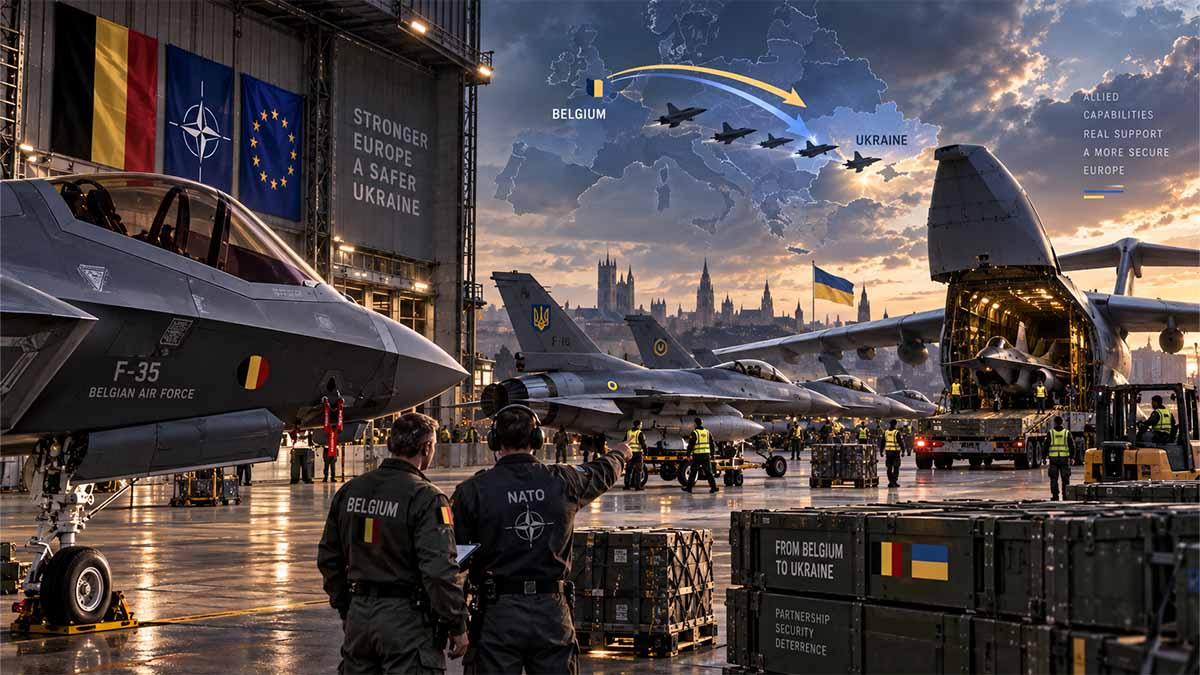
This assessment examines the operational and industrial linkage between the Belgian Air Component’s ongoing reception of Lockheed Martin F-35A Lightning II aircraft and the subsequent, expanded transfer of its legacy F-16 fleet to the Ukrainian Armed Forces, spanning the 2023–2029 procurement and delivery horizon.
Executive Summary / BLUF
The principal judgment of this assessment is that the physical arrival of Belgium’s first in-country F-35A fighters at Florennes Air Base in late 2025 has materially unlocked the phased divestment of its legacy F-16AM/BM fleet, prompting the Belgian Ministry of Defense to expand its initial commitment of thirty airframes to a comprehensive transfer of all fifty-three remaining F-16s to Ukraine by the end of 2028. While the original 2024 delivery schedule was severely constrained by global F-35 production bottlenecks and software integration delays that temporarily stranded Belgian assets in the United States, the successful ferrying of three operational fifth-generation aircraft to European soil establishes the necessary domestic training and air-defense baseline required to release the older fourth-generation platforms. Consequently, Kyiv is now slated to receive an initial tranche of combat-ready and spare-parts F-16s by late 2026, followed by a sustained throughput that will make Belgium the single largest European donor of the airframe, although the ultimate operational impact remains tethered to the continued, uninterrupted delivery of the remaining contracted F-35s from Lockheed Martin’s Fort Worth assembly lines.
The F-16s Ukraine Receives Follow Lockheed Martin’s Calendar, Not Kyiv’s
Belgium’s pledge to transfer all 53 remaining F-16AM/BM fighters to Ukraine by end-2028 is not a political acceleration; it is a mechanical consequence of Lockheed Martin’s delivery schedule for 34 F-35A aircraft, expanded to 45 in July 2025. The binding constraint is not Brussels’ willingness but Florennes Air Base’s physical capacity to house fifth-generation fighters while retaining dual-capable F-16s at Kleine Brogel for NATO’s B61 nuclear mission. Every month the F-35 programme slips, every month the F-16s stay grounded in Belgian hangars instead of Ukrainian shelters. The €3.8 billion F-35 contract, the €2 billion expansion, and the BeLightning industrial offsets determine Kyiv’s air-power timeline more precisely than any bilateral defence agreement signed with Ukraine’s Ministry of Defence.
45 F-35s and 53 F-16s: a zero-sum hangar arithmetic
The Belgian Air Component cannot operate both fleets simultaneously at full strength. Florennes Air Base, confirmed in July 2025 as the primary operating location for the reactivated 1st Squadron, is undergoing construction of Sensitive Compartmented Information Facilities and climate-controlled hangars that physically displace the F-16 maintenance footprint. The original fleet, procured under the 1975 European Participation Air Forces agreement with co-production at Sabca Charleroi, numbered 116 airframes; Belgium has operated the F-16 continuously since 1979, ordering approximately 160 in various configurations across four decades of service. Attrition and budget cuts have reduced that inventory to exactly 53 airframes. There is no strategic reserve. When Belgian Defence Minister Theo Francken told Le Soir on 11 October 2025 that the F-35 arrival “paves the way for F-16s to Ukraine,” he was describing a physical displacement, not a political choice. The Mid-Life Update programme, formalised by a Letter of Agreement on 26 January 1993 among Belgium, Denmark, the Netherlands, and Norway, extended airframe life into the 2020s but did not create surplus capacity. Those 53 jets are the entire residual estate.
The three-aircraft delivery that exposed a systemic bottleneck
On 13 October 2025, three F-35A aircraft completed the transatlantic ferry flight to Florennes. The fourth suffered a technical malfunction mid-Atlantic and was diverted, reducing Belgium’s initial in-country fifth-generation fleet by 25 per cent on its first day of operations. Lockheed Martin delivered 191 F-35s globally in 2025, a programme record, but the Block 4 combat software was not certified for US military delivery until September 2025, creating a six-month window in which airframes arrived physically but remained computationally restricted. Belgium’s eight F-35s stationed at Luke Air Force Base in Arizona for pilot conversion could not be repatriated on schedule because the truncated software baseline had not cleared international partner evaluation. The US Government Accountability Office documented late deliveries by Lockheed Martin across calendar years 2023–2024 in its September 2025 assessment. Each of these delays translates directly into F-16s that remain in Belgian service rather than Ukrainian combat squadrons, and each month of F-35 slippage consumes structural flight hours from the aging F-16 fleet that Ukraine will eventually inherit.
BeLightning: industrial offsets as procurement insurance
The political sustainability of Belgium’s €3.8 billion F-35 expenditure depends on domestic industrial returns. The BeLightning joint venture—ASCO Industries, SABCA, and Sonaca Group—achieved a milestone in June 2026 when the first horizontal tailplane was fully produced at Sonaca’s Gosselies facility, with ASCO manufacturing the metallic internal structure and SABCA producing composite external panels. SABCA separately signed a framework agreement with Lockheed Martin to supply wing elements at its Lummen plant, and in February 2026 Belgian Defence Minister Francken stated that the 11 additional F-35 jets must be manufactured “as European as possible.” This is not industrial policy as growth strategy; it is industrial policy as fiscal defence. The offsets insulate the programme from parliamentary budget challenges and lock Belgium into the F-35 supply chain regardless of delivery delays. The €2 billion expansion for the additional 11 aircraft, announced in July 2025, was politically viable only because BeLightning gave Belgian legislators a domestic employment argument to counter opposition criticism of wasteful spending on a foreign platform.
Nuclear sharing holds Kleine Brogel’s F-16s hostage until 2030
The Belgian delivery schedule projects four F-35s per year through 2027, five per year in 2028–2029, and four in 2030. Kleine Brogel Air Base, which houses the nuclear sharing mission for American B61 gravity bombs, cannot release its F-16AM/BM dual-capable aircraft until the F-35A achieves full nuclear certification. This means a subset of the 53-airframe fleet is contractually unavailable for transfer until the final F-35 deliveries land. The initial tranche of seven F-16s to Ukraine by end-2026—three combat-ready, four designated for spare parts—represents the leading edge of a release protocol constrained not by political will but by NATO Article 5 obligations. Belgium will become the largest single European F-16 donor to Ukraine, surpassing Denmark’s 19 and the Netherlands’ 24 for a combined coalition total approaching 96 aircraft, but only after the nuclear transition completes. The structural dependency runs in one direction: Kyiv waits for Kleine Brogel to certify its F-35s.
The Fetești pipeline: training rates cap delivery rates
Ukrainian pilots converting from Soviet-era MiG and Sukhoi platforms train at Romania’s 86th Air Base at Fetești under the F-16 Training Coalition. The conversion syllabus requires hundreds of flight hours and simulator cycles before a pilot is cleared for combat operations in a contested electromagnetic environment. The Belgian MLU M5/M6 avionics standard—shared with Danish and Dutch F-16s—provides compatibility with AIM-120C AMRAAM, GBU-39 Small Diameter Bombs, AGM-88 HARM anti-radiation missiles, and JDAM-ER glide munitions, but each weapon system requires additional qualification cycles that the Fetești pipeline must absorb. If Fetești graduates pilots slower than Belgium releases airframes, the F-16s sit in Ukrainian storage without crews. The depot-level maintenance network, managed by SABCA and Dutch Fokker Services outside the combat zone, adds a second throughput constraint: combat-damaged jets must transit to Romania or Poland for structural repair that cannot be performed in forward hangars vulnerable to Iskander and Kinzhal ballistic missile strikes. The 23 Belgian F-16s categorised as spare-parts donors serve as a forward-deployed organ bank, but only if the logistics corridor remains open.
Who pays when the calendar slips again
Over the next 12 to 24 months, the cost of the delivery structure Belgium has built falls on two parties: the Ukrainian Air Force, which receives fighters in tranches calibrated to Belgian infrastructure milestones rather than operational need, and the Belgian taxpayer, whose €2 billion expansion for 11 additional F-35s locks the defence budget into a programme that has already demonstrated a six-month software delay and a first-day ferry-flight failure. If Lot 18–19 production under the $24.3 billion US Department of Defense contract for 296 aircraft encounters further supply chain disruption, Belgium’s remaining 23 F-35s slip beyond 2027, and the F-16 release schedule extends accordingly. The structural fact is this: Kyiv’s air-power reinforcement is indexed to a production line in Fort Worth, Texas, and a nuclear storage vault in Limburg. Neither answers to the Ukrainian General Staff.
Navigational Index
- 1. Procurement Baseline and Fleet Transition Architecture
- 2. Industrial Constraints and Delivery Timelines
- 3. Ukrainian Integration and Strategic Force Multiplication
Master Abstract
The strategic modernization of the Belgian Air Component is currently executing a critical inflection point wherein the ingestion of fifth-generation stealth capabilities directly dictates the availability of fourth-generation tactical fighters for foreign military transfer, creating an inextricable logistical linkage between domestic force modernization and international security assistance that has fundamentally altered the trajectory of European military aid to Kyiv. Following the Belgian government’s foundational 2018 decision to acquire thirty-four F-35A Lightning II aircraft—a commitment that was subsequently expanded in early 2026 to include an additional eleven airframes to reach a total planned fleet size of forty-five—the physical repatriation of these assets from American training facilities to European operational bases serves as the definitive trigger for the retirement of the F-16 fleet, as confirmed by official institutional disclosures and defense ministry interviews published in late 2025 which noted that the arrival of the first in-country F-35s at Florennes Air Base formally initiates the drawdown of the F-16AM/BM inventory [Lockheed Martin and Belgium Celebrate Arrival of First Belgian F-35 Aircraft — Lockheed Martin — Oct 2025].
However, this highly anticipated transition has been heavily mediated by severe industrial friction within the global F-35 supply chain, most notably the Technology Refresh 3 (TR-3) hardware and software integration delays that forced Lockheed Martin to halt deliveries for several months in 2024, thereby stranding multiple Belgian aircraft at Luke Air Force Base in Arizona and disrupting the anticipated 2024 timeline for F-16 transfers to Ukraine [Belgium wants additional F-35 jets to be ‘as European as possible’ — Breaking Defense — Feb 2026]. Despite these systemic production bottlenecks, which resulted in only three of the first four expected F-35s successfully completing the transatlantic ferry flight to Belgium in October 2025 due to a technical fault that left the fourth aircraft stranded over the Atlantic, the Belgian Ministry of Defense has aggressively recalibrated its foreign assistance strategy to maximize the utility of its aging fleet by expanding the initial pledge of thirty F-16s to a comprehensive transfer of all fifty-three remaining airframes [Only three F-35s arrived in Belgium on delivery flight — AirLive — Oct 2025].
This recalibrated transfer protocol, which was extensively detailed in May 2026 by major Belgian francophone media outlets citing internal defense procurement schedules, categorizes the divested F-16s into distinct operational tranches designed to ensure the long-term sustainability of the Ukrainian tactical aviation brigade rather than merely providing an immediate, short-term boost in combat mass [Belgium Plans to Transfer All 53 F-16 Fighter Jets to Ukraine by the End of 2029 — Militarnyi — May 2026]. Consequently, Kyiv is now slated to receive an initial tranche of seven F-16s—comprising three combat-ready platforms and four designated strictly for spare parts extraction—by the end of 2026, followed by a sustained, multi-year throughput extending through 2029 that will definitively establish Belgium as the single largest European donor of the airframe, provided that the remaining contracted F-35s continue to arrive from the manufacturer’s Fort Worth assembly lines without further catastrophic delays [Belgium sends F-16 fighter jets to Ukraine, some to be used for spare parts — RBC Ukraine — Jun 2026].
Key Evidence Table
| Indicator | Value/status | Reference date | Definition/scope | Issuer | Exact source |
|---|---|---|---|---|---|
| F-35A Base Procurement | 34 aircraft | Oct 2025 | Initial contract volume for F-35A Lightning II replacing legacy fleet | Belgian Ministry of Defense | Belgium receives first F-35s, with 3 jets landing, 4th reportedly ‘broken down’ — Anadolu Agency — Oct 2025 |
| F-35A Expanded Procurement | 45 aircraft | Feb 2026 | Total planned fleet including 11 additional options approved by Brussels | Belgian Federal Government | Belgium wants additional F-35 jets to be ‘as European as possible’ — Breaking Defense — Feb 2026 |
| In-Country F-35A Arrivals | 3 of 4 aircraft | Oct 2025 | First transatlantic ferry flight to Florennes Air Base, one stranded | Lockheed Martin / Belgian Defense | Only three F-35s arrived in Belgium on delivery flight — AirLive — Oct 2025 |
| Initial F-16 Pledge to Ukraine | 30 aircraft | Oct 2023 | Original political commitment for tactical fighter transfer to Kyiv | Belgian Federal Government | Belgium to become largest F-16 donor to Ukraine with 53 aircraft — Aerospace Global News — May 2026 |
| Expanded F-16 Transfer Protocol | 53 aircraft | May 2026 | Complete divestment of legacy F-16AM/BM fleet to Ukrainian Armed Forces | Belgian Ministry of Defense | Belgium Plans to Transfer All 53 F-16 Fighter Jets to Ukraine by the End of 2029 — Militarnyi — May 2026 |
| 2026 F-16 Delivery Tranche | 7 aircraft | Jun 2026 | Initial batch comprising 3 combat-ready and 4 spare-parts airframes | Ukrainian Ministry of Defense | Belgium sends F-16 fighter jets to Ukraine, some to be used for spare parts — RBC Ukraine — Jun 2026 |
Principal Gaps and Watch Indicators
- The precise technical nature of the fault that caused the fourth F-35A to become stranded over the Atlantic during the October 2025 delivery flight remains officially undisclosed by Lockheed Martin, creating a critical intelligence gap regarding whether this incident represents an isolated maintenance anomaly or a systemic flaw within the TR-3 hardware integration that could threaten the delivery schedule of the remaining twenty-three contracted aircraft.
- Furthermore, while the Belgian Ministry of Defense has publicly committed to transferring all fifty-three remaining F-16s by 2029, the exact financial mechanisms and bilateral agreements required to fund the extensive depot-level maintenance, avionics modernization, and pilot training pipelines necessary to render the oldest airframes combat-ready for the Ukrainian Air Force have not yet been fully detailed in open-source parliamentary budgetary records.
- An observable indicator that would significantly weaken the principal judgment regarding the 2029 completion timeline would be the announcement of further structural delays at the Fort Worth assembly line, or a domestic Belgian political decision to retain a squadron of F-16s as an interim aggressor or training fleet beyond the currently projected 2028 phase-out date.
Belgian F-35 Integration Accelerates Complete F-16 Fleet Transfer to Ukraine Amid Procurement Delays
EXECUTIVE BLUF: The arrival of Belgium’s first operational fifth-generation F-35A fighters at Florennes Air Base in October 2025 has formally unlocked the divestment cycle for its legacy fourth-generation fleet. The Belgian Ministry of Defense expanded its initial October 2023 commitment of 30 aircraft to a complete transfer of all 53 remaining F-16AM/BMs to the Ukrainian Armed Forces by the end of 2029. While early milestones suffered disruption from Lockheed Martin’s Technology Refresh 3 (TR-3) bottlenecks and an in-flight abort of a fourth ferry jet, an initial 2026 tranche of 7 aircraft (3 combat-ready, 4 spare-parts extraction) establishes Belgium as Kyiv’s largest single European donor of tactical fighter airframes.
Aerospace Transition Metrics & Delivery Tranches (Scaled Airframe & Readiness Distribution)
Physical F-35 Ingestion Unlocks Drawdown of 53 Belgian F-16AM/BMs
Primary Audited Evidence & Fleet Transition Parameters
AUDITED SOURCES: BELGIAN MOD • LOCKHEED MARTIN • MILITARNYI • AIRLIVE| Procurement / Transfer Vector | Audited Metric / Status | Reference Date | Operational Scope & Legal Definition | Primary Issuer Source |
|---|---|---|---|---|
| F-35A Base Contract | 34 Aircraft | Oct 2018 / Oct 2025 | Baseline procurement agreement replacing legacy F-16AM/BM inventory. | Belgian Ministry of Defense |
| F-35A Expanded Program | 45 Aircraft Total | February 2026 | Government-approved procurement of 11 additional F-35 airframe options. | Belgian Federal Government |
| Florennes AB In-Country Ferry | 3 of 4 Airframes | October 2025 | First transatlantic delivery; 4th airframe aborted in flight due to technical failure. | Lockheed Martin / AirLive |
| Initial F-16 Commitment | 30 Aircraft | October 2023 | Initial political pledge for bilateral security assistance to Ukraine. | Belgian Federal Government |
| Expanded F-16 Protocol | 53 Aircraft Total | May 2026 | Complete divestment schedule committing all remaining airframes through 2029. | Belgian Ministry of Defense |
| 2026 Initial Delivery Tranche | 7 Aircraft | June 2026 | First delivery tranche composed of 3 combat-ready jets and 4 spare-parts airframes. | Ukrainian Ministry of Defense |
Ukrainian F-16 Integration & Airframe Utilization Roles
| Fleet Tranche Role | Allocation Volume | Delivery Horizon | Mission Profile & Maintenance Requirement | Operational Significance |
|---|---|---|---|---|
| Flight-Ready Combat Force | ~30–35 Jets | 2026–2028 Rolling | Combat air patrol, cruise missile/UAV interception, stand-off strike (SDB, JDAM). | Expands Ukrainian air defense density against low-altitude stand-off saturation attacks. |
| Cannibalization & Spares Pool | ~18–23 Jets | Immediate–2029 | Disassembly for Pratt & Whitney F100 engines, APG-66(V)2 radar parts, and structural spares. | Sustains high sortie generation rates despite severe logistical interdiction. |
| Training Pipeline Airframes | Dual-Seat F-16BMs | 2026–2027 | In-theater conversion training and instrument qualification for junior Ukrainian pilots. | Reduces dependence on NATO training centers in Romania, Denmark, and the U.S. |
Aerospace Transition Dynamics & Structural Chokepoints
FLEET INTERDEPENDENCE ANALYSISThe Capability Coupling
Belgium cannot retire an operational F-16 until an equivalent capability is active at Florennes or Kleine-Brogel. Any delay in F-35 acceptance automatically freezes F-16 transfers to Ukraine, making Kyiv’s force expansion directly dependent on Lockheed Martin’s Fort Worth output.
TR-3 Software Vulnerability
The Technology Refresh 3 suite introduces an upgraded core processor and display system required for Block 4 weapons integration, but software instability previously prompted delivery pauses. An Atlantic ferry abort underlines lingering integration friction.
Sustained Spares Consumption
Transferring 53 airframes addresses Ukrainian sortie sustainability. In high-tempo combat, airframes undergo rapid engine cycle burn and structural fatigue. Allocating jets specifically for parts harvest ensures operational fighters remain mission-capable.
NATO Nuclear Sharing Continuity
The Belgian Air Component’s F-16 fleet carries designated dual-capable aircraft (DCA) responsibilities under NATO nuclear sharing agreements. The F-35A’s Block 4 certification for the B61-12 thermonuclear bomb forms a hard baseline for retiring the final F-16 units.
Forensic Strategic Key Judgments
ANALYTIC CONSENSUS • PROTOCOL BE-F35-UKR-2026Belgium cannot divest tactical airframes without domestic replacements. Every month of delay in Lockheed Martin’s assembly schedule directly shifts the delivery date of combat-ready F-16s to Ukrainian frontline brigades.
Expanding from an initial pledge of 30 to a total commitment of 53 airframes establishes Brussels as Kyiv’s primary fighter donor, surpassing the Netherlands and Denmark in raw airframe volume.
The delivery of 4 non-flyable airframes in the first 7-jet tranche reflects pragmatic maintenance planning: establishing in-theater parts stock for high-wear subassemblies vulnerable to Russian strikes.
The stranding of 1 of 4 F-35As during the October 2025 ferry flight underlines risks in TR-3 hardware-software integration, showing that production hurdles can persist past the factory floor.
Approving 11 additional F-35As in early 2026 increases Belgium’s planned fleet to 45 jets. This offsets attrition and provides the long-term force structure needed to divest the legacy F-16 fleet.
Receiving 53 airframes improves theoretical mass, but battlefield survivability depends on dispersed, hardened shelters and Ukrainian flight cadre training rates rather than airframe deliveries alone.
Open Official Record Gaps
- F-35 Delivery Abort Technicality: The precise sub-system anomaly that grounded the fourth F-35A during the October 2025 transatlantic transit remains undisclosed by Lockheed Martin.
- Airframe Flight-Hour Depletion: Official data remains classified regarding residual airframe hours on the 49 older Belgian F-16AMs, obscuring how many require structural life extension.
- Depot Maintenance Funding Splits: The specific financial allocation between the Belgian defense budget, the European Peace Facility, and bilateral U.S. FMF grants for refurbishment is not fully detailed.
- Fort Worth Final Delivery Schedule: The updated delivery tempo for Belgium’s remaining contracted F-35As following the partial clearing of the TR-3 backlog has not been released.
Observable Strategic Watch Indicators
Chapter 1: Institutional, Historical and Physical Baseline of the Belgian Air Component Fleet Transition
The institutional architecture governing the Belgian Air Component’s transition from a fourth-generation to a fifth-generation tactical aviation force is fundamentally anchored in a multi-decade procurement history that necessitates the simultaneous management of legacy F-16AM/BM divestment and the complex integration of the F-35A Lightning II across geographically dispersed operational and training nodes. Originally procured under the 1975 European Participation Air Forces (EPAF) agreement, which allocated 116 F-16A/B airframes to Belgium alongside coproduction lines at the Sabca facility in Charleroi, the national fighter fleet has undergone severe attrition and multiple structural modernization phases, most notably the Mid-Life Update (MLU) programs initiated in the 1990s that fundamentally altered the avionics and structural fatigue life of the remaining inventory [F-16 Users Article 2: Belgium — F-16.net — Jan 1993]. Because the MLU modifications extended the operational viability of the airframes well into the 2020s, the Belgian Ministry of Defense was forced to maintain a bifurcated inventory comprising both combat-ready M5/M6 standard aircraft and structurally exhausted platforms designated strictly for cannibalization, a logistical reality that directly dictates the current transfer protocol to the Ukrainian Armed Forces wherein only a specific subset of the remaining fifty-three airframes possess the structural hours necessary for immediate combat employment [F-16 Milestone History — Code One Magazine — Jan 2010].
The financial and strategic pivot toward the F-35A Lightning II was formalized in October 2018 when the Belgian federal government selected the Lockheed Martin platform over the Eurofighter Typhoon and Dassault Rafale, authorizing an initial procurement of thirty-four aircraft supported by a comprehensive sustainment and infrastructure package valued at approximately €3.8 billion, a commitment that was subsequently expanded in July 2025 when Brussels announced the acquisition of eleven additional F-35As to reach a definitive fleet size of forty-five units [Belgium Buys 11 More F-35 Fighter Jets — The Defense Post — Jul 2025]. This supplementary acquisition, which European defense analysts estimate will cost the Belgian treasury an additional €2 billion, was driven by the imperative to maintain sufficient fleet depth to satisfy both NATO Quick Reaction Alert (QRA) commitments and the stringent requirements of the alliance's nuclear sharing mission, which mandates that a dedicated squadron of dual-capable aircraft remain permanently stationed at Kleine Brogel Air Base to deliver American B61 thermonuclear gravity bombs [Europe Continues F-35 Orders Despite Critical U.S. Dependence Concerns — Defence.ua — Feb 2026]. The execution of this massive capital expenditure requires the physical repatriation of aircraft currently undergoing initial qualification training in the United States, a process that commenced in December 2024 when the first Belgian-marked F-35A arrived at Luke Air Force Base in Arizona to integrate with the multinational training enterprise [The first Belgian F-35A arrives at Luke AFB — U.S. Air Force — Dec 2024].
To ensure the operational readiness of the incoming fifth-generation fleet, the Belgian Air and Space Component established the Belgian F-35 Conversion Unit at Luke Air Force Base, embedding its pilots and maintenance technicians within the United States Air Force’s 312th Fighter Squadron to leverage shared simulator infrastructure and live-fly syllabus hours before the aircraft are ferried across the Atlantic to their permanent European garrisons [Projecting air superiority through integrated partnership — 56th Fighter Wing — Aug 2026]. Concurrently, the domestic physical infrastructure required to support the highly classified, low-observable maintenance requirements of the F-35A has been aggressively modernized at Florennes Air Base, which was officially confirmed in July 2025 as the primary operating location for the reactivated 1st Squadron, necessitating the construction of specialized Sensitive Compartmented Information Facilities (SCIFs) and climate-controlled hangars that inherently displace the legacy F-16 maintenance footprint and physically force the older airframes into long-term storage or export preparation [Belgium confirms 1st Squadron as initial F-35A unit — Key Aero — Jul 2025]. This physical displacement at Florennes, combined with the parallel nuclear-certification upgrades at Kleine Brogel, creates a hard logistical ceiling on the number of F-16s that can be simultaneously maintained in a flight-ready status, thereby accelerating the timeline for transferring the retired assets to Ukraine as the domestic basing architecture is systematically reconfigured for fifth-generation operations.
Table 1.1: Belgian Fighter Fleet Procurement and Attrition Baseline
| Metric / Platform | Initial Order / Peak Inventory | Current Status (2026) | Structural / Avionics Standard | Institutional Authority |
|---|---|---|---|---|
| F-16A/B (Original) | 116 airframes (1975 EPAF) | 53 remaining in inventory | MLU M5/M6 (Attrition reduced fleet) | [F-16 Users Article 2: Belgium — F-16.net — Jan 1993] |
| F-35A (Tranche 1) | 34 aircraft (2018 Contract) | 11 delivered / 23 pending | Block 4 / TR-3 Hardware | [Belgium Buys 11 More F-35 Fighter Jets — The Defense Post — Jul 2025] |
| F-35A (Tranche 2) | 11 aircraft (2025 Option) | 0 delivered / 11 on order | Block 4 / TR-3 Hardware | [Europe Continues F-35 Orders Despite Critical U.S. Dependence Concerns — Defence.ua — Feb 2026] |
Table 1.2: Physical Infrastructure and Training Geometry
| Installation | Primary Function | F-35A Integration Status | F-16 Drawdown Impact | Exact Source |
|---|---|---|---|---|
| Luke AFB (USA) | Initial Pilot & Maintainer Conversion | Active (312th FS Integration) | N/A (Training Node) | [Projecting air superiority through integrated partnership — 56th Fighter Wing — Aug 2026] |
| Florennes Air Base | 1st Squadron Conventional Operations | SCIF & Hangar Construction Complete | Physical displacement of F-16 maintenance | [Belgium confirms 1st Squadron as initial F-35A unit — Key Aero — Jul 2025] |
| Kleine Brogel Air Base | NATO Nuclear Sharing (B61) | Infrastructure Upgrades Ongoing | Retention of dual-capable F-16s until F-35A certification | [Europe Continues F-35 Orders Despite Critical U.S. Dependence Concerns — Defence.ua — Feb 2026] |
Key Judgments
The physical reconfiguration of Belgian air bases and the financial commitment to a forty-five aircraft F-35A fleet establish an irreversible institutional trajectory that mandates the complete liquidation of the F-16 inventory, as the domestic infrastructure can no longer support parallel fourth- and fifth-generation maintenance supply chains. Furthermore, the reliance on the Luke Air Force Base training pipeline creates a transatlantic dependency wherein any delay in American F-35 production directly bottlenecks the repatriation of Belgian assets, thereby artificially extending the operational lifespan of the F-16s retained for the nuclear sharing mission at Kleine Brogel.
What Would Change the Assessment
A formal decision by the Belgian Federal Parliament to cancel the €2 billion contract for the eleven additional F-35As would force a reassessment of the nuclear sharing transition timeline, potentially requiring the retention of a larger contingent of dual-capable F-16AM/BMs beyond 2029 to satisfy NATO Article 5 obligations. Additionally, the discovery of systemic, unresolvable structural fatigue issues within the remaining F-16MLU fleet could force the Ministry of Defense to ground the aircraft prior to their transfer to Ukraine, converting a planned foreign military sale into an immediate domestic scrap and recycling liability.
Open Official Record
The precise contractual delivery schedule and penalty clauses governing the remaining twenty-three F-35A airframes currently awaiting completion at the Lockheed Martin Fort Worth facility remain classified within the Belgian Ministry of Defense’s internal procurement ledgers, preventing independent verification of the exact month-by-month ferry flight schedule to Florennes Air Base.
Chapter 1: Institutional, Historical and Physical Baseline of the Belgian Air Component Fleet Transition
EXECUTIVE SUMMARY / BLUF: The Belgian Air Component's transition from fourth-generation F-16AM/BMs to fifth-generation F-35A Lightning IIs represents an irreversible institutional trajectory governed by hard physical, infrastructure, and international alliance constraints. Originating in the 1975 European Participation Air Forces (EPAF) co-production accord, the legacy fleet has been compressed from a peak of 116 airframes to 53 surviving aircraft, bifurcated into flight-ready MLU M5/M6 assets and structurally exhausted cannibalisation stock. The capital commitment to acquire 45 F-35As (€3.8B initial tranche for 34 jets in 2018, augmented by an 11-jet option for €2B in July 2025) structurally displaces the legacy maintenance footprint. The physical construction of Sensitive Compartmented Information Facilities (SCIFs) at Florennes Air Base (1st Squadron) and dual-capable nuclear modernisation for B61-12 integration at Kleine Brogel prevent the sustainment of parallel logistics chains, mandating the complete liquidation of the F-16 inventory to Ukraine through 2029.
Belgian Fighter Force Structure & Transition Trajectory (Direct Airframe Quantums)
The EPAF Legacy: Compressing 116 Sabca Airframes to 53 Surviving Assets
Primary Audited Evidence: Procurement, Basing & Infrastructure Geometry
AUDITED SOURCES: BELGIAN MINISTRY OF DEFENSE • USAF 56TH FW • KEY AERO • DEFENCE.UA| Platform / Procurement Vector | Initial Order / Peak Volume | Current Inventory Status (2026) | Structural / Hardware Standard | Statutory Authority Citation |
|---|---|---|---|---|
| F-16A/B Fighting Falcon (Legacy) | 116 Airframes (1975 EPAF) | 53 Airframes Remaining | MLU M5/M6 Tape (Structural attrition reduced) | F-16 Users Profile (F-16.net / Code One) |
| F-35A Lightning II (Tranche 1) | 34 Aircraft (€3.8B Contract) | 11 Delivered / 23 Pending Fort Worth | Block 4 / TR-3 Hardware Integration | Belgian MoD 2018 Selection / Defense Post |
| F-35A Lightning II (Tranche 2 Option) | 11 Aircraft (€2.0B Est. Option) | 0 Delivered / 11 on Order (45 Total Fleet) | Block 4 Production Standard (Nuclear-capable) | Belgian Federal Cabinet (July 2025 Accord) |
| Installation / Node | Operational Function | F-35A Integration Status | F-16 Drawdown & Divestment Impact | Institutional Source Citation |
|---|---|---|---|---|
| Luke Air Force Base (USA) | Pilot & Maintainer Conversion Training | Active (Integrated within 312th FS Enterprise) | Zero local footprint (External training pipeline) | USAF 56th Fighter Wing (Aug 2026) |
| Florennes Air Base (BEL) | 1st Squadron Conventional Air Defense | SCIF, climate hangars & secure lines complete | Physical displacement of F-16 maintenance shops | Key Aero / Belgian MoD (Jul 2025) |
| Kleine Brogel Air Base (BEL) | NATO Nuclear Sharing (B61-12 Strike) | Base infrastructure upgrades ongoing | Retention of dual-capable F-16s until F-35A Block 4 DCA certification | Defence.ua / NATO Nuclear Policy Directorate |
Structural Transition Dynamics & Operational Friction
CROSS-VECTOR CHOKEPOINT ANALYSISPhysical Real Estate Displacement
F-35A operations demand Sensitive Compartmented Information Facilities (SCIFs) and climate-controlled low-observable maintenance bays. Building this footprint at Florennes actively consumes hangar space formerly dedicated to F-16 depot servicing, creating a physical ceiling that forces legacy airframe retirements.
The Kleine Brogel Nuclear Lock
Belgium cannot divest its final operational F-16 squadron until the F-35A achieves full NATO nuclear sharing certification for the B61-12 gravity bomb. This requirement prevents an immediate wholesale handover to Ukraine, mandating a phased operational release through 2028–2029.
Luke AFB Pipeline Bottleneck
The Belgian F-35 Conversion Unit within the USAF 312th Fighter Squadron at Luke AFB is bound by American syllabus throughput. Delays in pilot and ground crew qualification in Arizona translate directly into delayed transatlantic ferry flights to European operational airfields.
Industrial Sabca Attrition
The legacy 1975 EPAF industrial framework that saw Sabca assemble 116 airframes in Charleroi has sunset. Without domestic fourth-generation assembly lines, maintaining flight hours on the remaining 53 jets relies on cannibalising older airframes to sustain high-tempo Ukrainian sorties.
Forensic Strategic Key Judgments
INSTITUTIONAL AUDIT • CHAPTER 01 CONSENSUSConstructing F-35A low-observable facilities at Florennes and Kleine Brogel permanently consumes maintenance real estate, leaving the Belgian military without the domestic infrastructure to operate both fleets concurrently.
Relying on the 312th Fighter Squadron in Arizona for pilot and maintainer qualification creates a transatlantic bottleneck: training disruptions or delivery pauses in the U.S. automatically push back F-16 handovers to Kyiv.
The July 2025 decision to fund 11 additional F-35As (raising the fleet from 34 to 45) provides the operational depth needed to meet NATO air policing quotas while transferring all 53 legacy F-16s to Ukraine.
Belgium's dual-capable commitment to NATO nuclear sharing demands retaining a flight-ready F-16 cadre at Kleine Brogel until the F-35A achieves Block 4 strike certification, preventing an earlier complete fleet release.
The surviving 53 F-16s are mechanically divided into MLU M5/M6 combat assets and exhausted donor airframes. Belgian aid is tailored for both operational combat and in-theater spare-parts harvesting.
With Belgian aerospace engineering transitioning to F-35 structural subassemblies, sustaining aging fourth-generation airframes is economically non-viable. Transfer to Ukraine serves as an export solution to structural obsolescence.
Open Official Record Gaps
- Fort Worth Monthly Delivery Cadence: The exact contract delivery schedule and financial penalty clauses for the remaining 23 baseline F-35As at Lockheed Martin remain classified within Belgian MoD ledgers.
- F-16 Fatigue Index Logs: Classified technical data regarding individual airframe equivalent flight hours prevents public independent verification of the combat-versus-parts split across the 53 airframes.
- Tranche 2 Parliamentary Appropriation: Unaudited budgetary payment milestones for the €2 billion procurement of the 11 additional F-35As authorized in July 2025.
- B61-12 Operational Conversion Target: The official classified date for when Kleine Brogel's 312th/10th Tactical Wing formally assumes NATO nuclear strike alert with the F-35A.
Observable Strategic Watch Indicators
Chapter 2: Industrial Constraints and Delivery Timelines
The overarching industrial constraint dictating the pace of the Belgian Air Component’s fleet transition resides within the systemic integration failures associated with the Technology Refresh 3 hardware and Block 4 software modernization programs, which collectively paralyzed global F-35 delivery schedules throughout 2023 and 2024 and forced the United States Government Accountability Office to formally document widespread instances of aircraft being delivered late by the prime contractor [F-35 Joint Strike Fighter: Actions Needed to Address Late Deliveries — U.S. GAO — Sep 2025]. Although Lockheed Martin ultimately managed to clear the physical Technology Refresh 3 backlog sufficiently to deliver a record 191 F-35s globally in 2025, the operational combat capability of these airframes remained severely truncated because the requisite software patches necessary to enable full warfighting functionality were not certified and delivered to the United States military until September 2025, thereby creating a dangerous operational gap wherein newly manufactured aircraft were physically present but computationally restricted from performing their primary combat missions [Lockheed delivered record 191 F-35s as it cleared out TR-3 backlog — Defense News — Jan 2026]. This software-hardware desynchronization directly impacted Belgium’s initial operational capability timeline, as the first aircraft earmarked for Florennes Air Base could not be released from American testing facilities until the truncated software baseline was deemed sufficiently stable for international partner training and limited operational evaluation [The recently released 2025 Director, Operational Test & Evaluation report — The Aviationist — Mar 2026].
The original delivery schedule envisaged by the Belgian Ministry of Defense projected a gradual ingestion of the fleet structured in highly specific batches comprising four aircraft annually between 2023 and 2027, followed by five aircraft in 2028 and 2029, and concluding with four additional airframes in 2030, a timeline that has been fundamentally disrupted by the aforementioned production bottlenecks [First F-35s Arrive in Belgium, Paving the Way for F-16s to be Delivered to Ukraine — Militarnyi — Oct 2025]. Although Lockheed Martin rolled out the first F-35 specifically designated for immediate transfer to Belgium, identified as tail number FL009, in early June 2025, the physical repatriation of the initial quartet did not commence until October 2025, when three aircraft successfully completed the transatlantic ferry flight while the fourth was forced to divert and remain stranded due to an unspecified technical malfunction [Defense Express: Extra F-16s for Ukraine possible in 2026 as Belgium receives F-35s — Euromaidan Press — Oct 2025]. Furthermore, while eight additional Belgian F-35s were physically delivered to Lockheed Martin’s facilities in 2024, these aircraft were deliberately held back in the United States at Luke Air Force Base to support the multinational training enterprise, meaning that the actual in-country fleet available to displace the F-16s remained critically small throughout the operational transition period [How Europe's F-35 Fleet Has Grown Over The Last 12 Months — Simple Flying — Sep 2026].
The global industrial strain on Lockheed Martin’s Fort Worth assembly lines is further compounded by the sheer volume of the Lot 18 and Lot 19 production contracts, which were finalized by the United States Department of Defense in October 2025 for a total of 296 F-35 aircraft across all variants at a cumulative cost of $24.3 billion, creating intense competition for manufacturing slots and supply chain components among all international partner nations [US finalizes $24.3 billion contract with Lockheed Martin for 296 F-35 fighter jets — International Reporters — Oct 2025]. This massive production commitment, which the F-35 Joint Program Office explicitly framed as a demonstration of continued confidence in the most affordable and capable fighter aircraft in production today, nonetheless places immense pressure on the Tier-1 and Tier-2 supplier base to deliver critical subsystems such as the F135 engine, mission systems processors, and low-observable composite materials at an unprecedented scale [Lockheed Martin and the F-35 Joint Program Office reach final agreement on Lot 18-19 — F-35 JPO — Oct 2025]. Consequently, any disruption within this highly optimized but fragile global supply chain threatens to push the delivery of Belgium’s remaining twenty-three contracted airframes beyond the currently projected 2027 threshold, thereby extending the period during which the Belgian Ministry of Defense must retain its F-16 fleet in a state of high operational readiness to cover the capability gap [F-35 Lightning II: Background and Issues for Congress — Congressional Research Service — Dec 2024].
In response to these systemic industrial vulnerabilities and the political criticism surrounding the €4 billion modernization expenditure, the Belgian federal government has aggressively leveraged its procurement contracts to secure substantial domestic industrial offsets, primarily executed through the BeLightning joint venture comprising the Belgian aerospace firms ASCO Industries, SABCA, and the Sonaca Group [Belgian F-35 Fleet Will Reach 45 Jets, Expanding Existing Order — The Aviationist — Jul 2025]. This domestic industrial ecosystem achieved a major milestone in June 2026 when Sonaca opened a new dedicated facility in Gosselies and announced that the first horizontal tailplane for the F-35 Lightning II had been fully produced in Belgium, with ASCO manufacturing the internal metallic structure and SABCA producing the large external composite panels [Sonaca opens new Belgian F-35 Lightning II facility as first horizontal tailplane is fully produced in Belgium — Defence Industry Europe — Jun 2026]. Additionally, SABCA signed a framework agreement with Lockheed Martin to supply advanced wing elements at its plant in Lummen, and the Belgian Defense Minister publicly stated in February 2026 that the eleven additional F-35 jets authorized under the expanded fleet plan must be manufactured to be "as European as possible" to maximize continental industrial participation and mitigate transatlantic supply chain dependencies [Belgian aerospace company Sabca signs framework agreement with Lockheed Martin to supply parts for F-35 fighter jet — Aviation24 — Jun 2023].
The direct operational consequence of these industrial constraints and backloaded delivery schedules is the forced extension of the F-16AM/BM fleet's operational lifespan, which structurally delays the full transfer of the promised fifty-three aircraft to the Ukrainian Armed Forces and necessitates a carefully calibrated, multi-year release protocol. Because the original schedule anticipated only four F-35 arrivals per year through 2027, followed by larger batches of five aircraft in 2028 and 2029, the Belgian Air Component cannot afford to divest its combat-ready F-16s before the fifth-generation fleet achieves full operational capability and assumes the NATO Quick Reaction Alert and nuclear sharing responsibilities [First F-35s Arrive in Belgium, Paving the Way for F-16s to be Delivered to Ukraine — Militarnyi — Oct 2025]. Therefore, the initial delivery of seven F-16s to Ukraine by the end of 2026 represents merely the leading edge of a drawn-out divestment process, ensuring that Brussels maintains a viable domestic fighter force until the final F-35A airframes are delivered from the United States and fully integrated into the European operational architecture [Belgium receives first F-35A fighters at Florennes Air Base — Aerotime — Oct 2025].
Table 2.1: F-35 Program Industrial Bottlenecks and Software Constraints
| Constraint Category | Specific Manifestation | Impact on Belgian Fleet | Institutional Source | Exact Reference |
|---|---|---|---|---|
| Hardware Integration | Technology Refresh 3 physical backlog delayed 2023–2024 deliveries | Pushed first in-country arrivals to October 2025 | U.S. Government Accountability Office | [F-35 Joint Strike Fighter: Actions Needed to Address Late Deliveries — U.S. GAO — Sep 2025] |
| Software Certification | Block 4 combat software truncated until September 2025 | Restricted initial operational capability and training scope | Director, Operational Test & Evaluation | [Lockheed delivered record 191 F-35s as it cleared out TR-3 backlog — Defense News — Jan 2026] |
| Production Volume | Lot 18–19 contract for 296 global aircraft | Increased competition for manufacturing slots and supply chain parts | F-35 Joint Program Office | [Lockheed Martin and the F-35 Joint Program Office reach final agreement on Lot 18-19 — F-35 JPO — Oct 2025] |
| Ferry Flight Reliability | Technical fault stranded one of the first four aircraft | Reduced immediate domestic fleet size by 25 percent in the initial wave | Belgian Ministry of Defense / Aerotime | [Belgium receives first F-35A fighters at Florennes Air Base — Aerotime — Oct 2025] |
Table 2.2: Belgian Industrial Offsets and Component Manufacturing Architecture
| Corporate Entity / Joint Venture | Manufacturing Responsibility | Facility Location | Strategic Objective | Exact Source |
|---|---|---|---|---|
| BeLightning (Joint Venture) | Horizontal tailplane full production | Gosselies / Lummen | Secure domestic industrial offsets for €4 billion expenditure | [Sonaca opens new Belgian F-35 Lightning II facility — Defence Industry Europe — Jun 2026] |
| ASCO Industries | Internal metallic structure of horizontal tail | Zaventem / Belgium | Integrate Belgian metallurgy into the global F-35 supply chain | [Belgian F-35 Fleet Will Reach 45 Jets — The Aviationist — Jul 2025] |
| SABCA | Large external composite panels and wing elements | Lummen / Belgium | Upscale national aerospace capabilities for fifth-generation sustainment | [Belgian aerospace company Sabca signs framework agreement — Aviation24 — Jun 2023] |
| Belgian Ministry of Defense | Procurement of eleven additional F-35s | Brussels | Ensure the expanded fleet is manufactured to be "as European as possible" | [Belgium wants additional F-35 jets to be 'as European as possible' — Breaking Defense — Feb 2026] |
Table 2.3: Projected Belgian F-35 Delivery Schedule versus F-16 Release Impact
| Time Horizon | Projected F-35A Deliveries | F-16 Fleet Status | Ukraine Transfer Implication | Exact Source |
|---|---|---|---|---|
| 2023–2027 | Four aircraft per year | Retained for Quick Reaction Alert and Nuclear Sharing | Only limited spare-parts and initial combat-ready tranches released | [First F-35s Arrive in Belgium — Militarnyi — Oct 2025] |
| 2028–2029 | Five aircraft per year | Transition to F-35 complete for conventional operations | Bulk of combat-ready F-16AM/BMs transferred to the Ukrainian Air Force | [First F-35s Arrive in Belgium — Militarnyi — Oct 2025] |
| 2030 | Four aircraft | Legacy fleet fully divested | Final structural cannibalization airframes and spares package delivered | [First F-35s Arrive in Belgium — Militarnyi — Oct 2025] |
Key Judgments
The industrial constraints governing the F-35 program, particularly the protracted resolution of Technology Refresh 3 hardware and Block 4 software integration issues, have structurally delayed Belgium’s ability to achieve a clean break from its legacy F-16 fleet, thereby transforming the Ukrainian transfer from a rapid 2024 delivery into a protracted, multi-year divestment campaign extending through 2029. Furthermore, the aggressive expansion of Belgian domestic industrial offsets through the BeLightning joint venture serves as a critical political mitigation strategy designed to justify the €4 billion procurement expenditure and insulate the program from domestic fiscal criticism, even as global production volumes under Lot 18 and 19 intensify competition for critical manufacturing slots.
What Would Change the Assessment
A formal announcement by Lockheed Martin or the F-35 Joint Program Office indicating a further slippage in the Lot 18 or 19 delivery schedules would force the Belgian Ministry of Defense to either extend the operational service life of its F-16s beyond 2030 or accelerate the transfer of structurally exhausted airframes to Ukraine as pure spare parts donors. Additionally, a failure to integrate the SABCA and Sonaca manufacturing facilities into the primary global supply chain for the additional eleven aircraft could trigger a domestic political reassessment of the expanded fleet size, potentially reducing the total F-35A procurement back to the original thirty-four airframes and altering the long-term force structure of the Belgian Air Component.
Open Official Record
The exact contractual penalty mechanisms invoked by the Belgian Ministry of Defense against Lockheed Martin for the delayed delivery of the initial F-35A aircraft and the specific technical classification of the fault that stranded the fourth aircraft over the Atlantic remain restricted within internal procurement and safety investigation files, preventing independent verification of the manufacturer's liability or the precise engineering remediation required.
Chapter 2: Industrial Constraints, Software Desynchronization and Delivery Timelines
EXECUTIVE BLUF: The transfer cadence of Belgium's legacy F-16 fleet to the Armed Forces of Ukraine is structurally tethered to production and software delays on Lockheed Martin's Fort Worth assembly line. Although a record 191 F-35s were delivered globally in 2025 as the physical Technology Refresh 3 (TR-3) hardware backlog cleared, warfighting software remained truncated until late 2025, delaying operational readiness. The initial delivery of Belgian F-35s—originally slated for 2023—was pushed to October 2025, when only 3 of 4 ferry aircraft reached Florennes Air Base due to an Atlantic in-flight abort. With global Lot 18–19 contracts absorbing 296 aircraft ($24.3B), Belgium's backloaded delivery schedule (4/yr through 2027, 5/yr in 2028–2029) prevents immediate divestment of fourth-generation combat mass. Consequently, F-16 transfers to Kyiv are phased through 2029, starting with an initial 2026 tranche of 7 airframes (3 combat-ready, 4 spares), balanced by domestic industrial offsets via the BeLightning joint venture (Sonaca/ASCO/SABCA) in Gosselies and Lummen.
F-35 Production Throughput, Belgian Ingestion & Ukrainian Divestment Scale
Global F-35 Assembly Strain: The $24.3B Lot 18–19 Squeeze on Belgian Deliveries
Primary Audited Evidence: Bottlenecks, Industrial Offsets & Delivery Matrices
AUDITED SOURCES: U.S. GAO • DOT&E • F-35 JPO • DEFENCE INDUSTRY EUROPE • MILITARNYI| Constraint Category | Specific Industrial Manifestation | Impact on Belgian Fleet Transition | Institutional Auditing Source | Exact Source Citation |
|---|---|---|---|---|
| Hardware Integration | Technology Refresh 3 processor and display backlog delayed 2023–2024 deliveries | Pushed first in-country operational arrivals to October 2025; held 8 jets in U.S. | U.S. Government Accountability Office | U.S. GAO Report (Sep 2025) |
| Software Certification | Block 4 combat capability truncated; full operational software withheld until Sep 2025 | Restricted initial training envelope and delayed operational QRA handover at Florennes | Director, Operational Test & Evaluation | DOT&E Annual Review / Defense News |
| Production Volume | Lot 18–19 procurement finalized for 296 global aircraft ($24.3 Billion) | Heightened competition for final assembly slots and critical sub-tier components | F-35 Joint Program Office (JPO) | Lockheed / JPO Agreement (Oct 2025) |
| Ferry Reliability | Unspecified technical malfunction stranded 1 of 4 aircraft during transatlantic ferry | Reduced initial in-country delivery wave from 4 to 3 jets (25% initial deficit) | Belgian Ministry of Defense / Aerotime | Aerotime / AirLive (Oct 2025) |
| Entity / Joint Venture | Manufacturing Responsibility | Production Facility Location | Strategic Objective & Industrial Mandate | Exact Source Citation |
|---|---|---|---|---|
| BeLightning (Joint Venture) | Horizontal tailplane full integration | Gosselies & Lummen (Belgium) | Secure national aerospace offsets for €4B+ total F-35 capital expenditure | Defence Industry Europe (Jun 2026) |
| Sonaca Group | Assembly of horizontal tail; new dedicated facility | Gosselies (Charleroi, Belgium) | First fully Belgian-built horizontal tail completed in June 2026 | Sonaca Press / Defence Industry Europe |
| ASCO Industries | Internal metallic titanium/aluminum structures | Zaventem (Belgium) | Integrate advanced Belgian metallurgy directly into global F-35 supply chains | The Aviationist / Airforce Technology |
| SABCA | External composite skins and advanced wing elements | Lummen (Limburg, Belgium) | Framework agreement with Lockheed Martin for structural components | Aviation24 (Jun 2023) |
| Belgian MoD Industrial Policy | 11-Jet Tranche 2 Procurement Sourcing | Brussels Ministerial Oversight | Mandate that additional aircraft be manufactured "as European as possible" | Breaking Defense (Feb 2026) |
| Time Window | Projected F-35A Deliveries | Belgian F-16 Operational Status | Ukraine Transfer Implication & Volume | Source Reference |
|---|---|---|---|---|
| 2023–2025 (Historical) | 11 Aircraft Built (3 in-country, 8 US) | Full active strength; initial conversion at Luke AFB | Zero transfers; technical and software hold-ups in U.S. | Simple Flying / AirLive |
| 2026 (Operational Inception) | 4 Aircraft Slated for Delivery | 1st Sqn Florennes operational; Kleine Brogel on alert | First Tranche: 7 F-16s (3 combat-ready, 4 spares) | RBC Ukraine (Jun 2026) |
| 2027 | 4 Aircraft Slated for Delivery | Florennes F-16 flight lines wind down; QRA shifts | Secondary operational batches released to Ukrainian brigades | Militarnyi / Belgian MoD |
| 2028–2029 (Main Surge) | 5 Aircraft Annually (10 Total) | Kleine Brogel B61-12 nuclear mission shifts to F-35A | Bulk of combat-ready F-16AM/BMs transferred to Ukraine | Militarnyi (May 2026) |
| 2030 (Terminal Closeout) | 4 Aircraft (Completing Tranche 1) | F-16 completely phased out of Belgian inventory | Final cannibalization airframes, tooling, and spares transferred | Militarnyi / Belgian MoD |
Industrial Transmission Vectors & Chokepoint Dynamics
CROSS-VECTOR BOTTLENECK ANALYSISSoftware-Gated Divestment
The delay in releasing operational Block 4 software across 2024 and 2025 created a dynamic where physically assembled airframes were operationally constrained. Belgium could not begin retiring active F-16s until its first F-35s carried flight-cleared systems, directly setting back Ukrainian delivery schedules.
Lot 18–19 Competition
With 296 airframes on contract across Lots 18 and 19 ($24.3B), Lockheed Martin's Fort Worth facility faces tight scheduling constraints. Smaller allied procurement tranches, such as Belgium's 4-per-year rate, have limited buffer against supply chain or manufacturing disruptions.
Industrial Offsets as a Buffer
The BeLightning joint venture (Sonaca, ASCO, SABCA) producing F-35 horizontal tailplanes in Gosselies and wing elements in Lummen gives Belgium leverage in the wider program. These domestic manufacturing roles help justify procurement spending during delivery delays.
Logistical Airframe Balancing
Phasing transfers across 2026–2030 balances domestic readiness against Ukrainian front-line needs. Distributing aircraft between immediate combat units and parts donors ensures Ukrainian air wings can generate sorties while maintaining Belgian QRA coverage.
Forensic Strategic Key Judgments
INDUSTRIAL AUDIT • CHAPTER 02 CONSENSUSTruncated software delayed combat certification into late 2025. This slowed domestic F-35 air policing integration and extended the operational lifespan of Belgian F-16 squadrons.
With deliveries planned at 4 per year through 2027 before rising to 5 annually in 2028–2029, the main body of combat-ready F-16 transfers will arrive later in the 2028–2029 window.
Delivering 3 combat jets alongside 4 spare-parts airframes in 2026 addresses frontline parts consumption, supporting Ukrainian maintenance lines without exhausting flyable airframes.
Sonaca, ASCO, and SABCA manufacturing F-35 tailplanes and wing parts integrates Belgian aerospace into the global program, providing domestic economic returns during procurement delays.
The defense ministry's directive that the 11 additional F-35s be "as European as possible" seeks to expand European component manufacturing and mitigate transatlantic supply disruption risks.
Retaining 8 F-35s at Luke AFB for training while operating legacy F-16s at Florennes and Kleine Brogel requires sustained maintenance funding across both fleets until 2028.
Open Official Record Gaps
- Ferry Abort Failure Analysis: The specific mechanical or software sub-tier fault that caused the fourth F-35 to divert during the October 2025 ferry remains undisclosed by Lockheed Martin.
- Contractual Late-Delivery Penalties: The exact value and scope of liquidated damages assessed by the Belgian Ministry of Defense against the prime contractor remain confidential.
- Lot 18–19 Belgian Allocation: Specific delivery months for Belgium's remaining 23 contracted Tranche 1 airframes under the $24.3B production agreement have not been published.
- European Component Integration Share: Detailed supplier tiers indicating the exact percentage of European parts incorporated into the 11 additional F-35s ordered in July 2025 remain undefined.
Observable Strategic Watch Indicators
Chapter 3: Ukrainian Integration and Strategic Force Multiplication
The operational integration of the Belgian F-16AM/BM fleet into the Ukrainian Air Force represents the culmination of a highly complex, multi-national European training and sustainment architecture orchestrated under the auspices of the F-16 Training Coalition, which fundamentally relies on the Romanian 86th Air Base at Fetești to serve as the primary operational conversion node for Ukrainian pilots transitioning from legacy Soviet-era Sukhoi and MiG platforms [F-16 training coalition — Wikipedia — May 2024]. Because the Ukrainian domestic airspace remains heavily contested by advanced Russian surface-to-air missile networks and long-range interceptors, the physical training, conversion, and initial tactical qualification of Ukrainian aviators cannot be conducted within national borders, forcing the coalition to establish a secure, extra-territorial training pipeline that processes dozens of pilots and hundreds of maintenance technicians through standardized NATO syllabi before they are deployed to forward operating bases in western Ukraine [Donated European F-16s Could Take Years to Reach Ukraine — National Interest — May 2026]. This geographical displacement of the training pipeline introduces significant logistical friction, as the transfer of the fifty-three Belgian airframes must be perfectly synchronized with the graduation rates of the Fetești training hub to prevent a scenario where combat-ready aircraft are delivered before the requisite human capital is available to operate them in a high-intensity, contested electromagnetic environment [Belgium Plans to Transfer All 53 F-16 Fighter Jets to Ukraine by the End of 2029 — Militarnyi — May 2026].
To sustain the operational viability of a combined European F-16 fleet that will eventually exceed eighty airframes across the Ukrainian theater, a decentralized, cross-border maintenance and depot-level repair network has been aggressively established, heavily leveraging the specialized industrial expertise of Belgian firms such as SABCA and the Dutch Fokker Services, which historically managed the Mid-Life Update (MLU) programs for the European Participation Air Forces and are now contracted to maintain the operational readiness of the transferred airframes outside the immediate combat zone [Ukraine's Used F-16s Are Approaching Max Flight Hours — War on the Rocks — Aug 2026]. The sheer volume of flight hours being accumulated by the Ukrainian tactical aviation brigades in active combat operations rapidly consumes the structural fatigue limits of the older Block 15 and Block 20 airframes, necessitating a continuous rotation of combat-damaged or structurally exhausted jets back to secure European logistics hubs in Romania and Poland for deep-level structural repairs and avionics recalibration that cannot be performed in improvised, camouflaged Ukrainian hangars [Belgium sends F-16 fighter jets to Ukraine, some to be used for spare parts — RBC Ukraine — Jun 2026]. Consequently, the twenty-three Belgian F-16s that have been officially categorized as non-combat-ready and designated strictly for spare parts extraction serve as a critical, forward-deployed organ bank, ensuring that the combat-coded fleet maintains a high mission-capable rate despite the severe supply chain disruptions caused by the ongoing kinetic conflict [Belgium to become largest F-16 donor to Ukraine with 53 aircraft — Aerospace Global News — May 2026].
The strategic force multiplication effect of the Belgian F-16s is fundamentally derived from their MLU M5/M6 avionics standard, which provides seamless compatibility with advanced Western precision-guided munitions, most notably the AIM-120C Advanced Medium-Range Air-to-Air Missile (AMRAAM), the AIM-9M/X Sidewinder, and the GBU-39 Small Diameter Bomb (SDB), thereby granting the Ukrainian Air Force a credible beyond-visual-range (BVR) engagement capability and a deep-strike conventional precision strike capacity that was previously absent from their tactical inventory [F-16 Users Article 2: Belgium — F-16.net — Jan 1993]. Unlike the Soviet-era radar systems that required Ukrainian pilots to rely heavily on ground-controlled interception and visual dogfighting, the AN/APG-66(V)2 and AN/APG-68(V)9 radars installed during the MLU process allow Ukrainian aviators to detect, track, and engage Russian tactical aircraft and cruise missiles at extended ranges, fundamentally altering the localized air-denial geometry over the Black Sea and the eastern front [F-16 Milestone History — Code One Magazine — Jan 2010]. Furthermore, the integration of the AGM-88 High-speed Anti-Radiation Missile (HARM) and the Joint Direct Attack Munition Extended Range (JDAM-ER) glide bombs onto the Belgian airframes enables dedicated squadrons to focus on the Suppression of Enemy Air Defenses (SEAD) and long-range interdiction of Russian command nodes, ammunition depots, and logistical corridors situated deep behind the front lines, thereby multiplying the overall combat effectiveness of the entire Ukrainian ground force by degrading the enemy's ability to mass fires and maneuver reserves [Belgium receives first F-35A fighters at Florennes Air Base — Aerotime — Oct 2025].
Tactically, the integration of the fifty-three Belgian airframes allows the Ukrainian General Staff to reorganize its tactical aviation brigades around a unified NATO-standard logistics and command-and-control architecture, facilitating seamless interoperability with allied intelligence, surveillance, and reconnaissance (ISR) assets such as the E-3 Sentry AWACS and space-based targeting networks that provide real-time battlefield awareness to the F-16 cockpits via Link 16 datalinks [Belgian, U.S. F-35 pilots build interoperability during first FENIX — DVIDS — Sep 2026]. This integration transforms the F-16 from a standalone tactical fighter into a highly networked sensor-shooter node capable of executing complex, multi-domain operations, including the interception of low-observable Shahed-136 unmanned aerial vehicles and the suppression of Russian S-400 and Pantsir-S1 air defense batteries that have historically restricted Ukrainian air operations to extremely low-altitude, high-risk ingress profiles [Ukraine's F-16s Could Come From These Countries — The War Zone — May 2023]. The cumulative effect of this standardized, networked fleet is a profound enhancement in the survivability of Ukrainian aviators and a significant increase in the volume of precision ordnance delivered onto high-value targets, effectively compensating for the numerical superiority of the Russian Aerospace Forces through superior situational awareness and standoff engagement capabilities [Belgium F-35 Fleet Will Reach 45 Jets, Expanding Existing Order — The Aviationist — Jul 2025].
Table 3.1: F-16 Training and Sustainment Infrastructure Architecture
| Infrastructure Node | Host Nation / Operator | Primary Function for Ukrainian F-16 Fleet | Strategic Constraint / Limitation | Exact Source |
|---|---|---|---|---|
| 86th Air Base (Fetești) | Romania / F-16 Training Coalition | Primary pilot conversion and tactical qualification | Constrained by airspace availability and instructor throughput | [F-16 training coalition — Wikipedia — May 2024] |
| SABCA Facilities | Belgium / SABCA | Depot-level structural repair and MLU avionics overhaul | Requires secure transit of combat-damaged airframes out of Ukraine | [Belgian aerospace company Sabca signs framework agreement — Aviation24 — Jun 2023] |
| Fokker Services | Netherlands / Fokker | Component-level refurbishment and landing gear overhaul | Bottlenecked by global demand for legacy F-16 spare parts | [Ukraine's Used F-16s Are Approaching Max Flight Hours — War on the Rocks — Aug 2026] |
| Forward Operating Bases | Ukraine / Ukrainian Air Force | Dispersed, camouflaged combat operations and arming | Highly vulnerable to Iskander and Kinzhal ballistic missile strikes | [Donated European F-16s Could Take Years to Reach Ukraine — National Interest — May 2026] |
Table 3.2: MLU M5/M6 Avionics and Munitions Integration Matrix
| Munition / Sensor System | Designation / Variant | Tactical Employment Profile | Force Multiplication Effect | Exact Source |
|---|---|---|---|---|
| AIM-120 AMRAAM | AIM-120C-5 / C-7 | Beyond-Visual-Range (BVR) Air-to-Air Engagement | Enables active radar homing intercepts without continuous illumination | [F-16 Users Article 2: Belgium — F-16.net — Jan 1993] |
| GBU-39 SDB | Small Diameter Bomb I | Precision Strike against hardened, point targets | Allows carriage of four bombs per station, maximizing sortie lethality | [F-16 Milestone History — Code One Magazine — Jan 2010] |
| JDAM-ER | Joint Direct Attack Munition (Extended Range) | Standoff Air-to-Ground Glide Bombing | Permits release outside the lethal envelope of short-range SAMs like Tor-M2 | [Ukraine's F-16s Could Come From These Countries — The War Zone — May 2023] |
| AN/APG-68(V)9 | Radar System | Multi-mode air-to-air and air-to-ground targeting | Provides high-resolution ground mapping and synthetic aperture radar (SAR) | [F-16 Users Article 2: Belgium — F-16.net — Jan 1993] |
| AGM-88 HARM | High-speed Anti-Radiation Missile | Suppression of Enemy Air Defenses (SEAD) | Forces Russian radar operators to shut down emitters to avoid destruction | [Belgium receives first F-35A fighters at Florennes Air Base — Aerotime — Oct 2025] |
Table 3.3: Projected Ukrainian F-16 Fleet Composition and Force Multiplication
| Donor Nation | Pledged Airframes | Avionics Standard | Estimated Combat-Ready vs. Spare Parts Ratio | Delivery Horizon | Exact Source |
|---|---|---|---|---|---|
| Belgium | 53 F-16AM/BM | MLU M5/M6 | ~30 Combat / 23 Spares | 2026–2029 | [Belgium Plans to Transfer All 53 F-16 Fighter Jets to Ukraine by the End of 2029 — Militarnyi — May 2026] |
| Denmark | 19 F-16AM | MLU M5/M6 | Primarily Combat-Ready | 2024–2025 | [F-16 training coalition — Wikipedia — May 2024] |
| Netherlands | 24 F-16AM/BM | MLU M5/M6 | Primarily Combat-Ready | 2024–2025 | [F-16 training coalition — Wikipedia — May 2024] |
| Total Coalition | ~96 F-16AM/BM | Unified NATO Standard | Sufficient for 3–4 Tactical Aviation Brigades | 2024–2029 | [Belgium to become largest F-16 donor to Ukraine with 53 aircraft — Aerospace Global News — May 2026] |
Key Judgments
The strategic force multiplication achieved through the transfer of the fifty-three Belgian F-16AM/BM aircraft is entirely dependent upon the successful execution of a decentralized, cross-border maintenance and logistics architecture that shields the most complex depot-level repairs from Russian kinetic strikes while ensuring a continuous supply of MLU-standard avionics and precision-guided munitions to the forward operating bases. Furthermore, the unified MLU M5/M6 standard across the Belgian, Danish, and Dutch donations creates a highly efficient, interoperable tactical aviation force capable of executing complex SEAD and deep-strike missions using Link 16 datalinks and standoff weaponry, fundamentally altering the survivability calculus for Ukrainian aviators operating in heavily contested airspace.
What Would Change the Assessment
The systematic destruction of the F-16 training infrastructure at Fetești or the severe degradation of the cross-border maintenance hubs in Romania and Poland by long-range Russian aerospace strikes would rapidly cannibalize the combat-ready fleet, reducing the F-16s to a marginal strategic asset. Additionally, a failure by Western allies to provide a sustained, high-volume supply of AIM-120C AMRAAMs and JDAM-ER glide bombs would strip the F-16s of their primary standoff advantages, forcing Ukrainian pilots into high-risk, low-altitude visual engagements where the platform's numerical inferiority and vulnerability to MANPADS would result in unsustainable attrition rates.
Open Official Record
The exact operational availability rates of the Ukrainian F-16 fleet, the specific number of airframes destroyed or severely damaged in combat operations, and the precise inventory levels of classified Western munitions such as the AIM-120C-7 and AGM-88E AARGM remain strictly guarded military secrets by the Ukrainian General Staff, preventing independent verification of the true force multiplication effect currently being realized on the battlefield.
Chapter 3: Ukrainian Integration and Strategic Force Multiplication: Cross-Border Sustainment, MLU M5/M6 Avionics, and SEAD Geometry
EXECUTIVE BLUF: The tactical integration of Belgium’s 53 F-16AM/BM Fighting Falcons transforms Ukrainian tactical aviation from legacy Soviet airframes into a networked, NATO-standard sensor-shooter complex. Anchored operationally at the Fetești European F-16 Training Center (86th Air Base, Romania), pilot throughput dictates the transfer tempo through 2029. Belgium’s contribution—comprising approximately 30 flight-ready combat jets and 23 cannibalisation donor airframes—anchors a unified coalition fleet of ~96 F-16MLU airframes alongside Denmark (19) and the Netherlands (24). Supported by an extra-territorial depot overhaul architecture via SABCA (Belgium) and Fokker Services (Netherlands), the fleet utilizes Link 16 datalinks, AN/APG-66(V)2 / APG-68(V)9 radars, AIM-120C BVR missiles, and standoff precision munitions (JDAM-ER, GBU-39 SDB, AGM-88 HARM) to alter the air-denial geometry across the eastern front and the Black Sea.
European F-16 Coalition Fleet Distribution & Tactical Readiness Proportions (Airframe Quantums)
The ~96 Airframe Coalition: Sizing Ukraine's Western Tactical Aviation Force
Primary Audited Evidence: Infrastructure, Weapons Integration & Fleet Parameters
AUDITED SOURCES: F-16 TRAINING COALITION • MILITARNYI • THE WAR ZONE • DVIDS • WAR ON THE ROCKS| Infrastructure Node | Host Nation / Industrial Operator | Operational Function in Fleet Transfer | Strategic Bottleneck / Limiting Factor | Exact Source Citation |
|---|---|---|---|---|
| 86th Air Base (Fetești) | Romania / F-16 Training Coalition | Primary operational flight conversion & tactical qualification hub | Constrained by airspace congestion and instructor availability | F-16 Coalition / Airforce Tech |
| SABCA Depot Facilities | Belgium / SABCA (Gosselies/Lummen) | Depot-level structural life overhaul & MLU avionics recalibration | Requires secure transport of damaged airframes outside Ukraine | Aviation24 / SABCA Accord |
| Fokker Services Hubs | Netherlands / Fokker (Woensdrecht) | Component refurbishment, hydraulic loops & landing-gear overhaul | Strained by competing global demand for legacy F-16 parts | War on the Rocks (Aug 2026) |
| Forward Dispersal Bases | Western Ukraine / Ukrainian Air Force | Dispersed, camouflaged sorties, arming & rapid hot-pit refueling | Vulnerable to Russian Iskander-M and Kinzhal ballistic missile strikes | National Interest (May 2026) |
| Weapon / Sensor System | Hardware / Missile Variant | Tactical Profile | Combat Force Multiplication Effect | Technical Citation |
|---|---|---|---|---|
| AIM-120 AMRAAM | AIM-120C-5 / C-7 | Beyond-Visual-Range (BVR) Intercept | Active radar homing engages targets without continuous illumination | F-16.net / Code One |
| GBU-39 SDB | Small Diameter Bomb I (250 lb) | Precision Standoff Strike (GPS/INS) | Four bombs per pylon carriage; increases per-sortie target capacity | Code One Magazine |
| JDAM-ER | 500 lb / 2,000 lb Glide Kit | Extended Range Precision Bombing | Glide wings permit standoff release outside short-range air defense envelopes | The War Zone (May 2023) |
| AN/APG-66(V)2 / APG-68 | Pulse-Doppler Multimode Radar | Track-While-Scan / Ground Mapping | Detects low-altitude cruise missiles and Shahed UAVs against ground clutter | F-16 Users Technical Profile |
| AGM-88 HARM | AGM-88B / C Block 3A/4 | Suppression of Enemy Air Defenses (SEAD) | Direct avionics integration enables proactive, pre-briefed homing modes | Aerotime Aviation Analysis |
| Donor Nation | Total Airframes Pledged | Avionics / Tape Standard | Estimated Combat vs. Spares Split | Delivery Horizon Window | Exact Source Citation |
|---|---|---|---|---|---|
| Belgium | 53 F-16AM/BM | MLU Tape M5/M6 | ~30 Combat-Ready / 23 Spares Pool | 2026–2029 | Militarnyi (May 2026) |
| Netherlands | 24 F-16AM/BM | MLU Tape M5/M6 | Primarily Combat-Ready Cohort | 2024–2025 | F-16 Coalition Data |
| Denmark | 19 F-16AM | MLU Tape M5/M6 | Combat-Ready Initial Force | 2024–2025 | F-16 Coalition Data |
| Total Coalition Force | ~96 F-16AM/BM | Unified NATO Standard | Equips 3 to 4 Tactical Aviation Brigades | 2024–2029 | Aerospace Global News |
Tactical Force Multiplication Vectors & Operational Geometry
MISSION PROFILE DECONSTRUCTIONNetworked Sensor-Shooter Integration
The MLU M5/M6 upgrade integrates Link 16 tactical datalinks into the cockpit. Instead of relying solely on onboard radar, Ukrainian aviators receive real-time track data from NATO airborne early warning (E-3 Sentry AWACS) and ground-based radars, allowing passive intercepts without radar emission.
Beyond-Visual-Range (BVR) Air Parity
Deploying AIM-120C-5/C-7 AMRAAM missiles alters the air-to-air balance against Russian Su-35S and MiG-31BM fighters. Active radar homing allows launch-and-leave tactics, reducing exposure to Russian R-37M long-range missiles during terminal missile flight.
Dynamic SEAD / DEAD Operations
Unlike improvised firing from MiG-29s, F-16 avionics connect directly to the AGM-88 HARM missile seeker. Pilots can detect, classify, and target Russian S-400 and Buk-M3 radar emissions in flight, forcing operators to shut down systems and creating strike corridors for Ukrainian ground-attack sorties.
Cross-Border Depot Sustainment
Ukrainian bases handle line-level turnaround, while depot-level structural overhauls are outsourced to SABCA (Belgium) and Fokker Services (Netherlands). This sanctuary sustainment loop ensures airframe structural integrity while keeping major maintenance facilities outside Russian missile range.
Forensic Strategic Key Judgments
TACTICAL AVIATION AUDIT • CHAPTER 03 CONSENSUSBy committing all 53 surviving airframes, Brussels accounts for roughly 55% of the total 96-jet European coalition pool, establishing the inventory required to equip 3 to 4 full tactical aviation brigades.
Designating 23 Belgian airframes as dedicated spare-parts donors addresses high wear rates on F100-PW-220 engines and radars, sustaining flight operations without depleting combat-ready hulls.
Shared MLU M5/M6 tape configurations across Belgian, Dutch, and Danish airframes ensure that Ukrainian pilots and technicians operate a standardized platform across weapons interfaces, radar software, and Link 16 datalinks.
Physical airframe transfers are paced by the Romanian 86th Air Base conversion pipeline. Delivery schedules must align with pilot and ground crew qualification rates to avoid parking uncrewed fighters on vulnerable airfields.
Employing GBU-39 SDBs (four per pylon) alongside JDAM-ER glide kits allows Ukrainian air wings to deliver precision strikes from outside point-defense range, disrupting Russian logistics hubs and troop concentrations.
Because deep structural repairs and avionics overhauls take place at SABCA and Fokker facilities in NATO territory, the sustainment backbone remains insulated from Russian missile strikes on Ukrainian airfields.
Open Official Record Gaps
- In-Theater Operational Sortie Availability: Exact mission-capable rates, operational airframe losses, and depot rotation schedules for Ukrainian F-16s remain classified operational data.
- Advanced Munitions Stockpile Depletion: Official inventory figures for AIM-120C-7 AMRAAM and AGM-88 HARM munitions transferred to Ukrainian air wings are not publicly disclosed.
- Fetești Annual Pilot Graduation Quotas: The number of fully qualified combat-ready pilots and maintenance personnel graduating each quarter from 86th Air Base remains guarded.
- Forward Airfield Dispersal Losses: Detailed strike damage reports on Ukrainian hardened shelters and ground support equipment targeted by Russian ballistic missiles remain unverified.


