











Scope: Assessment of whether the contraction of the PKK’s armed campaign in Türkiye and the phased absorption of the SDF into the Syrian state are shifting Kurdish armed activity towards Iran, covering Türkiye, Syria, Iraq and Iran with a 2026–2031 outlook.
Executive Summary / BLUF
- Iran is now the most exposed arena for renewed Kurdish armed pressure, but the public record does not establish that a unified “Iranian front” has opened.
- The PKK announced dissolution and disarmament in May 2025, but the United Nations expressly treated implementation as conditional rather than completed. UN Secretary-General has welcomed the announcement that the PKK will disarm — United Nations in Türkiye — May 2025
- Syria announced a phased integration of SDF military, security and civil structures in January 2026; this reduces autonomous Kurdish territorial space but does not prove that SDF personnel or weapons have moved towards Iran. Comprehensive agreement between Syrian government and SDF for full integration — Syrian Arab News Agency — Jan 2026
- PJAK remains organizationally distinct from the PKK settlement and retains an armed Iranian theatre; OFAC added it to the US sanctions list in 2009 under the Specially Designated Global Terrorist framework. Anti-Terrorism designations — Office of Foreign Assets Control — Feb 2009
- Five Iranian Kurdish parties reportedly formed a coalition in February 2026, but political coordination is not evidence of unified command, deployable mass or sustained territorial capability.
- The best-supported pathway is episodic cross-border and internal armed activity designed to impose security costs on Tehran, not a conventional campaign capable of holding major Iranian territory.
- Transformation into a durable front would require three conditions not publicly demonstrated together: protected sanctuary in Iraq, reliable external military support and meaningful local mobilization inside Iran.
- Claims of systematic PKK/SDF personnel transfers, Turkish facilitation, US or Israeli operational direction, Emirati vehicle procurement and PJAK force strength remain unverified in accessible official records.
After the PKK and SDF, Iran Faces Pressure Without a Unified Kurdish Front
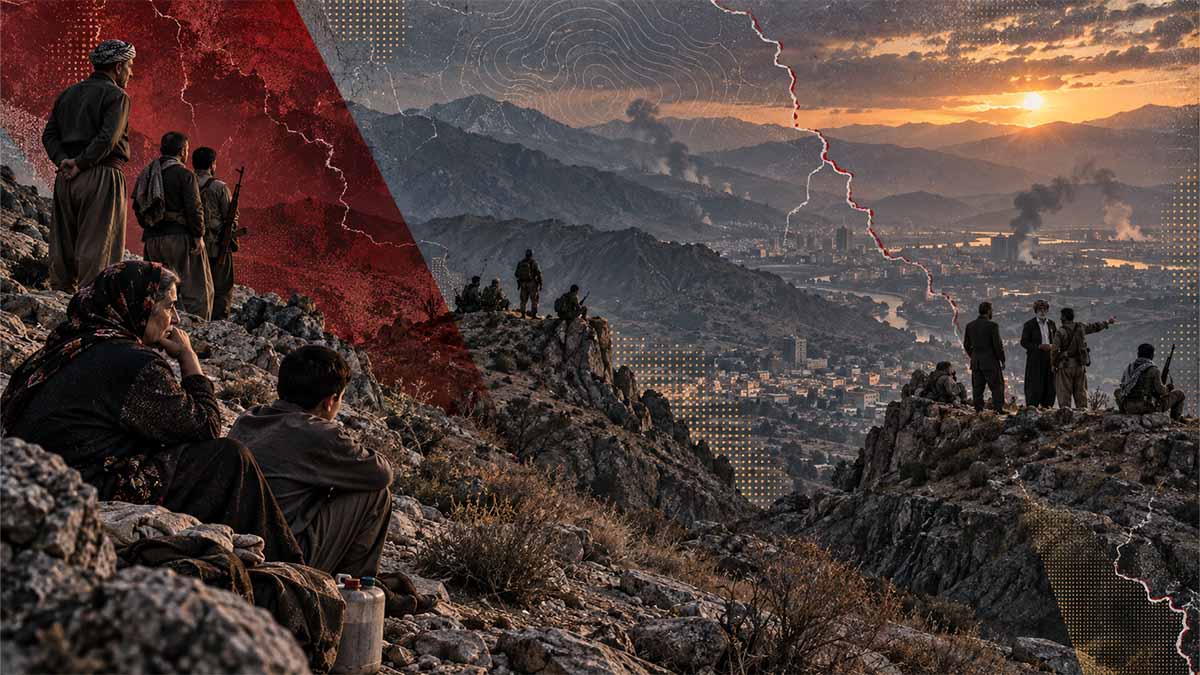
The Kurdish armed map is being redrawn, but not yet transferred wholesale towards Iran. The Kurdistan Workers’ Party’s dissolution and the Syrian Democratic Forces’ integration into the Syrian state in 2026 have released political attention—not demonstrably a unified expeditionary force. The more immediate security risk is narrower: the Kurdistan Free Life Party, or PJAK, could serve as the armed core of an attritional campaign exploiting Iranian unrest, Iraqi sanctuary and temporary alignment among Washington, Ankara and Kurdish opposition parties. Yet the same actors that can raise the pressure also cap it. US signals have reversed, Türkiye fears Kurdish autonomy returning across its own border, Iranian strikes have imposed costs, and opposition groups remain divided. Iran therefore faces a plausible front of recurring disruption, but not a Kurdish army capable of sustained territorial war.
The PKK decision did not close every armed branch
Abdullah Öcalan’s call for the PKK to dissolve and terminate its armed struggle in Türkiye was presented as a historic break. In November 2025, however, Öcalan reportedly told a Turkish parliamentary delegation that PJAK would remain armed while executions continued in Iran, even as he endorsed dialogue and an eventual political settlement. PJAK had already stated in May 2025 that the disarmament call did not require it to abandon its own weapons.
That distinction changes the meaning of the 2026 transition. Dr Hassan Sadeghian, a lecturer at the University of Tehran, interprets the PKK settlement as a division of labour: armed struggle ends in Türkiye while pressure is redirected towards Iran. Hooshang Sheikhi, a lecturer at Islamic Azad University, similarly argues that PJAK is preserving the PKK movement’s Iranian-facing military function. These are attributed assessments, not proof of an organised transfer of personnel or weapons. The dossier contains no verified inventory, redeployment order or command document demonstrating that the PKK and SDF have handed usable military capacity to PJAK.
Ankara wants Iranian weakness without Kurdish strength
Türkiye is the pivotal contradiction. President Recep Tayyip Erdoğan benefits from reducing the domestic cost of the PKK conflict and, according to researcher Soheil Farahmand, has an electoral interest in attracting Kurdish support for constitutional change. Ankara can also benefit from pressure on Iran, its regional competitor. Yet an enlarged PJAK with cross-border reach would recreate the transnational Kurdish military problem that Türkiye’s peace process is intended to contain.
Mohammad Motlagh, a former editorial board member of Iran Newspaper, alleges that Türkiye could facilitate pressure against Iran and later invoke border security to establish a buffer zone resembling its operations in Iraq and Syria. Dr Hassan Sadeghian goes further, claiming that weapons and non-Turkish cadres released by the PKK and SDF are being redirected to PJAK. The dossier provides no documentary evidence for either transfer or a Turkish-US-Israeli agreement. What it does record is a warning by Turkish Foreign Minister Hakan Fidan to Tehran during the January 2026 unrest about attempted crossings from Iraqi Kurdistan. That warning indicates Turkish visibility over the border system; it does not establish Turkish sponsorship of the groups attempting to cross it.
The more defensible judgment is that Ankara seeks control over the direction and intensity of Kurdish mobilisation. It can tolerate pressure that consumes Iranian attention while opposing any Kurdish formation capable of operating independently across four states. Türkiye is therefore not a reliable corridor for PJAK. It is a potential gatekeeper whose cooperation would remain conditional, reversible and subordinate to domestic security.
Washington raised expectations and then withdrew certainty
In early 2026, US President Donald Trump encouraged Iranian Kurdish forces to act while opposition parties sought weapons and armoured vehicles from US officials. Washington subsequently changed its message, and President Trump ruled out sending those groups into Iran. Iranian strikes, Kurdish divisions and contradictory US signals then helped prevent a coordinated incursion from Iraqi Kurdistan.
This reversal exposed the difference between using Kurdish pressure as coercive signalling and underwriting a military campaign. Kurdish organisations can threaten infiltration, force dispersal and political agitation without requiring the United States to accept responsibility for their survival. Sustained operations are different. Mohammad Motlagh argues that the groups cannot advance without US air power; the failed mobilisation of early 2026 supports the narrower conclusion that external protection is a prerequisite for operations beyond limited raids and infiltration.
The Coalition of Political Forces of Iranian Kurdistan, formed by five parties in February 2026, gave Washington a broader political interlocutor. It brought together PJAK, the Kurdistan Democratic Party of Iran, the Kurdistan Freedom Party, the Khabat Organization and Komala of the Toilers of Kurdistan. Their agreement created a common platform but did not eliminate disputes over ideology, strategy or leadership. Hooshang Sheikhi interprets the coalition as the result of US pressure, although the dossier explicitly states that no public evidence establishes that Washington ordered its formation.
The numbers describe disruption, not territorial conquest
The most ambitious claims in the dossier reveal the gap between political mobilisation and military capacity. Hooshang Sheikhi estimates that PJAK has approximately six times the manpower of Komala, the Kurdistan Freedom Party, Khabat and the Kurdistan Democratic Party of Iran. Komala leader Abdullah Mohtadi said in March 2026 that tens of thousands of young people would be prepared to take up arms if the United States supplied support. US intelligence assessments cited during the same period doubted that Iranian Kurdish groups possessed the personnel or firepower required to sustain a rebellion.
Another claim illustrates the evidentiary problem. Mohammad Motlagh alleges that the United Arab Emirates purchased around 1,000 vehicles for Iranian Kurdish armed groups before the 12-day US-Israeli war against Iran in June 2025, with the vehicles subsequently equipped in Syria, Türkiye and Iraq. The dossier provides no procurement record, recipient list or verified delivery chain. The figure cannot therefore be treated as an established transfer, but it identifies the type of evidence that would materially change the assessment: attributable logistics, protected mobility and external financing.
Absent such support, PJAK’s military utility is attritional. Small units can move weapons, conduct ambushes and exploit periods of unrest, obliging Tehran to reinforce Kurdistan, West Azerbaijan, Kermanshah and Ilam. They cannot, on the evidence presented, seize and hold major territory against the Iranian state. Media amplification can magnify each incident’s political effect, but it cannot supply air defence, logistics or local legitimacy.
Iraqi sanctuary is the front’s indispensable vulnerability
During the unrest beginning in December 2025, armed Kurdish groups attempted to cross from Iraq into Iran, after which Iranian forces struck opposition facilities in Iraqi Kurdistan. Mohammad Motlagh claims that some fighters reached Karaj and links additional violence in West Azerbaijan, Ilam and Kermanshah to Kurdish organisations, with operatives later moving towards Hamedan, Saveh and Tehran alongside the Mojahedin-e Khalq. These claims are not independently established within the dossier and should not be converted into a verified penetration map.
What is established within the dossier’s account is the mechanism of Iranian deterrence. Tehran damaged opposition bases, demonstrated intelligence reach inside Iraq and threatened forces considering cross-border action. A Reuters investigation cited in the dossier concluded that Iranian military pressure and contradictory US signals deterred Kurdish forces on both sides of the border in early 2026. Sanctuary proved valuable for organisation but insufficient for escalation once fixed bases became targets.
This constraint places Iraqi Kurdistan at the centre of any future campaign. PJAK and allied parties require territory for command, training, storage and recovery; Tehran can attack that infrastructure without waiting for a large incursion. Unless an external power supplies reliable air protection, the sanctuary becomes both the enabling platform and the exposed pressure point.
Iran’s strongest defence remains political as well as military
PJAK’s operational experience does not resolve its legitimacy deficit. Mohammad Motlagh argues that the organisation carries deeply negative historical associations among Iranian Kurds and cites more than 500 deaths in Sanandaj during earlier fighting with Kurdish armed groups. His account is politically interested and the dossier provides no independent demographic measure of present support. It nevertheless warns against treating Kurdish grievance as automatic acceptance of PJAK leadership.
Soheil Farahmand identifies a second political constraint in Türkiye: uncertainty over Kurdish cultural and social rights and resistance among Turkish nationalist constituencies could weaken the peace process that supposedly releases capacity for Iran. If the settlement is perceived as an electoral arrangement for President Erdoğan rather than a durable accommodation, the resulting dissatisfaction could remain centred on Türkiye instead of migrating east.
Mohammad Motlagh consequently argues that Tehran should move Kurdish policy from local military administration to national decision-making. His proposed combination of political engagement, cultural ties, intelligence activity and deterrence addresses the campaign’s actual mechanism. Repression alone can disrupt cells while expanding the pool of grievance from which those cells recruit; political concessions alone cannot neutralise armed groups protected across an international border.
The next 24 months will price the difference between pressure and war
Over the next 12–24 months, the most credible threat is not a unified Kurdish offensive but repeated attempts to synchronise economic pressure, domestic protest and armed infiltration. PJAK would provide the trained core; the February 2026 coalition would supply political coordination; sympathetic media would magnify tactical incidents; and external actors could raise or lower the campaign’s intensity through weapons, intelligence and air protection.
The decisive indicators are concrete: verified movement of PKK or SDF cadres into PJAK structures, documented delivery of armoured vehicles or weapons, durable US air-support commitments, Turkish facilitation of cross-border logistics, and evidence that the February 2026 coalition has overcome its command divisions. Without them, the Iranian front remains capable of imposing local insecurity but not of sustaining territorial revolt.
The cost of inaction would fall first on Iranian Kurdish provinces subjected simultaneously to militant activity and intensified state security measures. Iraqi Kurdistan would bear Iranian retaliation against opposition bases and the diplomatic cost of contested sanctuary. Türkiye would face the return risk of a strengthened transnational Kurdish network, while Washington would inherit the credibility cost of encouraging forces it is unwilling to protect. The choice made in 2026 is therefore not whether a Kurdish front exists, but whether outside powers convert a fragmented pressure instrument into a war they would then be required to sustain.
Navigational Index
Pillar I — Armed Reconfiguration Without Proven Force Transfer
The distinction between announced dissolution, verified disarmament, organizational continuity and personnel redeployment will determine whether the PKK and SDF transitions release usable military capacity for Iran.
Pillar II — Iran’s Internal Fault Line and the Iraqi Sanctuary Constraint
The decisive theatre is the Iran–Iraq border system: Kurdish political grievances inside Iran interact with opposition infrastructure in the Kurdistan Region, while Baghdad and Erbil face strong incentives to prevent their territory from becoming an operational launchpad.
Pillar III — External Leverage, Regional Restraint and European Exposure
US, Israeli, Turkish and European policies can alter the balance through intelligence, air protection, sanctions, diplomacy and counterterrorism arrangements. Their interests nevertheless diverge sharply over Iranian pressure, Iraqi sovereignty, Syrian unity and Kurdish armed autonomy.
Master Abstract
The centre of exposure has moved; an army has not
The balance of verified evidence supports a narrower proposition than the supplied thesis. Iran has become the principal remaining state against which a PKK-associated Kurdish organization—PJAK (Partiya Jiyana Azad a Kurdistanê – Kurdistan Free Life Party)—continues to maintain an explicitly armed posture. This creates a structural eastward shift in exposure as the PKK (Partiya Karkerên Kurdistanê – Kurdistan Workers’ Party) process reduces violence in Türkiye and Damascus absorbs SDF-controlled structures. It does not establish a corresponding transfer of fighters, weapons, financing or command authority. The UN’s formulation was deliberately conditional: the PKK’s May 2025 decision represented a step towards peace “if implemented.” It also clarified that the United Nations was not supervising disarmament. UN Secretary-General has welcomed the announcement that the PKK will disarm — United Nations in Türkiye — May 2025 The analytically correct baseline is therefore a regional reconfiguration still under implementation—not the verified closure of one force pool followed by its movement into another theatre.
Syria is closing territorial autonomy, not releasing a fungible army
The Syrian government reported on 30 January 2026 that its agreement with the SDF provided for a ceasefire, withdrawal from contact lines, entry of Interior Ministry forces into Hasakah and Qamishli, and phased military and administrative integration. It described three SDF brigades within a new division, a separate Kobani brigade under an Aleppo-based formation, individual integration within those structures, and eventual state control of public institutions and border crossings. The agreement also preserved civil and educational protections for Syrian Kurds. Comprehensive agreement between Syrian government and SDF for full integration — Syrian Arab News Agency — Jan 2026 This architecture is designed to anchor former SDF personnel inside Syrian institutions. Leakage, desertion or clandestine recruitment cannot be excluded, but no accessible official inventory identifies SDF personnel, weapons or formations transferred to PJAK. Treating the entire SDF as manpower available for Iran would therefore confuse negotiated institutional integration with operational redeployment.
PJAK provides a nucleus, but capability remains unverified
PJAK is the clearest organizational bridge between the wider Öcalan-influenced movement and the Iranian theatre. OFAC’s 4 February 2009 action identified the Free Life Party of Kurdistan—also recorded as PEJAK, PEZHAK and PJAK—at locations in Iraq’s Erbil Governorate and Iran, and added it to the Specially Designated Global Terrorist list. Anti-Terrorism designations — Office of Foreign Assets Control — Feb 2009 That record establishes US sanctions treatment and the organization’s cross-border character at the time of designation. It does not establish its present manpower, readiness, territorial penetration or foreign sponsorship. Estimates in the supplied material—including the assertion that PJAK has six times the personnel of rival Iranian Kurdish groups—lack an auditable official force-generation baseline and are excluded from the verified assessment.
Mobilization potential and armed legitimacy are different variables
The UK Home Office assesses that Iran’s Kurdish population is concentrated principally along the Turkish and Iraqi borders and records state discrimination, surveillance, detention and exposure to broadly defined national-security offences among politically active Kurds. Country policy and information note: Kurds and Kurdish political groups, Iran, October 2025 — UK Home Office — Oct 2025 These conditions provide mobilization mechanisms: grievance, community networks, difficult border terrain and a history of political repression. They do not demonstrate popular endorsement of PJAK or any other armed party. Opposition influence must therefore be disaggregated into capacity to encourage strikes or protests, capacity to recruit clandestine cells, and capacity to field forces able to seize and administer territory. Public evidence is strongest for the first, incomplete for the second and insufficient for the third.
Coalition formation changes coordination, not automatically combat power
The UK Home Office’s May 2026 bulletin records the February creation of the Coalition of Political Forces in Iranian Kurdistan, involving PAK ( Partî Azadîyê Kurdistan – Kurdistan Freedom Party) , PDKI (Partîya Demokrata Kurdistana Îranê – Democratic Party of Iranian Kurdistan ) , PJAK ( Partiya Jiyana Azad a Kurdistanê – Kurdistan Free Life Party) , Khabat (Sazmanî Xebatî Kurdistani Îran – Organization of Iranian Kurdistan Struggle ) and Komala ( Komeley Şoreşgêrî Zahmatkeşânî Kurdistany Îran -Komala Party of Kurdistan ) of the Toilers of Kurdistan. It also concludes that information available through 29 April 2026 did not demonstrate a material overall change in the situation of Kurds or Kurdish political groups since August 2025. Country bulletin Iran: Kurds and Kurdish political groups, May 2026 — UK Home Office — May 2026 Coalition formation can improve political messaging, liaison and contingency planning. It does not by itself resolve ideological rivalry, create interoperable units, secure heavy weapons, generate air defence or obtain permission from Iraqi authorities to operate across the border. The coalition is therefore a warning indicator of potential consolidation, not evidence that consolidation has been completed.
Ankara’s public posture favours containment, not an Iranian proxy war
Türkiye publicly endorsed the January 2026 Syrian agreement as an instrument for territorial unity, integration and regional stability, while reiterating support for Syrian state counterterrorism efforts. No: 9, 18 January 2026, Regarding the Ceasefire and Full Integration Agreement Announced in Syria — Republic of Türkiye Ministry of Foreign Affairs — Jan 2026 This statement proves Ankara’s declared position, not the totality of its conduct. Nevertheless, the allegation that Türkiye is deliberately transferring Kurdish combat power towards Iran requires positive operational evidence. Ankara would gain from reduced Iranian regional influence, but it would also incur serious risks from strengthening a transnational Öcalan-aligned armed network near its own Kurdish-majority provinces. Turkish policy can therefore tolerate pressure on Tehran while simultaneously opposing an autonomous Kurdish military corridor. That tension makes selective, deniable maneuver more plausible than open sponsorship—but neither has been established by an official record.
Net assessment
Iran should be treated as the principal prospective Kurdish pressure theatre, not yet as the successor battlefield to Türkiye and Syria. The strongest pathway is a distributed campaign combining political mobilization, covert cells, limited incursions and information operations during periods of Iranian domestic or interstate crisis. A sustainable insurgent front would require an observable break in Iraqi border enforcement, external provision of weapons or protective air power, and evidence that Kurdish communities inside Iran are moving from protest participation to organized armed recruitment. Without those conditions, Tehran retains substantial advantages in coercive capacity, intelligence penetration, interior lines and the ability to impose costs on sanctuaries across the Iraqi border.
Key Evidence Table
| Indicator | Value/status | Reference date | Definition/scope | Issuer | Exact source |
|---|---|---|---|---|---|
| PKK dissolution and disarmament | Announced; implementation explicitly conditional | 13 May 2025 | UN confirmation of the PKK announcement; no UN supervision established | United Nations | UN Secretary-General has welcomed the announcement that the PKK will disarm — United Nations in Türkiye — May 2025 |
| SDF institutional status | Ceasefire and phased military, security and administrative integration announced | 30 Jan 2026 | Three SDF brigades in a division; Kobani brigade; individual integration; state control of institutions and crossings | Syrian government, reported by SANA | Comprehensive agreement between Syrian government and SDF for full integration — Syrian Arab News Agency — Jan 2026 |
| Syrian Kurdish protections | Civil and educational rights included; Decree No. 13 recognizes Kurdish cultural and linguistic identity | 16–30 Jan 2026 | Syrian government’s declared legal and implementation framework | Syrian presidency/government, reported by SANA | Comprehensive agreement between Syrian government and SDF for full integration — Syrian Arab News Agency — Jan 2026 |
| PJAK sanctions record | Added to SDN list as an SDGT | 4 Feb 2009 | Free Life Party of Kurdistan and listed aliases; locations recorded in Iraq and Iran | US Treasury/OFAC | Anti-Terrorism designations — Office of Foreign Assets Control — Feb 2009 |
| Iranian Kurdish coalition | Formation reported involving five named organizations | 22 Feb 2026 | Political coalition; unified deployable command not established | UK Home Office public-record assessment | Country bulletin Iran: Kurds and Kurdish political groups, May 2026 — UK Home Office — May 2026 |
| Change in overall Kurdish security situation | No material change identified from August 2025 through the bulletin’s evidence cut-off | Evidence through 29 Apr 2026 | Country-of-origin assessment; comprehensive but expressly not exhaustive | UK Home Office | Country bulletin Iran: Kurds and Kurdish political groups, May 2026 — UK Home Office — May 2026 |
| Turkish position on SDF settlement | Supports Syrian unity, integration and state counterterrorism | 18 Jan 2026 | Official diplomatic position; not independent verification of implementation | Türkiye Ministry of Foreign Affairs | No: 9, 18 January 2026, Regarding the Ceasefire and Full Integration Agreement Announced in Syria — Republic of Türkiye Ministry of Foreign Affairs — Jan 2026 |
Competing Pathways
| Hypothesis | Diagnostic support | Disconfirming evidence | Indicators | Current standing |
|---|---|---|---|---|
| H1 — Localized Iranian Kurdish attrition becomes the principal armed expression | PJAK retains an Iranian orientation; a five-party coalition improves political coordination; Iran contains persistent Kurdish grievances and difficult border terrain | No verified mass force transfer; uncertain domestic support for armed parties; Iranian intelligence and coercive advantages | Repeated small-unit attacks; weapons seizures; recruitment networks; synchronized protest and armed activity | Best supported. It requires fewer capabilities than territorial warfare and fits the presently verified organizational structure. |
| H2 — Regional containment prevents a durable Iranian front | PKK disarmament process, SDF state integration and Turkish support for Syrian territorial unity reduce autonomous armed space | PJAK remains outside the publicly documented settlements; Iranian repression can regenerate recruitment incentives | Verified disarmament inventories; return or resettlement arrangements; Iraqi camp monitoring; declining attack frequency | Strong competing pathway. Its durability depends on implementation and on Baghdad and Erbil controlling cross-border sanctuary. |
| H3 — External sponsorship produces a coordinated anti-Iran front | Iran’s regional confrontation creates incentives for adversaries to exploit internal fault lines; Kurdish parties have established a coalition | No accessible official record establishes systematic US, Israeli, Turkish or Emirati arming, command or air-support commitments to PJAK; US sanctions treatment of PJAK remains a major contrary indicator | Official authorization, traceable arms deliveries, joint planning structures, protected corridors, air-support rules or deployed liaison teams | Material but unproven contingency. Political incentives exist; the necessary operational architecture is not publicly established. |
| H4 — Fragmentation and intra-Kurdish rivalry dissipate the opportunity | Organizations differ in ideology, leadership, constituency and relations with regional governments; coalition formation does not create unified command | Severe external pressure can produce temporary cooperation; shared opposition to Tehran supplies a minimum common objective | Rival communiqués, defections, competing recruitment, separate foreign channels, failure to agree transitional authority | Plausible constraint rather than dominant trajectory. It would limit escalation even if violence increases. |
Principal Gaps and Watch Indicators
Records capable of changing the assessment
- A verified PKK disarmament inventory specifying personnel, weapons, storage, destruction and monitoring arrangements.
- Syrian defence and interior ministry implementation orders identifying SDF personnel absorbed, rejected, demobilized, missing or absent from assigned formations.
- Iraqi or Kurdistan Regional Government records showing the location, weapons status and movement restrictions of Iranian Kurdish opposition groups.
- Authenticated evidence of PKK or SDF cadres transferring to PJAK, including unit rosters, command appointments or traceable logistical movements.
- An official US, Israeli, Turkish or Gulf instrument authorizing material assistance, intelligence support or air protection for Iranian Kurdish armed organizations.
- Credible evidence distinguishing protest participation inside Iranian Kurdish provinces from recruitment into armed formations.
- Auditable casualty and incident records that separate armed attacks, protest violence, state repression and ordinary criminal events.
Escalation signposts
- Sustained rather than symbolic cross-border movement from Iraqi territory.
- Emergence of unified operational—not merely political—command among PJAK, PDKI, PAK, Khabat and Komala formations.
- Deployment of anti-armour weapons, drones, secure communications or air-defence systems traceable to an external supplier.
- Iraqi federal or KRG forces withdrawing from monitored border sectors or declining to enforce movement restrictions.
- Coordinated attacks across Kurdistan, West Azerbaijan, Kermanshah and Ilam that persist beyond a short domestic crisis.
- Iranian operations against Kurdish camps in Iraq expanding in frequency, geographic depth or target class.
- Turkish security measures indicating concern that personnel or matériel are moving between the Iranian and Turkish theatres.
Indicators weakening the judgment
- Verified completion of PKK disarmament without significant splinter formation.
- Effective absorption and payroll registration of former SDF personnel within Syrian institutions.
- Monitored demobilization or relocation of Iranian Kurdish armed groups away from the Iran–Iraq border.
- Sustained political dialogue between Tehran and representative Kurdish civil actors accompanied by measurable reductions in repression.
- Continued factional division preventing unified command, financing or rules of engagement.
The Centre of Exposure Has Moved; An Army Has Not
BOTTOM LINE UP FRONT (BLUF): The structural eastward shift of Kurdish insurgent exposure toward the Islamic Republic of Iran represents a geopolitical realignment born of Turkish containment and Syrian state integration—not a verified transnational redeployment of fighters, armaments, or logistical networks. While PJAK serves as an ideological nucleus and a five-party Iranian Kurdish coalition established in February 2026 deepens diplomatic coordination, empirical evidence refutes the assertion that Syria’s SDF represents a fungible force pool ready for immediate Iranian theater mobilization.
H1 — Localized Iranian Kurdish Attrition as Principal Armed Expression
PJAK maintains dedicated Iranian orientation; 5-party coalition (Feb 2026) expands cross-factional liaison; persistent local political/economic grievances along Zagros border belt provide continuous recruitment mechanism.
Absence of verified mass personnel transfers from SDF/PKK; deeply entrenched Iranian intelligence penetration; overwhelming IRGC artillery, drone, and cross-border kinetic superiority against Iraqi sanctuaries.
Repeated small-unit rural ambushes; clandestine arms cache seizures; synchronized general strikes across Mahabad/Sanandaj timed alongside localized guerrilla engagements.
Anchoring vs. Redeployment
The 30 Jan 2026 Damascus–SDF agreement incorporates forces into 3 regular division brigades and an Aleppo-based Kobani formation. Rather than releasing a mobile insurgent reserve, the mechanism anchors fighters to fixed garrisons, institutional salaries, and Interior Ministry oversight across Hasakah and Qamishli.
PJAK Operational Limits
While designated under OFAC since 2009 with historic rear bases in Iraqi Kurdistan’s Erbil Governorate, claims that PJAK commands six times the manpower of rival groups lack verified force-generation audits. Without secure heavy armor, air defense, or air corridors, operations remain restricted to hit-and-run border raiding.
Grievance vs. Insurgency
UK Home Office reporting documents severe state discrimination, surveillance, and securitization across Iranian Kurdistan. However, analytical rigor demands separating the population’s proven capacity for commercial strikes and civil unrest from a willingness to endorse armed guerrilla governance or join clandestine militias.
Containment vs. Proxy War
The hypothesis that Ankara intentionally facilitates armed Kurdish transfers toward Iran contradicts core Turkish doctrine. While Turkey welcomes diminished Iranian regional leverage, empowering an Öcalan-aligned transnational armed network along the Iranian-Turkish-Iraqi tri-border creates acute blowback risks for its own provinces.
Shift in Exposure, Not Manpower
Iran is now the primary state against which an Öcalan-aligned armed faction (PJAK) sustains active resistance. However, this is an optical concentration of residual conflict, not an operational redeployment of demobilized PKK fighters from Türkiye.
Institutional Capture in Syria
Damascus’s January 2026 pact incorporates the SDF into state military divisions and civil frameworks. Treating former SDF manpower as an available expeditionary reserve for eastern campaigns contradicts the binding institutional terms of the Syrian settlement.
Conditional Disarmament Status
The UN Secretary-General’s May 2025 statement expressly characterized the PKK’s disarmament posture as conditional (“if implemented”) and confirmed no international verification mechanisms exist. Force preservation remains the default militant hedge.
Political vs. Tactical Coalition
The five-party coalition (PAK, PDKI, PJAK, Khabat, Komala) formed in Feb 2026 harmonizes diaspora diplomacy and cross-border rhetoric, but public intelligence through April 2026 establishes that it lacks integrated headquarters, joint logistics, or unified ROEs.
Absence of External Air Umbrellas
A sustainable, territorial anti-Tehran front requires external air defense, protected logistical corridors, and Iraqi acquiescence. No accessible official record demonstrates US, Israeli, Turkish, or Gulf material commitments to equip PJAK for high-intensity warfare.
Iranian Coercive Superiority
Tehran maintains formidable asymmetric advantages: deep SIGINT penetration across border mountain networks, short interior supply lines, and proven ballistic missile/loitering munition strike capabilities to devastate staging camps inside Iraq’s sovereign territory.
Documented records capable of altering the analytical baseline if officially verified:
- PKK Disarmament Inventories: Verified serial records of weapons destruction and monitoring frameworks under neutral auspices.
- Syrian Ministry Integration Orders: Official lists of SDF cadres absorbed, demobilized, or confirmed absent from regular formations.
- Iraqi KRG Border Audits: Verified data from Baghdad or Erbil on movement restrictions and camp status for Iranian dissidents.
- Cadre Transfer Authentication: Primary rosters confirming transfer of veteran Syrian or Qandil fighters directly into PJAK units.
- External State Authorizations: Legal instruments authorizing foreign military financing or air defense umbrellas for PJAK.
Field observables signaling operational inflection points across the Zagros belt:
Pillar I: Armed Reconfiguration Without Proven Force Transfer
Principal judgment
The public official record does not establish that either the PKK’s announced dissolution or the SDF’s integration into the Syrian state has released personnel, weapons or command capacity for employment against Iran. The PKK process remains distinguishable from independently verified, comprehensive disarmament. The Syrian Democratic Forces (SDF) process is not demobilisation: its announced design transfers personnel into Syrian state structures while retaining them within identifiable brigade formations. Both transitions can preserve military skills, interpersonal networks and political affiliations, but none of those attributes constitutes usable force transfer without evidence of movement, reception and a new chain of command.
The Iranian-facing component therefore remains centred on existing Iranian Kurdish organisations, particularly PJAK, rather than on a demonstrated migration of PKK or SDF formations. The decisive warning indicator is not another dissolution or integration communiqué. It is corroborated evidence that identifiable cadres or weapons have left their former theatres, crossed into an Iraqi or Iranian staging area and entered an Iranian-facing command structure.
Four conditions that must remain separate
“Dissolution” is being used publicly to describe materially different organizational states. Analytical precision requires four separate tests.
| Condition | Evidentiary threshold | Current finding |
|---|---|---|
| Announced dissolution | An attributable decision by the organization or an authoritative record confirming that decision | Established for the PKK as an announced intention |
| Verified disarmament | Accounted weapons collection or destruction, identified participants, competent monitoring and reconciliation against an inventory | Not established comprehensively in the accessible official record |
| Organizational continuity | Evidence that command, finance, recruitment, communications or armed substructures persist under the same or successor identity | Unresolved for the PKK; partly preserved by design for the SDF through brigade-level integration |
| Personnel redeployment | Identified departure, transit, reception and reassignment to an Iranian-facing organization or operation | Not established for either PKK or SDF personnel |
These states are not sequential by necessity. An organization can announce dissolution while retaining informal networks; surrender some weapons while withholding others; integrate nominally into a state structure while preserving unit cohesion; or lose its formal identity without transferring any personnel to another theatre. Conversely, individual defections can occur without constituting an organized force transfer.
The PKK has crossed a political threshold, not a verified force-disposition threshold
The United Nations recorded that the PKK had decided to dissolve and disarm, but the Secretary-General’s spokesperson explicitly qualified the significance of the decision with the words “if implemented.” The spokesperson also rejected reports that disarmament would occur under UN auspices and confirmed that the Secretary-General had not been in direct contact with the Turkish or Kurdish parties at that stage. UN Secretary-General has welcomed the announcement that the PKK will disarm — United Nations in Türkiye — May 2025
That formulation establishes an announced organizational decision. It does not establish the number or identities of participating personnel, the quantity and categories of weapons surrendered, the disposition of stockpiles, the closure of facilities, the dismantlement of financing and communications networks, or the status of personnel outside Türkiye. No public UN verification mechanism was attached to the announcement.
The continuing inclusion of the PKK on the United Kingdom’s list of proscribed organizations, updated on 7 July 2026, demonstrates that the political declaration did not automatically alter the organization’s status under UK law. The list also treats KADEK, Kongra Gele Kurdistan and Hezen Parastina Gel as PKK names or aliases for proscription purposes. Proscribed terrorist groups or organisations — Home Office — Jul 2026
This legal continuity must not be misread as independent proof that the former operational hierarchy remains intact. Proscription persists until the statutory deproscription procedure is completed; it is therefore a legal and regulatory fact, not a current order of battle. It nevertheless matters operationally because it constrains overt financing, political representation, international travel and third-party engagement with persons still treated as PKK members.
What remains unverified
A comprehensive finding of PKK disarmament would require more than evidence that selected members relinquished or destroyed selected weapons. At minimum, the public record would need to identify:
- the eligible personnel population and participating formations;
- reception, registration and identity-verification arrangements;
- weapon types, quantities and inventory-reconciliation procedures;
- the disposition of explosives, ammunition, communications equipment and concealed stockpiles;
- the status of commanders, specialist personnel and members outside the principal assembly areas;
- mechanisms for preventing successor structures or cross-border reassignment;
- the competent monitoring authority and its reporting standard.
No accessible official instrument supplies this complete chain. The defensible formulation is therefore announced dissolution with incomplete public verification, not “the PKK has disappeared” and not “PKK forces have been released for Iran.”
The SDF transition is absorption, not the creation of an unassigned fighter pool
The Syrian process is structurally different. On 30 January 2026, the Syrian government announced a ceasefire and phased military and administrative integration with the SDF. The announced architecture included withdrawal from contact lines; entry of Interior Ministry security forces into Hasakah and Qamishli; and the formation of a military division comprising three SDF brigades, alongside a separate Kobani brigade under an Aleppo-affiliated division. The government source described integration as occurring “on an individual basis within the brigades” and asserted that the state would assume control over civil institutions, government institutions and border crossings. Comprehensive agreement between Syrian government and SDF for full integration — Syrian Arab News Agency — Jan 2026
This is not disarmament in the PKK sense. Personnel are intended to remain armed within Syrian state formations, subject to a new sovereign command. The design therefore preserves two apparently competing features:
- Individual legal incorporation, which is intended to terminate an autonomous command relationship; and
- Brigade-level concentration, which can preserve interpersonal cohesion, local identity and parts of the former force’s organizational memory.
The first feature reduces the formal availability of SDF personnel for external operations. The second creates a residual risk that commanders and networks remain able to coordinate outside official channels if implementation fractures. The public announcement does not disclose brigade personnel totals, commander-selection procedures, vetting standards, weapon-accounting arrangements, deployment locations, payroll control, communications architecture or disciplinary jurisdiction. It also does not publish the agreement’s military annexes, if such annexes exist.
Türkiye welcomed the agreement but framed successful implementation as unity, cohesion, counterterrorism and the elimination of division. Its statement expresses a policy expectation; it does not independently verify that SDF formations have transferred command, personnel or weapons to Damascus. No: 9, 18 January 2026, Regarding the Ceasefire and Full Integration Agreement Announced in Syria — Republic of Türkiye Ministry of Foreign Affairs — Jan 2026
The integration paradox
The Syrian model creates less immediately “free” manpower than outright demobilisation would create. Personnel incorporated into Syrian brigades acquire garrison duties, payroll dependence, geographical assignments and exposure to state discipline. These obligations raise the cost of organized departure.
The model can nonetheless preserve latent capacity. Former SDF personnel retain combat experience, local logistical knowledge and durable relationships. If state integration fails, those networks could facilitate remobilisation more rapidly than would be possible among individually dispersed civilians. That possibility is analytically material, but it is a contingent reserve, not a demonstrated force available for Iran.
A transfer to the Iranian theatre would require at least one of four disruptions:
- rejection of integration by an identifiable SDF faction;
- desertion or negotiated release of a concentrated body of personnel;
- exclusion of foreign or non-integrable cadres from Syrian formations;
- collapse of Damascus’s payroll, command or territorial control in the northeast.
None is established in the cited agreement. Nor does the official record identify PJAK or any other Iranian Kurdish organization as a recipient.
PJAK is an existing Iranian-facing organization, not proof of a transfer pipeline
PJAK’s relevance does not depend on personnel arriving from the PKK or SDF. The United States designated the Free Life Party of Kurdistan—listing PJAK, PEJAK and PEZHAK among its aliases—as a Specially Designated Global Terrorist entity in February 2009. The designation record identified locations in the Qandil Mountains of Iraq’s Erbil Governorate and at Razgah in Iran. Anti-Terrorism designations — Office of Foreign Assets Control — Feb 2009
This official record establishes PJAK as a separately named, Iranian-facing organization with a historically documented cross-border geography. It does not provide a current force strength, readiness assessment, weapons inventory or proof that the organization can absorb large external contingents. Nor does the designation entry, by itself, establish the current degree of command integration between PJAK and any surviving PKK structure.
The distinction matters because organizational affinity is not equivalent to operational transfer. Common ideology, personal connections, historical association or overlapping geography can lower coordination costs. They do not demonstrate that personnel have changed units, accepted PJAK orders or entered Iran.
Political coordination has not become a verified joint command
The UK Home Office’s May 2026 country bulletin recorded the announced formation of a coalition among several Iranian Kurdish opposition parties, including PJAK. It also assessed that, despite speculation about Kurdish participation in the 2026 conflict involving Iran, the groups had not taken up arms against Iran by the bulletin’s evidentiary cut-off of 29 April 2026. The bulletin further stated that available information did not indicate a material change in the overall situation of Iranian Kurds or Kurdish political groups since August 2025. Country bulletin Iran: Kurds and Kurdish political groups, May 2026 (accessible) — Home Office — May 2026
This is an official UK analytical compilation, not an operational audit. Much of its underlying reporting comes from open third-party sources, and it expressly warns that omission does not prove non-existence. Its value is consequently bounded. It supports the narrower finding that a competent government assessment had not identified a Kurdish ground offensive or confirmed US material support by its cut-off date. It does not exclude clandestine movement after that date.
The coalition announcement establishes political coordination and a declared convergence of objectives. It does not establish:
- a unified military headquarters;
- pooled weapons or logistics;
- common rules of engagement;
- operational control over member formations;
- agreed territorial sectors;
- integrated communications;
- authority to receive PKK or SDF personnel.
Treating coalition formation as force generation would therefore collapse political intent into military capability.
No verified PKK–SDF–PJAK transfer chain
Claims in the supplied base material that PKK or SDF personnel and weapons were redirected toward PJAK remain unsupported by an accessible first-order transfer record. The official sources establish three separate developments: a conditional PKK dissolution process, an announced SDF-to-state integration structure and the continued existence of Iranian Kurdish organizations. They do not connect those developments through documented personnel or materiel movement.
A defensible transfer finding would require evidence across the full chain:
| Transfer stage | Required observation | Present official record |
|---|---|---|
| Release | Named PKK or SDF unit ceases former duties and becomes available | Not established |
| Movement | Corroborated route, border crossing, transport or staging record | Not established |
| Reception | PJAK or another Iranian Kurdish organization registers or incorporates arrivals | Not established |
| Re-equipment | Accounted weapons issue, stock transfer or new supply line | Not established |
| Command assignment | Identified commander, mission, sector and reporting relationship | Not established |
| Operational signature | Attributable activity inside Iran consistent with the transferred capability | Not established |
Evidence at only one stage would remain insufficient. Unidentified movement toward the Iran–Iraq border would not prove PJAK reception. An increase in PJAK activity would not prove that former PKK or SDF personnel caused it. Common weapon types would not establish transfer without serial, inventory, custody or route evidence.
How usable capacity could nevertheless emerge
The absence of verified transfer does not eliminate the risk of gradual force diffusion. Three mechanisms remain plausible.
Individual migration
Former combatants can relocate independently, especially where personal relationships and language reduce entry barriers. Small numbers of specialists—communications personnel, explosives technicians, trainers or intelligence facilitators—could have effects disproportionate to their size. Such migration would be harder to detect than a formed-unit transfer, but it would also produce less immediate mass.
Network persistence
Commanders, financiers and facilitators can preserve coordination after formal dissolution without retaining a conventional hierarchy. These networks could move funds, documentation, recruits or technical knowledge toward an Iranian-facing organization. Evidence of communications or financial continuity would raise concern even before physical movement became visible.
Integration failure
If SDF incorporation fragments, coherent subunits could become available outside Syrian command. The risk would rise if former SDF brigades retain exclusive leadership, segregated communications, independent logistics or weapons outside state inventory. It would fall if Damascus establishes mixed staffing, individual payroll control, transparent basing and enforceable disciplinary jurisdiction.
Each pathway is conditional. Countervailing forces include Syrian state employment, Turkish interdiction, Iraqi and Kurdistan Regional Government border control, Iranian surveillance and attack capability, factional rivalry among Iranian Kurdish organizations, and the legal exposure created by continuing terrorism designations.
Net force-generation assessment
As of 10 September 2026, the balance of verified evidence supports latent reconfiguration without proven transfer.
- The PKK declaration can reduce violence and organizational activity if implemented comprehensively, but public verification remains insufficient to calculate how many personnel have demobilised, remained in place or changed affiliation.
- The SDF agreement preserves organized military manpower inside Syria; it does not release that manpower into a regional market of armed actors.
- PJAK supplies an existing organizational destination and cross-border geography, but its current absorptive capacity is not established by official data.
- Iranian Kurdish political coordination has increased, yet the accessible record does not demonstrate conversion into a joint operational command.
- No official source reviewed verifies that a formed PKK or SDF contingent has entered PJAK service or deployed against Iran.
The immediate danger is therefore not a large, visible transfer of entire formations. It is the harder-to-observe movement of specialists, commanders, finance and organizational knowledge, followed by later local recruitment. Even that pathway remains an analytical risk rather than an established event.
Key judgments
- No verified surplus force exists. Neither the PKK nor the SDF process has produced an officially documented body of unassigned personnel available for Iran.
- PKK dissolution remains implementation-dependent. The UN record confirms the announcement while expressly withholding judgment on completion.
- SDF integration preserves more cohesion than demobilisation would. Brigade-based incorporation can retain networks and military skills, but it also binds personnel to Syrian state duties if implemented.
- PJAK continuity is more important than speculative transfer. Its established Iranian orientation means escalation can originate from its existing structure without any large influx from Türkiye or Syria.
- Political coalition is not military unification. No official record establishes a combined headquarters, shared logistics or common command among the Iranian Kurdish parties.
- Specialist diffusion is the principal concealed risk. A small number of trainers, logisticians or communications personnel would be more consequential—and less observable—than unorganized rank-and-file movement.
What would change the assessment
The judgment would strengthen toward an organized Iran transfer if the public record produced:
- named PKK or former SDF commanders assuming PJAK or coalition military posts;
- verified rosters showing clustered arrival of former PKK or SDF personnel;
- Iraqi, Syrian or Turkish border and detention records documenting common routes;
- serial-number or inventory evidence linking surrendered, missing or Syrian-issued weapons to Iranian Kurdish formations;
- satellite or official inspection evidence of expanded reception and training facilities;
- a published joint-command instrument allocating forces, sectors and operational authority;
- attributable operations inside Iran displaying capabilities not previously documented among the Iranian Kurdish groups.
The judgment would move toward durable demobilisation and containment if:
- a competent monitor published reconciled PKK personnel and weapons inventories;
- successor organizations and armed aliases were formally addressed;
- SDF personnel entered individually controlled Syrian payroll, basing and disciplinary systems;
- former SDF brigades received mixed command structures and state-controlled logistics;
- Iraq and the Kurdistan Regional Government documented sustained enforcement against unauthorized armed movement toward Iran;
- Iranian Kurdish organizations verifiably dismantled forward facilities or accepted monitored disarmament.
Open official record
The following records are unavailable publicly or have not been identified in authoritative form, and their disclosure could materially change the assessment:
- the complete PKK disarmament implementation instrument and any annexed personnel or weapons inventory;
- monitoring reports identifying PKK units, commanders and geographical areas covered;
- the complete Syrian–SDF military integration agreement, including command, vetting, basing, payroll and weapons-accounting annexes;
- Syrian personnel records distinguishing integrated, rejected, absent and foreign SDF members;
- Iraqi and Kurdistan Regional Government inspection reports for Iranian Kurdish opposition camps and border approaches;
- current official force-strength and weapons data for PJAK and the other Iranian Kurdish organizations;
- any authenticated agreement establishing a unified military command for the Iranian Kurdish coalition;
- government records corroborating or disproving organized PKK or SDF personnel transfer into PJAK.
Armed Reconfiguration Without Proven Force Transfer
BOTTOM LINE UP FRONT (BLUF): The public official record establishes neither that the PKK’s announced dissolution nor the Syrian Democratic Forces’ (SDF) integration into the Syrian state has released formed units, weaponry, or command infrastructure into the Iranian theater. While both transitions preserve underlying interpersonal networks, military skills, and ideological affinities, usable combat capacity cannot migrate across borders without physical departure, documented transit corridors, reception logistics, and integration into a new chain of command. The threat vector facing Iran remains anchored in pre-existing domestic organizations—primarily the Free Life Party of Kurdistan (PJAK)—rather than a verified influx of Turkish or Syrian battle-hardened formations.
Condition 1: Announced Dissolution (PKK Political Declaration)
An attributable decision by the organization or an authoritative third-party record confirming that decision. Established for the PKK via the May 2025 announcement acknowledged by the United Nations.
UN SG explicitly conditioned the milestone with the words 'if implemented' and denied UN supervision. Furthermore, the UK Home Office proscription list (updated July 2026) retains PKK/KADEK/HPG, proving lack of legal erasure.
A political milestone crossed without structural verification. It constrains legal transactions and financing, but does not provide proof that personnel inventories or armaments have dissolved or relocated toward Iran.
Brigade Cohesion vs. Mobility
The 30 Jan 2026 integration creates less "free" manpower than standard demobilization. Absorbing SDF fighters into 3 regular division brigades and an Aleppo-affiliated Kobani formation binds combatants to state salaries, fixed territorial posts, and Interior Ministry oversight, drastically increasing the friction of unauthorized mass departure.
Breakdown Across All 6 Stages
An evidentiary transfer finding requires continuity from release to tactical employment inside Iran. Finding common ideological sympathy or even isolated transit does not satisfy the forensic burden. In the accessible official record, all six transfer stages currently register as completely unevidenced.
Affinity Is Not Transfer
Designated by OFAC since 2009 in Qandil and Razgah, PJAK’s presence in the Iranian theater predates recent Syrian/Turkish peace shifts. Its capacity to recruit or conduct raids stems from indigenous Zagros border networks, not an influx of Syrian fighters. Ideological alignment cannot be conflated with unit redeployment.
Specialist Migration vs. Mass Armies
While formed unit redeployment is disproven, latent diffusion remains an active risk. Crucially, this would not manifest as marching battalions, but through low-signature migration of high-value specialists: drone technicians, IED fabricators, secure-communications experts, and veteran combat facilitators.
No Verified Surplus Force Exists
Neither the PKK’s political disarmament declaration nor the SDF’s administrative pact with Damascus has generated an unassigned, unanchored pool of trained fighters ready for immediate operational employment against Iranian state assets.
PKK Dissolution Is Strictly Conditional
The UN Secretary-General explicitly qualified the May 2025 announcement as dependent on real-world verification ("if implemented"), confirming no UN monitoring agency was deployed. Unilateral pronouncements cannot be equated with verified dismantlement.
SDF Model Preserves Latent Cohesion
Brigade-level integration locks personnel into Syrian territorial defenses while preserving local networks and organizational memory. It reduces mobile availability in the short term, but preserves a latent re-mobilization vector if Syrian integration collapses.
PJAK Continuity Transcends Transfer Rumors
PJAK’s combat threat against Iranian forces is indigenous, persistent, and grounded in its own longstanding cross-border logistics in the Qandil mountains. Threat assessments must be based on PJAK's existing infrastructure, not speculative foreign troop influxes.
Diplomatic Coalition ≠ Joint Command
The Iranian Kurdish 5-party coalition (Feb 2026) represents a political alignment. Authoritative British intelligence auditing confirms it has failed to generate a joint operational headquarters, unified logistics, or harmonized tactical commands.
Specialist Infiltration as True Danger
The primary security risk is not the visible transit of battalions, but the low-profile infiltration of specialized instructors, IED/drone technicians, and financial conduits capable of multiplying the lethal efficacy of existing Iranian insurgent networks.
Classified or unreleased documentation that would materially shift current assessments:
- Complete PKK Disarmament Protocol: Annexed weapons-accounting manifests, destruction site audits, and commander verification rosters.
- Damascus-SDF Military Annexes: Detailed personnel allocations distinguishing integrated, retired, and unvetted foreign fighters.
- KRG & Iraqi Border Verification Reports: Border security monitoring files documenting transit or containment along the Qandil range.
- PJAK Order of Battle Audits: Authoritative current force-strength surveys and weapons receipts for Iranian-facing opposition groups.
- Joint Command Charters: Any binding legal pact establishing integrated military command among the five coalition parties.
Observable indicators that would validate or invalidate an organized force transfer:
Pillar II: Iran’s Internal Fault Line and the Iraqi Sanctuary Constraint
Principal judgment
Iran’s Kurdish fault line becomes a sustained armed front only if internal mobilization acquires protected external depth in Iraq. That condition is not presently established. Iran contains a substantial, geographically concentrated Kurdish population exposed to documented political, cultural and socioeconomic discrimination. The Kurdistan Region of Iraq simultaneously hosts the headquarters or infrastructure of several Iranian Kurdish opposition organizations. Yet geography alone does not create sanctuary: Baghdad holds constitutional responsibility for foreign policy, national security and border defence, while Erbil controls regional police, security forces and guards. Both governments have overriding incentives to prevent Iraqi territory from becoming the launchpad for a war against Iran.
The resulting system is neither sealed nor permissive. It is a contested border-security regime. Opposition organizations can retain political identity, personal networks and residual infrastructure inside Iraq, but their ability to concentrate forces, move heavy equipment, train openly and conduct sustained cross-border operations depends on the tolerance or incapacity of Iraqi authorities. Iranian coercion—including attacks condemned by the Kurdistan Regional Government in July 2026—raises the cost of sanctuary while simultaneously demonstrating that Tehran does not regard existing controls as sufficient.
The most plausible threat is therefore a limited cycle of clandestine infiltration, local attacks, Iranian retaliation and intensified Iraqi containment—not an uncontested territorial corridor from Iraqi Kurdistan into western Iran.
An internal fault line, not an automatic insurgency
The UK Home Office estimates Iran’s Kurdish population at 7–15 million, approximately 8–17% of the national population, concentrated principally in northwestern Iran along the borders with Iraq and Türkiye. The unusually wide range reflects the absence of a definitive official ethnic census and should not be converted into a force-generation estimate. Country policy and information note: Kurds and Kurdish political groups, Iran, October 2025 (accessible) — Home Office — Oct 2025
The same official UK assessment identifies a durable grievance structure. It finds that constitutional equality is not observed consistently in practice; that Kurdish communities face discrimination affecting housing, political representation, employment and education; and that Kurdish regions experience economic neglect, underdevelopment and high unemployment. It also records restrictions affecting Kurdish-language instruction and the arrest of some language teachers. These findings are an attributed UK government assessment assembled from country-of-origin information, not an Iranian statistical series or independent census.
Political repression adds an organizational dimension. The Home Office assesses that Kurds involved—or perceived to be involved—in Kurdish political, civil or cultural activity face surveillance, arrest, detention and broadly defined security charges. It characterizes the Iranian authorities’ threshold for suspicion of Kurdish political activity as low and the potential reaction as severe. Country policy and information note: Kurds and Kurdish political groups, Iran, October 2025 (accessible) — Home Office — Oct 2025
These conditions create political vulnerability but do not demonstrate collective readiness for armed rebellion. Three countervailing mechanisms operate simultaneously:
- discrimination and coercion can increase alienation from the central state;
- intensive surveillance raises the cost of organization and suppresses visible command structures;
- fear of collective punishment can discourage communities from supporting armed actors whose operations invite retaliation.
Kurdish ethnicity, peaceful political activity, clandestine party membership and armed participation are therefore separate categories. Treating Kurdish-majority areas as an existing insurgent constituency would overstate both the opposition’s reach and the population’s willingness to accept the costs of war.
The internal network is clandestine and organizationally fragmented
The Home Office records that several Iranian Kurdish opposition headquarters are located in the Kurdistan Region of Iraq, while the organizations remain illegal and operationally restricted inside Iran. It describes members and supporters within Iran as frequently organized through small, secret cells and notes that many opposition parties have shifted emphasis toward political activity even though most have conducted armed campaigns at some point. Country policy and information note: Kurds and Kurdish political groups, Iran, October 2025 (accessible) — Home Office — Oct 2025
This clandestine structure is suited to propaganda, strikes, intelligence collection, recruitment and limited facilitation. It is less suited to sustained territorial operations unless it receives an external supply system. A cross-border insurgency requires more than sympathetic cells. It needs reliable command communications, medical evacuation, resupply, replacement personnel, protected training areas and routes capable of surviving Iranian surveillance and interdiction.
The February 2026 formation of a coalition among Iranian Kurdish opposition parties indicates a greater degree of political coordination. It does not resolve the operational fragmentation identified in Chapter 1. The UK Home Office’s subsequent bulletin assessed that the organizations had not entered the 2026 conflict against Iran by its evidentiary cut-off of 29 April 2026 and that the information available did not show a material change in the overall position of Kurdish political groups since August 2025. Country bulletin Iran: Kurds and Kurdish political groups, May 2026 (accessible) — Home Office — May 2026
That conclusion is time-bounded. It does not exclude subsequent clandestine movement or isolated attacks. It does, however, weaken the proposition that political coalition-building had already produced a coordinated Kurdish ground front.
Iraq’s constitutional architecture opposes external launchpad status
The Iraqi Constitution establishes a clear prohibition at the level of state purpose. Article 7 requires the state to combat terrorism and protect Iraqi territory from being used as a base, pathway or field for terrorist activity. Article 8 requires good-neighbourly relations, non-interference in other states’ internal affairs and peaceful settlement of disputes. Article 9 prohibits military militias outside the framework of the Iraqi armed forces. The Constitution of Iraq — Iraq Constitutional Committee — Oct 2005
Competence is divided but not ambiguous on external security. Article 110 assigns the federal government exclusive authority over:
- foreign policy and international agreements;
- national security policy;
- establishment and management of the armed forces;
- protection and security of Iraq’s international borders;
- residency, citizenship and political-asylum policy.
Article 121 nevertheless gives the regional government responsibility for its internal security institutions, including regional police, security services and guards. The cited English text is identified by its host as an unofficial translation; the operative Arabic and Kurdish constitutional texts remain controlling. The Constitution of Iraq — Iraq Constitutional Committee — Oct 2005
This division produces a two-level enforcement requirement:
| Function | Principal constitutional authority | Operational dependency |
|---|---|---|
| Foreign relations with Iran | Federal government | Baghdad’s diplomatic and national-security institutions |
| International-border defence | Federal government | Federal forces, access, intelligence and coordination with the Region |
| Security inside the Kurdistan Region | Kurdistan Regional Government | Regional police, Asayish, Peshmerga and local political cooperation |
| Political asylum and residency | Federal government | Federal law and regional implementation |
| Denial of armed bases and transit routes | Federal obligation with regional implementation | Joint intelligence, inspection, weapons control and mobility restrictions |
Baghdad can sign an international security undertaking, but implementation in the Kurdistan Region cannot be reduced to a federal diplomatic communiqué. Erbil possesses the local intelligence, policing relationships and physical access needed to inspect facilities and constrain movement. Conversely, Erbil cannot lawfully convert regional territory into an independent foreign-policy instrument against Iran.
The asylum–security boundary complicates enforcement
Article 21 of the Iraqi Constitution provides that a political refugee cannot be surrendered to a foreign entity or forcibly returned to the state from which that person fled. The same article excludes from political asylum persons accused of international or terrorist crimes or of causing harm to Iraq. The Constitution of Iraq — Iraq Constitutional Committee — Oct 2005
This creates a legally significant distinction among:
- civilian refugees and family members;
- political officials and media personnel;
- inactive former combatants;
- armed members of opposition organizations;
- persons subject to individualized criminal allegations;
- persons whom Iran labels terrorists without a publicly reviewable judicial record.
Relocation away from the border, weapons restrictions and denial of military activity are analytically distinct from extradition or refoulement. Iraq can prevent an organization from conducting armed operations without accepting that every member is lawfully returnable to Iran. Tehran, Baghdad and Erbil can therefore agree on the security objective while differing over status determination, evidence, detention and repatriation.
The full text and implementation annexes of the reported 2023 Iran–Iraq security arrangement have not been identified in an accessible controlling repository. The UK Home Office confirms the existence of an Iran–Iraq security agreement and records that Iranian attacks against Kurdish organizations in the Kurdistan Region continued despite it. The public record does not support reconstructing the agreement’s unpublished provisions. Country policy and information note: Kurds and Kurdish political groups, Iran, October 2025 (accessible) — Home Office — Oct 2025
The Kurdistan Region has strong incentives to deny sanctuary
The Kurdistan Region’s interests weigh against becoming an operational rear base for conflict with Iran.
Civilian and economic exposure
Iran can impose costs without occupying Iraqi territory. Missile, drone, intelligence and economic pressure can disrupt transport, investment, energy infrastructure and civilian confidence. On 17 July 2026, the KRG Presidency of the Council of Ministers publicly condemned Iranian attacks against the Region, described them as a grave threat to regional peace and called on Baghdad and the international community to end the violations. Statement from the Presidency of the Council of Ministers of the Kurdistan Region — Kurdistan Regional Government — Jul 2026
That statement establishes the KRG’s attribution and political position; it does not independently verify every attack or target. Its decision significance lies in the revealed vulnerability: the Region regards escalation with Iran as a direct threat to its own security and stability.
Constitutional and fiscal dependence on Baghdad
The Region remains embedded within Iraq’s federal system and depends on cooperation with Baghdad across budgets, border policy, defence resources, diplomatic protection and international legal representation. Openly facilitating attacks on Iran would expose Erbil to federal pressure while weakening its claim that Baghdad must defend the Region against external attack.
Dependence on external partnerships
The KRG identifies Germany, the United Kingdom and the United States as partners in Peshmerga reform and capacity-building. Those relationships are designed around counterterrorism, professionalization and regional stability. Using reformed forces to support an unauthorized offensive against a neighbouring state would jeopardize political support and create legal and reputational exposure for partners. Strengthening Kurdistan’s security forces — Kurdistan Regional Government — accessed Sep 2026
Intra-Kurdish stability
Iranian Kurdish opposition organizations operate within a political environment divided between regional parties, security services and territorial spheres of influence. Tolerance by one local actor does not amount to a unified KRG policy. A unilateral facilitation arrangement would risk internal Kurdish confrontation and could invite Iranian retaliation against rival-controlled as well as facilitating areas.
President Nechirvan Barzani stated in March 2026 that the Kurdistan Region would not join a conflict or military escalation that endangered its population. In June, he again said that Iraq and the Kurdistan Region should remain outside regional conflicts and described the Region as a bridge for peace and diplomacy. President Nechirvan Barzani’s statement on the anniversary of the Uprising — Presidency of the Kurdistan Region — Mar 2026 President Nechirvan Barzani underscores the significance of peshmerga reunification — Presidency of the Kurdistan Region — Jun 2026
These are authoritative statements of regional policy, not guarantees that every party, commander or armed organization will comply.
Enforcement capacity remains divided
The constitutional case for denying sanctuary is stronger than the evidence of fully unified enforcement capacity. The KRG itself states that its military and intelligence forces contain multiple units and that integration, modernization and alignment remain continuing objectives. Its declared security programme extends from border security to counterterrorism and critical-infrastructure protection. Strengthening Kurdistan’s security forces — Kurdistan Regional Government — accessed Sep 2026
In June 2026, President Nechirvan Barzani described Peshmerga unification as progressing slowly and called for a single ministry, leadership and administration. He also emphasized Baghdad’s constitutional responsibilities for supplying the Peshmerga with weapons, ammunition and resources. President Nechirvan Barzani underscores the significance of peshmerga reunification — Presidency of the Kurdistan Region — Jun 2026
This institutional fragmentation affects the sanctuary problem through four mechanisms:
- Uneven territorial control. Different services can possess different levels of access and political authority across Erbil and Sulaymaniyah governorates.
- Incomplete information sharing. Federal, regional and party-linked institutions do not necessarily maintain a single operational picture of personnel, camps, weapons and border routes.
- Variable enforcement. A restriction imposed centrally can be implemented strictly, selectively or symbolically at local level.
- Attribution ambiguity. Armed movement can be portrayed as individual infiltration, an opposition-party operation, local facilitation or official sponsorship, complicating deterrence and crisis management.
Fragmentation does not mean that the border is open. It means that denial is more credible against large, visible formations than against small groups, couriers, financiers or clandestine specialists.
Sanctuary should be measured by function, not presence
PJAK’s continuing identification in the US sanctions record with locations historically associated with the Qandil area in Iraq and Razgah in Iran demonstrates the cross-border character of the Iranian Kurdish security problem. It does not establish that those locations remain operational in 2026 or that Iraqi authorities tolerate offensive activity. Anti-Terrorism designations — Office of Foreign Assets Control — Feb 2009
The presence of an opposition headquarters, refugee community or political office is not equivalent to operational sanctuary. A decision-grade assessment should test six functions.
| Sanctuary function | What would establish it | Current finding |
|---|---|---|
| Protected basing | Persistent armed facilities insulated from Iraqi inspection or Iranian attack | Not established |
| Training | Verified organized military instruction, ranges or recurrent training cycles | Not established publicly |
| Stockpiling | Accounted weapons, ammunition, drones or explosives available for cross-border use | Not established publicly |
| Transit | Repeatable routes with identifiable facilitation and border penetration | Possible at small scale; no verified sustained corridor |
| Command and communications | Operational headquarters directing activity inside Iran | Political infrastructure exists; joint operational control is unverified |
| Recovery and resupply | Medical evacuation, replacement and replenishment from Iraqi territory | Not established publicly |
The existing record better supports the concept of constrained infrastructure than protected sanctuary. Political and organizational presence persists, but the enabling conditions for sustained high-tempo operations remain unverified.
The border system favours infiltration over territorial advance
The operational balance differs sharply between small-cell movement and conventional force penetration.
Small groups can exploit terrain, familial connections, smuggling knowledge and limited surveillance gaps. Their requirements are modest, and they can disperse among local populations. Such movement can support sabotage, targeted attacks, intelligence collection or liaison with clandestine cells.
Larger formations create observable signatures: assembly areas, vehicles, communications traffic, ammunition movement, medical preparation and resupply requirements. They also expose the KRG and Baghdad to unmistakable attribution. Iran would have greater incentive to strike concentration points or pressure Iraqi authorities, while Iraq would face stronger legal and diplomatic reasons to intervene.
The sanctuary constraint therefore imposes a ceiling on escalation:
- Below the ceiling: clandestine liaison, propaganda, finance, individual infiltration and episodic attacks remain feasible.
- Near the ceiling: recurrent cross-border raids, organized resupply and rotating armed teams require sustained local facilitation.
- Above the ceiling: territorial seizure or continuous insurgent operations require protected bases, mass logistics and political cover that the verified record does not establish.
Tehran’s coercion strengthens containment but can deepen the fault line
Iranian pressure has a dual effect.
Attacks and threats against opposition infrastructure increase the risks borne by Baghdad and Erbil. This encourages relocation, weapons control, surveillance and tighter restrictions. It also discourages international partners from supporting operations that could transform the Kurdistan Region into a wider battlefield.
The same pressure can produce countervailing consequences. Civilian harm, violations of Iraqi sovereignty or indiscriminate attribution of Kurdish political activity to foreign subversion can deepen resentment. Iranian coercion can also weaken Iraqi political cooperation if Baghdad or Erbil concludes that compliance does not reduce attacks.
The relationship is therefore non-linear. More Iranian force does not automatically produce more effective containment. Beyond a threshold, it can erode the political legitimacy of Iraqi restrictions and strengthen the narratives of the organizations Tehran seeks to suppress.
Most supported pathway: contained, recurrent border pressure
The evidence supports neither a fully neutralized border nor an established Kurdish liberation corridor. The most defensible pathway is recurrent pressure managed below the threshold of a sustained cross-border insurgency.
The mechanism would be:
- political and socioeconomic grievances sustain a recruitment and protest environment inside Iran;
- clandestine cells maintain limited links with organizations headquartered in Iraq;
- small-scale movement or localized armed activity triggers Iranian surveillance and retaliation;
- Baghdad and Erbil tighten restrictions to prevent strategic escalation;
- opposition organizations preserve political identity but remain unable to establish durable territorial control.
This pathway can impose persistent security costs on Iran without threatening central control. It can also destabilize the Kurdistan Region through retaliatory strikes, diplomatic pressure and internal political division.
Key judgments
- Internal grievance is necessary but insufficient. Documented discrimination and repression create mobilization potential, but no official record demonstrates mass Kurdish readiness for armed revolt.
- External depth is the controlling variable. Sustained operations require Iraqi-based command, resupply, recovery and training functions that are not presently verified.
- Baghdad possesses the primary constitutional authority. Foreign policy, national security and border protection are exclusive federal competencies.
- Erbil possesses indispensable enforcement instruments. Regional police, security services and guards control much of the local implementation environment.
- Both governments have strong containment incentives. Iranian retaliation, civilian exposure, federal dependence and international partnerships make an operational launchpad strategically costly.
- Institutional fragmentation leaves residual gaps. Incomplete Peshmerga unification and divided security structures make small-scale clandestine movement harder to prevent than formed-unit deployment.
- Iranian coercion is double-edged. It can compel stronger Iraqi controls, but attacks on Iraqi territory can also reduce cooperation and intensify Kurdish resentment.
- The current system supports episodic attrition, not territorial war. A durable front would require a material deterioration in Iraqi denial capacity or a deliberate decision by Baghdad, Erbil or powerful sub-state actors to tolerate sanctuary.
What would change the assessment
Evidence of the following would strengthen the judgment that Iraq is becoming an operational sanctuary:
- persistent armed camps beyond effective Iraqi or KRG inspection;
- verified weapons stockpiles or drone-production facilities assigned to Iranian operations;
- recurring organized movement across identifiable border corridors;
- medical-evacuation and resupply chains returning fighters to Iraqi territory;
- a joint Kurdish operational headquarters directing cells inside Iran;
- Iraqi or regional security units providing warning, escort, documentation or logistical assistance;
- systematic refusal to enforce federal orders against named facilities;
- a significant increase in attributable attacks inside Iran followed by organized withdrawal into Iraq.
The sanctuary assessment would weaken if:
- Baghdad and Erbil published jointly verified camp, personnel and weapons records;
- armed members were separated from civilian refugee populations through lawful screening;
- monitored relocation placed opposition facilities beyond practical cross-border reach;
- Peshmerga and federal forces established interoperable border commands and common reporting;
- weapons were placed under documented Iraqi custody;
- political organizations retained lawful non-violent activity while military structures were dismantled;
- Iran ceased cross-border attacks in response to demonstrable Iraqi compliance.
Open official record
The following missing instruments or observations could materially change the assessment:
- the complete, authoritative text of the 2023 Iran–Iraq security agreement and its implementation annexes;
- Iraqi and KRG reports identifying camps, relocated persons and weapons placed under state control;
- the legal status assigned to opposition members, civilian relatives, refugees and former combatants;
- joint federal–regional border-security plans, command arrangements and rules of engagement;
- current official maps of federal, Peshmerga, police and Asayish responsibilities near the Iranian border;
- verified records of Iranian Kurdish personnel entering or leaving Iraq;
- official investigation findings concerning Iranian attacks alleged by the KRG;
- current PJAK, PDKI, PAK and Komala force structures, basing and weapons inventories;
- authenticated evidence of operational command between Iraqi-based headquarters and cells inside Iran;
- any Iraqi judicial decisions governing extradition, asylum, detention or weapons possession under the bilateral security arrangement.
Iran’s Internal Fault Line and the Iraqi Sanctuary Constraint
BOTTOM LINE UP FRONT (BLUF): Iran’s domestic Kurdish fault line converts into a durable insurgent front only if internal political alienation secures operational, logistical, and military sanctuary in the Kurdistan Region of Iraq (KRI). That enabling condition is not established. While northwestern Iran features profound socioeconomic and civil grievances among 7–15 million Kurds, external depth is blocked by an interlocking dual-containment regime: Baghdad exercises exclusive constitutional authority over international borders and foreign policy (Articles 7, 8, 9, 110), while Erbil’s regional security apparatus (Article 121) faces catastrophic economic, energy, and retaliatory costs from Iranian ballistic and loitering-munition strikes. The resulting border system supports clandestine infiltration and episodic attrition, but firmly precludes an uncontested territorial launching pad.
Dimension 1: Contested Border Containment Regime
Baghdad holds sole authority over borders, defense, and foreign policy (Arts. 7, 8, 9, 110). Simultaneously, KRI leadership (Barzani, March/June 2026) repeatedly commits to avoiding regional escalations that risk civilian security.
Slow Peshmerga unification and bifurcated KDP/PUK security commands create surveillance gaps. However, Iranian missile/drone strikes (condemned by KRG July 2026) impose intolerable costs on Erbil, driving aggressive containment of armed fronts.
The system imposes a rigid ceiling: small-cell infiltration, intelligence courier activity, and localized attacks remain possible below the line, but high-tempo operations and conventional armed corridors are firmly suppressed.
Asymmetric Costs of Escalation
The KRG cannot risk functioning as an operational rear base. Iranian precision ballistic and drone strikes (formally condemned by the KRG Council of Ministers on 17 July 2026) threaten critical energy fields, commercial transit, and investor confidence without requiring Iranian ground incursions.
Peshmerga Reform Conditions
The KRG’s core security partnerships with the United States, United Kingdom, and Germany are legally conditioned on regional counterterrorism and stability. Diverting reformed Peshmerga assets or facilities to sponsor cross-border attacks against Iran would compromise essential Western fiscal and military assistance.
Divided Lines of Control
President Nechirvan Barzani’s June 2026 statements highlight that Peshmerga reunification across Erbil (KDP) and Sulaymaniyah (PUK) is progressing slowly. Divided security apparatuses and mountainous borders inhibit a total seal, permitting small-scale couriers, smugglers, and individual infiltrations to slip through.
Tehran's Double-Edged Sword
Iranian cross-border artillery and missile strikes compel Iraqi authorities to clamp down on dissidents, but excessive cross-border violence erodes local legitimacy, strains Baghdad's diplomatic patience, and fuels anti-Tehran sentiment, providing continuous domestic recruitment oxygen for Kurdish cells.
Internal Grievance ≠ Armed Revolt
Severe discrimination, linguistic restrictions, and economic marginalization among Iran's 7–15 million Kurds fuel strikes and civil unrest, but intense state surveillance and fear of collective punishment inhibit conversion into mass guerrilla warfare.
External Depth Is the Limiting Factor
An insurgency cannot achieve operational continuity without sustained rear basing, live-fire training, secure stockpiles, and medical evacuation lines. None of these six critical sanctuary functions is verified as operational in Iraqi Kurdistan.
Baghdad Holds Sovereign Prerogative
Under Articles 7, 8, and 110 of the Iraqi Constitution, the federal government possesses exclusive authority over national defense, international borders, and foreign treaties. Iraqi law strictly forbids operating hostile militias or foreign military launchpads.
Erbil Constrained by Vital Interests
The Kurdistan Region’s fiscal reliance on Baghdad, economic exposure to Iranian trade and retaliation, and institutional partnerships with Western armed forces create an overwhelming strategic imperative to suppress unauthorized armed actions against Tehran.
Refugee Asylum vs. Security Quarantine
Iraqi constitutional protections against refoulement (Article 21) safeguard civilian refugees and political personnel from deportation, but permit disarming militants, seizing heavy equipment, and relocating border camps away from the frontier.
System Ceiling: Episodic Attrition Only
The operational balance allows small-cell liaison, propaganda, and isolated sabotage, but suppresses mass maneuvers. Any effort to establish an open territorial corridor triggers crushing Iranian retaliatory fire and swift Iraqi interdiction.
Unpublished documentation that would fundamentally alter the sanctuary assessment:
- 2023 Iran–Iraq Security Agreement: The full text and implementation annexes detailing specific camp closures, disarmament mandates, and border buffer zones.
- Joint Border Guard Operational Orders: Declassified deployment maps defining operational boundaries between Iraqi Federal Border Forces and KRG Peshmerga.
- KRG Weapons Inventory Audits: Certified inspection registries of impounded matériel and disarmed personnel within Iranian Kurdish opposition facilities.
- Judicial Extradition Files: Iraqi Supreme Judicial Council rulings clarifying the legal status and extradition exceptions for specific opposition figures under Article 21.
- Attributable Incident Audits: Comprehensive ballistics and forensic assessments on cross-border strikes in Erbil and Sulaymaniyah governorates.
Observable indicators signaling inflection points along the Zagros border:
Pillar III: External Leverage, Regional Restraint and European Exposure
Principal judgment
External intervention can raise or lower the operational ceiling of an Iranian Kurdish campaign, but the verified record does not establish a durable US, Israeli, Turkish or European commitment to create such a front. Washington possesses the relevant enabling instruments, yet its public position remains uncommitted and its designation of PJAK creates a direct legal-policy barrier. Israel has a strong strategic interest in dispersing Iranian security capacity, but no retrieved official record demonstrates Kurdish force sponsorship or protection. Türkiye is more likely to constrain than enable an autonomous Kurdish military project. European policy remains concentrated on Iraqi institutional capacity, counter-ISIS operations, sanctions and diplomatic pressure.
The principal external effect is therefore restraint combined with selective leverage—not the construction of a protected insurgent theatre. Intelligence support, communications, financial pressure and defensive force protection could strengthen Kurdish actors incrementally. Sustained air cover, systematic weapons supply or permission to launch attacks from Iraqi territory would require an observable change in policy, mandate and Iraqi consent. Without those changes, external involvement is more likely to produce episodic covert assistance or political signalling than a transferable military umbrella.
External interest is not external sponsorship
Public discussion frequently collapses four different forms of external involvement:
| Instrument | What it can accomplish | Present evidentiary status | Principal constraint |
|---|---|---|---|
| Intelligence and warning | Improve force protection, route selection and warning of Iranian strikes | Plausible within existing partnerships; no verified public record establishes Iran-facing targeting support to Kurdish opposition groups | Attribution, escalation and designation rules |
| Defensive air protection | Protect recognised Iraqi facilities, foreign personnel or designated partner forces | Technically and institutionally possible if authorised; NATO’s present Iraq mission is non-combat and all personnel were relocated to Europe in March 2026 | Iraqi consent and a mission-specific mandate |
| Weapons or financial support | Increase survivability and small-unit endurance | US support to PJAK would conflict with its existing SDGT designation; no verified current transfer programme was identified | Sanctions, end-use control and diversion |
| Diplomatic and sanctions pressure | Raise the cost of Iranian repression and cross-border coercion | Active US and EU instrument | Indirect effect on battlefield capacity |
| Air cover for an incursion into Iran | Suppress Iranian aviation, missiles or ground forces during opposition operations | No verified public mandate or commitment | Would constitute a major escalation and implicate Iraqi sovereignty |
These categories are not interchangeable. Force protection for foreign personnel in Iraq would not establish a commitment to defend Iranian Kurdish units. Intelligence exchanged for counter-ISIS purposes would not automatically authorise offensive targeting inside Iran. Sanctions against Iranian officials would not amount to recognition of an armed Kurdish opposition.
Iraq’s constitutional architecture reinforces these distinctions. Foreign policy, treaties, national security policy, the armed forces and border protection are federal competences; regional authorities retain responsibility for internal regional security forces. The same constitution requires Iraq to respect non-interference principles and prohibits militias outside the armed forces. Any externally protected Kurdish launchpad directed at Iran would therefore require more than Kurdish regional acquiescence: it would collide with Baghdad’s enumerated authority and its constitutional obligations. The Constitution of Iraq — Iraq Constitutional Committee — Oct 2005
Washington can change the military ceiling, but has not crossed it
US involvement is the decisive external variable because intelligence, logistics, communications, sanctions administration and air operations can be combined. The public record nevertheless indicates a gap between political signalling and authorised support.
The UK Home Office’s May 2026 country bulletin records that President Donald Trump publicly welcomed the prospect of Kurdish action but did not commit US air strikes; it also records a White House denial that the President was considering arming the groups. Citing the Congressional Research Service, the bulletin states that the administration had not confirmed material support as of early March. The bulletin’s evidence cut-off was 29 April 2026 and it expressly warns that omission does not establish that an event did or did not occur. Its findings therefore support a narrow conclusion: public advocacy did not mature into a verified support programme during the period examined. Country bulletin Iran: Kurds and Kurdish political groups, May 2026 (accessible) — Home Office — May 2026
PJAK’s US sanctions status is a further constraint. In February 2009, the US Treasury added the Free Life Party of Kurdistan—listing PJAK, PEJAK and PEZHAK among its aliases—to the Specially Designated Global Terrorist list. That designation is a first-order obstacle to overt funding, materiel or services unless the competent US authorities delist the entity, license otherwise prohibited transactions or establish a legally distinct recipient. Anti-Terrorism designations — Office of Foreign Assets Control — Feb 2009
This does not rule out contact, intelligence collection or support to Kurdish parties not covered by the designation. It does mean that claims of a unified US programme for “the Kurds” are analytically defective unless they identify the recipient, legal authority, funding channel and end-use controls. Support to a recognised Iraqi security institution, an Iranian political opposition body and PJAK would represent three legally and operationally different policies.
The strongest indicator of a genuine US shift would not be rhetoric. It would be a designation change, a notified assistance authority, sustained logistics at identifiable facilities, an air-tasking posture linked to Kurdish operations or an agreement with Baghdad governing protection and territorial use.
Israel’s incentive exceeds the verified commitment
Israel has an evident strategic interest in forcing Iran to disperse surveillance, air-defence and internal-security resources. A Kurdish pressure axis could contribute to that objective by threatening several north-western provinces while complicating Tehran’s security relationship with Iraq. This mechanism creates a basis for contact or intelligence interest; it does not establish sponsorship.
No retrieved Israeli government, military or parliamentary instrument publicly commits Israel to arm Iranian Kurdish organisations, provide them with intelligence or protect them from Iranian retaliation. The UK Home Office bulletin confirms the wider context of US and Israeli operations against Iran but does not document an Israeli Kurdish assistance programme. Country bulletin Iran: Kurds and Kurdish political groups, May 2026 (accessible) — Home Office — May 2026
The distinction matters because intelligence cooperation is designed to remain unobservable. The public record cannot exclude clandestine contact, but it does not permit reported contact to be converted into a fielded capability. Even limited Israeli assistance would face three constraints:
- An identifiable Israeli role would strengthen Tehran’s claim that Kurdish mobilisation is externally directed.
- Israeli protection of forces based in Iraq would risk widening the conflict into Iraqi territory.
- Kurdish organisations would incur dependency without assurance that Israel’s Iran strategy includes their political objectives or long-term security.
Israel is therefore best assessed as a potential accelerator under conditions of wider conflict—not as a verified guarantor of a Kurdish front.
Türkiye is a veto actor, not a reliable enabling corridor
Ankara can influence movement across northern Iraq and Syria, intelligence access, logistics and political legitimacy. Its current official position, however, prioritises Syrian unity, territorial integrity and the integration of armed formations under the Syrian government. Türkiye’s January 2026 statement described Syria’s future as lying in “unity, cohesion, and integration” and pledged continued support for Damascus’s counterterrorism efforts. No: 9, 18 January 2026, Regarding the Ceasefire and Full Integration Agreement Announced in Syria — Republic of Türkiye Ministry of Foreign Affairs — Jan 2026
This position is incompatible with accepting an autonomous SDF successor capable of transferring organised formations eastward. It also indicates that Ankara will evaluate any Iranian Kurdish campaign through the PKK linkage: personnel, command relationships and logistics associated with PKK structures would trigger Turkish counterterrorism priorities even if Iran were the immediate target.
Türkiye has incentives to benefit from constrained Iranian influence and to exchange warning information with Tehran or Baghdad when cross-border armed movements threaten regional stability. These incentives are not contradictory. Ankara can favour pressure on Iran while opposing the consolidation of a Kurdish armed entity able to operate across Türkiye, Iraq, Syria and Iran.
The balance of evidence therefore supports a restrictive judgment: Türkiye might tolerate political pressure on Tehran or exploit Iranian weakness diplomatically, but sustained facilitation of PJAK or PKK-derived forces would create the transnational Kurdish military capacity Ankara has spent decades attempting to dismantle. Claims that PKK or SDF weapons are being systematically routed to PJAK through Türkiye remain unestablished by the official record.
Baghdad and Erbil impose the operational restraint
No external support architecture can be assessed independently of Iraqi consent and Kurdish regional control. The Kurdistan Region Presidency stated in March 2026 that the Region would not join a conflict or military escalation that endangered its population. In June, President Nechirvan Barzani again said that Iraq and the Kurdistan Region should remain outside regional conflicts and described the Region as a bridge for diplomacy. President Nechirvan Barzani’s statement on the anniversary of the Uprising — Presidency of the Kurdistan Region — Mar 2026 President Nechirvan Barzani underscores the significance of peshmerga reunification — Presidency of the Kurdistan Region — Jun 2026
These are attributed policy positions, not proof that every party-affiliated force will comply. They nevertheless establish the institutional line against converting the Region into a belligerent platform. Erbil must balance Kurdish political affinities against the risk of Iranian retaliation, disruption of foreign partnerships and federal intervention.
The KRG describes its foreign-supported security reform as a programme for unified Peshmerga forces, border security, critical-infrastructure protection and counterterrorism. It identifies Germany, the United Kingdom and the United States as capacity-building partners. The programme does not describe support for Iranian opposition operations. Strengthening Kurdistan’s security forces — Kurdistan Regional Government — accessed Sep 2026
External assistance routed through recognised Peshmerga institutions is therefore more likely to improve territorial defence and state control than to release an Iran-facing expeditionary capacity. The countervailing risk is incomplete unification: party influence and fragmented command can permit local accommodation, leakage or deniable facilitation even when the formal regional policy is restraint.
NATO and the European Union provide leverage without an offensive mandate
NATO Mission Iraq is explicitly a non-combat advisory and capacity-building mission established at Baghdad’s request. NATO states that any expansion requires Iraqi consent, that the mission does not accompany Iraqi forces in combat and that it trains only forces under the Iraqi government’s direct and effective control. In March 2026, NATO relocated all mission personnel from Baghdad to Allied Joint Force Command Naples. NATO Mission Iraq — North Atlantic Treaty Organization — Jun 2026
These conditions exclude interpreting NATO’s institutional presence as an available air-protection mechanism for Iranian Kurdish opposition forces. A NATO role can reinforce Iraqi border governance, command systems and counterterrorism capacity; it cannot be repurposed into an Iran-facing combat mission without Iraqi request and a new Alliance decision.
The EU’s leverage is primarily regulatory and economic. Its Iran human-rights regime—extended to 13 April 2027—currently covers 269 individuals and 53 entities and includes asset freezes, travel restrictions, controls on internal-repression equipment and prohibitions concerning certain monitoring technology. The separate military-support regime covers 22 individuals and 27 entities and is extended to 27 July 2027. In February 2026, the Council also placed the IRGC under the EU counterterrorism sanctions regime. EU sanctions against Iran — Council of the European Union — accessed Sep 2026
These instruments can target repression, procurement and cross-border coercion without recognising or arming Kurdish organisations. Their indirect character is also their limitation: sanctions can degrade resources or signal political cost, but they do not protect exposed camps, keep supply routes open or substitute for local legitimacy.
European exposure is differentiated
| Lens | Existing institutional connection | Most plausible contribution | Constraint and net effect |
|---|---|---|---|
| Italy | Allied Joint Force Command Naples now hosts the relocated NATO Mission Iraq personnel | Remote advisory support, diplomatic coordination, sanctions enforcement and protection of Italian interests | Italy hosts mission command infrastructure but has no published mandate for Iran-facing Kurdish operations; effect is stabilising and defensive |
| France | A French general commanded NATO Mission Iraq from May 2025 to May 2026 | Iraqi security assistance, intelligence cooperation and diplomatic pressure on Iran | Counterterrorism experience does not supply authority to protect a Kurdish incursion; exposure rises if French-supported Iraqi facilities are attacked |
| Germany | The KRG identifies Germany as a Peshmerga capacity-building partner | Institutional reform, border management, logistics accountability and protective capability | Assistance is tied to recognised regional security institutions; diversion to non-state Iranian groups would threaten programme legitimacy |
| United Kingdom | The KRG identifies UK support for Peshmerga reform; the UK maintains a statutory terrorism-proscription framework | Intelligence, counterterrorism training, sanctions and diplomatic coordination | The PKK and specified aliases remain proscribed, imposing a direct barrier to assistance where organisational identity or support networks overlap |
| European Union | Active Iran sanctions regimes and coordination with NATO and Iraq | Financial restrictions, export controls, diplomatic pressure and documentation of repression | Member-state consensus is more supportable for sanctions and Iraqi sovereignty than for arming Kurdish opposition groups |
Italy’s position is institutionally important because the relocated NATO mission now operates from Naples, but hosting command infrastructure does not create national or Alliance authority for offensive action. France retains significant institutional familiarity with the Iraqi theatre through its recent NATO command role. Germany and the United Kingdom have the clearest published connection to Peshmerga capacity-building through the KRG’s own account. These relationships strengthen recognised Iraqi Kurdish forces but also give European governments leverage to condition assistance on unified command, end-use controls and non-involvement in cross-border militancy.
The UK faces an additional statutory constraint. Its July 2026 list continues to proscribe the PKK and treats KADEK, Kongra Gele Kurdistan and HPG, among others, as alternative names. Proscription creates offences relating to membership, support and organisational activity. Proscribed terrorist groups or organisations — Home Office — Jul 2026 This does not automatically classify every Kurdish movement as PKK-controlled. It does require the UK to determine organisational identity rather than accept rebranding, individual reassignment or nominal separation at face value.
For Europe collectively, the main exposure is not that governments will deliberately open an Iranian Kurdish front. It is that existing personnel, diplomatic posts, security programmes and commercial interests in Iraq become targets if Tehran concludes that European-supported institutions are facilitating one. European leverage is consequently biased toward deterrence, monitoring and Iraqi control.
The alignment is sufficient for pressure, insufficient for war
The actors assessed share no common political end state:
- Washington can favour pressure on Tehran while remaining unwilling to assume responsibility for Kurdish territorial ambitions.
- Israel can value internal Iranian distraction without committing to protect the forces generating it.
- Türkiye can welcome reduced Iranian influence while vetoing PKK-linked military autonomy.
- Baghdad and Erbil seek protection from Iranian coercion but have stronger immediate incentives to deny an operational launchpad.
- European governments can sanction Iranian repression while preserving counterterrorism cooperation and Iraqi sovereignty.
This divergence does not prevent covert, limited or transactional activity. It does prevent the assumption that tactical convergence will produce a durable coalition. The most supportable pathway is a bounded pressure campaign: political encouragement, intelligence collection, communications support and sanctions combined with Kurdish small-unit activity below the threshold that would compel external air protection.
A protected insurgent front would require three simultaneous changes: a capable Kurdish command willing to operate inside Iran; Iraqi or de facto regional tolerance of sustained cross-border logistics; and an external actor willing to defend that system against Iranian retaliation. None is established in the verified official record.
Key judgments
- External actors can improve Kurdish warning, survivability and political leverage more readily than they can create a sustainable Iran-facing battlefield.
- US rhetoric has not been matched by a verified support programme; PJAK’s SDGT designation is a concrete barrier to overt US assistance.
- No retrieved official record establishes Israeli sponsorship, weapons transfers or air-cover commitments to Iranian Kurdish groups.
- Türkiye’s commitment to Syrian unity and counterterrorism makes it a structural opponent of autonomous PKK-linked military continuity, even where Ankara benefits from pressure on Iran.
- Baghdad’s federal competence and the KRG’s declared non-belligerence remain the principal institutional restraints on external sponsorship.
- NATO’s Iraq mandate is non-combat, consent-based and directed toward recognised Iraqi institutions. It does not support an Iranian Kurdish front.
- European leverage is strongest in sanctions, institutional reform, border governance and diplomacy; its military partnerships increase European exposure if Iran attributes Kurdish activity to foreign assistance.
What would change the assessment
- US delisting or licensing action concerning PJAK, or a formally notified assistance authority for a named Iranian Kurdish recipient.
- Verified deliveries of weapons, protected communications or targeting intelligence to Iranian Kurdish formations.
- Deployment of air-defence or air-support assets under rules of engagement covering opposition forces rather than foreign personnel or recognised Iraqi units.
- A Baghdad–foreign government agreement authorising Kurdish opposition operations, or demonstrable loss of Baghdad’s ability to enforce the contrary policy.
- KRG departure from its declared non-belligerence, accompanied by sustained logistics or basing access.
- Turkish facilitation of personnel or materiel despite verified PKK/PJAK command links.
- An official Israeli acknowledgement, parliamentary appropriation or attributable military arrangement covering Iranian Kurdish forces.
- European end-use monitoring showing diversion from recognised Peshmerga institutions to non-state Iran-facing formations.
Open official record
- No public US decision document establishes whether contacts with Iranian Kurdish parties resulted in authorised material assistance after 29 April 2026.
- No retrieved Israeli instrument establishes the existence, recipient or scope of Kurdish military assistance.
- Publicly available mission documents do not provide rules of engagement governing possible foreign force protection during Kurdish–Iranian hostilities.
- No consolidated official Iraqi record establishes the current location, disarmament status or movement restrictions applicable to every Iranian Kurdish organisation based in the Kurdistan Region.
- Published Peshmerga reform material does not permit a complete audit of party-command persistence, end-use monitoring or possible materiel leakage.
- No verified official record establishes systematic PKK or SDF personnel and weapons transfer through Türkiye to PJAK.
External Leverage, Regional Restraint and European Exposure
BOTTOM LINE UP FRONT (BLUF): External intervention can calibrate the tactical survivability of Iranian Kurdish opposition networks, but the verified official record establishes neither a durable Western, Israeli, or regional commitment to construct an offensive anti-Tehran front, nor a military umbrella capable of defending it. While Washington retains unmatched strategic enablers, the executive branch has avoided material combat commitments, and PJAK’s binding 2009 Specially Designated Global Terrorist (SDGT) listing forms an immovable statutory barrier to overt assistance. Concurrently, Israeli strategic interest remains bounded by unverified covert parameters, Türkiye acts as an active veto power against Öcalan-linked autonomy, and European policy is structurally tethered to Iraqi state sovereignty, counterterrorism governance, and economic sanctions. The resulting external vector produces selective deterrence and signaling, firmly suppressing the emergence of a foreign-backed ground campaign.
Lens 1: United States Strategic Capacity vs. Statutory Obstacles
Possesses full-spectrum enabling architecture: tactical ISR, precision targeting, communications resilience, theater logistics, and offensive combat air operations. Statements by political figures signal potential interest in raising pressure on Tehran.
OFAC SDGT listing on PJAK (Feb 2009) creates severe domestic criminal barriers to overt materiel transfers. White House public denials and Congressional Research Service reporting (cited UK Home Office, May 2026) establish zero authorized assistance through April 2026.
A genuine policy inversion would require formal de-listing or OFAC general licenses for PJAK, Title 10/Title 50 statutory notifications to Congress, or forward-deployed logistics pipelines dedicated to Iranian opposition lines.
The Sanctions Iron Curtain
Treating "the Kurds" as a unified beneficiary ignores US legal reality. PJAK has been an OFAC SDGT entity since 2009. Providing weapons, funding, or direct material support without formal delisting or explicit presidential waivers violates federal statutes, exposing US personnel and third-party intermediaries to direct criminal liability.
Incentive Without Guarantee
Israel benefits operationally if Iran disperses air defense and intelligence assets away from its core infrastructure toward the Zagros range. However, this strategic alignment cannot be converted into verified army sponsorship. Openly arming PJAK would confirm Tehran's foreign-proxy narrative without offering Kurds a reliable defensive umbrella.
Ankara's Transnational Redline
Ankara's official endorsement of Syrian state integration (January 2026) prioritizes eliminating autonomous Kurdish armed corridors. Even if Turkish strategists welcome pressure on Iran, Turkey will actively interdict any logistics chain that preserves or expands Öcalan-aligned armed cadres capable of rebounding across its own southeastern border.
Exposure Without Escalation
Europe’s primary exposure is involuntary entanglement. While the EU's 269 human-rights designations and IRGC counterterrorism sanctions target Iranian state organs, European military personnel in Iraq remain purely advisory. If Tehran links Kurdish actions to Western capacity-building in Erbil, European bases become primary retaliation targets.
Leverage Differs from Sponsorship
External powers can provide tactical early warning, commercial satellite imaging, and diplomatic backing. However, none of these incremental aids equates to the creation, arming, or air-defense shielding of an organized expeditionary force.
US Policy Bounded by OFAC Sanctions
Political rhetoric in Washington has not translated into authorized military assistance. PJAK’s binding designation as an SDGT entity establishes an unyielding statutory hurdle to overt funding, arms deliveries, or joint military coordination.
Israel: Strategic Value Without Guarantees
Israel benefits from internal security diversions that overstretch Iranian radar and missile batteries. Yet no verified Knesset appropriations, defense pacts, or theater deployments exist to safeguard Kurdish formations from subsequent Iranian retaliation.
Ankara Acts as a Structural Barrier
Türkiye views all Öcalan-derived armed groups through a strict counterterrorism lens. Ankara will systematically interdict, rather than facilitate, any transnational weapons pipelines that might consolidate veteran militant networks near its borders.
NATO Mandate Excludes Combat Ops
NATO Mission Iraq operates solely at Baghdad's invitation on a non-combat advisory mandate, with headquarters personnel relocated to Naples in March 2026. The Alliance possesses no institutional charter or legal standing to conduct offensive operations against Iran.
Europe's Asymmetric Regional Exposure
European powers maintain extensive diplomatic, commercial, and training infrastructure in Iraq. Escalating cross-border militancy directly jeopardizes European personnel through Iranian kinetic strikes, forcing European policy to firmly prioritize Iraqi border containment.
Unreleased official documentation whose disclosure would fundamentally shift the external sponsorship baseline:
- US Title 10/50 Authorizations: Any formal presidential finding or congressional notification authorizing material or lethal assistance to Iranian Kurdish parties after 29 April 2026.
- OFAC Licensing / Delisting Decisions: Statutory regulatory filings modifying the Specially Designated Global Terrorist status of the Free Life Party of Kurdistan (PJAK).
- Israeli Defense Appropriations: Declassified parliamentary or ministerial instruments establishing covert financing or arms transfers to Iranian opposition groups.
- Foreign Coalition Rules of Engagement: Specific theater ROE documents authorizing defensive fire to shield Kurdish opposition camps from Iranian ballistic retaliation.
- European End-Use Monitoring Audits: Independent inspection records verifying that German, British, or allied assistance to the Peshmerga has not leaked into non-state cross-border factions.
Observable indicators validating or disconfirming the emergence of an external military umbrella:


