



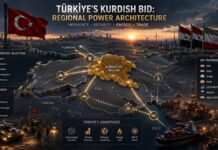









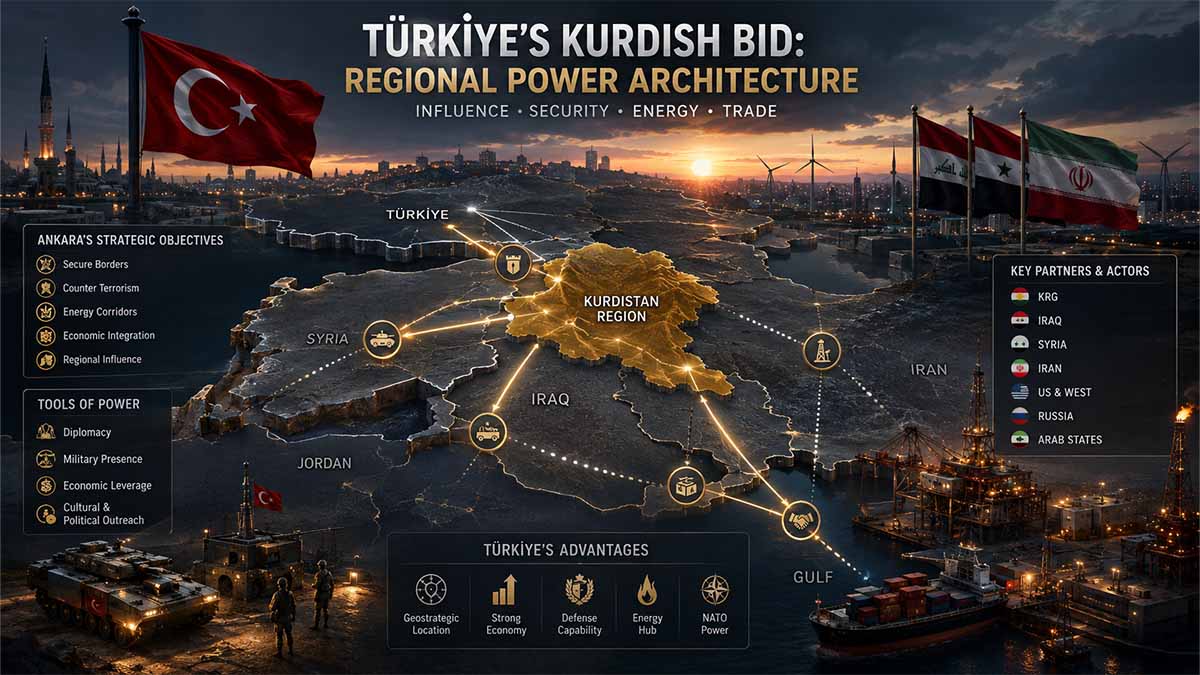
Executive Summary
- BLUF: Ankara’s peace initiative is simultaneously a domestic disarmament project, a constitutional test and an attempt to reshape Türkiye’s influence across Syria, Iraq and the wider Middle East.
- Its first-order objective is the verified dismantlement of the PKK’s armed infrastructure; its larger ambition is to convert security penetration into political, commercial and diplomatic reach.
- The decisive external variable is northeastern Syria, where Kurdish military, police and civilian structures remain only partially integrated into the Syrian state.
- Iraq offers Ankara economic depth but imposes a sovereignty constraint on continuing cross-border military operations.
- The initiative does not prove the existence of a US–Turkish plan to erase regional borders or nation-states; no qualifying primary evidence establishes such a project.
- The central contradiction is structural: Ankara seeks Kurdish political cooperation beyond its borders while resisting autonomous armed or territorial authority adjoining Türkiye.
- Success therefore requires a sequenced settlement joining disarmament, lawful reintegration, political rights, local representation and independently verifiable security guarantees.
- Five-year base case: managed but incomplete accommodation, punctuated by implementation crises rather than either comprehensive peace or immediate return to full insurgency.
- Strategic upside: lower internal-security costs, reconstruction access, transit connectivity and greater Turkish leverage in Damascus, Baghdad and Erbil.
- Strategic downside: an outward-looking regional project without domestic legal normalization could internationalize—rather than resolve—the Kurdish question.
Türkiye’s Kurdish Gamble: Peace as a Regional Strategy
Ankara’s attempt to end four decades of conflict with the Kurdistan Workers’ Party is no longer a discreet security negotiation. It has become a project for reorganising Türkiye’s domestic politics, its southern frontier and its economic position between the Gulf and Europe. The bargain is formidable: verified disarmament and legal reintegration at home; absorption of Kurdish forces into the Syrian state; deeper cooperation with Baghdad and Erbil; and the conversion of Ceyhan and the Development Road into strategic infrastructure. Yet the same architecture contains its greatest vulnerability. If military demobilisation advances without political normalisation, or if Washington reduces its presence before Damascus can secure northeastern Syria, the process may redistribute instability rather than eliminate it.
The Law of Disarmament
Türkiye crossed a decisive threshold on 10 August 2026, when the Grand National Assembly adopted Law No. 7595, the Law on Strengthening National Solidarity and Social Integration. President Recep Tayyip Erdoğan approved it on 17 August 2026; publication followed on 18 August 2026 in Official Gazette No. 33344. The measure was adopted with 467 parliamentary votes, giving the initiative a breadth extending beyond the governing alliance. Law No. 7595 – Grand National Assembly of Türkiye – August 2026.
The legislation is not a general amnesty. Its mechanism is conditional: Türkiye’s security institutions must determine that the PKK/KCK and associated formations have terminated their effective organisational existence and surrendered the weapons and ammunition under their control. The National Security Council must confirm that finding, which must then be published in the Official Gazette before the judicial procedures established by the law can operate.
That sequence gives Ankara control over verification while offering differentiated treatment of investigations, prosecutions, sentences and legal disabilities. It is designed to prevent political promises from replacing material disarmament. But it also creates the process’s first institutional vulnerability: if the criteria for identifying organisational dissolution, surrendered inventories and eligible individuals remain opaque, every exclusion can be portrayed as political manipulation and every unexplained weapons discrepancy as evidence of deception.
Peace Enters Parliament
The parliamentary route matters because earlier Kurdish initiatives depended excessively on executive discretion, confidential contacts and the political resilience of individual leaders. The National Solidarity, Fraternity and Democracy Commission approved its report on 18 February 2026 by 47 votes to two, with one abstention, after examining both legal measures and democratisation. Commission Report – Grand National Assembly of Türkiye – February 2026.
This institutionalisation provides political protection to parties that would otherwise face mutually incompatible accusations: legitimising terrorism if they support the process, or sabotaging peace if they oppose it. Yet the strength of the vote does not settle the substance of the Kurdish question. Law No. 7595 regulates the transition out of armed organisation; it does not itself resolve Kurdish-language rights, municipal autonomy, the boundaries of protected political speech or the replacement of elected mayors by state-appointed trustees.
The European Commission’s Türkiye Report, published on 4 November 2025, recorded continuing pressure on political representatives, journalists and human-rights defenders working on Kurdish issues. It reported that 11 mayors in eastern and southeastern Türkiye had been dismissed and replaced by trustees, while Kurdish-language media and cultural institutions remained severely restricted. Türkiye Report 2025 – European Commission – November 2025.
This is the core test. Ankara can secure pacification without achieving reconciliation. Durable peace, however, requires citizens to believe that peaceful representation produces results unavailable through armed mobilisation.
The Syrian Test
The future of northeastern Syria will determine whether Türkiye’s domestic settlement becomes regionally sustainable. The agreement reached between Damascus and the Syrian Democratic Forces created a pathway for military, security, administrative and economic integration. By 22 June 2026, the United Nations reported that four integrated SDF brigades were receiving salaries through Syrian national structures and approximately 1,300 SDF-affiliated detainees had been released. Kurdish families were returning to Afrin and other northern areas, while Damascus had recognised school certificates issued by the former northeastern administration. Security Council Meeting S/PV.10178 – United Nations – June 2026.
The unresolved issues are more consequential than the milestones already achieved. The United Nations identified the integration of the Asayish internal-security forces, the status of women’s protection units, absorption of the civilian administration and control of the education curriculum as outstanding questions. These dossiers define sovereign authority: who commands armed personnel, controls policing, administers detention, appoints officials and shapes collective identity.
Ankara wants a single Syrian state without an autonomous armed structure on its border. Damascus wants control over territory, security and revenue. Kurdish actors require guarantees that integration will not become political erasure. Washington needs a force capable of suppressing the remnants of the Islamic State and securing detention facilities. A nominal redesignation of SDF formations without unified command would be unacceptable to Türkiye; forced dispersal without political guarantees could fracture Kurdish consent and generate rejectionist groups.
Washington’s Conditional Shield
The United States is reducing its physical footprint but preserving disproportionate strategic leverage. On 18 April 2025, the US Department of Defense ordered the consolidation of American forces into selected Syrian locations and announced that the deployment would fall below 1,000 personnel. It simultaneously retained the capacity to strike Islamic State remnants, support local partners and adjust its regional posture. Consolidation of US Forces in Syria – US Department of Defense – April 2025.
A limited deployment provides intelligence, surveillance, precision-strike coordination, logistical support and political deterrence far beyond its numerical size. It also supports the security architecture surrounding Islamic State prisoners and displaced populations. Washington’s mission, however, is the enduring defeat of the Islamic State—not an unlimited guarantee of Kurdish autonomy.
The 2026 US Central Command Posture Statement reported that Islamic State attacks across Iraq and Syria had declined by 70 percent since 2023 and were at their lowest level since 2013. From January 2025, coalition operations had killed 97 Islamic State-linked personnel and detained almost 900; nevertheless, CENTCOM warned that the dispersal of people from Al-Hol and continuing detention risks required sustained coalition action. US Central Command Posture Statement – CENTCOM – 2026.
For Ankara, an abrupt American withdrawal would be a false victory. It could remove the SDF’s principal external enabler while simultaneously weakening prison security, intelligence coverage and deterrence among competing forces. The preferable outcome is a sequenced transfer of counterterrorism functions to credible Syrian institutions.
Erbil’s Strategic Role
The Kurdistan Region of Iraq is the indispensable intermediary between Türkiye’s domestic process and the PKK’s cross-border environment. President Nechirvan Barzani declared on 17 February 2025 that the Kurdistan Region was prepared to support Türkiye’s peace process. On 11 July 2025, he welcomed a PKK disarmament ceremony held in the Region. Statement on Support for the Peace Process – Presidency of the Kurdistan Region – February 2025.
Erbil can communicate with Ankara, Baghdad and Kurdish political networks, but it does not command every mountain corridor or armed formation. The Kurdistan Democratic Party, the Patriotic Union of Kurdistan, federal Iraqi forces, Peshmerga units and Popular Mobilisation Forces operate through overlapping security geographies. High-level political support must therefore not be confused with comprehensive territorial control.
Türkiye’s durable interest lies in replacing recurrent cross-border coercion with Iraqi-controlled surveillance, intelligence exchange and local economic incentives. The European Union welcomed the PKK’s announcement that it would lay down arms and dissolve, but its October 2025 conclusions also called for an end to unilateral military actions undermining Iraqi sovereignty. EU–Iraq Cooperation Council Joint Statement – Council of the European Union – October 2025. Ankara gains influence when Baghdad and Erbil voluntarily internalise shared security objectives; it accumulates political liabilities when Turkish operations appear to bypass Iraqi authority.
Oil, Ceyhan and Federal Power
The Baghdad–Erbil dispute over oil marketing, production costs, federal transfers and public-sector salaries is inseparable from Türkiye’s regional strategy. In February 2025, the Kurdistan Regional Government linked the resumption of oil exports through Ceyhan to amendments in Iraq’s federal budget governing production and transportation costs. It also insisted that the Kurdistan Region participate in the Development Road. Türkiye–KRG Consultations – Kurdistan Regional Government – February 2025.
The Iraq–Türkiye pipeline system connects Iraqi production with the Mediterranean terminal at Ceyhan. Türkiye’s Ministry of Energy records a design capacity of 70.9 million tonnes annually following construction of the second parallel line. Iraq–Türkiye Crude Oil Pipeline – Ministry of Energy and Natural Resources of Türkiye.
On 1 April 2026, Energy Minister Alparslan Bayraktar stated that approximately 80,000–100,000 barrels per day were reaching Ceyhan through the relevant system, leaving more than one million barrels of daily capacity unused. He advocated extending the corridor toward Basra and using up to approximately 1.5 million barrels per day. Energy Infrastructure Statement – Ministry of Energy and Natural Resources – April 2026.
These are official Turkish ambitions, not guaranteed throughput. Their realization requires a legally durable Baghdad–Erbil settlement, verified metering, stable tariffs, sanctions compliance and protection against sabotage. Without those safeguards, underused infrastructure remains a symbol of unrealised leverage.
The Development Road
The Development Road is the economic spine of Ankara’s wider strategy. It is intended to connect Al Faw Grand Port on the Gulf with Türkiye and European markets through more than 1,200 kilometres of road and railway. Iraq’s official project specifications include a planned port capacity of 25 million containers annually, bulk handling capacity of 55 million tonnes, five initial berths, a 2.4-kilometre immersed tunnel and a 62-kilometre connecting road to Umm Qasr. Al Faw Grand Port and Development Road – General Company for Ports of Iraq.
Türkiye, Iraq, Qatar and the United Arab Emirates signed the project’s quadrilateral memorandum on 22 April 2024. On 27 June 2025, Erdoğan described it as a multimodal corridor from the Gulf through Ovaköy to Europe. The Turkish Presidency projected an economic-production effect exceeding USD 50 billion over ten years and average employment of 63,000 jobs annually. These remain government projections rather than completed outcomes. Development Road Economic Projection – Presidency of the Republic of Türkiye – June 2025.
The corridor gives every actor something to gain—but also something to obstruct. Baghdad seeks economic diversification; Erbil demands inclusion; Ankara seeks Gulf–European connectivity; armed networks may pursue protection rents; and excluded provinces may resist an infrastructure system perceived as extractive. Security must therefore be built into contracts, customs systems, local employment and revenue distribution, not added later as military protection.
The Shadow Contest
The dissolution of a formal armed organisation does not automatically eliminate its financial specialists, procurement networks, smugglers or cyber operators. Some will demobilise; others may migrate into organised crime, mercenary markets, illicit commodities or foreign-supported networks. The principal intelligence challenge will be distinguishing legitimate reintegration from organisational relabelling.
Europol’s European Union Terrorism Situation and Trend Report 2025 found that terrorist actors continued to exploit cryptocurrencies and “digital hawala,” combining blockchain systems, mobile payments and informal transfer networks. It also warned that instability surrounding Syrian camps and detention facilities could affect European security. EU TE-SAT 2025 – Europol – June 2025.
The expanding digitalisation of ports, customs, pipelines and railways creates an additional vulnerability. Cyber operations can disrupt freight, manipulate cargo records, conceal smuggling or attack operational technology without the political exposure of conventional violence. In July 2026, the US Cybersecurity and Infrastructure Security Agency warned that Iranian-affiliated actors were exploiting internet-connected programmable logic controllers across critical infrastructure. The advisory concerned US targets, but the technique is directly relevant to interconnected energy and transport systems. Cybersecurity Advisory AA26-097A – CISA – July 2026.
The Measure of Success
The initiative will not be judged by a ceremony, a statute or a temporary fall in attacks. Its durability will be measured by whether command networks disappear, weapons inventories reconcile, elected Kurdish representatives can exercise lawful mandates, Damascus establishes one credible security chain in northeastern Syria, and Baghdad and Erbil reach enforceable arrangements over borders, revenue and energy.
Türkiye now has an opportunity to exchange the geography of conflict for an architecture of influence. But influence built only through military access remains expensive and reversible. Influence embedded in law, trade, pipelines, railways and legitimate political representation becomes structural. That is the real scale of Ankara’s Kurdish gamble: not merely ending an insurgency, but proving that a state accustomed to managing the Kurdish question through security can convert disarmament into institutions—and institutions into regional power.
Navigational Index
- The Domestic Bargain — disarmament, parliamentary legalization, Kurdish political participation, institutional trust and regime incentives.
- The Cross-Border System — northeastern Syria, Iraq and the Kurdistan Region, US force posture, Iranian influence, energy corridors and Turkish regional power.
- The Five-Year Outlook — competing hypotheses, Bayesian indicators, Monte Carlo scenarios, spoilers, illicit finance, cyber operations and warning thresholds.
Master Abstract
Türkiye’s latest Kurdish initiative should be assessed neither as a conventional bilateral negotiation nor as proof of a predetermined neo-Ottoman territorial project. It is better understood as a multidomain conversion strategy: Ankara is attempting to transform a four-decade security confrontation into a domestic political settlement while exploiting the weakening or reconfiguration of the armed systems surrounding its southern frontier. The initiative acquired an institutional form when the Grand National Assembly of Türkiye created the National Solidarity, Fraternity and Democracy Commission on 5 August 2025 to address the removal of terrorism from the national agenda, social integration, democracy and the rule of law. Its final report was approved on 18 February 2026 by 47 votes to two, with one abstention. This establishes that the process is no longer merely rhetorical or confined to executive–security channels. National Solidarity, Fraternity and Democracy Commission Report – Grand National Assembly of Türkiye – February 2026. Ankara’s official discourse meanwhile places the project inside a wider “terror-free region” and a Turkish–Kurdish–Arab political vocabulary, indicating that the government sees domestic pacification as an instrument of regional influence rather than an isolated concession. Türkiye’s Century Has Opened Its Doors Wide – Directorate of Communications of the Presidency of Türkiye – July 2025. The strongest defensible judgment, however, is narrower than the maximalist narratives surrounding the process: Ankara is pursuing a security settlement that could generate regional leadership, not an evidenced plan to abolish the borders of Türkiye, Syria or Iraq. Territorial revisionism, confederal reconstruction and a transnational religious compact remain hypotheses requiring observable legal, diplomatic or military corroboration; they cannot be treated as established policy.
The Syrian arena is the principal external test because it forces incompatible objectives into the same institutional space. Ankara demands the elimination of an autonomous armed structure connected, in its assessment, to the PKK; Damascus seeks a monopoly over force, territory, revenue and administration; Kurdish actors seek durable guarantees against political erasure; and Washington’s counter-Daesh requirements have historically depended on Kurdish-led forces. By June 2026, the United Nations reported measurable but incomplete implementation of the 29 January agreement between Damascus and the Syrian Democratic Forces: four integrated SDF brigades were reportedly receiving salaries through national structures and approximately 1,300 SDF-affiliated detainees had been released. Yet the same UN record identified unresolved questions concerning the integration of Asayish personnel into the Interior Ministry, the status of women’s protection units, civilian administration and education. Security Council 10178th Meeting Transcript – United Nations – June 2026. These are not administrative details; they are the constitutional architecture of post-war northeastern Syria. Control of policing determines coercive authority, curricula shape identity reproduction, payroll integration tests command loyalty, and the status of women’s units touches the ideological core of the Kurdish movement. Ankara’s opportunity is to help produce a Syrian settlement in which the border is controlled by a recognized state, heavy weapons and external command networks disappear, and Kurdish cultural and local-government protections become legally enforceable. Its risk is that coercive acceleration, proxy violence or maximalist centralization produces splinter groups, clandestine rearmament and renewed US dependence on a separate Kurdish security partner. The initiative will therefore succeed regionally only if disarmament, demobilization and reintegration, minority protections and counter-Daesh continuity advance together. Any strategy that delivers only the first element may suppress organized formations temporarily while preserving the recruitment conditions for their successors.
Iraq presents a different balance: there Ankara possesses expanding commercial and diplomatic access, a working relationship with both Baghdad and Erbil, and a powerful interest in preventing armed sanctuaries along the northern frontier, but it cannot obtain durable regional legitimacy through military reach alone. The European Union formally welcomed the PKK announcement that it would lay down arms and dissolve, judging that a credible peace process could improve regional stability; in the same official conclusions, however, the EU called for an end to unilateral military actions undermining Iraqi sovereignty. EU–Iraq Cooperation Council Joint Press Statement – Council of the European Union – October 2025. That dual formulation captures Ankara’s strategic constraint. A successful domestic settlement could permit Türkiye to reduce the political cost of its Iraqi deployments, move from recurrent coercion toward intelligence-led border security, and attach security normalization to trade, transport, water management and reconstruction. Failure could instead fragment the threat: compliant cadres might enter legal or civilian channels while rejectionist networks migrate into smuggling, private armed protection, drone procurement, cyber-enabled finance or sponsorship relationships with regional competitors. The relevant “shadow” economy is therefore wider than weapons trafficking. It includes informal taxation, front companies, construction subcontracting, cryptocurrency transfers, remittance systems, fuel diversion, procurement intermediaries and political-finance networks. No available qualifying primary record proves a single controlling sponsor behind these activities, so attribution must remain case-specific. The five-year intelligence requirement is to map whether financial and logistical nodes are actually dismantled, repurposed for civilian reintegration or merely relabelled. For Ankara, the strategic prize is not the annexation of Kurdish space but the creation of an economic-security hinterland in which Turkish infrastructure, capital, intelligence cooperation and diplomatic mediation become indispensable. For Baghdad and Erbil, the acceptable version of that order must remain contractually reciprocal and constitutionally Iraqi.
The domestic legitimacy variable ultimately governs every external ambition. The European Commission’s 2025 Türkiye Report recognized the state’s responsibility to combat terrorism but documented continuing concerns over an expansive terrorism definition, pressure on political actors and journalists, the replacement of 11 elected mayors in the east and southeast by state-appointed trustees, unresolved property and accountability cases, and incomplete protection of Kurdish cultural rights. Türkiye Report 2025 – European Commission – November 2025. In July 2026, an EU institutional assessment described the initiative as a process involving PKK dismantlement, Kurdish-rights concessions and fighter reintegration, while simultaneously recording high inflation and continuing democratic backsliding. EU–Türkiye Political and Economic Assessment – Council of the European Union – July 2026. These conditions produce the report’s principal Bayesian judgment. Starting from a neutral prior, parliamentary institutionalization and observable Syrian integration raise the probability of a sustained process; unresolved legal protections, institutional distrust and the multiplicity of cross-border veto players reduce the probability of a comprehensive settlement. The modeled central estimate for August 2026–August 2031 is therefore 44 percent for managed but incomplete accommodation, 23 percent for a deeper constitutional–regional compact, 18 percent for securitized stagnation, 10 percent for renewed organized conflict and 5 percent for destabilizing transborder fragmentation. These are structured analytical estimates, not frequencies derived from an official dataset. The model uses five competing hypotheses—H₁ genuine domestic normalization, H₂ tactical pacification, H₃ regional influence conversion, H₄ elite-regime consolidation and H₅ externally conditioned containment—and treats them as overlapping causal mechanisms rather than mutually exclusive slogans. The most likely outcome combines H₁, H₃ and H₄: real violence reduction, selective legal accommodation, expanded Turkish regional leverage and preservation of centralized executive control. The settlement becomes strategically durable only if observable conduct begins to falsify H₂ and H₅ through transparent legislation, reciprocal demobilization, judicial safeguards and institutions capable of surviving leadership change.
Kurdish Settlement Stability Matrix
Adjust the four principal drivers. The dashboard recalculates an analytical stability score and redistributes five scenario weights.
Driver controls
Five-year stability estimate
0 fragile · 100 durable
Analysis of Competing Hypotheses
The Domestic Bargain: Türkiye’s Kurdish Settlement, 2026–2031
Disarmament becomes a legal transaction
The domestic bargain has crossed the boundary separating exploratory political dialogue from enforceable state action. On 10 August 2026, the Grand National Assembly adopted Law No. 7595, the Law on Strengthening National Solidarity and Social Integration; presidential approval followed on 17 August, and publication in Official Gazette No. 33344 occurred on 18 August 2026. Law No. 7595 on Strengthening National Solidarity and Social Integration – Grand National Assembly of Türkiye – August 2026. Its design is strategically important because it does not begin with a generalized amnesty, mutual political declaration or constitutional recognition of the Kurdish question. It establishes a security-triggered sequence: competent security institutions must determine that the PKK/KCK and connected formations have terminated their effective organizational existence and surrendered the weapons and ammunition under their control; the National Security Council must confirm that determination; and the resulting decision must be published in the Official Gazette before prescribed judicial accommodations become operational. The legislation’s parliamentary record describes those accommodations as mechanisms governing investigations, prosecutions, deferred execution of sentences, removal of legal disabilities and related administrative measures rather than the automatic erasure of criminal responsibility. This structure converts disarmament from a political promise into a precedent condition for legal relief. It also concentrates the decisive verification power inside the state’s security architecture. The bargain is consequently asymmetric but not fictitious: the armed organization must produce observable, irreversible conduct before individuals obtain differentiated legal treatment, while the government retains control over certification, sequencing and the classification of applicants. The immediate five-year question is therefore not whether a law exists, but whether its verification system can distinguish senior commanders, armed members, logistical personnel, coerced affiliates, political activists and persons prosecuted under expansive association theories without reproducing the grievances the settlement is supposed to contain.
| Bargain layer | Principal obligation | Verification authority | Benefit offered | Primary failure mode |
|---|---|---|---|---|
| Organizational | Terminate command and operational structures | Security institutions and National Security Council | Activation of the statutory process | Nominal dissolution with covert continuity |
| Material | Surrender controlled weapons and ammunition | Security, military and judicial chain | Access to individualized legal procedures | Hidden caches, cross-border transfers or proxy custody |
| Individual | Apply through prescribed procedures and disclose status | Prosecutorial and judicial authorities | Deferred proceedings, sentences or disabilities where applicable | Arbitrary categorization or inconsistent adjudication |
| Political | Replace armed representation with lawful competition | Parliament, electoral institutions and courts | Legitimate participation and policy influence | Criminalization of non-violent Kurdish politics |
| Social | Accept reintegration without collective retaliation | Central government, municipalities and communities | Reduced violence and economic normalization | Vigilantism, stigma or spoiler mobilization |
Verification is the settlement’s critical infrastructure
A credible disarmament architecture requires more than photographed weapons destruction, declarations by recognized leaders or a statistical decline in attacks. It must determine whether the organization has lost five separable capacities: command authority, lethal equipment, recruitment, finance and territorial mobility. These capacities should be evaluated through mutually reinforcing evidentiary streams rather than a single politically controlled certification. The physical stream should record weapons by type, serial number, condition, origin and transfer location; reconcile surrendered stocks against seizure histories, procurement intelligence and unit-level estimates; and maintain a chain of custody capable of surviving judicial challenge. The organizational stream should test whether regional commands, communications protocols, disciplinary mechanisms, safe-house systems and logistical cells remain active. The personnel stream should establish identity, function, time in organization, alleged criminal conduct, citizenship and reintegration risk without treating mere ethnic, familial or political proximity as membership. The financial stream should trace front companies, informal taxation, cash couriers, remittance networks, cryptocurrency wallets, fuel and cigarette trafficking, construction subcontracting and charitable conduits. The digital stream should monitor whether dormant media, encrypted communications and cyber-support networks are being preserved as mobilization infrastructure. Law No. 7595 supplies a formal gateway, but the public record does not yet demonstrate that the verification mechanism possesses independent auditing, published evidentiary standards or a challenge procedure for disputed classifications. That gap matters because an exclusively executive determination can accelerate implementation but leaves each side vulnerable to manipulation claims. Parliament’s preparatory process offers a stronger foundation: the National Solidarity, Fraternity and Democracy Commission approved its report on 18 February 2026 by 47 votes to two, with one abstention, following work covering legal regulation and democratization. National Solidarity, Fraternity and Democracy Commission Report – Grand National Assembly of Türkiye – February 2026. The durable model would preserve security confidentiality for sources and methods while submitting aggregate inventories, compliance milestones, regional discrepancies and recidivism data to a cross-party parliamentary body and an empowered judicial review channel.
Operational dependency architecture
Verified organizational termination
↓ requires simultaneous confirmation of
Command dissolution → weapons accounting → financial-network disruption → cross-border movement controls
↓ activates
Individual classification and judicial processing
↓ enables
reintegration, political participation and local normalization
↓ produces, only if rights are credible
institutional trust and declining recruitment
↘ if verification is opaque or selective
spoiler narratives → clandestine networks → security re-escalation
The architecture reveals a crucial intelligence distinction: reduced violence is an outcome indicator, not proof of organizational liquidation. A disciplined armed network can temporarily suppress attacks while preserving command, finance and personnel. Conversely, isolated violence after a genuine dissolution does not necessarily demonstrate organizational continuity; it may represent rejectionist splinters, criminal entrepreneurs or autonomous militants. The verification system must therefore attribute capability and command, not merely count incidents.
Parliamentary legalization and the limits of conditionality
Parliamentary legalization changes the political economy of the process by distributing ownership beyond the presidency, the security establishment and the governing alliance. The proposal entered parliament on 5 August 2026, was debated in committee and plenary, and ultimately received 467 votes, an unusually broad mandate in a 600-seat legislature. Law on Strengthening National Solidarity and Social Integration Adopted by the General Assembly – Grand National Assembly of Türkiye – August 2026. That majority reduces the probability that the legal mechanism can be portrayed as a narrow transaction between the executive and one Kurdish intermediary. It also provides political insurance to deputies who would otherwise fear being accused either of legitimizing terrorism or sabotaging peace. Yet parliamentary scale does not automatically create substantive pluralism. Law No. 7595 remains principally a framework for processing the consequences of demobilization; it does not by itself settle the boundaries of protected political speech, Kurdish-language education, municipal authority, electoral replacement rules, cultural institutions or the relationship between non-violent advocacy and terrorism offences. The government could therefore satisfy the law’s security logic while postponing the democratic component indefinitely. That outcome would generate a “compliance trap”: former fighters might enter individualized legal channels, but elected politicians, journalists, lawyers and local officials could remain exposed to broad interpretations of organizational association. The European Commission reported in November 2025 that Türkiye retained a broad application of terrorism concepts, continued judicial and administrative pressure on political actors and journalists addressing Kurdish issues, replaced 11 mayors in eastern and southeastern municipalities with state-appointed trustees, and had not produced a comprehensive approach to several legacy accountability questions. Türkiye Report 2025 – European Commission – November 2025. Those findings do not negate the later legislation; they identify the institutional baseline against which its transformative value must be tested. Over five years, parliamentary legalization will be meaningful only if emergency-style instruments contract as security risk declines and if political competition becomes the principal channel through which Kurdish interests are aggregated.
| Legislative test, 2026–2031 | Evidence of genuine normalization | Evidence of tactical pacification |
|---|---|---|
| Terrorism law | Narrower, conduct-based application with clearer evidentiary thresholds | Existing breadth retained for political and journalistic cases |
| Reintegration | Published categories, individualized review and appeal | Discretionary exemptions dependent on executive certification |
| Local government | Elected mandates protected unless removed through final judicial process | Continued replacement through administrative trustee mechanisms |
| Political speech | Non-violent autonomy, language and decentralization arguments protected | Policy advocacy treated as organizational propaganda |
| Parliamentary oversight | Periodic public compliance reports and opposition access | Security briefings without auditable outcomes |
| Sunset mechanisms | Exceptional authorities expire after measurable compliance | Temporary powers become permanent administrative tools |
Kurdish participation is the conversion mechanism
The settlement can suppress insurgent capacity without resolving political representation, but it cannot become self-sustaining unless constituencies formerly addressed through armed structures acquire confidence that lawful participation produces material outcomes. Kurdish political participation is therefore not a symbolic concession added after disarmament; it is the conversion mechanism that reduces the expected utility of remobilization. The relevant institutional indicators extend beyond the electoral survival of a pro-Kurdish party. They include whether candidates can campaign without disproportionate prosecution, elected mayors can exercise their mandates, municipal budgets remain under accountable local control, Kurdish-language cultural activity is lawful, parliamentary immunity is predictable, courts distinguish advocacy from operational support, and former affiliates can enter civilian life without becoming permanently unemployable. The European Court of Human Rights held in July 2025 that the continuing pre-trial detention of former HDP co-chair Selahattin Demirtaş involved several violations of the European Convention. Selahattin Demirtaş v. Türkiye No. 4 – European Court of Human Rights – July 2025. Separately, the Council of Europe’s local-democracy assessment concluded that replacing elected mayors with appointed trustees was inconsistent with core local self-government principles. Fact-Finding Mission on Local Elections in Türkiye – Congress of Local and Regional Authorities of the Council of Europe – March 2024. These sources create an external legal benchmark: Ankara can retain a unitary state and strong counterterrorism capabilities while still reducing the discretionary zone in which electoral mandates are administratively displaced. The regime’s challenge is that political normalization can empower Kurdish representatives as autonomous negotiators rather than controlled beneficiaries. Nevertheless, suppressing that autonomy would undermine the bargain’s central behavioral exchange. If non-violent political action yields no reliable institutional return, rejectionists can argue that disarmament merely transferred coercive advantage to the state. Conversely, visible municipal delivery, parliamentary bargaining and legal victories would provide evidence that civilian politics outperforms insurgency.
Institutional trust cannot be legislated by declaration
Trust in this context is not interpersonal confidence between leaders; it is a probabilistic judgment by thousands of actors about whether institutions will honor commitments when political conditions deteriorate. Former militants must estimate the probability of arrest after disclosure, Kurdish politicians must estimate whether electoral victories will be respected, security personnel must estimate whether reintegration exposes them or civilians to renewed violence, victims’ families must estimate whether accommodation sacrifices accountability, and governing parties must estimate whether concessions will be exploited by hostile networks. Each group begins with a different prior and processes the same event differently. The adoption of Law No. 7595 produces a positive Bayesian update because it creates a published, nationally authorized mechanism that is harder to reverse than an informal executive assurance. The 467-vote parliamentary majority produces a second positive update because it widens institutional ownership. The National Security Council trigger, however, creates a mixed update: it increases confidence that disarmament will be tested by the state’s most capable bodies, but decreases confidence among skeptical participants if the certification criteria remain secret and non-reviewable. Continuing trustee appointments, expansive prosecutions or non-implementation of binding judicial decisions would generate strong negative updates because they are observable demonstrations of how the state behaves after political mandates or legal judgments challenge executive preferences. Trust-building therefore requires costly signals: actions that Ankara would find politically or institutionally difficult to take unless it intended the settlement to endure. Examples include publishing disarmament criteria before applying them; permitting independent lawyers to observe applicant processing; creating a secure appeal mechanism; restoring political rights after individualized review; applying the same evidentiary standards across provinces; reporting misconduct by officials; and protecting lawful Kurdish political organization even when it opposes the government. China’s Foreign Ministry provides a useful external cross-check without adding speculative geopolitical content: on 28 February 2025, it stated that Beijing supported relevant Turkish parties in resolving differences through political means. Foreign Ministry Regular Press Conference – Ministry of Foreign Affairs of the People’s Republic of China – February 2025. No directly relevant Russian governmental document located during live verification met the same evidentiary threshold; Russian-language secondary reporting is therefore excluded rather than used to manufacture multilingual corroboration.
Regime incentives: peace dividend and political control
The governing coalition has at least five rational incentives to pursue the bargain, none of which must be treated as mutually exclusive. First, verified demobilization lowers the expected security burden imposed by military operations, intelligence coverage, infrastructure protection and recurrent emergency governance. Second, it expands Ankara’s capacity to redirect political attention toward inflation, reconstruction, productivity and external economic positioning. The Ministry of Treasury and Finance projected 26 percent annual inflation for 2026 after 30.9 percent in 2025, reported unemployment of 8.2 percent in May 2026, and placed the 2025 budget deficit at 2.9 percent of GDP. Türkiye–EU High-Level Economic Dialogue Presentation – Ministry of Treasury and Finance – July 2026. Peace cannot independently solve these macroeconomic problems, but it can reduce a persistent risk premium, improve southeastern investment expectations and free political capacity for economic management. Third, the process permits the executive to claim authorship of a historic national settlement while neutralizing an issue previously used by competing parties to organize Kurdish voters. Fourth, cooperation with Kurdish representatives could alter parliamentary coalition arithmetic during future legislative or constitutional bargaining. Fifth, domestic demobilization strengthens Türkiye’s negotiating position toward Syria, Iraq, the European Union and the United States by allowing Ankara to argue that cross-border Kurdish armed structures—not Kurdish identity or representation—constitute the remaining security problem. These incentives create both momentum and moral hazard. A government seeking durable peace will accept institutional constraints that distribute credit and bind future executives. A government seeking primarily regime consolidation will prefer selective relief, centralized certification, symbolic inclusion and continued leverage over Kurdish municipalities and politicians. The key discriminant is not official rhetoric but whether policy reduces the incumbent’s discretionary power. Reforms that protect opponents, constrain trustee appointments, narrow prosecutorial latitude and make reintegration reviewable are more diagnostic of H₁, genuine normalization. Measures that deliver immediate disarmament while leaving those levers untouched support H₂, tactical pacification, and H₄, regime consolidation.
| Competing hypothesis | Prior probability | Evidence raising probability | Evidence reducing probability | August 2026 posterior |
|---|---|---|---|---|
| H₁ Genuine democratic normalization | 22% | Law, broad parliamentary vote, rights reforms, protected local mandates | Security-only implementation or continued exceptional governance | 29% |
| H₂ Tactical pacification | 25% | Conditional relief, centralized certification, limited institutional reform | Independent oversight and durable political-rights guarantees | 24% |
| H₃ Regional influence conversion | 21% | Coordination linking domestic peace to Syria, Iraq, transport and trade | Inability to reduce cross-border coercion or gain Kurdish cooperation | 23% |
| H₄ Regime and coalition consolidation | 20% | Selective inclusion, executive ownership and constitutional bargaining | Cross-party implementation insulated from incumbent control | 18% |
| H₅ Externally conditioned containment | 12% | Milestones closely follow US, Syrian or Iraqi pressure | Process survives adverse external change through domestic law | 6% |
The posterior distribution is an analytical estimate, not an official statistic. Evidence supports a hybrid explanation in which sincere violence reduction, regional strategy and domestic political advantage operate simultaneously. The decisive test is whether H₁ continues gaining probability after the easy legislative milestone has passed and the costly implementation phase begins.
Shadow dimensions and spoiler economics
The shadow system will determine whether formal demobilization produces actual security normalization. Cadres who cannot or will not enter the statutory process may seek protection through criminal markets, private security structures, foreign armed groups, smuggling networks or digitally mediated finance. The principal risk is not the formation of a conventional mercenary army inside Türkiye; no qualifying public evidence presently supports such a judgment. The more plausible threat is functional migration: specialists in explosives, drones, document fraud, border movement, encrypted communications, fundraising or covert procurement can sell capabilities to criminal or foreign-sponsored networks without retaining the PKK label. Financial monitoring should therefore focus on network behavior rather than designated names. Sudden closure of known associations combined with the creation of construction, transport, agricultural, tourism or consulting firms by connected intermediaries may indicate legitimate economic transition, asset concealment or both. Cryptocurrency transactions require contextual analysis: wallet activity alone cannot prove terrorist finance, but convergence between previously attributed wallets, high-risk exchanges, procurement payments and travel patterns would raise the probability of organizational continuity. Cyber risks are similarly ambiguous. A decline in kinetic violence may coincide with increased defacement, doxing, data theft, diaspora intimidation or influence operations because cyber activity offers lower attribution risk and preserves mobilization narratives. State overreach in digital surveillance would create an opposing hazard by collapsing the distinction between clandestine support and lawful Kurdish political expression. The optimal counter-network system therefore uses financial intelligence, customs records, judicial warrants and international cooperation while imposing auditable minimization rules. Reintegration policy must also address income. Individuals with weapons knowledge but no lawful employment constitute a predictable recruitment pool for organized crime and foreign conflict markets. Vocational programs, geographic mobility, psychological support and employer incentives should be matched to risk classification, while high-risk former commanders require longer monitoring. Success is measured not merely by the number of applicants processed, but by recidivism, employment retention, community acceptance, illicit-finance disruption and the absence of collective punishment.
| Shadow vector | Early-warning indicator | Benign alternative explanation | Required corroboration |
|---|---|---|---|
| Mercenary migration | Travel toward active conflict theatres; security-sector recruitment | Lawful overseas employment | Travel, contract, payment and command-link convergence |
| Illicit liquidity | New wallets, cash-intensive firms, irregular remittance clusters | Reintegration capital or family support | Transaction graph, procurement links and attributed counterparties |
| Arms concealment | Discrepancies between expected and surrendered inventories | Historical intelligence error or destroyed stocks | Serial data, depot imagery, testimony and forensic matching |
| Cyber continuity | Coordinated propaganda, doxing or intrusion attempts | Decentralized activism without command | Infrastructure reuse, operator overlap and synchronized tasking |
| Criminal convergence | Smuggling or protection activity by former logistical nodes | Pre-existing local criminality | Personnel, finance, communications and territorial overlap |
| Political coercion | Threats against candidates or defectors | Personal disputes or unrelated violence | Pattern analysis, claims, communications and beneficiary assessment |
Five-year scenario model
The 2026–2031 outlook is best represented as a sequence of conditional transitions rather than a single peace probability. Phase one, extending through mid-2027, will test whether Law No. 7595 can process surrender and reintegration cases without producing a classification crisis. Phase two, from late 2027 through 2028, will expose the political core: reduction in attacks will increase demands for municipal normalization, narrower terrorism law, cultural guarantees and implementation of European human-rights judgments. Phase three, covering 2029 and likely electoral positioning, will test whether the process survives partisan competition. Phase four, during 2030–2031, will determine whether exceptional machinery expires, becomes institutionalized or is reactivated following spoiler violence. A Monte Carlo model using 100,000 synthetic trials assigns distributions to six drivers: verified disarmament, legal reciprocity, local-democracy protection, macroeconomic pressure, regional spillover and spoiler capability. The model is explicitly judgmental: it propagates uncertainty from structured assumptions and does not claim statistical prediction from a historical sample. Under the August 2026 baseline, managed but incomplete accommodation is assigned 43 percent, a durable democratic settlement 24 percent, securitized stagnation 18 percent, organized conflict recurrence 9 percent, and fragmented criminal–proxy violence 6 percent. Sensitivity testing identifies legal reciprocity as the strongest domestic variable. Raising verified disarmament without increasing legal reciprocity initially lowers violence but raises stagnation after 2028; improving both produces the only pathway in which durable settlement exceeds 40 percent. Severe macroeconomic deterioration reduces resources for reintegration and increases polarizing incentives, although it may also encourage the government to preserve peace to avoid a second crisis. Regional escalation affects the model asymmetrically: conflict in northern Syria or Iraq can increase Ankara’s demand for Kurdish cooperation while simultaneously empowering security hardliners. The five-year base case is therefore neither constitutional transformation nor breakdown. It is a controlled, contested accommodation that removes most organized armed activity, produces selective legal reintegration and expands parliamentary Kurdish participation, but leaves continuing disputes over municipal authority, judicial independence and the boundaries of national identity.
| Period | Decision gate | Base-case development | Principal warning threshold |
|---|---|---|---|
| Aug. 2026–Jun. 2027 | Verification and first applications | Initial disarmament certification; differentiated processing begins | Unexplained inventory gaps or mass rejection of applicants |
| Jul. 2027–Dec. 2028 | Democratic reciprocity | Pressure shifts from weapons to political and municipal rights | Continued trustee rule despite sustained security improvement |
| 2029 | Electoral stress test | Kurdish actors bargain within parliamentary competition | Violence or prosecutions used to restructure electoral competition |
| 2030 | Institutionalization | Reintegration becomes ordinary judicial and administrative practice | Parallel security process remains outside effective review |
| 2031 | Settlement durability | Most violence remains criminalized and politically marginal | Coordinated remobilization, foreign sponsorship or systemic reversal |
Strategic judgment and intelligence requirements
The domestic bargain is real, legally consequential and potentially historic, but its durability remains unproven because Ankara has completed the stage that maximizes state control and is only beginning the stages that require the state to constrain itself. The strongest evidence for durability is the combination of formal legislation, a 467-vote parliamentary majority and a prior cross-party commission process. The strongest evidence against premature confidence is the unresolved institutional baseline: broad counterterrorism application, contested local-government replacement, adverse European human-rights judgments and uncertainty over independent verification. The central strategic judgment is that disarmament and democratization are not sequential substitutes. Some sequencing is operationally unavoidable—weapon surrender must precede particular forms of relief—but excessive postponement of political reciprocity will weaken compliance precisely when the state expects surrender to become irreversible. Ankara should therefore publish a milestone compact connecting each verified security achievement to a defined legal or administrative response. Parliamentary opposition and Kurdish representatives should receive access to aggregate verification results without exposure of operational intelligence. Courts should control individualized rights restrictions, while an independent inspectorate audits equality of treatment. Municipal mandates should be displaced only through a narrowly defined judicial process, not generalized executive inference. Victims’ rights require separate truth, compensation and serious-crime mechanisms so that reintegration is not interpreted as denial of harm. The five most important intelligence requirements are: I₁ whether central and regional command chains have actually ceased; I₂ whether weapons inventories reconcile across Türkiye, Iraq and Syria; I₃ whether former financial nodes are dissolving, criminalizing or entering legitimate commerce; I₄ whether political participation produces measurable institutional access; and I₅ whether the governing coalition accepts reforms that remain binding after future elections. If I₁ and I₂ improve while I₄ and I₅ remain static, the process should be classified as successful pacification but incomplete peace. If all five improve for at least two electoral cycles, the probability of durable settlement rises sharply. If political restrictions increase after disarmament, clandestine reorganization becomes a medium-term rather than immediate risk, with the most dangerous window opening between 2028 and 2030.
The Cross-Border System: Türkiye’s Regional Power Architecture
Northeastern Syria is the decisive hinge
The northeastern Syrian settlement is the central hinge connecting Türkiye’s domestic Kurdish bargain to the regional balance of power because it concentrates almost every unresolved variable within one theatre: Kurdish military organization, Syrian sovereignty, US counterterrorism requirements, Turkish border security, Arab–Kurdish governance, detention infrastructure, agricultural production, hydrocarbon administration and access between Iraq and the Mediterranean. The 29 January 2026 agreement between Damascus and the Syrian Democratic Forces has moved beyond declaratory diplomacy but remains far from institutional completion. By June 2026, the United Nations reported that four integrated SDF brigades were receiving salaries through Syrian national structures, approximately 1,300 SDF-affiliated detainees had been released, displaced Kurdish families were returning to locations including Afrin, and Damascus had recognized secondary-school certificates previously issued by northeastern authorities. The same assessment identified four unresolved dossiers capable of reversing those gains: integration of the Asayish internal-security forces into the Interior Ministry, the future of the women’s protection units, absorption of the civilian administration and control over the education curriculum. Security Council 10178th Meeting Transcript – United Nations – June 2026. Each dossier concerns sovereign power rather than bureaucratic detail. Brigade salaries test fiscal incorporation but do not by themselves establish a unified command chain. Integrating the Asayish determines who controls policing, intelligence files, detention and public order. The women’s units constitute both an armed capability and an ideological institution whose dissolution could fracture Kurdish consent. Civil-administration integration decides whether local councils retain meaningful authority or become implementation offices for Damascus. Curriculum control determines language, historical narrative and the reproduction of political identity. Türkiye’s preferred outcome is therefore not merely “SDF integration,” but an integration deep enough to eliminate an autonomous cross-border military architecture while remaining politically credible enough to prevent renewed Kurdish insurgency. If Damascus centralizes coercive authority without providing dependable cultural and administrative protections, Ankara may obtain a short-term security gain while inheriting a long-term radicalization problem along its entire southern frontier.
| Northeastern Syrian function | Present integration signal | Unresolved sovereign question | Turkish security relevance |
|---|---|---|---|
| Military formations | Four brigades reportedly paid through national structures | Operational command, unit composition and heavy weapons | Whether an autonomous force remains adjacent to Türkiye |
| Internal security | Negotiations concerning Asayish incorporation | Police command, intelligence archives and detention authority | Cross-border intelligence, infiltration and PKK-linked networks |
| Civil administration | Institutional integration remains incomplete | Local taxation, appointments, courts and municipal authority | Durability of Kurdish political accommodation |
| Education | Certificate recognition achieved | Kurdish-language instruction and curriculum control | Identity formation and future mobilization |
| Women’s formations | Status unresolved | Separate units, individual integration or demobilization | Cohesion of Kurdish forces and spoiler risk |
| Counter-Daesh detention | Camps and prisons remain a strategic burden | Custody, repatriation and financing | Risk of mass escape, recruitment and cross-border attacks |
| Hydrocarbons and agriculture | Revenue administration remains politically sensitive | Ownership, marketing and fiscal transfers | Funding of local authority and Turkish economic access |
Integration must solve a command problem, not rename it
A stable military settlement requires a precise answer to the question “who gives the final lawful order?” Merely redesignating SDF formations as Syrian brigades would preserve dual loyalty if personnel recruitment, promotions, intelligence, logistics and disciplinary authority remained inside the former command network. Conversely, dispersing Kurdish personnel individually across distant Syrian units could appear to satisfy unitary command but would create fears of forced dissolution, expose personnel to retaliation and reduce the local intelligence capacity needed to contain Daesh. The most viable architecture is a layered integration model. Strategic command, border policy, heavy weapons and national counterterrorism doctrine would belong to Damascus; territorially based brigades could retain a locally representative composition but operate through a nationally defined chain; internal-security personnel would enter a professional Interior Ministry structure with standardized vetting; and a joint transition mechanism would reconcile personnel files, ranks, salaries and alleged offences. Türkiye would require transparent exclusion of individuals connected to operational PKK networks, but an excessively expansive definition would make implementation impossible because Ankara’s institutional conception of the YPG and the SDF is broader than the distinctions used by Washington and some European governments. The process therefore needs conduct-based vetting: participation in attacks, weapons transfer, command relationships, financing and cross-border logistics should carry greater evidentiary weight than ethnicity, residence or nominal unit membership. The United States officially welcomed the earlier Damascus–SDF agreement and subsequently described integration into one Syrian government as the intended political “on-ramp.” Agreement Between the Syrian Interim Authorities and the Syrian Democratic Forces – US Department of State – March 2025. For Ankara, the optimal end state is a Syrian state capable of preventing both Daesh recovery and PKK cross-border operations without depending permanently on US troops or an autonomous Kurdish army. The principal risk is temporal mismatch: Washington may consolidate its presence faster than Damascus can absorb northeastern security functions, producing a security vacuum that neither Syrian forces nor Turkish-backed formations can fill without provoking conflict.
Cross-border command-conversion architecture
SDF military and security system
↓ personnel vetting, weapons registration, payroll reconciliation
Syrian Defence Ministry brigades + Interior Ministry policing
↓ monitored through national command and local liaison mechanisms
Unified border control + counter-Daesh continuity + detention security
↓ requires political sustainability through
local representation + language protections + revenue transfers
↘ failure of command integration
dual authority → Turkish coercive pressure → US dependency persists
↘ failure of political integration
Kurdish alienation → splinter recruitment → clandestine remobilization
This architecture also illustrates why Turkish and Syrian interests overlap only partially. Both governments reject a permanently autonomous armed structure, but Damascus seeks unconditional territorial restoration while Ankara seeks verifiable neutralization of networks it regards as PKK-linked. Syria could accept former SDF structures under nominal national control to accelerate reunification, whereas Türkiye could interpret precisely that arrangement as institutional camouflage. A durable settlement therefore needs third-party technical verification without transferring sovereignty to an external guarantor.
The US posture is shrinking but remains strategically disproportionate
The US military presence functions less as a territorial occupation force than as a high-leverage enabling system. In April 2025, the US Department of Defense ordered consolidation of its Syrian deployment into selected locations and stated that the footprint would fall to fewer than 1,000 personnel, while preserving the capacity to conduct strikes, support capable partners and adjust regional posture as conditions changed. It identified reduction of populations in northeastern Syrian camps and detention facilities holding Daesh-linked individuals as an essential counterterrorism objective. Consolidation of US Forces in Syria under Combined Joint Task Force–Operation Inherent Resolve – US Department of Defense – April 2025. Force numbers alone understate influence. A limited deployment can supply intelligence fusion, surveillance, air-ground coordination, logistics, special operations, strike authorization and political deterrence far beyond its physical scale. Its presence constrains attacks on partner forces, reassures detention guards, gives Washington direct visibility into northeastern networks and prevents Damascus, Ankara or regional militias from assuming that a coercive fait accompli will remain cost-free. Yet consolidation communicates that this protection is conditional and mission-specific. Washington has consistently defined its deployment around the enduring defeat of Daesh rather than an open-ended guarantee of Kurdish autonomy. The distinction reshapes Kurdish calculations: the SDF must exchange the uncertain protection of a declining foreign deployment for enforceable status inside the Syrian state. It also reshapes Ankara’s strategy. A rapid US exit could appear advantageous because it would remove the SDF’s principal external military enabler, but it could simultaneously produce prison breaches, Daesh reconstitution, intercommunal violence and an unmanaged race among Syrian, Turkish-backed, Kurdish and Iran-aligned forces. Ankara therefore benefits more from a sequenced US transition than from abrupt withdrawal. The five-year base case is a declining fixed presence combined with persistent over-the-horizon strike, intelligence and partner-support capabilities. The strongest indicator of imminent withdrawal will not be rhetoric but the transfer of prison security, intelligence targeting and air-support functions to credible Syrian institutions.
| US capability | Effect despite limited troop numbers | Transfer requirement | Vacuum risk |
|---|---|---|---|
| Intelligence, surveillance and reconnaissance | Detects Daesh cells and monitors hostile force movement | Syrian fusion centres with vetted personnel | Loss of warning and target discrimination |
| Precision strike | Raises cost of concentrated terrorist activity | Syrian air-ground coordination or regional response capacity | Daesh sanctuary regeneration |
| Partner advising | Sustains operational standards and planning | Institutional training inside Syrian ministries | Fragmented command and declining readiness |
| Detention support | Reinforces prisons and camps holding Daesh-linked populations | Funded guard force, repatriation and judicial processing | Escape, riots and recruitment |
| Political deterrence | Discourages unilateral attacks on partner areas | Negotiated Turkish–Syrian–Kurdish guarantees | Rapid coercive territorial change |
| Regional reinforcement | Allows dynamic response beyond Syrian bases | Access, air corridors and allied facilities | Reduced crisis-response time |
Iraq and the Kurdistan Region form Ankara’s strategic rear area
Northern Iraq is simultaneously a security buffer, a commercial gateway, an energy source and the physical environment in which the PKK’s disarmament credibility will be tested. The Kurdistan Region is not a passive extension of Turkish power: it possesses its own parties, security institutions, economic interests and constitutional disputes with Baghdad. Yet Erbil has become an indispensable intermediary because it can communicate with Ankara, Baghdad, Kurdish political networks and actors associated with the peace process. In July 2025, Kurdistan Region President Nechirvan Barzani publicly welcomed a PKK disarmament ceremony held in the Region and described the step as progress in the peace process. President Nechirvan Barzani Commends Progress in Peace Process – Presidency of the Kurdistan Region of Iraq – July 2025. Earlier, he had declared the Region prepared to provide assistance and support to the Turkish peace initiative. Support for the Peace Process in Türkiye – Presidency of the Kurdistan Region of Iraq – February 2025. These statements demonstrate political support but do not prove that Erbil controls all relevant mountainous territories, armed movements or logistical routes. The Kurdistan Democratic Party, Patriotic Union of Kurdistan, federal Iraqi forces, Peshmerga formations, Popular Mobilization Forces and local security bodies possess overlapping but non-identical areas of influence. Ankara must therefore avoid equating high-level alignment with comprehensive territorial control. Its most sustainable approach is to replace unilateral penetration with interoperable Iraqi border surveillance, intelligence exchange, transport-security agreements and economic incentives for districts historically exposed to armed networks. Baghdad’s sovereignty sensitivity imposes a clear ceiling. The European Union welcomed PKK dissolution but simultaneously called for an end to unilateral military action undermining Iraqi sovereignty. EU–Iraq Cooperation Council Joint Press Statement – Council of the European Union – October 2025. Turkish power grows when Iraqi institutions voluntarily internalize shared security goals; it becomes strategically expensive when military presence produces nationalist resistance or strengthens rival militias.
Baghdad–Erbil relations determine corridor viability
The cross-border system cannot be stabilized without reducing the chronic fiscal and constitutional friction between Baghdad and Erbil. Disputes over oil marketing, production costs, federal transfers, public-sector salaries, disputed territories and Peshmerga status affect more than Iraqi governance: they determine whether Kurdish institutions possess predictable revenue, whether Turkish companies face a coherent contracting environment and whether external actors can exploit financial distress. The Kurdistan Region has explicitly linked the resumption of oil exports through Ceyhan to amendments in Iraq’s federal budget governing extraction and transportation costs, while also demanding meaningful participation in the Development Road. KRG Prime Minister Receives Türkiye’s Deputy Foreign Minister – Kurdistan Regional Government – February 2025. For Ankara, the optimal structure is triangular rather than bilateral: Baghdad controls sovereign export authorization and national infrastructure; Erbil supplies production, local security and commercial access; Türkiye supplies pipelines, markets, investment and European connectivity. Any arrangement perceived as bypassing Baghdad invites legal challenge and political retaliation. Any arrangement that excludes Erbil risks non-cooperation, local obstruction and continuing production disputes. Energy interdependence can act as a peace technology only when revenues and obligations are transparent. Otherwise, it becomes a shadow-finance channel through which discounted oil, blending, false documentation, intermediaries or politically connected companies redistribute value outside formal budgets. The United States Treasury alleged in May 2026 that designated Iraqi individuals and companies had exploited the oil sector to benefit Iran and Iran-aligned militias; this is an official US sanctions determination, not an independently adjudicated factual finding, and must be treated accordingly. Economic Fury Targets Iraqi Oil Official and Iran-Backed Militias – US Department of the Treasury – May 2026. The analytical implication is nevertheless important: oil governance, militia finance and state sovereignty cannot be separated into independent policy compartments.
| Baghdad–Erbil variable | Regional-security effect | Turkish exposure | Required stabilizer |
|---|---|---|---|
| Oil marketing authority | Determines legality and transparency of exports | Pipeline utilization and commercial liability | Federal–regional marketing and auditing mechanism |
| Production compensation | Determines whether international operators continue output | Supply reliability and investment confidence | Formula linked to verified production costs |
| Salary transfers | Affects public stability and KRG legitimacy | Migration, unrest and political leverage | Predictable rules insulated from political disputes |
| Peshmerga reform | Determines unity and professionalism of regional forces | Reliability of border-security partners | Unified command, payroll and brigade structure |
| Disputed territories | Shapes control of roads, fields and mixed communities | Corridor security and conflict risk | Joint security arrangements and constitutional dialogue |
| Customs and transit | Determines corridor speed and revenue distribution | Turkish trade expansion | Digital tracking and harmonized border procedures |
Iranian influence operates through institutions, finance and coercive optionality
Iranian influence in Iraq should not be reduced to a single militia hierarchy or treated as unlimited command over Iraqi Shia actors. Tehran’s power derives from overlapping political relationships, religious networks, commercial exchange, energy dependence, armed organizations, intelligence access and the ability to raise the cost of policies hostile to Iranian interests. Some Popular Mobilization Forces operate within Iraqi legal structures and cannot be analytically collapsed into foreign proxies; other factions maintain documented ideological, financial or operational relationships with Iran. US Central Command assessed in 2025 that Iran-aligned Iraqi militias challenged Iraqi government authority and undercut legitimate Iraqi security institutions. US Central Command Posture Statement – United States Central Command – June 2025. In July 2026, the President of the European Council reported that Iraqi authorities had committed to disarming Iran-backed militias and ensuring a state monopoly over weapons. Telephone Call with the President of Iraq – European Council – July 2026. These official positions demonstrate that militia autonomy is recognized as a sovereignty problem, but they do not establish that Baghdad possesses either the capacity or consensus to dismantle every formation rapidly. Türkiye’s Kurdish peace strategy interacts with this system in three ways. First, reduced PKK activity could permit Ankara to shift intelligence and diplomatic resources toward containing militia and trafficking networks around Mosul, Sinjar and the Syrian border. Second, Turkish economic penetration through transport, construction and energy creates an alternative pole of influence that can reduce Iranian monopoly without requiring overt alignment against Tehran. Third, aggressive Turkish military expansion could produce the opposite result by enabling Iran-aligned factions to present themselves as defenders of Iraqi sovereignty. Ankara’s effective strategy is calibrated institutional competition: deepen Baghdad’s customs, infrastructure, counterterrorism and energy capacity while avoiding actions that unite otherwise divided Iraqi actors against Türkiye.
Energy corridors convert geography into bargaining power
Türkiye’s regional ambition is increasingly infrastructural. The Iraq–Türkiye crude-oil system, the Ceyhan export complex, electricity interconnection, prospective gas cooperation and the Development Road can transform military geography into revenue-producing interdependence. The official Turkish pipeline map records two parallel Iraq–Türkiye crude lines connecting Iraqi production with the Ceyhan terminal and an annual design capacity of 70.9 million tonnes after completion of the second line. Iraq–Türkiye Crude Oil Pipeline – Ministry of Energy and Natural Resources of Türkiye – current official map. Actual utilization has remained far below physical capacity. In April 2026, Türkiye’s energy minister stated that approximately 80,000–100,000 barrels per day were then reaching Ceyhan through the relevant system while more than one million barrels per day of capacity remained unused; he advocated extending the corridor toward Basra and ultimately using up to approximately 1.5 million barrels per day. Crises Can Pave the Way for Opportunities and Reforms – Ministry of Energy and Natural Resources of Türkiye – April 2026. These are Turkish governmental figures and ambitions, not independently guaranteed future throughput. Their strategic meaning is clear: Ceyhan could aggregate Iraqi, Kurdish, Azerbaijani and potentially Central Asian crude, giving Ankara commercial influence over multiple producers while supplying Mediterranean and European markets. But dependence runs in both directions. Iraq requires reliable access and legally durable transit; Türkiye requires volumes to justify infrastructure, storage and trading-hub ambitions. Sabotage, contractual arbitration, Baghdad–Erbil disputes and regional war can strand capacity. The five-year energy opportunity is therefore less about building entirely new lines than about governing existing ones credibly: metering, ownership verification, tariff stability, sanctions compliance, transparent revenue allocation and physical security. Energy connectivity supports peace only if actors earn more from predictable transit than from controlling bottlenecks or diverting flows through shadow markets.
The Development Road is Ankara’s economic-security spine
The Development Road extends the Turkish strategy beyond hydrocarbons by linking Al Faw Grand Port on the Gulf to the Turkish border and onward to Europe through rail and road infrastructure. Iraq’s official project portal describes an axis exceeding 1,200 kilometres, a planned Al Faw capacity of 25 million containers annually, bulk handling capacity of 55 million tonnes, five initial berths, a 2.4-kilometre immersed tunnel and a 62-kilometre connecting road between Al Faw and Umm Qasr. Al Faw Grand Port and Development Road – General Company for Ports of Iraq – current official project record. Those capacity figures describe project design and ambition, not verified present throughput. In April 2024, Iraq, Türkiye, Qatar and the United Arab Emirates signed a quadrilateral memorandum on cooperation in the Development Road. Development Road Memorandum of Understanding – Directorate of Communications of the Presidency of Türkiye – April 2024. Ankara subsequently projected that the corridor’s production effect could exceed USD 50 billion over ten years and generate an annual average of 63,000 jobs. Geopolitical Means and the Development Road – Directorate of Communications of the Presidency of Türkiye – June 2025. These figures should be treated as official Turkish projections rather than audited outcomes. Strategically, the corridor can align Baghdad, Erbil and Ankara by monetizing stability, but its route creates distributional conflict. Provinces excluded from freight nodes may resist; armed groups may seek protection rents; Kurdish authorities may fear bypass; Iran may view the corridor as economic competition; and alternative routes through the Gulf, Iran, the Caucasus or the Red Sea will constrain pricing. Corridor security therefore requires more than patrols. It requires customs integration, digital cargo tracking, land acquisition legitimacy, local employment, cybersecurity, bridge and tunnel protection, insurance, dispute settlement and revenue-sharing mechanisms.
Regional value-conversion chain
Al Faw maritime intake
→ Iraqi customs and digital cargo declaration
→ southern and central rail–road backbone
→ Baghdad logistics and industrial nodes
→ Mosul–Ovaköy security corridor
→ Turkish rail and motorway system
→ Mediterranean ports and European markets
Security dependencies beneath the corridor
State monopoly over force
→ Baghdad–Erbil coordination
→ PKK demobilization
→ militia restraint
→ customs integrity
→ investor and insurer confidence
A single failure does not automatically destroy the corridor, but combinations are nonlinear. Militia pressure plus customs corruption can make transit commercially unreliable; Kurdish exclusion plus Turkish military unilateralism can create political obstruction; and regional energy shocks plus attacks on infrastructure can move insurers and freight operators to alternative routes even before physical capacity is lost.
Competing hypotheses and five-year outlook
Five hypotheses explain Türkiye’s cross-border strategy. H₁ views Ankara as pursuing defensive border normalization: domestic disarmament, Syrian state consolidation and Iraqi cooperation would remove armed sanctuaries. H₂ interprets the same policies as regional influence conversion, using security cooperation to embed Turkish trade, construction, energy and logistics across Iraq and Syria. H₃ sees corridor primacy as the governing objective, with Kurdish accommodation serving mainly to de-risk infrastructure. H₄ emphasizes competitive balancing against Iran and other regional actors. H₅ predicts strategic overextension: incompatible commitments, military exposure and local resistance would consume resources faster than Ankara converts them into durable influence. These hypotheses overlap, but observable indicators can change their relative probabilities. The August 2026 prior distribution assigns H₁ 27 percent, H₂ 30 percent, H₃ 18 percent, H₄ 15 percent and H₅ 10 percent. Evidence of Syrian brigade integration, Erbil’s support for disarmament, institutionalized Turkish–Iraqi cooperation and Development Road investment raises H₁–H₃. Persistent Iraqi sovereignty objections, incomplete SDF integration, militia autonomy and uncertain pipeline governance preserve H₄ and H₅. A Monte Carlo model using 100,000 synthetic trials across seven uncertain drivers—SDF integration, US drawdown speed, Daesh pressure, Baghdad–Erbil settlement, militia autonomy, corridor execution and Turkish macroeconomic capacity—produces five outcome scenarios for 2031. The base case is constrained Turkish primacy at 38 percent: Ankara gains influence but cannot dictate regional order. Cooperative corridor consolidation receives 27 percent. Fragmented equilibrium receives 18 percent. Renewed cross-border conflict receives 11 percent, and Turkish overextension receives 6 percent. These are structured estimates rather than frequencies derived from an official dataset.
| Scenario, 2026–2031 | Probability | Defining condition | Principal consequence |
|---|---|---|---|
| Constrained Turkish primacy | 38% | Partial Syrian integration, stable Erbil ties and incremental corridor progress | Ankara becomes indispensable but remains checked by Baghdad, Damascus and Washington |
| Cooperative corridor consolidation | 27% | Full security sequencing and credible Baghdad–Erbil revenue settlement | Trade and energy interdependence reduce armed spoiler incentives |
| Fragmented equilibrium | 18% | No decisive breakdown, but parallel authorities and militias persist | High transaction costs and recurrent localized crises |
| Renewed cross-border conflict | 11% | SDF integration collapses or major spoiler attack triggers intervention | Displacement, infrastructure disruption and US re-engagement |
| Turkish overextension | 6% | Economic constraints combine with military and diplomatic resistance | Ankara retains exposure without obtaining proportional influence |
Strategic judgment and intelligence requirements
Türkiye is constructing a regional system in which Kurdish demobilization, Syrian territorial integration, Iraqi sovereignty, Ceyhan energy flows and the Development Road reinforce one another. The ambition is not best measured by territorial control. Its higher-order objective is positional power: Ankara wants to become the unavoidable junction through which Kurdish political accommodation, Iraqi trade, Gulf–European transport, northern Syrian stabilization and eastern Mediterranean energy access must pass. The strategy is plausible because Türkiye possesses geographic continuity, a large commercial base, military reach, NATO membership, established relations with Baghdad and Erbil, and infrastructure connecting the Gulf-facing hinterland to Europe. It is not assured because each advantage generates countervailing fears of dependence. Damascus resists external constraint over sovereign reintegration; Baghdad resists unilateral Turkish military action; Erbil seeks economic access without subordination; Washington prioritizes Daesh prevention rather than Turkish regional primacy; and Iran retains political, commercial and armed instruments capable of raising corridor risk. The most important intelligence requirements are therefore I₁ whether Syrian integrated brigades answer exclusively to a national chain of command; I₂ whether detention and counter-Daesh functions can survive further US consolidation; I₃ whether PKK logistical and financial nodes in Iraq are dismantled rather than transferred; I₄ whether Baghdad and Erbil establish durable oil, salary and security rules; I₅ whether Iran-aligned armed groups accept an Iraqi monopoly over strategic weapons; I₆ whether Development Road financing reaches irrevocable construction commitments; I₇ whether Ceyhan throughput expands under legally uncontested contracts; and I₈ whether local communities receive enough employment and revenue to defend rather than prey upon the corridor. The decisive five-year threshold will occur between 2027 and 2029, when political agreements must become command structures, contracts, functioning infrastructure and recurring revenue. Until then, Türkiye possesses a strategic opening, not a completed regional order.
The Five-Year Outlook: Türkiye’s Kurdish Settlement, 2026–2031
Forecast architecture and baseline judgment
The five-year outlook must distinguish a reduction in organized violence from a durable political settlement. Those outcomes overlap but are not equivalent. Türkiye may achieve verified disarmament, substantially reduce PKK operational capacity and stabilize its southeastern frontier while leaving political representation, local government, judicial normalization and Syrian Kurdish integration only partially resolved. Conversely, a process that produces political reforms without dismantling cross-border command, finance and weapons networks would remain vulnerable to coercive reversal. The baseline forecast therefore models the system across seven interacting domains: D₁ organizational demobilization; D₂ domestic legal reciprocity; D₃ Kurdish political participation; D₄ Syrian military and administrative integration; D₅ Baghdad–Erbil–Ankara coordination; D₆ illicit-finance disruption; and D₇ regional cyber and proxy pressure. Each domain is assigned observable indicators rather than rhetorical proxies. The starting judgment as of 25 August 2026 gives 41 percent probability to managed but incomplete accommodation, 25 percent to a durable political-security settlement, 17 percent to securitized stagnation, 11 percent to renewed organized conflict and 6 percent to fragmented violence conducted through splinters, criminal networks or foreign-sponsored proxies. These probabilities are analytical estimates generated from structured assumptions, not official statistics. The model begins with two strong positive updates: Türkiye has enacted Law No. 7595, creating a statutory mechanism for verified organizational termination and individualized legal processing, and the law received a 467-vote parliamentary majority. Law No. 7595 on Strengthening National Solidarity and Social Integration – Grand National Assembly of Türkiye – August 2026. It then applies negative updates for incomplete northeastern Syrian integration, unresolved local-democracy questions, opaque security verification, militia autonomy in Iraq and the capacity of regional shocks to interrupt implementation. The central forecast is consequently conditional: if security verification and legal reciprocity advance together through 2027, the durable-settlement probability can exceed 40 percent by 2029; if verification advances while political normalization remains static, the system migrates toward securitized stagnation rather than peace.
| Forecast domain | August 2026 baseline | Positive five-year signal | Negative five-year signal | Strategic weight |
|---|---|---|---|---|
| D₁ Organizational demobilization | Moderately positive | Command dissolution, reconciled weapons inventory, no coordinated attacks | Hidden arsenals, replacement commands or cross-border redeployment | 19% |
| D₂ Legal reciprocity | Uncertain | Reviewable reintegration, narrower terrorism application, sunset clauses | Selective relief and permanent exceptional authority | 18% |
| D₃ Political participation | Fragile | Protected electoral mandates and lawful Kurdish advocacy | Trustee replacement, mass prosecutions or party closure dynamics | 15% |
| D₄ Syrian integration | Partially positive | Unified command, Asayish incorporation and rights guarantees | Dual command, forced dissolution or Turkish–SDF escalation | 17% |
| D₅ Iraq–KRG coordination | Mixed | Joint border security, oil settlement and corridor participation | Baghdad–Erbil fiscal crisis or unilateral military escalation | 12% |
| D₆ Illicit-finance disruption | Low visibility | Beneficial-ownership tracing and cross-border asset cases | Network relabelling, cash migration or oil diversion | 10% |
| D₇ Cyber and proxy pressure | Elevated | Shared warning, segmented infrastructure and rapid attribution | OT compromise, hacktivist escalation or state-proxy convergence | 9% |
Competing hypotheses and falsification tests
The assessment uses seven competing hypotheses because a five-hypothesis minimum would not adequately separate domestic, regional and clandestine causal mechanisms. H₁, irreversible normalization, holds that Ankara and Kurdish actors have concluded that armed conflict has exhausted its strategic utility and are building institutions capable of surviving leadership turnover. H₂, tactical pacification, predicts that the state will secure weapons surrender and selective reintegration without accepting structural limits on counterterrorism law or executive authority. H₃, regional power conversion, treats domestic peace as an enabling condition for Turkish leverage in Syria, Iraq, energy transit and the Development Road. H₄, electoral-regime consolidation, predicts that the governing coalition will use controlled Kurdish engagement to reshape parliamentary arithmetic and claim ownership of the peace dividend. H₅, US-conditioned settlement, argues that the process depends principally on the transition from an autonomous US-supported SDF security system to a Syrian national framework. H₆, Iranian counterbalancing, predicts that Turkish accommodation with Kurdish actors is designed partly to reduce the spaces through which Iran-aligned networks can obstruct Ankara’s Iraqi and Syrian strategy. H₇, deferred fragmentation, anticipates that organizational dissolution will disaggregate rather than eliminate violence, creating smaller clandestine, criminal, mercenary and cyber-enabled formations. The current posterior weights are H₁ 24 percent, H₂ 19 percent, H₃ 23 percent, H₄ 14 percent, H₅ 9 percent, H₆ 6 percent and H₇ 5 percent. These hypotheses are not entirely exclusive; H₁, H₃ and H₄ can operate simultaneously. Their value lies in diagnostic discrimination. A reform that reduces the incumbent government’s discretionary authority strongly supports H₁ because it is costly under H₄. A security certification made without published criteria supports H₂. Sustained investment in cross-border rail, energy and customs systems supports H₃. Milestones that accelerate only when US force posture changes support H₅. The assessment should therefore update on actions that impose real costs, redistribute authority or close future options, not on speeches that every hypothesis can explain equally well.
| Hypothesis | Predicted observable evidence | High-value falsifier | Current probability |
|---|---|---|---|
| H₁ Irreversible normalization | Transparent reintegration, protected political competition, declining exceptional governance | Security gains without reciprocal legal change | 24% |
| H₂ Tactical pacification | Centralized certification, selective relief and continuing coercive discretion | Independent oversight binding future governments | 19% |
| H₃ Regional power conversion | Corridor construction, energy normalization and Turkish mediation | Persistent regional resistance cancelling economic gains | 23% |
| H₄ Electoral-regime consolidation | Kurdish bargaining tied to incumbent constitutional or electoral needs | Cross-party implementation insulated from government advantage | 14% |
| H₅ US-conditioned settlement | Syrian milestones track US consolidation and detention transfers | Domestic and Syrian implementation survives rapid US policy reversal | 9% |
| H₆ Iranian counterbalancing | Turkish–Iraqi security and finance measures target militia autonomy | Ankara accommodates Iranian networks to preserve bilateral stability | 6% |
| H₇ Deferred fragmentation | Splinter recruitment, criminal convergence and cyber substitution | Multi-year absence of residual command, finance and coercion | 5% |
Bayesian updating and indicator discipline
Bayesian updating must prevent analysts from treating every favorable event as confirmation of peace or every violent incident as proof of failure. The appropriate method begins with prior odds, multiplies them by the likelihood ratio of new evidence under each hypothesis and then normalizes the result across the hypothesis set. The calculation can be stated without mathematical notation: posterior odds equal prior odds multiplied by evidentiary likelihood. The difficult step is assigning evidentiary value. A surrender ceremony, for example, has a low likelihood ratio because both genuine normalization and tactical pacification predict it. A verified reconciliation between estimated and surrendered weapons stocks has higher value. A law protecting opposition-controlled municipal mandates has still higher discriminatory value because it is expected under H₁ but inconvenient under H₂ and H₄. Similarly, an isolated attack should receive limited weight unless forensic, financial and communications evidence connects it to a surviving command structure. This discipline is especially important because public information will be manipulated. The government has incentives to emphasize irreversible security success; Kurdish negotiators have incentives to emphasize unmet democratic obligations; rejectionists benefit from portraying compromise as surrender; foreign actors may amplify either narrative to pressure Ankara. Confidence grades should therefore accompany every update: high confidence requires multiple independent official or technical streams; medium confidence rests on credible but incomplete institutional reporting; low confidence applies to contested attribution, unknown inventories or opaque intelligence judgments. The US Central Command’s 2026 assessment provides a useful example. It reported that Daesh attacks across Iraq and Syria were at their lowest level since 2013, representing a 70 percent reduction since 2023, and that operations since January 2025 had killed 97 Daesh-linked personnel and detained almost 900. US Central Command Posture Statement 2026 – United States Central Command – 2026. This materially lowers the near-term probability of Daesh territorial restoration, but it does not eliminate the detention, clandestine-cell or security-vacuum risks that could interact with Kurdish integration.
| Indicator event | Likelihood ratio for durable settlement | Confidence requirement | Recommended analytical response |
|---|---|---|---|
| Verified dissolution of regional command | 3.0 | Multi-source security and communications confirmation | Strong positive update |
| Weapons inventory reconciled above 85% | 2.5 | Serial, forensic and unit-level accounting | Strong positive update |
| Independent reintegration appeals functioning | 2.2 | Published decisions and judicial enforcement | Positive institutional update |
| Elected local mandates protected for 18 months | 2.0 | Electoral and administrative records | Positive political update |
| One unattributed attack | 0.9 | Attribution unresolved | Minimal negative update |
| Coordinated attacks in three provinces | 0.45 | Shared command or finance indicators | Strong negative update |
| Confirmed covert weapons transfer to splinters | 0.30 | Forensics plus logistics or communications evidence | Severe negative update |
| Collapse of Damascus–SDF command integration | 0.25 | Official withdrawal or renewed force mobilization | System-wide negative update |
A formal update cycle should occur monthly for operational indicators, quarterly for financial and political indicators, and annually for structural hypotheses. Updating too frequently on noisy events creates volatility; updating too slowly conceals phase transitions. The model should also include negative evidence. If predicted splinter attacks fail to appear despite opportunities, H₇ must decline. If Ankara continues rights reforms after obtaining weapons surrender, H₂ must decline. If corridor investment stalls despite security progress, H₃ must lose explanatory weight.
Monte Carlo scenario design
The Monte Carlo model uses 250,000 synthetic iterations covering the period from August 2026 to August 2031. It is not presented as a statistically validated forecast because no homogeneous historical dataset can represent the current combination of Turkish legislation, PKK dissolution, post-transition Syria, US force consolidation, Baghdad–Erbil disputes and regional Iranian pressure. Its purpose is to expose conditional relationships and tail risks. Each iteration draws values for twelve variables: V₁ verified disarmament completeness; V₂ command-network survival; V₃ legal reciprocity; V₄ Kurdish electoral access; V₅ Syrian command integration; V₆ US drawdown speed; V₇ Daesh operational pressure; V₈ Baghdad–Erbil fiscal stability; V₉ militia autonomy; V₁₀ corridor implementation; V₁₁ illicit-finance resilience; and V₁₂ cyber disruption. Correlations are imposed where independent sampling would be unrealistic. Faster US withdrawal is positively correlated with security-vacuum risk unless Syrian integration is already high. Baghdad–Erbil fiscal instability is positively correlated with illicit oil diversion and local-force fragmentation. Legal reciprocity is negatively correlated with Kurdish recruitment into rejectionist structures. Corridor implementation is negatively correlated with sustained armed attacks but positively correlated with the attractiveness of extortion and sabotage. The simulation produces five terminal scenarios: S₁ durable settlement; S₂ managed accommodation; S₃ securitized stagnation; S₄ fragmented proxy-criminal violence; and S₅ renewed organized conflict. Baseline shares are respectively 25, 41, 17, 6 and 11 percent. Sensitivity analysis identifies V₃ legal reciprocity, V₅ Syrian integration and V₁ command-network dissolution as the three variables with the greatest effect on terminal outcomes. V₆ US drawdown speed is highly consequential only when V₅ is weak; it is therefore a conditional amplifier, not the dominant independent driver. V₁₀ corridor implementation improves the probability of S₁ and S₂ only when revenue distribution and local participation prevent infrastructure from becoming an extractive enclave.
| Scenario | 2031 probability | Central pathway | Strategic end state |
|---|---|---|---|
| S₁ Durable settlement | 25% | Disarmament, legal reciprocity and Syrian integration reinforce one another | Violence becomes marginal; political competition becomes dominant |
| S₂ Managed accommodation | 41% | Core organization dissolves but constitutional and regional disputes persist | Low-intensity crises without return to full insurgency |
| S₃ Securitized stagnation | 17% | Arms decline while exceptional governance and distrust remain | Apparent stability with accumulated remobilization risk |
| S₄ Proxy-criminal fragmentation | 6% | Specialists migrate into smuggling, mercenary or cyber networks | Attribution becomes difficult; violence loses coherent ideology |
| S₅ Renewed organized conflict | 11% | Syrian collapse, covert rearmament or political reversal reconnects networks | Coordinated cross-border insurgency and military escalation |
Spoiler system and escalation pathways
Spoilers should be categorized by capability and incentive rather than presumed identity. Type A spoilers are ideological rejectionists who view compromise as betrayal and seek symbolic violence to demonstrate organizational continuity. Type B spoilers are threatened intermediaries—smugglers, procurement agents, protection networks and local power brokers—whose income depends on conflict-related rents. Type C spoilers are political entrepreneurs who benefit electorally from polarization but may lack direct command over violence. Type D spoilers are foreign state-linked networks seeking leverage over Türkiye, Iraq or Syria. Type E spoilers are security actors who fear accountability, loss of budget, diminished institutional authority or exposure of past operations. Type F spoilers are Daesh cells exploiting Kurdish–Arab, Syrian–Turkish or state–militia confrontation. Their strategies differ. Ideological rejectionists need visible attacks and propaganda. Criminal spoilers prefer deniable sabotage and coercive taxation. Political spoilers seek arrests, inflammatory rhetoric or local clashes that destroy trust without necessarily producing mass casualties. Foreign-linked networks can combine finance, drones, cyber operations and proxy claims to complicate attribution. Security bureaucratic spoilers may delay certification, broaden exclusion categories or leak intelligence selectively. The highest-risk escalation pathway begins not with a spectacular attack but with reciprocal interpretation failure: an ambiguous incident is blamed on a surviving PKK command; Ankara expands operations; Kurdish actors suspend implementation; Syrian forces reposition; detention security weakens; Daesh exploits the diversion; and foreign-backed groups strike Turkish or US assets under a separate label. The process then shifts from a bilateral peace problem into a multi-actor regional confrontation. Prevention requires an incident-management mechanism operating before the first crisis. That mechanism should include forensic teams, protected communications among Ankara, Baghdad, Erbil and Damascus, predefined attribution standards and a rule against strategic retaliation before minimum evidentiary thresholds are met. It should also distinguish spoiler success from spoiler capability. A small faction need not defeat the state militarily; it succeeds if it causes the principal parties to abandon the bargain.
Escalation dependency chain
Ambiguous attack or infrastructure failure
→ rapid political attribution without verified command evidence
→ arrests, air operations or militia mobilization
→ suspension of disarmament and reintegration channels
→ movement of weapons, personnel and money into clandestine networks
→ cyber retaliation and attacks on transport or energy systems
→ US or regional military response
→ transition from managed accommodation to organized conflict
Interruption points
Independent forensic attribution
→ 72-hour political restraint window
→ joint security communication
→ targeted individual action
→ continued protection of lawful political channels
The warning value lies in sequence acceleration. One event is manageable; three linked steps occurring within thirty days indicate a phase transition. Analysts should therefore track temporal clustering, cross-domain synchronization and beneficiary structure rather than treating each incident as isolated.
Illicit finance and liquidity migration
Illicit finance will adapt faster than formal regulation because demobilization changes the risk–return profile of existing networks. Cash couriers, hawala brokers, front companies and commodity traders will not necessarily disappear when armed activity declines. Some will legalize, some will enter organized crime, and others will provide services to new sponsors. Türkiye’s financial controls have improved, but historical weaknesses remain analytically relevant. The Financial Action Task Force found that Türkiye understood major money-laundering and terrorist-financing risks and had strengthened its legal framework, while identifying shortcomings in the use of financial intelligence, asset freezing, confiscation and the understanding of terrorist-financing exposure outside core banking. Türkiye’s Measures to Combat Money Laundering and Terrorist Financing – Financial Action Task Force – December 2019. FATF subsequently recorded technical-compliance progress, meaning the current system should not be assessed solely through the 2019 baseline. Türkiye Country Assessment and Follow-Up Reports – Financial Action Task Force – current verified record. The five-year threat is liquidity migration across channels: bank transfers move into cash; cash moves into trade-based laundering; identifiable charities are replaced by commercial service companies; directly controlled wallets are replaced by nested exchange accounts, stablecoins, over-the-counter brokers and “digital hawala.” Europol reported that cryptocurrency continued to be exploited for terrorist financing and described its role in digitally adapted hawala arrangements. European Union Terrorism Situation and Trend Report 2025 – Europol – June 2025. This does not establish PKK use in any particular transaction; it identifies a relevant technique. Monitoring must therefore connect financial anomalies to command, procurement, travel or operational evidence. The strongest indicators are not high transaction values but patterned behavior: repeated sub-threshold payments, shared devices, rapid asset conversion, common counterparties, synchronized withdrawals, freight mispricing and companies with turnover inconsistent with staffing or physical activity.
| Illicit-finance channel | Observable anomaly | Required corroboration | False-positive risk |
|---|---|---|---|
| Cash and hawala | Repeated settlements across border towns without commercial basis | Travel, communications and beneficiary links | Family remittances and informal legitimate trade |
| Virtual assets | Rapid wallet hopping, exchange nesting and stablecoin conversion | Attributed wallet clusters and procurement evidence | Ordinary speculative or remittance activity |
| Oil and fuel | Blending, false origin documents and volume discrepancies | Metering, customs, vessel and invoice reconciliation | Technical losses or reporting delays |
| Construction firms | Large advances, thin staffing and repeated subcontracting | Beneficial ownership and political or security connections | Legitimate project-finance structures |
| Charitable entities | Concentrated transfers to high-risk intermediaries | End-use failure and associated network evidence | Genuine humanitarian expenditure |
| Precious metals | Cash purchase followed by cross-border resale | Dealer records, customs data and linked actors | Lawful savings behavior under inflation |
| Trade invoicing | Persistent under- or over-pricing and circular shipments | Comparable pricing and corporate-network analysis | Currency controls and tax optimization |
Iranian-linked liquidity and oil-market penetration
The Iranian-linked financial dimension requires special evidentiary caution because official sanctions announcements combine intelligence findings, policy objectives and legal designations. They are primary records of US government determinations but are not equivalent to neutral judicial judgments. In May 2026, the US Treasury designated Iraqi officials, companies and militia leaders, alleging that Iraqi oil products had been diverted to benefit Iran and Iran-aligned militias. The same release stated that US actions had led to the freezing of nearly USD 500 million in regime-linked cryptocurrency and targeted shadow-banking, oil-trading and digital-asset networks. Economic Fury Targets Iraqi Oil Official and Iran-Backed Militias – US Department of the Treasury – May 2026. A subsequent Treasury action targeted what it described as Iran’s largest digital-asset exchange for terrorism-related activity and again emphasized the interaction between cryptocurrency, shadow banking and proxy finance. Economic Fury Targets Iran’s Largest Digital Asset Exchange – US Department of the Treasury – June 2026. The relevant forecast implication is not that every informal Iraqi oil transaction or digital wallet is Iranian controlled. It is that commodity diversion and digital liquidity can be integrated into one financial architecture: oil generates value; front companies obscure beneficial ownership; intermediaries settle obligations outside correspondent banking; digital assets accelerate cross-border transfer; and armed networks provide protection or coercive enforcement. Türkiye’s Kurdish settlement could disrupt these systems by increasing border cooperation and reducing armed sanctuary, but it could also displace networks into routes serving the Development Road, Ceyhan, Mersin or Gulf-linked trade. Effective monitoring requires common data standards among Turkish, Iraqi and Kurdish customs, energy, financial-intelligence and judicial bodies. Political selectivity would be fatal: controls used only against Kurdish-linked networks while ignoring state-connected oil diversion or militia finance would reduce both effectiveness and legitimacy.
Cyber operations and critical-infrastructure risk
Cyber operations will become more attractive as kinetic violence becomes politically costly. The most probable activities are not strategic cyberwarfare in the narrow sense but a continuum ranging from propaganda automation and doxing to distributed denial-of-service attacks, credential theft, ransomware, supply-chain intrusion, manipulation of customs data and interference with industrial control systems. The Development Road, Ceyhan terminals, rail signalling, pipeline monitoring, border databases, electronic cargo declarations and energy-dispatch systems will create a larger digital attack surface precisely as they increase economic integration. ENISA’s transport-sector assessment found ransomware, data threats, malware, denial-of-service and supply-chain attacks among the principal observed threats; it also warned that hacktivist activity and ransomware disruption of operational technology were likely to grow. ENISA Threat Landscape: Transport Sector – European Union Agency for Cybersecurity – March 2023. The report predates the present Kurdish process and does not attribute threats to its actors, but its sector findings define credible attack pathways. Iranian-affiliated cyber activity provides another relevant capability benchmark. In July 2026, US authorities warned that Iranian-affiliated actors were exploiting internet-connected programmable logic controllers across critical infrastructure. Iranian-Affiliated Cyber Actors Exploit Programmable Logic Controllers – Cybersecurity and Infrastructure Security Agency – July 2026. This advisory concerns US infrastructure and cannot be transferred automatically to Turkish or Iraqi systems; it demonstrates a technical method and potential actor capability. The critical distinction is between information-technology disruption and operational-technology manipulation. A defaced ministry website has symbolic impact. Compromised pipeline pressure controls, railway signalling or port gate systems can create physical and economic consequences. Resilience therefore requires network segmentation, offline operating modes, signed configuration changes, privileged-access control, immutable logging, backup communications and exercises simulating concurrent cyber and physical sabotage.
| Cyber threat | Likely strategic objective | Primary target | Escalation threshold |
|---|---|---|---|
| DDoS and defacement | Narrative dominance and reputational damage | Government, party and transport websites | Multi-day disruption synchronized with political crisis |
| Credential theft | Intelligence collection and network access | Ministries, contractors and local administrations | Compromise of command, applicant or security databases |
| Ransomware | Revenue, disruption or plausible deniability | Ports, rail, logistics and municipal services | Operational shutdown exceeding 24 hours |
| Customs-data manipulation | Smuggling, sanctions evasion and corridor corruption | Cargo declarations and tracking platforms | Physical–digital inventory discrepancy above 5% |
| OT intrusion | Physical disruption or coercive signalling | Pipelines, terminals, power and rail control | Unauthorized control action or safety-system interference |
| Influence operation | Destroy trust in disarmament verification | Social media, messaging and synthetic media | Coordinated false evidence triggers official retaliation |
| Supply-chain compromise | Persistent access across multiple operators | Software vendors and industrial contractors | Shared malicious update across two or more sectors |
Warning thresholds and decision triggers
Warning architecture should translate continuous monitoring into predetermined decisions. A green status indicates implementation friction without evidence of systemic reversal. Amber status begins when one strategic domain crosses a significant threshold or three operational domains deteriorate simultaneously. Red status begins when evidence demonstrates renewed coordinated command, mass detention failure, cross-border military mobilization or critical-infrastructure sabotage producing physical consequences. The thresholds must be specific enough to prevent political manipulation. For demobilization, amber should activate when weapons reconciliation remains below 70 percent six months after the principal surrender deadline, or when two regionally separated cells display common tasking. Red should activate after confirmed reconstruction of a cross-border command or three coordinated lethal operations within sixty days. For political participation, amber should activate after the administrative removal of two elected Kurdish mayors without final judicial judgments; red should follow a systematic national campaign that eliminates lawful representation. For northeastern Syria, amber should activate if payroll integration continues but command integration freezes for ninety days; red should follow formal withdrawal from the agreement, inter-force combat or large-scale displacement. For Daesh detention risk, thresholds must reflect the scale of consequences. The United Nations reported in August 2026 that the closure of Al-Hol camp had left the whereabouts of thousands unclear, while emphasizing that Daesh remained adaptive despite leadership disruption. Twenty-Third Report on the Threat Posed by ISIL/Daesh – United Nations Security Council Briefing – August 2026. Red status should therefore activate upon a mass escape, loss of custody at multiple facilities or credible evidence of coordinated recruitment among released or missing populations. For finance, amber should follow convergence between attributed actors and three separate laundering channels; red should require operational funding, procurement or attack linkage. Decision triggers should never be purely quantitative: thresholds initiate investigation and calibrated response, not automatic collective punishment.
| Domain | Green | Amber warning | Red warning | Required decision |
|---|---|---|---|---|
| Disarmament | Inventories reconcile and commands dissolve | Less than 70% reconciliation or linked residual cells | Reconstituted regional command or coordinated attacks | Freeze affected benefits; preserve political channel; investigate individually |
| Politics | Electoral mandates and lawful advocacy protected | Two removals without final judgments | Systematic elimination of Kurdish representation | Parliamentary and judicial emergency review |
| Syria | Command and civil integration advance | Ninety-day implementation freeze | Formal collapse or sustained inter-force combat | Multilateral deconfliction and detention-security reinforcement |
| Iraq/KRG | Joint security and fiscal coordination continue | Salary, oil or border mechanism interrupted | Armed confrontation or prolonged export shutdown | Ankara–Baghdad–Erbil crisis mechanism |
| Illicit finance | Isolated anomalies investigated | Multi-channel convergence around attributed nodes | Proven procurement or attack financing | Targeted asset restraint and prosecutorial action |
| Cyber | Routine hostile activity contained | Persistent access or 24-hour disruption | Physical OT effect or multi-sector compromise | National cyber crisis protocol and segmented recovery |
| Daesh | Cells suppressed and custody stable | Guard degradation or localized escape | Mass escape or coordinated detention collapse | Immediate multinational counterterrorism response |
Final five-year judgment
The most probable five-year trajectory is a real reduction in organized PKK violence combined with incomplete political and regional normalization. That outcome is neither cosmetic nor sufficient. It would remove a substantial security burden, reduce the organization’s ability to sustain territorial and logistical systems, and create space for economic integration across southeastern Türkiye, northern Iraq and Syria. Yet managed accommodation contains an internal expiry mechanism: if exceptional security powers remain after the armed threat declines, Kurdish constituencies may conclude that peaceful participation changed methods but not institutional outcomes. The system would then accumulate latent risk beneath lower incident counts. Durable settlement requires four simultaneous transformations by 2031. First, organizational disarmament must become technically verifiable and legally reviewable. Second, Kurdish representation must operate through protected electoral, municipal and parliamentary institutions. Third, northeastern Syrian integration must establish one sovereign command without erasing local political and cultural guarantees. Fourth, financial and cyber controls must target conduct across Kurdish, criminal, militia and state-connected networks without ethnic or partisan selectivity. The five decisive strategic indicators are I₁ absence of reconstructed command for twenty-four consecutive months; I₂ at least 85 percent reconciliation of credible weapons estimates; I₃ sustained protection of elected mandates across one full local-government cycle; I₄ functioning Syrian national control over border, detention and heavy weapons with locally legitimate administration; and I₅ cross-border financial investigations producing judicially sustainable cases rather than administrative accusations alone. Meeting four of five would raise the 2031 durable-settlement probability above 55 percent. Meeting only I₁ and I₂ would produce successful pacification but leave the probability of post-2031 remobilization materially elevated. The most dangerous period is 2028–2029, when the initial symbolic gains will have faded, political expectations will rise, regional infrastructure will become more valuable, and spoilers will know that one carefully designed incident could reactivate the security logic the bargain was intended to supersede.


