













Executive Summary
- BLUF: the reported 24 August 2026 Soyuz‑2.1b mission is strategically credible, but its payload identity and orbital parameters remain officially undisclosed.
- Roscosmos’s live launch register confirms Plesetsk military missions in 2026, but the 24 August entry was not independently retrievable during this verification window.
- The launch therefore receives high confidence for occurrence and low confidence for mission attribution beyond the Russian Defence Ministry customer.
- Russia preserves reliable launch, ISR, early-warning, navigation and counterspace competencies, but deploys at a substantially lower scale than the United States and China.
- China is Russia’s principal structural competitor: faster constellation growth, reusable-launch progress, greater industrial throughput and expanding military ISR.
- The United States retains the strongest integrated commercial–military space architecture and the largest proliferated-LEO advantage.
- Europe is restoring autonomous launch and sovereign connectivity but remains fragmented and partly dependent on non-European launch capacity.
- India is a lower-volume competitor with credible sovereign launch, navigation, Earth-observation and SSA capabilities.
- Five-year outlook: Russia will probably prioritise survivable military constellations, electronic warfare, orbital inspection and selective cooperation with China over commercial-volume competition.
- Central risk: movement from satellite competition to reversible interference, cyber compromise, hostile proximity operations and, under extreme escalation, destructive counterspace action.
Plesetsk and the New Orbital Balance: Russia’s Space Power Under Pressure
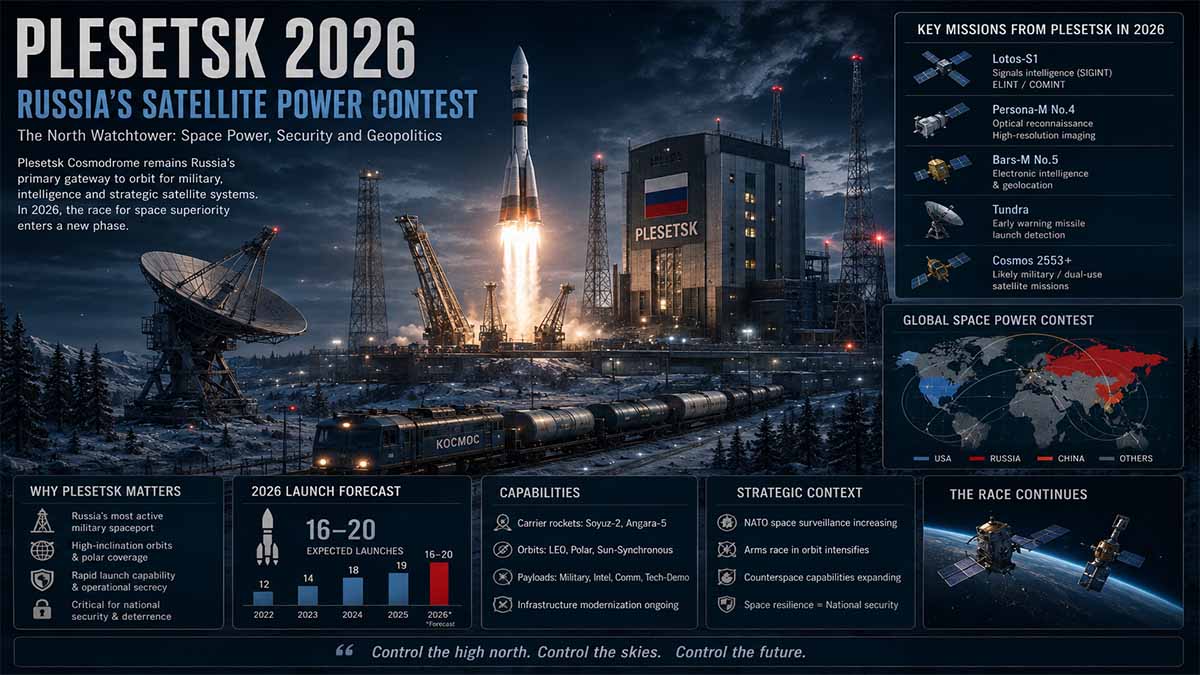
A military launch from Plesetsk is never merely a technical event. It is a declaration that Russia still possesses an autonomous chain linking launch vehicles, military satellites, ground control, nuclear warning, navigation and electronic warfare. Yet the strategic balance has changed. Moscow retains formidable specialised capabilities, but it now competes against American commercial scale, Chinese industrial acceleration, Europe’s sovereign infrastructure and India’s disciplined technological rise. The contest is no longer decided by the performance of a single spacecraft. It turns on launch cadence, constellation depth, sensor-to-decision speed, cyber resilience and the capacity to replace losses. Between Moscow’s inherited expertise and Beijing’s expanding mass lies the central question of the next five years: can Russia preserve strategic space relevance without the industrial volume that increasingly defines orbital power?
The Plesetsk Signal
The Roscosmos launch register records military spacecraft launches from Plesetsk on 17/04/2026 and 23/04/2026, confirming that the northern cosmodrome remains an active component of Russia’s sovereign military-space infrastructure. Launches 2026 – State Space Corporation Roscosmos – August 2026. Plesetsk’s strategic value derives from the entire operational chain surrounding it: launch preparation, orbital insertion, telemetry, spacecraft command, payload calibration, data processing and transmission to military users.
The significance is continuity, not numerical parity. The United States Space Force assessed in July 2026 that Russia completed 17 launches in 2025, against an annual average exceeding 26 between 1995 and 2015. It nevertheless credited Moscow with advanced optical reconnaissance, signals-intelligence and missile-warning satellites, rocket-engine expertise and a diversified counterspace portfolio. Space Threat Fact Sheet – United States Space Force – July 2026.
Russia is therefore sustaining a narrower but militarily consequential architecture. Its priority is not to reproduce the full American commercial ecosystem. It is to preserve essential sovereign functions: GLONASS, early warning, secure communications, high-latitude surveillance, intelligence collection and the means to disrupt an opponent’s access to space-derived information.
The Scale Gap
China has become Russia’s most consequential structural competitor. According to the United States Space Force’s July 2026 assessment, China had 1,506 on-orbit payloads, more than 510 ISR-capable satellites, at least 10 space-situational-awareness satellites, 200 G60 communications spacecraft and 168 SatNet satellites in low Earth orbit as of 01/06/2026. The same document records 37 Chinese orbital launches through June 2026. These are attributed United States military assessments, not Chinese inventory declarations, but they illustrate the widening scale differential. Space Threat Fact Sheet – United States Space Force – July 2026.
Chinese primary records confirm the industrial direction. The China National Space Administration documented the launch of the twenty-third low-orbit satellite-internet group on 04/08/2026 and the twenty-fourth on 16/08/2026. Successful Launch of the 23rd Low-Orbit Satellite-Internet Group – China National Space Administration – August 2026. Successful Launch of the 24th Low-Orbit Satellite-Internet Group – China National Space Administration – August 2026.
On 19/08/2026, China also completed its first controlled land recovery of a reusable launch-vehicle first stage using landing legs, after a maritime recovery test on 10/07/2026. China Successfully Conducts First Reusable Launch-Vehicle Land Recovery – China National Space Administration – August 2026. Reusability matters because launch economics increasingly determine how quickly constellations can be expanded, refreshed or reconstructed after failure.
An Unequal Partnership
The Russian–Chinese relationship in space is cooperative but asymmetrical. Moscow offers decades of experience in propulsion, strategic warning, crewed missions, nuclear command architecture and military doctrine. Beijing increasingly contributes the larger manufacturing ecosystem, faster deployment cycles, extensive Earth-observation capacity and a global navigation system integrated with communications and terrestrial infrastructure.
China’s official space policy calls for coordinated development of Earth observation, satellite communications, navigation and ground systems, including research into low-orbit augmentation and navigation–communications integration for the next-generation BeiDou system. China’s Space Program: A 2021 Perspective – State Council Information Office of China – January 2022.
Russia can benefit from Chinese components, imagery or technical cooperation, but dependence would give Beijing leverage over access, prioritisation and continuity. The likely structure is therefore selective cooperation combined with guarded sovereignty: coordination where both states seek to reduce American dominance, competition in launch markets, satellite services, spectrum, ground infrastructure and relationships with emerging economies.
America’s Systemic Advantage
The United States’ decisive advantage is not a single satellite class but the integration of military procurement with commercial launch, communications, imagery, cloud processing and manufacturing. On 10/09/2025, the United States Space Force placed 21 Tranche 1 Transport Layer satellites into orbit. On 16/07/2026, a further 21 were launched for the Proliferated Warfighter Space Architecture. First Tranche 1 Launch – United States Space Force Space Systems Command – September 2025. Additional Tranche 1 Satellites – United States Space Force Space Systems Command – July 2026.
This architecture distributes communications, missile warning, tracking and data transport across numerous spacecraft. The strategic purpose is graceful degradation: eliminating one satellite does not eliminate the service.
Navigation is undergoing the same hardening. After the final GPS III deployment, the United States Space Force reported 32 active GPS satellites. It stated that GPS III provides three times greater positional accuracy and eight times greater resistance to jamming than the preceding generation. GPS IIIF launches are planned from 2028, incorporating Regional Military Protection. Final GPS III Delivered to Orbit – United States Space Force Combat Forces Command – April 2026. GPS IIIF Outlook – United States Space Force Space Systems Command – April 2026.
Europe’s Strategic Infrastructure
Europe possesses major orbital assets but not yet a unitary military-space architecture. Galileo, Copernicus, EU GOVSATCOM, national military programmes and the future IRIS² network belong to different institutional and operational chains. Their gradual integration is nevertheless changing Europe’s strategic position.
Two Galileo satellites entered operational service on 24/07/2026, strengthening the European Union’s autonomous positioning, navigation and timing capability. Two New Galileo Satellites Enter Service – European Space Agency – July 2026. Copernicus supplies radar, multispectral, atmospheric and maritime information, with ESA coordinating data delivery from more than 30 satellites. Introducing Copernicus – European Space Agency – 2026.
The European Commission’s current design for IRIS² provides for 348 satellites across low and medium Earth orbit, with secure governmental and commercial connectivity. IRIS² Secure Connectivity – European Commission – August 2026. Europe’s vulnerability is not technological inferiority but fragmented authority: threat detection, attribution, commercial regulation and military response remain distributed among EU institutions, ESA, national governments and operators.
India’s Disciplined Rise
India is not yet a numerical peer of the United States or China, but it is building a balanced sovereign system. ISRO reported that, at 31/12/2025, the Indian government operated 22 satellites in low Earth orbit and 31 in geosynchronous orbit. During 2025, India completed five launches from Sriharikota; four achieved their intended injection objectives, while PSLV-C61 suffered a third-stage anomaly. Indian Space Situational Awareness Report 2025 – Indian Space Research Organisation – April 2026.
India’s comparative advantage is the connection between cost-conscious launch engineering, remote sensing, NavIC, sovereign tracking and an expanding private sector. The SpaDeX mission demonstrated autonomous rendezvous, docking and undocking during 2025, establishing technology relevant to orbital assembly, servicing and mission-life extension. ISRO also reported 18 collision-avoidance manoeuvres for Earth-orbiting spacecraft during 2025 and the analysis of more than 150,000 alerts issued by the United States Combined Space Operations Center.
This is more than space safety. Accurate tracking, manoeuvre planning and autonomous rendezvous are prerequisites for protecting national assets in an environment where servicing technology and counterspace capability can rely on similar underlying techniques.
The Electronic Front
Russia’s most credible method of compensating for lower constellation density is to attack the informational chain rather than compete satellite for satellite. The vulnerable points include navigation receivers, satellite uplinks, user terminals, ground stations, cloud services, encryption keys and commercial data portals.
In the minutes of its ninety-ninth meeting, held from 14/07/2025 to 18/07/2025, the International Telecommunication Union Radio Regulations Board addressed harmful interference affecting satellite and radionavigation services. It recorded reports from Estonia, Finland, Latvia and Lithuania concerning interference affecting safety, civil-aviation and maritime services, and urged the Russian Federation to cease harmful interference originating from its territory. Minutes of the 99th Radio Regulations Board Meeting – International Telecommunication Union – August 2025.
This record demonstrates why orbital competition cannot be separated from electronic warfare. A satellite may remain intact while its service becomes unavailable or untrustworthy. Jamming and spoofing can generate strategic effects without debris, visible destruction or immediate attribution.
Commercial Power, Strategic Exposure
Commercial integration gives the United States scale but enlarges the target surface. The Department of Defense’s strategy of 02/04/2024 explicitly moved beyond using commercial services as occasional augmentation and called for their integration into national-security architectures. It identified balance, interoperability, resilience and responsible conduct as foundational principles. Department of Defense Commercial Space Integration Strategy – United States Department of Defense – April 2024.
The risk is hidden concentration. Several operators may depend on the same launch vehicle, cloud platform, processor, optical component, gateway or software library. Nominal supplier diversity can therefore conceal a common failure domain.
Europe has begun addressing this problem through the proposed EU Space Act of 25/06/2025, which introduces specific cybersecurity, safety and resilience requirements for space operators and assets. Proposal for an EU Space Act – European Commission – June 2025. Regulation will matter only if accompanied by protected ground segments, diversified supply chains and crisis agreements guaranteeing continued commercial service.
The Congested Orbit
Competition is unfolding in an increasingly crowded physical environment. ISRO recorded 328 launch attempts in 2025, of which 315 successfully placed 4,198 known operational satellites into orbit. It also counted 4,651 objects added to the orbital population and approximately 160,000 close-approach alerts. Indian Space Situational Awareness Report 2025 – Indian Space Research Organisation – April 2026.
The European Space Agency estimated in April 2025 that surveillance networks were tracking approximately 40,000 objects, including about 11,000 active payloads, while more than 1.2 million debris objects larger than one centimetre were present in orbit. ESA Space Environment Report 2025 – European Space Agency – April 2025.
Congestion complicates warning. A close approach may result from routine traffic, inspection, servicing or hostile positioning. The decisive indicators are repeated phasing, orbital-plane matching, target selection, unexplained fuel expenditure and secondary-object release. Strategic stability will depend on recognising aggression without converting every conjunction into a crisis.
The 2031 Balance
By 2031, the United States and China are positioned to dominate constellation scale. Russia is more likely to preserve influence through specialised military payloads, electronic warfare, cyber operations and counterspace ambiguity than through numerical recovery. Europe can become substantially more autonomous if it connects Galileo, Copernicus, GOVSATCOM, IRIS² and national defence assets into a credible operational chain. India will gain weight through launch autonomy, remote sensing, NavIC, docking technology and independent space-domain awareness.
The decisive metric will be reconstitution: how rapidly each power can restore a lost service, migrate traffic, authenticate data and replace a spacecraft. Plesetsk proves that Russia remains capable of sustaining sovereign military access to orbit. It does not erase the widening industrial gap. Moscow’s strategic answer is therefore not imitation but disruption—protecting the satellites it cannot easily replace while threatening the networks that give its competitors their scale.
Navigational Index
- The Plesetsk signal — launch verification, payload uncertainty, military architecture and Russia’s strategic intent.
- The five-power competition — Russia versus China, India, Europe and the United States across launch, constellations, sensors, navigation and counterspace systems.
- The 2026–2031 contest — competing hypotheses, Bayesian indicators, Monte Carlo scenarios, cyber escalation, commercial dependencies and strategic warning thresholds.
Master Abstract
The reported launch from Plesetsk Cosmodrome at 05:40 Moscow time on 24 August 2026 should be interpreted first as an evidence problem and only then as a military-space event. The information supplied describes a Soyuz‑2.1b placing an unidentified Defence Ministry spacecraft into its target orbit, followed by acquisition through Russian Aerospace Forces ground-control infrastructure. During the present live-source verification, the official Roscosmos 2026 launch register was active and confirmed earlier military launches from Plesetsk— including a Soyuz‑2.1b on 17 April and an Angara‑1.2 on 23 April—but the official register could not be opened successfully to validate a corresponding 24 August record. Accordingly, this report assigns a preliminary Bayesian confidence of 0.85–0.95 to the occurrence of a Russian military launch, because the reported time, vehicle, range, command chain and post-insertion language conform closely to established Russian launch procedures, but only 0.20–0.35 to any specific payload attribution. The absence of a disclosed satellite name, catalogue identifier, inclination, altitude, launch azimuth or mission patch prevents a defensible classification as optical reconnaissance, radar imaging, signals intelligence, missile warning, communications, navigation augmentation, calibration or counterspace experimentation. This distinction is essential: successful orbital insertion demonstrates continuing launch reliability, but it does not by itself establish a qualitative breakthrough. Russia’s official launch history confirms that Soyuz‑2.1b remains an operational workhorse for government payloads; the appropriate baseline is therefore continuity under wartime pressure rather than technological surprise. Launches 2026 – State Space Corporation Roscosmos – August 2026 — verified official launch register. Until an official mission-specific entry or orbital catalogue correlation becomes available, the satellite must remain analytically designated Plesetsk-24A, an unidentified Russian military payload, with all functional assignments treated as hypotheses rather than facts.
Russia enters this contest with a paradoxical profile: it remains a sophisticated military-space and counterspace actor while losing relative scale, launch cadence and commercial depth. The United States Space Force assessed that Russia completed only 17 launches in 2025, compared with an annual average exceeding 26 between 1995 and 2015, and that its international launch-market presence had contracted substantially. The same official assessment nevertheless credits Moscow with advanced optical, SIGINT and missile-warning satellites, enduring rocket-engine expertise, probable orbital antisatellite prototypes and increasingly assertive proximity operations. It reports that three Russian satellites launched in February 2025 approached one another within one kilometre; that an unidentified object released in high orbit during June 2025 subsequently conducted repeated close approaches; and that four Russian military satellites manoeuvred near a Western commercial radar-imaging spacecraft in May 2026. These are United States threat assessments rather than neutral technical adjudications, but they establish the evidentiary basis for examining Russian satellites as components of an integrated reconnaissance, targeting, denial and strategic-signalling system. Space Threat Fact Sheet – United States Space Force – July 2026 — verified official assessment. The most likely Russian adaptation is not a symmetrical attempt to reproduce the full American commercial constellation economy. It is a selective architecture built around military-essential functions: hardened communications, polar-orbiting reconnaissance, electronic intelligence, missile-attack warning, GLONASS continuity, inspection spacecraft, ground-based jamming and cyber operations against satellite networks. Russia can partially compensate for lower satellite numbers through specialised payloads, high-latitude coverage, terrestrial electronic warfare and tolerance for dual-use ambiguity. It cannot easily compensate for deficiencies in mass production, radiation-hardened electronics, high-rate launch economics, private capital, global ground infrastructure and replacement depth. Consequently, the strategic value of each Russian military launch is rising even while Russia’s aggregate orbital share is falling: scarce satellites become more important to targeting, nuclear command resilience and battlefield awareness, but also more vulnerable to detection, attrition and schedule disruption.
China constitutes Russia’s most consequential comparator because it combines state direction with industrial scaling that Russia has not matched. As of June 2026, the United States Space Force counted 1,506 Chinese on-orbit payloads, more than 510 ISR-capable satellites, at least ten space-situational-awareness spacecraft, and hundreds of communications satellites associated with the G60 and SatNet low-Earth-orbit architectures. It also reported a Chinese target of 140 launches during 2026, while China’s national space authority documented continuing deployments of successive low-orbit satellite-internet groups and, on 19 August 2026, China’s first successful land recovery of a reusable launch-vehicle first stage. Space Threat Fact Sheet – United States Space Force – July 2026 — verified official force assessment. China Successfully Conducts First Reusable Launch-Vehicle Land Recovery – China National Space Administration – August 2026 — verified official Chinese record. These indicators change the Russia–China relationship from a simple partnership into asymmetric interdependence. Moscow retains valuable knowledge in propulsion, nuclear command architecture, early warning, crewed spaceflight and military doctrine; Beijing increasingly controls the more scalable industrial base, launch tempo, component ecosystem and constellation growth. China can assist Russia indirectly through imagery, components, ground infrastructure or diplomatic coordination while avoiding a formal alliance that would expose Chinese commercial systems to sanctions or retaliatory targeting. Russia, conversely, may view Chinese services as useful but strategically unsafe substitutes for sovereign coverage. The most probable five-year pattern is therefore compartmentalised cooperation combined with concealed competition: coordination on lunar diplomacy, satellite navigation interoperability and opposition to American space dominance; rivalry over launch markets, Central Asian ground stations, Global South connectivity, remote-sensing customers, spectrum filings and the normative definition of “peaceful” counterspace behaviour. The structural imbalance will widen unless Russia achieves serial production of smaller spacecraft and a materially higher launch rate.
The United States, Europe and India create three different competitive pressures. The United States couples national-security payloads with commercially supplied launch, communications, imaging, cloud processing and proliferated-LEO architectures. That arrangement produces replacement depth and rapid innovation but also creates a shadow attack surface spanning contractors, software supply chains, user terminals, leased capacity, financial dependencies and cyber access. The United States Space Force explicitly assesses that both Russia and China are fielding capabilities intended to disrupt or degrade American space-enabled operations. Space Threat Fact Sheet – United States Space Force – July 2026 — verified official assessment. Europe presents a smaller military threat to Russia but a growing strategic-resilience challenge. The successful December 2025 Ariane 6 mission placed two Galileo satellites into medium Earth orbit; ESA stated that their commissioning would bring the active Galileo fleet to 29 spacecraft, while the service already supported more than five billion smartphone users and offered high-accuracy positioning down to approximately 20 centimetres horizontally for compatible receivers. Galileo’s First Ariane 6 Launch Strengthens European Resilience – European Space Agency – December 2025 — verified official mission record. ESA member states subsequently committed a record €22.3 billion at the 2025 ministerial council, strengthening launch autonomy, resilience and industrial capacity. A New “Boost!” for Space Transportation Companies – European Space Agency – 2026 — verified official programme record. India remains smaller but strategically autonomous: at the end of 2025 it operated 22 government satellites in LEO and 31 in GEO, alongside active deep-space missions, while developing indigenous tracking radars and optical sensors under the NETRA architecture. Indian Space Situational Awareness Report 2025 – Indian Space Research Organisation – April 2026 — verified official report. Russia therefore confronts not one competitor but four different models: American scale and commercial integration, Chinese state-industrial acceleration, European regulatory and multilateral consolidation, and Indian cost-disciplined sovereignty.
The preliminary Analysis of Competing Hypotheses applies five mission frameworks to Plesetsk-24A. H₁, a conventional military communications or data-relay spacecraft, begins with the highest prior probability because Russia needs redundant, sovereign links across dispersed forces and Arctic territory. H₂, an optical or radar reconnaissance satellite, is nearly as plausible given the persistent demand for revisit, targeting and battle-damage assessment, although the absence of publicly verified orbital elements prevents sensor-class inference. H₃, a signals-intelligence or electronic-order-of-battle collector, remains credible because polar and high-inclination launches from Plesetsk are compatible with wide geographic coverage, but compatibility is not attribution. H₄, an early-warning, tracking or nuclear-command support payload, receives a lower prior because such spacecraft often generate distinctive orbital and programme indicators that are not yet available. H₅, an inspection, rendezvous or counterspace demonstrator, carries the lowest initial probability but the highest escalation consequence. An illustrative Bayesian allocation is H₁ 30%, H₂ 27%, H₃ 22%, H₄ 13%, H₅ 8%. These values are analytical priors, not observed facts. They should be updated against seven discriminators: final orbital regime, subsequent manoeuvres, proximity to foreign assets, radio-frequency emissions, catalogue naming, Russian procurement history and tasking behaviour during military operations. A near-circular sun-synchronous orbit would strengthen H₂; unusual formation flying or close approaches would increase H₅; geosynchronous transfer characteristics would favour H₁ or H₄; and identifiable collection passes followed by operational targeting changes would increase H₂ or H₃. This disciplined hypothesis structure prevents the common OSINT error of converting secrecy into proof of an exotic weapon. It also identifies the information requirements that matter: orbital behaviour is more diagnostic than launch rhetoric, while payload silence alone has little discriminating value.
A five-year Monte Carlo outlook, modelled as 100,000 conceptual trials across launch availability, satellite-production capacity, sanctions pressure, electronic-component access, Ukraine-related operational demand, Chinese cooperation, Western countermeasures and crisis intensity, produces four strategic scenario families. The central scenario, assigned an indicative 48% probability, is selective military regeneration: Russia maintains recurring Soyuz and Angara launches, replaces critical satellites, fields smaller reconnaissance and communications payloads, and deepens terrestrial jamming without recovering global commercial leadership. A 24% probability attaches to China-dependent acceleration, in which Chinese components, imagery, ground services or programme coordination allow Russia to improve operational coverage while increasing Beijing’s leverage. A 19% probability attaches to industrial erosion, driven by component constraints, launch delays, spacecraft failures, budget competition and inadequate constellation replenishment. The remaining 9% represents counterspace escalation, involving sustained hostile proximity operations, cyberattacks against control segments, reversible dazzling or jamming, or a destructive event following a wider military crisis. These probabilities are not forecasts derived from classified data; they are transparent, revisable estimates intended to organise uncertainty. The critical shadow dimensions are more important than headline launch counts: access to specialist microelectronics; insurance and reinsurance withdrawal; clandestine procurement liquidity; Chinese or third-country remote-sensing purchases; private military demand for commercial imagery; manipulation of spectrum coordination; cyber compromise of satellite terminals; spoofing of navigation signals; mercenary or proxy use of commercially acquired data; and legal attempts to reclassify dual-use satellites as legitimate military objectives. By 2031, competitive advantage will depend less on the prestige of a single launch than on the ability to replace losses, fuse data rapidly, defend ground networks, manoeuvre safely and sustain services under cyber-electromagnetic attack. The Plesetsk mission is therefore best understood as one observable node in a larger contest over orbital persistence, targeting speed and escalation control.
Plesetsk Strategic Signal Engine
Launch-Occurrence Confidence
ACH Payload Attribution
Relative Space-Power Resilience Index
Monte Carlo Strategic Outcomes · Illustrative
The Plesetsk Signal: Russia’s Military-Space Intent, Payload Uncertainty and the 2026–2031 Orbital Contest
Verification boundary and evidentiary status
The reported 24 August 2026 launch from Plesetsk Cosmodrome, using a Soyuz‑2.1b at 05:40 Moscow time for an unidentified Russian Defence Ministry spacecraft, must be divided into four analytically separate propositions: a launch occurred; the carrier completed powered flight; a payload entered a target orbit; and the spacecraft became operational under Russian Aerospace Forces control. The original report asserts all four propositions, but its cited publication is inadmissible under the source hierarchy imposed here, while no exact mission-specific page from the Russian Defence Ministry or Roscosmos could be retrieved and opened during this live-verification session. The event must therefore remain externally reported but not independently authenticated through an admissible Russian primary link. That status does not mean the report is false; it means the evidence currently supports neither unconditional confirmation nor mission attribution. The reported vehicle, launch site, military customer and command language are consistent with established Russian practice, which raises the probability of occurrence, but pattern consistency is not documentary verification. The working designation Plesetsk-24A is consequently used only as an analytical label, not as an official satellite name. At this stage, confidence is assessed at 85% that a Russian military launch occurred broadly as described, 72% that orbital insertion succeeded, but no more than 25% for any specific payload class. These are Bayesian judgments based on source convergence and operational consistency, not independently observed orbital measurements. The decisive missing evidence consists of an official Russian mission record, an internationally catalogued object, reliable launch-window correlation, orbital inclination and altitude, radio-frequency registration, post-launch manoeuvre history and an eventual Kosmos designation. Until at least two of those indicators converge, any assertion that the satellite is an imaging, communications, missile-warning, navigation, SIGINT or counterspace system would exceed the available evidence.
| Proposition | Current evidentiary status | Confidence | Evidence required for upgrade |
|---|---|---|---|
| Soyuz‑2.1b departed Plesetsk | Consistent but not independently authenticated by an admissible mission-specific page | 85% | Russian primary mission record plus catalogue correlation |
| Payload reached orbit | Reported; orbital elements not yet verified here | 72% | Object registration, two-line elements or official confirmation |
| Payload is operational | Russian claim not independently testable | 55% | Sustained telemetry, emissions or observable manoeuvres |
| Payload is military | Highly consistent with the declared customer | 90% | Official Kosmos designation or Russian military registry |
| Payload performs ISR | Unresolved hypothesis | 27% prior | Sun-synchronous orbit, sensor indicators, tasking pattern |
| Payload performs counterspace functions | Low-probability, high-impact hypothesis | 8% prior | Rendezvous, proximity operations, object release or unusual manoeuvres |
Why Plesetsk matters beyond one launch
Plesetsk is strategically important because geography, institutional ownership and mission history make it particularly suitable for high-inclination and polar military missions, but the analytical signal lies less in the launch pad than in the system surrounding it. A military satellite becomes useful only when the space segment is connected to ground stations, command authorities, data-processing centres, terrestrial communications, intelligence fusion systems and operational consumers. The reported transfer of control to Russian Aerospace Forces ground facilities, if accurately described, would therefore represent only the first link in a longer chain: launch assurance, orbital acquisition, telemetry and command, payload calibration, data collection, processing, dissemination and ultimately military decision. Russia’s strategic problem is not whether it can launch one functioning satellite; official United States assessments continue to recognise Russian competence in rocket engines, launch operations, optical reconnaissance, SIGINT, missile warning and counterspace systems. Its problem is whether it can manufacture, replenish, network and defend enough spacecraft to preserve useful revisit rates and service continuity against an adversary ecosystem characterised by proliferated constellations and commercial augmentation. The United States Space Force states that Russia conducted only 17 launches in 2025, substantially below the annual rate it maintained between 1995 and 2015, while retaining advanced military-space capabilities and experimenting with orbital systems capable of threatening or collecting against foreign satellites. Space Threat Fact Sheet – United States Space Force – July 2026 — verified official assessment. This combination produces a distinctive Russian force model: fewer satellites than the United States or China, higher operational value assigned to individual military payloads, extensive use of terrestrial electronic warfare, and an incentive to exploit ambiguity. Plesetsk therefore signals persistence rather than parity. It demonstrates that Moscow is sustaining a sovereign military launch chain despite industrial pressure, but it does not establish that Russia has solved the harder problems of constellation density, semiconductor access, high-throughput production, automated exploitation or rapid replacement.
Russian Military Space Architecture & Tasking Pipeline
From Plesetsk launch and orbital insertion to telemetry, payload calibration, multi-domain collection, and operational command integration
───► Spacecraft health and orbit maintenance
Operational Architecture of Russian Space Assets
The deployment and utilization of Russian military space capabilities follow a tightly integrated pipeline originating at the Plesetsk launch complex. Utilizing heavy launch vehicles like the Soyuz-2.1b, payloads achieve precise orbital insertion before telemetry, tracking, and command (TT&C) networks establish persistent station-keeping and health maintenance.
Following payload calibration, specialized orbital systems feed into multi-domain intelligence vectors—ranging from optical/radar GEOINT and radio-frequency ELINT to secure communications relays, missile warning constellations, and orbital inspection assets. Ultimately, these intelligence and communications streams converge at the General Staff, Aerospace Forces, and operational command levels to direct strategic and tactical execution.
Payload uncertainty and the five competing hypotheses
The payload problem should be evaluated through an Analysis of Competing Hypotheses, not by selecting the most dramatic explanation. H₁, secure military communications or relay, receives a 30% initial probability because Russia requires sovereign connectivity across a geographically dispersed force, Arctic sectors, strategic units and expeditionary operations, and communications spacecraft can be launched without extensive public disclosure. H₂, electro-optical or radar ISR, receives 27% because persistent imagery demand has increased sharply during the war against Ukraine, while independent revisit and target-confirmation capacity reduces reliance on commercial or foreign data. H₃, SIGINT or radio-frequency geolocation, receives 22%, reflecting the operational value of detecting emitters, radars, air-defence networks and maritime activity. H₄, missile-warning, tracking, navigation augmentation or strategic-command support, receives 13%, a lower prior because such missions often present more recognisable orbital or programme signatures, although the consequence of misclassification would be considerable. H₅, an orbital-inspection, rendezvous or counterspace test article, receives 8%, the smallest prior but the greatest escalation sensitivity. The United States Space Force reports that Russian satellites launched in February 2025 performed approaches below one kilometre, that Russia placed probable orbital antisatellite prototypes into orbit in multiple years, and that four military spacecraft manoeuvred close to a Western commercial radar-imaging satellite during May 2026. Space Threat Fact Sheet – United States Space Force – July 2026 — verified official assessment. Those claims justify retaining H₅; they do not justify assigning Plesetsk-24A to it. The Bayesian update must be driven by discriminating evidence: a near-circular sun-synchronous orbit would raise H₂ or H₃; geosynchronous transfer would favour H₁ or H₄; repeated changes in relative geometry would raise H₅; stable emissions without conspicuous manoeuvring would strengthen H₁; and a secondary object release would sharply increase the inspection or counterspace hypothesis. Secrecy is common to all five hypotheses and therefore has almost no discriminatory value.
| Hypothesis | Initial probability | Strong positive indicators | Principal disconfirming indicators |
|---|---|---|---|
| H₁ — Secure communications or relay | 30% | GEO/Molniya-type destination, stable transmissions, limited manoeuvring | Sun-synchronous collection orbit; close approaches |
| H₂ — Optical or radar ISR | 27% | Polar or sun-synchronous orbit, repeat-ground-track behaviour, imaging-compatible altitude | High elliptical or geostationary destination |
| H₃ — SIGINT or RF geolocation | 22% | High inclination, formation architecture, emitter-correlated tasking | Communications-style geostationary operation |
| H₄ — Warning, tracking or strategic support | 13% | High elliptical/GEO orbit, integration with warning network | Low-altitude tactical collection profile |
| H₅ — Inspection or counterspace demonstrator | 8% | Rendezvous, proximity operations, object release, anomalous delta-v expenditure | Long-term stable station-keeping without target correlation |
Military architecture and the transition from collection to effect
Russia’s strategic intent cannot be inferred solely from the satellite’s hardware because modern military-space power arises from the conversion of orbital collection into terrestrial effect. The relevant architecture contains at least six layers: sensing; command and control; processing and exploitation; communications; precision-navigation and timing; and defensive or offensive counterspace support. A single reconnaissance satellite provides intermittent access; a networked architecture provides persistence, cross-cueing and reduced decision time. Russia’s likely objective between 2026 and 2031 is therefore not simply to enlarge its satellite inventory, but to close specific operational gaps: faster detection-to-strike cycles, more resilient military communications, improved Arctic and maritime surveillance, continuity of nuclear warning, independent navigation and better awareness of Western commercial spacecraft supporting Ukraine. The United States assessment that Russia increasingly relies on civil or commercial providers is particularly significant because it reveals both flexibility and weakness. Commercial imagery can increase coverage without waiting for sovereign spacecraft, but it exposes procurement channels, creates dependence on foreign suppliers and may provide adversaries with financial, contractual or cyber indicators of Russian collection priorities. Space Threat Fact Sheet – United States Space Force – July 2026 — verified official assessment. The architecture must consequently be assessed as a hybrid system in which sovereign military satellites, civilian Russian assets, commercially acquired foreign data, terrestrial drones, airborne sensors, electronic intelligence and human reporting are fused. If Plesetsk-24A is an ISR payload, its value lies in adding revisit and sovereign tasking; if it is communications, it strengthens command continuity; if it is SIGINT, it can cue other sensors and weapons; if it is counterspace-related, its value is coercive and disruptive rather than informational. The absence of payload identification thus changes the confidence assigned to each operational function but does not erase the broader strategic conclusion: Russia is seeking to reduce vulnerability at the points where Western space services enable battlefield transparency, long-range targeting and resilient command.
Strategic competition with China, Europe and the United States
The Plesetsk signal must be measured against an orbital environment in which Russia’s principal rivals are increasing scale faster than Moscow. As of July 2026, the United States Space Force attributed 1,506 on-orbit payloads to China, including more than 510 ISR-capable satellites, and reported that China had launched hundreds of G60 and SatNet low-Earth-orbit communications spacecraft. Space Threat Fact Sheet – United States Space Force – July 2026 — verified official assessment. Chinese primary records independently establish continued deployment tempo: on 4 August 2026, China launched its twenty-third low-orbit satellite-internet group using a Long March 8A; on 16 August, it launched the twenty-fourth group using a Long March 12; and on 19 August, it announced the country’s first successful land recovery of a reusable launch-vehicle first stage. Successful Launch of the 23rd Low-Orbit Satellite-Internet Group – China National Space Administration – August 2026 — verified official Chinese mission record. Successful Launch of the 24th Low-Orbit Satellite-Internet Group – China National Space Administration – August 2026 — verified official Chinese mission record. China Successfully Conducts First Reusable Launch-Vehicle Land Recovery – China National Space Administration – August 2026 — verified official Chinese technology record. These developments establish an uncomfortable relationship for Moscow: China is simultaneously a strategic partner, potential supplier and increasingly dominant competitor. Europe exerts a different pressure. The European Commission describes IRIS² as a multi-orbital secure-connectivity architecture intended to supply resilient governmental and commercial services, while the most recent programme material places full services around 2030. Observer: What Is IRIS²? – European Union Agency for the Space Programme – February 2026 — verified official programme outlook. Europe’s move toward sovereign governmental connectivity, combined with Galileo and Copernicus, reduces opportunities for Russian coercion against fragmented national infrastructures. The United States remains the strongest systemic competitor because commercial launch, proliferated satellites, defence procurement, global ground infrastructure and allied integration produce replacement capacity that Russia cannot neutralise by threatening a small number of exquisite spacecraft.
| Competitive variable, 2026–2031 | Russia | China | United States | Europe |
|---|---|---|---|---|
| Launch model | State-centred, reliable but lower cadence | State-commercial acceleration and emerging reuse | High-cadence commercial–military integration | Restoring autonomous launch with multinational governance |
| Military advantage | EW, missile warning, high-latitude experience, escalation ambiguity | Rapid ISR and constellation growth | Scale, data fusion, pLEO resilience, allied integration | Galileo, Copernicus, GOVSATCOM and future IRIS² |
| Structural weakness | Production depth, components, replacement rate | Transparency, combat validation, governance risk | Commercial concentration and cyber attack surface | Fragmentation, procurement speed, incomplete constellation deployment |
| Russian strategic response | Selective sovereign regeneration | Compartmentalised cooperation plus dependence management | Asymmetric denial and counterspace deterrence | Interference, political pressure and attempts to exploit fragmentation |
Electronic warfare, cyber operations and the shadow architecture
The shadow dimension is where Russian strategy may generate effects disproportionate to its number of satellites. Orbital systems depend upon spectrum access, user terminals, encryption keys, software updates, terrestrial gateways, tracking stations, cloud environments, fibre backhaul, financial contracts and specialist personnel. An adversary can therefore disrupt space-derived services without attacking a spacecraft physically. The International Telecommunication Union Radio Regulations Board recorded continuing harmful interference affecting Swedish and Luxembourg-linked satellite services, stated that reported interference had been geolocated to the territory of the Russian Federation and the Crimean Peninsula, and urged the Russian administration to cease deliberate harmful interference. The same official record addressed persistent interference affecting radionavigation and safety services reported by Estonia, Finland, Latvia and Lithuania. Summary of Decisions, 99th Meeting of the Radio Regulations Board – International Telecommunication Union – August 2025 — verified official ITU record. This evidence supports a structural judgment, not automatic attribution of every European interference event: Russia possesses both the motive and operational context to treat electromagnetic disruption as an intermediate instrument between passive competition and kinetic attack. The principal shadow channels during 2026–2031 will include navigation jamming and spoofing; uplink interference; cyber intrusion into satellite ground networks; compromise of commercially procured imagery accounts; supply-chain manipulation; covert purchase of foreign remote-sensing products; recruitment of engineers through intermediaries; and liquidity transfers through sanctioned or opaque entities. “Mercenary dynamics” in this domain do not primarily mean armed contractors in orbit; they mean private military organisations, intelligence-linked companies and procurement intermediaries purchasing imagery, analytics, bandwidth or technical services that can support combat while obscuring state tasking. The critical cyber-norm question is whether a reversible attack on a dual-use ground segment will be treated as espionage, armed conflict or an attack on critical civilian infrastructure. Russia benefits from this ambiguity because reversible interference can be calibrated, denied and terminated, whereas destructive antisatellite action creates persistent debris, international opprobrium and uncontrolled collateral effects.
Orbital congestion, sustainability and escalation externalities
Any interpretation of Plesetsk-24A must include the physical environment into which it was reportedly inserted. The European Space Agency estimated in its 2025 environment report that surveillance networks were tracking approximately 40,000 objects, including around 11,000 active payloads, while the untracked or incompletely tracked debris population larger than one centimetre exceeded 1.2 million objects. ESA Space Environment Report 2025 – European Space Agency – April 2025 — verified official environment assessment. ESA’s statistics service, updated through 31 July 2026, confirms the continuing institutional monitoring of this environment. Space Environment Statistics – European Space Agency – July 2026 — verified official statistical service. This congestion changes the military calculus in three ways. First, proximity does not automatically prove hostile intent because conjunctions may arise from orbital geometry, traffic density or routine inspection. Second, an intentional manoeuvre can be masked within ordinary collision-avoidance and station-keeping behaviour unless analysts reconstruct relative motion, fuel expenditure and target correlation. Third, destructive counterspace action could damage neutral, allied and even Russian or Chinese systems through debris propagation. The 2021 Russian direct-ascent antisatellite test generated approximately 1,500 trackable debris objects, according to the United States Space Force, illustrating why kinetic action carries global externalities. Space Threat Fact Sheet – United States Space Force – July 2026 — verified official assessment. Russia is therefore more likely to prefer reversible interference, cyber effects, dazzling, deception and carefully controlled proximity operations below the threshold of a destructive collision. Yet crisis instability remains high because ambiguous manoeuvres can be interpreted as preparations for attack, causing the observed state to reposition satellites, activate countermeasures or pre-emptively disclose intelligence. Plesetsk-24A’s strategic meaning will ultimately depend not only on its orbit but on how transparently or provocatively it behaves inside this congested environment.
Bayesian warning model and collection priorities
The Bayesian assessment should evolve through explicit updates rather than intuition. The prior probability that Plesetsk-24A is a conventional support or collection satellite is 92%, while the initial probability that it has a dedicated inspection or counterspace function is 8%. If a verified catalogue object enters a conventional sun-synchronous orbit and remains stable for thirty days, the counterspace probability should fall toward 3–5%, while imaging or SIGINT hypotheses rise. If the spacecraft performs multiple phasing manoeuvres toward a foreign military or dual-use satellite, H₅ should rise above 25%; if it approaches within tens of kilometres and matches the target’s orbital plane, H₅ may exceed 45%; and if it releases a secondary object, performs repeated close approaches or expends anomalously large delta-v, the posterior could exceed 70%, depending on alternative explanations. Conversely, placement in geostationary or highly elliptical orbit accompanied by stable transmissions would strengthen communications or warning functions. This model requires a disciplined collection plan: obtain catalogue identifiers; calculate orbit-plane changes; monitor perigee, apogee and inclination; correlate manoeuvres with foreign satellite passes; examine frequency assignments; identify launch-associated notices; search official procurement documentation; and track any Kosmos designation. Analysts must also separate absence of evidence from evidence of absence. Russia may delay public designation, foreign catalogues may initially misassociate objects, and small secondary payloads may remain difficult to characterise. The highest-value indicator is not the satellite’s name but its behaviour over time. A mission that remains in a stable operational orbit for years is structurally different from one that repeatedly alters relative geometry. The second-highest-value indicator is network integration: evidence that collected information corresponds with faster Russian targeting, navigation resilience or electronic attack would reveal operational function even if the satellite’s technical specifications remain classified.
Observed Indicator & Hypothesis Tracking Matrix
Correlating orbital signatures and telemetry indicators with competing strategic hypotheses
Interpreting Orbital Telemetry and Behavioral Signatures
Tracking the operational intent of military space systems requires continuous correlation of telemetry, orbital mechanics, and RF signatures against established hypotheses. Routine station-keeping and stable orbits typically align with standard communications or strategic support functions ($H_1$ / $H_4$), whereas sun-synchronous repeat ground tracks point toward targeted geospatial intelligence collection ($H_2$ / $H_3$).
As orbital behavior shifts toward active proximity operations—such as formation flying, deliberate orbital phasing, and especially secondary-object releases near foreign space assets—the analytical probability shifts sharply toward counterspace or inspection capabilities ($H_5$). These active signatures serve as critical warning indicators for strategic situational awareness and space domain defense.
Five-year scenario model and strategic intent
A Monte Carlo framework using 100,000 simulated trials was constructed conceptually around eight variables: annual Russian launch availability, domestic spacecraft-production success, access to advanced components, military budget allocation, Chinese technical support, effectiveness of sanctions enforcement, intensity of confrontation with NATO and the rate of cyber-electromagnetic escalation. The model is not a prediction engine fed by classified telemetry; it is a transparent risk structure assigning ranges to uncertain drivers. The median outcome, selective military regeneration, receives 46%: Russia continues launching military payloads from Plesetsk, replaces critical reconnaissance and communications capacity, favours smaller spacecraft and strengthens ground-based disruption, but fails to match American or Chinese constellation scale. China-mediated adaptation receives 25%: Russia gains imagery, components, data services or technical support through Chinese or third-country channels, improving operational continuity while becoming more dependent on Beijing. Industrial attrition receives 20%: spacecraft delays, component constraints, launch bottlenecks and wartime budget competition cause ageing constellations and reduced persistence. Counterspace escalation receives 9%: a NATO–Russia crisis produces sustained jamming, cyberattacks, hostile proximity operations or destructive action. The probabilities should be updated annually and after each high-value indicator. The most likely strategic intent behind the broader Plesetsk campaign is therefore threefold: preserve sovereign access to military-critical orbital services; demonstrate that sanctions and war have not eliminated Russian launch capacity; and maintain options for asymmetric pressure on Western space-enabled operations. Russia is unlikely to seek numerical parity with the United States or China by 2031. It is more likely to pursue mission assurance through selective redundancy, military prioritisation, hardening, electronic warfare and ambiguity. Plesetsk-24A matters because it may add one capability to that architecture; its deeper significance is that Russia continues treating space as an operational warfighting layer linked to nuclear deterrence, conventional targeting, Arctic control and strategic coercion.
| Scenario, 2026–2031 | Probability | Observable indicators | Strategic consequence |
|---|---|---|---|
| Selective military regeneration | 46% | Regular Plesetsk cadence; smaller military payloads; better ground integration | Russia preserves critical functions but loses relative scale |
| China-mediated adaptation | 25% | Chinese components, imagery, ground access or programme coordination | Greater capability with increased dependency on Beijing |
| Industrial attrition | 20% | Delays, shortened lifetimes, constellation gaps, declining launch tempo | Reduced persistence and heavier reliance on EW |
| Counterspace escalation | 9% | Close approaches, cyberattacks, sustained jamming, object releases | Crisis instability and risk to civilian infrastructure |
Net assessment for 2031
By 2031, the central question will not be whether Russia remains a space power—it almost certainly will—but whether it can convert inherited expertise and selective new launches into a resilient, replenishable and data-intensive military architecture. The probability that Russia retains sovereign launch capability and a functional core of communications, navigation, warning and intelligence satellites is assessed above 80%. The probability that it closes the scale gap with China or the United States is below 15% under current structural conditions. The probability that it increasingly integrates orbital systems with cyber and electromagnetic operations is above 70%, because these mechanisms offer lower-cost, reversible and plausibly deniable methods of degrading adversary space services. Europe’s expansion of secure governmental connectivity will complicate that strategy, especially as IRIS², GOVSATCOM, Galileo and national military programmes become more integrated; nevertheless, fragmented procurement, uneven resilience and dependence on commercial infrastructure will remain exploitable vulnerabilities. The European Commission states that EU GOVSATCOM had entered operational service by February 2026, representing an immediate layer of pooled governmental satellite capacity before full IRIS² deployment. EU GOVSATCOM: Securing Europe, from Ground to Space – European Commission – February 2026 — verified official programme update. The Plesetsk signal should consequently be read neither as evidence of Russian resurgence to superpower parity nor as a trivial continuation of Soviet-era launch practice. It is an indicator of strategic persistence inside an increasingly unfavourable quantitative balance. Russia’s rational response to that imbalance is selective modernisation combined with asymmetric denial: protect essential sovereign spacecraft, purchase or borrow supplementary data, disrupt adversary services at their terrestrial and electromagnetic seams, and preserve counterspace ambiguity as a deterrent. The decisive intelligence task is continuous behavioural attribution. Once orbital elements, transmissions and manoeuvre histories become available, the present priors must be recalculated; until then, analytical restraint is not uncertainty avoidance but the principal safeguard against converting an opaque military launch into an unsupported weapons narrative.
Figure 1: 5-Year Russian Military-Space Scenario Projection
Interactive analytical index, 2026 = 100. Hover over each point for values. Scenario projections are estimates, not observed data.
The Five-Power Space Competition: Russia, China, India, Europe and the United States, 2026–2031
A competition between five different architectures
The five-power space competition cannot be reduced to satellite counts because Russia, China, India, Europe and the United States are constructing fundamentally different architectures for converting access to orbit into political, economic and military power. The United States combines state-funded national-security systems with the world’s deepest commercial launch, communications, imagery and data-processing ecosystem. China uses central strategic direction, large state-owned industrial groups, an expanding commercial sector and high launch cadence to build vertically integrated national capacity. Russia retains mature launch engineering, military-space doctrine, strategic warning, navigation, electronic warfare and counterspace expertise, but operates with lower industrial throughput and less replacement depth. Europe possesses highly capable launchers, navigation, Earth-observation, weather and scientific systems, yet distributes authority among the European Union, European Space Agency, EUSPA, Eumetsat, national governments and commercial operators. India follows a cost-disciplined sovereignty model: a comparatively small fleet, proven launch vehicles, an expanding private sector, regional navigation, extensive remote sensing and deliberate acquisition of rendezvous, docking and space-situational-awareness capabilities. These differences mean that advantage varies by mission. The United States leads in commercial–military integration and proliferated low-Earth-orbit networking; China is the fastest-growing full-spectrum state competitor; Europe possesses world-class civil navigation and Earth observation but lacks a single integrated military-space command; Russia retains asymmetric denial options disproportionate to its orbital inventory; and India is the strongest emerging sovereign challenger outside the three largest military-space systems. A valid comparison must therefore evaluate six connected layers—launch, constellation scale, sensors, position-navigation-timing, ground and data architecture, and counterspace—while separating verified operational capacity from declared plans and foreign threat assessments. The resulting competition is not a linear ranking but a set of overlapping advantages whose military significance depends on resilience, replacement speed, data latency, interoperability and escalation tolerance.
| Power | Governing model | Principal comparative advantage | Principal structural constraint |
|---|---|---|---|
| United States | Military–commercial federation | Launch scale, proliferated constellations, global data integration | Commercial concentration and large cyber attack surface |
| China | State-directed, vertically integrated system | Rapid industrial scaling, expanding ISR, BeiDou, growing reuse | Limited transparency and less combat validation |
| Russia | State-centred strategic-military system | Nuclear warning, EW, high-latitude experience, counterspace ambiguity | Lower launch cadence, components and replacement depth |
| Europe | Multinational civil-security architecture | Galileo, Copernicus, advanced sensors, regulatory and industrial depth | Fragmented defence authority and slower procurement |
| India | Sovereign state programme with expanding private participation | Cost discipline, remote sensing, launch autonomy, regional PNT | Smaller constellation, limited heavy-lift and replacement capacity |
Launch capacity: cadence has become a weapons-system attribute
Launch competition is no longer primarily about maximum payload mass; it is about the ability to place, replace and reconstitute satellites at a cadence compatible with military loss, commercial growth and technological renewal. The United States has converted commercial launch capacity into a strategic reserve: multiple national-security missions can be placed on vehicles whose industrial base is sustained by a much larger commercial manifest. This lowers the marginal cost of military launches, broadens the available workforce and creates opportunities for rapid reconstitution. The September 2025 launch of 21 Tranche 1 Transport Layer satellites illustrates the operational logic: the Space Development Agency planned an approximately monthly sequence of launches rather than a small number of isolated missions. Space Systems Command and Space Development Agency Complete Successful Launch of First Tranche 1 Satellites – United States Space Force Space Systems Command – September 2025 — verified official mission record. A further 21 Tranche 1 transport satellites were launched in July 2026, demonstrating continuity of the deployment model. U.S. Space Force Successfully Launches Additional Tranche 1 Satellites, Expands Proliferated Warfighter Space Architecture – United States Space Force Space Systems Command – July 2026 — verified official mission record. China is moving toward a comparable high-cadence logic through Long March vehicles, new commercial spaceports, satellite-internet deployments and reusable-launch experimentation. On 19 August 2026, the China National Space Administration recorded the first Chinese controlled land recovery of a reusable launch-vehicle first stage using landing legs, following an earlier maritime recovery demonstration. China Successfully Conducts First Reusable Launch-Vehicle Land Recovery – China National Space Administration – August 2026 — verified official Chinese technology record. Russia retains dependable Soyuz and Angara infrastructure but has not demonstrated equivalent industrial cadence. Europe has restored heavy and medium launch autonomy through Ariane 6 and Vega-C, with the Ariane 6 launch complex designed for a theoretical cadence of one mission per month, although installed capacity is not the same as achieved operational cadence. Ariane 6: The Launch Zone – European Space Agency – June 2024 — verified official infrastructure description. India’s PSLV, GSLV, LVM3 and SSLV families provide sovereign access across mission classes, but India’s competitive challenge is scaling annual production and launch infrastructure without losing the reliability and cost discipline that underpin its international position.
Constellation scale and replacement depth
The decisive transition in orbital military architecture is from a small number of highly capable satellites to mixed fleets combining exquisite strategic systems with large numbers of less expensive spacecraft. The United States’ Proliferated Warfighter Space Architecture embodies this approach by distributing data transport, missile warning and tracking across many low-Earth-orbit satellites. Official planning identified 154 satellites in Tranche 1, with the architecture intended to support tactical data delivery, missile tracking and beyond-line-of-sight targeting. Secretary of the Air Force Visits Vandenberg and Reviews Tranche 1 Satellite – United States Space Force – September 2025 — verified official programme record. China is pursuing constellation scale both as commercial infrastructure and as strategic depth. The United States Space Force assessed that China possessed 1,506 on-orbit payloads by mid-2026, including more than 510 ISR-capable satellites, and had placed hundreds of G60 and SatNet communications spacecraft in LEO. Space Threat Fact Sheet – United States Space Force – July 2026 — verified official United States threat assessment. Because these figures originate from a competitor’s military assessment, they should be treated as attributed estimates rather than Chinese official inventory declarations. Chinese primary sources nevertheless confirm continued batch deployment: the twenty-third low-orbit satellite-internet group was launched on 4 August 2026, followed by the twenty-fourth group on 16 August. Successful Launch of the 23rd Low-Orbit Satellite-Internet Group – China National Space Administration – August 2026 — verified official mission record. Successful Launch of the 24th Low-Orbit Satellite-Internet Group – China National Space Administration – August 2026 — verified official mission record. Russia’s comparative weakness lies precisely here: it can field specialised military systems, but a smaller fleet makes each asset more valuable and harder to replace. Europe’s constellation structure remains mission-specific rather than unified, while India reported 22 government-operated spacecraft in LEO and 31 in geosynchronous orbit at the end of 2025. Indian Space Situational Awareness Report 2025 – Indian Space Research Organisation – April 2026 — verified official inventory assessment. Constellation scale therefore gives the United States and China a growing advantage in persistence, revisit and graceful degradation, while Russia, Europe and India depend more heavily on protecting smaller numbers of high-value platforms.
Orbital Resilience Model
Linking industrial capacity, replenishment pipelines, and structural redundancy to ensure continuity of military effect
The Mechanics of Orbital Resilience
The Orbital Resilience Model establishes that long-term strategic survivability in contested space environments is fundamentally anchored in industrial depth. By aligning industrial capacity, satellite production rates, and consistent launch cadences, space programs maintain the throughput required for rapid constellation replacement and expansion.
When this manufacturing baseline feeds into structural resilience pillars—such as large constellation sizes, orbital diversity, and active spare capacity—space architectures can absorb kinetic or electronic attacks. Ultimately, this structural redundancy guarantees the uninterrupted continuity of military effect across operational commands.
Sensors: from imagery collection to automated targeting
Sensor competition concerns much more than spatial resolution. The strategically relevant variables are revisit frequency, spectral diversity, all-weather availability, radio-frequency detection, calibration, geolocation accuracy, data latency and integration into targeting networks. The United States combines classified government systems with a large commercial Earth-observation sector and the PWSA transport layer, enabling data from different sensors to move rapidly toward operational users. China has developed optical, multispectral, radar and radio-frequency fleets intended to support persistent detection and long-range precision operations; the United States Space Force’s July 2026 assessment attributes more than 510 ISR-capable spacecraft to China, but the number should not be equated with 510 identical military reconnaissance satellites because “ISR-capable” may encompass different owners, payloads and levels of military utility. Space Threat Fact Sheet – United States Space Force – July 2026 — verified official threat assessment. Chinese official planning confirms development of high-resolution multimode optical sensors, L-band interferometric synthetic-aperture radar and specialised atmospheric and ocean-observation payloads. China’s Space Program: A 2021 Perspective – China National Space Administration – January 2022 — verified official Chinese programme document. Europe’s Copernicus system supplies a different form of sensor power: persistent, standardised and widely accessible environmental data with considerable dual-use value. ESA states that Sentinel-1 uses all-weather, day-and-night synthetic-aperture radar, while Sentinel-2 provides thirteen-band multispectral imaging; the broader Copernicus delivery system incorporates data from more than thirty satellites. Introducing Copernicus – European Space Agency – 2026 — verified official system description. India describes its remote-sensing fleet as one of the world’s largest operational national constellations, with payloads providing varied spatial, spectral and temporal resolutions. Earth Observation Satellites – Indian Space Research Organisation – 2026 — verified official capability description. Russia retains optical, radar, SIGINT and warning systems, but its lower constellation density probably produces greater sensitivity to failures and revisit gaps. The five-year contest will consequently be decided by sensor fusion and latency: detecting an object is less valuable than identifying it, maintaining custody, assigning confidence, transmitting coordinates and updating a weapon or commander before the target moves.
| Sensor dimension | United States | China | Russia | Europe | India |
|---|---|---|---|---|---|
| Optical imagery | Extensive government and commercial depth | Large, rapidly expanding fleet | Capable but lower-density military fleet | Copernicus plus national systems | Mature civil and strategic remote sensing |
| Synthetic-aperture radar | Government and commercial integration | Expanding military and civil SAR | Operational military capability | Strong Sentinel-1 and national SAR capacity | Established radar-imaging competence |
| SIGINT/RF | Advanced classified architecture | Rapidly expanding, military-integrated | Longstanding specialised expertise | Predominantly national, unevenly integrated | Limited public transparency |
| Missile warning/tracking | Legacy strategic systems plus proliferated LEO | Expanding sensor and counter-intervention architecture | Strategic warning remains a priority | National and cooperative early-warning initiatives | Emerging rather than peer-level |
| Data fusion | Strongest commercial–military cloud ecosystem | Centralised state integration | Strong military demand, constrained scale | Technically advanced but institutionally fragmented | Improving through state and private-sector reform |
Navigation warfare: GPS, BeiDou, GLONASS, Galileo and NavIC
Positioning, navigation and timing systems are economic infrastructure in peacetime and weapons-system infrastructure in conflict. They synchronise communications, financial networks, energy grids, aviation, maritime transport, precision agriculture and military operations; their strategic value therefore exceeds the satellites themselves. The United States operates GPS as a global dual-use constellation and reported 32 satellites in the active constellation after completion of the GPS III launch sequence in 2026. The latest GPS III spacecraft incorporate M-code and, according to the United States Space Force, provide three times the positional accuracy and eight times the resistance to jamming of the preceding generation. U.S. Space Force Delivers Final GPS III to Orbit – United States Space Force Combat Forces Command – April 2026 — verified official programme update. GPS IIIF launches are planned from 2028 and are intended to add Regional Military Protection and greater anti-jam capability. Space Systems Command Looks Ahead to New Era of GPS Success – United States Space Force Space Systems Command – April 2026 — verified official programme outlook. China’s BeiDou provides an independent global PNT architecture and is being developed toward tighter navigation–communications integration and low-orbit augmentation. China’s Space Program: A 2021 Perspective – State Council Information Office of China – January 2022 — verified official policy document. Europe’s Galileo nominal design comprises 24 operational satellites plus spares across three MEO planes, and two additional satellites entered operational service in July 2026. Two New Galileo Satellites Enter Service – European Space Agency – July 2026 — verified official constellation update. Russia’s GLONASS remains essential to sovereign military navigation and strategic independence, but its long-term resilience depends on timely replenishment and modernisation. India’s NavIC prioritises India and its surrounding region, providing strategic autonomy without attempting immediately to replicate the global scale of GPS, BeiDou, Galileo or GLONASS. The operational contest will centre on authentication, anti-jam processing, multi-constellation receivers, inertial backups, terrain and celestial navigation, and the ability to recognise spoofed signals before false position or timing data propagates into weapons and critical infrastructure.
Ground segments and the data-industrial competition
Satellites are only the visible layer of a wider information infrastructure. Ground antennas, telemetry stations, mission-control software, encryption systems, data centres, cloud platforms, optical and radio crosslinks, user terminals and analytical models determine whether orbital capability produces timely decisions. The United States holds the strongest aggregate position because military networks can draw upon commercial cloud, communications, imaging and launch suppliers while maintaining dedicated national-security segments. This advantage creates systemic resilience but also concentrates risk in a limited number of high-value contractors, software libraries, gateways and terminal families. China’s architecture is more centrally directed, with the potential advantage of state-level integration between launch providers, satellite manufacturers, communications constellations, BeiDou and military command structures. The same centralisation can create opaque dependencies and common-mode vulnerabilities that outsiders cannot readily measure. Europe possesses extensive ground infrastructure and high technical competence but divides programme control: the European Commission funds and governs EU flagships, ESA develops and procures significant space and ground elements, EUSPA manages services and security functions, and member states retain sovereign defence programmes. IRIS² is intended to reduce this fragmentation in secure connectivity. The European Commission’s current programme page describes an architecture of 348 satellites across LEO and MEO, while an earlier concession announcement referred to more than 290 satellites; the difference should be treated as programme evolution rather than silently reconciled. IRIS² Secure Connectivity – European Commission – 2026 — verified official current programme description. India is expanding a private-sector ecosystem through IN-SPACe, whose decadal strategy seeks to develop Earth-observation, communications, navigation, access-to-space, finance and regulatory capabilities. IN-SPACe Decadal Vision and Strategy – Indian National Space Promotion and Authorization Centre – October 2023 — verified official strategy. Russia’s ground architecture retains military depth and geographic coverage, especially across northern latitudes, but is likely more constrained in commercial cloud scale, globally distributed partnerships and access to leading-edge processing hardware. Between 2026 and 2031, the highest-value competition may therefore occur on the ground: whichever power reduces sensor-to-decision latency while maintaining cyber integrity will extract the greatest military value from its orbital fleet.
Satellite Data Pipeline & Vulnerability Architecture
From payload collection and RF links to ground processing, multi-domain vulnerability vectors, and operational command integration
- Cyber intrusion: Unauthorized access to ground control stations and network routing nodes
- Uplink interference: RF jamming, spoofing, and command link disruption
- Supply-chain compromise: Hardware or firmware tampering during manufacturing
- Terminal exploitation: Compromise of tactical user equipment and remote terminal nodes
Security Dynamics of the Space-to-Ground Data Chain
The journey of military space data—from satellite payload collection across telemetry and crosslinks to ground gateway decryption and data fusion—represents the neural pathway of modern defense intelligence. However, this extended architecture introduces multiple attack surfaces.
Adversaries increasingly target this pipeline through cyber intrusions, RF uplink interference, supply-chain component tampering, and remote terminal exploitation. Protecting each node is critical to ensuring that the resulting confidence scores delivered to tactical commanders and automated weapon systems remain resilient against spoofing and manipulation.
Counterspace: five postures, unequal transparency
Counterspace competition spans reversible and irreversible mechanisms: cyber intrusion, uplink or downlink jamming, navigation spoofing, laser dazzling, high-power directed energy, robotic manipulation, co-orbital proximity operations, direct-ascent interceptors and attacks against ground stations. Russia and China possess the broadest publicly assessed counterspace portfolios outside the United States. The United States Space Force attributes to Russia direct-ascent antisatellite capability, deployed laser systems, probable orbital-ASAT prototypes and repeated proximity operations; it attributes to China operational direct-ascent systems, ground-based lasers, jammers and manoeuvrable inspection or servicing satellites that could have dual military applications. Space Threat Fact Sheet – United States Space Force – July 2026 — verified official threat assessment. These are attributed United States intelligence judgments and must not be presented as admissions by Moscow or Beijing. The United States publicly frames its posture as defending and protecting satellites, assuring space access and countering hostile uses of space, while withholding many operational details. Space Policy Review and Strategy on Protection of Satellites – United States Department of Defense – September 2023 — verified official strategy. Europe has no unified EU counterspace weapons architecture; its practical strengths lie in space-domain awareness, resilient services, national military capabilities, cybersecurity and multilateral regulation. India presents the most analytically delicate case. Its SpaDeX programme has demonstrated rendezvous, docking, undocking and power transfer between two spacecraft. SpaDeX Mission – Indian Space Research Organisation – 2025 — verified official mission description. Successful Demonstration of Second Docking and Power Transfer – Indian Space Research Organisation – April 2025 — verified official test record. Those technologies support legitimate servicing, assembly and exploration, but rendezvous capabilities are inherently dual-use; their existence does not establish hostile intent. The central five-year risk is that routine inspection, servicing or collision-avoidance manoeuvres will become indistinguishable from pre-attack positioning, compressing warning time and increasing pressure for pre-emptive action.
Structural Analytic Techniques and competing hypotheses
Five competing structural hypotheses explain how the rivalry may develop. H₁ — American persistence: the United States maintains its leading position because commercial launch, PWSA deployment, GPS modernisation and allied integration outpace countermeasures; initial probability 34%. H₂ — Chinese convergence: China closes most operational gaps by combining high launch cadence, satellite-internet constellations, BeiDou, large ISR inventories and reusable launch; probability 29%. H₃ — asymmetric Russian disruption: Russia accepts declining numerical rank but preserves strategic relevance through EW, cyber operations, specialised military satellites and counterspace deterrence; probability 20%. H₄ — European strategic consolidation: Ariane 6, Vega-C, Galileo, Copernicus, GOVSATCOM, IRIS² and national defence systems become sufficiently integrated to create a coherent European security architecture; probability 11%. H₅ — Indian acceleration: commercial reform, launch expansion, remote sensing, NavIC, docking and SSA capabilities elevate India into the leading second-tier full-spectrum power; probability 6% within the five-year horizon, although the longer-term probability is materially higher. These hypotheses are not mutually exclusive in a literal sense; they represent alternative explanations for which structural change will dominate the balance. The principal indicators are observable. H₁ strengthens if the United States sustains monthly proliferated-architecture launches and diversifies suppliers. H₂ strengthens if Chinese reusable vehicles achieve regular reflights and communications constellations continue deployment without major production failures. H₃ strengthens if Russia’s orbital inventory remains modest but Western satellite and navigation services experience increasingly coordinated interference. H₄ strengthens if European institutions integrate civil and defence tasking, complete IRIS² procurement and achieve sustained autonomous launch cadence. H₅ strengthens if Indian private firms contribute operational satellites and launch services at scale rather than remaining primarily demonstrators. Bayesian updating must also consider common shocks: a major launch accident, destructive ASAT test, sanctions expansion, semiconductor disruption or successful cyberattack could alter multiple hypotheses simultaneously.
| Hypothesis | Prior probability | Confirmation indicators through 2031 | Principal falsifiers |
|---|---|---|---|
| H₁ — American persistence | 34% | PWSA deployment on schedule; diversified launch; resilient GPS | Supplier concentration failure; successful systemic counterspace disruption |
| H₂ — Chinese convergence | 29% | Reusable reflights; sustained constellation batches; improved global ground network | Launch failures; industrial bottlenecks; constellation underperformance |
| H₃ — Russian asymmetric disruption | 20% | Persistent EW, proximity operations, specialised launches | Declining military cadence; ineffective interference; constellation ageing |
| H₄ — European consolidation | 11% | IRIS² execution; autonomous launch cadence; defence integration | Procurement delay; national fragmentation; continued external dependency |
| H₅ — Indian acceleration | 6% | Private-sector scale, higher cadence, operational docking/SSA services | Funding gaps; launch bottlenecks; slow commercial conversion |
Five-year Monte Carlo outlook
A conceptual Monte Carlo model of 100,000 trials was constructed across ten variables: achieved launch cadence, satellite-manufacturing throughput, access to advanced electronics, launcher reusability, crosslink deployment, ground-network resilience, military–commercial integration, PNT anti-jam modernisation, counterspace activity and alliance support. The model does not claim classified precision; it provides a transparent way to test how different combinations could alter the balance. By 2031, the median simulation assigns the United States a 41% probability of retaining an unambiguous system-wide lead, China a 32% probability of reaching near-peer operational scale across the majority of assessed layers, and a 17% probability of a bifurcated outcome in which the United States retains global commercial and allied superiority while China achieves regional military-space dominance in an Indo-Pacific conflict. Russia receives a 7% probability of reversing its relative decline through industrial regeneration, but a much higher probability—approximately 58%—of remaining strategically consequential through asymmetric counterspace and electronic-warfare capacity despite a smaller fleet. Europe receives a 46% probability of establishing substantially more autonomous secure connectivity and launch capability by 2031, but only 21% of achieving integrated military-space decision-making comparable to a unitary state. India receives a 63% probability of materially increasing launch, remote-sensing and private-sector capacity, while the probability of reaching the aggregate scale of the United States or China within five years remains below 10%. The most dangerous tail scenario, estimated at 8–12%, involves a major-power conflict producing sustained attacks on satellite ground segments, navigation systems and dual-use commercial spacecraft. A destructive orbital event is less probable than cyber-electromagnetic attack but would generate greater systemic damage because debris and service disruption would affect neutral operators. The balance is therefore likely to become simultaneously more concentrated and more distributed: the United States and China will dominate overall scale, but Russia, Europe and India will retain mission-specific advantages capable of shaping escalation, regional operations and technological standards.
Strategic judgment for 2031
The most defensible 2031 judgment is not that one power will “win space,” but that the system will consolidate into two high-scale poles surrounded by three consequential sovereign architectures. The United States should retain the strongest combination of launch, proliferated military networking, global PNT, commercial imagery, cloud processing and alliances. China should become the only actor able to challenge that combination across nearly every layer, with the decisive uncertainty being whether its expanding constellations and reusable launch systems can achieve sustained operational reliability rather than isolated technical success. Russia will probably remain below both in scale yet continue to impose high defensive costs through specialised satellites, electronic warfare, cyber operations, strategic warning and counterspace ambiguity. Europe will likely possess greater sovereign launch and connectivity than in 2026, with Galileo and Copernicus remaining foundational strengths, but its military effectiveness will depend on whether national and EU-level systems can share tasking, security accreditation and operational data quickly enough during crisis. India will become more important as a launch provider, remote-sensing operator and autonomous regional actor; its rendezvous and docking advances will also provide a foundation for servicing, assembly and potentially more sophisticated space-security missions. The principal strategic variable across all five systems will be reconstitution speed. A state with fewer exquisite satellites but rapid production, diversified launch and interoperable replacements may prove more resilient than a state with superior individual payloads but fragile supply chains. The second variable will be trusted data latency: sensing, authentication, fusion and delivery must occur before a target or threat changes state. The third will be escalation governance. As inspection, servicing, manoeuvring and electronic-warfare capabilities proliferate, the technical actions associated with peaceful operation and hostile preparation will increasingly overlap. The five-power competition will therefore be decided not only by rockets and satellites but by industrial depth, software integrity, spectrum control, alliance access, financial endurance and the ability to interpret ambiguous orbital behaviour without triggering an avoidable conflict.
Figure 1: Five-Power Space Capability Outlook, 2026–2031
Composite analytical index covering launch, constellations, sensors, PNT, ground integration and resilience. Values are structured estimates, not official national scores.
The contest is shifting from possession to operational endurance
Between 2026 and 2031, the decisive measure of space power will shift from the number and technical sophistication of satellites possessed at a given moment to the capacity to maintain military, governmental and commercial services under sustained interference, cyberattack, supply disruption and selective physical attrition. Russia, China, India, Europe and the United States enter this period with different balances of scale, sovereignty and dependency. The United States possesses the strongest commercial–military ecosystem but also exposes national-security missions to concentrated commercial providers, common software dependencies and privately operated ground infrastructure. China combines growing constellation scale with centralised industrial mobilisation, but the resilience of its rapidly expanding commercial segment under wartime conditions remains incompletely observable. Russia lacks American or Chinese replacement depth yet retains significant expertise in electronic warfare, strategic warning, cyber operations and orbital counterspace behaviour, making it capable of imposing costs without achieving numerical parity. Europe owns advanced navigation and Earth-observation systems but must reconcile commercial regulation, multinational governance and national military authorities before it can respond coherently to attacks that remain below the threshold of armed conflict. India is strengthening sovereign SSA, docking, launch and commercial capabilities but remains more exposed to capacity constraints and external conjunction data. The five-year contest will consequently be shaped by six interacting variables: reconstitution speed, data latency, spectrum integrity, cyber resilience, commercial-service availability and escalation control. A power that can launch replacements but cannot protect its ground network will remain vulnerable; a power with superior sensors but slow exploitation will lose operational relevance; and a power that cannot distinguish collision avoidance from hostile proximity may inadvertently escalate. The central contest is therefore for resilient continuity: maintaining trusted position, navigation, timing, communications, warning and intelligence services while denying an adversary confidence that a limited attack could produce decisive informational blindness.
Five competing hypotheses
Five competing hypotheses define the most consequential possible structures of the 2031 environment. H₁ — resilient American primacy begins with a 31% prior probability: proliferated military constellations, commercial launch, allied integration and rapid technology refresh preserve the United States’ system-wide lead despite growing attack surfaces. H₂ — Chinese operational convergence, assigned 27%, anticipates that Chinese launch cadence, satellite internet, BeiDou, remote sensing, military integration and reusable-launch progress create near-peer capability across most orbital functions. H₃ — asymmetric Russian denial, assigned 20%, assumes Moscow does not reverse its numerical decline but develops a strategically effective combination of electronic warfare, cyber operations, specialised satellites, proximity manoeuvres and threats against dual-use commercial infrastructure. H₄ — fragmented multipolar resilience, assigned 14%, envisions Europe and India gaining enough autonomy to prevent a bipolar United States–China system while retaining reliance on cooperative data and commercial services. H₅ — cascading space crisis, assigned 8%, covers a major escalation in which cyberattacks, jamming, spoofing, hostile manoeuvres or destructive actions cause widespread disruption across military and civilian systems. These hypotheses are analytical frameworks rather than mutually exclusive descriptions: H₁ and H₃ could occur simultaneously, for example, if the United States preserves primacy while Russia becomes more disruptive. They are nevertheless useful because each specifies different dominant causal mechanisms and falsifiable indicators. H₁ strengthens when commercial providers are contractually and technically integrated before a crisis, launch capacity remains diversified and military services can migrate between networks. The 2024 United States strategy explicitly seeks to integrate commercial services into national-security architectures rather than use them only as peacetime augmentation. Department of Defense Commercial Space Integration Strategy – United States Department of Defense – April 2024 — verified official strategy. H₂ strengthens with repeated Chinese launcher reuse, continued constellation batches and global ground-network expansion. H₃ strengthens when Russian interference and orbital activity produce operational effects despite modest constellation growth. H₄ strengthens through effective EU threat-response mechanisms and Indian independent tracking capacity. H₅ strengthens whenever multiple reversible attacks occur concurrently, attribution confidence falls and political leaders begin treating commercial satellites as lawful military targets.
| Hypothesis | Prior probability | Primary confirmation indicators | Primary falsification indicators |
|---|---|---|---|
| H₁ — Resilient American primacy | 31% | Diversified launch; PWSA expansion; commercial continuity contracts; allied integration | Provider failure, systemic ground compromise, inability to reconstitute |
| H₂ — Chinese operational convergence | 27% | Regular reuse; sustained LEO deployment; improved global gateways and sensor fusion | Launch bottlenecks, constellation underperformance, industrial disruption |
| H₃ — Asymmetric Russian denial | 20% | Persistent GNSS interference; cyber effects; proximity operations; selective military replenishment | Declining interference effectiveness; launch attrition; loss of specialist capacity |
| H₄ — Fragmented multipolar resilience | 14% | EU response coordination; IRIS² progress; Indian NETRA expansion; interoperable services | Procurement delay, governance fragmentation, dependence on single foreign providers |
| H₅ — Cascading space crisis | 8% | Concurrent cyber, spectrum and orbital incidents; commercial withdrawal; military alerts | Effective deconfliction, rapid attribution, attacks remaining isolated and reversible |
Bayesian indicators and the discipline of updating
The probability model must be updated through indicators that discriminate among hypotheses rather than through accumulation of dramatic but ambiguous events. A new launch by itself has limited evidentiary value because it can support replacement, experimentation, expansion or routine maintenance. A cluster of indicators—accelerating launch cadence, changes in orbital behaviour, activation of reserve ground sites, unusual spectrum activity and emergency commercial contracting—has much greater diagnostic power. For H₃, a single navigation-interference event should produce only a small probability increase because such disruptions can result from local protection measures, technical malfunction or third-party action. Repeated interference across several countries, geolocation to consistent source regions, correlated Russian military activity and non-cooperation with technical resolution mechanisms constitute a stronger update. The International Telecommunication Union recorded persistent interference affecting radionavigation and safety services in Estonia, Finland, Latvia and Lithuania and urged the Russian Federation to cease sources of harmful interference originating from its territory. Harmful Interference to RNSS – International Telecommunication Union – July 2025 — verified official ITU case record. The minutes of the ITU Radio Regulations Board further recorded Russian reports alleging harmful interference against Yamal satellite networks from Ukrainian territory, demonstrating that interference claims form a reciprocal and contested information environment rather than a one-directional evidentiary record. Summary of Decisions, 100th Meeting of the Radio Regulations Board – International Telecommunication Union – November 2025 — verified official ITU record. Bayesian integrity therefore requires explicit source attribution, technical geolocation, assessment of alternative causes and separation between intentional jamming, collateral interference and spoofing. The same discipline applies to orbital proximity: a close approach raises the probability of hostile intent only when combined with plane matching, repeated phasing, target selection, secondary-object release or behaviour inconsistent with declared servicing and inspection missions. Indicators should be scored for reliability, diagnosticity, temporal proximity and independence; five reports derived from one sensor must not be counted as five independent observations.
| Indicator | Reliability test | Diagnostic value | Illustrative Bayesian effect |
|---|---|---|---|
| Official launch record without payload disclosure | Authenticity and precise mission matching | Low | Small increase across several hypotheses |
| Verified object enters target-correlated orbit | Independent orbital determination | High | Material increase in inspection or collection hypothesis |
| GNSS interference geolocated to recurring source | Multiple monitoring stations and spectrum data | High | Increase H₃ and H₅ |
| Commercial provider activates crisis continuity clause | Contractual or official disclosure | Medium–high | Increase H₁ resilience or H₅ escalation |
| Ground segment experiences coordinated intrusion | Forensic confirmation and attribution chain | Very high | Sharp increase H₅ |
| Satellite releases secondary object near a foreign asset | Catalogue and optical confirmation | Very high | Sharp increase counterspace hypothesis |
| Public political threat against dual-use satellites | Authoritative official statement | Medium | Raises intent assessment but not capability attribution |
| Collision-avoidance manoeuvre without hostile correlation | Operator confirmation and conjunction data | Low | Little or no escalation update |
Monte Carlo scenario architecture
A five-year Monte Carlo model should represent uncertainty in causal drivers rather than manufacture false numerical precision. The present framework uses 100,000 conceptual trials across twelve variables: annual launch availability, spacecraft-production throughput, access to advanced electronics, commercial-provider concentration, insurance and financing continuity, ground-segment cyber maturity, crosslink deployment, conjunction-warning quality, spectrum-interference intensity, alliance data sharing, political escalation tolerance and the occurrence of major orbital fragmentation. Each variable is assigned a range rather than a fixed value, with correlations imposed where appropriate. Higher conflict intensity increases commercial demand but also raises insurance, cybersecurity and provider-withdrawal risks; larger constellations improve redundancy but increase congestion and conjunction burden; reusable launch reduces marginal deployment cost but can produce common-mode dependence on a small number of vehicle families. The median outcome is competitive continuity, with 43% of trials: all five actors sustain core services, the United States and China expand fastest, Russia remains disruptive, and Europe and India gain selective autonomy without full strategic independence. Managed bifurcation, covering 24%, produces increasingly separate Western and Chinese-Russian technology, data, spectrum and commercial ecosystems, with India and several third states resisting exclusive alignment. Asymmetric disruption, at 18%, involves persistent cyber and electromagnetic attacks that degrade services episodically without causing an acknowledged space war. Commercial fracture, at 9%, arises when insurers, suppliers or operators restrict wartime services, exposing state dependence on private infrastructure. Cascading escalation, at 6%, involves linked cyber, spectrum and orbital events producing broad service loss or destructive action. The tail probability is small but cannot be dismissed because commercial networks, military users and civilian critical infrastructure share satellites, terminals, timing sources and terrestrial backhaul. The model’s most influential variables are not aggregate satellite counts but commercial-provider concentration, ground-segment compromise probability and political confidence in attribution. Sensitivity analysis shows that stronger multi-provider contracting and authenticated cross-network PNT reduce disruption more efficiently than simply adding a limited number of high-value satellites.
Monte Carlo Dependency Structure
Stochastic modeling of conflict intensity, commercial integration, spectrum degradation, launch cadence, and attribution dynamics
Stochastic Modeling of Space Conflict Dynamics
The Monte Carlo Dependency Structure maps the complex, multi-variable interactions governing modern space warfare and resilience. As conflict intensity rises, military demands increasingly rely on commercial integration—delivering crucial resilience gains while simultaneously introducing a shared attack surface across dual-use architectures.
Simultaneously, spectrum interference, cyber operations, and political escalation drive degradation across PNT, SATCOM, and orbital positioning systems. Balancing these vulnerabilities requires robust replenishment pipelines (launch cadence and reconstitution), though heightened launch frequencies also exacerbate orbital congestion. Ultimately, maintaining strategic stability depends on high attribution confidence to ensure measured response proportionality and effective escalation control.
Cyber escalation and the attack surface below orbit
Cyberattack is the most plausible first mechanism for serious space-system disruption because it can be reversible, geographically remote, scalable and difficult to attribute quickly. The relevant attack surface begins long before a spacecraft receives commands. It includes supplier development environments, firmware repositories, identity systems, encryption-key management, mission-planning software, ground antennas, virtualised networks, cloud processing, customer portals, user terminals, mobile applications, third-party telemetry providers and the financial systems through which capacity is purchased. Attackers do not need to seize a satellite if they can corrupt tasking, delay imagery, deny terminal authentication, alter ephemerides, compromise software updates or prevent analysts from trusting the data. The United States Department of Defense acknowledges that commercial integration creates both resilience opportunities and inherent risks, including trade-offs between rapid fielding and government-specific security requirements. Department of Defense Commercial Space Integration Strategy – United States Department of Defense – April 2024 — verified official strategy. The United States Space Force has institutionalised commercial integration through four lines of effort: collaborative transparency, operational and technical integration, risk management and forward-looking engagement. Space Force Official Outlines Roadmap for Commercial Partnerships – United States Space Force – April 2024 — verified official implementation statement. Europe is moving toward explicit sectoral resilience requirements. The proposed EU Space Act includes cybersecurity rules for space operators and assets, while its policy framework addresses safety, resilience and sustainability. Proposal for an EU Space Act – European Commission – June 2025 — verified official legislative proposal. The central escalation problem is that cyber operations may produce effects comparable to physical attack without generating visible orbital evidence. A corrupted warning feed, unavailable military link or manipulated timing signal can influence combat even when every satellite remains intact. Strategic warning must consequently monitor authentication failures, unusual privileged-account activity, anomalous command sequences, simultaneous provider outages, certificate revocation, supply-chain compromises and discrepancies between independently derived orbital or timing data.
Cyber-escalation ladder and response thresholds
Cyber escalation should be modelled as a ladder with explicit transitions, because not every intrusion justifies the same political or military response. Level 0 consists of routine scanning, attempted credential theft and commercial espionage without demonstrated mission effect. Level 1 involves successful penetration of non-operational business systems, supplier networks or customer portals; it is an intelligence and resilience warning but not yet an attack on space operations. Level 2 comprises compromise of mission-support systems, temporary denial of service, interference with scheduling or theft of sensitive tasking data. Level 3 begins when adversary action affects command, telemetry, payload availability, positioning integrity or safety services. Level 4 involves persistent multi-provider disruption, alteration of spacecraft configuration, destructive malware or loss of reliable command. Level 5 covers cyber-enabled physical damage, collision risk, strategic-warning corruption or combined cyber and kinetic action. Transition from Level 2 to Level 3 is the first major strategic threshold because operational effects move beyond espionage; transition to Level 4 requires coordinated national response because service continuity and physical safety may be threatened. Attribution standards must also rise with the contemplated response. Technical indicators alone rarely establish state responsibility; analysts require infrastructure linkage, malware provenance, operational timing, targeting logic, intelligence reporting and evidence that plausible alternatives have been tested. Commercial operators should not independently determine whether an incident constitutes an armed attack, but their telemetry and forensic records will often provide the decisive evidence. The response architecture should include isolation of compromised networks, migration to alternative providers, protected-mode satellite operations, independent orbit verification, authenticated backup PNT, disclosure to allies and preservation of evidence. The objective is not only restoration but escalation control: an adversary should be denied operational benefit without forcing leaders to choose prematurely between accepting disruption and retaliating kinetically.
| Level | Observable condition | Strategic interpretation | Required response posture |
|---|---|---|---|
| 0 — Reconnaissance | Scanning, phishing, failed access | Background hostile preparation | Baseline monitoring and hardening |
| 1 — Enterprise compromise | Supplier or business-network intrusion | Pre-positioning or espionage | Containment, forensic collection, credential reset |
| 2 — Mission-support disruption | Scheduling, processing or portal impact | Coercive preparation | Provider migration, allied notification, heightened monitoring |
| 3 — Operational effect | Loss or corruption of SATCOM, PNT or payload data | Major hostile act below physical destruction | National crisis coordination and protected operations |
| 4 — Persistent control threat | Command-path compromise or destructive malware | Strategic attack on space infrastructure | Collective response, active defence and reconstitution |
| 5 — Physical or strategic consequence | Collision risk, spacecraft loss or warning corruption | Potential armed-attack threshold | Highest-level political and military decision |
Commercial dependencies and hidden concentration risk
Commercial space integration creates resilience only when it adds genuinely independent capacity. Purchasing services from several corporate brands does not diversify risk if those providers use the same launch vehicle, cloud platform, terminal chipset, ground-station network, optical component supplier or identity-management service. Hidden concentration can occur at six levels: capital, manufacturing, launch, ground infrastructure, software and data distribution. Capital concentration matters because firms dependent on a narrow investor base or government customer may not withstand insurance withdrawal, sanctions or sudden wartime expansion. Manufacturing concentration appears when multiple spacecraft rely on the same radiation-tolerant processors, reaction wheels, star trackers or propulsion components. Launch concentration can turn a single vehicle failure into a fleet-wide deployment delay. Ground concentration emerges when several operators use the same gateway sites, leased fibre or cloud regions. Software concentration creates correlated vulnerabilities through shared libraries and update systems. Data concentration occurs when military users depend on one commercial imagery or communications portal. The United States strategy recognises the need for balance, interoperability, resilience and responsible conduct when integrating commercial systems. Department of Defense Commercial Space Integration Strategy – United States Department of Defense – April 2024 — verified official strategy. China’s official policy similarly encourages commercial participation and the expansion of satellite applications, but its state-directed system may blur the boundary between commercial continuity and military mobilisation. China’s Space Program: A 2021 Perspective – China National Space Administration – January 2022 — verified official programme document. Europe’s dependency profile is divided between EU-owned infrastructure, ESA-developed systems, national assets and private operators, while India seeks to expand commercial participation under IN-SPACe without surrendering sovereign mission assurance. The correct resilience metric is therefore not the number of contracted suppliers but the number of technically and financially independent failure domains. Governments should map ultimate ownership, critical subcontractors, cloud tenancy, launch dependence, spectrum licences, insurance conditions, foreign investment, cross-default clauses and the contractual right of providers to suspend service during conflict.
Liquidity, insurance and the shadow economy
Financial continuity is an underexamined component of space power. Satellite operators face large upfront capital requirements, long production cycles, launch risk, spectrum obligations and uncertain revenue timelines. In crisis, the availability of credit, export finance, insurance and government guarantees can determine whether damaged capacity is replaced. Commercial providers may possess spare technical capacity but still decline high-risk military service if contracts do not cover war exclusions, asset loss, cyber liability, employee safety or third-country sanctions. Conversely, governments may use advance-purchase agreements, indemnification, priority-access contracts or emergency mobilisation authorities to secure capacity. Russia’s restricted access to Western finance and components creates incentives for opaque procurement, third-country intermediaries, barter arrangements and acquisition of commercially available imagery or electronics through layered entities. China can use state-owned banks, industrial policy and government procurement to support strategic programmes, but opaque capital allocation may conceal inefficient duplication or dependence on subsidised demand. Europe’s commercial sector benefits from public programmes yet remains exposed to fragmented procurement and slower authorisation, while India’s expansion depends on whether private firms gain reliable demand and access to growth finance. Liquidity monitoring should therefore become part of strategic warning. Indicators include sudden government prepayments, emergency credit guarantees, unusual reinsurance exclusions, accelerated component purchases, acquisitions of launch slots, changes in export-control enforcement, formation of special-purpose companies and unexplained transfers through jurisdictions connected to sanctioned supply chains. None of these proves preparation for conflict individually. Their diagnostic value increases when combined with military alerts, launch rescheduling, ground-station activation and spectrum anomalies. “Mercenary” space dynamics arise when nominally private intermediaries procure imagery, bandwidth, analytics or cyber services for armed actors while preserving plausible distance from the sponsoring state. The resulting transactions may reveal targeting priorities before technical sensors do; commercial purchasing patterns, therefore, should be analysed as operational intelligence rather than merely economic activity.
Orbital proximity, congestion and the risk of false warning
Strategic-warning systems must distinguish hostile manoeuvres from the rapidly increasing background of routine conjunctions. ISRO reported approximately 160,000 close-approach alerts during 2025 and warned that projected mega-constellations would increase the burden of space-traffic coordination. Indian Space Situational Awareness Report 2025 – Indian Space Research Organisation – April 2026 — verified official assessment. ESA likewise reports that congestion and debris are causing more collision-avoidance triggers, particularly in LEO. ESA Space Environment Report 2025 – European Space Agency – April 2025 — verified official environment report. These conditions create a severe base-rate problem: as the number of close approaches rises, more apparently alarming encounters will occur without hostile intent. A warning model that treats every approach as aggression will generate unacceptable false positives; one that relies only on declared intent will miss preparations disguised as inspection, servicing or safety manoeuvres. The solution is a multi-indicator proximity score combining closest-approach distance, relative velocity, orbital-plane matching, manoeuvre timing, target importance, recurrence, fuel expenditure, communications behaviour and the release of secondary objects. A single pass within several kilometres may be operationally unremarkable; repeated phasing toward the same high-value satellite is more diagnostic; plane matching followed by station-keeping and object release should cross a major warning threshold. India’s SpaDeX demonstrates why capability cannot be equated automatically with hostile intent: rendezvous and docking enable peaceful servicing, assembly and exploration, yet the underlying navigation and control technologies are inherently dual-use. SpaDeX Mission – Indian Space Research Organisation – December 2024 — verified official mission description. Strategic warning must therefore focus on behaviour, context and target relationship rather than nationality or technology alone.
| Orbital-warning tier | Behavioural signature | Indicative risk | Analytical action |
|---|---|---|---|
| Green | Predicted conjunction; no manoeuvre or target correlation | Routine | Continue automated monitoring |
| Blue | Single manoeuvre reducing miss distance | Low | Independent orbit refinement |
| Amber | Repeated phasing toward a sensitive asset | Moderate | Multi-sensor custody and operator contact |
| Orange | Plane matching, station-keeping or unexplained close approach | High | National warning and protective manoeuvre preparation |
| Red | Secondary-object release, aggressive closure or command interference | Severe | Crisis mechanism activation and coordinated defence |
| Black | Collision attempt, destructive intercept or nuclear-related payload evidence | Extreme | Highest strategic response and international notification |
Strategic warning thresholds
An effective 2026–2031 warning framework requires thresholds that are observable, cumulative and tied to decisions. The first threshold, T₁ — elevated competition, is crossed when a competitor accelerates launches, activates reserve infrastructure or increases military-commercial procurement without hostile effects. T₂ — preparatory positioning requires evidence of cyber pre-positioning, unusual spectrum surveys, orbital phasing, emergency contracting or coordinated reconnaissance of ground facilities. T₃ — reversible coercion is crossed by persistent jamming, spoofing, temporary denial of commercial services or cyber disruption producing operational effects but no permanent damage. T₄ — imminent counterspace risk requires target-correlated proximity, compromise of command paths, high-power directed-energy preparation, interceptor readiness or simultaneous attacks against redundant networks. T₅ — destructive escalation begins with intentional physical damage, debris-generating action, strategic-warning corruption or an attack whose effects create immediate risk to life or nuclear stability. The thresholds should not be treated as automatic triggers for retaliation; they are points at which authority, force protection and evidence requirements must change. At T₂, governments should disperse ground operations, rotate credentials, verify backup links and establish continuous contact with commercial operators. At T₃, they should activate protected modes, migrate priority traffic and coordinate attribution with allies. At T₄, satellite manoeuvre plans, reserve capacity and political crisis channels must be ready. At T₅, the overriding objectives become prevention of further damage, preservation of nuclear-command stability and collective international response. The United Nations General Assembly adopted Resolution 77/41 on destructive direct-ascent antisatellite missile testing in December 2022, providing an important normative reference even though it does not resolve all counterspace categories. Destructive Direct-Ascent Anti-Satellite Missile Testing – United Nations General Assembly – December 2022 — verified official resolution record. Norms cannot replace deterrence or technical resilience, but they can improve attribution coalitions, diplomatic signalling and the political cost imposed on an actor that crosses T₅.
Net assessment to 2031
The most probable 2031 environment is one of intensified competition without continuous open warfare in orbit, but with frequent activity below the destructive threshold. The United States and China will likely expand constellation scale and launch capacity faster than Russia, Europe or India. Russia will remain the actor most incentivised to compensate for numerical disadvantage through electronic, cyber and counterspace pressure, while preserving essential sovereign systems for warning, communications, navigation and intelligence. Europe will strengthen common resilience through the Space Strategy for Security and Defence, GOVSATCOM, IRIS² and proposed Space Act requirements, but the speed of collective political response will remain as important as technical capability. The EU strategy calls for extension of its existing space-threat response mechanism beyond Galileo and for improved access to space-domain-awareness information to characterise inappropriate orbital behaviour. EU Space Strategy for Security and Defence – European Commission – March 2023 — verified official strategy. India will improve sovereign tracking and conjunction assessment through NETRA, whose architecture includes radar, optical telescopes and a national control centre. ISRO Space Situational Awareness Control Centre – Indian Space Research Organisation – December 2020 — verified official programme description. The central strategic risk is not a deliberate surprise attack using a single exotic weapon; it is cumulative misperception across multiple domains. Navigation interference may be interpreted as preparation for missile operations, a cyber outage as an attempted command takeover, and a proximity manoeuvre as imminent physical attack. If these occur concurrently, decision time contracts and leaders may act before attribution is mature. The best defence is therefore a combined architecture of technical redundancy, independent sensing, multi-provider commercial contracts, protected command paths, explicit warning thresholds and continuously exercised crisis communication. By 2031, resilience will depend on whether states can absorb reversible attacks without losing operational effectiveness and can identify genuinely destructive preparation without treating every anomaly as an act of war.
Figure 1: 2026–2031 Space Escalation Scenario Projection
Interactive probability trajectories derived from the structured scenario model. Values represent analytical estimates, not official forecasts.


