










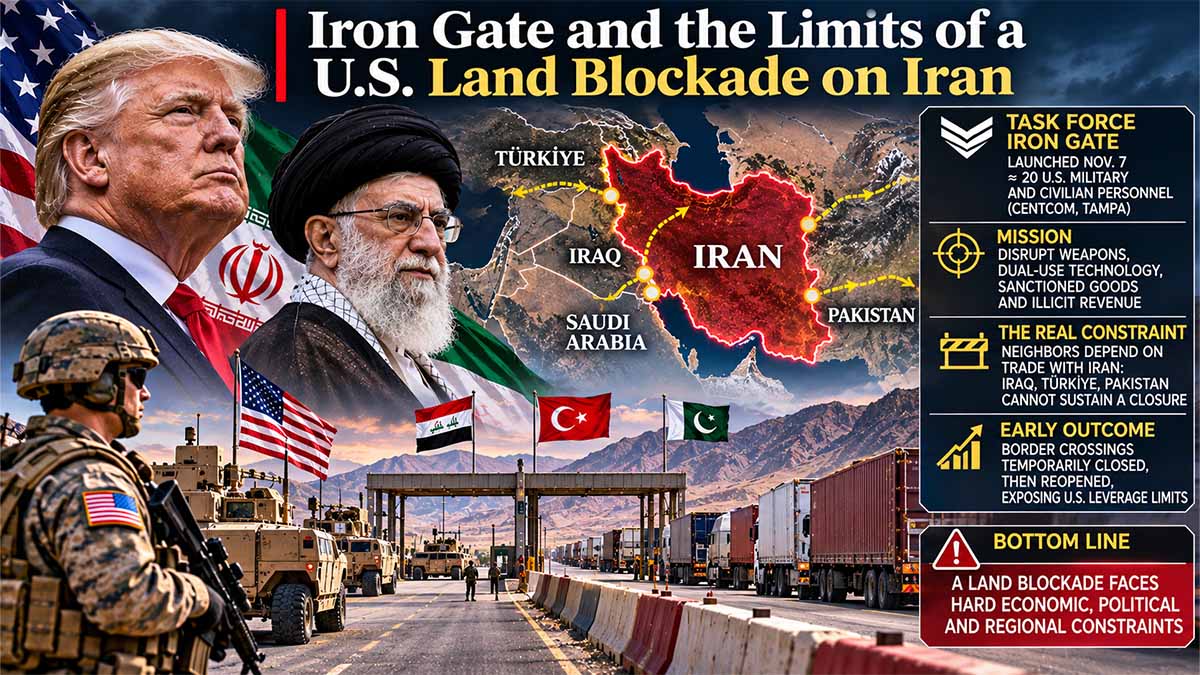
Scope. This assessment examines U.S. pressure on Iran’s overland and Caspian commerce from July to 18 November 2026, focusing on Iraq, Türkiye, Pakistan, the Caspian littoral and European exposure, with an outlook through November 2031.
Executive Summary / BLUF
- Task Force Iron Gate can increase the cost of trading with Iran. Sustained denial of overland trade depends on decisions by Iran’s neighbours. CENTCOM announced an interagency staff of approximately 20 military and civilian personnel in Tampa on 7 November. The announcement establishes a coordination mandate and identifies no delegated authority at foreign border crossings. CENTCOM Launches Task Force to Disrupt Iranian Ground Transit Routes Supporting Illegal Shipments — U.S. Central Command — Nov 2026. dvidshub.net
- Selective financial pressure is already documented. On 15 October, Treasury designated an Iraqi bank under Operation Economic Outcast. The potential loss of access to U.S. finance can affect firms and transactions even where customs authorities continue to clear cargo. Operation Economic Outcast Targets Iran’s International Financial Networks and Shadow Banking Architecture — U.S. Department of the Treasury — Oct 2026. U.S. Department of the Treasury
- The costs of broad restrictions differ by country. Iraq faces power-generation exposure linked to Iranian gas. Türkiye recorded US$5.50 billion in bilateral trade in 2025 and publicly supported stronger commercial ties in November. Pakistan’s commerce minister identified the absence of a bilateral banking channel even while documenting substantial formal border trade. Iraq Country Analysis Brief — U.S. Energy Information Administration — Jul 2025 · Türkiye-İran Ekonomik ve Ticari İlişkileri — Türkiye Ministry of Foreign Affairs — undated · Ticaret Bakanı Ömer Bolat, İran Ekonomi ve Maliye Bakanı Medenizade ile Görüştü — Türkiye Ministry of Trade — Nov 2026 · Questions for Oral Answers and Their Replies, pp. 31–33 — Senate of Pakistan — Aug 2026. eia.gov
- Decisive uncertainty. Whether governments adopt sustained, enforceable restrictions across several jurisdictions remains open. The decision threshold is a persistent decline in comparable trade across multiple routes after accounting for diversion, commodity exemptions and ordinary fluctuations. A closure at one crossing cannot establish that result.
Iron Gate Tests What Iran’s Neighbours Will Pay to Restrict Trade
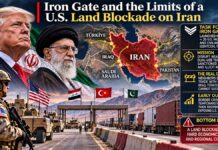
On 7 November 2026, U.S. Central Command announced Task Force Iron Gate, assigning about 20 military and civilian staff in Tampa to coordinate efforts against the movement of weapons, dual-use technology, sanctioned goods and revenue it classifies as illicit across Iran’s land borders and the Caspian Sea. Washington can use that coordination to make transactions more difficult or expensive. Sustained restrictions on physical trade depend on governments that would bear much of the immediate cost. In Iraq that cost can reach the electricity system, in Türkiye the gas import bill, and in Pakistan the traders who depend on a concentrated customs network. For Europe, the immediate question is how to enforce its own restrictions while containing another shock to energy and industrial costs.
The numbers show where the costs would fall
Iraq imported about 9 billion cubic metres of gas from Iran in 2024 and 6 billion cubic metres in 2025, according to the World Bank. The Bank links the decline to gas shortages for power generation, giving Baghdad a direct interest in the reliability of remaining deliveries. Türkiye imported 7.7 billion cubic metres from Iran in 2025, about 13.2% of its 58.3 billion cubic metres in total gas imports. Ankara has a wider portfolio of pipeline and LNG suppliers. The cost of replacing Iranian gas depends on how much those suppliers can deliver when needed, particularly in winter. Pakistan’s exposure takes a different form. Two customs entries accounted for about 83.6% of the assessed import value in the Federal Board of Revenue’s FY 2024–25 table for trade with Iran. That share identifies where disruption could hit recorded commerce hardest. Its denominator covers the customs entries in the parliamentary return, including inland facilities. The exposure of households and traders who rely on informal commerce remains outside that measure.
Iraq needs gas at the power plant before it can give up imports
The World Bank estimates that Iraq flared about 24 billion cubic metres of gas in 2025, four times the volume it imported from Iran that year. Capturing some of that gas could reduce dependence on imports. The early Ratawi treatment unit announced by TotalEnergies has a design processing rate of 50 million cubic feet per day. At that rate for a full year, it would process about 0.52 billion cubic metres. Actual substitution requires gas collection, treatment, network connections and reliable delivery to generators when electricity demand peaks. Iraq’s contract for up to 258 billion cubic feet per year of Turkmen gas illustrates a separate constraint. The arrangement diversifies the contractual source of supply while retaining transit through Iran. Baghdad’s room for manoeuvre depends on how much usable fuel reaches its power plants under stress. The volume Iraq flares and the volume it contracts indicate the scale of its options. The electricity system absorbs any shortfall until those options produce dependable deliveries.
Washington can reach a bank before it reaches a border
On 15 October 2026, the U.S. Treasury designated Iraq-based International Development Bank for Investment and Finance under Executive Order 13902. The designation preceded Iron Gate and illustrates the leverage Washington already had. The order provides for blocking property within U.S. jurisdiction and, under separate criteria, restricting certain U.S. accounts of foreign financial institutions. A bank can withhold payment while a customs office continues to clear goods. A shipment can also be held after the buyer has paid. Pakistan’s commerce minister told the Senate in August 2026 that the absence of a bilateral banking channel was already an obstacle to trade with Iran. Financial pressure can therefore reach traders before a government changes its border policy, increasing funding costs and delaying purchases. Washington’s designation record shows when it exercised its own authority. Measuring the effect on physical trade requires settlement and customs data that distinguish delayed transactions from deliveries that never occurred.
The Caspian already carries freight. Its new corridors still have to earn it.
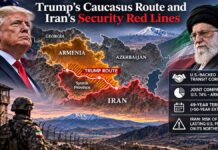
Kazakhstan’s agriculture ministry put nationwide grain exports to Iran at about 900,000 tonnes in 2025. It separately recorded 316,500 tonnes of grain handled that year at the Ak Bidai terminal in Aktau. The first figure measures a bilateral market and the second the throughput of one terminal. Together they explain why regional governments value established trading relationships as well as future infrastructure. On 27 October 2026, Russia’s transport ministry still described Rasht–Astara as the missing link on the western branch of the International North–South Transport Corridor, reporting progress on land acquisition and fiscal arrangements. On 7 November 2026, Armenia, Azerbaijan and the United States announced technical planning groups for the Trump Route for International Peace and Prosperity. The published framework preserves Armenia’s jurisdiction over its borders and customs. Both projects could change the choices available to freight customers once services are operating. The commercial test is whether each can carry the relevant cargo regularly at a competitive delivered cost.
Europe’s largest documented bill comes through energy
The European Commission puts EU–Iran goods trade at €3.7 billion in 2025. ACER estimates that the wider Middle East conflict added €18–33 billion to Europe’s gas import bill in summer 2026 for the same quantity of gas. The first figure is recorded goods trade over a calendar year. The second is a modelled price effect for one season, before Iron Gate was launched. Its scale explains why Europe’s response reaches well beyond bilateral commerce. Italy and Croatia used the Rome Coalition for Fertiliser Access and Food Security to address the effects of shipping disruption on agricultural supply. France and the United Kingdom co-led a defensive maritime initiative to support civilian shipping under stated conditions. Germany’s gas regulator reported that industrial customers accounted for 60% of domestic gas consumption in 2025, giving Berlin a direct interest in the price at which gas reaches industry. These governments share an interest in predictable navigation, even where the costs reach them through different markets.
Over the next two years, delays will leave the bill with industry and traders
The EU’s listing of two individuals and one entity on 8 June 2026 under its freedom-of-navigation measures shows how restrictions can be tied to specified conduct. The International Energy Agency’s March 2026 stock action addresses a physical supply problem. Italy, France, Germany and the United Kingdom initially committed a combined 58.1 million barrels, with different arrangements for public and industry stocks. The value of those commitments depends on the products delivered, their location and their timing. In November 2026, the IEA still assessed Gulf refined-product and liquefied petroleum gas exports at roughly half their pre-war levels even as crude flows recovered. Over the next 12–24 months, freight operators and industrial buyers will bear the cost if governments read a recovery in crude as evidence that product shortages have eased. Traders will carry the financing cost if authorities leave the treatment of lawful transactions unclear. Iron Gate’s effect on regional trade should be judged by a sustained change in covered deliveries across several jurisdictions, allowing for shifts in demand and traffic between crossings. Until that evidence arrives, the costs of disruption will be easier to identify than any durable change in who controls the movement of goods across Iran’s borders.
Navigational Index
| Thematic pillar | Chapters |
|---|---|
| Authority and reach | Chapter 1 — From the naval blockade to Iron Gate’s interagency mandate Chapter 2 — Sanctions, customs jurisdiction and the Caspian legal framework |
| Regional exposure and trade adjustment | Chapter 3 — Iraq’s power system, border commerce and financial exposure Chapter 4 — Türkiye and Pakistan’s choices on trade, transit and payments Chapter 5 — Caspian commerce, Russia and the South Caucasus corridors |
| European implications and decisions | Chapter 6 — Italy, France, Germany, the United Kingdom and the European Union Chapter 7 — Implementation pathways, indicators and outlook through 2031 Chapter 8 — Policy options and final net assessment |
Master Abstract
Washington can exert financial pressure faster than it can secure coordinated border restrictions
CENTCOM’s own records show the difference between the two instruments. Its 5 October release says U.S. forces resumed the naval blockade on 14 July and had redirected 130 commercial vessels by 5 October. Its 7 November release assigns Iron Gate a different function, coordinating U.S. agencies on cross-border movements involving weapons, dual-use technology, sanctioned goods and revenue CENTCOM characterises as illicit. Treasury’s 24 August launch of Operation Economic Outcast had already established a wider economic campaign. Its subsequent Iraqi bank designation illustrates how financial restrictions can affect commerce before a foreign government changes its customs policy. Iron Gate could make U.S. agencies more effective at acting on shared information, but the two announcements provide no common outcome measure. Vessel redirections record naval activity. Financial designations record administrative action. Each requires separate evidence before it can support a claim about the volume or value of Iranian land trade lost. CENTCOM Maintains Strict Enforcement of U.S. Blockade Against Iran — U.S. Central Command — Oct 2026 · CENTCOM Launches Task Force to Disrupt Iranian Ground Transit Routes Supporting Illegal Shipments — U.S. Central Command — Nov 2026 · Treasury Launches Unprecedented Campaign Against Iranian Regime on Economic D-Day — U.S. Department of the Treasury — Aug 2026 · Operation Economic Outcast Targets Iran’s International Financial Networks and Shadow Banking Architecture — U.S. Department of the Treasury — Oct 2026. dvidshub.net
Neighbouring governments face different economic costs
In Iraq, the most consequential exposure is the fuel used by domestic power plants. EIA’s July 2025 brief reports that direct electricity imports from Iran supplied about 2% of Federal Iraq’s electricity in 2023. It separately attributes to Iraq an estimate that imported Iranian gas supported more than 30% of electricity generation, without specifying a common reference year for that estimate. A road crossing restriction does not itself interrupt pipeline deliveries. Baghdad’s exposure becomes greater if wider financial or trade measures make gas deliveries harder to sustain or pay for. Türkiye’s official trade series and the trade minister’s 2 November statement give separate evidence of commercial exposure and Ankara’s policy preference. Pakistan’s Senate record shows why the formal trade channel deserves attention of its own. Customs recorded substantial import and export clearances despite the absence of a bilateral banking channel. Across the three cases, a government can tighten scrutiny of specified goods or transactions while maintaining other commercial flows. Iraq Country Analysis Brief, natural gas trade and electricity sections — U.S. Energy Information Administration — Jul 2025 · Türkiye-İran Ekonomik ve Ticari İlişkileri — Türkiye Ministry of Foreign Affairs — undated · Ticaret Bakanı Ömer Bolat, İran Ekonomi ve Maliye Bakanı Medenizade ile Görüştü — Türkiye Ministry of Trade — Nov 2026 · Questions for Oral Answers and Their Replies, pp. 31–33 — Senate of Pakistan — Aug 2026. eia.gov
The Caspian presents a separate jurisdictional problem
Azerbaijan, Iran, Kazakhstan, Russia and Turkmenistan signed the Aktau Convention in August 2018. Article 3 sets out the principle that armed forces of non-parties are to be absent from the Caspian, while Article 22 makes entry into force conditional on Kazakhstan receiving the fifth ratification instrument. The official record reviewed does not establish that deposit or a notification of entry into force. The signed text establishes the five governments’ agreed design for the basin. Its present legal effect requires separate verification. The geography still matters for the assessment. Washington’s announcement identifies no local enforcement arrangement, while Russia’s transport ministry describes Rasht–Astara as the missing Iranian rail link on the western branch of the North–South corridor. The project demonstrates Moscow’s interest in expanding regional connectivity, with future transport capacity dependent on implementation. Separately, the 7 November U.S.–Armenia–Azerbaijan statement records the launch of technical planning groups for the Trump Route, a distinct corridor initiative. The published mandates establish planning in one case and U.S. interagency coordination in the other. Convention on the Legal Status of the Caspian Sea, arts. 3 and 22 — Caspian littoral signatories — Aug 2018 · В Иране продолжается реализация проекта строительства железнодорожной линии Решт – Астара — Russian Ministry of Transport — Oct 2026 · Joint Statement by the United States, Armenia, and Azerbaijan on the Launch of Trilateral Technical Planning Groups to Advance the Trump Route for International Peace and Prosperity (TRIPP) — Armenian Ministry of Foreign Affairs — Nov 2026. tehranconvention.org
The legal distinction also matters for allies. Articles 41 and 42 of the UN Charter distinguish Security Council measures without armed force from military action that can include blockade. They define powers of the Council. The public Iron Gate release describes a U.S. command decision and identifies neither a Security Council mandate for the task force nor a grant of authority by a neighbouring state. Any assessment of a specific restriction or interdiction therefore requires the applicable domestic instrument, the jurisdiction and the facts of the action. United Nations Charter, arts. 41–42 — United Nations — Jun 1945 · CENTCOM Launches Task Force to Disrupt Iranian Ground Transit Routes Supporting Illegal Shipments — U.S. Central Command — Nov 2026. dppa.un.org
Europe’s immediate stake is freedom of navigation and the cost of disruption
The November G7 declaration supported safe and free passage through Hormuz, recognised the role of the France–UK defensive initiative and reiterated coordination on economic pressure absent a diplomatic solution. Those commitments concern distinct policy instruments. The IEA reported that North Sea Dated crude fell from US$136 per barrel on 8 October to around US$93 per barrel at the time of its November report as Gulf exports recovered. European diesel nevertheless remained 77% above the IEA’s pre-war comparison level. The figures show why governments and industrial buyers need to follow refined-product prices as well as crude. Neither series measures Iron Gate’s effect on land trade. Joint declaration following the G7 Foreign Ministers Meeting in Paris on 9 and 10 November 2026 — Italian Ministry of Foreign Affairs and International Cooperation — Nov 2026 · Oil Market Report – November 2026 — International Energy Agency — Nov 2026. esteri.it
| Jurisdiction | Documented position and decision implication |
|---|---|
| Italy | Foreign Minister Antonio Tajani prioritised avoiding renewed escalation in Hormuz and supporting regional partners’ efforts to resume U.S.–Iran negotiations. He also identified Italy’s food-security initiative with Croatia and FAO support. Rome’s published position links energy transit and food-system exposure to diplomacy. Tajani al G7 Esteri in Francia: minacce ibride, intelligenza artificiale e crisi internazionali tra i temi in agenda — Italian Ministry of Foreign Affairs and International Cooperation — Nov 2026. esteri.it |
| France | France co-leads the defensive maritime initiative recognised by the G7. The declaration identifies support for the resumption of traffic and verification of mine removal as possible contributions. Any further French operational commitment would require its own mandate and implementation record. Déclaration conjointe à l’issue de la réunion des ministres des Affaires étrangères du G7 à Paris, les 9 et 10 novembre 2026 — France Diplomatie — Nov 2026. France Diplomatie |
| Germany | Foreign Minister Johann Wadephul called for concrete negotiations and urged against renewed military escalation before the Paris meeting. Germany also joined France and the EU High Representative in recommending restoration of EU nuclear-related measures in 2025. Berlin’s documented levers include diplomacy and enforcement through the EU framework. Foreign Minister Wadephul prior to his departure for Paris for the G7 Foreign Ministers meeting — Federal Foreign Office — Nov 2026 · Iran sanctions snapback: Council reimposes restrictive measures — Council of the European Union — Sep 2025. Federal Foreign Office |
| United Kingdom | London co-leads the Hormuz initiative. Its nuclear sanctions framework separately provides for the Secretary of State to specify ships under prescribed conditions. Defensive maritime activity and ship-related sanctions have different authorities and implementation requirements. Joint declaration following the G7 Foreign Ministers’ Meeting in Paris — UK Foreign, Commonwealth & Development Office — Nov 2026 · Iran nuclear sanctions: statutory guidance, section 1.2.2 — UK Government — Sep 2026. GOV.UK |
| European Union | The Council reimposed previously lifted nuclear-related economic and financial restrictions in September 2025. Regulation (EU) 2025/1975 amended the underlying Iran sanctions regulation. EU operators should assess obligations under the applicable EU instruments when a transaction is exposed to separate U.S. action. Iran sanctions snapback: Council reimposes restrictive measures — Council of the European Union — Sep 2025. Consilium |
Key Evidence Table
| Indicator | Value/status | Reference date | Definition/scope | Issuer | Exact source |
|---|---|---|---|---|---|
| Iron Gate establishment | Approximately 20 military and civilian staff based in Tampa | 7 Nov 2026 | Announced internal U.S. interagency coordination staff | U.S. Central Command | CENTCOM Launches Task Force to Disrupt Iranian Ground Transit Routes Supporting Illegal Shipments — U.S. Central Command — Nov 2026. dvidshub.net |
| U.S. naval blockade activity | 130 commercial vessels redirected, according to CENTCOM | By 5 Oct 2026, following resumption on 14 Jul | Cumulative vessel redirections reported by the implementing command | U.S. Central Command | CENTCOM Maintains Strict Enforcement of U.S. Blockade Against Iran — U.S. Central Command — Oct 2026. dvidshub.net |
| Financial action involving Iraq | International Development Bank for Investment and Finance designated | 15 Oct 2026 | OFAC action under Executive Order 13902, as explained by Treasury | U.S. Department of the Treasury | Operation Economic Outcast Targets Iran’s International Financial Networks and Shadow Banking Architecture — U.S. Department of the Treasury — Oct 2026. U.S. Department of the Treasury |
| Iraq’s exposure to Iranian energy | About 2% of Federal Iraq’s electricity supply from direct imports in 2023. More than 30% of generation attributed by Iraq to imported Iranian gas in the estimate reported by EIA | 2023 for direct imports. Gas estimate in Jul 2025 brief, with no separate reference year specified | Different denominators and delivery channels. Current generation attributable to Iranian gas remains open | U.S. Energy Information Administration | Iraq Country Analysis Brief, electricity section — U.S. Energy Information Administration — Jul 2025. eia.gov |
| Türkiye–Iran bilateral trade | US$5.50 billion, comprising US$3.00 billion in Turkish exports and US$2.50 billion in imports | Calendar year 2025 | Published nominal trade values in U.S. dollars, using TÜİK data. The ministry table does not specify a separate conversion convention | Türkiye Ministry of Foreign Affairs, citing TÜİK | Türkiye-İran Ekonomik ve Ticari İlişkileri — Türkiye Ministry of Foreign Affairs — undated, accessed Nov 2026. mfa.gov.tr |
| Pakistan–Iran formal trade gateways | 12 customs-notified crossing points, 6 described as operational in the August reply | 20 Aug 2026 | Commerce minister’s account to the Senate. Joint border markets have a separate status | Pakistan Ministry of Commerce, citing the Federal Board of Revenue | Questions for Oral Answers and Their Replies, pp. 31–33 — Senate of Pakistan — Aug 2026. senate.gov.pk |
| Pakistan–Iran customs-assessed trade | PKR 358,915 million in imports and PKR 82,129 million in exports | Pakistani FY 2024–25 | Nominal assessed values for the customs points and dry-port entries covered by the Senate reply. The figures do not measure informal trade and have not been converted | Pakistan Federal Board of Revenue, reported to the Senate | Questions for Oral Answers and Their Replies, pp. 31–32 — Senate of Pakistan — Aug 2026. senate.gov.pk |
| Caspian Convention | Five signatories. Entry into force requires the fifth deposit with Kazakhstan | Signed 12 Aug 2018. Entry into force unresolved in the verified record at the cut-off | Articles 3 and 22 of the signed instrument | Caspian littoral signatories | Convention on the Legal Status of the Caspian Sea — Caspian littoral signatories — Aug 2018. tehranconvention.org |
Competing Explanations or Pathways
The pathways compare the dominant implementation pattern through November 2027. Diplomatic signalling and selective enforcement can coexist. The diagnostic question is whether Iron Gate produces identifiable operational changes and how far those changes extend.
| Hypothesis | Diagnostic support | Disconfirming evidence | Indicators | Current standing |
|---|---|---|---|---|
| Selective enforcement adds measurable friction | The announced mandate specifies categories of goods and revenue. Treasury has already demonstrated the ability to designate entities in third countries. | The observed Treasury actions cited above predate Iron Gate. Their effects cannot be attributed to the task force. | An official account tying specific administrative actions to Iron Gate, followed by measurable effects in the covered categories. | Leading pathway. The tools exist. Iron Gate’s incremental effect remains unmeasured. dvidshub.net |
| Several neighbours impose sustained broad restrictions | Treasury’s August campaign covers a wider economic objective than the categories in the Iron Gate release. Financial exposure gives Washington leverage with some authorities and firms. | Iraq’s power-sector exposure, Ankara’s stated interest in trade and the institutional limits in the Caspian weigh against durable convergence. | Published restrictions across several jurisdictions, with subsequent commodity-level data showing a persistent aggregate decline after allowing for diversion. | Conditional and currently weakly supported. It depends on sustained local implementation and manageable domestic costs. U.S. Department of the Treasury |
| Iron Gate’s incremental effect remains primarily diplomatic | The public announcement creates a coordination staff. Some of the policy instruments associated with the wider campaign were already active before 7 November. | An internal staff can improve interagency coordination before results become attributable in public. | Measures continue under existing programmes while official reporting provides no traceable link to new Iron Gate outcomes. | Plausible near term. It becomes less persuasive if agencies or partner governments publish attributable results. dvidshub.net |
Principal Gaps and Watch Indicators
| Open official record | Watch indicator and decision threshold |
|---|---|
| U.S. mandate and results. A CENTCOM or Treasury implementation statement identifying participating agencies’ roles and attributable outcomes. | Revise the assessment of Iron Gate’s incremental effect when an agency documents an action it attributes to the task force and reports a measurable result in a defined category. |
| Iraqi and Pakistani border measures. Dated orders from Iraq’s Border Ports Commission and Pakistan’s Ministry of Commerce or Federal Board of Revenue, alongside separate passenger and cargo data. | Treat a reported closure or reopening as economically consequential once the responsible authority confirms its scope, duration, exemptions and effect on actual clearances. The public record reviewed leaves the causal link between individual changes and U.S. pressure unresolved. |
| Iraqi fuel substitution. Current Ministry of Electricity gas receipts and generation attributable to the delivered fuel, plus commissioning and throughput records for replacement supply. | Revise the assessment of Baghdad’s exposure when verified replacement deliveries sustain generation through a period of peak demand. |
| Caspian treaty status and implementation. Kazakhstan’s depositary notification under Articles 22–23 and any subsequent national port or customs orders. | A fifth-deposit notification would clarify the treaty’s status. Evidence of changed trade requires separate implementing orders and throughput data. |
| Trade diversion and civilian exposure. Comparable official customs series by crossing, commodity and month, with energy flows tracked separately from general cargo. | Evidence of regional isolation requires a sustained fall in aggregate flows across several jurisdictions. Passenger counts, administrative designations and press statements cannot substitute for the trade series. |
Visualisation
Where enforcement authority changes hands
Institutional relationship as of 18 November 2026. Arrows identify the authority responsible for the action.
U.S. coordination → U.S. agencies
CENTCOM assigned Iron Gate an interagency role. Treasury separately announced financial designations under Economic Outcast.
CENTCOM mandate, 7 November 2026Treasury designations, 15 October 2026
Border restrictions → national authorities
Foreign customs agencies implement domestic gateway rules. Pakistan’s notification for Gabd illustrates the distinction between legal designation and actual traffic.
Pakistan Federal Board of Revenue, 9 June 2026Caspian enforcement → coastal governments
Five coastal states signed the Aktau text. Its entry into force requires the fifth ratification deposit. The signature record alone leaves that condition unresolved.
Aktau Convention, articles 3 and 22, 12 August 2018Iron Gate and the limits of U.S. pressure on Iran’s borders
U.S. agencies can coordinate pressure on trade and finance. Sustained border restrictions depend on decisions by neighbouring governments.
Trade data explorer
Reduced motion is active.
Source ·
Evidence and institutional status
| Indicator | Value or status | Reference period | Source |
|---|
Trade and evidence reference
| Year | Total | Türkiye’s exports | Türkiye’s imports |
|---|---|---|---|
| 2022 | 6.42 | 3.07 | 3.35 |
| 2023 | 5.40 | 3.22 | 2.18 |
| 2024 | 5.68 | 3.23 | 2.45 |
| 2025 | 5.50 | 3.00 | 2.50 |
| Customs entry | PKR million |
|---|---|
| NLC Taftan | 170,957 |
| Border Point 250 | 129,137.36 |
| Rideeg / Mand | 11,372.65 |
| Indicator | Value or status |
|---|---|
| Iron Gate staff | About 20 in Tampa, announced 7 November 2026. |
| U.S. naval blockade | 130 commercial vessels redirected by 5 October 2026, according to CENTCOM. |
| Iraqi electricity generation | More than 30% linked to Iranian gas in a July 2025 EIA brief. Underlying year unspecified. |
| Pakistan trade gateways | 12 customs-notified and 6 described as operational in August 2026. |
| Pakistan’s customs-assessed trade | Imports of PKR 358,915 million and exports of PKR 82,129 million in FY 2024–25, within the coverage of the Senate reply. |
| Caspian Convention | Five signatories. Entry into force requires the fifth ratification deposit. |
| Rasht–Astara | Missing rail link on the western North–South corridor, according to Russia’s transport ministry in October 2026. |
Official sources · Türkiye MFA / TÜİK · Pakistan Senate, pp. 31–33 · CENTCOM, Iron Gate · CENTCOM, naval blockade · EIA, Iraq · Aktau Convention · Russian Ministry of Transport
Authority and Reach | From the Naval Blockade to Iron Gate
Assessment as of 18 November 2026
Chapter 1 — From the Naval Blockade to Iron Gate’s Interagency Mandate
Iron Gate gives Washington a mechanism to coordinate pressure across several U.S. agencies. Its ability to change what happens at a foreign border depends on decisions taken under separate legal authorities. The decisive distinction is who can act. U.S. forces implemented the naval operation and reported vessel redirections. Treasury can issue financial designations under U.S. law. A government that wishes to stop or inspect cargo at a land crossing must direct the authorities that administer that crossing, under the law applicable there. CENTCOM’s announcement of 7 November establishes an internal staff in Tampa and sets out the categories of activity it will address. It identifies no agreement delegating customs powers, no foreign agency operating under U.S. direction and no host-government commitment to close a crossing. Those documents would establish different levels of cooperation, ranging from notification or information sharing to the adoption of new restrictions by a partner government. As of the cut-off, the published mandate supports the first proposition that Washington intends to coordinate pressure more closely. The scope of foreign participation remains open. CENTCOM Launches Task Force to Disrupt Iranian Ground Transit Routes Supporting Illegal Shipments — U.S. Central Command — Nov 2026. dvidshub.net
The maritime campaign changed in phases
The documentary chronology begins before the July resumption. On 13 April 2026, the UK Maritime Trade Operations advisory reported access restrictions affecting Iranian ports and coastal facilities, applicable to vessels of any flag engaging with the covered locations. On 18 June, the Joint Maritime Information Center reported the end of that phase of the U.S. blockade following the announcement of the U.S.–Iran memorandum of understanding. The June advisory shows that the maritime campaign had a documented interruption. CENTCOM subsequently dated the resumption to 14 July and, on 5 October, reported the redirection of 130 commercial vessels and the disabling of three vessels that refused to comply. These figures describe activities reported by the implementing command. They do not establish the number of voyages cancelled before departure, the cargo value associated with each redirection, or the volume ultimately delivered by other means. The chronology therefore establishes two distinct things. U.S. forces demonstrated an ability to act directly at sea, and the continuity of that action depended on executive decisions and diplomatic developments. The November announcement carried that political pressure into another domain through an interagency mandate with a different implementing chain. UKMTO Advisory 035-26 — United Kingdom Maritime Trade Operations — Apr 2026 · JMIC Advisory Note 008-26 — Joint Maritime Information Center — Jun 2026 · CENTCOM Maintains Strict Enforcement of U.S. Blockade Against Iran — U.S. Central Command — Oct 2026. ukmto.org
From naval enforcement to interagency coordination
| Date | Issuing body | Documented action | Evidence limit |
|---|---|---|---|
| 13 Apr 2026 | UKMTO | Reports access restrictions affecting Iranian ports and coastal facilities. | Advisory records announced scope. |
| 18 Jun 2026 | JMIC | Reports the end of that phase of the U.S. blockade. | Date of the advisory, rather than a timestamp for every change in enforcement. |
| 14 Jul 2026 | CENTCOM | Resumes naval enforcement against ships seeking to enter or leave Iranian ports. | Resumption date recorded retrospectively in the 5 October release. |
| 5 Oct 2026 | CENTCOM | Reports 130 commercial vessels redirected and three ships disabled after refusing to comply. | Command-reported actions. The release does not give a trade-volume denominator. |
| 7 Nov 2026 | CENTCOM | Announces an internal Tampa coordination staff of about 20 military and civilian personnel. | Staffing and mandate in the announcement. No named foreign implementation order. |
Sources for the table. UKMTO Advisory 035-26 — UKMTO — Apr 2026 · JMIC Advisory Note 008-26 — JMIC — Jun 2026 · CENTCOM Maintains Strict Enforcement of U.S. Blockade Against Iran — CENTCOM — Oct 2026 · CENTCOM Launches Task Force to Disrupt Iranian Ground Transit Routes Supporting Illegal Shipments — CENTCOM — Nov 2026. ukmto.org
Port access, passage through Hormuz and the use of force
The object of the announced U.S. operation was maritime traffic entering or leaving Iranian ports. The legal assessment of passage through Hormuz asks a different question about the rights of ships using an international strait. A restriction aimed at port access can affect vessels and commercial decisions elsewhere when the routes overlap. The existence of that effect does not resolve which jurisdiction governed a particular encounter, what right of navigation the vessel was exercising or which legal basis the acting state invoked. Part III of the UN Convention on the Law of the Sea sets out transit passage through qualifying straits and, in Article 44, bars states bordering those straits from hampering or suspending that passage. The UN depositary records Iran’s signature of the Convention. Applying the treaty text to a specific incident still requires checking the parties’ treaty status, any relevant customary rule and the relationship between the law of the sea and the law applicable during armed conflict. The G7’s November declaration provides an identifiable political position in favour of safe and free passage through Hormuz. It does not itself adjudicate a particular restriction or maritime incident. United Nations Convention on the Law of the Sea, Part III, arts. 37–44 — United Nations — Dec 1982 · United Nations Convention on the Law of the Sea, Iran signature record — UN Treaty Collection — Dec 1982 · Joint Declaration Following the G7 Foreign Ministers Meeting in Paris — Italian Ministry of Foreign Affairs and International Cooperation — Nov 2026. un.org
Articles 41 and 42 of the UN Charter distinguish Security Council measures without armed force from military action that can include blockade. Article 51 separately preserves the right of individual or collective self-defence if an armed attack occurs and requires measures taken in its exercise to be reported to the Council. In its 31 August 2026 letter to the UN, Iran characterised the U.S. maritime blockade as part of a continuing series of internationally wrongful acts. That document establishes Tehran’s legal position. CENTCOM’s October and November releases establish what the command said it was doing and how it described the operation. The records serve different evidentiary purposes. In Oil Platforms, the International Court of Justice examined the necessity and proportionality of force invoked in self-defence in a different dispute between the United States and Iran. The judgment helps identify the legal questions an assessment should ask. It supplies no ruling on the 2026 campaign. For a present-day determination, the material record would include the authority invoked by the acting state, the contemporaneous facts of the action and any relevant communication to the Council. United Nations Charter, arts. 41, 42 and 51 — United Nations — Jun 1945 · Letter dated 31 August 2026 from the Permanent Mission of Iran, S/2026/702 — United Nations — Aug 2026 · Oil Platforms (Islamic Republic of Iran v. United States of America), Judgment — International Court of Justice — Nov 2003. dppa.un.org
What Iron Gate can add, and how to measure it
The public mandate covers four categories with different legal and evidentiary requirements. Identifying an advanced weapon concerns the nature of the item. Identifying controlled dual-use equipment requires the applicable control rule and facts about the goods or transaction. Identifying sanctioned material depends on the regime, its jurisdiction and any authorisation. Identifying revenue as illicit requires a basis for treating the transaction or entity as prohibited. A coordination staff can help U.S. agencies resolve discrepancies between these assessments and refer cases to the body with the relevant authority. A referral, a financial designation, a foreign customs instruction and an actual change in cleared trade are four different observations. Counting them together would overstate the evidence, particularly if the same underlying matter generated several official actions. CENTCOM’s November statement also attributes more than US$25 billion in crude oil exports foregone to the naval blockade over an unspecified period of recent months. The release provides no price basis, affected volume series or counterfactual export baseline. The number therefore remains an attributed command estimate. It cannot serve as a verified measure of revenue lost or a benchmark for Iron Gate’s performance. CENTCOM Launches Task Force to Disrupt Iranian Ground Transit Routes Supporting Illegal Shipments — U.S. Central Command — Nov 2026. dvidshub.net
Key judgments
- The naval campaign had a documented interruption. April commencement, the June announcement that the first phase had ended, and July resumption should remain separate in the chronology.
- Iron Gate’s first measurable contribution would be an action attributable to its coordination. A partner’s decision, a change in trade volumes and a change in Iranian revenue would each require further evidence.
What would change the assessment
A public U.S. implementation document identifying agency responsibilities would clarify the task force’s contribution. A dated partner-government instrument, combined with comparable clearance data, would show whether that contribution translated into a change in border administration and whether the change persisted.
Open official record
The decisive missing records are the task force’s implementation instructions, published partner commitments where applicable, and the methodology underlying CENTCOM’s estimate of crude oil exports foregone.
Chapter 2 — Sanctions, Customs Jurisdiction and the Caspian Legal Framework
Financial sanctions can reach firms and transactions outside the United States through their exposure to U.S. jurisdiction and the U.S. financial system. Physical control of a neighbouring state’s land border or Caspian port depends on the competent authorities there. Executive Order 13902 provides a concrete example of the distinction. Section 1 establishes blocking authorities for property and interests in property within the United States, coming within the United States, or within the possession or control of a U.S. person, when the relevant determination is made. Section 2 provides a separate mechanism under which Treasury can prohibit or impose strict conditions on specified U.S. correspondent or payable-through accounts of a foreign financial institution that meets the order’s criteria. These provisions can change the commercial decisions of banks well beyond U.S. territory. On 15 October 2026, Treasury said it designated Iraq-based International Development Bank for Investment and Finance under the order for operating in Iran’s financial sector. That action preceded Iron Gate and illustrates a tool already available to Washington. A financial institution can decline a transaction because of its assessment of sanctions exposure while the customs authority processing the underlying goods continues to administer its own rules. The result can be a substantial commercial obstacle even in the absence of a published closure order. Executive Order 13902, Imposing Sanctions With Respect to Additional Sectors of Iran, §§ 1–2 — President of the United States — Jan 2020 · Operation Economic Outcast Targets Iran’s International Financial Networks and Shadow Banking Architecture — U.S. Department of the Treasury — Oct 2026. govinfo.gov
Customs competence determines which restrictions can be implemented
The distinction between a diplomatic request and an operative decision can be tested against national law. Iraq’s Border Ports Commission Law No. 30 of 2016 assigns the Commission’s council responsibility for setting general policy and overseeing border-port affairs. That establishes the Iraqi institutional framework within which a decision concerning a crossing must be examined. A case-specific assessment still requires the actual instrument and the authority named in it. Pakistan’s Customs Act 1969, as amended through 30 June 2026, provides in section 16 for federal government restrictions on specified goods by notification in the official Gazette. Türkiye’s Parliament published Customs Law No. 4458, whose Article 55 establishes the framework for assigning goods a customs-approved treatment or use and addresses restrictions on grounds including public order or security. The original parliamentary text is a statutory baseline. A claim about a particular 2026 measure would require the applicable consolidated provision and implementing decision. In all three jurisdictions, the commercial effect turns on what the measure covers. Suspending passenger movements, imposing a commodity-specific import restriction, adding documentary requirements and closing a crossing to all cargo produce different effects. A statement that a border is “closed” is therefore too imprecise for a government or market assessment unless the issuing authority, duration, direction of travel, commodity coverage and exemptions can be established. Border Ports Commission Law No. 30 of 2016, art. 6 — Official Gazette of Iraq, No. 4419 — Oct 2016 · Customs Act, 1969, as amended through 30 June 2026, § 16 — Pakistan Federal Board of Revenue — Jun 2026 · Gümrük Kanunu No. 4458, art. 55, enacted text — Grand National Assembly of Türkiye — Oct 1999. moj.gov.iq
UN and EU inspection provisions are tied to defined goods and conditions
Security Council Resolution 1929 illustrates the specificity of a multilateral cargo-inspection provision. Paragraph 14 calls for inspection of cargo to and from Iran in a state’s territory where there are reasonable grounds to believe it contains goods prohibited under identified resolutions. Paragraph 15 addresses requests for inspections on the high seas with flag-state consent and under the stated evidentiary conditions. Paragraph 16 addresses seizure and disposal of prohibited items identified through an inspection under those provisions. The record of the September 2025 Security Council debate also documents a material dispute over the restoration of earlier measures under Resolution 2231. France and the United Kingdom defended the E3 notification, while Russia and China challenged its legal basis. These are recorded positions of governments with a direct stake in the dispute. The UN’s 1737 Committee page sets out the measures under that framework. For an assessment of a particular government’s implementation, its operative domestic or regional act remains central. The EU’s own decision of 29 September 2025 amended its inspection rules, including the reasonable-grounds requirement for cargo in member states’ territories and the flag-state consent requirement for inspection requests on the high seas. That EU decision provides an identifiable legal reference for its member states. The separate regulation amended the EU economic and financial restrictions. Security Council Resolution 1929 (2010), paras. 14–16 — UN Security Council — Jun 2010 · Security Council Meeting Record S/PV.10001 — UN Security Council — Sep 2025 · Security Council Committee Established Pursuant to Resolution 1737 (2006) — UN Security Council — accessed Nov 2026 · Council Decision (CFSP) 2025/1972, amendment to art. 15 — Council of the European Union — Sep 2025 · Council Regulation (EU) 2025/1975 — Council of the European Union — Sep 2025. documents.un.org
| Legal instrument | Relevant condition | Record that would establish implementation |
|---|---|---|
| Executive Order 13902, §§ 1–2 — United States — Jan 2020 | The applicable determination and criteria for blocking property or imposing U.S. account restrictions. | The designation or account measure, with its effective date and applicable authorisations. govinfo.gov |
| Resolution 1929, paras. 14–16 — UN Security Council — Jun 2010 | Reasonable grounds tied to specified prohibitions. The high-seas inspection request addresses flag-state consent. | The relevant authority or consent record and the grounds for treating the items as prohibited. documents.un.org |
| Decision (CFSP) 2025/1972 — Council of the European Union — Sep 2025 | Cargo to or from Iran within a member state’s territory, subject to the decision’s grounds for inspection and applicable national and international law. | The member-state implementation record or competent authority’s decision. eur-lex.europa.eu |
| Convention on the Legal Status of the Caspian Sea, arts. 22–23 — Littoral signatories — Aug 2018 | Receipt of the fifth ratification instrument by Kazakhstan, which acts as depositary. | The depositary’s notification. Any specific restriction would require its own applicable instrument. tehranconvention.org |
The Caspian’s signed framework distinguishes coastal powers from navigation rights
The 2018 Aktau text gives substances to the distinction between control of a port, jurisdiction in territorial waters and navigation beyond those waters. Articles 5–9 distinguish internal waters, territorial waters, fishery zones and a common maritime space. Article 7 provides for territorial waters of up to 15 nautical miles. Article 9 provides for an adjacent 10-nautical-mile fishery zone and reserves fishing there to the relevant coastal party. The fishery limit therefore answers a resource-jurisdiction question and cannot be treated as an additional belt of territorial waters. Article 10 provides for navigation beyond territorial waters by ships flying the parties’ flags and specifies treatment for qualifying ships at Caspian ports open to them. Article 3 states the principle that armed forces belonging to non-parties are to be absent from the Caspian, while Article 17 provides for cooperation among the parties on specified offences including arms trafficking. Taken together, those provisions describe a regional system in which local cooperation on prohibited conduct is compatible with navigation and defined port-access rights. Their legal effect under the Convention remains subject to Articles 22–23. The official record reviewed for this pillar does not establish a fifth deposit or notification of entry into force by Kazakhstan. The signed rules therefore establish the agreed framework for analysis, while the status of any particular measure requires the operative regional, bilateral or national basis. Convention on the Legal Status of the Caspian Sea, arts. 3, 5–10, 17 and 22–23 — Littoral signatories — Aug 2018. tehranconvention.org
Sources for the scheme. CENTCOM Launches Task Force to Disrupt Iranian Ground Transit Routes Supporting Illegal Shipments — CENTCOM — Nov 2026 · Executive Order 13902 — United States — Jan 2020 · Pakistan Customs Act, § 16 — Federal Board of Revenue — Jun 2026 · Convention on the Legal Status of the Caspian Sea — Littoral signatories — Aug 2018. dvidshub.net
Both WordPress blocks use independently scoped styles and no JavaScript. The scheme uses native expandable panels. Rendering in the live WordPress theme remains unverified.
Key judgments
- The United States can create payment and compliance costs through its own authorities. Foreign customs decisions require a separate legal instrument and remain subject to the implementing government’s rules and discretion.
- The Caspian assessment turns on jurisdiction and treaty status. A coastal state’s decision at one port, even if established, would show action at that port. A basin-wide claim would require separate evidence across the relevant jurisdictions.
What would change the assessment
A published customs measure in a neighbouring country would establish a change in local policy once its scope and effective date were clear. A series of comparable implementing acts could support a judgment of regional convergence. The Kazakh depositary notice would resolve the Convention’s entry-into-force question. Evidence of restricted trade would still depend on the applicable measures and subsequent cargo data.
Open official record
The highest-value records are the dated national instruments governing any specific Iranian border or Caspian restriction, the terms and authorisations attached to financial designations, and Kazakhstan’s notification under Articles 22–23. Their publication would allow the next pillar to assess the economic burden on neighbouring states against measures those governments actually adopted.
Regional Exposure and Trade Adjustment | Why Iran’s Neighbours Face Different Costs
Open-source analytical assessment as of 18 November 2026
Chapter 3 — Iraq’s Power System, Border Commerce and Financial Exposure
Iraq’s most immediate exposure is the effect of reduced Iranian gas deliveries on domestic electricity generation. Trade restrictions at road crossings would impose a different set of costs on importers, transport operators and border communities. The World Bank’s June 2026 Global Gas Flaring Tracker Report puts Iraqi imports of Iranian gas at approximately 9 billion cubic metres in 2024 and 6 billion cubic metres in 2025, a decline of about one-third, calculated from the report’s rounded annual figures. The Bank associates these shortfalls with pressure on power generation. The same report estimates that Iraq flared approximately 24 billion cubic metres of domestic gas in 2025, four times that year’s imports from Iran. The comparison identifies a substantial domestic resource that Iraq could bring into productive use over time. Deliverable gas depends on field-level collection, processing, connections to the gas network and the availability of plants that can use it. An annual flare estimate therefore cannot be translated into immediately available fuel or electricity. That distinction matters to Baghdad’s policy choices. The economic cost of a supply interruption depends on the gas available to particular plants when demand peaks, regardless of the size of the country’s longer-term domestic resource. Global Gas Flaring Tracker Report, pp. 24–25 — World Bank — Jun 2026. thedocs.worldbank.org
Domestic gas can reduce exposure once it reaches the power system
TotalEnergies’ Gas Growth Integrated Project shows the scale and timing of the transition. The operator announced an investment of approximately US$250 million for the early Ratawi gas-treatment unit and specified a design processing rate of 50 million cubic feet per day. At uninterrupted nameplate operation for 365 days, that rate equates to approximately 0.52 billion cubic metres per year, calculated using the standard cubic-foot-to-cubic-metre conversion. The larger Gas Midstream Project has a stated processing capacity of 300 million cubic feet per day, according to the operator. These are nameplate figures for different project components, and adding them would require evidence that the units process distinct feedstock and operate concurrently. Neither figure establishes the volume delivered to generators at the cut-off. The IMF’s 2025 Article IV report also identifies chronic power shortages and sector inefficiencies, placing gas development alongside improvements in electricity-sector finances and operations. The strategic test is consequently more demanding than the commissioning of a treatment unit. Iraq needs reliably delivered gas and electricity that the system can distribute and finance. Verified throughput during peak demand would establish how much external supply exposure the project actually removes. GGIP in Iraq: TotalEnergies Launches Construction of an Early Gas Treatment Unit — TotalEnergies — Jan 2025 · Iraq: TotalEnergies Launches the Construction of the Final Two Major Projects of the GGIP — TotalEnergies — Sep 2025 · Iraq: 2025 Article IV Consultation, Country Report No. 25/183 — IMF — 2025. totalenergies.com
Other supply options relieve different constraints. EIA records an October 2024 Iraqi contract for up to 258 billion cubic feet per year of Turkmen gas using Iran’s pipeline system. Such an arrangement could diversify the contractual source of supply while retaining exposure to Iranian transit. Electricity interconnections can diversify the sources of delivered power, subject to available capacity and actual transfers. Domestic gas capture addresses the fuel supply to Iraqi plants and depends on an entirely different construction and operating schedule. The relevant comparison for policymakers is how much dependable energy each option can deliver during a shortage, where that energy enters the Iraqi system, and how quickly it can reach consumers. Contract ceilings, rated electricity-transfer capacity, annual gas volumes and actual power delivered answer different parts of that question. They should remain separate in any estimate of Iraq’s ability to absorb a prolonged reduction in Iranian deliveries. Iraq Country Analysis Brief, natural gas trade and electricity sections — U.S. Energy Information Administration — Jul 2025. eia.gov
| Iraq exposure | Verified quantity or status | Evidence needed to establish reduced dependence |
|---|---|---|
| Iranian gas received | Approximately 9 bcm in 2024 and 6 bcm in 2025, according to the World Bank. Global Gas Flaring Tracker Report — World Bank — Jun 2026. thedocs.worldbank.org | Monthly receipts by region and the generation supported at affected plants during peak demand. |
| Domestic gas flared | Approximately 24 bcm in 2025, a satellite-based estimate. Global Gas Flaring Tracker Report — World Bank — Jun 2026. thedocs.worldbank.org | Field-level capture, treatment and delivery volumes. |
| Ratawi and the wider gas programme | 50 million cubic feet per day at the early unit and 300 million cubic feet per day for the wider midstream project, as stated by the operator. Iraq GGIP Construction Update — TotalEnergies — Sep 2025. totalenergies.com | Commissioning records, sustained utilisation and metered deliveries into the Iraqi gas network. |
| Turkmen supply contract | Up to 258 billion cubic feet per year, with transit through Iran, according to EIA. Iraq Country Analysis Brief — U.S. Energy Information Administration — Jul 2025. eia.gov | Actual receipts and delivery continuity under the transit arrangement. |
Border trade and bank settlement expose different parts of the Iraqi economy
Iraq’s statistical authority records US$3.139 billion in non-oil merchandise imports from Iran in 2024, equivalent in its published table to approximately IQD 4.144 trillion and 7.9% of Iraq’s recorded non-oil merchandise imports. The authority separately reports approximately US$9.3 billion, or 23.5%, as the value of non-oil imports entering Iraq through land crossings from all origins in 2024. The first figure identifies the origin of imports. The second identifies their mode of entry. Without a cross-tabulation by origin, commodity and crossing, the figures cannot identify how much Iran-origin trade passed through any one border post. The same distinction explains why the nationwide exposure can appear manageable while the consequences in a particular province are substantial. A temporary closure can shift freight and revenue away from one district while leaving national volumes broadly steady. An increase in transport costs or clearance times can still reach retailers and consumers even if import quantities subsequently recover. The national tables establish the scale of the commercial relationship and land transport’s share of imports. They leave the distribution of the burden across particular crossings and communities unresolved. Annual Imports Report 2024, major partners and mode-of-entry tables — Iraq Statistics and Geographic Information Systems Authority — 2024 data. cosit.gov.iq
The banking evidence adds a separate route by which disruption can reach an Iraqi importer. In January 2025, the Central Bank of Iraq said it had completed the transition from its electronic foreign-transfer platform to a system in which Iraqi banks work through foreign correspondents. On 15 November 2026, it reaffirmed that it was meeting requests to fund eligible imports at the official exchange rate. It specifically addressed transfers meeting the applicable requirements and covered by funding approved before 7 October 2026, and directed merchants whose beneficiaries had yet to receive payment to follow up with their banks. The statement establishes the central bank’s policy and acknowledgement of outstanding individual payments. It provides no Iran-specific settlement data. A transfer can remain pending even where central-bank funding is available, and the underlying goods can face a separate clearance decision. Conversely, a bank’s payment confirmation provides no evidence that cargo crossed the border. For Iraq, attribution requires pairing invoice and settlement records with customs release and delivery data. Without that evidence, a fall in recorded trade cannot be assigned confidently to a border restriction, sanctions exposure, payment delays or a change in supplier demand. البنك المركزي يعلن عن إنجاز كبير في التحويلات الخارجية — Central Bank of Iraq — Jan 2025 · البنك المركزي مستمر بتمويل الاستيرادات وتنفيذ الحوالات الخارجية — Central Bank of Iraq — Nov 2026. cbi.iq
Three ways disruption reaches Iraqi consumers
Gas delivery → electricity generation
Fuel availability changes the output that affected plants can sustain.
Measure gas receipts, plant output and peak demand together.
Customs clearance → delivered goods
Changes in cargo release affect transport time, local supply and delivered prices.
Compare the same goods across the affected area and period.
Bank settlement → import financing
Payment delays can affect an importer’s ability to complete a purchase.
Compare approved funding, completed transfers and goods received.
Sources for the scheme. Global Gas Flaring Tracker Report — World Bank — Jun 2026 · Annual Imports Report 2024 — Iraq Statistics and Geographic Information Systems Authority · البنك المركزي مستمر بتمويل الاستيرادات وتنفيذ الحوالات الخارجية — Central Bank of Iraq — Nov 2026. thedocs.worldbank.org
Key judgments, changing evidence and open records
Iraq can reduce its exposure over time through domestic gas capture and more dependable access to alternative power. The evidence that would change the near-term judgment is sustained domestic gas delivery to affected plants through a peak-demand period. For goods trade, the priority is a matched record of cargo clearances and volumes by crossing and commodity. For finance, it is the share of funded transfers settled within the applicable period, with enough detail to establish whether delays are concentrated by bank, transaction type or destination. Published national totals alone leave the provincial and sectoral effects unresolved.
Chapter 4 — Türkiye and Pakistan’s Choices on Trade, Transit and Payments
Ankara’s main choice concerns how it manages a material gas relationship within a diversified national supply portfolio. Islamabad’s exposure is more visible in the concentration of recorded border commerce and the limits of formal payment channels. The figures support different measures of resilience. Türkiye can compare pipeline and LNG supplies in a common physical unit and examine whether alternative deliveries are available at the required time. Pakistan’s Senate record shows where assessed trade was concentrated within a defined customs dataset. That record tells policymakers where delays could matter most to documented commerce, but its assessed values do not reveal household reliance on informal trade, the number of viable suppliers, or how quickly local distributors can replace interrupted supplies. Evaluating each country against the same national trade threshold would therefore miss the mechanisms that determine the cost of cooperation with Washington. Description of the Republic of Turkey, Exhibit D to Form 18-K for FY 2025 — Republic of Türkiye — Sep 2026 · Questions for Oral Answers and Their Replies, pp. 31–33 — Senate of Pakistan — Aug 2026. sec.gov
Türkiye has alternative suppliers, with substitution costs that vary by season
Türkiye’s sovereign filing reports 58.3 bcm of total natural gas imports in 2025, including 7.7 bcm from Iran, 21.16 bcm from Russia and 11.91 bcm from Azerbaijan. It also records 9.5 bcm of LNG from the United States and 4.4 bcm from Algeria, alongside additional spot LNG sources. Iranian gas represented approximately 13.2% of total imports, calculated as 7.7 divided by 58.3 using the published figures. That share establishes national exposure over the calendar year. The cost of replacing deliveries depends on the availability of alternative contracted gas or LNG, seasonal demand and the capacity to move gas from its point of receipt to the areas that need it. The source of the gas and the physical arrangements for delivery can also differ. In February 2025, Türkiye’s energy ministry announced a Turkmen supply arrangement through Iran and a target of 1.3 bcm by year-end. In March, it reported the arrival of the first supplies. Those records establish the announced target and the start of deliveries. The full-year realised volume and the terms of any continuation require separate evidence. This distinction matters when a government describes diversification by supplier. The portfolio can become commercially more diversified while still retaining physical exposure to a transit country. Description of the Republic of Turkey, Exhibit D to Form 18-K for FY 2025 — Republic of Türkiye — Sep 2026 · We Will Supply 1.3 Billion Cubic Meters of Natural Gas by the End of the Year — Türkiye Ministry of Energy and Natural Resources — Feb 2025 · Ministry Record of the March 2025 Turkmen Gas Deliveries — Türkiye Ministry of Energy and Natural Resources — Mar 2025. sec.gov
The goods-trade series shows continued commerce through several years of changing conditions. Türkiye’s foreign ministry, citing TÜİK, reports bilateral trade of US$6.42 billion in 2022, US$5.40 billion in 2023, US$5.68 billion in 2024 and US$5.50 billion in 2025. The last figure is 14.3% below 2022 in nominal U.S. dollars, calculated from the published totals. These figures predate Iron Gate and provide a baseline against which future changes can be tested. The series contains no breakdown by physical crossing in the published table, and part of the import relationship consists of natural gas. A change in the total can therefore reflect prices, fuel deliveries or changes in trade volumes for other products. The ministry identifies textiles, machinery and parts, road vehicles and parts, and agricultural goods among the principal Turkish exports. On 2 November 2026, Trade Minister Ömer Bolat’s ministry recorded his meeting with Iran’s economy minister and his position that stronger bilateral commerce could contribute to regional stability. That statement supports a judgment that Ankara sees value in maintaining commercial relations. It leaves the treatment of individual transactions and the scope of any new customs arrangements open. Türkiye–İran Ekonomik ve Ticari İlişkileri — Türkiye Ministry of Foreign Affairs, citing TÜİK — accessed Nov 2026 · Ticaret Bakanı Ömer Bolat, İran Ekonomi ve Maliye Bakanı Medenizade ile Görüştü — Türkiye Ministry of Trade — Nov 2026. mfa.gov.tr
Pakistan’s customs data show where the financial value of formal trade was concentrated
Pakistan’s August 2026 Senate reply gives a more granular view than a nationwide bilateral trade headline. For FY 2024–25, the Federal Board of Revenue reported PKR 358,915 million in assessed imports and PKR 82,129 million in assessed exports across the customs entries in the reply, which also include dry-port entries. The NLC Border Terminal Taftan recorded PKR 170,957 million in assessed imports. Border Point 250 recorded PKR 129,137.36 million. Together the two entries represented approximately 83.6% of the assessed import value in that table. The concentration is specific to assessed values and to the entries in the official reply. It does not measure the share of total bilateral commerce, physical tonnage, informal trade or the concentration of household consumption. The same reply distinguishes operational customs gateways from the status of designated joint border markets and identifies the absence of a banking channel as a trade constraint. Pakistan’s published barter order and its commerce yearbook document efforts to support formal trade, including consultations on health certification for agricultural exports. The existence of these instruments establishes that Islamabad has sought to keep regulated commerce workable. Their realised volume, current use and impact on the costs borne by border traders remain separate questions. Questions for Oral Answers and Their Replies, pp. 31–33 — Senate of Pakistan — Aug 2026 · Business-to-Business Barter Trade Mechanism, 2023, amended text — Pakistan Ministry of Commerce — Oct 2025 · Year Book 2024–25, Trade Facilitation and Market Access — Pakistan Ministry of Commerce — Nov 2025. senate.gov.pk
The operational comparison is between available substitution in Türkiye and measured concentration in Pakistan. For Türkiye, the annual share of Iranian gas is a starting point. The decisive observations are the timing of any loss and the volume of alternative supply delivered during the same period. For Pakistan, a high share of assessed trade at two entries means that disruption there could affect the recorded system disproportionately. Its effect on wider commerce depends on whether alternative formal facilities can handle the same class of goods, how their clearance costs compare, and whether payment and documentary requirements are met. Those are empirical questions about throughput, administrative capacity and realised cost. A published legal designation of a crossing, such as Pakistan’s June 2026 customs notification for Gabd, establishes its official status under the cited instrument. It supplies no continuous series on volumes or operating conditions through November. The official records reviewed for this chapter do not resolve the precise timing, scope and cause of the reported October interruptions at individual Pakistani crossings. S.R.O. 962(I)/2026 — Pakistan Federal Board of Revenue — Jun 2026 · Questions for Oral Answers and Their Replies, pp. 31–33 — Senate of Pakistan — Aug 2026. download1.fbr.gov.pk
Türkiye’s gas portfolio and Pakistan’s assessed imports
| Country and indicator | Value | Definition |
|---|---|---|
| Türkiye · total gas imports | 58.3 bcm | National annual volume, all suppliers. |
| Türkiye · Iranian gas | 7.7 bcm · 13.2% | Share calculated as 7.7 ÷ 58.3. Annual volume, before Iron Gate. |
| Türkiye · Russian and Azerbaijani gas | 21.16 bcm · 11.91 bcm | Reported annual imports by source. The figures do not measure immediately available replacement supply. |
| Pakistan · assessed imports in Senate reply | PKR 358,915 million | Total for the customs entries in the parliamentary table, including dry-port entries. |
| Pakistan · NLC Taftan and Border Point 250 | PKR 170,957 million · PKR 129,137.36 million | Assessed import value at the two entries. Together, approximately 83.6% of the table total. |
| Pakistan · assessed exports in Senate reply | PKR 82,129 million | Same reported customs coverage. Import and export values are shown separately. |
Sources for the table. Description of the Republic of Turkey, Exhibit D to Form 18-K for FY 2025 — Republic of Türkiye — Sep 2026 · Questions for Oral Answers and Their Replies, pp. 31–33 — Senate of Pakistan — Aug 2026. sec.gov
Key judgments, changing evidence and open records
Türkiye’s supplier diversity improves its options, and Pakistan’s customs concentration increases the importance of individual operating decisions. For Türkiye, revised supply contracts and monthly gas deliveries through a winter peak would show the cost of replacing Iranian volumes. For Pakistan, dated instructions on cargo clearance and trade records by commodity would show whether disruption concentrated at particular customs entries, spread across the formal system or chiefly changed where commerce was recorded. Evidence of the actual use of the published trade instruments would clarify how much relief they provide.
Chapter 5 — Caspian Commerce, Russia and the South Caucasus Corridors
The Caspian gives Iran and its neighbours established commercial relationships and several prospective transport investments. Its capacity to absorb displaced trade must be assessed commodity by commodity and project by project. Kazakhstan’s agriculture ministry provides a useful example. It reports that the Ak Bidai grain terminal at Aktau handled 316,500 tonnes in 2025, up from 182,100 tonnes in 2024, an increase the ministry reports at 72%. Barley accounted for 298,100 tonnes and wheat for 18,400 tonnes of the 2025 terminal total. The ministry separately puts Kazakhstan’s nationwide grain exports to Iran at approximately 900,000 tonnes in 2025. These are different series. The first measures handling at a particular terminal, with Iran identified as a principal export destination. The second measures Kazakhstan-wide exports to Iran across the routes counted by the ministry. The same release identifies 600,000 tonnes per year as the terminal’s rated grain-handling capacity and 400,000 tonnes as its 2026 handling plan. The four figures therefore establish realised traffic, bilateral demand, rated capacity and a plan. They cannot establish unused space available at short notice. The timing of vessel calls, the availability of handling equipment and the characteristics of the cargo determine how much additional trade a facility can absorb in practice. Перевалка зерна через «Ак Бидай-Терминал» увеличилась на 72% — Kazakhstan Ministry of Agriculture — Jan 2026. gov.kz
Kazakhstan, Turkmenistan and Azerbaijan have distinct commercial interests
Kazakhstan is developing more than one orientation for its transport network. In June 2026, its government reported talks with Iran on the North–South corridor, port infrastructure and trade. It also announced a build–operate–transfer agreement concerning land for a Kazakh logistics terminal at Shahid Rajaee Port in Bandar Abbas, on Iran’s southern coast. The agreement is evidence of an institutional commitment to develop a terminal. The record cited does not establish operational handling capacity at that facility. At the same time, the EBRD announced an up to €35 million loan for improvements at Aktau and identified a potential EU grant of up to €10 million under a separate Trans-Caspian investment package. The announced amounts carry different levels of commitment, and the project description identifies the equipment and berth works they are intended to finance. Kazakhstan can pursue trade with Iran and expand its connections westward across the Caspian at the same time. The commercial relevance of each initiative depends on the respective cargo market, route, financing and stage of construction. Treating every investment at a Caspian port as an expansion of Iran-related capacity would obscure those differences. Казахстан и Иран договорились ускорить развитие транспортных коридоров, портовой инфраструктуры и инвестиционного сотрудничества — Kazakhstan Ministry of National Economy — Jun 2026 · Kazakhstan and Iran Sign BOT Agreement for the Construction of a Kazakh Transport and Logistics Terminal at Shahid Rajaee Port — Kazakhstan Ministry of Foreign Affairs — Jun 2026 · EBRD and EU Help Improve Sustainability of Transportation through Transcaspian Corridor — EBRD — 2025. gov.kz
Turkmenistan’s customs administration said its Iranian frontier crossings were operating normally on 5 March 2026. That statement establishes the administration’s assessment for the stated date. In November, following President Serdar Berdimuhamedov’s meeting with Iranian Foreign Minister Abbas Araghchi, Turkmenistan’s foreign ministry recorded the president’s description of Iran as an important trade and economic partner. The two records establish a documented interest in cross-border commercial continuity, while leaving the subsequent operating status of specific crossings and volumes open. Azerbaijan’s exposure has a different composition. Its State Statistical Committee, citing customs data, puts Iran at 1.3% of Azerbaijan’s 2025 foreign trade turnover and 2.6% of its goods import value. Those figures demonstrate a measured bilateral goods relationship. They do not value Azerbaijan’s role as a transit economy, because the value of freight passing across its territory is a different measure from the goods Azerbaijan itself imports or exports. The commercial significance of a corridor to Baku must therefore be assessed using traffic, services and infrastructure records, alongside its bilateral customs statistics. Работа пунктов пропуска на туркмено-иранской границе продолжается в штатном режиме — State Customs Service of Turkmenistan — Mar 2026 · Президент Туркменистана принял министра иностранных дел Исламской Республики Иран — Turkmenistan Ministry of Foreign Affairs — Nov 2026 · Foreign Trade Relations — State Statistical Committee of Azerbaijan — Feb 2026. customs.gov.tm
Russia’s North–South programme and TRIPP are at different stages and serve different markets
Russia’s transport ministry reported on 27 October 2026 that work on the Rasht–Astara project was advancing through matters including land acquisition and Iranian tax and fee arrangements. It described the line as the missing infrastructure link on the western branch of the International North–South Transport Corridor and separately reported growth in Russian–Iranian rail and maritime freight in 2026, without supplying a comparable tonnage series in that release. The relevant inference is that existing traffic and future railway capacity can move on different timelines. Current freight can grow while the new rail link remains incomplete. The railway’s later impact depends on commissioning, integration with adjacent networks and operation at sustained volumes. The Eurasian Economic Commission records that its full free trade agreement with Iran entered into force on 15 May 2025, with duty-free treatment covering almost 90% of goods, according to the Commission’s description. That agreement changes the tariff framework for covered trade. It does not establish the available transport capacity, the value of traffic that can be carried, or the applicability of other jurisdictions’ restrictions to individual transactions. Moscow and Tehran have a documented institutional basis for expanding commerce. The incremental contribution of Rasht–Astara remains a matter for construction and operating records. В Иране продолжается реализация проекта строительства железнодорожной линии Решт – Астара — Russian Ministry of Transport — Oct 2026 · Sustainable Development Goal No. 17, EAEU Trade Agreements — Eurasian Economic Commission — 2026. Министерство транспорта Российской Федерации
The Trump Route for International Peace and Prosperity, or TRIPP, has a separate purpose and implementation record. The published U.S.–Armenia framework sets out proposed development rights and a financing role for the United States that is expressly subject to funding availability and applicable requirements. Article 8 states that Armenia retains sovereignty and jurisdiction over its borders and customs operations. Article 11 conditions entry into force on the later note in an exchange confirming completion of the parties’ internal procedures. On 7 November 2026, Armenia, Azerbaijan and the United States announced the launch of technical planning groups dealing initially with transport and electricity transmission. On 12 November, the Azerbaijani presidency reported that President Ilham Aliyev and Armenian Prime Minister Nikol Pashinyan discussed planning and design of the road and rail components. The November records demonstrate work on implementation and political engagement at senior level. They establish neither available freight capacity nor commencement of cross-border service. TRIPP could change the transit options considered by some freight users once links, agreements and services are in place. Its effect on Iran’s commercial position would then depend on which markets and shipments it serves, its cost at the point of delivery and the alternatives available to those users. An announced planning group cannot be used to infer the displacement of Iranian commerce. Framework Agreement between Armenia and the United States on Strategic Cooperation Concerning TRIPP, arts. 5, 8 and 11 — Armenian Ministry of Foreign Affairs — May 2026 · Joint Statement on the Launch of Trilateral Technical Planning Groups to Advance TRIPP — Armenian Ministry of Foreign Affairs — Nov 2026 · President of Azerbaijan Ilham Aliyev Met with Prime Minister of Armenia in Dublin — Presidency of Azerbaijan — Nov 2026. mfa.am
| Corridor or asset | Verified evidence class | Consequence for the regional assessment |
|---|---|---|
| Ak Bidai grain terminal, Aktau | 316,500 tonnes handled in 2025. Reported realised traffic at a specialist terminal. Kazakhstan Ministry of Agriculture — Jan 2026. gov.kz | Establishes an existing commercial capability for grain. Other cargoes require their own handling evidence. |
| Kazakh terminal at Shahid Rajaee | Build–operate–transfer agreement announced 28 June 2026. Kazakhstan Ministry of Foreign Affairs — Jun 2026. gov.kz | Establishes agreement for development. Construction and throughput must be verified separately. |
| Aktau container upgrades | EBRD loan of up to €35 million, with a potential EU grant of up to €10 million. EBRD — 2025. ebrd.com | Supports a defined port investment. The published ceilings do not establish disbursement or current container capacity. |
| Rasht–Astara | Land and fiscal arrangements discussed in the 27 October 2026 project update. Russian Ministry of Transport — Oct 2026. Министерство транспорта Российской Федерации | Official progress in development. Through-service and actual tonnage require operating records. |
| TRIPP | Technical groups launched 7 November 2026. Presidents’ and ministers’ records describe further road and rail planning. Armenian Ministry of Foreign Affairs — Nov 2026 · Presidency of Azerbaijan — Nov 2026. mfa.am | Establishes an additional prospective corridor. Its competitive effects depend on operating terms, commissioning and market uptake. |
What each corridor record actually establishes
Recorded traffic · Aktau grain
316,500 tonnes handled at Ak Bidai in 2025. Terminal-wide handling is distinct from Kazakhstan’s nationwide exports to Iran.
Investment agreement · Shahid Rajaee
The June 2026 agreement concerns terminal development. Actual capacity depends on the subsequent project and operating record.
Project development · Rasht–Astara
The October 2026 update records progress on project arrangements. Opening and freight volumes require separate evidence.
Technical planning · TRIPP
Planning groups address transport and electricity transmission. A change in trade requires operating infrastructure and users.
Sources for the scheme. Ak Bidai Terminal Grain Handling — Kazakhstan Ministry of Agriculture — Jan 2026 · Shahid Rajaee Terminal BOT Agreement — Kazakhstan Ministry of Foreign Affairs — Jun 2026 · Rasht–Astara Railway Project Update — Russian Ministry of Transport — Oct 2026 · TRIPP Trilateral Technical Planning Groups — Armenian Ministry of Foreign Affairs — Nov 2026. gov.kz
Key judgments, changing evidence and open records
Regional commerce gives governments a concrete reason to preserve viable trade, while the capacity of alternative corridors remains uneven and commodity-specific. The evidence that would change this judgment is comparable port and rail throughput by commodity and direction, paired with commissioning dates and actual service frequency. For Rasht–Astara, the decisive records are entry into service and independently comparable freight volumes. For the Kazakh terminal at Shahid Rajaee, they are construction, commissioning and handling records. For TRIPP, the relevant milestones are formal entry into force where documented, implementing agreements, actual financing and the opening of services. Across the pillar, the central test is whether a measure changes aggregate delivered trade, the price paid by consumers or the reliability of energy supply. A shift between routes or customs entries can impose significant local costs while leaving regional deliveries substantially intact.
The three WordPress snippets use scoped CSS and native HTML controls. They do not load scripts, change site settings or style elements outside their containers. Live rendering in your WordPress theme remains unverified.
European Implications and Decisions | Iron Gate, Energy Security and the Outlook to 2031
Open-source analytical assessment as of 18 November 2026
Chapter 6 — Italy, France, Germany, the United Kingdom and the European Union
Europe’s largest documented exposure comes from the disruption of Gulf energy supply and shipping. The effect of Iron Gate itself on European costs remains unmeasured. The European Commission reports €3.7 billion in EU–Iran goods trade in 2025 and €1.6 billion in two-way services trade in 2024. These figures describe direct commercial relations in different years. The broader exposure operates through the prices and availability of energy bought from multiple suppliers. ACER estimated that the Middle East conflict added €18–33 billion to Europe’s summer 2026 gas import bill for the same quantity of gas. The range reflects the use of different Dutch TTF price series. It is a modelled price effect, with no direct attribution to Iron Gate, which was announced after the summer period. ACER also recorded EU underground gas storage at 75% of capacity on 21 October 2026, following a slow refill season. That dated observation is relevant to winter resilience, but a percentage for the EU as a whole says little about how much gas can be withdrawn and delivered to a specific market on a cold day. European decisions therefore depend on three distinct records: the legal status of a transaction, the availability of physical supply, and the price at which that supply reaches users. EU Trade Relations with Iran — European Commission — accessed Nov 2026 · Key Developments in European Gas Wholesale Markets – Summer 2026 — ACER — 2026. policy.trade.ec.europa.eu
Italy | Gas diversification, refined products and fertiliser supply
Italy is exposed to Gulf disruption through both physical supply and the cost of replacing cargoes. ARERA reports that Italian LNG imports rose from 14.7 bcm in 2024 to 21.2 bcm in 2025, an increase of approximately 44%. In the ministry-origin series reproduced by ARERA, Algeria accounted for 36.1% of Italy’s total gas imports in 2025, Azerbaijan 16.2%, the United States 15.9% and Qatar 11.0%. These are shares of gas imports by pipeline and sea combined. They show that Rome has several major supply relationships, while the sharp rise in LNG imports also increases the importance of cargo availability and international prices. A replacement cargo may preserve industrial deliveries and still increase the cost of production. The assessment of Italian resilience should therefore consider contracted pipeline deliveries, usable regasification capacity, storage withdrawal and the delivered cost of replacement volumes over the same period. Annual origin shares establish the starting position. They do not establish the quantities available under stress. Annual Report 2026, gas supply and imports section — ARERA — 2026. AR 2026_EN.docx
Italy also has a distinct diplomatic interest in the transmission of shipping disruption into fertiliser and food markets. On 24 September 2026, Italy and Croatia convened the second meeting of the Rome Coalition for Fertiliser Access and Food Security. The co-chairs’ declaration connects maritime pressures with fertiliser and food supply chains and records participation by the FAO, EU, Gulf and other regional representatives. This gives Rome a forum for following a risk that energy-security reporting alone would miss. Fertiliser arriving after the relevant purchasing or planting window can retain its market value and still fail to meet the original agricultural need. The same logic applies to Italy’s March contribution to the IEA oil-stock action. The IEA initially recorded 10 million barrels, all refined products from obligated industry stocks. The useful measure of that action is the grade, location and availability of the released product during the shortage. Italy’s scope for action thus runs from national stock decisions and export-control administration to diplomacy on fertiliser access, with each instrument answering a different problem. Seconda riunione della Coalizione di Roma per l’accesso ai fertilizzanti e la sicurezza alimentare — Italian Ministry of Foreign Affairs — Sep 2026 · IEA Confirms Member Country Contributions to Collective Action to Release Oil Stocks — IEA — Mar 2026 · Autorità Nazionale UAMA: Materiali d’Armamento e a Duplice Uso — Italian Ministry of Foreign Affairs — accessed Nov 2026. esteri.it
France | A gas entry point for Europe and a co-lead for maritime reassurance
France’s exposure extends beyond its domestic gas balance because it receives LNG and moves some of that supply onward to other European markets. The French statistical service’s provisional 2025 energy balance reports 518 TWh of gross gas imports on a higher-heating-value basis, 301 TWh of net gas imports after accounting for exports and transit in its balance, and LNG equal to 64% of gross gas imports. The Commission de régulation de l’énergie reports 249 TWh of LNG imports, or 56% of imports, in its wholesale-market publication. The two releases use different statistical presentations, and the published passages reviewed here do not provide a full reconciliation of the underlying series. The figures should be cited with their original definitions and kept out of a common ranking. Both sources identify material LNG inflows and onward trade. That is the relevant strategic point. A cargo arriving in France can affect supply and wholesale prices elsewhere, while a change in terminal receipts can alter the amount available for onward delivery. The French statistical balance also records 94 TWh of net electricity exports in 2025, a separate electricity indicator that cannot be added to the gas balance or treated as spare replacement capacity. Bilan énergétique de la France en 2025 – Données provisoires — SDES — 2026 · La CRE publie son rapport de surveillance des marchés de gros 2025 — Commission de régulation de l’énergie — Jun 2026. Données provisoires
The second French role is diplomatic and maritime. At the May meeting convened by Paris and London, the signatories announced political support for an independent defensive mission to support civilian shipping, with operations conditional on a permissive environment, international law and applicable national procedures. The November Paris G7 declaration continued to describe the France–UK initiative as defensive and independent, recognising that it could help restore commercial traffic. The institutional significance is that France can support navigation through a defined initiative while implementing financial restrictions under the EU framework. The French Treasury’s Iran guidance provides a separate reference for financial operators and exporters applying sectoral restrictions and asset freezes. For Paris, the measure of maritime success is a sustained improvement in civilian shipping conditions. An announced contribution or a diplomatic endorsement supplies evidence of intent and preparation. Commercial vessel movements and the terms on which insurers are willing to cover them supply evidence about the result. Joint Statement on the Multinational Military Mission for the Strait of Hormuz — UK and French Governments and partner signatories — May 2026 · Déclaration conjointe à l’issue de la réunion des ministres des Affaires étrangères du G7 à Paris — France Diplomatie — Nov 2026 · Iran — Direction générale du Trésor — Mar 2026. GOV.UK
Germany | Industrial exposure through the European gas market
The Bundesnetzagentur’s preliminary 2025 account reports 1,031 TWh of gas imports, including 106 TWh through German LNG terminals, or 10.3% of reported imports. Norway, the Netherlands and Belgium accounted for 44%, 24% and 21%, respectively, of the regulator’s recorded supply origins. These figures describe the German import system and its entry relationships. The figures for neighbouring countries do not trace every molecule back to upstream production. Germany also exported 221 TWh of gas in 2025, while industrial customers represented 60% of domestic gas consumption in the same release. Those two facts explain why the German exposure can be economically significant even when direct imports at German LNG terminals represent a limited share of the gross total. A rise in the price of marginal European supply reaches an integrated market and industrial buyers can face higher costs even if their physical deliveries continue. Berlin’s foreign minister called for concrete negotiations and avoidance of renewed military escalation ahead of the November G7 meeting. For German decision-makers, wholesale prices, delivered industrial costs and cross-border flows provide a more immediate view of stress than a tally of direct cargoes from any one Gulf supplier. Bundesnetzagentur Publishes Gas Supply Figures for 2025 — Bundesnetzagentur — Jan 2026 · Foreign Minister Wadephul Prior to His Departure for Paris for the G7 Foreign Ministers Meeting — German Federal Foreign Office — Nov 2026. bundesnetzagentur.de
United Kingdom | Limited direct Qatari share and a separate sanctions framework
The United Kingdom’s official energy statistics put 2025 gas imports at 464 TWh. Qatar supplied 1.8% of total gas imports and 6.0% of LNG imports. The United States supplied 76% of LNG imports. These percentages use different denominators and matter for different decisions. A limited direct Qatari share reduces the immediate volume gap suggested by the origin data, while concentrated reliance on U.S. LNG leaves British buyers exposed to international cargo prices and availability. London combines this market position with its co-leadership of the defensive Hormuz initiative and a separate domestic sanctions framework. In its September statement to Parliament, the government announced amendments covering additional goods, technology and services, including specified activities in shipping, insurance and banking. UK statutory guidance identifies OFSI as responsible for implementing financial sanctions on behalf of HM Treasury. For British firms participating in markets that also involve EU operators, G7 coordination does not settle the legal treatment of a transaction. The operative rules and authorisations in each relevant jurisdiction determine that treatment. The availability of lawful shipping, banking or insurance services remains a separate commercial test. Digest of UK Energy Statistics 2026, Chapter 4 — Department for Energy Security and Net Zero — 2026 · Written Ministerial Statement: Iran Sanctions — UK Foreign, Commonwealth & Development Office — Sep 2026 · Iran Nuclear Sanctions: Statutory Guidance — UK Government — Sep 2026. assets.publishing.service.gov.uk
European Union | A direct response to interference with navigation
The EU’s most directly relevant additional action in 2026 was to amend its restrictive-measures framework on 22 May to cover individuals and entities involved in Iranian actions threatening freedom of navigation in the Middle East. On 8 June, the Council announced the listing of two individuals and one entity under that framework. It identified their connection to interference with navigation through Hormuz and set out the financial restrictions attached to listing. This gives the EU an instrument tied to specific conduct and an identifiable basis on which further action could be considered. The Council separately amended the mandates of ASPIDES and ATALANTA in March and recorded their extension to 28 February 2027. Those operations have their own mandates. The France–UK initiative cited by the G7 has its own political and operational conditions. A European policy can combine several instruments, but the legal basis, institutional responsibility, financial burden and public measures of success must be identifiable for each. That is especially important when measures concerning shipping services can affect the same market in which European governments are seeking to restore routine commercial traffic. Middle East: Council Extends EU Legal Framework to Target Those Involved in Impeding Lawful Transit Passage and Freedom of Navigation — Council of the European Union — May 2026 · Freedom of Navigation in the Strait of Hormuz: EU Lists Two Individuals and One Entity — Council of the European Union — Jun 2026 · Maritime Security: Council Updates Mandates of EU Naval Operations ASPIDES and ATALANTA — Council of the European Union — Mar 2026. consilium.europa.eu
WordPress evidence table | Comparable European oil-stock commitments
This table uses a single IEA release, a common unit and the same reporting date for all four countries. The 58.1 million barrels total is the sum of their published March contributions. The original reporting distinguished contributions from changes in industry obligations and releases of public stocks. The March figures establish the initial commitments, and the subsequent October statement records changes in implementation at the collective level. IEA Confirms Member Country Contributions to Collective Action to Release Oil Stocks — IEA — Mar 2026 · IEA Governing Board Statement on Energy Markets and Security — IEA — Oct 2026. IEA
Four European contributions to the IEA oil-stock action
| Country | Million barrels | Published composition |
|---|---|---|
| Italy | 10.0 | Obligated industry stocks. All reported as refined products. |
| France | 14.6 | Composition pending in the March release. |
| Germany | 19.5 | Public stocks. Crude and product split pending in the March release. |
| United Kingdom | 14.0 | Obligated industry stocks. 4.3 million barrels of crude and 9.7 million barrels of products. |
| Four-country total | 58.1 | Calculated from the four published commitments. |
Key judgments, changing evidence and open records
Europe’s material exposures differ by country, even where governments agree on freedom of navigation and reducing the cost of disruption. The assessment would change with evidence of sustained shifts in LNG receipts, diesel availability, cross-border gas flows or industrial demand. Figures published for different baselines and periods should retain their definitions. The principal gaps at the cut-off are realised oil-stock deliveries by product and location, comparable wholesale-to-industrial price transmission, and the extent to which improved shipping conditions have translated into ordinary commercial service.
Chapter 7 — Implementation Pathways, Indicators and Outlook Through 2031
The leading pathway through 2031 is uneven implementation: individual measures can raise costs and reduce some categories of trade, while governments continue to make separate decisions about the commerce they are prepared to restrict. A five-year outlook must allow for changes in diplomatic conditions, the scale of enforcement, and the availability of energy and transport substitutes. The relevant question is whether the European exposure arises from a persistent change in regional trade or from a sequence of market shocks with different causes. The IEA’s 13 November 2026 report shows why a single indicator cannot resolve that question. It estimated that Gulf oil exports excluding Oman reached 18.4 million barrels per day in October, still 26% below pre-war levels, while Gulf crude flows reached 15 million barrels per day, equivalent to 82% of their pre-war level. It also reported that refined-product and LPG exports from the Gulf remained at roughly half of pre-war levels. A recovery in crude volumes can therefore coexist with continued tightness in products that freight operators and industry actually use. The same asymmetry could recur through 2031 if interruptions are intermittent and refining, product inventories and distribution recover at different speeds. Oil Market Report – November 2026 — IEA — Nov 2026. IEA
A five-year outlook anchored in observable decisions
The outlook has three useful time windows. Through winter 2026–27, the first concern is the physical balance of particular fuels and products, so the relevant observations are deliveries, stock movements and distribution constraints. From 2027 to 2029, the question shifts to whether temporary procedures become routine policy. A one-off notice, a surge in compliance enquiries or an exceptional stock release can impose significant short-run costs. Persistent implementation would appear in successive renewal decisions, changes in clearance patterns and measurable effects on the goods covered. By 2031, the strategic balance will depend more heavily on facilities and supply options that have entered service, secured customers and sustained throughput. Published investment or development plans become material to the outlook when they change the actual cost, timing or reliability of deliveries. These windows are analytical review periods. The scenarios below can overlap across commodities and jurisdictions, and their standing is qualitative because the record does not support a numerical probability model.
| Pathway through 2031 | Conditions that would make it more credible | European consequence | Current standing |
|---|---|---|---|
| Selective restrictions with persistent transaction costs | Defined instruments continue to target specific goods, entities or conduct. Clearance, payment or insurance costs rise in the affected categories, while aggregate supply remains more resilient. | Sustained compliance and working-capital costs for some firms. Energy-market spillovers still depend heavily on Gulf flows and product availability. | Leading pathway. It requires less alignment across jurisdictions than a broad regional restriction. |
| Negotiated stabilisation and gradual commercial recovery | Public commitments on passage or de-escalation are followed by regular commercial movements, durable insurance availability, and sustained replenishment of products and stocks. | Less need for repeated emergency interventions. Residual compliance costs continue where restrictive measures remain in force. | Plausible, conditional. Commercial operating evidence would carry more weight than a diplomatic announcement alone. |
| Persistent restriction across several jurisdictions | Multiple governments adopt comparable measures, sustain them beyond temporary notices and record a durable decline in covered flows after allowing for differences in timing and product coverage. | Higher delivered costs and wider pressure on neighbouring markets, with possible secondary effects on European energy-intensive and transport sectors. | Weakly supported at the cut-off. It would require a material change in partner implementation and sustained evidence of effects. |
| Recurring Gulf supply shocks despite selective land enforcement | Refined-product or LNG deliveries deteriorate repeatedly, war-risk cover tightens, or regional shortages persist even during recoveries in crude flows. | Greater risk of recurring diesel, LNG and freight-price shocks. Pressure on reserves and public budgets is episodic rather than permanent. | Material planning contingency. The IEA observed distinct recovery rates for crude and refined products in 2026. IEA |
Indicators that can change a decision
A workable monitoring framework should require evidence at three stages. First, establish the decision through a published instrument with a clear start date and scope. Second, establish implementation through records of what was cleared, delivered, paid or released. Third, establish the effect by comparing outcomes for the same product and period and testing alternative explanations. Trade can fall because of weaker demand, a seasonal interruption or a change in prices. A higher reported price can reflect global competition for gas even when the direct volume received from the Gulf is small. For changes short of an emergency, three consecutive comparable monthly observations are a proposed review threshold for distinguishing a persistent pattern from a single reporting anomaly. This threshold is an analytical choice and has no statutory force. A verified physical shortage, formal supply emergency or withdrawal of essential commercial services can require an earlier decision under the applicable framework. For market stress, a particularly important distinction is between stocks measured in aggregate and deliverable supply of the specific product where it is needed. ACER’s gas and storage monitoring and the IEA’s crude-versus-product balances provide starting points for that distinction. Key Developments in European Gas Wholesale Markets – Summer 2026 — ACER — 2026 · Oil Market Report – November 2026 — IEA — Nov 2026. www.acer.europa.eu
| Decision question | Records to match | Proposed threshold for revising the assessment |
|---|---|---|
| Has selective enforcement become sustained regional restriction? | Dated partner instruments and comparable monthly clearances by commodity, direction and jurisdiction. | Confirm implementation in more than one jurisdiction and a persistent aggregate decline in the covered trade, with alternative explanations tested. |
| Is Europe facing a product shortage? | Product-level inventories, deliveries and distribution delays, with crude and refined products tracked separately. | Give priority to verified supply shortfalls in the affected product and market. A crude-price movement alone is insufficient. |
| Has commercial navigation recovered? | Official shipping notices, actual commercial sailings and the availability of ordinary insurance cover. | Look for sustained improvement in sailings and cover. An isolated resumption provides limited evidence of durability. |
| Has replacement infrastructure changed the cost of adjustment? | Commissioning records, recurring utilisation, contracted services and delivered costs. | Update the outlook when the asset consistently serves the relevant market and commodity at measurable volumes. |
Key judgments, changing evidence and open records
The strongest evidence that Iron Gate had altered the regional balance would be a durable change in covered deliveries across multiple jurisdictions after allowing for demand, prices and diversion. The strongest evidence that European energy risk had eased would be recovery in the particular products under stress, demonstrated by regular deliveries, usable inventories and ordinary commercial terms. A durable recovery in one can occur while the other remains unresolved.
Chapter 8 — Policy Options and Final Net Assessment
The most defensible European course is to apply existing controls precisely, preserve lawful trade, and reserve emergency market or maritime measures for a demonstrated need under the relevant mandate. The economic case is strongest where the policy addresses the observed constraint. An administrative clarification can reduce avoidable delay for lawful commerce. A licence or designation decision addresses a specific legal question. Product-stock releases can bridge an identifiable shortage in a particular fuel. Defensive maritime reassurance can support navigation under the publicly declared conditions. These tools differ in authority, speed, cost and reversibility. Treating them as a single escalation ladder would make it harder to judge what each one achieved. The institutional task is to match the decision to the evidence and give every extraordinary measure an explicit basis for review or termination.
Compare the options by authority, time and cost
| Course of action | Authority and trigger | Expected effect and time to effect | Burden, reversibility and principal risk |
|---|---|---|---|
| Clarify and coordinate application of existing controls | EU and national competent authorities and, under separate UK law, the relevant UK departments. Use where materially similar lawful transactions face differing or unclear treatment under the same applicable rules. | Better classification and more consistent processing. Guidance can be issued in days or weeks where the legal position is clear. Individual cases can take longer. | Moderate administrative burden. Guidance can be updated. Imprecise wording risks widening compliance delays or causing firms to withdraw services beyond the intended scope. |
| Use targeted listings where the documented conduct meets the applicable criteria | The relevant EU or national authority under its own instrument. The EU’s measures concerning interference with freedom of navigation provide a documented example. | Restricts dealings with specified listed parties once the act takes effect. The economic effect develops as operators implement it. | Evidentiary, administrative and review burdens. Listing decisions can be amended or lifted through the applicable procedures. Weak targeting risks harm to legitimate transactions and creates legal exposure. |
| Release oil stocks against a demonstrated supply disruption | National stock authorities, with EU procedures and IEA coordination as applicable. Identify the affected product and market before selecting quantities. | Can improve near-term availability where the stock is of the right grade and can reach users. The IEA’s March and October records show that commitment, delivery and product composition can evolve separately. | Uses finite reserves and creates replenishment costs. A release is physically reversible only through restocking. Mistimed replenishment or an ill-matched grade can dilute the benefit. |
| Use the applicable gas emergency framework if market supply is insufficient | National competent authorities under the EU gas-security framework where applicable. Solidarity has its own conditions as a last-resort measure. | Protects essential supply in a verified emergency. Speed depends on existing arrangements, available gas and the ability to deliver it across the system. | Potential compensation, demand restrictions and spillover to connected markets. Termination can follow recovery, while the economic cost of interrupted supply can persist. |
| Maintain conditional defensive maritime cooperation | Participating governments under their own procedures and the stated conditions of the France–UK initiative. | May support the resumption of civilian shipping where the legal and operating conditions are met. Success should be measured through commercial movements and cover. | Requires sustained personnel, funding and political coordination. Participation can be reviewed or ended. The principal risk is escalation or an expansion of purpose beyond the conditions publicly agreed. |
Authorities and precedents for the options. Regulation (EU) 2021/821, arts. 3–4 — European Union — May 2021 · Iran Nuclear Sanctions: Statutory Guidance — UK Government — Sep 2026 · Freedom of Navigation in the Strait of Hormuz: EU Lists Two Individuals and One Entity — Council of the European Union — Jun 2026 · Minimum Stocks of Crude Oil and Petroleum Products, Summary of Directive 2009/119/EC — EUR-Lex · Regulation (EU) 2017/1938 Concerning Measures to Safeguard the Security of Gas Supply, consolidated text — European Union — Jun 2026 · Joint Statement on the Multinational Military Mission for the Strait of Hormuz — UK and French Governments and partner signatories — May 2026. eur-lex.europa.eu
WordPress decision scheme | Match the response to the verified problem
European decisions after a verified change
Compliance friction → clarify the applicable rule
Refer the issue to the competent authority. Measure whether comparable lawful cases are processed consistently.
Review with decisions and documented processing times.
Physical shortage → assess the matching reserve
Identify the product, market and delivery window. Assess release or emergency action under the applicable framework.
Review with volumes delivered, usable stocks and replenishment cost.
Navigation disruption → review defensive cooperation
Assess the stated legal and operating conditions with participating governments and commercial shipping stakeholders.
Review with sustained commercial sailings and insurance availability.
The evidence table and decision scheme use separate, container-scoped styles. The panels use native HTML controls. Live rendering in your WordPress theme remains unverified.
Final net assessment
Washington has more capacity to raise the cost of transactions with Iran than to secure lasting control over the volume of Iran’s regional trade. Europe has more control over its own exposure to the resulting shocks than over the border decisions of Iran’s neighbours. That is the strategic judgment of the dossier. It rests on three findings. The public Iron Gate mandate establishes U.S. coordination, while local implementation requires separate decisions. The regional data show that those decisions carry different costs for electricity generation, commerce and transport across neighbouring states. The European record demonstrates that the resulting economic stakes extend far beyond direct trade with Iran, particularly through the gas import bill, refined-product supply and the conditions under which ships can trade. A claim of sustained isolation would require comparable evidence of a decline in delivered trade across jurisdictions. A claim of restored European resilience would require physical and commercial evidence that supplies can reach users at manageable cost. CENTCOM Launches Task Force to Disrupt Iranian Ground Transit Routes Supporting Illegal Shipments — CENTCOM — Nov 2026 · Key Developments in European Gas Wholesale Markets – Summer 2026 — ACER — 2026 · Oil Market Report – November 2026 — IEA — Nov 2026. www.dvidshub.net
Through 2031, the most consequential evidence will come from implementation records that can be compared over time: partner-government orders paired with actual trade outcomes, product-level stock movements paired with delivery data, and infrastructure commissioning paired with sustained commercial use. Until those series support a stronger conclusion, European governments have the clearest basis for action where an existing authority addresses a documented problem and the result can be measured. That standard supports targeted enforcement where the legal criteria are met, engagement to preserve lawful flows, and proportionate intervention when a physical shortage or disruption to navigation is established.


