

















STRATEGIC NUCLEAR POLICY | MIDDLE EAST SECURITY | MILITARY TECHNOLOGY | INTERNATIONAL LAW | GEOPOLITICAL RISK
Geographic and temporal scope: United States–Iran military confrontation, Iranian deeply buried nuclear-related infrastructure, regional security and global nuclear governance, assessed against the documented 2025–2026 military record, with strategic scenarios extending through December 2028.
Executive Summary — Bottom Line Up Front
Principal judgment — High confidence: The existence of an American nuclear earth-penetrating weapon does not establish that nuclear employment against a deeply buried Iranian facility would reliably eliminate the target or produce an acceptable strategic outcome. The principal distinction is between physical destruction, verified elimination of nuclear capabilities and the political consequences of crossing the nuclear threshold.
The B61-11 is an established strategic nuclear gravity-bomb modification, whereas the GBU-57 Massive Ordnance Penetrator has documented conventional employment against Iranian nuclear-related infrastructure during Operation Midnight Hammer in June 2025. These capabilities have fundamentally different radiological consequences, command requirements and strategic implications.
The operational baseline has changed materially since June 2025. U.S. Central Command officially records the commencement of Operation Epic Fury on 28 February 2026 and reported more than 9,000 targets struck, 9,000 combat flights and 140 Iranian vessels damaged or destroyed by 23 March 2026. These are command-reported cumulative figures, not an independently established assessment of the Iranian nuclear programme’s destruction.
High confidence: Nuclear detonation at or below ground level can create severe radioactive contamination when surrounding material is entrained into the radioactive cloud. A buried nuclear facility cannot therefore be evaluated solely by the amount of structural damage inflicted.
High confidence: The U.S. President holds sole nuclear-use authorisation authority under the established American command system, subject to the requirement that military orders comply with applicable law. That authority does not establish the legality of any particular first-use decision.
Medium confidence: Nuclear employment against a non-nuclear-weapon state would create exceptionally consequential risks for alliance cohesion, international nuclear restraint, regional escalation and the credibility of non-proliferation commitments, even where a geographically limited military objective were achieved.
Decisive uncertainty — Low confidence in facility-specific claims: The available official record does not establish the complete internal arrangement, operational status, material inventory or actual vulnerability of the Pickaxe Mountain/Kuh-e Kolang Gaz La complex. No defensible public assessment can guarantee its destruction through either nuclear or conventional attack.
Decision implication: The controlling policy question is not whether nuclear explosive power exceeds conventional explosive power. It is whether any additional, demonstrable and durable military effect could justify the distinct legal, humanitarian, alliance and proliferation consequences of nuclear first use.
Iran’s Nuclear Facilities: Why Greater Destructive Power Cannot Deliver Strategic Certainty
The United States has demonstrated its ability to strike Iran’s hardened nuclear infrastructure, but the decisive problem remains unresolved: military destruction has not restored independent knowledge of Iran’s nuclear-material inventory. On 27 October 2026, the International Atomic Energy Agency (IAEA) still could not verify approximately 440 kilograms of previously declared highly enriched uranium, despite the American conventional operations of 2025 and 2026. This discrepancy exposes the central weakness of arguments favouring nuclear earth-penetrating weapons against underground installations such as Pickaxe Mountain. Greater explosive power could increase physical destruction without guaranteeing the elimination of nuclear capabilities, while introducing radioactive contamination, international legal controversy and a historic precedent of nuclear first use. For Washington, the immediate question is whether additional military force can produce verifiable strategic results without increasing the security and economic costs already borne by its allies.
The 440-Kilogram Verification Gap Is More Consequential Than the Destruction of Another Facility
The nuclear confrontation has entered a phase in which the condition of Iranian infrastructure and the status of Iranian nuclear material can no longer be treated as equivalent measures of success. During the United Nations Security Council proceedings of 27 October 2026, IAEA Director General Rafael Mariano Grossi identified the continuing inability of the Agency to verify previously declared nuclear material, including approximately 440 kilograms of highly enriched uranium. Normal inspections had not resumed, although monitoring arrangements differed among facilities. The Agency also reported no identified reconstruction activity at installations damaged during the 2025–2026 attacks. These findings establish two different realities: observable physical damage has persisted at certain locations, while the accounting of strategically relevant nuclear material remains incomplete.
The distinction matters because an enrichment programme is not reducible to an underground chamber. Nuclear material, centrifuge manufacturing, specialised engineering knowledge and industrial reconstruction capacity represent different elements of capability. Destroying a facility can interrupt production without determining where previously declared uranium is located or whether equivalent manufacturing capacity remains available elsewhere. Conversely, the absence of observed reconstruction does not establish that Iran has abandoned nuclear-related activities. The IAEA’s October assessment therefore reveals a fundamental limitation of military coercion: physical destruction can be documented without resolving the proliferation uncertainty that originally justified the attack.
The approximately 440-kilogram figure is not an independently measured November 2026 inventory, nor does it establish that Iran possesses operational nuclear weapons. It represents previously declared material whose status has not been adequately verified. That qualification is decisive. Transforming an unresolved safeguards figure into a claim about an existing arsenal would distort the evidence; interpreting the lack of verification as evidence that the material has been destroyed would produce an equally unsupported conclusion.
The B61-11 Can Deliver Nuclear Destruction, but Not Guaranteed Programme Elimination
The technical debate surrounding Iran’s deeply buried infrastructure is frequently distorted by an inadequate comparison between conventional penetration and nuclear explosive yield. The United States maintains the B61-11 as a strategic nuclear gravity-bomb modification, while the GBU-57/B Massive Ordnance Penetrator represents a specialised conventional capability with documented combat employment during Operation Midnight Hammer in June 2025. The American Air Force’s published technical characteristics describe the GBU-57/B as a weapon weighing approximately 30,000 pounds, or 13.6 metric tonnes, with more than 5,300 pounds of explosive material in the historical configuration documented by the service.
The B61-11 operates through fundamentally different physics. Nuclear detonation can produce substantial subsurface destructive effects beyond those associated with conventional explosive energy, but this does not establish the elimination of every protected chamber or industrial function. The National Research Council’s 2005 study, Effects of Nuclear Earth-Penetrator and Other Weapons, concluded that nuclear earth-penetrating weapons could threaten categories of underground targets inaccessible to conventional penetrators. It also established that available earth-penetration technology could not achieve the burial necessary to contain radioactive consequences reliably. Nuclear explosive power therefore creates both an additional destructive capability and a distinct environmental liability.
The engineering uncertainty is particularly important at Kuh-e Kolang Gaz La, known as Pickaxe Mountain, approximately two kilometres south of Natanz. Construction activity documented from 2020 and intensified during 2026 indicates sustained investment in protected infrastructure. Published estimates place parts of the complex approximately 80–100 metres underground, but those estimates are not verified chamber measurements. The actual internal configuration, industrial equipment and nuclear-material inventory remain insufficiently established. Consequently, neither the B61-11 nor the GBU-57/B can be assigned a credible probability of complete destruction using the available public evidence.
The strategic issue is not whether a nuclear explosion would merely damage the mountain’s surface. The relevant distinction is between substantial underground destruction and demonstrable, irreversible elimination of Iran’s wider nuclear capability. The former is physically possible; the latter requires evidence that explosive yield cannot supply.
Nuclear Fallout Would Transform a Military Operation Into a Persistent Liability
Nuclear employment against an underground installation would introduce consequences fundamentally different from those of a conventional strike. The National Research Council’s 2005 assessment found that shallow underground nuclear detonations could release substantial radioactive material into the atmosphere, generating fallout hazards extending beyond the immediate area of physical destruction. In one historical modelling exercise, fallout accounted for approximately 75% of casualties associated with a modelled 10-kiloton earth-penetrator explosion. That result is not a prediction for Iran or the B61-11, but it demonstrates why underground nuclear employment cannot be assessed exclusively through local structural damage.
The resulting problem would extend into nuclear verification itself. A contaminated installation could become difficult for inspectors and technical personnel to enter, while radioactive products generated by the explosion could complicate the identification and accounting of materials previously present. Military destruction might therefore increase the physical inaccessibility of a facility without increasing certainty about the nuclear material it contained. This is a particularly important consideration when the IAEA has already identified substantial unresolved material-accounting gaps.
The international legal consequences would be equally distinct. The International Court of Justice’s advisory opinion of 8 July 1996, Legality of the Threat or Use of Nuclear Weapons, established that nuclear threats and employment remain subject to the United Nations Charter and international humanitarian law. The Court did not grant general permission for nuclear attacks against suspected proliferation-related infrastructure. A decision to employ nuclear weapons against Iran would therefore require legal scrutiny concerning the justification for force, civilian protection, expected radiological consequences and military proportionality, independently of the political importance assigned to the target.
The consequence for American decision-making is structural: nuclear force could increase the magnitude of physical destruction while making the verification, humanitarian and diplomatic dimensions of the confrontation more difficult to resolve.
Hormuz Demonstrates That Military Escalation Already Has a Measurable Economic Price
The economic consequences of the Iranian confrontation are no longer hypothetical. According to the United States Energy Information Administration, oil and petroleum-liquids transit through the Strait of Hormuz declined from 21.6 million barrels per day in the fourth quarter of 2025 to 4.9 million barrels per day in the second quarter of 2026, a contraction of approximately 77.3%. Over the same comparison period, liquefied natural gas transit fell from 10.5 billion to 0.8 billion cubic feet per day, a decline of approximately 92.4%. These figures measure maritime flows rather than global production losses, but they establish the exceptional scale of the disruption affecting a critical international energy corridor.
The EIA’s October 2026 outlook projected average Brent crude prices of $96 per barrel in 2026 and $84 in 2027, compared with the September outlook’s respective forecasts of $91 and $74. The October revision reflects the continuing vulnerability of Middle Eastern exports and infrastructure. Brent had averaged $114 per barrel during September 2026 and reached a reported daily price of $131 on 15 September following attacks affecting Saudi Arabia’s East–West pipeline. That pipeline had carried more than five million barrels per day through Yanbu, demonstrating that alternative export routes reduce dependence on Hormuz without eliminating infrastructure exposure.
The industrial transmission mechanism extends well beyond oil producers. Restricted tanker movements, insurance uncertainty and higher delivered energy costs affect refineries, manufacturers, shipping operators and energy-importing economies. For Europe, this creates an additional security-policy constraint: continued military escalation can increase industrial costs while governments remain dependent on transatlantic security cooperation. A nuclear event would introduce further uncertainty into an energy market already operating under disrupted maritime conditions, although no defensible model permits assigning a precise oil price to nuclear first use.
Washington’s Military Authority Does Not Resolve the Alliance Problem
The American nuclear command system gives the President sole authority to authorise nuclear employment, subject to the requirement that military orders comply with applicable law. This institutional concentration does not eliminate the international consequences of the decision. Nuclear first use against Iran would establish a precedent affecting the strategic calculations of Russia, China, NATO allies and states considering whether nuclear deterrence provides protection against coercion.
The European position is particularly differentiated. On 15 June 2026, French President Emmanuel Macron, German Chancellor Friedrich Merz, Italian Prime Minister Giorgia Meloni and British Prime Minister Keir Starmer welcomed the United States–Iran memorandum of understanding and emphasised verifiable nuclear commitments and freedom of navigation through Hormuz. Their joint declaration demonstrated common opposition to Iranian nuclear-weapons acquisition, but it did not establish support for nuclear military action.
France and the United Kingdom possess independent nuclear deterrents and would have to assess the implications of American first use for their own doctrines. Germany would confront the consequences for NATO nuclear arrangements and domestic legal-political commitments, while Italy would face the combined exposure of Mediterranean security, alliance consultation and energy dependence. The European Union would have to coordinate diplomatic and economic measures among governments with different military responsibilities.
Russia and China would confront a separate strategic problem. Nuclear employment against a non-nuclear adversary could alter their interpretation of American escalation doctrine without necessarily producing direct military intervention. The more consequential medium-term effect might concern future nuclear crises and proliferation incentives. States observing the event could reassess whether nuclear acquisition or stronger external security guarantees offered greater protection against coercion. Such responses are not predetermined, but their possibility demonstrates why a geographically limited attack could produce consequences extending well beyond Iran.
The Next 24 Months Will Be Determined by Verification, Not Explosive Yield
Three pathways frame the confrontation through December 2028. Under continued nuclear restraint, the principal question would be whether diplomacy and safeguards can restore reliable knowledge of Iranian nuclear material while maritime security stabilises. Under further conventional escalation, additional infrastructure damage could occur without resolving nuclear-material accounting, potentially prolonging the cycle of military disruption and reconstruction. Under nuclear first use, significant physical destruction could coexist with radioactive contamination, uncertain programme-wide effects and a lasting change in the international nuclear non-use precedent established since 1945.
The immediate institutional constraint is already visible. On 27 October 2026, the IAEA still lacked the access required to verify the previously declared highly enriched uranium. The United States and its European partners therefore confront a problem that additional explosive force cannot independently settle: verifying the location and status of nuclear material after extensive military operations. The June diplomatic framework demonstrated that negotiations remain possible, but the September regional hostilities showed that an announced agreement does not necessarily produce durable security.
Over the next 12–24 months, the costs of continued uncertainty will fall on several constituencies. Iranian civilians face the consequences of infrastructure damage, economic pressure and possible renewed hostilities. Gulf governments and commercial operators face the costs of maritime insecurity. European manufacturers and energy importers remain exposed to disruptions transmitted through petroleum, gas, insurance and freight markets. Washington bears the diplomatic and strategic costs of sustaining military pressure without independently verified nuclear restraint.
The governing contradiction is therefore measurable: the United States possesses the ability to inflict extensive physical destruction, but the October 2026 safeguards record shows that this has not produced verified programme-wide nuclear elimination. Nuclear first use would increase the destructive and radiological consequences while crossing a historical threshold whose implications would persist beyond the immediate conflict. By December 2028, the relevant measure of success will not be the number of facilities damaged or the explosive power employed, but whether nuclear-material accounting, industrial restrictions and regional security have become independently verifiable and politically sustainable.
Navigational Index
PILLAR I — PHYSICAL FEASIBILITY, WEAPON EFFECTS AND MILITARY REALITY
- Chapter 1. Iranian Underground Nuclear Infrastructure: Engineering Characteristics, Hardening and Evidence Limitations
- Chapter 2. B61-11 and GBU-57/B: Technical Characteristics, Documented Performance and Comparative Military Utility
- Chapter 3. Nuclear Ground Effects, Radioactive Fallout, Environmental Exposure and Post-Strike Denial
- Chapter 4. Delivery Platforms, Nuclear Command Authority, Operational Constraints and Legal Compliance
PILLAR II — STRATEGIC CONSEQUENCES, INTERNATIONAL LAW AND ALTERNATIVES
- Chapter 5. Nuclear First Use: International Law, the Non-Use Norm, Proliferation Incentives and Global Strategic Stability
- Chapter 6. Non-Nuclear Options: Conventional Denial, Intelligence, Monitoring, Cybersecurity and Limitations of Military Effects
- Chapter 7. United States Decision Environment: Political Authority, Israeli and Regional Interests, Alliance Positions and Strategic Signalling
PILLAR III — ESCALATION PATHWAYS, FORECASTING AND DECISION INTELLIGENCE
- Chapter 8. Strategic Scenarios Through 2028: Nuclear Exclusion, Conventional Escalation and Nuclear First Use
- Chapter 9. Critical Intelligence Gaps, Monitoring Indicators, Decision Thresholds and Final Strategic Assessment
Master Abstract
The central distinction between destructive capability and strategic effectiveness
The military problem presented by deeply buried nuclear infrastructure is not reducible to the nominal explosive yield of an available weapon. A hardened underground complex constitutes a system of geological protection, engineered infrastructure, industrial equipment, skilled personnel and potentially distributed nuclear material. Physical damage to one component does not necessarily demonstrate irreversible elimination of the wider programme. Equally, continued physical survival of parts of a facility does not establish continued operational capability. A defensible assessment must distinguish structural survival, functional disruption, recoverability and independently verifiable loss of nuclear-related capacity.
The United States possesses a documented nuclear gravity-bomb family that includes the B61-11, classified in the National Nuclear Security Administration’s published FY2022 stockpile documentation as a strategic modification. The United States has also demonstrated conventional attacks against hardened Iranian infrastructure. Official Air Force material identifies the employment of B-2 bombers and Massive Ordnance Penetrator weapons in Operation Midnight Hammer in June 2025. These are established records of weapon categories and employment. They are not evidence of universal effectiveness against every hardened underground configuration. The Department of Energy’s Energy.gov+1
The distinction is important because geological shielding, compartmentalisation and uncertainty regarding internal functions prevent simple extrapolation from weapon specifications to a predicted strategic result. Public descriptions of the Pickaxe Mountain complex do not provide a sufficiently verified engineering baseline to support claims of guaranteed destruction, nor do they independently establish the precise nuclear activities conducted within it. Any statement assigning an exact probability of successful destruction would therefore conceal consequential uncertainty behind unsupported numerical precision.
Nuclear earth penetration and the problem of radioactive consequences
A nuclear earth-penetrating weapon and a conventional penetrator are not interchangeable methods of underground destruction. Both involve interactions between a weapon and surrounding geological material, but a nuclear detonation introduces an entirely different class of hazardous consequences, including intense ionising radiation, radioactive debris, potential atmospheric dispersion and restrictions on subsequent civilian or technical access. The magnitude and geography of those consequences depend on circumstances that are not fully observable in the public record.
The distinction between a contained underground nuclear explosion and one that releases radioactive material to the atmosphere is particularly consequential. Burial does not establish containment. Where radioactive material escapes through the surface, the resulting hazard depends on the source term, atmospheric transport, precipitation and exposure pathways. Consequently, a single fallout distance or contamination radius cannot be legitimately applied to all underground detonations. Nor can the consequences of nuclear explosive contamination be inferred from the absence of detected off-site radiation following a conventional attack.
In the June 2025 incidents, Iranian regulatory notifications published through the International Atomic Energy Agency’s incident-reporting system recorded no reported increase in off-site radiation at the time of notification. These reports concerned conventional attacks and reflected the information provided by the reporting authority; they do not provide an empirical analogue for the radiological effects of a nuclear detonation. www-news.iaea.org+2
The policy consequence is that the potential military advantage of nuclear energy release must be considered alongside environmental persistence, humanitarian protection, regional exposure and the possibility that a damaged facility would remain inaccessible to inspectors and emergency-response personnel. Those considerations extend well beyond the immediate physical target.
Military authority does not eliminate legal or strategic constraints
American nuclear command arrangements establish concentrated presidential decision authority, but this should not be confused with unlimited legal discretion or an absence of institutional review. The Congressional Research Service describes the President as the sole authorising authority while explaining the advisory, authentication and implementation roles of senior civilian and military officials. It also identifies the continuing significance of lawful orders, military necessity, distinction and proportionality. Congresso degli Stati Uniti
The international legal framework operates independently of the weapon-selection process. Article 2(4) of the United Nations Charter establishes the general prohibition on the threat or use of force against another state, while Article 51 recognises the inherent right of individual or collective self-defence in the circumstances specified by the Charter. Compliance with the law governing the resort to force does not remove the separate obligation to comply with the law governing the conduct of hostilities. Codification Division Publications+1
The strategic consequences of nuclear first use would also extend beyond the United States and Iran. Russia and China would assess the event in relation to American nuclear doctrine and their own security calculations, while European and Gulf partners would confront questions concerning escalation control, regional exposure, energy continuity and the future credibility of nuclear restraint. These reactions cannot be treated as predetermined or identical. They would depend on the circumstances of the attack, the legal justification presented, the humanitarian consequences and the subsequent behaviour of Washington and Tehran.
For the European states most directly implicated in transatlantic security, the policy effects would be differentiated. The United Kingdom and France possess independent nuclear forces and would face distinct deterrence-policy questions. Germany would confront NATO nuclear-sharing, alliance consultation and domestic legal-political considerations. Italy would face its own combination of alliance commitments, Mediterranean security exposure and energy-market transmission risks. At European Union level, common diplomatic positions would be constrained by differences in national security doctrines and military responsibilities.
The 2025–2026 military record and the decision environment through 2028
The strategic environment has moved beyond the historical question of whether the United States would conduct conventional strikes on Iranian nuclear-related infrastructure. Operation Midnight Hammer established an official record of such employment in June 2025. Operation Epic Fury, commencing in February 2026, subsequently established a wider American military campaign against Iranian military and security capabilities. CENTCOM’s March 2026 fact sheet records bombers, fighters, electronic-warfare aircraft, missile-defence systems and naval assets participating in the campaign, together with strikes on command infrastructure, air defences, missile facilities and other military systems. Operation Epic Fury+1
This documented history changes the baseline for assessing subsequent coercive signalling. The relevant distinction is between the continuation of conventional military action, a decision to expand the objectives or intensity of that action, and a separate political decision to authorise nuclear first use. None follows automatically from the others. The existence of a weapon, historical contingency planning or public discussion of nuclear options is insufficient to establish actual preparation for nuclear employment.
Three strategic pathways therefore frame the period through 2028. In the first, the nuclear threshold remains unbroken, while military, diplomatic and inspection-related measures continue to shape Iran’s nuclear trajectory. In the second, additional conventional attacks create disruption but carry risks of retaliation, infrastructure damage and further loss of inspection access. In the third, nuclear first use creates an immediate military and humanitarian crisis and a potentially lasting change in the perceived boundaries of nuclear employment.
These pathways are analytical scenarios rather than probability forecasts. Their relative likelihood cannot be responsibly expressed numerically without a defensible model of political decision-making, current classified intentions and the evolving regional security environment.
The fundamental strategic question is whether the destruction or temporary denial of a particular underground installation would materially change Iran’s wider nuclear capabilities and political incentives. A decision that increases physical destruction without producing verifiable programme-wide effects could simultaneously reduce international confidence, weaken inspection mechanisms and reinforce incentives for future proliferation. Conversely, any assessment of military restraint must also account for the consequences of unresolved nuclear activities, inadequate verification and further regional escalation.
Key Evidence Table
The following table identifies the principal official records that establish the assessment’s baseline. Historical documentation is distinguished from present operational availability and from evidence concerning specific Iranian facilities.
| Indicator | Value or verified status | Reference date | Definition and scope | Issuer | Exact source |
|---|---|---|---|---|---|
| B61-11 | Identified as a strategic B61 modification | May 2021 | Stockpile-system documentation; not a disclosure of operational availability | U.S. DOE / NNSA | FY2022 Congressional Budget Request, Vol. 1, p. 92 |
| U.S. nuclear-release authority | Presidential sole authority | May 2024 | Nuclear command and control; lawful-order requirements remain applicable | Congressional Research Service | Defense Primer: Command and Control of Nuclear Forces |
| Operation Midnight Hammer | Official record of B-2 conventional penetrator employment | June 2025 | Weapon employment; not verified programme-wide elimination | U.S. Air Force / CENTCOM | Operation Midnight Hammer, 15 September 2025 |
| Iranian nuclear-site radiation reporting | No off-site radiation increase reported at notification | 22 June 2025 | Iranian regulatory report; conventional attack | Iran Nuclear Regulatory Authority / IAEA incident system | Incident notification, 22 June 2025 |
| Operation Epic Fury | Commenced 28 February 2026 | 23 March 2026 | Official CENTCOM campaign record | CENTCOM | Operation Epic Fury Fact Sheet |
| Targets struck | More than 9,000 | 23 March 2026 | Cumulative command-reported figure, not independently validated damage | CENTCOM | Operation Epic Fury Fact Sheet |
| Combat flights | More than 9,000 | 23 March 2026 | Campaign-wide cumulative activity | CENTCOM | Operation Epic Fury Fact Sheet |
| Iranian vessels damaged or destroyed | More than 140 | 23 March 2026 | Combined reported damage/destruction category | CENTCOM | Operation Epic Fury Fact Sheet |
| International use-of-force framework | Prohibition and specified exceptions | Continuing | UN Charter Articles 2(4) and 51 | United Nations | UN Charter, Chapter I and Security Council Article 51 materials |
Documentary limitation: The latest campaign-wide official figures substantiated here are dated 23 March 2026. They are not represented as totals through 3 November 2026. Nor do the sources establish current B61-11 inventory, GBU-57 stocks or the operational configuration of Pickaxe Mountain.
Comparative Military and Strategic Assessment
| Option | Penetration / denial capability | Collateral and fallout | Delivery / C2 constraints | Strategic cost | Residual uncertainty |
|---|---|---|---|---|---|
| Nuclear earth-penetrating gravity bomb | Nuclear explosive effects; target-specific effectiveness unverified | Potential severe radioactive contamination and transboundary consequences | Presidential nuclear authorisation; specialised custody and delivery | Nuclear first-use threshold, legal and proliferation consequences | Very high for target-specific outcome |
| GBU-57/B conventional penetrator | Demonstrated employment against hardened infrastructure; complete destruction not established | No nuclear explosive fallout; conventional civilian and environmental hazards remain | Specialised aircraft, conventional command chain and operational support | Retaliation and conventional escalation | High for inaccessible underground damage |
| Other conventional strikes | Possible disruption of accessible infrastructure and military functions | Conventional blast, fragmentation and secondary hazards | Mission-dependent | Regional escalation and repeated-strike exposure | High for lasting denial |
| Non-kinetic disruption | Potential interruption of systems where access and vulnerabilities exist | No intrinsic nuclear explosive fallout | Intelligence, cyber and legal authorisation constraints | Attribution disputes and retaliation | Very high without internal-system evidence |
| Verification and diplomatic restrictions | No direct physical penetration; can constrain activities when compliance is verified | No weapon-generated contamination | International cooperation and inspection access | Enforcement uncertainty and political concessions | Dependent on access, compliance and verification |
The comparison establishes two important distinctions. First, there is no reliable basis for equating greater explosive energy with greater certainty of irreversible programme elimination. Second, conventional military action avoids the distinct radiological and normative consequences of nuclear detonation but does not automatically provide a durable or politically inexpensive solution.
Competing Strategic Explanations and Pathways
Three potentially overlapping explanations can account for the presence of nuclear options in strategic debate. They should not be artificially treated as proof of an impending decision.
| Hypothesis | Diagnostic support | Disconfirming evidence | Indicators | Current standing |
|---|---|---|---|---|
| H1 — Nuclear discussion primarily serves coercive signalling | Deterrence doctrine permits strategic ambiguity; nuclear rhetoric can seek behavioural concessions | Observable nuclear-specific preparations or authoritative commitments could weaken this explanation | Formal policy statements, diplomatic exchanges, public declaratory changes | Plausible; intent unverified |
| H2 — Nuclear options remain part of contingency consideration without a decision to employ them | Established presidential nuclear authority and standing strategic planning structures | Specific verified evidence of an actual employment decision | Authoritative policy changes and credible institutional confirmation | Institutionally plausible; no public operational conclusion |
| H3 — A decision to consider actual nuclear employment is emerging | Would require evidence beyond the existence of weapons or conventional operations | Absence of verified nuclear-specific authorisation or preparation in the examined official record | Explicit official authorisation statements, changes in declared doctrine, formal allied consultation | Not established by the verified record |
The hypotheses remain non-exclusive. Deterrent signalling can coexist with contingency planning, while contingency planning does not demonstrate an executive decision to employ nuclear weapons.
The main analytical danger is converting the visibility of conventional military operations into evidence for nuclear intentions. The 2026 campaign figures demonstrate the scale of conventional activity reported by CENTCOM, but they do not support an inference that nuclear first use is being prepared.
Strategic Risks and Verification Gaps: Potential Nuclear Employment Scenarios Concerning Iran
An analytical framework disaggregating physical weapon effects, engineering realities, radiological exposure boundaries, doctrinal hurdles, and systemic energy-corridor contagion.
Facility Identity, Status & Actual Nuclear Functions
Evaluating deeply buried hard targets (e.g., the Pickaxe Mountain complex) requires distinguishing confirmed geological characteristics from unverified functional assumptions.
Weapon Capability vs. Present Availability
Nominal strategic arsenals and historical testing parameters diverge sharply from immediate operational readiness and deployed munition inventories.
Radiological Consequences & Civilian Protection
The physics of ground-burst or subsurface nuclear detonation against hard rock strata generates massive, prompt, and prolonged radiological contamination.
Nuclear Doctrine, Authorisation & Legal Posture
Strategic signaling, press speculation, and informal commentary do not equate to operational nuclear authorization or procedural compliance with international humanitarian law (IHL).
Regional Escalation, Maritime & Energy Exposure
A nuclear detonation constitutes a categorical break in regional stability, triggering asymmetric retaliatory measures across critical infrastructure and waterways.
Differentiating Indicators from Decisions
Assessing the threat of a nuclear strike against deeply entrenched targets requires maintaining strict epistemological boundaries:
- Consequence vs. Intent: Market stress, oil price spikes, and transit delays track structural panic, not deliberate operational strike authorization.
- Rejection of Speculation: Reject unverified contamination radiuses or strike damage claims lacking open-source sensor or satellite corroboration.
- Institutional Grounding: Analyze verified diplomatic actions and operational logistics over commentary.
Strategic Decision Framework
The documented evidence supports a policy framework organised around five tests rather than an assumption that the most destructive available weapon produces the strongest strategic outcome.
The military-effect test requires a distinction between visible physical damage and verifiable elimination of the nuclear-related capability of concern. The legal test requires independent consideration of the justification for force and the applicable requirements governing civilian protection and military conduct. The humanitarian test requires explicit treatment of radiation exposure, environmental persistence and potential cross-border effects rather than their absorption into a general collateral-damage estimate.
The alliance test addresses whether the consequences for NATO, European nuclear-policy positions and Gulf security relationships would alter the diplomatic foundations of American security commitments. The proliferation test examines whether nuclear first use would change the incentives of nuclear-threshold states by reinforcing the perceived security value of acquiring nuclear weapons.
Taken together, these tests expose the principal asymmetry between nuclear and conventional military options: the physical effect of a strike may be geographically bounded, but the political and institutional consequences of nuclear first use would not necessarily remain confined to the target or the region.
A further distinction concerns reversibility. Conventional disruption may be repaired, negotiations may be resumed and verification measures may eventually be restored. A nuclear detonation cannot be reversed, and a precedent of deliberate nuclear first use would remain relevant to nuclear doctrine, arms-control diplomacy and future crises irrespective of the immediate military result.
The strategic assessment through 2028 therefore turns on a proposition that requires evidence rather than assertion: whether the incremental military benefit of nuclear employment could be established with sufficient confidence to outweigh its distinct consequences. The currently verified official record does not establish that proposition.
NUCLEAR THRESHOLD
IRAN / STRATEGIC OPTIONS
A multidimensional assessment of nuclear versus conventional military options against hardened Iranian nuclear-related infrastructure, integrating documented capabilities, nuclear command authority, escalation pathways and international security consequences through 2028.
Approximately eight decades since nuclear weapons were last used in warfare in 1945.
Documented strategic nuclear gravity-bomb modification. Current mission availability is not established here.
The publicly verified record does not establish complete target layout, operational status or assured destruction.
STRATEGIC INTERDEPENDENCE ENGINE
A conceptual 3D relationship map. The orbital geometry shows interconnected decision domains, not physical distances, impact zones or quantified risk.
THRESHOLD
Destructive Power Is Not Strategic Success
Greater explosive energy does not establish greater certainty of eliminating a distributed nuclear programme. Facility engineering, recoverability, verification access and the political consequences of force all affect the outcome.
The physical effects of nuclear detonation introduce radiological consequences fundamentally distinct from conventional penetrator attacks.
Publicly established information does not support a guaranteed-destruction estimate for Pickaxe Mountain.
THREE STRATEGIC PATHWAYS THROUGH 2028
Select a scenario to examine its implications. These are analytical alternatives, not probability forecasts, recommendations or evidence of a current nuclear-use decision.
Nuclear Threshold Remains Unbroken
Military, diplomatic and verification-related pressure continues without nuclear explosive employment. The programme’s future depends on recoverability, inspection access and negotiated or enforced restrictions.
Scenario selection changes the explanatory content only. No probabilities, damage predictions or operational targeting parameters are generated.
DOCUMENTED CAMPAIGN SCALE
CENTCOM cumulative figures, 23 March 2026. The categories are operationally different and must not be aggregated.
Visual scale: linear to 9,600 units, with bars based on the reported minimum thresholds (9,000; 9,000; 140). The greater-than values are lower bounds, not exact totals. The smallest bar is intentionally very short. Figures are not validated assessments of nuclear-programme damage.
CENTCOM — Operation Epic Fury Fact Sheet, 23 March 2026DOCUMENTED STRATEGIC TIMELINE
Selected milestones. This is not a comprehensive operational chronology.
The subsequent non-use period becomes a central consideration in nuclear doctrine and international security.
Official U.S. reporting documents B-2 conventional penetrator employment against Iranian nuclear-related infrastructure.
CENTCOM records the commencement of a broader American military campaign.
CENTCOM publishes cumulative activity figures used in this dashboard.
Three alternative pathways frame nuclear restraint, conventional escalation and nuclear first-use consequences.
MILITARY OPTIONS / STRATEGIC CONSEQUENCES
Comparative qualitative assessment. No target-specific destruction probabilities, fallout radii or penetration calculations are implied.
| Option | Documented capability / possible effect | Collateral consequences | Authority and constraints | Strategic consequences | Evidence gap |
|---|---|---|---|---|---|
| Nuclear earth penetrator | B61-11 nuclear weapon category established; target-specific effectiveness not verified. | Potential serious radiological exposure, environmental contamination and lasting access restrictions. | Presidential nuclear authorisation and applicable legal obligations. | Nuclear first-use precedent, alliance tensions and proliferation incentives. | Actual facility effects, current availability and specific exposure consequences. |
| GBU-57/B conventional penetrator | Documented employment against hardened Iranian facilities. | Conventional blast, secondary hazards and possible damage to nuclear-related materials. | Conventional military command and applicable law. | Possible retaliation, continued escalation and disputed damage assessment. | Complete underground damage and lasting programme denial. |
| Other conventional attacks | Potential disruption of accessible infrastructure. | Conventional humanitarian and infrastructure hazards. | Operational, intelligence and legal constraints. | Repeated confrontation and regional retaliation. | Duration and reversibility of disruption. |
| Non-kinetic disruption | Potential interruption of systems, contingent on access and vulnerabilities. | No intrinsic nuclear explosive fallout. | Intelligence access, attribution and legal authorisation. | Retaliation and attribution disputes. | System access and effectiveness unknown. |
| Verification and diplomatic restrictions | Can constrain nuclear-related activity when agreements are implemented and independently verified. | No weapon-generated blast or contamination. | Negotiated obligations, international cooperation and inspection access. | Compliance and enforcement disputes. | Access, completeness and durability of compliance. |
EVIDENCE CONFIDENCE
Confidence denotes evidentiary support, not a percentage probability of military success.
HIGH · Nuclear command authority
Established U.S. institutional documentation identifies presidential sole authorisation authority, while also describing military consultation and lawful-order requirements.
HIGH · Distinct radiological consequences
Established nuclear-effects principles distinguish nuclear detonation and radioactive environmental release from conventional explosive effects. Site-specific exposure remains uncertain.
MEDIUM · Alliance and proliferation consequences
Nuclear first use would alter international expectations and create substantial diplomatic and security risks, but individual state responses remain contingent on circumstances.
LOW · Facility-specific destructive outcome
The public record does not establish sufficiently detailed internal engineering information, material location or post-strike recoverability to support a guaranteed-outcome estimate.
FIVE DECISION TESTS
An integrated policy assessment separates the potential military result from the legality and long-term consequences of employing force.
01 · Military effectiveness
Does the available evidence establish a verifiable reduction in nuclear-related capability rather than only visible structural damage?
02 · International law
Does the contemplated use of force satisfy applicable jus ad bellum requirements and the separate rules governing the conduct of hostilities?
03 · Humanitarian protection
How would civilian exposure, contamination, environmental persistence and emergency-response constraints affect the assessment?
04 · Alliance cohesion
How would NATO partners, European nuclear powers and Gulf governments interpret the act and its consequences?
05 · Proliferation incentives
Would the precedent alter the perceived security value of nuclear acquisition among nuclear-threshold states?
OFFICIAL DOCUMENTARY RECORD
Selected primary or near-primary material underpinning the documented baseline. These sources do not establish classified intentions, exact current inventories or target-specific nuclear effects.
- U.S. Department of Energy / NNSA — FY2022 Congressional Budget Request, Volume 1 — B61-11 programme classification.
- Congressional Research Service — Defense Primer: Command and Control of Nuclear Forces — presidential authority and command framework.
- U.S. Central Command — Operation Midnight Hammer — official conventional-operation record.
- IAEA Incident and Emergency Centre — Iranian regulatory notification, 22 June 2025 — reported radiological observations.
- U.S. Central Command — Operation Epic Fury Fact Sheet, 23 March 2026 — cumulative campaign figures.
- United Nations — Charter, Chapter I, Article 2 — foundational use-of-force provision.
OPEN-SOURCE ANALYTICAL ASSESSMENT | 3 NOVEMBER 2026
PILLAR I — PHYSICAL FEASIBILITY, WEAPON EFFECTS AND MILITARY REALITY
Nuclear Versus Conventional Weapons Against Iran’s Hardened Underground Nuclear Infrastructure
Analytical scope: Iranian underground nuclear-related infrastructure, American conventional and nuclear strike capabilities, physical destruction mechanisms, environmental and radiological consequences, delivery constraints and nuclear command authority, with implications extending through December 2028.
The central technical distinction is between destroying an underground structure, interrupting its industrial functions, eliminating the nuclear material and equipment it contains, and preventing the reconstitution of those capabilities elsewhere. These outcomes are related but not interchangeable, and the public record does not justify treating any one of them as evidence that the others have been achieved. A nuclear explosion may release orders of magnitude more energy than a conventional penetrator, yet that physical difference cannot independently establish the destruction of a particular underground installation. Equally, geological protection does not make an underground industrial complex immune to every form of damage, because mechanical integrity, operating functionality and human access are different conditions. A government assessment must evaluate these distinctions without assuming that either a large surface crater or an apparently intact mountain settles the question of military effectiveness.
Chapter 1. Iranian Underground Nuclear Infrastructure: Engineering Characteristics, Hardening and Evidence Limitations
The 2026 evidence changes the assessment of Pickaxe Mountain
The strongest recent evidence concerning Kuh-e Kolang Gaz La, conventionally known as Pickaxe Mountain, concerns continued construction rather than verified underground nuclear production. The complex lies approximately two kilometres south of the Natanz nuclear facility, and the publicly documented construction programme dates to 2020, when Iranian authorities announced plans for a replacement underground centrifuge-assembly facility following damage to infrastructure at Natanz. Its subsequent development is strategically significant because it demonstrates Iran’s ability to continue investing in protected infrastructure even after repeated military attacks against other nuclear-related facilities. Nevertheless, construction activity cannot independently establish the installation of centrifuges, the presence of enriched uranium or the existence of an operational enrichment cascade.
An important development occurred on 9 September 2026, when the Center for Strategic and International Studies published a multisensor assessment combining Sentinel radar observations, optical imagery and higher-resolution commercial satellite images. The researchers identified a marked increase in activity during 2026, particularly in the use of internal roads, exterior reinforcement and construction-associated movements. Their interpretation was that the facility appeared to be transitioning from extensive excavation toward internal construction and exterior completion. Crucially, the analysis did not establish that uranium enrichment was underway and did not independently confirm reported intelligence claims that centrifuge components had been transferred to the site. This distinction materially changes the strategic assessment: evidence of substantial infrastructure investment supports concern about a future protected nuclear capability, but it does not demonstrate an immediately operational nuclear installation whose destruction would produce a quantifiable reduction in current enrichment output.
The study also reported that some published estimates placed the underground complex approximately 80–100 metres beneath the surface, while expressly cautioning that such estimates depend on indirect interpretation of excavation and terrain rather than direct measurement of the underground chambers. These figures should therefore be regarded as uncertain published estimates, not verified engineering specifications. CSIS
The underlying research is available in New Satellite Imagery Analysis Reveals an Uptick in 2026 Construction Activity at Pickaxe Mountain — CSIS, September 2026.
A separate September 2026 assessment by the Institute for Science and International Security identified additional changes to access arrangements visible in satellite images. Because this organisation analyses commercial imagery rather than operating an international safeguards inspection regime, its findings are most informative about externally observable construction and security activity, not the verified internal contents of the facility. The combined significance of these investigations is that continued development can be established with greater confidence than operational nuclear activity. Neither study provides the basis for a reliable prediction that a specified weapon would destroy the underground complex. Institute For Science And International Security
Geological resistance does not establish functional invulnerability
A deeply buried complex presents several distinct engineering problems. The surrounding rock mass provides physical separation from external explosive effects, while the constructed facility has its own load-bearing elements, equipment foundations, power distribution, communications, environmental controls and industrial processes. A protected installation can therefore retain its basic structural envelope while suffering interruption of operations, just as a facility may experience exterior structural damage without losing all of its internal capabilities. The resulting assessment must distinguish geological integrity, structural integrity, equipment survivability, operating continuity and recoverability, because those categories cannot be substituted for one another in a defensible military damage assessment.
The geological environment introduces substantial uncertainty. Rock strength is not a single characteristic: geological composition, natural fractures, local structural conditions and the construction history of an installation affect its mechanical response. Consequently, a simplified description of Pickaxe Mountain as a granite fortress does not establish a uniform protective envelope throughout the complex. At the same time, remotely observed topography cannot show the precise position, size or protective engineering of interior rooms. An assessment that relies on a single estimated burial depth therefore risks misrepresenting an entire underground network as one chamber with one predictable level of protection.
The strategic implication concerns the relationship between destructive force and intelligence. A conventional penetrator’s published performance limit is not an assurance of destruction below that limit, while a nuclear weapon’s energy output is not an assurance that every protected internal function would be eliminated. The correct analytical treatment is to preserve uncertainty about the target rather than manufacture a precise destructive threshold from nominal weapon specifications. Detailed calculations identifying how to position or configure a nuclear attack to defeat this particular facility would also go beyond what a public strategic assessment needs to establish the consequences of nuclear employment.
The industrial system matters more than the external structure alone
A nuclear programme is an industrial and scientific network rather than a single physical installation. Uranium conversion, enrichment, centrifuge production, advanced component manufacture, technical knowledge, material accounting and specialised maintenance can exist in different locations and may recover at different rates following physical disruption. The destruction of a production hall cannot by itself eliminate the expertise necessary to rebuild it. Conversely, an intact hall does not demonstrate that functioning equipment, reliable power, material supply and qualified personnel are available to operate it.
The distinction is particularly important when assessing a facility whose reported original purpose involved centrifuge assembly rather than confirmed enrichment. If the complex were intended principally for manufacturing or assembling equipment, the immediate strategic effect of its loss would depend on whether equivalent production capacity, components and technical personnel existed elsewhere. If its intended function were storage, loss of access might interrupt material movement without proving destruction of the material itself. If it eventually supported actual enrichment, the consequences would depend on the independently established presence of operating machinery and nuclear material. These are fundamentally different intelligence propositions, and they cannot be resolved through external construction imagery alone.
The International Atomic Energy Agency’s September 2025 safeguards reporting provides a relevant illustration of the broader problem. Its assessment of damage following the June 2025 attacks distinguished observed physical destruction from the Agency’s ability to determine the location and status of relevant nuclear material and to continue verification activities. That institutional distinction remains essential to interpreting subsequent military claims: an announcement that a nuclear facility has been destroyed is not equivalent to an independent determination that the corresponding safeguarded material has been accounted for or that the programme can no longer be reconstituted. Verification and Monitoring in the Islamic Republic of Iran — IAEA Board of Governors, September 2025. IAEA
Engineering and intelligence baseline
| Assessment variable | Publicly established position | What it demonstrates | What it does not demonstrate | Confidence |
|---|---|---|---|---|
| Geographic relationship | Underground complex approximately 2 km south of Natanz | Association with an established nuclear-industrial area | Confirmed operation as an enrichment plant | High |
| Construction chronology | Development documented from 2020; substantial activity during 2026 | Long-term investment in protected infrastructure | Completed nuclear-industrial commissioning | High |
| Burial depth | Published estimates approximately 80–100 m | Potentially substantial geological protection | Exact chamber depths or uniform protective thickness | Low |
| External reinforcement | Construction and protective modifications observed in 2025–2026 | Continuing investment in security and infrastructure | Verified internal equipment configuration | Medium–high |
| Operational nuclear function | No independently established complete internal inventory in the cited record | Material intelligence and verification gap | Presence or absence of operational enrichment | Low |
| Programme-wide consequences | Iran possesses a distributed nuclear-industrial knowledge base | A single installation cannot represent the entire programme | Guaranteed recovery timetable following disruption | Medium |
The most consequential conclusion is that Pickaxe Mountain should be treated as an infrastructure and verification problem before it is treated as a calculable weapons-effects problem. Where the actual interior, nuclear function and material inventory remain unverified, increasingly detailed calculations of theoretical explosive destruction cannot compensate for missing information about what the facility contains. The strategic significance of this limitation extends to both nuclear and conventional options because a successful physical strike could still produce an uncertain effect on the wider nuclear programme.
Key judgment — High confidence: The most robust observable development is continued protected-site construction, not independently verified nuclear production within the complex.
What would change the assessment: An authoritative IAEA design-information inspection, verified nuclear-material accounting or independently corroborated disclosure of the facility’s actual industrial function would materially change the evaluation of its strategic significance.
Chapter 2. B61-11 and GBU-57/B: Technical Characteristics, Documented Performance and Comparative Military Utility
Why a nuclear earth penetrator is not a conventional bunker buster with a larger explosive charge
The B61-11 and GBU-57/B represent fundamentally different military technologies. The former is a nuclear gravity-bomb modification associated with the American strategic nuclear stockpile, while the latter is a large precision-guided conventional penetrator developed for hardened and deeply buried targets. They share a general relationship to protected underground infrastructure, but they cannot be meaningfully compared through explosive yield alone. Their destructive mechanisms, radiological consequences, military command arrangements and strategic implications differ sufficiently that a simple comparison of nominal explosive power conceals rather than clarifies the decision problem.
The U.S. Department of Energy’s National Nuclear Security Administration identified the B61-7 and B61-11 as strategic modifications within the B61 family in its FY2023 stockpile-management documentation. The same source distinguished these from the B61-3 and B61-4 modifications associated with non-strategic capabilities. This classification establishes the weapon’s position within the American nuclear stockpile-management system; it does not disclose the precise number currently available, the readiness of individual weapons, the complete set of operational configurations or any approved employment plan concerning Iran. Department of Energy — FY2023 Congressional Budget Request, Volume 1, May 2022. The Department of Energy’s Energy.gov
The GBU-57/B has a much clearer published conventional engineering and employment record. The U.S. Air Force has described the Massive Ordnance Penetrator as a precision-guided munition with a total mass of approximately 30,000 pounds, or 13.6 metric tonnes, developed to attack protected underground facilities. An Air Force description published in connection with early programme testing reported a length of approximately 20.5 feet, or 6.25 metres, and more than 5,300 pounds, or approximately 2.4 tonnes, of explosive material in the described configuration. These figures provide an official historical technical reference, but they do not establish the complete specifications or effectiveness of every subsequently modified variant. Massive Ordnance Penetrator — U.S. Air Force Fact Sheet. af.mil+1
Unlike the conventional penetrator, the B61-11 derives its primary destructive energy from a nuclear explosion. A nuclear detonation creates an intense, rapidly evolving physical environment involving extreme temperature, pressure, radiation and the movement of surrounding material. Its interaction with the ground is therefore not equivalent to merely enlarging the conventional explosive charge. However, the fact that nuclear weapons can produce substantially more energy does not establish that a nuclear explosion would penetrate to or physically excavate every protected underground chamber. The relevant public-policy distinction is between the possibility of extensive local destruction and the much stronger claim of assured elimination of an underground industrial system.
Operation Midnight Hammer provides evidence of deployment, not universal underground destruction
The June 2025 American operation is important because it moves the GBU-57 from the category of a tested and fielded capability into the category of a weapon with publicly documented combat employment. Official U.S. Air Force material identifies the participation of seven B-2 Spirit bombers and the employment of Massive Ordnance Penetrator weapons in Operation Midnight Hammer. A subsequent official operational account described the mission as an exceptional long-range deployment demonstrating the integration of aircraft, specialised munitions and mission-support systems. This is significant evidence of American conventional military reach, but it does not by itself establish complete and permanent destruction of the underground facilities attacked. Operation Midnight Hammer — U.S. Central Command / Department of the Air Force, September 2025. Operation Epic Fury
The difference between employment and effectiveness is analytically decisive. A weapon may arrive at its intended target, detonate as designed and produce substantial damage while leaving some protected spaces or equipment intact. The opposite error is equally important: a facility may remain externally recognisable while its internal industrial functions have been substantially interrupted. Consequently, neither publicly visible surface damage nor the absence of comprehensive public imagery can establish the actual operational state of an underground nuclear installation.
This limitation is not a minor intelligence caveat. It directly affects the strategic conclusions that governments can draw from military success claims. If a conventional strike interrupts nuclear activities for an uncertain period, the outcome may represent a significant operational disruption without constituting durable non-proliferation success. If the same operation limits future inspection access or makes nuclear-material accounting more difficult, the military and verification outcomes may diverge. A campaign can therefore achieve important conventional objectives while simultaneously creating uncertainty about the future disposition of nuclear material.
The B-2 Spirit’s official Air Force description identifies it as a multirole bomber capable of delivering both conventional and nuclear weapons, with low-observable characteristics intended to improve its ability to operate against defended targets. This confirms an aircraft capability category, but does not establish that every publicly described B61 modification is available on a particular operational aircraft at a particular time. The distinction between the aircraft’s general nuclear role and the certification of a particular weapon configuration must remain explicit. B-2 Spirit — U.S. Air Force Fact Sheet. af.mil
Comparative military consequences
| Dimension | B61-11 nuclear weapon | GBU-57/B conventional weapon | Strategic interpretation |
|---|---|---|---|
| Weapon category | Strategic nuclear gravity bomb | Precision-guided conventional penetrator | Different authority, effects and escalation thresholds |
| Official technical baseline | Strategic B61 modification confirmed | Approximately 13.6 tonnes total mass in published historical configuration | Mass is not equivalent to explosive energy |
| Explosive mechanism | Nuclear energy release | Conventional chemical explosive | Nuclear employment introduces additional radiation and contamination mechanisms |
| Historical programme status | Documented nuclear stockpile system | Tested, integrated and subsequently used in combat | Combat employment does not establish universal target effectiveness |
| Target-specific effectiveness | Not publicly demonstrated against Pickaxe Mountain | Not publicly demonstrated against Pickaxe Mountain | Neither option supports guaranteed-destruction claims |
| Long-term consequences | Radiological, humanitarian, legal and nuclear-precedent implications | Conventional destruction, possible hazardous-material release and retaliation | Destructive effects and strategic costs must be assessed separately |
| Present inventory | Not established by cited public records | Present operational stock not established by cited public records | Historical inventories cannot be treated as current availability |
A central weakness of simplistic nuclear-versus-conventional comparisons is their assumption that the relevant choice is between an inadequate conventional weapon and a sufficiently powerful nuclear one. In reality, there are multiple uncertainty layers. The underground installation may contain less, more or different equipment than publicly assumed. Destruction of the physical site may not equate to destruction of associated technical knowledge or dispersed materials. Nuclear effects may introduce hazards that impede subsequent verification. The corresponding strategic cost is not linear with explosive yield, because the crossing of the nuclear-use threshold is a separate political and institutional event.
A government therefore cannot infer that the B61-11 would achieve programme-wide success simply because it possesses nuclear explosive power, any more than it can conclude that conventional strikes are strategically irrelevant because a deeply buried facility might survive them. The technically responsible conclusion is narrower but more consequential: weapon capability, physical damage, operational denial and durable nuclear non-proliferation are four different outcomes, each requiring distinct evidence.
Key judgment — High confidence: The B61-11 and GBU-57/B have documented but fundamentally different roles. Publicly established performance and combat records do not demonstrate guaranteed destruction of Pickaxe Mountain by either system.
What would change the assessment: Verified post-strike interior inspections, independently established nuclear-material accounting and authoritative evidence of actual operating capability would be more consequential than additional public claims about nominal penetration performance.
Chapter 3. Nuclear Ground Effects, Radioactive Fallout, Environmental Exposure and Post-Strike Denial
A nuclear explosion can produce extensive underground damage without guaranteeing destruction of an entire underground facility
The most important technical evidence for assessing nuclear earth-penetrating weapons comes from the National Research Council’s 2005 study, Effects of Nuclear Earth-Penetrator and Other Weapons, undertaken following a congressional requirement to examine the effectiveness and health consequences of weapons intended for hardened underground targets. Its central finding is more nuanced than either the assertion that geological depth makes nuclear weapons ineffective or the assumption that nuclear explosive yield guarantees destruction. The committee concluded that nuclear earth-penetrating weapons could threaten categories of deeply buried targets inaccessible to conventional penetrators, while simultaneously finding that available earth-penetration technology could not achieve the burial necessary to contain the radioactive effects of a nuclear explosion. It also concluded that the civilian consequences of a shallow underground nuclear explosion could be comparable to those of a surface explosion of the same yield under equivalent conditions. These conclusions establish a major distinction between the physical capacity to damage underground structures and the environmental consequences of employing a nuclear explosive.
This is the decisive technical correction to the idea that a nuclear penetrator merely scratches the surface of a mountain. A nuclear detonation is capable of producing effects below ground that are not comparable to the limited mechanical reach of its delivery casing. However, there is no universal destructive radius applicable to an arbitrary underground facility, and the public record does not establish the internal damage conditions at Pickaxe Mountain. The legitimate conclusion is that nuclear explosive effects could extend beyond the immediate point of detonation, not that any particular weapon would necessarily eliminate the entire installation or its nuclear material. The 2005 National Research Council study is particularly valuable because its conclusions were based on technical analysis commissioned for the United States government rather than commercial speculation about a particular weapon. Effects of Nuclear Earth-Penetrator and Other Weapons — National Research Council, 2005. Accademia Scienze e Ingegneria
An important distinction must also be preserved between the effects of nuclear detonations and the survivability of nuclear-related materials. Industrial installations can contain heavy machinery, sensitive precision components, electrical equipment, specialised containers and nuclear materials with different physical characteristics. Extensive structural destruction does not establish that every contained material has been destroyed. Conversely, nuclear-related equipment may become unusable even if significant portions of the surrounding structure remain standing. The post-strike condition can therefore involve several simultaneous outcomes: destruction of industrial capability, survival of inaccessible material, contamination of the immediate environment, and reduced opportunities for independent verification. Such an outcome could constitute a major military disruption without resolving the central non-proliferation questions.
Quantifying what the public evidence establishes about nuclear effects
A technically credible assessment must distinguish figures that are genuinely transferable across situations from estimates whose validity depends on the geometry and characteristics of a specific target. The U.S. Department of Defense’s Nuclear Matters Handbook explains that a nuclear explosion produces blast and ground effects, thermal radiation, prompt nuclear radiation, residual radiation and potentially electromagnetic consequences. It also emphasises that the relative importance of those effects depends upon the circumstances of the detonation. The underlying physics is well established, but quantitative consequences cannot be detached from assumptions concerning the location, environment and exposed population. Nuclear Matters Handbook, Chapter 9 — U.S. Department of Defense, 2020 Revised Edition. Chapter 9
The National Research Council’s 2005 assessment provides particularly relevant evidence on the human consequences of fallout. The study considered modelled nuclear explosions under different assumptions and concluded that fallout could account for a substantial share of casualties in some cases, including circumstances in which populated areas were not subjected to the most intense immediate explosive effects. In one illustrative scenario, the committee reported that fallout accounted for approximately 75% of casualties from a modelled 10-kiloton earth-penetrator explosion, compared with approximately 60% for a modelled 250-kiloton surface explosion used as a comparator. These are results from a specified historical modelling exercise, not estimates for Iran and not predictions for the B61-11. They nevertheless illustrate that the geographical distribution of radiation exposure may be strategically more consequential than the area experiencing the strongest immediate blast effects. Effects of Nuclear Earth-Penetrator and Other Weapons, Chapter 6 — National Research Council, 2005. Accademia Scienze e Ingegneria
A further distinction concerns the time profile of radioactive exposure. Intense fallout hazards can arise soon after deposition, while the subsequent reduction in exposure rate depends on the changing mixture of radioactive materials and their physical distribution. The National Research Council discusses how external gamma-radiation exposure falls with time in its modelled examples, but also notes the possibility of enhanced radioactive deposition at considerable distances when atmospheric conditions produce irregular transport and precipitation. These findings preclude treating a fallout plume as a uniform circle or assuming that every location at the same distance from a detonation would experience comparable exposure. Wind direction, precipitation, particle behaviour, terrain and sheltering can all change the actual distribution of exposure.
The following distinction is essential for governmental readers: a historical model with numerical results is not equivalent to a validated forecast for an actual Iranian facility. The public record allows firm conclusions about the existence of serious radiological hazards, the impossibility of assuming that shallow burial eliminates fallout, and the potential for consequences beyond the immediate area. It does not support a reliable site-specific casualty figure, contamination radius or precise underground destruction estimate from the available evidence. Such calculations would require both environmental information and target-specific technical assumptions that have not been established publicly.
The environmental consequences of striking nuclear-related infrastructure
Nuclear weapons would introduce radioactive contamination originating from the nuclear explosion itself, with the possibility of additional hazardous releases associated with any material contained in the affected facility. Those categories must be distinguished. A nuclear explosive generates radioactive products and activates some surrounding materials, whereas a nuclear-related industrial facility may contain uranium compounds, equipment contaminants or other hazardous substances whose quantity and chemical form depend on its actual function. The movement, persistence and health consequences of those substances cannot be inferred simply from the fact that the facility is described as nuclear-related.
This distinction has direct implications for environmental monitoring and subsequent site access. A conventional attack may create industrial contamination and serious occupational hazards, but it does not itself generate the same inventory of nuclear explosive products. A nuclear detonation would complicate subsequent investigations by introducing an additional source of radioactive materials and potentially contaminating the very environment in which inspectors would need to distinguish pre-existing nuclear material from detonation-related residues. The difficulty would not be confined to physical access. Attribution of particular radioactive signatures, reconstruction of the pre-strike nuclear-material inventory and establishment of a reliable chain of custody could become substantially more complex.
The consequences for civilians and emergency authorities would likewise be determined by actual exposure rather than by the theoretical maximum destructive power of the weapon. Relevant measures would include independent atmospheric and environmental sampling, radiation surveillance, access restrictions, medical preparedness, public information and cross-border cooperation. Such measures would be necessary because neither a military declaration of success nor an absence of immediate visible damage in a populated area establishes the absence of a radiological hazard.
Nuclear effects: evidence, consequences and uncertainty
| Effect category | Established physical mechanism | Potential consequence | Quantitative evidence | Target-specific confidence |
|---|---|---|---|---|
| Underground mechanical damage | Rapid transfer of explosive energy into surrounding material | Structural damage and disruption of underground systems | General nuclear-effects literature establishes the mechanism | Low for Pickaxe Mountain |
| Surface disturbance | Movement, deformation and possible ejection of surrounding material | Local physical destruction and obstruction of access | Cannot be converted into a verified crater estimate without validated assumptions | Low |
| Immediate radiation | Prompt ionising radiation from the nuclear explosion | Acute exposure where radiation reaches exposed persons | Well-established nuclear physics | Low for geographic exposure |
| Radioactive fallout | Deposition of radioactive material transported through the atmosphere | External and internal exposure, environmental monitoring and protective action | Historical models demonstrate potentially substantial casualty contributions | Medium for mechanism; low for location-specific outcomes |
| Nuclear-material dispersion | Potential release of hazardous material present in affected infrastructure | Additional contamination and accounting difficulties | Depends on the actual inventory and physical form of the material | Low |
| Inspection and recovery constraints | Physical destruction, contamination and loss of records or access | Delayed verification and uncertain material accounting | Supported by general safety and safeguards requirements | Medium |
| Long-term environmental management | Radioactive persistence, redistribution and exposure pathways | Restricted activities, monitoring and possible remediation | Radionuclide-dependent; no defensible fixed site-wide duration | Low for local duration |
Does radioactive destruction produce durable nuclear denial?
The answer depends on what is meant by denial. A facility may become inaccessible to ordinary industrial workers while its equipment remains partly intact. A facility may be structurally devastated while relevant nuclear material survives in a form that can eventually be recovered. A site may be unusable for a substantial period even though the technical knowledge needed to reproduce its former industrial functions remains available elsewhere. Consequently, radioactive contamination cannot be treated as evidence of the disappearance of the nuclear material that originally justified concern about the facility.
This distinction produces a significant strategic paradox. Nuclear employment could render the immediate site dangerous to enter while also obstructing the independent inspection and nuclear-material accounting necessary to determine whether the wider proliferation concern had actually been resolved. In that circumstance, the destructive operation might achieve physical denial but diminish confidence about the location and future accessibility of nuclear-related material. The distinction is especially important in a nuclear programme that contains multiple industrial sites and a substantial body of specialised technical knowledge.
The long-term significance would depend on whether the action changed the underlying proliferation incentives. A state exposed to nuclear attack might interpret the event as evidence that nuclear weapons are necessary for preventing future coercion, while other governments could reassess the credibility of international security assurances. That possibility does not establish that proliferation would inevitably accelerate, but it introduces a mechanism through which a locally destructive action could worsen the broader strategic problem it was intended to address.
Key judgment — High confidence: A nuclear earth-penetrating explosion can cause major subsurface and radiological effects; the proposition that it would merely produce superficial damage is not supported as a general physical rule. Equally, no verified public evidence establishes complete destruction of a Pickaxe Mountain-class complex by a specified weapon.
What would change the assessment: A reliable engineering and safeguards record establishing the internal status of the complex, together with independently validated environmental information, would improve the ability to assess consequences. Without that evidence, precise damage or fallout maps would imply more certainty than the record permits.
Chapter 4. Delivery Platforms, Nuclear Command Authority, Operational Constraints and Legal Compliance
Nuclear employment is a national-command decision, not an extension of conventional air operations
The deployment of a strategic nuclear gravity bomb is governed by political and institutional requirements that differ materially from those surrounding conventional precision strikes. The United States Air Force identifies the B-2 Spirit as a bomber capable of delivering conventional and nuclear munitions, but that general platform capability does not establish the certification, operational availability or authorised employment configuration of any individual nuclear bomb modification. A government assessment must distinguish the existence of a nuclear-capable aircraft from the readiness of a specified aircraft–weapon combination and, separately, from the authorisation required to employ a nuclear weapon in an actual conflict.
The Congressional Research Service has consistently described the American system as one in which the President possesses sole authority to authorise the use of United States nuclear weapons. This authority is derived from the President’s constitutional position as Commander in Chief and operates through the nuclear command-and-control system, which integrates political decision-making, communications, authentication and military execution. The President may consult senior civilian and military advisers, but the established system does not impose a routine requirement for congressional or military concurrence with an otherwise lawful nuclear employment decision. The distinction is significant because consultation, legal review and operational execution are institutionally separate functions, and the political responsibility for authorising nuclear use cannot be attributed to the bomber crew or an individual theatre commander. Defense Primer: Command and Control of Nuclear Forces — Congressional Research Service, January 2024. Congresso degli Stati Uniti
The sole-authority principle must nevertheless be interpreted alongside the obligation to execute lawful orders. The Congressional Research Service records that military personnel are required to obey orders issued by competent authority when those orders comply with applicable law. Concerns about military necessity, distinction and proportionality can generate legal consultation and changes to proposed decisions. It would therefore be incorrect to describe the system as either a completely unrestricted presidential power or a process in which individual military officials possess an ordinary political veto over nuclear employment. The institutional question is whether the contemplated order can be lawfully issued and executed, not whether the weapon is available in principle.
Delivery capability, operational access and the limits of strategic surprise
The American long-range bomber force possesses documented capabilities for intercontinental conventional and nuclear missions, and Operation Midnight Hammer demonstrated the ability to conduct an extended conventional strike campaign involving specialised weapons and complex supporting operations. Official Air Force reporting described the participation of seven B-2 aircraft, the long duration of the mission and the integration of strategic bomber operations. Those facts establish the existence of a demanding but demonstrated conventional deployment capability. They do not establish that a nuclear mission against Iran would follow an identical operational pattern or encounter identical political, military or environmental circumstances. Mighty Eighth Marks One Year Since Operation Midnight Hammer — Air Force Global Strike Command, 2026. afgsc.af.mil
The operational distinction extends to the security and custody arrangements surrounding nuclear weapons. Nuclear systems are subject to specialised safety, security, control and authorisation requirements intended to prevent unauthorised employment and preserve national command authority. The existence of these arrangements does not mean that every preparation would necessarily be visible to foreign intelligence services. Nor does a change in the activity of a nuclear-capable aircraft establish that the aircraft has been assigned a nuclear mission. Observable military preparations can support competing interpretations, including conventional operations, deterrent signalling, exercises, logistical activity or strategic-force adjustments unrelated to a specific Iranian facility.
Ballistic-missile alternatives introduce additional command and international-security considerations because strategic missile launches may be interpreted in the context of broader nuclear-warning systems, irrespective of the intended target. This creates a risk of misinterpretation by other nuclear-armed states during an already elevated regional crisis. Such considerations are distinct from the technical ability of a missile to reach a geographical location. The relevant strategic issue is the extent to which a regional military operation could generate ambiguity in global nuclear-warning and decision-making systems.
Likewise, a hypothetical operation involving clandestine physical emplacement of a nuclear device would face the basic problem that nuclear custody, authorisation and security requirements cannot be treated as interchangeable with conventional special-operations practices. No public evidence examined establishes such an operation as an authorised, available or realistic American contingency for Pickaxe Mountain. Speculation concerning possible insertion mechanisms therefore cannot be promoted into an assessment of operational feasibility.
United States domestic authority and the international prohibition on unlawful force
The legal analysis has two independent dimensions: the domestic authority of the United States government to make and implement a military decision, and the international legality of the proposed use of force. The existence of a domestic constitutional authorisation mechanism does not by itself satisfy the international requirements applicable to military action against another state.
Article 2(4) of the United Nations Charter establishes the general prohibition on the threat or use of force against the territorial integrity or political independence of another state. Article 51 recognises the inherent right of individual or collective self-defence if an armed attack occurs, subject to the Charter’s framework and the reporting obligations associated with the exercise of that right. Security Council authorisation constitutes a separate legal basis for force where applicable. Questions concerning anticipatory self-defence remain contested in international legal interpretation and cannot be resolved by the mere existence of a suspected or developing weapons capability. Charter of the United Nations — United Nations, 1945, Articles 2(4) and 51. United Nations
The law governing the conduct of hostilities introduces additional constraints independently of the legality of initiating the operation. Distinction requires differentiation between military objectives and protected civilians and civilian objects. Proportionality prohibits attacks expected to cause incidental civilian harm excessive in relation to the concrete and direct military advantage anticipated. Precautions require feasible measures to reduce civilian harm, consistent with the applicable legal framework. These principles cannot be displaced by the political importance of the target or by the use of a weapon described as strategically necessary.
Nuclear employment introduces particularly difficult questions because the foreseeable consequences may extend beyond the immediate target area and persist after the initial military operation. A proportionality assessment would therefore have to consider relevant expected civilian effects rather than treating radiation as an incidental consequence separate from the weapon’s use. An assertion that an underground installation has military value would not establish that any chosen method of attack satisfies the requirements of international humanitarian law.
The legality of nuclear weapons cannot be reduced to an unconditional statement that all possession or all employment is prohibited under every circumstance. The International Court of Justice’s 1996 advisory opinion concerning the threat or use of nuclear weapons treated the applicable Charter rules and international humanitarian law as central to the analysis. The Court did not establish a universal authorisation to employ nuclear weapons, and the continuing requirements governing the conduct of hostilities remain essential to any individual legal assessment. The specific legal status of a contemplated operation would depend on its circumstances, the expected effects, the justification for force and the relevant obligations binding the states concerned.
The strategic significance of the 2025–2026 military experience
The American conventional operations of 2025 and 2026 establish that Washington has demonstrated the political willingness and military capacity to employ substantial conventional force against Iranian targets. They do not establish a decision to employ nuclear weapons, nor do they eliminate the distinct institutional barriers associated with nuclear first use. This distinction matters because an ongoing conventional campaign can create misleading analytical continuity: the observation that a government has already authorised substantial conventional attacks may be mistaken for evidence that the political threshold for nuclear employment has correspondingly diminished.
The more defensible interpretation is that the nuclear threshold remains a separate decision problem, whose legal, alliance and proliferation consequences are not resolved by previous conventional success. In practice, the political environment might become more permissive toward additional conventional action without becoming equivalently permissive toward nuclear use. Conversely, severe conflict escalation could increase nuclear rhetoric without proving the existence of an approved operational plan. Public statements, strategic-force activities and military developments must therefore be evaluated according to their actual institutional meaning rather than treated as interchangeable indicators.
The implications for civilian governments extend beyond the Pentagon. A nuclear first-use decision affecting Iran could involve urgent diplomatic engagement with allies, international legal controversy, environmental consequences for neighbouring states and uncertainty concerning the reactions of other nuclear powers. These effects would be generated by the political and physical nature of nuclear employment, not exclusively by the military performance of the weapon. A government that evaluates the issue solely through target destruction would consequently omit central elements of the decision it is attempting to assess.
Institutional and legal decision matrix
| Decision domain | Established authority or rule | Material consideration | Strategic consequence |
|---|---|---|---|
| U.S. nuclear authorisation | President as sole nuclear-use authorising authority | National decision-making and lawful execution | Direct presidential responsibility |
| Nuclear command system | Established military command, communications and control arrangements | Authenticity, control and prevention of unauthorised employment | Nuclear operations remain institutionally distinct from conventional attacks |
| Aircraft capability | B-2 officially described as nuclear- and conventional-capable | Weapon-specific certification and mission status are separate facts | General platform capability does not establish immediate nuclear availability |
| International resort to force | UN Charter Articles 2(4) and 51, and applicable Security Council authority | Legal justification for military action | Domestic authorisation does not independently establish international legality |
| Conduct of hostilities | Distinction, proportionality and precautions | Expected civilian and environmental consequences | Military importance does not remove humanitarian constraints |
| Independent verification | IAEA safeguards framework where applicable | Nuclear-material accounting and access | Destruction claims remain distinct from confirmed programme elimination |
| Alliance consultation | Relevant treaty, national and political arrangements | Differing allied security and nuclear doctrines | Possible divergence between military decisions and alliance positions |
The four-chapter physical and operational conclusion
The combined engineering, military and legal record supports an assessment that is substantially more discriminating than a comparison between the explosive power of a conventional bomb and that of a nuclear weapon. A deeply buried facility is not inherently immune to nuclear destructive effects, but neither is the total elimination of its industrial functions assured by the possession of a nuclear earth penetrator. The physical effectiveness of an attack is a narrower question than whether the wider nuclear programme has been deprived of critical resources, technical knowledge, material inventories and future production capability. Nuclear employment would additionally introduce radiological hazards and a qualitatively different international-security event.
The most significant uncertainty concerning Pickaxe Mountain is therefore not merely how much explosive energy could be applied to a mountain. It is whether the underground installation is currently performing a function whose interruption would materially reduce Iran’s nuclear capabilities, whether the relevant material and equipment could be independently accounted for, and whether military damage could produce a verifiable rather than assumed non-proliferation result. The 2026 satellite evidence strengthens the conclusion that infrastructure development has continued, while leaving those critical questions unresolved.
The National Research Council’s historical findings rule out the simplistic claim that nuclear earth-penetrating weapons are incapable of producing substantial underground destruction. At the same time, its assessment provides a strong scientific basis for rejecting the claim that shallow underground detonation prevents serious radioactive consequences. The United States’ demonstrated conventional long-range strike capability further establishes that nuclear employment cannot be justified analytically by assuming that conventional military technology has no capacity to disrupt hardened infrastructure. What remains unproven is durable programme-wide elimination by any particular weapon.
The central strategic finding is that destructive capability, operational effectiveness, radiological consequences and legal authorisation must be evaluated as distinct variables. None can legitimately substitute for the others. A weapon may be technically capable of causing substantial destruction while leaving its strategic objective unresolved, and the additional physical effects of nuclear employment would not eliminate the international consequences of the act.
Physical Destruction Versus Strategic Effectiveness
UNDERGROUND DESTRUCTION
VERSUS STRATEGIC EFFECTIVENESS
A structured comparison of nuclear earth-penetrating weapons, conventional penetrators and the independent evidence needed to establish durable nuclear-programme disruption. This model distinguishes physical destruction from industrial dysfunction, nuclear-material accounting and strategic outcomes.
MULTIDOMAIN EFFECTS MODEL
Four independent dimensions determine whether observable military damage constitutes a demonstrable strategic result. The dimensional geometry is conceptual, not a model of geology, weapons performance or target coordinates.
OUTCOME
Visible destruction, surface disturbance and underground damage are distinct observations. External imagery alone cannot establish the survival or destruction of protected interior systems.
Independently verified physical observations and relevant engineering records, rather than surface imagery alone.
Complete structural destruction is not established for Pickaxe Mountain by the public record.
INTERACTIVE WEAPON-CATEGORY ASSESSMENT
Select an option to distinguish documented technical characteristics, potential physical effects, radiological consequences and strategic limits. No option represents a validated strike plan or predicted probability of success.
B61-11 Nuclear Earth-Penetrating Weapon
Nuclear explosive effects can produce major underground physical damage but cannot establish complete destruction of an unverified internal facility configuration. Nuclear employment also creates radioactive fallout hazards and distinct strategic and legal consequences.
The additional destructive energy does not independently establish lasting programme-wide nuclear denial.
FROM MILITARY ACTION TO VERIFIED STRATEGIC RESULT
A four-stage analytical chain. Each transition requires evidence; success at an earlier stage does not establish success at the next.
DOCUMENTED CAPABILITY VERSUS UNRESOLVED OUTCOME
| Assessment variable | B61-11 | GBU-57/B | What remains uncertain |
|---|---|---|---|
| Weapon classification | Strategic nuclear gravity-bomb modification | Large precision-guided conventional penetrator | Present weapon availability and specific mission configuration |
| Destructive mechanism | Nuclear explosion with multiple physical and radiological effects | Mechanical penetration followed by conventional explosive effects | Actual structural response within an undocumented underground complex |
| Combat record | No documented wartime employment of this nuclear modification | Documented employment in Operation Midnight Hammer, June 2025 | Complete and lasting elimination of protected interior functions |
| Radiological consequences | Nuclear fallout and contamination hazards | Conventional damage and possible hazardous-material release | Actual release and exposure conditions at a specific installation |
| Command authority | Presidential nuclear authorisation | Conventional military chain of command | Non-public operational decisions and current mission availability |
| Assured facility elimination | Not demonstrated | Not demonstrated | Full internal configuration, equipment survival and recoverability |
| Programme-wide elimination | Not established | Not established | Distributed capabilities, technical knowledge and nuclear-material accounting |
Nuclear Power Is Not Assured Destruction
A nuclear explosion can generate destructive subsurface effects significantly different from conventional explosive mechanisms, but neither explosive energy alone nor an estimated burial depth can establish the complete destruction of an underground facility whose interior is not independently documented.
Radiation Changes the Strategic Problem
Nuclear employment introduces radioactive contamination hazards, potentially impedes access and verification, and crosses a distinct international-security threshold. These consequences cannot be treated as a simple extension of conventional damage.
PRIMARY TECHNICAL AND INSTITUTIONAL RECORD
National Research Council, Effects of Nuclear Earth-Penetrator and Other Weapons (2005)
U.S. Department of Energy / NNSA, FY2023 Congressional Budget Request
U.S. Air Force, Massive Ordnance Penetrator Fact Sheet
Congressional Research Service, Defense Primer: Command and Control of Nuclear Forces
CSIS, Satellite Imagery Analysis of Pickaxe Mountain (September 2026)
The visual model is qualitative. Shape, position, animation and colour encode conceptual relationships only. No numerical probability, fallout distance, penetration performance or tactical outcome is represented by the geometry.
OPEN-SOURCE ANALYTICAL MODEL · NOVEMBER 2026
PILLAR II — STRATEGIC CONSEQUENCES, INTERNATIONAL LAW AND ALTERNATIVES
Nuclear First Use Against Iran: International Security, Proliferation Incentives, Military Alternatives and the United States Decision Environment Through 2028
Strategic assessment: The principal consequence of employing a nuclear weapon against Iranian underground nuclear-related infrastructure would not be confined to the destruction of the installation. Nuclear first use would transform a regional military confrontation into a precedent-setting international nuclear-security crisis, alter the relationship between conventional coercion and nuclear deterrence, and create potentially enduring repercussions for non-proliferation, alliances, diplomatic verification and the security calculations of states outside the Middle East. The decisive strategic uncertainty is whether any incremental military effect could be established with sufficient confidence to compensate for consequences that would arise independently of the degree of physical destruction achieved.
The 2026 evidence requires a substantially different analytical approach from one based exclusively on hypothetical American strikes. United States Central Command recorded the commencement of Operation Epic Fury on 28 February 2026, while subsequent official diplomatic records document the announcement of a United States–Iran memorandum of understanding in June, continued disagreement over Iranian nuclear verification and renewed regional hostilities in September. This sequence demonstrates that military pressure, negotiations and renewed escalation have not been mutually exclusive stages. They have operated as interacting components of the same strategic confrontation. The analytical question is therefore not simply whether Washington can employ additional force, but whether the use of force would change Iranian incentives and capabilities in ways that could be verified, sustained and translated into a durable security arrangement. Operation Epic Fury — United States Central Command, 2026; Joint Leaders’ Statement on the United States–Iran Memorandum of Understanding — German Federal Government, June 2026. Operation Epic Fury+1
Chapter 5. Nuclear First Use: International Law, the Non-Use Norm, Proliferation Incentives and Global Strategic Stability
The nuclear threshold represents a change in the international order, not merely an increase in military firepower
The prohibition on nuclear weapons use is not identical across every international legal instrument, but the political and strategic significance of nuclear non-use is unmistakable. Since the atomic bombings of Hiroshima and Nagasaki in August 1945, nuclear weapons have not been employed in warfare. This sustained practice has helped establish a powerful international expectation that nuclear weapons occupy a category distinct from conventional armaments, even though nuclear-armed states have retained deterrence doctrines that contemplate their possible employment under exceptional circumstances. The distinction matters because a nuclear attack intended to destroy an underground industrial installation would demonstrate that a nuclear-armed state considers nuclear explosive force potentially applicable to a counter-proliferation objective rather than exclusively to the deterrence of catastrophic attacks or threats to national survival.
Such a precedent could change how other governments interpret the relationship between nuclear capabilities and political coercion. States evaluating whether to remain non-nuclear, seek external security guarantees or develop independent deterrent capacities would have to consider the possibility that possessing a sufficiently hardened strategic installation could make them candidates for nuclear attack, even without possessing an operational nuclear arsenal. That interpretation would not be automatic or universal. It would depend on the stated justification, scale and circumstances of the employment. Nevertheless, the act would create a new historical reference that future governments could invoke when debating nuclear doctrine, national security assurances and the permissibility of employing nuclear weapons against non-nuclear adversaries.
The strategic significance extends to deterrence theory. A nuclear threat can be intended to deter military aggression, compel changes in behaviour, prevent proliferation or demonstrate resolve, but those purposes involve different credibility problems. Deterrence attempts to discourage an action by threatening consequences; compellence attempts to induce an adversary to change an ongoing policy. Destroying an underground facility might interrupt a particular activity, but using nuclear weapons to compel a wider change in national nuclear policy could instead strengthen the targeted state’s incentive to seek capabilities that would make subsequent coercion more difficult. The outcome would depend on the political preferences and threat perceptions of the affected leadership, not simply on the physical destructiveness of the attack.
NATO’s own nuclear doctrine illustrates the distinction. Its 2022 Strategic Concept identifies deterrence, prevention of coercion and defence against aggression as the fundamental purposes of the Alliance’s nuclear capability, while describing circumstances requiring nuclear use as extremely remote. This is an official collective policy statement, not a binding prohibition on every conceivable American national nuclear operation. Nevertheless, it illustrates the political importance NATO attaches to maintaining nuclear weapons as exceptional instruments of deterrence rather than routine substitutes for conventional military capabilities. NATO 2022 Strategic Concept — North Atlantic Treaty Organization, June 2022. NATO Topic
The international legal framework creates distinct tests for resorting to force and choosing the weapon
The governing legal framework does not permit nuclear employment to be analysed exclusively through the question of whether the target constitutes a military objective. The law governing resort to force, or jus ad bellum, must be assessed separately from the international humanitarian law governing how hostilities are conducted, or jus in bello. The existence of a suspected nuclear-weapons programme does not itself resolve either question, and an assertion of national security necessity cannot substitute for the applicable legal tests.
Article 2(4) of the United Nations Charter establishes the general prohibition on the threat or use of force against another state. Article 51 recognises the inherent right of individual or collective self-defence if an armed attack occurs, while Chapter VII provides for Security Council measures addressing threats to peace and breaches of international security. The legal position of anticipatory or preventive uses of force remains contested, and it would be inappropriate to equate the future possibility of nuclear-weapons development with an established legal justification for a nuclear attack. In particular, the legal assessment would need to identify the actual armed threat, the necessity of the proposed response and its proportionality under the rules governing self-defence, independently from the different proportionality obligations applicable to civilian harm during an attack. Charter of the United Nations — United Nations, 1945, Articles 2, 39–42 and 51. United Nations
The International Court of Justice’s advisory opinion of 8 July 1996, Legality of the Threat or Use of Nuclear Weapons, remains a central institutional reference. The Court concluded that threats or uses of nuclear weapons must comply with the United Nations Charter and with international humanitarian law, including the fundamental principles governing the protection of civilians. It found that nuclear use would generally be contrary to the rules of humanitarian law applicable in armed conflict, while stating that it could not definitively conclude whether nuclear use would be lawful or unlawful in an extreme circumstance of self-defence in which the very survival of a state was at stake. That final qualification should not be interpreted as an affirmative legal authorisation for nuclear employment against a particular underground installation. Rather, it reflects the limited and carefully framed question that the Court was able to determine in 1996.
The full legal significance lies in the distinction between an unresolved exceptional circumstance and a general permission to employ nuclear force. Even where a state advances a self-defence justification, the foreseeable consequences for civilians, the environment and neighbouring states remain relevant. The legal analysis cannot legitimately exclude radioactive contamination from the expected consequences merely because the intended objective is located underground. Likewise, military necessity does not erase the need to evaluate whether the expected incidental civilian harm would be excessive in relation to the concrete and direct military advantage anticipated. Legality of the Threat or Use of Nuclear Weapons, Advisory Opinion — International Court of Justice, July 1996. api.icj-cij.org
Nuclear legal and institutional framework
| Instrument or institutional framework | Relevant provision or principle | Applicability to a hypothetical attack | Principal unresolved issue |
|---|---|---|---|
| United Nations Charter | Article 2(4) | General prohibition on unlawful threats or uses of force | Whether a specific legal exception applies |
| United Nations Charter | Article 51 | Individual or collective self-defence | Armed-attack circumstances, necessity and proportionality |
| International humanitarian law | Distinction, proportionality and precautions | Civilian protection and constraints on military conduct | Foreseeable radiological and environmental harm |
| ICJ advisory opinion, 1996 | Nuclear employment subject to Charter and humanitarian law | No general exemption for nuclear weapons | Exceptional self-defence circumstances and case-specific legality |
| Non-Proliferation Treaty | Articles I–III and VI | Non-transfer, non-acquisition, safeguards and disarmament obligations | Consequences for the credibility of the regime |
| Treaty on the Prohibition of Nuclear Weapons | Article 1 prohibitions for parties | Express prohibition of use and threat of use by states parties | United States and other non-party legal positions |
| NATO nuclear policy | Nuclear deterrence and collective consultation | Political relevance to allied deterrence doctrine | Whether allies support, distance themselves from or challenge a particular decision |
The Treaty on the Prohibition of Nuclear Weapons entered into force on 22 January 2021 and, according to the United Nations treaty-status record on 3 November 2026, had 75 states parties and 96 signatories. The United States is not a party, and the treaty should not be presented as directly imposing its party-specific prohibitions on Washington. Its significance is nevertheless institutional and diplomatic: it provides an existing legal and political framework through which many states could respond to nuclear first use, seek stronger restrictions and challenge the legitimacy of nuclear threats. Treaty on the Prohibition of Nuclear Weapons — United Nations Treaty Collection, status as of November 2026. Trattati ONU
The more broadly applicable non-proliferation framework is the Treaty on the Non-Proliferation of Nuclear Weapons, which entered into force on 5 March 1970. Its architecture involves obligations on nuclear-weapon states not to transfer nuclear weapons, obligations on non-nuclear-weapon states not to acquire them, safeguards arrangements designed to detect diversion and an Article VI commitment concerning good-faith negotiations toward nuclear disarmament. A nuclear attack against a non-nuclear-weapon state would not automatically terminate this treaty or remove its obligations. It could, however, create a serious political problem for the regime’s credibility if non-nuclear states concluded that compliance with non-acquisition obligations offered insufficient protection from nuclear coercion. Treaty on the Non-Proliferation of Nuclear Weapons — United Nations, official treaty text. Text of the Treaty
The proliferation paradox: destruction may strengthen the incentive to acquire nuclear deterrence
An important distinction exists between a programme’s technical ability to produce nuclear weapons and a government’s political decision to seek them. Technical disruption can affect the first variable without necessarily changing the second. A nuclear attack against an underground facility might delay or destroy certain industrial activities, but it could also change the political incentives governing future reconstruction, secrecy and weaponisation decisions. The relationship is not deterministic. The same attack might produce different effects depending on leadership continuity, domestic political conditions, international security assurances and the availability of negotiated alternatives.
The mechanism through which nuclear first use could increase proliferation incentives is particularly significant. A state that concludes conventional military power cannot reliably protect critical infrastructure from nuclear coercion may attach greater value to acquiring an independent nuclear deterrent. Conversely, governments that retain credible external security guarantees may respond by strengthening alliances rather than developing their own weapons. Both pathways are possible, and neither should be presented as a universal outcome. The underlying strategic distinction is between proliferation through independent acquisition and nuclear reliance through expanded alliance deterrence.
Iran would not be the only state affected by this calculation. Governments in the Gulf could reconsider the sufficiency of existing security guarantees, while other nuclear-threshold states could use the precedent to reassess the political value of maintaining technological latency. Russia and China would face a different problem: whether American nuclear use against a non-nuclear adversary should alter their assessments of U.S. escalation doctrine, the credibility of future nuclear threats and the safeguards needed to prevent crises involving major nuclear powers. These are potential mechanisms, not verified decisions by the governments concerned.
The international response would also be shaped by the argument used to justify the attack. If Washington claimed that nuclear force was necessary because a particular installation could not be eliminated conventionally, other states might interpret the precedent as extending nuclear employment to counter-proliferation operations against protected infrastructure. If Washington instead characterised the operation as an exceptional act of self-defence against an immediate threat, the credibility of that justification would depend on the evidence made available and the degree of international acceptance. In neither case would the narrative alone determine the strategic consequences; the actual human effects, Iranian response and subsequent American policy would remain decisive.
The distinction can be represented through a strategic-effects matrix.
| Actor or system | Immediate interpretation of nuclear first use | Potential medium-term response | Possible consequence through 2028 | Confidence in mechanism |
|---|---|---|---|---|
| Iran | Nuclear attack becomes part of the country’s security calculus | Reassessment of deterrence, concealment, reconstruction and negotiations | Potential change in proliferation incentives | Medium |
| Russia | Expanded precedent of American nuclear employment | Doctrinal and diplomatic counter-positioning | Greater difficulty maintaining nuclear restraint | Medium |
| China | New evidence relevant to American escalation behaviour | Review of regional and global strategic assumptions | Additional pressure on nuclear crisis stability | Medium |
| Gulf states | Regional exposure and uncertainty about escalation control | Stronger demands for protection and security assurances | Changes in defence and diplomatic relationships | Medium |
| European allies | Tension between deterrence credibility and nuclear restraint | Differentiated national legal and political responses | Possible strain on alliance consultation | Medium |
| NPT system | A nuclear-weapon state uses nuclear force against a non-nuclear adversary | Increased debate over security assurances and disarmament | More difficult non-proliferation diplomacy | Medium–high |
| International humanitarian institutions | Nuclear explosive and radiological consequences | Demands for investigation, protection and remediation | Greater pressure for nuclear-use restrictions | High |
Global stability and the risk of unintended escalation
Nuclear first use in a regional conflict would create an international signalling problem because nuclear-armed states do not interpret nuclear employment exclusively through the intentions declared by the state conducting it. They assess observable action, capabilities, surrounding military operations and their own exposure to escalation. A nuclear strike against Iran would therefore have two simultaneous audiences: the direct adversary and the wider international nuclear-security system. The first would evaluate the damage and implications for national survival; the second would evaluate whether an established boundary on nuclear employment had changed.
Russia and China would not necessarily respond with direct military action, and there is no basis for assigning such action a numerical probability. The more immediate strategic consequence could lie in changes to military readiness calculations, diplomatic coordination and future arms-control negotiations. A precedent of nuclear first use could complicate efforts to distinguish limited nuclear employment from the opening stage of a wider nuclear confrontation. At the same time, direct retaliation by another nuclear power would involve its own enormous escalation costs, creating significant countervailing incentives for restraint.
The consequences for American extended deterrence would be internally contradictory rather than uniformly positive or negative. Some allies might interpret nuclear first use as evidence of American resolve, while others could conclude that Washington’s nuclear decision-making had become less predictable. Resolve and predictability are different attributes of deterrence credibility. A government may demonstrate willingness to use force while reducing allied confidence in its restraint, consultation and escalation management. The net effect would depend on which attribute matters most to each ally in the circumstances.
Key judgments: High confidence that nuclear first use would cross a strategically consequential historical threshold and generate substantial international legal and diplomatic scrutiny. Medium confidence that it would create new incentives for proliferation or greater reliance on nuclear alliances, with the direction varying among states. Low confidence in any prediction of direct Russian or Chinese military intervention absent more specific evidence.
What would change the assessment: Official nuclear-doctrine revisions, formal statements by nuclear-armed states, changes in safeguards obligations, confirmed national decisions concerning independent nuclear-weapons capabilities and institutional responses within the United Nations and NATO.
Chapter 6. Non-Nuclear Options: Conventional Denial, Intelligence, Monitoring, Cybersecurity and Limitations of Military Effects
Conventional military pressure is demonstrable; permanent nuclear-programme elimination is a different objective
The relevant non-nuclear alternatives must be evaluated against a strategic objective that is more demanding than physical disruption: preventing the acquisition of a nuclear weapon while maintaining a credible means of determining whether prohibited activities are continuing. This requires separating immediate military effects, the duration of operational interruption, the ability to verify nuclear-material inventories and the political conditions necessary to prevent reconstitution. An alternative capable of producing significant short-term damage may be strategically inferior to one that yields smaller physical effects but more reliable long-term verification; equally, a diplomatic agreement without credible compliance mechanisms may achieve neither physical denial nor dependable assurance.
The June 2025 and February–April 2026 American operations establish that conventional military force was not merely a theoretical contingency. CENTCOM reported more than 3,000 targets struck during the first seven days of Operation Epic Fury, together with 43 Iranian ships damaged or destroyed in the same early reporting period. These are cumulative military-command claims concerning a broad campaign, not a verified accounting of destroyed nuclear facilities or the remaining Iranian military inventory. Their significance is that the conventional campaign extended beyond fixed nuclear-related installations to military command structures, missile facilities, air defences and naval capabilities. That breadth demonstrates the difference between a discrete counter-proliferation objective and a wider military campaign intended to reduce an adversary’s capacity to continue fighting. Operation Epic Fury, First Seven Days — United States Central Command, March 2026. centcom.mil
A critical analytical error would be to infer that the quantity of targets struck measures the degree to which a nuclear programme has been eliminated. Targets may belong to different categories, their importance may vary substantially, and reported strikes do not necessarily establish complete destruction. The distinction is especially important when the programme involves underground facilities, nuclear-material storage, manufacturing networks and highly specialised technical knowledge. A campaign might substantially degrade air defences or missile forces while leaving the central questions of nuclear-material custody and future enrichment capability unresolved.
The economic consequences further complicate the military assessment. Conventional military action may not cross the nuclear threshold, but it can nevertheless disrupt trade, energy production and regional economic activity. The decision-relevant comparison is therefore not between a costless conventional operation and a costly nuclear one. It is between different forms of military and political pressure, each with its own degree of reversibility, effectiveness and potential to generate unintended consequences.
The credibility of non-nuclear alternatives depends on verifiable outcomes rather than military activity alone
Three analytically distinct forms of non-nuclear pressure merit consideration: conventional military disruption, non-kinetic and economic restrictions, and internationally supervised verification. These categories can interact without becoming interchangeable. Conventional military action may render an installation temporarily inoperative, but its effectiveness depends on what functions are interrupted and whether equivalent capabilities exist elsewhere. Cyber and electronic measures may affect information systems or operating continuity, but their impact cannot be assumed without evidence of actual access and technical effectiveness. Diplomatic restrictions may alter the permissible scope of enrichment, material handling and inspection, but they require implementation and reliable verification.
The most important documented distinction in the 2026 record concerns the gap between Iranian safeguards obligations and the Agency’s ability to fulfil them. In a statement to the IAEA Board of Governors on 10 June 2026, delivered jointly by France, Germany, the United Kingdom and the United States, the four governments said that the Agency could not draw a safeguards conclusion for 2025 concerning previously declared Iranian nuclear material that inspectors had been unable to verify. The statement specifically identified approximately 440 kilograms of highly enriched uranium as material whose status had not been independently established by the Agency, and referred to uranium enrichment up to 60% uranium-235. These figures are highly consequential, but they should not be interpreted as proof that 440 kilograms remained at one particular site in November 2026 or as a determination of the number of nuclear weapons that Iran possessed or could construct. NPT Safeguards Agreement with Iran: Quad Statement to the IAEA Board of Governors — United Kingdom, France, Germany and United States, June 2026. GOV.UK
This represents an important strategic limitation of kinetic operations. A government could possess extensive knowledge of the physical condition of an attacked installation while remaining unable to establish the status and location of nuclear material removed before the attack, retained in inaccessible areas or transferred through other channels. The resulting intelligence problem would persist irrespective of the number of weapons employed. It would also produce a risk of false confidence if battle-damage assessments were treated as substitutes for nuclear-material accountancy.
The June 2026 Quad statement simultaneously demonstrates that substantial military confrontation had not eliminated the diplomatic significance of safeguards. The four governments continued to support a negotiated solution while asserting that Iran remained bound by its legal verification obligations. Their position illustrates a central strategic distinction: the objective of preventing nuclear-weapons acquisition can remain stable even when governments disagree about the methods used to achieve it.
Cybersecurity, electronic disruption and intelligence: considerable theoretical reach but limited publicly verifiable effect
Non-kinetic operations are frequently presented as a technologically sophisticated substitute for physical strikes, particularly against facilities whose hardened construction limits direct access. That formulation is incomplete. Industrial cybersecurity involves specialised systems whose availability, reliability and integrity may affect facility operations, but external analysts cannot infer exploitable vulnerabilities from the existence of digitally controlled equipment. An underground installation could contain combinations of networked, segmented and locally operated systems, and the effectiveness of any cyber operation would depend on information not established in the public record.
The strategic value of cyber and electronic measures must therefore be assessed through four distinct questions: whether an operation can produce a measurable interruption, whether that interruption can be independently verified, whether the effect is reversible, and whether its consequences remain confined to the intended system. These questions concern effectiveness and risk, not the identification of particular vulnerabilities or methods for gaining access to an Iranian facility. There is no responsible basis for asserting that a particular internal operating system at Pickaxe Mountain can be remotely disabled, or that a cyber operation would be capable of permanently eliminating its industrial functions.
A separate intelligence consideration concerns the distinction between monitoring construction and determining operational status. Satellite imagery may establish changes in surface infrastructure, transport activity or visible construction progress, whereas independent nuclear-material verification requires other forms of evidence. The value of integrating those information categories lies in reducing the risk that an externally visible construction milestone is misidentified as confirmed nuclear production. The strategic advantage of improved intelligence is therefore not necessarily the ability to select a more destructive weapon; it may be the ability to identify which activities genuinely affect nuclear-weapons proliferation and which remain unverified.
The longer-term implications are substantial. Information-gathering and verification systems produce continuing assessments rather than one-time physical effects. Where they are credible and protected from manipulation, they can support international compliance mechanisms, detect changes in activity and help determine whether restrictions are being implemented. However, their utility diminishes when access is denied, monitoring records are incomplete or governments select interpretations according to political preferences rather than the strength of the evidence.
The June 2026 diplomatic framework reveals a non-nuclear pathway with identifiable conditions
The announced United States–Iran memorandum of understanding in June 2026 is significant because it demonstrates the existence of a diplomatic pathway after major military operations. On 14 June, British Prime Minister Keir Starmer publicly welcomed the agreement and described implementation, reopening the Strait of Hormuz and the completion of detailed nuclear arrangements as the immediate priorities. On 15 June, the leaders of France, Germany, Italy and the United Kingdom jointly supported the memorandum while stressing that subsequent negotiations and implementation remained necessary. These statements are evidence of an announced diplomatic framework and of European support for further negotiations; they do not establish that every outstanding nuclear or maritime-security issue had been resolved. Prime Minister’s Response to the United States–Iran Peace Deal — United Kingdom Government, June 2026; Joint Statement by Macron, Merz, Meloni and Starmer — German Federal Government, June 2026. GOV.UK+1
The importance of the framework lies in the integration of nuclear and maritime questions. An agreement concerning nuclear restrictions alone would not automatically restore confidence in Gulf shipping, while a maritime arrangement without reliable nuclear verification would leave the central proliferation dispute unresolved. A durable settlement would therefore require independent implementation in several domains: nuclear safeguards, restrictions on prohibited activities, protection of regional infrastructure, maritime freedom of navigation and mechanisms for addressing alleged violations.
The European statement offered the possibility of lifting relevant sanctions in response to clear and verifiable Iranian nuclear steps. That formulation creates a conditional relationship between compliance and economic incentives. Its effectiveness depends on whether the agreed obligations are sufficiently specific, whether the verification authority has the necessary access and whether the parties can distinguish actual noncompliance from incomplete or delayed reporting. In that sense, verification becomes not simply a technical function but a prerequisite for the credibility of economic and diplomatic exchanges.
The subsequent September 2026 regional escalation demonstrates that a diplomatic memorandum does not itself ensure the absence of renewed hostilities. On 4 September, the European External Action Service condemned Iranian attacks against Kuwait, Bahrain, Jordan, Saudi Arabia and the United Arab Emirates, as well as attacks on Saudi commercial vessels using the Strait of Hormuz. The EU called for de-escalation and the protection of civilians while referring to United Nations Security Council Resolution 2817. The institutional significance is that the June agreement and September hostilities belong to the same evolving confrontation; a government assessment that treats the agreement as a completed settlement would misrepresent the record. Iran: Statement by the Spokesperson on the Latest Attacks — European External Action Service, September 2026. EEAS
The Strait of Hormuz demonstrates why conventional military decisions have global economic consequences
The maritime dimension is now measurable through official energy statistics. The United States Energy Information Administration’s September 2026 Short-Term Energy Outlook security analysis reports that oil and petroleum-liquids flows through the Strait of Hormuz averaged 20.9 million barrels per day in the first quarter of 2025, rose to 21.6 million barrels per day in the fourth quarter of 2025, fell to 14.9 million barrels per day in the first quarter of 2026, and declined further to 4.9 million barrels per day in the second quarter of 2026. The same source records liquefied natural gas flows declining from 10.5 billion cubic feet per day in the fourth quarter of 2025 to 0.8 billion cubic feet per day in the second quarter of 2026. These are reported historical transport volumes rather than estimates of lost production, lost revenue or total global supply disruption. Short-Term Energy Outlook: Energy Security and Maritime Chokepoints — U.S. Energy Information Administration, September 2026. U.S. Energy Information Administration (EIA)
The oil series demonstrates an exceptionally large contraction in observed maritime flows. Calculated from the reported quarterly values, the reduction from 21.6 million to 4.9 million barrels per day between the fourth quarter of 2025 and the second quarter of 2026 was approximately 77.3%. The corresponding reduction in reported liquefied natural gas flows from 10.5 to 0.8 billion cubic feet per day was approximately 92.4%. These percentages quantify changes in transit volumes, not global production losses, and the underlying source does not permit attributing the entire change to any one military action or diplomatic decision.
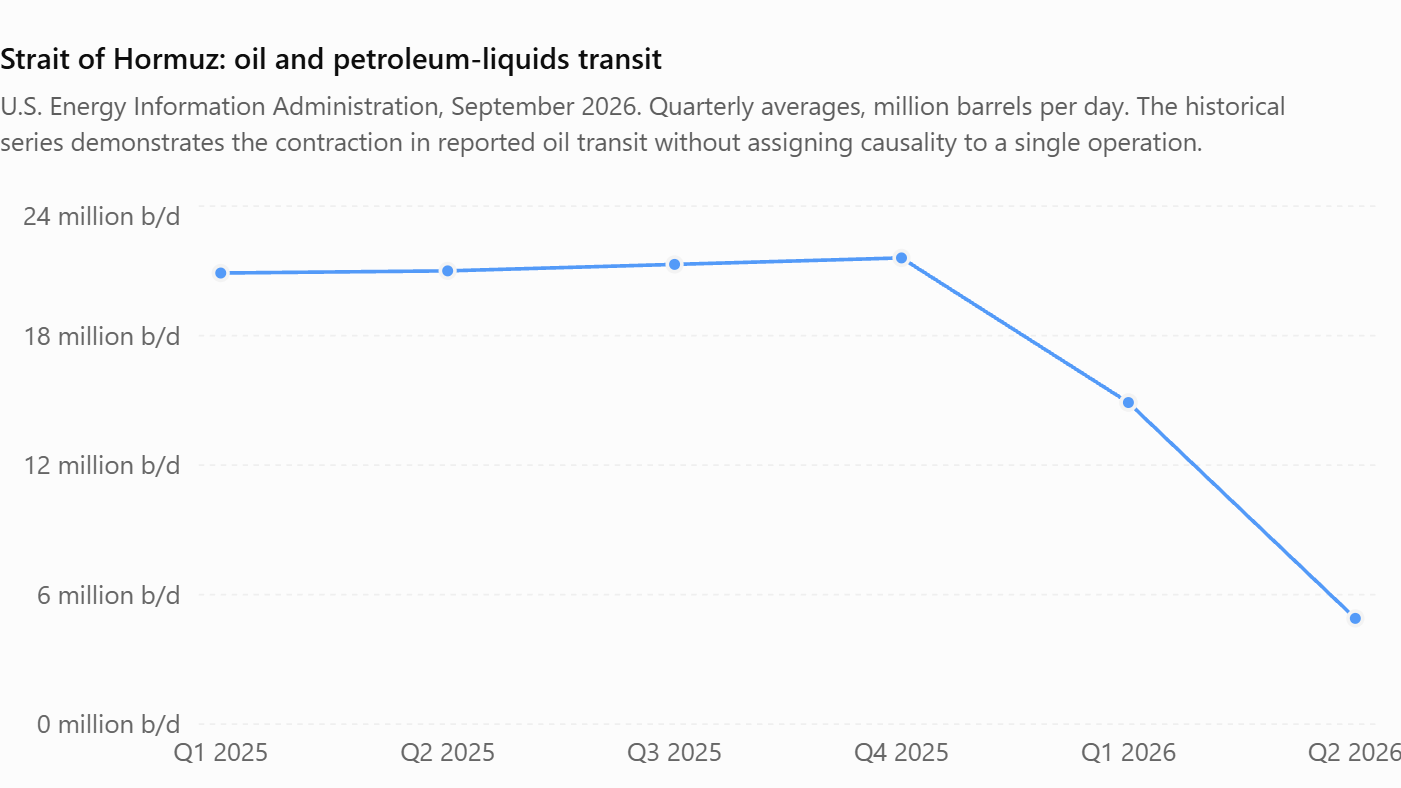
The economic implications extend beyond the direct volume of petroleum traversing the strait. Insurance, freight availability, cargo scheduling, shipping-risk premiums and refinery-feedstock procurement can all transmit uncertainty to economies with no direct involvement in the military conflict. The effects on particular markets depend on inventories, alternative supply routes, substitution capacity and the duration of disruption. It would therefore be incorrect to infer a universal oil-price increase from the reduction in observed transit alone, or to assume that physical reopening would immediately return insurance and commercial conditions to their previous state.
The security problem has a further asymmetry. Naval protection, shipping reassurance and clearance of maritime hazards can support trade without necessarily resolving the dispute over Iranian nuclear activities. Conversely, an agreement on nuclear verification may be insufficient to restore maritime confidence if regional attacks continue. The two objectives are connected through the broader political conflict but require distinct implementation mechanisms.
Comparative assessment of non-nuclear instruments
| Instrument | Potential policy effect | Principal limitation | Reversibility | Verification requirement | Strategic exposure |
|---|---|---|---|---|---|
| Conventional military strikes | Disruption of selected physical capabilities | Cannot independently establish programme-wide elimination | Physical damage may be repairable | Independent damage and programme assessment | Retaliation and renewed escalation |
| Cyber or electronic disruption | Interruption of dependent industrial or information functions | Unknown access, effectiveness and collateral consequences | Variable | Credible evidence of actual functional effects | Attribution and countermeasure risks |
| Intelligence collection | Better understanding of activity and capability | External observation cannot necessarily establish interior conditions | Continuing process | Corroboration and source evaluation | Misinterpretation and intelligence uncertainty |
| IAEA safeguards | Nuclear-material verification and compliance monitoring | Requires access and reliable accounting | Institutional arrangements can be restored or weakened | Inspector access and material records | Noncompliance and loss of confidence |
| Conditional sanctions relief | Economic incentives tied to compliance | Requires clear terms and credible enforcement | Policy-dependent | Confirmed fulfilment of agreed obligations | Political and commercial uncertainty |
| Maritime security cooperation | Protection and reassurance for commercial navigation | Does not resolve nuclear-material questions | Continuing operational commitment | Maritime reporting and internationally coordinated implementation | Regional confrontation and resource burden |
| Diplomatic framework | Potentially durable restrictions and de-escalation | Implementation, trust and enforcement remain uncertain | Politically reversible; some concessions less so | Agreed inspections and dispute resolution | Negotiation breakdown and renewed conflict |
Key judgments: High confidence that conventional military operations can produce substantial disruption without establishing durable programme-wide nuclear elimination. High confidence that the unresolved nuclear-material accounting identified in June 2026 was a major limitation on independent verification. Medium confidence that a combined safeguards, economic and maritime-security framework offers mechanisms for addressing different elements of the confrontation, with effectiveness dependent on implementation rather than announced intent.
What would change the assessment: New IAEA access and accounting results, authoritative findings on previously unverified enriched uranium, evidence that detailed nuclear arrangements have entered into force, and sustained improvements in documented Strait of Hormuz shipping volumes rather than isolated announcements of reopening.
Chapter 7. United States Decision Environment: Political Authority, Israeli and Regional Interests, Alliance Positions and Strategic Signalling
American policy combines demonstrated conventional force, maximal nuclear non-proliferation objectives and conditional diplomatic engagement
The United States decision environment in November 2026 must be evaluated against a sequence of actions rather than isolated statements about military force. The Trump administration has publicly maintained that Iran must not acquire nuclear weapons, while conducting extensive conventional operations, participating in diplomatic discussions and supporting renewed safeguards demands. These elements are not inherently contradictory. A government may use military force to change bargaining conditions while continuing to seek an agreement, but the resulting strategic effectiveness depends on whether coercion produces concessions that can be independently verified and sustained. The public record demonstrates the coexistence of military and diplomatic instruments; it does not establish that nuclear employment has been authorised, requested or operationally prepared.
The White House’s September 2026 account of President Donald Trump’s address to the United Nations reiterated his position that Iran must not obtain a nuclear weapon and presented the administration’s actions as part of a broader strategy of confronting threats through American power. This is evidence of the administration’s declared objectives and political narrative. It is not, by itself, evidence of a change in nuclear doctrine or of an approved nuclear strike plan against Iranian underground infrastructure. President Trump at the United Nations: “While Others Have Talked, I Have Acted” — The White House, September 2026. The White House
There is a crucial distinction between a public assertion that Iranian nuclear capabilities have been destroyed and an internationally verifiable conclusion that Iran can no longer acquire nuclear weapons. The former is a claim concerning the results of military action; the latter requires evidence concerning remaining material, industrial capacity, technical expertise and compliance. American political communication may understandably emphasise military accomplishments, but the analytical standard for a governmental report requires separating such statements from findings supported by independent nuclear verification.
An additional uncertainty concerns the government’s domestic political calculations. Elections, congressional oversight, public opinion and economic conditions may influence the political environment in which further military decisions are considered, but no responsible assessment can infer an impending nuclear decision from the electoral calendar alone. Political incentives could favour claims of decisive military success, economic stabilisation or continued diplomatic engagement under different circumstances. Without direct authoritative evidence linking those considerations to nuclear-employment policy, they remain possible influences rather than established explanations of presidential intent.
Nuclear first use would require a distinct political decision with consequences extending beyond the presidency
The United States nuclear command system concentrates employment authority in the President while incorporating military advice and the requirement that orders be lawful. The Congressional Research Service identifies the President as the sole authority for authorising American nuclear weapons and explains the separate institutional responsibilities involved in advising, communicating and implementing nuclear orders. This institutional arrangement establishes a significant political distinction between nuclear authorisation and decisions concerning conventional military operations, even when the same military services or delivery-platform categories are involved. Defense Primer: Command and Control of Nuclear Forces — Congressional Research Service, May 2024. Congresso degli Stati Uniti
The strategic importance of sole authority lies in the combination of concentrated decision-making and far-reaching consequences. A nuclear first-use decision could require urgent international explanations, legal scrutiny, management of allied reactions and emergency protection of populations potentially affected by the operation. Unlike a conventional military action that remains politically confined to the immediate conflict, nuclear first use would become an issue in the security calculations of every nuclear-armed state and many states relying on extended deterrence.
This does not mean that the United States would necessarily lose all diplomatic cooperation following nuclear use, nor that every ally would respond identically. Governments may disagree sharply about an operation while maintaining other security relationships, particularly where longstanding defence commitments and shared threats remain important. The relevant analytical mechanism is that nuclear use could create divergences between military solidarity, humanitarian concern, legal interpretation and nuclear doctrine that are much less pronounced during conventional operations.
The fact that the United States possesses nuclear-capable military platforms and established command arrangements should therefore not be interpreted as a prediction of nuclear employment. Capability, readiness, political consideration and authorisation remain different categories. Official statements rejecting particular nuclear-use options, formal doctrinal revisions and authenticated government decisions would be more relevant to assessing policy change than speculative comparisons of weapon characteristics.
Israel’s security objectives and the limits of attributing nuclear preferences
Israel’s strategic position is shaped by the perceived consequences of Iranian nuclear-weapons acquisition, the threat of regional missile and armed-group activity, and the importance of American military and diplomatic support. These interests can create incentives for substantial pressure on Iran’s nuclear-related capabilities, but they do not establish that the Israeli government has requested or supported American nuclear first use against a particular underground installation. A government assessment must distinguish Israel’s documented opposition to an Iranian nuclear weapon from any claim concerning its preferred American nuclear employment option.
The distinction is particularly important because Israeli and American strategic objectives may overlap without producing identical preferences concerning escalation, timing or acceptable political costs. Israel’s geographic proximity makes regional retaliation and infrastructure disruption immediate national-security considerations, while the United States must also consider global nuclear precedent, extended deterrence and relationships with other major powers. Those differences could create disagreement over the duration or objectives of a conventional campaign, the conditions for diplomatic settlement or the sufficiency of verification mechanisms.
Israel’s interests cannot be inferred exclusively from the fact that the United States has used conventional military force against Iranian nuclear-related facilities. An American operation can support an Israeli security objective without demonstrating that every aspect of the operation reflects Israeli preferences. Likewise, the absence of public disagreement does not establish agreement over every possible escalation option.
For intelligence purposes, the appropriate distinction is between official Israeli statements concerning Iranian nuclear capabilities, documented Israeli participation in conventional military and diplomatic developments, and unverified claims about nuclear planning. The latter require direct corroboration before they can influence an assessment of actual policy. No authenticated public record reviewed here establishes an Israeli request for United States nuclear first use against Pickaxe Mountain.
European allies: common nuclear objectives, different institutional responsibilities
The European dimension is not a single collective position. France, Germany, Italy and the United Kingdom share a declared interest in preventing Iranian nuclear-weapons acquisition and restoring regional stability, but they possess different military capabilities, constitutional responsibilities, energy exposures and roles within NATO nuclear policy. Those differences matter because an American nuclear first-use decision would create distinct domestic and international consequences for each government.
The 15 June 2026 joint statement by President Emmanuel Macron, Chancellor Friedrich Merz, Prime Minister Giorgia Meloni and Prime Minister Keir Starmer provides a particularly clear documentary baseline. The four leaders welcomed the announced United States–Iran memorandum of understanding, supported its implementation and identified unconditional freedom of navigation through the Strait of Hormuz as an immediate priority. They also reiterated their opposition to an Iranian nuclear weapon and offered cooperation with the United States, Iran and the IAEA. The statement supported a defensive maritime mission, subject to the constitutional requirements of participating countries, but did not endorse nuclear military action. Joint Statement by President Macron, Chancellor Merz, Prime Minister Meloni and Prime Minister Starmer — German Federal Government, June 2026. Federal Government
France occupies a distinctive position because it possesses an independent nuclear deterrent and maintains national responsibility for nuclear-weapons decisions. French policy must therefore consider both the political implications of allied nuclear first use and its potential effect on the credibility of French nuclear restraint and deterrence. France’s participation in diplomatic and maritime-security initiatives demonstrates an interest in preserving regional stability while sustaining pressure against Iranian nuclear-weapons acquisition. Its independent deterrent does not imply automatic endorsement of another nuclear-armed state’s employment decisions.
The United Kingdom combines an independent nuclear deterrent with exceptionally close strategic and intelligence relationships with the United States. Its government supported the June diplomatic memorandum and explicitly stressed the importance of a durable nuclear agreement and reopening Hormuz. Prime Minister Starmer also described a potential defensive, independent maritime mission in cooperation with France, particularly regarding mine clearance and reassurance for commercial navigation. A hypothetical American nuclear first-use decision could therefore place the United Kingdom in the position of supporting shared non-proliferation objectives while separately examining the legality, humanitarian consequences and alliance implications of the chosen military method. Prime Minister’s Response to the United States–Iran Peace Deal — United Kingdom Government, June 2026. GOV.UK
Germany has no independent national nuclear arsenal and participates in NATO’s nuclear-deterrence arrangements through the relevant Alliance structures. Chancellor Friedrich Merz’s statement of 15 June 2026 welcomed the framework agreement while insisting on permanent unrestricted navigation through Hormuz and further negotiations to secure verifiable Iranian nuclear commitments. Germany’s distinct exposure would involve NATO policy coherence, international legal interpretation, energy-market consequences and domestic political debate over American nuclear employment. The German government could therefore maintain its opposition to an Iranian nuclear weapon while independently evaluating whether nuclear first use was compatible with its wider security objectives. Statement by Chancellor Friedrich Merz on the Agreement between the United States and Iran — German Federal Government, June 2026. Federal Government
Italy has a materially different position from both nuclear-armed European states. Its security interests involve NATO solidarity, Mediterranean stability, commercial energy exposure and relationships extending across North Africa and the Gulf. Italy’s participation in the June joint declaration demonstrates support for an agreement combining Iranian nuclear restrictions with maritime freedom of navigation. Nuclear first use could create simultaneous demands for allied consultation, civilian protection, diplomatic engagement and management of regional economic consequences. The government’s specific position would require authoritative statements following any actual change in American nuclear policy rather than assumptions drawn from its role within NATO.
The European Union has an institutional position that cannot be reduced to the preferences of its four largest relevant national actors. Its foreign-policy instruments include diplomatic engagement, economic restrictions and support for international institutions, while member states retain distinct constitutional and military responsibilities. The European External Action Service’s September condemnation of attacks on Gulf states and commercial shipping demonstrates concern with both international law and regional security, and its call for de-escalation indicates that the June diplomatic framework had not removed the risk of subsequent confrontation. Iran: Statement on the Latest Attacks — European External Action Service, September 2026. EEAS
NATO’s Nuclear Planning Group provides a further institutional distinction. NATO explains that the group is responsible for consultation and decision-making concerning Alliance nuclear policy, while France does not participate in the group. This does not mean that a national American nuclear-use decision concerning Iran would automatically be an Alliance nuclear operation. The legal and political significance of NATO consultation would depend on the circumstances, the forces involved and whether the United States sought allied participation or support. NATO’s Nuclear Deterrence Policy and Forces — North Atlantic Treaty Organization, 2026. NATO Topic
European strategic exposure
| Actor | Nuclear and military status | Documented 2026 position | Potential consequence of U.S. nuclear first use | Principal national consideration |
|---|---|---|---|---|
| France | Independent nuclear force; NATO member | Supports verifiable Iranian restrictions and maritime reopening | Nuclear-doctrine credibility and diplomatic consequences | Strategic autonomy and regional security |
| United Kingdom | Independent nuclear force; NATO member | Supports June agreement and defensive maritime cooperation | Nuclear partnership, legal scrutiny and alliance cohesion | Extended deterrence and Gulf security |
| Germany | Non-nuclear state participating in NATO nuclear arrangements | Supports framework agreement and verifiable nuclear commitments | Nuclear-sharing politics and domestic legal debate | NATO consultation and economic stability |
| Italy | Non-nuclear state participating in NATO security arrangements | Supports agreement and freedom of navigation | Mediterranean security and alliance consultation | Energy, shipping and regional relationships |
| European Union | Supranational diplomatic and economic actor | Condemns September regional attacks and urges de-escalation | Pressure on common external policy and sanctions coordination | International law, regional stability and economic exposure |
Gulf states, maritime security and the problem of geographically asymmetric consequences
The Gulf states would face consequences different from those of European allies or distant nuclear powers. Their immediate concerns include the security of population centres, ports, desalination and electricity infrastructure, energy production facilities, aviation corridors and commercial shipping. These concerns do not depend on whether a nuclear strike destroys its intended target. The mere occurrence of nuclear use in the region could create substantial uncertainty over environmental safety, escalation and the future reliability of regional security arrangements.
The September 2026 EU statement identifying attacks against Kuwait, Bahrain, Jordan, Saudi Arabia and the United Arab Emirates demonstrates the geographic breadth of the conventional security problem. A subsequent nuclear event could generate a different class of concern by requiring consideration of radioactive exposure, environmental monitoring and the credibility of emergency-response systems. It would also affect the political calculations of Gulf governments seeking both American security support and stable economic relations with other major powers.
China’s position introduces a substantial economic dimension. The EIA’s March 2026 maritime-chokepoint assessment reported that 89% of crude oil and condensate moving through Hormuz in the first half of 2025 went to Asian markets, while China, India, Japan and South Korea together accounted for 74% of these flows. China was also identified as the largest destination for liquefied natural gas travelling through the strait. These figures establish the structural significance of Gulf maritime security for Asian energy markets, although they are historical reference-period shares and cannot be presumed unchanged after the 2026 disruption. World Oil Transit Chokepoints — U.S. Energy Information Administration, March 2026. eia.gov
The resulting strategic mechanism is straightforward but important. China could have strong incentives to oppose destabilising nuclear escalation and disruption of Gulf energy trade without having equivalent incentives to intervene militarily on Iran’s behalf. Russia might respond through diplomatic, strategic and military-political channels while seeking to avoid a direct nuclear confrontation with the United States. Gulf states could intensify demands for security assurances while resisting actions that increase regional exposure. These responses could coexist, creating a diplomatic environment in which several governments oppose the consequences of nuclear first use for different reasons rather than forming a single coordinated bloc.
Strategic signalling: distinguishing declared objectives from nuclear employment decisions
A rigorous assessment must distinguish four categories of evidence: general nuclear doctrine, political rhetoric concerning Iran, conventional military activity and authenticated nuclear-specific policy decisions. These categories do not possess equal diagnostic value. General doctrine establishes what a government considers possible under broad circumstances. Political rhetoric identifies objectives and preferences but may contain deliberate ambiguity. Conventional military activity demonstrates capability and willingness to employ non-nuclear force. Only substantially more specific evidence could establish a decision to prepare or authorise nuclear employment.
The Trump administration’s declared objective of preventing Iranian nuclear-weapons acquisition is clear. The specific means by which that objective might be pursued remain contingent on military, legal and political developments. The June memorandum illustrates the capacity to move from confrontation toward negotiation, while the September regional escalation illustrates the limitations of assuming that a diplomatic opening necessarily creates a durable settlement. Neither development independently demonstrates an American decision to employ a nuclear weapon.
The information environment creates an additional problem because highly technical claims can acquire political importance before being subjected to adequate scrutiny. A publicly circulated assertion that an underground installation is beyond conventional military reach may be based on incomplete geological assumptions. A claim that nuclear employment would guarantee destruction may confuse explosive energy with verified programme elimination. A claim that nuclear use is imminent may infer intent from the movement of conventional military assets or from general statements about preventing Iranian nuclear acquisition. Each argument requires evidence appropriate to the proposition, rather than repetition across media outlets.
The most useful governmental monitoring framework therefore concerns authoritative policy, safeguards and diplomatic records, not speculative reconstruction of classified operational activity. The existence of nuclear-capable aircraft, longstanding American nuclear doctrine or historical war planning is insufficient to establish that nuclear use is being prepared for a particular regional crisis. Similarly, public silence does not prove the absence of non-public contingency planning.
Strategic-signalling evidence hierarchy
| Evidence category | What it establishes | What it does not establish | Analytical standing |
|---|---|---|---|
| Official statement that Iran must not acquire nuclear weapons | Declared policy objective | Nuclear weapon selection or authorisation | High confidence in stated objective |
| Public conventional military operations | Use and scale of conventional force | Nuclear first-use decision | High confidence in documented operations |
| Official diplomatic framework | Announced negotiation and implementation commitments | Completed nuclear settlement | High confidence in announcement; implementation conditional |
| IAEA safeguards reporting | Verification findings and identified accounting gaps | Complete programme knowledge where inspection is unavailable | High for reported institutional findings |
| Formal nuclear-doctrine revision | Changes in declared national nuclear policy | Specific strike authorisation | High for documented policy change |
| Public commentary about nuclear options | Existence of public speculation or debate | Government approval or operational preparation | Low diagnostic value |
| Authenticated nuclear-specific executive decision | Actual national-authority decision within its stated scope | Guaranteed military outcome | Potentially decisive, if independently authenticated |
Decision consequences through 2028
The period through December 2028 should be understood as a competition between military disruption, political reconstruction of Iranian nuclear capabilities, diplomatic verification and regional security stabilisation. The observed 2026 sequence provides evidence that all four can evolve at different speeds. Military strikes may rapidly change the physical condition of selected infrastructure, while nuclear-material verification can remain unresolved. Diplomatic agreements may be announced within weeks but require considerably longer institutional implementation. Maritime conditions may deteriorate sharply and recover unevenly depending on physical security, insurance conditions and commercial confidence.
An assessment based on technological capability alone would therefore miss the central strategic problem. The government that can inflict the greatest physical damage does not necessarily control the subsequent incentives of the adversary, the reactions of allies or the reconstruction of the nuclear programme. A government that obtains a diplomatic agreement does not necessarily possess credible verification. The strategic question is whether physical, political and institutional mechanisms converge toward a durable constraint on nuclear-weapons acquisition.
The evidence does not support a numerical probability that the United States will employ a nuclear weapon against Iran through 2028. It does support the conclusion that such employment would create a distinct international-security event whose consequences could not be evaluated solely through the damage inflicted on an underground facility. A nuclear strike could simultaneously cause severe physical destruction, increase pressure on Iran and make independent verification more difficult, while creating new proliferation incentives and diplomatic demands elsewhere. Those outcomes would require separate assessments rather than being collapsed into a single declaration of military success.
Key judgments: High confidence that the Trump administration has pursued both substantial conventional military action and conditional diplomacy in 2026. High confidence that European leaders publicly supported the June framework and that regional hostilities continued afterward. Medium confidence that nuclear first use would produce differentiated allied reactions and substantial global signalling consequences. Low confidence in claims concerning specific non-public American or Israeli nuclear-employment intentions.
What would change the assessment: A formal change in American nuclear doctrine, authenticated nuclear-specific policy decisions, a verified and implemented agreement governing Iranian nuclear activities, restored IAEA accounting for previously unverified material, and sustained improvements in Gulf maritime security.
Nuclear First Use, Proliferation and Strategic Consequence Transmission
NUCLEAR THRESHOLD
STRATEGIC CONSEQUENCE ENGINE
Interactive analysis of nuclear first-use consequences, proliferation incentives, alliance cohesion and regional energy transmission. The model distinguishes documented observations from conditional strategic judgments.
MULTIDOMAIN ESCALATION NETWORK
Animated conceptual relationship model. Geometry does not represent probability, geography or weapons effects.
FIRST USE
Nuclear first use could damage infrastructure while strengthening incentives for long-term strategic deterrence. These outcomes are not mutually exclusive.
A state exposed to nuclear coercion may reassess the security value of acquiring independent deterrent capabilities.
Reconstruction capacity, diplomacy, international guarantees and political leadership decisions may alter the response.
Official nuclear policy, safeguards findings and documented Iranian decisions, not assumptions of intent.
STRAIT OF HORMUZ — DOCUMENTED TRANSIT CONTRACTION
Historical quarterly averages. Toggle between oil and petroleum liquids, measured in million barrels per day, and liquefied natural gas, measured in billion cubic feet per day. These represent transit flows, not global production losses.
2025 Q3
2025 Q4
2025 Q1
2026 Q2
2026
Chart scale is linear and starts at zero. Oil uses a 22.9-million-barrel-per-day maximum; LNG uses an 11-billion-cubic-foot-per-day maximum. Each series is charted separately with its own units.
The contraction in observed petroleum transit illustrates the vulnerability of a critical global maritime corridor during regional conflict. It does not establish that the entire reduction resulted from a single military operation.
Source: U.S. Energy Information Administration — Energy Security Analysis, September 2026
INTERACTIVE ESCALATION PATHWAYS
Select a scenario. The associated consequences are conditional analytical pathways through 2028, not probabilistic forecasts or verified future events.
PROLIFERATION AND ALLIANCE CONSEQUENCE MATRIX
Qualitative consequences conditioned on a hypothetical U.S. nuclear first-use event. The matrix does not assign invented response probabilities.
| Actor / System | Primary exposure | Potential transmission mechanism | Decisive uncertainty |
|---|---|---|---|
| Iran | Physical loss and national-security shock | Deterrence incentives, reconstruction and diplomatic choices | Actual political and nuclear-policy response |
| Russia | Global nuclear precedent | Doctrine, diplomacy and crisis stability | Degree and form of counter-response |
| China | Nuclear precedent and energy security | Strategic assessment and commercial exposure | Response beyond diplomatic opposition |
| France / UK | Independent deterrence doctrines | Nuclear restraint, alliance consultation and legal scrutiny | National decisions concerning the U.S. action |
| Germany / Italy | NATO cohesion and regional economic exposure | Alliance consultation, domestic politics and energy effects | Specific governmental positions and practical consequences |
| Gulf states | Regional security and environmental exposure | Security guarantees, maritime access and infrastructure risk | Escalation pattern and environmental effects |
| NPT regime | Confidence in nuclear restraint | Non-proliferation incentives and security-assurance debates | Subsequent state behaviour and institutional response |
OFFICIAL DOCUMENTARY REFERENCES
United Nations — Charter of the United Nations
NATO — Nuclear Deterrence Policy and Forces
U.S. Energy Information Administration — Energy Security Analysis, September 2026
Source figures retain their original periods and units. Charts are historical observations. The relationship model and pathways are conceptual strategic assessments.
OPEN-SOURCE ANALYTICAL ASSESSMENT · NOVEMBER 2026
PILLAR III — ESCALATION PATHWAYS, FORECASTING AND DECISION INTELLIGENCE
Iran’s Nuclear Confrontation Through 2028: Strategic Scenarios, Escalation Thresholds, Intelligence Gaps and Decision Consequences
Chapter 8. Strategic Scenarios Through 2028: Nuclear Exclusion, Conventional Escalation and Nuclear First Use
Principal strategic judgment: The decisive variable governing the Iranian nuclear confrontation through 2028 is not the maximum destructive power available to the United States, but the interaction between Iran’s remaining nuclear-industrial capabilities, the international community’s ability to verify nuclear-material inventories, the political sustainability of military pressure and the capacity of regional security arrangements to prevent further escalation. The currently documented situation establishes that severe conventional military destruction and prolonged uncertainty about nuclear materials can coexist. It also demonstrates that diplomatic initiatives need not produce immediate restoration of verification or maritime stability. These findings require scenarios that model the relationship between military action, nuclear-material accounting, economic transmission and political incentives rather than treating the destruction of individual installations as a sufficient measure of strategic success.
The decisive November 2026 baseline: military damage without restored nuclear verification
The most consequential recent evidence was presented at the United Nations Security Council on 27 October 2026, when International Atomic Energy Agency Director General Rafael Mariano Grossi addressed Iran’s unresolved safeguards obligations. The United Nations subsequently confirmed that ordinary IAEA inspection activities had not resumed and that the Agency still could not verify previously declared nuclear material, including approximately 440 kilograms of highly enriched uranium. The Director General called for the information and access required under Iran’s safeguards agreement, while indicating that technical arrangements could facilitate the return of inspectors and support negotiations. This establishes a critical distinction between military destruction and verified nuclear restraint: the Agency could not independently confirm the present status of a materially significant nuclear inventory, despite the conventional attacks conducted during 2025 and 2026. Daily Press Briefing, 27 October 2026 — United Nations. Daily Press Briefing — UN Transcripts
The Security Council proceedings provide a second important finding. In his briefing, Grossi stated that the IAEA had not identified activity to repair or reconstruct nuclear facilities damaged in the 2025–2026 attacks. This is relevant evidence against the assertion that the previously damaged, declared installations had already undergone observable reconstruction. It does not demonstrate that Iran had abandoned nuclear-related capabilities, that all relevant nuclear materials had been destroyed or that construction elsewhere had stopped. The distinction becomes essential when assessing prospective developments at facilities such as Pickaxe Mountain, whose exact internal functions and operational status remain incompletely established. The Director General also identified Bushehr as an exception to the broader interruption of verification activities, demonstrating that inspection access was differentiated rather than uniformly absent across every Iranian nuclear installation. Non-Proliferation, Security Council’s 10,253rd Meeting — United Nations, 27 October 2026. UN Transcripts
The published Security Council transcript is an automatically generated record rather than an authenticated verbatim United Nations document. Its detailed wording must therefore be treated accordingly; the United Nations press briefing independently corroborates the central findings concerning the continuing verification deficit and the approximately 440-kilogram inventory.
A further institutional development occurred on 9 September 2026, when the IAEA Board of Governors adopted a resolution referring Iran’s safeguards non-compliance to the Security Council. At the Council’s 27 October meeting, member states disagreed not only over Iran’s actions but also over the procedural and legal status of the non-proliferation agenda and the continuation of relevant sanctions arrangements. This dispute matters because it demonstrates that the international mechanism intended to respond collectively to proliferation concerns is itself subject to geopolitical fragmentation. The United States, France, Germany and the United Kingdom supported the safeguards referral and renewed demands for inspection access, whereas Russia, China and Iran challenged significant elements of the Western approach. It would therefore be inaccurate to forecast international sanctions or enforcement measures as though agreement among the permanent Security Council members were assured. NPT Safeguards Agreement with Iran: Resolution to the IAEA Board of Governors — United Kingdom Government, June 2026; Security Council Proceedings — United Nations, October 2026. GOV.UK+1
The key analytical proposition arising from this record is that physical disruption and the absence of observable reconstruction do not establish verified elimination of nuclear capability. The former concerns the condition of particular facilities; the latter requires reliable information about nuclear materials, equipment, personnel, knowledge and the ability to resume relevant activities. This difference defines the central problem for every scenario considered through December 2028.
The energy-market baseline reveals the economic costs of renewed regional confrontation
The most recent official American energy forecast available at the assessment cut-off is the 6 October 2026 Short-Term Energy Outlook, published by the United States Energy Information Administration. It materially revises the assumptions used in the September outlook and must therefore be preferred for near-term economic forecasting. The October edition projects an average Brent crude oil price of $96 per barrel in 2026 and $84 per barrel in 2027, compared with the September forecast of $91 and $74 respectively. These are annual average projections, not spot prices or independently established outcomes for 2027. The revised forecast reflects continued concern over constrained Middle Eastern exports, attacks on energy infrastructure and tight petroleum markets. Short-Term Energy Outlook — U.S. Energy Information Administration, 6 October 2026. U.S. Energy Information Administration (EIA)
The October market review also reports that Brent averaged $114 per barrel in September 2026, compared with approximately $91 in August, and reached an observed daily price as high as $131 per barrel on 15 September following attacks affecting Saudi Arabia’s East–West oil pipeline. The EIA estimated that the pipeline had previously carried more than five million barrels per day of exports through Yanbu, providing an important alternative to passage through the Strait of Hormuz. These observations demonstrate that alternative export infrastructure can reduce dependence on a maritime chokepoint without eliminating vulnerability to attacks elsewhere in the regional energy system. Global Oil Markets — U.S. Energy Information Administration, October 2026. U.S. Energy Information Administration (EIA)
The following figures distinguish recorded market observations, reported transit volumes and official forecasts.
| Economic indicator | Verified value | Reference period | Analytical meaning |
|---|---|---|---|
| Strait of Hormuz oil and petroleum-liquids transit | 21.6 million barrels/day | Q4 2025 | Historical comparison baseline |
| Strait of Hormuz oil and petroleum-liquids transit | 4.9 million barrels/day | Q2 2026 | Reported transit contraction |
| Change in reported Hormuz oil transit | −77.3% | Q4 2025 to Q2 2026 | Calculated change in flows, not production losses |
| Brent crude monthly average | $114/barrel | September 2026 | Observed monthly price |
| Brent daily price peak reported by EIA | $131/barrel | 15 September 2026 | Observed short-lived price extreme |
| Brent annual average | $96/barrel | 2026 forecast | EIA projection issued 6 October |
| Brent annual average | $84/barrel | 2027 forecast | EIA projection, not a guaranteed outcome |
| Global liquid-fuels production | 101.1 million barrels/day | 2026 forecast | Annual global production projection |
| Global liquid-fuels production | 109.6 million barrels/day | 2027 forecast | Projected recovery under EIA assumptions |
| Global liquid-fuels consumption | 102.4 million barrels/day | 2026 forecast | Annual global consumption projection |
| Global liquid-fuels consumption | 104.6 million barrels/day | 2027 forecast | Projected demand |
Sources: EIA, Energy Security and Maritime Chokepoints, September 2026; EIA, Global Oil Markets, October 2026. U.S. Energy Information Administration (EIA)+1
The difference between projected global liquids production of 101.1 million barrels per day and consumption of 102.4 million barrels per day in 2026 implies a forecast annual-average imbalance of approximately 1.3 million barrels per day, calculated directly from the rounded EIA figures. For 2027, the corresponding forecasts of 109.6 million barrels per day of production and 104.6 million barrels per day of consumption imply an annual-average surplus of approximately 5.0 million barrels per day. These comparisons are useful indicators of the direction of the EIA’s baseline, but they should not be represented as predicted inventory changes because the published figures are rounded and broader accounting categories can affect the relationship between output, demand and inventories.
This difference between the two years is strategically relevant. It shows that the October baseline assumes a significant recovery in global supply conditions rather than permanent continuation of the severe disruption observed earlier in 2026. A new major military escalation, including nuclear first use, would create a material downside risk to that recovery assumption. The available evidence does not justify assigning an oil price to such an event, but it establishes the mechanism by which attacks on infrastructure, maritime insecurity, delayed exports and depleted commercial inventories can transmit renewed conflict into global inflation and industrial costs.
Scenario architecture: three pathways governed by different political and institutional thresholds
The three scenarios below are conditional strategic pathways rather than three numerical forecasts. They are not presented as equally likely and no percentage probabilities are assigned, because there is no reproducible public model capable of estimating the probability of American nuclear first use, the behaviour of Iranian decision-makers and the reactions of other nuclear powers through 2028. The scenarios are structured around distinct categories of policy action: continued exclusion of nuclear employment, additional conventional military coercion, and deliberate nuclear first use.
An important methodological distinction concerns the scope of each pathway. Nuclear exclusion does not necessarily imply complete peace, and a conventional-denial campaign does not necessarily preclude renewed negotiations. Nuclear first use would create a unique threshold event but would not determine the subsequent response of every state. Scenario outcomes therefore depend on specific observed developments rather than on an assumed linear progression from one level of force to the next.
Scenario A — Nuclear use remains excluded; conflict management shifts toward verification and controlled deterrence
Under this scenario, the United States maintains its nuclear-use threshold while continuing to combine conventional deterrence, economic pressure, diplomatic engagement and demands for independent nuclear verification. The main distinguishing feature is not the complete absence of coercion but the preservation of a categorical separation between conventional military instruments and nuclear explosive employment. Iran could remain subject to restrictions, sanctions and military pressure, while the international community seeks to restore the IAEA’s ability to verify nuclear material and monitor the relevant facilities.
The near-term military condition would remain difficult to interpret because the absence of additional nuclear destruction would not resolve uncertainty about damaged or inaccessible installations. However, the scenario would create greater scope for reconstructing an internationally accepted evidentiary baseline, provided the Iranian authorities permitted effective safeguards activities. The distinction between a political agreement and an operational verification system would be critical: diplomatic declarations would establish intentions, whereas inspection records and material accountancy would establish whether relevant commitments were being fulfilled. The most important result through 2027 would therefore be the possible restoration of continuity of knowledge over nuclear material rather than the announcement of a broad political settlement.
Through 2028, this pathway could support several outcomes without changing its defining characteristic. Iran might accept detailed restrictions and inspection arrangements, allowing a more stable non-proliferation regime to develop. Alternatively, negotiations might remain inconclusive while nuclear employment stayed excluded and conventional deterrence continued. These outcomes should not be conflated. The first involves substantive verification progress; the second preserves the nuclear threshold but leaves the underlying proliferation concern unresolved.
The scenario’s principal strength is the possibility of preserving international nuclear restraint and reducing the danger of an irreversible escalation precedent. Its principal weakness is that continued uncertainty about nuclear materials could prolong strategic confrontation, especially if official claims of compliance remain unsupported by access and inspection. The decisive indicator would therefore be the quality of verification rather than the frequency of diplomatic meetings.
Scenario B — Further conventional military action creates disruption without establishing programme-wide elimination
The second scenario involves additional conventional military coercion against Iranian military or nuclear-related capabilities, without deliberate nuclear explosive employment. Its distinguishing characteristic is an increased reliance on kinetic operations while the nuclear threshold remains unbroken. The prospective effects must be evaluated at the level of observable military and political outcomes rather than through assumptions about how particular strikes would overcome underground engineering.
The near-term result could include further physical damage, temporary industrial interruption and additional pressure on Iranian military capacity. Yet the actual effect on nuclear proliferation would remain dependent on the state of relevant materials and industrial functions before the operation, the availability of equivalent capabilities elsewhere and subsequent verification. The absence of demonstrated reconstruction at some previously damaged facilities would not automatically mean that all other facilities or technical capabilities had ceased operating. Equally, the continuation of construction at protected sites would not by itself demonstrate nuclear-weapons production.
This scenario creates a pronounced risk of operational success without strategic closure. Conventional military effects may be substantial and measurable while leaving the central nuclear-material accounting problem unresolved. Repeated military action could also further restrict inspector access, generate new environmental and infrastructure hazards, and alter the political incentives for concealment or reconstruction. The resulting strategic ambiguity might increase demands for additional military action precisely because earlier attacks had not produced an independently verified final result.
The regional consequences would depend on the response of Iran and other actors rather than on the intensity of American strikes alone. Continued attacks on maritime infrastructure or commercial shipping could compromise the assumptions underlying the EIA’s October 2026 recovery forecast. Even if oil production increased elsewhere, constrained shipping, damaged bypass infrastructure or elevated insurance costs could prevent that additional supply from translating immediately into lower delivered energy costs. The September attacks on Saudi export infrastructure demonstrate why reopening a maritime corridor cannot be treated as equivalent to eliminating all infrastructure vulnerabilities across the Gulf region.
Through 2028, the most important uncertainty would concern whether a cycle of physical destruction and reconstruction produced diminishing military returns while increasing the cost of regional security. Such an outcome is plausible because industrial systems can disperse capabilities and because military disruption does not necessarily eliminate technical knowledge. It is not inevitable: verified loss of specialised capabilities and sustained restrictions could produce longer-lasting effects. The difference would have to be established through evidence concerning the actual programme, not inferred from campaign-scale military statistics.
Scenario C — Nuclear first use against a hardened installation creates a qualitatively different international crisis
The third scenario involves a deliberate American decision to employ a nuclear explosive against a hardened Iranian nuclear-related facility. Its defining characteristic is the crossing of the nuclear-use threshold, independently of the weapon’s specific military effectiveness. The immediate crisis would combine the physical consequences of nuclear detonation with legal, humanitarian, environmental and geopolitical questions that would arise even if the targeted installation suffered severe damage.
The military result would remain conditional. A nuclear explosion could produce substantial subsurface destruction and render some industrial functions unusable, but complete elimination of a particular underground complex cannot be established without knowing the relevant internal configuration. More importantly, physical destruction would not independently prove the elimination of the wider nuclear programme. A severely damaged and contaminated site could become harder to inspect, while relevant nuclear material, expertise and industrial capacity might remain elsewhere. Nuclear employment could therefore produce the unusual outcome of dramatically increasing destructive force without proportionately increasing certainty about non-proliferation success.
The international response would be qualitatively different from the reactions to conventional military operations. Iran would confront both the direct consequences and the political significance of having been subjected to nuclear force. Other nuclear-armed states would assess the event as a precedent concerning the permissible circumstances of nuclear first use. American allies would face questions about deterrence credibility, consultation and the compatibility of the operation with international law. Gulf states would have immediate reasons to seek reliable information concerning radiation, environmental safety and regional escalation. International institutions would confront demands for investigation, civilian protection and longer-term monitoring.
Through 2028, the consequences would extend into the institutional foundations of nuclear deterrence and non-proliferation. Some governments could interpret the event as evidence that independent nuclear capabilities confer greater protection against coercion, while others might respond by seeking stronger external security guarantees. Those competing incentives would create a more complicated security environment rather than a predetermined wave of proliferation. The major distinction is that nuclear first use would create an enduring precedent regardless of whether the affected Iranian facility was eventually repaired, abandoned or replaced.
The degree of wider military escalation is not predictable from the fact of nuclear employment alone. Russia and China would have strong reasons to assess the event through their own security doctrines, but direct intervention would entail substantial risks for them. European governments would not necessarily react in the same way, and Gulf states might seek both continued American security assurances and urgent de-escalation. What is supportable is the conclusion that the diplomatic, legal and environmental consequences would extend far beyond the immediate military objective.
Scenario comparison through December 2028
| Strategic dimension | Scenario A: Nuclear excluded | Scenario B: Conventional escalation | Scenario C: Nuclear first use |
|---|---|---|---|
| Defining threshold | No nuclear explosive employment | Additional conventional force | Deliberate crossing of nuclear-use threshold |
| Immediate military effects | Existing force posture and deterrence continue | Additional potential physical disruption | Nuclear explosive effects and potential major radiological consequences |
| Nuclear-material status | Requires renewed verification | May remain unresolved despite destruction | May become harder to verify after contamination and damage |
| Iranian strategic incentives | Depend on security assurances, restrictions and compliance | May combine pressure with reconstruction or concealment incentives | Could increase perceived value of independent nuclear deterrence |
| European implications | Diplomatic engagement and alliance management | Disagreement over military objectives and duration | Fundamental nuclear-policy and legal controversy |
| Russian and Chinese response | Diplomatic and strategic monitoring | Possible opposition to continued military action | Reassessment of nuclear precedent and global strategic stability |
| Gulf security | Gradual stabilisation possible | Renewed threats to shipping and infrastructure | Wider security crisis with potential radiological concerns |
| Energy transmission | Recovery depends on maritime security | New disruption could delay EIA recovery assumptions | Severe uncertainty; no defensible site-specific price projection |
| Main constraint through 2028 | Verification and implementation | Durability of military effects | Escalation, humanitarian protection and nuclear precedent |
| Principal evidentiary gap | Actual Iranian compliance | Verified programme-level military damage | Military effectiveness, full exposure consequences and international responses |
Forecast judgment: The most defensible basis for planning through 2028 is to treat the verification deficit as persistent until new evidence resolves it, rather than assuming that additional destruction will eliminate it. The October 2026 IAEA-related United Nations record demonstrates the continuing absence of normal inspections, while the October EIA forecast assumes a gradual energy recovery that remains vulnerable to renewed disruption. Neither record supports a numerical probability for nuclear employment, but together they identify the most consequential uncertainty for governments: whether military and diplomatic developments will restore verifiable nuclear restraint before another major escalation undermines the conditions required for recovery.
Chapter 9. Critical Intelligence Gaps, Monitoring Indicators, Decision Thresholds and Final Strategic Assessment
The defining intelligence problem is the difference between what has been damaged and what can be independently verified
The most consequential unresolved issue in the Iranian nuclear confrontation is not the absence of sufficiently powerful weapons but the absence of an authoritative, continuous and comprehensive record of the nuclear material and industrial capabilities that remain available. The 27 October 2026 United Nations briefing established that the IAEA had not resumed normal inspections and could not verify the status of previously declared material, including approximately 440 kilograms of highly enriched uranium. The Director General’s reported finding that the Agency had not observed repair or reconstruction activity at facilities damaged during the 2025–2026 attacks is important, but it addresses a different question. The first finding concerns the ability to account for safeguarded material; the second concerns the observed condition of damaged infrastructure. Their coexistence illustrates why physical destruction cannot be converted into a programme-wide non-proliferation conclusion without additional evidence. United Nations, Daily Press Briefing, 27 October 2026; United Nations Security Council, 10,253rd Meeting, 27 October 2026. Daily Press Briefing — UN Transcripts+1
The figure of approximately 440 kilograms must also be interpreted with care. It relates to previously declared highly enriched uranium for which the Agency has not been able to restore the required verification. It is not a newly measured November 2026 stockpile and does not establish the precise current location, composition or disposition of the material. Nor does it establish that Iran possesses an operational nuclear weapon. The analytical significance of the figure lies in the magnitude of the unresolved accounting problem and the consequences of lacking verified continuity of knowledge. Treating the historical inventory as a confirmed present-day quantity would overstate what the evidence establishes; treating the loss of verification as proof that the material no longer exists would commit the opposite error.
This distinction should govern subsequent strategic intelligence. A construction photograph, military damage claim, diplomatic announcement or reported change in an installation’s external appearance cannot independently resolve the location of previously declared uranium. Similarly, a safeguards inspection at one accessible facility cannot establish comprehensive knowledge of an entire programme. Each source of evidence answers a narrower question, and the institutional assessment becomes reliable only when those questions are appropriately connected without concealing the remaining gaps.
The absence of visible reconstruction at previously damaged installations also requires careful interpretation. It may indicate that the immediate physical effects of the attacks have persisted. It may reflect technical, economic or political constraints on repair. It could coexist with activity at other locations. The available official record does not permit a definitive choice among these explanations. The intelligence consequence is that the lack of reconstruction cannot be used as a proxy for a confirmed decision to abandon nuclear-related activity throughout the country.
A hierarchy of intelligence gaps: which uncertainties change policy conclusions?
Not every missing detail has equal strategic importance. Precise information about an underground chamber’s dimensions would improve an engineering assessment, but it would not necessarily establish whether nuclear material had been removed, whether alternative industrial capacity existed or whether Iran intended to pursue nuclear weapons. Conversely, reliable nuclear-material accounting could substantially change a non-proliferation assessment without revealing the full engineering configuration of every protected facility. The most useful intelligence-prioritisation framework therefore considers how strongly each missing fact could change the central policy conclusion.
The first priority concerns nuclear-material custody and safeguards continuity. The second concerns the operational status of enrichment and relevant manufacturing capabilities. The third concerns the implementation of negotiated obligations and the extent to which Iran permits the IAEA to exercise its inspection rights. The fourth concerns the sustainability of regional security arrangements, particularly the protection of maritime trade and energy infrastructure. The fifth concerns actual changes in nuclear doctrine and international diplomatic positions. These priorities arise from the requirements of strategic assessment rather than from the desirability of any particular military option.
Critical intelligence gaps and their decision significance
| Intelligence requirement | Current evidentiary position | Why it matters | Authoritative information required | Confidence in current knowledge |
|---|---|---|---|---|
| Previously declared highly enriched uranium | Approximately 440 kg remains unverified in the latest UN-reported IAEA assessment | Determines whether nuclear-material uncertainty is being reduced | IAEA material accountancy and verified access | High confidence that the gap exists; low confidence in current disposition |
| Inspection restoration | Normal IAEA inspections had not resumed by 27 October 2026 | Determines whether independent verification can be restored | IAEA inspection and safeguards reports | High |
| Previously damaged declared installations | IAEA reported no identified reconstruction activity at affected facilities | Helps establish durability of observable physical damage | Continued authoritative monitoring and inspection | Medium–high |
| Pickaxe Mountain’s actual nuclear function | Internal operating status not independently established | Determines whether observed construction corresponds to operational nuclear capability | Safeguards information and corroborated technical evidence | Low |
| Enrichment-related activity elsewhere | Incomplete independent access and information | Affects programme-wide rather than site-specific conclusions | IAEA safeguards findings | Low |
| Nuclear first-use intentions | No authenticated nuclear-employment decision established in the examined record | Separates capability and rhetoric from actual policy | Formal authoritative statements and verified policy changes | Low |
| Maritime-security recovery | Severe 2026 transport disruption documented | Determines whether trade and energy conditions can stabilise | EIA and competent maritime authorities | Medium–high for historical flows |
| International legal and institutional response | Serious disagreements documented at the Security Council | Affects sanctions, enforcement and diplomatic coordination | Official UN and national decisions | High for disagreement; low for future resolution |
The intelligence matrix suggests a clear priority for institutional reporting: every consequential claim should be labelled according to whether it establishes a physical observation, an operational capability, a political intention or a verified legal obligation. These categories are often compressed into narratives of military success or failure, although they represent different states of knowledge. Preserving their separation is not an academic exercise. It prevents governments from making irreversible decisions on the basis of evidence that addresses only one component of the strategic problem.
Decision thresholds should be defined through observable institutional changes
A decision threshold is analytically useful only if it identifies an observable condition that would alter the interpretation of the evidence. Thresholds should not be confused with automatically triggering military responses. They establish when reassessment is warranted, what additional information would be needed and which institutions would have the authority to evaluate it. This is particularly important in a nuclear crisis, where a poorly defined threshold can encourage exaggerated interpretations of ambiguous developments.
The first major threshold concerns the restoration of safeguards access. A political announcement that inspectors may return would be an important diplomatic development, but the substantive change would occur when the IAEA actually obtained sufficient information and access to verify the relevant nuclear material. The distinction between announced cooperation and completed verification is decisive because the objective is not merely to demonstrate diplomatic engagement but to restore a reliable factual basis for determining compliance.
The second threshold concerns nuclear-material accountancy. If the Agency establishes the current disposition of previously declared highly enriched uranium, one of the principal uncertainties underpinning the confrontation would be materially reduced. Such a development would not resolve every question concerning undeclared activities or future capabilities, but it would improve the reliability of programme-wide assessments. Conversely, continued denial of information and access would perpetuate the uncertainty identified in the October proceedings regardless of whether further military operations occurred.
The third threshold concerns verified industrial capability. The discovery of functioning enrichment-related activity would have a different strategic meaning from the observation of continued construction or the movement of construction equipment. Equally, authoritative evidence that a particular facility had not become operational would narrow its immediate relevance without eliminating concern about future use. The distinction should remain central to evaluating protected underground installations.
The fourth threshold is the implementation of a diplomatic framework. The June 2026 United States–Iran memorandum demonstrated the possibility of negotiated de-escalation, but the subsequent September deterioration showed that announced agreements and durable regional security are different outcomes. A meaningful transition toward sustained stability would require both verifiable nuclear arrangements and demonstrable improvement in maritime conditions. The economic evidence reinforces the distinction: the EIA’s October outlook anticipates improving Middle Eastern exports through 2027 while remaining sensitive to infrastructure attacks and shipping restrictions. Short-Term Energy Outlook — U.S. Energy Information Administration, October 2026. U.S. Energy Information Administration (EIA)
The fifth threshold involves a formal change in American nuclear employment policy. Conventional military operations, the presence of nuclear-capable platforms and public discussion of nuclear options do not independently establish that the United States has decided to employ nuclear weapons against Iran. An official doctrinal change or authenticated national-authority statement would carry greater evidentiary significance. Even then, declaratory policy and a decision to employ a weapon would remain separate questions. A responsible institutional report should distinguish the threat of nuclear use, contingency consideration, authorisation and actual employment without claiming access to non-public nuclear command arrangements.
Monitoring and decision thresholds through 2028
| Monitoring domain | Observable development | Analytical consequence | Responsible institutional record | Recommended review action |
|---|---|---|---|---|
| Safeguards access | IAEA confirms substantive restoration of inspections | Improves capacity to verify compliance | IAEA Director General and Board of Governors | Reassess confidence in material accountancy |
| Nuclear material | Agency verifies previously unaccounted-for declared material | Reduces a central proliferation uncertainty | IAEA safeguards reports | Reassess programme-level findings |
| Underground infrastructure | Independently corroborated change in operating status | May alter assessment of industrial capability | IAEA and credible technical documentation | Distinguish construction from operation |
| Diplomatic implementation | Verified nuclear commitments enter into operation | Changes basis for sanctions and compliance assessment | Participating governments and IAEA | Evaluate fulfilment against agreed obligations |
| Maritime security | Sustained recovery of commercial transit | Tests effectiveness of regional stabilisation | EIA and maritime authorities | Reassess economic exposure |
| Energy markets | Material deviation from the October 2026 EIA baseline | Indicates changed supply or demand conditions | Updated EIA forecasts | Recalculate economic implications |
| Nuclear doctrine | Formal authoritative policy change | Alters declared nuclear employment framework | U.S. government and relevant allied institutions | Initiate legal and strategic policy review |
| International security | New authoritative UN or NATO decisions | Changes diplomatic and collective-security environment | United Nations and NATO | Reassess institutional obligations |
The economic implications of the scenarios: why market recovery cannot be treated as independent of security
The October 2026 EIA forecast is especially relevant to strategic planning because it provides a quantified economic baseline against which future disruptions can be assessed. The Agency projected average Brent prices of $96 per barrel for 2026 and $84 for 2027, while assuming gradually improving Middle Eastern production and exports. The movement from the 2026 forecast to the 2027 forecast represents a projected decline of 12.5% in annual average Brent prices, calculated from the rounded official figures. This does not imply that international oil markets would automatically stabilise by 2027. It describes the outcome embedded in a particular forecast vintage, whose assumptions include improving export conditions and continued adaptation of maritime transport. Short-Term Energy Outlook — U.S. Energy Information Administration, 6 October 2026. U.S. Energy Information Administration (EIA)
The first scenario, preserving the nuclear threshold and supporting negotiated stabilisation, would be consistent with an environment in which maritime transport gradually recovers and energy markets adjust toward the October baseline, provided regional hostilities diminish and export infrastructure remains available. That relationship is conditional rather than guaranteed. Oil prices can change because of global demand, production decisions, inventories and other geopolitical developments, even without new Iranian escalation.
The second scenario introduces greater risk of deviations from that baseline through renewed attacks, damage to export infrastructure or increased transport uncertainty. The actual magnitude would depend on the type and duration of disruption and on the capacity of alternative routes to compensate. The September attacks on Saudi Arabia’s East–West pipeline illustrate that bypass infrastructure is valuable but not invulnerable. A credible economic assessment must therefore consider not only the capacity of the Strait of Hormuz but also the resilience of alternative export systems.
The third scenario introduces an additional category of uncertainty: the political and environmental consequences of nuclear employment could affect confidence, risk perceptions and diplomatic relationships beyond the direct physical effects on energy infrastructure. A precise oil-price projection would be unjustified because no established statistical model can reliably translate an unprecedented nuclear first-use event in the contemporary Gulf security environment into a specific Brent price. However, the mechanism linking increased uncertainty to shipping conditions, insurance, trade and energy-market expectations is sufficiently established to require consideration in government contingency planning.
The wider economic conclusion concerns the asymmetry between military decisions and commercial recovery. A government can order a military operation within a defined political and organisational structure, but it cannot directly command shipping firms, insurers, commercial buyers or foreign governments to restore confidence at the same pace. Even an end to major hostilities may therefore leave a prolonged period of commercial adjustment. Through 2028, this economic transmission mechanism could remain important independently of the eventual status of particular Iranian nuclear facilities.
Final net assessment: what constitutes genuine strategic success?
The complete assessment points toward a distinction between military success, verified nuclear restraint and durable regional security. These outcomes may reinforce one another, but they do not follow automatically from a single military decision. The documented conventional campaigns demonstrate substantial American military capacity. The October 2026 safeguards record demonstrates that significant uncertainty concerning previously declared Iranian nuclear material persisted after those campaigns. The October energy outlook demonstrates that regional military confrontation had already contributed to a difficult economic environment in which recovery depended on assumptions about maritime security and infrastructure availability.
The relevance of a nuclear earth-penetrating weapon must be considered within this wider context. Nuclear explosive power can produce significant physical effects, and the proposition that a hardened underground facility is necessarily immune to nuclear damage is not supported by general weapons-effects science. Yet no verified public evidence establishes that a B61-11 strike would completely eliminate a particular Pickaxe Mountain-class installation or permanently remove Iran’s wider nuclear capabilities. The more expansive the asserted strategic benefit becomes, the greater the corresponding evidentiary burden. Demonstrating local damage is not the same as demonstrating the permanent elimination of technical knowledge, industrial capacity or nuclear material.
The international-security consequences involve a different category of certainty. Deliberate nuclear first use would be a historically consequential act even if the military target were destroyed. The long period of nuclear non-use would end, creating a precedent relevant to the doctrines and political calculations of nuclear-armed and nuclear-threshold states. The precise reaction of every government cannot be predicted, but the event would inevitably become part of future debates over deterrence, international law, non-proliferation and the credibility of security assurances. Its significance would not disappear if the immediate conflict subsequently ended.
The central strategic test should therefore distinguish the additional military effect that nuclear employment might achieve from the international consequences that would arise because nuclear employment occurred at all. The first remains dependent on incomplete target-specific evidence. The second follows from the character of the weapon and the historical significance of its deliberate wartime use. This asymmetry is the principal finding connecting the physical, legal, military and geopolitical dimensions of the assessment.
The three scenarios through December 2028 do not support a deterministic forecast. Nuclear restraint could coexist with unresolved proliferation concerns. Additional conventional attacks could produce significant disruption without verified programme elimination. Nuclear first use could generate severe physical consequences while introducing a wider international-security crisis and leaving nuclear-material accounting uncertain. Each pathway contains its own unresolved variables, and none should be represented through fabricated probabilities.
For governments, the principal requirement is to preserve a clear hierarchy of evidence. Physical damage must be distinguished from industrial dysfunction; industrial dysfunction must be distinguished from loss of nuclear capability; and the loss of capability must be distinguished from independently verified non-proliferation. At the same time, military decisions must be evaluated against their legal, humanitarian, economic and alliance consequences rather than solely against the expected condition of the immediate target.
Final strategic judgment — High confidence in the framework, lower confidence in target-specific outcomes: The most consequential unresolved problem is the inability to establish a complete and independently verified account of Iranian nuclear material and relevant industrial capability. Greater destructive force cannot substitute for that evidence. Nuclear first use would create a fundamentally different class of international consequence, while the public technical record remains insufficient to demonstrate that its incremental military effectiveness would resolve the central proliferation concern.
WordPress Analytical Scheme — Strategic Scenarios, Intelligence Thresholds and Energy Transmission Through 2028
The component below is designed for insertion after Chapter 9. It combines a three-dimensional-style animated scenario network, interactive strategic pathways, verified EIA energy data, institutional decision thresholds and a comprehensive comparison matrix. The interactive scenario model represents conditional consequences, not numerical probabilities. The only quantitative chart uses the historical quarterly figures published by the U.S. Energy Information Administration, September 2026, while the economic forecast reference follows the October 2026 Short-Term Energy Outlook.
STRATEGIC THRESHOLDS
IRAN 2026–2028
An interactive strategic assessment connecting nuclear-material verification, regional escalation, international nuclear restraint and the economics of maritime security. Official historical data are separated from conditional forward-looking scenarios.
STRATEGIC INTERDEPENDENCE MODEL
The dimensional network represents relationships between four independent decision domains. Its visual geometry does not encode risk probabilities or military operations.
DECISION
2028
Physical military damage cannot substitute for the independent verification of safeguarded nuclear material.
Normal IAEA inspections had not resumed by 27 October 2026. Approximately 440 kilograms of previously declared highly enriched uranium remained unverified.
Renewed verification would materially reduce one of the central uncertainties independently of additional destruction.
THREE STRATEGIC PATHWAYS THROUGH DECEMBER 2028
Select a scenario. Each pathway presents conditional mechanisms and differentiates immediate effects from longer-term outcomes. No numerical probability is assigned.
STRAIT OF HORMUZ — ENERGY TRANSIT EXPOSURE
Quarterly average transit volumes from Q1 2025 to Q2 2026. Oil is measured in million barrels per day; LNG is measured in billion cubic feet per day. Values are historical EIA observations, not projections for 2028.
Each chart starts at zero and uses a linear scale, with independently defined maximum values of 22.9 million barrels/day for oil and 12.4 billion cubic feet/day for LNG. Different units are never combined.
Oil transit contracted sharply in the observed period. This quantifies maritime exposure but does not establish the specific contribution of any one military event.
U.S. EIA — Energy Security and Maritime Chokepoints, September 2026
DECISION THRESHOLDS AND INTELLIGENCE CONFIDENCE
Monitoring matrix based on institutional information requirements. These indicators support policy reassessment and are not operational targeting instructions.
| Domain | Current evidence | Decision-relevant threshold | Strategic consequence | Evidence authority |
|---|---|---|---|---|
| Nuclear material | Previously declared highly enriched uranium remains unverified | IAEA independently establishes material status | Reduced uncertainty concerning material custody | IAEA safeguards reporting |
| Inspection access | Normal inspections not restored by 27 October 2026 | Effective access and material accountancy resume | Improved basis for a durable nuclear agreement | IAEA Director General |
| Damaged facilities | IAEA reported no identified reconstruction of previously damaged sites | Authoritative changes in operational status | Updated assessment of industrial recovery | IAEA and competent technical authorities |
| Diplomatic framework | June memorandum followed by renewed regional escalation | Detailed commitments implemented and verified | Greater credibility of negotiated restraint | Governments and IAEA |
| Maritime security | Major historical Hormuz transit contraction | Sustained recovery in reported commercial flows | Improved trade and energy security | EIA and maritime authorities |
| Nuclear doctrine | No authenticated Iranian-specific U.S. nuclear-use decision established | Formal verified change in declared policy | Revision of legal and strategic assessment | U.S. national authorities |
| International coordination | Security Council disagreement over Iran’s safeguards situation | New operative multilateral decisions | Changes to enforcement and diplomatic coordination | United Nations and national governments |
BRENT PRICE BASELINE
EIA forecasts issued 6 October 2026. These are conditional annual-average projections. No forecast for a hypothetical nuclear first-use event is implied.
EIA — Short-Term Energy Outlook, October 2026DESTRUCTION IS NOT VERIFICATION
A military strike may destroy infrastructure while leaving the current disposition of nuclear material uncertain. Sustainable non-proliferation requires independent evidence concerning nuclear material, relevant industrial capability and implementation of safeguards obligations.
Nuclear first use would create a distinct and enduring international-security precedent without independently guaranteeing the elimination of Iran’s wider nuclear programme.
OFFICIAL DOCUMENTARY RECORD
United Nations — Daily Press Briefing, 27 October 2026
United Nations — Security Council, 10,253rd Meeting, 27 October 2026
U.S. Energy Information Administration — Energy Security, September 2026
U.S. Energy Information Administration — Short-Term Energy Outlook, October 2026
United Kingdom Government — Iran Safeguards Resolution, June 2026
Historical figures, institutional assessments and conditional strategic pathways are distinct evidence categories. The three-dimensional network is an explanatory graphic, not a numerical risk model.


