














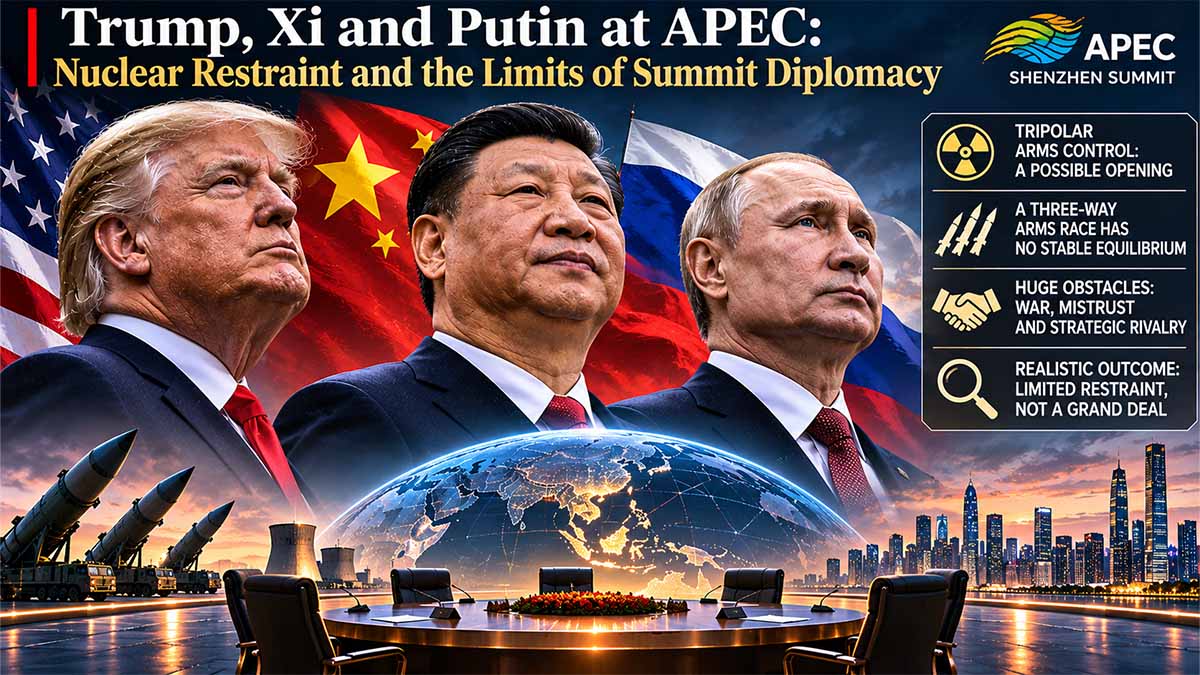
Scope: This assessment examines the prospective US–China–Russia discussions surrounding the Shenzhen APEC meetings of 18–19 November 2026, their implications for nuclear restraint and Ukraine, and the consequences for European security through November 2031.
Executive Summary / BLUF
The most defensible positive outcome from Shenzhen is a mandate for sustained nuclear-risk negotiations; a comprehensive trilateral treaty would require substantial changes in publicly documented negotiating positions.
China has acknowledged the three-leader meeting, but its official account does not establish a detailed agreed agenda or negotiated deliverables. fmprc.gov.cn
New START expired on 5 February 2026. Its replacement requires a new agreement; its existing extension provision had already been exhausted. documents.un.org
Beijing reiterated in October that participation in trilateral nuclear-disarmament negotiations was unacceptable at the present stage. un.china-mission.gov.cn
Ukraine presents a separate implementation problem: three leaders cannot supply Ukrainian consent, European commitments or NATO accession by agreement among themselves.
European governments should assess any outcome against published mandates, verification provisions, participating authorities and implementation milestones.
The decisive uncertainty is whether political contact produces an authorised negotiating process with identifiable technical work and follow-up dates.
Shenzhen’s Real Test Is Whether Governments Can Deliver What Leaders Promise
The meeting involving US President Donald Trump, Chinese President Xi Jinping and Russian President Vladimir Putin around the Shenzhen APEC summit should be judged by the commitments their governments can execute, not the breadth of their declarations. As of 17 November 2026, nuclear restraint, a Ukrainian settlement and European security guarantees depend on different authorities, resources and negotiating conditions. Treating them as one bargain risks exchanging immediate concessions for obligations that remain unfunded, legally unresolved or outside the negotiator’s control. Europe’s response should connect diplomatic participation to industrial delivery, national authorisation and sustained support for Ukraine. Otherwise, a summit announcement could reduce political pressure to act before it reduces the security risks that governments, manufacturers and public budgets must continue to carry.
A mandate would matter more than a promise of disarmament
New START’s expiration on 5 February 2026 removed a contractual framework for interpreting strategic forces as well as limiting them. Its ceilings depended on agreed definitions, declarations and verification procedures. Reintroducing a familiar number without its accounting rules would create the appearance of continuity while potentially regulating something different. Each deployed nuclear-capable heavy bomber counted as one warhead under New START, whereas deployed ballistic missiles were counted according to their actual warheads. That distinction makes counting rules a substantive negotiating issue, not technical housekeeping. The US Senate’s examination of New START shows why a political endorsement of restraint cannot substitute for an agreement about what restraint means.
China’s statement of 16 October 2026 rejected trilateral nuclear-disarmament negotiations at the present stage. Attendance at a leaders’ meeting would therefore not establish acceptance of arsenal reductions. A useful initial outcome would identify authorised delegations, defined subjects and subsequent meetings, allowing practical risk-reduction measures to develop without pretending that a comprehensive limitation framework already exists. The governing test is whether the process generates usable information or changes conduct. A meeting that merely schedules another meeting leaves the underlying planning uncertainty intact. China’s official negotiating position makes that distinction unavoidable.
The financial figures expose different obligations, not a common European war chest
France’s amended military programming provides a funding trajectory, while Germany’s parliamentary budget account describes proposed expenditure and Britain’s nuclear-enterprise figures cover a specialised national system. France’s updated mission Défense programming rises from €57.1 billion in 2026 to €75.7 billion in 2030, in current euros, excluding pensions and on a constant perimeter. Germany’s September first-reading account of the 2027 budget describes €109.7 billion in the regular defence budget and €29.9 billion from the Bundeswehr special fund, totalling €139.6 billion. These figures establish different financial decisions and stages; neither demonstrates completed capability. France’s amended programming law and the Bundestag’s budget account cannot be turned into a readiness ranking by placing their totals side by side.
Britain’s Defence Investment Plan provides £63.6 billion for the Defence Nuclear Enterprise over financial years 2026–27 to 2029–30. The enterprise reports more than 47,000 personnel and workforce demand expected to reach approximately 65,000 by 2030. At EU level, SAFE’s €150 billion loan envelope contained a €21.3 billion second call announced on 29 October 2026; almost €13.5 billion had been disbursed as prefinancing across 11 member states. The second call is part of the envelope, and prefinancing is not equipment delivery. These distinctions expose the real constraint: money must pass through national decisions, contracts, production, acceptance and sustainment before it can support an operational undertaking. The British investment answer and the Commission’s SAFE implementation record describe commitments whose practical effects arrive on different schedules.
Procurement decides whether European influence becomes usable power
The additional French SAMP/T NG order announced by OCCAR on 21 October 2026 illustrates the transmission mechanism. The programme links France and Italy through cooperative procurement, with EUROSAM responsible for the contracted systems. An order establishes demand and contractual responsibility; it does not establish the availability of the additional systems for an immediate security mission. Governments must still connect equipment to trained personnel, maintenance, interceptors and replenishment. If diplomatic commitments assume that these elements arrive together, procurement delay becomes a security exposure rather than merely a programme-management problem. OCCAR’s contract announcement supports an industrial commitment, not a claim of additional operational readiness.
Italy’s presidency of the Tallinn Mechanism offers a different contribution to the same problem of sustained implementation. The Rome declaration published on 30 October 2026 emphasised civilian cyber resilience, local infrastructure and cooperation with implementing partners. Such projects can preserve essential functions through negotiation and reconstruction, but installation without maintenance ownership creates another form of incomplete capability. Rome’s influence will depend on projects that remain effective after its rotating presidency ends, just as Berlin’s financial expansion must produce accepted equipment and London’s nuclear programmes must secure qualified personnel. The Tallinn Mechanism’s Rome declaration places continuity of delivery alongside the allocation of resources.
Consent prevents a three-leader bargain from becoming a European settlement
Ukraine’s Constitution makes territorial commitments more demanding than an exchange of presidential assurances. Article 73 assigns questions concerning changes to Ukrainian territory exclusively to an all-Ukrainian referendum, while Article 157 restricts constitutional amendments directed against territorial integrity and prohibits constitutional amendment under martial law or a state of emergency. These provisions do not make every operational ceasefire equivalent to a territorial transfer. They require the proposed instrument to distinguish where forces stop from what happens to sovereignty. A referendum provision is not a general licence for any concession, and a foreign government’s endorsement cannot resolve the constitutional requirements of the affected state. Ukraine’s referendum provision and its amendment restrictions therefore constrain the content and sequence of a settlement.
The Paris Declaration of 6 January 2026 also distinguishes ceasefire monitoring, continued support for Ukraine’s armed forces and a multinational contribution to regeneration and deterrence. These functions cannot be merged into a generic guarantee. Monitoring may document a breach without providing the authority or capability to stop it; a reassurance force may have a military task without adjudicating compliance. The declaration’s reference to national legal and constitutional arrangements reinforces the implementation constraint: collective language requires decisions by the governments expected to act. The Paris Declaration is consequently a framework for responsibilities that must be made executable, rather than proof that protection is already operational.
Europe’s leverage lies in decisions the summit participants cannot make for it
The European Council’s proposed negotiating team, outlined on 13 November 2026, comprises EU institutions alongside France, Germany, Italy, Poland and the United Kingdom. Its importance lies in connecting negotiations to the authorities expected to provide resources and accept obligations. The proposal does not establish that every other negotiating participant has accepted that format, nor does a smaller European team eliminate the need for wider national decisions. Representation becomes consequential when it prevents promises being made about European contributions before their providers have agreed to them. The European Council’s account describes coordination intended to bridge that gap.
European sanctions demonstrate the same boundary of authority. The Council adopted additional listings on 16 November 2026 while diplomatic efforts continued; those measures did not disappear because another government might prefer a wider political exchange. Any proposed relief must identify the restrictions concerned, the competent decision-maker and the conduct expected in return. Linking sanctions, territorial terms and nuclear restraint can widen bargaining space, but it also increases the number of decisions that can fail to align. Europe should resist an arrangement in which it is expected to deliver a legal or financial concession against a reciprocal promise that remains outside the other negotiator’s control. The Council’s sanctions decision shows that economic pressure remains a separate policy instrument.
The next two years will reveal who has mistaken commitments for capacity
Over the 12–24 months following November 2026, the decisive evidence will come from implemented measures: working crisis procedures, accepted security responsibilities, sustained Ukrainian support and procurement milestones that produce maintainable capability. SAFE prefinancing, French military programming, Germany’s budget proposals and Britain’s Defence Nuclear Enterprise plans must each be assessed against their own intended outputs. A useful summit process would survive disagreement and produce corrections when implementation fails. An ineffective one would allow broad declarations to coexist with unresolved obligations while governments continue to credit themselves with progress.
The cost of inaction would fall first on Ukraine if protection and assistance remain conditional while its exposure persists. European armed forces would carry the operational cost where commitments exceed available capacity; public budgets would carry the cost of programmes that require correction, prolonged support or replenishment; manufacturers and specialist suppliers would face procurement schedules that do not match the political promises built upon them. For the Paris Declaration and Europe’s procurement instruments, the choice is whether to establish accountable, sustained implementation now or leave those costs to accumulate behind an announcement. Shenzhen can initiate a more predictable security relationship. It cannot supply Ukrainian consent, European authorisation or industrial delivery by declaration.
Navigational Index
Pillar I — Nuclear Competition and the Architecture of Restraint
- Chapter 1 — After New START: The Legal and Strategic Baseline
- Chapter 2 — Three Nuclear Powers, Different Requirements: Forces, Verification and Negotiating Asymmetry
- Chapter 3 — From Political Declaration to Implementable Agreement
Pillar II — Ukraine and the Boundaries of Great-Power Bargaining
- Chapter 4 — Territory, Consent and Security Guarantees
- Chapter 5 — Escalation, Economic Leverage and the Risks of Linking Negotiations
Pillar III — European Security and the Five-Year Decision Horizon
- Chapter 6 — Italy, France, Germany, the United Kingdom and the European Union
- Chapter 7 — Alternative Pathways and Observable Indicators, 2026–2031
- Chapter 8 — Courses of Action and Final Net Assessment
Master Abstract
The attainable breakthrough is an organised negotiating process
Shenzhen offers an opportunity to establish political direction, but the public record supports a narrower expectation than a completed nuclear settlement. China’s Foreign Ministry confirmed that Xi Jinping would chair the APEC Economic Leaders’ Meeting on 18–19 November; separately, its spokesperson acknowledged forthcoming exchanges among the Chinese, Russian and American heads of state without publishing detailed commitments. These announcements establish a diplomatic opportunity, not agreement on negotiating scope. Xi Jinping to Attend the 33rd APEC Economic Leaders’ Meeting and Related Events — Ministry of Foreign Affairs of the People’s Republic of China — Nov 2026; Foreign Ministry Spokesperson Mao Ning’s Regular Press Conference on November 16, 2026 — Ministry of Foreign Affairs of the People’s Republic of China — Nov 2026. fmprc.gov.cn
The principal analytical judgment is therefore conditional: a summit would produce a material improvement if it authorised officials to negotiate defined measures, identified responsible institutions and established subsequent meetings. A declaration expressing support for disarmament would have political value, but would leave force limitations, verification and compliance unresolved. A narrowly specified process could be consequential because it would convert presidential engagement into work that survives the meeting itself.
Washington, Moscow and Beijing disagree over the starting point
The American and Russian documentary accounts confirm New START’s expiration but interpret the consequences differently. In a statement delivered on 6 February and circulated as Conference on Disarmament document CD/2498, the United States argued that the former bilateral architecture no longer adequately addressed multiple nuclear competitors, China’s expansion or Russian systems outside the treaty’s coverage. That statement establishes Washington’s negotiating rationale; its allegations concerning other states remain American assertions. Russia’s Foreign Ministry, in a statement transmitted to the United Nations, emphasised the predictability previously provided by the treaty and recalled Putin’s September 2025 proposal for voluntary observance of its quantitative ceilings for at least another year. Moscow also stated that it no longer regarded the parties as bound by treaty-related obligations or corresponding declarations. Note verbale dated 6 February 2026 from the United States Delegation to the Conference on Disarmament, CD/2498, annex, pp. 2–4 — United Nations Conference on Disarmament — Mar 2026; Letter dated 13 February 2026 from the Permanent Representative of the Russian Federation, A/80/641–S/2026/79, annex, pp. 2–3 — United Nations — Feb 2026. documents.un.org
These positions leave space for discussing restraint, but they do not establish reciprocal restraint in operation. An offer to observe ceilings, an accepted political arrangement and a legally binding instrument with verification are different outcomes. The practical question is whether the parties can agree on an interim mechanism while negotiating a broader framework.
China introduces a distinct obstacle. Its April national implementation report rejected trilateral nuclear-disarmament negotiations at the present stage, while recording participation in strategic dialogue and confidence-building measures. In October, China’s disarmament ambassador reiterated that its forces were not comparable in scale to those of the United States and Russia and again rejected the proposed negotiating format. Implementation of the Treaty on the Non-Proliferation of Nuclear Weapons in the People’s Republic of China, paragraphs 15 and 30–32 — Ministry of Foreign Affairs of the People’s Republic of China — Apr 2026; 中国裁军大使李驰江在第81届联大一委关于核问题的答辩发言 — Permanent Mission of China to the United Nations — Oct 2026. fmprc.gov.cn
The resulting analytical distinction is important: participation in nuclear-risk discussions need not imply acceptance of negotiated arsenal reductions. A viable initial agenda could therefore separate crisis communications and notifications from ceilings on forces, while leaving the relationship between those tracks explicit.
Three-power competition raises risks without making instability inevitable
Three-power nuclear competition creates additional planning dependencies, but it does not establish a mathematical requirement for unlimited expansion. If a government chooses to size its forces against the combined capabilities of two potential adversaries, the resulting increase can appear threatening to each separately and encourage compensating investment. That is a plausible escalation mechanism, not a universal prediction: outcomes also depend on force survivability, targeting requirements, defensive systems, alliance commitments and the political relationships among the participants.
The relevant decision question is consequently how to reduce incentives for worst-case planning. Measures that clarify intentions or make particular activities more predictable could have value before governments agree on arsenal totals. China’s national report records an existing China–Russia agreement on notification of ballistic-missile and space-launch-vehicle launches, extended in 2020 for ten years. That provides a documented example of a narrower instrument, although it does not establish willingness to extend equivalent arrangements to all three participants. Implementation of the Treaty on the Non-Proliferation of Nuclear Weapons in the People’s Republic of China, paragraph 31 — Ministry of Foreign Affairs of the People’s Republic of China — Apr 2026. fmprc.gov.cn
A comprehensive agreement would still have to define what it regulates, how compliance is established and how disputes are handled. The assessment therefore places greater initial weight on an agreed work programme than on expansive language about eventual disarmament.
Ukraine requires consent and commitments beyond the summit table
The official European account of the 10 November Abu Dhabi meeting documents coordination among Ukraine, the United States, European partners and NATO on a durable peace and credible security guarantees. It does not publish an agreed territorial settlement or establish the detailed bargaining positions of every participant. Its operative principles include sovereignty, territorial integrity and independent decision-making. Statement on today’s meeting in Abu Dhabi between the EU, France, Germany, Italy, United Kingdom, Ukraine, United States and NATO — European Council — Nov 2026. Consilium
A Shenzhen discussion could influence diplomacy, but a settlement would require decisions on ceasefire obligations, monitoring, security commitments and responses to violations by the authorities responsible for implementing them. NATO membership introduces an additional institutional requirement: Article 10 requires unanimous agreement among existing allies to invite an eligible European state. An American presidential undertaking alone cannot satisfy that condition. The North Atlantic Treaty, Article 10 — North Atlantic Treaty Organization — Apr 1949. NATO Official text
Accordingly, a nuclear negotiating mandate and a Ukrainian peace settlement should be assessed independently. Progress on strategic risk could benefit European security while leaving the conditions for ending the war unresolved.
France and the United Kingdom have sovereign stakes
France’s position makes any attempt to subsume European arsenals into a three-power bargain particularly consequential. On 2 March 2026, President Emmanuel Macron announced an increase in French nuclear warheads, an end to public disclosure of arsenal figures and a developing approach of dissuasion avancée, involving closer cooperation with European partners. He retained French authority over nuclear employment. These are announced policy decisions; the speech does not establish a publicly measurable increase in completed warheads by the assessment date. Déplacement sur la base opérationnelle de l’Ile Longue; Discours du Président de la République sur la dissuasion nucléaire de la France — Presidency of the French Republic — Mar 2026. Él
The United Kingdom has separately reaffirmed its deterrent’s commitment to NATO. In October, British Typhoons participated alongside French Rafales in a French nuclear exercise; the British release explicitly states that the exercise involved no nuclear weapons and that both countries retained sovereign decision-making. Statement by the United Kingdom on UK-France nuclear policy and cooperation — Cabinet Office — Mar 2026; UK-France deepen nuclear defence ties in first joint exercise — Ministry of Defence — Oct 2026. GOV.UK
For Paris and London, consultation is therefore a substantive requirement if negotiations begin to address their forces or operational cooperation. Their positions cannot be inferred from Washington’s acceptance of an American–Russian–Chinese formula.
Germany and Italy face different implementation choices
Germany’s March declaration with France established a high-level nuclear steering group and envisaged German conventional participation in French nuclear exercises, alongside cooperation on early warning, air defence and deep precision strike. The declaration explicitly presents this cooperation as complementary to NATO deterrence and nuclear sharing. Joint declaration of President Macron and Chancellor Merz — Federal Government of Germany — Mar 2026. bundesregierung.de
Berlin’s decision problem concerns the relationship between its conventional contributions, alliance obligations and escalation management; the declaration does not create a German national nuclear force. Italy’s Foreign Ministry, meanwhile, identifies continuing political, economic, humanitarian and military support for Ukraine, reconstruction and energy resilience as elements of Italian policy. L’Italia a sostegno dell’Ucraina — Ministry of Foreign Affairs and International Cooperation of Italy — undated, accessed Nov 2026. esteri.it
For Rome, the immediate analytical priority is to connect diplomatic undertakings to the support, expenditure and implementation responsibilities Italy would actually assume. For Berlin, the corresponding priority is clarity about how developing deterrence cooperation fits within negotiated constraints. Neither government should treat a summit communiqué as sufficient authority for new national commitments.
The European Union must connect principles to implementation
At the European Political Community meeting on 12 November, European Council President António Costa reiterated Ukraine’s freedom to choose its partners and the requirement for European involvement in discussions affecting European security. The official account also identified Ukrainian financing needs for 2027 as an issue for the European Council of 26–27 November. Meeting of the European Political Community — European Council — Nov 2026. Consilium
The financial and military baseline remains material. NATO’s July Ankara declaration pledged €70 billion in military equipment, assistance and training for Ukraine in 2026, together with sovereign commitments to sustain at least equivalent levels in 2027. These are commitments, not verified completed deliveries or cash expenditure. The Ankara Summit Declaration, paragraph 4 — North Atlantic Treaty Organization — Jul 2026. NATO Official text
The decision consequence is that diplomatic progress does not immediately remove support requirements. Governments would need evidence of implementation, monitoring and credible security arrangements before revising commitments on the assumption that the underlying risks had diminished.
Key Evidence Table
| Indicator | Value/status | Reference date | Definition/scope | Issuer | Exact source |
|---|---|---|---|---|---|
| APEC Economic Leaders’ Meeting | Scheduled for 18–19 November 2026 | Announcement: 13 Nov 2026 | Shenzhen meeting chaired by Xi Jinping | Chinese Foreign Ministry | Official announcement. fmprc.gov.cn |
| Three-leader discussions | Acknowledged; detailed agenda not published in the cited briefing | 16 Nov 2026 | Chinese official account of forthcoming exchanges | Chinese Foreign Ministry | Press conference. fmprc.gov.cn |
| New START | Expired on 5 February 2026 | US statement: 6 Feb 2026 | Treaty and central limits; existing extension option exhausted | US delegation to the Conference on Disarmament | CD/2498, annex, p. 2. documents.un.org |
| Russian interim-restraint proposal | Voluntary ceilings proposed for at least one year after expiration | Proposal: 22 Sep 2025; account circulated Feb 2026 | Russian account of proposed reciprocal political restraint; not proof of an operative agreement | Russian Foreign Ministry | A/80/641–S/2026/79, annex, p. 3. digitallibrary.un.org |
| Chinese negotiating position | Rejects trilateral nuclear-disarmament negotiations at the present stage | 16 Oct 2026 | Official policy position | Chinese mission to the UN | First Committee statement. un.china-mission.gov.cn |
| French arsenal policy | Increase ordered; future arsenal figures withheld | 2 Mar 2026 | Announced policy; completed numerical increase not established | French presidency | Île Longue speech. Él |
| Allied Ukraine assistance | €70 billion pledged for 2026; at least equivalent support committed for 2027 | 8 Jul 2026 | Military equipment, assistance and training; not a delivery total | NATO heads of state and government | Ankara declaration, paragraph 4. NATO Official text |
Competing Pathways
These pathways are analytically distinct but can occur in sequence. Their standing is qualitative; the verified record does not support numerical probabilities.
| Hypothesis | Diagnostic support | Disconfirming evidence | Indicators | Current standing |
|---|---|---|---|---|
| A limited nuclear-risk process begins | High-level engagement exists; China documents participation in confidence-building arrangements | No detailed trilateral work programme has been established in the opened official record | Named delegations, agreed subjects, follow-up dates, notification or communications proposals | Most credible substantive opportunity |
| A comprehensive trilateral limitation framework is launched | Washington formally seeks a broader architecture | Beijing’s October position explicitly rejects the negotiating format at this stage | Revised Chinese position; agreed coverage, baseline definitions and verification mandate | Requires a material policy change |
| Political declarations emerge without sustained technical work | Public announcements remain broad and substantive positions diverge | A published mandate with actual follow-up would weaken this pathway | General language followed by absent or repeatedly deferred working meetings | Strong alternative |
| Shenzhen catalyses a wider Ukrainian settlement process | An existing US–Ukrainian–European coordination channel is documented | Territorial terms and implementable guarantees are not established by the cited records | Ukrainian participation, European involvement, monitoring arrangements and authorised commitments | Possible diplomatic contribution; insufficient basis for expecting a settlement |
The first three pathways follow the contrast between acknowledged engagement, Washington’s proposed architecture and Beijing’s stated objections. The fourth rests on the separate Abu Dhabi coordination process rather than an assumption that nuclear negotiations confer authority over Ukraine. fmprc.gov.cn
Principal Gaps and Watch Indicators
| Consequential gap | Record or observation needed | Decision threshold |
|---|---|---|
| Whether the leaders agree on a nuclear work programme | Published joint statement or consistent national readouts identifying scope, officials and dates | An authorised follow-up process would justify assessing a concrete diplomatic opening |
| Whether restraint is reciprocal and measurable | Matching commitments defining covered forces, duration and data arrangements | A unilateral offer is insufficient to establish an operative restraint regime |
| Whether China’s participation extends beyond dialogue | Subsequent Chinese Foreign Ministry or UN statement accepting a defined negotiating mandate | Explicit acceptance would materially improve the prospects for broader negotiations |
| Whether verification is being negotiated | Agreed provisions for declarations, observation, inspection or dispute resolution | General transparency language alone does not establish verification |
| Whether Ukraine accepts proposed terms | Ukrainian official statement and participation in the relevant negotiations | External endorsement cannot substitute for Ukrainian agreement |
| Whether European guarantees are implementable | National and collective decisions identifying authority, resources, responsibilities and violation responses | Political assurances require corresponding implementation decisions |
| Whether diplomacy changes the military and fiscal baseline | Verified compliance and identifiable changes in support requirements | Existing commitments should be reassessed against observed implementation |
The initial test should occur in the published summit readouts and subsequent working-level meetings. Over the following twelve months, a process should be judged by whether it produces agreed texts, usable information and implemented measures. Across the five-year horizon, the decisive question is whether those arrangements reduce uncertainty and constrain behaviour through changes in leadership, military planning and regional crises.
Shenzhen: nuclear restraint and the limits of summit diplomacy
The strongest attainable opening is a sustained negotiating process. A comprehensive nuclear agreement and a Ukrainian peace settlement require different participants, authorities and implementation mechanisms.
Outlook · November 2026–November 2031A process before a treaty
A mandate, named officials and follow-up dates would be more diagnostic than broad disarmament language.
Consent and guarantees
A three-leader discussion cannot replace Ukrainian agreement or the decisions of European governments and NATO allies.
Implementation is decisive
Evaluate obligations, resources and verified compliance before assuming that diplomatic announcements reduce security requirements.
The strategic triangle
Select a country to inspect its documented position. Connections represent negotiating relationships, not alliances, force ratios or agreed commitments.
RISK DIALOGUE
Explore the possible outcomes
The stages below show the requirements of the selected pathway. They do not measure achieved progress or assign probabilities.
Europe: distinct authorities and exposures
Open each national lens. Announced cooperation is distinguished from completed capability.
Evidence register
| Indicator | Documented status | Reference date | Official source |
|---|---|---|---|
| APEC | Economic Leaders’ Meeting scheduled in Shenzhen. | 18–19 Nov 2026 | Chinese Foreign Ministry · 13 Nov 2026|
| New START | Expired; existing extension provision exhausted. | 5 Feb 2026 | US statement · CD/2498|
| China | Rejected trilateral nuclear-disarmament negotiations at the present stage. | 16 Oct 2026 | Chinese mission to the UN |
| France | Warhead increase ordered; future arsenal figures withheld. Completed increase not established. | 2 Mar 2026 | French presidency |
| Ukraine assistance | €70 billion pledged for 2026; at least equivalent support committed for 2027. Not a delivery total. | 8 Jul 2026 | NATO · Ankara declaration §4 |
Source documents retain their original language. The dashboard translates analytical descriptions, not the official documents themselves.
Decision thresholds
After the summit
Look for matching readouts, named officials, negotiating scope and an agreed next meeting.
Following twelve months
Look for agreed texts, reciprocal measures, usable information and a compliance mechanism.
Five-year horizon
Assess whether implemented arrangements constrain behaviour through political changes and regional crises.
Pillar I — Nuclear Competition and the Architecture of Restraint
Assessment cut-off: 17 November 2026. Historical treaty provisions, dated force disclosures and forward estimates are identified separately throughout.
Chapter 1 — After New START: The Legal and Strategic Baseline
The central loss is an agreed system for interpreting military change
The strategic significance of New START’s expiration extends beyond the disappearance of numerical ceilings: governments have lost a common contractual framework for determining which activities count, which information must be supplied and which procedures can resolve uncertainty. A ceiling has limited practical meaning unless the parties also agree on the objects being counted, the circumstances in which their status changes and the evidence by which compliance can be assessed. The resulting problem is therefore partly military and partly informational. An observed change in a missile force can represent replacement, maintenance, redistribution or expansion; without agreed definitions and current declarations, another government must interpret that change through its own intelligence and planning assumptions. This does not make every ambiguous observation evidence of preparation for aggression, but it increases the importance of unilateral assessments and reduces the opportunities for correcting mistaken interpretations through an accepted institutional process. The American statement delivered to the Conference on Disarmament on 6 February 2026 acknowledged the value of New START’s data exchanges and inspections while arguing that its scope no longer matched the strategic environment. That combination matters: dissatisfaction with an agreement’s coverage does not demonstrate that the information it previously generated has become unnecessary. Note verbale dated 6 February 2026 from the United States Delegation to the Conference on Disarmament, CD/2498, annex — United Nations Conference on Disarmament — Mar 2026. documents.un.org
The former ceilings cannot be read as total arsenal figures
New START’s architecture distinguished deployed delivery systems, accountable deployed warheads and a broader category of deployed and non-deployed launchers and bombers. Its three principal ceilings were 700, 1,550 and 800, respectively, but those figures represented different accounting categories rather than three interchangeable measurements of nuclear strength. Particularly consequential was the bomber attribution rule: each deployed nuclear-capable heavy bomber counted as one warhead, regardless of its potential weapons load, whereas deployed intercontinental and submarine-launched ballistic missiles were counted according to their actual warheads. The implication is that the treaty’s warhead ceiling was an agreed accounting measure rather than a complete physical census of every weapon available to a state. A successor negotiation that uses the familiar figure of 1,550 without preserving or explicitly changing the associated counting rules could create the appearance of continuity while regulating a materially different force. Conversely, adopting more comprehensive counting rules could produce an apparent numerical increase even if the underlying inventory had not changed. The distinction between a physical object, its operational status and its treaty-accountable value must therefore precede any comparison of proposed ceilings. Treaty with Russia on Measures for Further Reduction and Limitation of Strategic Offensive Arms, Senate Executive Report 111-6, discussion of central limits and bomber counting — US Senate Committee on Foreign Relations — 2010. govinfo.gov
WordPress component — historical treaty-accounting table. This component uses scoped CSS, contains no JavaScript or external assets, and does not alter page-level settings.
New START: three ceilings, three accounting categories
Historical treaty limits. These are not current total arsenal figures.
| Ceiling | Covered category | Interpretation |
|---|---|---|
| 700 | Deployed ICBMs, deployed SLBMs and deployed nuclear-capable heavy bombers | A delivery-system ceiling, not a warhead total. |
| 1,550 | Accountable warheads on deployed strategic systems | Each deployed nuclear-capable heavy bomber counted as one warhead. |
| 800 | Deployed and non-deployed ICBM launchers, SLBM launchers and nuclear-capable heavy bombers | A broader launcher-and-bomber category; not all national nuclear assets. |
Source: US Senate Executive Report 111-6, 2010 . Expiration of the treaty does not convert these historical categories into verified present-day inventories.
Verification must be treated as an operating system with its own requirements
The verification question is frequently compressed into whether inspectors are permitted to return, although access is only one element of an effective arrangement. New START’s historical architecture included unique identifiers, notifications, data exchanges and an entitlement to 18 on-site inspections annually. Recreating comparable confidence would require decisions about the information supplied before an inspection, the items an inspection may examine, how discrepancies are recorded and which authority must answer a challenge. Treaty with Russia on Measures for Further Reduction and Limitation of Strategic Offensive Arms, Senate Executive Report 111-6, verification discussion — US Senate Committee on Foreign Relations — 2010. govinfo.gov The analytical consequence is that an agreement to “restore transparency” should not be treated as equivalent to an inspection regime unless it generates information that can test a specific obligation. A notification that a launcher has changed status serves a different purpose from an inspection confirming a declaration; neither automatically establishes the completeness of a national warhead inventory. A sound successor architecture would identify these distinct evidentiary functions and avoid presenting a limited measure as proof of compliance across the entire agreement. Its technical ambition should follow the obligation being verified, with additional access justified by a defined compliance question rather than by the assumption that more intrusive procedures always produce proportionately greater confidence.
| Verification function | Question it should answer | Required design choice | Limit of the resulting evidence |
|---|---|---|---|
| Baseline declaration | What is covered when obligations begin? | Common definitions, reference date and reporting format | A declaration alone does not establish completeness |
| Change notification | What has changed since the baseline? | Reportable events and notification deadlines | Notifications require corroboration where compliance depends on accuracy |
| Inspection | Does an observed item or facility match its declaration? | Access rights, scope, protections and reporting rules | An inspected sample does not establish every unobserved fact |
| Monitoring by national technical means | Are observable activities consistent with declared obligations? | Treatment of interference, concealment and relevant observation | Observable activity may not reveal every internal characteristic |
| Consultative procedure | How will an ambiguity or discrepancy be resolved? | Responsible officials, response periods and escalation procedure | A meeting does not guarantee resolution |
Analytical design assessment: the table specifies evidentiary functions for a prospective arrangement; it does not describe agreed successor provisions.
Expiration leaves other legal obligations in place
The end of a bilateral strategic-arms treaty does not extinguish the separate obligations of the Nuclear Non-Proliferation Treaty. Article VI requires parties to pursue good-faith negotiations on effective measures relating to the cessation of the nuclear arms race and nuclear disarmament, together with negotiations on general and complete disarmament under international control. It does not itself prescribe a particular trilateral format, an identical ceiling for every nuclear-weapon state or the verification procedures of a successor to New START. This distinction prevents two different errors: treating the absence of a preferred negotiating format as automatic proof of a specific treaty violation, and treating disagreement over format as eliminating the underlying negotiating obligation. The legally supportable baseline is narrower and more consequential: states retain their NPT obligations while contesting the instruments, sequence and distribution of responsibilities through which those obligations should be pursued. A negotiating process should therefore be assessed both against its particular commitments and against the wider disarmament undertaking, without confusing a government’s preferred policy with the text of the operative treaty. Treaty on the Non-Proliferation of Nuclear Weapons, Article VI, United Nations Treaty Series, volume 729 — United Nations — 1968. treaties.un.org
Key judgments, changing indicators and open official record
The immediate strategic deficit is the absence of a jointly accepted replacement for the combination of definitions, limits and evidentiary procedures. The strongest indication of improvement would be publication of reciprocal commitments identifying their coverage and the means of assessing them, rather than a unilateral announcement that earlier ceilings remain desirable. The material open record comprises any accepted interim arrangement, associated declarations, inspection provisions and implementation instructions. Until those documents establish otherwise, historical treaty entitlements and proposed future measures must remain separate from arrangements demonstrably operating at the assessment date.
Chapter 2 — Three Nuclear Powers, Different Requirements: Forces, Verification and Negotiating Asymmetry
Numerical symmetry would not necessarily produce equivalent restraint
The central negotiating difficulty is that an identical numerical rule can impose different military and political costs on states with different inventories, force structures and plans for future expansion. A common ceiling above one participant’s existing force could permit substantial growth while requiring reductions or restraint from another; a freeze at current levels could preserve disparities that a smaller participant rejects. Percentage reductions introduce a different problem because their significance depends on the baseline, the category being reduced and the residual capability available after implementation. These are design alternatives rather than neutral mathematical solutions. A negotiation must first specify the outcome it seeks: fewer warheads, greater predictability, limits on particular delivery systems, reduced incentives for rapid expansion or lower risks of misinterpretation. Several objectives can coexist, but each requires its own evidence and should not be credited with achieving another objective automatically. China’s October 2026 statement grounds its rejection of trilateral nuclear-disarmament negotiations in the asserted disparity between its forces and those of the United States and Russia. That is an official negotiating position, not an independently verified inventory comparison, but it establishes why a proposal framed simply as equal treatment would encounter a substantive objection. 中国裁军大使李驰江在第81届联大一委关于核问题的答辩发言 — Permanent Mission of China to the United Nations — Oct 2026. un.china-mission.gov.cn
The available figures answer different questions
The public official record does not support presenting every accessible nuclear figure as part of a common 2026 inventory table. The US National Nuclear Security Administration’s stockpile page identifies 3,748 American warheads in 2023, which is a dated national disclosure rather than a present-day deployed-force count. The U.S. Nuclear Weapons Stockpile — National Nuclear Security Administration — undated, accessed Nov 2026. Department of Energy The Pentagon’s December 2024 China Military Power Report fact sheet estimated more than 600 operational Chinese nuclear warheads as of mid-2024 and projected more than 1,000 by 2030; both the attribution and the difference between historical estimate and projection are essential. China Military Power Report Fact Sheet — US Department of Defense — Dec 2024. media.defense.gov These quantities cannot establish a precise current ratio because their dates, definitions and evidentiary bases differ. Nor would dividing either figure by the former New START ceiling produce a defensible measure of relative military capability. The appropriate institutional use is to identify scale, uncertainty and the information a future negotiation would need to reconcile. Where a compatible Russian figure has not been established from the admissible records used here, leaving the cell unresolved is more informative than inserting a widely repeated estimate with a different provenance.
| Quantity | Value | Reference period | Evidentiary status | Appropriate use |
|---|---|---|---|---|
| US nuclear stockpile | 3,748 warheads | 2023 | American national disclosure | Historical stockpile baseline |
| Chinese operational nuclear warheads | More than 600 | Mid-2024 | US Department of Defense estimate | Dated assessment of Chinese force scale |
| Chinese operational nuclear warheads | More than 1,000 | 2030 | US Department of Defense projection | Conditional planning reference |
| Comparable current Russian total | Not established here | Assessment cut-off | Compatible official figure not verified in this evidence set | Named collection gap |
| Former New START accountable warhead ceiling | 1,550 per party | Historical treaty framework | Legal accounting category | Interpretation of the former agreement |
The table deliberately preserves differences in date and definition. It is not a ranking of current arsenals.
Russia’s position makes the distinction between restraint and verification decisive
Moscow’s February statement provides evidence of its account of the treaty’s collapse and its preferred interim response, but it cannot establish either American acceptance or subsequent reciprocal implementation. The document recalled Putin’s September 2025 proposal to maintain the central quantitative ceilings voluntarily for at least a year after expiration, stated that a formal American response had not been received through bilateral channels and concluded that the parties were no longer bound by treaty-related obligations and corresponding declarations. Letter dated 13 February 2026 from the Permanent Representative of the Russian Federation, A/80/641–S/2026/79, annex — United Nations — Feb 2026. digitallibrary.un.org The analytical issue is whether a subsequent political arrangement would preserve only the headline numbers or also supply enough information to assess them. Reciprocal political restraint could have value even without reproducing every former procedure, but its value would depend on the duration of the commitment, the objects covered and the evidence available when compliance becomes disputed. It would also require an explicit account of what happens when one party alleges that the other has exceeded a ceiling. An arrangement that remains silent on those questions might reduce immediate diplomatic friction while leaving military planners unable to distinguish durable restraint from a temporary and reversible posture.
| Proposed rule | Potential advantage | Distributional problem | Verification question |
|---|---|---|---|
| Identical ceilings | Simple common upper bound | May permit growth for one participant while constraining another | Are the categories and counting rules equivalent? |
| Freeze at declared levels | Can constrain expansion without negotiating an immediate reduction | Preserves existing disparities | Is the opening declaration sufficiently complete and testable? |
| Percentage reductions | Makes the proportional obligation visible | Equal percentages can leave very different residual forces | Are starting inventories defined consistently? |
| Category-specific limits | Can address a defined source of concern | Activities may shift into uncovered categories | Is the boundary between covered and uncovered systems workable? |
| Notifications without numerical limits | Can improve predictability with a narrower initial bargain | Does not directly limit force size | Are events reported accurately and in time to be useful? |
Prospective design comparison; none of these rules is presented as an agreed Shenzhen outcome.
Industrial constraints make declared ambition an unreliable measure of near-term capability
Nuclear planning must distinguish a decision to expand or replace a force from the industrial ability to deliver it on the intended schedule. The Government Accountability Office’s February 2026 Sentinel assessment reported that the programme’s first flight had slipped by approximately four years and was then planned for March 2028, while identifying restructuring, software and transition risks. The report also warned that delays could require prolonged operation of Minuteman III. Those findings describe the programme at the reporting date; they are not a guarantee of the eventual flight schedule or a finding that deterrent requirements have ceased to be met. National Security Snapshot: Intercontinental Ballistic Missile Modernization Faces Critical Risks and Opportunities, GAO-26-108755 — US Government Accountability Office — Feb 2026. U.S. GAO The negotiating implication is that a government’s available choices are bounded by overlapping maintenance, production and replacement requirements. A ceiling that permits a capability does not create that capability, and a reduction agreement does not automatically remove the cost of sustaining systems during transition. Conversely, industrial delay can create an incentive to seek predictable limits, but it does not prove that a government will prefer restraint: officials may instead retain older systems longer or protect expansion options against future uncertainty. Assessments should therefore follow identifiable programme decisions and verified milestones rather than infer available forces from political statements.
Fiscal exposure strengthens the case for predictability without guaranteeing savings
The Congressional Budget Office estimated that the American nuclear-force plans described in the fiscal year 2025 budget submissions would require $946 billion in nominal budget authority over fiscal years 2025–2034. That figure incorporates $817 billion for the specified plans and $129 billion in potential additional costs based on historical programme cost growth. It is a dated projection, not expenditure already incurred or an updated 2026 appropriation. Projected Costs of U.S. Nuclear Forces, 2025 to 2034 — Congressional Budget Office — Apr 2025. Congressional Budget Office The important analytical consequence is that numerical restraint and fiscal restraint do not have a fixed one-to-one relationship. A smaller force may still require expensive command systems, infrastructure and maintenance; a cap on deployed items may leave reserve capacity and replacement programmes unaffected. Savings would depend on the actual decisions avoided or changed, their timing and the costs of implementing and verifying the agreement. Governments should therefore require programme-level analysis before attaching a financial dividend to an arms-control announcement, especially where the relevant cost baseline covers a different period or assumes a different force structure.
WordPress component — fiscal exposure table with a comparable categorical graph. Bar lengths compare the four listed categories against the largest category, $454 billion; they are not percentages of the overall estimate.
US nuclear-force plans: selected cost categories
CBO projection published April 2025, based on FY2025 budget submissions. Units: billions of nominal US dollars in budget authority, FY2025–2034.
| Category | US$ billion | Categorical comparison |
|---|---|---|
| Strategic delivery systems and weapons | 454 | |
| Tactical delivery systems and weapons | 15 | |
| DOE laboratories and supporting activities | 193 | |
| Command, control, communications and early warning | 154 |
Published figures are rounded; displayed categories sum to 816, while CBO reports 817 for the specified plans. Potential additional cost growth of 129 brings CBO’s overall projection to 946. Bar widths are calculated as category value ÷ 454. These are projections, not completed expenditure. Source: Congressional Budget Office, Projected Costs of U.S. Nuclear Forces, 2025 to 2034, April 2025 .
Key judgments, changing indicators and open official record
A workable three-power framework would need to reconcile different security requirements without pretending that identical arithmetic necessarily delivers equivalent restraint. The decisive change would be agreement on common definitions and on the relationship between initial inventories, permitted changes and verification. The most important unresolved records are compatible baseline declarations, authoritative explanations of covered categories and current implementation schedules for relevant force changes. Industrial and fiscal evidence should inform feasibility, but neither programme difficulty nor high projected cost establishes that a government has accepted negotiated limits.
Chapter 3 — From Political Declaration to Implementable Agreement
A negotiating mandate must assign decisions to institutions capable of executing them
An implementable agreement begins when political direction is translated into responsibilities that officials can discharge and governments can sustain. A summit statement that calls for a safer nuclear order leaves unresolved which institutions negotiate, what subjects they may address, which commitments require additional domestic authority and how disputes between national agencies will be settled. The practical design requirement is a mandate sufficiently precise to organise work without prejudging every substantive compromise. It should identify the subjects under discussion, the officials responsible, the relationship between bilateral and trilateral tracks and the conditions under which proposed measures move to political approval. This is an analytical recommendation, not a description of a mandate already agreed at Shenzhen. Its relevance follows from the documented divergence between Washington’s demand for a broader architecture, Beijing’s objection to trilateral disarmament negotiations and Moscow’s earlier proposal for voluntary ceilings: officials cannot resolve those differences merely by being instructed to maintain dialogue. They need authority to test particular arrangements and a procedure for obtaining decisions on issues outside that authority. Note verbale dated 6 February 2026, CD/2498 — United Nations Conference on Disarmament — Mar 2026; 中国裁军大使李驰江在第81届联大一委关于核问题的答辩发言 — Permanent Mission of China to the United Nations — Oct 2026. documents.un.org
An initial package can be narrow without becoming merely symbolic
The strongest case for a limited initial package is that some risk-reduction measures can be specified without first resolving every dispute over arsenal size. Italy’s April 2026 national report identifies military dialogue, hotlines, accident-related arrangements, doctrine discussions, exercise transparency, missile-launch notifications and data exchanges as possible practical measures against misunderstanding and miscalculation. The same report supports work on nuclear-disarmament verification and explicitly recognises the need to assess both the benefits and escalation risks of artificial intelligence in decision processes. These are Italian policy positions and proposed areas of work, not evidence that all participants have accepted them. Implementation of the action plan of the 2010 Review Conference and previous Review Conference outcomes, NPT/CONF.2026/38, paragraphs 6–7 and 18, advance unedited version — Report submitted by Italy — Apr 2026. docs-library.unoda.org The analytical criterion should be whether a measure changes a defined operational relationship. A hotline that is periodically tested, staffed and connected to officials authorised to respond offers a different level of practical assurance from an announcement that a channel exists. A notification arrangement needs a defined event, recipient and time requirement. A doctrine discussion needs enough specificity to expose a consequential misunderstanding. Narrow scope is therefore compatible with substantive effect when the measure produces an observable and repeatable change.
Human control requires a defined commitment, not assumptions about national systems
Artificial intelligence should enter this architecture through explicit questions of authority, information and responsibility rather than through unsupported claims about automated nuclear employment. China’s 2026 NPT implementation report records that the Chinese and American leaders affirmed in November 2024 the need to maintain human control over decisions to use nuclear weapons and to consider military AI risks prudently. The report establishes China’s account of that bilateral understanding; it does not disclose the internal design of either country’s command system or demonstrate implementation across every relevant process. Implementation of the Treaty on the Non-Proliferation of Nuclear Weapons in the People’s Republic of China, paragraph 33 — Ministry of Foreign Affairs of the People’s Republic of China — Apr 2026. fmprc.gov.cn A useful negotiating approach would distinguish the final authority to authorise use from AI-supported assessment, communications and warning functions. Governments could explore shared principles without pretending that a political undertaking makes every supporting system transparent. The decisive analytical question is what conduct the commitment excludes, which authorities are responsible for preserving that exclusion and what consultations become possible when a new technology generates concern. No conclusion about an undisclosed command arrangement should be inferred from the existence of a general human-control statement.
| Initial measure | Responsible authority for a prospective arrangement | Intended effect | Implementation burden | Time-to-effect condition | Reversibility and principal risk |
|---|---|---|---|---|---|
| Crisis communication protocol | Designated national security and defence authorities | Clarify urgent incidents and intentions | Staffing, authentication, exercises and response procedures | Once the channel is tested and responsible officials are available | Operational use can cease quickly; an unanswered channel may create false reassurance |
| Launch-notification arrangement | Governments and competent military authorities | Reduce ambiguity around covered launches | Definitions, secure transmission and event-reporting procedures | Once agreed procedures operate consistently | Politically reversible unless otherwise bound; uncovered events remain a source of ambiguity |
| Limited reciprocal declarations | Authorities responsible for covered forces | Establish a common reference point | Data preparation, classification review and reconciliation | After acceptance and assessment of the first exchange | Disclosure cannot be undone; incomplete coverage can distort interpretation |
| Common human-control principles | National political leadership with military implementation | Clarify responsibility over nuclear-use decisions | Definition of scope and internal implementation review | Depends on the specificity and execution of the commitment | Declaratory reversal is possible; broad language may conceal divergent meanings |
| Verification working group | Negotiating delegations and authorised technical experts | Match proposed obligations to feasible evidence | Specialist personnel, access concepts and information protection | When testable procedures and findings are produced | Work can be suspended; technical agreement may exceed available political authority |
Prospective options, not negotiated commitments. No fixed implementation duration is assigned where the necessary arrangements remain unspecified.
Legal form and implementation authority must be decided explicitly
The choice between a political commitment and a legally binding instrument affects durability, domestic procedures and the remedies available when performance is disputed, but neither label is sufficient to establish effectiveness. A political arrangement can be precise, reciprocal and practically useful; a treaty can be legally binding while suffering from unresolved implementation problems. Negotiators should therefore identify the legal character of each obligation rather than rely on the title of the document. They should also distinguish the international undertaking from the national authority required to execute it: an instruction to negotiate does not itself authorise every expenditure, disclosure or change in force posture that an eventual agreement might require. New START’s American ratification record illustrates the importance of this domestic dimension, including conditions and understandings concerning implementation and substantive changes. That historical record informs the need for early institutional preparation but does not predetermine the constitutional route of a future instrument, which would depend on its actual content and legal basis. Treaty with Russia on Measures for Further Reduction and Limitation of Strategic Offensive Arms, Senate Executive Report 111-6, resolution of advice and consent and discussion of amendments — US Senate Committee on Foreign Relations — 2010. govinfo.gov
WordPress component — implementation architecture. The branches show different negotiating functions. They do not represent completed stages or a claim that one legal form is universally superior.
From political direction to assessable implementation
Analytical design proposal. The three tracks can proceed in parallel; none is shown as already agreed.
Authorised mandate
Identify participating authorities, scope, responsible delegations, approval procedures and the next decision point.
Operational risk reduction
Communications, incident procedures and clearly defined notifications.
Evidence of implementation
Tested channels, named recipients, agreed reportable events and records showing that procedures are used.
Quantitative restraint
Covered objects, counting rules, baseline declarations and permitted changes.
Evidence of implementation
Reciprocal obligations with a defined duration and information sufficient to assess the covered limits.
Verification and legal design
Access, information protection, domestic authority and dispute procedures.
Evidence of implementation
Approved procedures, authorised resources and a functioning route for resolving compliance questions.
Does the arrangement change observable conduct?
Assess actual exchanges, implemented measures and resolved discrepancies. Keep a political announcement, an accepted obligation and verified performance as separate findings.
Qualitative architecture: no numerical scoring, probabilities or assumed implementation dates. Native disclosure panels remain usable without JavaScript. No external requests, libraries, cookies or page-level CSS.
Compliance procedures should preserve the ability to distinguish error from evasion
An agreement becomes strategically fragile when every discrepancy is forced immediately into a choice between ignoring the problem and abandoning the arrangement. A prospective compliance system should provide a sequence for clarification, technical examination, political consideration and proportionate response, while retaining the ability to act when a violation is serious or unresolved. The distinction is important because reporting errors, definitional disagreements and deliberate concealment demand different remedies. An unexplained discrepancy can undermine confidence, but an allegation alone does not establish its cause; equally, repeated consultation cannot substitute indefinitely for compliance. The design task is to specify what evidence must be supplied, who evaluates it and when failure to resolve a question changes the parties’ obligations or policy choices. These are recommended safeguards rather than proposed treaty clauses. They should be negotiated alongside the substantive limits, because governments otherwise risk accepting a ceiling before deciding how to respond when its meaning or observance becomes contested. Verification and compliance also require protected channels for sensitive evidence: compelling a government to disclose intelligence publicly as the only route to raising a concern could discourage timely action or expose information unrelated to the agreement.
| Decision point | Evidence required | Finding justified by that evidence | Finding not yet justified |
|---|---|---|---|
| Leaders endorse further talks | Consistent official readouts | Political authorisation to continue dialogue | An agreed limitation regime |
| Delegations adopt a work programme | Mandate, scope and scheduled meetings | An organised negotiating process | Acceptance of final obligations |
| Parties accept an interim measure | Reciprocal text and identified authorities | A defined commitment | Verified performance |
| Initial exchanges or procedures occur | Relevant records and competent assessments | Implementation of the observed measure | Compliance across unobserved categories |
| A discrepancy is resolved | Accepted explanation, correction or remedy | Resolution of the specified issue | Proof that no other issue exists |
| An arrangement operates over time | Repeated performance and functioning dispute procedures | Evidence of practical durability | Guaranteed future compliance |
Analytical assessment framework. Each finding is deliberately bounded by the evidence available.
Key judgments, changing indicators and open official record
The strongest achievable architecture would connect a precise political mandate to measures that generate assessable conduct, while keeping broader limits open to further negotiation. Its quality would depend on reciprocal obligations, competent implementation authorities, protected evidence and procedures capable of addressing disagreement without obscuring it. The assessment would improve materially with an agreed work programme, published descriptions of initial measures and records demonstrating their operation; it would weaken if successive declarations produced no identifiable technical work. The outstanding official record therefore concerns mandates, accepted texts, implementation authority, verification arrangements and compliance procedures. Those documents would determine whether diplomatic engagement had begun to constrain behaviour or remained an expression of intent.
Pillar II — Ukraine and the Boundaries of Great-Power Bargaining
Assessment cut-off: 17 November 2026. Diplomatic positions, legal requirements, announced security arrangements and implemented measures are distinguished throughout.
Chapter 4 — Territory, Consent and Security Guarantees
A ceasefire line and a sovereign border are different legal objects
The central territorial question is not simply where military operations might stop, but what legal and political consequences the parties would attach to that stopping point. An arrangement can regulate the separation of forces, prohibit particular military activities or establish procedures for incidents without necessarily recognising a transfer of sovereignty. Conversely, language that appears operational can have wider consequences if it is accompanied by recognition, renunciation of claims or restrictions on the affected state’s future choices. The distinction matters because effective military control does not itself establish lawful territorial title. United Nations General Assembly resolution ES-11/4, adopted on 12 October 2022, rejected the attempted annexation of the Donetsk, Kherson, Luhansk and Zaporizhzhia regions and called on states not to recognise the resulting alterations of status. The resolution is an expression of the General Assembly’s position, rather than a negotiated settlement or a judicial determination of a particular future instrument, but it provides a clear documentary baseline against which recognition proposals must be assessed. Territorial integrity of Ukraine: defending the principles of the Charter of the United Nations, A/RES/ES-11/4, paragraphs 1–5 — United Nations General Assembly — Oct 2022. digitallibrary.un.org The analytical consequence is that any proposed territorial formula needs to state separately the location of forces, the administration of territory, the treatment of sovereignty and the status of unresolved claims. Compressing those subjects into a phrase such as “territorial compromise” conceals decisions that require different authorities and can have different consequences.
| Element of a possible arrangement | Question requiring an explicit answer | What agreement on that element would not establish |
|---|---|---|
| Cessation of hostilities | Which military activities must stop, where and when? | Recognition of territorial acquisition |
| Separation or withdrawal of forces | Which units move, to which positions and under whose observation? | A final international border |
| Civilian administration | Who performs specified public functions during the arrangement? | Sovereign title merely by exercising those functions |
| Territorial status | Are claims preserved, deferred, renounced or recognised? | Validity without examination of consent and applicable law |
| External security commitments | Who responds to specified violations, with what authority? | Participation by governments that have not accepted obligations |
| Economic normalisation | Which restrictions change and through which legal decisions? | Automatic restoration of all commercial relations |
Analytical distinction between possible negotiating subjects; the table does not describe an agreed settlement.
Ukrainian consent has constitutional content beyond presidential agreement
A territorial undertaking would have to be assessed against Ukrainian constitutional requirements, not merely against the willingness of a foreign government to endorse it. Article 73 of Ukraine’s Constitution assigns questions concerning changes to the territory of Ukraine exclusively to an all-Ukrainian referendum. Конституція України — Розділ III, Article 73 — Presidency of Ukraine — Constitution adopted Jun 1996, current official publication accessed Nov 2026. Розділ III Article 157 separately prohibits constitutional amendments directed against territorial integrity and prohibits amendment of the Constitution under martial law or a state of emergency. Конституція України — Розділ XIII, Article 157 — Presidency of Ukraine — Constitution adopted Jun 1996, current official publication accessed Nov 2026. Розділ XIII These provisions must be read together: the existence of a referendum provision does not establish that every proposed territorial concession could lawfully be achieved through a referendum, and the constitutional restriction on amendments should not be misrepresented as a prohibition on all negotiations or every operational ceasefire. The legal effect would depend on the actual instrument, its treatment of territory and the procedures it required. The practical negotiating consequence is nevertheless substantial. A foreign leader cannot resolve Ukrainian constitutional questions by announcing that Kyiv has been offered a politically attractive exchange, and an agreement to suspend fighting should not be assumed to carry the same domestic legal requirements as an undertaking to alter sovereign territory.
Great-power participation does not confer authority over absent states
The limits of a three-leader bargain are also grounded in the distinction between influence and legal authority. Article 34 of the Vienna Convention on the Law of Treaties states the general rule that a treaty does not create rights or obligations for a third state without its consent; Article 35 addresses obligations expressly accepted in writing by a third state. The Convention also provides, in Article 52, that a treaty procured by the threat or use of force contrary to the principles of the UN Charter is void. These rules provide a framework for analysing consent, but application to a particular instrument would require examination of its text, circumstances and relevant treaty or customary-law basis; political pressure and unlawful coercion must not be treated as interchangeable concepts without that examination. Vienna Convention on the Law of Treaties, Articles 34–35 and 52 — United Nations — May 1969. legal.un.org For decision-makers, the immediate implication is that Washington, Beijing and Moscow can negotiate their own conduct and explore proposals affecting wider diplomacy, but they cannot simply allocate Ukrainian obligations or European security responsibilities among themselves. A proposal becomes implementable only when the authorities responsible for its constituent commitments accept them through the applicable procedures.
European representation is being organised, but acceptance by every negotiating party remains a separate question
The European Council’s account of the 13 November 2026 informal leaders’ meeting identifies a proposed European negotiating team comprising EU institutions and five countries: France, Germany, Italy, Poland and the United Kingdom. That is evidence of a European coordination proposal, not proof that every other participant has accepted its composition, mandate or role in every negotiating format. Informal meeting of heads of state or government, Ukraine section — European Council — Nov 2026. Consilium Ukraine’s presidential account of the 12 November meeting with the presidents of the European Council and European Commission similarly emphasised full European representation where negotiations concern European security, support and commitments. Volodymyr Zelenskyy Discussed Diplomatic Process, Winter Preparations, and European Integration with Presidents of European Council and European Commission — Presidency of Ukraine — Nov 2026. president.gov.ua The analytical importance of representation is practical: governments expected to provide forces, financing, sanctions changes or reconstruction support need sufficient participation to assess the obligations being contemplated. A negotiating format that secures an early political announcement while leaving these providers outside the operative discussion can defer difficult decisions rather than resolve them. European coordination can reduce that risk, but a small negotiating team would still need a reliable connection to the wider group of governments and institutions whose subsequent decisions implementation would require.
Security guarantees contain several functions that should not be merged
The Paris Declaration of 6 January 2026 provides a more differentiated basis for assessing guarantees than the generic promise of future protection. It envisages a proposed US-led ceasefire monitoring and verification mechanism, a commission to address breaches and determine remedies, continued support for Ukraine’s armed forces and a multinational force intended to support regeneration and deterrence. Its commitments are framed by the participating states’ respective legal and constitutional arrangements and by activation following a ceasefire. Paris Declaration — Robust Security Guarantees for a Solid and Lasting Peace in Ukraine — Presidency of the French Republic — Jan 2026. elysee.fr These functions address different problems: monitoring can establish an evidentiary account of events, sustained assistance can preserve Ukrainian defensive capacity, and an external military presence can alter the consequences an attacker expects. None automatically supplies the others. An observer may document a violation without possessing the authority or capability to stop it; a reassurance force may have a military mission without being the institution responsible for adjudicating ceasefire breaches. A credible package therefore needs explicit interfaces between observation, attribution, political decision and response, including arrangements for cases in which participants disagree about responsibility or the appropriate remedy.
WordPress scheme — the distinct functions of a security arrangement. This component contains scoped CSS and native expandable panels, with no JavaScript, external libraries or page-level styling.
Security guarantees: separate functions, connected decisions
Documented planning architecture and analytical implementation questions. The panels do not indicate deployed capability or completed commitments.
Monitoring and verification
Establish an evidentiary account of ceasefire compliance.
Implementation question
Who has access, what activities are covered, and how are incomplete or contested observations reported?
Attribution and remedies
Assess breaches and connect findings to an authorised response.
Implementation question
Which body decides, what happens if participants disagree, and which remedies have been accepted in advance?
Ukrainian armed forces
Preserve the national capacity to deter and defend.
Implementation question
Are financing, maintenance, replenishment and training commitments matched to sustained requirements?
Multinational reassurance force
Support regeneration and deterrence under agreed conditions.
Implementation question
Have invitation, national authorisations, command arrangements, force protection and sustainment been established?
Sources: Paris Declaration, 6 January 2026; UK Ministry of Defence, 3 November 2026. Implementation questions are analytical, not quoted operational provisions.
A multinational force is not automatically a deployed guarantee
The British Ministry of Defence’s 3 November 2026 guidance identifies an operational-level UK–French headquarters in Paris, a planned rotation to the United Kingdom before the end of 2026 and military commitments from 24 nations. It expressly distinguishes the Multinational Force-Ukraine from a peacekeeping or ceasefire-monitoring force and describes deployment as conditional on an invitation from Ukraine, the end of hostilities and the necessary political and military conditions. The Multinational Force-Ukraine — UK Ministry of Defence — Nov 2026. GOV.UK A headquarters and commitments establish organisational preparation; they do not establish the strength, readiness or arrival of every promised contribution. The relevant assessment would require the authorised mission, forces actually available, sustainment arrangements and the relationship between national restrictions and collective command. Nor should the number of political participants be substituted for deployable capability. The British page describes a coalition of 35 nations, while the French Foreign Ministry’s page, updated on 17 November, reports 36 countries; the different dates may reflect an evolving membership, but the opened records do not reconcile the difference. Ukraine: What is the Coalition of the Willing? — French Ministry for Europe and Foreign Affairs — Nov 2026. France Diplomatie Neither count should be treated as the number of governments that have authorised an identical military obligation.
| Publicly documented indicator | Value or status | Reference date | What it establishes | What remains unresolved |
|---|---|---|---|---|
| Proposed European diplomatic team | EU institutions plus five countries | 13 Nov 2026 | European coordination proposal | Acceptance and precise mandate in each negotiating format |
| Coalition membership, British account | 35 nations | 3 Nov 2026 | Membership reported by the UK | Reconciliation with the later French count |
| Coalition membership, French account | 36 countries | Updated 17 Nov 2026 | Membership reported by France | Equivalent obligations across participants |
| MNF-U military commitments | 24 nations | 3 Nov 2026 | Contributions reported as committed | Units, readiness, restrictions and actual deployment |
| Operational-level headquarters | Paris; rotation to UK planned | 3 Nov 2026 | Command preparation | Completion of the planned rotation and subsequent operational status |
The credibility test is the response available when the guarantee is challenged
A guarantee’s deterrent effect depends partly on whether a potential attacker expects the promised response to occur under the circumstances in which it would matter. Legal language contributes to that expectation, but operational availability, financing, decision procedures and political cohesion also affect it. The July statement of the coalition’s co-chairs reaffirmed the intended combination of politically and legally binding guarantees, activation after a ceasefire and compliance with national constitutional arrangements. Statement of the co-chairs of the Coalition of the Willing: 13 July 2026 — UK Government — Jul 2026. GOV.UK The analytical challenge is to avoid two opposite weaknesses: a commitment so vague that no participant knows what action is expected, and a promise so extensive that governments lack the means or authorisation to execute it. A workable design would define triggering events, consultation requirements, available responses and the treatment of attacks against supporting personnel or infrastructure, while retaining appropriate discretion where the facts are uncertain. These are assessment criteria rather than disclosed operational provisions. They matter because an arrangement that postpones every consequential decision until after a breach can leave the defender exposed precisely when rapid, coordinated action is most important.
Key judgments, changing indicators and open official record
A durable Ukrainian settlement requires territorial language that distinguishes military arrangements from sovereign status, Ukrainian consent consistent with applicable law and guarantees whose providers have accepted executable responsibilities. The assessment would improve with an agreed ceasefire instrument, a clear account of unresolved territorial claims, accepted monitoring arrangements and authorised national contributions. The consequential gaps concern deployment conditions, command relationships, response obligations and the financing of sustained Ukrainian defence. No inference of a completed settlement should be drawn solely from a summit endorsement, a coalition membership count or a commitment to contribute forces.
Chapter 5 — Escalation, Economic Leverage and the Risks of Linking Negotiations
Linking negotiations can widen bargaining space while increasing exposure to failure
The principal risk in combining nuclear restraint, Ukrainian territorial questions, sanctions relief and wider political recognition is that a disagreement in one domain can acquire leverage over progress in another. Linkage can sometimes make an agreement possible by allowing governments to exchange benefits they value differently, but it also increases the number of authorities, implementation schedules and compliance judgments that must remain aligned. A government might accept a nuclear-risk discussion without accepting a territorial formula; a European institution might support diplomacy while retaining sanctions that another participant expects to be removed. These are plausible bargaining mechanisms, not findings that a particular unpublished exchange has occurred. The institutional baseline is that the 10 November Abu Dhabi statement documents coordination on Ukrainian sovereignty, security guarantees and post-war European arrangements, while preserving a wider process involving European partners. Statement on today’s meeting in Abu Dhabi between the EU, France, Germany, Italy, United Kingdom, Ukraine, United States and NATO — Council of the European Union — Nov 2026. consilium.europa.eu Any broader package would therefore need to identify which commitments can be made by the summit participants themselves and which depend on subsequent decisions elsewhere. Otherwise, diplomatic bargaining can produce an apparent exchange in which one side delivers an immediate benefit while the promised reciprocal measure remains outside the other side’s authority.
| Form of linkage | Potential bargaining benefit | Failure mechanism | Decision implication |
|---|---|---|---|
| Nuclear-risk dialogue linked to Ukraine | Creates an additional channel between senior leaders | A regional dispute interrupts measures intended to reduce wider nuclear danger | Specify which risk-reduction contacts continue during political disagreement |
| Ceasefire linked to sanctions relief | Offers a potentially valuable incentive for compliance | Relief precedes verified performance or exceeds the negotiator’s authority | Match each concession to a defined legal decision and observable condition |
| Territorial terms linked to guarantees | Connects immediate vulnerability to future protection | Territorial commitments take effect before guarantees become operational | Examine the sequence and duration of exposure |
| Reconstruction linked to normalisation | Mobilises interest in sustained peace | Financing assumes security or legal conditions not yet established | Separate approved funds, disbursement conditions and private investment expectations |
| Recognition linked to a wider bargain | Offers a politically significant concession | Recognition is difficult to reverse after other commitments fail | Assess legal consequences and reversibility before agreement |
Analytical mechanisms; no unpublished package is assumed.
A pause in fighting can reduce immediate harm without resolving the incentives for renewed conflict
Escalation analysis must consider what the parties do during a cessation of hostilities, not simply whether firing initially declines. A pause can create time for repair, civilian relief and diplomatic work, but it can also permit force regeneration if the arrangement leaves military activity and external support insufficiently defined. The relevant assessment is not that every replenishment activity is evidence of a planned violation: maintaining defensive capability may be an explicit purpose of the agreed security architecture. The distinction lies in whether conduct is consistent with accepted obligations and whether monitoring can identify significant changes before they generate a crisis. The British guidance’s emphasis on regenerating Ukrainian forces illustrates that a post-hostilities military contribution is intended to support deterrence rather than eliminate military preparedness. The Multinational Force-Ukraine — UK Ministry of Defence — Nov 2026. GOV.UK A settlement that leaves this relationship ambiguous can generate conflicting expectations: one party may treat continued Ukrainian rearmament as permitted defence, while another claims it undermines the arrangement. Negotiators would therefore need to distinguish prohibited activity, permitted defensive support and matters deliberately left outside the ceasefire, without requiring disclosure of operationally sensitive detail that the agreement does not need.
| Escalation pathway | Mechanism | Observable warning | Countervailing factor |
|---|---|---|---|
| Disputed ceasefire incident | Incomplete evidence produces competing attribution and retaliation | Restrictions on monitoring; inconsistent incident accounts | Accepted procedures for investigation and urgent clarification |
| Uneven activation of guarantees | Hostilities stop before protective arrangements become effective | Repeated postponement of authorisations or contributions | Interim support and clearly assigned bridging responsibilities |
| Ambiguous force regeneration | Permitted and prohibited activities are interpreted differently | New allegations tied to undefined obligations | Explicit treatment of covered military activities |
| Pressure on civilian resilience | Damage or threats increase urgency for political concessions | Documented deterioration in essential services | Energy repair, civilian protection and predictable assistance |
| Failure of a linked bargain | Non-performance in one domain triggers retaliation elsewhere | Public claims that unrelated commitments are conditional | Clear limits on cross-domain conditionality |
European sanctions remain an independent source of authority and pressure
The sanctions record shows that diplomatic activity has not, by itself, displaced European restrictive measures. On 16 November 2026, the Council announced additional listings covering 12 individuals and 101 entities, or 113 in total, in sectors it identified as supporting Russian war revenue and shadow-fleet activity. Listed persons and entities fall under the relevant asset-freeze and prohibition-on-funds framework, with travel restrictions applying to listed natural persons. The Council’s description of their role is the institutional basis for its action; the announcement is not a quantitative estimate of the economic damage the listings will cause. Ukraine: EU lists 113 individuals and entities to further restrict Russia’s ability to finance its war of aggression — Council of the European Union — Nov 2026. consilium.europa.eu Separately, the Council’s 25 June decision renewed the sectoral economic measures until 31 July 2027. Russia’s war of aggression against Ukraine: Council extends economic sanctions for another year — Council of the European Union — Jun 2026. Consilium These instruments must not be collapsed into a single concession supposedly available to one foreign leader. A political offer involving European sanctions would still require the competent European decisions, a precise identification of the measures concerned and an examination of any conditions or exceptions attached to the proposed change.
Economic leverage depends on transmission, not the number of measures announced
The effect of a restriction depends on whether it changes access to finance, technology, revenue or services in a way that alters the target’s choices. Counting listed entities can describe the scope of a decision, but it cannot measure the resulting revenue loss, the speed of adaptation or the political response. The UK–Ukraine Strategic Dialogue statement published in November reaffirmed both governments’ opposition to easing sanctions while Russia continued its war and emphasised enforcement and circumvention controls. That establishes their stated policy; it does not prove the effectiveness of every existing measure. UK-Ukraine joint statement: Strategic Dialogue, November 2026 — UK Government — Nov 2026. GOV.UK Analytically, an incentive is credible only if the authority offering it can deliver the benefit and if the recipient believes the benefit will follow the specified conduct. Pressure is credible only if enforcement makes the threatened cost sufficiently consequential. Both can weaken when exemptions, alternative channels or inconsistent implementation reduce the practical difference between compliance and non-compliance. Conversely, economic costs do not automatically translate into acceptance of a particular settlement: a leadership may absorb them, redistribute them or judge its political objectives more important. The assessment should therefore follow identifiable transactions, enforcement decisions and changes in access, rather than infer negotiating concessions from sanctions announcements alone.
| Instrument | Direct transmission channel | Evidence needed to assess effect | Important limitation |
|---|---|---|---|
| Individual or entity listing | Restricts dealings involving the listed person or entity | Applicable act, ownership/control assessment and enforcement record | A listing count is not an estimate of lost revenue |
| Sectoral restriction | Limits defined financial, trade or service activity | Covered transactions, exemptions and observed implementation | Activity may shift to alternative channels |
| Export control | Restricts access to specified goods or technology | Licensing decisions, end-use evidence and enforcement | A denied shipment does not establish absence of substitutes |
| Conditional relief | Offers a defined benefit after specified conduct | Legal authority, trigger and effective date | A political promise may exceed the offeror’s competence |
| Support for Ukraine | Sustains fiscal and defensive capacity | Approved financing, disbursement and delivered capability | Financing and operational effect occur on different schedules |
Immobilised principal, investment revenues and support loans must remain separate
The financial architecture contains several quantities that are related politically but different legally and economically. The Council’s financial-support page, reviewed on 17 November 2026, reports approximately €210 billion in immobilised Russian central-bank assets in the EU, alongside €8 billion in accumulated windfall profits. It describes €3.8 billion as having reached Ukraine and €4.2 billion as having contributed to repayment of EU–G7 loans or having been set aside for that purpose. Those figures describe a stock of immobilised assets, revenues generated and subsequent uses; they do not establish that the principal has been transferred to Ukraine. EU financial assistance to Ukraine, immobilised Russian assets section — Council of the European Union — reviewed Nov 2026. Consilium The distinction is consequential for bargaining because releasing or reallocating principal, changing the treatment of revenues and modifying a loan arrangement are different decisions, with different authorities and legal questions. A proposal that treats them as a single available payment risks overstating what a summit participant can promise and understating the commitments already associated with particular revenue streams.
WordPress table — financial instruments and their different meanings. The component uses no global styles, scripts or external data requests.
Financial leverage: stocks, revenues and lending authority
Euro-denominated figures with different definitions and reference periods. They must not be added into a single assistance total.
| Instrument or quantity | Value | Definition | Interpretive boundary |
|---|---|---|---|
| Russian central-bank assets immobilised in the EU | ≈ €210bn | Asset stock reported by the Council. | Not a transfer of principal to Ukraine. |
| Windfall profits generated | €8bn | Accumulated revenues reported by the Council. | Distinct from the immobilised principal. |
| EU Ukraine support loan | €90bn | Loan framework supporting 2026–2027 needs. | Authorised framework is not completed disbursement. |
| Loan disbursements reported to date | €25.8bn | Disbursed under the €90bn framework. | Part of the framework, not additional to it. |
Sources: EU financial assistance to Ukraine ; Council finalises €90 billion support loan, 23 April 2026 . No common graphical scale is used because the quantities represent different financial concepts.
Predictable Ukrainian financing changes the negotiating horizon
The Council’s 23 April 2026 announcement describes the completion of the legislative framework underpinning the €90 billion support loan for Ukraine’s 2026–2027 budgetary and defence-industrial needs, financed through EU borrowing backed by EU budget headroom. The announcement also records that the loan regulation used enhanced cooperation involving 24 member states. These are institutional and financing facts, not evidence that the entire amount was immediately available for unrestricted expenditure. Council finalises €90 billion support loan to Ukraine — Council of the European Union — Apr 2026. consilium.europa.eu Analytically, predictable support can reduce the pressure to accept terms merely because essential state functions face an immediate funding interruption, but its effect depends on the pace and conditions of disbursement and the uses to which funds can be put. It does not eliminate battlefield constraints or the need for a negotiated settlement. A credible bargaining assessment should therefore distinguish the political announcement of a financing envelope, the legal availability of funds, actual disbursement and the resulting fiscal or defensive capacity. Those stages determine whether support changes Ukraine’s practical choices or remains an expectation that has not yet affected the negotiating environment.
Chinese influence must be assessed through demonstrated choices
China’s official position combines support for sovereignty and territorial integrity with emphasis on the security concerns of all parties and a negotiated regional security architecture. In September 2026, its permanent representative to the United Nations called for an early ceasefire and a comprehensive, lasting and binding peace agreement, while presenting Beijing as a facilitator rather than a party to the conflict. That is China’s stated diplomatic position; it does not establish a commitment to impose particular economic costs on Russia if Moscow rejects a proposal. Remarks by China’s Permanent Representative to the UN Ambassador Fu Cong at the UN Security Council High-level Briefing on Ukraine — Chinese Ministry of Foreign Affairs — Sep 2026. fmprc.gov.cn The analytical distinction is between possessing relationships that could transmit pressure and choosing to use them for a defined outcome. To establish meaningful leverage in operation, the record would need to show a condition communicated by Beijing, an identifiable economic or diplomatic action under Chinese authority and a subsequent response that supports the proposed causal account. Without those observations, claims that China can simply deliver Russian acceptance remain stronger than the available evidence. Equally, the absence of a public ultimatum would not prove that private influence is absent; it limits what can responsibly be concluded about its content and effect.
Sequencing should match concessions to observable performance
The strongest policy design would preserve the ability to distinguish diplomatic engagement from performance under an arrangement and would avoid granting a difficult-to-reverse concession against a benefit that remains conditional or outside the recipient’s authority. That does not require every measure to be delayed until a complete settlement exists. It requires an explicit decision about what is being exchanged, why the sequence is credible and what happens if the expected conduct does not occur. A limited and legally authorised measure could be easier to reverse than recognition of a territorial change, but legal reversibility does not guarantee immediate practical reversal once contracts, expectations or financial flows have changed. Conversely, maintaining every restriction unchanged may preserve formal leverage while offering no new incentive for a specific verified step. The appropriate choice depends on the conduct sought, the authority available and the downside if compliance fails. The following options are prospective analytical designs, not descriptions of measures already accepted by the parties.
| Course of action | Authority and expected effect | Burden and time-to-effect | Reversibility, second-order consequence and principal risk |
|---|---|---|---|
| Preserve separate nuclear-risk and Ukraine channels | Participating governments maintain contacts relevant to their respective responsibilities | Requires coordination; useful once channels operate | Politically reversible; can contain spillover from disputes; risk of inconsistent messages |
| Tie narrowly defined relief to verified conduct | Competent sanctions authorities adopt a measure against explicit conditions | Legal drafting, monitoring and enforcement; effect begins when operative | Depends on instrument and transactions; may strengthen incentives; risk of premature benefit |
| Sustain predictable Ukrainian support during talks | EU institutions and national authorities execute approved support | Financing, procurement and delivery requirements; effects follow actual use | Future commitments can change; supports resilience; risk of delivery gaps or fragmented responsibilities |
| Require consent and implementation decisions before territorial commitments | Ukraine and relevant supporting authorities clarify legal and operational requirements | Potentially substantial legal and political work; no fixed duration established | Some territorial consequences may be difficult to reverse; improves durability; risk of prolonged disagreement |
Key judgments, changing indicators and open official record
The most consequential danger is a package that exchanges immediate and difficult-to-reverse benefits for commitments whose providers, conditions or implementation remain uncertain. The assessment would improve if the negotiating parties published a clear division of authority, matched economic measures to observable conduct and established how guarantees operate during the transition from hostilities to a sustained cessation. It would weaken if sanctions expectations diverged across jurisdictions, if military support lapsed before protective arrangements became effective or if territorial language obscured the distinction between military control and sovereignty. The principal open records are the operative ceasefire text, accepted guarantees, relevant national authorisations, legally effective sanctions decisions and documented financing and deployment milestones. Those records would establish whether negotiations were changing the conditions of security or merely rearranging political expectations.
Pillar III — European Security and the Five-Year Decision Horizon
Assessment cut-off: 17 November 2026. The outlook extends to November 2031. National budget proposals, statutory programming, financing instruments and delivered capabilities are treated as distinct categories.
Chapter 6 — Italy, France, Germany, the United Kingdom and the European Union
European influence will depend on the responsibilities governments can sustain
Europe’s position in the emerging negotiations will depend increasingly on the relationship between diplomatic participation and the capacity to implement commitments over several years. A government may support the same political objective as its partners while contributing through a different combination of military capabilities, financing, industrial production, infrastructure protection and civilian resilience. Those contributions are complementary only when their schedules and responsibilities fit together: a newly procured system needs personnel, maintenance and replenishment; a financing commitment needs an executable procurement route; an external security undertaking needs sufficient national authority and operational support. The 3 November 2026 meeting of Germany’s National Security Council illustrates the breadth of this implementation problem, addressing NATO planning, unmanned systems, counter-drone capabilities, air defence, long-range weapons, industrial scalability and space security within the same discussion. Sitzung des Nationalen Sicherheitsrates im November 2026 — Federal Government of Germany — Nov 2026. bundesregierung.de The analytical implication is that European credibility should be assessed through a portfolio of usable contributions rather than a single spending figure or negotiating seat. The country assessments below therefore concentrate on implementation choices and constraints, without assuming that participation in a common political framework creates identical national obligations.
Italy: turn coordination into a durable contribution to resilience
Italy has a documented opportunity to exercise influence through the continuity of civilian systems that Ukraine needs during war, negotiation and reconstruction. Rome assumed the rotating presidency of the Tallinn Mechanism on 1 July 2026, with the presidency scheduled to continue through December. The Italian Foreign Ministry identified more effective management of Ukrainian project requests, private-sector involvement and regional and local cyber resilience as priorities. L’Italia assume la presidenza di turno del meccanismo di Tallinn — Ministry of Foreign Affairs and International Cooperation of Italy — Jul 2026. esteri.it The subsequent Rome declaration, published on 30 October, reported €32.4 million in additional allocations during 2026 across the mechanism, welcomed Spain as its fifteenth member and announced Norway and Finland as joint leads for the first half of 2027. The allocation is collective, not an Italian national contribution, and the announcement does not establish that every funded project has been completed. Dichiarazione Congiunta della Riunione di Roma sul Meccanismo di Tallinn — Ministry of Foreign Affairs and International Cooperation of Italy — Oct 2026. esteri.it For Italy, the consequential choice is whether this coordination role produces a maintainable project pipeline: completed work, trained local administrators, agreed responsibilities after installation and continuity when the presidency changes. These functions can strengthen security without requiring every contribution to take the form of a military deployment, but they still require procurement discipline, technical assurance and an identifiable national commitment to follow-through.
Italy’s industrial interest also lies in cooperative capabilities whose operational value depends on sustained European demand. OCCAR’s 21 October 2026 announcement of an additional French SAMP/T NG order identifies a programme managed on behalf of France and Italy, with EUROSAM responsible for the contracted systems. The announcement documents a procurement decision and describes the intended configuration; it does not establish the delivery or operational readiness of the additional systems. OCCAR Awards Contract for Additional SAMP/T NG Air Defence Systems for France — Organisation for Joint Armament Cooperation — Oct 2026. occar.int The analytical opportunity for Rome is to connect industrial participation with the support structure that makes cooperative procurement useful: compatible training, maintenance arrangements, available interceptors and a realistic division between national requirements and external assistance. Its fiscal position should be assessed through the national appropriations and programme decisions actually available, rather than by assigning a share of a European financing envelope to Italy without an operative allocation. A practical Italian contribution would therefore combine diplomatic coordination, selected industrial cooperation and civilian resilience projects with explicit annual responsibilities; the principal risk is spreading commitments across too many activities without protecting the personnel and recurring resources needed to keep them effective.
France: the revised programming path creates choices, not completed capability
France’s military programming now provides a more specific financial baseline than the original headline associated with the 2024–2030 law. Article 4, as amended in August 2026, sets the updated mission Défense payment-appropriation trajectory at €57.1 billion in 2026, €63.3 billion in 2027, €69.5 billion in 2028, €72.6 billion in 2029 and €75.7 billion in 2030, in current euros, excluding pension charges and on a constant perimeter. The article reports an updated programming total of €435.7 billion and provides separately for resources associated with support to Ukraine and specified replenishment requirements. These are statutory programming figures, not evidence of expenditure already executed or forces already available. Loi n° 2023-703 relative à la programmation militaire pour les années 2024 à 2030, Article 4, as amended by Loi n° 2026-791 — French Republic, Légifrance — Aug 2026. Légifrance The strategic question for Paris is how the trajectory supports concurrent demands: sustaining its own force structure, renewing capabilities, replenishing transferred equipment and carrying responsibilities associated with European security. Programming can make those choices more predictable, but the operational result still depends on annual budget execution, supplier performance and the availability of trained personnel. France’s negotiating credibility would therefore be strengthened by demonstrable progress in the capabilities it undertakes to provide, rather than by presenting the programming total as a measure of immediately deployable power.
France: programmed Defence payment appropriations
Current € billion; pensions excluded; constant perimeter. Statutory programming, not completed expenditure. Common scale: zero to €80 billion.
Open the numerical table
| Year | Current € billion |
|---|---|
| 2026 | 57.1 |
| 2027 | 63.3 |
| 2028 | 69.5 |
| 2029 | 72.6 |
| 2030 | 75.7 |
Source: French military programming law, Article 4, August 2026 version . Bar height is calculated as annual value ÷ 80. The five displayed years are a subset of the 2024–2030 programme.
Germany: distinguish the expansion of financial authority from absorption capacity
Germany’s budget documents present a substantial prospective expansion, but the legal and temporal status of the figures must remain explicit. The Bundestag’s account of the September 2026 first reading of the 2027 defence budget described €109.7 billion in the regular defence budget and €29.9 billion from the Bundeswehr special fund, for a combined €139.6 billion. The same account identified the corresponding 2026 amounts as €82.7 billion and €25.5 billion. These are the categories used in that parliamentary account; the 2027 quantities are proposals described at first reading, not a finding here that the final budget has been enacted, and the combined total should not be substituted for another institution’s defence-expenditure definition. Deutlicher Anstieg bei den Verteidigungsausgaben — German Bundestag — Sep 2026. Deutscher Bundestag The implementation problem is whether a larger financial envelope can be converted into accepted equipment, maintained infrastructure, trained personnel and sustainable readiness within the required period. An appropriation can remove one constraint without resolving the others. Berlin’s most useful contribution to a European negotiating position would therefore combine long-term demand signals with milestone-based scrutiny of procurement and sustainment, while ensuring that new commitments do not depend on capabilities whose delivery dates remain uncertain. The principal downside of a rapid expansion is not spending itself, but making operational promises on the assumption that financial authority and usable capacity arrive together.
The United Kingdom: protect the industrial foundations of the commitments it offers
Britain’s public nuclear-enterprise record identifies a long-term capacity requirement whose significance extends beyond the headline investment figure. A parliamentary answer of 2 November 2026 states that the Defence Investment Plan provides £63.6 billion for the Defence Nuclear Enterprise between 2026–27 and 2029–30; the answer also states that detailed nuclear-weapons and wider nuclear-capability forecasts are not published for national-security reasons. Written question HL4359, answer on Defence Nuclear Enterprise investment — UK Parliament — Nov 2026. UK Parliament The enterprise’s September annual update reports a workforce exceeding 47,000, demand expected to reach approximately 65,000 by 2030, and a supply chain of more than 6,000 UK-based businesses. These are reported enterprise-wide figures and a workforce-demand forecast, not counts of nuclear-warhead personnel or evidence that future positions are already filled. Defence Nuclear Enterprise 2026 Annual Update to Parliament — UK Ministry of Defence — Sep 2026. GOV.UK The analytical priority is to protect the skills, facilities and supplier continuity on which the enterprise depends while assessing additional European responsibilities against the wider national force and budget. Industrial bottlenecks would not necessarily invalidate a commitment, but they could change its cost, timing or opportunity cost. London should therefore distinguish what can be sustained with existing capacity from what depends on recruitment, construction or production improvements that remain in progress.
The European Union: financing becomes strategic influence only through delivery
The EU’s distinctive contribution is its ability to organise financing, procurement incentives and market rules across participating states, but the public implementation record shows several stages between an instrument’s ceiling and military effect. On 29 October 2026, the Commission announced a €21.3 billion second SAFE call, within the instrument’s €150 billion loan envelope. It reported approval of loan agreements for 19 participating member states, signature of agreements with 16, and almost €13.5 billion in prefinancing disbursed across 11 states. These are dated administrative and financing milestones; prefinancing is not equivalent to completed equipment delivery, and the second call is part of the existing envelope rather than an additional €21.3 billion above it. Commission invites Member States to use €21.3 billion under SAFE to boost Defence Readiness and support to Ukraine — European Commission, Directorate-General for Defence Industry and Space — Oct 2026. European Commission The consequential European choice is whether common financing supports genuinely compatible requirements and durable procurement relationships. Funding can reduce uncertainty for suppliers, but it cannot by itself settle technical specifications, national priorities or acceptance procedures. Strategic influence grows when governments can show that the financial framework is producing capabilities relevant to the security undertaking being discussed; it weakens when multiple instruments are presented as cumulative resources without identifying overlaps, repayment obligations and delivery constraints.
European commitments: what implementation must demonstrate
Qualitative assessment. No scores, national spending ranking or assumption of identical responsibilities.
| Actor | Priority | Evidence of progress | Principal exposure |
|---|---|---|---|
| Italy | Maintainable civilian resilience and selected industrial cooperation. | Completed projects, support arrangements and continuity after coordination changes. | Fragmented commitments without recurring technical resources. |
| France | Connect statutory programming to sustained national and European responsibilities. | Budget execution, accepted equipment and replenishment milestones. | Concurrent demands exceed delivery capacity. |
| Germany | Convert financial expansion into usable capacity. | Authorised budgets, contract execution, trained personnel and sustainment. | Operational promises outrun procurement and absorption. |
| United Kingdom | Protect specialist skills, facilities and supplier continuity. | Recruitment, qualification and programme delivery. | Workforce or infrastructure constraints affect timing and cost. |
| European Union | Connect common financing to compatible procurement. | Signed agreements, contracts, delivery and acceptance. | Financial milestones are mistaken for military capability. |
Key judgments, changing indicators and open official record
The European implementation problem is the coordination of different national capacities across common objectives, not the creation of a uniform contribution model. The strongest evidence of improvement would be a consistent chain from authorised responsibility to financing, contracted output and sustained operational use. The assessment would weaken if governments expanded commitments faster than procurement, staffing and maintenance could support them. Consequential missing records include final budget decisions where proposals remain pending, national implementation arrangements, delivery and acceptance milestones, and the recurring resources assigned to sustain new responsibilities.
Chapter 7 — Alternative Pathways and Observable Indicators, 2026–2031
Selective progress is the most useful planning assumption
The most defensible planning assumption is uneven progress across the nuclear, Ukrainian and European implementation tracks, because their participants, authorities and prerequisites differ. That judgment does not predict that diplomacy must fail; it recognises that one channel can produce a useful result while another remains blocked. A limited nuclear-risk measure might become operable before agreement on force ceilings, while a Ukrainian security arrangement could develop through separate national decisions and European procurement could continue on its own schedule. The practical risk is treating movement in one track as evidence that the others have reached an equivalent stage. The November 2026 G7 foreign ministers’ declaration, published by Italy’s Foreign Ministry, simultaneously addressed Ukrainian air defence, long-range capabilities, production licences, financing needs, sanctions coordination, energy resilience and civilian cyber projects. This is evidence of a multi-domain policy agenda, not a finding that every announced effort has produced its intended result. Dichiarazione congiunta a seguito della riunione dei Ministri degli Esteri del G7 tenutasi a Parigi il 9 e 10 novembre 2026 — Ministry of Foreign Affairs and International Cooperation of Italy — Nov 2026. esteri.it Planning should preserve the capacity to recognise such differentiated results, rather than require the entire diplomatic environment to be classified as either a breakthrough or a collapse.
| Pathway | Mechanism | Evidence that would strengthen it | Evidence that would weaken it | Planning consequence |
|---|---|---|---|---|
| Selective stabilisation | Limited measures operate while major disputes remain unresolved | Repeated use of agreed procedures; continuing technical contacts despite political disagreements | Suspension of practical measures over unrelated disputes | Preserve useful arrangements while maintaining wider preparedness |
| Broader negotiated restraint | Initial cooperation supports more demanding obligations | Accepted definitions, reciprocal declarations and an authorised verification agenda | Persistent rejection of negotiating scope or unwillingness to provide necessary evidence | Prepare implementation capacity before assuming benefits |
| Managed confrontation | Diplomacy continues, but governments primarily rely on deterrence and resilience | Sustained procurement and support alongside narrowly functioning contacts | Either comprehensive agreement or major breakdown of communication | Budget for recurring security requirements |
| Disorderly breakdown | Failed commitments and ambiguous incidents reinforce hostile expectations | Repeated unresolved breaches, withdrawn access and interrupted communications | Effective clarification, credible remedies and restored implementation | Protect crisis response, continuity and alliance coordination |
The pathways can overlap or occur in sequence. They are not assigned numerical probabilities or treated as mutually exclusive outcomes.
The first year should test whether institutions survive disagreement
Between the assessment date and November 2027, the most diagnostic question is whether newly announced arrangements remain usable when a consequential dispute arises. Scheduling an initial meeting is an entry condition, not a durability test. More informative observations would include whether responsible officials continue to meet, whether promised information arrives in the agreed form, whether an incident is examined through the accepted process and whether participants execute the resulting decisions. A failure in one of these areas would not automatically establish deliberate evasion: administrative delay, incompatible definitions or unresolved national authority could produce similar early symptoms. The assessment should therefore identify the specific obligation, request clarification and examine the response before assigning a cause. At the same time, repeated invocation of technical difficulties without corrective action would progressively weaken confidence in the arrangement’s practical value. European governments should use this initial period to compare political undertakings with execution, particularly where national approval, procurement or personnel decisions remain necessary. The important distinction is between a problem that generates an accepted corrective programme and a problem that is repeatedly deferred while governments continue to describe the arrangement as effective.
The middle years will expose the difference between mobilisation and sustained output
The 2028–2029 period is an appropriate analytical checkpoint for whether the mobilisation of finance and industrial demand is producing durable output, although it should not be mistaken for a uniform delivery deadline across unrelated programmes. By then, assessments should examine the relationship between contracts, accepted deliveries, workforce availability, maintenance capacity and the resources needed for continued use. A procurement programme can meet an initial delivery milestone while leaving ammunition, spares or training insufficient; conversely, a delayed platform may coexist with meaningful progress in supporting infrastructure. The relevant measure is therefore completion of the capability required for the assigned mission, not merely acceptance of a major item. This is especially important where national programmes and European instruments rely on some of the same suppliers or specialist personnel. Overlapping demand may create incentives for investment and scale, but it can also create competition for scarce inputs if governments do not coordinate specifications and schedules. The hypothesis of industrial improvement would be strengthened by evidence of repeat deliveries, stable quality and maintainable output; it would be weakened by repeated milestone revisions, unfilled critical posts or financing that remains disconnected from executable orders.
The five-year test is whether security arrangements remain credible after political change
By November 2031, the central assessment should concern the resilience of the system rather than the diplomatic reputation of the summit that helped initiate it. An arrangement that depends on uninterrupted personal alignment among a small number of leaders may function initially but prove vulnerable when governments, priorities or military conditions change. Institutional durability would be demonstrated by continued observance of obligations, predictable national funding, functioning dispute procedures and the ability to adapt implementation without quietly abandoning the underlying commitment. That does not require arrangements to become irreversible in every respect; governments retain legitimate reasons to review policy. It requires the costs, conditions and consequences of change to be sufficiently clear that partners can plan and adversaries cannot rely on uncertainty alone. The five-year judgment should also distinguish durability from stagnation: a process that meets regularly while producing no usable information or changed conduct should not be credited with stability merely because it survives administratively. Its value must remain connected to the specific risks it was intended to reduce, with evidence sufficient to identify both improvements and deterioration.
| Review window | Primary question | Strong indicator | Warning indicator | Record needed |
|---|---|---|---|---|
| First 90 days after an announced arrangement | Has authority become executable work? | Mandates, responsible officials and agreed schedules | Inconsistent readouts or no designated implementing body | Official mandates and implementation decisions |
| To November 2027 | Does the arrangement function during disagreement? | Completed exchanges and accepted corrective action | Repeated deferral without remedy | Implementation and consultation records |
| 2028–2029 | Is investment producing sustained capacity? | Repeat deliveries, support capacity and qualified personnel | Recurring revisions or incomplete capability packages | Programme, audit and acceptance records |
| To November 2031 | Does the system survive political and strategic change? | Continued performance and orderly adaptation | Personalised commitments without institutional continuity | Successive budgets, reviews and compliance records |
The windows are proposed review periods, not predictions of when particular agreements or capabilities will materialise.
Key judgments, changing indicators and open official record
The most useful forecast is conditional: selective stabilisation becomes more credible when measures continue operating through disagreement, broader restraint becomes more credible when governments accept testable obligations, and breakdown becomes more credible when unresolved non-performance spreads across channels. No numerical probability is justified by the evidence assembled here. The decisive collection requirements are longitudinal records of implementation, programme delivery and responses to disputes. A five-year outlook should be revised when those observations change, rather than retained because an initial summit narrative proved politically convenient.
Chapter 8 — Courses of Action and Final Net Assessment
The preferred approach combines limited diplomacy with sustained implementation capacity
The strongest European course is to support attainable restraint while retaining the resources and decision procedures required if negotiations remain incomplete. This is an analytical recommendation based on the asymmetry between reversible diplomatic engagement and the longer lead times of military, industrial and resilience capacity. A government can reopen a discussion relatively quickly; it may be unable to replace lost expertise, interrupted production or neglected infrastructure on the same schedule. The reverse risk also matters: programmes should not continue without scrutiny merely because the strategic environment is uncertain. Governments need a way to adjust requirements when verified conditions improve, while avoiding abrupt assumptions that a political announcement has removed the need for support or preparedness. The appropriate policy is therefore a portfolio whose elements have different functions: technical diplomacy to reduce defined risks, predictable support to preserve practical choices, procurement and resilience work to sustain capability, and regular review to prevent ineffective activity from becoming permanent. Each element should have an accountable authority and an observable purpose, so that continuation or modification can be justified by evidence.
National responsibilities should be recorded before collective promises expand
A collective undertaking is most credible when participants know which government or institution is responsible for each essential function, what authority it holds and how its contribution connects to those of others. This does not require publication of sensitive operational information. It requires sufficient internal specificity to avoid a situation in which several participants assume that another will provide a capability, fund a recurring cost or make a time-critical decision. The same discipline applies to European industrial cooperation: common language about procurement should be translated into agreed requirements, contracting responsibility, acceptance procedures and sustainment arrangements. For Italy, France, Germany and the United Kingdom, the relevant national decision is not whether to support an abstract European role, but which responsibilities each can maintain through the adopted planning horizon. For EU institutions, it is whether the financing and procurement frameworks remain consistent with those responsibilities and their legal competence. A concise internal register of commitments would make gaps visible before they become operational failures, while preserving national discretion where governments have not accepted a common obligation.
| Course of action | Authority | Expected effect | Implementation burden | Time-to-effect |
|---|---|---|---|---|
| Establish a European implementation register | Participating governments and relevant EU bodies, within their competences | Identify owners, dependencies and uncovered responsibilities | Intergovernmental coordination and recurring updates | Once governments validate their entries |
| Sustain technical nuclear-risk engagement | Competent national negotiating authorities, with allied consultation where interests are affected | Preserve opportunities for practical risk reduction | Specialist teams, clear mandates and continuity | When specific measures become operative |
| Align procurement with sustainment | National procurement authorities, cooperative programme bodies and applicable EU instruments | Turn financing into maintainable capability | Requirements coordination, contracting and support planning | Programme-specific; measured through accepted milestones |
| Protect civilian and infrastructure resilience | Competent civilian authorities, donors and implementing partners | Reduce vulnerability during prolonged uncertainty | Technical delivery, maintenance and local ownership | Project-specific; effectiveness follows actual operation |
| Review major commitments against verified conditions | National executives, legislatures and competent collective institutions | Adapt policy without confusing announcements with performance | Regular evidence review and approval where required | At scheduled reviews or after defined material changes |
Reversibility should shape the sequence of decisions
The order of commitments should reflect how quickly their effects can be changed if the assumptions behind them prove wrong. A working-level dialogue can generally be adjusted more readily than a major infrastructure programme, a transfer of sensitive information or a formal undertaking with substantial long-term consequences. Yet reversibility is not a complete measure of desirability: a durable commitment may be precisely what makes an arrangement credible, while an easily reversible promise may offer little assurance. The decision should therefore balance expected effect against the exposure created before reciprocal performance is established. Governments should identify the benefits that occur immediately, the benefits dependent on future conduct and the resources needed to manage the interval between them. This approach also helps distinguish useful conditionality from unattainable conditions. A requirement that cannot be observed or assessed cannot reliably govern the next decision, while an excessively broad trigger may invite competing interpretations. The objective is a sequence in which each consequential step rests on evidence appropriate to that step, without demanding proof that no uncertainty remains.
| Course of action | Reversibility | Second-order consequence | Principal risk | Safeguard |
|---|---|---|---|---|
| Implementation register | High administrative reversibility | Exposes differences in national willingness and capacity | Becomes a reporting exercise without decisions | Assign responsibility for resolving identified gaps |
| Technical engagement | Generally high at the level of meetings; disclosures may be irreversible | Can preserve contact during political tension | Dialogue is credited as restraint without changed conduct | Define outputs and assess implemented measures |
| Procurement alignment | Depends on contractual stage | Can strengthen interoperability and supplier confidence | Requirements become locked in before assumptions are tested | Use explicit acceptance and review milestones |
| Civilian resilience | Future funding can change; completed assets need support | Can reduce pressure on essential state functions | Projects are installed without maintenance ownership | Require lifecycle and handover plans |
| Evidence-based policy review | Depends on the commitment under review | Improves adaptation and accountability | Frequent reversals undermine partner confidence | Predetermine review criteria and explain material changes |
A decision scheme should identify when to proceed, repair or defer
The following scheme is a proposed assessment tool for individual commitments. It does not assign arbitrary scores or assume that all policy choices can be reduced to a uniform calculation. Its purpose is to force three questions before a consequential decision proceeds: whether the responsible authority can deliver, whether the necessary capacity exists or has a credible delivery path, and whether reciprocal performance or relevant conditions can be assessed. A negative answer should identify a specific repair rather than produce an automatic rejection of the wider diplomatic effort. Some measures may appropriately proceed while a separate commitment is deferred; others may be sufficiently interdependent that proceeding with only one part creates unacceptable exposure. That relationship must be examined explicitly. The scheme is particularly useful where a political package combines commitments under different national or collective authorities, because the failure of one component can otherwise remain hidden behind a general statement of agreement.
Before a commitment proceeds
Proposed analytical decision scheme. Apply to the specific obligation; do not assume that a political package has one common implementing authority.
Can the responsible institution deliver?
Identify the decision-maker and required approvals.
If unresolved
Obtain the mandate or approval. Do not treat another government’s endorsement as a substitute.
Are resources and sustainment credible?
Connect funding, personnel, delivery and continued operation.
If unresolved
Define a funded implementation path, identify bridging arrangements or narrow the undertaking.
Can relevant conditions be assessed?
Specify observable performance and the response to uncertainty.
If unresolved
Clarify the condition, reporting process and treatment of disputed or incomplete evidence.
Proceed with bounded commitments
Use accepted authority, credible capacity and an appropriate evidentiary basis. Preserve scheduled review.
Repair or defer the affected obligation
Identify the missing requirement and examine dependencies. A gap in one component need not stop every independent measure.
Analytical proposal, not an official agreed procedure. No scores, probabilities or assumed completion dates. No JavaScript, external requests, libraries, cookies or global CSS.
Review should focus on consequences, not administrative activity
A final review mechanism should ask whether the policy changed the risk or capacity it was intended to address. Meetings, approvals, contracts and disbursements are relevant evidence, but they occupy different positions in the causal chain and should not all be credited as the final effect. A procurement contract may establish demand without establishing delivery; a delivered item may not establish sustained readiness; an information exchange may improve knowledge without constraining the behaviour being observed. Governments should therefore define the intended consequence when they approve an action and identify the record that could demonstrate progress toward it. Where performance disappoints, the review should separate an unsuitable objective from a sound objective implemented badly, because the appropriate corrections differ. This discipline can also preserve public and parliamentary confidence: explaining a programme revision through identifiable evidence is more credible than maintaining a target whose prerequisites have changed. The central requirement is continuity of responsibility, so that a commitment remains owned and assessed after the political attention surrounding its announcement has moved elsewhere.
Final net assessment
Shenzhen’s strategic value would lie in the durable changes it initiates in conduct, information and implementation, rather than in the breadth of a joint declaration. The most defensible positive trajectory remains selective: practical nuclear-risk work can begin without a comprehensive force-limitation settlement, Ukrainian diplomacy can advance without every territorial issue being resolved immediately, and European capacity can improve while both processes remain incomplete. The corresponding danger is a mismatch of timing and authority—benefits granted before reciprocal performance, guarantees announced before their providers can execute them, or financial commitments treated as capabilities before delivery and sustainment exist. Europe’s response should therefore combine support for attainable agreements with a persistent effort to make its own contributions usable, funded and institutionally durable.
Italy can strengthen that position through civilian resilience and selected industrial cooperation; France through the execution of its revised programming and sustainable military responsibilities; Germany through the conversion of financial expansion into accepted capability; the United Kingdom through protection of specialist industrial capacity and executable commitments; and the European Union through financing and procurement frameworks that produce identifiable output. These are different contributions to a common security problem, and their effectiveness depends on coordination rather than uniformity. The decisive test through November 2031 is whether arrangements continue to function through disagreement, political change and regional crisis, while governments retain the ability to correct failures and adapt to verified improvements. A summit would deserve a favourable historical judgment if it established that trajectory; the evidence available on 17 November 2026 supports preparing for the opportunity without assuming that the necessary agreements or capabilities already exist.


