












Scope: This dossier examines the military purposes of China’s nuclear expansion, its relationship to Taiwan and U.S. intervention, and its implications for European and allied security, using the public official record available through 17 November 2026 and a forward horizon to November 2031.
Executive Summary / BLUF
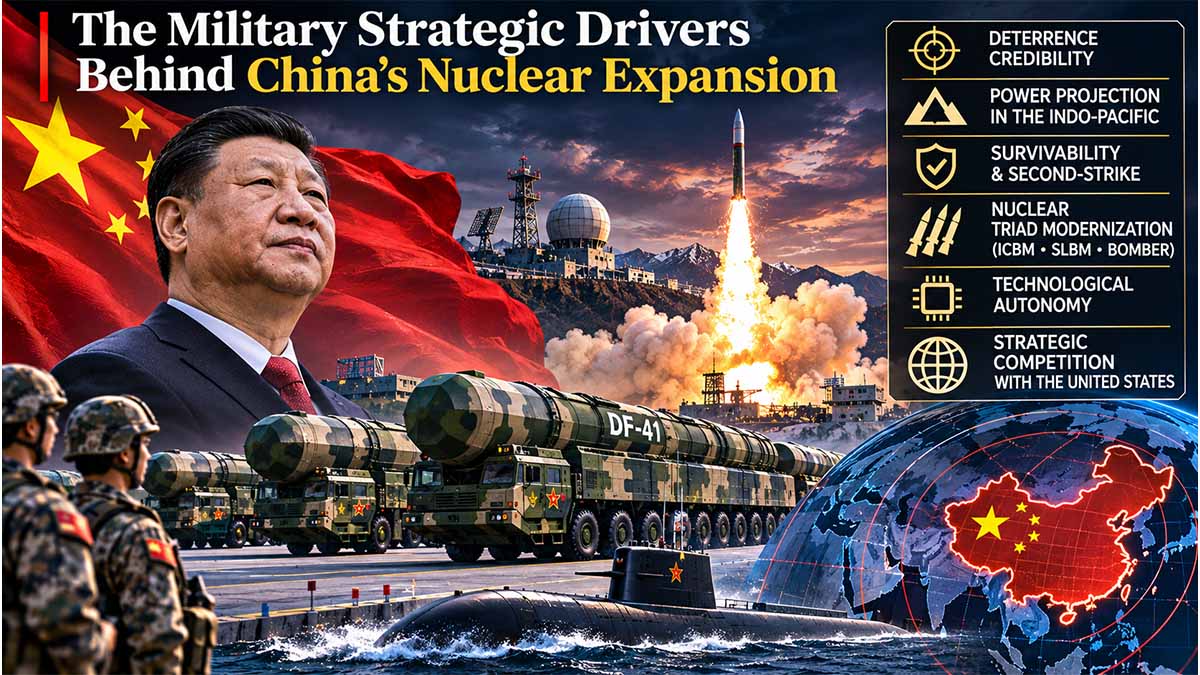
China’s nuclear expansion is best understood as an effort to preserve credible retaliation while increasing Beijing’s freedom of action in a confrontation with the United States.
Taiwan provides a critical connection between these objectives: nuclear deterrence can protect China against nuclear coercion while complicating outside intervention in a conventional conflict.
The Pentagon’s 2025 assessment placed China’s warhead stockpile in the low 600s through 2024 and projected more than 1,000 by 2030; the latter remains a forecast.
China continues to declare unconditional no-first-use, but its public statements do not disclose operational employment orders.
The decisive uncertainty concerns how a larger, more responsive force would influence Chinese decisions during a deteriorating conventional war.
The policy consequence is to assess nuclear deterrence, conventional defence and crisis communication together, without treating arsenal size as a sufficient measure of either intention or readiness. Annual Report to Congress: Military and Security Developments Involving the People’s Republic of China 2025 — U.S. Department of Defense — Dec 2025, pp. 22–25. media.defense.gov
China’s Nuclear Expansion Is Testing Europe’s Ability to Deliver Deterrence
Europe’s response to China’s nuclear expansion will succeed only if it preserves credible political and military choices under pressure; a larger collection of spending commitments will not achieve that result by itself. Beijing is strengthening a force intended to protect retaliation while complicating outside intervention, particularly over Taiwan. European governments are responding through NATO planning, national procurement and French–British coordination, but these instruments operate under different authorities and delivery schedules. The contradiction is already visible in the Northwood Declaration and the European Union’s Security Action for Europe instrument: cooperation can deepen without transferring nuclear authority, and financing can expand without producing immediately available capability. The fiscal and security stakes meet at implementation, where governments must turn approved resources into forces, infrastructure and decisions that allies can actually rely on.
The numbers measure different things
The Pentagon’s December 2025 assessment placed China’s nuclear-warhead stockpile in the low 600s through 2024 and projected more than 1,000 by 2030. The first figure is an estimate of a stockpile; the second is a forecast. Neither identifies the weapons immediately available for employment. China’s Ministry of Finance subsequently published a central-government defence appropriation of CNY 1,909.561 billion for 2026, an increase of CNY 124.896 billion over the previous year’s execution. That establishes a growing financial envelope, but no separately identified nuclear allocation. Treating the entire increase as nuclear expenditure would manufacture a precision the budget does not provide.
European figures require the same discipline. The Security Action for Europe regulation establishes a ceiling of €150 billion in loans, repayable by beneficiary states, rather than grants or completed procurement. Britain’s announced £63 billion programme over four years includes Dreadnought, a new warhead, SSN-AUKUS and other nuclear work; the conventionally armed, nuclear-powered submarine programme prevents that sum from being described as nuclear-weapons spending alone. Italy’s parliamentary dossier identifies a 2026 defence-mission requirement of €1,378,529,211, including €469.3 million payable in 2027. That is an existing programme requirement with a payment schedule, not uncommitted funding for an additional contingency.
The structural problem is therefore more demanding than a comparison of national totals suggests. China’s estimated stockpile, SAFE’s lending ceiling, Britain’s programme announcement and Italy’s mission requirements measure different categories of commitment. Adding them to a political argument without preserving those distinctions obscures the question governments must answer: which resources will become usable capability, under whose authority, and before which operational deadline?
Beijing seeks freedom of action, not merely additional weapons
China’s public military documents have long placed nuclear strategy within wider military strategy. The consequential development is the greater burden that a retaliatory force may now be expected to carry. The Pentagon’s 2025 report assesses that Beijing increasingly seeks to use nuclear deterrence to limit adversary involvement in a conventional conflict. Applied to Taiwan, the mechanism is politically significant: a force that makes nuclear retaliation more credible can also alter the risks Washington associates with intervention. This does not establish that China has adopted an unrestricted first-use doctrine. It does establish why an arsenal cannot be interpreted independently of the conventional objectives it supports.
China’s declared no-first-use policy and the development of early-warning counterstrike capabilities consequently raise different questions. The declaration concerns the circumstances of employment; warning architecture concerns how information reaches decision-makers and how quickly forces can respond. Faster detection does not establish reliable interpretation, while the presence of supporting systems does not demonstrate that the entire decision process works under disruption. A larger and more survivable force could give leaders greater confidence to wait; a posture dependent on rapid decisions could instead increase the consequences of uncertainty.
For Europe, the relevant objective follows from that distinction. NATO governments need to preserve their capacity to assess events, consult and sustain authorised responses despite nuclear pressure. An automatic numerical answer to China’s expansion would not establish that those functions had improved. The appropriate test is whether a proposed investment changes an adversary’s calculation or remedies a specific weakness in allied assurance, rather than whether it produces a more symmetrical inventory.
Procurement milestones expose the distance between ownership and availability
Germany’s F-35A programme record demonstrates why delivery language matters. The first German aircraft was formally handed over on 18 September 2026, but initially remains in the United States for the introduction and training process. Deliveries to Büchel are planned for the end of 2027, while Tornado retirement is planned for the end of 2030. The handover is evidence of progress; it is not evidence that the complete replacement contribution is already available. Infrastructure, personnel preparation and continuity during transition determine whether the procurement strengthens deterrence when required.
The same transmission problem applies to SAFE. Its regulation connects financial assistance with production capacity, timely availability and interoperability, but the loan ceiling cannot shorten a delivery schedule by declaration. National plans, implementing decisions and procurement must connect financing to the constraint being addressed. A project that expands industrial capacity may be valuable while arriving too late to cover an interim requirement. Conversely, improvements in maintenance and support can increase the usefulness of equipment already owned without producing the political visibility of a new platform.
Italy’s mission framework adds an authorisation constraint to the industrial one. The parliamentary dossier explains that designated high-readiness contingents still require specific parliamentary approval for employment abroad. Preparing personnel and equipment therefore does not settle the political decision to deploy them. For Rome, credible support requires a defined contribution, a lawful approval route and a sustainable resource plan. Leaving any of those elements unresolved can turn an assurance into an expectation that the state is not yet equipped or authorised to fulfil.
European nuclear coordination stops at sovereign decisions
France’s forward-deterrence initiative does not create a distributed authority to employ French nuclear weapons. In his 2 March 2026 Île Longue address, President Emmanuel Macron retained the ultimate decision, its planning and conduct under French authority, together with sovereign assessment of France’s vital interests. Partners can contribute to deterrence without acquiring a share of that decision. The political benefit is wider participation; the accompanying risk is that partners interpret cooperation as a guarantee more automatic than Paris has offered.
French–British coordination has nevertheless acquired documented substance. During Operation Rummy on 20–21 October 2026, RAF Typhoons escorted French Rafales simulating a nuclear strike mission; the official account states that no nuclear weapons were involved. The 10 November 2026 Nuclear Steering Group statement then recorded further coordination and expanded technical cooperation, including reciprocal use of sovereign trials facilities. These developments strengthen the evidence of implementation without establishing a merged force.
The EPURE facility gives that relationship an industrial dimension: the British parliamentary update describes jointly managed experiments supporting modelling of weapon performance, safety and reliability while preserving operational independence. Europe can therefore improve coordination and technical assurance without establishing a common arsenal. The requirement is precision about what each arrangement delivers. Exercise participation, technical cooperation and political consultation reinforce different functions; none should be presented as transferring sovereign nuclear-release authority.
NATO solidarity does not erase geography or national approval
The North Atlantic Treaty does not turn every confrontation involving an ally’s forces anywhere in the world into an automatic collective-defence event. Article 6 defines the geographic scope relevant to Article 5, while Article 5 leaves each ally to take the action it considers necessary. A conflict around Taiwan therefore requires examination of the actual attack and applicable provisions. Political consultation and nationally authorised assistance remain possible, but they must not be confused with an automatic obligation to enter combat.
Institutional coordination also has limits. NATO’s Nuclear Planning Group operates by consensus and excludes France, which has chosen not to participate. French–British arrangements and Germany’s bilateral cooperation with France consequently need to connect with NATO processes without pretending that the institutions are identical. The practical purpose of consultation is to establish what governments can approve and sustain, including where their contributions differ. A collective statement that conceals those differences can create uncertainty precisely when decisions become urgent.
Economic action has its own decision chain. Under the EU framework, foreign-policy decisions concerning sanctions must be connected to the necessary economic regulations, legal safeguards and national enforcement. European governments cannot assume that economic weight becomes an effective response simply because consequences have been threatened. The measures require a defined trigger, an intended effect and an assessment of exposure. Preparation preserves options; unspecified promises risk leaving the coalition to negotiate implementation after the crisis has already restricted its choices.
The next two years will charge for the gap between announcement and execution
Over the next 12–24 months, the clearest tests will concern obligations already undertaken. Germany’s planned deliveries to Büchel will test whether aircraft introduction and supporting infrastructure advance together. The French–British Northwood process will be judged by whether documented coordination continues to produce usable procedures and technical cooperation. SAFE-backed national procurement will have to demonstrate a connection between approved finance and delivery. None of these tests requires a new headline commitment; each requires execution of an existing one.
The Hague Summit Declaration schedules a review of NATO’s investment trajectory in 2029, but the capabilities needed before that review cannot be borrowed from the longer-term destination. Governments must identify the interim requirements that remain uncovered and decide which can be addressed through procedures, support capacity or procurement. Major force changes may take years; consultation, authorisation preparation and selected resilience measures can begin earlier, although their effectiveness still requires demonstration.
The cost of inaction will be allocated through those existing programmes. Armed forces will carry transition and availability gaps; taxpayers will finance commitments whose benefits arrive later than expected; firms will face uncertain orders or abrupt implementation demands; and governments will confront pressure to offer assistance they have not prepared to authorise. China’s nuclear expansion makes that weakness more consequential because its strategic effect may be to narrow other states’ choices before any nuclear weapon is used. Europe’s answer will be measured by the choices it can still exercise under pressure, supported by delivered capability and credible decisions, rather than by the scale of resources it has announced.
Navigational Index
Pillar I — Strategic Purpose and Political Authority
- Chapter 1 — From Retaliatory Deterrence to Strategic Counterbalance: Historical baseline, military strategy and the changing security requirements assigned to nuclear forces.
- Chapter 2 — Taiwan, Intervention and Nuclear Coercion: The relationship between conventional objectives, external intervention and nuclear protection.
- Chapter 3 — Declaratory Policy, Command Authority and Legal Constraints: No-first-use, political control, treaty obligations and the limits of publicly available doctrine.
Pillar II — Force Development and Escalation Dynamics
- Chapter 4 — Survivability, Readiness and Operational Reach: Delivery systems, early warning, command resilience and the distinction between inventory and usable capability.
- Chapter 5 — Industrial Capacity and the Sustainability of Expansion: Fissile materials, production infrastructure, programme execution and financial visibility.
- Chapter 6 — Crisis Instability and Nuclear–Conventional Interaction: Warning uncertainty, attacks on strategic systems and pathways to unintended escalation.
Pillar III — Allied Consequences and Strategic Choices
- Chapter 7 — European and Allied Exposure: Separate assessments of Italy, France, Germany, the United Kingdom and the European Union, followed by NATO coordination constraints.
- Chapter 8 — Outlook to November 2031 and Final Net Assessment: Conditional pathways, observable indicators and courses of action assessed by authority, effect, implementation burden, timing, reversibility and risk.
Master Abstract
Retaliatory credibility is the foundation of expansion
The strongest documented starting point is the relationship between China’s nuclear forces and its broader military strategy. Beijing’s May 2015 military white paper placed nuclear counterattack alongside other national military tasks and explicitly called for improvements in early warning, command and control, missile penetration, rapid response and survivability. This matters because a retaliatory strategy does not prescribe an unchanging arsenal: the force required to preserve retaliation depends on the threats its leadership expects to face. The analytical implication is that continuity in declared purpose can coexist with substantial changes in force structure. Greater survivability, more reliable communications and better penetration of defences can all serve the same underlying retaliatory mission. Conversely, a larger inventory cannot compensate automatically for weaknesses in command reliability or operational execution. These requirements establish a more useful baseline for interpreting expansion than the assumption that every additional warhead represents a new political objective. China’s Military Strategy — State Council Information Office of the People’s Republic of China — May 2015, sections II–IV. english.www.gov.cn
Taiwan connects nuclear protection with conventional freedom of action
Taiwan is central to the assessment because the military problem extends beyond overcoming Taiwan’s defences to anticipating a potential conflict with the United States. The March 2026 U.S. intelligence assessment describes continuing Chinese preparations to seize Taiwan and deter or defeat American intervention, while also assessing that Beijing prefers unification without force where possible. Crucially, it states that Chinese leaders did not then plan an invasion in 2027 and had no fixed unification timetable. Capability development, political preference and a decision to initiate war must therefore remain separate. The resulting analytical concern is conditional: if Chinese leaders believe their nuclear forces reduce Washington’s freedom to escalate, they could judge a conventional operation less vulnerable to outside pressure. The countervailing force is equally consequential: the same intelligence assessment identifies an amphibious invasion as exceptionally difficult, particularly with U.S. intervention. Nuclear protection would not resolve that operational problem. Annual Threat Assessment of the U.S. Intelligence Community — Office of the Director of National Intelligence — Mar 2026, “China–Taiwan,” p. 22. archive.dni.gov
American policy and Chinese perceptions require separate treatment
The interaction also depends on what Beijing believes American nuclear forces are intended to accomplish. The 2022 U.S. Nuclear Posture Review rejected both no-first-use and sole-purpose declarations, retained nuclear employment for extreme circumstances involving vital interests, and advocated closer coordination of nuclear and non-nuclear planning. These provisions document American policy at that time; they do not establish a publicly verified decision to use nuclear weapons against a Chinese invasion force. The distinction is essential because a perceived threat can drive procurement and readiness even when the adversary’s actual contingency plans remain non-public. Equally, Washington presented integration as a means of strengthening deterrence and raising adversary nuclear thresholds. The central mechanism is therefore an interaction between declared policy, interpretation and precautionary military development, rather than a demonstrated identity between either side’s intentions and the other’s threat assessment. 2022 National Defense Strategy, Nuclear Posture Review, and Missile Defense Review — U.S. Department of Defense — Oct 2022, Nuclear Posture Review, pp. 9–10. media.defense.gov
Declared restraint leaves operational questions unresolved
China’s November 2025 arms-control white paper reaffirmed no-first-use and described its nuclear requirements as the minimum necessary for national security. It also identified missile defence and military applications of space, cyber and artificial intelligence as challenges to strategic stability. This combination supports a security-driven explanation for modernisation, while leaving the numerical meaning of “minimum” undefined. In June 2026, the Foreign Ministry’s Chinese-language account of the nuclear prohibition treaty again reiterated unconditional no-first-use. These statements establish continuity in public policy, rather than independently verified constraints on wartime conduct. The most consequential issue is whether the organisational and technical implementation of that policy remains sufficiently clear under attack, communications disruption or uncertain warning. Public declarations provide evidence of stated restraint; they cannot alone establish how leaders would interpret an ambiguous crisis. China’s Arms Control, Disarmament, and Nonproliferation in the New Era — State Council Information Office — Nov 2025, sections I and III. 禁止核武器条约 — Ministry of Foreign Affairs of the People’s Republic of China — updated Jun 2026. mfa.gov.cn
European exposure differs by national role
The United Kingdom’s 2025 Strategic Defence Review explicitly connected China’s expansion with demands on U.S. nuclear forces and American extended deterrence in Europe. This establishes a direct transmission mechanism: developments in the Indo-Pacific can affect allied assurance and the allocation of American strategic attention. For London, the relevant assessment concerns the contribution of its independent deterrent and the resilience of its supporting industrial enterprise. The Strategic Defence Review 2025 — Making Britain Safer: secure at home, strong abroad — UK Ministry of Defence — Jun 2025, section 7.1. GOV.UK
France approaches this environment through sovereign nuclear decision-making. President Emmanuel Macron’s March 2026 address announced an increase in warhead numbers and a progressive “advanced deterrence” approach involving European partners, while retaining French control over nuclear use. Germany’s distinct position is reflected in the accompanying bilateral declaration: closer consultation with France complements its continuing contribution to NATO nuclear sharing. Neither announcement establishes that China alone caused these changes; both demonstrate that European responses operate through different national authorities and alliance relationships. Déplacement sur la base opérationnelle de l’Ile Longue — Presidency of the French Republic — Mar 2026. Déclaration conjointe du Président Macron et du Chancelier Merz — Presidency of the French Republic — Mar 2026. Él
Italy’s documented diplomatic position links concern over China’s nuclear build-up with support for stability across the Taiwan Strait, as expressed in the November 2025 G7 declaration published by its Foreign Ministry. The European Union’s October 2026 nuclear statement separately calls for Chinese transparency, arms-control dialogue and risk reduction. The implication for subsequent country analysis is to distinguish diplomatic alignment from national operational commitments: a shared concern does not establish identical military obligations, industrial capacity or willingness to assume Indo-Pacific risks. Dichiarazione congiunta dei Ministri degli Esteri del G7 riuniti a Niagara — Italian Ministry of Foreign Affairs and International Cooperation — Nov 2025. EU Statement – UN General Assembly 1st Committee: Nuclear Weapons (Cluster 1) — European External Action Service — Oct 2026. esteri.it
Key Evidence Table
| Indicator | Value/status | Reference date | Definition/scope | Issuer | Exact source |
|---|---|---|---|---|---|
| Estimated warhead stockpile | Low 600s | Through 2024; published Dec 2025 | U.S. estimate; not a verified Chinese declaration or deployed-warhead count | U.S. Department of Defense | Annual Report to Congress: Military and Security Developments Involving the People’s Republic of China 2025 — Dec 2025, p. 22 |
| Projected arsenal | More than 1,000 warheads | 2030 forecast | Projection, not realised inventory | U.S. Department of Defense | Same report, p. 22 |
| Silo loading | More than 100 silos likely loaded with DF-31-class missiles | 2025 assessment | Estimated missile loading; does not establish warhead mating or mission availability | U.S. Department of Defense | Same report, p. 24 |
| Early-warning counterstrike | Capability assessed as developing | Activity in 2024 | Warning-based launch before incoming detonation; operational reliability remains unverified publicly | U.S. Department of Defense | Same report, pp. 23–24 |
| Declared employment policy | Unconditional no-first-use reaffirmed | Jun 2026 update | Public policy statement | Chinese Ministry of Foreign Affairs | 禁止核武器条约 — Jun 2026 |
| Taiwan invasion timing | No current plan for a 2027 invasion assessed | Mar 2026 | Time-specific intelligence judgment; not a guarantee of subsequent decisions | Office of the Director of National Intelligence | Annual Threat Assessment of the U.S. Intelligence Community — Mar 2026, p. 22 |
The quantitative and capability entries above retain the issuing institutions’ qualifications. media.defense.gov
Competing Explanations or Pathways
Retaliatory assurance and counter-intervention can reinforce one another
The central explanations overlap. A force designed to survive attack can also influence an adversary’s willingness to intervene conventionally. The diagnostic question is whether changes in force employment, exercises and political signalling remain centred on retaliation or increasingly seek to constrain conventional action through nuclear threats. The Pentagon’s assessment explicitly identifies a broader counter-intervention purpose, but that remains an attributed assessment of Chinese intentions. media.defense.gov
Numerical growth does not establish a parity objective
The verified record does not disclose a Chinese numerical endpoint that would establish parity with the United States as the governing requirement. Beijing’s public denial of an arms race is evidence of its stated position, while the absence of a disclosed endpoint prevents confirmation of either a fixed ceiling or an unrestricted expansion programme. China’s Arms Control, Disarmament, and Nonproliferation in the New Era — State Council Information Office — Nov 2025, section III. mfa.gov.cn
Greater survivability and greater crisis stability are separate outcomes
The assessment must test two different effects. Improved survivability can weaken incentives for a disarming attack; faster warning-based decisions can reduce the time available to resolve uncertainty. Which effect dominates depends on warning reliability, political control and communication under stress. NATO’s call for reciprocal transparency and strategic risk-reduction discussions provides a practical framework for addressing those uncertainties without assuming that force growth alone reveals employment doctrine. Washington Summit Declaration — NATO — Jul 2024, paragraph 27. NATO Official text
Principal Gaps and Watch Indicators
| Consequential gap | Named record or observation needed | Decision significance |
|---|---|---|
| Relationship between no-first-use and warning-based launch | Authoritative Chinese employment guidance explaining attack confirmation and release authority | Would clarify whether public restraint translates into operational safeguards |
| Inventory versus usable capability | Official reporting separating stockpiled, mated, deployed and available weapons | Would prevent arsenal totals from being mistaken for immediate strike capacity |
| Nuclear role in a Taiwan contingency | Authoritative doctrine or clearly documented exercises distinguishing retaliation from coercive intervention deterrence | Would strengthen or weaken the judgment that nuclear protection supports conventional freedom of action |
| Future expansion requirements | A Chinese force-planning statement identifying requirements or limits | Would help distinguish threat-responsive modernisation from an open-ended numerical competition |
| Reliability of crisis communication | Documented exercises, notification arrangements and evidence that channels function during confrontation | Would indicate whether political communication can constrain military escalation |
These are collection priorities rather than claims that the missing records are publicly available. The principal judgment would weaken if authoritative evidence demonstrated a substantially different employment purpose; it would strengthen if documented force development and exercises consistently connected survivable retaliation with limiting intervention.
Visualisation
The verified quantitative entries mix inventory estimates, forecasts and capability assessments; they do not form a sufficiently comparable series for a meaningful chart. A relationship graphic at this stage would reproduce the narrative without resolving the central uncertainty over employment authority.
China’s Nuclear Expansion
Retaliatory credibility and the effort to constrain outside intervention are connected strategic drivers. Force growth alone does not establish wartime intent or operational readiness.
Published December 2025. Not a deployed-warhead count. [S1, p. 22]
U.S. projection; not a realised inventory. [S1, p. 22]
Chinese Foreign Ministry update, June 2026. Employment orders are not disclosed. [S2]
Strategic relationships
Select a node to examine its mechanism and the evidence needed to test it. Connections represent analysis, not measured effects.
No numerical scale. Node size, depth and animation carry no quantitative meaning. Analytical basis: S1, S3 and S4.
Evidence and uncertainty
Filter by evidentiary category. Dates describe the underlying record, not a continuously updated feed.
| Indicator | Value / status | Reference | Definition / limitation | Record |
|---|---|---|---|---|
| Warhead stockpile | Low 600s | Through 2024 | U.S. estimate; not deployed-warhead total. | S1, p. 22 |
| Projected arsenal | >1,000 warheads | 2030 | Forecast; not realised inventory. | S1, p. 22 |
| Missile silo loading | >100 silos likely loaded | 2025 assessment | DF-31-class missiles; not proof of warhead mating. | S1, p. 24 |
| Early-warning counterstrike | Developing capability | 2024 activity | U.S. assessment; reliability not publicly established. | S1, pp. 23–24 |
| No-first-use commitment | Reaffirmed | June 2026 | Public policy; employment orders undisclosed. | S2 |
| Taiwan invasion timing | No fixed timeline assessed | March 2026 | Time-specific U.S. judgment; no guarantee of future decisions. | S4, p. 22 |
Distinct European positions
Shared concern does not imply identical authority, commitments or capabilities.
Italy
G7 diplomacy links nuclear transparency with Taiwan Strait stability. [S5]
France
Sovereign nuclear decision-making; advanced-deterrence initiative announced in March 2026. [S6]
Germany
Closer French consultation complements continuing NATO nuclear sharing. [S7]
United Kingdom
The 2025 review connects China’s expansion with demands on U.S. extended deterrence. [S8]
European Union
The October 2026 position calls for transparency, dialogue and risk reduction. [S9]
Official records and source notes
Original document titles are retained. Sources open only when selected. This dashboard does not fetch or refresh external data.
- S1 Annual Report to Congress: Military and Security Developments Involving the People’s Republic of China 2025 — U.S. Department of Defense — Dec 2025
- S2 禁止核武器条约 — 中华人民共和国外交部 — Jun 2026 update
- S3 China’s Military Strategy — State Council Information Office — May 2015
- S4 Annual Threat Assessment of the U.S. Intelligence Community — Office of the Director of National Intelligence — Mar 2026
- S5 Dichiarazione congiunta dei Ministri degli Esteri del G7 riuniti a Niagara — Ministero degli Affari Esteri e della Cooperazione Internazionale — Nov 2025
- S6 Déplacement sur la base opérationnelle de l’Ile Longue — Présidence de la République — Mar 2026
- S7 Déclaration conjointe du Président Macron et du Chancelier Merz — Présidence de la République — Mar 2026
- S8 The Strategic Defence Review 2025 — Making Britain Safer: secure at home, strong abroad — UK Ministry of Defence — Jun 2025
- S9 EU Statement – UN General Assembly 1st Committee: Nuclear Weapons (Cluster 1) — European External Action Service — Oct 2026
Pillar I — Strategic Purpose and Political Authority
Chapter 1 — From Retaliatory Deterrence to Strategic Counterbalance
Nuclear strategy has long served a wider military purpose
China’s movement towards a stronger nuclear force does not require a complete abandonment of its traditional retaliatory rationale. The more consequential development is the widening set of military circumstances in which that rationale must operate. This relationship was already explicit in the December 2006 defence white paper, which subordinated nuclear strategy to national nuclear policy and military strategy, identified the prevention of nuclear attack and coercion as its fundamental purpose, and placed nuclear forces under the Central Military Commission’s direct command. The analytical significance lies in the combination of those provisions: political leaders define the security objectives, military strategy establishes the conflicts for which the armed forces prepare, and nuclear-force development supplies the capabilities considered necessary within that environment. Consequently, continuity in the declared purpose of retaliation can accompany substantial changes in the scale, organisation and responsiveness of the forces assigned to perform it. The official record supports examining changing military requirements before treating expansion as sufficient evidence of an entirely new nuclear doctrine. China’s National Defense in 2006 — State Council Information Office — Dec 2006, section II; official reproduction hosted by the China Aerospace Studies Institute. airuniversity.af.edu
The historical baseline combined nuclear possession with diplomatic restraint
The historical foundation of this approach is a distinction between possessing nuclear weapons and accepting nuclear employment as an ordinary instrument of war. China’s September 2005 arms-control white paper traced its position to the first nuclear test in 1964 and presented the subsequent policy as protection against nuclear intimidation rather than participation in an unrestricted numerical competition. Its documentary chronology also recorded a January 1994 draft treaty on mutual no-first-use, reciprocal Chinese–Russian no-first-use and detargeting statements in September 1994, and Chinese–American detargeting in June 1998. These measures addressed different problems: no-first-use concerned the circumstances of employment, whereas detargeting concerned the declared targeting posture. Neither established an independently verified ceiling on the arsenal. Their strategic importance was to accompany a retained retaliatory capability with political assurances intended to reduce perceived aggression. The resulting baseline should therefore be understood as a combination of military insurance and diplomatic positioning, with each element serving purposes that cannot be measured simply by counting weapons. China’s Endeavors for Arms Control, Disarmament and Non-Proliferation — State Council Information Office — Sep 2005, “Nuclear Disarmament”. fmprc.gov.cn
| Documentary milestone | What the official record establishes | Strategic significance | Evidentiary boundary |
|---|---|---|---|
| September 2005 arms-control white paper | Records earlier no-first-use and detargeting initiatives | Political restraint accompanied retained nuclear capability | Assurances do not establish an arsenal ceiling |
| December 2006 defence white paper | Nuclear strategy serves military strategy | Nuclear development belongs within wider defence planning | Does not disclose operational employment plans |
| January 2009 publication of the 2008 defence white paper | Distinguishes peacetime, nuclear-threat and nuclear-attack conditions | Readiness was already conceived as conditional | Does not specify every technical transition |
| April 2013 employment white paper | Separates nuclear counterattack from conventional precision-strike missions | A common organisation performed differentiated missions | Shared service affiliation does not prove identical release authority |
| December 2015 Rocket Force instructions | Connect nuclear retaliation, conventional strike and strategic counterbalance | Counterbalance predates the latest expansion debate | The term is not a numerical parity requirement |
The dates refer to the documents or statements themselves, including the distinction between the 2008 defence white paper’s title and its January 2009 publication. Sources: China’s National Defense in 2008 — State Council Information Office — Jan 2009, section VII; The Diversified Employment of China’s Armed Forces — State Council Information Office — Apr 2013; 习近平论坚持总体国家安全观(2015年) — official government compilation reproducing the 31 December 2015 instructions. airuniversity.af.edu
Conditional readiness preceded the present expansion
The January 2009 white paper provides a particularly important operational baseline because it distinguishes three conditions without presenting them as interchangeable. In peacetime, the Second Artillery’s nuclear missiles were declared not to target any country; under a nuclear threat, the force would increase alert and prepare for counterattack; following nuclear attack, it would conduct retaliation, independently or with other services’ nuclear forces. This sequence shows that a retaliatory posture was never synonymous with an absolute prohibition on readiness changes before nuclear detonations. At the same time, the wording does not establish that a nuclear threat alone authorised nuclear employment. That distinction matters when interpreting subsequent modernisation: preparations designed to prevent destruction, preserve communication or demonstrate resolve can occur before the declared employment threshold has been crossed. Analysts must therefore distinguish an alerting decision, which changes preparedness, from a release decision, which authorises use. Treating both as the same event obscures the political and organisational safeguards that determine whether heightened readiness stabilises or destabilises a confrontation. China’s National Defense in 2008 — State Council Information Office — Jan 2009, section VII. airuniversity.af.edu
Nuclear and conventional missions developed within the same institution
The April 2013 employment white paper adds a second distinction that is essential to understanding strategic counterbalance. It described the Second Artillery as comprising nuclear missile forces, conventional missile forces and operational support units, while assigning nuclear counterattack and conventional precision strike as separate functions. Its readiness discussion specified Central Military Commission orders for raising nuclear readiness under nuclear threat, alongside a conventional missile force capable of moving rapidly into wartime operations. The institutional implication is substantial: an organisation can combine nuclear and conventional capabilities without eliminating the different political conditions governing their employment. The analytical risk arises when an adversary observes activity associated with that organisation and cannot confidently identify the mission being supported. Service affiliation alone cannot resolve whether a particular movement, exercise or support activity is conventional, nuclear or relevant to both. For that reason, the development of the missile force must be examined through mission assignment, command relationships and identifiable procedures, rather than through the unsupported assumption that organisational integration necessarily means automatic nuclear escalation. The Diversified Employment of China’s Armed Forces — State Council Information Office — Apr 2013, sections II–III. english.www.gov.cn
Strategic counterbalance describes an effect, not a fixed arsenal ratio
Xi Jinping’s instructions at the Rocket Force’s establishment on 31 December 2015 placed credible nuclear deterrence and counterattack, medium- and long-range precision strike, and stronger strategic counterbalance within the same mission statement. The Chinese term 战略制衡, translated here as strategic counterbalance, is significant because it describes an intended relationship with an opponent rather than a prescribed quantity of weapons. Its practical meaning can include offsetting superior capabilities, constraining choices and preserving the freedom to pursue national objectives. The speech also connected the Rocket Force with China’s international standing, demonstrating that status and military utility were presented together rather than as mutually exclusive motivations. However, the statement does not identify a required numerical relationship with the United States, specify an endpoint for expansion or authorise first use. The defensible interpretation is therefore that counterbalance broadened the political significance assigned to missile forces while leaving the precise mixture of nuclear and conventional contributions to be determined through subsequent planning. 习近平论坚持总体国家安全观(2015年) — official government compilation, extract from the 31 December 2015 Rocket Force establishment instructions. sw.wuhan.gov.cn
| Strategic concept | Question it addresses | What would demonstrate its implementation | What would not establish it |
|---|---|---|---|
| Retaliatory deterrence | Can nuclear attack be discouraged by credible consequences? | Evidence of survivable forces, reliable command and authorised response procedures | Inventory growth considered alone |
| Strategic counterbalance | Can an opponent’s advantages and choices be constrained? | A documented relationship between capabilities and the choices they are intended to restrict | An assumed requirement for numerical equality |
| Conventional deterrence | Can the military objective be made prohibitively difficult or costly? | Relevant conventional capability, readiness and sustainment | Nuclear possession without conventional effectiveness |
| Crisis management | Can escalation be bounded while political objectives remain under review? | Functioning communication, validated warning and controlled authorisation | Public assurances without evidence of implementation |
This table distinguishes analytical functions rather than assigning measured effectiveness. Its documentary basis is the differentiated mission structure in The Diversified Employment of China’s Armed Forces — State Council Information Office — Apr 2013 and the strategic framework in China’s Military Strategy — State Council Information Office — May 2015.
Active defence does not mean tactical passivity
The May 2015 military-strategy white paper explicitly combined strategic defence with operational and tactical offence. This provision helps explain why Beijing can describe its overall posture as defensive while preparing military actions that would appear offensive to an opponent. It does not, however, erase the separate nuclear commitment against first use. An analytical error occurs when the general principle of seizing military initiative is automatically converted into evidence that nuclear first use has been authorised. The general military framework and the nuclear employment threshold operate at different levels and must be connected through authoritative evidence rather than inference alone. A further implication follows: statements that China’s military policy is defensive cannot settle the legal or strategic character of every contemplated operation. The content of the objective, the means selected and the circumstances of employment remain necessary to the assessment. The central question is how political leaders define the interests being defended and what risks they accept in advancing them. China’s Military Strategy — State Council Information Office — May 2015, section III. english.www.gov.cn
The July 2019 defence white paper supplied a more confrontational account of the surrounding security environment, attributing deterioration in strategic stability to American developments in nuclear forces, space, cyber capabilities and missile defence, while identifying U.S. alliances and regional deployments as sources of pressure. These were Chinese official assessments, not independently established descriptions of American intent. Their importance for explaining force development is that procurement responds to perceived future vulnerability as well as demonstrated present threats. A leadership expecting simultaneous pressure across several domains can demand a larger margin of survivability and greater independence from systems it considers exposed. The countervailing consideration is that threat perceptions can become self-reinforcing: measures justified as defensive by one side can confirm the other side’s expectation of confrontation. The 2019 document therefore helps explain the political environment supporting expansion, while providing no basis for assuming that every subsequent programme was caused by a single American deployment or policy decision. 新时代的中国国防 — State Council Information Office — Jul 2019, section I, official Chinese-language reproduction. locpg.gov.cn
The strategic objectives are related but operationally distinct
The Pentagon’s December 2025 report interprets Chinese planning through three major strategic capabilities: victory in the principal contingency, counterbalance against the United States, and deterrence and control against other regional actors. Its assessment associates nuclear modernisation particularly with restraining American involvement. This formulation matters because it separates defeating the immediate opponent from limiting the participation of additional opponents. Nuclear forces can contribute to the latter without supplying the conventional means required for the former. The report also assesses that revisions to military strategic guidelines probably began in late 2022, cautioning against treating the 2019 framework as necessarily the final stage of doctrinal development. These remain attributed U.S. assessments, particularly where the underlying Chinese requirements are not public. Annual Report to Congress: Military and Security Developments Involving the People’s Republic of China 2025 — U.S. Department of Defense — Dec 2025, pp. 9–11. media.defense.gov
Key judgments
The historical record supports distinguishing continuity in the declared retaliatory purpose from change in the military effects expected of nuclear forces. Strategic counterbalance adds an adversary-centred requirement: the force must influence another state’s choices, including decisions about intervention. That requirement can expand without a publicly announced parity target, but its effectiveness depends on what the opponent believes and how conventional operations develop; a declaratory mission statement cannot establish either outcome.
What would change the assessment
An authoritative requirement for numerical superiority, a revised employment policy or documented exercises explicitly linking conventional setbacks to nuclear first use would materially change the interpretation. Conversely, clearer mission separation and published restrictions on escalation would strengthen the assessment that expansion serves a broader but still retaliatory framework.
Open official record
The consequential missing records are the operative military strategic guidelines, the requirements used to translate counterbalance into force planning, and authoritative explanations of how nuclear and conventional missile missions are coordinated without conflating their release conditions. Their absence limits conclusions about implementation, rather than establishing that such arrangements do not exist.
Chapter 2 — Taiwan, Intervention and Nuclear Coercion
The nuclear requirement arises from the possibility of a wider war
Taiwan creates a demanding nuclear-planning problem because an operation directed at a geographically limited objective could bring China into confrontation with another nuclear-armed power. Beijing’s August 2022 Taiwan white paper connected unification with national rejuvenation, retained the option of force and identified external interference as one of the circumstances against which that option was directed. It simultaneously described force as a last resort under compelling conditions. These provisions establish the Chinese government’s political position, but they do not disclose a nuclear plan for achieving it. The analytical connection is that an operation’s immediate objective and its potential escalation environment are different matters: even if the initial campaign were conventional, leaders would have to consider whether outside involvement could threaten forces, command systems or interests they regard as strategically indispensable. Nuclear protection therefore concerns the risks surrounding the campaign as well as the campaign’s immediate military tasks. This distinction explains why the nuclear dimension cannot be inferred solely from the weapons needed to cross the Strait. The Taiwan Question and China’s Reunification in the New Era — Taiwan Affairs Office and State Council Information Office — Aug 2022, preamble and section IV. un.china-mission.gov.cn
American law creates a durable interest without prescribing an automatic response
The Taiwan Relations Act makes the prospect of American involvement structurally important to Chinese planning. Section 3301 of Title 22 establishes U.S. policy to regard non-peaceful efforts to determine Taiwan’s future, including boycotts and embargoes, as a threat to Western Pacific security and a matter of grave concern, to provide defensive arms, and to maintain the capacity to resist force or coercion threatening Taiwan’s population and its social or economic system. Its scope is therefore broader than an amphibious invasion alone: economic isolation and other coercive methods also fall within the statutory concern. The strategic implication is that Beijing cannot assume that choosing a campaign below the level of invasion would remove the American interest in responding. Equally, a legal requirement to maintain capacity does not specify the exact military action that a particular president and Congress would authorise. That uncertainty is part of the intervention problem China’s military strategy must address, rather than a gap that arsenal growth automatically resolves. 22 U.S.C. § 3301, Congressional findings and declaration of policy — U.S. House Office of the Law Revision Counsel — current text accessed Nov 2026, subsection (b). uscode.house.gov
Section 3302 adds the decision mechanism: the United States is to make defence articles and services available to support sufficient Taiwanese self-defence, while the president must promptly inform Congress of relevant threats and the two branches determine an appropriate response through constitutional processes. This language does not contain an automatic order for American forces to enter combat. It does, however, make sustained support for Taiwan more than an improvised diplomatic preference. The distinction has practical consequences for deterrence. Chinese leaders must consider several possible responses—support, reinforcement, economic measures or direct military action—whose timing and combination depend on political decisions. A nuclear posture intended to discourage the most escalatory American options would not necessarily discourage every other form of support. Intervention is therefore better understood as a spectrum of decisions than as a single binary event, and the effectiveness of Chinese deterrence would have to be assessed separately against the different decisions it sought to prevent. 22 U.S.C. § 3302, Implementation of United States policy with regard to Taiwan — U.S. House Office of the Law Revision Counsel — text through Oct 2026, subsections (a)–(c). uscode.house.gov
| Decision dimension | Chinese political position | American statutory position | Consequence for strategic assessment |
|---|---|---|---|
| Peaceful outcome | Publicly preferred in the 2022 Taiwan white paper | Peaceful determination is a foundational expectation | Preference does not eliminate preparation for conflict |
| Coercion below invasion | External interference is framed as a security problem | Boycotts, embargoes and other coercion are expressly relevant | A campaign short of invasion can still produce confrontation |
| Military support | Beijing opposes foreign interference | Defensive articles and services are provided for | Support can continue without an immediate combat decision |
| Direct military response | An uncertainty Beijing must account for | Appropriate action follows constitutional processes | Neither automatic intervention nor automatic abstention follows from the Act |
Sources: The Taiwan Question and China’s Reunification in the New Era — Taiwan Affairs Office and State Council Information Office — Aug 2022; 22 U.S.C. § 3301; 22 U.S.C. § 3302.
Flexible American nuclear options create a perception problem
The February 2018 U.S. Nuclear Posture Review is important to the chronology because it proposed additional flexible nuclear options, including a low-yield modification to an existing submarine-launched ballistic-missile warhead and a longer-term nuclear-armed sea-launched cruise missile. The document presented these as measures to deny adversaries an advantage from limited nuclear escalation and explicitly argued that they would raise the nuclear threshold. For Chinese planners, however, flexibility can also indicate that Washington intends to preserve usable responses across a wider range of conflicts. The mechanism does not require accepting either government’s interpretation as objectively correct: a capability intended by its owner to strengthen restraint can be interpreted by an opponent as making employment more credible. Importantly, the 2018 proposals were programme decisions and policy intentions at that date; their inclusion in a review did not establish immediate operational availability. Nor does the document establish a specific American plan to employ nuclear weapons against a Chinese force operating around Taiwan. Nuclear Posture Review — U.S. Department of Defense — Feb 2018, pp. 54–55. media.defense.gov
The November 2024 American nuclear-employment report sharpens this interaction by directing planning for simultaneous deterrence of Russia, China and North Korea, integration of non-nuclear capabilities where they support the nuclear mission, and deeper consultation with NATO and Indo-Pacific partners. It also reaffirms presidential authority over American nuclear employment. These provisions explain why Chinese planners would examine American nuclear policy within a wider system of conventional forces, alliances and strategic capabilities. They do not prove that those elements form an automatic sequence leading from conventional conflict to nuclear use. The decision problem is instead one of mutual interpretation: Washington seeks credible options against several adversaries, while Beijing evaluates whether those options could threaten its capacity to sustain a regional operation. A stronger Chinese retaliatory force could consequently be intended to reduce the credibility of particular American threats, even where it cannot eliminate American conventional power or allied political cooperation. Report on the Nuclear Employment Strategy of the United States — U.S. Department of Defense — Nov 2024, “Updated Guidance”. media.defense.gov
Nuclear protection has several possible mechanisms
A nuclear shield can operate through different mechanisms, with different implications for declared policy. The first is straightforward retaliatory deterrence: an opponent is discouraged from nuclear attack because retaliation remains credible. The second concerns a conventional operation conducted beneath that protection: leaders may believe the risk of nuclear punishment makes outside escalation less attractive. The third is explicit coercion, in which nuclear employment is threatened to stop an adversary’s conventional action. These mechanisms must remain separate because the third would raise particularly direct questions about compatibility with unconditional no-first-use. A state can hope that its retaliatory capability influences conventional decisions without publicly threatening nuclear first use, while an explicit threat to respond nuclearly to a purely conventional action would require a different interpretation. The analytical task is therefore to identify the actual communication and the condition attached to it. The 2022 American review illustrates the wider problem by discussing both nuclear and non-nuclear contributions to deterrence, while acknowledging that conventional operations against a nuclear-armed adversary must account for potential nuclear escalation. 2022 National Defense Strategy, Nuclear Posture Review, and Missile Defense Review — U.S. Department of Defense — Oct 2022, Nuclear Posture Review, pp. 9–10. media.defense.gov
| Analytical pathway | Intended effect | Relationship to no-first-use | Evidence required before attributing it to China |
|---|---|---|---|
| Retaliatory protection | Deter an adversary’s nuclear employment | Consistent with the declared principle | Authoritative mission statements and credible implementation |
| Indirect influence on conventional intervention | Make escalation costs weigh more heavily in outside decisions | Can coexist with no-first-use; mechanism must be specified | Evidence that leaders connect retaliation with intervention restraint |
| Explicit nuclear coercion against conventional action | Compel an opponent to stop through a nuclear threat | Potential tension if the threat entails first nuclear use | Exact official wording, conditions and issuing authority |
| Protection of a conventional campaign | Preserve political freedom while conventional forces pursue the objective | Depends on the threatened response, not the campaign label | Campaign-specific doctrine or clearly attributable signalling |
These are distinct propositions for assessment, not a reconstruction of undisclosed Chinese war plans. The Pentagon’s 2025 report attributes a broader intervention-limiting purpose to Chinese nuclear deterrence, but its judgment does not by itself identify which mechanism would govern a particular crisis. Annual Report to Congress: Military and Security Developments Involving the People’s Republic of China 2025 — U.S. Department of Defense — Dec 2025, p. 25. media.defense.gov
A leadership seeking protection must still judge the campaign’s feasibility
The relationship between nuclear confidence and conventional risk-taking cannot be assumed to run in only one direction. Greater confidence in retaliation might reduce concern about outside nuclear coercion, but it could coexist with a highly pessimistic assessment of the conventional campaign itself. The March 2026 U.S. intelligence assessment identifies PLA readiness, Taiwan’s political circumstances and the prospect of American intervention as factors relevant to Beijing’s decision, and recognises Chinese awareness of the difficulty of an amphibious invasion. The analytical consequence is that nuclear assurance should be treated as one input into a broader political calculation. It cannot substitute for confidence in achieving the objective, sustaining operations or controlling the consequences of a prolonged conflict. Equally, improved conventional capability does not automatically establish a political decision to use it. The most revealing indicators would connect leadership judgments about military feasibility with judgments about outside restraint, rather than relying on force development in either domain as a self-sufficient predictor of war. Annual Threat Assessment of the U.S. Intelligence Community — Office of the Director of National Intelligence — Mar 2026, “China–Taiwan,” p. 22. archive.dni.gov
Key judgments
The intervention problem is multidimensional: discouraging nuclear employment, discouraging direct conventional combat and discouraging material support are different objectives. A nuclear posture that influences the first does not necessarily achieve the others. The principal strategic concern is therefore whether Beijing overestimates the extent to which greater retaliatory confidence translates into American or allied restraint, while Washington overestimates its ability to signal resolve without appearing to threaten China’s strategic deterrent.
What would change the assessment
The clearest changing indicators would be authoritative Chinese statements specifying what outside actions nuclear forces are intended to deter, exercises that explicitly distinguish nuclear retaliation from conventional counter-intervention, and verified crisis communications clarifying the conditions attached to threats. Such evidence would be more diagnostic of employment purpose than an additional weapons display.
Open official record
The outstanding records are campaign-specific nuclear guidance, authenticated instructions on signalling during a Taiwan contingency, and authoritative explanations of how Chinese leaders distinguish attacks on conventional forces from threats to nuclear retaliation. These gaps prevent a definitive account of the nuclear shield’s operational boundaries.
Chapter 3 — Declaratory Policy, Command Authority and Legal Constraints
Constitutional command authority is not an operational release procedure
China’s public constitutional structure establishes where military authority is concentrated, but it does not publish the complete process for authorising a nuclear strike. Article 93 assigns leadership of the armed forces to the Central Military Commission and establishes its chairperson responsibility system; Article 94 makes the chairperson responsible to the National People’s Congress and its Standing Committee. Separately, Article 62 assigns the Congress decisions on war and peace, while Article 80 addresses presidential declarations of war and mobilisation pursuant to legislative decisions. These provisions identify different constitutional functions and should not be compressed into an unsupported claim that the presidency alone constitutes nuclear command authority. The distinction also prevents the opposite mistake: formal provisions concerning war and peace do not establish that a separate parliamentary vote precedes each operational decision. The public text supports a centralised constitutional architecture, while the timing, authentication and transmission of nuclear-release decisions require evidence from a different category of record. Constitution of the People’s Republic of China — National People’s Congress, amended Mar 2018; official English text published Jun 2020, Articles 62, 80 and 93–94. english.www.gov.cn
The revised National Defense Law, adopted on 26 December 2020 and effective from 1 January 2021, makes the allocation more concrete. Article 14 assigns the State Council defence-development and administrative functions; Article 15 assigns the Central Military Commission unified military command, military strategy and operational guidelines; Article 16 reiterates chairperson responsibility; Article 17 provides coordination between the State Council and the Commission; and Article 21 places the armed forces under Communist Party leadership. These provisions establish a system in which political leadership, military command and civilian administration have related but differentiated roles. They do not disclose whether nuclear release requires specified consultations, what arrangements apply if senior communications fail, or whether any exceptional delegation exists. Political centralisation can strengthen control, but its effects under crisis pressure depend on procedures that preserve both authorised action and protection against unauthorised action. The existence of central authority alone does not demonstrate the effectiveness of either safeguard. 中华人民共和国国防法 — National People’s Congress Standing Committee — Dec 2020, Articles 14–17 and 21; official text hosted by the Ministry of Foreign Affairs. mfa.gov.cn
| Authority or function | Governing provision | Publicly established responsibility | What the provision does not disclose |
|---|---|---|---|
| National People’s Congress | Constitution, Article 62 | Decisions on war and peace | Individual nuclear-release workflow |
| President | Constitution, Article 80 | Specified declarations pursuant to legislative decisions | A complete operational nuclear-command procedure |
| Central Military Commission | Constitution, Article 93; National Defense Law, Article 15 | Military leadership, unified command and strategy | Detailed nuclear authentication arrangements |
| CMC chairperson | Constitution, Articles 93–94; National Defense Law, Article 16 | Chairperson responsibility | Contingency succession or delegation procedures |
| State Council | National Defense Law, Articles 14 and 17 | Defence administration and coordination | Independent nuclear-launch authority |
Sources: Constitution of the People’s Republic of China — official English text — Jun 2020; 中华人民共和国国防法 — Dec 2020.
The Anti-Secession Law does not specify nuclear employment
The 14 March 2005 Anti-Secession Law establishes a separate domestic framework for action concerning Taiwan. Article 8 identifies three categories of circumstances: action producing Taiwan’s secession, major incidents entailing secession, or complete exhaustion of possibilities for peaceful unification. It assigns decisions and implementation concerning non-peaceful means and other necessary measures to the State Council and Central Military Commission, with prompt reporting to the National People’s Congress Standing Committee. Article 9 addresses protection of civilians, foreign nationals and legitimate interests while minimising losses. None of these provisions specifies nuclear employment. Consequently, the law cannot be treated as a published nuclear-release instrument or as proof that a Taiwan-related trigger automatically overrides no-first-use. It establishes Beijing’s domestic legal position concerning the use of non-peaceful measures; the weapons selected, their authorisation and their legality require separate analysis. Its domestic status also does not, by itself, settle the international legality of a particular operation or resolve the contested positions underlying the cross-Strait dispute. Anti-Secession Law — National People’s Congress — Mar 2005, Articles 8–9; official embassy reproduction. us.china-embassy.gov.cn
No-first-use and negative security assurances have different scopes
China’s no-first-use position concerns the sequence and circumstances of nuclear employment; its negative security assurances concern the recipients against whom nuclear use or threats are disavowed. The Foreign Ministry’s July 2024 security-assurances paper states both commitments and advocates an international legal instrument protecting non-nuclear-weapon states and nuclear-weapon-free zones. The distinction matters because a general promise not to initiate nuclear use is not identical to a recipient-specific assurance against use or threat. The same paper criticises nuclear sharing and extended deterrence, demonstrating that Beijing’s diplomatic agenda also concerns the role of allied arrangements. Those criticisms establish China’s position rather than a settled legal finding against the arrangements concerned. For this dossier, the relevant point is that assurances must be assessed through their precise wording, beneficiaries and conditions, rather than combined into a single undifferentiated statement of restraint. Their practical credibility also depends on whether military signalling remains intelligible to the states expected to rely on them. Security Assurances — Ministry of Foreign Affairs of the People’s Republic of China — Jul 2024. mfa.gov.cn
China’s separate July 2024 no-first-use initiative proposed that the five recognised nuclear-weapon states negotiate a mutual treaty or issue a political statement. Its draft elements would commit participating states against first nuclear use towards one another while supporting a separate instrument on assurances to non-nuclear states. This architecture is legally revealing: a proposed reciprocal treaty, a political statement and an existing unilateral declaration are different instruments, even when their substantive language overlaps. The proposal does not itself establish that the other nuclear powers accepted reciprocal no-first-use or that a treaty entered into force. It nevertheless provides a concrete benchmark against which subsequent diplomacy can be evaluated: participation, negotiated exceptions, verification or clarification arrangements, and the relationship between treaty language and national doctrine would all matter. The existence of the proposal therefore contributes evidence about Beijing’s preferred diplomatic framework while leaving the effectiveness and implementation of its own employment restraint to be assessed separately. No-first-use of Nuclear Weapons Initiative — Ministry of Foreign Affairs of the People’s Republic of China — Jul 2024. mfa.gov.cn
Unilateral declarations cannot be dismissed as legally irrelevant
The absence of a reciprocal treaty does not automatically deprive a unilateral assurance of legal significance. In the 20 December 1974 Nuclear Tests judgment concerning New Zealand and France, the International Court of Justice explained that public declarations can create international obligations when the issuing state intends to be bound, while also stressing that not every unilateral statement has that effect. Intention, wording and context therefore matter. Applied analytically to Chinese assurances, this prevents two categorical errors: treating them as equivalent to a fully specified treaty regime, or dismissing them as necessarily devoid of legal consequence. The 1974 judgment establishes the general legal principle; it does not itself adjudicate China’s nuclear declarations. Any conclusion about a particular assurance would require examining the competent issuer, the terms used, subsequent conduct and the circumstances in which other states were invited to rely on it. That assessment is distinct from the military question of whether the undertaking has been translated into reliable operational restrictions. Nuclear Tests (New Zealand v. France), Judgment — International Court of Justice — Dec 1974, paragraphs 46–49. icj-web.leman.un-icc.cloud
| Instrument or statement | Legal or political character | Main analytical question |
|---|---|---|
| Domestic statute | Binding within its applicable domestic legal order | Which institutions and actions does it govern? |
| Nuclear employment policy | Official declaratory position | How is it translated into orders and procedures? |
| Unilateral international assurance | May create obligations where the required intent is established | What commitment did the competent issuer intend? |
| Proposed treaty | Negotiating proposal until concluded and effective | Have states accepted binding obligations? |
| Joint political statement | Shared public commitment; precise legal effect requires examination | What undertakings were actually made, and how are they implemented? |
The distinction between unilateral commitments and treaty obligations follows the reasoning in Nuclear Tests (New Zealand v. France) — International Court of Justice — Dec 1974, paragraphs 46–49; the proposed treaty is documented in No-first-use of Nuclear Weapons Initiative — Chinese Ministry of Foreign Affairs — Jul 2024.
The NPT establishes obligations without assigning China a numerical quota
China deposited its NPT accession instrument on 9 March 1992, as recorded in the United Nations treaty-registration documentation. Statement of Treaties and International Agreements Registered or Filed and Recorded with the Secretariat — United Nations — Oct 1992, Treaty No. 10485, p. 458. The treaty’s Article IX defines the recognised nuclear-weapon-state category through the pre-1967 manufacture-and-test criterion; Article I establishes non-transfer and non-assistance obligations for nuclear-weapon states; and Article VI requires good-faith negotiations concerning cessation of the nuclear arms race and nuclear disarmament. The text does not assign China a numerical stockpile ceiling. It would therefore be inaccurate to treat a particular arsenal number as exceeding an NPT quota that the treaty does not contain. It would be equally inaccurate to infer from recognised status that expansion is insulated from disarmament obligations. Assessment of compliance requires attention to the relevant obligation, conduct and legal interpretation, rather than an invented numerical test. Treaty on the Non-Proliferation of Nuclear Weapons — opened for signature Jul 1968, Articles I, VI and IX; United Nations official text. treaties.un.org
China’s April 2026 NPT implementation report illustrates the political disagreement over how those obligations should advance. Beijing argues that strategic stability and undiminished security must guide disarmament, rejects participation at that stage in trilateral disarmament negotiations with the United States and Russia, and favours incremental, voluntary transparency responsive to national security circumstances. The European Union’s October 2026 statement, by contrast, characterises China’s rapid and opaque expansion as inconsistent with its disarmament commitments and calls for meaningful dialogue, confidence-building and information sharing. These positions should be preserved as a disagreement between official actors, rather than converted into a judicial finding. The practical obstacle is an asymmetry of expectations: Beijing emphasises relative force disparities and vulnerability, while its critics emphasise expansion and insufficient visibility. Resolving that disagreement would require engagement on what information and restraint can be exchanged without either side believing that transparency itself increases exposure. Implementation of the Treaty on the Non-Proliferation of Nuclear Weapons in the People’s Republic of China — Chinese Ministry of Foreign Affairs — Apr 2026, paragraphs 12–14 and transparency discussion; EU Statement – UN General Assembly 1st Committee: Nuclear Weapons (Cluster 1) — European External Action Service — Oct 2026. mfa.gov.cn
Testing status and employment legality are separate questions
The CTBTO’s official status table records China’s signature of the Comprehensive Nuclear-Test-Ban Treaty on 24 September 1996, with no ratification recorded at the assessment cut-off. Signature, ratification and verified behaviour are separate categories: a signature date does not establish completed ratification, while the absence of ratification is not itself evidence that a nuclear explosive test has occurred. The same separation applies to force development and employment. Whether a weapon has been tested, produced or deployed does not determine whether its threatened or actual use would be lawful in a particular conflict. Those questions arise under the applicable rules on force and armed conflict, together with specific treaty obligations and undertakings. For institutional assessment, this means that treaty-status data should be used for the question they actually answer, without turning them into proxies for programme reliability, wartime restraint or the legality of an operation. Status of Signatures and Ratifications — Comprehensive Nuclear-Test-Ban Treaty Organization — status accessed Nov 2026, China entry. CTBTO
Nuclear retaliation remains subject to international law
The United Nations Charter requires analysis of the legal basis for force separately from the political interests invoked to justify it. Article 2(4) regulates threats or uses of force in international relations, while Article 51 addresses individual and collective self-defence following armed attack and requires reporting to the Security Council. A domestic determination that a national interest is threatened does not, by itself, answer the international-law question. In a Taiwan contingency, the disputed positions concerning status and intervention would require their own legal examination; they should not be silently resolved through acceptance of either side’s terminology. For nuclear analysis, the immediate implication is narrower and firm: describing an action as deterrence, counterattack or defence does not exempt it from the applicable legal requirements. The legal assessment must examine the threatened or actual conduct, its basis and its circumstances. Charter of the United Nations — Jun 1945, Articles 2(4) and 51; official transcript hosted by the U.S. National Archives. National Archives
The International Court’s 8 July 1996 advisory opinion further requires nuclear threats and uses to comply with the Charter and the law applicable in armed conflict. It concluded that nuclear threat or use would generally conflict with humanitarian-law requirements, while declining to decide definitively the exceptional circumstance of self-defence in which a state’s very survival was at stake. That unresolved circumstance was not a general authorisation. The Court also linked the legality of a threat to the legality of the use contemplated and affirmed the obligation to pursue and conclude nuclear-disarmament negotiations in good faith. These findings prevent a retaliatory label from functioning as a complete legal defence: responding after an adversary’s first nuclear use would still require examination of the response itself. The relevant distinction is between the existence of a security rationale and compliance with the legal constraints governing the means selected. Legality of the Threat or Use of Nuclear Weapons, Advisory Opinion — International Court of Justice — Jul 1996, paragraphs 41–48 and 105(2)(C)–(F). icj-web.leman.un-icc.cloud
| Legal question | Relevant authority | Supported conclusion | Conclusion the record does not support |
|---|---|---|---|
| Is there a lawful basis for force? | UN Charter, Articles 2(4) and 51 | The basis and circumstances require examination | Domestic authorisation automatically establishes international legality |
| Does retaliation settle legality? | ICJ advisory opinion, paragraphs 41–48 | Self-defence and armed-conflict requirements both matter | Any retaliatory nuclear response is lawful |
| Does the NPT impose a Chinese stockpile quota? | NPT, Articles VI and IX | Disarmament obligations exist without a numerical quota in the text | A particular number breaches a nonexistent treaty ceiling |
| Does the 1996 survival reservation authorise employment? | ICJ advisory opinion, paragraph 105(2)(E) | The Court left a narrow question unresolved | A general permission to use nuclear weapons |
| Does CTBT signature equal ratification? | CTBTO official status record | China’s signature and ratification status are distinguishable | Signature alone completes treaty ratification |
Sources: UN Charter — Jun 1945; NPT — Jul 1968; ICJ advisory opinion — Jul 1996; CTBTO status record — accessed Nov 2026.
Human control is a documented commitment with an implementation gap
The November 2024 Lima meeting supplied a specific commitment relevant to command authority: the Chinese official account reported that the two presidents affirmed the need to maintain human control over decisions to use nuclear weapons and to approach military artificial intelligence prudently. This is more concrete than a general endorsement of strategic stability, but it still leaves important implementation questions. Human control can describe formal legal authority without establishing how warning systems present uncertain information, how decision-makers validate it or how much time remains for review. A meaningful assessment therefore needs to distinguish a human formally approving an action from a process in which that person retains informed and effective discretion. The public commitment provides a legitimate basis for asking about safeguards and decision support; it does not establish that nuclear decisions have been automated, nor does it demonstrate that all relevant risks have already been controlled. Chinese foreign ministry spokesperson on meeting between Chinese, U.S. Presidents in Lima — State Council official website — Nov 2024, reporting the 16 November meeting. english.www.gov.cn
The January 2022 statement by the five nuclear-weapon-state leaders offers a related benchmark by committing to strengthen national measures against unauthorised or unintended nuclear use and to pursue diplomatic approaches that improve stability and predictability. Its relevance is the emphasis on implementation: preventing deliberate aggression and preventing accidental or unauthorised employment are connected but different responsibilities. A force can become more capable while leaving outsiders uncertain about how those responsibilities are fulfilled. Conversely, some useful transparency can concern decision principles and accident prevention without requiring disclosure of operationally sensitive locations or targeting plans. The statement does not supply verification procedures, but it identifies a shared standard against which practical exchanges can be judged. For China’s expansion, the most decision-useful question is therefore whether greater capability is accompanied by demonstrable safeguards that preserve political control and reduce the possibility that uncertain warning or misunderstood signalling drives an unintended decision. Joint Statement of the Leaders of the Five Nuclear-Weapon States on Preventing Nuclear War and Avoiding Arms Races — Jan 2022, official text published by the UK government. assets.publishing.service.gov.uk
Key judgments
The public record establishes centralised political and military authority, differentiated domestic responsibilities and continuing declaratory restraint; it does not disclose the complete nuclear-release system. Neither the Anti-Secession Law nor recognised nuclear-weapon-state status supplies an unrestricted authority to employ nuclear weapons. The central analytical requirement is to connect political purpose, lawful authority and operational safeguards without treating evidence from one category as proof of another.
What would change the assessment
Material changes would include publication of authoritative release principles, clarification of how no-first-use applies to warning-based decisions, evidence concerning contingency delegation, or an accepted international instrument that converts proposed reciprocal restraint into effective obligations. These developments would alter the assessment more directly than renewed general assurances unsupported by implementation detail.
Open official record
The remaining consequential gaps concern nuclear authorisation and authentication rules, procedures for validating ambiguous warning, the boundary between decision-support technology and effective human discretion, and the safeguards maintaining political control during communications disruption. Until those records or reliable official observations become available, analysis can identify the governing institutions and legal constraints but cannot certify the behaviour of the complete wartime decision system.
Pillar II — Force Development and Escalation Dynamics
Chapter 4 — Survivability, Readiness and Operational Reach
Operational capability depends on the complete force system
China’s nuclear expansion changes the strategic balance through the interaction of delivery systems, warning architecture, communications and operational preparation, rather than through inventory growth alone. A missile can be physically present without being immediately available; a submarine can be commissioned without being on patrol; and a nuclear-capable aircraft can be fielded without establishing the availability of every weapon and support element required for its mission. These distinctions become particularly important as China diversifies its force. The Defense Intelligence Agency’s 2024 assessment identifies road-mobile intercontinental missiles, six Type 094 ballistic-missile submarines, the longer-range JL-3 submarine-launched missile and the H-6N bomber as elements of that diversification. The strategic benefit is the possibility of preserving retaliation through different operating environments, but diversification also creates additional requirements for maintenance, training and communication. Consequently, the relevant assessment concerns whether these components function together under disruption, rather than whether each appears separately in an inventory or public display. Nuclear Challenges: The Growing Capabilities of Strategic Competitors and Regional Rivals — Defense Intelligence Agency — Oct 2024, pp. 4–5; information current to Jun 2024. |
Geographic reach and survivability solve different problems
The Pentagon’s 2024 range comparison places the regional CSS-18 class at approximately 4,000 kilometres, the JL-3 at 10,000 kilometres, the CSS-10 class at 11,200 kilometres, the CSS-20 class at 12,000 kilometres, and the CSS-4 class at 13,000 kilometres. These are approximate maximum-range representations, with information dated 1 May 2024; they do not establish performance under every payload, trajectory or operational condition. The analytical distinction is that reach determines which geographic relationships are possible, whereas survivability concerns whether a force remains available after an adversary acts. A longer-range submarine missile can expand the operating areas from which retaliation is possible, but range alone does not establish concealment, communication reliability or patrol availability. Similarly, a long-range land-based missile does not become invulnerable merely because it can reach distant territory. Military and Security Developments Involving the People’s Republic of China 2024 — U.S. Department of Defense — Dec 2024, nuclear missile-range graphic, p. 106. media.defense.gov
Approximate maximum missile reach
Kilometres · U.S. assessment · Reference: 1 May 2024. Range does not establish readiness, survivability or wartime availability.
Open accessible data table
| System | Approximate maximum range |
|---|---|
| CSS-18 class | 4,000 km |
| JL-3 | 10,000 km |
| CSS-10 class | 11,200 km |
| CSS-20 class | 12,000 km |
| CSS-4 class | 13,000 km |
Source: Military and Security Developments Involving the People’s Republic of China 2024 — U.S. Department of Defense — December 2024, p. 106 . Linear scale; bar depth is decorative.
Higher readiness is a force-management choice, not an inventory category
The 2024 Pentagon report describes a differentiated readiness system in which part of the Rocket Force maintains heightened preparedness while other elements remain in a peacetime configuration with launchers, missiles and warheads separated. This makes a single force-wide readiness assumption inappropriate. For assessment purposes, a reported stockpile must therefore be separated from weapons assigned to delivery systems, systems configured for an operational mission, and units actually able to execute an authenticated order under prevailing conditions. These categories cannot be converted into one another through an assumed percentage. A larger arsenal might support more available forces, deeper reserves, replacement requirements or future deployments, and the public aggregate does not identify the distribution. The unresolved issue is consequently the force’s configuration over time, especially during a crisis, rather than a theoretical maximum assembled from all available launchers and warheads. Military and Security Developments Involving the People’s Republic of China 2024 — U.S. Department of Defense — Dec 2024, “Readiness of the Nuclear Force,” pp. 106–107.
| Assessment category | Evidence needed | What it establishes | What remains unresolved |
|---|---|---|---|
| Declared specification | Authoritative technical statement | Claimed design characteristics | Performance in representative conditions |
| Tested performance | Documented test conditions and outcome | Performance in that test | Reliability across the operational force |
| Fielded capability | Evidence of delivery and unit integration | Presence in an operational organisation | Availability at a particular moment |
| Operational availability | Configuration, personnel, maintenance and communications evidence | Ability to perform a mission under defined conditions | Performance under an adversary’s disruption |
| Combat evidence | Documented wartime employment | Behaviour in the observed conflict | Reliability in other conditions or future engagements |
The distinction between these categories prevents test results or physical inventories from being promoted into claims about wartime effectiveness. It is an analytical framework for interpreting the capability and readiness reporting in the 2024 China Military Power Report — U.S. Department of Defense — Dec 2024.
Warning speed cannot be treated as decision time
The 2025 Pentagon report describes an early-warning architecture combining space-based infrared detection with ground-based radars. It reports a potential incoming-missile detection interval of 90 seconds, followed by an alert reaching a command centre within three to four minutes. These are attributed technical assessments, not a verified account of the complete Chinese decision process. Detection, transmission, corroboration, interpretation and political authorisation remain separate functions. A sensor’s ability to identify a launch does not establish that its payload, destination and strategic meaning are immediately known, while a rapid alert does not establish how much deliberation follows. Annual Report to Congress: Military and Security Developments Involving the People’s Republic of China 2025 — U.S. Department of Defense — Dec 2025, pp. 23–24. The July 2025 DTRA-sponsored study by David Logan and Phillip Saunders identifies warning systems, alerted forces and responsive command structures as distinct prerequisites for launch-on-warning. Its findings are the authors’ analysis, rather than an official U.S. policy statement. The important implication is that possessing supporting components and demonstrating reliable end-to-end operation are different evidentiary thresholds. Implications of a PRC Shift to a Launch-on-Warning Nuclear Posture — DTRA Strategic Trends Research Initiative — Jul 2025, findings summary and analysis. media.defense.gov
Command resilience must preserve both execution and restraint
A resilient nuclear-command system must support two requirements simultaneously: transmitting legitimate instructions despite disruption and preventing mistaken or unauthorised action. Increasing redundancy or speed addresses only part of that problem if information cannot be validated or decision authority becomes uncertain. An instructive institutional comparison is the American requirement under 10 U.S.C. § 499 for at least annual joint assessments by Strategic Command and Cyber Command of nuclear command-and-control cyber resilience, including the ability to operate through attacks associated with China, Russia or other identified threats. The statute also requires reporting on confidence in mission assurance and quarterly briefings on relevant intrusions or anomalies. This does not establish a corresponding Chinese procedure, but it demonstrates why command resilience requires recurring assessment rather than a one-time declaration that secure communications exist. For China, the consequential public-record gap is evidence of comparable functional testing under degraded conditions, not the mere presence of communications infrastructure. 10 U.S.C. § 499, Annual assessment of cyber resiliency of nuclear command and control system — U.S. House Office of the Law Revision Counsel — text through Oct 2026. uscode.house.gov
Key judgments
China’s expanding range of delivery systems increases the possible ways in which retaliation could survive, but it also enlarges the command and support system that must remain dependable. The most consequential distinction is between additional physical capacity and demonstrated integration: improvements in either should be assessed separately until evidence connects them. Range figures establish geographic possibilities; readiness and command evidence determine whether those possibilities constitute available military capability.
What would change the assessment
The strongest changing evidence would be official reporting that differentiates readiness across force elements, repeated demonstrations of integrated warning and command performance, and credible information about mission availability rather than platform totals. A successful test would strengthen the assessment of the function exercised, while leaving functions outside the test unresolved.
Open official record
The principal gaps concern deployed configurations, maintenance availability, warning-validation performance and the continuity of authorised command during disruption. These gaps preclude a defensible numerical estimate of the immediately usable Chinese nuclear force.
Chapter 5 — Industrial Capacity and the Sustainability of Expansion
Industrial expansion must be assessed through realised output
The sustainability of China’s nuclear expansion depends on whether material supply, manufacturing, quality assurance, delivery-system production and operational support advance together. A new facility can increase future options without producing immediate military output; a commissioned reactor can generate material without establishing its subsequent allocation; and expanded processing infrastructure can serve civilian programmes while also attracting military concern. The December 2025 Pentagon report assessed delays at the two CFR-600 fast-reactor units at Xiapu, describing the first as probably still undergoing testing and the second as under construction, and identified a third nominal 200-tonne-per-year reprocessing plant under construction at Jinta. Those statements must retain their assessment date: they do not establish the sites’ completed operational status in November 2026. Nor does the plant-capacity figure represent tonnes of separated plutonium or annual warhead production. Annual Report to Congress: Military and Security Developments Involving the People’s Republic of China 2025 — U.S. Department of Defense — Dec 2025, pp. 24–25. media.defense.gov
A supplier’s delivery record establishes a dependency, not military diversion
TVEL’s report on its 2022 activities provides first-party evidence that the initial core load and fuel for the first refuelling of China’s first large CFR-600 fast reactor were manufactured and dispatched. This is a materially different evidentiary category from an external estimate of future military production: the supplier reports a completed commercial-industrial action. It establishes that Russian fuel manufacturing contributed to the Chinese project at that stage, but it does not establish the reactor’s later operating schedule, the amount or composition of material subsequently produced, or its eventual military allocation. The strategic implication is a qualified one. External assistance can help a programme cross an industrial threshold, while continued expansion may depend on follow-on supply, domestic substitution, licensing and reliable operation. It would be incorrect either to dismiss that contribution as irrelevant or to treat the shipment itself as proof of a completed weapons-material pathway. The documentary distinction between delivered fuel and demonstrated military output is indispensable to an auditable assessment. Итоги деятельности Топливного дивизиона Госкорпорации «Росатом» — TVEL/Rosatom — reporting year 2022, key events and fast-reactor fuel sections. report.rosatom.ru
Material reporting has a precise scope and reference date
The IAEA’s 18 October 2017 circular concerning China’s plutonium-management policy records a Chinese submission dated 18 September 2017, reporting civil unirradiated plutonium holdings as of 31 December 2016. Its scope is therefore explicitly civilian and historical. It cannot be used as a current military inventory, as a measure of all plutonium within China, or as evidence of material subsequently assigned to weapons production. The importance of this distinction extends beyond a single outdated observation: industrial assessments frequently combine material stocks, nominal plant capacity and external estimates as though they belonged to one internally consistent series. They do not. A defensible material balance would require compatible definitions, reference dates and coverage, together with information on production, processing and allocation. Where those elements are unavailable, the correct result is an unresolved balance rather than an estimated warhead yield manufactured from incomplete inputs. The circular provides a useful documentary baseline precisely because it states what was being reported and when. Communication Received from China Concerning its Policies Regarding the Management of Plutonium, INFCIRC/549/Add.7/16 — International Atomic Energy Agency — Oct 2017. iaea.org
| Industrial observation | What can be concluded | What cannot be concluded without additional evidence |
|---|---|---|
| Facility construction | Physical investment and potential future capacity | Sustained production or military allocation |
| Fuel manufacture and dispatch | Supplier production and a completed shipment | Subsequent reactor performance |
| Commissioning activity | Progress towards operation | Stable output at nominal capacity |
| Nominal processing capacity | A design or assessed throughput capability | Actual annual throughput or separated-material output |
| Civil material declaration | Holdings within the declaration’s defined scope and date | Current military stocks |
| Expansion of manufacturing infrastructure | Increased potential to support programmes | Accepted military output at a specified annual rate |
This distinction follows the different evidentiary scopes of the TVEL/Rosatom 2022 activities report, the IAEA’s October 2017 Chinese plutonium-management circular, and the Pentagon’s December 2025 China report.
Budget growth creates financial capacity without revealing nuclear allocation
China’s Ministry of Finance provides a precise central-government defence appropriation for 2026: CNY 1,909.561 billion, an increase of CNY 124.896 billion over the previous year’s executed amount. Subtracting the published increase gives a calculated 2025 execution figure of CNY 1,784.665 billion; the resulting increase rounds to the ministry’s reported 7%. These are nominal domestic-currency figures, with a comparison between a new budget and previous execution rather than two completed outturns. The disclosure supports assessment of the broader financial envelope but provides no separately identified nuclear allocation. It therefore cannot establish a nuclear spending growth rate, cost per additional warhead or programme-specific expenditure. Those quantities would require their own budget and execution records. 关于2026年中央本级支出预算的说明 — Ministry of Finance of the People’s Republic of China — Mar 2026, item 3. yss.mof.gov.cn
Defence financing: what is actually disclosed
Central-government defence expenditure · Nominal CNY billion. Budget and execution are identified separately.
| Indicator | Value | Status |
|---|---|---|
| 2026 defence appropriation | 1,909.561 | Published budget |
| 2025 defence execution | 1,784.665 | Calculated: 2026 budget minus published increase |
| Increase over 2025 execution | 124.896 | Published increase |
| Reported growth | 7% | Rounded nominal growth |
| Separately identified nuclear allocation | Not disclosed | Unavailable in this budget item; not zero |
Production sustainability includes acceptance, maintenance and organisational performance
The industrial requirement continues after manufacturing: equipment must be accepted, supported and kept serviceable, while personnel and organisations must be able to use it reliably. This is why neither a larger appropriation nor a larger industrial footprint establishes a proportionate increase in available nuclear capability. China’s April 2026 NPT implementation report identifies safety, security, reliability and effectiveness as objectives of its nuclear-force development, alongside improvements in warning, command and survivability. These are declared objectives, not published performance results. The analytical implication is that an expansion programme can advance unevenly: physical production may outpace training or support, while improvements in procedures may increase effective capability without an equally visible change in inventory. An assessment of sustainability must therefore examine the relationship between new production and the continuing burden of maintaining the existing force. Without programme-specific delivery, acceptance and availability records, it is not possible to determine which element constrains the expansion rate or whether apparent construction progress translates into a stable military output. Implementation of the Treaty on the Non-Proliferation of Nuclear Weapons in the People’s Republic of China — Ministry of Foreign Affairs — Apr 2026, paragraph 12. www.mfa.gov.cn
Key judgments
China’s industrial development increases its capacity to sustain a larger nuclear force, but the public record does not support a single verified annual production rate across materials, warheads and operational systems. The decisive distinction is between an expanded option to produce and demonstrated output accepted into service. Financial growth supports the overall programme environment, while leaving the nuclear allocation and the relative importance of industrial bottlenecks unresolved.
What would change the assessment
The strongest evidence would be dated commissioning and sustained-operation records, compatible material declarations, programme-specific expenditure and execution, and verified acceptance of military output. A supplier announcement or construction milestone would update the relevant stage of the assessment without resolving the entire production chain.
Open official record
The principal gaps are current facility operating status, realised throughput, material allocation, nuclear-specific spending and the relationship between production and operational acceptance. These gaps prevent a defensible conversion of industrial capacity into a precise future arsenal.
Chapter 6 — Crisis Instability and Nuclear–Conventional Interaction
The central danger is escalation through interpretation
China’s expanding nuclear system creates risks that cannot be assessed solely through deliberate first-use intentions. A conventional operation can affect a system that the defender associates with strategic warning or retaliation, while the attacker may understand the same operation as a limited military action. The resulting escalation mechanism depends on perceived consequences as well as physical damage. The Defense Intelligence Agency’s 2024 assessment specifically identifies the dual-capable DF-26 as a source of potential inadvertent escalation and warns that developing capabilities and procedures can introduce uncertainty during crises. These are U.S. assessments of risk, not proof that an accidental sequence is inevitable. The analytical concern is conditional: if the defender cannot distinguish an attack on conventional operations from an effort to weaken its nuclear response, it may revise its interpretation of the conflict before the attacker intends any nuclear escalation. Conversely, clear mission separation and credible communication can weaken that mechanism, even where the physical systems remain dual-capable. Nuclear Challenges: The Growing Capabilities of Strategic Competitors and Regional Rivals — Defense Intelligence Agency — Oct 2024, China section, pp. 2–8. |
A shorter response cycle can increase the cost of uncertainty
Launch-on-warning introduces a particular tension between preserving forces and preserving decision time. A posture designed to respond before incoming weapons arrive can reduce the prospect that vulnerable forces are destroyed unused, while simultaneously increasing the importance of making a correct judgment before the attack’s effects are observable. The DTRA-sponsored July 2025 study identifies compressed deliberation and mistaken interpretation as central risks, and argues that a larger, more survivable force could reduce the necessity for accepting some warning-based pressures. This is an analytical proposition rather than an established Chinese decision. Its relevance is that survivability and responsiveness are not always mutually reinforcing solutions: investment in the former can create an opportunity to rely less heavily on the latter. Consequently, the most important question is whether Chinese force development gives leaders more time and confidence to withhold a decision, or encourages them to interpret rapid action as indispensable to maintaining a credible response. The supporting infrastructure alone cannot answer that question. Implications of a PRC Shift to a Launch-on-Warning Nuclear Posture — DTRA Strategic Trends Research Initiative — Jul 2025, findings summary and key findings. inss.ndu.edu
| Escalation mechanism | Necessary condition | Why it could intensify a crisis | Countervailing condition |
|---|---|---|---|
| Ambiguous warning | Uncertainty over the nature or destination of an observed event | Leaders may fear that waiting will remove options | Reliable corroboration and survivable forces |
| Mission ambiguity | Activity cannot be confidently classified as nuclear or conventional | Defensive preparation can be interpreted as offensive preparation | Clear separation and credible explanation |
| Strategic-system interference | Conventional action affects warning or command functions | The defender may perceive an attempt to weaken retaliation | Resilience and confidence that retaliation remains available |
| Reciprocal readiness increases | Each side treats the other’s precautions as evidence of attack preparation | Preparatory actions become mutually reinforcing | Communication that explains changes and their limits |
These are conditional analytical mechanisms, not forecasts or reconstructed operational plans. They follow the warning and command problems examined in the DTRA-sponsored launch-on-warning study — Jul 2025 and the mission-assurance requirements reflected in 10 U.S.C. § 499 — current text through Oct 2026.
Conventional resilience and nuclear signalling can pull in opposite directions
The American 2022 Nuclear Posture Review provides a useful illustration of the two-sided problem. It calls for conventional forces to remain cohesive and able to operate after limited nuclear attack, presenting resilience as a deterrent against an adversary’s expectation that nuclear escalation could terminate a conflict advantageously. It also seeks better coordination of nuclear and non-nuclear planning and operations. From Washington’s perspective, those measures strengthen deterrence; from an opponent’s perspective, they can complicate interpretation of what American preparations imply about nuclear employment. The analytical point is not that integration necessarily lowers the threshold, but that the same measure has an intended effect and a perceived effect that may differ. Crisis assessment must therefore examine whether the signals accompanying a capability clarify its purpose or leave the opponent to infer a more threatening one. A force capable of operating through disruption can preserve options for restraint, while ambiguous communication about that capability can undermine the reassurance its owner believes it provides. 2022 National Defense Strategy, Nuclear Posture Review, and Missile Defense Review — U.S. Department of Defense — Oct 2022, Nuclear Posture Review, pp. 9–10. media.defense.gov
How a conventional crisis can acquire nuclear significance
Conditional analytical scheme. No probability, risk score or inevitable sequence is implied. Select each safeguard to expand its explanation.
Conventional military action under incomplete information
Its observed effects and the defender’s interpretation may differ from the attacker’s intended purpose.
What is happening?
An observed event cannot immediately be classified with confidence.
Safeguard: corroboration
Independent confirmation and explicit treatment of uncertainty can reduce premature conclusions.
Will options disappear?
Disruption is interpreted as threatening the ability to respond later.
Safeguard: resilience
Confidence that authorised retaliation remains possible can reduce pressure for an immediate decision.
What does preparation mean?
One side’s precaution is interpreted as the other side’s attack preparation.
Safeguard: communication
Credible explanation of changes and their limits can interrupt mutually reinforcing assumptions.
Cyber disruption can create uncertainty without visible destruction
Cyber-related risk deserves separate treatment because the decision problem can arise before physical damage is apparent. An anomaly might affect confidence in information, communication or system integrity without immediately revealing its cause, scope or duration. The American statutory requirement to assess nuclear-command cyber resilience and brief legislators on relevant anomalies illustrates the institutional importance of that uncertainty. It does not establish that a particular adversary has compromised either country’s nuclear-command system. The distinction is important: evidence that cyber intrusion is a recognised threat must not be promoted into a claim that a decisive intrusion has occurred. The escalation mechanism is instead conditional on what leaders believe a disruption means. If they regard it as limited and recoverable, restraint remains available; if they interpret it as the opening of a broader attempt to disable retaliation, pressure can increase before attribution is complete. The quality of recovery procedures and trusted alternative information channels therefore matters alongside the prevention of intrusion itself. 10 U.S.C. § 499 — U.S. House Office of the Law Revision Counsel — text through Oct 2026, subsections (b)–(d). uscode.house.gov
Advance notification addresses one identifiable source of misinterpretation
A practical distinction exists between preventing disagreement over political objectives and reducing uncertainty about a specific military event. China’s November 2025 arms-control white paper states that relevant countries were notified before the September 2024 intercontinental-missile launch into the Pacific. That is evidence of Beijing’s declared notification practice for that event, rather than proof of a comprehensive and continuously functioning notification regime. Its strategic value is nevertheless identifiable: advance information can help distinguish an announced test from an unexplained launch. It does not resolve questions about payload, force posture or the broader political environment, and it cannot substitute for communication during an unplanned confrontation. The policy-relevant lesson is that limited procedural measures can address particular mechanisms of miscalculation without requiring agreement on the underlying dispute. Their effectiveness should be judged through coverage, timeliness, clarity and demonstrated use, rather than through the mere existence of a diplomatic channel or an isolated notification. China’s Arms Control, Disarmament, and Nonproliferation in the New Era — State Council Information Office — Nov 2025, nuclear transparency and confidence-building measures. www.mfa.gov.cn
Collection should distinguish a changing risk from an approaching outcome
An observable increase in alert activity or strategic messaging should update the assessment of crisis pressure without being treated automatically as evidence that nuclear use is imminent. The same observation can have several explanations: precaution, signalling, training or preparation for employment, with the distinction depending on context and supporting evidence. China’s April 2026 NPT report continues to frame strategic warning, command reliability and survivability as components of deterrence, while favouring transparency that protects security-sensitive information. The consequence is a persistent tension between what an outside observer needs to distinguish intentions and what Beijing is willing to disclose. An effective watch framework must therefore prioritise combinations of observations and authoritative clarification rather than assign decisive meaning to one visible movement. The threshold for revising an assessment should be tied to a defined proposition—such as a change in readiness or a failure of communication—rather than an unsupported numerical probability of nuclear employment. Implementation of the Treaty on the Non-Proliferation of Nuclear Weapons in the People’s Republic of China — Ministry of Foreign Affairs — Apr 2026, nuclear capability and transparency sections.
| Watch indicator | Assessment it could change | What must be checked before drawing a conclusion |
|---|---|---|
| Unusual readiness activity | Degree of force preparation | Duration, context, coverage and authoritative explanation |
| New nuclear-related political language | Conditions attached to deterrent threats | Exact wording, issuing authority and intended audience |
| Strategic communication interruption | Capacity to clarify events | Technical failure, political suspension or deliberate restriction |
| Reported warning-system anomaly | Confidence in information and validation | Corroboration, scope and recovery |
| Repeated launch notification | Practical transparency performance | Consistency, recipients and usable advance notice |
This framework identifies collection priorities rather than predicted Chinese actions. Its basis is the distinction between readiness, warning and command in the DTRA-sponsored study — Jul 2025, together with the confidence-building measures described in China’s arms-control white paper — Nov 2025.
Key judgments
The principal escalation danger is a mismatch between action, interpretation and decision time. Greater survivability can support restraint by preserving options, while faster response requirements can make unresolved warning more consequential. Neither effect should be assumed to dominate in every situation. The relevant evidence concerns whether leaders retain confidence in their ability to wait, verify and communicate while military operations continue.
What would change the assessment
The strongest stabilising evidence would be demonstrated warning corroboration, reliable communication during confrontation and arrangements that clarify ambiguous military events. Evidence that ordinary conventional interference is consistently interpreted as an impending nuclear attack would instead strengthen concern about crisis instability. Neither judgment requires assuming that escalation is inevitable.
Open official record
The outstanding questions concern warning thresholds, anomaly-handling procedures, degraded communications and the practical boundary between nuclear and conventional support functions. Until those records or credible official observations become available, the assessment can identify plausible escalation pathways but cannot assign defensible numerical probabilities to them.
Pillar III — Allied Consequences and Strategic Choices
Chapter 7 — European and Allied Exposure
Europe’s exposure combines strategic dependence with distinct national authorities
China’s nuclear expansion affects European security through several channels that require different responses: demands on American extended deterrence, the credibility of European contributions to collective defence, the resilience of military and industrial support systems, and the political consequences of a confrontation involving Taiwan. These channels do not create a single European decision-making authority. France retains sovereign nuclear decisions; the United Kingdom combines its independent deterrent with its NATO commitment; Italy and Germany participate in allied consultation through national political processes; and European Union institutions exercise powers relevant to industrial support, economic measures and diplomacy. The distinction matters because a statement of solidarity, a procurement decision and an authorisation for military employment belong to different legal and operational categories. NATO’s Nuclear Planning Group provides a central forum for policy, planning, posture and exercises, but France does not participate, and decisions are reached by consensus. The practical challenge is therefore to connect overlapping institutions without assuming that consultation transfers sovereign authority or that a shared assessment produces identical national commitments. Nuclear Planning Group — NATO — updated May 2026. NATO Topic
Italy: preparedness requires an authorised and financially sustainable contribution
Italy’s most immediate strategic requirement is to define what it could contribute during an Indo-Pacific crisis while sustaining its existing overseas responsibilities. The parliamentary dossier on international missions for 2026 identifies a defence-mission financial requirement of approximately €1.379 billion, including €469.3 million payable in 2027; these are programme requirements and payment timing, not evidence of expenditure directed against China. The same dossier explains that international missions operate under Law 145/2016, as amended, and that designated high-readiness contingents still require specific parliamentary authorisation for employment abroad. The implication is that readiness, political approval and financing must be prepared together. Rome’s useful options include advance consultation, continuity planning for logistics and industrial support, and clearly defined contributions that can be authorised and sustained. A contingent identified on paper cannot be treated as an automatic commitment to a future theatre, while an existing overseas mission budget cannot be relabelled as available funding for an additional operation. Proroga delle missioni internazionali in corso e autorizzazione per ulteriori missioni e interventi di cooperazione per l’anno 2026 — Camera dei deputati — 2026, current legal framework and financial requirement. documenti.camera.it
For Italian policy, the operational value of alliance participation should be assessed through the ability to keep approved functions working during simultaneous pressure, rather than through a presumption that geographic distance removes exposure. NATO’s North Atlantic Council permits consultation on issues affecting members’ peace and security, including circumstances in which a member considers its security threatened. That provides a route for early political coordination before a specific collective-defence determination. The resulting analytical recommendation is to identify which Italian decisions would be needed for logistical support, protection of relevant infrastructure, changes in national force availability and any additional deployment. These decisions should be prepared as separate packages, with their authorities and resource consequences stated explicitly. Such preparation would preserve flexibility: Rome could contribute to allied resilience without implying that every form of assistance entails the same escalation exposure. Conversely, an undefined promise of support could leave allies expecting capabilities or permissions that have not been approved. North Atlantic Council — NATO — updated Oct 2024, political authority and Article 4 consultation. NATO Topic
France: wider European participation does not distribute nuclear authority
France’s developing European role must be assessed through the terms Paris actually attaches to cooperation. In his March 2026 Île Longue address, President Emmanuel Macron expressly retained the ultimate employment decision, its planning and conduct under French authority, and retained sovereign assessment of France’s vital interests. He also rejected a rigid guarantee in the strict sense. These provisions qualify what participation in forward deterrence can mean: partners may contribute politically and operationally without receiving a share of nuclear authorisation or a mechanically triggered commitment. The strategic benefit for France is the possibility of making its deterrent more relevant to partners’ security while preserving national discretion; the corresponding burden is to ensure that partners and potential adversaries understand what cooperation does and does not establish. In relation to China, the practical issue is how France would evaluate a threat affecting European freedom of action or vital interests during a wider confrontation, rather than whether an initiative developed for European security automatically supplies a Taiwan guarantee. Visit to the Île Longue Operational Base — Presidency of the French Republic — Mar 2026, speech on nuclear deterrence. Élysée
The French–British relationship supplies concrete evidence that coordination has progressed beyond declaratory language. The 10 November 2026 Nuclear Steering Group statement records further work on coordination between the two independent deterrents, identifies recent British participation in a French airborne nuclear exercise, and announces expanded technical cooperation and reciprocal use of sovereign trials facilities. This is significant because it connects political consultation with documented activity and supporting capabilities. It does not establish a merged force or a shared nuclear-release authority. The analytical consequence is that Europe can strengthen the coherence of separate deterrents without creating a single European arsenal, provided the arrangements remain clear to participating governments and to the adversaries they seek to influence. The principal coordination risk is a mismatch between what partners believe cooperation guarantees and what the sovereign decision-makers retain discretion to do. That risk is best addressed through sustained consultation and precise descriptions of exercised functions. UK-France Nuclear Steering Group Advances Progress Under Northwood Declaration — UK Cabinet Office — Nov 2026. GOV.UK
Germany: capability transition is a measurable implementation problem
Germany’s contribution has a particularly concrete implementation horizon. The Bundeswehr records a programme for 35 F-35A aircraft, the first German aircraft’s initial flight on 8 September 2026, and its formal handover on 18 September 2026. It also states that this aircraft initially remains in the United States for the introduction and training process, with the first deliveries to Büchel planned for the end of 2027 and Tornado retirement planned for the end of 2030. These dates establish a transition programme, not immediate availability of the entire replacement capability. For the outlook to November 2031, the relevant assessment concerns whether aircraft introduction, infrastructure, personnel preparation and the continuity of Germany’s existing contribution advance together. A handover is a meaningful milestone, but it cannot be treated as equivalent to completion of the operational transition. The programme therefore provides a useful example of how allied credibility depends on implementation against dated requirements rather than on procurement totals alone. F-35A: Das neue Kampfflugzeug der Luftwaffe — Bundeswehr — programme status accessed Nov 2026. bundeswehr.de
Germany’s March 2026 declaration with France adds a separate political and capability relationship. It establishes a bilateral steering group, provides for conventional German participation in French nuclear exercises and identifies cooperation in early warning, air defence and deep precision strike, while stating that the arrangement complements rather than replaces NATO nuclear deterrence and Germany’s continuing nuclear-sharing contribution. The strategic implication is that Berlin is pursuing several related forms of assurance through different institutions. The implementation problem is to ensure that these arrangements reinforce one another rather than compete for the same limited personnel, infrastructure and investment. Cooperation with France does not remove the requirements of Germany’s existing transition programme, and participation in an exercise does not transfer sovereign French nuclear authority. For assessing exposure to China, the relevant issue is how these contributions support European security when American resources and attention face demands elsewhere, rather than whether the bilateral declaration constitutes a new German nuclear capability. Joint declaration of President Macron and Chancellor Merz — German Federal Government — Mar 2026. Federal Government
United Kingdom: coordination and industrial delivery must advance together
The British position combines a documented commitment to European deterrence with an industrial programme whose categories require careful separation. The official account of Operation Rummy, conducted on 20–21 October 2026, states that RAF Typhoons escorted French Rafales simulating a nuclear strike mission and that the exercise involved no nuclear weapons. The same release describes £63 billion over four years for a wider programme including Dreadnought, SSN-AUKUS, a new warhead and other nuclear work, alongside a planned purchase of 12 F-35A aircraft. The financial figure cannot therefore be described as spending solely on nuclear weapons: it includes the conventionally armed, nuclear-powered submarine programme. The exercise, similarly, establishes a particular form of conventional support and coordination, not a transfer of French weapons or British possession of an additional operational nuclear-delivery capability. These distinctions matter because alliance assurance depends on what has actually been exercised, delivered and sustained, rather than the aggregation of unlike programme announcements into a single measure of strength. UK-France deepen nuclear defence ties in first joint exercise — UK Ministry of Defence — Oct 2026. GOV.UK
Britain’s 2026 parliamentary update also identifies an industrial dimension to cooperation through the jointly managed EPURE facility, where French and British experiments support modelling of weapon performance, safety and reliability while preserving operational independence. The same update describes SSN-AUKUS as conventionally armed and records a March 2026 maintenance period in Australia involving HMS Anson. The analytical importance is that the British defence enterprise supports several strategic functions with overlapping industrial and skills requirements, but different weapons roles and delivery schedules. Exposure to China therefore extends beyond the question of nuclear-force size to the ability to fulfil European commitments while sustaining an Indo-Pacific partnership and a demanding production programme. The appropriate assessment examines programme execution and support capacity separately before considering their combined demands. It should not assume that an announced investment automatically eliminates constraints in skilled labour, maintenance or delivery sequencing. Defence Nuclear Enterprise 2026 Annual Update to Parliament — UK Ministry of Defence — 2026, France and AUKUS sections. GOV.UK
European Union: financial instruments support delivery without creating a nuclear command
The European Union’s most tangible contribution to the capability problem is through instruments that support national procurement and industrial capacity. The SAFE regulation establishes a maximum of €150 billion in loans, rather than grants or completed expenditure, and requires national plans and implementing decisions before assistance is made available. Its stated functions include expanding production capacity, improving timely availability, reducing delivery lead times and supporting interoperability. These functions are relevant to European resilience, but the instrument is not a common nuclear budget and cannot be counted as a completed addition to military capability. The distinction also matters fiscally: beneficiary states repay the loans, so access to financing does not remove the need to prioritise projects or demonstrate delivery. The strategic value of SAFE lies in whether eligible investments reduce identified capability and supply constraints within useful timescales. Its headline ceiling alone cannot establish that Europe will be better prepared for a simultaneous Euro-Atlantic and Indo-Pacific crisis. Council Regulation (EU) 2025/1106 establishing the Security Action for Europe instrument — Council of the European Union — May 2025, Articles 4–8. eur-lex.europa.eu
Economic measures follow a different authority chain. The European External Action Service describes sanctions decisions under Article 29 TEU as Council decisions based on proposals from the High Representative or member states, with implementation and enforcement principally undertaken nationally. Article 215 TFEU provides the procedure for necessary economic and financial measures, with the Council acting by qualified majority on a joint proposal from the High Representative and Commission following the relevant foreign-policy decision. This architecture means that a political assessment of coercion does not itself activate an economic response. Scope, legal safeguards, implementation and enforcement must be prepared. For a China-related contingency, the analytical implication is that Europe’s economic weight becomes a usable instrument only when governments agree what conduct would trigger measures, what effects they seek and what exposure they are prepared to bear. Pre-crisis work on those questions can preserve choice; promising unspecified economic consequences without implementation preparation can instead weaken credibility. The adoption of EU sanctions — European External Action Service — Dec 2024; Treaty on the Functioning of the European Union, Article 215 — consolidated text — Jun 2016. EEAS
Cooperation without a single release authority
Institutional relationships, not an operational command diagram. Cards have equal visual weight; no hierarchy or quantified influence is implied.
France
Forward-deterrence cooperation retains French authority over nuclear employment and the assessment of vital interests.
United Kingdom
Coordination with France proceeds through the Northwood framework while national nuclear decisions remain independent.
NATO Nuclear Planning Group
Consensus-based consultation and policy development. All Allies participate except France.
Italy and Germany
National authorisation, capability delivery and resource decisions determine the contributions available to allied arrangements.
European Union — SAFE
Loans support eligible national procurement and industrial capacity. Financing is not completed capability.
Council, Commission and member states
Foreign-policy decisions, economic regulations and national enforcement are distinct implementation stages.
NATO coordination is constrained by geography, consensus and delivery times
The North Atlantic Treaty does not make every confrontation involving an allied state’s forces anywhere in the world an automatic Article 5 event. Article 6 defines the geographic scope relevant to collective defence, while Article 5 leaves each ally to take the action it considers necessary, including the use of armed force. A conflict around Taiwan therefore requires a fact-specific examination of the attack and the applicable treaty provisions; it cannot be converted into an automatic European combat obligation merely because the United States becomes involved. At the same time, the absence of an automatic trigger does not prevent consultation or nationally authorised assistance. This distinction is strategically important because allied planning must prepare for a range of political decisions without confusing them with treaty compulsion. The most credible arrangements identify in advance which forms of support are possible, which require further approval and which depend on the location and nature of an attack. The North Atlantic Treaty — NATO — Apr 1949, Articles 4–6. NATO Official text
NATO’s consensus system adds a second constraint: collective decisions express the agreement of sovereign governments, and national threat perceptions or preferred responses can differ even where the underlying concern is shared. The Hague declaration’s investment framework adds a third, temporal constraint. It sets a 2035 objective comprising at least 3.5% of GDP for core defence requirements and up to 1.5% for broader defence- and security-related purposes, with the trajectory and balance reviewed in 2029. Those objectives extend beyond this dossier’s November 2031 horizon and cannot be treated as resources already delivered within it. The analytical consequence is to assess the capabilities available during the transition, not only the announced destination. A policy that depends on future resilience, production or readiness must identify the interim exposure and the measures available before larger programmes mature. Consensus decision-making at NATO — NATO — updated Jun 2023; The Hague Summit Declaration — NATO — Jun 2025, paragraphs 2–3. NATO Topic
Key judgments
European exposure is differentiated by authority and capability, while the common problem is maintaining credible choices during simultaneous demands. Italy’s contribution depends on authorisation and sustainability; France and Britain must make coordination intelligible without obscuring sovereign decisions; Germany must complete an operational transition; and EU institutions must translate financing and political agreement into enforceable, delivered effects. None of these functions can substitute automatically for the others.
What would change the assessment
Material changes would include completed capability transitions, documented progress from consultation to exercised cooperation, programme execution that reduces identified gaps, and agreed support arrangements that specify national responsibilities. Announcements would change the assessment of intent; delivery and demonstrated availability would change the assessment of usable capability.
Open official record
The consequential gaps concern national contingency contributions, available capacity under simultaneous commitments, programme-specific delivery risks and the extent to which economic-response preparations have been agreed. These gaps prevent a reliable aggregate estimate of “European capacity” as though it were controlled by a single actor.
Chapter 8 — Outlook to November 2031 and Final Net Assessment
The horizon is defined by implementation, not a single arsenal forecast
The outlook to November 2031 should be organised around whether programmes, institutions and crisis-management arrangements become more reliable together. Several dated milestones fall within or near that period: Germany plans its first F-35A deliveries to its German operating location by the end of 2027 and Tornado retirement by the end of 2030; NATO’s investment trajectory is to be reviewed in 2029; and French–British coordination has already moved into documented exercises and technical cooperation. These records establish different things—planned deliveries, a scheduled policy review and observed activity—and should not be compressed into a single forecast of allied strength. The relevant judgment is conditional: European capacity to manage the consequences of Chinese nuclear expansion improves if delivery, authorisation and coordination advance together, and remains exposed if one element outpaces the others. An additional platform or agreement can be strategically useful without resolving the availability of the complete system on which its intended effect depends. F-35A programme record — Bundeswehr — accessed Nov 2026; The Hague Summit Declaration — NATO — Jun 2025; UK-France Nuclear Steering Group statement — UK Cabinet Office — Nov 2026.
| Milestone | Documentary status at the cut-off | Relevance to the 2031 outlook | Assessment limit |
|---|---|---|---|
| French–British exercise, October 2026 | Completed, officially reported | Demonstrates a defined form of coordination | Does not establish merged authority |
| First German F-35A handover, September 2026 | Completed, officially reported | Marks progress in aircraft introduction | Not completion of the operational transition |
| First deliveries to Büchel, end-2027 | Planned | Tests delivery and infrastructure integration | Schedule is not a realised result |
| NATO investment review, 2029 | Scheduled | Allows reassessment of the spending trajectory | Does not guarantee a particular review outcome |
| Tornado retirement, end-2030 | Planned | Creates a requirement for transition continuity | Retirement and replacement readiness must be assessed together |
| NATO investment destination, 2035 | Commitment beyond the dossier horizon | Frames longer-term planning | Cannot be counted as achieved by November 2031 |
Sources: UK–France exercise account — UK Ministry of Defence — Oct 2026; Bundeswehr F-35A programme record; The Hague Summit Declaration — NATO — Jun 2025.
Four conditional pathways can overlap
The most useful pathways concern the relationship between capability, information and political confidence, rather than mutually exclusive predictions about a particular war. China’s April 2026 NPT implementation report continues to emphasise strategic security, reliability and survivability while favouring incremental transparency that protects sensitive information. NATO, meanwhile, has called for Chinese participation in strategic risk-reduction discussions and greater transparency. These positions leave room for several combinations: substantial force development with limited transparency; improvements in selected procedures without negotiated force limits; periods of political confrontation despite functioning communication; or programme delays that alter the pace of implementation without changing the underlying objective. The pathways below can coexist, and none is assigned an invented probability. Their value is to identify what observations would discriminate between a more manageable competitive relationship and one in which uncertainty increasingly drives decisions. A force can become stronger while a particular risk decreases, just as a slower expansion can coexist with deteriorating crisis stability. Implementation of the NPT in the People’s Republic of China — Chinese Ministry of Foreign Affairs — Apr 2026; Washington Summit Declaration — NATO — Jul 2024, paragraph 27. www.mfa.gov.cn
| Conditional pathway | Defining condition | Observable evidence | Consequence for allied policy |
|---|---|---|---|
| Stronger forces, bounded competition | Capability grows while communication remains usable | Regular exchanges and intelligible signalling despite disagreement | Sustain deterrence while testing practical risk reduction |
| Greater readiness, persistent ambiguity | Preparedness increases faster than shared understanding | Unexplained changes and repeated disputes over military events | Prioritise corroboration, consultation and communication reliability |
| Partial procedural accommodation | Specific safeguards improve without comprehensive arms control | Repeated notifications, implemented dialogue or agreed safety practices | Preserve useful arrangements without overstating their coverage |
| Uneven programme execution | Production, training or support advance at different rates | Dated delays, revised delivery schedules or availability gaps | Adjust plans to realised capacity rather than announced totals |
This is an analytical framework for the five-year horizon. It does not attribute undisclosed decisions to China or assume that a particular observation proves an employment intention.
The decision threshold should follow the proposition being tested
Policy should distinguish a signal requiring investigation from evidence justifying a material change in posture. An additional system entering service changes the capability baseline; an authoritative change in employment language changes the doctrinal assessment; and a failure of crisis communication changes confidence in risk management. These observations should not be treated as interchangeable. The 2024 American nuclear-employment report explicitly identifies the need to account for changing adversary capabilities, manage escalation and consult allies, while preserving flexibility in how deterrence is implemented. The analytical consequence is to maintain separate decision thresholds for capability adaptation, political signalling and emergency response. That separation reduces the risk of overreacting to an ambiguous observation while also preventing governments from waiting for a complete picture before addressing a demonstrable weakness. Where uncertainty remains, the initial response can be reversible collection and consultation, followed by more consequential action if corroboration establishes the relevant change. Report on the Nuclear Employment Strategy of the United States — U.S. Department of Defense — Nov 2024, updated guidance. media.defense.gov
| Observation | Proposition affected | Proportionate decision threshold | Record needed |
|---|---|---|---|
| New equipment delivery | Capability is entering service | Revise the relevant inventory or programme assessment | Official delivery and integration record |
| Demonstrated operational availability | Capability can perform a defined function | Revise readiness assumptions | Exercise or availability evidence with stated conditions |
| Authoritative employment-policy change | Declared thresholds have changed | Review deterrence and assurance policy | Exact text, competent issuer and effective date |
| Crisis-channel failure | Clarification may be unavailable | Activate alternative contacts and intensify consultation | Confirmed communication status |
| Repeated, usable launch notification | A procedural safeguard is functioning | Preserve and seek to regularise the practice | Dated notifications and recipient confirmation |
| Programme delay | Expected future capacity may arrive later | Reassess interim requirements | Revised schedule and delivery consequences |
The thresholds are analytical recommendations, not descriptions of undisclosed national procedures. Their basis is the separation of capability, consultation and escalation management in the 2024 U.S. nuclear-employment report.
Courses of action should preserve options while addressing specific weaknesses
The strongest initial policy package combines actions whose benefits remain useful across several interpretations of China’s intentions: better allied consultation, more reliable conventional support, clearer national authorisation and practical risk-reduction measures. This recommendation follows from the uncertainty identified throughout the dossier. If expansion primarily strengthens retaliation, those measures help maintain stability and allied choice; if it increasingly supports intervention deterrence, they reduce the prospect that nuclear pressure alone can paralyse political decisions. More consequential force adaptations should be connected to a demonstrated capability or assurance gap rather than justified by numerical symmetry. The July 2025 Northwood Declaration illustrates one available model—coordination across policy, capabilities and operations while retaining independent deterrents—but does not prescribe a universal arrangement for all allies. A useful course of action must identify who can implement it, what effect is expected and what new burden or risk it creates. Announcing a stronger response without specifying those elements can produce commitments that are difficult to sustain or interpret. Northwood Declaration — United Kingdom and France — Jul 2025. GOV.UK
Options assessed by effect and implementation
Proposed courses of action. Timing is a qualitative planning judgment, not an official programme schedule. No numerical score or ranking is used.
| Course of action | Authority | Expected effect | Implementation burden | Time to effect | Reversibility | Second-order consequence / principal risk |
|---|---|---|---|---|---|---|
| Regular allied contingency consultation | National governments; appropriate NATO and bilateral forums | Clarify support, permissions and national limits | Staff work, exercises and politically sensitive coordination | Consultation can begin promptly; shared procedures require repetition | High for meeting formats; lower for public commitments | Greater coherence; risk of expectations exceeding approved contributions |
| Conventional resilience and support continuity | National defence authorities; agreed allied capability processes | Preserve options under disruption and simultaneous demands | Procurement, personnel, maintenance and infrastructure | Selected procedural gains sooner; major capacity over years | Limited after capital commitments | More durable support; opportunity costs and delivery delays |
| Specific risk-reduction arrangements | Competent diplomatic and military authorities of participating states | Reduce ambiguity around defined events or communication failures | Negotiation, usable procedures and reciprocal participation | After agreement and demonstrated use | Relatively high; arrangements can be suspended | Better clarification; false confidence if coverage is overstated |
| Prepare targeted economic-response options | EU Council and competent institutions; national enforcement authorities | Make consequences and implementation choices more credible | Legal preparation, exposure mapping and enforcement capacity | Preparation before crisis; effects depend on adopted measures | Legal measures can change; commercial damage may persist | Greater policy choice; retaliation, uneven exposure and coalition friction |
| Adapt nuclear posture to a demonstrated gap | Nuclear-weapon-state governments and applicable national institutions; allied consultation | Address a specified deterrence or assurance weakness | Potentially substantial industrial, financial and political demands | Policy adjustments sooner; major force changes over years | Policy partly reversible; major investment less so | Possible assurance benefit; reciprocal expansion or ambiguous signalling |
Implementation priorities should distinguish commitments from delivered effects
The first priority is to establish a shared record of approved national contributions and the conditions under which they can be used. The second is to direct investment towards gaps that would otherwise make those contributions unavailable: maintenance, support, personnel and infrastructure can be decisive even when they are less visible than new platforms. The third is to preserve channels capable of clarifying a specific event before it acquires a more threatening interpretation. These priorities should proceed together because consultation unsupported by capacity can become hollow, while capacity unsupported by political agreement can remain unusable. SAFE’s legal framework explicitly connects industrial support with timely availability and interoperability, providing a basis for assessing projects against delivery outcomes rather than the volume of announced financing. The practical test is whether a funded programme reduces a named limitation within the relevant horizon and whether the government expected to use it has approved the supporting arrangements. Council Regulation (EU) 2025/1106 — Council of the European Union — May 2025, Article 4.
Force adaptation requires a more specific evidentiary threshold than the observation that China is expanding. The policy question is what additional capability or posture would change an adversary’s expected benefits and costs, improve allied assurance, or preserve response options that are otherwise at risk. A measure without that connection can consume resources while intensifying the opponent’s threat perception. The American 2024 employment report recognises that deterrence requirements may evolve, but its framework also emphasises escalation management and the contribution of non-nuclear capabilities. The resulting analytical recommendation is to compare nuclear and conventional responses against the same identified problem, while preserving their different political and operational implications. A numerical increase should be justified by the effect it is expected to achieve and the alternatives available, rather than by a presumption that every additional adversary weapon requires a corresponding allied weapon. Report on the Nuclear Employment Strategy of the United States — U.S. Department of Defense — Nov 2024.
Accountability requires a small number of consequential measures
Progress should be assessed through records that connect policy decisions with observable results: approved contributions, completed deliveries, demonstrated availability, exercised coordination and functioning communication. The October 2026 French–British exercise and November steering-group statement illustrate different levels of evidence: one describes a completed activity, while the other records continuing policy and technical work. Both matter, but neither supports every possible claim about combined deterrent effectiveness. The same discipline should govern the 2031 review. Governments should identify which commitments have become usable capacity, which remain dependent on future delivery and which have been revised. Where a risk-reduction measure is claimed to work, its practical use should be documented; where a procurement programme is described as complete, the necessary training and support should be considered. This creates a more reliable basis for future decisions than an aggregate count of declarations, budgets or platforms. UK-France deepen nuclear defence ties in first joint exercise — UK Ministry of Defence — Oct 2026; UK-France Nuclear Steering Group statement — UK Cabinet Office — Nov 2026.
What would change the final assessment
The assessment would change materially if authoritative Chinese employment guidance established a purpose substantially different from the retaliatory and counter-intervention functions examined here, if force developments demonstrably removed or created an important vulnerability, or if political decisions altered the willingness and ability of allies to support one another. It would also change if practical arrangements substantially reduced uncertainty around warning, military events or communication failures. These observations must be assessed separately: clearer dialogue can improve crisis management without halting expansion, while a larger force can coexist with more restrictive employment procedures. The principal collection requirement is therefore evidence that connects capability with political purpose and implemented behaviour. China’s public implementation report and NATO’s transparency demands identify the disagreement, but they do not resolve it. Implementation of the NPT in the People’s Republic of China — Chinese Ministry of Foreign Affairs — Apr 2026; Washington Summit Declaration — NATO — Jul 2024, paragraph 27.
Open official record
The remaining decisive records concern China’s operative nuclear-employment requirements, the availability of its complete force system under disruption, and the relationship between programme output and accepted military capability. On the allied side, the corresponding gaps concern approved contingency contributions, capacity under simultaneous demands and the implementation of economic and military support arrangements. These are the records needed to determine whether the strategic environment is becoming more manageable, rather than merely more heavily armed.
Final net assessment
China’s nuclear expansion is best assessed as an effort to make retaliation more credible and to constrain the choices of potential intervening powers, with Taiwan providing a central connection between those purposes. The important uncertainty is how that protection affects political decisions during a conventional confrontation, especially when leaders interpret attacks, warning and support activities differently. The Pentagon’s assessment of a broader intervention-limiting role supports taking this concern seriously, while the public record does not establish a single fixed employment plan or prove that escalation is inevitable. For allied governments, the strongest response is a coordinated combination of credible capability, sustainable national contributions and practical measures that reduce ambiguity. Europe’s contribution depends on the distinct authorities and programmes of its states and institutions, not on an assumed collective arsenal. By November 2031, the decisive measure of success will be whether governments retain informed, authorised and militarily credible choices under pressure—supported by delivered capacity and functioning coordination—rather than whether they have matched China’s expansion numerically. Annual Report to Congress: Military and Security Developments Involving the People’s Republic of China 2025 — U.S. Department of Defense — Dec 2025, p. 25. media.defense.gov


