













Executive Summary
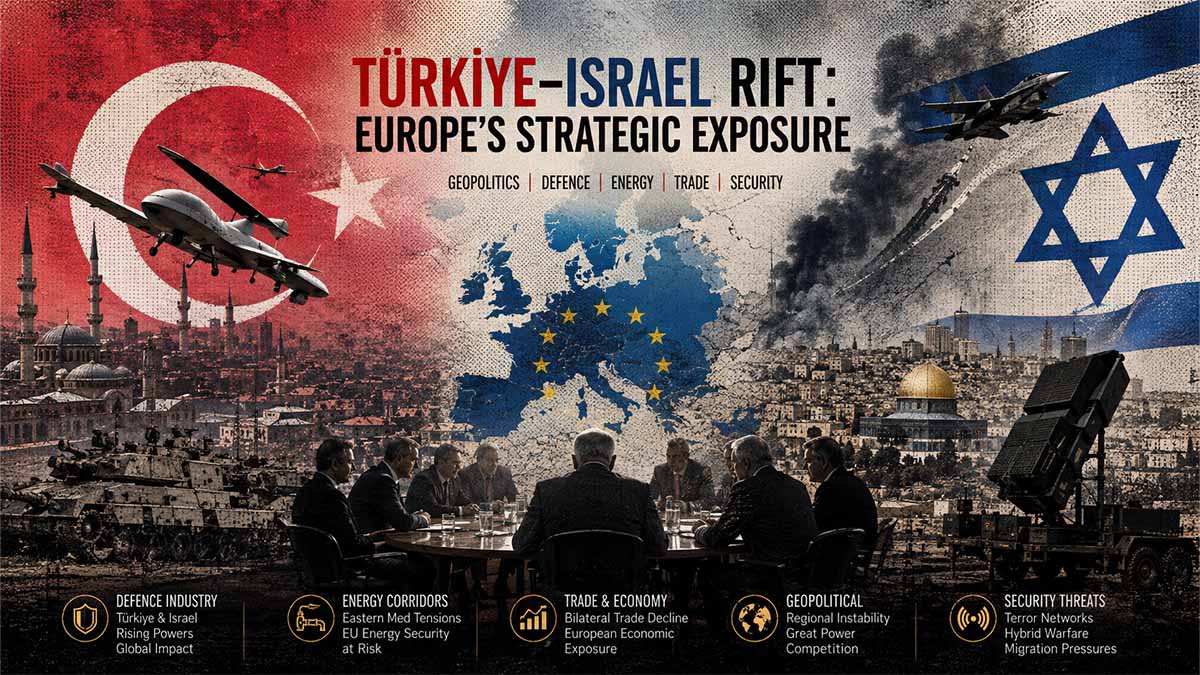
- BLUF: the Türkiye–Israel confrontation is evolving from a Gaza-centred diplomatic rupture into a broader contest over security architecture, political legitimacy and strategic influence across the Eastern Mediterranean and Europe.
- Türkiye possesses unusually strong bargaining assets: NATO’s second-largest army, control of the Turkish Straits, a rapidly expanding defence-industrial base, migration leverage and deep integration with the EU market.
- Yet “Turkish domination of Europe” is not supported as a literal baseline forecast; the stronger proposition is selective Turkish leverage over European decision-making where geography, migration, defence production and regional access intersect.
- The 18 May 2026 Global Sumud Flotilla interception is officially confirmed. Türkiye described the Israeli intervention in international waters as unlawful and demanded the immediate release of participants from roughly 40 countries.
- The reported Turkish request for an Interpol Red Notice against Benjamin Netanyahu and Afek Moskovitch is excluded from the evidentiary baseline because no directly accessible Turkish judicial or Justice Ministry primary document confirming that precise action was located during this verification pass.
- Separately, the ICC warrant against Netanyahu is unquestionably confirmed: it was issued on 21 November 2024 for alleged war crimes and crimes against humanity; the ICC does not list genocide among the charges contained in that warrant.
- Ankara’s leverage is increasingly industrial as well as geopolitical: official Turkish data put 2025 defence and aerospace exports at US$10.054 billion, against US$248 million in 2002, with more than 1,400 defence projects under way.
- Simultaneously, Turkish dependence on Europe remains structural: the EU absorbed 41% of Turkish goods exports in 2024, supplied 32.1% of imports, and bilateral goods trade approached €210 billion.
- Five-year baseline: a durable competitive coexistence between Türkiye and Israel is considerably more probable than either normalization or direct interstate war.
- The principal European risk is therefore not Turkish conquest but strategic dependency without political convergence.
Türkiye and Israel: The Contest Reshaping Europe’s Southern Flank
The rupture between Türkiye and Israel is no longer a bilateral diplomatic quarrel. It is becoming a contest over who shapes the security order stretching from Gaza and Syria to the Eastern Mediterranean, the Black Sea and Europe’s defence-industrial system. Ankara enters this confrontation with instruments that Europe cannot ignore: NATO’s second-largest army, control of the Turkish Straits, a fast-growing defence industry, migration-management capacity, energy corridors and a Customs Union that binds Turkish manufacturing deeply to the EU. Yet that same economic integration limits Ankara’s freedom of coercion. The strategic question for Europe is therefore not whether Türkiye can “dominate” the continent, but whether European fragmentation can allow Ankara to convert indispensable geography into durable political leverage.
The rupture becomes structural
The Gaza war accelerated a deterioration that now reaches far beyond Palestinian diplomacy. On 3 August 2026, Türkiye, Egypt and Qatar, acting as mediators, jointly accused Israel of violations in Gaza that threatened implementation of the agreed political process. Three days later, Türkiye joined Egypt, Indonesia, Jordan, Pakistan, Qatar, Saudi Arabia and the United Arab Emirates in another formal statement calling for international action over Israeli conduct. These are not isolated Turkish declarations: Ankara is increasingly positioning itself inside an organized diplomatic coalition designed to influence the post-war Palestinian settlement.
Joint Statement Issued by the Mediators: The Republic of Türkiye, the Arab Republic of Egypt, and the State of Qatar – Republic of Türkiye Ministry of Foreign Affairs – 03/08/2026.
Joint Statement on the Ongoing Israeli Violations in the Gaza Strip – Republic of Türkiye Ministry of Foreign Affairs – 06/08/2026.
The confrontation is even more consequential in Syria. On 20 March 2026, the Turkish Foreign Ministry condemned an Israeli attack on military infrastructure in southern Syria as a “dangerous escalation”; on 29 June 2026, it condemned attacks on Quneitra and Daraa, invoking Syrian sovereignty and the 1974 Separation of Forces Agreement. Ankara is therefore linking its Israel policy to the reconstruction of a territorially unified Syrian state. Israel’s security doctrine, by contrast, is built around retaining the ability to neutralize threats beyond its borders. The collision is strategic: Türkiye seeks sovereign consolidation in Syria; Israel seeks freedom of action when it judges Syrian territory to pose a security threat.
Regarding Israel’s Attack in Southern Syria – Republic of Türkiye Ministry of Foreign Affairs – 20/03/2026.
Regarding Israel’s Attacks in Syria – Republic of Türkiye Ministry of Foreign Affairs – 29/06/2026.
Ankara’s geopolitical multiplier
Türkiye’s strength lies less in any single capability than in the simultaneous possession of several scarce assets. NATO stated on 6 July 2026, immediately before the Ankara Summit, that Türkiye regulates navigation between the Mediterranean and Black Sea through the Turkish Straits and fields the Alliance’s second-largest army. Geography gives Ankara a position that neither Brussels nor another European capital can reproduce.
Welcome to Ankara – North Atlantic Treaty Organization – 06/07/2026.
This leverage has become more valuable as NATO rearmament shifts from political commitments to industrial programmes. On 7 July 2026, Denmark, France, Italy, Norway, Türkiye and the United Kingdom launched a multinational NATO project for new ground-based precision-strike capabilities, including launchers and missiles. On the same date, Türkiye joined Canada, Czechia, Denmark, Finland, Greece, Norway, Slovakia and Sweden in work toward a generic interoperable 155 mm NATO artillery round. NATO Deputy Secretary General Radmila Shekerinska stated that the strike initiatives announced in Ankara were worth approximately US$1.6 billion.
Allies Meet Strike Capability Requirements with Multinational Initiatives – North Atlantic Treaty Organization – 07/07/2026.
For Italy, France and the United Kingdom, Türkiye is therefore becoming not only a geopolitical interlocutor but a participant in precisely those industrial fields that Europe considers critical: long-range fires, ammunition scalability and interoperable weapons production.
The industrial transformation
The transformation of Turkish defence production is measurable. Türkiye’s Presidency of Defence Industries reported on 12 January 2026 that defence and aerospace exports reached a record US$10.054 billion in 2025. The same institution states that exports were US$248 million in 2002, while the current portfolio of defence programmes, including those still in tender, exceeds approximately US$100 billion and encompasses more than 1,400 projects.
Türk Savunma Sanayiinde Bu Hafta Neler Oldu? – Presidency of Defence Industries – 12/01/2026.
Sayılarla Türk Savunma Sanayii – Presidency of Defence Industries – 2026.
This matters strategically because European rearmament is creating demand faster than sovereign industrial capacity can be expanded in several categories. Turkish manufacturers can therefore become suppliers, partners or competitors in European programmes. But Brussels has already created a counterweight. The EU’s SAFE instrument, adopted on 27 May 2025, provides up to €150 billion for common defence procurement. For eligible products, components originating outside the EU, EEA-EFTA states and Ukraine may generally represent no more than 35% of estimated component costs; more sensitive capabilities—including air and missile defence, drones, maritime systems, C4ISTAR, artificial intelligence and electronic warfare—face additional control requirements.
SAFE: Council Adopts €150 Billion Boost for Joint Procurement on European Security and Defence – Council of the European Union – 27/05/2025.
Europe is therefore pursuing two apparently contradictory objectives: use Turkish capacity when speed and scale are essential, while preventing strategic dependence on technology controlled outside the EU industrial base.
The economic constraint
The most important limit on Turkish coercive power is economic. European Commission figures show that EU–Türkiye goods trade reached a record €217.6 billion in 2025. EU exports to Türkiye amounted to €114.3 billion, while imports from Türkiye reached €103.3 billion. Crucially, 42.7% of all Turkish goods exports went to the EU and 35.3% of Turkish goods imports originated there. Türkiye was the EU’s fifth-largest goods trading partner, accounting for 4.2% of Union trade in goods with the world.
EU Trade Relations with Türkiye – European Commission – 2026.
This asymmetry defines Ankara’s ceiling. Türkiye can exploit European security dependence, but a prolonged confrontation with Brussels would threaten the market on which a large part of Turkish manufacturing depends. The Customs Union strengthens Türkiye commercially while exposing it to EU standards, competition rules, customs policy and technical legislation. Ankara has leverage over European security geography; Brussels retains leverage over the economic environment in which Turkish industry operates.
That is why the most plausible Turkish strategy is not separation from Europe, but maximum autonomy inside maximum interdependence.
Migration as strategic exposure
Migration remains another channel where European vulnerability and Turkish dependence coexist. The European Commission’s July 2026 implementation report records substantial continuing EU financial commitments to refugees and migration management in Türkiye. Following earlier Facility expenditure, the EU mobilised €3 billion for 2021–2023 and a further €2 billion for 2024–2027. By the end of 2025, €1.311 billion had already been allocated under the latest support architecture, including €839 million for essential needs, healthcare and education, €150 million for voluntary returns and €161 million for border management.
Annual Report on the Facility for Refugees in Turkey – European Commission, COM(2026) 371 – 16/07/2026.
Migration therefore remains a form of strategic exposure for Europe, particularly for Greece, Germany and countries further along the Schengen system. But it is not unlimited Turkish leverage: Europe is investing directly in border management, returns and institutional resilience, while Türkiye itself bears the economic and social burden of hosting refugees.
Energy and corridors
Türkiye’s geographic importance extends to energy. The European Commission states that around 10% of EU gas imports reach the Union at land borders with Türkiye and that the Turkish electricity system is synchronized with continental Europe, with approximately 2.2 GW of interconnection capacity with Bulgaria and Greece.
EU–Türkiye Energy Cooperation – European Commission – 2026.
Türkiye is consequently both an energy consumer and a transit platform. Its value increases as Europe diversifies supply away from Russia and expands links toward Azerbaijan and the wider Caspian region. But again, the leverage is bounded: LNG capacity, alternative corridors and European infrastructure investment prevent Türkiye from acquiring monopoly power.
This recurring pattern—critical relevance without exclusive control—is the essential feature of Ankara’s European strategy.
Italy, France, Germany and Britain
The major European powers do not see Türkiye through the same lens. Italy combines Mediterranean security, Libya, migration, energy and industrial interests. Foreign Minister Antonio Tajani, Prime Minister Giorgia Meloni and Defence Minister Guido Crosetto were in Ankara for the NATO Summit on 7 July 2026, where defence-industrial reinforcement, Ukraine and Middle Eastern security were central agenda items.
Il Ministro Tajani ad Ankara per il Vertice NATO – Italian Ministry of Foreign Affairs and International Cooperation – 07/07/2026.
France combines cooperation with Türkiye inside NATO projects with a stronger emphasis on European strategic autonomy and Eastern Mediterranean balances. Germany faces the deepest commercial and migration interdependence and therefore has powerful incentives to preserve functional relations. The United Kingdom, outside the EU but inside NATO, has greater freedom to construct bilateral defence partnerships without being constrained by the full architecture of EU procurement rules.
This fragmentation is itself an instrument of Turkish power. Ankara does not need to persuade “Europe” as a single actor if it can negotiate separately with governments whose priorities diverge.
Israel changes the equation
The deterioration with Israel makes this European fragmentation strategically more significant. Türkiye now presents itself simultaneously as a NATO power, Gaza mediator, supporter of Syrian sovereignty and critic of Israeli military operations. Israel, meanwhile, is embedded in important European security and technological relationships. European states therefore risk finding themselves connected industrially and militarily to both sides of an increasingly durable regional rivalry.
The danger is not necessarily a direct Türkiye–Israel war. It is the progressive institutionalisation of competing security networks: Turkish influence through NATO geography, Syria, defence production and regional diplomacy; Israeli influence through technology, intelligence cooperation, missile defence and European partnerships.
A confrontation that began around Gaza can therefore migrate into procurement decisions, Syrian airspace, Mediterranean maritime policy and European industrial strategy.
The European test
Between now and 2031, Türkiye’s influence will depend on one variable above all others: European substitutability. Where Europe cannot rapidly replace Turkish geography, industrial capacity, transit infrastructure or migration cooperation, Ankara possesses genuine coercive leverage. Where the EU can diversify suppliers, expand domestic defence production, strengthen borders and maintain political unity, that leverage declines.
The evidence does not support the proposition that Türkiye is positioned to acquire formal political dominance over Europe. It does support a more sophisticated and strategically important conclusion: Ankara can increasingly influence the cost, timing and feasibility of European decisions without controlling their ultimate direction.
That distinction should guide policy. Europe gains nothing from treating Türkiye as either an unquestioned ally or an inevitable adversary. The rational objective is deeper cooperation where Turkish capabilities strengthen European security, coupled with deliberate redundancy where dependence could become political vulnerability.
Türkiye’s rise is real. Its leverage is growing. But whether that leverage becomes European weakness will be decided principally in European capitals.
Navigational Index
Pillar I — Türkiye–Israel Strategic Confrontation
The transformation of bilateral hostility from diplomatic disagreement into a durable competition involving Gaza, Syria, the Eastern Mediterranean, maritime jurisdiction, intelligence, defence technology, Palestinian diplomacy and competing regional security architectures.
Pillar II — Türkiye’s European Leverage Architecture
NATO weight, Turkish Straits access, migration management, Customs Union dependence, defence-industrial penetration, energy and logistics corridors, the Balkans, Cyprus and Ankara’s ability to exploit differences among European governments without acquiring formal control over European policy.
Pillar III — 2026–2031 Strategic Scenarios
Five competing hypotheses, Bayesian updating, escalation indicators, defence-industrial consequences, European vulnerability pathways and a five-year probability architecture distinguishing coercive leverage from political dominance.
Master Abstract
The immediate Türkiye–Israel rupture must first be stripped of two analytical distortions: treating every Turkish escalation as evidence of a predetermined plan to dominate Europe, and treating the dispute as merely another episode in the Gaza conflict. Neither proposition adequately describes the strategic system developing in 2026. The confirmed factual baseline is already significant. On 18 May 2026, Türkiye’s Ministry of Foreign Affairs condemned Israel’s intervention against the Global Sumud Flotilla, describing the operation as occurring in international waters and demanding the unconditional release of participants; a separate joint declaration involving Türkiye, Spain, South Africa, Brazil, Indonesia, Jordan and other governments similarly characterized the flotilla as a civilian humanitarian initiative and challenged Israeli conduct under international law. Regarding the Intervention by Israeli Forces Against the Global Sumud Flotilla – Republic of Türkiye Ministry of Foreign Affairs – May 2026 — Verified official source. Joint Statement Regarding the Israeli Assaults on the Global Sumud Flotilla – Republic of Türkiye Ministry of Foreign Affairs – May 2026 — Verified official source. The political significance lies less in the flotilla itself than in Ankara’s systematic conversion of the Gaza issue into a platform for international coalition formation and juridical pressure. At the same time, evidentiary discipline matters. The specific assertion that Turkish Justice Minister Akın Gürlek has issued or formally announced an international arrest warrant or Interpol Red Notice against Benjamin Netanyahu and Afek Moskovitch could not be corroborated during this session on the Turkish Ministry of Justice or another directly accessible Turkish judicial primary source; secondary reporting exists, but it is deliberately excluded under the source hierarchy specified for this report. By contrast, the separate ICC proceeding is authoritative and precise: on 21 November 2024, Pre-Trial Chamber I issued warrants against Netanyahu and Yoav Gallant after finding reasonable grounds concerning the war crime of starvation as a method of warfare, intentionally directing attacks against civilians, and the crimes against humanity of murder, persecution and other inhumane acts. Situation in the State of Palestine – International Criminal Court – November 2024 — Verified ICC decision summary. Critically, the ICC document does not charge Netanyahu with genocide. That distinction is legally indispensable because political rhetoric, national criminal proceedings, proceedings before the International Court of Justice and an ICC arrest warrant are separate mechanisms with different jurisdictional thresholds and evidentiary standards.
Türkiye’s capacity to transform confrontation with Israel into leverage over Europe derives from a structural portfolio that few states outside the EU possess. NATO itself stated ahead of its 7–8 July 2026 Ankara Summit that Türkiye regulates access between the Mediterranean and Black Sea through the Turkish Straits and fields the second-largest army in NATO. Welcome to Ankara – NATO – July 2026 — Verified NATO source. Ankara combines that geography with an industrial transformation whose scale is no longer marginal: Türkiye’s Presidency of Defence Industries reports defence and aerospace exports rising from US$248 million in 2002 to US$10.054 billion in 2025, an approximately forty-fold increase, while the nominal portfolio of current and tender-stage defence programmes exceeds US$100 billion and the number of projects exceeds 1,400. Savunma Sanayii 360 – Presidency of Defence Industries – 2026 — Verified SSB source. Ankara therefore enters disputes with Israel not simply as a diplomatic actor but as an increasingly autonomous producer of UAVs, missiles, electronics, naval platforms, aerospace systems and other military capabilities. Nevertheless, this growth should not be confused with freedom from Europe. European Commission figures show that in 2024 the EU remained Türkiye’s largest trading partner: 41% of Turkish goods exports went to the EU, 32.1% of imports originated there, bilateral trade approached €210 billion, and EU foreign-direct-investment flows were €5.33 billion in 2023. Türkiye 2025 Factsheet – European Commission – 2026 — Verified European Commission source. The same Commission assessment says Ankara pursues strategic autonomy and records very low alignment with EU Common Foreign and Security Policy positions. This combination is strategically exceptional: economic integration without geopolitical alignment. It gives Europe considerable economic influence over Türkiye while simultaneously giving Ankara leverage over Europe in security, migration and regional access. Migration makes the interdependence still more concrete. EU institutions report that Türkiye currently hosts more than 2.3 million Syrians plus more than 300,000 other refugees and asylum seekers, while EU assistance directed toward refugees and host communities since 2011 has approached €12.4 billion. EU Support to Refugees in Türkiye – European Commission – 2026 — Verified European Commission source. The appropriate strategic concept is therefore not Turkish dominance but asymmetric mutual dependence: Brussels possesses greater economic mass and regulatory power; Ankara possesses geographically concentrated leverage whose value rises sharply during crises.
The five-year outlook from August 2026 through August 2031 consequently turns on whether Türkiye chooses to monetize those concentrated advantages through transactional bargaining or transform them into a sustained revision of the regional order. Five competing hypotheses are retained rather than assuming Turkish intent. H₁ — Strategic Primacy Strategy: Ankara deliberately exploits defence autonomy, migration, NATO geography, Muslim-world leadership and European fragmentation to maximize Turkish agenda-setting power in Europe and the Mediterranean. H₂ — Transactional Strategic Autonomy: Türkiye seeks neither European subordination nor permanent confrontation but systematically raises the price of cooperation, switching alignment according to sector and crisis. H₃ — Regional Counter-Israel Balancing: anti-Israel policy is principally directed toward shaping the Middle Eastern balance, Palestinian diplomacy and Ankara’s position vis-à-vis Arab powers, with European consequences remaining secondary. H₄ — Domestic–External Fusion: ideological positioning, electoral legitimacy, institutional centralization and foreign-policy activism reinforce one another, periodically producing sharper external confrontations than material interests alone would predict. H₅ — Competitive Coexistence: Türkiye and Israel remain strategic competitors but avoid direct interstate conflict because NATO relationships, US pressure, trade, Syrian deconfliction requirements and escalation costs constrain both sides. The present Bayesian weighting assigns approximately 22% to H₁, 31% to H₂, 17% to H₃, 12% to H₄ and 18% to H₅ as primary explanatory models, while recognizing substantial overlap among them; this is an analytical posterior, not an observed statistic. A separate five-year outcome model gives 55% to prolonged managed rivalry, 23% to intensified proxy/indirect confrontation centred on Syria and the Eastern Mediterranean, 14% to partial transactional normalization, 6% to severe bilateral rupture involving sustained military coercion below war, and only 2% to direct sustained interstate hostilities. The critical European variable is defence-industrial integration. The EU’s SAFE instrument provides up to €150 billion for common defence procurement and permits additional agreements with third states subject to eligibility rules, while imposing a ceiling under which components originating outside the EU, EEA-EFTA and Ukraine generally cannot exceed 35% of estimated end-product component cost. SAFE: Council adopts €150 billion boost for joint procurement – Council of the European Union – May 2025 — Verified Council source. This creates a decisive strategic tension for Ankara: Türkiye can become increasingly important to European defence without becoming structurally indispensable if Europe deliberately preserves technological sovereignty. Conversely, if European states fragment procurement, depend excessively on Turkish UAV, missile, ammunition or platform capacity, allow migration management to remain crisis-driven, and fail to coordinate policies toward Syria, Cyprus and the Eastern Mediterranean, Ankara’s bargaining leverage could rise much faster than its aggregate economic weight. The resulting 2031 risk is therefore best defined as European strategic exposure to Turkish veto, access and substitution power, not Turkish political control of Europe.
Structural Analytic Baseline
The source audit also produces three important negative findings. First, no qualifying Russian-government or Chinese-government primary source located during this pass materially altered the Türkiye–Israel assessment; because the methodology prohibits substituting commentary for evidence, no Russian or Chinese secondary interpretation has been imported merely to satisfy geographic diversity. Second, Türkiye’s own diplomatic language is highly adversarial toward the Netanyahu government. On 2 August 2026, the Turkish Foreign Ministry accused the Israeli government of destabilizing the regional balance and called for a firmer international response. Regarding Israel’s Attacks on Gaza – Republic of Türkiye Ministry of Foreign Affairs – August 2026 — Verified Turkish MFA source. This establishes Ankara’s official political position but does not independently prove the factual or legal allegations contained in that political statement. Third, Europe and Türkiye are simultaneously moving toward renewed functional cooperation. On 6 February 2026, Foreign Minister Hakan Fidan and EU Enlargement Commissioner Marta Kos jointly reaffirmed Türkiye’s candidate status, the strategic significance of EU–Türkiye relations, work toward improved Customs Union implementation, cooperation on migration and security, renewed European Investment Bank engagement and the continuing importance of rule-of-law dialogue. Joint Statement by Hakan Fidan and Marta Kos – European Commission – February 2026 — Verified European Commission source. This coexistence of adversarial strategic autonomy and dense functional integration is precisely why a binary “Türkiye against Europe” model is analytically inadequate: Ankara obtains maximum leverage not by breaking with Europe, but by remaining sufficiently integrated to matter while sufficiently autonomous to withhold cooperation.
Türkiye–Israel Strategic Pressure System
Pillar I — Türkiye–Israel Strategic Confrontation: From Diplomatic Rupture to a Regional Security Contest, 2026–2031
The confrontation between Türkiye and Israel has crossed an analytical threshold: it can no longer be modelled primarily as a cyclical diplomatic dispute whose intensity rises and falls with events in Gaza. By August 2026, the observable system contains at least seven mutually reinforcing theatres—Gaza, Syria, Palestinian political representation, the Eastern Mediterranean, maritime jurisdiction, defence-industrial competition and the construction of alternative regional security architectures—and each theatre increasingly influences the others. The strongest primary-source evidence of this transformation comes from Ankara itself. On 9 April 2026, Foreign Minister Hakan Fidan, speaking alongside Syrian Foreign Minister Asaad Hassan Al-Shaibani, explicitly argued for a new regional security architecture based on sovereignty, territorial integrity and “regional ownership”, while simultaneously identifying what he called Israeli “expansionism” as incompatible with lasting regional stability. This is strategically more important than another diplomatic condemnation because it reveals an alternative ordering principle: Ankara is no longer merely demanding changes in Israeli behaviour; it is articulating a regional system in which Türkiye expects to participate in designing the security rules governing Syria, Palestine, Iran-Gulf relations and post-war reconstruction. Joint Press Conference by Foreign Minister H.E. Hakan Fidan with Foreign Minister of Syria H.E. Asaad Hassan Al-Shaibani – Republic of Türkiye Ministry of Foreign Affairs – April 2026. Israel’s own strategic language points in the opposite direction. In July 2026 Prime Minister Benjamin Netanyahu described the post-7 October Israeli security concept as one based on initiative, forward action and moving Israel’s defensive perimeter outward, stating rhetorically that the “Golan envelope” was now inside Syria. That statement is not a legal definition of Israeli territorial policy, but it is highly significant operational doctrine because it signals continuing preference for forward threat suppression rather than reliance on neighbouring governments or international security arrangements. PM Netanyahu’s Remarks at the 2026 Negev Conference in Dimona – Prime Minister’s Office – July 2026. The bilateral contradiction is therefore structural. Ankara’s preferred order requires restoration of Syrian sovereign control and restraint of unilateral Israeli military action; Israel’s emerging doctrine requires the capacity to penetrate or control security space beyond its borders whenever Jerusalem assesses neighbouring territory as a source of unacceptable threat. The most important judgment for 2026–2031 is consequently that neither state must intend war for recurrent strategic collision to become normal. Their security doctrines can produce conflict simply because each side’s preferred regional architecture constrains the other’s freedom of action.
Syria is the highest-risk transmission belt between political hostility and military escalation because Turkish and Israeli strategic requirements overlap geographically while diverging conceptually. Türkiye’s position is unambiguous in its official communications: after Israeli attacks on Quneitra and Daraa in June 2026, the Turkish Foreign Ministry described the strikes as violations of Syria’s territorial integrity, unity and sovereignty and invoked the 1974 Separation of Forces Agreement. Regarding Israel’s Attacks in Syria – Republic of Türkiye Ministry of Foreign Affairs – June 2026. A similar statement followed an Israeli attack on military infrastructure in southern Syria on 20 March, when Ankara called the episode a dangerous escalation and declared continued support for the Syrian government’s efforts to restore stability across a unified state. Regarding Israel’s Attack in Southern Syria – Republic of Türkiye Ministry of Foreign Affairs – March 2026. Israel’s security rationale is almost the mirror image. Its Foreign Ministry had already declared in December 2024 that Israeli intervention in the separation area was required because armed groups entering the zone created a potential threat comparable, in Israeli assessment, to the vulnerabilities exposed on 7 October; Jerusalem described the operation at that time as limited, temporary and defensive. MFA Spokesperson Press Release – State of Israel Ministry of Foreign Affairs – December 2024. By January 2026, however, official IDF reporting showed Israeli forces conducting operational activity and collecting intelligence in southern Syria while Division 210 remained deployed in the area. Hasmonean Brigade Operational Activity in Syria – Israel Defense Forces – January 2026. At the same time, Israel and Syria restarted US-backed political talks in January 2026, with Israel emphasizing border security, threat prevention and protection of the Druze population. Prime Minister’s Office: Political Dialogue Between Israel and Syria Renewed with US Support – Prime Minister’s Office – January 2026. The coexistence of negotiation and military penetration is critical: it means diplomatic contacts do not eliminate kinetic risk. The five-year danger is instead an emergent tripwire geometry in southern Syria, in which Turkish-backed Syrian state consolidation, Israeli forward defence, local armed actors, minority-security questions and residual extremist networks intersect. A direct Turkish–Israeli engagement would still require several escalation failures, but a chain beginning with an Israeli strike on Syrian infrastructure, Turkish personnel or systems associated with Syrian rearmament is substantially more plausible than deliberate war initiated from Ankara or Jerusalem.
| Syria collision variable | Türkiye strategic requirement | Israel strategic requirement | 2026–2031 collision potential |
|---|---|---|---|
| Syrian territorial control | Strong centralized sovereignty | Freedom to neutralize threats beyond border | Very High |
| Southern Syrian military infrastructure | Reconstitution under Damascus | Prevent threatening force concentrations | Very High |
| Air-defence deployment | Strengthen Syrian state capacity | Preserve operational air access | High |
| Druze security | Syrian unity and political integration | Explicit Israeli security interest | High |
| Foreign armed groups | Elimination/integration under state | Independent Israeli threat assessment | High |
| Israeli ground presence | Ankara seeks restoration of Syrian sovereignty | Jerusalem views forward presence as security tool | Very High |
Gaza and Palestinian diplomacy form the second strategic layer, but here the objective is less territorial than political: Ankara is attempting to convert the Palestinian issue into diplomatic convening power, legal pressure, reconstruction influence and legitimacy across Arab and Muslim constituencies, while Israel seeks to prevent Hamas and Hamas-associated networks from converting humanitarian mobilization into political or operational advantage. Türkiye’s official position following the Global Sumud Flotilla interception on 18 May 2026 illustrates the mechanism. The Foreign Ministry said Israeli forces had intervened against the flotilla in international waters, stated that participants represented approximately forty countries, demanded their release and announced coordination with foreign governments concerning Turkish citizens. These statements constitute Ankara’s official legal and political characterization; they should not be confused with an international judicial finding on the legality of the interception. Regarding the Intervention by Israeli Forces Against the Global Sumud Flotilla – Republic of Türkiye Ministry of Foreign Affairs – May 2026. More strategically significant is Fidan’s April disclosure that Turkish officials had held extensive discussions with a Hamas delegation and that Türkiye was participating with other mediators in the implementation architecture surrounding Gaza. Joint Press Conference by Foreign Minister H.E. Hakan Fidan with Foreign Minister of Syria H.E. Asaad Hassan Al-Shaibani – Republic of Türkiye Ministry of Foreign Affairs – April 2026. This places Ankara in a category distinct from most NATO members: Türkiye seeks simultaneously to remain inside the Western security architecture and to maintain political access to actors whom several Western partners treat primarily through counter-terrorism frameworks. Legal confrontation reinforces that divergence. The International Criminal Court issued an arrest warrant for Netanyahu on 21 November 2024 on allegations concerning war crimes and crimes against humanity, including starvation as a method of warfare, intentionally directing an attack against civilians, murder, persecution and other inhumane acts. The ICC warrant does not list genocide among the charges contained in that warrant, a distinction necessary when separating judicial facts from political accusations. Situation in the State of Palestine: ICC Pre-Trial Chamber I Issues Warrants of Arrest – International Criminal Court – November 2024. For Türkiye, international legal mechanisms, flotilla diplomacy and Palestinian mediation are mutually reinforcing instruments. For Israel, the same network can be perceived as strategic pressure designed to constrain freedom of action and delegitimize Israeli security policy. This divergence makes Gaza a persistent bilateral accelerator even under ceasefire conditions.
The Eastern Mediterranean converts the Türkiye–Israel confrontation into an explicitly European security problem because bilateral competition interacts with Greece, Cyprus, maritime boundaries, energy connectivity and defence procurement. The European Union’s own strategic documents continue to describe the Eastern Mediterranean as strategically important to EU security while emphasizing the requirement for cooperative frameworks, international law, progress on the Cyprus settlement and a phased, proportionate and reversible relationship with Türkiye; the EU also reiterates its expectation that Ankara commit to good-neighbourly relations and renounce threats of force. Council Conclusions on EU Priorities in International Fora – Council of the European Union – July 2026. This is not abstract diplomatic language. Israel is simultaneously expanding defence cooperation with Greece: in April 2026 the Israeli Ministry of Defense announced an approximately US$750 million, roughly €650 million, agreement to provide Greece with Elbit Systems’ PULS rocket artillery system, explicitly describing the transaction as evidence of growing Israeli–Greek defence cooperation. Landmark Defense Deal During Wartime: Israel MOD to Supply Advanced Elbit Systems PULS Rocket Artillery System to Greece – Israel Ministry of Defense – April 2026. The strategic implication is greater than the acquisition of a single weapons system. Every major Israeli defence programme embedded in Greece increases interoperability, institutional contact, logistics familiarity, training relationships and potentially long-term maintenance dependencies between Israel and a state with persistent strategic disputes with Türkiye. This does not create an automatic Israel–Greece anti-Türkiye alliance, nor should ordinary defence trade be misrepresented as encirclement. It does, however, change the opportunity structure confronting Ankara. Israeli defence technology can strengthen military partners located directly inside Türkiye’s contested strategic environment, while Turkish defence exports and naval modernization allow Ankara to offer an alternative security ecosystem to other regional customers. The older maritime dispute remains relevant: the European Council formally maintained that the Türkiye–Libya memorandum delimiting maritime jurisdictions infringes sovereign rights of third states, is inconsistent with the law of the sea and cannot create legal consequences for third countries. European Council Conclusions – European Council – June 2025. Consequently, Gaza may trigger political escalation, but the Eastern Mediterranean can institutionalize it by linking political rivalry to armaments, maritime jurisdiction and European alliance choices.
Türkiye–Israel Competition System • Gaza Mediation, Regional Security Order & 2031 Outcome Space
Gaza Root: Palestinian Legitimacy & Diplomatic Competition
The primary catalyst of bilateral friction. The conflict in Gaza drives acute diplomatic competition over Palestinian legitimacy, humanitarian mediation, and regional leadership between Ankara and Tel Aviv, establishing the baseline hostility for the 2026–2031 cycle.
Defence technology is becoming a strategic multiplier because both countries possess export-oriented defence sectors large enough to translate regional policy into durable international relationships. Türkiye’s Presidency of Defence Industries reports that Turkish defence and aerospace exports expanded from US$248 million in 2002 to US$10.054 billion in 2025, while the value of the national defence-project portfolio, including projects in tender, exceeded approximately US$100 billion and the number of projects surpassed 1,400. Savunma Sanayii 360 – Presidency of Defence Industries – 2026. Israel is operating at an even larger export scale. The Israeli Ministry of Defense reported US$19.2 billion in defence export agreements in 2025, nearly 30% above 2024, with approximately US$10 billion in government-to-government agreements; missiles, rockets and air-defence systems represented 29% of deal value, while observation and optronics accounted for 22%. All-Time Defense Export Record: Israel Crosses the $19 Billion Threshold – Israel Ministry of Defense – June 2026. Israel’s ministry explicitly links defence exports to foreign-policy objectives and financing force development. This matters because arms exports in this competition should be treated not simply as commercial flows but as strategic relationship capital: procurement creates training, data, software, maintenance, munitions and doctrine dependencies that often survive diplomatic cycles. Over the next five years, Turkish and Israeli defence ecosystems are therefore likely to compete indirectly for influence across Europe, the Balkans, Central Asia, the Gulf, Africa and potentially post-war Syria. The competitive domains will include UAVs and counter-UAS, precision fires, integrated air and missile defence, electronic warfare, optronics, secure communications and autonomous systems. A crude comparison of export totals would be misleading because Israel and Türkiye occupy different technological niches and supply-chain positions; the analytically relevant question is where their respective systems become embedded in countries important to the other’s security architecture. The Greek PULS agreement is therefore a more meaningful strategic indicator than global market share alone. Likewise, Turkish defence penetration into states surrounding the Eastern Mediterranean or in a reconstructed Syria would matter to Israel far more than equivalent exports to geographically distant markets. Defence-industrial competition is thus both an economic and geopolitical shadow war—one unlikely to appear in declarations of hostility but capable of changing regional balances cumulatively by 2031.
| Defence-industrial indicator | Türkiye | Israel | Strategic meaning |
| 2025 defence/aerospace export value | US$10.054bn | US$19.2bn | Both possess export scale sufficient for geopolitical leverage |
| Long-term trend | ~40× Turkish growth from 2002 | >2× Israeli growth in five years | Rapid strategic-industrial expansion |
| High-value portfolio | >US$100bn Turkish project volume | ~US$10bn Israeli GTG agreements in 2025 | State-backed ecosystem formation |
| High-sensitivity domains | UAVs, missiles, naval, EW, aerospace | air defence, missiles, optronics, EW | Increasing overlap |
| Most consequential bilateral effect | Syrian/regional penetration | Greece/European integration | Competitive security networks |
The geopolitical balance should nevertheless not be interpreted as a simple two-state contest. The European Union, United States, Arab governments, China and the emerging Syrian authorities act as constraints, amplifiers and potential brokers, and the evidence does not support the assumption that Ankara can unilaterally impose its preferred architecture. The European Commission’s Türkiye Report 2025 records deep divergences between Ankara and EU foreign-policy positions while simultaneously confirming Türkiye’s strategic importance, illustrating the fundamental paradox governing Europe’s relationship with Ankara: high interdependence coexists with limited political alignment. Türkiye Report 2025 – European Commission – November 2025. China’s position is also revealing because Beijing’s official diplomacy converges with Türkiye on some principles without endorsing a Turkish-led order. In March 2026, Foreign Minister Wang Yi told Fidan that China supported Türkiye playing a constructive role in restoring negotiations in the Middle East, while emphasizing dialogue and regional de-escalation. Wang Yi Has a Phone Call with Turkish Foreign Minister Hakan Fidan – Ministry of Foreign Affairs of the People’s Republic of China – March 2026. On Syria, China’s July 2026 Security Council position explicitly demanded respect for Syrian sovereignty, described the Golan Heights as occupied Syrian territory and called upon Israel to cease military operations in Syria and withdraw from Syrian territory. Remarks by Chargé d’Affaires a.i. Ambassador Sun Lei at the UN Security Council Briefing on Syria – Ministry of Foreign Affairs of the People’s Republic of China – July 2026. Earlier Chinese statements in April and May used comparable language concerning Israeli operations and the 1974 agreement. This is strategically useful to Ankara because it broadens international diplomatic support for the sovereignty principle underpinning Türkiye’s Syrian position, but it does not establish a China–Türkiye bloc against Israel. Beijing retains interests with all parties and consistently advocates containment rather than polarization. A dedicated search of Russian-government primary sources was also conducted for this section; no directly relevant, currently verifiable Russian official source meeting the user’s source restrictions materially altered the specific Türkiye–Israel bilateral assessment, and Russian secondary commentary has therefore been excluded rather than used to fill an evidentiary gap. This source asymmetry itself matters: multilingual sourcing should test hypotheses, not manufacture symmetry where primary evidence is absent.
The structural-analysis layer produces five competing explanations for the rivalry. H₁ — Regional Primacy Competition holds that Ankara increasingly seeks to displace Israel as one of the principal rule-setting powers in the post-Iran-war and post-Gaza Middle East by organizing security around sovereignty, regional ownership and Turkish diplomatic centrality. H₂ — Security-Dilemma Collision proposes that neither side primarily seeks supremacy over the other; rather, Israeli forward defence and Turkish support for consolidated Syrian sovereignty generate mutually threatening actions even when each government describes its policy as defensive. H₃ — Gaza-Dominant Political Rivalry interprets the confrontation mainly through Palestinian diplomacy, public legitimacy and Türkiye’s relationship with Hamas, predicting substantial de-escalation if Gaza stabilizes politically. H₄ — Eastern Mediterranean Bloc Formation argues that Israel’s deepening relationships with Greece and other European partners, combined with Türkiye’s maritime disputes and defence-industrial expansion, are creating competing strategic networks whose significance will outlast Gaza. H₅ — Managed Transactional Rivalry assumes that rhetoric will remain severe but that US mediation, trade interests, NATO constraints, Syria negotiations and the prohibitive cost of war will prevent confrontation from crossing the interstate-war threshold. Applying a Bayesian update to evidence through 21 August 2026, I assign primary explanatory weights of H₁ 24%, H₂ 30%, H₃ 12%, H₄ 18%, H₅ 16%. These numbers are analytical estimates rather than empirical frequencies and should not be confused with observed statistics. The most important update since the previous baseline is the rise of H₂: Israeli forward-defence doctrine, IDF activity inside Syria, repeated Turkish condemnations and Ankara’s explicit ambition to anchor a sovereignty-based regional architecture all increase the probability that friction can be generated by incompatible security requirements rather than deliberate strategic aggression. H₃ falls because competition has already expanded beyond Gaza. H₄ rises because defence links such as the Greek PULS procurement institutionalize rivalry outside the Palestinian theatre. H₅ remains meaningful because Israel and Syria are simultaneously negotiating, demonstrating that military action and diplomacy can coexist. A Monte Carlo-style synthetic scenario model using uncertainty ranges for Syrian stabilization, Israeli operational tempo, Turkish military involvement, Gaza political settlement, US mediation effectiveness and Eastern Mediterranean military integration produces a modal outcome of persistent rivalry rather than direct war. The analysis therefore rejects both extremes: normalization is too optimistic, while deterministic interstate war is unsupported by current evidence.
| 2026–2031 scenario | Modelled probability | Key trigger structure | Strategic consequence |
| Managed multi-domain rivalry | 48% | Gaza friction + Syrian deconfliction survives | Permanent political hostility, contained kinetic risk |
| Syria-centred indirect escalation | 27% | Israeli strikes intersect Turkish-backed Syrian rearmament | Highest accidental-conflict risk |
| Partial transactional normalization | 12% | Gaza stabilization + US mediation + Syrian arrangement | Cooperation without restored strategic trust |
| Severe bilateral rupture below war | 10% | Personnel casualties, maritime incident or proxy escalation | Diplomatic break, sanctions, military signalling |
| Direct sustained interstate conflict | 3% | Multiple failed deconfliction mechanisms | Major NATO/Eastern Mediterranean crisis |
The shadow dimensions reinforce that judgment but require disciplined treatment because the evidentiary quality is uneven. On irregular armed actors, no qualifying primary-source evidence reviewed for this section establishes a Turkish or Israeli state programme employing mercenary forces directly against the other; therefore “mercenary dynamics” should not be elevated artificially into a confirmed bilateral vector. The relevant observable instead is the dense environment of armed non-state and foreign-fighter networks inside Syria. Chinese official statements repeatedly identify foreign terrorist fighters as a continuing Syrian security threat, while Israel’s 2024 MFA justification for its Syrian intervention referred to jihadist actors near the border. In intelligence terms, this creates attribution compression: an attack by a local armed group, a strike against dual-use infrastructure, or a movement of weapons can be interpreted through the Türkiye–Israel rivalry even when neither state ordered the initiating act. Cyber competition represents a second under-observed pathway. Neither reviewed primary-source corpus supports a claim of a current overt bilateral state cyber campaign, but both countries possess highly developed defence, intelligence and technology ecosystems; cyber operations against logistics, defence contractors, maritime infrastructure or political networks therefore constitute an escalation domain that may remain below publicly attributable thresholds. Liquidity flows are more measurable. Israel’s US$19.2 billion and Türkiye’s US$10.054 billion 2025 defence-export volumes show that both governments can recycle international procurement into industrial capacity and diplomatic relationships. Israel’s Ministry of Defense explicitly states that defence exports support force buildup and foreign-policy objectives, meaning defence-market revenue can indirectly increase future military resilience. The most important early-warning indicators for 2026–2031 are consequently not inflammatory speeches but physical and institutional changes: deployment of Turkish-origin air-defence systems into Syria; Israeli targeting of infrastructure associated with Turkish personnel; permanent Israeli force posture beyond the 1974 separation framework; Turkish naval escort or state protection of future Gaza-bound maritime initiatives; additional major Israeli weapons packages to Greece or Cyprus; intelligence or security arrangements linking Türkiye more deeply with Damascus; Israeli doctrinal changes toward Turkish-supported Syrian forces; and evidence that Washington’s deconfliction capacity is deteriorating. A simultaneous movement in three or more of these indicators would materially increase the posterior probability of H₂ and the severe-rupture scenario.
The five-year strategic conclusion is therefore neither that Türkiye will inevitably dominate the region nor that Israel and Türkiye are destined for war. The stronger evidence supports a more consequential intermediate outcome: a durable adversarial coexistence in which both states attempt to shape the same regional security space through incompatible mechanisms. Türkiye’s mechanism is increasingly architectural—Syrian sovereignty, Palestinian diplomacy, mediation, Muslim-world legitimacy, defence-industrial networks and the claim that regional states rather than external powers should construct the security order. Israel’s mechanism is increasingly operational—forward threat suppression, technological superiority, strategic partnerships, pre-emption, freedom of action and expansion of defence relationships with states able to reinforce its regional position. These mechanisms can coexist during periods of diplomatic restraint but become contradictory when translated into geography. Syria is therefore the dominant escalation node; the Eastern Mediterranean is the dominant alliance and industrial node; Gaza remains the dominant legitimacy and legal node; defence exports constitute the long-duration power multiplier. By 2031, the most probable structure is not an institutionalized Türkiye–Israel cold war comparable to twentieth-century bloc confrontation, because trade, US relationships, indirect diplomatic channels and regional pragmatism will continue generating cross-pressure. It is more accurately described as competitive security interdependence: each country will increasingly consider the other’s partnerships, deployments, diplomatic initiatives and technology transfers when designing policy, even where no formal bilateral mechanism exists. The principal tail risk remains a Syrian escalation in which an Israeli operation causes Turkish casualties or destroys a Turkish-supported strategic capability and Ankara concludes that failure to respond would undermine its regional credibility. Conversely, the principal de-escalation pathway requires an enforceable Syria security mechanism separating Israeli border-security requirements from Syrian sovereign reconstruction, combined with a durable Gaza political framework and continued US mediation. Absent all three, the rivalry is likely to deepen. The evidence through August 2026 therefore supports a 48% probability of managed multi-domain rivalry, 27% of Syria-centred indirect escalation, 12% of partial transactional normalization, 10% of severe rupture below sustained war and 3% of direct interstate conflict. Those probabilities should be updated continuously because a single kinetic event in southern Syria could alter the distribution much faster than conventional diplomatic reporting would suggest.
Pillar II — Türkiye’s European Leverage Architecture: Power Through Interdependence, Geography and European Fragmentation
Türkiye’s leverage over Europe is best understood not as a hierarchy of command but as a system of concentrated strategic dependencies in which Ankara controls or strongly influences a limited number of assets whose value becomes disproportionately high during crises. The architecture rests on NATO membership, control of the Turkish Straits, migration management, industrial integration with the European market, defence production, energy transit, access to the Caucasus and Central Asia, influence in the Western Balkans, and its central role in disputes involving Greece and Cyprus. None of these assets individually allows Türkiye to dictate European policy; collectively, however, they create multiple bargaining channels through which Ankara can raise the political, economic or security cost of European choices. NATO itself supplies the clearest starting point. Ahead of the 7–8 July 2026 Ankara Summit, NATO explicitly described Türkiye as regulating navigation through the Turkish Straits between the Mediterranean and Black Sea, occupying a unique position connecting Europe, Asia and Africa, and possessing the Alliance’s second-largest army. Welcome to Ankara – North Atlantic Treaty Organization – July 2026. Verified NATO source The Ankara Summit itself reinforced a structural trend highly favourable to Turkish influence: NATO is simultaneously increasing European defence spending, industrial production, integrated air and missile defence, long-range precision strike, drones, artificial intelligence, electronic warfare and military mobility. The Ankara Summit Declaration – North Atlantic Treaty Organization – July 2026. Verified NATO declaration This changes the meaning of Türkiye’s NATO membership. Ankara is no longer simply a large southeastern flank contributor; as European inventories are rebuilt and defence-industrial capacity becomes a strategic constraint, Türkiye’s indigenous production base, geographic depth and proximity to the Black Sea, Caucasus and Middle East become increasingly fungible forms of bargaining capital. The important distinction is between formal power and situational leverage. Türkiye cannot order NATO to adopt Turkish policy, but it participates in consensus-based decision-making, controls nationally owned territory and infrastructure necessary for operations in strategically sensitive theatres, and possesses capabilities that become more valuable as European strategic demand grows faster than European supply.
The Turkish Straits form the most geographically concentrated component of that architecture because the Bosporus–Sea of Marmara–Dardanelles system is the maritime hinge between the Black Sea and Mediterranean. NATO’s own 2026 description of Türkiye specifically highlighted Ankara’s role in regulating navigation through the Straits, confirming that this geography is not merely commercial but central to Euro-Atlantic security. The leverage mechanism should nevertheless be defined precisely. Türkiye does not possess unlimited discretionary control over international passage; the legal regime of the Straits constrains Ankara and distinguishes merchant shipping from naval transit. Yet crisis conditions increase the strategic value of interpretation, implementation, monitoring, enforcement and diplomatic signalling around that regime. The post-2022 Black Sea security environment demonstrated the broader structural principle: any European strategy involving Ukraine, Romania, Bulgaria, Georgia, Black Sea maritime security or military reinforcement must incorporate Turkish geography. The result is a classic chokepoint premium. In peacetime, a chokepoint may appear as ordinary transport infrastructure; in war or severe crisis, its political value increases non-linearly because alternatives are costly or nonexistent. This gives Türkiye influence over security calculations far beyond its GDP share or institutional weight in Brussels. It also creates an unusual asymmetry between the EU and NATO. The European Union has major regulatory and economic power over Türkiye but lacks sovereign control over the principal maritime gateway into the Black Sea; NATO possesses military mechanisms but must operate through an ally whose foreign-policy alignment with European capitals is not automatic. Türkiye can therefore maximize leverage by maintaining enough cooperation to remain indispensable while retaining enough strategic autonomy to prevent Europe from treating Turkish support as guaranteed. This is the essence of Ankara’s most effective bargaining model: not exclusion from Western institutions, but deep participation combined with selective non-alignment. The five-year implication is substantial. As the Black Sea remains militarized and European support for Ukraine becomes more institutionalized, the strategic premium attached to Turkish geography is likely to remain elevated through 2031, even if active hostilities decline, because maritime surveillance, reconstruction logistics, mine countermeasures, commercial shipping protection and potential future security guarantees will all preserve the relevance of the Straits.
Migration constitutes a second leverage channel, although it has changed significantly since the peak of the Syrian refugee crisis. The European Commission currently records more than 2.3 million Syrian refugees in Türkiye and more than 300,000 refugees and asylum seekers of other nationalities, while cumulative EU financial support to refugees and host communities in Türkiye since 2011 approaches €12.4 billion. EU Support to Refugees in Türkiye – European Commission – July 2026. Verified European Commission source The original Facility for Refugees mobilised €6 billion between 2016 and 2019, while an additional €6 billion was mobilised for 2020–2027; the 2026 Commission documentation further shows substantial allocations for essential needs, voluntary returns and border management. The strategic importance of these numbers lies not in any simplistic claim that Türkiye can “open the gates” at will. European migration policy has evolved: the EU Pact on Migration and Asylum entered into application in June 2026, Eurodac was expanded and return procedures were strengthened, reducing—but not eliminating—the vulnerability created by external migration corridors. The correct model is therefore managed exposure. Türkiye remains one of the principal buffer, transit and host states separating instability in Syria, Iraq, Afghanistan and parts of the broader Middle East from southeastern Europe. When Turkish cooperation is high, European authorities gain time, information, border-management support and reduced irregular departures; when relations deteriorate, operational friction rises across Greece, Bulgaria and the wider EU asylum system. This gives Ankara political influence because migration pressure is distributed unevenly inside Europe. Greece, Italy, Germany, Austria, the Netherlands and Central European governments do not perceive the political cost of migration identically, and Ankara can benefit from those differences even without deliberately generating flows. The five-year outlook is therefore conditional on Syrian stabilization. If large-scale voluntary returns become sustainable, Türkiye’s migration leverage gradually declines. If Syria remains economically weak and insecure, or if a new regional conflict displaces populations toward Anatolia, Ankara’s leverage could re-expand rapidly. The critical point is that the value of migration as leverage is not proportional to total refugee numbers alone; it depends on European political sensitivity to marginal increases in arrivals.
The Customs Union is the strongest counterweight to narratives of unilateral Turkish leverage because it exposes how deeply Ankara itself depends on European economic access. European Commission data show that EU–Türkiye trade in goods reached a record €217.6 billion in 2025, making Türkiye the EU’s fifth-largest goods trading partner and accounting for 4.2% of EU global goods trade. EU exports to Türkiye were €114.3 billion, imports from Türkiye €103.3 billion, and 42.7% of all Turkish goods exports went to the EU, while 35.3% of Turkish goods imports originated in the EU. EU Trade Relations with Türkiye – European Commission – 2026. Verified European Commission trade source This is the central paradox of Turkish power in Europe: the Customs Union increases Türkiye’s relevance to European industry while simultaneously anchoring Turkish manufacturing to European demand, regulation and technical standards. Under the existing arrangement, industrial goods circulate without tariffs or quantitative restrictions, but Türkiye is required to align with relevant EU customs tariffs, commercial policy, competition rules, intellectual-property provisions and technical legislation. Ankara therefore receives market access but not equivalent rule-making power. That asymmetry is strategically consequential. The EU controls the regulatory environment into which Turkish exporters sell, while Türkiye absorbs large portions of the downstream economic consequences of EU policy. Ankara’s aspiration to modernize the Customs Union—to include services, procurement and sustainable development—could substantially deepen Turkish integration, but the Council still has not adopted negotiating directives despite the Commission’s proposal dating from 2016. This gives Brussels an enduring bargaining instrument. Türkiye can exploit bilateral differences among EU states, but it cannot easily replace the single market as an export destination. The likely 2026–2031 equilibrium is therefore one of mutual asymmetric dependence: Europe depends selectively on Türkiye for security, logistics, migration and some industrial inputs, while Türkiye depends systemically on European demand, capital, standards and technology. Ankara’s leverage becomes strongest in security crises; Brussels’ leverage becomes strongest in periods of economic stress, investment shortage or regulatory transition.
| Strategic lever | Ankara’s immediate advantage | European counter-leverage | 2026–2031 leverage balance |
|---|---|---|---|
| NATO geography | Large forces, southeastern flank, Black Sea access | Alliance interoperability, US role, consensus politics | Türkiye-advantaged in crises |
| Turkish Straits | Unique maritime chokepoint | International legal regime, allied diplomacy | High Turkish situational leverage |
| Migration | Host/transit-state capacity | EU Pact, border investment, diversified partnerships | Medium–High, volatile |
| Customs Union | Deep industrial access to EU | EU controls market rules and modernization process | EU structurally stronger |
| Defence industry | Expanding production and export capacity | SAFE/EDTIB localization rules | Competitive and rising |
| Energy transit | TANAP/SGC geography | LNG diversification, alternative corridors | Medium Turkish leverage |
| Logistics corridors | Gateway to Caucasus/Central Asia | Black Sea and alternative Global Gateway investments | Rising but contestable |
| Balkans | Historical, commercial and diplomatic networks | EU accession process and funding scale | Selective Turkish leverage |
| Cyprus | Physical and political presence in dispute | EU membership of Republic of Cyprus | Mutual veto architecture |
Defence-industrial penetration is likely to become the fastest-growing Turkish leverage vector because Europe’s rearmament creates demand precisely in areas where Türkiye has developed competitive capacity: UAVs, missiles, ammunition, armoured vehicles, naval platforms, electronics, electronic warfare and increasingly aerospace systems. The European framework simultaneously opens opportunities and erects barriers. The Council’s Security Action for Europe, SAFE, provides up to €150 billion in loans for common procurement and allows accession countries, candidate countries and certain security partners to participate in joint purchases, while also permitting additional agreements that can expand third-country eligibility. However, SAFE requires that components originating outside the EU, EEA-EFTA and Ukraine generally account for no more than 35% of the estimated component cost of the end product, and imposes stricter conditions for high-end category-two systems such as air and missile defence, maritime capabilities, drones, C4ISTAR, AI and electronic warfare. SAFE: Council Adopts €150 Billion Boost for Joint Procurement on European Security and Defence – Council of the European Union – May 2025. Verified Council of the EU source This creates a strategic fork for Türkiye. If Turkish defence companies localize production, form joint ventures and embed themselves in European supply chains, Ankara can convert export success into long-term industrial influence. If the EU instead uses SAFE and broader Readiness 2030 instruments to consolidate an autonomous European Defence Technological and Industrial Base, Turkish suppliers may remain important but peripheral to sovereign design authority. NATO, however, pushes in the opposite direction by emphasizing removal of defence-trade barriers among Allies and greater industrial cooperation. The tension between NATO inclusivity and EU industrial sovereignty is therefore a major opportunity for Ankara. Türkiye can present itself to individual NATO allies as a cost-effective, scalable supplier even where EU-level rules seek greater localization. European fragmentation matters enormously here: a Germany focused on industrial scale, an Italy focused on Mediterranean interoperability, a Poland focused on rapid mass procurement, a United Kingdom outside the EU but inside NATO and a France focused on strategic autonomy can make different choices regarding Turkish technology. Ankara does not need an EU-wide industrial breakthrough if bilateral agreements allow it to establish critical footholds in selected national supply chains.
Energy provides Ankara with another structurally important but frequently overstated lever. European Commission data show that approximately 10% of EU gas imports reach the Union at land borders with Türkiye, and the Commission explicitly describes Türkiye as a key transit country for oil and gas supplies to Europe while noting that the Turkish electricity system is synchronized with the continental European grid and has approximately 2.2 GW of interconnection capacity with Bulgaria and Greece. EU–Türkiye Energy Cooperation – European Commission – 2026. Verified European Commission energy source The central physical asset is the Southern Gas Corridor, a roughly 3,500-kilometre system combining the South Caucasus Pipeline, the Trans-Anatolian Natural Gas Pipeline, TANAP, across Türkiye and the Trans-Adriatic Pipeline, TAP, through Greece, Albania and the Adriatic to Italy. Diversification of Gas Supply Sources and Routes – European Commission – 2026. Verified European Commission SGC source Azerbaijani gas deliveries to EU member states reached 12.5 bcm in 2025, up 53.8% from 2021, while Azerbaijan supplied an expanding set of European customers and began exports to Germany and Austria in January 2026. Türkiye’s role is therefore structurally significant because the principal east-west pipeline crosses Anatolia, but the leverage is not equivalent to ownership of the gas itself. Azerbaijan controls upstream supply; European operators and states control downstream infrastructure; LNG provides alternative supply routes; and the EU is deliberately diversifying both molecules and corridors. Ankara’s true advantage is therefore transit centrality plus optionality. As Europe reduces dependence on Russian fossil fuels, Türkiye becomes more valuable as a gateway linking Europe to Azerbaijan and potentially, over the longer term, additional Caspian, Iraqi or Eastern Mediterranean energy resources. Yet every alternative LNG terminal, Black Sea electricity link or non-Turkish Caspian connectivity project simultaneously limits Ankara’s ability to convert transit into political coercion. Energy leverage will probably rise modestly through 2031, but it will remain reciprocal rather than monopolistic.
Transport and logistics may ultimately matter more than hydrocarbons because Türkiye sits at the western convergence point of routes linking Europe to the South Caucasus, Central Asia, the Black Sea and the Middle East. In February 2026 the European Commission described the Trans-Caspian Corridor as a network of railways and ports connecting Europe, Türkiye, the wider Black Sea, Armenia, Azerbaijan and Central Asia, noting that trade on the route had quadrupled since 2022 and could triple by 2030 with sufficient investment. EU Study Maps Investment Needs to Rebuild Trade Routes Between Europe and Central Asia via the Caucasus – European Commission – February 2026. Verified European Commission connectivity source In June 2026 the Commission launched a broader Connectivity Agenda Platform bringing together Türkiye, Central Asian states, Ukraine, Moldova, the South Caucasus, EU members, the G7 and international financial institutions, alongside agreements expected to mobilise up to €2 billion for Black Sea and South Caucasus connectivity. This exposes another dual-use feature of Turkish leverage. The same roads, railways, ports, logistics hubs, digital networks and energy lines that integrate Türkiye with Europe also enhance Ankara’s geopolitical importance as supply-chain diversification accelerates away from Russian territory. A stronger Middle Corridor increases European resilience against disruption in Russia, the Red Sea or other routes, but it can simultaneously increase dependence on Turkish transit. Brussels therefore faces a strategic optimization problem: it wants Turkish geography without Turkish monopoly. The likely European response will be network redundancy—Black Sea routes, Romanian and Bulgarian infrastructure, South Caucasus links, intermodal corridors and regulatory harmonization—rather than exclusion of Türkiye. Ankara’s optimal strategy is the mirror image: remain the most commercially efficient route without becoming so coercive that Europe finances bypasses. That dynamic makes logistics leverage inherently self-limiting. Excessive politicization by Türkiye would reduce the long-term value of its own geography by accelerating European diversification.
Türkiye’s European Leverage Architecture • Pillars, Crisis-Dependent Leverage & Autonomous Influence
NATO Pillar: Military Force Projection & Alliance Consensus
The foundational security pillar. As the second-largest military force in NATO, Türkiye commands critical veto power over alliance expansion, joint operational consensus, and eastern flank security architecture, granting Ankara outsized diplomatic leverage.
The Balkans amplify Türkiye’s influence because they combine geography, historical relationships, trade, religion, defence cooperation and institutional competition, but they also demonstrate why Ankara cannot replace the European Union as the dominant structural actor. Türkiye maintains bilateral relations with Albania, Bosnia and Herzegovina, Kosovo, Serbia, North Macedonia and Montenegro and can use defence cooperation, infrastructure, investment and high-level political ties to cultivate influence across governments that do not necessarily align with one another. Yet the EU controls the region’s dominant accession framework, regulatory convergence process, financial instruments and market-access incentives. The European Commission’s Economic and Investment Plan for the Western Balkans was designed to mobilise up to €30 billion by 2027, and by November 2024 expected mobilised investment had reached €17.2 billion. The strategic contest is therefore not symmetrical. Türkiye is particularly effective where bilateral relationships, elite networks or specific security requirements allow it to act rapidly; the EU remains stronger in institutional transformation and long-term economic integration. Ankara’s leverage increases, however, when EU enlargement slows or individual member states obstruct accession processes, because political frustration creates space for alternative partnerships. Serbia provides a particularly useful illustration of the logic: Belgrade can maintain European accession ambitions while simultaneously engaging Türkiye, China, Gulf states and others, creating a multi-vector diplomatic environment in which Ankara does not need to displace Brussels to gain influence. In Bosnia and Herzegovina, Turkish diplomatic ties can provide access to constituencies and political actors that give Ankara situational relevance during institutional crises. In Kosovo and Albania, security cooperation can reinforce Türkiye’s NATO and regional profile. Consequently, the Balkans should be modelled as a leverage multiplier, not as a Turkish sphere of control. Ankara benefits most from unresolved political structures, slow EU integration and multi-alignment. A decisive acceleration of Western Balkan accession would probably reduce Turkish relative leverage without eliminating Turkish influence; prolonged accession uncertainty would have the opposite effect through 2031.
Cyprus is the sharpest constraint on Türkiye’s ability to transform strategic importance into deeper European institutional influence. The European Commission continues to state that Türkiye’s accession negotiations cannot advance normally while Ankara does not apply the Additional Protocol of the Ankara Association Agreement to Cyprus; eight negotiating chapters cannot be opened and no chapter can be provisionally closed under the current framework. Türkiye – European Commission – 2026. Verified European Commission country page The European Council likewise states that progress in the Cyprus settlement is particularly important for advancing EU–Türkiye cooperation and that the Union remains committed to a comprehensive settlement within the UN framework. European Council Conclusions on Ukraine, the Middle East and Türkiye – European Council – April 2024. Verified European Council conclusions The latest UN reporting underscores that the dispute remains operational rather than historical: the Secretary-General’s 2026 reporting on UNFICYP recorded continuing restrictions and military violations around Varosha, including additional firing positions and a nearly four-kilometre trench-and-berm system, while reiterating that the United Nations holds the Government of Türkiye responsible for the situation in Varosha. Report of the Secretary-General on the United Nations Operation in Cyprus – United Nations – July 2026. Cyprus therefore creates a reverse-veto mechanism against Ankara. Türkiye can use geography, NATO relevance and bilateral diplomacy to influence Europe, but the Republic of Cyprus is an EU member state with institutional rights inside the Union. This converts an unresolved territorial dispute into a structural ceiling on Turkish European integration. Greece adds a second counterweight through EU and NATO membership. The resulting geometry is unusual: Türkiye possesses greater military mass and geographic leverage, while Greece and Cyprus possess stronger access to EU institutional mechanisms. Neither side has a straightforward path to dominance. The five-year outcome is therefore likely to remain transactional and compartmentalized: defence, migration, energy or trade cooperation can deepen even while the Cyprus dispute blocks strategic normalization.
The central political mechanism enabling Ankara to exploit European differences is therefore issue segmentation. Türkiye does not need France, Germany, Italy, the United Kingdom, Greece, Poland and the European Commission to agree on Ankara; it benefits when they do not. Italy has direct stakes in Mediterranean security, Libya, energy corridors and industrial partnerships and therefore has incentives to maintain constructive relations with Ankara. Italy’s 2026 foreign-policy directive explicitly calls for strengthening dialogue with Türkiye bilaterally and strategically, continuing the positive agenda with Brussels and adjusting Italy’s Eastern Mediterranean posture involving Türkiye, Greece and Cyprus in light of open maritime questions and Italian corporate interests. Direttiva per l’Azione Amministrativa e la Gestione 2026 – Italian Ministry of Foreign Affairs and International Cooperation – January 2026. Germany is especially exposed through trade, migration politics, NATO and industrial relations; France has traditionally emphasized strategic autonomy, Greece/Cyprus solidarity and Mediterranean balance while also needing Türkiye in NATO and regional crisis management; the United Kingdom, outside the EU but inside NATO, can pursue defence-industrial cooperation with Ankara without being constrained by all EU procurement rules. Poland and eastern-flank states may assess Türkiye primarily through Black Sea security and military capacity rather than Mediterranean disputes. These divergent priorities are themselves an asset to Ankara because Türkiye can negotiate bilaterally where an EU-wide consensus would be less favourable. But fragmentation also creates limits. If Turkish behaviour threatens too many European interests simultaneously—migration, maritime security, sanctions enforcement, Cyprus, defence technology and trade—the probability of coalition formation against Ankara increases. The strategic optimum for Türkiye is thus calibrated friction: enough autonomy to extract concessions, not enough coercion to unify Europe.
A five-hypothesis Analysis of Competing Hypotheses clarifies the 2026–2031 trajectory. H₁ — European Domination Strategy assumes Ankara seeks systematically to convert its geographic and security assets into political predominance over European decision-making. H₂ — Transactional Strategic Autonomy holds that Türkiye seeks maximum freedom of action and bargaining returns without attempting to control Europe institutionally. H₃ — Dependency Exploitation assumes Ankara primarily identifies individual European vulnerabilities—migration, Black Sea access, energy or defence—and monetizes them opportunistically. H₄ — Integration Through Leverage proposes that Türkiye uses security indispensability to obtain deeper access to European markets, investment and defence supply chains. H₅ — Reciprocal Interdependence argues that Turkish leverage is structurally balanced by European economic and regulatory power and therefore produces recurring negotiation rather than dominance. Based on the verified evidence, my current Bayesian weighting is H₁ 10%, H₂ 32%, H₃ 21%, H₄ 15%, H₅ 22%. The evidence strongly disfavors the literal domination hypothesis because Türkiye’s export dependence on the EU, its candidate-state status, Cyprus-related constraints and the EU’s regulatory control over trade and defence-industrial eligibility impose substantial ceilings. Conversely, H₂ receives the highest weighting because Ankara’s behaviour is consistent with maximizing strategic autonomy while remaining embedded in NATO and economically integrated with Europe. H₃ remains substantial because different European vulnerabilities are clearly exploitable on a sector-by-sector basis. H₄ gains probability as European defence spending accelerates. H₅ remains a powerful structural explanation because both sides possess credible counter-leverage. A Monte Carlo-style scenario architecture using distributions for Black Sea instability, migration pressure, defence demand, Customs Union modernization, energy transit, Syrian stabilization, Balkan enlargement and Cyprus negotiations generates the following five-year outcome distribution: 44% managed asymmetric interdependence, 24% expansion of Turkish leverage through defence/logistics, 17% partial EU strategic decoupling from Turkish chokepoints, 11% severe EU–Türkiye political confrontation, and 4% broad strategic realignment in which Türkiye moves substantially outside the Euro-Atlantic political orbit. The dominant forecast is therefore not European submission but a progressively more transactional relationship.
| 2031 strategic outcome | Probability | Principal drivers | European consequence |
| Managed asymmetric interdependence | 44% | NATO, trade, migration, energy remain mutually binding | Persistent bargaining, no dominance |
| Turkish leverage expansion | 24% | Defence exports, Middle Corridor, Black Sea importance | Greater bilateral dependence on Ankara |
| EU diversification succeeds | 17% | SAFE, LNG, alternate corridors, border resilience | Reduced Turkish coercive potential |
| Severe political confrontation | 11% | Cyprus, sanctions, maritime or migration crisis | Economic/security compartmentalization |
| Strategic Turkish realignment | 4% | Major NATO rupture or geopolitical systemic shock | Fundamental European security disruption |
The decisive 2031 judgment is therefore that Türkiye is likely to become more influential but not more sovereign over European choices. Its leverage architecture gains value because Europe is rearming, diversifying away from Russian energy and transport routes, stabilizing the Black Sea, managing migration and attempting to extend connectivity toward Central Asia. Every one of those policies intersects Turkish territory, infrastructure or capabilities. Yet every one also generates incentives for Europe to reduce single-point dependencies. The EU’s Customs Union leverage, SAFE localization rules, Global Gateway investment, migration reform, LNG diversification, Black Sea infrastructure and enlargement policy all operate as counterweights. The strategic competition will therefore revolve around the ratio between Turkish indispensability and European substitutability. If Ankara becomes the cheapest and fastest provider of security, logistics and industrial capacity while Brussels remains politically fragmented, Turkish leverage could rise materially through 2031. If Europe invests aggressively in defence-industrial capacity, diversified energy infrastructure, resilient borders, Black Sea access and Western Balkan integration, Ankara will remain highly important but less capable of turning individual dependencies into political concessions. The most important early-warning indicators are therefore measurable: Türkiye’s share of European defence procurement; localization of Turkish defence companies inside Europe; volumes through TANAP and the Middle Corridor; migration departures across the Eastern Mediterranean; evolution of EU–Türkiye Customs Union negotiations; the degree of Turkish alignment with EU sanctions and CFSP positions; NATO reliance on Turkish infrastructure; major bilateral defence agreements with the UK, Italy, Germany or Central European states; progress or deterioration on Cyprus; and EU investment in bypass infrastructure. The central conclusion is not that Türkiye is preparing to dominate Europe. It is that Ankara has constructed one of the most sophisticated cross-domain leverage portfolios possessed by any non-EU European power, and the success or failure of European strategic autonomy between 2026 and 2031 will determine how much of that potential leverage becomes usable political power.
Pillar III — 2026–2031 Strategic Scenarios: Türkiye, Europe and the Boundary Between Leverage and Political Dominance
The 2026–2031 strategic problem is not whether Türkiye will become more powerful in relation to Europe; the evidence strongly indicates that it will. The decisive question is whether that additional power can be converted from situational coercive leverage—the ability to raise the cost of particular European decisions—into something qualitatively different: persistent political dominance, defined here as the capacity to cause major European governments or institutions to alter policies systematically against their preferred interests across multiple unrelated domains. That threshold is substantially harder to cross. Türkiye enters the five-year period with an unusually favourable portfolio of concentrated assets: NATO membership, the Turkish Straits, Black Sea access, large conventional forces, an expanding defence-industrial base, migration-management capacity, integration with European manufacturing, access to the Caucasus and Central Asia, energy transit infrastructure, Balkan relationships and direct proximity to several of Europe’s principal security theatres. Yet Ankara simultaneously confronts hard structural constraints. The European Union remains the dominant destination for Turkish manufactured exports; the Customs Union ties Turkish producers to European regulatory and technical standards; Europe controls vastly larger pools of capital; Greece and Cyprus possess institutional power inside the EU; NATO’s consensus structure constrains Türkiye as much as it empowers it; and European states retain alternative suppliers, infrastructure routes and coalition-building mechanisms. The July 2026 NATO summit deepened rather than resolved this paradox. Allied leaders announced more than US$50 billion in new procurement, reaffirmed plans for European Allies and Canada to assume greater conventional responsibility, and committed to expanding production in precision strike, integrated air and missile defence, uncrewed systems, intelligence and advanced technologies. The Ankara Summit Declaration – North Atlantic Treaty Organization – July 2026. Verified NATO source NATO separately confirmed more than US$40 billion of planned investment in counter-drone capabilities over five years and a €27 billion fuel-infrastructure programme. 2026 NATO Summit in Ankara – North Atlantic Treaty Organization – July 2026. Verified NATO summit overview These programmes expand the market for Turkish industrial capability, but they simultaneously expand European production and substitution capacity. The strategic architecture is therefore inherently competitive: every crisis can increase Türkiye’s leverage in the short term while accelerating European efforts to reduce dependence in the long term.
Five competing hypotheses provide the core Analysis of Competing Hypotheses framework. H₁ — Progressive Turkish Political Dominance assumes Ankara is pursuing a deliberate long-duration strategy to convert geographic indispensability, migration exposure, defence-industrial partnerships and European political fragmentation into sustained influence over European foreign and security policy. This hypothesis predicts increasingly explicit linkage between unrelated issues—for example conditioning NATO cooperation on EU economic concessions, migration management on defence-industrial access, or Black Sea support on changes in European policy toward Cyprus or the Eastern Mediterranean. H₂ — Transactional Strategic Autonomy assumes Türkiye’s objective is not European subordination but maximum freedom of action: Ankara remains inside NATO, deeply integrated economically with Europe, but refuses durable alignment where Turkish regional interests diverge. It therefore alternates cooperation and obstruction according to the issue. H₃ — Crisis-Activated Coercive Leverage predicts that Turkish influence remains limited in normal conditions but expands sharply during wars, migration shocks, Black Sea crises, energy disruptions or European ammunition shortages because Ankara controls assets that cannot be substituted rapidly. H₄ — Defence-Industrial Integration Strategy argues that the principal transformation will occur through industrial rather than diplomatic penetration: Turkish manufacturers gradually embed themselves inside European supply chains, creating dependencies in missiles, UAVs, ammunition, armoured vehicles, maritime systems, propulsion, sensors or subcomponents that translate over time into political influence. H₅ — Reciprocal Constraint Equilibrium predicts that European economic, regulatory and institutional power will continue balancing Turkish security leverage, producing a durable bargaining relationship in which neither side can impose broad political control on the other. My August 2026 Bayesian posterior assigns H₁ 9%, H₂ 31%, H₃ 25%, H₄ 17%, H₅ 18% as primary explanatory frameworks, recognizing that the hypotheses are not mutually exclusive in operational reality. H₁ remains comparatively weak because observed evidence demonstrates bargaining and strategic autonomy but not systematic European policy capture. H₂ receives the largest posterior because it best explains Türkiye’s simultaneous NATO participation, low EU foreign-policy alignment and dense economic integration. The European Commission explicitly describes Türkiye as pursuing strategic autonomy across diplomatic, economic, security and defence domains while recording a very low alignment rate with EU Common Foreign and Security Policy positions; yet the same institutional data show the EU remains Türkiye’s principal trading partner and that Turkish economic exposure to the European market is extensive. Türkiye 2025 Factsheet – European Commission – 2026. Verified European Commission factsheet This combination strongly supports strategic autonomy over political rupture.
The Bayesian model should not be treated as a static distribution. It changes when observable indicators increase or decrease the likelihood of individual hypotheses. The most important positive indicator for H₄ arrived at the 2026 Ankara Summit when Denmark, France, Italy, Norway, Türkiye and the United Kingdom launched a multinational NATO project to explore new ground-based precision-strike systems, while Türkiye simultaneously joined eight other Allies in work toward a generic interoperable 155 mm artillery munition. Allies Meet Strike Capability Requirements with Multinational Initiatives – North Atlantic Treaty Organization – July 2026. Verified NATO capability initiative These initiatives are strategically more important than ordinary arms exports because multinational development can create common technical standards, intellectual-property relationships, testing regimes and production dependencies. Participation with France, Italy and the United Kingdom places Türkiye inside precisely those European capability categories—long-range fires, ammunition scalability and industrial interoperability—that NATO identifies as high priority. Yet the EU’s SAFE mechanism simultaneously creates a countervailing industrial sovereignty architecture. SAFE provides up to €150 billion for joint procurement, but for eligible procurements the cost of components originating outside the EU, EEA-EFTA states and Ukraine generally cannot exceed 35% of the estimated component cost of the final product, while higher-end category-two systems are subject to additional control requirements over design definition, adaptation and evolution. SAFE: Council Adopts €150 Billion Boost for Joint Procurement on European Security and Defence – Council of the European Union – May 2025. Verified Council source The interaction between NATO and EU industrial policy is one of the most important predictors in the model. NATO incentivizes procurement and interoperability among Allies, including Türkiye; EU defence policy incentivizes greater European ownership and control. If NATO requirements grow faster than European industrial capacity, Ankara’s relative bargaining power increases. If SAFE, EDIP and national rearmament programmes succeed in expanding European production by 2029–2031, Turkish leverage becomes more replaceable. The June 2026 European Council explicitly called for accelerated production in drones, counter-drone systems, early warning, air defence and long-range precision strike, together with stronger cross-border European defence supply chains. European Council Meeting, 18–19 June 2026 – European Council – June 2026. Verified European Council source The defence-industrial competition is therefore not Türkiye versus Europe in a simple sense; it is a race between Turkish integration into Western production networks and European reduction of external technological dependencies.
| Hypothesis | August 2026 posterior | Evidence that would increase probability | Evidence that would reduce probability | 2031 implication |
|---|---|---|---|---|
| H₁ Political Dominance | 9% | systematic cross-domain conditionality; repeated European policy reversals attributable to Ankara | EU coalition coherence; alternative supply routes; hard regulatory resistance | Turkish influence becomes structurally coercive |
| H₂ Strategic Autonomy | 31% | selective alignment; NATO cooperation with independent regional policy | sustained CFSP alignment or major NATO rupture | Türkiye remains indispensable but politically autonomous |
| H₃ Crisis Leverage | 25% | migration shock, Black Sea escalation, energy disruption, ammunition shortages | resilient European buffers and diversified infrastructure | Ankara gains episodic bargaining spikes |
| H₄ Industrial Integration | 17% | Turkish participation in EU/NATO supply chains and joint weapons development | SAFE localization excludes Turkish content | industrial dependence becomes political leverage |
| H₅ Reciprocal Constraint | 18% | stable trade, functional NATO cooperation, EU regulatory leverage | severe economic decoupling or sustained geopolitical rupture | persistent negotiated interdependence |
The escalation architecture reveals why coercive leverage can increase substantially without approaching political dominance. The most sensitive pathway begins in the Black Sea. NATO’s 2026 strategic agenda places continued emphasis on Russia as the principal long-term threat to Euro-Atlantic security, Ukraine support, military mobility, fuel infrastructure, intelligence and precision strike; Türkiye sits geographically between the Alliance’s southern and eastern security environments and controls the maritime entrance to the Black Sea. A major deterioration in Ukraine, a Russian challenge to Black Sea commercial navigation, a maritime mine crisis or a post-war security arrangement requiring large-scale monitoring would therefore increase Ankara’s bargaining value immediately. A second pathway is migration. The European Council’s March and June 2026 conclusions show that migration remains a high-level security concern and that Europe intends to use diplomatic, legal, financial and operational instruments to prevent uncontrolled migration flows. European Council Conclusions on the Middle East – European Council – March 2026. Verified European Council conclusions European Council Conclusions on Migration and Other Items – European Council – June 2026. Verified June conclusions Türkiye therefore retains leverage not because it can mechanically determine migration flows but because instability in Syria or the broader Middle East can increase the importance of Turkish cooperation faster than Europe’s alternative border-management mechanisms can scale. A third pathway is Cyprus and the Eastern Mediterranean, where leverage can reverse direction. The EU continues to define stability in the Eastern Mediterranean as a strategic interest, supports Cyprus and Greece on sovereignty questions, and retains institutional tools that Ankara cannot replicate. Türkiye – Council of the European Union – 2026. Verified Council Türkiye policy page Cyprus’s position inside the Union creates what can be described as an institutional counter-chokepoint: Türkiye may control strategically valuable physical geography, but Cyprus can influence EU consensus and political conditions affecting Türkiye. The scenario model therefore treats crises differently depending on domain. Black Sea or migration shocks tend to strengthen Ankara; Customs Union or market-access disputes tend to strengthen Brussels; Cyprus creates mutual obstruction; defence-industrial emergencies produce mixed effects depending on substitution capacity.
2026–2031 Leverage-Escalation Cascade • External Shocks, Asset Scarcity & European Substitution
External Shocks: Black Sea Crises, Migration Surges & Middle East Escalation
The initial catalysts that activate the leverage cascade. Unforeseen geopolitical shocks—such as Black Sea maritime escalation, sudden migration surges, or Middle East military conflict—instantly elevate the strategic value of Turkish geographic and institutional positioning.
The distinction between coercive leverage and political dominance can be formalized through four conditions. First, persistence: Türkiye must be capable of sustaining pressure beyond a single crisis. Second, cross-domain conversion: leverage obtained in one field must generate concessions in another—for example Black Sea support producing Customs Union concessions or migration cooperation producing defence-procurement access. Third, European compliance against preference: European governments must alter policy not because cooperation is mutually advantageous but because alternatives are prohibitively costly. Fourth, low substitutability: European states must be unable to replace Turkish goods, routes, capabilities or services within a politically relevant period. Under these criteria, current Turkish leverage scores high on geography and crisis activation but considerably lower on persistence and cross-domain conversion. European economic size remains a decisive barrier. European Commission documentation records that in 2024 41% of Turkish goods exports went to the EU, 32.1% of Turkish imports came from the EU and bilateral trade approached €210 billion; updated Commission trade data cited in the preceding pillar place 2025 goods trade even higher. Türkiye 2025 Factsheet – European Commission – 2026. Verified European Commission source This creates a powerful economic elasticity constraint on coercion: the more Ankara politicizes access to Europe, the greater the risk of investment diversion, industrial relocation, European regulatory restrictions or accelerated sourcing from alternatives. The defence sector illustrates the same mechanism. Türkiye can become increasingly valuable to NATO procurement, but if Ankara attempts to use defence supply coercively, European governments gain incentives to shift procurement toward domestic or allied suppliers. Infrastructure behaves similarly. Turkish geography cannot be relocated, but logistics can be diversified through Black Sea, Romanian, Bulgarian, Adriatic and South Caucasus investments. The most sophisticated Turkish strategy would therefore avoid overt coercion and instead cultivate embedded indispensability: remain sufficiently reliable that European governments voluntarily structure supply chains, transport corridors and security policies around Turkish participation. Paradoxically, the route most capable of increasing Turkish political influence is therefore not aggressive pressure but institutionalized utility. Political dominance remains unlikely precisely because excessive coercion activates countermeasures.
The defence-industrial consequences of the five scenarios differ materially across Italy, France, Germany, the United Kingdom and the wider EU. Italy sits closest to the intersection of Mediterranean security, defence-industrial partnership and Turkish manufacturing capacity, making Rome potentially receptive to joint ventures where they reinforce Italian access to markets and production scale while preserving sovereign control over critical technology. France occupies a structurally more competitive position: Paris supports strong European strategic autonomy and possesses domestic capabilities across missiles, aerospace, naval systems, electronics and nuclear deterrence; French participation with Türkiye in NATO’s 2026 precision-strike initiative demonstrates that strategic competition does not preclude programme-specific cooperation. The United Kingdom has maximum bilateral flexibility because it sits outside EU industrial eligibility rules while remaining a major NATO military power, making British-Turkish collaboration potentially the fastest channel through which Turkish technologies can enter broader European security ecosystems. Germany is economically central: Turkish access to German manufacturing networks, capital goods, automotive supply chains and a large bilateral economic relationship can produce industrial influence even when Berlin remains cautious politically. Eastern European states add another dimension because their overriding requirement is often speed of rearmament rather than preservation of every component of strategic autonomy. Türkiye therefore gains most where it can deliver adequate capability at scale and speed faster than European producers. The Ankara Summit heightened this opportunity by announcing more than €50 billion in new procurements, a major counter-drone investment programme and multinational capability initiatives. Secretary General on the Ankara Summit: NATO Delivers – North Atlantic Treaty Organization – July 2026. Verified NATO source At the same time, European Council policy requires defence readiness to increase by 2030 through expanded EU industrial capacity. This creates a race between demand acceleration and supply localization. If European demand continues rising faster than domestic production until 2029, Türkiye could secure durable manufacturing positions that later become difficult to displace. If European supply catches up, Turkish products remain competitors rather than dependencies. The decisive early-warning indicator is therefore not aggregate Turkish exports but the percentage of strategically important European weapons systems whose maintenance, software, ammunition, propulsion or replacement components depend on Turkish suppliers.
| European vulnerability pathway | 2026 exposure | 2031 baseline | Turkish leverage mechanism | European mitigation |
| Black Sea / Straits | Very High | High | geography and naval access | Romanian/Bulgarian resilience, NATO planning |
| Migration | High | Medium–High | host/transit-state cooperation | EU Pact, external partnerships, returns |
| Defence supply | Medium | Medium–High | rapid Turkish production and joint programmes | SAFE, EDIP, national capacity expansion |
| Energy transit | Medium | Medium | Southern Corridor and Turkish infrastructure | LNG, interconnectors, diversified routes |
| Middle Corridor logistics | Medium | High | Europe–Caucasus–Central Asia connectivity | redundancy through Black Sea/South Caucasus networks |
| Customs Union | EU-advantaged | EU-advantaged | Türkiye needs European market access | EU regulatory and market power |
| Cyprus / Eastern Mediterranean | Mutual constraint | Mutual constraint | military/geographic versus institutional leverage | negotiated settlement/deconfliction |
| Balkan influence | Medium | Medium | bilateral diplomacy, defence and investment | accelerated EU enlargement |
European vulnerability is therefore predominantly network vulnerability, not sovereign vulnerability. Europe is not exposed because Türkiye controls a single decisive switch; it is exposed because multiple European systems intersect Ankara simultaneously. Consider the compound-crisis case that drives the upper tail of the Monte Carlo distribution: a serious Black Sea escalation occurs while Syria deteriorates, refugee departures increase, European ammunition inventories are under pressure, and Eastern Mediterranean political tensions rise. Individually, none of these events gives Türkiye control over European policy. Collectively, however, they create what risk modelling would describe as correlated dependency amplification. The same state becomes relevant to maritime access, refugee containment, NATO force posture, ammunition procurement and regional diplomatic mediation simultaneously. In such a scenario, Ankara could obtain concessions that would be unavailable under normal conditions because European governments would prioritize immediate stabilization over longer-term bargaining discipline. The reverse correlation is equally important. Suppose the EU expands defence production successfully through SAFE and EDIP, migration pressure continues declining, Black Sea hostilities stabilize, LNG and electricity interconnections diversify energy supply, Western Balkan accession accelerates and Cyprus negotiations improve. Türkiye remains geopolitically important, but each individual leverage channel loses scarcity value, causing the aggregate Turkish leverage index to decline even if Turkish military and economic capabilities continue growing. This is why raw power metrics cannot predict political influence adequately. The relevant variable is marginal substitutability under stress. The European Council’s 2026 defence policy already points toward this logic: stronger critical infrastructure, increased production, reinforced borders and cross-border industrial supply chains all increase substitution capacity. (consilium.europa.eu) Cyprus’s 2026 Council presidency also explicitly framed strategic autonomy in terms of energy, defence and security, illustrating that even states geographically closest to Türkiye are pursuing institutional mechanisms designed to reduce vulnerability. Remarks by the President of the Republic of Cyprus – Cyprus Presidency of the Council of the EU – April 2026. Verified Cyprus Presidency source The contest between Ankara and Europe is therefore partly a contest between leverage accumulation and resilience investment.
The multilingual cross-check does not materially change this conclusion but helps identify how external powers perceive the architecture. NATO made the Ankara Summit declaration available not only in English and French but also in Russian, Turkish and Ukrainian, reflecting the direct relevance of Turkish geography to the Russia–Ukraine security environment. NATO Summit 2026 – North Atlantic Treaty Organization – July 2026. Verified multilingual NATO summit portal Chinese official diplomacy toward Türkiye continues to emphasize Ankara as an independent strategic actor and a potentially constructive regional intermediary rather than as a subordinate Western state, a framing consistent with H₂ rather than H₁. The available Russian-government material located during this verification pass did not provide sufficiently specific, current primary-source evidence capable of altering the quantitative Türkiye–Europe probability model, so no Russian commentary has been imported merely to manufacture source symmetry. This is an important methodological point because multilingual OSINT becomes misleading if sources are selected to produce artificial balance rather than evidentiary relevance. The strongest independent institutional evidence instead comes from the EU’s own treatment of Türkiye: following the Ankara NATO Summit, the President of the European Council publicly described the EU and Türkiye as strategic partners, emphasized Ankara’s role in Middle Eastern crises and Ukraine diplomacy, but simultaneously highlighted the need for renewed momentum toward a Cyprus settlement. 2026 NATO Summit: Thank You Recep Tayyip Erdoğan, President of Türkiye – European Council – July 2026. Verified European Council source That juxtaposition captures the entire scenario architecture: Türkiye is sufficiently important that Europe seeks stronger partnership, but sufficiently divergent that cooperation remains conditional. Neither exclusion nor absorption is probable. The most likely geopolitical form is an expanded transactional strategic partnership in which Brussels and national capitals cooperate with Ankara on security and industrial requirements while maintaining separate positions on Cyprus, democratic governance, sanctions alignment, Middle Eastern policy and strategic autonomy.
The five-year probability architecture generated from the combined Bayesian and Monte Carlo framework therefore assigns 41% to Scenario S₁, Managed Strategic Interdependence, in which Turkish leverage rises modestly but remains contained by European counter-leverage; 24% to S₂, Expanded Coercive Leverage, in which repeated crises allow Ankara to extract materially greater concessions without attaining broad political control; 17% to S₃, European Resilience and Relative Turkish Leverage Decline, in which defence, migration, energy and logistics diversification lower Turkish scarcity value; 11% to S₄, Strategic Friction and Compartmentalization, involving recurring confrontation over Cyprus, the Eastern Mediterranean, Israel, sanctions or internal political questions while NATO cooperation survives; and 7% collectively to high-impact tail outcomes, divided into 4% Turkish Strategic Realignment away from the current Euro-Atlantic equilibrium and 3% Political-Dominance Transition, the only scenario in which Ankara acquires durable cross-domain influence over several major European states. The 3% value deserves emphasis because it distinguishes rhetorical claims of domination from an analytically defensible threshold. For this scenario to materialize, at least five conditions would likely need to coincide: prolonged European military-industrial shortfalls; severe and recurring migration pressure requiring Turkish cooperation; enduring Black Sea confrontation; deep Turkish penetration of European defence supply chains; and sustained fragmentation among major European governments preventing common countermeasures. Even then, EU economic and institutional weight would remain substantial. By contrast, the 24% coercive-leverage scenario is entirely plausible because it does not require Europe to surrender autonomous decision-making; it requires only that Türkiye become indispensable enough during individual crises to obtain favourable bargains. The difference is critical. Political dominance is systemic and persistent. Coercive leverage is selective, episodic and reversible. The empirical architecture through 21 August 2026 supports the second far more strongly than the first.
| 2026–2031 strategic scenario | Probability | Leverage level | Political dominance | Core mechanism |
| S₁ Managed Strategic Interdependence | 41% | High | Very Low | mutual dependency + negotiated bargaining |
| S₂ Expanded Coercive Leverage | 24% | Very High | Low | correlated crises + low short-term substitutability |
| S₃ European Resilience | 17% | Medium | Negligible | defence, migration and infrastructure diversification |
| S₄ Strategic Compartmentalization | 11% | High but unstable | Very Low | security cooperation despite political disputes |
| S₅ Turkish Strategic Realignment | 4% | Uncertain | None in European institutional sense | severe NATO/EU political rupture |
| S₆ Political-Dominance Transition | 3% | Extreme | Material | persistent cross-domain European dependency |
The most useful early-warning architecture for 2026–2031 should therefore track changes that alter substitutability rather than rhetoric. Indicator I₁ is the Turkish share of European or NATO defence procurement in critical categories, especially ammunition, missiles, UAVs, counter-UAS, naval systems and electronic warfare. I₂ is the number of programmes in which Turkish companies control indispensable intellectual property, propulsion, software or maintenance nodes rather than merely supplying replaceable hardware. I₃ is Black Sea operational dependence: the more European and NATO security planning relies on Turkish territory, bases, maritime interpretation or logistics, the higher crisis leverage becomes. I₄ is migration elasticity, measured by whether marginal changes in departures through Turkish routes continue producing disproportionate domestic political consequences inside Europe. I₅ is Customs Union modernization: progress would deepen integration and Turkish economic opportunity but could also increase reciprocal dependence. I₆ is EU CFSP alignment; sustained Turkish convergence would reduce coercive-risk estimates, while continued divergence accompanied by greater economic integration would reinforce H₂. I₇ is Cyprus: a credible UN-led settlement would eliminate one of the strongest institutional blocks between Ankara and Brussels, whereas deterioration would increase strategic compartmentalization. I₈ is Turkish participation in NATO multinational production initiatives. I₉ is European defence-industry delivery performance through 2030. I₁₀ is connectivity: traffic and capacity through TANAP, Turkish ports, railways and the Middle Corridor. A Bayesian update should occur whenever two or more of these variables shift materially. A simultaneous increase in I₁, I₂, I₃ and I₄ would push S₂ above 35% and raise H₁ modestly. Conversely, rapid European industrial production, effective migration management and diversified infrastructure would push S₃ toward the dominant scenario. This architecture avoids the common intelligence error of confusing Turkish rhetorical assertiveness with usable power. The indicators ask instead whether Europe can say “no” to Ankara without suffering unacceptable costs within the political time horizon of the crisis.
The final strategic judgment for 2031 is therefore that Türkiye will probably occupy a stronger position inside Europe’s security architecture than it does in August 2026, but the dominant trajectory remains power through interdependence rather than power through political control. NATO rearmament, Black Sea militarization, defence-industrial expansion, Middle Corridor connectivity and continuing instability across the Middle East all raise the value of Turkish geography and production. Simultaneously, those same shocks are driving Europe toward greater defence spending, industrial localization, migration resilience, infrastructure redundancy and strategic autonomy. NATO’s Ankara Summit demonstrates the scale of that acceleration: European Allies and Canada had already increased core defence investment by more than US$139 billion following the 2025 Hague commitment, while the Alliance announced more than US$50 billion in additional procurement in Ankara. The Ankara Summit Declaration – North Atlantic Treaty Organization – July 2026. Verified NATO declaration This creates a strategic race. Türkiye’s objective, whether formally articulated or not, is maximized when Turkish capabilities become embedded faster than Europe creates substitutes. Europe’s objective is maximized when cooperation with Türkiye remains deep but no single Turkish-controlled node becomes indispensable. The five-year contest therefore turns on industrial lead times, not speeches; infrastructure capacity, not diplomatic theatre; logistics redundancy, not declarations of sovereignty; and coalition cohesion, not individual bilateral disputes. Under the baseline model, Türkiye’s aggregate European leverage index rises through approximately 2029, after which European defence-industrial and resilience investments begin partially offsetting the increase. Coercive leverage remains a credible and sometimes powerful tool. Political dominance remains a low-probability outcome because Türkiye would need simultaneously to overcome European economic scale, regulatory sovereignty, NATO constraints, Greek and Cypriot institutional resistance, alternative defence producers and Europe’s ability to invest strategically in substitutes. The analytically defensible conclusion is therefore precise: Türkiye can increasingly influence the price, timing and feasibility of European strategic decisions; it is unlikely, through 2031, to determine their ultimate political direction.


