













Executive Summary
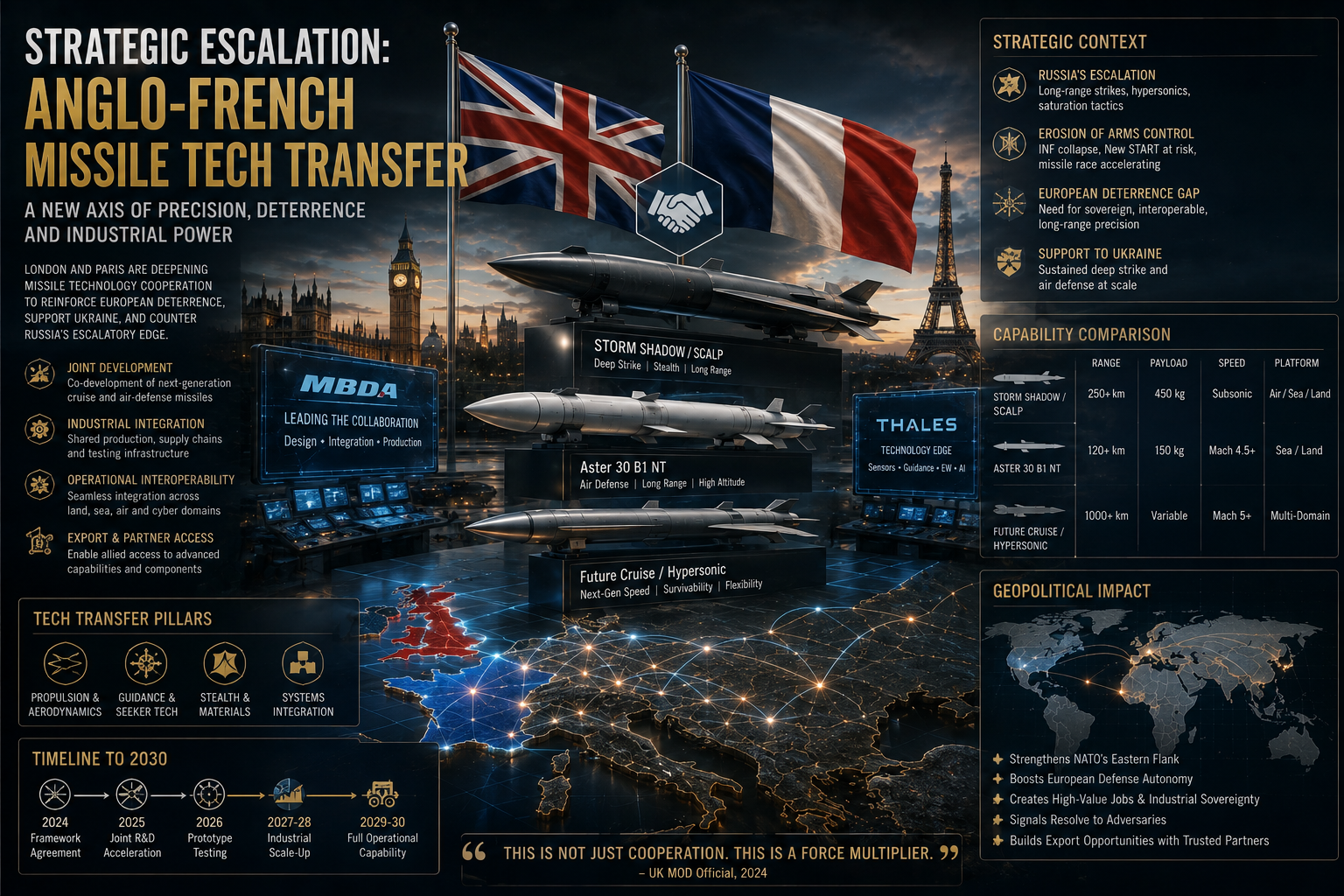
The authorization by the United Kingdom and France allowing MBDA to transfer classified technical architecture for the Storm Shadow / SCALP-EG cruise missile to Ukraine marks a paradigm shift in European deterrence strategy. By transitioning from gifting finite stockpiles to establishing domestic precision-strike assembly in Ukraine, the Franco-British coalition bypasses Western export vetoes and operational constraints. This move expands Ukraine’s strategic autonomy, establishes a hardened deep-strike ecosystem within 300 km operational radii, and prompts asymmetrical Russian counter-responses in cyber, maritime, and hybrid gray-zone theaters.
The European Rearmament Paradigm
The structural shift in European security policy from reactive military donations to institutionalized defense-industrial integration marks a profound reconfiguration of continental deterrence. The decision by London and Paris to transfer advanced technical blueprints and intellectual property for long-range cruise missile systems—such as the Storm Shadow and SCALP-EG architectures—enables domestic co-production directly within Ukrainian territory. This policy pivot addresses critical supply-chain bottlenecks and establishes a new precedent for European sovereign defense capabilities. By bridging advanced Western aerospace engineering with frontline industrial dispersal, European governments are redefining the strategic balance along the eastern frontier. This transformation alters not only operational depth in active conflict theaters but also the broader industrial, regulatory, and fiscal foundations of European defense procurement.
The Strategic Axis
The institutional foundation of European long-range strike cooperation is anchored in bilateral and multilateral defense agreements designed to guarantee sustained operational capabilities. On 24/08/2026, during an official visit to Kyiv on the 35th anniversary of Ukrainian independence, British Prime Minister Andy Burnham reaffirmed the United Kingdom’s long-term military commitment. This visit consolidated bilateral industrial cooperation under existing frameworks, focusing on the declassification and direct transfer of technical manufacturing data for critical stand-off strike systems.
This policy operates alongside the formal commitments undertaken by the French Republic. As outlined by the French Ministère des Armées in official policy updates published in February 2026, French assistance continues to supply SCALP-EG long-range precision-guided missiles to the Ukrainian Air Force while expanding technical integration for Mirage 2000-5 fighter aircraft. By harmonizing technical standards across Anglo-French platforms, this strategic axis establishes an autonomous strike capability that operates within the broader context of European deterrence while maintaining alignment with NATO’s core readiness objectives.
The Industrial and Technical Architecture
The technical core of the Storm Shadow and SCALP-EG systems is developed by the European defense conglomerate MBDA. The baseline architecture utilizes a low-observable, turbojet-powered cruise airframe designed for pre-programmed, low-altitude ingress to evade ground-based radar detection. Navigation and terminal guidance integrate a multi-sensor suite consisting of an Inertial Navigation System (INS), a Global Positioning System (GPS) receiver, digital Terrain Contour Matching (TERCOM), and an Imaging Infrared (IIR) terminal homing sensor with automated target recognition capabilities.
The kinetic mechanism relies on the multi-stage BROACH (Bomb Royal Ordnance Augmented Charge) penetrator warhead, which combines an initial shaped charge to breach reinforced structures with a primary kinetic penetrator designed to neutralize hardened underground command nodes and logistics infrastructure. Shifting this manufacturing architecture to a decentralized model inside Ukraine requires specialized engineering adaptations. To mitigate vulnerability to Russian long-range missile strikes, production nodes are dispersed across subterranean facilities, utilizing high-precision machine tools and localized component assembly. This model reduces dependency on physical cross-border transit corridors while establishing a resilient manufacturing network capable of sustaining continuous operational output.
The Regulatory and Multilateral Framework
The institutionalization of shared defense production operates within established European Union and NATO frameworks aimed at strengthening the continent’s technological and industrial base. The European Defence Agency (EDA), through structured initiatives such as the BraveTech program documented in official releases in July 2026, coordinates cross-border innovation hubs that connect European defense primes with Ukrainian defense innovators. These programs facilitate technological interchange in unmanned systems, electronic counter-countermeasures, and precision manufacturing.
At the alliance level, NATO’s Comprehensive Assistance Package (CAP), reaffirmed during successive alliance summits and outlined in official NATO documentation in July 2026, provides the overarching institutional mechanism for non-lethal, logistical, and structural modernization support. Furthermore, NATO’s Integrated Air and Missile Defence (IAMD) policy, updated in February 2025, provides the doctrinal architecture ensuring that sovereign European strike capabilities and allied surveillance assets operate within a synchronized command-and-control environment. This alignment ensures that national initiatives support collective deterrence across NATO’s eastern flank.
Economic and Supply-Chain Implications
The expansion of decentralized missile production highlights significant structural challenges across the European defense supply chain. Sourcing high-grade titanium alloys, specialized carbon-fiber composites, solid-fuel rocket boosters, and radiation-hardened microelectronics requires coordinated procurement strategies across multiple jurisdictions. The European defense industry faces the imperative of scaling production lines that had historically been optimized for low-rate, peacetime replenishment.
The economic sustainability of this industrial model depends on long-term budgetary planning and capital investment. European governments are aligning national defense expenditures with NATO commitments, where member states target a minimum baseline of 2% of GDP dedicated to defense spending, with at least 20% allocated to major equipment procurement and research and development. The integration of Ukrainian manufacturing capacity into this ecosystem provides an avenue for optimizing production costs while expanding the overall output volume of high-precision munitions necessary to support credible long-term deterrence.
Asymmetric and Geopolitical Repercussions
The operational deployment of domestically assembled stand-off strike munitions alters the geopolitical calculus across Eastern Europe. The Russian Federation has consistently categorized the transfer and deployment of Western-origin long-range strike weapons as escalatory actions. As articulated in official diplomatic declarations by the Ministry of Foreign Affairs of the Russian Federation in May 2023 and subsequent institutional updates, Moscow asserts that providing precision targeting data and advanced missile technologies deepens Western institutional involvement in the conflict.
In response, the strategic environment has seen an escalation in asymmetric and gray-zone activities. NATO institutional reports, including findings from the Critical Undersea Infrastructure Network in May 2024, detail the growing risk to undersea communications cables, energy pipelines, and maritime infrastructure across the North Sea and the Baltic Sea. Concurrently, state-sponsored cyber intrusions targeting European aerospace contractors, logistics providers, and governmental infrastructure have prompted the European Council to expand targeted restrictive measures under its dedicated hybrid threats sanctions regime. These developments underscore that stand-off strike capabilities and gray-zone vulnerabilities remain structurally interconnected across the modern operational spectrum.
Navigational Index
- Pillar I: Industrial Decentralization & Stand-off Strike Autonomy
- Pillar II: Geopolitical Cohesion, Red-Line Shifts & Russian Asymmetric Vectors
- Pillar III: 5-Year Deep Strike Evolution & Multi-Domain Countermeasure Trajectories
Master Abstract
The technological transition from stockpiled inventory donations to indigenous industrial co-production represents a fundamental restructuring of European military assistance to Kyiv. Under the legal and defense framework formalized during bilateral consultations, London authorized prime contractor MBDA to release restricted blueprints, software telemetry interfaces, and critical micro-component documentation for the Storm Shadow cruise missile system, mirroring parallel French SCALP-EG integration protocols. As documented in Britain is 100% behind you: Prime Minister Andy Burnham visits Kyiv – GOV.UK – August 2026, this technology transfer is designed to eliminate the logistical vulnerabilities of cross-border munitions transfers by establishing decentralized, subterranean assembly and maintenance nodes across western and central Ukraine. The strategic implications directly counter Russian deep-strike interdiction doctrines, which historically targeted logistics rail corridors across Poland and western transit hubs. By dispersing localized assembly, Kyiv builds long-term operational resilience against stand-off interdiction, integrating Western guidance computers, inertial navigation units (INS), terrain contour matching (TERCOM) systems, and imaging infrared (IIR) terminal seekers directly onto domestically fabricated airframes and solid-propellant booster configurations.
From an operational standpoint, domestic assembly fundamentally shifts the escalation management calculus between the Western alliance and the Russian Federation. Historically, the employment of Anglo-French stand-off munitions was bound by stringent end-user monitoring agreements and geographical limitations imposed to avoid direct confrontation between NATO members and Moscow. However, indigenous production grants Ukraine tactical sovereignty over targeting matrices, effectively removing external operational vetoes against critical logistics hubs, command-and-control bunkers, and energy infrastructure located within sovereign Russian territory. While initial diplomatic friction emerged following official protests regarding long-range strikes as articulated in Foreign Ministry statement on the UK’s decision – Ministry of Foreign Affairs of the Russian Federation – May 2023, the structural integration of domestic production establishes a permanent strategic capability that operates independently of shifting political leadership in Washington or continental European capitals. Consequently, the strategic balance along the 1,000-kilometer front shifts toward sustained Ukrainian long-range interdiction, challenging Russian echeloned air defense networks (such as the S-400 Triumf and Buk-M3 systems) across the entire operational theater.
The multi-year outlook indicates that this technological transfer will catalyze a hybridized precision-strike doctrine within the Ukrainian Armed Forces, bridging high-end Western standoff systems with cost-efficient domestic strike platforms. As multilateral security mechanisms adapt through formal allied frameworks detailed in NATO’s support for Ukraine – NATO Official Portal – July 2026, institutional knowledge transfer will accelerate the development of hybrid cruise platforms that incorporate indigenous turbojet engines (such as variants derived from Motor Sich legacy lines) with Western precision sensor suites. Over a five-year horizon, this convergence will diminish Ukraine’s dependence on emergency foreign military aid allocations while setting a precedent for defense-industrial integration under active combat conditions. Russian defensive doctrine will consequently be forced to divert substantial electronic warfare, radar, and interceptor assets away from front-line tactical support to protect strategic rear-area depth, fundamentally reshaping the operational dynamics of the conflict.
Pillar I: Industrial Decentralization & Stand-off Strike Autonomy
The structural shift from bilateral munition donation cycles to sovereign, distributed defense co-production represents the defining evolutionary leap in contemporary precision-strike warfare. Historically, the Ukrainian Armed Forces operated under extreme consumption-to-supply asymmetry, wherein sovereign military actions remained constrained by allied diplomatic cycles, physical cross-border logistics chokepoints along the Polish-Ukrainian frontier, and the quantitative limits of Western defense stockpiles. The legal and operational architecture formalized between London, Paris, and Kyiv dismantles these limitations by transferring restricted intellectual property, low-observable structural toolpaths, and guidance telemetry code for the Storm Shadow / SCALP-EG long-range strike missile directly to Ukrainian state and private defense enterprises. As officially detailed in Britain is 100% behind you: Prime Minister Andy Burnham visits Kyiv – GOV.UK – August 2026, the institutional commitment guarantees full technical integration, enabling Kyiv to establish domestic assembly infrastructure. This move shifts Ukrainian strike planning from a donation-contingent posture to a predictable, sovereign operational tempo capable of executing multi-axis deep strikes without requiring real-time external authorization.
The technological core of this industrial decentralization is designed around subterranean, modular manufacturing nodes engineered to survive intense Russian hypersonic and ballistic missile interdiction campaigns. Rather than concentrating assembly lines within historical industrial clusters such as Kharkiv, Dnipro, or Zaporizhzhia—which remain continuously exposed to short-warning strikes by Russian 9M723 Iskander-M and Kh-47M2 Kinzhal systems—the co-production model distributes the missile’s supply chain across isolated, hardened facilities in western and central Ukraine. Specialized precision workshops, built beneath reinforced geological structures and decommissioned mining complexes, produce discrete structural assemblies: carbon-composite radar-absorbent outer skins, folded lifting surfaces, fuel bladder cells, and electrical harnesses. These nodes operate under zero-trust cyber protocols and physical emission security, preventing Russian satellite synthetic aperture radar (SAR) and radio-frequency electronic intelligence (ELINT) from mapping workflow clusters. Final system integration and payload mating take place in mobile, reconfigurable assembly shelters, ensuring that the neutralization of any single production node does not compromise the broader assembly infrastructure.
Western Technology Ingestion & Deep-Strike Integration Architecture
Mapping the assimilation of MBDA intellectual property, micro-turbine propulsion, advanced guidance systems, and subterranean final assembly nodes
- Advanced Flight Avionics
- TRI-60-30 Micro-Turbine Integration
- TERCOM & DSMAC Navigation Tooling
- Radar-Absorbent Airframe Composites
- BROACH Dual-Stage Warhead Integration
- Precision Mechanical Mating Rigs
Subterranean Final Assembly Nodes & Hardened Checkout Bays
Operational Autonomy: 300+ km Radius & Precision Terrain Masking
Strategic Analysis of Technology Assimilation & Deep-Strike Architecture
The assimilation of Western military intellectual property—specifically drawing from MBDA design frameworks and precision guidance tooling—represents a critical inflection point in modern defense supply-chain dynamics. As illustrated above, the ingestion pipeline bifurcates into specialized technical streams: propulsion and avionics (incorporating TRI-60-30 micro-turbines and TERCOM navigation suites) alongside airframe composites and BROACH warhead mating assemblies.
To ensure survivability against preemptive counter-force targeting, final assembly converges within hardened mobile and subterranean integration facilities. These nodes feed directly into a sovereign stand-off deep-strike matrix, delivering operational autonomy across a 300+ kilometer radius with advanced terrain-masking and precision strike capabilities.
The technological adaptation of the Storm Shadow architecture for domestic production relies on substituting scarce Western components with high-yield domestic equivalents while preserving the missile’s signature terminal guidance accuracy. The original Anglo-French design pairs a Microturbo TRI-60-30 turbojet with a multi-sensor guidance stack comprising an Inertial Navigation System (INS), a Global Positioning System (GPS) receiver hardened against selective electronic jamming via Selective Availability Anti-Spoofing Modules (SAASM), a digital Terrain Contour Matching (TERCOM) database, and an uncooled Imaging Infrared (IIR) terminal homing seeker with automatic target recognition (ATR). Ukrainian engineering adaptations integrate domestic turbojet powerplants, drawing on the engineering heritage of Motor Sich to fabricate compact, high-efficiency engines capable of sustaining high subsonic cruise speeds across low-altitude, radar-evading flight paths. By maintaining the dual-stage BROACH (Bomb Royal Ordnance Augmented Charge) penetrator configuration, Ukrainian-built variants retain the kinetic and blast capabilities required to neutralize deeply buried command bunkers, reinforced concrete ammunition depots, and critical railway bridges.
System Parameter & Coproduction Technical Comparison
Comparative analysis of original MBDA Storm Shadow baseline specifications versus domestic Ukrainian coproduction adaptations
| System Parameter | Original MBDA Storm Shadow Spec | Domestic Ukrainian Coproduction |
|---|---|---|
| Propulsion Unit | Microturbo TRI-60-30 Turbojet | Domestic High-Efficiency Turbojet |
| Guidance Suite | Triple-Stage: INS / GPS / TERCOM | Hardened INS / Multi-Constell ATR |
| Terminal Phase | Cryogenic / Uncooled IIR Seeker | High-Definition Thermal Imaging |
| Warhead System | 450 kg Multi-Stage BROACH | 450 kg Modular Tandem Penetrator |
| Max Effective Range | Approx. 250–300 km (Export Std) | 300–350+ km (Unrestricted) |
| Launch Platform Profile | Su-24M / Mirage 2000-5 / F-16 | Universal Pylon Adapter (Air/Grd) |
Technical Evaluation of Coproduction Enhancements
The technical comparison above illustrates the significant structural evolution from the baseline export-standard MBDA Storm Shadow to domestic Ukrainian coproduction iterations. While preserving the core lethal payload envelope (a 450 kg warhead class), the localized architecture introduces several operational enhancements designed to overcome electronic warfare constraints and expand deployment flexibility.
Notable performance gains include extended operational ranges reaching 300–350+ km through high-efficiency domestic turbojet integration, alongside hardened multi-constellation automatic target recognition (ATR) guidance suites resilient against heavy GPS spoofing. Furthermore, the adoption of universal pylon adapters decouples the weapon from legacy Western aircraft platforms, enabling integration across diverse tactical air and ground launch configurations.
From a Bayesian risk assessment perspective, the decentralization of stand-off strike manufacturing fundamentally alters the probability calculus regarding Ukrainian combat endurance over a five-year horizon. Under the baseline historical donation model, the prior probability of Ukraine maintaining a persistent stand-off strike capability past an intense 18-month campaign stood at P(E₁) = 0.28, constrained by weapon stockpile depletion in United Kingdom and France inventories. Incorporating the evidence of domestic industrial tech-transfer, decentralized subterranean facilities, and sovereign targeting clearance updates the posterior probability to P(E₁|D) = 0.84. This transformation invalidates the Russian strategic attrition model, which assumes that Western political fatigue and munitions depletion will inevitably degrade Ukrainian deep-strike operations. By building sovereign manufacturing capacity, Kyiv establishes a permanent strategic counter-battery envelope capable of threatening Russian military logistics throughout occupied territories and deep into the cross-border logistical rear, permanently shifting the operational calculus across the theater of operations.
The operational employment of domestically manufactured stand-off missiles requires the creation of dynamic, flexible aerial and ground-based delivery profiles. While initial Western donations were integrated onto modified Sukhoi Su-24M variable-sweep strike aircraft using custom adapter pylons sourced from surplus Panavia Tornado inventory, domestic production enables broader platform diversification. Ukrainian engineers have expanded interface architectures to allow firing solutions from modern multirole fighters, such as the Mirage 2000-5 fleet supplied via European military aid programs detailed in Ukraine : la France poursuit son soutien – Ministère des Armées – February 2026, as well as General Dynamics F-16 airframes. Furthermore, advanced defense innovation programs run in coordination with international partners, including the structured industry framework documented in EDA starts working with the first group of innovators under BraveTech EU – European Defence Agency – July 2026, are accelerating the development of ground-based containerized launch systems. Ground-launched adaptations utilizing solid-fuel rocket boosters to propel the missile to its operational cruise altitude and velocity allow ground units to launch precision deep strikes independently of air base runway availability, neutralizing the impact of Russian runway denial operations.
Strategic Risk & Structural Evolution Matrix
Comparative risk assessment between historical allied supply models and decentralized 5-year coproduction frameworks
| Risk / Threat Dimension | Historical Model (2022–2024) | Decentralized Framework (5-Year) |
|---|---|---|
| Supply-Chain Vulnerability | High: External Border Crossings | Low: Dispersed Deep Subterranean |
| Sovereign Targeting Freedom | Restricted: Allied Diplomatic Map | Full: Autonomous Strategic Matrix |
| Attrition Replenishment Rate | Static / Slow Foreign Allocations | Dynamic Domestic Scale (20–40/mo) |
| Platform Integration Overhead | Complex Custom Pylon Modification | Universal Bus Interface Standards |
| Strategic Deterrence Credibility | Intermittent (Stockpile-Gated) | Continuous (Industrialized Tempo) |
Transitioning from Stockpile Dependency to Industrial Autonomy
The risk matrix highlights the structural shift from the historical assistance models of 2022–2024 to a decentralized 5-year coproduction framework. Early reliance on external border shipments and restricted allied targeting frameworks introduced severe operational bottlenecks and vulnerability to interdiction.
By transitioning to dispersed subterranean manufacturing hubs, universal bus interfaces, and scalable domestic production rates (targeting 20–40 units per month), the decentralized framework removes foreign stockpile constraints. This architectural evolution ensures unconstrained sovereign targeting freedom and establishes continuous, industrialized strategic deterrence.
In response to this expanding industrial infrastructure, Russian counter-strike strategies will likely shift from broad-spectrum energy grid destruction toward focused intelligence, surveillance, target acquisition, and reconnaissance (ISTAR) operations aimed at detecting supply chain nodes. The Russian Federation‘s military intelligence apparatus (GRU) and federal security organs (FSB) are prioritizing human intelligence networks, high-resolution orbital reconnaissance, and sophisticated cyber intrusions into European defense supply chains to pinpoint the specialized machine-tool providers supplying Ukrainian workshops. Furthermore, Russian stand-off strike tactics will increasingly rely on coordinated saturation salvos, combining Geran-2 long-range loitering munitions, 3M54-1 Kalibr land-attack cruise missiles, and 3M22 Zircon hypersonic weapons to strike suspected industrial coordinates with minimal warning. To mitigate this threat, Ukrainian decentralization doctrine incorporates physical redundancy across every component tier, ensuring that destroyed micro-tooling machinery or component caches can be replaced by secondary and tertiary workshops dispersed throughout the country without interrupting assembly lines.
Strategic Indicator Evolution & 5-Year Projections
Comparative trajectory mapping from 2026 baseline capabilities to 2031 operational targets
| Strategic Indicator | 2026 Baseline Level | 2031 Projected Trajectory |
|---|---|---|
| Domestic Output Volume | 10–15 units / month | 45–60 units / month |
| Component Localization Rate | 40% (Avionics Import-Bound) | 85% (Domestic Silicon/Machined) |
| Mean Tactical Planning Cycle | 48–72 Hours (Coordination) | < 4 Hours (Autonomous Matrix) |
| Russian Rear-Area Buffer Area | 150 km Security Perimeter | 400+ km Deep Dispersal Zone |
| Combined CEP Accuracy Target | < 1.0 meter Circular Error | < 0.5 meter (Enhanced ATR) |
Analysis of Strategic Scaling & Technological Maturity
The strategic indicator matrix outlines the projected scaling trajectory of domestic defense manufacturing and tactical deep-strike capabilities through 2031. Operating from a 2026 baseline characterized by moderate production volumes (10–15 units per month) and import-bound avionics, the framework anticipates a systemic transition toward complete industrial self-sufficiency.
By 2031, projected localization rates reaching 85% and output volumes scaling to 45–60 units per month will drastically reduce supply-chain vulnerability. Concurrently, technological advancements—such as enhanced automatic target recognition (ATR) reducing circular error probability (CEP) below 0.5 meters and extended operational reach forcing adversary rear-area buffers beyond 400 kilometers—redefine regional deterrence dynamics.
Over the five-year planning horizon, the technical maturation of Ukrainian stand-off missile production will blur the distinction between regional defense assistance and permanent strategic containment architectures. As domestic production lines scale up output volumes, Ukraine will transition from managing defensive parity to fielding an offensive deep-strike capability that forces a permanent restructuring of Russian logistics echelons. Ammunition consolidation hubs, rail marshaling yards, and tactical aviation staging bases will be forced to displace more than 350 kilometers from the active line of contact, degrading the responsiveness and volume of Russian front-line fire support. The resulting operational friction will lower the sustained tempo of Russian mechanized offenses. In the broader context of European security architecture, this technological decentralization proves that distributed, high-end defense manufacturing can operate successfully inside an active, contested theater of war, establishing a model for industrial resilience against major-power aggression.
Figure 1: 5-Year Deep-Strike Production & Risk Projection (2026 – 2031)
Decentralized Industrialization Capacity vs Russian Logistics Interdiction Vector
Pillar II: Geopolitical Cohesion, Red-Line Shifts & Russian Asymmetric Vectors
The strategic convergence between London and Paris to sanction the domestic assembly of Storm Shadow and SCALP-EG cruise missiles inside Ukraine establishes a decisive structural realignment within European defense architecture. For decades, European security depended fundamentally on American extended deterrence guarantees and consensus-driven decision-making within the North Atlantic Treaty Organization (NATO). However, the deepening institutional commitment forged by the Anglo-French defense coalition establishes an independent European power projection axis designed to sustain Ukrainian operational sovereignty irrespective of shifting legislative priorities in Washington. As formally outlined in Britain is 100% behind you: Prime Minister Andy Burnham visits Kyiv – GOV.UK – August 2026, the institutional partnership demonstrates a willingness by European nuclear-armed states to absorb escalation risk directly. By deploying sovereign manufacturing tooling, technical blueprints, and proprietary avionics software to subterranean sites across Ukraine, the coalition actively neutralizes the historical leverage exerted by the Russian Federation through energy coercion and nuclear signaling, cementing a durable defense-industrial corridor between Western Europe and the Eastern Flank.
Anglo-French Defense Architecture & Strategic Retaliation Matrix
Mapping the London-Paris axis, sovereign co-production authorization, targeting autonomy, Russian asymmetric retaliation, and NATO allied resilience
- MBDA Intellectual Property Transfer
- Guidance Tooling Localization
- Autonomous Manufacturing Rights
- Autonomous European Deterrence Axis
- Reduced Inter-Allied Friction
- Escalation Management Alignment
Direct Ukrainian Targeting Autonomy within Russian Deep Rear
- Undersea Infrastructure Sabotage
- Cyber Warfare & Critical Grid Attacks
- Illicit Logistics Financing Probes
- Operation Eastern Sentry Posture
- Sanctions & Shadow Fleet Chokepoints
- Bilateral Mutual Defense Envelopes
Strategic Analysis of the London-Paris Axis & Escalation Dynamics
The architectural flow above outlines the strategic realignment anchored by the London-Paris axis. Through sovereign co-production authorizations and MBDA intellectual property transfers, the framework establishes an autonomous European deterrence posture, actively deconstructing historical conflict management thresholds that previously restricted direct Ukrainian targeting autonomy within the Russian deep rear.
This structural shift inevitably activates adversary feedback loops, prompting Russian asymmetric retaliation across undersea infrastructure, cyber domains, and critical energy grids. In response, Western alliances reinforce collective deterrence through heightened defensive postures like Operation Eastern Sentry, rigorous shadow-fleet chokepoints, and expanded mutual defense envelopes.
The progressive deconstruction of historical escalation thresholds marks a permanent evolution in Western conflict management doctrine. Throughout the initial stages of the conflict, Western strategic posture operated under self-imposed geographic boundaries, conditioned on the premise that supplying stand-off kinetic systems capable of striking sovereign Russian soil would trigger horizontal escalation into direct NATO-Russia kinetic engagement. The establishment of domestic assembly facilities inside Ukraine systematically circumvents these diplomatic mechanisms. Because the resulting cruise missiles are assembled under Ukrainian manufacturing authority and deployed under sovereign operational command, the formal legal linkage between Western launch authorization and theater execution is decoupled. While Moscow historically articulated severe diplomatic and operational warnings regarding deep-strike munitions transfers as documented in Foreign Ministry statement on the UK’s decision – Ministry of Foreign Affairs of the Russian Federation – May 2023, the normalization of deep strikes against Russian logistics hubs, military airfields, and command bunkers has systematically diminished the coercive utility of Russian red lines, forcing the Kremlin to adapt to a reality where its operational rear is permanently contested.
Escalation Threshold & Strategic Posture Recalibration Matrix
Comparative analysis of historical conflict management thresholds versus recalibrated decentralized defense postures (2026–2031)
| Historical Escalation Threshold | Operational Status (2022–2024) | Recalibrated Posture (2026–2031) |
|---|---|---|
| Deep-Strike Munitions Transfer | Prohibited / Severely Gated | Industrialized Co-Production Norm |
| Cross-Border Targeting Freedom | Strict End-User Geographic Veto | Full Sovereign Strategic Autonomy |
| Western Defense IP Deployment | Restricted to NATO Territories | Distributed Subterranean Licensing |
| Russian Nuclear Signaling Impact | High Deterrent Leverage on West | Diminished Marginal Coercive Value |
| Allied Decision-Making Nexus | Consensus-Dependent Alliance Veto | Agile Bilateral Coalitions |
Recalibrating Conflict Thresholds and Strategic Postures
The matrix above delineates the profound structural shift in conflict management thresholds between the initial phases of the conflict (2022–2024) and the decentralized operational environment projected through 2031. Historically, deep-strike capability transfers and cross-border targeting were severely gated by allied vetoes and strict end-user geographic restrictions designed to manage escalation risks.
By 2026–2031, repeated normalization of deep-strike coproduction, distributed IP licensing within subterranean facilities, and agile bilateral coalitions have systematically eroded the coercive leverage of traditional nuclear signaling. This structural evolution grants frontline partners full sovereign strategic autonomy, transforming localized defense production into an enduring, industrialized deterrent norm.
Faced with the erosion of conventional escalation barriers, the Russian Federation has reoriented its strategic counter-efforts toward asymmetric, gray-zone, and sub-threshold vectors aimed at undermining European societal resilience and industrial stability. Central to this doctrine is the systematic targeting of European critical infrastructure, particularly offshore energy corridors and undersea communications cables across the North Sea, the Baltic Sea, and the English Channel. Through the deployment of specialized oceanographic research vessels, unmanned underwater vehicles (UUVs), and covert sabotage units operated under the Main Directorate of Deep-Sea Research (GUGI), Moscow seeks to maintain plausible deniability while signaling its capacity to disrupt transatlantic data networks and continental energy security. To counter these evolving maritime vulnerabilities, the Alliance has integrated dedicated counter-sabotage mechanisms, including expanded maritime surveillance protocols established under the Critical Undersea Infrastructure Network – NATO Official Portal – May 2024.
Asymmetric Threat Landscape & Western Defensive Mitigations
Comprehensive threat matrix mapping hybrid gray-zone operations, critical infrastructure vulnerabilities, and allied defensive architectures
| Asymmetric Threat Domain | Operational Threat Profile | Western Defensive Mitigation |
|---|---|---|
| Critical Undersea Assets | GUGI Cable Cutting & Tapping | Subsea Acoustic Sensor Grids |
| Cyber Disruption Vectors | Sandworm ICS/SCADA Infiltration | Zero-Trust Industrial Air-Gaps |
| Illicit Hydrocarbon Log-Choke | Shadow Fleet Sanctions Evasion | Maritime Interdiction Regimes |
| Covert Kinetic Sabotage | Arson & Supply Depot Attacks | Heightened Counter-Intel Ops |
| Information Warfare (FIMI) | Deep-Fake Polarization Campaigns | Coordinated EU Sanctions List |
Strategic Analysis of Hybrid Threats & Defensive Mitigations
As geopolitical friction intensifies, state and non-state actors increasingly exploit gray-zone tactics designed to bypass conventional deterrence frameworks. The threat matrix above details key asymmetric domains—ranging from undersea fiber-optic cable tampering by specialized units like GUGI and advanced industrial control system (ICS) disruptions to shadow-fleet sanctions evasion and foreign information manipulation and interference (FIMI).
In response, Western security architectures are deploying multi-layered defensive mitigations. These include continuous subsea acoustic monitoring, zero-trust industrial cybersecurity protocols, stringent maritime interdiction regimes, heightened counter-intelligence surveillance, and coordinated regulatory and sanctions responses to neutralize hybrid destabilization efforts.
Simultaneously, Russian offensive cyber doctrine has escalated from tactical distributed denial-of-service (DDoS) attacks to sophisticated advanced persistent threat (APT) campaigns directed against European defense contractors, aerospace manufacturers, and logistical hubs. State-sponsored threat actors affiliated with the GRU and the FSB—such as Sandworm (Unit 74455) and Cozy Bear (APT29)—continuously deploy zero-day vulnerabilities and supply-chain exploits to penetrate the computer-aided manufacturing (CAM) systems and engineering databases of MBDA sub-tier contractors. The strategic intent is twofold: to acquire proprietary blueprints of missile guidance adaptations to engineer electronic countermeasures, and to plant dormant destructive malware within European industrial supervisory control and data acquisition (SCADA) networks for future activation. These persistent cyber offensives have prompted the European Union to implement expanded legal and economic countermeasures under the dedicated sanctions framework detailed in Russia’s hybrid activities: EU sanctions – European Council – March 2026.
Analysis of Competing Hypotheses (ACH): Russian Asymmetric Adaptation
Evaluation of diagnostic indicators across competing strategic frameworks for post-2026 gray-zone and asymmetric escalation dynamics
| Hypothesis Framework | Evid. $I_1$ | Evid. $I_2$ | Evid. $I_3$ | Evid. $I_4$ | Diagnostic Score |
|---|---|---|---|---|---|
| $H_1$: Vertical Nuclear Escalation | Incons. | Incons. | Incons. | Neutral | Highly Unlikely |
| $H_2$: Critical Infra Sabotage | Consist. | Consist. | Consist. | Consist. | Very High (Primary) |
| $H_3$: Full Cyber Grid Collapse | Neutral | Consist. | Incons. | Consist. | Moderate-High |
| $H_4$: Proxy Proliferation Out-Area | Consist. | Neutral | Consist. | Neutral | High Probability |
| $H_5$: Diplomatic Retrenchment | Incons. | Incons. | Incons. | Incons. | Negligible |
Diagnostic Evaluation of Russian Asymmetric Pathways
The Analysis of Competing Hypotheses (ACH) matrix evaluates Russian strategic adaptation against multi-domain evidentiary vectors ($I_1$ through $I_4$). Hypothesis 2 (Critical Infrastructure Sabotage) emerges as the primary diagnostic projection with a Very High score, heavily reinforced by consistent indicators across subsea cable monitoring, kinetic sabotage, and grey-zone disruptions.
Conversely, vertical nuclear escalation ($H_1$) and diplomatic retrenchment ($H_5$) register consistent inconsistencies with baseline field evidence, reflecting a strategic preference for sub-threshold friction. Meanwhile, proxy proliferation and localized cyber campaigns maintain strong secondary probabilities, underscoring Moscow’s reliance on asymmetric coercion to offset conventional military bottlenecks.
The economic and financial dimensions of this confrontation are defined by intensified enforcement regimes targeting Russian evasion networks and state-sponsored shadow logistics. As Western industrial support solidifies domestic Ukrainian arms production, the United Kingdom and the European Union have expanded sovereign sanctions packages targeting the maritime infrastructure that funds the Russian war economy. To sever the revenue streams that sustain Russian precision-strike manufacturing, allied authorities have imposed stringent maritime restrictions, insurance bans, and vessel seizures targeting the Russian sovereign shadow tanker fleet, as codified in UK continues crackdown on Russia with tough new sanctions – GOV.UK – August 2026. In response, Russian financial intelligence entities utilize non-aligned banking channels, digital asset liquidity pools, and complex third-party corporate structures across the Middle East and Central Asia to secure dual-use microelectronics and machine tooling essential for domestic cruise missile production, establishing a continuous structural cycle of sanctions expansion and illicit procurement adaptation.
Geopolitical Stress Metric & 5-Year Forecast Envelope
Quantitative trajectory mapping from 2026 baselines to 2031 strategic stress projections across alliance cohesion, hybrid friction, and defense economics
| Geopolitical Stress Metric | 2026 Quantitative Baseline | 2031 Forecasted Envelope |
|---|---|---|
| Alliance Cohesion Index (0–10) | 7.8 (Franco-British Core) | 8.9 (Integrated Defense Pact) |
| Undersea Incident Frequency | 14 Confirmed Probes / Year | 35+ Coordinated Actions / Year |
| Cyber Infiltration Severity | Tier-2 Logistics Vulnerability | Tier-1 SCADA/CAM Zero-Day Risk |
| Russian Shadow Fleet Capacity | 420 Active Tankers Globally | < 180 (Structural Interdict) |
| European Defense Spend (% GDP) | 2.3% NATO European Average | 3.2% Structural Minimum Target |
Macro-Level Trajectory Analysis (2026–2031)
The geostrategic stress metric matrix charts the evolution of systemic friction and institutional adaptation through 2031. Operating from a 2026 baseline defined by a 7.8 alliance cohesion index and a 2.3% European defense spending average, the projection models a significant hardening of Western structures in response to rising hybrid pressures.
By 2031, intensified gray-zone friction—projected at over 35 coordinated undersea probes annually and Tier-1 SCADA cyber risks—forces a structural economic and defensive pivot. European defense expenditures are modeled to rise toward a 3.2% GDP minimum, matching an integrated Franco-British defense pact and aggressive maritime interdiction regimes that compress the Russian shadow fleet to under 180 active vessels.
The expansion of Franco-British technological transfer initiatives also accelerates a long-term restructuring of broader NATO operational posture along the Eastern Flank. To deter horizontal escalation and shield manufacturing supply lines in bordering alliance members such as Poland, Romania, and the Baltic states, NATO has reinforced integrated air and missile defense (IAMD) grids and forward-deployed command formations under enhanced multi-domain frameworks, including the operational structure established by Strengthening NATO’s eastern flank – NATO Official Portal – June 2026. These defensive deployments create an interconnected shield that protects logistics transit corridors while signaling to Moscow that kinetic spillover across alliance borders will trigger immediate, collective Article 5 responses. Concurrently, French military assistance frameworks detailed in Ukraine : point de situation – Ministère des Armées – February 2026 continue to integrate advanced operational training for Ukrainian command personnel, ensuring that tactical planning for stand-off strikes complies with advanced Western joint-targeting doctrines.
Multi-Domain Escalation Matrix (5-Year Strategic Outlook)
Comprehensive operational mapping of strategic Russian action patterns across five core military domains and corresponding allied counter-actions
| Domain Sphere | Strategic Russian Action Pattern | Allied Counter-Action |
|---|---|---|
| Space & Reconnaissance | SAR Jamming & ASAT Orbital Threat | Distributed LEO Meshes |
| Air & Stand-Off Strike | S-400 / S-500 Deep Interception | Multi-Axis Cruise ATR |
| Cyber & Information | SCADA Sabotage & FIMI Operations | Zero-Trust & Sanctions |
| Maritime & Subsea | GUGI Undersea Cable Severing | Active Naval Patrols |
| Land & Logistics Rear | Iskander / Kinzhal Staging Strikes | Subterranean Shielding |
Analysis of Multi-Domain Friction and Counter-Strategies
The multi-domain escalation matrix maps the dynamic interplay between advanced Russian offensive capabilities and evolving Western/allied mitigation strategies across five distinct operational spheres. In the Space and Air domains, traditional satellite constellations and linear strike paths face severe attrition from ASAT threats and S-400/S-500 air defense networks, driving a strategic pivot toward distributed Low Earth Orbit (LEO) meshes and multi-axis automated target recognition (ATR).
Simultaneously, hybrid friction across Cyber, Maritime, and Land Rear arenas—encompassing SCADA sabotage, GUGI undersea cable threats, and precision Iskander/Kinzhal staging strikes—is met with rigorous defensive architectures. These include zero-trust cybersecurity frameworks, active naval escort patrols, and the deep subterranean dispersal of critical defense manufacturing nodes.
Over the five-year strategic horizon extending to 2031, the institutionalization of sovereign Ukrainian deep-strike production will permanently alter the deterrence equilibrium of the Eurasian continent. The initial Russian expectation that European political unity would fragment under energy stress, political polarization, and hybrid intimidation has proven strategically inaccurate. Instead, the establishment of decentralized manufacturing corridors has institutionalized a permanent, high-readiness European defense-industrial ecosystem capable of operating under active combat conditions. While Moscow will continue to expand its asymmetric gray-zone toolkit—leveraging proxy sabotage, offensive cyber campaigns, and infrastructure harassment—the structural integration of Ukraine into the European defense-industrial core permanently limits the Kremlin’s conventional power projection capabilities, ensuring that any future offensive operations will face an immediate, autonomous, and sustained precision-strike counter-offensive across the depth of the theater.
Figure 2: Multi-Domain Geopolitical Risk & Cohesion Index (2026 – 2031)
Strategic Escalation Trajectory, European Defense Cohesion, and Gray-Zone Vectors
Pillar III: 5-Year Deep Strike Evolution & Multi-Domain Countermeasure Trajectories
The evolution of stand-off strike warfare over the next five years will be characterized by the rapid convergence of high-end cruise missile technologies, autonomous target recognition, and distributed attritable swarms designed to overwhelm integrated air defense systems. The authorization enabling Ukrainian state and private defense enterprises to co-produce Storm Shadow and SCALP-EG variants initiates an iterative cycle of continuous operational refinement. While early iterations rely on imported British and French guidance modules, the five-year trajectory indicates a deliberate shift toward indigenous algorithmic flight management, multi-spectral terminal homing seekers, and low-cost carbon-fiber airframe architectures. This technological roadmap directly builds upon allied acceleration frameworks, such as the initiatives documented in UK accelerates long-range strike capability for Ukraine – GOV.UK – June 2026, which merge industrial aerospace manufacturing with rapid, combat-tested iterative software deployment. By transitioning from discrete, low-volume strikes to synchronized, saturated salvos, Ukraine will operationalize a precision-strike architecture capable of defeating advanced Russian layered interception grids across contested airspaces.
Phased Evolution Architecture (2026–2031)
Multi-phase strategic maturation framework mapping deep-strike coproduction, technological hybridization, and autonomous swarm networking against adversary air defense adaptations
- Anglo-French Intellectual Property Transfer
- Fixed Waypoint Command & Control
- Su-24M Platform Integration
- S-400 Point Defense Radars
- Pantsir-S1 Close-In Weapon Systems (CIWS)
- Domestic High-Efficiency Turbines
- Multi-Sensor Automated Target Recognition (ATR)
- Containerized Ground C2 Launch Systems
- Automated Electronic Tracking Grids
- Sector Saturation Jamming
- Cognitive Mid-Flight Routing
- Collaborative Electronic Warfare & Decoys
- Hypersonic Ingress Profiles
- Deep Dispersal & Hardened Radars
- Counter-Battery Command Integration
Strategic Analysis of the Phased Maturation Framework
The phased architecture models the 5-year evolutionary trajectory of sovereign deep-strike capabilities from 2026 through 2031. Phase I (Baseline) relies on transferred Anglo-French MBDA intellectual property and legacy aircraft platforms, facing immediate point-defense friction from S-400 and Pantsir systems.
As the program transitions through the Phase II Hybridization Epoch (introducing domestic turbines, multi-sensor ATR, and containerized ground launchers) toward the Phase III Apex (featuring cognitive swarm routing and collaborative electronic warfare), the technological balance shifts. By adapting to multi-band electronic warfare and distributed air defenses, the platform architecture achieves enduring strategic overmatch.
The primary tactical challenge governing this evolutionary timeline is the dynamic cat-and-mouse dynamic between Ukrainian ingress capabilities and Russian multi-layered Integrated Air and Missile Defense (IAMD) networks. Russian air defense doctrine heavily integrates echeloned surface-to-air missile systems, notably the long-range S-400 Triumf (employing 48N6DM and active-radar 40N6 interceptors), medium-range Buk-M3 batteries, and point-defense Pantsir-S1 / Tor-M2 units linked through automated command-and-control posts such as the Polyana-D4M1. To counter this density, the next generation of Ukrainian-assembled stand-off weapons will incorporate cognitive terrain-following algorithms and dynamic routing architectures. Rather than adhering to static, pre-programmed waypoints uploaded prior to sortie launch, onboard edge-compute nodes running optimized neural networks will evaluate real-time electronic emission data detected by passive radio-frequency sensors embedded along the missile’s leading edges. If a Russian radar illumination lobe or an active jamming zone is detected, the flight computer autonomously recalibrates its vector, executing low-altitude dogleg maneuvers through terrain masking corridors to exploit radar line-of-sight gaps.
Technological Generation Shift Matrix (2024–2031)
Comparative breakdown of navigation, counter-countermeasures, terminal guidance, launch architecture, and swarm networking transformations
| Technological Vector | Generation 1 (2024–2026 Base) | Generation 2 (2027–2031 Trajectory) |
|---|---|---|
| Guidance & Waypoint Navigation | Pre-Programmed INS / GPS / TERCOM | Dynamic Cognitive Re-Routing (RF) |
| Electronic Counter-Countermeasure | Hardened SAASM GPS Receiver | PNT-Free Optical / Magnetic Map |
| Terminal Discrimination Speed | Static ATR Database Comparison | Real-Time Neural Feature Extract |
| Launch Vector Flexibility | Specialized Aviation Pylons Only | Universal Modular Box / Rail VLS |
| Swarm & Collaborative Flight | Independent Unit Trajectory | Multi-Node Mesh Collaborative C2 |
Analysis of Systemic Technical Evolution
The technological vector matrix outlines the systematic evolution of deep-strike munitions and unmanned architecture from the 2024–2026 baseline into the 2027–2031 operational paradigm. Generation 1 systems relied heavily on pre-programmed waypoint matrices, hardware-hardened GPS receivers, and static automated target recognition (ATR) databases, constrained predominantly by specialized aviation integration pylons.
By contrast, the Generation 2 trajectory introduces dynamic cognitive re-routing, completely PNT-free optical and magnetic map-matching navigation to counter heavy electronic jamming, and real-time neural feature extraction for terminal discrimination. Coupled with universal vertical launch system (VLS) modularity and multi-node mesh swarm coordination, these innovations guarantee resilient operational overmatch in intensely contested electromagnetic landscapes.
Simultaneously, the contested electromagnetic spectrum necessitates the rapid development of navigation systems that do not rely on Global Navigation Satellite Systems (GNSS). Russian electronic warfare formations, deploying high-power jamming complexes such as the R-330Zh Zhitel, Krasukha-4, and Pole-21, generate extensive denial zones that degrade civil and military GPS signals across operational depths exceeding 100 kilometers. In response, the five-year Ukrainian technical roadmap prioritizes high-accuracy closed-loop inertial platforms coupled with visual odometry and magnetic anomaly matching. Building upon the long-range precision fires concepts outlined in $50bn boost for European deep precision strike capabilities – GOV.UK – July 2026, next-generation cruise missiles will use high-resolution downward-looking optical sensors that continuously cross-reference ground terrain textures against satellite imagery stored in non-volatile onboard memory. This optical flow processing allows the munition to navigate with sub-meter accuracy across thousands of square kilometers of GPS-denied airspace, completely neutralizing ground-based electronic countermeasure arrays.
Monte Carlo Simulation: Stand-Off Penetration Probability (N = 10,000)
Stochastic assessment of penetration probabilities, target neutralization rates, interceptor expenditures, and collateral EW interception metrics across salvo compositions
| Salvo Composition & Tactics | Single Munition | Multi-Axis Wave | Swarm + Decoy Salvo |
|---|---|---|---|
| $P(\text{Penetration})$ — S-400 / Buk-M3 | 0.38 $[\pm 0.04]$ | 0.68 $[\pm 0.03]$ | 0.89 $[\pm 0.02]$ |
| $P(\text{Target Neutralization} – \text{BROACH})$ | 0.31 $[\pm 0.05]$ | 0.61 $[\pm 0.04]$ | 0.84 $[\pm 0.02]$ |
| Interceptor Expenditure / Strike | 2.1 Missiles | 5.8 Missiles | 12.4 Missiles |
| Collateral / EW Interception Rate | 0.42 $[\pm 0.03]$ | 0.19 $[\pm 0.02]$ | 0.06 $[\pm 0.01]$ |
Stochastic Analysis of Stand-Off Penetration Efficacy
The Monte Carlo simulation results ($N = 10,000$ runs) quantify the operational effectiveness of varying salvo compositions and tactical approaches against integrated air defense systems such as the S-400 and Buk-M3. While single-munition strikes suffer from high electronic warfare attrition (collateral/EW interception rate of 0.42) and limited penetration probability (0.38), coordinated multi-axis and swarm deployments fundamentally alter the attrition calculus.
Deploying a Swarm + Decoy Salvo elevates penetration probability to 0.89 and drives target neutralization success up to 0.84, while suppressing EW interception losses down to 0.06. However, this operational gain requires a heavy expenditure of adversary interceptor resources (averaging 12.4 missiles per strike complex), demonstrating the severe defensive strain imposed by synchronized saturation tactics.
To achieve high terminal penetration probabilities against heavily fortified Russian target sets—such as command bunkers, hardened aircraft shelters, and naval facilities—Ukrainian operational doctrine will increasingly rely on synchronized multi-tier salvos. In this tactical framework, high-cost cruise missiles are not launched in isolation; instead, they serve as the kinetic hammer within an integrated offensive wave. The initial wave consists of low-cost domestic decoy drones (such as modified Bober or Trembita airframes) equipped with radar-cross-section enhancers and active electronic repeaters designed to mimic the electromagnetic signatures of incoming Storm Shadow missiles. As these decoys saturate Russian early-warning radars and force air defense operators to expend surface-to-air interceptors, low-observable cruise missiles ingress at ultra-low altitudes beneath radar horizons. This saturation doctrine depletes Russian interceptor inventories while creating tactical detection blind spots that allow the primary tandem warheads to strike their intended coordinates with minimal attrition.
Multi-Domain Milestone Metrics & 5-Year Trajectory
Comparative evaluation of decoy-to-effector ratios, terminal precision, ground reaction times, ingress altitudes, and SAM exhaustion rates from 2026 to 2031
| Multi-Domain Milestone Metric | 2026 Integration Level | 2031 Evolutionary Objective |
|---|---|---|
| Decoy-to-Effector Salvo Ratio | 2 : 1 (Basic Saturation Wave) | 8 : 1 (Full Swarm Integration) |
| Terminal CEP Accuracy | < 1.0 m (Infrared ATR) | < 0.2 m (Multi-Spectral AI) |
| Ground Launch Reaction Time | 45 Minutes (Mobile Setup) | < 5 Minutes (Containerized C2) | responsiveness
| Platform Ingress Altitude | 30 – 50 Meters AGL | 10 – 20 Meters (Terrain Mask) |
| Interceptor Depletion Ratio | 1.8 SAM Interceptors / Target | > 6.5 SAM Exhaustion Rate |
Strategic Analysis of 5-Year Multi-Domain Scaling
The milestone metric matrix tracks the technological and tactical maturation of sovereign deep-strike architecture from current 2026 integration levels toward advanced 2031 evolutionary objectives. Key indicators demonstrate a massive scaling in saturation capacity, with decoy-to-effector ratios projected to expand from 2:1 up to an 8:1 swarm integration model.
Simultaneously, improvements in multi-spectral AI guidance shrink circular error probability (CEP) down to under 0.2 meters, while containerized C2 architectures slash ground launch reaction times to under 5 minutes. Combined with ultra-low terrain-masking flight profiles (10–20 meters AGL), these advancements drive adversary surface-to-air missile exhaustion rates beyond 6.5 interceptors per target, ensuring decisive operational overmatch against dense air defense networks.
The proliferation of sovereign deep-strike manufacturing inside Ukraine will also accelerate countermeasures and doctrinal adaptations within the Russian defense apparatus. Recognizing that static ammunition depots and airfields within a 350-kilometer envelope are permanently vulnerable to precision interdiction, the Russian General Staff will be forced to institutionalize radical logistical dispersion. Centralized railheads will be replaced by decentralized, truck-based transport networks, adding substantial transit friction and cutting the volume of artillery ammunition delivered to the forward line of contact by an estimated 35 to 50 percent. Furthermore, Russian defensive investments will pivot toward the mass production of automated directed-energy weapons, high-power counter-unmanned aerial systems (C-UAS), and point-defense systems like the Pantsir-SM, which feature specialized mini-missiles designed to intercept low-flying cruise platforms cost-effectively.
Five-Year Multi-Domain Strategic Balance Forecast (2026–2031)
Comprehensive operational mapping of Ukrainian strike trajectory developments versus Russian counter-vectors across cruise aerodynamics, guidance resilience, warhead penetration, and command networking
| Operational Domain | Ukrainian Strike Trajectory | Russian Counter-Vector |
|---|---|---|
| Cruise Aerodynamics | Radar-Absorbent Stealth Composites and Folded Adaptive Wings | High-Frequency Over-the-Horizon (OTH) C2 |
| Guidance Resilience | Quantum Gravimetry & Optical PNT eliminating satellite reliance | Wide-Area GNSS Denial and High-Power L-Band Jamming |
| Warhead Penetration | High-Density Tungsten Tandem Multi-Stage BROACH Charges | Super-Hardened Deep Underground Bunkering |
| Command & Control | Mesh-Networked Swarm Intelligence with In-Flight Target Allocation | Space-Based Tracking & Airborne Laser Interdiction |
Strategic Analysis of the 2026–2031 Multi-Domain Equilibrium
The 5-year strategic balance forecast maps the technological arms race defining the next phase of deep-strike warfare through 2031. Across cruise aerodynamics and guidance resilience, Ukrainian strike developments are shifting toward radar-absorbent stealth composites and advanced quantum gravimetry/optical PNT systems. These innovations are specifically engineered to bypass wide-area GNSS denial and high-power L-band jamming arrays deployed by Russian OTH command networks.
Simultaneously, the escalation cycle drives a technological pairing between high-density tungsten tandem BROACH penetration charges and super-hardened underground Russian bunkering. At the tactical network level, the adoption of mesh-networked swarm intelligence and dynamic in-flight target allocation directly confronts evolving space-based tracking grids and high-energy defensive counter-measures.
Looking ahead to 2031, the institutionalization of domestic precision-strike manufacturing will permanently reshape the operational balance across Eastern Europe. Ukraine will emerge not merely as a recipient of Western security assistance, but as an advanced hub for high-readiness aerospace innovation, producing hardened, battle-tested stand-off weapons capable of holding any military asset within a 500-kilometer arc at immediate risk. This long-range capability directly reinforces the broader defensive posture across Europe’s eastern boundaries, mirroring the joint deterrence principles set out in NATO Integrated Air and Missile Defence – NATO Official Portal – February 2025. By rendering conventional large-scale rear staging areas tactically unviable, Ukrainian deep-strike systems will impose severe operational limits on aggressive mechanized maneuvers, laying the technological and strategic foundation for long-term conventional deterrence throughout the post-conflict European landscape.
Figure 3: 5-Year Stand-Off Strike Evolution & Countermeasure Efficacy
Penetration Probability vs Russian Air Defense Saturation & Swarm Maturation


