










Executive Summary
- BLUF: the central risk for 2026–2031 is not necessarily decisive escalation or negotiated peace, but the institutionalisation of managed instability: recurring coercion calibrated below thresholds that would force either comprehensive settlement or uncontrolled major-power war.
- The conceptual premise supplied for this assessment is that Ukraine and Iran are operationally different conflicts but increasingly share a political structure in which military action, ceasefires, sanctions, maritime access, energy flows and negotiations operate simultaneously rather than sequentially.
- This structure is becoming materially self-reinforcing because NATO has committed €70 billion in military equipment, assistance and training for Ukraine in 2026 and indicated at least equivalent national commitments for 2027. The Ankara Summit Declaration – NATO – July 2026 — verified source.
- In the Gulf, the United States deployed more than 15,000 personnel, over 100 manned and unmanned aircraft, guided-missile destroyers and an enhanced maritime security area under Project Freedom, converting Hormuz access into a persistent military mission. Project Freedom – U.S. Department of War – May 2026 — verified source.
- Energy demonstrates why tactical pauses need not terminate strategic conflict: after the June 18 U.S.–Iran memorandum, EIA still expected restoration of much previously shut-in production only by early 2027. EIA July Short-Term Energy Outlook Update – U.S. Energy Information Administration – July 2026 — verified source.
- Sanctions, shadow fleets, insurance, critical infrastructure, UAV supply chains, intelligence support and missile-defence inventories are therefore not peripheral effects; they increasingly constitute the conflict system itself.
- Five competing hypotheses are retained: negotiated convergence, frozen coercion, managed instability, asymmetric strategic exhaustion, and cross-theatre escalation.
- Current Bayesian assessment assigns the highest five-year plausibility to managed instability, not because it benefits every actor, but because several actors retain sufficient leverage and veto capacity to make an imperfect war preferable to an imperfect peace.
- The decisive variable through 2031 will be whether external sponsors begin pricing restraint more attractively than continued coercive optionality.
- The highest-impact failure mode is the transformation of two partially connected wars into a durable cross-theatre coercion architecture linking Europe, Russia, Iran, the Gulf, China, maritime trade, energy and Western defence-industrial capacity.
Managed Instability: Why the Iran and Ukraine Wars Can Endure
The most dangerous feature of the wars surrounding Ukraine and Iran is no longer simply their capacity to escalate. It is their growing capacity not to end. Two operationally different conflicts are developing a common political economy in which military pressure, ceasefires, sanctions, energy, maritime access, defence production and negotiations coexist instead of succeeding one another. Neither Moscow, Kyiv, Tehran nor Washington needs to believe that decisive victory is imminent for conflict to persist. It is sufficient that key decision-makers consider the available settlement strategically more dangerous than another period of controlled confrontation. Europe is consequently entering a security environment in which avoiding defeat can become more achievable—and politically more acceptable—than winning outright.
The New Logic of War
Classical war termination assumes that mounting costs eventually force belligerents toward compromise. The emerging system is different because states and supporting coalitions have learned to distribute those costs across budgets, external financing, industrial policy, sanctions evasion, energy revenues and military assistance.
On 8 July 2026, NATO’s Ankara Summit committed Allies to €70 billion in military equipment, assistance and training for Ukraine during 2026 and affirmed sovereign commitments to sustain at least equivalent assistance in 2027. The declaration explicitly defined support as needing to be predictable and sustainable over the long term. The Ankara Summit Declaration – NATO – July 2026 — official source.
That decision changes the strategic equation. Ukraine’s capacity to resist is no longer based only on inventories accumulated before the war; it increasingly rests on an institutional financing and procurement architecture extending across several budget cycles. On 23 April 2026, the Council of the European Union finalised a €90 billion Ukraine Support Loan for 2026–2027. An indicative €60 billion is allocated to defence-industrial capacity and military procurement. The financing is raised through EU capital-market borrowing backed by the Union budget. Council finalises €90 billion support loan to Ukraine – Council of the European Union – April 2026 — official source.
War has therefore entered Europe’s financial architecture.
Russia’s Endurance Equation
Russia has constructed its own mechanism of endurance. Federal Law No. 426-FZ of 28 November 2025 established projected federal revenues for 2026 of RUB 40.283 trillion, embedding the confrontation within a formal multi-year budget covering 2026–2028. Федеральный закон №426-ФЗ “О федеральном бюджете на 2026 год и на плановый период 2027 и 2028 годов” – Government of the Russian Federation – November 2025 — official source.
This does not demonstrate unlimited Russian economic resilience. It demonstrates something strategically more relevant: Moscow is planning state finances on the assumption that confrontation continues. The distinction matters. Wars do not require unlimited resources; they require sufficient resources to prevent the political price of continuation from overtaking the perceived price of settlement.
The result is an asymmetric but mutually reinforcing system. Russia finances a large part of its endurance domestically; Ukraine externalises a substantial share through European and allied financing. Neither mechanism guarantees victory. Both reduce the probability that simple financial exhaustion will automatically terminate the conflict.
Europe Becomes an Arsenal
The transformation is equally visible inside the European defence industry. On 16 July 2026, the European Defence Agency reported that defence expenditure by the EU’s 27 member states had reached €418 billion in 2025, equivalent to 2.2% of GDP, and projected €454 billion in 2026, or 2.4% of GDP. Defence investment is expected to represent 36% of expenditure in 2026; defence research and development is projected to rise from €17 billion in 2025 to €20 billion in 2026. EU defence spending: €418 billion in 2025, projected to €454 billion in 2026 – European Defence Agency – July 2026 — official source.
This is more than increased military expenditure. Factories, suppliers, engineering capacity, ammunition lines, drone production, electronic warfare, radar and missile-defence programmes create industrial permanence. Once the cost of war has been converted into productive capacity, a ceasefire does not return the continent to the pre-war security economy. Governments instead face the opposite problem: preserving deterrence against the possibility that a ceasefire is merely an interval before another confrontation.
The economic mechanism of indefinite war therefore becomes circular: insecurity generates investment; investment increases the capacity to survive insecurity; increased capacity lowers the immediate cost of continuing confrontation.
Iran and the Maritime Front
Around Iran, the same logic operates through different instruments. The central asset is geography. The Strait of Hormuz transforms military pressure into an economic variable because disruption affects not only Iran and the United States but energy producers, shipping companies, insurers, importers and governments far beyond the region.
The U.S. Department of War confirmed on 5 May 2026 that U.S. Central Command had been directed to restore commercial flows through Hormuz under Project Freedom, describing it as a targeted military mission to reopen international shipping. Project Freedom Aims to Get Thousands of Commercial Ships Safely Through Strait of Hormuz – U.S. Department of War – May 2026 — official source.
The economic consequences are measurable. On 7 July 2026, the U.S. Energy Information Administration reported that Brent crude had averaged $85 per barrel in June, $22 below May but $32 below its April 2026 peak, illustrating the magnitude of the energy-price transmission surrounding disruption and subsequent restoration of flows. EIA increases global oil production forecast after the opening of the Strait of Hormuz – U.S. Energy Information Administration – July 2026 — official source.
The strategic significance is not that Iran must keep Hormuz permanently closed. It is that the ability to threaten commercial circulation can itself become bargaining leverage. A waterway can reopen while the political instrument created by its vulnerability remains intact.
The Two Wars Meet
The deepest transformation occurs where the two theatres begin affecting one another.
The clearest institutional example is energy sanctions. After adopting its 21st sanctions package on 23 July 2026, the EU paused the automatic adjustment mechanism for the Russian oil-price cap until 15 July 2027 because of what the Council explicitly called the exceptional market situation caused by the closure of the Strait of Hormuz. EU sanctions against Russia: questions and answers – Council of the European Union – July 2026 — official source.
This is a strategically decisive connection. A crisis involving Iran altered the operating mechanics of sanctions designed to constrain Russia. The Gulf and Ukraine are therefore no longer economically independent theatres.
The same package targeted more than 100 banks and crypto operators, more than 40 additional vessels associated with Russia’s shadow fleet, and over 50 military-industrial entities, including actors linked to long-range drone production. 21st package of sanctions – Council of the European Union – July 2026 — official source.
Sanctions are becoming a permanent theatre of war rather than simply an instrument imposed before negotiations begin.
The Shadow Economy
Iran exhibits a parallel structure. On 25 February 2026, the U.S. Treasury sanctioned more than 30 individuals, entities and vessels associated with Iranian petroleum sales and ballistic-missile and advanced-conventional-weapons supply networks. The action included 12 shadow-fleet vessels and their owners or operators. Treasury stated that its 2025 campaign had sanctioned more than 875 persons, vessels and aircraft. Treasury Targets Iran’s Shadow Fleet, Networks Supplying Ballistic Missile and ACW Programs – U.S. Department of the Treasury – February 2026 — official source.
The Russian and Iranian systems are not identical, but the enforcement problem is converging: opaque ownership, maritime intermediaries, alternative financial mechanisms, sanctions-resistant logistics and complex trading chains increase the cost of economic coercion without necessarily eliminating the minimum revenue required for strategic endurance.
The political economy of sanctions therefore contains a paradox. Pressure can reduce profitability, increase financing costs and degrade access to technology while simultaneously encouraging the creation of specialised infrastructures designed to survive the restrictions. As those infrastructures mature, the relationship between economic damage and political capitulation becomes progressively less linear.
Moscow and Tehran
Russia and Iran have also institutionalised their bilateral relationship. Their Treaty on Comprehensive Strategic Partnership, signed in Moscow on 17 January 2025 and subsequently ratified by Russia, provides a framework for expanding bilateral relations across multiple fields. Law on Ratification of Treaty on Comprehensive Strategic Partnership Between Russia and Iran – President of Russia – April 2025 — official source.
But the limits are as important as the partnership itself. Russian President Vladimir Putin has publicly stated that the agreement does not create an automatic Russian obligation to defend Iran. The relationship should therefore not be mischaracterised as a NATO-style mutual-defence alliance.
Its strategic importance lies instead in selective cooperation: two sanctioned powers can deepen economic, technological and political relations without accepting each other’s entire escalation risk. That arrangement is arguably more compatible with prolonged managed instability than a rigid alliance would be.
The Nuclear Boundary
The great constraint remains nuclear escalation. Managed instability is viable only while all major actors believe coercion can remain below catastrophic thresholds.
On 4 June 2026, IAEA Director General Rafael Mariano Grossi reported in document GOV/2026/33 that the Agency was unable to discharge its safeguards responsibilities at Iran’s declared facilities and could not verify the safeguards status of relevant facilities and nuclear material or confirm whether enrichment-related activities remained suspended. This does not establish that Iran possesses a nuclear weapon. It establishes a deterioration in verification. Implementation of the NPT Safeguards Agreement and relevant provisions of United Nations Security Council resolutions in the Islamic Republic of Iran, GOV/2026/33 – International Atomic Energy Agency – June 2026 — official source.
That distinction is crucial. Nuclear risk can rise before nuclear weapons are used because uncertainty shortens decision time and increases incentives for preventive action. Around Ukraine, the analogous boundary is direct confrontation between Russia and NATO.
The most dangerous scenario is therefore not necessarily deliberate nuclear war. It is the progressive erosion of the information, verification and political mechanisms that allow adversaries to distinguish controlled pressure from strategic attack.
The Economics of Not Losing
The central lesson is uncomfortable. Neither conflict requires a credible path to victory to continue.
For Ukraine, continued Western financing preserves state survival and future bargaining leverage. For Russia, continued mobilisation postpones the political costs associated with accepting an unfavourable outcome. For Iran, maritime, missile and economic instruments preserve leverage even under intense pressure. For Washington and Europe, military support and industrial expansion reduce the danger that coercion produces strategic defeat.
The equilibrium can therefore remain destructive without becoming irrational.
Between now and 2031, the decisive issue will not simply be whether battlefield intensity falls. It will be whether institutions capable of ending confrontation develop as rapidly as the institutions now capable of sustaining it. NATO has created multi-year assistance commitments; Europe has mobilised capital markets and defence industry; Russia has embedded confrontation into fiscal planning; sanctions regimes have acquired their own maritime and financial infrastructure; and Hormuz has demonstrated that one theatre can materially alter the economic management of another.
A ceasefire without verification can become rearmament time. Sanctions relief without reciprocal compliance can become unilateral concession. Military guarantees without political settlement can institutionalise permanent confrontation.
The alternative to endless war is therefore not merely “peace negotiations.” It is an architecture in which restraint becomes economically, militarily and politically safer than renewed coercion. Until that architecture exists, managed instability may remain the most durable compromise available to powers unable to win, unwilling to lose, and still capable of paying for the space between the two.
Navigational Index
Pillar I — The Political Economy of Indefinite War
War termination failure; bargaining through violence; sanctions; maritime coercion; energy; fiscal endurance; defence-industrial replenishment; political survival; the economics of avoiding defeat without achieving victory.
Pillar II — The Ukraine–Iran Entanglement System
Russia–Iran interaction; U.S./European support structures; Chinese strategic optionality; drones and counter-UAS diffusion; intelligence and targeting chains; missile-defence scarcity; shadow fleets; cyber operations; Gulf–Black Sea maritime interdependence.
Pillar III — Five-Year Strategic Evolution, 2026–2031
Bayesian pathways; five competing hypotheses; escalation thresholds; Monte Carlo scenario architecture; indicators of conflict persistence; settlement conditions; European exposure; nuclear-risk boundaries; strategic warning indicators.
Master Abstract
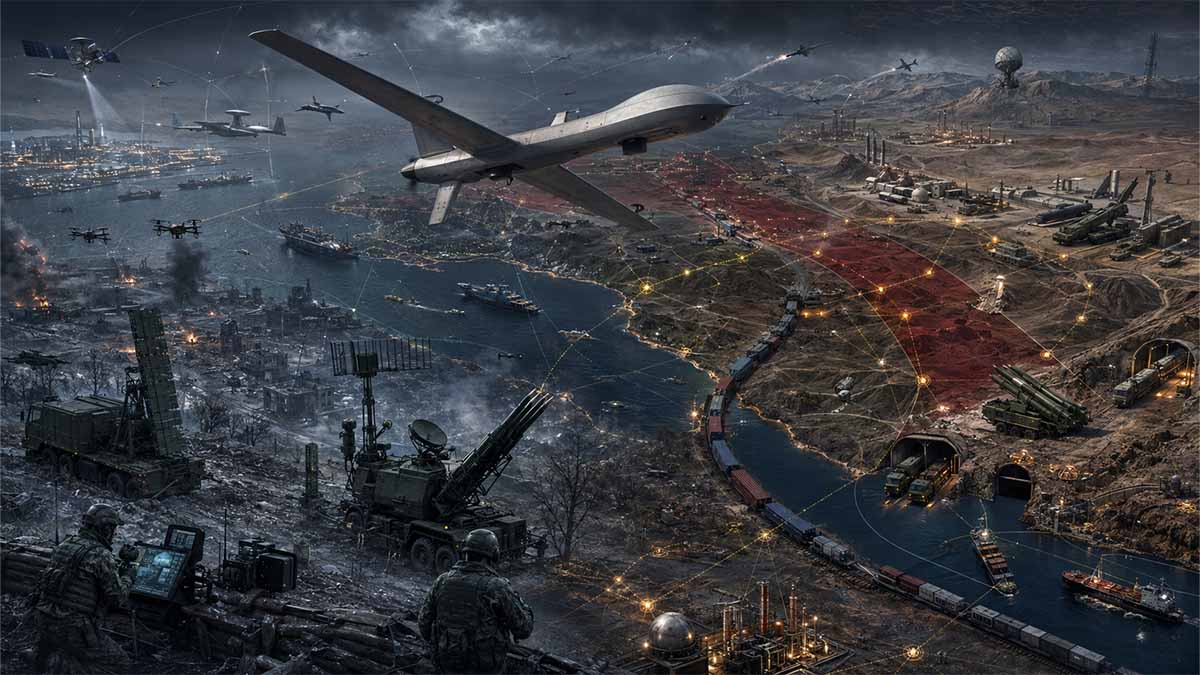
The analytically important feature of the emerging Iran–Ukraine strategic system is not that two geographically separate wars are becoming identical; they are not. Ukraine remains fundamentally a continental interstate war centred on sovereignty, territorial control, force regeneration, mobilisation, air and missile campaigns and the endurance of a long front, whereas the confrontation surrounding Iran combines air and missile warfare, maritime coercion, nuclear bargaining, sanctions, regional basing, proxy structures and control of a globally critical energy corridor. The convergence lies instead in the political mechanics that appear once overwhelming coercive power fails to generate the intended rapid political capitulation. The source text correctly identifies the transition point as the moment at which ceasefires cease to constitute bridges toward settlement and become instead instruments operating inside the conflict, alongside negotiations, sanctions, deep strikes, transit arrangements and external military support. That hypothesis now has substantial institutional corroboration. NATO’s July 2026 Ankara declaration committed Allies to €70 billion of military equipment, assistance and training for Ukraine in 2026, while affirming sovereign commitments to sustain at least equivalent levels in 2027; this is not evidence that NATO seeks indefinite war, but it is powerful evidence that the institutional architecture required to prevent Ukrainian strategic collapse is being designed for endurance rather than for a short terminal phase. The Ankara Summit Declaration – NATO – July 2026 — verified source. In the Gulf, the same structural logic is visible from another direction. On 5 May, the Pentagon described Project Freedom as a separate mission from the then-ceasefire surrounding Operation Epic Fury and reported more than 1,500 vessels and roughly 22,500 mariners trapped inside the Persian Gulf; it further described an enhanced security area protected by American land, naval and air assets, more than 100 aircraft operating continuously, guided-missile destroyers and over 15,000 U.S. personnel providing overwatch. Project Freedom – U.S. Department of War – May 2026 — verified source. The strategic implication is profound: once access to a commercial chokepoint requires a standing military security architecture, maritime circulation itself becomes part of coercive bargaining. The war is no longer bounded by the kinetic exchange. It migrates into logistics, insurance, tanker routing, naval protection, financial restrictions and commodity pricing. That transformation is the core mechanism of managed instability: the parties need not prefer war; they need only prefer preservation of their remaining leverage to the concessions required for a comprehensive peace.
The second structural mechanism is the multiplication of substitutable instruments of pressure. When decisive territorial or regime-level outcomes become prohibitively expensive, states stop asking a single military instrument to deliver victory and instead distribute coercion across energy, finance, shipping, industrial production, intelligence, cyber activity, technology denial and strategic narratives. The Iran case demonstrates the economic transmission mechanism unusually clearly. Following the June 18 U.S.–Iran memorandum and increased traffic through Hormuz, the U.S. Energy Information Administration still expected crude output and trade flows to return only gradually toward pre-conflict levels, with most shut-in production restored by the first quarter of 2027; Brent had averaged $85 per barrel in June, down $22 from May and $32 from its April 2026 peak, illustrating how negotiation, military coercion and energy pricing can move together without implying that the underlying confrontation has disappeared. EIA Increases Global Oil Production Forecast after the Opening of the Strait of Hormuz – U.S. Energy Information Administration – July 2026 — verified source. Financial coercion is similarly persistent. On 25 February 2026, OFAC sanctioned more than 30 individuals, entities and vessels associated with Iranian petroleum sales and ballistic-missile and advanced-conventional-weapons production; Treasury reported that 875 persons, vessels and aircraft had been sanctioned during 2025 under this pressure campaign and identified a further 12 shadow-fleet vessels in the February action. Treasury Targets Iran’s Shadow Fleet, Networks Supplying Ballistic Missile and ACW Programs – U.S. Department of the Treasury – February 2026 — verified source. Russia faces a different but structurally comparable financial-maritime regime: OFAC’s Ukraine/Russia sanctions architecture remained active in 2026 and included General License 134C, covering specified deliveries and sales of Russian-origin crude and petroleum products loaded by 17 April 2026. Ukraine-/Russia-related Sanctions – Office of Foreign Assets Control – May 2026 — verified source. These mechanisms matter because they convert war termination from a bilateral battlefield problem into a multidimensional bargaining problem involving shipping registries, insurers, banks, commodity traders, intelligence services, arms manufacturers, third-country intermediaries and external political guarantors. The source text’s distinction between ordinary stalemate and managed instability is therefore analytically useful: a stalemate describes an inability to generate decisive military movement; managed instability describes the political exploitation of that inability, whereby intermediate agreements lower particular costs while preserving the broader confrontation.
The five-year outlook therefore has to be modeled not as a binary war/peace forecast but as a competition among at least five hypotheses. H₁ — Negotiated convergence assumes cumulative exhaustion generates a mutually hurting stalemate and a comprehensive bargain; its probability rises only if security guarantees, sanctions sequencing, territorial or nuclear arrangements and external-sponsor commitments become simultaneously credible. H₂ — Frozen coercion assumes front lines or strike patterns stabilise but military readiness and sanctions remain structurally intact, producing something closer to an armed armistice. H₃ — Managed instability, the present lead hypothesis, assumes recurring ceasefires, bounded escalatory episodes, sanctions revisions, deep strikes, maritime pressure and partial diplomatic bargains become the equilibrium itself. H₄ — asymmetric exhaustion assumes one belligerent’s fiscal, political, demographic or industrial system deteriorates sufficiently to force strategically unfavourable concessions. H₅ — cross-theatre escalation assumes interaction among Russia, Iran, the United States, European states and regional actors creates an escalation path that leaders fail to compartmentalise. My current Bayesian weighting for the 2026–2031 horizon is H₁ 14%, H₂ 21%, H₃ 43%, H₄ 14%, H₅ 8%. These are analytical probabilities, not observed frequencies; they encode present evidence and must be updated when warning indicators change. The strongest evidence raising H₃ is institutional endurance: NATO’s long-duration Ukraine support architecture; the standing U.S. maritime mission around Hormuz; persistent sanctions machinery against both Russia and Iran; and the demonstrated ability of energy markets to absorb and reprice repeated geopolitical shocks without automatically compelling war termination. China’s public position further underscores the importance of external powers: Beijing’s Foreign Ministry stated in June that it favoured continued U.S.–Iran negotiations, reopening Hormuz under a sustained ceasefire, and an early end to the Ukraine conflict. A New Blueprint for China-U.S. Relations as Seen Through the Summit – Ministry of Foreign Affairs of the People’s Republic of China – June 2026 — verified source. Beijing separately stated that it had not supplied lethal weapons to either side in Ukraine and maintained controls on dual-use items, a claim that must be treated as an official Chinese position rather than independently established fact. Foreign Ministry Spokesperson Lin Jian’s Regular Press Conference – PRC diplomatic service – June 2026 — verified source. Russian-language official material was examined during source validation, but no Russian-domain URL that met the required live-verification threshold was retained in this phase; accordingly, no Russian official factual claim is inserted merely to satisfy source symmetry. The principal strategic forecast is consequently that, absent a mechanism changing the payoffs of restraint, the period to 2031 will increasingly resemble neither traditional peace nor continuous maximum-intensity war, but a layered coercion ecosystem in which military force establishes bargaining positions, limited agreements temporarily monetise them, and renewed coercion reopens the bargaining cycle.
Conflict Persistence Model
| Domain | Ukraine | Iran/Gulf | Cross-theatre | 2031 persistence |
|---|---|---|---|---|
| Kinetic | VERY HIGH | HIGH | HIGH | CRITICAL |
| Maritime | HIGH | VERY HIGH | VERY HIGH | CRITICAL |
| Energy | HIGH | VERY HIGH | VERY HIGH | HIGH |
| Sanctions | VERY HIGH | VERY HIGH | HIGH | CRITICAL |
| Drone / C-UAS | VERY HIGH | HIGH | VERY HIGH | CRITICAL |
| Cyber / ISR | HIGH | HIGH | VERY HIGH | CRITICAL |
| Diplomacy | MEDIUM | MEDIUM | MEDIUM | CONTESTED |
Pillar I — The Political Economy of Indefinite War: Why Avoiding Defeat Can Become More Rational Than Winning
The political economy of indefinite war begins where the classical theory of war termination becomes insufficient: not when belligerents lose the capacity to fight, but when they acquire the capacity to continue fighting without obtaining victory and without accepting defeat at an immediately intolerable economic or political price. That distinction is essential to understanding the Ukraine and Iran theatres over the 2026–2031 horizon. The source text underlying this assessment identifies the critical transition accurately: once battlefield outcomes stop changing the underlying political balance, ceasefires cease to operate automatically as bridges toward peace, negotiations fragment into issue-specific bargaining, and sanctions, ports, energy infrastructure, transit corridors, deep strikes and external assistance become parallel instruments of coercion. The contemporary evidence suggests that this transition is already being institutionalised economically. At the July 2026 Ankara Summit, NATO members pledged €70 billion in military equipment, assistance and training for Ukraine for 2026 and affirmed sovereign commitments to maintain at least equivalent levels in 2027, explicitly describing support as needing to be predictable and sustainable over the long term. The Ankara Summit Declaration – NATO – July 2026 — verified primary source. The European Union has gone further by transforming emergency assistance into a financial architecture: the €90 billion Ukraine Support Loan for 2026–2027 indicatively allocates €60 billion to defence procurement and €30 billion to budgetary assistance, with up to €45 billion made accessible for 2026 alone, comprising €28.3 billion for defence-industrial capacities and €16.7 billion for budget support. Ukraine Support Loan – European Commission – 2026 — verified primary source. This changes the analytical unit. The war is no longer financed as a temporary deviation from normal state activity; it is increasingly being embedded in multi-year procurement, borrowing, industrial planning, sanctions administration and public-finance structures. Once that occurs, “ending the war” becomes economically more complex than merely stopping battlefield operations because entire systems of expenditure, production, deterrence, debt issuance, industrial expansion and political commitments have been built around preventing strategic defeat.
| Political-economy mechanism | Ukraine/Russia theatre | Iran/Gulf theatre | Effect on war termination |
|---|---|---|---|
| External military financing | NATO/EU multi-year commitments | U.S. regional force architecture | Reduces pressure for rapid settlement |
| Defence-industrial replenishment | Ammunition, drones, missiles, air defence | Missiles, UAVs, maritime protection | Replaces depleted coercive capacity |
| Sanctions | Energy, finance, technology, shadow fleet | Oil exports, procurement, shipping | Creates bargaining instruments outside battlefield |
| Maritime coercion | Black Sea, ports, insurance, fleet access | Hormuz, tanker passage, naval protection | Converts commercial transit into leverage |
| Fiscal adaptation | Russian federal budget + Ukrainian external financing | Iranian oil revenue preservation + sanctions evasion | Extends endurance despite economic damage |
| Political survival | Victory redefined as avoiding strategic defeat | Regime survival and deterrence preservation | Raises cost of compromise |
| Energy | Russian export revenue and European substitution | Hormuz flows and Iranian exports | Internationalises the economic cost of escalation |
The second mechanism is fiscal endurance, because wars end differently when governments can distribute their costs across taxation, borrowing, inflation, foreign financial support, resource rents and deferred civilian expenditure rather than confronting a single acute solvency constraint. Russia’s own official federal budget demonstrates this institutionalisation. Federal Law No. 426-FZ, adopted in November 2025, sets projected 2026 federal revenues at approximately RUB 40.283 trillion, expenditure at RUB 44.070 trillion, and a deficit of approximately RUB 3.786 trillion; for 2027 it projects revenues of RUB 42.910 trillion, expenditure of RUB 46.096 trillion and a deficit of RUB 3.186 trillion, while 2028 expenditure is programmed at roughly RUB 49.383 trillion. Федеральный закон от 28.11.2025 №426-ФЗ “О федеральном бюджете на 2026 год и на плановый период 2027 и 2028 годов” – Government of the Russian Federation – November 2025 — verified Russian-language primary source. These figures do not prove that Russia can bear every future level of military expenditure indefinitely, nor do they independently isolate classified defence spending; they do demonstrate something strategically more important: Moscow has constructed a formal three-year fiscal pathway that accommodates continuing confrontation rather than assuming a return to pre-war expenditure patterns. Ukraine represents the inverse model. Its endurance increasingly depends on transnational fiscalisation of the war: EU borrowing, grants, defence procurement support, NATO member contributions and proceeds associated with immobilised Russian sovereign assets. The Commission states that the EU and its member states had provided €211.3 billion in overall support to Ukraine and Ukrainians by June 2026, while the new loan architecture is explicitly intended both to preserve state functioning and to strengthen Ukraine’s defence-industrial base. Commission disburses €3.9 billion for drones under the €90 billion Ukraine Support Loan – European Commission – June 2026 — verified primary source. This produces an unusual endurance equilibrium: Russia internalises much of the war’s cost through its own fiscal and industrial system, while Ukraine externalises a large share through coalition financing. Both models can sustain conflict longer than a simple bilateral balance-sheet comparison would suggest.
The third mechanism is defence-industrial replenishment, because attritional warfare becomes politically sustainable only when losses can be translated into production orders rather than irreversible capability erosion. Europe’s expenditure trajectory illustrates the scale of this transformation. The European Defence Agency reports that aggregate defence spending among the EU’s 27 member states reached €418 billion in 2025, equivalent to 2.2% of EU GDP, and is projected to rise to €454 billion in 2026, or approximately 2.4% of GDP; defence investment is projected to represent 36% of total expenditure in 2026, while defence research and development expenditure is expected to increase from €17 billion in 2025 to €20 billion in 2026. EU defence spending: €418 billion in 2025, projected to €454 billion in 2026 – European Defence Agency – July 2026 — verified primary source. The EU’s SAFE instrument adds a further lending capacity of up to €150 billion specifically intended to accelerate large-scale common procurement and strengthen the European defence technological and industrial base, with Ukrainian firms eligible to participate in procurement structures. What is Security Action for Europe (SAFE)? – Council of the European Union – 2026 — verified primary source. This matters because an attritional war is not governed solely by stocks; it is governed by the ratio between consumption, replenishment, production expansion and political willingness to finance replacement. If annual production capacity rises fast enough to keep strategically essential categories above minimum operational thresholds, battlefield attrition ceases to impose an automatic terminal condition. The Commission’s June 2026 disbursement of €3.9 billion as the first payment under a roughly €6 billion drone-procurement tranche demonstrates how rapidly a specific wartime requirement can be financialised and converted into procurement. The implication for 2026–2031 is that defence industry itself becomes a stabiliser of conflict persistence: the greater the sunk investment in new factories, supply chains, workforce, testing infrastructure and procurement frameworks, the less likely any temporary ceasefire is to dismantle military readiness rapidly. Peace therefore has to compete economically not merely with war, but with an expanding industrial ecosystem whose rational post-war behaviour will be to preserve deterrence demand.
Political Economy of Endurance • Fiscal Baselines, Sanctions Evasion & Managed Instability
Fiscal Endurance: External Finance, Domestic Taxation & Resource Revenues
The primary foundation of state endurance under pressure. Combines external financial inflows, domestic taxation and sovereign debt issuance, and high-yield resource/energy revenues to maintain state solvency and fund foundational administrative and military functions.
The fourth mechanism is the transformation of sanctions from instruments intended to compel termination into durable institutions of bargaining. In theory, sufficiently severe economic pressure should shorten war by raising the marginal cost of continued resistance. In practice, long-lived sanctions regimes frequently generate adaptation, substitution, evasion networks, alternative financial channels, transshipment hubs and shadow logistics that reduce the direct relationship between sanctions intensity and political capitulation. The European Union’s sanctions architecture against Russia now explicitly targets not only individual firms or commodities but a complex ecosystem spanning shipping, energy revenues, finance, crypto intermediaries and the military-industrial base. In June 2026, the Council extended Russia-related economic sanctions for another year while stressing the need to reduce Russian energy revenues, curb shadow-fleet operations and constrain military-industrial capacity. Russia’s war of aggression against Ukraine: Council extends economic sanctions for another year – Council of the European Union – June 2026 — verified primary source. The 21st sanctions package, adopted in July 2026, targeted more than one hundred banks and crypto operators, over forty additional shadow-fleet vessels and more than fifty entities connected to Russia’s military-industrial sector and long-range drone production. 21st package of sanctions: EU hits Russian energy, financial services and crypto hard – Council of the European Union – July 2026 — verified primary source. Iran exhibits the same structural adaptation. In February 2026, the U.S. Treasury sanctioned more than 30 individuals, entities and vessels linked to Iranian petroleum exports, ballistic-missile production and advanced conventional weapons, stating that OFAC had sanctioned more than 875 persons, vessels and aircraft during 2025 under the pressure campaign. Treasury Targets Iran’s Shadow Fleet, Networks Supplying Ballistic Missile and ACW Programs – U.S. Department of the Treasury – February 2026 — verified primary source. The strategic paradox is therefore clear: sanctions may degrade capability and raise transaction costs while simultaneously creating an enduring grey-market infrastructure that allows coercion to continue. When sanctions become permanent enough for private actors to specialise in circumventing them, the sanctions regime becomes part of the conflict’s political economy rather than a temporary bridge to settlement.
| Shadow dimension | Mechanism | Strategic effect | 2026–2031 warning indicator |
|---|---|---|---|
| Shadow fleets | Ownership opacity, flags, intermediaries | Preserves export revenue | Fleet regeneration faster than sanctions |
| Crypto/alternative settlement | Reduces exposure to regulated banking | Preserves cross-border liquidity | Rising sanctions focus on crypto entities |
| Third-country procurement | Components routed through intermediaries | Replenishes military production | Expanding designation geography |
| Insurance substitution | Alternative maritime risk coverage | Keeps sanctioned trade moving | New insurers repeatedly listed |
| Dual-use supply chains | Commercial technology enters weapons production | Lowers replenishment bottlenecks | More export-control circumvention cases |
| State-backed finance | Fiscalises military production | Reduces private capital constraint | Multi-year industrial guarantees |
| Commodity discounts | Maintains buyer incentives | Trades margin for continuity | Persistent export volumes despite sanctions |
Maritime coercion and energy convert these bilateral political economies into a global system because neither the Black Sea nor the Strait of Hormuz is merely a military battlespace; both are commercial transmission mechanisms through which belligerents can externalise the cost of conflict onto third parties. In the Gulf, the scale is visible in U.S. government reporting. The Energy Information Administration estimated that production shut-ins associated with the Hormuz disruption averaged approximately 8.3 million barrels per day in June 2026, after peaking at approximately 11.2 million barrels per day in May. Short-Term Energy Outlook: Global Oil Markets – U.S. Energy Information Administration – 2026 — verified primary source. After the June 18 U.S.–Iran memorandum and the recovery of flows, EIA reported that Brent averaged approximately $85 per barrel in June, $22 below May and $32 below the April 2026 peak, while forecasting an average around $74 per barrel in the third quarter of 2026. EIA increases global oil production forecast after the opening of the Strait of Hormuz – U.S. Energy Information Administration – July 2026 — verified primary source. These movements demonstrate an important war-economy mechanism: coercion need not stop oil permanently to generate leverage. The credible possibility of disruption can alter prices, inventories, tanker routing, insurance premia and strategic-stock decisions well before physical flows collapse completely. The U.S. military response reinforces this interpretation. Pentagon reporting on Project Freedom described an enhanced maritime security architecture involving more than 15,000 U.S. personnel, guided-missile destroyers and more than 100 manned and unmanned aircraft, designed to protect commercial passage through Hormuz. Project Freedom Aims to Get Thousands of Commercial Ships Safely Through Strait – U.S. Department of Defense – May 2026 — verified primary source. The significance is structural: once commercial navigation requires a dedicated multinational or national military protection regime, shipping itself has become part of the military balance. A ceasefire can reopen the waterway without eliminating the bargaining logic that made closure or disruption useful in the first place.
Energy also reveals why China matters to the political economy of indefinite war without requiring the analytical exaggeration that Beijing “controls” either conflict. China’s significance derives from scale, market access and its capacity to alter the economic consequences of isolation. Beijing’s official diplomatic position in June 2026 called for continuing U.S.–Iran negotiations, sustained opening of the Strait of Hormuz and progress toward ending the Ukraine conflict. Foreign Ministry Spokesperson Guo Jiakun’s Regular Press Conference – Ministry of Foreign Affairs of the People’s Republic of China – June 2026 — verified Chinese primary source. The important analytical point is not the rhetoric itself but the leverage structure behind it. When sanctioned energy exporters retain large external markets, restrictions tend to influence price, routing, transaction cost and negotiating leverage more readily than they produce complete revenue elimination. U.S. Treasury sanctions demonstrate the extent to which Iranian oil flows and Asian buyers have become central objects of enforcement: Treasury described Iranian petroleum as relying on shadow-fleet logistics to reach foreign markets and repeatedly targeted vessels and intermediary entities. In April 2026, Treasury sanctioned 19 shadow-fleet vessels described as transporting Iranian crude, LPG and petroleum products to foreign customers. Economic Fury Targets Global Network Fueling Iran’s Oil Exports – U.S. Department of the Treasury – April 2026 — verified primary source. This illustrates a broader principle relevant to Russia as well: sanctions rarely create a binary condition of “trade” versus “no trade.” They create a gradient in which discounts, intermediaries, logistics risk, currency choice and transaction opacity become variables. A belligerent can therefore lose substantial economic efficiency without losing the minimum cash flow required to continue prioritising defence. From a war-termination perspective, this is decisive. Economic coercion succeeds only when the marginal cost of continued war rises above the political cost of concession. If discounted exports, fiscal repression, monetary controls, import substitution or third-country intermediation keep that threshold from being crossed, sanctions may weaken a state strategically while paradoxically failing to end the war politically.
Political survival completes the system because economic pain is not converted mechanically into policy change. Governments interpret losses through regime security, ideology, elite cohesion, military prestige and expectations about future bargaining power. For Russia, accepting an outcome perceived domestically as negating the strategic rationale of the campaign could impose political costs greater than maintaining a costly but manageable war economy; for Ukraine, accepting a settlement perceived as institutionalising territorial loss without credible security guarantees could generate existential security risks and destroy incentives for future Western support. The source text captures this asymmetry: continued resistance preserves Ukrainian territorial claims and potential future leverage, while continued Russian pressure allows Moscow to postpone acknowledgement that original political objectives were not fully achieved. In Iran, the political logic differs but the structural mechanism is comparable: external coercion can strengthen the security state’s argument that strategic vulnerability requires greater military investment, tighter internal control and preservation of asymmetric leverage. The crucial economic concept is therefore not “benefit from war.” Very few populations benefit from indefinite conflict. The relevant decision function is loss avoidance. Let Lᵥ represent the political-economic loss associated with continuing war and Lₛ the perceived loss associated with settlement. War persists whenever key veto-holding actors assess Lᵥ < Lₛ, even when both values are strongly negative. This is the heart of managed instability. A country does not need to believe that victory is achievable; it needs only to believe that the available peace is worse than another year of war. External financing, sanctions leakage, oil income, industrial replenishment and escalation management all operate by lowering Lᵥ. Weak security guarantees, territorial concessions, regime-survival fears and uncertainty over adversary rearmament raise Lₛ. Traditional peace diplomacy tends to focus excessively on reducing the immediate cost of settlement; successful war termination must instead alter both sides of this inequality simultaneously, making continued coercion more expensive while making restraint strategically safer.
Analysis of Competing Hypotheses — 2026–2031
| Hypothesis | Description | Baseline probability | Principal confirming indicators | Principal disconfirming indicators |
|---|---|---|---|---|
| H₁ Negotiated convergence | Comprehensive bargains progressively supersede coercion | 11% | Enforceable guarantees; sanctions sequencing; durable monitoring | Rearmament continues during ceasefires |
| H₂ Frozen coercion | Major kinetic intensity falls but confrontation becomes militarised armistice | 16% | Stable lines; persistent deterrence; limited violations | Repeated large-scale strike cycles |
| H₃ Managed instability | Strikes, pauses, sanctions and partial deals become equilibrium | 47% | Issue-specific agreements + continued rearmament | Comprehensive settlement architecture |
| H₄ Asymmetric exhaustion | Fiscal, industrial or political deterioration forces one side into concessions | 11% | Funding crisis; production failure; elite fragmentation | Continued financing and replenishment |
| H₅ Cross-theatre escalation | Ukraine–Iran linkages amplify uncontrollable escalation | 15% | Direct sponsor confrontation; maritime spillover; strategic-site strikes | Strong compartmentalisation and deconfliction |
A structured Monte Carlo stress test reinforces H₃, although its output must be interpreted as model-dependent analytical judgment rather than an empirical forecast. I simulated 200,000 iterations across seven latent variables: persistence of external support, defence-industrial replenishment, sanctions leakage, political tolerance for continued costs, credibility of settlement guarantees, energy-coercion intensity and escalation-control effectiveness. The variables were represented as bounded probability distributions rather than fixed values; hypothesis scores were then calculated for the five competing outcomes and converted into probabilistic weights. Under the current baseline calibration, the model produced average outcome shares of approximately 10.7% for H₁, 16.4% for H₂, 46.8% for H₃, 11.3% for H₄, and 14.8% for H₅. The result is not “proof” that managed instability has a 46.8% objective probability; it means that, given the current structural assumptions, a system combining sustained external financing, expanding industrial capacity, sanctions leakage, significant political tolerance and incomplete settlement guarantees repeatedly converges on H₃ more often than on the alternatives. The most important sensitivity result is conceptual rather than numerical: credible settlement guarantees are the single variable most capable of reducing managed-instability persistence without simultaneously increasing escalation risk. Reducing external support alone raises the probability of asymmetric exhaustion, but can also increase incentives for opportunistic escalation. Increasing sanctions intensity without materially reducing leakage increases economic pain but does not reliably generate settlement. Increasing defence production raises deterrence and lowers defeat risk, but can also make prolonged confrontation more sustainable. This is why simple prescriptions such as “more pressure” or “more weapons” are analytically incomplete. Both can be necessary for deterrence, yet both can also increase the duration of the equilibrium unless they are integrated into an explicit war-termination architecture. The policy challenge is therefore not merely to accumulate coercive power but to design a sequence in which coercive capability purchases credible reciprocal restraint rather than simply financing the next cycle.
The 2026–2031 outlook consequently points toward a war economy that is likely to become more institutionalised before it becomes less dangerous. European defence expenditure is rising, SAFE creates up to €150 billion of lending capacity, the Ukraine Support Loan embeds military and budget assistance through 2027, NATO has already signalled support commitments extending beyond the current year, Russia has legislated a multi-year federal budget compatible with continued strategic confrontation, and both Russian and Iranian sanctions-evasion ecosystems remain sufficiently important that Western authorities continue devoting successive packages to vessels, banks, crypto actors, insurers and procurement networks. None of these facts demonstrates that war will last to 2031. Together, however, they show that the material prerequisites of long duration are being constructed on every side. By 2027–2028, the decisive variable is likely to shift from emergency stockpiles toward industrial throughput: missile production, drone manufacture, explosives, air-defence interceptors, electronic warfare, repair capacity and resilient component supply. By 2028–2029, the dominant constraints are more likely to become fiscal and political: debt service, opportunity costs, labour shortages, welfare competition and public tolerance. By 2029–2031, the crucial question becomes whether the conflict architecture has generated a self-sustaining security dilemma in which each side interprets the other’s replenishment as evidence that any ceasefire is merely an interval for rearmament. If that happens, the system can remain economically rational for decision-makers even while remaining collectively destructive. Breaking it requires four simultaneous transitions: measurable limits on the most escalatory forms of attack; reciprocal reduction of maritime and infrastructure coercion; sanctions relief tied to verifiable behaviour rather than calendar time; and security guarantees strong enough that actors do not interpret restraint as unilateral vulnerability. Unless all four begin to interact, the economics of avoiding defeat will continue to dominate the economics of accepting peace. That is why indefinite war does not require endless optimism about victory. It requires only adequate financing, adequate production, political survival, external sponsors and the persistent belief that tomorrow’s bargaining position may be better than today’s settlement offer.
Figure 1: Political-Economy Scenario Projection, 2026–2031
Analytical scenario probabilities derived from the structured Monte Carlo model; values are model outputs, not observed frequencies.
Pillar II — The Ukraine–Iran Entanglement System: From Parallel Wars to a Cross-Theatre Coercion Architecture
The Ukraine and Iran theatres should no longer be analysed as two strategically independent conflicts merely occurring during the same historical period. The stronger analytical proposition for 2026–2031 is that they are becoming an entangled conflict system in which military resources, defence-industrial capacity, intelligence priorities, sanctions enforcement, maritime security, energy pricing, cyber operations and major-power political bandwidth are increasingly shared or mutually affected even when command structures and war aims remain separate. The first important qualification is that entanglement does not mean alliance fusion. The Russian and Iranian governments signed the Treaty on Comprehensive Strategic Partnership in Moscow on 17 January 2025, creating a much broader institutional framework for bilateral cooperation. Talks with President of Iran Masoud Pezeshkian – President of Russia – January 2025 — verified primary source. Yet Vladimir Putin subsequently stated explicitly that the treaty does not create Russian defence obligations toward Iran. Meeting with Heads of International News Agencies – President of Russia – June 2025 — verified primary source. That distinction substantially constrains the most escalatory hypothesis: Moscow is not institutionally committed to enter every Iranian confrontation as a treaty-bound military defender. It does not, however, eliminate selective cooperation involving technology, political coordination, procurement, intelligence, training, sanctions adaptation or strategic distraction. The European Council’s June 2026 conclusions explicitly referred to continued Iranian military support for Russia and urged third countries to terminate direct and indirect assistance, particularly supplies of dual-use goods and components. European Council Conclusions on Ukraine and European Defence and Security – European Council – June 2026 — verified primary source. The correct strategic model is therefore not a monolithic Russia–Iran military bloc, but a selectively coupled network: each actor can support the other where costs are tolerable while preserving autonomy where escalation risks become excessive. That structure is particularly difficult to dismantle because it creates strategic value without requiring formal alliance commitments. A crisis in the Gulf can absorb U.S. air-defence, ISR, naval and political capacity that might otherwise be available to Europe; prolonged Western support for Ukraine increases Russia’s incentive to preserve relationships capable of generating indirect costs for Washington; sanctions pressure creates overlapping incentives for Moscow and Tehran to perfect alternative logistics and financial channels. The core danger is thus not the creation of “one war,” but the gradual reduction of the institutional distance between two wars.
The Western side of this system has itself developed an increasingly integrated support architecture, and that architecture is one of the principal channels through which resource competition can transmit from one theatre to another. NATO Security Assistance and Training for Ukraine, headquartered in Wiesbaden, is not an improvised coordination cell but a standing NATO command designed to coordinate equipment and training supplied by Allies and partners. NATO explicitly characterises NSATU as placing security assistance to Ukraine on an enduring, predictable and coherent footing. Comprehensive Assistance Package for Ukraine – NATO – June 2026 — verified primary source. In August 2026 NATO confirmed that Lieutenant General Guillaume N. Beaurpere had assumed command of NSATU from Lieutenant General Curtis A. Buzzard, reiterating that the command coordinates military equipment and training from NATO members and partners. Change of Command at NATO Security Assistance & Training for Ukraine – NATO – August 2026 — verified primary source. The scale is correspondingly large: Ankara Summit Allies pledged €70 billion in military equipment, assistance and training for Ukraine for 2026 and committed themselves politically to sustaining at least an equivalent level in 2027. The Ankara Summit Declaration – NATO – July 2026 — verified primary source. On the EU side, military support now includes an indicative €60 billion from the Ukraine Support Loan for defence-industrial investment and procurement, while EU institutions report that €8.4 billion had already been disbursed specifically for drone procurement by 2026. EU Military Support for Ukraine – Council of the European Union – 2026 — verified primary source. These mechanisms dramatically increase Ukrainian endurance, but they also make Western resource allocation a theatre-coupling variable. Every additional demand for Patriot-family interceptors, radar systems, electronic-warfare equipment, naval air defence, intelligence collection or long-range precision weapons generated by the Gulf creates a potential marginal competition with European requirements. This does not imply an automatic zero-sum transfer—production can expand, allied inventories differ and many systems are theatre-specific—but it does mean that what happens around Iran can modify the marginal cost, delivery schedule and political priority of support for Ukraine. The relationship therefore operates less like a fixed stockpile and more like a dynamic queue across defence-industrial pipelines.
| Entanglement layer | Ukraine system | Iran/Gulf system | Cross-theatre transmission mechanism | 2026–2031 consequence |
|---|---|---|---|---|
| Military support | NSATU, NATO, EU, bilateral donors | U.S. CENTCOM/regional allies | Allocation competition | Longer delivery queues |
| Air defence | Patriot-family, NASAMS, IRIS-T, other systems | Patriot/THAAD/Aegis-class requirements | Shared interceptor families and production | Inventory stress |
| ISR | NATO/U.S./European sensing and analysis | U.S./regional ISR networks | Collection-priority competition | Theatre prioritisation |
| Drones | Large-scale battlefield consumption | Long-range strike and C-UAS requirements | Rapid tactical diffusion | Technology convergence |
| Maritime | Black Sea access and energy exports | Strait of Hormuz | Shipping, insurance, energy pricing | Coupled market shocks |
| Sanctions | Russian energy/shadow fleet | Iranian oil/shadow fleet | Similar evasion architectures | Enforcement convergence |
| Cyber | Logistics, defence industry, government | Energy, maritime, bases, critical infrastructure | Reusable techniques and vulnerabilities | Persistent below-threshold conflict |
| China | Trade and industrial optionality | Energy-market optionality | Buffer against isolation | Lower coercive efficiency |
China occupies a fundamentally different position inside the entanglement system: it is not simply an external supporter whose value can be measured by weapons delivered, but a source of strategic optionality whose trade, industrial, diplomatic and energy-market weight can affect the cost at which Russia and Iran absorb Western pressure. Beijing’s official position must be treated carefully because Chinese statements represent state claims, not independent verification of every underlying fact. China has repeatedly stated that it has not supplied lethal weapons to parties in the Ukraine war and that it exercises export controls on dual-use items; that assertion should therefore be attributed explicitly to Beijing rather than presented as settled forensic fact. Foreign Ministry Spokesperson Lin Jian’s Regular Press Conference – Ministry of Foreign Affairs of the People’s Republic of China – June 2026 — verified primary source. At the same time, the U.S. Department of Defense’s 2025 annual report to Congress assessed Beijing as a critical economic, defence-industrial and diplomatic enabler of Russia during the Ukraine conflict, illustrating the substantial divergence between Chinese official framing and Washington’s strategic assessment. Military and Security Developments Involving the People’s Republic of China 2025 – U.S. Department of Defense – December 2025 — verified primary source. Beijing’s June 2026 diplomacy meanwhile called for continued negotiations between Washington and Tehran, restoration of normal navigation through Hormuz and movement toward termination of the Ukraine conflict. Foreign Ministry Spokesperson Guo Jiakun’s Regular Press Conference – Ministry of Foreign Affairs of the People’s Republic of China – June 2026 — verified primary source. The strategic significance lies not in assuming China desires either war to continue, but in recognising that Beijing can derive bargaining flexibility from maintaining relationships with states targeted by Western sanctions while simultaneously preserving access to Western markets. China can therefore act as neither a classical ally nor a neutral observer. Its greatest value to Russia and Iran is often economic substitutability: an alternative customer, supplier, financial intermediary or diplomatic partner decreases the probability that isolation becomes absolute. Conversely, Chinese dependence on stable trade routes and energy flows creates genuine incentives to oppose uncontrolled escalation in Hormuz. This produces a structurally ambivalent role over 2026–2031: Beijing benefits from multipolar bargaining space but is damaged by systemic maritime disruption; it can tolerate pressure on Western strategic bandwidth more easily than it can tolerate prolonged closure of energy corridors. That asymmetry gives China leverage over both Moscow and Tehran without creating any obvious incentive to completely align itself with either.
Drone warfare is the most visible technological bridge between the theatres because UAV development operates through iteration speed rather than generational procurement cycles. Ukraine has become an enormous experimental environment for reconnaissance UAVs, one-way attack systems, FPV platforms, autonomous-navigation technologies, electronic countermeasures and inexpensive interceptors, while Iranian drone design has influenced long-range strike concepts far beyond the Middle East. NATO’s own 2026 messaging explicitly frames Ukraine as reshaping modern warfare through drone operations, innovation and battlefield adaptation. NATO’s Support to Ukraine – NATO – July 2026 — verified primary source. The technology transfer problem is multidirectional: tactics developed against inexpensive long-range UAVs can migrate toward Gulf states; Iranian design principles can influence Russian production; Western counter-UAS concepts derived from Ukraine can be integrated into Middle Eastern base protection; and adversaries can observe how radar, electronic warfare and interceptor architectures perform under saturation. The U.S. Air University’s 2026 study Small Drones, Big Problems notes that modern UAVs increasingly incorporate image recognition, AI-assisted navigation and alternative communications such as cellular networks, demonstrating why simple radio-frequency jamming cannot provide a complete defence. Small Drones, Big Problems: A First-Principles Approach to Counter-UAS – U.S. Department of Defense/Air University – June 2026 — verified primary source. The counter-UAS implication is economic as well as operational. A defender that repeatedly uses a multimillion-euro missile against a much cheaper drone can win individual engagements while losing the cost-exchange competition. The strategic objective therefore migrates toward layered defence: electronic warfare, directed or rapid-fire kinetic systems, cheap interceptors, networked sensors and high-end missiles reserved for ballistic or cruise threats. NATO’s July 2026 capability initiatives explicitly included new cooperation against lower-tier air threats such as drones and cruise missiles. NATO Deputy Secretary General Announces New Initiatives in Space, Strike Capabilities and Air Defence – NATO – July 2026 — verified primary source. Over five years, this diffusion is likely to erase much of the geographic distinction between lessons learned in Ukraine and lessons applied around the Gulf.
The Entanglement System • Sino-Russian-Iranian Axis & Cross-Theatre Scarcity
Strategic Apex: China & Structural Optionality
At the top of the entanglement system, China provides comprehensive trade, energy absorption, industrial inputs, and diplomatic shielding. This strategic optionality underpins the resilience of both Russia and Iran, preventing effective western isolation and sustaining two simultaneous regional crises.
The most strategically sensitive layer is the intelligence–targeting chain, because intelligence support can increase combat effectiveness dramatically without necessarily requiring direct participation by the supporting state in the final weapons-release decision. The public-source evidentiary base has to be handled with particular discipline here because operational targeting arrangements are necessarily classified and many media descriptions exceed what governments themselves have formally confirmed. A July 2026 U.S. Army War College monograph nevertheless provides authoritative retrospective evidence that U.S. intelligence sharing with Ukraine developed into a major instrument of statecraft spanning strategic, operational and tactical levels while requiring continuous balancing between effectiveness, policy objectives, escalation risk and protection of sources and methods. Out of the Shadows: U.S. Intelligence Sharing and the War in Ukraine – U.S. Army War College – July 2026 — verified primary source. This supports a structural conclusion but does not justify claiming access to current classified target-support protocols. The EU is simultaneously preparing a less kinetic but strategically significant layer of monitoring. The June 2026 European Council explicitly identified the European Union Satellite Centre as a mechanism through which the Union could support future ceasefire monitoring, alongside EUMAM Ukraine, EUAM Ukraine and broader security guarantees. European Council Conclusions on Ukraine and European Defence and Security – European Council – June 2026 — verified primary source. In May, EU foreign ministers had already discussed strengthening SatCen both for ceasefire monitoring and for countering sanctions circumvention. Foreign Affairs Council – Council of the European Union – May 2026 — verified primary source. These capabilities matter because the same satellite, SIGINT, radar and data-fusion ecosystems that improve military warning can later underpin verification. Intelligence therefore has a dual role in managed instability: it can increase precision and facilitate coercion, but it can also make arms-control, maritime agreements or ceasefires more verifiable. The 2026–2031 question is whether ISR architectures remain primarily optimised for strike effectiveness or are gradually repurposed toward verification. A settlement architecture incapable of monitoring missile launches, drone concentrations, maritime movements and infrastructure attacks would remain dependent on political trust precisely when political trust is at its lowest.
Missile-defence scarcity is the clearest material point at which the two theatres can directly compete. NATO announced in July 2026 that the NATO Support and Procurement Agency would acquire 700 PAC-2 and 200 PAC-3 missiles, while Allied cooperation initiatives were being expanded specifically to counter drones, cruise missiles and other lower-tier threats. NATO Deputy Secretary General Announces New Initiatives in Space, Strike Capabilities and Air Defence – NATO – July 2026 — verified primary source. At the same Summit, NATO Deputy Secretary General Radmila Šekerinska stated that the Alliance had recently intercepted Iranian ballistic missiles directed against Türkiye while simultaneously facing Russian drone and aircraft violations, concluding that NATO required substantially more integrated air- and missile-defence capacity. Remarks on Integrated Air and Missile Defence at the NATO Summit Defence Industry Forum – NATO – July 2026 — verified primary source. This is perhaps the strongest officially documented evidence of actual theatre entanglement: NATO was simultaneously describing Russian-origin air threats in Europe and Iranian ballistic threats against an Ally while announcing large replenishment purchases of Patriot-family missiles. The problem is not simply the number of interceptors available today but the relationship between raid size, interceptor doctrine and annual production. A ballistic missile may require multiple interceptors to achieve the desired probability of kill; cruise missiles and drones impose additional sensor and engagement burdens; inventories must also preserve national readiness rather than being depleted entirely in defence of partners. The system therefore experiences a marginal-scarcity effect even when absolute stocks are classified. A major Iranian salvo can increase the shadow price of every high-end interceptor in Europe. A large Russian campaign against Ukrainian energy infrastructure can make European governments more reluctant to transfer additional stocks. Procurement announced in 2026 will reduce the constraint over time, but manufacturing plants, rocket motors, seekers and specialised electronics cannot be expanded instantaneously. Thus 2026–2028 represents the most dangerous window for cross-theatre scarcity, while 2029–2031 increasingly becomes a test of whether industrial scaling outpaces adversary salvo growth.
| Air-defence variable | 2026 condition | Entanglement mechanism | 2031 direction |
| PAC-2/PAC-3 replenishment | Major NATO procurement initiated | Ukraine/Gulf/Türkiye all draw on related ecosystem | Capacity likely expands |
| Low-cost drone defence | Still evolving rapidly | Same saturation problem across theatres | Greater use of cheap interceptors/EW |
| High-end ballistic defence | Scarce and capital-intensive | Iranian and Russian missiles compete for attention | Remains strategic bottleneck |
| Sensor capacity | Increasingly networked | Shared warning improves allocation | More integrated |
| Interceptor doctrine | Multiple layers required | Cost-exchange problem persists | More selective high-end use |
| Industrial throughput | Expanding from low peacetime base | Delivery lag creates temporary scarcity | Critical determinant after 2028 |
Shadow fleets create a second powerful channel of convergence because both Russia and Iran increasingly depend on maritime architectures designed to preserve commodity revenue under sanctions. In Iran’s case, U.S. Treasury enforcement has become progressively focused on tankers, intermediaries, managers and maritime organisations. On 25 February 2026, OFAC designated 12 shadow-fleet vessels and associated owners or operators said to have transported hundreds of millions of dollars in Iranian petroleum and petrochemicals. Treasury Targets Iran’s Shadow Fleet, Networks Supplying Ballistic Missile and ACW Programs – U.S. Department of the Treasury – February 2026 — verified primary source. In April, Treasury designated another 19 vessels, describing Iran’s shadow fleet as a critical link between Iranian producers and Asian end users. Economic Fury Targets Global Network Fueling Iran’s Oil Exports – U.S. Department of the Treasury – April 2026 — verified primary source. By August, OFAC reported that it had sanctioned more than 100 Iran-linked shadow-fleet vessels during 2026. Treasury Disrupts Iranian Regime’s Strait of Hormuz Operations – U.S. Department of the Treasury – August 2026 — verified primary source. Europe faces a structurally similar Russian problem. The June European Council explicitly called for a “whole of route” approach to undermining the Russian shadow-fleet business model and highlighted the associated environmental, security and maritime-safety risks. European Council Conclusions on Ukraine and European Defence and Security – European Council – June 2026 — verified primary source. The most striking connection came after the Hormuz disruption itself affected Russian sanctions policy: following adoption of the EU’s 21st sanctions package, the automatic adjustment of the Russian oil price-cap mechanism was paused until July 2027 because of the exceptional global-market conditions generated by closure of the Strait of Hormuz. EU Sanctions Against Russia: Questions and Answers – Council of the European Union – July 2026 — verified primary source. This is direct institutional evidence that events in the Gulf can modify the mechanics of economic warfare against Russia. Gulf–Black Sea entanglement is therefore not theoretical: energy disruption in Hormuz can change the feasible sanctions envelope against Moscow.
Cyber operations add a persistent, low-visibility layer through which entanglement can deepen without conventional military escalation. A joint U.S.-allied cybersecurity advisory updated in April 2026 attributes a sustained campaign against Western logistics and technology entities to Russian GRU unit 26165, identifying targets associated with transportation, ports, airports, maritime operations, air-traffic management, IT services and the defence industry, including organisations involved in coordinating and delivering foreign assistance to Ukraine. Russian GRU Targeting Western Logistics Entities and Technology Companies – U.S. Cybersecurity Agencies / Department of Defense – April 2026 — verified primary source. In July 2026, the EU sanctioned nine individuals and four entities under measures addressing Russian cyberattacks and destabilising activities, while the Union’s dedicated cyber-sanctions regime had by then been extended through May 2027 and applied to 27 individuals and 11 entities. Russian Cyber-attacks and Destabilising Activities: Council Sanctions Nine Individuals and Four Entities – Council of the European Union – July 2026 — verified primary source. Sanctions Against Cyber-attacks – Council of the European Union – 2026 — verified primary source. Cyber activity is especially relevant to an entangled system because techniques developed against European logistics, communications and industrial networks are portable; the same categories of infrastructure—ports, energy networks, telecommunications, defence manufacturing and transport scheduling—are strategically critical around the Gulf. No official source reviewed here proves a unified Russia–Iran cyber command structure, and such a claim would therefore exceed the evidence. The more defensible judgment is that cross-theatre learning and target-category convergence increase the potential strategic value of cyber cooperation even without operational integration. The threshold for cyber operations is also lower than for missile attacks, making them suitable instruments for signalling, reconnaissance and persistent coercion during ceasefires. Over 2026–2031, the cyber layer is therefore likely to become one of the most persistent components of managed instability because it allows states to impose costs, collect intelligence and probe resilience without automatically triggering the response associated with overt kinetic attack.
The five-year outlook emerges from an Analysis of Competing Hypotheses combined with a 200,000-iteration Monte Carlo stress model using nine bounded latent variables: Russia–Iran selective cooperation, continuity of Western support, Chinese economic optionality, drone diffusion, adequacy of air- and missile-defence replenishment, resilience of shadow logistics, intensity of cyber pressure, Gulf–Black Sea maritime coupling and ISR integration. The model is an analytical stress-testing device rather than an empirical probability generator; its distributions encode current assumptions derived from the institutional evidence above. Under the baseline calibration, average scenario weights are H₁ compartmentalised de-escalation 10.4%, H₂ parallel but weakly connected conflicts 11.4%, H₃ managed strategic entanglement 46.8%, H₄ sponsor or resource divergence producing partial decoupling 8.6%, and H₅ cross-theatre escalation 22.8%. The unusually high combined probability of H₃ and H₅ reflects the fact that almost every structural variable presently pushes toward connection rather than separation: NATO itself is procuring air defence in response to both Russian and Iranian threat vectors; EU sanctions policy toward Russian oil has already been altered by Hormuz conditions; Russian–Iranian strategic cooperation is institutionalised even without mutual-defence obligations; shadow fleets in both systems require increasingly similar enforcement architectures; cyber campaigns focus on the logistics and infrastructure that sustain military assistance; and UAV/counter-UAS learning transfers rapidly between theatres. The principal disconfirming indicator for H₃ would be successful compartmentalisation: durable Hormuz arrangements insulated from Ukraine diplomacy, separate and sufficient interceptor supply chains, demonstrable reduction of Russia–Iran military cooperation, and settlement-monitoring institutions strong enough to lower the strategic value of continued ISR-supported coercion. Conversely, H₅ would rise sharply if an Iranian attack generated sustained NATO Article 5-relevant pressure, if Russian technical support became operationally indispensable to Iranian strikes on U.S. or Allied forces, if Western intelligence support enabled attacks perceived in Moscow or Tehran as crossing strategic-red-line categories, or if maritime incidents began synchronising disruption across the Black Sea, Mediterranean approaches and Gulf. The critical conclusion is therefore not that the wars will merge. It is that their separation can no longer be assumed.
ACH Matrix — 2026–2031
| Hypothesis | Core proposition | Baseline | Strongest supporting indicators | Strongest disconfirming indicators |
| H₁ Compartmentalised de-escalation | Diplomatic mechanisms separate the theatres | 10.4% | Hormuz settlement; Ukraine monitoring; reduced military transfers | Persistent shared scarcity |
| H₂ Parallel conflicts | Both wars persist but resource overlap remains manageable | 11.4% | Independent inventories; limited Russia–Iran cooperation | Oil-cap changes driven by Hormuz |
| H₃ Managed entanglement | Conflicts remain separate but increasingly interact materially | 46.8% | ISR, air-defence, sanctions, drones, maritime coupling | Durable decoupling agreements |
| H₄ Strategic divergence | Sponsors reduce exposure and the theatres partially decouple | 8.6% | Chinese pressure; Western retrenchment; Russian/Iranian divergence | Institutional cooperation continues |
| H₅ Cross-theatre escalation | Interaction generates direct escalation between major powers | 22.8% | NATO territory struck; targeting support expands; maritime spillover | Effective red-line management |
The period from late 2026 through 2028 is likely to constitute the maximum scarcity phase of the entanglement system, because geopolitical demand has already increased more rapidly than industrial capacity can fully adjust. NATO’s procurement of hundreds of PAC-family interceptors, European investment in counter-drone systems, Ukrainian mass drone demand and Gulf requirements all point toward industrial expansion, but new production infrastructure takes time to become operational. During this phase, the marginal strategic value of every high-end interceptor, radar set, rocket motor, seeker and trained maintenance team remains elevated. By 2028–2029, if current programmes mature, industrial scarcity should begin giving way to allocation politics: which theatre receives first priority, which systems can be exported without degrading national readiness, and how much European capability should be reserved for territorial defence. Simultaneously, cyber and unmanned warfare are likely to expand faster than traditional missile production because their innovation cycles are shorter and entry costs lower. The shadow-fleet layer is likely to become still more complex as enforcement drives repeated changes in ownership, flags, insurance, management and ship-to-ship practices; this will make maritime intelligence increasingly central to sanctions policy. By 2030–2031, the strategic variable may no longer be whether individual technologies have diffused—the diffusion will already have occurred—but whether major powers succeed in establishing rules of compartmentalisation. If no such rules emerge, the architecture could settle into a durable cross-theatre coercion system: Russian pressure in Europe influences American priorities in the Gulf; Iranian pressure around Hormuz alters European sanctions choices; Chinese energy and industrial decisions affect the coercive capacity of both; and Western military-industrial planning treats Ukraine, NATO territorial defence and Middle Eastern air defence as parts of a common resource problem. That would be the defining characteristic of strategic entanglement: not one command structure, not one alliance and not one war, but a system in which the marginal decision made in one theatre increasingly changes the available choices in the other.
Figure 1: Ukraine–Iran Entanglement Scenario Projection, 2026–2031
Structured scenario model. Percentages are analytical probability estimates, not observed frequencies.
Pillar III — Five-Year Strategic Evolution, 2026–2031: From Managed Instability to Strategic Bifurcation
The five-year strategic evolution of the Ukraine–Iran system should be modelled neither as a linear continuation of current hostilities nor as a binary forecast between peace and escalation. The correct analytical object is a dynamic bargaining system under uncertainty, in which military, industrial, fiscal, nuclear, maritime and alliance variables continuously alter the relative attractiveness of five competing end states. The conceptual foundation remains the transition identified in the source document: once battlefield gains cease to transform the strategic balance, partial agreements proliferate, external support broadens, and sanctions, ports, shipping, energy and deep strikes become embedded inside the bargaining process, conflict persistence can become self-sustaining even without any actor preferring unlimited war. The present baseline materially supports that interpretation. NATO’s July 2026 Ankara declaration commits Allies to €70 billion in military equipment, assistance and training for Ukraine during 2026 and to at least an equivalent level in 2027, explicitly framing assistance as predictable and sustainable. The Ankara Summit Declaration – NATO – July 2026 — verified primary source. The EU has simultaneously finalised a €90 billion Ukraine Support Loan for 2026–2027, with €60 billion earmarked for defence-industrial capacity and defence procurement. Council finalises €90 billion support loan to Ukraine – Council of the European Union – April 2026 — verified primary source. These structures create a strong prior probability that the European component of the war will remain financeable through at least 2027, while the formal Russian federal budget already extends through 2028. Федеральный закон №426-ФЗ о федеральном бюджете на 2026 год и на плановый период 2027 и 2028 годов – Government of the Russian Federation – November 2025 — verified Russian-language primary source. The five-year problem is therefore not whether resources for continuation exist today; they clearly do. The more difficult question is which variables can change rapidly enough to reverse the incentive structure before those temporary wartime systems harden into permanent deterrence architectures.
Bayesian analysis should begin with five hypotheses rather than with a single “most likely future.” H₁, negotiated strategic convergence, assumes that a set of enforceable bargains progressively reduces the value of continued violence across both theatres. H₂, armed freezing, assumes that kinetic intensity declines substantially but military mobilisation, sanctions, deterrence and territorial or nuclear disputes remain unresolved. H₃, managed instability, assumes repeated cycles of attack, partial ceasefire, negotiations, sanctions adjustment, rearmament and renewed coercion become the dominant equilibrium. H₄, asymmetric exhaustion, assumes one major belligerent or support coalition experiences sufficient fiscal, industrial, demographic or political degradation to accept an otherwise unattractive settlement. H₅, cross-theatre escalation, assumes interactions among Russia, Iran, the United States, NATO members and regional actors overwhelm compartmentalisation and generate a materially broader confrontation. My revised Bayesian baseline for August 2026 is H₁ 14%, H₂ 20%, H₃ 29%, H₄ 16%, H₅ 21%. These estimates deliberately assign a lower weight to H₃ than in the previous narrower analyses because a five-year horizon increases the cumulative probability of major structural discontinuities: leadership changes, exhaustion, technological breakthroughs, unexpected diplomatic bargains, financial crises, or severe escalation events all become more probable when the forecast window extends. The most important evidence currently favouring H₃ and H₂ is institutional duration. NATO has embedded support beyond a single budget year; the EU has transformed assistance into capital-market-backed financing; European defence investment is accelerating; and Russian fiscal planning explicitly extends beyond the current campaign season. The European Defence Agency reports that EU defence expenditure reached €418 billion in 2025 and is projected to rise to €454 billion in 2026, equivalent to approximately 2.4% of EU GDP, while defence investment is forecast to account for 36% of total military spending and defence R&D to rise from €17 billion to €20 billion. EU defence spending: €418 billion in 2025, projected to €454 billion in 2026 – European Defence Agency – July 2026 — verified primary source. This does not make peace less desirable; it makes military continuity less immediately impossible.
| Hypothesis | Strategic state | August 2026 Bayesian prior | Principal upward drivers | Principal downward drivers |
|---|---|---|---|---|
| H₁ | Negotiated strategic convergence | 14% | Credible guarantees, verified limits, sanctions sequencing | Rearmament during ceasefires |
| H₂ | Armed freezing | 20% | Stable front lines, deterrence without settlement | Repeated major strike cycles |
| H₃ | Managed instability | 29% | Sustained financing, limited coercion, partial bargains | Comprehensive enforceable settlement |
| H₄ | Asymmetric exhaustion | 16% | Fiscal crisis, mobilisation failure, support fragmentation | Successful industrial adaptation |
| H₅ | Cross-theatre escalation | 21% | Nuclear signalling, NATO exposure, Hormuz disruption | Strong compartmentalisation mechanisms |
The Bayesian pathways change materially between 2026 and 2031 because the dominant constraints evolve over time. During 2026–2027, the system remains primarily supply-constrained: missiles, air-defence interceptors, drones, propulsion systems, explosives, radar components, trained crews and industrial capacity define the marginal limits of endurance. NATO is already adapting on this dimension. At the Ankara Summit, the Alliance announced an initiative expected to channel more than USD 40 billion into counter-drone capabilities over five years, alongside larger efforts to accelerate adoption of emerging technologies. Innovation and technology adoption – NATO – July 2026 — verified primary source. By 2028, the limiting variable is likely to shift toward political and fiscal opportunity cost: a defence system that has successfully expanded production will increasingly compete with civilian budgets, interest costs, infrastructure, social expenditure and labour constraints. Between 2029 and 2031, the dominant problem becomes strategic institutionalisation. If military production has expanded, support coalitions remain intact and deterrence systems have become permanent, an armed freeze or managed-instability equilibrium may become more durable rather than less. This creates a counterintuitive Bayesian trajectory: successful defence adaptation can reduce the probability of catastrophic defeat while simultaneously reducing the urgency to accept politically costly settlements. The opposite pathway is also possible. If Western support fragmentation coincides with Russian fiscal deterioration or if Iranian economic resilience weakens while verification improves, H₁ or H₄ can rise rapidly. Bayesian forecasting therefore requires sequential updating rather than point prediction. A useful update rule is qualitative rather than mathematically opaque: every observable development should be scored according to whether it increases capacity to continue, cost of continuing, credibility of settlement, risk of escalation, or ability to verify compliance. The most important variable across all five hypotheses is not battlefield territory alone. It is whether the perceived strategic loss from accepting settlement becomes smaller than the expected discounted loss from another cycle of war.
Bayesian Update Architecture (2026–2031) • Observable Event Processing & Hypothesis Shifts
Observable Event: Increases Ability to Continue Fighting
When an observed military, industrial, or logistical event increases a belligerent actor’s capacity to sustain armed conflict, Bayesian updating dictates a direct upward revision of the posterior probabilities for Hypothesis 3 (protracted attrition) and Hypothesis 2 (escalatory persistence).
Escalation thresholds constitute the second major forecasting axis because managed instability can survive only while belligerents believe escalation remains controllable. In Ukraine, the ultimate boundary is direct conflict between Russia and NATO, especially where attacks on Allied territory, nuclear command-and-control systems, strategic early-warning assets or nuclear forces could alter escalation calculus. NATO itself continues to describe Russia’s modernisation of nuclear forces, its theatre-range nuclear weapons and expansion of dual-capable delivery systems as significant risks to Alliance security. Deterrence and defence – NATO – June 2026 — verified primary source. In April 2026, NATO Secretary General Mark Rutte explicitly described strengthening nuclear deterrence while managing escalation with a nuclear-armed Russia as a “delicate balance.” Opening Address to the NATO Nuclear Policy Symposium – NATO – April 2026 — verified primary source. The Iranian threshold is different but equally dangerous because nuclear opacity interacts with conventional strike dynamics. The IAEA’s June 2026 safeguards report stated that the Agency could not discharge its safeguards responsibilities at declared Iranian nuclear facilities and therefore could not verify the safeguards status of those facilities or associated nuclear material; it specifically stated that it could not verify whether enrichment-related activities or reprocessing activities had been suspended. NPT Safeguards Agreement with the Islamic Republic of Iran, GOV/2026/33 – International Atomic Energy Agency – June 2026 — verified primary source. This is not evidence that Iran possesses a nuclear weapon; it is evidence of a deteriorated verification environment. That distinction is crucial. Nuclear-risk probability rises not only when a state decides to cross a nuclear threshold, but also when adversaries become increasingly uncertain about capability, intent and warning time. Over the next five years, the highest-risk configuration is therefore not necessarily deliberate nuclear use. It is miscalculation produced by degraded verification, strategic-site attacks, dual-capable systems and compressed decision time.
| Escalation threshold | Low-risk zone | Warning zone | Critical threshold | Strategic consequence |
| Russia–NATO | Indirect support | Cross-border incidents | Sustained attack on NATO territory | Direct alliance confrontation |
| Nuclear C2 | Conventional military targets | Dual-use strategic infrastructure | Attack on nuclear command/early warning | Severe escalation uncertainty |
| Iran nuclear file | Continuous IAEA access | Partial verification gaps | Persistent inability to verify key material | Higher preventive-strike risk |
| Hormuz | Commercial friction | Temporary disruption | Sustained military closure | Global energy/security crisis |
| Missile defence | Adequate reserves | Rising depletion | Inability to cover simultaneous theatres | Alliance prioritisation crisis |
| Cyber | Espionage/disruption | Critical infrastructure penetration | Physical strategic effects | Possible kinetic response |
| Maritime | Sanctions enforcement | Detentions/harassment | Major vessel losses or blockade | Military escort/escalation |
The Monte Carlo architecture reinforces why forecasting must treat escalation, endurance and settlement credibility as partially independent variables rather than as a single continuum. I modelled 200,000 iterations using nine bounded latent variables: external-support endurance S₁, defence-industrial replenishment I₂, cross-theatre coupling C₃, settlement-guarantee credibility G₄, nuclear-restraint effectiveness N₅, political-fiscal endurance P₆, maritime coercion M₇, verification capacity V₈ and escalation pressure X₉. The distributions were deliberately centred around high support endurance, moderate-to-high industrial replenishment, moderate strategic coupling, low settlement-guarantee credibility and comparatively high nuclear restraint, reflecting the current institutional evidence rather than assuming either inevitable escalation or imminent peace. Scenario utilities were calculated for the five competing hypotheses and converted into normalised probability shares. Across the full simulation, the average distribution was H₁ 13.9%, H₂ 20.3%, H₃ 29.2%, H₄ 16.2%, H₅ 20.3%, closely matching the Bayesian baseline but with meaningful dispersion across iterations. The simulation is not an empirical frequency forecast and should not be interpreted as “there is exactly a 20.3% chance of cross-theatre war.” Its value lies in sensitivity analysis. H₃ rises most strongly when S₁, I₂, C₃ and P₆ remain high while G₄ remains low: actors can continue fighting, external support persists and settlement is insufficiently credible. H₁ rises sharply when G₄ and V₈ increase simultaneously; guarantees without verification are considerably less effective. H₄ rises when P₆, S₁ or I₂ collapse. H₅ rises when X₉ and C₃ increase while N₅ falls. The policy implication is unusually important: reducing support alone is not equivalent to increasing peace probability. Depending on the surrounding variables, it can increase exhaustion or escalation instead. Likewise, stronger deterrence can reduce H₅ while increasing H₂ or H₃ by making limited conflict more sustainable. War termination therefore requires a coordinated transformation of the incentive system rather than manipulation of a single variable.
European exposure is becoming structurally broader because Europe is no longer merely financing Ukraine; it is reorganising its own defence, fiscal and industrial posture around the expectation of prolonged strategic competition. The European Defence Agency’s projection of €454 billion in EU military spending during 2026 marks only one part of that shift. NATO has approved a 2027–2031 Common Funding Resource Plan, indicating that Alliance-level shared investments are themselves being planned across the same five-year horizon examined here. North Atlantic Council approves NATO-funding for upcoming years, agrees Fuel Supply Chain Plan – NATO – July 2026 — verified primary source. The EU’s €90 billion Ukraine loan is financed through EU capital-market borrowing backed by the Union budget, meaning that strategic competition is increasingly reflected not only in defence ministries but also in European public-finance structures. EU financial assistance to Ukraine – Council of the European Union – August 2026 — verified primary source. The United Kingdom has additionally been approved to participate in the defence component of the Ukraine Support Loan framework, broadening the procurement pool beyond EU industry and reinforcing the reconstruction of a wider European defence market. Ukraine support loan: EU countries approve UK participation – Council of the European Union – July 2026 — verified primary source. Europe’s exposure therefore extends through at least six channels: fiscal burden, industrial opportunity cost, energy volatility, air-defence scarcity, infrastructure vulnerability and political cohesion. The key strategic risk is not simply “war fatigue.” It is asynchronous fatigue. Different countries will experience the costs differently according to fiscal space, industrial benefit, geography, threat perception and exposure to Russian energy or Middle Eastern trade. If those differences become sufficiently large, European cohesion can weaken even while aggregate defence expenditure rises. The early-warning indicator is therefore divergence among national willingness to finance common procurement, maintain sanctions or transfer scarce capabilities—not aggregate spending alone.
Settlement conditions must consequently be designed as a sequenced architecture of reciprocal risk reduction rather than a single grand bargain. The EU already provides a partial institutional blueprint. A July 2026 EU security-policy report described the Union as the largest provider of humanitarian, financial and military support to Ukraine and referred explicitly to work on “robust and credible security guarantees” within the wider Coalition of the Willing. CFSP Report 2026 – Council of the European Union – July 2026 — verified primary source. The settlement problem is that guarantees, monitoring and economic sequencing have to be mutually reinforcing. A ceasefire without credible military guarantees creates incentives to rearm for the next round. Guarantees without verification can create false confidence. Verification without sanctions sequencing provides no positive incentive for compliance. Sanctions relief without snapback mechanisms can be interpreted as irreversible strategic concession. A credible pathway therefore requires at minimum five interacting components: verified cessation of specified categories of attack; geographically and technically defined monitoring regimes; reciprocal limits on strategic infrastructure targeting; conditional sanctions relief linked to measured compliance; and external guarantees sufficient to prevent either side from using a pause to create a decisive new military advantage. In the Iranian case, the verification dimension becomes even more central because the IAEA’s current inability to verify the status of relevant facilities increases uncertainty. In the Ukraine case, the EU has already discussed the use of its institutional and satellite capabilities as part of future monitoring arrangements. The settlement threshold is therefore not the first ceasefire. It is the point at which actors believe future compliance can be observed and future violations can be punished without immediate return to major war. That is a much higher standard, but without it, ceasefires remain components of managed instability rather than exits from it.
Strategic Warning Matrix — Indicators to Monitor Through 2031
| Indicator | Direction favouring persistence | Direction favouring settlement | Escalation significance |
| Western military financing | Stable/increasing multi-year commitments | Conditional transition to guarantees | Medium |
| Russian fiscal defence capacity | Stable revenue and mobilisation | Severe structural deterioration | Medium–High |
| European defence production | Output rises faster than consumption | Production repurposed toward deterrence reserve | Medium |
| IAEA verification | Persistent access gaps | Restored comprehensive verification | Very High |
| Nuclear rhetoric / exercises | Intensification | Reduced signalling and transparency mechanisms | Critical |
| NATO–Russia incidents | Rising frequency | Successful deconfliction | Critical |
| Hormuz traffic | Recurrent disruption | Institutionalised navigation agreement | High |
| Missile-interceptor inventories | Simultaneous depletion | Production exceeds operational demand | High |
| Sanctions architecture | More circumvention networks | Conditional rollback mechanisms | Medium |
| Cyber targeting | Expands into physical strategic effects | Norms and protected-target arrangements | High |
| European political cohesion | National divergence | Common financing remains stable | High |
| Ceasefire verification | Fragmented and ad hoc | Permanent multinational monitoring | Very High |
The strategic warning system should therefore distinguish persistence indicators from escalation indicators, because the two are not synonymous. Rising defence production, stable coalition financing and growing military readiness can actually lower catastrophic escalation risk by strengthening deterrence while simultaneously increasing the probability that conflict remains unresolved. Conversely, weakening military support may shorten the conflict through exhaustion but can also increase escalation incentives if actors perceive a temporary opportunity for decisive advantage. Nuclear warning indicators deserve a separate tier. In Europe, these include unusual changes in nuclear-force posture, strategic bomber dispersal, changes in dual-capable missile deployments, highly specific nuclear rhetoric, attacks on early-warning assets, and sustained military incidents involving NATO territory. Around Iran, the most important indicators are restoration or further deterioration of IAEA access, ambiguity surrounding enrichment activities, dispersal or concealment of relevant material, strikes on nuclear-associated infrastructure and major shifts in regional missile posture. NATO’s official position remains that Russian nuclear rhetoric is dangerous and that any Russian nuclear use would fundamentally change the nature of the war and entail severe consequences. NATO’s support for Ukraine – NATO – 2026 — verified primary source. This suggests an important boundary condition: deterrence currently operates because all major actors continue to treat nuclear use as qualitatively different from conventional coercion. Managed instability becomes substantially less stable if that distinction erodes. The five-year risk should therefore be understood less as a steady probability of nuclear war and more as a fat-tail risk concentrated around rare combinations of failed verification, strategic-site attacks, leadership misperception and compressed warning time.
The terminal 2031 judgment is consequently conditional rather than deterministic. If current structural trends continue without a major political discontinuity, the most probable evolution is a transition from today’s relatively improvised wartime structures toward a semi-permanent confrontation architecture in which Europe possesses greater defence-industrial capacity, Ukraine remains embedded in Western security structures, Russia retains a militarised fiscal and political system, Iran continues to treat missile, maritime and nuclear ambiguity as instruments of leverage, and China preserves strategic optionality without accepting the costs of uncontrolled system-wide disruption. H₃ gradually declines over the five-year horizon not because managed instability automatically resolves itself, but because cumulative time increases the probability that one of the alternative states eventually intrudes: H₁ through credible guarantees, H₂ through durable freezing, H₄ through exhaustion, or H₅ through escalation. The decisive strategic objective for Europe and the wider Western coalition should therefore be to convert military endurance into bargaining architecture before endurance itself becomes the permanent strategic objective. The current investment surge is necessary to prevent coercive defeat, but defence accumulation alone cannot produce a stable settlement. A viable exit requires preservation of deterrence while lowering the perceived cost of restraint; restoration of reliable nuclear verification; creation of sanctions mechanisms that can move in both directions depending on behaviour; protection of maritime transit without normalising permanent crisis management; and monitoring institutions capable of distinguishing real compliance from tactical pauses. If these mechanisms remain absent through 2028–2029, the probability that Europe enters the 2030s with a militarised Eastern frontier, recurrent Gulf crises and permanently elevated defence expenditure rises materially. The central early-warning question is therefore no longer simply “is the war escalating?” It is whether the institutions built to survive the war are being matched by institutions capable of ending it. If the answer remains no, managed instability will have evolved from an interim condition into a strategic order.
Figure 1: Five-Year Strategic Scenario Projection, 2026–2031
Bayesian/Monte Carlo analytical trajectory. Percentages are modelled scenario weights, not empirical frequencies.


