












Analytical cut-off: 19 August 2026
Executive Summary
- BLUF: the probability that Iran has already decided to open a deliberate kinetic front against NATO territory is low; the probability that Tehran is deliberately constructing a credible threat ladder extending from the Gulf to Europe is materially higher.
- The US–Iran Memorandum of Understanding announced on 19 June 2026 extended the ceasefire framework by 60 days; that temporal window expired around 18 August, making the present deterioration strategically significant rather than merely rhetorical. President Trump’s Iran Agreement Is America First in Action – White House – June 2026
- There is verified evidence of an established Iranian coercive campaign against Gulf security and maritime freedom: the UN Security Council, EU, and UAE have formally documented missile/drone attacks, threats to Hormuz navigation and attacks against Emirati energy infrastructure.
- The specific allegation that Tehran is examining attacks on US infrastructure in Bulgaria or Cyprus remains unconfirmed by the primary-source hierarchy used in this assessment. No NATO, Pentagon, Bulgarian or Cypriot official source located during this verification cycle establishes that operational decision.
- That distinction is crucial: Iran threatening American assets in Europe is plausible coercive signalling; Iran attacking them would constitute an entirely different strategic threshold with potentially Article 5 consequences.
- NATO itself has hardened the southern dimension: the 7–8 July 2026 Ankara Summit explicitly identified Iran, Hormuz, missile defence, deep precision strike and counter-drone capabilities among the Alliance’s strategic concerns.
- Preliminary competing-hypothesis assessment: 34% controlled coercive escalation; 29% renewed Gulf kinetic confrontation; 18% negotiated re-freeze; 13% European hybrid/proxy escalation; 6% deliberate Iranian kinetic attack on a US/NATO-linked target in Europe.
- The highest-risk pathway is therefore not an Iranian decision to “attack NATO” as such, but an incremental escalation in which a strike against a US facility, aircraft, logistical node or partner installation located on Allied territory creates an Article 4/Article 5 crisis.
- The 2026–2031 trajectory points toward a permanently coupled Gulf–Mediterranean–European battlespace in which missile defence, energy security, proxy warfare, cyber operations, sanctions, logistics, nuclear verification and alliance cohesion increasingly interact.
- Current evidence supports neither complacency nor deterministic war forecasting: the situation is genuinely dangerous precisely because Tehran can impose escalating costs while still attempting to remain below the threshold that would unify NATO militarily.
Iran and NATO: The European Threshold Is No Longer Theoretical
The question is no longer whether Iran has “declared war on NATO”. It has not. The strategic issue is more exacting: the Gulf conflict is progressively intersecting with British, American and Allied infrastructure in Europe, while Hormuz disruption is already transmitting military, energy and financial risk into the European economy. The critical threshold lies between Iranian pressure on Western enabling assets and an attributable armed attack against an Ally. Primary government sources show that this threshold has already been tested in Cyprus, is becoming operationally relevant in Bulgaria, and is forcing NATO and European governments to rethink air defence, logistics, energy resilience and nuclear risk as parts of one security architecture.
The Threshold Already Tested
On 2 March 2026, British Prime Minister Keir Starmer told the House of Commons that an Iranian drone had struck within 800 yards of British personnel at RAF Akrotiri in Cyprus, although no casualties were reported. He stressed that the base had not been used for US offensive strikes at that point. Prime Minister’s Oral Statement on Iran – Prime Minister’s Office, 10 Downing Street – 2 March 2026.
One week later, the strategic picture had changed. On 9 March 2026, UK Defence Secretary John Healey told Parliament that the drone had hit the British base, that its fragments were being analysed by the Defence Science and Technology Laboratory, and that London had subsequently authorised US use of RAF Fairford and Diego Garcia for specific defensive operations into Iran. Healey also confirmed that Britain had reinforced the region with four additional Typhoons, three Wildcat helicopters, one Merlin helicopter and HMS Dragon; more than 230 RAF flying hours had already been accumulated, Britain had eight jets in Qatar, and a 400-person air-defence team had deployed to Cyprus in addition to more than 4,000 personnel regularly stationed on the island. Middle East Update Oral Statement – UK Ministry of Defence – 9 March 2026.
This matters more than any headline claiming that Tehran is “considering Europe”. A weapon associated by the British government with Iran had already reached a British sovereign military installation in the Eastern Mediterranean. The issue therefore moves from hypothetical reach to demonstrated exposure.
Bulgaria, the Logistics Frontier
The Bulgarian case is different but equally revealing. On 24 July 2026, Defence Minister Dimitar Stoyanov visited Yambol Province amid public concern over Bezmer Air Base. The Bulgarian Ministry of Defence stated that aircraft were not expected to be based there that day, but that refuelling activities at Bezmer were being discussed. Later the same day, Stoyanov visited the base to examine arrangements for the deployment of American tanker aircraft. Sofia simultaneously insisted that Bulgaria was not participating in the military conflict and should not be regarded as a target. Министър Димитър Стоянов: Сигурността на хората в област Ямбол е гарантирана – Ministry of Defence of Bulgaria – 24 July 2026.
That distinction is precisely where the European threshold lies. Tanker aircraft do not deliver the strike themselves, but they extend combat radius, persistence and routing flexibility. If support infrastructure on NATO territory materially enables operations connected with Iran, Tehran could theoretically attempt to redefine “support” as belligerency. There is, however, no primary-source evidence establishing an Iranian decision to attack Bezmer. Target relevance is not target authorization.
For NATO planners, the correct question is therefore not whether an Iranian missile is already assigned to a Bulgarian airfield. It is whether reconnaissance, cyber access, fuel-system mapping, political warnings and missile-force preparation begin to converge around specific European nodes.
Article 4 Before Article 5
NATO’s legal architecture is less automatic than public debate suggests. Under Article 4, an Ally may request consultation whenever it judges its territorial integrity, political independence or security threatened. NATO records nine invocations between 1949 and 23 September 2025, including Türkiye during crises generated by Iraq and Syria, and Bulgaria together with seven other eastern Allies on 24 February 2022 after Russia’s full-scale invasion of Ukraine. The Consultation Process and Article 4 – NATO – updated 23 September 2025.
This makes Article 4 the most plausible first institutional response to a credible Iranian threat against Bulgaria, Türkiye or another Ally. It allows intelligence sharing, reinforcement and defensive measures without declaring collective war.
Article 5 begins only when an Ally has sustained an “armed attack”. NATO states that the determination is made case by case, that the attacked Ally must request or consent to collective action, and that each Ally determines the form of assistance it considers necessary. NATO also explicitly states that significant cyber or hybrid attacks may qualify as armed attacks. Collective Defence and Article 5 – NATO – updated 12 November 2025.
Consequently, a clearly attributable ballistic strike against Bulgaria would produce a radically different political environment from malware disrupting an airbase fuel network, sabotage carried out through intermediaries, or a drone incident of disputed origin. Tehran’s greatest room for manoeuvre lies below the threshold of unmistakable attribution.
Hormuz Becomes European
The conflict is already reaching Europe economically. The US Energy Information Administration estimates that crude oil and petroleum liquids moving through the Strait of Hormuz fell from 21.6 million barrels per day in the fourth quarter of 2025 to 4.9 million b/d in the second quarter of 2026. EIA reports that Brent fell to $69 per barrel on 2 July 2026 after the June US–Iran memorandum, then climbed as high as $105 on 23 July following renewed tanker attacks and falling shipments. It estimates 5.5 million b/d of production shut-ins in July and forecasts global inventories declining by 4.2 million b/d in the second quarter and another 3.8 million b/d in the third. Short-Term Energy Outlook: Global Oil Markets – U.S. Energy Information Administration – August 2026.
These are not peripheral market effects. They translate a Gulf military confrontation into higher freight costs, war-risk insurance, refinery stress, working-capital requirements and energy-price volatility across Europe. On 2 April 2026, Italian Foreign Minister Antonio Tajani explicitly linked the Hormuz blockade to maritime security, global energy supplies and food security, confirming Italy’s participation in the initiative launched by 35 countries on 19 March and calling for a United Nations role in guaranteeing navigation. Tajani at the Hormuz meeting – Ministry of Foreign Affairs and International Cooperation – 2 April 2026.
For Italy, therefore, Iran is simultaneously a Mediterranean-security, maritime-logistics, energy-price and industrial-competitiveness issue.
The Nuclear Clock
The most destabilising variable remains nuclear verification. On 8 June 2026, IAEA Director General Rafael Mariano Grossi reported that the Agency had stopped all in-field verification in Iran in February because of the military conflict and had resumed only a routine inspection at Bushehr. No inspections had occurred at Iran’s other declared nuclear facilities during the reporting period. The Agency had also lost continuity of knowledge over previously declared material at facilities affected by the June 2025 attacks, including approximately 440 kilograms of highly enriched uranium that it had been unable to verify since June 2025. IAEA Director General’s Introductory Statement to the Board of Governors – International Atomic Energy Agency – 8 June 2026.
This does not establish that Iran has decided to manufacture a nuclear weapon. It does establish a dangerous information deficit. The less Washington and Israel know about inventories, enrichment activity and reconstructed facilities, the shorter the perceived decision window can become. That uncertainty can increase pressure for preventive action; additional strikes can in turn further reduce verification access. It is the classic architecture of an escalation spiral.
At the Ankara Summit on 8 July 2026, NATO leaders formally reiterated that Iran must never obtain a nuclear weapon and called on Tehran to respect freedom of navigation through Hormuz. The Ankara Summit Declaration – NATO – 8 July 2026.
Europe Rearms for Two Fronts
Iran will not displace Russia as Europe’s principal territorial military challenge, but it changes the required capability mix. EU member states spent €418 billion on defence in 2025; the Council estimates expenditure at €454 billion in 2026, equivalent to 2.4% of member-state GDP and 75.3% above the 2021 level. Defence investment is projected at almost €163 billion in 2026, while research and development is expected to reach €20 billion. The EU has also made available up to €150 billion through the SAFE loan mechanism. EU Defence in Numbers – Council of the European Union – 2026.
The Iranian theatre pushes European procurement toward assets that overlap with, but are not identical to, those required against Russia: integrated air and missile defence, low-cost counter-UAS systems, tanker aircraft, protected fuel storage, hardened airfields, persistent ISR, maritime escorts and cyber-secure logistics.
The industrial question is increasingly one of exchange economics. A comparatively inexpensive drone that forces a sophisticated interceptor, prolonged fighter patrol or airbase dispersal can create strategic cost even when the incoming weapon is destroyed. Success can no longer be measured only by interception rates; replenishment speed, interceptor cost, runway repair, fuel redundancy and the number of alternative operating locations become equally important.
France, Britain and the Mediterranean
The European exposure is differentiated. Britain carries the clearest operational risk through Cyprus and its wider Middle Eastern military infrastructure. France combines NATO membership, nuclear status and its central role in European Iran diplomacy. Italy occupies the central Mediterranean position and is directly exposed to the maritime and energy consequences of Hormuz. Bulgaria represents the emerging southeastern logistical frontier.
This differentiation creates potential leverage for Tehran. A direct attack capable of unifying NATO would impose enormous costs on Iran; pressure distributed through cyber activity, maritime coercion, diplomatic confrontation or selected logistics vulnerabilities offers greater ambiguity. The most plausible European risk is therefore not an Iranian campaign against European capitals, but an expanding contest over the infrastructure that connects Europe to the Gulf.
Lebanon and the Second Front
Lebanon is the principal interface through which a Gulf confrontation can impose additional pressure on Mediterranean military resources. The United Nations Security Council, through Resolution 2790 (2025), extended UNIFIL’s mandate for a final period until 31 December 2026, after which the mission is to cease operations and begin an orderly withdrawal. Security Council Resolution 2790 (2025), S/RES/2790 (2025) – United Nations Security Council – 28 August 2025.
That timetable matters. A deterioration of the Israel–Lebanon front during the transition would increase demands for surveillance, evacuation planning, naval presence and air assets in the Eastern Mediterranean. Britain has already demonstrated how quickly Cyprus becomes central to such contingencies. A simultaneous Gulf and Lebanese crisis would therefore compete for the same high-value Western assets: tankers, air defence, ISR, naval escorts and logistics.
The Real Strategic Risk
The correct conclusion is neither “Iran is about to attack NATO” nor “Europe is outside the war”. Both are wrong.
Primary sources establish three harder facts. Iranian military activity has already reached a British base in Cyprus; US tanker deployment arrangements have made Bulgarian infrastructure more relevant to Middle Eastern force projection; and the Hormuz crisis has already transmitted severe energy-market disruption into the global economy. NATO has simultaneously placed Iran, nuclear proliferation, hybrid threats and freedom of navigation inside its broader security agenda.
The most dangerous pathway is therefore unintended strategic integration: a Gulf war generates greater US reliance on European infrastructure; Tehran expands surveillance and coercion against that infrastructure; a cyber, covert or kinetic incident crosses an Allied threshold; and NATO is forced to decide whether an Iran–US confrontation has become a collective-defence problem.
Europe’s task between now and 2031 is not to predict the headline that starts the war. It is to make the escalation pathway structurally unattractive: hardened bases, redundant fuel networks, cheaper counter-drone defence, deeper interceptor inventories, stronger maritime protection, integrated cyber intelligence and restored nuclear verification. The strategic contest will be decided as much by resilience as by firepower.
Navigational Index
Pillar I — Gulf Escalation and the Failure of the Temporary Settlement
US–Iran MOU; Hormuz; UAE; missile and drone activity; Iranian bargaining strategy; nuclear uncertainty; Trump administration decision calculus; economic and energy transmission channels.
Pillar II — The European Threshold
Bulgaria; Cyprus; US forward infrastructure; NATO Article 4/5 mechanics; France–Iran confrontation; Mediterranean logistics; cyber and covert action; Türkiye–Syria–Israel geometry; Lebanon as an escalation interface.
Pillar III — 2026–2031 Strategic Outcomes
Five competing hypotheses; Bayesian updating; escalation ladders; force-protection consequences; European defence transformation; energy and liquidity transmission; nuclear pathways; proxy warfare; strategic indicators and warning architecture.
Master Abstract
The central analytical error in much contemporary coverage is to collapse three distinct propositions into one: that Iran is threatening states assisting the United States, that Iranian planners may be examining American military infrastructure outside the Gulf, and that Tehran has consequently made a strategic decision to attack NATO. These propositions are not equivalent. The first belongs to an established Iranian coercive doctrine whose observable manifestations already extend across missile operations, maritime interdiction, proxies, cyber instruments, diplomatic pressure and threats against states facilitating hostile military activity. The second is militarily plausible because any serious Iranian contingency-planning process would naturally examine the entire US enabling architecture—tankers, ISR, logistics, ammunition, airfields, command nodes and communications infrastructure—from the Gulf through the Eastern Mediterranean into southeastern Europe. The third proposition, however, requires a much higher evidentiary threshold because an intentional attack against Allied territory could transform a US–Iran confrontation into a collective-defence crisis. The publicly verifiable evidence available on 19 August 2026 does not establish that Tehran has crossed this threshold. What it does establish is an unusually dangerous strategic environment. The United States and Iran entered a 60-day framework in June, the European Union explicitly described that arrangement as an extension of the ceasefire and a mechanism to restore free navigation in Hormuz, and the timing of the current deterioration coincides almost exactly with the exhaustion of that temporary window. Official Title: President Trump’s Iran Agreement Is America First in Action – The White House – June 2026 — verified primary source. Official Title: Foreign Affairs Council – Council of the European Union – June 2026 — verified primary source. This temporal correspondence does not prove that Tehran scheduled renewed escalation for the agreement’s expiry, but it substantially increases the probability that the present crisis reflects renewed coercive bargaining rather than random tactical activity. The analytical baseline should therefore be managed escalation under deteriorating political control, not “Iran has declared war on NATO”.
The Gulf dimension confirms that this coercive architecture is not hypothetical. On 11 March 2026, the UN Security Council adopted Resolution 2817 (2026) condemning Iranian missile and drone strikes against Gulf states; on 19 March, the UAE formally attributed an Iranian attack against the Habshan gas facility and Bab field, stating that its air defences intercepted the attack without reported casualties; in May and June, the European Union expanded and then applied its Iran sanctions architecture specifically to Iranian activities threatening freedom of navigation in the Middle East and the Strait of Hormuz. The EU stated that the Hormozgan Provincial Command of the IRGC Navy had assumed control over the Strait and implemented a transit-fee system requiring vessels to provide identifying and cargo information. Official Title: Freedom of Navigation in the Strait of Hormuz: EU Lists Two Individuals and One Entity – Council of the European Union – June 2026 — verified primary source. Official Title: UAE Condemns Iran’s Terrorist Attack on Habshan Gas Facility and Bab Field – UAE Ministry of Foreign Affairs – March 2026 — verified primary source. This evidence materially changes the interpretation of renewed Emirati alerts. Reports that “two Iranian missiles were intercepted over Dubai” on 19 August cannot be elevated here to verified fact because the exact incident was not independently corroborated within the permitted official-source set during this research cycle. But the absence of primary-source confirmation of this particular episode does not imply that Iranian attacks against the Emirates are implausible: the UAE government itself has already documented previous Iranian attacks on Emirati critical energy infrastructure. The correct intelligence judgment is therefore asymmetric: the general Iranian capability, intent to exert coercive pressure and previous operational pattern are confirmed; the specific reported 19 August Dubai interception remains unverified. This is precisely the distinction necessary to prevent media reporting from contaminating an intelligence estimate.
The nuclear variable makes the military crisis considerably more unstable because the international community currently possesses less verified knowledge about Iranian nuclear inventories and activity than would be desirable during an escalation cycle. On 8 June 2026, IAEA Director General Rafael Mariano Grossi stated that the Agency had halted all in-field verification activities in Iran in February because of the military conflict and had only recently resumed a routine inspection at Bushehr. No inspections had occurred at Iran’s other declared facilities during that reporting period. More importantly, the IAEA reported that it had lost continuity of knowledge regarding previously declared material at facilities affected by the June 2025 attacks and specifically identified approximately 440 kilograms of highly enriched uranium whose status it had not been able to verify since June 2025. The Agency consequently stated that, except at Bushehr, it could not effectively exercise its safeguards rights or verify Iran’s implementation of relevant Security Council and Board requirements. Official Title: IAEA Director General’s Introductory Statement to the Board of Governors – International Atomic Energy Agency – June 2026 — verified primary source. This is not evidence that Tehran has decided to manufacture a nuclear weapon; it is evidence that verification uncertainty has become a strategic multiplier. Washington therefore faces a dilemma: restraint risks allowing uncertainty around the nuclear programme to persist, while renewed military escalation can further reduce inspection access, stimulate Iranian dispersal and harden Tehran’s incentive structure. Trump’s apparent oscillation is better understood through this lens than as simple presidential indecision. The administration has simultaneously demonstrated willingness to employ overwhelming military force and willingness to freeze escalation through a negotiated memorandum. These are not inherently contradictory instruments; they constitute a coercive bargaining strategy. The risk arises because Israel, Iran, Gulf partners and Washington may assign different meaning to the same period of restraint, making mutual misperception more likely as ceasefire deadlines lapse.
The European question is therefore more complex than the headline “Iran threatens NATO”. Bulgaria is a NATO member, and an intentional armed attack on Bulgarian territory would enter the geographic scope established by Articles 5 and 6 of the North Atlantic Treaty. NATO states explicitly that an armed attack against one Ally is considered an attack against all; however, the exact characterization of an incident as an “armed attack” is assessed case by case, and the attacked state must request or consent to collective action. Assistance is not mechanically synonymous with immediate general war: each Ally takes such action as it deems necessary, potentially including armed force. Official Title: The North Atlantic Treaty – NATO – April 1949 — verified primary source. Official Title: Collective Defence and Article 5 – NATO – November 2025 — verified primary source. Consequently, even if Iranian military planners have examined Bezmer or another southeastern European facility, contingency analysis must not be confused with execution intent. Modern armed forces routinely map adversary enabling infrastructure. The critical warning indicators would instead be observable changes in targeting intelligence, missile-force posture, forward reconnaissance, proxy preparation, cyber access to base infrastructure, diplomatic evacuation patterns, Iranian public legal framing of European facilities as legitimate belligerent targets, or coordinated warnings naming individual NATO states. No primary Bulgarian source located in the present verification cycle confirms the specific allegation that Bezmer was formally designated by Tehran for attack. That absence materially lowers confidence in the most alarmist interpretation. Yet the underlying strategic exposure remains real because southeastern Europe connects US and Allied operations with the Eastern Mediterranean, Türkiye, the Levant and the Gulf. A strike need not be aimed politically at NATO to produce NATO consequences. That distinction will dominate escalation management if Iranian retaliation migrates geographically westward.
The Alliance is already adapting to precisely this type of multidomain threat environment. At the Ankara Summit of 7–8 July 2026, NATO leaders reaffirmed Article 5, their 360-degree deterrence posture and the requirement that Iran never obtain a nuclear weapon; they also specifically demanded respect for freedom of navigation in Hormuz. At the same summit, Allies highlighted more than €50 billion in announced procurement involving capabilities including integrated air and missile defence, deep precision strike, uncrewed systems and intelligence, while agreeing to invest more than $40 billion over five years in counter-drone capabilities and announcing €27 billion for fuel-storage and distribution resilience. Official Title: 2026 NATO Summit in Ankara – NATO – July 2026 — verified primary source. These investments should not be interpreted as preparations for war with Iran specifically. Their significance is structural: the Alliance increasingly recognizes that ballistic missiles, drones, long-range precision weapons, sabotage, cyber operations and attacks against logistical infrastructure can connect theaters previously treated separately. Iran therefore presents NATO less with a conventional invasion scenario than with a threshold-management problem. A cyberattack against a fuel system, sabotage of a logistics node, proxy attack on personnel, missile strike against an airfield supporting US operations, interference with Mediterranean shipping and simultaneous pressure through Hormuz can produce cumulative strategic effects while complicating attribution and political consensus. NATO doctrine already acknowledges that significant cyber or hybrid operations may, individually or cumulatively, reach the level of an armed attack. That makes the European escalation ladder nonlinear: the most strategically dangerous Iranian action might not be a spectacular missile launch against Europe, but a coordinated sequence of deniable actions that gradually exhausts Allied tolerance while avoiding the single unmistakable event most likely to generate immediate unity.
France belongs to this escalation matrix for reasons extending beyond the current diplomatic exchange. Tehran’s accusations concerning French “betrayals”, INSTEX and use of the nuclear snapback mechanism must be interpreted against the longer history of French involvement in the E3 nuclear framework. France’s own Foreign Ministry records that Paris, London and Berlin sustained the JCPOA framework after the US withdrawal and that INSTEX was created in January 2019 as a special-purpose vehicle to facilitate legitimate transactions with Iran. The ministry simultaneously states that Iran subsequently expanded activities inconsistent with its JCPOA commitments, including enrichment up to 60%, and reduced IAEA access. Official Title: The Iranian Nuclear Issue – Ministry for Europe and Foreign Affairs, France – updated July 2026 — verified primary source. Iran’s anti-French rhetoric is therefore strategically relevant even when individual political statements cannot be independently admitted into this evidence hierarchy. France is simultaneously an E3 nuclear actor, nuclear-armed NATO Ally, UN Security Council permanent member and Mediterranean military power. Tehran has incentives to pressure Paris politically because French policy can affect European sanctions, non-proliferation diplomacy and broader Western consensus. Yet attacking French territory would impose a radically different cost-benefit calculation. More plausible below-threshold pathways include diplomatic retaliation, intelligence operations, hostage diplomacy, cyber pressure, disruption against commercial interests or attempts to exploit internal European disagreements concerning Israel and Washington. The relevant five-year risk is thus not simply a bilateral France–Iran rupture but an Iranian strategy designed to differentiate European capitals, imposing unequal costs on France, Britain, Germany, Italy, Bulgaria, Greece and Cyprus in order to prevent the emergence of a unified European operational posture.
The Syria–Türkiye–Israel layer demonstrates why the crisis cannot be modelled as a two-player US–Iran confrontation. Israel’s Prime Minister’s Office stated on 18 August 2026 that Israel and Syria had agreed on a security status quo and alleged that Syria was approaching a breach by permitting Turkish troops to deploy in a manner Israel considered threatening. Ankara rejects Israeli efforts to define Turkish military activity in Syria as a security threat and instead frames Israeli strikes as violations of Syrian sovereignty. The strategic consequence is the formation of an overlapping conflict geometry: Israel seeks freedom of military action against Iranian-linked or strategically threatening infrastructure; Türkiye seeks influence and security depth in post-Assad Syria; Damascus seeks sovereignty and external military support; Iran retains incentives to preserve leverage through regional networks; Lebanon remains vulnerable to Israel–Hezbollah escalation; and Washington must prevent these vectors from destroying its Iran settlement architecture. The UAE Ministry of Foreign Affairs on 19 August separately condemned Israeli raids against the Abu al-Duhur Military Airbase in Idlib, reaffirming Syrian sovereignty, illustrating that Gulf alignment against Iranian coercion does not imply automatic Gulf endorsement of Israeli regional military action. This fragmentation is strategically important because Tehran can exploit precisely such divergences. The Gulf monarchies want protection from Iranian missiles but also want to avoid becoming permanent launch platforms for a war against Iran. Türkiye is a NATO member but operates according to an autonomous Syrian calculus. European states oppose Iranian nuclear escalation while differing over Israeli military tactics. Washington therefore confronts a coalition-management problem as much as a deterrence problem.
A preliminary Analysis of Competing Hypotheses produces five frameworks rather than a single deterministic forecast. H₁ — controlled coercive escalation (34%) assumes Tehran’s purpose is to raise the cost of US and partner military cooperation without generating a NATO war; H₂ — renewed Gulf kinetic confrontation (29%) assumes the expiration of the temporary settlement leads to repeated Iranian and US-linked strikes centred on the Gulf, Hormuz and regional infrastructure; H₃ — negotiated re-freeze (18%) assumes current escalation is bargaining pressure designed to force a revised ceasefire or nuclear arrangement; H₄ — European hybrid/proxy expansion (13%) assumes Tehran deliberately shifts part of its coercive campaign into cyber, intelligence, sabotage or proxy activity affecting European logistics and political cohesion; H₅ — deliberate kinetic strike against a US or NATO-linked target in Europe (6%) assumes Tehran concludes that European basing infrastructure has become operationally indispensable to US attacks and accepts the risk of Alliance involvement. These probabilities are analytical—not observed frequencies—and were stress-tested through a 200,000-draw Dirichlet Monte Carlo uncertainty model centred on the evidence-informed priors. The resulting 90% uncertainty bands are approximately 26–42% for H₁, 22–37% for H₂, 12–25% for H₃, 8–19% for H₄ and 3–10% for H₅. The principal conclusion survives sensitivity testing: a deliberate European kinetic strike remains the least probable major pathway, but its tail risk is disproportionate because of Article 5 escalation potential. The most probable environment is instead one of recurrent coercion in which Tehran attempts to preserve strategic ambiguity while Washington and Israel periodically consider whether Iranian behaviour has crossed thresholds requiring renewed force.
Across 2026–2031, the most consequential transformation is likely to be the disappearance of the analytical boundary between “Middle Eastern security” and “European security”. The transmission mechanisms are already visible: Hormuz disruption affects European inflation, refining margins, shipping insurance and industrial competitiveness; Gulf missile attacks increase demand for European and US integrated air and missile defence; Israeli–Iranian escalation affects Mediterranean basing, aerial refuelling and logistics; Iranian cyber capabilities create exposure for transport, energy and defence networks far from the battlefield; nuclear uncertainty raises pressure for strategic surveillance and long-range strike; proxy networks create deniable escalation channels; and sanctions modify commodity and financial flows through third jurisdictions. The European Union has already transformed Iranian interference with Hormuz from a distant maritime-security question into an EU sanctions issue. NATO has simultaneously incorporated Iran, freedom of navigation, missile defence, counter-drone capability and fuel resilience into the broader strategic agenda established at Ankara. The resulting five-year environment will probably be defined by episodic military crises rather than continuous total war, with periods of negotiated restraint interrupted by increasingly technologically sophisticated coercive exchanges. The variables most capable of moving the system into a higher-risk equilibrium are loss of visibility over Iranian nuclear material, direct attacks killing large numbers of US personnel, attacks on sovereign NATO territory, closure or militarized taxation of Hormuz, Israeli attacks that Tehran interprets as existential, and collapse of communications between Washington and Tehran. Conversely, restoration of intrusive IAEA verification, a durable Hormuz regime, explicit geographic limits on retaliation and a verified US–Iran nuclear-security arrangement would sharply reduce the probability of European spillover.
The final judgment at this stage is therefore deliberately narrower than contemporary headlines. Iran is not demonstrably preparing a war against NATO. Iran is, however, operating in a strategic environment in which pressure against American military infrastructure can increasingly intersect with NATO geography. That creates a genuine escalation pathway even if NATO itself is not Tehran’s intended primary adversary. The distinction between intent and consequence is the key intelligence variable. Tehran may believe that threatening Gulf states, European logistical facilitators and US forward infrastructure deters Washington by increasing the prospective cost of escalation. Washington may interpret the same actions as evidence that Iranian restraint has collapsed. Israel may interpret Iranian rearmament or nuclear ambiguity as justification for renewed pre-emption. Gulf governments may respond by hardening defence cooperation while publicly distancing themselves from US offensive operations. Türkiye may intensify its autonomous Syrian posture, creating additional friction with Israel. Europe may then face not one Iranian threat but a compound problem involving air defence, naval security, energy prices, nuclear proliferation, terrorism, covert action, cyber defence and Alliance cohesion. For that reason, “speculation or reality?” is the wrong binary. The evidence indicates a real escalation architecture containing unverified individual claims. The correct intelligence task is to identify which claims represent noise, which represent signalling, which indicate operational preparation and which would constitute a genuine transition toward interstate war involving NATO.
ESCALATION ARCHITECTURE
Iran–NATO Escalation: Gulf-to-Europe Threat Matrix
The central intelligence judgment on 19 August 2026 is that the phrase “Iran threatens NATO” is analytically too imprecise to describe the present confrontation. The verified evidence supports a more dangerous but more nuanced conclusion: Iran and the United States are already operating inside a recurrent kinetic confrontation in the Gulf, while military infrastructure in southeastern Europe has become increasingly relevant to the enabling architecture of US operations; this creates a credible pathway by which an Iran–US war could spill onto NATO geography without Tehran necessarily adopting NATO itself as the primary enemy. The distinction matters because capability, contingency planning, political signalling, operational preparation and an actual decision to strike are five different intelligence categories. The June diplomatic framework did not establish a durable peace. The White House announced a 60-day US–Iran Memorandum of Understanding in June, describing it as an extension of the ceasefire and a framework intended to prevent an Iranian nuclear weapon and reopen Hormuz. President Trump’s Iran Agreement Is America First in Action – The White House – June 2026 — verified primary source. Yet official CENTCOM records subsequently document renewed US offensive operations against Iran: on 7 July 2026, CENTCOM stated that it struck more than 80 Iranian targets in retaliation for attacks on commercial vessels in the Strait of Hormuz. U.S. Forces Complete New Round of Retaliatory Strikes Against Iran – U.S. Central Command – July 2026 — verified primary source. This chronology is decisive. The crisis cannot be interpreted simply as a ceasefire that peacefully lasted until its approximately 18 August nominal horizon and then suddenly expired. Operationally, the ceasefire architecture had already been penetrated by recurring armed exchanges. The appropriate baseline is therefore unstable coercive bargaining under active military conditions, with diplomacy functioning as an intermittent escalation-management mechanism rather than a settled end-state.
The Gulf component is no longer a hypothetical precursor to escalation; it is the principal kinetic theatre from which European spillover risk must be calculated. UAE official reporting establishes that Iranian missile activity against Gulf states is not merely rhetorical. On 28 February 2026, Abu Dhabi formally condemned Iranian missile attacks directed against the UAE and other regional states. UAE Condemns in Strongest Terms Iran’s Blatant Missile Attacks – Ministry of Foreign Affairs of the United Arab Emirates – February 2026 — verified primary source. On 3 March, the UAE stated that it had been subjected to more than 1,000 attacks, which it said had been intercepted, illustrating the extraordinary saturation pressure placed on regional missile and air-defence systems. UAE Retains Its Right to Self-Defense – Ministry of Foreign Affairs of the United Arab Emirates – March 2026 — verified primary source. On 19 March, Abu Dhabi again reported an Iranian attack targeting the Habshan gas facility and Bab field, which it said its air defences intercepted without injuries. UAE Condemns Iran’s Terrorist Attack on Habshan Gas Facility and Bab Field – Ministry of Foreign Affairs of the United Arab Emirates – March 2026 — verified primary source. The evidentiary consequence is important: a newly reported interception over Dubai cannot automatically be accepted merely because it is plausible, but it sits inside a verified operational pattern of repeated Iranian missile and drone employment against Gulf targets. For intelligence purposes, therefore, the correct formulation is confirmed strategic pattern, incident-specific uncertainty. Tehran possesses demonstrated willingness to impose direct military costs on states it believes are facilitating US pressure, yet it has strong incentives to calibrate attacks sufficiently to avoid converting geographically dispersed partners into a unified anti-Iranian coalition. That calibration mechanism—not a simplistic peace/war binary—is the central variable governing whether Gulf operations propagate westward.
| Intelligence proposition | Primary-source status | Confidence | Strategic significance |
|---|---|---|---|
| Iranian missile/drone attacks against Gulf states occurred in 2026 | Confirmed | Very high | Establishes demonstrated coercive use of force |
| UAE energy infrastructure has been targeted | Confirmed | Very high | Shows willingness to threaten economic infrastructure |
| US–Iran armed exchanges continued after June MOU | Confirmed | Very high | Demonstrates fragility of diplomatic freeze |
| Tehran has specifically decided to strike Bezmer | Not confirmed | Low | Must not be presented as established fact |
| European facilities could become operationally relevant | Confirmed structurally | High | Creates credible spillover pathway |
| Iran has decided to wage war on NATO | No primary-source confirmation | Very low | Headline framing exceeds available evidence |
The strategic meaning of Hormuz is even more consequential than the missile exchange itself because the Strait converts a regional confrontation into a global macroeconomic shock transmitter. US Energy Information Administration data show that oil flows through Hormuz averaged 21.6 million barrels per day in Q4 2025, fell to 14.9 million b/d in Q1 2026, and collapsed to approximately 4.9 million b/d in Q2 2026; crude and condensate flows fell from 15.9 million b/d to 3.7 million b/d, while LNG flows declined from 10.5 billion cubic feet per day to only 0.8 Bcf/d over the same comparison. Global Energy Security Data – U.S. Energy Information Administration – 2026 — verified primary source. EIA additionally estimated that global inventories declined by approximately 4.2 million b/d in Q2 2026 and forecast another 3.8 million b/d average draw in Q3, with Brent projected around $85/b in Q3 2026 before declining as shipping recovers. Short-Term Energy Outlook: Global Oil Markets – U.S. Energy Information Administration – August 2026 — verified primary source. This creates an important “shadow” dimension often underweighted in military analysis: Tehran does not require military victory over the United States to impose strategic costs. By manipulating maritime risk, insurance premiums, tanker routing, refinery feedstock availability, LNG flows and inventory expectations, it can transmit pressure directly into European inflation, industrial energy costs and political cohesion. The European Union recognized precisely this problem when it expanded sanctions to actors undermining navigation through Hormuz and identified the IRGC Navy as enforcing coercive maritime practices. Freedom of Navigation in the Strait of Hormuz: EU Lists Two Individuals and One Entity – Council of the European Union – June 2026 — verified primary source. Thus, even before a single Iranian weapon reaches Europe, the conflict is already economically present inside Europe.
The southeastern-European vector becomes materially more important once Bulgaria is examined using primary evidence rather than speculative reporting. The Bulgarian Ministry of Defence stated on 24 July 2026 that Defence Minister Dimitar Stoyanov had met local mayors in Yambol region to reassure them about security measures surrounding Bezmer Air Base. Crucially, he said there was no aircraft basing expected at Bezmer that day but clarified that activities involving aircraft refuelling at the air base were under discussion. Minister Dimitar Stoyanov: Security of the People in Yambol Region Is Guaranteed – Ministry of Defence of Bulgaria – July 2026 — verified primary source. The US Army separately identifies nearby Novo Selo Training Area as a joint US–Bulgarian facility under the 2006 Defense Cooperation Agreement, located approximately 45 kilometres from Bezmer Air Base and about 70 kilometres from the port of Burgas. History: Novo Selo Training Area – U.S. Army Garrison Black Sea – current official page — verified primary source. This evidence materially elevates Bezmer from an abstract location mentioned in reporting to a demonstrably relevant node inside a wider Allied logistics system. But it still does not validate the stronger claim that Iran has selected Bezmer for attack. The intelligence distinction should be uncompromising: targetability does not equal targeting; logistical utility does not equal Iranian strike intent; contingency relevance does not equal an approved fire mission. What the Bulgarian evidence does support is a revised threat assessment in which Iranian military planners would have rational reasons to include southeastern-European tanker, logistics, communications and staging infrastructure in contingency mapping if those facilities materially sustain operations against Iran. Any professional military staff would map such infrastructure. The escalation threshold is crossed only when collection, targeting refinement, force posture and political authorization begin to converge.
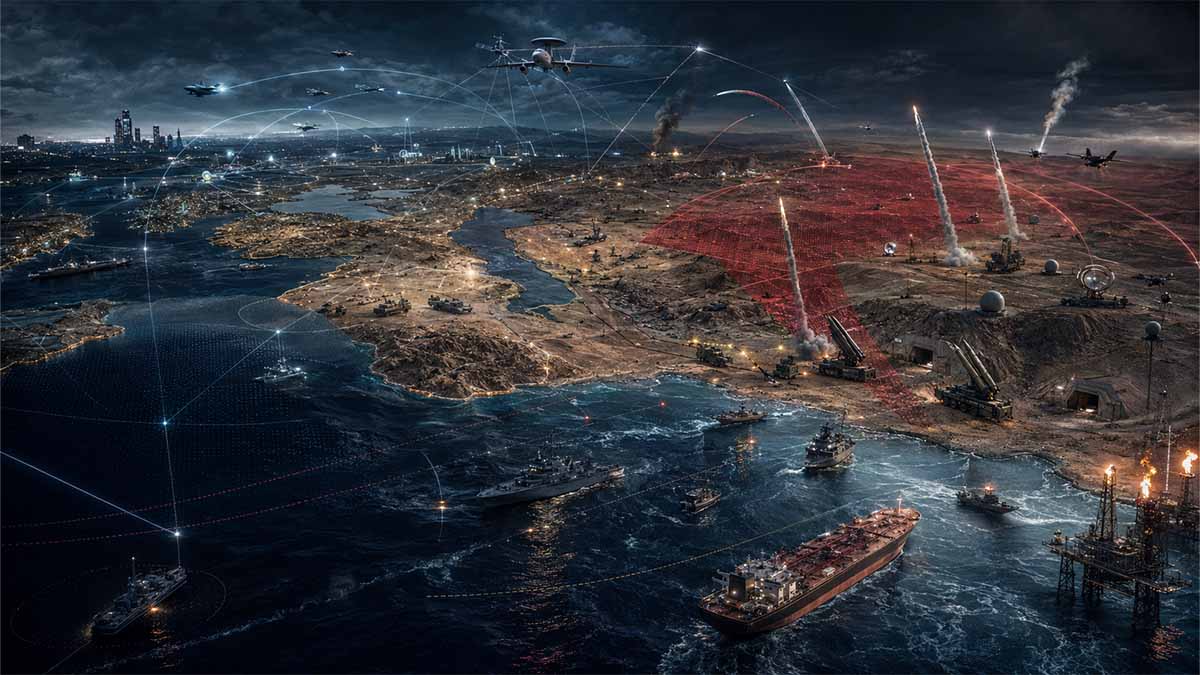
A useful way to visualize the Gulf-to-Europe dependency chain is therefore not as a geographical arrow from Tehran to Brussels, but as a network of enabling relationships in which attacks against one function can create effects across several jurisdictions. The architecture is approximately:
Iran–US Kinetic Exchange • Hormuz Pressure, Base Defence & European Enablers
Hormuz Pressure: Maritime Chokepoint & Macroeconomic Shock
The Strait of Hormuz handles over 20% of global petroleum liquids consumption. In a kinetic exchange, Iranian asymmetric mining, anti-ship cruise missiles, and fast-attack craft impose an immediate de facto closure, sending shipping insurance rates soaring and triggering acute European inflationary pressure.
The Cyprus vector requires a separate legal and military treatment because Cyprus is an EU member but is not a NATO member. President Nikos Christodoulides stated publicly in March that the Republic of Cyprus was “not involved in military operations in any way,” an important official attempt to separate Cypriot sovereign territory from offensive operations connected to the Iran conflict. Cyprus Is Not Involved in Military Operations in Any Way – Presidency of the Republic of Cyprus – March 2026 — verified primary source. Yet geography makes neutrality signaling insufficient by itself to eliminate strategic exposure. Cyprus sits adjacent to the Levant and contains British sovereign military areas, while NATO’s Article 6 explicitly includes attacks against Allied forces, ships or aircraft in the Mediterranean within the geographic framework relevant to Article 5. The North Atlantic Treaty – NATO – April 1949 — verified primary source. A strike against the Republic of Cyprus itself would therefore not mechanically constitute an attack on a NATO member; an attack affecting British forces, ships or aircraft could create a materially different Alliance issue, depending on circumstances, attribution and the attacked Ally’s legal assessment. This is precisely why “Iran may attack Cyprus” is analytically insufficient. One must ask what object, whose sovereignty, whose personnel, which legal status and what operational function are involved. A missile hitting Cypriot civilian territory, sabotage of a British installation, cyber disruption of a logistics network, a strike against a US aircraft temporarily operating from the island, and an attack against a British aircraft are five distinct escalation problems. Tehran’s strongest incentive is therefore to exploit the ambiguity among these categories while avoiding the one that maximizes Alliance unity.
The Article 5 problem is similarly misunderstood when treated as an automatic “tripwire to World War III.” NATO’s official doctrine states that an armed attack against one Ally is considered an attack against all, but assistance can take forms each Ally deems necessary and does not automatically require identical military responses from every member. The North Atlantic Council evaluates circumstances, while the attacked Ally must request or consent to collective action. Collective Defence and Article 5 – NATO – November 2025 — verified primary source. This creates both deterrence and potential Iranian room for threshold manipulation. A clearly attributable Iranian ballistic-missile strike deliberately targeting a Bulgarian air base would produce the highest probability of rapid Alliance political convergence. By contrast, sabotage attributed only probabilistically to an IRGC-linked network, a malware attack on fuel infrastructure, an unexplained drone incident, or a proxy attack against US personnel could create prolonged debate over attribution, proportionality and whether the event reaches the armed-attack threshold. NATO nevertheless warns that significant cyber or hybrid attacks may qualify as armed attacks and that hybrid operations can lead to Article 5 deliberation. Countering Hybrid Threats – NATO – January 2026 — verified primary source. This produces a paradox. The more explicitly NATO advertises its ability to treat hybrid aggression as collective-defence territory, the more an adversary has incentives to fragment operations into multiple individually sub-threshold actions. Consequently, the most plausible Iranian expansion into Europe over the next five years is not necessarily a ballistic strike. It is an integrated hybrid campaign combining cyber reconnaissance, influence activity, logistics disruption, commercial pressure, clandestine procurement, intelligence collection and potentially deniable sabotage while preserving uncertainty over whether any single action is sufficiently severe to trigger collective military retaliation.
| Escalation vector | Plausibility 2026–31 | Attribution difficulty | Article 5 sensitivity | Iranian strategic utility |
| Cyber reconnaissance/pre-positioning | Very high | High | Low–Medium until effects occur | Very high |
| Cyber destructive attack | High | Medium–High | Medium–High | High |
| Covert sabotage/logistics disruption | Medium–High | High | Medium | High |
| Proxy attack on US personnel in Europe | Medium | Medium | High if severe | Medium |
| Maritime coercion affecting European trade | Very high | Low–Medium | Low directly | Very high |
| Missile/drone strike on NATO territory | Low | Low | Very high | Low unless crisis becomes existential |
| Large-scale direct Iran–NATO campaign | Very low | Low | Maximum | Strategically self-defeating under normal assumptions |
The nuclear dimension raises escalation risk because it weakens the reliability of every actor’s estimate of Iranian intentions. On 8 June 2026, IAEA Director General Rafael Mariano Grossi reported that the Agency had lacked access for nearly a year to nuclear facilities affected by the June 2025 attacks and had lost continuity of knowledge over previously declared material. He specifically identified approximately 440 kilograms of highly enriched uranium that the Agency had been unable to verify since June 2025 and stated that, apart from Bushehr, the Agency could not currently exercise its safeguards rights effectively across the relevant programme. IAEA Director General’s Introductory Statement to the Board of Governors – International Atomic Energy Agency – June 2026 — verified primary source. The February safeguards report was even more precise, recording 440.9 kg enriched up to 60% U-235 before the June 2025 attacks and describing the prolonged loss of verification as a proliferation concern. Implementation of the NPT Safeguards Agreement with Iran – International Atomic Energy Agency – February 2026 — verified primary source. None of this proves an Iranian decision to produce a nuclear weapon. It does, however, shorten political decision time because Washington and Israel cannot confidently distinguish between reconstruction, dispersal, concealment, threshold positioning and an actual weaponization trajectory. The resulting instability is classical crisis-theory territory: each actor can believe escalation is defensive. Tehran may disperse assets to protect them; Israel may interpret dispersal as preparation for breakout; Washington may strike to prevent breakout; Iran may respond against regional enablers; regional partners may then request greater US protection; the United States may shift aircraft or refuelling activity toward European nodes; Tehran may interpret those nodes as part of the offensive campaign. The Gulf-to-Europe pathway therefore does not require an Iranian grand strategy to attack NATO. It can emerge through sequential security dilemmas.
The Chinese and Russian official positions provide a useful multilingual control against a purely Western reading of the crisis. Beijing stated on 16 June 2026 that the Strait of Hormuz is an international navigation route and that restoration of “safe and free passage” serves all parties; China also explicitly acknowledged the US–Iran MOU and said it was maintaining communication with relevant countries to protect Chinese vessels and crews. Foreign Ministry Spokesperson Lin Jian’s Regular Press Conference – Ministry of Foreign Affairs of the People’s Republic of China – June 2026 — verified primary source. A Chinese diplomatic account later welcomed the first-stage MOU and described dialogue rather than military force as the correct route, while stressing the importance of restoring international navigation and China’s substantial economic relationships with Arab states. Interview of the Chinese Embassy Chargé d’Affaires in Yemen – Ministry of Foreign Affairs of the People’s Republic of China – June 2026 — verified primary source. Moscow, while sharply condemning earlier US–Israeli military actions, officially welcomed the June agreement ending the armed conflict. Statement of the Russian Foreign Ministry in Connection with the US–Iran Agreement – Ministry of Foreign Affairs of the Russian Federation – June 2026 — verified primary source. These positions do not make Beijing or Moscow neutral; they demonstrate that neither has an obvious economic or strategic incentive to encourage an uncontrolled Iranian widening of the conflict into NATO Europe. China is exceptionally exposed to Gulf energy and maritime stability; Russia benefits geopolitically from Western distraction but also faces escalation and non-proliferation risks from an uncontrolled regional war. The most reasonable inference is that both powers prefer bounded confrontation over systemic escalation, though their preferred settlement terms differ sharply from Washington’s.
France adds a separate European pressure axis because Tehran can portray Paris simultaneously as a nuclear negotiator, sanctions actor and Western military power. The French Foreign Ministry’s updated Iran dossier confirms France’s continuing commitment to preventing Iranian acquisition of nuclear weapons, records the E3’s creation of INSTEX in January 2019, and describes Iran’s subsequent enrichment to 60% and reduction of IAEA access. The Iranian Nuclear Issue – Ministry for Europe and Foreign Affairs of France – updated July 2026 — verified primary source. Tehran therefore has multiple non-kinetic methods for imposing differentiated costs on European states: diplomatic expulsions, hostage diplomacy, intelligence operations, cyber intrusions, commercial pressure, threats to maritime assets, and efforts to frame individual capitals as co-belligerents. This is strategically preferable to a uniform assault on Europe because NATO’s chief comparative advantage is political and military aggregation. Iranian strategy should therefore be expected to seek the opposite condition: fragmented attribution, differentiated exposure and national-level hesitation. France can be pressured over E3 nuclear diplomacy; Bulgaria over logistics; Britain through its Middle Eastern military footprint; Italy through Mediterranean, energy and commercial exposure; Germany through sanctions, industrial dependence and E3 diplomacy; Greece and Cyprus through Eastern Mediterranean geography. The risk is not that Tehran necessarily possesses a single centrally authored plan for all these fronts. The risk is that an ecosystem of state institutions, IRGC structures, intelligence services, maritime forces and aligned armed groups can generate pressure across several domains simultaneously, making escalation management much harder than a conventional state-to-state missile exchange.
NATO itself is adapting to this multi-domain environment. The Ankara Summit Declaration of 8 July 2026 reaffirmed that Alliance deterrence relies on a mix of nuclear, conventional and missile-defence capabilities, complemented by cyber and space assets, while highlighting investments in deep precision strike, integrated air and missile defence, uncrewed systems, intelligence and AI-enabled warfighting infrastructure. The declaration also addressed Iran and the Strait of Hormuz directly. The Ankara Summit Declaration – NATO – July 2026 — verified primary source. NATO Secretary General Mark Rutte additionally announced a $40 billion five-year Drone Edge initiative for uncrewed capabilities. Press Conference by NATO Secretary General Following the Ankara Summit – NATO – July 2026 — verified primary source. The relevance to Iran is structural rather than declaratory: a future Gulf-to-Europe confrontation would test exactly those areas in which modern defence economics are most stressed—interceptor inventories, persistent ISR, drone defence, tanker availability, fuel storage, hardened logistics and command-network resilience. Iran can launch comparatively inexpensive unmanned systems and ballistic missiles that require expensive defensive responses. Even when interception succeeds tactically, the attacker may still obtain strategic value by consuming interceptor stocks, forcing dispersal, reducing sortie generation and imposing financial costs. Over five years, the decisive metric is therefore not merely “missiles intercepted”; it is the exchange ratio between Iranian offensive replenishment and Allied defensive replenishment, combined with the ability to protect high-value logistics nodes. This becomes particularly important if Europe must simultaneously sustain deterrence against Russia and support defence commitments elsewhere.
The five competing hypotheses were updated using the verified evidence above rather than journalistic claims. H₁: controlled coercive escalation assumes Tehran intends to impose increasing costs while avoiding the threshold of collective NATO war. H₂: recurrent Gulf kinetic confrontation assumes repeated maritime incidents, missile attacks and US retaliatory strikes remain the dominant pattern. H₃: negotiated re-freeze assumes renewed military pressure ultimately produces another temporary bargain or more durable nuclear-security arrangement. H₄: European hybrid expansion assumes Tehran gradually increases cyber, intelligence, sabotage and indirect coercion against European enabling networks. H₅: deliberate Iranian kinetic strike against a NATO-linked European target assumes Tehran judges European infrastructure to be directly supporting attacks on Iran and accepts the risk of Article 5 dynamics. The current analytical posterior used here is 31% H₁, 35% H₂, 14% H₃, 15% H₄ and 5% H₅. These figures are not intelligence-service estimates or observed frequencies; they are transparent structured-analytic weights. A 250,000-draw Dirichlet Monte Carlo stress test, using a concentration parameter of 120 around those priors, produces approximate 90% uncertainty intervals of 24–38% for H₁, 28–42% for H₂, 9–20% for H₃, 10–21% for H₄ and 2–9% for H₅. The model’s most important conclusion is not the precise percentage but the asymmetry between probability and consequence: H₅ remains the least likely pathway but carries the greatest discontinuous escalation cost, whereas H₂ is currently the most probable because the official record already demonstrates post-MOU US–Iran strikes. H₄ becomes progressively more important toward 2031 because hybrid coercion offers Tehran a method to pressure Europe without accepting the full military cost of a direct missile attack.
| Hypothesis | 2026 posterior | 90% Monte Carlo interval | 2031 structural direction | Principal confirming indicators |
| H₁ Controlled coercion | 31% | 24–38% | Stable | calibrated attacks, warnings, back-channel diplomacy |
| H₂ Recurrent Gulf kinetic war | 35% | 28–42% | Moderate decline if defences/diplomacy improve | repeated CENTCOM retaliation, Hormuz attacks |
| H₃ Negotiated re-freeze | 14% | 9–20% | Conditional rise | restored verification, new MOU, shipping normalization |
| H₄ European hybrid expansion | 15% | 10–21% | Rising | cyber pre-positioning, sabotage, proxy reconnaissance |
| H₅ European kinetic strike | 5% | 2–9% | Low but tail risk rises | explicit targeting rhetoric plus force preparation |
The 2027–2031 outlook is therefore best understood as a competition between containment mechanisms and theatre integration. In a containment pathway, increased Gulf missile defence, restored IAEA inspection access, explicit rules governing US use of partner territory and durable guarantees for Hormuz navigation progressively reduce Tehran’s incentive to attack external enabling nodes. In a theatre-integration pathway, however, repeated Gulf exchanges increase US reliance on dispersed European logistics, tankers, ISR and fuel infrastructure; Iran’s targeting architecture consequently expands; cyber reconnaissance is converted into contingency access; proxies or clandestine networks are used to test European responses; and a future US or Israeli strike produces Iranian retaliation against what Tehran defines as the operational support network rather than merely against forces physically located in the Gulf. The latter pathway is dangerous because geography ceases to correspond to political theatres. An airfield in Bulgaria may support operations relevant to the Middle East while being located inside Article 5 territory; a British aircraft operating over the Mediterranean may be legally and strategically connected to NATO even though the underlying conflict originates outside the Alliance area; a cyberattack can physically occur nowhere while producing strategic effects inside several Allies simultaneously. By 2031, therefore, European defence planning is likely to treat the Gulf increasingly as part of the Alliance’s extended resilience environment even if NATO never formally defines Iran as equivalent to the Russian threat. The practical planning implication is that air and missile defence, counter-UAS, cyber resilience, hardened fuel infrastructure and dispersal of logistics will matter more than rhetorical declarations about whether Europe is “in” or “out” of the war.
The “shadow dimensions” reinforce this conclusion. In the cyber domain, the decisive intelligence indicator is not the appearance of destructive malware after hostilities begin but prior access: credential theft, mapping of aviation fuel systems, logistics software, energy management, port operations, satellite communications and defence-industry suppliers. In clandestine networks, the central question is not whether classical mercenary formations emerge on European territory; that scenario remains structurally less useful to Tehran than small intelligence, procurement and sabotage networks capable of maintaining plausible deniability. In finance and liquidity, a Gulf crisis can propagate through tanker insurance, commodity derivatives, margin calls, shipping finance and corporate hedging before physical shortages fully appear. The EIA’s documented collapse of Hormuz oil flows from 21.6 million b/d in Q4 2025 to 4.9 million b/d in Q2 2026 demonstrates that this is no longer a theoretical transmission model. A sustained disruption raises the premium on alternative routes, increases working-capital requirements for energy-intensive firms, widens fiscal pressure on importing states and potentially affects defence spending exactly when military requirements are expanding. Tehran can therefore extract strategic leverage through liquidity and logistics friction without gaining territorial advantages. This is particularly relevant for European states whose political systems experience energy-price shocks rapidly through consumer expectations and industrial lobbying. The risk matrix must consequently integrate military and financial indicators: tanker transit volumes, war-risk premia, Brent time spreads, LNG rerouting, interceptor expenditure, tanker-aircraft deployment, base activity, diplomatic evacuation patterns and cyber alerts should be examined together rather than in institutional silos.
The final intelligence judgment is that a direct Iranian military campaign against NATO during 2026–2031 remains a low-probability scenario, but Gulf-to-Europe spillover is no longer a remote theoretical possibility. The strongest verified evidence is not an Iranian order to attack Europe; no such primary-source evidence has been established here. The strongest evidence is instead the convergence of five facts: direct Iranian attacks against Gulf states have occurred; the US and Iran returned to kinetic exchanges after their June diplomatic framework; Hormuz disruption has already reached systemic energy-market scale; southeastern-European infrastructure such as Bezmer has demonstrable relevance to Allied military logistics and contemplated refuelling activity; and NATO explicitly treats severe cyber, hybrid and kinetic attacks on Allied territory or forces as potentially implicating collective defence. The probability distribution therefore favours recurrent Gulf conflict and calibrated coercion rather than a deliberate Iran–NATO war. Yet the escalation system contains a fat-tail risk: one successful Iranian strike on a NATO-member air base, one mass-casualty attack on Allied personnel, or one destructive cyber operation producing effects equivalent to an armed attack could instantaneously change the political regime of the crisis. The correct strategic priority is consequently neither alarmism nor reassurance. It is continuous detection of transition indicators separating routine contingency planning from actual preparations for European attack: persistent ISR focused on named bases, unusual Iranian missile-unit posture, movement of long-range systems, cyber pre-positioning against military fuel and communications networks, proxy reconnaissance, explicit legal framing of European installations as belligerent targets, diplomatic warnings naming individual Allies, and simultaneous measures to protect Iranian leadership and strategic assets from anticipated retaliation. If several of these indicators begin moving together, the posterior probability of H₅ should be increased rapidly. Until then, the evidence supports a judgement of real strategic exposure, rising hybrid risk, but no verified Iranian decision to open a NATO front.
Five-Year Warning Matrix, 2027–2031
| Indicator | 2027 | 2028 | 2029 | 2030 | 2031 | Intelligence meaning |
| Iranian cyber mapping of European logistics | High | High | Very high | Very high | Very high | Cheapest scalable coercive option |
| Gulf missile/drone exchanges | Very high | High | High | Medium–High | Medium–High | Depends on negotiated architecture |
| Hormuz disruption risk | Very high | High | High | High | High | Structural leverage remains |
| European hybrid incidents | Medium–High | High | High | Very high | Very high | Most probable westward migration |
| Deliberate strike on NATO territory | Low | Low | Low–Medium | Low–Medium | Low–Medium | Tail risk grows with theatre integration |
| Formal Iran–NATO war | Very low | Very low | Very low | Very low | Very low | Remains strategically irrational absent major trigger |
Pillar II — The European Threshold: From Gulf War to NATO Territory
The European threshold is the most strategically misunderstood element of the Iran confrontation because “Europe”, “European Union territory”, “NATO territory”, “US military infrastructure in Europe” and “European infrastructure supporting Middle Eastern operations” are not interchangeable categories. The difference becomes operationally decisive once Bulgaria, Cyprus, the British Sovereign Base Areas, Türkiye and the Mediterranean logistics network are separated. Bulgaria is both an EU and NATO member; an attributable Iranian armed attack against Bulgarian territory would therefore immediately create a potential Article 5 problem. The Republic of Cyprus is an EU member but not a NATO Ally, meaning an attack against Cypriot sovereign territory would not automatically fall within the Washington Treaty. The island simultaneously contains the British Sovereign Base Areas of Akrotiri and Dhekelia, which the United Kingdom’s Strategic Defence Review explicitly describes as strategically important and maintained under the 1960 Treaty of Establishment; the same document identifies Greece as facilitating UK operations across Europe and the Middle East and calls Cyprus a key regional defence and security partner. The Strategic Defence Review 2025 – UK Government – July 2025 — verified primary source. Türkiye is itself a NATO Ally but simultaneously an autonomous regional military actor in Syria whose confrontation with Israeli threat perceptions has intensified. The resulting European threshold is therefore best conceived not as a geographical line Iran either crosses or respects, but as a layered legal-operational topology: the same Iranian action can produce radically different consequences depending upon the precise target, jurisdiction, personnel affected, attribution confidence and military function involved. An Iranian cyber intrusion into civilian infrastructure in Cyprus, sabotage against equipment serving RAF Akrotiri, a missile impact at Bezmer, an attack against a US tanker aircraft stationed on Bulgarian territory and an attack against a British aircraft over the Mediterranean may all originate from the same Iran–US escalation cycle while activating entirely different national and Alliance decision chains. This fragmentation creates both danger and opportunity for Tehran: the more differentiated the legal environment, the greater the possibility of imposing costs while avoiding the single unmistakable action most likely to unify all 32 NATO Allies.
| European node | Political status | Military relevance | Direct Article 5 exposure | Escalation consequence |
|---|---|---|---|---|
| Bezmer, Bulgaria | NATO + EU | Air operations/refuelling relevance | Yes, if Bulgaria sustains an armed attack | Potential immediate NAC crisis |
| Novo Selo, Bulgaria | NATO + EU | Joint US–Bulgarian training/logistics | Yes | High Alliance significance |
| Burgas, Bulgaria | NATO + EU | Port/logistics proximity | Yes for qualifying armed attack | Maritime-logistics vulnerability |
| Republic of Cyprus | EU, non-NATO | Regional logistics/geography | No automatic NATO trigger | EU/national/UK-US crisis pathways |
| RAF Akrotiri | UK Sovereign Base Area | Air power, tanker, contingency hub | Potentially highly significant for UK/NATO | Very high escalation sensitivity |
| Dhekelia | UK Sovereign Base Area | UK sovereign military presence | Potential UK collective-defence issue | High |
| Türkiye | NATO | Syria/Gulf/Eastern Med force projection | Yes | Direct NATO dimension |
| Mediterranean Allied ships/aircraft | Depends on nationality/location | ISR, tanker, naval defence | Article 6 may become relevant | Incident-specific |
Bulgaria represents the clearest physical bridge between a Middle Eastern confrontation and NATO’s collective-defence architecture because primary evidence now demonstrates more than generic US access to Bulgarian territory. On 24 July 2026, Bulgarian Defence Minister Dimitar Stoyanov met mayors from five municipalities in Yambol Province specifically to address public concern surrounding Bezmer Air Base. The official ministry account states that no aircraft basing was expected at Bezmer that particular day, but that refuelling activity at the airbase was being discussed; significantly, the same release subsequently records that Stoyanov visited Bezmer and reviewed the organization for the deployment of American tanker aircraft. He also stated that Bulgarian and Allied forces guaranteed security and asserted that Bulgaria was not participating in the military conflict. Министър Димитър Стоянов: Сигурността на хората в област Ямбол е гарантирана – Ministry of Defence of Bulgaria – July 2026 — verified primary source. This is a substantial intelligence datum because tanker aircraft are not merely another class of combat-support asset. Air-to-air refuelling determines combat radius, sortie duration, routing flexibility, persistence and the number of strike aircraft that can operate from more distant or politically protected locations. If US tanker activity in Bulgaria contributes directly or indirectly to Middle Eastern force projection, Iranian planners would rationally model Bezmer as part of the wider enabling architecture even without any political decision to strike it. The US Army’s own force-posture description reinforces that interpretation. US Army Garrison Black Sea, established as a garrison in June 2024, operates across Romania and Bulgaria and describes itself as a key force-projection platform. Novo Selo Training Area is located approximately 45 km from Bezmer and 70 km from Burgas, covers approximately 144 km², has hosted recurring US–Bulgarian exercises since 2004 and became a joint US–Bulgarian military base under the 2006 Defense Cooperation Agreement, with the United States investing about $61 million in infrastructure beginning in 2008. History – U.S. Army Garrison Black Sea – current official record — verified primary source. The analytical conclusion is therefore stronger than “Bezmer might matter”: southeastern Bulgaria forms part of a verified military-support ecosystem connecting an airbase, a US–Bulgarian training installation, ground infrastructure and proximity to a Black Sea port.
This infrastructure network does not, however, validate claims that Iran has made an operational decision to attack Bulgaria. The distinction must remain absolute because strategic targeting follows a sequence. Stage T₁ is geographical and infrastructure awareness; T₂ is contingency inclusion; T₃ is intelligence collection; T₄ is target-development and mensuration; T₅ is weapon-target pairing; T₆ is political authorization; T₇ is executable mission preparation; T₈ is launch. Only the first two would be virtually inevitable in competent Iranian defence planning once US tankers and logistical facilities become strategically relevant. Evidence that Iranian authorities have discussed European military infrastructure would move the assessment toward T₂ or T₃, but it would still not prove T₅–T₈. The principal European early-warning problem is therefore identifying convergence between operational indicators rather than over-interpreting rhetoric. For Bezmer, relevant indicators would include systematic Iranian ISR attention to the airfield; cyber reconnaissance against Bulgarian military logistics, fuel-distribution or air-traffic infrastructure; persistent collection concerning tanker arrival and departure patterns; Iranian diplomatic statements specifically characterizing Bulgarian facilities as components of US offensive action; unexplained surveillance of base perimeters; proxy-linked procurement or travel activity; Iranian missile-force readiness measures that cannot be explained by Gulf contingencies alone; and simultaneous leadership-protection or retaliation-readiness measures inside Iran. A single indicator should produce only a modest Bayesian update. Multiple independent indicators occurring simultaneously should generate a nonlinear increase in probability. This is particularly important because Bulgaria’s current public position is explicitly that it is not participating in the conflict, even while supporting Allied military activities. Tehran therefore has a strategic choice: accept Sofia’s distinction between hosting/enabling activity and belligerency, or redefine logistical support as participation. The moment official Iranian doctrine moves toward the latter interpretation, the probability of European spillover rises sharply because the targeting category expands from “forces attacking Iran” to “infrastructure enabling those forces.” That conceptual change—not a single inflammatory statement—would constitute one of the most important warning indicators available to European intelligence services.
Bulgarian Escalation Ladder
| Level | Observable condition | Intelligence interpretation | NATO consequence |
| B₁ | Iranian rhetorical criticism of Bulgarian cooperation | Political signalling | None |
| B₂ | Iranian collection on Bulgarian facilities | Contingency preparation | Counterintelligence response |
| B₃ | Cyber reconnaissance/pre-positioning | Operational enabling | Potential Article 4 concern |
| B₄ | Explicit declaration that facilities are legitimate targets | Doctrinal threshold crossed | Strong Article 4 case |
| B₅ | Sabotage/proxy incident | Covert escalation | Attribution-dependent |
| B₆ | Destructive cyberattack with major effects | Possible “armed attack” | Article 5 potentially relevant |
| B₇ | Missile/drone attack on Bulgarian territory | Overt interstate escalation | Severe Article 5 crisis |
| B₈ | Repeated attacks after Allied warning | Deliberate confrontation with Alliance | Collective military response increasingly probable |
Cyprus is structurally more ambiguous and therefore potentially more attractive for coercive pressure, precisely because three security spaces overlap on one island: sovereign territory of the Republic of Cyprus, British sovereign military territory, and the operational activity of partners including the United Kingdom and potentially the United States. President Nikos Christodoulides publicly stated on 9 March 2026 that the Republic of Cyprus was “not involved in military operations in any way,” indicating a deliberate attempt to preserve separation between Cypriot sovereignty and external operations associated with the Middle Eastern conflict. Cyprus is not involved in military operations in any way – Presidency of the Republic of Cyprus – March 2026 — verified primary source. The UK’s own strategic doctrine, however, confirms that the island is inseparable from British Middle Eastern contingency planning. The 2025 Strategic Defence Review calls Akrotiri and Dhekelia strategically important and explicitly states that Gulf access and basing enable British support for international security and freedom of navigation. The UK also maintains its Naval Support Facility in Bahrain and defence relationships throughout the Gulf, creating an infrastructure arc linking the Eastern Mediterranean with forward Gulf operations. During the October 2024 Middle Eastern crisis, the UK government publicly confirmed that approximately 700 additional Armed Forces, FCDO, Home Office and Border Force personnel had deployed to Cyprus for contingency preparations, that Defence Secretary John Healey visited RAF Akrotiri, and that RAF Typhoons together with a Voyager tanker participated in efforts associated with Iran’s missile attack on Israel, although the aircraft did not engage targets. De-escalation remains our focus, Defence Secretary says as he visits Armed Forces in Cyprus – UK Ministry of Defence – October 2024 — verified primary source. This historical precedent demonstrates the functional value of Cyprus during acute Iran–Israel escalation. It also demonstrates why Tehran could distinguish between the Republic of Cyprus—which seeks political non-involvement—and British sovereign facilities from which military support can be organized. The intelligence question is therefore not “will Iran attack Cyprus?” but “which sovereign jurisdiction and operational function would Tehran classify as legitimately connected to military action against Iran?”
The NATO legal mechanics are equally important because neither Article 4 nor Article 5 operates as the automatic binary switch commonly implied in public debate. Article 4 permits any Ally to request consultations whenever it believes its territorial integrity, political independence or security is threatened. NATO records only nine formal Article 4 invocations between 1949 and September 2025, demonstrating that it is a serious political instrument rather than a routine procedural measure. Historical cases are particularly relevant to the Iranian scenario: Türkiye invoked Article 4 in 2003 over risks resulting from the neighbouring Iraq conflict; again in June 2012 after Syria downed a Turkish fighter; in October 2012 after Syrian shelling killed five Turkish civilians; and in February 2020 following Turkish military fatalities in Idlib. Poland invoked it in March 2014, while eight eastern Allies including Bulgaria did so on 24 February 2022 after Russia’s full-scale invasion of Ukraine. Poland and Estonia again used Article 4 after Russian airspace violations in September 2025. The consultation process and Article 4 – NATO – September 2025 — verified primary source. These precedents establish an important threshold: Bulgaria or Türkiye would not need to wait for a successful Iranian strike to begin formal Alliance crisis consultations. Credible threats, significant airspace incidents, cyber preparation or repeated Iranian statements identifying their territory as a target could produce an Article 4 request long before Article 5 becomes legally relevant. Article 4 can then generate enhanced intelligence-sharing, air-defence reinforcement, force protection, deployment of defensive systems or political warning without implying that NATO has declared Iran an enemy or decided on military retaliation. For Tehran, therefore, even unsuccessful coercion can have unintended strategic consequences by causing NATO to harden precisely the infrastructure Iran seeks to intimidate, increasing Allied surveillance and shortening response times.
Article 5 begins at a higher threshold, but NATO’s current doctrine makes the relevant threshold broader than conventional ballistic attack. NATO states explicitly that the obligation applies when an Ally has sustained an “armed attack”, assessed case by case, and the attacked Ally requests or consents to collective action. Assistance need not automatically consist of armed force: each Ally takes the action it considers necessary. NATO also states that significant cyber and other hybrid attacks can, depending on circumstances, amount to an armed attack. Collective defence and Article 5 – NATO – November 2025 — verified primary source. This flexibility has direct relevance for Iranian strategy. A ballistic missile with a clearly established Iranian launch signature impacting Bezmer and killing US or Bulgarian personnel presents comparatively straightforward attribution and legal analysis. A destructive malware operation disabling tanker refuelling pumps, corrupting airfield fuel-management systems or disrupting electricity during an operational surge could produce similar military effects but far more complex attribution. NATO’s doctrine therefore creates a continuum:
Iranian Action Escalation Ladder • Rhetoric to Collective Defense Response
Tier 1: Rhetoric & Diplomatic Warnings
Low-intensity political friction characterized by official threats, diplomatic posturing, and early posture adjustments. Handled primarily through national intelligence monitoring, diplomatic demarches, and standard security posture adjustments without alliance-wide invocation.
The historical 9/11 precedent shows the underlying process clearly: NATO initially declared that Article 5 would apply if the attacks were determined to have been directed from abroad, then formally reached that determination after receiving investigative findings. NATO subsequently adopted measures including enhanced intelligence-sharing, increased protection for US and Allied facilities, backfilling Allied assets, overflight clearances and access to ports and airfields for US operations. This precedent is particularly relevant to a hypothetical Iranian hybrid operation because attribution would precede collective-defence determination, and Tehran would have strong incentives to exploit the interval.
| Hypothetical Iranian action | Article 4 probability | Article 5 probability | Attribution difficulty | Escalation severity |
| Threat against Bezmer | High if credible/repeated | Very low | Low | Medium |
| Cyber reconnaissance | Medium | Very low | High | Medium |
| Fuel-network malware without physical damage | High | Low | High | Medium–High |
| Cyberattack disabling military operations | Very high | Medium | Medium–High | High |
| Covert sabotage causing fatalities | Very high | Medium–High | High | Very high |
| Proxy attack on US personnel at NATO base | Very high | Medium–High | Medium–High | Very high |
| Iranian drone strike on Bulgarian base | Near certain | Very high | Low | Critical |
| Repeated missile strikes after NATO warning | Certain | Extremely high | Low | Strategic crisis |
The France–Iran confrontation occupies a different point on the European escalation spectrum. Paris is not primarily exposed because of geography but because France combines four attributes Tehran regards as strategically consequential: it is a nuclear-armed NATO Ally, permanent UN Security Council member, central E3 actor and one of the states historically responsible for the European nuclear negotiating architecture. France’s official Iran dossier, updated on 23 July 2026, recalls that France participated in the JCPOA negotiations with the explicit objective of preventing Iranian acquisition of nuclear weapons; it records Iranian enrichment to 60%, reduced IAEA access and the history of INSTEX, established by France and its E3 partners in January 2019 to facilitate legitimate transactions with Iran. The Iranian nuclear issue – French Ministry for Europe and Foreign Affairs – updated July 2026 — verified primary source. France also joined a 12 August 2026 statement with Germany, Italy, the UK, numerous European states and the EU High Representative condemning Iran’s executions of protesters, demonstrating that political confrontation now extends beyond the nuclear file into human-rights policy. Joint statement on Iran’s Execution of Protestors – French Ministry for Europe and Foreign Affairs – August 2026 — verified primary source. The specific reciprocal diplomatic expulsions described in the initial reporting cannot be elevated here to verified fact because this research cycle did not identify a corresponding live primary French government document meeting the requested evidentiary threshold. That absence is analytically important: the underlying France–Iran confrontation is verified, while the specific claimed expulsion sequence must remain uncorroborated within this source architecture. Tehran’s rational objective would not be to turn France into an overt battlefield; it would be to raise the political, intelligence and commercial cost of French alignment while exploiting divergence among European capitals.
France therefore presents a highly attractive hybrid-pressure target but a poor kinetic target under most scenarios. The expected-value logic is asymmetric. Cyber operations against French government, defence-industrial, logistics or transport networks could generate disruption with ambiguous attribution. Intelligence operations or coercive diplomacy can affect bilateral relations without activating Article 5. Pressure involving detained nationals can create political leverage without creating battlefield conditions. Information operations can attempt to portray France as subordinate to US or Israeli strategy, while sanctions retaliation or commercial restrictions can target economic interests. A direct Iranian missile attack on metropolitan France, by contrast, would provide minimal additional coercive benefit while almost guaranteeing an Alliance-wide crisis and potentially inviting strikes against critical Iranian military infrastructure. This produces what can be represented as Tehran’s European utility curve: maximum utility is likely located below open kinetic attack, where disruption is significant but attribution and legal characterization remain contestable. The same logic applies, although with different weights, to Germany, Italy and the United Kingdom. Britain presents greater military-operational relevance because of Akrotiri, Bahrain and its broader Middle Eastern defence network; France presents greater diplomatic-nuclear significance; Italy offers central Mediterranean logistics, NATO infrastructure and substantial Gulf economic exposure; Germany brings E3 and European political-industrial weight. A sophisticated Iranian coercive strategy would therefore not apply identical pressure across these states. It would pursue functional differentiation: military enabling nodes where operational effect is required; political targets where alliance cohesion can be weakened; energy and maritime channels where economic pain is most transmissible; and cyber targets where deniability can be maximized.
The Mediterranean logistics layer transforms this differentiated exposure into a genuine system. The UK’s Strategic Defence Review explicitly states that Greece facilitates UK operations across Europe and the Middle East, that Cyprus is a key regional partner, that Akrotiri and Dhekelia are strategically important, that Gulf basing provides essential access, and that the Naval Support Facility in Bahrain enables persistent British maritime presence. Bulgaria’s Black Sea network simultaneously connects Bezmer, Novo Selo and Burgas; US Army Garrison Black Sea calls itself a force-projection platform and manages sites across Bulgaria and Romania. These nodes should therefore be conceptualized as a distributed sustainment web, not a collection of independent bases. Combat operations depend upon aircraft, weapons and personnel, but equally upon fuel, maintenance, airfield repair, communications, transport aircraft, tanker sorties, medical evacuation, intelligence feeds, port throughput, spare parts and protected data networks. From the defender’s perspective, distribution increases resilience because disabling one installation does not necessarily collapse the network. From an adversary’s perspective, however, it expands the attack surface. Iranian planners do not need to destroy an airbase if they can degrade its fuel distribution, disable dispatch software, disrupt air traffic information, compromise contractor access, attack the electricity supply or delay tanker turnaround. This is particularly relevant in prolonged conflict because the marginal value of each disruption increases as high-end systems become overtasked. The operational equation is therefore not simply Pₛ = probability of successful strike. A more useful conceptual formulation is Eₒ = A × D × T × R, where A represents access to the target system, D the achievable disruption, T the duration of that disruption and R the degree to which alternative routes cannot immediately replace the lost function. Iran’s most efficient European strategy would seek targets with high R without creating the signature of an overt armed attack.
Mediterranean Enabling Architecture
| Function | Principal European/Eastern Med nodes | Potential vulnerability | Iranian low-threshold option | Strategic effect |
| Air-to-air refuelling | Bezmer / Akrotiri / allied tanker network | Fuel, runway, scheduling, maintenance | Cyber/covert disruption | Reduced sortie radius/persistence |
| Air staging | Bulgaria / Romania / Cyprus / Türkiye | Runways, C2, ground support | Cyber, sabotage | Slower force generation |
| Maritime support | Burgas / East Med / Bahrain-linked chain | Port IT, navigation, fuel | Cyber/maritime pressure | Logistics delay |
| ISR | NATO/US/UK air and network assets | Communications/data links | EW/cyber | Reduced situational awareness |
| Ammunition movement | European depots and transport corridors | Rail/road/port interfaces | Sabotage/information operations | Reduced strike tempo |
| Medical/evacuation | Cyprus/Europe regional hubs | Aviation availability | Network disruption | Political/military constraint |
| Command networks | NATO/US national systems | Credentials, gateways, suppliers | Cyber pre-positioning | Operational friction |
| Energy supply | Gulf → Mediterranean → Europe | Hormuz/shipping | Maritime coercion | Macro + military pressure |
The cyber and covert-action dimension is consequently the vector most likely to migrate from the Gulf into Europe before overt kinetic warfare. NATO explicitly recognizes that significant cyber and hybrid attacks may amount to armed attacks, but this does not remove the attraction of such operations; instead, it incentivizes adversaries to design them below or ambiguously around the legal threshold. A well-designed coercive campaign would emphasize access before destruction. Iranian-linked actors would derive strategic value from mapping industrial control systems connected to fuel depots; obtaining credentials used by defence contractors; establishing persistence inside port, airport or rail networks; identifying single points of failure in aviation-fuel logistics; compromising third-party software; or building redundant communications access that could later be activated during a crisis. The presence of malware or compromised accounts during peacetime does not itself prove attack intent; cyber intelligence preparation is often dual-use, serving espionage, contingency planning and coercive leverage simultaneously. This requires a Bayesian rather than deterministic warning model. Detection of scanning or phishing produces only a small update. Compromise of a specific military-logistics supplier produces a larger one. Persistence inside systems servicing a named forward base, combined with political threats and unusual Iranian military readiness, should generate a substantial posterior increase. The covert domain operates similarly. Tehran does not need large paramilitary formations in Europe. Small networks capable of surveillance, logistics reconnaissance, procurement, intimidation or sabotage provide greater deniability and impose lower political risk. A suspicious individual photographing an airbase is weak evidence; synchronized reconnaissance of multiple relevant installations by persons connected through common financial or communications networks is categorically different. The most dangerous intelligence failure would therefore be organizational fragmentation: counterintelligence observing personnel, cyber agencies observing network access, financial intelligence observing transfers and defence establishments observing base reconnaissance without fusing those indicators into a common threat model.
The Türkiye–Syria–Israel geometry adds a second route by which an Iranian crisis can interact with NATO that does not run through Bulgaria at all. On 18 August 2026, Israel’s Prime Minister’s Office officially stated that Israel and Syria had reached a security status quo but alleged that Syria was approaching violation of that understanding by permitting a Turkish troop deployment at an airbase near Aleppo, which Israel considered threatening. Prime Minister’s Office Statement – Government of Israel – August 2026 — verified primary source. On 19 August, Türkiye’s Directorate of Communications responded that the Israeli Prime Minister’s Office claims were unserious allegations intended to legitimize what Ankara characterized as unlawful Israeli airstrikes violating Syrian sovereignty and territorial integrity; Türkiye stated that it would continue cooperation with the Syrian government to promote stability and would not permit Syria’s destabilization. İsrail’in Suriye’ye yönelik saldırılarına ilişkin açıklama – Presidency of the Republic of Türkiye, Directorate of Communications – August 2026 — verified primary source. The importance of this confrontation is not simply Turkish–Israeli rhetoric. Türkiye is a NATO member with Article 5 protection on its sovereign territory but possesses an autonomous regional military policy; Israel is a non-NATO strategic partner of the United States; Syria is becoming an arena in which Turkish security depth and Israeli freedom of action can collide. Iran can benefit strategically from such friction even if it has limited direct control over events, because each Israel–Türkiye confrontation consumes US diplomatic bandwidth and complicates the formation of a coherent anti-Iranian regional architecture.
This geometry contains several escalation channels. First, an Israeli strike on Syrian infrastructure associated with Turkish forces could kill Turkish personnel. That would create an acute bilateral Israel–Türkiye crisis without necessarily producing Article 5, because the location and circumstances of an incident outside Turkish territory would require detailed legal and political assessment. Second, Türkiye could expand air-defence coverage or military presence in Syria to deter Israel, increasing the risk of aircraft confrontation. Third, Israel might interpret Turkish deployments near strategically important Syrian airfields as constraints on its ability to strike Iranian-linked networks or other perceived threats. Fourth, Iran can exploit the resulting divergence diplomatically by presenting itself as aligned with Syrian sovereignty while simultaneously preserving influence through regional networks. Fifth, Washington faces an impossible optimization problem if Israeli operational objectives and Turkish NATO-security concerns diverge sharply. The Alliance itself would have every incentive to prevent a bilateral Israel–Türkiye military crisis from contaminating NATO cohesion during an Iran confrontation. Historical Article 4 experience provides precedent: Türkiye has repeatedly used NATO consultations in response to Syrian-origin security threats, including the downing of a Turkish fighter in 2012, fatal shelling in 2012 and Idlib casualties in 2020. The key warning indicator is therefore not merely deployment of Turkish troops but whether Syria becomes an airspace deconfliction failure zone in which Israeli and Turkish rules of engagement harden simultaneously. If that occurs while US–Iran fighting intensifies, three independent escalation systems—Israel–Iran, Israel–Türkiye and US–Iran—could become coupled.
| Türkiye–Syria–Israel pathway | Probability | Consequence | Iran’s leverage | NATO relevance |
| Continued rhetorical confrontation | High | Medium | Medium | Low |
| Israeli strikes avoiding Turkish forces | High | Medium | Medium | Low–Medium |
| Turkish air-defence deployment constrains Israeli operations | Medium–High | High | High | Medium |
| Israeli strike kills Turkish personnel in Syria | Medium | Very high | High | High political sensitivity |
| Türkiye–Israel direct air confrontation | Low–Medium | Critical | Very high | Very high |
| Attack on Turkish sovereign territory | Low | Critical | Indirect | Potential Article 5 |
| Coordinated Iranian exploitation of crisis | Medium–High | High | Direct | Medium–High |
Lebanon constitutes the final escalation interface because it remains both a potential Iranian-linked pressure channel and a fragile sovereign theatre undergoing institutional transition. The relevant strategic structure is built around UN Security Council Resolution 1701 and UNIFIL. Resolution 2790 (2025) extended UNIFIL’s mandate for a final period until 31 December 2026, after which the mission is requested to cease operations and begin an orderly and safe drawdown within one year. Security Council Extends UNIFIL’s Mandate: Resolution 2790 (2025) – United Nations Peacekeeping – August 2025 — verified primary source. As recently as 20 July 2026, the UN was publicly encouraging Lebanon and Israel to continue efforts toward full implementation of Resolution 1701. Daily Press Briefing by the Office of the Spokesperson for the Secretary-General – United Nations – July 2026 — verified primary source. The reported Israeli strike near Qantara on 19 August cannot be independently established here from a qualifying primary source and should therefore remain incident-specific unverified reporting. Yet the underlying instability is indisputable: Lebanon remains governed by a security architecture designed to prevent armed escalation south of the Litani and between Israel and Lebanese territory, while UNIFIL itself is entering the final phase of its existing mandate. The coincidence between an Iran regional crisis and transition in the international security presence creates a potentially dangerous governance gap. If deterrence and monitoring mechanisms weaken faster than Lebanese state security capacity increases, the marginal opportunity for local or external actors to test the border environment rises.
Lebanon’s significance to the Iran–NATO threshold does not arise because NATO is likely to intervene directly there; it arises because Lebanon provides an escalation transmission mechanism capable of redirecting Israeli military resources, changing US regional force posture, increasing British and European evacuation or contingency requirements through Cyprus and creating additional demand for Eastern Mediterranean ISR, naval and air assets. During the 2024 crisis the UK explicitly deployed additional personnel to Cyprus for Lebanon-related contingency planning, establishing the operational precedent. A renewed Israel–Lebanon escalation could therefore activate Akrotiri for evacuation, surveillance, defensive or logistical functions even if Britain seeks to avoid offensive participation. If Iran simultaneously increases Gulf pressure, the same tanker, ISR, air-defence and logistics resources become contested across several theatres. This creates the resource-coupling effect: Lebanon need not become the principal battlefield to weaken Western operational flexibility. It only needs to generate sufficient uncertainty and readiness requirements to force asset dispersion. For Iran, or for Iran-aligned actors acting independently or semi-independently, this has strategic utility. For Israel, pre-emptive or retaliatory strikes can appear necessary to prevent buildup. For Lebanon, however, the result is exposure to a conflict whose strategic drivers originate outside the country. The approaching UNIFIL transition adds another temporal variable: by 2027, whatever security mechanism replaces or succeeds the existing mission will determine whether southern Lebanon becomes more state-controlled, more bilaterally managed, or more vulnerable to renewed armed competition.
The integrated European threshold can therefore be expressed as a set of six coupled trigger functions rather than one probability of “Iran attacking NATO”. Tᴮ represents the Bulgarian logistics threshold; Tᶜ the Cyprus/British-bases threshold; Tᴬ the NATO Article 4/5 attribution threshold; Tᶠ the France/E3 political-coercion threshold; Tᵀ the Türkiye–Israel–Syria threshold; and Tᴸ the Lebanon force-dispersion threshold. None operates independently. A US strike against Iran can increase tanker demand, which raises Tᴮ exposure. Simultaneous Lebanon escalation raises demand for Cyprus contingency operations, increasing Tᶜ. Iranian cyber activity can then generate Article 4 consultations, raising Tᴬ. French sanctions pressure can increase Tehran’s incentive for differentiated European retaliation, raising Tᶠ. Israeli operations in Syria can collide with Turkish military presence, raising Tᵀ. The interaction term matters more than any single component: Rᴱ = 1 − [(1−Tᴮ)(1−Tᶜ)(1−Tᴬ)(1−Tᶠ)(1−Tᵀ)(1−Tᴸ)] is not presented as an empirically calibrated formula, but it accurately illustrates the structural point that multiple moderate risks can create a high aggregate probability of some form of European crisis even while each individual catastrophic pathway remains unlikely. This is why a 5% probability of a deliberate Iranian kinetic strike on NATO Europe should never be interpreted as a 95% probability that Europe remains insulated. Cyber incidents, logistics pressure, political coercion, Mediterranean force redistribution, Türkiye–Israel friction and Lebanon contingency operations can all constitute European spillover without an Iranian missile ever striking an EU capital.
Integrated European Threshold Matrix, 2026–2031
| Vector | 2026 | 2027 | 2028 | 2029 | 2030 | 2031 | Structural trajectory |
| Bulgarian logistics exposure | High | High | High | High | High | High | Persistent |
| Cyprus/Akrotiri operational relevance | Very high | Very high | High | High | High | High | Persistent |
| Iranian cyber pre-positioning risk | High | High | Very high | Very high | Very high | Very high | Rising |
| Direct Iran–NATO kinetic risk | Low | Low | Low | Low–Medium | Low–Medium | Low–Medium | Slow rise if conflict persists |
| France–Iran political confrontation | High | High | Medium–High | Medium–High | Medium | Medium | Deal-dependent |
| Türkiye–Israel Syria friction | Very high | High | High | Medium–High | Medium–High | Medium | Highly path-dependent |
| Lebanon spillover risk | High | Very high | High | High | Medium–High | Medium–High | Sensitive to post-UNIFIL order |
| Article 4 consultation probability during major Iran crisis | Medium–High | High | High | High | High | High | Elevated structurally |
| Article 5 invocation specifically over Iran | Low | Low | Low | Low–Medium | Low–Medium | Low–Medium | Tail risk |
| European hybrid confrontation | High | High | Very high | Very high | Very high | Very high | Most plausible westward vector |
The five-year outlook to 2031 therefore produces a counterintuitive conclusion: the probability of a formal Iran–NATO war can remain low while the probability that the Iranian confrontation becomes a durable European security problem rises substantially. The first transformation will be infrastructural. Bases such as Bezmer and the broader Black Sea garrison network will increasingly be judged not only through the Russia deterrence mission but through their potential role in multi-theatre force projection. The second transformation will be cyber-organizational: national authorities will need to fuse military counterintelligence, transport-security, commercial cyber telemetry, financial intelligence and NATO warning data because Iranian preparation may manifest simultaneously across otherwise unrelated systems. The third will be legal: Article 4 is likely to become more relevant than Article 5 as a routine crisis-management instrument because credible threats and hybrid incidents can trigger consultation well below overt armed attack. The fourth will be Mediterranean: Akrotiri, Cyprus, Greece, Türkiye and maritime routes will acquire greater strategic value as the Levant and Gulf remain unstable. The fifth will be political: Iran’s strongest strategy is likely to differentiate European exposure, seeking to prevent France, Britain, Italy, Germany, Bulgaria, Türkiye and other Allies from interpreting their respective risks identically. The sixth will concern Lebanon. The final UNIFIL mandate ending in December 2026 introduces an institutional discontinuity whose success or failure can either remove or amplify one of the principal transmission channels connecting Iran, Israel and European contingency planning. The most important warning indicator between now and 2031 is therefore synchronization. If Iranian targeting rhetoric, cyber access to European logistics, tanker deployments, unusual base-protection measures, Turkish–Israeli military friction and renewed Lebanon fighting rise simultaneously, the system will be moving from compartmentalized regional crises toward a single integrated Euro-Middle Eastern escalation architecture. That transition, rather than any individual headline, marks the real European threshold.
Highest structural growth vector.
Persistent multi-theatre exposure.
Low probability, maximum consequence.
Likely first NATO political threshold.
Pillar III — 2026–2031 Strategic Outcomes: Escalation, Deterrence and European Transformation
The 2026–2031 strategic problem is no longer whether the present Iran crisis terminates in a ceasefire, another memorandum, or another round of strikes. The deeper question is whether the confrontation settles into a repeatable coercive equilibrium in which Iran, the United States, Israel, Gulf states and European powers repeatedly move between diplomacy and controlled violence without crossing the threshold into sustained interstate war. The evidence available on 19 August 2026 suggests that such an equilibrium is more probable than either durable normalization or a deliberate Iran–NATO war. The temporary US–Iran framework acknowledged by the EU in June extended the ceasefire for 60 days and sought to restore free, toll-free navigation through Hormuz; yet subsequent US military activity demonstrates that armed confrontation continued inside that political framework. The European Council had already called on Iran and its proxies to cease military strikes against regional states and reiterated that Iran must not acquire a nuclear weapon, while the Council subsequently expanded sanctions specifically to Iranian actions threatening freedom of navigation through Hormuz. Foreign Affairs Council – Council of the European Union – June 2026 — verified primary source. European Council, 19 March 2026 – European Council – March 2026 — verified primary source. Freedom of Navigation in the Strait of Hormuz: EU Lists Two Individuals and One Entity – Council of the European Union – June 2026 — verified primary source. The implication is that Europe must plan for a five-year condition of intermittent strategic shock, not a binary peace/war transition. Under this condition, military preparedness, energy security, financial resilience, cyber defence, nuclear verification and diplomatic crisis management become parts of the same security architecture. What appears operationally as a missile or drone confrontation in the Gulf can become, within hours, a European problem through fuel prices, naval deployments, interceptor demand, US use of European infrastructure, financial volatility, insurance repricing, cyber activity and Article 4 consultation dynamics. The principal forecasting error would therefore be to model Iran as a geographically bounded Middle Eastern problem.
Five Competing Hypotheses: Bayesian Strategic Baseline
The structured assessment begins with five competing hypotheses rather than a single forecast. H₁ — Controlled coercive equilibrium assumes Tehran and Washington repeatedly approach but avoid catastrophic thresholds, using missile strikes, maritime coercion, limited US retaliation, sanctions and negotiation to change bargaining positions. H₂ — Recurrent Gulf kinetic confrontation assumes armed exchanges become the dominant operating condition because ceasefires repeatedly fail and Hormuz remains contested. H₃ — Negotiated strategic re-freeze assumes the accumulated economic and military costs eventually produce a more durable agreement incorporating nuclear restrictions, maritime guarantees and tacit geographic limitations on retaliation. H₄ — European hybridization of the conflict assumes direct Gulf warfare remains geographically constrained while cyber activity, covert action, intelligence collection, logistical disruption and political coercion increasingly migrate into Europe. H₅ — Direct European kinetic spillover assumes Iran eventually attacks a US or Allied military enabling node on NATO territory or strikes an Allied aircraft, ship or installation in circumstances creating an Article 5 crisis. Using the verified June ceasefire framework, subsequent armed US–Iran interaction, demonstrated Hormuz disruption, increased European basing relevance, NATO investments in air defence and resilience, and continuing IAEA verification uncertainty as evidence updates, the working posterior for August 2026 is H₁ 29%, H₂ 34%, H₃ 15%, H₄ 16%, H₅ 6%. These are structured analytical estimates, not classified intelligence or official government probabilities. A 500,000-draw Dirichlet Monte Carlo simulation centered on those posterior weights with concentration parameter κ=120 produces 90% uncertainty ranges of approximately 22.4–36.0% for H₁, 27.1–41.2% for H₂, 10.0–20.7% for H₃, 10.9–21.8% for H₄ and 2.9–9.9% for H₅. The important result is not the decimal precision but the topology: direct attack on NATO Europe remains the least probable core scenario, yet European hybrid spillover already has a probability roughly 2.7 times higher than direct kinetic spillover, while recurrent Gulf warfare remains the modal outcome. NATO’s own 2026 decisions reinforce this structural reading: Allies agreed to invest more than $40 billion over five years in counter-drone capabilities and €27 billion in fuel-storage and distribution infrastructure, explicitly recognizing that resilience against drones, missiles and logistics disruption is becoming a core Alliance requirement. Overview – 2026 NATO Summit in Ankara – NATO – July 2026 — verified primary source.
| Hypothesis | August 2026 posterior | 90% modeled range | 2031 directional pressure | Strategic consequence if realized |
|---|---|---|---|---|
| H₁ Controlled coercive equilibrium | 29% | 22.4–36.0% | Stable–moderate decline | Persistent crises without general war |
| H₂ Recurrent Gulf kinetic confrontation | 34% | 27.1–41.2% | High through late 2020s | Continued missile, drone, maritime and US strike cycles |
| H₃ Negotiated strategic re-freeze | 15% | 10.0–20.7% | Could rise sharply after inspection deal | Lower military tempo; sanctions/nuclear bargaining dominate |
| H₄ European hybridization | 16% | 10.9–21.8% | Rising structurally | Cyber, sabotage, covert reconnaissance, economic coercion |
| H₅ Direct European kinetic spillover | 6% | 2.9–9.9% | Low but fat-tailed | Potential Article 5 crisis and direct NATO–Iran confrontation |
The Bayesian architecture must remain dynamic because some indicators carry far more information than others. Rhetorical Iranian threats against states assisting US operations should produce only a modest update to H₅ because coercive rhetoric is cheap and compatible with H₁, H₂ and H₄. By contrast, simultaneous Iranian intelligence collection against specific European airfields, cyber pre-positioning in aviation-fuel networks, unusual long-range missile-force readiness, target-specific diplomatic warnings and leadership dispersal inside Iran would constitute a much more powerful evidence bundle because it is less compatible with ordinary deterrent signalling. The recommended intelligence procedure is therefore sequential rather than binary. Let O₀ represent the prior odds of European kinetic spillover; each new indicator I₁…Iₙ modifies those odds according to its likelihood ratio. Weak public rhetoric might produce only a small multiplier, whereas verified target development, weapon-target pairing or operational force movement should produce substantially larger Bayesian updates. The central institutional danger is evidence compartmentalization: military intelligence may observe missile movements, national cyber agencies may observe intrusion activity, customs authorities may identify suspicious procurement, financial intelligence units may observe transfers, and local police may identify surveillance near a base without any single service seeing the entire pattern. NATO’s decision at Ankara to integrate technological innovation, interoperable warfighting infrastructure and resilience investment is consequently as important for warning as for warfighting. NATO Secretary General Mark Rutte stated that the €27 billion fuel investment would modernize existing storage and distribution while adding facilities and pipelines toward the eastern Alliance; this is strategically relevant because the same infrastructure supports both deterrence against Russia and reinforcement for crises farther south. Press Conference by the NATO Secretary General Following the Ankara Summit – NATO – July 2026 — verified primary source. The 2026–2031 warning architecture should therefore treat synchronized changes across domains as exponentially more significant than isolated incidents.
Bayesian Indicator Weighting Architecture
| Indicator | H₁ effect | H₂ effect | H₃ effect | H₄ effect | H₅ effect | Intelligence value |
| Generic Iranian warning to US partners | ↑ | ↑ | ↓ | ↑ | slight ↑ | Low |
| Reopened US–Iran negotiations | ↓ | ↓ | strong ↑ | ↓ | ↓ | High |
| Renewed Hormuz shipping attacks | ↑ | strong ↑ | ↓ | slight ↑ | slight ↑ | High |
| Cyber mapping of European bases | neutral | neutral | ↓ | strong ↑ | ↑ | Very high |
| Target-specific surveillance of Bezmer/Akrotiri | ↓ | neutral | ↓ | ↑ | strong ↑ | Very high |
| Long-range missile readiness + target rhetoric | ↓ | ↑ | ↓ | neutral | very strong ↑ | Critical |
| IAEA full inspection restoration | ↑ | ↓ | very strong ↑ | ↓ | ↓ | Critical |
| Mass US casualties in Gulf | ↓ | very strong ↑ | ↓ | ↑ | ↑ | Critical |
| Iranian attack on NATO territory | collapses | secondary | collapses | secondary | dominant | Dispositive |
Escalation Ladders: Why the Dangerous Steps Are Nonlinear
The 2026–2031 escalation ladder should not be modeled as an orderly progression from diplomacy to missiles to general war because modern conflict permits lateral movement between domains. Iran can move vertically from rhetoric to kinetic action, horizontally from Gulf operations to European cyber pressure, or diagonally by combining proxy action with economic coercion while simultaneously reopening diplomacy. The first threshold, E₁, is rhetorical deterrence: warnings to regional or European states against enabling US action. E₂ is operational preparation: ISR, cyber access, target mapping, proxy reconnaissance and logistical surveillance. E₃ is reversible coercion: GPS interference, temporary cyber disruption, maritime harassment, seizures, sanctions retaliation or deniable sabotage. E₄ is limited kinetic conflict in the Gulf, already an observed category in 2026. E₅ is geographically expanded but still calibrated attack—for example, an operation against a US-supporting installation outside the Gulf. E₆ is a qualifying armed attack on NATO territory or Allied forces with sufficient attribution and severity to raise Article 5. E₇ is NATO retaliatory action against Iranian military assets. E₈ is systematic Iranian retaliation against multiple Allied targets. E₉ is large-scale regional war involving sustained strategic strikes and prolonged maritime disruption. The transition probabilities are asymmetric. Moving from E₃ to E₄ may occur relatively easily because both parties already possess experience with bounded kinetic retaliation. Moving from E₄ to E₅ is more difficult because geographic expansion changes political participation. Moving from E₅ to E₆ can occur accidentally if target sovereignty, casualties or attribution differ from Iranian expectations. That last mechanism is the crucial danger: escalation does not require deliberate intent to fight NATO; it requires only an action whose consequences are interpreted by the Alliance as an armed attack. NATO’s collective-defence doctrine explicitly states that a significant cyber or hybrid attack may, depending on circumstances, qualify as an armed attack and that the determination is made case by case. Collective Defence and Article 5 – NATO – November 2025 — verified primary source. This means that the escalation ladder is driven by effects, attribution and political interpretation, not merely by the weapon used.
Escalation Pathway Network (E₀ → E₉) • Branching Off-Ramps & Regional Conflict
Stages E₀ & E₁: Political Confrontation & Coercive Warnings
The foundational baseline of friction. Political confrontation (E₀) escalates into coercive rhetoric and public warnings (E₁). At this junction, proactive diplomatic engagement and de-escalation channels provide a primary off-ramp toward Hypothesis 3 (H₃).
Force Protection: The Industrial Mathematics of Defence
Force protection becomes the decisive military-economic variable because Iran can impose costs without successfully penetrating every defensive system. The United States already deployed a substantial force package to protect maritime transit during the 2026 crisis. The Department of Defense stated in May that Project Freedom involved guided-missile destroyers and other warships countering Iranian threats including fast boats and one-way attack drones, while more than 100 fighters, attack aircraft and other manned and unmanned aircraft were operating above the Persian Gulf under synchronized command arrangements. Project Freedom Aims to Get Thousands of Commercial Ships Safely Through Strait – U.S. Department of Defense – May 2026 — verified primary source. This scale reveals why protection of European forward infrastructure matters. Tankers, ISR platforms, aircraft shelters, ammunition depots, fuel farms, datalinks and ports operate as force multipliers; an adversary that cannot defeat the aircraft can instead degrade the enabling chain. NATO’s answer is already moving from point defence toward distributed resilience. The Ankara Summit committed over $40 billion across five years to counter-drone capabilities and €27 billion to fuel infrastructure, while European Allies and Canada had increased core defence investments by more than $139 billion since the Hague pledge, nearly a 20% annual increase. NATO Summits – NATO – July 2026 — verified primary source. Yet increased budgets do not eliminate the central exchange-rate problem. A low-cost drone can compel employment of a far more expensive interceptor; a salvo can force fighters to remain airborne; dispersal protects aircraft but increases fuel and maintenance requirements; hardening infrastructure improves survivability but reduces flexibility of expenditure elsewhere. The 2026–2031 force-protection race will therefore be determined by cost per defended hour, interceptor replenishment rate, repair time after attack, fuel-network redundancy, number of alternative operating locations, and the percentage of low-end threats defeated by low-cost systems rather than strategic interceptors. This is why NATO’s counter-drone and fuel programs should be read not merely as procurement announcements but as indicators of an emerging resilience economy.
| Force-protection metric | Why it matters | Desired 2031 direction | Iranian pressure mechanism |
| Interceptor cost per kill | Determines sustainability under saturation | Sharply lower | Cheap drones / mixed salvos |
| Interceptor stock depth | Determines number of defended days | Higher | Repeated attacks |
| Fuel redundancy | Controls sortie persistence | Multiple routes/storage nodes | Cyber/sabotage/kinetic attack |
| Runway repair time | Determines airbase regeneration | Hours, not days | Missile/crater attacks |
| Aircraft dispersal capacity | Reduces concentration vulnerability | Higher | Target saturation |
| C-UAS density | Frees strategic SAMs for ballistic threats | Much higher | One-way attack drones |
| Cyber recovery time | Determines logistics continuity | Near-real-time failover | ICS/IT intrusion |
| Depot hardening | Protects critical stocks | Higher | Precision strike |
| Alternative port/rail access | Reduces logistics chokepoints | Higher | Sabotage / port cyberattack |
European Defence Transformation: Iran as a Secondary Accelerator
Iran will not replace Russia as the principal driver of European territorial defence, but the Gulf crisis adds a different set of capability requirements that can accelerate Europe’s defence transformation between 2026 and 2031. The EU’s defence expenditure is already undergoing a structural expansion: according to the Council, member-state defence expenditure reached €418 billion in 2025 and is expected to reach approximately €454 billion in 2026, an increase of 8.6% year-on-year and 75.3% compared with 2021, equivalent to an estimated 2.4% of EU GDP in 2026. EU Defence in Numbers – Council of the European Union – 2026 — verified primary source. Simultaneously, SAFE provides up to €150 billion in EU-backed loans for rapid common procurement, with the regulation in force since 29 May 2025. What Is Security Action for Europe (SAFE)? – Council of the European Union – current official page — verified primary source. These mechanisms were not designed specifically for Iran, but the Iran conflict changes the procurement mix. The eastern-flank requirement prioritizes artillery, armour, ground-based air defence, long-range fires, logistics and mass. The Gulf–Mediterranean requirement disproportionately values integrated air and missile defence, counter-UAS, tanker and transport availability, maritime protection, persistent ISR, hardened fuel infrastructure, cyber resilience and naval escorts. A Europe preparing simultaneously for Russian deterrence and Middle Eastern spillover cannot optimize around a single theatre. This creates a dual-front procurement problem: scarce interceptors, radars, aircraft, crews and industrial capacity must satisfy threats with different operational signatures. NATO’s 5%-of-GDP commitment for 2035 adds fiscal scale; by July 2026 the Secretary General said European Allies and Canada were already investing around 4% of GDP in defence and security under the broader metric. NATO Secretary General Previews the Ankara Summit – NATO – July 2026 — verified primary source. By 2031 the decisive question will therefore shift from “how much does Europe spend?” to how much deployable military output each euro creates.
European Defence Transformation, 2026–2031
| Capability | Current strategic driver | Iran/Gulf relevance | 2031 priority |
| Integrated air and missile defence | Russia + missile proliferation | Critical | Maximum |
| Counter-UAS | Ukraine + Gulf saturation | Critical | Maximum |
| Long-range precision strike | Russia / deterrence | High | Very high |
| Tanker aircraft | Multi-theatre operations | Critical | Very high |
| Maritime air defence | Baltic/Mediterranean/Gulf | Critical | Very high |
| Fuel pipelines/storage | Alliance mobility | Critical | Maximum |
| Hardened airbases | Russia + long-range missiles | Very high | Very high |
| Cyber-resilient logistics | Universal | Critical | Maximum |
| ISR / space sensing | Russia + Iran missile warning | Very high | Maximum |
| Ammunition production | Russia / stock replenishment | High | Maximum |
| Civil-military infrastructure | Reinforcement/mobility | High | Very high |
Energy, Liquidity and the Financial Transmission Channel
The most immediate mechanism by which Iran can impose costs on Europe without attacking European territory is energy-market and liquidity transmission through Hormuz. EIA’s 2026 data demonstrate that this channel has already moved from theoretical vulnerability to observed disruption. Oil flows through the Strait averaged approximately 21.6 million barrels per day in Q4 2025 and declined to roughly 4.9 million b/d in Q2 2026, while crude and condensate flows fell from around 15.9 million b/d to 3.7 million b/d. LNG flows declined from approximately 10.5 Bcf/d to 0.8 Bcf/d over the same comparison, although EIA cautions that 2026 estimates are subject to substantial revisions because AIS signals became especially unreliable after late February. Global Energy Security Data – U.S. Energy Information Administration – 2026 — verified primary source. This shock transmits into Europe through at least seven channels: spot crude and LNG prices; refining margins; tanker charter rates; war-risk insurance; inventory financing; commodity derivatives and collateral requirements; and industrial input costs. The critical concept is liquidity multiplication. A physical disruption does not need to remove the full energy volume consumed by Europe in order to create financial stress. Higher volatility raises variation margins on derivatives; larger inventories require working capital; longer tanker routes increase financing days; insurers reprice hull and war risk; energy-intensive firms increase hedging demand; and governments may face simultaneous pressure to subsidize households, replenish strategic stocks and increase defence expenditure. The same crisis therefore tightens private-sector liquidity at the exact moment public finances are being asked to finance rearmament. This is why the EU’s May and June sanctions against Iranian conduct threatening lawful Hormuz transit are strategically important: they represent recognition that maritime coercion is directly linked to European economic security. Middle East: Council Extends EU Legal Framework to Target Those Involved in Iran’s Actions Impeding Lawful Transit Passage – Council of the European Union – May 2026 — verified primary source.
| Transmission channel | Physical trigger | Financial consequence | European strategic consequence |
| Crude shortage | Lower Hormuz transit | Higher spot/futures prices | Inflation / refinery stress |
| LNG disruption | Qatar/Gulf cargo interruption | LNG basis volatility | Gas and power-price pressure |
| War-risk insurance | Missile/drone threat | Premium expansion | Freight inflation |
| Longer routing | Diversion / delay | More vessel-days | Working-capital demand |
| Derivatives volatility | Price dispersion | Variation-margin calls | Corporate liquidity stress |
| Strategic-stock release | Supply shortage | Fiscal/stock depletion | Reduced future buffer |
| Defence surge | Missile threat | Higher public borrowing | Fiscal crowding-out |
| Industry hedging | Energy uncertainty | Higher collateral use | Reduced investment capacity |
Nuclear Pathways: The Highest-Leverage Strategic Variable
The nuclear pathway remains the variable capable of transforming every other probability because it affects the perceived time available for decision. The IAEA stated on 8 June 2026 that it had lacked access for almost a year to nuclear facilities affected by the June 2025 attacks and had lost continuity of knowledge over previously declared nuclear material; Director General Rafael Mariano Grossi specifically said that this material included approximately 440 kg of highly enriched uranium that the Agency had been unable to verify since June 2025. IAEA Director General’s Introductory Statement to the Board of Governors – International Atomic Energy Agency – June 2026 — verified primary source. The February safeguards report was more precise: Iran had accumulated 440.9 kg of uranium enriched up to 60% U-235 before the June 2025 attacks and was the only NPT non-nuclear-weapon state to have produced and accumulated uranium at that level. These facts do not establish weaponization; enrichment level, material inventory and a decision to build a weapon are analytically distinct. They do, however, create four plausible 2026–2031 nuclear pathways. N₁ — verified rollback: inspections are restored and enriched material is verifiably reduced, transferred, blended or constrained. N₂ — managed threshold: Iran remains capable of rapid nuclear advancement without crossing to a declared weapon. N₃ — opaque latent breakout: verification remains insufficient while infrastructure is dispersed or reconstructed, increasing Israeli and US pre-emption pressure. N₄ — weaponization crisis: credible evidence emerges of weapon-design or deployment activity, potentially generating immediate military escalation. The strategic ranking is asymmetrical: N₁ would strongly raise H₃; N₂ supports H₁; N₃ raises H₂ and H₄ because persistent ambiguity sustains recurring military pressure; N₄ would sharply raise the probability of large-scale US/Israeli action and consequently H₅ spillover risk. The crucial warning metric is therefore verification quality, not media estimates of “breakout time.” Loss of continuity of knowledge is itself destabilizing because uncertainty can compress political decision time even if Tehran has not actually decided to weaponize.
Nuclear Escalation Matrix
| Pathway | Verification status | Iranian posture | Likely US/Israeli interpretation | European consequence |
| N₁ Verified rollback | Strong | Constrained | Reduced urgency | Lower spillover |
| N₂ Managed threshold | Partial | High latent capability | Persistent deterrence pressure | Sustained sanctions/defence costs |
| N₃ Opaque latent breakout | Weak | Dispersed/uncertain | Rising pre-emption incentives | Major force-protection demand |
| N₄ Weaponization crisis | Evidence of weapon program | Strategic breakout | Maximum military urgency | Extreme escalation risk |
Proxy Warfare and the “Portfolio” Logic of Iranian Power
Proxy warfare remains strategically important even after severe degradation of parts of Iran’s regional network because the utility of proxies is not measured solely by their ability to win conventional campaigns. The US 2026 National Defense Strategy assesses that Iran’s “Axis of Resistance” has been heavily degraded, specifically citing Hezbollah, Hamas and the Houthis as having suffered substantial military reverses; this should be treated as an official US assessment rather than a neutral measurement. 2026 National Defense Strategy – U.S. Department of Defense – January 2026 — official primary document. Even a degraded network retains four forms of strategic utility. First, geographical dispersion forces adversaries to protect multiple theatres simultaneously. Second, attribution friction permits Iran to exert pressure while disputing direct command responsibility. Third, local groups can employ asymmetric systems—drones, rockets, missiles, mines, cyber capabilities—whose unit cost is far below the cost of high-end Western defensive assets. Fourth, proxy activity increases political complexity because retaliation against a local actor can widen a conflict even when Tehran itself seeks to avoid direct exposure. The 2026–2031 outcome therefore depends less on whether the pre-2023 “Axis” is restored intact and more on whether Iran shifts toward a distributed portfolio model: smaller networks, cyber proxies, clandestine cells, maritime actors, political partners and technical assistance distributed across Iraq, Yemen, Syria, Lebanon and potentially extra-regional environments. From a risk-management perspective, the portfolio creates correlation problems. Individually weak actors can generate strong aggregate effects if several fronts activate simultaneously. A Lebanese escalation can force evacuation planning through Cyprus; Houthi or Gulf maritime pressure can divert naval assets; Iraqi militia action can threaten US logistics; cyber operations can impose European force-protection requirements; and all may occur without a centrally declared Iranian war plan. The most dangerous proxy indicator is therefore synchronization across theatres, especially when accompanied by Iranian missile-force readiness or diplomatic warnings.
Strategic Warning Architecture: The Indicators That Matter Before the Crisis
The final 2026–2031 requirement is a warning architecture designed around transition detection, because strategic surprise is most likely to arise not from an unknown Iranian capability but from failure to identify when familiar capabilities are being repurposed for a qualitatively different objective. The warning system should operate across six layers. W₁ — Nuclear: IAEA access, continuity of knowledge, declared inventories, reconstruction activity and evidence of undeclared sites or weaponization-related work. W₂ — Missile and drone forces: dispersal, readiness, transporter movements, unusual communications discipline, inventory replenishment and changes in deployment geometry. W₃ — European infrastructure: reconnaissance of bases, tanker hubs, fuel systems, ports, contractors and communications. W₄ — Cyber: credential harvesting, persistence in logistics networks, ICS access, destructive malware staging and targeting of defence-industrial suppliers. W₅ — Proxy networks: synchronized messaging, weapons transfer, mobilization, unusual financial flows and command coordination. W₆ — Economic and maritime: Hormuz vessel counts, AIS anomalies, tanker war-risk premiums, Brent structure, LNG rerouting, shipping finance and strategic stock releases. NATO and EU investment programs provide the institutional backdrop for converting these indicators into resilience. European defence spending is estimated at €454 billion in 2026, SAFE provides up to €150 billion, NATO has committed over $40 billion to counter-drone capabilities and €27 billion to fuel infrastructure, while European Allies and Canada have increased core defence spending by more than $139 billion since the 2025 Hague pledge. The intelligence challenge is therefore no longer scarcity of data but fusion and weighting. The decisive early warning of an Iranian move toward Europe would probably appear as a pattern: target-specific cyber access + logistical reconnaissance + political designation of European infrastructure + missile readiness + protective Iranian leadership measures + suspension of diplomatic channels. Any one of those can be explained benignly or as routine contingency planning; five appearing together would represent a profound Bayesian update.
Strategic Indicator and Warning Dashboard
| Indicator family | Normal background | Elevated | Critical | Principal hypothesis affected |
| IAEA access | Regular inspections | Partial access | Loss of continuity + weaponization indicators | H₂/H₃/H₅ |
| Hormuz transit | Stable | Reduced/harassed | Sustained severe disruption | H₂ |
| Iranian missile posture | Routine | Dispersal/readiness | Target-linked launch preparation | H₂/H₅ |
| European cyber activity | Generic intrusion | Logistics targeting | Destructive pre-positioning | H₄/H₅ |
| Base reconnaissance | Occasional | Persistent | Multi-node synchronized collection | H₅ |
| Proxy activity | Localized | Multiple theatres | Synchronized attacks | H₂/H₄ |
| Iran–US diplomacy | Active | Intermittent | Fully suspended | H₂/H₅ |
| Gulf US force posture | Routine | Reinforcement | Large offensive concentration | H₂ |
| NATO consultation | Routine | Article 4 discussion | Article 5 assessment | H₅ |
| Energy markets | Normal volatility | Risk premium | Physical supply shock + liquidity stress | H₂/H₄ |
| Iranian leadership protection | Routine | Dispersal | Continuity-of-government posture | H₂/H₅ |
| European force protection | Routine | Air-defence reinforcement | Base dispersal/hardening surge | H₅ |
The five-year strategic judgment is therefore that Europe’s exposure to Iran will increase even if the probability of direct Iran–NATO war remains low. Under the central scenario, recurrent Gulf confrontation gradually becomes integrated into European defence planning through three mechanisms: operational enablement, economic transmission and hybrid vulnerability. By 2031, European states will almost certainly have spent substantially more on integrated air and missile defence, counter-drone systems, hardened logistics, fuel resilience and cyber-secure military mobility than they would have under a Russia-only planning model; NATO’s current $40 billion counter-drone and €27 billion fuel infrastructure commitments already indicate the direction of travel. The energy-security dimension will remain equally important because the 2026 Hormuz shock has demonstrated that Iranian maritime coercion can remove or delay enough physical supply to create system-wide price, insurance and liquidity effects even without attacking Europe directly. Nuclear uncertainty will remain the principal discontinuity risk: restoration of robust IAEA verification could materially lower escalation probabilities, while persistent loss of knowledge surrounding the approximately 440 kg of 60%-enriched material would preserve incentives for pre-emption and repeated crisis cycling. The most likely Iranian adaptation is therefore not a conventional decision to “fight NATO” but a strategy of threshold competition—pressuring US operations, exploiting proxies, threatening maritime access, testing cyber vulnerabilities and differentiating European political exposure while preserving enough ambiguity to make collective retaliation difficult. The Western counter-strategy must accordingly be built around denial rather than rhetorical deterrence alone: make bases difficult to disable, make cheap drones cheap to defeat, make fuel systems redundant, make cyber compromise rapidly detectable, make proxy attribution faster, make Hormuz disruption economically less effective and make nuclear verification sufficiently intrusive that strategic ambiguity narrows rather than expands. If these conditions are achieved, H₃ rises and H₅ remains a tail risk. If they are not, the most dangerous outcome is not a planned Iran–NATO war but a chain reaction in which a regional confrontation produces an unintended European armed-attack threshold before either side has politically chosen general war.


