












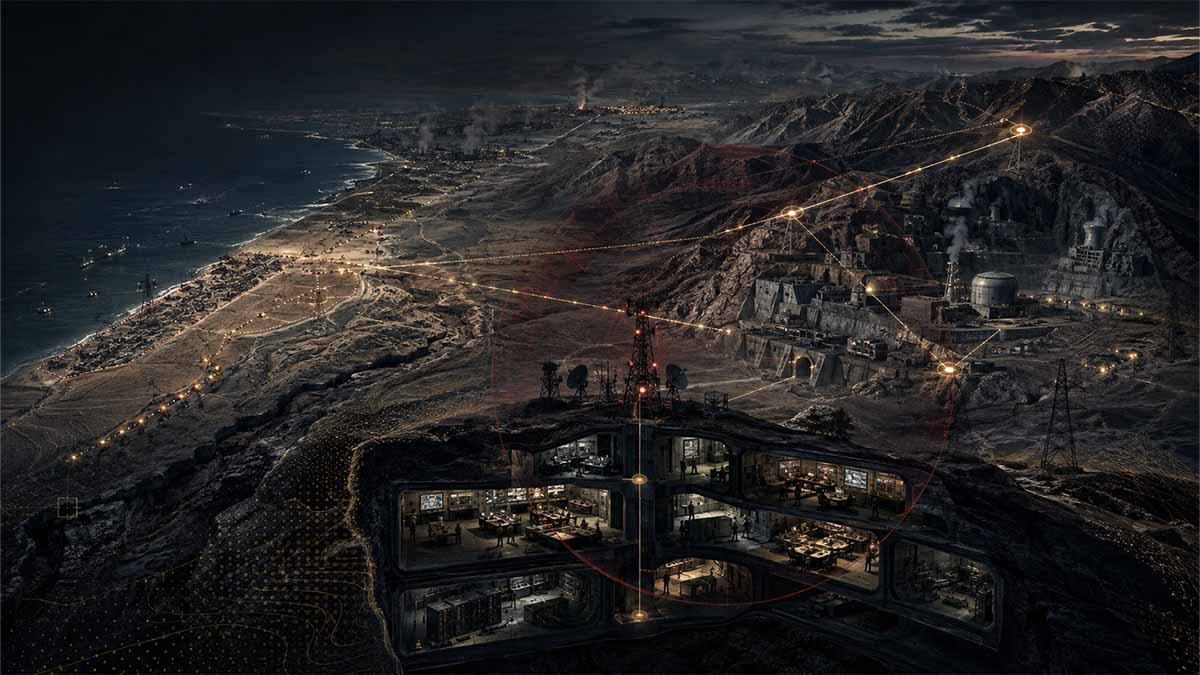
Executive Summary
- BLUF: the verified evidence supports a structural transition from episodic coercion to a prolonged, interconnected confrontation involving military pressure, nuclear verification, maritime access, Iranian regime security and Gaza governance.
- Operation Epic Fury began on 28/02/2026 at the direction of the US President; the official US description identifies Iran’s security apparatus and imminent-threat capabilities as operational targets. Operation Epic Fury Fact Sheet – United States Central Command – April 2026 — verified document.
- Iran’s nuclear file has become more opaque: the IAEA reported that no inspections occurred at several declared facilities during the relevant reporting period. Director General’s Introductory Statement to the Board of Governors – International Atomic Energy Agency – June 2026 — verified statement.
- The Gaza project is not separate from Iran strategy: it seeks a security order in which Gaza cannot threaten Israel while demilitarisation, governance and reconstruction proceed through an internationally supervised framework. High Representative for Gaza Nickolay Mladenov’s Briefing to the Security Council – United Nations – May 2026 — verified briefing.
- The principal strategic contest is therefore over sequencing: nuclear access, Iranian force reconstruction, maritime coercion, Gaza demilitarisation and Israeli withdrawal are mutually interacting but institutionally unresolved tracks.
- The reported Trump compensation quotation, the alleged US$13 billion loss, the asserted destruction of 42 US aircraft, the 52,000 fatality claim, the Oman tanker details and the reported Iranian command appointments are omitted because exact qualifying primary-source confirmation was not located.
- The five-year baseline is persistent coercive bargaining—not verified reconciliation—combined with elevated risks of miscalculation, proxy reconstitution, inspection failure and fragmented Gaza implementation.
Iran, Gaza and the New Architecture of Coercive Peace
The Middle East is not moving from war to peace. It is moving toward a harder, conditional order in which military force, nuclear inspections, sanctions, maritime access and Gaza’s demilitarisation are becoming parts of the same negotiating architecture. Since Operation Epic Fury began on 28 February 2026, Washington has combined repeated strikes with economic pressure and diplomacy; Tehran has defended strategic opacity and asymmetric leverage; Israel has tied withdrawal from Gaza to Hamas’s disarmament. The decisive issue is no longer who can impose the greatest immediate damage. It is whether coercion can be converted into verifiable commitments before Iran reconstructs its military networks, Gaza’s transitional institutions lose credibility and every ceasefire becomes merely an interval between campaigns.
From Deterrence to Reconstitution Denial
US strategy has shifted beyond conventional deterrence. The objective is increasingly to prevent Iran from reconstructing the military, financial and regional systems through which it can project power.
According to the Operation Epic Fury Fact Sheet, US Central Command began the operation at 01:15 on 28 February 2026. Washington’s declared target set extended beyond individual launchers to Iran’s security apparatus, ballistic missiles, drones, naval forces, defence industry and command infrastructure.
The campaign did not end the confrontation. CENTCOM recorded consecutive strike waves from 13 to 23 July. On 29 July it announced that it had struck dozens of Islamic Revolutionary Guard Corps command centres, missile and drone facilities, coastal-surveillance sites and maritime capabilities after what it described as attempted Iranian ballistic-missile attacks on 28 July. CENTCOM also disclosed that more than 50,000 US military personnel were deployed in the Middle East. These remain US operational claims, not independently audited battle-damage assessments, but they establish the scale and continuity of the confrontation. U.S. Strikes IRGC Targets After Attempted Iranian Attacks – USCENTCOM – 29 July 2026.
The strategic transformation is clear: Washington is attempting to suppress not only Iran’s existing arsenal, but its ability to regenerate command, procurement, financing and external power projection. Tehran’s response will therefore be institutional—dispersed command nodes, redundant communications, fragmented purchasing and less transparent financial channels—not simply quantitative rearmament.
The Nuclear Paradox
The nuclear file is the architecture’s most dangerous contradiction. Military strikes may damage facilities, but they can simultaneously destroy the visibility needed to determine what capability and material remain.
The International Atomic Energy Agency reported that indirect US–Iran negotiations occurred in Geneva on 17 and 26 February 2026, with Director General Rafael Mariano Grossi advising on verification. Two days after the second meeting, US and Israeli attacks led the Agency to suspend verification activities inside Iran. Limited inspections resumed only at the Bushehr Nuclear Power Plant from 1 to 3 June 2026.
Iran had declared 22 nuclear facilities and one location outside facilities. Yet the Agency reported that, apart from Bushehr, it had neither received sufficient information on the status of declared facilities and associated material nor obtained the access necessary for in-field verification. It could not verify the current uranium stockpile, enrichment and reprocessing activity, heavy-water projects or centrifuge inventories. GOV/2026/33 – International Atomic Energy Agency – 4 June 2026.
The last usable quantitative baseline is therefore historical, not current. As of 13 June 2025, the IAEA estimated Iran’s total enriched-uranium stockpile at 9,874.9 kilograms, including 440.9 kilograms of uranium hexafluoride enriched up to 60% U-235; the Agency had verified 432.9 kilograms of that latter quantity. It explicitly stated in June 2026 that it could no longer determine the stockpile’s current size, composition or whereabouts.
This does not prove a decision to manufacture a weapon. It proves something strategically different: the safeguards system cannot presently supply the level of knowledge required for a durable settlement. The more national intelligence replaces multilateral inspection, the more negotiating positions will be shaped by worst-case assumptions.
Hormuz as a Negotiating Instrument
The Strait of Hormuz has become simultaneously a maritime artery, military theatre, sanctions-enforcement zone and Iranian source of bargaining leverage.
The White House announced a ceasefire on 8 April 2026, linking it to negotiations and the reopening of the Strait. President Donald Trump and Iranian representatives subsequently signed a Memorandum of Understanding at Versailles on 17 June 2026. A later administration document said the MOU required Iran to use its “best efforts” to arrange safe commercial passage from the Persian Gulf to the Sea of Oman.
That language does not amount to an unconditional security guarantee. It leaves unresolved who attributes an attack, what constitutes sufficient Iranian prevention, how neutral shipping is protected and which breach authorises renewed force.
The problem became visible in July. The US administration alleged attacks on neutral-flagged commercial vessels beginning on 6 July and resumed strikes on 7 July against Iranian missile sites, air defences, maritime assets, support infrastructure and command-and-control systems. On 29 July, the US Treasury sanctioned two firms it described as integral to an IRGC-backed compulsory maritime-insurance scheme and also targeted vessels associated with Iranian petroleum shipments. Treasury Disrupts Iranian Regime’s Strait of Hormuz Extortion Network – US Department of the Treasury – 29 July 2026.
Hormuz consequently cannot be separated from the nuclear negotiation. Freedom of navigation provides immediate economic relief; maritime coercion restores Iranian leverage; US interdiction restricts Tehran’s revenue; and every disputed incident can reactivate the military track.
Sanctions as Industrial Warfare
Financial pressure is no longer centred on freezing identifiable state accounts. It is directed against the entire conversion chain that moves value from oil exports through vessels, front companies, exchange houses and digital assets into military procurement.
On 11 May 2026, the US Treasury designated 12 individuals and entities it said enabled the IRGC to sell and ship Iranian oil to China. On 19 May, it blocked 19 vessels associated with petroleum and petrochemical shipments. On 10 June, it targeted China- and Hong Kong-based persons and companies allegedly involved in weapons procurement for the IRGC and Iran’s Ministry of Defence and Armed Forces Logistics. On 7 August, Treasury sanctioned two digital-asset exchanges and a front-company network allegedly used to move funds for the IRGC and regime-connected individuals.
The number of designations alone does not measure success. The meaningful indicators are revenue denied, procurement delayed, transaction costs imposed and the time required for a disrupted network to regenerate. Iran’s counterstrategy will be corporate and technological: shorter-lived intermediaries, smaller dual-use purchases, rapidly changing beneficial ownership, multiple settlement platforms and wider use of lightly regulated jurisdictions.
This creates the central sanctions dilemma. Premature financial relief could accelerate Iranian reconstitution; relief withheld until perfect compliance could remove Tehran’s incentive to implement a negotiated settlement. Sanctions must therefore be divided into reversible nuclear and maritime measures, restrictions tied to military procurement, and human-rights or terrorism measures that cannot automatically be exchanged for nuclear concessions.
Gaza’s Conditional Sovereignty
Gaza is the second arena of reconstitution denial. Israel seeks to prevent Hamas from rebuilding the combination of government, weapons, tunnels, finance and territorial control that existed before 7 October 2023.
United Nations Security Council Resolution 2803 (2025) endorsed the US-backed Comprehensive Plan, welcomed the Board of Peace and authorised a temporary International Stabilization Force. On 16 January 2026, the White House announced that the National Committee for the Administration of Gaza, led by Dr Ali Sha’ath, would oversee public services and civil institutions. It named Nickolay Mladenov High Representative for Gaza and Major General Jasper Jeffers commander of the stabilisation force. Statement on President Trump’s Comprehensive Plan to End the Gaza Conflict – The White House – 16 January 2026.
The Gaza Roadmap of 30 July 2026 is based on “One Authority, One Law, One Weapon”. Police personnel are to be vetted; police weapons transferred to NCAG control; heavy weapons, production sites, depots and tunnels progressively decommissioned; and militia weapons stored under Palestinian institutional authority. An International Verification Committee would certify each phase, while the stabilisation force would monitor the ceasefire, separate Israeli and NCAG-controlled areas, train Palestinian police and protect humanitarian deliveries.
This is not unconditional disarmament followed by discretionary withdrawal. It is intended as reciprocal sequencing: verified decommissioning triggers phased Israeli withdrawal, which enables wider Palestinian administration and further demilitarisation.
Netanyahu’s Red Line
Israel has now challenged that sequencing.
On 9 August 2026, Prime Minister Benjamin Netanyahu stated that Israel did not accept the 15-point roadmap and that the IDF would not withdraw until Hamas had been genuinely disarmed. Remarks by Prime Minister Netanyahu at the Start of the Government Meeting – Government of Israel – 9 August 2026.
The disagreement is structural, not semantic. The Board of Peace model distributes risk through successive, verified exchanges. Netanyahu’s position places decisive disarmament before withdrawal. Israel fears that withdrawing first would allow Hamas to conceal weapons, rebuild command networks and obstruct inspectors. Palestinian actors can argue that comprehensive disarmament is impossible while Israeli forces retain extensive territorial control and the future political order remains uncertain.
Without an agreed territorial map, objective weapons benchmarks, tunnel-verification rules and a binding dispute mechanism, each party can accuse the other of failing to execute the prerequisite step. The process would then freeze with Israeli forces still inside Gaza, the NCAG possessing formal recognition but limited authority, and Hamas retaining enough underground capability to exercise a coercive veto.
Reconstruction as Security Policy
The physical condition of Gaza makes reconstruction inseparable from security. The joint World Bank–EU–UN assessment published on 20 April 2026 used remote sensing and ground-validated evidence to evaluate destruction and recovery needs accumulated between October 2023 and October 2025. Rapid Damage and Needs Assessment, Gaza Strip – World Bank, European Union and United Nations – April 2026.
A World Bank document estimated recovery and reconstruction requirements above US$67 billion, with approximately US$10 billion required during the first 18 months. By 23 July 2026, UN humanitarian authorities reported that nearly 630,000 tonnes of debris had been cleared, against more than 60 million tonnes generated since October 2023. Humanitarian Situation Report – OCHA – 23 July 2026.
Reconstruction cannot wait for perfect security: prolonged material collapse weakens legitimate administration and enlarges the recruitment base for armed and criminal networks. Yet unconditional reconstruction creates diversion and dual-use risks. The workable model is zonal and audited—construction linked to verified security transfer, transparent procurement, beneficial-ownership disclosure and Palestinian civilian employment.
The Iran–Gaza Compression
Iran and Gaza are converging inside one strategic doctrine. Washington is attacking Iran’s capacity to reconstitute missiles, maritime power, external networks and nuclear leverage. Israel is attempting to prevent Hamas from reconstituting weapons, tunnels, finance and government inside Gaza.
The relationship should not be simplified into automatic Iranian command of every Hamas decision. US Treasury designations document financial channels and alleged transfers—including mechanisms connecting the IRGC-Qods Force to Hamas and Palestinian Islamic Jihad—but financing, ideological alignment and operational command remain distinct categories.
Nevertheless, the regional consequence is substantial. A functioning Palestinian administration with an exclusive weapons monopoly would reduce the strategic value of armed non-state governance and weaken one component of Iran’s regional model. A failed transition would demonstrate that military organisations can survive extensive destruction, outlast international administrations and retain enough coercive power to block political settlement.
The danger is reciprocal contamination: an Iranian escalation could harden Israel’s conditions in Gaza; a collapse in Gaza could strengthen Tehran’s regional narrative; a maritime incident could reactivate US strikes; renewed strikes could reduce Iranian cooperation with the IAEA. Separate crises would become a single escalation system.
The Price of Sequencing Failure
The region’s emerging order will not be decided by the number of agreements signed, commanders appointed or targets struck. It will be decided by sequencing.
In Iran, inspection access must precede major nuclear relief, but relief must become tangible enough to reward verified compliance. In Hormuz, safe passage requires neutral incident attribution rather than immediate escalation from allegation to retaliation. In Gaza, every weapons-decommissioning step must correspond to a mapped Israeli withdrawal, while every territorial transfer must correspond to functioning Palestinian policing and international monitoring.
The alternative is a coercive equilibrium: Iran rebuilds under pressure, Washington strikes recurrently, Israel retains a security perimeter, Hamas survives clandestinely and international institutions administer an unresolved conflict. That would not be peace. It would be a regional system designed to postpone the next war—while steadily making it harder to prevent.
Navigational Index
- Iranian State Reconstitution — command continuity, regime protection, IRGC adaptation and proxy-network control.
- US–Iran Coercive Architecture — military operations, nuclear verification, maritime access, sanctions and negotiation sequencing.
- Israel–Gaza–Regional Order — demilitarisation, withdrawal conditions, transitional governance and the strategic compression of Iran and Gaza policy.
Master Abstract
The decisive development is not a single appointment or statement but the emergence of an integrated coercive system in which military operations, nuclear uncertainty, command regeneration and diplomatic bargaining reinforce one another without yet producing a stable political settlement. United States Central Command states that Operation Epic Fury commenced at 01:15 on 28/02/2026 and describes its targets as elements of the Iranian security apparatus presenting an imminent threat. That language matters analytically because it places the operation beyond a narrowly bounded counter-nuclear strike while stopping short of an official declaration of regime-change policy. Operation Epic Fury Fact Sheet – United States Central Command – April 2026 — verified document. The corresponding Iranian problem is institutional rather than merely matériel: Tehran must preserve political command, reconstitute military coordination, protect strategic infrastructure and sustain bargaining leverage under external pressure. A rapid succession of senior appointments could indicate continuity planning, internal consolidation, operational adaptation or factional redistribution; however, the names and positions supplied in the prompt cannot be treated as established facts because no live document satisfying the prescribed source hierarchy was located. They are therefore excluded from the evidence base. The same lock applies to the reported compensation exchange and the alleged aggregate US losses. Neither can be used to infer negotiating doctrine, battlefield effectiveness or domestic political intent without an admissible primary record. The defensible judgment is narrower but strategically significant: Washington has acknowledged an ongoing military campaign against Iranian state-security capabilities, while Tehran’s observable strategic requirement is to prevent operational attrition from becoming institutional paralysis. Over the five-year horizon, command resilience, secure communications, dispersed missile control, counterintelligence and proxy discipline will be more consequential than any isolated personality change.
The nuclear track supplies the strongest verified indicator that the confrontation is becoming structurally harder to terminate. The IAEA reported that Iran’s president signed a law suspending cooperation with the Agency on 02/07/2025, while Director General Rafael Mariano Grossi and Foreign Minister Abbas Araghchi signed the Cairo agreement on practical safeguards steps on 09/09/2025. The Agency further recorded that inspections had not taken place at other declared Iranian nuclear facilities during the reporting period covered by its June 2026 statement. GOV/2026/33 – International Atomic Energy Agency – June 2026 — verified report; Director General’s Introductory Statement to the Board of Governors – International Atomic Energy Agency – June 2026 — verified statement. These findings do not establish that Iran has decided to manufacture a nuclear weapon, and they must not be represented as proof of such a decision. They do establish an information deficit affecting the Agency’s ability to perform safeguards functions across the declared programme. That deficit changes the bargaining environment because military intelligence, national technical means and political assumptions can begin substituting for continuous multilateral verification. Under an Analysis of Competing Hypotheses, at least five explanations must remain open: H₁, Iran seeks restored negotiations while preserving maximum leverage; H₂, Tehran intends a threshold posture without weapon manufacture; H₃, the leadership prioritises regime survival and treats nuclear opacity as deterrence; H₄, fragmented command and physical disruption are impeding coherent compliance; H₅, the confrontation is moving toward prolonged military containment. Current primary evidence discriminates among these hypotheses only weakly. Consequently, no Bayesian percentage is assigned: admissible priors and validated likelihood ratios are unavailable, and numerical precision would be synthetic rather than evidentiary.
Gaza constitutes the third component because the proposed post-war framework attempts to remove one arena of armed pressure from the wider regional system while simultaneously preserving Israeli security guarantees. In his 21/05/2026 briefing, Nickolay Mladenov, identified by the United Nations record as the Board of Peace’s High Representative for Gaza, described a governance, reconstruction and redevelopment structure operating under a plan endorsed by the Security Council. High Representative for Gaza Nickolay Mladenov’s Briefing to the Security Council – United Nations – May 2026 — verified briefing. The strategic problem is not whether demilitarisation, reconstruction and security are desirable end states; it is whether their implementation sequences can be made mutually acceptable. Israel’s security logic prioritises irreversible disarmament and prevention of another cross-border attack. Palestinian implementation requires legitimate administration, material reconstruction and a credible political horizon. The US-sponsored structure must reconcile those requirements while avoiding an indefinite territorial and administrative partition. Iran enters this equation indirectly through the regional value of armed non-state networks, the reputational consequences of Gaza’s governance outcome and Tehran’s ability to frame continued conflict as evidence that American regional architecture cannot deliver sovereignty or security simultaneously. This does not prove that developments in Gaza cause a particular Iranian decision; it identifies a shared strategic environment. Across the five-year outlook, the decisive indicators will be verifiable weapons decommissioning, the operational authority of the transitional Palestinian administration, the territorial configuration of Israeli forces, the durability of regional guarantees, restored IAEA access and the degree to which Iran rebuilds centralised or distributed command. The most dangerous pathway is asynchronous implementation: military pressure continues, inspections remain incomplete, Gaza governance stalls and each actor interprets the others’ hedging as preparation for renewed escalation.
Systemic pressure indicator
Structural indicator matrix
Iranian State Reconstitution: Command, IRGC and Proxy Control, 2026–2031
Reconstitution as a system, not an appointment cycle
Iranian state reconstitution must be analysed as a contested reconstruction of political authority, command survivability, coercive capacity, revenue access and regional influence—not as a simple replacement of commanders eliminated, incapacitated or politically displaced. The verified operational baseline is unusually severe. United States Central Command states that Operation Epic Fury began at 01:15 on 28/02/2026 and that US forces were directed to strike components of Iran’s security apparatus, prioritising capabilities described by Washington as posing an imminent threat. Operation Epic Fury Fact Sheet – United States Central Command – April 2026 — verified primary document. This formulation is broader than a discrete counter-nuclear mission because the declared target system encompasses the institutions that preserve internal coercion, military coordination and regime continuity. It nevertheless remains a US institutional characterisation and cannot, by itself, establish Iran’s intentions or prove that Washington has adopted regime change as an official objective. The analytical centre of gravity is therefore the Iranian state’s capacity to absorb repeated attacks without losing vertical control over the Islamic Revolutionary Guard Corps, the regular armed forces, internal-security bodies, strategic weapons units and external partner networks. The prompt’s reported appointment of Ahmad Vahidi as IRGC commander and the other named command changes cannot be incorporated as verified events because no accessible decree or announcement satisfying the stipulated primary-source threshold was located during the live audit. This omission is analytically material: biographies, reported appointments and alleged succession chains must not substitute for documented command authority. Until official decrees are available, the defensible assessment concerns functions rather than personalities—who can authenticate orders, allocate money, coordinate missile and drone forces, control provincial repression, preserve encrypted communications and negotiate with armed partners outside Iran.
| Reconstitution layer | Operational function | Verified pressure vector | Observable indicator required | Principal analytical danger |
|---|---|---|---|---|
| Supreme command | Strategic authorisation and political arbitration | Persistent external military pressure | Official decrees, authenticated orders, public command appearances | Confusing symbolic visibility with effective authority |
| General Staff | Joint planning and force synchronisation | Strikes on military and security capabilities | Exercise directives, joint operational statements, force appointments | Assuming formal hierarchy equals functioning command |
| IRGC | Regime protection, strategic weapons, external networks | Direct military and financial targeting | Verified command orders, deployments, procurement records | Treating the IRGC as institutionally monolithic |
| Regular armed forces | Territorial defence and conventional operations | Air, naval and infrastructure attrition | Mobilisation orders, basing changes, force-generation activity | Underestimating IRGC–regular-force coordination problems |
| Internal security | Protest control, surveillance and elite protection | Human-rights sanctions and legitimacy pressure | Provincial command changes, policing directives, detention policy | Equating coercive persistence with political stability |
| External networks | Deterrence, influence and strategic depth | Sanctions, interdiction and partner attrition | Independently attributable transfers, financing and command traffic | Calling every aligned group an Iranian proxy |
| Revenue architecture | Oil income, shadow banking, procurement | OFAC, EU and FATF countermeasures | Vessel ownership, beneficial ownership, payment routing, procurement links | Converting designation allegations into judicially proven facts |
Command continuity under decapitation and communications pressure
Command continuity has four separable components: legal succession, operational succession, communications survivability and elite acceptance. A formal appointment may satisfy only the first. Operational continuity requires the successor to obtain access to secure networks, intelligence repositories, weapons-release procedures, budgetary authorities and trusted liaison channels connecting the Supreme Leader’s office, the General Staff, the IRGC, the Ministry of Defence and Armed Forces Logistics, the regular armed forces and internal-security organisations. Elite acceptance is still more difficult because a commander imposed during wartime must reconcile veterans’ networks, intelligence organisations, provincial commanders and politically embedded economic interests. Consequently, repeated personnel replacement can preserve the appearance of institutional continuity while simultaneously degrading decision quality through shortened tenure, restricted communications and fear-driven centralisation. The observable question is not whether Tehran announces new commanders quickly, but whether those commanders can generate coherent activity across geographically separated forces without producing contradictory orders or unauthorised escalation. CENTCOM’s official operation page states that US forces are striking Iran’s security apparatus and records continuing operations through July 2026, including a release dated 29/07/2026 concerning strikes on IRGC targets after attempted Iranian attacks. Operation Epic Fury – United States Central Command – July 2026 — verified operational page. These are US claims regarding US operations and targeting; they do not independently verify the extent of Iranian damage. They nevertheless establish that Iranian reconstitution is occurring under continuing rather than purely historical pressure. Over the five-year horizon, Tehran’s rational institutional response would be expected to favour redundant command posts, dispersed authentication authorities, compartmented communications and greater delegation to surviving regional commanders. That expectation is an analytical inference, not a verified Iranian policy. Its principal danger for regional stability is the command-and-control paradox: decentralisation increases survival after a strike but can reduce the centre’s ability to prevent local retaliation, accidental escalation or opportunistic action by an affiliated organisation.
| Command-continuity test | Evidence that would support successful reconstitution | Evidence that would indicate concealed degradation | Collection discipline |
|---|---|---|---|
| Order authentication | Consistent, attributable instructions across services | Conflicting statements, unexplained reversals, multiple claimants | Require authenticated official records; reject anonymous reporting |
| Joint planning | Coordinated exercises or operations with defined command relationships | Service-specific actions without visible deconfliction | Distinguish public messaging from demonstrated interoperability |
| Strategic-force custody | Stable control procedures and repeated institutional attribution | Unclaimed launches, delayed attribution, contradictory explanations | Do not infer custody from weapon type alone |
| Provincial control | Uniform enforcement and logistics across provinces | Divergent provincial responses or unexplained leadership turnover | Separate local administrative weakness from national fragmentation |
| External liaison | Consistent political and logistical relationships | Partner autonomy accompanied by declining Iranian attribution | Avoid assuming funding automatically establishes command |
| Leadership protection | Regularised continuity mechanisms | Emergency improvisation and concentration of authority in a shrinking circle | Visibility is not proof of physical or operational security |
Regime protection: the shift from defence to political survivability
Regime protection extends beyond defending senior officials from kinetic attack. It comprises the preservation of an accepted decision centre, control of the information environment, protection of internal-security databases, continuity of salaries and patronage, management of civilian hardship, deterrence of elite defection and suppression or accommodation of organised opposition. The European Union provides primary-source evidence that internal repression and military reconstruction are being treated externally as connected but legally distinct policy areas. On 29/01/2026, the Council adopted restrictive measures against fifteen persons and six entities linked by the Council to violence, arbitrary detention and intimidation against Iranian civilians, while also adopting measures under its drones-and-missiles framework. Foreign Affairs Council, 29 January 2026 – Council of the European Union – January 2026 — verified institutional record. The same Council release states that the drone-and-missile decision brought the relevant listings to twenty-four individuals and twenty-six entities and that the regime had been extended to 27/07/2026. Iran: Council Adopts New Sanctions over Serious Human Rights Violations and Iran’s Continued Support to Russia’s War of Aggression against Ukraine – Council of the European Union – January 2026 — verified primary release. These measures do not demonstrate that sanctions will destabilise the Iranian government, nor do they permit a numerical forecast of regime survival. They do show that Tehran must rebuild military capability while operating under external pressure directed at personnel, entities, finance and legitimacy. During 2026–2031, the regime-protection problem will therefore be distributive: resources devoted to air defence, missiles, hardened sites, military salaries and external networks cannot simultaneously finance every civilian, economic and patronage requirement. Without audited Iranian budget execution records, the scale of that trade-off cannot be quantified. The critical indicators are payment continuity, provincial coercive cohesion, elite asset protection, succession procedures and the ability to prevent military institutions from becoming autonomous political-economic centres.
IRGC adaptation: from concentrated capability to distributed survivability
The IRGC faces an adaptation problem shaped by three competing imperatives. It must remain centralised enough to execute strategic policy, distributed enough to survive targeting and economically connected enough to finance reconstruction under sanctions. Excessive centralisation creates identifiable command nodes and serial dependencies; excessive distribution protects local capability but raises the risk that subordinate formations, naval units, missile commands or foreign partners act without fully synchronised political authorisation. The US Treasury explicitly framed its 28/05/2026 action as targeting Iranian military oil sales that, according to Treasury, helped finance the rebuilding of Iran’s armed forces through arrays of front companies. Economic Fury Targets Illicit Oil Revenue Fueling Iran’s Military Reconstitution – US Department of the Treasury – May 2026 — verified primary release. On 10/06/2026, OFAC also designated overseas procurement and financial networks, including China- and Hong Kong-based persons and companies that Treasury identified as facilitating weapons procurement for the IRGC and the Ministry of Defence and Armed Forces Logistics. Economic Fury Disrupts Foreign Networks Supporting Iran’s Weapons Procurement – US Department of the Treasury – June 2026 — verified primary release. These releases are authoritative evidence of US designation actions and the factual allegations underpinning them; they are not substitutes for criminal adjudications and should not be presented as universally established findings. Analytically, however, their targeting pattern reveals the external model of Iranian reconstruction being attacked: oil exports generate funds; corporate intermediaries obscure the Iranian beneficiary; exchange houses, banks or digital-asset channels move value; foreign procurement companies obtain components; and military institutions convert those components into restored capability. The likely IRGC adaptation is not abandonment of this architecture but greater modularity—shorter-lived companies, diversified settlement instruments, more intermediaries and procurement fragmentation. That is a forward-looking hypothesis requiring vessel, corporate, customs and blockchain evidence before confirmation.
| IRGC adaptation domain | Pressure observed in primary sources | Likely institutional adaptation to test | Falsifying observation |
|---|---|---|---|
| Command and control | Continuing US targeting of security capabilities | More distributed authorities and redundant communications | Persistent dependence on a small, repeatedly exposed headquarters structure |
| Oil monetisation | Designations against military-linked oil networks | Rotating intermediaries, vessels and beneficial owners | Durable use of unchanged, already designated entities |
| Procurement | Measures against China- and Hong Kong-linked networks | Smaller purchases, dual-use substitution, layered brokers | Continued large, directly attributable military procurement |
| Digital finance | Designations against exchanges and clandestine currency networks | Multi-platform routing and greater jurisdictional dispersion | Sustained dependence on a small number of identifiable platforms |
| Maritime coercion | US and EU measures addressing Strait of Hormuz activity | Denial mechanisms below declared-war thresholds | Abandonment of naval pressure as a bargaining instrument |
| External partners | Sanctions against support to armed groups | More political autonomy and lower Iranian signature | Increased overt Iranian command claims over partner operations |
| Domestic security | EU sanctions linked to repression | Greater reliance on local surveillance and provincial enforcement | Visible reduction in coercive institutional reach |
The financial spine: oil, shadow banking, cryptocurrency and procurement
The most consequential shadow dimension is liquidity. Military reconstitution requires convertible value, reliable settlement, foreign exchange, procurement credit and a mechanism for repatriating or reallocating revenue. On 11/05/2026, OFAC designated twelve persons and entities that it identified as enabling the IRGC to sell and ship Iranian oil to the People’s Republic of China through front companies. Economic Fury Ramps Up Pressure on Iran’s Islamic Revolutionary Guard Corps – US Department of the Treasury – May 2026 — verified primary release. On 19/05/2026, Treasury blocked nineteen vessels connected in its findings to Iranian petroleum and petrochemical shipments. Economic Fury Targets Networks Generating Revenue for Iran’s Regime – US Department of the Treasury – May 2026 — verified primary release. On 07/08/2026, Treasury targeted two digital-asset exchanges and a network of front companies that it said were used to move and obscure funds for the IRGC and regime-connected persons. Treasury Sanctions Crypto Exchanges Funding Iran’s IRGC and Enabling Illicit Finance – US Department of the Treasury – August 2026 — verified primary release. Treasury used the formulation “billions of dollars” in that release, but the absence in the public text of a complete transaction-level dataset means this report does not independently reproduce or extrapolate the aggregate. The Financial Action Task Force, meanwhile, retained Iran within its call-for-action framework on 19/06/2026, while acknowledging that Iran had provided an update in January 2026 concerning ratification of the Palermo and Terrorist Financing Conventions. High-Risk Jurisdictions Subject to a Call for Action – Financial Action Task Force – June 2026 — verified institutional statement. The five-year implication is a continuing contest between network replacement and regulatory discovery. Success cannot be measured merely by the number of sanctions listings: the relevant metrics are revenue actually denied, settlement costs, procurement delays, asset substitution and the time required for a disrupted network to regenerate.
| Financial-control layer | Required OSINT object | What can be established | What must not be inferred automatically |
|---|---|---|---|
| Oil cargo | Vessel identity, ownership, insurer, loading record, destination | Physical and corporate route when records converge | Ultimate military use of every unit of revenue |
| Front company | Registry filings, directors, addresses, counterparties | Corporate overlap and control indicators | Criminality solely from shared address or nationality |
| Bank or exchange house | Designation record, correspondent relationships, transaction evidence | Institutional exposure alleged or documented by authority | Complete size of the network without underlying ledger data |
| Digital asset | Wallet attribution, transaction graph, exchange records | Movements associated with verified addresses | Beneficial owner of every downstream wallet |
| Procurement company | Customs declarations, bills of lading, end-user documents | Acquisition route and declared commodity | Military end use from dual-use classification alone |
| Revenue allocation | Audited budget, transfer order, institutional account | Direct funding relationship | “Every oil dollar funds proxies” or equivalent causal simplification |
| Network resilience | Time between designation and replacement activity | Regeneration speed after repeated observation | Strategic success from listing counts alone |
Proxy-network control: a spectrum from command to alignment
“Proxy” is analytically useful only when disaggregated. Iranian relationships with armed organisations may involve ideology, training, finance, weapons, intelligence, political coordination, shared adversaries or direct operational direction, but those components do not automatically coexist. The Council of the European Union states that the sanctions framework established on 20/07/2023 was broadened on 14/05/2024 to encompass Iranian military support to armed groups and entities in the Middle East and Red Sea region, as well as drone and missile activity. EU Sanctions against Iran – Council of the European Union – updated 2026 — verified institutional policy record. This confirms the EU’s legal and policy attribution of Iranian support; it does not establish that Tehran exercises continuous tactical control over every listed organisation or operation. For intelligence purposes, at least five relationship models must be kept separate: H₁, direct command, in which Iranian authorities approve targets or timing; H₂, delegated command, in which a partner acts within an Iranian-defined strategic mandate; H₃, logistical sponsorship without operational control; H₄, convergent alignment based primarily on shared interests; and H₅, nominal affiliation masking substantial local autonomy. Reconstitution after sustained military pressure could push different relationships in opposite directions. Tehran might centralise politically sensitive operations to prevent escalation, while decentralising logistics and tactical activity to make the network less vulnerable. Conversely, disrupted communications and reduced financing might increase partner autonomy even if public rhetoric continues to emphasise unity. A credible five-year assessment must therefore track command evidence separately from weapons provenance and financial support. Relevant indicators include authenticated instructions, timing coordination, target selection, payment chains, personnel travel, common encryption systems, weapons custody, disciplinary interventions and evidence that Iran can veto an intended operation. Shared equipment, rhetoric or adversaries alone remain insufficient to establish command.
| Relationship category | Minimum evidentiary threshold | Strategic meaning | Frequent analytic error |
|---|---|---|---|
| Direct operational command | Authenticated orders or convergent official documentation linking Iran to target and timing | Extension of Iranian command architecture | Inferring direct command from Iranian-origin equipment |
| Delegated mission command | Evidence of Iranian strategic tasking with local tactical discretion | Resilient but escalation-sensitive partnership | Treating delegated actors as either fully controlled or fully autonomous |
| Sustained sponsorship | Verified finance, training, procurement or transport | Iranian capacity enhancement without proven tactical control | Converting sponsorship into attribution for every attack |
| Intermittent facilitation | Transaction- or operation-specific logistical assistance | Selective influence and access | Assuming a durable alliance from a single transfer |
| Ideological alignment | Shared doctrine and public political support | Narrative and mobilisation value | Treating rhetoric as an operational chain of command |
| Convergent autonomy | Independent action serving overlapping objectives | Plausible strategic benefit without Iranian direction | Labelling all convergence as covert control |
Maritime adaptation and the Strait of Hormuz
The maritime theatre links regime reconstitution to revenue, deterrence and international coalition formation. On 08/06/2026, the Council of the European Union listed two individuals and one entity under measures addressing threats to freedom of navigation in the Strait of Hormuz. The Council identified Mohammad Akbarzadeh as Deputy Commander for Political Affairs and spokesperson of the IRGC Navy and attributed to the IRGC Navy a toll system, threats, harassment and attacks against commercial shipping. The Council’s background section also records that the European Council on 19/03/2026 called for implementation of Security Council Resolution 2817 (2026), while the High Representative on 09/04/2026 urged observance of a US–Iran ceasefire and safe passage through the Strait. Freedom of Navigation in the Strait of Hormuz: EU Lists Two Individuals and One Entity – Council of the European Union – June 2026 — verified primary release. The United Nations record states that Security Council Resolution 2817 was adopted on 11/03/2026 in response to missile and drone strikes against Gulf states. Security Council Adopts Resolution 2817 (2026) – United Nations – March 2026 — verified institutional record. These records establish diplomatic and legal reactions; they do not independently validate every operational allegation included in national statements. Strategically, the maritime arena offers the IRGC an asymmetric instrument that can impose insurance, routing, escort and political costs without requiring conventional parity. Yet maritime coercion can also enlarge the coalition confronting Iran, damage relationships with Asian energy importers and expose naval assets to surveillance and interdiction. Across 2026–2031, the central variable is whether Tehran can calibrate maritime pressure below the threshold that converts economically cautious states into active security participants.
China, Russia and the external limits of Iranian reconstitution
The Chinese and Russian positions provide diplomatic space but should not be mistaken for verified commitments to rebuild Iranian military power. China’s Ministry of Foreign Affairs stated on 15/05/2026 that the conflict had affected regional populations, global growth, supply chains, international trade and energy stability, and called for an end to continued fighting. Foreign Ministry Spokesperson Guo Jiakun’s Regular Press Conference – Ministry of Foreign Affairs of the People’s Republic of China – May 2026 — verified Chinese government statement. In a separate official briefing concerning the China–US summit, Foreign Minister Wang Yi stated that China encouraged Washington and Tehran to continue resolving disputes, including the nuclear issue, through negotiation. Briefing by Foreign Minister Wang Yi on the China–US Summit – Ministry of Foreign Affairs of the People’s Republic of China – May 2026 — verified Chinese government statement. China and Pakistan’s five-point initiative of 31/03/2026 likewise called for peace talks, protection of sovereignty and refraining from force during negotiations. Five-Point Initiative of China and Pakistan for Restoring Peace and Stability in the Middle East – Ministry of Foreign Affairs of the People’s Republic of China – March 2026 — verified Chinese government document. Russia’s Foreign Ministry condemned the US–Israeli attacks on 28/02/2026 and subsequently stated on 18/06/2026 that it had transmitted an updated collective-security concept for the Persian Gulf to Arab and Iranian partners. Statement by the Russian Foreign Ministry Regarding Military Aggression against Iran – Ministry of Foreign Affairs of the Russian Federation – February 2026 — verified Russian government statement; Foreign Ministry Statement on the Memorandum of Understanding Reached between the United States and Iran – Ministry of Foreign Affairs of the Russian Federation – June 2026 — verified Russian government statement. These positions favour Iranian sovereignty and negotiated de-escalation, but the cited texts do not document Russian or Chinese guarantees to restore IRGC capability.
Analysis of competing hypotheses, Bayesian discipline and model boundaries
The evidence supports an Analysis of Competing Hypotheses but not numerical posterior probabilities. H₁—centralised restoration predicts rapid formal appointments, reconstructed joint command and strong control of external partners; it is weakened if operational authority remains dispersed or contradictory. H₂—distributed resilience predicts redundant command nodes, greater provincial discretion and modular procurement; it is weakened if Iranian activity continues to depend on a small number of exposed institutions and financial channels. H₃—security-state consolidation predicts that internal protection, surveillance and elite control will receive priority over conventional-force regeneration; it is weakened by verifiable resource transfers favouring civilian recovery or regular-force modernisation. H₄—managed retrenchment predicts reduced external commitments, selective preservation of strategically valuable partners and diplomatic attempts to exchange restraint for economic access; it is weakened by expanding and increasingly attributable external operations. H₅—fragmented militarisation predicts competing chains of authority, partner autonomy and growing escalation risk; it is weakened by consistent central veto power and coherent cross-service execution. H₆—negotiated dual track predicts simultaneous military rebuilding and partial safeguards or ceasefire implementation; it is weakened if inspections, maritime restraint and financial negotiations all collapse together. A Bayesian update would require explicit priors, evidence likelihoods conditional on each hypothesis and validated independence assumptions. Those inputs are unavailable in the admissible primary record; assigning percentages would therefore violate the factual-integrity lock. A Monte Carlo simulation would additionally require documented distributions for strike tempo, command attrition, network-regeneration time, export revenue, procurement delay and proxy autonomy. No such complete dataset is available here. The appropriate substitute is a transparent indicator model: every future observation should be coded for direction, source quality, date and discriminating power, while scenario paths remain ordinal stress tests rather than statistical forecasts.
| Hypothesis | Confirming indicators through 2031 | Disconfirming indicators | Primary collection priority |
|---|---|---|---|
| H₁ Centralised restoration | Consistent joint orders; rapid institutional appointments; demonstrable veto over partner operations | Conflicting commands; persistent unauthorised activity | Official decrees, exercise orders, authenticated command communications |
| H₂ Distributed resilience | Redundant headquarters; modular procurement; geographically dispersed force generation | Continued dependence on concentrated nodes | Basing changes, procurement dispersion, regional-command activity |
| H₃ Security-state consolidation | Internal-security investment and political surveillance dominate available resources | Regular-force or civilian priorities visibly outweigh coercive institutions | Budget execution, contracting, provincial security directives |
| H₄ Managed retrenchment | Selective external disengagement linked to negotiated economic relief | Broader, costlier and more attributable regional operations | Financial flows, arms transfers, diplomatic implementation documents |
| H₅ Fragmented militarisation | Competing claims, partner autonomy, inconsistent escalation control | Stable central arbitration and operational discipline | Attribution evidence, timing analysis, disciplinary interventions |
| H₆ Negotiated dual track | Partial nuclear access and maritime restraint coexist with defensive rebuilding | Total collapse of verification and repeated unrestricted escalation | IAEA access, ceasefire records, maritime incident documentation |
Five-year outlook: reconstruction under persistent constraint
The 2026–2031 outlook is best structured as a sequence of institutional tests rather than a point forecast. The first test is emergency continuity: Iran must maintain authenticated command, strategic-force custody and internal-security coherence while operations remain active. The second is resource conversion: oil, shadow-banking and digital-finance networks must translate revenue into salaries, infrastructure and foreign procurement despite repeated designations. The third is organisational learning: the IRGC must decide which functions to harden, disperse, automate or delegate. The fourth is partner governance: Tehran must preserve enough influence over aligned armed organisations to retain deterrent value without accepting unlimited responsibility for local actions. The fifth is political normalisation: military recovery that does not restore nuclear verification, commercial predictability or civilian economic capacity may preserve coercive power while deepening long-term isolation. External constraints will not be uniform. The United States is simultaneously applying kinetic and financial pressure; the European Union is linking nuclear, human-rights, missile, drone and maritime instruments through legally differentiated regimes; China prioritises negotiations, trade stability and energy security; Russia opposes US–Israeli military action and promotes a Gulf-security concept. These policies may provide Tehran with tactical diplomatic opportunities, but none of the verified sources establishes that another power will absorb the full economic or military cost of Iranian reconstruction. The central five-year judgement is therefore conditional: Iran can regenerate substantial state-security capability if it preserves command legitimacy, obtains external liquidity and modularises procurement, but successful coercive reconstruction would not automatically restore strategic freedom. The same adaptations that improve survival—opacity, decentralisation, shadow finance and partner autonomy—can increase transaction costs, weaken central control and make negotiated commitments harder for foreign governments to verify.
| Outlook phase | Reconstitution priority | Decisive indicator | Escalation trigger | Stabilising condition |
|---|---|---|---|---|
| Emergency continuity | Preserve command authentication and strategic custody | Coherent cross-service orders | Conflicting authority or uncontrolled retaliation | Verified chain of command |
| Early rebuilding | Restore communications, logistics, salaries and air defence | Regular payment and procurement continuity | Competition among security institutions | Transparent allocation and negotiated restraint |
| Network regeneration | Replace disrupted oil, banking and procurement channels | Reduced replacement time after sanctions | Expanded interdiction and secondary sanctions | Lawful, monitorable commercial access |
| Organisational adaptation | Balance central control with distributed survivability | Demonstrated coordination after dispersion | Local initiative exceeding political mandate | Reliable deconfliction and veto mechanisms |
| Regional recalibration | Redefine relations with aligned armed groups | Verifiable control or retrenchment | Partner action provoking interstate retaliation | Explicit boundaries and monitored commitments |
| Strategic settlement | Connect military restraint, nuclear access and economic relief | Durable implementation across multiple tracks | Collapse of safeguards or maritime ceasefire | Sequenced, independently verifiable agreement |
Warning indicators and intelligence requirements
The practical monitoring architecture should prioritise observable institutional behaviour rather than rhetoric. A high-value warning set would include unexplained turnover among command, intelligence and provincial-security officials; duplication of titles or competing public orders; sudden changes in military payroll mechanisms; transfer of strategic industries into new holding companies; accelerated incorporation of trading firms in permissive jurisdictions; repeated changes in vessel ownership or flag; procurement fragmentation across unrelated dual-use commodities; migration from sanctioned exchanges to smaller virtual-asset service providers; new liaison structures connecting Tehran to armed partners; and divergence between Iranian political guidance and partner operational conduct. None of these indicators proves regime fracture, weapons reconstruction or operational command in isolation. Their value arises from temporal convergence and source triangulation. Corporate registries should be checked against customs records, sanctions designations, port calls and beneficial-ownership data; blockchain observations require validated wallet attribution; missile or drone debris requires documented chain of custody; command claims require official records or corroborating operational behaviour. Cyber indicators deserve equivalent discipline. Increased use of isolated networks, domestic routing, new encryption systems or destructive activity could reflect defensive hardening, offensive preparation or ordinary security adaptation. Attribution must therefore separate infrastructure ownership, malware similarity, operator behaviour, victimology and authenticated state direction. The intelligence objective through 2031 is not to produce a single dramatic verdict but to detect movement among the six hypotheses before that movement becomes irreversible. The most consequential warning would be simultaneous deterioration across four systems—command coherence, nuclear verification, maritime restraint and control over aligned armed organisations—because convergence would narrow diplomatic options even if no individual indicator independently established an intention to escalate.
US–Iran Coercive Architecture: Force, Verification and Negotiation, 2026–2031
Coercion as an integrated architecture
The post-28/02/2026 US–Iran confrontation is not adequately described as a bilateral war interrupted by negotiations. It operates as an integrated coercive architecture in which military operations, nuclear opacity, maritime access, financial exclusion and diplomatic sequencing are deliberately interconnected, although each track retains different legal authorities, verification mechanisms and thresholds for escalation. United States Central Command states that Operation Epic Fury began at 01:15 on 28/02/2026 and identifies its operational purpose as striking Iran’s security apparatus while prioritising capabilities characterised by Washington as imminent threats. Operation Epic Fury Fact Sheet – United States Central Command – April 2026 — verified primary document. The White House subsequently stated on 08/04/2026 that Iran had accepted a ceasefire and reopening of the Strait of Hormuz while negotiations toward a wider agreement continued. That same official release attributed three military objectives to the US campaign: destruction of Iranian ballistic-missile and drone capabilities, destruction of Iran’s navy and destruction of the defence-industrial base used to reconstitute power projection. Peace Through Strength: Operation Epic Fury Crushes Iranian Threat as Ceasefire Takes Hold – The White House – April 2026 — verified official release. These are official US descriptions, not independently adjudicated measurements of military effectiveness. Their strategic significance lies in the declared relationship between force and future capability: Washington did not frame coercion solely as punishment for a completed act, but as an effort to alter Iran’s capacity to rebuild instruments of regional projection. Tehran’s corresponding leverage rests not in conventional symmetry but in the ability to preserve nuclear ambiguity, threaten maritime predictability, regenerate military capacity, sustain external networks and impose recurring costs on US forces and regional partners. The architecture is therefore recursive: each coercive measure generates an adaptation, and each adaptation creates justification for another layer of pressure.
| Coercive instrument | Immediate US objective | Iranian counter-leverage | Verification mechanism | Principal sequencing problem |
|---|---|---|---|---|
| Kinetic operations | Degrade missiles, drones, naval assets, defence industry and command systems | Dispersal, concealment, retaliation and reconstruction | Battle-damage assessment, imagery, attributable operations | Determining when degradation is sufficient to suspend strikes |
| Nuclear pressure | Prevent weapon acquisition and constrain enrichment-related capability | Inspection access, nuclear material, technical knowledge and programme opacity | IAEA safeguards, declarations, inspections and design-information verification | Whether access precedes sanctions relief or follows it |
| Maritime control | Preserve safe passage and deny coercive use of Hormuz | Threats to shipping, mines, missiles, drones, seizures or administrative toll mechanisms | Vessel tracking, inspections, incident attribution and third-party monitoring | Whether free navigation is a precondition, reciprocal step or final outcome |
| Financial sanctions | Reduce revenue, procurement access and military reconstruction | Oil rerouting, shadow banking, front companies and digital assets | OFAC records, registries, customs data and financial intelligence | Which restrictions can be suspended without enabling rapid reconstitution |
| Diplomatic engagement | Convert temporary restraint into enforceable commitments | Delay, partial compliance and issue linkage | Written agreements, implementation timetables and independent reporting | Avoiding irreversible concessions before verified performance |
| Regional coalition | Distribute defence and enforcement burdens | Bilateral pressure on Gulf partners and networked retaliation | Joint statements, deployments and operational coordination | Preventing coalition fragmentation during negotiations |
The military layer: degradation, deterrence and reconstitution denial
Military coercion within this architecture has three distinct functions that must not be collapsed: immediate defence against an identified threat, cumulative degradation of Iranian capabilities and denial of Iran’s ability to reconstruct those capabilities. CENTCOM describes Operation Epic Fury as major combat operations against Iran beginning on 28/02/2026. About United States Central Command – United States Central Command – updated 2026 — verified institutional page. The official CENTCOM media record lists continuing strike activity during July 2026, including an eleventh night of strikes on 21/07/2026, a subsequent operation on 22/07/2026 and a thirteenth night on 23/07/2026. United States Central Command Media – United States Central Command – July 2026 — verified operational record. The existence of recurring strike announcements after an April ceasefire and June memorandum demonstrates that negotiation and force were operating concurrently rather than sequentially. It does not establish the accuracy of US damage assessments or the legality of each operation under international law. The administration’s 23/07/2026 Statement of Administration Policy says that US forces resumed strikes on 07/07/2026 against missile-launch sites, air defences, military maritime assets, support infrastructure, and command-and-control capabilities after alleged Iranian attacks on neutral-flagged commercial vessels beginning on 06/07/2026. Statement of Administration Policy: H. Con. Res. 89 – Executive Office of the President – July 2026 — verified official document. The allegations concerning Iranian responsibility remain the administration’s attributed position unless independently corroborated. Strategically, the July cycle illustrates the enforcement dilemma built into coercive diplomacy: if Washington responds militarily to every alleged breach, it preserves deterrent credibility but risks transforming a temporary arrangement into an indefinitely renewable target list; if it does not respond, it risks allowing incremental violations to redefine the agreement’s practical meaning.
| Military phase | Verified date | Officially stated development | Analytical significance | Evidentiary limitation |
|---|---|---|---|---|
| Operation commences | 28/02/2026 | CENTCOM begins Operation Epic Fury | Coercion moves from threat to sustained force | Does not independently establish effectiveness |
| Ceasefire announced | 08/04/2026 | White House declares military objectives achieved and ceasefire accepted | Force becomes leverage for broader negotiations | US assessment of success is not neutral verification |
| MOU signed | 17/06/2026 | White House records signature at Versailles | Temporary restraint acquires a written political framework | Full authenticated MOU text was not located |
| Maritime breaches alleged | From 06/07/2026 | Administration attributes attacks on neutral-flagged vessels to Iran | Maritime compliance becomes an enforcement trigger | Attribution is stated by the US executive |
| Strikes resume | From 07/07/2026 | US targets several Iranian military categories | Negotiation and kinetic enforcement operate simultaneously | Individual strike outcomes require separate verification |
| Extended strike cycle | 13–23/07/2026 | CENTCOM records repeated strike waves | Tactical retaliation becomes a sustained coercive mechanism | Public release frequency is not a measurement of strategic effect |
| IRGC targets struck | 29/07/2026 | CENTCOM reports strikes following attempted Iranian attacks | Focus shifts toward institutional reconstitution capacity | Iranian damage and decision chain remain unverified |
Nuclear verification: the architecture’s decisive bottleneck
The nuclear track is the hardest component to sequence because it combines legal safeguards obligations, physical access, material accountancy, military damage, intelligence uncertainty and political demands exceeding ordinary NPT verification. The IAEA reported that indirect US–Iran negotiations occurred in Geneva on 17/02/2026 and 26/02/2026, with the Director General participating to advise on verification questions. It further recorded that US and Israeli attacks on 28/02/2026 included sites associated with nuclear facilities, causing the Agency to suspend in-field verification activities. Implementation of the NPT Safeguards Agreement and Relevant Provisions of United Nations Security Council Resolutions in the Islamic Republic of Iran, GOV/2026/33 – International Atomic Energy Agency – June 2026 — verified primary report. Verification partially resumed from 01/06/2026 through 03/06/2026 at the Bushehr Nuclear Power Plant, where the Agency conducted an inspection, design-information verification and examinations associated with updated design-information questionnaires. The same report states that Iran had declared twenty-two nuclear facilities and one location outside facilities, but that the Agency had not received status information or access for the other declared facilities and associated nuclear material during the reporting period. Consequently, the Agency said it could not verify suspension of enrichment, reprocessing and heavy-water-related activities. These are precise institutional findings and do not prove a decision to manufacture a nuclear weapon. They establish a safeguards deficit: knowledge about declared material, facility status, centrifuge inventories and current activities had become incomplete. That distinction is essential. Military destruction of facilities cannot substitute for material accountancy because physical damage may disable operations without establishing the location, composition or custody of nuclear material and equipment. Conversely, lack of access cannot be presented as proof that prohibited work is occurring. The coercive architecture therefore confronts a central paradox: military operations intended to constrain nuclear capability can simultaneously reduce the Agency’s ability to verify what remains.
| Verification object | Last directly relevant IAEA finding in GOV/2026/33 | What the finding establishes | What it does not establish |
|---|---|---|---|
| Bushehr Nuclear Power Plant | Inspection and design-information activities conducted from 01–03/06/2026 | Limited resumption of in-field verification | Restoration of verification across Iran |
| Other declared facilities | Status information and access not provided during the reporting period | Material safeguards gap | Proof of clandestine operation at every inaccessible site |
| Enriched-uranium stockpile | Current size, composition and location could not be verified | Loss of current material accountancy | Confirmed diversion to weapons manufacture |
| Centrifuge inventory | Agency lacked current information on manufacture, assembly and testing | Equipment-monitoring deficit | Exact current production capacity |
| Isfahan tunnel complex | IAEA requested access after observing vehicle activity in satellite imagery | Safeguards concern requiring inspection | Nature or contents of every observed vehicle movement |
| Natanz | Agency observed damage to entrance buildings and additional structures | Physical damage at the site | Complete destruction of enrichment capability |
| Khondab heavy-water plant | Agency observed severe damage; report notes the plant is not itself a nuclear facility | Damage to supporting heavy-water infrastructure | Elimination of all heavy-water-related knowledge or capability |
The quantitative nuclear baseline and its temporal limits
The numerical nuclear baseline must be used with exceptional temporal discipline. GOV/2026/33 states that, using information supplied by Iran up to 12/06/2025, previous verification and estimates based on operating records, the Agency estimated Iran’s total enriched-uranium stockpile as of 13/06/2025 at 9,874.9 kilograms. This comprised 9,040.5 kilograms in uranium hexafluoride and 834.4 kilograms in other forms. The uranium-hexafluoride component included 2,391.1 kilograms enriched up to 2% U-235, 6,024.4 kilograms enriched up to 5%, 184.1 kilograms enriched up to 20%, and 440.9 kilograms enriched up to 60%. Implementation of the NPT Safeguards Agreement and Relevant Provisions of United Nations Security Council Resolutions in the Islamic Republic of Iran, GOV/2026/33 – International Atomic Energy Agency – June 2026 — verified primary report. The report further notes that the Agency had verified 432.9 kilograms of the 440.9 kilograms of uranium hexafluoride enriched up to 60%. Those figures must not be described as Iran’s current August 2026 inventory. The Agency expressly states that, because of the lack of information and access, it could not provide the current size, composition or location of the stockpile. Nor should stockpile mass be mechanically converted into a number of weapons: doing so would require assumptions concerning chemical form, material losses, further enrichment, facility availability, weaponisation knowledge and actual political intent. The strategic use of this baseline is therefore diagnostic rather than predictive. It shows the magnitude and diversity of the last Agency-estimated declared inventory before subsequent access disruptions; it does not resolve what survived, moved, was consumed or remains recoverable. Negotiations that address only future enrichment but fail to reconcile past material accountancy would leave the core verification problem unresolved.
Maritime access: bargaining lever, enforcement arena and revenue channel
The Strait of Hormuz performs three roles within the coercive architecture. It is an international maritime route requiring safe commercial passage, an asymmetric theatre in which Iran can impose costs without conventional naval superiority, and a potential revenue mechanism when transit risks are monetised. The White House announced on 08/04/2026 that the ceasefire included reopening the Strait while negotiations continued. The MOU signed on 17/06/2026 was officially presented by the White House as reopening the Strait to free navigation and establishing a framework for further negotiations. President Trump’s Iran Agreement Is America First in Action – The White House – June 2026 — verified official release. The more legally useful public quotation appears in the administration’s 23/07/2026 policy statement, which says the MOU required Iran to make arrangements using its best efforts for safe passage of commercial vessels from the Persian Gulf to the Sea of Oman. Statement of Administration Policy: H. Con. Res. 89 – Executive Office of the President – July 2026 — verified official document. “Best efforts” is operationally weaker than an absolute guarantee unless accompanied by defined enforcement, attribution and monitoring provisions. On 29/07/2026, OFAC designated two firms allegedly involved in an IRGC-backed mandatory maritime-insurance system and several vessels connected by Treasury to Iranian petroleum shipments. Treasury Disrupts Iranian Regime’s Strait of Hormuz Extortion Network – US Department of the Treasury – July 2026 — verified primary release. Treasury’s characterisation establishes the basis of US sanctions action, not a judicial finding. The sequencing danger is evident: maritime access can be treated simultaneously as a security obligation, a sanctions issue, an economic concession and a casus for renewed strikes, creating multiple opportunities for disputed attribution to collapse a wider agreement.
| Maritime requirement | Necessary implementation detail | Verification actor | Failure mode | Required safeguard |
|---|---|---|---|---|
| Safe passage | Defined transit corridor and communication procedure | Coastal states, naval forces and commercial operators | Competing warnings and misidentification | Shared incident-notification mechanism |
| No attacks | Agreed definition covering missiles, drones, mines, seizure and sabotage | National authorities plus independent technical evidence | Attribution dispute | Evidence-preservation and joint investigation protocol |
| No coercive tolls | Definition of lawful fees, insurance and compulsory payments | Maritime regulators and financial authorities | Repackaging coercion as insurance or administration | Published fee schedule and auditable payment channels |
| Mine safety | Survey, clearance and hazard reporting | Naval mine-countermeasure forces | Undeclared hazards and false alarms | Verified clearance map and continuing monitoring |
| Vessel compliance | Rules for identification, inspection and diversion | Flag states and designated maritime authority | Escalatory boarding or disabling of neutral vessels | Graduated enforcement and neutral review |
| Sanctions implementation | Identification of prohibited cargo, vessels and counterparties | OFAC, allied authorities and port states | Overcompliance or evasive reflagging | Beneficial-ownership transparency and review procedure |
| Ceasefire enforcement | Proportional response ladder | US, Iran and mediators | Immediate transition from allegation to kinetic response | Consultation window except for imminent defence |
Sanctions as a reconstitution-denial system
US sanctions have evolved beyond a static embargo into a network-oriented reconstitution-denial system targeting the conversion chain between export revenue, international settlement, procurement and military capability. On 11/05/2026, OFAC designated twelve persons and entities that Treasury identified as enabling the IRGC to sell and ship Iranian oil to China through obscured corporate structures. Economic Fury Ramps Up Pressure on Iran’s Islamic Revolutionary Guard Corps – US Department of the Treasury – May 2026 — verified primary release. On 19/05/2026, Treasury blocked nineteen vessels it associated with petroleum and petrochemical shipments. Economic Fury Targets Networks Generating Revenue for Iran’s Regime – US Department of the Treasury – May 2026 — verified primary release. On 10/06/2026, OFAC acted against China- and Hong Kong-based procurement and financial networks that it alleged supported weapons acquisition for the IRGC and the Ministry of Defence and Armed Forces Logistics. Economic Fury Disrupts Foreign Networks Supporting Iran’s Weapons Procurement – US Department of the Treasury – June 2026 — verified primary release. On 07/08/2026, Treasury sanctioned two digital-asset exchanges and a front-company network it said facilitated laundering and sanctions evasion for the IRGC and regime-connected persons. Treasury Sanctions Crypto Exchanges Funding Iran’s IRGC and Enabling Illicit Finance – US Department of the Treasury – August 2026 — verified primary release. These actions show coverage across oil, vessels, procurement, banking substitutes and cryptocurrency. Their strategic effect cannot be measured by listing counts alone. A designation may immobilise assets, deter compliant counterparties and raise transaction costs, but the targeted network may regenerate through new companies, jurisdictions, wallets or intermediaries. Negotiation must therefore distinguish sanctions maintained for leverage, sanctions legally linked to terrorism or human rights, and measures potentially suspendable after nuclear or maritime performance.
| Sanctions layer | Targeted function | Intended coercive effect | Evasion response to monitor | Negotiation complication |
|---|---|---|---|---|
| Oil-sector measures | Revenue generation | Reduce accessible foreign exchange | Blending, re-documentation and intermediary trading | Revenue relief can accelerate reconstruction |
| Vessel designations | Physical transport | Raise shipping, insurance and port-access costs | Reflagging, renaming and opaque ownership transfers | Delisting requires continuing ownership verification |
| Shadow banking | Settlement and repatriation | Disrupt cross-border movement of value | Exchange houses, informal settlement and layered invoicing | Financial channels may serve legitimate trade and illicit procurement |
| Procurement sanctions | Acquisition of components and machinery | Delay military and nuclear rebuilding | Dual-use substitution and fragmented purchases | End-use monitoring becomes essential |
| Digital-asset measures | Alternative settlement | Restrict pseudonymous international transfers | Platform migration and wallet dispersion | Blockchain transparency does not automatically identify beneficial ownership |
| Maritime-insurance sanctions | Monetisation of transit risk | Deny compulsory revenue collection | New regulators, insurers or tokenised payment channels | Lawful insurance must be separated from coercive fees |
| Human-rights measures | Internal repression | Impose personal and institutional costs | Asset concealment and nominee ownership | These sanctions are not automatically exchangeable for nuclear compliance |
European, Chinese and Russian pressure on the architecture
External powers do not occupy identical positions inside the US–Iran coercive structure. The European Union combines non-proliferation, human-rights, missile, drone and maritime sanctions while retaining an interest in negotiated nuclear verification. The Council states that sanctions reimposed on 29/09/2025 restored measures previously suspended after the Joint Comprehensive Plan of Action. Iran Sanctions Snapback: Council Reimposes Restrictive Measures – Council of the European Union – September 2025 — verified primary release. On 08/06/2026, the Council listed two persons and one entity over conduct it linked to threats against navigation in Hormuz, while referencing the 09/04/2026 ceasefire and the need for safe passage. Freedom of Navigation in the Strait of Hormuz: EU Lists Two Individuals and One Entity – Council of the European Union – June 2026 — verified primary release. China described the Islamabad negotiations on 13/04/2026 as a movement toward de-escalation and urged preservation of the ceasefire, even though the talks had not produced a final deal. Foreign Ministry Spokesperson Guo Jiakun’s Regular Press Conference – Ministry of Foreign Affairs of the People’s Republic of China – April 2026 — verified Chinese government statement. On 15/05/2026, Beijing emphasised the conflict’s effects on trade, supply chains and energy stability. Foreign Ministry Spokesperson Guo Jiakun’s Regular Press Conference – Ministry of Foreign Affairs of the People’s Republic of China – May 2026 — verified Chinese government statement. Russia condemned the initial military action and later promoted an updated collective-security concept for the Persian Gulf. These positions create diplomatic alternatives and pressure for de-escalation but do not constitute a unified verification or enforcement mechanism.
Negotiation sequencing: the real centre of gravity
The decisive problem is not whether the United States and Iran can sign another document; it is whether obligations can be sequenced so that neither side obtains its principal benefit while leaving the other side’s central security requirement unverifiable. The verified timeline begins with indirect negotiations in Geneva on 17/02/2026 and 26/02/2026, continues through the outbreak of major combat operations on 28/02/2026, a ceasefire beginning on 07/04/2026 according to the administration’s July policy statement, the public White House announcement on 08/04/2026, inconclusive Islamabad negotiations referenced by China on 13/04/2026, and signature of an MOU at Versailles on 17/06/2026. Implementation of the NPT Safeguards Agreement, GOV/2026/33 – International Atomic Energy Agency – June 2026 — verified primary report; President Donald J. Trump Signs a Memorandum of Understanding between Iran and the United States – The White House – June 2026 — verified official record. A durable sequence would require parallel but conditional lanes: cessation of attacks; protected IAEA access; a baseline declaration of material and facilities; verified maritime passage; calibrated suspension of designated economic measures; procurement monitoring; and a dispute-resolution procedure capable of distinguishing technical delay from material breach. Front-loading sanctions relief would increase Iran’s reconstitution resources before verification matured. Front-loading irreversible nuclear concessions would require Tehran to surrender leverage before receiving dependable economic benefit. An agreement based only on political assurances therefore remains structurally unstable.
| Negotiation gate | Iranian performance required | US or allied reciprocal action | Verification standard | Reversal mechanism |
|---|---|---|---|---|
| Gate 1: Hostilities | Cessation of attributable attacks and support for attacks covered by the agreement | Suspension of offensive operations except immediate defence | Incident log, attribution protocol and mediator review | Proportionate, time-limited response |
| Gate 2: Maritime access | Safe, toll-free and non-coercive commercial passage | Suspension of blockade measures affecting compliant shipping | Vessel data, port records and independent incident review | Targeted maritime restrictions |
| Gate 3: Safeguards access | Access to declared facilities, material records and design information | Humanitarian and narrowly licensed commercial facilitation | IAEA written confirmation | Automatic pause in new relief |
| Gate 4: Nuclear baseline | Reconciled material and centrifuge inventory | Suspension of specified nuclear-related measures | IAEA material-accountancy report | Reimposition after defined non-compliance |
| Gate 5: Reconstitution control | End-use monitoring for sensitive imports and procurement | Wider but conditional financial channels | Customs, licensing and end-use audits | Entity- or sector-specific snapback |
| Gate 6: Durable settlement | Continuing verification and dispute-resolution compliance | Phased removal of eligible restrictions | Periodic multilateral certification | Graduated rather than total snapback |
Analysis of competing coercive architectures
At least six competing models explain the observed combination of warfare, ceasefire, sanctions and negotiations. H₁—compellence success holds that military and economic pressure forced Iran to accept restrictions it would otherwise reject; it predicts verified concessions, widening inspections and continuing maritime restraint. H₂—temporary Iranian accommodation holds that Tehran accepted tactical pauses to preserve the regime and rebuild; it predicts partial compliance, delayed access and rapid exploitation of sanctions openings. H₃—reciprocal coercive equilibrium holds that neither side can impose a decisive outcome and both use calibrated violations to renegotiate terms; it predicts recurring limited strikes and repeated short agreements. H₄—verification-centred settlement holds that the IAEA can become the institutional bridge between military restraint and economic relief; it predicts restoration of material accountancy and a decline in intelligence-driven worst-case assumptions. H₅—fragmented implementation holds that maritime, military and nuclear authorities cannot maintain synchronised compliance; it predicts breaches that may reflect institutional fragmentation rather than deliberate national strategy. H₆—progressive escalation holds that each enforcement action expands the target set and undermines diplomacy; it predicts shrinking consultation windows, repeated kinetic cycles and worsening verification. A Bayesian numerical update is not defensible because transparent priors and validated likelihood functions are absent. A Monte Carlo probability model would require documented distributions for inspection restoration, maritime incidents, strike recurrence, sanctions-network regeneration and negotiation breakdown. Those distributions are not available from the qualifying primary sources. The proper method is an ordinal scenario architecture with explicit indicators and falsifiers rather than invented probabilities.
| Hypothesis | Strongest confirming indicator | Strongest falsifier | Five-year implication |
|---|---|---|---|
| H₁ Compellence success | Verified and sustained Iranian concessions across nuclear and maritime tracks | Repeated breaches despite continuing pressure | US institutionalises force-backed agreements |
| H₂ Temporary accommodation | Compliance concentrated around relief milestones, followed by renewed opacity | Durable access continuing after major relief | Cyclical reconstruction and renewed coercion |
| H₃ Reciprocal equilibrium | Repeated limited strikes without transition to total war or durable peace | Comprehensive settlement with stable verification | Managed but persistent regional instability |
| H₄ Verification-centred settlement | IAEA restores complete declared-material accountancy | Military intelligence substitutes permanently for inspections | Gradual movement from coercion to monitored restraint |
| H₅ Fragmented implementation | Contradictory behaviour among Iranian or US enforcement institutions | Consistent central control and predictable dispute resolution | Accidental escalation dominates intentional escalation |
| H₆ Progressive escalation | Shortening intervals between allegation, retaliation and counter-retaliation | Expanding consultation mechanisms and declining strike tempo | Wider war and deteriorating nuclear visibility |
Five-year outlook and strategic warning system
Between 2026 and 2031, the coercive architecture will be determined less by the nominal existence of an agreement than by the durability of its verification and enforcement interfaces. The military track can suppress visible infrastructure, but repeated strikes may encourage dispersal, concealment and delegated retaliation. Sanctions can raise transaction costs and disrupt procurement, but they can also stimulate increasingly opaque financial mechanisms. Maritime enforcement can preserve passage, but aggressive interdiction can generate incidents involving neutral shipping. Nuclear demands can establish strict limits, but if inspections remain incomplete, policymakers will continue substituting national intelligence estimates for internationally verified material accountancy. The most stabilising pathway is therefore not immediate trust but disciplined conditionality: every significant concession should be reversible, proportionate and linked to a technically verifiable act. The most dangerous pathway is cross-domain retaliation, in which a disputed maritime incident triggers military strikes, Iran responds by restricting nuclear access, Washington expands sanctions, and Tehran activates external partners. Warning indicators include cancelled IAEA visits, unexplained movement at protected nuclear sites, renewed mining or compulsory-payment mechanisms in Hormuz, concentrated procurement of missile and air-defence components, changes in US force protection, shortened public ultimatums and the disappearance of mediator language from official statements. No single indicator proves imminent war. Convergence across nuclear, maritime and military domains would, however, indicate that the architecture is losing compartmentalisation. The five-year strategic objective should be to prevent one disputed track from automatically collapsing all others while preserving credible consequences for material non-compliance.
Israel–Gaza–Regional Order: Demilitarisation, Withdrawal and the Iran Nexus, 2026–2031
A regional settlement compressed into one territory
The Gaza framework has become a compressed test of the entire post-war regional order because it attempts to resolve, within a single territory, four problems that normally require separate institutions: disarmament of a non-state military organisation, withdrawal of an occupying military force, construction of legitimate Palestinian administration and containment of the regional network through which Iran has historically projected influence. The institutional baseline is no longer merely a diplomatic proposal. United Nations records state that Security Council Resolution 2803 (2025) endorsed the US-facilitated Comprehensive Plan to End the Gaza Conflict, welcomed the Board of Peace and authorised a temporary International Stabilization Force. Security Council Authorizes International Stabilization Force in Gaza, Adopting Resolution 2803 (2025) – United Nations Security Council – November 2025 — verified United Nations record. On 16/01/2026, the White House announced the formation of the National Committee for the Administration of Gaza, led by Dr Ali Sha’ath, and named Nickolay Mladenov as High Representative for Gaza and Major General Jasper Jeffers as commander of the International Stabilization Force. Statement on President Trump’s Comprehensive Plan to End the Gaza Conflict – The White House – January 2026 — verified official statement. These appointments establish an intended governance architecture, but they do not by themselves demonstrate operational control inside Gaza, effective disarmament, sufficient financing or Israeli withdrawal. The central strategic question is whether the plan can convert externally conferred authority into Palestinian administrative capacity while synchronising Israeli security requirements with a verified termination of factional armed rule. Failure would not simply preserve instability in Gaza; it would validate the regional model in which armed organisations, external sponsors and territorial security zones outlast diplomatic frameworks. Success would create the opposite precedent: armed power can be transferred to a Palestinian institutional monopoly while Israeli forces withdraw under an internationally monitored security mechanism.
| Structural problem | Intended institutional answer | Required transfer | Principal unresolved question |
|---|---|---|---|
| Hamas civil rule | NCAG technocratic administration | Ministries, municipalities, records, budgets and public assets | Can administrative continuity be preserved without covert factional control? |
| Multiple armed formations | “One Authority, One Law, One Weapon” | Weapons registration, storage, decommissioning and police control | Who verifies completeness when weapons and tunnels are concealed? |
| Israeli military presence | Phased withdrawal linked to verified decommissioning | Territory transferred from IDF control to NCAG/ISF-secured areas | What constitutes sufficient demilitarisation for each withdrawal phase? |
| Internal public order | Vetted Palestinian police under NCAG | Personnel, police weapons and law-enforcement authority | Can police operate without Hamas, militia or clan capture? |
| External security | Temporary ISF separation and monitoring mission | Ceasefire monitoring, training and humanitarian protection | What mandate applies when an incident is neither purely internal nor clearly external? |
| Reconstruction | Board of Peace and NCAG-supervised programme | Funds, contracts, debris clearance and infrastructure delivery | How are security conditions prevented from indefinitely postponing recovery? |
| Long-term sovereignty | Reformed Palestinian institutional authority | Transition from exceptional governance to Palestinian self-government | What measurable event terminates the transitional structure? |
Demilitarisation: a chain of custody, not a political slogan
Demilitarisation is the decisive technical variable because every other element—withdrawal, reconstruction, donor mobilisation and Israeli acceptance of reduced military presence—has been made dependent on it. The Gaza Peace Plan states that Hamas and other factions are to have no direct or indirect governing role; military and offensive infrastructure, including tunnels and weapons-production facilities, is to be destroyed and not reconstructed; weapons are to be placed permanently beyond use through an agreed decommissioning process supervised by independent monitors and supported by an internationally financed buyback and reintegration programme. Gaza Peace Plan – Board of Peace – updated 2026 — verified official plan. The 30/07/2026 roadmap adds greater operational detail. Heavy weapons, military-production sites, weapons depots and tunnels are to enter a gradual, sequential and time-bound decommissioning process after completion of the remaining Sharm el-Sheikh commitments, entry of the NCAG and deployment of the ISF. The process is to be administered by the NCAG, supported by the ISF and certified by an International Verification Committee. No weapon is to be transferred to Israel or another non-Palestinian party; at completion, only the NCAG is to hold, store or control weapons. Gaza Roadmap – Board of Peace – July 2026 — verified official roadmap. This design addresses political ownership but does not eliminate the verification problem. A credible process needs an initial declaration, geographically indexed inventories, unique weapon identifiers where available, documented transfer, secure storage, destruction protocols, tunnel mapping, explosives handling and continuing inspections capable of detecting retained capability. Decommissioning cannot be measured only by public ceremonies or the quantity surrendered because rational actors may relinquish obsolete equipment while retaining strategically valuable systems. The critical outcome is not zero physical weapons in society but destruction of the organisational capacity to maintain an autonomous military chain of command.
| Demilitarisation object | Required procedure | Verification evidence | Evasion risk | Completion standard |
|---|---|---|---|---|
| Heavy weapons | Declare, identify, secure, disable and store or destroy | Serial records, geolocation, imagery and witnessed disablement | Retention of best-preserved systems; substitution of decoys | No factional custody or operational access |
| Rockets and missiles | Inventory complete systems, components and launch infrastructure | Component reconciliation, site inspection and production audit | Distributed component caches and improvised manufacture | No autonomous launch or production capacity |
| Military production | Close workshops, seize specialised machinery and monitor dual-use inputs | Facility records, equipment seals and procurement controls | Reconstitution through civilian workshops | Persistent inability to manufacture prohibited systems |
| Tunnels | Map, inspect, seal, collapse or repurpose under verified control | Survey data, engineering records and recurring inspection | Undeclared branches and reconstructed access points | No operational military tunnel network outside NCAG control |
| Explosives | Secure stocks and precursor chemicals | Material accountancy and chain-of-custody records | Diversion into improvised devices | Accounted stocks under lawful authority |
| Personal weapons | Registration and licensing under Palestinian law | Owner registry, ballistic records and inspection rights | False registration and clan-based concealment | Enforceable NCAG licensing monopoly |
| Militia weapons | Decommission and place under NCAG authority | IVC certification and independent storage inspection | Rebranding fighters or transferring weapons between groups | No militia-held or militia-controlled arsenal |
| Command structure | Dissolve military units and communications networks | Personnel rosters, payroll audit and network dismantlement | Conversion into covert cells | No parallel operational chain of command |
Withdrawal conditions: the conflict between performance and geography
Israeli withdrawal is formally linked to verified demilitarisation rather than to predetermined dates, producing a performance-based architecture that can prevent premature security vacuums but can also enable indefinite territorial retention if compliance criteria remain ambiguous. On 29/09/2025, Prime Minister Benjamin Netanyahu stated that Israel’s cabinet principles required return of all hostages, disarmament of Hamas, demilitarisation of Gaza, continuing Israeli security responsibility—including a security perimeter for the foreseeable future—and a civilian administration run by neither Hamas nor the Palestinian Authority. He said an initial limited withdrawal would precede hostage release and that additional withdrawals would be connected to the degree of disarmament and demilitarisation. Prime Minister Netanyahu’s Statement with President Donald Trump at the White House – Ministry of Foreign Affairs of the State of Israel – September 2025 — verified Israeli government statement. On 09/08/2026, Netanyahu stated that Israel did not accept the fifteen-point roadmap and that the IDF would not withdraw until Hamas had been genuinely disarmed. Remarks by Prime Minister Netanyahu at the Start of the Government Meeting – Government of Israel – August 2026 — verified official statement. This position creates a direct implementation dispute because the Board of Peace roadmap envisages reciprocal, phase-linked decommissioning and withdrawal, not completed disarmament before any further withdrawal. The distinction is fundamental. A sequential reciprocal model exchanges verified increments: weapon storage produces territorial withdrawal, which enables NCAG entry, ISF deployment and further decommissioning. A front-loaded Israeli model requires decisive disarmament before meaningful withdrawal. The former distributes risk across phases; the latter concentrates initial compliance risk on the Palestinian side. Without an agreed territorial map, defined security perimeter, objective decommissioning benchmarks and adjudication mechanism, each side can claim that the other has failed to perform the prerequisite step.
| Withdrawal model | Israeli-force movement | Palestinian security action | Strategic advantage | Structural weakness |
|---|---|---|---|---|
| Full demilitarisation first | Major withdrawal follows verified completion | Hamas and factions surrender autonomous military capacity before territorial transfer | Minimises immediate Israeli security exposure | Demilitarisation may be impossible while Israeli forces retain extensive territorial control |
| Step-for-step reciprocity | Each certified weapons action triggers mapped withdrawal | Decommissioning proceeds in measurable tranches | Distributes risk and generates implementation momentum | A single disputed tranche can freeze the entire process |
| Geography-first transition | IDF leaves selected civilian zones before heavy-weapons completion | NCAG police and ISF establish administrative space | Enables governance and aid delivery early | Concealed armed cells may exploit reduced Israeli presence |
| Security-perimeter retention | Internal withdrawal with continuing perimeter presence | NCAG controls internal security | Provides external buffer against infiltration | “Temporary” perimeter may become politically permanent |
| ISF substitution | International force separates IDF and NCAG zones | ISF monitors ceasefire and supports decommissioning | Reduces direct Israeli–Palestinian contact | Depends on troop contributors, mandate clarity and willingness to accept casualties |
| Conditions-based final withdrawal | Final movement occurs after IVC certification | All factional weapons placed under NCAG authority | Connects final territorial transfer to verified monopoly of force | Completion standard may be contested indefinitely |
Transitional governance: authority without sovereignty
The NCAG is designed as a temporary technocratic administration responsible for daily services, municipalities, public assets, policing and reconstruction while the Board of Peace provides international oversight and mobilises resources. The White House statement of 16/01/2026 assigns Dr Ali Sha’ath responsibility for restoring public services, rebuilding civil institutions and stabilising daily life; it identifies Nickolay Mladenov as the link between the Board of Peace and the NCAG and assigns Major General Jasper Jeffers command of the ISF. Statement on President Trump’s Comprehensive Plan to End the Gaza Conflict – The White House – January 2026 — verified official statement. The roadmap requires the NCAG to preserve public-service continuity, audit Gaza’s financial and administrative affairs, recover public assets and assess legitimate obligations to suppliers and contractors up to an aggregate ceiling of US$400 million, with implementation phased over three years. Gaza Roadmap – Board of Peace – July 2026 — verified official roadmap. That ceiling is an official roadmap provision, not a verified assessment of total inherited liabilities. The institutional design attempts to separate administrative continuity from political inheritance: public employees and services may continue, while past obligations are audited rather than automatically assumed. This is necessary but insufficient. Transitional governance fails when it possesses formal recognition but lacks coercive authority, payroll capacity, data systems, territorial access or public legitimacy. It can also fail through excessive internationalisation if Palestinians perceive that strategic decisions are made by external boards while local administrators bear responsibility for unpopular outcomes. The necessary governance test is therefore multidimensional: the NCAG must control personnel appointments, revenue, procurement, police, records, crossings coordination and service delivery while remaining accountable to Palestinian law and capable of eventual transfer into a durable Palestinian constitutional order.
| Governance function | NCAG responsibility | External supporting actor | Capture risk | Required control |
|---|---|---|---|---|
| Public administration | Maintain ministries, municipalities and civil-service continuity | Board of Peace and donors | Retention of covert factional patronage networks | Personnel audit, transparent appointments and payroll verification |
| Public finance | Protect assets, establish budgets and evaluate inherited obligations | International financial institutions and auditors | Off-budget funds and contractor collusion | Single treasury account, published budget and independent audit |
| Police | Vet personnel, receive police weapons and handle internal security | ISF training and monitoring | Militia infiltration or politically selective enforcement | Unified command, complaints mechanism and judicial oversight |
| Procurement | Contract services, equipment and reconstruction | Board of Peace financing architecture | Cartels, conflict profiteering and politically connected intermediaries | Open tenders, beneficial-ownership disclosure and contract publication |
| Crossings | Coordinate lawful movement of people and goods | Israel, Egypt, EUBAM Rafah and humanitarian agencies | Smuggling, arbitrary denial and duplication of authority | Shared digital manifests and appeals mechanism |
| Civil registry | Preserve identity, property and entitlement records | UN agencies and technical partners | Manipulation of property claims or political exclusion | Secure backups and legally reviewable corrections |
| Reconstruction | Set priorities and supervise delivery | Board of Peace, World Bank, EU and UN | Donor-driven projects disconnected from local needs | Palestinian priority setting and verifiable milestones |
| Long-term transition | Prepare transfer to reformed Palestinian governance | Palestinian Authority and international guarantors | Indefinite technocratic trusteeship | Defined institutional benchmarks and termination procedure |
The International Stabilization Force and the security gap
The ISF is intended to fill the space between Israeli external-security requirements and Palestinian internal administration, but its effectiveness will depend on a mandate precise enough to prevent mission paralysis. The Board of Peace roadmap states that the temporary ISF will deploy to separate Israeli forces from NCAG-controlled areas, monitor compliance with the ceasefire, train Palestinian police, protect humanitarian assistance and essential supplies and support the NCAG in non-policing missions when requested. It explicitly states that the ISF will not conduct policing missions relating to Palestinian society. Gaza Roadmap – Board of Peace – July 2026 — verified official roadmap. The distinction between stabilisation and policing is institutionally sound but operationally fragile. A weapons cache discovered during humanitarian protection, an armed faction blocking a road, a cross-boundary rocket launch or a militia intimidating NCAG officials may simultaneously involve internal law enforcement, ceasefire monitoring and external security. If NCAG police lack capacity and the ISF lacks authority, an enforcement vacuum emerges. If the ISF expands into coercive policing, it may lose political legitimacy and become a party to the conflict. A workable mandate therefore needs graduated authorities: observation; documentation; site protection; separation of forces; temporary seizure of weapons presenting an immediate threat; handover to NCAG police; and referral of disputed violations to the IVC. It also needs rules governing relations with the IDF, because unilateral Israeli action inside an ISF-supported area could undermine both forces. The ISF must consequently operate as more than a troop deployment. It requires shared maps, communication channels, incident-classification protocols, evidence-handling standards, medical evacuation, force protection, detention-transfer arrangements and a public reporting system that distinguishes allegations from verified breaches.
Reconstruction cannot wait for perfect security
The scale of physical destruction makes reconstruction a security variable rather than a post-security activity. The joint World Bank–European Union–United Nations Rapid Damage and Needs Assessment published on 20/04/2026 examines damage, economic loss and recovery requirements accumulated between October 2023 and October 2025 and explicitly states that remote sensing was combined with ground-validated data. Rapid Damage and Needs Assessment, Gaza Strip – World Bank, European Union and United Nations – April 2026 — verified institutional assessment. A World Bank institutional document of November 2025 reported that total recovery and reconstruction needs were expected to exceed US$67 billion, with approximately US$10 billion required during the first eighteen months for immediate recovery and critical investment. Establishment of a Financial Intermediary Fund for Gaza Recovery and Reconstruction – World Bank – November 2025 — verified World Bank document. These are source estimates based on the assessment period and methodology; they are not a current final bill. On 23/07/2026, OCHA reported that nearly 630,000 tonnes of debris had been cleared from roads and essential-service facilities, while total debris generated since October 2023 exceeded 60 million tonnes. OCHA also reported that 231,334 tonnes of concrete had been crushed at five sites, of which 184,191 tonnes had been reused for roads, shelters and service facilities. Humanitarian Situation Report, 23 July 2026 – United Nations Office for the Coordination of Humanitarian Affairs – July 2026 — verified UN report. Reconstruction conditioned on total demilitarisation would therefore prolong administrative weakness and create incentives for illicit governance. Unconditional reconstruction, however, risks diversion, military reuse and political capture. The viable approach is zonal, audited and dual-use controlled.
| Reconstruction domain | Verified baseline or institutional requirement | Security dependency | Governance control | Strategic effect if delayed |
|---|---|---|---|---|
| Debris removal | More than 60 million tonnes generated; approximately 630,000 tonnes cleared by 23/07/2026 | Explosive ordnance, unstable structures and access | NCAG priority maps and audited contractors | Blocks roads, housing, utilities and property verification |
| Housing | Major component of recovery needs in the joint assessment | Safe construction zones and land-title resolution | Transparent beneficiary and property-claims process | Prolongs displacement and informal authority |
| Water and sanitation | Critical recovery sector under international assessment | Controlled entry of pumps, pipes, chemicals and machinery | Asset registry and maintenance funding | Deepens health risks and public dissatisfaction |
| Energy | Necessary for hospitals, water, communications and industry | Dual-use screening and grid protection | Metering, revenue collection and independent regulation | Prevents administrative and economic normalisation |
| Health | Requires infrastructure, pharmaceuticals and specialised equipment | Uninterrupted humanitarian access | Public procurement and inventory controls | Converts ceasefire into continuing human insecurity |
| Transport | Road clearance and restored internal mobility | Deconfliction and unexploded-ordnance management | Published works programme | Fragments territorial administration |
| Digital government | Identity, land, payroll and service records | Cybersecurity and physical server protection | NCAG data authority and backup systems | Enables fraud, exclusion and contested ownership |
| Employment | Construction and public services as reintegration channels | Vetting that avoids collective exclusion | Transparent recruitment and payroll | Expands the recruitment pool for armed and criminal networks |
The strategic compression of Iran and Gaza policy
Iran and Gaza policy are strategically compressed because the success or failure of the Gaza transition alters the value of Tehran’s regional model even when Iran is not a formal party to the implementation roadmap. This connection must not be overstated as direct command over every Hamas decision. US Treasury actions provide primary-source evidence of financial relationships but do not prove comprehensive Iranian operational control. On 14/11/2023, OFAC, coordinating with the United Kingdom, designated Hamas officials and mechanisms through which Treasury said Iran provided support to Hamas and Palestinian Islamic Jihad. United States and United Kingdom Take Coordinated Action against Hamas – US Department of the Treasury – November 2023 — verified primary release. On 22/01/2024, the United States, United Kingdom and Australia targeted financial exchanges and facilitators that Treasury linked to transfers, including cryptocurrency transfers, from the IRGC-Qods Force to Hamas and Palestinian Islamic Jihad. US, UK and Australia Target Additional Hamas Financial Networks – US Department of the Treasury – January 2024 — verified primary release. These official designations establish the US government’s documented attribution and legal action; they do not allow the inference that every Hamas operation was ordered by Iran. Strategically, demilitarisation would sever three mechanisms valuable to Tehran: a local armed force capable of imposing recurring costs on Israel; an ideological symbol connecting Iranian regional policy to Palestine; and a logistics-finance network through which external support becomes territorial military capacity. Conversely, a failed transition would demonstrate that armed organisations can retain coercive veto power despite international governance structures. Israel’s Iran and Gaza policies thus converge on reconstitution denial: preventing Iran from rebuilding strategic regional capacity and preventing Hamas from rebuilding military-governmental capacity inside Gaza. The danger is that this conceptual compression encourages Israel to treat incomplete Gaza compliance as an extension of the Iranian threat, thereby lowering the threshold for renewed military action.
| Iran–Gaza linkage | Verified evidence category | Strategic mechanism | Analytical limit |
|---|---|---|---|
| Financial support | US and allied sanctions designations | External value transfer to Hamas-linked networks | Does not prove control of all downstream expenditure |
| Cryptocurrency and exchanges | OFAC attribution of transfer mechanisms | Cross-border settlement outside conventional banking | Wallet movement does not automatically identify command intent |
| Weapons and technical support | Requires documented transfer, recovered materiel and chain of custody | Conversion of external support into military capability | Weapon similarity alone is insufficient attribution |
| Ideological alignment | Official statements and organisational doctrine | Mobilisation, legitimacy and narrative continuity | Shared rhetoric is not operational command |
| Strategic coordination | Authenticated instructions or convergent official evidence | Timing, targeting and escalation management | Simultaneous activity does not independently prove coordination |
| Reconstitution denial | Israeli and US declared policy objectives | Prevent rebuilding of armed power after degradation | Degradation does not equal durable demilitarisation |
| Regional signalling | State and organisational responses to Gaza implementation | Alters perceived viability of Iran-aligned armed governance | Influence is not equivalent to determinative causation |
The European and Arab-state role: guarantors, implementers or financiers
The European Union has articulated a position that simultaneously supports permanent disarmament of Hamas, full Israeli withdrawal, deployment of the temporary ISF and continued movement toward a two-state settlement. European Council conclusions adopted on 19/03/2026 call for full implementation of Resolution 2803, permanent disarmament of Hamas and other non-state armed groups, full withdrawal of Israeli forces and deployment of the ISF. The conclusions also reference possible European contributions through EUBAM Rafah and EUPOL COPPS, demand greater humanitarian access and support Palestinian Authority reform. European Council Conclusions on the Middle East – European Council – March 2026 — verified official conclusions. On 29/01/2026, EU foreign ministers discussed a potential role in the Board of Peace framework, with High Representative Kaja Kallas stating that Gaza’s security must ultimately be in Palestinian hands. Foreign Affairs Council, 29 January 2026 – Council of the European Union – January 2026 — verified institutional record. This creates a distinctive European function: not replacing the US security sponsor, but supplying border-management experience, Palestinian police assistance, reconstruction standards and institutional support for eventual Palestinian governance. Arab states face a different constraint. They are essential as political guarantors, financiers and potential ISF contributors, but participation without a credible Palestinian political horizon could expose them to accusations of administering Gaza on Israel’s behalf. Participation without credible demilitarisation could expose their personnel and funding to armed capture. The resulting compact requires three assurances: Israel must accept an actual withdrawal process; Palestinian administration must possess real authority; and external contributors must not inherit open-ended responsibility for coercive enforcement. Money alone cannot resolve that triangular problem.
Analysis of competing regional-order hypotheses
Six hypotheses capture the principal five-year trajectories. H₁—verified Palestinian security monopoly predicts that NCAG institutions gradually obtain exclusive weapons control, allowing phased Israeli withdrawal and transition toward reformed Palestinian governance. H₂—Israeli perimeter permanence predicts that partial demilitarisation occurs but Israel retains an indefinite security perimeter and recurrent intervention rights, preventing completion of Palestinian territorial authority. H₃—technocratic façade with covert factional survival predicts visible administrative transfer while Hamas or other factions preserve clandestine personnel, finance and weapons networks. H₄—internationalised trusteeship predicts that the Board of Peace and ISF become durable governing structures because neither Israeli–Palestinian agreement nor Palestinian institutional succession matures. H₅—implementation collapse and renewed war predicts that disputes over disarmament and withdrawal destroy the reciprocal sequence and restore major combat. H₆—regional bargain predicts that Gaza demilitarisation, Israeli withdrawal, Palestinian reform and wider Arab–Israeli normalisation become mutually reinforcing, reducing Iran’s capacity to exploit the Palestinian conflict. Numerical Bayesian updates are not justified because transparent priors and validated likelihood functions are unavailable. A Monte Carlo probability model would require documented distributions for weapons disclosure, tunnel discovery, Israeli withdrawal compliance, NCAG capacity, donor disbursement, ISF deployment and external interference. The primary sources provide no complete distributional dataset. The correct approach is therefore an ordinal indicator model in which each hypothesis is tested against observable events. The most discriminating observations will be territorial transfer verified by maps, NCAG payroll control, police-command integrity, IVC certification reports, weapons-accountancy discrepancies, ISF freedom of movement, reconstruction-contract transparency and evidence that Iranian-linked financial channels are—or are not—reconstituting factional capacity.
| Hypothesis | Confirming indicator | Disconfirming indicator | Regional consequence through 2031 |
|---|---|---|---|
| H₁ Palestinian security monopoly | IVC certifies progressive decommissioning and NCAG weapons control | Persistent armed factional command | Palestinian institutional consolidation and reduced Israeli presence |
| H₂ Israeli perimeter permanence | Withdrawal stops while the security zone becomes administratively durable | Agreed final timetable and completed territorial transfer | Frozen conflict with limited Palestinian sovereignty |
| H₃ Covert factional survival | Parallel payrolls, hidden weapons, intimidation and clandestine command emerge | Effective NCAG enforcement against all factions | Recurring insurgency and donor reluctance |
| H₄ Internationalised trusteeship | Board of Peace and ISF functions continue without a termination pathway | Transfer to accountable Palestinian constitutional institutions | Stable administration but unresolved sovereignty |
| H₅ Implementation collapse | Reciprocal steps stop and large-scale military operations resume | Functioning dispute resolution prevents retaliatory cycles | Renewed destruction and regional mobilisation |
| H₆ Regional bargain | Arab participation, Palestinian reform, withdrawal and demilitarisation advance together | Separate tracks become hostage to incompatible conditions | Reduced Iranian leverage and broader normalisation potential |
Five-year outlook: the decisive sequence
Between 2026 and 2031, the Gaza order will be determined by whether a viable sequence can move from ceasefire management to a Palestinian monopoly of legitimate force without creating either an Israeli security vacuum or indefinite international trusteeship. The first phase must establish monitoring, NCAG entry, police vetting, administrative continuity and protected humanitarian operations. The second must begin auditable decommissioning of heavy weapons, production sites, depots and tunnels while Israeli forces withdraw from mapped areas in verified increments. The third must connect large-scale reconstruction to transparent procurement, property claims, civilian employment and anti-diversion controls. The fourth must transfer border, policing, fiscal and judicial functions into accountable Palestinian institutions. The final phase must define the termination of exceptional international structures and the status of the Israeli security perimeter. Three warning clusters require continuous attention. The first is security asymmetry: Israel demands complete disarmament before withdrawal while Palestinian factions demand withdrawal before surrendering their final leverage. The second is institutional emptiness: the NCAG receives recognition but not territory, revenue, police loyalty or control of records. The third is regional reactivation: Iranian-linked financial or logistical networks exploit slow reconstruction and political exclusion to restore clandestine armed capacity. The stabilising alternative is not blind simultaneity but verified reciprocity—each weapons step matched by territorial transfer, each administrative transfer matched by funding and access, and each security assurance matched by a credible political horizon. If those exchanges become measurable and enforceable, Gaza can shift from being the compression point of regional warfare to the testing ground of a new regional order. If they remain rhetorical, the transitional architecture will institutionalise the very uncertainty it was created to remove.


