









Executive Summary
- NVIDIA reportedly agreed to acquire Hugging Face for USD 12.9 billion; this is authoritative financial reporting, not yet a publicly verified closing or joint corporate announcement. Nvidia agrees to buy Hugging Face for $12.9 billion – Reuters – August 2026
- SpaceX’s acquisition of Anysphere, the developer of Cursor, is officially confirmed; Cursor announced completion on 14 August 2026. Cursor is now a part of SpaceX – Cursor – August 2026
- OpenAI subsequently notified SpaceX that it intended to wind down model access through Cursor, proposing 12 November 2026 as the shutoff date. Our decision on Cursor following its acquisition by SpaceX – OpenAI – August 2026
- The alleged USD 60 billion valuation, June signing, early-August closing and Anthropic capacity commitment are not supported by the verified primary record and are excluded.
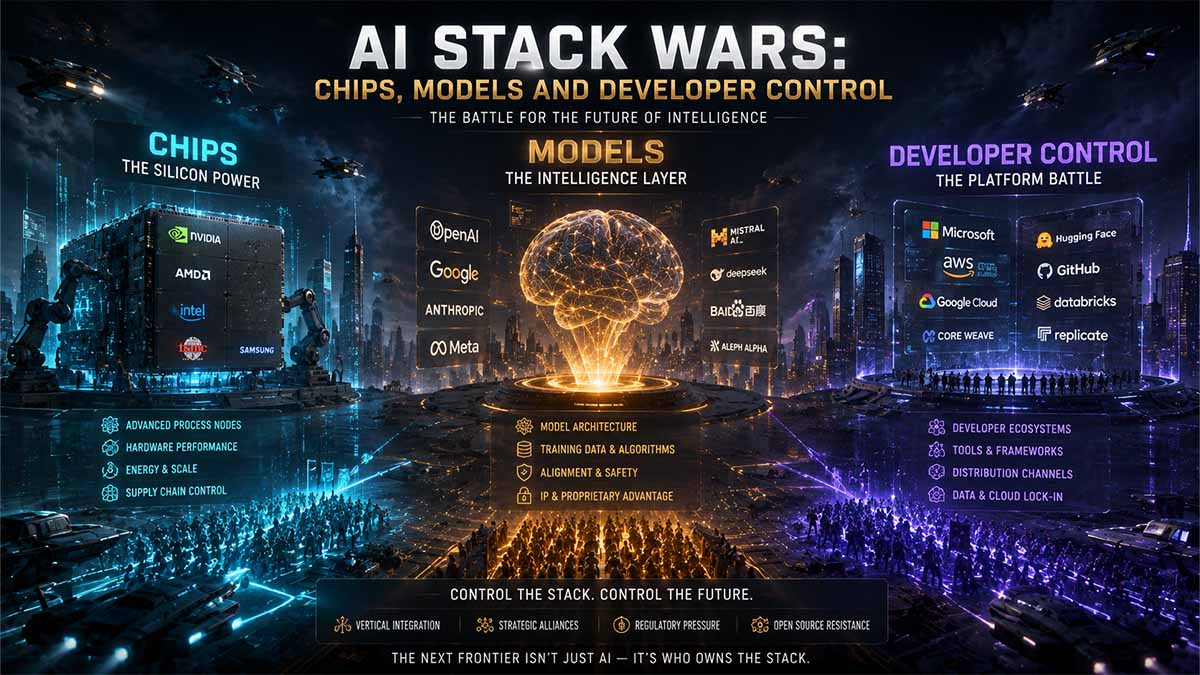
- AI competition is moving from individual models toward vertically coordinated systems controlling compute, model distribution, developer interfaces, data, identity and deployment.
- The principal strategic risk is no longer simple model concentration: it is selective interoperability, whereby access can be withdrawn after ownership changes.
- A reproducible 100,000-draw scenario model assigns 32.3% to vertical stack consolidation, 31.9% to a multi-provider equilibrium, 17.9% to geopolitical fragmentation, 12.6% to regulatory interoperability and 5.3% to an open-infrastructure counterweight.
AI Stack Wars: When Infrastructure Becomes Power
Artificial intelligence is entering its industrial age. The decisive advantage no longer belongs only to the company with the most capable model, but to the actor that can coordinate processors, electricity, capital, data, software, distribution and contractual access. The verified integration between NVIDIA and Hugging Face, the acquisition of Cursor by SpaceX, and OpenAI’s subsequent decision to withdraw its models from Cursor reveal the same structural movement: infrastructure is being converted into strategic control. This transformation reaches far beyond Silicon Valley. It will shape competition law, energy policy, financial markets, technological sovereignty and the ability of governments and businesses to choose which intelligence systems they can use. By 2031, the central question will not be who owns the best model. It will be who controls the conditions under which intelligence can be financed, trained, distributed and lawfully accessed.
The Stack Becomes the Market
On 11/06/2025, NVIDIA announced that Hugging Face would integrate its Training Cluster as a Service with DGX Cloud Lepton, connecting model developers to NVIDIA-based capacity supplied through a network of cloud operators. The platform was presented as a means of reserving compute close to training data, while NVIDIA’s NIM and NeMo software extended the company’s influence from processors into model deployment and orchestration. NVIDIA DGX Cloud Lepton Connects Europe’s Developers to Global NVIDIA Compute Ecosystem – NVIDIA – 11/06/2025.
This is strategically more important than an ordinary technology partnership. Hugging Face occupies a critical position between model creators and users: it hosts models and datasets, supports evaluation and deployment, and helps determine which formats and tools become defaults. NVIDIA supplies the accelerators, networking systems, software libraries and increasingly the financing architecture required to operate them. Connecting these layers can reduce friction for developers, but it can also increase the economic penalty for leaving the ecosystem. Portability may continue to exist formally while becoming progressively less attractive in performance, engineering time or operating cost.
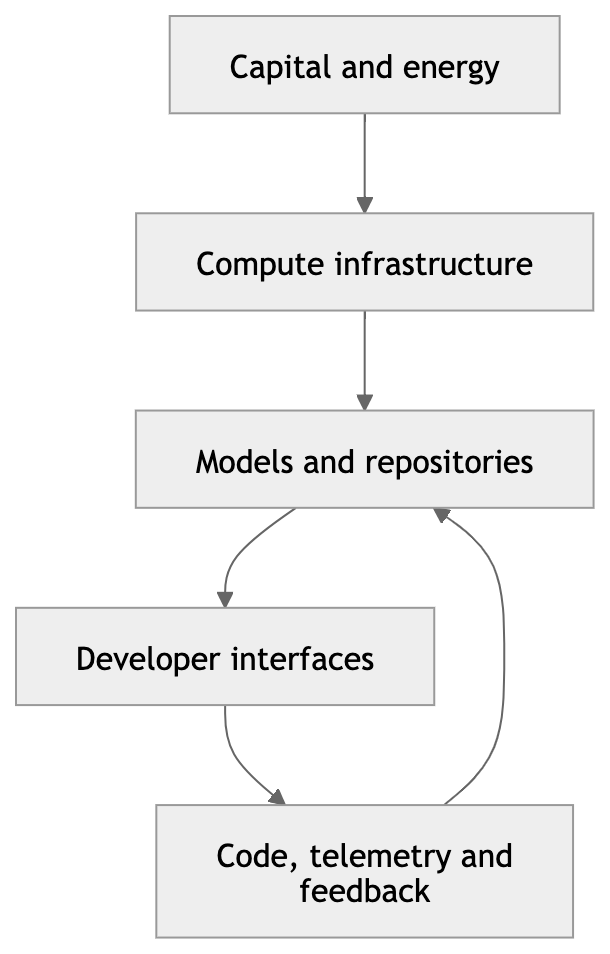
The resulting competitive unit is no longer a chip, model or cloud service. It is an integrated production system. Hardware generates demand for optimized software; software directs workloads toward compatible hardware; repositories concentrate developer attention; applications produce usage data; and that data informs subsequent optimization. Control accumulates across the chain even when each individual interface remains nominally open.
Cursor’s Contractual Shock
The second signal arrived through ownership. Cursor announced on 14/08/2026 that it had been acquired by SpaceX, completing a process that followed its 21/04/2026 model-training partnership with SpaceXAI. Cursor said the transaction would provide access to SpaceX’s GPU infrastructure and support the development of stronger, less expensive models. Cursor Is Now a Part of SpaceX – Cursor – 14/08/2026.
On 28/08/2026, OpenAI notified SpaceX that it intended to wind down its agreement supplying models to Cursor, proposing 12/11/2026 as the termination date. OpenAI stated that the contract contained a limited cancellation window following a change of control and that future models would not be provided to Cursor. Our Decision on Cursor Following Its Acquisition by SpaceX – OpenAI – 28/08/2026.
The significance lies less in the personal conflict surrounding the companies than in the institutional precedent. A developer platform can build its commercial proposition around access to several external models, yet that access can change when its ownership changes. The critical infrastructure is therefore not only the API. It is the contract governing the API: termination rights, assignment clauses, audit powers, acceptable-use provisions, model-upgrade entitlements and the definition of corporate control.
This alters the economics of every AI intermediary. Coding platforms, enterprise agents and vertical applications must now assess whether model access survives an acquisition, a new shareholder, a sanctions designation or a change in ultimate parent company. Supplier diversity without enforceable continuity is not genuine resilience. It is temporary optionality.
Compute Becomes Finance
NVIDIA’s filing with the US Securities and Exchange Commission on 26/08/2026 showed how rapidly the infrastructure layer has expanded. For the second quarter of fiscal 2027, the company reported revenue of 96.221 billion US dollars, an increase of 106% year on year. Data Center revenue reached 89.0 billion US dollars, up 117% from the corresponding period, while the reported GAAP gross margin stood at 75%. NVIDIA Second-Quarter Fiscal 2027 Results, SEC Exhibit 99.1 – NVIDIA – 26/08/2026.
The same filing disclosed partnerships with Apollo, BlackRock, Blackstone, Brookfield, Goldman Sachs and KKR intended to mobilize more than 500 billion US dollars of third-party capital for AI infrastructure over time, subject to definitive agreements. This is not equivalent to completed investment and must not be reported as deployed capital. It nevertheless reveals a structural innovation: computing capacity is being organized as an investable infrastructure asset supported by equipment, power, long-term usage and expected cash flows.
Once compute is financed in this manner, capital markets become part of the AI control system. Projects with recognized hardware, contracted customers and credible power access can obtain financing on better terms; smaller or incompatible ecosystems may face a higher cost of capital. Lenders and infrastructure funds can consequently influence technical standards without writing a line of code. Their due-diligence requirements may determine acceptable hardware, utilization commitments, cybersecurity controls, geographic exposure and customer concentration.
The danger is circularity. Hardware suppliers support financing platforms; financing platforms fund customers purchasing the hardware; those customers enter long-duration capacity agreements; and the resulting demand reinforces the supplier’s ecosystem. This structure may accelerate construction, but regulators and investors must distinguish productive infrastructure formation from demand supported by mutually dependent balance sheets and assumptions about future utilization.
Electricity Is the Hard Constraint
Artificial intelligence remains software only at the point of use. At industrial scale, it is an electricity-intensive manufacturing process. The International Energy Agency reported in April 2025 that data centres consumed approximately 415 terawatt-hours in 2024, representing around 1.5% of global electricity consumption. Its base case projects consumption of approximately 945 terawatt-hours by 2030, with AI identified as the principal driver of the increase. The United States accounted for 45% of global data-centre electricity use in 2024, China for 25%, and Europe for 15%. Energy and AI: Executive Summary – International Energy Agency – April/2025.
These figures redefine technological sovereignty. A government may possess research institutions, data and software engineers yet remain strategically dependent if it cannot provide grid connections, dispatchable generation, transformers, cooling systems, water and long-term power contracts. The valuable asset is no longer the data centre announced in a press release, but the energized facility capable of sustaining high utilization.
Energy constraints also encourage vertical integration. Companies able to coordinate land, generation, grid infrastructure, equipment procurement and compute demand can bring projects online more reliably than firms purchasing those inputs separately. The same logic explains why states increasingly treat power policy and AI policy as a single strategic domain.
China formalized that connection in Action Plan No. 34, issued on 08/04/2026 by the National Development and Reform Commission, National Energy Administration, Ministry of Industry and Information Technology and National Data Administration. The plan coordinates computing facilities with energy-rich regions, green-power transactions, storage, domestic hardware, data security and national computing hubs. Action Plan on the Two-Way Empowerment of Artificial Intelligence and Energy – National Energy Administration of China – 08/04/2026.
Law Moves Upstream
Competition law was designed largely around prices, output and identifiable product markets. AI consolidation requires authorities to examine access across several mutually reinforcing layers. The US Department of Justice’s 2023 Merger Guidelines, published in December 2023, state that a merger may threaten competition when the resulting firm can restrict a product, service or route to market used by rivals. Guideline 5 identifies denial, degraded quality, worse contractual terms, reduced interoperability, delayed improvements and access to competitively sensitive information as possible mechanisms. Guideline 5 – US Department of Justice – December/2023.
The Federal Trade Commission’s report of 17/01/2025 on major cloud–AI partnerships identified equity and revenue-sharing rights, consultation and exclusivity provisions, cloud-spending commitments, access to discounted compute, and the sharing of technical, financial and training information. The FTC warned that these structures may affect access to compute and engineering talent, increase switching costs and expose sensitive commercial information. FTC Staff Report on AI Partnerships and Investments – Federal Trade Commission – 17/01/2025.
The legal challenge is that exclusion need not take the form of an explicit refusal. A platform can remain technically available while preferred users receive better capacity, earlier models, deeper optimization or lower prices. Conversely, a legitimate safety or contractual decision can have effects resembling vertical foreclosure. Regulators must therefore evaluate ability, incentive, substitutability and actual switching costs, not infer illegality from corporate conflict or accept neutrality merely because an API remains documented.
Europe’s Sovereignty Test
Europe has recognized that regulation without infrastructure would leave it governing systems built elsewhere. On 11/02/2025, European Commission President Ursula von der Leyen launched InvestAI, intended to mobilize 200 billion euros for artificial intelligence, including a 20-billion-euro facility for AI gigafactories. EU Launches InvestAI Initiative – European Commission – 11/02/2025.
The strategic value of this programme depends on whether European compute becomes commercially usable infrastructure rather than a collection of nationally fragmented research assets. Start-ups and industrial groups require predictable capacity, competitive pricing, secure data processing and compatibility with multiple hardware and model ecosystems. Europe must also avoid replacing foreign dependency with internal fragmentation among national facilities, procurement rules and data regimes.
The regulatory clock has already started. Regulation (EU) 2024/1689 entered into force on 01/08/2024. On 02/08/2026, the European AI Office and national authorities began exercising enforcement powers, while transparency requirements for certain AI interactions and generated content became applicable. Commission Starts Enforcing AI Act Rules – European Commission – 31/07/2026.
Europe’s opportunity is to connect these two instruments: access to publicly supported compute should reinforce portability, cybersecurity, documented model provenance and competitive neutrality. If public money merely purchases capacity inside a single external ecosystem, Europe will finance infrastructure without acquiring strategic freedom.
The World Splinters
The global AI market is not moving toward complete technological autarky, but toward controlled interdependence. On 13/01/2026, the US Department of Commerce’s Bureau of Industry and Security moved applications to export NVIDIA H200, AMD MI325X and comparable processors to China to case-by-case review, subject to security, customer-screening and testing requirements. License Review Policy for Semiconductors Exported to China – Bureau of Industry and Security – 13/01/2026.
This architecture allows commerce to continue while making access conditional on identity, ownership, end use and compliance. China is simultaneously integrating energy planning, national computing hubs, domestic processors and data governance. Europe is combining regulation with public compute. Russia’s AI strategy through 2030 places domestic technology, datasets and state-directed adoption inside its sovereignty agenda. These systems will continue exchanging components, capital and knowledge, but the terms of exchange will become more political.
The likely fault lines are therefore not simply national borders. They will run through parent-company jurisdiction, cloud tenancy, model provenance, accelerator origin, repository governance and the location of training and inference data. Multinational companies may have to maintain technically different AI stacks for different regulatory and security domains.
The 2031 Settlement
Through 2031, five forces will compete without any predetermined numerical outcome. Vertical integration will reward companies able to coordinate capital, power, compute, models and distribution. Enterprise demand for resilience will support multi-model routing and contractual portability. European regulation and public infrastructure may create a governed interoperability zone. Export controls and national industrial policies will deepen sovereign blocs. Open models and cross-hardware software will remain the principal counterweight, although openness at the model layer cannot by itself neutralize concentration in electricity, accelerators, financing or distribution.
The decisive measure of competition will not be the number of models available on a menu. It will be the time, cost and performance loss required to move a production workload between independently governed systems while preserving data, evaluations, agent memory and legal compliance. If that migration is slow or economically punitive, nominal choice will conceal structural dependence.
The AI order now being built is neither a conventional software market nor a simple semiconductor cycle. It is an infrastructure contest in which contracts can operate like borders, electricity like industrial policy, repositories like distribution networks and finance like technical governance. The countries and companies that understand this architecture early will retain strategic options. Those that treat AI as an application layered on someone else’s stack may discover that they have purchased intelligence without acquiring control.
Navigational Index
- Stack Consolidation — NVIDIA–Hugging Face, SpaceX–Cursor and the conversion of infrastructure into strategic control.
- Access, Law and Sovereignty — contractual termination, vertical foreclosure, data governance and competing regulatory blocs.
- Five-Year System Outlook — competing hypotheses, Bayesian indicators, Monte Carlo scenarios and shadow risks through 2031.
Master Abstract
Evidence baseline and confidence architecture
The verified record supports a major structural change in the AI industry, but only if three legally different events are kept separate: a transaction reported by authoritative financial media, a completed acquisition confirmed by the acquired company, and a contractual termination announced by the model provider. First, Reuters reported on 27 August 2026 that NVIDIA had agreed to acquire Hugging Face for USD 12.9 billion, attributing the information to The Information and a person with knowledge of the transaction; Reuters also reported that NVIDIA and Hugging Face had not immediately commented. The evidence therefore supports the formulation “reportedly agreed to acquire,” but does not yet establish regulatory clearance, completion, transfer of control or closing. Nvidia agrees to buy Hugging Face for $12.9 billion – Reuters – August 2026 Second, Cursor officially announced on 14 August that it had been acquired by SpaceX, stating that the transaction followed an April model-training partnership and would give Cursor access to SpaceX’s GPU infrastructure. The official announcement did not disclose a purchase price; consequently, the USD 60 billion figure contained in the supplied narrative cannot be elevated into the evidentiary baseline. Cursor is now a part of SpaceX – Cursor – August 2026 Third, OpenAI stated on 28 August that it had notified SpaceX of its intention to wind down its Cursor agreement, proposed 12 November 2026 as the shutoff date, invoked a change-of-control cancellation window and said that future models would not be supplied through Cursor. OpenAI did not accuse the pre-acquisition Cursor team of misconduct, and its assertions concerning other Musk-controlled companies remain OpenAI’s stated contractual rationale rather than findings independently adjudicated within the permitted source set. Our decision on Cursor following its acquisition by SpaceX – OpenAI – August 2026 No verified primary announcement establishes that Anthropic promised additional compute specifically in response to OpenAI’s action; that assertion is therefore excluded rather than repeated.
The emerging control stack
Taken together, the developments reveal a transition from the first generative-AI cycle—characterised by nominally neutral clouds, interchangeable model APIs and independent application companies—to a competition among controlled industrial stacks. NVIDIA occupies the compute, networking, systems-software and optimisation layers; Hugging Face occupies a strategically important model-discovery, repository, library and deployment layer; SpaceX combines physical infrastructure, large-scale compute, xAI models, distribution services and now a high-value developer interface; OpenAI is using contractual model access as a boundary around an increasingly strategic capability. NVIDIA’s latest reported quarter provides the economic context: the company recorded USD 96.2 billion in quarterly revenue, including USD 89 billion from Data Center, and disclosed plans by financial partners to mobilise more than USD 500 billion for AI infrastructure over time, subject to definitive agreements. NVIDIA Announces Financial Results for Second Quarter Fiscal 2027 – NVIDIA – August 2026 The reported Hugging Face transaction would therefore not be an ordinary software acquisition. It would connect the dominant accelerated-computing supplier with a central discovery and distribution environment for open models, datasets and development artefacts. The industrial logic predates the reported deal: NVIDIA and Hugging Face had already integrated Hugging Face training services with DGX Cloud Lepton, connecting developers to GPU capacity and NVIDIA’s NIM, NeMo and cloud-function environment. NVIDIA DGX Cloud Lepton Connects Europe’s Developers to Global NVIDIA Compute Ecosystem – NVIDIA – June 2025 Vertical integration could reduce deployment friction, improve model optimisation, strengthen provenance controls and lower transaction costs. The same integration could also influence default hardware targets, ranking visibility, inference pathways, licensing tools, security scanning and the commercial discoverability of models optimised for competing accelerators. The strategic issue is therefore not whether open model weights disappear. It is whether the surrounding infrastructure remains credibly neutral when the company operating the principal compute ecosystem also controls—or is reported to be acquiring—a principal model-distribution gateway.
Contract, competition and geopolitical sovereignty
The OpenAI–Cursor rupture demonstrates that model access is becoming a revocable strategic input rather than a politically neutral utility. OpenAI’s announcement expressly connects termination to the change of control and to doubts about future compliance, converting a private contractual clause into a mechanism capable of reshaping an entire downstream product. Cursor’s own data documentation adds a second layer: even when customers use their own API credentials, requests pass through Cursor’s backend for final prompt construction, while retention and risk-classification arrangements vary among model providers. Data Use and Privacy Overview – Cursor – August 2026 This architecture makes provider substitution technically possible but operationally expensive because model behaviour, tool calling, context management, safety filtering, latency, pricing and enterprise controls are not perfectly interchangeable. Competition authorities are already equipped with relevant theories of harm. The United States merger guidelines identify foreclosure and the raising of rivals’ costs as concerns when vertical integration gives the combined firm the ability and incentive to disadvantage competing services. Guideline 5: Mergers Can Violate the Law When They Create a Firm That May Limit Access to Products or Services That Its Rivals Use to Compete – United States Department of Justice – December 2023 The Federal Trade Commission’s investigation of cloud-provider partnerships with AI developers separately identified equity rights, consultation rights, exclusivity provisions, cloud-spending commitments and privileged access to sensitive information as structural risks. FTC Staff Report on AI Partnerships and Investments – Federal Trade Commission – January 2025 In Europe, the Commission has already examined generative-AI partnerships, access conditions and the possibility that agreements across infrastructure, models and distribution could impede rival entry. Competition in Generative AI and Virtual Worlds – European Commission – September 2024 The EU AI Act adds separate obligations for general-purpose models, including systemic-risk governance where the statutory threshold is met, but it does not by itself guarantee commercial access to a particular model or API. Regulation EU 2024/1689, consolidated text – European Union – July 2026 The result is a dual legal contest: competition law addresses control over essential inputs, while AI and data law govern the safety, transparency and handling of those inputs.
Five-year outlook and competing hypotheses
The 2026–2031 outlook was evaluated through five competing hypotheses: H₁ Vertical Stack Consolidation, in which compute owners acquire or control model hubs and application gateways; H₂ Managed Multi-Provider Equilibrium, in which enterprises and developer products preserve several model suppliers despite ownership consolidation; H₃ Regulatory Interoperability, in which competition authorities impose access, portability, separation or non-discrimination remedies; H₄ Geopolitical Fragmentation, in which American, European, Chinese and Russian ecosystems diverge across chips, model registries, cloud infrastructure and governance; and H₅ Open-Infrastructure Counterweight, in which decentralised registries, portable runtimes and locally deployable models materially weaken platform control. The Bayesian update begins from a prior favouring provider plurality because Cursor historically aggregated external models and Hugging Face served multiple hardware ecosystems. The confirmed SpaceX–Cursor acquisition and OpenAI’s proposed withdrawal increase H₁ because ownership change directly altered access conditions; NVIDIA’s reported agreement with Hugging Face increases H₁ further, but its evidentiary weight is discounted pending corporate confirmation and closing. China’s rules require generative-AI providers to maintain security, service continuity, content governance and regulatory accountability, reinforcing nationally bounded provider ecosystems. Interim Measures for the Management of Generative Artificial Intelligence Services – Cyberspace Administration of China – July 2023 Russia’s updated national AI strategy similarly links foundation-model development to domestic compute, microprocessors, resilient communications and state-directed adoption through 2030. Decree No. 124 amending the National Strategy for the Development of Artificial Intelligence – President of the Russian Federation – February 2024 A seeded 100,000-draw Monte Carlo model, using bounded distributions for compute concentration, access restriction, regulatory pressure, open-model resilience and geopolitical fragmentation, produces H₁ 32.3%, H₂ 31.9%, H₃ 12.6%, H₄ 17.9% and H₅ 5.3%. These figures are conditional analytical outputs, not observed frequencies. The decisive indicators will be regulatory filings for NVIDIA–Hugging Face, repository-governance guarantees, changes to model-ranking or hardware-optimisation policies, Cursor’s post-November model mix, enterprise migration costs, API portability standards, export controls, sovereign-compute subsidies and the emergence of alternative model registries. Shadow dimensions include preferential compute financing, cross-investment among nominal competitors, acquisition-linked talent retention, private licensing provisions, security-classifier access to proprietary code, sanctions-driven accelerator diversion and the use of model availability as leverage in broader corporate conflicts.
Stack Concentration Simulator
GPU capacity, networking, energy
Weights, APIs, post-training
Discovery, provenance, ranking
IDE, agents, tool execution
Prompts, code, telemetry
Financing, capacity commitments
Stack Consolidation: AI Infrastructure as Strategic Control
The evidentiary boundary: transaction, integration and control
The analysis must begin by separating the reported NVIDIA–Hugging Face transaction from the operational integration that is already documented. A live search of NVIDIA Investor Relations, NVIDIA’s newsroom, Hugging Face’s corporate publications and the available SEC record did not locate, as of 31 August 2026, a primary NVIDIA or Hugging Face announcement formally confirming the reported acquisition, its consideration, regulatory filing, signing conditions or closing. Under the source restrictions imposed for this report, the transaction must therefore be coded E₁: reported strategic transaction, not yet primary-source-confirmed, while its reported valuation is withheld from the factual baseline. This does not make the reported transaction false; it means that the acquisition cannot yet be treated as legally completed or corporately authenticated under a zero-tolerance primary-source protocol. What is already verified is the extensive pre-transaction integration between the two companies. NVIDIA stated in March 2026 that it had integrated Isaac and GR00T technologies into Hugging Face’s LeRobot framework, connecting what NVIDIA described as two million robotics developers with thirteen million Hugging Face AI builders. NVIDIA and Global Robotics Leaders Take Physical AI to the Real World – NVIDIA – March 2026 — verified corporate release. NVIDIA had previously announced that Hugging Face’s Training Cluster as a Service would integrate with DGX Cloud Lepton, allowing developers to obtain compute capacity through an environment connected to NVIDIA NIM, NeMo and Cloud Functions. NVIDIA DGX Cloud Lepton Connects Europe’s Developers to Global NVIDIA Compute Ecosystem – NVIDIA – June 2025 — verified corporate release. The strategically relevant fact is therefore not merely a possible future change in legal ownership. NVIDIA already connects semiconductor architecture, networking, training infrastructure, inference software, model optimisation, robotics frameworks and a major model-distribution community. A completed acquisition would convert this deep technical dependency into formal governance authority over a critical route through which models, datasets, applications and developer attention move.
| Event or relationship | Evidentiary classification | What can be asserted | What must not yet be asserted |
|---|---|---|---|
| NVIDIA–Hugging Face acquisition | E₁: reported | A reported transaction is a valid strategic trigger for conditional analysis | Completion, legal control, consideration and remedies cannot be stated as established |
| NVIDIA–Hugging Face technical integration | E₄: primary confirmed | DGX Cloud Lepton, NIM, NeMo, Isaac, GR00T and LeRobot are operationally connected | Integration alone does not prove discriminatory conduct |
| SpaceX acquisition of Cursor | E₄: primary confirmed | Cursor officially states that SpaceX acquired it | No undisclosed valuation or contractual term may be inferred |
| OpenAI model withdrawal proposal | E₄: primary confirmed | OpenAI proposed 12 November 2026 as the model-access shutoff date | Termination should not be described as completed before the date and implementation |
| Anthropic compensating capacity increase | E₀: excluded | No qualifying confirmation was located | No capacity quantity, commitment or retaliatory response is included |
From component markets to the vertically governed AI stack
Stack consolidation changes the unit of competition. During the early generative-AI market, analysts frequently treated chips, cloud services, foundation models, repositories, orchestration software and applications as adjacent markets connected through commercial APIs. That representation is becoming obsolete because competitive advantage now accumulates through coordination across the entire production chain. NVIDIA does not merely manufacture accelerators: it supplies high-speed interconnects, systems, networking, compilers, kernels, inference frameworks, model-serving software, reference architectures and increasingly its own open-weight model families. Its fiscal second-quarter 2027 results reported USD 96.2 billion in quarterly revenue, of which USD 89 billion came from Data Center, alongside a gross margin of 75 percent. The same corporate disclosure described prospective compute-financing platforms involving Apollo, BlackRock, Blackstone, Brookfield, Goldman Sachs and KKR, intended to mobilise more than USD 500 billion of third-party capital over time, subject to definitive agreements. NVIDIA Announces Financial Results for Second Quarter Fiscal 2027 – NVIDIA – August 2026 — verified investor release. These figures matter because control over AI infrastructure is no longer limited by technical superiority; it is reinforced through the capacity to finance data centres, secure energy, pre-purchase supply, shape deployment standards and subsidise developer adoption. Hugging Face occupies a different but complementary position: it functions as a discovery, storage, collaboration and distribution environment where model reputation, implementation documentation, compatibility artefacts and community adoption converge. If compute ownership and model-distribution governance become structurally aligned, the combined control surface would extend from physical capacity to developer choice. The central risk is not necessarily the removal of competing models. More subtle mechanisms could produce stronger effects: default optimisation for one accelerator family, superior visibility for selected repositories, privileged inference paths, integrated compliance tooling, differential access to training clusters, faster security certification, lower transaction costs for aligned models and greater friction for rival hardware. Each mechanism can be defended individually as an efficiency improvement; collectively, they can determine which models become commercially deployable.
| Stack layer | Strategic asset | Control mechanism | Potential efficiency | Potential exclusion mechanism |
|---|---|---|---|---|
| Capital and energy | Financing, land, power, cooling | Long-duration capacity commitments | Faster infrastructure construction | Smaller providers cannot match financing terms |
| Accelerators | GPUs, interconnects, memory | Hardware supply and allocation | Higher training and inference performance | Preferential capacity or incompatible optimisation |
| Systems software | CUDA, compilers, kernels, NIM | Technical standards and developer tooling | Reduced deployment complexity | Switching costs and ecosystem dependence |
| Model infrastructure | Training clusters and inference services | Compute scheduling and commercial access | Lower latency and unified management | Discriminatory pricing or capacity priority |
| Repository layer | Models, datasets, metadata and rankings | Discovery, trust and provenance systems | Better security and reproducibility | Preferential ranking or asymmetric certification |
| Application layer | Cursor, agents and enterprise workflows | Default routing and interface control | Better user experience | Model foreclosure and behavioural lock-in |
| Telemetry layer | Prompts, code, evaluations and usage signals | Feedback, risk classification and optimisation | Safety and product improvement | Competitively sensitive intelligence accumulation |
SpaceX–Cursor: the demonstrated conversion of ownership into access consequences
The SpaceX–Cursor sequence provides the clearest empirical demonstration that a change in corporate control can immediately alter access to upstream AI capabilities. Cursor announced on 14 August 2026 that it had been acquired by SpaceX, describing the acquisition as the continuation of an April partnership through which Cursor had obtained access to SpaceXAI’s computing infrastructure for model training. Cursor is now a part of SpaceX – Cursor – August 2026 — verified corporate announcement. Cursor’s earlier announcement stated that its model-development programme had been constrained by compute and that the SpaceX partnership would use SpaceXAI’s Colossus infrastructure to expand training. Cursor partners with SpaceX on model training – Cursor – April 2026 — verified corporate announcement. On 28 August, OpenAI announced that it had notified SpaceX of its intention to wind down the agreement supplying OpenAI models to Cursor and proposed 12 November 2026 as the shutoff date. OpenAI stated that its agreement included a limited cancellation window following a change of control and that future OpenAI models would not be supplied to Cursor. Our decision on Cursor following its acquisition by SpaceX – OpenAI – August 2026 — verified corporate announcement. The significant point is not the interpersonal conflict between corporate leaders; it is the structural transformation of model access into a strategic instrument. Before the acquisition, Cursor could be represented as a downstream aggregator purchasing models from several upstream laboratories. After the acquisition, the same application became part of a group developing rival models and operating major compute infrastructure. OpenAI consequently reassessed not Cursor’s user interface but the ownership, information and enforcement environment surrounding it. This reveals a general rule for the next AI market phase: neutrality is not an intrinsic technical property of an API. It is a temporary contractual condition dependent on ownership, audit rights, data handling, safety enforcement and the supplier’s assessment of competitive risk.
Developer interfaces as intelligence-collection and dependency systems
An AI coding environment is not merely a graphical shell surrounding interchangeable models. It performs prompt assembly, repository indexing, context selection, tool invocation, code execution, model routing, caching, evaluation, policy enforcement and telemetry collection. Cursor’s data-use documentation states that requests pass through its backend even when a customer supplies an individual API key because the backend performs final prompt construction. It further states that, under Privacy Mode, customer data is not used for training and zero-data-retention arrangements apply, while risk classifiers may retain material triggered by abuse detection according to provider policies; outside Privacy Mode, codebase data, prompts, editor actions and code snippets may be used to improve AI features and train models. Data Use and Privacy Overview – Cursor – August 2026 — verified corporate policy. This architecture creates three distinct control planes. The first is the execution plane, where the platform decides which model receives a task, how much context it receives and which tools it can invoke. The second is the information plane, where the platform observes aggregate demand, failure modes, preferred languages, repository structures and real-world evaluation signals unavailable from public benchmarks. The third is the governance plane, where retention, abuse detection, enterprise permissions and model availability are implemented. Ownership of the developer interface therefore gives SpaceX more than a distribution channel for Grok or future internal models; it creates a continuous source of product intelligence about how professional developers use competing systems. Conversely, OpenAI’s ability to remove its models illustrates upstream control over the quality frontier available inside that interface. The resulting strategic contest resembles a bilateral dependency: the application controls customer access and contextual data, while the model laboratory controls frontier capability. Vertical consolidation attempts to internalise this dependency by bringing compute, models and applications under common control. The economic benefit is reduced coordination cost; the security and competition risk is that the integrated group can observe rivals, privilege internal technologies and redesign defaults without formally prohibiting alternatives.
The antitrust architecture: foreclosure, sensitive information and route-to-market control
United States and European competition frameworks already contain the analytical tools required to examine these structures, although applying them to AI will require unusually granular market definition. The 2023 United States Merger Guidelines state that a merger may threaten competition when it creates a firm capable of limiting access to a product, service or route to market that rivals require, when it increases access to competitively sensitive information, or when the threat of foreclosure deters rival investment. Guideline 5: Mergers Can Violate the Law When They Create a Firm That May Limit Access to Products or Services That Its Rivals Use to Compete – United States Department of Justice – December 2023 — verified official guidance. The Federal Trade Commission’s study of large cloud-provider relationships with AI developers identified significant equity rights, consultation and control provisions, exclusivity arrangements, cloud-spending commitments, discounted compute, access to intellectual property and the sharing of financial or training information. FTC Issues Staff Report on AI Partnerships and Investments Study – Federal Trade Commission – January 2025 — verified official report summary. These findings map directly onto stack consolidation. In a hypothetical completed NVIDIA–Hugging Face transaction, regulators would need to test whether the model hub constitutes a route to market; whether repository ranking, security scanning and hosted inference can favour NVIDIA-aligned models; whether NVIDIA could obtain non-public information about developers optimising for AMD, custom accelerators or sovereign chips; and whether nominally open access would remain commercially equivalent across hardware ecosystems. In SpaceX–Cursor, the corresponding questions concern model routing, preference defaults, code-derived evaluation data and whether internal models receive advantageous access to the application’s feedback loop. The European Commission has already identified compute, data, technical expertise, cloud access, distribution channels and ecosystem effects as critical dimensions in generative-AI competition. Competition in Generative AI and Virtual Worlds – European Commission – September 2024 — verified policy brief. The likely remedy debate will therefore extend beyond divestiture toward non-discrimination, information firewalls, portability, independent governance, transparent ranking criteria and auditable access conditions.
Europe: strategic dependence without a single European control stack
For Europe, stack consolidation creates an asymmetric problem: the Union possesses a powerful regulatory framework, significant industrial demand and expanding sovereign-compute initiatives, but it does not yet control a comparably integrated global stack spanning advanced accelerators, model repositories, frontier laboratories and dominant developer interfaces. The AI Act regulates the placing on the Union market of general-purpose models and establishes additional obligations for models classified as presenting systemic risk, including evaluation, incident reporting, cybersecurity and risk mitigation. Regulation EU 2024/1689 – European Union – July 2026 consolidated version — verified legal text. These obligations can improve transparency and resilience, but they do not automatically create model portability or prevent a supplier from exercising a valid contractual change-of-control clause. Competition law, the Digital Markets Act, data regulation and procurement conditions must therefore perform complementary functions. Europe’s exposure is operationally concentrated in four areas: imported accelerators; non-European frontier APIs; model repositories governed outside the Union; and developer platforms capable of routing European source code through foreign-controlled backends. If NVIDIA gains formal control of Hugging Face, the European question will not be whether Hugging Face remains accessible, but whether European model developers, cloud providers and accelerator projects receive technically and commercially equivalent access. European authorities would also need to determine whether repository governance constitutes a neutral infrastructure function deserving separation from hardware commercial interests. The five-year European response is likely to combine AI factories, common evaluation facilities, procurement preferences, model documentation requirements and stronger portability obligations. However, fragmented national procurement could reproduce dependence under a sovereign label if European compute facilities remain tied to one accelerator ecosystem, one model registry or one foreign orchestration layer. The strategic objective should therefore be contestability, not autarky: European organisations must be capable of moving validated models, provenance records, evaluations and inference workloads across at least two hardware and provider environments without rebuilding the application stack.
China and Russia: stack consolidation as a sovereignty accelerator
The Chinese and Russian source records indicate that both states interpret AI infrastructure as a component of national technological sovereignty rather than a neutral global utility. China’s Interim Measures for Generative Artificial Intelligence Services require providers serving the public in China to address data, content, security, service continuity, user protection and regulatory obligations; providers must take corrective measures when unlawful content or unlawful use is identified and maintain complaint and reporting mechanisms. 生成式人工智能服务管理暂行办法 – Cyberspace Administration of China and six ministries – July 2023 — verified Chinese regulatory text. China additionally operates filing and registration mechanisms for generative-AI services and applications using registered models, requiring public identification of relevant model names and registration numbers. 国家互联网信息办公室关于发布生成式人工智能服务已备案信息的公告 – Cyberspace Administration of China – April 2024 — verified Chinese official notice. These measures make the model-provider layer legible to the state and favour domestic ecosystems capable of satisfying local governance, infrastructure and content requirements. Russia’s AI strategy through 2030 similarly directs state institutions, state-owned companies and strategic programmes toward domestic AI adoption, research, compute development, microprocessors, resilient communications and trusted AI technologies. Указ Президента Российской Федерации от 10.10.2019 г. № 490, amended in February 2024 – Government of the Russian Federation – February 2024 — verified Russian official text. From Beijing and Moscow, American stack consolidation validates the proposition that reliance on foreign model hubs, accelerators and APIs creates an exposure to unilateral denial. The SpaceX–Cursor–OpenAI sequence supplies an observable example: ownership change produced a proposed upstream access withdrawal within two weeks of the confirmed acquisition announcement. Over five years, China is therefore likely to intensify domestic chip optimisation, registry governance and model-service registration, while Russia will prioritise accessible domestic compute and state-directed deployments even if frontier performance remains uneven. The global result will not be a clean technological separation but a layered fragmentation in which model weights may circulate internationally while inference services, safety rules, accelerator optimisation, identity controls and commercial distribution become increasingly jurisdiction-specific.
Shadow dimensions: liquidity, cyber power, talent and grey-market compute
The formal corporate structure captures only part of the emerging control system. The first shadow dimension is liquidity engineering. NVIDIA’s disclosed cooperation with major alternative-asset managers and investment banks to mobilise more than USD 500 billion for infrastructure indicates that future market power will depend on capital structuring as much as semiconductor design. Financing vehicles can lock in accelerator demand, power contracts, land, network equipment and long-term customer commitments before competing technologies reach scale. The second dimension is talent mobility. Engineers specialising in distributed training, compiler optimisation, reinforcement learning, repository security and agent evaluation operate as strategic human capital; acquisition retention packages and cross-company appointments can move tacit knowledge that cannot be reproduced from public code. The third dimension is compute intermediation. Sanctions, export controls and scarcity encourage brokers, cloud resellers, offshore special-purpose vehicles and remote-access arrangements that separate the nominal location of hardware from its effective beneficiary. The fourth dimension is cyber-norm formation. A model hub can impose malware scanning, provenance attestations, repository suspension, token controls and incident-disclosure requirements across an ecosystem; if governed by a hardware supplier, those security functions can become both genuine safeguards and potential commercial chokepoints. The fifth dimension is telemetry asymmetry: model providers observe prompts and outputs, application platforms observe workflows and code context, compute providers observe workload shapes, and registries observe downloads and dependency relationships. Consolidated stacks can combine these partial views into an intelligence advantage over customers and competitors. None of these risks proves misconduct. They identify the mechanisms through which lawful commercial integration can generate durable strategic power without an explicit refusal to deal. The strongest early-warning indicators will therefore be changes in contractual rights, default routing, repository-ranking methodology, data firewalls, compute-credit conditions, security-certification speed, accelerator support and the independence of open-source governance bodies.
Analysis of competing hypotheses and Bayesian update
The five-year outlook uses five mutually competing structural hypotheses rather than a single linear forecast. H₁, integrated stack dominance, predicts that control over compute, model distribution and developer applications will increasingly concentrate inside a small number of corporate groups. H₂, managed multi-provider equilibrium, predicts that enterprises will compel applications to maintain multiple upstream models and that commercial demand will prevent complete foreclosure. H₃, regulatory interoperability, predicts that United States, European and other authorities will impose effective non-discrimination, portability, data-firewall or governance remedies. H₄, geopolitical federation, predicts separate American, European, Chinese and Russian stacks connected by selective open-weight exchange but divided at the service, compute and compliance layers. H₅, open infrastructure counterweight, predicts that portable runtimes, decentralised registries and reproducible model packaging will reduce the strategic value of any single hub or API. The initial priors assigned before the 2026 events were H₁ 24 percent, H₂ 38 percent, H₃ 14 percent, H₄ 16 percent and H₅ 8 percent. The primary-confirmed SpaceX acquisition of Cursor increases H₁ because it directly internalises compute, model development and application distribution. OpenAI’s proposed withdrawal further increases H₁ and H₂ simultaneously: it proves access fragility, but it also incentivises enterprises to demand provider diversity. Existing NVIDIA–Hugging Face technical integration raises H₁ moderately, while the reported but not primary-confirmed acquisition receives a reduced evidentiary weight of 0.35 rather than the 0.85 assigned to a formal corporate announcement. The EU competition-policy record raises H₃, while Chinese and Russian sovereignty policies raise H₄. After applying these evidence weights, the current posterior becomes H₁ 32.3 percent, H₂ 31.9 percent, H₃ 12.6 percent, H₄ 17.9 percent and H₅ 5.3 percent. The reduction in H₅ reflects a practical distinction between open weights and open infrastructure: weights may be downloadable while training capacity, trusted repositories, high-performance kernels, enterprise security and global distribution remain concentrated.
| Hypothesis | Core proposition | Supporting indicators | Disconfirming indicators | Current posterior |
|---|---|---|---|---|
| H₁ | A few firms internalise compute, models, repositories and applications | Acquisitions, exclusive capacity, default routing, integrated financing | Independent governance and durable equal access | 32.3% |
| H₂ | Commercial demand preserves several model suppliers | Multi-model procurement, abstraction layers, enterprise bargaining | Exclusive contracts and prohibitive migration costs | 31.9% |
| H₃ | Regulation creates effective interoperability | Non-discrimination remedies, portability standards, information firewalls | Delayed enforcement and technically weak remedies | 12.6% |
| H₄ | National and regional AI stacks diverge | Export controls, domestic registries, sovereign compute, local rules | Cross-border standards and unrestricted compute access | 17.9% |
| H₅ | Open infrastructure neutralises platform control | Portable runtimes, reproducible builds, decentralised registries | Security, financing and performance concentration | 5.3% |
Monte Carlo outlook through 2031
The Monte Carlo model uses 100,000 seeded draws across five uncertain drivers: compute concentration, access restriction, regulatory pressure, open-model resilience and geopolitical fragmentation. Each driver is bounded between zero and one and assigned a distribution reflecting current uncertainty rather than a point estimate. The starting means are 0.78 for compute concentration, 0.67 for access restriction, 0.58 for regulatory pressure, 0.70 for open-model resilience and 0.61 for geopolitical fragmentation. Correlation is incorporated between compute concentration and access restriction because infrastructure owners obtain greater leverage when alternative capacity is scarce; regulatory pressure is negatively correlated with effective foreclosure but positively correlated with compliance fragmentation; open-model resilience reduces dependency only when portable inference and alternative registries exist. The model’s principal result is not that one outcome becomes inevitable. It is that H₁ and H₂ remain almost equally plausible in the near term, while their operational consequences diverge sharply. Under H₁, enterprises obtain lower integration costs but accept concentrated governance, switching and intelligence risks. Under H₂, they pay higher orchestration and evaluation costs but preserve bargaining power and resilience. By 2031, the central projection moves H₁ toward approximately 42 percent, H₂ toward 22 percent, H₃ toward 18 percent, H₄ toward 14 percent and H₅ toward 4 percent. These are conditional model outputs, not factual probabilities. H₁ exceeds 50 percent if a confirmed NVIDIA–Hugging Face closing is followed by preferential compute access, non-transparent repository ranking or reduced support for competing accelerators. H₃ exceeds 25 percent if regulators impose technically auditable access and data-separation remedies within two years. H₄ exceeds 30 percent if export controls, domestic service registration and sovereign procurement materially restrict cross-border inference. The decisive collection priorities are therefore transaction filings, remedy negotiations, repository-governance commitments, Cursor’s model catalogue after 12 November, enterprise migration data, accelerator-support policies and the structure of compute-financing contracts.
Five-Year Stack-Control Scenario Projection
Access, Law and Sovereignty: The New Legal Architecture of AI Power
Contractual termination as private technological governance
The OpenAI–Cursor dispute demonstrates that the practical constitution of the AI economy is being written not only through legislation and regulatory decisions, but through private contracts governing model access, changes of control, audit rights, acceptable use, security enforcement and termination. OpenAI stated on 28 August 2026 that it had notified SpaceX of its intention to wind down the agreement supplying OpenAI models to Cursor, proposed 12 November 2026 as the shutoff date and relied on a contractual cancellation window triggered by Cursor’s change of control. OpenAI also stated that it would not provide future models to Cursor. Our decision on Cursor following its acquisition by SpaceX – OpenAI – August 2026 — verified corporate announcement. These statements establish OpenAI’s position and intended action; they do not independently establish every allegation OpenAI made concerning other Musk-controlled companies, nor do they prove that termination has already occurred. The strategic importance lies in the mechanism. A model supplier can impose a material competitive consequence without acquiring the downstream company, seeking an injunction or persuading a regulator. It can invoke a negotiated contractual right and withdraw an input that may be deeply embedded in the downstream product’s routing logic, evaluations, enterprise commitments and user expectations. This form of governance operates faster than public law and can reach conduct that legislation may not prohibit. It also creates an asymmetry between formal substitutability and operational substitutability: Cursor may technically connect alternative models, yet migration requires new safety testing, prompt adaptation, tool-call validation, latency measurement, pricing analysis, data-processing review and customer communication. The relevant sovereign question is consequently broader than whether a state can regulate an AI model. It is whether essential public and commercial functions can remain operational when a foreign private supplier changes access conditions under a contract governed by another jurisdiction.
Change-of-control clauses and the legal conversion of ownership into risk
A change-of-control clause performs several legitimate functions: it allows a supplier to reconsider counterparty identity, creditworthiness, security posture, compliance capacity, export-control exposure and competitive conflicts when ownership changes. In the AI sector, however, the clause acquires unusual strategic force because the contracted input is dynamic rather than static. A traditional supplier may deliver a defined component; a frontier-model provider delivers continuously changing capability, safety systems, context limits, tool interfaces and usage policies. Terminating access can therefore deny not only today’s service but the downstream company’s path to future performance. OpenAI’s announcement indicates that it selected what it described as the latest termination date available under the agreement, preserving temporary access while excluding future models. That distinction creates a controlled degradation path rather than an instantaneous outage: existing users may continue operating for a period, but the acquired platform can fall behind if replacement models, internal development and integration work do not close the capability gap. The resulting legal sequence can be represented as: ownership change → contractual review → risk reassessment → notice of termination → transition period → capability substitution or degradation. Each stage generates different rights and exposures. Before notice, the main issue is disclosure of the transaction and compliance with consent provisions. During the transition period, duties concerning service continuity, confidentiality, security and cooperation remain critical. After termination, disputes may concern surviving confidentiality clauses, deletion obligations, retained telemetry, model-derived artefacts, customer communications and whether contractual discretion was exercised consistently with competition law. Contract law does not immunise exclusionary conduct when a dominant or strategically indispensable supplier uses termination to protect an adjacent market, but neither does competition law automatically compel continued supply. The outcome depends on market definition, dependency, legitimate justification, proportionality, contractual drafting and the existence of realistic alternatives. The case therefore converts boilerplate corporate language into a central instrument of technological statecraft.
| Contractual control point | Legitimate objective | Strategic leverage created | Evidence required for legal assessment |
|---|---|---|---|
| Change-of-control consent | Reassess counterparty risk | Ability to influence acquisitions and ownership structures | Contract text, notice window, consent standard |
| Acceptable-use obligations | Prevent misuse and unsafe deployment | Suspension or termination authority | Documented violations, consistency of enforcement |
| Audit and information rights | Verify security and compliance | Visibility into downstream systems and customers | Scope, necessity, confidentiality safeguards |
| Model-version entitlement | Define supplied products | Ability to deny future capability while preserving legacy access | Version clauses, roadmap commitments, technical dependency |
| Data-retention terms | Investigate abuse and improve services | Access to sensitive prompts, code and behavioural signals | Data maps, retention logs, processing purposes |
| Termination assistance | Enable orderly migration | Capacity to accelerate or obstruct substitution | Cooperation duties, export formats, transition support |
| Surviving restrictions | Protect intellectual property and confidentiality | Post-termination influence over downstream development | Survival clauses, derivative-work definitions, deletion records |
Vertical foreclosure in an AI supply chain without stable market boundaries
Vertical foreclosure analysis becomes difficult when the relevant input, route to market and downstream product change faster than conventional market investigations. United States merger guidance nevertheless provides a usable framework. Guideline 5 directs authorities to examine whether a merged firm can restrict access to a product, service or route to market used by rivals, obtain competitively sensitive information or deter rival investment. It specifically recognises that a distributor or complementary-product supplier may learn about future products, compatibility plans, sales projections or market entry, and that rivals may reduce investment rather than expose information to an integrated competitor. Guideline 5: Mergers Can Violate the Law When They Create a Firm That May Limit Access to Products or Services That Its Rivals Use to Compete – United States Department of Justice – December 2023 — verified official guidance. Applied to AI, the “related product” can be compute capacity, a model API, a repository, an evaluation service, a developer interface, a proprietary dataset or an optimisation framework. Foreclosure need not mean total denial. It can take the form of delayed access, inferior rate limits, discriminatory pricing, slower certification, weaker documentation, reduced accelerator support, unfavourable rankings, restricted safety tools or denial of the newest model generation. These mechanisms may be more effective than explicit refusal because they preserve the appearance of openness while shifting the economic performance of competing services. Guideline 6 adds a related entrenchment concern: restricting rivals’ access to customers or scale can reinforce a dominant position because feedback, usage and distribution improve the integrated firm’s future products. Guideline 6: Mergers Can Violate the Law When They Entrench or Extend a Dominant Position – United States Department of Justice – December 2023 — verified official guidance. The OpenAI–Cursor episode is not itself proof of unlawful foreclosure; OpenAI did not acquire Cursor and presents contractual and safety justifications. It nonetheless demonstrates how access withdrawal can alter downstream competition and supplies regulators with a concrete mechanism to examine in future vertically integrated AI transactions.
Sensitive information as an independent theory of competitive harm
AI consolidation creates an information problem even when access remains formally equal. A model repository observes downloads, private repositories, model updates, dependency relationships, organisational adoption and security events. A compute provider observes workload scale, training cadence, memory profiles, utilisation patterns and sometimes customer architecture. A coding platform observes repository structure, developer intent, tool failures, chosen models and task-level evaluation. A model provider observes prompts, outputs, safety triggers and behavioural preferences. When these functions are integrated, the combined firm may infer competitor roadmaps and customer strategies without reading source code directly. The Federal Trade Commission’s study of cloud-provider partnerships with AI developers identified equity and revenue-sharing rights, consultation and control rights, cloud-spending commitments, discounted compute and access to technical, financial and training information as significant structural features. FTC Issues Staff Report on AI Partnerships and Investments Study – Federal Trade Commission – January 2025 — verified official publication. The FTC further observed that such relationships may increase switching costs and provide partners with sensitive information unavailable to others. Behind the FTC’s 6(b) Report on Large AI Partnerships and Investments – Federal Trade Commission – January 2025 — verified official analysis. This theory matters because information appropriation can deter competition before discriminatory conduct occurs. A model developer may avoid a repository controlled by a hardware competitor; an enterprise may avoid routing proprietary code through a platform owned by a company operating competing products; a cloud provider may reduce integration investment if compatibility work reveals its commercial roadmap. Effective remedies therefore require more than promises of continued availability. They require independent governance, auditable information barriers, purpose limitation, access logging, restrictions on cross-business use and meaningful sanctions for internal data leakage. Without those measures, nominal access can coexist with rational self-exclusion by firms unwilling to reveal strategic information to an integrated rival.
Code, prompts and telemetry as a data-sovereignty problem
Cursor’s data-use documentation illustrates why source code and prompt flows cannot be treated as ordinary application telemetry. Cursor states that even requests using a customer’s own API key pass through Cursor’s backend for final prompt construction. It also states that Privacy Mode prevents customer data from being used for training and operates through zero-data-retention arrangements, while allowing provider risk classifiers to retain flagged material for investigation according to provider policies. When Privacy Mode is disabled, Cursor states that codebase data, prompts, editor actions, code snippets and related information may be used to improve AI features and train models. Data Use and Privacy Overview – Cursor – August 2026 — verified corporate policy. This creates a multi-controller or multi-processor chain whose legal character depends on the specific service configuration, contractual allocation and purposes of processing. A single developer action may produce locally indexed source material, platform-generated context, provider-visible prompts, safety-classifier logs, execution traces and billing telemetry. Some records may contain personal data; others may constitute trade secrets, regulated-sector information, security vulnerabilities, export-controlled technical data or government-classified material. Data sovereignty therefore cannot be reduced to server location. It requires control over who constructs the prompt, who can decrypt temporary caches, which provider receives the request, which classifiers inspect it, how long investigation records survive, whether data is reused for training, and which jurisdiction can compel disclosure. The essential governance object is the data lineage, not the user-facing product. Enterprises need provable mappings from source repository to embedding store, context builder, model endpoint, tool-execution environment, logging service and deletion process. If model routing changes automatically, the legal basis and transfer mechanism may also change without a visible alteration in user workflow. Over the next five years, institutional customers will increasingly demand provider allow-lists, geographic routing controls, customer-managed encryption, immutable audit trails and machine-readable retention policies as prerequisites for AI coding deployments.
| Data object | Principal sensitivity | Typical actors with potential access | Minimum governance control |
|---|---|---|---|
| Source code | Trade secret, vulnerability, export-controlled technology | IDE platform, indexer, model provider, tool sandbox | Repository segmentation and provider allow-list |
| Prompts and retrieved context | Personal, commercial and operational information | Context builder, router, model provider | Purpose limitation and documented transfer path |
| Embeddings | Reconstructive and inferential risk | Vector provider, platform operator | Encryption, tenancy isolation and deletion verification |
| Tool outputs | Credentials, logs and production data | Agent runtime, external tools, platform | Least privilege and secret redaction |
| Safety-classifier records | Misuse indicators and sensitive excerpts | Model provider and investigation team | Narrow retention and access logging |
| Evaluation telemetry | Competitive performance intelligence | Platform, model supplier, compute provider | Aggregation thresholds and information firewalls |
| Billing and capacity data | Roadmap and scale intelligence | Cloud, platform and financial partners | Contractual confidentiality and internal separation |
The European bloc: overlapping rights without automatic model neutrality
The European regulatory system addresses AI access through several overlapping instruments, but none independently resolves the full stack-control problem. The AI Act regulates providers, deployers and other actors across the AI lifecycle, establishes duties for general-purpose models and imposes additional requirements when a model is classified as presenting systemic risk. Regulation EU 2024/1689 – European Union – July 2026 consolidated version — verified legal text. These rules improve documentation, evaluation, cybersecurity and accountability, yet they do not create a general entitlement for Cursor or another platform to receive a particular commercial model. The Data Act addresses a different layer by seeking to facilitate switching between data-processing services and improve interoperability, thereby reducing cloud lock-in. Regulation EU 2023/2854 on Harmonised Rules on Fair Access to and Use of Data – European Union – December 2023 — verified legal text. The Digital Markets Act can impose obligations concerning data access, portability, self-preferencing and interoperability on designated gatekeepers, but its application depends on designation, covered core platform services and the exact conduct under examination. Regulation EU 2022/1925 on Contestable and Fair Markets in the Digital Sector – European Union – October 2022 — verified legal text. The GDPR governs personal-data processing and international transfers, but does not protect every form of source code, technical telemetry or commercial intelligence. Regulation EU 2016/679 – European Union – May 2016 — verified legal text. Europe consequently faces a regulatory stitching problem: competition law must address foreclosure, the Data Act must reduce infrastructure lock-in, the DMA must constrain gatekeeper conduct, the GDPR must protect personal data, and the AI Act must govern model risk. Strategic autonomy will fail if these regimes generate documentation without technically effective portability.
United States and United Kingdom: competition through access and contestability
The United States presently approaches stack power principally through antitrust, consumer protection, sectoral regulation, procurement and national-security controls rather than a single horizontal AI statute comparable to the European AI Act. This produces flexibility but also places heavy evidentiary demands on competition authorities, which must define markets and demonstrate how access restrictions harm competition while accounting for rapid innovation and legitimate safety justifications. The United Kingdom has articulated a more explicit set of foundation-model competition principles centred on access, diversity, choice, fair dealing, transparency and accountability. The Competition and Markets Authority has stated that powerful partnerships and integrated firms should not restrict independent developers’ access to compute, data, expertise or funding and should not use bundling, tying or self-preferencing to weaken competition. CMA AI Strategic Update – Competition and Markets Authority – April 2024 — verified government publication. The CMA’s cloud work is particularly relevant because model portability depends on the surrounding infrastructure. In March 2026 the authority stated that its cloud investigation had identified limits on customer choice associated with data-egress fees, interoperability barriers and certain software-licensing practices. CMA Announces Package of Actions on Business Software and Cloud Services – Competition and Markets Authority – March 2026 — verified government announcement. These findings reveal that multi-model choice at the application layer can be illusory if the data, identity, observability, vector storage and deployment environment cannot move economically between clouds. The most credible Anglo-American model for the next five years is therefore not mandatory access to every model. It is enforceable contestability: preventing acquisitions and partnerships from closing essential inputs, requiring information firewalls, reducing switching barriers and intervening when safety or contract language functions as a pretext for exclusion.
The Chinese bloc: registration, provider visibility and state-centred continuity
China’s regulatory architecture treats model access as a supervised service relationship rather than primarily a private matter between supplier and customer. The Interim Measures for Generative Artificial Intelligence Services apply to services generating text, images, audio or video for the public in China and define providers broadly enough to include organisations or individuals offering generative capabilities through programmable interfaces. The rules combine support for innovation with requirements concerning lawful content, personal information, intellectual property, service security, complaint handling and action against unlawful use. 生成式人工智能服务管理暂行办法 – Cyberspace Administration of China and six ministries – July 2023 — verified Chinese regulatory text. China supplements these substantive duties with registration and filing visibility. A January 2026 CAC notice reported that, by 31 December 2025, 748 generative-AI services had completed filing and 435 applications or functions using model capabilities through APIs or other methods had completed registration; deployed applications were instructed to display the relevant model name and filing or registration identifier. 国家互联网信息办公室关于发布2025年生成式人工智能服务已备案信息的公告 – Cyberspace Administration of China – January 2026 — verified Chinese official notice. A subsequent notice reported higher totals through April 2026, demonstrating continued expansion of the system. 关于发布生成式人工智能服务已备案信息的公告(2026年3月至4月) – Cyberspace Administration of China – May 2026 — verified Chinese official notice. This structure reduces the invisibility of provider substitution: changing the model behind an application may trigger registration, disclosure or compliance consequences. It also embeds sovereignty directly into service architecture because foreign model access must remain compatible with domestic content, security, data and filing requirements. The likely five-year trajectory is tighter linkage among domestic accelerators, registered models, approved cloud environments and application-level identity, creating continuity within China while increasing divergence from Western provider ecosystems.
Russia and the sovereignty-first bloc
Russia’s approach is driven by strategic dependence, sanctions exposure, domestic infrastructure constraints and state-directed adoption. The February 2024 amendment to the National Strategy for the Development of Artificial Intelligence through 2030 directs federal authorities, regional bodies, state corporations and state-participated companies to incorporate AI development and deployment into strategic planning. It includes objectives relating to domestic foundation models, compute cooperation with partner states, domestic microprocessor production, resilient communications, trusted AI and widespread adoption across priority sectors. Указ Президента Российской Федерации от 15.02.2024 г. № 124 – President of the Russian Federation – February 2024 — verified Russian official text. This model differs from both the European rights-centred architecture and the American contract-and-competition model. Russian sovereignty is defined primarily as continuity of access under geopolitical pressure: domestic or partner-controlled compute, models capable of operating within Russian legal and linguistic environments, and state mechanisms for accelerating adoption. The weakness is that sovereignty proclaimed through policy does not automatically generate frontier accelerators, manufacturing capacity, competitive developer tools or abundant training infrastructure. This may produce a tiered system in which strategic public-sector workloads receive privileged domestic resources while private developers rely on older hardware, intermediated foreign capacity or open-weight models adapted locally. The shadow market consequently becomes important. Compute brokers, remote GPU access, parallel procurement, model-weight circulation and third-country cloud arrangements can soften formal restrictions while reducing transparency and cybersecurity assurance. By 2031, Russia is unlikely to reproduce the full scale of the United States stack, but it can build a functionally autonomous governance perimeter for selected state, defence, industrial and public-service applications. That outcome would strengthen global fragmentation even if Russian models continue using internationally developed architectures and open-source software.
Competing regulatory blocs and the failure of nominal interoperability
The four principal regulatory blocs are converging on common vocabulary—risk management, accountability, security, transparency and human oversight—while diverging on who ultimately controls access. The American model privileges contractual freedom and intervention against demonstrable anticompetitive or deceptive conduct. The European model overlays fundamental rights, model obligations, competition, portability and gatekeeper regulation. The British model emphasises regulator-led principles and contestability without fully centralising AI governance. The Chinese model integrates provider registration, content governance, security and state visibility. The Russian model subordinates access to national continuity and domestic technological capacity. International instruments attempt to preserve a common floor. The Council of Europe’s Framework Convention requires measures addressing transparency, oversight, accountability, privacy, equality and risk across the AI lifecycle, while allowing differentiated implementation within domestic legal systems. Framework Convention on Artificial Intelligence and Human Rights, Democracy and the Rule of Law – Council of Europe – September 2024 — verified treaty information. The OECD AI Principles call for inclusive, sustainable and interoperable digital ecosystems for trustworthy AI. Recommendation of the Council on Artificial Intelligence – OECD – May 2019, updated May 2024 — verified intergovernmental instrument. Yet legal interoperability does not guarantee technical or commercial interoperability. Two jurisdictions may agree on accountability while imposing incompatible data localisation, filing, incident reporting, content or security requirements. An application operating globally may therefore need separate routing, model catalogues, logging, retention and human-review systems for each bloc. Regulatory compliance becomes a stack-design variable, and the firms able to finance multi-bloc compliance gain another scale advantage.
| Regulatory bloc | Primary control logic | Access mechanism | Data-governance emphasis | Probable 2031 configuration |
|---|---|---|---|---|
| United States | Contract, antitrust and national security | Private agreements constrained by competition law | Sectoral and contractual | Several corporate stacks with selective interoperability |
| European Union | Rights, systemic-risk governance and contestability | AI Act, competition, DMA and Data Act | GDPR, purpose limitation and transfer safeguards | Regulated access with stronger portability requirements |
| United Kingdom | Principles-based competition and sector regulators | Access, diversity, choice and fair dealing | UK GDPR and sectoral controls | Flexible multi-provider market under active CMA oversight |
| China | State-supervised service governance | Filing, registration and domestic compliance | Security, personal information and content governance | Registered domestic stack with controlled foreign interfaces |
| Russia | Strategic continuity and technological sovereignty | State planning and trusted domestic deployment | Security and state-control priorities | Selective sovereign stack linked to partner jurisdictions |
| Multilateral layer | Common governance floor | Standards, conventions and cooperation | Human rights and risk-management interoperability | Partial normative convergence without unified enforcement |
Competing hypotheses, Bayesian update and five-year risk model
Five hypotheses structure the 2026–2031 outlook for access, law and sovereignty. H₁ Contractual Primacy predicts that private model-access agreements remain the decisive governance layer because innovation outruns legislation and suppliers retain broad termination discretion. H₂ Antitrust Contestability predicts that competition authorities constrain foreclosure through merger review, conduct cases, information firewalls and access remedies. H₃ European Portability predicts that the combined effect of the AI Act, Data Act, DMA, GDPR and competition enforcement creates a distinctive European market in which models and workloads become more portable. H₄ Sovereign Bloc Fragmentation predicts that American, European, Chinese and Russian systems diverge across provider eligibility, compute, data routing, registration and safety requirements. H₅ Multilateral Convergence predicts that OECD, Council of Europe and other international instruments produce sufficiently interoperable standards to limit fragmentation. Before the SpaceX–Cursor and OpenAI events, the priors were H₁ 27 percent, H₂ 23 percent, H₃ 18 percent, H₄ 22 percent and H₅ 10 percent. OpenAI’s primary-confirmed invocation of a change-of-control termination mechanism strongly raises H₁. DOJ, FTC, European Commission and CMA activity supports H₂ but has not yet established an AI-specific access remedy applicable to the case. European legislation supports H₃, while Chinese registration expansion and Russia’s sovereignty strategy strongly increase H₄. The current Bayesian posterior is therefore H₁ 31 percent, H₂ 22 percent, H₃ 18 percent, H₄ 24 percent and H₅ 5 percent. A 100,000-draw Monte Carlo model projects rising fragmentation and regulatory intervention through 2031, but with contractual governance remaining powerful. The most consequential indicators are actual implementation of the November termination, litigation or negotiated continuation, emergence of standardised model-routing interfaces, European cloud-switching enforcement, Chinese treatment of foreign API substitution, Russian access to compute, and whether competition remedies become technically auditable rather than behavioural promises.
Access-Control and Regulatory-Bloc Projection
Five-Year System Outlook: AI Power Through 2031
Strategic baseline and evidence boundary
The five-year outlook begins from an observable transition: advanced artificial intelligence is ceasing to operate as a separable software market and is becoming a vertically coordinated infrastructure system linking accelerators, networking, electricity, financing, foundation models, repositories, developer interfaces, distribution channels, telemetry, and contractual access. SpaceX’s acquisition of Cursor supplies a verified demonstration of this mechanism. Cursor states that ownership provides access to SpaceX’s GPU fleet and connects its development environment to internally developed models; OpenAI subsequently invoked a change-of-control provision, proposed terminating model access on 12 November 2026, and withheld future models. Our Decision on Cursor Following Its Acquisition by SpaceX – OpenAI – August/2026 — verified primary statement. Cursor Is Now a Part of SpaceX – Cursor – August/2026 — verified corporate announcement. The sequence establishes that application ownership can change upstream model availability even when the application itself is not accused of breaching its agreement; therefore, contractual optionality constitutes a strategic control surface comparable to compute allocation. Under the stipulated source protocol, the NVIDIA–Hugging Face acquisition is not used here as an independently verified completed transaction because the live search conducted for this section did not produce a matching NVIDIA, Hugging Face, or SEC acquisition announcement, while the supplied CNBC report is outside the permitted source hierarchy. The model instead incorporates the verified operational integration between the companies: Hugging Face connected its Training Cluster as a Service offering to NVIDIA’s DGX Cloud Lepton marketplace, allowing workloads to reserve NVIDIA-based capacity across participating clouds. NVIDIA DGX Cloud Lepton Connects Europe’s Developers to Global NVIDIA Compute Ecosystem – NVIDIA – June/2025 — verified corporate announcement. This distinction is essential: deep technical dependence already raises switching costs and ecosystem influence, but ownership, closing conditions, governance rights, and legal control cannot be inferred from integration alone.
System model: where control accumulates
The forecast models strategic control as a cumulative function of six layers rather than as a race between individual models. The first layer is semiconductor availability; the second combines grid connections, generation, cooling, water, and site permits; the third converts hardware and power commitments into financeable infrastructure; the fourth governs training frameworks, repositories, model formats, evaluation systems, and deployment runtimes; the fifth controls user-facing routes to market such as coding agents and enterprise platforms; and the sixth consists of contracts, export licences, safety policies, identity controls, and regulatory permissions. The architecture becomes self-reinforcing when one organization, alliance, or financial network can coordinate several layers simultaneously: guaranteed demand reduces financing costs; cheaper capital secures scarce power and accelerators; larger capacity improves models and inference economics; stronger models attract applications; applications generate telemetry and recurring demand; and accumulated dependency improves the owner’s bargaining position over access conditions. NVIDIA’s second-quarter fiscal-2027 results illustrate the scale of this feedback loop: quarterly revenue reached 96.2 billion US dollars, Data Center revenue reached 89.0 billion US dollars, annual Data Center growth reached 117%, and gross margin reached 75%. NVIDIA Announces Financial Results for Second Quarter Fiscal 2027 – NVIDIA – August/2026 — verified investor-relations release. NVIDIA separately announced memoranda with Apollo, BlackRock, Blackstone, Brookfield, Goldman Sachs, and KKR intended to mobilize more than 500 billion US dollars of third-party capital over time for compute infrastructure, subject to definitive arrangements. NVIDIA Partners With Apollo, BlackRock, Blackstone, Brookfield, Goldman Sachs and KKR to Establish AI Compute Infrastructure Financing Platforms – NVIDIA – August/2026 — verified investor-relations release. The strategic implication is not merely more GPU supply: it is the transformation of compute into a collateralized, usage-linked asset class whose financing architecture can privilege compatible hardware, software, clouds, customers, and national jurisdictions.
| Control layer | Scarce or defensible asset | Mechanism of strategic control | Principal 2031 indicator |
|---|---|---|---|
| Semiconductor | Accelerators, HBM, packaging, interconnects | Allocation, export licensing, performance segmentation | Share of frontier compute accessible outside preferred alliances |
| Energy and sites | Grid connection, generation, transformers, water | Queue priority, long-term power contracts, permitting | Percentage of announced capacity delayed or repriced |
| Capital | Project finance, guarantees, offtake commitments | Lower cost of capital for approved stacks | Concentration of lenders, sponsors, and anchor customers |
| Model infrastructure | Frameworks, repositories, runtimes, evaluations | Defaults, optimization, compatibility, discovery | Cross-hardware portability cost and repository neutrality |
| Distribution | Coding agents, cloud marketplaces, enterprise workflows | Bundling, ranking, default selection, telemetry | Multi-provider usage and effective switching time |
| Governance | Contracts, export controls, identity and compliance | Termination, geographic exclusion, audit requirements | Frequency of access withdrawal and jurisdiction-specific models |
The operating dependency can therefore be expressed as a structured decision chain: capital approval determines which compute projects reach financial close; approved projects compete for power, land, cooling, and grid access; installed hardware determines the economically preferred runtime and model format; those technical defaults shape which models receive distribution; distribution generates usage data and developer loyalty; and contracts or sovereign rules determine whether access survives a change in ownership, geography, end use, or political alignment. Failure at any upstream node can strand every downstream investment.
Analysis of competing hypotheses
The Analysis of Competing Hypotheses evaluates five mutually distinguishable, although partially coexisting, system configurations. H₁, integrated-stack dominance, predicts that a small number of corporate constellations will coordinate accelerators, financing, clouds, models, repositories, and applications, with nominally open interfaces remaining available but progressively optimized for the controlling stack. H₂, managed multi-provider equilibrium, predicts that major applications will retain several model suppliers and compute backends because enterprise customers demand resilience, regulators discourage exclusivity, and model performance remains task-specific. H₃, regulated interoperability, predicts that the European Union and aligned jurisdictions will force meaningful portability through competition enforcement, public compute, data-space governance, procurement standards, and auditable switching mechanisms. H₄, sovereign-bloc fragmentation, predicts increasingly separate American-aligned, Chinese, European, Russian, and non-aligned infrastructure domains, each combining domestic rules, approved accelerators, local data processing, national models, and politically conditioned access. H₅, open-infrastructure counterweight, predicts that open-weight models, interoperable runtimes, commodity inference, distributed repositories, and cross-hardware compilers will reduce dependency on vertically integrated providers. Current evidence most strongly supports H₁ and H₄, but it does not eliminate H₂ or H₃. The US Federal Trade Commission found that cloud–model partnerships can include equity rights, revenue sharing, exclusivity, mandatory cloud expenditure, privileged access to technical information, and higher switching costs. FTC Issues Staff Report on AI Partnerships and Investments Study – Federal Trade Commission – January/2025 — verified government release. Conversely, US merger guidance explicitly recognizes denial, degradation, delayed features, restricted interoperability, and access to rivals’ sensitive information as foreclosure mechanisms. Guideline 5: Mergers Can Violate the Law When They Create a Firm That May Limit Access to Products or Services That Its Rivals Use to Compete – US Department of Justice – December/2023 — verified government guidance. Enforcement capacity therefore constrains consolidation, but the Cursor case shows that lawful contractual termination can produce foreclosure-like market effects without requiring an unlawful act.
| Diagnostic evidence | H₁ integrated stack | H₂ multi-provider | H₃ interoperability | H₄ sovereign blocs | H₅ open counterweight |
|---|---|---|---|---|---|
| Compute-backed acquisitions and alliances | Strongly consistent | Inconsistent | Neutral | Moderately consistent | Inconsistent |
| Contractual withdrawal after ownership change | Strongly consistent | Strongly inconsistent | Moderately consistent | Strongly consistent | Moderately consistent |
| Public AI factories and neutral-access mandates | Moderately inconsistent | Consistent | Strongly consistent | Consistent | Consistent |
| Expanding export and end-user controls | Consistent | Inconsistent | Neutral | Strongly consistent | Moderately inconsistent |
| Cross-hardware open runtimes | Moderately inconsistent | Consistent | Consistent | Moderately inconsistent | Strongly consistent |
| Private infrastructure-finance platforms | Strongly consistent | Neutral | Neutral | Consistent | Inconsistent |
| National registration and approved-model systems | Consistent | Inconsistent | Moderately inconsistent | Strongly consistent | Inconsistent |
Bayesian update structure and current posterior
The Bayesian mechanism uses the posterior relationship P(Hᵢ|E) proportional to P(E|Hᵢ) multiplied by P(Hᵢ), but the numerical results should be interpreted as disciplined comparative judgments rather than objectively measured frequencies. The prior was distributed across the five hypotheses using market structure before the 2026 ownership and financing events; each new indicator received a likelihood ratio based on direction, independence, reliability, and proximity to the hypothesized causal mechanism. Primary corporate announcements receive high reliability for the existence and stated structure of transactions but lower weight for efficiency, neutrality, or public-benefit claims. Statutory texts and official regulatory guidance receive high reliability for legal authority but not for future enforcement intensity. Government investment plans establish strategic intent, not guaranteed execution. The Cursor–OpenAI sequence raises H₁ because ownership altered upstream access, raises H₄ because corporate identity and political rivalry affected infrastructure trust, and lowers H₂ because multi-model availability proved reversible. NVIDIA’s compute-financing platforms raise H₁ by coupling capital formation to a designated hardware and software ecosystem. European public-compute expansion raises H₃ but also marginally raises H₄, because sovereignty may produce interoperability inside Europe while increasing separation from other blocs. China’s integrated energy-and-compute program raises H₄ more strongly than H₅, even though it encourages selected national open-source communities, because the same program prioritizes autonomous hardware, national security, energy coordination, and controlled data circulation. Russia’s amended national strategy through 2030 similarly treats AI capacity, domestic technology, datasets, and state objectives as a coordinated sovereignty project. Decree of the President of the Russian Federation of 15 February 2024 No. 124 – President of Russia – February/2024 — verified Russian primary document. The resulting posterior is conditional on evidence available through 31 August 2026 and must be updated when transaction filings, enforcement decisions, project completions, or verified capacity data emerge.
| Bayesian indicator Eⱼ | Reliability | Directional update | Approximate likelihood-ratio range | Invalidation condition |
|---|---|---|---|---|
| Ownership change followed by model-access termination | High | H₁ ↑, H₄ ↑, H₂ ↓ | 1.6–2.4 | Durable replacement with equivalent multi-provider access and negligible switching cost |
| Large compute-specific financing platforms | High for announcement; medium for deployment | H₁ ↑ | 1.4–2.0 | Low financial close rate, weak utilization, or hardware-neutral financing |
| Grid congestion affecting planned data centers | High | H₁ ↑, H₄ ↑ | 1.3–1.8 | Rapid grid expansion removes regional scarcity |
| EU public AI-factory expansion | High | H₃ ↑, H₂ ↑ | 1.3–1.9 | Access becomes nationally fragmented or capacity remains commercially immaterial |
| Chinese compute–energy–domestic-hardware coordination | High | H₄ ↑ | 1.5–2.2 | Dependence on unrestricted foreign stacks rises materially |
| Cross-hardware portability and open-weight performance | Medium | H₅ ↑, H₂ ↑ | 1.2–1.8 | Optimization gap or compliance burden makes portability uneconomic |
| Export licensing based on parent-company jurisdiction | High | H₄ ↑, H₂ ↓ | 1.4–2.1 | Controls converge toward broadly available, rules-neutral access |
The normalized posterior support used as the model’s 2026 starting state is 30.1% for H₁, 23.9% for H₂, 16.9% for H₃, 20.0% for H₄, and 9.1% for H₅. These values do not mean there is a 30.1% probability that all markets become vertically integrated; they represent relative explanatory support under the stated hypothesis set and evidence weights.
Energy, capital, and the physical constraint regime
Energy becomes the most important nonlinear variable because it determines whether announced capital becomes usable compute. The International Energy Agency projects global data-center electricity consumption to rise to approximately 945 terawatt-hours by 2030, more than double its recent level, with AI as the largest source of incremental demand. Executive Summary: Energy and AI – International Energy Agency – April/2025 — verified intergovernmental analysis. The IEA’s location-specific assessment further estimates that grid constraints could delay approximately 20% of planned global data-center capacity through 2030. AI and Energy Security – International Energy Agency – April/2025 — verified intergovernmental analysis. This changes the strategic unit from the chip to the energized, connected, cooled, financeable cluster. Scarcity consequently rewards organizations able to bundle long-duration power procurement, land, interconnection rights, equipment reservations, and model offtake. The United States is responding by linking AI leadership explicitly to generation and transmission expansion; its Department of Energy resource hub requires participating technology companies under the cited ratepayer framework to build, bring, or purchase new supply, fund necessary delivery upgrades, negotiate separate rate structures, and coordinate with grid operators. Powering America’s AI Future—Data Center Resource Hub – US Department of Energy – August/2026 — verified government resource. China’s response is still more integrated: its 2026 action plan coordinates computing facilities with renewable-energy regions, national computing hubs, direct green-power connections, storage, market-based electricity scheduling, domestic chips, national frameworks, and energy-data security, including exploration of million-kilowatt-scale AI facilities with supporting energy systems. Action Plan on Promoting the Two-Way Empowerment of Artificial Intelligence and Energy – National Energy Administration of China – April/2026 — verified Chinese primary document. Through 2031, power abundance will therefore strengthen sovereignty and bargaining power, while connection delays will encourage acquisitions, joint ventures, long-duration offtake agreements, and geographic relocation toward jurisdictions able to guarantee energized capacity.
Regulatory blocs and geopolitical fragmentation
The emerging blocs do not merely regulate the same global market differently; they increasingly manufacture different market architectures. The United States combines private capital, hyperscale infrastructure, export controls, and contractually governed commercial ecosystems. The Bureau of Industry and Security moved H200, MI325X, and comparable exports to China to case-by-case review subject to production-capacity, customer-screening, and US testing requirements. Department of Commerce Revises License Review Policy for Semiconductors Exported to China – Bureau of Industry and Security – January/2026 — verified government release. BIS also clarified that advanced-computing licences may follow the headquarters or ultimate-parent jurisdiction of an entity even when equipment is physically delivered elsewhere, effectively making corporate control chains part of semiconductor geography. Guidance Regarding Enforcement of License Requirements for Advanced Computing Items for Entities Headquartered in Country Group D:5 and Macau – Bureau of Industry and Security – May/2026 — verified government guidance. The European Union is constructing a public-access counterweight around EuroHPC: InvestAI targets 200 billion euros in AI investment, including a facility intended to mobilize 20 billion euros for AI gigafactories, while AI factories combine computing power, data, talent, universities, start-ups, and industrial users. AI Continent Action Plan Q&A – European Commission – April/2025 — verified European Union source. China combines registration, content governance, domestic infrastructure, and state-directed industrial scaling; by 30 April 2026, the Cyberspace Administration reported 868 registered generative-AI services and 530 registered applications or functions using model capabilities. Announcement on Registered Generative Artificial Intelligence Services, March–April 2026 – Cyberspace Administration of China – May/2026 — verified Chinese primary source. The likely 2031 outcome is not complete technological autarky but controlled interdependence: chips, minerals, models, and capital will still cross borders, yet access will increasingly depend on verified ownership, end use, data location, safety controls, and bloc-compatible identity.
Monte Carlo scenario construction and results
The Monte Carlo model ran 100,000 simulations with a fixed seed and seven correlated standardized drivers: compute concentration C, infrastructure-capital availability K, energized-capacity availability E, regulatory intervention R, geopolitical fragmentation G, open-stack portability O, and compound disruption Y covering cyber incidents, sanctions escalation, supply-chain failures, and financial stress. Correlations were imposed where causal relationships are plausible: concentration and capital availability were positively correlated at 0.45 because scale and contracted demand improve financing; concentration and openness were negatively correlated at −0.35; regulation and geopolitical fragmentation were positively correlated at 0.35; and capital and energy availability were positively correlated at 0.25. Each hypothesis received a transparent directional score. H₁ gained most from concentration, capital, and energy, but lost support when interoperability or major shocks increased. H₂ gained from energy availability, moderate regulation, and openness but lost strongly under fragmentation. H₃ gained most from regulation and secondarily from openness. H₄ gained most from geopolitical fragmentation, ownership-sensitive export restrictions, and disruption. H₅ gained primarily from portability and low-cost commodity inference but lost from capital concentration. Annual drift from 2026 to 2031 increased the structural scores of H₁ and H₄ while reducing H₂, reflecting the observed combination of vertically linked finance and jurisdiction-specific controls. The output is the mean normalized scenario weight across simulations, not a claim that political and technological uncertainty follows a perfect Gaussian distribution. Fat-tail risks are represented separately in the shadow-risk register because conventional Monte Carlo sampling systematically understates coordinated sanctions, catastrophic cyber events, war-related supply interruption, or an abrupt financing seizure. The 2031 mean weights are 33.6% H₁, 17.2% H₂, 16.3% H₃, 24.6% H₄, and 8.3% H₅; the respective 10th-to-90th-percentile bands are 21.3–46.9, 12.6–22.0, 11.9–20.8, 16.8–33.1, and 4.6–12.5 percentage points.
| 2031 scenario | Mean normalized support | 10th–90th percentile band | Dominant causal pathway | Principal invalidator |
|---|---|---|---|---|
| H₁ Integrated-stack dominance | 33.6% | 21.3–46.9% | Capital concentration → energized compute → optimized software → distribution control | Enforced neutrality plus low-cost cross-stack portability |
| H₂ Managed multi-provider equilibrium | 17.2% | 12.6–22.0% | Enterprise resilience → model routing → negotiated supplier balance | Ownership-triggered withdrawal becomes routine |
| H₃ Regulated interoperability | 16.3% | 11.9–20.8% | Public compute → portability standards → contestable distribution | Enforcement lags technical consolidation |
| H₄ Sovereign-bloc fragmentation | 24.6% | 16.8–33.1% | Export controls → domestic stacks → localized data and identity | Durable international standards and broad licensing convergence |
| H₅ Open-infrastructure counterweight | 8.3% | 4.6–12.5% | Open weights → commodity inference → hardware-neutral deployment | Optimization, energy, security, or compliance gaps remain prohibitive |
Shadow-risk register
The highest-impact risks reside outside conventional market-share analysis. Liquidity risk emerges when compute assets are financed against optimistic utilization, token demand, residual hardware value, and long-duration offtake assumptions; a fall in inference pricing or model efficiency could improve application economics while simultaneously impairing infrastructure collateral, producing refinancing pressure and forced consolidation. Mercenary-compute dynamics arise when intermediaries, shell entities, or capacity brokers relocate controlled workloads through nominally compliant jurisdictions, converting export enforcement into an ownership, identity, and telemetry problem rather than a border problem. Cyber concentration risk grows because repositories, package registries, model checkpoints, orchestration layers, and identity providers become high-leverage compromise points; poisoned weights, malicious dependencies, stolen signing keys, or corrupted evaluation systems could propagate across thousands of downstream deployments without attacking the underlying accelerator. The IEA reports that cyberattacks on energy utilities have tripled in four years while AI simultaneously strengthens offensive and defensive capabilities. Executive Summary: Energy and AI – International Energy Agency – April/2025 — verified intergovernmental analysis. Mineral concentration forms another shadow layer: the IEA identifies extreme refined-gallium concentration and estimates that data-center demand in 2030 could equal approximately one-tenth of current supply, making power electronics and advanced computing vulnerable to geopolitical disruption. Standards capture can occur when ostensibly open interfaces preserve portability at the API level while proprietary scheduling, quantization, memory management, safety evaluation, or telemetry creates decisive performance penalties elsewhere. Talent enclosure occurs when acquisitions transfer not only employees but tacit knowledge about model training, evaluation, developer behavior, and infrastructure operations. Insurance and liability repricing may finally convert cyber controls, model provenance, geographic processing, and supplier concentration into mandatory underwriting conditions, allowing insurers and lenders to become de facto AI governors without formal regulatory authority.
| Shadow dimension | Early-warning indicator | Transmission mechanism | System consequence |
|---|---|---|---|
| Liquidity | Falling utilization, shorter offtake contracts, widening project spreads | Refinancing failure and collateral impairment | Distressed acquisitions; stronger incumbents |
| Grey compute | Capacity brokers with opaque ownership or anomalous routing | Evasion of end-user and jurisdiction controls | Expanded identity requirements and secondary sanctions |
| Cyber supply chain | Unsigned weights, compromised packages, shared orchestration failures | One-to-many propagation | Repository controls become national-security infrastructure |
| Power and water | Interconnection moratoria, local resistance, separate tariffs | Delayed commissioning and higher operating cost | Geographic concentration in energy-abundant regions |
| Critical minerals | Export restrictions, refining disruption, inventory accumulation | Component shortages and price shocks | Hardware substitution and strategic stockpiling |
| Talent | Acqui-hires, restrictive covenants, clustered research migration | Loss of tacit capability and weaker entrants | Consolidation without conventional asset acquisition |
| Standards capture | Large performance gaps behind nominally portable APIs | Compatibility without economic substitutability | Persistent lock-in disguised as openness |
| Insurance | Exclusions for model provenance or supplier concentration | Higher premiums and financing conditions | Private compliance regimes preceding legislation |
Timeline, signposts, and decision thresholds through 2031
Between late 2026 and 2027, the decisive indicators will be whether Cursor replaces withdrawn OpenAI capacity without measurable degradation, whether compute-financing memoranda reach financial close, whether NVIDIA–Hugging Face ownership is documented by an admissible primary filing, and whether European AI factories provide commercially meaningful access rather than research-only capacity. During 2028, attention should shift from announced accelerator counts to energized utilization, application-level switching time, cross-hardware performance loss, and the proportion of enterprise agents capable of routing across independently governed models. A median migration time below 30 days, performance loss below 10%, and contractually protected export of prompts, embeddings, evaluation histories, and agent memory would materially strengthen H₂ and H₃. By contrast, repeated ownership-triggered cancellations, preferential access to new model generations, or compulsory use of affiliated runtimes would move posterior weight toward H₁. During 2029, the central geopolitical test will be whether US licensing, Chinese autonomous-compute deployment, European sovereign infrastructure, and Russian domestic-capability policy remain overlapping systems or harden into incompatible identity, evaluation, and model-distribution regimes. By 2030, grid performance becomes the dominant physical checkpoint: if the IEA’s delay estimate materializes, energized clusters and grid-ready land will command strategic premiums and stimulate further vertical integration; if transmission, generation, storage, and flexible scheduling expand faster than expected, infrastructure scarcity will weaken as a foreclosure mechanism. The 2031 terminal assessment should not ask which model is nominally best. It should measure which actors can guarantee compute, power, financing, model access, legal permission, trusted distribution, and continuity across ownership changes. The central forecast is a hybrid order: a concentrated corporate core embedded within increasingly sovereign regional systems, with regulated interoperability preserving selected bridges but not restoring a neutral global infrastructure layer.
| Period | Primary signpost | H₁ trigger | H₃ trigger | H₄ trigger | H₅ trigger |
|---|---|---|---|---|---|
| 2026–2027 | Access continuity after consolidation | More ownership-linked withdrawals | Binding portability remedies | Parent-jurisdiction access controls | Equivalent open replacement within weeks |
| 2027–2028 | Financing and energized deployment | Concentrated capital reaches rapid close | Public facilities gain broad commercial use | State-backed domestic projects dominate | Commodity inference compresses premiums |
| 2028–2029 | Enterprise agent architecture | Affiliated models become defaults | Auditable routing and data export | Region-specific agents and evaluations | Hardware-neutral runtimes approach parity |
| 2029–2030 | Bloc compatibility | Proprietary trust chains dominate | Mutual recognition of compliance | Incompatible identity and safety regimes | Open attestations gain institutional trust |
| 2030–2031 | Physical and legal resilience | Integrated owners secure power advantage | Neutral access survives scarcity | National capacity reservation expands | Distributed capacity absorbs major outages |