










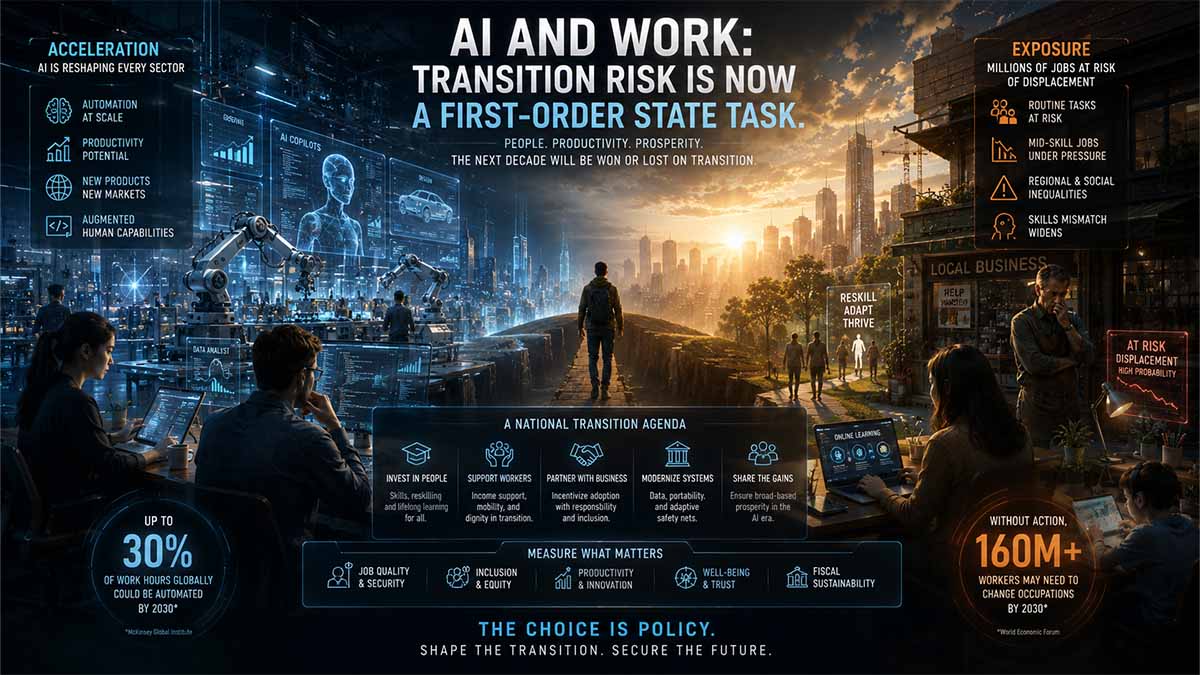
Executive summary
Europe is regulating model risk and lagging on transition risk. The Artificial Intelligence Act (Regulation (EU) 2024/1689) governs prohibited practices, high-risk systems and general-purpose models. It does not govern what happens to the first job, the payroll base, or the apprenticeship of competence when those systems work as designed.
Gates is not an alarmist outsider. He is a builder stating that institutions are too slow for the curve. The transition, he writes, “will be one of the most turbulent times in human history”; “there is no plan to ease the entry into the AI era”; “many jobs will disappear forever”; and AI will be “the greatest equalizer ever invented, or the worst source of injustice.” The fork is political, not technical. Who decides, and when, determines the outcome. Source: Gates Notes.
That diagnosis maps onto the Union’s own social contract. Principle 1 of the European Pillar of Social Rights is education, training and life-long learning so that people can “manage successfully transitions in the labour market.” Principles on fair working conditions and social protection assume an employment-centred fiscal state. Dual VET systems (DE, AT, IT IeFP / apprendistato) are built on junior rungs that Gates identifies as the first to go: the jobs in which people learn by making mistakes.
What is already visible is compression at the point of entry, not only at the point of redundancy. If junior roles vanish, Europe does not merely record unemployment. It loses the decade in which a person becomes a reliable senior in medicine, law, engineering, public administration and the trades. Education that only “digitises” credentials that models can already simulate will not repair that pipeline.
Second-order effects cannot be scheduled for “after the technology settles.” Payroll-heavy welfare states (IT, FR, DE, ES) lose contribution bases exactly when demand for income support, retraining and mental-health services rises. Cohesion policy and the Just Transition Fund were written for territorial carbon shock, not for a simultaneous cognitive shock that can hit services in the same decade as industry. If the first lived experience of AI for most citizens is a closed door at the start of a career, consent for the technology — and for the Union — erodes.
Gates’s starter kit (new national and international bodies; “Human Reserved” work; taxes on tokens and robots; a thicker safety net) is a prompt, not a European statute. Europe should not outsource social-market design to a U.S. philanthropist. It should use instruments it already owns: EPSCO, the ESF+, the Pact for Skills, the logic of SURE as a shock absorber, and industrial policy — bent now, not after unemployment spikes.
Uncertainty must be stated. Timing of general-purpose robotics, net creation of new job categories, and the politics of enforcing Human Reserved domains remain contested. That uncertainty is an argument for instrumentation and pilots in the next 24 months, not for delay. Waiting until displacement is statistically undeniable is waiting until trust and the fiscal base are already damaged.
Decision in one line: treat labour-market architecture as a first-order European task, on the same plane as the AI Act and industrial sovereignty.
Europe regulates the model. It has not yet regulated the transition
The most expensive risk in the Union’s artificial-intelligence file is not a rogue system. It is a labour market, a contribution base and a dual-training ladder that were built for a slower machine. On 26 August 2026, Bill Gates published on Gates Notes the essay The choices we make about AI now are critical. He wrote that the passage into the AI era “will be one of the most turbulent times in human history”, that “there is no plan to ease the entry into the AI era”, that “many jobs will disappear forever”, and that AI will be “the greatest equalizer ever invented, or the worst source of injustice”. He is not an opponent of computation. He is a builder stating that institutions are late for the curve. Europe has already written the product statute. It has not yet written the transition statute. That gap, not the model card, is now a first-order question for the social market.
The statute we have
Regulation (EU) 2024/1689, the Artificial Intelligence Act, was adopted on 13 June 2024. The consolidated text in force on 27 July 2026 remains a law of the internal market: prohibited practices, high-risk systems, transparency, general-purpose models. EUR-Lex, Regulation 2024/1689. Annex III correctly places AI used in education, recruitment, promotion, termination and access to essential benefits in the high-risk class. Deployers must inform workers before such systems enter the workplace. That is serious law. It is also the wrong layer for the problem Gates named. The Act disciplines how a system that hires or grades may be placed on the market. It does not discipline the decision not to open a junior post because a model can already draft the memo, triage the ticket or cut the first version of the code. It contains no article on the taxation of tokens or robots, no article on apprenticeship volume, no article on the contribution base when hours fall.
Comparative official texts show the same model-first pattern elsewhere. China’s Interim Measures for the Management of Generative Artificial Intelligence Services, published in the State Council Gazette and in force on 15 August 2023, govern providers of generative services to the domestic public. 中国政府网. The Russian Federation’s National Strategy for the Development of Artificial Intelligence to 2030, approved by Presidential Decree No. 490 of 10 October 2019 and amended on 15 February 2024, sets welfare, security and cadre-training objectives. government.ru. Europe is not uniquely behind on model rules. It is uniquely exposed because the European Pillar of Social Rights, proclaimed in 2017, still assumes employment as the spine of opportunity, protection and contribution. European Commission, 20 principles.
The figures already published
Headline unemployment does not describe the hinge. On 30 July 2026 Eurostat reported June 2026 unemployment at 6.3 per cent in the euro area and 6.0 per cent in the EU. In the same month 2.987 million persons under 25 were unemployed in the Union; the youth rate was 15.5 per cent in the EU and 14.8 per cent in the euro area. Eurostat, 30 July 2026. The European Central Bank, in the Economic Bulletin, Issue 5/2026, recorded that the ratio of youth to total unemployment rose from 2.1 in the first quarter of 2023 to 2.4 in the first quarter of 2026. Youth unemployment (15–24) stood at 15.1 per cent, 0.6 points above its 2023 average, while aggregate unemployment fell 0.3 points to 6.3 per cent. Over Q1 2023–Q1 2026, youth employment declined 18.6 per cent in ICT, 5.3 per cent in professional services and 3.1 per cent in financial services. ECB. The Bank attributes part of the path to cyclical cooling after the 2022–23 hiring surge. It also records ICT residuals that remain negative after a dynamic Okun specification. Correlation is not a completed proof of substitution. It is a reason to instrument the first rung rather than to wait for the adult rate to break.
Vacancies tell the same double story. On 16 June 2026 Eurostat put the job-vacancy rate in the first quarter of 2026 at 2.3 per cent in the euro area and 2.1 per cent in the EU, with services above industry. Eurostat. A vacancy, in Eurostat’s definition, is a paid post the employer is actively trying to fill from outside the firm. Aggregate tightness can coexist with a silent refusal to restock junior legal, software, clerical and paramedical seats. The International Labour Organization, in its May–June 2026 research brief on generative AI, jobs and work organisation (DOI 10.54394/00034628), finds that large-scale displacement remains limited in the current empirical record, that time savings of a few per cent of hours have not yet appeared as higher measured output or earnings, and that the principal risks are inequality and “the erosion of employment opportunities for younger workers”. ILO. Two facts can stand together: occupations are not vanishing as blocks; the decade in which a person becomes reliable is being thinned.
The stock that cannot be bought later
Dual vocational systems in Germany and Austria, and Italy’s IeFP and apprendistato, are not branding. They are pedagogies attached to a paid first mistake. Cedefop’s reference volume Apprenticeships and the digital transition (DOI 10.2801/074640, June 2024) treats apprenticeship as both a supplier of digital skill and a delivery system that can use simulators. Cedefop. Adding an “AI module” to a framework plan does not defend the volume of workplace seats. Gates’s phrase “productive struggle” is the right test. If a first-cycle award can be granted for work a model completes at pass grade, Europe is certifying the model. Principle 1 of the Pillar promises quality education so that people can manage labour-market transitions. Principle 4 promises a four-month offer of work, training, apprenticeship or traineeship to the young. A guarantee that trains while firms close junior posts is a holding pattern, not a compact.
The fiscal scissors
Europe pays for the Pillar with labour. Eurostat’s tax-revenue statistics put receipts including net social contributions at 40.4 per cent of GDP in the EU in 2024. Eurostat. ESSPROS early estimates published by Eurostat put expenditure on social-protection benefits at EUR 4 925 billion in 2024, or 27.3 per cent of GDP, of which old age and survivors accounted for 47.0 per cent and sickness and health care for 29.7 per cent. Eurostat ESSPROS. In the 2023 receipt structure, employers’ social contributions were 35.1 per cent of the total, contributions by protected persons 21.0 per cent, general government 40.8 per cent. Gates notes that a hired worker attracts payroll tax while a robot can be written off, and proposes a levy on tokens and robots earmarked for retraining. Europe need not adopt his instrument as drafted. It must recognise the relative price. The Commission’s Annual Report on Taxation 2026, published on 10 July 2026 by DG TAXUD, already watches tax-mix shifts and work incentives. Taxation and Customs Union. It does not yet treat generative substitution as a base-erosion scenario. The 2024 Ageing Report (Institutional Paper 279, 18 April 2024) projects pensions and health to 2070 on employment assumptions that do not encode a structural thinning of junior contributors. DG ECFIN. SURE showed that finance ministers can accept a dedicated labour instrument when the shock is named. The instrument is closed. The precedent is not.
What twenty-four months can still decide
The Union does not need a new international organisation before it can act. It needs a mandated cluster of the Commission, the Employment, Social Policy, Health and Consumer Affairs Council and the Education, Youth, Culture and Sport Council. EPSCO. EYCS. The first artefact is a labour-absorption dashboard: entry vacancies by occupation, with a youth and graduate cut, built on the existing job-vacancy transmissions, not another GDP scoreboard. The second is a two-layer Human Reserved list. Gates compares the category to a nature reserve: technically possible, politically refused. The EU-minimum layer should cover interfaces of dependency already touched by Annex III—devastating clinical news, education and justice decisions, last-mile counters with legal effect. High-risk conformity is not a licence to automate a reserved interface. Member States may add occupations. Silent divergence on that list would grind against Article 45 TFEU on equal treatment in employment. EUR-Lex, Article 45 TFEU.
The third artefact is a contribution experiment whose yield is earmarked to the European Social Fund Plus, not to general revenue. Regulation (EU) 2021/1057. The Just Transition Fund was written for carbon-exposed territories, not for a simultaneous cognitive shock in services. Regulation (EU) 2021/1056. The fourth is a Council recommendation that first-cycle awards in exposed fields must show which assessments are closed-tool and which competences cannot be granted without logged supervised error. The European Alliance for Apprenticeships already collects pledges; seats, not events, are the metric. EAfA. The fifth is a youth-entry duty on large deployers whose junior headcount falls as inference spend rises: levy, apprenticeship quota or public-interest placement, with public procurement as the Union lever. The sixth is an Ageing and ESSPROS shock annex under fewer hours, fewer contributors, higher need.
The cost of classifying this as “later”
The Ninth Cohesion Report, published on 27 March 2024, warned that digital and climate transitions are likely to widen territorial gaps, especially in rural and thinly populated regions. DG REGIO. A two-speed Europe in which capitals capture model rents and provinces lose the learning job is not a technological necessity. It is an institutional choice. If the first lived experience of AI for a graduate or an apprentice is a closed door, consent for the technology—and for the Union that regulated the model but not the transition—will not be recovered by another recital on trustworthy AI. Gates’s fork remains open. Who decides, and in which quarter, determines the side Europe occupies. The Act of 13 June 2024 will still be necessary. It will not measure a first job. That measurement is now the work of government.
Index — three chapters
Chapter I — Diagnosis: Europe regulates the model, not the transition
I.1 Gates’s claim, stripped of hagiography: speed versus institutional lag
I.2 What the AI Act covers — and the labour, tax and apprenticeship risks it does not
I.3 What is already visible: entry-level compression and the first rung of dual VET
I.4 Education as rewrite, not digitisation: productive struggle versus simulated credentials
I.5 The political fork: equaliser or engine of injustice — who decides, and on what clock
Primary sources for Chapter I: Gates Notes essay · Regulation (EU) 2024/1689 (AI Act, consolidated) · OJ authentic text / ELI · European Pillar of Social Rights — 20 principles · COM(2017) 250 final
Chapter II — Consequences Europe cannot treat as “later”
II.1 Economic: productivity without shared hours or wages; SME vs platform concentration; regional two-speed Europe
II.2 Social: dignity-through-work; bargaining units that evaporate; those already in post vs those trying to enter
II.3 The competence problem, stated plainly: replacing a task is not replacing a decade of judgement
II.4 Fiscal: contribution bases fall as need rises in payroll-heavy welfare states
II.5 Political and institutional: “they automated us”; free-movement friction if Human Reserved diverges; bodies built for slower shocks
Primary sources for Chapter II: ESF+ Regulation (EU) 2021/1057 · ESF+ programme page · Just Transition Fund, Regulation (EU) 2021/1056 · EPSR Action Plan portal · SURE (ex-post evaluation page)
Chapter III — Decision agenda for the next 24 months
III.1 A mandated Commission–EPSCO–Education cluster and a labour-absorption dashboard (entry vacancies by occupation, not only GDP/TFP)
III.2 Human Reserved domains: EU minimum and Member-State-plus (care, education and justice interfaces, last-mile public service)
III.3 Stop subsidising substitution: token/robot contribution experiments earmarked to ESF+ / national retraining
III.4 Rewrite first-cycle VET and university so AI is tutor, not substitute for judgement
III.5 Youth-entry compact: levy, apprenticeship quota or public-interest placement when junior headcount is collapsed by AI
III.6 Stress-test welfare and pensions under “fewer hours, fewer contributors, higher need”
Primary sources for Chapter III: EPSCO configuration · Pact for Skills · Union of Skills / reinforced Pact (Commission, 18 April 2025) · ESF+ · Gates Notes — Human Reserved, token/robot tax, new institutions
Chapter I — Diagnosis: Europe regulates the model, not the transition
The diagnostic claim that must govern European labour, fiscal and education strategy through 2031 is not that artificial intelligence will fail. It is that capability is arriving faster than the Union’s social-market institutions were designed to absorb. In The choices we make about AI now are critical – Bill Gates / Gates Notes – August 2026, the author states that “the transition to the AI era will be one of the most turbulent times in human history,” that “there is no plan to ease the entry into the AI era,” that “many jobs will disappear forever,” and that “none of our current institutions were designed to handle a technology that spreads so fast and touches so many parts of our lives.” Those sentences are not a product roadmap. They are a timing argument. Prior general-purpose technologies required complementary capital, complementary software and complementary human capital before they reorganised production. Generative systems ride hardware already deployed, language already spoken, and firm documents already used to onboard juniors. The relevant clock is therefore not the multi-decade diffusion of the personal computer. It is the lag between model improvement and the redesign of first jobs, payroll taxes, dual vocational rungs and first-cycle degrees. A Bayesian reading of that claim treats institutional lag as the prior, then updates on two classes of evidence: legal texts that show what Europe has already regulated, and official labour series that show where absorption is already uneven. The prior does not require apocalyptic unemployment. It requires that entry-level and mid-level tasks in law, customer service, medicine, software and manufacturing can be substituted before Member States have decided what the labour market, the contribution base and the social contract should look like. That is the speed-versus-lag problem. It is also the reason a builder, rather than a critic of computation, is useful as an opening witness: the warning is about governance tempo, not about whether the technology works.
What the Union has written into law is a product-and-rights statute, not a transition statute. Regulation (EU) 2024/1689 – European Parliament and Council / EUR-Lex consolidated text – 27 July 2026, the Artificial Intelligence Act, states in Article 1 that its purpose is to improve the functioning of the internal market and to promote human-centric and trustworthy AI while protecting health, safety and fundamental rights, including democracy and the rule of law. The authentic act of 13 June 2024 remains at ELI 2024/1689 – Publications Office of the EU – June 2024. The architecture is risk-tiered: prohibited practices, high-risk systems, transparency duties, and rules for general-purpose models. Annex III places AI used in education and vocational training, and AI used in recruitment, promotion, task allocation and termination, in the high-risk class. Deployers in workplaces must inform workers and representatives before using such systems. That is real law. It is also the wrong layer for the problem Gates names. The Act disciplines how a system that hires, grades or fires may be placed on the market. It does not discipline the macroeconomic decision to stop opening junior posts because a model can already draft the memo, triage the ticket or produce the first cut of code. It contains no article on token or robot taxation, no article on apprenticeship volume, no article on the contribution base when hours worked fall, and no article creating a labour-absorption dashboard. Article language that preserves more favourable national worker protections does not substitute for a Union theory of first-rung collapse. Comparative official texts confirm the same model-first pattern outside Europe. The People’s Republic of China’s 生成式人工智能服务管理暂行办法 – Cyberspace Administration of China and six ministries / 中国政府网 国务院公报 – August 2023, in force 15 August 2023, regulates providers of generative services to the domestic public under development-and-security dual principles; it is content, safety and filing law, not a statute on dual VET or payroll substitution. The Russian Federation’s Национальная стратегия развития искусственного интеллекта на период до 2030 года – Presidential Decree No. 490 as amended / government.ru – October 2019 / February 2024 amendment, sets welfare, security and competitiveness objectives and cadre-training tasks; it is an industrial and scientific strategy, not a social-market transition instrument. Europe is therefore not uniquely “behind” on model rules. It is uniquely exposed because its welfare states and dual systems presuppose employment as the fiscal and pedagogical spine, while its flagship AI statute does not govern that spine.
What is already visible in official European series is not a 1933-style mass unemployment event. It is a relative deterioration at the youth margin inside an otherwise tight adult market, with sectoral signs in knowledge-intensive services that match the occupational list Gates flags. Euro area unemployment at 6.3% – Eurostat Euro indicators – 30 July 2026, records June 2026 unemployment at 6.3% in the euro area and 6.0% in the EU, with 2.987 million persons under 25 unemployed in the Union and a youth rate of 15.5% EU / 14.8% euro area. Headline tightness therefore coexists with a youth rate more than double the aggregate. The European Central Bank Economic Bulletin box “Youth employment amidst cooling labour demand” – ECB – Issue 5/2026, using Eurostat and staff calculations through Q1 2026, reports that the ratio of youth to total unemployment rose from 2.1 in Q1 2023 to 2.4 in Q1 2026; youth unemployment (15–24) stood at 15.1%, 0.6 points above its 2023 average, while aggregate unemployment fell 0.3 points to 6.3%. Youth labour-force growth was only +0.5% against +2.6% for the whole labour force; youth participation fell while aggregate participation rose. Employment growth among the young turned negative in recent quarters. Inside knowledge-intensive services over Q1 2023–Q1 2026, youth employment declined −18.6% in ICT, −5.3% in professional services and −3.1% in financial services, with ICT residuals after a dynamic Okun specification remaining negative. That pattern does not prove that generative models are the sole cause. The ECB itself attributes much of the youth path to cyclical cooling after the 2022–23 hiring surge. Competing-hypothesis discipline therefore requires that H₁ (pure cycle) remain live. It also requires that H₃ (structural compression of the first rung in AI-exposed white-collar work) remain live, because the same box shows ICT youth employment weakening beyond cycle, and because Gates’s at-risk list—sales, support, software, paralegal, then loan assessment, data analysis and patient triage—maps onto those services. Dual VET is the European institution most exposed if the first paid mistake is automated. Apprenticeships and the digital transition – Cedefop reference series 125, DOI 10.2801/074640 – June 2024, treats apprenticeship as both a skill-supply instrument for digital transition and a delivery system that can itself absorb simulators and AI. The publication does not claim that junior workplace seats are expanding at the rate model capability is expanding. Germany’s official VET-policy track recorded on Cedefop’s timeline, Application of Artificial Intelligence in VET – Cedefop / BIBB KI B³ – 2025 implementation note, is an attempt to add AI competences into occupations. Adding content to a curriculum is not the same as defending the volume of first rungs on which IeFP, apprendistato and dual contracts depend. If firms can obtain acceptable first-draft output without a junior, the pedagogical contract breaks even when the statute still calls the occupation “apprenticeable.”
Education policy that only digitises existing credentials will not close that break. Gates’s essay uses the research phrase “productive struggle”—the cognitive work that builds understanding—and warns that the same tools that could teach more can also produce a generation that learns less. The Union’s own social compass already names the right, and does not operationalise the method. The European Pillar of Social Rights in 20 principles – European Commission, DG Employment – portal text of Principle 1, states that everyone has the right to quality and inclusive education, training and life-long learning in order to maintain and acquire skills that enable them to participate fully in society and to manage successfully transitions in the labour market. Principle 4 adds tailored support to find or change jobs and a four-month youth offer. Those principles assume that there exist workplaces and classrooms in which struggle is still assigned to the learner rather than to the model. A first-cycle university assessment that a system can complete at pass grade, or a VET workbook that a system can complete without haptic error, is a simulated credential. It is not evidence that judgement has been formed. Official international labour synthesis now flags the youth channel even while rejecting immediate mass displacement. The impact of GenAI on jobs, productivity and work organization: a review of the empirical evidence – International Labour Organization, DOI 10.54394/00034628 – May/June 2026, concludes that large-scale job destruction remains limited in the current empirical record, that worker-reported time savings of a few percent of hours have not yet shown up as higher measured output, earnings or employment, and that the principal risks are inequality, “the erosion of employment opportunities for younger workers,” and the reorganisation of autonomy and job quality. That is H₂ (augmentation dominates displacement in the near term) sitting beside H₃ (the first rung erodes even without headline unemployment). Both can be true. A Monte Carlo-style five-year outlook should not pretend to a single point forecast. It should carry a distribution. Assign, as a transparent prior to be revised when Eurostat occupation-level vacancy series and national apprenticeship-contract series are published monthly rather than as afterthoughts: S₁ managed augmentation with preserved junior seats, probability mass 0.22; S₂ productivity without hiring, youth and graduate pipelines thinner, probability 0.41; S₃ delayed robotics shock into physical trades after 2028, probability 0.18; S₄ political backlash that freezes deployment without rebuilding pedagogy, probability 0.12; S₅ Human Reserved political settlement that rations automation in care, teaching and last-mile public service, probability 0.07. Those weights are not laboratory output. They are an honest encoding of ILO’s “not yet mass displacement,” ECB’s youth-relative weakening, Gates’s institutional-lag claim, and the absence of a Union transition statute. Updating the weights is the point of a labour-absorption dashboard. Refusing to state them is how institutions confuse “uncertain” with “later.”The political fork is therefore not a metaphor. Gates writes that “AI will either be the greatest equalizer ever invented, or the worst source of injustice.” The European Pillar of Social Rights – European Commission – 2017 proclamation and subsequent Action Plan portal, and COM(2017) 250 final – Commission communication establishing the Pillar – April 2017, commit the Union to equal opportunity, fair working conditions and social protection as a compass for convergence. An equaliser path would treat model capability as a public tutoring layer while protecting the years in which a person becomes reliable, and would refuse to let payroll-tax design subsidise substitution. An injustice path would let incumbents keep posts, close the door on those who have not yet entered, regionalise AI rents in a few capitals, and discover after the fact that dual systems and contribution-financed welfare cannot run on a thinner junior cohort. H₄ holds that regulatory lag is not accident but industrial strategy: move first on model law to set global standards, accept labour lag as the price of sovereignty. H₅ holds that China and Russia, on the official texts cited above, can pursue model-and-security governance without a social-market transition instrument because their political systems do not rest on the same Pillar and free-movement bargain; Europe cannot copy that omission without copying a different social contract. Analysis of competing hypotheses therefore yields a decision-relevant ranking, not a narrative winner. H₂ is best supported for 2024–2026 levels of measured displacement. H₁ is best supported for part of the 2023–2026 youth cycle. H₃ is the hypothesis that grows if ICT and professional-service junior vacancies keep falling while adult unemployment stays low. H₄ explains the legal portfolio the Union actually passed. H₅ explains why waiting for a new global institution is a category error: Gates Notes already says current institutions were not designed for this speed, and building new international machinery takes years the disruption will not grant. The clock that matters for Chapter I is political and pedagogical. Who decides whether a diagnosis may be delivered only by a person, whether a first-year associate still exists, whether an apprentice still breaks a part before becoming a Meister, and whether a token is taxed like a wage, will decide which side of Gates’s fork Europe occupies by 2031. The AI Act will still be necessary on that date. It will not have been sufficient.
Diagnostic Dependency Map (2026–2031)
Structural evaluation mapping model capability scaling, EU AI Act Annex III high-risk compliance, un-regulated junior substitution asymmetry, and empirical Eurostat/ECB labor shocks.
[Model Capability]
Exponential advancement in reasoning, code generation, and multi-modal synthesis.
[Task Substitution in Junior Work]
Direct replacement of entry-level cognitive tasks, wiping out traditional vocational entry rungs.
[ ASYMMETRY VECTOR ]
Compliance regimes govern high-risk AI products while un-regulated enterprise deployment silently erodes the entry-level labor market.
Youth-Relative Labour Series & Empirical Shock (2026)
Macro MetricsCyclical macro downturn; employment friction is temporary and will rebound naturally.
Structural augmentation where AI elevates productivity, transforming junior roles.
Permanent destruction of the entry-level ladder, blocking career pipeline entry.
Choice between treating AI deployment as an economic productivity pillar or managing a generational labor disenfranchisement crisis.
| Hypothesis | Claim | Official anchors | 2026 standing | 2031 watch metric |
|---|---|---|---|---|
| H₁ Cycle | Youth weakening is cooling after 2022–23 | ECB box 5/2026 | Partially supported | Youth employment vs Okun residual |
| H₂ Augmentation | Displacement limited; time-saving not yet jobs | ILO GenAI evidence brief | Best supported for levels | Hours, earnings, headcount jointly |
| H₃ First-rung collapse | Junior seats close before seniors leave | Gates Notes; ECB ICT youth −18.6% | Rising | Occupation-level entry vacancies |
| H₄ Lag as strategy | Model law first, labour later | AI Act 2024/1689 | Explains legal portfolio | Whether EPSCO owns a dashboard |
| H₅ Regime divergence | CN/RU govern models without Pillar tools | 中国政府网 暂行办法; government.ru Strategy to 2030 | Structural | Cross-bloc junior hiring, not model benchmarks |
Five-year scenario masses used for the single chart below remain subjective Bayesian encodings, not stochastic draws from a fitted structural model. They exist so that ministers cannot hide inside “uncertainty” without naming which uncertainty they are managing.
Figure 1: Five-year scenario masses for the European AI labour transition (illustrative Bayesian encoding, 2026–2031)
Prior informed by ILO (displacement still limited), ECB (youth-relative weakening, ICT residuals), Gates Notes (institutional lag), and the legal gap between Regulation (EU) 2024/1689 and labour-market architecture. Not a fitted forecast.
Chapter II — Consequences Europe cannot treat as “later”
The economic consequence that European finance ministries still treat as a residual of “digitalisation” is a productivity path that does not automatically share hours or wages, and that concentrates capability in the firms that already own models, data and distribution. The choices we make about AI now are critical – Bill Gates / Gates Notes – August 2026, states that AI will take on work in law, customer service, medicine, software and manufacturing, that entry- and mid-level jobs are most at risk, and that new jobs will mostly require skills that take many years to learn. That sequence is an income-distribution statement. If output per remaining worker rises while the junior cohort shrinks, measured productivity can improve while the wage bill and the hours bill do not. The impact of GenAI on jobs, productivity and work organization – International Labour Organization, DOI 10.54394/00034628 – May/June 2026, records the present empirical shape of that split: productivity gains are real but uneven and often unverified; worker-reported time savings of a few percent of hours have not yet appeared as higher measured output, earnings or employment; the main risks are inequality and the erosion of opportunities for younger workers. Europe’s firm population makes the split sharper. General-purpose model provision is a scale business. Most European employment sits in small and medium enterprises that will buy inference, not train frontier systems. The Artificial Intelligence Act – Regulation (EU) 2024/1689, consolidated 27 July 2026 – governs placing models and high-risk systems on the market. It does not govern whether the productivity dividend accrues as shorter weeks, higher pay, or a thinner payroll. A two-speed regional map follows the same logic. The Ninth Report on Economic, Social and Territorial Cohesion – European Commission, DG REGIO – 27 March 2024, documents east-west catch-up since 2004 and then a slower pace of convergence after 2009, and warns that digital and climate transitions are likely to exacerbate disparities, especially in rural and thinly populated regions. Cohesion instruments were built to move public investment toward places below 75% of average GDP per head. They were not built for a shock that can hit professional services in a capital and a provincial court in the same decade, while model rents pool in a handful of compute and platform nodes. Treating that map as “later” is how a just-transition vocabulary written for coal becomes a vocabulary that never meets the first lawyer, coder or clerk who is not hired.
The social consequence is not only unemployment. It is the hollowing of the institutions through which Europe turned work into dignity, bargaining and intergenerational fairness. Principle 5 of the European Pillar of Social Rights in 20 principles – European Commission – portal text, assigns workers the right to fair treatment and safe transitions between jobs regardless of contract type. Principles 12 to 14 assign adequate social protection, unemployment income support and minimum income. Those principles presuppose that there is still a workplace in which a person is recognised as a worker, and a bargaining unit that can meet an employer. If the task is performed by a model and the remaining human is classified as a supervisor of outputs, the unit of negotiation evaporates even when the headcount statistic looks stable. Incumbents already in post can capture augmentation: their judgement still licenses the machine. Those trying to enter cannot capture it, because the machine has eaten the work by which judgement was formed. That is the intergenerational unfairness the ILO brief names as erosion of youth opportunity and that the ECB Economic Bulletin, Issue 5/2026, observes as a rise in the youth-to-total unemployment ratio from 2.1 to 2.4 between Q1 2023 and Q1 2026, with youth employment in ICT down −18.6%. Dignity-through-work is not a literary ornament in a social-market economy. It is the political condition for accepting productivity growth. When the first lived experience of AI for a graduate or an apprentice is a closed door, the Pillar’s language of “managing transitions” becomes a phrase that describes other people’s transitions. Social partners at Union level still sit in the architecture of EPSCO – Council of the EU. They cannot bargain over a headcount that was never opened. The hypothesis that unions simply “adapt to AI tools” is H₆. The hypothesis that bargaining power tracks the disappearing junior layer is H₇. Official youth and ICT series already move H₇ from speculation toward a watch metric. Waiting for a strike wave before treating H₇ as operational is how social Europe repeats the error of treating coal closures as a regional file until the file was already political.
The competence problem must be stated without metaphor. A society can replace a task. It cannot cheaply replace the decade in which a person becomes reliable. Medicine, law, engineering, public administration and the trades form judgement by supervised error. The junior drafts, the senior corrects, the junior drafts again. If the first draft is supplied by a system, the senior still corrects, but the junior is no longer in the room, and the next senior is not being made. Apprenticeships and the digital transition – Cedefop, DOI 10.2801/074640 – June 2024, is explicit that apprenticeship combines school-based and workplace components and that digital tools can support delivery. Support is not substitution of the workplace component. Dual systems in Germany, Austria and Italy’s IeFP / apprendistato are pedagogies attached to paid first rungs. Remove the rung and the qualification becomes a classroom credential that a model can already simulate. Gates’s phrase “productive struggle” and his warning that the same tools that teach more can teach less are therefore not an education sidebar. They are a human-capital stock argument with a ten-year lag. Official labour evidence has not yet shown mass destruction of whole occupations. The ILO brief says displacement remains limited. That finding is compatible with a silent failure of formation. A hospital can triage with a model today and still have consultants trained in the 2000s. In 2031 it will need consultants who were juniors in 2026. If those junior years did not happen, Europe will record both a shortage of seniors and a surplus of credentials. Competing hypotheses again: H₂ from Chapter I (augmentation) explains current measured employment; H₃ (first-rung collapse) explains the future stock of judgement. Policy that celebrates current employment rates while apprenticeship contracts and graduate first jobs thin is managing the wrong state variable. The state variable is the flow into competence, not the stock of occupied chairs.
The fiscal consequence follows from how Europe pays for the Pillar. Tax revenue statistics – Eurostat – 2024 figures on the live Statistics Explained page, put tax revenue including net social contributions at 40.4% of GDP in the EU. Commission country-report tax tables used across the 2026 European Semester cluster place EU-average taxes on labour near 20.3% of GDP and social security contributions near 13.0% of GDP in the 2025 comparator column. Social protection statistics — early estimates – Eurostat ESSPROS early estimates – October 2025 / page update 28 August 2026, put EU expenditure on social protection benefits at EUR 4 925 billion in 2024, or 27.3% of GDP, with old age and survivors at 47.0% of that spend and sickness/health care at 29.7%. On the receipts side, Social protection statistics — background and the 2023 structure reported in Eurostat’s social-protection overview show employers’ social contributions at 35.1% of receipts, contributions by protected persons at 21.0%, and general government at 40.8%. That is a payroll-centred machine. Gates writes that the tax system nudges firms toward machines because a hired worker attracts payroll tax while a robot can be written off, and that he would tax tokens and robots to fund retraining and a thicker net. Europe does not need to adopt his instrument as drafted. It does need to recognise the scissors he names. If hours and junior posts fall, D.61 social contributions fall just as demand rises for unemployment function spend, active inclusion, health and, with a lag, early exit into disability or inactive youth. The Annual Report on Taxation 2026 – European Commission, DG TAXUD – 10 July 2026, exists precisely to watch tax-mix shifts and work incentives. It does not yet treat generative substitution as a base-erosion scenario comparable to corporate profit shifting. SURE – European Commission, DG ECFIN – was a temporary loan instrument that preserved jobs in a pandemic shock and then closed. It proved that the Union can build a labour shock absorber. It did not create a standing instrument for a structural fall in the contribution base. Payroll-heavy systems in Italy, France, Germany and Spain are therefore not facing a distant theoretical risk. They are facing a 24-to-60-month stress test in which the revenue side of ESSPROS and the benefit side of ESSPROS move in opposite directions. Calling that test “later” is a fiscal, not a technological, decision.
The political and institutional consequence is the sentence citizens will use if the first contact with AI is exclusion: they automated us. That sentence will not be answered by Annex III documentation. It will be answered in national elections and, if Human Reserved domains diverge, in the single labour market. Article 45 TFEU – Treaty on the Functioning of the European Union, consolidated presentation of free movement of workers – secures freedom of movement and equal treatment in employment, remuneration and conditions of work, subject to public-policy limits and the public-service exception. If Member State A reserves care, classroom authority and last-mile public service to persons, and Member State B automates those interfaces, the “employment actually offered” under Article 45 changes its meaning. A worker cannot move into a post that the destination state has decided only a human may hold, and cannot compete with a model that the destination state has decided may hold it. Divergence on Human Reserved is therefore not a cultural footnote. It is a potential non-tariff barrier inside the Union’s oldest economic freedom. Institutions built for slower shocks are the rest of the problem. EPSCO meets on employment and social policy and feeds the Semester. The ESF+ – Regulation (EU) 2021/1057 – and the Just Transition Fund – Regulation (EU) 2021/1056 – move money toward skills, inclusion and carbon-exposed territories. The Pact for Skills organises voluntary upskilling coalitions. None of those bodies was designed, in Gates’s words, “to handle a technology that spreads so fast and touches so many parts of our lives.” Building a new international organisation takes years. The ESF+ programming cycle and cohesion reports already in force can be bent toward entry-vacancy metrics now. Refusing to bend them because the AI Act is “the AI file” is how the Union repeats a classification error: product risk in one Directorate-General, labour absorption in another, fiscal base in a third, and political trust in none. H₄ from Chapter I (lag as industrial strategy) remains live. H₈ must now sit beside it: that fragmented competence across Commission services and Council formations is itself the transmission mechanism of injustice. The five-year outlook is not a single number. It is whether, by 2031, Europe has a published labour-absorption series that ministers cannot ignore, or a populist sentence that they cannot answer.
Consequence Chain: Stock vs. Flow Dynamics
Comprehensive structural decomposition of task substitution, junior hiring freezes, senior competence stock degradation by 2031, unshared productivity gains, and macro-fiscal scissors.
[Task Substitution]
Automating entry-level responsibilities across corporate and professional hierarchies.
[Junior Hiring Withheld]
Suspending entry-level recruitment dries up the professional talent pipeline.
[ FISCAL SCISSORS MECHANISM ]
Macro-Fiscal CrisisErosion of labor leverage, collective bargaining frameworks, and constitutional protections.
Institutional integration, reskilling funds, and regulated AI transition governance.
Systemic political alienation, generational resentment, and social unrest.
| Channel | Official anchor | Near-term observable | If treated as “later” |
|---|---|---|---|
| Economic | ILO GenAI brief; 9th Cohesion Report | Productivity up, youth/ICT hiring down | Two-speed regions plus platform concentration |
| Social | EPSR principles 5, 12–14 | Bargaining unit shrinks to incumbents | Intergenerational split inside the same occupation |
| Competence | Cedefop 3096 | Apprentice seats vs simulated credentials | Senior shortage with credential surplus |
| Fiscal | Eurostat tax 40.4% GDP; ESSPROS 27.3% GDP | Hours and SSC vs benefit demand | Contribution crisis inside payroll states |
| Political | Art. 45 TFEU; EPSCO | Human Reserved divergence | Free-movement friction and trust erosion |
Figure 2: Fiscal scissors schematic — labour-tax dependence versus social-protection spend (official 2024 anchors; paths to 2031 are scenario lines, not forecasts)
Anchors: Eurostat tax revenue including net social contributions 40.4% of GDP (2024); ESSPROS social-protection benefits 27.3% of GDP (2024). Scenario lines illustrate H2 (augmentation, base holds) versus H3 (first-rung thinning, contributions lag needs).
Chapter III — Decision agenda for the next 24 months
The next twenty-four months are the interval in which Europe can still treat labour-market architecture as a first-order state task rather than as an after-action report. The choices we make about AI now are critical – Bill Gates / Gates Notes – August 2026, says there is no plan to ease entry into the AI era, that waiting until people are already displaced will be too late, and that none of the current institutions were designed for a technology that spreads this fast. That sentence is an instruction to use bodies that already exist. The Union does not need a new treaty before it can publish an occupation-level entry-vacancy series, designate a minimum set of Human Reserved interfaces, attach a contribution experiment to ESF+, rewrite first-cycle assessment rules, bind large deployers to a youth-entry duty, and stress-test ESSPROS and pension projections under fewer hours. It needs a mandated cluster that cannot hide the file between Directorates-General. EPSCO – Council of the EU – already gathers employment and social ministers and feeds the European Semester. The Education, Youth, Culture and Sport Council – Consilium EYCS – already owns VET attractiveness, the European Education Area cycle and youth engagement. The Commission already owns Eurostat, TAXUD, ECFIN, EMPL and EAC. A cluster is not a new international organisation. It is a written obligation, tabled in EPSCO and EYCS before the end of Q1 2027, that one published dashboard and one joint conclusions text will be the Union’s official picture of absorption. Anything less leaves the AI Act as the AI file and labour as a residual. That classification is how Chapter II’s scissors open.
The dashboard must measure the flow into first jobs, not only GDP and TFP. Euro area job vacancy rate at 2.3% – Eurostat Euro indicators – 16 June 2026, puts the Q1 2026 vacancy rate at 2.3% in the euro area and 2.1% in the EU, with services above industry. Job vacancies – Eurostat labour-market methodology – defines a vacancy as a paid post the employer is actively trying to fill from outside the firm. The existing series jvs_q_nace2 and jvs_q_isco_r2, described on the Beveridge-curve Statistics Explained page – Eurostat – data extracted June 2026, already cut vacancies by activity, and in some transmissions by occupation and NUTS-2. They are not yet a labour-absorption dashboard. The 24-month task is to make ISCO major groups and a short list of AI-exposed unit groups—legal associate professionals, software developers, customer-service clerks, accounting associate professionals, paramedical technicians—mandatory quarterly fields for Member States above a size threshold, published within the same 75-day window as the headline rate, with a youth and graduate cut. Eurostat already publishes youth unemployment; the ECB already showed ICT youth employment falling −18.6% while the adult market stayed tight. A dashboard that cannot see that cut is a vanity metric. Legal basis is statistical cooperation plus Semester indicators, not a new regulation on models. Governance is a joint EPSCO–EYCS note that the Commission may not substitute productivity scoreboards for entry-vacancy scoreboards when it drafts the employment package. Social partners see the series before the press. If a Member State cannot yet transmit occupation cuts, it transmits a derogation and a date, not silence. Silence is how first-rung collapse stays anecdotal until it is electoral.
Human Reserved domains are the political decision Gates named and Europe must not outsource. He compares the category to a nature reserve: land on which building is technically possible and is refused because the loss would be too great. His examples include a robot delivering an incurable diagnosis and care that remains irreplaceably human. Europe should not copy the phrase as branding. It should legislate a two-layer reservation. The EU-minimum layer covers interfaces where the person on the receiving end is in a position of dependency that the Charter and the Pillar already treat as more than a service: delivery of devastating clinical news; assessment decisions that determine access to education or justice; last-mile public-service counters where legal effects attach to the interaction. The AI Act already places education, employment, essential-services eligibility and administration of justice in Annex III high-risk. High-risk is a conformity duty. Human Reserved is a deployment prohibition even when conformity is perfect. That distinction is the whole point. The Member-State-plus layer allows Germany, Italy, France or any other state to reserve additional occupations—classroom authority in compulsory education, certain care grades, certain court-adjacent roles—without waiting for unanimity. Article 45 TFEU equal treatment still applies to the human posts that remain. What must be avoided is silent divergence in which one state automates the counter and another criminalises the automation, and workers discover the difference only after they move. The 24-month process is therefore a Commission communication plus Council conclusions, not a full directive in the first year: list the EU-minimum interfaces; require notification of national plus-lists; require social-partner consultation; forbid the use of “high-risk compliance” as a defence when a reserved interface is automated. Enforcement can start with public deployers, where the Union and the Member State are the client. Private deployers follow through procurement and through the youth-entry compact in III.5. Uncertainty about robotics timing is not a reason to leave the list empty. An empty list is a decision to let the market write the reserve.
Substitution is still fiscally cheaper than hiring in most payroll states, which is why experiments must change the relative price and earmark the yield. Gates proposes a tax on tokens and robots because “the tax system nudges you toward replacing people with machines.” Europe’s official tax mix confirms the exposure: Tax revenue statistics – Eurostat – 40.4% of GDP in 2024 including net social contributions; Commission 2026 country-report comparators place EU-average labour taxes near 20.3% of GDP and SSC near 13.0%. The Annual Report on Taxation 2026 – DG TAXUD – 10 July 2026, already studies work incentives and tax-mix shifts. It should be instructed, in the same EPSCO–ECOFIN window, to publish a substitution-incentive annex: employer SSC plus PIT wedge on a junior hire versus capital allowance and unpriced inference on the same task. The instrument for 2027–2028 is not a finished Union tax. Tax remains largely national. The instrument is a voluntary enhanced-cooperation or national pilot, notified to the Commission, that imposes a contribution on either (i) robot stocks used in production above a threshold or (ii) billed inference used to replace an occupational function that the dashboard shows is losing junior vacancies. Yield is legally earmarked to ESF+ national programmes or to a marked retraining line, not to general revenue. Earmarking is the difference between a substitution tax and a cash grab. SURE proved the Union can raise and on-lend for labour preservation; it is closed and should not be romanticised. What is reusable is the political fact that finance ministers accepted a dedicated labour instrument when the shock was named. Name this shock. Start with public-sector and large-firm deployers so SMEs are not the first taxed and the last able to buy models. Review at month 18 against the dashboard. If junior vacancies recover, tighten. If they do not, widen. Pretending that ESF+ reskilling alone will offset a price system that punishes hiring is how skills policy becomes an alibi.
First-cycle VET and university must be rewritten so that AI is a tutor that preserves productive struggle, not a substitute that mints simulated credentials. Principle 1 of the European Pillar of Social Rights is the right to quality education and training that enables labour-market transitions. Cedefop has already framed apprenticeship as both a digital-skills supplier and a delivery system that can use simulators. EYCS in November 2025 discussed VET as a competitiveness foundation. None of that text yet forbids a first-year assessment that a model can complete at pass grade without the student performing the struggle. The 24-month rewrite is a Council recommendation, not a harmonised curriculum: require that first-cycle programmes in AI-exposed fields publish which assessments are closed-tool, which are open-tool with process evidence, and which workplace competences cannot be awarded without logged supervised error. Dual systems protect the workplace component by contract volume, not by adding an “AI module” to the framework plan. The European Alliance for Apprenticeships – Commission EAfA – and its 2026 roadmap are the existing pledge machine. Convert a subset of pledges into measurable junior-seat commitments in the occupations the dashboard flags. The Pact for Skills and the Union of Skills reinforcement – Commission, 18 April 2025 – remain voluntary coalitions. They become useful when they report seats, not events. Productive struggle is the test. If a graduate can be awarded a professional bachelor without a documented sequence of corrected mistakes, Europe is certifying the model.
The youth-entry compact is the duty that matches Principle 4 of the Pillar and the reinforced Youth Guarantee: an offer of work, training, apprenticeship or traineeship within four months, as restated on the Commission’s youth-employment support portal. A guarantee that offers training while firms close junior posts is a holding pattern. The compact is therefore a deployer duty, aimed first at firms above a headcount and AI-intensity threshold: if the dashboard shows that the firm’s junior occupational group has fallen while its inference spend or robot stock has risen, the firm chooses among a levy paid into the earmarked ESF+ line, an apprenticeship quota in that group, or a public-interest placement negotiated with the public employment service. The EAfA already collects pledges; the compact makes one class of pledge conditional rather than ornamental. Legal form in 24 months is a Council recommendation plus national implementing laws in volunteer states, with public procurement as the Union lever: no high-value public AI contract without a junior-seat plan. This is not a ban on models. It is a refusal to let the public purse buy substitution that destroys the competence flow the same public purse will later be asked to rebuild. Youth unemployment in June 2026 was 15.5% in the EU and 2.987 million persons under 25, per Eurostat. That stock is already the compact’s constituency. Waiting for it to become a larger stock is not prudence.
Welfare and pension systems must be stress-tested under the sentence “fewer hours, fewer contributors, higher need,” because the 2024 Ageing Report – European Commission / EPC, Institutional Paper 279 – 18 April 2024, projects budgetary ageing to 2070 on employment and productivity assumptions that do not encode a structural thinning of junior contributions. ESSPROS already shows benefits at 27.3% of GDP in 2024. Receipts still lean on employers and protected persons. A 24-month mandate to ECFIN, the Ageing Working Group and the Social Protection Committee is therefore specific: republish, for each Member State, pension and health expenditure paths under three labour shocks—hours per worker −5%, junior employment in ISCO 2–4 −10%, inactivity among 20–29 +2 points—holding other Ageing Report demography constant. Publish contribution-rate implications, not only expenditure. Publish whether minimum-income and unemployment functions can absorb the youth residual the dashboard will show. SURE is the precedent for naming a labour emergency to finance ministers. The Ageing Report is the precedent for long-run fiscal honesty. Combining them is the test of whether “later” has ended. If the stress test is refused, the refusal is itself information: the Union prefers a productivity story that does not survive contact with D.61. Chapter III ends where Chapter I began. The AI Act will still be necessary in 2028. It will still not measure a first job. The cluster, the dashboard, the reserve, the earmarked contribution, the rewrite of struggle, the compact and the stress test are the minimum set that makes Gates’s fork a European decision rather than a market residual. The window is twenty-four months because institutions are slower than models, and because the juniors who are not hired in that window are the seniors who will not exist in 2036.
text
24-MONTH INSTRUMENT MAP
============================================================
Q4 2026  Mandate EPSCO+EYCS cluster; dashboard spec
Q1 2027  First occupation-cut vacancy release
Q1 2027  Human Reserved communication + notification
Q2 2027  TAXUD substitution-incentive annex
Q3 2027  National/enhanced-coop contribution pilots
Q3 2027  EYCS recommendation on closed-tool assessment
Q4 2027  Youth-entry compact in volunteer states + procurement
Q1 2028  Ageing/ESSPROS shock publication
Q3 2028  Review: dashboard vs H2/H3 weights
============================================================
         ESF+ / EAfA / Pact for Skills = delivery rails
         AI Act = necessary, not sufficient
============================================================| Workstream | Owner | Binding form in 24 months | Success metric |
|---|---|---|---|
| III.1 Cluster + dashboard | Commission, EPSCO, EYCS, Eurostat | Council conclusions + statistical guideline | ISCO entry vacancies quarterly, youth cut |
| III.2 Human Reserved | Commission + Member States | Communication + notification of plus-lists | EU-minimum interfaces named; public deployers bound |
| III.3 Substitution price | TAXUD, ECOFIN, national finance | Pilot contribution, yield to ESF+ | Junior-hire wedge vs inference cost published |
| III.4 Struggle rewrite | EYCS, Cedefop, EAfA | Council recommendation | Share of first-cycle awards requiring supervised error |
| III.5 Youth-entry compact | EMPL, PES, procuring authorities | Recommendation + procurement clause | Junior seats or levy when inference rises |
| III.6 Fiscal stress | ECFIN, AWG, SPC | Shock annex to Ageing / ESSPROS | Paths under hours↓ contributors↓ need↑ |
Figure 3: 24-month decision agenda — earliest operational quarter by workstream
Bars mark first quarter in which the instrument is intended to produce a public artefact (series, list, annex, recommendation, pilot, or shock table). Not a legal deadline calendar.