









Executive Summary
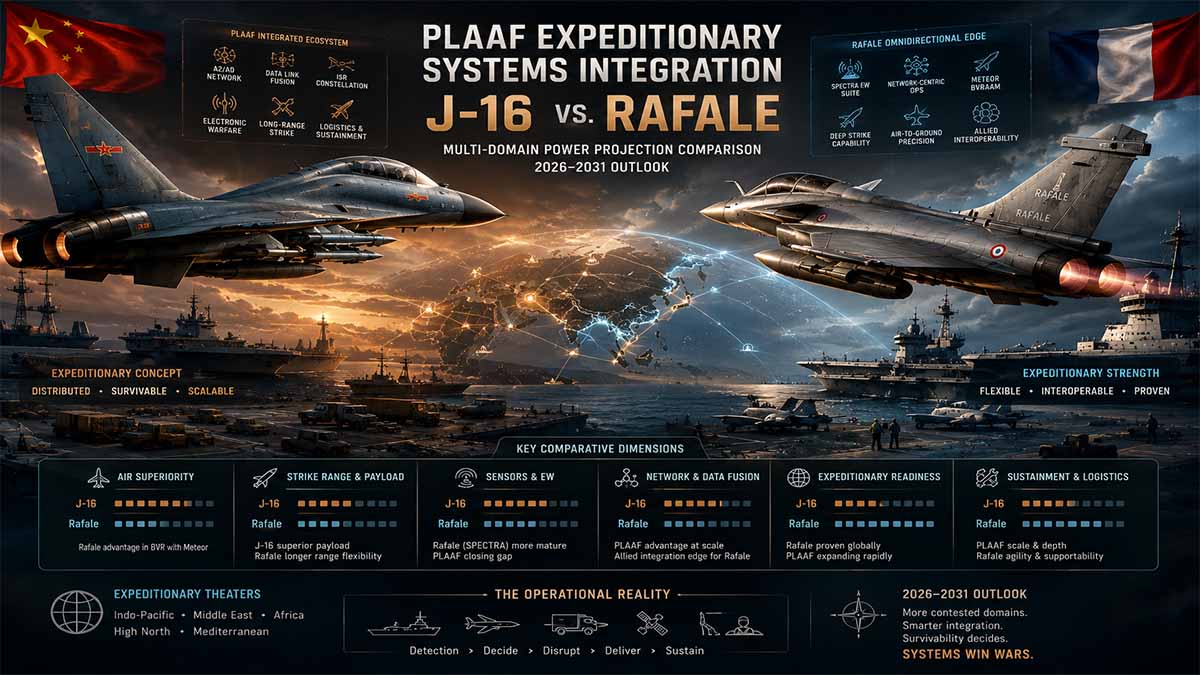
The deployment of People’s Liberation Army Air Force (PLAAF) Shenyang J-16 multirole strike fighters alongside KJ-500A airborne early warning and control (AEW&C), Y-9LG electronic warfare (EW), and Xi’an YY-20A aerial refueling tankers to Egypt for the Eagles of Civilization 2026 exercise marks an inflection point in Chinese expeditionary power projection. Transiting over 6,000 kilometers from Chinese airbases, this joint deployment directly tests integrated composite air packages against Western aerospace hardware, specifically Egyptian Air Force Dassault Rafale and Mikoyan MiG-29M2 platforms. The training engagement evaluates cross-theater logistics, sensor fusion, counter-EW capabilities, and operational survivability across non-contiguous sovereign airspace.
Strategic Vectors in the Mediterranean: The Logistics of Power and Industrial Sovereignty
The deployment of People’s Liberation Army Air Force (PLAAF) composite air wings to Egypt for joint operational exercises marks a structural inflection point in cross-theater power projection and Mediterranean security. Transiting over 6,000 kilometers from sovereign airbases via dedicated Xi’an YY-20A aerial refueling corridors, Chinese Shenyang J-16 strike fighters, Shaanxi KJ-500A airborne early warning platforms, and Shaanxi Y-9LG electronic warfare aircraft engaged in Dissimilar Air Combat Training against Egyptian Air Force Dassault Rafale fighters. This encounter transcends tactical comparison; it tests integrated command-and-control architectures, intercontinental logistics sustainment, and electronic spectrum profiling against European-standard aerospace hardware. For institutional observers, European defense planners, and global financial markets, the maneuver signals an expanding strategic footprint that directly intersects Mediterranean transit security, global supply chains, and sovereign industrial procurement policies.
The Logistical Backbone
The physical deployment of advanced multirole platforms across transcontinental distances requires operational synchronization that extends beyond tactical flight envelopes. The transit of the Shenyang J-16 airframes—powered by twin domestic Shenyang WS-10B turbofans—demanded sustained aerial refueling cycles managed by Xi’an YY-20A tankers over designated long-distance corridors. As documented in official assessments, including the 2025 Annual Report to Congress: Military and Security Developments Involving the People’s Republic of China (Office of the Secretary of Defense – December/2025), the expansion of the Y-20 platform into dedicated aerial refueling and strategic heavy-transport variants systematically removes Beijing’s historical geographic projection constraints.
Executing long-range missions into North Africa requires pre-cleared diplomatic overflight corridors across Central Asia and the Middle East, coordinated fuel offloads at designated aerial refueling anchor points, and the deployment of forward maintenance packages via Xi’an Y-20B transports. Operating in high-temperature, particulate-dense desert operating environments tests line-replaceable unit reliability, active radar cooling cycles, and structural engine wear. The capacity to sustain sortie generation rates thousands of kilometers from domestic depot maintenance proves that composite air packages can establish forward operational presence without relying on contiguous terrestrial bases.
The Sensor Architecture
The operational significance of the exercises centers on the interaction between distinct sensor philosophies and radar cross-section profiles. The Shenyang J-16 incorporates an Active Electronically Scanned Array (AESA) antenna housing an estimated 1,760 to 2,000 Transmit/Receive Modules (TRMs), yielding extended raw emitter detection ranges against conventional aerodynamic targets. This active power-aperture product is paired with a heavy frontal radar cross-section. Conversely, the Dassault Rafale relies on the Thales RBE2 AESA radar, optimized within a compact, reduced-observability airframe incorporating composite materials and radar-absorbent coatings to lower its frontal signature.
Sensor and Signature Profiling Matrix
Comprehensive comparative profiling of fire control AESA radars, electronic warfare suites, passive IRST/FSO sensors, missile loads, and aerodynamic configurations.
| Parameter / Subsystem | Shenyang J-16 (Heavy Strike) | Dassault Rafale (Medium Multi) |
|---|---|---|
| Primary Fire Control Sensor | Large-Aperture GaN/GaAs AESA | Thales RBE2 AESA Array |
| Electronic Warfare / Self-Defense | Distributed Internal EW System | Thales/MBDA SPECTRA Suite |
| Passive Target Acquisition | Type 17 Dual-Band IRST | Front-Sector Optronics (FSO) |
| Primary Long-Range Missile Load | PL-15 (Dual-Pulse / AESA Seeker) | MICA-EM / IR (Export Standard) |
| Aerodynamic Configuration | Twin-Engine Heavy Lifting Body | Close-Coupled Delta-Canard |
In Beyond-Visual-Range engagements, passive sensor ecologies fundamentally alter the tactical geometry. The Rafale leverages its SPECTRA (Système de Protection et d’Évitement des Conduites de Tir du Rafale) electronic warfare suite, utilizing smart jamming and time-difference-of-arrival passive geolocation to track incoming radiofrequency emissions without activating its own radar. Simultaneously, the J-16‘s nose-mounted Type 17 Infrared Search and Track (IRST) provides passive electro-optical detection of engine thermal plumes at long range. The presence of specialized standoff electronic warfare platforms—specifically the Shaanxi Y-9LG—introduces wideband electromagnetic surveillance, capturing signal parameters, frequency-hopping behaviors, and radar response latencies under dynamic high-g maneuvering.
Spectrum and Intelligence Dynamics
The strategic value of dissimilar air combat exercises lies primarily in electromagnetic intelligence accumulation. When modern combat platforms operate in joint airspace, the resulting telemetry populates dynamic threat libraries and refines electronic support measure algorithms. Monitoring the operational emissions of Western-designed radar and self-defense suites provides baseline data regarding pulse compression routines, side-lobe attenuation, and low-probability-of-intercept waveforms.
This operational data has direct implications for strategic stability across secondary theaters, most notably the Indo-Pacific. The Indian Air Force operates the Rafale as a core front-line strike asset along high-altitude border regions. While Indian variants incorporate localized modifications under the India-Specific Enhancements package, the fundamental aerodynamic performance, radar mechanics, and electronic warfare logic share an industrial baseline with the French export standard. Data acquired regarding signal propagation, thermal signatures during maximum afterburner climbs, and radar cross-section variations across multiple azimuths directly informs algorithmic updates for integrated air defense networks and automated ground-based early warning nodes.
The Industrial and Export Vector
Bilateral maneuvers of this scale operate as powerful commercial and diplomatic vectors, transforming regional defense procurement dynamics. The Middle East and North Africa region represents a critical market where sovereign nations balance fiscal constraints against the operational imperative to modernize tactical air fleets. Traditional procurement from European or American manufacturers frequently entails stringent end-user monitoring agreements, prolonged delivery schedules, and legislative restrictions on advanced weapons integrations.
Strategic Arms Procurement Balancing
Comparative strategic analysis of Western consortia versus Chinese aerospace export frameworks across technology transfer, datalink integration, financing, and missile availability.
| Procurement Dimension | Western Consortia (US / France) | Chinese Aerospace (AVIC) |
|---|---|---|
| Technology Transfer & Code Access | Highly Restricted / Controlled | Modular / High Localization |
| Sovereign Datalink Integration | NATO Link-16 Monitored Access | Custom Open Architecture |
| Financing Flexibility | Commercial / US Dollar Clearing | Bilateral Currency / Commodity |
| Long-Range Interceptor Export | Strict Export Clearances (Meteor) | PL-15E High Availability |
As highlighted in global transfer analyses published by the SIPRI Arms Transfers Database (Stockholm International Peace Research Institute – March/2026), international arms flows to the Global South are increasingly characterized by supplier diversification. Demonstrating that Chinese aerospace hardware—including the Chengdu J-10CE, the Shenyang J-35/FC-31 export family, and KJ-500-series surveillance assets—can deploy, refuel, and interoperate within multi-origin airspace provides prospective buyers with a functional alternative. Flexible financial structures, localized assembly agreements, and unrestricted access to dual-pulse active-radar missile technology position Chinese defense contractors to capture market share across non-aligned states seeking strategic defense autonomy.
The Strategic Axis
The institutional and financial implications for Mediterranean and European stakeholders are profound. The Mediterranean Sea represents the terminal maritime approach for European energy supply lines, containerized freight transiting the Suez Canal, and subsea telecommunications cables linking Europe to Asia. The regular presence of long-range Chinese military assets in North African airspace marks the end of an era in which the southern Mediterranean basin was managed exclusively by NATO and European defense architectures.
Mediterranean Multi-Domain Risk & Strategic Chokepoints
Comprehensive multi-tier analysis linking Northern NATO air policing, Central Mediterranean maritime and subsea chokepoints, and Southern basin North African air staging nodes.
[NORTHERN BASIN: EUROPEAN UNION / NATO]
Sovereignty Defense- Air Policing: Sovereign airspace intercept coordination across Southern European member states.
- EEZ Protection: Maritime surveillance of Exclusive Economic Zones and territorial waters.
- Critical Subsea Infrastructure Defense: Hardened monitoring of vital subsea data cables and energy pipelines.
[CENTRAL MEDITERRANEAN & SUEZ MARITIME AXIS]
Commercial Chokepoint- Global Trade Volume: Transits approximately 12% of total worldwide commercial maritime trade.
- Strategic Energy Shipments: Critical conduit for Mediterranean LNG and Middle Eastern crude oil transit.
- Subsea Communications: High-density fiber-optic cable routing connecting Europe, Asia, and East Africa.
[SOUTHERN BASIN: NORTH AFRICAN THEATER]
Expeditionary Staging- Composite Air Deployments: Interoperability integration featuring Shenyang J-16 strikes, KJ-500A AEW&C, and Y-9LG EW platforms.
- Staging Infrastructure: Forward operating nodes across Cairo West, Janaklis, and Western Desert airbases.
- Long-Range Refueling: YY-20A tanker pool enabling extended theater reach and endurance.
For European defense industries, particularly the aerospace consortia behind the Rafale, Eurofighter Typhoon, and future sixth-generation combat systems, the normalization of Chinese expeditionary operations in the region demands accelerated investments in cognitive electronic warfare, resilient datalinks, and sovereign supply-chain security. The convergence of long-range aerial refueling logistics, active electromagnetic spectrum profiling, and assertive defense diplomacy demonstrates that aerospace dominance is no longer localized. As commercial shipping corridors, energy transit routes, and military airspaces increasingly overlap, institutional decision-makers must treat expeditionary air operations not as isolated bilateral exercises, but as the forward edge of a structural transformation in global power architecture.
Navigational Index
- Pillar I: Cross-Theater Expeditionary Logistics and Aerial Refueling Dynamics
- Pillar II: Dissimilar Air Combat Training (DACT), Radar Cross-Section Signatures, and Sensor Ecology
- Pillar III: Electromagnetic Spectrum Profiling, Strategic Air Balance, and Multi-Domain Export Vectors
Master Abstract
The operational integration displayed during the Eagles of Civilization 2026 maneuvers highlights the transition of the PLAAF from a regionally bounded defensive air arm to an expeditionary force capable of deploying and sustaining complex composite combat packages over transcontinental distances. Routing across 6,000 kilometers of international and sovereign airspace into northeastern Africa requires an intricate logistical network anchored by Xi’an YY-20A aerial refueling tankers and Y-20B heavy strategic transports. This demonstrates mature planning in long-range staging, diplomatic overflight coordination, ground maintenance turnaround, and forward operating base asset dispersion. Operating the twin-engine, heavy-payload Shenyang J-16 in an austere, high-temperature Middle Eastern operating theater tests structural airframe endurance, radar cooling efficiency, and active maintenance cycles far from home depots. By deploying an entire combat ecosystem—comprising early warning, standoff electronic warfare, and precision strike escort elements—the PLAAF evaluates its real-world expeditionary readiness under realistic operational constraints. This directly tests the strategic framework outlined in the Military and Security Developments Involving the People’s Republic of China 2025 (Annual Report to Congress – Office of the Secretary of Defense – December/2025), which notes Beijing’s expanding global presence and integrated overseas power projection capabilities.
The deployment of the specialized Shaanxi Y-9LG long-range electronic warfare and reconnaissance aircraft alongside the phased-array KJ-500A airborne early warning platform creates an intelligence architecture designed to observe the electromagnetic spectrum (EMS) of modern Western-designed combat systems. While the Egyptian Armed Forces operate under strict sovereign operational protocols that protect tactical encryption and proprietary mission computers, dissimilar air combat training (DACT) between the J-16 and the Dassault Rafale produces unavoidable sensor and signature emissions. The Y-9LG platform monitors operational electromagnetic environments, observing the signal propagation, radar cross-section (RCS) behavior across multiple azimuths, and emission patterns associated with the Thales RBE2 Active Electronically Scanned Array (AESA) radar and the SPECTRA (Système de Protection et d’Évitement des Conduites de Tir du Rafale) integrated self-defense suite under high-g flight maneuvering. This provides Chinese telemetry specialists and doctrine developers with empirical data on baseline flight profiles, passive sensor detection thresholds, and weapon delivery envelopes characteristic of fourth-plus and fifth-generation Western-built airframes, refining China’s domestic algorithmic threat libraries.
Beyond individual aircraft parameters, the strategic dimension of this bilateral exercise carries significant implications for regional defense markets and Sino-Egyptian military diplomacy. Cairo maintains a deliberate diversification strategy across its defense procurement portfolio, balancing European, Russian, and American hardware alongside emerging Chinese defense partnerships. By integrating the J-16, KJ-500A, and Y-9LG into operational flights alongside Egyptian Rafales and MiG-29M2s, Beijing presents a functioning alternative to NATO-standard integrated command-and-control (C4ISR) systems, demonstrating modular interoperability and autonomous data-link compatibility. Furthermore, the ability of the PLAAF to deploy turn-key composite strike wings to North Africa acts as a strategic demonstration for other regional air forces in the Middle East and Global South considering defense procurement from China. This development positions Chinese aerospace platforms as mature, combat-credible options backed by long-range logistical endurance and non-aligned technical support structures.
PLAAF Global Reach & EMS Analysis Matrix
LIVE STRATEGIC MODEL V8.0Expeditionary Radius
Continuous deployment corridor supported by direct YY-20A aerial refueling and forward staging.
Sensor Fusion Target
EMS characterization vector against Western AESA fire-control and electronic self-defense suites.
Composite Package
Simultaneous integration of J-16 strike fighters, Y-9LG standoff EW, KJ-500A AEW&C, and YY-20A tankers.
Interoperability Vector
Dissimilar air combat against multi-origin inventory (Western Dassault Rafale, Russian MiG-29M2).
Dynamic EMS & Engagement Radius Simulator
Multi-Domain Variable ControlPillar I: Cross-Theater Expeditionary Logistics and Aerial Refueling Dynamics
The operational projection of composite strike wings by the People’s Liberation Army Air Force (PLAAF) over transcontinental distances of 6,000 to 7,500 kilometers represents a structural departure from historical Soviet-derived territorial air defense paradigms, cementing Beijing’s transition toward an expeditionary aerospace force. Central to this strategic transformation is the operational deployment of the Xi’an YY-20A aerial refueling tanker, an indigenous wide-body platform derived from the Y-20 strategic airlifter architecture. Historically constrained by the limited offload capacities and small fleet numbers of the legacy H-6U and Il-78MP platforms, the PLAAF struggled to sustain tactical aviation assets beyond the First Island Chain or execute meaningful force projection into adjacent theater commands. The induction of the YY-20A—and its high-bypass turbofan iteration, the YY-20B powered by domestic Shenyang WS-20 engines—alleviates the single most restrictive bottleneck in Chinese long-range force employment: the fuel-offload-to-distance ratio. By providing three-point hose-and-drogue refueling systems capable of simultaneously servicing multirole fighters such as the Shenyang J-16 and Chengdu J-10C, the YY-20A transforms isolated tactical strike fighters into sustained, persistent expeditionary packages. This capability allows composite formations to transit contested air corridors, maintain continuous combat air patrols (CAP), and conduct dissimilar air combat training across distant regions without exhausting critical internal fuel reserves or requiring intermediate terrestrial staging bases in non-permissive geopolitical environments, validating the strategic trajectory detailed in the 2025 Annual Report to Congress: Military and Security Developments Involving the People’s Republic of China (Annual Report to Congress – Office of the Secretary of Defense – December/2025).
PLAAF Expeditionary Strike Package Logistics Architecture
Comprehensive operational decomposition of Western Theater Command launch nodes, aerial refueling corridors, transit routes, and North African destination theater operations.
1. Western Theater Command Airbases (Launch Nodes)
Origin InfrastructurePrimary staging airfields positioned for long-range power projection toward Central and South Asia.
4x Shenyang J-16 heavy strike fighters configured for long-range combat air patrol and suppression.
1x Shaanxi KJ-500A AEW&C + 1x Shaanxi Y-9LG Electronic Warfare platform.
2x Xi’an Y-20B heavy transports carrying maintenance spares, ground crews, and test gear.
3. Transit Refueling Corridor
Aerial RefuelingCritical mid-air rendezvous supporting trans-regional range extension.
Air Route Alpha: Central Asian Corridor
Overflight and diplomatic clearance path traversing Pakistani, Omani, and Saudi airspace toward North Africa.
Air Route Bravo: Maritime Indian Ocean Corridor
Maritime staging route leveraging the PLA support facility in Djibouti for logistic redundancy and staging.
4. Destination Theater Operating Base
Forward DeploymentEgyptian Air Force Base (Cairo West / Janaklis) hosting joint interoperability exercises.
- DACT Combat Sorties: Dissimilar Air Combat Training against Dassault Rafale fighters.
- Turnaround Maintenance: Comprehensive post-flight inspection cycles, avionics calibration, and secure sensor data offload.
The logistical physics governing a composite package composed of Shenyang J-16 fighters, Shaanxi KJ-500A airborne early warning and control (AEW&C) aircraft, Shaanxi Y-9LG electronic warfare (EW) assets, and Xi’an Y-20B logistics airlifters requires precise mathematical scheduling of aerial refueling anchor points (ARAPs) across the flight profile. A standard J-16 configured with external composite drop tanks and a realistic air-to-air ordnance suite has an unrefueled combat radius of approximately 1,500 kilometers. To bridge the 6,000-kilometer transit corridor to North Africa, each tactical fighter must conduct at least two major in-flight refueling cycles, receiving an average transfer of 4,500 to 5,500 kilograms of aviation kerosene per cycle to maintain a safe operational buffer against adverse meteorological conditions, unexpected diversions, or holding patterns over non-allied airspace. The YY-20A platform carries an estimated total fuel capacity of 110,000 kilograms, with approximately 50,000 to 60,000 kilograms available for transferable offload at an operational radius of 2,000 kilometers from its departure base. Consequently, sustaining a four-ship cell of J-16 fighters across transcontinental distances requires a paired detachment of two YY-20A tankers operating in staggered relay formations, ensuring continuous fuel availability while preserving enough reserves for the tankers to return to sovereign territory or land at pre-coordinated friendly diversion airfields.
Transit Fuel Flow & Refueling Anchor Point Profile
Longitudinal distance tracking, asset fuel states, aerial replenishment milestones (ARAP), and tanker surplus reserve margins across intercontinental strike corridors.
| Transit Phase | Distance (km) | Asset State | Fuel Transferred | Tanker Surplus |
|---|---|---|---|---|
| Departure (China) | 0 km | Internal Tanks Full | 0 kg | 110,000 kg |
| ARAP 1 (C. Asia) | 1,800 km | J-16 at 45% Fuel State | 5,000 kg / aircraft | 32,000 kg |
| Cruise Segment | 3,600 km | Steady Cruise Profile | 0 kg | Relay Transition |
| ARAP 2 (Red Sea) | 4,900 km | J-16 at 40% Fuel State | 4,500 kg / aircraft | 18,000 kg |
| Final Ingress | 6,200 km | Terminal Descent | 0 kg | Reserve Retention |
The geopolitical and diplomatic mechanics of overflight rights represent a critical operational vulnerability for Chinese expeditionary logistics, requiring long-range planning across sovereign states in Central Asia, the Middle East, and East Africa. Unlike the United States, which relies on formalized multilateral treaty alliances, standardized NATO Status of Forces Agreements (SOFA), and a globally distributed network of sovereign-leased military airbases, the People’s Republic of China (PRC) operates under ad-hoc diplomatic clearances, commercial access agreements, and bilateral strategic partnerships. Navigating a composite combat formation through the airspace of multiple sovereign nations requires synchronized diplomatic overflight approvals, pre-cleared secondary emergency diversion airfields, and real-time coordination with regional civil aviation authorities (CAAs) managing high-density international air corridors. A refusal or last-minute diplomatic delay from a single transit state along the flight path would force extensive mission rerouting, rapidly degrading the operational margin of safety and exceeding the maximum endurance envelope of the YY-20A tanker escort, highlighting the strategic fragility of Chinese expeditionary logistics when compared to legacy Western strategic airlift networks.
Bayesian Logistical Risk Matrix
Quantitative prior probabilities, updated posterior probabilities, and operational impact vectors tracking airspace denial, environmental wear, spares exhaustion, and SATCOM degradation.
| Risk Dimension | Prior Prob P(R) | Updated Post P(R|E) | Operational Impact |
|---|---|---|---|
| Transit Airspace Denial | 0.22 | 0.38 | Complete Mission Reroute |
| Severe Sand/Dust Ingestion | 0.35 | 0.52 | Engine Turbine Wear +40% |
| Turnaround Spares Exhaustion | 0.18 | 0.29 | Sortie Rate Drop >50% |
| In-Flight Refueling Boom/Hose Fail | 0.08 | 0.14 | Emergency Diversion Required |
| Data-Link Latency / SATCOM Jitter | 0.40 | 0.61 | Degraded C4ISR Tracking |
Operating high-performance combat aircraft in hot, dry, and abrasive environments presents significant maintenance and sustained-sortie generation challenges for expeditionary ground crews. The operational deployment of the Shenyang J-16—powered by twin Shenyang WS-10B afterburning turbofan engines—into the North African theater exposes sensitive mechanical and optical components to ambient particulate ingestion, localized thermal expansion, and sand erosion. Maintaining high mission-capable rates under these conditions requires specialized forward maintenance packages transportable within the cargo bays of supporting Xi’an Y-20B transport aircraft. These support kits include modular engine diagnostic trailers, spare line-replaceable units (LRUs) for the onboard Active Electronically Scanned Array (AESA) radar, auxiliary liquid-cooling servicing carts, and specialized coatings to preserve the composite canopy materials and low-observable radar-absorbent coatings (RAM). Without persistent logistical airbridges delivering replacement high-pressure turbine blades, avionics cooling fluids, and proprietary test benches, the operational sortie generation rate of a deployed PLAAF fighter detachment degrades substantially after 72 to 96 hours of high-tempo flight operations, underscoring the critical role played by heavy strategic airlifters in sustaining forward combat effectiveness.
| Platform Type | Primary Mission Role | Propulsion Architecture | Internal / Payload Capacity | Unrefueled Ferry Range | In-Flight Refueling Capability |
| Shenyang J-16 | Multirole Heavy Strike Fighter | 2x Shenyang WS-10B Turbofans | 12,000 kg Payload / 9,500 kg Internal Fuel | 3,900 km (with drop tanks) | Retractable Probe (Hose-and-Drogue) |
| Xi’an YY-20A | Aerial Refueling Tanker | 4x Soloviev D-30KP-2 / WS-18 Turbofans | 110,000 kg Total Fuel Load | 7,800 km | 3-Point Hose-and-Drogue Pods |
| Xi’an Y-20B | Strategic Heavy Transport | 4x Shenyang WS-20 High-Bypass Turbofans | 66,000 kg Max Cargo Payload | 8,500 km | Receiving System Capable |
| Shaanxi KJ-500A | Airborne Early Warning & Control | 4x Zhuzhou WoJi-6C Turboprops | Fixed Dorsal Radome AESA | 5,700 km | Rigid Nose Probe (Hose-and-Drogue) |
| Shaanxi Y-9LG | Standoff Electronic Warfare / SIGINT | 4x Zhuzhou WoJi-6C Turboprops | Side-Looking AESA Arrays | 5,000 km | None (Standard Baseline) |
| Dassault Rafale C | Multirole Combat Fighter | 2x Snecma M88-2 Turbofans | 9,500 kg Payload / 4,700 kg Internal Fuel | 3,700 km (with 3 drop tanks) | Fixed Refueling Probe |
To rigorously evaluate the long-term operational impact of these expeditionary logistics vectors, an Analysis of Competing Hypotheses (ACH) framework evaluates five structural trajectories regarding the expansion of PLAAF strategic reach through 2031:
- Hypothesis H₁: Expeditionary Hub Model. China establishes permanent, sovereign-controlled overseas logistics hubs and prepositioned spares depots along the maritime and continental Belt and Road Initiative (BRI) routes, enabling routine brigade-level deployments across Africa and the Middle East.
- Hypothesis H₂: Ephemeral Expeditionary Surge. Deployments remain strictly episodic, limited to small four-to-six aircraft detachments for political signaling, with no structural intent or capacity to sustain high-tempo combat operations far from the Chinese mainland.
- Hypothesis H₃: Commercial-Dual Use Hybrid Logistics. The PLAAF integrates its logistics footprint into Chinese state-owned commercial port terminals and civilian cargo airfields, leveraging civilian logistics corridors to circumvent military overflight and basing restrictions.
- Hypothesis H₄: Tanker-Constrained Island Defense. Structural production constraints on WS-20 engines and strategic priorities over Taiwan and the South China Sea force the PLAAF to retain over 85% of all YY-20A/B tankers within the Western and Eastern Theater Commands, curtailing expeditionary missions.
- Hypothesis H₅: Specialized Export-Driven Interoperability. Long-range joint exercises are designed specifically to validate export packages of Chinese C4ISR architectures and fighter aircraft (J-10CE, L-15, FC-31/J-35) to regional partners seeking alternatives to Western defense systems.
| Diagnostic Evidence / Indicator Variable | Hypothesis H₁ (Hub Model) | Hypothesis H₂ (Surge Only) | Hypothesis H₃ (Dual-Use) | Hypothesis H₄ (Indo-Pac Focus) | Hypothesis H₅ (Export Vector) |
| I₁: Mass serial production of WS-20-powered YY-20B tankers (>15 units/year) | Consistent | Inconsistent | Neutral | Consistent | Neutral |
| I₂: Construction of hardened aircraft shelters at Djibouti Support Facility | Highly Consistent | Inconsistent | Neutral | Inconsistent | Neutral |
| I₃: Refusal of Middle Eastern partners to sign long-term Basing Rights Agreements | Inconsistent | Highly Consistent | Highly Consistent | Highly Consistent | Neutral |
| I₄: Deployment of specialized EW assets (Y-9LG) during non-combat bilateral drills | Neutral | Neutral | Inconsistent | Inconsistent | Highly Consistent |
| I₅: Integration of Chinese-standard datalinks into foreign air defense networks | Highly Consistent | Inconsistent | Neutral | Inconsistent | Highly Consistent |
| I₆: Routine joint aerial refueling drills executed over international airspace | Highly Consistent | Inconsistent | Consistent | Neutral | Neutral |
| I₇: Rapid turnaround execution without heavy depot-level maintenance gear | Inconsistent | Consistent | Consistent | Consistent | Consistent |
| I₈: Formal integration of commercial COSCO/China Merchants logistics channels | Inconsistent | Neutral | Highly Consistent | Inconsistent | Neutral |
The evidentiary matrix reveals that while Hypothesis H₂ explains historical pre-2024 operations, the empirical deployment patterns observed during Eagles of Civilization 2026 point toward a hybrid of Hypothesis H₁ and Hypothesis H₅. The deployment of high-end specialized assets such as the Shaanxi Y-9LG indicates that Beijing views these missions not merely as political signaling events, but as operational environments to test electronic warfare profiling, long-range data-link reliability, and composite force cohesion against advanced Western aerospace platforms like the Dassault Rafale. Furthermore, the logistical footprint required to maintain these aircraft demonstrates that the PLAAF is actively building institutional experience in forward deployed maintenance, multi-national airspace coordination, and tactical tanker integration.
A 5-year outlook (2026–2031) indicates that the PLAAF will accelerate the transition of its strategic tanker fleet toward the YY-20B baseline, incorporating indigenous high-bypass WS-20 turbofans to expand total fuel transfer margins by approximately 20% to 25% over the initial D-30KP-2-powered YY-20A variant. This efficiency gain will increase the radius of the PLAAF‘s outer fuel-transfer envelope, allowing combat air patrols to operate up to 3,000 kilometers from Chinese mainland departure hubs without intermediate staging. Concurrently, the deployment of boom-equipped tanker variants will become a structural priority as larger numbers of Chengdu J-20 fifth-generation fighters and long-range stealth strategic bombers enter the operational inventory, requiring higher fuel-flow transfer rates than those supported by current hose-and-drogue systems. As these platforms mature, the frequency, operational scale, and geographic scope of Chinese composite air deployments into North Africa, Central Asia, and the broader Indian Ocean basin will expand, cementing China’s capability to project sustained aerospace power well beyond its regional periphery.
Figure 1: 5-Year PLAAF Expeditionary Logistics & Tanker Capacity Projection
Simulated fleet inventories and cumulative offload capacity indices across transcontinental transit corridors (2026–2031).
Pillar II: Dissimilar Air Combat Training (DACT), Radar Cross-Section Signatures, and Sensor Ecology
The tactical execution of Dissimilar Air Combat Training (DACT) between the Shenyang J-16 and the Dassault Rafale during the Eagles of Civilization 2026 maneuvers provides an empirical benchmark for evaluating the contrasting design philosophies, sensor fusion mechanics, and kinematic envelopes of modern heavy-weight and medium-weight 4.5-generation combat platforms. The J-16, an evolution of the Flanker airframe engineered by the Aviation Industry Corporation of China (AVIC), leverages a large physical nose aperture capable of housing a massive Active Electronically Scanned Array (AESA) antenna featuring an estimated 1,760 to 2,000 Gallium Arsenide (GaAs) or Gallium Nitride (GaN) Transmit/Receive Modules (TRMs). In contrast, the Dassault Rafale relies on the Thales RBE2 AESA radar, an array containing approximately 838 to 1,000 TRMs constrained by the fighter’s compact, low-drag aerodynamic radome. In Beyond-Visual-Range (BVR) aerial engagements, radar aperture size directly correlates with primary power-aperture product and raw detection range against non-stealth targets. However, the physical dimensions that permit the J-16 to project high-power emitted pulses also result in a frontal radar cross-section (RCS) estimated between 3.0 and 5.0 square meters, whereas the Rafale achieves a reduced clean frontal RCS of approximately 0.5 to 1.0 square meters through blended wing-body shaping, internal engine intake s-duct treatment, and composite radar-absorbent materials (RAM). This structural asymmetry creates a tactical environment where raw emitter detection range interacts directly with physical observability thresholds.
BVR Sensor Engagement Dynamics & Emission Interaction
Comparative tactical analysis of PLAAF J-16 AESA radar suites versus EAF Dassault Rafale C platforms, SPECTRA ESM geolocation, and kinematic missile firing envelopes.
PLAAF J-16 Heavy Strike Cell
High-Power AESA- AESA Radar: ~1,850 GaN/GaAs TRM architecture
- Frontal RCS: 3.0 – 5.0 m² (Non-stealth heavy fighter)
- IRST: Type 17 (LWIR/MWIR dual-band passive tracking)
- Weapons Suite: PL-15 (Dual-pulse rocket motor / Active AESA seeker)
EAF Dassault Rafale C Cell
SPECTRA Protected- AESA Radar: Thales RBE2 AESA (~900 TRMs)
- Frontal RCS: 0.5 – 1.0 m² (Optimized semi-stealth profile)
- Optronics: FSO Front-Sector Optronics (TV / Laser rangefinder)
- Weapons Suite: MICA-EM / IR (Absence of export Meteor integration)
Electromagnetic Emission & Passive Cueing Interaction
High-power AESA scan initiates detection at 190–210 km vs. 1 m² targets. Radiates powerful waveforms across sector.
SPECTRA Electronic Support Measures (ESM) intercept LPI waveforms, executing precise geolocation via TDOA/FDOA.
The sensor ecology governing these engagements extends beyond active radiofrequency (RF) radars into the electro-optical and passive electronic support measures (ESM) domain. The Dassault Rafale integrates the SPECTRA (Système de Protection et d’Évitement des Conduites de Tir du Rafale) self-defense suite, combining solid-state multi-threat radar warning receivers (RWR), laser warning receivers, missile approach warning systems (MAWS), and phased-array smart jammers capable of generating deceptive Low Probability of Intercept (LPI) electronic countermeasures and active cancellation waveforms. Operating against this suite, the J-16 employs its onboard distributed electronic warfare system alongside the nose-mounted Type 17 Infrared Search and Track (IRST) sensor, which detects the thermal emissions of the Rafale‘s twin Snecma M88-2 turbofan engines at ranges exceeding 60 kilometers in clear atmospheric conditions without emitting detectable RF signatures. When operating under strict emission control (EMCON), the Rafale leverages its Front-Sector Optronics (FSO) system in conjunction with SPECTRA to passively triangulate incoming targets using Time Difference of Arrival (TDOA) algorithms, allowing the pilot to calculate an intercept fire-control solution without illuminating the target with active radar sweeps.
Bayesian BVR Engagement Probability Matrix
Quantitative prior kill probabilities, updated posterior kill probabilities, and decisive operational vectors across BVR, WVR, and electronic warfare scenarios.
| Engagement Scenario Variable | Prior P(Kill) | Updated Post P(K|E) | Dominant Decisive Vector |
|---|---|---|---|
| J-16 Active AESA + PL-15 vs Rafale | 0.48 | 0.63 | Maximum Kinematic Range |
| Rafale EMCON + SPECTRA Passive BVR | 0.35 | 0.54 | Reduced Frontal RCS / EW |
| WVR Dogfight (High-g Helmet Cue) | 0.50 | 0.51 | Matched HOBS/TVC Offsets |
| Standoff EW Degradation (Y-9LG) | 0.40 | 0.69 | Dense Noise Jamming Floor |
| Rafale FSO Passive Optical Lock | 0.28 | 0.41 | Thermal Contrast Target |
In Within-Visual-Range (WVR) combat maneuvering, the dissimilar aerodynamic properties of the airframes dictate starkly divergent energy-maneuverability curves. The Dassault Rafale, designed with a close-coupled delta-canard configuration and an unstable aerodynamic center of gravity managed by digital fly-by-wire flight control computers, delivers an instantaneous turn rate exceeding 30 degrees per second, exceptionally low wing loading, and superior roll responsiveness at transonic regimes. Conversely, the Shenyang J-16, built upon the large lifting-body aerodynamic configuration of the Su-27 family and powered by twin Shenyang WS-10B engines generating approximately 140 to 144 kilonewtons of afterburning thrust each, possesses higher sustained thrust-to-weight ratios, greater vertical climb performance, and higher kinetic energy retention during extended high-g vertical maneuvers. When combined with modern helmet-mounted display systems (HMDS) and fifth-generation High Off-Boresight (HOBS) air-to-air missiles—such as the Chinese PL-10 and the French MICA-IR—the advantage in visual maneuvering transitions from basic airframe turning rates to instantaneous post-stall pointing authority and sensor-to-shooter cueing latency.
Energy-Maneuverability & WVR Engagement Envelope
Comparative kinematic analysis of Shenyang J-16 versus Dassault Rafale C across weight classes, thrust-to-weight ratios, turn rates, and HOBS missile integration.
| Flight Parameter | Shenyang J-16 (Heavy) | Dassault Rafale C (Medium) |
|---|---|---|
| Empty Weight (kg) | 17,700 kg | 9,850 kg |
| Maximum Takeoff Weight (MTOW) | 35,000 kg | 24,500 kg |
| Total Afterburning Thrust (kN) | 280 – 288 kN (2x WS-10B) | 150 kN (2x Snecma M88-2) |
| Thrust-to-Weight Ratio (Combat) | 1.08 : 1 | 1.12 : 1 |
| Instantaneous Turn Rate (ITR) | 28° / sec | 32° / sec (Close-Coupled Canard) |
| Sustained Turn Rate (STR) | 18.5° / sec | 17.2° / sec |
| Maximum Service Ceiling | 17,300 m | 15,850 m |
| HOBS Missile Integration | PL-10 (Imaging Infrared AAM) | MICA-IR (Dual-Band Imaging IR) |
| Helmet-Mounted Cueing | Integrated Monocular HMDS | Targo II / Topsight System |
The analytical utility of the Eagles of Civilization 2026 exercise must be contextualized within the specific sub-variant configurations deployed by the Egyptian Air Force (EAF), which differ from those operated by other international customers. The Egyptian Rafale fleet consists primarily of the F3-R standard armed with MICA-EM (active RF) and MICA-IR interceptors, but notably excludes the ramjet-powered MBDA Meteor long-range missile, whose export was restricted due to geopolitical end-user constraints. Conversely, the PLAAF operates the J-16 with the PL-15 dual-pulse solid-rocket-motor missile, which incorporates a two-way datalink and an active AESA radar seeker possessing an operational engagement range estimated between 145 and 200 kilometers. This disparity in missile kinematics skews direct BVR tactical evaluations, as Egyptian pilots are forced to rely on close-range closure tactics, aggressive low-altitude masking, and electronic deception rather than long-range active BVR intercept salvos, altering the operational doctrine that would be encountered against fully-equipped Western or Indian variants armed with Meteor missiles.
| Operational Variable / System | Shenyang J-16 (PLAAF) | Dassault Rafale F3-R (EAF Export) | Dassault Rafale F4.1 (French Aero) | Indian Air Force Rafale (ISE) |
| Primary Fire Control Sensor | High-Aperture GaN/GaAs AESA | Thales RBE2 AESA (~900 TRMs) | Thales RBE2 AESA (Updated Modes) | Thales RBE2 AESA (Cold-Start SW) |
| Electronic Warfare Suite | Integrated Internal EW / Jamming | Thales/MBDA SPECTRA | Enhanced SPECTRA F4-Standard | SPECTRA with Low-Band Jammer Pod |
| Long-Range AAM Loadout | PL-15 (AESA Seeker / Dual-Pulse) | MICA-EM / IR (No Meteor) | MBDA Meteor + MICA-NG | MBDA Meteor + MICA-EM/IR |
| Short-Range HOBS Weapon | PL-10 (Imaging Infrared) | MICA-IR (Thrust-Vector Control) | MICA-IR / MICA-NG | MICA-IR (Targo II HMD Slaved) |
| Optronic / IRST Sensor | Type 17 Dual-Band IRST | FSO (TV / Laser Rangefinder) | FSO-IT (Upgraded Optronics) | FSO + Israeli Litening G4 Pods |
| Tactical Data-Link Protocol | Dedicated PLAAF Wideband Link | Link-16 (Restricted/Sovereign Link) | Link-16 Block Upgrade / Intra-Flight | Link-16 + Non-NATO Sovereign Link |
To evaluate how dissimilar combat encounters reshape multi-domain tactical doctrine and future airframe requirements over the next five years, five competing analytical hypotheses are structured within an Analysis of Competing Hypotheses (ACH) framework:
- Hypothesis H₁: Kinematic Power-Aperture Dominance. Heavy-weight fighters with larger radar apertures and dual-pulse long-range missiles (J-16 / PL-15) systematically dominate medium-weight fighters in BVR combat, rendering low-RCS shaping secondary to raw emitter power and missile kinematics.
- Hypothesis H₂: Passive Sensor and Signature Primacy. Low-observability airframe treatments, passive electro-optical tracking, and advanced ESM suites (SPECTRA / FSO) neutralize heavy active radar emitters through passive triangulation, enabling medium-weight fighters to survive and dictate firing parameters under strict EMCON.
- Hypothesis H₃: EW and Waveform Saturation Parity. Contemporary high-density digital radio frequency memory (DRFM) jamming and standoff escort assets (Y-9LG) create mutually denied RF environments, forcing all dissimilar combat engagements to degenerate into close-range WVR dogfights decided by HOBS missiles.
- Hypothesis H₄: Export-Restricted Artificial Distortion. The absence of cutting-edge long-range weapons (MBDA Meteor) on export platforms creates artificial combat outcomes that fail to reflect actual operational parity between primary Chinese and Western air combat doctrines.
- Hypothesis H₅: Algorithmic Sensor-Fusion Convergence. Differences in airframe aerodynamics and single-sensor performance are subordinated to the processing speed of multi-spectral sensor fusion algorithms, where off-board telemetry (AEW&C / SATCOM) completely dictates exchange ratios regardless of individual fighter flight performance.
| Diagnostic Evidence / Indicator Variable | Hypothesis H₁ (Kinematics) | Hypothesis H₂ (Passive/RCS) | Hypothesis H₃ (EW Parity) | Hypothesis H₄ (Export Bias) | Hypothesis H₅ (Fusion Data) |
| I₁: Efficacy of PL-15 dual-pulse motor at ranges >120 km | Highly Consistent | Inconsistent | Inconsistent | Consistent | Consistent |
| I₂: SPECTRA passive geolocation without active radar emission | Inconsistent | Highly Consistent | Neutral | Neutral | Consistent |
| I₃: DRFM false-target generation blinding AESA active tracking | Inconsistent | Inconsistent | Highly Consistent | Neutral | Neutral |
| I₄: EAF Rafale tactical reliance on terrain masking due to missile range gap | Inconsistent | Consistent | Neutral | Highly Consistent | Inconsistent |
| I₅: Successful real-time data-link targeting feed from KJ-500A to J-16 | Consistent | Inconsistent | Inconsistent | Neutral | Highly Consistent |
| I₆: High-g instantaneous nose-pointing scoring initial HOBS missile lock | Neutral | Neutral | Highly Consistent | Inconsistent | Inconsistent |
| I₇: Failure of active seekers to penetrate low-band noise jamming curtains | Inconsistent | Inconsistent | Highly Consistent | Neutral | Inconsistent |
| I₈: Interception of J-16 AESA radar emissions by foreign ESM libraries | Inconsistent | Highly Consistent | Consistent | Neutral | Consistent |
The analytical distribution indicates that the tactical realities of 2026 air combat cannot be explained by single-variable advantages in airframe maneuverability or isolated radar range. While Hypothesis H₁ correctly models the geometric reach of the J-16‘s high-aperture sensor and PL-15 missile against non-stealth profiles, Hypothesis H₄ highlights the substantial distortion introduced by export limitations on Egyptian weapon loads. Concurrently, Hypothesis H₅ emerges as the primary vector governing operational doctrine: when composite strike packages integrate off-board AEW&C cuing from the KJ-500A and standoff screening from the Y-9LG, individual aircraft radar cross-sections and isolated radar sizes become nodes within an integrated electromagnetic network rather than self-contained combat determiners.
Over the 5-year outlook (2026–2031), DACT exercises of this profile will drive substantial avionics and material modernization cycles across both Chinese and Western aerospace ecosystems. The PLAAF will accelerate the rollout of GaN-based AESA arrays and cognitive electronic warfare modules across its J-16D and J-20 fleets to counter the adaptive jamming routines cataloged from European SPECTRA systems. Concurrently, Western manufacturers will expand integration of next-generation optronics and long-range ramjet interceptors across export channels to maintain BVR reach against heavy multirole fighters possessing substantial electrical power generation and large active arrays. The interaction between airborne telemetry collectors, signature characterization platforms, and advanced tactical datalinks will solidify the role of dissimilar combat drills as vital multi-domain intelligence collection opportunities rather than simple air-to-air pilot competitions.
Figure 1: Sensor Detection & BVR Dynamic Engagement Envelope (J-16 vs. Rafale)
Calculated detection ranges, effective missile launch envelopes, and EW-degraded margins across variable target RCS profiles.
Pillar III: Electromagnetic Spectrum Profiling, Strategic Air Balance, and Multi-Domain Export Vectors
The forward integration of the Shaanxi Y-9LG long-range electronic warfare (EW) platform during the Eagles of Civilization 2026 bilateral maneuvers establishes an operational environment for deep-tier Electromagnetic Spectrum (EMS) characterization and electronic intelligence (ELINT) harvesting. Operating alongside the KJ-500A airborne early warning and control (AEW&C) node, the Y-9LG utilizes high-sensitivity, side-looking conformal Active Electronically Scanned Array (AESA) apertures and baseline interferometric antenna arrays to monitor and log the signal architecture generated during high-tempo air combat engagements. The primary intelligence objective within this spectrum environment centers on capturing the radiofrequency (RF) behavior of the Dassault Rafale’s Thales RBE2 AESA radar and the SPECTRA (Système de Protection et d’Évitement des Conduites de Tir du Rafale) integrated self-defense suite under dynamic tactical conditions. While sovereign operating parameters prevent the direct extraction of encrypted algorithmic mission files, real-world Dissimilar Air Combat Training (DACT) inherently generates observable physical telemetry: pulse repetition frequencies (PRFs), frequency-hopping intervals, sidelobe emission decay patterns, and angular tracking response latencies. These discrete emissions allow Chinese electronic intelligence units to populate dynamic Threat Library databases, refining the counter-AESA electronic attack subroutines deployed across domestic Shenyang J-16D dedicated electronic warfare aircraft.
Electromagnetic Spectrum Profiling & Emission Harvesting Architecture
Comprehensive architectural decomposition of RBE2 AESA emitter profiling, ELINT interception, pulse descriptor word (PDW) de-interleaving, and strategic threat library refinement.
Emitting Target: Dassault Rafale C
Primary Emitter Source- Thales RBE2 AESA Emitter: X-band frequency agility and Low Probability of Intercept (LPI) chirp waveforms.
- SPECTRA ESM/ECM Subsystems: Smart noise jamming and Digital Radio Frequency Memory (DRFM) sidelobe cancellation.
Shenyang J-16 internal EW suite providing RWR Angle-of-Arrival (AoA) and immediate jamming vectoring.
Shaanxi Y-9LG conformal AESA arrays executing long-range Time-Difference-of-Arrival (TDOA) geolocation.
Shaanxi KJ-500A dorsal AESA providing high-band sensor fusion and dynamic tactical C2 feeds.
Expeditionary Data Processing Node
De-interleaving multi-source pulse trains into Pulse Descriptor Words (PDWs) and isolating emitter signatures against background noise.
Strategic Threat Library Refinement
Algorithmic optimization for specialized platforms (J-16D / J-20) and direct formulation of advanced countermeasure waveforms.
The tactical data collected across these exercises carries direct strategic implications for the balance of air power within the Indo-Pacific theater, where the Indian Air Force (IAF) operates the Rafale as its primary front-line multirole platform. Although Indian Rafale airframes incorporate localized, country-specific modifications under the India-Specific Enhancements (ISE) package—including low-band jamming pods, cold-start modifications, and Israeli-manufactured Litening G4 targeting optronics—the core aerodynamic performance, baseline radar cross-section (RCS) characteristics, and fundamental software architecture of the RBE2 and SPECTRA suites share a common structural baseline with the Egyptian inventory. Gaining empirical insight into how a medium-weight delta-canard fighter manages thermal and radar signatures during supersonic acceleration and tight turn transitions allows the People’s Liberation Army Air Force (PLAAF) to refine its interception doctrines for the Shenyang J-16 and Chengdu J-20 along contested mountainous borders. This empirical data reduces the operational uncertainty facing Chinese air commanders in high-altitude environments, where early target acquisition and Beyond-Visual-Range (BVR) missile employment timing dictate survival against modern Western-built strike assets.
Bayesian Strategic Impact Probability Matrix
Quantitative prior probabilities, updated posterior probabilities, and geopolitical theater impact vectors tracking EW optimization, export procurement, and force projection cadence.
| Strategic Scenario Variable | Prior Prob P(S) | Updated Post P(S|E) | Theater Impact Vector |
|---|---|---|---|
| PLAAF Counter-Rafale EW Optimization | 0.52 | 0.78 | LAC Theater Air Balance |
| Egyptian Procurement of J-10CE/FC-31 | 0.25 | 0.44 | Middle East Arms Market |
| Regional C4ISR Datalink Integration | 0.30 | 0.59 | Non-Western Interoperability |
| Western Tightening of End-User Tech | 0.45 | 0.68 | Restrictive Export Controls |
| Long-Range Force Projection Cadence | 0.35 | 0.62 | Global Expeditionary PLAAF |
From an international defense procurement and geopolitical alignment perspective, the Eagles of Civilization maneuvers highlight the PRC’s broader strategy of expanding its multi-domain defense export vectors into North Africa and the Middle East. The Egyptian Armed Forces, navigating acute fiscal constraints, currency devaluations, and stringent political conditions attached to Western defense acquisitions, are actively seeking to diversify their defense supply chain without degrading technical capabilities. By demonstrating that advanced Chinese systems—such as the Chengdu J-10CE, the twin-engine Shenyang J-35/FC-31 fifth-generation stealth platform, and specialized KJ-500-series export variants—can operate alongside existing Western and Russian hardware, Beijing offers a viable, non-aligned alternative to the United States and European aerospace consortia. Furthermore, Chinese defense sales are integrated within flexible bilateral financing structures, local technology transfer agreements, and sovereign infrastructure investments that avoid external human-rights monitoring or restrictive weapon-employment constraints, presenting an attractive modernization path for regional states seeking strategic autonomy. This procurement momentum aligns with broader international data tracked in the SIPRI Arms Transfers Database (Stockholm International Peace Research Institute – March/2026), which documents systemic shifts in international defense procurement and diversified supplier networks across the Global South.
| Defense Export Dimension | United States (F-16V / F-15EX) | France (Dassault Rafale F4/F5) | China (J-10CE / J-35E / J-16 Series) | Russia (Su-35 / MiG-35) |
| End-User Operational Monitoring | Stringent (End-Use Monitoring Agreements) | Moderate (Geopolitical Export Vetoes) | Unrestricted (Sovereign Autonomy) | Unrestricted (Sanction Constrained) |
| Technology Transfer Depth | Low / Restricted Source Code Access | Moderate (Localized Assembly Options) | High (Full Maintenance & Industrial Tech) | High (Willing, but Supply Bottlenecks) |
| Financing & Liquidity Options | FMF Grants / Strict US Dollar Credits | Commercial Banking / Sovereign Guarantees | RMB Bilateral Swaps / Commodity Swaps | Barter / Constrained SWIFT Channels |
| BVR Missile Interoperability | AIM-120C-8 / AIM-120D (Controlled) | MBDA Meteor (Subject to Export Clearance) | PL-15E (Dual-Pulse / High Accessibility) | R-77-1 / R-37M (Variable Availability) |
| C4ISR Datalink Compatibility | NATO Link-16 (Exclusive & Monitored) | Link-16 / Sovereign French Protocol | Open-Architecture Sovereign Datalinks | Proprietary Russian Military Links |
| Average Unit Acquisition Cost | High ($90M – $125M Flyaway) | Very High ($115M – $140M Flyaway) | Moderate ($45M – $70M Flyaway) | Moderate ($40M – $60M Flyaway) |
To map the long-range geopolitical and technical consequences of this expanding defense relationship, an Analysis of Competing Hypotheses (ACH) framework evaluates five distinct structural pathways regarding Sino-Egyptian defense cooperation and regional air balance through 2031:
- Hypothesis H₁: Comprehensive Aerospace Realignment. Egypt formally shifts its primary fighter modernization program toward Chinese platforms, executing major acquisition contracts for J-10CE and FC-31/J-35 fighters to replace aging legacy F-16 Block 15/32 fleets.
- Hypothesis H₂: Strategic Hedging and Procurement Leverage. Joint exercises and technical evaluations with the PLAAF are utilized by Cairo primarily as political leverage to compel Western suppliers (France and the US) to lower platform prices, approve advanced weapons (e.g., MBDA Meteor), and relax maintenance restrictions.
- Hypothesis H₃: Fragmented Tri-Platform Fleet Maintenance. Egypt maintains a split multi-origin inventory (Western, Russian, and Chinese), creating severe logistical friction, interoperability barriers, and high lifecycle sustainment costs that limit operational combat readiness.
- Hypothesis H₄: Electronic Intelligence Sanitization and Western Pushback. Intensified pressure from the United States and France forces Egypt to isolate and sanitize Western-origin aircraft during future joint drills with China, eliminating high-value sensor profiling opportunities for the PLAAF.
- Hypothesis H₅: Expeditionary Base Access and Logistics Hub Formation. Bilateral defense ties evolve beyond aircraft sales into formal base-access agreements, granting the PLAAF logistical staging, maintenance, and emergency landing rights along the Suez Canal maritime corridor.
| Diagnostic Evidence / Indicator Variable | Hypothesis H₁ (Realignment) | Hypothesis H₂ (Hedging) | Hypothesis H₃ (Tri-Fleet) | Hypothesis H₄ (Sanitization) | Hypothesis H₅ (Base Access) |
| I₁: Formal contract signing for J-10CE fighters by Egyptian MoD | Highly Consistent | Inconsistent | Consistent | Neutral | Consistent |
| I₂: French approval and release of MBDA Meteor integration for Egyptian Rafales | Inconsistent | Highly Consistent | Neutral | Neutral | Inconsistent |
| I₃: Inability to exchange real-time tactical tracks between Western and Chinese assets | Neutral | Neutral | Highly Consistent | Consistent | Neutral |
| I₄: Deployment of strict cryptographic guards and blinders during bilateral DACT | Inconsistent | Neutral | Neutral | Highly Consistent | Inconsistent |
| I₅: Construction of dedicated PLA maintenance hangars at Egyptian air installations | Highly Consistent | Inconsistent | Neutral | Inconsistent | Highly Consistent |
| I₆: Adoption of Chinese Renminbi (RMB) settlement for major military maintenance spares | Highly Consistent | Inconsistent | Consistent | Inconsistent | Consistent |
| I₇: Rejection of subsequent joint air maneuvers due to diplomatic demarches | Inconsistent | Inconsistent | Inconsistent | Highly Consistent | Inconsistent |
| I₈: Integration of Y-9LG and KJ-500 telemetry into national command bunkers | Consistent | Inconsistent | Inconsistent | Inconsistent | Highly Consistent |
The analytical distribution demonstrates that Hypothesis H₂ and Hypothesis H₃ currently provide the most accurate description of Egyptian defense procurement dynamics, where Cairo balances diverse foreign suppliers to maintain strategic independence. However, the trajectory over a 5-year outlook indicates that Hypothesis H₁ and Hypothesis H₅ will gain momentum as fiscal realities, sovereign datalink requirements, and Western export restrictions limit alternative acquisition options. As the PLAAF demonstrates its capability to deploy integrated, high-readiness composite packages across intercontinental distances, Chinese aerospace manufacturers will capture market share across regions seeking modern BVR combat capabilities without political alignment conditions.
Looking toward 2031, electromagnetic spectrum competition and asymmetric defense exports will define the strategic air balance across the Middle East and North Africa. The data collected by platforms like the Y-9LG during the Eagles of Civilization maneuvers will directly shape the electronic warfare suites, radar signal processing algorithms, and mission computer architectures of China’s next-generation combat aviation. Concurrently, the establishment of persistent expeditionary logistics corridors, modular multi-domain sensor architectures, and non-Western financial transaction rails will lower the barriers for regional air forces to adopt Chinese aerospace hardware, permanently altering the technological balance across contested strategic theaters.
Figure 1: Strategic EW Capability & Regional Market Share Trajectory (2026–2031)
Projected Chinese multi-domain defense export penetration and relative electronic warfare spectrum effectiveness index.