












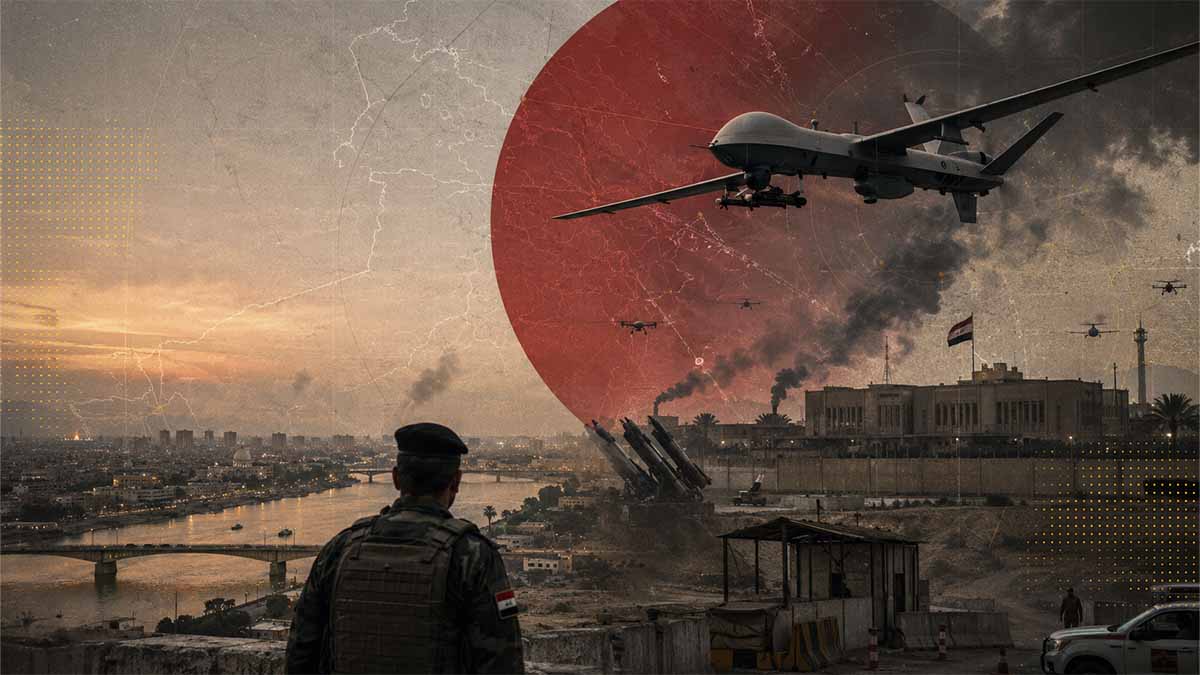
Executive Summary
- BLUF: Baghdad’s new drone doctrine marks a shift from political accommodation of armed factions to criminal enforcement of state airspace sovereignty.
- Iraq reports the seizure of 49 drones in 2026 and the closure of 71 fictitious armed-group headquarters.
- Prime Minister Ali Faleh al-Zaidi, formally installed on 16 May 2026, has made weapons consolidation a defining test of governmental authority.
- The catalyst is external coercion: CENTCOM reports more than 600 attempted militia attacks between February and April 2026.
- On 28 July 2026, US–Saudi aircraft struck militia logistics and weapons sites after more than 30 drone attacks in 72 hours.
- President Trump’s approach has shifted from proxy containment toward direct punishment of Iran’s regional military architecture.
- Baghdad’s deadline can reduce overt launches, but disarmament is less likely than selective integration, concealment and organizational mutation.
- Baseline five-year estimate: 55% managed state consolidation, 25% militia adaptation, 12% coercive fragmentation, 8% renewed proxy war.
- The decisive variable is whether Iraq converts declarations into registration, custody, prosecution, financial control and unified command.
- The strategic contest is no longer merely over weapons: it is over who possesses the sovereign authority to initiate war from Iraqi territory.
Iraq’s Five-Year Test: Sovereignty, Militias and Money
Iraq’s decisive contest through 2031 will not be fought solely over weapons. It will turn on who controls public payrolls, oil revenues, banking access, commercial contracts, intelligence networks and the authority to decide when force may be used. Baghdad must convert armed factions from politically connected power centres into accountable state institutions while preserving security against Islamic State remnants and avoiding confrontation with Iran. Washington, meanwhile, is replacing expansive military engagement with bilateral assistance, sanctions and financial pressure. The Gulf states and the European Union offer Iraq economic connectivity—but only if sovereignty becomes operational rather than ceremonial. The outcome will determine whether Iraq emerges as an investable bridge between competing regional blocs or remains a fiscal state whose institutions finance actors capable of overruling it.
The Sovereignty Balance Sheet
The central Iraqi problem is frequently described as militia “disarmament,” but that formulation is incomplete. The real issue is the fragmentation of sovereign authority across military, political and commercial structures. The Popular Mobilization Forces were incorporated into Iraq’s security architecture by legislation enacted in 2016. Integration, however, does not automatically create command discipline: uniforms, salaries and statutory recognition can coexist with factional loyalties, autonomous weapons stocks and economic enterprises beyond ordinary ministerial scrutiny.
This distinction will define the 2026–2031 period. A credible state must control recruitment, promotions, military procurement, weapons registration, targeting authority, bases and disciplinary proceedings. It must also prevent armed institutions from owning or controlling businesses that compete for public land, procurement contracts and strategic infrastructure. Otherwise, integration becomes fiscal absorption: the government pays personnel and provides legal protection without acquiring exclusive command.
The strategic threshold is therefore not the number of weapons formally surrendered. It is whether Baghdad can establish a single enforceable chain of command from the prime minister, as commander-in-chief, through operational headquarters to every armed formation. Unauthorized drone launches are an especially revealing test. A government that cannot identify the operator, financing channel, launch site and command authorization behind an aircraft crossing its territory does not fully control either its airspace or the regional consequences generated from it.
Washington Changes the Instrument
The United States has moved from an open-ended coalition framework toward a narrower combination of bilateral security cooperation and coercive financial enforcement. On 27 September 2024, Washington announced a two-phase transition for Operation Inherent Resolve: the coalition’s military mission in Iraq was scheduled to conclude its first phase in September 2025, while support from Iraqi territory for counter-Islamic State operations in Syria would continue until at least September 2026, subject to conditions and consultations. The Pentagon emphasized that this was not a complete American withdrawal and identified the Iraqi Counter Terrorism Service, Joint Operations Command, Air Force and Kurdish Peshmerga as continuing partners. “Inherent Resolve Mission in Iraq and Syria Transitioning” — U.S. Department of Defense, 27 September 2024.
The political consequence is profound. As the coalition footprint contracts, attacks on American personnel become less likely to produce another prolonged stabilization campaign and more likely to trigger intelligence-led strikes, sanctions, banking restrictions or pressure on individual Iraqi institutions. The Trump administration’s coercive architecture treats the separation between armed activity and commercial finance as largely artificial: the target set extends from commanders and weapons facilitators to banks, oil intermediaries, construction companies and public officials.
On 9 October 2025, the U.S. Treasury sanctioned individuals and companies it accused of helping Iran evade sanctions, smuggle weapons and exploit Iraq’s banking system. Treasury identified the Muhandis General Company—a conglomerate associated with the Popular Mobilization Forces—and alleged that it diverted revenue through government contracting. It also named three Iraqi banking executives, stating that militia-linked networks had generated or laundered millions of dollars and, in other cases, tens of millions. “Treasury Takes Aim at Iran-Backed Militia Groups Threatening the Safety of Americans” — U.S. Department of the Treasury, 9 October 2025.
This is not merely counterterrorism policy. It is an attempt to change the economics of armed autonomy. A faction may survive the loss of a weapons depot; it is far more constrained when banks refuse transactions, insurers withdraw, contractors lose counterparties and politically exposed intermediaries can no longer convert state access into internationally usable capital.
Oil Becomes a Security Variable
Iraq’s vulnerability arises from the exceptional concentration of its public finances in hydrocarbons. The International Monetary Fund estimated that crude-oil exports would fall in value from $99.2 billion in 2024 to $84.2 billion in 2025 and $79.2 billion in 2026, reflecting an assumed decline in the average export price from $80.60 to $65.90 and then $62 a barrel. Over the same period, the projected fiscal deficit widened from 4.2% of GDP to 7.5% and 9.2%, while government debt was projected to rise from 47.2% of GDP in 2025 to 62.3% in 2026. Wages and pensions alone were expected to absorb 24.5% of GDP in 2026. “IMF Executive Board Concludes 2025 Article IV Consultation with Iraq” — International Monetary Fund, 9 July 2025.
These figures convert militia governance into a macroeconomic problem. When oil income weakens, every protected payroll, opaque contract and politically allocated security budget competes directly with electricity networks, water systems, schools and productive investment. Fiscal stress can also make reform more dangerous: reducing benefits may fragment armed organizations, while maintaining them crowds out development and entrenches patronage.
Oil traceability has accordingly become part of the sovereignty contest. On 7 May 2026, the U.S. Treasury designated Iraqi Deputy Oil Minister Ali Maarij Al-Bahadly, three militia leaders and associated businesses, alleging that Iraqi resources had been diverted to benefit Iran and Iran-aligned groups. The measures invoked authorities covering both terrorism and Iran’s petroleum sector. “Economic Fury Targets Iraqi Oil Official, Iran-Backed Terrorist Militias in Iraq” — U.S. Department of the Treasury, 7 May 2026.
The strategic message reaches beyond the named parties: oil cargo documentation, beneficial ownership, customs records, dollar settlement and public appointments are now potential instruments of geopolitical enforcement. Baghdad’s room for ambiguity is narrowing because international financial compliance systems can impose consequences even when domestic prosecution remains politically blocked.
Integration or Institutional Capture
Five broad trajectories are possible. The first is genuine integration: personnel are individually vetted, heavy weapons enter audited depots, commanders rotate through national institutions and factional companies are subjected to procurement, taxation and beneficial-ownership rules. This is the most stabilizing path, but it demands political authority stronger than the networks being regulated.
The second is nominal integration. Armed groups retain autonomous command while acquiring additional salaries, ranks and legal immunities. This would enlarge the state on paper while hollowing it out operationally. The third is controlled fragmentation: cooperative formations enter regular forces, whereas harder-line networks become smaller, clandestine and more technically specialized. This could reduce visible militarization but increase reliance on drones, cyber operations, deniable cells and commercial fronts.
The fourth is coercive rupture, in which external strikes or sweeping sanctions force Baghdad into abrupt confrontation with selected factions. Such a scenario could temporarily disrupt capabilities but also produce retaliatory attacks, cabinet instability and pressure on energy infrastructure. The fifth is negotiated pluralism: factions preserve political influence and limited organizational identity but accept enforceable prohibitions on independent foreign policy, cross-border attacks and unauthorized strategic weapons.
Of these outcomes, controlled fragmentation may be the most difficult to detect. Large formations are expensive, observable and dependent on public financing. Small networks can conceal command functions inside charities, logistics businesses, media organizations, technology firms or political offices. Commercial drones, encrypted communications and dual-use components lower the cost of coercion. Success must therefore be measured not by parade formations or public declarations but by financial audits, weapons inventories, arrest authority and the decline of unattributed launches.
Iran’s Adaptive Depth
Iran’s influence in Iraq rests on more than armed proxies. It includes religious relationships, political alliances, cross-border commerce, energy dependence, intelligence cooperation and personal networks accumulated over decades. Tehran can therefore preserve leverage even if prominent factions surrender selected weapons. Its most durable strategy would be institutional embedding: influence exercised through parliamentary blocs, provincial administrations, border revenues, contracting and appointments rather than continuous military visibility.
Baghdad cannot eliminate these connections without destabilizing its own political system, nor should sovereignty be confused with hostility toward Iran. Iraq’s viable objective is diversification. A sovereign Iraqi government should be able to cooperate with Tehran without allowing any foreign power to exercise an indirect veto over Iraqi security decisions. The same principle must apply to Washington, Ankara and the Gulf capitals.
Iran also possesses incentives for restraint. An uncontrolled Iraqi front could invite strikes on logistics corridors, expose financial networks and weaken friendly political actors. Under sustained pressure, Tehran may prefer disciplined, lower-signature influence to repeated attacks that force Baghdad to choose publicly between domestic partners and international economic access. That creates a narrow opening for Iraqi policy: integration can be presented not as the destruction of one geopolitical camp, but as the transformation of influence from armed privilege into lawful political competition.
The Gulf Alternative
Gulf engagement matters because coercion alone cannot replace militia-linked political economies. Iraq needs alternative sources of electricity, finance, logistics connectivity and private-sector employment. Saudi Arabia and the other Gulf Cooperation Council states can raise the opportunity cost of armed alignment by supporting infrastructure whose returns depend on predictable borders, secure transmission lines and internationally compliant banking.
The European Union offers a complementary institutional anchor. At the fourth EU–Iraq Cooperation Council, held in Luxembourg on 19 October 2025, EU High Representative Kaja Kallas and Iraqi Foreign Minister Fuad Hussein addressed trade, energy, development cooperation and regional security. The EU explicitly supported Iraq’s sovereignty, recognized the role of the EU Advisory Mission in civilian-security reform and announced a new €8 million package supporting the repatriation of Iraqis from camps in north-eastern Syria. “Joint Press Release — 4th EU–Iraq Cooperation Council” — Council of the European Union, 20 October 2025.
Such engagement will be strategically meaningful only if projects are protected from coercive contracting and factional capture. Power interconnection, rail corridors, ports and urban reconstruction are not neutral assets: they redistribute rents and create new centres of economic influence. Transparent tendering and independent regulation are therefore security instruments, not administrative refinements.
The Post-UNAMI Test
The conclusion of the United Nations Assistance Mission for Iraq on 31 December 2025 removed a political mission established in 2003 and left the UN country presence under the Resident Coordinator. “United Nations Assistance Mission for Iraq” — United Nations in Iraq, updated 2026. The transition signalled institutional maturity, but it also transferred greater responsibility for mediation, electoral confidence and political crisis management to Iraqi institutions.
That timing is consequential. The drawdown of the coalition framework, the end of UNAMI and intensified U.S. financial enforcement all reduce the external buffers that previously contained Iraqi disputes. By 2031, institutional resilience will depend less on international supervision and more on whether courts, parliament, audit bodies, security commands and the central bank can withstand partisan pressure.
The relevant indicators are concrete: the share of security expenditure subject to audit; the percentage of personnel verified biometrically; the number of heavy weapons assigned to registered depots; enforcement actions against unauthorized launches; disclosure of corporate beneficial ownership; non-oil revenue performance; electricity-import diversification; and the ability of prosecutors to pursue sanctioned or politically connected actors without selective justice.
The 2031 Choice
The five-year contest will not produce a clean victory by Baghdad, Tehran, Washington or the Gulf states. It will determine the operating rules under which all of them compete. Iraq can remain a distributive oil state in which armed-political networks capture revenue and external powers punish one another through Iraqi territory. Or it can use fiscal pressure and geopolitical competition to impose a more disciplined bargain: one budget, one targeting authority, one weapons registry and one set of commercial rules.
The greatest danger is nominal reform—formal integration combined with clandestine autonomy. The greatest opportunity is to connect security consolidation with banking modernization, oil traceability, electricity diversification and competitive investment. That approach does not require Iraq to choose an exclusive foreign patron. It requires Iraq to become capable of choosing at all.
By 2031, sovereignty will not be measured by communiqués or the institutional labels attached to armed formations. It will be measured at the instant a drone is prepared for launch, a government contract is awarded, an oil cargo is documented or a bank transfer enters the international system—and by whether the Iraqi state can authorize, inspect, stop and prosecute each transaction on its own terms.
Navigational Index
- Sovereignty and the Drone Red Line — Legal authority, airspace control, weapons registration and the institutional meaning of treating unauthorized launches as terrorism.
- Trump’s Coercive Architecture — The transition from calibrated proxy management to direct military punishment, partner-enabled strikes and pressure on Baghdad.
- The 2026–2031 Contest — Militia integration, clandestine adaptation, Iranian influence, Gulf deterrence, fiscal leverage and alternative five-year trajectories.
Master Abstract
Iraq’s declaration that an unauthorized drone launch will be treated as a terrorist act is not principally a counter-unmanned-aircraft measure; it is an attempt to redefine the constitutional boundary between the state and the armed networks that have historically combined parliamentary influence, public salaries, autonomous arsenals and external strategic relationships. An Iraqi governmental committee has reported the seizure of 49 drones during 2026, the construction of a weapons-information bank and the closure of 71 fictitious headquarters claiming affiliation with security formations—“We Established an Information Bank to Inventory Weapons and Closed 71 Fictitious Headquarters” – Iraqi News Agency – August 2026 — verified official record. These measures create three interlocking enforcement thresholds: a technical threshold, under which an aircraft must be registered and its mission authorized; a criminal threshold, under which an unauthorized sortie can be investigated as terrorism rather than as an administrative aviation violation; and a political threshold, under which factional affiliation no longer supplies presumptive immunity. The change coincides with the formal transfer of executive and commander-in-chief authority to Ali Faleh al-Zaidi on 16 May 2026—“Prime Minister Ali al-Zaidi Officially Assumes His Duties as Head of Government and Commander-in-Chief of the Armed Forces” – Iraqi News Agency – May 2026 — verified official record—after President Nizar Amedi commissioned him to form a government on 27 April 2026—“In a Ceremony at Baghdad Palace, the President of the Republic Assigns Mr Ali al-Zaidi to Form the Government” – Presidency of the Republic of Iraq – April 2026 — verified official record. Institutionally, the doctrine therefore converts “control of weapons” from a negotiated slogan into a chain-of-custody problem: Baghdad must identify platforms, operators, storage compounds, imported components, radio-frequency profiles, launch zones, financiers and the officials who enable them. Its credibility will depend not on the number of public handovers but on whether the same evidentiary standard is applied across factional, regional and party boundaries.
The Trump administration’s approach changes Baghdad’s incentive structure because it compresses the interval between proxy action and external punishment. The White House describes Operation Epic Fury, initiated on 1 March 2026, as a campaign intended to destroy Iran’s ballistic-missile capacity, degrade proxy networks and cripple Iranian naval forces—“Peace Through Strength: President Trump Launches Operation Epic Fury to Crush Iranian Regime, End Nuclear Threat” – The White House – March 2026 — verified official record. Whatever judgment is made about that administration’s characterization or legal theory, its operational consequence is measurable: Washington is treating the militia system less as a collection of locally deterrable organizations and more as a distributed Iranian military architecture. CENTCOM states that Iraqi Iran-aligned groups attempted more than 600 attacks against US citizens and facilities from February through April 2026. It further states that US and Saudi aircraft struck multiple logistics and weapons sites in eastern Iraq on 28 July, following more than 30 IRGC-directed drone attacks in 72 hours—“U.S., Saudi Forces Strike Iran-Backed Terrorist Sites in Iraq” – US Central Command – July 2026 — verified official record. This is strategically different from episodic bilateral retaliation: the participation of Saudi Arabia introduces a regionalized enforcement coalition and demonstrates that launches originating in Iraq can expose Iraqi territory to punishment by more than one neighboring or expeditionary power. Baghdad is consequently confronting a sovereignty trap. Failure to restrain the factions makes Iraqi territory a launch platform and therefore a target; coercive disarmament risks intra-Shiite conflict, defections within state-funded formations and political obstruction; purely symbolic integration preserves the underlying capability while merely changing its administrative label. Trump’s method intensifies this trap by making ambiguity itself costly: if Washington attributes attacks through technical intelligence, Baghdad can no longer rely indefinitely on factional denials or uncertain public attribution to prevent retaliation.
The five-year outlook was evaluated through five competing hypotheses: H₁—genuine state consolidation, H₂—cosmetic integration, H₃—clandestine militia adaptation, H₄—violent fragmentation, and H₅—renewed regional proxy war. The initial Bayesian distribution assigns 55% to a managed but incomplete consolidation, 25% to concealed adaptation under political or security-sector cover, 12% to coercive fragmentation and 8% to renewed large-scale proxy conflict. These are analytical estimates, not official forecasts; they represent transparent priors conditioned on current governmental measures, the documented tempo of attacks and the demonstrated willingness of external actors to strike inside Iraq. A Monte Carlo-style scenario structure should vary six drivers: enforcement consistency, factional compliance, Iranian regeneration capacity, US strike tolerance, Gulf participation and Iraqi elite cohesion. Under the baseline path, 2026–2027 brings registration drives, seizures and negotiated absorption of personnel, while higher-value drone teams disperse, compartmentalize launch authority and migrate toward dual-use commercial components. During 2028–2029, the critical contest moves from visible arsenals to procurement finance, encrypted command channels, shell companies, border logistics and sympathetic nodes embedded within formal institutions. By 2030–2031, success should be judged through negative indicators: fewer unattributed launches, reduced unexplained military procurement, unified air-tasking procedures, judicially sustainable prosecutions and the absence of retaliatory foreign strikes. Russia’s official diplomacy has opposed the US–Israeli military campaign against Iran—“Briefing by Foreign Ministry Spokeswoman Maria Zakharova” – Ministry of Foreign Affairs of the Russian Federation – March 2026 — verified official record—illustrating the external diplomatic resistance Baghdad may exploit to defend territorial sovereignty, although diplomatic opposition does not itself neutralize militia capability. The governing inference is therefore narrow but consequential: Iraq may suppress unauthorized drone operations without fully eliminating the organizations behind them, but it cannot establish durable strategic autonomy unless it unifies authorization, intelligence, finance, storage and coercive command under institutions answerable to the elected state.
Drone-Control Intelligence Codex
State Consolidation Probability
Five Competing Hypotheses
Sovereignty and the Drone Red Line: Iraq’s Battle for the Monopoly of Force
The legal meaning of Baghdad’s red line
Iraq’s declaration that every unauthorized drone launch will be treated as a terrorist act represents a deliberate elevation of the issue from aviation regulation to national-security jurisdiction. It transforms the drone from a licensable aircraft into a potential instrument for unlawfully exercising the sovereign power to use force. This distinction is central. An unauthorized civilian survey flight, a smuggling sortie, an intelligence-collection mission and a weaponized attack are not legally identical merely because each uses an unmanned aircraft. The political declaration establishes a presumption of extreme threat, but an Iraqi court would still have to determine whether the conduct satisfies the constituent elements of terrorism under Anti-Terrorism Law No. 13 of 2005. Article 1 defines terrorism through a criminal act intended to disturb security, stability or national unity, spread fear or provoke chaos for terrorist purposes. Article 2 covers violence or threats forming part of an organized terrorist project, attacks against governmental or diplomatic facilities, leadership of an armed terrorist organization and the use of explosive or incendiary devices for terrorist purposes. Article 3 additionally addresses acts threatening state security and the unauthorized seizure or command of military or civilian facilities. The law prescribes capital punishment for perpetrators, accomplices, instigators and financiers of the acts identified in Articles 2 and 3, life imprisonment for intentional concealment, and confiscation of the instrumentalities used to prepare or execute the offence—Anti-Terrorism Law No. (13) of 2005 – Iraqi Ministry of Justice – November 2005 — official translated legislation. Consequently, the Interior Ministry’s red line is legally strongest where investigators can prove an unauthorized launch, operational intent, an organized chain of command and a terrorist purpose. Treating every technical violation as a completed terrorist offence without this evidentiary chain would risk conflating preventive security policy with judicial determination, weakening rather than strengthening future prosecutions.
The constitutional foundation is broader and, in institutional terms, more consequential than the terrorism statute. Article 9 of Iraq’s Constitution requires the armed forces and security services to remain under civilian authority and expressly prohibits the formation of military militias outside the framework of the armed forces. It also separates the armed forces from partisan political activity and assigns the Iraqi National Intelligence Service responsibility for collecting information, evaluating national-security threats and advising the government—الدستور – Presidency of the Republic of Iraq – 2005 — official constitutional text. The drone red line therefore derives its deepest legitimacy not from the physical characteristics of unmanned aircraft but from the constitutional prohibition against autonomous military authority. A faction possessing drones, explosives, targeting intelligence and an independent launch chain possesses more than materiel: it retains an autonomous capacity to select an adversary, determine the timing of hostilities and expose Iraq to retaliation without authorization from the civilian commander-in-chief. The constitutional violation occurs at the level of command sovereignty even before a weapon reaches its target. Conversely, formal membership in a state-recognized formation cannot by itself cure the problem. If a brigade receives public salaries and nominally belongs to the security apparatus but preserves separate operational orders, secret launch teams or externally controlled mission approval, its legal integration may conceal rather than eliminate the unconstitutional command relationship. Baghdad’s actual test is therefore functional: who authorizes the mission, who controls the aircraft, who supplies coordinates, who can cancel the sortie and who bears criminal and command responsibility? The difference between a state unit and a militia cannot be resolved solely by uniforms, payroll records or organizational decrees. It must be resolved through a demonstrable, auditable chain extending from civilian authorization to platform custody and from targeting approval to post-mission accountability.
| Legal layer | Relevant authority | Required factual showing | Operational consequence | Principal vulnerability |
|---|---|---|---|---|
| Constitutional order | Article 9 of the Iraqi Constitution | Armed capability exists outside effective civilian command | Disarmament, restructuring or genuine incorporation | Formal integration may conceal autonomous command |
| Counterterrorism | Law No. 13/2005, Articles 1–4 | Criminal act, terrorist purpose, participation, assistance or financing | Arrest, prosecution, severe penalties and confiscation | A launch violation alone may not prove terrorist intent |
| Criminal investigation | Judiciary, Interior Ministry, intelligence and counterterrorism bodies | Attribution of operator, commander, financier and intended target | Warrants, seizure, forensic exploitation and prosecution | Fragmented evidence or political interference |
| Aviation and airspace control | Civil and military aviation authorities | Registration, authorization, approved zone and mission profile | Grounding, interdiction and airspace deconfliction | Weak low-altitude identification and fragmented databases |
| Weapons control | Interior Ministry and security command | Registered owner, custodian, storage site and authorized use | Inventory, inspection, transfer or confiscation | Ghost headquarters, duplicate inventories and hidden stocks |
| International responsibility | Iraqi executive and diplomatic institutions | Whether Iraq knew of, tolerated or failed to suppress launches | Diplomatic protest, cooperation or exposure to retaliation | Attribution by foreign states may precede Iraqi adjudication |
From aircraft registration to sovereign weapons accounting
The government’s newly disclosed inventory effort indicates that Baghdad understands the problem as an information-governance challenge as much as a kinetic one. According to the Interior Ministry, authorities have created a data bank covering approximately six million weapons, seized 49 drones during 2026, and closed 71 fictitious headquarters falsely claiming affiliation with the Popular Mobilization Forces. The same official account states that judicial authorities treat a drone operating outside formal conditions as a terrorist act—انشأنا بنك معلومات لحصر السلاح وأغلقنا 71 مقراً وهمياً يدعي الصلة بالحشد الشعبي – Iraqi News Agency – August 2026 — official statement. These figures are important but should not be interpreted as proof that the state has already achieved effective control. A database becomes strategically valuable only when each entry links a physical object to a verified custodian, location, legal authority, chain of transfer, technical identity and inspection history. For drones, the minimum record should extend beyond the airframe serial number. It should include the flight controller, firmware, radio transceiver, datalink frequency, navigation module, payload interface, launch mechanism, ground-control station, operator credentials, approved operating area and cryptographic identifiers where available. Weaponized systems require additional custody records for warheads, fuzing mechanisms, explosive material, mission computers and targeting data. Small commercial platforms complicate this architecture because serial-number removal, modular assembly and component substitution can rapidly break the relationship between the registered airframe and the operational system. Baghdad therefore needs a federated architecture connecting the Interior Ministry’s weapons bank, military inventories, customs declarations, civil-aviation permissions, telecommunications-spectrum data, explosive-material records and judicial case files. Without entity resolution across those repositories, a faction can register a benign platform, exchange its flight controller, change its payload, operate through an unregistered ground station and exploit institutional gaps between the authority licensing the aircraft and the authority investigating the attack. The operational objective must be continuous traceability, not a one-time registration campaign.
The closure of 71 fictitious headquarters exposes another dimension: armed influence can be reproduced through organizational impersonation, bureaucratic ambiguity and false claims of official protection. A ghost headquarters can function as an arms depot, recruiting site, financial office, communications relay or intimidation mechanism while exploiting the symbolic immunity of a recognized security institution. Drone operations are particularly suited to this environment because their physical footprint is small. A launch team may require only a vehicle, several modular containers, a portable antenna, preloaded coordinates and minutes of access to an open area. The strategic arsenal may therefore be dispersed across safe houses, agricultural buildings, commercial warehouses and mobile teams rather than concentrated in conventional bases. This shifts enforcement from static site inspection to network analysis. Authorities must correlate property ownership, vehicle movements, power consumption, telecommunications activity, procurement invoices, border imports and personnel associations, while preserving judicially admissible evidence. The government’s announcement that the Counter Terrorism Service and Iraqi National Intelligence Service penetrated and dismantled a network possessing drones intended for attacks on specified targets demonstrates the value of joint intelligence access—العبودي: تفكيك شبكة بحوزتها طائرات مسيرة كانت تخطط لتنفيذ هجمات ضد أهداف معينة – Iraqi News Agency – August 2026 — official government statement. Yet the disclosure does not publicly identify the number or types of aircraft, intended targets, command affiliation, technical origin or evidentiary status of those arrested. Those omissions are operationally understandable, but analytically they prevent independent quantification of the network’s capacity. The strongest inference is therefore limited: Iraqi agencies demonstrated at least one successful pre-launch disruption, not that the broader clandestine drone architecture has been dismantled.
| Registration object | Minimum identifiers | Verification mechanism | Red-flag condition |
|---|---|---|---|
| Airframe | Manufacturer, model, serial number, dimensions, mass | Physical inspection and photographic record | Removed or duplicated serial number |
| Flight controller | Hardware ID, firmware version, configuration hash | Forensic extraction and signed baseline | Unapproved firmware or erased logs |
| Datalink | Frequencies, device IDs, encryption and antenna type | Spectrum registration and controlled test | Frequency hopping outside declared profile |
| Navigation | GNSS receiver, inertial system, waypoint capacity | Bench inspection and flight-log analysis | Anti-jam modification or stored restricted coordinates |
| Payload | Camera, sensor, release mechanism or warhead interface | Certified configuration and tamper seal | Undeclared release mechanism or wiring modification |
| Ground station | Laptop, controller, software and account identifiers | Device registration and access logging | Shared credentials or foreign remote access |
| Operator | Identity, training, employing institution and clearance | Biometric credential and recurrent certification | Factional chain of command outside state tasking |
| Mission | Time, route, altitude, purpose and approving authority | Digital flight authorization and geofencing | Launch outside approved space or mission window |
| Custody | Storage site, responsible officer and transfer history | Periodic audit and surprise inspection | Missing platform, unexplained relocation or inventory mismatch |
| Supply chain | Importer, customs record, vendor and payment route | Customs-financial data matching | Shell importer, cash settlement or component fragmentation |
The airspace problem: detection is not attribution
Airspace sovereignty requires more than the capacity to shoot down an aircraft. Iraq must be able to distinguish authorized state missions, coalition or bilateral missions, commercial activity, civilian hobby use, smuggling flights, intelligence collection, improvised one-way attack systems and decoys. Low-cost platforms exploit the lower reaches of airspace where conventional military radar may have incomplete coverage, particularly against small objects flying slowly, close to terrain or within urban clutter. A usable national architecture would combine military radar, passive radio-frequency detection, electro-optical and infrared sensors, acoustic arrays, civil air-traffic information, telecommunications monitoring and human reporting. Each sensor supplies different evidence. Radar may establish a trajectory but not an operator; radio-frequency detection may locate a controller but fail against autonomous navigation; optical imagery may classify the airframe without identifying the launch authority; recovered wreckage may reveal components but not necessarily the commander who ordered the mission. The evidentiary chain must therefore integrate pre-launch intelligence, launch-site observation, technical flight data, payload forensics, communications records, financial links and command relationships. ICAO’s Middle East airspace work identifies unmanned-aircraft-system traffic management and remotely piloted aircraft as regional airspace-management priorities. Its regional working group has highlighted layered low-altitude airspace, civil–military cooperation, integration with air-traffic-management systems and the need to manage unmanned and manned users within a common architecture—ASM WG/1 Final Report – International Civil Aviation Organization Middle East Office – November 2024 — official regional report. Although the report does not establish an Iraqi domestic regime, it provides the relevant institutional direction: low-level drone governance cannot remain separated from national airspace management. Iraq requires a single operational picture in which civilian permission, military authorization and counter-drone alerts are reconciled in near real time.
Attribution becomes still more difficult when the attacking organization employs commercial parts, preprogrammed navigation, intermediaries or deniable launch crews. A foreign intelligence service may attribute a strike using classified collection that it cannot disclose, while Iraqi investigators require evidence capable of surviving judicial scrutiny. This produces an attribution gap with direct implications for sovereignty. External actors may decide that they possess sufficient operational certainty to retaliate before Baghdad completes an investigation or publicly identifies the perpetrators. On 28 July 2026, US Central Command reported that American and Saudi aircraft struck several logistics and weapons sites in eastern Iraq after more than 30 IRGC-directed aerial drone attacks during the preceding 72 hours. CENTCOM also reported more than 600 attempted attacks against US citizens and facilities by Iran-aligned militias in Iraq between February and April 2026—U.S., Saudi Forces Strike Iran-Backed Terrorist Sites in Iraq – US Central Command – July 2026 — official military release. These numbers are official US operational claims and should be attributed as such; the public release does not provide a strike-by-strike dataset enabling external reconstruction of all 600 attempts. Nevertheless, it establishes the strategic mechanism confronting Baghdad: unauthorized launches from Iraqi territory can generate foreign targeting decisions on a timetable measured in hours rather than months. The state therefore needs an emergency attribution protocol capable of preserving evidence, communicating preliminary findings to threatened partners and taking visible domestic action before foreign governments conclude that Iraq is unable or unwilling to suppress the threat.
The institutional meaning of “terrorist act”
Calling an unauthorized drone launch terrorism performs four institutional functions. First, it reallocates the matter from routine aviation enforcement toward intelligence, counterterrorism and specialized judicial mechanisms. Second, it expands investigative attention from the pilot to the network of commanders, financiers, facilitators and concealment providers contemplated by Law No. 13. Third, it signals to armed factions that political affiliation will not automatically shield an operational cell. Fourth, it informs external governments that Baghdad intends to deny its territory as a launch platform. Yet the terminology also generates serious legal risks. Iraq’s counterterrorism law is exceptionally punitive; using it without a precise nexus between the launch and a terrorist purpose could undermine due process, encourage selective prosecution and create disputes over civilian or commercial violations. The state should therefore establish a graduated legal taxonomy. Category A would cover administrative non-compliance without hostile indicators; Category B would cover reckless or concealed operation near restricted infrastructure; Category C would cover intelligence collection, smuggling or organized coercion; Category D would cover possession of weaponization components, target packages or operational coordination; Category E would cover attempted or completed attack missions. Categories D and E would normally provide the strongest basis for counterterrorism charges, while Categories A–C could trigger seizure, detention or prosecution under other legislation depending on the facts. Such a taxonomy would preserve the deterrent force of the red line while avoiding the proposition that every unlicensed flight is legally indistinguishable from an armed attack. It would also improve data quality: authorities could report incidents by legal and operational class rather than aggregating hobby violations, smuggling missions, reconnaissance and attacks into a single politically dramatic count.
| Threat class | Observable characteristics | Presumptive treatment | Evidentiary priority | Escalation trigger |
|---|---|---|---|---|
| A — Administrative | Unregistered platform, no concealment, benign payload | Grounding, seizure, fine or licensing action | Operator identity and flight log | Repetition or restricted-zone entry |
| B — Reckless/restricted | Concealed route, protected-site proximity, disabled identification | Criminal investigation and technical exploitation | Route, communications and intent | Surveillance pattern or evasion |
| C — Organized illicit | Smuggling, covert imaging, facilitation network | Organized-crime or security prosecution | Financial and network evidence | Foreign tasking or strategic target |
| D — Weaponization preparation | Warhead interface, release device, target coordinates | Counterterrorism investigation | Command chain, financier and intended target | Mission-ready configuration |
| E — Attack operation | Armed launch, attempted strike or completed impact | Full counterterrorism response | Attribution, damage, command responsibility | Immediate threat to life or strategic infrastructure |
The political importance of the 30 September 2026 deadline must be interpreted within this enforcement architecture. Iraq’s National Security Council has stated that it will continue implementing the plan to confine weapons to state authority while completing the security arrangements associated with the coalition transition at the end of September—مجلس الأمن الوطني يدين الاعتداء السعودي–الأمريكي ويقر خطة للتعامل مع تداعياته – Iraqi News Agency – July 2026 — official council account. The conjunction of these two processes creates both leverage and exposure. As the coalition framework changes, Baghdad can argue that the reduction of foreign military presence removes a justification used by militias for retaining autonomous “resistance” capabilities. At the same time, reduced coalition support may place greater demands on Iraqi command, intelligence, surveillance, air defense and precision-strike capacity. The earlier US–Iraq transition plan envisaged concluding the coalition’s military mission in Iraq and continuing support for counter-ISIS operations in Syria from Iraq through at least September 2026, subject to conditions and consultation—Inherent Resolve Mission in Iraq and Syria Transitioning – US Department of Defense – September 2024 — official transition account. A deadline without durable replacement institutions could therefore produce apparent disarmament followed by concealed rearmament. The most reliable indicators after September will not be ceremonial weapons transfers but verified closure of independent operations rooms, surrender of specialized launch equipment, transfer of encrypted communications, dissolution of separate procurement channels, removal of unauthorized commanders and prosecution of post-deadline violations. If those indicators do not appear, the deadline will have changed the visibility of the militia system rather than its coercive substance.
Shadow architecture: finance, procurement and cyber control
The drone ecosystem’s shadow dimensions are especially resistant to conventional disarmament because the decisive capabilities are modular and dual-use. Airframes, batteries, electric motors, electronic-speed controllers, antennas, cameras, microprocessors, satellite-navigation receivers and commercial software can enter Iraq through legitimate trade. Specialized capabilities emerge when those components are combined with military payloads, hardened communications, autonomous waypoint navigation, electronic-countermeasure resistance or target intelligence. Financially, procurement can be divided among numerous low-value transactions, conducted through cash, exchange houses, front companies, charitable structures, construction firms or importers whose declared business plausibly requires electronics. Consequently, a weapons database that records finished platforms but ignores payment networks will remain structurally incomplete. Iraq should create transaction-risk indicators connecting customs records, beneficial ownership, currency movements and technical component profiles. Repeated imports of high-discharge batteries, long-range communications modules, autopilot boards or precision navigation components by firms lacking a credible commercial requirement should trigger inspection. The European Union’s restrictive-measures framework is relevant because it permits sanctions against persons and entities involved in supplying, selling or transferring Iranian drones, missiles and related components to armed groups undermining peace and security in the Middle East and Red Sea region. The framework also prohibits making funds or economic resources available to listed parties—EU Sanctions Against Iran – Council of the European Union – updated August 2026 — official sanctions framework. Iraqi financial intelligence could use such external designations as leads, but it should not substitute foreign listing decisions for domestic proof. Effective sovereignty requires Iraq to generate its own financial cases, identify domestic facilitators and demonstrate that counterterrorism finance controls apply even when the relevant network enjoys political connections.
Cyber control constitutes the least visible layer. A drone may be assembled in Iraq yet receive firmware, navigation files, target coordinates or mission authorization from outside the country. Conversely, the operator may be physically outside the formal factional hierarchy while using credentials or encrypted channels supplied by an embedded state employee. The sovereignty question is therefore not solved by taking possession of airframes. Baghdad must control the digital means by which an aircraft becomes operational. A mature forensic process should preserve controller memory, flight logs, configuration files, satellite-navigation histories, map caches, messaging applications, cloud synchronization records and evidence of firmware modification. It should also establish whether the platform was piloted in real time, flown autonomously or designed as a one-way attack system. Spectrum monitoring can help associate a launch with a ground station, but adversaries may use relay nodes, prerecorded routes or cellular links to complicate geolocation. Network defense must additionally prevent unauthorized personnel from extracting target information from government systems. Airfield layouts, force-protection routines, diplomatic movements, energy-facility coordinates and radar gaps can transform a commercially available drone into a strategic weapon. The institutional model should therefore combine counter-UAS, counterintelligence, cyber defense, financial intelligence and judicial investigation rather than distributing them across isolated bureaucracies. The Iraqi National Intelligence Service should lead foreign-command attribution; the Counter Terrorism Service should address high-risk cells; the Interior Ministry should maintain weapons and identity records; military authorities should control operational airspace; civil aviation should manage legitimate access; customs and financial bodies should map procurement; and courts should determine criminal responsibility. Any gap between these functions becomes an exploitable sanctuary.
Analysis of competing hypotheses
The five competing hypotheses are not mutually exclusive descriptions of every faction; they are alternative dominant trajectories for the Iraqi system through 2031. H1, substantive consolidation, predicts that the state progressively acquires real control over drone platforms, launch authorization, procurement and commanders. H2, cosmetic integration, predicts visible registration and organizational incorporation without elimination of separate decision-making. H3, clandestine adaptation, predicts that pressure drives smaller cells toward modular commercial systems, covert finance and deniable communications. H4, coercive fragmentation, predicts that uneven enforcement breaks large organizations into armed splinters and criminalized technical teams. H5, proxy-war recurrence, predicts that renewed regional escalation overwhelms Baghdad’s controls and restores high-tempo launches. The initial prior distribution used in the earlier assessment favored managed consolidation because the government had adopted a deadline, placed weapons control at the center of its program and received declared international backing. New evidence shifts some probability away from an uncomplicated H1 path. The seizure of 49 drones, closure of 71 fictitious headquarters, disruption of a drone network and creation of a six-million-weapon database support H1. Conversely, the alleged scale of attacks reported by CENTCOM, the participation of external aircraft in strikes inside Iraq and the need for pre-launch intelligence penetration support H2, H3 and H5 by demonstrating the persistence of autonomous capacity. The Bayesian update below is therefore an analytical judgment based on source-weighted indicators, not an official probability statement and not a claim of statistical certainty.
| Hypothesis | Core prediction for 2026–2031 | Supporting indicators | Disconfirming indicators | Updated probability |
|---|---|---|---|---|
| H1 — Substantive consolidation | State controls platforms, missions, finance and commanders | Audited inventories; consistent seizures; prosecutions; unified tasking | Repeated unattributed launches or protected arsenals | 38% |
| H2 — Cosmetic integration | Formal incorporation masks autonomous command | Salary integration without custody transfer; parallel communications | Dissolution of independent operations rooms | 29% |
| H3 — Clandestine adaptation | Smaller cells use modular systems and covert procurement | Commercial components; mobile launch teams; encrypted tasking | Sustained supply-chain disruption and forensic attribution | 18% |
| H4 — Coercive fragmentation | Enforcement produces splinters and criminalized specialists | Defections, intra-faction violence, freelance launch teams | Negotiated demobilization with verified compliance | 9% |
| H5 — Renewed proxy war | Regional escalation reactivates mass attack cycles | External strikes, Iranian regeneration and coalition confrontation | Durable ceasefire and cross-border interdiction | 6% |
The Monte Carlo model used for the five-year projection is a structured scenario instrument, not a prediction engine derived from classified event data. It evaluates 100,000 synthetic pathways across six drivers: enforcement consistency, elite cohesion, militia adaptation, external military pressure, Iranian regeneration capacity and judicial implementation. The baseline ranges were calibrated qualitatively from the verified official record, with enforcement improving after the 2026 measures but adaptation and external pressure remaining elevated. Each path changes annually and is assigned to the dominant hypothesis according to whether the state achieves control of authorization, custody, finance and command; whether control is primarily nominal; whether capabilities migrate underground; whether organizations fragment; or whether regional war restores high-intensity attacks. Sensitivity testing shows that enforcement alone is insufficient. Raising seizure activity without improving elite cohesion and judicial implementation tends to move outcomes from H2 toward H3 or H4 rather than toward H1. Similarly, external pressure has a nonlinear effect: moderate pressure can strengthen Baghdad’s leverage over factions, whereas repeated foreign strikes can delegitimize the government’s disarmament campaign, stimulate retaliatory recruitment and reinforce claims that autonomous weapons remain necessary. The most powerful positive combination is consistent enforcement plus cross-party political protection for investigators plus validated control of procurement finance. The most dangerous combination is high external pressure, low elite cohesion and incomplete custody transfer. The probability bands should be updated when post-deadline evidence becomes available, particularly arrest and prosecution data, audited handovers, reductions in launch events, customs seizures and proof that independent mission approval has ceased.
Five-year operational outlook
During late 2026 and 2027, Baghdad’s most probable strategy is selective coercion combined with negotiated incorporation. The government is likely to prioritize unauthorized launch cells, fictitious headquarters and weapon systems presenting the greatest risk of foreign retaliation, while avoiding indiscriminate confrontation with every armed formation simultaneously. This phase should generate seizures, declarations of compliance and organizational rebranding, but it will also incentivize concealment. During 2028, the center of gravity is likely to shift from visible depots toward supply-chain and personnel control. Successful enforcement will require licensing importers, tracing beneficial ownership, regulating high-risk components and certifying operators. During 2029, the principal vulnerability will be institutional penetration: formally integrated personnel may preserve factional loyalty or provide access to targeting, logistics and communications. Baghdad will need recurrent vetting, compartmented access, auditable mission orders and credible penalties for unauthorized tasking. During 2030, the state’s performance will be measured by whether it can detect and attribute low-signature launches without relying primarily on foreign intelligence. This requires a national low-altitude surveillance network and a unified incident command. By 2031, the decisive outcome will be one of three institutional equilibria: a genuine state monopoly over strategic unmanned operations; a hybrid system in which factions remain dormant but retain recoverable capability; or a fragmented marketplace of smaller clandestine cells. Full elimination of all illicit drones is unrealistic. The achievable sovereign objective is to make unauthorized launch preparation difficult to conceal, rapidly attributable, financially costly, legally punishable and politically indefensible.
| Period | Principal state objective | Expected adversary adaptation | Verification metric | Strategic failure indicator |
|---|---|---|---|---|
| Q3–Q4 2026 | Enforce deadline; secure inventories; close false sites | Dispersal, temporary stand-down, organizational relabeling | Platforms and ground stations physically transferred | Ceremonial handovers without technical custody |
| 2027 | Consolidate authorization and prosecution mechanisms | Use of intermediaries and mobile launch teams | Cases linking operators to commanders and financiers | Arrests limited to low-level personnel |
| 2028 | Control imports, components and procurement finance | Fragmented purchases and shell companies | Customs-financial matches and beneficial-owner findings | Repeated recovery of untraceable components |
| 2029 | Counter institutional penetration | Insider access and dual command relationships | Audited mission orders and access-control records | State personnel supporting unauthorized missions |
| 2030 | Achieve independent detection and attribution | Autonomous navigation and radio-silent attacks | Shorter detection-to-attribution interval | Dependence on foreign intelligence for attribution |
| 2031 | Institutionalize monopoly of force | Dormant recoverable networks | Multi-year absence of autonomous strategic launches | Rapid militia remobilization during crisis |
The international environment will reinforce some dimensions of Iraqi sovereignty while contesting others. European Council President António Costa stated after a July 2026 call with Iraq’s president that the European Union remained committed to Iraq’s sovereignty, unity and territorial integrity and was encouraged by Iraqi commitments to disarm Iran-backed militias and ensure the state monopoly over weapons—Call with President of Iraq – European Council – July 2026 — official European Council record. European sanctions and technical assistance can support financial interdiction, border control, aviation governance and judicial capacity. Russia’s diplomatic posture, by contrast, has condemned the US–Israeli military campaign against Iran and emphasized the regional consequences of external strikes—Briefing by Foreign Ministry Spokeswoman Maria Zakharova – Ministry of Foreign Affairs of the Russian Federation – March 2026 — official Russian statement. The official Chinese-domain search conducted for this assessment did not yield a sufficiently specific primary document addressing Iraq’s August 2026 drone red line; no Chinese citation or derived claim is therefore included. This absence is analytically important because multilingual checking is not a license to introduce tangential material. Baghdad will attempt to use the differing positions of the United States, Gulf states, European Union, Russia, China and Iran to maximize strategic autonomy. Yet diplomatic balancing cannot substitute for internal command control. If armed actors can still initiate hostilities independently, Iraq’s foreign policy remains partly hostage to decisions made below or outside the state.
The final assessment is that the drone red line can become a genuine sovereignty doctrine only if Baghdad converts a politically powerful sentence into a repeatable institutional process. That process begins before launch with importer screening, platform registration, operator certification, airspace authorization and intelligence collection. It continues during an incident through integrated detection, immediate classification, electronic and physical interdiction, protection of civilian aviation and preservation of evidence. It concludes after an incident through forensic exploitation, financial tracing, command attribution, judicial review, confiscation and public reporting consistent with operational security. The government must publish enough aggregate information to demonstrate impartial enforcement: numbers of platforms registered and seized, authorizations issued, restricted-zone violations, investigations opened, cases referred to courts and convictions obtained. It should avoid disclosing sensor locations, investigative techniques or vulnerabilities. Success will not be measured by declaring every unauthorized launch terrorism; it will be measured by proving that no political organization can exempt its operators from investigation and no foreign sponsor can reliably convert Iraqi territory into a deniable launch pad. The most likely five-year outcome remains partial rather than absolute consolidation. Baghdad can sharply reduce overt factional drone use, but concealed technical capacity will survive unless finance, procurement, communications and command are addressed together. The red line is therefore best understood as the opening move in a contest over the entire architecture of coercive authority.
Figure 1: Five-Year Sovereignty Scenario Projection
Trump’s Coercive Architecture: From Proxy Management to Direct Punishment
The collapse of calibrated proxy management
The strategic change introduced by President Donald Trump is not simply a higher frequency of military strikes; it is a redefinition of the object being deterred. Earlier US practice generally treated attacks by Iran-aligned Iraqi organizations as discrete incidents attributable to individual militias, even when Washington publicly identified Iranian financing, training or direction. That approach sought to punish the immediate perpetrator while preserving escalation distance between the United States and Iran. Force protection, limited retaliatory strikes, sanctions, diplomatic messages through Baghdad and pressure on militia commanders were combined to communicate that attacks would generate costs without automatically producing a direct US–Iran war. The 2026 architecture breaks this compartmentalization. The White House describes Operation Epic Fury, launched on 1 March 2026, as a campaign intended not only to address Iran’s nuclear and ballistic-missile capabilities but also to degrade its “proxy terror networks” and naval forces. The administration explicitly presents those capabilities as components of one integrated threat system rather than independent problems—Peace Through Strength: President Trump Launches Operation Epic Fury to Crush Iranian Regime, End Nuclear Threat – The White House – March 2026 — official White House release. This conceptual shift alters the deterrence equation for Iraqi factions. An attack can now be interpreted simultaneously as a local militia operation, an action enabled by the Islamic Revolutionary Guard Corps–Qods Force, an extension of an Iranian regional campaign and a trigger for action against several layers of the network. The resulting coercive architecture is vertical because it connects operators to commanders, financiers, corporate fronts and Iranian sponsors; horizontal because it recruits regional partners; and recursive because military strikes, sanctions, intelligence attribution and diplomatic pressure reinforce one another.
Trump’s approach also changes the sequence of coercion. In calibrated proxy management, Washington often attempted to preserve an interval between attribution, warning and retaliation, allowing Baghdad or militia intermediaries an opportunity to suppress further attacks. Under direct punishment, the interval is compressed and the burden of prevention shifts toward the host government. Baghdad is no longer asked merely to condemn an attack after it occurs; it is expected to identify launch networks, seize weapons, control financing and prevent recurrence before US or partner forces act. The coercive signal therefore operates through two audiences. The first is the armed faction: autonomous attacks may produce rapid destruction of its logistics, weapons, commanders or financial infrastructure. The second is the Iraqi state: failure to exercise territorial control may result in external military action inside Iraq, even when Baghdad neither authorized the original attack nor consented to the retaliation. This creates a strategically severe sovereignty paradox. The more incapable Baghdad appears, the stronger Washington’s operational rationale for unilateral or partner-enabled action becomes. Yet every uncoordinated foreign strike can politically weaken the Iraqi government, validate militia narratives of external aggression and make disarmament appear to be compliance with foreign coercion. Trump’s architecture consequently applies pressure in ways that can either strengthen Iraqi state authority or undermine the legitimacy required to exercise it. The outcome depends on whether US pressure is synchronized with Iraqi institutions or repeatedly substitutes for them.
| Dimension | Calibrated proxy management | Trump-era direct punishment | Consequence for Baghdad |
|---|---|---|---|
| Unit of attribution | Individual militia or attack cell | Integrated Iran–proxy operational network | Iraqi incidents acquire regional strategic meaning |
| Primary objective | Stop or reduce the next attack | Degrade the network’s capacity and impose cumulative costs | Preventive disruption becomes more urgent |
| Escalation posture | Preserve distance from direct US–Iran conflict | Accept direct confrontation with Iran and its extensions | Iraq becomes exposed to interstate escalation |
| Retaliation interval | Often delayed, signalled or politically mediated | Compressed after technical attribution | Baghdad has less time to intervene |
| Target spectrum | Launch sites, weapons depots, local commanders | Operators, logistics, finance, intelligence and sponsorship | State institutions must police a broader ecosystem |
| Partner role | Base access, force protection and diplomatic support | Joint or parallel strikes, intelligence and regional defense | Gulf states become direct coercive actors |
| Economic instrument | Designations focused on particular facilitators | Network-level financial exclusion and business disruption | Iraqi banking and contracting systems face greater scrutiny |
| Standard applied to Iraq | Condemn attacks and protect foreign forces | Demonstrate monopoly over arms and prevent launches | Non-performance can trigger external enforcement |
From episodic retaliation to a coercive campaign system
The defining operational feature of the 2026 model is the integration of military and non-military instruments into a continuous campaign. Military force destroys time-sensitive capabilities; financial sanctions restrict access to dollar clearing, property, commercial services and international counterparties; intelligence identifies operators and command relationships; diplomacy presses Baghdad to dismantle autonomous armed structures; and public attribution raises reputational costs for Iraqi political actors associated with targeted organizations. This is not equivalent to saying that every US claim has been independently verified. Official US releases provide the government’s evidentiary and legal position, but much of the underlying intelligence remains classified. The analytical task is to identify what the official record proves and what it does not. US Central Command stated that, from February through April 2026, Iran-aligned militias in Iraq attempted more than 600 attacks against US citizens and facilities. It further reported that more than 30 IRGC-directed aerial drone attacks occurred during the 72 hours preceding the joint US–Saudi strikes of 28 July 2026—U.S., Saudi Forces Strike Iran-Backed Terrorist Sites in Iraq – US Central Command – July 2026 — official military release. CENTCOM’s public statement confirms that the US government attributed the attacks to IRGC direction and that American and Saudi aircraft struck multiple logistics and weapons locations in eastern Iraq. It does not publish a complete incident ledger, geospatial strike file, casualty assessment, evidentiary annex or Iraqi consent record. The numbers should therefore be treated as official operational claims rather than a publicly auditable attack dataset.
The scale claimed by CENTCOM nevertheless matters because it implies a transition from event-based deterrence to rate-based deterrence. A government facing one or two attacks can focus on punishing identified perpetrators; a government claiming hundreds of attempted attacks is more likely to target the enabling system that produces them. The relevant metric becomes not simply whether a strike retaliates for a particular launch, but whether cumulative action lowers the adversary’s sortie generation rate, raises replacement time, interrupts command continuity and forces the network to spend more resources on concealment. Trump’s architecture appears designed to impose costs at several points in that production cycle. Destruction of storage and logistics sites reduces immediate inventory; sanctions constrain financial regeneration; intelligence exposure forces commanders to change communications and routines; partner participation widens the geographic and political source of punishment; and pressure on Baghdad reduces the availability of domestic sanctuary. The architecture’s effectiveness can therefore be modeled through four operational ratios: the number of attack systems destroyed relative to those replaced; the number of exposed commanders relative to newly appointed substitutes; the time between procurement and operational deployment; and the proportion of attacks prevented before launch. Public sources do not provide sufficient data to calculate those ratios. Any assertion that the campaign has permanently dismantled the network would therefore exceed the evidence. What can be established is that the administration has designed its coercion to attack regeneration, not merely punish completed attacks.
Partner-enabled strikes and the Saudi threshold
Saudi participation in strikes inside Iraq represents the most strategically consequential innovation because it converts the US response from unilateral expeditionary punishment into a regional security action involving a neighboring Arab state. CENTCOM’s release states that US Central Command and the Saudi Arabian Armed Forces conducted precision strikes on 28 July against Iran-aligned actors accused of attacking both US forces and Saudi energy infrastructure. This creates a new deterrence geometry. Iraqi factions must now consider that attacks on Gulf infrastructure may produce retaliation from the affected Gulf state, enabled by US intelligence, command-and-control, aerial refueling, suppression of air defenses or targeting support. The precise division of labor is not disclosed in the official release and should not be invented. The presence of both American and Saudi aircraft, however, demonstrates political authorization for shared kinetic action. That is more important than the number of aircraft involved because it establishes a replicable coalition format. If sustained, the model can distribute risk, increase sortie capacity, expand target knowledge and frame retaliation as regional collective defense rather than solely as US intervention. It may also encourage other Gulf states to provide non-kinetic support—airspace access, radar information, early warning, base services or financial intelligence—even if they avoid public participation in strikes.
For Baghdad, Saudi involvement raises the cost of militia attacks beyond the US–Iraq relationship. Iraq’s government must protect diplomatic and economic normalization with Saudi Arabia, energy connectivity with the Gulf and its broader effort to prevent Iraqi territory from becoming a battlefield among external powers. An attack on a Saudi energy asset launched or enabled from Iraq can damage commercial confidence, border cooperation, investment and regional integration independently of its military consequences. The Iraqi response illustrates the collision between shared threat perception and contested enforcement authority. Iraq’s National Security Council, chaired by Prime Minister Ali Faleh al-Zaidi, condemned the Saudi–American strikes as an attack, while simultaneously reaffirming implementation of the state-monopoly plan and the security arrangements associated with the coalition transition—مجلس الأمن الوطني يدين الاعتداء السعودي–الأمريكي ويقر خطة للتعامل مع تداعياته – Iraqi News Agency – July 2026 — official Iraqi account. This dual position is not contradictory. Baghdad can reject unauthorized foreign force on Iraqi territory and still recognize that autonomous armed groups create the threat environment enabling such intervention. The strategic challenge is to turn that duality into policy: Iraq must insist on respect for its sovereignty while demonstrating that it can investigate, arrest and disarm the actors whose operations expose the country to retaliation.
| Actor | Immediate coercive interest | Instrument contributed | Strategic benefit | Principal risk |
|---|---|---|---|---|
| United States | Protect personnel, destroy proxy capability, deter Iran | ISR, targeting, strike platforms, sanctions and diplomacy | Shorter decision cycle and broad escalation dominance | Legal controversy, mission expansion and anti-US mobilization |
| Saudi Arabia | Protect energy infrastructure and deter cross-border attacks | Combat aircraft, regional intelligence and political legitimacy | Direct punishment and strengthened deterrence | Iraqi backlash and exposure to retaliation |
| Iraqi government | Restore monopoly over force and avoid becoming a battlefield | Arrest, registration, seizure, prosecution and diplomacy | Greater sovereign control and external credibility | Domestic conflict and accusations of serving foreign objectives |
| Iran-aligned factions | Preserve coercive leverage and external alignment | Drones, rockets, intelligence and political influence | Ability to impose asymmetric costs | Leadership loss, financial isolation and domestic disarmament |
| Iran | Retain strategic depth and distributed retaliation capacity | Funding, weapons, training, intelligence and coordination | Pressure without relying only on regular forces | Attribution brings punishment closer to the sponsor |
| European partners | Preserve regional stability and lawful state authority | Diplomacy, sanctions, capacity building and financial controls | Reduced escalation and stronger Iraqi institutions | Limited leverage over kinetic decision-making |
The financial battlespace: coercion below the threshold of bombing
Trump’s coercive architecture does not begin or end with airstrikes. The financial layer is designed to reduce militia survivability by attacking the overlap between armed organizations, state contracting, banking, corporate fronts, intelligence collection and Iranian support. In October 2025, the US Treasury designated entities and individuals it described as supporting Kata’ib Hizballah, the IRGC-QF and other Iran-aligned groups. Treasury alleged that the Muhandis General Company, controlled by a US-designated Kata’ib Hizballah leader, diverted revenue from Iraqi government contracts and used the agricultural front Baladna Agricultural Investments within a weapons-supply structure. Treasury also designated three Iraqi banking executives accused of using commercial banks to generate or transfer revenue for the IRGC-QF, Kata’ib Hizballah and Asa’ib Ahl al-Haq. It separately identified a network gathering intelligence on US interests in Iraq—Treasury Takes Aim at Iran-Backed Militia Groups and Their Support Networks – US Department of the Treasury – October 2025 — official sanctions release. These are US government allegations embedded in designation decisions; the supporting intelligence is not fully disclosed and designation is not identical to conviction in an Iraqi court. Nevertheless, the action reveals Washington’s targeting logic: commercial revenue, banking access, political influence and military intelligence are treated as parts of the same coercive ecosystem.
The April 2026 action sharpened that architecture by targeting operational commanders across multiple organizations. Treasury designated officials it associated with Kata’ib Hizballah, Asa’ib Ahl al-Haqq, Kata’ib Sayyid al-Shuhada and Harakat al-Nujaba. The release states that, as of March 2026, Asa’ib Ahl al-Haqq used Iranian drones to attack US and coalition forces in northern Iraq. It describes designated Kata’ib Hizballah officials as involved in targeting, operational coordination and threats to US forces—Economic Fury Targets Iran-Backed Iraqi Militia Commanders – US Department of the Treasury – April 2026 — official sanctions release. The title “Economic Fury” itself signals doctrinal integration with Operation Epic Fury: financial designation is presented as part of the same campaign logic as military degradation. Sanctions block property and interests in property under US jurisdiction, prohibit relevant transactions by US persons and create secondary compliance risk for non-US financial institutions. In Iraq’s dollar-sensitive economy, the effects can extend beyond formally designated persons because banks, insurers, logistics providers and multinational counterparties may avoid transactions that create sanctions exposure. This gives Washington a coercive instrument capable of imposing persistent costs without launching aircraft. It also pressures Baghdad to demonstrate beneficial-ownership transparency, contracting integrity and enforcement against money laundering. The risk is systemic overreach: if compliance uncertainty causes indiscriminate de-risking, legitimate Iraqi firms and banks may be excluded alongside illicit networks, producing economic resentment and alternative financial channels outside Western oversight.
The legal transformation of American force
The domestic legal framework demonstrates that the shift toward direct action is not merely rhetorical. The White House’s report on legal and policy frameworks states that President Trump rescinded President Biden’s October 2022 Presidential Policy Memorandum on 30 January 2025 and restored the first Trump administration’s Principles, Standards, and Procedures for US Direct Action Against Terrorist Targets. The same report states that the Fiscal Year 2026 National Defense Authorization Act, signed on 18 December 2025, repealed the 2002 Authorization for Use of Military Force Against Iraq, while operations against ISIS and al-Qaida in Iraq and Syria continued under the 2001 AUMF. It further states that US forces used force in Iraq and other theaters under presidential Article II authority and remained postured to protect US persons and property from Iran and Iran-aligned militias—Report on the Legal and Policy Frameworks for the United States’ Use of Military Force and Related National Security Operations – The White House – February 2026 — official legal-framework report. The repeal of the Iraq-specific AUMF removes one legacy statutory basis associated with the 2003 war, but it does not eliminate the executive branch’s claimed capacity to use force under Article II, self-defense rationales or other statutory authorities.
This produces a legally fragmented architecture. Counter-ISIS operations remain connected to the 2001 AUMF; actions protecting US forces may be justified by the executive as self-defense under Article II; direct operations against Iran or its aligned forces invoke separate collective or individual self-defense arguments; and actions taken with regional partners add questions concerning consent, collective defense and territorial sovereignty. The Department of State’s Office of the Legal Adviser published an official defense of Operation Epic Fury’s compatibility with international law, including discussion of Iranian support for Kata’ib Hizballah and other organizations—Operation Epic Fury and International Law – US Department of State – April 2026 — official US legal position. That document establishes the US government’s legal rationale, not a universally accepted adjudication. Baghdad’s public condemnation of foreign strikes demonstrates that territorial consent cannot simply be presumed. The strategic consequence is a recurring legal collision: Washington can claim that Iraq is unable or unwilling to suppress an imminent threat, while Baghdad can argue that external force violates its sovereignty and that domestic authorities retain primary jurisdiction. Unless the two governments establish an agreed rapid-response protocol, operational necessity and host-state consent will continue to diverge.
Pressure on Baghdad: partnership conditioned by performance
Trump’s pressure on Iraq combines access, prestige, economic partnership and coercive conditionality. Prime Minister Ali al-Zaidi met President Trump at the White House on 14 July 2026, an encounter documented in the official White House record—President Donald J. Trump Participates in a Bilateral Meeting with Iraqi Prime Minister Ali al-Zaidi – The White House – July 2026 — official meeting record. During the visit, al-Zaidi publicly described Iraq as needing a strategic partner of the scale of the United States to overcome economic and technological challenges—رئيس الوزراء: العراق بحاجة إلى شريك ستراتيجي بحجم الولايات المتحدة لتخطي التحديات الاقتصادية والتكنولوجية – Iraqi News Agency – July 2026 — official Iraqi account. The sequence matters. A high-level partnership meeting occurred two weeks before the US–Saudi strikes. This demonstrates that cooperation and coercion are not opposite policy modes in the Trump architecture; they are simultaneous tracks. Washington can support a prime minister’s state-building agenda, offer technology and investment, and still strike armed actors inside the partner’s territory if it judges that immediate threats persist.
The pressure mechanism can be expressed as conditional strategic access. Baghdad seeks investment, energy cooperation, military training, intelligence, aviation support, dollar-system stability and recognition as a sovereign regional partner. Washington seeks protection of US personnel, suppression of Iran-aligned attacks, financial transparency and a government monopoly over strategic weapons. The administration can therefore reward progress through bilateral security cooperation, diplomatic access and commercial facilitation while penalizing non-performance through sanctions, restrictions, intelligence exposure or military action. This resembles a performance contract without a single published instrument. Its benchmarks are inferred from official statements: confining weapons to state authority, preventing attacks, separating Iraqi institutions from IRGC-directed networks and protecting US facilities. The architecture’s weakness is asymmetry. Washington can impose costs quickly; Baghdad requires time to build cases, manage coalition politics and avoid intra-state violence. If American timelines are consistently shorter than Iraqi institutional timelines, al-Zaidi’s government may be forced into symbolic action that satisfies neither side. A durable strategy must therefore distinguish between demonstrable progress and immediate completion. Audited custody transfers, closure of unauthorized headquarters, arrests supported by evidence, financial seizures and declining launch rates are more meaningful than declarations of total disarmament.
| US lever | Observable mechanism | Intended Iraqi response | Baghdad’s counter-leverage | Failure mode |
|---|---|---|---|---|
| Presidential access | White House meeting and strategic dialogue | Political commitment to state monopoly over arms | Partnership value and regional legitimacy | Public embrace followed by weak implementation |
| Security assistance | Training, intelligence and bilateral cooperation | Stronger counterterrorism and airspace control | Control over access, basing and legal permissions | Assistance captured by penetrated institutions |
| Financial pressure | OFAC designations and banking compliance | Investigate fronts, banks and procurement networks | Domestic regulation and negotiated exemptions | Excessive de-risking harms legitimate economy |
| Military punishment | Strikes on weapons and logistics sites | Rapid disruption of threat networks | Sovereignty objections and operational deconfliction | Strikes strengthen militia recruitment |
| Public attribution | Naming organizations, commanders and Iranian links | Domestic political isolation of armed networks | Demand for shareable evidence | Competing narratives deepen polarization |
| Gulf partnership | Saudi or other regional participation | Prevent attacks against neighboring states | Arab diplomacy and economic integration | Iraq becomes an arena for regional retaliation |
| Coalition transition | Shift toward bilateral security relationship | Greater Iraqi responsibility and capability | Negotiation over future mission and presence | Capability gap emerges after transition |
Analysis of competing hypotheses
Five hypotheses define the possible logic of Trump’s architecture through 2031. H1, successful coercive compellence, predicts that military, financial and diplomatic pressure persuades Baghdad and major factions to surrender autonomous strike authority. H2, tactical suppression without strategic transformation, predicts that attacks fall while militias preserve dormant infrastructure and regenerate when pressure declines. H3, coercive displacement, predicts that large formations disperse into smaller cells, criminal fronts and cyber-enabled procurement networks. H4, sovereignty backlash, predicts that foreign strikes weaken pro-disarmament actors, increase nationalist resistance and produce parliamentary or governmental restrictions on US cooperation. H5, regionalized enforcement, predicts that US-enabled Gulf states institutionalize joint deterrence against cross-border militia attacks, creating a durable but contested security system around Iraq. The official evidence supports elements of all five. The reported scale of attempted attacks and the need for subsequent strikes weaken the claim that coercion has already compelled compliance. The designation of financial and corporate networks supports H3 by showing that militia capability is embedded in economic structures. Al-Zaidi’s White House engagement and weapons-control agenda support H1. Iraq’s condemnation of the July strikes supports H4. Saudi combat participation provides direct evidence for H5.
A Bayesian update begins with a prior favoring tactical suppression because coercive campaigns commonly reduce visible activity faster than they transform institutions. The July partner-enabled strikes increase H5; the Iraqi condemnation increases H4; continued Iraqi weapons seizures and network disruption preserve a meaningful H1 probability; and Treasury’s identification of diversified commercial and banking structures raises H3. The resulting distribution assigns 27% to successful compellence, 31% to tactical suppression, 18% to coercive displacement, 12% to sovereignty backlash and 12% to regionalized enforcement as the dominant five-year outcome. These probabilities refer to the dominant system trajectory, not mutually exclusive events. A period of regionalized enforcement may coexist with tactical suppression, and coercive displacement may occur even while Baghdad makes genuine institutional progress.
| Hypothesis | Dominant mechanism | Confirming indicators through 2031 | Disconfirming indicators | Updated probability |
|---|---|---|---|---|
| H1 — Successful compellence | Pressure strengthens Iraqi monopoly over force | Verified disarmament, prosecutions, unified command and declining attacks | Parallel arsenals and protected commanders remain | 27% |
| H2 — Tactical suppression | Threat of punishment induces temporary restraint | Fewer attacks but preserved organizations and recoverable systems | Permanent custody and financial dismantlement | 31% |
| H3 — Coercive displacement | Networks fragment and move underground | Commercial fronts, smaller cells and covert procurement | Sustained attribution and supply-chain interruption | 18% |
| H4 — Sovereignty backlash | Foreign strikes delegitimize cooperation | Parliamentary restrictions, protests and official disengagement | Institutionalized deconfliction and public Iraqi ownership | 12% |
| H5 — Regionalized enforcement | US–Gulf action becomes repeatable | Joint doctrine, shared warning and additional partner operations | Gulf withdrawal or Iraqi-negotiated prohibition | 12% |
Monte Carlo pressure model and five-year trajectory
The five-year Monte Carlo framework evaluates 100,000 synthetic pathways across seven drivers: militia attack tempo, US tolerance for casualties, Iraqi enforcement capacity, Iraqi elite cohesion, Iranian regeneration, Gulf partner participation and economic-sanctions penetration. The model does not claim access to classified targeting or decision data. It converts the observable official record into bounded analytical variables and tests how their interaction changes the dominant outcome. US casualty events and attacks on Gulf energy infrastructure produce the greatest short-term increase in strike probability. Iraqi enforcement capacity and elite cohesion exert the greatest effect on long-term success because they determine whether US pressure produces state consolidation or merely displaces networks underground. Sanctions penetration is most effective when combined with Iraqi beneficial-ownership investigations; without domestic enforcement, it shifts transactions toward cash, informal exchange and alternative intermediaries. Gulf participation improves deterrent reach but also raises backlash risk if operations lack Iraqi consent. Iranian regeneration capacity becomes decisive after the first two years because destroyed systems can be replaced through technical assistance, component smuggling and organizational succession.
The baseline projection anticipates an elevated coercive phase during 2026–2027, followed by either institutional consolidation or adaptation. In 2026, direct military punishment and sanctions dominate because attack tempo and external pressure remain high. In 2027, Baghdad’s enforcement performance becomes the primary branching variable. If the government demonstrates custody over drones, closes autonomous command sites and prosecutes financiers, the probability of additional strikes declines. If it produces only political declarations, Washington is likely to retain a rapid punitive posture. By 2028, the contest shifts toward financial and technical regeneration. By 2029, partner-enabled regional security arrangements may become formalized if cross-border attacks persist. During 2030–2031, the system either stabilizes around an Iraqi monopoly over strategic weapons, remains a cycle of suppressed but recoverable militia capability, or evolves into a regional deterrence regime that constrains Iraq’s autonomy. The model’s most important finding is nonlinear: coercive pressure has positive marginal effects only until it begins to erode the legitimacy and cohesion of the Iraqi institutions required to implement US objectives.
Shadow dimensions: intelligence, liquidity and deniable escalation
The architecture’s shadow layer joins targeting intelligence, illicit liquidity, information warfare and deniable technical assistance. Treasury’s October 2025 action alleges that militia-associated figures used Iraqi commercial banks, government contracts and corporate fronts to generate and transfer funds. Its April 2026 designations identify commanders involved in targeting and drone attacks. Combined, these releases show that Washington’s model does not separate financial and operational intelligence. A contractor diverting state revenue, a banker moving dollars, an operative surveying US facilities and a commander selecting a target are treated as sequential nodes in one attack system. This permits coercive escalation below armed conflict: exposure of a banking executive can disrupt operations without a strike; designation of a commercial front can force counterparties to withdraw; disclosure of an intelligence network can compel the militia to rebuild collection channels. It also provides signals before kinetic action. Concentrated designations against operational commanders, drone procurement or front companies may indicate that Washington is preparing to reduce a network’s resilience before military strikes.
The same architecture generates risks of misperception. A faction may interpret financial pressure as preparation for decapitation and launch pre-emptively. Baghdad may see foreign intelligence collection against Iraqi citizens as infringement even when the targets are designated by Washington. Iran may respond to direct degradation by transferring authority to smaller cells with weaker command discipline. Saudi participation may encourage militia retaliation against energy infrastructure outside Iraq, widening rather than closing the battlefield. Cyber operations add ambiguity because disruption of communications, navigation or banking can be difficult to attribute publicly. The optimal US–Iraqi arrangement would establish a protected mechanism for sharing threat intelligence, testing attribution and coordinating time-sensitive action without granting either side an unrestricted veto. It would also separate immediate force-protection emergencies from longer investigations. Failure to create that mechanism leaves the region vulnerable to a compressed escalation cycle in which a drone launch, classified attribution and retaliatory strike occur before Iraqi political authorities can verify the facts.
Strategic assessment to 2031
Trump’s coercive architecture is more integrated, faster and more regionalized than the proxy-management model it replaces. It combines the threat of overwhelming direct force against Iran with targeted punishment of Iraqi armed networks, financial warfare against their commercial infrastructure, partner-enabled strikes and conditional support for Baghdad’s state-building agenda. Its immediate advantage is clarity: organizations cannot safely assume that affiliation with a larger Iranian network will shield them through plausible deniability. Its second advantage is depth: commanders and weapons are only part of the target system; banks, companies, intelligence collectors and procurement channels are exposed as well. Its third advantage is burden sharing: Saudi participation demonstrates that threatened regional partners may enforce deterrence directly. The architecture’s principal weakness is that it can destroy militia assets more rapidly than Iraq can build legitimate institutions. If external punishment repeatedly overtakes Iraqi law, Washington may win tactical exchanges while weakening the sovereign partner needed for strategic success.
By 2031, the most probable result is not complete disarmament but a narrower operational space for overt militia attacks combined with persistent dormant capability. The decisive measure will be whether Baghdad becomes the indispensable authorization center for the use of force from Iraqi territory. If Iraq can register strategic weapons, control mission orders, prosecute unauthorized launches, trace funding and supply chains, and provide credible protection to foreign missions and neighboring states, Trump’s pressure will have contributed to sovereign consolidation. If militias merely reduce their visibility, preserve parallel command and wait for US attention to shift, the campaign will have produced suppression without transformation. If partner-enabled strikes become routine without Iraqi consent, a third outcome emerges: regional security may improve at the price of an externally enforced limitation on Iraqi sovereignty. The architecture therefore contains its own strategic paradox. To achieve lasting deterrence, Washington must eventually use less unilateral coercion because Iraqi institutions have become capable of doing more. If the United States must continue striking indefinitely, the architecture will have demonstrated tactical power but failed in its central political objective.
Figure 1: Coercive Pressure–Sovereignty Balance, 2026–2031
The 2026–2031 Contest: Iraq’s Militias, Money and Strategic Alignment
Integration is a command problem, not a payroll exercise
The central contest through 2031 will not be decided by whether militia personnel receive Iraqi state salaries, wear official uniforms or operate under the administrative label of the Popular Mobilization Forces. Those conditions already exist for significant parts of the armed landscape. The decisive issue is whether Baghdad can convert legal incorporation into exclusive state command. Popular Mobilization Commission Law No. 40 of 2016 defines the reconstituted Commission as a legal entity forming part of Iraq’s armed forces and reporting to the commander-in-chief. It subjects its personnel to military law, provides for military ranks, salaries, allowances, rights and duties, requires personnel to sever political, party and social affiliations, prohibits political activity within the formation and reserves authority over force deployment and provincial distribution to the commander-in-chief—تضمن العدد قانون هيأة الحشد الشعبي رقم (40) لسنة 2016 – Iraqi Ministry of Justice – January 2017 — official legislative account. The legal architecture is therefore clearer than the political reality: integration requires one command chain, one operational authorization system and separation from party structures. A formation whose members are paid by the state but retain external mission approval, partisan obligations, undeclared arsenals or independent finance is not fully integrated in the functional military sense. It is a hybrid organization occupying both state and non-state domains.
This creates four distinguishable integration levels. Administrative integration places personnel on the state payroll and recognizes formal units. Logistical integration subjects weapons, depots, vehicles, communications and procurement to audited state custody. Operational integration places targeting, deployment and launch authorization under the commander-in-chief and joint command. Political integration removes armed leverage from party competition and prevents commanders from using military capability to shape appointments, contracts, elections or foreign policy. Iraq has already accomplished substantial portions of the first level. The 2026–2031 contest concerns the remaining three. The government’s post-30 September 2026 doctrine states that armed conduct outside the state framework will be addressed under the Anti-Terrorism Law—واع تعيد نشر نص قانون مكافحة الإرهاب الذي سيطبق على أي سلوك مسلح بعد انتهاء مهلة 30 أيلول – Iraqi News Agency – August 2026 — official legal-policy notice. The deadline creates a legal and political discontinuity, but it cannot by itself dissolve dual command. Baghdad must audit whether formal units receive orders exclusively from recognized institutions, whether their heavy and unmanned systems are physically registered, and whether commanders maintain unauthorized relationships with political organizations or foreign actors. Without those tests, “integration” risks becoming the legalization of autonomy rather than its termination.
| Integration level | Required state control | Evidence of genuine compliance | Evidence of cosmetic compliance | Strategic significance |
|---|---|---|---|---|
| Administrative | Personnel records, rank, payroll and legal status | Verified identities and unit rosters | Ghost employees, duplicate records or fictitious units | Establishes visibility but not command |
| Logistical | Weapons, depots, vehicles and communications | Audited custody and authorized procurement | Hidden stocks, uninspected depots or parallel logistics | Determines capacity for autonomous operations |
| Operational | Mission approval, targeting and deployment | Digitally traceable orders from joint command | External tasking or informal commander approval | Determines who can initiate hostilities |
| Financial | Budget, contracts, banking and revenue | Transparent accounts and beneficial ownership | Contract diversion, front companies and cash networks | Determines capacity to regenerate after seizures |
| Political | Separation from parties and electoral activity | Commanders removed from partisan direction | Armed wings linked to political bargaining | Determines whether force distorts constitutional politics |
| External | Exclusive Iraqi foreign-security authority | No foreign funding, training or mission control | Iranian or other external operational support | Determines strategic sovereignty |
The clandestine adaptation cycle
The government’s enforcement campaign will not produce a static adversary. Every seizure, registration requirement, sanctions designation or command restructuring changes the incentives of armed organizations. Large headquarters, recognizable launch teams and concentrated depots become liabilities once the state demonstrates the will and technical ability to investigate them. Rational adaptation therefore moves capability toward smaller cells, modular equipment, dispersed storage, commercial components and compartmented command. Iraq’s announcement that more than 500,000 citizens had registered their weapons by late July 2026 illustrates the scale of the broader weapons-control project—أكثر من نصف مليون مواطن سجلوا أسلحتهم ودعم عشائري واسع – Iraqi News Agency – July 2026 — official registration update. The figure is evidence of mass participation, not proof that the highest-risk weapons have entered state custody. Voluntary registration tends to capture actors willing to interact with authorities; clandestine networks have the strongest incentives to conceal inventories, split components and avoid traceable ownership. The state must therefore distinguish compliance volume from threat reduction.
A clandestine drone architecture can preserve strategic capability with relatively little visible infrastructure. Airframes can be acquired commercially; flight controllers, batteries, navigation modules and radio equipment can be imported in separate consignments; payload mechanisms can be fabricated domestically; and mission software can be transferred digitally. A faction under pressure may dissolve its branded drone unit while retaining technicians as nominal civilians, security employees or members of commercial companies. It may move procurement to intermediaries who lack obvious organizational ties, use cash or informal exchange, and store components across multiple provinces. Command can be transmitted through short-lived encrypted accounts, couriers or preprogrammed mission packages. Foreign technical influence can continue without foreign personnel entering the launch site. The relevant countermeasure is therefore not solely disarmament but capability denial: preventing dispersed components, specialized personnel, target intelligence and finance from recombining into an attack system. Baghdad must track component clusters, not merely completed aircraft; identify technicians, not only commanders; and reconstruct beneficial ownership, not merely inspect nominal company directors.
| Adaptation stage | Militia response | Observable signature | Required Iraqi countermeasure | Residual uncertainty |
|---|---|---|---|---|
| Pressure recognition | Reduce public displays and suspend launches | Lower visible activity, moved equipment | Preserve surveillance despite apparent compliance | Stand-down may be temporary |
| Organizational dispersion | Break large units into small cells | Personnel transfers and disappearing headquarters | Entity resolution across units and civilian identities | Cell boundaries may remain unknown |
| Component fragmentation | Import dual-use parts separately | Repeated small consignments from unrelated firms | Customs-risk scoring and technical end-use verification | Commercial demand creates false positives |
| Financial concealment | Shift to cash, fronts and informal transfer | Contract layering and unexplained corporate turnover | Beneficial-ownership and transaction analysis | Dollar exclusion may accelerate informal finance |
| Digital compartmentation | Use autonomous missions and encrypted channels | Short-lived accounts, firmware changes and radio silence | Device forensics, cyber intelligence and spectrum monitoring | Foreign command may be technically deniable |
| Dormant preservation | Store expertise and plans without active operations | Low incident rate but retained networks | Recurrent vetting, inspection and controlled amnesty | Absence of attacks does not prove disarmament |
| Crisis regeneration | Reassemble capability during regional escalation | Sudden procurement, movement and communications surge | Pre-authorized disruption and rapid judicial procedures | Political leaders may delay action |
Iranian influence after direct military pressure
Iranian influence in Iraq should not be modeled as a single command switch controlled from Tehran. It consists of several overlapping channels: ideological affinity, religious and political networks, military training, weapons and component supply, intelligence relationships, commercial entities, bank access, cross-border trade, patronage and personal ties among commanders. Direct military pressure on Iran can weaken some channels while increasing Tehran’s incentive to preserve others. If regular Iranian missile, naval or command infrastructure is degraded, dispersed Iraqi partners may become more valuable as survivable instruments of retaliation and political influence. Conversely, if Iranian financing and logistics are severely constrained, Iraqi formations may become more dependent on Iraqi public budgets, government contracts and domestic businesses. The result could be reduced Iranian operational control without corresponding state consolidation: militias may become more nationally financed but still politically autonomous. This is why the source of money and the source of orders must be audited separately.
The United States Treasury’s April 2026 designation action alleges that Asa’ib Ahl al-Haqq used Iranian drones against US and coalition forces in northern Iraq as of March 2026; it also identifies commanders associated with Kata’ib Hizballah, Kata’ib Sayyid al-Shuhada and Harakat al-Nujaba, describing Iranian funding, training, weapons support or ideological allegiance—Economic Fury Targets Iran-Backed Iraqi Militia Commanders – US Department of the Treasury – April 2026 — official US designation record. These claims constitute the US government’s formal designation basis; they are not Iraqi judicial verdicts and the underlying intelligence is not fully public. The October 2025 Treasury action further alleges that the Muhandis General Company was controlled by Popular Mobilization Commission chief of staff Abd al-Aziz al-Muhammadawi, known as Abu Fadak, and used subcontracting and affiliated commercial entities to generate revenue and support weapons supply. Treasury also alleged that Iraqi banking executives facilitated revenue generation or laundering for the IRGC-QF, Kata’ib Hizballah and Asa’ib Ahl al-Haqq—Treasury Takes Aim at Iran-Backed Militia Groups and Their Support Networks – US Department of the Treasury – October 2025 — official US sanctions release. The strategic implication is that Iranian influence and militia autonomy may survive through Iraqi corporate and fiscal structures even when direct Iranian transfers decline.
Fiscal leverage: the payroll state as security instrument
Iraq’s fiscal structure gives Baghdad enormous theoretical leverage over armed formations while simultaneously limiting its ability to exercise that leverage selectively. The state pays salaries, allowances and pensions; awards contracts; controls customs and licenses; regulates banks; allocates land; and funds security institutions. In principle, the government can condition these resources on audited compliance, unified command and political separation. In practice, fiscal enforcement occurs inside an economy whose stability depends heavily on oil revenue and public expenditure. The International Monetary Fund’s 2025 Article IV consultation reported that non-oil growth slowed from 13.8% in 2023 to an estimated 2.5% in 2024. It stated that the oil price required to balance the budget increased from approximately $54 per barrel in 2020 to around $84 in 2024, while financing constraints and sovereign-debt risks intensified. The IMF recommended additional medium-term consolidation of 1–1.5% of non-oil GDP per year—IMF Executive Board Concludes 2025 Article IV Consultation with Iraq – International Monetary Fund – July 2025 — official IMF assessment.
Updated World Bank indicators make the 2026 contest still more severe. The Bank reports that Iraqi GDP contracted by 2.4% year-on-year during the first nine months of 2025, oil GDP contracted by 5.7%, and non-oil growth slowed to 1.5%. It estimates that oil accounted for 53% of real GDP, 88% of government revenue and 91% of merchandise exports in 2025. It also reports unemployment of 13.5%, labor-force participation of 38%, and a population aged 15–29 representing nearly 29% of the total—Iraq: Economic Context – World Bank – updated 2026 — official country assessment. These figures mean that fiscal coercion against militia-linked payrolls or companies cannot be separated from the wider political economy. Removing salaries from thousands of personnel without a demobilization and employment mechanism could create an armed, technically skilled and economically displaced population. Conversely, continuing unconditional payments can finance the very autonomy Baghdad seeks to eliminate. The optimal instrument is conditional expenditure: verify identities, attendance, command compliance, asset custody and political separation before payment; redirect compliant personnel into state formations or civilian transition programs; and freeze resources attached to unverifiable units, ghost employees or sanctioned procurement networks.
| Fiscal lever | State mechanism | Security objective | Economic risk | Required safeguard |
|---|---|---|---|---|
| Payroll verification | Biometric rosters and unit attendance | Eliminate ghost personnel and duplicate salaries | Sudden income shock in militia-dependent communities | Phased review and appeal mechanism |
| Conditional salaries | Payment linked to command compliance | Incentivize integration and lawful service | Collective punishment if applied by affiliation | Individualized compliance tests |
| Contract audit | Beneficial ownership and subcontract review | Stop diversion to armed networks | Delays to infrastructure and private-sector activity | Risk-based rather than blanket suspension |
| Banking supervision | Transaction monitoring and related-party exposure | Disrupt laundering and foreign support | De-risking and loss of legitimate dollar access | Transparent evidentiary thresholds |
| Customs control | End-user certification and technical inspection | Restrict drone and weapons components | Increased trade costs and smuggling incentives | Targeted dual-use profiles |
| Land and asset review | Validate grants, leases and state-property use | Recover unauthorized bases and commercial assets | Legal disputes and local backlash | Judicial process and public registry |
| Pension and reintegration funds | Time-limited civilian transition payments | Reduce incentives for clandestine retention | Permanent new entitlement burden | Training, employment milestones and sunset clauses |
| Capital allocation | Prioritize provinces showing verified compliance | Reward demobilization and improve services | Politicization of development spending | Published criteria and external audit |
The budgetary paradox of militia integration
Formal absorption into the state can reduce external autonomy while expanding fiscal rigidity. Every integrated fighter becomes a recurrent expenditure commitment encompassing salary, allowances, equipment, medical care and potentially pension rights. Iraq’s legislation explicitly aligns Popular Mobilization personnel with military ranks, salaries and entitlements. If integration is implemented primarily by adding personnel without rationalizing units, Iraq may acquire the liabilities of a larger security sector without obtaining unified operational control. The fiscal system would then subsidize hybrid organizations while reducing resources for professional training, air defense, intelligence, infrastructure and civilian employment. IMF projections that oil revenues will remain above 90% of government revenue through 2030 reinforce this vulnerability—Iraq: 2025 Article IV Consultation—Staff Report – International Monetary Fund – July 2025 — official IMF staff report. A fall in oil receipts, production constraints or disruption to export routes could force Baghdad to prioritize salaries over investment, generating arrears and weakening the same institutions tasked with weapons control.
The strategic question is therefore not whether Baghdad can “buy off” armed organizations but whether it can exchange state resources for verifiable surrender of autonomy. A fiscal-security compact should contain reciprocal obligations. The state guarantees lawful employment, pension portability, medical coverage and reintegration support. The individual discloses identity, affiliation, skills and assets; accepts exclusive state command; surrenders unauthorized weapons and communications; and renounces partisan military activity. Commanders face a stricter standard: disclosure of depots, commercial interests, procurement relationships and foreign contacts. Units that cannot demonstrate operational necessity should be dissolved or consolidated, not perpetuated merely to preserve payrolls. Technical specialists may be selectively transferred into counter-UAS, engineering, border-security or explosive-ordnance roles after vetting. Personnel unsuitable for continued military service require civilian programs linked to infrastructure, energy, logistics and vocational training. The government should avoid mass dismissal without alternatives, which would convert fiscal austerity into a recruitment pool for clandestine networks. It should equally avoid blanket amnesty for serious crimes, which would undermine the rule of law. The integration architecture must differentiate ordinary personnel, technical operators, political commanders, financiers and individuals implicated in attacks or abuses.
Gulf deterrence as an emerging regional system
The July 2026 US–Saudi strikes demonstrate that Gulf deterrence is moving from defensive interception and US dependency toward selective partner participation in punishment. CENTCOM reported that US and Saudi aircraft struck Iran-aligned logistics and weapons sites in eastern Iraq after more than 30 IRGC-directed drone attacks during 72 hours, and stated that Iran-aligned Iraqi militias attempted more than 600 attacks against US citizens and facilities between February and April 2026—U.S., Saudi Forces Strike Iran-Backed Terrorist Sites in Iraq – US Central Command – July 2026 — official military release. Those figures are CENTCOM claims; the public release does not include a full incident dataset. The verifiable strategic fact is Saudi participation in strikes on Iraqi territory. This creates a five-layer deterrence model: Gulf early warning and air defense; US intelligence and command support; partner strike capability; financial sanctions; and political pressure on Baghdad to suppress launch networks.
For Iraq, Gulf deterrence is simultaneously a threat and an opportunity. It is a threat because attacks attributed to Iraqi territory may trigger retaliation from neighboring states, turning Iraq into an involuntary theater. It is an opportunity because deeper economic and security relations with Gulf countries can diversify Baghdad’s external partnerships and reduce the perception that Iraqi politics must oscillate exclusively between Washington and Tehran. The European Union is reinforcing the regional-security and financial-pressure environment. On 15 July 2026, European Council President António Costa stated that the EU supported Iraq’s stability, sovereignty, unity and territorial integrity and welcomed Iraqi commitments to disarm Iran-backed militias and ensure the state monopoly over arms—Phone Call with President of Iraq, Nizar Amidi – European Council – July 2026 — official European Council record. The Council also expanded its restrictive-measures framework in May 2026 to address Iranian support for armed groups and actions threatening navigation, adding a European financial dimension to the regional pressure system—Middle East: Council Extends EU Legal Framework to Target Those Involved in Iran’s Actions Impeding Lawful Transit Passage and Freedom of Navigation – Council of the European Union – May 2026 — official Council release.
Five competing hypotheses for 2026–2031
The first hypothesis, H1, is command consolidation: Baghdad uses the September deadline, payroll conditionality, judicial action and international support to subordinate the majority of formations to a single chain of command. H2 is hybrid integration: organizations accept formal status and reduce overt attacks but retain dormant weapons, political structures and recoverable external connections. H3 is clandestine adaptation: visible units comply while technical cells, commercial fronts and procurement networks move underground. H4 is fiscal fragmentation: falling oil revenue constrains payroll and contracts, producing defections, criminalization and competition over remaining resources. H5 is regional proxy reactivation: renewed Iranian–US or Iranian–Gulf escalation overwhelms Iraqi controls and restores high-tempo attacks. Each hypothesis generates a different observable pattern. Command consolidation produces audited custody, unified mission orders and prosecutions. Hybrid integration produces low attack rates but incomplete disclosure. Clandestine adaptation produces smaller seizures, dual-use supply anomalies and dispersed communications. Fiscal fragmentation produces salary disputes, unauthorized taxation, smuggling and violence over contracts. Proxy reactivation produces sudden mobilization, intensified foreign tasking and partner strikes.
The Bayesian update assigns the largest probability to H2 because Iraq possesses strong legal tools and fiscal leverage but faces entrenched political, commercial and external networks. The official registration campaign, anti-terrorism deadline and closure of unauthorized structures raise H1. Treasury’s identification of corporate, banking and command networks raises H3. IMF and World Bank fiscal indicators increase H4. The July US–Saudi action and the scale of attacks alleged by CENTCOM preserve a material H5 risk. The resulting distribution is 28% command consolidation, 34% hybrid integration, 18% clandestine adaptation, 11% fiscal fragmentation and 9% regional proxy reactivation. These probabilities describe dominant trajectories rather than mutually exclusive events; clandestine adaptation could exist within an otherwise consolidating system, and fiscal stress could trigger regional reactivation.
| Hypothesis | Dominant 2031 outcome | Leading indicators | Warning thresholds | Probability |
|---|---|---|---|---|
| H1 — Command consolidation | State controls strategic weapons, finance and missions | Audited transfers, unified orders, impartial prosecutions | Post-deadline attacks prosecuted regardless of affiliation | 28% |
| H2 — Hybrid integration | Overt restraint but recoverable autonomous capability | Formal compliance with incomplete depot and finance disclosure | Long periods without attacks but no verified dismantlement | 34% |
| H3 — Clandestine adaptation | Small cells and front companies preserve capability | Dual-use imports, shell firms, encrypted micro-networks | Repeated recovery of unregistered modular systems | 18% |
| H4 — Fiscal fragmentation | Armed actors seek illicit revenue and local control | Salary arrears, extortion, smuggling and contract conflict | Security payroll disruption across multiple months | 11% |
| H5 — Proxy reactivation | Regional conflict restores mass attack cycles | Foreign tasking, rapid mobilization and Gulf retaliation | High-impact casualty event or infrastructure strike | 9% |
Monte Carlo trajectories and decisive variables
The scenario model evaluates 100,000 synthetic pathways from late 2026 through 2031 using eight interacting drivers: enforcement consistency, elite cohesion, oil-revenue adequacy, payroll continuity, Iranian regeneration, clandestine technical adaptation, Gulf deterrence and US military tolerance. The exercise is a structured forecast, not an official prediction and not a substitute for classified intelligence. Each driver changes annually within bounded ranges derived from the verified institutional and economic record. The most powerful positive interaction is high enforcement consistency combined with payroll continuity and elite cohesion. Enforcement without fiscal capacity increases fragmentation; payroll continuity without enforcement strengthens hybrid integration; Gulf deterrence without Iraqi legitimacy increases clandestine adaptation; and Iranian regeneration combined with regional escalation increases H5 sharply. Oil revenue is not merely a macroeconomic variable: it determines whether Baghdad can pay integrated personnel, fund professional security institutions, sustain social programs and resist contract diversion.
The model indicates that 2027 is the principal institutional decision year. The post-deadline period will reveal whether the government applies the law across factional boundaries and whether declared weapons transfers can be physically verified. 2028 becomes the financial and supply-chain year, when networks either lose access to contracts, banks and imports or successfully migrate to concealed structures. 2029 is the political-institutional year: integrated commanders must either accept professional military subordination or preserve influence through party and patronage channels. 2030 becomes the regional alignment year, when Gulf security partnerships and Iranian recovery determine the external pressure on Baghdad. 2031 reveals the durable equilibrium. Under the median pathway, overt militia drone launches decline substantially, but complete elimination of autonomous capability does not occur. The state’s best achievable outcome is not zero illicit weapons; it is a system in which independent mobilization is detectable, costly, politically isolated and unable to alter Iraqi foreign policy without triggering domestic enforcement.
| Year | Dominant contest | State priority | Militia adaptation | External pressure | Decision indicator |
|---|---|---|---|---|---|
| Late 2026 | Deadline enforcement | Verify units, depots and launch systems | Stand-down, dispersal and relabeling | High US–Gulf strike risk | Impartial post-deadline cases |
| 2027 | Command authority | Close parallel operations rooms | Preserve informal commander networks | Conditional US support | Exclusive mission-order system |
| 2028 | Finance and procurement | Audit contracts, banks and imports | Shell companies and fragmented purchases | Expanded sanctions compliance | Beneficial-owner prosecutions |
| 2029 | Political separation | Enforce military non-partisanship | Electoral and administrative influence | EU and Gulf institutional support | Removal of dual-role commanders |
| 2030 | Regional alignment | Build autonomous warning and deterrence | External hedging and dormant cells | Iranian recovery versus Gulf integration | Reduced dependence on foreign attribution |
| 2031 | Durable equilibrium | Institutionalize civilian monopoly over force | Compliance, concealment or remobilization | Stabilized or renewed proxy competition | Multi-year absence of autonomous strategic attacks |
Strategic determination
The 2026–2031 contest will be won or lost in the space between formal law and institutional execution. Iraq already possesses a statute placing the Popular Mobilization structure within the armed forces, subjecting it to military law, prohibiting political activity and linking it to the commander-in-chief. It now possesses an explicit post-September doctrine for treating armed conduct outside the state framework as terrorism. It has launched mass weapons registration and, according to official statements, begun dismantling unauthorized structures and drone networks. These measures supply legal authority and operational momentum. They do not remove the political and fiscal constraints that historically allowed hybrid organizations to survive.
The most probable outcome is hybrid integration, not because Baghdad lacks legal authority but because armed capability is embedded in payrolls, businesses, banking relationships, political networks, technical expertise and regional alignment. Iranian influence may decline in direct material form yet persist through ideology, command relationships and locally generated revenue. Gulf deterrence may reduce attacks while also exposing Iraq to foreign retaliation. Fiscal pressure may help Baghdad condition resources, but severe revenue stress could fragment rather than integrate armed personnel. The policy objective should therefore be sequenced: secure strategic weapons and launch authority first; dismantle independent command and communications second; audit finance and procurement third; enforce political separation fourth; and maintain long-term monitoring against dormant regeneration. Baghdad should publish aggregate compliance metrics, permit judicial review and protect investigators from factional pressure. International partners should reward verified Iraqi performance rather than substitute external strikes for state capacity. The defining criterion for 2031 is simple but demanding: no Iraqi or foreign organization should be able to initiate hostilities from Iraqi territory without authorization from institutions accountable to the Iraqi constitutional order.


