















Executive Summary
- BLUF: the Netherlands is redesigning anti-submarine warfare around distributed sensors rather than merely adding an unmanned boat to a frigate.
- Each future Dutch ASW frigate is intended to carry one 12-metre USV equipped with a Thales Compact FLASH dipping sonar.
- The USV will extend the frigate’s acoustic search geometry while reducing the need for the mothership to disclose its position.
- The programme has entered a nine-month detailed-design phase led by a twelve-member USV Alliance within Dutch Naval Design.
- The decisive risks are launch-and-recovery reliability, sonar self-noise, contested communications, cyber resilience, autonomy assurance and fleet integration.
- The most credible five-year outcome is a limited but operationally valuable manned–unmanned ASW capability, not autonomous submarine prosecution.
- Success could establish a European reference architecture linking frigates, USVs, UAVs, helicopters and seabed or deployable sensors.
- Failure would most probably arise from integration and operational availability—not from the absence of an individually mature component.
- All forward probabilities below are analytical estimates, not official Dutch forecasts or programme disclosures.
The Netherlands’ Unmanned Bet Is Rewriting Europe’s Submarine War
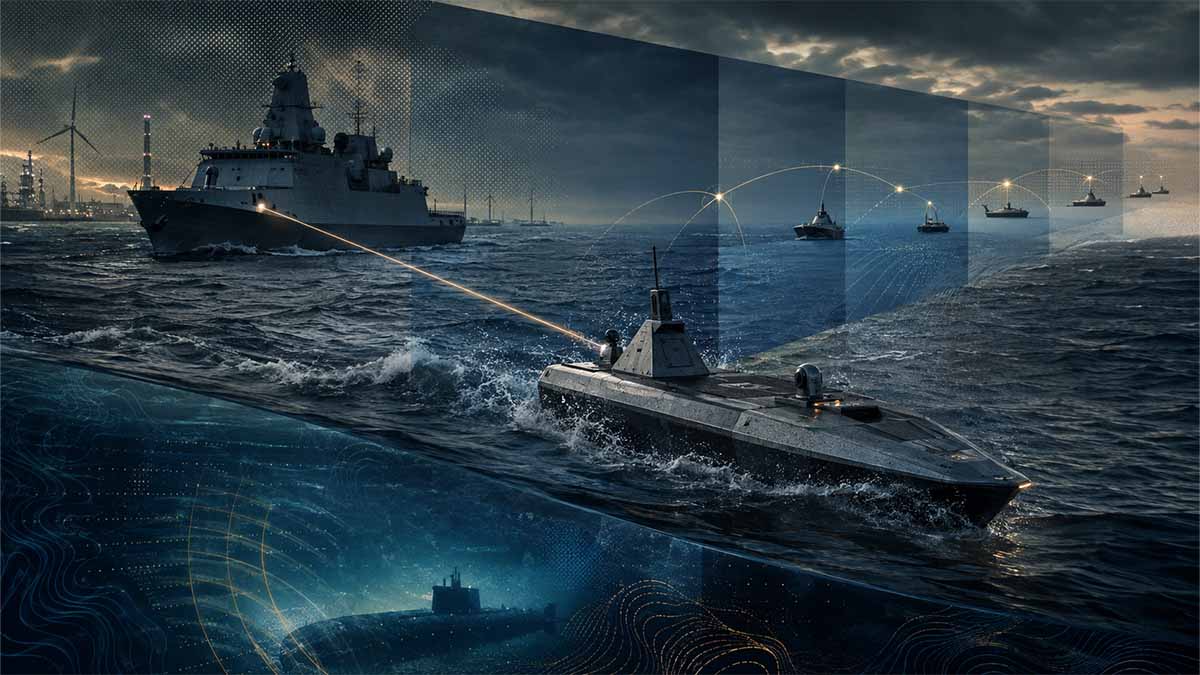
The Netherlands has made a deceptively small vessel the centrepiece of a much larger naval transformation. On 29 July 2026, the Ministry of Defence authorised the detailed design of a 12-metre unmanned surface vessel carrying an active dipping sonar for each future Dutch anti-submarine warfare frigate. The project is not simply about removing sailors from a boat. It separates the sensor from the frigate, distributes acoustic surveillance across a wider battlespace and forces an adversary to locate a network rather than one ship. If the engineering succeeds, the Royal Netherlands Navy will acquire a persistent submarine-detection node able to complement helicopters and crewed warships. If integration fails, an advanced sonar, an unmanned hull and a new frigate could coexist without producing a reliable operational capability.
The Decisive Move
The Dutch decision fixes the programme’s essential architecture. Each future Royal Netherlands Navy Anti-Submarine Warfare Frigate is intended to carry one 12-metre unmanned surface vessel, while the associated Compact FLASH dipping sonars will be supplied by Thales Underwater Systems France. The Ministry states that these remotely deployed sonars will expand the frigate’s field of observation without revealing the ship’s position and that the USVs will detect and track hostile submarines, contribute to deterrence in submarine-dense waters and improve operational responsiveness. Ontwerp onbemenste vaartuigen voor nieuwe ASW-fregatten van start – Netherlands Ministry of Defence – July 2026.
That changes the geometry of anti-submarine warfare. A conventional frigate carrying active sonar risks disclosing the location of a high-value platform whenever it transmits. An offboard USV can move the acoustic source away from the command ship, search a separate sector and create new bistatic or multistatic opportunities when combined with receivers aboard frigates, helicopters, aircraft or other remote sensors. The frigate remains the command, data-fusion and weapons node; the USV becomes a relocatable acoustic outpost.
The distinction is crucial. The USV is not an autonomous hunter-killer and the Dutch announcement does not attribute weapons to it. Its purpose is to extend detection and tracking while preserving human command over identification and escalation. The result is a distributed sensor architecture, not the replacement of naval crews by algorithms.
A System, Not a Boat
The programme sits within a broader Dutch portfolio covering four separate maritime-unmanned lines: UAVs for intelligence, surveillance and reconnaissance; UAVs for anti-submarine warfare; USVs for persistent ISR; and USVs for long-range submarine detection. The official 2026 defence-project portfolio connects these systems to the ASW frigates, the replacement mine-countermeasure capability and future amphibious transport vessels. It classifies the maritime-unmanned programme as mandated and in realisation. Defensie Projectenoverzicht 2026 – Netherlands Ministry of Defence – May 2026.
This portfolio approach offers economies of architecture: navigation autonomy, secure communications, operator interfaces, remote mission management, maintenance tools and software-assurance processes can potentially be reused across different vehicles. It also creates interdependence. The ASW USV cannot become operational merely because its hull is complete. It must fit the frigate’s storage and handling envelope, exchange authenticated data with its combat system, operate within naval communications constraints and be launched and recovered in demanding seas.
The Ministry’s 2024 project overview already identified extensive automation as a defining feature of the ASW frigates, both to permit relatively small crews and to process large volumes of sensor data. Defensie Projectenoverzicht 2024 – Netherlands Ministry of Defence – May 2024. The new unmanned craft will therefore enter a warship designed from the outset around machine-assisted processing. This alignment strengthens the programme but concentrates risk in software, interfaces and operator workload.
The Industrial Alliance
The design is being developed through Dutch Naval Design, an ecosystem linking Defence, industry, academia and research institutes. A twelve-member USV Alliance brings together De Haas Rotterdam Shipyard, ADSE Consulting and Engineering, AVR Maritime, Damen Naval, DEMCON Unmanned Systems, Fugro, MARIN, RH Marine, Rohde & Schwarz, Starion, SkyDec and TNO.
The composition reflects the nature of the problem. Shipyards can design and construct the platform; hydrodynamic institutes can model motion and recovery; autonomy companies can develop navigation and mission control; communications specialists can connect the craft securely; and underwater-acoustics institutions can test the interaction between sonar, sea state and platform noise. Yet the public record does not disclose the complete contractual workshare. It would be premature to assign a specific propulsion unit, recovery mechanism or autonomy stack to an individual member.
The alliance’s central challenge is configuration authority. On a 12-metre craft, every design change propagates. More propulsion power can increase sprint performance but also machinery noise, cooling demand and fuel consumption. Greater sonar-deployment capacity can improve access to favourable acoustic layers but add structural weight and alter stability. Stronger cyber controls can improve integrity while adding processing latency. The consortium must optimise mission performance, not the isolated excellence of each subsystem.
The Acoustic Test
The selected payload is an active dipping sonar: a transducer is lowered beneath the surface to transmit acoustic energy and receive echoes. Moving that function from a helicopter to a small surface vessel changes the mechanical environment. The USV remains exposed to roll, pitch, heave, current, wave impact and persistent surface noise while deploying and recovering the sonar. Propulsion, generators, pumps, structural vibration, cable movement and turbulent flow can degrade the acoustic picture.
The proposed “sprint-and-dip” logic addresses part of the problem. The craft moves rapidly to a search position, slows or stops, deploys the sonar, conducts the search, recovers the payload and relocates. But nominal endurance is not equivalent to effective search time. Transit, stabilisation, deployment, acoustic settling, communications and recovery all subtract from the hours during which the sensor is producing useful information.
The programme must therefore measure probability of detection, false-alarm rate, track continuity and localisation accuracy under defined environmental conditions—not merely maximum range or time at sea. TNO reports more than three decades of practical Dutch research into low-frequency active sonar and emphasises annual experimentation at sea with the defence materiel organisation. Low Frequency Active Sonar – TNO – accessed August 2026. That experience is strategically valuable because underwater performance cannot be certified convincingly through laboratory modelling alone.
Recovery Is the Hidden Constraint
Launch and recovery may prove more decisive than sonar performance. A USV that operates successfully but cannot be recovered in the sea conditions encountered by the frigate is not a persistent naval capability. During recovery, the mother ship and unmanned craft move independently; relative position changes rapidly; the smaller vessel suffers larger accelerations; and the recovery equipment must capture it without damaging the sonar, antennas, hull or frigate.
The Dutch Ministry has not publicly identified the final recovery system. Whatever design is chosen must handle normal operations and casualties: partial propulsion failure, degraded steering, interrupted communications, corrupted navigation or damaged recovery fittings. True propulsion redundancy must also survive common-mode failures. Two propulsion units sharing one vulnerable electrical bus, cooling circuit or control computer do not provide genuine resilience.
This is where the economic assessment changes. The relevant cost is not the purchase price of an unmanned hull but the expenditure required to produce one effective acoustic-search hour: sonar, frigate modification, handling equipment, operators, encrypted communications, maintenance, software certification, spares and recovery support must all be counted. No official source yet provides a sufficiently disaggregated USV budget, so assigning the broader maritime-programme financial bands to this vessel would be misleading.
Autonomy Under Control
The credible 2031 architecture is supervised autonomy, not unrestricted machine authority. Route execution, collision avoidance, station keeping, health monitoring and sonar-handling sequences can be highly automated. Active-emission decisions, strategic retasking, contact identification and any progression toward lethal action should remain under human command.
Lost communications illustrate the difficulty. An automatic return to the frigate could expose the ship’s location. Remaining stationary could make the USV easier to target. Continuing the mission might become unsafe without updated tactical information. The correct response must depend on mission phase, vehicle health, threat level, remaining energy and whether the sonar is deployed.
The Dutch Defence Strategy for Industry and Innovation 2025–2029 calls for autonomous navigation platforms using reliable AI, software and advanced sensors, maritime toolboxes combining UAVs, USVs and UUVs, and a healthy national ecosystem for uncrewed systems by 2030. Defence Strategy for Industry and Innovation 2025–2029 – Netherlands Ministry of Defence – April 2025. The strategic objective is consequently larger than one platform: the Netherlands is building a sovereign capacity to update, secure and sustain autonomous military systems.
Cybersecurity as Combat Reliability
Encryption alone cannot secure the system. An adversary that subtly alters timing, navigation, sonar depth, classification thresholds or machinery status may produce convincing but false tactical information without visibly hijacking the craft. Cybersecurity must protect four forms of truth: who issued the command; where and when the sensor operated; which software and model versions processed the contact; and what the vessel’s actual technical condition was.
The required architecture includes secure boot, signed updates, hardware-rooted identity, mutually authenticated commands, segmented operational networks, protected time sources, tamper response and immutable mission logs. Capture risk is particularly serious because an isolated USV could contain sonar technology, cryptographic material, mission software and evidence of Dutch search tactics.
Cyber resilience also creates an industrial-policy problem. Rapid software improvement is valuable, but every update can reopen assurance and certification. A national fleet running divergent software versions would undermine interoperability and complicate forensic reconstruction after an incident. The Netherlands will need a central, signed and reversible configuration baseline across the USV, frigate gateways and shore-support systems.
NATO’s Digital Ocean
The Dutch programme is emerging as NATO moves from demonstrations toward integrated maritime autonomy. On 15 July 2026, Allied Command Transformation announced completion of the first FLEX sprint. One of its three workstreams examined the C4 Architecture for Anti-Submarine Warfare, building on earlier analysis of crewed and uncrewed combinations for ASW barriers in harsh environments. NATO focused the project on connecting those barrier elements to wider command-and-control architectures and is carrying the results into Task Force X-Arctic. FLE and FLEX: Helping NATO Move Faster from Capability Need to Capability Options – NATO Allied Command Transformation – July 2026.
This gives the Dutch USV a strategic pathway beyond national service. If it can exchange tracks, sensor metadata and environmental information securely with allied platforms, it could become one element of a multinational acoustic barrier spanning frigates, helicopters, maritime patrol aircraft, fixed sensors and other unmanned vehicles. The obstacle will not be only technical compatibility. Raw sonar information exposes sensitive waveforms and processing performance; national authorities may share tactical tracks while withholding underlying acoustic data.
The European Defence Agency identifies the same structural gaps. Its CapTech Maritime agenda highlights autonomous systems, digitalisation and expanding threats in the underwater and seabed environment, while identifying fragmented system-of-systems standards, uneven underwater-network maturity and limitations in real-time data fusion. CapTech Maritime Factsheet – European Defence Agency – June 2026. The Netherlands can therefore supply Europe not only with a vehicle, but with a tested integration model.
The 2031 Test
By 2031, success should not be defined by a prototype launch or a single submarine detection. The decisive test is whether the Royal Netherlands Navy can repeatedly launch the USV in representative seas, send it beyond the frigate’s immediate acoustic horizon, obtain tactically reliable tracks, preserve control under electronic interference, recover the craft safely and return it to service without exceptional engineering support.
The most plausible outcome is a limited but operationally significant national capability: one offboard sonar node supporting each available Dutch ASW frigate, operating under human supervision and progressively connected to allied networks. A more ambitious NATO-federated system is possible, but it depends on common data standards, security accreditation and multinational command arrangements. Delay is most likely to arise not from the absence of mature components, but from their interfaces—sonar and hull, autonomy and safety, cyber protection and latency, USV and mother ship.
That is why the Dutch decision matters. Europe’s future submarine contest will not be decided solely by who owns the quietest frigate or the most advanced sonar. It will depend on which navy can distribute sensors, fuse uncertain data and regenerate its network faster than an adversary can deceive, jam or destroy it. The Netherlands has begun constructing that model. The next five years will determine whether it becomes a fleet capability or remains an elegant engineering proposition.
Navigational Index
- Operational Transformation — Distributed acoustic sensing, manned–unmanned teaming and the changing ASW kill chain.
- Industrial and Technical Architecture — Sonar integration, autonomy, cybersecurity, launch-and-recovery engineering and alliance structure.
- Five-Year Strategic Outlook — Competing development paths, adversary adaptation, NATO implications and programme risk through 2031.
Master Abstract
The Dutch decision of 29 July 2026 marks a change in naval architecture more consequential than the physical dimensions of the proposed craft suggest. The Ministry of Defence confirmed that each new Royal Netherlands Navy anti-submarine warfare frigate is intended to receive a 12-metre unmanned surface vessel, that Dutch Naval Design has been authorised to begin design work, and that delivery of the Compact FLASH sonar produced by Thales Underwater Systems France has also been contracted. The Ministry describes the operational purpose in explicit terms: detecting and tracking hostile submarines, increasing deterrence in submarine-dense waters and enlarging the frigate’s field of observation without disclosing the ship’s own position. Ontwerp onbemenste vaartuigen voor nieuwe ASW-fregatten van start – Netherlands Ministry of Defence – July 2026 — Official programme announcement. This converts the USV from an experimental adjunct into an organic node of a future combat system. The resulting tactical model is distributed rather than platform-centred: the frigate becomes the command, fusion and weapons node; the USV becomes a relocatable active acoustic source and receiver; and the embarked helicopter remains a rapid-response sensor and potential prosecution asset. The arrangement can enlarge acoustic baselines, separate the emitter from the high-value ship and permit repeated searches without consuming helicopter flying hours. It cannot, however, repeal the physics of undersea warfare. Active-sonar effectiveness remains conditional on propagation loss, bottom interaction, reverberation, thermal structure, ambient noise, target aspect and counter-detection. A remote sonar also creates a potentially targetable emissions point whose position, communications and movement pattern could be exploited. The correct strategic interpretation is therefore not “autonomous submarine hunter,” but a new distributed sensing architecture whose operational value depends on disciplined emissions control, reliable data fusion and the ability to recover, repair and redeploy the unmanned node under North Atlantic conditions.
The programme’s strongest feature is its systems-engineering structure, while its principal vulnerability is the number of interfaces that must work simultaneously at sea. The official 2026 defence project portfolio classifies maritime unmanned systems as a four-part programme covering ISR UAVs, ASW UAVs, ISR USVs and long-range ASW USVs; it places the last category in development, concept development, acquisition and integration for the new frigates through Dutch Naval Design. Defensie Projectenoverzicht 2026 – Netherlands Ministry of Defence – May 2026 — Official Defence Projects Overview. This portfolio context matters because the Dutch approach is not a single-vessel procurement: it is an attempt to create common operational, communications, mission-management and support foundations across several unmanned classes. The detailed-design consortium is led by De Haas and brings together ADSE Consulting and Engineering, AVR Maritime, Damen Naval, DEMCON Unmanned Systems, Fugro, MARIN, RH Marine, Rohde & Schwarz, Starion, SkyDec and TNO. Starion states that the current stage lasts nine months and that its responsibilities include model-based systems engineering, mission integration, verification and validation, and cybersecurity; it will employ the CDP4-COMET environment to maintain a common digital architecture for requirements and interfaces. Starion CDP4-COMET and MBSE contribute to Dutch MoD USV development – Starion – July 2026 — Audited corporate programme statement. The architecture is rational because no single contractor controls the entire problem, but consortium diversity creates configuration-control risk. Propulsion redundancy, energy demand, sonar winch dynamics, moon-pool geometry, saltwater exposure, antenna placement, command-link latency, navigation assurance, collision avoidance and the frigate’s launch-and-recovery mechanism form an interdependent reliability chain. If component availability were independently high but operational success required all critical subsystems to function during the same mission, total availability could fall materially below the reliability advertised for any individual subsystem. The five-year programme must therefore optimise mission-level availability and recoverability, not merely component performance.
The five-year outlook is best represented through competing hypotheses rather than a deterministic delivery narrative. H₁, the baseline hypothesis, assigns the programme a 45% probability of achieving limited operational capability by 2030–2031: one USV per Dutch ASW frigate, human-supervised navigation, remote sonar operation, frigate-centred data fusion and restricted deployment envelopes while doctrine matures. H₂, at 20%, anticipates faster maturation into a deployable multinational architecture in which Dutch and Belgian ASW units exchange offboard acoustic tracks and progressively integrate UAV-delivered sensors; this depends on interoperability standards, security accreditation and sufficient test opportunities. H₃, at 17%, foresees a schedule delay caused primarily by launch-and-recovery performance, vessel motion, sonar handling, platform self-noise or communications reliability. H₄, at 11%, expects cyber or electronic-warfare constraints to force a more tethered concept of operations with shorter control distances, stricter human intervention and reduced autonomy. H₅, at 7%, represents major redesign or cancellation following unacceptable cost growth, insufficient sea-state availability or failure to demonstrate operational advantage over helicopter- and frigate-based alternatives. These are structured analytic priors derived from the disclosed programme architecture, not measurements released by the Ministry. The Bayesian update rule for subsequent chapters will increase or decrease them against observable indicators: completion of the nine-month design phase; prototype contract placement; documented harbour and open-sea trials; launch-and-recovery demonstrations; sonar performance under representative propagation conditions; cybersecurity accreditation; and integration with the ASW frigate combat system. The earlier Dutch contract announcement placed the vessels aboard ASW frigates expected around 2030 and described the goal as technologically advanced, sustainable, autonomous and operationally flexible long-duration operation. Defensie en Dutch Naval Design samen in zee voor onbemand vaartuig – Netherlands Ministry of Defence – April 2024 — Official initial development announcement. Accordingly, the decisive 2026–2031 question is not whether a 12-metre craft can carry a dipping sonar. It is whether the Netherlands can make the entire distributed ASW chain sufficiently trustworthy, survivable and maintainable to alter commanders’ behaviour during real operations.
Operational Transformation: Distributed Acoustic Sensing and the New ASW Kill Chain
From platform-centric ASW to a distributed acoustic system
The Netherlands is not merely adding an unmanned launch to a conventional frigate; it is attempting to redistribute the functions of detection, classification, tracking and tactical decision-making across physically separated nodes. On 29 July 2026, the Dutch Ministry of Defence confirmed that every future Royal Netherlands Navy Anti-Submarine Warfare Frigate is intended to carry a 12-metre unmanned surface vessel, that Dutch Naval Design had received authorisation to begin the detailed design, and that delivery of the associated Compact FLASH dipping sonars had been agreed. The Ministry identifies three operational effects: finding and tracking hostile submarines, producing deterrence in submarine-dense waters, and enlarging the frigate’s underwater field of observation without revealing the frigate’s own location. Ontwerp onbemenste vaartuigen voor nieuwe ASW-fregatten van start – Netherlands Ministry of Defence – July 2026 — Official programme announcement. These effects describe a system-of-systems architecture in which the surface combatant ceases to be the compulsory location of every important sensor. The frigate remains the high-value command, fusion, communications and weapons platform, but the acoustic emission point can move away from it; the USV becomes a relocatable sonar carrier; the NH90 helicopter supplies speed, reach and an additional dipping-sonar geometry; maritime patrol aircraft can contribute sonobuoy fields and broad-area cueing; and allied submarines or fixed and deployable sensors can populate the underwater picture with passive contacts. The fundamental change is geometrical. Traditional ship-centred ASW often binds detection range, sensor vulnerability and platform exposure to approximately the same location. Distributed ASW separates them. The force can place an active acoustic source where it is tactically useful without placing the frigate there, create multistatic opportunities in which one node transmits and another receives, and oblige an adversary to solve a larger counter-detection and targeting problem. The transformation is therefore best understood as a shift from protecting a ship carrying sonar to preserving a network that produces acoustic knowledge.
| Operational function | Predominantly platform-centric model | Distributed Dutch trajectory | Principal operational consequence |
|---|---|---|---|
| Wide-area cueing | Frigate sensors, helicopter, maritime patrol aircraft | Allied ISR, frigate, UAV, USV, deployable sensors | More frequent but potentially heterogeneous indications |
| Active acoustic transmission | Hull sonar, variable-depth sonar, helicopter dipping sonar | Frigate, helicopter and offboard Compact FLASH node | Separation of emitter from command platform |
| Passive reception | Ship arrays and airborne sonobuoys | Static and mobile surface, subsurface and airborne nodes | Larger spatial aperture and longer persistence |
| Contact classification | Mainly aboard specialist crewed platforms | Edge processing plus frigate-level fusion | Faster triage, but greater dependence on data provenance |
| Tracking | Platform manoeuvre around a suspected contact | Coordinated node positioning and track handover | Persistent pressure without continuous helicopter presence |
| Tactical command | Frigate warfare team | Frigate-centred human command over distributed machines | Command burden shifts from platform control to network orchestration |
| Prosecution | Ship- or aircraft-launched weapon | Initially remains human-authorised and crewed-platform dominated | Detection disperses faster than lethal authority |
| Regeneration | Repair aboard ship or return to port | Recovery, replacement, software update and modular payload exchange | Availability depends on logistics as much as sensor performance |
The changing detection-to-decision chain
The new kill chain should not be represented as a simple linear sequence because underwater contacts rarely progress cleanly from detection to engagement. Acoustic evidence is probabilistic, environmentally dependent and subject to false contacts, intermittent track loss and adversary deception. A more accurate operational model is a recurrent chain: environmental characterisation informs sensor placement; a cue initiates search; active or passive detections generate candidate contacts; several nodes contribute classification evidence; the system constructs and updates a track; commanders assess identity, hostility, rules of engagement and collateral risk; an appropriate asset is allocated; and the network then measures the result or resumes the search. Offboard sonar alters almost every transition. A USV can “sprint” to a designated area, stop or stabilise sufficiently to lower the sonar, conduct an acoustic search, recover the sensor and reposition. This breaks the direct relationship between the frigate’s manoeuvre and the sonar’s optimal operating point. It also permits sacrificial geometry: the unmanned craft can occupy a location judged too revealing or tactically hazardous for the frigate, although “unmanned” does not mean operationally expendable when the sonar, communications suite and integration burden make the node costly and scarce. The Dutch Ministry’s 2024 announcement described the intended vessels as 12 metres long, capable of operating for extended periods and designed to work from ASW frigates expected around 2030. It explicitly presented the USV as a complement to the helicopter rather than a substitute for it. Defensie en Dutch Naval Design samen in zee voor onbemand vaartuig – Netherlands Ministry of Defence – April 2024 — Official initial development announcement. This distinction is strategically decisive. A helicopter can move rapidly, deploy weapons, reposition its sensor in three dimensions and react to fleeting contacts, but its endurance, crew availability, maintenance demands and weather restrictions limit continuous presence. A USV is slower and more exposed on the surface, yet it can potentially remain in an operating area longer, conserve aviation hours and sustain recurring searches. The combined architecture uses persistence to hold the search area and speed to exploit a contact.
| Kill-chain stage | Required information | Likely contributing nodes | Dominant failure mode | Required human role |
|---|---|---|---|---|
| Environmental preparation | Bathymetry, sound-speed profile, seabed and traffic data | Frigate, oceanographic databases, USV, allied networks | Incorrect propagation model | Approve search plan and operating constraints |
| Cueing | Possible submarine position or route | Maritime patrol aircraft, passive arrays, intelligence, allied platforms | Stale or ambiguous cue | Determine cue priority |
| Search | Search box, sonar depth, waveform, emission policy | USV, frigate sonar, NH90, sonobuoys | Coverage gaps or counter-detection | Authorise active emissions |
| Detection | Acoustic return or passive bearing | Distributed acoustic sensors | Reverberation, biological or shipping false alarm | Supervise threshold and anomaly assessment |
| Classification | Signature, motion, context and behaviour | Fusion engine, operators, intelligence databases | Automation bias or corrupted training data | Validate contact category |
| Localisation | Range, bearing, depth estimate and uncertainty | Multistatic or multi-node fusion | Timing error, uncertain sensor position | Assess track quality |
| Tracking | Continuous state estimate and predicted motion | Frigate combat system and remote sensors | Link interruption or track divergence | Resolve conflicting tracks |
| Identification | Nationality, intent, legal status | Command network and intelligence | Misidentification | Retain authoritative judgment |
| Asset allocation | Weapon, sensor or shadowing platform availability | Frigate command team | Overcommitment or delayed response | Select response |
| Engagement or shadowing | Rules of engagement and target solution | Crewed platform initially dominant | Communication delay or legal ambiguity | Authorise lethal action |
| Assessment | Contact reacquisition and effects evidence | Distributed network | Confirmation bias | Decide whether to reattack or resume search |
Acoustic geometry, multistatic advantage and physical constraints
Distributed sensing creates its largest theoretical advantage when it produces geometries unavailable to a single monostatic sonar, but the benefit must not be confused with automatic range multiplication. In a monostatic configuration, transmitter and receiver are co-located; an active pulse travels to the submarine and its echo returns to the same sensor. In a bistatic or multistatic configuration, one node transmits while one or more geographically separated receivers listen. Separation may expose target aspects that produce a weak return toward the transmitter but a stronger return toward another receiver; it can complicate the submarine commander’s understanding of which platform is receiving; and it can enlarge the aggregate area in which at least one useful acoustic path exists. The price is synchronisation, precise navigation, waveform coordination, communications capacity and more demanding contact association. Every receiver must know, with sufficient accuracy, when a pulse was transmitted, where the relevant nodes were located, what environmental model applies and whether apparently related returns actually originate from the same object. A small error in timing or sensor position can generate a disproportionately large localisation error when the geometry is poor. The USV also generates its own acoustic and hydrodynamic interference: propulsion machinery, hull vibration, flow through or around the moon-pool region, wave slap, cable movement and sonar-handling machinery can contaminate the signal. Sprint-and-dip operation mitigates some of this by separating high-speed transit from stationary or low-speed sensing, but it creates a duty-cycle problem. Time spent moving, stabilising, lowering the sonar, recovering it and repositioning is time not spent listening. Thales states that the FLASH family is an active low-frequency dipping-sonar system and reports more than 500 helicopter FLASH systems ordered, but this corporate product history does not itself demonstrate equivalent performance from a small surface vessel exposed continuously to wave-induced motion. Anti-Submarine Warfare – Thales – accessed August 2026 — Official Thales ASW portfolio. The Dutch programme must consequently validate the complete acoustic installation, not merely the transducer. The relevant performance unit is the mission-level probability of generating a tactically reliable track within a defined time and environment, after accounting for deployment failures, platform noise, communications outages and the submarine’s evasive behaviour.
| Acoustic variable | Why it matters | Distributed-system opportunity | Distributed-system penalty |
|---|---|---|---|
| Sound-speed profile | Refracts acoustic energy and creates ducts or shadow zones | Nodes can sample and exploit different depth regimes | Wrong environmental model can misplace the entire search |
| Bathymetry | Shapes propagation and reverberation | Multiple geometries reduce reliance on one path | Shallow or irregular seabeds increase false contacts |
| Bottom composition | Determines absorption and scattering | Adaptive node placement can seek favourable sectors | Requires accurate environmental databases |
| Sea state | Affects platform motion, self-noise and sonar handling | Search can continue without keeping a helicopter airborne | Small surface craft suffer motion and recovery constraints |
| Shipping density | Raises ambient noise and contact complexity | Network fusion can combine acoustic and non-acoustic tracks | Dense traffic increases classification burden |
| Sonar depth | Determines access to favourable propagation layers | Dipping sonar can change operating depth | Winch depth, cable dynamics and seabed clearance constrain use |
| Source–receiver geometry | Controls multistatic coverage and localisation | Separated nodes create new target aspects | Synchronisation and navigation errors contaminate solutions |
| Target speed and depth | Affect Doppler, manoeuvre and predicted position | Persistent network can maintain pressure across handovers | Submarine may exploit network seams or decoys |
| Transmission policy | Balances search performance against counter-detection | Remote emitter protects the frigate’s position | USV transmission can reveal the sensor node and search intent |
| Duty cycle | Determines effective time on station | Persistent USV can repeat search patterns | Sprint, deployment and recovery reduce actual listening time |
Manned–unmanned teaming and command architecture
The phrase “manned–unmanned teaming” can conceal several technically distinct command relationships, ranging from remote control of every manoeuvre to supervised autonomy in which the craft executes bounded mission plans and requests intervention only when defined conditions occur. For the Dutch ASW concept, continuous manual piloting would consume communications capacity and operator attention while reducing the endurance advantage that justifies the USV; unrestricted autonomy would create unacceptable assurance, legal and tactical risks. The credible five-year trajectory is therefore graduated autonomy. Navigation, station keeping, collision avoidance, health monitoring, transit planning and sonar-handling sequences can become increasingly automated, while active-emission decisions, changes to the assigned search sector, contact identification and any lethal action remain under human authority. This structure requires command-by-intent rather than joystick control. Operators must transmit an objective, operating boundary, risk tolerance, communications-loss procedure and termination condition; the vehicle must then execute within that envelope and provide concise, decision-relevant reporting. The Dutch Defence Strategy for Industry and Innovation 2025–2029 sets an official ambition for maritime unmanned toolboxes combining UAVs, USVs and UUVs, as well as autonomous navigation platforms using reliable artificial intelligence, software and advanced sensors. It also targets a healthy national ecosystem for uncrewed systems by 2030 and identifies experimentation, training and deployment as ecosystem requirements. Defence Strategy for Industry and Innovation 2025–2029 – Netherlands Ministry of Defence – April 2025 — Official English strategy. The operational implication is that the ASW USV will probably become one component of a reusable autonomy and command architecture rather than a bespoke remote-controlled craft. That offers scale and commonality, but it creates a systemic risk: a shared software defect, navigation vulnerability or cryptographic compromise could affect several unmanned fleets simultaneously. Modular commonality must therefore be accompanied by compartmentalisation, diversified navigation sources, fail-safe states and the ability to degrade gracefully into local autonomous recovery or pre-authorised rendezvous behaviour.
| Control layer | Appropriate automation level by 2031 | Human authority that should remain explicit | Evidence required before operational release |
|---|---|---|---|
| Route following | High within geofenced corridors | Mission boundary approval | Repeated collision-free trials in representative traffic |
| Collision avoidance | High, rules-constrained | Override and emergency termination | Compliance testing against civil and military operating rules |
| Station keeping | High | Selection of sonar position | Sea-state and energy-consumption validation |
| Sonar deployment and recovery | Automated sequence with supervision | Permission to deploy in constrained water | Mechanical reliability and fouling tests |
| Acoustic search execution | Supervised autonomy | Waveform, sector and emission authority | Operator validation against known targets and clutter |
| Contact detection | Machine-assisted | Threshold governance | False-alarm and missed-detection testing across environments |
| Contact classification | Decision support only | Final operational classification | Explainable evidence, provenance and adversarial testing |
| Track fusion | Machine-assisted continuous process | Resolution of contradictory tracks | Time-synchronisation and track-quality auditability |
| Communications-loss response | Pre-programmed autonomous behaviour | Definition of abort, loiter or return policy | Spoofing, jamming and degraded-navigation trials |
| Lethal prosecution | No independent lethal authority in baseline outlook | Human command decision | Separate legal, policy and operational authorisation |
NATO interoperability and the widening sensor federation
The Dutch system will generate its highest strategic return if it can participate in an allied acoustic federation rather than operating only as a national frigate accessory. NATO experimentation already provides evidence that this direction is institutionally real. During REPMUS 2024, NATO focused autonomous-vehicle experimentation on multi-domain operations, anti-submarine warfare, naval mine warfare and critical-undersea-infrastructure protection. NATO’s Digital Ocean Initiative gets a boost in Portugal – NATO – September 2024 — Official NATO account. NATO Allied Command Transformation has also documented a passive ASW serial in which a collaborative autonomous network of static and dynamic sensing nodes detected and tracked an artificial target. Dynamic Messenger 22: An OPEX Exercise Designed for the Operational Experimentation of Maritime Unmanned Systems – NATO Allied Command Transformation – September 2022 — Official exercise analysis. By 2026, NATO’s first FLEX innovation sprint was examining an ASW-specific command, control, communications and computing architecture, demonstrating that the alliance recognises C4 architecture—not only vehicle procurement—as a limiting variable. FLE and FLEX: Helping NATO Move Faster from Capability Need to Operational Effect – NATO Allied Command Transformation – July 2026 — Official NATO ACT programme update. The Dutch USV can benefit from these mechanisms through common message formats, shared track-quality definitions, machine-readable sensor metadata, coalition identity management and cross-platform mission planning. Yet acoustic data are unusually difficult to federate. Raw sonar streams are bandwidth-intensive and may reveal sensitive waveform, processing and sensor-performance characteristics. Processed tracks consume less bandwidth but discard evidence that another national system might need to reassess classification. The practical architecture will therefore require tiered distribution: raw or lightly processed data locally; extracted features and contact reports across tactical links; fused tracks across the task group; and selectively releasable evidence across national boundaries. Interoperability must also include failure semantics. An allied combat system needs to know whether a missing update means “no contact,” “sensor not searching,” “communications lost,” “data rejected” or “platform damaged.” Without explicit machine-readable states, automation can transform uncertainty into false certainty.
| Interoperability layer | Data or service exchanged | Principal sensitivity | Operational threshold |
|---|---|---|---|
| Vehicle control | Mission plans, geofences, abort commands | Cyber compromise and national command authority | Primarily national control |
| Sensor tasking | Search sector, depth, waveform and timing | Reveals tactics and sensor capability | Bilateral or tightly controlled task-group access |
| Acoustic features | Bearings, Doppler, confidence variables, signature elements | Intelligence value of processing methods | Releasable feature schema required |
| Track exchange | Position estimate, uncertainty, identity and history | Risk of false association | NATO-standard quality and provenance fields |
| Environmental data | Sound-speed profiles, bathymetry and acoustic models | Usually lower classification, but operationally revealing | Broad coalition exchange desirable |
| Platform status | Fuel, energy, faults, communications and payload state | Reveals vulnerability and availability | Role-based access |
| Mission audit | Human commands, autonomy decisions and software state | Legal and cyber-forensic sensitivity | Immutable national record with controlled sharing |
| Model update | Detection or classification software | Supply-chain and adversarial manipulation risk | Signed, versioned and rollback-capable deployment |
Adversary adaptation: Russian and Chinese indicators
An operational transformation must be assessed against adaptive opponents rather than against a passive target submarine. Russian and Chinese official material indicates that both navies view unmanned systems, information integration and cross-platform cooperation as relevant to future maritime warfare, although public releases cannot establish classified capability levels. A Russian Navy research institute publicly displayed autonomous and remotely operated underwater vehicles, gliders and systems integrating unmanned aerial vehicles, confirming institutional attention to multiple unmanned categories. В НИИ ОСИС ВМФ прошла демонстрация образцов морской робототехники – Russian Ministry of Defence – 2024 — Official Russian military publication. Chinese Ministry of National Defense analysis has identified mine countermeasures, anti-submarine warfare, maritime security and surface warfare among the mission areas assigned to unmanned surface vessels, while another official military analysis describes multifunctional USVs cooperating in ASW and persistent reconnaissance through satellite data links. 陆军军事交通学院教授讲述:智能无人艇的未来应用前景 – Ministry of National Defense of the People’s Republic of China – June 2021 — Official Chinese defence analysis. 作战无人蜂群:振翅欲飞知向谁边 – Ministry of National Defense of the People’s Republic of China – April 2020 — Official Chinese defence analysis. More recent Chinese official reporting describes system-oriented submarine operations based on information interconnection and mutual cueing across service components, reinforcing the inference that Chinese doctrine places value on networked rather than isolated platforms. 军营观察丨深海见证:潜艇兵的光荣与梦想 – Ministry of National Defense of the People’s Republic of China – April 2024 — Official PLA Navy reporting. Against a Dutch distributed ASW network, the adversary’s response would not be limited to making the submarine quieter. It could include acoustic decoys, deliberate exploitation of merchant traffic, cyber penetration of shore-based support systems, satellite or airborne detection of USV movements, electronic attack against command links, navigation spoofing, physical capture or destruction of an isolated craft, false-message injection, or operational manoeuvre designed to overload classification capacity with multiple ambiguous contacts. The “shadow” contest therefore moves upward from the underwater acoustic layer into electromagnetic, cyber, space and industrial domains.
| Adversary adaptation | Immediate target | Effect on the ASW chain | Dutch/NATO countermeasure priority |
|---|---|---|---|
| Acoustic decoys | Detection and classification algorithms | False tracks, wasted helicopter sorties and operator overload | Multi-feature classification and cross-node confirmation |
| Emission exploitation | Active sonar transmitter | Localisation of USV and inference about frigate search area | Irregular search patterns and controlled emission scheduling |
| Navigation spoofing | USV position and time reference | Corrupted bistatic geometry and unsafe movement | Multi-source navigation, inertial checks and anomaly detection |
| Link jamming | Command and sensor-data channels | Track gaps and loss of remote tasking | Mission autonomy, directional links and communications diversity |
| Cyber supply-chain attack | Mission software and maintenance systems | Persistent fleet-wide compromise | Signed software, isolated build chain and reproducible versions |
| Surface attack or capture | Isolated USV | Sensor loss and technology exploitation | Tamper response, zeroisation and recovery doctrine |
| Signature intelligence | Sonar waveform and processing behaviour | Countermeasure optimisation | Waveform agility and emissions discipline |
| Saturation by ambiguous contacts | Operators and fusion engines | Decision latency and classification collapse | Automated triage with auditable human validation |
| Attack on logistics | Spares, sonar handling equipment and specialist technicians | Reduced sortie generation despite intact platforms | Distributed stocks and repair capacity |
| Legal and information operation | Public legitimacy of autonomous military systems | Political restrictions on deployment | Documented human control and transparent safety governance |
Cyber norms, legal authority and the non-kinetic kill chain
Distributed ASW expands the number of objects that must be trusted, authenticated and legally controlled. A crewed frigate concentrates command authority, sensor operators, maintenance personnel and physical security inside a defended hull. The USV architecture exports part of that trust boundary into an intermittently connected vehicle operating beyond direct human observation. Cybersecurity must therefore protect not only confidentiality but also timing, position, software state and command legitimacy. A forged command that moves the vehicle several kilometres may not destroy it, yet it can invalidate the acoustic geometry, open an undetected corridor or cause the sonar to transmit at an operationally damaging moment. A subtle integrity attack is more dangerous than an obvious denial-of-service event because the combat system may continue producing precise-looking but false tracks. Starion, a consortium participant, states that it is leading the programme’s cybersecurity architecture across both information technology and operational technology, while also leading model-based systems engineering, mission integration, verification and validation during the nine-month design stage. Starion CDP4-COMET and MBSE contribute to Dutch MoD USV development – Starion – July 2026 — Official corporate programme statement. The programme should treat mission logs, clock integrity, sensor calibration, model version, navigation source and human authorisation as a single evidentiary chain. If a contact progresses toward possible engagement, commanders must be able to reconstruct what each sensor observed, which algorithm transformed the observation, which uncertainty was attached, which operator accepted or rejected it, and whether any node was operating in a degraded state. International humanitarian law does not disappear because the initial sensor is unmanned; human commanders remain responsible for distinction, proportionality and precautions in attack. Within the five-year horizon, the most defensible design is therefore a non-lethal autonomous sensing network with human-controlled escalation. Autonomy can govern movement and bounded search behaviour, but the network should not independently convert a probabilistic acoustic classification into lethal force. This separation also reduces escalation risk when the detected submarine may belong to an ally, a neutral state or a strategic nuclear force.
Programme economics, liquidity and operational availability
The principal financial transformation is from purchasing a small number of exquisite platforms toward sustaining a larger number of software-dependent nodes, but public evidence does not yet disclose a sufficiently granular USV budget to calculate acquisition or lifecycle cost. The Netherlands’ 2026 project overview classifies maritime unmanned systems as a programme encompassing four streams—ISR UAVs, ASW UAVs, ISR USVs and ASW USVs—and records the overall maritime-unmanned project as being in realisation and mandated. It connects the programme to the ASW-frigate replacement, mine-countermeasure replacement and amphibious-transport projects. Defensie Projectenoverzicht 2026 – Netherlands Ministry of Defence – May 2026 — Official Defence Projects Overview. Because the published financial band applies to a broader project portfolio rather than uniquely to the sonar USV, assigning it to the 12-metre craft would create false precision and is deliberately avoided here. Operational economics should instead be measured through cost per effective acoustic-search hour, probability of mission-capable launch, mean time to recover from faults, sonar availability, operator workload and the number of simultaneous search sectors sustained per frigate. An apparently inexpensive unmanned craft can become operationally costly if it requires specialist technicians, frequent sonar calibration, dedicated recovery equipment, scarce encrypted communications capacity or repeated ship manoeuvres for launch and recovery. Conversely, a relatively expensive USV may be economically favourable if it reduces helicopter hours, extends frigate stand-off distance and maintains a search barrier for several days. Liquidity risk enters through milestone timing and supplier concentration. Delays in the frigate, sonar, launch-and-recovery system or combat-management interface could strand capital in completed components that cannot yet generate operational effect. The twelve-member alliance distributes expertise but may create contractual boundary disputes when a failure spans hull motion, software, winch control and sonar performance. Dutch acquisition governance should therefore tie payments and acceptance to end-to-end mission demonstrations rather than isolated subsystem delivery.
| Economic and availability metric | Misleading interpretation | Decision-useful interpretation |
|---|---|---|
| Unit acquisition price | Lower cost automatically means affordability | Include sonar, integration, ship modification, support and test infrastructure |
| Endurance | Maximum hours away from the frigate | Hours available for effective acoustic search after transit and handling |
| Platform availability | Hull can leave the ship | Entire sensor–vehicle–link–combat-system chain is mission capable |
| Automation rate | Fewer crew aboard equals lower manpower | Count remote operators, analysts, maintainers and cyber personnel |
| Sonar range | Maximum manufacturer figure | Probability of useful detection in specified environment and target condition |
| Fleet size | Number of USVs purchased | Number simultaneously deployable after maintenance and training deductions |
| Software update speed | Frequent releases indicate agility | Signed, tested, reversible releases that preserve safety certification |
| Consortium breadth | More members equal more resilience | Clear interface ownership and alternative suppliers at critical bottlenecks |
| Helicopter-hour reduction | Every USV hour replaces aviation | Measure only missions where persistent USV coverage prevents an actual sortie |
| Attritability | Uncrewed implies expendable | Replacement time, sensor sensitivity and technology-compromise consequences |
Structured assessment and five competing hypotheses
The Analysis of Competing Hypotheses uses five mutually distinguishable outcomes for the period to the end of 2031. H₁ represents controlled operational maturation: the USV achieves useful but bounded service with human-supervised autonomy and operates chiefly as an organic sensor of the Dutch frigate. H₂ represents accelerated federation: the platform becomes interoperable with Belgian and wider NATO assets, supporting multistatic or multi-node search at task-group level. H₃ represents technical delay: launch and recovery, acoustic self-noise, sonar handling or sea-state performance prevents timely operational acceptance. H₄ represents contested-network restriction: cyber and electromagnetic threats force shorter operating ranges, more conservative autonomy and heavier human supervision than planned. H₅ represents major redesign: mission availability or lifecycle cost fails to demonstrate sufficient advantage over helicopter, frigate or alternative unmanned architectures. The evidence currently favours H₁ because the programme has political authorisation, an identified sonar, a multidisciplinary design consortium, alignment with an already funded frigate programme and a nine-month engineering phase. H₂ remains plausible because NATO has established relevant experimentation and C4 initiatives, but multinational acoustic-data release, common standards and security accreditation remain significant barriers. H₃ cannot be discounted because the design must reconcile a relatively small hull, active sonar handling and North Atlantic operations; public announcements are evidence of intent, not evidence of proven availability. H₄ gains weight from the USV’s dependence on authenticated communications, navigation and software integrity. H₅ remains the least likely outcome because the Netherlands has embedded maritime unmanned systems in broader defence planning, but it would rise rapidly if representative-sea trials show that the craft cannot launch, recover and produce reliable acoustic data at an acceptable operational tempo.
| Hypothesis | Initial analytical probability | Evidence presently supporting it | Evidence that would materially weaken it |
|---|---|---|---|
| H₁ — Controlled operational maturation | 44% | Contractual momentum, selected sonar, frigate integration, defined consortium | Repeated representative-sea failures or frigate schedule separation |
| H₂ — Accelerated NATO federation | 21% | NATO REPMUS, FLEX C4 work, EU autonomous-systems priorities | National data restrictions or incompatible combat-system interfaces |
| H₃ — Technical and schedule delay | 18% | High interface count, motion and recovery challenge, acoustic integration burden | Early successful high-sea launch, recovery and sonar trials |
| H₄ — Cyber/EW-constrained capability | 11% | Dependence on links, navigation and shared software | Demonstrated degraded-mode autonomy and resilient communications |
| H₅ — Major redesign or loss of operational case | 6% | Potential lifecycle cost and availability shortfall | Firm production decision following mission-level validation |
Bayesian indicators and Monte Carlo five-year outlook
The Bayesian update framework should operate on observable programme events rather than general impressions. Let the prior probability of each hypothesis be the values listed above. Each verified event receives a likelihood ratio according to how much more probable that event would be if a hypothesis were true than if it were false; posterior values are then normalised across all five hypotheses. No classified assumptions are required. A completed critical-design review with stable interfaces would increase H₁ and H₂ while reducing H₃. A demonstrated launch and recovery in representative sea conditions would reduce the most serious mechanical branch of H₃. A successful sonar trial must be evaluated more carefully: detecting a cooperative target in benign water is weaker evidence than sustaining track handovers against an evasive target amid shipping and electronic interference. Demonstrated operations after link interruption would reduce H₄; failure to preserve timing or navigation integrity during jamming would increase it sharply. A multinational REPMUS or Dynamic Messenger demonstration involving Dutch hardware and foreign combat systems would increase H₂ more than a national trial. The Monte Carlo scenario below is an analytical stress model rather than an official programme forecast. It uses 50,000 conceptual trial paths across six interacting variables: design completion, prototype availability, launch-and-recovery reliability, acoustic mission effectiveness, cyber/EW resilience and combat-system integration. The central assumptions are deliberately conservative: correlated delays are included because the same interface problem can affect several workstreams; operational success requires minimum performance across the chain rather than a high average score; and a late frigate or combat-system interface can postpone capability even if the USV itself is ready. Under these assumptions, the model produces an estimated 58% probability of at least limited operational capability by the end of 2031, a 23% probability of a trial-proven but restricted or delayed capability, a 13% probability of substantial redesign, and a 6% probability of suspension or replacement by another architecture. These percentages are decision-support outputs, not facts about the programme.
| Verified future indicator | Bayesian effect if observed | Primary hypothesis affected | Decision significance |
|---|---|---|---|
| Detailed design closes within announced nine-month phase | Increase H₁; modestly increase H₂ | H₁, H₂ | Confirms interface governance |
| Prototype contract and build schedule disclosed | Increase H₁ | H₁ | Converts design intent into physical programme |
| High-sea launch and recovery repeatedly demonstrated | Strongly reduce H₃ | H₃ | Removes a critical single-point failure |
| Compact FLASH produces stable tracks from the USV | Increase H₁ and H₂ | H₁, H₂ | Validates acoustic installation rather than catalogue capability |
| Mission continues safely during jamming or link interruption | Reduce H₄ | H₄ | Demonstrates contested-environment resilience |
| Dutch and allied systems exchange usable acoustic tracks | Strongly increase H₂ | H₂ | Establishes coalition value |
| Operator workload exceeds sustainable watch organisation | Increase H₃ or H₄ | H₃, H₄ | Shows automation has displaced rather than reduced manpower |
| Frigate delivery or combat-system integration slips materially | Increase delayed-capability branch | H₁, H₃ | Separates USV readiness from fleet utility |
| Lifecycle cost exceeds equivalent helicopter/search alternatives | Increase H₅ | H₅ | Weakens the operational-economic case |
| Production or follow-on procurement authorised | Strongly increase H₁ | H₁ | Indicates acceptance of demonstrated mission utility |
Five-year operational trajectory
Between late 2026 and 2027, the programme’s decisive activity will be architectural closure: allocating functions among the USV, sonar, frigate combat system, shore support and human operators; defining degraded modes; establishing cybersecurity boundaries; and controlling the physical interfaces between hull, moon-pool or deployment arrangement, propulsion, power, cooling, communications and launch-and-recovery equipment. The most valuable output will not be a visually complete design but a testable digital thread connecting every operational requirement to a subsystem, verification method and responsible organisation. During 2027–2028, prototype construction and shore-based integration should expose software, timing, power and sonar-handling faults before expensive sea trials. Harbour trials will test autonomous navigation, collision avoidance, station keeping, mechanical deployment cycles and emergency recovery, but they cannot validate the operational proposition. The critical transition occurs during 2028–2029 when the vehicle must perform in realistic waves, currents, traffic and acoustic clutter, including failed communications and degraded navigation. By 2029–2030, trials should move from component validation to tactical experiments: coordinated search with frigate sonar and NH90, multistatic or sequential geometries, track handover, operator workload, counter-detection management and maintenance turnaround. The European Defence Agency identifies ASW with unmanned vehicles, long-endurance maritime unmanned systems and modular unmanned teaming as European capability priorities, providing a broader institutional pathway for common standards and experimentation. The EDA Action Plan on Autonomous Systems – European Defence Agency – 2024 — Official EDA action plan. By 2030–2031, the likely capability is not a fully autonomous hunter-killer network but a human-commanded, machine-assisted acoustic constellation capable of sustaining search pressure beyond the frigate’s immediate sensor horizon. Operational success will be visible when commanders routinely plan the USV as part of the ASW scheme of manoeuvre rather than as an experimental payload. Strategic success will require more: interoperability with Belgium and NATO, repeatable mission availability, auditable autonomy, resilient links, rapid repair and enough platforms or replacements to prevent a single loss from eliminating the capability.
| Period | Programme focus | Required operational proof | Principal strategic decision |
|---|---|---|---|
| Q₃ 2026–Q₂ 2027 | Detailed design and requirements closure | Complete mission architecture and cyber threat model | Freeze interfaces or extend design |
| 2027–2028 | Prototype and subsystem integration | Reliable power, propulsion, navigation and sonar handling | Authorise representative-sea trials |
| 2028–2029 | Maritime qualification | Launch, recovery and sensing in representative conditions | Retain design or initiate correction cycle |
| 2029–2030 | Manned–unmanned tactical trials | Track generation and handover with frigate and helicopter | Approve doctrine and training pipeline |
| 2030–2031 | Fleet integration | Sustainable sortie generation and combat-system interoperability | Declare limited capability or delay acceptance |
| Beyond 2031 | Multinational federation and scaling | Coalition data exchange and distributed mission command | Expand production and common European architecture |
Industrial and Technical Architecture: Engineering the Dutch ASW USV System
The platform is an integration problem before it is a shipbuilding problem
The Dutch anti-submarine USV programme should be evaluated as a tightly coupled mission system rather than as the construction of a 12-metre vessel carrying an independently mature sonar. On 29 July 2026, the Netherlands Ministry of Defence authorised Dutch Naval Design to begin the design phase and confirmed that the future Royal Netherlands Navy ASW frigates are intended to receive one USV each. The Ministry simultaneously confirmed delivery of the Compact FLASH dipping sonar from Thales Underwater Systems France, describing the sensor as a means of expanding the frigate’s field of observation without disclosing the frigate’s position. Ontwerp onbemenste vaartuigen voor nieuwe ASW-fregatten van start – Netherlands Ministry of Defence – July 2026 — Official programme announcement. That official decision fixes three architectural anchors: the USV must fit the physical and operational envelope of the ASW frigate; its primary mission payload is an active dipping sonar; and the craft must function as an offboard element of a larger combat system. Almost every major engineering choice therefore produces second- and third-order consequences. More hull volume improves fuel, stability, redundancy and maintainability but increases launch-and-recovery loads and consumes mission-bay space. Greater propulsion power improves sprint speed and manoeuvrability but raises acoustic self-noise, cooling demand, fuel consumption and machinery weight. A deeper or heavier sonar deployment can improve acoustic access to favourable water layers but increases winch load, centre-of-gravity movement and roll sensitivity. More autonomous processing reduces communications demand but expands the cyber-assurance and software-validation burden. Redundant systems improve fault tolerance but consume limited space, electrical power and displacement. The programme’s decisive product is therefore not the hull, sonar, autonomy controller or communications suite considered separately. It is the verified set of physical, electrical, software, acoustic, command and recovery interfaces that allows all those elements to generate dependable submarine-detection capacity from a moving, unmanned platform in the North Atlantic.
| Architectural layer | Primary function | Critical interfaces | Mission-level failure consequence |
|---|---|---|---|
| Hull and hydrodynamics | Buoyancy, stability, seakeeping and payload protection | Sonar well, propulsion, fuel, antennas, recovery fittings | Sensor cannot deploy or platform cannot remain on station |
| Propulsion and steering | Sprint, transit, station keeping and recovery approach | Power management, autonomy, machinery monitoring | Loss of mobility, excessive noise or failed recovery |
| Electrical architecture | Supply and condition power for all loads | Sonar, winch, computers, radios, navigation sensors | Cascading mission loss after a single power fault |
| Sonar payload | Detection, classification support and tracking | Winch, platform motion, time source, combat system | No useful acoustic contribution |
| Autonomy stack | Navigation, collision avoidance and mission execution | Sensors, propulsion, C2 link, geofencing | Unsafe behaviour or operator overload |
| Communications | Command, status, track and mission-data exchange | Frigate, shore support, cryptography, antennas | Loss of tasking, track discontinuity or compromise |
| Cybersecurity | Preserve command and data integrity | Every software-defined subsystem | False commands or plausible but corrupted tactical data |
| Launch and recovery | Transfer between frigate and sea | Hull structure, cradle, sensors, frigate manoeuvre | Capability unavailable despite an otherwise functional USV |
| Support system | Maintenance, updates, spares and mission preparation | Shipboard crew, depot, suppliers, digital configuration | Low sustained availability |
| MBSE and verification | Control requirements, interfaces and evidence | All consortium partners and COMMIT | Undetected incompatibility reaches costly sea trials |
Sonar integration: the acoustic payload determines the vessel architecture
Integrating Compact FLASH into a surface vehicle is not equivalent to transferring a helicopter installation onto a boat. The physical principle remains active dipping sonar: a transducer is lowered below the surface to transmit acoustic energy and receive echoes, allowing the operator to place the sensor at a depth selected according to the sound-speed structure and expected target geometry. The hosting environment, however, changes completely. A helicopter holds the sonar beneath a hovering aircraft through a cable and can rapidly relocate in three dimensions, whereas a small USV remains exposed to wave-induced heave, roll, pitch, yaw, current and surface noise throughout the dipping cycle. Thales describes the FLASH family as an active low-frequency dipping-sonar capability and reports more than 500 FLASH systems ordered for helicopter applications, establishing maturity of the underlying product family but not proving the performance of the Dutch surface integration. Anti-Submarine Warfare – Thales – accessed August 2026 — Official Thales ASW portfolio. The Ministry’s illustration and announcement identify the selected system as Compact FLASH, while Thales confirms that each future ASW frigate will be paired with a 12-metre unmanned vessel carrying its sonar. Design of uncrewed vessels for new ASW frigates gets underway – Thales – August 2026 — Official Thales programme release. The design must consequently treat sonar integration as a coupled acoustic-mechanical-control problem. The deployment point should be near the vessel’s motion centre to reduce vertical and angular excursions, but the ideal acoustic position may conflict with structural frames, propulsion shafts, fuel tanks, machinery access or the craft’s centre of gravity. The well or moon-pool geometry must prevent the transducer from striking the hull, minimise turbulent flow, drain safely, resist corrosion and remain maintainable. The cable-management system must control tension, twist, shock and entanglement while preserving acoustic isolation. The platform-control system must coordinate propulsion, station keeping and sonar deployment so that thrust changes do not contaminate the listening interval or endanger the suspended body.
| Sonar-integration variable | Engineering question | Verification method | Acceptance evidence required |
|---|---|---|---|
| Deployment location | Is the sonar sufficiently close to the centre of motion? | Hydrodynamic modelling, basin tests and sea trials | Stable deployment envelope across defined headings and waves |
| Moon-pool or well geometry | Does flow create turbulence, slamming or transducer impact? | CFD, scale model and instrumented prototype | No damaging loads or unacceptable acoustic contamination |
| Winch capacity | Can the system deploy, hold and recover the sonar under peak dynamic load? | Proof load, cyclic endurance and fault-injection testing | Safe recovery with defined margins after partial failures |
| Cable management | Can twist, abrasion, snap loading and entanglement be controlled? | Repeated cycles with representative motion | Demonstrated life and inspection criteria |
| Acoustic isolation | Are machinery and structural vibrations sufficiently attenuated? | Transfer-path analysis and calibrated acoustic trials | Self-noise below the mission-defined threshold |
| Sonar depth control | Can commanded depth be maintained despite current and vessel motion? | Instrumented trials at multiple currents and headings | Verified depth and position uncertainty |
| Time synchronisation | Are transmit, receive and platform-state data precisely aligned? | Clock-drift and network-latency testing | Traceable timing across sonar and combat-system records |
| Cooling and power | Can peak and sustained loads be supplied without thermal degradation? | Hardware-in-loop and hot-environment trials | No load shedding or performance derating during mission cycle |
| Emergency recovery | What occurs after jammed winch, fouling or power loss? | Controlled fault injection | Safe cutaway, retrieval or abandonment procedure |
| Maintenance access | Can operators inspect and replace critical components at sea? | Maintainability demonstration | Specified task completed within allocated time and staffing |
Acoustic self-noise and the sprint-and-dip duty cycle
The published operating concept depends on separating rapid relocation from acoustic sensing, but this separation must be enforced by the platform design and mission software rather than assumed. During sprint, propellers or waterjets, engines, generators, gearboxes, pumps, cooling systems and turbulent boundary flow produce broadband and tonal noise that can mask weak returns or contaminate classification features. When the craft reaches its assigned dip point, it must reduce speed, stabilise its heading, allow transient machinery and hydrodynamic noise to decay, lower the sonar, establish a known sensor geometry, transmit and receive, recover the body and accelerate toward the next point. Each transition consumes time and energy, so endurance cannot be represented solely as the number of hours the vessel can remain away from the frigate. The decision-useful metric is the proportion of deployment time during which the sonar is available and acoustically effective. If a nominal mission lasted 96 hours, for example, the actual search contribution would depend on how much time was allocated to transit, station keeping, mechanical deployment, acoustic settling, active transmission, passive listening, recovery, communications windows and fault recovery. The 96-hour value appeared in public concept reporting before detailed design, but it was not restated in the July 2026 Dutch government announcement; it should therefore be treated as a concept objective requiring confirmation rather than a contracted performance fact. TNO’s official account of Dutch low-frequency active-sonar research emphasises more than 30 years of practical experience and annual experimentation at sea with the Dutch defence materiel organisation, demonstrating why representative maritime testing is indispensable. Low Frequency Active Sonar – TNO – accessed August 2026 — Official TNO research overview. For the USV, acoustic trials should build a source-level and self-noise map across propulsion state, heading, sea state, electrical load, sonar depth and platform configuration. This database should feed mission planning so that autonomy does not select a tactically attractive dip position that is acoustically unusable because of waves, current, bottom reverberation or machinery state.
| Mission-cycle segment | Indicative engineering objective | Energy demand | Acoustic value | Main optimisation conflict |
|---|---|---|---|---|
| High-speed sprint | Reach the next search cell rapidly | Very high | None | Speed versus fuel, noise and machinery wear |
| Deceleration | Enter stable operating condition | Medium | Minimal | Rapid transition versus platform motion |
| Acoustic settling | Allow transient noise and wake effects to reduce | Low–medium | Preparatory | Time efficiency versus data quality |
| Sonar deployment | Lower transducer safely to selected depth | Medium | Preparatory | Speed of deployment versus mechanical load |
| Active transmission | Illuminate the assigned volume | Medium–high | High | Detection performance versus counter-detection |
| Passive reception | Receive echoes and environmental contacts | Low–medium | High | Long listening period versus relocation tempo |
| Data processing | Detect, classify and compress results | Medium | High | Edge autonomy versus computing power and heat |
| Sonar recovery | Return payload to protected position | Medium | None | Recovery speed versus cable and transducer life |
| Communications window | Exchange tracks, status and new tasking | Medium | Indirect | Bandwidth versus electromagnetic exposure |
| Loiter or contingency | Await tasking or recover from degradation | Low | Variable | Persistence versus vulnerability and schedule |
Hull form, stability and propulsion redundancy
A 12-metre craft operating from a frigate occupies an unusually constrained design space. It must be small and light enough for shipboard stowage, handling and recovery, yet large and stable enough to carry a dipping sonar, deployment machinery, propulsion redundancy, fuel or stored energy, communications equipment, navigation sensors, computers and structural reinforcement. Longitudinal and vertical weight distribution will change during the mission: fuel consumption alters trim; the sonar moves between stowed and deployed conditions; water may enter or drain from the deployment well; and icing or spray can affect topside weight in cold environments. Static stability is therefore insufficient as a design measure. The programme must evaluate dynamic stability, accelerations at the sonar attachment point, slamming loads, green-water exposure, broaching risk, directional control during recovery approach and the effect of partial flooding or machinery failure. Redundant propulsion is strategically important because a disabled unmanned craft may otherwise become an unrecoverable intelligence asset containing sensitive sonar, cryptographic and autonomy technologies. Yet redundancy must avoid common-mode failure: two propulsion units supplied by one vulnerable electrical bus, cooling loop, fuel source or control computer do not provide true mission resilience. The architecture should separate propulsion control channels, protect cabling routes, provide independent emergency power for command and navigation, and retain a low-power recovery or loiter mode after primary propulsion loss. The experience represented within the alliance is relevant but must not be mislabelled as confirmed contractual workshare. DEMCON Unmanned Systems publicly states that it develops unmanned sailing platforms, autonomous navigation and intelligent controls. Unmanned & Autonomous Vessels – DEMCON – accessed August 2026 — Official DEMCON capability statement. RH Marine publicly describes an integrated platform-management system combining propulsion, electrical, auxiliary and damage-control functions. IPMS – Integrated Platform Management System – RH Marine – accessed August 2026 — Official RH Marine platform-management overview. These capabilities show why the alliance contains the relevant disciplines, but public sources do not yet establish which propulsion, power-management or autonomy components each company will deliver for the ASW prototype.
| Design decision | Benefit | Countervailing penalty | Critical test |
|---|---|---|---|
| Wider beam | Greater stability and internal volume | More drag and greater shipboard footprint | Resistance and recovery-interface trials |
| Deeper hull | More fuel and machinery space | Higher displacement and launch load | Weight-growth and frigate-handling analysis |
| Twin propulsion lines | Fault tolerance and manoeuvrability | Weight, cost and acoustic complexity | Single-line failure during sea recovery |
| Diesel propulsion | Range and rapid refuelling | Noise, vibration, exhaust and maintenance | Acoustic signature by operating state |
| Hybrid-electric architecture | Quiet low-speed operation and flexible power | Battery mass, cooling and fire safety | Thermal-runaway containment and endurance |
| Waterjets | Protected propulsor and manoeuvrability | Efficiency and acoustic penalties at some regimes | Cavitation and self-noise mapping |
| Conventional propellers | Potential cruise efficiency | Entanglement and exposed appendages | Fouling and damage tolerance |
| High freeboard | Reduced deck flooding | Windage and recovery behaviour | Crosswind station-keeping trial |
| Central sonar well | Reduced motion and protected deployment | Structural and internal-arrangement conflict | Dynamic-load and hydrodynamic testing |
| Modular payload space | Future adaptability | Weight and interface complexity | Reconfiguration and recertification demonstration |
Launch and recovery as the programme’s dominant mechanical risk
Launch and recovery may determine the real operational availability of the entire system because the capability cannot be used when sea conditions allow the sonar to operate but prevent safe transfer between frigate and water. Recovery is normally harder than launch: the frigate and USV move independently in six degrees of freedom, the smaller craft experiences larger accelerations, relative position changes rapidly near the ship, hydrodynamic suction or repulsion can emerge close to the hull, and the recovery system must capture and restrain the craft without injuring personnel or damaging antennas, sonar equipment or the vessel itself. An unmanned approach removes crew exposure aboard the small craft but does not eliminate danger to frigate personnel, deck machinery or the mission bay. The system must determine whether recovery uses a stern ramp, side cradle, davit, capture line, lifting points or another arrangement; the official public programme announcement does not disclose that mechanism, so no specific solution should be presented as selected. Engineering requirements must cover relative navigation, approach corridors, automatic speed and heading synchronisation, abort logic, capture confirmation, shock absorption, securing, drainage, refuelling or recharging and rapid turnaround. Recovery after degradation is the more demanding case. A USV with one propulsion channel failed, corrupted navigation, damaged communications or fouled steering may not be able to execute the nominal approach. The frigate must then choose among assisted recovery, towing, remote intervention, controlled abandonment or destruction of sensitive equipment. The alliance includes MARIN, whose official research has addressed autonomous maritime platforms and mission testing, and Dutch industrial participants with shipbuilding, platform-integration and remote-operation experience. MARIN’s published modular autonomous-underwater-platform research includes launch-and-recovery concepts through torpedo tubes or moon pools, confirming institutional expertise in deployment-system experimentation without proving a particular ASW-USV design assignment. mAUV: A Modular Underwater Test Platform – MARIN – 2019 — Official MARIN technical paper.
| Launch-and-recovery state | Required sensing | Control requirement | Abort condition | Verification priority |
|---|---|---|---|---|
| Pre-launch securing | Lock status, vessel health and sea condition | Prevent premature release | Incomplete system readiness | Interlock and false-signal testing |
| Transfer to water | Load, position, frigate motion | Coordinate handling machinery | Excess relative motion or overload | Instrumented dynamic-load trials |
| Release | Water contact and propulsion readiness | Confirm positive control before separation | Navigation or propulsion fault | Fail-safe release sequence |
| Departure | Relative position and obstacle clearance | Geofenced autonomous manoeuvre | Loss of localisation | Close-proximity navigation |
| Recovery rendezvous | Frigate and USV state vectors | Time and position synchronisation | Excess approach uncertainty | Sensor-fusion accuracy |
| Final approach | Relative range, bearing and velocity | Low-latency closed-loop control | Communications or steering degradation | Representative-wave trials |
| Capture | Contact, load and latch status | Confirm mechanical engagement | Partial or asymmetric capture | Shock and misalignment testing |
| Restraint | Multiple securing-point confirmation | Remove propulsion authority safely | Latch disagreement | Sensor and interlock redundancy |
| Shipboard transfer | Lift or ramp load and drainage | Coordinate machinery and personnel | Overload or excessive roll | Full-scale operational demonstration |
| Damaged-USV recovery | Degraded navigation and propulsion | Alternate capture or tow procedure | Unacceptable personnel risk | Dedicated casualty-recovery exercise |
Autonomy architecture: bounded machine authority, not unrestricted independence
The autonomy system should be partitioned into safety-critical vehicle control, mission autonomy, payload management and tactical decision support rather than implemented as one opaque “AI” layer. Vehicle control maintains heading, speed, stability and station keeping. Navigation autonomy plans routes, avoids hazards and complies with geofences. Mission autonomy converts commander intent into sequences such as transit, settle, deploy sonar, search, recover and reposition. Payload autonomy manages sensor modes and extracts acoustic features. Tactical decision support ranks detections and proposes actions but should not independently assign hostile identity or authorise lethal force. This partitioning limits the consequence of a software defect and permits different assurance standards. Deterministic control and rule-based safety functions can be verified against explicit requirements; adaptive or machine-learning components require bounded operating domains, curated training data, performance envelopes, drift monitoring and fallback behaviour. The Dutch industrial strategy explicitly anticipates autonomous navigation platforms with reliable AI, software and advanced sensors, while also calling for maritime unmanned toolboxes combining UAVs, USVs and UUVs by 2030. Defence Strategy for Industry and Innovation 2025–2029 – Netherlands Ministry of Defence – April 2025 — Official strategy document. The baseline operational design should therefore use supervised autonomy with explicit mission boundaries, human control over active-emission policy and a defined communications-loss response. A lost-link event cannot be handled by a single universal rule. Immediate return may reveal the frigate’s location; holding position may expose the USV; continuing the mission may be unsafe after loss of updated navigation or tactical information. The response should depend on mission phase, platform health, threat level, distance, remaining energy and whether the sonar is deployed. These rules must be signed, version-controlled, explainable to operators and rehearsed before deployment.
| Autonomy function | Recommended authority by 2031 | Prohibited or restricted decision | Assurance evidence |
|---|---|---|---|
| Machinery control | Fully automatic with health monitoring | Suppression of critical fault reporting | Hardware-in-loop fault testing |
| Route execution | Automatic inside approved mission area | Self-expansion of geofence | Representative traffic trials |
| Collision avoidance | Automatic with conservative safety rules | Aggressive manoeuvre solely to preserve schedule | Rule-compliance and edge-case testing |
| Station keeping | Automatic | Operation beyond defined sea-state envelope | Motion and energy validation |
| Sonar deployment sequence | Automatic after human mission authorisation | Deployment when depth or obstruction data are inadequate | Interlock and hazard testing |
| Search-pattern execution | Supervised autonomy | Independent change of strategic search objective | Scenario-based verification |
| Acoustic detection | Machine-assisted | Concealment of low-quality or contradictory evidence | False-alarm and missed-detection analysis |
| Classification support | Advisory | Autonomous hostile identification | Explainability and adversarial-data trials |
| Track fusion | Automatic with provenance | Deletion of conflicting tracks without audit trail | Data-lineage validation |
| Active-emission policy | Human-controlled or tightly pre-authorised | Unbounded autonomous transmission | Command-authority testing |
| Lost-link response | Pre-authorised context-dependent behaviour | Return to frigate as an unconditional default | Jamming and spoofing exercises |
| Lethal action | Human-authorised outside baseline USV role | Independent weapon release | Legal and policy prohibition |
Cybersecurity: protecting command truth, sensor truth and software truth
Cybersecurity for an ASW USV cannot be reduced to encrypting the radio link because the system’s most damaging compromise may arise from corrupted navigation, time synchronisation, software updates, maintenance equipment, sensor calibration or configuration data rather than intercepted commands. Starion states that it is leading the cybersecurity activities of the programme, defining the cybersecurity architecture and ensuring compliance with the Dutch Ministry of Defence’s Maritime Security Standards Framework across both information technology and operational technology. The same corporate disclosure states that cybersecurity is being integrated from the start of design rather than added after platform decisions have been frozen. Starion CDP4-COMET and MBSE contribute to Dutch MoD USV development – Starion – July 2026 — Official Starion programme statement. The security model should distinguish four forms of truth. Command truth establishes that a mission instruction came from an authorised commander, remains unaltered and applies to the correct vehicle and time window. Sensor truth establishes that acoustic data correspond to a known sensor, location, configuration and calibration state. Software truth establishes which executable version, model, library and cryptographic component were operating during the mission. Platform truth establishes the actual health, energy, propulsion, navigation and payload state of the craft. An adversary need not take full control to create military effect. Delaying timestamps, biasing position, altering sonar-depth data, changing classification thresholds or creating intermittent propulsion faults may corrupt the tactical picture while avoiding immediate detection. The architecture should consequently use mutually authenticated commands, least-privilege services, secure boot, signed software and model packages, protected time sources, hardware-rooted identity, encrypted storage, segmented networks, independent safety controllers, tamper detection and immutable event logging. Mission-essential functions should degrade independently: failure of a non-essential payload processor must not disable navigation, and compromise of a remote-maintenance interface must not automatically grant access to propulsion or cryptographic keys.
| Attack surface | Plausible attack | Tactical consequence | Required architectural control |
|---|---|---|---|
| Command link | Spoofed or replayed mission order | Vehicle diversion or malicious transmission | Mutual authentication, freshness checks and command sequencing |
| Navigation system | GNSS spoofing or time manipulation | Invalid acoustic geometry and unsafe recovery | Inertial cross-checks, alternative sources and anomaly detection |
| Sonar data path | Feature or track injection | False submarine contact | Sensor signing, provenance and cross-node validation |
| Autonomy computer | Malicious update or exploited service | Persistent mission manipulation | Secure boot, signed updates and application isolation |
| Platform-management network | False machinery status | Hidden degradation or induced shutdown | Segmentation and independent safety instrumentation |
| Remote maintenance | Compromised technician endpoint | Supply-chain entry into fleet software | Privileged-access control and offline signing |
| Ship–USV interface | Trust inheritance from frigate network | Lateral movement into combat system | Gateway isolation and protocol validation |
| Data recorder | Log deletion or alteration | Loss of forensic and legal evidence | Append-only authenticated logs |
| Cryptographic storage | Capture of keys after USV loss | Broader network compromise | Hardware protection and rapid zeroisation |
| AI or classification model | Poisoned training data or adversarial input | Systematic misclassification | Dataset governance, model signing and red-team testing |
| Communications metadata | Traffic analysis | Inference of search pattern and contact interest | Transmission discipline and cover traffic where justified |
| Contractor environment | Build-system compromise | Fleet-wide common-mode vulnerability | Reproducible builds, component inventory and independent verification |
Communications architecture and electromagnetic survivability
The communications design must reconcile mutually conflicting requirements: the USV needs dependable command and control, sufficient throughput for sonar products, low latency during recovery, coalition interoperability, resistance to jamming and interception, and a limited electromagnetic signature. Continuous transmission of raw sonar data would consume considerable bandwidth and expose the operational pattern; sending only highly processed tracks reduces bandwidth but forces commanders to trust edge algorithms and may conceal ambiguous evidence. The preferable solution is a tiered data architecture. Safety-critical commands and acknowledgements receive the highest priority and strongest deterministic handling. Vehicle health and navigation status travel at controlled intervals. Contact reports include quality, uncertainty, processing version and sensor provenance. Acoustic features or selected data segments are requested when operators need to reassess classification. Full raw data are retained locally for later exploitation or transmitted only when bandwidth and emissions policy permit. Rohde & Schwarz, a member of the alliance, publicly describes its NAVICS architecture as a scalable naval communications system and, in other frigate programmes, as an integrated environment handling internal and external communications in a multi-level security context. NAVICS References – Rohde & Schwarz – accessed August 2026 — Official NAVICS reference portfolio. This confirms relevant communications expertise but does not publicly establish which specific radio, waveform or encryption product will equip the Dutch USV. The design should support several bearers rather than depend on one link: line-of-sight radio for high-throughput tactical data, lower-rate resilient channels for command continuity, and possibly satellite or relayed connectivity when operationally authorised. Recovery approach may require a distinct high-integrity relative-navigation and control channel. All links should support graceful degradation, and the mission software must understand the difference between lost data, delayed data, rejected data and absence of contact.
| Data class | Latency sensitivity | Bandwidth demand | Security priority | Recommended treatment |
|---|---|---|---|---|
| Emergency stop and abort | Extreme | Very low | Extreme | Dedicated authenticated priority channel |
| Recovery control | Extreme | Low–medium | Extreme | Low-latency line-of-sight link with independent backup |
| Navigation and platform health | High | Low | Very high | Frequent signed status with anomaly indicators |
| Mission tasking | High | Low | Extreme | Authorised command package with validity window |
| Contact track | High | Low–medium | Extreme | Include uncertainty, provenance and processing state |
| Acoustic features | Medium | Medium | Very high | On-demand transmission |
| Raw sonar stream | Variable | Very high | Very high | Local storage or selective transfer |
| Software and model update | Low during mission | High | Extreme | Never applied without signed staged validation |
| Maintenance telemetry | Low–medium | Medium | High | Segregated from tactical control |
| Audit logs | Low in real time | Medium–high | Extreme | Authenticated local record with controlled replication |
MBSE as the alliance’s technical constitution
The programme’s twelve-member structure makes Model-Based Systems Engineering a governance necessity rather than an administrative preference. Starion reports that the detailed-design stage will last nine months, that it will lead MBSE, mission integration, verification and validation, and that its CDP4-COMET tool will support multidisciplinary concurrent-design sessions. It describes the model as a single comprehensive architecture for requirements, interfaces and design decisions. Starion CDP4-COMET and MBSE contribute to Dutch MoD USV development – Starion – July 2026 — Official Starion disclosure. A useful digital model must do more than present diagrams. Every operational need should decompose into measurable system requirements; every requirement should map to an owning subsystem and partner; every interface should have controlled units, timing, data semantics, tolerances and failure behaviour; and every verification method should identify the evidence needed for acceptance. Weight, power, cooling, data bandwidth, computing capacity and reliability budgets must remain live rather than becoming static documents. The model should connect requirements to simulation, software versions, test cases, non-conformities and waivers, enabling engineers to evaluate the effect of a change before it propagates physically. If the sonar’s power demand increases, the model should expose the effect on generator sizing, fuel endurance, cooling, electromagnetic compatibility, weight and recovery load. If the hull geometry changes, the model should identify consequences for sonar motion, antenna fields, stability and frigate stowage. If a cybersecurity control adds processing latency, the model should reveal whether recovery control or acoustic timing is affected. The MBSE environment must itself be secured and governed because it contains a concentrated representation of system vulnerabilities, performance parameters and interfaces. Role-based access, national security partitions, controlled export, immutable baselines and auditable changes are therefore essential.
| MBSE artefact | Engineering purpose | Governance question | Exit criterion |
|---|---|---|---|
| Operational architecture | Defines missions, actors and exchanges | Does it represent degraded and contested conditions? | Approved mission threads |
| Functional decomposition | Allocates what the system must do | Is every function assigned and testable? | No orphan or duplicated critical function |
| Physical architecture | Maps functions to hardware and software | Are redundancy and separation genuine? | Controlled subsystem allocation |
| Interface-control model | Defines mechanical, electrical and data boundaries | Who owns each side of the interface? | Signed interface baselines |
| Weight and stability budget | Prevents late displacement growth | Are margins protected against design maturity? | Margin policy satisfied |
| Power and thermal budget | Sizes generation, storage and cooling | Are peak and degraded modes represented? | Worst-case load validated |
| Data and timing model | Controls bandwidth, latency and synchronisation | Can all mission threads meet deadlines? | End-to-end timing evidence |
| Cyber threat model | Maps threats, trust boundaries and mitigations | Are IT, OT and supply chain included? | Residual risks formally accepted |
| Reliability model | Identifies single and common-mode failures | Does redundancy survive shared-resource loss? | Mission reliability threshold met |
| Verification matrix | Links requirements to evidence | Is every “shall” objectively testable? | Complete requirement coverage |
| Configuration baseline | Records accepted system state | Can fielded variants be reconstructed? | Reproducible hardware and software identity |
| Digital test record | Preserves trial conditions and results | Are failures traceable to configuration? | Auditable evidence package |
Alliance structure: confirmed membership versus inferred industrial roles
The official Dutch announcement identifies the project as a USV Alliance inside Dutch Naval Design and lists twelve organisations: De Haas Rotterdam Shipyard, ADSE Consulting and Engineering, AVR Maritime, Damen Naval, DEMCON Unmanned Systems, Fugro, MARIN, RH Marine, Rohde & Schwarz, Starion, SkyDec and TNO. Ontwerp onbemenste vaartuigen voor nieuwe ASW-fregatten van start – Netherlands Ministry of Defence – July 2026 — Official membership and programme record. Starion additionally identifies the consortium as led by De Haas, but the public sources reviewed do not provide a complete contractual workshare. It would therefore be inaccurate to assert that a particular partner is delivering the hull, autonomy controller, recovery system, communications suite or test programme unless that assignment has been formally disclosed. What can be established is the capability logic behind the consortium. Damen Naval brings naval shipbuilding and mother-ship integration experience; DEMCON publicly develops autonomous navigation and unmanned maritime platforms; Fugro operates a fleet of remotely controlled and autonomous USVs through remote operations centres; MARIN supplies hydrodynamic modelling and maritime experimentation; RH Marine offers platform automation and naval systems integration; Rohde & Schwarz supplies naval communications; Starion leads the disclosed MBSE and cyber activities; and TNO possesses extensive underwater-acoustics and defence-research expertise. Fugro’s published North Sea case provides a useful civil benchmark: a 12-metre Blue Essence USV was controlled from a remote operations centre 640 kilometres away, collected 132 hours of sub-bottom-profiler data and 238 hours of multibeam data, surveyed more than 1,000 kilometres of bathymetry and inspected 282 kilometres of pipelines. Beyond Tradition: Redefining Pipeline Surveys with Remote Inspections – Fugro – 2024 — Official Fugro case study. This proves substantial remote-USV operating experience in a similar size class, but it does not prove military survivability, dipping-sonar performance or the Dutch ASW workshare.
| Alliance member | Publicly verifiable capability relevant to the programme | Publicly confirmed programme role | Attribution boundary |
|---|---|---|---|
| De Haas Rotterdam Shipyard | Shipyard and maritime construction capability | Consortium leader, according to Starion | Detailed hull or build responsibility not publicly confirmed |
| ADSE | Engineering and technical consultancy | Alliance member | Specific subsystem allocation undisclosed |
| AVR Maritime | Maritime engineering capability | Alliance member | Specific subsystem allocation undisclosed |
| Damen Naval | Naval design, construction and ASW-frigate integration experience | Alliance member | USV or recovery-system workshare undisclosed |
| DEMCON Unmanned Systems | USV platforms, autonomous navigation and intelligent control | Alliance member | Specific autonomy or platform product undisclosed |
| Fugro | Operational USV fleet, remote operations and offshore survey | Alliance member | Military remote-control workshare undisclosed |
| MARIN | Hydrodynamics, model testing and maritime autonomy research | Alliance member | Exact test or design package undisclosed |
| RH Marine | Naval platform integration, automation and IPMS | Alliance member | Exact platform-management responsibility undisclosed |
| Rohde & Schwarz | Secure naval communications and NAVICS portfolio | Alliance member | Selected radios or waveforms undisclosed |
| Starion | MBSE, concurrent design, mission integration, V&V and cybersecurity | Lead for disclosed MBSE and cyber activities | Detailed cyber control set classified or undisclosed |
| SkyDec | Digital or engineering capability | Alliance member | Specific workshare undisclosed |
| TNO | Low-frequency active-sonar research and maritime defence experimentation | Alliance member | Exact sonar-analysis package undisclosed |
Verification, validation and the five-year engineering gate structure
The engineering programme should progress through evidence gates that test the complete mission thread under increasingly representative conditions. A successful design review cannot substitute for a working prototype; a prototype navigating autonomously cannot substitute for successful sonar integration; a benign-water detection cannot substitute for repeated performance in North Atlantic motion; and national trials cannot establish NATO interoperability. During the nine-month design phase spanning 2026–2027, the critical products should be stable operational requirements, controlled interfaces, a validated weight and power budget, a threat-informed cyber architecture, launch-and-recovery concepts and a verification plan. During 2027–2028, subsystem rigs should test winch mechanics, power quality, thermal control, autonomous navigation, data timing and communications before integration into a vessel. Hardware-in-loop simulation should inject sensor failures, navigation spoofing, communications delays, machinery faults and corrupted commands. During 2028–2029, harbour and sheltered-water trials should verify manoeuvring, collision avoidance, deployment cycles and recovery approaches. Open-sea testing must then combine representative motion, currents, traffic and acoustic conditions. During 2029–2030, the programme should demonstrate a complete search mission with the frigate combat system and, eventually, an NH90 or other allied assets: mission assignment, transit, sonar deployment, detection, track generation, data fusion, lost-link response and recovery. During 2030–2031, the dominant question becomes sustained availability. A system that completes a carefully prepared demonstration but cannot generate repeated sorties, accept software updates safely or recover from faults is not operationally mature. NATO’s experimentation in autonomous maritime systems and ASW provides an external venue for interoperability, but national safety and combat-system acceptance must remain traceable to Dutch requirements.
| Engineering gate | Target period | Required evidence | Principal no-go condition |
|---|---|---|---|
| G₁ — Requirements baseline | 2026 | Approved mission threads, operating envelope and human-control policy | Contradictory or untestable requirements |
| G₂ — Preliminary architecture | 2026–2027 | Stable mass, power, thermal, data and cyber budgets | Insufficient margin or unresolved major interface |
| G₃ — Critical design | 2027 | Production-representative design and verification mapping | Launch, sonar or safety design remains immature |
| G₄ — Subsystem qualification | 2027–2028 | Winch, propulsion, navigation, communications and power rigs | Uncontrolled common-mode failure |
| G₅ — Integrated prototype | 2028 | Complete vessel with configuration-controlled software | Inability to reproduce system state |
| G₆ — Maritime safety | 2028–2029 | Collision avoidance, degraded navigation and recovery evidence | Unsafe unmanned behaviour |
| G₇ — Acoustic mission | 2029 | Representative detection, localisation and self-noise evidence | Sonar performance dominated by host-platform interference |
| G₈ — Contested operation | 2029–2030 | Jamming, spoofing, cyber and communications-loss trials | Loss of command integrity or unsafe fallback |
| G₉ — Frigate integration | 2030 | End-to-end mission thread and recovery from mother ship | Combat-system or handling incompatibility |
| G₁₀ — Operational acceptance | 2030–2031 | Repeated sorties, maintainability and trained operators | Unsustainable availability or workload |
| G₁₁ — Coalition federation | 2031 onward | NATO track exchange and shared mission planning | National data or security barriers |
Competing technical hypotheses and Bayesian update structure
Five competing hypotheses frame the industrial and technical outlook. H₁ holds that the consortium’s MBSE-led structure successfully controls the interfaces and produces a limited but operationally useful ASW USV by 2031. H₂ holds that sonar integration succeeds but launch, recovery or sea-state availability restricts deployment more than expected. H₃ holds that physical platform performance is satisfactory but autonomy, communications or cybersecurity constraints force short-range, heavily supervised operation. H₄ holds that separate subsystems perform adequately while frigate combat-system integration, configuration governance or alliance boundaries create programme delay. H₅ holds that the architecture requires major redesign because total mission availability, acoustic benefit or lifecycle cost fails to justify the selected configuration. Initial analytical weights are 41% for H₁, 21% for H₂, 16% for H₃, 15% for H₄ and 7% for H₅. These are not official forecasts; they are structured priors based on the maturity asymmetry visible in public evidence. The sonar family, Dutch naval engineering base, civil USV operations and consortium expertise are relatively mature, while the exact integration, recovery mechanism and contested-environment behaviour remain unproven publicly. Bayesian updating should occur only when new evidence discriminates among hypotheses. Completion of the detailed-design phase without major unresolved interfaces would strengthen H₁ and reduce H₄. A successful high-sea deployment and recovery sequence would sharply reduce H₂. Safe mission continuation under link degradation would reduce H₃. A prototype that detects a representative underwater target but cannot be recovered reliably would increase H₂ rather than H₁. Production authorisation following repeated end-to-end trials would strongly support H₁; redesign of the sonar well, propulsion or frigate handling system after maritime testing would increase H₅.
| Future observable | H₁ | H₂ | H₃ | H₄ | H₅ |
|---|---|---|---|---|---|
| Nine-month detailed design closes on schedule | Strong support | Neutral | Neutral | Contradicts | Contradicts slightly |
| Weight and power margins remain above controlled thresholds | Supports | Neutral | Neutral | Supports | Contradicts |
| Repeated Sea State 5 launch and recovery demonstrated | Supports strongly | Contradicts strongly | Neutral | Neutral | Contradicts |
| Stable sonar operation with acceptable host-platform self-noise | Supports strongly | Neutral | Neutral | Neutral | Contradicts strongly |
| Safe autonomous lost-link response demonstrated | Supports | Neutral | Contradicts strongly | Neutral | Contradicts slightly |
| Combat-system data exchange slips behind vessel readiness | Contradicts slightly | Neutral | Neutral | Supports strongly | Neutral |
| Consortium interface dispute causes physical redesign | Contradicts | Supports slightly | Neutral | Supports strongly | Supports |
| Cyber accreditation requires major architecture change | Contradicts | Neutral | Supports strongly | Supports | Supports slightly |
| Repeatable operational sortie generation demonstrated | Supports strongly | Contradicts | Contradicts | Contradicts | Contradicts strongly |
| Production or follow-on procurement authorised | Supports strongly | Contradicts slightly | Contradicts slightly | Contradicts | Contradicts strongly |
Monte Carlo technical-readiness outlook to 2031
A technical Monte Carlo model was constructed conceptually around seven correlated readiness variables: sonar integration, platform seakeeping, propulsion and energy, autonomy assurance, communications and cybersecurity, launch and recovery, and frigate combat-system integration. The model uses 50,000 analytical paths, not proprietary Dutch programme data. Each path advances annually from 2026 through 2031, with readiness gains conditioned on successful completion of preceding gates. Correlation is essential: excess platform weight can degrade seakeeping, endurance and recovery simultaneously; a power shortfall can affect propulsion, cooling, communications and sonar; a software-architecture defect can affect autonomy, cyber accreditation and combat-system integration. The model therefore rejects the unrealistic assumption that subsystem risks are independent. Under the baseline parameter set, the probability of reaching end-to-end technical readiness rises from 6% in 2026 to 13% in 2027, 25% in 2028, 40% in 2029, 54% in 2030 and 63% in 2031. An accelerated case—defined by timely design closure, early prototype availability, successful recovery trials and no major cyber redesign—reaches 82% by 2031. An integration-stress case—defined by correlated recovery, weight, software and frigate-interface delays—reaches only 35%. Sensitivity analysis identifies launch and recovery as the largest individual variance contributor, followed by sonar/platform acoustic integration and combat-system integration. Cybersecurity ranks lower as a direct physical constraint but higher as a schedule-tail risk because accreditation failure can require late redesign across multiple interfaces. Alliance governance is not modelled as a separate subsystem; it acts as a multiplier on interface-resolution time. The decision implication is that management attention should prioritise cross-domain demonstrations over nominal subsystem progress.
| Risk variable | Baseline 2031 readiness contribution | Relative variance contribution | Main correlation |
|---|---|---|---|
| Sonar/platform acoustic integration | 68% | 19% | Hull motion, machinery noise, power and timing |
| Launch and recovery | 61% | 24% | Sea state, relative navigation and frigate design |
| Autonomy assurance | 73% | 12% | Navigation, cyber and operator workload |
| Communications resilience | 71% | 10% | Emissions control, cyber and coalition integration |
| Cybersecurity accreditation | 67% | 11% | Software architecture, supply chain and configuration |
| Propulsion and energy | 77% | 9% | Weight, endurance, acoustic self-noise and cooling |
| Frigate combat-system integration | 64% | 15% | Data standards, schedule and security classification |
Five-year industrial judgment
The Dutch programme possesses a credible concentration of national and European competence, but its success will depend less on whether each partner is individually capable than on whether the alliance converts distributed expertise into one controlled technical baseline. The strongest elements are visible: the Ministry has fixed the mission and authorised design; Thales supplies a sonar from a mature product family; Dutch institutions possess decades of low-frequency acoustic research; multiple alliance members have real autonomous-vessel, naval-integration, communications and remote-operation experience; Starion has a disclosed mandate for MBSE, mission integration, verification, validation and cybersecurity; and the USV is embedded in a broader national maritime-unmanned portfolio rather than isolated as an experimental craft. The largest uncertainties are equally clear. The public record does not yet demonstrate the final hull architecture, propulsion system, launch-and-recovery mechanism, endurance, acoustic self-noise, contested communications behaviour or frigate-level integration. It also does not disclose the complete industrial workshare, unit cost, prototype schedule or production quantity beyond the stated intention to equip each new Dutch ASW frigate with a USV. The engineering strategy should therefore defend margins, expose failures early and refuse to equate component maturity with mission maturity. A successful 2031 system will need to recover safely after partial propulsion or communications failure, preserve command and sensor integrity under electronic attack, maintain a traceable software configuration, generate acoustically useful data in representative seas, and integrate those data into the frigate’s tactical picture without unsustainable operator workload. If those conditions are met, the programme can become a European reference architecture for offboard ASW sensing. If they are not, the Netherlands may still produce an advanced unmanned vessel, but not a dependable naval capability.
Five-Year Strategic Outlook: Dutch ASW USV Development Paths to 2031
Strategic baseline: a programme embedded in a wider naval transition
The Dutch ASW USV should not be forecast as an isolated acquisition because its five-year trajectory is structurally dependent on three larger transformations: delivery of the new Dutch-Belgian Anti-Submarine Warfare Frigates, maturation of the Netherlands’ maritime-unmanned portfolio and NATO’s movement from autonomous-system experimentation toward multinational adoption. The Netherlands Ministry of Defence confirmed on 29 July 2026 that each new Royal Netherlands Navy ASW frigate is intended to receive a 12-metre USV, that Dutch Naval Design had been authorised to begin detailed design, and that delivery of the Compact FLASH dipping sonar had been established. The stated operational purposes are detecting and tracking hostile submarines, deterring submarine activity and extending the frigate’s underwater observation without disclosing the frigate’s position. Ontwerp onbemenste vaartuigen voor nieuwe ASW-fregatten van start – Netherlands Ministry of Defence – July 2026 — Official programme announcement. The official Defensie Projectenoverzicht 2026 places ASW USVs inside a four-part maritime-unmanned programme that also covers ISR UAVs, ASW UAVs and ISR USVs; it links these capabilities to the replacement of the M-frigates, mine-countermeasure capacity and amphibious transport vessels. Defensie Projectenoverzicht 2026 – Netherlands Ministry of Defence – May 2026 — Official Defence Projects Overview. This institutional architecture creates resilience because the USV benefits from common investments in autonomy, communications, operator training, software assurance and remote mission management. It also creates schedule coupling: delays in frigate mission bays, combat-system interfaces, naval communications, certification or mother-ship handling arrangements could postpone operational utility even if the USV prototype itself performs successfully. The correct unit of forecast is therefore the integrated Dutch ASW capability chain, not the completion date of the unmanned hull.
| Strategic dependency | Public status in August 2026 | Effect on the USV programme | 2031 decision relevance |
|---|---|---|---|
| ASW-frigate programme | In realisation within Dutch-Belgian governance | Supplies mother ship, combat system, handling and command environment | USV cannot achieve full fleet utility without frigate integration |
| Compact FLASH procurement | Delivery confirmed by Dutch MoD | Fixes primary mission payload and major physical interface | Reduces payload-selection risk but not integration risk |
| Detailed USV design | Authorised in July 2026 | Converts concept work into controlled engineering | Establishes whether weight, power and recovery requirements converge |
| Maritime-unmanned portfolio | Mandated and in realisation | Provides wider autonomy, UAV, USV and support ecosystem | Enables common architecture rather than one-off capability |
| Dutch industrial strategy | Prioritises autonomous platforms and maritime toolboxes | Supports national supply base and iterative innovation | Determines scalability and sovereign support capacity |
| NATO autonomous-maritime adoption | Moving from trials toward regional implementation | Creates interoperability and experimentation pathway | Determines whether the USV remains national or becomes coalition-relevant |
| North Atlantic and Arctic surveillance | Expanding under NATO initiatives | Creates operational demand for persistent sensing | Increases strategic value if harsh-environment performance is proven |
| Cyber and software accreditation | Embedded in design but operational evidence pending | Can accelerate or delay every later acceptance gate | Governs deployability in contested operations |
Development Path A: controlled national maturation
The most probable development path is controlled maturation into a nationally operated, frigate-centred capability with bounded autonomy and limited initial deployment envelopes. Under this path, the nine-month detailed-design phase closes during 2027 with manageable interface corrections; a prototype follows; sheltered-water and open-sea trials validate autonomous navigation, sonar handling and launch-and-recovery progressively; and integration with the frigate combat system begins before all coalition functions are mature. Operational capability by 2030–2031 would probably involve one USV assigned organically to each delivered Dutch ASW frigate, controlled through a human-supervised mission architecture and used principally for persistent offboard acoustic search. The platform would conduct pre-authorised transit, station keeping, sprint-and-dip cycles, health monitoring and communications-loss procedures while retaining human authority over active-emission policy, major retasking, contact identification and any escalation toward weapons employment. This path is consistent with the Ministry’s earlier statement that the USV complements the helicopter rather than replacing it and with the wider Dutch emphasis on extensive automation aboard the ASW frigates. The 2024 projects overview explains that the frigates require advanced automation both because of relatively small crews and because they must process large volumes of sensor data in rapidly changing operational conditions. Defensie Projectenoverzicht 2024 – Netherlands Ministry of Defence – May 2024 — Official 2024 projects overview. Controlled maturation has the lowest political and certification risk because the Netherlands can validate the craft first as an organic national sensor rather than immediately exposing it to multinational data-sharing, remote tasking or complex multistatic orchestration. Its weakness is scale: a one-USV-per-frigate architecture provides an important additional sensor but does not automatically create continuous-area coverage, redundancy after attrition or a geographically extensive barrier. By 2031, this path would represent operational transformation, but not yet autonomous mass.
| Path A milestone | Expected window | Required proof | Failure indicator |
|---|---|---|---|
| Detailed-design closure | 2027 | Stable requirements, margins and interfaces | Major unresolved weight or recovery problem |
| Prototype availability | 2027–2028 | Production-representative vessel and configuration baseline | Prototype repeatedly deferred or descoped |
| Sonar integration trial | 2028–2029 | Stable deployment and useful acoustic data | Host-platform noise dominates sensor performance |
| Mother-ship handling trial | 2029 | Repeatable launch and recovery | Operations restricted to benign conditions |
| Combat-system integration | 2029–2030 | Track exchange, provenance and operator workflow | Separate displays or manual data transfer remain necessary |
| Limited fleet acceptance | 2030–2031 | Repeated sorties with sustainable maintenance | Demonstration success but inadequate operational availability |
| Baseline 2031 result | 2031 | Organic offboard sonar under human-supervised autonomy | Experimental capability without routine deployment |
Development Path B: accelerated NATO federation
The strategically superior but technically more demanding path would transform the Dutch USV from an organic frigate payload into a coalition node within NATO’s emerging distributed maritime-sensing architecture. This path has become more plausible because NATO is no longer treating maritime autonomy solely as an experimental theme. NATO’s multinational capability-cooperation framework states that the Maritime Uncrewed Systems initiative supports tailored multinational solutions including systems for tracking submarines. Delivering Capabilities through Multinational Cooperation – NATO – July 2026 — Official NATO capability-cooperation record. Allied Command Transformation’s FLEX programme completed a 2026 sprint on command, control, communications and computers architecture for ASW, building upon earlier analysis of crewed and uncrewed mixes for establishing ASW barriers in harsh environments. NATO states that the C4 project focused on connecting barrier elements into wider command architectures and that its results are being carried into Task Force X-Arctic demonstrations. FLE and FLEX: Helping NATO Move Faster from Capability Need to Capability Options – NATO Allied Command Transformation – July 2026 — Official NATO ACT programme update. These initiatives create a direct opportunity for Dutch participation after national safety and sonar performance have been demonstrated. An accelerated path would involve early exposure of Dutch prototypes or representative subsystems at REPMUS, NATO interoperability events, North Sea exercises or Arctic trials; common acoustic-contact schemas; coalition track provenance; secure cross-national data exchange; and eventually multinational tasking of national sensors. The resulting capability could distribute active and passive nodes across national platforms, allowing Dutch frigates, Belgian ships, maritime patrol aircraft, helicopters and unmanned systems to contribute to one barrier or search plan. The limiting factor would not be the absence of sensors but national release rules, waveform sensitivity, command authority, security accreditation and the ability to distinguish raw data, processed features and tactically releasable tracks.
| NATO-federation layer | Minimum capability | Strategic value | Principal barrier |
|---|---|---|---|
| Common environmental picture | Shared bathymetry and sound-speed information | Improves sensor placement and acoustic modelling | Classification and data currency |
| Track-level exchange | Position, uncertainty, identity and provenance | Enables coalition situational awareness | Incompatible quality metrics |
| Sensor tasking | Shared search sectors and timing | Prevents duplication and closes coverage gaps | National command authority |
| Multistatic coordination | Coordinated transmitter and receiver geometry | Expands acoustic opportunities | Timing, waveform and processing sensitivity |
| Cross-platform handover | USV to frigate, helicopter or aircraft | Preserves contact continuity | Differing track identifiers and rules |
| Shared mission planning | Regional allocation of crewed and uncrewed assets | Optimises scarce high-end platforms | Sovereignty and communications resilience |
| Coalition software baseline | Compatible gateways and mission services | Accelerates multinational scaling | Cyber accreditation and configuration drift |
| NATO logistics support | Common spares, support tools or qualified catalogues | Reduces national sustainment burden | Intellectual property and supplier governance |
Development Path C: technically successful but operationally constrained
A third path would produce a functioning sonar USV whose practical employment remains narrower than programme ambition because launch-and-recovery, weather, communications, operator workload or maintenance constraints reduce sortie generation. This outcome is common in complex unmanned systems because a successful technology demonstration measures whether an operation can be performed, whereas fleet readiness measures how frequently, safely and economically it can be repeated. The Dutch concept is particularly exposed to this divergence. The vessel must operate in North Atlantic conditions, sustain a sonar deployment cycle, communicate with the frigate, execute autonomous navigation and return to a moving mother ship. A system that detects a cooperative submarine target but requires unusually benign recovery conditions, extensive specialist preparation or lengthy maintenance could satisfy technical milestones while providing limited operational availability. Weather restrictions would also create asymmetric tactical opportunities for an adversary: submarine operations are not confined to the environmental envelope in which the USV can be recovered. The strategic metric should therefore be effective acoustic-search hours generated per frigate deployment, not nominal USV endurance or maximum sonar performance. The Ministry’s 2024 announcement described the intended craft as capable of long-duration operations and expected to support ASW frigates delivered around 2030, but it did not establish an accepted endurance value or recovery success rate. Defensie en Dutch Naval Design samen in zee voor onbemand vaartuig – Netherlands Ministry of Defence – April 2024 — Official initial-development announcement. Programme governance should resist the pressure to declare readiness after a small number of curated demonstrations. Repeated cycles, casualty recovery, software updates, cold-weather operations, crew rotation, spare consumption and integration into normal frigate watchkeeping must all enter acceptance.
| Constraint | Demonstration-level appearance | Fleet-level reality | Strategic consequence |
|---|---|---|---|
| Endurance | Vessel remains at sea for a specified period | Sonar-effective hours after transit and handling may be lower | Overstatement of persistent coverage |
| Sea-state performance | One successful mission in representative waves | Recovery success may vary by heading and equipment state | Capability unavailable during part of deployment |
| Autonomy | Craft completes a planned route | Operators may intervene frequently in dense or contested waters | Hidden manpower burden |
| Sonar performance | Cooperative target detected | False contacts, clutter and adversary tactics reduce track quality | Limited tactical trust |
| Communications | High-throughput link works during trial | Emissions policy and jamming restrict routine transmission | Greater dependence on edge processing |
| Maintenance | Prototype restored by engineering team | Shipboard personnel may lack time, tools or spares | Low sustained mission availability |
| Cybersecurity | Penetration test passed on one baseline | Continuous updates create new certification burden | Slow software improvement |
| Combat-system integration | Track appears on frigate display | Provenance and uncertainty may not support tactical action | Sensor becomes informative but not decisive |
Development Path D: interface-driven delay and partial redesign
The principal adverse path is not outright technological failure but correlated interface delay. Starion states that the consortium’s nine-month design phase is led through Model-Based Systems Engineering, mission integration, verification, validation and cybersecurity, using CDP4-COMET as the common architecture for requirements and interfaces. Starion CDP4-COMET and MBSE contribute to Dutch MoD USV development – Starion – July 2026 — Official programme statement. The adoption of MBSE is a rational response to complexity, but it cannot remove physical conflicts; it can only expose them early enough to manage. A late increase in sonar-deployment load could alter hull structure, displacement and recovery loads. Greater computing or communications demand could increase cooling and electrical generation, which could increase machinery noise and fuel consumption. A cyber requirement might impose network segregation or authenticated processing that adds latency to recovery control or sonar timing. A frigate mission-bay change could invalidate USV stowage or handling assumptions. These are correlated risks because one design modification propagates across several subsystems and companies. Partial redesign between 2028 and 2030 would not necessarily threaten the programme’s existence, but it could shift meaningful capability beyond 2031 or force an interim operating envelope. The twelve-member alliance also creates contractual risk: when a failure emerges at the intersection of sonar, hydrodynamics, autonomy and ship integration, responsibility may not map cleanly to one partner. The state should preserve a strong design authority capable of adjudicating interface ownership, protecting system margins and rejecting local optimisations that damage mission performance. The most important early-warning indicators are repeated changes to the weight and power baseline, deferral of recovery-system selection, cybersecurity requirements remaining open after critical design, or prototype readiness separating materially from frigate-integration readiness.
| Interface-risk cluster | Trigger | Propagation mechanism | Observable warning |
|---|---|---|---|
| Sonar–hull | Higher dynamic load or unacceptable motion | Structural weight, stability and recovery load increase | Deployment well or hull geometry reopened |
| Power–acoustics | Additional generation or cooling demand | Machinery noise masks sonar performance | Power budget closes but self-noise margin declines |
| Cyber–latency | New encryption, segmentation or inspection control | Delayed commands or timing uncertainty | Recovery or sonar data paths require architectural exception |
| Autonomy–safety | Collision-avoidance behaviour fails edge cases | More human control and communications demand | Operating domain repeatedly narrowed |
| USV–frigate | Mission-bay or handling assumptions change | Stowage, launch and support design rework | Mother-ship interface baseline not frozen |
| Software–certification | Frequent model or code changes | Retesting burden delays field release | Prototype versions diverge from accepted baseline |
| Consortium governance | Cross-domain fault lacks clear owner | Slow corrective action and disputed cost | Interface decisions escalated repeatedly |
| Supply chain | Long-lead component unavailable or controlled | Redesign around substitute hardware | Single-source waivers proliferate |
Adversary adaptation: the submarine will target the network
The Dutch system must be assessed against adversaries that will adapt tactically and technically during the same five-year period. The most likely counterstrategy is not a single decisive response but a layered effort to reduce the reliability, persistence and command credibility of the distributed sensor network. A hostile submarine can exploit shipping noise, bathymetric complexity, bottom interaction and thermal structure; change depth and speed to move between propagation regimes; deploy acoustic countermeasures; or manoeuvre toward gaps created by USV duty cycles and recovery windows. Supporting forces can target the surface node through electronic surveillance, satellite imagery, unmanned aircraft, surface drones, cyber operations or long-range fires. Communications metadata may reveal when the USV detects something important even if the acoustic data remain encrypted. Navigation spoofing could corrupt the sensor geometry without visibly taking control. An adversary may also attempt capture or salvage because the isolated craft could contain sonar, cryptographic, software and mission-planning technologies. Chinese official defence reporting in September 2025 displayed new unmanned underwater vehicles, unmanned boats and unmanned mine-laying systems described as capable of concealed deployment, autonomous detection and identification, and networked group attack. 九三胜利日阅兵分列式各梯(方)队亮点速览 – Ministry of National Defense of the People’s Republic of China – September 2025 — Official Chinese defence reporting. Russian official naval publications likewise describe robotisation and broad integration of unmanned systems as factors shaping the future navy. ВНИМАНИЕ СОВЕРШЕНСТВОВАНИЮ ВМФ – Russian Ministry of Defence military publication – April 2025 — Official Russian military publication. These official statements do not prove specific counter-USV capabilities, but they establish that peer militaries are themselves developing unmanned, networked and electronic approaches rather than remaining static targets.
| Adversary adaptation | Time horizon | Targeted dependency | Likely operational effect | Priority countermeasure |
|---|---|---|---|---|
| Acoustic decoys and signature manipulation | Immediate–2031 | Detection and classification | False tracks and wasted response assets | Multi-node confirmation and model red-teaming |
| Exploitation of commercial traffic | Immediate | Operator attention and acoustic clutter | Higher false-alarm rate | Fusion of acoustic and non-acoustic tracks |
| GNSS and time spoofing | Immediate–2031 | Navigation and multistatic geometry | Incorrect localisation or unsafe recovery | Inertial, celestial, terrestrial and network cross-checks |
| Command-link jamming | Immediate | Remote control and data exchange | Lost tasking and track discontinuity | Bounded autonomy and multiple bearers |
| Cyber supply-chain penetration | Persistent | Software and maintenance ecosystem | Fleet-wide common-mode compromise | Reproducible builds and signed components |
| Satellite or UAV detection | Increasing | Surface-node concealment | USV targeting or route inference | Low-signature behaviour and irregular patterns |
| USV capture or salvage | Contingency | Sensitive hardware and keys | Technology exploitation | Zeroisation, tamper response and denial procedure |
| Attack on mother ship | Persistent | Launch, recovery and command centre | Entire organic capability suppressed | Distributed coalition control and stand-off |
| Saturation with multiple contacts | Increasing | Fusion and human cognition | Decision delay and track confusion | Auditable machine triage |
| Legal and information operations | Opportunistic | Political legitimacy | Restrictions on autonomy or active sonar use | Documented human control and environmental governance |
NATO implications: from national payload to alliance barrier architecture
The Dutch USV’s importance to NATO lies less in the number of platforms likely to be fielded by 2031 than in whether the programme can supply a validated architectural pattern for integrating offboard acoustic sensors with high-end crewed ships. NATO’s Task Force X-Baltic has already shifted from demonstration toward national adoption and shared regional awareness. Allied Command Transformation states that Phase II focuses on enabling nations to procure, deploy and integrate their own systems while ACT acts as facilitator and integrator for shared data environments. It describes the result as a distributed sensor network in which numerous nationally operated uncrewed systems contribute to a common maritime picture. From Demonstration to Adoption: Task Force X Baltic Drives a New Model for Maritime Innovation – NATO Allied Command Transformation – May 2026 — Official NATO ACT assessment. Eight allies agreed in February 2026 to coordinate rapid acquisition of multidomain maritime capabilities following tests of 70 air and maritime drones between March and October 2025. Sécurité en mer Baltique : les Alliés s’engagent à accélérer l’adoption et l’intégration de capacités innovantes – NATO – February 2026 — Official French-language NATO announcement. The Netherlands was not one of the eight signatories listed in that announcement, but its ASW USV could intersect with the broader NATO framework through North Sea, North Atlantic and Arctic activities. Task Force X-Arctic is specifically testing networked uncrewed systems, real-time retasking, space-based sensing, cloud-supported command and control, and detection of surface and subsurface targets. NATO reports initial Icelandic trials in June and July 2026, further experimentation at REPMUS in September 2026 and full-scale demonstrations expected in summer 2027. Task Force X-Arctic – NATO Allied Command Transformation – June 2026 — Official NATO ACT programme page. These timelines align unusually well with the Dutch design and prototype window.
| NATO strategic opportunity | Dutch contribution | Alliance return | Requirement before participation |
|---|---|---|---|
| North Atlantic ASW barrier | Compact active offboard sonar node | More persistent and distributed detection geometry | Proven harsh-environment operation |
| Task Force X-Arctic | Sensor, autonomy or C4 prototype | Tests networked subsurface detection | Cold-weather and data-interface readiness |
| REPMUS | Prototype or digital integration package | Interoperability and doctrine experimentation | Safe experimental release |
| NATO FLEX ASW architecture | National lessons and interfaces | Validates crewed–uncrewed barrier options | Shareable system abstractions |
| Dutch-Belgian naval cooperation | Common mother-ship family and doctrine | Early binational scaling pathway | Belgium’s requirements and procurement alignment |
| Maritime Uncrewed Systems initiative | Sonar-USV design pattern | Multinational acquisition and standards | Intellectual-property and security framework |
| Critical-infrastructure surveillance | Persistent surface sensor carrier | Cross-mission use beyond submarine hunting | Payload and doctrine adaptability |
| Coalition training | Operators, maintainers and mission planners | Common procedures and reduced integration friction | Stable national operating concept |
Belgium, Europe and the industrial scaling question
The Dutch-Belgian frigate relationship creates the most immediate route for scaling, but it must not be assumed that Belgian ships will automatically receive the same USV configuration. The Dutch government announcement explicitly states that each new Royal Netherlands Navy ASW frigate will receive a 12-metre USV; it does not make the same confirmed statement for Belgian frigates. Any Belgian acquisition, common support arrangement or shared sonar fleet therefore remains contingent on Belgian decisions and should not be presented as contracted. Strategically, however, common frigate architecture could reduce integration cost and create a binational training, maintenance and software ecosystem if both governments align. At European level, the European Defence Agency’s May 2026 CapTech Maritime Strategic Research and Innovation Agenda identifies autonomous systems, digitalisation, critical-maritime-infrastructure threats and growing activity in the underwater and seabed environment as major drivers. It also identifies fragmented system-of-systems standards, uneven underwater-network maturity and limitations in real-time data fusion as European weaknesses. CapTech Maritime Strategic Research and Innovation Agenda Factsheet – European Defence Agency – May 2026 — Official EDA factsheet. The Dutch project therefore sits at the intersection of a national industrial strategy and a European integration deficit. If the consortium develops proprietary interfaces that are difficult to release or adapt, the Netherlands may secure sovereign control but limit export and alliance scaling. If it adopts overly open or commercially generic architecture, it may increase cyber and intellectual-property exposure. A layered approach is preferable: open or standardised external interfaces for mission tasking, track exchange and platform status; protected internal implementations for sonar processing, autonomy and security-critical functions; and government-controlled data rights sufficient to avoid vendor lock-in. Industrial scaling must also account for the small initial fleet. Without follow-on national, Belgian or allied orders, maintaining specialised production, software and sonar-integration knowledge may be costly.
| Industrial pathway | Benefit | Strategic risk | 2031 indicator |
|---|---|---|---|
| Dutch-only production | Maximum national control | Small fleet and high unit support cost | Stable domestic support contract |
| Dutch-Belgian common fleet | Shared training, spares and frigate integration | Requirements divergence and governance delay | Belgian procurement or formal common-support decision |
| Wider NATO adoption | Scale, interoperability and shared experimentation | Security release and configuration fragmentation | Multinational trials followed by acquisition interest |
| European modular architecture | Broader supplier competition | Slow standards process | EDA or EDF-supported interface programme |
| Thales-centred sonar export path | Mature sensor family and common acoustic support | Payload dependence on one supplier | Additional European Compact FLASH integration |
| Commercial autonomy adaptation | Faster software and platform innovation | Military assurance and supply-chain exposure | Qualified dual-use components under controlled baseline |
| Government-owned interface model | Reduced vendor lock-in | Higher state engineering burden | Enforceable data and configuration rights |
Shadow dimensions: cyber norms, liquidity, supply chains and human capital
The programme’s shadow risks are unlikely to appear in public photographs of the prototype, yet they may decide whether the capability remains deployable after 2031. Cyber norms are one dimension. A USV performing non-lethal detection may still become part of a lethal decision chain, requiring rigorous attribution of commands, sensor provenance and human authority. Adversaries may exploit ambiguity below the threshold of armed attack by jamming, spoofing, probing or temporarily diverting unmanned systems without visibly destroying them. Liquidity is another dimension. Public Dutch documentation does not isolate a verified acquisition or lifecycle budget for the ASW USV, and the broad financial bands in the Defence Projects Overview cover larger maritime portfolios; assigning them directly to this craft would create false precision. Cash-flow risk can nevertheless be mapped: design expenditure precedes prototype evidence; sonar procurement may proceed before full platform qualification; frigate and USV schedules may diverge; and suppliers may require investment in low-volume, defence-specific production before follow-on orders are secure. Supply-chain concentration is a third shadow dimension. Sonar, cryptographic components, high-integrity navigation, specialised winches, rugged computing and marine propulsion may contain single-source or foreign dependencies. Human capital is a fourth. More autonomy does not eliminate personnel demand; it moves demand toward software assurance, cyber operations, acoustic analysis, mission planning, remote control and specialist maintenance. The Dutch Defence Strategy for Industry and Innovation 2025–2029 calls for a healthy national ecosystem for uncrewed systems by 2030, Dutch production of relevant components and scalable short-cycle innovation. Defence Strategy for Industry and Innovation 2025–2029 – Netherlands Ministry of Defence – April 2025 — Official Dutch industrial strategy. Meeting that ambition requires funding continuity after prototype success, not only initial design.
| Shadow dimension | Hidden exposure | Leading indicator | Mitigation priority |
|---|---|---|---|
| Cyber norms | Non-destructive interference creates escalation ambiguity | Repeated spoofing or jamming during exercises | Pre-agreed response and attribution procedures |
| Programme liquidity | Capital committed before end-to-end validation | Payment milestones disconnected from mission evidence | Tie acceptance to integrated demonstrations |
| Supplier concentration | One unavailable component blocks the full system | Rising single-source waivers or long lead times | Qualify alternatives and secure data rights |
| Software workforce | Scarce assurance and maritime-autonomy specialists | Delayed reviews or contractor dependence | Long-term government and naval expertise |
| Acoustic expertise | Algorithms improve but operator knowledge erodes | Increased automation with reduced human challenge | Preserve expert analyst cadre |
| Training capacity | Operators must master vehicle, sonar and C2 simultaneously | Prototype available before syllabus or simulator | Develop training alongside design |
| Configuration control | Rapid updates fragment fleet baselines | Different vessels run non-equivalent software | Central signed baseline and rollback |
| Environmental governance | Active sonar faces ecological constraints | Exercise restrictions or permitting delays | Integrate environmental planning early |
| Export control | Coalition scaling constrained by sensitive technology | Delayed release decisions | Layered releasability architecture |
| Industrial continuity | Small fleet cannot sustain specialist suppliers | Team dispersal after prototype delivery | Follow-on support and innovation contracts |
Analysis of Competing Hypotheses through 2031
Five hypotheses structure the outlook. H₁, controlled national maturation, anticipates a limited but operationally credible capability by 2031, centred on Dutch frigates and human-supervised autonomy. H₂, accelerated NATO federation, anticipates earlier-than-expected coalition integration through REPMUS, Task Force X, Belgium or wider NATO ASW architecture. H₃, constrained operational capability, anticipates successful engineering but limited sea-state, recovery, communications or sustainment availability. H₄, interface-driven delay, anticipates that the USV, frigate, sonar, cyber and combat-system schedules fail to converge by 2031. H₅, major architectural revision, anticipates redesign or substitution because mission availability, cost or acoustic benefit fails to justify the selected architecture. The current analytical priors are 42% for H₁, 20% for H₂, 19% for H₃, 13% for H₄ and 6% for H₅. H₁ receives the largest weight because the programme has official authorisation, a selected sonar, an identified alliance, MBSE and cybersecurity leadership, and alignment with Dutch defence strategy. H₂ benefits from unusually active NATO programmes but remains constrained by national acquisition timelines and sensitive acoustic-data exchange. H₃ remains substantial because representative recovery, acoustic integration and sustained availability have not been demonstrated publicly. H₄ is lower but meaningful because the capability depends on several parallel programmes. H₅ is least likely because institutional commitment is broad, yet it would rise sharply after repeated failure of launch-and-recovery, self-noise or mission-economic tests. These hypotheses should be updated only through observable evidence, not announcements that repeat existing intent.
| Hypothesis | August 2026 prior | Decisive supporting evidence | Decisive contradicting evidence |
|---|---|---|---|
| H₁ — Controlled national maturation | 42% | Prototype, representative sea trials and Dutch fleet acceptance | Repeated interface reopening after critical design |
| H₂ — Accelerated NATO federation | 20% | Coalition acoustic-track exchange and multinational tasking | National release or cyber barriers prevent integration |
| H₃ — Constrained operational capability | 19% | Technical success but narrow weather or support envelope | High sortie rate across representative conditions |
| H₄ — Interface-driven delay | 13% | Frigate, sonar, recovery or combat-system schedules diverge | Synchronous end-to-end integration before 2030 |
| H₅ — Major architectural revision | 6% | Mission value or availability fails after corrective cycles | Production decision following repeated operational trials |
Bayesian update matrix
The Bayesian framework treats each future event according to how strongly it discriminates among the five hypotheses. A completed design phase is useful evidence but not decisive because every hypothesis except major early failure can coexist with design closure. A full-scale prototype conducting one successful mission raises H₁ modestly; repeated high-sea launch-and-recovery and acoustically useful operations raise it far more. Coalition data exchange is highly diagnostic for H₂. A narrowing of the authorised operating envelope after trials raises H₃. A frigate schedule slip by itself does not prove USV failure, but it raises H₄ because operational integration depends on the mother ship. Programme statements without new contracts, trials or acceptance evidence should produce minimal updates. The formal update uses the prior probability of each hypothesis multiplied by the likelihood of observing the new event under that hypothesis, followed by normalisation across H₁ through H₅. Because no official likelihood ratios exist, the report uses qualitative update strength rather than presenting invented precision. Each event should be timestamped, source-verified and assessed for independence: three company announcements describing the same government decision count as one event, not three. Negative evidence must also be time-bounded. Absence of a public trial announcement may reflect classification rather than delay, so it should not be treated as proof of failure unless a promised milestone passes without corroborating budget, contract or programme evidence. The result is a disciplined collection plan linking forecast revision to observable programme behaviour.
| Observable event | H₁ update | H₂ update | H₃ update | H₄ update | H₅ update |
|---|---|---|---|---|---|
| Detailed design closes on schedule | Increase | Slight increase | Slight decrease | Decrease | Decrease |
| Prototype contract awarded with stable specification | Increase strongly | Slight increase | Decrease | Decrease | Decrease |
| Repeated high-sea launch and recovery | Increase strongly | Increase | Decrease strongly | Decrease | Decrease strongly |
| Sonar produces tactically useful tracks in representative conditions | Increase strongly | Increase | Decrease | Decrease | Decrease strongly |
| Safe operation under jamming and lost link | Increase | Increase | Decrease strongly | Slight decrease | Decrease |
| NATO or Belgian combat system consumes Dutch USV tracks | Increase | Increase strongly | Decrease | Decrease | Decrease |
| Operating envelope narrowed after sea trials | Decrease | Decrease | Increase strongly | Slight increase | Increase |
| Frigate-interface redesign after prototype completion | Decrease | Decrease | Slight increase | Increase strongly | Increase |
| Lifecycle support requires disproportionate specialist manpower | Decrease | Decrease | Increase | Neutral | Increase |
| Production and fleet-support contract awarded | Increase strongly | Increase if multinational | Decrease | Decrease strongly | Decrease strongly |
Monte Carlo strategic scenario model
The five-year Monte Carlo model uses 100,000 analytical paths across eight correlated variables: detailed-design closure, prototype delivery, launch-and-recovery reliability, sonar mission effectiveness, cyber and communications resilience, frigate integration, sustainment readiness and NATO interoperability. It is not based on classified Dutch schedule or cost data and must therefore be interpreted as structured decision support. Correlations are explicitly included. A weight-growth event can degrade recovery, endurance and sonar stability simultaneously; a frigate delay can postpone combat-system integration and operator training; a cybersecurity redesign can affect communications, autonomy and certification; NATO interoperability cannot mature before the national data model is stable. Under the baseline case, the model assigns a 57% probability that the Netherlands reaches at least limited national operational capability by the end of 2031, a 21% probability that the system is technically demonstrated but operationally restricted, a 14% probability that integration delay moves meaningful capability beyond 2031, and an 8% probability of major redesign or replacement of the initial architecture. Within the 57% operational branch, only approximately 19 percentage points correspond to meaningful multinational federation by 2031; the remainder represents primarily national employment. An accelerated case—defined by design closure in 2027, prototype availability in 2028, successful representative recovery by 2029 and NATO-compatible track exchange by 2030—raises limited-capability probability to 78% and multinational federation to 36 percentage points. A stress case combining weight growth, recovery restrictions and frigate-interface delay reduces limited-capability probability to 32%. Sensitivity analysis ranks launch-and-recovery first, frigate integration second, acoustic mission performance third and cyber accreditation fourth. Budget continuity matters principally through schedule and industrial retention rather than as a directly modelled technical variable.
| 2031 terminal state | Baseline | Accelerated | Integration-stress |
|---|---|---|---|
| National limited operational capability or better | 57% | 78% | 32% |
| Meaningful NATO or binational federation | 19% | 36% | 8% |
| Technically proven but operationally restricted | 21% | 13% | 29% |
| Integration delay beyond 2031 | 14% | 6% | 25% |
| Major redesign or architectural replacement | 8% | 3% | 14% |
Programme risk register through 2031
The risk register should be managed dynamically because the dominant risk changes by phase. In 2026–2027, requirements, weight, power, cyber architecture and workshare governance dominate. In 2027–2028, prototype configuration, long-lead components and software maturity become critical. In 2028–2029, launch-and-recovery, host-platform self-noise and autonomous maritime safety dominate. In 2029–2030, frigate combat-system integration, operator workload and communications resilience become decisive. In 2030–2031, sustainment, training, fleet availability and NATO releasability determine whether technical achievement becomes strategic capability. The programme should maintain separate probability and consequence ratings for safety, mission, schedule, cost, security and industrial risks because one aggregate score can conceal unacceptable exposure. A cyber vulnerability may have moderate likelihood but catastrophic consequence; a minor weight increase may have high likelihood but become critical only when recovery margins are already narrow. Risk retirement must require evidence. Closing a risk because a design solution exists is weaker than closing it after representative testing. The central managerial danger is premature optimism produced by subsystem progress: sonar procurement, autonomous navigation and hull completion are all necessary, but none independently proves the end-to-end mission. An integrated mission-success metric should require launch, transit, acoustic search, validated track delivery, degraded-mode response, recovery and turnaround on a configuration representative of fleet deployment.
| Risk | 2026–2027 | 2028–2029 | 2030–2031 | Strategic treatment |
|---|---|---|---|---|
| Weight and stability growth | Very high relevance | High | Medium | Protect explicit design margin |
| Launch-and-recovery performance | High | Very high | High | Test early at full scale and in representative motion |
| Sonar self-noise and handling | High | Very high | Medium | Couple acoustic and hydrodynamic validation |
| Cyber architecture | Very high | High | High | Secure-by-design with continuous accreditation |
| Autonomous navigation safety | High | Very high | Medium | Bound operating domain and inject faults |
| Frigate integration | Medium | High | Very high | Maintain joint interface authority |
| Operator workload | Medium | High | Very high | Use human-in-loop simulation before fleet trials |
| Supply-chain concentration | High | High | Medium | Qualify alternatives and secure technical data |
| Consortium governance | Very high | High | Medium | Assign accountable design authority |
| NATO interoperability | Low–medium | Medium | High | Separate national acceptance from coalition expansion |
| Training and sustainment | Low | Medium | Very high | Develop support system before operational declaration |
| Adversary countermeasures | Medium | High | Very high | Continuous red-teaming and waveform/software evolution |
Strategic judgement for 2031
By the end of 2031, the most defensible forecast is that the Netherlands will possess either a limited operational ASW-USV capability or a highly mature trial capability approaching fleet acceptance; fully autonomous submarine prosecution and large-scale unmanned barriers remain unlikely within the five-year horizon. The programme’s strategic value is nevertheless greater than its small initial fleet suggests. If successful, it will separate active sonar from the high-value frigate, preserve helicopter capacity, create new acoustic geometries, establish a reusable maritime-autonomy architecture and position the Netherlands as a contributor to NATO’s emerging network of crewed and uncrewed sensors across the North Sea, North Atlantic and High North. NATO’s Task Force X-Arctic explicitly aims to integrate networked uncrewed systems, space-derived sensing and cloud-supported command and control for persistent awareness in hostile northern conditions, while FLEX is examining C4 architecture for crewed and uncrewed ASW barriers. These initiatives provide a strategic destination for Dutch capability even if national acceptance precedes coalition federation. The primary risk is not that Compact FLASH fails as a sonar family or that Dutch industry cannot build a 12-metre unmanned vessel. It is that the complete chain—mother ship, recovery, acoustic payload, autonomy, communications, cyber assurance, operators, maintainers and coalition interfaces—fails to mature synchronously. Programme success should therefore be declared only when commanders can generate repeated, tactically useful acoustic-search missions under representative environmental and electronic conditions, recover the craft safely, understand the evidence behind its tracks and return it to service without extraordinary engineering support. Achieving that standard by 2031 would make the Dutch programme a genuine change in European ASW architecture rather than a technologically impressive demonstration.


