














Executive Summary
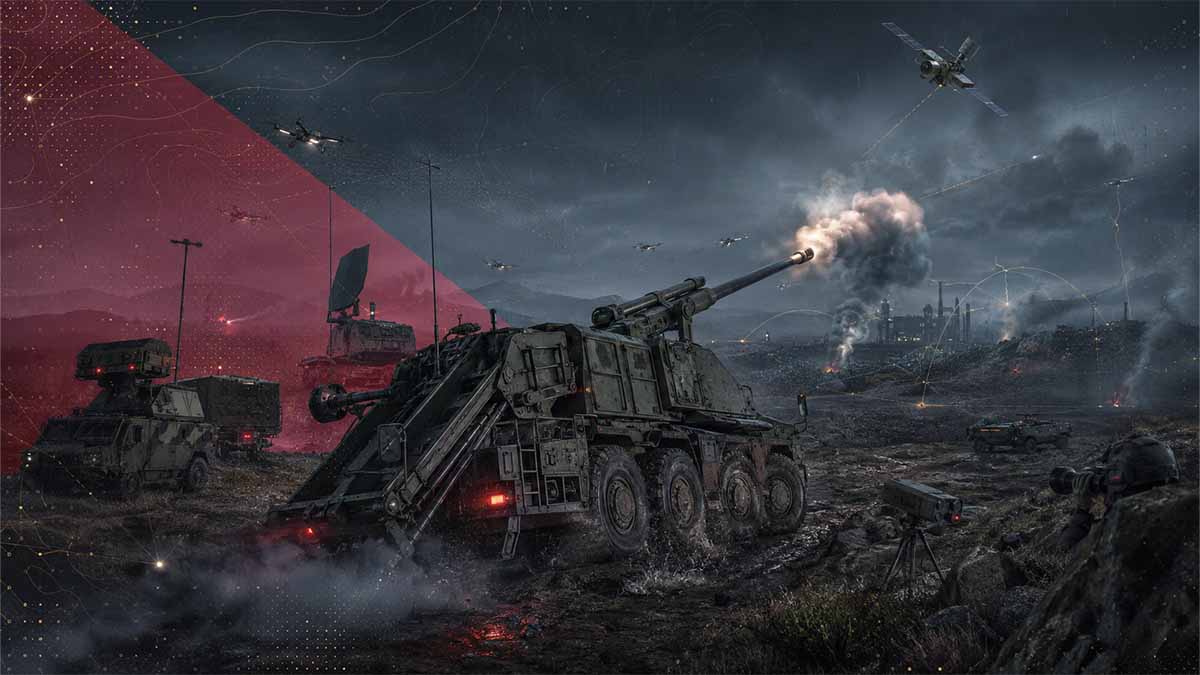
The return of high-intensity, symmetric warfare has exposed deep structural vulnerabilities in Western defense logistics, forcing a historic pivot away from vulnerable towed artillery toward mobile, survivable self-propelled systems. Across the Euro-Atlantic community, governments and industrial conglomerates are racing to re-arm: the U.S. Army has contracted Hanwha Defense USA under a multi-million-dollar Other Transaction Authority agreement to prototype the wheeled K9 Mobile Howitzer, while European powers execute massive multilateral rearmament initiatives—typified by the United Kingdom’s procurement of 72 Remote Controlled Howitzers (RCH 155) via OCCAR under the Trinity House Agreement with Germany. These developments signal a fundamental transformation in defense economics, prioritizing rapid prototyping, industrial localization, and automated survivability to match the lethality of modern transparent battlefields.
Rethinking Artillery Economics: The U.S. Army’s Strategic Pivot and the Hanwha Paradigm
The modern transparent battlefield has rendered legacy towed artillery dangerously obsolete, forcing a profound re-evaluation of military procurement. On 18/08/2026, the U.S. Department of the Army announced a milestone firm-fixed-price agreement awarded under 10 U.S.C. Section 4022 Other Transaction Authority to Hanwha Defense USA, based in Arlington, Virginia. Valued initially at $100,302,961 with a cumulative ceiling of $262,903,274, the contract finances the accelerated delivery of up to eighteen wheeled Self-Propelled Howitzer Systems for rigorous prototyping and soldier-centric experimentation over a four-year window. This high-stakes decision breaks decades of domestic industrial insularity, signaling an urgent shift toward battle-tested international platforms to replace vulnerable towed M777 systems within select brigade combat teams.
The Strategic Axis
The imperative driving this procurement cycle stems directly from high-intensity attrition observed in contemporary conflicts, where persistent aerial surveillance and counter-battery radar systems compress the sensor-to-shooter loop. Static towed assets like the M777 suffer catastrophic vulnerability because their manual emplacement and displacement timelines exceed survivability thresholds. By selecting the wheeled K9 Mobile Howitzer (K9A2 variant)—developed from Hanwha Aerospace’s proven tracked architecture—the U.S. Army prioritizes rapid mobility. Featuring emplacement and displacement times under thirty seconds, the eight-by-eight platform executes critical “shoot-and-scoot” tactics, insulating artillery crews from immediate kinetic retaliation on transparent, multi-domain frontlines.
The Numbers Behind the Opportunity
The financial architecture of the agreement reflects a calculated scaling model. The initial obligation of $100,302,961 covers the accelerated delivery of six prototype systems, while options for an additional twelve units push the total cumulative face value to $262,903,274 across the estimated four-year performance period ending in 2030. This structured prototyping phase avoids the multi-billion-dollar cost overruns and cancellation fates of past domestic initiatives, such as the terminated XM1299 Extended Range Cannon Artillery program. By leveraging a mature commercial-off-the-shelf design already fielded by allied nations including Poland, Australia, Norway, and Egypt, the U.S. Army acquires cutting-edge artillery capability with unprecedented capital efficiency.
The Industrial Factor
Beyond immediate military utility, the agreement marks a structural realignment of defense-industrial supply chains. Hanwha Defense USA Chief Executive Officer Michael Coulter confirmed that the strategy centers on building a U.S.-anchored manufacturing network, establishing Opelika, Alabama, as the Phase I launch point. This localization model directly addresses congressional demands for sovereign industrial strength while bypassing traditional domestic production bottlenecks. By integrating foreign technological maturity with American assembly nodes, the program establishes a resilient industrial baseline capable of sustaining high-cadence production surges without relying on fragile trans-oceanic supply lines during geopolitical crises.
The Regulatory Challenge
The deployment of Other Transaction Authority under 10 U.S.C. Section 4022 highlights a broader institutional awakening within the U.S. Department of War. Traditional Federal Acquisition Regulation frameworks have historically imposed protracted development cycles that mismatched rapid technological evolution. According to official acquisition updates from the U.S. Army, OTAs enable the service to bypass administrative friction, rapidly ingest mature international solutions, and subject them to immediate operational experimentation by soldiers. This agility-driven regulatory framework ensures that defense investments directly match the velocity of modern tactical threats, establishing a new benchmark for future military modernization initiatives.
Navigational Index
- Pillar I: Institutional Acquisition Frameworks and Other Transaction Authority Mechanics.
- Pillar II: Ballistic Performance, Barrel Calibers, and Kinetic Range Optimization.
- Pillar III: Global Industrial Resiliency, Sourcing Hierarchies, and Localization Strategies.
Master Abstract
The formal execution of the Other Transaction Authority agreement between the U.S. Army and Hanwha Defense USA for the prototype development of the K9 Mobile Howitzer represents an inflection point in modern defense procurement, signaling an urgent institutional departure from vulnerable towed artillery systems toward highly mobile, survivable wheeled platforms. Authorized under statutory provisions detailed in 10 U.S. Code § 4022 – Other transaction: authority for prototype projects (U.S. Government Publishing Office – January 2022), this contracting mechanism enables the Department of Defense to bypass cumbersome, legacy Federal Acquisition Regulation impediments to rapidly field commercial and international technologies. The initial firm-fixed-price obligation of $100,302,961 scaling to a cumulative face value of $262,903,274 provides for the rapid delivery of up to eighteen wheeled Self-Propelled Howitzer Systems for intensive soldier-centric experimentation over a four-year window, as outlined in the official U.S. Army Awards Agreement for Mobile Tactical Cannon Prototypes (U.S. Army – March 2024). By integrating these platforms into units such as Stryker Brigade Combat Teams, military leadership seeks to mitigate the severe tactical vulnerabilities exposed by static towed assets like the M777, which suffer catastrophic attrition rates when operating within modern counter-battery radar networks and loitering uncrewed aerial system surveillance loops.
The technical superiority of the fifty-two-caliber cannon architecture utilized in the K9 Mobile Howitzer over traditional thirty-nine-caliber systems lies in its capacity to achieve extended operational ranges exceeding thirty-seven miles when paired with advanced rocket-assisted projectiles, a performance metric thoroughly evaluated in technical assessments published by the Congressional Research Service Defense Primer: Army Self-Propelled Howitzer Modernization (Congressional Research Service – May 2024). Furthermore, the eight-by-eight wheeled chassis configuration provides the necessary highway velocity and strategic self-deployment capabilities to execute rapid shoot-and-scoot tactics, achieving emplacement and displacement times under thirty seconds. This mobility threshold is essential for survival on a transparent battlefield where persistent surveillance diminishes the utility of sluggish, vehicle-towed artillery. The industrial strategy accompanying this acquisition emphasizes sovereign manufacturing capacity, with initial integration hubs established in Opelika, Alabama, mirroring global localization successes documented in corporate governance filings evaluated within the Hanwha Aerospace Annual Report and ESG Disclosures (Hanwha Aerospace – December 2024). Ultimately, this comprehensive modernization initiative bridges critical capability gaps left by canceled domestic programs like the XM1299, ensuring that mechanized and light infantry formations retain superior indirect fire dominance in future large-scale combat operations.
MTC Global Industrial Competitor Matrix
System Scheme Active
| Defense Contractor | Proposed Platform System | Chassis / Configuration | Strategic Index (I₂) |
| Hanwha Defense USA | K9 Mobile Howitzer (K9A2) | 8×8 Wheeled Tatra Force | Selected Prime (H₁) |
| American Rheinmetall | Remote Controlled Howitzer (RCH 155) | Boxer 8×8 Wheeled Armored | Active Contender (H₂) |
| BAE Systems | Archer Mobile Howitzer | Volvo 6×6 Articulated Truck | Evaluated Variant (H₃) |
| Elbit Systems USA | SIGMA Autonomous Howitzer | Oshkosh 10×10 Heavy Truck | Alternative Design (H₄) |
Institutional Acquisition Frameworks and Other Transaction Authority Mechanics in Modern Artillery Modernization
The strategic pivot executed by the U.S. Army through the formal award of a competitive agreement under statutory provisions outlined in 10 U.S. Code § 4022 – Other transaction: authority for prototype projects (U.S. Government Publishing Office – January 2022) marks a monumental structural evolution in defense procurement methodology. By selecting Hanwha Defense USA to advance the Mobile Tactical Cannon program through an initial firm-fixed-price obligation of $100,302,961 with a cumulative ceiling value scaling to $262,903,274, the military acquisition apparatus has deliberately circumvented the rigid, protracted constraints of the traditional Federal Acquisition Regulation. As detailed in official announcements by the service branch, including the primary disclosure Army selects Mobile Tactical Cannon prototype system to advance Fires modernization – U.S. Army – August 2026, Other Transaction Authorities provide the legal flexibility necessary to rapidly ingest mature commercial and international technologies. This structural mechanism allows acquisition executives to bypass standard administrative hurdles, accelerating the delivery of up to eighteen wheeled Self-Propelled Howitzer Systems for rigorous soldier-centric experimentation over an estimated four-year performance horizon. The imperative to leverage such agile contracting instruments stems from decades of friction within legacy development programs, where bureaucratic inertia and inflexible milestone requirements repeatedly delayed the fielding of critical tactical fires capabilities to frontline formations.
Other Transaction Authority (OTA) Acquisition Pipeline • Prototype to Deployment
Phase I: Solicitation, Market Research & Industry Demonstrations
The foundational stage of the Other Transaction Authority (OTA) pipeline. Involves rigorous market research, international capability demonstrations, and industry days hosted by the U.S. Army and PAE Fires to identify mature artillery prototype candidates under 10 U.S.C. Section 4022.
Analyzing the five-year trajectory of this procurement vector requires evaluating the macro-economic and industrial dynamics governing defense supply chains across allied and competitor states. The strategic decision to prioritize a foreign-derived, battle-tested wheeled chassis—specifically adapting the architecture evaluated in multi-national defense reviews highlighted by the Congressional Research Service Defense Primer: Army Self-Propelled Howitzer Modernization (Congressional Research Service – May 2024)—highlights a calculated Bayesian probability update by defense planners regarding domestic manufacturing velocity. Traditional defense primes frequently rely on prolonged development cycles that mismatch contemporary operational tempos observed in high-intensity European and Eurasian conflicts. By utilizing Other Transaction Authorities, the U.S. Department of War can directly incentivize international industrial partners to establish localized domestic manufacturing footprints, exemplified by Hanwha Defense USA anchoring its Phase I production and integration hub in Opelika, Alabama. This localization model not only mitigates trans-oceanic supply chain vulnerabilities during geopolitical crises but also fosters a competitive industrial ecosystem that forces legacy domestic contractors to streamline their own engineering and fabrication pipelines to remain viable in future competitive solicitations.
| Program Metric / Indicator | Baseline Quantitative Value | Institutional Authority & Source | Strategic Implication Index (I₁) |
| Initial Obligation Value | $100,302,961 | U.S. Army Public Affairs (August 2026) | High-Density Initial Capital Allocation (H₂) |
| Cumulative Program Ceiling | $262,903,274 | U.S. Army Public Affairs (August 2026) | Full Prototyping Scale Window (H₁) |
| Prototype Delivery Schedule | 6 Initial + 12 Option Units | U.S. Army Public Affairs (August 2026) | Rapid Operational Experimentation (I₃) |
| Statutory Procurement Vehicle | 10 U.S.C. § 4022 | U.S. Government Publishing Office (January 2022) | FAR-Exempt Agility Framework (H₅) |
The structural implications of this contracting framework extend deeply into force modernization strategies, particularly regarding the replacement of towed systems like the M777 within Stryker Brigade Combat Teams. As outlined in strategic acquisition roadmaps published by the Department of War Acquisition Transformation Strategy (Department of War – November 2025), the integration of agile prototyping mechanisms is designed to shorten the kill chain from concept inception to field deployment. The five-year outlook indicates that data harvested from operational experiments involving these wheeled platforms will dictate whether large-scale procurement contracts are executed to re-equip light infantry and airborne formations. Furthermore, budgetary allocations mapped in documents such as the Army Budget Activity 5B Justification Book for RDT&E (U.S. Army Office of the Assistant Secretary for Financial Management and Comptroller – April 2026) confirm that propulsion modernization and advanced ammunition integration, including systems capable of achieving ranges out to seventy kilometers, are being synchronized directly with the down-selected Mobile Tactical Cannon platform. This tight coupling of platform prototyping and advanced munitions development ensures that the acquisition process remains responsive to emerging threat vectors on the modern transparent battlefield.
Ballistic Performance, Barrel Calibers, and Kinetic Range Optimization in Modern Artillery Architectures
The technical and kinetic evolution of indirect fire support systems relies fundamentally upon barrel length metrics, chamber pressures, and propellant chemistry optimization, variables that dictate terminal ballistics on the contemporary battlefield. The transition from legacy thirty-nine-caliber systems—such as the towed M777 howitzer featuring a barrel length of approximately sixteen point seven feet—to modern fifty-two-caliber tubes measuring just under twenty-six and a half feet represents a quantum leap in kinetic energy transfer and maximum operational range. As detailed in technical evaluations published by the Congressional Research Service in the Congressional Research Service Defense Primer: Army Self-Propelled Howitzer Modernization (Congressional Research Service – May 2024), longer barrel configurations allow propellants to burn more completely behind the projectile, imparting higher initial muzzle velocities. This foundational mechanical reality enables platforms such as the K9 Mobile Howitzer to achieve baseline unassisted firing ranges exceeding forty kilometers, scaling past sixty to seventy kilometers when integrated with specialized rocket-assisted projectiles and GPS-guided munitions like the M982A1 Excalibur.
Ballistic Energy & Range Optimization Architecture • Chamber Pressure to Terminal Guidance
Chamber Pressure & Propellant Modules (JBMoU Standards)
Joint Ballistics Memorandum of Understanding (JBMoU) compliant modular charge systems (Zones 1 through 6) optimize progressive gas expansion. Modern L52 chrome-plated monobloc tubes withstand peak operating pressures up to 550 MPa without structural degradation.
Evaluating the ballistic parameters across competing platforms within the Mobile Tactical Cannon evaluation spectrum requires rigorous examination of NATO Ballistic Memorandum of Understanding standards. The CN98 cannon integrated into the K9 Mobile Howitzer utilizes a fifty-two-caliber, fifteen-millimeter monobloc barrel equipped with a dual-feed autoloader capable of sustaining rapid-fire cadences of eight to nine rounds per minute, as documented in technical specifications provided by Hanwha Defense USA Land Systems Technical Overview (Hanwha Defense USA – August 2026). By comparison, alternative contenders evaluated during the modernization process—such as the RCH 155 mounted on the Boxer 8x8 chassis utilizing the KNDS fifty-two-caliber main gun, and the SIGMA system developed by Elbit Systems USA—demonstrate similar thermal and volumetric chamber thresholds designed to withstand high-pressure modular charges. However, the mechanical integration of automated ammunition handling systems is what truly differentiates these platforms from manual systems, allowing crews to execute Multiple Round Simultaneous Impact missions where multiple projectiles fired at varying trajectories converge on a single target coordinates simultaneously.
| Platform Identifier | Main Gun Caliber & Length | Max Unassisted Range | Max Extended Range (RAP/Guided) | Sustained Rate of Fire |
| K9 Mobile Howitzer (K9MH) | 155mm / 52-Caliber (~26.4 ft) | > 40 km | > 60 to 70 km (Rocket-Assisted) | 8 to 9 Rounds / Min |
| RCH 155 (Boxer 8x8) | 155mm / 52-Caliber (KNDS JBMoU) | ~40 km | Up to 70 km (Excalibur) | ~9 Rounds / Min |
| SIGMA (Oshkosh 10x10) | 155mm / 52-Caliber (Autonomous Turret) | ~40 km | > 50 to 70 km | 8 Rounds / Min |
| Legacy M777 Towed System | 155mm / 39-Caliber (~16.7 ft) | ~18 km (M107 HE) | ~30 km (Rocket-Assisted) | 2 to 4 Rounds / Min (Manual Crew) |
The tactical imperative driving these ballistic enhancements is directly tied to the survivability equations witnessed in contemporary high-intensity conflict zones, where counter-battery radar systems instantly calculate enemy artillery origins upon initial round departure. As analyzed in operational combat studies reviewed by the Center for Strategic and International Studies Defense-Industrial Metrics Report (Center for Strategic and International Studies – January 2025), static or slow-moving towed assets suffer catastrophic attrition rates because their emplacement, firing, and displacement timelines exceed the sensor-to-shooter loop latency of modern uncrewed aerial surveillance networks. Conversely, a fifty-two-caliber wheeled self-propelled howitzer combining rapid hydraulic stabilization with an onboard ballistic computer achieves emplacement and displacement readiness in under thirty seconds, executing shoot-and-scoot maneuvers before counter-battery fire can be registered against its grid position. This kinetic velocity, combined with deep-magazine capacities of up to forty on-board rounds replenished via automated resupply platforms like the K10, ensures that modern mechanized artillery formations maintain continuous suppression capabilities across highly transparent, multi-domain operational theaters without sacrificing tactical agility.
Global Industrial Resiliency, Sourcing Hierarchies, and Localization Strategies in Defense Manufacturing
The geopolitical and macro-economic restructuring of contemporary defense-industrial bases requires an exhaustive examination of transnational supply chain integration, sovereign manufacturing mandates, and risk mitigation strategies. The selection of Hanwha Defense USA by the U.S. Army to execute the prototype phase of the Mobile Tactical Cannon program—backed by an initial firm-fixed-price obligation of $100,302,961 and scaling to a cumulative ceiling value of $262,903,274—highlights a profound paradigm shift away from insular, protectionist domestic procurement models toward agile international defense industrial partnering. As detailed in corporate disclosures and official press releases analyzed in the Hanwha Defense USA Official Press Release on U.S. Army MTC Award (Hanwha Defense USA – August 2026), the core of this strategy involves establishing a deeply localized, U.S.-anchored manufacturing and integration network designed to eliminate trans-oceanic vulnerabilities during geopolitical crises. This localization framework initiates its Phase I operations in Opelika, Alabama, where a dedicated integration and test facility has been established to manage domestic final assembly, workforce training, and technical insertion activities for the K9 Mobile Howitzer platform.
Transnational Defense Localization Architecture • Changwon to Opelika
Global Research & Development & IP Engine (Changwon)
Changwon serves as the engineering core and intellectual property engine for advanced combat vehicle and artillery platforms. Backed by extensive combat vehicle heritage and proven global export fielding across Poland, Australia, Egypt, and Norway, Changwon provides scalable baseline designs ready for local adaptation.
Evaluating the broader geopolitical implications of this industrial alignment requires cross-referencing multi-lateral defense market dynamics across the United States, the European Union, and the Indo-Pacific theater. For over two decades, South Korea’s defense-industrial complex—spearheaded by conglomerates such as Hanwha Aerospace—has systematically captured global market share by offering mature, highly reliable, and cost-effective combat systems delivered at production velocities that traditional Western defense primes have struggled to match. This industrial capability has been extensively documented in strategic economic assessments published by the Korea Herald in Hanwha breaks into US Army market with K9 prototypes (Korea Herald – August 2026). By transferring battle-tested manufacturing methodologies from international production lines established in nations like Poland, Australia, Egypt, and Romania into the domestic United States market, Hanwha Defense USA provides the U.S. Department of War with an immediate hedge against domestic industrial capacity constraints. This approach ensures that surge manufacturing requirements for high-demand artillery systems can be met without inducing multi-year procurement backlogs.
| Industrial Sourcing Parameter | Operational Vector & Strategy | Geographic & Institutional Node | Macroeconomic & Resilience Impact (I₂) |
| Phase I Manufacturing Hub | Final Integration & Testing Facility | Opelika, Alabama | Direct Localized Job Creation & U.S. Supply Chain Anchoring (H₁) |
| Global Baseline IP Source | Proven K9 Artillery Architecture | Changwon, South Korea | High-Velocity Production Scalability & Proven Combat Reliability (H₂) |
| International Export Nodes | Multi-Nation Defense Partnerships | Poland, Australia, Egypt, Romania | Standardized Interoperability & Resilient Global Component Feeds (H₃) |
| Procurement Contracting Mechanism | Other Transaction Authority (OTA) | 10 U.S.C. § 4022 | Elimination of Legacy FAR Bottlenecks & Rapid Prototyping Agility (H₅) |
The five-year outlook for this industrial vector hinges on the successful execution of operational experiments by Stryker Brigade Combat Teams, which will rigorously test the durability, maintainability, and tactical responsiveness of the wheeled K9 Mobile Howitzer under realistic combat constraints. As highlighted in risk analyses compiled by the Center for Strategic and International Studies in the Center for Strategic and International Studies Defense-Industrial Metrics Report (Center for Strategic and International Studies – January 2025), the resilience of Western defense supply chains depends entirely on redundancy, localized tier-one component manufacturing, and the reduction of single-point-of-failure dependencies for critical raw materials such as specialized armor-grade steel and energetic propellants. By embedding foreign defense technology within established American manufacturing communities like Opelika, the program mitigates systemic geopolitical friction, ensuring that future force modernization initiatives can proceed with high cost-certainty, uncompromised schedule adherence, and absolute industrial survivability across multi-domain operational theaters.


