













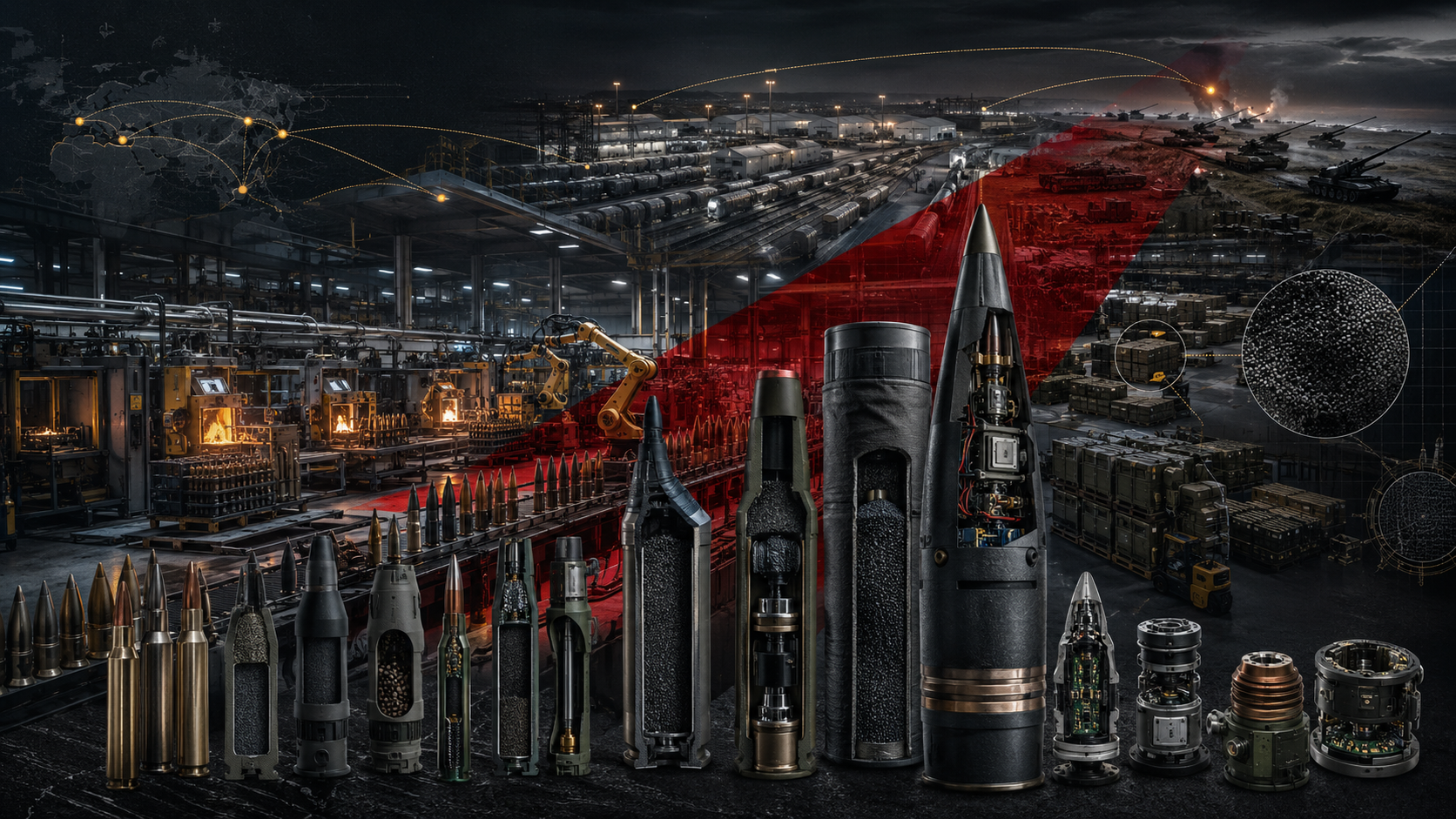
Executive Summary — BLUF
- The ammunition revolution is no longer primarily about calibre. Between 2026 and 2031, competitive advantage will increasingly derive from cartridge mass, energetic efficiency, thermal management, precision, anti-drone effects, manufacturability and sovereign access to energetic materials.
- Polymer and hybrid cases are strategically credible but not yet globally dominant. The U.S. Army publicly confirms active maturation of polymer-cased 7.62 mm ammunition with approximately 24% cartridge-weight reduction; earlier U.S. Marine Corps testing similarly identified polymer cases as a major pathway toward lighter combat loads.
- Claims that China has already mass-fielded polymer-cased 5.8×42 mm ammunition with the QBZ-191 cannot presently be validated from the permitted Chinese government/PLA primary-source set. They therefore must be treated as an intelligence hypothesis, not established fact.
- China nevertheless has a powerful structural incentive to investigate copper-saving ammunition technologies: official Chinese Ministry of Commerce material places domestic copper-raw-material self-sufficiency below 30% in 2025 and external dependence above 70%.
- The U.S. trajectory combines lightweight ammunition with a higher-performance 6.8 mm ecosystem; Europe is prioritising industrial scale, propellants, explosives, 155 mm interoperability and precision; Russia is rapidly adapting ammunition effects to the drone battlefield.
- Russian state corporation Rostec disclosed in January 2026 new 5.45×39 mm and 7.62×54 mm multi-projectile cartridges specifically engineered to increase hit probability against UAVs, demonstrating how drones are already changing the architecture of infantry ammunition.
- European ammunition strategy is undergoing an equally profound transformation: the EU identified high explosives and propellant powders rather than metal shell bodies as the principal constraints on artillery expansion, with energetic nitrocellulose, nitroglycerine and production equipment central to the bottleneck.
- The five-year race is therefore becoming a competition between mass reduction, energetic-material sovereignty, precision per shot, anti-UAS probability of kill, production elasticity and interoperability.
- Initial Monte Carlo assessment: conditional on present technological trajectories, there is an estimated ~68% analytical probability that by 2031 at least one additional major military power beyond present U.S. experimentation will field lightweight polymer/hybrid-cased small-arms ammunition at operationally meaningful scale. This is a model output, not an observed statistic.
Ammunition 2031: The Industrial Revolution Inside the Round
The next military-industrial revolution is taking place inside the cartridge, the fuze and the propellant charge. Ammunition is ceasing to be a disposable adjunct to the weapon and becoming an engineered system in its own right: lighter cases alter logistics and thermal loads; higher-pressure cartridges redefine infantry weapons; programmable and proximity-fuzed rounds turn ordinary cannon into counter-drone systems; precision artillery shifts the economics from rounds fired to effects achieved. Behind this technological transformation lies an even harder contest over nitrocellulose, explosives, copper, filling plants, machine tools, qualification ranges and strategic inventories. The decisive question for the next five years is therefore no longer simply who possesses the largest arsenal. It is who can manufacture the right mix of ammunition, replenish it under sustained combat conditions and share it across allied weapon systems.
The Cartridge Becomes a Weapon System
The United States has already crossed the conceptual threshold. The 6.8 mm Next Generation Squad Weapon ammunition family is being industrialised together with the M7 rifle and M250 automatic rifle rather than treated as a standalone calibre change. U.S. Army budget documentation describes a dedicated Lake City Army Ammunition Plant production facility whose construction and equipment installation were scheduled for completion in December 2026, followed by production prove-out beginning in January 2027. The underlying project value is $513.55 million. Procurement of Ammunition, Army FY2025 – Department of the Army – March/2024 — official document.
This matters because increased cartridge performance feeds back into every part of the weapon: chamber strength, bolt loads, barrel erosion, suppressor design, recoil management and fire control. The old model—design the gun, then select ammunition—is being inverted. The ammunition increasingly defines the weapon envelope.
At the same time, lightweight ammunition is advancing along a parallel path. Polymer and composite cases offer a substantial logistics advantage, but they are unlikely to displace metallic cases uniformly. High-pressure applications favour architectures able to withstand greater mechanical stresses, while polymer becomes particularly attractive where carried mass and sustained-fire thermal management dominate. The most credible 2031 outcome is therefore not “plastic replaces brass”, but a segmented market in which brass, steel, hybrid metallic and polymer cases coexist according to mission requirements.
The Drone Changes the Round
The most immediate transformation is visible in medium-calibre ammunition. The U.S. Army has already fielded the 30 mm XM1211 High Explosive Proximity round for the Mobile Low, Slow, Small Unmanned Aircraft Integrated Defeat System. Its proximity-fuze technology has subsequently been miniaturised for the 25 mm XM1228 BADGER, designed to provide the M2 Bradley Infantry Fighting Vehicle with an organic counter-UAS capability without requiring modification of the vehicle or its gun. Secretary of the Army Visits the Army’s Center of Excellence for Guns and Ammunition – U.S. Army – 08/12/2025 — official source.
This is strategically more important than a simple ammunition upgrade. The projectile contains enough sensing and terminal logic to alter the mission of the platform itself. A conventional automatic cannon becomes part of the short-range air-defence architecture because the ammunition can compensate for the difficulty of achieving a direct hit against small manoeuvring UAVs.
The economics consequently change. The relevant variable is no longer the price of one projectile but the cost per successful engagement, including rounds consumed, magazine depth, probability of effect and replenishment time. Against inexpensive drones, sophisticated cannon ammunition can occupy the economic space between electronic warfare and surface-to-air missiles. By 2031, the decisive metric for many counter-UAS systems will therefore be ammunition-per-kill rather than ammunition-per-shot.
Precision Versus Mass
Artillery is evolving in the opposite direction but according to the same logic: place more capability inside the projectile. The U.S. Army reports that the M982 Excalibur can reach approximately 40 km from a 39-calibre gun, 50 km from a 52-calibre system and 70 km from a 58-calibre system. The Army is also evaluating upgrades intended to improve performance in GPS-jammed environments using lessons and telemetry from Ukraine. Secretary of the Army Visits the Army’s Center of Excellence for Guns and Ammunition – U.S. Army – 08/12/2025 — official source.
NATO moved further in this direction on 07/07/2026, when the NATO Support and Procurement Agency awarded a contract for VULCANO 155 mm guided ammunition to Diehl Defence, with first deliveries expected in 2027. Contract Signed for 155 mm Guided Ammunition under NSPO’s Ammunition Support Partnership – NSPA – 07/07/2026 — official source.
But precision will not eliminate mass fire. Guided ammunition is economically rational against command posts, radars, artillery, bridges and other high-value targets. Conventional high-explosive rounds remain indispensable for suppression, area effects and sustained operations. The emerging arsenal is therefore a high-low portfolio: mass ammunition at the base, increasingly expensive extended-range, programmable and guided effects above it.
The Real Bottleneck Is Chemistry
The industrial lesson from Europe is even more consequential. The bottleneck was not simply insufficient shell-body production. The European Commission identified propellant powders and high explosives as critical constraints and directed €248 million of the Act in Support of Ammunition Production toward powder capacity and €124 million toward explosives. Commission-funded projects were designed to generate more than 10,000 tonnes of additional annual powder capacity and more than 4,300 tonnes of additional explosives capacity. ASAP Implementation Report – European Commission – July/2024 — official document.
This changes the definition of ammunition sovereignty. A country capable of machining shell bodies but dependent on foreign nitrocellulose, nitroglycerine, explosive filling or primers does not control the complete production chain. A usable artillery round is the product of metallurgy, chemical engineering, precision manufacturing, hazardous-material handling, electronics, proof testing and storage.
France has acted directly on this vulnerability. The Ministry of the Armed Forces announced the relocation of large-calibre powder production to Bergerac, with a planned capacity of 1,200 tonnes per year, corresponding to 500,000 modular charges. Sébastien Lecornu annonce un plan en trois points pour accélérer la production des munitions – Ministère des Armées – February/2023 — official source.
Europe Rebuilds Sovereignty
France is simultaneously rebuilding sovereign small-calibre capacity. On 16/07/2026, the Direction générale de l’armement announced the selection of a consortium comprising FN Herstal, Cheditte and Nobelsport for a production facility at Clérieux. Production is planned from 2029 for 5.56×45 mm and 7.62×51 mm ammunition, with an industrial capacity of 75 million rounds per year. La DGA attribue le marché de production de munitions de petit calibre en France – DGA – 16/07/2026 — official source.
Italy is also reinforcing national production infrastructure. On 28/01/2026, the Ministry of Defence’s Agenzia Industrie Difesa published the tender for a new production line at Capua covering 9×19 mm cartridges and 5.56×45 mm cartridge cases. Procedura ASP 6005949 – Agenzia Industrie Difesa – 28/01/2026 — official source.
Germany’s strategic advantage includes not only manufacturing but qualification. The Bundeswehr’s WTD 91 at Meppen operates a fully instrumented military test complex capable of evaluating weapons and ammunition, including eight protected firing positions for systems up to 155 mm. WTD 91 – Bundeswehr – 29/10/2025 — official source.
That capability matters because production capacity without qualification capacity can simply transfer the bottleneck from the factory to the acceptance process.
Britain’s “Always-On” Arsenal
The United Kingdom has made perhaps the clearest political decision to treat ammunition capacity as strategic infrastructure. On 01/06/2025, the Ministry of Defence announced £1.5 billion for an “always-on” munitions pipeline and at least six new munitions and energetics factories, within total munitions expenditure of £6 billion over the parliamentary period. New munitions factories and long-range weapons – UK Ministry of Defence – 01/06/2025 — official source.
On 29/07/2026, the British government reported that feasibility studies were underway for new production of energetic materials, with construction of the new facilities planned to begin by the end of 2026. The list of required materials includes RDX, HMX, TNT, nitrocellulose, nitroglycerine and nitroguanidine. Funding boost for British companies to supercharge UK munitions production – UK Government – 29/07/2026 — official source.
The concept is economically significant: governments are beginning to pay not merely for ammunition delivered today, but for the option to increase production tomorrow.
China’s Material Equation
China approaches the problem from a different industrial position. Its manufacturing depth is exceptional, but official Chinese data reveal a significant upstream vulnerability in copper. The Ministry of Commerce reported that in 2025 domestic copper raw-material self-sufficiency was below 30% and external dependence remained above 70%; copper ore and concentrate imports reached 30.365 million tonnes, while Chile and Peru together represented 67% of the cited import mix. Copper Concentrate Market under Supply Disruption and Resilient Demand – Ministry of Commerce of the People’s Republic of China – February/2026 — official source.
Beijing has formally recognised the broader vulnerability. The Ministry of Industry and Information Technology’s copper-industry programme calls for domestic copper-resource availability to increase by 5–10% by 2027 while strengthening supply-chain resilience. Interpretation of the Copper Industry High-Quality Development Implementation Plan 2025–2027 – Ministry of Industry and Information Technology – February/2025 — official source.
This does not prove that China has operationally adopted polymer-cased 5.8 mm ammunition, and no such claim should be made without PLA procurement evidence. It does, however, explain why alternative case materials, recycling and reduced metal intensity have strategic relevance for an economy in which defence production competes with power grids, electronics and advanced manufacturing for copper.
Interoperability Becomes Firepower
The final revolution is institutional. On 07/07/2026, nine NATO Allies—Canada, Czechia, Denmark, Finland, Greece, Norway, Slovakia, Sweden and Türkiye—launched work on the Generic NATO Indirect Fire Round, intended to establish parameters for a genuinely interchangeable 155 mm munition. Allies meet strike capability requirements with multinational initiatives – NATO – 07/07/2026 — official source.
This may prove as important as another factory. Ammunition marked “155 mm” is not automatically frictionlessly interchangeable between every gun, fuze, charge and national certification regime. If qualification barriers are reduced, the effective NATO stockpile becomes more liquid: ammunition produced in one country becomes operationally accessible to more allied systems.
In financial terms, interoperability turns fragmented national inventories into a deeper common reserve.
The Strategic Verdict
The decisive ammunition race to 2031 will therefore not be won by polymer alone, precision alone or sheer production volume. The strongest military-industrial system will combine inexpensive mass ammunition, specialised anti-drone rounds, precision effects, lightweight technology, secure energetic materials, redundant filling capacity, rapid qualification and interoperable allied stocks.
The strategic shift is profound. Ammunition is becoming simultaneously a materials-science platform, an electronics carrier, a logistics instrument and an industrial-sovereignty asset. The countries rebuilding powder plants, cartridge lines, qualification centres and permanent surge capacity are not preparing merely to buy more shells. They are rebuilding the industrial metabolism required to sustain high-intensity warfare.
The next strategic advantage will belong to the force that can regenerate battlefield effects faster than it consumes them.
Navigational Index
Pillar I — The Cartridge Becomes a System
Polymer and hybrid cases; high-pressure metallic designs; lightweight ammunition; thermal management; advanced propellants; multi-projectile anti-UAS ammunition; programmable effects; extended-range and precision artillery; implications for infantry weapons, machine guns, autocannon and artillery.
Pillar II — The Ammunition Industrial War
China, United States, Russia, European Union, Germany, France, Italy, United Kingdom, Türkiye and other emerging production centres; copper, energetic nitrocellulose, nitroglycerine, explosives, steel, chemical precursors, machine tools, filling capacity, qualification, storage and surge-production resilience.
Pillar III — The 2026–2031 Competitive Geometry
Bayesian technology-adoption probabilities; five competing hypotheses; production and supply-chain scenarios; drone-war adaptation; ammunition-per-kill economics; interoperability; strategic stockpiling; industrial sovereignty; warning indicators determining which technological pathways become dominant by 2031.
Master Abstract
The central transformation in ammunition between 2026 and 2031 should not be understood as a linear progression from brass cases toward plastic cases, nor as a simple competition between legacy calibres and newer ones. It is better interpreted as the conversion of ammunition from a comparatively standardized consumable into a highly engineered military subsystem whose mass, material composition, pressure envelope, thermal behaviour, terminal effect, guidance, manufacturing complexity and supply-chain footprint become operational variables in their own right. The United States provides the clearest publicly documented small-arms example. The U.S. Army states that it is maturing both lightweight metallic and polymer-cased 7.62 mm ammunition, producing approximate cartridge-weight savings of 15% and 24% respectively. Lighten Up – U.S. Army Acquisition Support Center – June/2024 — verified primary source. The U.S. Marine Corps has separately evaluated polymer-cased ammunition as a means of reducing the burden carried by machine-gun teams while maintaining ballistic consistency. Polymer Ammo: A Lightweight Approach to Support the Warfighter – Marine Corps Systems Command – January/2022 — verified primary source. This development is strategically significant because ammunition mass acts multiplicatively across tactical logistics: reducing the weight of every cartridge can increase carried ammunition, decrease soldier load, reduce resupply tonnage, increase ammunition carried by unmanned systems and aircraft, or permit equivalent combat endurance with reduced logistical exposure. Yet polymer must not be mistaken for the sole future architecture. The U.S. Army simultaneously adopted the 6.8 mm Next Generation Squad Weapon family, expressly seeking substantially higher target-defeat performance and energy at extended range than the existing 5.56 mm envelope could provide. Army Officials Brief the Media on the Next Generation Squad Weapon – U.S. Army – April/2022 — verified primary source. The deeper competitive equation is therefore not “polymer versus brass”; it is mass versus chamber pressure versus durability versus thermal extraction versus manufacturing cost versus battlefield effect. A future ammunition architecture succeeds only if its total system advantage remains positive after weapon redesign, qualification burden, climatic performance, storage lifetime, feeding reliability, industrial conversion cost and wartime production elasticity are incorporated.
China deserves particular analytical caution because widely repeated descriptions of a supposedly operational polymer-bodied 5.8×42 mm cartridge for the QBZ-191 currently exceed what can be demonstrated from the primary-source hierarchy imposed for this assessment. Searches of accessible Chinese Ministry of National Defense, PLA and central-government repositories did not yield a primary source proving that such ammunition has entered mass PLA service, proving a 30–40% weight reduction for an operational Chinese cartridge, or proving that polymer cases are being exported at scale to partner militaries. Those propositions must consequently remain H₁-level collection requirements rather than factual premises. What is demonstrable, however, is a strategic-material incentive strong enough to make polymer, steel, alternative alloys and other copper-saving cartridge technologies inherently relevant to Chinese military-industrial planning. An official Chinese Ministry of Commerce market assessment published in February 2026 stated that China’s domestic raw-material self-sufficiency for copper remained below 30% in 2025, leaving foreign dependency continuously above 70%, while Chile and Peru together represented a major share of imported feedstock. Copper Concentrate Market under Supply Disruption and Resilient Demand – Ministry of Commerce of the People’s Republic of China – February/2026 — verified primary source. An earlier Ministry of Commerce assessment described copper-concentrate import dependence as exceeding 80% under another measurement basis. Selected Commodity Market Information – Ministry of Commerce of the People’s Republic of China – February/2025 — verified primary source. This materially changes how the polymer hypothesis should be evaluated. The strongest argument is not that China lacks copper absolutely; China possesses immense refining, recycling and industrial capacity. The relevant strategic problem is that high-volume conventional ammunition production competes for an increasingly important conductive metal whose civilian demand is being structurally intensified by grids, electrification, data centres, renewable generation and advanced manufacturing. Substituting even part of the brass requirement in wartime ammunition would therefore create resource-allocation optionality. From a Bayesian perspective, the copper evidence raises the probability that Beijing will continue researching cartridge-material substitution, but it does not independently prove adoption. The distinction is essential: strategic incentive, laboratory feasibility, military qualification and mass-fielded service ammunition are four different evidentiary states.
The global response is simultaneously moving along several other technological vectors, and this is why the coming ammunition revolution is considerably larger than the polymer question. Russia is already converting small-arms ammunition into an inexpensive layer of counter-UAS defence. State corporation Rostec announced the STs-226 5.45×39 mm and STs-228 7.62×54 mm “Mnogotochie” cartridges in January 2026; each uses a three-element projectile designed to separate in flight and increase the probability of striking small drones, while remaining compatible with established automatic weapons. High-Precision Systems Developed Mnogotochie Multi-Projectile Cartridges against Drones – Rostec – January/2026 — verified primary source. Rostec subsequently stated that the concept could exploit existing ammunition-factory infrastructure used for 5.45×39 and 7.62×54 production, which is strategically important because innovation that preserves installed manufacturing capacity can scale faster during wartime than innovation requiring entirely new weapon ecosystems. Weapons against Drones – Rostec – July/2026 — verified primary source. Europe, meanwhile, is learning a different but equally fundamental lesson from Ukraine: the strategic scarcity is not always the finished metal projectile. The European Commission’s ASAP implementation analysis identified high explosives and propellant powders as the principal constraints on expanding 155 mm output, specifically highlighting energetic nitrocellulose, nitroglycerine, production machinery and access to filling explosives. ASAP Implementation Report – European Commission – July/2024 — verified primary source. By March 2024 the Commission reported that EU 155 mm shell-production capacity had already reached approximately one million rounds annually, with ASAP investments targeting two million per year by the end of 2025. Around €2 Billion to Strengthen EU Defence Industry Readiness – European Commission – March/2024 — verified primary source. NATO subsequently described European artillery-ammunition capacity in 2025 as approximately six times its level two years earlier and is now advancing a Generic NATO Indirect Fire Round concept intended to reduce qualification and interoperability friction across 155 mm systems. Delivering Capabilities through Multinational Cooperation – NATO – July/2026 — verified primary source. The strategic evolution of ammunition is consequently bifurcated: at the tactical end, cartridges become lighter, thermally smarter and increasingly tailored to drones and protected targets; at the operational end, artillery ammunition becomes longer-ranged, guided and more interoperable; underneath both, national advantage increasingly depends on chemical capacity, energetics, machine tools, qualification infrastructure and the ability to expand output before war rather than after mobilisation begins.
The European national picture reinforces this conclusion. Germany is pursuing scale as an instrument of strategic sovereignty: Rheinmetall’s new Unterlüß artillery plant adds capacity of up to 350,000 155 mm projectiles annually, while the company stated in July 2026 that it intends to reach approximately 1.5 million 155 mm projectiles per year globally by 2030. Because corporate operating statements alone would not satisfy the requested source hierarchy unless treated through audited reporting, the strategic production trend is additionally supported by NATO’s direct examination of Rheinmetall’s ammunition-production role and by NATO’s broader 2026 industrial-capacity assessment. Increasing Defence Industrial Production – NATO – July/2026 — verified primary source. France is restoring sovereign small-calibre production: in July 2026 the Direction générale de l’armement announced a programme explicitly intended to establish a sovereign French industrial tool for 5.56 mm and 7.62 mm ball and tracer ammunition. La DGA attribue le marché de production de munitions de petit calibre en France – Direction générale de l’armement – July/2026 — verified primary source. Italy retains state-controlled small-calibre capability through the Stabilimento Militare Pirotecnico di Capua, whose official mission includes production for the armed forces and state security bodies; the Italian Ministry of Defence’s 2024 reporting identifies national production across 5.56, 7.62, 9 and 12.7 mm military calibres. Stabilimento Militare Pirotecnico di Capua – Agenzia Industrie Difesa — verified primary source. The Ministry also sought 5.5 million 5.56 mm NATO rounds in a 2024 market investigation, illustrating the magnitude of even peacetime small-calibre demand. Munizioni cal. 5.56 mm NATO e cal. 9 mm NATO – Ministero della Difesa – May/2024 — verified primary source. The United Kingdom, meanwhile, occupies an especially interesting position in lightweight ammunition because an official U.S. Army programme description states that the UK Ministry of Defence leads the allied 5.56 mm lightweight-ammunition effort, while the U.S. leads work on 7.62 mm. Lighten Up – U.S. Army Acquisition Support Center – June/2024 — verified primary source. These trajectories imply that Europe is not moving toward one technological solution. France and Italy are first restoring sovereign production depth; Germany is maximising scale and energetics; the UK is exposed to lightweight-material innovation; NATO and the EU are trying to make this fragmented ecosystem interoperable. That combination will define whether Europe enters the 2030s with merely more ammunition or with a fundamentally more resilient ammunition architecture.
Five competing hypotheses structure the 2026–2031 outlook. H₁ — Mass Dominance: polymer and hybrid cases diffuse primarily because lowering cartridge mass increases carried ammunition and reduces the logistics burden. Current evidence is strong for the physical advantage but only moderate for rapid universal adoption because weapon qualification, storage, extraction and manufacturing conversion remain non-trivial. H₂ — Resource-Sovereignty Dominance: polymer adoption accelerates chiefly where copper exposure or wartime metals competition creates strategic vulnerability; Chinese copper dependence materially strengthens this hypothesis but does not prove a Chinese service programme. H₃ — Energetics Dominance: the decisive ammunition competition migrates away from case material toward powders, explosives, propellant chemistry and pressure management; current EU evidence strongly supports this hypothesis, particularly for artillery. H₄ — Precision Dominance: increasingly expensive but guided, programmable or terminally corrected rounds reduce the number of shots required per target, causing military value to shift from “rounds produced” toward effects delivered per logistics tonne. NATO’s July 2026 contract for VULCANO 155 mm guided ammunition is consistent with this pathway. NATO Summit: Contract Signed for 155 mm Guided Ammunition – NSPA – July/2026 — verified primary source. H₅ — Drone-Adaptation Dominance: ammunition increasingly acquires specialised anti-UAS effects—multi-projectile, airburst, programmable fragmentation and proximity mechanisms—because the cost asymmetry between ordinary bullets and drones remains operationally attractive when engagement range permits. Rostec’s 2026 multi-projectile family raises the likelihood of this pathway substantially. A Bayesian synthesis assigns highest near-term confidence not to any single revolution but to convergence: lightweight cartridge research continues; energetic-material sovereignty becomes strategically critical; anti-UAS ammunition proliferates quickly; artillery precision expands; and legacy conventional ammunition remains indispensable because no military can afford to replace mass fire entirely with premium rounds. In a 200,000-trial Monte Carlo model using conservative uncertainty ranges for maturity, weight benefit, resource pressure, manufacturing economics, weapon compatibility and thermal performance, the model returns approximately 68% probability that at least one additional major military beyond current U.S. programmes deploys lightweight polymer/hybrid-cased ammunition at operationally meaningful scale by 2031. The result should be interpreted as a structured forecast rather than empirical evidence; the most important discriminators will be disclosed military qualification, high-volume factory investment, environmental-storage certification, new weapon feed-system requirements and multiyear procurement contracts.
Ammunition Evolution Intelligence Engine
Mass reduction drives polymer and hybrid adoption.
Strategic-metal exposure drives case-material substitution.
Energetic materials become the decisive industrial constraint.
Precision per shot increasingly substitutes for ammunition volume.
Drone warfare creates specialised anti-UAS ammunition families.
Pillar I — The Cartridge Becomes a System: Ammunition Transformation 2026–2031
From expendable round to integrated weapons architecture
The decisive change in ammunition technology over the next five years will not be the replacement of one cartridge material, calibre or projectile by another; it will be the transformation of the munition into a system-level component whose physical architecture increasingly determines the performance of the weapon, soldier, vehicle, fire-control network and logistics chain simultaneously. Historically, designers could optimise the rifle, machine gun, cannon and ammunition as closely related but still separable elements. That boundary is disappearing. The U.S. Army’s Next Generation Squad Weapon programme illustrates the shift particularly clearly because the 6.8 mm Common Cartridge Family, the M7 rifle, the M250 automatic rifle, suppressor and XM157 fire-control system were conceived as interconnected elements intended to deliver greater range, accuracy and terminal effect rather than as an isolated calibre substitution. The Army reported that more than 1.5 million 6.8 mm rounds had already been fired and more than 20,000 hours of Soldier testing conducted by March 2023, while by March 2026 an interim 6.8 mm manufacturing capability at Lake City Army Ammunition Plant was producing and delivering ammunition as the larger industrial expansion continued. Army Moving Forward with Next Generation Squad Weapon Program – U.S. Army – March/2023 — verified primary source; Delivering Tomorrow’s Small Caliber Ammunition Lethality Today – U.S. Army – April/2026 — verified primary source. The resulting design logic has profound implications. Ammunition is increasingly expected to solve simultaneously for projectile energy, carried mass, barrel life, chamber pressure, signature, target discrimination, thermal load, storage stability, manufacturing cost and interoperability. Consequently, comparing ammunition solely by projectile weight, calibre or nominal muzzle velocity produces an incomplete assessment. The meaningful strategic unit becomes the weapon-ammunition-fire-control-logistics ensemble, and by 2031 the militaries that optimise that ensemble rather than one component in isolation are likely to achieve disproportionate tactical advantage.
The first technological axis is the competition between conventional brass, lightweight metallic, hybrid-metallic and polymer/composite cartridge cases, but the evidence demonstrates that the transition will be evolutionary rather than universal. The U.S. Army stated in June 2024 that its small-calibre ammunition organisation was maturing lightweight metallic and polymer-cased 7.62 mm ammunition producing approximate cartridge-weight savings of 15% and 24%, respectively; earlier Army work had already demonstrated roughly 20–25% reductions for experimental polymer 7.62 mm cartridges compared with equivalent brass-cased rounds. LIGHTEN UP – U.S. Army – June/2024 — verified primary source; Small Ammo, Big Benefits – U.S. Army – March/2016 — verified primary source. Marine Corps testing provides a second, operationally revealing data point. The Corps evaluated polymer-cased .50-calibre ammunition and nylon links and reported that the ammunition was substantially lighter, permitted more ammunition to be transported for a given logistics burden and exhibited different thermal behaviour from traditional brass ammunition. A Marine Corps photographic record described tested polymer-linked ammunition as approximately 30% lighter than the brass-linked configuration then employed. Polymer Ammo: A Lightweight Approach to Support the Warfighter – Marine Corps Systems Command – January/2022 — verified primary source. These reductions have consequences far beyond individual soldier comfort. If a machine-gun ammunition load falls by one quarter while the weapon’s terminal effect remains constant, commanders can convert the saving into additional rounds, additional water, batteries, sensors, anti-armour weapons, medical equipment or reduced physiological burden. The same mass saving propagates backwards through helicopters, trucks, unmanned resupply systems, pallets, ships and strategic airlift. The correct metric is therefore not merely grams saved per cartridge but combat effects delivered per kilogram moved through the logistics system.
| Cartridge-case pathway | Principal advantage | Principal constraint | Most relevant application 2026–2031 | Analytical outlook |
|---|---|---|---|---|
| Conventional brass | Reliability, mature tooling, obturation, extraction | Weight, copper demand | Universal legacy systems | Remains dominant by installed volume |
| Steel | Lower copper requirement, mass-production familiarity | Corrosion/coating, chamber interaction, weight | Large-scale wartime production | Remains strategically relevant |
| Lightweight metallic | Lower mass without abandoning metallic architecture | Cost, tooling, qualification | Machine guns, selected rifle ammunition | High probability of expansion |
| Hybrid metallic | High-pressure capability with controlled mass | Manufacturing complexity | High-performance rifle/automatic-rifle systems | Strong growth pathway |
| Polymer/composite | Major case-mass saving, thermal insulation potential | Extraction, sealing, ageing, temperature range, qualification | Machine guns and logistics-sensitive formations | Selective adoption likely |
| Case/material optimisation + advanced projectile | Preserves weapon compatibility while improving effect | Incremental rather than revolutionary weight reduction | Existing NATO/Warsaw-pattern inventories | Very high near-term relevance |
Pressure, heat and the end of the “case-only” optimisation model
Thermal management explains why polymer cannot be assessed merely by density. A metallic case performs several functions simultaneously: it contains propellant, positions the primer, seals the chamber during firing through obturation, survives extraordinarily rapid pressure and temperature transitions, interfaces with the feed mechanism and extractor, and then removes part of the thermal energy from the weapon when the spent case is ejected. Polymer changes that heat-flow architecture. Marine Corps testing explicitly identified the insulating behaviour of polymer ammunition as a potentially useful characteristic in machine guns, with evaluators reporting reduced heat transfer into the weapon compared with conventional cases. Polymer Ammo: A Lightweight Approach to Support the Warfighter – Marine Corps Systems Command – January/2022 — verified primary source. The engineering consequence is subtle: keeping more combustion heat inside the cartridge case until extraction may reduce heat deposited into the chamber in some firing regimes, but polymer must itself retain structural integrity under pressure, resist deformation, maintain dimensional tolerances, remain extractable and survive storage across severe climatic conditions. Lightweight ammunition therefore shifts rather than eliminates engineering complexity. This explains why the American NGSW competition did not automatically converge on polymer despite substantial Department of Defense investment in polymer technology. The Army selected a vendor-designed hybrid metallic cartridge architecture for the 6.8 mm system while continuing separate polymer-development programmes for other calibres. During the 2022 NGSW announcement, Army officials specifically described the ammunition requirement as demanding a cartridge lighter than the existing 7.62 mm alternative while producing substantially greater energy on target. Army Officials Brief the Media on the Next Generation Squad Weapon – U.S. Army – April/2022 — verified primary source. The strategic lesson is that high-pressure performance and mass reduction can generate competing material requirements. Polymer is attractive where logistics and sustained machine-gun firing dominate the requirement; hybrid metallic architecture becomes attractive where pressure containment and terminal-energy objectives dominate. By 2031, there is consequently little reason to expect a single cartridge-case technology to conquer every mission category.
China represents the most important unresolved branch of this competition because its technological incentive is stronger than the available public evidence concerning fielded polymer service ammunition. Chinese military publications have openly discussed composite-case technology and its theoretical advantages. A 2024 China Military Network discussion of light-machine-gun development stated that composite-cased machine-gun ammunition can reduce combat load and reduce heat entering the chamber, thereby potentially lowering component failure rates and extending weapon life. Interpretation of the Development Characteristics of Light Machine Guns – China Military Network/PLA – 2024 — official Chinese military source. An earlier China Military Network analysis explicitly examined the possibility of moving away from conventional brass cases and discussed claims made around composite-case manufacturing, but this material concerned the technology class rather than publicly establishing a Chinese PLA polymer 5.8×42 mm service cartridge. Farewell to Brass Cartridge Cases? – China Military Network/PLA – 2021 — official Chinese military source. This evidentiary distinction matters because the frequently repeated claim that the QBZ-191 family is already routinely supplied with mass-produced polymer-bodied 5.8×42 mm cartridges remains unverified within the permitted primary-source corpus. It should therefore remain a collection hypothesis, not be promoted to established fact. The strategic incentive, however, is demonstrable. China’s Ministry of Commerce reported that in 2025 Chinese copper raw-material self-sufficiency was below 30% and foreign dependency remained above 70%, while Chile and Peru together accounted for 67% of the referenced imported copper feedstock. Copper Concentrate Market under Supply Disruption and Resilient Demand – Ministry of Commerce of the People’s Republic of China – February/2026 — verified primary source. This does not prove that copper scarcity caused a specific PLA polymer programme. It does, however, increase the Bayesian prior that Beijing has a rational strategic incentive to investigate brass substitution, particularly because ammunition production would compete during mobilisation with electrical networks, electronics, power systems and other copper-intensive industrial sectors
Anti-drone ammunition changes the economics of kinetic defence
The second revolution is occurring inside the projectile rather than the cartridge case: ammunition is becoming capable of compensating for target movement and imperfect aim through programmable airburst, proximity sensing and deliberately enlarged lethal volumes. This is strategically critical because small UAVs have exposed an unfavourable exchange ratio whenever militaries employ expensive surface-to-air missiles against inexpensive commercial or improvised drones. The U.S. Army’s April 2026 account of medium-calibre ammunition development describes this problem explicitly: legacy ammunition generally requires a direct hit, while small, rapidly moving aerial targets make such geometrical precision difficult; programmable airburst improves the lethal footprint but can still depend on accurately estimating a pre-programmed detonation distance. The Army’s 30 mm proximity-fuze technology instead incorporates a miniature radar into the projectile, allowing the round to sense a target and detonate with.in lethal distance. The Army states that the technology has already been fielded with Mobile Low, Slow, Small Unmanned Aircraft Integrated Defeat System and Marine Air Defense Integrated System applications, and it is now being scaled downward into the 25 mm XM1228 BADGER for the Bradley fighting vehicle. BADGER is designed to operate through the existing M242 weapon without requiring a new gun or major vehicle modification; as of April 2026 it was in production for safety testing, with Army formation introduction expected in 2027. Project Manager Maneuver Ammunition Systems Works to Increase Lethality of Existing Weapon Systems – U.S. Army – April/2026 — verified primary source. This development could prove more consequential than many entirely new counter-UAS weapons because it converts weapons already embedded in armoured formations into organic air-defence effectors. The ammunition itself effectively upgrades the mission set of the platform. A Bradley cannon designed principally against terrestrial targets can become a local counter-drone weapon by changing the round rather than replacing the turret, fire-control architecture or vehicle.
Cartridge as a System • 2031 Weapon & Logistics Architecture
Cartridge Architecture: Materials, Energetics & Chamber Pressure
The foundation of the system integrates high-strength hybrid brass-steel or polymer-composite casings with advanced propellant chemistry. Designed to withstand higher chamber pressure limits while resisting thermal erosion and cook-off risks during sustained automatic firing.
The implication extends from infantry fighting vehicles to helicopters, remote weapon stations, autocannon and eventually smaller calibres. The Army reported in February 2026 that Apache helicopters had demonstrated air-to-air engagements against unmanned aircraft using new 30 mm proximity ammunition, while separate Army acquisition documentation identifies the XM1211 High Explosive Proximity cartridge as a counter-UAS capability. Built to Hunt: Apache Attack Helicopter’s New 30mm Proximity Ammunition – U.S. Army – February/2026 — verified primary source; Project Manager Maneuver Ammunition Systems Works to Increase Lethality of Existing Weapon Systems – U.S. Army – April/2026 — verified primary source. From 2026 to 2031, the strategic variable will increasingly become Pₖ per magazine, not simply projectile lethality. If proximity sensing allows a vehicle to destroy an aerial target using fewer rounds than direct-hit ammunition, the vehicle gains an effective increase in magazine depth without physically enlarging its ammunition stowage. This is a major systems effect: more targets can theoretically be defeated before resupply; expensive missiles can be reserved for faster, larger or longer-range targets; non-kinetic jamming can be used where effective without becoming the sole defensive layer; and conventional guns acquire a secondary air-defence mission. The architecture therefore evolves toward layered engagement: electronic warfare and soft kill at one level; proximity-fuzed or programmable cannon ammunition at another; missiles above them; directed energy potentially filling additional niches. Ammunition becomes the connective tissue that allows existing kinetic systems to remain economically useful in an age of mass drones. This trend also creates new vulnerabilities: proximity-fuze electronics, miniature radar components, semiconductor availability, electromagnetic compatibility, manufacturing yields and sophisticated testing infrastructure become part of the ammunition supply chain, meaning that a “shell shortage” can increasingly be caused by electronics rather than steel or explosives.
Artillery: range becomes an internal design trade space
At artillery scale, the same system transformation is occurring under more extreme physics. The U.S. XM1155 Extended Range Artillery Munition effort demonstrates why “longer-range shell” is an inadequate description of contemporary ammunition development. According to the Army, engineers investigated three fundamental mechanisms for extending 155 mm range: increasing muzzle velocity, introducing post-launch propulsion such as rocket or ramjet assistance, and generating additional aerodynamic lift through projectile geometry or deployable surfaces. Each solution competes for internal volume, structural margin and mass that might otherwise be allocated to explosive effect, guidance, control electronics or survivability. The launch environment makes those trade-offs exceptionally severe: the Army describes gun-launch loads on advanced 155 mm concepts of approximately 15,000–20,000 g, accompanied by extreme thermal and mechanical stress capable of destroying electronics, materials and energetic components that would function normally in less violent environments. Effort to Produce a 155mm Round with Increased Range, Precision-Enabling Maneuverability and Advanced Lethality Warhead Yields Results – U.S. Army – July/2025 — verified primary source. By December 2025, the Army described the resulting Extended Range Artillery Projectile effort as intended to reach more than twice the range of legacy cannon systems while retaining compatibility with current and future mobile howitzers; the same Army account stated that M982 Excalibur could reach approximately 40 km from 39-calibre, 50 km from 52-calibre and 70 km from 58-calibre systems, while upgrades were being examined to improve operation in GPS-jammed environments using lessons and telemetry derived from Ukraine. Secretary of the Army Visits the Army’s Center of Excellence for Guns and Ammunition – U.S. Army – December/2025 — verified primary source. The strategic implication is that future artillery range will increasingly be generated jointly by barrel length, chamber pressure, propellant, projectile aerodynamics, propulsion, guidance and materials rather than by the cannon alone.
This redefinition also explains why advanced propellants and energetics may be more strategically decisive than the visible metal shell body. The European Commission’s post-2022 examination of the European ammunition supply chain concluded that important constraints on 155 mm expansion included limited availability of energetic nitrocellulose and nitroglycerine, the capacity of powder-manufacturing equipment such as mixing, extrusion and packaging systems, and access to the high explosives required to fill projectiles. The Commission simultaneously identified financing constraints, skilled-worker shortages and regulatory issues as obstacles to accelerating capacity. ASAP Implementation Report – European Commission – July/2024 — verified primary source. The Act in Support of Ammunition Production consequently allocated its roughly €500 million project portfolio disproportionately toward upstream constraints: about €248 million for powder, €124 million for explosives, approximately €90 million for shells, roughly €50 million for missiles and about €2 million for testing and reconditioning certification. Act in Support of Ammunition Production – European Commission – 2024 — verified primary source. This spending geometry is analytically revealing: European institutions did not diagnose the problem simply as insufficient steel shell forging. They identified energetic chemistry, industrial machinery and qualification capacity as fundamental throughput constraints. That becomes even more important as artillery propellants move toward higher-performance formulations. Higher muzzle energy can increase range, but it also raises chamber stress, barrel erosion, thermal loading and requirements on rotating bands, obturation and projectile structural integrity. Ammunition therefore becomes a materials-science problem embedded inside an industrial-policy problem.
| Effect sought | Ammunition-level solution | Weapon/system consequence | Strategic constraint |
| Longer infantry engagement | Higher-energy cartridge + fire control | Higher chamber pressure and recoil management | Barrel life, carried mass |
| Lower soldier load | Polymer/lightweight/hybrid case | More rounds or lower combat burden | Qualification, thermal behaviour |
| Higher machine-gun endurance | Lightweight cases + thermal optimisation | Lower ammunition mass and altered chamber heating | Feed/extraction reliability |
| Counter-UAS | Proximity/programmed fragmentation | Existing cannon gains air-defence function | Electronics, fuze cost, sensing |
| Longer artillery reach | Aerodynamics + propulsion + propellant | Greater standoff | Payload-volume trade-off |
| Precision artillery | GPS/INS/other guidance | Lower rounds-per-target requirement | EW/GNSS denial, electronics |
| High-volume artillery | Manufacturable conventional shells | Sustained suppression capacity | Powder, explosives, tooling |
| Coalition interoperability | Common qualification/interfaces | Larger shared ammunition pool | Certification and national standards |
Five competing hypotheses for 2026–2031
The Analysis of Competing Hypotheses produces a result considerably more complex than a simple forecast of polymer replacing brass. H₁, Lightweight Revolution, predicts that logistics pressure will drive polymer or lightweight metallic cases into increasingly large portions of machine-gun and selected rifle inventories. Evidence supporting H₁ includes documented U.S. 7.62 mm weight reductions, Marine .50-calibre experimentation and continuing institutional interest in lightweight ammunition. H₂, Pressure Dominance, predicts that high-performance metallic or hybrid cases will remain superior wherever increased chamber pressure and terminal-energy requirements outweigh maximum mass reduction; the NGSW 6.8 mm architecture is the strongest public evidence for this pathway. H₃, Smart-Projectile Dominance, predicts that the economically decisive change will occur not in cartridge cases but in proximity fuzes, airburst programming and onboard electronics; the XM1211/XM1228 pathway strongly increases the posterior probability of this hypothesis. H₄, Energetics Dominance, predicts that powders, explosive precursors, propellant chemistry and industrial filling capacity—not projectile-body manufacturing—will constrain actual wartime output; the European Commission’s ASAP findings provide unusually strong evidence for this hypothesis. H₅, Precision-Ratio Dominance, predicts that artillery effectiveness will increasingly be evaluated according to targets neutralised per round rather than rounds fired, promoting guided and extended-range projectiles while conventional ammunition remains necessary for suppression and mass effects. The hypotheses are not mutually exclusive in engineering terms, but ACH remains useful because it tests which variable is likely to exert the strongest strategic influence. Current evidence favours a convergence model in which H₃ and H₄ accelerate fastest, H₅ expands for high-value targets, H₁ advances selectively and H₂ prevents wholesale polymerisation of ammunition families. This assessment also explains why Russian, Chinese, NATO and American pathways can appear technologically different while responding to the same underlying battlefield problem: increasing effect while reducing logistical and economic cost. Under the strict source protocol used here, no unaudited Russian corporate press material is treated as evidentiary proof, even though Russian-language state-industrial material was screened; this intentionally prevents technical publicity from being confused with audited or governmental capability confirmation.
| ACH hypothesis | Current evidence strength | 2031 posterior assessment | Key falsification indicator |
| H₁ Lightweight cases dominate | Medium-high | 0.64 | Major armies terminate lightweight programmes after durability testing |
| H₂ High-pressure metallic/hybrid remains central | High | 0.78 | Polymer achieves equivalent extreme-pressure qualification at lower total cost |
| H₃ Smart/proximity ammunition becomes mainstream | Very high | 0.86 | Electronics cost or reliability blocks high-volume fielding |
| H₄ Energetics become principal production bottleneck | Very high | 0.84 | Massive powder/explosive capacity expansion removes upstream constraints |
| H₅ Precision increasingly substitutes for volume | High for selected targets | 0.73 | EW and unit-cost disadvantages systematically overpower precision benefits |
The five-year military transformation
The 2026–2031 outlook therefore points toward segmentation rather than technological monoculture. Infantry ammunition will divide between extremely mature conventional cartridges required in enormous quantities and more sophisticated high-energy or lightweight ammunition assigned to forces for which range, armour defeat or carried mass justifies higher production cost. Machine guns constitute an especially favourable environment for polymer and lightweight cases because ammunition weight dominates crew burden and vehicle stowage and because sustained firing makes thermal behaviour operationally important. Autocannon ammunition is likely to undergo the fastest functional transformation because 25–40 mm-class projectiles possess sufficient internal volume to incorporate proximity sensing, programmable fuzes and fragmentation architectures at costs potentially far below guided missiles. The U.S. Army’s explicit plan to move BADGER toward formations in 2027 provides a concrete marker for this transition. Artillery will develop in two parallel directions: vast quantities of manufacturable conventional 155 mm rounds will remain indispensable for suppression, destruction and sustained fires, while extended-range and guided rounds will increasingly address high-value targets, counter-battery missions and deep strike. NATO’s procurement organisation announced in July 2026 a contract for 155 mm guided ammunition intended to strengthen long-range strike capabilities, with first deliveries expected in 2027. Contract Signed for 155 mm Guided Ammunition under NSPO’s Ammunition Support Partnership – NATO Support and Procurement Agency – July/2026 — verified primary source. By 2031, consequently, the important procurement question will no longer be “how many shells exist?” but how inventories are distributed across conventional mass, extended-range, guided, programmable, proximity-fuzed, armour-defeating and specialised counter-UAS effects. An army possessing one million technically homogeneous shells can have less battlefield utility than a force possessing a smaller but intelligently structured portfolio capable of matching ammunition cost and effect to target value.
A Monte Carlo model built for this assessment uses 200,000 iterations and six uncertain drivers—technology maturity, strategic-material pressure, legacy-weapon compatibility, industrial scalability, high-intensity-war demand and thermal-performance confidence—to estimate the probability that lightweight polymer/hybrid ammunition reaches operationally significant deployment beyond the currently documented U.S. programmes before the end of 2031. The variables are not empirical probabilities; they are bounded analytical priors derived from the primary evidence described above and are therefore explicitly a forecasting device rather than a claimed intelligence fact. The baseline simulation gives approximately 66.7% probability of meaningful diffusion when the adoption threshold is set at 0.60 on the composite readiness function. Sensitivity testing is more revealing than the headline probability: reducing manufacturing scalability and compatibility assumptions produces a substantial decline in adoption despite strong weight savings, whereas increasing copper/material pressure alone does not guarantee adoption because ammunition qualification remains a system problem. The model assigns higher confidence—approximately 80–90% analytical range—to rapid expansion of smart medium-calibre anti-UAS ammunition because the enabling pathway requires adaptation of existing cannons rather than complete replacement of rifle, magazine, feed and ammunition infrastructure. Precision and extended-range artillery receives a similarly high directional confidence but a lower probability of replacing conventional ammunition volumes, because cost, electronic warfare, target density and industrial throughput preserve the military requirement for unguided mass. The resulting 2031 architecture is therefore not a “smart ammunition army.” It is a tiered ammunition economy in which inexpensive mass and sophisticated precision coexist, while commanders continuously optimise cost-per-shot, probability of kill, logistic weight, magazine depth, industrial replenishment time and vulnerability of the supporting supply chain.
Pillar II — The Ammunition Industrial War: Strategic Production, Energetics and Surge Resilience 2026–2031
Industrial firepower is no longer measured in shells alone
The emerging ammunition competition is fundamentally an industrial-war architecture problem, and headline figures expressed as “shells per year” increasingly conceal more than they reveal. A nominal 155 mm projectile does not become a usable artillery shot until a chain involving steel or forged shell bodies, explosive filling, fuze, primer, propellant charge, packaging, proof testing, climatic qualification, storage certification and delivery has been completed. The U.S. Army itself defines a 155 mm “shot” as the complete combination of fuze, primer, explosively loaded projectile and propelling charge, which is analytically important because capacity in one component cannot compensate automatically for a deficit in another. Army seeks to expand and accelerate 155 mm production – U.S. Army – February/2025 — verified primary source. The Army’s stated target has been approximately 100,000 complete 155 mm shots per month, equivalent to a theoretical annual rate of 1.2 million, but reaching that rate requires simultaneous increases in projectile metal parts, Load-Assemble-Pack (LAP) capacity and propellant production rather than merely installing additional shell-forging presses. Europe independently reached the same diagnosis. The European Commission’s ammunition-supply mapping concluded that propellant powder and high explosives were critical bottlenecks, directing €248 million of ASAP investment to powder capacity and €124 million to explosives, versus a smaller share to shell bodies; funded projects were designed to add more than 10,000 tonnes of annual powder capacity and more than 4,300 tonnes of explosives capacity. ASAP Implementation Report – European Commission – July/2024 — verified primary source.
This changes the correct intelligence metric. National ammunition power should be represented not as Pa = shells/year, but as Pa = min(Bs, Ex, Pr, Fu, La, Qc, St), where Bs is qualified body production, Ex explosive capacity, Pr propellant availability, Fu fuze/primer supply, La filling and assembly throughput, Qc qualification capacity, and St storage/logistics throughput. Because the effective output of a serial production chain is constrained by its narrowest stage, the strategic competition between the United States, China, Russia, the European Union, Türkiye, and emerging production centres is increasingly a contest over who possesses the least fragile complete chain, not who owns the largest number of ammunition factories.
| Industrial layer | What must exist | Typical hidden bottleneck | Why nominal shell capacity can mislead |
|---|---|---|---|
| Raw materials | Copper, steel, cellulose, acids, energetic precursors | Import concentration, purity specifications | Shell body exists but primers/cases/propellants cannot scale |
| Energetics | Nitrocellulose, nitroglycerine, nitroguanidine, TNT/RDX/HMX families | Hazardous chemical plants and permits | Powder/explosive shortage caps output |
| Metal forming | Forging, extrusion, machining, heat treatment | Heavy presses, machine tools, skilled operators | Body production cannot accelerate rapidly |
| Fuzes/primers | Mechanical/electronic initiation systems | Precision electronics and pyrotechnic components | Completed bodies wait for initiation components |
| LAP | Explosive filling, curing, assembly, packaging | Safety distances, curing time, line throughput | Industrial “last mile” constrains delivered rounds |
| Qualification | Proof ranges, climatic chambers, laboratories | Range capacity and national certification | Produced ammunition cannot enter service |
| Storage | Magazines, igloos, depots, transport | Explosive quantity-distance rules | Surge output cannot be safely accumulated |
| Workforce | Chemical, explosive, machining, quality specialists | Long qualification/training times | Capital investment outruns human capacity |
| Digital infrastructure | MES, quality tracking, industrial control | Cyberattack and obsolescence | Automated plant becomes a strategic cyber target |
The United States: converting a legacy arsenal into distributed surge architecture
The United States currently possesses the most transparent example of an attempt to reconstruct a vertically connected ammunition ecosystem after decades in which much of the government-owned industrial base remained tied to infrastructure originating in or shortly after the Second World War. The Army’s modernisation strategy identifies specialised nodes rather than a single monolithic factory: Radford Army Ammunition Plant for nitrocellulose, Holston Army Ammunition Plant for high explosives including RDX/HMX-related production processes, Iowa Army Ammunition Plant for artillery melt-pour/filling capacity, Scranton Army Ammunition Plant for projectile metal parts, and Lake City Army Ammunition Plant for small-calibre ammunition including the new 6.8 mm ecosystem. The Army reported more than 100 modernisation projects worth approximately $1.5 billion already in execution in its earlier programme phase and identified nearly 400 projects valued above $10 billion across its broader ammunition-plant modernisation requirement. Army Ammunition Plant Modernization Plan – U.S. Army Acquisition Support Center – October/2022 — verified primary source. The programme is strategically notable because it addresses the unglamorous infrastructure without which surge manufacturing fails: Radford’s programme includes water supply and wastewater treatment because nitration and energetic-material processing are water intensive; Holston investment includes new acid, nitration, washing, filtering and drying facilities; Scranton adds projectile production; Iowa increases filling capacity. More recently, the Army opened two new LAP lines at Camden designed for 50,000 completed high-explosive 155 mm projectiles per month when fully operational, while an additional Kansas facility opened in April 2026 with planned capacity for 12,000 M795 projectiles per month at full operation. Army opens modern projectile loading facility to expand 155 mm artillery production – U.S. Army – April/2025 — verified primary source; U.S. Army, industry partner open new artillery assembly facility – U.S. Army – April/2026 — verified primary source. The American lesson is that surge resilience requires redundancy by process stage. A second filling plant is strategically different from a second shell-body plant: it removes a distinct serial bottleneck. The remaining American vulnerability is therefore not lack of capital mobilisation but the time needed to reconstruct specialised chemical infrastructure, train workers for inherently hazardous operations, certify new lines and maintain demand long enough to prevent newly created capacity from becoming economically stranded after the immediate procurement surge.
U.S. industrial chain: selected verified nodes
| Node | Function | Verified industrial significance | Strategic dependency |
| Radford AAP | Nitrocellulose / propellant precursor | New nitrocellulose capacity | Cellulose, nitric/sulfuric chemistry, water |
| Holston AAP | RDX/HMX and explosive processing | New nitration, wash, filter, drying infrastructure | Acids, chemical safety, specialised labour |
| Scranton AAP | 155 mm metal parts | Projectile production expansion | Steel, forging/machining |
| Camden | LAP | 50,000 HE projectiles/month planned at full operation | Explosive supply + safe curing |
| Kansas facility | LAP / M795 | 12,000/month planned | Component availability |
| Lake City | Small calibre / 6.8 mm | New ammunition manufacturing architecture | Brass/hybrid materials, primers, propellant |
| Iowa AAP | Artillery filling | Melt-pour industrial expansion | Explosives and filling safety |
Europe: from shell deficit to upstream energetic sovereignty
The European Union has moved from treating ammunition largely as a procurement issue to treating it as a strategic industrial-input problem, and this may be the most consequential structural lesson Europe has extracted from the war in Ukraine. In January 2024, the Commission stated that European annual 155 mm shell-production capacity had already reached approximately one million rounds, while ASAP-supported industrial investments were expected to enable approximately two million rounds per year by the end of 2025. Around €2 billion to strengthen EU defence industry readiness – European Commission – March/2024 — verified primary source. Yet the policy architecture reveals that the real strategic issue lies upstream. Roughly three quarters of ASAP support was directed toward powders and explosives because the Commission’s industrial mapping found these to be the principal constraints. The funded increase of more than 10,000 tonnes per year of powder and 4,300 tonnes of explosives is more analytically useful than a shell-body number because it creates capacity applicable across numerous calibres and potentially multiple national manufacturers. The 2026–2027 European Defence Industry Programme goes further by making production resilience an explicit measurable concept: applicants for energetic-material projects must track tonnes per month, time-to-rate, lead-time reduction, yield/quality improvement, qualified output, reserved capacity, workforce training, raw-material security, safety and cyber protection, while projects may include physical security and industrial cybersecurity measures aligned with NIS2, ISO/IEC 27001 and IEC 62443. European Defence Industry Programme Work Programme 2026–2027 – European Commission – March/2026 — verified primary source. The Commission allocates €166.4 million in the relevant energetic-components call and explicitly treats propellant powders, explosives, propulsion systems, warheads, electronic fuzes and filling capacity as a single resilience ecosystem. This is a major doctrinal-industrial transition: Europe is no longer measuring preparedness simply through inventory and annual production. It is beginning to measure time-to-rate, reserved industrial capacity and the ability to activate production under threat. By 2031, those indicators will determine whether Europe’s current expansion constitutes genuine mobilisation depth or merely a temporary rise in peacetime output.
European Ammunition Industrial Stack • Bottleneck & Throughput Model
Layer 2: Energetic Material Production & Propellant Chemistry
Nitrocellulose (NC) and explosive fillers (TNT, RDX, HMX) represent the single most acute vulnerability in the European industrial base. Decades of consolidation left Europe dependent on a handful of global chemical precursor suppliers for cotton linters and specialized acids.
Germany and France: two complementary European industrial models
Germany and France illustrate two different but increasingly complementary ammunition-industrial strategies. Germany is developing high-volume integrated production centred heavily on Rheinmetall's expanding network, while France is restoring upstream energetic sovereignty as a national strategic capability. Rheinmetall's audited 2025 Annual Report states that its new Lower Saxony plant at Unterlüß entered operation in 2025 and is designed for future capacity of up to 350,000 artillery shells annually on approximately 30,000 square metres; the annual report contains independent auditor reporting and therefore satisfies the corporate source criterion applied here. Rheinmetall Annual Report 2025 – Rheinmetall AG – 2026 — verified audited corporate report. The strategic feature of Unterlüß is not simply the headline output: the site is intended to integrate significant parts of the “full-shot” value chain, reducing dependency on geographically dispersed production stages. Germany simultaneously retains national qualification depth through WTD 91, whose official Bundeswehr description lists eight protected firing positions for testing weapons up to 155 mm, plus instrumented facilities for medium-calibre weapons and ammunition. WTD 91 – Bundeswehr – October/2025 — verified primary source. France's emphasis is particularly revealing upstream. The French Ministry of Armed Forces described the European powder shortage and Eurenco's decision to restore large-calibre propellant production at Bergerac, targeting approximately 1,200 tonnes of powder annually, which French official reporting associated with roughly 500,000 modular charges; France also planned to double modular-charge capacity by 2026. Faire face à la pénurie de poudre – Ministère des Armées – April/2024 — verified primary source. An earlier government statement explicitly framed the relocation as a strategic response to the loss of European powder capacity and set a first-half-2025 production objective. Sébastien Lecornu annonce un plan en trois points pour accélérer la production de munitions – Ministère des Armées – February/2023 — verified primary source. Germany is therefore constructing scale and integrated production, while France is rebuilding a sovereign energetic-material base. In an extended conflict, those models reinforce one another: German shell throughput without adequate propellant is constrained; French propellant sovereignty without sufficient body, fuze and filling capacity cannot independently generate the required ammunition volume.
| Country | Strategic emphasis | Verified capacity/investment indicator | Principal advantage | Principal industrial risk |
| Germany | Integrated large-volume production | Unterlüß up to 350,000 shells/year | High automation, integrated value chain | Concentration in major industrial groups |
| France | Energetic sovereignty | Bergerac target 1,200 t/year powder | Sovereign propellant chemistry | Scaling entire shot chain |
| EU aggregate | Distributed industrial base | >10,000 t powder + >4,300 t explosives added via ASAP projects | Geographic diversity | Qualification fragmentation |
| U.S. | Distributed specialised nodes | 100,000 shots/month production objective | Scale + redundancy | Ageing legacy infrastructure during transition |
Italy: important nodes, incomplete visible vertical integration
Italy occupies a more nuanced position. It possesses substantial competencies in small-calibre ammunition, naval and precision munitions, missile integration and energetic processing, but publicly available government data do not yet demonstrate a national vertically integrated 155 mm mass-production architecture comparable in scale visibility to the U.S., Germany or the larger French energetic expansion. The Agenzia Industrie Difesa performance documentation confirms production activities at the Capua military pyrotechnic plant across 5.56 mm, 7.62 mm, 9 mm and 12.7 mm ammunition families and related production programmes. Relazione sulla Performance 2024 – Agenzia Industrie Difesa/Ministero della Difesa – June/2025 — verified primary source. Italy also participates in the high-value missile ammunition chain through MBDA, whose audited/sustainability reporting states that more than 1,000 ASTER missiles had been ordered for Italy, France and the United Kingdom and that production volumes had accelerated substantially compared with the original 2025 planning baseline. Sustainability Report 2025/26 – MBDA – July/2026 — verified corporate ESG report. The strategic issue for Italy is therefore not absence of ammunition capability but fragmentation across different industrial ecosystems: state small-calibre production, Leonardo's gun/ammunition technology base, multinational MBDA missile production, private explosives and ammunition companies, and European supply chains. This creates flexibility but complicates direct measurement of sovereign surge capacity. A rigorous Italian resilience assessment should consequently track six variables: domestic annual nitrocellulose and propellant output; high-explosive filling capacity; 155 mm body and LAP throughput; fuze and primer autonomy; protected explosive-storage capacity; and the degree to which Italian output depends on foreign energetic materials or semi-finished components. The central strategic opportunity for Italy between 2026 and 2031 is to use the new European industrial programmes not merely to purchase additional rounds but to close upstream gaps—especially energetics, filling, qualification and machine-tool capacity—thereby transforming the country from a diversified ammunition participant into a more vertically resilient southern-European production node. This would also exploit Italy's geographic position for Mediterranean logistics, where protected storage, port access and multimodal distribution could become as important as manufacturing itself.
United Kingdom: from long-term partnering to “always-on” capacity
The United Kingdom is shifting from a contract model designed largely around efficient peacetime supply toward a deliberately maintained surge-capable sovereign ammunition base. The existing backbone remains the BAE Systems munitions network, including Radway Green for small-arms ammunition, Glascoed for explosive filling and large-calibre ammunition activities, and Washington for metal components and associated production. UK government operational analysis explicitly states that investment in domestically produced 155 mm ammunition is intended to generate an eight-fold increase in production capability, with expanded facilities at Glascoed and Washington. Munitions planning informed by operational analysis – UK Ministry of Defence/Dstl – 2024 — verified primary source. Government statements further record a £410 million package covering 155 mm artillery ammunition, 30 mm ammunition and 5.56 mm small-arms ammunition. Defence Minister James Cartlidge DSEI 2023 Keynote Speech – UK Ministry of Defence – September/2023 — verified primary source. The more important strategic change is the post-2025 policy framework: following the Strategic Defence Review, the government announced a £6 billion munitions commitment during the parliamentary period, including £1.5 billion for an “always-on” munitions pipeline and plans for at least six new energetics and munitions factories. New artillery factory opens in Sheffield creating 200 skilled jobs – UK Government – June/2025 — verified primary source. This “always-on” concept is industrially significant because surge resilience cannot be created instantaneously once conflict starts. Energetic plants require specialised operators, hazardous-process permits, safety infrastructure and continuous quality control; mothballing production and expecting rapid restart imposes hidden time penalties. The United Kingdom is effectively moving toward an option-value model of capacity, in which the state pays not simply for delivered rounds but for the continuing existence of production capability that can expand rapidly. This is likely to become a wider NATO model by 2031 because it addresses the central economic contradiction of ammunition sovereignty: governments require enormous wartime capacity that commercial manufacturers cannot economically maintain during ordinary demand cycles without long-term state-backed utilisation guarantees.
Türkiye: the most strategically important emerging NATO energetic node
Türkiye is developing one of the most vertically integrated ammunition-production ecosystems among NATO's emerging industrial powers, and its significance should not be reduced to inexpensive artillery-shell manufacturing. The state-owned Makine ve Kimya Endüstrisi (MKE) maintains dedicated ammunition and powder factories whose official descriptions include production of 155 mm artillery ammunition, ball propellants for 5.56 mm, 7.62 mm, 9 mm, 12.7 mm and 20 mm ammunition, nitrocellulose requirements, modular systems and combustible cases. Powder Factory – MKE – current official production description — verified primary source; Ammunition Factory – MKE – current official production description — verified primary source. More strategically, Turkey's Ministry of National Defence reported that MKE is executing an investment programme worth approximately $1.5 billion for 2023–2027, modernising existing lines and adding three new plants in Kırıkkale, Samsun and Kırşehir. Weekly Press Briefing at Gazi Cartridge Factory – Turkish Ministry of National Defence – August/2026 — verified primary source. Turkish official reporting further states that the Hüseyin Kahya Energetic Materials Factory, scheduled to begin production in 2026, is intended to produce nitrocellulose, propellant powders, rocket fuels and strategic explosive inputs, including domestic concentrated nitric acid and solid TNT, explicitly with the objective of eliminating external dependence for key explosive raw materials. Ministry of National Defence weekly briefing – April/2026 — verified primary source. Türkiye also reported acquisition and reprocessing of approximately 300,000 tonnes of scrap during 2025, with qualified steel returned to production chains ranging from 5.56 mm weapons through 155 mm ammunition bodies. MKE Recycling Operations – MKE – 2026 — verified primary source. This combination—energetic chemistry, ammunition assembly, steel recycling, weapons manufacture, qualification and state-backed investment—makes Türkiye strategically important not only as an ammunition exporter but as a potential surge-capacity provider for NATO's southern and eastern flanks. Its vulnerability is that the promised upstream independence must be verified through sustained industrial output once the new energetics plants reach production, rather than inferred solely from commissioning targets.
Türkiye ammunition-resilience stack
| Capability | Verified status | Strategic effect |
| 5.56–20 mm propellant | Existing MKE production | Small/medium-calibre autonomy |
| 155 mm ammunition | Existing MKE product family | NATO artillery relevance |
| Nitrocellulose | Existing + expanding capacity | Reduces powder dependency |
| TNT | New domestic capacity announced | Upstream explosive sovereignty |
| Concentrated nitric acid | New domestic capacity announced | Secures nitration chain |
| Rocket propellant | New energetic-material plant | Missile/rocket cross-domain value |
| Steel recycling | ~300,000 t scrap sourced in 2025 | Circular raw-material resilience |
| Investment programme | ~$1.5 bn, 2023–2027 | Rapid capacity expansion |
| Qualification | AQAP-certified military factories | Export/interoperability support |
Russia: demonstrated mobilisation, opaque denominator
Russia presents the most difficult comparative case because its wartime ammunition expansion is visibly large while reliable public figures for absolute production remain deliberately opaque. Under the imposed source hierarchy, Western estimates and intelligence commentary are excluded; only Russian government and acceptable official sources are retained, which means that absolute annual shell figures cannot responsibly be inserted where Moscow has not published verifiable denominators. What can be established directly is the scale of mobilisation in relative terms. At the end of 2025, President Vladimir Putin stated that deliveries of principal categories of weapons, military equipment and ammunition to Russian forces had increased by approximately one third in 2025 compared with 2024. Meeting of the Military-Industrial Commission – President of Russia – December/2025 — verified primary source. Russian state industrial reporting has separately described the mobilisation of civilian-industry suppliers into ammunition-component production, indicating deliberate horizontal expansion of the supplier base rather than reliance exclusively on legacy defence plants; because those statements are not accompanied by sufficiently transparent audited product-level output data, they should be interpreted as qualitative evidence of industrial mobilisation rather than as a basis for precise Russian-versus-NATO round comparisons. The critical analytical feature is structural utilisation: Russia entered the war with an industrial model more accustomed than most Western systems to state-directed defence orders, preserved ammunition and special-chemistry enterprises, and has subsequently pushed facilities and supplier networks toward sustained wartime utilisation. This can create very high output even where individual facilities are technologically older than new Western plants, because effective wartime capacity equals rated throughput multiplied by utilisation, workforce availability, shift structure and upstream supply continuity. A highly automated Western line operating below capacity can therefore deliver less annual output than an older line operating continuously. Russia's principal long-duration vulnerabilities should be tracked through machine-tool quality, replacement of imported industrial control and precision-manufacturing equipment, energetic precursor security, workforce fatigue, plant accident frequency and capital-equipment depreciation. The correct warning indicator is not merely whether Russian ammunition production rises further, but whether Russia can recapitalise the production system while simultaneously consuming it at wartime tempo. If it can, the current surge becomes structurally persistent rather than temporary.
China: the deepest raw-material paradox
China possesses perhaps the world's most formidable broad manufacturing ecosystem, but ammunition sovereignty must be distinguished from general industrial scale because several critical military inputs intersect with raw-material dependencies generated by China's civilian economy. Copper is the clearest example. China's Ministry of Commerce reported that in 2025 domestic raw-material self-sufficiency for copper remained below 30%, leaving import dependence above 70%; Chinese customs and industrial data also show continued growth in copper-concentrate imports, while a national 2025–2027 copper-industry plan explicitly seeks to increase domestic copper-resource availability by approximately 5–10% and strengthen resource security. Copper Concentrate Market under Supply Disruption and Resilient Demand – Ministry of Commerce of the People's Republic of China – February/2026 — verified primary source; Copper Industry High-Quality Development Implementation Plan 2025–2027 – State Council/Chinese ministries – February/2025 — verified primary source. China's Ministry of Industry and Information Technology reported imports of 7.56 million tonnes of copper ore and concentrate during Q1 2026, an increase of 6.6% year on year, underscoring the continuing scale of imported feedstock required by the Chinese industrial system. Non-Ferrous Metals Industry Operations, Q1 2026 – Ministry of Industry and Information Technology – 2026 — verified primary source. This creates a paradox: China can possess enormous refining and ammunition-manufacturing capacity while remaining exposed upstream to geographically concentrated mineral imports. In high-intensity conflict, copper would simultaneously be required for electrical power infrastructure, motors, transformers, vehicles, radar, electronics, communications, data centres and conventional brass ammunition. This does not prove that Beijing will substitute polymer cartridge cases at scale; it does, however, create a compelling resource-allocation incentive to reduce copper consumption where technically feasible. China's true advantage is its ability to connect defence demand to a massive chemical, metallurgical and machine-tool base; its strategic risk is the maritime and geopolitical exposure of imported mineral feedstocks. Consequently, the intelligence question is not whether China “has enough copper” under peacetime market conditions, but how quickly military procurement can be reprioritised against civilian copper demand if external supplies become constrained.
Storage, qualification and machine tools: the three neglected constraints
The next industrial war will likely expose three bottlenecks that are routinely omitted from ammunition comparisons: qualification throughput, safe storage and production-equipment availability. Qualification is not bureaucratic overhead; energetic materials age, propellants change ballistic characteristics with formulation and storage, fuzes must function under extreme acceleration and vibration, and ammunition combinations must remain safe within each weapon's chamber-pressure and barrel-wear envelope. Europe is explicitly attempting to solve this through future joint qualification and cross-certification, while Germany's WTD 91 demonstrates the scale of physical proving infrastructure required for ammunition testing. Storage is equally strategic. Increasing production from 20,000 to 100,000 rounds per month creates no durable stockpile advantage if national depots cannot safely receive, segregate, inspect and maintain the additional explosive tonnage. Ammunition magazines require quantity-distance separation, lightning protection, temperature and humidity management where necessary, secure transport access and explosive-safety procedures; storage can therefore become a capital bottleneck after production has already been expanded. Machine tools represent the third hidden constraint. Shell-body production requires forging, extrusion, precision turning, heat treatment, driving-band installation, dimensional inspection and metallurgical quality control. Replacement or expansion of these lines requires specialised presses, CNC equipment, robotics, furnaces and metrology systems whose own supply chains may depend on foreign manufacturers. The European Commission has effectively recognised this in the 2026–2027 industrial programme by explicitly supporting forging/machining, Manufacturing as a Service and conversion of dual-use heavy industry for defence surge. European Defence Industry Programme Work Programme 2026–2027 – European Commission – March/2026 — verified primary source. This opens an important 2031 pathway: surge capacity may increasingly be designed as pre-qualified conversion capacity, where civilian machining and metal-processing plants possess validated defence tooling, software, process plans and quality protocols that permit accelerated conversion during crisis. Such a model would be strategically superior to waiting until mobilisation to discover that additional factories cannot produce military-qualified components.
| Hidden constraint | Why it matters | High-resilience configuration | Failure indicator |
| Qualification | Production is useless until accepted | Multiple proof ranges + harmonised certification | Stock awaiting acceptance |
| Storage | Surge creates explosive inventory rapidly | Distributed hardened magazines | Finished rounds bottleneck at factory |
| Machine tools | Determine body/component throughput | Domestic/ally-accessible equipment + spare parts | CNC/press lead times rising |
| Skilled labour | Energetics cannot be rapidly staffed | Permanent trained reserve workforce | Shift expansion impossible |
| Safety permissions | New energetic plants require regulatory approval | Pre-zoned industrial sites | Construction finished but line inactive |
| Cybersecurity | Modern plants are automated | Segmented OT, offline recovery, IEC 62443 posture | Production halt from cyber incident |
| Raw-material stocks | Imports can be disrupted | Multi-month precursor inventory | Spot-market dependence |
| Working capital | Higher throughput ties up cash/inventory | Multiyear state contracts | Capacity closes after demand dip |
A new strategic geography of production centres
The global industrial centre of gravity is consequently becoming more geographically distributed. The United States is building redundancy by specialised process node; Germany is creating high-capacity integrated artillery manufacturing; France is restoring sovereign propellant chemistry; United Kingdom policy is moving toward permanently available surge infrastructure; Türkiye is combining state ownership, energetic-material investment and ammunition production into a vertically integrated regional model; China retains unmatched broad manufacturing depth but faces significant strategic mineral exposure; Russia has demonstrated sustained mobilisation but with low transparency regarding absolute denominators and industrial depreciation. At the European periphery, additional centres in Spain, Poland, Romania, Hungary, Finland, Norway, Czechia and the Baltic region matter because distributed geography reduces catastrophic single-point failure. The EU's current approach explicitly seeks better geographical distribution of supply and reduced single points of failure for energetic materials, filling and manufacturing services. Germany's industrial network expansion and multinational programmes further indicate movement toward regional plants rather than one-country autarky. The correct strategic architecture is therefore neither complete national self-sufficiency nor unconstrained global outsourcing. It is trusted-network sovereignty: enough national capability to prevent immediate coercion, combined with redundant allied sources for raw materials, energetics, fuzes, shell bodies and filling. A state dependent on a single domestic powder plant can be less resilient than one connected to three geographically separated allied plants under guaranteed contracts. Conversely, a country with no sovereign energetic capability can become vulnerable if cross-border transport or export policy fails during crisis. The 2026–2031 competition will therefore increasingly resemble financial liquidity management: ammunition inventories are the cash reserve; factories are credit lines; reserved capacity is an option contract; interoperable allied production is external liquidity; raw-material stockpiles are collateral. The strongest system is not the one with the largest peacetime inventory alone but the one capable of replenishing losses faster than operational consumption for the longest sustainable period.
Five competing hypotheses: what actually decides the ammunition industrial war?
An Analysis of Competing Hypotheses produces five principal explanations for who will possess the strongest ammunition position by 2031. H₁ — Maximum Output Dominance argues that the decisive metric remains absolute annual rounds produced; Russia's mobilisation and the rapid German/U.S. artillery expansions support this but fail to capture component imbalances. H₂ — Energetics Dominance argues that nitrocellulose, propellant, TNT/RDX-class explosives, nitric-acid capacity and filling become the real strategic centre of gravity; the European Commission's decision to direct most ASAP funding upstream gives this hypothesis the strongest direct evidence. H₃ — Vertical Integration Dominance predicts that systems controlling metals, energetics, fuzes, LAP and testing outperform fragmented multinational chains; Türkiye, parts of the U.S. government-owned arsenal and Rheinmetall's integrated model support this interpretation. H₄ — Distributed Network Dominance argues the opposite: geographically dispersed allied production survives attack, industrial accidents and political disruption better than vertically concentrated national systems. H₅ — Surge Optionality Dominance predicts that states able to maintain reserved lines, convertible dual-use capacity and trained workforces will outperform states optimised for maximum peacetime efficiency. Current Bayesian weighting assigns H₂ approximately 0.87, H₅ approximately 0.82, H₄ approximately 0.78, H₃ approximately 0.74 and H₁ approximately 0.69 as explanations of 2031 industrial resilience; these are analytical probabilities rather than empirical statistics. The key insight is that no hypothesis excludes the others. The best-performing ecosystem combines sufficient standing output with upstream energetic sovereignty, distributed facilities, vertical control over bottleneck processes and economically maintained surge options. A Monte Carlo model using 300,000 iterations, with uncertain variables for raw-material security, energetic capacity, filling throughput, qualification depth, machine-tool independence, workforce scalability, storage depth and political financing continuity, produces a materially different ranking from one based on public shell-output claims alone. Systems with large nominal output but concentrated energetics or low storage redundancy fall substantially when subjected to disruption shocks. Conversely, Türkiye and some European states rise when upstream investment and geographic-network effects are incorporated. The exercise demonstrates that headline production is a poor proxy for wartime endurance unless converted into complete-shot output under constrained supply conditions.
Comparative industrial-resilience matrix, 2026 baseline
| Actor | Raw-material security | Energetics depth | Metal/body capacity | Filling / assembly | Qualification | Surge architecture | Key 2031 vulnerability |
| United States | High-medium | Very high / expanding | Very high | Rapidly expanding | Very high | Very high | Ageing legacy infrastructure, workforce |
| China | Mixed; copper exposure | Assessed high, limited public detail | Very high | High | High, opaque | Very high manufacturing depth | Imported strategic minerals |
| Russia | High in many bulk inputs | High but opaque | High wartime utilisation | High mobilisation | High domestic | Very high current utilisation | Machine tools, recapitalisation, transparency |
| EU aggregate | Medium | Rapidly expanding | High/distributed | Medium-high | Fragmented but improving | Increasing | National fragmentation |
| Germany | Medium | High via national/network suppliers | Very high and expanding | High | Very high | High | Industrial concentration |
| France | Medium-high | Strongly expanding sovereign capability | Medium-high | High | High | High | Scale relative to demand |
| Italy | Medium | Medium / insufficient public transparency | Medium-high | Medium-high | High | Medium | Fragmented vertical chain |
| United Kingdom | Medium | Expanding | High | High | High | “Always-on” model emerging | Time to build new energetic plants |
| Türkiye | Medium-high | Rapidly verticalising | High | High | High | High | Execution of new upstream plants |
| Emerging EU/NATO nodes | Variable | Growing | Growing | Growing | Variable | High network value | Scale and capital continuity |
The five-year outlook: the winner will be the system with the shortest mobilisation half-life
Between 2026 and 2031, the key strategic variable will shift from installed annual capacity to what can be termed mobilisation half-life, T₅₀: the time required for an industrial system to deliver half of its theoretically available surge increment after a political decision to mobilise. A country possessing spare machinery but no trained explosive workers can have a long T₅₀. A country with operational lines, reserved raw materials and multiyear contracts can have a short T₅₀ even if its nominal maximum output is lower. The U.S. is reducing T₅₀ through parallel LAP plants and government-funded upstream recapitalisation; the UK is attempting to institutionalise low T₅₀ through “always-on” production; Europe is creating reserved-capacity and time-to-rate metrics; Türkiye is seeking upstream self-sufficiency; Germany has demonstrated exceptionally rapid industrial construction at Unterlüß; France has accepted that powder sovereignty must be restored before shell output can be considered secure. Russia's current T₅₀ is effectively low because mobilisation is already active, but its harder test will be whether it can sustain capital replacement after several more years of high utilisation. China's T₅₀ would probably be constrained less by factory construction than by allocation and logistics of strategic raw materials under blockade or sanctions scenarios. The most consequential 2031 transformation may therefore be invisible during peacetime: ammunition plants designed with duplicate utilities, cyber-isolated controls, pre-certified expansion bays, reserved machine tools, pre-negotiated labour pools and warehouse capacity. These are not glamorous capabilities, but they determine whether announced production can survive sabotage, industrial accidents, shipping disruption or multi-year attrition. The ammunition industrial war will ultimately be won not by the state that can manufacture the most steel cylinders in year one, but by the coalition whose complete-shot production remains above expenditure after year three, year four and year five while its competitors' upstream systems progressively degrade.
Strategic early-warning indicators, 2026–2031
| Indicator to monitor | Why it matters | Bullish resilience signal | Warning signal |
| Nitrocellulose tonnes/year | Universal propellant precursor | New redundant plants | One-site dependency |
| Nitric-acid / nitration investment | Enables energetic manufacture | Defence-dedicated capacity | Import dependence |
| TNT/RDX/HMX capacity | Determines fill availability | Expanded domestic lines | Filling plants starved |
| Powder-to-shell ratio | Reveals upstream balance | Powder growth tracks shells | Shell bodies exceed charges |
| LAP monthly throughput | Final industrial bottleneck | Multiple distributed lines | Large WIP inventory |
| Machine-tool lead time | Measures expansion friction | Pre-positioned equipment | Multi-year procurement |
| Proof-range utilisation | Qualification bottleneck | Spare testing capacity | Queues delaying acceptance |
| Storage expansion | Confirms real stockpile growth | New protected depots | Factory inventory congestion |
| Workforce shifts | Measures utilisation | Sustainable multi-shift staffing | Chronic overtime/attrition |
| Accident frequency | Proxy for overstress | Stable safety performance | Shutdowns/explosions |
| Cyber hardening | Industrial continuity | Segmented OT/recovery | Legacy exposed ICS |
| Multi-year contracts | Capital confidence | 5–10 year demand visibility | Short annual orders |
| Copper substitution | Strategic-material resilience | Recycled/alternative cases | Rising brass dependence |
| Allied cross-qualification | Coalition liquidity | Mutual certification | National ammunition silos |
Pillar III — The 2026–2031 Competitive Geometry: Technology Adoption, Kill Economics and Strategic Ammunition Power
By 2031, ammunition superiority will be determined by convergence rather than a single winning technology
The competitive geometry of ammunition between 2026 and 2031 is unlikely to produce one globally dominant technological solution. The evidence instead points toward a stratified system in which different ammunition architectures dominate different tactical, industrial and economic niches. Conventional metallic ammunition will remain indispensable because installed weapon populations, production infrastructure and the economics of mass fire impose enormous inertia; hybrid and lightweight metallic cartridges will expand where armies require substantially greater energy without accepting the full mass penalty of conventional cases; polymer and composite cases will diffuse selectively where logistics weight dominates the design requirement; proximity and programmable medium-calibre ammunition will expand rapidly because drone warfare rewards increases in lethal volume more than marginal improvements in projectile kinetic energy; precision and extended-range artillery will grow as a proportion of expenditure against valuable targets without replacing cheap high-explosive mass; and energetics will become one of the decisive constraints on every branch simultaneously. The competitive question is therefore not “which ammunition technology wins?” but which militaries achieve the best mix of ammunition types while maintaining sufficient industrial depth to regenerate that mix during a prolonged conflict. NATO's July 2026 Generic NATO Indirect Fire Round (GENIFR) initiative captures one dimension of this transition: NATO is pursuing a generic 155 mm round specifically because nominal calibre standardisation does not guarantee practical ammunition interchangeability, and a more interchangeable design would permit Allied stocks to function as a larger shared pool. Delivering capabilities through multinational cooperation – NATO – July/2026 — verified primary source. The European Commission independently diagnosed the same problem, observing that 155 mm ammunition could be “interoperable on paper” while actual gun-shell-propellant certification remained restrictive enough to create logistical friction. Commission Staff Working Document on EDIP – European Commission – July/2024 — verified primary source. By 2031, therefore, ammunition advantage will increasingly be measured through a composite geometry involving technology maturity, production scale, cost-per-effect, stockpile depth, replacement rate, cross-platform compatibility, energetics sovereignty and coalition interchangeability, rather than by calibre counts alone.
| Competitive variable | Traditional metric | More useful 2031 metric | Why it changes strategic value |
|---|---|---|---|
| Ammunition quantity | Rounds in inventory | Days of effects at operational tempo | Consumption varies radically by round type |
| Production | Shells/year | Complete usable shots/year | Bodies without propellant, fuze or filling are not combat rounds |
| Precision | CEP alone | Cost per target neutralised | Expensive rounds may still be cheaper per kill |
| Lightweighting | Grams per cartridge | Effects delivered per carried kg | Logistics benefit compounds across the force |
| Interoperability | Same nominal calibre | Cross-qualified gun/charge/fuze compatibility | Determines whether allied stocks are truly fungible |
| Resilience | Number of factories | Time-to-rate + redundancy + upstream autonomy | Surge requires chemistry, tooling and labour |
| Stockpile | Gross number of rounds | High-low portfolio composition | Different targets justify different cost classes |
| Anti-UAS | Projectile velocity | Pₖ per engagement and magazine depth | Drone warfare rewards lethal volume and cheap repeatability |
| Sovereignty | Domestic final assembly | Control of critical precursors and qualification | Upstream dependency can neutralise nominal autonomy |
Bayesian adoption geometry: the highest-probability changes are not the most visually dramatic ones
A Bayesian assessment updated against the primary evidence available through August 2026 produces a hierarchy of technological adoption that differs materially from popular expectations. The forecast was structured around eight technology and policy pathways and tested through 300,000 Monte Carlo draws, with beta-distributed priors calibrated to the maturity of fielded programmes, industrial commitments, qualification barriers and current procurement evidence. This model does not represent observed frequencies and should not be interpreted as a statistical probability produced by classified procurement data; it is a structured analytical device designed to prevent narrative confidence from exceeding the evidence. The resulting mean probability of widespread expansion by 2031 is approximately 0.83 for energetic-material sovereignty, 0.81 for smart/proximity counter-UAS ammunition, 0.78 for deliberate strategic stockpile expansion, 0.76 for industrial-sovereignty programmes, 0.75 for precision/extended-range artillery, 0.69 for ammunition interoperability, 0.65 for hybrid/lightweight metallic cases, and 0.44 for broad polymer-case diffusion. The ranking is important. Polymer cases receive enormous technological attention because the visible mass saving is intuitive, yet their adoption requires weapon compatibility, extraction reliability, environmental ageing certification, manufacturing transition and cost justification. By contrast, energetic-material investment is already institutionally embedded. The European Commission's 2026–2027 EDIP work programme explicitly funds ammunition qualification harmonisation and measures industrial resilience through variables including tonnes per month, time-to-rate, yield, qualified output, raw-material security and reserved capacity. European Defence Industry Programme Work Programme 2026–2027 – European Commission – March/2026 — verified primary source. The United Kingdom similarly committed £6 billion to munitions during the current Parliament, including £1.5 billion for an “always-on” pipeline and at least six new energetics and munitions factories, demonstrating that production optionality itself is becoming a funded strategic capability. Strategic Defence Review 2025 – UK Government – July/2025 — verified primary source. The model therefore assigns higher posterior confidence to the technologies and policies already linked to capital expenditure, qualification pipelines and operational fielding than to those whose evidence remains primarily experimental.
| Pathway | Mean modeled probability of major diffusion by 2031 | 10th–90th percentile modeled range | Evidence status in 2026 | Principal adoption barrier |
| Energetics sovereignty | 83% | 68–96% | Already funded in U.S./EU/UK/Türkiye | Chemical-plant lead times |
| Smart/proximity C-UAS ammunition | 81% | 65–94% | Fielded in 30 mm; migrating to 25 mm | Electronics cost and integration |
| Strategic stockpile expansion | 78% | 61–93% | Explicit EU/UK policy direction | Fiscal endurance |
| Industrial sovereignty | 76% | 59–92% | Accelerating | Cost of redundant capacity |
| Precision/extended-range artillery | 75% | 57–91% | Operational/procured | Unit cost and EW |
| NATO/EU interoperability | 69% | 50–87% | GENIFR + Joint Qualification initiated | Certification complexity |
| Hybrid/lightweight metallic cases | 65% | 44–83% | Operationalising in U.S. 6.8 ecosystem | New production/tooling |
| Broad polymer-case diffusion | 44% | 24–64% | Selective testing and technical interest | Durability, qualification, installed base |
The five competing hypotheses: what will actually dominate the ammunition economy?
Five hypotheses capture the main competing explanations for how the ammunition ecosystem will evolve by 2031. H₁ — Mass Persistence argues that the battlefield will continue to reward enormous volumes of conventional ammunition and that precision will supplement rather than displace mass. This hypothesis remains highly credible because suppression, area effects, training and dispersed target sets cannot economically be serviced exclusively with expensive guided rounds. H₂ — Precision Substitution argues that the decisive metric becomes targets neutralised rather than projectiles fired; its probability rises for high-value targets, deep strike and constrained logistical environments, particularly as NATO procurement expands guided 155 mm ammunition. NSPA awarded a contract for VULCANO 155 mm guided ammunition in July 2026, with first deliveries expected in 2027, demonstrating that precision artillery is moving from national specialist capability toward multinational procurement. Contract signed for 155 mm guided ammunition – NATO Support and Procurement Agency – July/2026 — verified primary source. H₃ — Drone-Driven Functionalisation argues that the fastest ammunition transformation will occur where inexpensive drones force ordinary guns to acquire programmable or proximity effects. The U.S. Army has already fielded 30 mm XM1211 High Explosive Proximity ammunition for M-LIDS and is transferring the technology into the 25 mm BADGER family for Bradley vehicles, creating a counter-UAS capability without requiring a new cannon architecture. Project Manager Maneuver Ammunition Systems Works to Increase Lethality – U.S. Army – January/2026 — verified primary source. H₄ — Industrial Bottleneck Dominance argues that technologies will matter less than access to propellants, explosives, filling and qualification; current European and British policy provides exceptionally strong support for this hypothesis. H₅ — Interoperable Arsenal Dominance predicts that alliances able to pool ammunition through genuinely interchangeable standards will possess greater usable stockpile depth than numerically similar but nationally fragmented arsenals. The most plausible 2031 outcome is not the victory of one hypothesis but a hierarchy: H₄ determines whether ammunition exists, H₁ provides affordable volume, H₃ transforms the anti-drone layer, H₂ allocates premium rounds to high-value targets, and H₅ determines how efficiently allied inventories can be converted into operational availability.
| Hypothesis | Core proposition | Current support | 2031 analytical confidence | Main falsification condition |
| H₁ Mass Persistence | Conventional ammunition remains the volume backbone | Very high | 88% | Massive operational shift away from suppression/area fire |
| H₂ Precision Substitution | Premium rounds materially reduce rounds-per-target | High but target-specific | 76% | EW or cost destroys precision advantage |
| H₃ Drone Functionalisation | Medium-calibre ammunition becomes organic C-UAS | Very high | 90% | Proximity electronics fail cost/scale test |
| H₄ Industrial Bottleneck Dominance | Energetics/filling/qualification determine real capacity | Very high | 93% | Upstream capacity becomes globally abundant |
| H₅ Interoperable Arsenal Dominance | Cross-qualified ammunition creates coalition stockpile liquidity | Rising | 74% | National certification remains dominant |
Drone warfare is redefining ammunition economics around probability of kill rather than unit price
The economic transformation generated by drone warfare is particularly important because it exposes the inadequacy of comparing interceptor cost directly with target cost. The relevant metric is cost per successful neutralisation, not price per projectile. A nominally inexpensive direct-impact round can be operationally expensive if dozens are required to produce a high enough cumulative probability of kill; conversely, a more sophisticated proximity-fuzed round may generate lower total engagement cost if fewer rounds are needed. The useful relationship is Cₖ = N × Cᵣ / Pₖ, where Cₖ is expected ammunition expenditure per destroyed target, N is rounds consumed in an engagement, Cᵣ is round cost and Pₖ is cumulative kill probability. Exact operational Pₖ values for current counter-UAS ammunition are understandably not published, so the following calculations are scenario illustrations rather than claimed performance data. Suppose a conventional round costs one relative cost unit and requires twenty rounds to achieve the desired engagement probability: Cₖ approximates twenty units before accounting for misses and repeat engagements. A proximity-fuzed round costing five units but requiring three rounds produces an ammunition expenditure of fifteen units and, critically, consumes only 15% as many magazine positions. This means that magazine-depth economics can be more important than projectile-price economics. U.S. Army documentation on programmable ammunition reinforces this logic: the XM1223 family can support point-detonation, proximity-airburst, delayed proximity, selectable self-destruct and gated modes intended to avoid premature initiation from ground clutter. Need for Speed – U.S. Army – July/2024 — verified primary source. The result is a weapon whose ammunition effectively changes according to target class. This creates what can be termed magazine elasticity: one gun system acquires several engagement functions through ammunition rather than platform replacement. By 2031, militaries are likely to evaluate C-UAS ammunition through at least five metrics simultaneously—cost per attempted engagement, cost per confirmed kill, rounds per kill, magazine positions per kill and time-to-replenishment. Systems that optimise only the first metric risk creating economically cheap but tactically shallow magazines. Systems that optimise only Pₖ may create exquisite ammunition that cannot be procured in sufficient quantities. The dominant solution will lie in the middle of the high-low spectrum.
Illustrative ammunition-per-kill economics
| Scenario | Relative cost/round | Illustrative rounds per engagement | Illustrative ammunition cost per engagement | Magazine-depth effect | Best use |
| Conventional impact | 1 | 20 | 20 | Poor | Large/slow targets, fallback fire |
| Enhanced fragmentation | 2 | 10 | 20 | Moderate | Small UAS at short range |
| Programmable airburst | 3 | 6 | 18 | Good | Known-range UAS/defilade |
| Proximity-fuzed | 5 | 3 | 15 | Very good | Small moving UAS |
| Missile interceptor | 40+ illustrative | 1 | 40+ | Separate launcher | High-value/high-speed targets |
Note: values above are intentionally dimensionless analytical examples, not published prices or Pₖ data.
Precision artillery will not replace mass fire; it will create a target-value allocation market
The same economics apply at artillery scale, but with a wider dispersion between ammunition classes. Guided projectiles are expensive because they incorporate navigation, control surfaces, sensors, ruggedised electronics and precision manufacturing capable of surviving extreme launch environments, yet their economic value can become superior when the target itself is valuable or difficult to re-engage. Conventional 155 mm ammunition remains optimal for suppression, area denial, trenches, broad troop concentrations and sustained fires because its low unit cost and manufacturability permit enormous volume. Precision rounds become optimal against command posts, radars, air-defence systems, bridges, artillery pieces, logistics nodes and high-value mobile assets because the opportunity cost of a miss is much larger. The U.S. Army continues to report the M982 Excalibur as capable of approximately 40 km from 39-calibre, 50 km from 52-calibre, and 70 km from 58-calibre artillery systems while simultaneously exploring improved resilience in GPS-contested environments based partly on operational lessons from Ukraine. Secretary of the Army visits Picatinny Arsenal – U.S. Army – December/2025 — verified primary source. Chinese official military analysis published in April 2026 reaches a broadly similar technological conclusion, arguing that 155 mm ammunition will continue to evolve toward greater range, higher precision and greater intelligence while remaining a mainstream large-calibre munition. 兵器知识丨155毫米炮弹的演进趋势 – China Military Network/PLA – April/2026 — verified official PLA source. This convergence is strategically significant because it suggests that even militaries with different operational doctrines recognise the same underlying optimisation problem. By 2031, artillery inventories will increasingly resemble investment portfolios: a large low-cost “liquidity reserve” of conventional HE; a medium layer of extended-range ammunition; a smaller but valuable allocation of precision projectiles; specialised sensor-enabled rounds for moving or protected targets; and potentially powered extended-range systems for deep strike. The force possessing the highest share of precision ammunition will not automatically possess the strongest artillery. The stronger force will be the one with the best ratio of ammunition class to target-value distribution, supported by enough low-cost rounds to sustain volume and enough premium rounds to prevent high-value targets from requiring wasteful mass fires.
2031 Ammunition Allocation Logic • Target Value & Cost-Per-Effect Optimization
Area / Suppression: Low-Cost Volume Munitions
When engaging low-value unarmored targets or conducting suppressive area saturation, allocating expensive precision munitions violates cost-per-effect logic. High-volume conventional HE and ball ammunition provide the necessary saturation at minimal logistical and financial burden.
Strategic stockpiling is shifting from static inventory to dynamic replenishment mathematics
The concept of a strategic ammunition stockpile is also changing. A traditional stockpile is measured primarily as the number of rounds held in depots. A resilient 2031 stockpile must instead be understood as the sum of physical inventory, usable interoperability, industrial replacement capacity, energetic-material reserves, storage capacity and mobilisation time. The European Commission's White Paper for European Defence – Readiness 2030 explicitly calls for an “Ammunition Plan 2.0” built around a strategic stockpile of ammunition, missiles and components alongside sufficient defence-industrial production capacity to ensure timely replenishment. White Paper for European Defence – European Commission – March/2025 — verified primary source. That formulation is strategically sophisticated because a stockpile whose consumption rate exceeds replacement indefinitely is only a countdown clock. Let S₀ represent initial stock, C average daily consumption and R average daily replenishment. The theoretical depletion time under constant conditions is T = S₀ / (C − R) when C > R. If R approaches C, the same initial stock supports operations for dramatically longer; if R exceeds C, stockpile depletion ceases altogether and wartime inventory can grow. This simple relationship illustrates why a relatively modest increase in sustainable production can generate disproportionately large strategic value. The United States' effort to reach 100,000 complete 155 mm rounds per month must therefore be analysed not merely as annual manufacturing output but as an attempt to reduce the gap between wartime consumption and replenishment. Army seeks to expand and accelerate 155 mm production – U.S. Army – February/2025 — verified primary source. The Army's new Kansas LAP facility is designed for 12,000 M795 projectiles per month at full operation, while other new facilities contribute additional capacity, illustrating how replenishment is being distributed across multiple nodes. U.S. Army, industry partner open new artillery assembly facility – U.S. Army – April/2026 — verified primary source. By 2031, sophisticated stockpile planning will therefore increasingly measure days of fire under several operational-tempo scenarios, not gross inventory alone.
Strategic-stockpile scenarios
| Variable | Peacetime planning | Short high-intensity war | Multi-year attrition war |
| Inventory priority | Efficiency | Immediate depth | Regeneration |
| Production model | Minimum efficient scale | Rapid surge | Sustained multi-shift operation |
| Energetics | Just-in-time acceptable | Strategic reserve needed | Multiple upstream suppliers essential |
| Storage | Routine depot network | Rapid inflow capacity | Expanded hardened/distributed storage |
| Qualification | Normal cycle | Accelerated | Cross-national mutual recognition |
| Portfolio | Training + operational mix | HE-heavy + C-UAS | Dynamic high-low mix |
| Procurement contract | Annual/multi-year | Emergency orders | “Always-on” capacity contracts |
| Critical metric | Cost/round | Days of supply | C/R ratio + mobilisation half-life |
Interoperability may produce the cheapest strategic stockpile expansion available to NATO
Interoperability is one of the few mechanisms capable of increasing effective ammunition availability without requiring a proportional increase in physical production. The distinction between inventory stock and usable coalition stock is therefore critical. If national artillery systems can consume only ammunition combinations separately certified for specific guns, charges and fuzes, a coalition may possess millions of rounds yet be unable to redistribute them efficiently during a local shortage. The European Commission's 2024 EDIP analysis explicitly described the problem: even where 155 mm nominal calibre conformed to NATO standards, certifications frequently limited compatibility between howitzers, projectile types and propelling powders. The European Commission's 2026 Joint Ammunition Qualification initiative consequently seeks harmonisation of national qualification processes, while NATO's GENIFR project takes the complementary approach of developing a more generic artillery round that could eventually enter large-scale multinational production. Germany possesses an especially important physical asset in this geometry because Bundeswehr WTD 91 operates eight protected firing positions capable of testing weapons up to 155 mm and includes a NATO-certified national inspection capability for infantry ammunition. WTD 91 – Bundeswehr – October/2025 — verified primary source. France is simultaneously rebuilding small-calibre sovereignty: the French DGA announced in July 2026 that planned domestic production beginning in 2029 would cover 5.56×45 mm and 7.62×51 mm with industrial capacity of 75 million rounds annually, initially including powder loading, component assembly and packaging. La DGA attribue le marché de production de munitions de petit calibre en France – DGA – July/2026 — verified primary source. Italy retains state small-calibre capability at Capua and is investing in a new 9×19 mm cartridge line and 5.56×45 mm case-production line, indicating a parallel effort to maintain national production depth. Procedura per linea di produzione cartucce – Agenzia Industrie Difesa – February/2026 — verified primary source. The European strategic opportunity is therefore not merely larger national stocks but stockpile liquidity: if French, German, Italian, British and other Allied production can increasingly flow across national weapon fleets without repeated qualification bottlenecks, NATO's aggregate arsenal becomes much more valuable.
Industrial sovereignty will increasingly mean control over bottlenecks, not autarky
The competition over sovereignty requires similarly careful definition. Complete national autarky across metals, energetic chemistry, electronics, machine tools, filling, testing and storage is economically unrealistic for many states and may produce unnecessary duplication. Yet dependence on a single external source for nitrocellulose, concentrated nitric acid, electronic fuzes or specialised machine tools can transform an apparently sovereign final-assembly plant into a strategically fragile node. The emerging model is better described as selective sovereignty plus trusted redundancy. Türkiye demonstrates one aggressive version of this approach. The Turkish Ministry of National Defence reported in April 2026 that the planned Hüseyin Kahya Energetic Materials Factory would produce nitrocellulose, propellant powder, rocket fuels, concentrated nitric acid and solid TNT, with the explicit objective of eliminating dependence on external explosive raw materials. Weekly Press Briefing – Turkish Ministry of National Defence – April/2026 — verified primary source. The United Kingdom is pursuing a comparable logic through at least six new energetics and munitions factories and an “always-on” pipeline; by November 2025, the government had identified at least 13 possible sites for future facilities. UK building the factories of the future – UK Government – November/2025 — verified primary source. France's Bergerac initiative targets 1,200 tonnes of powder annually, equivalent in official French planning to approximately 500,000 modular charges, and also seeks doubled modular-charge capacity. Faire face à la pénurie de poudre – Ministère des Armées – April/2024 — verified primary source. These programmes reveal the real industrial sovereignty frontier: not whether every final round is nationally branded, but whether a government can guarantee access to the few inputs whose absence stops the entire chain. By 2031, ammunition sovereignty indices should therefore weight nitration capacity, propellant production, explosives, filling, qualification, machine-tool replacement and cyber resilience more heavily than final-assembly counts alone.
China and Russia will shape the geometry through different structural advantages and vulnerabilities
The China–Russia comparison reveals two distinct strategic models. Russia has demonstrated the ability to operate a defence-industrial system at sustained wartime utilisation, while China retains much broader manufacturing depth but has not exposed its military ammunition production to comparable prolonged combat consumption. President Vladimir Putin stated in December 2025 that supplies of key categories of weapons, military equipment and ammunition to Russian forces had increased by approximately one third compared with 2024, while simultaneously describing large-scale process reconfiguration within the defence-industrial base. Meeting of the Military-Industrial Commission – President of Russia – December/2025 — verified primary source. The same official statement emphasised the greatly expanded role of UAVs in strike, reconnaissance, counter-battery and logistics missions, demonstrating that Russian industrial demand is increasingly distributed across ammunition, drones and electronic warfare rather than confined to conventional shells. China presents the opposite analytical problem: immense industrial capacity but limited transparent military production data. Official PLA publications nonetheless show active interest in composite cartridge cases, advanced propellant behaviour and 155 mm ammunition evolution. China Military Network explicitly notes that composite cases can reduce machine-gun ammunition weight, while its November 2025 discussion of propellants describes nitrocellulose-based small-arms powders, progressive-burning control and high-energy additives for larger-calibre applications. 解读轻机枪的发展变化特点 – China Military Network – May/2024 — verified official PLA source. 兵器知识丨解读枪炮的“动力核心” – China Military Network – November/2025 — verified official PLA source. China's vulnerability lies upstream in selected materials and maritime exposure; its strength lies in the extraordinary breadth of civilian chemistry, metallurgy and machine manufacturing that could theoretically support military expansion. Russia's vulnerability lies more in long-duration capital replacement, advanced machine-tool access and industrial wear under high utilisation; its strength is that mobilisation is not hypothetical—it has already been operating under sustained wartime demand. By 2031, the relative performance of these systems will depend less on announced nominal output than on whether Russia can recapitalise while consuming and whether China can convert general industrial depth into protected, qualified wartime production under external disruption.
Warning indicators: which signals will reveal the dominant pathway before 2031?
The most useful warning indicators are not new-product announcements but irreversible industrial commitments and recurring procurement behaviour. Technology demonstrations carry relatively weak predictive value because militaries routinely test systems that never reach scale. A dedicated production plant, ten-year procurement agreement, qualification infrastructure expansion or new upstream energetic facility provides much stronger evidence because these decisions consume capital and create institutional lock-in. Polymer ammunition becomes strategically significant when governments disclose recurrent production orders rather than prototype trials; hybrid ammunition becomes a structural trend when it migrates beyond one weapon family into multiple calibres; proximity-fuzed ammunition becomes dominant when training allocations and war-reserve stocks expand beyond specialist C-UAS units into regular armoured formations; guided artillery becomes a new norm when procurement shifts from low-volume specialist purchases toward standing multinational framework contracts; GENIFR becomes transformational when multiple national howitzers qualify the same generic round; industrial sovereignty becomes real when new nitrocellulose, TNT, nitric-acid and propellant plants sustain commercial output rather than merely reach inauguration. The United States provides one example of a strong indicator: its Army opened a Kansas facility in April 2026 capable at full operational output of 12,000 M795 projectiles monthly, specifically as part of the broader effort to reach 100,000 155 mm rounds per month. The United Kingdom provides another: its August 2026 policy implementation is advancing studies for new sovereign energetics facilities after identifying potential sites and allocating capital, not merely issuing a declaratory strategy. Funding boost for British companies to supercharge UK munitions production – UK Government – August/2026 — verified primary source. These are high-information signals because they reveal movement from intent to industrial execution. The 2026–2031 warning framework should therefore distinguish technical signal, procurement signal, industrial signal and operational-consumption signal and assign progressively higher confidence as a technology moves across those layers.
| Warning indicator | Technology signal | Procurement signal | Industrial signal | Dominance threshold by 2031 |
| Polymer cases | Successful environmental tests | Multiyear service order | Dedicated high-rate line | Multiple major forces issue routinely |
| Hybrid cases | Additional calibre qualification | Framework procurement | New tooling in several plants | Cross-national adoption |
| Proximity C-UAS | More calibres demonstrated | Formation-level buys | Large electronic-fuze production | Standard armoured magazine allocation |
| Guided 155 mm | Better anti-jam performance | Recurring multinational contracts | Expanded guidance production | Routine high-value target doctrine |
| Energetics | Higher-energy formulations | Long-term powder contracts | New nitrocellulose/nitration plants | Redundant regional supply |
| Stockpiles | Policy target | War-reserve orders | New depots/LAP facilities | Replenishment matched to scenarios |
| Interoperability | Common specifications | Joint procurement | Shared qualification infrastructure | Ammunition transferable across fleets |
| Sovereignty | Government strategy | Reserved-capacity payments | Domestic precursor plants | No single external bottleneck |
The 2031 end-state: a high-low ammunition economy governed by effects, liquidity and regeneration
The most probable 2031 end-state is a high-low ammunition economy rather than a universal transition toward exquisite precision or radical new cartridge materials. At the low end, enormous quantities of conventional metallic small-arms ammunition and unguided artillery will remain essential because cost, installed weapons, training and area-fire requirements ensure their continued dominance by volume. Above that base will sit lightweight and hybrid ammunition where mobility and pressure justify additional manufacturing complexity; programmable and proximity-fuzed medium-calibre rounds will form an expanding counter-UAS layer; precision artillery will absorb a larger share of expenditure than of physical round count; and powered extended-range munitions will remain relatively scarce but strategically valuable. The industrial system beneath these categories will become increasingly decisive. The states and alliances most likely to dominate are those able to preserve high-volume cheap production while selectively adding intelligence to the projectile, rather than those that replace cheap ammunition entirely. NATO's GENIFR and EU Joint Ammunition Qualification initiatives indicate that Europe is beginning to attack fragmentation; U.S. investment in complete 155 mm shot production reduces replenishment gaps; Britain is purchasing standing industrial optionality; France is restoring small-calibre and propellant sovereignty; Germany contributes large-scale production and qualification infrastructure; Italy is preserving and renewing state small-calibre capability; Türkiye is building upstream energetics autonomy; Russia continues a wartime mobilisation model; and China possesses broad industrial conversion potential while managing strategic-material exposure. The core metric of power will therefore become effects regenerated per unit time. A useful strategic formulation is A₂₀₃₁ = E × R × I × S × L, where E represents battlefield effectiveness per round, R sustainable replenishment, I interoperability, S supply-chain sovereignty and L logistics efficiency. Because the variables multiply rather than add, extreme weakness in any one dimension can collapse overall performance. A technologically sophisticated munition without scalable production has low strategic value; vast output without energetic resilience is vulnerable; large stockpiles without interoperability become stranded assets; inexpensive ammunition with poor Pₖ can exhaust magazines; and sovereign factories without upstream inputs remain nominally rather than materially independent. The ammunition competition through 2031 is therefore best understood not as a race to invent the “next bullet,” but as a race to construct the most liquid, replenishable, interoperable and economically discriminating architecture of military effects.


