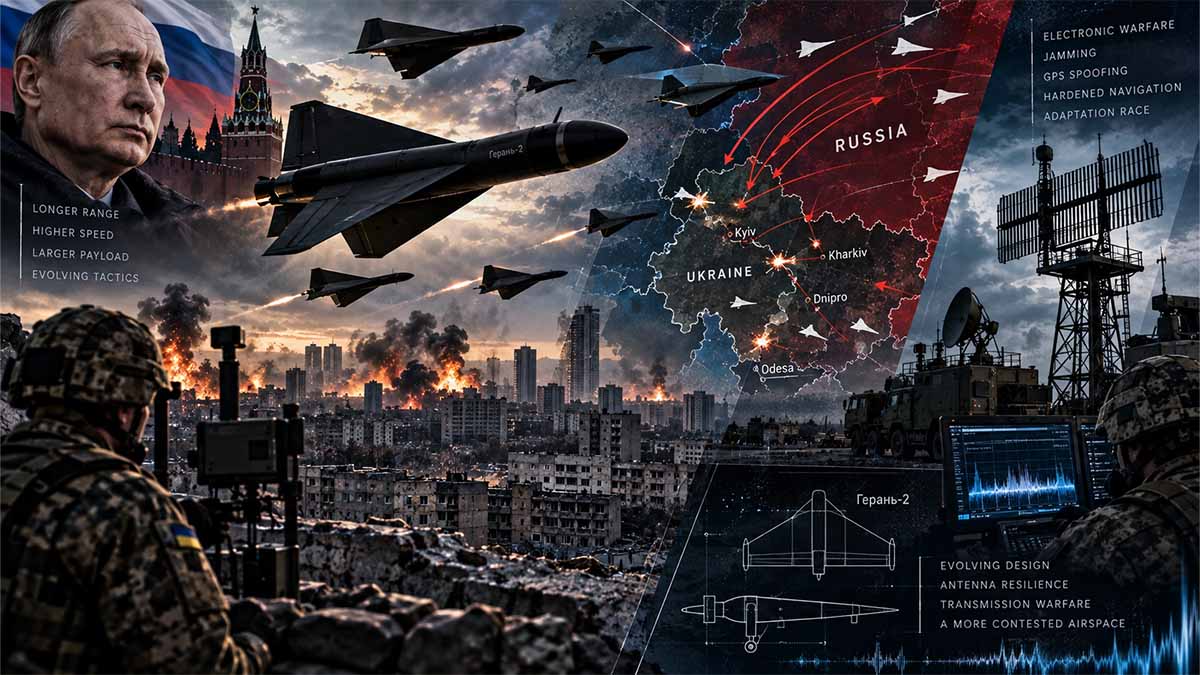
Scope: This assessment examines the reported introduction of the KRSN cumulative-cutting payload on Russian jet-powered Geran-family one-way attack UAVs, the emergence of modified contact-initiation configurations, the 1–2 October attacks affecting Kyiv’s Dnipro crossings, and whether these developments indicate a transition toward systematic attacks on Ukrainian high-voltage transmission infrastructure and strategic crossings during the winter 2026–27 campaign.
Executive Summary / BLUF
Russia appears to be developing a more specialised family of jet-powered one-way attack UAVs capable of imposing effects against target classes for which conventional blast-fragmentation Gerans are comparatively inefficient; however, the public record as of 2 October 2026 does not establish that the reported KRSN cumulative-cutting payload has entered serial production or that it was used against Kyiv’s Southern Bridge.
On 30 September, Serhii Beskrestnov, adviser to the President of Ukraine on defence technologies, stated that Russia had for the first time employed a jet-powered UAV carrying a cumulative-cutting special payload, described as a 40 kg main charge plus four additional destructive modules, designed specifically for high-voltage transmission pylons and steel bridge structures. This remains an attributed Ukrainian official assertion rather than independently published forensic confirmation. Ukrainska Pravda — 30 September 2026Pravda
The operational context materially strengthens the importance of the claim. President Volodymyr Zelensky stated on 28 September that more than 120 Shahed-type drones had attacked Ukraine during that day alone, including 90 jet-powered aircraft, demonstrating that jet propulsion is no longer an isolated experimental feature within Russian long-range UAV operations. President of Ukraine — 28 September 2026Presidenza del Presidente
The strategic significance, if the reported payload becomes available in quantity, would lie less in single-strike destructive power than in target specialisation: exposed transmission members, conductors and selected metallic structural elements require a different damage mechanism from substations, generating halls or massive reinforced-concrete bridge components.
Ukraine’s grid is especially sensitive to this distinction because its electricity system depends on long-distance 750 kV and 330 kV transmission architecture connecting major generating regions, including nuclear generation, to Kyiv and other demand centres. EBRD documentation records, for example, the 353 km Rivne NPP–Kyiv 750 kV line, the 135 km Khmelnytskyi diversion and a 60 km 330 kV connection into the Kyiv network. EBRD — Rivne Kyiv High Voltage Line ProjectEBRD
The principal winter risk would therefore arise if Russia can combine generation and substation attacks with repeated disruption of transmission corridors, creating an operational environment in which electricity remains available somewhere in the system but cannot be moved efficiently toward deficit regions.
The 1–2 October attacks against Kyiv crossings demonstrate a parallel logic in the transport domain: significant operational disruption does not require bridge collapse. On 2 October, Kyiv authorities reported that the Southern Bridge was completely closed in both directions, the Paton Bridge was restricted, and the Metro Bridge operated under partial restrictions following overnight attacks. Kyiv City Administration — 2 October 2026Офіційний портал КМДА – Головна
The controlling judgment is therefore Moderate Confidence that Russia is experimenting with a more specialised infrastructure-strike architecture, but only Low-to-Moderate Confidence that this already constitutes a systematic transmission-and-crossing campaign.
The decisive near-term indicator would be repeated recovery of specialised Geran components from geographically separate attacks that produce confirmed physical damage to high-voltage line infrastructure rather than merely to substations located near transmission corridors.
Russia’s Jet-Gerans Are Turning Infrastructure War Into a Contest of Repair Capacity
Russia’s latest drone adaptation matters less for the destructive power of any single warhead than for what it reveals about the economics of the winter 2026–27 campaign. On 30 September 2026, Serhii Beskrestnov, adviser to the President of Ukraine on defence technologies, said Russia had employed a jet-powered UAV carrying a roughly 40 kg cumulative-cutting payload plus four additional destructive modules, intended for high-voltage pylons and steel structures. Two days later, Kyiv authorities closed the Southern Bridge in both directions and imposed restrictions on the Metro and Paton bridges after renewed attacks. The issue is therefore no longer simply whether Russia can launch more drones. It is whether an increasingly differentiated Geran family can force Ukraine and its partners to spend more on interception, inspection and restoration than Russia spends creating the next layer of disruption.
The new contest is over mission specialisation, not simply drone volume
The scale of the carrier base is already changing the terms of the campaign. On 28 September 2026, President Volodymyr Zelensky said that more than 120 Shahed-type drones had attacked Ukraine during the day and that 90 were jet-powered, while on 30 September the Ukrainian Ministry of Defence identified jet-powered drones and ballistic missiles as the two principal challenges confronting national air defence. Those figures matter because a specialised payload becomes strategically relevant only when it can be attached to a carrier family available in numbers large enough to support repeated missions rather than isolated technical demonstrations.
Ukraine’s military-intelligence record points in the same direction industrially. Entries published by the Defence Intelligence of Ukraine on 17 September 2026 associate machinery at the Alabuga production complex with the Geran-2, Geran-3, Geran-4 and Geran-5 families, including Chinese SMTCL and Sino Machinery machine tools, electronics-production equipment and Iranian SEPANTA machinery. The evidence does not establish KRSN output, but it does show that Alabuga is being treated by Ukrainian intelligence as a multi-variant production environment rather than a single-airframe assembly line, which is exactly the industrial condition required for mission differentiation to become repeatable rather than exceptional.
The strategic inference is therefore narrower than claims of a technological breakthrough but more important than a prototype story. A conventional Geran can impose blast and fragmentation effects against broad targets; a faster airframe carrying a specialised payload and a more appropriate initiation mechanism can potentially extract greater effect from exposed structural components without requiring the destructive mass of a cruise or ballistic missile. The economic value lies in matching a cheaper carrier more precisely to a target class, not in pretending that a 40 kg payload has acquired the physical effect of a much larger strategic weapon.
Kyiv has already shown that disruption can be cheaper than destruction
The first empirical lesson is visible in Kyiv. On 2 October 2026, the Kyiv City Administration reported that the Southern Bridge was completely closed in both directions, that the Metro Bridge was operating under partial restrictions, and that movement on the Paton Bridge had also been restricted after the overnight attack sequence. Nothing in that official record establishes that the reported KRSN payload was used, and nothing publicly available proves that Russia achieved structural defeat of a major bridge.
That distinction is precisely why the episode matters. A bridge does not need to collapse to become operationally expensive. An impact can trigger inspection, traffic suspension, public-transport rerouting, congestion on alternative crossings, deployment of engineers and emergency services, and renewed closure if the structure is attacked again before permanent repairs are complete. The attacker’s relevant measure is therefore not necessarily tonnes of structural destruction per strike, but hours of denied mobility per unit of scarce munition expenditure.
For Russia, that creates an opportunity-cost calculation. A ballistic or long-range cruise missile remains valuable against hardened or exceptionally important targets because it brings much greater destructive energy, but every such missile expended to force a temporary bridge closure is unavailable for another mission. If a Geran-class system can repeatedly generate inspection-worthy damage at lower inventory cost, then Russia can reserve higher-value missiles for targets where their greater penetration and destructive mass actually change the result. The Southern Bridge sequence therefore suggests a possible shift from “destroy the bridge” to “keep the crossing intermittently unavailable,” a substantially different and potentially more economical campaign logic.
The power system is vulnerable not only where electricity is produced, but where it must travel
The same distinction applies more consequentially to electricity. The EBRD’s Rivne–Kyiv High Voltage Line Project documents a 353 km 750 kV line, a further 135 km 750 kV diversion, a second 1,000 MVA autotransformer, and 60 km of 330 kV double-circuit connections into the Kyiv network. Its South Ukraine Transmission Project records another architecture based on a 190 km 750 kV line, a 750/330 kV substation and 330 kV diversions. These are not peripheral engineering details; they explain why available national generating capacity and electricity actually deliverable to a deficit region are different quantities.
The International Energy Agency estimated in its latest comprehensive pre-winter assessment that Ukraine’s three operational nuclear power stations represented approximately 7.7 GW, around half of available generation, while firm winter import capability had reached 2.1 GW. Those numbers improve the national supply position, but the IEA also warned that internal transmission damage can separate comparatively well-supplied western regions from eastern areas facing deficits. The winter vulnerability is therefore not simply shortage of megawatts. It is the possibility that megawatts exist but cannot be moved efficiently across the system.
This is where a specialised attack on transmission infrastructure would change the economics of attrition. Russia’s established emphasis on generation and substations creates a manufacturing problem for Ukraine because large transformers, reactors and switching equipment are expensive, specialised and slow to replace. A transmission-focused campaign would create a restoration problem because towers, conductors, insulators, lifting equipment and engineering teams must be deployed across a geographically dispersed network. The first strategy attacks scarce equipment; the second attacks the rate at which the system can be repaired.
Transformer scarcity and corridor attrition would compound rather than substitute for each other
The existing transformer problem is already severe. The IEA’s 2025 transmission study reported procurement lead times of up to four years for large power transformers, with real transformer prices roughly 75 per cent above 2019 levels and waiting times for major grid equipment substantially longer than before 2021. Ukraine and its partners have responded accordingly: the EBRD’s emergency power-transmission programme for Ukrenergo, valued at approximately €220 million, includes 750 kV autotransformers, 330/220 kV autotransformers, 750 kV shunt reactors, circuit breakers, disconnectors, instrument transformers, surge arresters and relay-protection equipment.
The significance of a transmission campaign is that it would not replace this vulnerability; it would sit on top of it. A destroyed autotransformer consumes scarce manufactured capital. A damaged line consumes repair crews, conductors, structural components, access time and network flexibility. If both occur during the same winter attack cycle, Ukraine can simultaneously lose transformation capacity and alternative routes through which surviving generation or imports might otherwise be redirected.
The relevant systemic threshold is therefore not the number of pylons destroyed. European transmission operations are built around the N-1 security principle, under which the system should remain within operational limits after the loss of one relevant component, and Ukraine’s network retains redundancy precisely because individual failures are expected. The danger begins when repeated losses occur faster than operators can restore contingency margin, because the second or third event arrives while surviving circuits are already carrying redistributed flows and engineering teams are still committed to earlier repairs.
The measure that matters by January or February 2027 is consequently not strike count but restoration backlog: how many high-voltage failures remain unresolved when the next major wave arrives, how long repairs remain open, how many crews are simultaneously committed, and whether internal transfer constraints begin to explain regional shortages even when generation or European imports remain available.
Air defence is becoming an industrial cost-exchange problem
Ukraine is already adapting its defence architecture to this economic reality. On 30 April 2026, the Ministry of Defence announced procurement of 8,000 Octopus interceptor drones, with four manufacturers under state contract and 29 licensed Ukrainian companies involved in production efforts. On 8 June 2026, the ministry said a Brave1-developed interceptor had automated 95 per cent of the interception cycle, while the JEDI Shahed Hunter and Shvidun systems had already been codified with reported speeds above 350 km/h and 250 km/h respectively.
Those programmes matter because jet-powered Gerans compress the interval between detection and engagement, and the defender cannot sustainably answer a mass-produced one-way attack aircraft with a high-end surface-to-air missile every time. The objective is not perfect interception; it is to keep the least expensive effective layer—electronic warfare, gun systems and interceptor UAVs—responsible for as much of the threat as possible while preserving more expensive missiles and fighter sorties for weapons that cheaper systems cannot handle.
The scale already involved is substantial. On 22 September 2026, Ukraine’s Ministry of Defence reported that roughly 31,000 Shahed-type UAVs had been neutralised during 2026. If a larger share of future attack packages consists of faster jet-powered variants, Russia does not need every drone to penetrate. It gains economically whenever speed and geometry force Ukraine to commit a more expensive interceptor or to place additional permanent defence around infrastructure that previously relied mainly on repair.
This explains why corridor defence cannot simply replicate substation defence. A fixed high-value node can justify radar, guns, electronic warfare, barriers and short-range missiles concentrated within a bounded area; a transmission corridor extending hundreds of kilometres cannot. Ukraine therefore has to substitute distributed sensing, mobile interception and repair speed for universal point defence, accepting that some impacts will occur and focusing on ensuring that they do not remain operationally consequential.
Europe can supply more power, but it cannot bypass a broken internal network
European integration provides Ukraine with strategic depth, but it does not remove the transmission problem. Firm winter import capability of 2.1 GW gives Kyiv additional energy when domestic generation is damaged, and distributed assets are also growing: the IEA recorded a 200 MW / 400 MWh battery-storage complex across six Ukrainian locations, capable of providing substantial short-duration balancing and local resilience.
Neither measure replaces bulk internal transfer. A 400 MWh battery system can stabilise the network and bridge short interruptions; it cannot replicate continuous multi-gigawatt transmission between regions. Likewise, electricity imported across Ukraine’s western frontier is only strategically useful to an eastern deficit region if the internal high-voltage network can carry it there.
The external game therefore changes if transmission becomes a persistent target class. European assistance would have to move beyond replacing spectacularly expensive transformers toward a less visible but potentially broader package of conductors, modular structures, high-voltage protection equipment, repair vehicles, distributed sensors and low-cost air-defence systems. That shift would be financially less dramatic than a new missile-defence programme but institutionally more demanding because it requires continuous coordination between grid operators, defence ministries, municipalities, equipment manufacturers and European transmission-system partners.
The macroeconomic margin is already narrow. The February 2026 RDNA5, prepared by the Government of Ukraine, the World Bank Group, the European Commission and the United Nations, placed reconstruction and recovery requirements at almost $588 billion over ten years, with direct physical damage above $195 billion at the end of 2025. Within that total, transport recovery needs exceeded $96 billion and energy-sector needs approached $91 billion. A Russian strategy that turns infrastructure repair itself into a recurring consumption item therefore does not need to produce spectacular new categories of destruction to increase the fiscal burden materially.
By March 2027, the decisive question will be which side repairs or adapts faster
Over the next 12–24 months, the cost of inaction will be distributed unevenly. Ukraine will pay first through longer outages, transport disruption, additional interceptor expenditure and a larger permanent engineering establishment; European governments will pay through replacement equipment, emergency electricity support, air-defence replenishment and reconstruction finance; manufacturers will face pressure to expand transformer, grid-component, interceptor and power-electronics capacity; and Russia will bear the cost only if sanctions and battlefield adaptation raise the industrial price of sustaining jet-powered Geran production faster than Moscow can replace foreign machinery, propulsion components and electronics.
The central test before March 2027 is therefore whether Russia can convert technical experimentation into a repeatable industrial cycle before Ukraine can convert interception and restoration into a cheaper defensive cycle. If specialised wreckage begins recurring across several regions, high-voltage line damage becomes persistent, and unresolved repairs start carrying from one major attack wave into the next, the campaign will have moved from experimentation to transmission attrition. If Ukraine continues restoring line losses before new contingencies accumulate while expanding low-cost interceptors and preserving its 2.1 GW European import channel, Russia will have produced another weapon variant without changing the underlying balance.
The economic contest is ultimately straightforward: Moscow is trying to make infrastructure failure cheaper to impose; Kyiv and its partners must make interruption cheaper to absorb and faster to reverse.
Pillar I — The Weapon, the Evidence and the Engineering Problem
Chapter 1 — Evidence Ledger and Forensic Baseline
The documented emergence of KRSN; Beskrestnov’s statement; the modified jet-Geran imagery; evidentiary separation between payload, fuze modification and actual strike effects; Southern Bridge events; energy-system attacks of 30 September; confidence grading and falsification criteria.
Chapter 2 — Technical Assessment of the Payload and Carrier
Jet-powered Geran-4/Geran-5 development; differences between piston and jet propulsion; reaction-time compression for defenders; navigation and terminal-attack requirements; distinction between blast-fragmentation, classical shaped-charge and linear cumulative-cutting effects; initiation mechanisms; physical constraints on attacking transmission structures and large bridges.
Chapter 3 — Target-System Analysis: Transmission Versus Substations
Ukraine’s 750 kV and 330 kV architecture; historic Russian emphasis on generation and transformation assets; the economics of long transmission corridors; redundancy, N-1/N-2 conditions, repair saturation, transformer scarcity, corridor defence and winter system coupling.
Pillar II — Infrastructure Warfare and the Economics of Attrition
Chapter 4 — Bridges, Crossings and Operational Mobility
The strategic value of Dnipro crossings; distinction between temporary traffic denial and structural defeat; Kyiv’s Southern Bridge as the first current empirical case; transport rerouting, inspection cycles and repair burdens; interaction between low-cost UAV attacks and higher-value missile inventories.
Chapter 5 — Industrial and Force-Generation Perspective
Alabuga production architecture; evidence of Geran-4 and Geran-5 manufacturing capability; foreign machinery and propulsion dependencies; specialised-warhead manufacturing requirements; quality-control constraints; production scalability; conditions under which KRSN would shift from niche configuration to campaign instrument.
Chapter 6 — Ukrainian and Allied Counter-System
Detection, classification, interception and terminal defence; distributed sensor architecture; mobile gun and interceptor-UAV economics; point defence versus corridor protection; modular transmission repair; spare towers and conductors; European electricity support; distributed generation, storage and restoration doctrine.
Pillar III — Winter Campaign Logic, Indicators and Strategic Decisions
Chapter 7 — Campaign Outlook: 90 Days and Through March 2027
Three pathways: niche specialised employment; systematic transmission offensive; concentrated crossing-disruption campaign; Russian requirements; Ukrainian failure modes; allied decision thresholds; observable indicators capable of discriminating between pathways.
Chapter 8 — Intelligence Gaps and Collection Priorities
Warhead recovery; fuze examination; metallurgical evidence; transmission-operator damage codes; correlation between flight tracks and high-voltage corridors; Alabuga industrial signatures; repeated component standardisation; independent battle-damage assessment of Kyiv’s bridge infrastructure.
Chapter 9 — Strategic Annex and Decision Framework
Technical glossary; consolidated source architecture; confidence matrix; principal-level decision table; believe/discount/watch framework; fourteen-day and ninety-day indicators; criteria for raising or lowering confidence in the transmission-warfare thesis.
The Emerging Question Is Not Whether Russia Has Invented a “Bridge-Killing Drone”
The central analytical question is whether Russia is beginning to convert the Geran family from a largely standardised mass-strike system into a mission-differentiated strike architecture, in which airframe, propulsion, warhead and initiation mechanism are increasingly tailored to discrete categories of critical infrastructure.
Transmission Warfare Would Change the Geometry of Defence
The most consequential implication concerns geography rather than explosive yield.
A substation is a bounded object. Air defence, electronic warfare, physical barriers, camouflage and repair resources can be concentrated around it. A high-voltage transmission corridor is instead a linear system extending for tens or hundreds of kilometres, containing large numbers of exposed components and traversing terrain that cannot be continuously defended at comparable density.
Ukraine’s pre-war and wartime electricity architecture makes this distinction strategically important. The EBRD-documented Rivne–Kyiv system includes a 353 km 750 kV line, a 135 km 750 kV diversion and a 60 km 330 kV double-circuit connection toward the Kyiv transmission network. EBRD — Rivne Kyiv High Voltage Line ProjectEBRD In southern Ukraine, the EBRD documented another architecture based on a 190 km 750 kV line, a 750/330 kV substation and 330 kV diversions. EBRD — South Ukraine Transmission ProjectEBRD
The strategic vulnerability therefore does not arise because every pylon represents a critical node. It arises because coordinated losses across several corridors can increase the number of simultaneous network contingencies, reduce redispatch options and force engineering organisations to conduct geographically distributed repair under continuing attack.
Generation and Deliverability Are Different Problems
Ukraine has already adapted to a severe reduction in generating capacity. The International Energy Agency reported that available dispatchable generation fell from approximately 38 GW before 2022 to 12 GW after the concentrated attacks of spring 2024, before partial restoration, while the country’s three remaining operational nuclear power plants represented approximately 7.7 GW, or around half of available generating capacity in the IEA’s October 2025 assessment. IEA — A pre-winter assessmentIEA
European integration has provided a second resilience layer. Firm winter import capacity was set at 2.1 GW from December 2024, although the IEA emphasised that cross-border capacity remains constrained by congestion and that internal Russian attacks can separate relatively well-supplied western regions from deficit regions farther east. IEA — A pre-winter assessmentIEA
That distinction goes directly to the KRSN question. A generation attack reduces the quantity of electricity available. A successful transmission attack can reduce the deliverability of electricity that still exists.
If Russia were able to attack these mechanisms simultaneously, the cumulative effect would be materially greater than the sum of individual infrastructure losses.
Russia Is Already Diversifying the Geran Production Ecosystem
Industrial evidence does not establish KRSN production, but it does demonstrate diversification within the Geran family.
This is important because a specialised warhead only acquires strategic significance when embedded in an industrial architecture capable of supplying sufficient carriers, propulsion systems, initiation components and quality-controlled payloads.
No verified public series currently establishes the production rate of KRSN-configured UAVs. That gap is decisive. A handful of specialised weapons would represent experimentation; recurring employment across several regions would indicate doctrinal adoption.
Kyiv Demonstrates the Difference Between Destruction and Disruption
The attacks against Kyiv’s crossings on 1–2 October provide an early empirical illustration of how relatively limited physical effects can generate disproportionately significant operational consequences.
Those events do not demonstrate the destruction of a major bridge and do not establish the warhead used. They demonstrate something strategically different: temporary traffic denial can itself be an operational effect.
For infrastructure warfare, this distinction matters enormously. An attacker does not necessarily have to collapse a bridge span if repeated strikes can force inspection, traffic suspension, metro interruption, rerouting, engineering deployment and recurring uncertainty over structural safety.
The same logic applies to transmission systems. The strategic objective need not be permanent destruction if repeated localised failures can keep repair organisations operating below the rate at which damage is imposed.
The Winter Campaign Is Therefore Becoming a Contest Between Strike Tempo and Restoration Tempo
Russia’s established attacks on Ukrainian electricity infrastructure have already produced a substantial restoration requirement. The EBRD’s emergency transmission programme includes procurement of 750 kV autotransformers, 330/220 kV autotransformers, 750 kV reactors, transformers, circuit breakers and protection equipment, under a project with an estimated value of approximately €220 million. EBRD ECEPP — Emergency Power Transmission ProjectEcepp
Ukraine and its partners have therefore already built resilience mechanisms around concentrated equipment losses.
A systematic Russian shift toward transmission structures would challenge a different part of the recovery system: field engineering capacity, tower components, conductors, lifting equipment, safe access, regional repair teams and the ability to operate under recurring attack.
The central winter question is consequently whether Russia is attempting to convert the campaign from a competition over replacement equipment into a broader competition over network restoration capacity.
The public record does not yet establish that this transition has occurred.
It establishes that the technical, industrial and operational conditions making such a transition plausible are becoming more visible.
Key Evidence Table
Indicator
Value / status
Reference date
Definition / scope
Issuer
Exact source
Reported KRSN employment
First reported use; 40 kg principal charge plus four additional destructive modules
30 Sep 2026
Ukrainian adviser described payload as intended for high-voltage pylons and steel bridge structures; independent forensic confirmation not public
The decisive technical gap is physical evidence from a recovered strike vehicle whose employment can be associated with a documented infrastructure target. Public evidence currently establishes Beskrestnov’s description of KRSN, but it does not yet establish through published wreckage photography, metallurgical examination, liner recovery, explosive-residue analysis or fuze recovery that the complete configuration operates exactly as described.
The required confirmation threshold is therefore straightforward: recovery of identifiable energetic and initiation components from more than one attack, accompanied by consistent damage morphology.
The “Whisker” Configuration Requires Independent Confirmation
Imagery published in the current reporting cycle depicts a jet-powered Shahed/Geran with unusual forward-projecting rod-like elements. Defence Blog reported Serhii Sternenko’s assessment that these were intended to close an electrical contact when encountering narrow targets such as high-voltage conductors. Defence Blog — Ukraine spots “whiskered” Shahed aimed at power lines — 1 October 2026Defence Blog
The visible modification is relevant; its precise engineering purpose and integration with KRSN remain unresolved until a recovered assembly is documented.
Serial Production Remains Unknown
GUR evidence establishes an Alabuga industrial base associated with later Geran variants, but no competent public source currently establishes a production series for KRSN-configured weapons.
The transition from experimentation to campaign capability should therefore be assessed through repetition and standardisation, not statements of intent.
Key indicators include identical recovered components across multiple regions, recurring specialised configurations in successive strike packages, and industrial evidence of dedicated warhead or initiation-component production.
Target Selection Is the Most Important Operational Indicator
The most important question over the next fourteen days is not whether another modified Geran is photographed.
It is whether jet-powered attack routes repeatedly terminate against high-voltage transmission structures rather than only conventional generation or substation targets.
A geographically distributed sequence of documented tower, conductor or line-component damage would materially strengthen the transmission-offensive hypothesis.
A continuation of attacks predominantly against established power-generation and substation targets would weaken it.
Bridge Effects Must Be Separated from Bridge Destruction
The Kyiv attacks already demonstrate that repeated strikes can create significant transportation consequences.
What remains unresolved is whether Russia has achieved or even attempted systematic structural defeat rather than disruption and forced inspection.
The relevant indicators are independent engineering assessments, documented load restrictions, prolonged closure, replacement of structural members and repeated strikes against the same crossing after restoration.
Restoration Capacity Is the Strategic Measure of Effect
If transmission structures become a recurring target class, the decisive Ukrainian metric will not simply be the number of destroyed components.
It will be the ratio between damage generation and restoration capacity: repair crew availability, replacement steel, conductor inventories, access time, switching flexibility and the average duration required to restore lost circuits.
That is the measurement capable of distinguishing tactically successful attacks from strategically consequential network attrition.
Potential Transition from Point-Target Attrition to Network Attrition
Carrier evolution
Jet-Powered Geran Family
Higher speed compresses detection-to-engagement time and increases pressure on lower-cost defensive layers.
Payload evolution
Mission-Specific Warhead
A specialised cutting mechanism would seek greater effect against exposed metallic infrastructure than a conventional blast payload.
Target geometry
Distributed Infrastructure
Transmission corridors and crossings extend beyond the concentrated defensive geometry of generation plants and substations.
Strategic mechanism
Restoration Saturation
Repeated geographically dispersed failures can shift the limiting factor toward repair teams, materials, switching flexibility and restoration tempo.
↓
Strategic test:
the transmission-warfare thesis becomes materially stronger only if specialised Geran recoveries are repeatedly associated with documented damage to geographically separate high-voltage line infrastructure over successive strike cycles.
Open-Source Analytical Assessment · 2 October 2026
Russia’s Jet-Gerans:
From Energy Strikes to Transmission Warfare?
Strategic assessment of the reported KRSN cumulative-cutting payload,
jet-powered Geran-family development, attacks affecting Kyiv’s Dnipro
crossings, and the possibility of a transition from concentrated energy
targets toward distributed transmission and crossing infrastructure
during winter 2026–27.
Bottom Line Up Front
What is established, what matters, what remains unresolved
Russia’s reported KRSN adaptation would matter strategically not because
it gives a relatively light UAV cruise-missile-class destructive power,
but because it could allow the Geran family to attack previously inefficient
target classes with greater mission specificity. The most consequential
development would be a move from concentrated attacks against generation
and substations toward a combination of generation loss,
transmission disruption, restoration saturation and repeated crossing
denial. The available evidence supports serious monitoring of
this possibility but does not yet establish that such a campaign has begun.
Reported capability
Ukrainian defence-technology adviser Serhii Beskrestnov reported
first employment of a specialised cumulative-cutting payload.
Verified operational effect
Repeated UAV attacks generated measurable restrictions and temporary
closures on Kyiv’s Dnipro crossings.
Unresolved question
No public forensic evidence currently links KRSN, the modified
contact-initiation configuration and the Southern Bridge attacks
into one confirmed weapon system.
Decision-Critical Indicators
Verified figures and current status
Reported KRSN main charge
40 kg
Plus four additional destructive modules according to Beskrestnov’s
30 September statement.
Jet-powered Shaheds
90+
Reported among more than 120 Shahed-type UAVs attacking Ukraine
during 28 September.
Winter import capability
2.1 GW
Firm cross-border import capacity in the IEA baseline, constrained
by both external and internal transmission conditions.
Operational nuclear generation
7.7 GW
Approximately half of available generation in the IEA’s latest
comprehensive pre-winter baseline.
Report Architecture
Three pillars · nine chapters
I
The Weapon, the Evidence and the Engineering Problem
Establishes what can be documented about the reported KRSN adaptation,
jet-powered Geran evolution and the physical difference between attacking
concentrated facilities and exposed structural infrastructure.
Chapter 1 — Evidence Ledger and Forensic Baseline
Attribution, imagery, bridge events, confidence grading and
falsification criteria.
Chapter 2 — Technical Assessment of the Payload and Carrier
Carrier evolution, warhead classes, initiation logic and physical constraints.
Chapter 3 — Transmission Versus Substations
Grid architecture, redundancy, repair economics and winter coupling.
II
Infrastructure Warfare and the Economics of Attrition
Examines how repeated attacks can impose operational effects without
requiring catastrophic destruction, and whether industrial scale could
make specialised employment strategically relevant.
Chapter 4 — Bridges, Crossings and Operational Mobility
Traffic denial, structural defeat and the Kyiv Southern Bridge case.
Chapter 5 — Industrial and Force-Generation Perspective
Alabuga, Geran diversification, scalability and production constraints.
Chapter 6 — Ukrainian and Allied Counter-System
Detection, interception, repair, European support and resilience.
III
Winter Campaign Logic, Indicators and Strategic Decisions
Determines whether the emerging evidence represents isolated technical
experimentation or the beginning of a systematic transmission-and-crossing
campaign during winter 2026–27.
Chapter 7 — Campaign Outlook Through March 2027
Niche use, transmission offensive and crossing-disruption pathways.
Chapter 8 — Intelligence Gaps and Collection Priorities
Wreckage, grid damage records, industrial signatures and independent BDA.
Chapter 9 — Strategic Annex and Decision Framework
Confidence matrix, believe/discount/watch logic and decision thresholds.
Potential Campaign Mechanism
From carrier evolution to restoration pressure
Stage A
Jet Carrier
Increased speed compresses defender reaction time and increases pressure
on low-cost interception systems.
Stage B
Mission-Specific Payload
A specialised energetic effect would seek higher efficiency against
selected exposed structural components.
Stage C
Distributed Targets
Transmission corridors and crossings present a geographically dispersed
target geometry.
Stage D
Multiple Contingencies
Repeated failures can reduce network flexibility without destroying
the entire electricity system.
Stage E
Repair Saturation
Steel, conductors, engineering crews, safe access and restoration time
become increasingly important constraints.
Stage F
Winter Deliverability
Electricity may remain available while internal grid damage reduces
the ability to deliver it where demand is highest.
Evidence Status
What the current record supports
Proposition
Current status
Evidence
Analytical implication
Confidence
Specialised KRSN payload exists
Ukrainian official assertion
Beskrestnov described first employment of a cumulative-cutting
payload on 30 September.
Requires forensic confirmation before performance or scale can
be treated as established.
Moderate
Jet-powered Gerans are operationally significant
Strongly supported
Ukrainian presidential reporting identified 90 jet-powered
Shahed-type UAVs during 28 September attacks.
Jet propulsion is no longer analytically reducible to isolated experimentation.
High
Kyiv bridge attacks produced disruption
Verified
Southern Bridge closure and restrictions on other crossings were
reported by Kyiv municipal authorities.
Traffic denial can be operationally significant without bridge collapse.
High
KRSN was used against the Southern Bridge
Not established
No publicly available forensic evidence currently links the
reported KRSN payload to the bridge strikes.
Warhead attribution must remain separate from verified transport effects.
Low
Russia has begun a transmission offensive
Analytical hypothesis
Current evidence shows technical adaptation and an emerging infrastructure-strike pattern,
but not sustained multi-corridor repetition.
Requires geographic and temporal repetition before campaign-level
adoption can be assessed with higher confidence.
Low–Moderate
Why Transmission Warfare Would Be Different
Generation is not the same as deliverability
Dimension
Generation / Substations
Transmission Corridors
Strategic consequence
Target geometry
Concentrated sites
Long distributed infrastructure
Continuous defence becomes substantially more difficult.
Main replacement burden
Transformers, reactors, breakers and specialised high-voltage equipment
Towers, conductors, insulators, crews and field engineering capacity
The binding constraint can move from manufacturing to restoration tempo.
System effect
Reduces available generation or transformation capacity
Reduces ability to transport available electricity geographically
Power can exist but become increasingly difficult to deliver.
Defence model
Concentrated hardening and point defence
Distributed surveillance, mobile interception and rapid repair
Resilience becomes as important as interception.
Principal Gaps and Watch Indicators
What would materially change the assessment
Next 14 Days
Recoverable specialised warhead components associated with a documented
transmission-infrastructure strike.
Repeated jet-Geran tracks terminating against high-voltage corridors
rather than conventional substations alone.
Confirmed tower, conductor or line-component damage across more than
one geographically separate region.
Next 90 Days
Standardised recovered KRSN or contact-initiation components across
successive attack cycles.
Recurring attack–repair–reattack patterns against transmission corridors
or major crossings.
Industrial evidence indicating serial manufacture of specialised
payload or initiation components.
Ukrenergo restoration data showing repair capacity becoming a binding
system constraint.
Assessment-changing condition:
confidence in the transmission-warfare thesis should rise materially only
if several geographically separate strike episodes combine recovered
specialised Geran components with documented physical damage to 330 kV or
750 kV line infrastructure over successive attack cycles.
Pillar I — The Weapon, the Evidence and the Engineering Problem
Chapter 1 — Evidence Ledger and Forensic Baseline
Principal judgment
The available evidence supports Moderate Confidence that Russia has introduced, or is at minimum conducting operational trials of, a specialised structural-attack configuration within the expanding jet-powered Geran family. It does not yet support a finding that the reported KRSN payload has entered serial production, that the photographed forward-contact modification necessarily belongs to the same configuration, or that the Southern Bridge attacks of 1–2 October employed that specific warhead. The analytical burden is therefore not to determine whether all three propositions are “true” as a single package, but to identify what each evidentiary stream establishes independently, where they intersect, and which missing observations would move the assessment from experimental adaptation toward an established Russian operational capability.
The strongest evidence concerning the warhead itself remains Serhii Beskrestnov’s 30 September statement that Russian forces had for the first time employed a jet-powered UAV carrying a “cumulative-cutting” payload intended to damage high-voltage pylons and steel structures. The reported description of a 40 kg main charge accompanied by four additional destructive modules provides sufficient specificity to justify technical examination, but it is still an attributed Ukrainian official statement rather than a publicly available forensic reconstruction. Ukrainska Pravda — Russia uses warhead designed to destroy power lines on jet-powered UAV for the first time, 30 September 2026Pravda
The evidence concerning the carrier is stronger. Ukrainian official reporting now treats jet-powered Shahed-type UAVs as an operationally significant threat category rather than a marginal prototype phenomenon. On 30 September, Ukraine’s Ministry of Defence described jet-powered drones and ballistic missiles as the principal current challenges to Ukrainian air defence, and stated that Ukrainian forces had already achieved results against jet-powered UAVs while requesting additional F-16 munitions and MANPADS from Norway. Ministry of Defence of Ukraine — Ukraine and Norway work to strengthen air defence amid intensifying Russian aerial terror, 30 September 2026Міністерство оборони України
The evidence concerning the target environment is stronger again. During the night of 29–30 September Russia conducted what Ukrainian authorities described as the first combined attack of comparable scale against the energy sector since the end of the previous heating season, with eleven regions affected and subsequent emergency or stabilisation outages in Kyiv and several oblasts. Ukrenergo-related reporting recorded emergency restrictions in parts of Kyiv, Kyiv Oblast, Chernihiv Oblast and Zhytomyr Oblast because equipment had become overloaded following the attacks. Ukrainska Pravda — Emergency power outages begin in parts of Ukraine, 30 September 2026Pravda
The significance of this timing is analytical rather than merely chronological. The KRSN disclosure did not emerge against a quiet operational background; it appeared precisely as Russia resumed a high-intensity winter-oriented campaign against Ukrainian energy infrastructure, creating a credible strategic context in which differentiated UAV payloads would have greater value.
Evidence ledger
Date
Evidence source
Proposition supported
Evidentiary status
Independent corroboration
Confidence
What would materially falsify or weaken the proposition
30 Sep 2026
Serhii Beskrestnov statement reported by Ukrainska Pravda
Russia employed a jet-powered UAV with a specialised “cumulative-cutting” payload intended for pylons and steel structures
Attributed official Ukrainian statement
Multiple Ukrainian outlets reproduced the same originating statement, but these are not independent forensic streams
Moderate
Recovery of the attributed vehicle showing only a conventional blast-fragmentation payload
30 Sep–1 Oct 2026
Published imagery of modified jet-powered Geran
Forward-projecting elements exist on at least one observed airframe
Visual observation
Open-source imagery and specialist reporting
Moderate for physical modification; Low for precise function
Forensic examination showing that the elements are unrelated to target-contact initiation
30 Sep 2026
Ukrainian government and energy-sector reporting
Russia resumed large-scale combined attacks against the energy system
Official Ukrainian reporting supported by multiple system-level consequences
Outages, generation damage and restoration actions
High
No material contradiction presently identified
30 Sep 2026
Ukrenergo / Ministry of Energy-related reporting
Emergency outages imposed in Kyiv and Kyiv, Chernihiv and Zhytomyr oblasts after attacks
Operational system event
DTEK and Ukrainian government reporting
High
Subsequent operator evidence showing a materially different technical cause
1 Oct 2026
Kyiv City Administration
Multiple UAV impacts occurred in Kyiv during repeated drone alerts
Official municipal record
Physical response by emergency services
High
None concerning occurrence of attacks
1–2 Oct 2026
Kyiv municipal authorities
Southern Bridge and other Dnipro crossings were restricted or closed following attacks
Official operational record
Transport rerouting and public restrictions
High
None regarding closure; weapon attribution remains separate
17 Sep 2026
Ukrainian Defence Intelligence War & Sanctions
Alabuga machinery is associated by Ukrainian intelligence with Geran-2/3/4/5 production
Official intelligence attribution
Multiple separate machine-tool entries identify the same variants and site
Moderate–High
Independent industrial evidence demonstrating materially different production use
Current
No public forensic package
KRSN, modified contact devices and Southern Bridge attacks form one confirmed system
Not established
None sufficient
Low
Would strengthen if recovered components from bridge or pylon strikes matched the described configuration
The ledger exposes an important distinction between existence evidence, function evidence, employment evidence and effect evidence. These categories should not be merged. A photographed modification can establish that an airframe differs from earlier versions without proving why it differs; an official description of a warhead can establish that Ukrainian authorities believe such a configuration has been employed without proving its performance; a bridge closure can establish operational disruption without establishing the warhead responsible for that disruption.
The Beskrestnov statement: why it matters and why it is insufficient
The Beskrestnov statement is analytically important because it contains four elements that would be unusual in a generic wartime warning: the identification of a new payload class, a stated mass, a multi-module architecture, and an explicit target set comprising high-voltage transmission pylons and steel bridge structures. Ukrainska Pravda — 30 September 2026 report on the specialised payload
Those characteristics make the disclosure more useful than a broad assertion that Russia has developed a “new warhead.” They imply a concept of operation based on matching energetic effect to specific exposed structural components.
They do not, however, establish several matters that are crucial for a government-level assessment:
Unresolved technical question
Why it matters
Was the recovered payload intact enough to identify the complete configuration?
Partial wreckage can lead to mistaken reconstruction of system architecture
Was the 40 kg figure measured, estimated or derived from design inference?
Determines confidence in payload-mass assumptions
Were the four additional modules independently initiated or mechanically integrated?
Changes interpretation of the warhead architecture
Was the system recovered from a confirmed transmission-target strike?
Determines whether intended target and actual employment coincide
Was there reproducible evidence of directional cutting rather than blast damage?
Distinguishes a specialised structural payload from conventional explosive effect
Was an identical configuration recovered more than once?
Separates serial configuration from single-use experimentation
Until these questions are answered, the correct assessment is that KRSN is credible as a reported adaptation but not yet forensically closed.
Modified forward contacts: an important but separate evidentiary stream
The unusual forward-projecting elements visible on at least one jet-powered Shahed/Geran airframe are relevant because an open lattice tower or suspended conductor creates a fundamentally different contact geometry from a building façade, roof or hardened installation.
A conventional nose-impact mechanism benefits from encountering a broad solid surface. Narrow conductors, open lattice structures and protruding steel members create a greater possibility that the vehicle passes partly through open space or makes contact at a non-ideal point before its intended initiation sequence occurs. Extending the contact envelope forward would therefore be logically consistent with an attempt to improve initiation reliability against geometrically sparse targets.
Specialist reporting on imagery attributed to Serhii Sternenko interpreted the forward “whiskers” as an electrical contact arrangement potentially intended to initiate when the aircraft encounters a wire or other narrow element. That interpretation is plausible, but it remains an assessment rather than an officially published forensic finding. Defence Blog — Ukraine spots “whiskered” Shahed aimed at power lines, 1 October 2026
Three alternative explanations remain analytically possible without additional examination:
Explanation
Supporting logic
Evidence that would confirm it
Current standing
Contact-initiation system for thin structural targets
Separate experimental modification unrelated to the reported cutting charge
Temporal coincidence does not prove system integration
Different warhead recovered behind same device
Possible
The implication is not uncertainty for its own sake. It directly affects the campaign assessment. A specialised payload combined with a specialised fuze would indicate system-level optimisation for a target class; either adaptation in isolation would imply a narrower technological experiment.
The 30 September energy attack establishes strategic context
The large attack of 29–30 September is important because it establishes that the reported adaptation emerged at the start of a renewed winter energy campaign rather than as an isolated technical curiosity.
This sequence matters because it demonstrates that Russia was simultaneously imposing stress across several layers of Ukraine’s electricity system. The public record identifies attacks on generating assets and network equipment, while the reported KRSN configuration introduces the possibility that future attacks could extend more systematically into exposed line infrastructure.
That would represent a change in target diversification, not necessarily a replacement of existing tactics.
Southern Bridge: what the event proves
The Southern Bridge case is analytically significant because it demonstrates the difference between weapon attribution and operational effect.
Kyiv City Administration records for 2 October documented the complete closure of the Southern Bridge in both directions, restrictions on the Paton Bridge and partial restrictions on the Metro Bridge following the overnight attack sequence. Kyiv City Administration — Enemy attack on the capital on 2 October 2026
This establishes three points with high confidence.
First, strategic transport infrastructure has entered the current UAV strike pattern.
Second, even without catastrophic structural failure, UAV impacts can generate inspection, closure and rerouting effects sufficient to alter urban mobility.
Third, repeated attacks over successive nights can impose a cumulative operational burden even where the infrastructure remains physically recoverable.
What it does not establish is that the KRSN payload was responsible. No public municipal engineering record or forensic release reviewed for this assessment identifies the warhead used.
Confidence ladder for Chapter 1
Proposition
Confidence
Basis
Jet-powered Gerans are an established operational threat category
High
Ukrainian MoD statements and recurring operational reporting
Alabuga is associated with production of multiple Geran variants including Geran-4 and Geran-5
Moderate–High
Multiple Ukrainian Defence Intelligence equipment records
A specialised KRSN payload has been reported in operational use
Moderate
Specific Ukrainian presidential-adviser statement
Forward-contact modifications exist on at least one observed jet-powered Geran
Moderate
Published imagery
Forward contacts are designed specifically to improve attacks against wires/lattice targets
Moderate–Low
Plausible visual assessment without published recovered-device analysis
KRSN and the forward-contact system are components of the same serial configuration
Low
No public forensic integration
KRSN was used against the Southern Bridge
Low
No public forensic attribution
Russia has begun a systematic transmission campaign
Low–Moderate
Strategic logic exists, but repeated multi-corridor pattern has not yet been established
What would change the assessment
Confidence would increase materially if Ukrainian authorities publish recovered warhead photographs, component measurements, fuze wiring, metallurgical analysis or repeated examples showing standardised construction across separate strikes.
Confidence would decrease if subsequent wreckage demonstrates that the reported KRSN case was a unique prototype, if no further transmission-specific attacks occur during the winter campaign, or if the forward-contact configuration is shown to serve a different purpose.
Open official record
The principal missing official records are a Ukrainian forensic exploitation report on the reported KRSN vehicle, an engineering assessment linking a recovered warhead to a specific damaged transmission structure, and an independent technical assessment of the Southern Bridge strike damage sufficient to establish the weapon effect rather than only the transport consequence.
Chapter 2 — Technical Assessment of the Payload and Carrier
Principal judgment
The strategic significance of the reported configuration derives from the interaction of carrier speed, target geometry, initiation reliability and specialised energetic effect. Jet propulsion reduces defender reaction time; a specialised initiation arrangement can increase the probability that a narrow or discontinuous target produces the intended detonation sequence; and a focused structural warhead can concentrate available explosive energy against a limited metallic element instead of distributing it through general blast and fragmentation.
None of these mechanisms makes a relatively small one-way attack UAV equivalent to a heavy cruise or ballistic missile. The more important possibility is that they increase effect per kilogram against a narrow class of exposed targets, thereby expanding the economically useful target set available to mass-produced one-way attack systems.
Geran-family evolution is becoming industrial rather than purely experimental
Ukraine’s Defence Intelligence has published multiple September 2026 equipment records associating industrial machinery at the Alabuga special economic zone with production of Geran-2, Geran-3, Geran-4 and Geran-5 systems. The records include Chinese SMTCL machining centres, Sino Machinery equipment, Chinese Ruichi soldering robots, SCANTECH measurement equipment and Iranian SEPANTA machinery. Defence Intelligence of Ukraine — SMTCL VMC1000Q machine record, 17 September 2026War & Sanctions
These records do not independently prove individual production volumes, but together they establish a relevant industrial trend: Alabuga is assessed by Ukrainian intelligence as a multi-variant Geran production complex with machining, electronics and metrology capability rather than a facility limited to final assembly of one legacy Shahed-derived configuration.
Piston and jet propulsion create different defence problems
The operational advantage of jet propulsion should not be reduced to maximum speed. The decisive factor is the amount of time available to detect, classify, assign and engage the incoming vehicle.
If an aircraft traverses a fixed defensive engagement zone at higher speed, each layer of the kill chain operates under greater time pressure:
Defensive function
Effect of higher UAV speed
Initial detection
Less time between track establishment and arrival over defended area
Classification
Reduced interval for distinguishing threat from clutter or decoy
Command assignment
Less time to allocate the most economical available interceptor
Mobile fire-group positioning
Lower probability of repositioning before target passage
Gun engagement
Shorter firing window and greater lead/tracking demand
MANPADS engagement
Reduced acquisition and shot opportunity
Interceptor UAV employment
Greater speed, positioning and cueing requirements
This does not mean jet-powered Gerans are intrinsically more survivable against every defensive system. Faster speed can increase thermal and acoustic signatures and may improve detection under some conditions. The operational trade-off is therefore between greater observability and shorter reaction time, and the outcome depends on the sensor layer and weapon available at the interception point.
Reaction-time compression is a system problem
A useful government-level metric is not simply speed but decision latency.
If the target traverses the defended sector faster, the system loses not only seconds of flight time but also potential second and third engagement opportunities.
That changes air-defence economics. A defender that would prefer a low-cost gun system or interceptor drone may be forced to commit a more expensive missile if the remaining engagement envelope becomes too short for the cheaper layer.
This creates a second-order Russian benefit even when the jet-powered vehicle itself is intercepted: the attacker may force a more expensive defensive response.
Navigation requirements increase sharply as target dimensions shrink
A general-area target such as an industrial complex, large substation footprint or generating station does not impose the same terminal-navigation burden as an individual exposed transmission component.
Target specialisation therefore creates a fundamental navigation problem.
The smaller the intended vulnerable element relative to the overall target environment, the more important terminal localisation becomes.
At the strategic level, the navigation architecture can be divided into four functional layers:
Navigation layer
Function
Relevance to structural targeting
Inertial navigation
Maintains route when satellite signals are degraded
Necessary for continuity but accumulates error
Satellite navigation
Provides long-range positional correction
Efficient but susceptible to EW environment
Pre-programmed route / terrain reference
Shapes approach corridor
Can reduce exposure and improve arrival geometry
Terminal correction
Refines final approach to the intended object
Becomes increasingly important as target dimensions shrink
The public record reviewed here does not establish which terminal-correction architecture, if any, is used on KRSN-configured Gerans.
That uncertainty is strategically significant. A highly specialised warhead offers limited advantage if carrier accuracy is insufficient to bring the energetic effect to the intended structural element.
Electronic warfare matters differently against area and component targets
Electronic warfare does not have to cause complete mission failure to be effective.
Against a large-area target, moderate positional error may still result in a damaging strike somewhere within the facility.
Against a narrow exposed component, the same positional error can cause the vehicle to miss the relevant structure entirely.
This means that target specialisation increases the marginal value of navigation disruption even if the UAV itself continues to fly.
The distinction is important for defence planning because it suggests that EW should not be assessed only by the proportion of drones that crash or are completely diverted. A smaller terminal error sufficient to prevent interaction with the intended structural element can still represent a successful defensive outcome.
Three warhead classes must remain conceptually distinct
The reported payload has repeatedly been described using language that can be translated broadly as “cumulative-cutting.” That description should not be collapsed into generic “shaped charge” terminology because different focused-charge geometries produce different effects.
Warhead class
Primary mechanism
Typical effect pattern
Relevance to the current assessment
Blast-fragmentation
Expanding blast pressure and fragments
Broad local damage
Efficient against exposed personnel, equipment and general structures
Classical conical shaped charge
Concentrates energy into a narrow penetrative jet
Deep local penetration
Associated primarily with penetrating armour or similar barriers
Linear shaped / cutting charge
Concentrates energetic effect along an extended line
Local severing or cutting effect
Conceptually better aligned with attacking exposed structural members
A linear cutting configuration should therefore be understood as a structural severance mechanism, not as a small general-purpose explosive that somehow becomes capable of destroying an entire bridge.
That distinction is crucial.
A major bridge is a system containing multiple load paths, spans, bearings, piers, decks, cables or girders depending on design. Localised damage to one element can range from operationally irrelevant through inspection-triggering to structurally serious, but the effect cannot be inferred from warhead mass alone.
What a specialised payload changes
A conventional blast warhead distributes energy in many directions.
If the desired effect is to damage a narrow steel component, much of that energy is not efficiently coupled into the target.
A focused structural configuration attempts to reduce that inefficiency.
At the strategic level, its advantage can be expressed as:
greater fraction of available explosive energy applied to the intended local structural mechanism
rather than:
greater total explosive energy
This is why a relatively modest payload could potentially become useful against exposed components while remaining inadequate for destroying massive infrastructure structures.
Target-class constraints
The principal target classes in the current discussion differ substantially in structural character:
Target class
Structural character
Relative suitability for local focused damage
Principal uncertainty
Suspended conductor / ground wire
Thin, exposed, low local cross-section
High in geometric terms
Guidance and reliable contact
Lattice tower member
Exposed metallic element within redundant framework
Potentially significant locally
Whether local severance causes meaningful system failure
Insufficient energetic mass for catastrophic effect
This table should not be read as a target guide. Its purpose is to establish why one should not infer bridge-destruction capability from evidence that a weapon is designed to damage exposed metal infrastructure.
Initiation is as important as explosive design
A specialised warhead cannot produce its intended effect unless it initiates at the correct time relative to the target.
This creates a major difference between broad surfaces and open structures.
A building wall presents a near-continuous impact surface.
A high-voltage lattice structure consists of metal members separated by empty space.
A suspended conductor occupies only a small fraction of the vehicle’s potential contact area.
A conventional impact mechanism that performs reliably against a wall can therefore fail to initiate effectively against a sparse structure.
Forward-contact extensions, proximity sensing or another enlarged initiation envelope can mitigate this problem by increasing the probability that the system recognises target interaction before the vehicle passes through or breaks apart.
The public evidence is sufficient to make this mechanism plausible but not sufficient to establish the exact hardware.
Three initiation concepts and their implications
Initiation concept
Advantage
Limitation
Assessment relevance
Conventional nose impact
Simple and robust against broad surfaces
Poor geometry against narrow/open targets
Less suited to exposed line components
Extended physical contact
Enlarges effective contact envelope
Vulnerable to accidental activation or damage
Consistent with observed forward rods
Proximity / non-contact sensing
Does not require direct impact
More complex and potentially EW/environment sensitive
No public evidence currently establishes use
The presence of forward elements therefore matters not because they are technologically exotic, but because they indicate that Russian engineers may be treating target interaction itself as a design problem.
Failure modes matter as much as nominal capability
Specialised weapons frequently create new failure modes while solving old ones.
A forward-contact system can potentially improve initiation probability against thin targets but also creates the possibility of premature activation, physical damage during flight or interaction with unintended obstacles.
A focused structural warhead may produce greater local effect when positioned correctly but substantially less useful effect when orientation is poor.
A faster carrier reduces defender reaction time but can increase terminal-control difficulty.
The relevant engineering relationship is therefore not “specialised equals more powerful.” It is:
specialised equals potentially more efficient within a narrower envelope of correct employment.
Industrial standardisation will determine whether the adaptation matters
The Alabuga equipment records provide evidence of the broader manufacturing ecosystem required to produce increasingly differentiated Geran airframes. GUR identifies CNC machining capability, soldering equipment and three-dimensional coordinate measurement systems, including a Chinese SCANTECH TrackScan P42 system, at the production complex. Defence Intelligence of Ukraine — TrackScan P42 3D coordinate measuring system, 17 September 2026War & Sanctions
Metrology is relevant because serial production of specialised mechanical components requires repeatability. The presence of such machinery does not prove that it is dedicated to KRSN, but it reinforces the broader assessment that the Geran programme has access to equipment capable of supporting iterative airframe and component refinement.
The critical analytical threshold is therefore not whether Russia can manufacture one specialised device. It is whether the configuration becomes standardised, repeatable and numerous enough to be integrated into campaign planning.
Key judgments
Jet propulsion increases the pressure on Ukrainian air-defence decision time but does not make Geran variants inherently invulnerable.
Specialised structural warheads derive their advantage from focused energy application rather than from an increase in total destructive mass.
Terminal navigation and initiation reliability become increasingly important as the intended vulnerable element becomes smaller.
The available evidence supports the possibility of an integrated structural-targeting configuration, but the exact KRSN guidance and fuze architecture remain unverified.
What would change the assessment
Evidence of standardised recovered guidance packages, identical contact-initiation mechanisms or repeated structural damage morphology would strengthen confidence that the weapon has matured beyond experimentation.
Conversely, irregular recovered configurations or an absence of repeated target-specific effects would support the interpretation that Russia is still conducting limited trials.
Open official record
No competent public source reviewed for this assessment provides the complete KRSN fuze diagram, terminal-navigation architecture, serial-production quantity or independently validated structural-performance data.
Chapter 3 — Target-System Analysis: Transmission Versus Substations
Principal judgment
The strategic significance of a transmission-focused Russian campaign would arise from dispersion, redundancy management and repair saturation, not from the intrinsic fragility of individual Ukrainian transmission towers. Substations and large transformers remain highly consequential targets because they concentrate essential switching and voltage-transformation functions into fixed facilities and contain long-lead equipment. Transmission corridors present the inverse problem: many components are individually more replaceable, but they are geographically distributed across hundreds of kilometres and cannot be defended with the same concentration of sensors, barriers and air-defence systems.
A Russian campaign that combines both target classes would therefore attack two different resilience mechanisms simultaneously: manufacturing scarcity at substations and field-restoration capacity along transmission corridors.
Ukraine’s transmission system is built around long-distance high-voltage transfer
Ukraine’s electricity architecture reflects the geography of large centralised generation, including nuclear and thermal stations located far from several principal demand centres.
The EBRD’s Rivne–Kyiv project provides a particularly clear institutional example. The project included a 353 km 750 kV Rivne Nuclear Power Plant–Kyiv transmission line, a 135 km 750 kV diversion from the Khmelnytskyi NPP–Chornobyl NPP route to the Kyiv substation, installation of a second 1,000 MVA autotransformer, and 60 km of 330 kV double-circuit lines connecting the Kyiv substation with the city transmission network. EBRD — Rivne Kyiv High Voltage Line ProjectEBRD
The architecture is analytically important because it illustrates the functional hierarchy:
bulk generation → 750 kV long-distance transfer → major substation → 330 kV regional transmission → urban and regional delivery
The EBRD’s South Ukraine Transmission Project documents the same logic in another region: a 190 km 750 kV line, a new 750/330/220 kV substation, and diversions of existing 330 kV routes were designed to improve system reliability and electricity transfer in southern Ukraine. EBRD — South Ukraine Transmission ProjectEBRD
ENTSO-E’s transmission maps also distinguish Ukrainian 750 kV and 300–330 kV layers as major elements of the interconnected system. ENTSO-E — Transmission System MapENTSOE
Transmission and transformation perform different strategic functions
A simplified system model is useful:
System layer
Primary function
Typical consequence of loss
Generation
Produces electrical energy
Reduces available megawatts
Step-up / major substations
Transform and route bulk power
Restricts ability to inject or redirect generation
750 kV backbone
Long-distance bulk transfer
Reduces ability to move very large power flows between regions
330 kV regional network
Regional distribution and system meshing
Reduces redundancy and local transfer capability
Distribution network
Final delivery to consumers
Produces local service interruption
An attack on generation reduces supply.
An attack on a transformer or substation reduces the system’s ability to transform and route supply.
An attack on a transmission line can leave both generating capacity and receiving substations physically intact while preventing the desired flow between them.
This is why “installed capacity” and “deliverable power” are not interchangeable measures during wartime.
Nuclear dependence increases the value of transmission integrity
Nuclear generation is particularly relevant to transmission analysis because large nuclear units are concentrated sources of baseload electricity. Their strategic value therefore depends on the availability of high-capacity transmission paths capable of moving output from generation regions to consumption centres.
This assessment concerns only off-site electricity transmission. It makes no inference regarding reactor safety from transmission loss.
Historical Russian target emphasis created a transformer problem
Russia’s earlier energy campaign repeatedly targeted large generation and transformation assets because these facilities combine high strategic value with relatively concentrated physical footprints.
This approach exploited a well-known global supply-chain constraint: large transformers are difficult to replace quickly.
The IEA’s 2025 global transmission study found that procurement can now take up to four years for large power transformers, while transmission cables generally require two to three years, and that average waiting times had nearly doubled since 2021. Transformer prices were estimated to have risen by roughly 75% in real terms since 2019. IEA — Building the Future Transmission Grid: Executive SummaryIEA
Ukraine’s wartime restoration architecture demonstrates that this constraint is already being addressed institutionally. The EBRD’s emergency transmission-restoration programme for Ukrenergo, with an estimated value of €220 million, includes procurement of 750 kV 333 MVA autotransformers, 330/220 kV 125–250 MVA autotransformers, 750 kV shunt reactors, transformers, circuit breakers, disconnectors, instrument transformers, surge arresters and relay-protection equipment. EBRD ECEPP — Emergency Power Transmission Project procurement noticeEcepp
This replacement pipeline changes Russian incentives because some of the effects of repeated substation attacks are increasingly met by pre-planned allied procurement and stock-building.
A shift toward transmission structures would therefore attack a different logistics chain.
Transmission warfare creates a repair-tempo problem
Line structures are generally less technologically unique than large transformers.
That does not make them strategically irrelevant.
Their vulnerability lies in quantity and dispersion.
A long transmission corridor contains numerous towers, conductors, insulators, shield wires and associated components across terrain that can include forests, agricultural land, rivers and road crossings.
Damage at one location can often be repaired more rapidly than destruction of a major transformer.
The difficulty increases if damage occurs at several geographically separated locations within a compressed period.
Towers and lattice sections require transport and assembly
Conductors and insulators
Restoration cannot proceed without appropriate voltage-class material
Heavy equipment
Cranes and lifting systems may need road access close to the site
Security clearance
Repair cannot begin safely during continuing attack
Switching capacity
Operators must isolate damaged sections and reconfigure power flows
Communications
Dispatch and field crews need reliable operational coordination
Weather
Winter conditions extend access and repair times
Repeat attack
Restored infrastructure can be damaged again before full system recovery
The strategic objective would therefore be less “destroy the grid” than increase simultaneous restoration demand faster than the available repair system can clear it.
The N-1 principle explains why isolated damage often does not produce collapse
European transmission-system operations use the N-1 criterion as a core security principle. EU Regulation 2017/1485 defines it as the condition under which the elements remaining in operation after one contingency can accommodate the new operational situation without violating security limits. EUR-Lex — Commission Regulation (EU) 2017/1485, electricity transmission system operationEur-Lex
ENTSO-E similarly explains that N-1 contingency analysis is intended to ensure that the power system can withstand the unexpected loss of one component while remaining within operational security limits. ENTSO-E — Probabilistic risk assessment and the N-1 criterionENTSOE
This concept is central to interpreting transmission attacks.
A single lost line or network element does not necessarily create widespread service interruption because the system may redirect flows through alternative paths.
The attacker gains greater strategic leverage when failures occur faster than operators can restore contingency margin.
Why N-2 is qualitatively different
“N-2” is often used informally to describe simultaneous or sequential loss of two important components, but its effect cannot be generalised because the consequences depend on which two components fail, system loading, generation dispatch and topology.
The important analytical point is that once the system has already absorbed one major contingency, a second loss can remove the alternative path that was carrying redistributed power.
This creates a non-linear relationship between the number of attacks and the resulting effect.
Two carefully timed network failures can therefore produce substantially greater disruption than two isolated failures separated by sufficient restoration time.
No claim is made that any specific Ukrainian corridor would necessarily fail under an N-2 condition. That requires real-time operator data unavailable in the public domain.
Transmission warfare therefore targets redundancy
The relevant Russian objective, if the transmission hypothesis proves correct, would not be the destruction of arbitrary pylons.
It would be the erosion of operational redundancy.
That can occur through several mechanisms:
topological loss — removal of an alternative route;
However, the IEA also explicitly warned that available imports may not reach the regions most in need when Russian attacks fragment the internal network, noting the risk of increasingly well-supplied western regions being separated from eastern areas facing deficits. IEA
This is the central difference between external adequacy and internal deliverability.
Ukraine can simultaneously possess sufficient generation plus imports at the national level and still experience regional shortages if transmission bottlenecks prevent transfer.
The economics of defence favour substations but not corridors
A major substation can be surrounded by:
physical barriers;
camouflage;
electronic warfare;
short-range guns;
interceptor UAVs;
surface-to-air systems;
local radar and acoustic sensors.
The same defensive density cannot be economically extended along hundreds of kilometres of transmission line.
This creates a fundamental cost asymmetry.
Defence problem
Substation
Transmission corridor
Geographic footprint
Small and fixed
Long and dispersed
Sensor concentration
High
Difficult to sustain continuously
Physical hardening
Practical for selected equipment
Impractical for entire corridor
Local SAM coverage
Feasible at priority nodes
Extremely costly over full length
EW concentration
Feasible
Requires distributed architecture
Rapid repair
Equipment dependent
Crew/access dependent
Decoy value
Potentially high
Less useful for an extended network
Defender’s best response
Point defence + hardening
Selective defence + sensing + rapid restoration
The implication is that an optimal Ukrainian response to transmission attacks would not be to defend every tower.
It would be to identify systemically consequential segments, provide layered detection around those areas, maintain mobile interception capacity, and reduce restoration time across the rest of the network.
Transformer scarcity and line-repair capacity are complementary vulnerabilities
The attacker gains maximum systemic leverage if it combines attacks on both categories.
Destroying a large transformer creates a long-term asset problem.
Damaging a transmission line creates a potentially shorter-duration routing problem.
If line damage is imposed while transformer replacements are already scarce, the defender loses both hardware reserve and network flexibility.
The combined effect can be represented conceptually:
generation loss + transformation loss + transmission loss + peak winter demand = declining system margin
The first three components need not individually reach catastrophic levels if they occur simultaneously.
Winter changes the consequences of every contingency
Winter increases the strategic value of network integrity because demand rises while infrastructure repair becomes more difficult.
Cold weather raises electricity and heating requirements, can complicate field work and increases the societal cost of prolonged outages.
The IEA’s Ukraine assessment characterises the system as fragile despite substantial restoration progress and specifically identifies the possibility of major disruptions if attacks intensify or temperatures become colder than expected. IEA — Ukraine’s Energy SecurityIEA
Ukraine has improved resilience through restoration, imports and storage, including the addition of a 200 MW / 400 MWh battery-storage complex distributed across six locations, but storage cannot substitute indefinitely for the loss of high-capacity transmission paths. IEA — A pre-winter assessment of Ukraine’s energy security
Battery storage is valuable for balancing, frequency support and short-duration local resilience.
It does not replace the continuous bulk transfer function of a 750 kV or 330 kV network.
Quantitative comparison of the two attrition models
Variable
Substation / transformer attrition
Transmission-corridor attrition
Typical target concentration
High
Low
Component technological complexity
Very high
Moderate
Global replacement lead-time exposure
Severe for transformers
Lower for many tower components, but material availability still relevant
Geographic repair burden
Limited number of fixed sites
Potentially many dispersed sites
Air-defence concentration
Comparatively feasible
Structurally difficult
Repair-specialist requirement
High-voltage equipment specialists
Line crews, rigging, conductor and structural teams
Potential repeat-target problem
High-value known sites
Very large number of possible attack points
Primary systemic mechanism
Loss of transformation/switching capacity
Loss of routing and redundancy
Principal bottleneck
Manufactured equipment
Restoration tempo
Best defensive investment
Hardening, point defence, spare transformers
Distributed sensing, mobile defence, modular spares, rapid repair
Strategic effect if combined
Compounds hardware scarcity
Compounds geographic fragmentation
Repair saturation is the decisive threshold
Transmission warfare becomes strategically consequential only when the rate of damage exceeds the rate of sustainable restoration.
This distinction is critical because a spectacular strike is not the same as a successful campaign.
If a tower is repaired in hours or a small number of days and the system has sufficient alternative capacity during that period, the strategic effect is limited.
If multiple outages accumulate faster than repair teams can restore them, the system enters a different regime.
The relevant indicators are therefore:
average repair duration;
number of concurrent damaged circuits;
percentage of available crews already deployed;
inventory of emergency tower components;
frequency of repeat attacks before repair completion;
volume of forced redispatch;
duration of regional import or generation constraints.
These are more meaningful than raw strike counts.
The decisive strategic comparison
Russia’s earlier energy campaign attacked scarce objects.
A transmission campaign would attack numerous objects faster than they can be restored.
The difference can be summarised as follows:
Substation strategy: make each individual loss difficult to replace.
Transmission strategy: create enough distributed losses that restoration itself becomes the scarce resource.
If both approaches are combined during periods of peak winter demand, they become mutually reinforcing.
Key judgments
Ukraine’s 750 kV and 330 kV layers are indispensable because they connect concentrated generation and import capability with geographically distributed demand.
N-1 design and operational practice make isolated transmission damage manageable under many conditions, but repeated geographically coordinated contingencies can progressively remove redundancy.
European imports strengthen national adequacy but cannot compensate for internal network fragmentation when power cannot be delivered to deficit regions.
Large-transformer scarcity remains a major vulnerability, while transmission attacks would create a different bottleneck centred on engineering crews, field logistics and restoration tempo.
The strongest Russian campaign model would therefore combine rather than substitute generation, transformer and line attacks.
What would change the assessment
The transmission-warfare thesis would strengthen materially if operator reporting begins showing repeated high-voltage line outages across separate regions, if multiple line repairs remain simultaneously open for extended periods, or if emergency dispatch increasingly reflects internal transfer limitations rather than generation shortage alone.
It would weaken if specialised attacks remain rare, if damaged lines are routinely restored before additional contingencies accumulate, or if no recurring pattern emerges against transmission infrastructure during successive winter strike cycles.
Open official record
Publicly available data do not provide sufficient real-time topology, line-loading, contingency-margin or repair-crew information to identify which specific Ukrainian transmission losses would create system-wide N-2 conditions. Any attempt to rank individual lines by vulnerability without that data would exceed the verified record.
Pillar II — Infrastructure Warfare and the Economics of Attrition
Chapter 4 — Bridges, Crossings and Operational Mobility
Principal judgment
The operational significance of Russian attacks against Ukrainian river crossings lies less in the probability of achieving immediate catastrophic structural failure than in the possibility of imposing recurrent mobility denial at comparatively low marginal cost, because every closure of a major Dnipro crossing creates a compound burden that includes engineering inspection, traffic rerouting, public-transport disruption, emergency-service reconfiguration, military-logistics delay, and the possibility that the same structure must be reassessed after subsequent attacks before normal flow can resume. The Southern Bridge episode of 1–2 October is therefore analytically important not because it demonstrates that a Geran-class UAV can reliably destroy a major bridge, which the public record does not establish, but because it demonstrates that repeated UAV impacts can force authorities to reduce or suspend movement across strategically important urban crossings even when the structure remains standing. On 2 October, Kyiv municipal authorities reported that the Southern Bridge was completely closed in both directions, the Metro Bridge was restricted to one lane from the left bank toward the right bank, and the Paton Bridge was fully restricted from the right bank toward the left bank. Kyiv City Administration — Enemy attack on the capital on 2 October 2026Офіційний портал КМДА – Головна
The distinction between temporary traffic denial and structural defeat is fundamental. A bridge can remain physically repairable and yet be unavailable for several hours or days because the uncertainty created by impact damage, fire, deformation, debris, damaged overhead equipment, or suspected load-path impairment obliges operators and engineers to restrict movement until the structure is examined. That means the attacker can obtain a meaningful operational effect without achieving the far more demanding objective of dropping a span or destroying a massive reinforced-concrete support. From the defender’s perspective, the economic unit of analysis is therefore not simply “damage per strike”; it is disruption time per attack cycle, because a relatively minor structural or surface effect can become strategically useful if it repeatedly resets the inspection and reopening process.
Dnipro crossings are transportation multipliers rather than isolated civil structures
The Dnipro is not simply a geographic obstacle but a system separator whose crossings concentrate road, metro, rail, utility, and urban mobility functions into a limited number of fixed corridors. In Kyiv, the crossing network links the densely populated right bank with major residential, logistics, industrial, and transport areas on the left bank, and restrictions on one bridge immediately redistribute traffic toward the remaining crossings. The municipal record of 2 October already shows this network effect, because restrictions were not limited to a single bridge: simultaneous or near-simultaneous limits affected the Southern Bridge, the Metro Bridge, and the Paton Bridge, requiring public transport to operate with delays and route deviations. Kyiv City Administration — 2 October 2026Офіційний портал КМДА – Головна
The strategic value of repeated crossing attacks comes from the way these constraints propagate through the transport system. A closure does not merely affect vehicles that would otherwise use the targeted bridge; it pushes demand onto alternative corridors, increases congestion at bridge approaches, delays buses and emergency services, extends travel time for commercial deliveries, and can complicate the movement of repair crews themselves. If several crossings are simultaneously degraded, the resulting traffic concentration can also reduce the resilience of the entire urban network because any secondary incident—accident, additional attack, or maintenance failure—has a larger impact when spare capacity is already reduced.
Effect category
Immediate consequence
Second-order consequence
Strategic relevance
Bridge closure
Vehicles diverted
Congestion on remaining crossings
Reduces urban mobility resilience
Metro interruption
Passenger flows transferred to buses/cars
Road congestion increases further
Multiplies effect across transport modes
Engineering inspection
Structure unavailable pending assessment
Reopening delayed even when damage is limited
Turns uncertainty into operational denial
Repeated attack
Inspection cycle restarts
Restoration effort becomes recurrent
Creates cumulative attrition
Multi-bridge restriction
Alternative routes lose reserve capacity
Whole-city transport network becomes less flexible
Raises systemic rather than local cost
The implication is that the most important measure is not whether the bridge “survived” in a binary sense. The more useful operational metric is the duration and recurrence of imposed restrictions relative to available alternative crossing capacity.
Traffic denial requires far less destructive effect than structural defeat
A major bridge is a highly redundant engineered system. Structural defeat usually requires either severe damage to a primary load-bearing member, damage to multiple interacting elements, or cumulative deterioration that causes load limits or closure for safety reasons. Temporary traffic denial can be achieved with a much lower threshold, because a visible impact near a support, deck, girder, cable or utility interface can be sufficient to trigger a conservative engineering response until inspections establish whether the structure is safe.
This creates an important asymmetry in favour of repeated low-cost attack systems. A high-value ballistic or cruise missile may be capable of delivering far greater explosive energy, but if the objective is temporary denial rather than catastrophic collapse, the marginal value of that additional destructive power can decline sharply once the bridge has already been forced out of service.
The economic logic can therefore be represented as:
attacker objective = maximise closure time per unit of scarce high-value munition expenditure
rather than:
attacker objective = maximise structural destruction per strike
This distinction becomes especially important if Geran-family systems can be produced and employed in far greater numbers than cruise or ballistic missiles, because repeated low-cost attacks can create inspection saturation even when each individual impact produces limited physical damage.
Inspection cycles are part of the target system
Bridge resilience depends not only on concrete, steel, and redundancy but also on the institutional process required to declare the bridge safe after an attack. A major urban crossing cannot simply be reopened because visible damage appears limited; authorities must establish whether hidden deformation, bearing damage, deck displacement, cracking, fire exposure, utility damage, or debris loading has altered the structure’s safety margin.
This means that inspection itself becomes part of the attrition equation.
The physical damage in each cycle may remain repairable, but the operational effect accumulates because municipal authorities, engineering teams, traffic police, emergency services and transport operators repeatedly devote time and resources to the same infrastructure.
The Southern Bridge event should therefore be interpreted as an early example of operational denial through recurring uncertainty, not simply as a failed attempt to demolish a bridge.
Repeated attacks create a different cost-exchange than one-time heavy strikes
The economic comparison between a one-way UAV and a high-value missile cannot be reduced to catalogue unit prices because actual Russian procurement costs, wartime transfer pricing, and inventory values are not publicly transparent. The strategic comparison nevertheless remains valid because the systems occupy different scarcity classes.
Ballistic and long-range cruise missiles require higher-value propulsion, guidance, airframe, electronics and manufacturing inputs; they are correspondingly more valuable for deeply hardened, high-value or time-sensitive targets. A one-way attack UAV is optimised for mass employment and can be used to force defenders to spend disproportionate resources even when it fails to achieve catastrophic destruction.
A simplified campaign-cost framework is therefore:
Weapon class
Relative scarcity
Typical campaign role
Value against bridge denial mission
Ballistic missile
Very high
Hard, time-critical or defended targets
High destructive potential, expensive denial mechanism
Long-range cruise missile
High
Precision strategic strike
High effect but significant inventory opportunity cost
Jet-powered Geran
Lower than missile class
Repeated mass or specialised attack
Potentially attractive if temporary denial is sufficient
Piston Geran
Lowest among these classes
Mass saturation and distributed attack
Economically useful but more vulnerable to low-cost defences
The important concept is opportunity cost. Every expensive missile used to force a bridge closure is one that cannot be used against another high-value target. If a specialised Geran configuration can impose comparable temporary operational denial at a lower strategic inventory cost, Russia would gain a new option for maintaining pressure on crossings while preserving missile stocks.
Crossing attacks become strategically important when they are synchronised with other infrastructure pressure
Bridge attacks would have the greatest effect when combined with simultaneous energy, communications or rail disruptions, because the resulting constraints interact. Transport bottlenecks slow repair crews, fuel deliveries and equipment movement; power outages reduce the efficiency of rail or metro operations; communications degradation complicates dispatch and emergency management.
The relevant measure is therefore cross-domain friction, not isolated bridge damage.
A winter scenario in which urban crossings are periodically closed at the same time that energy infrastructure is under attack would impose a heavier cumulative burden than either campaign in isolation.
Repair burden is determined by recurrence, not simply severity
A one-time bridge strike may require inspection and local repair. Repeated strikes create a maintenance regime in which temporary measures may need to be replaced before permanent repair is complete, and engineering teams remain tied to a recurring threat environment.
The burden rises especially when:
the same crossing is attacked again before full repair;
multiple bridges require simultaneous inspection;
spare structural components must be pre-positioned;
road or metro operations require repeated service changes;
air defence units must be permanently allocated near crossings;
engineering teams must work under continuing aerial threat.
The strategic objective of repeated attack is therefore not necessarily to cause progressively greater physical damage each time. It can be to create a persistent readiness tax on the defender.
Bridge-defence economics
A major bridge presents a bounded geographic target, which makes point defence more practical than along a long transmission corridor, but the surrounding airspace, approach routes and dense urban environment create significant challenges. A rational defensive architecture would therefore combine early detection, terminal-area interception, physical mitigation where engineering conditions permit, rapid inspection, and prepared rerouting rather than attempting to guarantee zero impacts.
Defensive layer
Function
Principal advantage
Principal limitation
Wide-area radar/acoustic detection
Early track acquisition
Maximises engagement time
Depends on integration and low-altitude coverage
Mobile interceptor UAVs
Low-cost terminal engagement
Better cost exchange than high-end missiles
Performance challenged by faster jet threats
Gun systems
Point defence near crossings
Economically sustainable
Short engagement window
MANPADS / SHORAD
High-probability terminal defence
Effective against harder targets
More expensive per engagement
Physical barriers / local shielding
Reduce damage from some attack geometries
Persistent protection
Cannot shield entire bridge
Inspection and repair teams
Restore use quickly
Converts physical damage into short disruption
Requires trained personnel and safe access
Traffic redundancy plans
Preserve mobility
Limits systemic consequence
Alternative routes can saturate
The broad lesson from the Southern Bridge case is therefore that mobility resilience must be assessed as a network function, because the attacker can gain meaningful operational effects without meeting the far harder engineering requirement of structural defeat.
Key judgments
Repeated attacks against Dnipro crossings can impose high operational costs even when bridge structures remain repairable, because closure, inspection, rerouting and transport congestion create system-level effects.
The most economically significant Russian use of specialised one-way UAVs against bridges would be recurrent denial rather than one-shot demolition.
The strategic value of such attacks rises sharply when they are synchronised with energy or communications disruption.
The defender’s most important variables are reopening time, availability of alternative crossings, and the ability to prevent repeated impacts from resetting the inspection cycle.
What would change the assessment
Confidence in a deliberate crossing-disruption campaign would increase if the same bridges are re-attacked soon after reopening, if several crossings are systematically targeted during the same operational window, or if municipal engineering records begin showing cumulative structural degradation rather than temporary service interruption.
It would decrease if the October attacks remain isolated, if transport restrictions prove consistently short-lived, or if subsequent strikes do not show a recurring focus on bridge infrastructure.
Open official record
Publicly available material does not yet provide a complete independent engineering assessment of Southern Bridge structural damage, detailed reopening timelines for all affected crossings, or a sufficiently long strike series to determine whether the events represent sustained Russian crossing doctrine rather than opportunistic attacks.
Chapter 5 — Industrial and Force-Generation Perspective
Principal judgment
The central industrial question is not whether Russia possesses the technical competence to manufacture a specialised structural warhead, because that threshold is comparatively low for a state already producing multiple missile, UAV and energetic systems; the critical issue is whether Russia can incorporate the configuration into a repeatable, quality-controlled, high-throughput Geran production architecture without materially constraining baseline strike-drone output, because only then would KRSN evolve from a technically interesting niche adaptation into a campaign-level instrument capable of imposing recurring pressure on infrastructure across multiple regions.
The industrial significance of these records lies not in any single machine but in the functional diversity they reveal. A plant equipped with CNC machining, printed-circuit-board insertion, soldering and dimensional-control equipment can perform a much greater share of iterative redesign, fixture production, electronics integration, mechanical refinement and quality assurance internally than a simple final-assembly line.
Alabuga is best assessed as an evolving UAV production ecosystem
The available evidence supports a model in which Alabuga performs several industrial functions simultaneously:
Industrial layer
Evidence from GUR records
Relevance to Geran evolution
Structural machining
SMTCL, Sino Machinery, SEPANTA machine tools
Supports airframe, fixture, engine-mount and mechanical-component production
Electronics assembly
ICT insertion machinery, soldering equipment
Supports navigation, control and fuze/electrical integration
Metrology / quality control
Coordinate-measuring and scanning equipment in the broader record
Enables repeatable dimensional control across serial production
Final assembly
Facility attribution across Geran variants
Integrates airframes, engines, electronics and payloads
Variant differentiation
Geran-2/3/4/5 all cited
Indicates production architecture supports multiple configurations
The presence of multiple variants introduces both capability and complexity. A multi-variant line can tailor aircraft to different missions, but every additional configuration increases requirements for parts tracking, documentation, tooling, quality control and production scheduling.
The industrial question is therefore whether KRSN can be incorporated as a modular payload option with minimal disruption to the carrier line, or whether its manufacture requires sufficiently specialised components that it becomes a separate bottleneck.
Specialised-warhead manufacturing is not the same as conventional warhead filling
A standard blast-fragmentation warhead can be produced through well-established processes involving casing manufacture, explosive filling, fragmentation elements and fuze integration.
A specialised directional or cutting warhead imposes tighter requirements because performance depends not merely on explosive mass but on geometry, material consistency, component alignment and initiation uniformity.
At a strategic industrial level, the critical manufacturing steps include:
precision fabrication of the energetic structure;
consistent liner or focusing component manufacture;
dimensional inspection;
explosive loading with repeatable density;
reliable integration with the initiation system;
safe handling and transport;
lot-level testing and quality assurance.
The importance of quality control rises because a conventional blast warhead may remain militarily useful despite moderate manufacturing variation, whereas a directional energetic device can lose much of its intended effect if geometry, alignment or initiation timing fall outside tolerance.
This means that KRSN scalability depends on manufacturing repeatability, not simply explosive availability.
Quality control becomes the hidden bottleneck
A niche prototype can be hand-fitted, individually inspected and adjusted.
A campaign weapon must deliver predictable effects after thousands of production cycles.
That creates several scaling risks:
Scaling risk
Mechanism
Campaign consequence
Geometric inconsistency
Small dimensional deviations degrade focused effect
High dud/underperformance rate
Fuze variability
Contact system behaves inconsistently
Missed or premature initiation
Carrier integration variation
Payload changes balance or vibration
Navigation and reliability problems
Explosive-fill variability
Different density or void patterns
Inconsistent energetic performance
Batch quality drift
Production speed exceeds inspection capacity
Larger proportion of ineffective sorties
Supply-chain substitution
Sanctions force component changes
Requalification required
These problems are particularly important for a Russian production system under pressure to maximise output, because volume incentives can conflict with the tighter quality-control requirements of specialised payloads.
The implication is not that Russian production would cease if individual imported machines became unavailable, because machine tools are durable capital goods and existing equipment can continue operating. The more important vulnerability concerns maintenance, replacement parts, software, tooling, sensors, controls and future expansion.
A sanctions strategy aimed at industrial throughput therefore affects the production system differently depending on time horizon:
short term: existing machines remain usable;
medium term: spare parts, tooling and maintenance become more important;
long term: expansion and replacement become increasingly difficult if access to comparable imported systems narrows.
Propulsion is a separate force-generation constraint
Jet-powered UAV production introduces an additional industrial layer because engines are materially more complex than the small piston systems traditionally associated with Shahed-136-type vehicles.
That Ukrainian response is indirect evidence of the strategic importance being assigned to the jet-powered threat category, but it does not establish Russia’s actual engine output or supplier composition.
The most defensible industrial assessment is therefore that airframe diversification is proven more strongly than propulsion self-sufficiency.
KRSN would become strategically important only after modularisation
The most efficient route to scale would be to design the specialised payload as a modular configuration compatible with an existing carrier architecture rather than build a unique aircraft around it.
A modular approach offers several industrial advantages:
shared airframe;
shared navigation package;
shared propulsion;
common ground handling;
reduced training burden;
mission-specific payload installation late in the assembly process.
This would allow Russian planners to allocate a fraction of total Geran production to specialised missions without creating an entirely separate production line.
The decisive intelligence indicator would therefore be repeated use of the same specialised warhead on otherwise standardised jet-powered airframes.
Production scalability must be measured through output regularity, not announcements
No competent public record currently establishes a KRSN production rate.
The relevant indicators are therefore behavioural and industrial rather than declaratory:
Indicator
Interpretation if observed repeatedly
Same warhead architecture recovered in several regions
Standardised design
Same contact-initiation hardware across multiple wrecks
Serial component production
Specialised strikes appear in consecutive attack waves
Stable stock availability
No visible reduction in baseline Geran mass attacks
Specialised production not displacing core output materially
Dedicated industrial tooling or supplier records emerge
Separate production capacity likely
Increasing geographic spread
Weapon moving beyond limited field trial
A weapon does not become a campaign instrument because one factory can build it. It becomes one when planners can count on predictable availability over time.
Force generation is a scheduling problem
Once multiple Geran variants exist, Russian planners must allocate finite production among missions.
The relevant constraint can be conceptualised as:
total Geran production = baseline strike variants + jet variants + specialised payload variants + decoys / experimental configurations
Every specialised configuration therefore competes for airframes, engines, electronics and assembly time unless the relevant capacity expands.
This means that the strategic importance of KRSN depends partly on whether the specialised payload is constrained by the scarce carrier components or whether it uses capacity that would otherwise remain available.
If turbojet availability is the primary bottleneck, then every KRSN jet airframe has a high opportunity cost.
If warhead manufacture is the limiting factor while jet-carrier output is abundant, the opportunity cost is lower.
The public record does not yet establish which constraint dominates.
Campaign threshold: from niche to operational instrument
KRSN should not be assessed as a campaign-level capability until at least four conditions are visible simultaneously:
Condition
Why it matters
Standardised recovered design
Demonstrates repeatability
Regular employment over several attack cycles
Demonstrates stock continuity
Multiple geographically separate targets
Demonstrates operational integration
No rapid disappearance after initial use
Indicates production rather than prototype depletion
Only when these conditions are present does it become reasonable to treat the weapon as part of the standing Russian force-generation model rather than as a technically interesting adaptation.
Key judgments
Alabuga is increasingly documented as a multi-variant Geran production ecosystem with foreign-origin machining and electronics equipment rather than a single-type assembly facility.
The main industrial challenge for a specialised cutting payload is repeatable quality rather than access to explosive material alone.
The largest potential bottlenecks are precision manufacture, fuze reliability, jet propulsion and quality assurance at scale.
KRSN becomes strategically significant only when standardisation and recurring employment demonstrate that the weapon has been absorbed into routine production and force planning.
What would change the assessment
Confidence in campaign-scale availability would rise if identical KRSN assemblies are recovered across multiple regions, if serial employment continues through successive strike waves, or if additional official industrial evidence identifies dedicated specialised-payload production.
It would fall if configurations vary substantially, if the weapon disappears after limited use, or if jet-powered Geran availability itself proves too constrained to sustain a specialised mission stream.
Open official record
The public record does not establish reliable KRSN production rates, unit costs, monthly jet-engine availability, inventory levels, or the proportion of Geran-4/5 output allocated to specialised infrastructure missions.
Chapter 6 — Ukrainian and Allied Counter-System
Principal judgment
The most sustainable Ukrainian response to a faster, more mission-specific Geran threat cannot rely on a single interceptor or on universal point defence, because the geometry and economics of the problem require a layered counter-system combining early detection, automated classification, distributed low-cost interception, selective use of higher-end air defence, infrastructure hardening, and rapid restoration, with the objective of reducing the proportion of threats that reach strategically consequential infrastructure while ensuring that successful impacts do not generate effects that persist longer than the attack cycle itself. The key strategic shift is therefore from treating air defence and infrastructure repair as separate functions to treating them as a single survivability architecture.
Ukraine has already moved significantly in this direction. On 8 June 2026, the Ministry of Defence announced that a Brave1-developed interceptor system had successfully passed combat testing in Kharkiv and automated 95% of the interception cycle, from launch through target engagement, with the operator selecting the target before autonomous guidance, recognition and interception. Ministry of Defence of Ukraine — Next-generation interceptors, 8 June 2026Міністерство оборони України
A long transmission corridor cannot economically be protected by placing a full air-defence battery near every high-voltage tower.
The alternative is a distributed sensor architecture capable of identifying inbound threats early enough to cue mobile interception teams or terminal defence at critical nodes.
The sensor layer can include radar, acoustic systems, electro-optical sensors and data from existing national air-surveillance networks.
The strategic requirement is not that every sensor independently provide weapons-quality tracking.
It is that the network produce sufficiently early and reliable threat classification to move interceptors or activate terminal defences before the incoming vehicle reaches the highest-value infrastructure.
Interceptor UAVs are becoming the principal economic layer
Ukraine’s Ministry of Defence has already codified several interceptor designs.
The JEDI Shahed Hunter, authorised in March 2026, is reported by the Ministry as capable of speeds exceeding 350 km/h, altitudes up to 6 km, radar-data integration, automatic acquisition and homing, and protection within a radius of up to 40 km under the ministry’s stated specifications. Ministry of Defence of Ukraine — JEDI Shahed Hunter, 23 March 2026Міністерство оборони України
The emergence of jet-powered Shaheds creates pressure on these systems because the interceptor must not merely match nominal target speed; it must have sufficient excess performance to acquire, manoeuvre and close from an initially unfavourable geometry.
Ukraine’s leadership publicly acknowledged this problem on 26 September, when President Zelensky stated that several effective interceptor prototypes against Russian jet-powered drones had already been identified and that some teams were using them in combat. President of Ukraine — 26 September 2026Presidenza del Presidente
Interceptor economics are central to sustainability
A national air-defence system cannot afford to respond to every mass-produced one-way UAV with an expensive high-end missile.
The strategic hierarchy should therefore place the least expensive effective layer first while preserving higher-end missiles for threats that exceed the capabilities of guns and interceptor drones.
A simplified economic ladder is:
Defensive layer
Relative engagement cost
Best role
Limitation
EW / navigation disruption
Low marginal cost
Degrade accuracy before terminal phase
Effect depends on guidance architecture
Mobile gun teams
Low
Slow/medium-speed UAVs in favourable geometry
Short engagement range
Interceptor UAVs
Low–medium
Mass Shahed/Geran defence
Performance-dependent against jet variants
MANPADS / SHORAD
Medium
Threats penetrating cheaper layers
Inventory cost and finite stocks
Fighter engagement
High
Large-area response, difficult targets
Aircraft/munition cost and sortie burden
Strategic SAM
Very high
High-value threats, missiles, difficult geometry
Unsustainable against mass low-cost UAVs
The economic objective is to prevent the attacker from using a relatively inexpensive air vehicle to consume a disproportionately valuable interceptor.
Private-sector air defence increases distributed capacity
This model is particularly relevant to infrastructure protection because it distributes defensive capacity without requiring the state to station regular military air-defence units at every industrial or energy site.
Point defence versus corridor defence
The distinction between a substation and a transmission corridor should determine defence design.
Infrastructure type
Preferred defensive concept
Why
Major substation
Dense point defence + hardening
High-value fixed site
Nuclear switchyard / critical power node
Layered high-priority protection
Strategic concentration of system function
Major bridge
Terminal interception + rapid inspection
Fixed target, operational denial risk
Long transmission corridor
Distributed sensors + mobile interception + rapid repair
Too geographically dispersed for continuous dense protection
Urban distribution node
Local hardening + redundancy
Lower strategic but high local impact
The objective along a corridor is not to defend every tower equally.
It is to identify the points where line loss would impose the highest system cost, while relying on restoration speed for less critical segments.
Modular repair is the second line of defence
A successful interception prevents damage.
A successful restoration doctrine prevents damage from becoming strategically persistent.
This distinction is essential because even a high-performing air-defence system will not achieve perfect interception during mass attacks.
Ukraine’s restoration architecture therefore needs a parallel inventory of:
modular tower sections;
emergency poles and lattice components;
conductors;
insulators;
connectors;
grounding equipment;
cranes and lifting systems;
mobile protection and switching equipment.
The EBRD’s emergency programme already demonstrates the allied willingness to finance large-scale transmission restoration. Its €220 million programme includes 750 kV and 330/220 kV autotransformers, 750 kV reactors, circuit breakers, disconnectors, instrument transformers, surge arresters and relay-protection equipment. EBRD — Emergency Power Transmission ProjectEcepp
The strategic lesson is that a comparable philosophy must be applied to overhead-line restoration if tower and conductor attacks become systematic.
European electricity support provides capacity but not immunity
The IEA reported that Ukraine’s firm winter electricity-import capacity has been 2.1 GW since December 2024, while the six regional transmission system operators recalculate available trade capacity weekly. IEA — A pre-winter assessmentIEA
This European support is strategically important because it provides additional energy when domestic generation is damaged.
It does not eliminate internal grid vulnerability.
The IEA explicitly warns that Russian attacks can split better-supplied western regions from eastern regions facing deficits, meaning imported power cannot automatically reach the areas most in need. IEA — Ukraine’s Energy SecurityIEA
The defensive implication is that cross-border capacity and internal transmission resilience must be treated as one integrated system.
Storage improves resilience but cannot replace bulk transmission
Ukraine has also expanded battery storage. The IEA reported the launch of a 200 MW / 400 MWh storage complex distributed across six facilities, capable according to the report of powering approximately 600,000 homes for two hours. IEA — A pre-winter assessmentIEA
Battery storage contributes in several ways:
frequency support;
short-duration peak balancing;
local resilience during temporary disruptions;
black-start support in some configurations;
reduction of immediate load-shedding pressure.
It cannot substitute for the continuous transfer capacity of the 330 kV and 750 kV network.
A 400 MWh system can provide substantial short-duration resilience, but a sustained regional transmission deficit can last far longer than battery discharge duration.
The broader Ukrainian resilience strategy has increasingly shifted toward distributed generation because smaller geographically dispersed assets are more difficult to neutralise through a small number of strikes.
The IEA’s Ukraine energy-security work explicitly identifies restoration, decentralisation, cross-border integration and storage as pillars of resilience. IEA — Ukraine’s Energy SecurityIEA
This does not eliminate the need for the transmission system.
It changes the system’s dependence on a small number of centralised generators and can reduce the amount of power that must be moved over long distances during emergencies.
Restoration doctrine should be treated as an operational capability
A repair organisation operating under persistent attack requires doctrine just as a military formation does.
The critical metrics should include:
Metric
Why it matters
Time from strike to site clearance
Determines how quickly assessment begins
Time from clearance to isolation
Prevents wider system consequences
Time from isolation to temporary restoration
Measures operational recovery capacity
Spare component inventory
Determines whether repair waits on logistics
Crew utilisation rate
Shows proximity to saturation
Repeat-attack frequency
Determines whether repairs can be consolidated
Alternative routing capacity
Measures system flexibility
Restoration backlog
Best indicator of accumulating attrition
The most important warning signal would be a sustained increase in the backlog of unresolved transmission damage.
The counter-system should be built around cost exchange
The most efficient Ukrainian and allied response is not simply to procure more of every available air-defence system.
It is to allocate each defensive mechanism to the threat class where it produces the best economic return.
A high-end interceptor missile used against a low-cost Geran can achieve a tactical success while still producing a strategic cost-exchange problem.
An autonomous interceptor drone that destroys the same target at a fraction of the cost preserves more valuable missiles for ballistic or cruise threats.
The three highest-return actions within a short implementation window are:
Priority
Immediate effect
Expand radar/acoustic cueing into existing interceptor networks
Increases engagement time against faster threats
Accelerate interceptor-UAV deployment around highest-consequence infrastructure
Improves cost exchange and preserves missile inventories
Pre-position line-repair materials and engineering crews regionally
Reduces persistence of successful strikes
These measures improve resilience without requiring a fundamentally new national architecture.
Winter-scale priorities
Three measures matter more over the full winter campaign:
Priority
Strategic effect
Increase serial production of jet-capable interceptors
Prevents faster Gerans from forcing disproportionate missile expenditure
Expand modular high-voltage repair inventories
Reduces restoration backlog during multi-site attacks
Strengthen distributed generation, storage and cross-border transfer integration
Reduces dependence on individual generation and transmission nodes
The strategic objective is therefore not perfect protection.
It is to ensure that Russia cannot create a positive attrition gradient in which the number of unresolved infrastructure failures grows from one strike cycle to the next.
Jet-powered Gerans place greater pressure on this low-cost layer because shorter reaction times and higher target speeds reduce engagement opportunities.
Corridor defence cannot be solved through universal point defence; it requires distributed detection, mobile interception and fast restoration.
European imports, battery storage and distributed generation improve resilience but do not substitute for internal high-voltage transmission.
The decisive campaign metric is whether Ukraine can keep the infrastructure-restoration backlog stable or declining despite continuing strikes.
What would change the assessment
Confidence in the adequacy of the Ukrainian counter-system would rise if autonomous and high-speed interceptor production scales faster than jet-Geran employment, if transmission repair times remain short despite repeated attacks, and if winter import and storage capacity continue to offset temporary regional losses.
It would fall if jet-powered Gerans begin penetrating low-cost interception layers in large numbers, if high-end missiles become the default defensive response, or if simultaneous transmission damage creates an expanding restoration backlog.
Open official record
Public information does not provide complete data on interceptor-unit cost, monthly Ukrainian interceptor-drone production, regional ammunition stocks, real-time sensor coverage, spare tower inventories, or average transmission-line restoration time under repeated attack; these remain the principal variables required to quantify the sustainability of the defensive cost exchange.
Pillar III — Winter Campaign Logic, Indicators and Strategic Decisions
Chapter 7 — Campaign Outlook: 90 Days and Through March 2027
Principal judgment
The decisive question for the winter 2026–27 campaign is no longer whether Russia possesses sufficient one-way attack UAVs to maintain recurring pressure on Ukrainian infrastructure; the 28 September Ukrainian presidential disclosure that more than 120 Shahed-type aircraft were employed in a single day, 90 of them jet-powered, demonstrates that the jet-powered threat category has already moved beyond the scale at which it can be treated as a marginal technological experiment. Presidenza del PresidentePresident of Ukraine — 28 September 2026
The strategic uncertainty instead concerns mission allocation: whether specialised structural-attack configurations remain a small subset of Russian strike activity, whether they become integrated into a broader campaign designed to erode Ukraine’s transmission redundancy and restoration capacity, or whether Russia increasingly exploits lower-cost UAVs to maintain repeated disruption of selected transport crossings while reserving scarcer cruise and ballistic missiles for targets requiring greater destructive energy, penetration, or terminal precision.
These pathways are not merely different quantities of the same attack pattern. Each would impose a different Ukrainian failure mode, require a different Russian force-generation model, consume different categories of allied support, and produce distinguishable observable signatures. For that reason, the winter assessment should not be driven by the raw number of drones launched, the number of spectacular individual impacts, or isolated claims about new warheads; it should be driven by target-set persistence, configuration standardisation, infrastructure restoration backlog, geographic simultaneity, and the ratio between damage generation and system recovery.
The broader national baseline makes this distinction consequential. The February 2026 joint RDNA5 conducted by the Government of Ukraine, the World Bank Group, the European Commission and the United Nations estimated nearly $588 billion in reconstruction and recovery requirements over the following decade, with direct physical damage exceeding $195 billion as of 31 December 2025; the energy sector experienced an approximately 21% increase in damaged or destroyed assets compared with the preceding assessment, while transport-sector recovery needs increased by around 24%, placing both sectors among the central components of Ukraine’s cumulative wartime infrastructure burden. Banca MondialeWorld Bank — Updated Ukraine Recovery and Reconstruction Needs Assessment, 23 February 2026
This means that even an adaptation producing only moderate incremental physical destruction can acquire strategic significance if it increases the rate at which already stressed infrastructure institutions consume repair materials, engineering labour, air-defence interceptors, municipal contingency capacity and allied financial support.
The analytical horizon must be divided into three periods
The coming campaign should be assessed across three overlapping windows because different indicators become meaningful at different speeds.
Assessment window
Principal question
Most valuable indicators
Decision relevance
0–14 days
Is the reported specialised configuration recurring?
The first two weeks are primarily an identification problem.
The following three months become a doctrine problem.
The full winter becomes a sustainability problem.
Pathway A — Niche specialised employment
Under the first pathway, Russia continues to experiment with specialised payloads against selected structural infrastructure, but the weapon remains a limited mission configuration whose employment is too infrequent to alter the overall logic of the campaign.
This pathway requires the least industrial change. Russia would need only a modest number of specialised payloads, a small number of compatible carriers, limited mission-specific planning and enough technical success to justify occasional employment against high-value infrastructure.
The strategic effect would therefore remain local.
Transmission operators would occasionally face damaged line structures or unusual warhead effects; bridge authorities might confront additional inspection requirements; Ukrainian air defenders would encounter faster or differently configured UAVs; however, the cumulative number of incidents would remain below the point at which restoration capacity, rather than component availability or interception capacity, became the binding constraint.
Russian requirements
Russia would need:
a technically viable but not necessarily mass-produced payload;
a small production cell or modular integration process;
sufficient jet-powered carriers for occasional specialised sorties;
intelligence adequate to identify relevant infrastructure categories;
no large-scale redesign of broader Geran force generation.
This is industrially the least demanding scenario.
Ukrainian failure mode
The principal Ukrainian risk would be local surprise rather than national system degradation.
Individual transmission structures or crossings could be temporarily disabled, but operators would retain enough repair capacity and alternative network routes to absorb the events without accumulating a persistent backlog.
Allied decision threshold
Under this pathway, the optimal allied response would remain incremental: intelligence exploitation, selective reinforcement of interceptor capability, additional restoration inventories and sanctions enforcement directed toward critical UAV-production inputs, rather than wholesale reallocation of air defence toward transmission corridors.
Indicators supporting Pathway A
Indicator
Expected pattern
Specialised wreckage
Rare
Geographic distribution
Limited
Target recurrence
Irregular
Configuration standardisation
Partial or inconsistent
Transmission restoration backlog
Stable
Bridge disruption
Episodic
Russian baseline energy strikes
Remain dominant
High-end Ukrainian interceptor consumption
No structural change attributable to new configuration
Current standing
Moderate confidence that this remains the best-supported near-term interpretation as of 2 October 2026.
The principal reason is evidentiary: Russia has demonstrated a rapidly expanding jet-powered strike environment, but publicly available records do not yet demonstrate recurring specialised structural attacks across geographically separate transmission corridors.
Pathway B — Systematic transmission offensive
The second pathway would represent a materially more important campaign evolution because Russia would combine established attacks on generation and substations with repeated attacks against the transmission network, not with the unrealistic objective of destroying every line, but with the more achievable goal of degrading redundancy, increasing simultaneous contingencies and forcing restoration organisations to service geographically dispersed damage faster than they can sustainably clear it.
Ukraine’s network architecture makes such a strategy potentially significant. The EBRD-documented Rivne–Kyiv project alone illustrates the geographic scale of the bulk-transfer problem: 353 km of 750 kV transmission between Rivne NPP and the Kyiv substation, a further 135 km 750 kV diversion associated with the Khmelnytskyi–Chornobyl route, a second 1,000 MVA autotransformer, and 60 km of 330 kV double-circuit connection into the Kyiv network. EBRDEBRD — Rivne Kyiv High Voltage Line Project
The South Ukraine Transmission Project documents the same system logic in another region, with a 190 km 750 kV line, a new 750/330 kV substation and 330 kV double-circuit diversions. EBRDEBRD — South Ukraine Transmission Project
A systematic campaign therefore would not require disabling the national grid in one operation. It would seek to increase the number of transmission contingencies sufficiently that surviving circuits carry greater operational burden, switching flexibility declines, restoration crews become committed across multiple sites, and the geographic mismatch between available generation and regional demand becomes harder to manage.
Why winter increases the leverage
The IEA’s pre-winter baseline recorded 7.7 GW of operational nuclear generation, approximately half of available generation capacity, and firm winter import capability of 2.1 GW, while warning that internal network disruption can prevent electricity available in one part of Ukraine from reaching deficit areas elsewhere. IEAIEA — Ukraine’s Energy Security: A Pre-Winter Assessment
This creates a critical distinction:
generation adequacy is national; transmission adequacy is geographic.
Ukraine can therefore possess sufficient aggregate power to avoid a national deficit while individual regions experience serious shortages because transmission capacity, not generation, has become the binding variable.
Russian requirements
A sustained transmission campaign would require substantially more than a technically successful warhead.
Russia would need:
serial production of the specialised payload or another suitably efficient configuration;
sufficient carrier availability to support repeated missions without displacing other high-priority strike tasks;
reliable navigation adequate for a narrower infrastructure target set;
recurring intelligence on system repair and restoration;
campaign-level coordination with attacks on generation and substations;
sufficient operational persistence to attack again before full redundancy has been restored.
The key requirement is continuity.
One successful strike can be repaired.
A campaign becomes strategically useful only when the interval between effective attacks approaches or falls below the average restoration interval.
Ukrainian failure mode
The critical Ukrainian failure mode would not necessarily be nationwide blackout.
It would be the emergence of a positive restoration backlog, meaning the number of unresolved high-voltage failures grows from one strike cycle to the next.
This could manifest as:
increased simultaneous line outages;
longer repair durations;
more aggressive redispatch;
repeated regional emergency restrictions;
growing concentration of engineering teams at unresolved sites;
inability to return some circuits to service before subsequent attacks;
increasing dependence on temporary network configurations.
Decision threshold for allies
Allied support should shift materially toward transmission resilience if three conditions appear together:
repeated damage is documented on high-voltage line infrastructure in more than one region;
restoration durations increase because crews and components are committed simultaneously;
European electricity availability becomes less useful because internal transfer limitations, rather than generation shortage alone, constrain delivery.
At that point, the priority would no longer be merely replacement of destroyed high-value transformers, but a broader package including rapid-repair hardware, modular structural components, line crews, specialised vehicles, conductors, protection equipment, distributed sensors and low-cost interceptor capacity.
Pathway C — Concentrated crossing-disruption campaign
The third pathway would focus less on the electricity system and more on recurrent disruption of major Dnipro crossings, with the objective of imposing closure, inspection, rerouting and repair cycles without necessarily achieving catastrophic structural defeat.
The events of 1–2 October provide the strongest immediate evidence supporting the plausibility of this pathway. Kyiv municipal authorities reported on 2 October that the Southern Bridge was fully closed in both directions, traffic on the Metro Bridge was partially restricted, and movement on the Paton Bridge was fully restricted in one direction following the overnight attacks. Офіційний портал КМДА – ГоловнаKyiv City Administration — Enemy attack on the capital on 2 October 2026
This is operationally important because a crossing does not have to collapse to become temporarily unavailable.
A bridge can be denied through structural uncertainty, damaged roadway, fire, debris, localised deformation, safety inspection, utility damage or repeated attack alerts, and the resulting traffic may be diverted onto other crossings whose spare capacity is finite.
Russian requirement
A crossing-disruption strategy requires less destructive performance than a bridge-destruction strategy, but much greater persistence.
Russia would need:
a sufficient number of low-cost or medium-cost strike vehicles;
the ability to return to the same crossing repeatedly;
enough accuracy to create inspection-worthy damage;
operational timing that maximises disruption;
continuation over several cycles rather than one attack.
Ukrainian failure mode
The failure condition would not be loss of a bridge span.
It would be an increasing proportion of time during which key crossings operate below nominal capacity.
Relevant measures would include:
cumulative closure hours;
frequency of closure;
average reopening time;
percentage of alternative capacity already utilised;
disruption to metro or public transport;
recurrent engineering inspection requirements;
repeat attacks before permanent repair.
Comparative scenario matrix
Dimension
Pathway A — Niche weapon
Pathway B — Transmission offensive
Pathway C — Crossing disruption
Russian industrial burden
Low
High
Moderate
Specialised payload requirement
Limited
Serial
Useful but not necessarily essential
Target recurrence
Sporadic
Persistent across multiple regions
Persistent against limited crossing set
Ukrainian main failure mode
Local damage
Restoration saturation
Mobility degradation
Primary allied requirement
Intelligence + limited spares
Grid restoration + distributed defence
Point defence + engineering + routing resilience
Most diagnostic evidence
Rare wreckage
Standardised repeated wreckage + line damage
Repeat closures and reattack
Strategic effect if sustained
Limited
Potentially system-level
Regional / operational
Current evidence
Strongest fit
Plausible but unproven
Emerging empirical support
Why the scenarios can overlap
These pathways are analytically separated to identify their distinctive indicators, but Russia would not have to choose only one.
A sophisticated campaign could employ a limited specialised warhead against high-voltage infrastructure, conventional Gerans against substations, and repeated UAV attacks against bridges while cruise and ballistic missiles strike targets requiring greater penetration or destructive mass.
The resulting campaign would therefore be better described as mission differentiation within a common strike architecture.
This is strategically more consequential than simple growth in drone numbers because it allows Russia to allocate different weapons to the targets for which their cost and physical characteristics produce the highest expected effect.
Allied decision thresholds
Threshold
Evidence required
Decision implication
Threshold 1 — Experimentation confirmed
Multiple identical specialised recoveries
Expand technical exploitation and component sanctions
Threshold 2 — Operational adoption
Recurring specialised strikes across successive waves
Expand distributed counter-UAV allocation
Threshold 3 — Transmission campaign
Multi-region line damage + rising repair concurrency
Shift allied aid toward corridor resilience and restoration
Treat transmission repair as strategic winter requirement
Threshold 5 — Crossing campaign
Repeated attacks shortly after reopening + cumulative closure time
Reinforce bridge protection, inspection and transport redundancy
The most important winter metric: backlog
The single most useful system-level variable through March 2027 is not the number of incoming UAVs.
It is the backlog of unresolved infrastructure damage after each major attack cycle.
If Ukraine repairs damage at or above the rate at which Russia imposes it, the campaign remains destructive but strategically containable.
If unresolved failures accumulate, Russia begins converting tactical impacts into systemic attrition.
Chapter 7 key judgments
The present evidence does not justify assigning defensible numerical probabilities to the three pathways because there is no adequate base rate for this newly reported specialised configuration and the observations required to estimate transition rates do not yet exist.
The niche-employment pathway remains the strongest fit with the present forensic record.
The transmission-offensive pathway is the most consequential because it could attack Ukraine’s restoration capacity and internal deliverability rather than simply generating additional physical destruction.
The crossing-disruption pathway already has observable empirical support in Kyiv but has not yet demonstrated sufficient recurrence to establish a sustained national doctrine.
The most important allied trigger is a rising restoration backlog accompanied by repeated multi-region high-voltage line damage.
Chapter 8 — Intelligence Gaps and Collection Priorities
Principal judgment
The intelligence problem has now moved beyond determining whether Russia is experimenting with another Geran modification; the priority is to determine whether a repeatable industrially supported target-specific system exists, whether it is actually being employed against transmission and crossing infrastructure, whether its physical effects are consistent across events, and whether those effects are occurring frequently enough to alter Ukrainian restoration economics.
The collection architecture should therefore be organised around five distinct questions:
What is the weapon?
How is it initiated and guided?
Is it standardised?
What is it actually hitting?
Is the damage rate becoming operationally significant?
The most important analytical failure would be to answer one of those questions and assume the others have also been answered.
Priority 1 — Recover complete warhead assemblies
Physical exploitation of recovered material remains the single most valuable source because it can transform several currently inferential judgments into established technical facts.
A meaningful exploitation package should determine:
Required observation
Intelligence value
Explosive casing architecture
Distinguishes general-purpose from directional design
Recovered energetic focusing components
Determines whether the warhead is genuinely cutting / directional
Total recovered explosive mass
Tests the reported approximately 40 kg figure
Number and arrangement of additional modules
Tests the reported four-module architecture
Manufacturing marks
Supports batch identification and supplier tracing
Fasteners, welds and assembly methods
Distinguishes prototype fabrication from serial production
Serial or lot markings
Enables cross-event comparison
Electrical interfaces
Determines relationship between carrier and warhead
Residual wiring
Supports fuze reconstruction
Repeated identical components
Strong evidence of standardisation
The most valuable sample would be a vehicle that suffered minimal pre-impact destruction and can be connected confidently to a known strike event.
Priority 2 — Reconstruct the fuze chain
The fuze question matters because a target-specialised payload without target-specialised initiation may still perform unreliably.
The recovered system should therefore be analysed from sensor/contact interface to firing circuit, with particular attention to whether the observed forward elements are mechanically or electrically connected to the warhead initiation system.
The key intelligence questions are not how to reproduce the device, but whether:
the forward elements are genuine initiation contacts;
they are redundant or independent;
they connect directly to firing logic;
the same arrangement appears across several recovered vehicles;
there is an alternative proximity or inertial trigger;
the architecture is specific to structural targets or broadly applicable.
Repeated identical electrical layouts across separate attack events would be significantly stronger evidence of serial configuration than external photographs alone.
Priority 3 — Metallurgical and energetic-effect analysis
Warhead identification should be complemented by examination of damaged infrastructure itself.
A directional cutting effect should leave damage morphology distinguishable from broad blast, fragment impact or simple kinetic collision.
An independent forensic programme should therefore compare:
deformation pattern;
fracture characteristics;
heat-affected areas;
fragment distribution;
localised versus distributed structural damage;
residue pattern;
orientation of the damaged area relative to vehicle approach.
The objective is not merely to identify the explosive but to establish whether the observed effect matches the claimed design function.
This distinction is crucial because an experimental weapon can exist without performing effectively.
The most important system-level dataset would come from the transmission operator.
Every significant attack-related event should be coded consistently by component category rather than recorded only as a generic “energy infrastructure” incident.
A decision-useful schema would distinguish:
Damage category
Examples of operator-level classification
Analytical value
Generation
Unit, turbine, boiler, auxiliary equipment
Tracks supply loss
Major substation
Transformer, reactor, switchgear, protection
Tracks transformation bottleneck
Transmission tower
Structural support failure
Tracks corridor-targeting thesis
Conductor
Phase conductor loss
Identifies direct line attack
Insulator / cross-arm
Support-system damage
Detects component-specific attacks
Communications / protection
Relay, fibre, control system
Tracks non-structural grid degradation
Distribution
Local network assets
Separates strategic transmission from local outages
Without this classification, a rising number of attacks can be misinterpreted because destruction of a generating unit, loss of a transformer and severance of an overhead line produce fundamentally different system consequences.
Priority 5 — Correlate flight tracks with infrastructure corridors
The strongest evidence of doctrine would come from repeated correlation between observed Geran routes and the geography of high-voltage transmission infrastructure.
The correct analytical question is not whether a particular aircraft flew “near” a power line, because major lines extend over large areas.
The more rigorous test is whether:
terminal trajectories disproportionately coincide with high-voltage infrastructure;
strikes occur against similar component categories;
the pattern repeats across multiple regions;
attack timing overlaps with other energy strikes;
repaired corridors are subsequently re-attacked.
A single correlation is weak evidence.
A repeated, multi-region pattern is highly diagnostic.
Priority 6 — Establish component standardisation across wreckage
Serial production produces repetition.
The most decisive evidence that KRSN has moved beyond prototype status would therefore be not the existence of several damaged UAVs, but manufacturing commonality.
Analysts should compare recovered examples for:
dimensional consistency;
identical electrical connectors;
common machining marks;
common warhead casing design;
identical contact arrays;
lot numbering;
common supplier components;
repeated engine and avionics combinations.
The intelligence value can be represented as follows:
Ukraine’s own leadership has already elevated intelligence on Russian production capacity and supply networks to a strategic policy level. Following the 25 September Staff meeting, President Zelensky stated that Ukrainian Defence Intelligence had provided a detailed report on Russian technological plans for 2027, including anticipated capabilities, production capacity and component-supply networks; Ukraine was adjusting countermeasures and sanctions priorities accordingly. Presidenza del PresidentePresident of Ukraine — Staff meeting on interceptor and jet-engine production, 25 September 2026
For Alabuga, the intelligence requirement is to distinguish general Geran expansion from specialised structural-warhead expansion.
Relevant industrial indicators include:
Indicator
What it could establish
New dedicated assembly areas
Expansion beyond existing throughput
Additional precision metrology
Higher quality-control requirement
New energetic-material processing equipment
Potential warhead-line expansion
Large orders of specialised metallic components
Possible directional-warhead manufacturing
Turbojet import expansion
Ability to sustain faster carrier output
New component suppliers
Production diversification
Factory floor-space growth
Structural increase in throughput
Workforce growth in specialised engineering
Expansion beyond assembly operations
None of these indicators alone identifies KRSN production.
The Kyiv crossing case requires a more rigorous battle-damage assessment because the present official record establishes disruption much more strongly than structural effect.
These questions are essential because a weapon capable of producing repeated closure without severe structural damage can still have strategic utility.
Priority 9 — Measure repair concurrency
Traditional battle-damage reporting asks what was destroyed.
A winter attrition assessment must ask how many repairs are open at the same time.
A national dashboard should therefore track:
active high-voltage repair sites;
average repair age;
crews assigned;
crews available;
unresolved 750 kV incidents;
unresolved 330 kV incidents;
replacement structure inventories;
conductor inventory;
time from attack to temporary restoration;
time from temporary to permanent restoration.
The critical threshold is not a specific number applicable universally.
It is the point at which new repair demand persistently exceeds completed restoration.
Priority 10 — Integrate air-defence and infrastructure data
Air-defence reporting and grid reporting should not remain separate intelligence streams.
A new specialised infrastructure threat is best understood by combining:
This creates an end-to-end chain from Russian mission design to Ukrainian system consequence.
The same approach should apply to bridges:
incoming route + interception outcome + impact point + closure duration + engineering finding + reopening time + subsequent attack
Intelligence collection matrix
Priority
Intelligence requirement
Preferred source
Update frequency
Confidence gain if obtained
1
Complete specialised warhead
Wreckage exploitation
Event-driven
Very high
2
Fuze/contact reconstruction
Technical exploitation
Event-driven
Very high
3
Damage morphology
Engineering / metallurgy
Event-driven
High
4
Standardised grid damage codes
Ukrenergo/operator
Daily/weekly
Very high
5
UAV route correlation
Air-surveillance data
Continuous
Very high
6
Cross-wreck standardisation
Technical exploitation database
Continuous
High
7
Alabuga signatures
Industrial intelligence
Weekly/monthly
High
8
Southern Bridge independent BDA
Structural engineering
Immediate
High
9
Repair concurrency
Transmission operator
Daily
Very high
10
Air-defence + infrastructure fusion
Joint operational database
Continuous
Very high
Collection gaps that would most change the strategic judgment
Not all missing information has equal value.
The three highest-value gaps are:
First: repeated forensic recovery confirming a standardised specialised configuration.
Second: transmission-operator evidence showing that tower or line-component damage is becoming recurrent across several corridors.
Third: repair data demonstrating that unresolved infrastructure failures are beginning to accumulate between strike cycles.
These three observations together would transform the assessment because they would establish capability, employment doctrine and strategic effect.
Collection traps to avoid
A sophisticated intelligence effort should avoid several recurring analytical errors.
Survivorship bias: recovered UAVs may disproportionately be failed or intercepted systems and therefore may not represent configurations that successfully reached their targets.
Attribution bias: multiple media reports can still originate from one Ukrainian official statement and do not constitute independent corroboration.
Target-proximity bias: a strike near a high-voltage line does not prove the line was the intended target.
Recency bias: a dramatic new attack method should not automatically displace the longer-term evidence that generation and substations remain core target classes.
Technical determinism: the existence of a new payload does not prove that it can be manufactured at scale or employed reliably.
Chapter 8 key judgments
The intelligence burden is now threefold: prove the weapon, prove its standardisation and prove its campaign effect.
The single most valuable physical indicator is repeated recovery of identical specialised warhead and initiation components.
The single most valuable operational indicator is multi-region recurrence of high-voltage line damage.
The single most valuable strategic indicator is growth in unresolved restoration backlog.
Industrial collection should focus on converging signatures at Alabuga rather than interpreting any individual machine, supplier or facility expansion as conclusive evidence.
Chapter 9 — Strategic Annex and Decision Framework
Principal judgment
The appropriate decision framework is neither to dismiss the reported KRSN adaptation until every technical question is settled nor to treat it as a transformational Russian capability on the basis of one official statement and several related events; the correct institutional posture is conditional preparation, in which Ukraine and its partners treat specialised infrastructure attack as credible enough to justify low-regret defensive and collection measures while reserving major resource reallocation for observable thresholds demonstrating standardisation, recurrence and strategic effect.
This approach is especially important because Ukraine already operates under enormous reconstruction constraints. RDNA5 estimates that long-term transport recovery and reconstruction needs exceed $96 billion, while energy-sector needs approach $91 billion, meaning both sectors already constitute national-scale financial liabilities before any new target specialisation is incorporated into the Russian campaign. Banca MondialeWorld Bank — RDNA5, 23 February 2026
The question facing decision-makers is therefore not whether additional protection would be useful; it is which evidence should trigger additional expenditure, which interventions are justified before confirmation, and which actions should be deferred until the threat demonstrates persistence.
Technical glossary
Term
Decision-relevant definition
KRSN
Ukrainian-reported designation or shorthand for a specialised cumulative-cutting payload reportedly intended for high-voltage and steel structural targets; serial status remains unconfirmed publicly
Geran-4 / Geran-5
Later Geran-family configurations associated by Ukrainian intelligence with Alabuga production infrastructure
Jet-powered Geran
Geran/Shahed-type one-way attack UAV using jet rather than conventional piston propulsion, reducing defensive reaction time
Blast-fragmentation warhead
Payload designed primarily to distribute blast pressure and fragments over an area
Directional energetic configuration intended to concentrate effect along an extended local line rather than broad area
Contact initiator
Mechanism that detects physical interaction with a target and initiates the fuze sequence
N-1 security
Operating condition in which the system should remain within security limits after the loss of one relevant component
Multiple contingency
More than one important network loss occurring before the system fully returns to normal operating margin
Restoration backlog
Accumulated infrastructure damage not yet returned to operational service
Deliverability
Ability to move available electricity from generation/import point to demand centre
Battle-damage assessment
Structured determination of what an attack physically damaged and what operational effect followed
Mission differentiation
Allocation of distinct carrier/payload configurations to different target categories
Cost exchange
Relationship between attacker expenditure and defender expenditure required to defeat or recover from the attack
Consolidated source architecture
The evidentiary architecture of this dossier should be understood hierarchically rather than as a flat bibliography.
First-order Ukrainian operational record
Ukraine’s Ministry of Defence identifies jet-powered Shaheds and ballistic missiles as principal current air-defence challenges, and on 30 September explicitly requested additional F-16 munitions and MANPADS during consultations with Norway. Міністерство оборони УкраїниUkraine Ministry of Defence — 30 September 2026
The 25 September Staff meeting confirms that Ukraine is already adapting industrial policy to this threat, including accelerated interceptor production, domestic production of different types of jet engines and intelligence examination of Russian 2027 technological plans and component-supply networks. Presidenza del PresidentePresident of Ukraine — 25 September 2026
The IEA provides the strongest independent institutional baseline for Ukraine’s current electricity vulnerability: operational nuclear generation of 7.7 GW, winter import capability of 2.1 GW, and explicit warning that internal network disruption can separate well-supplied regions from deficit regions despite national-level availability of electricity. IEAIEA — Ukraine’s Energy Security
Transmission architecture evidence
EBRD documentation establishes the physical and functional relevance of 750 kV and 330 kV bulk-transfer systems, including the Rivne–Kyiv and South Ukraine projects. EBRD
RDNA5 provides the macroeconomic boundary conditions against which incremental infrastructure attrition should be evaluated: almost $588 billion of reconstruction and recovery requirements, direct damage above $195 billion, and rising damage in both energy and transport systems. Banca Mondiale
Confidence matrix
Proposition
Confidence as of 2 Oct 2026
What supports it
What prevents higher confidence
Jet-powered Gerans are now an operationally important Russian threat
High
Ukrainian presidential and MoD records
Precise variant mix remains incomplete
Russia possesses multiple later Geran configurations
Moderate–High
Ukrainian intelligence industrial attribution
Full independent factory verification unavailable
Specialised KRSN-type payload has been employed
Moderate
Specific Ukrainian technical-official statement
Public forensic package absent
Forward-contact modification exists
Moderate
Published imagery
Function remains incompletely verified
Forward contacts and KRSN form one standardised system
Low
Functional plausibility
No public integrated wreckage reconstruction
Southern Bridge attack used KRSN
Low
Temporal and thematic association only
No official forensic attribution
Russia is experimenting with structural-target specialisation
Moderate
KRSN claim + carrier evolution + target pattern
Sample remains small
Russia has launched a systematic transmission offensive
Low–Moderate
Strategic logic and emerging evidence
Insufficient multi-region recurrence
Russia is experimenting with crossing disruption
Moderate
Verified repeated Kyiv operational effects
National recurrence not yet established
Transmission warfare could become strategically significant in winter
Redundancy, restoration experience, allied support
Real-time winter topology unavailable
Ukraine could face restoration saturation under repeated distributed attacks
Moderate conditional judgment
Engineering/logistics mechanism is robust
Required Russian attack density not yet observed
Believe / Discount / Watch framework
Believe
Decision-makers should believe now, with appropriate confidence qualification, that the Russian Geran programme is undergoing meaningful technological and mission diversification; that jet-powered UAVs have entered operational use at significant scale; that Ukraine considers them a major air-defence problem; that attacks on major infrastructure crossings can produce consequential operational disruption without catastrophic structural defeat; and that transmission resilience is strategically important because Ukrainian generation and European imports depend on the ability of the internal grid to move power across regions.
These conclusions are supported directly by Ukrainian government records, municipal records and international institutional assessments. Міністерство оборони України
Discount
Decision-makers should discount for now claims that KRSN is already a mass-produced weapon, that every photographed forward-contact Geran carries the same warhead, that the Southern Bridge attacks prove reliable bridge-destruction capability, that one or two damaged transmission structures establish a deliberate national transmission offensive, or that a relatively small specialised UAV payload can be treated as a substitute for the destructive effect of substantially heavier strategic missiles.
None of those conclusions is supported by the verified public record at sufficient confidence.
Watch
Decision-makers should watch intensively for the convergence of three developments:
standardised specialised wreckage;
repeated high-voltage line damage across multiple geographic regions;
growing restoration backlog.
The first demonstrates industrial maturity.
The second demonstrates operational doctrine.
The third demonstrates strategic effect.
Only when all three begin to reinforce one another should the transmission-warfare thesis become the dominant planning assumption.
Fourteen-day indicator dashboard
Indicator
Direction that raises confidence
Direction that lowers confidence
Specialised wreckage recovered again
Identical construction
No recurrence
Forward-contact hardware
Same device on separate vehicles
Different/non-fuze function established
Transmission-line impacts
Multiple confirmed cases
Attacks remain concentrated on substations/generation
Geography
Several regions
Single isolated sector
Target recurrence
Reattack after repair
No repeat pattern
Bridge activity
Recurrent attacks shortly after reopening
October events remain isolated
Industrial signals
Repeated specialised-component evidence
No production signatures
Ukrainian official response
Dedicated countermeasures introduced
Threat remains managed within existing doctrine
Ninety-day indicator dashboard
Domain
Key indicator
Strategic interpretation
Weapon maturity
Standardised components across many recoveries
Serial configuration
Industrial capacity
Continued specialised employment without decline in wider Geran volume
Added rather than substituted capacity
Transmission targeting
Increasing share of confirmed line-component damage
Distributed sensing, mobile defence, repair inventories
Multi-region repeated line attacks
Diverting air defence from other strategic targets
Expand bridge defence
Kyiv disruption verified
Point defence at highest-consequence crossings and rapid BDA
Repeated reattack after reopening
Excessive concentration on fixed infrastructure
Increase low-cost interceptors
Jet threat already operationally significant
Accelerate production and automation
Increasing jet share / penetration
Industrial bottlenecks
Expand transformer stocks
Existing vulnerability independently established
Continue current programmes
Additional high-voltage transformer losses
Long lead times
Expand tower/conductor stocks
Potential new bottleneck
Low-regret stockpiling
Restoration concurrency increases
Inventory cost if threat remains niche
Increase European electricity support
Already valuable
Preserve and expand capacity where feasible
Domestic generation deficit rises
Internal grid may limit delivery
Expand distributed generation/storage
Already justified independently
Continue
Persistent regional separation
Cannot replace bulk transmission
Intensify component sanctions
Russian supply-chain dependence remains relevant
Target verified production networks
New supplier evidence
Substitution through third countries
Decision thresholds for changing the central assessment
From Low–Moderate to Moderate confidence in a transmission offensive
Require at least two independent evidence streams showing recurring transmission-targeted employment, such as repeated specialised wreckage plus operator-confirmed line-component damage across more than one region.
From Moderate to Moderate–High confidence
Require evidence that attacks are not merely recurrent but synchronised or strategically sequenced, with multiple line outages appearing during the same attack windows as generation or substation strikes and restoration concurrency beginning to rise.
From Moderate–High to High confidence
Require a sustained pattern over multiple strike cycles demonstrating all three components:
serial specialised capability;
persistent target doctrine;
measurable system-level consequence.
High confidence should therefore require more than technical proof of KRSN.
It requires proof that Russia is using such systems in a way that changes the operational performance of Ukraine’s grid.
Criteria for lowering confidence
Confidence should be reduced if:
no additional specialised recoveries occur;
forward-contact devices prove unrelated to structural-target initiation;
KRSN examples vary too widely to indicate serial production;
transmission-line attacks remain rare compared with generation and substations;
damaged lines are consistently restored before subsequent contingencies accumulate;
no rise in unresolved repair backlog occurs through peak winter;
Southern Bridge attacks remain an isolated episode;
jet-powered Geran employment remains substantial but does not demonstrate persistent target specialisation.
Strategic implications for allied resource allocation
The strongest case for immediate additional allied support does not depend on accepting the full transmission-warfare thesis.
Several measures remain justified under virtually every plausible scenario because they address established vulnerabilities while retaining value if KRSN proves less significant than currently feared.
These include:
low-cost interceptor production, because jet-powered Gerans are already an established challenge according to Ukraine’s Ministry of Defence; Міністерство оборони України
high-voltage restoration equipment, because Ukraine’s grid remains physically fragile independent of KRSN; IEA
distributed generation and storage, because they reduce dependency on individual assets and improve local resilience;
cross-border electricity integration, because firm winter import capacity provides an essential energy buffer; IEA
industrial sanctions and supply-chain intelligence, because Ukraine’s own leadership has identified Russian production networks and technological plans as a priority for 2027 countermeasures. Presidenza del Presidente
The threshold for much larger reallocation toward corridor-specific protection should remain higher because universal physical protection of hundreds of kilometres of transmission infrastructure would consume resources that are also required for cities, generation sites, military facilities and other strategic infrastructure.
Final Net Assessment
The reported KRSN development should be understood as part of a broader evolution in which Russia is attempting to extract greater operational value from the Geran family through speed, configuration differentiation and mission-specific adaptation, while Ukraine is simultaneously attempting to push interception downward in cost through autonomous and specialised interceptor systems and to push infrastructure recovery upward in speed through restoration, European integration, storage and decentralisation.
The outcome of the winter 2026–27 campaign will therefore depend less on whether any individual new Russian UAV can destroy a bridge or transmission tower than on which side can generate the more favourable adaptation cycle.
The strategic contest is won not by the actor that produces the most dramatic individual event, but by the actor that can repeat its cycle faster and at lower marginal cost.
The current evidence establishes that the Russian side has already achieved meaningful scale in jet-powered UAV employment: on 28 September, Ukraine reported more than 120 Shahed-type attacks during the day, of which 90 were jet-powered. Presidenza del Presidente Ukraine’s Ministry of Defence subsequently described jet-powered drones as one of the principal challenges facing national air defence. Міністерство оборони України These are no longer theoretical developments.
What remains unproven is the next step: whether target-specific energetic configurations such as KRSN have become sufficiently standardised, available and reliable to alter campaign doctrine.
The Ukrainian system nevertheless enters that test with both significant vulnerabilities and substantial resilience. The IEA baseline records a power system in which three operational nuclear plants provide 7.7 GW, approximately half of available generation, while European integration provides 2.1 GW of firm winter import capacity; both sources of electricity depend on a transmission network capable of moving energy from where it is generated or imported to where it is required. IEA The same network has been repeatedly restored under attack, and Ukraine has continued adding distributed capacity, storage and cross-border integration.
The financial and physical margin is not unlimited. RDNA5 already places aggregate reconstruction and recovery requirements at almost $588 billion, with transport needs above $96 billion and energy needs approaching $91 billion, while direct damage exceeded $195 billion by the end of 2025. Banca Mondiale A Russian adaptation that increases the recurrence and geographic dispersion of infrastructure damage therefore does not need to produce spectacular destruction to impose strategic cost; it only needs to make restoration slower, more concurrent and more expensive.
The controlling judgment as of 2 October 2026 is therefore:
Moderate Confidence that Russia is moving toward greater mission specialisation within the Geran strike architecture.
Moderate Confidence that infrastructure-disruption missions beyond traditional generation and substation attacks are becoming more important.
Low-to-Moderate Confidence that a systematic national transmission offensive has already begun.
Moderate Confidence that repeated crossing disruption is being explored as an operational effect, while evidence remains insufficient to establish a mature nationwide crossing campaign.
The assessment should move materially upward only when technical, operational and systemic evidence converge: serially standardised specialised components must recur; geographically separate transmission attacks must become persistent; and Ukraine’s restoration backlog must begin to rise because damage is being imposed faster than the system can sustainably repair it.
Until that threshold is crossed, the most defensible policy is neither complacency nor overreaction, but prepared resilience: intercept cheaply, repair rapidly, collect forensically, protect selectively, preserve network redundancy, and reserve major reallocation of scarce defensive resources for the point at which the evidence demonstrates that experimentation has become doctrine.
Copyright of debuglies.com – Even partial reproduction of the contents is not permitted without prior authorization Reproduction reserved
This website uses cookies to improve your experience. We'll assume you're ok with this, but you can opt-out if you wish. Cookie settingsACCEPT
Privacy & Cookies Policy
Privacy Overview
This website uses cookies to improve your experience while you navigate through the website. Out of these cookies, the cookies that are categorized as necessary are stored on your browser as they are essential for the working of basic functionalities of the website. We also use third-party cookies that help us analyze and understand how you use this website. These cookies will be stored in your browser only with your consent. You also have the option to opt-out of these cookies. But opting out of some of these cookies may have an effect on your browsing experience.
Necessary cookies are absolutely essential for the website to function properly. This category only includes cookies that ensures basic functionalities and security features of the website. These cookies do not store any personal information.
Any cookies that may not be particularly necessary for the website to function and is used specifically to collect user personal data via analytics, ads, other embedded contents are termed as non-necessary cookies. It is mandatory to procure user consent prior to running these cookies on your website.