












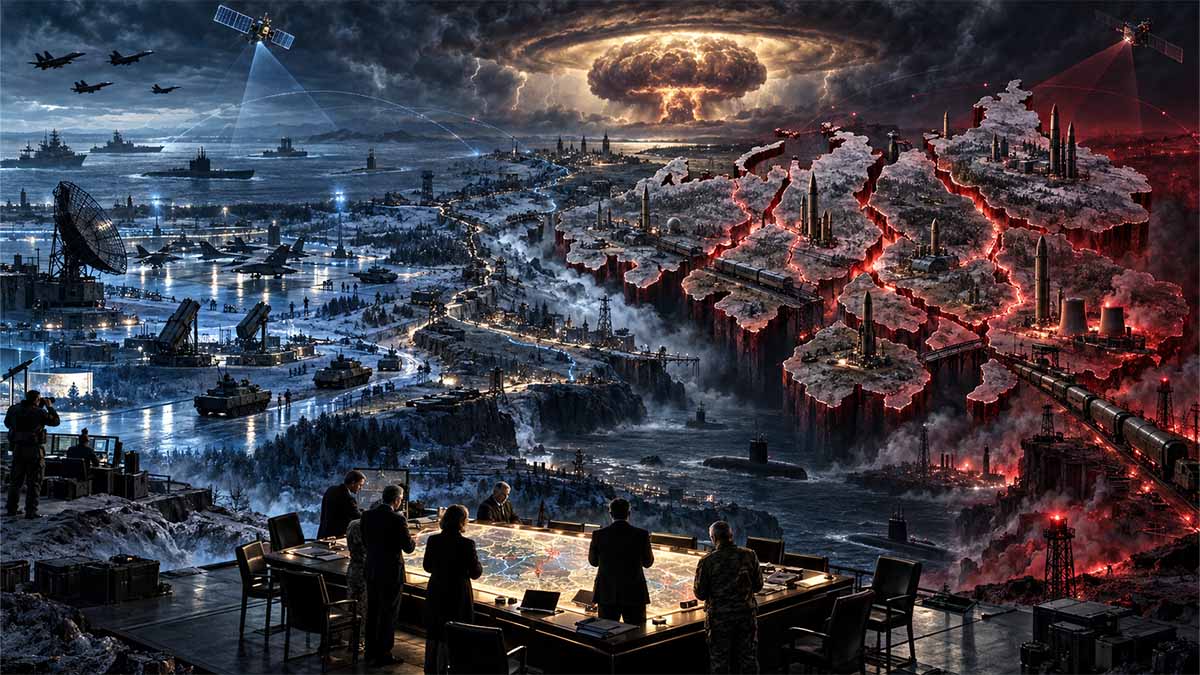
Scope: This assessment examines a hypothetical Russian armed attack against NATO, escalation and nuclear-use pathways, and the legal and strategic consequences of proposals to divide the Russian Federation, with a five-year outlook and specific implications for Europe, Italy, France, Germany and the United Kingdom.
Executive Summary / BLUF
- A Russian armed attack on NATO territory would create an Article 5 case, but neither Article 5 nor NATO doctrine prescribes automatic nuclear retaliation or an identical military response by every Ally.
- Nuclear use is not an inevitable consequence of NATO–Russia war. The risk would rise sharply if either side perceived defeat as threatening regime survival, nuclear command-and-control or the credibility of its strategic deterrent.
- No verified official record supports predictions that Russia would select Warsaw or Rzeszów for nuclear attack, spare France or the United Kingdom, or that NATO would answer by striking Pskov.
- NATO’s declared objective remains defence of Allied territory—not occupation, regime change or territorial dismemberment of Russia.
- Externally imposed partition would conflict with the prohibition on using force against another state’s territorial integrity unless based on valid consent or another lawful settlement mechanism.
- Fragmenting the state possessing what US intelligence describes as the world’s largest and most diverse nuclear stockpile would create exceptional command, custody, proliferation and succession risks.
- The defensible postwar objective is therefore to terminate aggression, restore protected borders, preserve nuclear command integrity, establish verifiable arms-control arrangements and enable internally legitimate political change.
- Peaceful reconfiguration initiated by Russia’s peoples or constitutional authorities is conceptually distinct from NATO coercively dividing Russia.
- The principal uncertainty is not whether partition would guarantee peace—it would not—but whether severe military defeat could produce uncontrolled state failure despite Allied efforts to avoid it.
- Net assessment: if Russia attacks NATO, its aggression must be defeated; the Russian state should not be broken up as a predetermined Allied war aim.
A NATO–Russia War Would Test Deterrence; Partition Would Break the Settlement
A Russian attack on NATO territory would activate collective defence, not a predetermined march to nuclear war or the dissolution of the Russian Federation. Article 5 of the 1949 North Atlantic Treaty requires every Ally to assist the state attacked, but leaves each government to take “such action as it deems necessary”. That discretion permits military force, cyber defence, logistics, air and missile protection or other measures without making every incident an automatic trigger for unrestricted war. The harder choice would follow Russian defeat. Ending aggression, restoring Ukraine’s internationally recognised territory and imposing verifiable military constraints would serve European security. Dividing Russia into four or five states would not. The 1945 UN Charter supplies authority for collective self-defence, not a general right to dismember an aggressor; nuclear custody, state succession and contested borders would turn punitive partition into a second security crisis.
Article 5 binds the Alliance but does not dictate the war
Article 4 and Article 5 of the North Atlantic Treaty perform different functions. Article 4 provides consultation when an Ally’s security or territorial integrity is threatened; Article 5 applies after an armed attack and obliges assistance. Neither provision prescribes a particular weapon, target or timetable. Political ambiguity therefore remains before attribution, but national discretion remains after attribution—a mechanism designed to preserve both solidarity and control.
A deniable incursion, cyber operation or isolated missile strike would force the North Atlantic Council to determine whether the incident constituted an armed attack and what response could restore security. Under Article 5, assistance is mandatory once the threshold is accepted, but identical national action is not. That distinction allows NATO to reinforce the affected state, suppress the immediate threat and impose costs while retaining limits on geography, targeting and weapons employment.
The danger lies less in the treaty than in inadequate preparation. The 10 July 2024 Washington Summit Declaration described Russia as NATO’s most significant and direct security threat while stating that the Alliance did not seek confrontation. Those positions are compatible only if governments define response options before a crisis: uncertainty must burden the aggressor without paralysing the attacked Ally or leaving nuclear powers to improvise under warning time.
Nuclear danger comes from failing control, not treaty machinery
Nuclear use is not an automatic consequence of conventional defeat. The risk rises when warning systems cannot distinguish attack from malfunction, conventional operations threaten nuclear command assets, political leaders misread signalling, or successive “limited” actions destroy confidence that restraint will be reciprocated. NATO’s nuclear policy, updated on 20 May 2026, confirms that the United States, France and the United Kingdom remain separate nuclear decision centres; consultation cannot convert three sovereign command systems into one release authority.
The Nuclear Planning Group works by political consultation and consensus, but it does not authorise the employment of French, British or American nuclear weapons. The United States retains absolute custody and control of its forward-deployed nuclear weapons, while France does not participate in the Nuclear Planning Group. A Russian attack on Poland or another eastern Ally would therefore confront several national decision processes, not a single automatic NATO launch mechanism.
This fragmentation can reinforce deterrence because Moscow cannot neutralise the Alliance through one political calculation. It also multiplies the possibility of inconsistent messages. The operational requirement is consequently disciplined separation: conventional defence must remain credible without creating the appearance of an attack on Russian nuclear command, while strategic communication must preserve a route from combat termination to negotiation.
The belief that one tactical nuclear detonation would remain isolated cannot be established by the public record. Once nuclear use altered the conflict, leaders would act with damaged communications, incomplete attribution and compressed decision time. The immediate priority would be continuity of command and prevention of additional use—not the search for a supposedly proportional city target, a concept that confuses political symbolism with escalation control.
Partition is neither collective defence nor lawful reparation
The 1945 UN Charter permits individual and collective self-defence after an armed attack, but prohibits force against the territorial integrity or political independence of states. Russian aggression would entail responsibility for cessation, non-repetition and reparation; the 2001 Articles on Responsibility of States for Internationally Wrongful Acts identify restitution, compensation and satisfaction as available forms. They do not identify territorial dismemberment as a standard remedy.
The 1975 Helsinki Final Act makes the distinction explicit. Frontiers can change in accordance with international law, by peaceful means and by agreement; territory cannot lawfully be acquired through occupation or unlawful force. Restoring Ukraine’s internationally recognised territory would reverse attempted acquisition by force. Detaching internationally recognised Russian territory would require a separate legal basis, credible consent and a settlement capable of surviving the end of foreign military pressure.
Article 52 of the 1969 Vienna Convention on the Law of Treaties renders a treaty void when its conclusion is procured by a threat or use of force violating the UN Charter. A lawful postwar agreement can impose withdrawal, inspection, compensation and arms-control obligations, but military dominance alone does not create territorial title. Historical possession by Finland, Japan or another state would likewise require a separate examination of applicable instruments; former control is not a self-executing border claim.
The comparison with the Austro-Hungarian Empire does not cure the defect. The settlement after the First World War reflected the collapse of a specific imperial constitution, competing national authorities and the diplomacy of its period. It did not create a permanent rule permitting outside powers to select four or five successor states whenever a large multinational country loses a war.
The proposed map conceals a nuclear balance sheet
A Russian dissolution would first be a command-and-control emergency. Political authority, delivery systems, early-warning infrastructure, nuclear material, specialised personnel and military communications would have to remain under identifiable control while new governments contested territory and legitimacy. The exact distribution of these functions is not established in the open dossier, but the 1991 Soviet collapse demonstrates the institutional priority: the United States treated prevention of nuclear catastrophe and the security of nuclear, chemical and biological weapons as central transition requirements, subsequently supported through the Nunn–Lugar programme.
The 1978 Vienna Convention on Succession of States in respect of Treaties defines succession as replacement of one state by another in responsibility for a territory’s international relations. It protects treaty-established boundaries from automatic disruption and subjects membership in international organisations to their own constituent rules. Dissolution would therefore not answer which successor inherited Russia’s treaty position, armed forces, diplomatic representation or international responsibilities.
The Russian Federation’s continuation of the Soviet Union’s position after December 1991 depended on a particular combination of agreements among former Soviet republics, Russian notification and international acceptance. It is a precedent in state practice, not an automatic algorithm. The UN Charter still names the Union of Soviet Socialist Republics among the five permanent members of the Security Council, while Article 4 governs admission of new members without resolving competing claims to an existing permanent seat.
The financial settlement would be equally severe. The 1983 Vienna Convention on Succession of States in respect of State Property, Archives and Debts is not in force, leaving no universally binding formula for dividing sovereign assets, central-bank reserves, debt, archives, pensions, energy infrastructure or external claims. Rival allocations would generate defaults, litigation and contested sanctions before successor administrations had established fiscal capacity.
Europe would inherit five liabilities, not five solutions
No Russian successor would inherit NATO or EU protection automatically. Article 10 of the North Atlantic Treaty requires unanimous agreement before a qualifying European state can be invited to join. Article 49 of the Treaty on European Union requires a unanimous Council decision, consent of the European Parliament and an accession agreement ratified by every contracting state. Recognition could be rapid; collective-defence and accession guarantees could not be presumed.
France and the United Kingdom would carry distinctive burdens as nuclear-weapon states and permanent members of the UN Security Council. Under NATO’s policy of 20 May 2026, their separate decision centres contribute independently to deterrence. In a Russian succession crisis, Paris and London would have to coordinate nuclear security, strategic communication and UN representation while ensuring that emergency engagement with regional authorities did not confer premature recognition.
Germany would face the largest continental transmission risks through logistics, reconstruction finance, energy networks and interrupted trade. Articles 24, 25 and 26 of the German Basic Law respectively support collective-security participation, give general rules of international law precedence over federal statutes and prohibit preparation for aggressive war. Berlin’s institutional interest would favour verified military restraint and lawful continuity over punitive territorial engineering.
Italy would face the fiscal, energy and humanitarian consequences of prolonged fragmentation without possessing the resources to guarantee several new eastern frontiers. As an EU and NATO member, Rome would be bound to coordinate sanctions, market access, recognition and collective defence while protecting Mediterranean security commitments. A four- or five-state settlement would therefore expand Italian liabilities even if the principal military crisis remained in northern and eastern Europe.
The European Union could regulate sanctions, reconstruction finance, trade and conditional market access, but Article 49 prevents Brussels from promising automatic accession. Premature guarantees would encourage unilateral secession before boundaries, minority protections, public debt and nuclear custody were settled. The alternative is staged engagement: recognition only after effective authority and representative consent are established, with security assistance kept legally distinct from NATO’s Article 5.
The next 24 months must price restraint before rhetoric
Over the 12–24 months following any NATO–Russia conflict, the decisive choice would not be between preserving Vladimir Putin’s system and breaking Russia apart. It would be between an enforceable settlement with one accountable counterpart and an uncontrolled succession process involving rival governments, disputed borders and fragmented military assets. The 2001 Articles on State Responsibility provide the stronger sequence: cessation, guarantees of non-repetition and reparation, followed by sanctions relief calibrated to verified performance.
NATO governments would need pre-agreed mechanisms under Articles 4 and 5 for attribution, conventional response, nuclear communication and conflict termination. The EU would need a common position under Article 49 on recognition and relations with any regional authority. France, the United Kingdom and the United States would need nuclear-security channels; Germany and Italy would need financing, energy and humanitarian contingencies. Without those decisions, escalation control would remain declaratory precisely when institutions were under maximum pressure.
The cost of inaction would fall first on exposed NATO populations and Ukraine, then on European taxpayers financing mobilisation, border security, refugee support and reconstruction. Industry would pay through interrupted energy and transport networks; creditors would absorb disputed sovereign liabilities; successor populations would bear administrative collapse and coercive border politics. Russia may change government, constitution or territorial composition after war. Making its dismemberment a NATO objective would convert a defensible campaign to stop aggression into an open-ended commitment to manage nuclear state failure.
Navigational Index
- Collective defence without automatic escalation
- Nuclear thresholds, command and uncontrolled risk
- Postwar sovereignty, state continuity and European security
Master Abstract
Defeating aggression is not equivalent to destroying the state
The proposition that Russia “must be broken up” combines two analytically separate questions: how NATO should defeat an attack, and what political structure should follow inside Russia. The first has a clear legal foundation. Article 5 treats an armed attack against one Ally as an attack against all, but requires each Ally to take the action it considers necessary; that action can include armed force but is not predetermined. Article 1 simultaneously requires disputes to be settled peacefully and prohibits force inconsistent with the UN Charter. The North Atlantic Treaty — North Atlantic Treaty Organization — Apr 1949
A covert incursion, destructive cyber operation or deniable strike would therefore require a fact-specific assessment of attribution, scale, effects and the attacked Ally’s request or consent. NATO’s published explanation confirms that significant cyber or hybrid operations can qualify as armed attacks, while assistance remains individually determined and need not always involve force. Collective defence and Article 5 — North Atlantic Treaty Organization — Nov 2025
This rules out two categorical claims in the supplied proposition. NATO inaction after a limited incident is not institutionally predetermined; neither is immediate general war. Conversely, ambiguity does not eliminate the defence obligation. It shifts the critical contest toward attribution, political consultation, calibrated retaliation and the credibility of reinforcement.
Nuclear escalation is possible, not preordained
A NATO–Russia war would involve an adversary whose nuclear forces remain integral to its military power. The US Intelligence Community assessed in March 2025 that Russia possessed the largest and most diverse nuclear-weapons stockpile and used non-strategic nuclear forces partly to offset Western conventional superiority. It also judged that the Ukraine war increased the danger of unintended NATO–Russia escalation and potential nuclear use. These are attributed US intelligence judgments, not independently observable inventories or proof of Russian intent. Annual Threat Assessment of the U.S. Intelligence Community — Office of the Director of National Intelligence — Mar 2025
NATO’s own position is deliberately different in emphasis: the circumstances in which it might employ nuclear weapons are described as “extremely remote,” while any nuclear use against NATO would fundamentally alter the conflict. France, the United Kingdom and the United States constitute separate nuclear decision centres; France does not participate in NATO’s Nuclear Planning Group, and US weapons forward-deployed in Europe remain under US custody. NATO’s nuclear deterrence policy and forces — North Atlantic Treaty Organization — May 2026
These positions support a conditional—not deterministic—escalation judgment. Nuclear danger would become acute if conventional operations threatened strategic forces, national command authorities, early-warning systems or territory regarded as essential to state survival. Limited nuclear use would not make wider use unavoidable, but it would degrade signalling, shorten decision time and create severe pressure for retaliation. NATO nevertheless retains conventional, missile-defence, cyber, space and nuclear options and declares that it will respond in the manner, timing and domain of its choosing. Washington Summit Declaration — North Atlantic Treaty Organization — Jul 2024
No admissible official evidence establishes Warsaw, Rzeszów, Pskov or any other named city as a probable nuclear target. Nor does the record support the proposition that Russian leaders would discount British or French retaliation while assuming lesser protection for Poland. Such assertions require non-public targeting, command-and-control and political-intent evidence that is not available.
Partition would magnify the problem NATO must control
The legal baseline is restrictive. Article 2(4) of the UN Charter prohibits the threat or use of force against the territorial integrity or political independence of any state. Collective self-defence under Article 51 authorises measures needed to respond to an armed attack; it does not create an unrestricted entitlement to redesign the aggressor’s borders. Chapter VII provides wider Security Council authority, but a settlement involving the territorial dissolution of a permanent member would confront evident institutional and political obstacles. Charter of the United Nations and Statute of the International Court of Justice — United Nations — Jun 1945
Comparisons with the Austro-Hungarian Empire, Arab states, Somalia, Moldova or Kosovo do not establish a legal rule or a transferable security model. Those cases arose from different imperial structures, constitutional arrangements, wars, recognition processes and international instruments. Shared language, ethnicity or history neither requires political unity nor independently authorises external powers to impose separation.
The nuclear consequences are more immediate. Under the Nuclear Non-Proliferation Treaty, nuclear-weapon states undertake not to transfer nuclear weapons or their control to another recipient, while non-nuclear-weapon parties undertake not to acquire them. The treaty defines a nuclear-weapon state by reference to manufacture and detonation before 1 January 1967. The emergence of four or five successor governments across Russian nuclear bases would therefore create questions of custody, succession, recognition, disarmament, safeguards and treaty status that cannot be resolved by drawing borders on a map. Treaty on the Non-Proliferation of Nuclear Weapons — United Nations Treaty Series — Jul 1968
The 1991 Soviet dissolution demonstrates that state fragmentation is possible; it does not demonstrate that it is safe, repeatable or coercively manageable. That transition required negotiated arrangements over succession, nuclear weapons and international representation. A wartime Russian collapse could instead involve contested military districts, competing security services, interrupted warning networks, regional armed formations and external intervention around strategically important territory. The proposition that smaller successor states would automatically be more peaceful is therefore unsupported.
Europe would bear unequal responsibilities
Europe cannot be treated as a single strategic actor. France and the United Kingdom possess independent nuclear forces and separate national decision-making. Italy and Germany are non-nuclear Allies participating in NATO’s nuclear consultation structure; their immediate responsibilities would centre on political consultation, conventional defence, reinforcement, logistics, air and missile defence, civil preparedness and infrastructure resilience. NATO reaffirmed in June 2026 that its strategic nuclear forces underpin extended deterrence and that participating Allies would continue sharing the mission’s responsibilities, risks and burdens. 2026 Nuclear Planning Group Statement — North Atlantic Treaty Organization — Jun 2026
For Italy, the principal exposure would be the security of Mediterranean access, bases, ports, energy infrastructure, telecommunications and reinforcement routes. Rome’s strategic interest lies in preventing an eastern-front conflict from disabling southern logistics or dividing Allied attention.
For Germany, the central problem would be sustaining continental reinforcement, air and missile defence, industrial mobilisation and civil resilience while managing the political consequences of operations launched or supported from German territory.
For France, the issue would extend beyond conventional operations to the credibility and independence of national nuclear decision-making. Paris would need to coordinate escalation messaging with NATO without eliminating the uncertainty created by an autonomous French deterrent.
For the United Kingdom, the requirements would combine maritime reinforcement, intelligence, long-range capabilities and maintenance of a survivable national deterrent assigned to the wider protection of NATO.
At the EU level, sanctions, energy security, industrial production, financial measures, transport resilience and civil protection would be material. Nuclear employment and Article 5 decisions would remain national and NATO matters. The 2025 Hague commitment to invest, by 2035, 3.5% of GDP in core defence and up to 1.5% in defence- and security-related requirements indicates the acknowledged scale of the readiness burden; it does not prove that every capability is already funded or operational. The Hague Summit Declaration — North Atlantic Treaty Organization — Jun 2025
The defensible end state
A sustainable Allied war aim would have five components: termination of the attack; restoration of Allied territorial security; preservation of reliable nuclear command and early-warning functions; verifiable constraints on forces capable of renewed aggression; and accountability through competent legal mechanisms. Political reform, decentralisation or peaceful separation inside Russia could be recognised only on the basis of authentic internal authority, effective governance and conformity with applicable international obligations.
Putin’s removal cannot itself constitute a complete strategy. Leadership change might reduce one source of aggression, but it could also expose succession weaknesses, elite conflict or loss of command coherence. Conversely, accepting an unchanged leadership without enforceable security arrangements would not establish lasting peace. The relevant test is therefore neither punishment nor accommodation: it is whether the settlement reduces Russia’s capacity and incentive to resume aggression without producing a larger nuclear-security emergency.
Key Evidence Table
| Indicator | Value/status | Reference date | Definition/scope | Issuer | Exact source |
|---|---|---|---|---|---|
| Article 5 obligation | Each Ally takes “such action as it deems necessary”; force is permitted but not automatically prescribed | 4 Apr 1949 | Armed attack in the treaty’s geographic scope | NATO parties | The North Atlantic Treaty — NATO — Apr 1949 |
| Hybrid and cyber threshold | Significant cyber or hybrid attacks can qualify; assessment is case-specific | 12 Nov 2025 | NATO interpretation of collective defence | NATO | Collective defence and Article 5 — NATO — Nov 2025 |
| NATO nuclear posture | Nuclear-use circumstances described as extremely remote; three separate Allied nuclear states | 20 May 2026 | Declared policy, not operational targeting information | NATO | NATO’s nuclear deterrence policy and forces — NATO — May 2026 |
| Russian nuclear capability | Described as the largest and most diverse stockpile; non-strategic weapons provide theatre escalation options | Information to 18 Mar 2025 | Coordinated US intelligence assessment; exact inventory not disclosed | ODNI | Annual Threat Assessment of the U.S. Intelligence Community — ODNI — Mar 2025 |
| Territorial-integrity rule | Threat or force against another state’s territorial integrity or political independence is prohibited | 26 Jun 1945 | UN Charter Article 2(4), subject to Charter exceptions | United Nations | Charter of the United Nations and Statute of the International Court of Justice — UN — Jun 1945 |
| Nuclear-transfer constraint | Nuclear-weapon parties must not transfer weapons or control; non-nuclear parties must not acquire them | 1 Jul 1968 | NPT Articles I, II and IX | NPT parties | Treaty on the Non-Proliferation of Nuclear Weapons — UN Treaty Series — Jul 1968 |
| Allied investment commitment | At least 3.5% of GDP for core defence plus up to 1.5% for wider defence and security by 2035 | 25 Jun 2025 | Political expenditure commitment; not delivered capability | NATO heads of state and government | The Hague Summit Declaration — NATO — Jun 2025 |
Competing Postwar Pathways
| Hypothesis | Diagnostic support | Disconfirming evidence | Indicators | Current standing |
|---|---|---|---|---|
| H1 — Russia survives as a unitary or federal state under constrained power | International law favours territorial continuity; NATO declares defensive objectives; Russian strategic institutions remain resilient | Severe defeat or elite fracture could weaken central authority | Continuity of nuclear command; recognised succession; functioning federal revenue and security chains | Best supported baseline |
| H2 — Internally negotiated constitutional reconfiguration | Existing federal and regional identities provide possible political units; peaceful change is legally distinguishable from imposed partition | No verified official process currently establishes consent for four or five successor states | Constitutional convention; recognised regional mandates; negotiated asset and debt allocation | Possible only after major internal political change; presently unsupported |
| H3 — Uncontrolled fragmentation after state or regime failure | Concentrated political authority and wartime pressures create succession vulnerabilities; nuclear and regional commands would become critical | US intelligence assessed the Russian state as adaptable and resilient despite wartime costs | Rival command claims; regional withholding of revenue or forces; interruption of strategic communications | Lower-support, high-consequence contingency |
| H4 — Externally imposed partition into four or five states | Military occupation or dictated settlement could theoretically attempt it | No NATO mandate or declared Allied policy; territorial-integrity constraints; nuclear-custody and recognition problems; probable resistance | Formal Allied war aim, occupation plans, agreed successor borders and verified disarmament mechanism | Not a credible or defensible current policy pathway |
Principal Gaps and Watch Indicators
- Russian nuclear doctrine and execution: verified evidence of revised release authority, delegation arrangements, launch-control survivability and crisis communications.
- NATO response architecture: national implementation decisions following a deniable cyber, sabotage or limited kinetic attack.
- Russian succession stability: continuity or fragmentation within the Security Council, General Staff, strategic forces and federal-regional fiscal system.
- Nuclear-site security: observable changes in guard forces, communications, dispersal or competing regional access to strategic and non-strategic storage sites.
- Allied political objectives: any official shift from restoring territorial security toward occupation, regime change or territorial reorganisation.
- Internal legitimacy: verifiable representative mandates from Russian regions seeking negotiated autonomy or separation.
- US–Russian crisis communications: confirmed continuity, suspension or degradation of military deconfliction and nuclear risk-reduction channels.
- Unverified supplied claims: the precise purpose and policy consequence of the reported 2026 CIA director’s Moscow visit remain outside the accessible official record reviewed here; it cannot support an inference of imminent Russian attack.
NATO–Russia War: Nuclear Risk Calibration and the Strategic Case Against Territorial Partition
Forensic evaluation of an armed attack on Allied territory, non-automatic Article 5 thresholds, and escalation pathways. Dissecting the legal prohibitions, custodial nightmares, and proliferation cascades of externally imposed partition against the world’s largest nuclear stockpile.
Diagnostic Balance: Russia Survives as a Unitary or Federal State Under Constrained Power (H1)
Tracking legal compliance, nuclear command continuity, defeat absorption capacity, and systemic risk.
H1 — Russia Survives as a Unitary or Federal State Under Constrained Power
International law strongly favours territorial continuity (UN Charter Art 2(4)); NATO’s declared objective remains defensive territory restoration rather than dismemberment; and central strategic institutions (General Staff, Strategic Rocket Forces) remain resilient.
Severe military defeat, cumulative economic exhaustion, or catastrophic elite fractures inside the Security Council could cripple central administrative control and weaken Moscow’s monopoly on legitimate violence.
Continuity of unified nuclear command and early-warning networks; recognized constitutional succession; functioning federal revenue and security chains; and absence of armed regional secessions.
Key Evidence Table: Treaties, Force Postures & Intelligence Baselines
Systematic reconciliation of verified treaty obligations, nuclear doctrines, intelligence estimates, and expenditure pacts.
| Indicator | Value / Status | Ref. Date | Definition / Scope | Issuer | Exact Source Citation |
|---|---|---|---|---|---|
| Article 5 Obligation | Each Ally takes “such action as it deems necessary”; force permitted but not automatic | 4 Apr 1949 | Armed attack within the treaty’s geographic perimeter; individual national determination. | NATO parties | The North Atlantic Treaty — NATO — Apr 1949 |
| Hybrid & Cyber Threshold | Significant cyber or hybrid attacks can qualify; assessment is case-specific | 12 Nov 2025 | NATO official interpretation of collective defence invocation thresholds. | NATO | Collective defence and Article 5 — NATO — Nov 2025 |
| NATO Nuclear Posture | Circumstances described as “extremely remote”; 3 separate Allied nuclear decision centres | 20 May 2026 | Declared deterrence doctrine; does not disclose pre-planned operational target folders. | NATO | NATO’s nuclear deterrence policy and forces — NATO — May 2026 |
| Russian Nuclear Capability | World’s largest and most diverse stockpile; non-strategic warheads offset conventional deficits | Mar 2025 assessment | Coordinated US intelligence baseline across strategic, theater, and tactical systems. | ODNI | Annual Threat Assessment of the U.S. Intelligence Community — ODNI — Mar 2025 |
| Territorial Integrity Rule | Threat or use of force against another state’s territorial integrity or political independence prohibited | 26 Jun 1945 | UN Charter Article 2(4); collective self-defence under Article 51 restricts goals to repulsion. | United Nations | Charter of the United Nations and Statute of the International Court of Justice — UN — Jun 1945 |
| Nuclear-Transfer Constraint | NWS must not transfer weapons or control; NNWS must not acquire or manufacture | 1 Jul 1968 | NPT Articles I, II, and IX; defines nuclear-weapon states strictly before 1 Jan 1967. | NPT parties | Treaty on the Non-Proliferation of Nuclear Weapons — UN Treaty Series — Jul 1968 |
| Allied Investment Commitment | ≥ 3.5% GDP for core defence plus up to 1.5% for wider security by 2035 | 25 Jun 2025 | Political expenditure targets for industrial ramp-up, air/missile defence, and resilience. | NATO Leaders | The Hague Summit Declaration — NATO — Jun 2025 |
Comprehensive Analysis of Competing Postwar Pathways (ACH)
| Pathway | Diagnostic Support | Disconfirming Evidence | Observable Indicators | Current Standing |
|---|---|---|---|---|
| H1 — Constrained State Continuity | International law favours territorial continuity; NATO explicitly declares defensive aims; central strategic command apparatus remains cohesive. | Severe conventional defeat or acute elite fracture inside the Security Council could paralyze central administrative control. | Continuity of unified strategic nuclear command; constitutional succession; functioning federal revenue and security chains. | Best Supported Baseline. Aligns with Allied legal constraints and the vital objective of avoiding nuclear custody voids. |
| H2 — Constitutional Reconfiguration | Existing federal subjects and ethnic republics possess formal administrative structures; internal peaceful decentralisation is legally distinct from partition. | No verifiable domestic political process or representative movement currently commands legitimate authority to negotiate a four- or five-state split. | National constitutional convention; recognized regional popular mandates; negotiated domestic agreements on national debt and nuclear custody. | Contingent Future Possibility. Only plausible after major internal political transformation; currently unsupported. |
| H3 — Uncontrolled State Fragmentation | Over-centralized personalist authority creates brittle succession points; military collapse could trigger regional warlordism and competing security factions. | US intelligence coordinates assess the Russian administrative and internal security state as highly adaptable and resilient despite wartime pressures. | Rival command claims over nuclear sites; regional governors withholding tax revenue or military units; breakdown of the national Early Warning Grid. | High-Consequence Risk. Lower baseline probability, but represents the most dangerous humanitarian and nuclear proliferation scenario. |
| H4 — Externally Imposed Partition | Theoretically imaginable only following unconditional military capitulation and total Allied ground occupation across 11 time zones. | Strictly forbidden by UN Charter Art 2(4); lacks any NATO mandate; violates NPT anti-proliferation rules; guarantees ferocious nuclear escalation. | Formal Allied declarations adopting partition as a war aim; published military government zones; negotiated territorial division treaties. | Doctrinally Defective. Neither legally defensible nor strategically viable; dismissed as a credible Allied policy objective. |
Asymmetric Strategic Responsibilities: The European Power Matrix
Europe cannot act as a monolithic strategic actor in a high-intensity conflict with Russia. National responsibilities diverge fundamentally based on nuclear status, geographical posture, and sovereign constitutional structures:
• Securing Mediterranean maritime chokepoints and undersea pipelines.
• Operating vital naval/air staging hubs (Sigonella, Gaeta, Taranto).
• Defending southern telecommunications and critical energy infrastructure.
• Preventing eastern operations from stripping Mediterranean air and missile defence.
• Serving as the primary central logistics corridor for transatlantic reinforcement.
• Dense multi-layered ground-based air and missile defence (Arrow-3 / Patriot).
• Executing NATO nuclear sharing tasks via dual-capable aircraft.
• Managing civil resilience and industrial mobilization under deep rear-area missile threats.
• Autonomous national nuclear command (independent of NATO NPG).
• Providing strategic ambiguity that complicates Russian escalation calculations.
• Maintaining airborne (ASMP-A) and submarine-launched (M51) deterrent legs.
• Deploying expeditionary air/ground forces to the southeastern flank (Romania).
• Continuous At-Sea Deterrence (Vanguard-class SSBNs) assigned to NATO defence.
• Securing the GIUK Gap and North Atlantic maritime lines of communication.
• Deep intelligence integration and strike coordination via Five Eyes and GCHQ.
• Leading multinational land formations on the northeastern flank (Estonia).
The Custodial Nightmare: Why Imposed Partition Compounds the Threat
Proposals suggesting that European peace requires the forced break-up of the Russian Federation into four or five sovereign successor republics commit a fatal strategic error: they confuse defeating an armed attack with stabilizing an atomic superpower.
• The NPT Succession Paradox: Under Articles I and II of the Nuclear Non-Proliferation Treaty, nuclear weapons cannot be transferred to non-nuclear entities. A fragmented Russia would spawn multiple nuclear-armed successor fragments or trigger violent, unmonitored civil wars over strategic warhead depots.
• The 1991 Fallacy: Soviet dissolution was negotiated and stabilized through the Lisbon Protocol and Budapest Memorandums, which consolidated all warheads under Moscow’s single custody. A wartime collapse in 2026 would occur without Western trust, amidst active hostilities and disrupted early-warning networks.
• Early-Warning Radar Blanks: Segmenting Russian territory would fracture the Voronezh and Daryal early-warning radar belts, blinding regional launch-control centers and drastically increasing the probability of false-alarm nuclear launches.
Terminating the armed attack; completely restoring Allied sovereign borders; neutralizing offensive staging capabilities; preserving single-custody nuclear command; and enforcing post-conflict verification regimes.
Pursuing forced partition guarantees that Russian military doctrine activates existential nuclear release criteria under its Basic Principles of State Deterrence, converting a regional defense war into global catastrophe.
Forensic Strategic Key Judgments
Principal Evidentiary Gaps & Intelligence Deficits
- Russian Nuclear Delegation Protocols: Verified evidence of pre-delegated launch authority to theater commanders under decapitation or communications blackout conditions.
- NATO Sub-Article 5 Consensus: Real-time national parliamentary and executive thresholds for answering ambiguous, deniable hybrid or cyber incursions.
- Security Council Succession Cohesion: Internal alignment between the Russian General Staff, FSB, and regional military governors under extreme wartime stress.
- Warhead Storage Facility Telemetry: Concrete indicators of warhead dispersal from central 12th Chief Directorate storage depots to forward delivery units.
- Crisis Communications Channels: Verified status of military-to-military deconfliction and Nuclear Risk Reduction Centers between Washington, Brussels, and Moscow.
Strategic Watch Indicators
Collective Defence Without Automatic Escalation
Principal judgment: Article 5 would require every NATO member to assist an Ally subjected to an armed attack, but it would not automatically initiate a predetermined military campaign, authorize unlimited war against Russia or require nuclear retaliation. The treaty deliberately combines certainty of assistance with flexibility over its form, scale, timing and national implementation. That architecture permits NATO to defeat or contain aggression while retaining political control over escalation. Its principal vulnerability lies not in the treaty text but in delayed attribution, divergent threat assessments and inadequate preparations for attacks designed to remain below an obvious conventional threshold.
Article 5 binds assistance, not a predetermined war plan
Article 5 establishes three propositions. An armed attack against one or more Allies within the treaty area is treated as an attack against all; every Ally must assist; and each determines the action it considers necessary, which can include armed force. The operative purpose is to “restore and maintain the security of the North Atlantic area,” not to prescribe regime change, territorial dismemberment or the unconditional defeat of the attacker. Measures must be reported immediately to the UN Security Council and remain anchored in the right of individual or collective self-defence recognized by Article 51 of the UN Charter. The North Atlantic Treaty — North Atlantic Treaty Organization — Apr 1949
The obligation is therefore automatic in legal character once its conditions are satisfied; the response is not automatic in operational form. NATO’s official interpretation confirms that assistance can be military or non-military and that the treaty does not specify its type or degree. Each government implements its obligation in accordance with its constitutional processes under Article 11. Collective defence and Article 5 — North Atlantic Treaty Organization — Nov 2025
This distinction is the foundation of controlled escalation:
| Decision stage | Controlling question | Competent actor | Consequence | What does not follow automatically |
|---|---|---|---|---|
| Threat consultation | Is an Ally’s territorial integrity, political independence or security threatened? | Any Ally can request consultations under Article 4 | Political consultation, intelligence exchange and possible precautionary measures | A finding that an armed attack has occurred |
| Threshold assessment | Has an armed attack occurred within Article 5 and Article 6? | Allies individually and collectively, acting in good faith | Mutual-assistance obligation arises if the attacked Ally requests or consents to collective action | A single prescribed military response |
| Collective coordination | What assistance is required to restore security? | North Atlantic Council and national governments | Synchronised political, military and civil action | Transfer of all national decisions to NATO |
| National execution | What action will each Ally take? | Each Ally under its constitutional processes | Military or non-military contributions appropriate to the situation | Identical contributions by every Ally |
| International-law control | Does the action remain collective self-defence? | Participating states; UN Security Council retains its Charter responsibility | Reporting to the Security Council and termination when it has taken the necessary measures | Unlimited authority to pursue unrelated political war aims |
The UN Charter independently preserves the inherent right of individual and collective self-defence when an armed attack occurs, pending necessary action by the Security Council, and requires immediate reporting of defensive measures. Charter of the United Nations and Statute of the International Court of Justice — United Nations — Jun 1945
Article 4 is an escalation-management instrument
Article 4 requires consultation whenever any Ally considers its territorial integrity, political independence or security threatened. It is neither a legal prerequisite for Article 5 nor evidence that the Alliance is preparing to invoke Article 5. The North Atlantic Treaty — North Atlantic Treaty Organization — Apr 1949 NATO’s current guidance expressly separates Article 4 consultation from Article 5 collective defence. Collective defence and Article 5 — North Atlantic Treaty Organization — Nov 2025
Used early, Article 4 can reduce escalation risk by creating a common intelligence picture, clarifying the attacked state’s requirements and enabling precautionary reinforcement before governments must decide whether an armed attack has occurred. It can also support joint attribution, crisis communications and public signalling. These functions are particularly important where the incident is limited, plausibly deniable or technically difficult to attribute.
Consultation should not become a device for postponing assistance after an unmistakable armed attack. Article 5 requires assistance “forthwith.” Conversely, invoking Article 4 following an airspace violation, sabotage allegation or cyber incident does not concede that Article 5’s threshold has been crossed. The two provisions form a graduated decision architecture rather than successive stages that must always be completed in order.
The threshold turns on attack character and effects—not the label “hybrid”
NATO defines hybrid threats as combinations of military and non-military, covert and overt means, including cyber operations, disinformation, economic pressure, irregular armed groups and regular forces. The primary responsibility for responding remains with the targeted state, although NATO can provide assistance; since 2016, Allies have stated that hybrid actions can lead to an Article 5 decision. Counter-hybrid support teams have been available on request since 2018, and NATO adopted broader preventive and response options in 2022. Countering hybrid threats — North Atlantic Treaty Organization — Jan 2026
“Hybrid” does not constitute a separate legal threshold. A covert operation can still amount to an armed attack if its scale, effects and connection to an external actor support that characterization. Equally, foreign sponsorship or attribution does not by itself convert every hostile act into an armed attack. The decisive assessment concerns what occurred, its consequences, whether incidents form a cumulative campaign, the degree of external direction or control, and the reliability of the evidence.
The treatment of Russian activity on Allied territory illustrates the available space below Article 5. In May 2024, the North Atlantic Council attributed an intensifying campaign—including sabotage, violence, cyber and electronic interference, disinformation and proxy activity—to Russia. It expressed solidarity, promised individual and collective action, and committed to stronger resilience and counter-hybrid tools without declaring that Article 5 had been invoked. The document records NATO’s institutional attribution; it is not an independent adjudication of each national investigation. Statement by the North Atlantic Council on recent Russian hybrid activities — North Atlantic Treaty Organization — May 2024
The same distinction applies in cyberspace. In May 2025, the Council recognized the Czech government’s attribution of a damaging and disruptive campaign against an unclassified foreign-ministry network to the People’s Republic of China-linked actor APT31. NATO condemned the activity and pledged stronger capabilities and resilience, but did not treat attribution alone as requiring Article 5. Statement of solidarity by the North Atlantic Council concerning the malicious cyber activities against the Czech Republic — North Atlantic Treaty Organization — May 2025
Cyber operations can accumulate into an armed attack
NATO states that significant malicious cyber activity—including cumulative activity—can in certain circumstances be considered an armed attack and lead the North Atlantic Council to invoke Article 5. The decision remains case-specific. NATO’s available instruments include political, diplomatic, technical and military measures; its Virtual Cyber Incident Support Capability supports national mitigation, while Cyber Rapid Reaction Teams can assist an Ally upon request and Council approval. Cyber defence — North Atlantic Treaty Organization — Jul 2024
This cumulative-effects doctrine addresses campaigns designed to distribute harm across time, sectors or jurisdictions so that no single incident appears decisive. Its practical application nevertheless remains publicly under-specified. The official record does not publish a quantitative threshold for fatalities, economic loss, duration of disruption or degradation of military capability. Nor does it require NATO to answer a cyber operation in cyberspace. The Alliance retains the ability to select measures from across its political, diplomatic and military toolbox.
For decision-makers, the absence of a published numerical threshold is both an asset and a liability. It denies an adversary a reliable safe-harbour formula. It also creates a risk that Allies will assess the same campaign differently. Pre-crisis agreement on evidentiary standards, damage assessment and procedures for combining incidents would reduce this vulnerability without disclosing a mechanical trigger.
NATO possesses a response spectrum below general war
The treaty creates no requirement to respond in kind. A cyberattack need not receive a cyber-only response; sabotage need not receive reciprocal sabotage; and a limited conventional strike does not require immediate attacks across the full depth of Russian territory. Assistance should be selected for its capacity to end the attack, protect the Ally and restore regional security.
| Response band | Illustrative measures supported by the official framework | Immediate purpose | Escalation exposure |
|---|---|---|---|
| National protection | Law enforcement, counter-intelligence, infrastructure protection, incident containment | Stop continuing harm and preserve evidence | Low, unless Russian personnel are directly confronted |
| Allied technical assistance | Cyber incident support, intelligence exchange, counter-hybrid teams | Accelerate recovery and improve attribution | Low |
| Collective political action | Formal attribution, diplomatic measures, coordinated public warning | Impose political cost and establish alliance unity | Low to moderate |
| Defensive military reinforcement | Air and missile defence, maritime and air surveillance, force protection, deployment of additional defensive forces | Deny follow-on attacks and reassure the exposed Ally | Moderate; depends on force posture and proximity |
| Limited defensive use of force | Interception of attacking platforms and operations necessary to halt an armed attack | Terminate the immediate attack | Moderate to high |
| Broader conventional collective defence | Coordinated operations against military capabilities sustaining the attack | Restore Allied territorial security when limited action is insufficient | High |
| Nuclear deterrence posture | Signalling or posture adjustment within NATO’s wider deterrence framework | Deter nuclear or existential escalation | Very high; this does not mean nuclear employment |
The 2001 precedent confirms that Article 5 action need not begin with major combat. After determining that the 11 September attacks were covered by Article 5, NATO adopted eight supporting measures, including intelligence sharing, protection of facilities, overflight and port access, naval deployment and airborne early-warning support. Collective defence and Article 5 — North Atlantic Treaty Organization — Nov 2025 The precedent arose from a different adversary and operational context, but it demonstrates the treaty’s institutional flexibility.
An overt Russian attack would narrow—but not eliminate—political discretion
A deliberate Russian invasion of Allied territory or an attributable missile strike causing substantial destruction would present the clearest Article 5 case. An attacked Ally’s request for collective action would leave governments discretion over their individual contributions, but not over whether to provide meaningful assistance. A response confined to statements after an unambiguous armed attack would be difficult to reconcile with the obligation to assist forthwith and restore security.
The harder cases involve limited or ambiguous events:
| Incident pattern | Threshold assessment | Most defensible initial course |
|---|---|---|
| Overt Russian ground incursion intended to seize Allied territory | Strong Article 5 basis | Immediate territorial defence, reinforcement and action against forces sustaining the attack |
| Deliberate, attributable missile or aircraft strike on an Allied military facility | Strong basis if the strike is not genuinely accidental or negligible | Interception, force protection and proportionate conventional defence |
| Unmarked armed personnel conducting coordinated attacks | Depends on evidence of external direction, scale and effects | Contain the force, preserve evidence, consult urgently and prepare collective defence |
| Destructive cyber campaign disabling essential services or military command systems | Can reach Article 5 based on significant or cumulative effects | Technical containment, collective attribution and cross-domain response planning |
| Isolated airspace or border violation without attack | Normally insufficient on its own | Investigation, interception where necessary, Article 4 consultation and strengthened surveillance |
| Repeated sabotage and coercion across several Allies | Cumulative assessment required | Integrate national cases, expose the campaign, disrupt networks and reassess the aggregate threshold |
The principal escalation-control task would be to separate the military objective—ending the attack and restoring Allied security—from maximal political objectives concerning Russia’s government, borders or continued existence. Article 5 supplies authority for collective defence; it does not itself supply legal authority for imposed partition. That distinction would remain essential even if Russia initiated the conflict.
Credible restraint requires credible capability
Escalation control cannot rest on an inability to respond. If Russia concluded that NATO’s desire to avoid escalation would prevent effective defence, restraint would weaken deterrence and invite further coercion. The more credible model combines three messages: an armed attack will produce assistance; NATO will choose the form and domain of that assistance; and defensive action will remain connected to restoring Allied security.
Article 3 therefore precedes Article 5 operationally. It requires Allies to maintain and develop their individual and collective capacity to resist armed attack through continuous self-help and mutual aid. The North Atlantic Treaty — North Atlantic Treaty Organization — Apr 1949 At The Hague in June 2025, Allies committed to spend 5% of GDP annually by 2035, comprising at least 3.5% for core defence requirements and up to 1.5% for matters including critical infrastructure, networks, civil preparedness, resilience and the defence industrial base; the trajectory is scheduled for review in 2029. These are expenditure commitments, not evidence that all required capabilities have already been fielded. The Hague Summit Declaration — North Atlantic Treaty Organization — Jun 2025
Resilience expands the time available for political control. Redundant communications, protected logistics, functioning civil authorities and recoverable infrastructure make a limited attack less capable of producing panic or forcing immediate horizontal escalation. They also reduce the coercive value of ambiguous operations.
Alliance unity does not erase national constitutional authority
The North Atlantic Council coordinates collective action, but Article 5 places an individual obligation on every Ally. Article 11 preserves each state’s constitutional processes. NATO’s official explanation notes that some deployments can require prior parliamentary approval or consultation. Collective defence and Article 5 — North Atlantic Treaty Organization — Nov 2025
This arrangement permits differentiated contributions but creates operational risk. Italy, France, Germany and the United Kingdom would not necessarily authorize or deliver identical forms of assistance on identical timelines. France and the United Kingdom also possess national nuclear forces, while Italy and Germany participate through different national and alliance arrangements. Detailed authorization procedures, force availability and nuclear decision structures require separate treatment in the country-and-alliance chapter; they should not be inferred from Article 5 alone.
The immediate requirement is not uniformity but coherence. National decisions must collectively meet the attacked Ally’s defence needs, avoid capability gaps and prevent contradictory signalling. Governments should therefore settle, before a crisis, which defensive actions can occur under existing authorities and which require new executive, parliamentary or NATO decisions.
Communication must preserve resolve and an off-ramp
At the 2024 Washington Summit, NATO described Russia as its most significant direct threat, stated that it could not discount an attack against Allied sovereignty and reaffirmed that it is a defensive alliance. The same declaration said NATO did not seek confrontation and remained willing to maintain channels with Moscow to mitigate risk and prevent escalation. Washington Summit Declaration — North Atlantic Treaty Organization — Jul 2024
These positions are compatible. A defensible crisis message would identify the attack, demand its cessation, state that NATO’s actions are defensive, specify—where operational security permits—the conduct that would permit de-escalation, and avoid premature commitments to unlimited war aims. Private military communication should accompany public signalling so that defensive reinforcement is not misread as preparation for a disarming first strike.
The Alliance should preserve ambiguity over the precise response to aggression while minimizing ambiguity over the conduct Russia must stop. Ambiguity about NATO’s commitment invites testing; excessive specificity about response thresholds gives Moscow a blueprint for calibrated aggression.
Key judgments
- Article 5 creates a binding duty to assist but leaves each Ally discretion over the form of assistance. It does not automatically require armed force, attacks on Russian territory or nuclear employment.
- Article 4 provides an early consultation channel and does not constitute either a prerequisite for, or a preliminary invocation of, Article 5.
- Overt territorial invasion or a deliberate attributable kinetic strike would provide the clearest Article 5 cases. Cyber, sabotage and covert-force cases require assessment of attribution, scale, effects and cumulative pattern.
- NATO’s response can move through national protection, technical assistance, political attribution, defensive reinforcement and, when necessary, conventional force. The treaty does not require an in-kind response.
- The decisive deterrence formula is certainty that assistance will occur combined with uncertainty over its instrument and domain.
- Article 5 authorizes collective defence directed toward restoring Allied security. It does not independently authorize the imposed breakup of Russia or other unlimited post-war objectives.
- Resilience under Article 3 is an escalation-control capability: it reduces the likelihood that a limited attack will force immediate, high-risk military choices.
What would change the assessment
The judgment would weaken if:
- an Ally publicly interpreted Article 5 as permitting only symbolic assistance after an unambiguous armed attack;
- governments failed to authorize or resource forces required by NATO defence plans;
- divergent national attribution standards prevented a common assessment of a cumulative hybrid campaign;
- Russian operations disrupted political consultation or military command before Allied decision-making could occur;
- Russian nuclear use or unmistakable preparation for further nuclear employment transformed the conflict’s immediate defensive requirements.
The judgment would strengthen if:
- Allies adopted interoperable procedures for combining cyber, sabotage and intelligence evidence across jurisdictions;
- national authorities pre-authorized urgent defensive and technical assistance;
- infrastructure resilience reduced the strategic effect of limited attacks;
- governments rehearsed public and private escalation messaging alongside military plans;
- Russia understood that NATO could impose effective cross-domain costs without adopting unlimited war aims.
Open official record
- NATO’s public documents do not disclose the evidentiary thresholds or decision matrices used to determine when cumulative cyber or hybrid activity constitutes an armed attack.
- The detailed preventive and response options approved for hybrid threats in 2022 are not fully available in the public official record.
- National rules governing rapid force deployment, parliamentary authorization, offensive cyber operations and participation in NATO missions differ; a comparable current official record for Italy, France, Germany and the United Kingdom must be assembled before assessing exact response timelines.
- NATO defence plans, rules of engagement, classified attribution material and nuclear consultation procedures are not publicly available and should not be reconstructed from general policy statements.
Collective Defence Without Automatic Escalation: Calibrating Article 5, Cumulative Thresholds, and Cross-Domain Response
Forensic evaluation of NATO’s collective defence architecture under Articles 3, 4, 5, and 11. Distinguishing mandatory legal assistance from predetermined military campaigns, deconstructing cumulative cyber and hybrid thresholds, and detailing multi-band response options designed to repel aggression while retaining political escalation control.
Escalation Exposure Across NATO Response Bands
Mapping operational risk against cross-domain defensive utility from technical support to strategic signalling.
The Calibrated Response Spectrum: Strategic Choice Below General War
The North Atlantic Treaty imposes no mechanical requirement to match an adversary’s domain. A cyberattack does not require a cyber-only response; sabotage does not mandate reciprocal sabotage; and a localized conventional incursion does not trigger automatic deep strikes inside Russia.
Article 5 authorizes measures strictly to “restore and maintain the security of the North Atlantic area.” It does not provide legal authority for unlimited war aims, forced regime change in Moscow, or the territorial partition of the Russian Federation.
NATO’s decisive deterrence formula rests on absolute certainty that assistance will occur forthwith, paired with calculated operational ambiguity regarding the chosen domain, timing, and instruments of counter-action.
Decision Stages in the NATO Treaty Architecture
Tracing the graduated procedural path from threat consultation to constitutional execution and UN Charter oversight.
| Decision Stage | Controlling Question | Competent Actor | Consequence | What Does Not Follow Automatically |
|---|---|---|---|---|
| Threat Consultation | Is an Ally’s territorial integrity, political independence or security threatened? | Any Ally requesting consultations under Article 4. | Political consultation, intelligence exchange, and precautionary reinforcement. | A finding that an armed attack has occurred under Article 5. |
| Threshold Assessment | Has an armed attack occurred within the geographic scope of Articles 5 and 6? | Allies individually and collectively, acting in good faith. | Mutual-assistance duty arises if the attacked Ally requests or consents. | A single, uniform, or prescribed military campaign. |
| Collective Coordination | What specific assistance is required to restore and maintain security? | North Atlantic Council (NAC) and national governments. | Synchronised military, intelligence, diplomatic, and civil plans. | Subordination of sovereign national decision-making to NATO command. |
| National Execution | What action will each individual Ally take under Article 11? | Each Ally under its respective constitutional processes. | Military or non-military contributions tailored to capabilities and geography. | Identical or synchronous military actions by every member state. |
| International-Law Control | Does the collective action remain lawful self-defence under UN Charter Art 51? | Participating Allies; UN Security Council retains authority. | Formal notification to UN Security Council; termination upon restored security. | Unlimited authority to pursue regime change or territorial dismemberment. |
NATO Response Spectrum Below General War
Graduated defensive measures authorized by Alliance doctrine, illustrating proportional escalation controls.
| Response Band | Illustrative Measures Supported by Framework | Immediate Purpose | Escalation Exposure |
|---|---|---|---|
| National Protection | Law enforcement mobilization, domestic counter-intelligence, infrastructure hardening. | Halt continuing harm and secure forensics. | Low (unless Russian troops engaged directly) |
| Allied Technical Assistance | Virtual Cyber Support Capability, intelligence sharing, Counter-Hybrid Support Teams. | Accelerate system recovery and confirm attribution. | Low |
| Collective Political Action | Joint formal attribution by NAC, diplomatic expulsions, multilateral sanctions. | Impose reputational costs and signal solidarity. | Low to Moderate |
| Defensive Reinforcement | Enhanced air/missile defence patrols, naval task groups, forward brigade deployments. | Deny follow-on strikes and reassure exposed Allies. | Moderate (depends on geography/posture) |
| Limited Defensive Force | Interception of attacking aircraft, missiles, or maritime vessels violating sovereign space. | Terminate immediate armed attack in real-time. | Moderate to High |
| Broader Conventional Defence | Combined arms operations striking military targets and launch staging areas. | Restore Allied territorial integrity completely. | High |
| Nuclear Deterrence Posture | Strategic signalling, alert posture adjustments, dual-capable aircraft exercises. | Deter adversary nuclear or existential escalation. | Very High (does not imply employment) |
Incident Patterns and Calibrated Initial Courses
Differentiating clear-cut territorial invasions from grey-zone sabotage, cyber assaults, and cumulative coercion.
| Incident Pattern | Threshold Assessment | Most Defensible Initial Course |
|---|---|---|
| Overt Russian Ground Incursion | Unambiguous Article 5 Basis | Immediate territorial defence, rapid reinforcement, and strikes against sustaining forces. |
| Attributable Missile or Air Strike | Strong Basis (if deliberate/non-negligible) | Air defense interception, critical site protection, and proportionate conventional counter-battery. |
| Unmarked Personnel conducting Sabotage | Contingent on Direction, Scale & Effects | Contain forces, preserve digital/physical evidence, consult urgently under Article 4, prepare Article 5. |
| Destructive Cyber Campaign on Command Grid | Reaches Article 5 via Cumulative Harm | Technical incident containment, collective attribution by NAC, cross-domain deterrent options. |
| Isolated Airspace or Border Violation | Normally Insufficient on Its Own | Diplomatic demarche, scramble interception, Article 4 consultation, intensified air surveillance. |
| Repeated Sub-Threshold Sabotage & Coercion | Cumulative Assessment Required | Integrate multi-nation intelligence files, expose state links publicly, disrupt networks, reassess aggregate threshold. |
Article 3 Resilience and the Mechanics of De-Escalation Signalling
Escalation control is functionally impossible without individual and collective civil and military resilience. Article 3 operates as the vital temporal buffer:
Article 3 requires continuous self-help and mutual aid. Hardened infrastructure, redundant communications, and civil preparedness prevent panic during limited attacks, giving political leaders the time needed to deliberate rather than escalate out of weakness.
Allies pledged at The Hague to spend 5% of GDP annually by 2035 (3.5% core defence + up to 1.5% for infrastructure, cyber, and civil resilience). These are expenditure commitments; they do not mean all capabilities are fielded today.
Public messaging must establish resolve while clearly specifying the precise hostile conduct Russia must stop to enable de-escalation. Direct military-to-military deconfliction channels prevent defensive buildups from being misread as preparations for a disarming first strike.
Forensic Strategic Key Judgments
Threshold Triggers Altering the Assessment
- Symbolic Compliance: An Ally formally arguing that Article 5 permits only symbolic political statements following an unambiguous conventional invasion.
- Resource Abandonment: Widespread national parliamentary failure to resource and field the forces mandated by regional defence plans.
- Attribution Paralysis: Irreconcilable evidentiary standards preventing consensus on attributing cumulative sabotage campaigns.
- Command Decapitation: Disruption of political and military communication channels before collective consultations can occur.
- Pre-Authorized Delegation: Widespread national adoption of pre-authorized emergency responses for rapid crisis containment.
Open Official Record Gaps
- Quantitative Thresholds: NATO documents do not disclose numerical thresholds (fatalities, financial damage) required to trigger Article 5 via cyber attacks.
- Classified Response Options: The detailed menu of preventive and response options adopted for hybrid threats in 2022 remains classified.
- Constitutional Variations: National variations in parliamentary authorization requirements across Italy, France, Germany, and the UK create operational timeline differences not public in NATO summaries.
- Classified Targeting: Operational war plans, rules of engagement, and nuclear consultation workflows are strictly non-public.
Nuclear Thresholds, Command and Uncontrolled Risk
Principal judgment: A NATO–Russia war would not make nuclear use inevitable, but it would create a progressively less controllable system in which military reversals, attacks on command infrastructure, ambiguous dual-capable platforms, incomplete warning data and fear of leadership decapitation could overwhelm deliberate restraint. NATO’s public threshold remains exceptionally high and its nuclear decisions remain politically controlled. Russia’s coercive signalling and broader declaratory conditions increase uncertainty, but the public record does not establish that Moscow would automatically use nuclear weapons following a conventional defeat. The greatest danger is not a pre-planned transition to unlimited nuclear war; it is a sequence of limited decisions that each appears rational locally while collectively destroying the conditions for control.
Nuclear deterrence is not an automatic extension of Article 5
Article 5 does not prescribe nuclear retaliation. It obliges each Ally to take the action it considers necessary to restore and maintain North Atlantic security, leaving the form of assistance to national governments. The North Atlantic Treaty — North Atlantic Treaty Organization — Apr 1949
NATO’s declared posture combines nuclear, conventional and missile-defence capabilities with cyber and space capabilities. The Alliance states that it will employ military and non-military tools coherently and proportionately, selecting the manner, timing and domain of its response. Washington Summit Declaration — North Atlantic Treaty Organization — Jul 2024
Nuclear weapons therefore sit behind collective defence as an ultimate deterrent, not as the mandatory first response to a Russian conventional attack. NATO describes the circumstances in which it might use nuclear weapons as “extremely remote.” It nevertheless states that a threat to the fundamental security of an Ally could expose an adversary to costs far exceeding any expected gain and that nuclear employment against NATO would fundamentally alter a conflict. NATO’s nuclear deterrence policy and forces — North Atlantic Treaty Organization — May 2026
This language preserves deliberate uncertainty. “Fundamental security” is not defined through a public checklist, and the Alliance does not publish a threshold tied to a particular territorial loss, casualty total or category of Russian weapon. That ambiguity is intended to prevent Moscow from calculating a supposedly safe level of aggression. It also means that nuclear deterrence depends on political interpretation during a crisis rather than on an automatic mechanism.
The public thresholds are asymmetric
The principal nuclear actors do not publish equivalent formulations. Their official statements must be treated as declaratory policy: evidence of what governments wish adversaries and allies to understand, not a complete account of classified employment plans.
| Actor | Publicly established threshold or purpose | Decision structure established by the accessible record | Material qualification |
|---|---|---|---|
| NATO | Nuclear use circumstances described as extremely remote; nuclear forces deter aggression and protect Allies’ fundamental security | Nuclear Planning Group consultation and consensus, with national control retained | NATO does not own a single supranational nuclear arsenal |
| United States | Nuclear use considered only in extreme circumstances to defend vital interests of the United States, allies and partners | President remains sole authority to direct US nuclear employment | Public guidance does not disclose operational decision sequences or all employment contingencies |
| United Kingdom | Independent strategic force contributes to Alliance deterrence | Separate British national decision centre, alongside participation in NATO nuclear consultation | Detailed authorization and submarine procedures remain non-public |
| France | Independent strategic force contributes to Alliance security | Separate French national decision centre; France does not participate in the Nuclear Planning Group | French forces are not placed under an NPG decision |
| Russia | NATO officially assesses increased reliance on nuclear systems, coercive signalling and diversified strategic and theatre-range capabilities | The detailed authenticated command sequence is not available in the retrieved official record | Declaratory language, exercises and actual willingness to employ a weapon must not be conflated |
The 2024 US nuclear-employment report states that the President remains the sole authority to direct US nuclear employment and that nuclear use would be considered only in extreme circumstances to defend vital interests. It also directs planners to provide flexible options and to seek to end conflict at the lowest achievable level of damage. Report on the Nuclear Employment Strategy of the United States — United States Department of Defense — Nov 2024
NATO’s institutional record states that France, the United Kingdom and the United States are the Alliance’s three nuclear-weapon states. Their separate national decision centres complicate an adversary’s calculation because neutralizing or politically influencing one centre would not control the other two. NATO’s nuclear deterrence policy and forces — North Atlantic Treaty Organization — May 2026
Russia presents a different transparency problem. NATO heads of government have formally condemned Moscow’s nuclear rhetoric and coercive signalling, its announced stationing of nuclear weapons in Belarus, its greater reliance on nuclear systems and its deployment of short- and intermediate-range dual-capable capabilities. These are attributed Alliance assessments, not independent verification of every Russian system or deployment. Washington Summit Declaration — North Atlantic Treaty Organization — Jul 2024
The authenticated text of Russian Presidential Decree No. 991 of 19 November 2024 did not resolve through the accessible official Russian portals during the present verification. Its individual provisions are therefore not reproduced here from secondary summaries. This prevents a line-by-line comparison of Russian declaratory conditions with NATO and US policy and remains a material evidence gap.
NATO consultation does not replace national release authority
The Nuclear Planning Group is NATO’s senior forum for nuclear deterrence policy, doctrine, planning, posture, capabilities, exercises and the safety and security of associated command-and-control systems. Decisions are taken by consensus. Every Ally except France participates, irrespective of whether it possesses nuclear weapons. Nuclear Planning Group (NPG) — North Atlantic Treaty Organization — May 2026
Political consultation, however, is not equivalent to ownership or release authority. NATO states that the United States retains absolute control and custody of its forward-deployed nuclear weapons in Europe. Participating Allies provide infrastructure, conventional support and, in some cases, dual-capable aircraft on a voluntary basis. NATO’s nuclear deterrence policy and forces — North Atlantic Treaty Organization — May 2026
The resulting architecture contains several decision layers:
| Layer | Function | Authority retained | Escalation implication |
|---|---|---|---|
| NATO political consultation | Establish common assessment, posture and Alliance requirements | NPG members acting by consensus | Slows unilateral Alliance action but creates shared political control |
| US national authorization | Decide whether US nuclear weapons can be employed | President of the United States | Alliance consultation cannot substitute for US authorization |
| UK national authorization | Decide employment of the British strategic force | United Kingdom’s national decision centre | London can make a sovereign decision while also consulting Allies |
| French national authorization | Decide employment of French nuclear forces | France’s national decision centre | France remains outside the NPG and preserves autonomous judgment |
| Host-state and supporting-force action | Provide aircraft, bases, security and conventional support | Participating governments under national authority | Political or operational non-participation can affect available options without transferring weapon custody |
| Military execution | Authenticate and implement an authorized decision | National chains of command and assigned forces | Reliability depends on communications, authentication and human execution under attack |
The architecture reduces the possibility that a single NATO official could order nuclear use. It does not eliminate the danger of misaligned national decisions. Washington, London and Paris can interpret the same warning differently; non-nuclear Allies can support, oppose or decline participation in particular measures; and consensus consultation can become more difficult as communications and decision time deteriorate.
Italy and Germany influence consultation but do not control US weapons
Italy and Germany participate in the Nuclear Planning Group because all NATO members except France are members. Their institutional influence concerns Alliance policy, consultation, exercises, force posture and the political conditions surrounding deterrence. Neither membership in the NPG nor the provision of supporting capabilities transfers ownership or release authority over US weapons; NATO states that the United States maintains absolute custody and control. Nuclear Planning Group (NPG) — North Atlantic Treaty Organization — May 2026 NATO’s nuclear deterrence policy and forces — North Atlantic Treaty Organization — May 2026
This distinction has direct operational importance. Rome and Berlin would participate in consultations on deterrence, posture and the consequences of Russian nuclear use, but the available official record does not support the proposition that either government could independently release a US nuclear weapon. Their practical influence would instead derive from political consent, national force contributions, base access, air defence, logistics and participation in an agreed mission.
The unresolved issue is time. NATO’s public record does not specify how Italian or German constitutional and executive procedures would operate during a rapidly developing nuclear crisis. Nor does it disclose whether all necessary national decisions can be completed within compressed warning timelines. These questions require authenticated national directives and parliamentary records rather than assumptions based on peacetime alliance participation.
France adds a separate deterrent—and a coordination problem
France’s absence from the Nuclear Planning Group does not place it outside NATO collective defence. Its independent nuclear force contributes to the Alliance’s overall security, while Paris preserves a separate national decision centre. NATO’s nuclear deterrence policy and forces — North Atlantic Treaty Organization — May 2026
This structure has two opposing effects. It strengthens deterrence because an adversary cannot assume that influencing NATO consensus or US decision-making would neutralize the French force. It complicates crisis management because French thresholds, signalling and employment decisions cannot be reduced to an NPG decision.
The relevant risk is not that France would act without political reasoning, but that multiple rational decision centres can produce cumulative escalation. A French posture change, a US force movement and a British submarine communication could each be intended as cautionary signalling. Moscow could instead interpret their combination as preparation for coordinated employment. Effective deterrence therefore requires secure consultation among the three nuclear Allies even though authority remains national.
The United Kingdom links national authority to extended deterrence
The United Kingdom maintains an independent strategic decision centre and assigns its nuclear forces to the protection of NATO Allies. NATO identifies the British and French forces as having deterrent roles of their own while contributing significantly to Alliance security. NATO’s nuclear deterrence policy and forces — North Atlantic Treaty Organization — May 2026
British participation in the NPG provides an institutional bridge between Alliance consultation and sovereign nuclear authority. It does not erase the distinction between them. The precise domestic authorization process, the content of instructions to deployed submarine commanders and continuity-of-government arrangements are not fully public. Claims that a particular British response would be automatic following an attack on Poland, the Baltic states or another Ally cannot therefore be established from the accessible official record.
The defensible conclusion is narrower: the British force adds a second NATO-participating nuclear decision centre alongside the United States. This increases deterrent redundancy while creating an additional requirement for synchronized crisis communication.
The United States retains sole authority but rejects automation
The US public command model concentrates employment authority in the President while requiring human involvement in critical actions. The 2024 employment report states that all US nuclear systems have multiple layers of control and procedural and technical safeguards against misinformed, accidental or unauthorized launch. It also commits to keeping a human “in the loop” for actions critical to initiating and terminating nuclear employment. Report on the Nuclear Employment Strategy of the United States — United States Department of Defense — Nov 2024
The report further states that the United States can launch forces during an ongoing attack but does not depend on a launch-under-attack policy for credible retaliation. Its guidance prioritizes reducing pressure to launch while under attack. This is an important control feature: survivable forces allow decision-makers to wait for better information rather than treating the first warning as the last opportunity to retaliate. Report on the Nuclear Employment Strategy of the United States — United States Department of Defense — Nov 2024
These safeguards reduce specific risks; they do not establish immunity from error. A human can act on incomplete information, misinterpret an adversary’s intent or face communications failure. “Human in the loop” is therefore necessary for political accountability but insufficient as a complete risk-control strategy.
Dual-capable systems create an interpretation hazard
NATO’s nuclear-sharing posture employs dual-capable aircraft supplied voluntarily by participating Allies. These aircraft can perform conventional functions and, in a nuclear role, carry nuclear weapons. The United States retains custody of the weapons deployed in Europe. NATO’s nuclear deterrence policy and forces — North Atlantic Treaty Organization — May 2026
Russia also fields short- and intermediate-range systems that NATO describes as dual-capable. Washington Summit Declaration — North Atlantic Treaty Organization — Jul 2024
Dual capability creates uncertainty because an observer cannot always determine from a platform’s movement, preparation or launch whether its payload and mission are conventional or nuclear. During peacetime this ambiguity supports deterrence. During high-intensity war it can compress decisions: an aircraft sortie, missile dispersal or movement of supporting units might be interpreted as preparation for first use even when intended for conventional operations or force protection.
The danger increases if the same command, sensor, airfield or communication infrastructure supports both conventional and nuclear missions. A conventional strike against such infrastructure might be interpreted as an attempt to disable nuclear forces. The public official record does not disclose the degree of Russian or NATO entanglement at individual facilities, so specific claims about particular bases or command nodes would be speculative.
The first detonation would change the conflict—not determine its ending
No official NATO document establishes that a Russian nuclear detonation would automatically receive a nuclear response. NATO states instead that any nuclear employment against it would fundamentally alter the nature of the conflict. NATO’s nuclear deterrence policy and forces — North Atlantic Treaty Organization — May 2026
That formulation preserves at least three broad response pathways:
| NATO pathway after limited Russian nuclear use | Intended effect | Potential advantage | Principal uncontrolled risk |
|---|---|---|---|
| Predominantly conventional response, reinforced nuclear posture and explicit warning | Punish the attack while withholding immediate nuclear employment | Preserves the nuclear threshold and wider coalition support | Moscow interprets restraint as permission for a second nuclear use |
| Limited nuclear response combined with an offer to terminate escalation | Re-establish deterrence through a demonstrably nuclear cost | Signals that nuclear use cannot secure unilateral advantage | Russia retaliates against additional military or civilian targets |
| Immediate emphasis on protection, dispersal and crisis communication before retaliatory selection | Preserve forces and improve situational awareness | Reduces action based on incomplete warning | Delay weakens deterrence or allows further attacks |
These are alternatives for decision analysis, not forecasts. Their feasibility would depend on the target, casualties, continuing Russian operations, confidence in attribution, force survivability, consultations among the nuclear Allies and indications of further launches.
The concept of an “appropriate” or “proportional” nuclear target is analytically dangerous if it implies that nuclear exchange can be reliably bounded by selecting similar target sizes. The adversary responds to perceived strategic effect, not to a shared accounting formula. A strike intended as limited can destroy command functions, kill political leaders, contaminate neighbouring territory or be mistaken for the opening phase of a larger campaign.
Five mechanisms can destroy escalation control
Warning and attribution failure
Missile, cyber and space operations can impair the sensors and communications on which nuclear decisions depend. A technically correct warning can still be politically misinterpreted; an anomalous warning can appear credible when it occurs alongside real conventional attacks.
Command-system degradation
Attacks against communications, headquarters or leadership protection can produce fear that authorization capacity is about to disappear. Decision-makers can then face incentives to transmit orders earlier, delegate under emergency procedures or alter force readiness. The detailed Russian and Allied fallback procedures are classified, preventing public assessment of their resilience.
Conventional–nuclear entanglement
The same platforms, support networks or locations can serve both conventional and nuclear missions. An attack intended to reduce conventional striking power can therefore be read as preparation to neutralize nuclear forces.
Cumulative signalling
Each party can regard its own alerting, dispersal or exercise activity as defensive while reading the adversary’s equivalent action as offensive. Separate US, British, French, NATO and Russian decision centres increase the number of signals that must be interpreted correctly.
False confidence in limited use
A leader might believe that a demonstration, battlefield detonation or strike on a military installation would compel negotiation. The opponent might instead conclude that failing to respond decisively would invite further use. The attempt to “restore deterrence” can therefore become the mechanism that expands the exchange.
The US Department of Defense acknowledges that escalation pathways in a complex operating environment might not be well understood or easy to predict. Its guidance requires every plan for responding to limited nuclear attack or a high-consequence non-nuclear strategic attack to include a concept for managing escalation and reducing the probability of large-scale nuclear attack. Report on the Nuclear Employment Strategy of the United States — United States Department of Defense — Nov 2024
Escalation control requires preserved decision time
The most effective nuclear-risk measures operate before first use. They increase the survivability of command systems, prevent ambiguous conventional operations from appearing nuclear, preserve direct political and military communication, and ensure that governments have response options other than immediate nuclear employment or capitulation.
NATO’s 2024 declaration committed the Alliance to strengthening command and control, air and missile defence, cyber protection, resilience and chemical, biological, radiological and nuclear defence. It also maintained that NATO does not seek confrontation and remains willing to keep communication channels with Moscow open to mitigate risk and prevent escalation. Washington Summit Declaration — North Atlantic Treaty Organization — Jul 2024
The US employment guidance similarly treats arms control, risk reduction and non-proliferation as necessary complements to deterrence. It links them to predictability, escalation control and reduction of nuclear-war risk. Report on the Nuclear Employment Strategy of the United States — United States Department of Defense — Nov 2024
The decision requirement is therefore not to select a predetermined retaliatory target in advance. It is to preserve a functioning choice architecture under attack: authenticated warning, survivable communications, political consultation, multiple conventional and nuclear response options, and a channel through which the adversary can understand the conduct required to halt further escalation.
Indicators of rising nuclear danger
The following indicators would not individually prove an intention to use nuclear weapons. A convergent pattern would increase concern:
- movement from routine nuclear exercises to unscheduled dispersal accompanied by changes in command posture;
- visible activation of specialized support, security or communication arrangements inconsistent with ordinary training;
- sustained disruption of political or military crisis-communication channels;
- attacks on early-warning, nuclear command or national leadership infrastructure;
- public language shifting from general deterrence to specific conditions, targets or deadlines;
- preparation for continuity of government or radiological consequences beyond ordinary readiness;
- simultaneous conventional reversals and claims that the state’s survival or fundamental security is at stake;
- evidence that dual-capable forces have moved from signalling posture to mission preparation;
- multiple nuclear decision centres displaying inconsistent or uncoordinated posture changes;
- dispersal or launch activity that cannot be reconciled with known exercises or force-protection measures.
None of these indicators should be interpreted through public rhetoric alone. The necessary assessment would combine technical intelligence, authenticated communications, force activity, political context and adversary behaviour across time.
Key judgments
- Article 5 does not require nuclear retaliation. NATO retains political and operational discretion over how to defend an attacked Ally.
- NATO’s public nuclear threshold remains deliberately high and imprecise: nuclear use circumstances are described as extremely remote, but fundamental Allied security is protected by nuclear deterrence.
- The Nuclear Planning Group coordinates nuclear policy by consensus, but nuclear release authority remains national. NATO does not possess a single supranational launch authority.
- The United States, United Kingdom and France constitute separate nuclear decision centres. This complicates Russian attack planning but also increases the requirements for crisis coordination.
- France does not participate in the Nuclear Planning Group. Italy and Germany do, but NPG membership does not transfer US weapon custody or release authority.
- The United States publicly identifies the President as the sole employment authority, retains human control over critical nuclear actions and does not depend on launch under attack for credible retaliation.
- Dual-capable systems and shared conventional–nuclear infrastructure create risks of misclassification and unintended escalation.
- A limited nuclear detonation would not mechanically lead to unlimited nuclear war. It would, however, destroy established restraint, increase pressure for rapid retaliation and make subsequent escalation substantially harder to control.
- Nuclear escalation is most plausibly generated by interacting failures—warning error, command degradation, doctrinal ambiguity, battlefield reversals and cumulative signalling—rather than by one isolated decision.
- No defensible public evidence supports the proposition that nuclear escalation can be reliably contained through “proportional” attacks on smaller cities or comparable civilian targets.
What would change the assessment
The assessment of nuclear risk would rise materially if:
- Russia coupled an acute conventional reversal with authenticated changes in nuclear command posture;
- NATO or Russia attacked nuclear warning, command or leadership systems;
- dual-capable forces moved in ways inconsistent with routine readiness or force protection;
- political and military crisis channels ceased functioning;
- governments publicly narrowed decision time through explicit deadlines;
- a nuclear device was detonated for demonstration or combat purposes;
- national nuclear decision centres issued inconsistent signals about restraint or retaliation;
- verified evidence showed delegation of employment authority below the established political level.
The assessment would moderate if:
- all sides preserved direct, tested crisis communications;
- conventional operations were separated visibly from nuclear forces and command infrastructure;
- nuclear decision-makers retained survivable second-strike capabilities and therefore faced no perceived requirement to launch under attack;
- NATO maintained several credible conventional response options to limited Russian nuclear use;
- reciprocal notification, transparency or arms-control arrangements restored predictability;
- Russia and NATO communicated mutually intelligible limits on attacks against nuclear command-and-warning systems.
Open official record
- The authenticated text and authoritative English translation of Russian Presidential Decree No. 991 of 19 November 2024 could not be verified through an accessible Russian official repository during this assessment. Its exact thresholds are therefore not reproduced.
- NATO does not publish the operational procedures connecting Nuclear Planning Group consultation to national release decisions.
- The complete US presidential nuclear-employment guidance and resulting operational plans remain non-public; the November 2024 report is a statutory summary.
- Current British and French authorization sequences, succession arrangements and emergency communications procedures are not publicly available in sufficient detail for operational comparison.
- Public Italian and German records do not disclose the complete sequence of national decisions governing participation in a nuclear-sharing mission during an active conflict.
- Russian safeguards against unauthorized, accidental or misinformed employment, including emergency delegation and continuity arrangements, are not established by the accessible official record.
- The location, readiness, payload status and mission assignment of individual theatre nuclear systems cannot be inferred reliably from nominal inventory or general doctrine.
Nuclear Thresholds, Command, and Uncontrolled Risk: The Dynamics of Non-Automatic Escalation
Forensic evaluation of nuclear decision architecture in a hypothetical NATO–Russia conflict. Analyzing the disconnect between Article 5 and automatic nuclear release, national authorization centres, dual-capable platform entanglement, post-detonation pathways, and the five systemic mechanisms that erode deliberate crisis control.
Systemic Vulnerability: The Five Drivers of Uncontrolled Escalation
Tracking decision compression, warning degradation, dual-use ambiguity, and signalling distortion.
The Five Systemic Breakdown Mechanisms of Crisis Escalation
Kinetic, cyber, or anti-satellite strikes on early-warning radar belts (such as Voronezh installations) and satellite links blind strategic decision-makers. Severe disruption generates panic that authorization windows are closing, creating structural pressure for pre-delegation or premature release.
Shared infrastructure—airfields hosting dual-capable aircraft (DCA), co-located communications nodes, and dual-capable delivery systems (such as Iskander-M or Kinzhal)—prevents adversaries from determining if an incoming salvo or staging movement is conventional or nuclear, compressing launch decisions.
A leadership executing a single demonstration or battlefield nuclear strike to force negotiations risks the exact opposite outcome: the targeted adversary perceives failure to respond decisively as an invitation to further strikes, turning an intended off-ramp into a catalyst for horizontal and strategic escalation.
Asymmetric Declaratory Formulations & Decision Authorities
Comparing officially published nuclear use thresholds, sovereign command structures, and verified doctrinal caveats across key actors.
| Actor | Publicly Established Threshold / Purpose | Decision Structure in Record | Material Qualification |
|---|---|---|---|
| NATO | Circumstances described as “extremely remote”; forces deter aggression and protect Allies’ fundamental security. | Nuclear Planning Group (NPG) consultation and consensus, with national control retained. | NATO does not own a supranational nuclear arsenal; relies on national sovereign decisions. |
| United States | Use considered only in extreme circumstances to defend vital interests of the US, allies, and partners. | The President remains the sole authority to direct US nuclear employment. | Public guidance does not disclose operational targeting sequences or all crisis contingencies. |
| United Kingdom | Independent strategic force contributes to overall Alliance deterrence across Europe. | Separate British national decision centre, alongside active participation in the NPG. | Detailed domestic authorization workflows and submarine commander letters remain non-public. |
| France | Independent strategic force contributes to overall Alliance deterrence and vital European security. | Separate French national decision centre; strictly autonomous outside the NPG. | French forces are not placed under NPG consultation or assigned to collective alliance planning. |
| Russia | Reliance on non-strategic and strategic nuclear forces; coercive signalling to offset conventional deficits. | Central command under the President; detailed authenticated sequence is not publicly accessible. | Declaratory rhetoric, military exercises, and actual political willingness must not be conflated. |
Multi-Layered Alliance Command Architecture
Separating multilateral NPG consensus consultation from sovereign national launch authorization and forward-deployed weapon custody.
| Layer | Function | Authority Retained | Escalation Implication |
|---|---|---|---|
| NATO Political Consultation | Establish common threat assessment, shared posture, and collective Alliance signaling. | NPG members acting strictly by consensus. | Slows unilateral action but provides political cohesion and risk-sharing. |
| US National Authorization | Decide whether forward-deployed or strategic US nuclear weapons can be employed. | President of the United States alone. | Alliance consultation cannot substitute for, bypass, or compel US presidential authorization. |
| UK National Authorization | Direct employment of the sovereign British submarine-based strategic deterrent. | Prime Minister / National Command Centre. | London can make a sovereign decision while actively consulting Allied counterparts. |
| French National Authorization | Decide employment of independent airborne and submarine-launched French nuclear legs. | President of the French Republic alone. | Operates outside NPG; provides strategic ambiguity but complicates crisis deconfliction. |
| Host-State Support Action | Provide dual-capable aircraft (DCA), airbases, ground security, and escort missions. | Host governments (e.g., Italy, Germany). | Political refusal can prevent a mission without transferring physical custody of US warheads. |
| Military Execution | Transmit emergency action messages (EAM), authenticate codes, and release munitions. | National military command chains. | Vulnerable to physical decapitation, jamming, and EMP-induced communications blackouts. |
Post-Detonation Response Pathways: The Fallacy of Proportional Target Calibration
No NATO document prescribes automatic nuclear retaliation following a single hostile detonation. NATO states that any nuclear use against it would “fundamentally alter the nature of the conflict,” preserving three distinct decision pathways:
Approach: Devastating conventional precision strikes destroying the units that launched the attack, paired with nuclear alerting and explicit off-ramps.
Advantage: Preserves the global nuclear taboo and maintains broad international political coalition support.
Uncontrolled Risk: Moscow misinterprets conventional restraint as weakness, prompting a second theater nuclear strike.
Approach: A single, highly contained nuclear strike on an isolated Russian military facility coupled with an immediate ceasefire demand.
Advantage: Proves that nuclear use yields zero unilateral military advantage, resetting deterrence credibility.
Uncontrolled Risk: Russian doctrine triggers secondary retaliatory strikes against wider European or US installations.
Approach: Dispersing delivery platforms, protecting command nodes, and maintaining hotlines to verify if the detonation was unauthorized.
Advantage: Eliminates catastrophic mistakes driven by degraded telemetry or early-warning sensor errors.
Uncontrolled Risk: Delay undermines Alliance resolve, leaving exposed frontline states unprotected.
Observational Radar: 10 Threshold Indicators of Critical Nuclear Danger
No single indicator confirms an intention to execute nuclear strikes. Escalation risk accelerates exponentially when technical, operational, and political indicators converge simultaneously:
Forensic Strategic Key Judgments
Threshold Triggers Altering the Assessment
- Command Decapitation Strikes: Physical or cyber attacks on strategic early-warning sensors, launch-control facilities, or national command authorities.
- Pre-Delegation Telemetry: Authenticated evidence showing release authority has been transferred to regional military commanders.
- Severe Communications Blackout: Disruption of primary and backup military deconfliction hotlines between nuclear-armed adversaries.
- Nuclear Detonation: Any combat or demonstration nuclear detonation instantly resetting operational realities and escalating retaliatory pressure.
Open Official Record Gaps
- Russian Decree No. 991: The complete authenticated Russian text of the November 2024 nuclear doctrine decree remains inaccessible in public repositories.
- NPG Consultation Workflows: Operational procedures linking NPG consultations to national executive launch authorizations remain classified.
- Submarine Release Directives: Specific domestic authorization sequences and instructions for deployed British and French SSBNs are not public.
- Emergency Delegation Safeguards: Exact operational procedures governing Russian nuclear command continuity under decapitation conditions remain non-public.
Postwar Sovereignty, State Continuity and European Security
Principal judgment. A Russian defeat, ceasefire, leadership change or constitutional rupture would not by itself terminate the Russian state. The most defensible postwar objective would be a continuing Russian state—potentially under radically different government and constitutional arrangements—required to end unlawful conduct, withdraw from occupied territory, provide reparation through agreed or adjudicated mechanisms, accept verifiable military constraints and restore workable relations with its neighbours. Externally imposed partition into four or five states has no general legal basis arising from defeat, would be difficult to reconcile with the prohibition on territorial coercion, and would create exceptional risks concerning nuclear custody, treaty succession, borders, debt, citizenship and recognition.
Defeat does not extinguish statehood
Four legally distinct events must not be conflated:
| Event | Presumption concerning the state | Immediate international consequence |
|---|---|---|
| Change of president or government | State continues | Existing international rights and obligations remain attached to the state |
| Constitutional replacement | State ordinarily continues | Domestic institutions change; continuity depends on effective authority and international practice |
| Agreed territorial separation | Parent state may continue alongside one or more new states | Recognition, nationality, boundaries, assets, debt and treaty succession require settlement |
| Dissolution | Predecessor ceases and several successors emerge | International representation, nuclear status, treaties, property, debt and responsibility become contested |
The 1978 Vienna Convention defines state succession as the replacement of one state by another in responsibility for the international relations of territory. It separately provides that succession does not, as such, disturb a treaty-established boundary or boundary regime. It also subjects succession involving constituent instruments of international organisations to the membership rules of the organisation concerned. The Convention therefore distinguishes territorial succession from a mere transfer of political authority and does not make organisational membership automatically inheritable. Its treaty rules do not constitute a universally applicable code for every hypothetical Russian dissolution and must be applied only where legally binding or otherwise reflective of applicable international law. Vienna Convention on Succession of States in respect of Treaties — United Nations — Aug 1978
A successor government in Moscow would consequently inherit the Russian state’s international position unless dissolution or legally effective separation occurred. Removing President Vladimir Putin, replacing the constitution, decentralising authority or prosecuting former officials would not alone convert Russia’s constituent regions into sovereign states.
International law supplies remedies, not a general right of partition
The UN Charter requires members to refrain from the threat or use of force against another state’s territorial integrity or political independence. It permits individual and collective self-defence following an armed attack, but self-defence is an authority to repel and terminate the attack—not an unrestricted entitlement to dismember the attacking state. Charter of the United Nations and Statute of the International Court of Justice — United Nations — Jun 1945
The Helsinki Final Act places sovereign equality, territorial integrity, inviolability of frontiers and self-determination within the same normative framework. It records that frontiers can change in accordance with international law, by peaceful means and by agreement; it simultaneously rejects acquisition of territory through occupation or other unlawful force. Conference on Security and Co-operation in Europe Final Act — Conference on Security and Co-operation in Europe — Aug 1975
A postwar settlement could therefore lawfully address:
- cessation of hostilities and verified withdrawal;
- restoration of Ukraine’s internationally recognised territory;
- compensation, restitution and other forms of reparation;
- prosecution or surrender of individuals under applicable jurisdiction;
- conventional-force limitations and demilitarised arrangements;
- nuclear-risk-reduction, inspection and arms-control commitments;
- guarantees of non-repetition;
- agreed border changes supported by valid consent.
The International Law Commission’s Articles on State Responsibility record cessation, assurances of non-repetition and full reparation as consequences of internationally wrongful conduct. They list restitution, compensation and satisfaction as forms of reparation and require countermeasures to remain commensurate with the injury. The Articles were annexed to UN General Assembly Resolution 56/83; they are not themselves a comprehensive peace treaty or an independent mandate for territorial partition. Responsibility of States for Internationally Wrongful Acts — International Law Commission — Dec 2001
NATO’s declared position is consistent with territorial restoration rather than punitive annexation: the Alliance refuses to recognise Russia’s attempted annexations of Ukrainian territory and calls for Russian forces to withdraw from Ukraine, Moldova and Georgia. Washington Summit Declaration — North Atlantic Treaty Organization — Jul 2024
Claims by Finland, Japan, Ukraine or another state to territory presently administered by Russia would require separate examination of title, applicable treaties, continuing disputes and valid postwar agreement. Historical possession alone would not establish a present entitlement.
A treaty is void under Article 52 of the Vienna Convention on the Law of Treaties when its conclusion is procured by a threat or use of force violating the UN Charter. This does not prevent lawful agreements reached after conflict, but it precludes treating military dominance as a self-sufficient source of legal title. Vienna Convention on the Law of Treaties — United Nations — May 1969
Self-determination cannot be manufactured externally
The existence of distinct ethnic, linguistic or regional communities within Russia does not establish that each possesses an automatic right to independent statehood. The Helsinki Final Act recognises that peoples may determine their political status, but places that principle alongside sovereign equality, territorial integrity and compliance with the UN Charter. Conference on Security and Co-operation in Europe Final Act — Conference on Security and Co-operation in Europe — Aug 1975
Three propositions should therefore remain separate:
- Internal self-determination: meaningful regional government, language rights, political participation, fiscal autonomy and protection from central coercion.
- Negotiated separation: independence based on a credible domestic process, peaceful agreement and subsequent international recognition.
- Externally imposed partition: division selected and enforced by foreign governments as a penalty or strategic expedient.
The first is compatible with state continuity. The second can be legally and politically possible under particular circumstances. The third would be the least defensible unless authorised through an exceptional and competent international process, accepted by the state concerned, or subsequently validated by genuine and uncoerced territorial consent.
Referendums conducted under foreign occupation, amid mass displacement or without neutral administration would not by themselves provide a reliable basis for deciding sovereignty. Any credible process would require an agreed electorate, freedom of political organisation, access for displaced residents, neutral monitoring, transparent campaign rules and advance settlement of the legal consequences of each outcome.
Four postwar pathways
| Pathway | Legal foundation | Security effect | Principal obstacle | Current standing |
|---|---|---|---|---|
| Continuing Russia under new government | Ordinary state continuity; constitutional transition | Preserves a single treaty counterpart and nuclear chain of custody | Revanchism, institutional capture and uncertain legitimacy | Default and most supportable |
| Federal or confederal reconstruction | Russian constitutional process and negotiated regional consent | Could reduce centre–periphery coercion while preserving external continuity | Weak institutions, fiscal disputes and possible re-centralisation | Viable only with enforceable domestic guarantees |
| Negotiated separation of particular regions | Peaceful agreement, credible local consent and recognition | Could resolve some regional conflicts but creates new borders and security dependencies | Nuclear facilities, mixed populations, resources, debt and disputed electorates | Exceptional and highly conditional |
| Externally imposed four- or five-state partition | No general authority follows from Russian defeat | Multiplies command, border, recognition and proliferation risks | Legality, enforceability and local legitimacy | Unsupported as a general postwar policy |
The Austro-Hungarian and Soviet precedents do not establish a transferable rule. Both involved specific constitutional, military and diplomatic circumstances; neither created a standing entitlement for outside powers to subdivide another defeated state according to a preferred number of successor units. Comparisons with Arab states, Moldova, Kosovo or Somali-populated territories likewise demonstrate that linguistic and cultural communities can inhabit multiple states—not that international law requires every large multinational state to fragment.
Continuity at the United Nations would require political acceptance
The Russian Federation’s continuation of the Soviet Union’s international position after December 1991 arose from a particular combination of agreements among former Soviet republics, Russia’s notification to international institutions and subsequent acceptance by other states. The United States, for example, treated the Russian Federation as the USSR’s successor state while recognising the other former Soviet republics as independent states. This is evidence of state practice, not a universal formula determining the outcome of any future Russian dissolution. A Guide to the United States’ History of Recognition, Diplomatic, and Consular Relations, by Country, since 1776: Union of Soviet Socialist Republics — Office of the Historian, United States Department of State — Sep 2026
The UN Charter still names the “Union of Soviet Socialist Republics” among the five permanent members of the Security Council. It provides a defined admission process for new UN members, involving a Security Council recommendation and General Assembly decision, but does not contain a complete procedure for allocating a permanent seat after dissolution of its incumbent state. Charter of the United Nations and Statute of the International Court of Justice — United Nations — Jun 1945
If Russia fragmented, three questions would consequently become political and legal disputes rather than automatic consequences:
- whether one successor could demonstrate substantial continuity with the Russian Federation;
- whether other successors accepted that claim;
- whether UN members and organs accepted the claimant’s credentials and institutional position.
A negotiated settlement identifying one continuing state would reduce uncertainty. Competing continuation claims, rival governments or the disappearance of a recognised central authority would expose the limits of the existing Charter framework—particularly for the permanent Security Council seat.
Alliance and Union membership would not transfer automatically
No hypothetical Russian successor would automatically acquire NATO or EU membership.
Article 10 of the North Atlantic Treaty permits the parties, by unanimous agreement, to invite another European state capable of advancing the Treaty’s principles and contributing to North Atlantic security. Admission is therefore a political and treaty-based decision by all Allies, not an automatic reward for separation from Russia. The North Atlantic Treaty — North Atlantic Treaty Organization — Apr 1949
Article 49 of the Treaty on European Union likewise permits a qualifying European state to apply, but requires unanimous Council action, European Parliament consent and an accession agreement ratified by all contracting states. Consolidated version of the Treaty on European Union — Article 49 — European Union — Jun 2016
Premature membership promises would create two dangers: successor authorities might treat Western recognition as an incentive for unilateral secession, while NATO could acquire defence commitments before boundaries, armed forces and nuclear custody were settled. Interim security assistance, monitoring missions and bilateral guarantees would be institutionally distinct from Article 5 protection.
Nuclear custody is the decisive security constraint
The overriding difference between the dissolution of Austria-Hungary and the hypothetical dissolution of Russia is the existence of a large nuclear arsenal, associated delivery systems, warning infrastructure, command facilities, fissile material and specialised personnel.
The exact wartime disposition and operational availability of Russian nuclear forces are not established by the open official record. It is nevertheless sufficient for planning purposes that a breakdown in central authority could separate political command, physical custody, communications and technical control. Partition would therefore be a nuclear-security operation before it became a cartographic exercise.
The Soviet collapse offers a limited precedent. The United States officially records that preventing nuclear catastrophe and securing nuclear, chemical and biological weapons were priorities during the transition; the Nunn–Lugar programme subsequently supported weapons dismantlement and security. The Collapse of the Soviet Union — Office of the Historian, United States Department of State — Sep 2026
A credible succession settlement would require, at minimum:
- a continuously identifiable nuclear command authority;
- secured sites, personnel, communications and transport;
- an agreed inventory subject to verification;
- prohibition of unauthorised movement or transfer;
- arrangements for weapons located outside the continuing state;
- safeguards for fissile material and civilian nuclear facilities;
- successor commitments concerning non-proliferation and export controls;
- mechanisms for de-alerting, consolidation or dismantlement where agreed;
- continuing strategic communication with NATO nuclear powers.
NATO’s present nuclear posture includes three nuclear-armed Allies—the United States, France and the United Kingdom—with separate decision centres; the United States retains custody and control of its forward-deployed weapons. France does not participate in NATO’s Nuclear Planning Group. These institutional differences would require close but not identical French, British and American roles in any nuclear-succession response. NATO’s Nuclear Deterrence Policy and Forces — North Atlantic Treaty Organization — May 2026
The prospect of unsecured or multiply claimed nuclear forces materially outweighs the speculative security benefit of reducing Russia’s geographic size.
No turnkey settlement exists for assets, debts and public administration
The 1983 Vienna Convention addressing state property, archives and debts is explicitly not in force. It can identify categories requiring settlement, but cannot be treated as a generally binding operational code for dividing Russia. Vienna Convention on Succession of States in respect of State Property, Archives and Debts — United Nations — Apr 1983
A dissolution agreement would have to resolve at least:
| Domain | Required determination | Security consequence if unresolved |
|---|---|---|
| State debt and external claims | Allocation formula, guarantees and payment agent | Default, asset litigation and exclusion from capital markets |
| Central-bank and sovereign assets | Ownership, reserve allocation and treatment of restricted assets | Competing claims and disruption of monetary settlement |
| Armed forces | Personnel allegiance, equipment ownership and basing | Rival commands and regional militarisation |
| Nuclear assets | Political authority, custody, verification and disposition | Proliferation or unauthorised use |
| Citizenship and residence | Nationality choice, minority protection and displaced-person rights | Statelessness, expulsion and territorial revisionism |
| Energy and transport networks | Ownership, transit access, tariffs and maintenance | Supply interruption and coercive dependency |
| Archives and registries | Access to security, property, pension and legal records | Administrative failure and contested ownership |
| International responsibility | Allocation or continuation of claims and reparation obligations | Incentives to use dissolution to evade liability |
| Arctic, maritime and space activities | Licensing, treaty representation and operational control | Navigation, environmental and orbital-safety disputes |
These questions would be particularly difficult if dissolution occurred through combat and institutional collapse rather than negotiated constitutional action.
European security should constrain power, not manufacture collapse
A durable settlement would need to prevent renewed Russian aggression without making the survival of the peace dependent on the orderly birth of several untested nuclear-adjacent states. Its central components should be:
- complete and monitored termination of unlawful territorial occupation;
- verifiable limits on forces positioned for renewed offensive action;
- sustained air, missile and territorial defence for exposed NATO members;
- nuclear communication and incident-prevention arrangements;
- an enforceable process for reparation and reconstruction claims;
- sanctions relief sequenced against verified conduct rather than declarations;
- support for representative government, regional rights and independent institutions;
- preservation of civilian administration, energy systems and nuclear safety;
- no recognition of territorial changes produced by unlawful force.
This approach does not require preservation of Russia’s current internal constitutional model. It distinguishes opposition to coerced partition from support for centralised authoritarian rule. If Russian regions pursued separation through credible, peaceful and domestically legitimate processes, European governments would need to assess each case individually. They should not predetermine the number, boundaries or political orientation of successor states.
European institutional and national lenses
| Actor | Distinctive role | Priority in a Russian state crisis | Principal constraint |
|---|---|---|---|
| Italy | EU and NATO member with Mediterranean, energy and fiscal exposures | Maintain allied cohesion, civilian energy continuity, sanctions coordination and humanitarian response | Limited capacity to underwrite multiple new security guarantees |
| France | Nuclear-weapon state, UN Security Council permanent member and independent NATO nuclear decision centre | Nuclear custody, UN representation, strategic dialogue and European defence coordination | Must reconcile national nuclear authority with allied crisis management |
| Germany | Central European logistical and industrial power | Conventional stabilisation, reconstruction finance, border monitoring and rule-based settlement | High exposure to continental disorder and prolonged economic fragmentation |
| United Kingdom | Nuclear-weapon state, Security Council permanent member and leading NATO military actor | Deterrence, intelligence, nuclear-security coordination and treaty diplomacy | Risk that security commitments outrun available stabilisation capacity |
| European Union | Sanctions, trade, financial regulation, reconstruction and accession institutions | Coordinate recognition, assistance, conditional market access and minority protections | Recognition and foreign-policy divisions; accession requires member-state unanimity |
Germany’s Basic Law authorises participation in systems of mutual collective security directed toward peace, gives general rules of international law precedence over federal statutes and prohibits preparation for aggressive war. These provisions reinforce a German institutional interest in a settlement based on collective security and lawful restraint rather than punitive territorial engineering. Basic Law for the Federal Republic of Germany — Federal Ministry of Justice and Federal Office of Justice — Mar 2025
Across the five lenses, the principal convergence would be the need to secure nuclear forces, restore protected borders and prevent renewed aggression. The principal divergence would concern the speed of recognition, sanctions relief, security guarantees and engagement with regional authorities claiming sovereignty.
Decision thresholds and watch indicators
The assessment should change only in response to observable institutional developments, not rhetorical declarations by exile groups or foreign advocates.
| Indicator | Significance |
|---|---|
| Central authorities retain continuous nuclear command and military control | Supports state continuity and negotiated governmental transition |
| Several regions establish effective, durable and locally legitimate governments | Increases the feasibility of negotiated separation |
| A constitutional convention creates enforceable regional autonomy | Strengthens the federal-reconstruction pathway |
| Competing authorities claim nuclear command or strategic sites | Triggers an immediate multinational nuclear-security crisis |
| Russian institutions and regions agree on a continuing state | Reduces UN, treaty, debt and diplomatic uncertainty |
| Regions conduct internationally monitored votes under non-coercive conditions | Strengthens—but does not alone complete—a claim to separation |
| Rival governments seek recognition while borders remain contested | Raises proxy-war and premature-recognition risks |
| UN organs and major diplomatic partners divide over continuity | Weakens the prospect of an orderly succession settlement |
| Security institutions fragment along ethnic or regional lines | Increases civil-war, forced-displacement and weapons-diversion risk |
Key judgments
- Defeat, leadership removal and constitutional replacement would not automatically terminate the Russian Federation’s international legal personality.
- International law permits territorial change through lawful, peaceful and consensual processes; it does not establish externally imposed partition as a normal consequence of aggression or defeat.
- Restoring occupied Ukrainian territory is legally distinct from dividing Russia: the former reverses attempted acquisition by force, while the latter would require an independent legal and political basis.
- Genuine regional self-government or negotiated separation must be distinguished from externally designed state creation.
- A continuing Russian state would provide the least disruptive framework for nuclear custody, treaty performance, international responsibility and diplomatic representation.
- The 1991 Soviet succession arrangements offer operational lessons but do not predetermine a future Russian succession.
- NATO and EU membership would require their ordinary treaty procedures and could not be inherited or guaranteed automatically.
- Nuclear command, physical security and non-proliferation arrangements should precede any international decision recognising territorial succession.
- European security interests favour constraining Russian offensive capacity and supporting representative government over adopting fragmentation as a war aim.
What would change the assessment
The judgment would move toward accepting negotiated separation if durable regional authorities emerged through demonstrably representative processes, the central government consented or a credible constitutional mechanism authorised separation, boundaries were agreed, minorities were protected and a verified nuclear-succession settlement existed.
The judgment against externally imposed partition would strengthen further if central authority collapsed before nuclear forces and strategic infrastructure were secured, if regional borders became militarised, or if competing governments sought recognition from rival external powers.
A competent international mandate, a comprehensive Russian constitutional settlement or controlling international adjudication addressing a specific territorial case could alter the legal assessment. None can be presumed from military defeat alone.
Open official record
- The classified or otherwise non-public distribution of Russian nuclear command, custody and communications functions across federal territory.
- Any authenticated Russian continuity-of-government arrangements governing simultaneous loss of senior political and military leadership.
- The legal position that Russia’s constituent republics and other federal subjects would adopt under an actual constitutional rupture.
- A competent UN determination governing Russia’s permanent Security Council position if no single state were generally accepted as its continuation.
- Binding arrangements for allocating Russian public debt, sovereign assets, archives, armed forces and international responsibility after dissolution.
- Credible, independently administered evidence of territorial preferences within potentially separatist regions.
- NATO and EU contingency decisions concerning recognition, interim guarantees and relations with hypothetical successor authorities.
Postwar Sovereignty, State Continuity, and European Security: The Legal and Strategic Case Against Externally Imposed Partition
Forensic evaluation of international legal personality, state continuity, and territorial integrity under the UN Charter and Vienna Conventions following a hypothetical Russian defeat. Dissecting the risks of command fragmentation across 5,500+ nuclear warheads, debt defaults, and the absence of any lawful mandate for externally dictated partition.
Feasibility vs. Strategic Risk Across Postwar Settlement Pathways
Measuring legal sustainability, international recognition probability, and proliferation severity.
State Continuity: The Decisive Legal and Strategic Postwar Baseline
Under the 1978 Vienna Convention and customary international law, changes of government, constitutional replacement, or military defeat do not terminate statehood. Existing treaty rights, debt obligations, international responsibility, and border regimes remain attached to the Russian state.
Article 51 collective self-defence authorizes repelling an armed attack—not dismembering the defeated state. Under Article 52 of the 1969 VCLT, treaties procured by unlawful coercion are void. Reparations, troop withdrawals, and demilitarization are lawful; forced partition is not.
A continuing Russian state provides a single legally accountable counterpart for nuclear custody, early-warning network integrity, sovereign debt service, UN Security Council representation, and enforceable international reparations under the ILC Articles on State Responsibility.
Presumptions of State Continuity and Legal Consequences
Distinguishing internal constitutional transformation from territorial succession, dissolution, and international personality termination.
| Event | Presumption Concerning the State | Immediate International Consequence |
|---|---|---|
| Change of President or Government | State Continues | Existing international rights, borders, debts, and obligations remain attached to the state without interruption. |
| Constitutional Replacement / Revolution | State Ordinarily Continues | Domestic institutions change; international continuity depends on effective authority, territorial control, and recognition. |
| Agreed Territorial Separation | Parent State Continues + New States | Recognition, nationality, boundaries, assets, public debt allocation, and treaty succession require negotiated settlement. |
| State Dissolution | Predecessor Ceases; Successors Emerge | UN permanent seat representation, nuclear status, treaties, property, debt, and international responsibility become contested. |
Comprehensive Analysis of the Four Postwar Pathways
Comparing legal foundations, strategic security outcomes, operational obstacles, and doctrinal standing.
| Pathway | Legal Foundation | Security Effect | Principal Obstacle | Current Standing |
|---|---|---|---|---|
| Continuing Russia under New Government | Ordinary state continuity; constitutional transition. | Preserves a single treaty counterpart and intact nuclear chain of custody. | Revanchism, institutional capture, and uncertain internal legitimacy. | Default and Most Supportable. |
| Federal or Confederal Reconstruction | Russian constitutional process and negotiated regional consent. | Reduces centre–periphery coercion while preserving external continuity and C2. | Weak institutions, fiscal revenue disputes, and threat of re-centralisation. | Viable with Domestic Guarantees. |
| Negotiated Separation of Regions | Peaceful agreement, credible local consent, and international recognition. | Resolves specific peripheral conflicts but creates new borders and dependencies. | Dislocated nuclear sites, mixed populations, contested debt, and resources. | Exceptional & Highly Conditional. |
| Externally Imposed Partition | No general authority follows from military defeat (violates UN Charter 2(4)). | Multiplies nuclear command, border dispute, recognition, and proliferation risks. | Illegality under international law, enforceability, and violent local resistance. | Unsupported as Postwar Policy. |
The Dissolution Maze: Unresolved Domains Under State Succession
The 1983 Vienna Convention on State Property, Archives, and Debts is explicitly not in force. Attempting to partition Russia without a negotiated treaty architecture triggers systemic institutional failures:
Unresolved allocation formulas and payment agency disputes trigger sovereign defaults, global asset litigation, and exclusion from international capital markets, while frozen central bank reserves become tied up in rival successor claims.
Dividing military commands risks regional warlordism, competing loyalties among strategic rocket forces, severed early-warning telemetry, and acute proliferation hazards violating NPT Articles I and II.
Arbitrary borders create mass statelessness, forced population expulsions, and transit tariff disputes across transcontinental gas, oil, and rail lines, causing severe regional economic paralysis.
European Institutional and National Perspectives
Cross-examination of national roles, strategic priorities, and legal constraints across major European powers.
| Actor | Distinctive Role | Priority in a Russian State Crisis | Principal Constraint |
|---|---|---|---|
| Italy | EU/NATO member with Mediterranean, energy, and fiscal exposures. | Maintain Allied cohesion, civilian energy continuity, sanctions coordination, and humanitarian stability. | Limited capacity to underwrite multiple new regional security guarantees across Eurasia. |
| France | Nuclear-weapon state, UNSC permanent member, autonomous deterrence centre. | Nuclear custody verification, UN representation continuity, strategic dialogue, and European defence autonomy. | Reconciling autonomous French nuclear command with collective Allied crisis management. |
| Germany | Central European industrial anchor, logistical staging hub, Basic Law constraints. | Conventional regional stabilisation, reconstruction finance, border monitoring, and international rule-based order. | High vulnerability to continental economic disorder, prolonged refugee flows, and energy shocks. |
| United Kingdom | Nuclear-weapon state, UNSC permanent member, assigned NATO strategic deterrent. | Deterrence credibility, Five Eyes intelligence coordination, nuclear security protocols, and treaty diplomacy. | Risk that expanding external security commitments outruns available conventional expeditionary capacity. |
| European Union | Supranational sanctions, single market trade regulation, reconstruction financing. | Coordinate recognition policies, macro-financial assistance, sequenced sanctions relief, and minority rights. | Foreign policy voting divisions; Treaty Art 49 accession requires strict member-state unanimity. |
Forensic Strategic Key Judgments
Observable Threshold Indicators
- Unified Nuclear Command: Central authorities maintain continuous strategic C2, supporting state continuity and negotiated transition.
- Constitutional Conventions: Formal domestic assemblies convening to negotiate federal autonomy, strengthening the internal reconstruction pathway.
- Competing Nuclear Claims: Regional warlords or breakaway republics attempting to seize warhead storage depots, triggering an immediate multinational nuclear emergency.
- Rival Diplomatic Recognition: Competing governments in Moscow and regional capitals seeking rival recognition, increasing proxy-conflict risks.
- UN Organ Deadlock: Severe institutional division within the UN General Assembly and Security Council over the credentials of a continuing state claimant.
Open Official Record Gaps
- Classified C2 Distribution: Non-public distribution of Russian strategic nuclear command, custody, and communications across federal subjects.
- Succession Contingency Laws: Authenticated emergency statutory frameworks governing simultaneous leadership decapitation in Moscow.
- UN Charter Allocation Protocols: Formal legal mechanisms for reallocating a permanent Security Council seat if the incumbent state dissolved without a recognized successor.
- Allied Recognition Plans: NATO and EU contingency planning frameworks regarding relations with hypothetical regional successor regimes.