












Scope: Assessment of the Russia–Democratic People’s Republic of Korea (DPRK) road bridge, its bilateral and regional implications, and its probable development through September 2031.
Executive Summary / BLUF
The Tumen River bridge creates the first permanent road connection between Russia and the DPRK and therefore materially improves bilateral logistical flexibility.
Its immediate importance is operational rather than economic: freight can now move by road throughout the year without depending exclusively on the single-track Friendship railway bridge.
The full crossing is not yet operational. Freight movement has begun, but the passenger component remains under construction.
Russia reports an initial checkpoint capacity of 300 vehicles and 2,325 people per day, potentially expandable to 800 vehicles; these are design capacities, not verified traffic volumes.
The bridge strengthens the implementation infrastructure surrounding the 2024 Treaty on Comprehensive Strategic Partnership, but it does not itself prove expansion in trade, tourism or industrial cooperation.
Binding UN Security Council measures continue to restrict arms-related transfers, transportation vehicles, industrial machinery, metals, petroleum, joint ventures, DPRK labour and other major categories.
Consequently, the bridge’s strategic effect will depend primarily on cargo composition, customs enforcement, sanctions reporting, passenger activation and the political willingness of Moscow and Pyongyang to use the corridor.
The principal judgment is that the bridge will deepen bilateral integration, but its most consequential uses may remain difficult to verify because public cargo, customs and utilisation data are not presently available.
Russia–DPRK Tumen Bridge: Connectivity Expands, Sanctions Constrain Strategic Returns
Russia and North Korea have opened their first road bridge across the Tumen River, replacing a border defined by a single rail connection with a permanent multimodal corridor. The infrastructure is modest by continental standards but strategically significant: it gives Moscow and Pyongyang year-round road access, connects the Korean frontier to Russia’s national highway system and creates a platform for freight, passenger traffic and bilateral projects. Yet physical connectivity does not remove the corridor’s economic and legal constraints. Binding United Nations restrictions still govern commodities, counterparties, financing, petroleum volumes and cargo inspections. The bridge will therefore test not only the durability of the Russia–DPRK partnership, but also the widening distance between rapid political integration and the transparency required to establish its lawful economic content.
A Border Becomes a Corridor
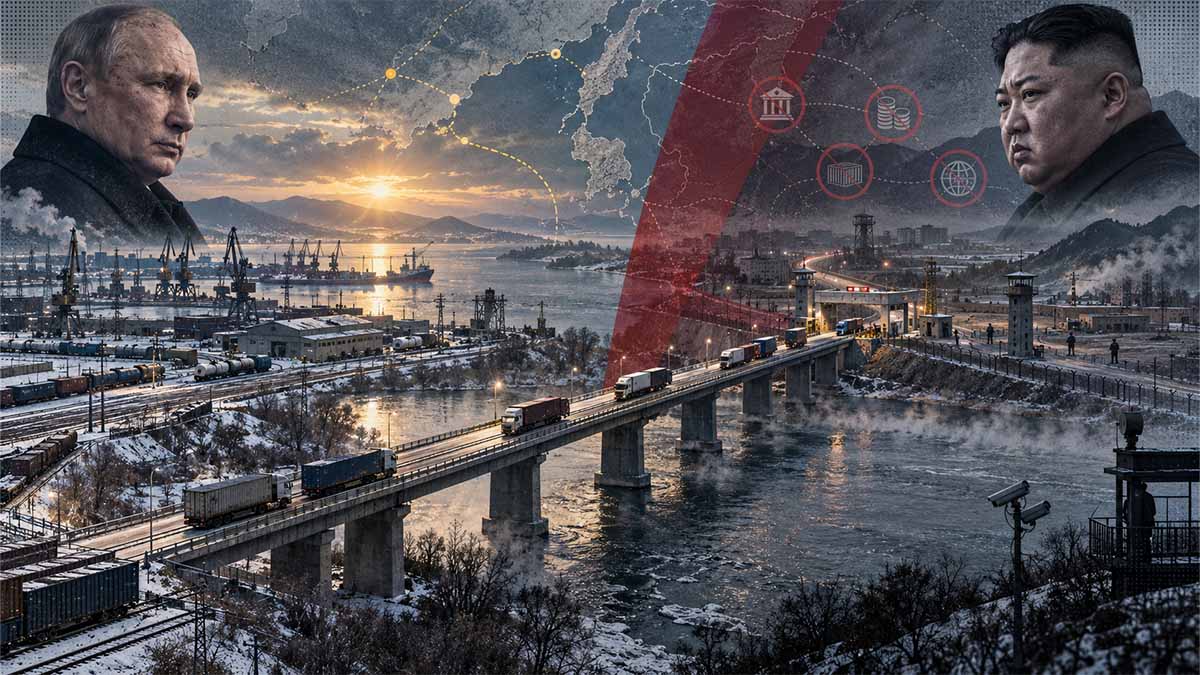
On 7 September 2026, Russian Prime Minister Mikhail Mishustin and DPRK Cabinet Premier Pak Thae Song remotely authorised traffic across the new bridge, named after Yakov Novichenko, a Soviet officer recognised as a Hero of Labour of the DPRK. According to Russia’s Ministry of Transport, construction began on 30 April 2025 and was completed in 495 days; the two bridge sections were joined on 21 April 2026.
The entire border-crossing complex extends for almost five kilometres, while the bridge itself is approximately one kilometre long and carries two traffic lanes. Russia also constructed Khasan, its first automobile checkpoint on the DPRK frontier. The facility has ten processing lanes: four for freight vehicles, two for cars, two for buses and two for oversized transport.
Its initial design capacity is 300 vehicles and 2,325 people a day, with the possibility of expansion to 800 vehicles. Freight operations began at opening, while passenger infrastructure remained in a second construction phase. These are capacity figures, not recorded traffic: neither government has yet published a commodity forecast, utilisation rate or expected annual trade value. На границе России и КНДР открыт автомобильный мост имени Якова Новиченко — Министерство транспорта Российской Федерации — Sep 2026
The Russian approach road connects with the federal Ussuri highway and, through it, the wider West–East road system. The significance lies less in the bridge’s dimensions than in the constraint it removes. Until now, direct overland exchange depended on the Friendship railway bridge. Trucks, buses and specialised vehicles lacked a permanent bilateral road crossing. Moscow and Pyongyang have now acquired greater scheduling flexibility, smaller shipment sizes and direct point-to-point transport without compulsory rail transloading.
Treaty Into Infrastructure
The bridge is a physical implementation of the political framework established during President Vladimir Putin’s state visit to Pyongyang. Russia and the DPRK signed their Treaty on Comprehensive Strategic Partnership on 19 June 2024. Russia enacted its ratification law on 9 November; the treaty entered into force when ratification instruments were exchanged in Moscow on 4 December 2024 and was officially published the following day. Договор о всеобъемлющем стратегическом партнерстве между Российской Федерацией и Корейской Народно-Демократической Республикой — Официальное опубликование правовых актов — Dec 2024
Mishustin described bilateral relations at the opening ceremony as being at an “unprecedentedly high level” and said cooperation extended to almost every field. Pak Thae Song presented the bridge as an instrument for long-term political, economic and cultural projects. These statements establish the two governments’ intentions; they do not establish the scale or composition of the resulting economic flows.
That distinction is central. Treaty implementation has produced visible infrastructure faster than economic disclosure. The public record identifies the bridge’s dimensions, lanes and capacity, but not its construction cost, financing structure, customs-revenue assumptions, anticipated commodity mix or expected return. Nor does it provide a bilateral freight agreement detailing tariffs, carrier access, insurance, liability, axle limits or dispute settlement.
The project should therefore be understood first as strategic infrastructure. Its immediate return is optionality: it allows both governments to move goods and people through an additional mode, redistribute traffic between road and rail and develop adjoining logistics facilities. Commercial viability will depend on volumes that remain undisclosed and on transactions that survive sanctions, banking and insurance scrutiny.
Logistics Without Scale
At full initial capacity, 300 vehicles a day would correspond arithmetically to 109,500 vehicle movements a year if the checkpoint operated at its ceiling every day. Expansion to 800 would raise the theoretical maximum to 292,000. These are calculations from announced daily capacity, not traffic forecasts; actual throughput will be lower whenever passenger and freight demand, inspections, weather, operating hours or border procedures constrain utilisation.
This difference matters for investment interpretation. A road corridor supports heterogeneous loads—food, pharmaceuticals, consumer products, construction inputs and humanitarian consignments—more efficiently than a railway designed around larger consolidated shipments. It can also serve time-sensitive and lower-volume movements. But logistical flexibility does not itself create purchasing power, convertible payment channels or insurable contracts.
North Korea’s external transactions operate within severe financial and sectoral restrictions. Russia may be prepared to absorb more settlement risk through state-directed mechanisms, barter or bilateral clearing, but no official document reviewed for this article discloses the bridge’s payment architecture. Without transparent pricing, settlement and cargo data, claims of a major trade transformation remain unproven.
The corridor’s economic value will therefore emerge at the intersection of three factors: sustained vehicle utilisation, a legally admissible commodity base and a settlement system capable of functioning under sanctions. The bridge has addressed the first-order physical bottleneck. It has not resolved the other two.
Sanctions Define the Market
The United Nations regime does not prohibit every form of trade with North Korea, but it sharply narrows the bridge’s permissible commercial universe. Security Council measures prohibit arms and related materiel; nuclear, ballistic-missile and other proliferation-sensitive goods; designated dual-use items; and goods capable of contributing to DPRK armed-forces operational capabilities.
Resolution 2397 of 22 December 2017 also prohibits supplying North Korea with industrial machinery, transportation vehicles, iron, steel and other metals, apart from its limited exception for spare parts needed to maintain civilian commercial passenger aircraft already in use. It prohibits further categories of DPRK exports, including food and agricultural products, machinery, electrical equipment, earth and stone, wood and vessels. S/RES/2397 (2017) — United Nations Security Council — Dec 2017
Resolution 2375 of 11 September 2017 prohibits DPRK textile exports and the creation or expansion of joint ventures and cooperative entities with DPRK persons, subject to the resolution’s provisions. It also introduced petroleum and labour restrictions subsequently reinforced by later measures. S/RES/2375 (2017) — United Nations Security Council — Sep 2017
The result is not a conventional free-trade corridor. Every significant movement requires classification by commodity, origin, destination, counterparties, ownership, financing and end-use. A commercially available item can still be prohibited because of its sector, recipient or potential contribution to military capability. Calling a shipment “civilian” cannot substitute for this assessment.
Petroleum Is a Quantified Constraint
The road bridge is technically suitable for tanker traffic and could make smaller fuel deliveries more flexible. The legal ceiling, however, applies across supply routes.
Resolution 2397 limits the aggregate supply of refined petroleum products to North Korea to 500,000 barrels in each twelve-month period, subject to specified conditions and reporting procedures. It limits crude-oil supply to four million barrels or 525,000 tonnes over the same period and requires supplying states to report crude deliveries to the Security Council’s 1718 Committee every 90 days. S/RES/2397 (2017) — United Nations Security Council — Dec 2017
A tanker cannot consequently be assessed in isolation. Road deliveries must be reconciled with supplies moved by rail, sea or any other channel during the relevant reporting period. The official record does not yet disclose a Khasan-specific allocation mechanism, real-time accounting procedure or public series recording petroleum movements over the bridge.
This is where infrastructure capacity and legal capacity diverge. The crossing may accommodate additional vehicles, but it cannot lawfully enlarge the aggregate volume authorised by the Security Council.
Inspection Becomes Strategic
UN measures require states to inspect cargo destined for or originating in North Korea—or brokered by it—when that cargo is within or transiting their territory. The obligation expressly covers road and rail transport, as well as vessels, aircraft and relevant passenger luggage. It is therefore a permanent operating requirement for Khasan, not an exceptional response reserved for suspicious maritime movements. Security Council Committee established pursuant to resolution 1718 (2006) — United Nations Security Council — Sep 2024
A credible control architecture must combine advance manifests, sanctions-list screening, beneficial-ownership checks, commodity classification, end-use assessment, petroleum accounting and physical or technical inspection. It must also preserve sufficient records to explain why a shipment was released, detained or refused.
The public Russian record describes lanes and throughput but does not disclose bridge-specific inspection protocols, screening equipment, staffing levels, advance-data exchange with DPRK authorities or interdiction procedures. This absence does not prove non-compliance. It does mean that construction completion cannot be treated as evidence of a demonstrated sanctions-control system.
The transparency gap has widened since the mandate of the UN Panel of Experts expired on 30 April 2024. The Panel had supported the 1718 Committee by investigating implementation, non-compliance, procurement, trade, finance and transport. Its termination reduced specialised international monitoring; it did not repeal the sanctions or diminish member-state obligations. Work and mandate — United Nations Security Council — Apr 2024
No General Khasan Exemption
Resolution 2397 contains a narrowly framed provision for the existing Russia–DPRK Rajin–Khasan port and railway project, solely where it exports Russia-origin coal to third countries. The exception is defined simultaneously by infrastructure, origin, commodity and destination. S/RES/2397 (2017) — United Nations Security Council — Dec 2017
Nothing in the published resolution extends that treatment to the new road bridge. The exception does not authorise DPRK-origin coal, Russian coal supplied for North Korean consumption or unrelated bilateral cargo. Shared geography and the Khasan name cannot convert a project-specific provision into a general transport exemption.
This boundary will become commercially important if the two governments seek to combine the bridge with rail, port or bulk-commodity operations. Each movement must retain the characteristics required by the applicable provision; changing the transport mode or final destination can alter the legal assessment.
Humanitarian Access
The crossing could nevertheless produce a measurable humanitarian benefit. Road transport can shorten delivery chains for medicines, diagnostic equipment, agricultural inputs, water systems and cold-chain components. When such goods engage sanctions restrictions, the 1718 Committee operates an exemption mechanism requiring the applicant to specify beneficiaries, items, quantities, values, counterparties, financing, shipment dates, route and measures against diversion.
As of 22 May 2026, the Committee reported 124 approved humanitarian-exemption requests. Authorisations extending into 2026 or 2027 covered, among other activities, medical imaging and laboratory equipment, maternal and child healthcare, water and sanitation, food security and agricultural projects. An exemption remains itemised and time-limited and does not replace domestic customs or licensing requirements. A material change of route—including use of the new bridge where another entry point was approved—must be submitted for review. Humanitarian Exemption Requests — United Nations Security Council — May 2026
Strategic Return, Legal Ceiling
The Tumen bridge gives Russia and North Korea something they did not previously possess: a permanent road interface capable of integrating freight, buses, private vehicles and specialised transport. It reduces dependence on one railway crossing, strengthens resilience and turns political alignment into durable geography.
Its strategic value is immediate; its economic value is conditional. The decisive measures will not be ceremonial declarations but vehicle utilisation, lawful commodity composition, customs performance, settlement capacity and publication of credible trade data. If those records emerge, the bridge could support a limited but durable sphere of civilian and humanitarian exchange. If opacity persists, its principal effect will be to expand logistical optionality while intensifying questions over inspection, sanctions enforcement and the true content of bilateral flows.
The bridge has changed the border. Whether it changes the regional economy will be determined at the checkpoint.
Navigational Index
- A road corridor removes a structural transport constraint
- Treaty implementation advances faster than economic transparency
- Sanctions and inspection obligations define the bridge’s permissible use
Master Abstract
A road corridor removes a structural transport constraint
Russia and the DPRK formally opened the automobile bridge over the Tumen River on 7 September 2026. Russian Prime Minister Mikhail Mishustin and DPRK Cabinet Premier Pak Thae Song authorised the opening by video link. According to the Russian Ministry of Transport, the wider crossing extends almost 5 kilometres, including approximately 1 kilometre of bridge, and provides two traffic lanes. Construction began on 30 April 2025, the two bridge sections were joined on 21 April 2026, and the works required 495 days. More than 5,000 tonnes of metal structures and 9,000 cubic metres of concrete were reportedly used. На границе России и КНДР открыт автомобильный мост имени Якова Новиченко — Ministry of Transport of the Russian Federation — Sep 2026
The infrastructure removes a genuine bilateral constraint. Before its opening, direct land transport depended on the Friendship railway bridge. The Russian Ministry of Transport states that this railway route was insufficient for existing transport requirements and that the new road link will support year-round vehicle movement. This is evidence of increased physical capacity, but not yet of increased commercial activity: no official data establishing traffic volumes, cargo composition, freight value, utilisation rates or transport-cost reductions have been published. Russian statements that the bridge will expand trade and reduce costs therefore remain policy expectations rather than measured outcomes.
Treaty implementation advances faster than economic transparency
The bridge was authorised through a bilateral project agreement signed in 2024 in the presence of Vladimir Putin and Kim Jong Un. It now provides a physical implementation channel for the wider Treaty on Comprehensive Strategic Partnership signed in Pyongyang on 19 June 2024. Russia ratified that treaty through Federal Law No. 374-FZ of 9 November 2024; the treaty entered into force following the exchange of ratification instruments on 4 December 2024. Договор о всеобъемлющем стратегическом партнерстве между Российской Федерацией и Корейской Народно-Демократической Республикой — Ministry of Foreign Affairs of the Russian Federation — Jun 2024 Подписан закон о ратификации Договора о всеобъемлющем стратегическом партнёрстве между Россией и КНДР — President of Russia — Nov 2024
The bridge should therefore be understood as part of an institutional sequence: treaty formation, ratification, infrastructure construction and operational border integration. Its road format is especially important because trucks and buses provide routing, scheduling and cargo-unit flexibility that rail transport cannot replicate. The infrastructure can support authorised commerce, official delegations, tourism and regional exchanges while providing redundancy if railway operations are disrupted.
The public record, however, does not establish the commercial scale necessary to validate the governments’ broader claims. No verified bilateral baseline has been released showing current truck demand, forecast freight tonnage, customs revenue, average crossing time or anticipated modal substitution from rail and maritime routes. Nor has an official project cost or financing allocation been identified in the accessible record. The bridge is therefore an established logistical capability embedded in a strategic political relationship, but not yet a demonstrated economic transformation.
The checkpoint—not the bridge—is the operative constraint
The associated Khasan border checkpoint is Russia’s first automobile checkpoint on the DPRK frontier. Freight traffic has commenced through an initial operating complex. The approved design contains 10 vehicle lanes: four for freight vehicles, two for passenger cars, two for buses and two for oversized vehicles. Russia states that full operation would permit 300 vehicles per day, expandable to 800, together with 2,325 people per day. Passenger facilities remain part of a second construction phase. На границе России и КНДР открыт автомобильный мост имени Якова Новиченко — Ministry of Transport of the Russian Federation — Sep 2026
These figures distinguish theoretical capacity from present availability. The crossing cannot yet deliver its stated tourism potential because the passenger component has not been commissioned. Actual throughput will also depend on operating hours, inspection procedures, customs staffing, vehicle availability, road connectivity beyond the checkpoint and DPRK domestic distribution capacity. A two-lane bridge can therefore possess substantial unused engineering capacity while the border terminal, regulatory process or onward network restricts realised flows.
Sanctions constrain what connectivity can lawfully deliver
The opening does not modify the sanctions framework established by binding UN Security Council resolutions. Member States remain required to inspect cargo originating in or destined for the DPRK, including goods transported by road or rail. The regime prohibits arms and related materiel transfers and applies “catch-all” restrictions to items capable of contributing to DPRK nuclear, ballistic-missile, weapons-of-mass-destruction or armed-forces capabilities. Security Council Committee established pursuant to resolution 1718 (2006) — United Nations Security Council — current consolidated record
Resolution 2397 limits aggregate refined-petroleum transfers to the DPRK to 500,000 barrels per twelve-month period and crude-oil transfers to 4 million barrels or 525,000 tonnes. It also prohibits the transfer to the DPRK of industrial machinery, transportation vehicles, iron, steel and other metals, subject to specified exceptions. S/RES/2397 (2017) — United Nations Security Council — Dec 2017
Resolution 2375 prohibits new or expanded joint ventures and cooperative entities with DPRK entities or individuals unless specifically authorised through the applicable process. It also prohibits DPRK textile exports and restricts employment authorisations for DPRK nationals. S/RES/2375 (2017) — United Nations Security Council — Sep 2017
The bridge is therefore legally neutral infrastructure whose strategic significance depends on use. It can facilitate permitted trade and passenger movement, but it also creates an additional enforcement surface. Road freight is divided into smaller, more numerous consignments than conventional rail shipments, increasing the importance of manifests, end-user checks, physical inspections and commodity classification. The infrastructure’s value to bilateral relations and its exposure to compliance risk rise together.
Regional consequences extend beyond bilateral trade
The crossing increases Russia’s direct connectivity with the Korean Peninsula without relying on Chinese territory. For Pyongyang, it provides an additional external corridor and reduces exclusive dependence on rail and maritime transport in relations with Russia. For Moscow, it integrates the DPRK more closely with Primorsky Krai and strengthens Russia’s physical position at the junction of Northeast Asia.
The bridge does not, however, constitute a regional transit corridor in its own right. No verified public agreement establishes onward transit through the DPRK to the Republic of Korea, and the inter-Korean political and security environment precludes treating the route as a functioning connection to South Korean markets. Its current geometry is bilateral: Khasan and the Russian Far East on one side, the DPRK’s northeastern transport system on the other.
The broader strategic consequence is thus not the creation of a new Eurasian commercial highway. It is the conversion of the Russia–DPRK frontier from a rail-only boundary into a multimodal interface. That change improves resilience, permits more granular movement and gives both governments another instrument for implementing political, economic and cultural initiatives under their strategic-partnership framework.
Key Evidence Table
| Indicator | Value/status | Reference date | Definition/scope | Issuer | Exact source |
|---|---|---|---|---|---|
| Bridge opening | Freight movement inaugurated | 7 Sep 2026 | First permanent Russia–DPRK automobile crossing | Russian Ministry of Transport | На границе России и КНДР открыт автомобильный мост имени Якова Новиченко |
| Total crossing length | Almost 5 km | 7 Sep 2026 | Bridge plus approaches and associated crossing | Russian Ministry of Transport | На границе России и КНДР открыт автомобильный мост имени Якова Новиченко |
| Bridge length and roadway | Approx. 1 km; two lanes | 7 Sep 2026 | Physical bridge over the Tumen River | Russian Ministry of Transport | На границе России и КНДР открыт автомобильный мост имени Якова Новиченко |
| Construction period | 495 days | 30 Apr 2025–7 Sep 2026 | Reported construction interval | Russian Ministry of Transport | На границе России и КНДР открыт автомобильный мост имени Якова Новиченко |
| Border-terminal configuration | 10 vehicle lanes | Full-design configuration | Four freight, two car, two bus and two oversized-vehicle lanes | Russian Ministry of Transport | На границе России и КНДР открыт автомобильный мост имени Якова Новиченко |
| Stated design throughput | 300 vehicles/day, expandable to 800; 2,325 people/day | At full operation | Design capacity, not observed utilisation | Russian Ministry of Transport | На границе России и КНДР открыт автомобильный мост имени Якова Новиченко |
| Passenger operations | Not yet commissioned | 7 Sep 2026 | Second operating complex remains under construction | Russian Ministry of Transport | На границе России и КНДР открыт автомобильный мост имени Якова Новиченко |
| Refined-petroleum ceiling | 500,000 barrels per 12 months | From 1 Jan 2018 | Aggregate supply to the DPRK under UNSCR 2397 | UN Security Council | S/RES/2397 (2017) |
| Crude-oil ceiling | 4 million barrels or 525,000 tonnes per 12 months | From 22 Dec 2017 | Aggregate supply to the DPRK under UNSCR 2397 | UN Security Council | S/RES/2397 (2017) |
| Road-cargo control | Inspection required | Current consolidated regime | Cargo to or from the DPRK, including road and rail transport | UN Security Council | Security Council Committee established pursuant to resolution 1718 (2006) |
Principal Gaps and Watch Indicators
Gaps capable of changing the assessment
- The bilateral bridge agreement’s complete technical, financial and operational annexes have not been identified in an accessible official record.
- No authoritative project cost, cost-sharing formula or final expenditure statement is publicly available.
- No official cargo manifest series, customs-value data, vehicle counts or utilisation statistics have been released.
- The commissioning date and operating conditions for passenger cars and buses remain unspecified.
- Public reporting does not establish the inspection technology, customs staffing or end-user verification procedures applied at Khasan.
- No official five-year traffic forecast or commodity-level trade plan has been published.
- Current open records do not establish whether design capacity refers to one-way movements, two-way movements or combined daily entries and exits.
Indicators that would strengthen the principal judgment
- Sustained publication of daily or monthly truck crossings and freight tonnage.
- Commissioning of the passenger complex and regular cross-border bus services.
- Publication of customs classifications demonstrating growth in permitted goods.
- New road, warehousing and logistics investment on both sides of the crossing.
- Measurable diversion of bilateral freight from rail or maritime routes.
- Formal tourism schedules, visa procedures and published passenger volumes.
Indicators that would weaken it
- Persistently low utilisation after the first operating year.
- Delayed passenger commissioning or restricted operating hours.
- Recurrent border closures, inspection bottlenecks or inadequate onward road capacity.
- Absence of transparent customs reporting.
- Evidence that sanctions restrictions exclude the commodity categories expected to generate most demand.
- Additional international measures affecting financial settlement, vehicles, fuel or logistics providers.
Operational Intelligence Interface: Russia–DPRK Automotive Crossing
Consolidated diagnostic platform for the Yakov Novichenko bridge over the Tumen River. Tracks confirmed structural specifications, design capacities, operational status, and international sanctions compliance architecture (UNSCR 2397) defining the permitted cargo envelope.
Structural Metric: Tumen River Physical Assets (Sep 2026)
Tracking physical bridge span, associated approaches, construction duration, and operational complexes.
Russia–DPRK Automotive Crossing: Yakov Novichenko Physical Metrics
Approximate 1km physical bridge over the Tumen River; two roadway lanes. Freight movement inaugurated 7 Sep 2026. Reported construction interval: 30 Apr 2025–7 Sep 2026 (495 Days). Total crossing length (bridge + approaches) is ‘almost 5km’.
10-lane border terminal configuration at full operation: Four freight lanes, two car lanes, two bus lanes, and two oversized-vehicle lanes. Passenger complex (buses and cars) is ‘not yet commissioned’.
Issuing Authority: Russian Ministry of Transport (Mintrans). Exact Source Document: “На границе России и КНДР открыт автомобильный мост имени Якова Новиченко” (7 Sep 2026).
Cross-Verification Matrix: Project Evidence & Compliance
Evaluating confirmed indicators, stated technical designs, international sanctions architecture (UNSCR 2397), and information integrity gaps defining crossing operations.
| Indicator | Status / Value | Definition & Governance Envelope | Authoritative Evidence Source |
|---|---|---|---|
| Freight Inauguration | 7 Sep 2026 | First permanent Russia–DPRK automobile crossing inaugurated; freight movement active. | Russian Ministry of Transport (На границе России и КНДР открыт автомобильный мост…) |
| Terminal Lanes | 10 Vehicle Lanes | Full-design configuration: 4 freight, 2 car, 2 bus and 2 oversized-vehicle lanes. | Russian Ministry of Transport (На границе России и КНДР открыт автомобильный мост…) |
| Stated Design Throughput | Apx 300 vehicles/day | Stated capacity (at full operation), expandable to 800. 2,325 people/day. UTILISATION UNVERIFIED. | Russian Ministry of Transport (На границе России и КНДР открыт автомобильный мост…) |
| Passenger Operations | Not Commissioned | Second operating complex (buses/cars) remains under construction. No regular services verified. | Russian Ministry of Transport (На границе России и КНДР открыт автомобильный мост…) |
| Refined-Petroleum Ceiling | 500k Barrels / 12 Months | Aggregate supply to the DPRK under UNSCR 2397 (From 1 Jan 2018). SUBJECT TO INSPECTION. | UN Security Council (S/RES/2397) |
| Crude-Oil Ceiling | 4m Barrels / 12 Months | Aggregate supply to the DPRK under UNSCR 2397 (From 22 Dec 2017). SUBJECT TO INSPECTION. | UN Security Council (S/RES/2397) |
| Road-Cargo Control | MANDATORY INSPECTION | UNSCR requires inspection of cargo to/from the DPRK, including road and rail. Enforcement unverified at Khasan. | UN Security Council (1718 Committee) |
| Evidence Gaps | CRITICAL UNVERIFIED METRICS | Missing official cargo manifests, vehicle counts, cost-sharing, and end-user verification procedures at Khasan. | Diagnostic Audit (Open Records Gaps) |
Anatomy of Information Entropy: Principal Gaps & Diagnostic Vulnerabilities
Open records define confirmed structure but do not establish operational truth. The Principal Gaps identified create severe diagnostic vulnerability, meaning raw physical capacity is conflated with actual utilization. The key informational choke points that prevent a high-confidence assessment of true crossing impact:
The complete technical, financial, and operational annexes defining the bilateral bridge agreement remain hidden. No authoritative project cost, cost-sharing formula, or final expenditure statement is accessible, obscuring the primary strategic investment motivation.
Zero official cargo manifests, customs-value data, or vehicle count series have been released. Stated design capacity (Apx 300 vehicles/day) is a engineering baseline, not observed utilization. Actual trade composition (sanctioned vs permitted) cannot be verified.
Public reporting does not establish the inspection technology (e.g., X-ray scanners), customs staffing, or end-user verification procedures applied at Khasan. The operational reality of the UNSCR mandatory inspection regime is unknown.
A Road Corridor Removes a Structural Transport Constraint
Principal judgment
The opening of the Tumen River automobile bridge changes the physical architecture of Russia–DPRK relations by replacing a rail-only land connection with a multimodal border system. The decisive gain is not the bridge’s nominal size, but the operational flexibility created by direct truck access: smaller consignments, independent departure schedules, door-to-door delivery and less dependence on railway timetables and transshipment procedures.
The constraint has nevertheless been removed only partially. As of 7 September 2026, freight traffic has commenced, while passenger operations remain pending. Published throughput figures describe planned capacity rather than demonstrated performance, and no official record yet establishes actual vehicle movements, cargo volumes, border-processing times or transport-cost reductions. The bridge is therefore an operationally significant enabling asset, not yet evidence of a large-scale commercial corridor.
From a single rail link to a multimodal frontier
Before September 2026, the Russia–DPRK land boundary possessed no permanent automobile crossing. Direct terrestrial movement depended on the Friendship railway bridge across the Tumen River at Khasan–Tumangang. The Russian Ministry of Transport now states that the railway route alone was insufficient to meet transport requirements and that the new bridge will permit year-round road movement. На границе России и КНДР открыт автомобильный мост имени Якова Новиченко — Ministry of Transport of the Russian Federation — Sep 2026
This is the central structural change. A railway corridor consolidates cargo into scheduled trains, depends on railway rolling stock and terminal coordination, and concentrates cross-border movement into a limited number of large consignments. Road transport allows freight to be divided among individual vehicles, dispatched at different times and routed beyond the border without necessarily being unloaded into another transport mode.
The new bridge consequently adds four capabilities that did not previously coexist on the bilateral frontier:
- an independent alternative to the railway crossing;
- direct truck movement between the two national road systems;
- potential passenger-car and bus connectivity;
- greater flexibility in the size, timing and destination of consignments.
These are operational characteristics, not proof of economic return. Their significance will be determined by the volume of authorised cargo, availability of trucks and drivers, customs-processing capacity, operating hours, onward-road conditions and financial arrangements supporting bilateral transactions.
The evidence therefore supports a precise conclusion: the bridge removes the absence of a road connection, but it does not remove the institutional and economic frictions governing use of that connection.
A project considered years before the strategic treaty
The road link was not conceived solely as an immediate consequence of the 2024 Russia–DPRK strategic realignment. Russian border-infrastructure authorities were already discussing a bridge between Khasan in Primorsky Krai and Tumangang in the DPRK by February 2019. Rosgranstroy records that representatives of its Vladivostok branch, the Primorsky regional administration and the Ministry for the Development of the Russian Far East examined the proposed bridge and border checkpoint at a meeting in Vladivostok. Перспективы строительства трансграничного автомобильного моста и пункта пропуска на границе России и Северной Кореей обсудили в ходе совещания во Владивостоке — Rosgranstroy — Feb 2019
The project therefore had an identifiable transport-policy rationale before the current strategic partnership. What changed after 2024 was the political authority, implementation speed and bilateral priority assigned to it.
The implementation agreement was signed in 2024 in the presence of Russian President Vladimir Putin and DPRK leader Kim Jong Un. Construction formally began on 30 April 2025. The two national bridge sections were joined on 21 April 2026, and the opening ceremony took place on 7 September 2026. The Russian Ministry of Transport calculates the construction period at 495 days, while stating that the principal construction stages were completed in less than one year. На границе России и КНДР открыт автомобильный мост имени Якова Новиченко — Ministry of Transport of the Russian Federation — Sep 2026
Verified implementation sequence
| Stage | Date | Evidentiary status | Institutional significance |
|---|---|---|---|
| Inter-agency consideration in Vladivostok | 19 Feb 2019 | Recorded by Rosgranstroy | Establishes that the infrastructure concept predates the 2024 strategic treaty |
| Bilateral project agreement | 2024 | Confirmed by the Russian Ministry of Transport; precise signing date not stated on the opening page | Converted the concept into an agreed interstate project |
| Construction launched | 30 Apr 2025 | Officially reported | Beginning of physical implementation |
| Bridge spans joined | 21 Apr 2026 | Officially reported | Structural connection completed across the frontier |
| Freight movement inaugurated | 7 Sep 2026 | Officially reported | First operational road connection between Russia and the DPRK |
| Passenger component | Expected by end-2026 in Russian government reporting | Announced, not completed | Required before the crossing can deliver its stated passenger and tourism functions |
The chronology indicates that the bridge should be interpreted in two layers. It is a longstanding regional infrastructure proposal, but its completion belongs to the post-2024 phase of accelerated Russia–DPRK institutional integration. The project is therefore neither purely commercial nor merely symbolic: it is legacy infrastructure delivered under a new strategic relationship.
The bridge is only one component of the crossing
The term “bridge” can obscure the scale and composition of the completed system. Russia reports that the entire bridge crossing—including approaches and associated infrastructure—extends almost 5 kilometres, while the bridge structure itself measures approximately 1 kilometre. It carries two vehicle lanes. Construction used more than 5,000 tonnes of metal structures and over 9,000 cubic metres of concrete, with more than 70 personnel and 30 units of equipment reportedly involved. На границе России и КНДР открыт автомобильный мост имени Якова Новиченко — Ministry of Transport of the Russian Federation — Sep 2026
These figures establish the physical scale of the project but do not define its economic capacity. The bridge deck is only one link in the processing chain:

The slowest component governs effective throughput. Even if the bridge deck can accommodate a continuous flow of vehicles, realised capacity will be constrained by inspection bays, customs staffing, document processing, security controls, vehicle queuing, DPRK-side facilities and the condition of onward roads.
For analytical purposes, the asset should therefore be treated as a border-processing system, not simply an engineering structure. The principal variables are vehicles cleared per hour, average inspection time, operating hours, proportion of loads requiring secondary examination and availability of suitable transport on both sides. None of these operating metrics has yet been published in an accessible official series.
Khasan becomes a new type of border checkpoint
The Russian government authorised Khasan as a permanent, multilateral road checkpoint for freight and passenger movements. Initial operations are limited to cargo vehicles; the government stated that the crossing would become fully operational by the end of 2026. Документ — Government of the Russian Federation — Sep 2026
The design provides 10 vehicle lanes:
| Function | Lanes | Share of total lanes |
|---|---|---|
| Freight vehicles | 4 | 40% |
| Passenger cars | 2 | 20% |
| Buses | 2 | 20% |
| Oversized vehicles | 2 | 20% |
| Total | 10 | 100% |
The allocation shows that the checkpoint was not designed exclusively for bilateral merchandise trade. Forty per cent of its lanes are assigned to standard freight, while the remaining lanes support passenger cars, buses and oversized cargo. This creates potential for tourism, official travel, organised passenger services and project-related equipment movements, subject to commissioning and applicable controls.
The inclusion of two oversized-vehicle lanes is operationally relevant because abnormal loads require different clearance geometry and handling from standard trucks. It does not establish that particular machinery or equipment will be transported, nor does it override restrictions applying to the underlying goods.
The official record also distinguishes between the inauguration of freight traffic and completion of the overall crossing. The Russian Ministry of Transport states that work on the “second launch complex” continues and that this phase will activate the passenger component. На границе России и КНДР открыт автомобильный мост имени Якова Новиченко — Ministry of Transport of the Russian Federation — Sep 2026
Accordingly, official references to tourism and passenger growth describe a planned function. As of the assessment date, the verified operational capability is freight movement.
Design capacity is not observed throughput
The Ministry of Transport reports that, after reaching full capacity, the checkpoint will process 300 vehicles per day, with the possibility of expansion to 800 vehicles, and 2,325 people per day. These numbers should be treated as design parameters rather than forecasts or operational results. На границе России и КНДР открыт автомобильный мост имени Якова Новиченко — Ministry of Transport of the Russian Federation — Sep 2026
At 300 vehicles per day, average throughput would equal 12.5 vehicles per hour if the checkpoint operated continuously for 24 hours. At 800 vehicles, the equivalent would be approximately 33.3 vehicles per hour. These calculated averages do not account for directional balance, opening hours, vehicle category, processing time or periods of peak demand. They consequently cannot be interpreted as verified operating rates.
A discrepancy also exists within the Russian official record. Rosgranstroy reported in January 2026 that the checkpoint would process up to 300 vehicles and 2,850 people per day, whereas the September 2026 Ministry of Transport release gives 2,325 people per day. В Минтуризма Приморья ожидают роста турпотока из РФ в КНДР с запуском моста — Rosgranstroy — Jan 2026 На границе России и КНДР открыт автомобильный мост имени Якова Новиченко — Ministry of Transport of the Russian Federation — Sep 2026
The later figure is preferable for the current baseline because it was published at opening, but the difference—525 people per day, or approximately 18.4% below the earlier figure—must remain visible. The accessible releases do not explain whether the revision results from a changed design, different passenger definitions, phased commissioning or correction of an earlier estimate.
Capacity claims and evidentiary limits
| Indicator | Published value | What it establishes | What it does not establish |
|---|---|---|---|
| Initial full-design vehicle capacity | 300 vehicles/day | Stated checkpoint processing design | Actual daily traffic or sustainable utilisation |
| Expandable vehicle capacity | 800 vehicles/day | Engineering or planning expansion potential | Funding, completion date or demand for expansion |
| September passenger capacity | 2,325 people/day | Latest published full-operation figure | Present passenger movement |
| January passenger capacity | 2,850 people/day | Earlier official planning figure | Current approved capacity |
| Freight operations | Commenced | Trucks can use the crossing | Cargo volume, value, composition or frequency |
| Passenger operations | Not yet commissioned | Second phase remains necessary | Confirmed launch date or service schedule |
Road access increases flexibility, not unlimited volume
The strongest near-term advantage is the ability to match transport units to smaller or less regular consignments. A truck can move without assembling a complete train, and road deliveries can be scheduled with greater frequency. This can reduce inventory waiting time and terminal handling where compatible vehicles and procedures exist.
The bridge also adds redundancy. If railway service is constrained by maintenance, rolling-stock shortages or scheduling limitations, some eligible cargo can be redirected by road. Redundancy does not mean interchangeability: rail remains more efficient for large quantities of bulk cargo, while trucks are generally better suited to smaller, higher-frequency or destination-specific loads.
The new corridor should therefore complement rather than automatically replace the railway bridge. The public record contains no official modal forecast showing how much existing rail freight is expected to transfer to trucks. There is likewise no verified evidence that road transport will reduce total delivered cost after accounting for customs procedures, fuel, driver availability, insurance, vehicle restrictions and transshipment where Russian trucks cannot continue through the DPRK—or DPRK vehicles cannot continue through Russia—under applicable operating rules.
The economic mechanism is credible but conditional:
- direct road access reduces dependence on train formation and railway schedules;
- this permits more frequent and granular consignments;
- greater flexibility can reduce waiting and handling costs;
- savings materialise only if border-processing and onward-transport costs do not offset them.
No official cost comparison currently demonstrates the fourth step.
Connection with the Russian road system broadens reach
Russian government reporting states that the approach road connects with the federal Ussuri highway, linking Khabarovsk and Vladivostok and forming part of Russia’s wider West–East transport architecture. This gives the bridge access to the road network of Primorsky Krai rather than leaving it as an isolated border installation. Движение по автомобильному мосту открыто на границе РФ и КНДР — Government statements reported at the opening ceremony — Sep 2026
This network connection increases the potential catchment area for freight. Cargo entering Russia can, in principle, be transferred into regional and national distribution routes; cargo moving toward the DPRK can be consolidated elsewhere in the Russian Far East before reaching Khasan.
The bridge does not by itself create a continuous international road corridor across the Korean Peninsula. No accessible official agreement establishes commercial transit from Russia through the DPRK to the Republic of Korea, and there is no functioning inter-Korean road trade route that would justify presenting the new crossing as a connection to South Korean markets. Its verified geography remains bilateral: Russia’s road system connects to the DPRK’s northeastern transport network at Khasan–Tumangang.
The infrastructure’s strategic reach is therefore substantial but bounded. It connects two national systems and strengthens Russia’s access to the DPRK; it does not yet connect the Russian road economy to the wider Korean Peninsula.
Freight activation precedes the tourism narrative
Both governments have attached tourism and cultural significance to the bridge. Mishustin stated that the crossing would create opportunities for tourism, while Pak Thae Song described it as opening new prospects for cooperation from economics to culture. These statements are evidence of governmental intent, not passenger demand or established services. На границе России и КНДР открыт автомобильный мост имени Якова Новиченко — Ministry of Transport of the Russian Federation — Sep 2026
Tourism requires more than bridge access. At minimum, practical passenger flows depend on:
- completion and certification of passenger-control facilities;
- visa and entry arrangements;
- authorised tour operators and itineraries;
- regular bus or private-vehicle rules;
- insurance and vehicle-recognition arrangements;
- accommodation and onward transport inside the DPRK;
- predictable border-opening schedules.
The Russian government’s stated objective of full checkpoint operation by the end of 2026 is therefore the first relevant signpost. Even after commissioning, passenger capacity cannot be equated with tourism volume. Recorded crossings will include officials, transport personnel and other authorised travellers, while the total number of unique visitors will differ from the number of border movements if entries and exits are counted separately.
Until operating regulations and observed passenger figures are published, tourism should remain a secondary prospective benefit rather than part of the verified opening-day impact.
Symbolism reinforces the infrastructure’s political function
The bridge was named after Yakov Tikhonovich Novichenko, a Soviet Red Army officer honoured by the DPRK for protecting Kim Il Sung during a 1946 attack in Pyongyang. Members of Novichenko’s family attended the opening, and the Russian vehicle column was led by a 1980 ZAZ-968M formerly belonging to him. На границе России и КНДР открыт автомобильный мост имени Якова Новиченко — Ministry of Transport of the Russian Federation — Sep 2026
The choice of name anchors a contemporary infrastructure project in the two governments’ shared historical narrative. This does not affect the bridge’s physical performance, but it clarifies its institutional purpose. The opening was structured not only as the commissioning of a transport asset but as a demonstration of political continuity, reciprocal recognition and renewed strategic alignment.
The symbolism and engineering function should not be conflated. The ceremony establishes the importance assigned to the project by both governments. Actual strategic value will be measured through sustained use, supporting regulations, follow-on investments and the categories of interaction that the corridor enables.
Net assessment
The bridge has removed a discrete and consequential physical constraint: Russia and the DPRK are no longer limited to rail for direct land transport. The addition of road freight allows smaller, more frequent and more flexible movements; creates a second surface-transport mode; connects the DPRK frontier with the Russian road network; and provides infrastructure for future passenger services.
The change remains narrower than the official political narrative suggests. Freight traffic has started, but the passenger system is unfinished. The published maximum of 300 vehicles per day is a design figure, while expansion to 800 vehicles remains potential capacity. Official sources do not disclose actual throughput, cargo composition, border-processing performance, project cost or documented transport savings.
The most defensible opening-stage judgment is therefore that the bridge has created strategic optionality. It gives Moscow and Pyongyang a transport instrument that did not previously exist. Whether that instrument develops into a significant economic corridor, a specialised bilateral supply route, a passenger gateway or a lightly used political symbol cannot yet be determined from the public record.
Key judgments
- The bridge creates the first permanent road connection between Russia and the DPRK and ends exclusive reliance on the Friendship railway bridge for direct land transport.
- Its principal operational contribution is flexibility rather than bulk capacity.
- The crossing must be assessed as an integrated bridge-and-checkpoint system; border processing, not the bridge deck, is likely to determine effective throughput.
- As of 7 September 2026, only freight operations are verified; passenger movement remains part of a second commissioning phase.
- The stated capacities of 300 vehicles per day, expandable to 800, are design parameters rather than observed traffic.
- The official passenger-capacity figure was revised from 2,850 to 2,325 people per day without a public explanation.
- The corridor connects the DPRK with the Russian road network but does not constitute an operational transit route to the Republic of Korea.
- No official evidence yet demonstrates realised reductions in transport costs or significant expansion in bilateral trade.
What would change the assessment
The judgment would strengthen if official monthly data demonstrate sustained freight growth, short and stable processing times, regular service schedules, diversified permitted cargo, passenger commissioning and complementary warehousing or road investment.
It would weaken if the checkpoint remains restricted to limited freight categories, operates intermittently, encounters persistent customs bottlenecks, fails to activate passenger services or records utilisation substantially below its 300-vehicle design capacity.
The assessment would change materially if a published bilateral operating protocol establishes through-running vehicle rights, harmonised customs procedures, scheduled passenger services or significant investment in onward logistics inside the DPRK.
Open official record
The following documents or observations remain necessary for a complete baseline:
- the full 2024 bilateral bridge agreement and any technical or financial annexes;
- the final Russian government order opening the Khasan road checkpoint, including operative conditions;
- the equivalent DPRK instrument authorising the crossing;
- the project’s final cost and bilateral financing allocation;
- approved operating hours and directional capacity;
- the definition underlying the 300- and 800-vehicle figures;
- the reason for the revision from 2,850 to 2,325 people per day;
- customs, immigration and vehicle-admission protocols;
- DPRK-side checkpoint specifications and onward-road capacity;
- first-month and first-year vehicle, passenger, tonnage and commodity data;
- measured border-processing times and documented transport-cost comparisons.
GDELT: Solo come Radar di Controllo (Sentinel Phase)
Forensic trace of the information decoupling mechanism: tracking how GDELT 2.0 (15-minute refresh, multilingual) acts strictly as a gap-recovery sentinel, triangulating international media flows not yet indexed by the principal NEXUS OSINT archive to identify and ingest omissions.
Sentinel Flow: Multilingual Media Omission Detection (15m Window)
Tracking how imperfect GDELT indexing and NEXUS capture lag define critical gap recovery transmission.
Omission Triangulation Chain: GDELT Radar strictly defined
GDELT 2.0 acts strictly as a gap-recovery sentinel, triangulating multilingual international flows not yet indexed by the NEXUS OSINT archive to identify omissions.
If NEXUS capture latency creates an information vacuum, the GDELT sentinel triggers a primary recovery protocol, defaulting ingestion to the GDELT stream during transitions.
Issuing Authority: GDELT Project (2.0 Update). Source Document: “GDELT solo come radar di controllo”. Audit Gaps: True multilingual indexing and NEXUS capture verification.
Cross-Verification Matrix: Sentinel Gaps & OSINT Compliance
Evaluating confirmed indicators, stated technical designs, OSINT standards, and information integrity gaps defining sentinel operations.
| Indicator | Status / Value | Definition & OSINT Envelope | Audit & OSINT Verification | |||||||||||||||||||||||||||||||||||||||||||||||||||||||||||||||||||||||||||||||||||||||||||||||||||||||||||||||||||||||||||||
|---|---|---|---|---|---|---|---|---|---|---|---|---|---|---|---|---|---|---|---|---|---|---|---|---|---|---|---|---|---|---|---|---|---|---|---|---|---|---|---|---|---|---|---|---|---|---|---|---|---|---|---|---|---|---|---|---|---|---|---|---|---|---|---|---|---|---|---|---|---|---|---|---|---|---|---|---|---|---|---|---|---|---|---|---|---|---|---|---|---|---|---|---|---|---|---|---|---|---|---|---|---|---|---|---|---|---|---|---|---|---|---|---|---|---|---|---|---|---|---|---|---|---|---|---|---|---|---|---|
| Sentinel Phase | Active Sentinel | GDELT acts strictly as OSINT gap sentinel, triangulation of multilingual media omissions. | OSINT Audit (Open Records Gaps) | |||||||||||||||||||||||||||||||||||||||||||||||||||||||||||||||||||||||||||||||||||||||||||||||||||||||||||||||||||||||||||||
| NEXUS Capture | Primary Ingestion | Principal ingestion engine captures and indexes open-source records, defining the base OSINT archive. | OSINT Audit (Capture Rate Gaps)
Treaty Implementation Advances Faster Than Economic TransparencyPrincipal judgmentRussia and the Democratic People’s Republic of Korea have constructed a comparatively dense institutional framework since June 2024: a ratified strategic-partnership treaty, intergovernmental implementation mechanisms, a completed cross-border bridge and a newly authorised automobile checkpoint. The speed of legal and physical implementation is established by the official record. The economic results are not. Neither government currently publishes a sufficiently complete, comparable and independently auditable series covering bilateral trade value, commodity composition, payment arrangements, freight volumes, project financing or realised transport savings. Official descriptions of cooperation as being at an “unprecedentedly high level” therefore establish the political position of Moscow and Pyongyang, but do not provide a quantitative economic baseline. The bridge closes an infrastructure gap more rapidly than the two governments have closed the information gap. This asymmetry matters because it prevents external observers from determining whether the new corridor is principally supporting ordinary commerce, state-directed exchanges, tourism, industrial cooperation or other strategic transactions. The treaty transformed political alignment into standing obligationsVladimir Putin and Kim Jong Un signed the Treaty on Comprehensive Strategic Partnership between the Russian Federation and the Democratic People’s Republic of Korea in Pyongyang on 19 June 2024. The Russian State Duma approved ratification on 24 October 2024. President Putin signed Federal Law No. 374-FZ on 9 November, and the treaty entered into force following the exchange of ratification instruments on 4 December 2024. Ратифицирован Договор о всеобъемлющем стратегическом партнерстве между РФ и КНДР — State Duma of the Russian Federation — Oct 2024 Подписан закон о ратификации Договора о всеобъемлющем стратегическом партнёрстве между Россией и КНДР — President of Russia — Nov 2024 Договор о всеобъемлющем стратегическом партнерстве между Российской Федерацией и Корейской Народно-Демократической Республикой — Official Internet Portal of Legal Information — Dec 2024 This sequence converted political declarations into a treaty of indefinite duration containing commitments across security, foreign policy, trade, investment, science, technology, energy, agriculture, education, health, transport, communications, culture and tourism. The instrument also establishes consultation mechanisms when either party considers itself exposed to an immediate threat of armed aggression and provides for military and other assistance under specified circumstances involving an armed attack. For the purposes of the bridge assessment, the treaty’s importance lies less in any single economic clause than in the breadth of the governmental mandate it creates. It authorises sustained coordination across multiple policy domains and supplies a durable political framework within which specialised agreements, commissions, infrastructure projects and administrative arrangements can be concluded. The treaty is nevertheless a framework instrument. It does not itself disclose:
The existence of the treaty therefore proves institutional commitment, not the scale or commercial viability of each activity pursued under it. Legal consolidation occurred within six monthsThe pace of treaty implementation is analytically significant. Approximately five and a half months separated signature on 19 June 2024 from entry into force on 4 December. During that interval, Russia completed its domestic ratification process and the two governments exchanged the required instruments. The bridge agreement was also signed in 2024 in the presence of Putin and Kim. Construction commenced on 30 April 2025; the bridge spans were joined on 21 April 2026; and freight movement began on 7 September 2026. The Ministry of Transport records a construction period of 495 days. На границе России и КНДР открыт автомобильный мост имени Якова Новиченко — Ministry of Transport of the Russian Federation — Sep 2026 Institutional implementation sequence
This sequence demonstrates more than diplomatic signalling. Governments converted a general strategic framework into infrastructure, regulatory authority and an operational freight crossing in slightly more than two years from treaty signature. The record does not, however, reveal whether economic institutions developed at the same pace. The available official releases do not identify a comprehensive customs protocol, vehicle-admission agreement, publicly disclosed settlement mechanism, commercial arbitration framework specific to bridge users or published programme of bankable bilateral projects. The intergovernmental commission provides an implementation channelThe Russia–DPRK Intergovernmental Commission on Trade, Economic, Scientific and Technical Cooperation provides the principal bilateral mechanism for converting high-level commitments into sectoral work. At the bridge opening, Russian Natural Resources Minister Alexander Kozlov was identified as chair of the Russian side of that commission. He stated that bilateral trade and economic cooperation had already reached a “good level” and that the bridge would raise it further. На границе России и КНДР открыт автомобильный мост имени Якова Новиченко — Ministry of Transport of the Russian Federation — Sep 2026 The statement is evidence of the Russian government’s assessment, but “good level” is not a measurable category. The release provides no accompanying trade value, growth rate, volume series, commodity structure or comparative reference period. The commission’s involvement nevertheless matters institutionally. It creates a venue through which the two governments can coordinate:
The commission can therefore reduce coordination costs among ministries and state entities. It cannot, by itself, solve the commercial constraints affecting bilateral activity. Those include limited public banking connectivity, sanctions exposure, restricted insurability, opaque counterparties, uncertain price formation and the absence of transparent market-level demand data. The operative distinction is between governmental capacity to approve projects and economic capacity to execute them efficiently and accountably. The former has clearly increased; the latter cannot yet be measured from the official record. Political language has moved ahead of economic measurementAt the opening ceremony, Mishustin described Russia–DPRK relations as being at an “unprecedentedly high level of comprehensive strategic partnership” and stated that cooperation extended across almost all areas. Pak Thae Song characterised the bridge as both an engineering achievement and a symbol of strategic partnership, while committing the governments to pursue practical results. На границе России и КНДР открыт автомобильный мост имени Якова Новиченко — Ministry of Transport of the Russian Federation — Sep 2026 Three different propositions are embedded in this official language:
The first proposition is supported by the treaty, ratification, senior-level engagement and completed bridge. The second is supported by the treaty’s sectoral breadth and intergovernmental machinery. The third remains prospective because the governments have not released sufficient performance data. The word “unprecedented” must also remain attributed. The official record cited at the ceremony does not define the historical comparison universe or provide a quantitative index of bilateral relations. It is therefore not possible to validate the superlative as an independently established analytical fact. The evidence supports a narrower formulation: bilateral institutional integration is deeper and more operationalised than before the June 2024 treaty, but the magnitude of the accompanying economic transformation is not publicly established. Four levels of implementation must remain separateAssessment of the partnership requires strict separation among legal authority, announced intent, installed capacity and realised output.
Failure to separate these levels would exaggerate the evidence. A treaty clause supporting economic cooperation is not a completed commercial project. A completed bridge is not utilised capacity. Design throughput is not traffic. Announced tourism potential is not passenger volume. A ministerial statement about expanding trade is not a customs series. The bridge is important precisely because it moves one category—installed transport capacity—from intention to reality. It does not automatically move the other categories with it. The missing economic baselineA defensible evaluation of the bridge’s economic effect requires a pre-opening baseline against which subsequent performance can be compared. At minimum, that baseline should contain:
No integrated official dataset containing these variables has been identified in the accessible Russian or DPRK public record. This prevents reliable calculation of market share, modal substitution, corridor growth or the bridge’s marginal economic contribution. The absence of a published baseline also prevents verification of Russian statements that existing trade has reached a strong level. Even when a bilateral trade total is reported, its analytical value would remain limited without definitions. Material questions include whether the figure measures customs value, contract value or payments; whether it includes services; whether goods of third-country origin are counted; and whether the data use Russian, DPRK or mirror statistics. The correct conclusion is not that economic cooperation is absent. It is that its scale and composition cannot be established to an institutional audit standard from the available official data. DPRK statistical opacity compounds the problemEconomic transparency is structurally limited by the DPRK’s restricted publication of national accounts, customs data, enterprise information and budgetary detail. This creates a dependence on counterpart statistics, international estimates and indirect indicators. For the bridge, even Russian-side customs reporting would illuminate only part of the system. It could establish declared cargo entering or leaving Russia, but not necessarily:
The analytical problem is therefore not solved by the existence of a border manifest. Understanding economic effect requires compatible information on ownership, financing, destination, utilisation and pricing. This information deficit is especially consequential where transactions are state-directed, conducted through non-market prices, settled through clearing arrangements, offset against other obligations or excluded from ordinary commercial disclosure. No conclusion about the prevalence of these mechanisms should be drawn without documentary evidence; their possibility identifies the records required for verification. Financial infrastructure may be more restrictive than physical infrastructureThe bridge enables vehicles to cross a river. It does not automatically enable counterparties to invoice, finance, insure and settle transactions. Commercial road freight normally depends on a chain of financial and administrative services:
The public official record examined for this chapter does not identify the institutions performing these functions for ordinary Russia–DPRK road trade. Nor does it disclose whether settlement is conducted in roubles, won, another currency, barter, clearing units or project-specific arrangements. The absence of disclosure does not prove the absence of functioning mechanisms. It means that analysts cannot determine their scale, cost, liquidity, convertibility, concentration risk or exposure to restrictive measures. This creates a potential inversion of the usual infrastructure problem. Before the bridge, the binding constraint was the absence of road connectivity. After the bridge, financial settlement, authorisation and compliance processes may become more restrictive than physical transport capacity. Sanctions create a bounded economic fieldThe treaty and bridge operate within binding UN Security Council measures applicable to the DPRK. These measures do not prohibit every form of trade, but they restrict many sectors that would otherwise generate substantial cross-border demand. The consolidated 1718 sanctions regime requires Member States to inspect cargo destined for or originating in the DPRK, including cargo transported by road and rail. It prohibits arms-related transfers, applies proliferation and military-capability catch-all controls, restricts financial support for trade, prohibits specified joint ventures and covers numerous sectoral goods. Security Council Committee established pursuant to resolution 1718 (2006) — United Nations Security Council — current consolidated record Resolution 2375 prohibits the opening, maintenance or operation of joint ventures or cooperative entities with DPRK entities or individuals unless approved through the applicable mechanism. It also restricts DPRK textile exports and employment authorisations for DPRK nationals. S/RES/2375 (2017) — United Nations Security Council — Sep 2017 Resolution 2397 prohibits the supply to the DPRK of industrial machinery, transportation vehicles, iron, steel and other metals, subject to defined exceptions. It caps aggregate refined-petroleum transfers at 500,000 barrels per twelve-month period and crude oil at 4 million barrels or 525,000 tonnes. S/RES/2397 (2017) — United Nations Security Council — Dec 2017 These measures substantially narrow the commodity and project universe within which the bridge can produce lawful economic growth. A road crossing capable of handling standard and oversized vehicles does not authorise the goods carried by those vehicles. Each consignment remains governed by commodity classification, destination, end use, counterparty status and any applicable exemption. The bridge’s economic potential must therefore be assessed as regulated capacity, not unrestricted connectivity. Institutional expansion creates an enforcement paradoxThe bridge serves two opposing institutional functions. First, it facilitates bilateral policy implementation. It provides Moscow and Pyongyang with a direct route for permitted goods, governmental exchanges and future passenger movements. Second, it creates an additional channel requiring cargo inspection, documentation, commodity classification and enforcement. More frequent and smaller road consignments can increase the number of individual compliance decisions relative to consolidated rail shipments. This does not mean that road freight is inherently less transparent. Automobile checkpoints can employ vehicle registration systems, weighbridges, scanners, electronic manifests and physical inspection. The question is whether these systems operate, what data they retain and whether results are reported. The Russian Ministry of Transport has disclosed lane configuration and design throughput but not the checkpoint’s inspection architecture, data systems, customs staffing or reporting rules. На границе России и КНДР открыт автомобильный мост имени Якова Новиченко — Ministry of Transport of the Russian Federation — Sep 2026 The same infrastructure can therefore improve logistical control while reducing external visibility if detailed records remain non-public. International monitoring has weakened, but the obligations remainThe UN Panel of Experts supporting the 1718 Committee operated from 2009 until 30 April 2024. Its mandate was not renewed, ending the specialised expert mechanism that had produced detailed public assessments of sanctions implementation and alleged evasion. The sanctions committee itself continues to operate, and the underlying Security Council measures remain in force. Work and mandate — United Nations Security Council — current record The distinction is critical:
The opening of a new Russia–DPRK road corridor after the Panel’s termination therefore occurs in a less transparent international monitoring environment. This increases the importance of national customs data, 1718 Committee reporting, documentary cargo records and information from other competent authorities. As of the current assessment, the UN sanctions list contains 80 individuals and 75 entities and was last updated on 17 September 2024. Sanctions List Materials — United Nations Security Council — Sep 2024 The number of listings does not measure the bridge’s compliance risk. It establishes that counterparty screening remains an essential part of any transaction involving the DPRK. Economic transformation requires more than throughputEven if the crossing reaches 300 vehicles per day, vehicle numbers alone will not demonstrate meaningful economic integration. One vehicle carrying low-value consumer goods and another carrying specialised equipment contribute equally to the traffic count but not to trade value, industrial effect or strategic relevance. A minimum performance framework should therefore distinguish:
Without these indicators, headline capacity figures risk being mistaken for economic performance. The treaty–transparency gap is itself strategically relevantThe combination of strong institutional commitment and weak economic disclosure is not a peripheral methodological problem. It affects how governments, firms and security institutions evaluate the corridor. For Russian and DPRK authorities, limited disclosure preserves operational discretion and reduces external visibility into counterparties and flows. For legitimate businesses, the same opacity raises due-diligence costs, complicates pricing and increases uncertainty over sanctions, payments and insurance. For external governments, it makes compliance assessment and strategic warning more difficult. The bridge can therefore strengthen state-to-state integration without producing a correspondingly open commercial environment. Indeed, the first users may be state-directed entities able to operate through administrative allocation and negotiated arrangements rather than transparent market infrastructure. That proposition remains analytical rather than established fact. It would be confirmed by evidence showing that traffic is concentrated among state entities, governed by unpublished bilateral protocols or settled outside ordinary commercial channels. It would be weakened by publication of open carrier rules, competitive access conditions, customs statistics and diversified private-sector participation. Net assessmentThe public record establishes unusually rapid institutional implementation. Within approximately two years of the June 2024 treaty signature, Russia and the DPRK had completed ratification, activated intergovernmental coordination, constructed a cross-border bridge and opened the first automobile freight route between them. Economic transparency has not kept pace. The governments have published engineering specifications, ceremonial statements and design capacities, but not the data necessary to determine the corridor’s financial value, cargo composition, market structure or realised efficiency. This does not diminish the bridge’s strategic importance. It changes the nature of the judgment. The strongest conclusion is not that the bridge has already transformed bilateral trade, but that Moscow and Pyongyang have acquired a new instrument through which deeper integration can occur. The scale, legality, commercial sustainability and sectoral distribution of that integration remain open empirical questions. Key judgments
What would change the assessmentThe assessment would strengthen toward demonstrated economic integration if Russia or the DPRK published consistent bilateral trade data, commodity-level customs statistics, freight volumes, verified transport-cost reductions, open carrier-access rules and functioning payment arrangements. It would shift toward predominantly state-directed strategic use if official records showed that traffic is concentrated in government-controlled entities, project-specific shipments or administratively allocated exchanges. It would weaken if vehicle utilisation remains low, the passenger phase is delayed, permissible commodity demand proves insufficient, or payment and insurance constraints prevent ordinary firms from using the corridor. The compliance judgment would change materially if the 1718 Committee published relevant exemptions, Member State reports or determinations concerning transactions conducted through Khasan. Open official recordThe following records remain necessary:
Sanctions and inspection obligations define the bridge’s permissible usePrincipal judgmentThe bridge is not subject to a general prohibition, but neither does its opening legalise unrestricted Russia–DPRK trade. Its permissible use is transaction-specific: legality depends on the cargo, counterparties, beneficial ownership, financing, end-user, intended end-use, applicable quantitative ceilings and any Security Council exemption. Russia must inspect cargo destined for, originating in or brokered by the DPRK—including road cargo—when it is within or transiting Russian territory. The bridge therefore converts sanctions compliance from an intermittent rail and maritime problem into a permanent land-border function. The bilateral Treaty on Comprehensive Strategic Partnership does not displace these requirements. Under Articles 25 and 103 of the UN Charter, Security Council decisions bind UN members and Charter obligations prevail over conflicting obligations under another international agreement. Treaty-based economic cooperation must consequently remain within the operative Security Council framework. United Nations Charter (full text) — United Nations — Jun 1945 Inspection is a condition of corridor operationThe 1718 sanctions framework requires states to inspect cargo destined for or originating in the DPRK, or brokered by the DPRK, when that cargo is within or transiting their territory. The requirement expressly encompasses rail and road transport as well as aircraft, vessels and passenger luggage where prohibited items may be present. Inspection is therefore not confined to maritime interdiction or intelligence-led exceptional cases. Security Council Committee established pursuant to resolution 1718 (2006) — United Nations Security Council — Sep 2024 Russia’s new Khasan automobile checkpoint has been designed with four freight lanes, two passenger-car lanes, two bus lanes and two lanes for oversized vehicles. Freight operations began with the bridge’s opening, while passenger facilities remained under development. Its announced full configuration—initially up to 300 vehicles and 2,325 persons daily, with potential expansion to 800 vehicles—would create a material inspection workload if utilisation approaches design capacity. These figures describe infrastructure capacity, not verified traffic or customs throughput. На границе России и КНДР открыт автомобильный мост имени Якова Новиченко — Министерство транспорта Российской Федерации — Sep 2026 A defensible control system must therefore establish more than ordinary tariff classification. At minimum, it requires:
The public official record reviewed for this chapter does not establish whether those functions are fully operational at Khasan, how Russian and DPRK authorities exchange advance information, or which authority makes final sanctions determinations. Completion of the physical checkpoint is therefore not evidence that a sanctions-compliant operating regime has been demonstrated. Permissible trade is narrower than non-military tradeThe sanctions architecture is not a comprehensive embargo on all civilian commerce. Non-prohibited civilian goods can, in principle, cross the bridge when the transaction involves no designated party, prohibited financial support, controlled end-use or other applicable restriction. “Civilian” labelling alone, however, is insufficient: certain civilian-facing commodity categories are expressly prohibited, while dual-use and catch-all provisions require consideration of capability and end-use.
The sectoral restrictions in Resolution 2397 include the prohibition on supplying industrial machinery, transportation vehicles, iron, steel and other metals to the DPRK. The resolution also prohibits additional DPRK exports and establishes the present petroleum ceilings. S/RES/2397 (2017) — United Nations Security Council — Dec 2017 Resolution 2375 separately prohibits DPRK textile exports, new work authorisations for DPRK nationals and the creation or expansion of joint ventures or cooperative entities with DPRK persons, subject to the resolution’s provisions. It also introduced additional petroleum restrictions subsequently tightened by Resolution 2397. S/RES/2375 (2017) — United Nations Security Council — Sep 2017 These measures make commodity description only one part of the decision. A shipment of ostensibly ordinary equipment can remain impermissible because it belongs to a banned sector, involves a designated entity, contributes to prohibited military capability, relies on prohibited financial support or forms part of an unauthorised joint venture. The Rajin–Khasan exception does not extend to the bridgeResolution 2397 states that its provisions do not apply to the existing Russia–DPRK Rajin–Khasan port and railway project where that project is used solely to export Russia-origin coal to third countries. The exception is defined by infrastructure, commodity origin, direction and destination. S/RES/2397 (2017) — United Nations Security Council — Dec 2017 There is no public Security Council record establishing that this exception covers the new automobile bridge. It does not provide a general exemption for Russia–DPRK transport cooperation, DPRK-origin coal, delivery of Russian coal for DPRK consumption or other cargo moved through Khasan. Treating geographic proximity or the shared “Khasan” designation as sufficient would expand a narrowly expressed exception beyond its recorded terms. Accordingly, any proposal to incorporate the road crossing into a coal or bulk-commodity corridor would require an independent legal assessment of the precise transaction. The existing rail-and-port exception cannot defensibly be presumed to travel with the cargo onto a different mode or serve a different destination. Petroleum movements require corridor-level accountingRoad tankers make the bridge technically suitable for smaller and more flexible fuel deliveries than a rail-only connection. That flexibility does not enlarge the permitted annual quantity. Resolution 2397 limits aggregate refined-petroleum transfers to the DPRK to 500,000 barrels in each twelve-month period under specified conditions. It limits crude-oil transfers to 4 million barrels or 525,000 tonnes per twelve-month period and requires supplying states to report crude deliveries to the 1718 Committee every 90 days. S/RES/2397 (2017) — United Nations Security Council — Dec 2017 Compliance consequently requires cumulative accounting across transport modes. A legally relevant total cannot be calculated from bridge traffic alone: road deliveries must be reconciled with any rail, pipeline, port or other reported supply attributed to the same period. Tanker-level customs clearance without an authoritative view of the aggregate ceiling would not establish compliance. The open record does not disclose a Russian bridge-specific procedure for allocating petroleum quantities, updating cumulative totals before release, converting different product units or correcting shipments after Committee notifications. These missing procedures matter because the legal constraint applies to the aggregate supply, not merely to the legality of an individual tanker considered in isolation. Humanitarian use is feasible but document-intensiveThe bridge can provide a direct route for humanitarian consignments, including medical, agricultural, water, sanitation and cold-chain equipment. Where an item or service engages sanctions restrictions, the 1718 Committee’s humanitarian mechanism requires an application identifying the assistance, beneficiaries, items and quantities, transfer dates, route, parties, financial transactions and measures preventing diversion. An approval is itemised and time-limited. It does not waive national customs, licensing or other domestic regulatory requirements. As of 22 May 2026, the Committee reported that it had approved 124 humanitarian-exemption requests; several authorisations extending into 2026 or 2027 covered medical equipment, agricultural projects, water and sanitation systems and UNICEF supplies. Humanitarian Exemption Requests — United Nations Security Council — May 2026 The bridge can reduce transit time, but a change of route is not automatically covered by an existing approval. Where the approved documentation specifies another entry point or transport method, the applicant must submit the change for review. Customs release should therefore reconcile the vehicle, manifest, quantities, route, parties and shipment date with the Committee’s approval letter and annex. Monitoring capacity has weakened, but the obligations remainThe mandate of the Security Council’s Panel of Experts supporting the 1718 Committee ended on 30 April 2024. That reduced the UN system’s dedicated capacity to investigate implementation and publish expert findings; it did not terminate the Committee, repeal the resolutions or release member states from their obligations. Work and mandate — United Nations Security Council — Apr 2024 This distinction is consequential for the bridge. A permanent road corridor can generate frequent, heterogeneous transactions that are less visible than large ship movements or unit trains. At the same time, the principal UN investigative mechanism previously used to assemble cross-border evasion evidence is no longer operating. The resulting enforcement environment combines continuing legal restrictions with reduced multilateral verification. The strongest observable evidence of compliant operation would therefore be Russian publication of disaggregated customs statistics, petroleum notifications, interdiction outcomes, exemption-linked releases and procedures for screening controlled end-use. Absent such records, the bridge’s throughput cannot be equated with either compliance or violation. The correct conclusion is narrower: increased traffic would raise the volume of transactions requiring demonstrable legal control. Key judgments
What would change the assessmentThe assessment would strengthen toward effective lawful operation if Russia published bridge-specific customs procedures, evidence of advance cargo screening, inspection statistics, petroleum accounting, designated-party controls and records of consignments released under valid humanitarian exemptions. It would weaken if official manifests or enforcement records showed prohibited sectoral goods, designated counterparties, petroleum deliveries exceeding notified ceilings, reliance on the Rajin–Khasan exception for road cargo, or systematic release without the required cargo inspections. A Security Council resolution modifying, suspending or terminating relevant measures—or an explicit Committee decision authorising a defined bridge-based activity—would change the applicable legal baseline. Open official recordThe following records are not publicly established but could materially change the assessment:
Copyright of debuglies.com – Even partial reproduction of the contents is not permitted without prior authorization Reproduction reserved |


