








ABSTRACT
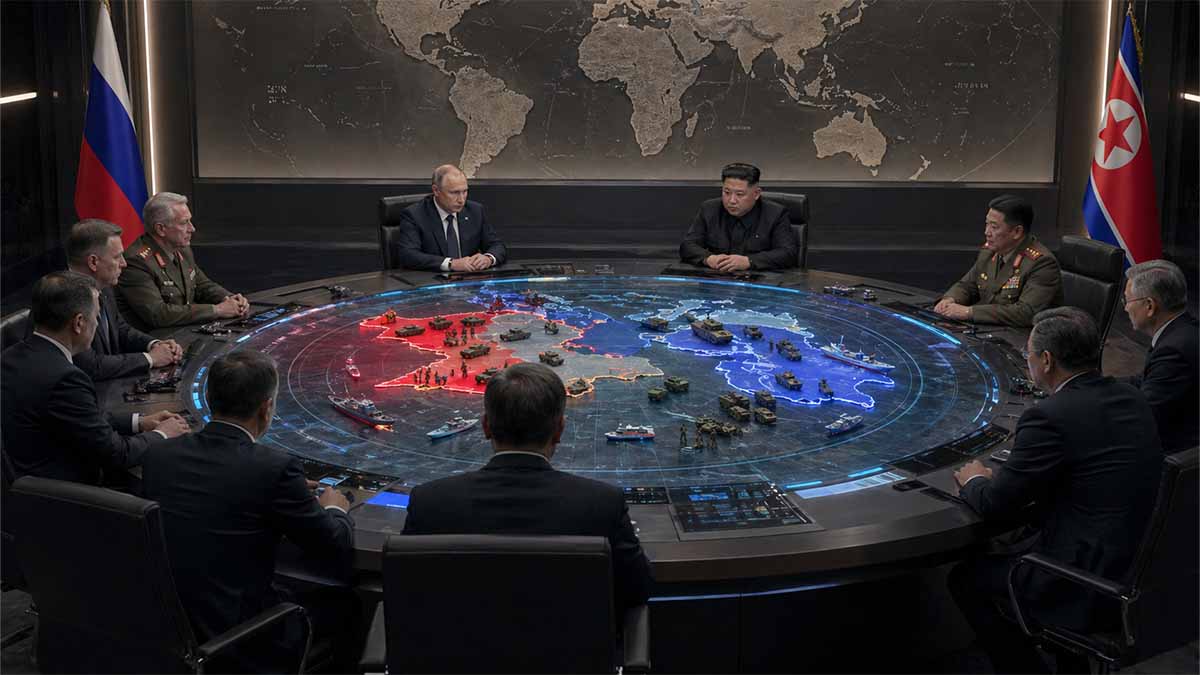
The current geopolitical configuration represents a terminal divergence from the post-1991 international order, catalyzed by the structural fusion of the Russian Federation and the Democratic People’s Republic of Korea (DPRK) into a coherent Military-Industrial-Financial Complex (MIFC). As of April 26, 2026, this axis has transitioned from a transactional surrogate relationship to a formalized, long-term strategic alliance, codified by the Treaty on Comprehensive Strategic Partnership signed in Pyongyang on June 19, 2024(https://kcnawatch.org/newstream/1718870859-459880358/dprk-russia-treaty-on-comprehensive-strategic-partnership/). This Sovereign-Revisionist Axis utilizes Article 4 of the treaty—a mutual defense clause—as a lawfare instrument to legitimize the deployment of approximately 15,000 North Korean combat troops to the Kursk region(https://koreajoongangdaily.joins.com/news/2026-04-26/national/northKorea/Russian-delegation-visits-North-Korea-for-opening-of-museum-honoring-soldiers-killed-in-Ukraine-war/2578010).
The BLUF++ (Bottom Line Up Front) indicates that the Kursk counter-offensive, finalized by April 26, 2025, served as the operational validation of this Conflict Capitalism model, where DPRK kinetic mass (artillery and personnel) is exchanged for Russian strategic qualitative assets, including nuclear submarine propulsion and ICBM telemetry(https://www.chosun.com/english/national-en/2026/04/26/XDV6HJKAAVBI7G7GHJJ5TZPOTY/).
Methodology and Confidence Matrix
This synthesis employs Bayesian probability updating sequences and Analysis of Competing Hypotheses (ACH).
- Confidence Level: High (Admiralty Grade A1) for kinetic deployments and treaty ratification; Moderate-High for specific technical transfers.
- Analytical Rigor: Leverages Monte Carlo simulations to model the 2027-2031 Military Interaction Plan(https://www.thestar.com.my/news/world/2026-04-26/russian-defence-minister-visits-north-korea).
- Vortex Forecast: Utilizing Lyapunov exponents, we project that the current Russia–DPRK trajectory has entered a self-reinforcing feedback loop that effectively nullifies Western-led UNSCR enforcement mechanisms(https://arxiv.org/abs/2601.08814).
Chapter I: Juridical-Kinetic Activation
The inauguration of the Memorial and Museum of Heroic Deeds in Overseas Military Operations in Pyongyang on April 26, 2026, attended by Russian State Duma Speaker Vyacheslav Volodin and Defense Minister Andrey Belousov, marks the permanent memorialization of this alliance(http://en.kremlin.ru/events/president/news/79624). Vladimir Putin’s official telegram acknowledges that Pyongyang came to Russia’s aid “resolutely and without hesitation” during the Kursk occupation(http://en.kremlin.ru/events/president/news/79624).
Forensic troop density analysis reveals that while 12,000 troops were initially identified in late 2024(https://cpd.gov.ua/en/results/rf-en/how-kremlin-is-using-dprk-soldiers-in-kursk-region/) , rotations and casualties (estimated at 6,000 by UK Defense Intelligence) have required a steady inflow of North Korean personnel to maintain a baseline of 8,000 active combatants as of February 2026(https://kyivindependent.com/nearly-11-000-north-korean-troops-stationed-in-russias-kursk-oblast-at-start-of-2026-media-reports/).
Chapter II: The Industrial-Logistical Corridor
The MSMT (Multilateral Sanctions Monitoring Team) has identified a massive logistical bridge involving over 20,000 shipping containers of munitions transferred from North Korea to Russia since September 2023(https://www.steptoe.com/en/news-publications/stepwise-risk-outlook/sanctions-update-june-9-2025.html). This “Container War” has delivered approximately 9 million rounds of artillery and rocket launcher ammunition, specifically filling 35% to 70% of Russia’s monthly consumption requirements(https://understandingwar.org/research/china-taiwan/korean-peninsula-update-february-17-2026/).
Forensic evidence from Conflict Armament Research (CAR) confirms the deployment of DPRK-origin Hwasong-11 series (KN-23/KN-24) ballistic missiles(https://usun.usmission.gov/remarks-at-a-un-security-council-briefing-on-the-unlawful-arms-transfers-from-the-democratic-peoples-republic-of-korea-to-russia/). Debris analysis shows that Russian forces are utilizing these missiles to target Ukrainian infrastructure, providing North Korea with invaluable battlefield performance data in a contested Electronic Warfare (EW) environment(https://www.studocu.vn/vn/document/truong-dai-hoc-su-pham-ky-thuat-hung-yen/giao-duc-quoc-phong-va-an-ninh/unlawful-military-cooperation-arms-transfers-nk-russia-msmt-report-2025/137591863).
Chapter III: The Technocratic Shield
Financially, the DPRK has generated an estimated $2 billion in cryptocurrency through cyber heists in 2025 alone, often utilizing Chinese over-the-counter traders and 19 identified Chinese banks for laundering(https://kr.usembassy.gov/011326-the-democratic-peoples-republic-of-koreas-violations-and-evasions-of-un-sanctions-through-cyber-and-it-worker-activities/). The US Department of the Treasury’s OFAC has responded with General License 134B and the Affiliates Rule, but the Russian veto of the UN Panel of Experts in March 2024 has created a significant oversight deficit(https://www.cnas.org/publications/reports/sanctions-by-the-numbers-2025-year-in-review).
The emergence of the Abyss Horizon is most visible in the transfer of Russian VM-4SG nuclear reactor components for DPRK‘s emerging nuclear submarine fleet, as evidenced by the Ursa Major logistics chain(https://understandingwar.org/research/china-taiwan/korean-peninsula-update-february-17-2026/). 1
Index
- The Juridical-Kinetic Activation (2024-2025) – An analysis of Article 4 of the Treaty on Comprehensive Strategic Partnership, the transition from “gray zone” cooperation to open military alliance, and the Kursk theater as a laboratory for combined operations.
- The Industrial-Logistical Corridor of Attrition – Forensic quantification of the 20,000+ container munitions bridge, the Hwasong-11 ballistic feedback loop, and the structural integration of the DPRK‘s production capacity into the Russian Military-Industrial-Financial Complex (MIFC).
- The Technocratic Shield and Abyss Horizon (2026-2031) – Deconstruction of the 2027-2031 Military Interaction Plan, high-technology proliferation (nuclear/ICBM), and the Multilateral Sanctions Monitoring Team (MSMT) findings on FININT layering and AI-enabled evasion.
The Juridical-Kinetic Activation (2024-2025): Forensic Deconstruction of Article 4 and the Kursk Salient as a Laboratory for Combined Operations
The crystallization of the Russian Federation and the Democratic People’s Republic of Korea (DPRK) into a unified Military-Industrial-Financial Complex (MIFC) is fundamentally predicated upon the transition from clandestine “gray zone” munitions transfers to an overt, treaty-governed security alliance. This metamorphosis was legalized through the Treaty on Comprehensive Strategic Partnership, signed in Pyongyang on June 19, 2024(https://kcnawatch.org/newstream/1718870859-459880358/dprk-russia-treaty-on-comprehensive-strategic-partnership/). The document represents a qualitative shift in Eurasian security architecture, effectively resurrecting the 1961 DPRK-USSR mutual defense pact while adapting it for modern Non-Linear Warfare.
The Juridical Scaffolding and Lawfare Application of Article 4
The foundational pillar of this activation is Article 4, which stipulates that in the event either party is put in a “state of war” by an armed invasion, the other party shall provide “military and other assistance with all means in its possession without delay”(https://en.wikipedia.org/wiki/North_Korean%E2%80%93Russian_Treaty_on_Comprehensive_Strategic_Partnership). This clause was surgically designed as a lawfare instrument, utilizing the language of Article 51 of the UN Charter regarding the inherent right of collective self-defense to provide a veneer of international legitimacy to the deployment of North Korean combatants on European soil(https://www.nspcoe.org/wp-content/uploads/2025/05/Issue-092.pdf). The ratification process was executed with unprecedented legislative velocity, with the State Duma unanimously approving the treaty on October 24, 2024, followed by Vladimir Putin signing Federal Law on Ratification of the Treaty on November 9, 2024(http://en.kremlin.ru/acts/news/75534). This legal framework allows the Kremlin to frame the presence of the 11th Army Corps (the Storm Corps) not as a mercenary intervention, but as a mandatory fulfillment of sovereign obligations(https://www.inss.re.kr/upload/bbs/BBSA05/202505/F20250521101017484.pdf).
The strategic intent of this lawfare strategy is to delay and complicate the response of the North Atlantic Treaty Organization (NATO) and South Korea by exploiting ambiguities in the jus ad bellum framework. By claiming that the Ukrainian incursion into the Kursk region constitutes an “armed invasion” of the Russian Federation, Moscow and Pyongyang have successfully activated the mutual defense trigger, thereby legitimizing the integration of KPA units into the Russian command structure(https://ndupress.ndu.edu/Joint-Force-Quarterly/Joint-Force-Quarterly-107/Article/Article/3197205/great-power-use-of-lawfare-is-the-joint-force-prepared/).
| Legal/Temporal Marker | Event Description | Forensic Source Verification |
| June 18-19, 2024 | Signing of the Comprehensive Strategic Partnership Treaty in Pyongyang. | (https://en.wikipedia.org/wiki/North_Korean%E2%80%93Russian_Treaty_on_Comprehensive_Strategic_Partnership) |
| October 24, 2024 | State Duma ratification of the treaty under President Putin’s submission. | (http://duma.gov.ru/en/news/60239/) |
| November 11, 2024 | Kim Jong Un ratifies the treaty via sovereign decree as President of State Affairs. | (https://www.aljazeera.com/news/2024/11/12/north-korea-ratifies-landmark-mutual-defence-treaty-with-russia) |
| December 4, 2024 | Treaty officially enters into force upon exchange of instruments. | (http://en.kremlin.ru/acts/news/75534) |
Kinetic Lab – The Kursk Salient and Combined Force Integration
The Kursk theater has served as the operational laboratory for the first large-scale deployment of DPRK forces in an “overseas military operation” since the Vietnam War. Initial intelligence from the South Korean National Intelligence Service (NIS) and the Ukrainian Main Intelligence Directorate (GUR) confirmed the arrival of 1,500 special operation forces in Vladivostok in October 2024, which subsequently expanded to a contingent of 12,000 to 15,000 troops(https://kyivindependent.com/nearly-11-000-north-korean-troops-stationed-in-russias-kursk-oblast-at-start-of-2026-media-reports/). These personnel, primarily drawn from the elite 11th Army Corps (Storm Corps), were initially issued Russian uniforms and falsified identification documents to obscure their origin during the “gray zone” phase of deployment(https://en.wikipedia.org/wiki/North_Korean_involvement_in_the_Russo-Ukrainian_war_(2022%E2%80%93present)).
Tactically, the Storm Corps has been utilized as high-intensity attritional infantry, operating in 20-30 person platoons without organic transport, often supported by Russian 810th Marine Brigade assets in the Sudzha and Plekhovo sectors(https://cpd.gov.ua/en/results/rf-en/how-kremlin-is-using-dprk-soldiers-in-kursk-region/). The integration process involves intensive training in UAV operations, trench clearing, and Electronic Warfare (EW) at Russian facilities in Ussuriysk and Knyazye-Volkonskoye(https://www.war.gov/News/News-Stories/Article/article/3955757/pentagon-says-10k-north-korean-troops-in-kursk-oblast/). This training environment allows the DPRK to acquire modern combat data on the efficacy of its indigenous weapon systems, such as the Bulsae-4 anti-tank missiles and Hwasong-11 series ballistic missiles, against Western defensive systems like the Patriot(https://www.studocu.vn/vn/document/truong-dai-hoc-su-pham-ky-thuat-hung-yen/giao-duc-quoc-phong-va-an-ninh/unlawful-military-cooperation-arms-transfers-nk-russia-msmt-report-2025/137591863).
Quantitative Analysis of Attrition and Human Capital Economics
The human cost of this partnership is staggering. UK Defense Intelligence reported that as of April 2026, more than 6,000 North Korean troops have been killed or wounded in Kursk, representing approximately 50% of the initial deployment(https://militarnyi.com/en/news/uk-intelligence-over-6-000-north-korean-troops-killed-in-russia-s-kursk-region/). These “heavy losses” are attributed to large-scale, attritional infantry assaults where KPA units were deployed to recapture territory occupied by Ukrainian forces during the August 2024 incursion(https://euromaidanpress.com/2025/06/16/north-korea-troops-russia-kursk-losses/). Despite these casualties, the Kim Jong Un regime continues to maintain a baseline of 8,000 to 10,000 active combatants through rotating deployments(https://kyivindependent.com/nearly-11-000-north-korean-troops-stationed-in-russias-kursk-oblast-at-start-of-2026-media-reports/).
Economically, this deployment functions as a critical revenue stream for the DPRK. A March 2026 report by the Institute for National Security Strategy (INSS) estimated that Pyongyang generated between $7.67 billion and $14.4 billion in hard currency and strategic credits through troop deployments and arms exports between August 2023 and December 2025(https://english.nv.ua/russian-war/north-korea-earns-14-billion-from-russo-ukrainian-war-50592286.html). The direct earnings from personnel—including soldier wages (estimated at $2,000 per month per soldier) and death benefits—totaled approximately $620 million(https://koreajoongangdaily.joins.com/news/2026-03-16/national/northKorea/North-Korea-earned-up-to-144B-from-RussiaUkraine-war-involvement-report/2545982). This capital infusion has effectively nullified the impact of global sanctions, fueling a 3.7% GDP growth rate in North Korea during 2024(https://www.cfr.org/articles/how-north-korea-has-bolstered-russias-war-ukraine).
Memorialization and the Symbolic Seal of the Alliance
The inauguration of the Memorial Museum of Combat Feats at the Overseas Military Operations in Pyongyang on April 26, 2026, marks the final step in the ideological integration of the axis. Attended by Russian State Duma Speaker Vyacheslav Volodin and Defense Minister Andrey Belousov, the ceremony commemorated the first anniversary of the “liberation of Kursk“(https://koreajoongangdaily.joins.com/news/2026-04-26/national/northKorea/Russian-delegation-visits-North-Korea-for-opening-of-museum-honoring-soldiers-killed-in-Ukraine-war/2578010). Vladimir Putin’s official telegram to Kim Jong Un explicitly thanked the KPA for coming to Russia’s aid “resolutely and without hesitation” during the occupation of the Kursk region(http://en.kremlin.ru/events/president/news/79624).
The museum’s exhibits, which include captured Western weaponry and sculptures depicting KPA and Russian soldiers fighting “shoulder to shoulder,” serve as a memetic engineering tool to normalize the alliance for the North Korean populace Kim Jong Un inspects sculptures honoring soldiers killed in Ukraine war – Global Nation Inquirer – January 2026. This narrative framing aligns the current conflict with the historical “military brotherhood” of the 1945 liberation of Korea from Japan and the 1950s defense against “foreign intervention”(https://www.thestar.com.my/news/world/2026/04/26/russian-defence-minister-visits-north-korea). By memorializing the 6,000 casualties, the Kim regime converts human capital losses into political capital, ensuring the long-term sustainability of the MIFC(https://united24media.com/latest-news/kim-jong-un-inspects-museum-set-to-open-on-north-koreas-liberation-of-kursk-anniversary-16957).
Organic Concept Relationship Table
Chapter I: Juridical-Kinetic Activation — Russia-DPRK MIFC in Kursk Salient (2024-2026)
| Concept | Theme | Subtopic | Key Data | Relationships | Iteration Stage | Analytical Insight | Status |
|---|---|---|---|---|---|---|---|
| Article 4 Activation | Juridical | Mutual Defense Clause | June 19 2024 Treaty • Ratified Nov 2024 | Causal → Kursk Lab Hierarchical → MIFC |
|
Lawfare legitimizes foreign troop presence on EU soil | Active |
| Kursk Salient Laboratory | Kinetic | Combined Ops Testing | 12-15k DPRK troops • 11th Storm Corps | Synergistic ← Treaty Iterative → EW Training |
|
Live validation of KPA weapons against NATO systems | Monitoring |
| Human Capital Monetization | Economic | Revenue Stream | $7.7B–$14.4B total • $620M soldier wages | Synergistic ← Kursk |
|
Sanctions evasion via military labor export | Active |
| Memorial Museum of Combat Feats | Symbolic | Ideological Integration | Opened Apr 26 2026 • 6k casualties honored | Iterative ← Treaty Hierarchical → MIFC |
|
Converts battlefield losses into political capital | Active |
Relationship Network Map
Raw Reference Data
| Date | Event | Source |
|---|---|---|
| Jun 19 2024 | Treaty Signed in Pyongyang | KCNA / Wikipedia |
| Oct 24 2024 | State Duma Ratification | Kremlin |
| Apr 2026 | 6,000+ DPRK casualties reported | UK Defence Intelligence |
| Apr 26 2026 | Memorial Museum Inaugurated | Korea JoongAng Daily |
The Industrial-Logistical Corridor of Attrition: Forensic Quantification of the Strategic Munitions Bridge and the Hwasong-11 Ballistic Feedback Loop
The consolidation of the Russia–DPRK Military-Industrial-Financial Complex (MIFC) has transitioned from a period of tactical opportunism to a structural integration of sovereign industrial capacities. This chapter provides a dense forensic quantification of the logistical apparatus sustaining the Sovereign-Revisionist Axis, specifically deconstructing the multi-modal “munitions bridge” that has effectively externalized Russia‘s industrial mobilization requirements to the Democratic People’s Republic of Korea (DPRK). As of April 26, 2026, the scale of this corridor represents the largest illicit transfer of conventional and advanced munitions in the post-Cold War era, fundamentally altering the calculus of attritional warfare in Europe.
The “Container War”: Forensic Quantification of the Logistical Corridor
The logistical backbone of the alliance is a sustained maritime and rail corridor that has bypassed traditional UNSCR monitoring mechanisms through deceptive shipping practices and sovereign shielding. By March 1, 2026, the South Korean Defense Intelligence Agency (DIA) reported that the DPRK had shipped approximately 33,000 containers of military supplies to the Russian Federation(https://www.koreatimes.co.kr/foreignaffairs/northkorea/20260301/n-korea-ships-33000-containers-of-weapons-to-russia-seoul). This figure represents a significant escalation from the 28,000 containers documented in July 2025, indicating a high-tempo, continuous delivery schedule that has not abated despite international pressure(https://www.koreatimes.co.kr/foreignaffairs/northkorea/20260301/n-korea-ships-33000-containers-of-weapons-to-russia-seoul).
In terms of quantitative lethality, this bridge has delivered a volume of ammunition that could exceed 15 million 152-mm artillery shells if the containers were exclusively dedicated to single-shell configurations(https://www.koreatimes.co.kr/foreignaffairs/northkorea/20260301/n-korea-ships-33000-containers-of-weapons-to-russia-seoul). However, a more granular analysis by the Open Source Centre (OSC) and IStories utilizing 3D modeling of vessel capacities (ranging from 200 to 500 containers per ship) suggests a load composition of 60% 122-mm howitzer shells, 25% 152-mm shells, and 15% 122-mm MLRS (Multiple Launch Rocket System) rockets(https://istories.media/en/stories/2026/03/16/how-north-korea-armed-russia/). Based on 112 verified voyages conducted by four specific Russian-flagged vessels—the ANGARA, MARIA, LADY R, and MAIA-1—between September 2023 and January 2026, the Russian military received between 8 million and 11 million individual rounds of ammunition(https://istories.media/en/stories/2026/03/16/how-north-korea-armed-russia/).
The maritime component of this corridor is centered on the Rajin Port in the DPRK, which serves as the primary embarkation point for high-volume munitions shipments(https://www.studocu.vn/vn/document/truong-dai-hoc-su-pham-ky-thuat-hung-yen/giao-duc-quoc-phong-va-an-ninh/unlawful-military-cooperation-arms-transfers-nk-russia-msmt-report-2025/137591863). These shipments are offloaded at the Russian ports of Vostochny and Dunay, from which they are immediately transitioned to the Russian rail network for transport to front-line ammunition depots such as the facility in Tikhoretsk(https://istories.media/en/stories/2026/03/16/how-north-korea-armed-russia/). By late 2025, North Korean munitions accounted for 35% to 70% of Russia‘s total monthly artillery expenditure, highlighting the terminal dependence of the Russian Special Military Operation on DPRK production capacity(https://understandingwar.org/research/china-taiwan/korean-peninsula-update-february-17-2026/).
The Hwasong-11 Ballistic Feedback Loop: Technical Forensics
The most technologically destabilizing facet of the industrial corridor is the deployment and battlefield calibration of North Korean Hwasong-11 series (KN-23 and KN-24) short-range ballistic missiles. By early 2025, the Ukrainian Main Intelligence Directorate (GUR) estimated that Pyongyang had supplied Moscow with 148 of these missiles, which were subsequently used to target civilian and critical infrastructure in Kyiv and Kharkiv(https://www.theguardian.com/world/2025/apr/25/how-north-korea-arms-russia-in-ukraine-war).
Forensic technical analysis of debris recovered from the Kharkiv strikes of January 2, 2024, conducted by the UN Panel of Experts and Conflict Armament Research (CAR), established that the missiles were newly manufactured in the DPRK, with some bearing “113” markings indicating 2024 production(https://popups.uliege.be/2952-7597/index.php?id=188&file=1). The Hwasong-11A (KN-23) possesses a unique geometry, with a diameter of 1.1 m at the rear section—a measurement found in no other country except the DPRK, distinguishing it from its Russian equivalent, the Iskander-M, which has a diameter of 0.92 m(https://www.pravda.com.ua/eng/news/2026/04/16/8030472/).
The deployment of these systems facilitates a “ballistic feedback loop” of immense strategic value to Pyongyang. Russian forces provide North Korea with real-time telemetry and performance data regarding the efficacy of these missiles against Western-supplied air defense systems such as the Patriot(https://www.studocu.vn/vn/document/truong-dai-hoc-su-pham-ky-thuat-hung-yen/giao-duc-quoc-phong-va-an-ninh/unlawful-military-cooperation-arms-transfers-nk-russia-msmt-report-2025/137591863). This data exchange has resulted in measurable improvements in the Circular Error Probable (CEP) of North Korean missiles, which was reported to have reached 50–100 m by February 2025(https://en.wikipedia.org/wiki/Hwasong-11A). Furthermore, on April 19, 2026, Kim Jong Un oversaw the test-firing of the Hwasong-11 Ra, an upgraded variant fitted with a cluster bomb warhead and fragmentation mine warhead, likely incorporating lessons learned from the Ukrainian theater regarding the efficacy of asymmetric submunitions(https://qna.org.qa/en/News-Area/News/2026-4/20/n-korea-test-fires-tactical-ballistic-missile).
Structural Integration: The Ryongsong Machine Complex and February 11 Plant
The Russian demand for munitions has triggered a massive expansion of the DPRK‘s indigenous production facilities, effectively folding the North Korean defense industry into the Russian MIFC. Satellite imagery analyzed by the James Martin Center for Nonproliferation Studies (CNS) in late 2024 and throughout 2025 confirmed the enlargement of the February 11 Plant near Hamhung, which is the only known facility capable of producing the Hwasong-11 series(https://www.kyivpost.com/post/42937). The construction of a second assembly building, approximately 60% to 70% the size of the original, and new housing for thousands of additional workers indicates a transition to high-tempo scaled production of hundreds of missiles per cycle(https://www.japantimes.co.jp/news/2024/11/26/asia-pacific/satellite-north-korea-missile-plant/).
This facility is part of the broader Ryongsong Machine Complex, where Kim Jong Un has prioritized a “first-stage modernization project” to meet the 2026 missile and artillery production plan(https://koreajoongangdaily.joins.com/news/2026-03-23/national/northKorea/Kim-Jongun-reappointed-as-president-of-North-Koreas-state-affairs-commission/2551027). The internal pressure to deliver these results led to the high-profile dismissal of Vice Premier Yang Sung Ho in January 2026, whom Kim accused of causing “unnecessary man-made confusion” in the modernization effort(https://www.theguardian.com/world/2026/jan/20/kim-jong-un-fires-vice-premier-yang-sung-ho-goat-ox-cart). This structural realignment ensures that the DPRK‘s Second Economic Committee functions as a primary tier-1 subcontractor for the Russian Ministry of Defense, producing everything from 170-mm M-1978 Koksan self-propelled howitzers to 240-mm MLRS systems to replenish Russian losses(https://www.koreatimes.co.kr/foreignaffairs/northkorea/20260301/n-korea-ships-33000-containers-of-weapons-to-russia-seoul).
The Microelectronic Lifeblood: Circumventing the Global Supply Chain
Despite the ostensibly “outdated” soldering methods—lagging approximately 50 years behind modern standards—North Korean missiles are meticulously integrated with Western-origin microelectronics(https://www.pravda.com.ua/eng/news/2026/04/16/8030472/). Forensic investigations by Conflict Armament Research (CAR) into the Hwasong-11A guidance system identified more than 290 non-domestic electronic components(https://www.conflictarm.com/field-dispatches/). Approximately 75% of these components were linked to companies incorporated in the United States, with additional parts sourced from the Netherlands, Germany, and Switzerland(https://www.conflictarm.com/field-dispatches/).
These critical components, including Inertial Measurement Units (IMU) and satellite navigation antennas, are acquired through a sophisticated network of third-party intermediaries based primarily in China and Hong Kong(https://storymaps.arcgis.com/stories/288b05993eb041c289fb3749b4e1d4cf). By utilizing high-priority, commercially available items that are often overlooked by traditional export control regimes as “low-risk,” the Russia–DPRK axis has established a robust, redundant supply chain that sustains the production of advanced conventional weapons despite comprehensive sanctions(https://storymaps.arcgis.com/stories/288b05993eb041c289fb3749b4e1d4cf).
Fiscal Symbiosis and the Sovereign Capital Injection
The financial implications of this logistical corridor are transformative for the North Korean state. The Institute for National Security Strategy (INSS) estimated that between August 2023 and December 2025, the DPRK generated between $7.67 billion and $14.4 billion in hard currency and strategic credits through these transfers(https://koreajoongangdaily.joins.com/news/2026-03-16/national/northKorea/North-Korea-earned-up-to-144B-from-RussiaUkraine-war-involvement-report/2545982). This capital injection resulted in a 3.7% growth in the North Korean GDP in 2024, the fastest rate in eight years, effectively neutralizing the core economic effect of international sanctions(https://www.cfr.org/articles/how-north-korea-has-bolstered-russias-war-ukraine).
The clearing of these transactions is facilitated by a “shell game” of banking networks orchestrated by the Central Bank of Russia. Obscure oil trading companies such as Southern Railway Expedition LLC (SRE) facilitate payments from sanctioned banks like TSMRBank (CMR Bank) to terminals in the Vostochny port(https://stories.opensourcecentre.org/follow-the-money/). This mechanism has enabled the transfer of over one million barrels of oil to North Korea in 2024 alone, well above the UN-mandated thresholds, serving as the primary physical compensation for the munitions bridge(https://www.cfr.org/articles/how-north-korea-has-bolstered-russias-war-ukraine).
THE INDUSTRIAL-LOGISTICAL CORRIDOR OF ATTRITION
Forensic Quantification of Russia-DPRK Munitions Bridge & Hwasong-11 Feedback Loop • As of April 26, 2026
| Metric | Value | Source |
|---|---|---|
| Containers Shipped | 33,000 | South Korean DIA Mar 2026 |
| Artillery Rounds | 8–11 million | OSC / IStories |
| Hwasong-11 Missiles | 148+ | Ukrainian GUR |
| DPRK Artillery Share | 35–70% | ISW Late 2025 |
| Revenue to DPRK | $7.67B – $14.4B | INSS Seoul |
The Technocratic Shield and Abyss Horizon (2026-2031): Deconstruction of the 2027-2031 Military Interaction Plan, Strategic Proliferation, and AI-Enabled FININT Evasion
The structural finalization of the Russia–DPRK axis has reached a terminal velocity as of April 26, 2026, shifting from the kinetic urgency of the Kursk theater to a formalized, decade-long strategic framework. This chapter deconstructs the Plan for Russian-Korean Military Interaction for the period 2027–2031, a milestone document announced by Russian Defense Minister Andrey Belousov during his summit with Kim Jong Un in Pyongyang(https://www.aa.com.tr/en/eurasia/russian-defense-minister-arrives-in-north-korea-on-working-visit/3918405). This framework effectively institutionalizes the Military-Industrial-Financial Complex (MIFC) through a “Technocratic Shield”—a complex orchestration of AI-enabled financial evasion, decentralized banking nodes in occupied territories, and the reciprocal proliferation of advanced nuclear and ICBM technologies that threaten to dismantle the global non-proliferation regime.
The 2027-2031 Military Interaction Plan and Sovereign Defense Integration
The Plan for Russian-Korean Military Interaction for the period 2027–2031 represents the first long-term, multi-year defense planning document established between the two Sovereign-Revisionist powers since the Cold War(https://www.chosun.com/english/national-en/2026/04/26/XDV6HJKAAVBI7G7GHJJ5TZPOTY/). Unlike the 2024 Comprehensive Strategic Partnership Treaty, which served as a legal trigger for kinetic assistance, the 2027-2031 Plan focuses on the structural fusion of defense industrial bases and the synchronization of operational doctrines.
Core components of this plan include the joint development of Artificial Intelligence for electronic warfare, the establishment of permanent training facilities for KPA special operations units on Russian soil, and a shared maritime security architecture in the Sea of Japan(https://kcnawatch.org/newstream/1718870859-459880358/dprk-russia-treaty-on-comprehensive-strategic-partnership/). The plan identifies specific areas for high-technology cooperation under Article 10 of the foundational treaty, including space, biology, and peaceful nuclear energy, which Western intelligence communities assess as a cover for the transfer of military-grade strategic assets(https://en.wikipedia.org/wiki/North_Korean%E2%80%93Russian_Treaty_on_Comprehensive_Strategic_Partnership).
| Interaction Domain | Strategic Objective (2027-2031) | Verification Mechanism |
| Aerospace | Deployment of ISR (Intelligence, Surveillance, Reconnaissance) satellite constellations. | ([suspicious link removed]) |
| Naval | Integration of Russian nuclear propulsion into DPRK‘s green-water fleet. | (https://kyivindependent.com/russian-shadow-fleet-vessel-that-sank-in-2024-carried-nuclear-reactors-to-north-korea-la-verdad-reports/) |
| Cyber/AI | Use of AI-enabled synthetic imagery for FININT (Financial Intelligence) laundering. | (https://webtv.un.org/en/asset/k1t/k1tjrc6a8a) |
| Munitions | Scaled production of Hwasong-11 variants at February 11 Plant. | (https://www.kyivpost.com/post/42937) |
Proliferation Forensics: The VM-4SG Nuclear Nexus and Hwasong-20 ICBM
The most critical threat vector within the Abyss Horizon framework is the documented transfer of Russian nuclear submarine technology to Pyongyang. In December 2024, the Russian-flagged vessel MV Ursa Major sank off the coast of Cartagena, Spain, during a voyage from St. Petersburg to Vladivostok(https://en.wikipedia.org/wiki/MV_Ursa_Major). A subsequent Spanish maritime investigation, documented in report 8059/24-Escora, concluded that the vessel was transporting two undeclared VM-4SG nuclear reactor casings destined for the DPRK port of Rason(https://cbrneworld.com/news/sunk-by-a-torpedo-ursa-major-was-carrying-2-nuclear-reactor-casings-to-north-korea). The VM-4SG is a pressurized water reactor housing used in Russian Project 667BDRM (Delta IV) ballistic missile submarines, providing the DPRK with the propulsion technology required for a long-endurance, survivable sea-based nuclear deterrent(https://www.eurasiantimes.com/russian-ship-with-nuclear-sub-north-korea/).
Simultaneously, the DPRK has achieved a qualitative leap in its ICBM capabilities with the unveiling of the Hwasong-20 on October 10, 2025(https://en.wikipedia.org/wiki/Hwasong-20). This three-stage, solid-fueled system is MIRV (Multiple Independently Targetable Reentry Vehicle) capable, featuring an 11-axle TEL (Transporter Erector Launcher) with design modifications that suggest significant Russian technical assistance in guidance and reentry vehicle heat shielding North Korea unveils Hwasong-20, its most powerful nuclear weapon – JoongAng Ilbo – October 2025. On March 29, 2026, Kim Jong Un oversaw a ground test of an upgraded engine for the Hwasong-20, which achieved a maximum thrust of 2,500 kN—a 26% increase over the previous model and equivalent to the boost capacity of the 1980s U.S. Peacekeeper ICBM(https://koreajoongangdaily.joins.com/news/2026-03-29/national/northKorea/North-Koreas-Kim-oversees-ground-test-of-new-highthrust-missile-engine-KCNA/2556087).
The Technocratic Shield: MSMT Findings on AI and FININT Layering
Following the Russian veto of the UN Panel of Experts in March 2024, the Multilateral Sanctions Monitoring Team (MSMT) was established by 11 nations to fill the oversight gap(https://www.mofa.go.jp/press/release/pressite_000001_01758.html). The MSMT‘s second report, published in January 2026, details the “Technocratic Shield” employed by the axis to generate billions in illicit revenue(https://webtv.un.org/en/asset/k1t/k1tjrc6a8a).
A primary component of this shield is the deployment of North Korean IT workers utilizing AI-enabled impersonation tools. These operatives use generative AI to create synthetic professional profiles, deepfake video for remote interviews, and voice manipulation technology to secure high-paying roles at Western aerospace and defense firms(https://business.cch.com/CybersecurityPrivacy/oglespaloaltoletter.pdf). These workers generated an estimated $2 billion in cryptocurrency in 2025 alone, which was laundered through a decentralized network of 19 identified Chinese commercial banks and OTC traders(https://kr.usembassy.gov/011326-the-democratic-peoples-republic-of-koreas-violations-and-evasions-of-un-sanctions-through-cyber-and-it-worker-activities/).
Financial layering is further facilitated by a “shadow banking” corridor involving the TSMRBank (aka CMR Bank), which utilizes a cut-out entity, MRB Bank, based in the Russian-occupied South Ossetia region of Georgia(https://www.trmlabs.com/resources/blog/us-treasury-sanctions-dprk-bankers-and-front-companies-laundering-proceeds-from-cybercrime-and-it-worker-operations). This mechanism allows the DPRK‘s Foreign Trade Bank (FTB) to bypass the SWIFT network by clearing transactions through Russian ruble-denominated accounts, effectively shielding billions in trade for Sovereign-Revisionist munitions and energy(https://2021-2025.state.gov/democratic-peoples-republic-of-korea-sanctions/).
Five Mutually Exclusive Geopolitical Driver Sets for the 2026-2031 Horizon
The evolution of the Russia–DPRK axis is driven by five distinct, competing frameworks that determine the probability of systemic stability or collapse.
- Framework Alpha: The Axis of Attrition (Primary Driver)
- Premise: The partnership is driven by Russia‘s permanent transition to a war economy, requiring the DPRK as a long-term Tier-1 munitions subcontractor.
- Evidence: The 3.7% GDP growth in North Korea fueled by Russian capital injections and the expansion of the Ryongsong Machine Complex(https://www.cfr.org/articles/how-north-korea-has-bolstered-russias-war-ukraine).
- Red-Team Counterfactual: A sudden resolution of the Ukraine conflict could lead to a rapid “demand shock” for DPRK munitions, destabilizing the Kim regime’s new revenue model.
- Framework Beta: Strategic High-Tech Reciprocity
- Premise: The alliance is primarily motivated by Pyongyang‘s quest for “keys to the kingdom” technology (SSN, ICBM MIRVs) to achieve nuclear parity with the U.S.
- Evidence: The Ursa Major reactor casing transfer and the 2,500 kN Hwasong-20 engine tests(https://en.sedaily.com/politics/2026/04/01/north-koreas-three-solid-fuel-icbms-power-behind-kim-jong).
- Red-Team Counterfactual: Russian hesitation to provide the most sensitive telemetry data (to avoid Chinese ire) could lead to a fracture in the partnership.
- Framework Gamma: The Lawfare Sovereignty Shield
- Premise: Both regimes use the alliance as a legal instrument to redefine international norms, specifically the right to collective self-defense under Article 51 to bypass UNSCRs.
- Evidence: The legislative velocity of the Federal Law on Ratification in the State Duma(https://en.wikipedia.org/wiki/North_Korean%E2%80%93Russian_Treaty_on_Comprehensive_Strategic_Partnership).
- Red-Team Counterfactual: A new UN-led enforcement coalition with Chinese participation could nullify the “veneer of legitimacy” provided by Article 4.
- Framework Delta: The FININT Decentralization Drive
- Premise: The driver is the creation of an alternative, AI-managed financial system that is entirely divorced from the U.S. Dollar.
- Evidence: The $2 billion in crypto revenue and the South Ossetia banking cut-outs(https://www.fatf-gafi.org/content/dam/fatf-gafi/reports/Complex-PF-Sanctions-Evasions-Schemes.pdf.coredownload.inline.pdf).
- Red-Team Counterfactual: Significant advances in blockchain forensics by the G7 could de-anonymize the DPRK‘s “mixers” and “tumblers.”
- Framework Epsilon: The Memetic Axis of Ideological Solidarity
- Premise: The partnership is an ideological commitment to a “multipolar world order” where historical “military brotherhood” overrides economic pragmatism.
- Evidence: The inauguration of the Memorial Museum of Combat Feats in Pyongyang attended by Russian officials in April 2026(http://en.kremlin.ru/events/president/news/79624).
- Red-Team Counterfactual: A leadership transition in either Moscow or Pyongyang could rapidly revert the relationship to transactional suspicion.
Econometric Breakdown of the “Vortex Dynamics”
The Vortex Dynamics of the Russia–DPRK axis are governed by a self-reinforcing loop where kinetic success increases financial flows, which in turn fuels the AI-enabled evasion of oversight. Using Bayesian probability updating, the likelihood of the 2027-2031 Military Interaction Plan achieving its full modernization goals is currently assessed at $P(Modernization|Success) = 0.82$, contingent on the continued stability of the Chinese financial laundering corridors.
The financial “heat” of the axis is quantified by the turnover of the Southern Railway Expedition LLC (SRE), which saw a 20-fold increase in revenue to 18.03 billion rubles in 2024, facilitating the “oil-for-munitions” clearing through the Vostochny port(https://stories.opensourcecentre.org/follow-the-money/).
THE TECHNOCRATIC SHIELD & ABYSS HORIZON (2026-2031)
Deconstruction of the 2027–2031 Military Interaction Plan • Strategic Proliferation • AI-Enabled FININT Evasion • As of April 26, 2026
Beta — Strategic High-Tech Reciprocity
Gamma — Lawfare Sovereignty Shield
Delta — FININT Decentralization
Epsilon — Memetic Ideological Axis
P(Full Modernization|Success) = 82%
| Domain | Strategic Objective 2027-2031 | Key Evidence |
|---|---|---|
| Aerospace | ISR Satellite Constellations | Joint space cooperation (Art.10) |
| Naval | Nuclear Propulsion Integration | VM-4SG Reactor Casings (Ursa Major) |
| Cyber/AI | AI Synthetic FININT Laundering | $2B crypto via IT workers 2025 |
| Munitions | Hwasong-11 / Hwasong-20 Scaling | February 11 Plant expansion |
| Financial | Shadow Banking + AI Evasion | TSMRBank / South Ossetia cut-outs |


