













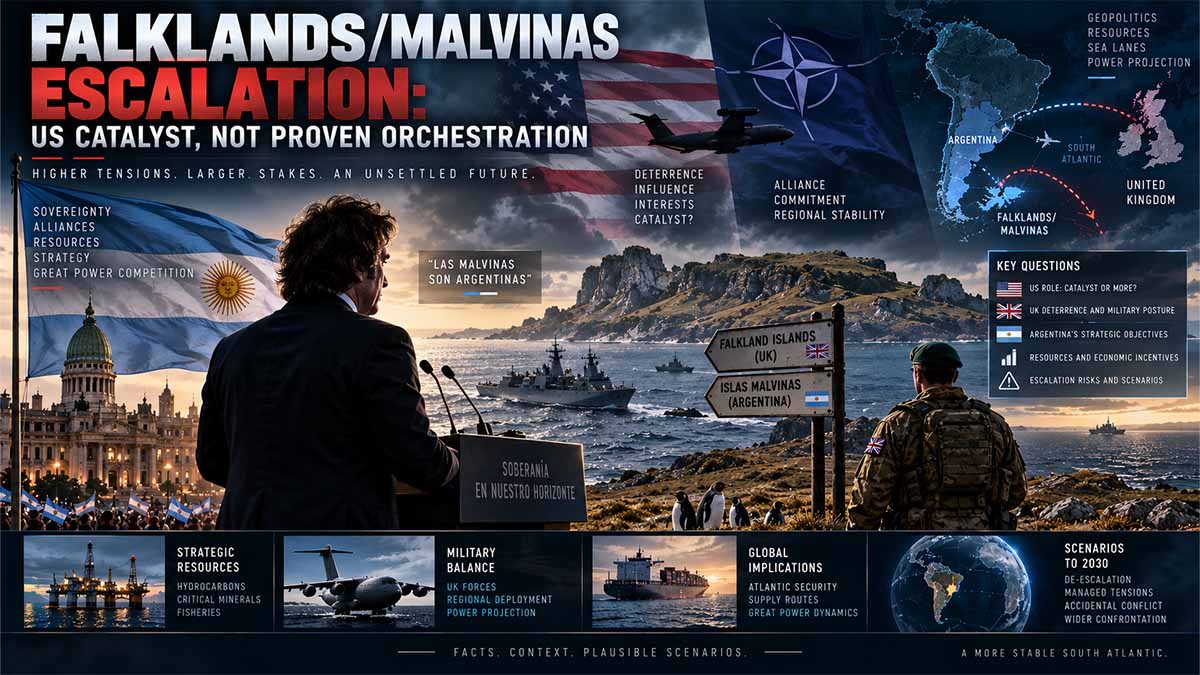
Scope: Assessment of Argentina’s September 2026 measures over the Falkland Islands/Islas Malvinas, Sea Lion hydrocarbons and the Ushuaia naval base, examining possible US involvement and implications through 2031.
Executive Summary / BLUF
- The verified public record does not establish that the United States planned, directed or coordinated Milei’s escalation.
- The strongest assessment is that Washington supplied a political catalyst and strategic opportunity, which Buenos Aires independently converted into sanctions, proposed legislation and renewed sovereignty pressure.
- Milei explicitly interpreted Donald Trump’s comments as evidence that Washington was reconsidering its position; however, no US executive instrument, State Department statement or bilateral declaration confirming a change of sovereignty policy has been located.
- Argentina’s actions have an autonomous and documented trigger: Sea Lion passed final investment decision in December 2025 and is targeting first oil in March 2028.
- Argentina opened proceedings against 45 natural and legal persons under Law 26,659, but the official communiqué does not identify them or establish liability.
- The integrated naval base at Ushuaia predates the present crisis. Argentine official statements in April 2024 described cooperation with the United States, but do not prove US ownership, command authority or a joint plan against the Falklands.
- Sea Lion’s operator, Navitas, declares a 65% interest, 216 million barrels of oil equivalent in 2P reserves attributable to it, and a staged 23-well development.
- Britain retains a declared defensive posture and rejects negotiations without the islanders’ consent.
- The immediate contest is therefore legal, financial and diplomatic, not evidence of imminent Argentine military action.
- The decisive uncertainty is whether Washington turns presidential rhetoric into formal diplomatic, military or financial policy.
Falklands Escalation: Oil, Ushuaia and the Limits of Washington’s Hand
Argentina’s renewed campaign over the Falkland Islands/Malvinas is neither a rhetorical reprise of 1982 nor evidence of a United States-directed operation against Britain. Its immediate trigger is more concrete: Sea Lion, the first commercially sanctioned offshore oil development around the islands, is moving towards production. President Javier Milei is responding with corporate sanctions, harder legislation, maritime surveillance and accelerated investment in an integrated naval base at Ushuaia. The resulting confrontation connects sovereignty, energy, finance, Antarctic logistics and alliance politics. Buenos Aires can impose meaningful costs on internationally mobile companies, but it cannot presently overturn British control. Washington has strengthened Milei’s strategic confidence and its cooperation with Argentina has raised the stakes. The official record does not, however, show American orchestration—or a military balance shifting in Argentina’s favour.
Oil Changes the Dispute
On 10 December 2025, Navitas Petroleum Development and Production and Rockhopper Exploration took final investment decisions on Sea Lion’s northern development area. The Falkland Islands Government had approved the development programme for Phases 1 and 2, together with arrangements covering taxation, petroleum valuation, investor security and land access. The relevant licences consequently entered a 35-year exploitation phase. FIG Notes Final Investment Decisions for Sea Lion Development Programme — Falkland Islands Government — Dec 2025
This was the decisive transition. Sea Lion ceased to be only a contingent resource invoked in diplomatic exchanges and became a financed industrial programme with regulatory approvals, contractors and an execution timetable.
The field lies approximately 220 kilometres north of the islands. Navitas operates it with a 65% working interest; Rockhopper holds 35%. Phase 1 provides for 11 subsea wells connected to a redeployed floating production, storage and offloading vessel. Phase 2 is intended to add 12 wells about three years after first oil. Navitas publicly targets March 2028 for initial production. Sea Lion — Navitas Petroleum — accessed Sep 2026
Rockhopper places the post-investment funding requirement at US$1.8 billion to first oil and US$2.1 billion through completion, including contingencies and financing costs. The structure includes US$1 billion of senior debt, with the balance expected from joint-venture equity and post-production cash flow. Phase 1 targets 170 million gross barrels and peak output of approximately 50,000 barrels per day. Phase 2 is associated with another 149 million gross contingent barrels. Final Investment Decision on Sea Lion — Rockhopper Exploration plc — Dec 2025
These are corporate targets, not delivered production. Their political effect is nevertheless immediate. Each debt drawdown, engineering contract and long-lead procurement decision increases sunk costs and gives another financial or industrial actor an interest in completing the project. Argentina’s opportunity to obstruct Sea Lion is greatest before that network becomes too expensive to unwind.
The Economic Prize
Sea Lion matters less for world oil supply than for the economic scale of the Falklands. The 2021 census recorded only 3,662 usual residents, including those temporarily absent, and 3,142 usual residents present on census night. Net migration accounted for almost all population growth between 2016 and 2021. Falkland Islands Census 2021 – Full Report — Falkland Islands Government Directorate of Policy, Economy and Corporate Services — 2024
A May 2025 impact assessment prepared by Hatch using Navitas projections modelled £3.61 billion in cumulative receipts for the Falkland Islands Government, averaging £109 million annually. It attributed 56% to corporation tax and 44% to a 9% royalty, with a projected revenue peak of £280 million in 2034. The calculation assumed oil at US$73.98 per barrel and an exchange rate of £1 to US$1.25. Sea Lion Northern Development Area Phase 1 and 2 Economic Impact Assessment Methodology – Technical Report — Hatch — May 2025
The same sponsor-commissioned model estimated a cumulative GDP uplift of £8.09 billion and a peak annual increase of £806 million in 2032—approximately 290% of its £280 million 2023 baseline. It also acknowledged that the gain in gross national income would be smaller because profits would be repatriated abroad. Headline GDP would therefore overstate the income retained locally.
The labour effects could still be transformative. Hatch calculated 3,860 full-time-equivalent person-years of direct and indirect onshore employment, averaging 120 FTE positions annually, plus 1,260 induced person-years. These are cumulative units of labour, not simultaneous jobs. Its population model assumes 1.27 incoming people, including dependants, for each additional FTE and 0.18 schoolchildren per FTE. Those assumptions are not observed outcomes, but they identify the pressure points: housing, schools, healthcare, utilities, ports and immigration administration.
For Buenos Aires, this is the strategic danger. Oil revenue would not resolve sovereignty, but it could finance infrastructure, regulation and public services while strengthening the islands’ capacity to sustain their preferred constitutional position. Sea Lion converts time into an advantage for Stanley and London.
Argentina Targets the Network
On 3 September 2026, Milei announced a package combining sanctions, intelligence coordination, maritime protection and defence investment. He said Argentina had already sent approximately 180 discouragement notices to companies and actors in more than 29 countries. He also announced accelerated proceedings under Law 26,659 and proposed extending penalties to directors, shareholders and suppliers involved in unauthorised resource activity. Cadena Nacional del Presidente Javier Milei sobre la Causa Malvinas — Casa Rosada — Sep 2026
The following day, the Presidency confirmed that the Foreign Ministry had initiated proceedings concerning 45 natural and legal persons. The statement used conditional language and did not publish their names, charges or final sanctions. It nevertheless showed that Buenos Aires was moving beyond protests against licence holders towards the project’s wider commercial architecture. Comunicado Oficial Número 158 — Oficina del Presidente de la Nación Argentina — Sep 2026
Law 26,659 prohibits persons active or authorised to operate in Argentina—and their shareholders—from participating in hydrocarbon activity on what Argentina considers its continental shelf without Argentine permission. It covers financial, logistical, technical, consultancy and commercial assistance. After an administrative process, infringements can produce disqualification from operating in Argentina for between five and 20 years. Ley 26.659 — Honorable Congreso de la Nación Argentina — Apr 2011
The mechanism is economically rational. Argentina cannot revoke licences issued by the Falkland Islands Government or directly administer Sea Lion. It can force companies with Argentine assets, concessions or contracts to choose between that market and the Falklands project.
Its leverage is uneven. A multinational oil-service group with substantial Argentine exposure faces a real compliance problem; a special-purpose supplier without Argentine assets may not. Sanctions can narrow contractor choice, increase insurance and legal costs, or delay procurement. They do not by themselves establish that production can be stopped.
Ushuaia’s New Meaning
The Integrated Naval Base at Ushuaia is frequently presented as proof of an imminent military turn. The official record supports a more precise conclusion.
The project predates the present crisis. Argentina marked the start of construction on 3 March 2022 as a long-term, phased programme intended to strengthen Antarctic logistics and its presence in the South Atlantic. The preparatory stage included ground studies, utility connections and two transportable industrial buildings. A pier, administrative facilities, service accommodation and support infrastructure for vessels were assigned to later phases. Avanza la construcción de la nueva Base Naval Integrada en Ushuaia — Ministerio de Defensa de la República Argentina — Mar 2022
Milei has now attached that inherited project directly to the Falklands campaign. On 3 September, he announced additional Defence Ministry resources for construction and telecommunications, describing Ushuaia as a future South Atlantic logistics hub. Yet no accessible official instrument specifies the new amount, executed contracts, completion schedule, assigned combat units or operational status.
Ushuaia is therefore an enabling node, not yet a strike complex. A base generates military power only when berths and buildings are connected to deployable ships, aircraft, sensors, trained personnel, maintenance, communications and replenishment. Its nearer-term value lies in surveillance, patrol support, Antarctic access and persistent state presence.
The real risk is gradual fusion: corporate enforcement backed by improved maritime awareness and increasingly military language. An encounter involving a patrol vessel, survey aircraft or Sea Lion support ship could escalate rapidly because both governments would interpret the same event through incompatible jurisdictional claims.
Washington’s Signal
The United States dimension requires particular discipline. On 4 April 2024, Milei met General Laura Richardson, then commander of US Southern Command, in Ushuaia. The Argentine presidency said the visit was intended to monitor the base project and described Argentina and the United States as a future gateway to Antarctica. El Presidente Milei se reunió en Ushuaia con Laura Richardson, Jefa del Comando Sur de los Estados Unidos — Presidencia de la Nación Argentina — Apr 2024
This establishes political alignment, strategic dialogue and interest in Antarctic logistics. It does not establish American ownership of the installation, basing rights, financing, operational command or a plan directed against Britain. No published bilateral agreement supports the stronger claim.
Washington’s role is better understood as catalytic. Closer US-Argentine relations raise Milei’s confidence that economic and diplomatic pressure can be applied without isolating Argentina. They may also help Buenos Aires reduce alternative strategic dependencies. But an American partnership with Argentina in Antarctica does not logically entail support for Argentine sovereignty over the islands—still less orchestration of a confrontation with the United Kingdom.
Britain Stands Outside NATO’s Automatic Shield
London maintains that sovereignty follows the wishes of the islanders and that negotiations cannot occur unless they request them. Argentina rejects that application of self-determination and invokes an unresolved territorial dispute recognised in the United Nations decolonisation process. The positions remain irreconcilable. The Falkland Islands: Lord Collins’ OAS statement, June 2026 — Foreign, Commonwealth & Development Office — Jun 2026
The operational fact is equally important: the islands fall outside NATO’s automatic collective-defence geography. Article 6 limits Article 5 coverage for islands to the North Atlantic north of the Tropic of Cancer. A South Atlantic attack could provoke allied consultation and voluntary assistance, but not automatic treaty protection. The North Atlantic Treaty — North Atlantic Treaty Organization — Apr 1949
Deterrence consequently remains a British national responsibility. London must protect the islands and Sea Lion’s supporting infrastructure without turning a manageable commercial confrontation into a self-validating Argentine narrative of militarised extraction. Too little preparation could invite threshold-testing; excessive reinforcement could strengthen Buenos Aires diplomatically across Latin America.
Europe’s Unequal Exposure
France has the strongest direct South Atlantic and Antarctic interests among EU members. It must prevent competition over Antarctic gateways from contaminating scientific cooperation and the Antarctic Treaty system. Any operational assistance to Britain would nevertheless require a separate French decision.
Germany’s exposure is primarily commercial. Banks, insurers, equipment manufacturers and maritime-service companies could face conflicting demands if they participate in Sea Lion while retaining Argentine interests. Berlin’s priority is legal predictability: published targets, precise grounds, due process and limits on extraterritorial enforcement.
Italy occupies the most delicate political space. Its unusually dense human and economic relationship with Argentina coexists with a major security partnership with Britain. Rome should distinguish support for peaceful management from endorsement of either sovereignty position, while demanding sufficient official detail for Italian companies to assess sanctions risk.
The European Union has no collective-defence responsibility for the islands. Its relevance begins where Argentine action affects EU-established businesses, finance, insurance or shipping. A common European sovereignty policy is improbable; coordination around navigational safety, corporate due process and incident prevention is both feasible and necessary.
The Narrowing Window
The central contest is now between two clocks. Sea Lion’s commercial clock advances through debt, procurement, FPSO conversion, drilling and subsea installation. Argentina’s clock advances through sanctions, legislation, surveillance and construction at Ushuaia.
The most plausible medium-term outcome is neither war nor Argentine acquiescence. It is managed confrontation: higher project costs, persistent diplomatic pressure, greater maritime monitoring and periodic demands on European governments to choose between legal positions they cannot reconcile.
That stability is fragile. It depends on both sides preserving a boundary between economic coercion and physical interference. Sea Lion has made the dispute material; Ushuaia is making it durable. Washington has amplified Argentina’s strategic confidence, but the orchestration thesis exceeds the evidence. The decisive actors remain Buenos Aires and London—and the greatest danger lies not in a secret American design, but in an incident neither capital initially intends.
Navigational Index
- Washington’s signal and the limits of the orchestration thesis
- Sea Lion as the material trigger of Argentine escalation
- Ushuaia, deterrence and the European consequences
Master Abstract
The controlling judgment
The balance of verified evidence supports an opportunistic-alignment explanation, not a US-directed operation. Washington’s political signals appear to have widened Milei’s perceived room for manoeuvre, but the Argentine measures respond directly to a material development already under way: the transition of Sea Lion from a disputed resource prospect to a financed petroleum project with regulatory approval and a defined production timetable.
On 3 September, Argentina announced a regulatory decree and proposed National Sovereignty Defence Bill responding to Sea Lion. The proposed law would establish a National Security Council and frameworks for critical-infrastructure, aerospace and maritime protection. These remain announced measures: the public record reviewed does not yet contain an enacted statute or sufficient bill text to determine their final powers. Comunicado Oficial Número 157 — Oficina del Presidente de la Nación Argentina — Sep 2026
On 4 September, the presidency announced that the Foreign Ministry had opened proceedings against 45 persons and entities suspected of activities prohibited by Article 2 of Law 26,659. The communiqué expressly uses conditional language—estarían desarrollando—and says that the proceedings cover companies, shareholders and service providers. It neither publishes the subjects’ identities nor records completed sanctions. Reporting that all 45 parties have already been “sanctioned” therefore exceeds the official record. Comunicado Oficial Número 158 — Oficina del Presidente de la Nación Argentina — Sep 2026
Sea Lion changed the strategic clock
Sea Lion is the principal material trigger. On 10 December 2025, the Falkland Islands Government recorded final investment decisions by Navitas Petroleum Development and Production and Rockhopper Exploration. It stated that the Executive Council had approved the development and production programme for phases 1 and 2 under existing licences and that the relevant condition precedent had been satisfied. FIG Notes Final Investment Decisions for Sea Lion Development Programme — Falkland Islands Government — Dec 2025
Navitas currently describes the field as under development, approximately 220 kilometres north of the islands, within licences PL032 and PL004b. The company reports a 65% working interest, 216 MMBOE of attributable 2P reserves and 603 MMBOE of 2C contingent resources. Phase 1 comprises 11 subsea wells tied to a redeployed floating production, storage and offloading vessel; phase 2 would add 12 wells approximately three years after first oil, which Navitas schedules for March 2028. These are company-declared reserves, plans and dates—not independently guaranteed production outcomes. Sea Lion — Navitas Petroleum — accessed Sep 2026
Rockhopper’s FID documentation records binding commercial arrangements for an FPSO, drilling rig, subsea infrastructure and drilling services. It also records a US$350 million, seven-year senior-debt facility for Rockhopper, while warning that cost increases, security requirements or unmet financing conditions could create additional equity requirements. Final Investment Decision on Sea Lion — Rockhopper Exploration plc — Dec 2025
The mechanism behind Milei’s change is consequently visible without assuming American direction: once FID and financial close converted Sea Lion into an executable project, Argentina faced a narrowing window before physical drilling and production created sunk costs, commercial constituencies and a durable revenue base for the islands.
Washington created leverage, not proof of control
Milei’s televised address treated Trump’s remarks as a possible change in the external balance. That proves how Buenos Aires publicly interpreted Washington’s signal; it does not prove prior coordination. Cadena Nacional del Presidente Javier Milei sobre la Causa Malvinas — Presidencia de la Nación Argentina — Sep 2026
No retrieved White House, State Department or Pentagon instrument formally recognises Argentine sovereignty, withdraws recognition of British administration, promises assistance to Buenos Aires or links US military cooperation at Ushuaia to pressure on the United Kingdom. Presidential comments reported through interviews remain politically significant, but they are not equivalent to a recognised change in US policy.
The US role is nevertheless relevant. In April 2024, Milei met then-US Southern Command chief General Laura Richardson in Ushuaia and said the visit would reinforce strategic cooperation while monitoring development of the Integrated Naval Base. Argentina described the facility as an Antarctic logistics hub and portrayed the bilateral relationship as supporting South Atlantic presence. El Presidente Milei se reunió en Ushuaia con Laura Richardson, Jefa del Comando Sur de los Estados Unidos — Presidencia de la Nación Argentina — Apr 2024
A separate presidential briefing went further by describing the base as being developed “jointly” by Argentina and the United States. That wording is evidence of Argentina’s official characterisation, but the accessible record does not disclose a bilateral agreement, ownership structure, financing schedule, basing rights or US command arrangements. “Nosotros sentimos que desde el 10 de diciembre se está avanzando” — Presidencia de la Nación Argentina — Apr 2024
The chronology therefore matters: Ushuaia cooperation began publicly more than two years before the September 2026 measures. The base can strengthen Argentina’s Antarctic logistics, maritime awareness and long-term South Atlantic position, but its existence alone does not demonstrate that Washington engineered the present campaign.
London’s position remains institutionally anchored
In June 2026, the British government reiterated that no sovereignty negotiation should occur without Falkland Islanders’ consent. It cited the 2013 referendum—99.8% support on 92% turnout for remaining within the British family—and explicitly supported the islanders’ development of natural resources. It also characterised British forces in the South Atlantic as defensive and maintained at the minimum level considered appropriate for deterrence. These are British legal and political positions, not an internationally uncontested resolution of the sovereignty dispute. The Falkland Islands: Lord Collins’ OAS statement, June 2026 — Foreign, Commonwealth & Development Office — Jun 2026
The UK’s 2025 Strategic Defence Review separately directs the maintenance of a defensive military posture in the Falkland Islands, South Georgia and the South Sandwich Islands. This makes a near-term British political withdrawal improbable absent a profound change in government policy or islander preference. The Strategic Defence Review 2025 — UK Ministry of Defence — Jul 2025
European implications
The United Kingdom bears the direct sovereignty, defence and fiscal consequences. Italy, France and Germany have no equivalent territorial responsibility and no automatic NATO collective-defence obligation is established merely by political pressure against an overseas territory. Their immediate exposure instead lies in diplomatic cohesion, maritime services, corporate compliance and the precedent created if bilateral disputes are used as leverage inside the transatlantic relationship.
France has the strongest comparable territorial interest because of its own overseas jurisdictions and South Atlantic–Antarctic presence. Germany’s principal interest is preservation of legal predictability and alliance cohesion. Italy’s exposure is more commercial and diplomatic, including scrutiny of corporate participation, finance, insurance and oilfield services that Argentina could attempt to capture within expanded sanctions. At EU level, competence would become material only if Argentine measures affected EU operators, financial channels or a coordinated foreign-policy response. The public record currently establishes no EU sanctions decision or common defence undertaking concerning Sea Lion.
Key Evidence Table
| Indicator | Value/status | Reference date | Definition/scope | Issuer | Exact source |
|---|---|---|---|---|---|
| Argentine enforcement action | Proceedings opened against 45 natural and legal persons | 4 Sep 2026 | Investigatory/sanctioning proceedings; identities and completed penalties not published | Argentine Presidency | Comunicado Oficial Número 158 — Oficina del Presidente — Sep 2026 |
| Sovereignty legislation | Decree announced; bill to be submitted | 3 Sep 2026 | Announced action, not verified enacted law | Argentine Presidency | Comunicado Oficial Número 157 — Oficina del Presidente — Sep 2026 |
| Sea Lion regulatory status | Phases 1 and 2 approved; FID effective | 10 Dec 2025 | Programme approved under Falklands-issued production licences | Falkland Islands Government | FIG Notes Final Investment Decisions — FIG — Dec 2025 |
| Navitas interest | 65% | Current company disclosure | Working interest, not state ownership | Navitas Petroleum | Sea Lion — Navitas Petroleum — accessed Sep 2026 |
| Navitas-attributable resources | 216 MMBOE 2P; 603 MMBOE 2C | Current company disclosure | Company-reported reserves and contingent resources | Navitas Petroleum | Sea Lion — Navitas Petroleum — accessed Sep 2026 |
| First-oil target | March 2028 | Current company plan | Forecast, not achieved production | Navitas Petroleum | Sea Lion — Navitas Petroleum — accessed Sep 2026 |
| Rockhopper senior debt | US$350 million; seven-year tenor | 10 Dec 2025 | Project financing facility subject to conditions | Rockhopper Exploration | Final Investment Decision on Sea Lion — Rockhopper — Dec 2025 |
| UK political baseline | 99.8% referendum result on 92% turnout | Referendum 2013; restated Jun 2026 | UK-stated basis for self-determination policy | FCDO | The Falkland Islands: Lord Collins’ OAS statement — FCDO — Jun 2026 |
| Ushuaia cooperation | US–Argentine strategic cooperation officially acknowledged | Apr 2024 | No public command, basing-rights or funding instrument identified | Argentine Presidency | El Presidente Milei se reunió en Ushuaia con Laura Richardson — Presidencia Argentina — Apr 2024 |
| Formal US policy reversal | Not established in retrieved official record | 6 Sep 2026 | No located executive instrument or competent departmental declaration | — | Open official-record gap |
Competing Explanations
| Hypothesis | Diagnostic support | Disconfirming evidence | Indicators | Current standing |
|---|---|---|---|---|
| H1 — US-directed pressure operation | Trump’s signals benefited Milei; documented US–Argentina defence cooperation; Ushuaia has strategic value | No official US policy change, bilateral operational plan, financing instrument or instruction to Argentina has been produced | US recognition statement; bilateral protocol; coordinated sanctions or intelligence support | Weakly supported |
| H2 — Argentine exploitation of a US-created opening | Milei publicly invoked Washington’s reconsideration; measures followed rapidly; alignment with Trump increases political access | Speed alone does not prove coordination; Argentine claim and Sea Lion opposition predate Trump’s remarks | Repeated US diplomatic signals; synchronized bilateral measures; private contacts later documented | Best supported |
| H3 — Primarily autonomous energy and domestic initiative | Sea Lion FID, financing and March 2028 target created a real deadline; measures rest on Argentine law; Malvinas has broad domestic resonance | Timing was amplified by Trump; Ushuaia cooperation supplies an external strategic dimension | Publication of bill prepared before Trump’s remarks; sustained enforcement regardless of US posture | Strong, but incomplete without H2’s catalytic effect |
The hypotheses indicate a combined conclusion: Sea Lion generated the structural cause; domestic politics supplied incentives; Trump supplied the immediate enabling signal. None of the verified evidence demonstrates American command or authorship.
Principal Gaps and Watch Indicators
- Publication of the National Sovereignty Defence Bill, accompanying decree and congressional docket.
- Official identification of the 45 subjects and procedural decisions distinguishing investigation from imposed sanctions.
- Any White House, State Department or Pentagon statement formally altering US policy.
- A US–Argentina agreement defining financing, access, ownership or command arrangements at Ushuaia.
- Diplomatic contacts between Washington and Buenos Aires immediately preceding Milei’s address.
- Changes in British force posture, readiness, airlift, maritime patrols or infrastructure funding.
- Contract withdrawals, insurance restrictions, financing changes or service-provider exits affecting Sea Lion.
- Argentine court filings or attempts to enforce penalties against assets and companies in third jurisdictions.
- Whether first drilling and the March 2028 production schedule remain technically and financially achievable.
Falklands / Malvinas: the oil clock is now running
US political signalling widened Argentina’s room for manoeuvre. The verified record does not prove US orchestration. Sea Lion’s March 2028 first-oil target is the material deadline reshaping the dispute.
Outlook: 2026–2031
US catalyst. Argentine initiative. No public proof of American direction.
Sea Lion converted a long-running sovereignty claim into a time-sensitive contest over licences, finance, services, population capacity and future petroleum revenue.
Strong first-party chronology; decisive US policy and bilateral basing instruments remain absent from the public record.
Investigations announced; identities and final penalties not published.
Target date, not achieved production.
Rockhopper holds the remaining 35%.
Political rhetoric is not a formal sovereignty decision.
Escalation mechanism
What the Ushuaia base does—and does not prove
Argentina officially linked US cooperation to development of the Integrated Naval Base in April 2024 and presented it as an Antarctic logistics hub. No retrieved bilateral instrument establishes US ownership, command rights or a joint operation against the islands. The base strengthens long-term logistics and maritime presence; it does not by itself establish orchestration.
Verified chronology
Company-reported proved + probable reserves.
Contingent resources, not booked reserves.
Hatch model using Navitas 2024 projections.
Sponsor-commissioned model; £59.18/bbl base assumption.
Production profile disclosed in the impact model
Oil-price sensitivity — transparent gross-value proxy
This calculator does not reproduce FIG revenue or corporate-tax forecasts. It multiplies disclosed peak oil flow by the selected price; it excludes discounts, costs, timing, tax losses, exchange rates and financing.
Total usual-resident population, Census 2021.
Official convention used through most census tables.
Growth depended primarily on net migration.
Overseas recruitment is structurally important.
Population: history and an explicit 2031 illustration
The 2031 figure is an illustrative scenario calculated from the 2021 total of 3,662. It is not a government or company forecast. The project-linked increment is deliberately user-controlled because the verified public model depends on employment, dependants, housing and migration assumptions.
Why population is a strategic constraint
Managed confrontation
- Sea Lion construction proceeds.
- Argentina pursues domestic sanctions with limited extraterritorial effect.
- US rhetoric remains ambiguous; no formal sovereignty reversal.
- Main pressure travels through compliance, insurance and services.
Commercial attrition
- Third-country providers reassess Argentine market access.
- Costs, delays or financing requirements increase.
- Buenos Aires broadens proceedings beyond principal licence holders.
- London reinforces diplomatic and defensive assurances.
Strategic rupture
- Washington issues a formal policy shift or conditions support to London.
- Argentina links Ushuaia capabilities directly to the sovereignty campaign.
- Britain changes force posture.
- Misjudgment risk rises even without invasion preparations.
Decision indicators
| Indicator | What it would mean | Current record | Threshold to watch |
|---|---|---|---|
| US formal position | Separates rhetoric from policy | No retrieved executive instrument changing sovereignty policy | White House, State Department or congressional act |
| Argentine bill text | Defines actual reach and penalties | Announced, not yet assessed as enacted law | Congressional filing and final text |
| 45 proceedings | Tests enforceability and commercial reach | Subjects not officially named in retrieved communiqué | Final administrative decisions or court filings |
| Sea Lion execution | Determines whether the strategic clock holds | FID reached; first oil targeted for Mar 2028 | Drilling, FPSO mobilisation, cost or financing changes |
| UK force posture | Signals perceived threat escalation | Declared defensive posture | Persistent reinforcement or readiness change |
| Ushuaia governance | Clarifies US role | Cooperation acknowledged; command and basing terms unavailable | Published bilateral agreement or permanent US access |
Chapter 1 — Washington’s Signal and the Limits of the Orchestration Thesis
Principal judgment
The public record supports the conclusion that Washington acted as a political catalyst, but it does not establish that the United States conceived, directed or operationally coordinated Argentina’s September 2026 escalation.
President Javier Milei explicitly connected his renewed campaign to Donald Trump’s statement that the United States was reassessing its position. That signal altered Buenos Aires’s perception of the diplomatic environment and enabled Milei to present Argentina as Washington’s preferred long-term South Atlantic partner. The subsequent measures, however, reflect an Argentine strategy prepared over several months and driven principally by Sea Lion’s transition from a disputed discovery to a financed petroleum-development programme.
No retrieved White House, State Department, Pentagon or congressional instrument recognises Argentine sovereignty, withdraws US acceptance of British administration, promises support against the United Kingdom or assigns the United States a role in Argentina’s sanctions campaign. Nor does the public record establish US command, permanent basing rights or operational authority at the Integrated Naval Base in Ushuaia.
The distinction is decisive: American signalling increased Argentine leverage; it did not, on the presently available evidence, transfer control of Argentine decision-making to Washington.
An Argentine operation prepared before the signal
Milei opened his 3 September address by stating that the announced decisions resulted from “months of joint work” among different parts of the Argentine state. The measures were therefore not publicly described as an improvised reaction to Trump. They constituted an interagency package involving the Presidency, Foreign Ministry, Ministry of Defence, intelligence apparatus and economic authorities. Cadena Nacional del Presidente Javier Milei sobre la Causa Malvinas — Casa Rosada — Sep 2026
The package contained several distinct elements:
- acceleration of sanctions procedures under Law 26,659;
- extension of restrictions to shareholders, directors, suppliers and other indirect participants;
- proposed exclusion of affected companies from public and private contracting in Argentina;
- proposed expansion of the regime beyond hydrocarbons to other natural-resource activities;
- creation of a National Security Council;
- integration of diplomacy, defence, intelligence and economic policy;
- additional resources for the Integrated Naval Base in Tierra del Fuego;
- expanded telecommunications, maritime-surveillance and aerospace-protection capabilities.
These actions reveal a broader Argentine doctrine: treating the South Atlantic not solely as a historical sovereignty dispute but as a national-security system connecting natural resources, maritime awareness, Antarctic access, infrastructure protection and economic coercion.
The official communiqué issued the same day confirmed that Milei had ordered a regulatory decree and the submission of a National Sovereignty Defence Bill to Congress. It described Sea Lion as the immediate reason for the package and identified coordination among Defence, National Security, State Intelligence, Foreign Affairs and Economy as its institutional mechanism. Comunicado Oficial Número 157 — Oficina del Presidente de la Nación Argentina — Sep 2026
This chronology weakens the proposition that Washington suddenly created Argentina’s policy. It is consistent instead with an existing Argentine programme whose political launch was accelerated or strengthened by Trump’s remarks.
Trump’s signal changed perceived opportunity
Milei nevertheless assigned unusual importance to Washington. In his address, he stated that Trump had declared that the United States was “re-evaluating its historical position” regarding the islands. Milei interpreted this not merely as uncertainty toward London but as recognition that Argentina had become a dependable Western partner in a strategically important location. Cadena Nacional del Presidente Javier Milei sobre la Causa Malvinas — Casa Rosada — Sep 2026
That interpretation performs three political functions.
First, it internationalises Milei’s claim. Instead of presenting Argentina as diplomatically isolated against a permanent member of the UN Security Council, the speech suggests that the principal external power capable of sustaining Britain’s South Atlantic position is no longer automatically aligned with London.
Second, it validates Milei’s alignment strategy. His government argues that economic liberalisation, strategic-resource development and alignment with Western partners have increased Argentina’s international weight. The Malvinas initiative is presented as evidence that this alignment is producing sovereign leverage rather than subordination.
Third, it changes the domestic distribution of political risk. A confrontational initiative launched without external support would expose Milei to accusations of symbolic nationalism without material means. By invoking Trump, Milei could claim that the international correlation of forces had shifted before asking the Argentine political system to support stronger measures.
The signal was therefore consequential even without a formal US policy change. In geopolitical disputes, ambiguity from a dominant partner can modify calculations before any treaty, recognition decision or military commitment is issued. Argentina can use that ambiguity to increase uncertainty for London and commercial actors. Britain must consider whether Washington’s future diplomatic and logistical support remains as dependable as previously assumed; investors must assess whether political risk will extend beyond Argentine jurisdiction.
This is catalytic influence, not yet evidence of orchestration.
What a genuine US policy reversal would require
The United States has several institutionally distinct ways to alter its position. These should not be collapsed into a single category.
A presidential comment can signal political preference but does not necessarily change the operational instructions of the Department of State or Department of Defense. A formal shift would require observable implementation through one or more of the following:
- an authoritative White House or State Department statement defining the new sovereignty position;
- revised diplomatic instructions or voting behaviour at the United Nations or Organization of American States;
- recognition of Argentine jurisdiction over the islands or surrounding maritime areas;
- measures discouraging US persons from supporting Falklands-licensed economic activity;
- modification of intelligence, logistics, export-control or defence cooperation with the United Kingdom;
- a bilateral US–Argentina instrument linking South Atlantic cooperation to the sovereignty dispute;
- congressional authorisation, restrictions or appropriations materially supporting the changed policy.
No such instrument was identified in the official public record reviewed for this chapter. The absence does not establish that private discussions did not occur. It means that a claim of US orchestration cannot presently satisfy a documentary standard.
The evidentiary difference is substantial:
| Evidentiary level | What it would establish | Public status |
|---|---|---|
| Presidential political remark | Willingness to introduce uncertainty or pressure | Reported and invoked by Milei |
| Argentine interpretation | Buenos Aires believes the signal improves its position | Officially established |
| Diplomatic consultation | Possible prior awareness or coordination | Not publicly established |
| Joint policy planning | Shared objectives, sequencing and instruments | Not publicly established |
| US operational direction | American control over Argentine measures | No public evidence identified |
| Formal sovereignty reversal | Change in competent US policy | No official instrument identified |
The thesis that “the United States is behind the events” therefore contains several possible meanings. If it means that Trump’s intervention encouraged Milei and changed the timing or presentation of the initiative, the evidence supports it. If it means that Washington ordered the sanctions, drafted the legislation or directed the Ushuaia expansion as an anti-British operation, the evidence does not support it.
Sea Lion supplied the material trigger
The December 2025 final investment decisions explain why Argentina acted now. The Falkland Islands Government recorded that Navitas Petroleum Development and Production and Rockhopper Exploration had approved investment in Sea Lion’s Northern Development Area. Its Executive Council had authorised the development and production programme for phases 1 and 2 under existing production licences, and the relevant approvals had become effective. FIG Notes Final Investment Decisions for Sea Lion Development Programme — Falkland Islands Government — Dec 2025
Rockhopper’s disclosure quantified the transition. The company placed the post-FID requirement at US$1.8 billion to first oil and US$2.1 billion to project completion, including contingencies and financing costs. Phase 1 targets 170 million barrels at peak production of approximately 50,000 barrels per day, with first oil planned for 2028. Rockhopper also reported executed arrangements covering the FPSO, drilling rig, drilling services and subsea infrastructure. Final Investment Decision on Sea Lion — Rockhopper Exploration plc — Dec 2025
These commitments create the mechanism behind Argentina’s urgency. Every completed contract, financing drawdown, mobilisation decision and installed asset increases sunk costs and enlarges the commercial coalition interested in protecting the project. Production would add a recurring revenue stream to the islands and deepen their capacity for infrastructure, public services and international commercial relationships.
Sea Lion therefore changes the dispute even if it does not change sovereignty. From Buenos Aires’s perspective, delaying action until production begins would allow an unfavourable political-economic structure to harden. Trump’s remarks offered a favourable diplomatic moment, but the project supplied the strategic clock.
Ushuaia predates the September escalation
The Integrated Naval Base is the strongest factual connection between the United States and Argentina’s emerging South Atlantic posture, but it must be interpreted precisely.
On 4 April 2024, Milei met General Laura Richardson, then commander of US Southern Command, in Ushuaia. The Argentine presidency stated that the meeting sought to reinforce strategic cooperation and that Milei had travelled to monitor progress on the Integrated Naval Base. He described the facility as an Antarctic logistics centre capable of supporting international scientific programmes and local economic development. El Presidente Milei se reunió en Ushuaia con Laura Richardson, Jefa del Comando Sur de los Estados Unidos — Presidencia de la Nación Argentina — Apr 2024
On the following day, presidential spokesman Manuel Adorni described the base as being developed jointly by Argentina and the United States and connected it to Argentina’s integration with the Western world and its sovereign presence against foreign vessels. “Nosotros sentimos que desde el 10 de diciembre se está avanzando” — Presidencia de la Nación Argentina — Apr 2024
This official wording establishes political association and cooperation. It does not disclose:
- the project’s ownership and financing shares;
- whether the United States possesses construction or management authority;
- permanent US access or stationing rights;
- command-and-control arrangements;
- intelligence-sharing protocols;
- rules for military use;
- any mission concerning the Falkland Islands;
- any connection between US involvement and the September 2026 sanctions.
The April 2024 meetings also predate Sea Lion’s final investment decision by approximately twenty months and Milei’s September 2026 measures by almost two and a half years. Their original declared context was Antarctic logistics, regional cooperation and maritime presence—not a coordinated campaign against Britain.
Ushuaia nevertheless gives Washington indirect structural influence. US equipment, training, maritime-domain awareness or logistical cooperation can strengthen Argentina’s general South Atlantic capacity even if they are not designed for use against the Falklands. The relevant analytical distinction is between capability contribution and mission direction. The first is plausible and partly documented; the second remains unproven.
The missing American side of the record
The asymmetry of the evidence is itself significant. The strongest public claims of US involvement come from Argentine sources. Buenos Aires has an evident political interest in presenting the United States as a strategic partner and in magnifying any uncertainty in Washington’s relationship with London.
By contrast, no comparably specific American instrument was located confirming:
- joint development of Ushuaia under defined bilateral terms;
- support for Argentina’s Malvinas position;
- participation in the preparation of Milei’s September package;
- endorsement of Law 26,659 proceedings;
- opposition to Sea Lion;
- a reassessment completed by the competent US foreign-policy authorities.
This does not render the Argentine statements false. It limits what can be inferred from them. They prove what the Argentine presidency announced and how it portrayed the partnership, not every underlying institutional arrangement.
The orchestration thesis would require evidence from both sides of the alleged command relationship: instructions, agreements, coordinated timelines, financing, diplomatic commitments or matching operational actions. The present record contains alignment and political signalling but not this stronger evidentiary chain.
Britain remains anchored despite American ambiguity
The British position was institutionally explicit before the September confrontation. In June 2026, the Foreign, Commonwealth & Development Office stated that the status of the islands could not change without the islanders’ consent, cited the 2013 referendum result of 99.8% on 92% turnout, supported local hydrocarbon development and described British forces as defensive. The Falkland Islands: Lord Collins’ OAS statement, June 2026 — Foreign, Commonwealth & Development Office — Jun 2026
Trump’s ambiguity can impose diplomatic and planning costs on Britain, but it does not itself remove British administration, invalidate Falklands-issued licences or neutralise the UK’s existing defensive posture. For Washington to produce a material strategic realignment, it would need to move from rhetorical uncertainty to policies affecting diplomatic recognition, military cooperation, intelligence, logistics or commercial risk.
Until that threshold is crossed, the practical effect is more limited: London must allocate greater attention to a previously stable theatre, Buenos Aires gains a narrative of international momentum, and commercial actors face additional uncertainty over access to the Argentine market.
Assessment of competing explanations
| Explanation | Supporting evidence | Evidence against | Standing |
|---|---|---|---|
| US-directed campaign | Trump signal; close Milei–Trump alignment; earlier US–Argentina defence cooperation | No directive, joint plan, policy instrument or operational arrangement connecting Washington to the September package | Weakly supported |
| Argentine campaign exploiting a US opening | Milei explicitly invoked Trump; timing maximised the signal’s value; Argentina requested allied support | No public proof that Washington promised concrete backing | Best supported |
| Autonomous response to Sea Lion | Months of Argentine interagency preparation; FID, financing and execution timetable created urgency | Does not fully explain the timing and prominent invocation of Trump | Strong and complementary |
| Primarily domestic political repositioning | Malvinas can produce cross-party mobilisation; Milei called for national unity | Measures correspond to a genuine project milestone and cannot be reduced to domestic messaging | Material but insufficient alone |
The evidence supports a combined explanation: Sea Lion generated the structural pressure; Argentine domestic and strategic objectives generated the policy; Washington’s signal created the moment of opportunity.
Key judgments
- No verified official record establishes American authorship or control of Milei’s measures.
- Milei’s own account identifies months of Argentine interagency preparation.
- Trump’s signal materially strengthened the initiative by introducing uncertainty into the US–UK relationship.
- The most defensible description is strategic encouragement without proven operational orchestration.
- Ushuaia demonstrates sustained US–Argentina security cooperation, but not a disclosed anti-British mission.
- Sea Lion’s financing and 2028 production target provide a stronger explanation for urgency than US pressure alone.
- The immediate campaign is designed primarily to impose legal, commercial and reputational costs, not to demonstrate an imminent military operation.
What would change the assessment
The judgment would move toward US orchestration if the official record produced:
- a bilateral planning document preceding Milei’s announcement;
- evidence that Washington requested or sequenced the Argentine measures;
- US financing or operational support expressly tied to the Malvinas campaign;
- a formal US sovereignty-policy reversal;
- coordinated US and Argentine pressure against Sea Lion;
- permanent American basing or command arrangements at Ushuaia connected to South Atlantic sovereignty operations.
The judgment would move away from meaningful US influence if Washington formally reaffirmed neutrality, explicitly rejected Argentina’s interpretation, continued unmodified support for British administration and declined involvement in Argentina’s economic campaign.
Open official record
- Full text and legal status of the announced regulatory and emergency decrees.
- Congressional filing and final text of the National Sovereignty Defence Bill.
- US transcript or authoritative departmental explanation of Trump’s remarks.
- Current State Department guidance on the sovereignty dispute.
- Bilateral instruments governing US participation in the Ushuaia project.
- Financing, ownership, access and command arrangements for the Integrated Naval Base.
- Diplomatic-contact records preceding the 3 September address.
- Any American guidance to companies, banks or service providers involved in Sea Lion.
- Official identification and procedural status of the 45 subjects named collectively by Argentina.
Assessment of Competing Explanations: The South Atlantic Geopolitical Escalation
Rigorous forensic evaluation dissecting the driver architecture behind Argentina’s September strategic diplomatic and economic maneuvers regarding the Malvinas/Falklands basin. Cross-evaluating external orchestration, tactical opportunism, offshore hydrocarbon extraction timelines, and domestic consolidation.
Vector Decomposition: Argentine Campaign Exploiting a US Opening
Assessing empirical alignment, documentary disproof, and explanatory validity.
Argentine Campaign Exploiting a US Opening
President Milei explicitly and repeatedly invoked Donald Trump; diplomatic timing deliberately calibrated to maximise the disruptive value of the political signal; Buenos Aires formally solicited allied coordination.
Absence of public documentary proof that Washington committed operational, security, or concrete diplomatic guarantees to Buenos Aires.
Represents opportunistic diplomatic asymmetric leverage: leveraging high-level political affinity to inject uncertainty into the historic Anglo-American security axis without requiring formal US operational co-sponsorship.
Comprehensive Analysis of Competing Explanations (ACH)
Cross-examination of four explanatory models against official actions, legal instruments, and operational data.
| Explanation | Supporting Evidence | Evidence Against / Data Gaps | Standing Verdict |
|---|---|---|---|
| US-Directed Campaign | Trump political signal; tight Milei–Trump ideological alignment; expanding bilateral defense accords in Ushuaia. | No directive, joint planning memo, bilateral policy instrument, or operational plan tying Washington to the September package. | Weakly Supported |
| Argentine Exploitation of US Opening | Explicit invocation of Trump; timing optimised to maximise signaling shock; diplomatic overtures for hemispheric backing. | No recorded commitment from the State Department or Pentagon guaranteeing material backing under escalatory retaliation. | Best Supported |
| Autonomous Response to Sea Lion | Documented months of domestic interagency work; Sea Lion’s Final Investment Decision (FID) window, debt financing, and 2028 production horizon created real-time urgency. | Fails to account for the explicit rhetorical prioritisation of Trump or the specific international diplomatic cadence chosen. | Strong & Complementary |
| Primarily Domestic Political Repositioning | Historical cross-party mobilisation power of the Malvinas claim; explicit calls for national unity amidst harsh austerity adjustments. | The specific legal-administrative sanctions correlate directly to real-world commercial milestones of an extractive project; cannot be reduced to hollow rhetoric. | Material but Insufficient Alone |
The Unified Three-Vector Dynamic
The South Atlantic measures cannot be understood through monocausal theories. The empirical evidence decisively validates a combined structural convergence:
Rockhopper and Navitas capital syndication approaching irrevocable project financing, combined with the 2028 initial production target, generated absolute institutional urgency in Buenos Aires to act before extraction commences.
Months of technical, maritime, and legal formulation across Argentine ministries provided the concrete policy instruments, combining cross-partisan sovereignty consolidation with aggressive regulatory lawfare.
The rhetoric and posture emerging from the Trump administration introduced unprecedented friction into the historic US–UK special relationship, handing Buenos Aires a high-leverage rhetorical shield to advance its agenda.
Verified Analytic Judgments
Chapter 2 — Sea Lion as the material trigger of Argentine escalation
Principal judgment
Sea Lion is the material trigger of Argentina’s September 2026 escalation because the project has crossed from a disputed but contingent resource into a financed development with regulatory approval, contracted infrastructure and a stated March 2028 first-oil target. Buenos Aires therefore confronts a narrowing window in which legal and commercial pressure might still raise project costs or disrupt its supply chain. Once production begins, petroleum revenue, infrastructure and inward migration would strengthen the Falkland Islands’ economic capacity and deepen the institutional status quo that Argentina seeks to reverse.
This assessment does not establish that Sea Lion caused every element of Javier Milei’s wider policy shift. Domestic political incentives, Washington’s diplomatic signal and Argentina’s Ushuaia strategy remain contributing factors. Sea Lion nevertheless supplies the urgency, economic scale and identifiable corporate targets that convert those incentives into action.
Final investment decision changed the strategic clock
Navitas Petroleum Development and Production Ltd and Rockhopper Exploration announced final investment decisions in December 2025. The Falkland Islands Government had already approved the development and production programme for Phases 1 and 2, together with arrangements concerning taxation, petroleum valuation, investor security and land access. Its approval placed the relevant licences into a 35-year exploitation phase, subject to the applicable terms and extensions. FIG Notes Final Investment Decisions for Sea Lion Development Programme — Falkland Islands Government — Dec 2025
The development is approximately 220 kilometres north of the Falkland Islands, within production licences PL032 and PL004b. Navitas holds a 65% working interest and operates the project; Rockhopper holds the remaining interest. Phase 1 is designed around 11 subsea wells connected to a redeployed floating production, storage and offloading vessel. Navitas states that Phase 2 would add another 12 wells approximately three years after first oil. Sea Lion — Navitas Petroleum — accessed Sep 2026
This progression matters more than the size of the discovery alone. Before final investment decision, Argentine opposition could be directed against a project whose commercial execution remained uncertain. After final investment decision, the dispute encompasses committed capital, debt providers, shareholders, engineering contractors, insurers and specialised offshore services. Every additional contract and irreversible expenditure increases the number of parties with an economic interest in completion.
The project’s scale supports strategic—not merely symbolic—concern
Rockhopper reported a post-final-investment funding requirement of US$1.8 billion to first oil and US$2.1 billion through project completion, including financing costs and contingencies. Its disclosed financing structure comprises US$1.0 billion of senior debt, with the remainder expected from joint-venture equity and post-first-oil cash flows. These are company disclosures concerning the financing plan, not proof that every future drawdown, construction milestone or operational test has been completed. Final Investment Decision on Sea Lion — Rockhopper Exploration plc — Dec 2025
Phase 1 targets 170 million barrels gross and approximately 50,000 barrels per day at peak production. Rockhopper assigns another 149 million barrels of gross contingent resources to Phase 2. A June 2025 evaluation commissioned by Rockhopper placed full-field gross 2C contingent resources at 917 million barrels; because that estimate includes resources beyond the sanctioned first phase and was prepared for the company, it should not be treated as a production forecast. Final Investment Decision on Sea Lion — Rockhopper Exploration plc — Dec 2025
The operator’s current public schedule places first oil in March 2028. This conflicts with Milei’s description of production as beginning within “the coming months.” The accessible records do not reconcile those formulations. The company timetable is the more specific operational benchmark; the Argentine wording is best treated as political compression of the period in which construction and contracting become progressively harder to reverse. Sea Lion — Navitas Petroleum — accessed Sep 2026
| Indicator | Value/status | Reference date | Definition and limitation | Issuer | Exact source |
|---|---|---|---|---|---|
| Project status | Under development following FID | Dec 2025 | Does not establish completed construction or operational readiness | Falkland Islands Government | FIG Notes Final Investment Decisions for Sea Lion Development Programme — Falkland Islands Government — Dec 2025 |
| Planned first oil | March 2028 | Accessed Sep 2026 | Operator schedule; subject to execution and commissioning risk | Navitas Petroleum | Sea Lion — Navitas Petroleum — accessed Sep 2026 |
| Funding to first oil | US$1.8 billion | Dec 2025 | Post-FID requirement including financing costs and contingencies | Rockhopper Exploration | Final Investment Decision on Sea Lion — Rockhopper Exploration plc — Dec 2025 |
| Phase 1 target | 170 million barrels gross | Dec 2025 | Sanctioned phase; target rather than realised production | Rockhopper Exploration | Final Investment Decision on Sea Lion — Rockhopper Exploration plc — Dec 2025 |
| Peak Phase 1 rate | Approximately 50,000 barrels/day | Dec 2025 | Planned gross peak, not sustained current output | Rockhopper Exploration | Final Investment Decision on Sea Lion — Rockhopper Exploration plc — Dec 2025 |
| Development configuration | 11 wells in Phase 1; 12 additional wells proposed for Phase 2 | Accessed Sep 2026 | Phase 2 expected around three years after first oil | Navitas Petroleum | Sea Lion — Navitas Petroleum — accessed Sep 2026 |
Revenue would alter the islands’ fiscal position
A May 2025 economic-impact study prepared by Hatch using Navitas production and profit projections modelled cumulative Falkland Islands Government receipts of £3.61 billion, averaging £109 million annually. It attributed 56% to corporation tax and 44% to a 9% royalty, with a projected revenue peak of £280 million in 2034. The model assumed an oil price of US$73.98 per barrel and an exchange convention of £1 to US$1.25. These are scenario inputs, not guaranteed public revenues. Sea Lion Northern Development Area Phase 1 and 2 Economic Impact Assessment Methodology – Technical Report — Hatch — May 2025
The same sponsor-commissioned study estimated a cumulative GDP uplift of £8.09 billion and a peak annual uplift of £806 million in 2032—about 290% of the report’s £280 million 2023 GDP baseline. The report also warns that the effect on gross national income would be smaller because a substantial share of profits would be repatriated overseas. Consequently, headline GDP would overstate the income retained by island residents. Sea Lion Northern Development Area Phase 1 and 2 Economic Impact Assessment Methodology – Technical Report — Hatch — May 2025
If realised, the fiscal stream would reduce the islands’ economic dependence on established industries and provide substantially greater capacity for public infrastructure, regulation, environmental oversight and contingency reserves. From Buenos Aires’s perspective, this is strategically adverse even if oil does not change the underlying sovereignty positions: it would give the Falkland Islands Government more resources to administer the territory and sustain its preferred constitutional status.
The principal countervailing forces are oil-price volatility, construction overruns, delayed commissioning, reservoir underperformance and the transfer of profits abroad. The project’s political significance is therefore high, while its eventual local economic benefit remains conditional.
Population effects would be consequential but are not yet measurable outcomes
The 2021 census recorded 3,662 usual residents, including residents temporarily absent, and 3,142 usual residents present on census night. Net migration accounted for essentially all estimated population growth between 2016 and 2021. This makes labour demand and migration policy unusually important to the effects of a project that requires specialised personnel. Falkland Islands Census 2021 – Full Report — Falkland Islands Government Directorate of Policy, Economy and Corporate Services — 2024
Hatch modelled 3,860 full-time-equivalent person-years of direct and indirect onshore employment over the assessed project period—an average of 120 FTE positions annually—and another 1,260 induced person-years, averaging 40 annually. These measures are cumulative person-years, not simultaneous jobs or distinct workers. Sea Lion Northern Development Area Phase 1 and 2 Economic Impact Assessment Methodology – Technical Report — Hatch — May 2025
Its population calculations assume that each created FTE position produces inward migration of 1.27 people, including dependants, and an additional 0.18 school-age children. These are modelling assumptions informed by consultations with the Falkland Islands Government; they are not demographic forecasts validated by an observed Sea Lion workforce. Sea Lion Northern Development Area Phase 1 and 2 Economic Impact Assessment Methodology – Technical Report — Hatch — May 2025
Because the resident population is small, even a workforce influx measured in the low hundreds would create visible pressure on housing, schools, healthcare, utilities, port capacity and immigration administration. It would also enlarge the non-native and temporary-worker share of the population. Whether this produces durable demographic growth will depend on residence rights, family migration, localisation of skilled employment and retention after peak construction—not simply on the number of offshore positions advertised.
Argentina is targeting the project’s network, not only its licence holders
Argentina’s Law 26,659 prohibits persons conducting or authorised to conduct activities in Argentina—and their shareholders—from participating in hydrocarbon operations on what Argentina defines as its continental shelf without Argentine authorisation. It also covers specified financial, logistical, technical, commercial and consultancy support. Following administrative proceedings, the statute provides for disqualification from activity in Argentina for between five and 20 years and restricts public-sector contracting with covered parties. These provisions state Argentina’s domestic legal position; their applicability to activities authorised by the Falkland Islands Government remains part of the wider sovereignty dispute. Ley 26.659 — Honorable Congreso de la Nación Argentina — Apr 2011
On 4 September 2026, the Argentine presidency announced that the Foreign Ministry had opened proceedings concerning 45 natural and legal persons. The announcement expressly extended the investigation beyond operating companies to shareholders and service providers. It used conditional language—those concerned “would be developing” relevant activities—and did not identify the subjects, publish charges or establish that final penalties had been imposed. Comunicado Oficial Número 158 — Oficina del Presidente de la Nación Argentina — Sep 2026
This approach reflects Sea Lion’s commercial structure. Argentina cannot directly revoke Falkland Islands licences or administer the offshore installation. It can instead attempt to increase the cost of participation for entities that value access to Argentina, depend on counterparties exposed to Argentine jurisdiction or require internationally mobile finance, insurance and specialised services.
The leverage is uneven. A supplier with important Argentine assets or contracts faces a materially different exposure from a special-purpose contractor with no Argentine nexus. Broadening sanctions can deter some service providers, but it can also encourage project sponsors to select firms deliberately insulated from Argentine markets. The result may be higher cost and narrower supplier choice without necessarily stopping development.
Two competing clocks now govern escalation
The first clock is commercial. Debt drawdowns, long-lead procurement, FPSO conversion, drilling mobilisation, subsea installation and workforce recruitment progressively convert projected expenditure into sunk cost. Argentina’s coercive leverage is greatest before those commitments become technically and financially difficult to unwind.
The second clock is political and legal. The 45 proceedings must pass through administrative processes; any proposed extension of penalties requires an identifiable legal instrument and, where legislation is necessary, congressional action. Enforcement against foreign entities also requires a usable Argentine jurisdictional or commercial nexus.
These clocks explain the timing of the escalation. Waiting until first oil would permit Argentina to protest an established revenue-producing system. Acting during execution allows Buenos Aires to test whether threatened exclusion from the Argentine economy can fracture the contractor and investor network before production begins.
Net assessment
Sea Lion is not simply a petroleum deposit invoked to dramatise a pre-existing sovereignty claim. Final investment decision created an executable project, a financing structure and a forecast revenue stream capable of transforming the islands’ fiscal base. That transition supplied both the urgency and the target architecture for Argentina’s policy.
The evidence nevertheless does not support a judgment that Argentine measures will halt the project. The disclosed financing and regulatory approvals indicate substantial commitment, while Argentina’s strongest practical instruments depend on third-party exposure to its jurisdiction. The most plausible near-term effect is increased compliance cost, contractor caution and schedule risk. Project failure would require a combination of financial, technical or supply-chain disruption exceeding the sponsors’ capacity to substitute capital and counterparties.
Key judgments
- Sea Lion became the material trigger when final investment decision converted a disputed resource into a financed development with a March 2028 first-oil target.
- Its strategic importance derives from prospective fiscal and institutional transformation, not from its expected contribution to global petroleum supply.
- Population effects could be large relative to the islands’ small demographic base, but published figures remain sponsor-modelled assumptions rather than observed outcomes.
- Argentina is attempting to project pressure through shareholders, service providers and firms with Argentine exposure because it lacks administrative control over the project area.
- The present record supports an assessment of higher project cost and execution risk, but not an assessment that Argentine action will stop first oil.
What would change the assessment
The judgment would strengthen if major lenders, insurers, drilling contractors or FPSO counterparties withdrew because of Argentine exposure; if financing conditions materially deteriorated; or if the March 2028 target were formally deferred.
It would weaken if offshore mobilisation proceeded on schedule, the sponsors replaced Argentina-exposed suppliers without material delay, or administrative proceedings failed to produce enforceable final decisions.
Evidence that first oil and revenue generation had become operational would shift the assessment from anticipatory coercion to management of an entrenched economic fact.
Open official record
- The names, alleged conduct and jurisdictional connections of the 45 subjects under Argentine investigation have not been published in the cited official communiqué.
- Final administrative decisions, penalties and appeal outcomes are not yet available.
- The definitive text and legislative status of the announced 2026 amendments to Law 26,659 require confirmation through the official congressional and gazette record.
- Public disclosures do not provide a complete counterparty-level account of insurance, subcontracting and supply-chain exposure to Argentina.
- No post-development census or observed labour series yet exists against which the population assumptions can be tested.
Sea Lion Field: Capital Execution, Political Compression & Fiscal Transformation
Forensic reconciliation of the verified March 2028 First Oil schedule versus political narrative compression, dissecting the £3.61 billion fiscal inflection point and its structural consequences for South Atlantic sovereign autonomy.
Falkland Islands Fiscal Inflows & GDP Trajectory (2025–2038)
Modelling Corporation Tax (56%), 9% Royalties (44%), and Macroeconomic GDP Uplift vs Base GNI Retention.
Scenario Analysis: Baseline Hatch 2025 Model (US$73.98/bbl)
56% derived from Corporation Tax and 44% from the 9% statutory royalty. Generates an annual average inflow of £109M across field life, peaking at £280M in 2034.
Cumulative GDP expansion of £8.09B with a peak uplift of £806M in 2032 (290% above 2023 baseline). Gross National Income (GNI) will be substantially lower due to massive offshore profit repatriation.
Removes fiscal dependence on fisheries and tourism, providing unmatched balance-sheet capability to fund independent port infrastructure, defence subventions, and international arbitration.
Audited Operational Benchmarks: Sea Lion Field
Verified parameters based on regulatory filings, operator statements, and official impact assessments.
| Indicator | Value / Status | Ref. Date | Definition & Operational Limitation | Issuer / Source |
|---|---|---|---|---|
| Project Status | Under Development | Dec 2025 | Formal FID sanctioned; does not denote completed construction or offshore operational readiness. | Falkland Islands Govt (FIG Notes FID) |
| Planned First Oil | March 2028 | Sep 2026 | Operator commercial schedule; heavily subject to FPSO conversion, supply-chain bottlenecks, and commissioning risk. | Navitas Petroleum (Sea Lion Operational Profile) |
| Funding to First Oil | US$1.8 Billion | Dec 2025 | Post-FID aggregate requirement incorporating debt financing costs, working capital, and weather contingencies. | Rockhopper Exploration plc (FID Disclosure) |
| Phase 1 Target Reserves | 170 Million Barrels | Dec 2025 | Gross recoverable reserve volume approved under Phase 1; an engineering projection rather than realized extraction. | Rockhopper Exploration plc |
| Peak Phase 1 Rate | ~50,000 bopd | Dec 2025 | Targeted plateau production profile; vulnerable to initial well decline dynamics and reservoir pressure depletion. | Rockhopper Exploration plc |
| Subsea Architecture | 11 Wells (P1) + 12 Wells (P2) | Sep 2026 | Phase 2 subsea tie-backs slated approximately 3 years post-First Oil, contingent on cash flow reinvestment. | Navitas Petroleum Disclosures |
The Timetable Conflict: “Months” vs March 2028
President Milei’s formulation of production arriving within “the coming months” is irreconcilable with engineering records establishing First Oil in March 2028.
The Sovereign Shock: Transforming Status Quo
A peak fiscal infusion of £280 million against an economy whose entire baseline GDP was ~£280 million in 2023 represents a sovereign wealth discontinuity.
Countervailing Vulnerabilities & Execution Risks
These macroeconomic projections remain unhedged scenario models. Materialization depends upon navigating five systemic operational friction points:
- Crude Volatility: Breakeven buffers erode rapidly if oil drops sub-US$55.
- FPSO Conversion Delays: Harsh South Atlantic shipyard retrofits.
- Subsea Reservoir Performance: Unproven geological connectivity in Phase 1.
- Argentine Legal Lawfare: Sanctions targeting contractors, logistics, and marine insurers.
Chapter 3 — Ushuaia, deterrence and the European consequences
Principal judgment
The Integrated Naval Base at Ushuaia does not presently alter the military balance around the Falkland Islands/Malvinas. It is a long-duration infrastructure programme whose verified design emphasises port services, Antarctic logistics and a broader Argentine presence in the South Atlantic. President Javier Milei’s decision to associate it explicitly with the sovereignty dispute nevertheless changes its political meaning: Ushuaia is becoming the physical anchor of an Argentine strategy combining surveillance, telecommunications, economic pressure and eventual maritime reach.
For the United Kingdom, the immediate consequence is a requirement to monitor capability development, protect Sea Lion’s supporting infrastructure and avoid allowing deterrence to depend upon declaratory language alone. For France, Germany and Italy, the principal exposure is not a foreseeable obligation to deploy forces. It lies in diplomatic coordination, maritime commerce, contractor liability and the danger that companies operating across both jurisdictions become instruments of coercive competition. NATO provides no automatic collective-defence guarantee for the islands.
A pre-existing project has acquired a new mission
The Ushuaia project did not originate with Milei or the September 2026 escalation. Argentina formally marked the beginning of construction in March 2022. The stated purpose was to expand Argentine logistical capacity in Antarctica and the South Atlantic, provide assistance to other countries and strengthen the presence of all three armed services in Tierra del Fuego.
The original programme was explicitly phased and long term. Its preparatory stage comprised ground studies, extension of utilities and two transportable industrial buildings produced by the state-owned Tandanor shipyard. A subsequent phase envisaged a pier and administrative buildings, followed later by service accommodation and facilities for visiting vessels. Avanza la construcción de la nueva Base Naval Integrada en Ushuaia — Ministerio de Defensa de la República Argentina — Mar 2022
That record establishes an infrastructure plan, not an operational naval capability. It does not identify an assigned combat fleet, readiness level, weapons architecture, permanent air component or completion date. The presence of a foundation marker, construction plan or future pier cannot therefore be equated with an ability to sustain offensive operations around the islands.
Milei altered the project’s strategic framing in April 2024, when he visited Ushuaia with General Laura Richardson, then commander of United States Southern Command. He described the future installation as a major logistics centre and said Argentina and the United States would become a gateway to Antarctica. The official account records political engagement and a shared interest in Antarctic access; it does not establish American ownership, basing rights, construction financing, command authority or a bilateral undertaking directed against the United Kingdom. El Presidente Milei se reunió en Ushuaia con Laura Richardson, Jefa del Comando Sur de los Estados Unidos — Presidencia de la Nación Argentina — Apr 2024
On 3 September 2026, Milei announced a decree intended to increase Defence Ministry resources for the base and improve telecommunications. He presented the installation as a future South Atlantic logistics hub and as fundamental to Argentina’s geopolitical projection. The speech provides evidence of presidential intent. Until the decree, budget allocation, contracting programme and implementation schedule are available, it does not establish that additional operational capacity has been delivered. Cadena Nacional del Presidente Javier Milei sobre la Causa Malvinas — Casa Rosada — Sep 2026
Ushuaia is an enabling node, not yet a Falklands strike complex
A naval base produces deterrent value only when infrastructure is connected to deployable forces, trained personnel, maintenance, communications, surveillance and replenishment. Ushuaia’s location offers strategic potential because it can support operations in the Beagle Channel, approaches to Antarctica and the wider South Atlantic. Geography alone, however, does not produce sea control.
| Capability layer | Verified status | Strategic effect | Principal limitation |
|---|---|---|---|
| Port and support infrastructure | Multi-stage construction programme announced in 2022 | Prospective maintenance, berthing and logistical support | No verified completion date or demonstrated operating capacity |
| Antarctic logistics | Foundational purpose of the project | Increases Argentina’s ability to service national and international Antarctic activity | Dual-use value does not establish a combat mission |
| Joint-service presence | Army, navy and air-force participation stated as an objective | Facilitates future coordination in Tierra del Fuego | Assigned units, readiness and command arrangements remain unpublished |
| Telecommunications | Additional capability announced in September 2026 | Could improve maritime awareness and command connectivity | Funding, architecture, coverage and operational status are not public |
| United States involvement | High-level cooperation and April 2024 visit verified | Political alignment and possible logistical interoperability | No verified US base, treaty commitment or anti-British operational role |
| Falklands deterrence | New political association made by Milei | Raises the signalling value of construction | No public evidence that the base can presently threaten or interdict the islands |
The project’s most consequential near-term functions are likely to be non-kinetic: monitoring maritime activity, consolidating information from civilian and military agencies, supporting patrols, hosting visiting vessels and demonstrating persistent state presence. Improved telecommunications could eventually shorten the interval between detection and political, legal or operational response. That would make enforcement activity more coherent without necessarily creating the capability to challenge British forces directly.
A second effect is logistical endurance. A functioning southern hub would reduce the dependence of Argentine operations on more distant support facilities and could increase the frequency of patrol, hydrographic, Antarctic and surveillance missions. Its deterrent value would remain conditional on the availability of suitable ships, aircraft, sensors, trained crews, maintenance stocks and sustained financing.
The most credible deterrence is presently economic
Milei’s announced policy integrates the base with corporate sanctions, intelligence exchange and maritime protection. This reveals a broader concept of deterrence: impose costs on firms supporting Sea Lion while building the state infrastructure needed to monitor activity and demonstrate jurisdictional claims.
That combination is more immediately credible than military compellence. Argentina can investigate companies, restrict their access to its domestic market and warn suppliers about legal exposure before Ushuaia possesses mature naval capacity. The base reinforces the permanence of the campaign; commercial sanctions supply its near-term instrument.
Milei also stated that future Argentine national-security policy would integrate foreign affairs, defence, intelligence and economic institutions. The declared architecture is consistent with coordinated coercion against corporate networks. It remains an announced model pending publication and enactment of its operative instruments. Cadena Nacional del Presidente Javier Milei sobre la Causa Malvinas — Casa Rosada — Sep 2026
The principal escalation risk is therefore not a deliberate Argentine attack. It is the gradual fusion of commercial enforcement, maritime surveillance and military signalling. A fisheries inspection, survey-vessel movement, aircraft interception, telecommunications disruption or encounter involving a project-support ship could acquire political significance disproportionate to its original purpose.
British deterrence remains national
The United Kingdom maintains that the inhabitants of the Falkland Islands have the right to determine their political status and that no sovereignty negotiations can occur unless they wish them. London also supports their right to develop natural resources. Argentina rejects the applicability of self-determination in this form and characterises British administration and resource activity as an occupation. The positions are not legally or diplomatically reconciled. The Falkland Islands: Lord Collins’ OAS statement, June 2026 — Foreign, Commonwealth & Development Office — Jun 2026
The critical European fact is that defence of the islands is primarily a British responsibility. Article 5 of the North Atlantic Treaty applies to armed attacks in Europe or North America, while Article 6 defines covered islands as those in the North Atlantic north of the Tropic of Cancer. The Falkland Islands fall outside that treaty geography. An armed incident could generate political consultations among allies, but it would not automatically activate NATO collective defence. The North Atlantic Treaty — North Atlantic Treaty Organization — Apr 1949
This boundary increases the importance of autonomous British detection, reinforcement and sustainment. The relevant deterrence calculation is not whether Argentina could recreate the 1982 campaign immediately. It is whether London can demonstrate that changes in Argentine surveillance and logistics would not create a temporary window for harassment, interdiction or political faits accomplis around commercial operations.
Overreaction would carry costs. A disproportionate British reinforcement could validate Buenos Aires’s portrayal of Sea Lion as militarised resource extraction and complicate relations with Latin American governments. Underreaction could encourage Argentina to test commercial and maritime thresholds. The most defensible posture combines credible protection with controlled signalling and an open channel for incident management.
France: territorial awareness without an automatic obligation
France has the most direct South Atlantic and Antarctic interests among EU member states because of its overseas territories, maritime responsibilities and Antarctic presence. Greater Argentine logistical capacity at Ushuaia could support scientific cooperation and emergency assistance, but it also contributes to a more competitive regional infrastructure landscape.
Paris has no automatic treaty obligation to defend the Falkland Islands. Its policy choice would arise bilaterally and through wider European consultation. In a crisis, France would need to distinguish among three different questions:
- support for peaceful settlement and navigation;
- political solidarity with the United Kingdom;
- direct operational assistance, which would require a separate national decision.
France also has an interest in preventing the Falklands dispute from contaminating Antarctic governance. Military rhetoric tied to “projection” towards Antarctica increases sensitivity because the Antarctic Treaty system depends upon peaceful use, scientific cooperation and the separation of sovereign positions from operational confrontation.
Germany: commercial law and escalation control
Germany’s direct military exposure is limited, but German-incorporated banks, insurers, engineering firms, equipment manufacturers and maritime-service providers could encounter competing compliance demands if they participate in Sea Lion-related activity while maintaining commercial interests in Argentina.
Berlin’s principal institutional interests are freedom of lawful commerce, predictable sanctions practice and the avoidance of extraterritorial coercion that fragments European business decisions. It would also have reason to resist any attempt to convert a bilateral sovereignty dispute into a general requirement that EU governments endorse one party’s domestic penalties.
Germany’s practical contribution would be diplomatic: encourage publication of sanction targets and legal grounds, press for due process, and support maritime deconfliction. A direct military role would require an additional political and legal decision rather than following automatically from NATO membership.
Italy: corporate exposure and relations with Buenos Aires
Italy faces a particularly delicate political balance. It has extensive societal and economic connections with Argentina, while the United Kingdom remains a major European security partner. Italian firms participating in offshore engineering, shipping, finance or energy services could be exposed if Argentina applies its sanctions architecture across indirect suppliers and shareholders.
Rome’s interest is therefore to obtain exact information before choosing a political position: named entities, alleged conduct, applicable legal provisions, final administrative decisions and available appeal mechanisms. Without those records, firms cannot reliably determine whether ordinary supply-chain participation creates Argentine exposure.
Italy should separate support for peaceful dispute management from endorsement of either sovereignty claim. It can also use its relations with Buenos Aires to encourage restraint, particularly regarding maritime encounters and the treatment of European companies whose connection to Sea Lion is remote or indirect.
The European Union: political relevance without collective-defence competence
The European Union is not the sovereign administrator of the islands and does not provide the United Kingdom with a collective-defence guarantee for them. Following the United Kingdom’s withdrawal from the EU, the Falklands also no longer possess the former relationship with the Union that arose through their status as a British overseas territory.
Brussels nevertheless becomes relevant if Argentine measures affect EU-established companies, market access, insurance, shipping or financial transactions. The central EU issue would not be adjudication of sovereignty. It would be whether Argentina’s enforcement produces discriminatory restrictions, legally uncertain extraterritorial effects or pressure on companies conducting activity authorised by the Falkland Islands Government.
A coordinated European position would be difficult because national exposure differs. France has overseas-territorial and Antarctic interests; Germany prioritises commercial predictability; Italy must balance strong Argentine ties with European security relationships; the United Kingdom is the sovereign claimant and security provider. These differences favour coordination around process—transparency, de-escalation and navigational safety—rather than a unified European sovereignty initiative.
Escalation pathways
Three pathways deserve monitoring. They are not presented as exhaustive probabilistic scenarios because the official record provides no defensible base rate.
Managed competitive presence
Argentina continues construction, surveillance and sanctions while avoiding interference with vessels or aircraft. Britain maintains its defensive posture and Sea Lion proceeds with higher compliance costs. This pathway preserves political confrontation below the threshold of operational crisis.
Commercial interdiction pressure
Argentina identifies additional suppliers, expands domestic prohibitions or warns ports, insurers and financiers against assisting Sea Lion. Contractors with Argentine exposure withdraw or demand higher compensation. The confrontation remains legally and economically coercive but begins to affect the project timetable.
Maritime incident and rapid escalation
An Argentine patrol, aircraft or surveillance system interacts with a Sea Lion support asset or British-controlled activity. Conflicting jurisdictional claims prevent routine resolution. Domestic political incentives turn a limited encounter into a test of credibility. Britain reinforces; European governments are pressed to take positions without the benefit of NATO automaticity.
The third pathway remains avoidable. Its probability would rise if the parties cease publishing navigational information, expand exclusionary practices, employ ambiguous rules of engagement or merge civilian enforcement activity with military signalling.
Five-year implications
Through 2031, Ushuaia’s strategic importance will depend less on ceremonial announcements than on five observable conversions:
- appropriations converted into executed contracts;
- construction converted into functioning berths and support facilities;
- telecommunications procurement converted into persistent maritime awareness;
- infrastructure converted into regularly deployed forces;
- national-security legislation converted into coordinated enforcement.
If all five occur, Argentina would possess a more credible system for sustained presence and below-threshold coercion in the South Atlantic. It would still face substantial barriers to contesting British control of the islands directly, but it would be better positioned to monitor, complicate and politically contest commercial operations.
If funding or implementation stalls, Ushuaia will remain a powerful national symbol with limited operational effect. The distinction is central: deterrence depends upon demonstrable capability and decision authority, not upon the declared ambition of becoming the South Atlantic’s principal logistics hub.
Key judgments
- Ushuaia is a pre-existing, phased infrastructure project whose political mission has expanded since September 2026.
- The verified record supports future logistics, Antarctic access and surveillance potential; it does not establish a completed offensive base or an assigned Falklands strike force.
- United States engagement supports Antarctic and strategic cooperation, but no public official instrument establishes a US-controlled base or American participation in coercion against Britain.
- Argentina’s present deterrent leverage is predominantly economic and regulatory; naval infrastructure is a longer-term enabling instrument.
- The Falkland Islands are outside Article 5’s defined treaty geography, leaving deterrence primarily a British national responsibility.
- France, Germany, Italy and the EU face differentiated diplomatic and corporate exposures, but no automatic military obligation.
- The most credible escalation risk is an incident produced by overlapping commercial enforcement, surveillance and military signalling—not a publicly declared Argentine invasion plan.
What would change the assessment
The assessment of limited present capability would change if Argentina publishes and executes substantial new appropriations; completes operational berths and command facilities; deploys persistent maritime-surveillance systems; assigns combat-capable naval or air units; or concludes a foreign-access agreement granting operational rights at Ushuaia.
The risk assessment would worsen if Argentina announces interdiction authorities, establishes exclusion zones affecting Sea Lion logistics, deploys armed patrols specifically against project traffic or integrates economic sanctions with military enforcement.
It would improve if Buenos Aires and London establish incident-notification procedures, preserve separation between Antarctic logistics and the sovereignty confrontation, and clarify that law-enforcement actions will not be undertaken against vessels operating under the opposing party’s authority.
Open official record
- The September 2026 decree or emergency instrument allocating additional Defence Ministry resources has not been identified in the accessible official record.
- The amount, source, annual profile and execution conditions of the promised funding remain unpublished.
- No current official construction schedule establishes when the pier, administrative buildings, telecommunications systems or service facilities will become operational.
- No public order of battle identifies forces permanently assigned to the future base.
- No bilateral agreement establishes US financing, basing rights, command functions or operational access at Ushuaia.
- Rules governing Argentine interaction with Sea Lion support vessels and aircraft have not been published.
- Public British records reviewed for this chapter do not disclose the detailed reinforcement thresholds that would apply following increased Argentine activity.
Ushuaia: An Enabling Node, Not Yet a Falklands Strike Complex
Forensic operational audit separating geographic positioning from verified sea control. Dissecting Ushuaia’s phased logistics development, bilateral US cooperation thresholds, European legal exposure, and the asymmetry between near-term corporate economic coercion and kinetic interdiction capability.
Capability Metric: Port Infrastructure & Support Architecture
Evaluating declared political intent, unverified execution status, and combat readiness constraints.
Port & Support Infrastructure: Multi-Stage Phased Construction
Multi-stage construction programme announced in 2022. Groundwork, initial pier access, and site layout under phased development; funding allocations depend on executive decree execution.
Provides prospective long-term maintenance, military and scientific berthing, refueling, and staging logistics for vessels transiting the Beagle Channel, Drake Passage, and South Atlantic.
No verified completion date, certified operational readiness, deep-water dry dock capability, or permanently assigned technical engineering units established in the public record.
Operational Capability Matrix: Ushuaia Integrated Base
Cross-examination of capability layers against strategic effects and structural limitations.
| Capability Layer | Verified Status | Strategic Effect | Principal Limitation |
|---|---|---|---|
| Port & Support Infrastructure | Multi-stage construction programme announced in 2022; ongoing phased civil works. | Prospective naval maintenance, prolonged berthing, and sustained logistical replenishment. | No verified completion date or demonstrated operational combat vessel support capacity. |
| Antarctic Logistics Hub | Foundational purpose of project; established geographic gateway. | Increases Argentina’s sovereign capacity to service national and international Antarctic missions. | Dual-use civilian-scientific value does not establish a combat deployment mission. |
| Joint-Service Presence | Army, navy, and air-force participation formally stated as strategic doctrine. | Facilitates future inter-service command coordination in Tierra del Fuego. | Assigned operational units, combat readiness levels, and joint command structures remain unpublished. |
| Telecommunications & ISR | Additional capability announced in September 2026 Presidential address. | Could compress maritime domain awareness cycles and accelerate interdiction response. | Financing mechanisms, radar architectures, sensor coverage, and operational status are not public. |
| United States Involvement | High-level bilateral dialogue and April 2024 SOUTHCOM visit verified. | Signals political alignment with Washington and prospective logistics interoperability. | No verified US base, bilateral treaty commitment, or anti-British operational assignment. |
| Falklands Deterrence | Political linkage invoked by Milei administration (Sep 2026). | Elevates the political signaling and diplomatic coercion value of base construction. | Zero verified capability to interdict commercial maritime traffic or project force against the islands. |
The European & British Strategic Landscape: Non-Automaticity & Corporate Exposure
Falkland Islands defense remains a strictly autonomous British responsibility. Under Article 6 of the 1949 North Atlantic Treaty, collective defence applies only north of the Tropic of Cancer, excluding the South Atlantic.
Relies entirely on sovereign naval and RAF Mount Pleasant assets. Must avoid overreaction (which validates Argentine claims of “militarised extraction”) while deterring grey-zone harassment of Sea Lion support vessels.
Possesses direct Antarctic and South Indian Ocean interests (TAAF). Prioritises preserving the demilitarised status of the Antarctic Treaty system while treating Falklands defence as an uncommitted national sovereign choice.
Zero military equities; focused entirely on legal predictability for German maritime insurers, subsea engineering suppliers, and commercial banks threatened by Argentine extraterritorial sanctions.
Faces intense societal and economic ties with Buenos Aires alongside UK defense partnerships. Seeks precise administrative records of targeted firms while urging diplomatic restraint regarding offshore supply chains.
South Atlantic Escalation Pathways (Below-Threshold to Kinetic)
Argentina proceeds with base civil works, telecommunications upgrades, and rhetorical sanctions, avoiding physical encounters. Britain sustains routine patrols. Sea Lion absorbs minor legal friction but proceeds without disruption.
Buenos Aires systematically designates engineering suppliers, FPSO contractors, and maritime underwriters, issuing formal asset-freeze warnings. Contractors withdraw or add severe risk surcharges, delaying FID execution.
An Argentine naval or prefecture vessel attempts an inspection or shadowing operation against a Sea Lion survey vessel. Royal Navy units respond. Absence of bilateral deconfliction protocols leads to international diplomatic crisis.
Five-Year Conversion Framework (2026–2031)
Ushuaia’s actual strategic value depends entirely on converting declared ambition into operational reality:
- Appropriations → Contracts: Converting presidential decrees into funded engineering tenders.
- Construction → Berths: Completing functional deep-water piers and bunkering terminals.
- Procurement → ISR: Deploying long-range coastal radar and real-time tracking arrays.
- Infrastructure → Force Posture: Permanently stationing operational corvettes or maritime patrol airframes.
- Legislation → Coordinated Lawfare: Integrating foreign policy, tax, and maritime enforcement.


