












Executive Summary
- BLUF: Camp Darby operates as the primary conventional theater war-reserve munitions node and Army Prepositioned Stocks-2 (APS-2) platform supporting USEUCOM, USAFRICOM, and USCENTCOM. It is managed operationally by the 405th Army Field Support Brigade (AFSBn-Africa) and the 731st Munitions Squadron (USAFE-AFAFRICA).
- Operational Connectivity: Multimodal outflow integrates the Pisa Ammunition Storage Area (PASA) and Leghorn Army Depot directly into commercial deep-water berths at the Port of Livorno via the Navicelli Canal and rail spurs, complemented by airlift via Pisa International Airport (Military Apron / 46ª Brigata Aerea).
- Sovereignty & Legal Tension: Operations fall under the NATO SOFA (1951), the classified Bilateral Infrastructure Agreement (1954), and the Italy–U.S. Memorandum of Understanding (1995). Routine prepositioning, replenishment, and training occur under host-nation concurrence; however, the deployment of combat assets for unilateral, non-Article 5 out-of-area operations remains subject to political-legal authorization gates controlled by the Government of Italy (GOI).
- Strategic Exposure: Reliance on external chokepoints along Tuscan civil infrastructure exposes operations to asymmetric transit disruption, labor union strikes, and retaliatory targeting vulnerabilities during Mediterranean and Middle Eastern power-projection operations.
THE MEDITERRANEAN FULCRUM: SOVEREIGNTY, SUPPLY CHAINS, AND THE STRATEGIC COST OF CAMP DARBY
Between the pine groves of Tombolo and the industrial docks of Livorno lies the critical junction of Western military logistics in Southern Europe: Camp Darby. Long framed in local political discourse as a legacy Cold War garrison, the installation has evolved into an indispensable, intermodal power-projection platform for NATO and the United States across three combatant commands: USEUCOM, USAFRICOM, and USCENTCOM. As geopolitical competition intensifies across the Mediterranean, North Africa, and Eastern Europe, the complex poses an acute strategic question for Italy. Rome faces a delicate balance between anchoring itself as an indispensable Western security provider and managing the economic, territorial, and diplomatic liabilities of hosting Europe’s most critical forward munitions hub.
The Intermodal Backbone
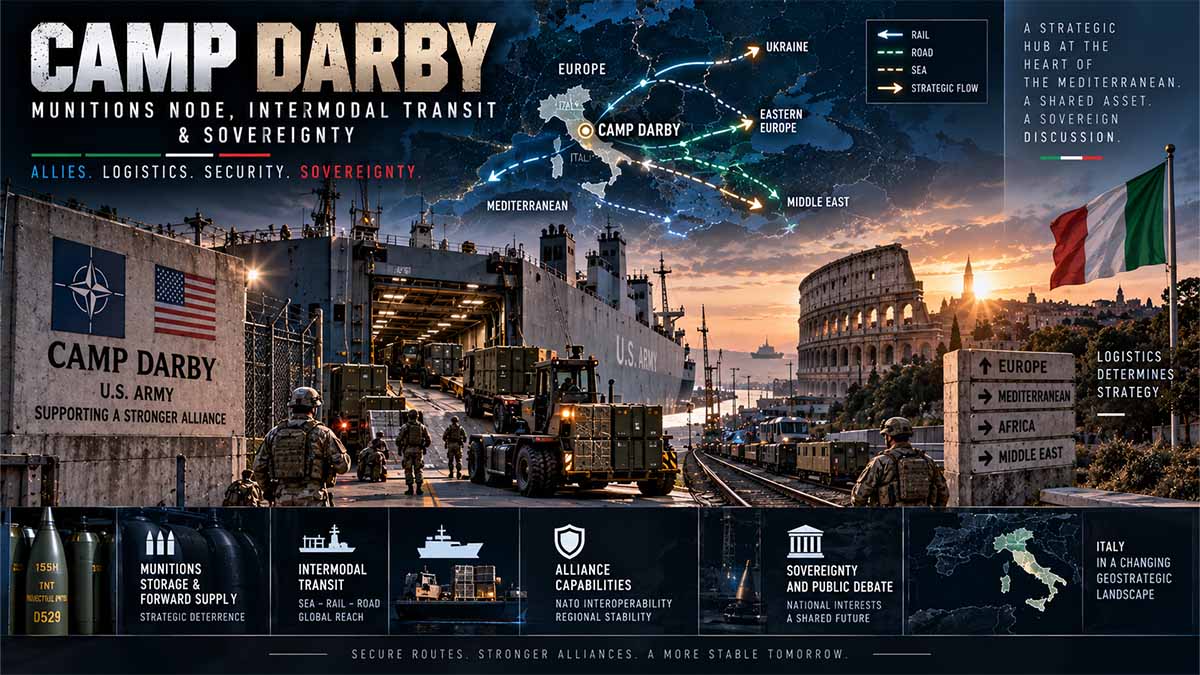
The tactical value of the Darby Military Community—encompassing the Pisa Ammunition Storage Area (PASA) and the Leghorn Army Depot (LAD)—stems from its physical integration into civilian logistics corridors. Under the operational stewardship of the 405th Army Field Support Brigade’s AFSBn-Africa and the 731st Munitions Squadron (USAFE-AFAFRICA), the complex manages over 700,000 square feet of climate-controlled warehouse capacity and 125 hardened, earth-covered ammunition magazines.
The site’s connectivity was fundamentally transformed by a 42-million-dollar infrastructure modernization initiative completed in September 2022. The deployment of a dedicated rail spur, an internal loading basin, and a revolving steel-truss rail bridge across the Navicelli Canal created a direct military bypass to the commercial quays of the Port of Livorno. This engineering project allows Class V ordnance and heavy combat armor from Army Prepositioned Stocks-2 (APS-2) to transfer directly from subterranean storage to commercial roll-on/roll-off vessels and rail corridors, bypassing municipal road arteries. Together with heavy airlift capacity at Pisa International Airport (shared with the Italian Air Force’s 46ª Brigata Aerea), Camp Darby offers an agile intermodal throughput network unmatched in the Mediterranean basin.
The Sovereignty Equilibrium
While U.S. forces exercise internal operational command over depot maintenance and inventory surveillance, Camp Darby remains de jure an Italian military installation. Under the London NATO Status of Forces Agreement (1951), the classified Bilateral Infrastructure Agreement (1954), and the 1995 Memorandum of Understanding (the “Shell Agreement”), the facility is commanded by an Italian Army officer, Colonnello Salvatore Pisciotta, representing territorial sovereignty and external interface authority.
This legal architecture creates a dual-use dilemma. While routine inventory cycling, European deterrence rotations, and Article 5 allied deployments enjoy permanent administrative clearance via the Italian Defense General Staff (Stato Maggiore della Difesa), out-of-area kinetic operations face rigorous constitutional and diplomatic gates. Under Article 11 of the Italian Constitution, which repudiates aggressive war, the Italian government retains explicit authority to deny base access, port transit, or national airspace for unilateral, non-NATO military interventions. What Washington views as an agile expeditionary springboard remains legally anchored to host-nation political concurrence.
European Geopolitical Friction
The strategic friction surrounding Camp Darby is thrown into sharp relief when evaluated against the defense architectures of Germany, France, and the United Kingdom. While Germany operates as NATO’s operational land and air command pivot through Ramstein and Miesau, its infrastructure is wired primarily into continuous overland corridors facing the Eastern Flank. The United Kingdom acts as a deep-strike and maritime redoubt, while France maintains full operational autonomy through its sovereign nuclear and conventional commands, hosting zero foreign logistics bases.
Italy occupies a more exposed posture. Camp Darby acts as an amphibious and maritime pivot: an asset that projects mass into the Mediterranean, the Levant, and Africa, while simultaneously feeding the trans-Alpine rail corridor toward Central Europe. However, in an era of peer-adversary tension driven by the conflict in Ukraine and instability in the Middle East, this concentration of conventional combat mass turns the Tuscan coastline into a high-priority target. In the event of broader interstate confrontation, adversary counter-logistics doctrine identifies the port infrastructure of Livorno and the rail bridges of the Navicelli as vital interdiction points, leaving the burden of point air defense and territorial missile interception (via SAMP/T batteries) entirely on Italian armed forces.
The Chokepoint Dilemma
The primary vulnerability of this logistical node is its reliance on public, shared infrastructure. The Navicelli Canal features shallow drafts restricted to approximately 2.5 to 3 meters, limiting waterway transport to flat-bottom barges. A single vessel grounding, mechanical failure at the swing bridge, or targeted cyber intrusion into civilian port SCADA networks could instantly throttle maritime ammunition flows.
Furthermore, the logistical chain depends on commercial maritime labor. Livorno’s dockworker syndicates and regional trade unions have demonstrated a willingness to picket quays, delay hazardous cargo handling, and publish tracking manifests of arms shipments bound for contested Middle Eastern theaters. This public tracking compromises operational security, drawing national political scrutiny into localized commercial logistics.
A Calculated National Balance
Camp Darby is not an autonomous enclave of foreign power projection, but a deeply integrated asset within Italy’s defense calculus. Hosting this logistics and munitions complex guarantees Rome primary access to allied intelligence, elevated standing within NATO command councils, and continuous security coordination with Washington.
Yet, this geopolitical influence requires constant sovereign stewardship. Italy must balance the alliance benefits of hosting this war-reserve node against the economic, civic, and defensive burdens placed on Tuscany’s commercial maritime ecosystem. Safeguarding Italian national security demands active oversight of throughput authorization, robust physical and cyber defenses for civic rail and port grids, and clear political management of sovereign transit corridors.
Navigational Index
- Pillar I: Multimodal Infrastructure, Prepositioned Stocks & Intermodal Outflow Corridors
- Pillar II: Jurisdictional Dual-Use Architecture, Residual Sovereignty & Clearance Thresholds
- Strategic Exposure, Escalation Dynamics, and Allied Interdependence: Camp Darby in European Deterrence
- Strategic Divergence: Collective Defense vs. Unilateral Power Projection from Italian Soil
- Pillar III: Multi-Domain Geopolitical Vulnerability, Transit Chokepoints & Strategic Exposure
Master Abstract
The strategic centrality of the Darby Military Community (DMC)—comprising the Pisa Ammunition Storage Area (PASA), the Leghorn Army Depot, and associated support areas—rests upon its unique positioning as the primary conventional war-reserve materiel and munitions logistics node in the Southern European theater. Established pursuant to post-World War II bilateral defense arrangements between Washington and Rome, the installation serves as an operational hinge connecting the continental United States with operational areas under U.S. European Command (USEUCOM), U.S. Africa Command (USAFRICOM), and adjacent contingencies across the broader Mediterranean basin. Rather than functioning solely as a static containment garrison, Camp Darby operates as an intermodal transshipment node maintained by the 405th Army Field Support Brigade’s Army Field Support Battalion-Africa (AFSBn-Africa) and the 731st Munitions Squadron (731st MUNS) under USAFE-AFAFRICA. The site integrates hardened subterranean earth-covered magazines and industrial-scale warehouse facilities designed for the receipt, maintenance, technical inspection, and outload of heavy armor, rolling stock, standard combat loads, and specialized guided munitions. The modern military utility of the site was reinforced by multi-million-dollar infrastructure recapitalization programs, which modernized internal rail loading yards, constructed direct rail-dock intermodal bridges across the Navicelli Canal, and reconfigured loading aprons to sustain expedited roll-on/roll-off and barge outload capabilities. These structural adaptations enable combat-configured equipment and hazardous cargo to bypass congested civilian municipal arteries between Pisa and Livorno, routing directly from hardened bunkers to commercial port terminals and military flight lines with minimal delay.
The legal and operational interface governing Camp Darby embodies the structural tensions inherent to forward-deployed allied infrastructure subjected to differing national strategic mandates. The facility operates legally within the jurisdictional boundaries of the NATO Status of Forces Agreement (1951), executed bilaterally through the classified Bilateral Infrastructure Agreement (BIA) of 1954 and operationalized via the Italy–U.S. Memorandum of Understanding of 1995 (commonly designated the Shell Agreement). While the physical terrain remains under residual Italian sovereign authority—formally commanded by an Italian military officer designated as the Base Commander—the functional administration and technical access controls governing munitions storage areas are exercised by U.S. armed forces. This division creates a distinct procedural boundary between routine logistical administration and kinetic force projection. Routine replenishment, weapons maintenance, European deterrence rotations, and standard APS-2 cyclical regeneration operate smoothly under standing technical arrangements and blanket clearances granted by the Italian General Staff (Stato Maggiore della Difesa). Conversely, the outload and staging of lethal munitions or armored sets for unilateral U.S. expeditionary operations that fall outside explicit NATO Article 5 collective-defense mandates or non-consensual out-of-area operations require affirmative political and diplomatic authorization from the Government of Italy. This operational gating mechanism turns the facility into a dynamic variable: the logistical speed required by forward U.S. combatant commanders must continuously adjust to host-nation legal scrutiny, ministerial oversight, and Italian domestic political stability.
From an integrated defense and geopolitical perspective, the installation constitutes an asymmetric target set and an operational node vulnerable to hybrid disruptions across host-nation infrastructure. Because the Pisa Ammunition Storage Area lacks autonomous, sovereign air and deep-draft sea exit routes entirely within its perimeter, its operational effectiveness depends on external civil corridors: the shallow-draft navigable waters of the Navicelli Canal, the commercial quays of the Port of Livorno, and the runways of Pisa International Airport, shared with the Italian Air Force’s 46ª Brigata Aerea. This intermodal dependence introduces acute operational friction points during crises. Local transport labor syndicates, dockworkers’ unions, and anti-militarist civic movements have historically demonstrated the capacity to picket gates, delay freight loading, and monitor munitions departures through forensic open-source tracking. Furthermore, the concentration of Class V conventional explosive weight and combat-ready materiel within a geographically concentrated zone near major civilian transport networks creates significant host-nation risk. In scenarios involving interstate escalation in the Mediterranean or Levant, the logistical footprint transforms the Pisa–Livorno corridor into a priority target for adversarial surveillance, sub-threshold sabotage, cyber disruption of rail signalling networks, and indirect missile or drone threats, placing the ultimate burden of physical protection and air defense on Italian armed forces.
Camp Darby Strategic Operational Architecture
Intermodal Corridor Status
REAL-TIME ASSESSMENT| Corridor / Node | Throughput Mode | Friction Vulnerability |
|---|---|---|
| Navicelli Canal | Barge / Direct Quay | Draft / Bridge Geometry |
| Livorno Port Terminal | Commercial Ro-Ro/Container | Labor Strikes / Civil Action |
| Pisa Air Base (46ª BA) | Strategic Airlift (C-17/C-130) | Runway Sharing / Flight Clearances |
| FS Rail Intermodal Spur | Heavy Armor / Class V Railcar | Direct Yard Connectivity |
ACH Weightings: Strategic Intent
EVALUATED POSTUREAuthorization Gate & Kinetic Threshold Dial
SOFA / BIA DYNAMICS| Italian Sovereignty Gate: | Routine Clearance (Blanket Permitted) |
| U.S. Operational Autonomy: | High (Intra-Theater Transfer) |
| Political Vulnerability Index: | Low (Standard Bilateral Training) |
Pillar I: Multimodal Infrastructure, Prepositioned Stocks & Intermodal Outflow Corridors
Facility Architecture and Storage Mass
The logistical footprint of the Darby Military Community is bifurcated across two primary functional nodes: the Pisa Ammunition Storage Area (PASA) located in the northern sector and the Leghorn Army Depot (LAD) situated in the southern sector.
- Army Prepositioned Stocks-2 (APS-2): Maintained by the 405th Army Field Support Brigade’s Army Field Support Battalion-Africa (AFSBn-Africa), Leghorn Army Depot encompasses 16 climate-controlled warehouses covering 749,000 square feet of humidity-regulated interior storage, complemented by four industrial maintenance facilities and approximately 1.5 million square feet of unimproved outside staging pads. The facility provides theater storage, lifecycle surveillance, operational configuration, and cyclical reconstitution of combat rolling stock, major end items, and secondary repair parts configured to deploy directly to forward Equipment Configuration and Handoff Areas (ECHAs).
- Ammunition Storage Area (Class V Stockpiles): Operated by the 731st Munitions Squadron (731st MUNS)—a geographically separated unit subordinate to the 31st Maintenance Group, 31st Fighter Wing at Aviano Air Base—the Pisa Ammunition Storage Area comprises hardened, earth-covered magazines (IGLOOs), revetted handling pads, and blast-containment barricades. The squadron receives, inspects, maintains, stockpiles, and stages Class V air-to-air, air-to-ground, and joint conventional munitions supporting U.S. Air Forces in Europe – Air Forces Africa (USAFE-AFAFRICA) and NATO contingency allocations across three combatant command theaters (USEUCOM, USAFRICOM, and USCENTCOM).
Intermodal Outflow Geometry: Rail, Canal, Sea, and Air
The strategic utility of Camp Darby depends on four interconnected intermodal vectors that eliminate civilian-artery friction between military storage compounds and commercial deep-water maritime/air departure points:
- Navicelli Canal Corridor & Swing Bridge Infrastructure: The Navicelli Canal connects the internal infrastructure of the base with the Port of Livorno. Modernization completed in September 2022 established an internal railhead, a dedicated loading/unloading dock pad, blast containment walls/berms, and a movable steel-truss rail swing bridge crossing the Navicelli Canal. This engineering upgrade permits Class V munitions and outsized rolling stock to be loaded onto railcars and shallow-draft barges directly inside the secured perimeter of the Pisa Ammunition Storage Area, eliminating the requirement to transport hazardous materials via public road corridors between the depot and the port.
- Port of Livorno (Deep-Water Terminal): Operating via commercial terminal concessions (including Darsena Toscana and Molo Italia), the Port of Livorno provides more than 1,200 meters of continuous berthing and natural operational depths reaching 13 meters. The port supports strategic sealift platforms including Roll-on/Roll-off (Ro-Ro) vessels, Large Medium-Speed Roll-on/Roll-off (LMSR) ships, and standard intermodal container carriers, supported by more than 360,000 square meters of covered and open staging facilities.
- Ferrovie dello Stato (FS) Heavy-Axle Rail Connection: The installation links directly into the Italian national rail grid (Rete Ferroviaria Italiana), allowing military block trains carrying high-tonnage combat vehicles and explosive loads to transit trans-Alpine freight corridors toward Central and Eastern European operating environments without transshipment delays.
- Pisa International Airport (46ª Brigata Aerea): Located within minutes of the Pisa Ammunition Storage Area, the airfield features military aprons and dual-use runways shared with the Italian Air Force. It accommodates heavy strategic airlift (C-17 Globemaster III, C-5M Super Galaxy, and C-130J Super Hercules) for high-priority Class V deployment, urgent secondary repair part insertion, and rapid air-evacuation sorties across the Mediterranean and North Africa.
Primary Evidence Verification Matrix
- AFSBn-Africa Official Fact Sheet – U.S. Army Sustainment Command – February 2025
- Camp Darby and Leghorn Army Depot: Power Projection for Three Combatant Commands – U.S. Army Official Portal – November 2025
- B-Roll Package of Upgrades at the Pisa Ammunition Storage Area – 7th Army Training Command – September 2022
- 731st Munitions Squadron Fact Sheet – 31st Fighter Wing / Aviano Air Base – March 2018
Intermodal Outflow & Prepositioned Capacity Analysis
Physical Stockpile Allocations
VERIFIED METRICS| Component | Operational Scope | Dimension / Metric |
|---|---|---|
| LAD (APS-2) | 16 Warehouses (Climate Controlled) | 749,000 sq ft |
| LAD Staging | Unimproved Equipment Hardstand | 1.5 Million sq ft |
| Livorno Port | Deep-water Berthage / Depth | >1,200 m / 13 m draft |
| Livorno Port | Covered / Open Storage Footprint | >360,000 sq m |
Corridor Vulnerability Assessment
FRICTION PROFILINGOperational Outflow Dynamic Simulator
SURGE CAPABILITY| Outflow Primary Mode: | Bilateral Rail / Road Feeder |
| Throughput Velocity: | Nominal (48-72h Handshake) |
| Primary Chokepoint: | Routine Standard Clearances |
Pillar II: Jurisdictional Dual-Use Architecture, Residual Sovereignty & Clearance Thresholds
The Tripartite Legal Architecture
The presence, administration, and operational employment of U.S. forces at the Darby Military Community (DMC) rest on three layered public international law and bilateral defense instruments. These agreements establish the legal tension between sovereign Italian territorial control and operational U.S. command autonomy:
- Multilateral Foundation — NATO Status of Forces Agreement (1951): The London SOFA regulates the basic legal position of visiting forces. Under Article VII, the sending State (United States) and the receiving State (Italy) maintain concurrent criminal and administrative jurisdiction, with primary jurisdiction allocated depending on the nature of offenses (offenses solely against U.S. property/personnel vs. offenses under host-nation law). While the SOFA establishes the administrative status of forces, it deliberately does not grant basing rights, extraterritorial status, or autonomous combat sortie authority.
- Bilateral Infrastructure Instrument — Bilateral Infrastructure Agreement (BIA, 1954): Ratified as a classified executive agreement pursuant to NATO Article 3 (continuous self-help and mutual aid), the 1954 BIA formalizes U.S. access to military installations across Italian territory. The BIA expressly preserves de jure Italian territorial sovereignty: installations remain under formal Italian command, designated as Italian military facilities with concessionary co-use granted to U.S. forces. The agreement establishes that military construction, major infrastructure expansion, and substantive changes in operational capability require bilateral consultation and explicit concurrence from the Italian General Staff (Stato Maggiore della Difesa – SMD).
- Operational Execution Framework — Italy–U.S. Memorandum of Understanding (1995 / “Shell Agreement”): Formalized to resolve jurisdictional ambiguities post-Cold War, the 1995 MoU codifies the command-and-control hierarchy at shared installations. The installation is placed under an Italian Base Commander (an Italian Army colonel at Camp Darby), who represents the territorial sovereign, controls external perimeter access, oversees host-nation environmental/labor compliance, and acts as the legal gatekeeper for military operations originating from the site. The U.S. Commander retains operational control (OPCON) over U.S. military personnel, internal facility administration, and the physical custody and handling of stockpiled materiel.
Dual-Use Operational Gates & Sovereignty Friction
The core jurisdictional dilemma at Camp Darby resides in the divergence between Article 5 collective defense mandates and non-Article 5 unilateral out-of-area operations:
- Routine Logistics and NATO Article 5 Alignment: Under standing bilateral arrangements, routine peacetime warehousing, cyclical modernization, munitions inspection by the 731st Munitions Squadron, and maintenance operations executed by the 405th AFSB (AFSBn-Africa) operate under permanent or programmatic administrative clearance. In a formally declared NATO Article 5 contingency or NATO-mandated operation (such as allied posture reinforcement across Eastern Europe), Italian sovereignty concurrence is pre-established via multilateral consensus; rail dispatch, airspace clearances, and port departures proceed on an expedited notification track.
- Out-of-Area Deployments & The Political Veto: When stockpiles or staging facilities at Camp Darby are mobilized to support unilateral U.S. operations, coalition missions without a United Nations Security Council mandate, or kinetic contingencies in the Middle East and North Africa, the 1995 MoU framework mandates affirmative clearance from the Government of Italy (GOI). The Italian Minister of Defense and the Prime Minister (Presidente del Consiglio dei Ministri) retain formal authority to deny authorization for the loading, departure, or sovereign airspace transit of combat assets:
- Direct Kinetic Sorties: Launching armed combat sorties directly from Italian geography requires case-by-case authorization from the Italian Cabinet, subject to parliamentary oversight pursuant to Article 11 of the Italian Constitution (which repudiates war as an instrument of offense against the liberty of other peoples).
- Lethal Logistics Outload: While U.S. planners categorize munitions transfer as non-kinetic sustainment, Italian constitutional jurisprudence and political sensitivities frequently interpret the mass outload of Class V ordnance destined for active non-NATO combat theaters as active logistical co-belligerency, triggering ministerial intervention or transit delays.
Primary Evidence Verification Matrix
- Agreement Between the Parties to the North Atlantic Treaty Regarding the Status of Their Forces – NATO Official Texts – June 1951
- Constitution of the Italian Republic (Art. 11 – Repudiation of War) – Senato della Repubblica – December 1947
- Italy: Background and Bilateral Relations with the United States – Congressional Research Service – Updated March 2024
Legal Control & Sovereignty Gateway Architecture
Legal Accord Hierarchy
PRIMARY INSTRUMENTSArt. VII: Concurrent Jurisdiction / Base Status
Art. 3 Alignment: Infrastructure Concession & Sovereign Base Commander
Operational Separation: Italian Base Authority vs. U.S. Technical OPCON
Repudiation of Aggressive War: National Parliamentary Authorization Threshold
Bilateral Jurisdiction Division
AUTHORITY ASSIGNMENT| Operational Dimension | Primary Authority | Sovereignty Gate |
|---|---|---|
| Perimeter Security & Customs | Italian Base Commander | Exclusive GOI |
| Class V Internal Depot Ops | 731st MUNS / AFSBn-Africa | U.S. Internal OPCON |
| Port of Livorno Rail Transit | SMD / Prefettura di Pisa | Host-Nation Permitted |
| Kinetic Combat Sorties | Italian Cabinet / Parliament | Explicit Parliamentary Gate |
Operational Clearance Analyzer
AUTHORIZATION SIMULATION| Host-Nation Clearance Level: | Programmatic Concurrence (SMD Routine) |
| Italian Parliamentary Review: | Not Required (Standing 1995 MoU) |
| Operational Friction Vector: | Negligible Administrative Overhead |
Strategic Exposure, Escalation Dynamics, and Allied Interdependence: Camp Darby in European Deterrence
Strategic Meaning for Italian National Security
The operational footprint of Camp Darby alters Italy’s national defense equation by establishing an asymmetric trade-off between institutional alliance influence and direct strategic exposure:
- Positive Security Value: Hosting the Pisa Ammunition Storage Area (PASA) and Leghorn Army Depot (LAD) cements Italy’s status as an indispensable transit hub for NATO southern and eastern flank architectures. It secures continuous bilateral security commitments with Washington, provides high-level defense integration via the Italian Army base command, and integrates Italian armed forces into high-tempo interoperability exercises, including co-location with elements of the Comando delle Forze Speciali dell’Esercito (COMFOSE) at the northern perimeter.
- The Entrapment-Vulnerability Dilemma: As the largest conventional munitions stockpile serving USAFE-AFAFRICA and a pivotal Army Prepositioned Stocks-2 (APS-2) depot, the facility exposes Italy to “entrapment risks.” Unilateral U.S. power projection or allied outloads that circumvent Italian political objectives can de facto implicate Italian territory in extra-regional disputes.
- Targeting Exposure in Interstate War: In a direct or sub-threshold confrontation with a peer adversary, Camp Darby shifts from a rear-echelon storage site to a high-priority, high-value counter-logistics target. Its geographical concentration of Class V ordnance close to Tuscan population centers makes any kinetic, cyber, or hybrid strike catastrophic for host-nation civilian infrastructure.
The Russia–Ukraine Vector: Horizontal Escalation and Retaliatory Thresholds
The ongoing war between the Russian Federation and Ukraine has converted European logistics nodes into primary targets of adversary hybrid doctrine. If NATO assistance surpasses adversary-defined red lines—such as direct operational enablement of deep strikes or massive forward positioning of breakthrough strike assets—the operational profile of Camp Darby shapes Italian vulnerability across three distinct escalation bands:
- Sub-Threshold Hybrid and Asymmetric Action: Rather than overt kinetic strikes, initial adversary retaliation focuses on gray-zone sabotage. The intermodal dependencies of Camp Darby—the Navicelli Canal, the Port of Livorno, and the Rete Ferroviaria Italiana (RFI) rail heads—rely on civilian infrastructure. These corridors are highly susceptible to covert electronic warfare, cyber disruption of rail traffic control, supply-chain interdiction, and adversary-instigated civil unrest or maritime labor blockades.
- Long-Range Conventional Standoff Threat: In the event of open conflict between NATO and the Russian Federation, Moscow’s maritime and long-range strike doctrine prioritizes interdiction of theater reinforcement and sustainment nodes. Submarine-launched land-attack cruise missiles (e.g., 3M-14 Kalibr) operating from Mediterranean maritime bastion deployments or long-range hypersonic systems could target the loading facilities at Livorno, the canal lock infrastructure, and the Pisa military airheads. Italy carries the primary burden of point air defense and territorial missile defense (SAMP/T batteries), straining national surface-to-air defense capacity.
- Chemical/Class V Secondary Detonation Risks: A successful kinetic or sabotage action targeting the dense munitions clusters of the Pisa Ammunition Storage Area creates massive secondary blast radius risks that directly threaten civilian urban areas in Pisa and Livorno, testing national civil protection capabilities.
Comparative Posture: Italy vs. Germany, France, and the United Kingdom
Camp Darby occupies a distinct structural position within the logistics and deterrence geometry of Western Europe when analyzed against the core defense profiles of Germany, France, and the United Kingdom:
- Germany (Ramstein AB / Dülmen APS / Miesau Army Depot):
- Strategic Role: Germany serves as the operational headquarters, heavy command-and-control hinge, and central staging ground for NATO’s Central and Eastern European land posture.
- Comparative Exposure: Germany hosts more forward-deployed U.S. personnel and command nodes, absorbing higher primary targeting priority. However, German depots feed directly into contiguous overland rail and highway networks. Camp Darby, by contrast, is an amphibious-maritime hinge: it connects Mediterranean sea lanes to the continent, acting as a flex-point between European defense and African/Middle Eastern contingencies.
- France (Autonomous Nuclear & Conventional Posture):
- Strategic Role: France maintains sovereign command autonomy outside the NATO Integrated Military Command Structure for its nuclear deterrent (Force de Frappe), with zero permanent U.S. combat bases or prepositioned munitions depots on its soil.
- Comparative Exposure: France controls its escalation escalation ladder completely and cannot be designated an automatic primary target due to foreign-controlled munitions stockpiles. Italy, by housing Camp Darby, accepts foreign operational footprints and their inherent targeting risks in exchange for integrated alliance protection.
- United Kingdom (RAF Lakenheath / RAF Fairford):
- Strategic Role: The UK serves as the strategic air-power and maritime power-projection bastion of NATO’s Western approaches, hosting forward-deployed U.S. dual-capable and strategic bomber task forces.
- Comparative Exposure: The UK hosts high-end kinetic air strike capabilities, drawing acute adversary strategic nuclear and conventional deterrent signaling. Camp Darby, while not a primary nuclear strike platform, provides the sustained conventional Class V volume and heavy combat equipment without which frontline combat sorties by allied platforms in Western Europe and the Mediterranean cannot be sustained over prolonged operations.
Allied Strategic Positioning & Vulnerability Matrix
Allied Posture Comparison
STRATEGIC ALIGNMENT| Country / Node | Strategic Function | Direct Targeting Exposure |
|---|---|---|
| Italy (Camp Darby) | Class V Munitions & Prepositioned Stockage | High (Mediterranean Standoff / Hybrid) |
| Germany (Ramstein/Miesau) | Central Theater Logistics & Air C2 | Critical (Primary Operational Pivot) |
| United Kingdom (Lakenheath) | Forward Air Strike & Strategic Staging | Critical (Nuclear/Air Counter-Force) |
| France (Sovereign Force) | Independent Nuclear Deterrent / Expeditionary | Controlled (No Foreign Base Hosting) |
Russian Escalation Vector Analysis
HOST-NATION RISK BANDS| Threat Vector | Mechanism | Impact on Italian Soil |
|---|---|---|
| Asymmetric Sabotage | Disruption of RFI Rail / Port Cranes | Direct Critical Municipal Friction |
| Cyber C2 Denial | Port Authority & Logistics SCADA Hacks | Interruption of Outflow Throughput |
| Stand-off Strike | Sub-launched Land-Attack Cruise Missiles | High Kinetic Damage / Civilian Spillover |
| Political Interdiction | Exploitation of Domestic Labor/Unions | Paralysis of Commercial Port Transit |
Escalation Phase Dynamic Assessment
SECURITY IMPACT SIMULATOR| Camp Darby Operational Status: | High Throughput Prepositioning Hub |
| Risk to Italian Infrastructure: | Low/Medium (Cyber Probing & Espionage) |
| Italian Defense Requirement: | Carabinieri Escort & Cyber Hardening |
Strategic Divergence: Collective Defense vs. Unilateral Power Projection from Italian Soil
The Asymmetry of Strategic Utility: Power Projection vs. National Territorial Defense
The premise that forward-deployed U.S. military installations in Italy—specifically Camp Darby, Naval Support Activity Naples, Sigonella Naval Air Station, and Aviano Air Base—primarily operate as forward operating bases for extra-European power projection reflects an objective structural tension within post-Cold War allied basing architecture:
- The Geographic Paradox: When established under the Bilateral Infrastructure Agreement (1954), installations on Italian territory were integrated into the NATO Article 5 perimeter to counter an amphibious, overland, or airborne advance by Warsaw Pact forces across the Mediterranean and Alpine approaches. In the contemporary operational environment, Italy faces negligible conventional territorial invasion threats across its maritime or land borders. Consequently, the conventional combat loads, strike platforms, and war-reserve materiel maintained at installations like Camp Darby are geographically oriented not toward the defense of Italian sovereign territory, but outward: across the Levant, North Africa, the Red Sea, and the broader Middle East.
- The Operational Radius: Assets stationed on or staged through Italian soil—such as Class V munitions managed by the 731st Munitions Squadron, strike-fighter components at Aviano, and maritime patrol/unmanned reconnaissance systems (MQ-9 Reaper, RQ-4 Global Hawk) at Sigonella—operate within a 1,500-to-3,000-nautical-mile operational radius. This envelope directly covers North Africa, the Sahel, the Eastern Mediterranean, and the Persian Gulf, providing USEUCOM, USAFRICOM, and USCENTCOM with forward staging capacity that bypasses the logistical transit times of deploying directly from the continental United States.
- Decoupling of Strategic Interests: This operational radius generates structural friction when U.S. expeditionary objectives diverge from Italian foreign policy priorities. While Washington views these installations as flexible staging points for global expeditionary commitments, the host nation faces the direct political, economic, and security consequences of regional destabilization—such as irregular migration flows, disrupted maritime trade routes through the Suez Canal and Red Sea, and radicalized violent non-state networks operating across the Southern Mediterranean.
Legal Sovereignty, Authorization Friction, and the Extraterritorial Myth
The assertion that U.S. forces operate autonomously from Italian installations “without constraint” must be evaluated against the formal public international law and bilateral defense architecture governing host-nation concurrence:
- The Host-Nation Legal Constraint: U.S. bases in Italy do not possess extraterritorial status. Legally, Camp Darby, Aviano, and Sigonella are Italian military installations commanded by senior Italian military officers under the authority of the Stato Maggiore della Difesa (SMD). Under the Italy–U.S. Memorandum of Understanding (1995 / “Shell Agreement”), the physical custody and routine maintenance of stockpiled assets are assigned to U.S. forces, but any non-routine operational deployment—particularly the launching of kinetic combat strikes or the staging of forces for out-of-area, non-NATO operations—requires explicit authorization from the Government of Italy (GOI).
- Precedents of Sovereign Refusal and Operational Friction: The operational record demonstrates that host-nation consent is not an automatic formality, but an active sovereign gate:
- The Sigonella Crisis (1985): The armed standoff between the Italian Carabinieri and U.S. Delta Force over jurisdictional control of the Achille Lauro hijackers demonstrated the absolute assertion of Italian territorial sovereignty over foreign military operations conducted on its bases.
- Operation Iraqi Freedom (2003): Due to strong domestic political opposition and the absence of a direct UN Security Council resolution or NATO Article 5 invocation, the Italian government denied the United States permission to launch offensive, kinetic combat air sorties directly from Italian bases (including Aviano and Sigonella). While overflight and logistical transit for non-combat replenishment were permitted, combat strike sorties were legally constrained.
- Operation Unified Protector / Libya (2011): Italian authorization for the operational use of its bases required prolonged inter-ministerial negotiation and parliamentary assent, ultimately conditioned on the operation being integrated directly under a formal NATO command-and-control umbrella rather than remaining an autonomous U.S.-led coalition.
Strategic Cost-Benefit Matrix: The Trade-Off for Italy
Hosting forward-deployed U.S. infrastructure presents an ongoing strategic calculus wherein the host nation accepts direct security and political burdens in exchange for institutional influence:
- Strategic Burdens Borne by Italy:
- Retaliatory Exposure: Adversaries targeted by U.S. operations launched or logistically sustained from Italian soil identify Italy as a co-belligerent, exposing domestic ports, air corridors, and civilian population centers to asymmetric counter-strikes, espionage, and cyber sabotage.
- Diplomatic Constraints: The perception across the Global South and the Mediterranean basin that Italian territory serves as an unsinkable aircraft carrier for U.S. unilateralism constrains Italian bilateral diplomacy, commercial partnerships, and peace-brokering initiatives in North Africa and the Levant.
- Domestic Political Polarization: Mass munitions movements through public transit corridors (such as the Navicelli Canal and the Port of Livorno) create severe friction with local labor unions, regional governments, and anti-war civic organizations.
- Strategic Compensations Received by Italy:
- Extended Nuclear Deterrence: Italy lacks sovereign nuclear weapons; its defense against peer nuclear powers relies entirely on the U.S. strategic umbrella and NATO nuclear sharing arrangements (e.g., dual-capable aircraft at Ghedi and Aviano).
- Alliance Weight and Intelligence Access: Housing vital Class V munitions at Camp Darby and strategic reconnaissance platforms at Sigonella guarantees Italy top-tier access to NATO decision-making bodies, bilateral intelligence-sharing architectures, and advanced military technology co-development.
- Subsidized Regional Security: The permanent presence of U.S. naval, air, and logistics assets deters regional state actors from directly coercing Italy or threatening maritime communication lines in the Central Mediterranean.
Strategic Alignment & Sovereignty Friction Matrix
Forward Hub Operational Radius
THEATER REACH| Installation | Primary Military Asset | Operational Focus |
|---|---|---|
| Camp Darby (PISA) | Class V Munitions & APS-2 Armor | USEUCOM / USAFRICOM / CENTCOM |
| Aviano Air Base | 31st Fighter Wing (F-16CM) | Balkans / Levant / NATO South |
| NAS Sigonella | P-8A Poseidon / AGS Global Hawk | Med Sub-Surface & North Africa ISR |
| NSA Naples | U.S. Sixth Fleet / NAVEUR-NAVAF | Strategic Mediterranean C2 |
Strategic Balance of Interests
TRADE-OFF EVALUATION| Dimension | U.S. Strategic Benefit | Italian Host Risk/Return |
|---|---|---|
| Power Projection | Expeditionary reach without CONUS lag | High risk of diplomatic blowback |
| Deterrence | Forward conventional forward posturing | Extended nuclear & alliance shield |
| Targeting Exposure | Low risk to CONUS homeland | Primary target for adversary cruise missiles |
| Sovereignty | High operational flexibility | Constrained by 1995 MoU veto mechanisms |
Sovereignty Friction Simulator
OPERATIONAL SCENARIO PROFILING| Host-Nation Concurrence: | Complete Strategic Convergence |
| Italian Sovereign Action: | Unrestricted Port & Air Transit |
| Public/Labor Resistance Risk: | Low (Recognized Collective Mandate) |
Pillar III: Multi-Domain Geopolitical Vulnerability, Transit Chokepoints & Strategic Exposure
The Chokepoint Vulnerability: Physical Intermodal Friction
The central operational vulnerability of the Darby Military Community (DMC) is that neither the Pisa Ammunition Storage Area (PASA) nor the Leghorn Army Depot (LAD) possesses integral, sovereign access to deep-water maritime berths or autonomous heavy air-cargo runways entirely within its perimeter fence. Logistical throughput depends on civilian and joint-use corridors across municipal Tuscan infrastructure:
- The Navicelli Canal Geometry: Connecting the depot’s internal loading dock pad to the commercial basins of Livorno, the Navicelli Canal represents a narrow, shallow-draft inland waterway vulnerable to operational denial. The canal’s nominal navigable draft (consistently constrained to approximately 2.5 to 3.0 meters) restricts transit to specialized flat-bottom barges. A single submerged obstruction, deliberate vessel grounding, structural damage to the railway swing bridge, or hydraulic siltation can halt maritime outload of Class V munitions. Such disruption forces logistical movements back onto local arterial highways (SS1 Via Aurelia and the SGC Firenze–Pisa–Livorno), reintroducing public-safety hazards and regulatory delays.
- Commercial Berthing Dependencies at Port of Livorno: Operations at Darsena Toscana and Molo Italia rely on civilian port authority infrastructure. The loading of Large, Medium-Speed Roll-on/Roll-off (LMSR) vessels and heavy container ships requires commercial gantry cranes, civilian stevedore labor, and harbor tug services. Under crisis conditions, commercial vessel congestion, priority commercial container traffic, or targeted physical and cyber interdiction of port infrastructure can degrade deployment velocity from hours to weeks.
- Pisa International Airport (46ª Brigata Aerea) Runways: Heavy strategic airlift operations utilizing C-17 Globemaster III or C-5M Super Galaxy aircraft rely on the dual-use runways shared with Pisa’s civilian passenger terminal (Galileo Galilei Airport). Runway maintenance, civilian commercial slot allocation, and flight-path restrictions over populated municipal zones limit maximum surge sortie frequency during concurrent outload operations.
- Ferrovie dello Stato (FS) Rail Chokepoints: Rail cars moving heavy combat equipment and Class V container loads must merge from the installation’s internal spurs into the national rail corridor administered by Rete Ferroviaria Italiana (RFI). Northbound trains moving toward Central or Eastern Europe must transit narrow coastal rail corridors and complex switchyards before traversing the Apennine or Alpine passes (Brenner, Tarvisio, or Frejus), where rail bottlenecks, power grid cuts, or structural bridge failures can halt continental reinforcement.
Asymmetric, Hybrid, and Labor Interdiction Vectors
The interface between U.S. military logistics and Italian municipal infrastructure creates high vulnerability to non-kinetic and sub-threshold interdiction:
- Dockworker and Transport Union Resistance: The maritime labor movement in Livorno—historically organized through syndicates such as the Unione Sindacale di Base (USB) and autonomous dockworker collectives—has repeatedly leveraged open-source monitoring, cargo inspections, and targeted strike actions against military cargo shipments. During regional escalations (such as maritime shipments bound for Middle Eastern or Eastern Mediterranean operating areas), port labor syndicates have mounted physical picket lines, declared selective strikes on explosive and arms loading, and disclosed hazardous cargo manifests to local media. This resistance converts routine technical transshipment into high-visibility domestic political disputes.
- Forensic Open-Source and Civilian Tracking: The movement of Class V munitions along public railways and through the Navicelli Canal is easily observable by the local populace, activist organizations, and foreign intelligence services. Train enthusiasts, local political monitors, and commercial ship-spotting networks routinely publish real-time photographs, container identification numbers, and vessel schedules online. This forensic transparency compromises operational security (OPSEC), telegraphs outload tempo, and provides adversary states with precise telemetry regarding theater-level ammunition replenishment patterns.
- Sub-Threshold Sabotage and Cyber Vulnerabilities: The supervisory control and data acquisition (SCADA) systems operating the rail switches of the Italian national rail network, the electro-mechanical controls of the Navicelli Canal swing bridge, and the logistics software scheduling container cranes at the Port of Livorno are civilian-grade networks. Adversary advanced persistent threat (APT) groups can deploy malware, denial-of-service vectors, or false sensor inputs to lock canal locks, de-synchronize rail signaling, or crash port inventory databases without crossing the threshold of an overt military attack.
Adversary Targeting Dynamics & The Domestic Political Trap
In any severe systemic crisis or direct conflict between NATO and a peer adversary (such as the Russian Federation), Camp Darby becomes an inevitable priority in adversary counter-logistics targeting:
- Standoff Conventional and Hypersonic Strike Geometry: Long-range maritime-strike platforms—including nuclear-powered guided-missile submarines (SSGNs) and surface combatants operating in the Eastern Mediterranean or Black Sea armed with 3M-14 Kalibr cruise missiles, or air-launched standoff assets—can range the Tuscan coast. While the hardened subterranean magazines of the Pisa Ammunition Storage Area are engineered against direct impacts, the above-ground intermodal bridges, open staging hardstands, and commercial port quays are unhardened. A precision kinetic strike on a loaded ammunition barge in the Navicelli Canal or a Ro-Ro ship berthed at Darsena Toscana would induce massive secondary detonations, devastating adjacent industrial and civilian maritime zones.
- Host-Nation Air and Missile Defense Burden: Because U.S. forces do not deploy dedicated surface-to-air missile batteries permanently around the perimeter of Camp Darby, the defense of this vital logistics node falls entirely on the Italian Armed Forces. Protecting the site requires the forward deployment of Italian Army SAMP/T (Sol-Air Moyenne-Portée/Terrestre) air defense batteries and Italian Air Force Eurofighter Typhoon quick-reaction alert (QRA) sorties from Grosseto (4° Stormo). This commitment diverts high-demand, low-density national air defense assets away from Italian civilian population centers and strategic industrial areas in northern Italy.
- Domestic Political and Constitutional Fractures: When logistical operations support controversial or unilateral out-of-area campaigns, the host nation faces intense domestic friction. Local municipalities (Pisa and Livorno city councils, the Regional Council of Tuscany) frequently voice formal opposition to base activities on environmental and public-safety grounds. Under Article 11 of the Italian Constitution, sustained public exposure of hazardous munitions transits fuels parliamentary challenges, inter-ministerial disputes, and coalition instability, transforming a localized logistical operation into a national sovereignty crisis.
Multi-Domain Geopolitical Vulnerability & Friction Codex
Intermodal Vulnerability Profile
CHOKEPOINT AUDITAdversary Interference Dimensions
MULTI-DOMAIN RISK| Domain | Primary Threat Vector | Operational Consequence |
|---|---|---|
| Sub-Surface / Sea | Submarine-launched Cruise Missiles | Kinetic destruction of port quays |
| Cyber / SCADA | RFI Rail & Port Crane Infiltration | Paralysis of loading schedules |
| Civil / Hybrid | Syndicate Strikes & Activist Blockades | Denial of commercial port access |
| Informational | Open-source tracking of train loads | Telemetry loss / adversary warning |
Dynamic Chokepoint Disruption Analyzer
SYSTEMIC FAILURE SIMULATION| Immediate Operational Impact: | Barge Corridor Paralyzed |
| Logistical Workaround: | Reroute via SS1 Aurelia Convoy |
| Host-Nation Burden: | High Municipal Police Escort Requirement |


