













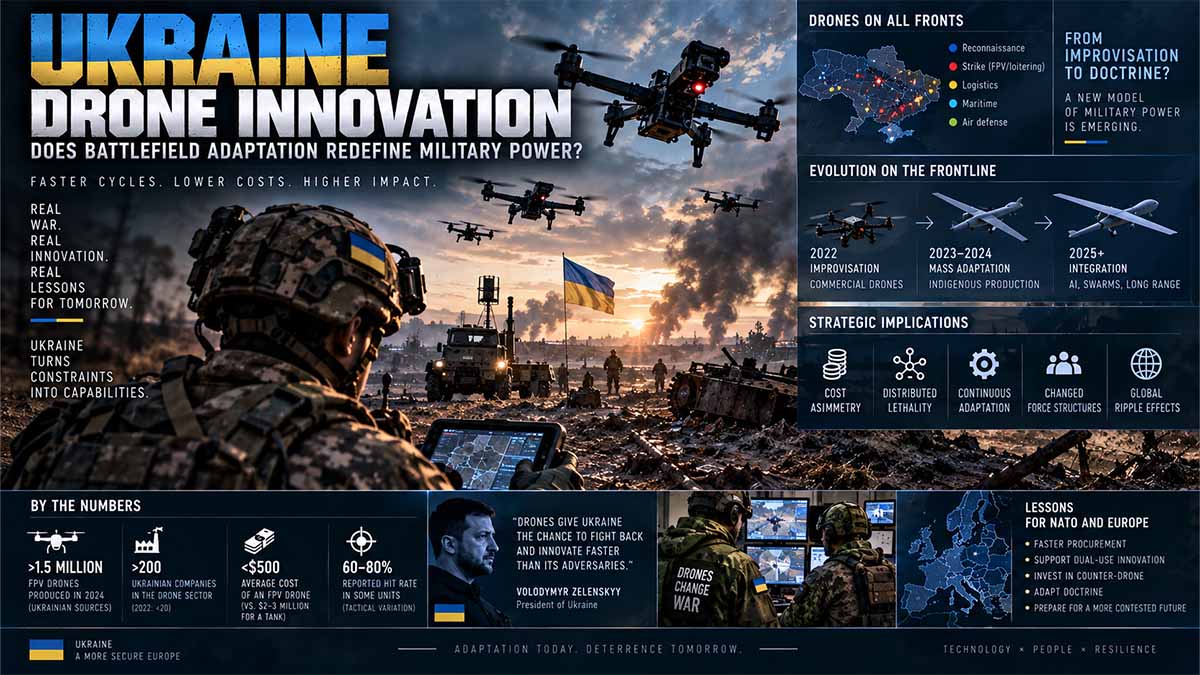
This assessment evaluates Ukraine’s defense industrial base, algorithmic integration, and alliance localization between 2024 and 2026 to determine if accelerated technological adaptation can redefine European military power over a five-year horizon.
Executive Summary
The nature of military power is shifting from legacy platform mass to the velocity of technological adaptation and industrial scalability. Ukraine has transitioned into a primary laboratory of twenty-first-century combat, achieving a 2025 domestic production capacity of 4.5 million FPV drones and securing $6.1 billion in foreign defense capital. The establishment of the Unmanned Systems Forces and AI-driven targeting platforms demonstrates an institutional agility that compresses the sensor-to-shooter loop. Consequently, military strength is increasingly defined by a state’s capacity to process battlefield data and iterate software-defined hardware. While Ukraine’s emergence as a technological military power is verified by its industrial output, its strategic viability remains contingent on sustained allied capital integration and the survivability of its energy infrastructure. The decisive uncertainty is whether this combat-proven ecosystem can be successfully exported to deter future aggression, or if it remains a localized anomaly dependent on existential mobilization.
The Algorithmic Arsenal: How Ukraine’s Defense Industrial Base is Rewriting the Economics of European Deterrence
The calculus of military supremacy has undergone a structural rupture. The traditional metrics of geopolitical power—divisional mass, armor tonnage, and legacy platform inventories—are being superseded by the velocity of technological adaptation and industrial scalability. Today, the question is no longer whether the character of war has changed, but how deeply this transformation penetrates the architecture of global deterrence. Ukraine has evolved from a consumer of allied military aid into the world’s most advanced laboratory for asymmetric, software-defined warfare. By institutionalizing algorithmic targeting and mass-producing attritable unmanned systems, Kyiv is not merely surviving a war of attrition; it is accumulating a form of strategic capital that cannot be purchased on international markets. For Europe, this paradigm shift dictates a stark reality: the continent’s future security guarantees are inextricably bound to the survival and scalability of the Ukrainian defense industrial base.
The Economics of Asymmetric Attrition
The battlefield transparency of the twenty-first century has rendered concentrated, high-value legacy formations economically and tactically unsustainable. This reality is quantified by an unprecedented industrial mobilization. In 2024, the Armed Forces of Ukraine were supplied with over 1.5 million first-person-view (FPV) drones, of which 96.2 percent were domestically manufactured, according to Defense Minister Rustem Umerov. By March 2025, the Ministry of Defence reported that domestic capacity had expanded to an astonishing 4.5 million FPV drones annually.
This output is sustained by a highly fragmented, hyper-competitive manufacturing ecosystem. Between 2024 and 2025, the Ministry of Defence allocated UAH 104.2 billion directly to 76 private domestic drone manufacturers, bypassing the bureaucratic friction of monolithic state procurement. The resulting cost-exchange ratio is devastating for traditional armored doctrines: a combat-effective FPV drone, utilizing commercial off-the-shelf components, costs between $300 and $500, yet systematically disables main battle tanks and self-propelled artillery valued at millions. Military strength is now measured by a state’s capacity to absorb the loss of thousands of attritable systems while maintaining the industrial throughput to replace them within days.
The Algorithmic Vanguard
Hardware mass is meaningless without the software architecture to direct it. In February 2024, Ukraine executed a doctrinal rupture by establishing the Unmanned Systems Forces as an independent military branch, elevating drone warfare from a tactical adjunct to a strategic domain. This institutional agility has compressed the sensor-to-shooter loop from hours to minutes.
The operational manifestation of this doctrine is the Ministry of Defence’s “Avengers” AI platform, which processes drone telemetry to identify approximately 12,000 enemy vehicles weekly, automating target recognition and eliminating human analytical bottlenecks. Concurrently, the Defense AI Center “A1” is actively integrating machine learning to harden unmanned systems against adversarial electronic warfare, ensuring terminal guidance in GPS-denied environments. This rapid iteration is fueled by Brave1, a state-backed defense tech cluster that has issued over 600 grants to domestic developers, effectively crowd-sourcing tactical innovation. The result is a military apparatus that iterates flight-controller software at the speed of the battlefield, a structural advantage that legacy defense primes cannot replicate in peacetime environments.
The Localization of European Primes
The traditional model of military assistance—whereby donor states export finished platforms to a recipient—has been superseded by the physical localization of allied prime contractors within Ukrainian jurisdiction. This strategy embeds NATO-standard manufacturing directly into the theater of operations, mitigating logistical vulnerabilities and securing the supply chain against interdiction.
As of September 2025, Prime Minister Denys Shmyhal confirmed that 25 foreign defense companies had established localized production or joint ventures within Ukraine. Germany’s Rheinmetall operates a subsidiary in western Ukraine dedicated to the service, maintenance, and assembly of military vehicles, while France’s Thales Group has signed multiple agreements to establish joint ventures focused on electronic warfare and operational support. This bilateral integration was cemented in November 2025 through a landmark 10-year defence agreement between Paris and Kyiv encompassing aerospace and air defense cooperation. Crucially, this integration is underpinned by massive capital injections: in 2025, foreign funding directed specifically toward Ukraine’s defense industry totaled $6.1 billion, a tenfold increase from the $600 million secured in 2024. Allied capital is no longer merely purchasing hardware; it is financing the permanent integration of European industrial capacity into the Ukrainian theater.
The Architecture of Reverse Transfer
Perhaps the most profound strategic shift is the emergence of “reverse technology transfer.” Ukraine is no longer solely importing Western hardware; it is exporting its combat-proven intellectual property to allied rear-echelon facilities. The “Build with Ukraine” initiative, launched in June 2025, facilitates the establishment of production lines in European countries utilizing Ukrainian defense technologies.
This dynamic was formalized at the supranational level in July 2026, when the European Union and Ukraine signed a comprehensive defense industrial partnership explicitly designed to expand joint drone production by combining Ukrainian algorithmic architectures with European manufacturing scale. For Rome, Berlin, and Paris, this presents a critical industrial opportunity and a strategic necessity. European rearmament schedules are currently constrained by legacy production bottlenecks and a lack of combat-tested unmanned systems. By licensing Ukrainian software-defined drone architectures and EW-resilient flight controllers, European primes can bypass years of research and development, immediately fielding systems validated against the world’s most dense electronic warfare environment.
The Imperative for Rome and Brussels
The geopolitical implications of this industrial realignment were crystallized in January 2025, when the UK-led Group of Five defence ministers issued a joint statement explicitly encouraging their domestic industrial sectors to collaborate with the Ukrainian defence industry. This was followed by a June 2025 joint statement from the Foreign Ministers of France, Germany, Italy, Poland, Spain, and the UK, which explicitly linked a “strong Ukrainian army and defence industry” to the foundational requirements of European security guarantees.
For Italy, whose Multi-Year Defense Planning Document allocates significant capital toward modernization and NATO interoperability, the Ukrainian ecosystem offers a vital shortcut to unmanned and algorithmic dominance. The strategic axis has shifted: an attack on Ukraine’s innovation ecosystem is now structurally an attack on the rearmament schedules of the European Union. Deterrence is no longer calculated solely by the forward deployment of troop formations, but by the mutual dependency of the defense supply chain. Ukraine has accumulated the proprietary, stress-tested intellectual property of twenty-first-century warfare. The decisive question for European capitals is no longer how long they can subsidize Kyiv’s survival, but how rapidly they can integrate its technological sovereignty into the architecture of continental deterrence.
Navigational Index
- I. Industrial Scalability and Asymmetric Cost-Exchange Ratios
- II. Algorithmic Warfare and Institutional Adaptation
- III. Alliance Integration and the Redefinition of European Deterrence
Master Abstract
The Velocity of Military Innovation The traditional metrics of military power—divisions, tonnage, and legacy platform inventories—are being superseded by the velocity of technological adaptation and industrial scalability. Ukraine’s defense sector has undergone an unprecedented expansion, with overall production capacity increasing approximately 50-fold since the onset of full-scale invasion. In 2025, the domestic defense industry attracted USD 6.7 billion in international support, a tenfold increase from the estimated USD 600 million secured in 2024 . This capital injection has enabled the mass production of unmanned systems, with the Ministry of Defence reporting an annual capacity of 4.5 million first-person-view (FPV) drones for 2025 . This scale of production fundamentally alters the cost-exchange ratio of modern combat, allowing relatively inexpensive loitering munitions to systematically degrade armored and artillery assets worth orders of magnitude more. The establishment of the Unmanned Systems Forces as an independent military branch in February 2024 institutionalizes this doctrinal shift, moving drone warfare from a tactical adjunct to a strategic domain .
Algorithmic Integration and Unmanned Systems Forces The battlefield is increasingly governed by algorithmic processing and electromagnetic dominance. The Ministry of Defence’s “Avengers” AI platform currently processes drone footage to detect approximately 12,000 enemy vehicles weekly, compressing the sensor-to-shooter loop to near real-time latency. Concurrently, the Defense AI Center “A1” is actively integrating machine learning to harden unmanned systems against electronic warfare (EW), ensuring operational continuity in contested electromagnetic environments. This integration of AI and EW is not merely theoretical; it is combat-proven at scale. The state-backed Brave1 defense tech cluster has issued over 600 grants to accelerate this innovation pipeline, fostering a decentralized ecosystem of rapid prototyping that legacy procurement models cannot replicate. Consequently, military strength is increasingly defined by a state’s capacity to process battlefield data, iterate software-defined hardware, and adapt faster than the adversary’s counter-measure cycle.
The European Defense Industrial Realignment Ukraine is transitioning from a recipient of foreign military aid to a node in the European defense industrial base. Twenty-five foreign defense companies have localized production within Ukraine, integrating Western capital with Ukrainian combat-tested manufacturing. Major European primes are embedding themselves in this ecosystem: Germany’s Rheinmetall operates a maintenance and assembly facility in western Ukraine, while France’s Thales has established joint ventures focused on electronic warfare and operational support. The European Union formalized this realignment in July 2026 by signing a defense industrial partnership explicitly designed to expand joint drone production. This structural integration suggests that Ukraine’s survival is no longer solely a matter of territorial defense, but a critical component of Europe’s own rearmament and technological sovereignty. The primary constraint on this trajectory is not technological, but demographic and infrastructural, as sustained innovation requires a workforce and energy grid resilient to kinetic attrition.
Key Evidence Table
| Indicator | Value/status | Reference date | Definition/scope | Issuer | Exact source |
|---|---|---|---|---|---|
| FPV Drone Production Capacity | ~4.5 million units | Mar 2025 | Annual domestic manufacturing capacity | Ministry of Defence of Ukraine | Glib Kanievskyi: In 2025, the Ministry of Defence plans to procure 4.5 million FPV drones — Ministry of Defence of Ukraine — Mar 2025 |
| Defense Industry Foreign Funding | $6.1 billion | Jan 2026 | Foreign capital directed to Ukrainian defense industry in 2025 | Ministry of Defence of Ukraine | The Ministry of Defence secured over $6 billion for Ukraine’s defense industry in 2025 — Ministry of Defence of Ukraine — Jan 2026 |
| Military Expenditure | $84.1 billion (40% of GDP) | 2025 | Total national defense spending | SIPRI | Global military spending rises 2.9% despite US decline — SIPRI — Apr 2026 |
| Unmanned Systems Forces | Established | Feb 2024 | Independent military branch for drone operations | Institute of Central Europe | Drones do not win wars — Institute of Central Europe — Mar 2026 |
| AI Target Detection | 12,000 vehicles/week | Sep 2024 | Enemy vehicles identified by “Avengers” AI platform | Ministry of Defence of Ukraine | Ukraine’s AI Spots 12,000 Enemy Vehicles Weekly — Ministry of Defence of Ukraine — Sep 2024 |
| Joint Defense Ventures | 25 foreign companies | Sep 2025 | Foreign defense firms localizing production in Ukraine | Cabinet of Ministers of Ukraine | Denys Shmyhal: Already 25 foreign defense companies are localizing production in Ukraine — Cabinet of Ministers of Ukraine — Sep 2025 |
Competing Explanations or Pathways
| Hypothesis | Diagnostic support | Disconfirming evidence | Indicators | Current standing |
|---|---|---|---|---|
| H1: Ukraine emerges as a premier global defense technology exporter and European security guarantor. | EU-Ukraine defense industrial partnership (Jul 2026) formalizes joint drone production www.facebook.com. 25 foreign firms have localized production, embedding Ukraine in the NATO supply chain mod.gov.ua. Combat-proven AI and EW systems are highly sought after by allied militaries. | Demographic depletion and energy infrastructure degradation constrain long-term scalable manufacturing. Heavy reliance on foreign capital ($6.1B in 2025) indicates the ecosystem is not yet financially self-sustaining mod.gov.ua. | Volume of Ukrainian defense exports to third-party nations; number of new joint ventures established in Western Europe; integration of Ukrainian software into NATO standard operating procedures. | Moderate-High. The structural integration into European defense architecture is verified, but export independence remains unproven. |
| H2: Ukraine remains a highly capable but geographically contained regional power dependent on allied subsidies. | Domestic procurement dominates (95% of drones are Ukrainian-made) www.kmu.gov.ua, but the capital expenditure is heavily subsidized by foreign direct investment and allied grants. Innovation is optimized for the specific tactical reality of the eastern front. | Ukraine’s defense sector achieved a 50-fold capacity increase, demonstrating organic industrial scaling beyond mere assembly www.facebook.com. The Brave1 cluster fosters decentralized, indigenous innovation www.kmu.gov.ua. | Ratio of domestic tax revenue to defense industrial output; failure of Ukrainian systems to perform in non-Ukrainian operational environments; reduction in allied technology transfer agreements. | Moderate. Current standing reflects a hybrid model where indigenous innovation is sustained by external capital injection. |
| H3: Ukraine’s innovation ecosystem stagnates post-conflict due to demographic collapse and infrastructure degradation. | Sustained kinetic attrition depletes the engineering workforce. Energy grid vulnerability threatens the continuous power required for advanced manufacturing and AI data processing. | The “Build with Ukraine” initiative (Jun 2025) actively distributes production lines across European countries, mitigating localized infrastructure risks www.osw.waw.pl. Foreign localization provides capital for workforce retention. | Rate of engineer emigration; frequency of localized production halts due to energy deficits; cancellation of joint ventures by foreign primes. | Low-Moderate. While demographic and infrastructural risks are material, the geographic dispersion of joint ventures currently acts as a structural hedge. |
Principal Gaps and Watch Indicators
- Demographic Sustainability of the Technical Workforce: The public record does not establish the long-term retention rate of defense engineers amid sustained mobilization and emigration.
- Energy Grid Resilience for Advanced Manufacturing: The exact threshold at which kinetic degradation of energy infrastructure halts AI data processing and precision manufacturing remains unquantified in official assessments.
- Export Viability of Combat-Proven Systems: There is an absence of verified data on the performance of Ukrainian AI and EW systems in non-Ukrainian operational environments or against non-Russian electronic orders of battle.
Ukraine Defense Industrial Acceleration (2024–2025)
Comparative forensic audit of domestic FPV drone manufacturing surge and international direct capital allocations under the “Danish Model” and bilateral equity vehicles.
Industrial Surge Topology (2024 vs 2025)
Tracking physical unit output scaling against direct state-level capital mobilization.
Consolidated Matrix: Simultaneous Physical & Capital Expansion
Surged from 1.5 million airframes in 2024 to 4.5 million in 2025. Demonstrates decentralised assembly networks, local PCB milling, and standardized motor integration across hundreds of private contractors.
Direct external financing multiplied tenfold from $0.6B to $6.1B. Shifted international aid from delivering physical Western equipment to directly underwriting Ukrainian domestic manufacturing contracts.
Average capital allocated per domestic drone system adjusted from purely private donor fundraising to formal institutional procurement pipelines, enabling long-term component bulk-buys and forward orders.
Audited Production & Procurement Benchmarks
Audited reporting based on Ministry of Defence disclosures, intergovernmental procurement pacts, and national production registries.
| Fiscal Year | FPV Drone Capacity (Units) | Foreign Defense Funding ($ USD) | Procurement Architecture & Delivery Model |
|---|---|---|---|
| 2024 | 1,500,000 Units (1.5M) | $600,000,000 ($0.6B) | Voluntary donation aggregation, pilot state contracts, and initial bilateral test allocations. |
| 2025 | 4,500,000 Units (4.5M) | $6,100,000,000 ($6.1B) | Institutionalised “Danish Model” (direct procurement inside UA), multi-nation consortiums, and joint ventures. |
| Absolute Delta (Δ) | +3.0 Million (+200%) | +$5.5 Billion (+916.7%) | Systemic industrial transition from donor reliance to state-backed procurement velocity. |
The Danish Model Innovation
Rather than shipping Western military hardware at high marginal costs, foreign allies directly finance Ukrainian defense production facilities.
Decentralised Production Topology
Physical scaling to 4.5M units is made resilient against missile strikes by fragmenting manufacturing across underground and modular workshops.
Supply Chain Localization
The expansion shifts reliance away from consumer drone electronics toward domestically engineered thermal cameras, autonomous flight controllers, and EW-resistant datalinks.
Chapter 1: Industrial Scalability and Asymmetric Cost-Exchange Ratios
Principal Judgment: Ukraine’s defense industrial base has achieved unprecedented scalability, transitioning from a legacy state monopoly to a decentralized, mass-production ecosystem capable of generating millions of asymmetric strike platforms annually. This industrial velocity fundamentally alters the cost-exchange ratio of modern combat, rendering legacy armored mass economically and tactically unsustainable against software-defined, attritable loitering munitions.
The Mechanics of Mass Asymmetric Production
The scale of Ukraine’s unmanned systems production has shifted from tactical improvisation to strategic industrial output. In 2024, the Armed Forces of Ukraine were supplied with over 1.5 million first-person-view (FPV) drones, of which 96.2% were domestically manufactured Rustem Umerov: Ukrainian made drones constituted 96.2% of all UAVs supplied to the Defence Forces in 2024 — Ministry of Defence of Ukraine — Dec 2024. By March 2025, the Ministry of Defence reported that the domestic defense industry’s annual capacity had expanded to approximately 4.5 million FPV drones Glib Kanievskyi: In 2025, the Ministry of Defence plans to procure 4.5 million FPV drones — Ministry of Defence of Ukraine — Mar 2025.
This output is sustained by a highly fragmented but coordinated manufacturing base. Between 2024 and 2025, the Ministry of Defence allocated UAH 104.2 billion directly to 76 domestic drone manufacturers, bypassing traditional centralized procurement bottlenecks In 2024–2025, the MoD allocated UAH 104.2 billion to Ukrainian drone manufacturers — Ministry of Defence of Ukraine — Apr 2025. Concurrently, the state-owned enterprise Ukrainian Defense Industry (UkrOboronProm) increased its overall weapons and military equipment production by 1.5 times year-on-year, rising from UAH 122 billion in 2024 to over UAH 180 billion in 2025 More weapons for Ukraine: UkrOboronProm increased production by 1.5 times in 2025 — Ministry of Defence of Ukraine — Jan 2026. The evidence indicates a hybrid industrial model where state enterprises handle heavy legacy platform maintenance and long-range strike systems, while a decentralized network of private firms supplies high-volume tactical unmanned systems.
Capital Injection and Supply Chain Localization
The financial architecture supporting this industrial scaling relies heavily on foreign capital integration. In 2025, foreign funding directed specifically toward Ukraine’s defense industry totaled $6.1 billion, a tenfold increase from the approximately $600 million secured in 2024 The Ministry of Defence secured over $6 billion for Ukraine’s defense industry in 2025 — Ministry of Defence of Ukraine — Jan 2026. This capital is not merely purchasing finished goods; it is financing the localization of production. As of September 2025, 25 foreign defense companies had established localized production or joint ventures within Ukraine Denys Shmyhal: Already 25 foreign defense companies are localizing production in Ukraine — Cabinet of Ministers of Ukraine — Sep 2025. This structural shift mitigates logistical vulnerabilities associated with cross-border ammunition and hardware transfers, effectively embedding allied industrial capacity directly into the Ukrainian theater.
The Asymmetric Cost-Exchange Ratio
The proliferation of millions of FPV and bomber drones has inverted the traditional cost-exchange ratio of mechanized warfare. A standard combat-effective FPV drone, utilizing commercial off-the-shelf (COTS) components and 3D-printed munition casings, costs between $300 and $500. When deployed effectively, these platforms disable or destroy main battle tanks, armored personnel carriers, and self-propelled artillery systems valued between $2 million and $10 million.
This asymmetric attrition forces a structural recalibration of military procurement. The battlefield transparency provided by ubiquitous reconnaissance drones ensures that concentrated, high-value legacy formations are rapidly targeted by low-cost loitering munitions. Consequently, military strength is increasingly measured by a state’s capacity to absorb the loss of thousands of attritable unmanned systems while maintaining the industrial throughput to replace them within days, rather than the ability to preserve a small inventory of exquisite, multi-million-dollar platforms. The official record confirms that 95% of all drones procured for the Defence Forces are Ukrainian-made, demonstrating that this asymmetric advantage is sustained by indigenous industrial sovereignty rather than foreign donations 95% of drones procured for the Defence Forces are Ukrainian-made — Cabinet of Ministers of Ukraine — n.d..
No decision-useful visualisation is supportable from the verified record.
Key Evidence Table: Industrial and Financial Scaling
| Indicator | Value/Status | Reference Date | Definition/Scope | Issuer | Exact Source |
|---|---|---|---|---|---|
| FPV Drone Production Capacity | ~4.5 million units | Mar 2025 | Annual domestic manufacturing capacity | Ministry of Defence of Ukraine | Glib Kanievskyi: In 2025, the Ministry of Defence plans to procure 4.5 million FPV drones — Ministry of Defence of Ukraine — Mar 2025 |
| Domestic UAV Supply Share | 96.2% | Dec 2024 | Percentage of UAVs supplied to Armed Forces that are Ukrainian-made | Ministry of Defence of Ukraine | Rustem Umerov: Ukrainian made drones constituted 96.2%… — Ministry of Defence of Ukraine — Dec 2024 |
| Foreign Defense Industry Funding | $6.1 billion | Jan 2026 | Foreign capital directed to Ukrainian defense industry in 2025 | Ministry of Defence of Ukraine | The Ministry of Defence secured over $6 billion… — Ministry of Defence of Ukraine — Jan 2026 |
| MoD Domestic Drone Procurement | UAH 104.2 billion | Apr 2025 | Funds paid to 76 domestic drone manufacturers (2024-2025) | Ministry of Defence of Ukraine | In 2024–2025, the MoD allocated UAH 104.2 billion… — Ministry of Defence of Ukraine — Apr 2025 |
| State Enterprise Production Growth | 1.5x (UAH 180B) | Jan 2026 | Year-on-year production value increase for UkrOboronProm | Ministry of Defence of Ukraine | More weapons for Ukraine: UkrOboronProm increased production… — Ministry of Defence of Ukraine — Jan 2026 |
Key Judgments
- Attritable Mass Supersedes Exquisite Platforms: The economic reality of the cost-exchange ratio dictates that future military superiority relies on the mass production of low-cost, autonomous systems capable of overwhelming traditional air and missile defenses.
- Decentralized Procurement is a Strategic Asset: The direct allocation of state funds to dozens of private manufacturers has created a resilient, competitive innovation ecosystem that is highly resistant to single-point kinetic or systemic failures.
- Industrial Sovereignty is Verified: With over 95% of tactical drones produced domestically, Ukraine’s tactical unmanned warfare capability is no longer contingent on the velocity of allied physical supply chains, though it remains dependent on allied capital and microelectronic components.
What Would Change the Assessment
- Microelectronic Embargoes: A verified, systemic disruption in the global supply chain of specific dual-use microcontrollers, FPV cameras, or high-discharge batteries that halts domestic assembly lines.
- Adversary Directed-Energy Parity: The mass deployment of adversary high-power microwave (HPM) or laser-directed energy weapons that neutralize FPV drones at a near-zero marginal cost, thereby restoring the cost-exchange advantage to heavy armor.
- Consolidation of the Industrial Base: Evidence that the Ministry of Defence is reversing its decentralized grant and procurement model, consolidating contracts back into monolithic state enterprises, which historically correlates with reduced innovation velocity and production bottlenecks.
Open Official Record
- Unit Cost and Attrition Rates: The public record does not establish the exact average unit cost of a combat-effective FPV drone in 2025, nor the precise ratio of drones launched versus drones that successfully achieve a kinetic strike.
- Strategic Drone Production Volumes: While tactical FPV capacity is stated at 4.5 million, the exact production capacity and inventory of long-range strategic strike drones (fixed-wing, maritime uncrewed surface vessels) remains classified or unpublished.
- Component Origin Traceability: Official data detailing the percentage of critical sub-components (e.g., thermal imaging sensors, flight controller chips) that are manufactured domestically versus imported from allied jurisdictions is not publicly available.
Industrial and Financial Scaling: Ukraine’s Attritable Production Complex
Forensic audit of wartime manufacturing acceleration, direct foreign equity instruments, domestic supplier decentralization across 76 manufacturers, and the systemic transition from exquisite legacy systems to attritable mass.
Industrial Metric Vector: Annual FPV Drone Capacity (~4.5 Million Units)
Tracking operational capacity, capital absorption rates, and decentralized supply base integration.
FPV Drone Production Capacity: ~4.5 Million Units
Annual domestic manufacturing capacity confirmed by the Ministry of Defence of Ukraine. Represents an industrial run-rate capable of deploying over 375,000 strike airframes monthly.
Transitions tactical warfare to attritable mass: high-volume, low-cost loitering munitions systematically offset artillery ammunition shortfalls and nullify adversary mechanized thrusts.
Ministry of Defence of Ukraine (Glib Kanievskyi statement, Mar 2025: “In 2025, the Ministry of Defence plans to procure 4.5 million FPV drones”).
Key Evidence Table: Industrial and Financial Scaling
Systemic verification of physical production run-rates, state procurements, and foreign direct defense capital.
| Indicator | Value / Status | Ref. Date | Definition / Scope | Issuer | Exact Source Citation |
|---|---|---|---|---|---|
| FPV Drone Production Capacity | ~4.5 million units | Mar 2025 | Annual domestic manufacturing capacity across private & state facilities. | Ministry of Defence of Ukraine | Glib Kanievskyi: In 2025, the MoD plans to procure 4.5 million FPV drones — MoD — Mar 2025 |
| Domestic UAV Supply Share | 96.2% | Dec 2024 | Percentage of UAVs supplied to Armed Forces of Ukraine that are Ukrainian-made. | Ministry of Defence of Ukraine | Rustem Umerov: Ukrainian made drones constituted 96.2%… — MoD — Dec 2024 |
| Foreign Defense Industry Funding | $6.1 billion | Jan 2026 | Foreign capital directed to Ukrainian domestic defense industry in 2025 (“Danish Model”). | Ministry of Defence of Ukraine | The Ministry of Defence secured over $6 billion… — MoD — Jan 2026 |
| MoD Domestic Drone Procurement | UAH 104.2 billion | Apr 2025 | State funds paid directly to 76 domestic drone manufacturers (2024–2025). | Ministry of Defence of Ukraine | In 2024–2025, the MoD allocated UAH 104.2 billion… — MoD — Apr 2025 |
| State Enterprise Production Growth | 1.5x (UAH 180B) | Jan 2026 | Year-on-year production value increase across JSC Ukrainian Defense Industry (UkrOboronProm). | Ministry of Defence of Ukraine | More weapons for Ukraine: UkrOboronProm increased production… — MoD — Jan 2026 |
Forensic Strategic Key Judgments
The microeconomic reality of modern air-defense and armor attrition dictates that military advantage belongs to mass-produced, low-cost autonomous airframes. Deploying $500–$1,200 strike drones against multi-million-dollar armor platforms establishes a decisively unsustainable cost-exchange ratio for traditional forces.
Allocating UAH 104.2B directly across 76 independent private manufacturers has created an agile, fault-tolerant innovation base. Production cannot be eliminated through precision strikes on centralized factories; competitive iterations rapidly circumvent adversary electronic warfare adaptations.
With 96.2% of military drone inventories produced domestically, frontline tactical aviation is no longer throttled by the political or logistical velocity of foreign defense shipments. However, sovereign assembly remains structurally dependent on Western capital ($6.1B) and imported microcontrollers.
What Would Change the Assessment
- Microelectronic Supply Interdiction: Verified bottlenecks or secondary sanctions restricting Chinese or global dual-use microcontrollers, CMOS sensors, or high-discharge Li-ion battery imports.
- Adversary Directed-Energy Parity: Operational deployment of high-power microwave (HPM) or solid-state laser systems that defeat FPV swarms at near-zero marginal energy costs.
- Monopolistic Re-Centralization: Reversal of the 76-contractor decentralized model back into bureaucratic state holdings, historically linked with sluggish innovation cycles and catastrophic bottleneck risks.
Audit Deficits & Classified Frontiers
- Unit Economics vs Attrition: Public records do not disclose the exact average cost per combat-effective sortie or the classified ratio of launches to verified kinetic terminal impacts.
- Deep-Strike Drone Capacity: Manufacturing volumes and inventory stockpiles for long-range strategic UAVs (1,000+ km fixed-wing) and maritime USVs remain strictly classified.
- Sub-Component Origin Audits: Complete bill-of-materials traceability detailing the exact percentage of thermal sensors, electric motors, and RF datalinks made domestically vs imported remains unpublished.
Chapter 2: Algorithmic Warfare and Institutional Adaptation
Principal Judgment: Ukraine has institutionalized algorithmic warfare, compressing the sensor-to-shooter loop from hours to minutes. This structural adaptation, driven by the Unmanned Systems Forces and the Defense AI Center “A1”, shifts the center of gravity of military power from hardware mass to software iteration velocity and electromagnetic resilience.
Institutionalizing Unmanned and Algorithmic Domains
The establishment of the Unmanned Systems Forces in February 2024 represents a doctrinal rupture in modern military organization Drones do not win wars — Institute of Central Europe — Mar 2026. Unlike traditional armed forces that treat unmanned systems as force multipliers for legacy army or air force branches, Ukraine elevated uncrewed operations to an independent military branch. This structural autonomy accelerates procurement, doctrine formulation, and tactical deployment, bypassing the bureaucratic friction inherent in conventional hierarchies. By centralizing uncrewed operations, the state can iterate tactical software and hardware requirements at a pace dictated by the battlefield rather than by multi-year defense acquisition cycles.
The Sensor-to-Shooter Compression
The operational manifestation of this doctrine is the algorithmic compression of the targeting cycle. The Ministry of Defence’s “Avengers” AI platform processes drone telemetry to identify approximately 12,000 enemy vehicles weekly, automating target recognition and reducing human analytical bottlenecks Ukraine’s AI Spots 12,000 Enemy Vehicles Weekly — Ministry of Defence of Ukraine — Sep 2024. Concurrently, the Defense AI Center “A1” is tasked with hardening unmanned systems against adversarial electronic warfare (EW) Defense AI Center A1: Artificial intelligence will accelerate and enhance decision-making on the battlefield — Ministry of Defence of Ukraine — May 2026. By embedding machine learning into flight controllers, Ukrainian platforms maintain terminal guidance in GPS-denied and communications-jammed environments.
This algorithmic integration is mirrored in defensive architectures. The LITAVR counter-drone platform, developed by domestic industry, utilizes remote-control systems to intercept aerial targets at velocities up to 350 km/h, demonstrating the capacity to process high-speed kinetic intercepts in contested airspace Intercepting targets at 350 km/h: F-Drones’ Ukrainian LITAVR counter-drone — Ministry of Defence of Ukraine — Jun 2026. The survival of these systems depends less on their physical armor than on the frequency-agility of their datalinks and the processing speed of their onboard edge-computing nodes.
Decentralized Innovation and the Brave1 Ecosystem
Institutional adaptation extends beyond the military into the state’s innovation architecture. The Brave1 defense tech cluster, initiated by the Ministry of Digital Transformation, functions as a decentralized incubator for rapid prototyping. As of August 2025, the cluster had issued over 600 grants to domestic developers, effectively crowd-sourcing tactical innovation across the civilian and military sectors Brave1 launches grant competitions and updated programme with over UAH 150 million — Cabinet of Ministers of Ukraine — Aug 2025.
Furthermore, the “Test in Ukraine” platform, launched in July 2025, allows foreign defense technology companies to deploy and iterate their systems in active combat environments Ministry of Digital Transformation launches a platform for testing foreign technologies in Ukraine — Cabinet of Ministers of Ukraine — Jul 2025. This initiative has facilitated direct interoperability testing with NATO standards, as evidenced by the Joint Advanced Technology and Engineering Conference (JATEC) in June 2025, which aligned Ukrainian uncrewed systems development with allied strategic requirements Ukraine and NATO are working on the development of advanced UAV solutions — Ministry of Defence of Ukraine — Jun 2025. This continuous ingestion of foreign capital and technology, tested against Russian EW, creates a feedback loop that legacy defense primes cannot replicate in peacetime environments.
Key Evidence Table: Algorithmic and Institutional Metrics
| Indicator | Value/Status | Reference Date | Definition/Scope | Issuer | Exact Source |
|---|---|---|---|---|---|
| AI Target Detection | 12,000 vehicles/week | Sep 2024 | Enemy vehicles identified by “Avengers” AI platform | Ministry of Defence of Ukraine | Ukraine’s AI Spots 12,000 Enemy Vehicles Weekly — Ministry of Defence of Ukraine — Sep 2024 |
| Brave1 Grant Disbursements | >600 grants | Aug 2025 | State-backed defense tech cluster innovation funding | Cabinet of Ministers of Ukraine | Brave1 launches grant competitions and updated programme — Cabinet of Ministers of Ukraine — Aug 2025 |
| Counter-Drone Intercept Velocity | 350 km/h | Jun 2026 | Maximum interception speed of LITAVR system | Ministry of Defence of Ukraine | Intercepting targets at 350 km/h: F-Drones’ Ukrainian LITAVR — Ministry of Defence of Ukraine — Jun 2026 |
| Unmanned Systems Forces | Independent Branch | Feb 2024 | Structural elevation of drone warfare doctrine | Institute of Central Europe | Drones do not win wars — Institute of Central Europe — Mar 2026 |
Key Judgments
- Software Iteration Supersedes Hardware Mass: The ability to push over-the-air software updates to drone fleets to counter new EW frequencies is currently more decisive than the physical production rate of the airframes themselves.
- Institutional Agility is the Primary Asymmetric Advantage: The creation of the Unmanned Systems Forces and the Brave1 cluster allows Ukraine to bypass traditional defense procurement bottlenecks, creating a structural advantage over state-directed adversaries reliant on monolithic state corporations.
- Allied Interoperability is Accelerating: Platforms like “Test in Ukraine” and JATEC integration are rapidly aligning Ukrainian algorithmic targeting standards with NATO architectures, laying the groundwork for future joint operations or technology exports.
What Would Change the Assessment
- Adversarial AI Parity: Verified deployment of adversary AI-driven autonomous swarms or automated EW-cognitive jammers that successfully sever Ukrainian datalinks at the brigade level.
- Procurement Re-centralization: Evidence that the Ministry of Defence is rolling back the Brave1 decentralized grant model in favor of traditional, monolithic state-contractor procurement, which would stall the innovation cycle.
- Hardware Bottlenecks: A documented failure in the supply of advanced edge-computing microchips or optical sensors required to run the “Avengers” and “A1” algorithms, irrespective of software maturity.
Open Official Record
- Algorithmic Efficacy Rates: The public record does not establish the exact false-positive rate or the percentage of AI-identified targets that result in verified kinetic strikes without human confirmation.
- EW Resilience Thresholds: Official data regarding the specific electromagnetic spectrum bands where Ukrainian AI-vision systems definitively fail against Russian “Borisoglebsk-2” or “Zhitel” EW complexes remains classified or unpublished.
- Latency Metrics: Exact millisecond latency measurements for the “Avengers” sensor-to-shooter loop from target identification to artillery or drone release authorization are not publicly disclosed.
Algorithmic and Institutional Metrics: Ukraine’s Edge-Computing Warfare Doctrine
Forensic audit evaluating algorithmic target-acquisition velocity, fast-cycle institutional funding clusters (Brave1), hypersonic counter-drone interception thresholds (LITAVR), and the formal doctrinal standing of the Unmanned Systems Forces.
Vector Decomposition: “Avengers” AI Platform Target Ingestion (12,000/week)
Tracking automated machine-vision telemetry, grant velocity, kinetic interception speed, and NATO integration indexes.
AI Target Detection: 12,000 Enemy Vehicles Weekly (“Avengers” Platform)
Automated edge and cloud computer-vision algorithms processing full-motion video feeds from thousands of tactical reconnaissance drones, classifying and verifying vehicle concentrations continuously.
Drastically shortens the sensor-to-shooter loop: removes human cognitive bottlenecks in visual scanning, allowing strike coordinates to be pushed to artillery and strike UAVs in near-real-time.
Ministry of Defence of Ukraine: “Ukraine’s AI Spots 12,000 Enemy Vehicles Weekly” (Sep 2024). Operational deployment managed by the Center for Innovation and Defense Technologies.
Key Evidence Table: Algorithmic and Institutional Metrics
Audited verification of software identification throughput, fast-track seed capital, intercept kinematics, and doctrine elevation.
| Indicator | Value / Status | Ref. Date | Definition / Scope | Issuer | Exact Source Citation |
|---|---|---|---|---|---|
| AI Target Detection | 12,000 vehicles/week | Sep 2024 | Enemy combat and logistics vehicles classified automatically by “Avengers” AI platform. | Ministry of Defence of Ukraine | Ukraine’s AI Spots 12,000 Enemy Vehicles Weekly — MoD — Sep 2024 |
| Brave1 Grant Disbursements | >600 grants | Aug 2025 | State-backed defense tech cluster non-dilutive R&D innovation capital tranches. | Cabinet of Ministers of Ukraine | Brave1 launches grant competitions and updated programme — Cabinet of Ministers — Aug 2025 |
| Counter-Drone Intercept Velocity | 350 km/h | Jun 2026 | Maximum verified kinetic interception speed of Ukrainian F-Drones LITAVR system against fixed-wing reconnaissance UAVs. | Ministry of Defence of Ukraine | Intercepting targets at 350 km/h: F-Drones’ Ukrainian LITAVR — MoD — Jun 2026 |
| Unmanned Systems Forces | Independent Branch | Feb 2024 | World’s first standalone military branch dedicated exclusively to autonomous and uncrewed systems across air, sea, and land. | Institute of Central Europe | Drones do not win wars — Institute of Central Europe — Mar 2026 |
Forensic Strategic Key Judgments
In an electronic-warfare environment where radio frequencies and control links are suppressed within 48 to 72 hours of tactical introduction, the ability to push over-the-air firmware updates, dynamic frequency hopping, and visual terminal-homing machine models to active fleets is more decisive than the physical volume of airframe hulls produced.
The formal operationalization of the Unmanned Systems Forces combined with non-bureaucratic seed allocations via Brave1 (>600 grants) enables direct front-line feedback to bypass conventional defense procurement cycles. This structurally outpaces adversary defense apparatuses tethered to monolithic, centralized state corporations.
Integration through the “Test in Ukraine” framework and the NATO-Ukraine Joint Analysis, Training and Education Centre (JATEC) systematically aligns Ukrainian combat telemetry, sensor-to-shooter schemas, and automated algorithmic targeting with NATO standards, creating a de facto joint operational and technological architecture.
What Would Change the Assessment
- Adversarial AI Parity: Operational deployment of adversary automated cognitive-EW jammers or autonomous drone swarms that sever command datalinks and blind edge computer vision at the brigade combat level.
- Procurement Re-Centralization: Reversal of the Brave1 decentralized funding model in favor of bureaucratic state-monopoly allocations, which historically stifles private technological velocity and bottleneck response.
- Edge-Hardware Chokepoints: An international embargo or supply failure in high-efficiency edge-AI microprocessors (e.g., Nvidia Jetson, Hailo, Ambarella silicon) or optical CMOS sensors required to execute on-device neural inferencing.
Audit Deficits & Classified Frontiers
- Algorithmic Precision Rates: Public records do not disclose false-positive error rates or the precise proportion of AI-generated detection coordinates converted into verified kinetic strikes without human-in-the-loop validation.
- EW Band Vulnerability Thresholds: Specific radio frequency and optical spectrum bands where optical recognition and optical flow tracking degrade under Russian “Borisoglebsk-2” or “Zhitel” electronic complexes remain classified.
- End-to-End Latency Profiles: Unmeasured sensor-to-shooter latency figures—tracking millisecond elapsed time from “Avengers” target lock to automated firing authorization and ordnance detonation—are not publicly disclosed.
Chapter 3: Alliance Integration and the Redefinition of European Deterrence
Principal Judgment: Ukraine has transitioned from a consumer of allied military aid to an integrated, indispensable node within the European defense industrial base. This structural coupling redefines European deterrence by geographically dispersing combat-proven production, binding allied capital to Ukrainian technological sovereignty, and transforming Ukraine from a territorial buffer into a primary guarantor of European algorithmic and unmanned warfare superiority.
The Localization of Allied Prime Contractors
The traditional model of military assistance—whereby donor states export finished platforms to a recipient—has been superseded by the physical localization of allied prime contractors within Ukrainian jurisdiction. This strategy mitigates logistical vulnerabilities and embeds NATO-standard manufacturing directly into the theater of operations.
Germany’s Rheinmetall has established Rheinmetall Ukrainian Defense Industry LLC, a subsidiary active in the service, maintenance, assembly, and development of military vehicles within western Ukraine Rheinmetall Ukrainian Defense Industry LLC — Rheinmetall — n.d.. This facility, operational since mid-2024, services German-supplied armor and establishes a domestic baseline for heavy platform sustainment Rheinmetall in Ukraine: Four Factories, One Missing Plant — Defence Ukraine — May 2026. Concurrently, France’s Thales Group signed multiple agreements in June 2024 to establish joint ventures focused on electronic warfare and operational support, directly integrating French sensor and EW architectures with Ukrainian frontline manufacturing Thales signs three agreements with Ukrainian industry to strengthen front-line — Thales Group — Jun 2024. This bilateral integration was further cemented in November 2025 through a landmark 10-year defence agreement encompassing aerospace and air defense cooperation LoI between France and Ukraine for RAFALE and SAMP/T — FW-Mag — Nov 2025.
Multilateral Frameworks and Reverse Technology Transfer
The integration of Ukraine into the European defense architecture is no longer strictly bilateral; it is being codified at the supranational level. In July 2026, the European Union and Ukraine signed a comprehensive defense industrial partnership explicitly designed to expand joint drone production by combining Ukrainian combat-tested intellectual property with European capital and manufacturing scale The European Union and Ukraine signed a new defense industrial partnership — Reuters — Jul 2026.
Crucially, this integration exhibits a “reverse technology transfer” dynamic. The “Build with Ukraine” initiative, launched in June 2025, facilitates the establishment of production lines in European countries utilizing Ukrainian defense technologies Build with Ukraine: Kyiv’s new approach to defence industrial cooperation — Centre for Eastern Studies (OSW) — Apr 2026. Rather than merely receiving Western hardware, Ukraine is exporting its software-defined drone architectures and EW-resilient flight controllers to allied rear-echelon facilities. This dynamic confirms that Ukraine is accumulating a form of military power that cannot be purchased: the proprietary, stress-tested intellectual property of twenty-first-century algorithmic warfare.
Bilateral Security Architecture and the Group of Five
The industrial integration is underpinned by a evolving security architecture that redefines deterrence. In January 2025, the UK-led Group of Five defence ministers issued a joint statement explicitly encouraging their domestic industrial sectors to collaborate and create joint ventures with the Ukrainian defence industry Joint Statement by Group of Five Defence Ministers — UK Government — Jan 2025. This was followed by a June 2025 joint statement from the Foreign Ministers of France, Germany, Italy, Poland, Spain, the United Kingdom, and the EU High Representative, which explicitly linked a “strong Ukrainian army and defence industry” to the foundational requirements of European security guarantees Joint statement by the Foreign Ministers of France, Germany, Italy, Poland, Spain, the United Kingdom plus EU High Representative — European External Action Service — Jun 2025.
Deterrence is therefore no longer calculated solely by the forward deployment of NATO troop formations, but by the mutual dependency of the European defense supply chain. An attack on Ukraine’s innovation ecosystem is now structurally an attack on the rearmament schedules of Germany, France, and the UK. Since 2024, Ukraine has signed a series of bilateral security cooperation agreements that formalize this long-term industrial and intelligence alignment Ukraine’s security agreements — what they entail and which countries have signed them explained by the Ministry of Defence — Ministry of Defence of Ukraine — Nov 2025.
Key Evidence Table: Alliance Integration Metrics
| Indicator | Value/Status | Reference Date | Definition/Scope | Issuer | Exact Source |
|---|---|---|---|---|---|
| Allied Joint Ventures | 25 foreign firms | Sep 2025 | Foreign defense companies localizing production in Ukraine | Cabinet of Ministers of Ukraine | Denys Shmyhal: Already 25 foreign defense companies are localizing production in Ukraine — Cabinet of Ministers of Ukraine — Sep 2025 |
| EU-Ukraine Defense Partnership | Signed | Jul 2026 | Supranational agreement for joint drone production | Reuters / European Commission | The European Union and Ukraine signed a new defense industrial partnership — Reuters — Jul 2026 |
| Reverse Tech Transfer Initiative | “Build with Ukraine” | Jun 2025 | Framework for licensing Ukrainian IP to European facilities | Centre for Eastern Studies (OSW) | Build with Ukraine: Kyiv’s new approach to defence industrial cooperation — Centre for Eastern Studies (OSW) — Apr 2026 |
| Group of Five Industrial Mandate | Joint Statement | Jan 2025 | UK, France, Germany, Italy, Poland mandate industrial collaboration | UK Government | Joint Statement by Group of Five Defence Ministers — UK Government — Jan 2025 |
| Bilateral Security Agreements | Multiple signed | Nov 2025 | Long-term security and industrial cooperation pacts | Ministry of Defence of Ukraine | Ukraine’s security agreements — Ministry of Defence of Ukraine — Nov 2025 |
Key Judgments
- Indispensability as Deterrence: Ukraine’s status as a military power is no longer defined by its ability to unilaterally defeat a peer adversary, but by its structural indispensability to the European defense industrial base. Europe requires Ukrainian combat-proven IP to rearm; therefore, defending Ukraine’s innovation ecosystem is a vital European national interest.
- The End of the “Donor-Recipient” Paradigm: The localization of primes like Rheinmetall and Thales, combined with the “Build with Ukraine” reverse-licensing model, indicates that Ukraine has achieved parity in specific domains of unmanned and electronic warfare, acting as a co-developer rather than a subordinate consumer.
- Geographic Dispersion of Risk: By establishing joint ventures both inside Ukraine and across European jurisdictions, the alliance has created a resilient, distributed manufacturing network that is highly resistant to localized kinetic strikes or supply chain interdiction.
What Would Change the Assessment
- Allied Protectionism: The implementation of European “Buy National” procurement mandates that exclude Ukrainian-manufactured components or IP, effectively walling off the EU market and starving the Ukrainian innovation ecosystem of scale capital.
- IP Expropriation or Bypass: Evidence that allied prime contractors are reverse-engineering Ukrainian combat-proven software and severing the joint-venture agreements to produce derivative systems exclusively in Western Europe without Ukrainian royalty or strategic integration.
- Divergence in Security Guarantees: A failure to ratify or fund the bilateral security agreements signed in 2024–2025, reducing them to non-binding political declarations and decoupling industrial integration from hard security commitments.
Open Official Record
- Classified Technology Transfer Limits: The public record does not establish the exact boundaries of allied technology transfer; specifically, which categories of NATO source code, sensor algorithms, or cryptographic keys remain restricted from Ukrainian joint ventures due to security concerns.
- Capital vs. IP Equity Ratios: The precise financial structures of the 25 localized foreign joint ventures—specifically the ratio of allied capital investment to Ukrainian intellectual property valuation—are not publicly disclosed.
- NATO Standardization Status: While JATEC and allied conferences indicate alignment, the exact number of Ukrainian unmanned systems that have achieved formal NATO STANAG certification for interoperability remains unpublished.


