














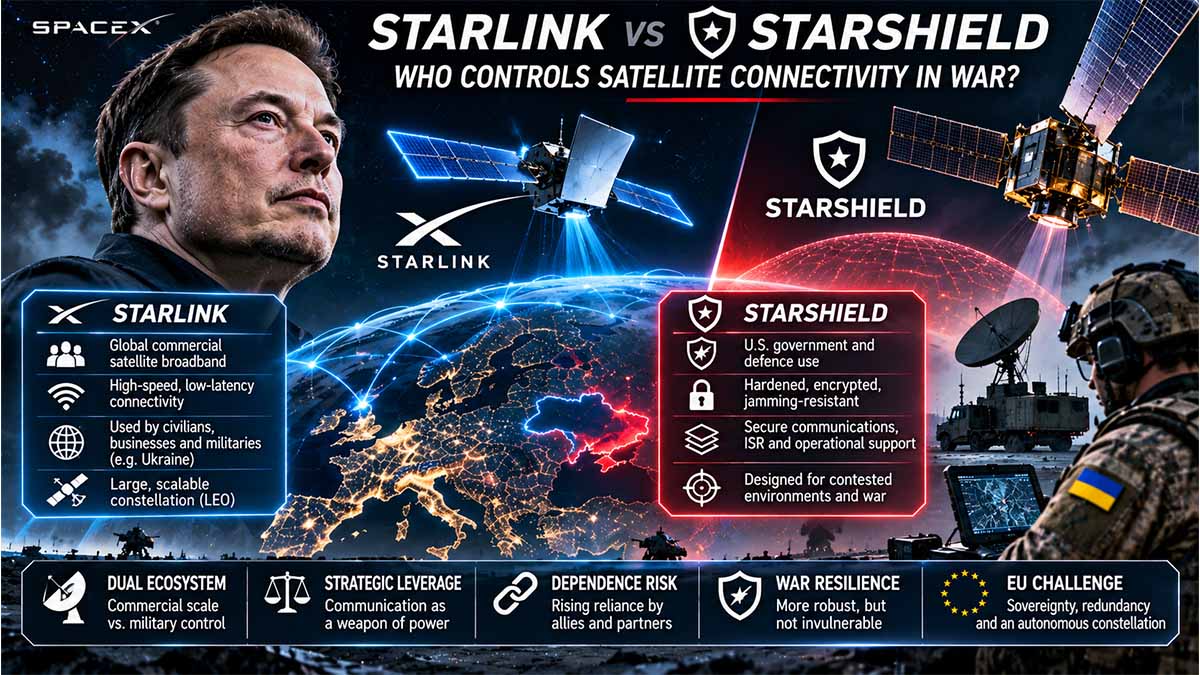
Strategic control, military command authority, commercial sovereignty and the emerging power to authorize or deny satellite connectivity in contested environments
Geographic scope: Ukraine, United States, Russia and relevant allied theatres, with separate European security implications. Period examined: February 2022–7 November 2026. Assessment horizon: 2027–2031.
Executive Summary — Bottom Line Up Front
The decisive distinction between Starlink and Starshield is not simply commercial versus military technology. It is the allocation of authority over network access, operational restrictions and continuity of service.
The verified record establishes that SpaceX retains substantial technical capability to implement network restrictions, while governments can exercise authorization and mission authority through regulatory processes, contracts and operational agreements. Neither ordinary terminal ownership nor military command of a connected unit automatically establishes control of the underlying satellite network.
Ukraine provides the most consequential documented example. On 4 February 2026, Starlink implemented restrictions requiring Ukrainian government approval for terminals operating within Ukraine. By 5 February, Ukrainian authorities reported that unauthorized Russian terminals had been blocked while approved terminals remained operational. In October 2026, Ukrainian authorities separately documented speed-related restrictions affecting Starlink/Starshield and their subsequent removal.
These incidents demonstrate two complementary realities: commercial infrastructure can enforce exclusion decisions with military consequences, and governments can exercise substantial influence over such decisions without owning the constellation.
The principal risk for national security authorities is therefore dependency without assured control: a military organization may possess communications terminals, purchase subscriptions and direct missions while relying on another actor to maintain operational connectivity.
Overall assessment: High confidence in the existence of distributed governmental and provider control; moderate confidence concerning the precise allocation of operational authority under non-public Starshield arrangements.
Starlink, Starshield and the New Sovereignty of War: Who Really Controls Military Communications?
The decisive question in modern warfare is no longer simply who owns the satellites, but who has the authority to keep military communications operating when governments and technology providers disagree. Ukraine’s February 2026 restrictions on Starlink terminals exposed a structural contradiction at the centre of Western defence policy: armed forces can command their operations, purchase communications equipment and finance connectivity without independently controlling access to the network. SpaceX’s Starlink and government-oriented Starshield services occupy different contractual positions, but neither product designation alone establishes sovereign control. The consequences extend beyond the Ukrainian battlefield to American defence procurement, European industrial autonomy and NATO interoperability. For governments investing billions in satellite infrastructure, the critical distinction is between buying connectivity and securing legally enforceable, technically executable rights to maintain it during conflict.
1. Ukraine demonstrated that access can be denied without destroying a satellite
On 4 February 2026, Starlink confirmed that terminals operating in Ukraine required authorization through a Ukrainian government whitelist. The measure followed a decision announced by Ukraine’s Ministry of Defence on 2 February to counter unauthorized Russian employment of Starlink equipment, including terminals reportedly installed on unmanned aerial systems. By 5 February, Ukrainian authorities reported that Russian terminals had been blocked while approved Ukrainian equipment remained operational.
The institutional significance exceeded the immediate military objective. Ukraine determined which terminals were authorized, while SpaceX implemented the restriction through its network. The government exercised authority over eligibility without acquiring ownership of the constellation or independent control of its technical administration. SpaceX retained responsibility for enforcing the decision without thereby acquiring authority over Ukrainian military operations.
The mechanism also exposed a vulnerability for legitimate users. Ukrainian authorities initially operated daily whitelist updates and warned that registration could take up to 48 hours to become effective. Personally owned military terminals could remain outside government property inventories while still requiring official authorization. Physical possession, subscription payment and permission to receive service had become separate conditions.
The system demonstrated selective exclusion, but the public record does not establish the total number of Russian terminals disconnected or the aggregate battlefield effect. The distinction matters: an officially reported successful restriction is not equivalent to an independently measured collapse in adversary communications.
A second episode reinforced the operational significance of provider-administered settings. On 24 October 2026, Ukraine’s Ministry of Defence reported restored Starlink and Starshield connectivity at movement speeds exceeding 400 kilometres per hour, following earlier restrictions. The figure described terminal movement, not data-transfer capacity. The ministry did not publicly identify who had originally ordered the restrictions.
Together, the two developments established a consequential reality: satellite networks can remain physically intact while administrative authorization and operating parameters determine whether particular military applications remain usable.
2. The $13 billion procurement ceiling is not $13 billion of sovereign capability
SpaceX’s distinction between Starlink and Starshield is substantive. Commercial Starlink services operate under published acceptable-use restrictions, including limitations affecting military activities and remotely operated unmanned vehicles unless specifically authorized. Starshield targets government national security requirements across communications, Earth observation and hosted payloads, with additional security capabilities advertised by the company.
Yet the description of a service as government-focused does not establish that the purchasing government controls spacecraft operations, terminal admission, geographic restrictions or emergency restoration. Those rights depend on the particular agreement.
The financial architecture of American procurement demonstrates the scale of the policy shift and the limits of interpreting headline figures. In July 2023, Space Systems Command awarded proliferated low-Earth-orbit service framework contracts to 16 companies, initially establishing an aggregate ceiling of $900 million. By 2025, the framework had expanded to 20 vendors and an aggregate ceiling of $13 billion.
That amount represents potential purchasing authority across multiple suppliers, not expenditure already incurred, money transferred to SpaceX or operational Starshield capacity delivered to the armed forces.
The distinction is equally important in Ukraine. On 29 August 2025, the United States Defense Security Cooperation Agency announced approval of a possible $150 million Foreign Military Sale covering satellite communications services and associated support, with Starlink Services identified as the principal contractor. The notification did not establish that the entire amount had been spent or that the proposed services had been fully delivered.
Poland provided another financing channel. In January 2025, its Ministry of Digital Affairs announced 5,000 additional Starlink terminals, with the first 2,600 expected toward the end of that month, alongside a prospective agreement of approximately PLN 113 million for continued subscription support through September 2025.
These figures describe different financial instruments: American multivendor procurement authority, a proposed defence sale and Polish equipment and subscription financing. They cannot be aggregated as a single spending program. More importantly, none independently establishes who can authorize a terminal, reverse a restriction or compel restoration during combat.
The economic question is therefore not merely the price of satellite connectivity. It is the cost of obtaining continuity rights, technical integration and alternative services capable of sustaining military operations when one network becomes unavailable.
3. Military command and network control operate under different authorities
The central institutional contradiction is that a military commander can possess lawful authority over a mission without controlling the infrastructure carrying its communications. A commercial network operator can administer access, implement technical restrictions and maintain the system while remaining outside the military chain of command.
The United States Government Accountability Office’s March 2025 satellite communications assessment described the Department of Defense’s transition toward an integrated architecture combining military-owned and commercial capabilities. Its findings identified interoperability, acquisition oversight and organizational coordination as continuing challenges.
The Department’s procurement structure already separates important functions. The Commercial Satellite Communications Office purchases commercial services, military organizations establish operational requirements and manage relevant equipment, while other defence institutions perform acquisition, integration and space-operation responsibilities. The existence of these institutions does not automatically produce one authority capable of resolving every urgent network decision.
Commercial dependence consequently has several dimensions. A government may hold a valid contract but depend on a provider to execute an emergency change. It may own terminals but require separate geographic authorization. It may protect its information through government-controlled encryption while relying on external infrastructure for transmission. It may have legal remedies for service interruption that arrive after the relevant military operation has ended.
The American response reflects this problem. The United States Space Force Commercial Space Strategy of April 2024 established balance, interoperability, resilience and responsible conduct as organizing principles. Its objective was not the unconditional replacement of military networks with commercial systems, but the integration of different capabilities without creating excessive dependence on one solution.
The Commercial Augmentation Space Reserve was intended to prepare additional commercial capacity for emergencies. However, the GAO reported in March 2025 that the relevant office had not yet concluded commercial satellite communications contracts under that initiative at the time of its audit.
The distinction between a reserve framework and usable reserve capacity is decisive. Contracting authority does not automatically generate terminals, compatible security systems, available bandwidth or trained operators.
4. Europe is acquiring legal sovereignty faster than operational independence
The European response differs because it increasingly seeks to establish governmental rights through legislation, ownership and dedicated infrastructure.
Regulation (EU) 2023/588 established the Union Secure Connectivity Programme, distinguishing governmental infrastructure from commercial infrastructure. Its provisions assign the European Union ownership of defined governmental assets, establish relevant service-priority rights and require participating authorities to manage governmental user authorization.
This is a stronger legal foundation for public control than an ordinary commercial satellite subscription. It is not, however, proof that the corresponding infrastructure is already available to military users.
The European Commission reported that initial GOVSATCOM services became operational in January 2026, pooling governmental satellite capacity through an institutional framework involving the Commission and the European Union Agency for the Space Programme.
The larger IRIS² program remains a different proposition. Following an implementation agreement announced on 7 August 2026, its planned principal constellation increased to 348 satellites: 330 in low Earth orbit and 18 in medium Earth orbit. Initial launches were targeted for 2029, while projected secure governmental capacity increased by 60% within the European Union and 54% worldwide relative to the earlier design.
Those percentages are projected improvements, not measured capacity delivered to European armed forces in 2026. A legal entitlement to a future communications service cannot replace an existing military link until the required infrastructure, terminals, security systems and operating procedures are deployed and tested.
The industrial implications differ across Europe. Italy’s participation through companies including Telespazio creates opportunities in the secure-connectivity supply chain, but industrial participation does not itself confer independent national control over European orbital infrastructure. France benefits from Eutelsat’s role in the SpaceRISE consortium, while Germany participates through industrial and telecommunications companies including OHB and Deutsche Telekom. In each case, manufacturing or service integration must be distinguished from sovereign authorization and operational command.
The United Kingdom follows a more diversified model. Its SKYNET 6 military satellite communications program involves more than £5 billion over ten years, combining dedicated military capabilities with contracted services. The existing SKYNET 5 architecture includes four satellites, while SKYNET 6A was scheduled, under the August 2025 program baseline, for launch in 2027.
London also holds a 10.89% stake in Eutelsat, confirmed in January 2026, alongside special national security-related rights associated with OneWeb. Eutelsat completed a €1.5 billion capital increase in December 2025.
These arrangements create several instruments of governmental influence: dedicated infrastructure, procurement rights, corporate participation and reserved security powers. They do not establish that Britain independently operates every component of the associated commercial networks.
For European governments, the strategic problem is therefore temporal as well as industrial. They must secure reliable connectivity through available commercial and allied infrastructure while financing systems intended to reduce future dependence.
5. The ability to restrict intelligence data is becoming another form of state power
The sovereignty question extends beyond broadband communications.
In its August 2026 report, the United States GAO documented an unidentified commercial Earth-observation company that restricted customer orders for imagery of the Middle East in February 2026, citing protection of American military interests. In March, the company worked with the National Reconnaissance Office’s Commercial Systems Program Office to modify restrictions affecting access and publication.
The company was not identified as SpaceX. The case nevertheless demonstrates that commercial space capabilities can be constrained through information-access decisions even when satellites remain operational.
The same GAO report identified uncertainty over licensing, redistribution and long-term access to commercial space data. Between 27 January 2023 and 30 September 2025, the Space Force purchased $123.9 million in services through the Global Data Marketplace. Of that amount, $76.8 million, approximately 62%, was attributable to the Joint Commercial Operations Cell. By July 2026, the marketplace contained 319 participating vendors.
These figures concern commercial space data and services, not Starshield communications spending. Their importance lies in the institutional dependence they reveal. A government may purchase intelligence data without automatically acquiring unrestricted rights to retain it, redistribute it among allies or use it indefinitely in artificial intelligence applications.
The implications for Starshield’s Earth-observation and hosted-payload offerings are substantial, although the public record does not establish the terms of individual contracts. The ability to collect, transport, process and disseminate information can be divided among different organizations. A government may control the mission while lacking unrestricted rights over every supporting data product or processing service.
Consequently, communications sovereignty and intelligence sovereignty must be assessed together. Securing the transmission channel does not resolve the legal or operational restrictions governing the information carried through it.
6. Over the next 24 months, dependency will become a procurement liability
Between November 2026 and November 2028, the immediate burden will fall on defence ministries, contracting authorities and military communications commands that must guarantee operational continuity before new sovereign infrastructure becomes available.
The alternatives are not equivalent. Governments can renegotiate service terms, establish emergency authorization procedures and conduct interoperability exercises without constructing new constellations. Deploying independent space infrastructure requires substantially greater capital commitments and longer implementation schedules. The European timetable for IRIS², with first launches targeted for 2029, makes that distinction unavoidable.
Three risks will shape the next procurement cycle: selective denial of otherwise functioning terminals, changes in operating conditions affecting military applications, and the failure of nominally available backup networks to support actual missions. Cybersecurity adds another dependency, as recognized in the March 2022 CISA–FBI satellite communications advisory and subsequent American oversight findings.
The relevant standard is whether a government can identify the authority responsible for a restriction, enforce its contractual rights, obtain timely restoration and transfer essential traffic to an independent alternative. Purchasing additional terminals from the same provider may expand capacity without resolving any of those questions.
The fiscal cost of inaction will fall on governments forced into emergency procurement, duplicated integration work and unplanned continuity expenditure. The industrial cost will fall on defence manufacturers and telecommunications suppliers required to adapt equipment to competing architectures without predictable procurement requirements. The operational cost will fall on armed forces whose communications remain dependent on access decisions they cannot independently execute.
The strategic distinction between Starlink and Starshield is ultimately a distinction between the service a state purchases and the authority it actually secures. The next 24 months will determine whether Western defence procurement converts commercial connectivity into enforceable military capability or continues financing networks whose availability is not fully aligned with sovereign command.
Navigational Index
Pillar I — Architecture, Contracts and Operational Evidence
Chapter 1. Key Judgments
Chapter 2. Technical and Contractual Overview
Chapter 3. Case Study: Ukraine, 2022–2026
Pillar II — Sovereignty, Decision Rights and Strategic Competition
Chapter 4. Authority and Control Analysis
Chapter 5. Strategic Implications
Chapter 6. Analysis of Competing Hypotheses
Pillar III — Resilience, Escalation and Intelligence Priorities
Chapter 7. Resilience Requirements
Chapter 8. Future Risks, Indicators and Warnings
Chapter 9. Gaps and Collection Recommendations
Chapter 10. Source Evaluation Appendix
Master Abstract
The incorporation of commercially developed low-Earth-orbit satellite networks into military operations has created an authority structure that conventional military communications doctrine does not fully describe. A state may direct combat operations, authorize terminal deployment, purchase communications services and own its equipment without necessarily holding unilateral authority over satellite admission, traffic policies, software changes, geographic restrictions or service restoration. The reverse distinction is equally important: a company may operate the technical infrastructure without possessing legitimate authority to determine the objectives of a government’s military operations. In practice, control is distributed across the state conducting the mission, the telecommunications provider, the contracting authority, the licensing jurisdiction and, in some circumstances, allied governments that finance or sponsor connectivity.
Starlink and Starshield represent different contractual and security arrangements built on related SpaceX technologies. Starlink is primarily a commercial connectivity product, including government civil-service offerings, while Starshield is designed for national security requirements involving communications, Earth observation and hosted payloads. Public documentation does not establish that all Starshield services use entirely separate orbital infrastructure, that every government customer enjoys identical control rights, or that a military contract transfers full technical administration to the purchasing state. The evidence instead supports a variable-control model in which contractual mission authority and technical network operations must be evaluated separately.
The February 2026 Ukrainian terminal authorization system is particularly revealing because the government defined the authorization policy and SpaceX implemented service eligibility. The subsequent October 2026 restoration of speed-sensitive connectivity illustrates the consequences of operational restrictions and the importance of governmental negotiation. Taken together, these events establish that connectivity is not merely a delivered military capability: control of access is itself an instrument of strategic power. The central requirement for governments is consequently to transform provider dependence into enforceable, testable and operationally survivable arrangements rather than assume that service procurement confers sovereign control.
1. Key Judgments
– KJ-1 — High confidence: Starlink and Starshield have different intended markets, security capabilities and contractual frameworks, but their technical relationship does not establish identical government control rights across all deployments.
– KJ-2 — High confidence: On commercial Starlink services, SpaceX retains consequential network-operating authority, including the technical ability to enforce access restrictions, geographic eligibility and service suspension under applicable agreements.
– KJ-3 — High confidence: The February 2026 Ukrainian verification system demonstrates an implemented form of dual control: Ukraine determined government authorization, while Starlink enforced terminal eligibility across its network.
– KJ-4 — Moderate confidence: Starshield arrangements can provide governments with substantially greater mission-specific contractual authority, although publicly available documents do not establish that every Starshield customer possesses unilateral network-operating authority.
– KJ-5 — High confidence: Military ownership or possession of a terminal, responsibility for its subscription and operational command of the connected military unit are insufficient, independently, to guarantee continued access to satellite services.
– KJ-6 — High confidence: The October 2026 Ukraine restrictions and restoration demonstrate that mobility-dependent satellite connectivity is sensitive to network policies and that governmental engagement can materially influence operational outcomes.
– KJ-7 — Moderate confidence: In a future regional conflict, selective denial, authorization disputes or changes in service parameters could disrupt military command-and-control functions before any physical satellite losses occur.
– KJ-8 — High confidence: Contractually defined decision rights, independently tested fallback communications and diversified network access are essential safeguards against concentration of operational dependency.
2. Technical and Contractual Overview
Starlink: commercial connectivity under provider-administered rules
Established fact. Starlink is SpaceX’s satellite broadband service, supplying communications through a network of satellites, user equipment and associated ground and network-management infrastructure. Although government organizations can purchase commercial Starlink services, SpaceX explicitly distinguishes civil-government uses from military applications and identifies Starshield as its product for United States national defence requirements.
Starlink’s government procurement guidance states that commercial priority services may be suitable for civil agencies but that ordinary Starlink offerings are not intended for military end-users or military end-uses. Its acceptable-use policy restricts military activity and the remote operation of aerial drones unless specifically permitted through an appropriate contractual arrangement. Its published service terms also provide for suspension or termination under specified circumstances, including legal requests, security problems, prohibited use and regulatory requirements.
The relevant documents are Starlink — Government Procurement Guidance, Starlink — Acceptable Use Policy and Starlink — Terms of Service.
The significance of these restrictions is not that every military use of Starlink is prohibited. The published language leaves room for separately authorized arrangements. The decisive issue is that ordinary commercial procurement does not, by itself, establish permission for unrestricted military operations.
Assessment — High confidence. Commercial Starlink customers generally obtain defined communications services rather than independent authority over network admission, geographic policies or provider infrastructure. Government customers must therefore distinguish equipment ownership from the rights actually granted under their agreements.
Starshield: a national security architecture with different mission requirements
SpaceX describes Starshield as a secured satellite network designed for government entities, drawing on Starlink’s technology and the company’s launch capabilities. Its announced scope comprises three mission categories.
| Mission category | Published capability | Principal governmental application | Control issue |
|---|---|---|---|
| Communications | Government connectivity using Starshield user equipment | Military command, operational data transfer and secure communications | Who authorizes users, operates network controls and guarantees continuity |
| Earth observation | Satellites with sensing payloads and delivery of processed data | Intelligence collection, surveillance and reconnaissance | Who controls collection priorities, data access, dissemination and retention |
| Hosted payloads | Satellite platforms capable of integrating government mission payloads | Specialized national security missions and government sensors | Who owns the payload, commands the mission and administers the supporting platform |
Source: SpaceX — Starshield, Supporting National Security.
The company also advertises additional high-assurance cryptographic capabilities, modular satellite architecture and interoperability with laser-linked space networks. These are provider-declared capabilities and design features; the public material is insufficient to establish the exact classification accreditation, cryptographic architecture or configuration of each deployed government system.
A further distinction is important. Starshield should not automatically be understood as one physically isolated satellite constellation through which all military traffic is carried. The program describes multiple offerings, including communications services and spacecraft or payload capabilities. Different government contracts may purchase different elements, with differing network-operating and mission-control arrangements.
Assessment — Moderate confidence. Starshield’s government-oriented design permits more extensive national security integration than commercial Starlink, but the degree of sovereign control depends on the particular service, equipment, contract and operational command arrangements.
Procurement does not equal operational sovereignty
The distinction is reflected in the broader American acquisition model. The United States Government Accountability Office (GAO) reported in March 2025 that the Department of Defense uses both military-owned satellite communications systems and commercially procured services. The report describes a continuing effort to integrate these capabilities into hybrid architectures, while highlighting difficulties associated with interoperability, terminals, management systems and implementation progress.
A particularly significant distinction in the GAO analysis is that purchasing commercially developed satellites for government ownership can offer different rights from leasing satellite communications as a service. Government ownership may eliminate some usage restrictions associated with commercial capacity, although ownership alone does not resolve all operational dependencies. – GAO — DOD Satellite Communications: Reporting on Progress Needed to Provide Insight on New Approach — March 2025. Gao Files
The United States Space Force’s Commercial Satellite Communications Office procurement mechanisms likewise provide a means of purchasing commercial and government-tailored connectivity. SpaceX identifies the Proliferated Low-Earth-Orbit contracting framework as a principal procurement route for Starshield communications services.
Assessment — High confidence. National security communications procurement must be evaluated against the rights conveyed by a specific contract, not the provider’s description of the product as commercial, military, secure or assured.
Operational control points
The following table separates authority that can be attributed from the published record from authority whose exact allocation depends on a non-public arrangement.
| Control point | Commercial Starlink | Starshield / government arrangements |
|---|---|---|
| Terminal ownership | Customer or other legal owner, depending on procurement | Government, contractor or other authorized entity |
| Terminal admission | Provider-enforced under service rules and applicable government authorization | Contract-specific, potentially incorporating government authorization |
| User authentication | Provider-managed service framework | Government-specific security arrangements may apply |
| Satellite and network operations | SpaceX | Depends on the purchased architecture; provider may remain the operator |
| Geographic and mobility restrictions | Provider-enforced, subject to applicable rules and agreements | Contractual and operational allocation not fully public |
| Military mission selection | Outside the authority conferred by ordinary commercial service | Authorized military or government command |
| Cryptographic protection | Commercial service security and user-controlled protections where implemented | Additional government-oriented security capabilities advertised |
| Service restoration | Provider processes, potentially coordinated with authorities | Contract-specific priority, escalation and operational procedures |
| Emergency decisions | Published terms plus applicable legal obligations | Specific government decision rights must be established from the contract |
This distinction leads to a general finding: government mission authority can coexist with contractor-operated network infrastructure. Government users may possess the authority to decide what information must be transmitted, or which operation should be supported, without themselves administering the physical network through which the information travels.
Key official evidence
| Indicator | Verified value or status | Reference date | Definition and scope | Issuer | Source |
|---|---|---|---|---|---|
| Starshield mission areas | Three: communications, Earth observation, hosted payloads | Provider description reviewed Nov 2026 | Advertised program scope, not verified complete operational inventory | SpaceX | Starshield |
| Commercial military use | Restricted except where appropriately permitted | Terms reviewed Nov 2026 | General commercial contractual policy | Starlink | Acceptable Use Policy |
| US military SATCOM models | Government-owned systems and commercial services | March 2025 | Department of Defense architectural assessment | GAO | GAO-25-107034 |
| Commercial data and services governance | Access during conflict and integration into exercises remain important requirements | August 2026 | United States national security space procurement | GAO | GAO-26-107959 |
| Ukraine authorization regime | Government whitelist required for operating terminals | 4 February 2026 | Terminals operating within Ukraine | Starlink | Ukraine Service Restrictions |
| Ukraine mobility performance | Restoration reported above 400 km/h | 24 October 2026 | Reported motion speed at which connectivity remained stable; not bandwidth | Ukrainian Ministry of Defence | Restoration Notice |
3. Case Study: Ukraine
2022–2025: the formation of strategic dependency
Ukraine’s experience began as an emergency communications problem and evolved into a question of state authority over essential wartime infrastructure.
Following Russia’s February 2022 full-scale invasion, Starlink provided an important means of maintaining connectivity when terrestrial infrastructure was damaged, disrupted or threatened. Ukrainian authorities subsequently integrated satellite services into civilian communications, governmental continuity and military operations.
The Ukrainian government’s February 2026 retrospective explicitly credited SpaceX’s early activation and delivery of terminals with supporting civilian communications, military coordination and emergency services. This is an official Ukrainian assessment of Starlink’s contribution, not a quantified measure of its share of military traffic.
The financing structure demonstrates how many actors can become involved in maintaining access to one provider’s network.
In January 2025, Poland’s Ministry of Digital Affairs discussed support for an additional 5,000 Starlink terminals and a proposed agreement valued at almost PLN 113 million to continue subscription financing through 30 September 2025. A subsequent Polish ministry statement confirmed Poland’s undertaking to cover subscriptions for terminals loaned to Ukraine during 2022–2024 and finance the additional 5,000 terminals then being delivered.
These figures concern identified Polish support commitments and do not represent the total cost of Ukrainian Starlink operations or the total value of all international satellite communications assistance. – Sources: Polish Ministry of Digital Affairs — Polish-Ukrainian Cooperation on Satellite Communications — January 2025 and Polish Ministry of Digital Affairs — Strengthening Digital Cooperation — 2025.
The strategic implication is that paying for terminals, funding subscriptions, owning terminal hardware and controlling the network are four different functions.
Assessment — High confidence. The Ukrainian model developed into a multilateral dependency involving Ukraine as operational user, allied governments as equipment or subscription sponsors, and SpaceX as the essential provider of network connectivity.
February 2026: a change in the access-control regime
The most decisive documented event occurred between 1 and 5 February 2026.
On 1 February, the Ukrainian Ministry of Defence announced work with Starlink to establish a system allowing only authorized terminals to operate within Ukraine.
On 2 February, the ministry reported that the Cabinet of Ministers had adopted the relevant resolution establishing a whitelist. According to the ministry, the immediate security problem was the use of Starlink terminals by Russian forces, including terminals mounted on drones.
On 4 February, Starlink’s own published service notice made Ukrainian government whitelist approval a condition of operating a terminal within Ukraine.
By 5 February, the Ukrainian Ministry of Defence reported that the first authorized terminals were working while terminals used by Russian forces had been blocked.
The sequence is supported by both the Ukrainian government’s implementation notices and SpaceX’s directly published restriction notice. – Ukrainian Ministry of Defence — Ukraine and Starlink to Roll Out Terminal Authorization System — 1 February 2026. – Ukrainian Ministry of Defence — Ukraine Rolls Out Starlink Terminal Verification — 2 February 2026. – Starlink — Update on Starlink Service in Ukraine — 4 February 2026. – Ukrainian Ministry of Defence — Starlink Terminals on the Whitelist Remain Operational — 5 February 2026.
How the verification system worked
The Ukrainian procedure introduced a distinction between governmental authorization and technical enforcement.
Military users were instructed to submit terminal information through the DELTA system or other designated military channels. Civilian users were directed toward Administrative Service Centers, while businesses were assigned an online verification route through Diia.
The registration process relied on terminal-identifying information, including equipment or user terminal identifiers. Importantly, Ukrainian military personnel were told that personally owned terminals did not need to be transferred onto military unit balance sheets and that account credentials did not have to be supplied merely to complete military whitelist registration.
The procedure also introduced an important operational limitation: the whitelist initially operated through batch updates, with the ministry communicating a processing period of up to 48 hours for certain registrations. The ministry acknowledged that a terminal could remain blocked after its information had been submitted, pending processing. – Ukrainian Ministry of Defence — Countering Russian Drones: How to Complete Starlink Verification — 2 February 2026. – Ukrainian Ministry of Defence — Commanders Urged to Verify Starlink Terminals — 4 February 2026. – Ukrainian Ministry of Defence — Frequently Asked Questions on Starlink Verification — 5 February 2026.
This is a consequential distinction. The government could decide whether a terminal was eligible without necessarily owning the equipment, knowing its account credentials or directly operating the satellite network. Conversely, a physically functional terminal could lose connectivity because it lacked the required authorization.
Starlink’s published support guidance explicitly attributes authorization decisions in Ukraine to the Ukrainian government and describes Starlink as the actor implementing them. – Starlink — Why Has My Starlink Service Been Restricted or Disabled in Ukraine?.
Assessment — High confidence. The February system demonstrates practical separation between an authorization authority and a network enforcement authority, with neither function independently sufficient to explain continued access.
What the blocking of Russian terminals establishes
The Ukrainian government reported that unauthorized terminals, including those used by Russian forces in occupied territory, were disconnected. The provider’s own policy confirms that terminals without government authorization cannot receive service in Ukraine.
The results support three findings.
First, terminals can be subject to a network-enforced eligibility regime that is distinguishable from their physical possession.
Second, a government and provider can coordinate selective access policies across a contested territory, even when unauthorized users have obtained the underlying equipment.
Third, the same mechanism that excludes an adversary creates a dependency for friendly users: an approved terminal must remain correctly registered and subject to effective enforcement to receive service.
However, the publicly accessible official evidence does not establish the exact number of Russian-operated terminals disabled, the completeness of the blocking measure, the internal SpaceX commands used, or the proportion of Russian battlefield communications affected.
The Ukrainian government’s operational claims establish its reported outcome. They do not independently prove a comprehensive denial of all Russian satellite connectivity.
Assessment — High confidence that the authorization regime blocked at least a reported class of unauthorized Russian users; moderate confidence regarding the scale and enduring operational effects.
October 2026: mobility restrictions and subsequent restoration
A second, distinct development occurred in October 2026.
On 24 October, the Ukrainian Ministry of Defence announced that its monitoring systems were recording restored Starlink/Starshield connectivity at movement speeds exceeding 400 kilometres per hour, following earlier operational restrictions. It attributed the result to high-level engagement and emphasized the importance of satellite communications for drones, logistics and battlefield communications. Ukrainian Ministry of Defence — Starlink and Starshield Speed Restored in Ukraine — 24 October 2026. MoD News
This reported figure is a terminal movement speed, not a broadband transmission rate. It must not be interpreted as 400 Mbps of network capacity.
The announcement is significant because it identifies a service parameter affecting moving platforms rather than merely ordinary fixed-terminal subscription eligibility. In mobility-dependent military systems, restrictions tied to movement can have operational consequences even if some stationary or slower-moving links remain available.
The announcement does not publicly establish who initially ordered the restriction, whether it arose from a unilateral provider decision, a government instruction, a contractual interpretation or a security safeguard. Nor does it establish that the same mechanism affected every Starlink and Starshield configuration.
Assessment — High confidence that restrictions and restoration occurred as officially reported; low confidence in any attribution of the initial decision to a particular actor without additional documentary evidence.
The October episode strengthens the overall conclusion: in contested environments, the capacity to adjust network operating conditions can be militarily consequential without any satellite being physically destroyed.
4. Authority and Control Analysis
Military mission authority
Military mission authority concerns the lawful power to define operational objectives, deploy forces, authorize activities, allocate military resources and determine how communications support a mission.
A military commander may legitimately direct the movement of a drone, the transmission of intelligence, the establishment of a command post or the exchange of operational information. Such authority arises from military command arrangements and applicable national and international law.
It does not automatically include the right to compel an external commercial company to maintain a particular telecommunications service under all circumstances.
The distinction is especially important when a military organization purchases commercial communications capacity. It may command every connected soldier and own every deployed terminal without exercising technical administration over satellite admission or the commercial network’s operating policies.
Assessment — High confidence. Military mission authority and satellite network-operating authority are legally and functionally distinct, even when the communications service is indispensable to the operation.
Network operating authority
Network operating authority concerns the practical ability to administer the communications system itself. Relevant control functions include authorization and deauthorization of terminals, enforcement of geographic restrictions, management of network service parameters, maintenance of network infrastructure, security updates and restoration of disrupted access.
The precise division of these functions is architecture-specific. A government-operated satellite system may allocate them to military personnel, while a service purchased from a commercial constellation may leave substantial technical functions with the provider.
The GAO’s March 2025 examination of American satellite communications identifies the continuing importance of integrating commercial and military systems, including the management architecture needed to connect multiple services. – GAO — DOD Satellite Communications — March 2025.
Assessment — High confidence. The actor capable of implementing or reversing a service restriction possesses a form of operational leverage that cannot be inferred solely from equipment ownership, network encryption or mission command.
The role of the provider
The provider occupies a dual position. It is a commercial contracting party, but it is also the technical organization responsible for delivering services through infrastructure that may have become essential to military operations.
Three categories of provider control must be distinguished.
Contractual control arises from service conditions and contractual provisions governing acceptable use, permitted customers, suspension, performance and termination.
Technical control arises from administering the infrastructure and software through which access is delivered or restricted.
Institutional influence arises from the practical difficulty of replacing the service, the provider’s knowledge of its network and the contracting government’s dependence on the provider’s implementation capabilities.
These categories do not necessarily give the provider a legitimate right to select military objectives. Nor do they establish that a provider can disregard binding government contracts or applicable law. They identify different sources of influence over whether the military can receive the communications service it needs.
The role of host governments and contracting governments
The February Ukrainian system shows that the territorial government can become a significant actor in determining which users receive service. Ukraine established an authorization framework, and SpaceX enforced its consequences through network access controls.
A separate question concerns the government that contracts for, funds or legally regulates a service. In this case, the provider is a United States company subject to relevant American law, while Ukraine is the state conducting the military operations and foreign partners may finance some equipment or subscriptions.
These roles are not interchangeable. Territorial authorization, export-control jurisdiction, procurement authority and military mission command can reside in different institutions.
The resulting control arrangement depends on whether these authorities are compatible and whether there are effective procedures for resolving disagreement.
Authority matrix
| Actor | Mission authority | Eligibility authority | Technical enforcement | Main limitation |
|---|---|---|---|---|
| Military operational command | Directs authorized operations | Determines operational need; may nominate users | Limited unless specifically delegated | Does not automatically operate provider infrastructure |
| Territorial government | Domestic security and regulatory authority | May define authorized local users | Often depends on provider cooperation | Cannot assume independent control of a foreign-operated constellation |
| Contracting defence authority | Defines procurement and contractual mission requirements | According to negotiated rights | According to architecture and contract | Classified or unpublished provisions limit external assessment |
| SpaceX / network operator | Does not acquire military command authority through service provision | Provider policy and contract-specific roles | Substantial for provider-operated networks | Subject to contracts, legal obligations and government requirements |
| Financing allied government | Determines its assistance commitments | Potentially through procurement arrangements | Generally indirect unless contractually provided | Financial sponsorship does not establish network control |
| Adversary possessing unauthorized equipment | Directs its own attempted use | No legitimate authorization merely from possession | No established network administration | Subject to authentication, denial and technical restrictions |
Analytical conclusion — High confidence. Connectivity control is best understood as a collection of separately allocable decision rights, not a single property attached to the terminal, constellation or contracting government.
5. Strategic Implications
Connectivity as a military capability versus access as strategic power
A telecommunications network is conventionally evaluated according to coverage, capacity, latency, availability, security and resilience. In contested military environments, an additional measure is necessary: the degree to which the operating state can guarantee continued lawful access when its mission requirements become politically or commercially sensitive.
This introduces an important distinction between connectivity as capability and control of connectivity as strategic power.
Connectivity as capability allows military forces to exchange information, maintain distributed command and exploit remote sensors or connected platforms. Control of connectivity determines which actors may access that capability, under what conditions and for how long.
The February Ukrainian experience demonstrates the distinction directly. The physical satellite equipment did not need to be destroyed for unauthorized users to lose service. Access authorization was sufficient to determine whether particular terminals could continue operating.
The October episode demonstrates a related but different mechanism: operating parameters governing mobile connectivity can matter to military systems even when the underlying satellite network remains functional.
Assessment — High confidence. Access policies and network operating parameters constitute militarily relevant control points alongside physical satellites, terminals and terrestrial ground infrastructure.
From single-provider reliance to strategic vulnerability
Reliance on one commercial network can generate operational advantages, particularly when it supplies rapidly deployable connectivity across a broad area. However, the same concentration creates correlated exposure.
A service interruption can affect multiple military functions if those functions depend on the same provider, contractual authority or authorization database. A state may have redundant terminals but still lack meaningful network redundancy.
This risk is amplified when communications are used across both civilian and military infrastructure. Emergency services, civil administration, critical infrastructure operators and military units may compete for support or face overlapping consequences from network restrictions.
The appropriate measure of resilience is therefore not simply the number of terminals held by a government. It is the ability to continue the required mission when a network becomes unavailable, when government authorization systems fail, when service parameters change or when the provider cannot implement an urgent request.
The distinction between Starlink and Starshield as a security issue
A government-oriented network can reduce some risks associated with ordinary commercial terms by establishing mission-specific requirements, enhanced security mechanisms and contractual obligations.
However, additional security and contractual assurances should not be confused with an automatic transfer of technical control. A service may be encrypted to a government-approved standard while its physical transport and service-administration functions remain contractor-operated.
Likewise, government payload ownership does not automatically mean the government independently operates the communications links or spacecraft supporting that payload.
This distinction is particularly important for Starshield Earth-observation and hosted-payload missions, where collection authority, spacecraft operation, data handling and dissemination may be separately allocated.
Assessment — Moderate confidence. Government-tailored procurement can materially reduce uncertainty over mission permissions and priorities, but residual reliance on contractors and shared technological infrastructure will remain consequential unless expressly addressed in the operating architecture.
National and alliance implications
United States. The United States has the most direct institutional tools to shape relationships with an American provider, including procurement, national security contracting, industrial policy and applicable regulation. Nevertheless, access to these mechanisms does not prove government ownership or direct operation of every Starshield asset. The GAO has explicitly identified integration and governance challenges as the military expands its use of commercial satellite capabilities.
In August 2026, the GAO again emphasized the importance of contracts ensuring access to commercial space services during conflict and the integration of these capabilities into military exercises before emergencies occur. – GAO — National Security Space: DOD Has Opportunities to Improve Its Use of Commercial Data and Related Services — August 2026. Gao Files
Ukraine. Ukraine demonstrates the effectiveness of government-provider cooperation but also the limits of external network dependence. The state secured a consequential role in authorizing terminals without acquiring the constellation. Its experience shows that such cooperation can be operationally valuable, while its October 2026 announcement establishes the importance of continuing high-level engagement over service restrictions.
Russia. The February 2026 case establishes that Russian forces had reportedly obtained and used Starlink terminals despite not being legitimate beneficiaries of the Ukrainian authorization regime. It also demonstrates that the subsequent restrictions were intended to deprive these forces of that access. The official public record does not establish the completeness of Russian alternatives or their performance following the restrictions.
Italy. The principal implication is the need to assess military and civil-protection satellite communications at the level of guaranteed service, operational authorization and fallback capability rather than terminal availability alone. Italy is also directly relevant to European sovereign-connectivity development because the European Union’s IRIS² architecture includes governmental control infrastructure in Italy.
France. France has a direct industrial and institutional interest in European secure-connectivity alternatives through its space industry and the participation of French-connected satellite and technology companies in the European consortium. The strategic question is whether European governmental services can deliver not only independent coverage but enforceable public-sector access and command arrangements.
Germany. Germany’s industrial and telecommunications role in European space infrastructure makes interoperability, secure terrestrial gateways and defence procurement integration central issues. Its dependence exposure cannot be quantified without a verified inventory of relevant German military and governmental contracts.
United Kingdom. The British government provides a documented alternative model through its interest in Eutelsat and the associated national-security rights concerning OneWeb. Its January 2026 response to a parliamentary report described a 10.89% government stake in Eutelsat, national-security-related rights and a commitment to priority government access in relevant OneWeb service contracts.- UK Government — Response to the House of Lords UK Engagement with Space Committee — January 2026. GOV.UK
This does not establish that OneWeb is operationally equivalent to Starlink in every military mission or that the British government possesses unrestricted technical authority over its network. It does show the use of investment, national-security rights and procurement arrangements to address strategic dependence.
European Union. The EU’s IRIS² initiative represents a longer-term effort to develop secure European satellite connectivity. Its trajectory must be distinguished from currently available operational alternatives.
On 7 August 2026, European institutions reported an implementation agreement expanding the planned main constellation to 348 satellites, with first launches targeted from 2029. The revised configuration includes 330 low-Earth-orbit satellites and 18 medium-Earth-orbit satellites, with additional optional elements. These are program parameters, not proof of an already deployed replacement for Starlink. European Union Agency for the Space Programme — Commission Accelerates IRIS² Deployment — August 2026. EU Agency for the Space Programme
Assessment — High confidence. European strategic autonomy requires both near-term commercial diversification and longer-term contractual and infrastructure arrangements that make governmental access predictable. A future European constellation does not, by itself, eliminate current dependencies.
6. Analysis of Competing Hypotheses (ACH)
Hypothesis definitions
The four hypotheses evaluate the location and practical consequences of control in contested environments. They are partially overlapping propositions, not mutually exclusive theories of a single decision-maker. The purpose of the exercise is to identify evidence that discriminates between pure provider control, effective government authority, adversary exploitation and distributed control, rather than force a misleading exclusive explanation.
H1 — Commercial provider predominance. The provider retains the decisive practical authority over network access because it operates the underlying infrastructure.
H2 — Government-directed control. Host or contracting governments can effectively assert control through negotiated arrangements, verification requirements and enforceable authorization procedures.
H3 — Adversarial exploitation. Unauthorized actors can exploit commercially distributed equipment, service limitations or gaps in verification to obtain communications access.
H4 — Dual or contested control. Governments and providers possess different but consequential decision rights, and the interaction between them can generate operational uncertainty.
ACH evidence matrix
| Diagnostic evidence | H1: Provider predominance | H2: Government-directed | H3: Adversarial exploitation | H4: Dual / contested |
|---|---|---|---|---|
| Commercial terms permit suspension and restrict uses | Strong support | Does not establish government control | Compatible | Strong support |
| Ukraine defined the February 2026 whitelist requirement | Weakens exclusive provider control | Strong support | Response to exploitation | Strong support |
| Starlink technically enforced Ukrainian terminal eligibility | Strong support for enforcement capability | Supports implementation of government authority | Weakens adversary access | Strong support |
| Russian forces reportedly used unauthorized terminals before blocking | Not diagnostic alone | Shows prior authorization gap | Strong support | Compatible |
| Ukraine reported successful Russian terminal blocking | Compatible | Strong support | Weakens sustained exploitation | Strong support |
| Starshield offered through government-specific procurement | Weakens universal commercial-terms explanation | Supports potentially greater government authority | Not diagnostic | Strong support |
| October 2026 restrictions followed by restoration | Supports external enforcement influence | Government engagement influenced outcome | Not diagnostic | Strong support |
| Government-specific Starshield decision rights remain non-public | Prevents universal conclusion | Prevents universal conclusion | Not diagnostic | Maintains unresolved authority allocation |
The matrix describes the direction of evidence, not a numerical likelihood calculation. It does not assign invented weighting or treat evidence that supports multiple hypotheses as automatically discriminating.
H1 — Primary control remains with the commercial provider
Supporting evidence. Starlink’s published commercial terms provide the company with service-administration and suspension powers under specified conditions. Its February 2026 Ukraine notice confirms that access decisions were enforced through Starlink service controls. The company operates the underlying commercial network.
Disconfirming evidence. In Ukraine, the government defined the authorization requirement. Starlink’s own guidance states that the Ukrainian government determines terminal eligibility and that the provider implements the government’s decisions.
Standing: Partially supported — High confidence.
The proposition accurately describes substantial technical operating authority. It is insufficient as a universal explanation of government-provider control, particularly where a state has obtained an explicit authorization role.
H2 — Governments can effectively assert control through contracts and verification
Supporting evidence. Ukraine established an authorization system, registered approved terminals through official channels and obtained the implementation of selective restrictions. Starshield government procurement also creates the possibility of stronger contractual authority than commercial subscription arrangements.
Disconfirming evidence. The Ukrainian process still required SpaceX’s technical implementation. The public record does not show that Ukraine acquired independent authority to operate the constellation or administer every network function.
Standing: Strongly supported for terminal authorization, but not established for complete network control — High confidence for the former, moderate confidence for the wider proposition.
The critical distinction is between successfully directing a network action through an agreed procedure and possessing the independent technical capacity to perform that action.
H3 — Adversaries can exploit commercial or technical gaps
Supporting evidence. The Ukrainian government documented the use of Starlink equipment by Russian forces, including on drones, and identified this exploitation as the reason for introducing nationwide verification.
Disconfirming evidence. The subsequent whitelist demonstrated that at least some unauthorized use could be suppressed through network enforcement. The evidence does not establish permanent or comprehensive adversary access.
Standing: Demonstrated historically; future scale uncertain — High confidence in the historical finding, moderate confidence in its persistence as a risk.
The mechanism is credible because commercially obtainable hardware and geographically accessible services create opportunities for possession and attempted use that are not equivalent to legitimate authorization.
H4 — Dual or contested control creates operational uncertainty
Supporting evidence. The February 2026 case explicitly divided authorization and enforcement functions between the Ukrainian government and SpaceX. The October 2026 restrictions and restoration show that operating parameters can remain consequential to military users while their precise decision authority is not fully transparent. The existence of separate government procurement arrangements further supports a contract-specific allocation of rights.
Disconfirming evidence. Dual control does not necessarily create unmanaged uncertainty. A negotiated arrangement with clearly defined decision rights and effective escalation channels may permit stable government-directed operation through contractor-managed infrastructure.
Standing: Best-supported general explanation — High confidence in distributed control; moderate confidence regarding the magnitude of uncertainty in any particular Starshield contract.
ACH conclusion
The evidence most strongly supports H4 as the general operating model, with H1, H2 and H3 describing consequential elements of that model.
The major analytical distinction is between who may determine an authorized outcome and who possesses the technical capability to implement it. February 2026 establishes that a host government can exercise meaningful authorization authority through a provider-operated network. It does not establish that the host government independently operates that network.
The hypothesis most clearly weakened by the February case is an absolute version of H1 in which SpaceX alone decides all terminal eligibility without meaningful governmental direction.
The hypothesis most strongly supported by the same case is the joint proposition that government authorization and provider enforcement can coexist.
Net assessment — High confidence: control is distributed and contract-dependent rather than categorically commercial or governmental.
7. Resilience Requirements
Sovereign mission assurance requires more than redundant terminals
Resilience planning must address three different vulnerabilities: loss of the communications link, loss of authorization to use an otherwise functioning link, and degradation of service characteristics below those required for the mission.
Traditional redundancy can mitigate the first problem while leaving the other two unresolved. Multiple terminals using the same provider, subject to the same authorization process and network policies, do not constitute fully independent communications pathways.
A resilient military architecture should therefore combine alternative satellite and terrestrial communications, explicit allocation of governmental decision rights, and operating procedures that preserve command authority during a provider dispute or service interruption.
Essential contractual protections
Government contracts for mission-critical satellite connectivity should address operational eligibility, continuity and the circumstances in which the provider may suspend, restrict or modify service. They should also establish emergency contact points, authoritative government representatives, incident escalation procedures, dispute resolution and technical verification mechanisms.
The public record supports these requirements at the policy level. In August 2026, the GAO identified government access during peacetime and conflict, integration of commercial services into exercises and the use of contractual arrangements as important elements of effective national security space procurement. – GAO — National Security Space: DOD Has Opportunities to Improve Its Use of Commercial Data and Related Services — August 2026.
The following are recommended procurement controls rather than claims about provisions already contained in Starshield contracts.
| Requirement | Responsible authority | Expected effect | Implementation burden | Principal residual risk |
|---|---|---|---|---|
| Explicit military use authorization | Defence contracting authority | Reduces ambiguity over permitted missions | Legal and procurement review | Requirements may change during conflict |
| Predefined terminal admission rules | Government security authority and provider | Accelerates legitimate access decisions | Identity governance and system integration | Incorrect or outdated eligibility data |
| Contractual service continuity obligations | Contracting government | Creates enforceable performance expectations | Negotiation, monitoring and compliance | Technical failures or legal conflicts |
| Government-approved restrictions protocol | Designated national authority | Reduces unilateral or poorly coordinated operational changes | Secure decision and escalation channels | Emergency action may outpace coordination |
| Independent fallback networks | Armed forces and telecommunications authorities | Reduces common-mode service dependency | Equipment, integration and training | Alternative capacity may be insufficient |
| Auditable access decisions | Government and provider | Supports attribution and post-incident review | Secure logging and access governance | Incomplete records or disclosure limitations |
| Mission-specific data governance | Security and intelligence authorities | Clarifies data access, handling and retention | Technical assessment and legal safeguards | Residual provider or supply-chain exposure |
The burden of implementation varies substantially. Contract amendments and authorization procedures may be achievable before a crisis if the parties cooperate. Deploying independent satellite infrastructure requires substantially greater industrial investment and time. Neither course can be assumed to deliver immediate operational substitution without testing.
Government decision rights
For military services dependent on provider-operated satellite infrastructure, the following distinction is essential: decisions about the mission should remain with the competent military authority, while any delegation of network actions should be explicit, documented and subject to agreed oversight.
A workable arrangement should identify who may order a terminal to be admitted, restricted, suspended or restored; whether emergency decisions require prior approval or permit subsequent notification; how conflicting legal instructions are handled; and what happens when communication with the responsible authority is interrupted.
These arrangements should be tested through exercises. Their effectiveness cannot be inferred from contractual language alone.
Alternative communications architectures
The United States’ movement toward hybrid satellite communications provides a relevant institutional model. The GAO’s March 2025 assessment described efforts to integrate military-owned and commercial networks while identifying significant technical and organizational challenges. – GAO — DOD Satellite Communications — March 2025.
For European states, potential resilience measures include existing government satellite communications, allied communications capacity, alternative commercial providers and terrestrial military networks. Europe’s IRIS² program offers a longer-term sovereign option, but its announced development schedule does not establish immediate operational replacement capacity.
The central design principle is not that every military system should possess unrestricted access to every available network. It is that no single provider, authorization mechanism or commercial agreement should become an unexamined point of failure for an essential military mission.
Assessment — High confidence. Multilayer redundancy and explicit decision rights are more defensible resilience measures than relying solely on additional terminals or stronger contractual descriptions of an unchanged single-provider architecture.
8. Future Risks, Indicators and Warnings
Risk outlook, 2027–2031
The following scenarios are qualitative forecasts. They are not mutually exclusive and do not carry numerical probabilities, because the public evidence does not support a calibrated frequency model.
For this assessment, most likely means the strongest comparative expectation among the scenarios examined, while plausible identifies a credible pathway whose frequency or timing is insufficiently established.
| Scenario | Qualitative outlook | Observable warning indicators | Operational consequence | Confidence |
|---|---|---|---|---|
| Selective terminal denial | Most likely to recur where verification is contested | New authorization requirements; increased registration exceptions; official restriction notices | Loss of access for affected users | High |
| Mobility-related restrictions | Plausible recurrence | Changes in permitted movement profiles; provider notices; verified performance deviations | Degradation of moving-platform connectivity | Moderate |
| Contractual or governmental disagreement | Plausible | Public procurement disputes; conflicting official statements; unresolved emergency authorization requests | Delays in restoring or expanding services | Moderate |
| Unauthorized adversary access attempts | Most likely to persist as a security challenge | Official findings of illicit terminal use; repeated verification updates | Security exposure and additional defensive restrictions | Moderate |
| Provider infrastructure disruption | Plausible | Sustained service incidents; official cyber or infrastructure alerts; abnormal cross-region interruptions | Broader communication degradation | Moderate |
| Data rights and access disputes | Plausible | Contract revisions; audit findings; disputes over retention or disclosure | Intelligence security and trust implications | Moderate |
| Cross-theatre escalation of network restrictions | Plausible | Regional licensing changes; sanctions; provider restrictions; government emergency directives | Uneven access across operational areas | Moderate |
Scenario A: selective denial becomes a recurring security instrument
The February 2026 Ukrainian precedent establishes that an authorization framework can selectively deny access to unauthorized terminals. Future states facing adversary exploitation may adopt similar arrangements, but their success will depend on provider cooperation, reliable user identification and compatible legal authority.
The principal warning sign is not merely an announcement of new registration procedures. It is a widening difference between terminals regarded as operationally necessary and those actually authorized by the network.
The most decision-useful indicators are therefore registration backlogs, contested eligibility decisions, unresolved restoration requests and documented interference with authorized users.
Assessment — High confidence in the technical and institutional feasibility of this scenario; moderate confidence in its frequency across other theatres.
Scenario B: mobility restrictions affect military systems
The October 2026 Ukrainian experience demonstrates that connectivity constraints associated with movement can become a consequential issue for military users.
Future restrictions could emerge from security requirements, contractual limitations, technical changes or government-directed operating policies. The public record does not justify treating any one of these causes as universally dominant.
Warning indicators include officially announced changes in mobility permissions, verified degradation affecting moving platforms and disagreement between government users and providers over restoration or permissible operating conditions.
Assessment — Moderate confidence. The pathway is demonstrated, but the recurrence rate and specific triggering conditions remain uncertain.
Scenario C: a state demands service continuity during political or military escalation
A government may require continuity of a service during a military emergency while the provider faces technical limitations, conflicting legal obligations or unresolved contractual questions.
The decisive indicator would be whether the contract and operating procedures produce timely, predictable decisions under pressure.
Evidence that would strengthen this warning includes emergency amendments, official requests for priority access, legislative intervention, unresolved contractual disputes or the creation of temporary government-provider control arrangements.
Assessment — Moderate confidence. Institutional friction is a credible risk in externally operated critical communications, although the existence of such friction does not establish that either party intends to deny military service.
Scenario D: adversaries exploit access gaps
Unauthorized acquisition or possession of satellite equipment will remain a concern wherever legitimate terminals are commercially distributed and valuable to combatants.
The February 2026 Ukrainian response provides direct evidence that this threat can become sufficiently consequential for a government to impose nationwide authorization procedures.
However, possession of equipment is not equivalent to successful access, and successful access at one point does not demonstrate durable access following changes in verification or service policy.
Assessment — Moderate confidence. Adversary exploitation attempts are credible; their effectiveness depends on controls and circumstances that vary by network and theatre.
Scenario E: data access becomes a sovereignty dispute
For communications services, the relevant questions include the division of responsibility for metadata, network logs, customer information and the security of traffic traversing provider infrastructure.
For Starshield Earth-observation arrangements, the questions may additionally concern collection tasking, imagery rights, processing, dissemination, retention and the ability to share information with partners.
Public provider claims concerning encryption or national security suitability do not establish all rights governing these categories.
The GAO’s August 2026 examination of commercial space data and services underscores the wider importance of procurement governance and data rights in United States national security space activity. GAO — National Security Space — August 2026.
Assessment — Moderate confidence. Data governance is likely to remain an important contracting and security issue, but the public record does not justify attributing a particular undisclosed data-access practice to Starshield.
Cross-theatre implications
Indo-Pacific. A regional crisis involving maritime forces, geographically dispersed bases and coalition military operations would elevate the value of resilient satellite communications. It would also increase the importance of distinguishing government mission directives from provider operating permissions and national regulatory requirements. This is a scenario assessment, not evidence of an existing Starshield denial incident in the region.
Europe. A wider conflict affecting European infrastructure would make the relationship between national governments, United States suppliers, European commercial operators and allied military commands particularly important. The critical issue would be whether competing national requirements could be resolved without interrupting essential communications.
Middle East. In politically sensitive operating environments, service availability and territorial authorization may become distinct sources of uncertainty. Governmental restrictions, commercial terms and military requirements could interact even where satellite coverage is technically possible.
Assessment — Moderate confidence. The general control problem is transferable across theatres, but the February 2026 Ukrainian implementation model should not be assumed to govern other countries without evidence of equivalent agreements.
9. Gaps and Collection Recommendations
Priority intelligence gaps
The most consequential gaps concern the actual allocation of Starshield decision rights, rather than the publicly advertised technological distinction between the two services.
| Priority | Intelligence gap | Recommended open-source collection | Why it matters |
|---|---|---|---|
| Critical | Government authority over Starshield suspension, restoration and service restrictions | Published contract provisions, procurement notices, official hearings and audit findings | Determines whether government direction is legally enforceable |
| Critical | Operational authority over Starshield networks and relevant spacecraft | Official technical descriptions, contract award records and competent agency disclosures | Distinguishes network administration from military mission command |
| Critical | Exact cause of October 2026 Ukrainian restrictions | Subsequent Ukrainian government statements and official provider explanations | Determines whether the event reflects policy, technical or contractual control |
| High | Performance and completeness of February 2026 blocking | Ukrainian official assessments, audit material and authorized aggregate incident reporting | Establishes the actual effectiveness and limitations of selective denial |
| High | Government visibility into terminal authorization and restoration | Published procedures and official oversight findings | Measures operational accountability |
| High | Government data rights and access arrangements | Public contracts, procurement appendices, regulatory filings and oversight reports | Clarifies confidentiality and control of intelligence-related information |
| High | Resilience of allied alternatives | Government tests, procurement reports and operational evaluations | Establishes whether substitutes can sustain mission requirements |
| High | Export-control and licensing implications | Competent United States and host-country regulatory decisions | Determines legal restrictions affecting foreign military employment |
| Medium | Long-term evolution of European secure-connectivity capacity | European Commission, ESA and EUSPA implementation and test reports | Distinguishes future sovereignty from current operational capability |
Evidence that could change the principal judgment
A publicly disclosed, binding Starshield agreement demonstrating that a government possesses unilateral, independently executable authority over terminal admission, mobility policy and network operation would weaken the assessment that substantial technical provider dependence persists in that particular deployment.
Conversely, official evidence establishing that a provider can change mission-critical access conditions despite explicit, enforceable government restrictions would strengthen the assessment of residual contractor control and raise questions about the effectiveness of contractual safeguards.
The strongest evidence would not be a general political statement about who controls a system. It would be a competent, authenticated record defining authority over specific functions, accompanied where possible by verified examples of decisions implemented under that authority.
Source evaluation priorities
Future collection should prioritize original contracts, amendments, government audit findings, procurement records, official operational notices and verified technical documentation.
Public statements by interested parties remain useful for establishing their positions. They should not automatically be treated as independent proof of the underlying technical or legal facts.
Particular care is required when interpreting service interruptions. The presence of an outage or restriction does not identify its cause, the actor responsible or the legal justification for the action. Those conclusions require additional evidence.
10. Source Evaluation Appendix
Source reliability methodology
The appendix separates source reliability from claim credibility.
Reliability evaluates whether the issuing body is competent, identifiable and positioned to know the matters described. Credibility evaluates how directly a particular document establishes the claim being used, whether the information is independently supported and whether the issuer has an interest in the outcome.
The qualitative ratings used here are High, Moderate and Low. A high reliability rating does not mean every statement is independently verified, nor does an official source establish matters outside its institutional competence.
| Source | Reliability | Credibility for the relevant claim | Principal limitation |
|---|---|---|---|
| Ukrainian Ministry of Defence, February 2026 terminal guidance and blocking notices | High | High for announced policy; moderate for battlefield outcomes | Operational results are government-reported |
| Starlink, February 2026 Ukraine service restrictions and authorization guidance | High | High for provider policy and described implementation | Does not reveal internal enforcement architecture |
| SpaceX, Starshield product description | High | High for stated product scope; moderate for performance and assurance claims | Interested-party technical description |
| Starlink commercial legal terms and acceptable-use policy | High | High for published contractual conditions | Terms may vary by jurisdiction, date and negotiated agreement |
| US Government Accountability Office, March 2025 satellite communications report | High | High for reviewed government programs and findings | Does not disclose all Starshield contract provisions |
| US Government Accountability Office, August 2026 national security space report | High | High for procurement and oversight findings | Broad commercial space scope rather than comprehensive Starshield operational audit |
| Polish Ministry of Digital Affairs, 2025 Ukraine support statements | High | High for announced Polish commitments | Does not establish total multinational expenditure |
| Ukrainian Ministry of Defence, October 2026 restoration notice | High | High for officially reported restoration; limited for causal attribution | Does not identify the initial decision-maker |
| UK Government, January 2026 space economy response | High | High for stated government ownership position and policy | Does not prove mission-equivalent alternative capacity |
| EU Agency for the Space Programme, August 2026 IRIS² announcement | High | High for announced agreement and architecture | Announced future deployment is not fielded operational capability |
Principal source assessments
Ukrainian Ministry of Defence — February 2026
The ministry is the competent governmental authority for the reported terminal verification procedure and the military registration instructions. Its notices provide especially strong evidence for the introduction of the whitelist, the requirement to register terminals and the government’s own description of the intended security purpose.
They provide less definitive independent evidence for the scale of Russian military disruption because the published record does not include an independently audited operational assessment. Ukraine — Terminal Verification Guidance — February 2026.
Starlink — February 2026 Service Restriction Notice
This is particularly important because it directly confirms the provider’s implementation of the authorization requirement. It establishes the published eligibility condition and its consequences for terminals not approved under the Ukrainian government procedure.
It does not disclose the internal network architecture or the precise technical controls used. Starlink — Update on Starlink Service in Ukraine — February 2026.
SpaceX — Starshield Product Description
The company is the primary competent source for the publicly advertised scope of its Starshield services, including communications, Earth observation and hosted payloads.
However, product statements do not establish undisclosed contract provisions, operational command arrangements or the exact degree of government independence from SpaceX infrastructure. SpaceX — Starshield.
United States Government Accountability Office — March 2025 and August 2026
These reports are especially valuable because they provide formal governmental oversight of commercial satellite communications and national security space procurement, rather than relying exclusively on provider descriptions.
The reports identify structural challenges in integration, acquisition governance, contractual access and the use of commercial capabilities in military environments. GAO — DOD Satellite Communications — March 2025. – GAO — National Security Space — August 2026.
European and British institutional sources
The European and British records provide a useful comparison of different approaches to strategic connectivity: European development of a new secure-connectivity architecture and British government investment coupled with defined national-security rights in an established commercial satellite operator.
Neither source establishes that these alternatives are fully operational substitutes for every Starlink military application. European Union Agency for the Space Programme — IRIS² Deployment — August 2026. – United Kingdom Government — Space Economy Committee Response — January 2026.
Final Net Assessment
Starlink and Starshield should not be treated as interchangeable services, nor should either be described as categorically controlled by one actor in every operational setting.
The evidence establishes a more complex distribution of authority. Starlink’s commercial terms reserve consequential rights to its provider. Starshield is designed to meet government national security requirements through different technical and contractual arrangements. Host governments may exercise authority over terminal eligibility, contracting governments may negotiate mission-specific rights, and military commanders retain their own operational responsibilities. Yet the actual execution of many network functions can remain dependent on the organization administering the infrastructure.
The February 2026 Ukrainian case offers the clearest demonstration of this structure: Ukraine determined authorization, SpaceX enforced it, unauthorized Russian users were reportedly denied service, and legitimate Ukrainian users had to comply with the same access regime. The October 2026 restoration episode reinforces the significance of operational policy settings and the role of governmental engagement, without conclusively identifying the original source of the restrictions.
For national security institutions, the central distinction is therefore not between purchasing a commercial product and purchasing a military-branded product. It is between purchasing communications availability and securing enforceable authority over mission-critical access.
A state that controls its armed forces but cannot independently guarantee the communications on which they depend faces a measurable sovereignty problem. That problem can be mitigated through contracting, government-provider coordination, independent technical architecture and operational redundancy, but it cannot be solved by assuming that possession of terminals confers control of the satellite network.
Final judgment — High confidence: Control of access has become a strategic dimension of satellite communications in war.
Residual uncertainty — Moderate confidence: The full distribution of authority within Starshield government contracts cannot be determined from the public record, and should not be inferred from product branding, political statements or service performance alone.
STARLINK vs STARSHIELD
WHO CONTROLS CONNECTIVITY?
In contested environments, ownership of a satellite terminal, military mission authority and control of network access are different powers. The Ukraine experience demonstrates how governments and providers can jointly determine connectivity.
Two systems, different arrangements
STARLINK
Commercial broadband connectivity with provider-administered service rules. Military uses require appropriate authorization; equipment ownership alone does not confer network control.
STARSHIELD
Government-oriented capabilities covering communications, Earth observation and hosted payloads. Specific command, access and continuity rights depend on the arrangement.
Interactive authority network
Select a control relationship or activate a node. The animated connections show distinct functional roles, not ownership shares, traffic volumes or measured influence.
Government authorization, provider enforcement and military command are separate functions.
Who controls each function?
This authority matrix distinguishes established roles from arrangements that depend on unpublished government contracts.
| Function | Starlink commercial | Starshield / government | Analytical implication |
|---|---|---|---|
| Terminal access | Provider-enforced eligibility | Government-specific arrangements | Terminal possession is not guaranteed access |
| Mission command | Outside ordinary service authority | Competent military authority | Network control differs from mission command |
| Network operation | SpaceX | Architecture and contract dependent | Technical control must be verified |
Ukraine: the evolution of access control
Government authorization and network enforcement
Ukraine introduced terminal verification. The Ukrainian government determined eligibility and Starlink enforced access restrictions; Ukrainian authorities reported blocking unauthorized Russian terminals.
HIGH CONFIDENCE: AUTHORIZATION MODELAnalysis of competing hypotheses
Four partially overlapping explanations are tested against the documentary record. Select a hypothesis to review supporting and limiting evidence. Rankings are qualitative, not statistical.
H4 — Distributed or contested control
Ukrainian governmental authorization and provider enforcement coexisted in February 2026.
Dual control can be predictable when contracts and emergency procedures clearly allocate decision rights.
Assessment: Best-supported general model — high confidence.
Risk and warning architecture
Qualitative scenarios for 2027–2031. No numerical likelihoods or arbitrary risk scores are assigned.
Selective denial
Indicator: changing eligibility rules, registration failures or restrictions.
Mobility restrictions
Indicator: official changes to mobile service parameters.
Contractual dispute
Indicator: conflicting official directions or unresolved requests.
Sovereign resilience requirements
Independent fallback links
Multiple terminals connected to one provider are not equivalent to independently operated backup communications.
Explicit contractual authorities
Agreements should define permitted military uses, service continuity, suspension rights and restoration procedures.
Predefined decision rights
Identify the authority responsible for admission, denial, emergency changes and dispute resolution before a crisis.
Tested operational integration
Verify fallback capacity, government-provider coordination and continuity procedures through realistic exercises.
Official evidence and traceability
Primary institutional and provider documents supporting the main historical and governance distinctions.
PILLAR I — ARCHITECTURE, CONTRACTS AND OPERATIONAL EVIDENCE
OPEN-SOURCE ANALYTICAL ASSESSMENT | 7 NOVEMBER 2026
Starlink, Starshield and the Division of Sovereign Authority over Satellite Communications in Contested Military Environments
Chapter 1 — Key Judgments: The Separation of Military Command, Network Administration and Sovereign Access
The fundamental asymmetry between communications dependence and operational sovereignty
Principal judgment — High confidence. The strategic significance of Starlink and Starshield lies not merely in the military exploitation of commercial space technologies, but in the institutional separation between the authority to conduct an operation and the authority to provide, modify, restrict or terminate the communications supporting that operation. A government may legitimately command its armed forces, own thousands of satellite terminals, finance recurring subscriptions and determine the military purposes for which communications are required, yet remain dependent on a private network operator for the technical execution of essential access decisions. Conversely, the commercial operator may administer satellite infrastructure and enforce service restrictions without acquiring lawful authority over the military objectives of the state conducting the operation. This arrangement creates a division of powers that traditional descriptions of military telecommunications as an organic capability do not adequately capture. The crucial distinction is between possessing communications equipment, purchasing an entitlement to use a communications service, exercising contractual rights over its performance and independently controlling the infrastructure needed to deliver that service. These are legally and technically different conditions, and confusing them leads to an inflated assessment of national communications sovereignty.
The documentary record provides unusually strong support for this distinction because it now includes not only commercial service terms and descriptions of national security procurement arrangements, but also government-directed access restrictions implemented during an active war. On 4 February 2026, Starlink announced that terminals operating in Ukraine required Ukrainian government whitelist approval. The provider subsequently explained that Ukraine controlled authorization and verification while Starlink implemented the resulting decisions. This is materially more precise than a generic statement that SpaceX controls Starlink or that the Ukrainian government controls connectivity within its territory. Both propositions are incomplete unless the specific function being controlled is identified. The authorization decision and its technical execution were allocated to different actors. The resulting access-control system was therefore simultaneously government-directed and provider-enforced. Sources: Starlink — Update on Starlink Service in Ukraine — February 2026 and Starlink — Why Has My Starlink Service Been Restricted or Disabled in Ukraine?.
This distinction has implications beyond Ukraine. Modern armed forces increasingly rely on external digital infrastructure for functions that were previously supplied primarily through dedicated military systems. Satellite broadband can support mobile command posts, distributed logistics, emergency communications, remote intelligence dissemination and coordination among geographically separated units. The operational value of these capabilities depends on availability under the precise circumstances in which they are needed. A service that performs satisfactorily during routine activity may prove inadequate if military operations require usage beyond its authorized contractual scope, if a territorial government changes eligibility requirements, if the provider imposes security restrictions, or if the network cannot sustain an agreed operational configuration. The decisive issue is consequently not whether commercial satellite communications are militarily useful, which is established by government employment and procurement, but whether their use can be made sufficiently predictable, enforceable and resilient to support essential national security functions.
Starlink and Starshield are different procurement and mission propositions, not interchangeable forms of sovereign control
Principal judgment — High confidence regarding published product distinctions; moderate confidence regarding undisclosed operating arrangements. Starlink and Starshield are related SpaceX offerings, but they should not be treated as alternative names for the same legal or operational product. SpaceX’s government procurement documentation distinguishes commercial Starlink services, which it recommends for civilian governmental applications, from Starshield communications services intended for United States national defence requirements. The published Starshield architecture covers communications, Earth observation and hosted payloads. This means the Starshield designation encompasses more than the provision of internet access to military personnel: it includes government-oriented space capabilities in which spacecraft, sensors, data-processing arrangements and mission-specific payload integration may form part of the contracted deliverable. However, the public distinction does not establish that all Starshield deployments use a completely separate constellation, that every customer receives independent spacecraft command authority, or that all relevant technical and contractual control rights are transferred from SpaceX to the purchasing government. Sources: Starlink — Is Starlink Available for Purchase by Government Entities? and SpaceX — Starshield: Supporting National Security.
The distinction is especially consequential for governments considering whether an explicitly defence-oriented commercial service resolves the sovereignty problem associated with ordinary commercial connectivity. Military suitability, advanced encryption, dedicated procurement channels and mission-specific service conditions can reduce important restrictions associated with standard civilian services. They do not necessarily establish government ownership of the underlying satellite assets, unilateral authority to modify every network parameter, exclusive control over associated infrastructure or independence from contractor technical support. A government can obtain a more secure service while retaining external dependencies; it can acquire stronger contractual rights without acquiring the means to execute them autonomously; and it can own a mission payload while relying on a contractor to maintain the spacecraft platform or supporting communications links. The relevant analytical unit must therefore be the actual combination of services, hardware, infrastructure, access rights and operational procedures purchased under each specific agreement.
Contractual permission to use communications infrastructure must be distinguished from a right to compel continued service
Principal judgment — High confidence for published commercial terms. Starlink’s publicly available acceptable-use policy restricts military activity under ordinary commercial service conditions and expressly addresses remote operation of aerial drones and unmanned vehicles. Its provisions permit exceptions to certain restrictions where appropriate contractual permission exists, while retaining the provider’s ability to respond to prohibited activity and security concerns through restrictions, suspension or termination. The service terms also identify applicable legal and international trade controls, restrictions on unauthorized diversion of equipment and the possibility that modifications for military applications could implicate United States export-control requirements. These provisions establish the contractual importance of distinguishing routine service procurement from authorized military employment. They do not prove that an individual government or military unit is operating unlawfully, because the applicable contract may be different, may contain separately negotiated permissions or may arise through government-specific procurement mechanisms. The most consequential conclusion is narrower and stronger: civilian subscription conditions cannot be assumed to confer unrestricted military rights. Sources: Starlink — Acceptable Use Policy and Starlink — Terms of Service.
For national security procurement, the legal difference between permission to use a service and entitlement to maintain it is substantial. A contract may authorize military usage without necessarily guaranteeing uninterrupted service under every circumstance. Service continuity provisions can establish performance requirements and legal remedies, but they do not eliminate the possibility of technical failure, competing legal obligations, operational emergency or a dispute regarding the interpretation of contractual rights. Even where the government possesses enforceable rights, the practical military problem remains whether the provider can implement the required action within the time available to the mission. A contractual remedy applied after an interruption cannot by itself restore the lost operational opportunity. Consequently, assurance must be evaluated simultaneously across legal enforceability, technical capability, organizational responsiveness and the time required to obtain a decision.
The United States procurement architecture confirms that government and commercial space systems are being integrated rather than simply substituted
Principal judgment — High confidence. United States military satellite communications policy provides an institutional indication of how governments are responding to the separation between military requirements and commercially operated systems. The Government Accountability Office (GAO), in its 4 March 2025 assessment, described the Department of Defense’s transition from relatively separate satellite communications systems toward an integrated enterprise capable of using different types of satellites and alternative communications pathways. The report identifies interoperability, system integration, organizational coordination and implementation oversight as significant challenges. It also records that Department of Defense acquisition programs have historically taken an average of approximately ten years to acquire and deliver new systems, explaining part of the institutional attraction of commercially developed capabilities that may be available on much shorter timescales. This observation must not be converted into an assertion that commercial services can replace all military systems or that any particular Starshield configuration has demonstrated operational equivalence to a government-owned architecture. It establishes why hybrid military-commercial communications have become a strategic procurement objective. Source: GAO — DOD Satellite Communications: Reporting on Progress Needed to Provide Insight on New Approach — March 2025.
The financial structure of the American procurement model is particularly instructive. On 18 July 2023, the United States Defense Information Systems Agency awarded contracts to 16 companies under the Proliferated Low-Earth-Orbit satellite-based services procurement framework, announced by Space Systems Command on 24 July. The initial aggregate ceiling was $900 million, with a minimum guarantee of $2,000 per contractor and an initial combined face value of $32,000. A later Space Systems Command account explained that the aggregate ceiling had increased to $13 billion, with the framework expanded to 20 vendors. These figures are not evidence that $13 billion was spent, obligated or awarded to SpaceX; they identify the maximum potential scope of a multivendor procurement vehicle and its evolution. The contract structure demonstrates an institutional preference for obtaining diverse space services through a common acquisition mechanism rather than requiring every capability to be developed and operated as a traditional government satellite program. Source: United States Space Systems Command — The Fine Art of Contracting Adapts to a Changing Space Acquisition Ecosystem — 2025.
Ukraine establishes the practical significance of access administration during active military operations
Principal judgment — High confidence for the existence and structure of the verification regime; moderate confidence for the independently measurable extent of its battlefield effects. The Ukrainian experience has moved beyond theoretical disputes about whether a private company could influence military connectivity. In February 2026, the Ukrainian government introduced a system under which Starlink terminals needed official authorization to continue operating on Ukrainian territory. The immediate stated reason was unauthorized Russian use of Starlink equipment, including on unmanned aircraft. The Ministry of Defence reported that the first approved terminals were operating and that terminals used by Russian forces had been blocked. The government also acknowledged that the system initially depended on periodic whitelist updates and that some approved users could experience delays before connectivity was restored. These administrative characteristics are strategically important because they demonstrate both the capacity to deny access selectively and the possibility that a protective measure can temporarily affect legitimate users when registration and enforcement procedures are not synchronized. Sources: Ukrainian Ministry of Defence — Ukraine Rolls Out Starlink Terminal Verification — 2 February 2026, Ukrainian Ministry of Defence — Starlink Terminals on the Whitelist Remain Operational — 5 February 2026 and Ukrainian Ministry of Defence — How to Complete Starlink Verification — 5 February 2026.
The case demonstrates that the relevant control problem cannot be reduced to the question of who physically possesses a terminal. A legitimate Ukrainian user could experience denied connectivity while waiting for authorization to become effective, whereas an unauthorized user possessing functioning hardware could be excluded through the network’s service-administration mechanisms. The legal owner of the hardware, the subscriber paying for connectivity, the government authorizing use and the provider enforcing the resulting decision could all be different entities. The Ukrainian procedure consequently provides direct empirical evidence for a distributed control model in which the military utility of satellite connectivity depends not only on the technological capacity of the network but also on the relationship between identity governance, public authority and provider administration.
Key judgments and confidence assessment
| Analytical judgment | Evidence establishing the judgment | Principal limitation | Confidence |
|---|---|---|---|
| Satellite equipment ownership does not guarantee active connectivity | February 2026 Ukrainian authorization requirements and provider enforcement | Exact rights vary by contract | High |
| Starlink commercial and Starshield government offerings have different intended uses | SpaceX product and government procurement documentation | Operational details of individual Starshield contracts remain unpublished | High |
| Commercial service conditions restrict ordinary military and unmanned-vehicle uses | Starlink acceptable-use policy and service terms | Separately authorized government agreements may differ | High |
| Government-directed access restrictions can be implemented through a contractor-operated network | Ukrainian whitelist and Starlink’s implementation notices | Government did not thereby acquire independent constellation operation | High |
| Hybrid military-commercial satellite architectures are an institutional United States procurement priority | GAO’s March 2025 report and Space Systems Command procurement records | Announced integration does not establish complete operational interoperability | High |
| Unpublished Starshield agreements may allocate stronger government decision rights | Government-oriented product and procurement structure | Contract-specific authority is not fully visible | Moderate |
| Selective denial can influence military access without destroying satellites | Ukraine’s reported blocking of unauthorized terminals | Aggregate battlefield consequences are not independently quantified | High for mechanism; moderate for operational scale |
What would change the assessment
The principal finding would require substantial revision if authenticated government contractual records demonstrated that Starshield customers routinely possess unrestricted, independently executable authority over network admission, service restoration and essential operating parameters without reliance on SpaceX’s implementation. Conversely, published evidence that a government cannot obtain timely enforcement of rights explicitly established under a government-specific contract would strengthen the assessment that contractor operation creates residual military vulnerability even where legal authority is clearly allocated. Neither proposition can be established simply through product descriptions, technical specifications or the fact that a service has been purchased for military purposes. The necessary evidence would concern the actual distribution of decision rights and the demonstrated operation of those rights under contested conditions.
Chapter 2 — Technical and Contractual Overview: Where Satellite Connectivity Is Actually Controlled
The communications architecture must be separated into transport infrastructure, access administration, information security and mission applications
Principal judgment — High confidence. A technically accurate assessment of Starlink and Starshield must distinguish the infrastructure transporting information from the systems authorizing access to that infrastructure and from the military applications using the resulting connectivity. In a satellite broadband architecture, user equipment establishes communication through a satellite network that includes orbital assets, associated ground facilities, traffic-management functions and connections to other communications infrastructure. Depending on the actual technical arrangement, traffic may pass through satellite-to-ground links, intersatellite connections, designated gateways and customer-controlled security systems. However, these components do not necessarily fall under the same administrative authority. The entity possessing the user terminal may control its installation and local configuration, while the satellite operator controls important elements of service admission and network operation; a separate government organization may determine which terminals are legally entitled to participate; and the military command may direct the applications that rely on the resulting communications. A comprehensive assessment must determine which authority governs each interface rather than infer centralized control from the satellite service’s name.
The United States GAO’s March 2025 examination of satellite communications is useful because it differentiates historical communications architectures, in which user equipment was frequently associated with a particular satellite system, from the Department of Defense’s developing enterprise approach intended to integrate different space and terrestrial capabilities. The report discusses network services orchestration as an element of the intended architecture. Such orchestration is important because the ability to select and manage alternative communications paths can reduce the operational consequences of losing a particular service. Yet this is an architectural objective, not proof that all relevant military equipment can already change commercial providers without integration, compatibility or authorization constraints. Source: GAO — DOD Satellite Communications: Reporting on Progress Needed to Provide Insight on New Approach — March 2025.
The technical distinction between connectivity and service authorization becomes especially important when an operational requirement changes. A terminal may remain physically functional, receive power and communicate with nearby equipment, but lose its ability to obtain satellite service because its account, identifying information or operating location is no longer accepted under the applicable network rules. Similarly, a service may remain operational for one class of use while a different mode of operation is restricted. The October 2026 Ukrainian announcement provides a documented example of the latter distinction: the Ministry of Defence reported the restoration of connectivity at movement speeds exceeding 400 kilometres per hour following earlier restrictions. This establishes the operational relevance of mobility-related service parameters, but does not disclose the internal implementation mechanisms or prove that the same restrictions applied to every government and commercial service configuration. Source: Ukrainian Ministry of Defence — Starlink and Starshield Speed Restored in Ukraine — 24 October 2026.
The Starlink commercial service model and its limits for defence institutions
Starlink’s official government procurement guidance identifies Local Priority and Global Priority as commercial service categories potentially suitable for civilian government customers, including fixed and mobile applications. The same guidance directs national defence customers toward Starshield communications services. This distinction has a specific contractual consequence: the fact that a civilian government agency is eligible to procure commercial connectivity does not establish that the same service may be incorporated without modification or additional authorization into military weapons systems, remote-control operations or other restricted defence applications. The service classification and the permitted end use are separate legal questions. Source: Starlink — Is Starlink Available for Purchase by Government Entities?.
The published acceptable-use policy identifies several restrictions directly relevant to military and dual-use deployment. Remote operation or piloting of aerial drones and unmanned vehicles is restricted unless otherwise contractually permitted; military activities outside specified approved categories are restricted; unauthorized network access and interference with the communications of others are prohibited; and the provider reserves enforcement powers when it identifies prohibited conduct or security risks. The terms also address the application of international trade laws, including export controls and sanctions, and warn that custom modifications of commercial equipment for certain military uses may implicate the International Traffic in Arms Regulations or Export Administration Regulations. These statements should not be interpreted as establishing that every civilian Starlink terminal is an export-controlled defence article or that any particular military arrangement violates export regulations. The published language establishes a conditional legal risk: the nature of the equipment, its modification, the proposed end use, the relevant jurisdiction and any applicable authorization determine the regulatory treatment. Sources: Starlink — Acceptable Use Policy and Starlink — Terms of Service.
From a national security perspective, this contractual framework introduces an important distinction between a service being technically capable of supporting a military application and the customer having permission to employ it for that purpose. Technical feasibility does not independently establish contractual authorization, and an authorized military application does not necessarily imply unlimited geographic, mobility or service-continuity rights. Contracting authorities should consequently identify the specific service being purchased, the permitted users, the authorized applications, the operational territory, the expected movement characteristics and the rights governing changes to service conditions. Without those distinctions, a procurement description that merely promises satellite connectivity may conceal decisive limitations on its employment during an emergency.
Starshield’s three mission categories create different control problems
SpaceX’s Starshield product description identifies three initial mission categories: communications, Earth observation and hosted payloads. The categories should be examined separately because each involves a different distribution of operational responsibilities and government decision rights. Communications services concern the transfer of information through a network, creating questions about terminal eligibility, service continuity, traffic handling and security. Earth-observation services involve sensing platforms and the delivery of processed data, introducing questions about collection tasking, image ownership, processing, classification and authorized dissemination. Hosted-payload arrangements involve the installation of mission equipment on a spacecraft platform, creating separate questions concerning payload command, spacecraft operations, supporting infrastructure and the responsibilities of the spacecraft manufacturer or operator. The published description also refers to additional high-assurance cryptographic capabilities for government requirements, but it does not disclose complete technical architectures or prove that every Starshield contract delivers the same security configuration. Source: SpaceX — Starshield: Supporting National Security.
For communications, the principal government requirement is that the authorized mission can exchange information under agreed security and performance conditions. Contractual assurance may cover availability, access permissions, priority handling, incident procedures or other negotiated features. The public product description does not establish the exact implementation of those obligations. Even where a government employs its own encrypted applications, the supporting network may remain subject to provider-enforced access and operational restrictions. Encryption protects specified information-security properties; it does not automatically confer authority over network administration. A government may therefore possess strong protection against unauthorized interpretation of its traffic while retaining dependence on the provider for transmission availability.
For Earth observation, the decisive distinction concerns the difference between obtaining an intelligence product and exercising control over the collection system itself. A government may procure processed imagery, analytical products or access to collection capacity without necessarily operating the satellite or possessing unrestricted rights over all underlying data. Conversely, a government-specific arrangement may confer stronger rights concerning collection priorities, delivery schedules, dissemination and exclusivity. Those rights must be established contractually. SpaceX’s statement that Starshield can deliver processed Earth-observation data directly to users demonstrates the advertised capability, not the complete allocation of data ownership, image-retention rights or tasking authority across its government customers.
For hosted payloads, ownership and command of the mission equipment must be separated from control of the spacecraft bus, propulsion, attitude control, telemetry, supporting power systems and communications channels. A government may retain authority over the intended intelligence or defence mission while contracting with an industrial organization to provide essential spacecraft functions. The operational risk is therefore not identical to the risk associated with losing access to a commercial broadband subscription. It may concern spacecraft availability, payload support, mission scheduling, data delivery or the respective responsibilities of government and contractor operations teams. Public sources do not justify treating all these arrangements as one uniform model of commercial control.
| Starshield mission category | Government objective | Distinct contractual issue | Technical dependency to assess | What the public record establishes |
|---|---|---|---|---|
| Communications | Provide secure connectivity to authorized government users | Access, continuity and permitted military use | Network admission, transport, operating parameters | SpaceX advertises government-focused communications |
| Earth observation | Obtain sensing information and processed intelligence products | Collection priorities, data rights and dissemination | Spacecraft sensors, processing and delivery architecture | SpaceX advertises sensing satellites and processed-data delivery |
| Hosted payloads | Operate government mission equipment in space | Ownership, mission command, support and liability | Satellite bus, spacecraft services and payload interfaces | SpaceX advertises buses supporting government payload missions |
| Additional security capability | Protect sensitive government information | Accreditation, cryptographic responsibilities and compliance | End-to-end security architecture as configured | SpaceX advertises higher-assurance cryptographic capability; individual accreditation details are not established |
Assessment — High confidence in the distinctions between mission categories; moderate confidence regarding the range of contractual and technical authority arrangements that individual government customers may negotiate.
Government procurement: the significance of the $13 billion proliferated-LEO contracting framework
The Proliferated Low-Earth-Orbit procurement framework is one of the most consequential official records for understanding how the United States intends to combine commercial space capabilities with military requirements. The original procurement, announced in July 2023, involved 16 vendors selected under an indefinite-delivery, indefinite-quantity structure. The initial ceiling of $900 million represented the aggregate potential value of the contracting vehicle, not the expenditure immediately committed to all suppliers. The announced initial minimum guarantees totaled $32,000 across the 16 contractors. The award arrangement was intended to create a broader purchasing mechanism for capabilities including broadband communications, synthetic aperture radar imagery, space-domain awareness and alternative positioning, navigation and timing services. This breadth illustrates that the government’s objective was not simply to purchase additional broadband terminals, but to establish a channel through which multiple commercial space capabilities could be acquired for military and national security purposes. Sources: United States Space Systems Command — Proliferated Low-Earth-Orbit Satellite-Based Services Contract Awards — July 2023 and United States Space Systems Command — The Fine Art of Contracting Adapts to a Changing Space Acquisition Ecosystem — 2025.
Space Systems Command subsequently reported that the framework had expanded to 20 vendors and that its aggregate ceiling had increased to $13 billion. This represented a substantial expansion of potential purchasing authority, but it must be interpreted with precision. A ceiling establishes the maximum amount of procurement permitted under the relevant framework, subject to the governing conditions; it does not establish the amount obligated, the amount actually disbursed, the revenue of any single supplier, the value of individual Starshield contracts or the quantity of deployed military terminals. Nor does the existence of a multivendor framework establish that customers can automatically shift operational traffic between providers without technical integration. The framework expands procurement options, whereas operational substitution depends on terminal compatibility, network configuration, authorization, security arrangements and mission requirements.
| Procurement indicator | Documented value | Date or period | Correct interpretation | Invalid inference |
|---|---|---|---|---|
| Initial PLEO vendors | 16 | July 2023 | Companies receiving framework contracts | Not 16 independently interchangeable military networks |
| Original aggregate ceiling | $900 million | July 2023 | Maximum initial framework value | Not immediate expenditure |
| Minimum guarantee per vendor | $2,000 | July 2023 | Initial guaranteed amount | Not the value of subsequent orders |
| Initial combined face value | $32,000 | July 2023 | Sixteen minimum guarantees combined | Not total expected program expenditure |
| Expanded vendor base | 20 | Reported in 2025 | Broader procurement participation | Not proof of deployed redundancy |
| Expanded aggregate ceiling | $13 billion | Reported in 2025 | Revised multivendor ceiling | Not SpaceX revenue or Starshield spending |
| Procurement coverage | Communications and other space services | 2023 onward | Eligible service categories | Not proof every category has been fielded |
The distinction between the framework’s aggregate size and individual procurement actions is indispensable for any serious financial or strategic assessment. Presenting the $13 billion ceiling as a Starshield contract, or as money already transferred to SpaceX, would materially misrepresent the public record. The same caution applies to announced space capabilities: the availability of a contracting mechanism does not establish operational delivery, technical acceptance or military readiness. A reliable assessment must follow individual task orders, their funding and acceptance records, and any available operational evaluation before attributing delivered capabilities to the program.
The August 2025 Ukrainian satellite-services notification establishes a separate governmental financing channel
An additional and more directly Ukraine-related procurement record was issued on 29 August 2025, when the United States Defense Security Cooperation Agency announced State Department approval of a possible Foreign Military Sale worth an estimated $150 million for satellite communications services and related support requested by Ukraine. The notification described an extension of communications services for Ukrainian Starlink terminals and identified engineering, technical, logistics and related support elements. Starlink Services, based in Hawthorne, California, was identified as the principal contractor. Critically, the notification described a possible sale and explicitly cautioned that the actual value would depend on subsequent requirements, budget authority and signed agreements. It must therefore not be recorded as a completed $150 million expenditure or evidence that all the contemplated services had already been delivered. Source: Defense Security Cooperation Agency — Ukraine: Satellite Communications Services, Transmittal No. 25-58 — 29 August 2025.
This record is particularly important because it demonstrates that Starlink connectivity for Ukraine can be addressed through a formal American government-to-government defence-sales mechanism rather than only through direct civilian subscriptions, private donations or allied purchases. Such a mechanism can change the legal and administrative framework under which the service is supported, but the public notification does not establish a transfer of Starlink’s network-operating authority to Ukraine. Nor does it establish the full contractual protections or operational rights that would apply if the proposed arrangements were concluded. The distinction reinforces the report’s principal analytical rule: the identity of the purchasing authority and the nature of the financial instrument are not substitutes for evidence concerning the actual distribution of technical and operational control.
Contractual control and technical control must be evaluated as separate capabilities
Contractual control consists of legally established rights and obligations. Technical control consists of the practical ability to execute actions through infrastructure, equipment, software and administrative systems. The distinction may be obscured by the term government-controlled satellite communications, which can describe substantially different realities. In one arrangement, the government might own and operate the spacecraft and associated ground systems. In another, it might purchase dedicated capacity from a privately operated network. In a third, it might establish approval rights over particular network actions while leaving their technical execution to the contractor. In a fourth, it might own mission equipment mounted on a contractor-operated spacecraft. These arrangements may all support national security objectives, but they distribute operational dependence differently.
The Ukrainian whitelist is a clear example of government authorization implemented through provider infrastructure. The network remained associated with SpaceX, while the Ukrainian government supplied the relevant authorization decisions. Starlink’s published support guidance states that the Ukrainian government is responsible for terminal eligibility and that Starlink implements those decisions. This is stronger evidence of an actual governance arrangement than a general provider statement about national security partnerships. Nevertheless, it does not establish the legal remedy available if an implementation error occurs, whether Ukraine can compel specified response times under an unpublished agreement, or whether all service parameters are subject to the same approval process. Source: Starlink — Why Has My Starlink Service Been Restricted or Disabled in Ukraine?.
The following matrix identifies the contractual and technical questions required to evaluate government control without making unsupported assumptions about non-public agreements.
| Control dimension | Question to establish | Relevant competent evidence | Consequence if unresolved |
|---|---|---|---|
| Permitted end use | Which military missions are explicitly authorized? | Signed service schedule, government contract, authorization | Possible disagreement over permissible employment |
| User eligibility | Who determines which units and terminals receive access? | Government procedures, provider authorization rules | Legitimate or unauthorized users may be incorrectly classified |
| Technical enforcement | Who executes admission, suspension and restoration? | Operating agreement and verified network procedures | Government may depend on contractor implementation |
| Geographic service | Which territories and operational areas are authorized? | Licensing decisions, contractual service areas | Service may not be available where required |
| Mobility permissions | Which moving applications and operating conditions are supported? | Service specifications and approved operating profiles | Mobile applications may experience restrictions |
| Continuity obligations | What performance is required during military emergencies? | Service-level agreements and emergency provisions | Routine service standards may not match wartime needs |
| Information security | Which party protects and administers each security layer? | Security architecture and accreditation records | Encryption claims may conceal separate infrastructure dependencies |
| Government data rights | Who can access, retain, process and disclose relevant data? | Data-rights provisions and official assessments | Sensitive information may face unclear handling rules |
| Change management | Who approves operationally consequential modifications? | Change-control and incident-management provisions | Service parameters may change without adequate coordination |
| Emergency escalation | Who can authorize immediate action when normal procedures fail? | Emergency clauses and tested escalation procedures | Contractual authority may be too slow to preserve the mission |
| Contract termination | Under what circumstances can service end or be suspended? | Termination clauses and governing law | A legally disputed interruption may become operationally irreversible |
| Alternative-provider integration | Can operations continue through a different service? | Interoperability tests and approved communications architecture | Apparent contractual diversity may not provide practical redundancy |
The economic implications of external network control
The financial significance of satellite connectivity cannot be reduced to the initial purchase price of terminals or the nominal cost of subscriptions. A military organization purchasing external communications services assumes a mixture of equipment expenditure, recurring service payments, integration costs, security compliance obligations and the costs of maintaining alternative communications capacity. These expenditures are not interchangeable. A cheaper recurring subscription may lower immediate procurement costs but can leave the customer exposed to operating restrictions or provider-specific technical dependencies. A more extensive government-specific arrangement may require greater integration and contractual expenditure while providing clearer security responsibilities or operational assurances. A sovereign satellite system may reduce some external dependencies but introduce substantial capital, staffing, maintenance and lifecycle costs. None of these approaches can be ranked reliably without comparable total-cost, performance and continuity data.
The GAO’s August 2026 assessment of national security space procurement provides a useful wider comparison concerning commercial space data. Its examination of the Space Force’s Joint Commercial Operations Cell reported $76.8 million in purchases through the Global Data Marketplace from January 2023 to September 2025, covering commercial space data and services. This amount is not Starlink or Starshield expenditure and must not be used as such. Its significance is institutional: the GAO identified licensing costs, perceived use restrictions and concerns about long-term access as factors limiting the effective use of commercial capabilities by government organizations. It also documented operational challenges involving commercial imagery availability and restrictions. These findings reinforce the general proposition that commercial space procurement involves rights over access and use as well as prices and delivered products. Source: GAO — National Security Space: DOD Has Opportunities to Improve Its Use of Commercial Data and Related Services — August 2026.
The economic and operational risks are consequently interconnected. A state can purchase a lower-cost service and achieve rapid capability expansion while accepting residual concentration of technical authority outside its own institutions. Alternatively, it can procure stronger contractual guarantees and redundant services, increasing expenditure in exchange for reduced dependency. The correct assessment does not assume that commercial infrastructure is strategically inferior or that sovereign ownership is always economically rational. It asks which mission requirements justify additional costs and which dependencies remain after those expenditures. For communications supporting essential national security functions, the economically relevant question is the cost of maintaining an operationally usable alternative when the primary provider becomes unavailable or its service conditions change.
Chapter 2 — Key judgments
The public record establishes, with high confidence, that Starlink commercial services and Starshield government-focused offerings operate under different intended-use and procurement arrangements. It establishes with high confidence that published Starlink commercial terms restrict certain military applications and provide for provider enforcement. It establishes with high confidence that the United States uses a multivendor commercial space acquisition model, with a proliferated-LEO framework whose reported ceiling increased from $900 million to $13 billion, without establishing corresponding expenditure or individual supplier revenue. It also establishes with high confidence that the United States approved a proposed $150 million satellite-communications Foreign Military Sale for Ukraine in August 2025, while leaving the final signed value and completed delivery status outside the verified notification. The proposition that government-specific Starshield agreements confer systematically greater operational rights is plausible with moderate confidence, but the precise transfer or allocation of network control cannot be established across contracts without the underlying instruments.
What would change the assessment
The most consequential additional evidence would be a publicly accessible Starshield statement of work, government contract, operational acceptance report or formal oversight document identifying who possesses authority to order and implement terminal admission, geographic restrictions, mobility changes, emergency restoration and data-handling decisions. Individual task-order records under the proliferated-LEO framework would also permit a reliable distinction between program ceilings, obligated funds, delivered capability and operationally accepted services. These documents would allow the analysis to move beyond the established functional differences between Starlink and Starshield toward a more precise account of the authority actually transferred to defence customers. Without those records, any categorical assertion that Starshield gives governments complete operational control, or that SpaceX alone decides every aspect of its employment, would exceed the available evidence.
Chapter 3 — Case Study: Ukraine, 2022–2026 — From Emergency Connectivity to Government-Directed Network Exclusion
The Ukrainian conflict transformed satellite broadband from a supplementary service into an operationally consequential infrastructure dependency
Principal judgment — High confidence. Ukraine is the most consequential publicly documented case for examining how a commercially operated satellite communications system can become deeply integrated into a state’s wartime activities while remaining subject to an allocation of operational authority involving governments and the private network provider. The importance of the case is not simply that Starlink terminals were employed after Russia’s full-scale invasion in February 2022. It is that the legal, financial and administrative arrangements surrounding their use evolved during the conflict, moving from emergency communications provision and internationally supported subscriptions toward formal military procurement and eventually government-directed terminal authorization. By February 2026, the Ukrainian authorities had established a process intended to determine which terminals could continue receiving service, while SpaceX retained responsibility for implementing the relevant restrictions through its network. The change represents a significant development in the governance of dual-use communications because the original problem of providing connectivity to legitimate users had become inseparable from the security problem of preventing an adversary from using the same commercially distributed technology.
The strategic relevance of Starlink to Ukraine developed within a wartime environment characterized by the need to maintain communications when fixed infrastructure was damaged, threatened or inaccessible. Satellite broadband offered an additional pathway for transmitting information and coordinating civilian and military activities. The Ukrainian government’s subsequent descriptions of Starlink’s role identify military coordination, civilian connectivity and emergency services among its applications. These official statements establish that Ukrainian authorities regarded the system as important to national resilience and defence operations. They do not, however, provide a verified percentage of Ukrainian military communications carried over Starlink, an independently audited inventory of all active military terminals or a reliable comparison of the system’s contribution to different battlefield outcomes. Such quantities should not be inferred from the prominence of the technology in public reporting. The correct assessment is that Starlink became a consequential communications capability across several Ukrainian operational and institutional functions, without sufficient public evidence to calculate the exact proportion of overall communications dependence.
The initial phase exposed the difference between emergency commercial assistance and formal military procurement
The institutional evolution of Starlink support can be traced through statements by the United States Department of Defense. During a November 2022 Pentagon press briefing, spokesperson Brigadier General Patrick Ryder stated that the Department of Defense had not, at that point, paid for Starlink systems or capabilities in Ukraine, while acknowledging continuing discussions with companies, including SpaceX, concerning satellite communications. This statement is valuable because it establishes the position of the department at a specified moment rather than implying that the American government had never supported commercial satellite connectivity or would never subsequently procure such services. It also confirms that the military relevance of Starlink had already created an active governmental procurement question within the first year of the invasion. Source: United States Department of Defense — Pentagon Press Secretary Briefing — November 2022.
By August 2023, the Pentagon publicly acknowledged a contract relating to Starlink services supporting Ukraine while declining to disclose its financial and operational details for operational-security reasons. This marks a material institutional change from the November 2022 position. The Department of Defense had moved from discussing possible arrangements to acknowledging a contractual relationship, although the public transcript did not provide the amount, detailed service obligations, specific operating restrictions or allocation of decision rights. The absence of those disclosures is consequential. An official contract can provide a more structured legal framework than informal support or privately maintained subscriptions, but it cannot be assumed that the contract transferred technical control of the network, guaranteed all military applications or conferred unrestricted geographic access. Source: United States Department of Defense — Pentagon Press Secretary Briefing — August 2023.
The evolution demonstrates a recurring difficulty in military reliance on commercial services. Emergency deployment can generate operational dependence more quickly than governments can negotiate and institutionalize the legal, security and continuity arrangements needed for sustained military use. When a system is introduced to address an immediate communications requirement, priority naturally falls on restoring functionality. As the service becomes integrated into established operational procedures, the remaining contractual and administrative limitations acquire greater importance. The transition to formal procurement can reduce some of those limitations, but the extent of the improvement depends on the agreement actually concluded. It is therefore analytically unsound to infer a single, unchanged control arrangement for Ukrainian Starlink operations across the entire period from 2022 to 2026.
Allied financing introduced additional institutional layers without transferring command of the network
The Polish government’s documented support provides a particularly useful example of how a foreign state can sustain wartime connectivity without becoming the technical operator of the network. In January 2025, Poland’s Ministry of Digital Affairs announced that it had financed the purchase of an additional 5,000 Starlink terminals for Ukraine and anticipated delivery of the first 2,600 units toward the end of that month. The ministry also discussed a prospective agreement valued at almost PLN 113 million, intended to continue financing subscription payments for terminals purchased and loaned to Ukraine through 30 September 2025. These were specific procurement and proposed financing figures, not the cumulative cost of all Polish Starlink assistance or a comprehensive measure of the Ukrainian satellite communications budget. Source: Polish Ministry of Digital Affairs — Polish-Ukrainian Cooperation on Satellite Communications — January 2025.
A subsequent Polish government statement confirmed the continuation of support, referring to subscription costs for terminals loaned to Ukraine during 2022–2024 and financing for the additional 5,000 terminals being delivered. The evidence therefore permits a distinction between the initial announcement of a prospective financial arrangement and the continuing governmental commitment described in subsequent reporting. It does not establish every final payment, the exact number of activated terminals at a given moment or the terms under which each Ukrainian user obtained connectivity. Source: Polish Ministry of Digital Affairs — Poland and Ukraine Strengthen Digital Cooperation — 2025.
The broader significance of Polish support lies in the multiplication of actors associated with a single communications service. Poland could finance equipment and subscriptions; Ukrainian institutions could distribute and operate the equipment for authorized purposes; military commanders could direct operational use; and SpaceX could continue administering essential elements of the satellite network. These roles are not equivalent, nor does their combination necessarily create a unified command structure. Financial sponsorship is an important form of strategic influence because the termination of funding can eventually affect service availability, but it is not identical to direct network-operating authority. A government paying for connectivity may possess contractual rights regarding its purchases while lacking independent power to modify the provider’s technical access policies. Conversely, a government that is not the original purchaser of a terminal may still possess territorial or security authority relevant to whether that terminal may lawfully operate.
The August 2025 American defence-sales notification further institutionalized satellite communications support
The United States Defense Security Cooperation Agency’s 29 August 2025 notification introduced another distinguishable mechanism. Under Transmittal No. 25-58, the State Department approved a possible Foreign Military Sale of satellite communications services and associated support for Ukraine at an estimated maximum value of $150 million. The stated purpose was to extend services for Ukrainian Starlink terminals, including relevant engineering, technical, logistics and program support. The principal contractor was identified as Starlink Services. Unlike the broader multivendor proliferated-LEO procurement framework, this notification concerned a specifically identified Ukrainian requirement. Yet it remained a notification of a possible sale, explicitly subject to final requirements, funding and subsequent agreements. Source: Defense Security Cooperation Agency — Ukraine: Satellite Communications Services — 29 August 2025.
The transaction illustrates the distinction between using an American commercial communications provider through civilian or allied funding channels and arranging service support through the United States’ formal defence-sales machinery. These mechanisms may create different institutional relationships, oversight processes and contracting responsibilities. The public notification does not, however, disclose the ultimate service-level commitments, the precise allocation of emergency suspension rights, the authorized geographic extent of military operations or any Ukrainian authority over the provider’s network infrastructure. The announcement should consequently be treated as evidence of formal governmental procurement intentions, not proof that the United States or Ukraine had acquired direct technical control over the satellite communications system.
The three financing and procurement phases collectively demonstrate a changing legal and institutional environment rather than a straightforward transfer from commercial to governmental ownership. The November 2022 Pentagon statement, the acknowledged 2023 contracting relationship, the Polish support documentation of 2025 and the August 2025 proposed Foreign Military Sale establish separate stages and mechanisms. Their differences matter because responsibility for payment, procurement, authorization and technical execution cannot reliably be reconstructed by treating all Starlink terminals operating in Ukraine as belonging to one contractual category.
February 2026: the emergence of a nationwide terminal authorization system
The decisive change in access governance began with the Ukrainian Ministry of Defence’s announcement on 1 February 2026 that Ukraine and Starlink were developing a system allowing only authorized satellite communications terminals to operate within Ukrainian territory. The ministry identified the need to counter Russian use of the technology, including its incorporation into unmanned aerial systems. The stated policy objective was not to terminate Starlink service in Ukraine, but to distinguish legitimate users from unauthorized users and thereby preserve Ukrainian access while denying the same capability to the adversary. The announcement also established that implementation required cooperation between Ukrainian authorities and the commercial network provider. Source: Ukrainian Ministry of Defence — Ukraine and Starlink to Roll Out Terminal Authorization System — 1 February 2026.
On 2 February 2026, the Ministry of Defence announced that the Cabinet of Ministers had adopted the relevant resolution introducing the whitelist. The ministry stated that the authorization system would be implemented in cooperation with SpaceX and that terminals lacking verification would be disconnected. Ukrainian officials linked the measure to Russian employment of commercially available satellite terminals on drones, which they described as capable of operating at low altitude, resisting certain electronic warfare effects and maintaining remote communications over substantial distances. These operational characteristics were presented by the Ukrainian government as the rationale for the access restrictions. They should be attributed accordingly; the ministry’s statement is not an independent technical evaluation of every drone configuration or evidence that all Russian unmanned systems possessed the same capabilities. Sources: Ukrainian Ministry of Defence — Ukraine Rolls Out Starlink Terminal Verification — 2 February 2026 and Ukrainian Ministry of Defence — Countering Russian Drones: How to Complete Starlink Verification — 2 February 2026.
The authorization system represented a significant administrative undertaking because it needed to distinguish among military personnel, civilian users, businesses and public institutions without unnecessarily interrupting legitimate connectivity. The Ministry of Defence’s published guidance established separate registration pathways. Military communications personnel and designated officers were instructed to register relevant terminal details through the DELTA system, while civilian users were directed toward Administrative Service Centers and legal entities toward the Diia governmental services system. Terminal identification required specific equipment or account information, including the KIT number and User Terminal Identifier, known as UTID, where applicable. The importance of these identifiers is institutional rather than merely technical: they enabled an authorization decision to be associated with a particular piece of equipment and subsequently implemented through the provider’s network. The available source does not establish the complete internal database architecture, the exact matching algorithms or the software commands used by SpaceX.
The Ministry of Defence also made clear that soldiers using personally owned terminals were not required to transfer those terminals onto a military unit’s balance sheet or disclose their account credentials simply to register the equipment through the designated military process. This provision is unusually revealing for the control analysis. The state could exercise an authorization function without becoming the legal owner of the terminal or taking control of the customer’s account. Accordingly, the whitelist cannot be accurately described as a nationalization of satellite communications equipment. It was an administrative access-control regime implemented through coordination with the operator. Source: Ukrainian Ministry of Defence — Commanders Urged to Verify Starlink Terminals — 4 February 2026.
The initial verification regime introduced operational restrictions for authorized users as well as unauthorized users
A further detail requires particular attention because it reveals the security trade-offs accompanying selective exclusion. The Ministry of Defence’s 2 February instructions stated that, as a precaution, authorized terminals would initially be allowed to operate in stationary mode and at low movement speeds. This provision means that the verification system was not simply a binary distinction between terminals receiving full unrestricted service and terminals receiving no service. At least during the initial implementation, the authorities described an operating regime in which authorization and mobility limitations were separate elements of the security response. The purpose was to reduce the potential benefit available to Russian users while preserving connectivity for legitimate Ukrainian customers, although the public record does not disclose a complete technical breakdown of every applicable mobility threshold. Source: Ukrainian Ministry of Defence — Countering Russian Drones: How to Complete Starlink Verification — 2 February 2026.
This distinction has direct military consequences because different uses of satellite communications may have different mobility requirements. A static command position, a vehicle travelling along a road and a rapidly moving airborne platform do not present identical operating conditions. A restriction affecting moving platforms could therefore reduce some military applications without necessarily terminating connectivity for stationary terminals. The public record establishes the existence of the described restrictions, but not the exact number of affected platforms, the operational losses associated with them or whether particular government-specific configurations were subject to exemptions. Any attempt to calculate battlefield consequences from the presence of the restriction alone would be speculative.
The provider’s 4 February notice established the separation of government authorization and network enforcement
On 4 February 2026, Starlink published its own formal service notice confirming that additional security measures had entered into effect in Ukraine and that all terminals required government whitelist approval to operate in the country. The notice explicitly stated that terminals not appearing on the required whitelist could not receive service in Ukraine. It also explained that an account might continue to be billed while the associated terminal was unable to receive service because it had not satisfied the Ukrainian authorization requirements. This latter detail is operationally and contractually meaningful: payment status and eligibility to receive network service are not identical conditions. Source: Starlink — Update on Starlink Service in Ukraine — 4 February 2026.
Starlink’s associated guidance provides an even more explicit account of decision rights. It identifies the Ukrainian government as responsible for authorization and verification and states that Starlink implements the government’s decisions rather than independently determining eligibility. The notice further indicates that the restrictions apply across service plans within Ukraine and that users denied service must complete the government’s authorization procedure. This is a direct first-party statement by the network provider concerning the division of administrative responsibility. It establishes a stronger basis for analysis than an inference drawn solely from Ukrainian political statements, because the two relevant actors describe compatible roles. Source: Starlink — Why Has My Starlink Service Been Restricted or Disabled in Ukraine?.
Nevertheless, even this documentation must be interpreted within its stated scope. It identifies the actor determining eligibility for the Ukrainian whitelist and the actor implementing those decisions. It does not establish that Ukraine independently controls satellite routing, spacecraft operations, the provider’s entire network-management system or every contractual condition governing Starlink services. Nor does it establish that the Ukrainian government may exercise equivalent authority over users located outside its territory. The evidence supports a specific allocation of terminal authorization authority in Ukraine, not a universal transfer of ownership or operating power.
The 5 February implementation record establishes selective blocking but not independently quantified battlefield effects
By 5 February 2026, the Ukrainian Ministry of Defence reported that the first batch of verified terminals was operational and that terminals used by Russian forces had been blocked. The ministry stated that whitelist updates were occurring once per day and that efforts were underway to move toward real-time submission and processing. A separate frequently asked questions notice explained that newly registered terminals could require up to 48 hours to become operational during the initial process. The ministry also acknowledged cases in which legitimate users had registered their terminals but remained temporarily without service. These details establish that implementation involved a transitional administrative delay, not simply instantaneous real-time enforcement of every government decision. Sources: Ukrainian Ministry of Defence — Starlink Terminals on the Whitelist Remain Operational — 5 February 2026 and Ukrainian Ministry of Defence — How to Complete Starlink Verification — 5 February 2026.
The distinction between the update cadence and the maximum processing delay matters. The reported once-daily updates concerned the operational synchronization of the whitelist at that stage of implementation, while the up-to-48-hour guidance described what users might experience before registration became effective. The two figures should not be averaged, treated as the same metric or converted into a definitive service-level guarantee. They identify an actual operational constraint in the initial authorization process: legitimate users could experience a delay between submitting identifying information and obtaining usable connectivity.
The ministry’s reported blocking of Russian terminals supports the conclusion that the security intervention was implemented and that at least the category of unauthorized access identified by the government was subject to denial. It does not provide an independently audited count of disabled Russian devices, the proportion of Russian operations affected, the duration of resulting communications losses or evidence that all Russian forces were deprived of satellite connectivity. The public documentation therefore permits a firm judgment about the creation and use of selective access controls, but a more cautious assessment of their aggregate military effectiveness.
Detailed documentary chronology: 2022–2026
| Date | Documented event | Quantitative or administrative detail | Institutional significance | Evidentiary status |
|---|---|---|---|---|
| February 2022 | Russia’s full-scale invasion and emergency expansion of Starlink use | No verified aggregate terminal count established here | Rapid introduction of external satellite connectivity | Established historical context |
| November 2022 | Pentagon states that the Department of Defense had not yet paid for Ukrainian Starlink capability | No US DoD payment at the time of the statement | Separates early support from later government procurement | Official statement |
| August 2023 | Pentagon acknowledges a Starlink-related Ukraine contract | Financial and operational details withheld | Formal US contractual involvement | Official statement |
| January 2025 | Poland announces additional terminals and prospective subscription support | 5,000 additional terminals; first 2,600 expected; proposed agreement near PLN 113 million | Allied financing and equipment provision | Official announcement |
| August 2025 | US approves possible Foreign Military Sale | Estimated ceiling of $150 million | Formal proposed defence-sales support for Ukrainian Starlink services | Authorization of possible sale, not completed expenditure |
| 1 February 2026 | Ukraine announces work on terminal authorization | Only approved terminals intended to remain operational | Government-provider access-control cooperation | Official announcement |
| 2 February 2026 | Ukrainian Cabinet authorization framework announced | Separate military, civilian and business procedures | Establishes governmental eligibility authority | Official implementation announcement |
| 2–3 February 2026 | Terminal registration procedures issued | KIT number and UTID used for verification | Equipment-level identification and administrative registration | Official technical guidance |
| 4 February 2026 | Starlink confirms additional security measures | Government whitelist required for service within Ukraine | Provider implementation of eligibility policy | First-party service notice |
| 4 February 2026 | Ukrainian commanders instructed to register military terminals | DELTA process; no compulsory transfer of personally owned equipment | Separates ownership from authorization | Official military guidance |
| 5 February 2026 | Ukraine reports initial whitelist activation and blocking | Daily updates; reported processing delays up to 48 hours | Demonstrates enforcement and administrative friction | Government-reported outcome |
| 24 October 2026 | Ukraine reports restoration of higher-speed mobile connectivity | Stable connectivity reported above 400 km/h movement speed | Demonstrates operational relevance of mobility-related restrictions | Government-reported performance |
The financial figures in this chronology refer to different institutional instruments and cannot be combined as if they represented one continuous spending series. Poland’s proposed PLN 113 million arrangement, its acquisition of 5,000 additional terminals and the United States’ proposed $150 million Foreign Military Sale describe different commitments and procurement mechanisms. Similarly, the February operational dates distinguish government announcements, provider implementation and subsequent reports of the outcome. The chronology does not imply that all relevant events occurred instantaneously or that every administrative procedure was fully operational on its announced introduction date.
The October 2026 mobility episode reveals a second dimension of control beyond terminal eligibility
The 24 October 2026 Ukrainian Ministry of Defence announcement materially extends the understanding of network access in contested environments. The ministry stated that its monitoring systems were recording restored Starlink/Starshield connectivity at movement speeds above 400 kilometres per hour, following earlier restrictions. It associated the restored operating conditions with the requirements of military personnel, drones, logistics and battlefield communications, while emphasizing the role of governmental engagement in achieving the result. The reported speed refers to the movement of connected equipment, not data transmission bandwidth or orbital velocity. Source: Ukrainian Ministry of Defence — Starlink and Starshield Speed Restored in Ukraine — 24 October 2026.
The significance of this announcement is that network-control decisions can influence the operational usefulness of satellite connectivity even when a terminal remains otherwise authorized. February 2026 demonstrated an admission-control mechanism: a terminal not accepted under the governmental whitelist could be denied access. October 2026 demonstrated the military importance of operating restrictions related to mobility, followed by a reported restoration of higher-speed connectivity. The two events are related through the wider governance of satellite services but should not be conflated into a single technical mechanism. One concerns terminal eligibility; the other concerns the operating conditions under which communications remain available to moving platforms.
The public evidence also imposes a significant attribution limit. Although the Ukrainian ministry linked the restoration to high-level political engagement, its announcement does not establish who originally directed the restrictions, whether the decision arose from SpaceX’s internal policies, Ukrainian governmental requirements, a jointly agreed security measure or some other operational consideration. Starlink’s support guidance confirms that speed restrictions within Ukraine can be implemented in coordination with the Ukrainian government, but this does not establish the complete decision history behind the October episode. It would therefore be analytically unsound to claim that SpaceX unilaterally imposed the initial restriction, that Ukraine independently ordered it or that the United States government directed the change without further evidence. Source: Starlink — Why Has My Starlink Service Been Restricted or Disabled in Ukraine?.
The Ukrainian record distinguishes four different forms of control that must not be conflated
Ukraine’s experience permits a more precise division of control than general discussions of commercial sovereignty usually provide. Equipment control concerns physical possession, distribution, maintenance and local use of terminals. Financial control concerns procurement, subscriptions, payments and the continuation of financing. Authorization control concerns the governmental determination of whether particular users or devices may access the service in the relevant territory. Network-operating control concerns the actual technical execution of service provision, restrictions and restoration. Different institutions can possess these powers simultaneously without any one of them exercising comprehensive authority over the entire communications system.
This distinction explains why the Polish government’s financing commitments were important without implying Polish command of the Starlink network; why Ukrainian military units could continue using personally owned equipment without transferring legal title; why the Ukrainian government could determine whitelist eligibility; and why SpaceX remained essential to implementing the resulting restrictions. It also explains why an American government-to-government defence-sales arrangement, even if concluded, would not automatically prove that Ukraine acquired technical control of the satellite infrastructure. The various institutions participated in different layers of the same operational system.
| Dimension of control | Documented Ukraine-related actor | Evidence of authority or role | What cannot be inferred |
|---|---|---|---|
| Physical equipment possession | Ukrainian military, civilian and institutional users | Registration procedures explicitly accommodate personally owned terminals | Possession does not confer guaranteed service |
| Subscription and equipment financing | Ukraine, allied governments and other relevant purchasers | Polish financing announcements and US proposed sale | Payment does not establish direct network administration |
| Territorial terminal authorization | Ukrainian government | February 2026 whitelist procedures | Authorization does not establish constellation ownership |
| Implementation of access restrictions | Starlink/SpaceX | Provider notices and Ukrainian implementation statements | Enforcement does not confer authority over Ukrainian military objectives |
| Military operational direction | Ukrainian competent military command | Military registration and command procedures | Military command does not establish provider network access rights |
| Mobility policy and performance | Government-provider operating arrangements | February guidance and October restoration announcement | Exact original decision-maker for the October restriction remains undetermined |
The significance of unauthorized Russian use
The Ukrainian government’s February 2026 announcements identify Russian use of commercially available Starlink equipment as the reason for introducing the nationwide authorization system. This is important because commercial technology can circulate through markets, intermediaries and secondary ownership arrangements in ways that complicate the relationship between the manufacturer, the original purchaser and the eventual user. However, the documented fact that an adversary obtained or employed equipment should not be confused with evidence that the provider deliberately authorized its use, that every terminal possessed by the adversary was functioning or that all such activity was successfully prevented after the whitelist was introduced.
The security response demonstrates the operational value of restricting service based on verified eligibility rather than attempting to control the physical distribution of every device alone. Yet selective denial requires accurate authorization information and effective coordination between governmental records and network enforcement. Errors in the authorization process can affect legitimate users, while incomplete identification of unauthorized users can leave residual access opportunities. The February implementation record shows that Ukraine confronted both the need to deny adversary access and the practical challenge of maintaining legitimate connectivity during the transition. The documentation supports these general institutional findings without establishing the internal architecture of SpaceX’s enforcement mechanisms or the location-specific configuration of individual Russian devices.
Assessment — High confidence. Commercial distribution of military-useful communications hardware can create authorization challenges that cannot be resolved through terminal ownership records alone. Assessment — Moderate confidence. Selective eligibility enforcement can substantially reduce unauthorized access when the authorization data and network implementation are sufficiently accurate; its effectiveness in a specific theatre requires verified operational reporting beyond the initial government announcement.
The distinction between reported military consequences and independently established effects
A central requirement of intelligence-grade analysis is to separate an official report of an operational outcome from an independently corroborated quantitative assessment of that outcome. The Ukrainian Ministry of Defence’s announcement that Russian terminals had been blocked is direct evidence of the Ukrainian government’s stated result. Starlink’s own service policy independently confirms the existence of the underlying access-control regime. Taken together, these sources support a strong assessment that selective denial was implemented. They do not establish the complete number of terminals disconnected, the percentage of Russian unmanned operations disrupted or the duration of any broader communications degradation.
The same distinction applies to the October restoration. The Ukrainian ministry’s reported observation of stable connectivity at movement speeds exceeding 400 kilometres per hour establishes a government-reported operational performance condition. It does not establish that every terminal model or operating location achieved that result, that the restriction had affected all Ukrainian military users or that unrestricted service was subsequently guaranteed for every conceivable moving application. Without the underlying monitoring methodology, equipment distribution, measurement conditions and relevant contract provisions, such conclusions would be unjustified.
| Operational claim | Direct supporting evidence | Additional evidence needed | Confidence |
|---|---|---|---|
| Ukraine implemented a territorial terminal whitelist | Government instructions and Starlink service notice | No additional evidence required for existence of the regime | High |
| Starlink enforced government eligibility decisions | Starlink’s own authorization guidance | Operational audit for detailed implementation | High |
| Unauthorized Russian terminals were blocked | Ukrainian Ministry of Defence announcement | Independent aggregate enforcement statistics | Moderate for breadth of outcome |
| The whitelist initially involved administrative delays | Government notices describing daily updates and processing times | Later performance statistics | High |
| February controls included restrictions affecting movement | Ukrainian Ministry of Defence verification guidance | Exact technical thresholds and applicable exceptions | High for existence; lower for detailed scope |
| Higher-speed connectivity was restored by October 2026 | Ukrainian Ministry of Defence monitoring announcement | Independent configuration-specific measurements | High for reported restoration |
| A particular company or government unilaterally ordered the earlier mobility restrictions | Not established by the identified public record | Decision records or authoritative explanation | Low |
| Blocking produced a specified reduction in Russian operational effectiveness | No verified quantitative series identified | Competent aggregate operational evaluation | Insufficient to quantify |
Strategic consequences established by the Ukrainian case
The Ukrainian evidence demonstrates that modern satellite communications security can be implemented through institutional cooperation between a territorial government and a commercial provider without transferring ownership of the underlying space infrastructure. The arrangement can serve legitimate defensive purposes by allowing a government to identify permitted users and exclude unauthorized ones. At the same time, it creates an administrative dependency in which the effectiveness of governmental decisions depends on the provider’s ability to implement them accurately and promptly. This dependency is particularly important for military organizations because administrative delays, misidentification or changes in permitted service conditions can affect mission-critical users even when the network itself remains physically intact.
The case also demonstrates that security measures can have operational trade-offs. A comprehensive authorization requirement protects against unauthorized use but introduces a registration and enforcement process affecting all relevant users. Mobility-related restrictions may reduce an adversary’s capacity to exploit satellite services in particular applications, but they can also constrain legitimate operations. The appropriate governance objective is therefore not simply to maximize the number of blocked terminals or minimize every restriction. It is to establish a system capable of distinguishing permitted and unauthorized users accurately while preserving sufficient access for legitimate military and civilian requirements.
For governments considering Starshield or other national security satellite services, the central lesson is not that commercial connectivity is inherently unreliable or that a government must own every orbital asset. The stronger conclusion is that effective military communications sovereignty requires clarity about decision rights, the technical capacity to enforce those decisions, the procedures for correcting mistakes and the existence of alternatives when the primary service is restricted. A government-specific contract can improve these conditions, but only if the relevant provisions exist, are operationally implementable and have been tested.
Chapter 3 — Key judgments
The Ukrainian record supports with high confidence the conclusion that the war created an increasingly institutionalized reliance on Starlink connectivity involving private provision, allied financing and formal government procurement channels. It supports with high confidence that the February 2026 authorization regime divided governmental decisions about terminal eligibility from provider implementation of network restrictions. It supports with high confidence that personally owned terminals could remain privately owned while becoming subject to governmental registration, demonstrating that equipment ownership and service authorization are separate legal and operational matters. It establishes with high confidence the existence of initial processing constraints, including daily whitelist updates and publicly communicated delays of up to 48 hours. It supports with moderate confidence the Ukrainian government’s reported operational success in blocking Russian terminals, while leaving the aggregate military effect insufficiently quantified. Finally, the October 2026 announcement establishes with high confidence that Ukraine reported restoration of higher-speed mobile connectivity, but provides low confidence for attributing the original restriction to a particular decision-maker.
What would change the assessment
The most consequential missing records concern the precise authority exercised under the government-provider operating arrangements, the verified scope of the February blocking measures and the cause of the earlier mobility restrictions reported in October. A competent technical audit of the whitelist would clarify the number of authorized, denied and subsequently restored terminals without requiring disclosure of sensitive operational locations. Published contractual provisions could establish whether the Ukrainian government possessed enforceable service restoration rights, defined approval procedures for changes in operating conditions or special emergency powers. An authoritative explanation of the October restrictions would allow the analysis to distinguish provider policy, governmental security requirements and technical limitations. Until those records become available, the strongest defensible conclusion remains that Ukraine exercised meaningful governmental authorization authority through a commercially operated network, while the complete allocation of technical and contractual power cannot be reconstructed from the public evidence.
Pillar I — Consolidated Evidentiary Position
The three chapters establish the historical, technical and contractual basis for the subsequent assessment of sovereign authority. The central finding is that satellite connectivity in wartime is governed by an interdependent system of physical infrastructure, contractual rights, public authorization and military command. Starlink and Starshield occupy different positions within that system, but their product classifications alone do not establish where all decision rights reside. The United States procurement framework confirms the institutional importance of commercial space capabilities while distinguishing multivendor contracting ceilings from actual supplier expenditure and delivered services. The Ukrainian experience provides direct evidence that a state can acquire meaningful authority over access eligibility without operating the satellite constellation, while also demonstrating that provider implementation and changes in service conditions remain operationally consequential.
Final Pillar I assessment — High confidence: The principal measure of strategic control is not how many satellite terminals a government owns, how much it spends on communications or whether its service is marketed for military use. It is the demonstrable combination of lawful decision authority, enforceable contractual rights, timely technical execution and the capacity to maintain essential operations when access conditions change. The precise distribution of those powers under individual Starshield agreements remains an important unresolved matter requiring contract-specific evidence.
PILLAR II — SOVEREIGNTY, DECISION RIGHTS AND STRATEGIC COMPETITION
Chapter 4 — Authority and Control Analysis: The Legal, Institutional and Operational Boundaries of Satellite Connectivity
Control of satellite communications is not a single legal entitlement but a distribution of sovereign, contractual and technical powers
Principal judgment — High confidence. The allocation of authority over satellite communications in contested environments cannot be determined by identifying the owner of the satellites, the manufacturer of the terminals or the military organization using the service. Control is exercised through several legally distinct relationships involving the state conducting the operation, the government exercising jurisdiction over the relevant territory, the government regulating the service provider, the institution purchasing the capability and the organization administering the network. These relationships may reinforce one another, but they can also generate conflicting obligations. A military command can possess legitimate authority to conduct an operation while depending on an external organization to implement the communications conditions necessary to execute it. A territorial government can determine whether a service or user is authorized within its jurisdiction while lacking direct access to the provider’s network-management systems. The provider can control important technical functions without acquiring authority to determine the state’s military objectives. Finally, the government exercising jurisdiction over the provider can impose legal obligations that affect service availability beyond its national territory, subject to the applicable legal framework and the reach of the specific measures adopted.
The most consequential analytical error would be to treat these relationships as interchangeable expressions of sovereignty. Ownership confers property rights, but those rights do not necessarily include authority to operate associated infrastructure or override applicable telecommunications regulation. Procurement establishes contractual relationships, but the terms of those relationships determine what the purchaser can demand. Military command establishes responsibility for operational decisions, but it does not automatically extend to a civilian company’s internal telecommunications operations. Regulatory authority can impose legal requirements, yet a regulator’s jurisdiction does not necessarily provide the technical means to implement a specific network restriction without cooperation from the operator. The resulting structure is a multilayered allocation of rights whose practical importance depends on the function in question and the conditions under which a decision must be implemented.
This distinction is reflected in the United States’ formal approach to commercial military space capabilities. The Department of Defense’s commercial integration policy, examined by the Government Accountability Office in August 2026, expressly emphasizes the importance of obtaining access to commercial services during peacetime and conflict through contracts or other agreements. The same oversight report identifies constraints associated with licensing, access to information, commercial restrictions and long-term availability. These are not peripheral commercial matters. They are institutional questions about whether an external capability can reliably support government missions when operational requirements change. Source: United States Government Accountability Office — National Security Space: DOD Has Opportunities to Improve Its Use of Commercial Data and Related Services — August 2026.
The seven dimensions of effective control
For the purposes of an intelligence assessment, effective control should be divided into seven dimensions: legal authority, contractual entitlement, technical execution, operational command, information control, financial leverage and continuity assurance. The dimensions are related, but none can reliably substitute for the others. Legal authority identifies which institution may lawfully issue a decision; contractual entitlement determines the obligations accepted by the service provider; technical execution determines whether the decision can actually be implemented; operational command identifies who directs the military mission; information control concerns the rights governing data and security; financial leverage concerns the ability to sustain or withdraw payment; and continuity assurance determines whether the service can be maintained or replaced under adverse circumstances.
The advantage of this framework is that it exposes situations in which apparent control is narrower than the political or commercial terminology suggests. A government may possess ownership rights and financing capacity while lacking effective technical execution authority. Another government may hold regulatory authority over the service provider but have no legitimate role in directing a foreign military operation. A defence customer may possess a contract designed specifically for military use without having independently executable rights to administer the network. Conversely, a provider may retain significant technical control but be subject to binding national security requirements, governmental authorization procedures and contractual penalties. The proper question is therefore not simply who controls the system, but who can initiate, approve, implement, reverse and review each decision that materially affects its military use.
| Dimension | Power being evaluated | Potential controlling institution | Documentary evidence required | Principal intelligence implication |
|---|---|---|---|---|
| Legal authority | Power to issue legally binding requirements | Territorial state, licensing state, competent government authority | Legislation, regulations, decisions, relevant agreements | Determines the legal basis for access or restriction |
| Contractual entitlement | Right to receive specified services or direct agreed actions | Contracting government and provider | Signed contracts, schedules, amendments | Determines enforceable obligations |
| Technical execution | Ability to implement network admission, restriction or restoration | Network operator or delegated administrator | Operating agreements, technical acceptance, verified procedures | Determines whether decisions can take effect |
| Military command | Authority to select and direct military missions | Competent military chain of command | National command arrangements, operational authorities | Determines legitimate mission decisions |
| Information control | Rights over traffic protection, data, logs and mission products | Government, customer, provider, according to agreement | Security schedules, data-rights provisions, accreditation | Determines confidentiality and lawful access |
| Financial leverage | Capacity to finance, suspend or redirect expenditure | Purchasing or sponsoring institution | Procurement contracts, appropriations, payment records | Determines economic sustainability and purchasing influence |
| Continuity assurance | Ability to preserve essential service or transition to alternatives | Government, provider and communications command | Contingency arrangements, interoperability assessments | Determines operational survivability |
Assessment — High confidence. These dimensions are necessary to distinguish meaningful sovereign access from commercial service consumption. The table is an analytical framework, not a claim that every legal or technical power has already been allocated in a publicly disclosed Starshield contract.
Military mission authority and network-operating authority are separated by both institutional competence and technical architecture
Military mission authority concerns the commander’s power to determine lawful operational objectives, employ forces, allocate military resources and select the military functions for which communications are required. It is exercised within the relevant national command structure and applicable legal restrictions. Network-operating authority concerns the operation of the telecommunications infrastructure that supports the mission. It can include management of network configurations, service availability, access administration and technical restoration. The two authorities may reside in the same state organization when a government owns and directly operates the complete communications system, but they do not necessarily coincide when the government buys services from an external operator.
A further distinction concerns operational control in military doctrine and practical control over telecommunications infrastructure. Military operational control ordinarily describes command authority over assigned forces and specified military activities. It should not be confused with the administration of a commercial network merely because both can be described using the word control. A commander directing an operation through a commercial service does not thereby assume command over the provider’s satellites, employees or internal systems. Likewise, the provider’s ability to administer its infrastructure does not make its executives military commanders. The relationship is one of operational dependency governed by contracts and applicable law rather than an automatic transfer of military command.
The institutional complexity is visible in the United States satellite communications enterprise. In its March 2025 report, the GAO identified separate responsibilities for the Space Force’s Commercial Space Office, Commercial Satellite Communications Office, Space Systems Command, United States Space Command and the military services that procure and operate user equipment. The Commercial Satellite Communications Office acquires commercial services, while military organizations remain responsible for mission requirements, terminals and operational integration. United States Space Command performs military space operations, and the acquisition organizations manage procurement and capability development. These institutional responsibilities illustrate that even within one national government the procurement, technical integration, operational employment and oversight of satellite communications are not necessarily assigned to a single authority. Source: GAO — DOD Satellite Communications: Reporting on Progress Needed to Provide Insight on New Approach — March 2025.
This separation becomes strategically important when a service restriction, network failure or disputed operating condition affects a military mission. A command authority can recognize the military urgency of restoring connectivity, but the authority to approve contractual changes may lie with a procurement organization, while the technical restoration action may require the provider’s intervention. The effectiveness of the arrangement depends on whether those organizations have previously established clear responsibilities and sufficiently rapid communication channels. Merely possessing a contractual right does not establish that the right can be exercised within an operationally relevant period. Equally, the existence of a technical provider interface does not establish that the military command has lawful authority to use it for every desired purpose.
The provider’s legal position is constrained but operationally consequential
A commercial satellite operator does not acquire an unlimited sovereign power simply because states depend on its services. The operator remains subject to the laws and regulations applicable to its activities, including relevant licensing conditions, trade controls, sanctions, contractual obligations and governmental requirements within the reach of the applicable jurisdictions. The fact that the operator can technically restrict connectivity does not necessarily mean it can exercise that power lawfully without regard to its agreements. However, legal restrictions and technical capability operate on different timescales. A government may possess legal remedies for a breach of contract while remaining unable to prevent the immediate military consequences of an interruption. The existence of a judicial or administrative remedy therefore does not resolve the operational dependency itself.
The commercial nature of the provider also creates a different decision environment from that of a military command. A company must account for legal compliance, infrastructure security, customer agreements, regulatory exposure, service obligations and commercial sustainability. These considerations are legitimate within their respective institutional domains, but they may not align perfectly with a military commander’s operational priorities. A requested activity might be permissible under international law while falling outside the service purchased under a particular contract. Conversely, a customer might possess a contractual right to service while the provider faces a genuine technical limitation or another binding legal restriction. The analyst must therefore distinguish an intentional denial of service from a contractual dispute, a regulatory prohibition, a technical failure or a security measure. The presence of interrupted connectivity is insufficient to identify the motive or legal basis.
The relevant official policy comparison comes from the United States Space Force’s April 2024 Commercial Space Strategy, which explicitly addresses the necessity of balancing commercial and government capabilities, preserving interoperability, improving resilience and avoiding overdependence on a single provider or solution. The strategy also acknowledges congressional direction that commercial systems cannot serve as the sole solution for certain military operational requirements. This is particularly significant because it demonstrates that the United States does not treat maximum commercial integration as equivalent to eliminating dedicated military infrastructure. Rather, the stated objective is to combine commercially available capabilities with governmental systems and operational arrangements suited to the relevant national security requirements. Source: United States Space Force — Commercial Space Strategy — April 2024.
Host-government authority, provider-state jurisdiction and alliance authority can produce overlapping obligations
The concept of a host government must be defined precisely because satellite communications can cross several jurisdictions without following the territorial structure of a conventional telecommunications network. A terminal operates in a particular location; the user may belong to a foreign military organization; the network provider may be incorporated and regulated in another country; associated infrastructure may be distributed internationally; and the service may be funded by a third government. Consequently, the location of the terminal, the nationality of the provider and the identity of the contracting authority do not automatically produce one uncontested chain of command.
A territorial government may regulate communications services and determine which users are authorized under its laws. A provider’s home government may regulate the company and impose applicable national security or trade-control obligations. An allied government may establish rights through a contract or international agreement. Military commanders retain responsibility for their lawful operations. These powers can be compatible, but their interaction depends on the relevant laws, contracts and recognized jurisdictional limits. A particularly important distinction is that sovereignty over national territory does not equate to physical ownership of a foreign-operated satellite constellation, and a state’s regulation of a domestic corporation does not give that state unrestricted authority to direct the military operations of another sovereign government.
A related analytical caution concerns the term government control. Government influence over a provider may result from direct legal regulation, an enforceable government contract, equity participation, special governance rights or an emergency operational arrangement. These mechanisms should not be treated as functionally identical. A minority equity position does not necessarily confer management authority; a special share can reserve narrowly defined decisions without transferring ordinary operations; and a procurement agreement can guarantee certain services without assigning ownership. The legal instrument must be examined before drawing conclusions about the practical power it creates.
The European Union has established a more explicit legislative allocation of governmental ownership and user authorization
The European Union offers a contrasting institutional model through Regulation (EU) 2023/588, which established the Union Secure Connectivity Programme for 2023–2027. The regulation’s objectives include secure governmental satellite communications, greater European autonomy and reduced excessive reliance on non-European solutions for critical functions. Its importance lies in the fact that it does not rely exclusively on the general concept of a European-operated network. It specifies the distinction between governmental and commercial infrastructure, establishes ownership requirements and allocates responsibilities for user authorization and prioritization. Source: Regulation (EU) 2023/588 — European Parliament and Council — March 2023.
Article 5 distinguishes governmental infrastructure from commercial infrastructure, including the relevant orbital, ground and security components. Article 6 provides that the European Union is to own the tangible and intangible assets forming part of the governmental infrastructure developed under the programme, with a specific exception for terrestrial elements of the European Quantum Communication Infrastructure owned by Member States. It also establishes rights concerning relevant frequencies and the prioritization of governmental services over commercial services, subject to the applicable conditions. This framework is materially different from an arrangement in which a government merely purchases connectivity from an external provider. It creates a statutory ownership and priority structure for a defined governmental component, while still allowing commercial infrastructure and contractor participation.
Article 11 addresses programme participants and the competent authorities responsible for secure connectivity. It requires each participant to designate a competent authority, subject to the specified arrangements, and provides that participants determine and implement prioritization among their authorized governmental users. The competent authority is responsible for ensuring compliance with security requirements, managing user access rights and establishing an appropriate security contact point. Article 12 then identifies categories of entities that may be authorized to use governmental services, including public authorities and persons acting on their behalf and under their control. The importance of these provisions is that the EU framework expressly distinguishes ownership, authorization, user eligibility and service provision within a legal instrument, rather than leaving the entire allocation to commercial subscription conditions.
The regulation further requires the relevant concession arrangements to define the roles, responsibilities, financing and risk allocation between the Union and contractors. This is a deliberate allocation of public and private functions, not an assertion that a European public authority must employ only public-sector engineers or operate every technical component directly. A government can contract out specialized operations while retaining ownership and legally defined rights. The effectiveness of that model, however, depends on implementation, contractual enforceability and tested operational arrangements. The statute establishes intended legal authority; it does not establish that the complete future system had already entered operational service by November 2026. Source: Regulation (EU) 2023/588 — Articles 5, 6, 11, 12 and 19.
| Control question | Commercial-service model | EU secure-connectivity legislative model | Significance |
|---|---|---|---|
| Ownership of governmental infrastructure | Depends on the contract; may remain private | EU ownership specified for defined governmental assets | Establishes a public property-rights baseline |
| Governmental user authorization | Provider and contract-specific arrangements | Programme participants authorize governmental users | Creates an express public authorization function |
| Prioritization | Depends on purchased rights and service conditions | Governmental priority rights established subject to programme arrangements | Reduces ambiguity between public and commercial demand |
| Security authority | Contractual and regulatory arrangements | Competent secure-connectivity authorities designated | Assigns institutional responsibility |
| Commercial infrastructure | May constitute the primary service | Legally distinguished from governmental infrastructure | Separates commercial and governmental risks |
| Contractor responsibilities | Determined by procurement | Specified through concession and programme requirements | Provides a framework for allocating obligations |
| Operational independence | Must be evaluated for each network | Intended to increase autonomy | Legal design is not proof of completed readiness |
Assessment — High confidence. The EU model establishes a more explicit legal distribution of governmental ownership, user authorization and priority rights than ordinary commercial subscription arrangements. Assessment — Moderate confidence. The degree to which these rights translate into independent operational control will depend on the completed infrastructure, accreditation, technical integration and implementing contracts.
The United Kingdom demonstrates that minority ownership can coexist with special national security rights
The United Kingdom provides an additional governance model that differs from both a fully government-owned constellation and ordinary commercial service procurement. Following the 2022 announcement of the planned merger between OneWeb and Eutelsat, the British government emphasized that it would retain a special share carrying exclusive rights concerning certain national security matters, including network security standards and the use of OneWeb for national security purposes. This is a material distinction because a special share can reserve specified decisions to a public authority without requiring majority ownership of the entire company. However, the precise powers cannot be extended beyond those described by the relevant legal arrangements. Source: UK Government — OneWeb Merger with Eutelsat — July 2022.
The British government’s 30 January 2026 response to the House of Lords space-economy inquiry provides more recent quantitative and institutional evidence. It confirmed a 10.89% government stake in Eutelsat, continued national security-related rights associated with the United Kingdom’s OneWeb interests and participation in Eutelsat’s €1.5 billion capital increase completed in December 2025. The government also stated that Eutelsat would guarantee priority access under relevant British government service contracts using OneWeb. These are three distinct instruments: equity participation, special rights and contractual priority. The equity position provides an ownership interest; the special rights address specified governance and national security matters; and the contractual provisions concern access to services. It would be incorrect to describe the 10.89% stake as conferring unilateral operational command of the entire constellation or to treat priority access as proof of unrestricted network-administration authority. Source: UK Government — Response to the House of Lords UK Engagement with Space Committee: The Space Economy — January 2026.
The British model demonstrates that sovereignty can be supported through a combination of legal rights, corporate governance and defence procurement without necessarily requiring complete state ownership. Its limitation is equally important: the existence of special rights does not establish the full technical capability of the government to operate the satellite network independently. That distinction must be preserved when comparing the United Kingdom with the European Union, the United States and countries whose access depends primarily on externally operated commercial services.
Decision-rights evaluation: what constitutes effective sovereign control?
A government’s degree of control should be evaluated by testing the actions it is legally entitled and practically able to perform, not by awarding an abstract sovereignty score. A meaningful assessment would determine whether the government can authorize legitimate users, require continuity for specified missions, manage emergency changes, obtain independent monitoring information, compel agreed restoration measures and maintain operational functions if the provider is unavailable. Each right must be associated with an identified authority and a verified implementing mechanism. A contractual clause granting a government emergency decision-making powers is more consequential when the operational process for exercising those powers is established, tested and auditable.
The resulting framework should distinguish three conditions. Government-directed control exists where a competent governmental authority determines a relevant outcome and has an effective mechanism for securing its implementation. Provider-directed control exists where the provider possesses and exercises the applicable decision rights under its service arrangements and governing law. Distributed control exists where different actors hold consequential rights over authorization, implementation, mission use or continuity. None of these categories implies that the associated authority is unlimited. The central issue is whether the allocation remains clear when participants disagree or when time-sensitive military operations are affected.
Chapter 4 — Net assessment
High confidence: The legal and operational authority governing military satellite connectivity is distributed across several institutions and must be evaluated function by function. The European Union’s secure-connectivity regulation and the United Kingdom’s OneWeb governance arrangements establish concrete alternatives to simple commercial-service dependence, while the United States’ military satellite procurement structure demonstrates an institutional effort to integrate commercial capabilities without making them the sole foundation of every operational requirement. Moderate confidence: Government-specific Starshield arrangements can reduce some uncertainty over military permissions and service obligations, but the public record does not establish a universal transfer of technical control to government customers. The decisive uncertainty concerns whether legally established rights can be exercised quickly and independently enough to preserve essential military operations during a dispute or service interruption.
Chapter 5 — Strategic Implications: Commercial Space Infrastructure, State Power and the Reconfiguration of Military Sovereignty
The strategic value of satellite connectivity is determined by the ability to preserve decision-making during conflict
Principal judgment — High confidence. Satellite connectivity has become an increasingly important component of military and governmental resilience, but its strategic value depends on the extent to which states can preserve authorized access when political, legal, commercial or technical conditions deteriorate. A communications service may have excellent nominal performance and extensive coverage while offering insufficient assurance for a mission whose interruption would have immediate consequences. Conversely, a government-owned system may offer stronger control over selected functions without automatically providing better coverage, lower operating costs or greater resistance to every form of disruption. National security policy must therefore distinguish network performance from mission assurance. Performance concerns what the communications system can deliver under specified conditions; mission assurance concerns whether the government can depend on the necessary service being available when those conditions become hostile, uncertain or contested.
The United States Space Force has expressly adopted this distinction in its commercial space strategy. Its four organizing principles are balance, interoperability, resilience and responsible conduct. Balance addresses dependence on government and commercial capabilities; interoperability concerns the technical and procedural compatibility of systems; resilience concerns the ability to continue operating despite disruption, including through diversified providers and supply chains; and responsible conduct addresses the legal and normative conditions governing space activities. These principles are not an assertion that all commercially supplied capabilities are operationally equivalent to national military systems. They establish that commercial integration must be assessed against mission-specific requirements and that excessive reliance on a single solution can become a strategic weakness. Source: United States Space Force — Commercial Space Strategy — April 2024.
The military consequences of the distinction extend beyond the communications system itself. Command networks connect decision-making authorities, military units, intelligence organizations, logistics functions and supporting infrastructure. When multiple functions depend on a common external connectivity service, the loss or restriction of that service can create simultaneous problems across otherwise independent military organizations. The effect is not necessarily a complete collapse of communications: local networks, alternative satellite links, terrestrial systems and other means may continue functioning. The strategic exposure is the possibility that several operational functions experience degradation at the same time because they share one externally administered dependency. A force possessing extensive physical hardware may therefore remain vulnerable if much of that hardware depends on the same service authorization, provider infrastructure or network-operating decision.
Commercial constellation growth creates strategic advantages while concentrating certain forms of authority
The development of large commercially operated satellite networks changes the economics and availability of space-based services. Commercial systems can exploit private investment, large customer bases, reusable launch capability, manufacturing scale and rapid technology development. Governments can consequently acquire capabilities that would otherwise require extensive dedicated procurement programs, sometimes on shorter schedules and with lower entry costs. The GAO’s March 2025 report noted that commercial satellite communications procurement was creating new opportunities for the Department of Defense and that officials attributed reductions in some service costs to increased competition, technological advances and lower launch costs. It reported that the average monthly cost of sending data through certain satellite communications services had fallen by more than 25% between 2019 and 2023. This was a reported market-related change covering the services evaluated by the GAO, not a claim that Starlink or Starshield prices individually fell by that amount. Source: GAO — DOD Satellite Communications: Reporting on Progress Needed to Provide Insight on New Approach — March 2025.
The resulting strategic trade-off is not a straightforward opposition between cheaper commercial systems and more expensive sovereign systems. Commercial scale can improve availability, accelerate deployment and create additional redundancy at the level of physical space assets. It can also concentrate network-management authority within a limited number of industrial organizations. These two effects can occur simultaneously. A large constellation containing many satellites may be more difficult to disable through the loss of individual spacecraft while remaining dependent on centralized service administration, common software, shared authorization systems or contractor-operated support functions. Distributed physical infrastructure should therefore not be confused with distributed institutional control.
A military organization may operate thousands of terminals across separate units, but if all require authorization through one network-management structure, the relevant administrative dependency remains concentrated. Similarly, multiple providers may reduce exposure to the failure of one company while offering limited resilience if their equipment, authentication arrangements or operational applications cannot be integrated in practice. National resilience consequently requires analysis of both physical redundancy and functional independence. Counting satellites, terminals or suppliers is insufficient to determine whether essential communications can continue during a contested operation.
The Commercial Augmentation Space Reserve establishes a mechanism for preparing wartime access before a crisis
One of the most important American institutional responses is the Commercial Augmentation Space Reserve (CASR), which aims to establish arrangements for accessing additional commercial space capabilities during emergencies or conflict. The mechanism addresses a problem that ordinary commercial procurement may not resolve: military demand for communications capacity can increase rapidly during a crisis, while commercial suppliers may need advance coordination, technical integration and contractual arrangements before additional capabilities can be made available. A reserve model seeks to establish those arrangements before operational requirements become urgent.
The GAO’s March 2025 report stated that the Commercial Space Office had established the CASR framework but that, at the time of the audit, it had not yet entered into contracts with commercial satellite communications providers under the initiative. This is an essential temporal distinction. The existence of a policy framework is not the same as the existence of signed reserve agreements, available surge capacity or demonstrated wartime service delivery. The GAO’s finding should be understood as an assessment of implementation status during its audit, not as a claim about every possible subsequent procurement action. Source: GAO — DOD Satellite Communications — March 2025, Commercial Augmentation Space Reserve.
The initiative is strategically significant because it addresses a dependency that cannot be eliminated solely through peacetime subscription purchases. A military organization may have sufficient service capacity under normal conditions while lacking guaranteed access when multiple government and commercial users compete for resources during an emergency. Pre-negotiated augmentation arrangements can establish priorities, procedural responsibilities and an institutional basis for allocating additional services. Their effectiveness, however, must be measured through actual agreements and exercises rather than the existence of the framework. A successful reserve system requires the ability to convert a government decision into operationally available capacity within the relevant time constraints.
Government influence over commercial space data can be exercised through market access and information restrictions, not only satellite-network control
A particularly important additional case appears in the GAO’s 27 August 2026 report on commercial space data and related services. The GAO recorded that a representative of an American commercial Earth-observation company reported temporarily restricting customers’ ability to order imagery of the Middle East in February 2026, in order to protect United States military interests. The report further stated that in March 2026, the company worked with the National Reconnaissance Office’s Commercial Systems Program Office to modify the restrictions, limiting access to and publication of the imagery. The company was not identified in the relevant passage, and the case must not be attributed to SpaceX, Starlink or Starshield. Source: GAO — National Security Space: DOD Has Opportunities to Improve Its Use of Commercial Data and Related Services — August 2026, Adversary Threats to Commercial Space Companies.
This case adds a separate form of strategic control to the analysis. Whereas terminal authorization determines whether a user can obtain connectivity, commercial imagery restrictions determine whether customers can obtain or disseminate specified information products. The physical satellites may remain operational, the commercial company may continue providing other services, and customers may retain valid contractual relationships, yet access to particular data can still be restricted. The case also shows that governmental security interests can influence commercial information availability through cooperation with an industrial provider. It does not establish that the National Reconnaissance Office initially ordered the February measure or that all customers were subject to identical restrictions. The official record supports the existence of the restriction, the company’s stated rationale and subsequent coordination with the competent government office.
The consequences are relevant to Starshield because Earth observation is one of its declared mission categories, although the documented Middle East case concerns an unidentified separate commercial company. Governments procuring imagery and analytical products must examine not only the availability of sensors but also collection permissions, delivery rights, licensing conditions and restrictions on dissemination. A military command may need access to particular intelligence at a specific moment; obtaining a long-term commercial account does not establish that every product will remain available without restriction. Conversely, governments may seek restrictions to prevent an adversary from obtaining sensitive information through the commercial market. The ability to limit data access can thus protect one state’s operations while reducing the information available to other lawful customers. Control of commercial space information is consequently a strategic security instrument whose legitimacy and consequences must be assessed according to the specific legal and contractual circumstances.
The commercialization of space intelligence creates a second sovereignty problem: rights over information after acquisition
The GAO’s August 2026 report identifies additional problems that are not reducible to service interruption. Officials reported that licensing costs, perceived restrictions on use and uncertainty about long-term access discouraged some government organizations from purchasing or exploiting commercial space data. In particular, a Space Force official expressed concern that access to specific commercial data might end with the relevant contract, potentially constraining the use of those data for training artificial intelligence systems. The problem concerns rights over information that may already have been lawfully obtained, rather than merely whether a satellite can transmit additional data in the future. Source: GAO — National Security Space — August 2026, Commercial Data Access and Licensing.
This distinction has substantial implications for intelligence and defence institutions. A government may acquire imagery or other space-derived information under a licence that permits specified operational uses without conferring unrestricted rights to retain, redistribute, combine or train automated systems on the data indefinitely. A later decision to build analytical models, share information with an allied government or incorporate historical data into a persistent intelligence database may encounter limitations not apparent at the initial purchase. The issue can affect intelligence continuity, automated analysis, allied information exchange and the capacity to reproduce previous assessments. A secure communications architecture therefore needs a corresponding information-rights architecture. The ability to transmit intelligence is not sufficient if the government lacks the rights needed to use or preserve it for its authorized purposes.
The same GAO report describes the Cross-Government Commercial Data Sharing Working Group, established in 2024, as a mechanism through which participating agencies seek to coordinate commercial purchases and improve data-sharing arrangements. It also reports that the contractor-owned Global Data Marketplace had 319 participating vendors as of July 2026. The presence of this number of vendors demonstrates the breadth of participation in the particular marketplace, not the availability of 319 equivalent satellite communications networks or independent military services. Nevertheless, the scale of the marketplace and the creation of a government coordination mechanism indicate that acquiring commercial space information has become an institutional governance problem involving licensing, interoperability and continuing access rather than simply a question of purchasing individual products. Source: GAO — National Security Space — August 2026, Global Data Marketplace.
The United Kingdom’s SKYNET 6 programme provides an institutional alternative combining sovereign systems and commercial services
The United Kingdom offers a materially different model through SKYNET 6, the Ministry of Defence’s program for sustaining and modernizing military satellite communications. The official program description states that more than £5 billion is being invested in SKYNET over a ten-year period, with the objective of maintaining assured military communications through a combination of dedicated military capabilities and supporting commercial services. The program includes spacecraft, ground facilities, user equipment and the services required to monitor, protect, control and exploit the communications architecture. This is a broader governmental capability program than the purchase of one commercial satellite service, and its significance lies in the deliberate combination of sovereign elements with contracted operations and commercial augmentation. Source: UK Ministry of Defence — SKYNET 6 Programme, updated August 2025.
The British Ministry of Defence identifies the existing SKYNET 5 constellation as comprising four satellites, providing military communications through X-band super-high-frequency services and ultra-high-frequency channels. SKYNET 6A, manufactured by Airbus Defence and Space UK, was scheduled in the ministry’s August 2025 program description for launch in 2027. The wider enduring-capability program includes narrowband and wideband satellite communications developments intended to support operations into the 2040s. These are separate program elements and should not be converted into a single number of fielded SKYNET 6 satellites. The existence of an industrial contract or planned launch date does not establish operational acceptance or readiness. Source: UK Ministry of Defence — SKYNET 6, Programme Structure and Enduring Capability.
The service-delivery architecture is equally instructive. The Service Delivery Wrap contract was awarded in February 2023 to Team Aurora, led by Babcock with SES, GovSat and Intelsat. The service began on 1 March 2024 following a twelve-month mobilization period, with a stated five-year duration. This arrangement demonstrates that the presence of dedicated national military satellites does not necessarily imply that government personnel directly perform every supporting operational function. A state can retain strategic command, procurement and ownership interests while contracting industry to manage defined aspects of communications service delivery. The sovereignty question then becomes whether the government retains the authority, visibility and continuity safeguards required for its missions, rather than whether any commercial contractor participates.
| UK satellite communications component | Verified figure or status | Reference period | Distinct strategic function | Evidentiary limitation |
|---|---|---|---|---|
| SKYNET program investment | More than £5 billion | Ten-year program horizon described by MOD | Sustain sovereign military communications capability | Program commitment, not evidence of completed spending |
| SKYNET 5 constellation | Four satellites | MOD description updated Aug 2025 | Existing military communications capacity | Does not establish all on-orbit availability metrics |
| SKYNET 6A | Scheduled for launch in 2027 | Aug 2025 program baseline | Additional military space capability | Scheduled, not demonstrated fielded service |
| Service Delivery Wrap | Five-year service arrangement | Commenced 1 March 2024 | Contracted network service delivery | Does not transfer military command to contractors |
| Enduring capability | New narrowband and wideband systems planned | From 2032 into subsequent decades | Long-term military capacity | Operational status depends on future delivery |
| UK Eutelsat ownership | 10.89% | Confirmed Jan 2026 | Government investment in a commercial operator | Minority ownership is not network command |
| Eutelsat capital increase | €1.5 billion | Completed Dec 2025 | Industrial financing and continuity | Total transaction, not UK contribution alone |
| OneWeb national security rights | Special rights retained | UK government confirmation Jan 2026 | Security governance and priority-access arrangements | Exact technical rights require governing instruments |
Sources: UK Ministry of Defence — SKYNET 6 and UK Government — Response to the House of Lords Space Economy Inquiry — January 2026.
An additional British initiative illustrates the use of commercial low-Earth-orbit services for non-military governmental resilience. On 21 July 2025, FCDO Services announced a partnership with NSSLGlobal and Eutelsat OneWeb to supply satellite connectivity supporting British government operations internationally. The official announcement identified service specifications of up to 195 Mbps download and 32 Mbps upload. These are advertised performance figures for the specified service arrangement, not independent test results or guaranteed minimum wartime bandwidth. Their relevance is that government agencies may diversify communications using commercially operated systems while integrating them with existing secure infrastructure. Source: FCDO Services — UK Government Space Investment Delivers Satellite Communication Resilience — July 2025.
European sovereignty requires a distinction between operational capacity available in 2026 and infrastructure planned for subsequent deployment
The European Union’s secure-connectivity strategy contains two complementary elements that must not be conflated: the already introduced GOVSATCOM governmental communications arrangements and the future IRIS² constellation. The European Commission’s February 2026 GOVSATCOM documentation states that initial services became operational in January 2026 through a framework that pools governmental satellite capacities from participating Member States and makes them available to authorized users. The European Commission acts as program manager, while the European Union Agency for the Space Programme manages service provision through the GOVSATCOM Hub. The framework is intended to expand through additional commercial capacity, with development of the hub and transition toward full operational capability during 2026–2028, followed by further integration with IRIS². These figures and dates concern the Commission’s stated development framework and should not be interpreted as proof of unlimited capacity or universal military availability. Source: European Commission — GOVSATCOM: Securing Europe, from Ground to Space — February 2026.
IRIS² represents the longer-term infrastructure component. The European Commission awarded a twelve-year concession to the SpaceRISE consortium, involving the satellite operators SES, Eutelsat and Hispasat alongside other European industrial participants. The original 2024 program description concerned more than 290 satellites across multiple orbits. On 7 August 2026, the Commission announced an implementation agreement that expanded the main constellation to 348 satellites, comprising 330 low-Earth-orbit satellites and 18 medium-Earth-orbit satellites. The revised arrangement brought first launches forward to 2029, with governmental connectivity services expected to follow as deployment advances. The Commission also stated that the expanded design would deliver 60% more secure governmental capacity within the European Union and 54% more worldwide relative to the preceding design. These percentages are official projected design improvements, not measured increases in capacity already delivered to operational users. Sources: European Commission — IRIS² Concession Award to SpaceRISE — November 2024 and European Commission — The European Union Is Accelerating and Reinforcing IRIS² — August 2026.
The institutional implications are substantial. GOVSATCOM provides a mechanism for coordinating access to existing governmental satellite capacities, while IRIS² is designed to expand European-controlled infrastructure and introduce additional sovereign connectivity services. The former addresses the immediate problem of organizing existing capacity; the latter addresses longer-term dependence on external industrial and telecommunications systems. Neither automatically replaces every commercial low-Earth-orbit capability currently used by European states. The operational capabilities required by a mobile military unit depend on available terminals, bandwidth, coverage, latency, security arrangements and approved military use. A program announcement concerning future governmental capacity cannot substitute for completed interoperability and operational acceptance tests.
Italy, France, Germany and the United Kingdom face different sovereignty problems
Italy — Industrial participation and governmental access. Italy’s position must be evaluated through the distinction between participation in European satellite infrastructure and actual sovereign access rights. Italian industrial participation in the European secure-connectivity ecosystem, including Telespazio’s role within the broader IRIS² industrial arrangements, provides opportunities related to ground systems, telecommunications services, integration and operations. However, an industrial role does not establish that Italian military or civilian authorities independently control the full European constellation or possess unrestricted access to its governmental services. The relevant governmental authority arises from the EU’s security and authorization framework and from specific national arrangements, not merely from the geographic location of industrial facilities. Italy’s strategic requirement is consequently to align its national satellite communications resources, military user equipment and secure governmental access procedures with available European and allied services while retaining effective national authority over authorized uses. Source: European Commission — IRIS² Concession Award and Industrial Consortium — November 2024.
France — Industrial influence and national strategic requirements. France occupies a different position because its satellite industry and its relationship with Eutelsat provide a significant industrial connection to European connectivity initiatives. Eutelsat’s participation in SpaceRISE and its ownership relationship with OneWeb create opportunities for industrial integration across geostationary and low-Earth-orbit services. However, influence through a national industrial base or corporate presence should not be conflated with sovereign control over every service offered by a multinational operator. France’s security requirements must be distinguished from the contractual rights of Eutelsat’s customers, the national security rights held by the British government over OneWeb and the future governmental arrangements of IRIS². The strategic consequence is a need to reconcile national security requirements with multinational corporate governance and European program obligations rather than assume that the nationality of an industrial participant determines network command. Sources: European Commission — IRIS² Concession Award — November 2024 and UK Government — OneWeb Merger with Eutelsat — July 2022.
Germany — Integration, industrial capacity and communications resilience. Germany’s position is strongly affected by the integration problem because its industrial and telecommunications companies participate in European secure-connectivity development. Deutsche Telekom and OHB are among the companies identified in the original SpaceRISE industrial structure. Their participation is evidence of a role in the European satellite communications supply chain, not proof that Germany possesses corresponding independent operational control over all resulting services. For German defence and civil-security institutions, the material questions concern interoperability with national systems, the authority to authorize users, the ability to maintain secure connections across allied networks and the availability of alternatives when a particular service is restricted. These questions cannot be resolved through industrial contract participation alone. Source: European Commission — IRIS² Concession Award and Consortium Composition — November 2024.
United Kingdom — Multiple instruments of national influence. The British position differs because the government combines a dedicated military satellite communications program, commercial service procurement, minority ownership of Eutelsat and special national security-related rights over OneWeb. This creates several mechanisms through which the United Kingdom can influence connectivity provision: national defence procurement, dedicated military infrastructure, corporate governance, security rights and contractual priority. Their existence does not make the British system entirely independent of industrial contractors, but it diversifies the forms of influence available to the government. The country’s strategic challenge is to ensure that these different instruments produce effective interoperability and contingency arrangements rather than simply coexist as separate programs. Sources: UK Ministry of Defence — SKYNET 6 and UK Government — Space Economy Response — January 2026.
| Jurisdiction | Documented governmental mechanism | Industrial or institutional connection | Principal strategic advantage | Principal limitation |
|---|---|---|---|---|
| United States | Military procurement, commercial integration policy, government-operated systems | US Space Force and American commercial providers | Multiple acquisition and governance instruments | Complex interoperability and contractor dependencies |
| Italy | National participation within EU governmental connectivity structures | Italian involvement in European industrial supply chains | Access to common European programs and national integration opportunities | Industrial participation does not establish independent network control |
| France | National security arrangements and European program participation | Eutelsat and associated French industrial capabilities | Significant industrial involvement in secure connectivity | Multinational governance and contract-specific access rights |
| Germany | National authorities and European secure-connectivity participation | German industrial and telecommunications companies | Integration and infrastructure capabilities | Technical participation is not equivalent to sovereign service control |
| United Kingdom | SKYNET, government procurement, special rights and equity participation | Ministry of Defence, Eutelsat OneWeb and service contractors | Multiple forms of governmental influence over connectivity | Contractor operation and interoperability remain consequential |
| European Union | Regulation (EU) 2023/588, GOVSATCOM and IRIS² | European Commission, EUSPA, Member States and SpaceRISE | Statutory governmental ownership and authorization framework | Future IRIS² capacity not yet fully deployed |
NATO and allied operations introduce a problem of multinational access governance
Coalition military operations require communications arrangements that can support multiple national command structures, different legal obligations and potentially distinct security classifications. The existence of a common satellite provider does not automatically establish common authorization rights among allied states. A terminal may belong to one national armed force, operate in a second country’s territory, receive service under a contract held by a third government and support a multinational mission. The resulting communications requirement may be operationally collective while the associated legal and contractual rights remain national or provider-specific.
This creates a governance challenge that is more complex than ordinary technical interoperability. Allied users may require compatible communications equipment, but they also need compatible authorization processes, information-sharing agreements and emergency decision arrangements. The failure of one of these elements can limit the usefulness of the others. A coalition may possess multiple communications networks while still lacking the legal authority or technical integration necessary to shift a particular mission from one service to another. Conversely, allied pooling arrangements may improve access without requiring every country to own a separate constellation.
The European Union’s secure-connectivity framework provides a useful example of how these problems can be addressed institutionally. The framework requires authorized governmental users and designated authorities while permitting participation under specific arrangements. On 17 September 2026, the European Commission announced an administrative arrangement with the Republic of Korea to examine cooperation in secure satellite connectivity and potential future integration with IRIS². The agreement established a working group involving the Commission, the European Space Agency and relevant Korean defence-acquisition and research authorities. This was an arrangement to study and develop cooperation, not evidence that South Korea had already obtained operational access to IRIS². The distinction illustrates how international cooperation over sovereign connectivity requires legal and institutional arrangements before technical participation can be assumed. Source: European Commission — EU and Korea Deepen Cooperation on Secure Satellite Connectivity — September 2026.
Strategic competition increasingly concerns the power to authorize access, not only the ability to destroy space infrastructure
Military competition in space is frequently assessed through the vulnerability of satellites to physical attack, interference and cyber operations. Those threats remain relevant, but they do not exhaust the mechanisms through which space-enabled military capabilities can be constrained. A service can be restricted through eligibility decisions, contractual conditions, information-access limitations or changes in permitted operating parameters without the destruction of orbital assets. Some of these measures may be legitimate security controls, others may arise from contractual disputes and others could reflect governmental legal requirements. Their common analytical feature is that they can affect the military utility of space infrastructure through institutional and administrative mechanisms.
The August 2026 GAO report adds a further dimension by recording that commercial satellite communications companies were already facing cyberattacks, according to a Space Force official interviewed for the review. The official statement establishes a reported threat to commercial space providers, but it does not disclose the identities of affected companies, the attribution of particular attacks or the operational consequences for Starlink or Starshield. The appropriate conclusion is that commercial integration expands the systems whose security matters to national defence. The provider’s cybersecurity and network-administration capabilities become relevant to military resilience, even where the government does not directly own those systems. Source: GAO — National Security Space — August 2026, Adversary Threats to Commercial Space Companies.
The strategic consequence is a shift from evaluating sovereignty solely through assets to evaluating it through enforceable access, information rights, operational integration and decision authority. States may gain resilience from private-sector scale while becoming exposed to new dependencies that cannot be mitigated by satellite proliferation alone. The corresponding policy challenge is to identify which governmental functions must remain independently executable, which may be entrusted to contractors under enforceable arrangements and which require alternative systems capable of maintaining operations during an interruption.
Chapter 5 — Net assessment
High confidence: Commercial space integration can increase available military capability, accelerate deployment and improve certain cost and resilience characteristics, while simultaneously introducing legal, administrative and technical dependencies. Official American, British and European programs demonstrate different responses to these dependencies: hybrid military-commercial integration, sovereign military systems combined with contractor support, special corporate governance rights and statutory governmental ownership. Moderate confidence: Future strategic competition will place increasing emphasis on access authorization, data rights and service continuity alongside physical space capabilities. The August 2026 GAO evidence concerning commercial imagery restrictions in the Middle East demonstrates that access control already extends beyond satellite broadband into the distribution of intelligence-relevant information. The overall implication is that communications sovereignty must be measured through the state’s capacity to sustain authorized military functions under contested conditions, not simply through its industrial participation, network coverage or ownership of user equipment.
Chapter 6 — Analysis of Competing Hypotheses: Who Holds Decisive Authority over Satellite Connectivity in Contested Environments?
Intelligence problem, competing explanations and evidentiary standards
Principal judgment — High confidence. The available evidence is inconsistent with the proposition that control over military satellite connectivity can be attributed universally and exclusively either to the commercial provider or to the government purchasing the service. Different institutions exercise authority over different functions, and the resulting allocation varies according to the service, jurisdiction, contract and mission. This conclusion does not imply that every participant possesses equivalent power or that the distribution of authority is always contested. It establishes that the location of decisive control must be determined for a specified decision, such as authorizing a terminal, modifying a service restriction, delivering intelligence data, securing emergency capacity or maintaining access during conflict. The analytical question is consequently whether the public evidence supports a predominantly provider-directed model, a government-directed model, an adversarial-exploitation model or a distributed-control model, and which observations distinguish these alternatives.
The Analysis of Competing Hypotheses (ACH) method is appropriate because the record contains evidence capable of supporting or weakening different explanations. However, the hypotheses are not strictly mutually exclusive. Provider predominance and government-directed authorization can coexist at different layers of the same service; adversarial exploitation concerns a different causal mechanism from legitimate control; and distributed control may accommodate elements of all three. The analysis therefore distinguishes competing explanations of the location of decisive authority from overlapping mechanisms that may operate simultaneously. It gives greater weight to evidence that contradicts an explanation than to evidence that merely appears compatible with it. This avoids the common error of treating a document that confirms one actor’s involvement as proof that all other actors lack influence.
The verified documentary foundation consists of commercial service conditions, official governmental procurement and oversight documents, statutory provisions establishing governmental control arrangements, the Ukrainian provider-government implementation record, the British government’s OneWeb governance statements and the European Union’s secure-connectivity legislation. The independent institutional evidence is particularly valuable because it distinguishes the intentions of governments and providers from the actual limitations encountered when commercial capabilities are used in national security operations. The analysis does not assign numerical likelihoods or fabricated consistency scores because the public record does not support defensible priors, likelihood ratios or quantified evidence weights.
H1 — Primary operational control remains with the commercial provider
The first hypothesis proposes that the provider retains the decisive practical ability to determine whether a satellite communications service operates because it administers the network, maintains the infrastructure and executes relevant access restrictions. Under this explanation, governmental authorization or contractual influence may exist, but the provider remains the indispensable actor for implementing changes to the communications service. The hypothesis has substantial support when applied to ordinary commercial Starlink operations. Published service conditions establish provider rights concerning acceptable use, restrictions and suspension, while the technical nature of a provider-operated network makes its cooperation important for implementing many changes. The fact that a government pays for connectivity does not demonstrate that it can independently execute the corresponding network commands.
The hypothesis is also compatible with the broader concern identified by the GAO that governmental organizations relying on commercial space services must negotiate effective access arrangements and address usage restrictions. If purchasing a service automatically conferred sufficient operational control, these contractual issues would not be so prominent in the official oversight record. The GAO’s August 2026 findings concerning licensing and long-term data access therefore provide additional, though not conclusive, evidence of the limits of public-sector authority over purchased commercial capabilities. Source: GAO — National Security Space: DOD Has Opportunities to Improve Its Use of Commercial Data and Related Services — August 2026.
The strongest evidence against an absolute version of H1 is that governments can establish binding or agreed authorization frameworks that providers implement. Ukraine’s February 2026 arrangements demonstrate government-directed eligibility decisions, while Regulation (EU) 2023/588 establishes a legal framework for governmental ownership and prioritization within the future European secure-connectivity infrastructure. The British government’s special security rights relating to OneWeb provide a further example of formally reserved governmental authority within a commercially operated satellite enterprise. These arrangements do not eliminate all provider dependencies, but they contradict the claim that a commercial network operator necessarily possesses exclusive legitimate decision-making authority over every aspect of service access.
H1 must therefore be narrowed. The proposition that a network provider possesses substantial technical implementation authority is strongly supported. The broader proposition that the provider always possesses superior legal authority over governmental access decisions is not supported across all arrangements.
Current standing: Partially supported. High confidence in the provider’s consequential technical role; low confidence in universal provider exclusivity.
H2 — Governments can effectively assert control through contracts, regulation and verification
The second hypothesis proposes that governments can obtain decisive authority over specified communications functions without necessarily acquiring full ownership or technical operation of the satellite constellation. The mechanism may involve national legislation, telecommunications licensing, defence procurement, service agreements, government-controlled authorization lists, special corporate rights or statutory ownership of defined infrastructure. Under this explanation, the commercial operator may remain responsible for implementation, but the outcome of specified decisions is determined by a competent public authority.
The strongest support comes from three institutionally different cases. The Ukrainian authorization regime demonstrates a government-directed access-control process implemented by the provider. The European Union’s secure-connectivity regulation assigns ownership of defined governmental infrastructure, establishes relevant governmental priority rights and requires designated authorities to manage access rights. The United Kingdom’s OneWeb arrangements provide special national security rights within a minority-ownership structure, reinforced by the government’s stated commitment to priority access under relevant service contracts. These cases show that governmental influence can be secured through different legal instruments and should not be equated with ordinary commercial subscriptions. Sources: Regulation (EU) 2023/588 — European Parliament and Council — March 2023, UK Government — OneWeb Merger with Eutelsat — July 2022 and UK Government — Response to the House of Lords Space Economy Inquiry — January 2026.
The disconfirming evidence concerns the distinction between the formal existence of governmental rights and their operational execution. Ukrainian eligibility decisions still required provider implementation. The European Union’s ownership and priority rules establish the intended legal framework, but they do not prove that the complete IRIS² architecture was already operational in November 2026. The British government’s special share establishes reserved rights, but not unrestricted technical administration of OneWeb. The GAO’s continuing concerns about integration, procurement and long-term access likewise indicate that governmental contractual arrangements do not automatically eliminate external dependency.
The hypothesis is therefore well supported for particular authorization and governance functions, but not for the stronger proposition that government contracts universally confer comprehensive technical control. Government power can be decisive without being technically autonomous. Its effectiveness depends on the legal instrument, the provider’s implementation obligations and the practical mechanisms available during an emergency.
Current standing: Strongly supported for defined governmental decision rights. High confidence in the existence and effectiveness of documented authorization mechanisms; moderate confidence regarding broader government control under undisclosed contracts.
H3 — Adversaries can exploit commercially distributed space capabilities and gaps in access governance
The third hypothesis concerns a different form of control competition. It proposes that adversaries can acquire commercially developed equipment or information services and exploit gaps in distribution, authorization or usage restrictions to obtain capabilities that the legitimate government or provider did not intend to make available to them. The principal mechanism is not sovereign authority over a commercial constellation, but the possibility that commercial technology and data may reach users outside the intended security framework.
The Ukrainian government’s documented concern about Russian employment of Starlink equipment provides direct evidence of this threat. More broadly, the GAO’s August 2026 report identifies the possibility that commercial space data and services may be purchased by customers that include adversarial states or other organizations. The same report’s Middle East imagery case demonstrates that a commercial provider may restrict information access when national security considerations arise. These findings indicate that the security challenge extends beyond physical terminals to commercially distributed intelligence products and analytical services. Source: GAO — National Security Space — August 2026, Adversary Threats to Commercial Space Companies.
The limiting evidence is equally significant. A commercially obtained terminal does not necessarily retain network authorization, and the availability of commercial imagery does not establish unrestricted rights to every sensor product. Government-provider cooperation can introduce restrictions that reduce unauthorized access. The Ukrainian whitelist is an example of this type of response, while the reported Middle East imagery restrictions demonstrate information-access controls under a different commercial space model. These measures do not prove that all unauthorized activity can be eliminated, but they weaken any hypothesis proposing that commercial distribution necessarily makes effective exclusion impossible.
H3 therefore explains the security pressure that encourages governments and providers to establish stronger eligibility and access controls. It does not independently identify which legitimate actor possesses ultimate authority over the network. It should not be treated as mutually exclusive with either provider predominance or government-directed control, because adversarial attempts may occur under both arrangements.
Current standing: Historically demonstrated and operationally relevant. High confidence in the existence of documented exploitation concerns; moderate confidence in their future scale and persistence.
H4 — Distributed or contested control is the prevailing institutional model
The fourth hypothesis proposes that satellite connectivity in contested environments is governed through a division of consequential powers among military commands, governments, contracting authorities, service providers and sometimes allied financing organizations. Under this explanation, no single actor necessarily possesses all relevant rights. Governments can define missions and authorized users, providers can implement technical restrictions, purchasing authorities can negotiate access obligations and regulatory institutions can impose applicable legal requirements. The resulting structure may function predictably when responsibilities are clearly defined, but can generate operational uncertainty when a decision falls between institutions or requires urgent coordination.
H4 has the strongest explanatory coverage because it accommodates the documented distinctions without assuming that one actor’s authority cancels the others. The Ukrainian system illustrates the division between authorization and enforcement. The American hybrid-space approach demonstrates separate procurement, military and industrial roles. The European Union’s legal framework deliberately differentiates governmental infrastructure, commercial infrastructure, authorized users and contractor responsibilities. The United Kingdom’s arrangements combine sovereign military capabilities, contractor-operated services, special rights and commercial connectivity. These cases differ in their institutional structure, but they share the principle that physical infrastructure, legal authority and operational implementation can be distributed.
The strongest counterargument is that distributed control does not necessarily produce contested authority. A government may employ a contractor to operate a network while retaining clearly defined and enforceable decision rights. An effective contractual and administrative framework can therefore preserve predictable mission support without requiring the state to operate every technical component itself. It would be incorrect to infer a conflict of authority merely because multiple organizations participate in service delivery. The term contested control should be reserved for situations where responsibilities overlap, conflict or cannot be exercised effectively, while distributed control describes the broader allocation of functions.
The distinction matters analytically because a hybrid arrangement can be either an advantage or a vulnerability. Division of responsibilities may allow states to benefit from industrial specialization, commercial scale and allied cooperation. It becomes problematic when one institution possesses formal authority but lacks the practical capacity to obtain timely implementation, or when a critical function depends on a single external actor without a usable alternative.
Current standing: Best-supported general explanation. High confidence in distributed institutional control; moderate confidence in the degree of operational uncertainty for particular contracts.
ACH matrix: diagnostic evidence and competing explanations
The matrix below tests whether the evidence meaningfully supports, weakens or fails to discriminate among the hypotheses. The designations are qualitative judgments about consistency and diagnostic value, not calculated probabilities.
| Evidence or observation | H1 Provider predominance | H2 Government direction | H3 Adversarial exploitation | H4 Distributed control |
|---|---|---|---|---|
| Commercial terms reserve service-administration rights | Strong support for technical control | Compatible where contracts modify rights | Not diagnostic | Supports distribution between contract and operator |
| Government-specific military procurement exists | Weakens universal commercial-terms explanation | Supports negotiated state authority | Not diagnostic | Strong support |
| Ukrainian government defines terminal eligibility | Weakens exclusive provider authority | Strong support | Explains response to exploitation | Strong support |
| Provider implements Ukrainian authorization decisions | Strong support for technical role | Supports government-directed implementation | Can restrict adversarial access | Strong support |
| Unauthorized adversary use is officially reported | Does not locate legitimate authority | Demonstrates earlier access-control limitation | Strong support | Compatible |
| EU legislation specifies governmental ownership and access rights | Weakens universal provider ownership proposition | Strong support for defined legal authority | Not diagnostic | Strong support |
| UK retains special OneWeb security rights | Weakens exclusive provider-governance proposition | Strong support for reserved public rights | Not diagnostic | Strong support |
| GAO identifies continuing licensing and access problems | Supports provider-related dependencies | Weakens assumption of sufficient contractual control | Compatible | Strong support |
| Unidentified commercial imagery company restricts Middle East orders | Supports provider implementation powers | Government security cooperation may influence outcome | Demonstrates information-access controls | Strong support |
| US military pursues hybrid communications architecture | Weakens single-model explanation | Compatible | Not diagnostic | Strong support |
| Complete Starshield contractual rights are not public | Prevents universal conclusion | Prevents universal conclusion | Not diagnostic | Preserves uncertainty |
The matrix establishes that the most discriminating observations are those identifying both the actor making a decision and the actor implementing it. Evidence showing only that SpaceX operates a network is compatible with H1 and H4, and does not establish that governments lack legal authority. Evidence showing that Ukraine authorized terminals is compatible with H2 and H4, but does not establish that the Ukrainian government operated the underlying constellation. Evidence showing that adversaries obtained commercially distributed equipment primarily supports H3 and does not resolve the institutional allocation of legitimate control. By contrast, records that explicitly separate government authorization from provider enforcement directly favor H4 over explanations asserting exclusive control by one actor.
Evidence diagnosticity: which findings actually change the assessment?
A rigorous ACH exercise must distinguish evidence that is important from evidence that discriminates among hypotheses. The fact that commercial providers possess sophisticated technology is important for understanding the communications system, but it is weak evidence for determining who holds legal authority over a specific government service. The fact that a government has signed a defence contract is important for procurement analysis, but does not establish whether it has obtained direct network-administration rights. Likewise, the existence of a statutory ownership framework does not prove that the resulting infrastructure is already operational. The decisive evidence consists of documents and observations that identify the specific actor authorized to make a decision, the party required to implement it and the outcome when the decision was exercised.
The European Union’s secure-connectivity regulation is particularly diagnostic for H2 because it explicitly assigns governmental infrastructure ownership and user-authorization responsibilities. It provides stronger evidence of a government-centered legal structure than a general policy statement about strategic autonomy. However, it has limited diagnostic value for the current technical operation of Starshield because it governs a different program under a different legal framework. The British special-share arrangements are diagnostic for reserved corporate and national security rights but insufficient to prove independent network operation. The GAO’s procurement and licensing findings are diagnostic for the persistence of commercial dependencies but do not establish that every contract contains the same limitations.
The August 2026 Middle East commercial imagery case is especially important because it demonstrates that a commercial provider can implement restrictions affecting information availability in response to national security considerations, with subsequent involvement of a government intelligence procurement authority. The case supports the wider proposition that government-provider arrangements can influence access to commercial space products outside the Ukrainian telecommunications context. Yet its evidentiary value has limits: the relevant company is unidentified in the GAO passage, the underlying contractual language is not public in the record examined and the precise initial decision process is not established. Accordingly, it strengthens H4 as a general explanation without proving that every commercial space operator is subject to the same governmental influence.
The decisive distinction between technical indispensability and legal supremacy
The ACH results reveal an important conceptual distinction. A provider may be technically indispensable to implementing a government decision without possessing superior legal authority to determine that decision. Similarly, a government may possess clear legal authority without the ability to implement its decision independently. These conditions are not contradictory. They describe different dimensions of effective control.
Under H1, technical indispensability is treated as the principal source of provider dominance. This is defensible when discussing the implementation of network restrictions in provider-operated systems. It becomes less persuasive when extended to authorization decisions that the applicable government is legally or contractually entitled to make. Under H2, legal authority is treated as potentially sufficient to establish government control. This is defensible when the required decision rights and implementation mechanisms are effective, but less persuasive when technical execution remains unavailable or uncertain. H4 provides the more complete explanation because it separates both dimensions and examines the relationship between them.
This distinction also prevents overstating the effect of government ownership. Ownership of an asset may provide substantial legal and strategic advantages, but a government may still rely on contractors for specialized maintenance, operations, software, security updates or supporting infrastructure. Conversely, commercial ownership does not preclude strong governmental rights established by contract, legislation or regulation. What matters is the alignment of lawful authority with executable capability.
Counterfactual tests
To test whether H4 is being favored merely because it accommodates the most evidence, the analysis considers the observations that would be expected if the alternatives were substantially more accurate.
If H1 were universally correct, the public record should show that governments cannot obtain decisive authority over network eligibility or related operational functions except through the provider’s entirely discretionary decisions. The Ukrainian governmental authorization framework, the British special rights and the EU’s explicit statutory allocation of governmental powers contradict this absolute proposition. They do not eliminate the provider’s technical role, but they demonstrate that government authority can be institutionally meaningful.
If H2 were universally correct, government procurement or authorization should be sufficient to establish practical control without substantial dependence on the provider. The continuing importance of contractual access, technical implementation and GAO-identified usage limitations weakens that proposition. The record supports effective government direction in certain functions, but not comprehensive technical autonomy across commercially operated systems.
If H3 were a sufficient explanation of control outcomes, the central variable would be whether adversaries can exploit the commercial distribution of space services, rather than the distribution of lawful authority between states and providers. Yet government-provider enforcement arrangements can restrict unauthorized access, and the broader procurement and sovereignty questions remain even where adversarial exploitation has not been documented. H3 is therefore a relevant security mechanism but cannot replace an institutional theory of control.
If H4 were false, the record should consistently locate the relevant legal, financial, military and technical decision rights within one organization. Instead, the official sources repeatedly identify distinct responsibilities. Some arrangements are more government-centered than others, and some technical functions remain concentrated with providers, but the broader division of institutional authority is well supported.
Sensitivity analysis: how much does each source affect the result?
The ACH conclusion should remain defensible when individual interested-party statements are discounted. Removing SpaceX’s commercial product descriptions would weaken detailed conclusions concerning Starshield’s advertised capabilities but would not invalidate the broader finding that government procurement and contractor operation can be separated. Removing Ukrainian government statements about the battlefield consequences of blocking would reduce confidence in the extent of the military effect, but Starlink’s own restriction notices would still establish the formal authorization regime. Removing the British government’s assessment of the strategic advantages of its Eutelsat investment would not eliminate the documented special-rights arrangements. Removing the European Commission’s forecasts of future IRIS² capacity would affect assessments of future operational availability but not the legal ownership and authorization provisions established by Regulation (EU) 2023/588.
The most consequential sensitivity concerns the absence of individual Starshield government contracts. The conclusion that authority is distributed across the broader military-commercial satellite ecosystem is robust. The conclusion that a particular Starshield customer lacks a specified operational right is not equally robust unless the relevant contract or technical arrangement can be examined. This is an important boundary between the general institutional assessment and contract-specific intelligence. The evidence establishes the broader operating model with high confidence while leaving the precise allocation of selected Starshield decision rights at moderate or lower confidence.
Final ACH standing
| Hypothesis | Evidence supporting its core mechanism | Principal contradiction or limitation | Final standing | Confidence |
|---|---|---|---|---|
| H1 — Provider predominance | Technical administration, service terms and enforcement capabilities | Government-directed authorization and reserved public rights | Supported for important technical functions, not universal legal supremacy | High for technical role |
| H2 — Government-directed control | Ukrainian authorization, EU legislation, British special rights | Government may lack independently executable network operations | Strong for defined decisions; incomplete for total control | High for documented rights |
| H3 — Adversarial exploitation | Unauthorized equipment use and commercial data-access concerns | Effective controls can restrict access; scale varies | Demonstrated threat mechanism, not a complete governance explanation | High for historical occurrence |
| H4 — Distributed or contested control | Different actors possess consequential legal, technical, financial and military rights | Distributed authority need not generate actual conflict | Best-supported general explanation | High |
The assessment favors H4 not because it is the most inclusive label, but because the verified record identifies distinct and independently consequential decision rights. Nevertheless, the hypothesis should not be interpreted as establishing permanent conflict among governments and commercial operators. Distributed authority can be stable, enforceable and operationally effective. Its strategic weakness arises when the division of responsibilities prevents timely action, leaves essential permissions ambiguous or makes continuity dependent on a single external actor without an effective substitute.
Chapter 6 — Final intelligence judgment
High confidence: The public record does not support universal commercial-provider supremacy or universal government control over satellite communications used in military operations. It supports a distributed-control model in which military mission authority, legal authorization, contractual rights, network administration and continuity obligations may reside in different institutions. Government influence can be established through regulation, specific contracts, special governance rights and statutory ownership, while technical implementation can remain dependent on commercial infrastructure. Adversarial exploitation of commercially distributed capabilities is a documented security concern and can motivate restrictive authorization procedures, but it does not independently determine the allocation of legitimate control.
Moderate confidence: Government-oriented systems such as Starshield can provide stronger mission-specific arrangements than ordinary commercial subscriptions, but the extent of those rights depends on the actual contracts and operating architecture. The available public record is insufficient to determine whether every Starshield deployment gives government customers direct, independently executable control over network admission, mobility policies, service restoration and related technical operations. It is also insufficient to attribute every operational restriction to a unilateral decision by the provider or the government.
Pillar II — Consolidated Strategic Assessment
The evidence developed across Chapters 4–6 establishes that the sovereignty problem associated with military satellite connectivity is fundamentally a problem of authority allocation, enforceability and operational execution. It is not resolved solely by replacing a commercial product with a government-oriented product, purchasing additional terminals, acquiring a minority equity position or announcing a future sovereign constellation. Each instrument addresses a different dimension of control. The United States’ hybrid integration model seeks to exploit commercial innovation while preserving military resilience; the United Kingdom combines dedicated military communications infrastructure with contracted operations, equity participation and reserved security rights; the European Union has legislated a governmental ownership and authorization framework intended to support longer-term autonomy; and the emerging international secure-connectivity arrangements demonstrate that multinational access requires explicit institutional mechanisms.
The most significant strategic risk is not necessarily deliberate service denial by a commercial company. It is the possibility that a state discovers during a military emergency that the authority to direct an operation and the ability to secure the communications needed to execute it are allocated to different actors without sufficiently tested procedures for reconciling them. This risk can arise through contract limitations, regulatory obligations, technical restrictions, delayed authorization, inadequate interoperability or the failure of an essential supporting organization. It is consequently a governance problem with direct military consequences.
Final Pillar II judgment — High confidence: Effective sovereign control of military satellite connectivity requires a demonstrable relationship between legitimate state decision-making, enforceable service rights, technically executable instructions and independent operational alternatives. The allocation of these functions determines the real balance of power between military authorities, governments and commercial providers. The most consequential unresolved issue is not whether Starlink and Starshield differ, which is established, but precisely which government-specific Starshield arrangements transfer decisive operational rights and how those rights would function during a contested military emergency.
PILLAR III — RESILIENCE, ESCALATION AND INTELLIGENCE PRIORITIES
Chapter 7 — Resilience Requirements: Engineering Operational Continuity Beyond Commercial Network Dependence
Resilience must be measured against the survival of the military mission, not the nominal availability of satellite infrastructure
Principal judgment — High confidence. The decisive requirement for states employing Starlink, Starshield or comparable commercial satellite communications is the ability to maintain essential military functions when the primary communications service becomes unavailable, restricted, degraded or subject to an unresolved authorization decision. Resilience is therefore not adequately demonstrated by the number of terminals acquired, the number of satellites in orbit, the advertised performance of a commercial service or the presence of contractual language promising availability. These indicators may describe useful components of a communications architecture, but none establishes that an operational command can continue transmitting mission-critical information during an actual service interruption. The correct unit of analysis is the military function supported by the network, the minimum communications capability required to sustain that function, the time for which the function can tolerate degraded communications and the independently available alternatives capable of restoring it. A state possessing several thousand terminals connected through one provider may have extensive equipment redundancy without possessing equivalent network redundancy. Similarly, a state purchasing several commercial services may remain exposed to correlated disruption if those services depend on incompatible user equipment, shared infrastructure, common authentication functions or untested operational procedures.
The United States Government Accountability Office (GAO) provides direct institutional support for this distinction. Its March 2025 examination of the Department of Defense’s satellite communications transition describes the move from relatively separate satellite systems toward an integrated enterprise in which user equipment can connect through different types of satellites and alternative communications pathways. The report identifies this ability to create different network routes as a potential resilience advantage, while emphasizing that interoperability, acquisition, implementation oversight and institutional coordination remain substantial challenges. These findings establish a program objective, not proof that every operational unit already possesses seamless connectivity across government and commercial constellations. The difference is essential: the existence of alternative networks somewhere within a national military inventory does not establish that an individual command post, aircraft, ship or remote unit can employ those networks under the conditions of a particular mission. Source: GAO — DOD Satellite Communications: Reporting on Progress Needed to Provide Insight on New Approach — March 2025.
The underlying resilience problem can be divided into four categories of failure. The first is physical or technical loss of the communications pathway, resulting from equipment failure, infrastructure disruption or other operational conditions. The second is administrative loss of access, in which functioning equipment becomes unable to obtain service because its eligibility, registration, account status or authorization is no longer accepted. The third is functional degradation, in which service remains available but no longer satisfies the mission’s requirements for throughput, latency, movement, reliability or information security. The fourth is institutional failure, in which the relevant government possesses a legitimate requirement or contractual right but cannot obtain an operationally timely decision from the organizations responsible for implementing it. These categories may coincide, yet they demand different remedies. Additional terminals may mitigate local hardware loss while offering little protection against a common authorization error. A second constellation may mitigate provider failure but require new equipment and integration procedures. An enforceable contract may improve accountability without independently restoring a communications service during the interval in which a military opportunity is lost.
Mission assurance requires explicit recovery objectives and tolerable-degradation limits
The National Institute of Standards and Technology (NIST) provides a useful methodological foundation for converting general resilience objectives into testable requirements. Its contingency-planning framework distinguishes the Maximum Tolerable Downtime (MTD), Recovery Time Objective (RTO) and Recovery Point Objective (RPO). MTD concerns the maximum interruption a mission or business process can tolerate; RTO concerns the time within which the supporting information-system resource must be restored; and RPO concerns the amount of data loss that can be tolerated after disruption. These definitions are particularly relevant to satellite communications because the acceptable interruption of a military command function may differ substantially from the acceptable interruption of a routine administrative service. The framework does not prescribe a universal restoration time appropriate to every combat mission. Such thresholds must be derived from the actual mission, the effects of communications loss and the capabilities of available alternatives. Source: NIST — Contingency Planning Guide for Federal Information Systems, Special Publication 800-34 Revision 1 — May 2010.
For defence organizations, an RTO measured only from the time a commercial provider formally acknowledges an outage would be insufficient. Operational continuity planning must account for the interval between the first loss of usable mission communications and the point at which a replacement pathway has been authenticated, configured and accepted by the relevant users. This includes recognizing the incident, distinguishing a local equipment failure from a wider service restriction, obtaining authority to activate an alternative, applying the necessary security controls and restoring the required applications. A backup link that can technically establish connectivity but cannot support the authorized traffic or security requirements does not necessarily restore the mission. Similarly, the restoration of general internet access does not establish the recovery of an intelligence dissemination process if the relevant data-handling environment remains inaccessible.
NIST’s more specific telecommunications contingency controls address this problem through CP-8, Telecommunications Services. The control calls for alternate telecommunications arrangements, including the agreements necessary to restore essential mission and business functions within an organization-defined period when primary communications are unavailable. Its related priority-of-service enhancement concerns service arrangements aligned with availability requirements, including recovery objectives. These are general information-security and continuity requirements, not Starshield-specific contractual obligations. Their value for the assessment lies in providing a recognized framework for defining what satellite communications resilience should achieve and what evidence would demonstrate it. Source: NIST — Security and Privacy Controls for Information Systems and Organizations, Special Publication 800-53 Revision 5, updated control catalogue.
A national security communications program should therefore establish mission-specific thresholds rather than adopt a uniform promise of high availability across all users. The restoration objective for an administrative reporting function may be different from that of an operational command function. Likewise, minimum service requirements should not be expressed solely in terms of the provider’s advertised bandwidth. Some military applications require low latency and continuous sessions, while others can tolerate intermittent delivery if the information remains protected and eventually reaches its destination. Certain functions may require sustained two-way connectivity, whereas others may remain operational with limited or delayed transmission. The appropriate engineering standard is not maximum theoretical service performance, but verified support for the mission’s minimum essential requirements under specified failure conditions.
Resilience measurement framework
The following indicators are proposed assessment variables, not measured Starlink or Starshield performance figures. The public official record does not provide a comparable operational dataset sufficient to calculate these indicators across individual government contracts.
| Resilience variable | Definition | Required measurement | Decision relevance | Principal limitation |
|---|---|---|---|---|
| Mission continuity | Ability to maintain the specified function during communications degradation | Verified completion of essential mission tasks | Establishes whether connectivity loss becomes mission failure | Requires mission-specific testing |
| Maximum Tolerable Downtime | Longest interruption the mission can accept | Authorized mission-impact assessment | Defines upper continuity limit | Cannot be inferred from network specifications |
| Recovery Time Objective | Required restoration time for essential system resources | Approved recovery plan and exercise results | Determines fallback requirements | Contractual response times may differ from operational recovery |
| Actual restoration time | Time from loss of usable service to restoration of required function | Timestamped incident and recovery records | Tests whether plans work | Requires reliable event records |
| Recovery Point Objective | Maximum acceptable loss of mission data during recovery | Data protection and backup assessment | Determines information continuity | Not interchangeable with connectivity restoration |
| Independent-path availability | Availability of a functioning alternative path | Exercise results and equipment readiness records | Identifies genuine redundancy | Multiple services may share dependencies |
| Authorization latency | Time between valid request and effective service eligibility | Registration and enforcement timestamps | Measures administrative resilience | Depends on provider-government coordination |
| Failover effectiveness | Proportion of specified tasks restored through alternatives | Controlled exercise with predefined success criteria | Measures operational substitution | Must not be reduced to terminal registration |
| Common-mode exposure | Dependencies shared by primary and backup arrangements | Architecture and supplier assessment | Identifies correlated failure risks | Detailed infrastructure information may be restricted |
| Security continuity | Ability to preserve required confidentiality, integrity and authorization during fallback | Security acceptance and operational evaluation | Prevents insecure emergency substitution | Alternative connectivity may not support required controls |
Alternative communications must provide independent mission capability rather than superficial supplier diversity
The United States Space Force’s commercial space policy provides a relevant strategic reference because it identifies balance, interoperability, resilience and responsible conduct as guiding principles for commercial integration. The policy expressly supports combining government, allied and commercial capabilities, while warning against excessive dependence on a single provider or solution. It also recognizes that selected commercial capabilities must themselves be resilient, including against cybersecurity threats. This supports a layered approach in which government systems and commercial services can complement one another without being regarded as automatically interchangeable. Source: United States Space Force — Commercial Space Strategy — April 2024.
A resilient architecture may combine different orbital services, terrestrial communications, allied networks, existing national military systems and other authorized pathways. However, independence must be tested at the level of equipment, spectrum use, network management, ground infrastructure, security architecture, service authorization and operational procedures. Two commercial services may be provided by different companies but still depend on a common terrestrial facility or supporting application. Conversely, two services supplied through related industrial organizations may possess genuinely independent transport capabilities for particular functions. The decisive question is not whether the providers have different corporate names, but whether a failure affecting one service is likely to prevent the alternative from performing the required mission.
A further distinction concerns communications capacity and usable operational capacity. An alternative network may have nominal coverage in the affected region while lacking sufficient approved capacity, suitable mobile terminals, compatible cryptographic arrangements or the appropriate rights for the intended military use. Governments should therefore maintain a catalogue of alternative communications assets that records verified service characteristics, supported applications, authorization requirements, integration status and demonstrated readiness. This catalogue should distinguish a contracted service from an installed service, an installed service from an exercised service, and an exercised service from a service demonstrated under the conditions relevant to the actual mission. Such distinctions prevent nominally diverse inventories from being represented as proven operational redundancy.
Contractual resilience requires authorities that remain enforceable during emergencies
Contracts for mission-critical satellite communications should identify the legally authorized customer, permitted military uses, applicable territory, service conditions, responsibilities for technical implementation, emergency procedures, restoration obligations and the consequences of conflicting instructions. The issue is not simply whether the government receives favorable service terms in peacetime. A military emergency may require rapid admission of additional users, temporary changes in communications priorities, restoration following an administrative error or modification of an operating restriction that was originally imposed for security reasons. The relevant decision rights should be defined before the crisis, including who may issue instructions, who must execute them, what evidence is necessary for authorization and how unresolved disputes are escalated.
Contractual resilience should also address the distinction between a provider’s legal obligation and its practical capacity to comply. A clause promising rapid restoration may be inadequate if the provider has no technically feasible means to deliver the service under the relevant circumstances. Conversely, a technically feasible restoration may be delayed if the parties have not identified which officials are authorized to approve it. Governments should require that critical provisions be translated into operational procedures and verified through joint exercises. Such exercises should be designed to test the result, not simply the existence of documentation. They should establish whether a legitimate emergency request reaches the correct authority, whether the required network action can be implemented and whether the affected military function actually recovers.
The GAO’s August 2026 review reinforces this requirement through its finding that the Department of Defense should use contracts or other agreements to ensure access to commercial space services during peacetime and conflict and integrate those services into exercises before emergencies occur. The report also identifies practical constraints associated with licensing, procurement procedures, data access and coordination between government organizations. These findings demonstrate that contractual ambiguity and inadequate institutional communication can become barriers to the effective employment of commercially procured capabilities even without an adversary physically attacking the underlying infrastructure. Source: GAO — National Security Space: DOD Has Opportunities to Improve Its Use of Commercial Data and Related Services — August 2026.
Contractual resilience requirements and responsible authorities
| Required protection | Lead authority | Required contractual or operational instrument | Expected effect | Implementation burden | Reversibility and secondary consequences |
|---|---|---|---|---|---|
| Explicit military end-use authorization | Defence procurement authority | Mission-specific permitted-use schedule | Reduces uncertainty over authorized applications | Legal and technical negotiation | Amendable, but changes may require security reassessment |
| Government terminal-admission authority | Designated governmental security authority | Authorization and verification agreement | Ensures eligibility decisions follow approved policy | Identity governance and provider integration | Revocable; erroneous exclusions require correction procedures |
| Emergency service-restoration procedures | Contracting authority and network operator | Emergency operations annex | Establishes responsibility for urgent restoration | Operational coordination and testing | Reversible; emergency changes may introduce security exposure |
| Priority access obligations | Government procurement authority | Priority and capacity-allocation clauses | Improves predictability during demand surges | Capacity reservation and monitoring | May reduce capacity available to other customers |
| Change-control notification | Government security and operational authorities | Approved change-management protocol | Reduces unexpected operational disruption | Secure reporting and oversight | Changes can be reversed, subject to technical constraints |
| Data-use and retention rights | Government information and legal authorities | Data-rights and security schedules | Preserves authorized long-term intelligence use | Licensing and information-management review | Some disclosures cannot be reversed |
| Incident auditability | Government assurance authority and provider | Logging, reporting and independent review provisions | Supports accountability and correction | Secure evidence handling | Disclosure creates additional security obligations |
| Termination and transition rights | Contracting authority | Exit, transition and continuity provisions | Reduces dependence on a single commercial relationship | Alternative-service preparation | Transition may be costly and technically difficult |
| Independent network fallback | Military communications authority | Separate procurement and operating plans | Maintains essential functions during primary loss | Equipment, integration, training and capacity costs | Financially reversible; loss of expertise may persist |
| Periodic continuity exercises | Military operational command and assurance authority | Test and acceptance plan | Demonstrates actual readiness | Staff, scheduling and test environments | Repeated exercises incur costs but reduce uncertainty |
The table identifies recommended governance measures. It does not assert that these clauses are absent from or already included in particular Starshield contracts.
National implementation should distinguish immediate resilience measures from long-term infrastructure development
An important policy distinction concerns the time required to achieve a given reduction in dependency. Some measures primarily require administrative and contractual changes, such as identifying responsible authorities, reviewing existing agreements, establishing escalation procedures and maintaining accurate service eligibility records. Other measures require technical integration, acquisition of compatible equipment, training and successful operational testing. A third category requires the development or acquisition of additional space infrastructure and potentially new ground segments. These categories cannot be treated as interchangeable short-term solutions.
For European states, the distinction is especially important because the European Union’s secure-connectivity program contains both operational and developmental elements. The Commission’s February 2026 GOVSATCOM documentation states that initial services had been operational since January 2026, using pooled governmental satellite resources made available to authorized users. The same documentation describes the intended expansion of the resource catalogue through commercial providers in 2027, upgrades to the GOVSATCOM Hub during 2026–2028 and a planned move toward final operational capability and IRIS² integration in 2029. These are different stages of capability maturity. Existing services can be assessed for immediate missions; planned expansions cannot be treated as fielded substitutes until implemented and tested. Source: European Commission — GOVSATCOM: Securing Europe, from Ground to Space — February 2026.
The European Commission’s August 2026 IRIS² announcement provides a further distinction between program commitment and available capability. The implementation agreement increased the planned main constellation to 348 satellites, including 330 in low Earth orbit and 18 in medium Earth orbit, with the first launch phase scheduled for 2029. These figures define the approved program architecture at that stage, not the amount of additional operational redundancy available to European defence users in November 2026. The appropriate national resilience policy is therefore to employ and test available alternatives while preparing for the future introduction of European governmental capacity. Source: European Commission — The European Union Is Accelerating and Reinforcing IRIS² — 7 August 2026.
Country-level implementation responsibilities
Italy, France, Germany and the United Kingdom face different immediate implementation tasks because their satellite communications inventories, industrial arrangements and governmental rights are not identical. Italy’s priority should be to establish an auditable relationship between national military requirements, existing national and allied communications capabilities and participation in European secure-connectivity services. The key practical issue is whether the relevant institutions possess verified alternative pathways for each essential mission rather than assuming that European industrial participation creates automatic operational rights. France should assess the interaction between its national defence communications requirements, European arrangements and commercial operators with which its industrial base is closely connected. Germany should focus on the interoperability and operational assurance of available national, allied and European services, distinguishing industrial integration from approved military use. The United Kingdom can assess its dedicated SKYNET infrastructure, contractor-supported service arrangements and OneWeb-related rights as complementary but distinct components of national communications resilience. These are analytical recommendations rather than assertions about unverified shortcomings in any country’s current inventory.
A useful comparative framework is to require each state to produce the same limited set of decision-relevant outputs: an inventory of essential military communications functions, the primary and alternative service supporting each function, the authority responsible for authorizing access, the contract governing service continuity, the most recent operational test, and the residual dependencies that could affect both primary and backup arrangements. This approach would support meaningful European and allied comparison without assuming that all countries operate identical military organizations or procure satellite communications through equivalent legal instruments. It would also make it possible to identify where cooperation could produce additional resilience and where national requirements demand independent capabilities.
Chapter 7 — Consolidated assessment
High confidence: Resilience must be evaluated against the continuity of essential military functions, not the number of deployed terminals or the nominal availability of satellites. Recognized contingency-planning standards establish the importance of mission-specific recovery objectives, alternative telecommunications services and tested recovery procedures. Official American procurement and oversight records support the need to integrate commercial capabilities with government systems and exercise those arrangements before conflict. Moderate confidence: Contractually stronger government arrangements can reduce important operational risks, but their effectiveness depends on the actual rights negotiated, the provider’s technical implementation capacity and the availability of independently usable alternatives. The decisive requirement is to demonstrate that a loss of service can be managed without an unacceptable interruption of the mission.
Chapter 8 — Future Risks, Indicators and Warnings: Escalation Pathways and the Strategic Vulnerability of Commercially Operated Space Services, 2027–2031
Escalation risk arises when restrictions over network access become consequential to military operations
Principal judgment — Moderate confidence. Between 2027 and 2031, the most credible risks associated with military dependence on commercial satellite communications will arise from the interaction of service eligibility, network-operating conditions, contractual obligations, cyber threats and the increasing use of commercial space data for military purposes. The available record supports several plausible escalation pathways, but it does not provide a defensible statistical base for assigning numerical probabilities to particular future incidents. The central warning problem is therefore to identify observable changes that indicate an emerging service-control dispute or loss of communications resilience before the relevant military function is affected. Early warning cannot rely solely on satellite outages, public statements by commercial executives or announcements of changes in equipment supply. A strategically consequential restriction may occur while the underlying constellation continues functioning, while other customers remain connected and while the affected terminals retain physical integrity. Conversely, a network interruption may result from technical problems rather than deliberate commercial or governmental decisions. The intelligence requirement is to distinguish these mechanisms through evidence rather than attribute every disruption to hostile intent.
The United States GAO’s August 2026 review demonstrates that commercial space integration creates several kinds of security exposure. Its findings concern access to commercial information, licensing restrictions, long-term data rights, procurement delays, coordination problems and cyber threats affecting commercial space providers. The report also documents a commercial Earth-observation company’s temporary restriction of imagery orders concerning the Middle East in February 2026, followed by coordination with the National Reconnaissance Office in March. These findings show that service availability can be influenced through commercial and governmental information controls even when the satellites themselves continue operating. However, the imagery incident concerned an unidentified company and must not be represented as a Starshield incident. Source: GAO — National Security Space: DOD Has Opportunities to Improve Its Use of Commercial Data and Related Services — August 2026.
The future risk landscape should be assessed through specific causal pathways rather than a single generic scenario of satellite communications failure. Selective authorization restrictions, operational parameter changes, conflicting governmental requirements, cybersecurity incidents, data-access disputes and inadequate fallback capacity involve different warning indicators and different responsibilities. Some can be mitigated through improved identity governance and contracting, others through technical protection and independent infrastructure, and others through diplomatic coordination or clarified legal authority. The relevant question for intelligence warning is whether a change in conditions increases the probability of a defined operational consequence, and whether decision-makers still have time to implement an effective response.
Scenario A — Selective service denial through revised authorization requirements
Outlook: Relatively more likely than deliberate total network withdrawal in theatres where unauthorized terminal use becomes a documented security concern. Confidence: Moderate.
The first scenario concerns a government-provider response to unauthorized users, suspicious equipment or a perceived security threat. A territorial government may seek to tighten registration procedures, restrict categories of terminals or require additional verification before service can continue. The provider may implement these requirements through the service-administration functions available within its network. Such measures can serve a legitimate security purpose, but they can also affect authorized users when equipment records are incomplete, administrative procedures are delayed or the rules change more quickly than users can comply.
The relevant evidence is not limited to the fact that Ukraine introduced terminal verification. Its official implementation guidance confirms that some registrations took up to 48 hours during the initial period, that authorization was being introduced progressively and that there was initially no simple publicly available facility for a user to confirm whether a terminal had been included in the whitelist. The Ministry of Defence also stated that further details about database administration and appeals mechanisms were security-sensitive and would be clarified as automation progressed. These facts identify specific administrative dimensions that can influence service continuity without requiring any failure of the orbital network. Source: Ukrainian Ministry of Defence — How to Complete Starlink Verification — 5 February 2026.
Early warning for similar arrangements should concentrate on official changes in eligibility requirements, the creation of new registration categories, public acknowledgement of authorization backlogs, increasing numbers of disputed service restrictions and changes in the procedures governing emergency access. A single restriction notice may indicate routine compliance activity rather than a broader military crisis. The warning becomes more consequential when multiple independent observations show that legitimate users are losing connectivity or that the responsible authorities cannot resolve authorization problems within the required operational period. The decision threshold should therefore be tied to verified disruption of essential communications functions, not merely the announcement of a new policy.
Scenario B — Service remains available, but operational restrictions reduce its usefulness to military platforms
Outlook: Plausible, with demonstrated relevance to mobile military applications. Confidence: Moderate.
The second scenario concerns service degradation that does not amount to complete denial. A network can continue supplying connectivity while limiting particular operating conditions, mobility profiles or categories of use. Such restrictions may originate from technical safeguards, contractual permissions, security requirements, governmental coordination or other provider operating policies. Their military significance depends on the applications affected. A fixed installation may remain adequately connected while a mobile system no longer receives service under the required operating conditions. The operational consequence can therefore be concentrated within a subset of military functions rather than appearing as a general network outage.
The October 2026 Ukrainian Ministry of Defence announcement established that monitoring systems recorded restored Starlink/Starshield connectivity at movement speeds exceeding 400 kilometres per hour after an earlier period of restrictions. It did not establish who originally initiated the restrictions or the complete technical rationale. The warning framework must consequently separate evidence of a changed operating condition from evidence of the actor responsible for the change. Source: Ukrainian Ministry of Defence — Starlink and Starshield Speed Restored in Ukraine — 24 October 2026.
Indicators should include competent official notices changing permitted operating modes, authenticated service advisories concerning mobile connectivity, documented differences between fixed and moving users, and verified restoration measures following governmental or contractual engagement. The strongest warning would be a consistent pattern in which authorized users retain ordinary connectivity but lose the specific operating conditions required by mission-essential applications. The assessment should not assume that every such pattern is deliberately imposed. Technical limitations, interference or equipment configuration can also produce differentiated service degradation, and those explanations must be tested.
Scenario C — A conflict between governmental requirements and provider obligations delays a critical decision
Outlook: Plausible, especially where services cross multiple jurisdictions. Confidence: Moderate.
The third scenario concerns a situation in which different institutions possess valid but potentially incompatible claims concerning a communications service. A military authority may require continued access for a specified mission, a territorial government may seek restrictions on particular users, the service provider may face contractual or security obligations, and the provider’s home government may impose legal requirements affecting permissible service. Such conflicts can be particularly difficult to resolve under time pressure because legal authority and technical implementation may belong to different institutions. The existence of overlapping jurisdiction does not establish that a dispute will occur, but it creates a pathway through which uncertainty can affect operational decisions.
The European Union’s Regulation 2023/588 provides an instructive contrast because it explicitly requires designated secure-connectivity authorities and allocates governmental user prioritization within the program. These arrangements illustrate the importance of defining responsibilities before operational demand becomes urgent. They do not eliminate every potential conflict with contractors or participating governments, and their operation depends on the applicable program and implementing agreements. Source: Regulation (EU) 2023/588 — Articles 6, 11 and 12 — European Parliament and Council — March 2023.
Warning indicators include public disagreements concerning the permissible geographic scope of military services, emergency changes in service conditions, conflicting regulatory directions, procurement disputes affecting continuity and repeated inability to identify the official authorized to approve a restoration decision. A particularly significant sign would be the existence of a verified military requirement together with an unresolved dispute concerning whether the service provider is obligated or permitted to meet it. Such evidence would warrant a higher-priority review of alternative communications arrangements and the relevant legal authorities. The scenario does not justify assuming that a foreign government can command an American provider in every jurisdiction or that all national security contracts contain equivalent clauses.
Scenario D — Commercial space providers become targets of cyber operations intended to disrupt military or civilian connectivity
Outlook: Persistent threat exposure; attack frequency and consequences cannot be quantified from the identified record. Confidence: High in the general threat, moderate in the forecast of specific effects.
Commercial satellite communications networks constitute potential targets for cyber operations because their services can support critical governmental and military functions. A successful intrusion affecting network administration, customer authentication or supporting infrastructure could create consequences beyond the original target organization. The impact would depend on the compromised systems, the architecture of the service, the effectiveness of defensive controls and the availability of alternatives. It would be incorrect to assume that every cyber incident involving a provider necessarily affects satellite operations or that every loss of satellite connectivity results from malicious activity.
The United States Cybersecurity and Infrastructure Security Agency and Federal Bureau of Investigation issued a joint advisory on 17 March 2022, subsequently updated on 10 May 2022, addressing threats to satellite communications network providers and customers. The advisory identified the importance of secure authentication, least-privilege access, reviewing trust relationships, incident-response preparation and the security of relationships between providers and customer environments. The issuing agencies subsequently attributed the relevant threat activity to Russian state-sponsored malicious cyber actors. This is official evidence of a threat category and of recommended defensive practices, not proof of a successful compromise of Starlink or Starshield. Source: CISA and FBI — Strengthening Cybersecurity of SATCOM Network Providers and Customers, AA22-076A — March 2022, updated May 2022.
The GAO’s August 2026 report provides a later institutional reference. It records a Space Force official’s statement that commercial satellite communications companies were already experiencing cyberattacks, although it does not identify the companies or provide sufficient details to attribute specific incidents. This supports the assessment that cyber threats are an ongoing operational concern for commercial space providers, while leaving the scale and consequences of individual incidents unresolved. Source: GAO — National Security Space — August 2026, Adversary Threats to Commercial Space Companies.
Warning indicators should focus on authenticated provider security notices, government cybersecurity advisories, confirmed compromise of supporting systems, changes in customer authentication processes following security incidents and verified disruption of specific service functions. Reports of suspicious activity should not be elevated to established network compromise without competent corroboration. A confirmed security incident affecting customer identity systems would also require separate assessment from an incident affecting orbital operations, because the immediate operational consequences and recovery measures would differ.
Scenario E — Commercial space information becomes subject to selective disclosure and redistribution restrictions
Outlook: Plausible and supported by an observed precedent outside Starlink. Confidence: Moderate.
The fifth scenario concerns restrictions affecting access to satellite-derived intelligence products rather than broadband connectivity. Commercial Earth-observation operators may possess information relevant to military operations, including data that can be purchased by governments, commercial customers and other organizations. Governments may seek to prevent particular data from becoming available to adversaries or to restrict distribution during sensitive operations. Providers may also apply contractual licensing conditions that limit how customers use and retain the products. These mechanisms can influence the availability of intelligence-relevant information without interrupting the satellite’s technical ability to collect data.
The GAO’s 2026 examination provides direct evidence of a company temporarily restricting commercial imagery orders concerning the Middle East and subsequently coordinating further restrictions with the National Reconnaissance Office. The same report identifies uncertainty over long-term access to purchased data and restrictions on licensing as concerns affecting government users. These are distinct problems: one concerns whether particular information can be acquired at a given time, while the other concerns what authorized users may do with information after acquisition. Both are relevant to national security because intelligence systems require not only access to data but also clarity over their retention, analysis and distribution rights. Source: GAO — National Security Space: DOD Has Opportunities to Improve Its Use of Commercial Data and Related Services — August 2026.
Indicators include official restrictions on the ordering or publication of certain imagery products, changes to licensing provisions governing governmental use, contractual disputes concerning long-term data access and regulatory interventions affecting commercial information distribution. Such developments should be assessed according to the actual service and provider involved. The evidence does not justify attributing the documented Middle East imagery restriction to SpaceX or assuming that Starshield Earth-observation contracts contain equivalent restrictions.
Scenario F — Alternative networks are available but cannot sustain the intended mission
Outlook: Plausible structural risk during rapid military expansion or emergency deployment. Confidence: Moderate.
The sixth scenario concerns a failure of interoperability rather than the absence of a second communications provider. A government may have acquired alternative satellite services but find that its essential applications require different terminals, security arrangements, network configurations or contractual permissions. In such circumstances, nominal redundancy does not translate into effective mission continuity. The difficulty may become visible only when the primary service is interrupted and personnel attempt to use a backup architecture that has not been exercised under realistic conditions.
The GAO’s March 2025 report provides institutional evidence for the importance of this risk because it identifies the integration of multiple satellite systems as a complex acquisition and implementation undertaking. The proposed enterprise architecture aims to allow user equipment to exploit different communications pathways, but the existence of that objective should not be interpreted as evidence of universal fielded interoperability. Source: GAO — DOD Satellite Communications — March 2025.
The most diagnostic warning would be a failed controlled continuity exercise in which the alternative service is available but cannot restore the required application or mission within the approved recovery objective. Additional indicators include repeated integration delays, incomplete security accreditation, unresolved equipment incompatibilities and reliance on manual procedures that have not been tested. These are more meaningful measures than the total number of commercially available constellations.
Scenario G — Regional regulatory fragmentation produces uneven service eligibility across multinational military operations
Outlook: Plausible, particularly in geographically distributed coalition operations. Confidence: Moderate.
The seventh scenario concerns differences in national authorization and regulatory requirements. Satellite networks can provide broad technical coverage, but lawful service availability and government eligibility rights may vary across jurisdictions. A multinational operation can involve military users governed by different national laws, equipment purchased under different contracts and missions conducted in territories where additional permissions apply. An arrangement valid for one government or operational area does not automatically apply to another.
The European Union’s secure-connectivity framework establishes a structure through which participating governments designate competent authorities and manage authorized users. The Commission’s September 2026 arrangement with the Republic of Korea demonstrates that extending cooperation beyond the European Union requires specific institutional procedures and future technical assessment rather than automatic access by every partner. Source: European Commission — EU and Korea Deepen Cooperation on Secure Satellite Connectivity — September 2026.
Relevant indicators include new cross-border access agreements, official regulatory restrictions, changes to the authorized-user categories of multinational programs and delays in extending service permissions to coalition partners. Such developments are not inherently negative. A new authorization framework may improve security and predictability. Warning significance arises where essential military communications depend on permissions that remain unresolved as operational requirements approach.
Strategic warning matrix, 2027–2031
The following table does not assign invented probabilities. The scenario ordering reflects the strength of available evidence and the existence of documented mechanisms, not a calibrated estimate of incident frequency.
| Scenario | Established mechanism or precedent | Observable indicators | Warning threshold for governmental review | Principal consequence | Confidence |
|---|---|---|---|---|---|
| Selective terminal denial | Ukrainian verification regime | Eligibility changes, registration delays, documented exclusions | Verified denial affecting legitimate mission users | Loss of authorized connectivity | High for mechanism; moderate for recurrence |
| Mobility-related restrictions | October 2026 Ukrainian restoration record | Service-policy changes, verified mobility degradation | Required mobile applications no longer meet approved conditions | Degraded mobile command or data links | Moderate |
| Government-provider dispute | Different contractual and jurisdictional authorities | Conflicting official directions, unresolved service requests | Essential service request cannot be resolved within mission recovery limits | Delayed restoration or restricted access | Moderate |
| Cyber incident affecting satellite services | CISA/FBI warnings and GAO threat reporting | Confirmed security alerts, provider incident notices | Verified compromise of mission-relevant supporting systems | Potential correlated service disruption | High for threat; moderate for specific consequences |
| Commercial intelligence-data restriction | February–March 2026 Middle East imagery case | New licensing or distribution limits | Required products unavailable despite existing procurement arrangements | Intelligence access and dissemination constraints | Moderate |
| Failure of alternate communications | GAO-identified integration challenges | Failed interoperability tests, incomplete acceptance | Backup service cannot restore essential mission | Nominal redundancy fails operationally | Moderate |
| Multinational authorization conflict | Legally differentiated national and EU arrangements | Incompatible authorizations, delayed partner access | Coalition requirement lacks effective approval pathway | Uneven communications availability | Moderate |
Warning methodology must separate technical incidents from political escalation
The appearance of a restriction is not sufficient evidence of coercion, hostile intent or deliberate escalation. Governments and providers may impose controls for legitimate security, regulatory or contractual reasons. A technical failure can produce symptoms similar to an administrative restriction, while a cyber incident may initially resemble ordinary service degradation. The warning process must therefore establish whether the observed event is real, what specific function has changed, whether legitimate users are affected, which institution possesses relevant authority and whether the available evidence supports attribution to a particular decision-maker.
A useful warning assessment should distinguish four stages. The first is the appearance of a relevant signal, such as an official service notice or a verified technical anomaly. The second is corroboration by an independent competent source or a reliable operational measurement. The third is identification of the mechanism through which the observed development could affect military operations. The fourth is assessment of whether the effect approaches a decision threshold requiring government action. This structure avoids treating every company statement as an impending national security crisis while still recognizing that apparently administrative decisions can have substantial consequences when the affected service supports essential military functions.
The same discipline should govern assessments of adversary intentions. A report that a commercial provider experienced an intrusion attempt does not establish that the attacker intended to disrupt a particular military operation. A regulatory change in one jurisdiction does not establish that other governments will adopt equivalent measures. A restored service restriction does not prove that the original limitation was imposed deliberately for political reasons. Intelligence warning must distinguish capability, observed activity, inferred intention and demonstrated effect.
Geographic escalation outlook
European theatre. The principal strategic exposure concerns the interaction between national military communications systems, United States commercial providers, allied procurement arrangements and emerging European governmental connectivity services. The presence of several institutional layers can create useful redundancy, but it also requires clear authorization and interoperability arrangements. A future European conflict would increase the importance of knowing which communications can be maintained independently, which require foreign provider cooperation and which depend on shared European infrastructure. The current public record does not justify a numerical estimate of European dependence on Starlink or Starshield without a verified inventory of relevant national contracts and operational equipment.
Indo-Pacific theatre. Long distances, maritime operations and geographically dispersed military requirements make satellite communications a potentially important component of regional military resilience. The principal analytical concern is whether military and coalition users can maintain authorized connectivity across relevant jurisdictions and operating environments while meeting mission-specific security and mobility requirements. This is a scenario-based assessment rather than a finding that a particular Starshield restriction has already occurred in the region.
Middle Eastern theatre. The GAO’s commercial imagery case provides an actual precedent for changing information-access conditions during a sensitive regional security period. Future assessments should distinguish restrictions affecting satellite imagery and analytical products from restrictions affecting broadband terminals, because the underlying contracts and operational effects differ. The available evidence supports monitoring the interaction between commercial information markets and governmental security interests, but not assuming that a single policy governs all commercial space services.
Eastern European theatre. The Ukrainian experience provides the most directly documented access-control precedent. Future warning should concentrate on changes in terminal authorization, the effectiveness of administrative procedures, government-provider coordination and the ability to maintain connectivity for legitimate users while restricting unauthorized access. The specific Ukrainian system should not be assumed to apply automatically to other states or territories.
Chapter 8 — Consolidated assessment
High confidence: Access restrictions, cybersecurity threats, data-rights limitations and interoperability failures represent distinct pathways through which commercially supplied space capabilities can become less useful to military organizations without requiring the physical destruction of satellites. Moderate confidence: Selective denial and service-parameter restrictions are more directly supported by the documented record than the prospect of an intentional, complete withdrawal of a major provider’s entire network during a conflict. Low confidence: The available evidence does not support precise estimates of when such incidents will occur, which government or provider will initiate them or how much military capability a future event would disable. The most defensible warning system therefore relies on observable institutional and technical indicators tied to defined operational thresholds rather than invented numerical probabilities.
Chapter 9 — Gaps and Collection Recommendations: The Intelligence Requirements for Determining Actual Control of Government Satellite Services
The principal intelligence deficit concerns enforceable decision rights and demonstrated operating authority, not the public characteristics of the satellite constellations
Principal judgment — High confidence. The most consequential unresolved questions concerning Starlink and Starshield do not relate to the general existence of the services, their advertised mission categories or the fact that commercially operated satellite networks can support military communications. Those matters are adequately established for the purposes of this assessment. The decisive intelligence deficit concerns the specific rights assigned to government customers, the practical means through which those rights can be exercised and the procedures governing a conflict between military requirements, governmental authorization and network-provider obligations. Public descriptions of Starshield do not reveal the complete contractual allocation of terminal admission, emergency suspension, geographic restrictions, mobility permissions, data access, incident reporting or restoration authority. Nor do general procurement announcements establish the degree of operational independence obtained by an individual government. Without these records, analysts can identify the general structure of distributed control with high confidence but cannot reliably determine every decision right within a particular military service arrangement.
The collection objective should therefore be stated narrowly. It is not to obtain the maximum amount of information about SpaceX or commercial satellite technologies. It is to establish which legally competent actor can authorize a defined network action, which organization is obliged and technically able to execute it, what limitations apply and whether the necessary procedure has been demonstrated under operationally relevant conditions. This approach would reduce uncertainty more effectively than collecting additional descriptions of satellite performance or general corporate announcements. It would also permit comparison across national arrangements without assuming that all services marketed to governments are subject to equivalent legal and operational conditions.
A further requirement is to distinguish three kinds of missing information. Some documents are public but insufficiently specific; others exist but are commercially confidential or not released because of national security considerations; and some information may not yet have been generated because a program remains under development or an operational test has not occurred. These conditions should not be represented as equivalent collection failures. An unpublished contract may contain decisive provisions that cannot be assessed through open sources. A future operational test may not yet have produced performance evidence. The proper assessment is that the relevant proposition remains unresolved within the admissible public record, not that the missing right or capability necessarily does not exist.
Priority intelligence requirements
The collection program should be organized around specific decisions facing a defence ministry, national security council, military communications command or government contracting authority. Each intelligence requirement should identify the relevant record, the institution competent to provide it, the proposition that the record could confirm or refute and the policy decision affected by the result. The following priorities are analytical recommendations. They do not represent a claim that the identified documents are publicly available or that every institution would lawfully disclose them.
| Priority | Intelligence requirement | Most relevant record or observation | Competent institution | Analytical consequence if resolved |
|---|---|---|---|---|
| Critical | Determine who may order service denial or restoration under a particular Starshield agreement | Contract clauses, service schedules, emergency operating provisions | Contracting defence authority and provider | Establishes the actual distribution of decision rights |
| Critical | Determine whether a government can execute relevant access controls independently | Technical acceptance reports and approved operating architecture | Government communications authority and system operator | Distinguishes direct technical control from provider implementation |
| Critical | Establish guaranteed service continuity during conflict | Service-level agreements, emergency conditions and operational test reports | Defence procurement and assurance authorities | Determines enforceability and practical mission assurance |
| Critical | Identify authority over geographic and mobility restrictions | Contractual operating permissions and regulatory instruments | Contracting authority, telecommunications regulator and provider | Clarifies the legitimacy and reversibility of restrictions |
| High | Establish the cause of the earlier October 2026 Ukrainian restrictions | Authenticated government or provider explanation | Ukrainian competent authorities and SpaceX | Resolves attribution and causal uncertainty |
| High | Measure the effectiveness of the February 2026 Ukrainian whitelist | Authorized aggregate enforcement and restoration statistics | Ukrainian Ministry of Defence and provider | Establishes effectiveness and administrative costs |
| High | Determine government data rights for Starshield Earth observation | Procurement and data-rights provisions | Competent government acquisition and intelligence authorities | Clarifies collection, retention and dissemination powers |
| High | Determine the maturity of alternative satellite communications | Test reports, fielding records and interoperability evaluations | National military communications authorities | Measures actual independence from the primary provider |
| High | Identify common dependencies across nominally separate services | Approved architecture, supplier and contingency assessments | Government systems-engineering and assurance authorities | Reveals correlated failure exposure |
| Medium | Establish the status of relevant commercial reserve arrangements | Contract awards, task orders and official program reports | US Space Force and procurement organizations | Distinguishes reserve policy from operationally available capacity |
| Medium | Assess GOVSATCOM and IRIS² operational maturity | European program milestones and acceptance records | European Commission, EUSPA and participating authorities | Distinguishes current European capacity from future capability |
| Medium | Determine whether allied users possess compatible emergency permissions | Bilateral agreements and coalition procedures | Relevant national defence and telecommunications authorities | Measures multinational access continuity |
Collection priority one: the allocation of Starshield decision rights
The most important records would identify the rights governing service eligibility, emergency restriction, restoration, operating territories, authorized users and contractual continuity. A full contract could be sensitive or commercially confidential, but authoritative public extracts, oversight reports or redacted contract schedules might establish the decisive distribution of responsibilities without revealing protected operational details. The required evidence would not necessarily include network architecture or classified mission information. It could consist of legally precise statements defining which government official may direct a provider action, which conditions permit the provider to act independently, what restrictions apply and how disagreements are resolved.
This collection would enable a direct test between the leading competing explanations. Evidence of independently executable government authority would support a stronger government-control interpretation for the relevant service. Evidence that government decisions require provider implementation would support the distributed-control interpretation. Evidence that the provider retains unilateral discretion over mission-critical changes, subject only to ordinary commercial terms, would strengthen the provider-predominance interpretation. The assessment should avoid treating all government contracts as equivalent: rights established for one program, customer or mission may not apply to another.
The relevant collection should also differentiate between contract rights that are legally established and operating functions that are technically delegated. A contract might make the government the final authority for certain actions while requiring the contractor to implement those actions. That would establish government-directed control but not necessarily government-operated infrastructure. The distinction is central to this report and should be preserved in all future documentary assessments.
Collection priority two: effective continuity obligations rather than general availability promises
A second critical requirement concerns the extent to which government satellite service agreements define what happens during a declared emergency or armed conflict. The most useful documents would identify the applicable priority rights, allowable service restrictions, restoration procedures, monitoring arrangements and conditions for terminating or suspending connectivity. Special attention should be given to whether military users possess a predictable means of obtaining immediate decisions when normal administrative channels are unavailable.
The GAO’s August 2026 report specifically identifies government access to commercial services during conflict and the need to integrate those services into training and exercises before a crisis. It also illustrates the consequences of poorly communicated procurement and data-access procedures through its findings concerning the Cross-Government Commercial Data Sharing Working Group. The GAO recommended that the Secretary of the Air Force ensure that the Space Force develops methods to inform current and potential users about that working group and about how to access commercial data and services already purchased by government organizations. At the time of the report, the recommendation remained open. This establishes a concrete institutional information-sharing problem, not merely a theoretical concern about interagency coordination. Source: GAO — National Security Space: DOD Has Opportunities to Improve Its Use of Commercial Data and Related Services — 27 August 2026.
Collection should consequently include official follow-up reporting on the recommendation, procurement guidance describing emergency access procedures and evidence that continuity exercises have tested the relevant arrangements. The mere existence of contingency language would not establish success. The decisive observation would be an authenticated exercise or incident report showing that the required mission capability was restored within its approved recovery objective, including the necessary authorization and security functions.
Collection priority three: distinguishing administrative exclusion from technical loss of service
The Ukrainian experience creates a specific methodological requirement: future reporting should distinguish terminal loss of access resulting from governmental eligibility decisions, provider enforcement, contractual status, technical failure or other causes. These mechanisms may produce similar visible outcomes for a user, but they imply different governance problems and different remedies. An authorization failure requires a correction of the applicable eligibility record or decision. A network failure requires technical restoration or alternative communications. A disputed contractual restriction may require legal or governmental intervention. A cyber incident may require security containment before service can safely resume.
The February 2026 Ukrainian guidance identifies a consequential evidentiary gap concerning the whitelist database’s administration and appeals arrangements. When asked who would administer the database, what appeals mechanisms would exist and whether SpaceX would have access, the Ukrainian Ministry of Defence stated that these were security-related matters and that further information would follow as the process became more automated. The public notice therefore did not establish the complete administrative architecture or appeal procedure. Source: Ukrainian Ministry of Defence — How to Complete Starlink Verification — 5 February 2026.
The appropriate collection requirement is not to reconstruct protected registration systems or obtain identifiable battlefield terminal records. It is to seek lawful, aggregate evidence about processing performance, rejected authorizations, restoration delays, correction procedures and verified service outcomes. Such data would permit an assessment of whether the security benefits of selective exclusion were achieved at an acceptable administrative cost to legitimate users. It would also establish whether the initial processing constraints were reduced as the system matured.
Collection priority four: resolving the October 2026 mobility restriction attribution problem
The October 2026 restoration announcement creates a narrower but strategically important uncertainty. The Ukrainian Ministry of Defence reported that connectivity had been restored at movement speeds above 400 kilometres per hour following earlier limitations, but the announcement did not identify the actor responsible for initiating those limitations. The fact that restoration followed governmental engagement does not establish the cause or legal authority behind the original restrictions. Multiple explanations remain consistent with the public record, including technical restrictions, provider policies, governmental security requirements or negotiated operating conditions.
Collection should therefore prioritize subsequent official Ukrainian statements, authenticated provider explanations and competent governmental oversight material describing the decision process. The analytical objective should be to determine whether the restriction arose from a contractual term, a technical safeguard, an authorization requirement or another cause. A clear attribution would help establish how governments should negotiate future mobility-related rights and what procedures are needed to prevent unanticipated operational consequences. Without that evidence, any assertion that a particular company or government deliberately constrained military operations would be insufficiently grounded. Source: Ukrainian Ministry of Defence — Starlink and Starshield Speed Restored in Ukraine — 24 October 2026.
Collection priority five: data rights, national security access and the persistence of information
For Starshield Earth observation and associated commercial space data services, the central gaps concern the rights to task collection, obtain products, retain information, redistribute results and use data in analytical systems. These questions have a different evidentiary basis from ordinary satellite broadband access. The relevant documents would include service schedules, data licences, procurement provisions, security classifications and official oversight findings. The purpose is to establish whether government organizations obtain durable rights suited to their missions or remain dependent on permissions that can expire, change or vary between users.
The GAO’s 2026 examination provides concrete evidence that this issue is already operationally relevant. Its audit identified licensing costs, perceived use restrictions, uncertainty about long-term access and inconsistent awareness of available government data-sharing arrangements. The report also established that the Global Data Marketplace had 319 participating vendors in July 2026, while the Space Force purchased $123.9 million in services through the marketplace between 27 January 2023 and 30 September 2025, of which $76.8 million, or approximately 62%, was attributable to the Joint Commercial Operations Cell. These amounts relate to the marketplace and its commercial space data and services, not Starlink or Starshield communications expenditure. The distinct figures are important because they establish the scale of an official procurement environment in which data rights have become a recognized governance issue. Source: GAO — National Security Space — August 2026, Global Data Marketplace.
These findings support targeted collection of contract terms defining government-purpose rights, restrictions on redistribution, retention after contract termination and reuse of data in approved analytical applications. Additional attention should be given to whether government personnel are aware of the rights already obtained, because a legally valid data entitlement may deliver limited operational value if authorized users cannot identify or exercise it. The same principle applies more broadly to satellite connectivity: contractual authority has little practical value when the responsible operational personnel cannot invoke it.
Collection priority six: verifying the independence of alternative communications pathways
A national communications inventory should not be accepted as proof of resilience unless it identifies which services have been integrated and successfully tested for the relevant mission. The most useful records would be official exercises, operational evaluations, interoperability assessments and documented mission restoration results. These should distinguish hardware compatibility, service authorization, security compliance, network availability and successful execution of the applications that the communications system is intended to support.
The GAO’s March 2025 report provides a specific institutional baseline because it documents the Department of Defense’s transition toward an enterprise satellite communications model and the remaining complexities of implementing it. Future collection should establish whether the organizational arrangements, equipment and network orchestration needed to realize this model have been accepted and exercised. The assessment should also distinguish partial integration from complete operational readiness, because an architecture capable of changing between two communications services for a limited application may not yet support every platform or mission. Source: GAO — DOD Satellite Communications — March 2025.
The relevant evidence should include the outcome of failure simulations, the time required to restore essential services, authorization errors encountered during transition and the extent to which alternative providers rely on common infrastructure. If such information cannot be released publicly, an open-source assessment should state the limitation rather than infer operational readiness from procurement or manufacturer claims.
Collection priority seven: European governmental access maturity
European strategic autonomy should be assessed against completed operational milestones and available user rights, rather than anticipated constellation size alone. The European Commission’s February 2026 GOVSATCOM documentation establishes an initial operational service, while the August 2026 IRIS² implementation agreement identifies a future 348-satellite architecture. The decisive remaining question is when the relevant governmental users will obtain tested services satisfying their actual security and operational requirements. Sources: European Commission — GOVSATCOM: Securing Europe, from Ground to Space — February 2026 and European Commission — The European Union Is Accelerating and Reinforcing IRIS² — August 2026.
Collection should include published GOVSATCOM service catalogues, participating-state eligibility requirements, national authorization arrangements, completed integration tests, operational acceptance milestones and the actual availability of alternative capacity for defined governmental missions. For Italy, France, Germany and other participating countries, it would also be necessary to distinguish the industrial roles performed by national companies from the operational access rights held by governmental institutions. This would prevent an inflated assessment of sovereignty based on industrial participation or planned orbital assets.
Prioritized collection and decision matrix
| Priority | Principal uncertainty | First preferred evidence | Alternative official evidence | Decision enabled | Consequence of continued uncertainty |
|---|---|---|---|---|---|
| 1 | Starshield government access authority | Publicly releasable contract provisions | Competent oversight or procurement statement | Determine whether essential rights are sufficient | Continued ambiguity over who can authorize restrictions |
| 2 | Technical independence of government operations | Government acceptance assessment | Official architecture and operational evaluation | Decide which functions require sovereign alternatives | Potential overstatement of autonomy |
| 3 | Conflict-time service continuity | Emergency operating agreement | Joint exercise and assurance records | Validate mission continuity obligations | Legal rights may remain operationally untested |
| 4 | October 2026 restriction causation | Official decision record | Authenticated government-provider explanation | Attribute the mechanism correctly | Risk of false political or corporate attribution |
| 5 | Ukrainian whitelist effectiveness | Aggregate authorized enforcement statistics | Government implementation audit | Assess security benefit and legitimate-user impact | Battlefield outcomes remain unquantified |
| 6 | Starshield information rights | Government data-rights provisions | Relevant audit or procurement guidance | Protect intelligence continuity | Unclear retention and dissemination permissions |
| 7 | Alternative network readiness | Completed interoperability evaluation | Official military exercise findings | Identify usable fallback services | Nominal redundancy may be overstated |
| 8 | Allied emergency authorization compatibility | Bilateral and coalition operating agreements | Public interoperability exercises | Reduce multinational service uncertainty | Delayed cross-border access during crisis |
| 9 | European sovereign service maturity | EUSPA and Commission acceptance reports | Official national implementation reports | Decide when alternative European capacity is usable | Planned systems may be treated as available prematurely |
| 10 | Commercial space cyber exposure | Competent incident disclosures | Official agency advisories and audits | Improve assurance and incident response | Unknown correlated provider vulnerabilities |
Analytical gaps must be kept separate from collection feasibility
A rigorous intelligence collection program should recognize that some of the most decisive material may be unavailable through open sources because it concerns classified military missions, confidential procurement terms, protected network architecture or operational security. This limitation should not encourage the reconstruction of internal systems from indirect fragments or the attribution of capabilities that official sources do not establish. Public procurement records, oversight reports, technical standards and authorized aggregate operational statistics can answer many governance questions without disclosing protected information. Where they cannot, the appropriate outcome is a calibrated statement of uncertainty.
The value of collection should be judged by whether it can change a decision. Additional information about commercial satellite numbers may be useful for coverage and capacity assessments, but it will not necessarily resolve who may order an emergency restoration. More detailed company descriptions of encryption may illuminate security capabilities, but they will not automatically establish government ownership of operational decision rights. A new contract award can confirm procurement activity without proving delivery or readiness. The collection program should therefore avoid accumulating documents that repeat established facts while leaving the decisive authority questions unanswered.
Chapter 9 — Consolidated assessment
High confidence: The major unresolved intelligence requirements concern contract-specific decision rights, actual technical execution, conflict-time continuity, service restoration, data governance and independently demonstrated alternative communications capability. Official sources already establish the general distribution of authority, but they do not provide a complete account of every Starshield governmental arrangement. Moderate confidence: Targeted collection of procurement documents, approved operating procedures, government audit findings and aggregate performance records would materially reduce uncertainty without requiring disclosure of sensitive military operating details. The highest collection value lies in evidence identifying the actor able to make and implement a consequential decision under crisis conditions.
Chapter 10 — Source Evaluation Appendix: Reliability, Credibility, Evidentiary Limits and Intelligence Confidence
Source authority and factual credibility must be evaluated separately
Principal judgment — High confidence. The quality of an open-source national security assessment depends less on the apparent prominence of a source than on its institutional competence, proximity to the event, ability to establish the particular claim and degree of independence from the outcome being described. An official ministry statement may be highly reliable evidence of a governmental decision or announced policy while providing less conclusive evidence of the military effects attributed to that decision. A commercial company’s legal terms may be authoritative evidence of the conditions it publishes while providing little information about confidential amendments negotiated with individual government customers. A parliamentary or governmental audit may be more independent than a provider’s promotional description, but its findings remain limited by the documents examined, the reporting period and any classified information excluded from public release. The assessment must therefore distinguish the reliability of the issuing institution from the credibility and completeness of the particular proposition supported by its record.
For this report, source reliability concerns whether an identifiable, competent institution issued the document and possessed a credible basis for its contents. Information credibility concerns whether the relevant passage directly establishes the factual claim, whether it is independently corroborated and whether material qualifications are preserved. Analytical confidence concerns the strength of the resulting judgment after the evidence, alternative explanations and remaining uncertainty have been considered. These three dimensions are related but not interchangeable. A highly reliable official source may report an assertion that cannot be independently verified. Two institutions may describe the same arrangement from different positions without providing completely independent confirmation of its operational effectiveness. A source can also remain authoritative for a historical decision while becoming outdated concerning the current status of the program it describes.
The principal source categories examined in this assessment are binding legal instruments, independent governmental oversight, official military and administrative statements, procurement records, technical standards and first-party commercial documentation. Each has a different evidentiary function. Legal instruments establish enforceable provisions within their applicable scope. Oversight reports establish reviewed findings and acknowledged limitations. Government announcements establish official positions and reported actions. Procurement records distinguish authorized acquisitions from completed expenditure and delivered services. Technical standards establish recognized methodologies but do not prove that a particular company has implemented them. Provider documents establish advertised capabilities and published commercial conditions while remaining interested-party statements concerning the provider’s own products.
Source reliability and credibility scale
The classifications below are qualitative assessment categories, not numerical scores.
| Rating | Source reliability | Claim credibility | Appropriate analytical use |
|---|---|---|---|
| High | Competent, identifiable institution or authenticated first-party record with direct responsibility | Claim directly supported by an operative provision, documented observation or adequately corroborated record | May support a firm factual finding within the source’s competence |
| Moderate | Credible source with relevant access but incomplete independence, detail or verification | Claim is plausible and supported, but material uncertainty remains | Supports a qualified judgment with explicit limitations |
| Low | Limited provenance, unclear competence or substantial unresolved reliability concerns | Claim lacks sufficient support or conflicts with stronger evidence | Should not independently establish a material finding |
| Not established | Relevant evidence is unavailable or inadequate | Available sources do not resolve the proposition | Preserve the uncertainty; do not substitute speculation |
Principal source evaluation matrix
| Source and document | Reliability | Credibility for its principal relevant claim | Appropriate evidentiary scope | Critical limitation |
|---|---|---|---|---|
| European Parliament and Council, Regulation (EU) 2023/588 | High | High | Legally prescribed ownership, authorization, priority and security responsibilities | Legal provisions do not prove fielded operational capacity |
| US Government Accountability Office, GAO-25-107034, March 2025 | High | High | Reviewed SATCOM acquisition strategy, integration status and institutional challenges | Does not establish all classified or later contract details |
| US Government Accountability Office, GAO-26-107959, August 2026 | High | High | Commercial space-data procurement, licensing problems and reviewed institutional findings | Does not comprehensively audit Starshield communications contracts |
| United States Space Force, Commercial Space Strategy, April 2024 | High | High for policy objectives | Official integration principles and strategic priorities | Strategic objectives are not evidence of achieved implementation |
| US Cybersecurity and Infrastructure Security Agency and FBI, AA22-076A, March–May 2022 | High | High for the official threat assessment and recommended controls | General SATCOM cyber-threat and mitigation baseline | Does not prove compromise of a named commercial provider |
| Ukrainian Ministry of Defence, February 2026 verification notices | High | High for governmental policy; moderate for aggregate operational effects | Authorization rules, registration procedures and reported implementation | Does not independently quantify all battlefield effects |
| Starlink, 4 February 2026 Ukraine service notice | High | High for the provider’s published restriction policy | Direct evidence of announced service conditions | Does not disclose complete technical enforcement mechanisms |
| Ukrainian Ministry of Defence, 24 October 2026 restoration notice | High | High for officially reported observation; limited for attribution | Reported restoration of mobility-related service performance | Does not identify who originally imposed restrictions |
| SpaceX, Starshield product description | High | High for advertised mission categories; moderate for broader capability claims | Provider-declared communications, Earth-observation and payload scope | Cannot establish undisclosed contracts or independent operational accreditation |
| European Commission, GOVSATCOM February 2026 documentation | High | High for program announcements and stated initial service status | Official governmental connectivity program status | Does not quantify available military capacity for every user |
| European Commission, IRIS² implementation announcement, August 2026 | High | High for agreed program design and announced milestones | Planned satellite architecture and deployment framework | Forecast capacity and schedules are not completed fielded capability |
| NIST, Special Publication 800-34 Revision 1 | High | High for planning definitions | Recovery objectives and continuity methodology | Does not set Starlink-specific performance requirements |
| NIST, Special Publication 800-53 Revision 5 | High | High for defined security controls | Alternative telecommunications and security assurance requirements | Does not independently certify any satellite service |
| United Kingdom governmental OneWeb governance statements | High | High for stated ownership and reserved rights | Public corporate and governmental position | Do not disclose every technical or contractual authority |
| United Kingdom Ministry of Defence, SKYNET 6 program documentation | High | High for official program structure and announced milestones | British military SATCOM procurement and program intentions | Future delivery is not operational acceptance |
Binding legislation: highest authority for legal provisions, not for operational readiness
The strongest primary legal document examined is Regulation (EU) 2023/588 — European Parliament and Council — March 2023. It establishes the European secure-connectivity program and contains operative provisions concerning governmental infrastructure, ownership, user authorization, service prioritization and security responsibilities. Its reliability for those legal propositions is high because it is an authenticated legislative instrument issued by the competent institutions. The regulation is therefore more authoritative for the Union’s legally prescribed rights than a promotional statement about European digital sovereignty.
The principal qualification concerns implementation. A law can establish ownership rights and require specific institutional arrangements without proving that the corresponding assets have been constructed, accepted, accredited or deployed. The analyst must not convert legislative intent into operational readiness. For this reason, the regulation supports a high-confidence judgment concerning the legal design of European governmental connectivity, while separate program records are necessary to assess the maturity of the infrastructure intended to implement that design. This distinction also prevents a misleading comparison with Starlink or Starshield: a statute governing future European infrastructure cannot directly establish the undisclosed terms of an American government contract.
Independent government oversight: the GAO as a principal analytical authority
The two GAO reports are among the most important sources in the dossier because they examine institutional performance and limitations through formal government audit procedures. GAO-25-107034 — DOD Satellite Communications: Reporting on Progress Needed to Provide Insight on New Approach — March 2025 provides direct evidence of the United States’ transition toward integrated military-commercial satellite communications. It establishes the intended architectural approach, identifies implementation challenges and assesses the adequacy of reporting and oversight. Its findings are particularly relevant when evaluating whether the existence of several satellite systems guarantees operational interoperability.
The report’s scope must be respected. It does not provide a complete technical evaluation of Starlink and Starshield under every operational condition, nor does it disclose the full details of classified government service arrangements. Its conclusions are valid within the audit’s questions, evidence and temporal boundaries. The appropriate use is to support institutional findings about acquisition, integration and governance, not to infer specific network capabilities absent from the report.
GAO-26-107959 — National Security Space: DOD Has Opportunities to Improve Its Use of Commercial Data and Related Services — August 2026 provides more recent evidence concerning commercial space-data procurement and associated operational and legal challenges. Its findings are based on government records, contract review, interviews and other specified audit procedures. The report directly supports statements concerning licensing concerns, long-term data rights, interagency coordination and reported cybersecurity threats. It also documents the February–March 2026 commercial imagery restrictions affecting the Middle East.
The report’s greater relevance to commercial space governance must not obscure its substantive limits. Commercial Earth-observation data and analytical services differ from satellite broadband communications. A finding concerning the licensing of purchased imagery is not direct evidence that Starlink broadband customers possess the same rights or that Starshield government contracts contain equivalent restrictions. The GAO report is therefore highly credible for the cases it actually examined and useful for identifying general governance risks, but it should not be used to reconstruct unidentified agreements.
Government military announcements: competent evidence of policy and reported operations
The Ukrainian Ministry of Defence is a competent first-order source for the February 2026 authorization regime because it established and communicated relevant military registration procedures. The ministry’s instructions identify how users were expected to register equipment, the responsible administrative channels and the practical limitations of the initial implementation process. These records can support high-confidence findings about the existence and design of the governmental authorization system.
The credibility assessment becomes more qualified when the ministry describes the effects of the restrictions on Russian military operations. A government engaged in an active conflict possesses direct operational information, but it also has an institutional interest in presenting its security measures as effective. The public statements reviewed do not provide a complete independently audited dataset of blocked terminals, failed operations or restored communications. Accordingly, the report can state that Ukrainian authorities reported successful blocking, while treating the scale and military consequences as less certain.
The relevant records are Ukrainian Ministry of Defence — Countering Russian Drones: How to Complete Starlink Verification — February 2026 and Ukrainian Ministry of Defence — How to Complete Starlink Verification: Frequently Asked Questions — February 2026.
The October 2026 restoration notice requires additional caution. The ministry reported that its monitoring systems had recorded stable connectivity at movement speeds exceeding 400 kilometres per hour following earlier restrictions. This is competent evidence of the government’s reported observation. It is not conclusive evidence of the original cause of the restriction or the institutional actor that ordered it. Attribution requires an additional decision record or authoritative explanation. Source: Ukrainian Ministry of Defence — Starlink and Starshield Speed Restored in Ukraine — October 2026.
Provider documentation: authoritative for published service conditions, limited for undisclosed arrangements
Starlink’s own service notices and published commercial terms are authoritative evidence of the company’s publicly stated operating rules. The 4 February 2026 notice directly establishes the introduction of a government whitelist requirement for terminals operating in Ukraine and the consequences for users whose terminals were not approved. The document also identifies the Ukrainian ministries involved in the coordination. It is therefore particularly important evidence because it confirms the provider’s acknowledgment of the authorization regime rather than relying exclusively on statements by the government that requested it. Source: Starlink — Update on Starlink Service in Ukraine — February 2026.
Provider terms nevertheless have limitations. Published service agreements may vary across jurisdictions, change over time and be supplemented or replaced by individually negotiated government contracts. The fact that ordinary commercial terms permit certain restrictions does not establish that the same provisions govern every defence procurement agreement. Likewise, a company may advertise advanced national security capabilities without disclosing the full technical architecture or independent validation of each configuration.
The Starshield product description is therefore reliable for identifying the three publicly advertised mission categories of communications, Earth observation and hosted payloads. It is less conclusive for assessing specific governmental authority over the network, contractual security accreditation, independent operating arrangements or the conditions under which service could be suspended. Source: SpaceX — Starshield: Supporting National Security.
Technical standards: strong evidence of recognized requirements, not achieved performance
The NIST publications are reliable sources for defining recovery objectives, alternate telecommunications arrangements and information-security control requirements. They provide a recognized framework for designing and evaluating resilience. However, they do not independently establish that a satellite service has implemented particular controls, passed a government security assessment or achieved the recovery performance required by a military mission.
NIST — Contingency Planning Guide for Federal Information Systems, SP 800-34 Revision 1 defines the planning approach needed to establish mission recovery requirements. NIST — Security and Privacy Controls for Information Systems and Organizations, SP 800-53 Revision 5 defines a broader security-control framework, including contingency planning and alternate telecommunications services. Both sources support the recommendations contained in Chapter 7, but neither can be cited as proof that Starlink or Starshield meets a particular recovery objective.
The same methodological restriction applies to the official CISA and FBI Joint Cybersecurity Advisory AA22-076A — Strengthening Cybersecurity of SATCOM Network Providers and Customers — March 2022, updated May 2022. The advisory establishes relevant threats and defensive recommendations. It does not identify a successful compromise of Starlink or Starshield in the cited text, and it should not be used to imply such an incident.
Source independence and the risk of circular corroboration
A high-quality assessment must avoid counting the same underlying information several times merely because it appears in multiple publications. Government statements may be reproduced by news organizations, contractors and specialist commentators without creating additional independent evidence. A company may repeat a ministry’s explanation, or a government may cite the company’s technical assessment, while both statements ultimately depend on one original operational record. In such circumstances, the analyst should identify the shared source of information and avoid describing repeated publication as independent confirmation.
The February 2026 Ukrainian case offers an important distinction. The Ukrainian government and Starlink issued separate notices describing their respective roles. This provides meaningful corroboration concerning the existence of a coordinated authorization process because both participating institutions acknowledged it. However, the two sources do not constitute completely independent technical audits of the resulting network restrictions. Their combined evidence establishes the publicly described arrangement more strongly than either notice alone, but it does not independently quantify all operational consequences.
The Middle East commercial imagery case illustrates a different limitation. The GAO provides an independent institutional audit report, but the specific account of the imagery restriction originated from a representative of the unidentified commercial company, with the GAO reporting subsequent coordination involving the National Reconnaissance Office. The finding is therefore stronger than an anonymous market rumor, but the company representative’s account should remain attributed to the source described in the audit. The identity of the company and the precise decision process cannot be inferred from the broader industry participants listed elsewhere in the report.
Temporal validity and version control
The assessment adopts 7 November 2026 as its evidence cut-off. Documents published before that date must be evaluated according to their reference period, not merely their publication date. A 2025 audit may describe procurement activity from earlier years; a 2026 announcement may concern a future launch; and a commercial service policy reviewed in November 2026 may contain provisions introduced before the review date. These distinctions are important when comparing policy, contractual status and operational capability.
In particular, the August 2026 IRIS² implementation agreement establishes an updated program architecture and deployment schedule; it does not retrospectively alter the status of European governmental satellite communications in January 2026. The February GOVSATCOM documentation records initial services that had entered operation in January of that year, while its later milestones remain prospective. The October 2026 Ukrainian restoration announcement describes the state of the reported service at that point and cannot automatically be treated as proof that the same operating conditions will persist indefinitely.
The GAO reports also have clearly defined periods. The March 2025 satellite communications report describes the integration effort as assessed through its audit, while the August 2026 commercial space-data report contains procurement and institutional evidence gathered over an earlier period. Its $76.8 million Joint Commercial Operations Cell expenditure figure refers to purchases through the Global Data Marketplace between January 2023 and September 2025, not total Department of Defense satellite communications spending or Starshield revenue. Its 319-vendor figure refers to marketplace participation as of July 2026, not independently operational military satellite networks. Preserving these definitions prevents the manufacture of apparently precise but invalid comparisons. Sources: GAO — DOD Satellite Communications — March 2025 and GAO — National Security Space — August 2026.
Evidence-to-judgment traceability
| Principal judgment | Controlling evidence | What the source establishes | What remains unresolved | Confidence |
|---|---|---|---|---|
| Government mission authority is distinct from network administration | US military procurement and satellite communications oversight records | Separate procurement, operational and technical responsibilities | Contract-specific division under individual Starshield arrangements | High |
| Governments can direct specified authorization decisions through provider infrastructure | Ukrainian government and Starlink February 2026 notices | Coordinated terminal eligibility and enforcement | Complete internal implementation and emergency rights | High |
| Commercial satellite service dependence can generate continuity risks | GAO integration findings and NIST contingency standards | Institutional integration problems and recognized recovery requirements | Service-specific performance under every contingency | High |
| Starshield provides government-focused capabilities beyond commercial broadband | SpaceX official Starshield documentation | Advertised communications, Earth-observation and hosted-payload categories | Exact customer operating rights and security configurations | High for published scope |
| Government-specific arrangements can preserve stronger public rights | Regulation (EU) 2023/588 and UK OneWeb governance records | Statutory ownership, user authorization and reserved security rights | Actual technical independence in each implementation | High for legal rights |
| Selective restrictions can affect authorized and unauthorized users | Ukrainian verification guidance | Registration and enforcement requirements; initial administrative delays | Full aggregate operational effect | High for implementation |
| Commercial data rights can constrain intelligence use | GAO August 2026 audit | Licensing, retention and coordination concerns | Scope of equivalent provisions in Starshield contracts | High for documented procurement issues |
| Commercial SATCOM faces recognized cyber threats | CISA/FBI advisory and GAO security observations | Official cybersecurity threat assessments | Named incidents and full effects on particular providers | High for threat category |
| October 2026 restrictions were restored following governmental engagement | Ukrainian Ministry of Defence announcement | Reported restoration of higher-speed connectivity | Original decision-maker and causal sequence | High for reported observation; low for attribution |
| Distributed authority is the best-supported general model | Combined legal, provider, government and oversight sources | Distinct actors possess different consequential rights | Degree of operational friction in each contract | High |
What future evidence would require revision of the assessment
A material revision would be required if competent government documentation established that a particular Starshield service had transferred all relevant network-operating functions to an independent governmental administrator, leaving SpaceX without a consequential technical implementation role. The revision would apply to that specific configuration and could not automatically be generalized to every Starshield offering. Conversely, authenticated evidence of a provider refusing to implement an explicit government contractual right under operationally significant conditions would strengthen the assessment of contractor-dependent vulnerability. Such evidence would still require careful legal and factual evaluation to distinguish deliberate refusal, technical incapacity, conflicting legal requirements and a dispute over the scope of the contractual obligation.
Further evidence could also change the assessment of European alternatives. Completed operational acceptance reports for GOVSATCOM and IRIS² services would allow stronger judgments about actual sovereign capacity. Verified multinational interoperability exercises would clarify whether alternative networks can sustain essential missions. Government audit findings on data-rights arrangements could reduce uncertainty concerning intelligence continuity. New legal provisions or contract amendments might strengthen governmental authority without necessarily changing the underlying technical architecture. In each case, the analytical update should identify exactly which proposition has changed rather than replace an earlier judgment with a broader claim unsupported by the new evidence.
Chapter 10 — Final source evaluation judgment
High confidence: The central findings of the dossier are supported by authenticated legal instruments, government oversight, official operational statements and direct provider documentation. The most robust conclusion is that legal authority, contractual entitlement, technical implementation and military mission command are distinct functions that can be assigned to different actors. Moderate confidence: The precise operational implications of distributed control depend on the individual service and contract, and the available public record does not establish all relevant Starshield government arrangements. Low confidence: Specific claims concerning the original decision-maker behind the earlier October 2026 Ukrainian mobility restrictions, the complete military consequences of Russian terminal blocking or comprehensive government-independent control of particular Starshield configurations cannot be substantiated from the identified official evidence.
Pillar III — Final Net Assessment and Strategic Decision Consequences
The completion of the resilience, escalation, collection and source-evaluation analysis establishes that commercially operated space capabilities have introduced a new dimension of national security dependence. This dependence cannot be evaluated solely through satellite inventory, communications performance or procurement expenditure. A government may acquire a rapidly available and technically capable communications service while retaining uncertainty over eligibility rules, emergency operating conditions, contractual continuity and the capacity to restore service without external implementation. These dependencies are not necessarily the result of inadequate procurement or deliberate commercial interference; they can arise from the normal distribution of responsibilities between a state and an industrial provider. Their strategic significance becomes apparent when the communications service is integrated into military functions whose interruption cannot be tolerated for the time required to resolve an administrative, technical or contractual problem.
The principal resilience requirement is therefore to make the relationship between governmental authority and network operation explicit, enforceable and operationally tested. States should identify which military functions require guaranteed connectivity, define the maximum tolerable loss of each function, establish independently usable alternative communications and ensure that the relevant contracts and procedures permit timely action during conflict. These measures should be evaluated through actual mission recovery rather than nominal equipment availability. The United States’ hybrid satellite communications strategy, the United Kingdom’s combination of dedicated military systems and contracted services, and the European Union’s separate GOVSATCOM and IRIS² arrangements demonstrate that different institutional solutions exist. None should be regarded as sufficient merely because it is government-owned, commercially competitive or described as secure. The deciding evidence is whether its rights, infrastructure and operating procedures meet the specified mission requirements.
The five-year outlook is characterized by several credible but differently supported risks. Selective terminal denial and changes in service operating conditions are documented mechanisms. Cyber threats to satellite communications are recognized by competent governmental authorities. Commercial intelligence-data restrictions have been officially documented outside the Starlink and Starshield context. Contractual disputes, multinational authorization conflicts and the failure of nominal backup arrangements are plausible pathways supported by the wider institutional record, but their occurrence and magnitude cannot be predicted numerically from the available evidence. Intelligence warning should therefore be based on observable changes in access eligibility, enforceable rights, actual service performance, authorized information use and tested fallback capability.
Final strategic judgment — High confidence. Sovereign control of military satellite communications is not established by owning terminals, purchasing subscriptions, commanding the users or selecting a government-oriented commercial product. It is established to the extent that the state possesses legitimate and effective authority over the decisions required to sustain its missions, can obtain timely technical implementation and can preserve essential operations when a particular service becomes unavailable. Starlink and Starshield provide different contractual and technical propositions, but the public evidence does not justify treating either designation as proof of complete and universal governmental or commercial control. The strategic objective for national security institutions is consequently not the elimination of every commercial dependency. It is the prevention of any dependency whose failure could place an essential sovereign military decision beyond effective execution.
Residual uncertainty — Moderate confidence. The most consequential unresolved evidence remains contract-specific: the precise rights and technical authorities possessed by individual Starshield government customers, the demonstrated performance of emergency continuity arrangements and the mechanisms governing restrictions imposed or reversed during active military operations. These matters determine whether distributed control remains an effective institutional arrangement or becomes a source of operational vulnerability.
Final Pillar III assessment: The essential transformation for governments is from procuring connectivity to guaranteeing mission continuity. A state that can communicate only while another actor’s service conditions remain favorable possesses a communications capability; a state that can preserve lawful, secure and effective communications through enforceable authority and independent alternatives possesses a stronger basis for operational sovereignty.