














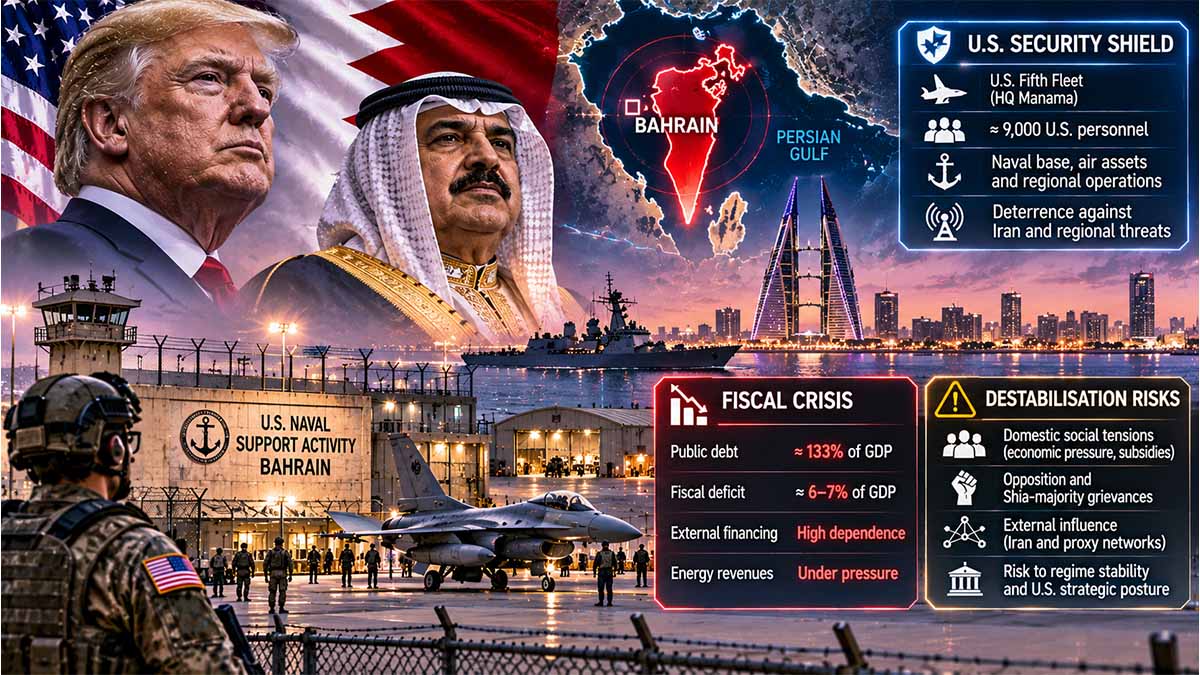
Scope: This assessment examines Bahrain’s security dependence on the United States, the consequences of the 2026 Iran–US confrontation, the vulnerability of American and British military infrastructure, fiscal and industrial disruption, Saudi and Emirati strategic influence, and domestic political stability, with a forward-looking horizon extending to November 2031.
Executive Summary / Bottom Line Up Front
Bahrain’s central strategic vulnerability is the growing divergence between its importance to American regional military power and its ability to control the security consequences of hosting that power. The US Fifth Fleet provides strategic deterrence, operational support and access to advanced defence capabilities, but the concentration of foreign military infrastructure simultaneously creates exposure to retaliation during conflicts in which Manama does not control escalation decisions.
The confrontation that began on 28 February 2026 has demonstrated the material significance of this problem. Bahrain has experienced direct Iranian attacks, industrial disruption and heightened economic and security pressures. The International Monetary Fund’s October 2026 World Economic Outlook projects a contraction of 11.3% in Bahrain’s real gross domestic product during 2026, a substantial deterioration from the 3.3% growth forecast in its January assessment.
The fiscal baseline was already weak before the confrontation. The IMF recorded government gross debt of 134% of GDP in 2024, while its January projections anticipated 149.7% in 2026. Its subsequent data indicate substantially greater sovereign-debt vulnerability.
The industrial consequences are documented. Bapco Energies declared force majeure on 9 March 2026 following an attack on its refinery complex. Aluminium Bahrain subsequently reported a 61% year-on-year reduction in net finished production in the second quarter of 2026, principally associated with the controlled shutdown of three production lines.
The institutional security framework provides consultation, defence integration and mechanisms for collective responses. It does not establish an automatic NATO-style mutual-defence obligation. Britain’s accession to the Comprehensive Security Integration and Prosperity Agreement in June 2025 broadened the framework without eliminating the distinction between political commitment and legally automatic military intervention.
The principal strategic judgment is that external deterrence, domestic legitimacy and sovereign solvency have become interconnected dimensions of Bahrain’s national security. The critical uncertainty concerns whether foreign security guarantees, fiscal assistance and industrial recovery can remain credible and sustainable through another major regional escalation.
Bahrain, the Fifth Fleet and the Price of American Protection: When a Security Guarantee Becomes a Sovereign Liability
Bahrain faces a contradiction that the 2026 war with Iran has made impossible to conceal: the American military presence designed to protect the kingdom has also increased its exposure to retaliation, while its public finances lack the capacity to absorb a prolonged confrontation. The United States Fifth Fleet remains central to Washington’s regional naval architecture, yet damage to its facilities, disruption to Bahrain’s refining and aluminium industries, and mounting sovereign debt have transformed a defence relationship into a problem of national economic resilience. The International Monetary Fund now forecasts an 11.3% contraction in Bahrain’s economy in 2026, while the monarchy remains dependent on external military support and Gulf financial assistance. The governing question is no longer whether American protection matters, but who bears its costs when deterrence fails to prevent attacks.
The Fifth Fleet protects American power, but Bahrain carries the territorial risk
The United States established its continuous naval presence in Bahrain in the late 1940s, expanded its role following the departure of British forces in 1971 and re-established the Fifth Fleet in 1995. The arrangement provides Washington with a forward command and logistical centre supporting operations across approximately 2.5 million square miles of maritime territory, including the Persian Gulf, Arabian Sea, Red Sea and Gulf of Aden. It also connects American naval power to three major chokepoints: the Strait of Hormuz, Bab el-Mandeb and Suez Canal. Bahrain’s importance therefore extends far beyond the defence of its own territory. The kingdom hosts infrastructure serving American military objectives across several theatres, while the consequences of attacks against that infrastructure remain concentrated within a small island state.
The confrontation beginning on 28 February 2026 exposed the financial and operational consequences of that arrangement. According to the Congressional Research Service’s September assessment, damage to Naval Support Activity Bahrain was preliminarily estimated at at least $400 million. The report also identified $42 million in fiscal year 2026 military-construction authorisations for maintenance and facility improvements. These are different financial categories: the first is a preliminary damage estimate, while the second concerns authorised expenditure, not a comprehensive reconstruction programme. Nevertheless, the figures reveal how a military installation previously treated as an instrument of regional deterrence has become a significant infrastructure-financing problem. The precise effect on the Fifth Fleet’s operational availability remains less clearly established than the damage itself. Bahrain: Issues for U.S. Policy — Congressional Research Service — September 2026.
Bahrain’s dependence on Washington is reinforced by its defence procurement. The Stockholm International Peace Research Institute calculated that the United States supplied 97% of Bahrain’s major arms imports between 2020 and 2024. This concentration provides access to American military technology, maintenance arrangements and training, but also creates long-term dependence on the continuity of those relationships. Procurement cannot be equated with operational readiness: the availability of aircraft, defensive systems and ammunition during a sustained confrontation depends on maintenance, replenishment and integration. For Manama, the problem is that substantial dependence on American military capabilities does not confer equivalent influence over Washington’s wider decisions concerning Iran. Recent Trends in International Arms Transfers in the Middle East and North Africa — SIPRI — April 2025.
The economic numbers expose a state with little room for another shock
Bahrain’s fiscal vulnerability predates the war. The IMF recorded government gross debt of 134% of GDP in 2024, an overall fiscal deficit of 11% of GDP and government revenue equivalent to only 17.9% of economic output, against expenditure of 28.9%. Hydrocarbon receipts represented 10.4% of GDP, approximately 58% of total government revenue under the IMF’s accounting framework. The problem was therefore already structural: expenditure substantially exceeded available revenue, while the government continued accumulating obligations. In January 2026, before the full effects of the regional confrontation could be incorporated, the IMF projected that debt would reach 149.7% of GDP during 2026. IMF Executive Board Concludes Bahrain’s 2025 Article IV Consultation — International Monetary Fund — January 2026.
The subsequent deterioration transformed the scale of the problem. The IMF’s October 2026 World Economic Outlook projected an 11.3% contraction in real GDP, replacing the 3.3% growth forecast in January: a downward revision of 14.6 percentage points. This does not establish that the entire revision represents directly attributable war damage. It does demonstrate that Bahrain now confronts a substantially weaker economic outlook while carrying an already elevated stock of public debt. Weaker output can reduce fiscal receipts and increase debt ratios through the GDP denominator, while reconstruction and emergency expenditure may generate additional financing requirements. World Economic Outlook Database — International Monetary Fund — October 2026.
The monetary constraint is equally important. Bahrain maintains a fixed exchange-rate arrangement with the US dollar, making foreign-currency liquidity and confidence in the central bank central to financial stability. The IMF reported that government overdrafts at the Central Bank of Bahrain exceeded one-quarter of GDP during 2024, although the exposure subsequently declined. This is not evidence that the currency peg has failed or that the banking system is insolvent; the IMF described Bahraini banks as profitable and well capitalised. It does, however, establish that government financing had become closely connected to the central bank’s balance sheet before the war. Bahrain must therefore manage sovereign refinancing, reserve adequacy and fiscal consolidation without assuming that monetary financing can indefinitely compensate for insufficient government revenue. IMF Staff Completes Bahrain’s 2025 Article IV Mission — International Monetary Fund — November 2025.
Refining, aluminium and cloud infrastructure reveal three different forms of economic damage
The attack on Bapco Energies illustrates how military confrontation can interrupt productive capacity that had recently absorbed major investment. Bahrain’s refinery modernisation increased designed processing capacity to 405,000 barrels per day, approximately 42% above its previous level, with 21 new operating units and 15 substations. On 9 March 2026, Bapco declared force majeure following an attack on its refinery complex, while stating that domestic market requirements remained secured. The distinction matters: the declaration confirms an operational and commercial disruption, but it does not establish that domestic fuel supplies stopped or quantify the total value of lost exports. Refinery damage can influence public finances through reduced commercial activity and associated revenue, while repair requirements introduce separate demands on capital and specialised industrial services. Bapco Modernization Project — Bapco Energies; Bapco Energies Declares Force Majeure — Bapco Energies — March 2026.
Aluminium Bahrain presents a more revealing economic contradiction. In the second quarter of 2026, net finished production fell 61% year on year to 155,469 metric tonnes, while sales volumes declined 32% to 280,799 tonnes. The controlled shutdown of production lines and disruption to maritime supplies substantially reduced physical output. Yet profit attributable to shareholders increased 164% to BHD 64.9 million in the same quarter, while first-half profit reached BHD 140.2 million, a 228% increase. The company reported an average aluminium price of $3,576 per tonne, 46% above the corresponding 2025 period. Higher prices and commercial conditions therefore helped produce stronger reported profits despite reduced production. Industrial recovery cannot be judged by earnings alone: profitability, employment, supply-chain continuity and physical output measure different consequences of the conflict. Alba Financial Results for the Second Quarter and First Half of 2026 — Aluminium Bahrain — August 2026.
Digital infrastructure adds a third category of exposure. Amazon Web Services reported physical disruption affecting its Bahrain cloud region during the confrontation and stated in September that damage across multiple availability zones had exceeded the resilience for which the regional architecture was designed. The company concluded that some resources and data hosted exclusively in Bahrain could not be restored. This was not merely a temporary telecommunications interruption: it demonstrated that regional concentration of computing infrastructure can create losses extending to customers whose own premises were not attacked. The economic implications depend on individual backup arrangements and service dependencies, but the incident establishes that national resilience now includes data recoverability alongside the protection of ports, refineries and manufacturing facilities. AWS Health Dashboard — Amazon Web Services — September 2026.
The security agreement guarantees consultation, not automatic intervention
The legal limits of Bahrain’s external protection are particularly important. The Comprehensive Security Integration and Prosperity Agreement (C-SIPA), signed with the United States on 13 September 2023, establishes defence cooperation, consultation and mechanisms for integrated security planning. Article II requires immediate senior-level consultations following external aggression or threats against a party’s sovereignty, independence or territorial integrity. It provides for appropriate responses under the parties’ respective constitutional and legal procedures. It does not establish an automatic obligation to employ military force whenever Bahrain is attacked. The United Kingdom’s accession in June 2025 extended the framework to three governments but did not eliminate national discretion over military intervention. Comprehensive Security Integration and Prosperity Agreement — United States Department of State — September 2023.
The distinction became operationally significant in March 2026, when the British government justified specific defensive activities under the international law of collective self-defence while expressly distinguishing them from participation in the broader conflict. London subsequently joined Paris in planning a defensive multinational mission for the Strait of Hormuz, contingent on a permissive operating environment. On 12 May, ministers and officials from 38 countries participated in discussions on the initiative. Britain announced £115 million for mine-hunting and counter-drone capabilities, but announced equipment and preparatory planning do not constitute proof that a fully operational mission has been deployed. European governments remain responsible for their own legal authorisations, military contributions and political decisions. UK Government Legal Position on Defensive Action Against Iranian Attacks — March 2026; UK Contribution to the Multinational Strait of Hormuz Mission — Ministry of Defence — May 2026.
For Bahrain, C-SIPA institutionalises cooperation without removing the distinction between the interests of a military guarantor and those of a host state. Washington may regard forward basing as necessary for operations across the wider region; Manama must also account for the effects on its industries, finances and population. British accession improves the scope for trilateral coordination, but it does not transform every American operational objective into a British or Bahraini obligation.
Riyadh and Abu Dhabi can supply liquidity, but cannot resolve the underlying dependency
Bahrain’s financial relationship with its Gulf neighbours predates the confrontation. In October 2018, Saudi Arabia, the UAE and Kuwait committed $10 billion over five years through a package of loans, grants and deposits linked to Bahrain’s Fiscal Balance Program. The programme envisaged eliminating the fiscal deficit by 2022. Yet by 2024 the IMF still recorded a deficit of 11% of GDP. The historical sequence demonstrates that external financial assistance can ease immediate financing pressure without delivering permanent fiscal consolidation. It does not establish that the earlier package caused subsequent deficits; it establishes that assistance did not eliminate the structural imbalance. Gulf Economic Monitor — World Bank — May 2019.
On 8 April 2026, the Central Bank of the UAE and the Central Bank of Bahrain signed a five-year currency-swap agreement with a nominal value of AED 20 billion, equivalent to BHD 2 billion. The facility represents a formal monetary-cooperation mechanism, not a verified transfer of the entire amount into Bahrain’s government budget. Its practical contribution depends on drawdowns, contractual conditions and liquidity requirements. Saudi Arabia meanwhile remains essential through its geographic, energy and transport connections, including the King Fahd Causeway and the relationship supporting Bahrain’s refining sector. Emirati financial support and Saudi infrastructure connections are complementary, not interchangeable. CBUAE and CBB Sign AED 20 Billion Currency Swap Agreement — Emirates News Agency — April 2026.
This dependence intersects with Bahrain’s diplomatic alignment. The 2020 Abraham Accords established relations with Israel, while Manama subsequently explored restoring diplomatic relations with Iran, severed in 2016. Maintaining relations with Washington and Israel does not prove that Bahrain participates in every American or Israeli military operation. It does, however, place the kingdom within a contested regional alignment while Saudi Arabia and the UAE pursue their own security, economic and diplomatic interests. Bahrain consequently relies on partners whose financial resources may be indispensable but whose priorities are not necessarily identical to its own. Bahrain–Israel Declaration — United States Department of State — September 2020.
The next 24 months will test whether Bahrain can finance both security and political continuity
The domestic consequences add a further constraint. Human Rights Watch reported more than 700 arrests by 16 October 2026, including children, during the period of intensified conflict-related security measures. Separate reporting documented the revocation of citizenship affecting 69 individuals, with at least 46 reportedly rendered stateless. These are attributed human-rights findings, not a comprehensive official register of all cases. They nevertheless expose the institutional tension between security enforcement and contested legal procedures in a country whose political environment continues to reflect the consequences of the 2011 uprising. Fiscal adjustment and industrial disruption could compound those tensions if their costs increasingly affect households and employment. President Macron’s Visit to Bahrain Amid an Escalating Human Rights Crackdown — Human Rights Watch — October 2026; Authorities Strip Citizenship from Dozens of Bahrainis — Human Rights Watch — June 2026.
Over the next 12–24 months, from November 2026 to November 2028, Bahrain’s government will confront overlapping financing and institutional decisions: the management of sovereign refinancing, restoration of industrial and digital infrastructure, implementation of fiscal adjustment and coordination of security responsibilities with Washington and London. These obligations coincide with a regional maritime environment in which the International Maritime Organization recorded 129 confirmed incidents and 25 seafarer fatalities as of 6 November 2026. For Britain, France, Germany, Italy and the European Union, continued commercial insecurity creates demands on diplomatic resources, maritime capabilities and exposed supply chains. For Saudi Arabia and the UAE, further Bahraini financing needs would require decisions concerning the scale and form of additional support. Middle East: Highlighted Confirmed Incidents — International Maritime Organization — November 2026.
The financial burden will not fall uniformly. The United States faces decisions concerning military reconstruction and force protection; Bahrain must finance its sovereign obligations and maintain civilian services; regional creditors may be asked to provide additional support; and businesses face the costs of interrupted production, shipping and digital continuity. If fiscal consolidation relies increasingly on higher charges, reduced subsidies or constrained public expenditure, part of the adjustment will be transferred to Bahraini households and domestic enterprises. If reconstruction restores military facilities without reducing their exposure or clarifying responsibilities between the host government and foreign forces, the underlying distribution of security risk will remain substantially unchanged.
The decision facing Manama is therefore not whether to preserve the American alliance in principle. It is whether an alliance that remains indispensable to national defence can be reorganised so that its operational benefits do not continually generate costs beyond the host state’s fiscal and institutional capacity. Without measurable progress on that question by November 2028, Bahrain could retain the formal protection of powerful allies while bearing an increasing share of the economic and political consequences of their regional confrontation.
Navigational Index
Pillar I — The Security Architecture and the Exposure of the Host State
Chapter 1. Bahrain’s Strategic Geography and the Historical Foundations of American Military Power : The evolution of the US–Bahrain defence relationship, the establishment and operational importance of the Fifth Fleet, the kingdom’s maritime geography and the relationship between foreign military basing and sovereign authority.
Chapter 2. Iranian Strike Capabilities and the Vulnerability of Forward-Deployed Naval Infrastructure : The 2026 confrontation, documented attacks, operational infrastructure, missile and unmanned aerial threats, air and missile defence, military logistics, force protection and the limits of available battle-damage evidence.
Chapter 3. The Legal and Operational Limits of American and British Security Commitments : The bilateral defence relationship, the 2023 Comprehensive Security Integration and Prosperity Agreement, British accession, consultation obligations, military access, escalation authority and the distinction between collective deterrence and automatic defence.
Chapter 4. The Regional Military Balance: Iran, Saudi Arabia, the UAE and the Strait of Hormuz : The consequences of Iranian military pressure, Saudi and Emirati strategic interests, Gulf Cooperation Council security coordination, maritime access and the regional implications of another confrontation.
Pillar II — Fiscal Fragility, Industrial Exposure and Domestic Stability
Chapter 5. Bahrain’s Sovereign Debt, Currency Stability and the Fiscal Cost of Conflict : The evolution of government debt, fiscal deficits, monetary financing, foreign-exchange reserves, financial-market exposure, sovereign credit risk and the constraints on state intervention during prolonged disruption.
Chapter 6. The Industrial Economy Under Attack: Refining, Aluminium, Ports and Digital Infrastructure : The effects on the hydrocarbon sector, industrial production, maritime logistics, exports, employment, commercial infrastructure and critical digital services, distinguishing documented damage from assessed second-order exposure.
Chapter 7. The Saudi–Emirati Financial Lifeline and Bahrain’s Strategic Dependence : The history of Gulf financial assistance, Saudi energy and transport connections, Emirati investment and financial support, the availability of fiscal rescue mechanisms and the political implications of external financing.
Chapter 8. Domestic Political Stability, Religious Institutions and the Security State : The political consequences of the 2011 uprising, state security institutions, arrests, nationality revocations, religious and political mobilisation, judicial proceedings and the implications of simultaneous external and domestic pressure.
Pillar III — Regional Reconfiguration, Strategic Scenarios and State Resilience
Chapter 9. Bahrain Between Washington, Tehran, Riyadh and Abu Dhabi : The competing pressures of American military integration, relations with Israel, Iranian deterrence, Saudi security interests, Emirati financial influence and Bahraini diplomatic autonomy.
Chapter 10. The International Consequences: Britain, France, Germany, Italy and the European Union : The implications for naval access, Gulf maritime security, European industrial assets, energy and transport systems, financial institutions and the diplomatic and operational options available to European governments.
Chapter 11. Strategic Pathways, Escalation Indicators and the 2027–2031 Outlook : Alternative security and economic pathways, conditions for military stabilisation, potential renewed escalation, fiscal stress, domestic contention and observable indicators that would change the assessment.
Chapter 12. National Resilience, Alliance Management and Final Strategic Assessment : Institutional choices concerning military basing, force protection, fiscal sustainability, industrial redundancy, political stabilisation, regional diplomacy and the long-term distribution of risks between Bahrain and its external security partners.
Master Abstract
The central strategic contradiction: deterrence without control of escalation
Bahrain’s security architecture rests on a structural asymmetry. Its territory supports American military operations whose geographic reach, operational objectives and political consequences extend far beyond the kingdom’s immediate national interests. At the same time, Bahrain depends on the United States for military technology, defence integration and strategic reassurance. These arrangements can strengthen deterrence against external aggression, but they cannot eliminate the danger that an adversary will regard infrastructure located inside Bahrain as part of a wider military confrontation. The resulting distinction is fundamental: the security benefits of foreign basing accrue to both the United States and Bahrain, while part of the physical, economic and political exposure remains concentrated in the host state.
The scale of this dependence is unusually pronounced. The Stockholm International Peace Research Institute calculated that the United States supplied 97% of Bahrain’s major arms imports during 2020–2024, establishing Washington as the kingdom’s overwhelmingly dominant supplier in the relevant category. This dependence extends beyond procurement to training, maintenance, interoperability, weapons-system support and the wider institutional relationship governing defence cooperation. It does not, however, establish that every imported system was operationally available during the 2026 confrontation, nor does it demonstrate the effectiveness of Bahrain’s air and missile defences under sustained attack. Recent Trends in International Arms Transfers in the Middle East and North Africa — SIPRI — Apr 2025. SIPRI
The legal architecture reinforces this distinction. Article II of the Comprehensive Security Integration and Prosperity Agreement, signed on 13 September 2023 and effective from 20 October 2023, provides for immediate high-level consultations following external aggression or threats against a party’s sovereignty, independence or territorial integrity. It envisages the development and implementation of appropriate responses under the parties’ respective constitutional and legal procedures. These commitments are meaningful, but their implementation is conditional on subsequent decisions rather than an automatic obligation to deploy military force. The United Kingdom’s accession on 19 June 2025 widened the framework into a trilateral arrangement. The November 2025 defence working group subsequently reaffirmed its objectives of deterrence and coordinated security. Comprehensive Security Integration and Prosperity Agreement — US Department of State — Sep 2023; Joint Statement from the Bahrain–United Kingdom–United States Defence Working Group — UK Ministry of Defence — Nov 2025.
The 2026 confrontation exposed the economic cost of strategic integration
The confrontation has produced consequences that can be documented independently of disputed claims concerning individual military facilities. The United States Department of State identifies 28 February 2026 as the beginning of hostilities between the United States and Iran, and records continuing risks from Iranian missiles and drones. Its 23 October travel advisory maintained Bahrain at Level 3, advising reconsideration of travel because of armed conflict and terrorism. At the international level, the United Nations Human Rights Council adopted Resolution A/HRC/RES/61/1, condemning Iranian attacks against Bahrain and other regional states, highlighting attacks on energy infrastructure and addressing disruption to navigation through the Strait of Hormuz. These records establish the existence and international significance of the threat but do not independently quantify damage to the operational command infrastructure of the Fifth Fleet. Bahrain Travel Advisory — US Department of State — Oct 2026; Resolution A/HRC/RES/61/1 — United Nations Human Rights Council — 2026. Viaggia Sicuro+1
The economic consequences are more directly measurable. Bapco Energies formally declared force majeure on 9 March 2026 after an attack on its refinery complex, although the company stated that domestic market requirements remained secured. Aluminium Bahrain reported that its second-quarter net finished production fell to 155,469 metric tonnes, 61% below the corresponding quarter of 2025, while sales volumes declined by 32% to 280,799 metric tonnes. The company identified regional shipping disruption and the controlled shutdown of three production lines as major contributing factors. These observations reveal that industrial damage cannot be measured solely by destroyed facilities: interruptions to shipping, raw-material availability, operating continuity and commercial deliveries can reduce production independently of direct physical destruction. Bapco Energies Declares Force Majeure — Bapco Energies — Mar 2026; Alba Financial Results for Q2 and H1 2026 — Aluminium Bahrain — Aug 2026. bapco.net+1
Fiscal deterioration transforms a military contingency into a sovereign-risk problem
Bahrain entered the confrontation with limited fiscal flexibility. In January 2026, the International Monetary Fund reported that government gross debt had reached 134% of GDP in 2024 and that the fiscal deficit amounted to 11% of GDP. The IMF also warned that foreign-exchange reserves remained relatively low and that fiscal consolidation was necessary to reduce macrofinancial vulnerabilities. The October 2026 World Economic Outlook subsequently projected an 11.3% contraction in economic activity, replacing the substantially more favourable pre-conflict outlook. The comparison between these projections does not, by itself, establish how much of the deterioration is attributable to direct strikes, interrupted trade, production losses, financial conditions or other factors. Nevertheless, it demonstrates the magnitude of the macroeconomic shock that Bahrain must absorb. IMF Executive Board Concludes Bahrain’s 2025 Article IV Consultation — IMF — Jan 2026; World Economic Outlook Database — IMF — Oct 2026. FMI+1
The implications extend beyond budgetary arithmetic. When government debt is already exceptionally high, an external security shock can increase financing requirements precisely when export revenues, industrial production and investor confidence are under pressure. A government facing these conditions must choose among additional borrowing, expenditure restraint, fiscal measures and external financial assistance, each carrying distinct economic and political consequences. Financial intervention by neighbouring Gulf states could protect short-term liquidity and the exchange-rate framework, while also increasing the importance of those states in Bahrain’s economic decision-making. Conversely, insufficient or delayed external support would leave a smaller fiscal margin for infrastructure recovery, public services and security expenditure. The stability of Bahrain’s monetary and financial arrangements therefore forms part of its wider national-security problem rather than a separate macroeconomic issue.
Domestic security and geopolitical alignment are increasingly connected
Bahrain’s internal political environment introduces a further dimension. Civil-society representatives addressing the United Nations Human Rights Council in September 2026 alleged an escalation of politically motivated detentions, restrictions on expression and nationality revocations during the regional confrontation. These statements form part of proceedings recorded on a United Nations platform but remain attributed allegations rather than independently adjudicated findings. They nevertheless establish the existence of a substantive international dispute over the domestic consequences of the government’s security response. Twenty-Second Meeting, Sixty-Third Session of the Human Rights Council — United Nations — Sep 2026. UN Transcripts
The analytical significance lies in the interaction among fiscal pressure, security policy and political legitimacy. State institutions facing an external threat have incentives to increase surveillance, restrict activities perceived as security risks and strengthen administrative controls. Such measures may improve immediate protective capacity, but they may also deepen existing political grievances when their application is contested. Economic adjustment can create an additional source of pressure if higher costs or reduced public expenditure coincide with uncertainty over employment and industrial activity. None of these mechanisms establishes that widespread destabilisation is inevitable. Rather, they identify conditions under which previously distinct economic, political and security problems could reinforce one another.
The five-year strategic question
Between November 2026 and November 2031, Bahrain’s strategic position will depend on whether three processes can be reconciled: the restoration and adaptation of foreign military infrastructure, the recovery of sustainable fiscal and industrial performance, and the management of domestic political tensions within a changing regional security environment. The United States and the United Kingdom retain important interests in Bahrain’s stability and maritime position. Saudi Arabia and the United Arab Emirates have distinct financial, geographical and political relationships with Manama. Iran’s military capabilities and regional policy remain central variables in the escalation environment. These relationships offer Bahrain multiple sources of support, but they also create overlapping external dependencies whose priorities may not always coincide.
The central assessment is therefore conditional rather than deterministic. Bahrain’s foreign military partnerships provide substantial security advantages, while the events of 2026 demonstrate that those partnerships cannot be evaluated independently of host-state exposure, economic resilience and sovereign decision-making. The most consequential future evidence will concern the functional condition of military facilities, the operational arrangements adopted after the attacks, actual financial assistance received, the recovery of industrial output and the evolution of domestic security measures.
Key Evidence Table
| Indicator | Value / status | Reference date | Definition / scope | Issuer and exact source |
|---|---|---|---|---|
| US share of major arms imports | 97% | 2020–2024 | Share of Bahrain’s major arms imports by supplier | SIPRI — Apr 2025 |
| Comprehensive Security Integration and Prosperity Agreement | Signed 13 Sep 2023; effective 20 Oct 2023 | 2023 | US–Bahrain security, economic and technological cooperation | US Department of State — Treaty Record |
| British accession to C-SIPA | Full membership confirmed | 19 Jun 2025 | Trilateral security framework | UK Prime Minister’s Office — Jun 2025 |
| Government gross debt | 134% of GDP | 2024 actual | Government gross debt | IMF Article IV — Jan 2026 |
| Fiscal deficit | 11% of GDP | 2024 actual | Overall fiscal balance | IMF Article IV — Jan 2026 |
| Real GDP forecast | +3.3% | 2026, pre-conflict projection | Annual real economic growth | IMF Article IV — Jan 2026 |
| Real GDP forecast | −11.3% | 2026, October projection | Annual real economic growth | IMF World Economic Outlook — Oct 2026 |
| Refinery disruption | Force majeure declared | 9 Mar 2026 | Bapco Energies group operations following refinery attack | Bapco Energies — Mar 2026 |
| Aluminium net finished production | 155,469 metric tonnes, −61% YoY | Q2 2026 | Quarterly finished production | Aluminium Bahrain — Aug 2026 |
| Aluminium sales volumes | 280,799 metric tonnes, −32% YoY | Q2 2026 | Quarterly sales | Aluminium Bahrain — Aug 2026 |
| US assessment of travel risk | Level 3 — Reconsider travel | 23 Oct 2026 | Terrorism and armed-conflict risk | US Department of State — Oct 2026 |
| Iranian attacks against Bahrain | Condemned in multilateral resolution | 2026 | Attacks against territory, infrastructure and regional security | UN Human Rights Council Resolution 61/1 — 2026 |
YoY = year on year. Figures represent different reference periods and must not be combined into a single measure of conflict damage. The January and October IMF forecasts are different vintages, not successive observations of actual GDP.
Competing Strategic Explanations and Pathways
The available record supports three overlapping strategic pathways. They are not mutually exclusive and do not justify assigning numerical probabilities. Their importance lies in identifying which future observations would distinguish temporary disruption from a more durable transformation of Bahrain’s security and economic architecture.
| Strategic pathway | Diagnostic support | Countervailing evidence | Decisive future indicators | Current assessment |
|---|---|---|---|---|
| Alliance adaptation and institutional continuity | Existing US and UK commitments; established defence cooperation; substantial American military integration | Direct attacks and industrial disruption reveal material vulnerabilities | Verified force-protection investments, operational restoration and renewed defence arrangements | Established institutional foundation; operational adaptation remains to be measured |
| Sustained fiscal dependence and constrained sovereignty | High pre-existing debt; severe growth revision; industrial disruption | Regional financial support and fiscal reform could mitigate immediate pressures | Executed assistance, debt-service burden, reserves, sovereign financing costs | Material financial vulnerability established; longer-term political consequences unresolved |
| Concurrent external and domestic security deterioration | Regional conflict, domestic security measures and reported political tensions | State institutions and external partners retain significant stabilising capacities | Documented protest activity, judicial developments, public-finance pressures and security incidents | Credible risk mechanism; scale and trajectory of domestic destabilisation not established |
Assessment of competing mechanisms
The first pathway depends on whether foreign military presence can be adapted to a more contested operating environment without undermining the strategic purpose of maintaining forward-deployed forces. Improvements to physical protection, command continuity, logistical redundancy and air defence could reduce exposure, although these measures would require investment and might not remove the ability of an adversary to threaten host-state infrastructure.
The second pathway arises from the fiscal consequences of military and industrial disruption. Even if foreign military facilities recover, Bahrain’s debt position could create a prolonged requirement for external financial assistance. That outcome would be particularly significant if the associated financing introduced additional policy conditions or reinforced the concentration of economic support among a limited number of regional partners. The availability of financial assistance and the conditions attached to it must be assessed through executed agreements, rather than political statements or anticipated rescue packages.
The third pathway concerns the interaction between external security threats and domestic governance. The material question is whether emergency security measures, political mobilisation and economic adjustment remain manageable as separate pressures or begin to reinforce one another. The evidence presently supports the existence of these risks but does not establish the inevitability of regime instability, an imminent political transition or a particular political outcome.
Principal Intelligence Gaps and Watch Indicators
| Intelligence gap | Required observation or record | Analytical significance |
|---|---|---|
| Operational status of Naval Support Activity Bahrain | Dated US Navy or Department of Defense assessment of infrastructure condition, command continuity and restoration | Distinguishes physical damage from sustained loss of operational capability |
| Fifth Fleet operational adaptation | Official force-posture and logistics disclosures | Determines whether alternative arrangements represent temporary contingency measures or structural redeployment |
| Bahrain’s air and missile defence performance | Competent operational reporting on engagements, expenditure and availability | Establishes whether reported attacks exposed deficiencies in coverage, supply or operational coordination |
| Financial recovery and debt sustainability | Updated IMF data, central-bank releases, budgets and sovereign financing disclosures | Measures whether the economic shock is being absorbed or converted into persistent fiscal deterioration |
| Industrial restoration | Subsequent Bapco and Aluminium Bahrain operational and financial statements | Distinguishes restored physical capability from recovered commercial output |
| Gulf financial support | Executed agreements and official disbursement records | Establishes the amount, maturity, conditionality and actual availability of external assistance |
| Domestic stability | Official judicial records, competent international human-rights findings and corroborated observations | Separates allegations, confirmed legal actions and the actual trajectory of political mobilisation |
| Regional diplomatic arrangements | Formal Bahrain–Iran, Gulf Cooperation Council and trilateral security statements | Identifies changes in the balance between deterrence, dialogue and military escalation |
Decision thresholds
For the United States and Britain, the critical threshold concerns evidence that operational risk to personnel and installations is no longer manageable through existing force-protection and infrastructure arrangements. Any resulting adjustment would have to balance the value of forward access against the costs of protection, logistics and exposure of the host state.
For Bahrain, the principal economic threshold concerns the point at which domestic revenue, financing access and available reserves become insufficient to maintain essential expenditure and debt obligations without extraordinary outside assistance. Such a threshold cannot be calculated responsibly without current cash-flow, financing and reserve data.
For Saudi Arabia and the United Arab Emirates, the central question is whether additional financial or security commitments would be structured as short-term stabilisation, long-term support or a broader adjustment of regional responsibilities.
For European governments, the relevant issues are continuity of maritime security cooperation, protection of exposed commercial and industrial interests, and the consistency of bilateral security arrangements with wider Gulf de-escalation efforts.
No decision-useful quantitative visualisation is supportable from the verified record without combining incompatible economic vintages, incomplete military assessments or unverified measures of conflict damage.
Principal Strategic Judgment
Bahrain’s 2026 experience demonstrates a fundamental limitation of host-state security models built around foreign military power. A forward military presence can deter aggression and enhance the operational capabilities of an allied government, but it can also increase the strategic significance of that government’s territory to an adversary. The resulting exposure cannot be evaluated solely through the military capacity of the external guarantor. It must also be assessed through the host state’s economic resilience, institutional autonomy, geographic dependencies, domestic political environment and ability to influence decisions that may precipitate escalation.
The evidence establishes serious economic deterioration, documented disruption to major industrial activities, extensive dependence on American defence systems and a security agreement whose consultation mechanisms do not amount to an automatic mutual-defence guarantee. It does not yet establish the precise operational degradation of the Fifth Fleet’s facilities or the permanence of any associated redeployment.
The decisive distinction for the coming five years is therefore between the continued availability of external military protection and the broader resilience of the Bahraini state under the consequences of regional conflict. These are related but not interchangeable outcomes. A durable security architecture would need to address both.
BAHRAIN: THE SECURITY PARADOX
American military protection strengthens Bahrain’s deterrence while exposing the host state to the consequences of regional escalation. The 2026 confrontation connects military infrastructure, industrial continuity, public debt and domestic stability into a single strategic problem.
GDP Forecast Reversal
Aluminium Bahrain: Q2 2026
Finished production fell 61% year on year. The comparison uses 2025 as a 100% reference; it is not a quarterly time series.
Bahrain’s Security and Economic Network
Select a node to inspect the relationship. Connections are qualitative, not weighted.
Bahrain — Host-state exposure
The kingdom concentrates foreign military access, industrial infrastructure and sovereign financial obligations within a geographically constrained state.
Four Interconnected Vulnerabilities
Qualitative relationships, without artificial threat scores
Forward basing
Deterrence and operational access coexist with exposure to regional retaliation.
Industrial continuity
Disruption can spread through refining, metals, shipping and commercial services.
Sovereign financing
Elevated debt narrows the margin for emergency spending and recovery.
Political resilience
External security pressure may interact with contested domestic measures.
Military protection, economic resilience and sovereign control are different outcomes. Improvements in one do not automatically resolve vulnerabilities in the others.
Five Decision-Relevant Milestones
Select a milestone. Events and forecast releases are distinguished.
9 March 2026 — Bapco Energies
The company declared force majeure following an attack on its refinery complex. Domestic market requirements were reported as secured.
Verified Indicator Register
Values are official disclosures or institutional statistics, not dashboard estimates.
| Indicator | Value | Reference | Source |
|---|---|---|---|
| US share of Bahrain’s major arms imports | 97% | 2020–2024 | SIPRI |
| Government gross debt / GDP | 134% | 2024 | IMF |
| Fiscal deficit / GDP | 11% | 2024 | IMF |
| Real GDP growth — January forecast | +3.3% | 2026 | IMF |
| Real GDP growth — October forecast | −11.3% | 2026 | IMF WEO |
| Alba finished production | 155,469 t | Q2 2026 | Alba |
| Alba production year-on-year change | −61% | Q2 2026 | Alba |
| Alba sales volumes | 280,799 t | Q2 2026 | Alba |
| Alba sales year-on-year change | −32% | Q2 2026 | Alba |
Strategic Watch Indicators
Observations that would materially alter the assessment
Operational continuity
Official verification of the condition and function of naval installations, force posture and logistics.
Fiscal sustainability
Debt trajectory, reserves, financing costs and the execution of external financial assistance.
Industrial recovery
Refinery operations, production restoration, shipping access and commercial output.
Alliance commitments
Implemented defence measures and changes in the trilateral security framework.
Regional financial support
Documented disbursements, agreements and conditionality involving Gulf partners.
Domestic stability
Judicial developments, verified mobilisation and responses to economic adjustment.
PILLAR I — THE SECURITY ARCHITECTURE AND THE EXPOSURE OF THE HOST STATE
BAHRAIN’S STRATEGIC DEPENDENCE: AMERICAN NAVAL POWER, IRANIAN MILITARY PRESSURE, ALLIANCE OBLIGATIONS AND THE SECURITY OF THE PERSIAN GULF
OPEN-SOURCE ANALYTICAL ASSESSMENT
Analytical cut-off: 7 November 2026
Chapter 1. Bahrain’s Strategic Geography and the Historical Foundations of American Military Power
The strategic function of Bahrain: a small sovereign territory supporting a transregional military architecture
Bahrain’s importance to the United States cannot be explained by the kingdom’s territorial size, population, natural resources or independent military capacity. Its strategic significance derives from the interaction between geography, maritime access, military infrastructure and the organisation of American power across the Persian Gulf, the Arabian Sea, the Red Sea and the wider western Indian Ocean. The country occupies an advantageous position for naval forces operating within the Gulf and provides an established institutional environment for command, logistical support, intelligence coordination, maintenance and allied military cooperation. These advantages have accumulated over several decades, transforming Bahrain from a location supporting a comparatively modest American naval presence into an important component of the United States’ regional military architecture. The distinction matters because Bahrain’s utility to Washington is not limited to the defence of Bahrain itself: American naval forces operating from the kingdom contribute to missions extending across multiple maritime theatres, supporting objectives that may be only indirectly connected to the immediate security requirements of the Bahraini state.
The operational geography reinforces this distinction. The United States Fifth Fleet’s area of responsibility has traditionally encompassed approximately 2.5 million square miles of maritime territory, including the Persian Gulf, Gulf of Oman, Arabian Sea, Red Sea and Gulf of Aden. It contains three internationally significant maritime chokepoints: the Strait of Hormuz, the Bab el-Mandeb Strait and the Suez Canal. These waterways serve different commercial and military functions, but together they connect energy-producing regions, global shipping networks and naval transit routes linking Europe, Africa and Asia. Bahrain provides a forward operating and administrative location within this wider system; it is not, however, geographically positioned to control every portion of that maritime operating area without support from distributed ships, aircraft, surveillance systems, logistics facilities and allied access arrangements. The distinction between the location of a fleet headquarters and the distribution of operational forces is essential to understanding both the advantages and the limitations of forward basing. U.S. Fifth Fleet: Mission and Area of Responsibility — U.S. Naval Sea Systems Command.
The maritime environment has also changed substantially since the establishment of the American presence. In earlier decades, threats to shipping and regional military infrastructure were frequently associated with surface combatants, mines, aircraft, coastal defences and conventional missile systems. Contemporary naval operations must additionally account for unmanned aircraft, uncrewed surface vessels, increasingly integrated surveillance networks, electronic interference and attacks against the information and communication infrastructure required to coordinate distributed forces. These developments alter the relative value of geographic proximity. A forward headquarters offers shorter administrative and logistical connections to the area of operations, but proximity also makes fixed installations more exposed to regional strike systems. Consequently, the strategic value of Bahrain cannot be measured merely by how rapidly American forces can reach the Gulf from its territory. It must also be measured by the degree to which forces based there can continue functioning after an attack on their supporting infrastructure.
From British maritime predominance to an enduring American naval presence
The historical development of American military infrastructure in Bahrain reflects the gradual transfer of Western naval responsibility in the Gulf from Britain to the United States. British maritime influence provided the original institutional and geographical foundation for foreign naval facilities in Bahrain, while the expansion of American naval interests after the Second World War created the conditions for a more continuous American presence. The United States established the Middle East Force in the late 1940s, initially relying on a comparatively limited forward presence to support maritime operations and maintain contact with regional partners. The transition was incremental rather than the result of a single decision to establish the modern Fifth Fleet headquarters. The United States progressively expanded its operational responsibilities as British forces reduced their permanent commitments east of Suez and as Gulf energy security became increasingly important to the global economy.
The decisive institutional transition occurred in 1971, when Bahrain achieved independence and the United States Navy occupied a former British naval facility. The original installation was considerably smaller and less capable than the infrastructure developed in subsequent decades. Its importance lay in providing a continuous American shore presence and a platform capable of supporting rotationally deployed naval forces. The installation underwent successive organisational changes as its administrative responsibilities expanded, culminating in the development of Naval Support Activity Bahrain during the 1990s. The re-establishment of the United States Fifth Fleet in 1995 represented a more consequential change in the regional command architecture: it consolidated the relationship between the forward naval headquarters and the ships operating across the United States Central Command’s maritime area of responsibility. This arrangement enabled operational forces deployed from the Atlantic and Pacific fleets to function under an established regional command rather than requiring a permanently stationed fleet composed entirely of ships homeported in Bahrain. History of the U.S. Fifth Fleet — U.S. Naval Forces Central Command.
The evolution of this architecture reveals an important distinction between the permanence of command infrastructure and the rotational character of combat forces. Bahrain supports a continuing headquarters, administrative services and operational infrastructure, while a substantial proportion of the warships assigned to the Fifth Fleet can enter and leave the region through rotational deployments. Such an arrangement can give the United States greater flexibility in allocating naval assets between theatres. Nevertheless, flexibility at sea does not eliminate dependence on shore-based communications, logistics, personnel support and local infrastructure. A fleet may continue operating after the loss of a particular shore installation, but the cost of sustaining those operations can increase if essential services must be redistributed to more distant facilities. Bahrain therefore provides value not solely through the physical presence of ships but through the cumulative institutional efficiencies created by an established military operating environment.
The British military relationship has not disappeared from this arrangement. On 5 April 2018, the United Kingdom formally opened its Naval Support Facility at Mina Salman, designed as a persistent operating hub for Royal Navy activities in the Gulf, Red Sea and Indian Ocean. The British Ministry of Defence described the facility as capable of supporting major warships, including aircraft carriers, and stated that it would accommodate just over 300 military personnel and supporting civilians, with temporary capacity approaching 550. These figures describe the facility as announced in 2018 and should not be interpreted as a verified November 2026 deployment count. The British installation demonstrates that Bahrain’s role as a host state extends beyond the American naval presence. Its military infrastructure supports overlapping Western operational interests, creating opportunities for cooperation while also increasing the strategic significance of facilities located on Bahraini territory. New Royal Navy Operations Hub Opens in Gulf — UK Ministry of Defence — April 2018.
Historical institutional milestones and their security implications
| Period | Institutional development | Operational significance | Consequence for Bahrain | Principal record |
|---|---|---|---|---|
| Late 1940s | Establishment of the US Middle East Force | Development of a continuing regional naval presence | Beginning of sustained American maritime engagement | U.S. Naval Forces Central Command — Historical Record |
| 1971 | Transition from British facilities to an American naval installation | Establishment of a permanent shore-support location | Bahrain becomes a continuing host for US naval infrastructure | U.S. Naval History and Heritage Command — NSA Bahrain |
| 1995 | Re-establishment of the US Fifth Fleet | Regional command of rotationally deployed naval forces | Increased operational and institutional significance | U.S. Naval Forces Central Command — Historical Record |
| 2002 | Establishment of Combined Maritime Forces | Multinational maritime-security cooperation | Expansion of the coalition dimension of naval activities | U.S. Fifth Fleet — Naval Sea Systems Command |
| April 2018 | Opening of the UK Naval Support Facility | Persistent British maritime support in the region | Consolidation of Bahrain as a multinational military-support location | UK Ministry of Defence — April 2018 |
| September 2023 | Signature of the Comprehensive Security Integration and Prosperity Agreement | Formalised consultation and security integration | Expansion of the institutional relationship with Washington | U.S. Department of State — September 2023 |
| June 2025 | British accession to the trilateral security framework | Extension of the agreement beyond its original bilateral structure | Greater scope for coordinated military and security cooperation | UK–Bahrain Strategic Dialogue — November 2025 |
The chronology demonstrates that Bahrain’s external military relationships cannot be reduced to a recent political alignment or a single government agreement. They represent an institutional structure accumulated over generations, incorporating physical infrastructure, operational procedures, training relationships, command arrangements and successive diplomatic commitments. Such structures are difficult to reproduce elsewhere quickly because their effectiveness depends not simply on access to a port but on the presence of functioning organisations, compatible procedures and a host government willing to accommodate continuing foreign military activity. At the same time, the historical depth of these relationships creates political and institutional inertia. Decisions concerning military access, strategic alignment or possible relocation involve more than the disposition of physical equipment: they concern the preservation or modification of a long-established system of military cooperation.
The difference between a fleet headquarters, a naval base and an operational fleet
Understanding the role of Naval Support Activity Bahrain requires separating functions frequently grouped together under the general description of an American naval base. The installation serves as an important shore-support centre, but it is neither synonymous with every military unit assigned to the Fifth Fleet nor physically equivalent to the entire maritime force operating under the United States Naval Forces Central Command. A regional maritime command can direct ships located hundreds or thousands of kilometres from its headquarters, while individual vessels may receive maintenance, fuel, supplies and other support from multiple facilities. This separation creates resilience when a particular location becomes unavailable, although it may also increase logistical complexity and reduce the efficiency associated with a consolidated forward presence.
The headquarters function concerns operational planning, coordination, command relationships and the processing of information needed to support naval activities. The shore-support function concerns facilities and services necessary to sustain personnel, ships and associated military organisations. The wider operational function concerns the employment of forces at sea, including surveillance, maritime interdiction, mine countermeasures, force protection and other missions assigned to the regional naval command. These functions are related but not interchangeable. Damage to an administrative building does not automatically establish the loss of operational command authority, just as the continued presence of warships at sea does not prove that their logistics system remains unaffected. A serious assessment of military infrastructure must identify which functions have been interrupted, which can be transferred, and which require specialised facilities that cannot easily be replaced.
| Institutional component | Principal function | Nature of geographic dependence | Consequence of disruption |
|---|---|---|---|
| Naval Support Activity Bahrain | Shore services, facilities and support for naval operations | Significant dependence on local installation infrastructure | Potential interruption to local support and personnel services |
| US Naval Forces Central Command | Regional naval command within the wider US Central Command structure | Headquarters location is important, but command functions may be distributed | Possible need for alternative command arrangements |
| US Fifth Fleet | Command and operational coordination of assigned maritime forces | Ships operate across an extensive maritime theatre | Effects depend on the continuity of communications, support and deployed forces |
| Combined Maritime Forces | Multinational maritime-security cooperation | Coalition coordination relies on shared institutional and communication arrangements | Potential friction in coordination, depending on available alternatives |
| UK Naval Support Facility | British naval access and sustainment | Established shore-support location in Bahrain | Increased requirements for alternative British logistical arrangements |
| Host-nation military and civilian institutions | Territorial security, infrastructure provision and domestic emergency coordination | Direct dependence on Bahraini authority and resources | Potential interaction between military emergencies and civilian resilience |
The analytical consequence is that Bahrain’s role cannot be evaluated through a binary distinction between a fully operational base and an abandoned installation. Military capability exists across multiple functional layers, and a disruption at one layer may generate a disproportionate burden elsewhere without producing a complete cessation of naval operations. Conversely, preserving formal command structures and operational communications does not automatically restore a damaged installation’s ability to support personnel, maintenance or long-duration deployments. These distinctions become particularly important when assessing public claims about the consequences of the 2026 attacks.
Geography as an operational advantage and a concentration risk
Bahrain’s island geography produces a distinctive combination of security advantages and structural constraints. Its location supports maritime access and close cooperation with other Gulf states, but it also places valuable military, industrial and civilian infrastructure within a comparatively concentrated territory. This concentration is analytically significant because the geographic separation normally available to larger states is more limited. A government operating across extensive territory may distribute functions across distant administrative, industrial and military locations; a smaller island state must achieve resilience through other means, including redundancy, external connections, contingency arrangements and cooperation with neighbouring states.
The relationship with Saudi Arabia is especially important in this regard. Bahrain’s fixed connection to the Arabian Peninsula through the King Fahd Causeway gives the kingdom a land-based route for movement to and from Saudi territory. This provides a form of connectivity unavailable to a wholly isolated island economy, but it also concentrates part of the kingdom’s external land-access arrangements within a single established corridor. Such infrastructure can acquire strategic importance during emergencies affecting maritime or air transport, although its existence must not be confused with proof that it can accommodate every category of military or civilian demand during a major regional crisis. The practical value of the corridor depends on capacity, border procedures, transport arrangements, safety conditions and the continuity of supporting infrastructure.
Bahrain’s maritime location also connects its national security to traffic through the Strait of Hormuz even though the kingdom does not control the strait geographically. Disruption of maritime navigation can affect the movement of energy commodities, industrial inputs, commercial cargo and naval forces throughout the Gulf. The United States Energy Information Administration calculated that approximately 20.9 million barrels per day of petroleum and other liquids passed through the Strait of Hormuz during the first half of 2025, representing approximately one-fifth of global petroleum liquids consumption. The scale of these flows makes the strait an international economic vulnerability rather than merely a regional military concern. This is a pre-conflict benchmark and must not be presented as an observed 2026 transit volume. World Oil Transit Chokepoints — U.S. Energy Information Administration — March 2026.
The sovereignty problem: territorial authority and strategic dependence
The presence of foreign military infrastructure does not, by itself, extinguish the sovereignty of the host state. Bahrain remains a sovereign state with its own government, armed forces, diplomatic relationships and international legal obligations. The relevant institutional problem concerns the practical distribution of authority over military activities, access arrangements, infrastructure security and decisions capable of exposing the host state to retaliation. Sovereignty has a formal legal dimension and an operational dimension: the existence of territorial authority does not necessarily imply that every military decision undertaken by an allied government is subject to direct host-state control. The actual allocation of authority depends on the applicable bilateral agreements, implementing arrangements, command relationships and domestic law. Where these instruments are not publicly available in sufficient detail, a defensible assessment cannot assume either unrestricted foreign military discretion or a comprehensive Bahraini veto over all operations.
This distinction becomes important when foreign military operations create consequences for the host population. The United States can pursue regional military objectives on the basis of its own threat assessments and command decisions, while Bahrain must address the domestic consequences of activities conducted from infrastructure located within its territory. Shared strategic interests may reduce the frequency of disagreement, but they cannot guarantee complete alignment. A host government may regard continued foreign basing as essential to deterrence while also seeking to avoid escalation with a regional adversary. If the external military partner considers escalation necessary for broader operational reasons, the host state may confront a choice between preserving alliance solidarity and limiting its own exposure. The precise extent of Bahrain’s legal authority in such circumstances cannot be reconstructed from public statements about friendship, consultation or strategic partnership alone.
The practical security dilemma is therefore more complex than the assertion that foreign military bases automatically make a country safer or more vulnerable. Bahrain gains capabilities and assurances that it would face substantial difficulties replacing independently. At the same time, the fixed infrastructure supporting those capabilities may become strategically relevant to an adversary whose objectives extend beyond Bahrain itself. The net security effect depends on the credibility of deterrence, the effectiveness of protection, the distribution of military functions and the ability of political authorities to prevent or manage escalation. These variables may change during a conflict, meaning that an arrangement providing substantial peacetime benefits can face different operational and political tests under sustained attack.
Chapter 1 — Key judgments
The historical record establishes Bahrain as an important and enduring component of American maritime operations, with a military-support architecture that evolved over several decades rather than emerging from a recent regional confrontation. The permanence of the shore presence should not be confused with the permanent stationing of all naval forces under the Fifth Fleet. Bahrain’s military value lies in its combination of established command relationships, logistical services, political access and location within the Gulf. The security limitation is that these advantages concentrate foreign military infrastructure within a small host state whose capacity to influence wider escalation decisions cannot be assumed to equal that of the external military power. The interpretation of this relationship would change materially if authoritative records demonstrated a different allocation of host-state operational authority or a sustained redistribution of essential Fifth Fleet functions away from Bahrain.
Chapter 2. Iranian Strike Capabilities and the Vulnerability of Forward-Deployed Naval Infrastructure
The 2026 confrontation: from strategic deterrence to sustained attacks on regional infrastructure
The confrontation beginning on 28 February 2026 fundamentally changed the evidentiary basis for assessing the vulnerability of military and civilian infrastructure in Bahrain. Before the conflict, an assessment of Iranian strike capabilities against foreign military installations necessarily relied heavily on the known characteristics of missile systems, unmanned aerial vehicles, exercises, public military declarations and hypothetical operational scenarios. The commencement of attacks against Gulf states provided direct evidence that regional governments and their foreign military partners were confronting an active threat environment rather than a merely prospective contingency. The Gulf Cooperation Council’s extraordinary ministerial meeting of 1 March 2026 formally identified Iranian missile and drone attacks against Bahrain, Saudi Arabia, the United Arab Emirates, Kuwait, Qatar and Oman. The Council reported damage to civilian facilities, service infrastructure and residential areas, while simultaneously affirming the collective security commitments of its members. This official record establishes the regional scale of the confrontation and the presence of attacks affecting Bahrain. It does not, however, provide a complete target-by-target military assessment or establish the functional condition of every American installation following the attacks. Statement of the Fiftieth Extraordinary Meeting of the GCC Ministerial Council — GCC General Secretariat — March 2026.
The extension of military operations across the Gulf is important because it demonstrates that the threat cannot be understood exclusively as a bilateral confrontation between Iran and Bahrain. The regional pattern links countries with different degrees of military integration with Washington, different economic structures and different historical relationships with Tehran. From the perspective of the host state, this means that diplomatic efforts to avoid direct participation in a conflict may not be sufficient to eliminate exposure to attacks. The GCC’s March statement explicitly maintained that member countries had sought to avoid escalation and had affirmed that their territories would not be used to launch attacks against Iran. This represents the collective position of the participating governments; it does not constitute independently verified evidence concerning every military activity undertaken from their territory. Nevertheless, the statement illustrates the central difficulty confronting Gulf governments: states may seek to limit their involvement in hostilities while possessing infrastructure, military relationships or geographic characteristics that other parties consider relevant to their campaign objectives.
The subsequent international response confirmed that the security problem extended beyond individual military installations. On 11 March 2026, the United Nations Security Council adopted Resolution 2817 (2026) condemning Iranian attacks against Bahrain and other regional states. The resolution was adopted by 13 votes in favour, none against and two abstentions. The GCC–United Kingdom ministerial statement subsequently reported that 136 United Nations members had co-sponsored the resolution, demonstrating substantial diplomatic support for the condemnation of the attacks. The existence of this international response does not settle every legal issue arising from the broader confrontation, including the legality of individual military operations or the attribution and proportionality of every strike. It does establish that attacks on Gulf states became a matter of formal Security Council consideration. Resolution 2817 (2026) — United Nations Security Council — March 2026; GCC–UK Ministers’ Meeting on Iran’s Attacks against GCC States — GCC General Secretariat — March 2026.
The operational significance of the Fifth Fleet’s fixed infrastructure
The military consequences of attacks on a forward-deployed headquarters depend on the precise functions performed by the affected facilities. A naval headquarters is not equivalent to a ship at sea, and the resilience of naval operations cannot be assessed through the number of surviving buildings alone. Command and support infrastructure can encompass operational planning, communications, information management, logistical coordination, personnel support and links with coalition partners. The interruption of one function may be manageable through alternative arrangements, whereas simultaneous disruption of several functions can increase organisational complexity. In a distributed naval theatre, the relevant measure is whether commanders can continue exercising authority, exchanging reliable information, sustaining deployed vessels and coordinating with allied organisations under conditions of degraded infrastructure.
An important distinction concerns the separation between command authority and the physical location from which a commander exercises that authority. Modern military forces can maintain elements of command continuity through alternate communications and headquarters arrangements, but the effectiveness of these arrangements depends on their preparation, technical compatibility, staffing and availability. Publicly established information about the Fifth Fleet’s existence and mission does not reveal the complete architecture of its operational communications or wartime continuity arrangements. Consequently, the proposition that damage to Naval Support Activity Bahrain necessarily eliminated command authority over American naval forces would exceed the verified evidence. Equally, the continued operation of American warships elsewhere in the region would not demonstrate that the disruption of shore-based functions had been insignificant.
The difference between the operational availability of a fleet and the condition of its supporting infrastructure is particularly important when discussing relocation. A temporary transfer of certain activities can be an established form of military contingency management rather than evidence of permanent strategic withdrawal. However, a prolonged inability to use a major installation can indicate a serious disruption even where the military organisation itself remains operational. The most consequential questions are therefore functional: whether critical headquarters activities remain accessible; whether logistical services have been transferred without unacceptable delay; whether personnel can return safely; whether facilities require reconstruction; and whether alternative operating arrangements have sufficient capacity to sustain prolonged activity. Each question requires evidence from the competent military authority. A report that substitutes an unverified building-damage estimate for an assessment of operational functionality would not adequately describe the military consequences.
Missile, drone and maritime threats: distinct mechanisms with different defensive requirements
Iranian military pressure in the Gulf involves several threat categories that must be separated because they generate different operational demands. Ballistic missiles, cruise missiles, uncrewed aerial systems and uncrewed surface vessels are not interchangeable weapons. They differ in flight or movement characteristics, potential trajectories, payload arrangements, methods of employment and the defensive systems required to detect and engage them. Public discussion frequently combines them under a general description of Iranian missiles and drones, but this aggregation can conceal important distinctions concerning warning, identification, interception and continuity of operations.
Ballistic missiles present a challenge associated with their flight profiles, terminal speed and the requirement for timely detection, tracking and interception. Cruise missiles may employ lower-altitude flight profiles, requiring suitable surveillance coverage and engagement arrangements. Uncrewed aerial systems introduce additional diversity because their size, endurance and operational purpose vary substantially; some are designed for surveillance, while others carry explosive payloads or can be used to impose repeated defensive demands. Maritime unmanned systems present another category of threat, particularly where military vessels and commercial traffic operate in shared maritime spaces. The existence of these different threat categories does not establish which specific systems struck a particular installation, nor does it support assigning an interception probability without corresponding operational records.
The September 2026 United States Maritime Administration advisory provides a particularly important official distinction. It identifies threats to commercial shipping arising from missiles, armed unmanned aerial vehicles and armed unmanned surface vessels, alongside the historical use of small boats and helicopters in Iranian maritime operations. The advisory also identifies interference affecting Global Navigation Satellite Systems, including spoofing and jamming, and recommends that mariners employ independent navigation checks when positioning information is degraded. These observations establish that the maritime threat environment combines kinetic attacks with interference capable of complicating safe navigation. The advisory’s purpose is merchant-shipping safety, however, and it cannot be used as evidence of the performance, deployment or vulnerability of particular classified military systems. US Maritime Advisory 2026-011: Persian Gulf, Strait of Hormuz and Gulf of Oman — Maritime Administration — September 2026.
Military threat taxonomy and evidentiary limits
| Threat category | Established operational characteristic | Principal defensive requirement | Relevance to Bahrain | Evidentiary limitation |
|---|---|---|---|---|
| Ballistic missiles | High-speed missile threat requiring timely engagement | Missile detection, tracking and appropriate interception capability | Threat to military and other infrastructure across the Gulf | No complete official Bahrain-specific engagement record established |
| Cruise missiles | Distinct aerodynamic flight and approach characteristics | Suitable surveillance and air defence integration | Potential challenge to the protection of fixed installations | Individual attack attribution and performance require incident-level evidence |
| Armed unmanned aerial vehicles | Aerial attack systems with varied characteristics | Detection, identification, interception and protective procedures | Documented regional threat category | No verified comprehensive inventory or interception ratio |
| Armed unmanned surface vessels | Maritime systems capable of threatening vessels | Maritime surveillance and vessel-protection arrangements | Relevant to Gulf shipping and naval operations | Merchant-shipping warnings do not establish attacks on specific naval facilities |
| Small-boat threats | Maritime approach, interference or coercive activity | Maritime monitoring and protective procedures | Relevant to naval and civilian port security | Incident-specific intentions and capabilities cannot be assumed |
| Navigation interference | Degradation or manipulation of satellite-derived positioning | Independent navigation and information validation | Directly relevant to shipping reliability | Does not independently demonstrate compromise of military command networks |
| Combined or repeated attacks | Multiple threats may increase defensive workload | Sustained readiness, coordination and replenishment | Relevant to prolonged regional conflict | Public evidence does not establish precise saturation thresholds |
The categories in this table are analytically distinct, but their employment can overlap. An adversary may conduct operations against more than one target category or exploit the broader operational distraction associated with simultaneous regional incidents. Such possibilities matter when evaluating whether a defensive system designed to intercept individual threats can maintain acceptable performance throughout a prolonged confrontation. Nevertheless, the available official record does not support constructing a numerical model of Bahraini missile-defence saturation, calculating the number of attackers necessary to overwhelm an installation or assigning undisclosed interception stocks to particular military facilities. These would require system-specific and operational information not established by the sources.
The difference between interceptor expenditure and effective defensive capacity
Air and missile defence performance must be assessed across several dimensions that are often incorrectly condensed into the number of weapons launched or intercepted. A competent assessment must distinguish the availability of sensors, the ability to identify and track incoming objects, engagement decisions, the availability of appropriate defensive systems, maintenance and readiness, and the sustainability of the overall defensive effort. Individual interceptions demonstrate performance under the conditions of the particular engagement; they do not establish that the same outcome can be reproduced indefinitely or against every combination of threats. Conversely, the occurrence of an impact does not automatically prove that the defending state lacked a suitable system, because public information may not establish whether the object was detected, engaged, missed or deliberately left unengaged under the applicable operational procedures.
The relevant strategic issue for Bahrain is that a high level of reliance on foreign military technology introduces a corresponding dependence on foreign technical support, maintenance arrangements and the supply of specialised equipment. Procurement agreements may provide access to advanced systems, but procurement is not equivalent to operational availability. The capabilities advertised by a manufacturer, the quantities formally ordered and the numbers actually available for use at a particular point in a conflict constitute separate categories of information. This distinction also affects public reporting of missile-defence systems associated with the Gulf. A statement that an air-defence system has been purchased is insufficient to determine its readiness, available ammunition or ability to sustain a prolonged period of operations.
The public information reviewed does not establish a reconciled 2026 record showing the total number of Iranian threats directed at Bahrain, the proportion engaged by each defensive system, the number of successful interceptions, the number of impacts or the associated expenditure of defensive munitions. In the absence of such a record, a numerical assessment of Bahraini interceptor depletion would be speculative. The question remains operationally important because the sustainability of defensive protection depends not only on successful engagements but also on the ability to restore readiness and replenish resources under continuing threat. It is therefore appropriate to identify defensive sustainability as a consequential uncertainty without inventing the quantities necessary to resolve it.
Naval logistics under attack: the distinction between supply distance and operational endurance
The consequences of damage to a forward military-support location extend beyond the immediate loss of buildings or equipment. Naval forces depend on a continuing flow of fuel, food, spare parts, technical support and other supplies, while sustained deployment also generates requirements associated with maintenance and personnel welfare. A well-established forward-support installation can reduce the administrative burden of coordinating these activities and provide access to services already familiar to deployed units. If such facilities become unavailable, support requirements must be redistributed across other locations or alternative maritime arrangements. The result may be longer supply chains, more demanding coordination or additional use of transport resources, although the magnitude of these effects depends on the available alternatives and operational tempo.
The strategic consequences must not be reduced to a simple calculation based on the distance between Bahrain and another military installation. Geographic distance is only one component of logistical performance. The frequency of replenishment, availability of suitable transport assets, capacity of receiving facilities, ability to maintain specialised equipment and freedom to use maritime routes can be equally important. An alternative base located farther from the Gulf may remain useful for some functions while being less efficient for others. Similarly, naval replenishment arrangements can support ships at sea without replacing every service traditionally provided by an established shore installation. The available record does not establish a complete post-attack distribution of American support functions or a verified calculation of the additional operational cost associated with any particular relocation.
The maritime operating environment introduces a further complication because the routes used for commercial trade and military sustainment may be subject to common security pressures. The United States Maritime Administration’s September advisory explicitly recognised continued Iranian threats to commercial vessels and called for coordinated voyage planning, appropriate protective measures and ongoing communication with naval authorities. Such measures may reduce exposure, but they also demonstrate that maritime security can require continuous administrative and operational attention. The ability to sustain military operations during a regional conflict therefore depends partly on whether supporting maritime traffic can continue functioning safely and predictably. US Maritime Advisory 2026-011 — Maritime Administration — September 2026.
Shipping incidents provide measurable evidence of continuing regional danger
The International Maritime Organization’s incident reporting provides a more transparent quantitative baseline for the regional maritime threat than the available public record provides for individual military installations. Its register of highlighted confirmed incidents recorded 129 incidents and 25 seafarer fatalities as of 6 November 2026. This is an important late-period observation because it demonstrates that maritime-security incidents remained a continuing concern beyond the confrontation’s opening months. The figure must nevertheless be interpreted according to the organisation’s methodology and geographic coverage: it represents confirmed incidents included in the IMO’s regional register, not the number of Iranian military strikes against Bahrain, not the number of attacks against American military infrastructure, and not a comprehensive inventory of every hostile action in the wider confrontation. Middle East: Highlighted Confirmed Incidents — International Maritime Organization — November 2026.
The IMO’s incident register also contains directly relevant examples of the potential consequences for Bahrain’s maritime infrastructure. Its entry for 1 March 2026 records an incident involving the vessel Stena Imperative while at berth in the Port of Bahrain, with one shipyard worker killed and two seriously injured. The registration of this incident at an identifiable port location demonstrates that the danger to maritime activity cannot be analysed exclusively through attacks against ships passing through international straits. Commercial vessels and personnel located within port facilities may also be exposed. The IMO’s confirmation of the incident, the vessel, the location and the casualties provides an auditable factual basis; determining the full sequence of military responsibility or the technical cause of damage would require additional records. Middle East: Highlighted Confirmed Incidents — International Maritime Organization — November 2026.
By 28 August 2026, the IMO had already identified at least 70 verified attacks on international shipping and 19 seafarer fatalities, while warning that thousands of seafarers had remained exposed to prolonged restrictions on safe maritime movement. The subsequent November incident register illustrates the persistence of the wider security problem. The difference between the August and November figures should not automatically be interpreted as a complete incident count for a precisely defined interval without confirming that both published series employ identical inclusion criteria and revision procedures. Nevertheless, the two dated records demonstrate the importance of separating military developments from the independently observable condition of commercial shipping. Six Months of Uncertainty for Seafarers in the Strait of Hormuz — International Maritime Organization — August 2026.
Evidence on the condition of American military facilities
The available official institutional record establishes the importance of Naval Support Activity Bahrain and the occurrence of Iranian attacks affecting Bahrain, but it does not provide a sufficiently complete, publicly accessible engineering and operational assessment of the installation’s condition after the 2026 confrontation. Military reporting concerning individual buildings, communications equipment, storage facilities, personnel relocation and the future use of the installation requires careful distinction between first-hand official disclosure, attributed statements and independent observation. These sources may address different questions, and apparently conflicting accounts can reflect differences between physical damage, occupation status, administrative restrictions and the continued functionality of the wider naval command.
A statement that a facility has suffered serious physical damage may support a conclusion that reconstruction or replacement will be necessary. It does not establish that every operational function previously conducted there has ceased. A statement that personnel have been moved elsewhere may demonstrate a change in force-protection or operating arrangements, but not necessarily a permanent decision to abandon the installation. A statement concerning the ability of deployed ships to continue operations may demonstrate operational continuity without identifying the additional logistical or financial costs imposed by damage to their traditional support location. These distinctions are essential because military organisations may preserve combat operations while accepting substantial degradation in efficiency or increased burden on supporting infrastructure.
| Question requiring verification | Necessary authoritative record | What the record would establish | What cannot currently be inferred |
|---|---|---|---|
| Physical damage to NSA Bahrain | US Navy engineering and installation assessment | Confirmed damage, repair requirements and physical limitations | Total loss of operational command |
| Personnel relocation | Dated Navy or Department of Defense personnel announcement | Scope and duration of relocation | Permanent evacuation of every military function |
| Headquarters continuity | Official NAVCENT or Fifth Fleet operational statement | Status of command arrangements | Completeness of alternative systems |
| Communications infrastructure | Authoritative assessment of service availability | Which communications functions remained operational | Technical resilience of undisclosed systems |
| Logistics redistribution | Official supply or force-posture reporting | Changes to established support arrangements | Exact additional costs or deployment delays |
| Long-term installation policy | Formal military infrastructure or basing decision | Restoration, restructuring or withdrawal | Permanent abandonment inferred from temporary restrictions |
| Bahraini military involvement | Competent national or allied operational records | Documented support, defensive activities and command responsibilities | Full engagement history from public procurement information |
The absence of a complete public record does not imply that the military damage was insignificant. It indicates that the level of public verification does not yet support a comprehensive operational balance sheet. For decision-makers, the most useful distinction is between what can be established about the threat environment and what remains uncertain about the resilience of the military organisation. The former is supported by multiple official sources, including the GCC’s documentation of attacks and the maritime-security records of the IMO and the United States Maritime Administration. The latter requires competent military reporting that has not been reproduced in sufficient detail in the evidence examined for this chapter.
Chapter 2 — Key judgments
The 2026 confrontation established that Bahrain’s geographic and institutional role within American regional military operations exposes the kingdom to an active missile, drone and maritime-security threat. Official GCC, United Nations and maritime-agency records confirm the regional breadth of attacks and the continuing danger to civilian shipping. The available evidence does not, however, justify a numerical assessment of the permanent loss of Fifth Fleet capability, the exhaustion of missile-defence inventories or the exact logistical penalty associated with changes to American military infrastructure. The assessment would change materially following publication of an authoritative installation-damage report, a dated operational statement identifying the sustained redistribution of critical headquarters functions, or a reconciled military record documenting defensive engagements and system availability.
Chapter 3. The Legal and Operational Limits of American and British Security Commitments
The difference between strategic assurance and an enforceable obligation to intervene
The legal foundation of Bahrain’s security relationship with the United States requires a distinction between political assurances, binding international agreements, operational arrangements and the separate decisions through which military force may be employed. These categories are frequently presented as components of a single security guarantee, but they do not necessarily create identical obligations or legal consequences. A public commitment to support the stability and territorial integrity of an allied state can carry considerable diplomatic importance without establishing an automatic obligation to conduct military operations whenever that state is attacked. Similarly, an agreement requiring consultation and coordinated planning can strengthen deterrence without transferring sovereign command authority or removing the need for decisions consistent with the participating states’ domestic laws.
The Comprehensive Security Integration and Prosperity Agreement (C-SIPA), signed by the United States and Bahrain in Washington on 13 September 2023, is particularly important because it provides a publicly accessible framework through which the parties define security cooperation and institutional integration. The agreement addresses defence and security, economic cooperation, science and technology, and the protection of communications and information networks. Its structure demonstrates an intention to extend the bilateral relationship beyond traditional military assistance and to integrate security with technological and economic development. This broader institutional purpose should not, however, obscure the precise limitations of its defence provisions. The agreement reinforces existing security arrangements and anticipates further implementing agreements; it is not itself a complete public description of all military basing rights, operational authorisations or national command procedures.
Article I establishes principles of cooperation grounded in respect for the independence and sovereignty of the parties and their obligations under international law and the United Nations Charter. Article II provides that external aggression, or the threat of external aggression, against the sovereignty, independence or territorial integrity of a party constitutes a matter of serious concern to the others. The parties undertake to meet immediately at senior levels, assess additional defence requirements and develop appropriate responses in accordance with their respective constitutions and laws. These provisions establish a procedural commitment to consultation and coordinated consideration of responses. They do not state that an attack on one party automatically requires every other party to employ military force. The distinction is not incidental: it determines the difference between a binding obligation to activate a decision-making process and an obligation to deliver a predetermined military outcome. Comprehensive Security Integration and Prosperity Agreement — United States Department of State — September 2023.
Article II: consultation, defence integration and the absence of automatic intervention
Article II contains several distinct commitments that must be interpreted individually. Its initial provisions identify external aggression as a common concern and require senior-level consultation. Subsequent provisions envisage cooperation to improve air and missile defence integration, maritime security, special operations, intelligence capacity, cybersecurity and strategic communications. The agreement also identifies training, military education, defence equipment and services, combined exercises and joint planning among the potential mechanisms for strengthening interoperability. These provisions create an institutional foundation for progressively closer defence cooperation, but they do not establish that every contemplated activity has already been implemented or that the participating armed forces possess a fully integrated operational architecture.
An important provision concerns the coordination of military and defence matters no less than twice annually. The agreement also provides for an annual Defence Working Group to review implementation. These mechanisms are significant because they make consultation an ongoing institutional responsibility rather than an activity dependent entirely on exceptional political circumstances. The distinction between an institutional obligation to meet and the operational results of those meetings nevertheless remains important. Establishing a working group does not, by itself, demonstrate that specific defensive systems have been integrated, that an operational command relationship has been adopted or that participating governments have approved rules of engagement for every possible contingency.
The agreement’s references to joint planning and potential coordination of command-and-control arrangements should therefore be interpreted as authorisations for cooperation within agreed limits, not as public evidence of a single integrated chain of command. The existence of cooperation does not mean that Bahrain’s armed forces are automatically subordinated to American commanders, nor does it establish that American military decisions are subject to a comprehensive Bahraini approval mechanism. Such conclusions would require the relevant implementing instruments and operational arrangements. The publicly accessible agreement establishes the legal and diplomatic direction of cooperation, while leaving substantial details of practical military implementation outside the visible treaty text.
Legal obligations and implementation requirements
| Instrument or provision | Documented obligation or mechanism | Responsible authority | Legal or operational limitation | Strategic consequence |
|---|---|---|---|---|
| C-SIPA Article I | Respect for sovereignty and international legal obligations | Participating states | Does not determine every practical issue of military access | Establishes the legal principles governing cooperation |
| C-SIPA Article II | Immediate senior-level consultation following external aggression or threat | Governments of the parties | Responses remain subject to constitutional and legal procedures | Creates a structured consultation mechanism |
| Article II: defence integration | Regular consideration of air, missile, maritime and other defence cooperation | Defence institutions | Does not prove that proposed systems are already integrated | Supports progressive interoperability |
| Article II: joint planning | Potential cooperation on command, control and rules of engagement | Competent military and political authorities | Operational arrangements require specific agreements or decisions | Provides a framework for coordinated planning |
| Article II: periodic meetings | Defence coordination at least twice annually | Participating defence authorities | Meetings do not guarantee particular operational results | Institutionalises continuing cooperation |
| Article II: Defence Working Group | Annual implementation review | Participating defence authorities | Implementation remains dependent on decisions and resources | Creates a forum for monitoring progress |
| Article III | Economic, commercial and supply-chain cooperation | Relevant governmental institutions | Does not automatically provide fiscal assistance during conflict | Broadens the partnership beyond military security |
| Article IV | Scientific, technological and network-security cooperation | Competent governmental and technical institutions | Specific activities remain subject to agreement | Links defence cooperation to technological resilience |
| Article V | Implementation through further arrangements, consultation on disputes and available funding | Participating governments | Cooperation subject to domestic law and funds; disputes resolved through consultation | Limits automatic enforcement and implementation |
| Article VIII | Admission of additional states by unanimous agreement | Existing parties | Accession requires formal procedures | Allows institutional expansion |
| Article IX | Withdrawal after five years in force, with six months’ notice | Parties to the agreement | Separate implementing arrangements may survive according to their terms | Creates a structured but qualified exit mechanism |
The table demonstrates that the agreement contains significant institutional commitments but does not remove the distinction between treaty obligations and subsequent implementation. In particular, Article V provides that activities are subject to domestic law and the availability of funds. It also establishes consultation between the parties as the means of resolving disputes concerning interpretation or application, rather than referral to national or international courts or third-party mechanisms. These provisions matter because they qualify the assumption that the agreement can compel a particular military outcome independently of political decisions. They also demonstrate that financial availability and domestic authorisation are not peripheral considerations: they are incorporated into the framework governing implementation.
Article V and the limits of external enforcement
Article V deserves particular attention because it establishes practical constraints that are sometimes absent from political descriptions of the security relationship. The parties may conclude additional agreements or arrangements to implement the framework, but all cooperation must be consistent with their domestic laws and available funds. Disagreements over interpretation or application are to be resolved through consultation among the parties, without referral to an external judicial or arbitral body. This arrangement is common in security cooperation where governments seek to preserve political discretion and avoid external adjudication of sensitive defence matters, but its consequences should be recognised.
The absence of compulsory external adjudication does not mean that the agreement lacks international legal significance. It means that the agreed mechanism for addressing disputes is diplomatic consultation, rather than a predetermined judicial remedy. Nor does it imply that a party may disregard every undertaking without legal consequence. The relevant analytical distinction is between the existence of obligations and the mechanisms through which their interpretation and implementation can be compelled or contested. In a crisis, a party dissatisfied with the scope or speed of assistance would rely principally on political and diplomatic channels established under the agreement, together with any other applicable arrangements.
The agreement’s financial qualification is also important. The requirement that activities remain subject to available funds means that the existence of a cooperation programme does not establish that all proposed technical or military activities have already received the necessary financial authorisation. Announcements concerning defence integration, new systems or further technical cooperation should therefore be checked against subsequent appropriations, procurement records and implementation statements. Without such records, an announced initiative remains an institutional intention rather than a completed military capability.
Withdrawal provisions and the persistence of implementing agreements
Article IX creates a further distinction between the security framework and the arrangements that may be concluded under it. The agreement permits withdrawal after it has been in force for five years, with the withdrawal taking effect six months after the required diplomatic notification. Because the original agreement entered into force in October 2023, the five-year period is relevant to the legal position from October 2028 onward. The provision does not create an unrestricted right to withdraw immediately during the earlier period under its ordinary termination mechanism. More importantly, the text provides that implementing arrangements may remain in effect according to their own terms even after a party withdraws from the principal agreement.
This distinction could become consequential if a government sought to revise the institutional framework while preserving specific bilateral defence arrangements. Withdrawal from C-SIPA would not necessarily terminate existing access agreements, contracts or implementing arrangements. Conversely, continued participation in C-SIPA would not automatically prevent the revision of a particular implementing agreement where its own legal terms permitted amendment or termination. The practical relationship between the overarching security framework and the underlying arrangements therefore depends on the content and duration of those separate instruments.
The public text does not establish the termination provisions of every military-access arrangement relevant to Bahrain. Consequently, a comprehensive legal assessment of possible basing changes would require the texts of applicable agreements or authoritative descriptions of their operative provisions. Public declarations concerning a permanent military presence should not be interpreted as proof of legally indefinite basing rights, just as the existence of a withdrawal provision in C-SIPA should not be treated as an automatic mechanism for terminating every aspect of military cooperation.
British accession and the expansion of the trilateral framework
The United Kingdom’s accession in June 2025 changed the institutional structure of C-SIPA by extending it beyond the original US–Bahrain relationship. The change matters because Britain already maintained an established military relationship with Bahrain and operated its own naval support facility. Accession therefore brought an existing security partner into the multilateral framework rather than creating British military involvement in Bahrain for the first time. The development created opportunities for coordinated consultation and technical cooperation among three governments with established but distinct military capabilities, national interests and legal responsibilities.
The trilateral Defence Working Group held in Bahrain on 1 November 2025, with its joint statement published on 11 November, explicitly reaffirmed the parties’ commitment under Article II to regard external aggression against another party’s sovereignty, independence and territorial integrity as a matter of grave concern. The statement was attended by senior Bahraini, British and American defence representatives, including Bahrain’s National Security Adviser Nasser bin Hamad Al Khalifa, the British Chief of the Defence Staff and the commander of United States Central Command. Its significance lies in confirming that the parties treated the agreement as an active institutional mechanism rather than a dormant diplomatic declaration. Joint Statement from the Bahrain–United Kingdom–United States Defence Working Group — UK Ministry of Defence — November 2025.
The subsequent UK–Bahrain Strategic Dialogue on 24 November 2025, reported by the British Foreign, Commonwealth and Development Office on 26 November, identified additional implementation priorities. The governments welcomed British accession and a separate Defence Cooperation Agreement, while recording that the trilateral working group had agreed to establish a technical implementation team considering future cooperation in maritime security, cybersecurity and air defence. The statement also indicated that the United Kingdom would host the next working group in 2026. These observations are useful because they establish specific institutional activities and their announced direction. They do not prove that all contemplated technical programmes had been completed by November 2026. UK–Bahrain Strategic Dialogue 2025: Joint Statement — Foreign, Commonwealth and Development Office — November 2025.
The legal significance of the United Kingdom’s March 2026 position
The most important legal development during the confrontation is the United Kingdom’s public explanation of the basis for its defensive military activities. On 1 March 2026, the British government published a statement setting out its legal position concerning Iranian attacks against regional states. The government stated that it was acting in collective self-defence of regional allies requesting assistance, in circumstances where the use or support of force was considered necessary and proportionate to address ongoing armed attacks. It described British military assets conducting defensive activity against missiles and drones and acknowledged cooperation with a United States request relating to limited defensive action against Iranian missile facilities involved in attacks against regional partners. The statement also distinguished those activities from wider British participation in the broader conflict and emphasised the government’s support for a negotiated settlement. Summary of the UK Government Legal Position: The Legality of Defensive Action in Respect of Iranian Regional Attacks — Prime Minister’s Office — March 2026.
This statement is important for two reasons. First, it demonstrates that British military action was publicly justified through the framework of individual and collective self-defence under international law, rather than presented simply as the automatic consequence of C-SIPA membership. Second, it shows that the government sought to define the scope of its military involvement, distinguishing specific defensive activities from broader participation in the confrontation. The legal argument is an attributed British government position, not an independent judicial determination of the legality of every activity undertaken. The factual basis, necessity and proportionality of particular uses of force would require examination of the relevant circumstances, including information about the attacks being addressed and the nature of the defensive response.
The distinction between the right of collective self-defence and a treaty obligation to intervene is essential. Article 51 of the United Nations Charter recognises the inherent right of individual or collective self-defence when an armed attack occurs, subject to the applicable requirements of international law. That right may provide a legal basis for military assistance in qualifying circumstances, but it does not automatically impose on a third state a duty to provide such assistance. A security agreement may establish obligations concerning consultation or cooperation without requiring every possible use of force, while a state may decide to provide defensive assistance under international law even where no treaty automatically compels it. The British statement demonstrates the practical operation of this distinction.
How British policy evolved during the confrontation
The British government’s statement of 9 April 2026, following the Prime Minister’s meeting with King Hamad bin Isa Al Khalifa and Crown Prince and Prime Minister Salman bin Hamad Al Khalifa, reaffirmed support for Bahrain and condemned Iranian attacks on the kingdom. It also emphasised sustaining the ceasefire, seeking lasting peace and restoring freedom of navigation through the Strait of Hormuz. The statement therefore combined political reassurance with an emphasis on conflict management and maritime security. It did not announce that the United Kingdom had assumed unlimited military responsibility for Bahrain or committed itself to every future regional operation. Prime Minister’s Meeting with the King and Prime Minister of Bahrain — Prime Minister’s Office — April 2026.
Taken together, the March and April statements show that British policy during the confrontation incorporated several different objectives: the defence of regional partners, the protection of British interests, the maintenance of international legal justification for military activities and the avoidance of a wider escalation. These objectives are compatible in some circumstances but may generate difficult decisions in others. A request for additional military support, for example, would require consideration of the nature of the threat, available capabilities, legal authority, potential consequences and the relationship between a proposed operation and the government’s publicly stated objectives. The existence of a security partnership would not eliminate these considerations.
Consultation obligations, national command authority and operational discretion
The relationship between C-SIPA and national command authority requires careful separation of several levels of decision-making. Political consultation concerns the exchange of views between governments and the identification of collective objectives. Military planning concerns the preparation of possible responses, the allocation of tasks and the establishment of procedures through which national forces may cooperate. Operational command concerns the authority to direct military activities within the arrangements authorised by the participating governments. National legal authority concerns the domestic procedures governing whether and how military force may be employed. These levels can be coordinated without becoming identical.
The United States, the United Kingdom and Bahrain each retain their own constitutional and institutional arrangements governing military decisions. The degree to which military commanders can exercise authority over national or multinational forces depends on the applicable operational arrangements. A multinational exercise, for example, does not prove that a standing command authority exists for wartime operations. Similarly, a shared surveillance system would not, by itself, establish that a foreign commander can direct every national defensive engagement. These distinctions are particularly important in assessing claims that military integration necessarily entails the loss of Bahraini sovereignty. Such a conclusion may be politically asserted, but the legal and operational position must be established through the relevant instruments and practices.
The practical challenge for Bahrain is that its ability to influence escalation may be constrained even where it retains formal sovereign authority. A country may possess the legal power to negotiate access arrangements while simultaneously confronting substantial political, economic and military costs associated with changing them. Dependence on foreign technology, military support and diplomatic relationships can narrow the range of politically feasible choices without removing sovereignty as a matter of international law. This is an analytical observation concerning bargaining power and institutional dependence, not a claim that an undisclosed provision legally transfers Bahraini decision-making to Washington or London.
Chapter 3 — Key judgments
C-SIPA establishes significant legal and institutional commitments concerning consultation, cooperation and defence integration, but it does not contain an automatic obligation equivalent to the mutual-defence arrangements commonly associated with NATO Article 5. British accession widened the agreement’s institutional scope while preserving the separate legal and political responsibilities of the participating states. The British government’s March 2026 explanation of its military activities demonstrates the importance of distinguishing treaty commitments from the international legal basis and domestic authorisation for particular operations. The most important unresolved matter concerns the content and practical operation of underlying military-access and implementing arrangements, which cannot be reconstructed from the public text of C-SIPA alone.
Chapter 4. The Regional Military Balance: Iran, Saudi Arabia, the UAE and the Strait of Hormuz
Regional security cannot be reduced to the American–Iranian military balance
Bahrain’s strategic vulnerability must be assessed within the wider distribution of military capabilities, political interests, infrastructure dependencies and diplomatic relationships across the Persian Gulf. The confrontation between Iran and the United States is central to this environment, but it does not exhaust the relevant security relationships. Saudi Arabia, the United Arab Emirates, Oman, Qatar and Kuwait possess different economic resources, geographic characteristics, military arrangements and diplomatic priorities. Their reactions to external aggression therefore depend not only on alliance solidarity but also on the consequences that prolonged confrontation could impose on their own territories and economies. The existence of the Gulf Cooperation Council provides a framework for collective consultation and defence cooperation, yet the operational effectiveness of that framework cannot be inferred solely from political declarations of solidarity.
The extraordinary GCC ministerial meeting of 1 March 2026 illustrates this distinction. The ministers condemned Iranian attacks against member states and affirmed that their security was indivisible, referring to the GCC Charter and Joint Defence Agreement. The declaration supported collective security, recognised the right of individual and collective self-defence and reported that member-state air-defence forces had intercepted missile and drone attacks. These statements establish the official collective position of the governments involved. They do not provide a complete public account of integrated command structures, shared missile-defence inventories, operational tasking or the mechanisms through which each government would contribute forces to a sustained campaign. Statement of the Fiftieth Extraordinary Meeting of the GCC Ministerial Council — GCC General Secretariat — March 2026.
The regional security architecture therefore combines formal institutions with national decision-making. A collective declaration can demonstrate political solidarity while leaving operational contributions dependent on each state’s military capabilities, threat exposure, domestic authority and strategic priorities. The distinction is especially important for Bahrain because the kingdom is geographically small, extensively integrated into American defence arrangements and economically connected to regional partners with substantially different capacities to absorb external shocks. Bahrain’s security consequently depends on a broader system of relationships whose individual components cannot be assumed to respond identically to every crisis.
Iran’s military pressure and the problem of asymmetric strategic exposure
Iran’s position in the regional balance derives partly from its ability to threaten geographically dispersed targets through several categories of military capability. Missile forces, unmanned systems and maritime units create the potential to impose costs on military installations, commercial shipping and strategic infrastructure. These capabilities cannot be evaluated simply by comparing the aggregate defence expenditure of Iran with that of the United States and its regional partners. The ability to threaten particular facilities or interrupt maritime activity depends on geography, the character of deployed systems, defensive arrangements, operational readiness and the nature of the objectives being pursued.
The maritime environment creates a significant asymmetry between the costs of threatening commercial activity and the requirements for assuring safe navigation. A single confirmed attack can generate consequences for affected personnel and vessels, while repeated incidents may increase the complexity of managing commercial risk across an extensive operating area. This does not establish that every incident produces a measurable regional economic loss of the same magnitude, nor does it support the assumption that shipping companies, insurers and governments react identically. It does establish a mechanism through which security uncertainty can affect commercial operations without requiring the permanent physical closure of a maritime route.
The United States Maritime Administration’s advisory of 9 September 2026 identified Iranian attacks and threats involving commercial vessels in the Persian Gulf, Strait of Hormuz and Gulf of Oman. Its recommendations included careful voyage planning, coordination with relevant naval authorities and measures to reduce navigational risk. The advisory also noted the persistence of satellite-navigation interference. These warnings demonstrate that the security challenge concerns the management of an operating environment containing multiple overlapping threats, rather than the interception of a single class of weapon. US Maritime Advisory 2026-011 — Maritime Administration — September 2026.
A second asymmetry concerns the relationship between the objectives of the attacking party and the obligations of the defending party. A state seeking to maintain freedom of navigation must consider the safety of commercial vessels, naval personnel and maritime infrastructure across a large geographical area. An adversary seeking to disrupt navigation may not require uninterrupted control of that area to impose additional security burdens. This distinction does not prove that Iran can close the Strait of Hormuz indefinitely or prevent all naval access. It does, however, explain why continued military presence and continued commercial insecurity can coexist. A powerful navy may retain the ability to deploy forces while commercial operators remain exposed to risks that are difficult to eliminate completely.
The Strait of Hormuz: strategic value measured through actual maritime flows
The economic importance of the Strait of Hormuz can be established through official maritime-energy statistics rather than through speculative claims about the consequences of complete closure. The United States Energy Information Administration’s March 2026 analysis reported that total petroleum and other liquids flows through the strait averaged 20.9 million barrels per day during the first half of 2025, compared with 20.7 million barrels per day in 2024. The corresponding liquefied natural gas flow in the first half of 2025 amounted to approximately 11.4 billion cubic feet per day, representing more than one-fifth of global liquefied natural gas trade. These figures describe pre-conflict traffic and provide a benchmark for understanding the scale of potential disruption. They must not be interpreted as volumes transported during the 2026 conflict. World Oil Transit Chokepoints — U.S. Energy Information Administration — March 2026.
The data also show why disruption cannot be analysed exclusively from a European or American perspective. The EIA estimated that 89% of crude oil and condensate transiting Hormuz during the first half of 2025 was destined for Asian markets. China, India, Japan and South Korea together accounted for approximately 74% of those flows. The United States, by contrast, imported approximately 0.4 million barrels per day of crude oil and condensate from Gulf countries through the strait during that period, equivalent to around 7% of American crude oil and condensate imports and 2% of total United States petroleum liquids consumption. These figures demonstrate that direct physical dependence on Hormuz oil varies substantially between importing economies. Nevertheless, direct import dependence is not equivalent to total economic exposure, because internationally traded oil and gas markets can transmit disruptions through prices, shipping arrangements and competition for alternative supplies.
Table 4.1 — Historical petroleum and natural-gas flows through Hormuz
| Indicator | 2020 | 2021 | 2022 | 2023 | 2024 | First half 2025 |
|---|---|---|---|---|---|---|
| Total petroleum and other liquids, million barrels/day | 19.2 | 19.7 | 21.9 | 21.8 | 20.7 | 20.9 |
| Crude oil and condensate, million barrels/day | 14.4 | 14.7 | 16.2 | 15.8 | 14.6 | 14.7 |
| Petroleum products, million barrels/day | 4.8 | 5.1 | 5.6 | 6.0 | 6.1 | 6.1 |
| Liquefied natural gas, billion cubic feet/day | 10.7 | 10.8 | 11.0 | 10.6 | 10.5 | 11.4 |
Source: World Oil Transit Chokepoints, Table 3 — U.S. Energy Information Administration — March 2026.
These figures provide a historical baseline rather than a direct measure of the effects of the war. They illustrate the scale and composition of trade normally passing through the strait, but they cannot determine the economic cost of 2026 interruptions without observations of actual post-conflict traffic, duration of disruption, market substitution and changes in commercial conditions. A decline in maritime volumes may reflect physical insecurity, changes in production, alternative export routes, reduced demand or other factors, and attributing the entire difference to military action without adjustment would be methodologically unsound.
Saudi Arabia: geographic redundancy and the limits of regional support
Saudi Arabia occupies a different strategic position from Bahrain because it combines extensive territory, substantial energy infrastructure, access to both the Persian Gulf and the Red Sea, and established military and financial relationships with neighbouring states. These characteristics provide options that Bahrain cannot independently reproduce. Most importantly for the maritime-energy balance, Saudi Arabia operates an East–West crude-oil pipeline system connecting eastern production areas with facilities on the Red Sea coast. This offers a route that can bypass the Strait of Hormuz for part of the country’s exports. The existence of such infrastructure does not mean Saudi Arabia is insulated from regional maritime disruption: the practical value of alternative transport depends on available capacity, operational conditions, export terminals and the security environment affecting the Red Sea.
The EIA’s March 2026 analysis estimated that Saudi and Emirati pipeline systems together offered approximately 4.7 million barrels per day of available capacity to bypass Hormuz under the conditions assessed in the report. This is not a figure attributable entirely to Saudi Arabia, nor should it be treated as an amount of oil actually redirected during the 2026 conflict. It represents an estimated alternative transportation capability, and its operational value depends on the circumstances under which the infrastructure is used. World Oil Transit Chokepoints — U.S. Energy Information Administration — March 2026.
For Bahrain, the Saudi relationship extends beyond energy transportation. Saudi Arabia has long played a central role in the kingdom’s regional security and economic connections. Its geographical proximity and land connection to Bahrain distinguish it from other external partners, while historical financial and military cooperation create institutional relationships that cannot be substituted simply through commercial investment. Nevertheless, the ability of Saudi Arabia to assist Bahrain during a confrontation depends on Riyadh’s assessment of its own security, economic priorities and regional diplomatic responsibilities. A commitment to Gulf solidarity does not establish the size, timing or conditions of future financial transfers, nor does it guarantee that Saudi Arabia would assume every additional security burden associated with the protection of foreign military infrastructure in Bahrain.
The regional consequences therefore require separate consideration of Saudi capacity and Saudi willingness. Capacity concerns the resources, infrastructure and institutions available for assistance. Willingness concerns political decisions about when and how those resources should be employed. The two may coincide, but they are analytically distinct. The presence of considerable national resources does not automatically imply unlimited assistance to a neighbouring government, particularly when the assisting country also faces direct security risks and competing domestic investment priorities.
The United Arab Emirates: commercial connectivity, strategic partnerships and financial influence
The United Arab Emirates provides another example of how different national characteristics shape the regional security balance. The UAE combines important commercial and maritime infrastructure, substantial participation in international financial and investment markets, and established security cooperation with Western partners. Its position differs from Bahrain’s because the federation possesses broader economic diversification, different transport arrangements and a larger range of internationally connected commercial assets. These differences influence how disruption in the Strait of Hormuz may be transmitted through the economy and how the government can approach regional security cooperation.
The UAE’s access to Fujairah on the Gulf of Oman gives it a strategically significant location outside the Strait of Hormuz. Its pipeline connection to the eastern coast provides an alternative route for a portion of crude-oil exports. As with Saudi infrastructure, the existence of the route does not mean that every commercial or energy flow can bypass the strait. The EIA’s estimate of combined Saudi and Emirati available bypass capacity demonstrates the existence of alternatives but also the scale of continuing dependence on normal maritime access. The difference between total historical flows through Hormuz and available bypass capacity indicates that alternative infrastructure cannot be treated as a complete substitute for the strait.
The UAE is also relevant to Bahrain through its role as a regional financial and political partner. External assistance can take different forms, including investment, sovereign lending, credit arrangements and other financial instruments. These mechanisms have different implications for Bahrain’s fiscal position, liquidity and long-term obligations. A financial commitment may offer immediate reassurance, but the economic consequences depend on whether funds are actually disbursed, whether support is provided as debt or equity, what conditions are attached and whether the arrangement creates additional future repayment obligations. Consequently, announcements of regional financial cooperation should not be converted into measures of immediately available Bahraini fiscal capacity without examining the executed instruments.
Table 4.2 — Structural comparison of the principal regional actors
| Actor | Strategic position | Principal relationship to Bahrain | Relevant structural advantage | Important limitation |
|---|---|---|---|---|
| Iran | Regional military actor with missile, unmanned-system and maritime capabilities | Direct source of military-security pressure during the 2026 confrontation | Ability to affect multiple regional operating environments | Public evidence does not establish unlimited or uniformly successful strike capability |
| Saudi Arabia | Major Gulf state with Persian Gulf and Red Sea connections | Security, economic, energy and land-transport relationship | Geographic scale and an alternative crude-oil export corridor | Exposed to its own regional security and economic pressures |
| United Arab Emirates | Major financial, commercial and maritime centre | Regional investment, economic and political partnership | Access to the Gulf of Oman and diversified commercial connections | Alternative infrastructure cannot replace all Hormuz-dependent flows |
| Oman | State bordering the Strait of Hormuz and possessing Arabian Sea access | Regional diplomacy and maritime-security relevance | Geographic position and diplomatic engagement | Cannot independently guarantee unrestricted navigation |
| Qatar | Major regional gas exporter | Shared GCC security interests and regional maritime exposure | Significant export and financial resources | Liquefied natural gas shipping remains sensitive to maritime security |
| Kuwait | Gulf state with established security relationships | Collective GCC security and diplomatic cooperation | Financial resources and regional institutional participation | Maritime and security exposure during regional escalation |
| Bahrain | Forward military host and regional transport node | Host of US and British naval infrastructure | Established military cooperation and geographic proximity to Gulf operations | Concentrated infrastructure and limited geographic redundancy |
The comparison is qualitative. It does not rank national military capability or predict how governments would behave in a future confrontation. Different states possess distinct combinations of economic resources, military responsibilities and geographic alternatives, making a single numerical ranking inappropriate without a clearly defined and comparable set of indicators.
Oman’s diplomatic and geographic role
Oman deserves particular attention because its relationship to the Strait of Hormuz differs from that of Bahrain, Saudi Arabia and the UAE. Oman shares the geographic setting of the strait and possesses ports opening directly onto the Gulf of Oman and Arabian Sea. Its territory therefore occupies an important position in maritime access between the Gulf and the wider Indian Ocean. At the diplomatic level, Oman has also been associated with efforts to facilitate regional dialogue and reduce confrontation, although the effectiveness of any particular diplomatic initiative must be evaluated through its documented outcomes rather than its stated objectives.
The March 2026 GCC–UK ministerial statement explicitly welcomed Oman’s constructive diplomatic role and reaffirmed the importance of dialogue in addressing the regional crisis. The statement is significant because it shows that collective condemnation of Iranian attacks did not eliminate support for diplomatic engagement. The Gulf states therefore pursued multiple objectives simultaneously: maintaining the right to defend their territories, seeking external security assistance, condemning attacks and supporting efforts to restore regional stability. These objectives need not be contradictory, but their practical implementation requires coordination among governments with different diplomatic relationships and threat assessments. GCC–UK Ministers’ Meeting on Iran’s Attacks against GCC States — GCC General Secretariat — March 2026.
For Bahrain, this distinction matters because diplomacy can contribute to reducing the frequency and intensity of attacks but cannot independently replace the defence of vital infrastructure. Conversely, military protection can reduce exposure to immediate threats but may not resolve the political disagreements that sustain a confrontation. A regional security architecture relying exclusively on military deterrence would therefore address only part of Bahrain’s problem. Diplomatic arrangements capable of reducing the risk of confrontation could complement military preparedness, although their effectiveness would depend on compliance, political credibility and the broader regional environment.
Commercial maritime insecurity as a strategic constraint on military power
The prolonged disruption of commercial navigation through the Strait of Hormuz demonstrates why a major naval presence does not automatically guarantee the uninterrupted functioning of international trade. The International Maritime Organization reported on 28 August 2026 that thousands of seafarers continued to face serious uncertainty, with up to 400 vessels carrying approximately 6,000 seafarers unable to depart safely at that point. The organisation also reported at least 70 verified attacks against international shipping and 19 seafarer fatalities. These figures represented the situation recorded at the August reference date, not the cumulative November position. Six Months of Uncertainty for Seafarers in the Strait of Hormuz — International Maritime Organization — August 2026.
The November incident register provides a later measure of the security environment. As of 6 November 2026, the IMO had recorded 129 confirmed incidents and 25 seafarer fatalities in its highlighted regional register. The persistence of incidents through October and early November demonstrates that the maritime-security problem had not been resolved by the initial military response. These figures do not measure the total volume of commercial traffic prevented from passing through Hormuz, nor do they establish that every confirmed incident was attributable to the same actor. They provide evidence of continuing danger to maritime personnel and shipping operations. Middle East: Highlighted Confirmed Incidents — International Maritime Organization — November 2026.
This is a significant distinction for strategic planning. Freedom of navigation is not adequately measured through the ability of military vessels to enter or exit a maritime area. Commercial navigation involves civilian crews, vessels with different protective capabilities, port access, contractual arrangements and the confidence of operators that a voyage can be completed without unacceptable danger. Military forces can support maritime security, respond to incidents and protect selected movements, but the existence of naval patrols does not establish that the commercial system has returned to normal. The restoration of commercial confidence may depend on a sustained reduction in attacks and the reliability of the wider maritime operating environment.
The International Maritime Organization’s incident register: selected examples
| Date | Vessel | Reported location | Confirmed consequence | Analytical relevance |
|---|---|---|---|---|
| 1 March 2026 | Stena Imperative | Port of Bahrain | One shipyard worker killed; two seriously injured | Demonstrates exposure within a port |
| 4 March 2026 | Safeen Prestige | Near Oman | Vessel sunk; oil slick detected | Demonstrates potential vessel-loss and pollution consequences |
| 6 March 2026 | Mussafah 2 | North of Oman | Four seafarers killed; three seriously injured | Demonstrates severe consequences for crews |
| 17 August 2026 | Minoan Dignity | Strait of Hormuz | Vessel damaged; one seafarer killed | Demonstrates persistent danger beyond the opening months |
| 13 October 2026 | GFS Pride | Strait of Hormuz | Vessel sunk; no pollution reported | Demonstrates continuing risk of complete vessel loss |
| 1 November 2026 | Selat Storm | Strait of Hormuz | Vessel damaged; pollution status unknown | Demonstrates incidents continuing into November |
| 4 November 2026 | Velos Sapphire | North of Madinat ash Shamal, Qatar | Vessel damaged; one seafarer killed | Demonstrates continuing regional exposure |
Source: Middle East: Highlighted Confirmed Incidents — International Maritime Organization — November 2026.
The examples are a selected subset of the IMO register and should not be interpreted as a statistical sample from which the frequency or severity of all maritime incidents can be estimated. Their analytical value lies in illustrating the range of documented consequences: damage to vessels, loss of ships, fatalities, injuries and potential environmental effects. These categories create different requirements for emergency response, maritime administration, port authorities and commercial operators. The available information does not support assigning a single financial cost to the selected incidents, because the losses associated with damaged vessels, interrupted cargo operations, casualties and possible environmental consequences would require separate evidence.
Military access, international law and the security of the strait
The legal position of navigation through the Strait of Hormuz introduces a further dimension to the regional balance. The strait is used for international navigation, and the relevant legal framework includes the rules governing passage through international straits and the broader international obligations of coastal and maritime states. The International Maritime Organization’s Council reaffirmed in July 2026 that transit passage through straits used for international navigation must not be threatened, impeded, denied, hampered, impaired or suspended. This institutional position reflects the importance of maintaining internationally recognised navigational rights during armed conflict. Six Months of Uncertainty for Seafarers in the Strait of Hormuz — International Maritime Organization — August 2026.
Legal entitlement to passage and the practical ability to exercise that entitlement are separate questions. A vessel may possess the legal right to transit an international strait while facing threats that make the voyage commercially or operationally unacceptable. International legal rules can establish obligations and the basis for diplomatic or judicial responses, but they do not independently remove military dangers. Conversely, the presence of armed conflict does not automatically eliminate the legal framework governing navigation. The relevant strategic question is how states and international institutions can translate existing rights into a sufficiently secure operating environment.
Bahrain’s position is distinctive because it is neither a coastal state controlling the geographical entrances to Hormuz nor an external actor with the ability to disregard the consequences of maritime disruption. It depends on the functioning of the Gulf maritime system while hosting forces contributing to regional security operations. Its interests therefore overlap with those of commercial shipping states, energy producers, neighbouring governments and external naval powers, but they are not identical to any single one of them.
Regional defence cooperation and the challenge of implementation
The GCC’s collective security architecture provides an institutional mechanism through which member states can identify common threats and coordinate political responses. However, the existence of common institutions does not establish complete operational integration among national armed forces. Military interoperability depends on communications, information-sharing arrangements, compatible procedures, command relationships, training and the availability of suitable equipment. It is also affected by the degree to which governments are prepared to share sensitive information or delegate operational responsibilities under particular circumstances.
The 2026 confrontation demonstrates the importance of examining the implementation of regional commitments rather than assuming that collective declarations translate automatically into identical national responses. The GCC’s March statement explicitly affirmed solidarity and referred to successful defensive interceptions, but it did not disclose a comprehensive regional order of battle, engagement record or common command arrangement. Such information would be necessary to determine the precise contribution of each state to collective defensive operations and to assess whether particular capabilities were integrated or merely coordinated.
The relationship between GCC cooperation and external security partnerships introduces another level of complexity. Bahrain’s arrangements with the United States and United Kingdom operate alongside the collective structures of the GCC, while other Gulf governments maintain their own international defence relationships. Coordination among these systems may strengthen regional deterrence, but its effectiveness depends on the compatibility of procedures and political objectives. Participation in a common diplomatic or security initiative does not necessarily imply that every government has accepted identical obligations concerning the use of its territory, military equipment or national forces.
Table 4.4 — The different levels of regional security coordination
| Level | Institutional basis | What is established | What requires further verification |
|---|---|---|---|
| National defence | Sovereign armed forces and domestic authority | Each government retains national security institutions | Precise force readiness and available capabilities |
| GCC collective security | GCC Charter and Joint Defence Agreement | Collective declarations of solidarity and common defence interests | Operational integration during specific engagements |
| US bilateral cooperation | Country-specific defence and access arrangements | Established US security partnerships | Full content of particular implementing agreements |
| Bahrain–US–UK cooperation | C-SIPA and related arrangements | Trilateral consultation and defence-cooperation framework | Completion and operational status of proposed integration programmes |
| Coalition maritime activity | Participating naval forces and agreed missions | Established multinational maritime-security cooperation | Actual contribution and availability of forces during individual operations |
| International maritime governance | IMO and relevant international legal instruments | Navigation rights, safety obligations and incident reporting | Effective restoration of safe passage under continuing threats |
| Regional diplomacy | Bilateral and multilateral governmental contacts | Documented discussions and political declarations | Compliance, durability and practical effects of negotiated arrangements |
The existence of these overlapping structures means that Bahrain’s security cannot be assessed through a single treaty or one military command. Each level serves a different purpose. National institutions exercise sovereign authority; collective Gulf mechanisms provide a framework for regional solidarity; bilateral agreements govern specific relationships; coalition arrangements facilitate selected operations; and international maritime institutions address safety, legal obligations and the protection of commercial navigation. The strength of the overall security architecture depends on how these layers function together under pressure.
What another regional confrontation would test
A renewed escalation would test several dimensions of the regional security system simultaneously. It would test whether national and allied defensive forces could maintain adequate readiness under continuing threats; whether military headquarters and supporting installations possessed sufficient resilience to maintain their functions; whether maritime traffic could continue operating at acceptable levels of risk; and whether governments could maintain political coordination despite differences in their immediate economic and security interests. It would also test whether diplomatic mechanisms could limit the duration or geographical scope of hostilities.
These are observable operational and institutional questions rather than grounds for predicting a particular political or military outcome. The existence of significant American military capabilities does not eliminate the possibility of damage to allied infrastructure. The presence of Iranian strike systems does not establish the ability to achieve every military objective. Saudi and Emirati financial and geographic resources do not guarantee unlimited support for Bahrain. GCC solidarity does not prove complete military integration. Equally, the continuation of maritime incidents does not demonstrate that international shipping has permanently ceased or that the regional economy cannot recover.
The most consequential uncertainty is whether Bahrain’s current network of external relationships can provide sufficient protection, operational continuity and economic support without creating additional exposure to the strategic decisions of larger states. The answer depends on the actual implementation of military agreements, the functional resilience of infrastructure, regional diplomatic developments and the ability of Bahraini institutions to manage the consequences of external confrontation.
Chapter 4 — Key judgments
Bahrain operates within a regional security architecture whose participants possess substantially different geographic positions, military relationships, financial resources and exposure to maritime disruption. Iran’s missile, unmanned-system and maritime capabilities create documented regional security pressures, while the United States and its partners retain important military and institutional mechanisms for defence and coordination. Saudi Arabia and the United Arab Emirates possess economic resources and transport alternatives that Bahrain cannot reproduce independently, but those advantages do not eliminate their own exposure to regional conflict. Official maritime records establish that commercial insecurity continued through November 2026, demonstrating that the presence of major naval forces and collective security arrangements does not by itself guarantee the uninterrupted functioning of shipping through the Persian Gulf.
Pillar I — Integrated Strategic Assessment
The four chapters establish a security problem that is institutional, geographical, military and legal rather than exclusively technological. Bahrain’s strategic importance to the United States and the United Kingdom derives from an established military-support architecture developed over several decades. The Fifth Fleet’s presence provides access to regional operations, supports maritime-security activity and strengthens defence cooperation with Bahrain. At the same time, the concentration of foreign military functions within a small sovereign territory creates a distinctive form of exposure during a confrontation involving actors whose strategic objectives extend beyond the host state.
The 2026 attacks demonstrate that the existence of foreign military protection does not eliminate the possibility of direct military pressure against Bahrain or against other Gulf states. Official GCC and United Nations records establish the regional scope and international significance of the attacks, while maritime-security reporting confirms that commercial vessels and crews continued to experience serious danger for months after the confrontation began. These observations support the conclusion that the regional security environment has challenged established assumptions about the ability of foreign military presence to provide uninterrupted protection for the surrounding commercial system.
The legal analysis establishes a further distinction. C-SIPA strengthens consultation, defence cooperation and the institutional framework for coordinated responses, but the agreement does not create an automatic obligation requiring the participating states to employ military force following every attack. British practice during the 2026 confrontation demonstrates that collective self-defence, domestic authorisation and political decisions remain relevant to particular military operations. The partnership is therefore legally significant without being equivalent to an unconditional guarantee of every possible military response.
The regional analysis shows that Bahrain’s security cannot be separated from the interests and capabilities of Saudi Arabia, the UAE, Oman and the wider GCC. These governments do not possess identical geographic advantages, economic resources or military arrangements, and their contributions to regional stability cannot be assumed to be interchangeable. The position of the Strait of Hormuz is especially consequential because it connects Bahrain’s national exposure with the interests of international energy markets, commercial shipping and external maritime powers.
The principal conclusion of Pillar I is that Bahrain’s security architecture provides substantial external military support while leaving consequential questions about host-state exposure, operational resilience and escalation authority unresolved. Determining whether the current architecture can adequately address these risks requires more than confirming the presence of American and British forces. It requires evidence concerning the actual condition of military facilities, the implementation of defence agreements, the continuity of maritime operations and the practical coordination of national and allied responsibilities.
The subsequent analytical requirement is to examine how these security relationships interact with Bahrain’s fiscal position, industrial infrastructure and domestic institutional environment. Those issues are distinct from the military and legal architecture examined here and must be assessed through their own financial, economic and political evidence.
PILLAR II — FISCAL FRAGILITY, INDUSTRIAL EXPOSURE AND DOMESTIC STABILITY
Chapter 5. Bahrain’s Sovereign Debt, Currency Stability and the Fiscal Cost of Conflict
The sovereign-financing problem predates the war and cannot be explained exclusively by military expenditure
Bahrain entered the 2026 regional confrontation with a fiscal structure already characterised by persistent primary deficits, an exceptionally high public-debt burden, substantial dependence on hydrocarbon-related government revenue and a monetary framework requiring continuing confidence in the convertibility of the Bahraini dinar into United States dollars. The critical finding is that the conflict did not create the kingdom’s sovereign-financing vulnerability. It introduced an additional economic and financial shock into a system whose capacity to absorb adverse developments had already deteriorated over successive fiscal cycles. The distinction is decisive for evaluating the consequences of military disruption: repairing industrial facilities, restoring maritime traffic or receiving emergency assistance could alleviate immediate economic losses without necessarily resolving the underlying structural imbalance between government revenue, expenditure and financing requirements. Conversely, a deterioration in external security conditions could accelerate a fiscal adjustment that would have been necessary even in the absence of war.
The International Monetary Fund’s January 2026 Article IV assessment provides a particularly important pre-conflict benchmark. It recorded government gross debt equivalent to 134% of gross domestic product in 2024, an overall fiscal deficit of 11% of GDP and an increasing need for sustained fiscal consolidation. The IMF further reported that the government’s overdraft at the Central Bank of Bahrain had exceeded one-quarter of GDP during 2024, although that exposure declined during 2025. These observations establish a fiscal vulnerability extending beyond conventional government bond issuance. They also demonstrate why the treatment of central-bank financing is fundamental to an accurate assessment of Bahraini public indebtedness. A fiscal analysis that incorporates marketable bonds while excluding significant obligations financed through the monetary authority may substantially understate the government’s reliance on financing mechanisms and misrepresent the relationship between fiscal policy and monetary stability. IMF Executive Board Concludes 2025 Article IV Consultation with the Kingdom of Bahrain — International Monetary Fund — January 2026.
The chronology is important because Bahrain’s financial deterioration did not follow a simple uninterrupted upward trajectory. Earlier IMF estimates recorded a reduction in the public-debt ratio during the recovery from the pandemic, followed by renewed deterioration as expenditure pressures and financing needs persisted. The January 2026 assessment projected further increases in government gross debt to 145.1% of GDP in 2025 and 149.7% in 2026 under its pre-conflict baseline. Those figures were projections made before the full economic consequences of the 2026 confrontation could be incorporated. They therefore cannot be treated as measurements of the actual debt stock at the November 2026 analytical cut-off. Their value lies in establishing that the country’s public debt was already expected to increase significantly under conditions that did not include the subsequently observed contraction in economic activity.
Public debt, fiscal deficits and financing requirements: three different measures of sovereign vulnerability
Government indebtedness must be distinguished from the annual fiscal deficit and from gross financing requirements. The public-debt stock measures accumulated obligations at a specified date, subject to the institutional coverage and accounting conventions used by the reporting authority. The fiscal deficit measures the difference between government revenue and expenditure over a period, including interest expenditure when the overall balance is used. Gross financing requirements may additionally include the refinancing of obligations reaching maturity, meaning that a government can face substantial market-financing needs even where its current annual deficit is comparatively modest. These distinctions are especially important for Bahrain because a high starting debt stock increases the significance of refinancing conditions, while persistent fiscal deficits add further borrowing requirements.
A fourth distinction concerns the primary fiscal balance, which excludes interest expenditure. The IMF’s January 2026 assessment showed that Bahrain’s overall deficit was materially greater than its primary deficit. This difference reveals the significance of interest obligations within the fiscal structure, although the difference should not automatically be interpreted as a directly observed cash interest payment without verifying the accounting treatment of the underlying series. For analytical purposes, a government that runs a primary deficit while carrying high accumulated debt faces two simultaneous pressures: it must finance expenditure exceeding non-interest revenue, while also servicing inherited obligations. In such circumstances, improving the debt trajectory may require changes to revenue, primary expenditure, economic growth and financing costs rather than relying exclusively on temporary increases in hydrocarbon receipts.
Table 5.1 — Bahrain’s pre-conflict fiscal trajectory, 2021–2026
| Indicator | 2021 | 2022 | 2023 | 2024 | 2025 projection | 2026 projection |
|---|---|---|---|---|---|---|
| Real GDP growth, annual % | 4.4 | 6.2 | 3.9 | 2.6 | 2.9 | 3.3 |
| Government revenue, % of GDP | 20.1 | 22.4 | 19.4 | 17.9 | 17.9 | 18.2 |
| Hydrocarbon revenue, % of GDP | 11.7 | 14.0 | 11.9 | 10.4 | 9.7 | 9.3 |
| Government expenditure, % of GDP | 30.6 | 28.4 | 29.0 | 28.9 | 29.4 | 28.9 |
| Overall fiscal balance, % of GDP | −10.6 | −6.0 | −9.7 | −11.0 | −11.5 | −10.6 |
| Primary fiscal balance, % of GDP | −6.0 | −1.6 | −3.9 | −4.5 | −4.8 | −3.5 |
| Government gross debt, % of GDP | 122.3 | 111.6 | 123.0 | 134.0 | 145.1 | 149.7 |
| Nominal GDP, BHD million | 15,356 | 17,468 | 17,368 | 17,713 | 17,867 | 18,463 |
The 2025 and 2026 values are IMF projections as published in January 2026. All fiscal ratios use GDP as the denominator; nominal GDP is expressed in millions of Bahraini dinars. The government-expenditure series includes the statistical discrepancy identified in the IMF’s presentation. The table preserves a single statistical vintage to avoid combining observations and estimates produced under incompatible assumptions.
Several findings emerge from the composition of this fiscal series. Government revenue declined from 22.4% of GDP in 2022 to 17.9% in 2024, while expenditure remained close to 29% of GDP in 2023 and 2024. The decline in the revenue ratio was therefore not matched by an equivalent reduction in total expenditure. The overall fiscal deficit widened from 6.0% of GDP in 2022 to 11.0% in 2024, while gross government debt increased from 111.6% to 134.0% of GDP over the same period. These figures demonstrate a continuing imbalance in the government’s financial structure, independently of the economic consequences of the 2026 conflict.
The fiscal revenue composition is equally consequential. The 2024 figures imply that hydrocarbon revenue accounted for approximately 58.1% of total government revenue, calculated by dividing hydrocarbon revenue equivalent to 10.4% of GDP by total revenue equivalent to 17.9% of GDP. This calculation differs from broader descriptions sometimes placing the hydrocarbon contribution at approximately 70% because those statements may refer to other years, budget definitions or revenue classifications. The IMF series provides a consistent basis for the present calculation. The underlying dependency remains substantial: a disruption affecting oil and refining operations can weaken government revenue even where the hydrocarbon sector represents a much smaller share of total domestic value added than its share of public receipts.
The January 2026 IMF projections also show that Bahrain expected to reduce its hydrocarbon-revenue ratio from 10.4% of GDP in 2024 to 9.3% in 2026, while total government expenditure remained close to 29% of GDP. This combination illustrates the challenge of fiscal diversification. Growth in nonhydrocarbon economic activity does not automatically translate into a proportionate improvement in government revenue unless the fiscal system captures an adequate share of that activity through taxes, fees, dividends or other mechanisms. Consequently, economic diversification and fiscal diversification must be assessed separately. The expansion of banking, digital services, tourism or manufacturing can improve the productive composition of GDP without immediately eliminating the public budget’s dependence on hydrocarbon-related income.
The 2026 contraction changes the denominator of sovereign risk
The October 2026 World Economic Outlook introduced a substantially different macroeconomic outlook. The IMF projected a real GDP contraction of 11.3% for Bahrain in 2026, compared with the 3.3% growth projected in January. The difference is 14.6 percentage points. This is a revision between two forecasts, not a measurement of actual economic output lost solely because of the conflict. Nevertheless, the magnitude is important because a severe contraction affects public finances through several channels simultaneously: reduced taxable activity, weaker corporate earnings, possible disruption of government-related enterprises, lower household expenditure, pressure on employment and deterioration in the GDP denominator used to calculate fiscal and debt ratios. World Economic Outlook Database, October 2026 Edition — International Monetary Fund — October 2026.
The denominator effect deserves particular emphasis. A debt-to-GDP ratio can rise even without a corresponding increase in nominal debt if nominal GDP declines. Conversely, debt may increase in absolute terms while the ratio remains comparatively stable if nominal GDP expands sufficiently. A forecast concerning real GDP alone does not permit the exact new debt ratio to be calculated, because nominal GDP also depends on price developments and the accounting treatment of relevant aggregates. In Bahrain’s case, any assessment of post-conflict debt sustainability must therefore use the latest consistent estimates of nominal GDP, government liabilities, fiscal balances and financing costs. Applying the October real-growth forecast mechanically to the January debt projection would produce an unreliable result.
Foreign-exchange reserves and the monetary consequences of fiscal financing
Bahrain’s monetary framework is anchored by its exchange-rate arrangement with the United States dollar. The peg contributes to monetary predictability and reduces exchange-rate uncertainty for many cross-border transactions, but it also makes the adequacy of foreign-currency liquidity a central component of monetary credibility. A fixed exchange-rate system requires the monetary authority to maintain the policy instruments and resources necessary to support its exchange-rate commitment under the applicable operating arrangements. The government and central bank therefore cannot treat fiscal financing, banking-sector liquidity and international reserves as completely independent policy areas.
The IMF’s January 2026 assessment indicated that official reserve assets remained low relative to prospective nonhydrocarbon imports, despite an improvement during 2025. The institution reported that the government’s overdraft at the central bank had risen to more than one-quarter of GDP in 2024 and subsequently declined by approximately 8% through October 2025. This observation does not imply that the central bank had abandoned monetary stability or that the banking system was insolvent. The IMF separately described the banking system as profitable and well capitalised. It does indicate that the scale of government financing through the monetary authority was sufficiently material to warrant explicit policy recommendations concerning its reduction and its inclusion in the statistical treatment of public debt. IMF Staff Completes 2025 Article IV Mission to the Kingdom of Bahrain — International Monetary Fund — November 2025.
Table 5.2 — External liquidity and monetary indicators before the conflict
| Indicator | 2021 | 2022 | 2023 | 2024 | 2025 projection |
|---|---|---|---|---|---|
| Official reserve assets, USD billion | 4.7 | 4.5 | 4.6 | 5.5 | 6.3 |
| Reserve coverage, months of prospective nonhydrocarbon imports | 2.3 | 2.1 | 2.2 | 1.9 | 2.2 |
| Current-account balance, % of GDP | 6.4 | 14.7 | 5.8 | 4.8 | 3.8 |
| Goods exports, % of GDP | 22.4 | 30.2 | 24.8 | 24.3 | 24.6 |
| Goods imports, % of GDP | 17.5 | 21.9 | 20.3 | 20.7 | 21.5 |
The table demonstrates why the absolute level of foreign-exchange reserves should not be interpreted without reference to the country’s import requirements and other potential foreign-currency demands. Official reserve assets can rise in nominal terms while the months of import coverage remain limited. Likewise, a current-account surplus does not automatically establish that the sovereign government possesses sufficient immediately usable foreign-currency assets to meet every external obligation. The current account measures flows between the domestic economy and the rest of the world, while official reserves are a stock held by the monetary authority. The two are related through the balance of payments but are not interchangeable. A country can record a current-account surplus while facing significant government refinancing needs, private capital outflows or other financial-account pressures.
These distinctions become more important during a period of conflict-related industrial disruption. Reduced export receipts can affect foreign-currency inflows, while changes in commercial confidence may alter financing conditions. A government may simultaneously need foreign currency for debt service, essential imports and infrastructure recovery. The relevance of these pressures depends on the currency denomination and maturity of obligations, the resources available to the central bank, private-sector foreign-currency activity and the existence of committed external financial support. None of these variables should be assigned speculative values without the corresponding official records.
Monetary financing and the relationship between the government and the central bank
The IMF’s concern over the government’s overdraft at the Central Bank of Bahrain provides an important institutional dimension to sovereign risk. Monetary financing can arise when a central bank extends credit to the government or accommodates government financing needs through mechanisms affecting its balance sheet. The consequences depend on the legal structure of the arrangement, its maturity, the funding methods used and the broader monetary framework. In a fixed exchange-rate system, a substantial and persistent central-bank exposure to the government can complicate liquidity management and reduce the separation between fiscal requirements and monetary policy.
The IMF recommended that Bahrain progressively reduce monetary financing while developing the local bond market and strengthening liquidity-management instruments. These recommendations reflect different but related objectives. Reducing direct government reliance on the central bank can clarify the financing responsibilities of the fiscal authority. Developing domestic debt markets can provide alternative financing instruments, although their effectiveness depends on investor demand and the financial system’s capacity to absorb government securities. Strengthening liquidity-management tools can help the central bank manage banking-system conditions while maintaining monetary stability. None of these reforms independently removes the requirement for fiscal consolidation: shifting government financing from the central bank to domestic investors changes the financing channel, but it does not eliminate the underlying deficit or the obligation to service accumulated debt.
The relationship between public borrowing and private credit also requires attention. Where banks allocate a substantial portion of their balance sheets to sovereign obligations, they may have fewer resources available for private lending under some conditions. However, the presence of government securities on bank balance sheets does not by itself prove that private-sector credit has been displaced. A defensible crowding-out assessment would require data on bank assets, government exposures, credit demand, capital requirements and the prevailing interest-rate environment. The IMF’s pre-conflict observation that banks remained profitable and well capitalised, while private credit growth was relatively weak, illustrates why banking-system solvency and the availability of private investment finance must be assessed separately.
Sovereign credit risk and the limits of market reassurance
High government indebtedness does not automatically produce a sovereign default, nor does continued market access establish that debt is sustainable under every plausible shock. Sovereign credit risk reflects the interaction of the government’s capacity and willingness to meet obligations, expected future revenue, financing conditions, currency structure, institutional credibility and access to external support. For Bahrain, the possible availability of assistance from neighbouring Gulf states is a material factor in the assessment, but it should not be treated as an unrestricted legal guarantee unless the relevant agreements establish such an obligation.
An additional complication is that debt sustainability can deteriorate through several mechanisms even where the government continues making scheduled payments. Refinancing at higher interest rates may increase future expenditure. A decline in GDP may increase the debt ratio. Reduced export revenue may weaken fiscal receipts and foreign-currency inflows. Additional borrowing to restore infrastructure may increase gross financing requirements. Fiscal adjustment may, in turn, affect domestic demand and the taxable economic base. These mechanisms need not operate with equal intensity, but together they explain why a sovereign can remain current on its obligations while facing increasing financial constraints.
The applicable credit-rating record and market-pricing data must be examined according to their dates, definitions and issuing agencies. Ratings, outlooks, sovereign bond yields and credit-default-swap measures are different indicators. A rating action expresses an agency’s assessment under its methodology; it is not a direct measurement of the probability of default. Bond yields incorporate benchmark interest rates, market liquidity, maturity and other characteristics in addition to sovereign risk. Consequently, a robust evaluation of Bahrain’s market position would compare instruments with appropriate maturities and identify whether a change reflects global financial conditions, domestic fundamentals or an alteration in expectations of Gulf financial assistance.
Fiscal consolidation under conflict conditions
Bahrain’s fiscal adjustment problem is politically and economically difficult because measures capable of improving government revenue or reducing expenditure can have consequences for household income, business costs and economic activity. The IMF’s January 2026 recommendations included increasing tax revenue, reducing broad subsidies while improving targeted support for vulnerable households, incorporating extrabudgetary expenditure into the budget and strengthening fiscal transparency. These recommendations were made in response to structural fiscal weaknesses rather than as a calculation of the direct cost of the 2026 confrontation. They provide a useful framework for understanding why additional war-related expenditure and interrupted industrial activity can make consolidation more difficult. IMF Executive Board Assessment: 2025 Article IV Consultation — International Monetary Fund — January 2026.
The choice between revenue increases and expenditure reductions cannot be evaluated solely by comparing their immediate contribution to the fiscal balance. Taxes and fees can increase government receipts but may affect investment, household purchasing power or the cost structure of businesses. Subsidy reductions can reduce budgetary transfers but may increase energy and utility costs, with different effects across industries and income groups. Expenditure reductions can limit borrowing requirements but may also affect public investment and government services. Targeted transfers can moderate the consequences for vulnerable households, although the effectiveness of such measures depends on administrative capacity and accurate identification of recipients.
During an industrial disruption, these choices acquire additional complexity. Increasing costs for companies facing interrupted production may complicate recovery, while postponing fiscal adjustment can prolong government financing pressures. A government seeking to preserve social and economic stability must therefore consider not only the amount of adjustment but also its sequence, distribution and interaction with the recovery of productive activity. This does not establish that any particular tax or subsidy measure is inherently inappropriate. It means that the fiscal effects and broader economic consequences must be examined together, using consistent data and clear assumptions.
Chapter 5 — Key judgments
The official pre-conflict record establishes that Bahrain’s sovereign-financing vulnerability resulted from persistent fiscal deficits, high accumulated debt, material government exposure to central-bank financing and limited reserve coverage. The October 2026 IMF projection of a severe economic contraction adds a substantial macroeconomic challenge, but the exact post-conflict fiscal cost cannot be calculated by mechanically combining pre-conflict debt projections with the revised real-growth forecast. The decisive information concerns the government’s actual financing requirements, the maturity and currency structure of its obligations, current foreign-exchange reserves, the execution of fiscal measures and the availability of external assistance. A material change in the assessment would require evidence of a sustained improvement in the primary fiscal balance, stabilisation of government financing arrangements and a consistent reduction in debt vulnerabilities under the latest economic conditions.
Chapter 6. The Industrial Economy Under Attack: Refining, Aluminium, Ports and Digital Infrastructure
Industrial damage must be measured through operating continuity, not simply the physical destruction of assets
The industrial consequences of the 2026 confrontation expose a second structural vulnerability in Bahrain’s economy: a relatively concentrated group of strategically important production and service activities generates substantial export earnings, supports domestic suppliers, sustains employment and contributes to government revenue. The economic consequences of attacks or disruptions therefore extend beyond the directly affected facility. Refining interruptions can influence petroleum-product availability and export commitments; aluminium-production reductions can affect downstream manufacturers and international customers; shipping restrictions can interrupt raw-material deliveries even where factories remain physically intact; and the loss of digital infrastructure can affect companies whose operational assets are located elsewhere. These mechanisms are connected, but they must be distinguished because each produces different accounting outcomes and requires different evidence to quantify.
The most consequential analytical distinction is between installed capacity, actual production, realised sales, corporate profitability and economy-wide value added. Installed capacity describes the production an asset is designed to achieve under specified conditions. Actual production measures physical output during a defined period. Sales reflect deliveries or commercial transactions and may differ from production because of inventory movements and shipment delays. Corporate profitability reflects revenues, costs, accounting treatment and market conditions, including price changes. Value added measures the contribution to economic output after intermediate inputs are deducted. A conflict can reduce physical production while increasing market prices sufficiently to protect or even increase reported profits. Conversely, a company can maintain substantial production while experiencing deterioration in cash flow because payments, exports or logistical arrangements are interrupted.
These distinctions are particularly important for Bahrain in 2026 because the available company disclosures reveal outcomes that cannot be reduced to a simple narrative of industrial collapse. Bapco Energies formally acknowledged an attack on its refining complex and declared force majeure. Aluminium Bahrain disclosed exceptionally large reductions in physical output and shipment volumes, but also reported substantial increases in earnings. Amazon Web Services documented severe damage to regional cloud infrastructure and ultimately stated that some resources and data hosted exclusively in Bahrain could not be recovered. Together, these records demonstrate the existence of several different forms of industrial disruption, each with distinct operational, financial and institutional consequences.
Bapco Refining: a recently modernised national industrial asset
Bahrain’s refining sector must be evaluated in the context of the Bapco Modernization Programme, which materially expanded the country’s processing capability before the 2026 confrontation. Bapco Energies identifies the modernisation as the largest energy investment in Bahrain’s history and reports that the programme increased crude-oil refining capacity to 405,000 barrels per day, representing an increase of approximately 42% over the earlier capacity. The programme incorporated 21 new operating units and 15 new substations, alongside improvements intended to increase processing efficiency and produce higher-value refined products. These figures establish the technical and economic scale of the industrial asset placed at risk during the confrontation. Bapco Modernization Project — Bapco Energies.
A refining facility of this scale is economically significant not merely because of the volume of crude oil it can process. Its value depends on the types of refined products produced, the efficiency of conversion processes, the cost and reliability of crude feedstock, access to export infrastructure and the availability of specialised maintenance services. Bapco’s modernisation included a residue-hydrocracking unit intended to convert lower-value feedstock into products such as diesel and kerosene. The company reported that this unit was designed to convert approximately 78% of lower-grade feedstock into distillates. This technical characteristic matters because disruption to a complex refinery can affect the economic value generated from each barrel of crude even where some processing capability remains available.
The company’s late-2025 operational disclosures provide an important pre-conflict benchmark. Bapco Energies reported that production had increased from approximately 265,000 to 380,000 barrels per day after modernisation and identified 405,000 barrels per day as the higher installed processing capacity. The distinction between the two figures is essential: 380,000 barrels per day described a reported operating production level, while 405,000 barrels per day described capacity. The company also reported that newly inaugurated industrial workshops could produce approximately 10% of its annual requirements for spare parts and operational equipment, identifying a partial localisation of maintenance-related supply capabilities. These figures should not be interpreted as evidence that the refinery operated at either level throughout 2026. Bapco Energies Announces Refinery Production Milestone — Bapco Energies — 2025.
The maintenance dimension has particular significance for conflict recovery. Modern refining facilities depend on specialised equipment, process-control systems, industrial safety arrangements and components requiring technically qualified maintenance. The restoration of a damaged unit cannot automatically be equated with restoration of the full refinery’s production capacity. Even where essential equipment remains intact, a refinery may face constraints involving inspection, spare parts, feedstock availability, utility systems and the condition of related processing units. These observations identify the categories of evidence required for an assessment of recovery; they do not establish which particular systems sustained damage in March 2026.
The March 2026 force-majeure declaration: what it establishes and what it does not
On 9 March 2026, Bapco Energies announced that the regional conflict and an attack on its refinery complex had affected group operations and required a declaration of force majeure. The announcement also stated that domestic market needs remained secured through existing contingency arrangements. This combination is important because it establishes an operational and commercial disruption without supporting the conclusion that the country’s domestic fuel supply had ceased. Force majeure is a contractual concept whose precise consequences depend on the applicable agreements, the nature of the event and the obligations involved. The public announcement does not identify every affected contract, quantify the lost volume of petroleum products or establish the duration of each interruption. Bapco Energies Declares Force Majeure Situation on the Group’s Operations — Bapco Energies — 9 March 2026.
The Saudi Press Agency’s contemporary reporting, attributed to Bahrain’s national news agency, also identified an attack affecting a refining unit and repeated the assurance that domestic requirements remained covered. This strengthens the evidence for the occurrence of the reported industrial incident, but it does not supply an independently audited damage assessment. The implications for export revenues therefore remain distinct from the implications for domestic fuel availability. A refinery may prioritise domestic deliveries while reducing or delaying exports, drawing on inventories or modifying its operational schedule. The financial consequences of these choices depend on realised sales, product prices, contractual obligations and operating expenses. Without a sufficiently detailed post-attack company statement, it is not possible to calculate the actual value of lost export production or the cost of repairing the refinery. Bahrain’s Bapco Energies Declares Force Majeure Amid Iranian Attacks — Saudi Press Agency — March 2026.
The fiscal transmission mechanism is nevertheless clear. Petroleum refining contributes to Bahrain through corporate activity, associated services, employment and government-related financial flows. A disruption capable of reducing production or exports can affect these channels even if the domestic fuel market remains supplied. Conversely, a declaration of force majeure does not automatically establish that every group company experienced an identical degree of interruption. The correct analytical treatment requires separating the affected operating entity, the contractual perimeter of the declaration, physical damage, production changes and the eventual financial accounts.
Table 6.1 — Bapco’s industrial baseline and the verified disruption
| Indicator | Documented value or event | Reference period | What the evidence establishes |
|---|---|---|---|
| Modernised refinery capacity | 405,000 barrels/day | Modernisation programme | Designed processing capacity |
| Capacity increase | Approximately 42% | Modernisation programme | Expansion relative to earlier refinery capacity |
| New operating units | 21 | Modernisation programme | Increased processing complexity |
| New substations | 15 | Modernisation programme | Expanded supporting electrical infrastructure |
| Reported production milestone | 380,000 barrels/day | 2025 company announcement | Reported production after modernisation |
| Residue-hydrocracking conversion objective | Approximately 78% | Modernisation programme | Declared design performance for lower-grade feedstock |
| Locally manufactured spare-parts coverage | 10% of annual requirements | 2025 company announcement | Reported partial localisation of maintenance supply |
| Force-majeure declaration | 9 March 2026 | Conflict period | Company-confirmed disruption following an attack |
| Domestic market supply | Reported as secured | 9 March 2026 | Company’s assurance concerning local supply continuity |
| Total repair cost | Not publicly established in the records examined | As of 7 November 2026 | No defensible monetary estimate |
| Verified cumulative production loss | Not established | 2026 | Cannot be derived from installed capacity alone |
Sources: Bapco Modernization Project — Bapco Energies; Refinery Production Milestone — Bapco Energies — 2025; Force Majeure Announcement — Bapco Energies — March 2026.
Aluminium Bahrain: production collapsed while reported profitability increased
Aluminium Bahrain provides one of the clearest demonstrations of why operational damage and corporate financial performance must be analysed separately. In its 4 August 2026 financial disclosure, the company reported that second-quarter net finished production reached 155,469 metric tonnes, representing a 61% reduction compared with the equivalent period of 2025. Sales volumes declined by 32%, reaching 280,799 metric tonnes. The company attributed the production reduction principally to the controlled shutdown of production lines 1, 2 and 3 in response to regional tensions, while identifying shipping disruption and constraints on raw-material availability as important operating factors. These statements establish a substantial physical and logistical interruption to the company’s normal production model. They do not establish that the entire reduction was caused by direct destruction of aluminium-production facilities. Alba Discloses its Financial Results for the Second Quarter and First Half of 2026 — Aluminium Bahrain — August 2026.
The same disclosure reported that second-quarter profit attributable to equity holders increased from BHD 24.6 million in 2025 to BHD 64.9 million in 2026, representing growth of approximately 164%. For the first half of 2026, profit attributable to equity holders reached BHD 140.2 million, compared with BHD 42.7 million in the corresponding period of 2025, an increase of approximately 228%. These results cannot be reconciled with a simplistic assumption that a decline in production necessarily produces a proportionate decline in profitability. The company’s operating performance was affected by several factors, including changes in output, product mix, costs and market conditions. Aluminium prices also rose substantially in the period, allowing a reduction in physical output to coexist with higher reported profits.
The company identified an average London Metal Exchange aluminium price of USD 3,576 per tonne in the second quarter of 2026, representing a 46% year-on-year increase. It also reported a decline in London Metal Exchange inventories to approximately 302,000 metric tonnes, or 13% below the corresponding period of 2025. The company attributed price strength partly to regional supply disruptions and constrained inventories. These market conditions help explain how the financial effects of lower production may differ from the physical consequences. Nevertheless, a higher average aluminium price does not establish the exact realised price obtained by Alba for every product sold, because commercial contracts, product premiums, delivery conditions and accounting conventions may differ from exchange benchmark prices.
The company’s disclosure further identified value-added product shipments of 195,891 metric tonnes, representing 70% of total shipments and a 38% year-on-year reduction. This provides an additional distinction between shipment quantity and commercial composition. A higher-value product mix may support margins even when volumes decline, although the precise contribution must be established from the company’s financial and operating records. Alba also reported that global aluminium demand increased by approximately 1% year on year during the quarter, while global supply contracted by a similar proportion, with regional production interruptions contributing to the imbalance. These are company-reported market assessments and should be distinguished from audited national statistical series.
Table 6.2 — Aluminium Bahrain’s second-quarter and first-half 2026 performance
| Indicator | Reported 2026 value | Year-on-year movement | Reference period |
|---|---|---|---|
| Net finished production | 155,469 metric tonnes | −61% | Q2 2026 |
| Sales volumes | 280,799 metric tonnes | −32% | Q2 2026 |
| Value-added product shipments | 195,891 metric tonnes | −38% | Q2 2026 |
| Value-added product share of shipments | 70% | Not stated as a comparable percentage-point change | Q2 2026 |
| Profit attributable to equity holders | BHD 64.9 million | +164% | Q2 2026 |
| Profit attributable to equity holders | BHD 140.2 million | +228% | H1 2026 |
| Total comprehensive income | BHD 64.5 million | +195% | Q2 2026 |
| Total comprehensive income | BHD 140.6 million | +264% | H1 2026 |
| Basic and diluted earnings per share | 46 fils | Versus 17 fils in Q2 2025 | Q2 2026 |
| Total assets | BHD 2,867.2 million | +9% compared with end-2025 | 30 June 2026 |
| Equity attributable to owners | BHD 2,163.5 million | +4% compared with end-2025 | 30 June 2026 |
| Average LME aluminium price | USD 3,576/tonne | +46% | Q2 2026 |
| LME aluminium inventories | 302,000 metric tonnes | −13% | Q2 2026 |
The table combines operating, financial and market indicators, but it does not combine them into a single performance score because they measure different phenomena. Production and sales changes use the second quarter of 2025 as their comparison period. The balance-sheet changes compare 30 June 2026 with 31 December 2025. The reported market figures reflect the company’s assessment of external aluminium-market conditions and should not be interpreted as identical to the company’s own transaction prices.
The employment and supply-chain consequences of controlled production reductions
The decision to reduce aluminium output while maintaining the stability of remaining facilities can be economically rational when raw-material availability is constrained. Aluminium smelting is a capital-intensive process requiring substantial electricity, specialised operating equipment and consistent input supplies. Sudden or poorly managed interruptions can create technical and financial costs extending beyond the immediate reduction in sales. Alba’s disclosure emphasised that production adjustments were conducted in a controlled manner to preserve operating stability and support future recovery. This distinction matters because the economic consequences of deliberate production curtailment differ from those of extensive destruction requiring reconstruction. The former may permit relatively faster recovery if operating conditions improve, although that outcome depends on equipment condition, raw materials, personnel and the feasibility of restarting operations.
Employment consequences cannot be calculated from the percentage reduction in production alone. A company experiencing reduced output may retain employees to preserve technical competence, redistribute personnel, alter working schedules or employ other measures. The actual consequences require verified data on employment, remuneration, contractors and the duration of any operating restrictions. Similarly, the impact on domestic suppliers depends on whether contracts were suspended, delayed, renegotiated or maintained during the disruption. A reduction in export volumes can affect commercial activity without necessarily producing an equivalent reduction in domestic employment or value added.
The export dimension also requires separation between physical shipments and revenue. Alba reported substantially lower sales volumes during the second quarter, but the increase in international aluminium prices changed the financial environment in which those volumes were sold. The extent to which domestic suppliers, transport companies or downstream manufacturers benefited from higher prices or experienced difficulties from reduced availability cannot be inferred from Alba’s aggregate profit figures. The necessary evidence would include the financial disclosures of affected companies, sectoral production statistics, export values and quantities, and employment records.
Digital infrastructure: the physical destruction of cloud capacity creates a different form of national exposure
The 2026 confrontation also exposed the physical vulnerability of Bahrain’s digital infrastructure. Amazon Web Services publicly reported disruptions to its Middle East infrastructure during March 2026, identifying physical impacts associated with drone strikes in its Bahrain and United Arab Emirates regions. The subsequent operational record is particularly significant because the damage in Bahrain exceeded the resilience that the company had designed into multiple availability zones. In its 15 September 2026 update, Amazon stated that the damage had affected more than one availability zone and exceeded what its regional and multi-zone services were designed to withstand. Following further assessment, the company concluded that it could not restore access to resources and data hosted exclusively in the Bahrain region. AWS Health Dashboard — Amazon Web Services — September 2026.
This disclosure establishes a materially different problem from ordinary telecommunications disruption. Cloud services often rely on distributed infrastructure, replicated data and arrangements intended to maintain availability when individual components fail. However, the existence of multiple availability zones does not guarantee survival of every regional infrastructure event. If several zones are affected and customer data are stored exclusively within the damaged region, the consequences may extend to permanent loss of access to resources and data not recoverable from independent copies. AWS reported that customers had been advised to migrate workloads to alternative regions and restore services from remote backups where available. The company also stated that it had pursued available options to recover resources that had not been migrated before the regional infrastructure became unavailable.
The importance of this incident for Bahrain extends beyond the commercial interests of one technology provider. Digital infrastructure supports business processes, administrative systems and services that may be geographically distributed even where their computing resources are concentrated within a particular region. A cloud interruption can therefore affect customers whose offices and operating facilities have not been physically attacked. The precise scale of this exposure depends on the services used, the location of customer data, backup policies, application architecture and the existence of alternative operating arrangements. AWS’s statement establishes the seriousness of the regional disruption but does not provide a comprehensive public inventory of affected Bahraini government systems, private-sector clients or the financial losses associated with unrecoverable resources.
Table 6.3 — Documented cloud-infrastructure disruption and its implications
| Date | Company disclosure | Technical or operational significance | Limit of public evidence |
|---|---|---|---|
| 1 March 2026 | Connectivity and power problems in a Bahrain availability zone | Initial disruption to regional computing services | Does not quantify all affected customer workloads |
| 2 March 2026 | AWS identified physical impacts associated with drone strikes in the Bahrain and UAE regions | Confirmed physical infrastructure exposure | Does not identify every damaged component |
| 3 March 2026 | AWS advised customers to prepare migration and recovery arrangements | Regional service continuity required alternative infrastructure | No complete public economic-loss estimate |
| April 2026 | Further disruption affected the Bahrain region | Multiple infrastructure failures complicated restoration | Customer-specific losses remained dependent on backups |
| 30 April 2026 | AWS reported the Bahrain region unavailable and advised recovery from remote backups | Regional outage and prolonged recovery process | Does not prove that every customer’s data was lost |
| 15 September 2026 | AWS stated that some resources and data hosted exclusively in Bahrain could not be restored | Confirmed limits of regional recovery after physical damage | No verified aggregate valuation of unrecoverable assets |
The evidence establishes an important distinction between service availability and data recoverability. A cloud provider may restore access to an application using resources in another region, but this does not automatically restore information that was stored exclusively on infrastructure that cannot be recovered. Conversely, an organisation with independent, usable backups may restore operations without recovering the original regional resources. The national-security implications therefore concern data governance, operational continuity and the practical effectiveness of disaster-recovery arrangements, rather than simply the physical protection of a data centre.
Ports, commercial logistics and the difficulty of measuring indirect industrial losses
Commercial port activity represents a further transmission channel through which regional conflict can affect Bahrain’s economy. Ports support not only the import and export of finished goods but also the movement of industrial inputs, equipment, intermediate products and materials needed for maintenance. Interruption to maritime access may affect manufacturers before any physical damage occurs at their production facilities. Delayed cargo deliveries can create shortages of raw materials, while reduced shipping availability can complicate the fulfilment of export contracts. The resulting financial impact depends on inventory levels, alternative suppliers, contract terms and the duration of disruption.
The appropriate statistical evidence would distinguish cargo volumes by type, container throughput, bulk commodities, vessel calls, port dwell times and transport costs. These variables are not interchangeable. A reduction in vessel calls does not necessarily produce a proportionate reduction in cargo tonnage, while an increase in freight costs may affect individual companies differently depending on their contractual arrangements. Likewise, an industrial company may report lower shipments because of reduced output, limited maritime capacity or both. Attribution therefore requires comparing company disclosures with port and transport records rather than assigning every variation to a single military cause.
For Bahrain, the connection between refining, aluminium and maritime logistics makes the question particularly consequential. The refinery requires feedstock and supports petroleum-product movements, while aluminium operations depend on imported raw materials and access to international customers. Both activities can encounter commercially significant difficulties when shipping conditions deteriorate. The public company disclosures establish that shipping disruption affected operations in 2026, but the available records do not provide a reconciled national account of port-related industrial losses. Such a calculation would require official trade and port data, corporate production and sales information, and an approach that avoids counting the same economic loss repeatedly across suppliers, transport companies and producers.
Chapter 6 — Key judgments
The industrial record demonstrates several distinct forms of economic damage. Bapco’s force-majeure announcement establishes a refinery-related operational disruption while preserving the company’s stated position that domestic supplies remained secured. Alba’s financial results demonstrate a substantial reduction in physical production and shipments alongside sharply increased reported profits, revealing the importance of prices, product composition and cost management in assessing commercial outcomes. AWS’s September disclosure establishes that regional cloud infrastructure suffered damage exceeding the resilience of its multi-zone architecture and that some exclusively hosted resources and data could not be recovered. The combined evidence supports an assessment of significant industrial and digital vulnerability, but it does not support a single aggregate monetary estimate of national conflict damage without more complete and consistent sectoral information.
Chapter 7. The Saudi–Emirati Financial Lifeline and Bahrain’s Strategic Dependence
The political economy of external assistance: support for the state and conditions on domestic adjustment
Bahrain’s financial relationship with Saudi Arabia, the United Arab Emirates and Kuwait is a structural component of its economic security rather than an exceptional arrangement created by the confrontation of 2026. The relationship developed from the interaction of persistent fiscal deficits, strong political and security connections within the Gulf Cooperation Council, and the willingness of neighbouring governments to provide financial support under agreed programmes. The most important implication is that Bahrain’s sovereign financing cannot be understood exclusively through its own budget, reserves and capital-market activity. Its fiscal position has also been influenced by the availability and conditions of assistance from neighbouring states. This support can mitigate immediate financing pressures, but the institutional form of assistance determines whether it increases debt, strengthens liquid reserves, finances public investment or contributes directly to the government’s fiscal resources.
The 2018 Fiscal Balance Program provides the most important historical precedent. The World Bank’s May 2019 Gulf Economic Monitor records that Bahrain adopted the programme in October 2018 with the support of a USD 10 billion financial package from Saudi Arabia, the UAE and Kuwait. The package was designed to be provided over five years and consisted of loans, grants and deposits. In return, Bahrain undertook to eliminate its fiscal deficit by 2022 and reduce public debt. The World Bank reported that the programme and associated support helped ease financing concerns and contributed to a decline in sovereign bond spreads after its announcement. This establishes a significant example of Gulf governments providing assistance in conjunction with a domestic fiscal-adjustment programme, rather than simply transferring unrestricted funds without an institutional framework. Gulf Economic Monitor, Issue 4: Building the Foundations for Economic Sustainability, Human Capital and Growth in the GCC — World Bank — May 2019.
The underlying fiscal conditions explain why such assistance was considered necessary. According to the same World Bank report, Bahrain’s public-debt ratio increased from 44.4% of GDP in 2014 to 81.3% in 2016, while the fiscal deficit widened from 1.6% to 17.6% of GDP over that period. The deterioration followed the decline in oil prices beginning in 2014 and revealed the extent to which Bahrain’s public finances were exposed to hydrocarbon-market conditions. By 2018, a recovery in oil prices had contributed to some improvement, but the fiscal imbalance remained substantial. The financial package therefore addressed a financing crisis that had developed over several years and was not limited to a single temporary shortfall in government revenue.
The historical record also provides an important test of the durability of fiscal-adjustment commitments. Bahrain’s 2018 programme envisaged eliminating the deficit by 2022, yet the IMF’s January 2026 assessment recorded an overall deficit of 11% of GDP in 2024 and projected continued deficits thereafter. These figures demonstrate that the earlier programme did not produce a sustained elimination of the fiscal deficit within the subsequently observed period. They do not, by themselves, establish why every target was missed or how the 2018 package was disbursed and spent. A complete programme evaluation would require annual implementation reports, budget outturns and records of the financing provided by each contributing government.
Financial assistance is not a single homogeneous resource
The distinction among loans, grants, deposits and central-bank liquidity arrangements is central to assessing Bahrain’s external dependence. A grant may provide resources without creating a repayment obligation. A loan creates financing today in exchange for contractual repayment requirements. A deposit placed with the central bank can support liquidity and reserves, depending on its currency, maturity and the applicable accounting arrangements, but may not be available for unrestricted government expenditure. A currency-swap agreement can permit central banks to exchange currencies under agreed conditions, supporting liquidity management and financial cooperation without necessarily representing an immediate transfer of fiscal resources. These instruments can all be described politically as financial support, but their effects on government debt, foreign-currency liquidity and fiscal sustainability differ materially.
The structure of the 2018 package illustrates this distinction. The World Bank identified loans, grants and deposits as components of the overall USD 10 billion commitment, but the description does not establish that the full headline value constituted an immediate grant to Bahrain’s government. Nor does it demonstrate that the full amount was transferred on the date of announcement. The package was spread over five years, and the financial effects would therefore have depended on the timing and form of individual disbursements. Consequently, the headline amount should not be added directly to a subsequent stock of central-bank reserves or treated as an unrestricted balance available for government expenditure.
This distinction became particularly important in 2026, when the United Arab Emirates and Bahrain established a new monetary-cooperation arrangement. On 8 April 2026, the Central Bank of the UAE and the Central Bank of Bahrain signed a five-year currency-swap agreement with a nominal value of AED 20 billion, equivalent under the agreement to BHD 2 billion. The central banks stated that the arrangement was intended to strengthen financial cooperation, encourage use of local currencies and support regional financial stability. The announcement identifies a formal agreement and its nominal ceiling. It does not establish that the full amount was drawn immediately or that an equivalent quantity of unrestricted United States dollar reserves was transferred to Bahrain’s government. CBUAE and CBB Sign AED 20 Billion Currency Swap Agreement — Emirates News Agency — 8 April 2026.
The currency denomination is especially significant. The announced facility concerns the UAE dirham and Bahraini dinar, rather than a straightforward fiscal transfer in US dollars. Its potential contribution to financial stability depends on the operational terms, permitted use of funds, settlement arrangements and actual drawdowns. The existence of a nominal swap line can improve confidence in available liquidity-management mechanisms, but its financial effect cannot be measured without knowing how it has been used. It would therefore be incorrect to present AED 20 billion as a verified payment to Bahrain, to classify it automatically as additional fiscal revenue or to treat it as evidence that the sovereign-debt problem has been resolved.
Table 7.1 — Gulf financial support: verified commitments and their distinct functions
| Arrangement | Participating institutions | Announced amount | Date | Financial structure | Established implication |
|---|---|---|---|---|---|
| Fiscal Balance Program support | Saudi Arabia, UAE and Kuwait | USD 10 billion | October 2018 | Loans, grants and deposits over five years | Multiyear support linked to fiscal-adjustment objectives |
| UAE–Bahrain currency swap | Central Bank of the UAE and Central Bank of Bahrain | AED 20 billion / BHD 2 billion | April 2026 | Five-year bilateral currency-swap agreement | Formal monetary-cooperation and liquidity arrangement |
| Additional 2026 fiscal assistance | Individual Gulf governments | No verified consolidated disbursement total established here | 2026 | Requires executed agreement records | Cannot be treated as available revenue without evidence |
| Historical Saudi security and economic support | Saudi governmental institutions | Not reducible to a single fiscal amount | Continuing relationship | Security, energy, transport and financial channels | Strategic support extends beyond direct sovereign lending |
Sources: Gulf Economic Monitor, Issue 4 — World Bank — May 2019; CBUAE and CBB Currency Swap Agreement — Emirates News Agency — April 2026.
The figures in the table describe different financial instruments and periods. They must not be summed into a single estimate of Bahrain’s available fiscal resources. The 2018 programme was a historical multiyear support package, whereas the 2026 swap is a central-bank agreement with a defined nominal value and maturity. A comparison of the two is useful for understanding the evolution of Gulf support mechanisms, but not for calculating the total cash made available to the sovereign government in November 2026.
Saudi Arabia’s role extends beyond sovereign financing
Saudi Arabia’s importance to Bahrain cannot be measured exclusively through grants, loans or other financial transfers. The bilateral relationship also incorporates energy supplies, transport connections, commercial activity and security cooperation. These functions create forms of economic interdependence that may become especially important during periods of maritime disruption. Bahrain’s refining industry has historically relied on access to Saudi crude oil, while the King Fahd Causeway provides a fixed connection between Bahrain and the Arabian Peninsula. These connections help distinguish Saudi Arabia from external financial supporters whose relationship with Bahrain does not include comparable geographic and industrial interdependence.
The World Bank’s 2019 assessment identified the role of the Saudi–Bahrain crude-oil pipeline in supporting the expansion of Bahrain’s refining activity, while also referring to the broader effects of the Fiscal Balance Program on the kingdom’s economy. These observations establish that Saudi support operates through both financial and productive channels. The economic consequences of a disruption to energy supplies, transport links or financing would therefore differ according to the affected relationship. A government loan can address liquidity or budgetary needs, but it cannot by itself restore an interrupted physical supply chain. Conversely, the continuation of energy supplies does not automatically provide the government with resources sufficient to finance debt service or public expenditure.
This distinction matters when assessing the consequences of another regional escalation. Bahrain’s ability to preserve industrial activity may depend partly on the continuation of cross-border commercial and energy connections, while its capacity to maintain public finances may depend on the availability of financial assistance. Saudi Arabia’s role in these areas is substantial, but the practical extent of its future commitments cannot be assumed without formal agreements and evidence of implementation.
The Emirati relationship: financial flexibility and strategic influence
The UAE’s relationship with Bahrain is important because it combines political cooperation, economic connections and formal monetary arrangements. The April 2026 currency swap provides a clear example of the institutional capacity for bilateral financial cooperation. However, the existence of a financial arrangement does not by itself establish the political conditions attached to every form of assistance or demonstrate that Abu Dhabi controls Bahraini fiscal decisions. Such claims require evidence from the relevant agreements, government decisions and actual patterns of implementation.
Financial dependence can nevertheless influence political bargaining even without explicit contractual restrictions. A government expecting to require further assistance may consider the preferences of its prospective creditors or financial partners when making economic and diplomatic decisions. The intensity of that influence depends on the availability of alternative financing, the scale of required support, the maturity of existing obligations and the extent to which the assistance is discretionary. These mechanisms are economically plausible and relevant to Bahrain’s position, but they do not justify assuming that a particular Gulf partner has obtained a specific unreported political concession.
The distinction between financial influence and formal authority is especially important where external assistance is accompanied by fiscal reforms. A support programme can be structured around measurable budget targets, expenditure controls or revenue measures, but the presence of such conditions does not automatically establish that every domestic policy decision originates with the external partner. National authorities retain responsibility for implementing domestic measures under their own institutional arrangements. The analytical question concerns how external financing affects the range of feasible choices and the allocation of economic costs, rather than whether financial assistance mechanically extinguishes sovereignty.
The conditions under which another rescue would become necessary
A renewed financing package could become relevant if Bahrain encountered a combination of large fiscal deficits, difficult sovereign refinancing conditions, reduced liquid reserves and insufficient domestic financing capacity. Such a situation would not necessarily require a formal default before assistance became economically important. Governments may seek preventive support to reduce market uncertainty, protect monetary stability or avoid the costs associated with emergency adjustment. Conversely, the announcement of assistance may have limited practical effect if disbursements are delayed, subject to unresolved conditions or structured in a currency and form that do not address the immediate financing requirement.
The evaluation of potential support must therefore identify the underlying financial need before selecting the instrument. Foreign-currency liquidity problems differ from shortages of domestic fiscal revenue. Refinancing needs differ from reconstruction expenditure. Banking-sector liquidity problems differ from sovereign solvency problems. A currency swap might support one part of the financial system without eliminating a persistent primary fiscal deficit. A grant could reduce immediate fiscal pressure without guaranteeing that debt remains sustainable over the following years. A long-maturity loan might reduce short-term refinancing needs while adding future repayment obligations.
Table 7.2 — Financial instruments and the risks they address
| Instrument | Immediate economic function | Potential benefit | Limitation | Required verification |
|---|---|---|---|---|
| Sovereign grant | Adds resources without creating ordinary repayment obligations | Reduces immediate fiscal financing pressure | May be temporary or conditional | Grant agreement and actual transfer |
| Concessional sovereign loan | Provides borrowing on agreed terms | Can extend repayment horizons or reduce financing costs | Creates debt-service obligations | Contract, maturity, interest and disbursement |
| Central-bank deposit | Adds funds to the monetary authority under agreed terms | May support liquidity and reserve management | Not automatically available for government expenditure | Currency, maturity and balance-sheet treatment |
| Currency swap | Enables exchange of currencies under agreed conditions | Supports monetary cooperation and liquidity management | Nominal ceiling is not equivalent to funds drawn | Swap terms, drawings and settlement |
| Direct investment | Finances a company or project | Can support productive activity and commercial development | Does not automatically improve sovereign cash balances | Ownership, execution and financial flows |
| Sovereign guarantee | Changes the distribution of credit risk | May improve access to financing | Creates contingent exposure for guarantor | Legal terms and obligations covered |
| Refinancing facility | Addresses maturing obligations | Can reduce immediate rollover pressure | Does not necessarily reduce total debt | Executed transaction and repayment schedule |
The implication of this comparison is that Bahrain’s external financial relationships cannot be evaluated through headline amounts alone. Their strategic importance depends on whether the instruments address the country’s actual financing constraints and on the obligations created in exchange. A sustainable arrangement would need to distinguish immediate liquidity requirements from the structural fiscal imbalance identified by the IMF before the conflict.
Chapter 7 — Key judgments
The historical record establishes that Bahrain has previously required substantial financial assistance from neighbouring Gulf governments and that such support has been connected to domestic fiscal-adjustment objectives. The USD 10 billion programme announced in 2018 provides a documented precedent, while the April 2026 AED 20 billion currency swap demonstrates renewed institutional financial cooperation with the UAE during the regional confrontation. Neither arrangement should be treated as an unrestricted cash reserve available to the sovereign government in November 2026. The principal uncertainty concerns the volume, form and conditions of additional assistance actually made available during the conflict. The assessment would change materially following publication of executed financing agreements, central-bank drawdown data and a consistent account of Bahrain’s current sovereign financing requirements.
Chapter 8. Domestic Political Stability, Religious Institutions and the Security State
The institutional legacy of 2011 remains relevant to the interpretation of the 2026 security response
Bahrain’s domestic political environment in 2026 must be understood through the institutional consequences of the 2011 uprising, the subsequent development of security and accountability mechanisms, and continuing disputes over political participation, citizenship, religious freedom and the treatment of detainees. The relationship between these issues and the regional confrontation is important but should not be simplified into an assumption that external military attacks automatically produce domestic political instability. The relevant question is how a government facing an external threat exercises its security powers within a political environment already characterised by contested institutional arrangements and unresolved grievances. The 2026 confrontation created additional circumstances in which national security, freedom of expression, political loyalty and relations with Iran became subjects of heightened domestic scrutiny.
The most authoritative historical starting point is the Bahrain Independent Commission of Inquiry, established by royal order in July 2011 and tasked with examining the events surrounding the February and March uprising. Its investigation considered allegations of violations by security forces, violence during demonstrations, detention practices and the treatment of individuals involved in the confrontation. The commission produced recommendations addressing accountability, law-enforcement practices, judicial procedures and remedies for victims. The existence of this independent inquiry is important because it provides a formally commissioned documentary account rather than requiring the events of 2011 to be reconstructed entirely through competing political narratives. The commission’s recommendations also became a reference point for subsequent institutional reforms and international monitoring. Report of the Bahrain Independent Commission of Inquiry — Bahrain Independent Commission of Inquiry — November 2011.
The United Nations Committee against Torture subsequently assessed Bahrain’s implementation of relevant obligations. In its 29 May 2017 concluding observations, the committee welcomed several institutional developments, including the establishment of the Bahrain Independent Commission of Inquiry, the creation of a national mechanism to oversee implementation of its recommendations and the existence of the National Institution for Human Rights. At the same time, the committee identified continuing concerns concerning the implementation of recommendations, investigations into past abuses and detention-related safeguards. The committee’s position illustrates the distinction between establishing formal institutions and demonstrating their effectiveness in individual cases. The existence of an oversight body does not, by itself, establish that all complaints receive adequate investigation, while criticism of particular procedures does not automatically prove that every institutional mechanism is ineffective. Concluding Observations on the Second and Third Periodic Reports of Bahrain — United Nations Committee against Torture — May 2017.
The domestic security implications of this institutional history arise from the relationship between political grievances and the legitimacy of enforcement procedures. Security authorities have a recognised responsibility to investigate genuine threats, including espionage, violent activity and attacks against public institutions. These functions are not inherently incompatible with international human-rights obligations. However, the application of security legislation to expression, association or religious activities creates questions concerning legal necessity, proportionality and procedural safeguards. The distinction between protected activity and conduct legitimately subject to criminal investigation must be established in individual cases rather than inferred from the religious or political identity of the person concerned.
The 2026 conflict and the expansion of security-related prosecutions
Human-rights organisations documented a significant increase in arrests and prosecutions during the confrontation between Iran, the United States and Israel. On 8 October 2026, Human Rights Watch and the Bahrain Institute for Rights and Democracy reported that more than 600 people had been arrested since March, on charges including support for a hostile state and espionage. Their report identified cases involving freedom of expression and assembly, while also documenting the rearrest of individuals previously released through royal pardons. These findings represent evidence collected and reported by the organisations, not an independently audited national register of every arrest. The precise number of individuals detained at a particular point in time may differ from the cumulative number arrested, because releases, repeated detention and subsequent legal proceedings can change the population in custody. Bahrain: Authorities Rearrest Pardoned Detainees — Human Rights Watch — October 2026.
A subsequent 16 October 2026 Human Rights Watch statement, concerning the French President’s visit to Bahrain, reported that arrests had exceeded 700 people, including children. The statement also described prosecutions involving lengthy sentences and alleged fair-trial violations. The difference between the October 8 and October 16 figures should not be treated automatically as the number of additional arrests occurring during the intervening eight days, because the reports do not establish identical data-collection methods, reporting cut-offs or inclusion criteria. Both figures are best understood as dated organisational assessments rather than interchangeable official statistical observations. President Macron’s Visit to Bahrain Amid an Escalating Human Rights Crackdown — Human Rights Watch — October 2026.
The government’s stated security rationale must also be distinguished from an independent legal determination. Bahraini authorities have treated certain expressions of support for Iran and alleged links with foreign actors as matters of national security. The existence of an accusation concerning espionage or cooperation with a foreign organisation does not establish that the accused committed the alleged conduct. Equally, the possibility that some cases involve genuine security concerns cannot be excluded solely because other prosecutions are criticised by rights organisations. A reliable assessment requires the relevant charging instruments, admissible evidence, judicial decisions, appeal records and information concerning procedural safeguards. In their absence, aggregate allegations about the entire detained population must be attributed and evaluated according to the competence and limitations of the reporting sources.
Citizenship revocation: the relationship between national security and legal identity
The revocation of Bahraini citizenship during April 2026 constitutes a particularly consequential domestic development because nationality is a legal status with effects extending beyond the immediate circumstances of a criminal or security investigation. On 27 April 2026, Bahraini authorities announced the revocation of citizenship affecting 69 individuals, including relatives of persons accused of supporting Iranian actions. The authorities framed the measures as part of the protection of national security and referred to the applicable nationality legislation. Human Rights Watch and the Bahrain Institute for Rights and Democracy subsequently reported that the affected group included children and individuals whose legal relationship with Iran was contested. Authorities Strip Citizenship from Dozens of Bahrainis — Human Rights Watch — June 2026.
The rights organisations’ June report identified 69 people whose nationality had been revoked, including infants, and stated that at least 46 individuals had been rendered stateless, more than half of whom were children. These figures must be distinguished. The total number affected by a nationality decision is not necessarily identical to the number rendered stateless, because the latter depends on whether another nationality is legally recognised or available. Nor should an individual’s ancestry or cultural association with another country be treated as proof of actual citizenship of that country. Nationality is determined by the applicable legal frameworks and evidence of recognised status.
The distinction is especially important because citizenship affects access to public services, residence, employment rights, family life and the ability to obtain documentation. The consequences may extend to individuals who have not personally been convicted of criminal conduct when derivative nationality arrangements are applied to family members. Determining the legality of particular measures requires analysis of domestic nationality law, applicable international obligations, individual circumstances and available remedies. The authorities’ assertion of national security necessity and the rights organisations’ allegations of discrimination or arbitrary deprivation of nationality represent distinct positions that must be evaluated against the relevant legal record.
Table 8.1 — Major documented or attributed domestic developments in 2026
| Development | Reported figure or status | Date or period | Reporting institution | Evidentiary qualification |
|---|---|---|---|---|
| Arrests during conflict-related security measures | More than 600 | March–early October 2026 | Human Rights Watch and BIRD | Organisational cumulative assessment |
| Updated arrest estimate | More than 700, including children | By 16 October 2026 | Human Rights Watch | Later organisational report; methodology may differ |
| Citizenship revocations | 69 individuals | 27 April 2026 | Bahraini authorities; subsequently reviewed by rights organisations | Administrative action reported; individual circumstances differ |
| Individuals reportedly rendered stateless | At least 46 | June 2026 assessment | Human Rights Watch and BIRD | Organisational legal-status assessment |
| Rearrested individuals previously pardoned | At least nine | July–August 2026 | Human Rights Watch and BIRD | Documented organisational investigation |
| Individuals affected by the underlying 2016 prison-related case | 57 defendants | Historical proceedings | Human Rights Watch and BIRD | Distinct from the 2026 arrest total |
| Financial penalties associated with that case | BHD 507,187.97 | 2016 | Human Rights Watch and BIRD review of proceedings | Aggregate penalties, not a fine for each individual |
| Clerics among defendants in a reported mass proceeding | 46 among 56 detained defendants | October 2026 organisational account | Human Rights Watch citing BIRD information | Legal proceedings and detention status require current judicial confirmation |
Sources: Bahrain: Authorities Rearrest Pardoned Detainees — Human Rights Watch — October 2026; President Macron’s Visit to Bahrain Amid an Escalating Human Rights Crackdown — Human Rights Watch — October 2026; Authorities Strip Citizenship from Dozens of Bahrainis — Human Rights Watch — June 2026.
The figures describe different populations, legal measures and dates. Arrest counts cannot be added to nationality revocations or the number of defendants in a particular trial, because individuals may appear in more than one category. Similarly, the number of detainees cannot be inferred directly from the cumulative number of arrests. The table is useful as a record of documented or attributed institutional developments, but it is not a comprehensive official statistical account of Bahrain’s detention system.
Royal pardons and the problem of continuing legal consequences
The rearrest of previously pardoned individuals raises a distinct question concerning the legal consequences of clemency and the relationship between criminal judgments and associated financial penalties. Human Rights Watch and BIRD reported in October 2026 that at least nine men who had been released under royal pardons were rearrested in July and August because of allegedly unpaid fines linked to earlier proceedings. The organisations interviewed affected individuals and examined the relationship between the pardons and enforcement of the financial penalties. The underlying case concerned events at Jau Prison in 2015, with subsequent convictions and aggregate fines imposed in 2016. Bahrain: Authorities Rearrest Pardoned Detainees — Human Rights Watch — October 2026.
The distinction between pardon and extinguishment of financial obligations is legally significant. A pardon may affect a custodial sentence, criminal conviction or associated penalties according to the legal terms under which it is granted. It cannot be assumed that every pardon eliminates all financial consequences unless the relevant instrument or applicable law establishes that effect. Conversely, the continued enforcement of a penalty does not automatically establish that the enforcement procedure complied with all legal requirements. The affected individuals reportedly understood their pardons to have removed the outstanding consequences of the original judgments, while the authorities subsequently sought payment. Determining the legal position would require the text of the pardons, the underlying court judgments and the relevant enforcement decisions.
The wider institutional significance concerns legal predictability. Where individuals are released under a public clemency initiative, the clarity of their remaining legal obligations is important to their ability to resume employment and ordinary economic activity. Uncertainty over whether earlier penalties remain enforceable may affect reintegration and public confidence in the finality of official measures. These consequences are analytically relevant without assuming that every legal disagreement concerning pardon implementation represents an identical political objective.
The October report also provides a useful reminder that domestic security policy has an economic dimension. The organisations recorded a dispute involving financial penalties totalling BHD 507,187.97 in the historical proceedings. This amount is not material to Bahrain’s sovereign fiscal balance, but it may be substantial for the individuals concerned. The case demonstrates that the consequences of judicial measures cannot be evaluated exclusively through the length of imprisonment: financial obligations, employment restrictions and legal uncertainty can also influence the social and economic position of former detainees.
Religious institutions and the distinction between political mobilisation and criminal liability
The treatment of Shia religious figures during 2026 requires analysis of the relationship between religious activity, political expression and security legislation. Human Rights Watch reported in October that 69 defendants were facing a mass trial, with 56 in custody, including 46 clerics, according to information received from the Bahrain Institute for Rights and Democracy. The organisations raised allegations concerning detention conditions, coerced confessions and violations of fair-trial guarantees. These assertions are significant because they concern a clearly identified category of defendants and identifiable legal proceedings. They nevertheless require attribution and should not be presented as judicial findings establishing the guilt or innocence of each individual. President Macron’s Visit to Bahrain Amid an Escalating Human Rights Crackdown — Human Rights Watch — October 2026.
Religious institutions can perform several roles simultaneously, including spiritual leadership, community organisation, education and participation in public debate. Their involvement in political or social questions does not automatically establish an organisational connection to a foreign government. Equally, religious status does not provide immunity from investigation where there is credible evidence of conduct constituting a criminal offence under applicable law. The relevant issue is whether specific allegations are supported by admissible evidence and whether the legal process satisfies applicable procedural guarantees. Conflating religious identity with foreign political allegiance would be analytically unsound, just as excluding the possibility of genuine security-related conduct on the basis of religious status alone would be unsupported.
The domestic implications extend beyond the defendants themselves. Proceedings involving religious figures may acquire broader political significance because of their position within local communities and their capacity to influence perceptions of the legitimacy of state institutions. However, a direct causal relationship between a particular trial and the scale of subsequent mobilisation cannot be established without reliable evidence concerning participation, organisation, public statements and the chronology of events. Reports of demonstrations, confrontations or calls for mobilisation must therefore be evaluated individually rather than automatically interpreted as proof of a nationwide political movement.
The relationship between economic adjustment and political stability
The financial difficulties examined earlier in Pillar II introduce an additional domestic constraint because fiscal measures affect households and businesses differently. Reductions in broad subsidies, increased utility charges or new revenue measures may improve the fiscal position while changing the distribution of economic costs. The political significance of these measures depends on household incomes, social-protection arrangements, employment conditions and the degree of confidence in public institutions. In a society where political grievances are already contested, economic adjustment may become associated with broader concerns over representation, fairness and accountability. This is a plausible interaction, but its existence does not demonstrate that fiscal measures caused the arrests or political developments recorded during 2026.
The IMF’s January 2026 assessment recommended reducing broad energy subsidies while strengthening targeted assistance to vulnerable households. The distinction matters because a uniform subsidy can benefit consumers and businesses with very different levels of income and consumption, while targeted transfers seek to protect households with more limited resources. The effectiveness of such an approach depends on administrative capacity, eligibility rules, coverage and implementation. No quantitative estimate of the distributional consequences of Bahrain’s fiscal measures can be justified without household-level data and the actual schedules of charges or transfers. IMF Executive Board Concludes 2025 Article IV Consultation with the Kingdom of Bahrain — International Monetary Fund — January 2026.
The connection between industrial disruption and domestic stability is similarly complex. Reduced production can threaten some forms of employment or commercial activity, but company profitability may behave differently from physical output, as demonstrated by Aluminium Bahrain. A decline in manufacturing output therefore cannot automatically be translated into a proportional decline in national employment or household income. The appropriate evaluation would require evidence concerning actual staffing, wages, contract labour, working hours and the performance of associated industries. In the absence of these data, the relationship between conflict-related industrial losses and political mobilisation remains an important analytical question rather than an established causal conclusion.
Security institutions and the competing requirements of protection and accountability
The operation of national security institutions during a regional confrontation creates a tension between the need to respond to genuine threats and the obligation to preserve lawful procedures. Bahrain’s authorities are responsible for protecting the population and investigating offences affecting national security. At the same time, the state remains subject to its domestic legal framework and applicable international obligations concerning detention, fair trial, freedom of expression and protection against torture. These obligations do not disappear because a government faces external military attacks. Their practical implementation becomes particularly important when national-security allegations are used in proceedings involving political activity, religious institutions or foreign connections.
The Bahrain Independent Commission of Inquiry and subsequent United Nations treaty-body assessments provide a historical framework for evaluating accountability institutions. The United Nations Committee against Torture’s 2017 observations acknowledged the establishment of relevant mechanisms while identifying unresolved concerns. This institutional record demonstrates that the existence of formal oversight and the effectiveness of that oversight must be evaluated separately. A government may establish complaint mechanisms, investigative bodies and internal review procedures, but determining whether they provide effective protection requires evidence concerning their independence, powers, decisions and the implementation of resulting recommendations.
Table 8.2 — Institutional accountability and the evidence required for evaluation
| Institutional dimension | Relevant public record | Principal analytical question | Consequential missing evidence |
|---|---|---|---|
| Historical accountability | Bahrain Independent Commission of Inquiry, 2011 | Were identified abuses investigated and remedied? | Case-level implementation and outcomes |
| Treaty compliance | UN Committee against Torture observations | Were recommendations implemented effectively? | Updated periodic review and verified follow-up |
| National security prosecutions | Charging records and criminal judgments | Are allegations supported by admissible evidence? | Complete judgments, evidence and appeal decisions |
| Citizenship revocation | Nationality law and administrative decisions | Were domestic and international legal requirements met? | Individual decisions and review procedures |
| Royal pardons | Clemency instruments and enforcement records | Which penalties were extinguished? | Complete pardon terms and enforcement orders |
| Religious freedom | Judicial records and competent human-rights findings | Are religious activities distinguished from criminal conduct? | Individual case evidence and procedural records |
| Detention oversight | Competent monitoring and investigation records | Are allegations investigated independently? | Findings, remedies and enforcement outcomes |
| Economic and social policy | Government budgets and social-protection records | How are adjustment costs distributed? | Household-level effects and programme coverage |
The table is not intended to imply that every allegation constitutes an established violation. Its purpose is to identify the records necessary to distinguish government assertions, civil-society allegations, judicial findings and independently established institutional outcomes. This distinction is essential when an assessment concerns politically contested questions and potential human-rights violations.
Domestic stability cannot be predicted from arrests or protests alone
The number of arrests, prosecutions or demonstrations can indicate the intensity of security measures and political contention, but it does not independently establish the trajectory of a political system. Domestic stability depends on numerous variables, including institutional cohesion, economic conditions, social relationships, the behaviour of political and religious organisations, external security developments and the government’s response to contested demands. A cumulative arrest total cannot determine the probability of widespread unrest, while the continuation of political mobilisation does not establish that state institutions are approaching collapse. Such conclusions would require a more complete evidence base and a defensible method for evaluating changes over time.
The most important analytical distinction is between the existence of political grievances and the mechanisms through which those grievances may affect institutions. Claims concerning discrimination, arbitrary detention or unfair trials can influence public perceptions, especially where the cases involve recognised community figures. However, the scale and durability of their political consequences depend on observable developments rather than the seriousness of the allegations alone. Likewise, external military threats may strengthen institutional solidarity under some circumstances while increasing domestic contention under others. The direction of the effect cannot be assumed without evidence.
The central domestic question for Bahrain is therefore whether the institutions responsible for security, justice and economic adjustment can maintain sufficient public legitimacy while responding to the external and fiscal pressures generated by the 2026 confrontation. This question has no credible numerical answer in the available record. It can be examined through changes in legal proceedings, implementation of oversight recommendations, independently corroborated political activity, economic conditions and the effectiveness of social-protection mechanisms.
Chapter 8 — Key judgments
The 2026 confrontation coincided with a substantial increase in reported arrests, nationality revocations and contested judicial proceedings. Human-rights organisations documented these developments and raised serious allegations concerning detention practices and fair-trial guarantees, while Bahraini authorities invoked national-security considerations in relation to alleged support for Iran and other activities. The historical record of the Bahrain Independent Commission of Inquiry and subsequent United Nations monitoring demonstrates that accountability and institutional reform have been central issues since 2011. The available evidence supports an assessment of heightened domestic political and legal tension, but it does not establish an inevitable political transition or a quantifiable probability of institutional destabilisation. Further assessment requires current official judicial records, independent verification of allegations and reliable evidence concerning the scale and development of political mobilisation.
Pillar II — Integrated Economic and Institutional Assessment
The findings of Pillar II identify three different categories of vulnerability that interact without being reducible to one another. Bahrain’s sovereign-financing problem is rooted in structural fiscal deficits, high government debt and substantial financing requirements that predated the 2026 confrontation. The industrial problem concerns the continuity of productive assets and commercial services under conditions of regional conflict, including refining, aluminium, maritime logistics and digital infrastructure. The domestic institutional problem concerns the exercise of security authority, the protection of legal rights and the capacity of public institutions to manage economic adjustment during a period of heightened external pressure.
The financial record establishes that Bahrain entered the confrontation with limited fiscal flexibility. The IMF identified government gross debt of 134% of GDP in 2024, a fiscal deficit of 11% of GDP and material central-bank financing of the government. The subsequent October 2026 projection of an 11.3% real economic contraction demonstrates the severity of the macroeconomic deterioration but does not, by itself, quantify the direct fiscal cost of military operations or infrastructure damage. The relevant decision variables are the actual financing requirements of the government, the availability of reserves, the conditions of sovereign borrowing and the execution of external financial arrangements.
The industrial record demonstrates that the consequences of conflict cannot be measured through physical destruction alone. Bapco’s force-majeure announcement establishes direct operational disruption to refining activities. Alba’s operating and financial results reveal that sharply reduced production can coexist with higher profitability when market conditions and commercial performance change. AWS’s disclosure of unrecoverable cloud resources establishes an additional category of vulnerability in which physical damage can affect digital services and data beyond the immediately damaged facilities. These outcomes require separate methods of measurement and cannot be combined into a credible national loss estimate without detailed sectoral accounts.
The historical role of Saudi, Emirati and Kuwaiti financial assistance is also firmly established. The 2018 financial package and the April 2026 UAE–Bahrain currency swap demonstrate the existence of institutional mechanisms through which regional partners can support Bahrain. Their effects, however, depend on the financial instruments used, the availability of actual disbursements and the conditions attached to support. External assistance can strengthen short-term liquidity without automatically resolving structural fiscal deficits or eliminating the future costs of debt service.
The domestic record shows heightened tensions involving arrests, nationality decisions and judicial proceedings during the confrontation. These developments are significant because national-security measures may affect political and legal relationships within society, particularly where existing grievances and institutional disputes remain unresolved. Nevertheless, claims concerning the motives of the authorities, the legality of individual measures and the probability of broader destabilisation require distinct evidence. The existence of political tension does not permit a deterministic forecast of regime stability.
The integrated conclusion of Pillar II is that Bahrain’s economic and institutional resilience depends on more than the restoration of damaged assets or the availability of emergency financing. It requires the simultaneous management of sovereign debt, monetary credibility, industrial continuity, external financial relationships and domestic legal and political obligations. These dimensions create different requirements for public policy and different forms of exposure to further regional conflict.
Statistical precision note
For accurate use of Chapter 5’s external-liquidity table, the IMF’s January 2026 series records prospective nonhydrocarbon import coverage of 2.1 months in 2021, 2.2 in 2022, 1.9 in 2023 and 2.4 in 2024. These are the values to use in place of the corresponding reserve-coverage cells in Table 5.2; the other rows remain unaffected. The correction preserves the IMF’s original statistical definitions and avoids mixing the reserve-asset stock with a different coverage series. IMF Executive Board Concludes 2025 Article IV Consultation with the Kingdom of Bahrain — International Monetary Fund — January 2026.
PILLAR III — REGIONAL RECONFIGURATION, STRATEGIC SCENARIOS AND STATE RESILIENCE
Bahrain’s Strategic Future: Alliance Reconfiguration, European Security Interests, Escalation Pathways and the Distribution of Sovereign Risk, 2027–2031
OPEN-SOURCE ANALYTICAL ASSESSMENT
Analytical cut-off: 7 November 2026
Chapter 9. Bahrain Between Washington, Tehran, Riyadh and Abu Dhabi
The central diplomatic problem: Bahrain must reconcile relationships that do not serve identical strategic objectives
Bahrain’s foreign-policy problem after the 2026 confrontation is not simply whether the kingdom should maintain its American security partnership or seek an accommodation with Iran. The more consequential question is whether Manama can preserve the benefits of its existing diplomatic, military and financial relationships while reducing the possibility that decisions taken by external powers expose Bahraini territory and institutions to consequences that the kingdom cannot independently manage. The United States, Israel, Iran, Saudi Arabia and the United Arab Emirates influence Bahrain through different mechanisms, and their interests cannot be treated as interchangeable. Washington supplies military capabilities and supports Bahrain’s international security position. Israel represents an additional diplomatic and security relationship created through normalisation. Iran constitutes a regional military threat but also a neighbouring state with which Bahrain has previously explored diplomatic restoration. Saudi Arabia remains central to the kingdom’s economic geography and regional political environment, while the UAE provides financial, commercial and diplomatic connections that may become more important during periods of fiscal stress. The challenge is to maintain room for sovereign decision-making within these overlapping relationships without assuming that any single partner can supply all the security, liquidity and political accommodation Bahrain requires.
This problem became more acute because the conflict altered the practical significance of external military infrastructure. The Congressional Research Service’s 23 September 2026 assessment reported serious damage to American facilities in Bahrain, significant challenges affecting naval logistics and preliminary estimates placing damage to Naval Support Activity Bahrain at at least USD 400 million. The figure was explicitly preliminary and should not be interpreted as an audited reconstruction cost, an appropriated repair budget or a completed engineering assessment. The same congressional report identified USD 42 million in military-construction authorisations for fiscal year 2026, covering maintenance and facility upgrades, alongside proposed provisions concerning energy programmes in fiscal year 2027. These are separate categories of financial information. The preliminary damage estimate measures reported physical losses; the 2026 authorisation concerns authorised military construction; and proposed 2027 provisions do not constitute completed reconstruction expenditure. Their analytical importance lies in demonstrating that the political debate over American military presence has acquired a measurable infrastructure-financing dimension. Bahrain: Issues for U.S. Policy — Congressional Research Service — September 2026.
For Bahrain, the financial and operational consequences of this development cannot be evaluated by considering American military expenditure alone. A decision by Washington to repair, reorganise or redistribute military functions would affect the host state’s strategic position through several channels: the continuation of foreign military activity, demand for supporting services, infrastructure protection requirements, diplomatic expectations and the degree to which Bahrain remains associated with potential American military operations. These consequences need not move in the same direction. An increase in military investment could strengthen physical protection while maintaining the kingdom’s exposure as a host state. A redistribution of some military functions could reduce the concentration of particular activities without removing the underlying American security relationship. A prolonged period of uncertainty over reconstruction could complicate planning without necessarily producing a formal change in alliance policy.
Washington’s three interests: military access, regional deterrence and political continuity
American policy toward Bahrain combines several objectives that should be analysed separately. The first concerns the preservation of military access and operational flexibility. The second concerns the effectiveness of deterrence and the protection of American personnel and facilities. The third concerns the continuity of relations with the Bahraini government and the wider diplomatic architecture of the Gulf. These interests frequently reinforce one another, but they are not identical. A military arrangement can remain politically valuable while its infrastructure requires modification, and a government can remain an important security partner even if operational requirements evolve.
The Congressional Research Service’s September 2026 report establishes that the condition of American facilities, future military-construction requirements and prospective Bahraini defence procurement had become matters of congressional relevance. That creates an institutional dimension extending beyond bilateral diplomatic assurances. Repair expenditures, military construction and arms transfers involve authorisations, notifications or other decisions within the American system. A political declaration that the partnership remains strong does not establish that every required investment has been appropriated, contracted or completed. Equally, a congressional discussion of damage or relocation should not automatically be interpreted as evidence that Washington has decided to terminate its relationship with Bahrain. Bahrain: Issues for U.S. Policy — Congressional Research Service — September 2026.
The strategic question for Washington is whether the marginal advantages of particular forward-deployed functions justify the costs and exposure associated with retaining them in their existing configuration. That calculation involves operational effectiveness, infrastructure resilience, logistical alternatives, personnel safety and the broader effects on regional security partnerships. Bahrain’s position is not simply that of a passive provider of territory. Its government has an interest in the continuity of the relationship, but it also has an interest in understanding whether future military investments will reduce the probability and consequences of attacks affecting civilian infrastructure. The two governments may agree on the desirability of continued cooperation while differing over the allocation of protective responsibilities and reconstruction costs.
Israel: diplomatic normalisation created additional opportunities and an additional political constraint
Bahrain’s relationship with Israel constitutes a distinct component of its foreign-policy architecture. The declaration announced on 15 September 2020 established the political foundation for full diplomatic relations and envisaged cooperation in investment, tourism, direct flights, security, telecommunications, technology, energy, healthcare, culture and other sectors. These provisions demonstrate that normalisation was intended to extend beyond diplomatic recognition. They do not establish that all contemplated programmes were subsequently implemented or that the economic and security relationship developed uniformly across the announced sectors. Abraham Accords: Declaration of Peace, Cooperation, and Constructive Diplomatic and Friendly Relations — United States Department of State — September 2020.
The relationship developed further through a security-cooperation memorandum in February 2022 and the inauguration of Israel’s embassy in Manama in September 2023. However, the subsequent regional conflicts complicated the normalisation process. The Congressional Research Service’s September 2026 assessment records that Bahrain retained diplomatic relations with Israel despite domestic opposition and the deterioration of regional security conditions. It also distinguishes Bahrain’s more limited commercial development with Israel from the deeper economic relationship established between Israel and the UAE. This distinction matters because formal diplomatic normalisation does not automatically create equivalent levels of trade, investment or security integration across participating states. Bahrain: Issues for U.S. Policy — Congressional Research Service — September 2026.
For Bahrain, the strategic problem concerns the separation between diplomatic relations with Israel and participation in military operations involving Israel. Maintaining diplomatic relations does not, by itself, establish that Bahraini territory is used for Israeli military operations or that Bahrain participates in every American or Israeli military decision concerning Iran. Such conclusions would require specific operational evidence. Nevertheless, perceptions of alignment can influence regional diplomatic relationships and domestic political debates even where the legal and operational relationships are more limited. The consequences therefore depend on both actual cooperation and the way that cooperation is interpreted by other governments and political constituencies.
The possible economic benefits of normalisation must also be evaluated against its implementation record. Agreements concerning technology, tourism, investment or commercial exchanges create opportunities, but the real economic contribution depends on realised flows rather than the existence of diplomatic instruments. A future assessment would therefore require bilateral trade statistics, implemented investment projects, operating transport services and completed commercial agreements. Without these records, the normalisation agreement cannot legitimately be converted into a quantified contribution to Bahrain’s economic growth or fiscal resilience.
Tehran: the importance of separating diplomatic accommodation from military deterrence
Bahrain’s relationship with Iran is more complex than the existence of military hostility during 2026 might suggest. Diplomatic relations were severed in 2016, but the two governments subsequently explored their restoration. In June 2024, Bahraini and Iranian officials agreed to initiate discussions concerning the resumption of political relations, following contacts between their foreign ministries. These discussions demonstrate that diplomatic engagement remained possible despite longstanding security disagreements. They do not establish that full diplomatic relations had been restored or that the two governments had resolved their disputes concerning regional military activity, political influence or sovereignty.
The significance of this earlier diplomatic initiative is that dialogue and deterrence are not necessarily mutually exclusive. A state may maintain military cooperation with external partners while seeking diplomatic channels with a regional adversary. The practical effectiveness of such a policy depends on whether the parties can identify areas of mutual interest and whether those understandings survive periods of military escalation. For Bahrain, reducing the probability of attacks against its territory would be an important diplomatic objective, but discussions alone cannot guarantee such an outcome.
A distinction is also necessary between Iran’s official positions and the actions attributed to it during the confrontation. Official Gulf Cooperation Council and United Nations records condemned Iranian attacks on regional states, establishing the collective diplomatic and legal response to the conflict. Iran’s own stated security concerns and political justifications form part of the diplomatic dispute, but they do not independently determine the legality or consequences of particular attacks. A comprehensive assessment must therefore distinguish the existence of security grievances, the actual use of force, the applicable rules of international law and the options available for diplomatic accommodation.
The United Kingdom’s 14 June 2026 statement concerning an agreement between the United States and Iran introduced another important element. Prime Minister Keir Starmer welcomed the announced agreement and emphasised that subsequent technical negotiations and implementation would be essential to restoring safe navigation and establishing durable regional stability. The statement specifically identified the importance of implementing the memorandum of understanding rather than treating its announcement as equivalent to a completed peace settlement. This distinction is highly relevant for Bahrain: a diplomatic breakthrough between Washington and Tehran may reduce immediate military pressure, but the durability of that reduction depends on subsequent compliance, verification and the resolution of outstanding issues. Prime Minister’s Response to the Peace Deal Between the United States and Iran — UK Prime Minister’s Office — June 2026.
Riyadh and Abu Dhabi: strategic support does not imply identical priorities
Saudi Arabia and the UAE represent separate relationships whose significance cannot be reduced to a competition for influence over Bahrain. Saudi Arabia’s importance derives partly from geographic proximity, land connectivity, longstanding security cooperation and the broader political structure of Gulf relations. The UAE’s importance includes financial relationships, investment activity, diplomatic cooperation and participation in regional security institutions. Both countries have interests in Bahrain’s stability, but their respective policies toward Iran, Israel, regional infrastructure and economic integration need not coincide in every circumstance.
The 2026 confrontation highlighted the importance of preserving Gulf coordination while limiting the risks of wider escalation. This does not establish that Riyadh and Abu Dhabi adopted mutually exclusive policies or that Bahrain must choose between them. The practical issue is whether Bahrain can obtain complementary support from both partners without assuming that either government has accepted unlimited financial or military obligations. Saudi Arabia’s geographic relationship cannot be replicated by Emirati financing, while financial cooperation with the UAE cannot automatically substitute for the continuity of Saudi-linked energy and transport infrastructure.
The possibility of differing regional priorities creates a bargaining challenge rather than a predetermined diplomatic outcome. Bahrain may seek to preserve multiple relationships to avoid excessive dependence on a single external partner. However, diversification is effective only when the resources and capabilities provided by different relationships are genuinely substitutable or complementary. Adding another financial partner does not necessarily reduce dependence on foreign military technology; obtaining additional security assurances does not eliminate refinancing requirements; and maintaining diplomatic relations with a regional adversary does not independently guarantee the protection of critical infrastructure.
Table 9.1 — Bahrain’s external relationships and the limits of substitution
| External relationship | Established institutional foundation | Principal strategic function | Potential constraint | Evidence required to assess change |
|---|---|---|---|---|
| United States | Bilateral defence arrangements and C-SIPA | Military cooperation, access, defence technology and deterrence | Operational exposure and dependence on American decisions | Military posture, executed agreements and congressional appropriations |
| United Kingdom | Defence relationship, naval support arrangements and C-SIPA accession | Maritime cooperation and coordinated defensive activity | Separate national legal and political authorisation | Ministry of Defence statements and implementation records |
| Israel | 2020 normalisation declaration and subsequent cooperation agreements | Diplomatic, technological, commercial and potential security cooperation | Regional diplomatic friction and domestic political controversy | Bilateral trade, investment and implemented agreements |
| Iran | Historical diplomatic relationship and attempted restoration talks | Potential de-escalation and regional security accommodation | Continuing military and political disputes | Formal diplomatic agreements and verified compliance |
| Saudi Arabia | GCC membership, bilateral cooperation and economic infrastructure | Regional security, transport, energy and financial support | Saudi national priorities and availability of resources | Executed agreements and operational continuity records |
| United Arab Emirates | GCC cooperation and bilateral financial arrangements | Monetary cooperation, investment and regional diplomacy | Instrument-specific financial conditions | Central-bank disclosures and executed financial commitments |
| GCC collectively | Charter, joint defence framework and ministerial consultations | Political coordination and collective security | Differences in national capabilities and implementation | Defence decisions, contributions and operational records |
The institutional foundation of the Israel relationship is documented in the 2020 Bahrain–Israel Declaration — United States Department of State. The broader American and regional security position is examined in Bahrain: Issues for U.S. Policy — Congressional Research Service — September 2026, while the emerging diplomatic framework involving Iran is reflected in Prime Minister’s Response to the United States–Iran Agreement — UK Prime Minister’s Office — June 2026.
Diplomatic autonomy is not equivalent to strategic neutrality
The central issue of Bahraini autonomy must be assessed through the difference between the legal capacity to make sovereign decisions and the practical ability to implement those decisions without disproportionate costs. Bahrain can maintain relations with multiple states, participate in multilateral institutions and pursue diplomatic initiatives within its sovereign authority. Nevertheless, longstanding military arrangements, dependence on foreign defence systems and the importance of regional financial cooperation can narrow the practical alternatives available to the government. Such dependence does not eliminate sovereignty, but it can affect the economic and political consequences of exercising it.
A policy of complete strategic neutrality would therefore require changes extending far beyond diplomatic declarations. It would raise questions concerning existing military arrangements, equipment support, intelligence cooperation, financial relationships and the institutions through which regional security coordination operates. The available record does not demonstrate that Bahrain has adopted such a policy or that its principal partners have agreed to replace the existing architecture with a neutral framework. A more limited form of diplomatic autonomy could involve maintaining established relationships while pursuing additional dialogue, seeking greater clarity concerning the use of host-state infrastructure and strengthening national capacity to manage the consequences of foreign military operations.
The distinction is strategically important because autonomy can be increased incrementally without assuming that complete independence from external support is immediately feasible. The most relevant measures would concern documented consultation rights, infrastructure responsibilities, continuity arrangements, financial transparency and the ability of national institutions to evaluate the consequences of external decisions. These matters belong to the operational management of sovereignty rather than symbolic declarations of alignment.
Chapter 9 — Key judgments
The relationship between Bahrain and its principal external partners is characterised by different and only partly substitutable forms of dependence. American military cooperation provides important security capabilities but creates questions concerning the concentration and protection of military infrastructure. Diplomatic normalisation with Israel establishes a separate relationship whose economic and strategic consequences must be measured through actual implementation. Dialogue with Iran offers a possible channel for reducing tensions but does not remove the requirement for credible security arrangements. Saudi and Emirati support may strengthen Bahrain’s position through different geographic, economic and financial mechanisms, although neither relationship constitutes an unrestricted guarantee of future assistance. The decisive uncertainty concerns whether Bahrain can obtain greater clarity over escalation-related responsibilities and practical resilience without undermining the external relationships on which its current security architecture depends.
Chapter 10. The International Consequences: Britain, France, Germany, Italy and the European Union
Europe’s exposure is not confined to the security of Bahrain or the protection of Western military installations
The international consequences of Bahrain’s security crisis extend into Europe’s maritime, industrial, energy, commercial and diplomatic systems, but the effects must be analysed through the particular responsibilities and dependencies of individual governments. Britain and France have assumed a leading role in planning a multinational maritime-security response to the crisis in the Strait of Hormuz. Germany has examined possible mine-countermeasure contributions under national political and legal conditions. Italy has combined diplomatic engagement with maritime-security planning, consular protection, industrial support and initiatives addressing the international consequences of interrupted fertiliser trade. The European Union provides a broader framework through its foreign-policy institutions, maritime operations and economic relationships with the Gulf Cooperation Council. These activities overlap, but they do not establish that the participating governments have delegated their national decisions to a single European command or that every announced contribution has become operational.
The distinction between planning and deployment is particularly consequential because the proposed multinational mission was deliberately designed around conditions that might not immediately exist during active hostilities. On 17 April 2026, France and the United Kingdom announced an initiative to restore commercial confidence and support safe navigation through the Strait of Hormuz. The governments described an independent, strictly defensive multinational mission intended to protect merchant vessels, reassure commercial operators and conduct mine-clearance operations when circumstances permitted. On 12 May 2026, British and French representatives convened defence ministers and officials from 38 countries to develop political support for the initiative. The resulting statement specified that operations would begin only in a permissive environment and would comply with international law, national constitutions and relevant national procedures. Political support for the mission therefore cannot be equated with an immediate decision to conduct military operations inside a contested strait. Joint Statement by President Macron and Prime Minister Starmer, Co-Chairs of the International Summit on the Strait of Hormuz — UK Prime Minister’s Office — April 2026; Joint Statement on the Multinational Military Mission for the Strait of Hormuz — UK Ministry of Defence — May 2026.
This framework reflects a fundamental distinction between restoring navigation after a reduction in hostilities and attempting to impose maritime access through combat operations. The first objective requires navigation assessment, mine-countermeasure capability, coordination with coastal states and the confidence of civilian shipping operators. The second would involve a different legal, military and political risk environment. The official Anglo-French statements explicitly prioritised a defensive mission under conditions that would permit its operation. Consequently, the existence of the multinational initiative does not substantiate the claim that European governments had collectively authorised offensive operations against Iran or assumed unlimited responsibility for the military reopening of Hormuz.
The United Kingdom: national interests, maritime leadership and the cost of operational commitments
Britain occupies a distinctive position because its responsibilities extend across bilateral military cooperation with Bahrain, continuing regional defence activity and leadership of the proposed multinational maritime mission. These commitments create a broader operational agenda than the protection of British vessels alone. The government must reconcile the security of British personnel, defence relationships with Gulf partners, commercial maritime interests and the political requirement to define the scope of British participation in regional hostilities. Its public statements during 2026 repeatedly distinguished defensive operations and assistance to regional partners from participation in the broader campaign against Iran. That distinction affects the authority under which British forces operate, the risks they may assume and the degree to which additional military commitments require government or parliamentary consideration.
On 12 May 2026, the British Ministry of Defence announced a proposed contribution to the multinational mission consisting of autonomous mine-hunting equipment, counter-drone systems, Royal Air Force Typhoon aircraft, naval mine-clearance specialists and HMS Dragon. It also announced GBP 115 million in new funding for mine-hunting drones and counter-drone systems. The ministry identified the Royal Navy’s modular Beehive system, capable of supporting Kraken uncrewed surface vessels, and reported that RFA Lyme Bay was being upgraded to support uncrewed systems if required. These announcements describe intended or preparatory capabilities within the mission framework. They should not be presented as evidence that each system was already operating in Hormuz under a fully activated mission at the date of announcement. UK to Contribute Drones, Jets and Warship to Multinational Mission to Secure the Strait of Hormuz — UK Ministry of Defence — May 2026.
The British contribution is important not merely because of the platforms identified but because it demonstrates the range of functions required to reassure commercial shipping. Mine countermeasures address one category of potential physical obstacle to safe navigation. Air patrols contribute a different form of protection and surveillance. Uncrewed maritime systems can support specific observation and security tasks. Command arrangements are needed to coordinate multinational activity, while communications with shipping operators must provide usable information concerning prevailing conditions. These capabilities are complementary but do not guarantee the elimination of every threat. Their effectiveness depends on operational availability, national authorisations, a suitable security environment and the integration of participating forces.
The financial figures also require careful interpretation. The GBP 115 million announcement concerns a defined package of equipment and related capabilities; it is not the full operating cost of the multinational mission, an estimate of the damage suffered by Bahrain or an appropriation for rebuilding American facilities. The distinction matters when comparing European spending commitments with military infrastructure losses or economic costs elsewhere in the region. Different amounts cover different accounting perimeters and cannot be summed or compared as though they measured the same obligation.
France: separating defensive solidarity from participation in offensive operations
France’s 2026 position demonstrates the importance of clearly defining the legal and strategic boundaries of military participation. During the 17 March 2026 Defence and National Security Council meeting, President Emmanuel Macron stated that France had not chosen the conflict and was not participating in the broader military campaign. He identified the protection of French nationals, diplomatic and military facilities, assistance to regional partners and the preservation of maritime navigation as principal objectives. He also distinguished the existing European Union operation ASPIDES from possible separate arrangements concerning Hormuz, opposing the assumption that the operation’s mandate should simply be expanded to cover another form of military intervention. Conseil de défense et de sécurité nationale sur la situation en Iran et au Moyen-Orient — Présidence de la République française — March 2026.
This position establishes a significant element of French strategic autonomy. Paris sought to protect existing regional interests while avoiding automatic identification with every American military operation. Such a position is not equivalent to neutrality toward Iranian attacks or withdrawal from regional security cooperation. It represents a distinction between defensive assistance, maritime stabilisation and participation in offensive military operations. The operational consequences depend on whether the proposed activity falls within the authorised mission, whether the necessary political conditions have been satisfied and whether sufficient military capabilities are available.
France’s subsequent cooperation with Britain indicates that declining participation in a wider war did not preclude leadership in a separate maritime-security initiative. The Anglo-French statements of April and July 2026 focused on navigation, commercial confidence, mine-clearance capabilities and cooperation with coastal states. On 3 July 2026, President Macron and Prime Minister Starmer announced that Oman had agreed to cooperate with France and Britain to help secure navigation through its territorial waters. The statement maintained support for the wider multinational mission but did not establish unrestricted operational authority inside Omani territory or confirm that every planned element of the mission had been deployed. Joint Statement on the Strait of Hormuz — UK Prime Minister’s Office — July 2026.
The French approach therefore combines three elements that should remain analytically distinct: the defence of French citizens and existing interests, resistance to automatic participation in broader hostilities, and support for a multinational operation intended to restore navigation under appropriate conditions. For Bahrain, this demonstrates that European partners can provide strategically relevant assistance without accepting identical obligations to those of the United States. The distinction may create opportunities for diversified diplomacy, but it also means that European participation cannot be treated as an unconditional substitute for American military protection.
Germany: constitutional authority, specialised capabilities and conditional military preparation
Germany’s approach is especially important because it illustrates the relationship between political support for maritime security and the domestic procedures governing military participation. The German government participated in discussions concerning the multinational mission while emphasising that actual deployment would depend on the necessary political, legal and operational conditions. German officials identified mine-countermeasure capabilities as a possible contribution, reflecting a specialised naval function relevant to restoring commercial navigation after a period of military insecurity.
During the federal government’s 15 June 2026 press conference, the Federal Ministry of Defence confirmed that the minehunter Fulda and the support vessel Mosel had been positioned in the eastern Mediterranean and were undergoing preparations for possible developments. The ministry did not present their presence there as proof that Germany had commenced mine-clearance operations in Hormuz. It stated that additional conditions would have to be satisfied before a decision on participation could be implemented. Erklärungen des Auswärtigen Amts in der Regierungspressekonferenz vom 15. Juni 2026 — Auswärtiges Amt — June 2026.
The distinction has broader implications for European military cooperation. Deploying a vessel to a region for preparation is not equivalent to authorising its employment in a specific operational theatre. A government may undertake contingency planning, training and logistical positioning while reserving a later decision concerning the actual mission. In Germany’s case, the constitutional framework governing deployments of armed forces and the role of the Bundestag are material to the implementation of international commitments. Consequently, a multinational statement of political support cannot substitute for the applicable national decision-making process.
German industrial exposure must also be analysed separately from military participation. Germany’s manufacturing economy is connected to international energy markets, chemical production and export-dependent supply chains. Disruption in Gulf energy and commodity trade can affect the cost and availability of inputs without requiring Germany to import the majority of those inputs directly from Bahrain or Iran. The extent of the effect depends on the actual supply chain, contractual arrangements and market transmission mechanisms. No Bahrain-specific estimate of lost German industrial production is established by the military and diplomatic records examined here; producing such a figure would require bilateral trade statistics, company disclosures and sectoral input-output data.
Italy: the combination of maritime security, commercial protection and international food-security diplomacy
Italy’s response to the Hormuz crisis illustrates a broader interpretation of maritime security that includes the effects of disruption on industrial competitiveness and international food systems. In an official statement published on 15 May 2026, Foreign Minister Antonio Tajani identified the interruption of Hormuz traffic as a global economic shock affecting energy prices, supply chains and the competitiveness of export-oriented economies. He stated that Italian exports had increased by 3.3% in 2025 despite difficult international conditions and emphasised the importance of maritime routes for a country whose exports represented approximately 40% of GDP under the measure used in the statement. These figures are attributed to the minister’s published account and should not be treated as a Bahrain-specific trade-impact calculation. L’Italia nella crisi di Hormuz: diplomazia, missioni navali e sicurezza alimentare — Ministero degli Affari Esteri e della Cooperazione Internazionale — May 2026.
The Italian government also highlighted the importance of fertiliser supply chains. On 7 May 2026, Italy convened a ministerial initiative with Croatia, in its role within the MED9 group, and the Food and Agriculture Organization of the United Nations. Approximately 40 countries and international organisations participated in the initiative, which addressed fertiliser availability, food security and the effects of interrupted maritime trade on vulnerable economies, particularly in Africa. This represented a diplomatic response to an indirect consequence of the Gulf confrontation rather than a military operation intended to protect Bahrain. Italy Launches Rome Coalition for Hormuz with Around 40 Countries and FAO — Italian Ministry of Foreign Affairs — May 2026.
Italy’s diplomatic activity also included direct contacts with Tehran concerning commercial shipping. On 17 June 2026, the Italian Foreign Ministry reported that Tajani had spoken with Iranian Foreign Minister Abbas Araghchi about the vessel Grande Torino, which had been unable to leave the Gulf since March. The ministry identified 21 crew members, including three Italian nationals, one of whom was the captain, and stated that the ship was operational but awaiting safe departure conditions. This official case provides a concrete example of the distinction between a mechanically functioning commercial vessel and the practical ability to conduct a voyage under regional security constraints. Tajani Requests Safe Departure Conditions for the Grande Torino — Italian Ministry of Foreign Affairs — June 2026.
The Italian response therefore developed along several distinct lines: diplomatic engagement with the principal parties to the confrontation, preparation for potential defensive maritime contributions, protection of Italian nationals and commercial assets, and coordination concerning wider economic consequences. The government also stated that Italian naval experience in existing European operations could support future mine-clearance and maritime-security activity. This does not establish that Italy had authorised a particular number of vessels for deployment to Hormuz or that an announced mission had commenced operations. It establishes a stated willingness to contribute under appropriate conditions.
Table 10.1 — European national positions and documented commitments during 2026
| Actor | Officially documented position | Quantitative or operational detail | Implementation status established by cited record | Principal legal or policy condition |
|---|---|---|---|---|
| United Kingdom | Co-leadership of an independent defensive Hormuz mission | GBP 115 million announced for mine-hunting and counter-drone capabilities; proposed naval and air assets | Announced contributions and preparations | Suitable operating environment and national authority |
| France | Defensive protection of nationals and partners; separate maritime-security initiative | Co-leadership with Britain; coordination with Oman | Diplomatic and military planning established | No automatic participation in the wider war |
| Germany | Conditional participation in multinational maritime security | Minehunter Fulda and support vessel Mosel prepared in eastern Mediterranean | Preparatory positioning reported in June | National constitutional and political procedures |
| Italy | Maritime-security preparation and diplomatic economic response | Approximately 40 participating countries and organisations in the Rome initiative; documented consular intervention | Diplomatic initiatives and preparatory positions established | National authorisation and appropriate mission conditions |
| European Union | Maritime-security operations and regional diplomatic coordination | ASPIDES extended to 28 February 2027; nearly EUR 15 million in common-cost reference funding | Existing EU mandate confirmed | Council decisions and the specific operation’s mandate |
Sources: UK Ministry of Defence — May 2026; French Presidency — March 2026; German Federal Foreign Office — June 2026; Italian Ministry of Foreign Affairs — May 2026; Council of the European Union — February 2026.
The figures are not financially comparable. The British amount refers to announced national equipment funding, whereas the European Union amount concerns the reference budget for common costs of an existing operation. Neither figure represents the total national expenditure of every contributing state, the full cost of the proposed Hormuz mission or the economic losses caused by the regional confrontation.
The European Union: why ASPIDES is not interchangeable with the proposed Hormuz mission
The European Union’s existing maritime-security architecture provides a legally established framework for specific activities in the Red Sea and surrounding region, but it should not be treated as equivalent to the proposed Anglo-French multinational mission. On 23 February 2026, the Council extended the mandate of EUNAVFOR ASPIDES until 28 February 2027, agreeing a financial reference amount of nearly EUR 15 million for the operation’s common costs during the relevant year. The Council identified the operation’s defensive role in protecting commercial vessels and supporting freedom of navigation, while specifying its geographical areas of activity and monitoring responsibilities. Red Sea: Council Extends the Mandate of Operation ASPIDES — Council of the European Union — February 2026.
On 30 March 2026, the Council updated the mandates of ASPIDES and ATALANTA, adding responsibilities concerning information collection and sharing on suspicious activity related to critical submarine infrastructure, subject to the operations’ means and capabilities. The decision is important because it demonstrates that maritime-security policy increasingly concerns not only the safety of vessels but also the protection and monitoring of infrastructure supporting international communications and economic activity. However, the addition of a monitoring function does not establish an unrestricted authority to conduct offensive operations or physically protect every submarine asset within the region. Maritime Security: Council Updates Mandates of EU Naval Operations ASPIDES and ATALANTA — Council of the European Union — March 2026.
A further institutional development occurred in October 2026. The European Council reaffirmed the importance of maritime security and freedom of navigation in accordance with international law, while warning that regional escalation threatened prolonged disruption to energy, fertiliser and food supply chains. At the same time, the second EU–GCC summit, originally planned for 24 October 2026 in Riyadh, was postponed, with the Council stating on 15 October that a new date would be announced later. This postponement should not be interpreted automatically as a collapse in EU–GCC relations. It demonstrates that a significant diplomatic event did not proceed on its original schedule and that the continuation of institutional engagement required further arrangements. EU Position on the Situation in the Middle East — European Council — October 2026; Rescheduling of the EU–GCC Summit — European Council — October 2026.
European industrial exposure requires more than a calculation of imported Gulf oil
The economic consequences for Europe depend on several pathways that must not be collapsed into a single measure of direct energy import dependence. A company may face higher operating costs because international energy prices increase even if its physical supply is sourced outside the Gulf. Shipping disruption may change voyage duration, freight costs, inventory requirements and delivery reliability. Chemical and agricultural supply chains may be affected through fertiliser availability and prices. Financial institutions may face changes in sovereign credit conditions, counterparty risk and the financing requirements of companies operating in the affected region. These mechanisms differ across national economies and sectors, making a single estimate of European exposure methodologically inadequate without a consistent statistical model.
For Italy, the combination of export-oriented manufacturing, maritime transport and Mediterranean logistics makes the effects on commercial continuity especially relevant. For Germany, industrial energy demand, chemical manufacturing and internationally connected supply chains require attention. France combines industrial and energy interests with direct diplomatic and defence responsibilities. Britain has its own commercial and financial exposures alongside its regional military commitments. At the European Union level, the collective interest concerns the functioning of international markets, uninterrupted trade and the coordination of policies where national interests overlap.
The available official records establish the strategic importance of these channels but do not provide a complete, directly comparable set of country-level losses attributable specifically to Bahrain’s crisis. Quantifying such losses would require matching national trade data with energy contracts, industrial input use, actual freight costs, company financial statements and the duration of disruption. Without that evidence, national percentages would create false precision and could wrongly attribute wider international economic changes to a single regional cause.
Table 10.2 — European exposure: analytical channels and required evidence
| Jurisdiction | Material exposure | Relevant authority or institution | Quantitative evidence required | Principal policy constraint |
|---|---|---|---|---|
| Italy | Maritime trade, industrial energy costs, fertilisers, consular protection | Ministries of Foreign Affairs and Defence; national trade and industrial agencies | Shipping volumes, export contracts, energy procurement and sectoral output | National operational authorisation and commercial conditions |
| Germany | Manufacturing inputs, energy prices, maritime supply chains | Federal Government, Bundestag and competent statistical authorities | Sectoral input-output data, procurement contracts and freight costs | Constitutional procedures and industrial competitiveness |
| France | Defence relationships, maritime operations, industrial assets | Presidency, ministries and competent market authorities | Actual military commitments, bilateral exposure and company data | Mission scope and national strategic autonomy |
| United Kingdom | Maritime security, shipping, finance and regional defence | Government, Ministry of Defence and financial authorities | Executed military expenditure, shipping exposure and financial positions | National legal authority and sustainability of commitments |
| European Union | Common trade, energy, maritime security and regional diplomacy | European Council, Council, Commission and EEAS | Harmonised trade flows, prices, industrial output and financial indicators | Division of powers and national implementation |
This comparison identifies categories of exposure, not a hierarchy of national vulnerability. The European Council’s October 2026 position explicitly connected regional security to energy, food, fertilisers and global supply chains, establishing a common institutional basis for evaluating these effects. EU Position on the Situation in the Middle East — European Council — October 2026.
Chapter 10 — Key judgments
Europe’s response to the Gulf confrontation consists of distinct national and collective initiatives rather than a single, automatically deployable military architecture. Britain and France established the political foundation for a defensive multinational mission whose activation depends on operational and legal conditions. Germany prepared potential specialised contributions without treating preparation as equivalent to deployment. Italy developed a combination of diplomatic, commercial, maritime and food-security initiatives. The European Union maintained existing maritime operations and diplomatic engagement while recognising the broader economic consequences of disruption. The principal uncertainty concerns the transition from political declarations and planning into sustained operational effectiveness, together with the ability of European governments to protect economic interests without assuming military commitments that exceed their agreed mandates.
Chapter 11. Strategic Pathways, Escalation Indicators and the 2027–2031 Outlook
The central forecasting problem: military stabilisation, economic recovery and political continuity may proceed at different speeds
The period from 2027 to 2031 must be assessed through several distinct processes rather than a single forecast of whether Bahrain will become more stable or more vulnerable. The most important analytical distinction concerns the possibility that military, economic, diplomatic and domestic developments may move in different directions over the same period. A reduction in the frequency of regional attacks could permit commercial activity to recover without eliminating government refinancing difficulties. A programme of military reconstruction could restore essential infrastructure while increasing Bahrain’s continued association with American regional operations. External financial assistance could protect monetary liquidity without placing public debt on a sustainable trajectory. Domestic security institutions could preserve administrative continuity while political and legal disputes remained unresolved. These possibilities demonstrate why the future cannot be represented credibly through a single numerical risk score or a deterministic sequence from military conflict to economic collapse.
The appropriate forecasting horizon also requires attention to the sequence of events already documented during 2026. The United States–Iran memorandum of understanding announced in June was welcomed by European governments as a potential foundation for de-escalation. However, subsequent International Maritime Organization reporting documented continued attacks against commercial vessels, while the European Council’s October position continued to express serious concern regarding military escalation and the security of international navigation. The coexistence of diplomatic initiatives with continuing maritime incidents is important evidence. It establishes that an announced political agreement did not automatically restore the full conditions required for commercial maritime security. It does not, by itself, prove that every element of the agreement failed or that the parties abandoned diplomatic efforts. Prime Minister’s Response to the United States–Iran Agreement — UK Prime Minister’s Office — June 2026; Middle East: Highlighted Confirmed Incidents — International Maritime Organization — November 2026; EU Position on the Situation in the Middle East — European Council — October 2026.
The International Maritime Organization’s register is particularly relevant because it provides a dated observable measure of continuing maritime insecurity. As of 6 November 2026, the register identified 129 confirmed incidents in the relevant Middle Eastern maritime region. The figure is not a Bahrain-specific total, nor does it establish that every incident involved the same attacking actor. It nevertheless provides an objective reason to distinguish the announcement of de-escalation from the practical restoration of safe navigation. For the 2027–2031 horizon, the central question is whether the frequency, severity and geographic distribution of incidents decline sufficiently to support normal commercial operations, or whether maritime insecurity continues to impose costs even in the absence of a major new interstate confrontation.
Establishing forecast categories without inventing probabilities
The available record supports the construction of alternative strategic pathways, but it does not support assigning defensible numerical probabilities to them. A reproducible probabilistic forecast would require a well-defined outcome, a suitable historical reference class or an explicit elicitation methodology, and evidence sufficient to estimate the likelihood of different transitions. The present case combines a highly specific military confrontation, an unusually concentrated host-state security architecture and fiscal vulnerabilities that have evolved through several distinct periods. Assigning numerical probabilities without a documented model would create a false appearance of precision.
The pathways are therefore assessed through their causal mechanisms, observable prerequisites, possible countervailing conditions and implications for policy. They are not treated as mutually exclusive forecasts. Bahrain could experience substantial military stabilisation while remaining financially dependent on external creditors. It could improve fiscal management while regional maritime insecurity continued. It could maintain political continuity while domestic legal disputes persisted. The analytical value lies in identifying which combinations of observations would strengthen or weaken each pathway.
Pathway A — A managed security transition with gradual economic recovery
The first pathway concerns the possibility that the existing diplomatic and security relationships are adapted to a more demanding operating environment without a fundamental rupture in Bahrain’s external alignments. Its defining conditions would include a sustained reduction in regional attacks, the restoration or redistribution of essential military functions, improvement in commercial maritime conditions and the availability of financing for necessary public and industrial investment. This pathway would not require the elimination of every political disagreement between Iran and the United States, nor would it require Bahrain to terminate its current military partnerships. It would depend on governments establishing sufficient predictability to permit military infrastructure, commercial shipping and private investment to operate without repeated emergency interruptions.
The June 2026 diplomatic developments provide an institutional basis for considering this pathway. The British government’s response to the United States–Iran agreement identified the agreement as a possible foundation for regional stability, while emphasising the need for implementation, verification and further technical discussions. The multinational maritime mission proposed by Britain and France was similarly designed to support commercial navigation once operating conditions became sufficiently permissive. These developments establish the existence of diplomatic and operational mechanisms that could contribute to stabilisation. They do not establish that stabilisation will occur or that the mechanisms are sufficient to address every underlying disagreement.
Under this pathway, the most important measure of military recovery would be functional rather than symbolic. The reconstruction of an installation would matter to the extent that it restored services necessary for continuing operations. Similarly, the redeployment of certain functions could improve resilience if supported by appropriate communications, staffing and logistics. Commercial recovery would require evidence of shipping regularity, restored industrial output, functioning data services and renewed confidence among transport operators. The pace of these developments could differ substantially across sectors. Repairing a damaged facility, restoring access to unrecoverable digital resources and rebuilding commercial confidence are different tasks with different technical and institutional requirements.
The principal fiscal limitation is that recovery of activity would not automatically resolve the public-debt problem. Bahrain would still need to address the structural financing imbalance identified before the confrontation, including the relationship between government revenue, expenditure and financing obligations. A stabilising security environment could improve the conditions under which fiscal adjustment takes place, but it would not replace the adjustment itself. The pathway therefore requires two parallel forms of progress: restoration of normal economic activity and measurable improvement in the government’s financial position.
Pathway B — Persistent external support with prolonged financial vulnerability
The second pathway concerns a state that retains its external security relationships and access to financing but does not achieve a sustained improvement in fiscal fundamentals. The defining conditions would include continuing government refinancing needs, periodic external financial assistance, uneven industrial recovery and a relatively stable diplomatic framework. Such an outcome would not necessarily constitute a sovereign default or a breakdown of state institutions. It would describe a prolonged condition in which external support helps manage immediate pressures while the underlying vulnerabilities remain significant.
The historical record provides a defensible basis for considering this pathway. Bahrain received a major regional financial-support package in 2018, yet the IMF’s January 2026 assessment continued to identify very high debt and substantial fiscal deficits. The sequence establishes that the provision of significant external assistance does not guarantee permanent fiscal stabilisation. It does not prove that external assistance caused the persistence of deficits; rather, it demonstrates that assistance and unresolved fiscal imbalances can coexist. Gulf Economic Monitor: Building the Foundations for Economic Sustainability — World Bank — May 2019; IMF Executive Board Concludes the 2025 Article IV Consultation with Bahrain — International Monetary Fund — January 2026.
The principal risk under this pathway concerns the increasing importance of refinancing conditions and the continued need to coordinate domestic economic decisions with external financing arrangements. If government obligations remain elevated, changes in borrowing costs or investor confidence can increase fiscal pressure even without another military attack. Financial assistance from regional partners may help reduce immediate uncertainty, but the nature of that support remains decisive. Grants, loans, deposits and currency swaps have different implications for public debt and liquidity. Treating them as equivalent resources would obscure the government’s actual financing position.
The longer-term political implications should not be overstated. Financial dependence may constrain policy choices, but it does not automatically establish that external creditors control a government’s foreign policy or domestic institutions. The extent of influence depends on the available alternatives, the terms of assistance and the decisions made by the relevant authorities. The most informative evidence would therefore concern executed financial agreements, the evolution of the government’s balance sheet, the proportion of obligations refinanced through different sources and the conditions attached to external support.
Pathway C — Renewed regional escalation and simultaneous infrastructure disruption
The third pathway concerns another period of direct regional confrontation that affects military installations, commercial shipping or strategically important civilian infrastructure. This pathway is analytically distinct from continuing low-level maritime insecurity because it would involve a material increase in the scale or intensity of military activity and a corresponding requirement for national emergency response. The underlying risk mechanism is supported by the events of 2026, which demonstrated that Bahrain and other Gulf states could experience attacks during a confrontation involving the United States and Iran. That historical observation establishes the feasibility of a renewed regional security shock, but it does not provide a numerical probability or demonstrate that another confrontation is inevitable.
The consequences for Bahrain would depend on the actual targets affected, the effectiveness of defensive measures, the continuity of essential services and the extent to which alternative arrangements had been established after the previous disruption. It would be methodologically unsound to assume that a future attack would reproduce the same pattern of industrial damage, military disruption or commercial interruption observed in 2026. Military deployments, protective measures, infrastructure condition and diplomatic circumstances may change. The appropriate assessment therefore concerns categories of exposure and response capacity rather than predicted target lists or invented measures of damage.
A particularly important feature of this pathway is the possibility that several economic functions could be affected at the same time. Interruption to refining or aluminium production would have different consequences from the loss of cloud services, while maritime insecurity could complicate the movement of industrial inputs and finished products. The combined economic impact would depend on the duration and interaction of these disruptions. An aggregate national loss estimate would require sector-specific observations and a model avoiding double counting across production, transport, finance and services. The availability of official company records makes some components measurable, but the record does not support a complete prospective loss calculation.
The relevant strategic question is not whether every form of disruption can be prevented. It is whether the state and its partners can reduce the consequences of an attack sufficiently to preserve essential functions and restore normal activity without requiring disproportionate emergency intervention.
Pathway D — Diplomatic diversification and a revised distribution of security responsibilities
A fourth pathway concerns gradual changes in Bahrain’s external relationships intended to increase flexibility and distribute security responsibilities more clearly. This could include greater emphasis on diplomatic engagement with regional governments, increased host-state participation in decisions affecting foreign military infrastructure, changes in the practical allocation of protective responsibilities and more systematic coordination between military and civilian resilience institutions. Such developments would not necessarily require a formal change in alliances. They would represent an adjustment in how established relationships are managed.
The available record provides institutional mechanisms through which such a process could be explored, including C-SIPA consultation arrangements, GCC structures and existing bilateral diplomatic relationships. However, no verified public agreement establishes that the United States, Britain and Bahrain have already adopted a comprehensive programme to redistribute these responsibilities after the 2026 attacks. The pathway therefore remains conditional on future decisions.
The principal challenge would be reconciling greater Bahraini participation in security decisions with the operational requirements of external forces. Military cooperation can involve information, procedures and authorisations that are sensitive or subject to national restrictions. Meaningful coordination would need to distinguish matters suitable for joint decision-making from those remaining within national command authority. An agreement clarifying responsibilities for physical infrastructure, civilian emergency coordination and reconstruction financing could improve predictability without requiring disclosure of classified operational details.
The economic dimension would concern reducing dependence on any single form of external assistance while preserving the benefits of existing relationships. Financial diversification would be meaningful only if it improved liquidity, borrowing conditions or access to productive investment without creating unsustainable additional obligations. Diplomatic diversification would similarly be meaningful only if it contributed to verifiable reductions in confrontation or improved institutional coordination. The existence of additional diplomatic meetings or investment announcements would not be sufficient evidence of success.
Table 11.1 — Alternative 2027–2031 pathways and their diagnostic indicators
| Pathway | Conditions required | Evidence supporting consideration | Principal countervailing factor | Observable indicators | Implications for Bahrain |
|---|---|---|---|---|---|
| Managed security transition | Sustained reduction in attacks and restoration of essential functions | Diplomatic agreements and defensive maritime planning | Incomplete implementation and continued incidents | Maritime incident trends, military restoration and industrial output | Potential improvement in operational predictability |
| Prolonged external financial dependence | Continued financing needs alongside available regional support | Historical financial assistance and persistent debt vulnerability | Fiscal reforms or stronger economic recovery | Debt trajectory, refinancing terms, executed support agreements | Continued fiscal constraints despite political continuity |
| Renewed regional escalation | Material increase in military confrontation | Documented attacks during 2026 | Effective de-escalation and improved protection | Official security incidents, emergency declarations and operational changes | Potential simultaneous infrastructure and economic pressures |
| Diplomatic diversification | Formal consultation and revised responsibilities | Existing diplomatic and security institutions | Divergent partner priorities and implementation costs | New executed arrangements and demonstrated cooperation | Possible increase in policy flexibility |
| Mixed or uneven recovery | Different rates of progress across security, industry and public finances | Distinct recovery requirements across sectors | Better coordinated policy and investment | Divergence between production, financing and security indicators | Continuing need for differentiated policy responses |
The pathways are not mutually exclusive. A country may experience characteristics of more than one pathway during the same year. No numerical probabilities are assigned because the available evidence does not provide a defensible quantitative forecasting model.
The critical indicators are not merely military
An effective monitoring framework must distinguish early indications of changed conditions from evidence that a structural transition has already occurred. A decline in maritime incidents over a short interval may be encouraging, but it does not establish that commercial traffic has returned to normal. An announcement of infrastructure reconstruction may signal policy commitment, but it does not establish operational restoration. An improvement in a company’s quarterly profits may reflect market prices rather than recovery of physical output. Similarly, a temporary increase in central-bank reserves may result from external financing without demonstrating that recurring fiscal deficits have been resolved.
The relevant indicators should therefore be interpreted in combinations. Sustained improvements in commercial navigation, industrial production and essential infrastructure would strengthen the assessment of economic recovery. A reduction in attacks combined with documented military continuity arrangements would strengthen the assessment of security stabilisation. Improvements in the primary fiscal balance, government debt dynamics and liquidity-management arrangements would strengthen the assessment of financial sustainability. Reliable judicial records and evidence concerning the treatment of contested cases would be relevant to the assessment of domestic institutional conditions. None of these indicators is sufficient alone.
Table 11.2 — Strategic monitoring framework, 2027–2031
| Domain | Indicator | Competent source | Frequency for review | What would strengthen the stabilisation assessment | What would weaken it |
|---|---|---|---|---|---|
| Maritime security | Confirmed incidents and consequences | International Maritime Organization | Monthly or following major incidents | Sustained reduction across comparable reporting periods | Repeated serious incidents or expansion of affected areas |
| Military infrastructure | Facility restoration and functional continuity | US Department of Defense and relevant authorities | Following official disclosures | Verified restoration or resilient alternative arrangements | Extended loss of essential functions |
| Diplomatic implementation | Formal agreements and compliance | Participating governments and international institutions | Event-driven | Implemented provisions and sustained adherence | Suspension or material violations |
| Sovereign debt | Government gross debt and debt-service burden | Ministry of Finance, central bank and IMF | Quarterly and annually | Sustained improvement under consistent definitions | Deterioration in financing needs or refinancing conditions |
| Monetary stability | Official reserves and liquidity conditions | Central Bank of Bahrain | Monthly | Adequate and durable liquidity under the exchange-rate framework | Persistent reserve depletion or financing stress |
| Refining | Actual output and operational availability | Bapco Energies | Company reporting cycle | Verified restoration of processing and commercial activity | Repeated outages or sustained lower output |
| Aluminium | Production, sales and operating conditions | Aluminium Bahrain | Quarterly | Recovery in physical output and supply continuity | Persistent production constraints |
| Digital infrastructure | Availability and recoverability | Service providers and competent regulators | Incident-driven | Verified continuity arrangements and restored services | Repeated major outages or unrecoverable data |
| Regional financing | Executed assistance and disbursements | Central banks and finance ministries | Following agreements and fiscal releases | Predictable support aligned with actual needs | Delayed or insufficient financing |
| Domestic institutions | Legal proceedings and implementation of safeguards | Competent judicial and international bodies | Following significant decisions | Greater procedural transparency and verified remedies | Unresolved systemic concerns or additional contested measures |
The 2027–2031 sequence: what can reasonably be assessed at successive horizons
The first period, covering 2027, would be particularly important for distinguishing emergency measures from enduring institutional change. During this period, the relevant evidence would concern the operational status of military facilities, the condition of industrial assets, the availability of commercial shipping and the financial arrangements adopted to address the economic shock. The European Union’s existing ASPIDES mandate extends to 28 February 2027, with a further strategic review scheduled under the Council’s decision. This creates a dated institutional decision point, although the review’s outcome cannot be assumed. Red Sea: Council Extends the Mandate of Operation ASPIDES — Council of the European Union — February 2026.
The period 2028–2029 would be more informative concerning the structural consequences of the confrontation. By then, completed infrastructure projects, recurring company results, successive fiscal budgets and longer-term financing arrangements could provide evidence distinguishing temporary interruption from lasting changes in economic and military organisation. The original C-SIPA’s ordinary withdrawal provision also becomes relevant after the agreement has been in force for five years, although this legal milestone does not imply that withdrawal will occur. The analytical significance lies in the availability of formal institutional choices rather than in predicting that any party will exercise them.
The final period, 2030–2031, would be most relevant to evaluating whether the economic and institutional adjustments introduced after the confrontation had become durable. Sustained reductions in public-debt vulnerability would require several years of consistent fiscal outcomes, while industrial recovery would need to be demonstrated through actual production and investment. The credibility of security arrangements would depend on their operational performance and their ability to manage subsequent crises. A favourable single-year result would not establish that the underlying vulnerabilities had disappeared.
Chapter 11 — Key judgments
The 2027–2031 outlook cannot be reduced to a single forecast of security improvement or deterioration. The most defensible assessment identifies several overlapping pathways through which military stabilisation, fiscal dependence, diplomatic adjustment and domestic institutional developments may evolve at different speeds. The evidence establishes the existence of formal diplomatic and security mechanisms that could support stabilisation, but continuing maritime incidents demonstrate that announced agreements cannot be equated automatically with restored operating conditions. The decisive requirement is to monitor implementation through observed outcomes, using consistent reporting periods and clearly distinguished indicators. A material change in the assessment would require sustained evidence concerning maritime safety, functional military infrastructure, fiscal improvement, industrial recovery and the operation of domestic institutions.
Chapter 12. National Resilience, Alliance Management and Final Strategic Assessment
National resilience requires a redistribution of responsibilities, not simply additional military protection
The principal institutional lesson of Bahrain’s 2026 confrontation is that national resilience cannot be equated with the accumulation of military equipment, the expansion of foreign basing arrangements or the availability of emergency financial assistance. These instruments address particular vulnerabilities, but they do not automatically strengthen the ability of the state to maintain essential functions during a prolonged crisis. A more comprehensive approach would distinguish the protection of military assets from the continuity of public services, the restoration of industrial production, the management of sovereign finances and the preservation of lawful domestic institutional processes. These responsibilities involve different authorities, technical requirements and implementation periods. Their coordination is consequently a matter of national governance rather than a single defence-procurement decision.
The central institutional problem concerns the allocation of responsibilities when facilities located within Bahrain are used by foreign military organisations. The host government retains responsibilities toward its population, infrastructure and legal order, while foreign military authorities retain responsibilities under their national command systems and the applicable agreements. During normal operations, these functions may be coordinated through established procedures. During a major disruption, however, the consequences can extend beyond the installation and involve civilian transport, communications, industrial utilities, emergency services and financial institutions. The relevant question is whether existing arrangements provide sufficient clarity concerning responsibility for preventing disruption, exchanging information, maintaining essential services and financing restoration.
A resilience framework should therefore be evaluated against its ability to produce verifiable outcomes. Announcing a new security agreement would not establish that operational responsibilities had been clarified. Allocating funds for reconstruction would not establish that the necessary facilities had returned to service. Procuring additional defensive equipment would not demonstrate its availability or integration. Creating a crisis-management committee would not demonstrate that emergency coordination had been tested. Each intervention must be linked to observable implementation and a defined institutional authority.
Host-state authority and the governance of foreign military infrastructure
The allocation of responsibility for foreign military installations is one of the most consequential areas in which Bahrain and its security partners could improve institutional clarity. Military access arrangements may address land use, facilities, security, support services and other matters, but the exact provisions are not necessarily disclosed publicly. A defensible policy analysis should therefore avoid assuming the existence of particular reimbursement obligations, inspection rights or operational veto powers that have not been established by the relevant instruments.
The appropriate starting point would be a review conducted by the participating governments under their existing legal authority. Such a review could distinguish responsibilities concerning infrastructure maintenance, emergency communication, continuity of essential civilian services and the procedures through which the host government is informed about developments affecting national territory. The purpose would not be to reconstruct undisclosed command arrangements or expose sensitive military information. It would be to establish whether the relevant authorities possess agreed procedures for addressing foreseeable consequences of major incidents.
The practical burden of such a review would depend on the number of agreements involved, the scope of existing responsibilities and the willingness of the parties to clarify operationally sensitive matters. Some changes might be implemented through administrative procedures or updated contingency plans, while others could require formal bilateral arrangements or legislative approval. The distinction matters because an institutional measure that can be adopted through existing authority is not equivalent to one requiring renegotiation of a major international agreement.
The security benefits would also be conditional. Clarifying responsibilities cannot eliminate the possibility of an attack, but it can reduce uncertainty concerning who must act, what information must be exchanged and how restoration should be coordinated. The principal risk is that negotiations over responsibilities could become entangled with broader disagreements over military access or financial obligations. Consequently, the design of the process would need to separate practical continuity arrangements from decisions concerning the long-term strategic relationship.
Military resilience should be assessed through recoverable functions
The reconstruction of damaged facilities presents a choice between restoring their previous physical configuration and adapting them to a different operational environment. These are not necessarily competing alternatives: some existing assets may be repairable and suitable for continued use, while other functions may benefit from redundancy or redistribution. The relevant decision criterion is whether the chosen arrangement can provide the required operational service under the applicable security and financial constraints. A reconstruction programme that restores buildings without improving the resilience of essential functions might reproduce earlier vulnerabilities. Conversely, moving functions without adequately preserving communications, personnel support and logistical continuity could create new inefficiencies.
The United States Congress has a direct institutional interest in this problem because military-construction and infrastructure expenditure are subject to American authorisation and appropriations processes. The Congressional Research Service’s September 2026 assessment identifies the damage to Naval Support Activity Bahrain and discusses potential future repair requirements, while recording existing military-construction authorisations and proposed measures. These figures establish an active American policy and financing issue but do not determine the final scope, location or cost of reconstruction. Bahrain: Issues for U.S. Policy — Congressional Research Service — September 2026.
The host-state dimension is equally significant. The continuity of military infrastructure may affect associated civilian services and commercial activities, while changes to military arrangements may influence local employment, transport requirements and demand for support services. These effects should be measured rather than assumed. A reduction in foreign military personnel could change some local economic activities, while reconstruction could generate different forms of expenditure and employment. The net consequences would depend on the actual projects, procurement arrangements and the distribution of expenditure between foreign contractors and domestic suppliers.
A further distinction concerns the durability of defensive investment. Equipment and infrastructure may improve the protection of particular facilities, but they also create maintenance, training and lifecycle costs. The appropriate financial assessment would consider not only the initial capital requirement but also recurring operating expenditure, replacement needs and the resources necessary to maintain readiness. No specific cost-benefit calculation can be established without the engineering assessments, procurement plans and operational requirements of the facilities involved.
Fiscal resilience requires a financing strategy compatible with monetary stability
The public-finance response should begin by distinguishing the direct fiscal cost of the confrontation from the structural deficit that preceded it. Expenditure on emergency response, infrastructure restoration and economic support may increase financing requirements, while disrupted production and commercial activity can affect government revenue. These consequences should be recorded separately from recurring expenditure and debt-service obligations. Without this separation, temporary emergency measures may become difficult to identify within the fiscal accounts, while structural weaknesses may be incorrectly attributed entirely to the conflict.
The IMF’s January 2026 assessment provides the institutional foundation for a more transparent fiscal framework. It identified high public debt, substantial financing requirements and the need to reduce reliance on monetary financing. These observations support the development of a financing strategy that separates immediate liquidity management from medium-term debt sustainability. The government may need resources to address urgent expenditure, but temporary borrowing does not resolve a structural revenue-expenditure imbalance. Equally, an aggressive fiscal adjustment introduced without regard to economic recovery can affect businesses and households already exposed to disruption. IMF Executive Board Concludes the 2025 Article IV Consultation with Bahrain — International Monetary Fund — January 2026.
The monetary dimension is especially important because Bahrain maintains a fixed exchange-rate framework. Public financing choices must therefore be assessed in conjunction with central-bank liquidity management, foreign-exchange reserves and the currency structure of sovereign obligations. Borrowing in domestic currency, obtaining foreign-currency loans and drawing on central-bank arrangements may have different consequences for liquidity and future debt service. The existence of a regional currency swap does not remove the need to evaluate these differences.
A transparent fiscal-recovery framework would require the publication of consistent information concerning extraordinary expenditure, public-debt liabilities, financing instruments, actual external assistance and the budgetary treatment of government-related entities. Such reporting would improve the ability of investors and public institutions to distinguish temporary conflict-related costs from recurring fiscal obligations. It would also allow financial assistance to be evaluated according to its actual economic effect rather than its headline amount.
Industrial resilience: different assets require different continuity strategies
The industrial consequences of the confrontation demonstrate that a single approach to resilience is insufficient. A refining complex, an aluminium smelter, a commercial port and a cloud-computing region perform different functions and depend on different forms of infrastructure. Their continuity requirements therefore differ, even where they share dependencies on electricity, transport, communications and specialised personnel.
For refining, the relevant governance questions concern industrial safety, operating continuity, repair requirements, feedstock availability and the maintenance of domestic supply arrangements. The applicable measures would need to be developed by the operating company and competent national authorities on the basis of facility-specific technical assessments. General statements about increasing resilience would not determine which investment is necessary or economically justified.
For aluminium production, the experience of 2026 demonstrates that controlled reductions in output can preserve elements of operating continuity during adverse conditions, while financial performance may differ substantially from physical production. A resilience programme should therefore distinguish the protection of production equipment, the continuity of raw-material supply, commercial delivery obligations and financial liquidity. The appropriate measure of success would not be limited to a return to maximum production capacity; it would also include the ability to maintain safe operations and recover commercial activity without disproportionate additional costs.
For digital infrastructure, the AWS incident introduces a particularly important requirement concerning recoverability. A system designed to tolerate the loss of individual components may still experience prolonged interruption if a geographically concentrated event affects multiple facilities. The relevant policy question concerns the relationship between data-location requirements, backup arrangements, service continuity and the capacity to restore essential functions from independently available resources. These questions must be addressed through the relevant service contracts, technical standards and the needs of individual users. The existence of a commercially advertised availability architecture does not independently guarantee recovery from every physical event.
Table 12.1 — Institutional resilience options and implementation requirements
| Policy domain | Responsible authority | Potential action | Expected effect | Implementation burden | Time-to-effect | Reversibility | Principal risk |
|---|---|---|---|---|---|---|---|
| Foreign military infrastructure | Bahrain and relevant foreign defence authorities | Review responsibilities for continuity and restoration | Greater institutional clarity | Legal and operational coordination | Short to medium term for procedures; longer for infrastructure | Procedures relatively reversible; construction less so | Disagreement over responsibilities and financing |
| Defence integration | Competent national military authorities | Audit implementation of existing cooperation commitments | More reliable understanding of available capabilities | Technical assessment and intergovernmental cooperation | Medium term | Varies by system and agreement | Expensive commitments without demonstrated readiness |
| Civil emergency coordination | Bahraini government and competent agencies | Establish common reporting and response procedures | Improved coordination during disruption | Administrative preparation and training | Short to medium term | Relatively reversible | Inadequate participation or untested procedures |
| Fiscal reporting | Ministry of Finance and related public institutions | Separate extraordinary conflict costs from recurring expenditure | Greater transparency of financing requirements | Accounting and reporting changes | Short to medium term | High policy reversibility | Incomplete coverage of liabilities |
| Monetary stability | Central Bank of Bahrain and fiscal authorities | Coordinate liquidity and government financing management | Reduced uncertainty concerning financing channels | Institutional and financial coordination | Continuing | Depends on financial instruments | Excessive reliance on temporary liquidity arrangements |
| Refining continuity | Bapco and competent regulators | Conduct facility-specific continuity and restoration reviews | More reliable recovery planning | Engineering and operating assessments | Medium to long term | Capital investment less reversible | Costly measures without clear operational benefit |
| Aluminium continuity | Alba and relevant authorities | Strengthen operating and supply-chain contingency procedures | Reduced risk of prolonged production interruption | Technical, commercial and financial work | Medium term | Partly reversible | Higher operating costs |
| Cloud and data resilience | Providers, regulators and major users | Verify independent recovery arrangements | Improved continuity and data recoverability | Technical migration, testing and contractual work | Medium term | Partial; architecture changes may be costly | Recovery arrangements failing under simultaneous disruption |
| Domestic institutional safeguards | Judicial and oversight institutions | Improve transparency and review of contested proceedings | Greater legal predictability | Legal and administrative effort | Short to long term | Depends on measures adopted | Incomplete implementation or institutional resistance |
| Regional diplomacy | Ministry of Foreign Affairs and participating governments | Maintain consultation and implementation mechanisms | Potential reduction in misunderstanding and escalation | Sustained diplomatic engagement | Variable | Generally reversible | Commitments without verification or compliance |
The table identifies possible courses of action rather than decisions already adopted by Bahrain. Their feasibility depends on the competent authorities, applicable law, available resources and the technical evidence relevant to each sector. The measures cannot be assigned meaningful numerical scores without common and defensible evaluation criteria.
Financial burden-sharing should be distinguished from political responsibility
The cost of military infrastructure and the economic consequences of attacks raise different questions about responsibility. An external military organisation may finance construction and maintenance of facilities it operates, while the host government may remain responsible for public services, emergency response and broader economic policy. Private companies may bear losses under their own commercial arrangements, and insurers may be involved according to the applicable coverage and contractual terms. These responsibilities are not necessarily governed by a single agreement.
The practical challenge is to distinguish costs that can be attributed to a specific operator or contract from wider economic losses affecting the national economy. A military construction budget may address particular buildings or supporting systems, but it does not automatically compensate private businesses for interrupted commercial activity. Likewise, assistance to a government may improve fiscal liquidity without restoring the data or equipment of an individual company. A coherent recovery framework would need to identify the affected asset, the responsible institution, the applicable legal arrangements and the resources available for restoration.
The issue also concerns incentives. Where a host state expects external partners to finance military infrastructure, it may have limited influence over some investment decisions while remaining exposed to the wider consequences of those decisions. Conversely, a foreign military organisation may consider certain facilities essential to its own operational requirements even if the host government places greater emphasis on civilian protection. These differences create a need for clear consultation procedures and transparent allocation of responsibilities where possible. They do not establish that either party has accepted unrestricted liability for every consequence of the confrontation.
Regional diplomacy as a component of resilience
Diplomatic engagement cannot replace the physical protection of essential infrastructure, but it can affect the conditions under which infrastructure must operate. The events of 2026 illustrate this distinction: military and defensive activity continued alongside international efforts to secure agreements, restore maritime navigation and limit escalation. The United States–Iran understanding announced in June and the Anglo-French diplomatic initiatives concerning the Strait of Hormuz demonstrate that governments pursued negotiations and defensive planning simultaneously. These activities were not necessarily contradictory. Their effectiveness depended on whether they produced practical improvements in the security environment.
For Bahrain, diplomacy would be relevant in three distinct areas. The first concerns bilateral engagement with countries whose actions directly affect regional security. The second concerns coordination within the Gulf Cooperation Council, where national interests overlap but are not identical. The third concerns relations with external military and commercial partners whose decisions influence the kingdom’s strategic exposure. Each requires a different institutional approach. Bilateral de-escalation can address particular disputes, GCC mechanisms provide a regional forum, and arrangements with the United States and Britain concern the governance of existing security cooperation.
The principal limitation is that diplomatic progress must be measured through implementation. A declaration supporting peace does not establish that military incidents have ceased. An agreement concerning maritime navigation does not establish that commercial operators regard the route as safe. A commitment to consultation does not guarantee that all parties will adopt identical policies during a subsequent crisis. The appropriate measures of effectiveness are the actual reduction of dangerous incidents, the implementation of agreed procedures and the continuity of essential commercial and security functions.
Domestic legitimacy and lawful institutional procedures are components of national resilience
The domestic consequences of the confrontation require an institutional response distinct from military reconstruction and economic assistance. National security institutions must be able to investigate genuine threats and enforce the law, but the effectiveness and legitimacy of their actions depend on compliance with applicable legal requirements and the availability of meaningful procedural safeguards. The historical record concerning Bahrain’s accountability institutions demonstrates that formal structures and their practical operation must be evaluated separately.
The relationship between security policy and public confidence is particularly important where measures affect citizenship, religious institutions and political expression. The existence of contested cases does not automatically determine broader political stability, but predictable legal procedures and effective review mechanisms can reduce uncertainty for individuals and institutions. Conversely, unresolved disputes concerning the application of security powers may complicate relations between public authorities and affected communities.
A national resilience framework should therefore include the capacity of judicial and oversight institutions to document decisions, review allegations and implement remedies where required by law. Such measures would not resolve every political disagreement, but they would provide a clearer basis for distinguishing lawful enforcement from contested administrative practice. The applicable standards and institutional responsibilities must be identified through domestic law and Bahrain’s international obligations, rather than through unverified assumptions about the political motives of individual officials.
The costs of resilience must be compared across time
One of the most difficult policy decisions concerns the allocation of limited public resources among military infrastructure, industrial recovery, social protection and fiscal adjustment. The relevant comparison cannot be made solely by ranking the initial expenditure associated with each project. Some measures require substantial capital investment but produce benefits over many years. Others involve relatively modest initial expenditure but require continuing operational resources. Certain actions can reduce future disruption without increasing productive capacity, while others can improve economic output but leave security vulnerabilities largely unchanged.
A defensible investment assessment would identify the responsible authority, the operational problem, the expected service improvement, the resources required and the conditions under which the investment might fail. It would also distinguish costs borne by Bahrain from those borne by foreign military partners, private companies or international financial institutions. Without this separation, a national recovery programme could appear more expensive or less affordable than it actually is for the sovereign government, while ignoring costs transferred to other institutions.
The timing of investment matters as much as its total amount. Immediate measures may be justified where essential services remain unavailable or where legal and financial obligations require urgent attention. Medium-term measures may concern industrial restoration, contractual reform and institutional coordination. Long-term measures may involve major infrastructure changes and the progressive improvement of fiscal sustainability. Attempting to implement every measure simultaneously could exceed administrative or financial capacity, whereas postponing urgent continuity requirements could prolong economic losses. The appropriate sequence depends on evidence concerning actual operating conditions and available resources, not on the symbolic visibility of individual projects.
Table 12.2 — Implementation sequence and measurable outputs
| Period | Institutional priority | Required documentary output | Indicator of implementation | Principal limitation |
|---|---|---|---|---|
| Immediate implementation following a decision | Clarify emergency responsibilities | Approved interagency procedures and relevant bilateral arrangements | Documented adoption and practical exercises | Authority and participation of all relevant institutions |
| Initial fiscal recovery period | Identify extraordinary financing requirements | Consistent budget and financing disclosures | Reconciled public accounts and financing records | Incomplete liability or contingent-obligation data |
| Industrial restoration period | Establish actual recovery requirements | Company engineering and operating assessments | Verified production and service restoration | Technical constraints and supply availability |
| Medium-term defence adaptation | Review infrastructure resilience | Authorised plans and funded programmes | Completion and functional validation | Procurement, cost and security restrictions |
| Medium-term monetary management | Reduce financing uncertainty | Central-bank and sovereign financing records | More predictable financing and liquidity conditions | External market conditions and fiscal performance |
| Medium-term institutional reform | Improve legal transparency | Judicial and oversight implementation records | Documented procedural outcomes | Institutional capacity and legal requirements |
| 2028–2031 | Assess durability of adjustments | Comparable multiyear fiscal, industrial and security records | Sustained outcomes rather than announcements | Exposure to further external shocks |
The distinction between resilience and strategic independence
Bahrain’s future security cannot realistically be evaluated on the assumption that the kingdom could immediately replace every external military, economic and financial relationship with domestic capabilities. Modern defence systems, maritime operations, international financial networks and specialised industrial activities involve extensive cross-border cooperation. The relevant question is not whether Bahrain can eliminate dependence, but whether its dependencies are understood, appropriately governed and supported by continuity arrangements that limit the consequences of disruption.
Strategic independence and national resilience are different concepts. Independence concerns the ability to make and implement decisions without external constraint. Resilience concerns the ability to maintain and restore essential functions when adverse events occur. A state may remain highly integrated with external partners while improving resilience through stronger institutions, reliable infrastructure and diversified financing. Conversely, reducing a particular external relationship could increase vulnerability if the replacement arrangements were inadequate or unaffordable.
The distinction is especially important for assessing military basing. A decision to maintain foreign military infrastructure could be accompanied by changes in protective responsibilities and civilian coordination. A decision to redistribute particular functions could preserve the wider security relationship while changing the concentration of operational activity. A broader change in foreign policy would involve additional consequences concerning defence technology, financing and diplomatic relationships. These are different courses of action, requiring separate legal and economic assessments rather than a single political judgment.
The final allocation of risk
The economic and security consequences of foreign military integration are distributed among several actors. The United States and Britain derive operational benefits from their security relationships with Bahrain and bear responsibilities associated with their own personnel and assets. Bahrain derives deterrence and security benefits while retaining responsibility for the functioning of the state and the welfare of its population. Saudi Arabia and the UAE have interests in regional stability and may provide financial or political support, but their obligations depend on the applicable agreements and national decisions. Private industrial and digital companies face contractual and operational consequences that differ from those of governments. International maritime operators and other states can incur economic losses through disruption even when they are not parties to the underlying military confrontation.
The existence of this distribution does not establish that all parties should bear identical costs or possess identical decision-making authority. It demonstrates that the security architecture generates benefits and exposures across different institutions. A comprehensive assessment therefore requires identifying the nature of each benefit, the responsible authority, the exposure created and the legal or financial mechanism through which the consequences are managed.
The principal institutional risk lies in treating these relationships as though the existence of a strategic partnership automatically resolves every question of responsibility. An alliance may provide political reassurance without specifying the allocation of reconstruction costs. A financial agreement may support liquidity without guaranteeing solvency. A maritime mission may improve navigation conditions without eliminating regional military threats. A domestic emergency measure may address a particular security concern while creating separate legal and political questions. These distinctions are not weaknesses of analytical terminology; they determine whether public authorities can select measures that address the actual problem.
Table 12.3 — Final strategic risk-distribution matrix
| Actor | Benefit derived from existing arrangements | Material exposure | Principal authority | Consequential unanswered question |
|---|---|---|---|---|
| Bahraini government | External security support, regional cooperation and financing relationships | Sovereign finance, domestic infrastructure and institutional continuity | National governmental and legal institutions | How are external-security consequences incorporated into national planning? |
| United States | Regional naval access and established military cooperation | Personnel, facilities, operational continuity and reconstruction expenditure | US executive, military authorities and Congress | Which functions will be restored or reorganised, and with what funding? |
| United Kingdom | Regional defence access and participation in maritime-security arrangements | Personnel, mission expenditure and operational commitments | UK government and competent national authorities | How will commitments remain aligned with authorised mission scope? |
| Saudi Arabia | Regional security and economic stability | Financial assistance requirements and regional infrastructure exposure | Saudi governmental institutions | What form and scale of future support are formally committed? |
| United Arab Emirates | Regional financial and diplomatic cooperation | Monetary and financial commitments and broader regional exposure | Emirati government and central bank | How much assistance is drawn or disbursed, and under what conditions? |
| Iran | Diplomatic and military interests in regional security arrangements | Continued confrontation, legal responsibilities and economic consequences | Iranian governmental institutions | Which agreements and practices would provide verifiable de-escalation? |
| European governments | Commercial navigation, energy security and regional stability | Military, industrial and economic consequences of disruption | National governments and relevant EU institutions | Which commitments are authorised, funded and operational? |
| Industrial and digital operators | Productive activity and access to international markets | Facility disruption, supply-chain losses and service continuity | Companies and competent regulators | What recovery and redundancy arrangements have been independently validated? |
Final Net Assessment — Bahrain’s Security Architecture After the 2026 Confrontation
Bahrain’s experience demonstrates that the strategic value of foreign military infrastructure and the national resilience of the host state must be evaluated as separate but connected propositions. American and British military cooperation provides Bahrain with capabilities and institutional relationships that would be difficult to reproduce independently. These arrangements also connect the kingdom to military activities and regional security decisions extending beyond its immediate national requirements. The existence of external military protection therefore cannot be treated as a complete measure of national security, because the consequences of escalation can affect public finances, industrial production, essential services, commercial infrastructure and domestic institutions.
The documented record establishes that the 2026 confrontation produced direct attacks affecting Bahrain, serious regional maritime insecurity and material disruption to strategically important industrial and digital activities. It also establishes that the United States continued to confront questions concerning damage to its military facilities and future infrastructure requirements. The Congressional Research Service’s preliminary estimate of at least USD 400 million in damage to Naval Support Activity Bahrain provides a relevant indication of the financial scale under consideration, while remaining subject to the limitations of an early assessment. These findings do not establish that the Fifth Fleet has permanently ceased operating as a regional military command or that all essential American military functions have been lost. Such conclusions would require a more complete operational record. Bahrain: Issues for U.S. Policy — Congressional Research Service — September 2026.
The diplomatic record also establishes that the regional confrontation has generated both military and institutional responses. The United States and Iran reached a memorandum of understanding in June 2026, while Britain and France developed plans for a defensive multinational maritime mission. European governments maintained differentiated national positions regarding military participation, and the European Union continued its own maritime-security activities. The persistence of maritime incidents through November demonstrates that diplomacy, military planning and the practical restoration of safe commercial conditions must be measured separately. The existence of an agreement does not guarantee implementation, and the continued presence of military forces does not automatically produce commercial confidence.
For Bahrain, the distribution of economic and institutional consequences remains the central long-term concern. The kingdom must manage substantial inherited sovereign-financing vulnerabilities while restoring the continuity of industrial and commercial activities affected by the confrontation. External financial support can reduce immediate pressure, but its contribution to sustainability depends on the actual instruments, disbursements and future obligations. Similarly, measures intended to strengthen national security must be assessed alongside their legal and institutional consequences, particularly where they affect domestic political activity, citizenship and judicial procedures.
The five-year outlook is consequently best understood as a question of institutional performance rather than a prediction of a particular geopolitical outcome. Bahrain’s resilience will be demonstrated through the functioning of its military and civilian infrastructure, the sustainability of public financing, the recovery of productive activity, the implementation of diplomatic commitments and the capacity of domestic institutions to operate under lawful and predictable procedures. Improvements in these dimensions may reinforce one another, but they should not be assumed to occur automatically or simultaneously.
The final strategic finding is that Bahrain’s external security relationships remain central to its national defence, while the events of 2026 have demonstrated that military protection alone cannot guarantee sovereign resilience. The effectiveness of the future architecture will depend on how clearly responsibilities are allocated, how reliably essential functions can be maintained, how financing requirements are managed and whether regional diplomatic arrangements reduce the conditions that expose the kingdom to renewed confrontation.