












Strategic assessment of ASELSAN’s GÖKDENİZ–GÖKSUR architecture, the emergence of deployable military weapons aboard commercial vessels, and the geopolitical, legal, industrial and economic consequences of a changing global attitude towards maritime armament.
Scope: Global maritime security, with particular attention to Türkiye, the Red Sea, the Eastern Mediterranean, European shipping interests and strategic trade corridors; assessment of the November 2026 technological baseline and its possible implications through 2031.
Executive Summary / Bottom Line Up Front
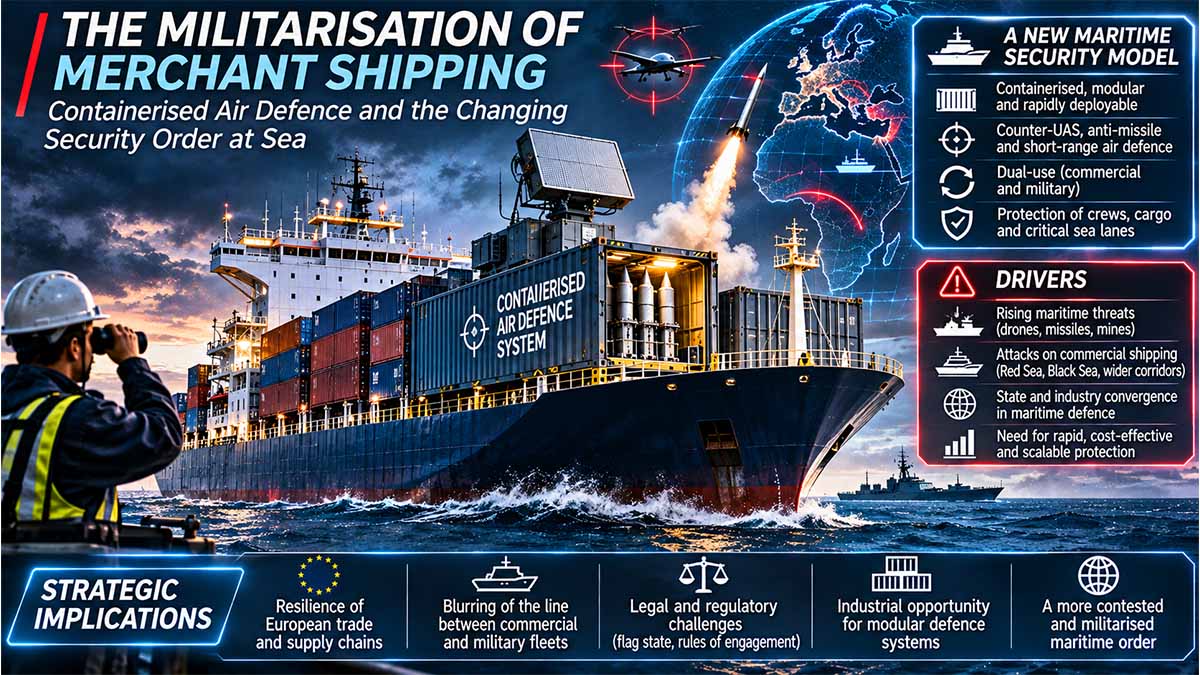
Principal judgment — High confidence: The development of containerised naval air-defence systems for deployment aboard commercial vessels represents a potentially significant change in how states, shipowners and defence manufacturers conceptualise maritime security. The emerging proposition is that some merchant vessels may require military-grade protection against aerial threats rather than relying exclusively on naval escorts, route avoidance, passive measures or private armed guards.
The significance lies not simply in the weapons themselves, but in the prospective transformation of commercial ships into temporarily armed platforms capable of conducting their own air-defence engagements.
ASELSAN’s publicly documented GÖKDENİZ and GÖKSUR systems provide two complementary defensive layers:
- GÖKDENİZ: twin 35 mm guns, a combined firing rate of 1,100 rounds per minute and a manufacturer-stated effective range of 4 km against aerial threats using ATOM airburst ammunition.
- GÖKSUR: a point-defence missile family with a manufacturer-stated effective range of 15 km, designed to counter sea-skimming missiles and other airborne threats.
- Deployable architecture: a modular approach intended to make defensive weapons transferable between compatible vessels or other installations without permanently transforming each host platform into a warship. – Source: GÖKDENİZ Close-In Weapon System — ASELSAN — June 2025 – Source: GÖKSUR 100-N Point Defense Missile System — ASELSAN — June 2025
Strategic consequence — High confidence: The technology is advancing into a regulatory environment historically designed around civilian shipping, naval forces and comparatively limited privately contracted armed security. Existing International Maritime Organization guidance does not establish a general authorisation for privately operated missile or automated gun systems on merchant ships.
Operational qualification — High confidence: Manufacturer-stated engagement ranges and demonstrated performance of underlying naval systems do not establish the combat effectiveness, seaworthiness, regulatory acceptability or operational readiness of a removable commercial-vessel installation.
Economic consequence — Moderate confidence: If states authorise deployments and insurers recognise their risk-reduction value, containerised defensive systems could create a specialised market connecting defence procurement, maritime logistics, ship classification, insurance and military support services. The scale of that market is not yet established.
Decisive uncertainty: Whether deployable naval weapons will remain a narrowly controlled military capability or become an accepted form of state-authorised protection for selected commercial voyages.
The Militarisation of Merchant Shipping: When Global Trade Starts Carrying Its Own Air Defence
The emergence of containerised military air-defence systems for merchant vessels marks a consequential shift in the relationship between international commerce and sovereign military power. At EURONAVAL 2026, held in Paris on 3–6 November, Türkiye’s ASELSAN presented deployable naval weapons intended to protect commercial ships and other critical assets. The innovation is not simply technological: it proposes transferring capabilities traditionally integrated into warships onto civilian vessels without permanently converting them into military platforms. Yet the ability to install a missile launcher is advancing faster than the legal authority, insurance arrangements and command structures required to operate it. For governments, the decision now concerns who protects commercial trade, who authorises military force and who pays when the boundary between civilian navigation and naval warfare becomes less distinct.
The merchant vessel is becoming a military procurement question
The historical division between merchant shipping and naval protection is under pressure. Commercial vessels were designed to carry cargo under the regulatory framework of the International Convention for the Safety of Life at Sea (SOLAS), while military forces retained responsibility for confronting sophisticated armed threats. The anti-piracy response developed from 2011 introduced privately contracted armed security personnel, but the International Maritime Organization (IMO) never converted that practice into a general authorisation for naval missile systems aboard commercial ships.
ASELSAN’s containerised GÖKDENİZ and GÖKSUR architecture changes the technological proposition. GÖKDENİZ combines two 35 mm guns capable of firing 1,100 rounds per minute, with a manufacturer-declared effective range of 4 kilometres against aerial threats using ATOM programmable ammunition. GÖKSUR adds guided-missile point defence with a declared range of 15 kilometres. The concept is intended to make military protection transferable between suitable platforms, separating the defensive capability from the permanent configuration of the ship.
That separation has substantial implications. A government could potentially assign military equipment to selected commercial voyages rather than permanently arm an entire fleet. But a removable launcher does not confer warship survivability, lawful engagement authority or automatic permission to enter foreign ports. Nor do the published ranges establish guaranteed interception performance. The relevant distinction remains between a manufacturer’s technical specification, a tested capability and an operationally accepted installation.
The numbers explain why maritime defence is becoming an industrial market
International shipping accounts for approximately 80% of merchandise trade by volume. According to UNCTAD’s Review of Maritime Transport 2025, seaborne trade volumes increased by 2.2% in 2024, while tonne-miles grew by 5.9%. The difference reflects greater transport distances and therefore a larger requirement for shipping capacity relative to cargo growth. Average voyage distance increased from 4,831 miles in 2018 to 5,245 miles in 2024.
The security implications are concentrated in strategic passages. UNCTAD reported that the Strait of Hormuz accounted for approximately 34% of global seaborne oil exports and 30% of liquefied petroleum gas exports. Its maritime assessment also recorded Suez Canal tonnage transits approximately 70% below the 2023 average during the period examined. In September 2026, the IMO reported 80 verified attacks against international shipping in and around Hormuz since 28 February, with at least 22 seafarers killed.
Europe has already committed military resources to protecting commercial navigation. EUNAVFOR ASPIDES, launched on 19 February 2024, reported supporting more than 1,960 merchant vessels and protecting more than 650 by 27 May 2026. The EU extended its mandate to 28 February 2027, allocating €14,917,600 in common-cost funding for the preceding twelve-month period. That amount excludes the full cost of nationally supplied military assets and cannot be treated as the total expenditure on maritime protection.
The economic mechanism is clear: maritime insecurity can impose costs without physically closing a corridor. Rerouting absorbs vessel capacity, affects delivery schedules and alters freight and insurance obligations. But the size of these costs does not demonstrate that onboard missiles would be cheaper than naval protection. A weapon capable of defending an individual ship cannot independently guarantee the availability of the route on which the vessel depends.
Türkiye is exporting an architecture, not merely a weapon
ASELSAN’s naval-defence initiative reflects a wider transformation of Türkiye’s military-industrial position. The country’s Presidency of Defence Industries reported defence and aerospace exports of USD 10.054 billion in 2025. ASELSAN’s financial results for January–September 2026 reveal the corporate scale supporting its technological expansion: revenue reached TRY 151.486 billion, EBITDA TRY 40.555 billion and new contracts USD 14.015 billion.
The company’s backlog stood at USD 30.744 billion at the end of September 2026, compared with USD 17.914 billion one year earlier. New export contracts reached USD 1.9 billion during the first nine months of 2026, while investments in infrastructure and production capacity totalled USD 684 million, an increase of 228% under the company’s reporting methodology. Research and development expenditure reached approximately USD 1.3 billion.
These figures establish industrial growth, not the value of the market for armed merchant vessels. ASELSAN’s backlog covers multiple defence categories, and its published accounts do not identify a separate revenue stream attributable to containerised commercial-vessel protection.
The industrial significance nevertheless extends beyond the acquisition of individual guns and missiles. A deployable defensive architecture creates demand for sensors, electronic systems, ammunition, installation engineering, maintenance, software support and qualified operators. It also creates potential long-term dependencies between customers and manufacturers. A government purchasing a removable system must consider not only its initial cost but access to spare parts, technical modifications, ammunition, maintenance rights and lawful transfers between platforms.
Türkiye’s commercial proposition therefore concerns the export of an integrated military capability. The scale of its adoption will depend on whether customers can translate that capability into authorised operations, not simply on the number of units manufacturers can produce.
Maritime law is the ceiling on technological ambition
The United Nations Convention on the Law of the Sea (UNCLOS) establishes a distinction that containerisation cannot erase. Articles 91–94 define the responsibilities associated with a ship’s nationality and flag-state jurisdiction. Articles 17–19 regulate innocent passage through territorial seas, while Article 29 defines warship status through institutional and command characteristics, not merely the presence of weapons.
Consequently, a merchant vessel carrying a removable missile launcher does not automatically become a warship. Equally, authorisation by its flag state does not eliminate applicable coastal- and port-state requirements or establish unrestricted permission to operate military weapons.
The distinction becomes more difficult when commercial and military authority coexist aboard the same vessel. The master retains navigational and safety responsibilities, while a government-controlled defensive system may operate under a separate military chain of command. A contract between a shipowner and equipment supplier cannot independently determine the lawful authority to identify a hostile target or employ military force.
International humanitarian law creates another constraint during armed conflict. Merchant vessels generally enjoy civilian protection unless their actual functions or conduct satisfy the applicable criteria for military objectives. Installing defensive equipment does not produce an automatic legal determination, but operating military weapons may become relevant to that assessment.
Technical autonomy therefore cannot substitute for sovereign accountability. Radar, programmable ammunition, encrypted communications and automated fire-control functions may strengthen a defensive system. They cannot determine its legal status or eliminate responsibility for an erroneous engagement, cyber compromise or harm to third parties.
The financial obstacle lies with insurers, charterers and governments
The commercialisation of onboard defence would enter an insurance market that recorded USD 42.6 billion in marine premiums during 2025, according to the International Union of Marine Insurance’s 2026 reporting. Ocean hull premiums reached approximately USD 10.5 billion, while cargo premiums totalled USD 24.2 billion. These figures establish the scale of marine risk transfer, but they are not estimates of the market available to defence manufacturers.
The contractual constraint is equally significant. BIMCO’s VOYWAR 2025 and CONWARTIME 2025 clauses address the consequences of dangerous voyages, alternative routing, additional insurance premiums and specified financial obligations. VOYWAR revised the treatment of diversions, replacing the previous 100-mile threshold with provisions reflecting time and expenses. Qualifying additional insurance costs are subject to documented reimbursement mechanisms.
None of these provisions automatically requires a charterer to finance a containerised missile launcher. Nor does fitting a defensive system guarantee lower war-risk premiums. Insurers must consider operational effectiveness, lawful authority, liability and the additional risks introduced by military equipment.
The potential financial conflict is substantial. The shipowner may incur installation costs, the charterer may benefit from a shorter route, the insurer may retain exposure to additional liabilities and the government may provide personnel or military support. Without contractual alignment, the party paying for protection may not capture its economic benefit.
The same problem affects fleet-wide deployment. A removable module may reduce permanent installation costs while creating recurring expenditure for transfer, certification, storage, maintenance and specialist personnel. Its financial advantage is therefore conditional, not inherent in its design.
Europe has maritime exposure but no single sovereign solution
Italy, France, Germany and the United Kingdom illustrate why a common European procurement model would encounter different legal and economic conditions.
Italian ports handled more than 488 million tonnes of goods in 2024, representing 14.6% of EU maritime cargo. Liquid bulk accounted for 40.5% of national throughput. Italy also exercises important multinational naval responsibilities: in April 2026, its Navy reported tactical-command roles across ASPIDES, ATALANTA and IRINI. Its exposure is consequently both commercial and operational, particularly across Mediterranean transport and energy networks.
France reported 468 commercial vessels under its flag in July 2026, including 231 transport vessels. Its Navy accompanied the French-flagged CMA CGM Notre-Dame through Bab el-Mandeb in June 2026 and subsequently reported more than 150 civilian-vessel accompaniments since February 2024. France already possesses an established military model for protecting commercial ships without permanently transferring defensive weapons to their operators.
Germany’s commercially controlled merchant fleet comprised 1,716 vessels in 2025, including 557 container ships, but only 594 operated under the German flag. The distinction is decisive: German commercial ownership does not confer German flag-state authority over foreign-registered ships. The Bundestag’s October 2026 authorisation of up to 350 personnel for ASPIDES also demonstrates the parliamentary dimension of German military participation.
The United Kingdom’s national register contained 1,034 vessels at the end of 2025, while 1,781 trading vessels were beneficially owned, managed or operated by UK companies. Its Ministry of Defence separately identified 439 militarily useful British-registered merchant vessels. These categories describe different forms of commercial and military relevance; none establishes automatic eligibility for onboard missile systems.
The European Union can coordinate maritime-security policy and naval operations, while NATO’s Operation Sea Guardian supports maritime awareness and security in the Mediterranean. Neither framework automatically replaces national authority over merchant-vessel registration, military weapons or the use of force.
The European problem is therefore not the absence of industrial capabilities. It is the mismatch between internationally distributed commercial fleets and nationally controlled military authority.
The next two years will determine who bears the cost of delayed decisions
Between November 2026 and November 2028, the decisive evidence will be whether deployable military systems progress from manufacturer demonstrations and procurement commitments to accepted installations with identifiable operating authorities. The EURONAVAL announcement establishes industrial intent, but publicly available records do not yet demonstrate a generally authorised commercial-vessel operating model.
The most credible near-term pathway is selective state-controlled deployment, supported by defined military personnel, approved host vessels and specific operating requirements. A wider commercial market would demand additional agreements among flag states, port authorities, insurers and equipment providers, alongside independently supportable evidence of safety and effectiveness.
Governments that acquire equipment without resolving these conditions risk creating assets that cannot be deployed efficiently. Governments that rely exclusively on existing naval capacity must confront the continuing financial and operational burden of protecting commercial traffic across dispersed maritime corridors.
The economic consequences will fall unevenly. Shipping companies face uncertain insurance and routing costs; charterers confront changing delivery obligations; manufacturers face the cost of supporting systems whose commercial market remains undefined; and European governments must decide how much additional military responsibility to assume for civilian commerce.
The fundamental shift is already visible: merchant shipping is becoming a potential customer for naval weapons. The unresolved question is whether states can build the legal and financial institutions required to operate them. Over the next 12–24 months, failure to establish that distinction will leave maritime trade exposed to two simultaneous costs: the continued expense of insecure routes and the risk of purchasing military protection that cannot lawfully or economically deliver the service for which it was acquired.
Navigational Index
Pillar I — The Transformation of Maritime Defence Technology
Chapter 1. From Commercial Vessel to Defended Platform: The Changing Character of Maritime Security : Historical development of commercial-vessel protection; the distinction between civilian shipping, armed security and military systems; the operational implications of aircraft, missiles and unmanned systems threatening maritime commerce.
Chapter 2. ASELSAN’s GÖKDENİZ–GÖKSUR Architecture: Capabilities, Limitations and Technical Maturity : The evolution of Turkish naval defence technology; gun and missile systems; sensors, ammunition, command-and-control and engagement geometry; differences between declared performance, tested capability and deployment readiness.
Chapter 3. Containerisation and the New Economics of Maritime Military Integration : Modular installation, vessel compatibility, power requirements, structural integration, electromagnetic interference, operator requirements, ammunition management, maintenance and the implications of transferring military systems between commercial platforms.
Pillar II — Sovereignty, Military Authority and the Economics of Armed Commerce
Chapter 4. International Maritime Law and the Limits of Civilian Armament : Flag-state jurisdiction, coastal-state and port-state competence, rules governing weapons carriage, the rights of innocent passage, command responsibility and the distinction between defensive equipment and military operations.
Chapter 5. The Red Sea, the Eastern Mediterranean and the Strategic Geography of Merchant-Vessel Defence : Exposure of trade corridors, maritime chokepoints, energy shipments and commercial fleets; the operational interaction between shipboard defence, naval escorts, intelligence and regional security arrangements.
Chapter 6. Shipping Economics, Insurance and the Industrial Market for Deployable Air Defence : Capital expenditure, installation and removal costs, recurring support, insurance and liability, fleet economics, export controls and the competing interests of shipowners, charterers, insurers, flag states and defence manufacturers.
Chapter 7. European Strategic Exposure: Italy, France, Germany and the United Kingdom : Separate national assessments of merchant-fleet exposure, maritime industrial interests, naval protection requirements, jurisdictional authority and implementation capacity, followed by European Union and NATO coordination constraints.
Pillar III — The Militarisation of Maritime Commerce, 2027–2031
Chapter 8. Türkiye’s Defence-Industrial Strategy and the Export of Modular Naval Protection : ASELSAN’s position within the Turkish defence ecosystem, the relationship between naval capability and export markets, state support, technology dependencies and the strategic consequences of supplying defensive military equipment for nontraditional maritime platforms.
Chapter 9. Escalation, Identification and Command Authority at Sea : Combatant identification, rules of engagement, hostile-intent assessment, accidental engagements, civilian crew safety, cyber resilience, electronic warfare and the consequences of deploying military-effect weapons in contested maritime environments.
Chapter 10. Strategic Scenarios and the Five-Year Outlook : Alternative adoption pathways to 2031; regulatory and operational decision thresholds; procurement and insurance indicators; conditions under which merchant-vessel armament could expand or remain exceptional.
Chapter 11. Governmental and Industrial Courses of Action: Final Net Assessment : Comparison of naval protection, state-operated defensive detachments, controlled modular installations and non-weapon alternatives, with particular attention to European maritime sovereignty, economic competitiveness, escalation risk and institutional responsibility.
Master Abstract
The changing boundary between commercial shipping and military defence
The growing intersection between commercial maritime transport and military air defence reflects a structural tension in the international security system. Global trade depends upon the continued movement of civilian vessels through maritime corridors that are not necessarily insulated from armed conflict, coercive attacks or the deployment of modern unmanned weapons. At the same time, naval forces have finite capacities to escort, monitor and defend commercial traffic across dispersed maritime theatres. The resulting question is whether the protection of merchant shipping can remain predominantly an external responsibility of navies and maritime-security organisations, or whether selected vessels will increasingly carry their own military-grade defensive capabilities.
ASELSAN’s modular naval-defence approach is strategically relevant because it attempts to separate the defensive weapon installation from the permanent design of the host vessel. The underlying technical proposition is that some protective functions traditionally reserved for warships could become deployable capabilities assigned to a voyage, route, vessel or strategic installation. Such an architecture would potentially allow a defence capability to be removed and reassigned when the relevant threat or operational requirement changes. This reversibility distinguishes modular weapons from permanent military conversion, although physical removal does not automatically resolve the legal and operational consequences of their deployment.
The international economic significance is substantial. UN Trade and Development identifies maritime shipping as responsible for approximately 80% of international merchandise trade by volume. Even limited changes to security requirements along strategically important routes may therefore affect transport costs, insurance arrangements, fleet deployment decisions and the resilience of industrial supply chains. – Source: Review of Maritime Transport — UN Trade and Development
From defensive gun systems to layered missile protection
The technical foundation of the emerging architecture is the combination of two distinct engagement mechanisms. GÖKDENİZ provides close-in gun defence using programmable 35 mm ammunition, with its manufacturer documenting qualification engagements against high-speed aerial targets and sea-skimming scenarios. GÖKSUR extends the defensive concept through guided missiles, infrared sensing, datalink-assisted guidance and a fire-control architecture intended to support multiple-target engagement. Their different effective ranges indicate complementary defensive functions rather than an interchangeable relationship between gun and missile systems.
This distinction matters because the threat environment contains fundamentally different engagement problems. An approaching unmanned aircraft, a high-speed cruise missile and an asymmetric surface threat cannot be evaluated exclusively through nominal engagement range. Detection quality, identification confidence, available reaction time, sensor coverage, available ammunition and the integrity of command decisions can determine whether a theoretically capable weapon system provides meaningful protection in a particular scenario.
ASELSAN’s manufacturer documents establish the specifications of the underlying systems. They do not, by themselves, demonstrate that a containerised combination has completed shipboard qualification across different merchant-vessel classes, or establish its effectiveness against coordinated attacks involving several threat types. The transformation from naval equipment to removable commercial-vessel defence therefore creates additional engineering and operational questions that cannot be answered simply by transferring existing performance figures. – Source: GÖKDENİZ Close-In Weapon System — ASELSAN — June 2025 – Source: GÖKSUR 100-N Point Defense Missile System — ASELSAN — June 2025
The more consequential transformation concerns authority, not firepower
The most important institutional distinction is between the historical acceptance of limited armed protection against piracy and the prospective deployment of military systems capable of engaging aircraft or guided missiles. The International Maritime Organization has progressively recognised that privately contracted armed security personnel may be deployed in certain circumstances, subject to applicable national laws. Its guidance nonetheless preserves flag-state responsibility and requires attention to coastal-state, port-state and other relevant requirements.
In June 2015, the Maritime Safety Committee issued revised recommendations explicitly addressing the possible escalation of violence arising from the carriage of firearms and armed personnel. Those recommendations were developed for privately contracted armed security, particularly in designated high-risk areas. They cannot reasonably be interpreted as a comprehensive legal framework for vertical-launch missiles, automated cannon systems or military air-defence detachments operating aboard commercial ships.
The development of removable weapons therefore introduces an authority problem that is separate from technical capability. Governments would need to determine who owns and controls the system, who authorises an engagement, which rules govern its operation, how the vessel interacts with military forces, and what obligations arise when entering ports or territorial waters. The answers may differ depending on whether the system is operated by military personnel, another state-authorised entity or a civilian contractor. The legal character of the vessel would require a fact-specific assessment rather than an assumption that weapons alone transform its status. – Source: Revised Interim Recommendations for Flag States Regarding the Use of Privately Contracted Armed Security Personnel — International Maritime Organization — June 2015
The industrial and financial implications of modular maritime armament
Containerisation potentially changes the commercial organisation of maritime defence. Conventional naval procurement usually integrates weapons, combat-management systems and supporting infrastructure into a vessel for a prolonged service life. A removable architecture instead raises the possibility of assigning protection to particular missions, with equipment shared across compatible platforms rather than permanently installed throughout an entire commercial fleet. This could create opportunities for defence manufacturers, maintenance providers, specialised logistics operators and government-supported maritime-security services.
However, the financial proposition cannot be established from weapon specifications alone. Even a fully self-contained defensive unit may require engineering approval, safe mounting, suitable fields of fire, protected personnel, ammunition and maintenance arrangements, and documented procedures for operating alongside the ship’s navigation and communication systems. The capital cost of the equipment is only one component of its total economic burden. Legal authorisation, liability allocation, recurring maintenance, military staffing and the effect on commercial operating arrangements may prove equally decisive.
For governments, the strategic choice is not necessarily between leaving merchant ships undefended and equipping them with missiles. Naval escorts, coordinated maritime surveillance, route management, protective shipboard measures and state-controlled deployment of defensive systems represent alternatives with different costs, capacities and escalation consequences. The emergence of modular armament expands the range of possible choices without establishing that widespread weapon installation is the most effective or lawful outcome.
The principal assessment is therefore that the technological boundary separating naval self-defence systems from commercial maritime platforms is becoming more flexible, while the institutional boundary between civilian transport and military force remains considerably more resistant to change. The decisive development through 2031 will not be the appearance of additional containerised weapons alone, but whether governments construct the legal authority, operating doctrine and financial arrangements necessary to employ them without undermining maritime safety or increasing escalation risks.
Key Evidence Table
The following record distinguishes documented specifications, institutional instruments and propositions that remain dependent on further evidence.
| Indicator | Value/status | Reference date | Definition/scope | Issuer | Exact source |
|---|---|---|---|---|---|
| GÖKDENİZ calibre | Twin 35 mm | June 2025 | Close-in weapon system | ASELSAN | Technical specification |
| GÖKDENİZ firing rate | 1,100 rounds/min | June 2025 | Combined twin-gun rate | ASELSAN | Technical specification |
| GÖKDENİZ effective range | 4 km | June 2025 | Aerial targets using ATOM ammunition | ASELSAN | Technical specification |
| GÖKDENİZ qualification targets | Greater than 180 m/s | June 2025 | High-speed target drone representing an anti-ship missile | ASELSAN | Qualification tests |
| GÖKSUR effective range | 15 km | June 2025 | Manufacturer-declared point-defence engagement range | ASELSAN | Technical specification |
| GÖKSUR missile dimensions | 160 mm diameter; 3,300 mm length | June 2025 | GÖKSUR 100-N missile | ASELSAN | Technical specification |
| GÖKSUR missile mass | 142 kg | June 2025 | Manufacturer-declared missile weight | ASELSAN | Technical specification |
| Modular commercial-vessel deployment | Concept; operational qualification not established in verified manufacturer specification | November 2026 | Removable defensive installations | ASELSAN | GÖKDENİZ specification |
| Flag-state authority over armed security | National authorisation required | June 2015 | Privately contracted armed personnel; not a general missile-system authorisation | IMO | MSC.1/Circ.1406/Rev.3 |
| Updated maritime-security practices | Consolidated industry guidance circulated | June 2025 | Best Management Practices Maritime Security | IMO | MSC.1/Circ.1601/Rev.2 |
| EURONAVAL 2026 | 3–6 November | November 2026 | Naval defence industry exhibition, Paris | European Commission | Event record |
Table 1. Verified manufacturer and institutional baseline. Declared performance is not equivalent to demonstrated effectiveness in every operating configuration. The technical documentation describes product families rather than certifying a specific merchant-vessel installation.
Competing Strategic Pathways
Three pathways can account for the future development of modular maritime armament. They are alternative strategic outcomes rather than evidence of already completed industry-wide adoption.
| Pathway | Supporting mechanism | Limiting evidence or conditions | Observable indicators | Current assessment |
|---|---|---|---|---|
| A. Exceptional military protection | Governments deploy temporary air-defence capabilities aboard selected vessels facing elevated threats | Military personnel, logistics and national authorisation requirements limit scalability | Naval procurement, military operating arrangements, selected-vessel trials | Credible near-term pathway |
| B. Commercially organised defensive services | Modular systems enable reusable mission-specific protection across compatible commercial platforms | Weapons legislation, export controls, liabilities, insurance, operating costs and uncertain rules of engagement | New flag-state rules, certified installations, insurer acceptance, commercial service contracts | Technically conceivable; institutionally unproven |
| C. Continued reliance on collective naval protection | Naval escorts and coordinated maritime-security arrangements retain responsibility for military engagements | Limited naval availability and dispersed threats can reduce practical coverage | Escort missions, maritime surveillance programmes, restrictions on merchant armament | Established institutional baseline |
These pathways are not necessarily mutually exclusive. A plausible future maritime-security structure could combine naval escorts for major corridors, temporary state-operated defensive systems for selected high-value shipments, and continued restrictions on privately controlled military weapons.
At the present evidentiary threshold, there is insufficient basis to assign numerical adoption probabilities. The choice between these pathways depends principally on regulatory decisions, operational demonstration, liability arrangements and the economics of sustained deployment.
Principal Gaps and Watch Indicators
The following uncertainties determine whether the technology remains a specialised military product or becomes a broader feature of maritime commerce.
| Strategic question | Missing decisive evidence | Indicator to monitor | Decision consequence |
|---|---|---|---|
| Is the removable architecture operationally mature? | Completed qualification and acceptance records for defined host-vessel classes | Verified sea trials and platform certification | Determines technical deployment credibility |
| Who is authorised to operate it? | Applicable flag-state authorisations and documented command arrangements | National regulations and military operating agreements | Determines whether employment is legally feasible |
| Can the systems operate safely aboard commercial vessels? | Structural, stability, firing-safety and maritime-equipment assessments | Classification approvals and independent safety assessments | Determines vessel compatibility |
| Does temporary armament reduce total voyage risk? | Comparable operational and financial assessments | Insurer decisions, risk assessments and deployment outcomes | Determines economic attractiveness |
| Can an export order be linked to merchant-vessel deployment? | Contract configuration, recipient, contractual scope and acceptance criteria | Official contract disclosures and subsequent deliveries | Distinguishes military procurement from commercial adoption |
| Will regulators converge internationally? | Commonly accepted rules for advanced shipboard defensive systems | Flag-, coastal- and port-state policy decisions | Determines cross-border scalability |
The distinction between an export contract for a containerised naval capability and operational adoption by merchant fleets is particularly important. An order from a navy, even when followed by delivery, would not independently establish that private commercial vessels had been authorised to operate such weapons.
Strategic Decision Assessment
The immediate decision for maritime authorities is whether existing rules governing armed security adequately address military systems that are portable, independently powered and potentially capable of engaging aerial targets beyond the effective reach of traditional shipboard security weapons.
For defence establishments, the question concerns the allocation of military protection capacity. Deploying a modular defensive unit aboard a merchant vessel could offer a different distribution of force from assigning a dedicated escort, but the relative efficiency depends on the threat, personnel requirements, available sensors, engagement authority and the ability to defend the vessel against multiple simultaneous attacks. Without comparative operational evidence, neither arrangement should be presumed superior.
For shipowners and insurers, the central problem is whether any improvement in protection can be demonstrated and legally recognised without creating greater liability, operating costs or restrictions on access to ports and trading routes.
For European governments, the issue has a further industrial dimension. Italy, France, Germany and the United Kingdom possess different combinations of shipping interests, maritime industries, defence capabilities and legal regimes. Their choices could generate divergent commercial standards unless national decisions are accompanied by appropriate European and allied coordination.
The strategic significance extends beyond one manufacturer’s products. Modern defensive weapons are increasingly being designed or adapted for modular use, while commercial shipping remains organised around civilian safety, international trade and complex jurisdictional relationships. These systems potentially bring those two structures into closer contact.
The central risk is that the ability to install military weapons aboard merchant vessels may develop faster than the rules governing who can use them, under what authority, and with what consequences.
The central opportunity is that a carefully regulated capability could offer additional protection for selected maritime movements without requiring permanent military conversion of civilian fleets.
Neither outcome is inevitable. Their relative credibility will be determined by official authorisations, independently supportable operational performance, legal responsibility and demonstrable economic value.
MARITIME DEFENCE INTELLIGENCE — Loading interactive dashboard. JavaScript is required for the interactive edition.
The Militarisation of Merchant Shipping
Containerised air defence, the changing relationship between naval force and civilian commerce, and the strategic implications of deployable military systems at sea.
ASSESSMENT HORIZON · 2026–2031Technical baseline
Published manufacturer specifications for the underlying defensive systems. These do not establish the effectiveness of a containerised merchant-vessel installation.
Defensive architecture — interactive visualisation
Select a defensive layer to inspect the published engagement ranges. The concentric display is a conceptual range comparison, not a tactical coverage map.
Declared engagement ranges
CONCEPTUAL · NOT TO SCALE FOR TARGET PERFORMANCEModular system — 3D conceptual architecture
Four functional elements illustrate the proposed installation concept. This arrangement is not a verified ship-class configuration or certified installation plan.
From defence technology to lawful maritime deployment
Four distinct gates separate a technically plausible concept from a legally authorised, economically sustainable capability.
Strategic pathways — interactive analysis
Select one of three plausible institutional outcomes. These pathways are qualitative and may coexist; no numerical probability is assigned.
Evidence and maturity register
The record separates published technical specifications, institutional legal guidance and matters not established for a commercial-vessel deployment.
| Indicator | Value / status | Evidence category | Interpretation |
|---|---|---|---|
| GÖKDENİZ | 35 mm × 2; 1,100 rpm | Manufacturer declared | Twin-gun close-in defence specifications |
| GÖKDENİZ | 4 km | Manufacturer declared | Effective range against aerial targets with ATOM ammunition |
| GÖKSUR | 15 km | Manufacturer declared | Point-defence missile effective range |
| GÖKSUR | 142 kg; 160 mm; 3,300 mm | Manufacturer declared | Missile mass, diameter and length |
| IMO · MSC.1/Circ.1406/Rev.3 | 2015 | Institutional guidance | Guidance concerning privately contracted armed security personnel; not blanket authorisation for missile systems |
| Merchant-vessel installation | Not established | Open official record | Certified platform integration, operating permissions and combat performance require further evidence |
The sovereign authority problem
Military-grade defensive armament creates responsibilities that cannot be resolved by modular engineering alone.
The technology allowing military weapons to be moved between maritime platforms is developing faster than an internationally harmonised framework for their operation aboard merchant vessels. Deployment feasibility depends on engineering qualification, legal authority, command responsibility and demonstrable economic value.
Official and manufacturer sources
Source documents supporting the technical and institutional baseline. Assessments and possible future pathways are analytical interpretations, not manufacturer claims.
PILLAR I — THE TRANSFORMATION OF MARITIME DEFENCE TECHNOLOGY
Evidence cut-off: 7 November 2026 | Strategic horizon: 2027–2031
Chapter 1. From Commercial Vessel to Defended Platform: The Changing Character of Maritime Security
Principal judgment: The prospective deployment of military-grade air-defence systems aboard merchant vessels represents a fundamental evolution in maritime security because it challenges an operating model in which commercial ships primarily relied upon passive protection, private armed security personnel and external naval forces. The decisive transformation is not the historical novelty of an armed merchant ship, but the possibility of placing sophisticated military systems on civilian platforms without permanently converting their basic commercial configuration. This development creates a new relationship between naval force, international commerce, military technology and sovereign authority. Its strategic significance will depend less on the availability of individual weapons than on the ability of governments and maritime industries to establish credible operational, legal and financial arrangements for their employment.
The Historical Separation Between Merchant Shipping and Naval Protection
The development of maritime security over the past century has been characterised by a progressive institutional separation between vessels engaged in commercial transport and naval forces responsible for organised military protection. This distinction has never been absolute. Merchant vessels have historically carried defensive weapons during major conflicts, while governments have organised convoy systems, assigned naval escorts and implemented special wartime arrangements to protect commercial navigation. Nevertheless, the modern international shipping system evolved around a different operational premise: the merchant vessel is primarily a transport platform whose design, crewing, insurance, certification and international mobility are governed by commercial maritime requirements rather than the permanent obligations associated with a combatant vessel.
The significance of this distinction becomes apparent when examining the international regulatory architecture established during the second half of the twentieth century. The International Convention for the Safety of Life at Sea, adopted on 1 November 1974 and entering into force on 25 May 1980, established a comprehensive framework covering ship construction, stability, machinery, electrical installations, lifesaving equipment, navigation and other fundamental safety requirements. Although SOLAS does not prohibit every conceivable form of defensive equipment on a commercial vessel, its architecture is directed principally toward the protection of human life, the safe operation of ships and the prevention of maritime accidents. Military weapon employment introduces technical and institutional problems that cannot be resolved simply by demonstrating that an installation is mechanically compatible with a particular deck or hull.
The importance of this regulatory distinction is reinforced by the International Maritime Organization’s treatment of maritime security. Following the terrorist attacks of 11 September 2001, governments strengthened the protection of international shipping and port facilities through amendments to SOLAS and the International Ship and Port Facility Security Code, which entered into force on 1 July 2004. This framework required security assessments, organisational responsibilities, security plans and arrangements for responding to different threat levels. It did not establish a general system under which privately operated commercial vessels could independently employ sophisticated military air-defence weapons. Its underlying philosophy remained that commercial maritime security should be managed through threat assessment, preventive measures, coordination with public authorities and clearly assigned responsibilities.
These distinctions are documented in the International Convention for the Safety of Life at Sea — International Maritime Organization and SOLAS Chapter XI-2 and the International Ship and Port Facility Security Code — International Maritime Organization.
The resulting arrangement has generally allowed commercial shipping companies to concentrate capital expenditure on transport performance, fuel efficiency, cargo capacity, environmental compliance and commercial reliability, while relying on states to provide military security where necessary. This allocation is economically logical when maritime threats are relatively limited, geographically contained or manageable through navigation procedures and naval intervention. It becomes more difficult when hostile actors can threaten commercial vessels with missiles, remotely piloted aircraft or other weapons whose operational characteristics exceed the defensive capabilities of conventional merchant-ship security arrangements.
The contemporary debate must therefore be understood as a reconsideration of the allocation of defensive responsibilities rather than as a straightforward return to historically armed merchant shipping. A commercial vessel equipped with a removable military system would remain fundamentally different from a purpose-built frigate or destroyer in its survivability, damage-control arrangements, crew composition and combat-system integration. Conversely, a missile launcher or automatic cannon installed temporarily on a merchant vessel cannot automatically be treated as equivalent to the small arms historically employed by private security personnel. The gap between these categories creates the central technological and institutional challenge examined throughout this pillar.
The Evolution From Anti-Piracy Protection to Defence Against Military Weapons
The modern expansion of armed protection aboard merchant ships emerged principally in response to piracy and armed robbery, particularly in the Western Indian Ocean and the Gulf of Aden. The operational problem was initially dominated by the vulnerability of commercial vessels to comparatively small groups of attackers, frequently approaching in small craft and attempting to board ships, seize crews or capture cargo. The corresponding security measures included voyage planning, enhanced observation, physical barriers, changes to operational procedures, reporting to maritime-security organisations and, in particular circumstances, the deployment of privately contracted armed security personnel.
In May 2011, the International Maritime Organization’s Maritime Safety Committee reaffirmed that the organisation neither endorsed nor condemned the presence of armed personnel aboard merchant vessels. The decision whether to permit such personnel remained dependent on applicable flag-state law, while coastal-state and port-state requirements also had to be considered. IMO subsequently developed guidance for shipowners, operators, masters, flag states, coastal states, port states and private maritime-security companies. The relevant institutional instruments include MSC.1/Circ.1405/Rev.2 of May 2012 and MSC.1/Circ.1406/Rev.3 of June 2015.
These arrangements reflected a narrowly defined security problem. Private armed teams were primarily intended to deter or respond to attacks involving boarding attempts and small-scale violence. They were not designed to provide a merchant vessel with an integrated military air-defence capability capable of detecting, tracking and engaging guided missiles or high-speed aerial threats.
The institutional position is set out in Private Armed Security — International Maritime Organization and the IMO Maritime Security Guidance Register — International Maritime Organization.
This historical development reveals an important asymmetry between the evolution of maritime threats and the instruments available to commercial operators. Measures designed to discourage boarding or reduce exposure to armed robbery cannot automatically protect a ship against a weapon travelling through the air toward its hull or superstructure. Physical barriers, additional observers and private security teams may reduce vulnerability to particular forms of attack, but they do not create the sensor coverage, engagement authority or interception mechanisms associated with military air defence.
The distinction is particularly significant because aircraft, anti-ship missiles and unmanned systems impose different defensive requirements. A vessel facing a small-boat boarding attempt may have an opportunity to alter course, increase speed, implement protective procedures or request assistance. A vessel threatened by a guided missile may have a much narrower opportunity to respond after detection, depending upon the weapon’s trajectory, speed, launch position and the availability of external warning. A remotely piloted aircraft may create a different problem again, because its relatively small size, potentially low altitude and variable flight characteristics may complicate detection or identification without necessarily presenting the same kinetic characteristics as a cruise missile.
It follows that the evolution of merchant-vessel protection cannot be evaluated by counting the number of weapons carried aboard a ship. The more consequential question is which threats the vessel can identify, how its defensive systems are authorised to respond, whether the response can be completed within the available time and whether the resulting engagement creates unacceptable risks for the crew, cargo, neighbouring ships or coastal populations.
Table 1.1 — Historical evolution of merchant-vessel security
| Development phase | Principal security concern | Prevailing protective approach | Institutional responsibility | Structural limitation |
|---|---|---|---|---|
| Wartime merchant protection | Attacks on commercial navigation by organised military forces | Naval escorts, convoys and exceptional wartime armament | State military authorities | Requires sustained naval capacity and wartime organisation |
| Modern commercial safety regulation | Navigation hazards, accidents, fire, stability and machinery failures | SOLAS-compliant ship design and operating procedures | Flag states, shipowners and recognised organisations | Safety compliance does not create military defensive capability |
| Post-2001 maritime security | Terrorism, unlawful interference and threats to port infrastructure | ISPS security assessments, plans, reporting and security levels | Governments, port authorities, companies and masters | Primarily a preventive and organisational security regime |
| Anti-piracy response, particularly from 2011 | Armed boarding, hijacking and crew detention | Best Management Practices, coordination and potentially armed personnel | Flag states, commercial operators and maritime-security providers | Limited protection against guided aerial weapons |
| Contemporary high-threat maritime environment | Missiles, unmanned aircraft, mixed threats and attacks on shipping | Naval protection, route management, surveillance and emerging military-grade shipboard defence proposals | Primarily states, with possible new arrangements involving commercial vessels | Technical integration, legal authority, operating costs and escalation exposure |
The phases overlap rather than replace one another. The adoption of new defensive capabilities does not eliminate obligations concerning maritime safety, anti-piracy procedures or ship security management.
Sources: SOLAS — International Maritime Organization; Private Armed Security — International Maritime Organization; SOLAS XI-2 and ISPS Code — International Maritime Organization.
The Economic Transmission of Threats Against Commercial Navigation
The vulnerability of commercial shipping acquires strategic significance because maritime transport is not an isolated industry. It is an enabling system for manufacturing, energy markets, agricultural commodities, consumer goods, industrial inputs and the movement of capital-intensive products across international supply chains. Disruption of a commercial maritime corridor may therefore generate consequences far beyond the immediate shipping companies involved. Longer routes increase vessel utilisation requirements, change the availability of transport capacity, increase fuel consumption and affect delivery schedules. Depending on market conditions and the availability of alternative routes, these effects may influence freight rates, inventory management, working capital and the competitiveness of trade-dependent industries.
The Review of Maritime Transport 2025 — UN Trade and Development provides a quantitative basis for understanding these mechanisms. UNCTAD reported that maritime trade volumes increased by 2.2% in 2024, while maritime trade measured in tonne-miles increased by 5.9% over the same period. The divergence illustrates the economic consequences of carrying goods over longer distances: physical cargo volumes may grow relatively slowly while the amount of transport work required to move them increases more rapidly. The organisation also reported that average maritime voyage distance increased from 4,831 miles in 2018 to 5,245 miles in 2024, reflecting changes in shipping routes and trading patterns.
The difference between these two distances is 414 miles, equivalent to an approximately 8.6% increase, calculated from UNCTAD’s published figures. This does not mean that every commercial voyage became 8.6% longer, nor does it establish that maritime insecurity was the sole cause of the change. It demonstrates that the geography of commercial navigation has become an important economic variable, with rerouting affecting the amount of transport service required even when the quantity of traded goods does not change proportionately.
The same UNCTAD publication reported that Suez Canal tonnage transit levels remained approximately 70% below the average recorded in 2023 at the period examined in its 2025 assessment. It also identified the Strait of Hormuz as a passage accounting for approximately 34% of global seaborne oil exports in the period referenced by the report. These figures measure different phenomena: the first concerns a disruption to canal traffic relative to a historical baseline, while the second concerns a strategic energy corridor’s share of maritime oil export flows. They cannot be combined into a single index of maritime insecurity, but together they demonstrate why the ability to protect commercial navigation has consequences for energy security and international economic stability.
Table 1.2 — Verified indicators of maritime economic exposure
| Indicator | Published value | Reference period | Economic interpretation |
|---|---|---|---|
| Growth in maritime trade volume | +2.2% | 2024 versus 2023 | Increase in the physical quantity of maritime commerce |
| Growth in maritime tonne-miles | +5.9% | 2024 versus 2023 | Greater transport work, influenced by longer routes |
| Average voyage distance | 4,831 miles | 2018 | Historical comparison point |
| Average voyage distance | 5,245 miles | 2024 | Longer average maritime journeys |
| Calculated change in average distance | +414 miles; approximately +8.6% | 2018–2024 | Derived from UNCTAD’s published distances |
| Suez Canal traffic deviation | Approximately 70% below 2023 average tonnage transit levels | Reported in 2025 | Severe corridor-specific disruption |
| Strait of Hormuz share of seaborne oil exports | Approximately 34% | UNCTAD 2025 reference | Concentration of maritime energy flows |
Source: Review of Maritime Transport 2025: Staying the Course in Turbulent Waters — UNCTAD — 2025.
These data should not be interpreted as evidence that shipboard military systems would automatically reverse commercial rerouting. Shipping companies respond to perceived threats through combinations of operational decisions, governmental advisories, insurance arrangements and evaluations of the probability and consequences of an incident. Even if a particular vessel possessed a defensive weapon capable of countering some forms of attack, other sources of danger might remain, including mines, surface assaults, navigation disruption, the possibility of coordinated attacks or the interruption of port operations. Consequently, the commercial value of improved self-defence would depend on whether it materially changes the total risk of conducting a voyage rather than merely adding another protective capability.
This distinction becomes particularly important when evaluating the relationship between technological innovation and market adoption. A defence system may be militarily effective in a defined engagement scenario yet remain commercially unattractive if its operation requires specialised personnel, extensive modifications, regulatory restrictions or insurance arrangements that outweigh the benefits of using a shorter shipping route. Conversely, a relatively expensive capability might be economically justified for a narrow category of high-value or strategically sensitive maritime movements if an authorised authority determines that the resulting protection is necessary and other measures are insufficient.
The present evidence therefore supports a more specific conclusion than the proposition that commercial shipping is inevitably becoming militarised. The economic consequences of maritime insecurity are demonstrable, and defence manufacturers are developing systems intended to respond to changing threats. Whether those developments lead to widespread merchant-vessel armament remains a separate institutional and commercial question.
The Operational Difference Between Civilian Security and Military Air Defence
The distinction between civilian security equipment and military defensive weapons is not merely a question of calibre or destructive effect. It concerns the architecture of the entire decision process. Conventional merchant-vessel security is organised around risk identification, prevention, deterrence, protective procedures, communication and the preservation of navigational safety. Military air defence introduces the requirement to detect and classify potential hostile objects, establish sufficient confidence in their identity, determine whether an engagement is authorised and employ a weapon in circumstances where an erroneous decision may create serious consequences beyond the host vessel.
The difference is especially clear when comparing a boarding threat with an aerial threat. In the former case, the intent of approaching individuals may be inferred from behaviour, proximity and the circumstances of an attempted boarding, although significant uncertainty can remain. In the latter case, a radar return or electro-optical observation does not necessarily establish whether an airborne object is hostile. Commercial aircraft, military aircraft, remotely piloted systems and other objects may operate within or near the same broad maritime environment. The availability of a sensor and a weapon does not eliminate the need for accurate identification, a valid legal basis for defensive force and command procedures capable of preventing an inappropriate engagement.
Autonomous or automated defence functions make this problem more consequential. Automated detection, target tracking and weapon control may reduce the workload associated with rapidly developing threats, but the distinction between technical automation and delegated authority to use force remains fundamental. The system’s ability to perform target detection or tracking without continuous manual intervention does not establish that the system should be authorised to initiate every engagement independently. An institutional framework must distinguish between technical functionality, human supervision, emergency operation and the legal responsibility of the persons or institutions exercising control.
The 2025 consolidated Best Management Practices Maritime Security guidance reinforces the importance of risk management rather than a single universal protective measure. Developed by the maritime industry and circulated through IMO, the consolidated guidance replaces several earlier geographically differentiated documents and addresses threats across maritime regions. Its framework is built around voyage planning, threat assessment, preventive action, incident reporting and the responsibilities of companies, ship security officers and masters. The guidance expressly preserves the master’s overriding responsibility for ship safety and security, while recognising that the measures appropriate for one type of vessel or threat may not be appropriate for another.
The transition toward military-grade commercial protection consequently introduces a potential conflict between several legitimate forms of authority. The ship’s master remains responsible for safe navigation and the protection of persons aboard. Military personnel, if deployed, may operate under a separate governmental chain of command. The flag state retains regulatory responsibility for the vessel, while coastal and port states exercise their respective powers under international and domestic law. The shipowner and charterer may have commercial interests in completing the voyage, but commercial direction cannot automatically override navigational safety or lawful military command.
This question is especially sensitive because the International Maritime Organization identifies the master’s professional judgment as a protected element of the SOLAS maritime-security framework. SOLAS regulation XI-2/8 establishes that the master must not be constrained by the company, charterer or another person in exercising professional judgment necessary to maintain the security of the ship. A future arrangement involving military weapons would therefore require careful definition of the relationship between navigational authority and weapon-operating authority rather than assuming that both functions can simply be assigned to the same organisational structure.
The Emergence of a Distinct Category of Defended Commercial Platform
The commercial vessel equipped with a removable military defensive system does not fit neatly into traditional categories. It is not necessarily a naval warship, because the presence of weapons does not by itself establish the legal conditions associated with warship status. It is not an ordinary merchant vessel in an operational sense if its protection includes military sensors, missile launchers and automatic cannon systems. Nor can it be assimilated without qualification to a ship carrying privately contracted armed personnel, because the technical capabilities, engagement circumstances and potential consequences are substantially different.
The United Nations Convention on the Law of the Sea defines the legal status of warships in Article 29 through conditions involving state armed-force membership, external marks, command by a duly commissioned officer and a crew subject to regular armed-forces discipline. It also regulates innocent passage through territorial seas under Articles 17–19 and the rights of coastal states under Article 25. A removable weapon installation does not automatically establish those attributes. The presence of weapons also does not, by itself, establish that passage is non-innocent; the applicable provisions distinguish the character of the vessel, the nature of passage and activities actually undertaken, including exercises or practice with weapons.
Source: United Nations Convention on the Law of the Sea, Part II, Articles 17–29 — United Nations.
For analytical purposes, the expression defended commercial platform is useful as a functional description rather than a formally established legal classification. It identifies a vessel that continues to perform commercial transport while carrying a defensive military capability under some form of authorised operating arrangement. This description avoids prematurely assigning the vessel a specific legal status, while allowing analysis of the questions created by the integration of military weapons into commercial maritime activity.
Three potential arrangements must be distinguished. Under a state-operated arrangement, military personnel could retain control of the defensive capability while the commercial vessel continues to perform its transport mission, subject to the applicable legal framework. Under a commercially operated arrangement, a private entity would require specific legal authority for the equipment, personnel and potential use of force, raising substantially more difficult regulatory and liability questions. Under a hybrid arrangement, military supervision and commercial logistical support could coexist, but only if responsibilities were clearly defined. These are analytical possibilities, not evidence that any particular state has already approved them.
Table 1.3 — Functional distinctions between maritime protection models
| Dimension | Conventional merchant vessel | Merchant vessel with private armed security | Merchant vessel with state-operated military defence | Commissioned warship |
|---|---|---|---|---|
| Primary mission | Commercial transport | Commercial transport | Commercial transport with assigned defence | Military operations |
| Defensive architecture | Preventive and passive security | Personnel and authorised firearms | Military sensors and weapons, subject to authorisation | Integrated military combat systems |
| Command structure | Master and commercial operator | Master, with security-team arrangements | Master for navigation; military command arrangements must be defined | Military chain of command |
| Principal legal framework | Merchant-shipping law and applicable conventions | Merchant-shipping law plus national weapons and security rules | Merchant-shipping law plus applicable state military and weapons arrangements | Warship and naval legal framework |
| Weapon-system integration | Not normally applicable | Generally limited compared with naval systems | Potentially extensive, depending on installation | Integral to ship design and operation |
| International port access | Subject to applicable port-state requirements | Additional weapons and security procedures may apply | Potentially more complex authorisation and notification | Subject to rules and arrangements applicable to warships |
| Operational survivability | Civilian design and safety standard | Civilian design and safety standard | Civilian design unless specifically modified | Military design requirements |
| Established category | Yes | Yes, subject to national laws | Possible arrangement; not a universal legal category | Yes, where legal conditions are satisfied |
The critical distinction concerns what the equipment changes and what it does not change. Installing a military air-defence system may add a defined defensive capability, but it does not automatically provide a commercial ship with compartmentalisation, battle-damage resistance, military communications, redundant power distribution or trained naval damage-control personnel. Neither does the installation resolve questions concerning the ship’s status, entry into foreign ports or responsibility for the use of force. The defensive capability and the overall military resilience of the host vessel must therefore be assessed separately.
Strategic Implications of an Expanding Defensive Responsibility
The potential redistribution of maritime protection creates consequences at three interconnected levels. At the level of the individual vessel, an additional defensive capability may improve the available responses to certain threats, but only after the capability has been authorised, integrated, tested and placed under a responsible command arrangement. At the level of maritime operators, the possibility of requesting mission-specific protection could alter the relationship between shipowners, charterers, insurers and governments, although it would also introduce significant financial and legal obligations. At the level of international security, wider deployment could change the interaction between commercial navigation and military confrontation by increasing the number of civilian platforms capable of conducting military defensive engagements.
The strongest reason to examine this development is not an assumption that it will necessarily become universal, but the interaction between technological supply and an observable change in the threat environment. Manufacturers can increasingly offer compact sensing, computing and defensive equipment in configurations intended to be more adaptable than traditional permanently integrated warship systems. Meanwhile, maritime operators confront a security environment in which threats are not confined to boarding attempts and geographically localised criminal activity. The resulting pressure encourages consideration of technical solutions that previously would have been regarded as disproportionate, unnecessarily complicated or unsuitable for routine commercial shipping.
Yet the introduction of more powerful defensive equipment also introduces new risks. A commercial vessel carrying military weapons may create uncertainty for neighbouring vessels, coastal authorities and potential adversaries regarding its defensive role and permitted conduct. The presence of such systems may require additional communications with maritime authorities and could affect how particular vessels are assessed during crises. Whether these consequences increase or reduce overall danger depends on the operating arrangements, the behaviour of hostile actors and the clarity of international legal obligations. It would be analytically unsound to assume that visible defensive armament necessarily deters attacks, just as it would be unsound to assume that the same armament inevitably causes escalation.
The central institutional challenge is therefore to preserve the commercial and civilian functions of maritime transport while determining whether selected military capabilities can be deployed in circumstances of elevated risk. That question cannot be settled by an equipment manufacturer, a shipping company or a military procurement authority acting independently. It requires coordination between maritime administrations, military authorities, classification bodies, insurers and the governments whose territorial waters or ports the vessel may enter.
Chapter 1 — Key Judgments
The most defensible conclusion is that the prospective adoption of military-grade air defence aboard commercial vessels marks a potential transition from predominantly external maritime protection toward selectively distributed defensive capability. The historical precedent of armed merchant shipping demonstrates that the distinction between civilian transport and military protection has never been absolute, but the technical characteristics of modern radar-guided guns and guided missiles make contemporary arrangements substantially more demanding than conventional private armed security.
The evidence establishes that maritime-security threats affect international trade, that existing IMO frameworks distinguish preventive security from the carriage of armed personnel, and that no general international framework presently demonstrated in the reviewed instruments authorises private merchant vessels to operate advanced naval air-defence systems without specific national consideration.
What would change the assessment: Publication of a flag-state regulatory framework specifically permitting removable military air-defence systems aboard commercial vessels; documented operational deployments; or an internationally coordinated arrangement defining command responsibility, safety requirements and recognition by relevant port states.
Open official record: National authorisations for military-grade equipment aboard commercial vessels, detailed operating agreements between naval personnel and civilian masters, and independently documented ship-class qualification.
Chapter 2. ASELSAN’s GÖKDENİZ–GÖKSUR Architecture: Capabilities, Limitations and Technical Maturity
Principal judgment: The significance of ASELSAN’s naval air-defence architecture lies in the convergence of three technological developments: the maturation of Turkish gun-based point defence, the emergence of domestically developed guided naval missile systems, and the transition from permanently integrated combat equipment toward configurations intended for more flexible deployment. The available manufacturer records establish that GÖKDENİZ has progressed through qualification and customer acceptance activities, while GÖKSUR has completed significant developmental firing tests. They do not establish that the combined, removable configuration intended for civilian vessels has reached an equivalent level of qualification. Understanding this distinction is essential because the military credibility of the constituent systems cannot automatically be transferred to every proposed installation or operating environment.
Türkiye’s Transition From Land-Based Air Defence to Naval Weapons Integration
Türkiye’s development of the GÖKDENİZ naval close-in weapon system is part of a broader effort to establish an industrial base capable of producing sophisticated air-defence equipment rather than relying exclusively on imported weapons and platform-specific solutions. The technological relationship with the KORKUT family is important because it demonstrates how common underlying engineering competencies can support several operational applications. Automatic cannon technology, fire-control computing, electro-optical sensing, programmable ammunition and target-tracking systems can be adapted to different host platforms, although each environment introduces specific mechanical, environmental and operational requirements.
The evolution of KORKUT illustrates a maturing product family rather than a single isolated development programme. In its 2025 annual report, ASELSAN records the first overseas delivery of the KORKUT 150/35, completion of live-fire testing for the KORKUT 140/35 configured on an 8×8 tactical wheeled vehicle, and integration of the KORKUT 141/35 onto a vehicle belonging to a company operating in the Middle East. The same report records continuing deliveries of KORKUT 130-series systems and new domestic contracts involving the KORKUT 240/35 and 250/35 variants. These disclosures demonstrate activity across multiple configurations and customers, supporting the conclusion that the manufacturer has developed a reusable base of engineering, production and integration expertise.
The naval development path is documented separately. ASELSAN reports that acceptance activities for the GÖKDENİZ 100/35 and GÖKDENİZ 100/35StA were completed for the Turkish Naval Forces and customers in the Asia-Pacific and Eastern European regions. It also records continued production, customer demonstrations and additional contracts for users including the Turkish Naval Forces and customers in Asia-Pacific. The annual report does not establish an exact total inventory for every customer, disclose every ship class involved or provide comparable operational-availability statistics. It does, however, distinguish GÖKDENİZ from a technology existing only as a proposed design.
Source: ASELSAN Annual Report 2025, Fields of Activity, pp. 94–98 — ASELSAN — 2026.
This progression carries strategic significance for the defence-industrial position of Türkiye. A state that can develop fire-control electronics, air-defence ammunition, naval sensors and guided weapons gains greater flexibility in constructing complete defensive architectures. It can offer individual subsystems to shipbuilders, integrate equipment into naval platforms and potentially adapt established products to specialised customers without redesigning every component from the beginning.
However, the term domestically developed should not be interpreted as proof that every component, raw material, electronic device, production machine or manufacturing input is supplied exclusively from within Türkiye. The level of national technological control must be established through programme-specific industrial evidence. The ability to integrate a system nationally is a meaningful capability, but complete supply-chain autonomy is a substantially stronger proposition requiring a different documentary basis.
The more consequential development is the change in the manufacturer’s product logic. Instead of limiting air defence to permanently installed military platforms, ASELSAN has begun publicly presenting deployable configurations intended to extend protection to additional maritime assets. On 3 November 2026, during EURONAVAL in Paris, the company announced a container-based GÖKDENİZ configuration and presented GÖKSUR as part of a broader deployable naval-defence proposition. ASELSAN stated that the approach was intended to support civilian vessels and other critical assets and described the container-based GÖKDENİZ as incorporating its own power and operator environment.
This announcement supports the existence of a publicly marketed deployable concept. It does not establish that every proposed configuration has been accepted by a navy, approved for commercial operation or qualified across multiple civilian ship classes. The distinction is important because the term deployable may refer to installation flexibility rather than confirmed readiness for unrestricted commercial use.
Source: ASELSAN Debuts Deployable Naval Solutions at EURONAVAL 2026 — ASELSAN — 3 November 2026.
GÖKDENİZ: Gun-Based Defence and the Importance of Programmable Ammunition
GÖKDENİZ is designed to provide close-in protection against threats approaching a ship or other protected platform. Its underlying weapon arrangement consists of two 35 mm automatic guns, with a combined manufacturer-declared firing rate of 1,100 rounds per minute. ASELSAN specifies an effective range of 4 km against aerial threats when using ATOM programmable airburst ammunition. The weapon family is presented in the manufacturer’s documentation as GÖKDENİZ 100/35 and 100/35StA, with the latter configuration explicitly identified as incorporating a three-dimensional search radar.
The inclusion of programmable ammunition is a central technical characteristic. Conventional direct-impact ammunition generally depends on a projectile striking or producing a sufficiently effective terminal interaction with the target. Programmable airburst ammunition introduces the capability to initiate a fragmentation effect at a controlled point in the projectile’s trajectory. This can be advantageous against certain aerial targets because the defensive effect is no longer limited exclusively to the geometric intersection of a single projectile and the target structure. Its usefulness nevertheless depends on accurate target information, appropriate ammunition programming, functioning fuzes and the conditions under which the engagement occurs.
ASELSAN also describes an automatic linkless ammunition-feed mechanism that permits the system to carry high-explosive incendiary ammunition and programmable airburst ammunition simultaneously and select between them according to the engagement requirement. This is operationally relevant because the potential target set includes different categories of aerial and surface threats. A system intended to respond to a missile, a helicopter or a small surface craft must manage different engagement requirements, and ammunition flexibility can expand the range of circumstances in which the weapon has a technically appropriate response.
The company’s 2025 product document identifies anti-ship missiles, helicopters, unmanned aerial vehicles, fighter aircraft and asymmetric surface threats as intended targets. These categories describe design objectives and claimed applicability. They do not constitute proof that every target within each category can be successfully engaged across all speeds, altitudes, environmental conditions or attack profiles.
Source: GÖKDENİZ 100/35 and 100/35StA Close-In Weapon System, Technical Brochure, p. 2 — ASELSAN — June 2025.
The manufacturer’s documentation also describes qualification firing tests involving a target drone travelling at more than 180 metres per second, representing an anti-ship missile threat, together with a sea-skimming scenario and autonomous detection, tracking and firing. These results provide stronger evidence than a purely conceptual specification because they indicate that the system has undergone relevant live-fire qualification activity.
The significance of those tests must nonetheless be interpreted carefully. A target drone used to represent a missile is a test surrogate, not proof that the system has defeated every missile category under operational conditions. The documentation does not provide a complete public record of engagement repetitions, environmental conditions, target manoeuvre distributions, failed shots or statistically established interception probabilities. Consequently, the reported test demonstrates relevant technical performance under the tested circumstances but does not justify a universal claim of defensive effectiveness.
The distinction between qualification testing and operational effectiveness is particularly important for merchant-vessel deployment. A weapon tested aboard a naval platform may benefit from a structural installation, electrical supply, communications environment and control arrangements different from those available aboard a commercial vessel. Transferring the gun into a removable module introduces new questions concerning mechanical stability, environmental protection, installation interfaces, operator access and integration with the host vessel’s safety procedures. These issues are not resolved by the demonstration that the underlying gun can engage a target.
GÖKSUR: The Transition Toward Guided Missile Point Defence
GÖKSUR represents a complementary technological approach based on guided missiles rather than automatic cannon fire. ASELSAN’s June 2025 technical brochure describes the GÖKSUR 100-N as a naval point-defence missile system intended particularly for the defence of maritime platforms against sea-skimming anti-ship and cruise missiles. Its manufacturer-declared effective range is 15 km, and the product is described as having a modular launcher architecture, the potential for integration with ship combat-management systems and a fire-control system incorporating artificial-intelligence-assisted functions.
The guided missile uses an imaging infrared seeker, datalink-assisted guidance, thrust-vector control, folded wings, a fragmentation warhead and a laser proximity sensor. ASELSAN’s published missile specifications identify a 160 mm diameter, 3,300 mm length and 142 kg weight. The manufacturer also identifies a bidirectional encrypted datalink and guidance algorithms intended for maritime operating conditions. These characteristics describe a substantially different engineering approach from gun-based defence. The missile is intended to pursue a target using onboard guidance and the appropriate supporting information, rather than relying on a succession of unguided cannon projectiles.
Source: GÖKSUR 100-N Point Defense Missile System, Technical Brochure, p. 2 — ASELSAN — June 2025.
The imaging infrared seeker and datalink are significant because they distribute the guidance process across different technical functions. The seeker supplies target-related information within the missile’s guidance architecture, while the datalink can support the exchange of information with the fire-control system according to the implemented configuration. The existence of these components does not by itself establish the system’s resistance to every form of electronic interference, deception or environmental degradation. Such conclusions would require specific test records and information about the conditions under which the system was evaluated.
The missile’s declared ability to conduct multiple-target engagements also requires careful interpretation. The number of threats that a system may track, the number of missiles it may launch, the number of guided weapons it may support simultaneously and the number of targets it can successfully defeat are different quantities. The manufacturer’s brochure identifies multiple-target engagement capability but does not provide a complete public performance matrix establishing all of those capacities under representative operational conditions.
Similarly, the description of a high probability of a successful single-shot engagement is a manufacturer assertion rather than an independently established numerical probability. No percentage should be inferred from that description, and the probability of successful interception should not be treated as identical across different targets or operating environments.
The progression of GÖKSUR beyond the design stage is supported by ASELSAN’s annual reporting. In its 2025 report, the company states that GÖKSUR completed an initial firing from a surface platform and that the missile subsequently fired from the GÖKSUR 100-N vertical-launch system successfully struck a low-altitude sea-skimming target. This disclosure documents an important developmental milestone. It does not establish that a containerised civilian-vessel installation has undergone full system acceptance or sustained operational service.
Source: ASELSAN Annual Report 2025, Tactical Air and Missile Defense Missile Systems, p. 98 — ASELSAN — 2026.
Table 2.1 — Technical characteristics of GÖKDENİZ and GÖKSUR
| Technical characteristic | GÖKDENİZ 100/35 / 100/35StA | GÖKSUR 100-N | Analytical significance |
|---|---|---|---|
| Principal defensive mechanism | Twin automatic cannon | Guided point-defence missile | Different engagement mechanisms |
| Weapon calibre or diameter | 35 mm | 160 mm missile diameter | Different ammunition and integration requirements |
| Effective range | 4 km against aerial threats with ATOM | 15 km | Manufacturer-declared specifications, not assured interception envelopes |
| Firing rate | 1,100 rounds/min combined | Not stated as a comparable rounds-per-minute figure | Gun firing rate cannot be directly compared with missile-launch capacity |
| Ammunition or missile guidance | Programmable airburst and high-explosive incendiary ammunition | Imaging infrared seeker and datalink-assisted guidance | Different dependence on fire-control and onboard guidance |
| Search radar | Three-dimensional search radar specified for 100/35StA | Fire-control architecture requires supporting target information | Sensor configuration must be assessed for each installation |
| Combat-management integration | Supported | Supported | Integration capability is not proof of universal compatibility |
| Autonomous functions | Autonomous detection, tracking and firing described | Advanced fire-control functions with AI features described | Automation must be distinguished from legal engagement authority |
| Multiple-target capability | Not numerically established in the cited specification | Claimed by manufacturer | Operational capacity requires further test evidence |
| Missile weight | Not applicable | 142 kg | Relevant to handling and installation assessment |
| Missile length | Not applicable | 3,300 mm | Relevant to launcher design and clearance |
| Missile warhead | Not applicable | Fragmentation warhead | Requires a distinct safety assessment |
| Tested development | High-speed target drone and sea-skimming qualification scenario | Surface-platform firing and low-altitude sea-skimming target hit | Tested underlying systems, not necessarily tested containerised combination |
| Commercial-vessel acceptance | Not established by the underlying product brochure | Not established by the underlying product brochure | Installation-specific approval remains a separate requirement |
Sources: GÖKDENİZ Technical Brochure — ASELSAN — June 2025; GÖKSUR 100-N Technical Brochure — ASELSAN — June 2025; ASELSAN Annual Report 2025 — ASELSAN — 2026.
Sensor Architecture, Data Quality and the Limits of Autonomous Protection
The performance of any naval air-defence system depends on more than the destructive effect of its weapons. A complete defensive capability requires a chain of functions through which relevant objects are detected, classified, tracked and evaluated before an authorised engagement can occur. This chain may involve radar, electro-optical sensors, infrared systems, fire-control computers, communication links and command arrangements. Failure or degradation in one part of the system may limit the practical value of components that would otherwise perform satisfactorily.
For GÖKDENİZ, the existence of a three-dimensional radar option and autonomous functions provides evidence of an architecture intended to reduce reliance on constant external direction. Nevertheless, the specific configuration of the installed system matters. An ability to operate independently of a host platform does not necessarily imply that every variant contains the same sensors, power architecture or redundant equipment. Nor does independent operation establish that a civilian ship can safely operate the system without additional command procedures and trained personnel.
For GÖKSUR, the imaging infrared seeker and encrypted datalink represent a different technical distribution of responsibilities between launcher, fire-control system and missile. The supporting architecture must generate and maintain sufficiently reliable information for the intended engagement. Its ability to support a particular target set depends on the configuration of the complete system and the environmental conditions involved. The public specifications do not establish a universal detection range, a complete sensor-performance envelope or the behaviour of the combined architecture in all relevant maritime conditions.
The increasingly frequent use of artificial intelligence in defence-system marketing also requires analytical precision. ASELSAN describes AI-enhanced functions in parts of its fire-control portfolio, but the expression does not specify which decisions are automated, what training or validation methods were used, whether the functions are advisory or determinative, or what human controls remain in place. Consequently, the presence of AI-related functionality cannot be treated as independent evidence of superior identification accuracy or operational reliability.
There is also an important distinction between the ability to detect an object and the authority to classify it as a legitimate military target. Technical classification algorithms may distinguish observable characteristics, but legal and operational judgments may require additional information concerning behaviour, context, identity and the circumstances of a possible attack. An automated system may therefore contribute to defensive decision-making without resolving the full question of whether lethal force is authorised.
Engagement Geometry: Why Nominal Range Is an Incomplete Measure
The manufacturer-declared ranges of 4 km and 15 km describe different defensive capabilities, but they do not establish a simple protective boundary around a vessel. The operational value of a weapon depends on the relationship between detection, identification, available response time, launcher or gun availability, target movement and the effective engagement conditions. A published maximum or effective range must consequently be treated as one element of a larger system assessment.
This distinction can be expressed without constructing speculative interception probabilities. A longer-range weapon may offer an opportunity to engage certain threats at greater distance, provided that adequate target information and the necessary engagement authority are available. A shorter-range weapon may provide an additional defensive mechanism when a target approaches the protected platform. These functions can be complementary, but their nominal ranges cannot be added together as if they produced a combined 19 km interception range. Nor can the ratio between their declared ranges be interpreted as a ratio of effectiveness.
Different target categories also introduce distinct evidence requirements. A sea-skimming missile, a small unmanned aerial vehicle, a helicopter and a fighter aircraft may differ in their observable signatures, movement characteristics and engagement conditions. A successful test against one representative target does not independently establish the performance of the same system against every other category. The full evidence required for an operational assessment would include the specific target class, test conditions, sensor configuration, engagement outcome and repeatability of the result.
For the civilian-vessel application, a further distinction concerns the geometry and obstruction characteristics of the host ship. Commercial ships vary significantly in their superstructure arrangements, cargo systems, deck equipment and available installation areas. Therefore, a weapon advertised as capable of broad directional coverage under its design assumptions may not provide the same unobstructed coverage once installed on every potential commercial host. The manufacturer specification should not be converted into a vessel-specific coverage claim without a verified installation study.
The strategic implication is that a combined GÖKDENİZ–GÖKSUR system should be evaluated as an integrated capability rather than as two independent weapons whose published ranges automatically produce a predictable defensive result.
System Maturity: From Technical Development to Operational Availability
Defence procurement analysis frequently encounters an important problem: technical development milestones are presented alongside delivery announcements and marketing claims, although these describe different forms of maturity. A system may have successfully completed a controlled test without being ready for unrestricted operational deployment. A system may also have been delivered and accepted by a customer without publicly disclosed evidence of its performance under every possible combat condition. The same distinction applies when an existing weapon is adapted to a new platform.
For the Turkish naval-defence portfolio, the documentary record permits several maturity levels to be distinguished. KORKUT has an established development, production and delivery history across multiple variants. GÖKDENİZ has manufacturer-reported qualification testing, customer acceptance activities and ongoing deliveries. GÖKSUR has manufacturer-reported developmental firing milestones, including a successful engagement of a low-altitude sea-skimming target. The removable configuration intended for civilian vessels represents an additional integration proposition whose full public qualification record is not established by these underlying programme disclosures.
Table 2.2 — Programme maturity and evidence classification
| Programme or configuration | Documentary milestone | What the evidence establishes | What it does not establish |
|---|---|---|---|
| KORKUT family | Multiple variants, deliveries and live-fire activities reported in 2025 | Established development and production activity | Universal performance across all variants and operating conditions |
| GÖKDENİZ 100/35 | Qualification against relevant aerial target scenarios | Demonstrated underlying technical functionality under test conditions | Universal combat effectiveness |
| GÖKDENİZ 100/35StA | Manufacturer identifies an integrated 3D radar configuration | Defined system architecture and customer acceptance activity | Identical performance in every installation |
| GÖKSUR 100-N | Surface-platform firing and successful sea-skimming target engagement reported | Significant missile-system developmental progress | Full combined commercial-vessel operational qualification |
| Deployable GÖKDENİZ concept | Public manufacturer presentation in November 2026 | Intent to offer removable protection for additional platforms | Certified installations across merchant fleets |
| Combined removable GÖKDENİZ–GÖKSUR architecture | Publicly presented deployment concept | A potential layered defensive product approach | Operational availability, complete combined-system test results or universal authorisation |
Sources: ASELSAN Annual Report 2025 — ASELSAN — 2026; ASELSAN Naval Defence Presentation at EURONAVAL 2026 — ASELSAN — November 2026.
An additional distinction concerns export orders. A contract for a containerised naval-defence system would demonstrate a customer’s commitment to procure equipment under the relevant contractual terms, but it would not establish the precise configuration of every unit or the intended operational setting unless those details were officially disclosed. An order placed by a navy for a deployable system could concern military vessels, maritime installations or other authorised applications. It should not automatically be counted as evidence of merchant-vessel adoption.
Similarly, an announced delivery schedule must not be treated as proof that delivery has occurred. Contract signature, production, factory acceptance, harbour acceptance, sea acceptance and operational deployment are distinct milestones. The manufacturer’s annual reporting explicitly identifies factory, harbour and sea acceptance activities as elements of its naval integration business, reinforcing the importance of assessing maturity through the sequence of verified milestones rather than through product availability claims alone.
Turkish Defence-Industrial Implications
The development of GÖKDENİZ and GÖKSUR illustrates a broader industrial trend in which defence manufacturers attempt to convert competencies across related markets. The capabilities required to design programmable ammunition, naval sensors, computing systems and guided weapons have applications beyond a single ship class. Modular architecture potentially allows manufacturers to address customers seeking upgrades to existing platforms, new-build naval integration and specialised forms of asset protection without requiring every customer to acquire an entirely new combat vessel.
ASELSAN’s 2025 annual report also records that ATOM 35 airburst ammunition was exported to multiple countries and that additional serial-production contracts were signed. This matters because the economic sustainability of a defensive gun system depends not only on production of the gun itself, but on continued availability of compatible ammunition, qualified servicing and support throughout the system’s operating life. Ammunition production is therefore an essential industrial dependency rather than a secondary procurement consideration.
Source: ASELSAN Annual Report 2025, Smart Ammunition Systems, p. 98 — ASELSAN — 2026.
The same industrial reasoning applies to missile systems, although the supporting supply chain is different. A guided missile requires manufacturing and integration of propulsion, guidance, sensors, electronics, warhead components and the interfaces necessary to communicate with the fire-control system. Its operational availability depends on qualified production, storage, handling and maintenance arrangements. A deployable launcher may reduce some forms of permanent installation work, but it does not eliminate these industrial and logistical dependencies.
For Türkiye, the potential strategic value is therefore twofold. First, the underlying naval systems can contribute to domestic force development and exports to existing naval customers. Second, removable configurations may open additional applications involving military-controlled maritime logistics and specialised protection of critical assets. The second opportunity is presently less mature from an evidentiary perspective and should not be assigned a market value or projected sales volume without corresponding contracts, technical qualification and regulatory evidence.
Chapter 2 — Key Judgments
The manufacturer record supports the conclusion that ASELSAN possesses a developed family of gun-based air-defence technologies and a progressing guided naval missile system, with identifiable tests, deliveries and integration activity. GÖKDENİZ and GÖKSUR offer distinct defensive mechanisms whose complementarity provides the technical foundation for a layered architecture.
The evidence does not support treating published effective ranges as guaranteed interception boundaries or treating acceptance of a naval weapon as proof that a removable installation is operationally qualified aboard civilian merchant vessels.
What would change the assessment: Publication of combined-system sea acceptance results, detailed configuration records for deployable installations, independently evaluated performance data and documented customer acceptance of an installation specifically intended for commercial-vessel operations.
Open official record: Complete deployable-system technical specifications, certified host-platform interfaces, environmental and electromagnetic qualification, public combined-system test reports, disclosed operational availability and support requirements.
Chapter 3. Containerisation and the New Economics of Maritime Military Integration
Principal judgment: Containerisation potentially changes the economic organisation of naval defence by separating the useful service life of a defensive weapon from the permanent service life of its host vessel. A military system designed for repeated installation and removal could, in principle, be allocated among compatible ships or other maritime assets according to changing security requirements. This possibility is strategically significant because it offers an alternative to permanent military conversion and the exclusive reliance on dedicated escort vessels. However, modularity should not be confused with universal interchangeability, and a removable weapon cannot be considered economically efficient until installation costs, vessel compatibility, certification, personnel, maintenance, ammunition, liability and operational availability are evaluated together. The central issue is whether containerisation reduces the total cost of delivering an authorised defensive capability or merely transfers integration costs from initial ship construction into recurring deployment and support activities.
Containerisation as a Change in Defence-Industrial Architecture
The traditional integration of a naval weapon into a combat vessel is generally conceived as a long-term relationship between the host ship and the installed military equipment. Weapons, sensors, computing systems, electrical distribution, communications, structural supports and maintenance arrangements are developed around the characteristics of the platform. Although naval systems may be replaced during modernisation, their original installation is usually part of a wider engineering and operational architecture that remains with the vessel throughout substantial portions of its service life.
A containerised defence system changes this relationship by attempting to consolidate a greater proportion of the military capability into a transportable and potentially removable unit. Depending on the product design, that unit may include weapons, sensors, electronic systems, power equipment, operator facilities and the structural arrangements necessary for installation. The purpose is not simply to package existing equipment inside a container-shaped enclosure. The more consequential objective is to reduce the degree to which the entire defence system must be permanently integrated into the host platform.
ASELSAN’s November 2026 presentation of a deployable GÖKDENİZ configuration illustrates this design direction. The manufacturer describes a self-contained, container-based solution incorporating independent power provision and an operator environment, intended for deployment aboard civilian vessels and other critical assets. The configuration is presented as an extension of existing air-defence technology into applications requiring greater flexibility.
Source: ASELSAN Debuts Deployable Naval Solutions at EURONAVAL 2026 — ASELSAN — 3 November 2026.
The economic distinction is fundamental. Under a permanently installed arrangement, a shipowner or government normally evaluates the cost of acquiring and integrating a system into a particular vessel. Under a removable arrangement, the economic assessment must consider the relationship between the equipment, the number of compatible platforms, the frequency of deployment, the availability of trained personnel and the cumulative costs of installation and removal. A reusable system may become attractive if demand is intermittent and its transfer between vessels is technically straightforward. The same system may become economically unattractive if repeated mobilisation requires extensive structural work, prolonged port stays, specialised contractors or new certification activities after every change of platform.
There is consequently no automatic relationship between containerisation and lower cost. A self-contained defence module may incorporate components that would otherwise be supplied by a warship, including power generation, environmental conditioning, operator facilities and communications equipment. Such independence could reduce reliance on host-vessel systems, but it may also increase the weight, volume, purchase cost and maintenance burden of the deployable package. The economic result depends upon which costs are eliminated, which are duplicated and how frequently the equipment is expected to be used.
A distinction must also be maintained between a container that can be transported through ordinary logistics channels and a military module that can be safely operated while installed aboard a ship. Transportability concerns movement between locations; operational integration concerns the technical and legal conditions under which the equipment can function. The ability to move an installation by road, rail or sea does not establish that its weapons can be safely employed from every deck on which it can physically be positioned.
Structural Integration: The Commercial Hull Was Not Designed as a Combat Platform
The first major engineering constraint concerns structural compatibility. Commercial ships are designed around transport functions, and their decks, foundations, cargo-handling arrangements and stability characteristics reflect the intended commercial service. A container ship, tanker, bulk carrier, roll-on/roll-off vessel and specialised heavy-lift ship may have very different structural arrangements and operating restrictions. Consequently, the ability to place a module on a deck cannot be treated as equivalent to approval for military operation.
A defensive installation introduces several classes of engineering demand. Its static mass affects loading and potentially the vessel’s centre of gravity. Its physical envelope may interfere with cargo operations, crew access, navigation visibility or other equipment. Weapon operation can introduce mechanical forces and vibration requiring evaluation of the supporting structure. The module must remain secure during ship movements and adverse environmental conditions, while its installation must preserve the vessel’s relevant safety and emergency functions.
These considerations fall within the broader technical disciplines addressed by SOLAS Chapter II-1, which governs construction, subdivision, stability, machinery and electrical installations. The International Maritime Organization also identifies the International Code on Intact Stability and the applicable load-line instruments as central elements of the regulatory framework governing safe ship design. The specific requirements applicable to a military module would depend on its characteristics, the host vessel, relevant national requirements and the resulting approval process.
Source: Ship Design and Stability — International Maritime Organization.
The presence of a removable defensive system therefore creates at least two independent engineering questions. The first concerns whether the vessel can carry the installation safely during ordinary maritime operations, including adverse weather, emergency manoeuvres and cargo activity. The second concerns whether the installation can function within its intended operating envelope without compromising the vessel’s structural integrity or the safety of persons and equipment aboard.
These questions must not be collapsed into a single statement that the module fits a standardised container space. Commercial container dimensions and handling arrangements can facilitate transport, but they do not establish suitability for mounting equipment with military operating requirements. Even where existing deck fittings appear relevant, their use for a particular installation would require assessment against the actual loads and conditions involved.
Table 3.1 — Structural and physical integration requirements
| Engineering domain | Principal issue | Required evidence | Possible commercial consequence |
|---|---|---|---|
| Static loading | Added mass and concentration of weight | Approved loading and structural assessment | Limits on installation position or cargo loading |
| Vessel stability | Effect on centre of gravity and operating condition | Stability evaluation for the modified configuration | Operating restrictions or changes to permissible loading |
| Module attachment | Secure connection to the host structure | Approved foundation and securing arrangements | Installation work and possible vessel modification |
| Mechanical loads | Forces and vibration associated with equipment operation | Installation-specific mechanical qualification | Reinforcement, fatigue assessment and maintenance |
| Environmental exposure | Corrosion, seawater, temperature and weather | Environmental qualification | Additional protection and lifecycle cost |
| Physical clearance | Interaction with superstructure and deck equipment | Vessel-specific spatial assessment | Restricted installation locations |
| Cargo operations | Interference with cargo handling or access | Operational compatibility study | Potential effect on commercial productivity |
| Crew safety | Restricted areas, access and emergency evacuation | Safety assessment and approved operating procedures | Training and operational constraints |
| Removal and reinstatement | Restoration of the vessel after a mission | Inspection and reinstatement procedures | Additional port time and recurring service cost |
The table identifies decision-relevant engineering assessments rather than claiming that every listed modification will be required for every vessel. The applicable evidence must be established for the actual installation.
Electrical Independence and the Hidden Cost of Supporting Infrastructure
Independent power provision is potentially one of the most valuable features of a removable defensive system, because integrating military equipment directly into a commercial vessel’s electrical network may create technical, contractual and certification complications. A self-contained unit could reduce the need to modify existing electrical-distribution arrangements, provided that its power-generating or power-storage systems are compatible with the shipboard environment and meet applicable safety requirements.
Nevertheless, the phrase independent power does not establish complete independence from the host vessel. A generator or other power source still requires installation space, environmental protection, maintenance access and arrangements appropriate to the underlying energy technology. The complete system may also require communications interfaces, status monitoring, alarm procedures and safe interaction with emergency operations aboard the ship. Depending on configuration, the independence of electrical supply may simplify one part of the installation while leaving other integration requirements largely unchanged.
The power requirements of the complete containerised architecture are not quantified in the publicly examined product specifications. There is therefore no evidentiary basis for assigning a generator rating, fuel consumption figure, electrical efficiency, operating endurance or annual energy cost. Such values would be material to a procurement decision because they would influence module size, logistics, operating expenditure and the feasibility of prolonged deployment.
The absence of verified power-consumption data is particularly significant when assessing the possibility of a pooled fleet of defensive modules. A system used intermittently across several commercial platforms may spend considerable periods in storage, maintenance or transit. During deployment, it may need to function reliably despite the ship’s movement, environmental conditions and operational constraints. The economic calculation must therefore include not only energy consumed during active operation but also the cost of maintaining a deployable and qualified capability between missions.
For governments considering procurement, the relevant question is whether the system provides a measurable improvement in the ratio between protection delivered and resources consumed. An independent power source may increase operational flexibility, but it does not establish an economic saving without comparison against alternative installation architectures.
Electromagnetic Compatibility and the Civilian–Military Systems Boundary
A second major integration problem concerns electromagnetic compatibility. Commercial vessels already depend upon electronic navigation, communications and control systems, including equipment used for safe navigation, shipboard operations and emergency communication. The introduction of military sensors, transmitters, fire-control electronics and associated communication systems can create new requirements for ensuring that equipment operates as intended without unacceptable interference.
The problem has two dimensions. The military installation must function reliably in the existing electromagnetic environment of the ship, and the ship’s essential equipment must continue to function safely while the military system is operating. This is not simply a question of whether the defence equipment can transmit or receive signals. It concerns the compatibility of the complete installed configuration, including cables, power systems, grounding, electronic enclosures, equipment placement and interactions with the host vessel’s systems.
The public information examined does not provide installation-specific electromagnetic compatibility results for a combined containerised GÖKDENİZ–GÖKSUR configuration aboard a representative merchant-vessel class. Consequently, it is not possible to conclude that independent power provision eliminates electromagnetic compatibility risks or that the equipment can be placed in any available deck position without additional evaluation.
The requirement to preserve safe navigation is reinforced by SOLAS, including the provisions governing electrical installations and navigational safety. A military system that interfered with essential ship functions could introduce a risk independent of its effectiveness against hostile threats. The assessment of a defensive module must therefore consider both its contribution to protection and the possibility that its operation affects systems necessary for ordinary commercial navigation.
Source: International Convention for the Safety of Life at Sea — International Maritime Organization.
This issue also affects the manufacturer’s claim of platform independence. Independence may mean that the equipment possesses autonomous operating functions, dedicated power and its own operator facilities. It cannot automatically mean that no engineering assessment of the surrounding platform is required. The operational environment remains part of the system’s safety and performance conditions, even when the core defensive equipment is self-contained.
Ammunition, Missile Storage and the Maritime Safety Problem
The introduction of gun ammunition and guided missiles aboard a commercial ship generates additional requirements concerning hazardous materials, handling, storage and emergency preparedness. Military ammunition contains energetic materials and must be assessed in relation to the applicable legal and technical requirements. These are not merely logistical matters: they affect the ship’s safety arrangements, the conditions of carriage, the responsibilities of the operator and potentially the vessel’s acceptance by ports and other authorities.
The International Maritime Dangerous Goods Code provides a mandatory framework, under SOLAS Chapter VII, for the carriage of dangerous goods in packaged form. The Code addresses classification, packaging, stowage and segregation requirements, including requirements relevant to explosives. The 2024 edition incorporating Amendment 42-24 became mandatory on 1 January 2026, making it an important reference point for dangerous-goods transport during the current assessment period.
Sources: International Maritime Dangerous Goods Code — International Maritime Organization; IMDG Code, 2024 Edition and Amendment 42-24 — International Maritime Organization.
An important legal and technical distinction nevertheless applies. The IMDG Code concerns carriage of dangerous goods under its applicable scope; it should not be treated as a complete regulatory instrument authorising the installation and operation of military weapons. Ammunition transported as cargo and ammunition held as part of an operational weapon system may raise different regulatory questions. Their treatment must be established under the relevant international instruments, flag-state requirements, national weapons regulations and any applicable military arrangements.
For a containerised weapon system, the lifecycle of ammunition therefore becomes part of the complete deployment decision. Authorities must establish the applicable conditions for transport, storage, authorised handling, replenishment and removal, together with responsibilities for responding to incidents involving the equipment. The mere fact that a weapon is packaged in a transportable container does not eliminate these obligations.
From an industrial perspective, ammunition and missile availability also create a recurring expenditure requirement. Purchasing the launcher or gun is only the initial step. The user must consider the cost and availability of compatible ammunition, qualified maintenance, inspection and replacement arrangements. A defensive capability that cannot be reliably supported throughout the intended deployment period would have limited operational value regardless of its published performance.
Table 3.2 — Technical and regulatory integration dependencies
| Dependency | Principal question | Public evidentiary status | Responsible assessment function |
|---|---|---|---|
| Host-vessel structural compatibility | Can the vessel safely carry and support the installation? | Vessel-specific qualification not established | Naval architecture and relevant approval authorities |
| Electrical supply | Can the complete system operate reliably and safely? | Quantified containerised-system demand not established | Electrical engineering and equipment approval |
| Electromagnetic compatibility | Can military and civilian electronic systems coexist safely? | Installation-specific results not established | Systems engineering and maritime safety assessment |
| Environmental qualification | Can the installation withstand relevant maritime exposure? | Underlying product documentation does not establish every host-specific condition | Manufacturer and relevant technical approval bodies |
| Ammunition and missile handling | What rules govern carriage, storage and operation? | Applicable IMDG framework exists; operational classification requires assessment | Flag state and competent national authorities |
| Fire protection | Does the installation alter fire and emergency arrangements? | Vessel-specific analysis required | Ship safety and fire-protection authorities |
| Operator qualification | Who may operate and maintain the weapons? | Commercial-vessel staffing model not established | Competent military or national authority |
| Maintenance | Can readiness be sustained between deployments? | No complete public containerised-system lifecycle dataset | Manufacturer and authorised support organisation |
| Command interfaces | How are weapon operations coordinated with ship safety? | Detailed arrangement not established | Relevant governmental and ship-operating authorities |
| Port acceptance | Can the armed installation enter or transit relevant jurisdictions? | Depends on applicable national requirements | Flag, coastal and port states |
The analysis demonstrates that containerisation may simplify selected elements of installation while simultaneously creating a new requirement to manage the complete lifecycle of a transferable military capability.
Human Capital: The Difference Between Commercial Crewing and Military System Operation
A commercial vessel is normally crewed according to its transport mission, applicable safe-manning requirements and the technical competencies needed for navigation, engineering, cargo handling and ship safety. Operating military sensors, automated cannon systems or guided missile launchers introduces a different body of professional responsibilities. These may include equipment maintenance, system monitoring, recognition of operating limitations, lawful engagement decision-making and the management of emergencies associated with the weapons.
The existence of automated functions does not eliminate these responsibilities. Indeed, greater automation can increase the importance of understanding system limitations, identifying anomalous behaviour and maintaining effective human control. The possibility that a weapon can detect, track or engage a target automatically should not be confused with evidence that it can operate safely without suitably qualified personnel.
A manufacturer may be able to reduce the number of individuals required to operate a particular system through interface design and automation. Whether the resulting staffing arrangement is acceptable aboard a commercial ship remains dependent on the weapon’s configuration, the applicable law, the operating doctrine and the relationship between military personnel and the ship’s master.
The economic implication is that personnel requirements can materially affect the attractiveness of temporary military protection. A removable module may be reassigned between vessels, but the necessary operators, technicians and authorising personnel must also be available. If specialised personnel must accompany every deployment, the cost of maintaining the capability includes training, salaries, travel, accommodation, insurance and the organisational arrangements needed to support operations away from permanent military facilities.
There is no verified public staffing figure for the complete combined containerised configuration in the manufacturer documents examined. Consequently, any precise claim that the system can be operated by a particular number of personnel would exceed the available evidence.
The relevant evaluation should instead compare different staffing models and their consequences. A state-operated detachment may offer clear military command authority but impose personnel and deployment burdens on the government. A private operating arrangement could create different commercial incentives while introducing more complex authorisation and liability questions. A hybrid structure could distribute support responsibilities, but would require explicit procedures preventing ambiguity over who controls the weapons and who retains responsibility for ship safety.
From Capital Expenditure to Lifecycle Economics
The economic attractiveness of removable maritime defence cannot be determined from acquisition cost alone. A meaningful comparison must consider the total expenditure required to make the capability operational, keep it available and deploy it safely over its intended useful life. This includes acquisition, installation, qualification, personnel, training, support, maintenance, ammunition, storage, transport and the consequences of taking a commercial vessel out of ordinary service for modifications or inspections.
The distinction between capital expenditure and recurring operating expenditure is especially important. Permanent integration may require a substantial initial investment but potentially reduce repeated installation work over the subsequent service life. A modular configuration may reduce permanent modifications to individual ships but create recurring mobilisation and demobilisation costs. The relative efficiency of the two models depends upon deployment frequency, equipment life, the number of compatible ships and the duration of each protected mission.
A comprehensive economic assessment should also distinguish between the cost incurred by the equipment owner and the cost incurred by the commercial vessel operator. A government could own the defensive equipment while a shipowner bears the financial consequences of installation delays, modifications or restrictions on commercial operations. Conversely, the shipowner might purchase or lease equipment while the government retains authority over its operational employment. These arrangements distribute costs and risks differently, meaning that the apparent economic advantage for one participant may correspond to additional expenditure for another.
The commercial allocation of costs is therefore as important as their aggregate amount. An equipment supplier may emphasise modularity and reusability; an insurer may concentrate on liability and demonstrated risk reduction; a charterer may value reliable transit time; a shipowner may prioritise the preservation of vessel availability and marketability; and a government may assess protection in terms of national security, freedom of navigation and strategic supply-chain resilience.
No public acquisition price, complete installation cost, operating cost or contractual service price for the examined combined commercial-vessel configuration has been established in the reviewed official records. Numerical modelling using assumed prices would create an appearance of precision unsupported by the evidence. The defensible approach is to identify the necessary financial variables and the conditions that would favour each procurement model.
Table 3.3 — Lifecycle cost structure of maritime defensive alternatives
| Cost category | Permanently integrated defensive system | Removable containerised system | Principal assessment requirement |
|---|---|---|---|
| Initial weapon acquisition | Required | Required | Comparable equipment and configuration |
| Permanent vessel modification | Potentially substantial | May be reduced, but not necessarily eliminated | Approved engineering scope |
| Installation and removal | Initial integration, with later modification as necessary | Potentially recurring across deployments | Actual labour, equipment and port-time requirements |
| Certification and qualification | Host-specific approval | May require repeated or standardised host-specific approval | Acceptance conditions and validity of approvals |
| Independent power equipment | Depends on host integration | May be integral to the module | Verified equipment architecture |
| Personnel | Depends on operating doctrine | Depends on operating doctrine | Authorised crew and support requirements |
| Maintenance | Continuous lifecycle obligation | Continuous lifecycle obligation, including between deployments | Manufacturer support plan |
| Ammunition | Procurement and replenishment | Procurement, replenishment and transfer arrangements | Approved logistics and consumption records |
| Storage between assignments | Usually remains aboard the vessel | Potentially requires shore storage and preservation | Storage infrastructure and readiness requirements |
| Transport between vessels | Generally not applicable during ordinary service | Potentially recurring | Logistics route and authorised handling |
| Commercial downtime | Installation and major maintenance periods | May occur with each mobilisation | Port-time and revenue impact |
| Insurance and liability | Depends on vessel and operating circumstances | Depends on vessel, mission and operating arrangements | Written insurance and liability terms |
| Residual value | Linked to equipment and host-vessel arrangements | Potentially more transferable between compatible platforms | Proven redeployment capability |
This structure should be used for procurement comparison only after the actual equipment configuration, operating model and relevant contractual terms have been established. It does not imply that any particular cost category is necessarily lower in the modular configuration.
Fleet-Level Economics and the Limits of Shared Defensive Assets
The possibility of transferring defensive modules between vessels creates a fleet-level allocation problem that is different from conventional single-vessel procurement. Instead of asking whether every ship should permanently carry a weapon, a government or maritime operator could consider whether a smaller number of systems can provide protection for selected movements when needed. The potential economic advantage arises when demand for protection is intermittent and when the equipment can be reassigned without excessive delay or cost.
That advantage depends on several conditions. First, the system must be compatible with a sufficiently broad set of potential host vessels. Second, deployment and removal must be achievable within the operational constraints of the relevant maritime services. Third, suitable personnel and support arrangements must be available when the system is required. Fourth, the equipment must remain technically qualified after transfer. Finally, the legal authorisations necessary for each assignment must be obtainable without undermining the commercial usefulness of the proposed arrangement.
Failure in any one of these conditions could reduce the economic value of sharing a system across multiple ships. A module that can be transferred mechanically but requires lengthy legal approval before each voyage may not deliver the expected flexibility. Similarly, an installation compatible with only a very small number of vessels may provide limited opportunities for reassignment. The theoretical flexibility of the hardware would then be greater than the practical flexibility of the operational service.
Fleet-level utilisation must also be distinguished from fleet-level readiness. A heavily utilised pool of defensive modules might produce lower average capital cost per protected voyage, but it could leave limited spare capacity for unexpected demands or maintenance. Conversely, maintaining additional reserve modules may improve availability while increasing the cost of holding equipment that is not continuously deployed.
These trade-offs are familiar in asset-intensive industries, but the potential consequences differ when the asset is a military defensive system. The economic objective cannot be limited to maximising equipment utilisation. It must also preserve sufficient readiness, technical reliability and lawful operational control.
A procurement authority would therefore need to examine both the commercial efficiency of the shared equipment and the strategic consequences of insufficient availability during periods of increased maritime insecurity. Without reliable information on deployment duration, maintenance cycles and demand distribution, no defensible numerical estimate of optimal fleet size can be produced.
Alternative Procurement and Operating Models
Several organisational models could be considered for a transferable maritime-defence capability. Their relative merits depend upon whether the principal objective is to provide national military protection, to support a limited group of strategically significant commercial movements or to establish a more general protective service.
A government-owned and government-operated model would retain procurement and operational authority within the state. This could simplify the allocation of military command responsibility, although it would require the government to finance and support the equipment and personnel. It would also create an allocation decision concerning which voyages merit protection and under what conditions.
A government-owned but externally supported model could retain state control over weapons and engagements while contracting some non-combat support services. Such an arrangement might involve transport, storage, maintenance or installation support, subject to applicable procurement and security requirements. The boundaries between support activity and military decision-making would need to be explicit.
A commercially owned model would raise different questions. The acquisition and support costs might be borne by private entities, but ownership would not itself establish authorisation to operate the weapons or employ force. The operational arrangement would still require recognition under the relevant national legal systems, together with acceptable insurance and liability terms.
A mission-based leasing or service arrangement could distribute capital expenditure across several users, provided that legal authority and operational control were clearly established. Such a model could be economically attractive where demand is intermittent, but the financial case would depend on equipment utilisation, deployment expenses and enforceable contractual arrangements.
Table 3.4 — Institutional and financial comparison of operating models
| Operating model | Equipment owner | Potential operational controller | Financial characteristic | Principal institutional constraint |
|---|---|---|---|---|
| State-owned, state-operated | Government | Authorised military personnel | Public capital expenditure and recurring military support | Allocation of scarce personnel and equipment |
| State-owned, externally supported | Government | Authorised state personnel | Public acquisition with contracted non-combat support | Clear separation of support and engagement authority |
| Commercial ownership with state-authorised operation | Private entity | As specifically authorised by applicable law | Private capital investment and service expenditure | Weapons authorisation, liability and operational control |
| Mission-based equipment service | Government or authorised supplier | Depends on lawful operating arrangement | Potential distribution of capital cost across missions | Availability, certification and enforceable contractual terms |
| Permanent integration into selected commercial ships | Government or shipowner | Depends on lawful operating arrangement | Concentrated vessel-specific investment | Long-term compatibility with vessel operations |
| Continued external naval protection | Government | Naval chain of command | Public naval expenditure rather than direct shipboard integration | Availability and geographical coverage of naval forces |
These are analytical organisational alternatives. The table does not represent an assertion that each model is presently authorised in the relevant jurisdictions.
Insurance, Liability and the Risk of Transferring Costs Rather Than Reducing Them
The financial value of a defensive system depends partly on how insurers and other market participants assess its effect on risk. The presence of weapons aboard a commercial vessel could potentially influence the evaluation of a voyage, but the direction and magnitude of that influence cannot be presumed. A system may reduce exposure to certain forms of attack while introducing additional liabilities associated with the equipment, its operation and the possibility of an erroneous engagement.
Insurance arrangements may also distinguish between the vessel, its cargo, personnel, operational responsibilities and risks associated with armed conflict. A defensive capability that is technically effective against a particular threat would not necessarily reduce every category of insured risk. The applicable policy terms, exclusions, operating conditions and allocation of responsibility would be decisive.
There is a further distinction between reducing the probability of an attack causing damage and reducing the probability that an attack will occur. A defensive weapon may provide a means of responding to an attack, but it does not automatically deter all hostile actors or eliminate other threats along the intended route. Insurers evaluating the system would therefore require evidence of its effect on overall exposure, not simply confirmation that the manufacturer advertises a particular engagement range.
The broader commercial implications include the possibility that the presence of a defensive system changes the vessel’s operational arrangements, required documentation or acceptance by particular ports. Any resulting additional costs or delays would need to be included in the economic assessment. The ability to traverse a threatened maritime corridor more safely may have commercial value, but that value can only be established by comparing the complete outcomes of relevant alternatives.
No verified insurance premium reductions, policy adjustments or quantitative claims experience attributable specifically to removable GÖKDENİZ–GÖKSUR installations have been established in the examined record. Assigning a percentage reduction to war-risk insurance or predicting a definite change in freight rates would therefore be speculative.
The Regulatory Difference Between Transporting Weapons and Operating Weapons
One of the most consequential implications of containerisation concerns the distinction between carrying military equipment as cargo and operating that equipment aboard a commercial vessel. A container holding weapons for shipment is not equivalent to an installed and operational weapon system. The former may raise dangerous-goods, customs, export-control and transport-law questions; the latter additionally raises questions of the authority to operate military equipment and potentially employ force.
This distinction is particularly important because the International Maritime Dangerous Goods Code includes detailed requirements concerning classified hazardous materials, including explosives. Compliance with applicable dangerous-goods transport requirements does not automatically authorise the equipment to be activated and operated while the ship is at sea.
Similarly, the existence of a national export licence or defence procurement contract would not necessarily establish the right to operate the system in the territorial waters of another state. The rights and obligations involved in international navigation depend on the relevant maritime zones, the vessel’s status and the applicable legal instruments. A procurement approval, a transport approval and an operational authorisation are different decisions that should not be treated as interchangeable.
The International Maritime Organization’s guidance on private armed security explicitly recognises the relevance of flag-state, coastal-state and port-state requirements. This illustrates why a reusable military module may face a more complicated regulatory environment than its purely mechanical design suggests.
Sources: Private Armed Security — International Maritime Organization; International Maritime Dangerous Goods Code — International Maritime Organization; United Nations Convention on the Law of the Sea, Part II — United Nations.
From an economic perspective, this distinction can determine whether the proposed business model is workable. If a removable module requires a complex authorisation process for every movement between vessels or jurisdictions, the expected advantages of temporary installation may be reduced. Conversely, a clear and appropriately controlled authorisation framework could increase predictability for governments, equipment providers, shipowners and insurers.
The regulatory system is therefore not an external consideration that can be addressed after purchasing the equipment. It is part of the definition of the product’s commercial and strategic value.
Maintenance, Industrial Support and Long-Term Availability
The economic viability of a removable defence capability also depends on the infrastructure required to sustain it after initial delivery. Military electronic systems, guided weapons and automatic cannon installations generally require inspection, maintenance, testing and qualified support. Their reliability cannot be assumed indefinitely simply because the equipment is unused or stored between deployments.
For a permanently installed system, maintenance is generally organised around the host vessel’s operating and support arrangements. A removable module may introduce a different pattern in which equipment alternates between active deployment, transfer, storage, inspection and maintenance. The frequency and duration of these phases depend on the product’s technical requirements and the operational model.
A government or equipment owner would therefore need to establish arrangements for equipment condition monitoring, maintenance documentation, qualified technicians, spare parts and any applicable requalification after installation or removal. The level of complexity would depend on the specific system and its manufacturer-approved support procedures.
The public documentation reviewed does not establish the complete maintenance intervals, overhaul costs, spare-part consumption or support-personnel requirements for the combined containerised configuration. It is therefore not possible to calculate a defensible annual maintenance cost or full lifecycle expenditure.
The industrial implications are nevertheless clear. A successful deployable defence product would require a support system capable of maintaining the military capability across multiple deployments and potentially multiple jurisdictions. This could create continuing demand for specialised maintenance, logistics, training and technical services in addition to the initial equipment purchase.
For Türkiye’s defence industry, such a model could potentially expand the economic relationship with customers beyond equipment delivery. The resulting strategic influence would depend upon actual contractual arrangements, export authorisations, customer requirements and the extent to which maintenance and support remain dependent on the original manufacturer. These potential effects cannot be quantified from the present record.
The Strategic Value of Reversibility
One distinctive characteristic of containerised equipment is its potential reversibility. A permanently integrated defensive system may remain associated with a vessel even when the immediate security requirement changes. A removable system, by contrast, may allow the host vessel to return to a less militarised commercial configuration following a particular mission, provided that the installation and removal processes are technically and legally satisfactory.
This reversibility could have economic advantages. It may permit more flexible allocation of capital-intensive equipment, reduce the need to equip an entire commercial fleet permanently and allow governments to concentrate defensive resources on selected movements. It could also reduce the extent to which military requirements influence the long-term design of particular commercial ships.
However, reversibility is not absolute. Physical removal does not necessarily eliminate modifications made to the vessel, contractual liabilities arising from prior deployments, maintenance requirements or the continuing need to maintain approved interfaces for future installations. Reversibility must therefore be assessed across several dimensions: mechanical, electrical, operational, regulatory and financial.
A system may be mechanically removable but require extensive certification before returning the vessel to ordinary service. It may be technically transferable but commercially difficult to reassign because personnel or spare parts are unavailable. It may be financially reusable while remaining subject to restrictions imposed by individual states. These possibilities demonstrate why reversibility should be treated as a measurable engineering and institutional characteristic rather than a general marketing attribute.
The procurement decision should consequently distinguish between a module’s ability to be transported, its ability to be installed, its ability to operate lawfully and its ability to be removed without disproportionate consequences for the vessel’s commercial service.
Decision Framework: When Could Containerisation Be Economically Justified?
The strongest potential case for containerised maritime defence arises where the requirement for military-grade protection is substantial but geographically or temporally limited, the equipment can be installed on suitable platforms without excessive modification, qualified operating personnel are available and the relevant authorities can provide a predictable legal framework.
A weaker case arises where ships are incompatible with the installation, repeated deployment requires lengthy port interruptions, operating costs are high or the defensive capability addresses only a small part of the relevant threat. In those circumstances, permanent integration into selected vessels, naval protection or alternative maritime-security arrangements may offer a more favourable balance of cost, availability and risk.
An economically credible procurement decision must therefore compare the total cost of delivering protection rather than the purchase price of the weapon. It must also consider the consequences of a failure to provide protection when needed and the potential costs associated with an incident involving the defensive system itself.
Table 3.5 — Decision matrix for maritime-defence procurement
| Decision criterion | Conditions favouring modular installation | Conditions weakening the modular case | Evidence needed before procurement |
|---|---|---|---|
| Duration of security requirement | Intermittent or mission-specific | Continuous requirement across a vessel’s service life | Defined operational demand |
| Vessel compatibility | Several approved host platforms | Extensive modification required for each ship | Platform qualification records |
| Deployment frequency | Sufficient use to justify shared equipment | Excessive transfer and mobilisation costs | Credible deployment schedule |
| Personnel | Authorised personnel available when required | Persistent staffing shortages or high support burden | Approved staffing model |
| Maintenance | Transferable support procedures and infrastructure | Complex requalification after each transfer | Lifecycle support documentation |
| Operational effectiveness | Demonstrated protection against relevant threats | Limited evidence for representative conditions | Verified test and acceptance results |
| Legal framework | Predictable approvals and clear command authority | Uncertain or inconsistent national authorisations | Applicable official instruments |
| Insurance | Demonstrable treatment of reduced and additional risks | Unresolved exclusions and liability | Written insurer assessments |
| Commercial operations | Limited disruption to cargo and port activity | Significant downtime or loss of operating flexibility | Vessel-specific commercial impact |
| Strategic allocation | Resources can be concentrated on selected missions | Demand exceeds available modules and personnel | Force-availability assessment |
This comparison is qualitative because the official record does not establish the acquisition prices, operating costs, deployment durations or certified fleet compatibility necessary for a defensible numerical model.
Final Technical and Economic Assessment of Containerised Maritime Defence
The central industrial opportunity presented by containerised defensive weapons is the separation of a military capability from a permanently assigned host platform. This separation may allow governments and authorised operators to reconsider how defensive resources are acquired, allocated and supported across maritime assets. It could also create opportunities for manufacturers to offer complete equipment and support arrangements rather than individual weapons intended exclusively for traditional naval vessels.
The limitations are equally consequential. A containerised weapon is not automatically an autonomous maritime-security service. It remains dependent on the technical characteristics of the host platform, the supply of ammunition and maintenance, qualified operators, safety approvals, legal authority and arrangements governing the consequences of military engagement. The economic value of the system cannot be separated from these requirements.
The available technical evidence establishes that ASELSAN is developing deployable naval-defence configurations based on existing weapon families. It does not establish that all the supporting institutional and engineering arrangements necessary for routine commercial-vessel deployment have been completed. It also does not provide the complete financial data required to demonstrate that modular installation is less costly than permanent integration or external naval protection.
The most important conclusion is therefore that containerisation potentially changes the procurement and allocation of maritime defence without eliminating the underlying obligations of military operation. The equipment may be moved between ships, but responsibility for its safe and lawful employment cannot be transferred automatically with the container.
Chapter 3 — Key Judgments
Technical: Containerisation may reduce some forms of permanent platform integration, but compatibility, structural safety, electrical systems, ammunition arrangements and maintenance remain essential. Independent power and modular construction do not establish universal ship compatibility.
Industrial: Removable systems could expand the market for complete defence capabilities and associated support services, particularly where protection is required only for selected voyages or assets. The size and profitability of that market remain unestablished.
Financial: The relevant comparison is total lifecycle cost and protection delivered, not equipment purchase price alone. Repeated deployment, certification, personnel and logistical support can materially affect whether modularity produces an economic advantage.
Institutional: Transporting a weapon, installing it aboard a vessel and operating it as a defensive system are different activities. Each may involve distinct legal and regulatory requirements.
Strategic: The potential advantage of modular defence lies in the ability to assign military protection selectively. Its principal limitation is that operational authority, safety and sustainment cannot be made interchangeable simply by standardising the equipment package.
What would change the assessment: Publication of certified installation procedures for defined merchant-vessel classes; complete lifecycle support data; documented deployment and removal experience; verified comparative cost studies; and national authorisations explicitly addressing the operation of advanced defensive weapons aboard commercial platforms.
Open official record: Equipment mass and dimensional configuration; power requirements; structural and electromagnetic qualification; approved operating personnel; maintenance and ammunition-support requirements; installation and removal costs; applicable host-vessel certification; and documented operational readiness of the deployable configuration.
Pillar I — Consolidated Net Assessment
The three chapters establish a coherent distinction between the historical evolution of maritime security, the technical maturity of specific defence systems and the industrial economics of transferring military capabilities between platforms.
The historical evidence demonstrates that merchant-vessel protection has evolved through several organisational models, from state-directed wartime defence to modern preventive security and authorised private armed protection. The emergence of guided missiles and advanced unmanned threats creates requirements beyond the normal functions of commercial security equipment, but it does not automatically establish that all merchant vessels should carry military weapons.
The technical evidence establishes meaningful progress in Türkiye’s development of naval air defence. ASELSAN’s records identify qualification and acceptance milestones for GÖKDENİZ and developmental firing achievements for GÖKSUR. Their complementary mechanisms provide a credible technological foundation for a layered defensive architecture, while the proposed deployable configuration represents an additional integration challenge whose maturity must be established separately.
The economic analysis shows that modularity may provide flexibility in allocating equipment, but its value depends on platform compatibility, operational support, deployment frequency, certification and legal authority. A removable weapon can be physically independent of a ship in certain respects without being institutionally or operationally independent of the wider maritime-security system.
The overarching conclusion of Pillar I is that the possibility of military-grade protection moving between civilian maritime platforms is technologically credible, but its transformation into a broadly deployable, economically efficient and internationally accepted capability remains conditional.
The next analytical stage must therefore address the authorities, legal boundaries and commercial institutions that would determine whether such a capability can be employed in practice. Those questions concern not only the protection of individual vessels but the relationship between maritime commerce, sovereign military power and international security.
PILLAR II — SOVEREIGNTY, MILITARY AUTHORITY AND THE ECONOMICS OF ARMED COMMERCE
Chapter 4. International Maritime Law and the Limits of Civilian Armament
Principal judgment: The introduction of military-grade air-defence systems aboard commercial vessels raises a problem of overlapping sovereign authority that cannot be resolved through equipment certification or a conventional shipowner–manufacturer contract. The controlling legal distinction is between the entitlement of a merchant vessel to navigate internationally, the jurisdiction exercised by its flag state, the powers of coastal and port states, and the separate legal grounds under which military force may be employed. International law does not establish that an armed merchant vessel automatically becomes a warship, nor does it provide an unrestricted entitlement to operate naval missiles or automatic cannon systems wherever commercial navigation is permitted. The decisive question is whether a specifically authorised defensive installation can operate within the applicable jurisdictional framework while preserving the vessel’s civilian commercial function, the master’s navigational responsibilities and identifiable accountability for any use of force.
Flag-State Jurisdiction Is the Starting Point, Not a Universal Operating Licence
The United Nations Convention on the Law of the Sea establishes the general framework for nationality, jurisdiction and navigational rights at sea. Articles 91–94 are particularly consequential because they connect the nationality of a ship to the responsibilities of the state whose flag it flies. Article 92 provides for the general principle of exclusive flag-state jurisdiction on the high seas, subject to exceptions recognised in international treaties or the Convention itself. Article 94 requires every state to exercise effective jurisdiction and control over ships flying its flag in administrative, technical and social matters, including requirements concerning construction, equipment, seaworthiness, manning, communications and the prevention of collisions.
These provisions mean that decisions concerning military equipment on a merchant vessel cannot be separated from the flag state’s responsibilities for the vessel’s lawful and safe operation. The physical ownership of the equipment is not sufficient to determine who may authorise its use. A shipping company may purchase or lease a defensive system, and a defence manufacturer may certify particular technical characteristics, but neither commercial transaction independently establishes the authority to employ military weapons aboard a vessel registered under a particular national flag.
The distinction becomes more important for open registries and internationally structured maritime ownership. The flag state, beneficial owner, ship manager, charterer and equipment supplier may operate under different national jurisdictions. The nationality of the commercial owner therefore cannot substitute for the nationality of the ship, while an export authorisation issued by the supplier’s state cannot automatically replace approval by the receiving flag state.
Article 94 also creates a continuing responsibility rather than a one-time registration obligation. A flag administration considering the installation of military weapons would need to determine how the resulting arrangement affects the ship’s equipment, qualified personnel, safe operation and compliance with applicable international conventions. An installation that is technically removable may still materially affect the conditions under which the vessel was originally surveyed or authorised to operate.
This is the critical difference between establishing legal ownership of a defensive module and establishing the lawful operation of that module at sea. The latter requires an identifiable authority capable of taking responsibility for the weapon’s presence, operation and consequences.
Source: United Nations Convention on the Law of the Sea, Part VII, Articles 91–94 — United Nations.
Innocent Passage Does Not Confer an Unlimited Right to Military Activity
Articles 17–19 of UNCLOS establish the right of innocent passage through the territorial sea and define the circumstances in which passage ceases to be innocent. Article 17 recognises that ships of all states enjoy the right of innocent passage, subject to the Convention. Article 18 requires passage to be continuous and expeditious, subject to specified exceptions. Article 19 provides that passage is innocent so long as it is not prejudicial to the peace, good order or security of the coastal state.
Article 19(2) identifies activities that make passage non-innocent, including threats or uses of force contrary to the relevant principles of international law, exercises or practice with weapons, certain activities involving military devices and information collection prejudicial to the coastal state’s defence or security. The distinction between possession and activity is essential. The Convention does not state that the mere presence of a weapon aboard every category of foreign ship automatically renders its passage non-innocent. Nor does the right of innocent passage establish a general entitlement to conduct military activities in another state’s territorial sea.
A merchant vessel carrying an inactive and lawfully authorised defensive installation could therefore present a different legal question from a vessel activating weapons, conducting exercises or launching military equipment while transiting territorial waters. Whether a defensive engagement during an actual attack is lawful would depend on the circumstances and the applicable rules governing the use of force, necessity, proportionality and the relevant state’s jurisdiction. It cannot be answered through the simple proposition that every defensive action is automatically permitted.
Articles 21, 24 and 25 further qualify the relationship between coastal-state powers and navigational freedom. Article 21 allows coastal states to adopt laws and regulations concerning specified matters relating to innocent passage, while Article 21(2) limits their ability to apply design, construction, manning or equipment requirements to foreign ships unless those requirements give effect to generally accepted international rules or standards. Article 24 prohibits unlawful interference with innocent passage, while Article 25 permits necessary measures to prevent passage that is not innocent and establishes powers relating to conditions of port admission.
Consequently, a coastal state does not possess an unlimited power to prohibit navigation merely because a foreign merchant vessel carries an unfamiliar defensive capability. Equally, a commercial operator cannot assume that military equipment may be operated without regard to lawful coastal-state requirements. The resulting legal assessment must distinguish the rights of navigation, the carriage of equipment, operational activities and the requirements applicable to entry into internal waters or ports.
Source: United Nations Convention on the Law of the Sea, Part II, Articles 17–25 — United Nations.
The Legal Difference Between an Armed Merchant Vessel and a Warship
The presence of military equipment does not independently transform a merchant ship into a warship. Article 29 of UNCLOS defines a warship through a combination of institutional attributes: belonging to the armed forces of a state, carrying appropriate external marks, operating under the command of a duly commissioned officer and having a crew subject to regular armed-forces discipline. These are cumulative legal characteristics, not merely technical descriptions of the equipment aboard.
This distinction matters for a vessel carrying a temporary military detachment. Military personnel may operate equipment under a government chain of command, while the ship remains engaged in commercial service under its existing registration and civilian management. The legal status of that arrangement cannot be determined solely from the military character of the defensive system. It would require examination of the vessel’s actual institutional status, its command arrangements and any relevant national or international legal provisions.
Warship status also matters because the Convention separately addresses the responsibilities and immunities of warships and other government ships operated for non-commercial purposes. Articles 30–32 govern particular consequences of non-compliance with coastal-state laws and the immunities of relevant government vessels. It would therefore be legally incorrect to assume that a commercially operated vessel becomes entitled to those immunities merely because it carries a government-owned missile launcher.
The converse is equally important: retaining commercial registration does not eliminate the need for lawful military command where military force is employed. A civilian master is responsible for the vessel’s navigation and safety, but this responsibility should not automatically be interpreted as establishing the command authority necessary to operate guided missiles. If civilian and military functions coexist, the relationship between them must be explicitly defined.
Source: United Nations Convention on the Law of the Sea, Articles 29–32 — United Nations.
Port-State Jurisdiction and the Limits of a Reusable Weapon System
Port access is a particularly significant constraint on the commercial value of a transferable defence system. A vessel may have a lawful basis to carry particular equipment under the law of its flag state yet encounter additional requirements when seeking admission to foreign ports. Entry into internal waters and ports is legally distinct from exercising innocent passage through the territorial sea. It may involve national customs controls, weapons regulations, safety requirements and conditions governing the presence of military personnel or equipment.
This creates a potential mismatch between the global operating model of commercial shipping and the nationally differentiated rules governing military weapons. Commercial vessels regularly change ports, routes and chartering arrangements. A reusable weapon module intended to accompany several voyages could therefore encounter multiple regulatory authorities over its service life.
A flag-state approval may be necessary but not sufficient for every intended port call. Likewise, permission to carry ammunition for transport does not automatically establish authority to maintain an operational launcher while entering a foreign jurisdiction. The relevant distinctions would need to be assessed against specific national laws and the actual operational configuration.
The International Maritime Organization’s guidance on privately contracted armed security personnel demonstrates the importance of this distinction. MSC.1/Circ.1406/Rev.3 explicitly places responsibility on flag states to determine whether armed security personnel may be carried, while also requiring consideration of relevant coastal- and port-state rules. The guidance concerns privately contracted armed personnel and associated firearms, not a comprehensive approval regime for naval missile systems. Its significance lies in establishing that maritime armament cannot be governed by the flag-state decision alone in every jurisdictional circumstance.
Table 4.1 — Jurisdictional authority governing armed merchant vessels
| Jurisdiction or actor | Principal authority | Legal distinction | Decision required for deployable military equipment |
|---|---|---|---|
| Flag state | Registration and effective jurisdiction over ships flying its flag | General high-seas jurisdiction and continuing safety obligations | Whether carriage, installation and operation are authorised |
| Coastal state | Powers under the applicable maritime-zone regime | Innocent passage differs from activities prejudicial to coastal-state security | Whether actual activities comply with the applicable territorial-sea regime |
| Port state | Applicable conditions of admission and domestic law | Port entry differs from transit through the territorial sea | Whether equipment, ammunition and personnel may enter under the intended conditions |
| State supplying military personnel | Authority over its armed forces | Military command does not automatically determine the merchant vessel’s legal status | Rules for personnel, command and engagement |
| Shipowner and operator | Commercial management and applicable contractual rights | Ownership does not independently authorise military force | Contractual allocation of costs and responsibilities |
| Ship’s master | Navigational and ship-safety responsibilities | Navigational command is not equivalent to military engagement authority | Coordination between ship safety and weapon operation |
| Equipment manufacturer | Contractual and technical responsibilities | Technical qualification is not permission to employ weapons | Documentation, support, compliance and contractual obligations |
The table distinguishes institutional functions; it does not imply that every authority must issue the same type of permit in every maritime jurisdiction.
The Master’s Authority and the Military Chain of Command
The relationship between a commercial ship’s master and a military detachment is one of the most consequential operational questions in any proposal to equip merchant vessels with advanced weapons. Under the maritime-safety framework, the master retains responsibilities for navigation, the safety of persons aboard and the safe management of the ship. Under a military operating arrangement, the authority to engage hostile targets may derive from a separate governmental chain of command, subject to applicable rules concerning the use of force.
A system combining these functions without explicit institutional separation would create the possibility of conflicting decisions. A master might determine that a particular navigation decision is necessary for the safety of the vessel, while an authorised military officer might assess an immediate defensive requirement. The legal framework must specify how such decisions are coordinated and which authority governs each function.
The question is not whether civilian and military personnel can physically work aboard the same vessel; such arrangements are conceivable. It is whether their respective responsibilities can be defined in advance, including decisions taken during emergencies. A contractual provision between a shipowner and a service provider cannot independently settle all questions of public-law authority or international responsibility.
The distinction between technical automation and legal command is equally important. A system capable of automatically tracking objects and supporting rapid defensive responses may reduce the time required for technical processing. It does not eliminate the need to determine the rules under which force may be used, who authorises those rules and who is accountable for the consequences of an engagement.
The existence of a human operator also does not, by itself, settle the legal question. The operator must possess the necessary authority, and the command arrangement must be appropriate to the operating environment. These requirements become particularly important when a commercial vessel transits regions in which multiple naval forces, civilian aircraft, commercial vessels and coastal-state authorities may be present.
The Difference Between Defensive Force and Unrestricted Military Operations
The use of the term defensive does not independently establish the legality of a weapon system or a particular engagement. A defensive system may be designed for point protection, but the lawful use of force depends on the applicable legal circumstances. In an armed conflict, international humanitarian law may become relevant alongside the law of the sea and other applicable rules. Outside armed conflict, different national and international legal considerations may govern the use of force against an identified threat.
This creates an important distinction between the lawful possession of equipment and the lawful employment of that equipment. A government may authorise a defensive installation aboard a ship, but that approval does not automatically define every circumstance in which the operator may engage an airborne object. The legal basis for a specific use of force must remain identifiable and appropriate to the facts.
International humanitarian law also requires careful treatment of civilian objects and military objectives where an armed conflict exists. The presence of military equipment may become relevant to the assessment of a vessel’s functions and circumstances, but it does not permit categorical conclusions concerning every armed merchant vessel. A vessel’s protected status, the consequences of its actual use and the legality of an attack require analysis under the applicable rules and circumstances.
This distinction has direct commercial consequences. Governments, insurers and shipowners cannot evaluate legal exposure solely by determining whether the equipment is formally described as defensive. They must understand who operates the system, the authority under which it operates and the potential responsibilities arising from its actual use.
Chapter 4 — Institutional Findings and Decision Requirements
The legal assessment establishes that modularity does not create a shortcut around sovereign jurisdiction. International navigational rights, flag-state responsibilities, port-state requirements and military engagement authority remain distinct even when the physical weapon system can be transferred rapidly between vessels.
The most consequential unresolved question is whether a sufficiently clear operating arrangement can be established without altering the fundamental commercial character of the host vessel. Such an arrangement would need to identify the lawful operator, specify the applicable authority over defensive force, preserve ship-safety responsibilities and address the conditions applicable in the jurisdictions through which the vessel intends to travel.
The decision threshold for governments should therefore be evidence of a complete, legally reviewable operating arrangement rather than a manufacturer declaration of technical readiness.
Key judgment: A removable military defensive system may be technically independent of its host vessel without being legally independent of the flag state, military authorities or other competent jurisdictions.
What would change the assessment: An officially published national framework specifically governing advanced defensive weapons on merchant vessels, accompanied by defined command responsibilities and applicable port-state procedures.
Open official record: Flag-state authorisations, applicable port-state requirements, military operating agreements, rules concerning command authority and publicly available legal analyses of representative deployment arrangements.
Chapter 5. The Red Sea, the Eastern Mediterranean and the Strategic Geography of Merchant-Vessel Defence
Principal judgment: The strategic geography of armed merchant-vessel protection is defined by the concentration of commercial flows within a limited number of maritime corridors whose disruption generates costs far beyond the immediate area of hostilities. The Red Sea, Bab el-Mandeb, the Suez Canal, the Eastern Mediterranean and the Strait of Hormuz form an interconnected system linking European industry to Asian manufacturing, Gulf energy production and international shipping networks. Their importance does not mean that they face identical threats or can be protected through the same military arrangements. The central operational issue is whether distributed defensive equipment aboard selected commercial ships can complement naval escorts and maritime surveillance without creating additional coordination, identification and escalation problems.
Maritime Chokepoints as Instruments of Economic Pressure
The strategic importance of a maritime chokepoint arises from the relationship between geography, the concentration of traffic and the limited availability of commercially acceptable alternatives. A narrow passage does not need to be physically closed to generate significant economic disruption. The perception that vessels may be attacked, detained or otherwise prevented from completing their voyages can influence shipping-company decisions, insurance conditions, chartering arrangements and the willingness of crews to enter particular waters.
The Red Sea crisis demonstrates this mechanism. Commercial shipping between the Indian Ocean and the Mediterranean traditionally benefits from passage through Bab el-Mandeb, the Red Sea and the Suez Canal. When security conditions make that route commercially unacceptable, vessels may instead travel around southern Africa. This increases the distance required to transport goods between certain origin and destination pairs and changes the allocation of available shipping capacity.
UNCTAD’s 2025 maritime transport assessment recorded that global seaborne trade increased by 2.2% in volume during 2024, while tonne-miles increased by 5.9%. The divergence indicates that longer transport distances were absorbing more shipping capacity relative to the physical growth of trade. The same report projected maritime trade growth of 0.5% for 2025, followed by average annual growth of approximately 2% during 2026–2030. These projections were forecasts published in 2025, not subsequently observed results for the entire forecast period.
Source: Review of Maritime Transport 2025 — United Nations Conference on Trade and Development — 2025.
The military-economic significance of this mechanism is that a hostile actor does not necessarily need to destroy a large number of ships to impose costs on international commerce. Credible threats may alter routing decisions, vessel availability and transport-market expectations. The resulting economic effects can extend to countries that are not direct participants in a regional conflict.
This does not establish that every deviation in freight rates or shipping distances originates in maritime insecurity. Freight markets are affected by demand, capacity, fuel prices, port congestion and broader economic conditions. The evidence does, however, establish a causal mechanism through which security threats can increase the amount of transport work required to sustain international trade.
The Red Sea and Bab el-Mandeb: Security Beyond the Individual Vessel
The Red Sea presents a problem that differs fundamentally from conventional anti-piracy operations. Attacks involving aerial weapons, remotely piloted systems and anti-ship missiles create demands for military surveillance and defensive capabilities that cannot necessarily be met through the preventive measures historically employed against boarding attempts.
The European Union’s response provides an official illustration of how governments have adapted to this environment. EUNAVFOR ASPIDES was established on 8 February 2024 and launched on 19 February 2024 as a defensive maritime-security operation intended to safeguard freedom of navigation in relation to the Red Sea crisis.
Its geographical scope extends beyond the Red Sea itself. The applicable EU decision identifies Bab el-Mandeb, the Strait of Hormuz and international waters in the Red Sea, Gulf of Aden, Arabian Sea, Gulf of Oman and Persian Gulf. The operation’s functions include accompanying vessels, maintaining maritime situational awareness and protecting ships against multidimensional attacks within the limits of its mandate and capabilities.
The relevant decision explicitly requires respect for international law, including necessity and proportionality. This matters because the operation is not a general authorisation for unrestricted military action, and its operating area must not be confused with a blanket entitlement to operate inside another state’s territorial waters.
Source: Council Decision (CFSP) 2024/583, as amended on 30 March 2026 — Council of the European Union.
The EU has also produced measurable evidence of the scale of this protective activity. On 27 May 2026, the European External Action Service reported that ASPIDES had supported more than 1,960 merchant vessels since its launch and provided protection to more than 650 ships. These are different reported activity categories and should not be added together as though they represent separate, non-overlapping vessels. Nor should the number of supported vessels be interpreted as the number of hostile attacks prevented.
Source: EUNAVFOR ASPIDES Mandate — European External Action Service — 27 May 2026.
The figures demonstrate the institutional scale of the European response. They also reveal why the potential relationship between naval escorts and removable merchant-vessel defence merits serious assessment. A naval force operating across several maritime regions must allocate ships, sensors, personnel, logistics and available protection among multiple commercial movements. A defensive module aboard a merchant vessel might alter that allocation, but it could also introduce new responsibilities for identification, command coordination and maintenance of a coherent maritime-security picture.
The relevant question is therefore not whether a merchant vessel should replace a naval escort. It is whether a lawful and technically qualified onboard system could supplement protection in circumstances where naval forces are required to cover a geographically dispersed set of movements.
The Strait of Hormuz: Energy Concentration and the Limits of Alternative Routes
The Strait of Hormuz presents a related but distinct strategic problem because of its central role in international energy flows. UNCTAD’s 2025 assessment reported that the passage accounted for approximately 11% of global maritime trade volume, including 34% of seaborne oil exports and 30% of liquefied petroleum gas exports.
The same assessment recorded an average of 144 vessel transits per day in mid-June 2025, with tankers accounting for approximately 37% of the observed traffic, container ships 17% and bulk carriers 13%. These proportions describe the composition of traffic in the referenced observation period; they are not permanent or universal characteristics of the strait.
UNCTAD also cited an estimate of approximately 3,512 ships per month, or more than 42,400 annually, potentially affected by a closure under the assumptions of the referenced traffic analysis. This was a scenario concerning potential disruption, not a record of ships actually prevented from transiting during 2025.
Source: Review of Maritime Transport 2025, Chapter II, Maritime Chokepoints — UNCTAD — 2025.
The energy significance of Hormuz has consequences beyond maritime freight. Oil and gas markets respond not only to realised interruptions but also to uncertainty concerning the availability of export routes, the ability to obtain insurance and the capacity of alternative infrastructure. UNCTAD noted that available pipeline alternatives were insufficient to offset the full consequences of major disruptions affecting the Strait of Hormuz and Red Sea routes.
For the present assessment, the important distinction is between protecting an individual tanker and maintaining the availability of a regional energy-export system. A defensive installation aboard one vessel may address some threats directed against that vessel. It does not secure export terminals, guarantee access to ports, protect every tanker in a concentrated shipping corridor or eliminate the consequences of a broader interruption to maritime transit.
The prospective value of merchant-vessel air defence should therefore be measured against specific protection requirements rather than the full economic value of the energy corridor. Otherwise, a weapon with a defined local defensive function could be credited with mitigating risks that lie beyond its technical scope.
The Eastern Mediterranean: A Different Combination of Security and Commercial Dependencies
The Eastern Mediterranean forms the western extension of the Suez-linked trading system and connects it to European ports, industrial markets and regional energy infrastructure. Its strategic importance arises from several overlapping functions: movement of commercial shipping between the Indian Ocean and Europe, access to Mediterranean port networks, energy transport, regional maritime security and the presence of important naval and military infrastructure.
Unlike Bab el-Mandeb, however, the Eastern Mediterranean cannot be analysed as a single narrow maritime chokepoint. It is a broader maritime region containing multiple routes, ports, coastal jurisdictions and operating environments. The security requirements of vessels approaching the Suez Canal differ from those operating near a Mediterranean energy terminal, commercial port or naval facility.
This distinction affects the usefulness of removable defensive systems. A temporary installation intended for a high-threat passage may have little commercial justification once the vessel enters waters where the relevant threat is no longer present. Conversely, a ship carrying defensive equipment may encounter different rules concerning its weapons and operating authority as it approaches Mediterranean ports.
The resulting challenge is not simply technological. It concerns the relationship between a changing threat environment and the legally differentiated geography of international shipping.
A vessel may transit international waters, pass through territorial seas under the relevant navigational regime and subsequently enter a port subject to national requirements. The continuity of the commercial voyage does not eliminate these legal changes. A system intended to remain aboard the vessel across several stages of navigation must therefore be compatible with the applicable authorities along the entire route.
The Limits of Distributed Defence Without Shared Maritime Awareness
The deployment of weapons aboard commercial vessels could increase the number of platforms capable of responding to certain threats, but it would also increase the number of platforms whose defensive actions must be coordinated within a maritime operating environment.
Naval forces possess organisational arrangements for identifying and monitoring maritime activity, exchanging information and coordinating military decisions. Merchant vessels ordinarily operate within civilian navigation and communication frameworks. These two environments overlap, but they are not identical.
A commercially operated vessel equipped with military weapons would consequently require a clearly defined relationship with the maritime-security architecture operating in the relevant region. Without that relationship, the addition of defensive systems could create ambiguity regarding identification, reporting, engagement responsibility and the handling of unexpected incidents.
The significance of shared maritime awareness is demonstrated by the ASPIDES mandate, which identifies maritime situational awareness as a distinct function alongside accompaniment and vessel protection. The collection and assessment of information are not merely auxiliary activities. They contribute to determining where protective resources are required, how threats are understood and which authorities are responsible for responding.
The same principle applies to cooperation with other naval and maritime-security organisations. Operations conducted by separate states or multinational arrangements may possess different mandates, command relationships and operational priorities. Their presence in the same broad geographical region does not mean that they form one integrated force or share identical rules for employing weapons.
Source: EUNAVFOR ASPIDES: About the Operation — European External Action Service.
Table 5.1 — Maritime corridors and distinct strategic exposures
| Maritime area | Verified strategic function | Relevant security problem | Potential value of onboard defence | Principal limitation |
|---|---|---|---|---|
| Bab el-Mandeb | Passage between Red Sea and Gulf of Aden | Threats to commercial navigation near a constrained route | Protection of selected exposed vessels | Cannot independently secure the corridor |
| Red Sea | Suez-linked international commerce | Aerial and maritime threats affecting route confidence | Supplementary protection under authorised conditions | Requires coordination with wider maritime security |
| Suez Canal | Direct connection between Mediterranean and Red Sea | Disruption and diversion of commercial traffic | Limited relevance to wider canal availability | Shipboard defence does not guarantee canal operations |
| Eastern Mediterranean | European and regional maritime connectivity | Security of maritime routes, ports and infrastructure | Selective protection of particular assets | Multiple jurisdictions and heterogeneous threat conditions |
| Strait of Hormuz | Concentrated seaborne energy exports | Threats to tanker movement and energy-route continuity | Protection of selected tankers | Cannot substitute for corridor-wide security |
| Gulf of Aden | Connection between Bab el-Mandeb and Indian Ocean routes | Threats to international merchant traffic | Potentially complementary to naval protection | Depends on recognised operational arrangements |
Source: Review of Maritime Transport 2025 — UNCTAD; EUNAVFOR ASPIDES Mandate — European External Action Service.
A New Measure of Naval Protection Capacity
The economics of naval protection should not be evaluated solely through the number of naval vessels assigned to a region. The relevant protective capacity depends on mission availability, coverage requirements, the characteristics of the supported traffic, operating conditions and the extent to which naval forces can sustain commitments over time.
A dedicated naval vessel may provide capabilities beyond point defence, including surveillance, communication, command support and the ability to respond to a broader range of circumstances. These functions are not automatically replicated by a removable gun or missile installation aboard a merchant ship.
A distributed defensive system may offer a different advantage: it remains with the protected vessel for the duration of an authorised deployment. This can reduce dependence on proximity to a particular escort for certain defensive functions, but it does not eliminate the need for information, support and wider military coordination.
The comparison therefore concerns different bundles of capability. Naval protection combines military command, surveillance, mobility and defensive force. Merchant-vessel armament potentially adds local defensive equipment while leaving other requirements dependent on external organisations.
A meaningful procurement assessment must identify which functions are actually being compared. Comparing the purchase price of a removable weapon module with the total cost of operating a frigate would be misleading because the two alternatives do not necessarily provide equivalent services.
Chapter 5 — Strategic Findings
The principal evidence establishes that maritime insecurity can alter trade routes and transport requirements, while the European Union has sustained a military operation specifically intended to protect commercial navigation against multidimensional threats. It also establishes that the Red Sea and Hormuz carry different forms of economic exposure and cannot be treated as interchangeable maritime-security environments.
The possibility of deployable merchant-vessel air defence is therefore strategically relevant, but its role would be supplementary unless governments demonstrated that it could perform the wider functions currently supplied by naval protection arrangements.
Key judgment: The economic importance of a threatened maritime corridor does not establish that onboard weapons can secure that corridor. Their potential value lies in protecting selected vessels within a broader system of maritime security.
What would change the assessment: Officially documented deployments combining onboard defensive systems with naval security arrangements, together with evidence of operational performance and their effects on commercial routing decisions.
Open official record: Comparable operational data on defensive outcomes, relevant deployment costs, verified effects on route selection and the arrangements governing coordination between shipboard weapons and regional maritime-security authorities.
WordPress analytical scheme — Maritime corridor exposure and protection authority
The following self-contained component is intended to replace a conventional relationship diagram within Chapter 5. It presents the verified strategic indicators alongside an interactive distinction between corridor exposure, collective naval protection and the unresolved conditions for merchant-vessel defence. Its three-dimensional styling is illustrative rather than geographic or tactical. All CSS is contained within a Shadow DOM, with no modification to WordPress theme settings, global typography, colours or JavaScript configuration.
The interactive scheme uses official UNCTAD figures for Hormuz and presents policy and operational relationships qualitatively. It does not invent military coverage radii, interception probabilities, ship numbers or naval force requirements.
Additional official security evidence — September–November 2026
The latest available institutional record materially strengthens the assessment of maritime exposure beyond the 2025 baseline. On 16 September 2026, the International Maritime Organization reported that it had verified 80 attacks against international shipping in and around the Strait of Hormuz since 28 February 2026, resulting in at least 22 seafarer deaths. These are reported incidents and fatalities, not estimates of the number of vessels requiring military air defence. They demonstrate the human and economic seriousness of the security deterioration, while providing no basis for calculating how many attacks could have been prevented by a particular defensive system. Stop Attacking Merchant Ships and Seafarers — International Maritime Organization — 16 September 2026.
The IMO also reported a fatal attack on the cargo ship TIHAMAH near Al Mokha, Yemen, in August 2026, and renewed its warning that seafarers should not be exposed to unacceptable risks during commercial voyages. At the IMO Council’s November 2026 session, the Secretary-General identified the Strait of Hormuz, Red Sea, Bab el-Mandeb, Eastern Mediterranean, Black Sea and Sea of Azov among the regions where commercial shipping continued to face security threats. These statements broaden the geographical basis for the assessment without establishing that the same defensive equipment would be appropriate across all theatres. Statement on Deadly Ship Attack in the Red Sea — International Maritime Organization — 12 August 2026; Council, 138th Session: Opening Remarks — International Maritime Organization — November 2026.
Chapter 6. Shipping Economics, Insurance and the Industrial Market for Deployable Air Defence
Principal judgment: The economic case for military-grade defence aboard merchant vessels cannot be established by comparing the purchase price of a modular weapon system with the cost of operating a naval escort. These alternatives provide different services, allocate costs to different institutions and create different liabilities. The relevant financial decision concerns whether a particular protective arrangement reduces the expected total cost of completing a commercial voyage while satisfying legal, operational and insurance requirements. The 2025 revision of BIMCO’s standard war-risk clauses provides especially important evidence that maritime insecurity is already changing how freight adjustments, additional premiums, route deviations and contractual responsibilities are allocated. A deployable air-defence industry could emerge within this environment, but the present public record does not establish its market size, unit economics or ability to obtain commercially acceptable insurance.
Maritime Security Has Become a Contractual Cost-Allocation Problem
International shipping is organised through commercial agreements that allocate responsibilities among shipowners, charterers, cargo interests, operators and other service providers. Security threats affect these agreements because the vessel may be required to deviate from its planned voyage, remain outside a particular area, incur additional insurance costs or follow instructions from competent authorities.
The financial effect of insecurity consequently depends not only on the physical threat but also on the contractual relationship governing the voyage. A shipowner may bear certain fixed operating costs, while a charterer may be required to reimburse specified additional expenses. The allocation may differ depending on whether the vessel operates under a voyage charter, time charter or another contractual arrangement.
This distinction is particularly important for analysing the possible commercial adoption of advanced defensive equipment. A shipowner might regard a removable air-defence system as an opportunity to reduce exposure to particular threats, while a charterer may focus on whether the equipment permits a shorter route or more predictable delivery schedule. An insurer may evaluate the additional liability arising from military weapons, and a flag state may concentrate on legal compliance and vessel safety.
There is therefore no single commercial actor whose interests automatically represent the economic optimum for the entire voyage.
The Baltic and International Maritime Council (BIMCO) revised its principal war-risk clauses in 2025, providing a documented example of how maritime markets are adapting contract language to contemporary security conditions. The revisions to CONWARTIME 2025 and VOYWAR 2025 address actual, threatened and reported war risks, including hostile actions, piracy, attacks by terrorist or political groups, blockades and other circumstances that may endanger the vessel, cargo or persons aboard.
The clauses also preserve an important decision-making role for shipowners and masters when they reasonably assess that a voyage may expose the vessel to danger. Their function is contractual risk allocation rather than the creation of a military operating authority.
Sources: War Risks Clause for Time Charter Parties 2025, CONWARTIME — BIMCO — 2025; War Risks Clause for Voyage Charter Parties 2025, VOYWAR — BIMCO — 2025.
The 2025 War-Risk Clauses and the Economics of Rerouting
The revision of VOYWAR is particularly significant because it explicitly addresses the consequences of a voyage becoming dangerous before, during or after cargo-loading operations. The contract language recognises that conditions may change after the commercial agreement has been concluded, potentially requiring the shipowner to reconsider whether the planned route remains acceptable.
One important change concerns the method of calculating adjustments when an alternative route is selected because of war risks. BIMCO’s explanatory material states that the previous 100-mile threshold was removed and replaced by an approach based on estimated time and additional or reduced expenses associated with the route change, supported by documentation. This reflects an effort to align contractual adjustments more closely with the actual commercial consequences of diversion rather than relying on a relatively simple distance threshold.
The implications extend beyond the calculation of freight. VOYWAR 2025 also addresses additional war-risk insurance premiums, specified insurance-related costs and the responsibilities of parties when the vessel must avoid a dangerous area. Its provisions can require charterers to reimburse qualifying insurance costs incurred under the relevant contractual conditions.
BIMCO further clarifies the treatment of applicable discounts and benefits. Its explanatory material identifies arrangements such as no-claims benefits and other reductions that may affect the cost ultimately reimbursed by the charterer. This is relevant because the commercial value of an additional protective measure depends partly on whether that measure changes the insurance terms actually offered and which party receives any resulting financial benefit.
The presence of a defensive installation does not automatically qualify the shipowner for a premium reduction. Such treatment would depend on the insurer, the policy and the evidence that the equipment changes the relevant risk.
Source : Source: BIMCO War Risks Clause for Voyage Charter Parties 2025 (VOYWAR 2025), Subclauses (c)–(f) and Explanatory Notes — BIMCO — 2025. bimco.org
The contractual implications are more substantial than a simple redistribution of insurance premiums. Under VOYWAR 2025, the shipowner’s response to war risks can affect the entire commercial performance of the contract, including the possibility of cancellation before loading, the designation of alternative discharge ports, the adjustment of freight, documentation requirements, payment deadlines and the protection of claims arising from the resulting voyage. Where the relevant contractual conditions are satisfied, subclause (b) permits cancellation before loading, although its operation is qualified by the requirement to request an alternative safe port within an agreed range where applicable and allow 72 hours for the charterer to nominate one. Subclause (c) addresses the position after loading begins, including the possibility of alternative discharge and financial adjustment. Subclause (d) establishes the treatment of alternative routing, including corresponding increases or reductions in freight. The revised architecture therefore recognises maritime insecurity as a factor capable of modifying the economic and legal performance of an existing transport commitment, rather than merely as an external risk for which an additional insurance premium may be purchased.
The payment mechanisms are equally important. Under the published standard wording, freight adjustments arising under the relevant provisions become payable or reimbursable within seven calendar days, calculated according to the contractual conditions concerning invoices, supporting documents and bills of lading. The reimbursement of qualifying additional insurance costs is subject to a separate 15-day period following receipt of invoices and supporting documentation. These deadlines create different liquidity requirements for the contracting parties and demonstrate why the financial impact of maritime insecurity must be assessed through working capital and payment obligations as well as eventual profitability. They are provisions of the BIMCO standard clause, however, and should not be described as universal statutory requirements applicable to every voyage charter: their contractual effect depends on incorporation into the agreement and any negotiated amendments.
The significance for deployable maritime air defence is that a defensive installation would enter a commercial environment in which the economic consequences of security decisions are already distributed through detailed contractual mechanisms. If a shipowner concludes that a dangerous maritime passage is unacceptable, the existence of a weapon aboard the vessel does not automatically extinguish the owner’s contractual rights under an applicable war-risk clause. Conversely, if a protective capability changes the owner’s assessment sufficiently to permit a particular voyage, that decision may affect the charterer’s freight obligations, the insurer’s risk evaluation and the treatment of additional security expenditure. A legally and financially credible merchant-vessel defence service would therefore require clarity not only on the price of installing the equipment, but also on how its presence affects existing contractual provisions and which party ultimately bears the cost.
From War-Risk Premiums to the Structure of the Global Marine Insurance Market
The scale of the insurance industry provides a broader reference for assessing the possible commercialisation of defensive systems. The International Union of Marine Insurance reported that global marine insurance premiums reached USD 39.92 billion in 2024, an increase of 1.5% compared with 2023. Within that total, hull insurance premiums reached USD 9.67 billion, representing an increase of 3.5%, while cargo insurance premiums reached USD 22.64 billion, an increase of 1.6%. Offshore energy premiums amounted to USD 4.34 billion, reflecting a decline of approximately 7.9%. These figures describe the insurance market’s premium income by major business category and do not represent the value of war-risk insurance alone, nor the amount commercially available for protective military equipment.
Source: Annual Stats Report Published by IUMI — International Union of Marine Insurance — 3 November 2025; The IUMI Stats Report 2025 — International Union of Marine Insurance — 8 December 2025. IUMI+1
These figures establish the scale of the financial industry responsible for evaluating maritime loss exposure, but they cannot be converted into an addressable market for containerised missile or gun systems. Hull, cargo and offshore energy insurance involve different insured interests, risk characteristics and contractual arrangements. A global premium total also includes risks unrelated to armed conflict, such as accidents, machinery failures, cargo damage and other marine losses. It would be analytically incorrect to apply an assumed reduction in war-risk premiums to the entire USD 39.92 billion market and present the result as savings attributable to military shipboard protection.
The relationship between a defensive system and insurance pricing is consequently conditional. A shipowner may install equipment intended to reduce the risk of a successful aerial attack, but an insurer must still consider the complete risk presented by the voyage, the equipment’s independently supported performance, the qualifications and authority of its operators, additional hazards associated with ammunition or missiles, and the consequences of an engagement affecting third parties. Even where the equipment reduces a particular physical vulnerability, the insurer may determine that other risks remain unchanged or that the installation introduces additional liabilities. The commercially relevant result would be the actual terms offered for a specified vessel, voyage and installation, not the theoretical effectiveness of the weapon alone.
The same distinction applies to the relationship between insurance expenditure and fleet capital value. Higher insured asset values may affect premiums even where the physical probability of loss has not increased. Similarly, growth in the number of insured vessels, changes in trading patterns or the value of goods carried may affect insurance-market revenue without demonstrating a corresponding deterioration in security. IUMI’s published aggregate statistics should therefore be used as market context, not as a direct measure of naval-threat intensity.
Table 6.3 — Global marine insurance: verified market figures and limits of interpretation
| Insurance segment | Premiums, USD billion | Reference year | Reported annual change | Relevance to deployable maritime defence |
|---|---|---|---|---|
| Global marine insurance | 39.92 | 2024 | +1.5% | Overall marine insurance market; not a defensive-systems market |
| Hull insurance | 9.67 | 2024 | +3.5% | Relevant to vessel damage exposure, subject to policy conditions |
| Cargo insurance | 22.64 | 2024 | +1.6% | Relevant to cargo interests; protection of the vessel does not eliminate all cargo risks |
| Offshore energy insurance | 4.34 | 2024 | −7.9% | Distinct insured assets and operating environments |
| Remaining reported premium categories | Not separately reconciled here | 2024 | Not established | Must not be assigned to war risks by subtraction |
| Merchant-vessel containerised air-defence insurance discounts | Not established | As of 7 November 2026 | Not applicable | Requires actual underwriting evidence |
| Dedicated global market for deployable merchant-vessel missile defence | Not established | As of 7 November 2026 | Not applicable | Requires identifiable customers, prices and authorised installations |
Source: IUMI Stats Report 2025 — International Union of Marine Insurance.
The unresolved underwriting question is not whether insurers possess sufficient financial resources to price maritime risk. It is whether a new category of military equipment operating aboard civilian vessels can be evaluated with sufficiently reliable evidence to establish acceptable policy conditions. That evaluation would be difficult if manufacturers supplied only nominal engagement ranges and selected test results without operational evidence concerning approved host vessels, safety, maintenance, command authority and third-party liabilities. A technically mature weapon may therefore face delayed commercial adoption because the institutional evidence required for insurance develops more slowly than the underlying product.
The Latest Insurance Evidence: The 2026 IUMI Assessment Changes the Market Baseline
The publication of IUMI’s 2026 Global Marine Insurance Report on 22 September 2026, followed by its annual statistics release on 27 October 2026, provides a more recent basis for the financial assessment than the 2024 results discussed above. According to the latest figures, global marine insurance premiums reached USD 42.6 billion in 2025, representing a reported increase of 5.5%. Marine cargo insurance premiums reached USD 24.2 billion, an increase of 6.9%, while global ocean hull premiums reached approximately USD 10.5 billion, up 9.4%. The 2024 observations remain relevant as a historical baseline but must not be presented as the most recent available insurance-market results as of November 2026.
Sources: Global Marine Insurance Report 2026 — International Union of Marine Insurance — 22 September 2026; IUMI’s Annual Stats Report Highlights Modest Market Development Amid Continued Soft Conditions — International Union of Marine Insurance — 27 October 2026. IUMI+1
The latest IUMI findings are particularly important because they distinguish nominal premium growth from the underlying condition of the insurance market. The organisation attributes part of the reported increase to currency effects, greater insured asset values and changing fleet characteristics, while describing competitive pressure and excess capacity in important market segments. Accordingly, the increase from USD 9.67 billion in reported 2024 hull premiums to approximately USD 10.5 billion in 2025 cannot be interpreted as evidence that war risks increased by the same proportion or that insurers raised the price of protection uniformly across commercial vessels.
IUMI’s September 2026 hull-market assessment also identifies the increasing age of the merchant fleet as a material underwriting issue. It reports an average merchant-vessel age of 22.4 years and anticipates fleet growth of approximately 3% by the end of 2026, the latter being a forecast rather than a completed result. The organisation explains that ageing vessels, spare-parts shortages, repair costs and port-state inspections are relevant to the development of hull risk. It also reports a European hull loss-ratio estimate of approximately 60% for 2025 on an incurred basis, compared with an Asian figure of approximately 50% on a paid-claims basis. These ratios cannot be compared directly because their accounting definitions differ, and neither is a measure of war-risk exposure specifically. Ocean Hull Market Faces Growing Risk Pressures Despite Global Premium Growth — International Union of Marine Insurance — 23 September 2026. IUMI
This creates an additional economic consideration for containerised defensive equipment. A proposed installation must be evaluated against the actual condition of the host vessel, not merely its nominal size or class. A commercial ship with significant age-related maintenance requirements may face technical and insurance considerations different from those of a newer vessel. This does not establish that older ships are necessarily unsuitable for defensive modules, but it means that the economic case for fleet-wide interchangeability must account for differences in host-platform condition and certification.
Table 6.4 — Updated marine insurance figures available by November 2026
| Indicator | 2024 published baseline | 2025 latest published figure | Reported change | Evidentiary implication |
|---|---|---|---|---|
| Global marine insurance premiums | USD 39.92bn | USD 42.6bn | +5.5% reported | Overall market revenue, not military-defence expenditure |
| Marine cargo premiums | USD 22.64bn | USD 24.2bn | +6.9% | Cargo underwriting market |
| Ocean hull premiums | USD 9.67bn | Approximately USD 10.5bn | +9.4% | Hull underwriting market |
| Global merchant-vessel average age | Not used as a comparable 2024 input | 22.4 years, reported in 2026 | Not calculated | Relevant to maintenance and underwriting |
| Expected global fleet growth | Not applicable | Approximately 3% forecast for end-2026 | Forecast | Not a realised 2026 growth rate |
| European hull loss ratio | Different reporting vintage | Approximately 60% incurred | Not directly comparable | Accounting basis must be preserved |
| Asian hull loss ratio | Different reporting vintage | Approximately 50% paid | Not directly comparable | Cannot rank underwriting performance against Europe’s incurred ratio |
Sources: IUMI Global Marine Insurance Report 2026; IUMI Annual Stats Report 2025; IUMI Ocean Hull Assessment — September 2026.
The latest insurance figures reinforce the distinction between the economic size of maritime risk-transfer markets and the still-unproven economics of removable military protection. The former can be measured through published premium income, whereas the latter requires evidence about authorised deployment, acquisition cost, operating expenditure, underwriting recognition and actual effectiveness against the threats for which the equipment is proposed.
The Difference Between Voyage Chartering and Time Chartering: Who Pays for Security?
The economic importance of the two BIMCO clauses becomes clearer when the different structures of voyage chartering and time chartering are considered separately. Under a voyage charter, the commercial agreement primarily concerns the carriage of cargo between agreed locations under specified terms. A change of route, discharge port or voyage duration may therefore affect the contracted transport service and the freight calculation. Under a time charter, the charterer employs the vessel for an agreed period, subject to the contract, while the shipowner retains specified responsibilities connected with the vessel and its operation. War risks may consequently affect hire, voyage instructions, additional premiums, crew-related costs and rights concerning the refusal of unsafe employment.
CONWARTIME 2025 makes these distinctions explicit. Subclause (b) allows a vessel to decline to proceed into, transit or remain in an area where the master or owners reasonably judge that relevant war risks may endanger the vessel or persons aboard. The provision applies whether the danger existed when the charter was concluded or arose subsequently. Subclause (d) addresses reimbursement of qualifying insurance costs, while subclause (e) provides for reimbursement of qualifying additional crew wages or bonuses actually paid because of war-risk exposure. The standard clause also allows the vessel to comply with relevant governmental directions and insurance requirements, and expressly addresses convoy navigation. Subject to the agreement’s other off-hire provisions, the vessel remains on hire in the circumstances specified by subclause (f).
Source: BIMCO War Risks Clause for Time Chartering 2025 (CONWARTIME 2025), Subclauses (b), (d), (e) and (f) — BIMCO — 2025. bimco.org
These provisions introduce important questions concerning the ownership and commercial employment of a removable defensive system. Suppose a commercial vessel operates under a time charter and the shipowner considers acquiring additional protection for voyages through a dangerous area. The standard war-risk clause does not automatically establish that the charterer must reimburse the purchase, leasing, installation or operating cost of a military air-defence module. The reimbursement provisions concern defined categories of expenditure, and the contractual treatment of a new defensive service would require examination of the actual agreement. It would be unsafe to treat the cost of military equipment as a qualifying insurance premium or crew bonus merely because its purpose is protection against war risks.
This problem becomes more consequential if the defensive system is owned by a government rather than the shipowner. A state may supply equipment or military personnel for reasons of national security, while the commercial benefit may accrue to the owner, charterer or cargo interests. A private agreement cannot necessarily allocate the public cost of that military contribution, particularly where equipment is supplied under governmental authority and subject to rules that do not derive from the charter party. A lawful operating model would require separate consideration of public funding, commercial reimbursement, responsibility for maintenance and any restrictions on charging for military protective services.
The competing interests of the contracting parties may also produce different preferences concerning the timing of protective measures. A charterer may value a prompt departure and a predictable delivery date, while a shipowner may prioritise the avoidance of unacceptable risks to the vessel and crew. An insurer may impose conditions that affect whether particular passages or activities remain covered. A military authority may determine that sufficient personnel or defensive resources are unavailable for the proposed movement. Containerisation does not eliminate these conflicting incentives; it introduces another potential variable into their resolution.
Table 6.5 — BIMCO war-risk provisions and the implications of deployable defence
| Contractual issue | VOYWAR 2025 | CONWARTIME 2025 | Implication for modular defence |
|---|---|---|---|
| Contract structure | Voyage charter | Time charter | Different commercial allocation of operating and voyage costs |
| War-risk assessment | Reasonable judgment of master or owners under relevant conditions | Reasonable judgment of master or owners | A weapon’s presence does not automatically displace that judgment |
| Refusal of dangerous route | Express provisions for cancellation, alternative routing and discharge | Express right not to proceed and liberty to leave a dangerous area | Defensive equipment is not proof that a route has become acceptable |
| Additional insurance | Reimbursement of qualifying actual costs under subclause (e) | Reimbursement of qualifying actual costs under subclause (d) | Equipment expenditure is not automatically an insurance cost |
| Insurance discounts | Benefits applicable to the voyage must be reflected | Benefits applicable to the voyage must be reflected | Actual insurer treatment matters |
| Crew-related expenditure | Depends on the applicable contract and other terms | Specific provision for qualifying additional wages and bonuses | Military-detachment costs are not automatically ordinary crew bonuses |
| Alternative discharge | Detailed provisions, including 72-hour nomination mechanism in specified circumstances | Alternative safe-port procedures under the clause | May create separate logistical obligations |
| Freight adjustment | Time- and expense-based adjustment under specified provisions | Different time-charter economic structure | Route economics cannot be compared through distance alone |
| Payment for qualifying insurance costs | 15 days following documented invoicing | 15 days following documented invoicing | Creates cash-flow and documentation requirements |
| Military equipment leasing | No general automatic reimbursement entitlement established | No general automatic reimbursement entitlement established | Requires separate contractual and legal treatment |
Sources: VOYWAR 2025 — BIMCO; CONWARTIME 2025 — BIMCO.
The Cost of Naval Protection: Why Public Budget Figures Are Not Comparable with Equipment Prices
The comparison between naval escorts and distributed defensive systems requires particular care because publicly available defence budgets seldom identify the complete economic cost of protecting an individual merchant vessel. Naval protection involves military assets that may perform several functions during the same deployment, including surveillance, command support, deterrence and defensive operations. Their personnel, maintenance and logistical costs are not necessarily attributable exclusively to the commercial vessels they accompany.
The European Union’s ASPIDES operation provides a relevant official financial reference. Council Decision (CFSP) 2026/439 of 23 February 2026 established a common-cost financial reference amount of €14,917,600 for the period 1 March 2026–28 February 2027. The Council’s corresponding announcement described the amount as nearly €15 million. This figure concerns the operation’s common costs under the applicable EU financing framework; it does not include every national expenditure associated with the ships, crews and military equipment made available by participating states.
Sources: Council Decision (CFSP) 2026/439 — Council of the European Union — 23 February 2026; Red Sea: Council Extends the Mandate of Operation ASPIDES — Council of the European Union — 23 February 2026. EUR-Lex+1
The financial distinction is material because comparing €14.9 million in common costs with the acquisition price of containerised defence modules would produce an invalid measure of relative efficiency. The common-cost figure is not the full operating cost of the military operation, while the acquisition price of a weapon is not the full cost of operating that weapon throughout its service life. Even if those figures were available in comparable currencies and reference years, the functions delivered would not necessarily be equivalent.
The correct procurement comparison would examine the incremental cost of supplying a defined protective service. For a naval escort arrangement, this might involve the additional resources required to accompany particular vessels, together with an appropriate allocation of wider military support. For a containerised system, it would involve capital costs, installation, operation, personnel, replenishment, maintenance and any support provided by external military forces. Both alternatives would also require an assessment of their effectiveness and limitations under the actual threats encountered.
Without these data, it is not possible to calculate a defensible cost per protected voyage or establish whether removable shipboard defence represents a financial saving. Public budget figures can identify the scale and structure of some governmental commitments, but they cannot substitute for an equipment-specific economic evaluation.
Defence-Industrial Commercialisation and the Problem of Market Definition
The emergence of containerised naval equipment potentially creates a market at the intersection of defence manufacturing, maritime integration, ship maintenance and specialised security services. That market, however, should not be defined simply as the worldwide merchant fleet multiplied by an assumed equipment price. A commercially meaningful market requires customers who are legally permitted to procure and operate the equipment, platforms that are technically suitable, operational requirements that justify the expenditure and financial arrangements capable of supporting the service.
The first requirement is to distinguish the customer from the ultimate beneficiary. A navy could purchase a modular system intended to protect selected shipping movements, while the protected shipowner receives the operational benefit without owning the weapon. Alternatively, a government could procure equipment for protecting maritime infrastructure. These transactions would involve military or public-sector customers and should not automatically be classified as sales to the civilian shipping industry.
A second potential market would involve specialised maritime-defence services. In principle, a provider could supply equipment, integration and maintenance to authorised users on a mission-specific basis. Yet the existence of such a service would depend on applicable weapons law, export controls, personnel arrangements and governmental authority. It would also require a contractual structure specifying the distribution of costs, operational control, liability and equipment availability.
A third market could arise from upgrades and integration work on existing platforms. Shipyards and equipment manufacturers might provide services related to the adaptation of military equipment for additional installations. Nevertheless, the presence of technical integration opportunities does not establish the number of vessels that would qualify or the revenue that could be generated.
The distinction between these potential markets matters because they are not necessarily additive. The same defensive system may be purchased by a government, maintained by a contractor and deployed aboard a commercial vessel. Counting its acquisition value, service revenue and the commercial value of protected cargo as separate purchases of defensive equipment would materially overstate the market.
A reliable market assessment would consequently distinguish equipment sales from services, public procurement from private expenditure, original manufacture from subsequent maintenance and the value of protected trade from the revenue earned by the protection provider.
Table 6.6 — Market categories and the conditions required for credible valuation
| Potential market | Commercial transaction | Principal customer | Missing evidence needed for valuation |
|---|---|---|---|
| Military procurement | Acquisition of deployable defensive systems | Government or armed forces | Contract values, quantities, configuration and deliveries |
| Merchant-vessel integration | Engineering and technical approval | Authorised equipment owner or ship operator | Certified installations and actual integration costs |
| Mission-specific protection | Temporary availability of equipment or authorised services | Government or approved commercial party | Legal operating model, contracts and mission charges |
| Maintenance and lifecycle support | Inspection, servicing and replacement | Equipment owner or support contractor | Maintenance intervals, parts, labour and contract duration |
| Ammunition and missile supply | Procurement and replenishment | Authorised military or other lawful user | Actual quantities, prices and procurement terms |
| Maritime training | Qualified technical and operational instruction | Authorised operators | Training requirements and approved personnel model |
| Storage and transport | Movement and preservation between missions | Equipment owner or logistics contractor | Permits, handling requirements and recurring expenditure |
| Insurance and liability services | Risk coverage and contractual protection | Insured commercial and governmental parties | Policy conditions, premiums and exclusions |
The evidentiary requirement is decisive: no complete public dataset identified in the present assessment permits these market categories to be converted into a defensible aggregate revenue forecast for containerised merchant-vessel air defence.
Export Controls, End-User Authority and the Economics of Reusable Military Equipment
The international commercialisation of advanced naval-defence equipment is also constrained by the laws governing military exports, authorised end users, technical assistance and transfers between jurisdictions. A weapon that can be physically moved between vessels may remain subject to restrictions concerning its purchaser, destination, operator and subsequent transfer. Consequently, technical reusability does not necessarily translate into unrestricted commercial transferability.
Within the European Union, the common framework for military-technology exports is established by Council Common Position 2008/944/CFSP, as amended. National authorities retain responsibilities under the applicable export-control arrangements, and authorisation decisions must take account of the relevant legal criteria and international obligations. A separate framework exists for dual-use items under Regulation (EU) 2021/821, where applicable. The classification of an actual product and transaction is essential; a military missile system should not be presumed to fall under an ordinary civilian maritime-equipment category simply because it is installed inside a transportable enclosure.
Sources: Council Common Position 2008/944/CFSP — Council of the European Union; Regulation (EU) 2021/821 Establishing a Union Regime for the Control of Dual-Use Items — European Parliament and Council.
The implications for reusable defence equipment are significant. A module could be owned by one state or authorised company, installed aboard a ship registered under another flag, operated by personnel subject to a third jurisdiction and subsequently transferred to a different vessel. Whether those movements constitute permitted transfers, require new authorisations or involve restrictions on technical assistance depends on the applicable legal instruments and actual facts. The equipment’s modular construction cannot resolve these issues independently.
This also affects the investment case for a shared defensive fleet. The potential benefit of reallocating expensive equipment among several host vessels depends on the ability to complete those transfers within commercially useful periods. If every reassignment requires substantial legal review, changes in end-user documentation or additional national approval, regulatory expenditure and delays may become material determinants of system utilisation.
For manufacturers, the resulting business model could favour long-term relationships with a limited number of government customers over unrestricted sales to commercial shipowners. Such a pathway may simplify some aspects of operational accountability but would also concentrate procurement decisions within public budgets and military planning processes. It remains an analytical possibility rather than an established market outcome.
The Economic Decision Must Be Based on the Entire Protected Voyage
The financial case for deployable maritime defence ultimately concerns the total economic consequences of conducting a voyage under a specified security arrangement. These consequences extend beyond the equipment and include transport costs, insurance, commercial downtime, personnel, maintenance, regulatory compliance and possible liabilities.
Four economic comparisons must be kept distinct. The first concerns a voyage conducted without additional onboard military protection, under the applicable route and security conditions. The second concerns the same commercial movement with an authorised defensive installation. The third concerns protection through naval accompaniment or other governmental arrangements. The fourth concerns an alternative commercial route or operating schedule chosen to avoid the relevant threat.
None of these alternatives can be assumed superior without comparable evidence concerning the specific commercial movement. A longer route may impose additional fuel, time and vessel-utilisation costs, while reducing exposure to particular threats. A naval escort may provide broader military functions but depend on availability and operational priorities. A removable defensive installation may accompany the vessel throughout the relevant movement, but require specialised personnel and impose additional technical and insurance obligations. The appropriate comparison must therefore evaluate the complete service delivered and the risks that remain under each alternative.
Table 6.7 — Required evidence for a defensible procurement decision
| Decision variable | Evidence required | Why it matters | Public status for the examined deployable configuration |
|---|---|---|---|
| Equipment acquisition | Signed procurement contract and configuration | Establishes actual capital cost | Complete commercial pricing not established |
| Installation and removal | Certified procedures and actual expenditure | Measures mobilisation burden | Not established |
| Host-vessel compatibility | Approved technical documentation | Determines eligible fleet | General qualification across merchant classes not established |
| Operating personnel | Authorised staffing and support arrangements | Establishes recurring labour requirements | Complete public model not established |
| Insurance treatment | Binding quotations and policy terms | Determines actual financial effects | Comparable premium reductions not established |
| Military effectiveness | Relevant acceptance and operational evidence | Determines protection delivered | Combined merchant-vessel performance not established |
| Maintenance | Qualified support programme and cost records | Determines lifecycle expenditure | Complete public dataset not established |
| Legal permissions | Applicable official authorisations | Determines whether deployment can occur | General international authorisation not established |
| Charter-party allocation | Executed contractual provisions | Determines who bears additional expenditure | Contract-specific |
| Alternative protection | Comparable naval or other service cost | Enables economically valid comparison | Incomplete full-cost evidence |
| Asset utilisation | Documented demand and assignment history | Determines reusability value | Not established |
| Residual liability | Insurance, indemnities and applicable legal rules | Determines downside exposure | Requires arrangement-specific assessment |
The information required for an investment or procurement decision is therefore more extensive than a manufacturer specification or an initial acquisition quotation. A government contemplating the deployment of removable defensive equipment would need to determine both the cost of providing the capability and the opportunity cost of allocating funds, personnel and technical resources away from other forms of maritime protection. A shipping enterprise would need to establish whether the equipment changes the actual commercial conditions under which voyages are undertaken. An insurer would need evidence that the resulting operating arrangement produces an acceptable overall risk, while competent authorities would need to determine whether the installation and employment of the equipment comply with applicable law.
Chapter 6 — Final Economic and Industrial Assessment
The available evidence establishes that maritime insecurity has already influenced the structure of international shipping contracts and the economic allocation of war-related costs. The 2025 BIMCO revisions provide a precise documentary basis for understanding how voyage deviations, alternative discharge, additional insurance premiums and specified crew-related costs can affect commercial obligations. These provisions also demonstrate that a decision to enter or avoid a dangerous maritime area cannot be reduced to the acquisition of a particular protective technology.
The latest IUMI evidence establishes a global marine insurance market valued at USD 42.6 billion in annual premiums for 2025, including approximately USD 10.5 billion in ocean hull premiums and USD 24.2 billion in marine cargo premiums. These figures provide the relevant scale of the insurance industry, but they do not establish a market for military shipboard protection or demonstrate savings attributable to containerised weapons. Published market growth, underwriting profitability and the pricing of individual war risks remain distinct economic variables.
The governmental evidence also confirms that commercial maritime protection requires public financial commitments, exemplified by the EU’s €14,917,600 common-cost reference amount for ASPIDES during March 2026–February 2027. That sum must not be interpreted as the complete cost of the naval operation or used as a direct comparator for acquiring modular weapons.
The industrial opportunity created by deployable air-defence technology is consequently conditional on the emergence of a legally authorised customer base, technically compatible host vessels, reliable lifecycle support and commercially acceptable arrangements for insurance and liability. The existence of a large international merchant fleet does not establish that those conditions are satisfied, and the potential value of protected cargo should not be confused with the revenue available to defence manufacturers or security-service providers.
Key judgments: Containerisation may change the allocation of military capital across vessels, but its economic efficiency is not established by physical removability alone. Shipping contracts determine important financial consequences of security decisions, while sovereign authorities determine whether military weapons may be operated. Insurance may recognise protective measures, but it cannot be assumed to offer premium reductions without relevant underwriting evidence. The defence-industrial market remains prospective rather than quantitatively established.
What would change the assessment: Disclosure of complete procurement and support costs for a certified deployable installation; independently supported performance evidence; official authorisations for representative merchant-vessel deployments; executed service contracts establishing the allocation of expenditure; and actual insurance terms demonstrating the financial consequences of the equipment.
Open official record: Equipment acquisition prices, certified integration costs, operating-personnel requirements, maintenance arrangements, deployment frequency, end-user and transfer authorisations, insurance conditions and financially comparable results for alternative methods of maritime protection.
Final Chapter 6 judgment: The economic transformation associated with deployable maritime air defence will occur only if military technology can be converted into a lawful, reliable and contractually financeable protection service. Until that conversion is demonstrated, containerised weapons should be regarded as a potentially significant defence-industrial innovation rather than an established solution to the financial consequences of maritime insecurity.
Chapter 7. European Strategic Exposure: Italy, France, Germany and the United Kingdom
Principal judgment: Europe’s response to the potential militarisation of commercial shipping cannot be based on a single national model. Italy, France, Germany and the United Kingdom have materially different maritime economic structures, flag registries, defence-industrial capabilities, naval commitments and institutional arrangements for authorising military activity. These differences determine not only the degree of exposure to disrupted maritime corridors but also the feasibility of introducing deployable military air-defence systems aboard commercial vessels. France combines a substantial national-flag fleet with documented, sustained naval protection operations. Germany possesses a large commercially controlled fleet, much of which operates under foreign flags, creating an important distinction between commercial ownership and sovereign regulatory authority. Italy’s exposure is strongly connected to the volume and composition of trade passing through its ports, its Mediterranean geography and its role in European naval command structures. The United Kingdom combines a distinct flag-registry structure with global maritime commercial interests, insurance expertise and national naval capabilities. The strategic challenge for Europe is therefore not simply whether its defence industries can manufacture modular weapons, but whether national authorities can establish compatible legal, financial and operational arrangements without confusing commercial fleet ownership, flag-state jurisdiction and collective naval responsibilities.
The European Maritime System Cannot Be Measured Through a Single Fleet Statistic
Comparative analysis of European maritime exposure requires a distinction between at least four statistical categories: ships registered under a national flag, ships commercially controlled by enterprises associated with a particular country, cargo handled by ports within that country’s territory, and vessels receiving protection from its naval forces. These quantities measure different aspects of maritime power and cannot be treated as interchangeable.
A country may possess a large nationally registered merchant fleet without controlling the majority of commercial cargo passing through its ports. Conversely, a country may be a major international freight and logistics centre while a substantial share of its commercially controlled vessels operates under foreign flags. A government may also contribute naval protection for vessels belonging to many countries rather than exclusively protecting ships registered under its own flag.
This statistical distinction has a direct consequence for the prospective deployment of removable military weapons. A programme developed for nationally registered ships would operate within a more clearly identifiable flag-state jurisdiction, although international port and coastal-state requirements would remain relevant. A programme intended to protect a country’s commercially controlled fleet could involve several flag administrations and substantially more complicated approval procedures.
The commercial owner, the registry, the country of port arrival and the state supplying military protection must consequently remain separate dimensions of the assessment. A comparison based only on the number of ships associated with each country would conceal these differences and could produce misleading conclusions about the market for military equipment.
The most useful official and institutional records available by 7 November 2026 illustrate the problem. France publishes figures for its national-flag fleet; Germany’s shipowners’ association provides a commercial-fleet series that also identifies flag distribution; the United Kingdom publishes both registration and trading-fleet statistics; and Italy’s national statistical institute provides detailed evidence concerning port activity, cargo composition and the role of its maritime system in European trade. These records are valuable but have different definitions and reference periods.
Table 7.1 — European maritime exposure: verified national indicators
| Country | Indicator | Value | Reference period | Definition and analytical limitation |
|---|---|---|---|---|
| Italy | Maritime cargo loaded and unloaded | More than 488 million tonnes | 2024 | Port throughput, not nationally controlled fleet capacity |
| Italy | Share of EU-27 maritime cargo | 14.6% | 2024 | Cargo handled by Italian ports |
| Italy | Commercial ports included in national statistics | 137 | 2024 | Infrastructure count, not vessel inventory |
| Italy | Trieste cargo throughput | Approximately 53 million tonnes | 2024 | Individual port activity |
| Italy | Genoa cargo throughput | Approximately 47 million tonnes | 2024 | Individual port activity |
| Italy | Gioia Tauro cargo throughput | Approximately 38 million tonnes | 2024 | Individual port activity |
| France | National-flag merchant fleet | 464 vessels | 1 January 2026 | Ships exceeding 100 gross tonnage units |
| France | Transport fleet | 231 vessels | 1 January 2026 | Subset of national-flag merchant fleet |
| France | Maritime services fleet | 233 vessels | 1 January 2026 | Different operating function from transport |
| France | Transport-fleet carrying capacity | More than 10.4 million deadweight tonnes | 1 January 2026 | Cargo-carrying capacity |
| Germany | German merchant fleet | 1,716 vessels | 2025 | Commercial-fleet series published by shipowners’ association |
| Germany | Gross tonnage of that fleet | 46.7 million GT | 2025 | Gross tonnage, not cargo weight |
| Germany | Container ships | 557 vessels | 2025 | Subset of German merchant fleet |
| Germany | Ships under German flag | 594 vessels | 2025 | Flag subset, not total controlled fleet |
| United Kingdom | UK Ship Register | 1,034 vessels | 31 December 2025 | Registered merchant and commercially operating pleasure vessels |
| United Kingdom | Registered gross tonnage | 8.7 million GT | 31 December 2025 | UK Ship Register statistical coverage |
| United Kingdom | Annual change in registered gross tonnage | −12% | 2025 versus 2024 | Registry change influenced by departures of large passenger vessels |
Sources: Transporto marittimo in Italia — ISTAT — February 2026; La Marine Marchande en France — French Ministry responsible for Maritime Affairs — June 2026; Shipping Facts — German Shipowners’ Association — 2026; Shipping Fleet Statistics: 2025 — UK Department for Transport — February 2026.
The table intentionally does not produce a ranking of the four countries by a single figure. Italy’s port throughput is a flow of cargo over a year, whereas French, German and British vessel counts describe fleets or registries at a point in time. Gross tonnage measures vessel size rather than the weight of cargo, while deadweight tonnage measures carrying capacity. Adding or ranking these figures as if they represented one common measure of economic exposure would be statistically invalid.
The policy conclusion is more useful than a superficial ranking: each country would require a different basis for identifying eligible vessels, assessing their security needs and determining which national authorities would be competent to approve military equipment.
Italy: Maritime Trade Concentration, Mediterranean Geography and Naval Command
Italy’s strategic exposure must be evaluated first through the relationship between its ports, industrial economy and maritime supply chains. According to ISTAT, Italian ports handled more than 488 million tonnes of goods in 2024, representing 14.6% of the European Union’s maritime cargo. Italy ranked second in the EU by this measure, behind the Netherlands, and maintained an especially important role in liquid-bulk cargo, including petroleum and gas-related shipments.
The composition of that throughput is significant. Liquid bulk accounted for 40.5% of cargo movements, containers for 22%, vehicles and related traffic for 20.4%, dry bulk for 13.1%, and other categories for the remaining 4%. These figures describe cargo handled at Italian ports and should not be treated as a measurement of Italy’s total dependence on particular foreign suppliers. They nevertheless establish that interruptions affecting liquid-bulk routes, international container shipping and maritime industrial logistics can influence different components of the national economy through different transmission mechanisms.
The geographical distribution reinforces that conclusion. Trieste handled approximately 53 million tonnes, Genoa 47 million tonnes, and Gioia Tauro 38 million tonnes during 2024. Trieste’s cargo structure was particularly concentrated in liquid bulk, which represented approximately 77% of its total throughput. Gioia Tauro was overwhelmingly specialised in containers, handling approximately one-third of Italy’s national container cargo volume. Genoa presented a more diversified cargo structure.
These distinctions are material to national security. A disruption affecting an energy-import route may have different consequences for Trieste from those created by changes in container-service networks serving Gioia Tauro or Genoa. A common national policy concerning shipboard defensive weapons would therefore need to recognise that the commercial and security requirements of different maritime services are not homogeneous.
The national statistical record also shows how geographical insecurity can change the organisation of trade without necessarily producing a proportional collapse in total maritime cargo. In 2024, Spain became Italy’s leading foreign maritime trading partner by cargo volume, with approximately 34 million tonnes, an increase of 30% from 2023. ISTAT explicitly connected changes in container traffic involving Spain with the Red Sea crisis. This is relevant because maritime disruption may reorganise feeder services, transshipment patterns and port-to-port relationships, changing the commercial geography of cargo movement even when aggregate national traffic remains comparatively stable.
Such adjustments have consequences for industrial production and logistics planning. A manufacturing company sourcing components through a particular maritime corridor may face longer delivery times, changes in inventory requirements or higher transport expenditure. An energy importer may face different pressures arising from altered shipping routes, availability of tankers or price volatility. A port authority may experience a change in cargo composition even when total cargo tonnage changes only modestly.
The argument for strengthened maritime protection is therefore not limited to shipowners. It concerns the reliability of supply chains supporting manufacturing, energy infrastructure and international trade.
Italy also occupies a significant position within the European military response. On 7 April 2026, the Italian Navy reported that it held the tactical command of all three principal EU maritime operations: ASPIDES, ATALANTA and IRINI. The report identified the frigate Luigi Rizzo as the platform supporting ASPIDES tactical command and Emilio Bianchi as the flagship of ATALANTA, while Francesco Morosini supported the command of IRINI.
This arrangement demonstrates an operational contribution extending beyond the assignment of individual naval vessels. It involves multinational command, personnel, coordination and the ability to support military activities across several maritime theatres. The fact that Italian naval units exercise tactical command does not mean that all participating forces are under permanent Italian national authority, nor that Italy can unilaterally modify the mandates established by the European Union.
Source: La Marina al Comando delle Operazioni Marittime Europee — Italian Navy — 7 April 2026.
The operational preparation of Italian vessels further illustrates the distinction between deploying a platform and sustaining a credible defensive capability. In April 2026, the frigate Carlo Bergamini undertook an ASPIDES-specific pre-deployment training module in the Gulf of Taranto. The Italian Navy subsequently reported that the vessel completed preparation and technical-operational verification activities at Augusta in June 2026 before deployment associated with maritime-security duties.
These records establish that participation in maritime protection requires dedicated preparation, qualification and support, even when the platform involved is a purpose-built military frigate. It would therefore be unsound to assume that transferring a defensive system to a civilian ship removes the need for comparable organisational discipline, even if the relevant technical and operational requirements differ.
Sources: ASPIDES Training Module for Carlo Bergamini — Italian Navy — 22 April 2026; Operational Preparation of Carlo Bergamini — Italian Navy — June 2026.
For Italy, the principal policy choice is therefore not whether to substitute merchant-vessel defensive modules for national frigates. It is whether deployable equipment could perform a narrowly defined protective function for selected maritime movements while allowing naval forces to concentrate on wider military responsibilities. Any such assessment would require Italian flag-state authorities, defence institutions and the relevant maritime technical bodies to establish the applicable requirements.
A national programme developed without these legal and operational foundations would risk creating equipment that could be purchased but not reliably deployed across the vessels and jurisdictions where protection was sought.
The Italian position also has a defence-industrial dimension. The country’s shipbuilding, naval systems, electronics and maritime services capabilities could be relevant to technical integration, installation, qualification and through-life support. However, the existence of a national industrial base does not itself establish that particular Italian companies possess approved modular merchant-vessel air-defence products or that a procurement programme has been authorised. A policy assessment should distinguish existing industrial competencies from future commercial opportunities requiring qualification and investment.
Italian net assessment: Italy has a demonstrable economic interest in maritime-route security and a substantial operational role in multinational naval protection. Its strongest near-term option is to evaluate deployable defence as a possible supplement to existing naval arrangements, while preserving national competence over ship safety, military command and relevant authorisations. The official record examined does not establish an Italian programme authorising commercial vessels to operate containerised naval air-defence weapons.
France: National-Flag Shipping, Sustained Naval Protection and the Military–Commercial Interface
France presents a different combination of commercial exposure and military capability. Its maritime interests extend through a national-flag fleet, internationally active shipping enterprises, port infrastructure, a geographically dispersed maritime presence and an established naval force capable of participating in multinational operations. The country’s importance to the emerging debate on deployable defensive systems lies in the relationship between those capabilities rather than in any single measure of fleet size. France provides an especially useful case for assessing how a government might distinguish the protection of nationally registered vessels from the wider protection of international commercial navigation.
The latest French government fleet figures available by the assessment date, updated on 14 October 2026, report 468 commercial vessels under the French flag as of 1 July 2026, comprising 231 transport vessels and 237 maritime-service vessels. The transport fleet represented approximately 10.85 million gross tonnage units and more than 9.3 million deadweight tonnes of carrying capacity. Its reported average age was six years, compared with approximately 20 years for the world transport fleet under the definitions used by the ministry. The service fleet had a substantially different profile, with an average age of 19.6 years.
These figures supersede the January 2026 snapshot used earlier in the comparison: the January series recorded 464 vessels, including 231 transport vessels and 233 service vessels. The difference illustrates why reporting dates matter. It also demonstrates that France’s registered commercial fleet comprises materially different categories of vessels whose technical and operational characteristics cannot be treated as uniform.
For military-defence integration, the distinction between transport ships and maritime-service vessels is central. The transport category includes ships whose commercial value is associated with the movement of passengers or cargo, whereas the service category covers other maritime activities. A future programme addressing defensive protection during high-risk international voyages would therefore need to identify its actual target vessels rather than assume that the entire 468-vessel registry represents eligible demand. The same principle applies within the transport fleet, where vessel size, operating routes, technical characteristics and regulatory obligations differ.
France’s naval posture provides a more concrete basis for evaluating the relationship between external military protection and potential shipboard defence. On 10 June 2026, a French multimission frigate accompanied the French-flagged container ship CMA CGM Notre-Dame through Bab el-Mandeb as part of ASPIDES. The French Ministry of the Armed Forces described the vessel as the largest container ship operating under the French flag at that time and documented the protective accompaniment provided during its passage through a high-risk area. The ministry also recorded direct coordination between the crews concerning the procedures for the transit.
This example is important because it establishes a real operational relationship among a commercial ship, its national flag, a naval escort and a multinational maritime-security mission. It does not establish that the same merchant vessel could have achieved equivalent protection through an onboard missile system. The frigate provided a broader military capability, including operational command, trained personnel and functions associated with a purpose-built naval platform.
The French naval record also provides useful operational figures. In September 2026, the Ministry of the Armed Forces reported that France maintained two FREMM multimission frigates in the broader Red Sea and Bab el-Mandeb region. One supported France’s independent maritime situational assessment, while the other could be placed temporarily under the command of ASPIDES to accompany commercial vessels requesting protection. The ministry reported more than 150 civilian-vessel accompaniments since February 2024 and approximately 400 days at sea under European command for participating French warships.
The distinction between the two frigates illustrates an important feature of sovereign naval policy. A state may retain national assets for independent assessment and decision-making while assigning other capabilities to an EU operation. These functions are complementary but institutionally distinct, and their division may change according to national operational requirements.
Source: Point de Situation des Opérations, 17–24 September 2026 — French Ministry of the Armed Forces.
The question of deployable merchant-vessel armament must be examined against this established alternative. France already possesses an institutional model for protecting civilian vessels through military forces while preserving a distinction between commercial and naval command. Introducing removable defensive weapons would change the location of part of the military capability, but would not automatically remove the requirements for maritime awareness, lawful engagement authority or naval support.
France’s defence-industrial position could also make it an important participant in any European market for modular maritime systems. Its naval-industrial ecosystem includes shipbuilding, combat-system engineering, sensors and missile technologies. Nevertheless, the existence of these capabilities is not evidence that France has adopted a policy of equipping merchant ships with removable missile systems. Industrial feasibility and state authorisation remain separate propositions.
The relevant French decision would therefore concern whether a modular defensive installation offers benefits beyond the existing naval escort model for an identified category of voyages. Such an assessment would need to consider the division of responsibility between maritime administration and military command, the additional obligations imposed on the ship’s master, and the possibility that a removable installation could create restrictions during international port calls.
The French evidence supports a further conclusion: national autonomy in maritime security requires more than physical possession of weapons. France’s decision to maintain a frigate contributing to its independent situational assessment demonstrates the value placed on information and sovereign decision-making. A shipboard defensive system that relies on external information or wider military coordination cannot automatically provide the same institutional autonomy merely because its launcher and fire-control equipment are installed aboard the protected ship.
French net assessment: France has a substantial national-flag commercial fleet and a documented record of protecting civilian navigation through naval operations. Its immediate strategic requirement is to determine whether deployable military equipment could supplement that established capability for selected missions, rather than treating onboard weapons as an equivalent replacement for a frigate and its wider functions. The reviewed official record does not establish routine French authorisation of privately operated naval missile systems aboard commercial vessels.
Germany: Commercial Fleet Ownership, Foreign Flags and Parliamentary Military Authority
Germany presents a structurally different challenge because its commercial maritime interests extend considerably beyond the German national flag. The German Shipowners’ Association reports that the German merchant fleet comprised 1,716 vessels and 46.7 million gross tonnes in 2025, including 557 container ships. The association also reports that German shipping held approximately 7.6% of global container-shipping capacity under its published market-share methodology, placing Germany second internationally in the relevant comparison.
The association identifies 594 ships under the German flag, 851 under EU-member-state flags and 436 under the flag of Antigua and Barbuda. The categories require careful interpretation: the 851-vessel EU-flag figure includes vessels under the German flag and must not be added to the 594 German-flag figure. The underlying information demonstrates that German commercial maritime ownership or management is distributed across several registration jurisdictions.
The same source reports 287 shipping companies, more than 80% of which operate no more than ten ships, with 48% operating only one vessel. The structure of the sector is important because a defence programme designed around large commercial groups may not be suitable for smaller operators with different financial capacity and administrative resources.
Source: Shipping Facts, 2025 Fleet and Ownership Indicators — German Shipowners’ Association.
This flag distribution creates a major jurisdictional constraint on any German policy designed to protect commercially controlled vessels through onboard military equipment. German commercial ownership does not automatically confer German flag-state authority over a ship registered in another country. A vessel operated by a German company under a non-German flag may require relevant authorisations from that flag administration, in addition to any German requirements concerning the equipment, personnel or military activity.
Consequently, a German programme targeting the nationally registered fleet would have a narrower direct regulatory perimeter than a programme targeting all German-controlled shipping interests. The latter might require a series of bilateral or multilateral agreements, and its feasibility would depend on the willingness of other flag administrations to accept the proposed arrangements.
This is not merely a technical detail. It determines whether a shared fleet of defensive modules could be reassigned freely among vessels owned by the same commercial group. The transfer might be mechanically straightforward while requiring a different legal process for each receiving ship because its flag, operator or intended destination changes.
Germany’s participation in ASPIDES adds a second institutional constraint. On 15 October 2026, the Bundestag approved continued German participation in the EU operation, authorising a ceiling of 350 military personnel. The parliamentary vote recorded 421 votes in favour, 66 against and 90 abstentions. The authorisation concerned continuation of participation through the subsequent mandate period rather than an unrestricted delegation of authority to deploy military personnel or weapons aboard commercial ships.
Source: Bundeswehreinsatz im Roten Meer verlängert — German Bundestag — 15 October 2026.
The parliamentary dimension is consequential because Germany’s constitutional and institutional arrangements require military deployments to be assessed through the applicable legal framework. A future proposal to place military personnel and defensive weapons aboard privately operated vessels could raise questions distinct from those involved in assigning a naval unit to a multinational mission. The correct constitutional classification would depend on the proposed arrangement and could not be inferred from the existence of the ASPIDES mandate.
A state-operated military detachment aboard a merchant ship would therefore require careful examination of the legal authority for the personnel, their mission and the circumstances in which weapons could be employed. The fact that a German company owns the commercial ship would not independently resolve those questions.
Germany also illustrates the importance of industrial concentration in global container shipping. The country’s commercial maritime sector has a substantial interest in the continuity of long-distance trade routes, particularly those linking Asian production networks to European markets. Disruption may affect freight contracts, vessel utilisation and the delivery of industrial inputs. The availability of a modular defensive system would have to be evaluated according to whether it materially changes those outcomes and can be employed across the fleet’s diverse flag structure.
The German industrial opportunity should not be confused with the size of the commercial shipping sector. Germany’s engineering and defence-industrial capabilities could support elements of maritime protection systems, but there is no verified basis in the reviewed records for translating the fleet’s 1,716 vessels into a potential order book for removable air-defence equipment.
The most appropriate German policy assessment would therefore examine three linked questions: which ships are actually exposed to relevant threats, which flag administrations possess authority over them, and which national or multinational military arrangements could provide an authorised protective capability.
German net assessment: Germany combines substantial commercial maritime exposure with an unusually important distinction between fleet ownership and flag-state jurisdiction. It also operates within a parliamentary framework governing participation in military missions. Any programme for deployable merchant-vessel armament would need to address these two institutional constraints before its economic or technical advantages could be considered established.
United Kingdom: Global Maritime Interests, the Red Ensign System and the Defence of Commercial Trade
The United Kingdom presents another important distinction between national registration and wider commercial maritime interests. Its maritime economy is connected to ship ownership, management, finance, insurance, port infrastructure and the international movement of goods. Consequently, the number of vessels registered under the United Kingdom’s national flag captures only one element of its exposure to maritime insecurity.
The Department for Transport’s official 2025 fleet statistics report 1,034 vessels on the UK Ship Register at the end of December 2025, with a combined gross tonnage of 8.7 million GT, a decrease of 12% from the previous year. The department attributed much of the decline in registered tonnage to the departure of a small number of large passenger vessels. The number of registered vessels declined from 1,054 in 2024 to 1,034 in 2025.
By deadweight tonnage, the UK-registered trading fleet represented approximately 0.4% of the world trading fleet and ranked 31st internationally. By gross tonnage, its global share was approximately 0.5%, ranking 28th.
These figures would suggest a relatively limited internationally registered fleet if examined in isolation. They would not adequately describe the wider commercial interests of British shipping enterprises.
Source: Shipping Fleet Statistics: 2025 — UK Department for Transport — 25 February 2026.
The Department for Transport provides a substantially broader measure of British maritime interests: 1,781 trading vessels, representing approximately 102 million deadweight tonnes, were beneficially owned, managed or operated by UK companies at the end of 2025. This represented approximately 4% of global trading-fleet deadweight tonnage, compared with the 0.4% represented by UK-registered trading vessels.
Within that wider commercial perimeter, 1,085 vessels were identified as UK beneficially owned, representing approximately 54 million deadweight tonnes, while 1,130 vessels, representing 56 million deadweight tonnes, were managed by UK-registered companies. These categories overlap and must not be added together.
The statistics therefore demonstrate that Britain’s commercial interest in maritime transport extends far beyond ships subject directly to UK flag-state jurisdiction.
The distinction is decisive for any proposed system of deployable merchant-vessel armament. The United Kingdom could establish regulatory requirements for relevant UK-flagged vessels under its jurisdiction, but the wider fleet associated with UK companies includes ships registered elsewhere. British ownership, management or commercial interest would not independently confer authority to install or operate military weapons aboard those foreign-flagged vessels.
A programme targeting British commercial interests rather than the British flag would consequently require a more complex structure involving foreign flag administrations, military authorities and potentially multiple export-control and port-state regimes.
The British fleet statistics also distinguish the Red Ensign Group, which comprises the United Kingdom, Crown Dependencies and Overseas Territories operating their own relevant registration arrangements. The Department for Transport reported that the UK-registered trading fleet represented approximately 22% of the Red Ensign Group’s deadweight tonnage in 2025. Considered together, the Red Ensign Group would rank 11th internationally by trading-fleet deadweight tonnage, according to the department’s published comparison.
These figures reinforce the need to distinguish legal authority from common maritime identity. Membership in the wider Red Ensign system does not mean that every ship is registered directly in the United Kingdom or that all registration jurisdictions are interchangeable for the purpose of military equipment authorisation.
Source: Shipping Fleet Statistics: 2025, Sections 2–3 — UK Department for Transport — February 2026.
The United Kingdom also has a distinctive relationship between civilian shipping and national defence requirements. The Ministry of Defence’s 2026 equipment statistics identify 439 militarily useful British-registered passenger, tanker and dry-cargo merchant vessels as of 31 December 2025, compared with 452 at the end of 2024. The ministry defines militarily useful vessels as those that could be requisitioned in appropriate circumstances to support the armed forces.
This classification does not establish that those vessels are armed, equipped for missile defence or available for immediate military employment. It is nevertheless important because it demonstrates that British defence planning recognises a category of commercially registered maritime assets potentially relevant to national military requirements.
The same publication reported 64 vessels in the UK armed forces as of 1 April 2026, comprising 52 Royal Navy surface-fleet vessels and 12 Royal Fleet Auxiliary vessels. These are inventory figures under the statistical publication’s definitions, not numbers of ships available for escort duties or deployable to a particular maritime theatre. They cannot be compared directly with the number of potentially useful merchant vessels to calculate available defensive coverage.
Source: UK Armed Forces Equipment and Formations 2026 — UK Ministry of Defence.
This evidence raises an important policy distinction. A merchant vessel identified as potentially useful for military purposes may support national defence without becoming a permanently armed commercial platform. Military utility may arise from transport capacity, specialised equipment, logistical functions or other attributes. The prospective addition of removable air-defence systems would therefore constitute a separate policy and engineering decision.
The United Kingdom’s National Strategy for Maritime Security, published in August 2022, provides a broader institutional framework. It identifies the security of maritime trade routes, strategic chokepoints, maritime infrastructure and freedom of navigation as important national interests. The strategy also emphasises international cooperation and the implementation of obligations under the United Nations Convention on the Law of the Sea.
The policy framework is relevant because it addresses maritime security as a system involving government departments, law enforcement, defence, shipping and international partners. It does not establish that a merchant-vessel missile installation is the preferred response to modern aerial threats.
Source: National Strategy for Maritime Security — UK Government — 15 August 2022.
The implementation question would involve the Maritime and Coastguard Agency, the relevant defence authorities and other competent bodies according to the actual proposal. The Maritime and Coastguard Agency’s maritime-security guidance, updated in October 2026, explains the existing implementation of SOLAS Chapter XI-2 and the International Ship and Port Facility Security Code, together with requirements for ship security, training and the prevention of unlawful interference.
This framework provides an institutional starting point for examining additional defensive equipment, but it cannot be interpreted as a general licence for commercial use of naval missiles.
Source: Ship Security — Maritime and Coastguard Agency — Updated 1 October 2026.
For the United Kingdom, the economic dimension is especially consequential because maritime services and international shipping interests extend beyond the boundaries of the national registry. A defensive system may be intended to protect a vessel that is commercially important to a British company while remaining legally subject to a different flag administration. The benefits of protection may accrue to cargo owners, insurers, charterers or operators distributed across several jurisdictions.
This creates a possible mismatch between who benefits financially, who bears the acquisition cost and who possesses authority over the weapons. A viable arrangement would require contractual and governmental coordination rather than relying on a single commercial decision.
British net assessment: The United Kingdom has a much wider internationally connected shipping interest than its national-flag fleet alone suggests. Its defence institutions also maintain an explicit distinction between militarily useful merchant ships and purpose-built naval assets. Any programme involving deployable weapons aboard commercially operated vessels would need to address the interaction between flag administration, military authority, contractual control and the broader Red Ensign system. The official records examined do not establish an existing general authorisation for privately operated naval missile systems aboard UK merchant vessels.
European Union Coordination: Common Maritime Security Without a Single European Flag State
The European Union provides an institutional framework for coordinating maritime-security policy, but it does not replace the national responsibilities of member states concerning the registration and regulation of their merchant fleets. This distinction is fundamental to evaluating whether deployable military air-defence systems could develop into a European market.
The EU can establish common policy objectives, coordinate maritime-security operations and regulate aspects of the internal market. Military equipment exports and national defence decisions, however, remain subject to specific arrangements under European and national law. The existence of a European naval operation does not mean that the Union can independently authorise a missile installation aboard any EU-associated merchant vessel irrespective of its flag.
ASPIDES illustrates the practical scope of European coordination. The operation was established through Council Decision (CFSP) 2024/583, subsequently amended, and is conducted under the EU’s Common Security and Defence Policy. Its mandate concerns defensive maritime security, protection of navigation and specified activities within the approved geographical and operational framework.
The Council extended the operation to 28 February 2027 in February 2026, allocating approximately €15 million for common costs during the following annual period. This is a common-cost reference amount, not the complete financial cost of all nationally supplied ships, personnel and supporting capabilities.
Sources: Council Decision (CFSP) 2024/583 — Council of the European Union; Extension of EUNAVFOR ASPIDES — Council of the European Union — 23 February 2026.
The distinction between common funding and nationally supplied capabilities creates an important economic constraint. A naval operation may be politically coordinated at EU level while much of the material burden remains with participating governments. Any future European initiative concerning deployable protection aboard commercial vessels would need to determine whether equipment was nationally owned, jointly procured, commercially supplied or allocated through some other lawful arrangement.
The answer would affect financial responsibility, export control, command authority, maintenance and access by different commercial fleets.
The European Union’s revised Maritime Security Strategy, adopted in 2023, recognises the importance of protecting maritime interests against a changing security environment. Its accompanying Action Plan addresses maritime awareness, resilience, partnerships, capabilities, education and training. The strategic framework supports the development of coordinated maritime-security policy, but it does not itself authorise private merchant-vessel missile operations.
Source: Revised EU Maritime Security Strategy and Action Plan — Council of the European Union — October 2023.
A European approach to removable shipboard defensive equipment would therefore encounter several layers of competence. Flag states would remain responsible for the ships registered under their authority. Governments would need to address the lawful possession and operation of military equipment. Export controls would apply according to the relevant products and transactions. Coastal and port states would retain their applicable powers. Commercial contracts and insurers would determine whether the proposed arrangements were financially acceptable.
These obligations are not necessarily incompatible, but they cannot be collapsed into a single European certification or procurement decision.
NATO: Collective Maritime Awareness Is Not Equivalent to an EU Naval Command
NATO provides an additional framework for maritime cooperation, but its operational functions and legal authority must remain distinct from those of the European Union.
Operation Sea Guardian, launched in November 2016, supports maritime-security capacity building, maritime situational awareness and counter-terrorism in the Mediterranean. NATO identifies Allied Maritime Command at Northwood in the United Kingdom as the operation’s command authority.
The operation supports a recognised maritime picture through information-sharing and activities involving naval and other relevant assets. It does not represent a universal NATO escort service for every commercial vessel, nor does its existence establish NATO control over EU missions or private maritime-security arrangements.
Source: Operation Sea Guardian — North Atlantic Treaty Organization.
The distinction matters because a commercial ship operating between the Red Sea and Mediterranean may encounter several security arrangements during a single voyage. Naval forces may belong to individual states, operate under an EU mandate or participate in NATO activities. Their mandates, command structures and available resources are not identical.
Effective coordination can improve maritime awareness and reduce unnecessary duplication. Nevertheless, an arrangement in which a merchant ship carries its own military weapons introduces an additional command relationship that would require explicit treatment. Information-sharing between NATO and EU institutions does not automatically establish who may authorise engagement by a privately owned or commercially operated vessel.
The institutional opportunity lies in developing compatible standards and procedures for communication, safety and information exchange without confusing the separate legal authorities governing military operations and merchant-vessel regulation.
The potential European problem is therefore more complex than technical interoperability. A weapon system may be electronically compatible with multiple platforms while remaining impossible to operate across different national jurisdictions under a single contractual arrangement.
Comparative European Implementation Capacity
The four national cases illustrate distinct starting conditions. Italy’s strongest documented exposure concerns major Mediterranean commercial ports and its operational role in multinational naval command. France combines a substantial national-flag transport fleet with sustained naval protection and sovereign situational-awareness capabilities. Germany’s commercial maritime strength extends far beyond its German-flag registry, creating a complicated relationship between ownership and national authority. The United Kingdom combines a comparatively smaller direct trading-fleet registry with a much larger international commercial interest and a distinct national defence framework.
These differences are not arguments for selecting one national model and imposing it across Europe. They indicate that future procurement and regulatory decisions should begin with the actual jurisdictional and operational characteristics of the vessels to be protected.
A proposal involving the Italian-flag fleet would have a different legal structure from a programme protecting vessels controlled by German companies but registered in other jurisdictions. A French military detachment assigned to a merchant vessel would raise operating questions distinct from those of a private contractor. A British commercial shipping company managing foreign-flagged vessels would not automatically be able to apply UK weapons authorisations throughout its managed fleet.
The resulting institutional diversity makes coordinated European standards potentially valuable, especially for equipment compatibility, maritime safety and documentation. It does not eliminate the need for national decisions concerning military authority.
Table 7.2 — European national comparison: authority, exposure and implementation
| Dimension | Italy | France | Germany | United Kingdom |
|---|---|---|---|---|
| Main documented commercial exposure | Major Mediterranean cargo and energy-port system | National-flag transport and service fleets | Large commercially controlled international fleet | Wide ownership and management interests beyond UK registry |
| Principal statistical limitation | Port throughput is not fleet ownership | Flag fleet excludes wider commercial interests | Controlled fleet is not the German-flag fleet | Registry is much smaller than beneficial ownership and management perimeter |
| Documented naval protection role | Tactical command and naval contributions to EU operations | Sustained frigate deployments and merchant-vessel accompaniment | Parliamentary-authorised participation in ASPIDES | National maritime-security and naval capability framework |
| Relevant sovereign authority | Italian flag and military authorities | French flag and military authorities | German authorities plus foreign flags used by German-controlled ships | UK flag authorities and other Red Ensign or foreign jurisdictions |
| Principal regulatory challenge | Matching protection to different commercial flows and vessel types | Defining military–commercial operating responsibilities | Multiple flag jurisdictions and national military authorisation | Registry complexity, military authority and commercial management structures |
| Potential industrial participation | Naval integration and support | Combat systems, shipbuilding and naval support | Engineering, maritime technology and defence support | Maritime services, defence, technical assessment and insurance |
| Near-term policy requirement | Identify eligible vessels and lawful operating arrangements | Compare modular defence with established naval protection | Establish competent flag and military authorities for each case | Distinguish registry, ownership and militarily useful vessel categories |
| Evidence of general merchant-vessel missile authorisation | Not established | Not established | Not established | Not established |
The comparison evaluates documented institutional characteristics and possible decision implications. It is not a claim that any country has adopted a general procurement programme for commercial-vessel missile defence.
Chapter 7 — Key Judgments
The European comparison demonstrates that the principal obstacles to deployable merchant-vessel armament are not identical across national systems. Italy’s challenge is linked to its maritime trade structure, Mediterranean exposure and the coordination of naval protection with commercial requirements. France’s challenge concerns the relationship between a nationally registered fleet and an established military approach to escort and maritime situational awareness. Germany’s challenge is strongly influenced by the international flag distribution of its commercially controlled fleet and the legal framework governing military participation. The United Kingdom’s challenge arises from the distinction between its national registry, wider commercial shipping interests and the institutional conditions governing military support to civilian assets.
The evidence also establishes that European maritime security is already organised through several complementary institutions, including national navies, EU operations and NATO maritime-security functions. These arrangements have different authorities and cannot be treated as components of a single automatic command structure.
The central European judgment is that technical standardisation alone will not establish a common market for deployable military weapons aboard merchant vessels. The limiting conditions are likely to include national authorisation, lawful operating control, port-state recognition, insurance arrangements and reliable information exchange between commercial and military organisations.
What would change the assessment: Publication of national regulatory frameworks specifically addressing advanced shipboard defensive systems, operational trials supported by competent authorities, compatible technical approval arrangements and evidence that insurers and commercial operators accept the resulting arrangements.
Open official record: National rules governing military weapons aboard merchant vessels, approved command relationships, documented operating costs, independent shipboard qualification and any proposed European arrangements addressing mutual recognition or multinational support.
WordPress HTML component — European maritime authority and exposure matrix
This component is intended for insertion immediately after Table 7.2. It provides a five-language interactive comparison of the four countries, with 3D-style animated columns for comparable published vessel counts and a separate governance matrix. The chart deliberately distinguishes German commercial fleet size, French national-flag fleet size and UK registration from wider UK commercial interests; it does not rank the countries by a falsely equivalent metric. Italian port throughput is displayed separately because it is a different statistical measure.
The source material is drawn from ISTAT — Maritime Transport in Italy, French Ministry for Maritime Affairs — Merchant Fleet, German Shipowners’ Association — Shipping Facts, UK Department for Transport — Shipping Fleet Statistics 2025 and Council of the European Union — ASPIDES Extension.
The HTML is an isolated component, not a document page. It uses Shadow DOM, no external dependencies, no theme-level CSS, and no global event handlers. Animated effects honour reduced-motion preferences.
European Maritime Assessment — Interactive component
Four countries, different maritime authorities
Fleet registration, commercial control and port throughput are different measures. The figures below retain their original statistical definitions.
Published fleet counts — different coverage
Bar lengths compare published vessel counts only. Germany: commercial fleet; France and UK: national registries. Italy is omitted because the cited Italian statistic measures cargo throughput.
The chart is not a ranking of national maritime power or a comparison of equivalent ownership categories.
Jurisdiction and procurement conditions
| Country | Main exposure | Authority challenge | Required decision |
|---|
Hardware interoperability does not establish legal interoperability. Every shipboard military capability requires an identifiable authorising jurisdiction and operating arrangement.
ISTAT · French Government · VDR · UK DfT
The code is designed to leave WordPress settings unchanged. As with any interactive Custom HTML component, it requires WordPress to preserve inline scripts; Shadow DOM provides style and DOM isolation, but not an absolute security boundary. The component has not been browser-rendered in the target WordPress environment, so theme-specific deployment still requires a visual check.
Pillar II — Consolidated Strategic Net Assessment
The institutional and economic evidence developed across Chapters 4–7 supports a central conclusion: the development of military defensive equipment for merchant vessels is progressing within an international maritime system whose laws, commercial contracts and military command arrangements were not designed around the routine transfer of advanced weapons between civilian ships. The resulting problem cannot be solved by manufacturers alone, because the authority to acquire, transport, install and operate military equipment is distributed across several legal and institutional domains.
International maritime law recognises extensive navigational rights while preserving the jurisdiction of flag states and the lawful powers of coastal and port states. Those rights do not automatically confer authority to employ military weapons. Equally, the possession of a military system does not by itself transform a commercial vessel into a warship or establish entitlement to the privileges associated with that status. A defensible implementation framework must therefore distinguish commercial transport, military command, ship safety and lawful defensive force.
The maritime-security environment creates a genuine reason for governments to examine additional protective capabilities. Official evidence demonstrates that threats affecting international shipping have generated substantial operational commitments and altered the economics of commercial transport. The European Union’s sustained ASPIDES operation, France’s documented merchant-vessel accompaniments, Italy’s multinational naval command responsibilities and Germany’s parliamentary-authorised participation provide evidence that the protection of maritime commerce is already treated as a military and institutional responsibility rather than a purely private commercial matter.
The economic evidence nevertheless does not justify the conclusion that transferring military systems aboard merchant vessels would necessarily reduce total protection costs. Shipping contracts allocate war-risk premiums, voyage deviations and additional expenses among different parties; national naval contributions involve expenditure not captured completely in common EU funding; and the commercial value of modular weapons depends on certified integration, lawful operation, maintenance, personnel, liability and recognised insurance arrangements. Without complete cost and performance records, claims of general economic superiority would be premature.
The European country comparison further establishes that no single implementation model would apply uniformly across Italy, France, Germany and the United Kingdom. The relevant statistical and institutional perimeters are fundamentally different: Italy’s port-centred exposure, France’s national-flag structure, Germany’s internationally registered commercial fleet and Britain’s wider ownership and management interests each create distinct legal and financial requirements.
The most consequential opportunity for European policy is therefore not immediate universal armament of merchant fleets. It is the possibility of defining a limited, controlled and independently qualified framework for mission-specific defensive protection, capable of complementing naval forces where the actual threat, lawful authority and operational evidence justify its use.
Such a framework would require governments to define which vessels may qualify, which authorities may operate military systems, what technical approvals are required, how command responsibility is allocated, and how costs and liability are distributed. These are preconditions for a credible deployment model, not administrative details that can be resolved after equipment procurement.
The principal downside is equally clear. If the availability of compact defensive weapons leads commercial operators to acquire military capabilities before the relevant operating frameworks are established, the result could be increased uncertainty over sovereign authority, legal responsibility, maritime safety and the distinction between civilian and military activities.
Pillar II establishes that the future of armed commercial shipping will be determined as much by sovereign authority and institutional coordination as by the performance of individual weapons. The decisive policy challenge for 2027–2031 is whether governments can establish a lawful, financially credible and operationally coherent model for selective protection without weakening the civilian framework on which international maritime commerce depends.
PILLAR III — THE MILITARISATION OF MARITIME COMMERCE, 2027–2031
Chapter 8. Türkiye’s Defence-Industrial Strategy and the Export of Modular Naval Protection
Principal judgment: Türkiye’s entry into the market for deployable naval air-defence systems is strategically significant because it reflects the convergence of an expanding national defence-industrial base, a rapidly growing international order portfolio, investment in sophisticated military electronics and a deliberate attempt to extend military capabilities beyond their traditional host platforms. The central development is not simply that ASELSAN can manufacture guns, sensors or missile systems, but that it is attempting to convert these technologies into a transferable defensive architecture potentially applicable to commercial vessels, maritime infrastructure and other assets. This creates an opportunity for Türkiye to influence the future organisation of maritime protection, but the available evidence does not establish that a commercially scalable market for merchant-vessel missile defence already exists. The decisive distinction is between a defence manufacturer possessing the industrial capabilities necessary to develop modular systems and the international acceptance of those systems as lawful, economically sustainable protection services.
From National Defence Manufacturing to the Export of Complete Security Architectures
Türkiye’s defence-industrial development has increasingly emphasised the domestic production of sophisticated subsystems, the integration of complete military capabilities and the expansion of international exports. Within this structure, ASELSAN occupies an important position as a developer of electronic defence technologies, including radar, communications, electronic warfare, electro-optical sensors, command-and-control equipment and weapon systems. Its importance to the prospective market for merchant-vessel defence derives from the ability to combine several of these technological categories within a single industrial organisation rather than relying exclusively on the integration of externally sourced, independently developed products.
The national context is significant. Türkiye’s Presidency of Defence Industries reported that the country’s defence and aerospace exports reached USD 10.054 billion in 2025, described by the institution as a historical record. This was a sector-wide export figure, encompassing companies and products well beyond ASELSAN. It should not be interpreted as ASELSAN revenue or as evidence of naval air-defence exports specifically. Nevertheless, it establishes the broader industrial environment in which Turkish manufacturers are seeking additional international markets. The announcement also identified major export agreements in other defence categories, illustrating that the expansion of Turkish defence exports was not confined to one technological segment.
The distinction between sector exports and individual corporate performance matters because the two figures describe different economic activities. National export values measure international sales attributed to an industry under the relevant reporting methodology. A manufacturer’s order backlog measures contractual obligations for future delivery under the company’s accounting and reporting conventions. Neither should be treated as cash receipts during the same period, and an export agreement should not automatically be recognised as delivered equipment or realised revenue.
A significant transformation is nevertheless observable in the commercial proposition advanced by Turkish defence manufacturers. Traditional defence exports frequently involve complete military platforms or equipment installed aboard designated military assets. A removable maritime-defence architecture allows the manufacturer to offer an additional category of product in which the military capability is not permanently tied to one ship. In principle, the same industrial competencies used to develop a naval gun, radar or missile system can support a deployable architecture intended for several authorised operating environments.
Such a strategy could widen the potential customer base beyond navies undertaking conventional fleet modernisation. Governments responsible for protecting strategic shipping or maritime infrastructure could consider equipment that can be assigned temporarily to particular assets. However, the existence of this potential customer group does not establish its purchasing power, willingness to procure or legal ability to operate the equipment. A credible export strategy must distinguish interest in the capability from authorised acquisition and actual operational employment.
The strategic consequence is that Türkiye could attempt to export not merely individual weapons but a larger part of the technological architecture required to provide local military protection. That possibility would create deeper relationships between the supplier and customer, particularly where system maintenance, software, ammunition, operator training and technical upgrades remain dependent on the original manufacturer. Whether those relationships become durable forms of industrial or strategic influence would depend on the actual procurement contracts and the extent of technology transfer or customer autonomy.
ASELSAN’s 2026 Financial Results: Evidence of Industrial Expansion, Not Proof of a Merchant-Defence Market
The latest official corporate evidence available by the assessment date is ASELSAN’s financial reporting for the nine months ending 30 September 2026. Published in October, the results identify substantial growth in orders, revenue, investments and the company’s backlog.
ASELSAN reported revenue of TRY 151.486 billion during January–September 2026, compared with TRY 117.890 billion in the corresponding period of 2025. The company described revenue growth as 28% in real terms, distinguishing that measure from the simple change in reported nominal Turkish-lira values. Gross profit reached TRY 47.496 billion, compared with TRY 36.439 billion one year earlier. Earnings before interest, taxes, depreciation and amortisation (EBITDA) reached TRY 40.555 billion, compared with TRY 29.408 billion during January–September 2025, while the reported EBITDA margin increased from approximately 25% to 27% in the rounded financial presentation.
The order portfolio expanded more rapidly. ASELSAN reported USD 14.015 billion in new contracts for the first nine months of 2026, compared with USD 5.700 billion for the corresponding period of 2025. Its backlog reached USD 30.744 billion at the end of September 2026, compared with USD 17.914 billion at the end of September 2025. These figures represent different financial categories: new contracts are orders signed during the relevant period, whereas backlog is the outstanding stock of contracted future business at the reporting date.
The reported book-to-bill ratio of 4.4 indicates the scale of order intake relative to the applicable revenue measure, using the company’s reporting convention. It should not be interpreted as a profit margin, delivery rate or guarantee that future contract obligations will be performed without delay.
Table 8.1 — ASELSAN financial and industrial indicators, January–September 2026
| Indicator | January–September 2025 | January–September 2026 | Published or calculated change | Strategic interpretation |
|---|---|---|---|---|
| Revenue | TRY 117.890bn | TRY 151.486bn | +28% real growth reported | Expansion of operating activity |
| Gross profit | TRY 36.439bn | TRY 47.496bn | Approximately +30.3% in reported TRY | Increased nominal gross profit; not a constant-price comparison |
| Gross profit margin | Approximately 31% | Approximately 31% | Broadly unchanged | Gross profitability maintained during expansion |
| EBITDA | TRY 29.408bn | TRY 40.555bn | Approximately +37.9% in reported TRY | Growth in operating earnings before specified charges |
| EBITDA margin | Approximately 25% | Approximately 27% | Approximately +2 percentage points in rounded figures | Improvement in operating profitability |
| New contracts | USD 5.700bn | USD 14.015bn | Approximately +145.9% | Strong increase in signed order intake |
| Backlog | USD 17.914bn | USD 30.744bn | Approximately +71.6% | Expansion of future contracted workload |
| Book-to-bill | 2.5 | 4.4 | +1.9 ratio points | Orders growing faster relative to the applicable sales measure |
| New export contracts | Previous value not separately used here | USD 1.9bn | +34% reported | International order expansion |
| Infrastructure and capacity investments | Previous value not separately used here | USD 684m | +228% reported | Increased manufacturing and infrastructure expenditure |
| Research and development expenditure | Previous value not separately used here | Approximately USD 1.3bn | +36% reported | Continued investment in technology development |
| Operational cash flow | Not used as a comparable input | TRY 23bn | Not calculated | Cash generation during the reporting period |
| Financial liabilities / total assets | Not used as a comparable input | 14% | Not calculated | Reported balance-sheet structure |
| Return on equity | Not used as a comparable input | 16.6% | Reported improvement of 400 basis points | Company-reported profitability indicator |
The calculated percentage changes are derived directly from the corresponding published values, with rounding to one decimal place. The reported real revenue growth and other company-defined performance measures are preserved separately from calculations based on nominal reported values.
The strategic significance of these results lies in the relationship between demand and production capacity. A rapidly increasing backlog creates future revenue opportunities but also a growing requirement to deliver equipment, maintain quality, finance production and meet contractual schedules. Strong demand therefore creates an industrial challenge rather than eliminating it. A manufacturer may possess advanced designs and substantial orders while facing constraints in the capacity to manufacture components, integrate complex systems, conduct testing or provide international technical support.
ASELSAN’s own reporting identifies investment in additional production capacity as an important response to the increasing order portfolio. The company stated that infrastructure and production-related investments increased by 228% to USD 684 million during the first nine months of 2026. It also reported that the first phase of the Oğulbey Technology Base became operational during the period, alongside investments including a Guided Ammunition Systems Production Center and expanded robotics and automation infrastructure.
The significance is not merely that ASELSAN is building additional facilities. For a manufacturer seeking to export complex defensive architectures, production expansion must be accompanied by the ability to support customers over the operating life of the equipment. Radar systems, electro-optical sensors, launchers, software and ammunition create different manufacturing and maintenance requirements. Increased assembly capacity in one category does not automatically resolve constraints in every other part of the supply chain.
The same limitation applies to the reported backlog. The USD 30.744 billion corporate backlog includes multiple defence product categories and cannot be interpreted as an order book for GÖKDENİZ, GÖKSUR or containerised maritime defence. The published financial information does not provide a sufficiently disaggregated figure for the contribution of removable merchant-vessel systems.
The defensible conclusion is therefore that ASELSAN has an expanding industrial and financial foundation from which to develop new naval-defence applications, while the commercial contribution of the deployable configuration remains unquantified.
The Strategic Logic of the EURONAVAL 2026 Product Architecture
ASELSAN’s announcement at EURONAVAL on 3 November 2026 is significant because it explicitly connects established naval-defence capabilities with deployment aboard civilian vessels and other critical assets. The company presented a self-contained GÖKDENİZ configuration with integrated power and operator facilities alongside a containerised GÖKSUR vertical-launch configuration incorporating dedicated fire-control and launcher elements.
The manufacturer also presented the broader portfolio in connection with autonomous surface and underwater platforms, naval electro-optics and advanced weapon systems. The commercial proposition therefore extends beyond the sale of a gun or missile launcher. It indicates an attempt to offer a range of related capabilities that could support different maritime-security requirements.
Source: ASELSAN Debuts Deployable Naval Solutions at EURONAVAL 2026 — ASELSAN — 3 November 2026.
Three aspects distinguish this product strategy from conventional naval modernisation. First, the manufacturer is attempting to reduce dependence on permanent platform integration by packaging a greater proportion of the defensive capability within removable equipment. Second, the proposed operating environments extend beyond traditional warships to include commercial ships and strategic infrastructure. Third, the possibility of transferring equipment between installations changes the potential economic relationship between the customer and manufacturer, because equipment ownership, maintenance, logistics and technical qualification may become recurring elements of the service.
These characteristics could create opportunities for customers seeking mission-specific defence rather than permanent installation across an entire fleet. They could also encourage defence manufacturers to compete through complete system support, availability and integration services rather than focusing exclusively on weapons performance.
Yet there is an important evidentiary boundary. The manufacturer’s announcement establishes the existence of the deployable product concept and the intended applications described by the company. It does not demonstrate that a commercial vessel carrying the equipment has obtained all necessary regulatory approvals, completed independent operational testing or achieved a documented protection outcome during a hostile engagement.
The relevant distinction for industrial forecasting is therefore between product availability as represented by a manufacturer, contracted equipment, delivered and accepted systems, and a functioning market in which customers repeatedly purchase or lease authorised protective services. These are successive stages, not interchangeable indicators.
Technology Sovereignty and Supply-Chain Dependencies
Türkiye’s development of naval air-defence electronics can reduce dependence on foreign suppliers for some critical technological functions, but the extent of that autonomy must be assessed separately for each subsystem. Radar, guidance electronics, programmable ammunition, computing systems, missile propulsion, communications and electro-optical sensors involve different industrial dependencies. Domestic design and integration do not automatically establish domestic control over every electronic component, semiconductor, specialist material, manufacturing process or production machine.
The distinction is consequential because a defence manufacturer may retain intellectual control over the architecture while remaining exposed to external suppliers for certain components. Such dependencies could affect production capacity, maintenance, export authorisations and the continuity of deliveries in periods of international tension.
ASELSAN’s financial disclosures identify investment in microelectronics, smart ammunition and propulsion technologies among its strategic development priorities. These investments indicate an intention to strengthen important enabling capabilities, but they do not constitute public proof that every relevant supply-chain dependency has been eliminated.
The potential value of technology sovereignty therefore lies in control over a greater proportion of the design, production and lifecycle-support chain, not in an unsupported assertion of complete industrial independence.
Table 8.2 — Industrial dependencies relevant to exportable naval-defence systems
| Industrial domain | Documented corporate activity | Relevance to deployable defence | Principal unresolved question |
|---|---|---|---|
| Radar and sensing | Established ASELSAN product portfolio | Target detection and tracking functions | Exact sensors and performance of each deployable configuration |
| Electro-optics | Established corporate product portfolio | Additional sensing and identification functions | Installation-specific environmental and operational qualification |
| Gun systems | GÖKDENİZ product family | Close-in defensive capability | Complete removable-configuration acceptance |
| Guided missiles | GÖKSUR development and testing | Point-defence missile capability | Operational qualification of the complete deployable architecture |
| Smart ammunition | Production and development investments | Sustained gun-system support | Customer-specific ammunition supply and readiness |
| Microelectronics | Reported strategic investment | Enabling electronic subsystems | Degree of domestic sourcing and production resilience |
| Computing and software | Corporate development activity | System control, information processing and maintenance | Cybersecurity assurance and software-support obligations |
| Industrial facilities | USD 684m investment reported for January–September 2026 | Expanded potential production capacity | Product-specific allocation and delivery schedules |
| International support | Corporate export and customer activity | Maintenance, training and replacement support | Contractual service levels and customer autonomy |
| Export authorisations | National regulatory competence | Determines lawful international transfers | Product-, customer- and destination-specific permissions |
The table distinguishes verified corporate activities from additional capabilities that would need to be demonstrated for a particular commercial-vessel installation.
Source: ASELSAN Third Quarter 2026 Financial Results — ASELSAN.
Defence Exports as a Form of Long-Term Strategic Relationship
The export of sophisticated military systems can create relationships extending beyond the initial commercial transaction. A customer acquiring a complete defensive architecture may require continuing access to technical updates, specialised maintenance, spare parts, ammunition, software support and training. These requirements can create long-term industrial links between the supplier and the operating state.
Such relationships may support interoperability and technical continuity, but they can also create dependencies. A customer may have limited freedom to replace proprietary components, transfer the system to another user or modify software without the supplier’s cooperation. These questions become particularly important where a system is expected to operate across multiple maritime platforms or jurisdictions.
The strategic effect of Turkish naval-defence exports would therefore depend on the actual contractual terms. Systems supplied with comprehensive customer training, documented maintenance rights and permitted integration interfaces could create a different degree of customer autonomy from systems whose critical support remains concentrated with the original manufacturer.
This difference matters for European customers because procurement decisions increasingly involve considerations of technological sovereignty, supply-chain resilience and the ability to sustain military capabilities during periods of political tension. Purchasing a capable weapon system and possessing independent authority to maintain, upgrade and operate it are not necessarily equivalent.
An additional constraint concerns the international transfer of military equipment. Export authorisation by Türkiye would not automatically establish the right to operate a weapon aboard a vessel registered elsewhere or to transfer it subsequently to another customer. The legal and commercial value of modularity depends partly on whether end-user and retransfer arrangements permit the intended operating model.
The result is a possible tension between the manufacturer’s objective of maximising equipment flexibility and governments’ responsibility to preserve control over military weapons. A commercial model requiring frequent transfers between vessels could demand more complex regulatory arrangements than a conventional military sale to a single national navy.
Competing Interpretations of Türkiye’s Maritime-Defence Strategy
The available evidence supports three plausible interpretations of the emerging export strategy. They are not necessarily mutually exclusive.
The first interpretation is conventional defence-industrial diversification. Under this explanation, removable naval-defence systems represent a new configuration of existing products intended to serve additional military customers and improve the manufacturer’s position in international procurement markets. The company’s substantial order book, growing international contracts and industrial investments support the general direction of export-oriented expansion. This explanation does not require widespread merchant-vessel adoption to be commercially relevant.
The second interpretation is the development of a specialised protection market for critical maritime assets. Under this pathway, governments could purchase deployable systems for selected military-controlled logistics movements, infrastructure protection or commercial voyages facing exceptional threats. The manufacturer’s explicit reference to civilian vessels and critical assets supports the existence of this intended market, but the absence of detailed public customer and operating records limits conclusions concerning actual adoption.
The third interpretation is a longer-term attempt to establish a broader category of exportable maritime-security services. This would involve not only hardware but also installation, training, maintenance and perhaps mission-specific availability. Such an outcome could create deeper commercial relationships, but it would require regulatory developments and financially viable operating models that have not yet been established.
Table 8.3 — Alternative industrial pathways
| Interpretation | Supporting evidence | Principal limitation | Observable confirmation |
|---|---|---|---|
| Defence-industrial diversification | Existing naval products, expanding corporate backlog and production investments | No need for a new merchant-vessel market | Additional military procurement and accepted deployable systems |
| Specialised critical-asset protection | Manufacturer’s announced civilian-vessel and infrastructure applications | Limited public installation and authorisation evidence | Official deployments for defined assets |
| Integrated maritime-defence services | Modular equipment and potential recurring support requirements | No established general commercial service framework | Published service contracts, approved operators and repeat deployments |
These explanations can coexist. A naval-defence manufacturer may diversify its products, serve selected state-controlled protection requirements and pursue longer-term service opportunities without any of those outcomes implying universal commercial adoption.
Chapter 8 — Key Judgments
ASELSAN’s 2026 financial disclosures provide substantial evidence of expanding industrial scale, including USD 30.744 billion in backlog, USD 14.015 billion in new contracts, USD 1.9 billion in new export contracts and USD 684 million in capacity-related investments during January–September 2026. These figures support an assessment of strong corporate growth and investment, but not a specific valuation of the market for containerised naval protection.
The development of deployable GÖKDENİZ and GÖKSUR configurations reflects a strategy of adapting existing defence technologies to additional platforms and missions. The product proposition is credible as an industrial development, but its broader commercial implications remain conditional on authorisation, qualification, customer demand and lifecycle economics.
What would change the assessment: Official disclosure of contracts specifically identifying deployable configurations, accepted installations on defined host platforms, recurring international service agreements and evidence that the equipment can be transferred between authorised users without disproportionate regulatory or technical burdens.
Open official record: Product-specific export values, customer and configuration disclosures, manufacturing-capacity allocations, confirmed delivery and acceptance milestones, support agreements, retransfer conditions and complete commercial-vessel qualification evidence.
Chapter 9. Escalation, Identification and Command Authority at Sea
Principal judgment: The most consequential risk associated with military-grade weapons aboard merchant vessels is not limited to their mechanical reliability or ability to intercept an approaching threat. It concerns the introduction of military engagement decisions into commercial platforms whose normal command, navigation, communication and safety arrangements were not designed to conduct armed operations. The prospective result is a new area of operational responsibility in which errors in identification, uncertainty concerning hostile intent, cyber compromise, fragmented command authority or misunderstanding of a vessel’s status could have consequences extending beyond the ship itself. The principal strategic requirement is therefore to establish whether the addition of defensive weapons can reduce the total danger faced by commercial navigation without creating an unacceptable risk of mistaken engagements, civilian casualties or escalation between states and armed actors.
Identification Is a Problem of Legal Authority as Well as Sensor Performance
Modern military air-defence systems are designed to process information concerning objects whose observed characteristics may be consistent with a potential threat. Technical information can contribute to identifying an object, but the legal and operational determination that force may be employed requires a broader assessment. This difference is particularly important at sea, where commercial shipping, civilian aviation, military operations and coastal-state activities may occur within overlapping geographical areas.
The existence of an airborne object detected by radar does not establish hostile intent. An object may be unidentified because available information is incomplete, because its behaviour differs from an expected pattern or because the receiving system does not possess sufficient contextual information. None of these conditions independently creates a lawful basis for an engagement. A military-defence arrangement aboard a merchant vessel would therefore need a clearly established distinction between technical detection, threat assessment and the authorisation of defensive force.
The problem becomes more difficult when several authorities participate in protecting the same vessel. The ship’s master retains responsibilities for navigation and the safety of persons aboard, while military personnel may operate under a separate national chain of command. External naval forces may possess additional information relevant to identifying threats, but their participation does not automatically establish a common authority over the weapons carried by the merchant ship.
A defensible operating arrangement must therefore specify who may authorise an engagement, how information is evaluated and how conflicting or incomplete information is handled. These are institutional requirements rather than additional technical specifications.
The International Committee of the Red Cross has emphasised that the conduct of hostilities is governed by principles including distinction, proportionality and precautions. These rules apply to naval warfare as well as other forms of armed conflict. Their application must not be confused with the ordinary law governing navigation or peacetime maritime security. The applicable rules depend on the legal character of the situation, the parties involved and the circumstances of the contemplated use of force.
The Risk of Misidentifying Civilian Objects
A commercial vessel equipped with military air defence may face circumstances in which available sensors produce incomplete or ambiguous information. Such uncertainty can arise from environmental conditions, system limitations, operational congestion or problems in the information exchanged between organisations. It is not necessary to assume a sophisticated electronic attack to recognise this risk: the ability to detect an object and the ability to identify it with sufficient confidence for a particular military decision are different capabilities.
An inappropriate engagement could endanger civilian aircraft, nearby vessels, personnel aboard the host ship and other persons within the affected environment. The consequences would depend on the weapon employed, the location and the circumstances, but the existence of this risk requires procedures that prevent technical automation from being mistaken for independent legal authority.
The implications are especially important for commercial shipping because the persons responsible for the ship’s navigation and safety may not possess the military information required to evaluate the identity and intent of an approaching object. Conversely, personnel operating the weapon may not possess complete information about the host vessel’s commercial activities or navigational constraints.
The relationship between these two forms of knowledge must be established institutionally. A defence system cannot be considered operationally mature merely because it performs the technical functions of detection and engagement. Its operation must be compatible with the responsibilities of the vessel and the legal environment in which it is employed.
Table 9.1 — Identification and engagement: distinct evidentiary requirements
| Function | Question requiring an answer | Principal evidence | Consequence of uncertainty |
|---|---|---|---|
| Detection | Has an object been observed? | Validated sensor information | Incomplete maritime or air picture |
| Classification | What type of object may be present? | Technical assessment with documented limitations | Potential confusion between object categories |
| Identification | Is the object’s relevant identity sufficiently established? | Corroborated information appropriate to the circumstances | Risk of misidentification |
| Hostile-intent assessment | Is there a lawful basis for treating the object as a threat requiring defensive force? | Applicable operational and legal assessment | Risk of premature engagement |
| Engagement authority | Who is permitted to authorise force? | Identifiable legal authority and command arrangements | Unlawful or unauthorised action |
| Execution supervision | Is the system operating under authorised human and technical controls? | Validated procedures and qualified personnel | Inadequate oversight |
| Incident review | Can the decision and resulting action be reconstructed? | Preserved records and accountable reporting | Inability to determine responsibility |
These requirements describe institutional assurance functions. They are not an operational sequence for conducting an engagement.
Merchant-Vessel Armament and the Risk of Losing Civilian Protection
A particularly important issue concerns the legal consequences of military activity conducted from a commercial ship during an armed conflict. International humanitarian law generally protects merchant vessels as civilian objects unless the relevant circumstances make them military objectives. The determination must be made under the applicable legal criteria; the mere presence of a weapon should not be treated as automatically resolving every question concerning status or protection.
The San Remo Manual on International Law Applicable to Armed Conflicts at Sea, published in 1994, provides an influential expert restatement of the law applicable to naval warfare. It is not itself a binding treaty, and its provisions must be assessed against applicable treaty and customary law. Nevertheless, it is relevant because its treatment of merchant vessels distinguishes ordinary commercial navigation from conduct contributing directly to military action.
Paragraphs 38–45 set out fundamental principles concerning distinction, military objectives and the conduct of attacks. Paragraph 41 identifies merchant vessels as civilian objects unless they satisfy the relevant criteria for military objectives. The broader manual discusses circumstances in which a merchant vessel’s conduct or function can become relevant to its potential status as a military objective.
Sources: San Remo Manual, Paragraphs 38–45 — International Committee of the Red Cross Legal Database; Air and Naval Warfare — International Committee of the Red Cross.
The International Committee of the Red Cross has also addressed this distinction in its March 2026 discussion of the conflict in the Middle East. It explains that merchant and other civilian vessels remain protected from attack unless they become military objectives, for example through certain forms of direct support to military operations or participation in fighting. Even where a vessel becomes a military objective, the rules concerning proportionality and precautions remain applicable.
The consequence for containerised defensive weapons is not that installing them inevitably eliminates civilian protection. The more precise conclusion is that their presence, intended purpose and actual operation may become relevant to the assessment of the vessel’s conduct and status in an armed conflict. A system carried but not operated under one set of circumstances may present different legal questions from a vessel actively participating in military engagements under another.
The strategic danger arises if governments or commercial operators assume that a weapon can be temporarily added without changing how a potentially hostile actor assesses the vessel’s military relevance. Reversibility in engineering terms does not necessarily produce immediate reversibility in the legal or perceptual consequences of military involvement.
The same problem applies to intelligence and communications. A commercial vessel may exchange information necessary for maritime safety and lawful protection without necessarily becoming a military objective. Direct participation in military operations or other conduct making an effective contribution to military action can raise different questions. Those distinctions are fact-dependent and should not be resolved through categorical claims about all information-sharing or all escorted commercial vessels.
Escalation Does Not Require an Intention to Escalate
A defensive installation may be intended to reduce vulnerability, but its strategic effects depend partly on how other actors perceive and respond to its presence. An armed group or state may interpret military equipment aboard a commercial vessel as a more significant military involvement than ordinary transport activity. Alternatively, the same equipment could discourage attacks if an adversary believes that attacking the vessel would be less likely to succeed.
Neither outcome is inevitable. The possibility of deterrence depends on the adversary’s objectives, capabilities and expectations, while the possibility of escalation depends on the broader political and military circumstances. The available evidence does not support a numerical estimate of either effect for removable merchant-vessel air-defence systems.
A particularly consequential risk arises where different parties interpret the same defensive engagement differently. The operator may regard an action as necessary protection against an imminent threat, while another actor may characterise it as hostile military activity. Such disagreement can influence subsequent decisions, especially when the facts of the incident are incomplete or disputed.
The risk is amplified when responsibility is divided among a commercial owner, a flag state, an equipment supplier and a military detachment supplied by another government. The involvement of several actors can make it more difficult to determine who was responsible for a decision and which state may be implicated in the consequences.
This does not mean that mixed civilian–military arrangements are inherently unworkable. It means that their institutional foundations must be sufficiently clear to avoid ambiguity over the source and limits of authority.
Table 9.2 — Potential escalation mechanisms and institutional safeguards
| Potential mechanism | Strategic consequence | Required safeguard | Principal unresolved evidence |
|---|---|---|---|
| Misidentification | Unlawful or mistaken engagement | Accountable identification and authorisation framework | Approved operating procedures and validation |
| Unclear operator status | Disputed responsibility | Identified military or other lawful authority | Relevant national authorisations |
| Civilian–military command conflict | Conflicting decisions during an emergency | Defined responsibilities for navigation and weapon use | Government-approved command arrangements |
| Ambiguous vessel function | Disagreement over the ship’s military relevance | Accurate identification of the vessel’s role and applicable law | Deployment documentation |
| Cyber compromise | Incorrect information or loss of control functions | Independent cyber assurance and incident response | System-specific security evidence |
| Third-party injury | Liability and potential diplomatic consequences | Safety review, accountability and applicable legal remedies | Insurance and liability arrangements |
| Misinterpretation by other states | Political or military escalation | Appropriate governmental coordination | Bilateral or multinational procedures |
| Incomplete incident records | Difficulty reconstructing events | Preservation of relevant operational evidence | Audit and reporting requirements |
The safeguards identified here concern accountability and institutional assurance, not tactical weapon employment.
Cybersecurity: The Military Module Creates an Additional Digital Risk Domain
The integration of advanced military equipment aboard a commercial vessel creates cybersecurity questions beyond those ordinarily associated with individual maritime communication or navigation systems. A modern defensive installation may contain computing equipment, sensors, software, control interfaces and communications technology. Compromise or malfunction affecting these systems could create operational and safety consequences even if no physical attack occurs.
The International Maritime Organization defines maritime cyber risk as the possibility that technological assets may be threatened in circumstances leading to operational, safety or security failures through the corruption, loss or compromise of information and systems. Its guidance emphasises the need to identify, assess and manage cyber-related vulnerabilities within maritime operations.
Importantly, the IMO’s current maritime-cybersecurity guidance identifies MSC-FAL.1/Circ.3/Rev.4 as the relevant revised guidelines. This supersedes earlier references to previous revisions and confirms that maritime cyber governance continues to evolve. IMO Resolution MSC.428(98) also addresses maritime cyber-risk management within safety-management systems, encouraging administrations to ensure that relevant risks are included in the applicable safety-management arrangements.
Source: Maritime Cyber Risk — International Maritime Organization.
For a commercial vessel carrying a removable military system, the central cybersecurity requirement is to ensure that the additional equipment does not undermine the safety or security of the host platform. Technical independence may reduce some dependencies on ship systems, but it does not eliminate the need for information exchange, maintenance, authorised access or secure operation.
An equipment supplier may possess evidence of product cybersecurity testing, while a maritime operator may possess a separate cybersecurity-management framework for the ship. Those assessments cannot automatically be combined into proof that the complete installation is secure. The resulting arrangement creates a system-of-systems problem in which the relevant risks arise partly from the interaction between components and organisations.
A credible approval process would therefore require a clear allocation of responsibility for software maintenance, authorised technical access, vulnerability handling, incident response and preservation of the ship’s essential operational functions. It would also need to establish the consequences of a failure affecting the military equipment independently from a failure affecting navigation or ordinary shipboard systems.
The publicly examined manufacturer documentation does not establish the complete cybersecurity certification of a combined deployable configuration aboard a representative commercial vessel. Consequently, it would be inappropriate to describe such a configuration as cyber-resilient solely because it uses encrypted communications or incorporates autonomous functions.
Electronic Warfare and the Limits of Technological Independence
Electronic warfare presents a related but distinct problem. Military defensive systems may operate in environments involving radio-frequency congestion, interference, deceptive signals or degraded communications. Their technical performance can depend on the integrity and availability of information exchanged among sensors, processing equipment and weapon-control functions.
The existence of encrypted communications provides a measure addressing particular information-security requirements, but encryption is not equivalent to immunity from every form of interference or system disruption. Likewise, an independent power supply does not establish that the system can retain all relevant functions under every communications or electronic-warfare condition.
The public record does not provide sufficiently complete information to evaluate the resistance of the deployable GÖKDENİZ–GÖKSUR architecture to representative electronic-warfare conditions. This limits any claim that the equipment can operate independently of wider military support in a contested environment.
A responsible procurement authority would therefore distinguish the manufacturer’s published design features from the broader evidence needed to establish operational resilience. That evidence would include relevant system-level qualification, documented limitations, support requirements and the ability to preserve safety when a subsystem is unavailable.
The consequence for commercial shipping is particularly important: technical degradation must not create a secondary danger to the crew, nearby ships or civilian aviation. The system’s safety case must therefore extend beyond its ability to defeat a hostile threat.
Crew Safety, Damage Control and the Limits of Militarising a Civilian Hull
The presence of a military weapon aboard a merchant vessel may change the consequences of an incident involving fire, damage, equipment malfunction or an engagement. Commercial ships are subject to extensive safety requirements, but those requirements are not identical to the design and damage-control standards applicable to purpose-built naval combatants.
A defensive module does not automatically provide the host ship with the structural redundancy, protection systems or specialised military damage-control capabilities found on some warships. The installation may therefore improve protection against selected external threats while leaving the vessel vulnerable to other forms of damage.
This distinction is important because protection should be evaluated through the entire incident outcome rather than solely through whether a weapon successfully engages a target. A defensive action that prevents one form of damage but creates a serious hazard elsewhere could affect the overall safety assessment. Similarly, an installation that restricts access to lifesaving equipment or interferes with emergency procedures could introduce risks unrelated to combat effectiveness.
The public record does not establish the detailed safety integration of the deployable architecture aboard all proposed host-vessel classes. The relevant assessment would therefore need to address the actual vessel, crew composition, equipment location, applicable maritime standards and the authority responsible for approving the installation.
An additional question concerns responsibility for technical maintenance while the vessel is operating commercially. Personnel qualified to maintain naval weapons may not belong to the ship’s ordinary crew, and the equipment supplier may retain specialised support obligations. The resulting division of responsibility must not produce ambiguity during emergencies.
Independent Military Authority and the Commercial Master’s Responsibilities
The International Maritime Organization’s treatment of privately contracted armed security is instructive because it explicitly recognises the complexity of liability, jurisdiction, sovereignty, navigation and the rights of innocent passage. In May 2011, the Maritime Safety Committee maintained that it neither endorsed nor condemned armed personnel aboard merchant vessels, recognising that their carriage was a decision subject to flag-state law. The subsequent guidance was designed for the anti-piracy environment and does not establish a general authorisation for private operation of advanced naval missiles.
Source: Private Armed Security — International Maritime Organization.
The significance for contemporary modular weapons is that the presence of government personnel may provide a clearer military chain of command than a purely commercial arrangement, but it does not eliminate the responsibilities of the ship’s master or other competent authorities. An agreement identifying military command over weapons would need to coexist with the master’s responsibilities for ship safety, navigation and compliance with applicable maritime requirements.
Where the defensive equipment belongs to one state and the ship is registered under another flag, further questions may arise concerning the relevant permissions and responsibilities. These cannot be resolved through the manufacturer’s warranty or a private services contract.
The operating model should therefore establish clear responsibilities before any deployment is considered operationally acceptable. It must also provide for the possibility that the equipment is unavailable, the vessel’s intended route changes or the participating authorities withdraw permission.
Chapter 9 — Key Judgments
The most important risk introduced by merchant-vessel air defence is the expansion of military decision-making into an operating environment governed principally by commercial navigation and maritime safety. Technical automation, sensors and guided weapons do not independently establish the legal authority or reliability necessary for their employment.
International humanitarian law preserves the distinction between civilian objects and military objectives, while recognising that a merchant vessel’s actual role and conduct may become relevant to its status during an armed conflict. The presence of defensive military equipment therefore requires fact-specific assessment rather than automatic classification.
Cybersecurity and electronic resilience are also central conditions for operational acceptance. The addition of a technically independent military module does not eliminate potential interactions with the host ship’s systems or the need for accountable software and safety management.
What would change the assessment: Published approval of a complete military–commercial command structure, independent certification of safety and cybersecurity requirements, and documented operating experience demonstrating reliable coordination without unacceptable additional risks.
Open official record: Rules governing engagement authority, system-level cyber assurance, relevant safety certification, incident-reporting requirements, and the allocation of responsibility among the flag state, ship’s master, military operator and equipment supplier.
Chapter 10. Strategic Scenarios and the Five-Year Outlook, 2027–2031
Principal judgment: The most defensible forecast for 2027–2031 is not the universal militarisation of international merchant fleets, but an extended period of experimentation, selective procurement and institutional differentiation. Deployable maritime air-defence systems may enter limited service with state-controlled customers before a comprehensive framework exists for their wider use aboard commercial vessels. The pace of adoption will depend on four developments that cannot be reduced to the technological maturity of the weapons: the persistence and geographical distribution of maritime threats, the ability of governments to authorise military equipment aboard commercial platforms, the performance of complete installations under independently supportable conditions, and the willingness of insurers and commercial operators to recognise their economic value. These conditions favour a forecast expressed through alternative pathways and observable decision thresholds rather than numerical probabilities that cannot presently be supported by reliable adoption data.
The Forecasting Baseline: A Technological Proposition Facing an Institutional Test
The starting point for the five-year assessment is an important asymmetry. The underlying technologies already possess industrial and developmental foundations, while the institutional arrangements governing their deployment aboard civilian commercial vessels remain insufficiently established in the examined public record. This does not mean the technology is necessarily unsuitable for the intended application. It means the existence of manufacturer specifications, qualification tests and potential customers cannot independently demonstrate that the complete commercial-vessel service is ready for broader adoption.
The international maritime-security environment also contains several possible future trajectories. Threats against commercial navigation could persist, change in geographical distribution or diminish in particular corridors. Governments could expand naval protection, adopt selective shipboard military capabilities or concentrate on other measures intended to reduce exposure. Defence manufacturers could develop additional modular products without producing a corresponding change in national legislation or commercial insurance arrangements.
The resulting forecast must therefore distinguish the supply of technology from demand for equipment and from the separate willingness of governments to authorise its operation.
The latest official records provide several material baseline observations. ASELSAN’s October 2026 financial disclosures establish an expanding production and order portfolio, while its November 2026 EURONAVAL announcement explicitly identifies civilian vessels and other critical assets as intended applications for deployable naval-defence equipment. The European Union’s ASPIDES framework establishes an operational model for military protection of commercial navigation, with the mandate then scheduled to end on 28 February 2027 and a strategic review required during 2026–2027. IMO guidance establishes the continuing importance of maritime safety, national authority and cyber-risk management.
These observations support the proposition that both the technical supply and the institutional demand for maritime protection are material. They do not establish how many commercial vessels will carry military weapons in 2031.
Sources: ASELSAN Third Quarter 2026 Financial Results; ASELSAN Deployable Naval Solutions — November 2026; Council Decision (CFSP) 2026/439 — Council of the European Union.
Three Strategic Pathways for the Commercialisation of Military Maritime Protection
The first pathway is restricted state-controlled adoption. Under this scenario, governments procure deployable defensive systems for selected missions or assets, retaining military control and limiting deployment to circumstances for which legal authority and operational support can be established. The principal advantage is that responsibility remains concentrated within recognised public institutions, potentially reducing some of the difficulties associated with privately controlled military weapons. The principal limitation is scalability: governments would still need trained personnel, maintenance support, equipment availability and a basis for determining which commercial movements qualify for protection.
This pathway is supported by the existing institutional role of naval forces in protecting merchant shipping and by the manufacturer’s development of deployable defensive products. It does not require a general international agreement permitting private merchant-vessel missile operations. Consequently, it has fewer institutional prerequisites than an unrestricted commercial market. Its near-term credibility is nevertheless conditional on the publication of accepted installations and specific operating authorisations.
The second pathway is a regulated multinational market for specialised defensive services. Under this scenario, several governments develop compatible technical and legal requirements allowing authorised equipment to be installed temporarily aboard eligible commercial vessels. Equipment ownership might remain public, private or mixed, while operational control would have to satisfy the relevant national laws. A specialised market could develop around integration, maintenance, logistical support and mission-specific protection.
This pathway would be a more substantial institutional transformation because it would require coordination across flag administrations, coastal and port states, defence regulators, insurers and commercial operators. Its feasibility would depend on the ability to standardise certain technical and documentary requirements without eliminating the sovereign authority of individual governments. A common product specification could support the market, but it would not independently establish reciprocal legal recognition.
The third pathway is continued reliance on collective naval protection with limited onboard military adoption. Under this scenario, the availability of modular defensive weapons expands, but their employment aboard commercial ships remains exceptional because of regulatory obstacles, incomplete evidence of commercial benefit, operational complexity or changes in the threat environment. Governments continue to protect commercial navigation through naval operations, information-sharing, route management and other measures, while deployable systems find applications primarily in military or other specialised environments.
This pathway should not be confused with technological failure. Manufacturers could successfully develop, deliver and export modular systems without those products becoming routine equipment aboard privately operated merchant fleets. The absence of a large civilian market would therefore not necessarily imply a lack of military utility.
The three pathways are not strictly mutually exclusive. Different regions and governments may adopt different arrangements, and a state may combine selective onboard equipment with continuing naval escorts. Numerical probabilities cannot responsibly be assigned because the relevant public record does not provide a validated historical base rate for this specific technology and institutional application.
Table 10.1 — Strategic adoption pathways, 2027–2031
| Pathway | Principal development | Supporting evidence or mechanism | Conditions necessary | Disconfirming indicators | Current standing |
|---|---|---|---|---|---|
| Restricted state-controlled adoption | Military-controlled systems assigned to selected commercial or strategic assets | Existing naval protection responsibilities and deployable manufacturer products | Official procurement, qualified host platforms and authorised operators | Persistent failure to qualify installations; absence of actual deployments | Credible initial pathway |
| Regulated multinational defensive-service market | Repeated deployments across eligible vessels and jurisdictions | Potential reusability of modular equipment | Compatible national rules, accepted technical approvals, insurance and enforceable service contracts | Conflicting national permissions, insurer rejection or unacceptable transfer costs | Conditional, institutionally demanding |
| Continued naval protection with exceptional onboard adoption | Existing naval-security model remains predominant | Established naval missions and unresolved commercial-vessel requirements | Continued willingness and capacity to provide collective security | Widespread official adoption of onboard defence and demonstrable commercial savings | Established baseline and credible alternative |
No pathway is assigned a numerical probability, market value or forecast equipment quantity.
The 2027 Threshold: From Product Demonstration to Authorised Installation
The first period of the outlook, covering 2027, should be evaluated primarily through procurement and acceptance evidence. Manufacturer announcements and reported contractual commitments are relevant, but the decisive evidence would be delivery records identifying the actual configuration ordered, the receiving customer, the intended application and the qualification achieved.
A delivery to a naval customer would represent progress in military procurement. It would not, without further information, establish that a commercially operated vessel had been authorised to carry and employ the system. A product tested on a stationary installation would establish different aspects of maturity from a product accepted aboard a moving commercial ship.
The EU’s ASPIDES strategic review provides a separate institutional indicator. Council Decision (CFSP) 2026/439 required a review during 2026–2027 and established the operation’s termination date of 28 February 2027 under the decision then in force. The resulting review and any subsequent formal decisions would provide evidence of how the Union assesses the continuing need for collective naval protection. They would not, by themselves, establish a procurement policy for merchant-vessel armament.
The relevant 2027 evidence would therefore concern two parallel developments: whether military customers accept complete deployable configurations and whether maritime-security authorities begin to establish explicit arrangements for their use aboard civilian ships.
The 2028–2029 Threshold: Technical Transferability Becomes a Regulatory Question
If deployable systems progress beyond limited military procurement, the next significant obstacle is likely to concern the ability to transfer a complete authorised capability between host vessels. This would require more than standardised mechanical connections. A receiving vessel would need a suitable technical basis for the installation, and the relevant authorities would need to approve the operating arrangement under the applicable laws.
The decisive indicator would not be the number of containerised systems displayed at defence exhibitions. It would be documented repeat deployment across different approved platforms, accompanied by evidence that technical acceptance and legal authorisations can be completed predictably.
The absence of such records would weaken the case for a broad commercial-service market even if individual military installations operated successfully.
Cybersecurity governance could also become increasingly consequential during this period. The IMO’s current public record identifies continuing work on maritime cyber-risk management and future regulatory developments involving digital maritime systems. Those initiatives should not be treated as authorisation mechanisms for military weapons; their relevance is that integration of more sophisticated electronic equipment increases the importance of documented responsibilities for digital safety, resilience and system management.
The availability of common technical standards would potentially reduce some transaction costs, but would not automatically eliminate differences between the national laws governing military equipment.
Source: Maritime Cyber Risk — International Maritime Organization.
The 2030–2031 Threshold: Evidence of Economic Adoption Rather Than Exceptional Use
By the later part of the forecast horizon, the critical question would shift from whether removable defensive equipment can operate in selected circumstances to whether repeated deployments demonstrate a sustainable economic and institutional model.
A genuine commercial market would require identifiable customers, recurring transactions, acceptable insurance terms, technical support and sufficiently reliable operational procedures. The presence of a small number of systems in military service would not establish that such a market exists. Conversely, several governments could adopt the equipment selectively without any general commercial market emerging.
The distinction between repeated use and wider adoption is essential. A single authorised system reassigned among several vessels could demonstrate transferability while remaining an exceptional capability controlled by one state. A multinational service market would require a broader set of legal and commercial arrangements, including the capacity to operate across different fleets and jurisdictions.
The available evidence does not justify a forecast of fleet penetration, unit sales or global expenditure by 2031. Any numerical estimate would require assumptions concerning eligible vessel populations, procurement prices, service demand, installation costs and regulatory authorisations that have not been established. Presenting such a calculation as a forecast would obscure the most important uncertainties rather than improve the assessment.
Indicators That Would Confirm or Weaken the Principal Judgment
The forecast can be monitored through a limited number of observable developments. The most important concern regulatory authorisation, accepted technical performance, procurement, insurance and operational employment. The relative significance of these indicators differs according to the pathway being evaluated.
A manufacturer contract is evidence of commercial or governmental demand, but not necessarily of operational maturity. An accepted technical installation provides stronger evidence of practical feasibility, although it does not establish cost-effectiveness or general legal recognition. A published flag-state authorisation would be particularly significant because it would demonstrate the movement from conceptual military equipment toward an explicitly governed maritime operating arrangement.
Insurance evidence would become decisive at a later stage. A binding policy recognising a specified configuration and operating model would provide stronger evidence of commercial acceptability than informal statements that defensive equipment may reduce risk. Repeated transactions and actual deployment records would be stronger still.
Table 10.2 — Five-year watch indicators and decision thresholds
| Monitoring period | Indicator | Evidence required | Interpretation if confirmed | Interpretation if absent |
|---|---|---|---|---|
| 2027 | Procurement configuration disclosed | Official contract or acceptance record | Identifies actual product and customer application | Military demand remains difficult to classify |
| 2027–2028 | Complete installation accepted | Qualified host-specific test record | Supports technical deployment feasibility | Product maturity remains installation-dependent |
| 2027–2029 | Explicit flag-state authorisation | Published national instrument or competent decision | Establishes a lawful operating precedent | Wider commercial adoption remains constrained |
| 2028–2029 | Repeat deployment between host vessels | Documented transfer and requalification | Supports practical reuse | Containerisation may remain mainly logistical |
| 2028–2030 | Insurance recognition | Actual policy conditions or underwriting evidence | Supports commercial risk evaluation | Financial value remains uncertain |
| 2029–2031 | Recurring service transactions | Executed, identifiable contracts | Supports emergence of a service market | Equipment sales may remain primarily military |
| 2029–2031 | Multinational regulatory compatibility | Official agreements or recognised arrangements | Reduces jurisdictional friction | Market remains nationally fragmented |
| Through 2031 | Documented safety and incident performance | Official records with relevant denominators | Supports evidence-based operational assessment | Claims of superior protection remain incomplete |
These are analytical monitoring periods rather than announced implementation dates.
What Would Falsify the Expansion Thesis?
A robust forecast must identify observations that would weaken the proposition that removable military weapons will become a significant feature of merchant shipping. The first would be the continued absence of accepted installations aboard civilian commercial vessels despite increasing manufacturer investment and defence-sector demand. Such an outcome would suggest that technical supply is progressing without the corresponding institutional acceptance.
The second would be explicit resistance from relevant flag administrations, port states or insurers to the proposed operating arrangements. A product could remain militarily useful while proving commercially impractical because the legal and liability conditions of repeated deployment are too restrictive.
The third would be evidence that the complete cost of modular protection substantially exceeds the cost of other arrangements delivering comparable protection for the relevant mission. The existence of a technically viable system is not sufficient to demonstrate that it represents an efficient allocation of public or private resources.
The fourth would be a sustained change in maritime threats that materially reduces demand for the specific defensive functions offered by onboard systems. Such a development would not eliminate the strategic importance of maritime security but could change the balance between permanent military investment, temporary protection and other commercial risk-management measures.
The fifth would be operational evidence showing that the proposed equipment provides insufficient protection against the actual threat categories encountered during representative voyages. Demonstrated limitations could restrict adoption to a narrower set of applications, even where the system remains technically sound for its original military purpose.
The Five-Year Strategic Outlook
For 2027–2028, the central assessment is that selective military procurement and qualification offer the most credible route toward operational adoption. This judgment follows from the existence of established military customers, manufacturers with relevant technical capabilities and continuing national responsibilities for maritime protection. It does not imply that all announced systems will be delivered or accepted during that period.
For 2029–2031, the assessment becomes more conditional. A broader market would require institutional progress beyond hardware maturity, particularly on national authorisations, repeat deployment, insurance and liability. The possibility of such a market is credible, but the present evidence does not establish that these requirements will be satisfied within the five-year horizon.
The principal forecast is therefore one of selective militarisation rather than general transformation. Governments may become more willing to place military defensive capabilities aboard selected commercial platforms when the threat and national-security rationale are sufficiently strong. Commercial adoption across large, internationally registered fleets is likely to face materially greater difficulties because it depends on coordinated legal, financial and operational arrangements.
Chapter 10 — Key Judgments
The strongest five-year pathway is limited, state-controlled employment of deployable defensive capabilities, followed by possible expansion only where operational evidence and national authorisations support it. A multinational commercial market remains possible but cannot be treated as an inevitable result of technological progress.
The principal uncertainties concern authorisation, qualified installation, repeated deployment and actual commercial acceptance. These uncertainties cannot be represented responsibly through numerical adoption probabilities or market forecasts without additional evidence.
What would change the assessment: Multiple officially accepted commercial-vessel installations, repeat transfers between vessels under recognised legal arrangements, and documented economic benefits supported by actual insurance and service contracts.
Open official record: Specific procurement outcomes, national authorisations, completed sea acceptance, operational safety evidence, service prices, insurance terms and the conclusions of relevant government maritime-security reviews.
Chapter 11. Governmental and Industrial Courses of Action: Final Net Assessment
Principal judgment: Governments considering the protection of merchant shipping against advanced military threats should avoid treating onboard armament as either a universal solution or a categorically unsuitable technology. The appropriate policy is to distinguish the protective functions required, identify the institution legally responsible for delivering them and select arrangements that can demonstrate operational effectiveness, proportionality, financial sustainability and acceptable consequences for civilian maritime activity. Conventional naval protection, state-operated defensive detachments, authorised modular installations and non-weapon alternatives each address different aspects of maritime insecurity. Their relative value depends on the threat, the vessel, the geography of the voyage and the capacity of the responsible authorities. For European governments, the central strategic objective should be to preserve maritime access and industrial resilience without transferring military decision-making into commercial shipping faster than the necessary institutions can govern it.
Governmental Responsibility Must Precede Equipment Selection
The first decision concerns the nature of the protection required rather than the selection of a manufacturer. A government may seek to protect a particular nationally significant shipment, maintain the availability of a major commercial route, reduce the vulnerability of a defined class of vessels or preserve the continuity of energy and industrial supply chains. These objectives are related but not equivalent.
Protecting one vessel against selected threats does not necessarily preserve the availability of a maritime corridor. Protecting an entire corridor may require surveillance, naval presence, diplomatic engagement, maritime information-sharing and capabilities that cannot be reproduced by an installation aboard a single commercial ship. Likewise, a government’s interest in safeguarding national cargo does not automatically mean it possesses flag-state jurisdiction over the vessel carrying that cargo.
The initial governmental requirement should therefore specify the protected interest, the relevant legal authority and the desired effect. If the objective is to protect a vessel under direct military responsibility, a state-operated capability may be appropriate for consideration. If the objective is to improve the security of a maritime corridor used by numerous countries, collective naval arrangements may remain more suitable. If the objective is to reduce commercial exposure to a particular route, changes in voyage planning or other non-weapon measures may offer an alternative.
The framework adopted in the European Union’s revised Maritime Security Strategy provides a relevant institutional foundation. Approved by the Council on 24 October 2023, the strategy and accompanying action plan identify six strategic objectives, supported by approximately 150 proposed actions. These include strengthening activities at sea, cooperation with partners, maritime situational awareness, resilience, capabilities, education and training. The strategy explicitly addresses conventional and emerging threats, including cyber and hybrid risks affecting maritime infrastructure.
This existing policy architecture matters because it offers a means of assessing additional defensive technologies within a wider maritime-security framework rather than allowing procurement to determine strategy. The relevant question is whether an onboard military system adds a function that existing arrangements cannot provide sufficiently, and whether that function can be delivered without creating disproportionate new risks.
Option One: Maintain and Improve Collective Naval Protection
The first course of action is continued reliance on dedicated naval forces and coordinated maritime-security operations. Its principal advantage is the retention of military engagement authority within established governmental institutions. Naval forces may provide surveillance, communication, command and defensive capabilities extending beyond the functions of an individual shipboard weapon.
The existing ASPIDES framework demonstrates that the European Union can coordinate protection of commercial navigation through an authorised military operation. Under Council Decision (CFSP) 2024/583, as amended, the operation is mandated to contribute to maritime security and freedom of navigation in its defined area of operations. Its functions include accompanying vessels, maintaining maritime situational awareness and protecting ships against attacks within the limits of its capabilities and approved mandate.
Source: Council Decision (CFSP) 2024/583, Consolidated to 30 March 2026 — Council of the European Union.
The principal limitation of this approach is the need to sustain military resources across large maritime areas and potentially prolonged periods. Governments must balance protection of commercial traffic against other naval responsibilities. The availability of escort vessels cannot be assumed to increase in direct proportion to the number of commercial movements requiring protection.
A decision to strengthen collective naval protection would therefore require assessment of existing operational commitments, personnel, logistics and the actual services delivered. It would also need a financial basis distinguishing EU common costs from nationally financed assets and expenditure.
The benefit of this course of action is institutional continuity. Its disadvantage is that the protection available to an individual vessel may depend on the location and availability of military assets rather than on equipment permanently accompanying the commercial ship.
Option Two: Deploy State-Operated Defensive Detachments for Selected Voyages
The second course of action would involve assigning state-operated defensive equipment and authorised military personnel to selected commercial vessels for specific missions. This approach could preserve a clearly identifiable military chain of command while providing the protected vessel with an onboard defensive capability.
Its potential advantage is selective allocation. A government could concentrate equipment and personnel on voyages it considers particularly important without permanently modifying every vessel in the relevant fleet. A removable installation might facilitate this approach where technical qualification and legal authorisation permit its use.
The institutional requirements would remain substantial. The flag state would need to address the vessel’s legal and technical status, while the government supplying personnel would need authority for their deployment and operation. The relationship between military command and the ship’s master would require explicit definition. The ship would also need to remain compliant with applicable safety requirements and the conditions imposed by relevant jurisdictions.
A state-operated detachment could reduce some problems associated with private control of military weapons, but it would not automatically eliminate questions of liability, third-party harm, port access or the vessel’s status during an armed conflict.
The approach would be most credible where the intended mission, host vessel and operating authority are clearly defined. It would be less attractive as an unrestricted commercial service because each deployment would consume government resources and potentially require separate authorisation.
Option Three: Develop a Controlled Modular-Defence Framework
The third course of action would establish a regulated framework through which qualified defensive modules could be installed aboard approved vessels under defined conditions. This is the most technologically ambitious option because it would attempt to convert removable equipment into a repeatable service supported by recognised technical and institutional procedures.
A viable framework would require several distinct approvals. The equipment itself would need an appropriate technical qualification, the host vessel would require an installation-specific safety assessment, the operating personnel would require recognised authority and the deployment would need to satisfy the relevant legal requirements.
The framework would also need to establish the responsibilities of equipment manufacturers and support organisations, particularly concerning maintenance, software, technical modifications and lifecycle records.
A regulated modular system might eventually allow a government or authorised provider to transfer equipment among several approved host vessels. However, the economic advantages of such transfers would depend on the ability to avoid repeated engineering and administrative burdens that outweigh the benefits of reuse.
The principal strategic advantage is flexibility. The principal disadvantage is institutional complexity: a programme involving multiple manufacturers, flag states, operators and jurisdictions could require extensive coordination before the equipment becomes commercially useful.
A controlled national programme might therefore be more feasible initially than a multinational market. International expansion would depend on evidence that the arrangement is safe, financially sustainable and legally acceptable to the relevant authorities.
Option Four: Strengthen Non-Weapon Maritime Resilience
The fourth course of action is to improve protection without adding military weapons to commercial ships. This may involve route planning, information-sharing, surveillance, security management, emergency preparedness and coordination with recognised maritime-security organisations.
These measures cannot defeat every military threat, but they may reduce exposure or improve the ability to manage certain risks without introducing the legal and operational consequences associated with onboard weapons.
The economic value of non-weapon measures depends on their actual effectiveness and cost. A route change may reduce exposure to a particular threat while increasing transport distance and operating expenditure. Enhanced maritime information may improve decision-making without eliminating the need for military protection in a high-threat environment.
Consequently, non-weapon alternatives should not be treated as automatically sufficient. They should be evaluated as part of the same comparative decision process applied to naval escorts and onboard systems.
The International Maritime Organization’s consolidated industry maritime-security guidance reinforces the importance of risk assessment, voyage preparation, organisational responsibility and the selection of protective measures appropriate to the vessel and circumstances.
Source: Maritime Security and Piracy Guidance — International Maritime Organization.
Comparative Evaluation of Governmental Options
The following comparison treats each course of action as a distinct institutional proposition. The purpose is not to select the option with the most visible military equipment, but to identify the conditions under which each could deliver a justified protective effect.
Table 11.1 — Governmental courses of action
| Decision dimension | Collective naval protection | State-operated onboard defence | Controlled modular-defence framework | Non-weapon resilience |
|---|---|---|---|---|
| Primary authority | Governmental or multinational naval command | Competent state military authority | Designated national authorities and authorised operators | Maritime operators and competent public authorities |
| Core protective function | Wider maritime-security coverage and military protection | Local defensive capability for selected vessels | Reusable local defensive capability across approved platforms | Risk avoidance, prevention and improved preparedness |
| Institutional maturity | Established | Dependent on specific authorisation | General commercial framework not established | Established maritime-security practice |
| Equipment integration | Primarily military platforms | Requires host-vessel qualification | Requires standardised and host-specific qualification | Depends on selected non-weapon measures |
| Personnel burden | Naval personnel and associated support | Military operators and support | Depends on authorised operating model | Commercial crews and relevant support organisations |
| Legal complexity | Existing naval mandates and applicable law | Military–commercial command and vessel jurisdiction | Multiple national approvals and potential transfers | Conventional maritime-security and navigation rules |
| Financial burden | Public naval expenditure | Equipment, personnel and mission support | Capital, installation, maintenance, certification and liability | Programme-specific operating and commercial costs |
| Time to effect | Depends on available naval forces and mandates | Depends on procurement and authorisation | Requires technical and institutional development | Some measures may be implemented under existing rules |
| Reversibility | Naval resources may be reassigned | Equipment and personnel may be withdrawn | Modules may be reassigned if authorised | Measures may be altered as conditions change |
| Principal downside | Scarce military capacity and competing commitments | Personnel burden and liability exposure | Regulatory fragmentation and uncertain economics | Limited protection against some direct military threats |
| Current evidence | Operational missions and governmental decisions | Possible arrangement, requiring case-specific evidence | Manufacturer products; incomplete general deployment evidence | Established guidance and commercial practice |
The comparison does not assign invented monetary costs, effectiveness percentages or deployment probabilities.
Governmental Decision Gates: Evidence Before Procurement
A credible national programme should proceed through a series of decisions that establish authority and feasibility before committing to large-scale procurement. The first requirement is a clearly defined security objective supported by evidence concerning the relevant maritime movements. The second is identification of the competent authorities and the applicable legal framework. The third is independent evaluation of the proposed installation’s safety and operational suitability. The fourth is a financial comparison with alternatives that deliver comparable protective functions.
These requirements should not be treated as a ceremonial sequence. Each addresses a distinct potential failure. A system may be technically capable but legally unusable; it may be legally authorised but commercially unaffordable; it may be financially attractive but unable to deliver the necessary protection; or it may meet technical and financial requirements while creating unacceptable safety or escalation risks.
The implementation burden also differs by option. A government can potentially modify some aspects of existing maritime-security guidance more quickly than it can qualify a new military installation. Procurement of a proven military system may be easier than establishing a recurring multinational service model. An existing naval mission may offer an immediately recognisable command structure while still facing constraints on force availability.
The decision process should therefore preserve the ability to reject or narrow a proposal when material evidence is insufficient.
Table 11.2 — Decision thresholds for an authorised deployment programme
| Decision gate | Competent function | Required evidence | Approval consequence | Reason to withhold approval |
|---|---|---|---|---|
| Security requirement | Governmental maritime-security authority | Defined threat and protected interest | Establishes the purpose of the programme | No demonstrated requirement |
| Legal competence | Flag state and other relevant authorities | Applicable legal authorisations | Establishes the lawful operating perimeter | Unresolved authority or jurisdiction |
| Military command | Competent defence authority | Documented operating responsibilities | Identifies responsibility for military force | Ambiguous engagement authority |
| Technical qualification | Relevant technical and safety authorities | Installation-specific evidence | Establishes platform suitability | Inadequate qualification |
| Cyber and systems assurance | Competent technical assessors | Security and resilience evidence | Supports reliable integration | Unresolved safety-critical vulnerabilities |
| Personnel | Competent operational authority | Qualifications and staffing arrangements | Establishes authorised operation | Insufficient qualified personnel |
| Insurance and liability | Contracting parties and insurers | Applicable coverage and responsibility arrangements | Establishes financial exposure | Material uninsured or disputed liability |
| Economic comparison | Procurement and finance authorities | Comparable lifecycle evidence | Supports resource allocation | Unsupported claims of savings |
| Operational acceptance | Competent governmental authority | Completed acceptance documentation | Permits defined deployment | Incomplete performance or safety evidence |
| Continued service | Responsible operating authority | Maintenance, monitoring and review | Sustains approved operation | Deteriorating safety or unresolved incidents |
The thresholds are proposed analytical requirements. They are not represented as an existing uniform international certification procedure for armed commercial vessels.
Industrial Policy: Avoiding Procurement Before the Market Exists
European industrial policy faces a potential dilemma. Defence manufacturers may develop products capable of providing additional maritime protection, while governments may be reluctant to authorise their use aboard commercial vessels before a complete regulatory framework exists. If public procurement is launched without defining the intended operating model, the result could be equipment that is technically advanced but has limited opportunities for lawful deployment.
Conversely, waiting for a fully developed international commercial market before evaluating the technology could leave governments without practical experience of a potentially useful capability. The appropriate policy distinction is between controlled development and premature general adoption.
A limited governmental assessment could establish whether the proposed equipment provides an identifiable protective function under a defined legal and technical arrangement. Such an assessment would need an explicit evaluation of safety, cost, command and alternative options. It should not be described as proof of general commercial viability unless the necessary evidence is actually obtained.
For manufacturers, the main industrial requirement would be to provide complete supportable evidence rather than relying primarily on product specifications. This includes documentation appropriate to the intended platform, lifecycle support obligations, maintenance arrangements and the qualifications necessary for responsible operation.
Governments should also assess dependency on proprietary software, specialist components and the original supplier’s continued support. A system may be physically transferable while remaining economically dependent on services controlled by one manufacturer. That dependence may be acceptable under some procurement models but should be recognised explicitly.
The same reasoning applies to domestic industry participation. Local shipyards, electronics companies and support organisations may be capable of contributing to installation and maintenance, but industrial participation must be based on verified technical competence and contractual rights rather than assumptions about national industrial capacity.
European Sovereignty and the Limits of Common Procurement
For the European Union, the principal institutional opportunity is the development of greater compatibility among national maritime-security arrangements. Such compatibility could reduce duplication of technical requirements, improve documentation and facilitate cooperation among competent authorities.
However, technical compatibility does not imply that military authority can be transferred automatically between states. A vessel’s flag, the nationality of its operating personnel, the ownership of the equipment and the jurisdiction in which it is employed remain legally relevant.
The revised EU Maritime Security Strategy provides an established framework for cooperation, while the Common Security and Defence Policy offers mechanisms for collective military operations. Neither automatically creates a common European licensing authority for privately operated naval missiles aboard merchant vessels.
A European approach should therefore distinguish areas where coordination is feasible from decisions that remain within national competence. Information-sharing, technical studies and cooperation among relevant authorities may be developed without assuming that national responsibilities over military force have been displaced.
The relationship with NATO would require similar clarity. Alliance maritime-security activities and EU missions may support complementary objectives, but their mandates and chains of command are not interchangeable. A system carried aboard a merchant vessel cannot automatically be considered under NATO or EU operational control merely because it operates in a region where alliance forces are present.
The Final Net Assessment: A Selective Capability, Not a New Universal Standard
The evidence supports a conclusion more specific than either the widespread militarisation of all merchant shipping or the rejection of deployable military defence as commercially irrelevant.
The development of containerised air-defence systems reflects a genuine shift in defence-industrial design. Manufacturers are increasingly capable of packaging sophisticated weapons, sensors and supporting equipment into architectures intended for use beyond permanently integrated naval platforms. ASELSAN’s publicly announced systems are a concrete example of this direction.
The institutional environment has not advanced at the same pace. The rules governing commercial navigation, vessel registration, military command, port access and international responsibility remain structured around identifiable sovereign authorities. A military system does not become an ordinary commercial product simply because it can be installed and removed from a civilian ship.
The economic evidence also remains incomplete. Manufacturer specifications and corporate financial growth demonstrate technological and industrial capacity, but they do not establish the cost or commercial value of protecting a merchant voyage through a complete deployable service. Naval escorts, state-operated detachments and non-weapon measures provide different functions and cannot be ranked fairly through simplified comparisons of equipment prices.
The appropriate governmental response is therefore to preserve existing maritime-security capabilities while establishing a rigorous basis for assessing new equipment in narrowly defined circumstances.
Chapter 11 — Key Judgments
The strongest immediate policy position is to maintain collective naval protection and established maritime-risk measures while evaluating whether state-controlled onboard capabilities offer additional protection for selected movements. Broader adoption should remain conditional on legal authorisation, technical qualification, financial evidence and accountable military operation.
A regulated market for modular defence could emerge, but its development should not be treated as inevitable or economically justified in advance of actual contracts and operating experience.
The principal risk of premature adoption is the creation of ambiguous military authority aboard civilian vessels, potentially increasing liability, safety concerns and escalation exposure without demonstrating a corresponding reduction in maritime risk.
What would change the assessment: Accepted state-operated deployments providing documented protection under clear legal arrangements, followed by repeat installations and financially credible evidence that the equipment performs a function not adequately supplied by available alternatives.
Open official record: Complete national authorisations, operational acceptance reports, public procurement and lifecycle cost data, insurance terms, independent safety assessments and documented procedures governing the relationship between military weapon operation and commercial-vessel authority.
WordPress HTML scheme — Strategic options, sovereign authority and deployment gates
This scheme is designed for insertion immediately after Table 11.2. It is a specific interactive decision diagram, not a replacement for the written chapter. It compares four strategic options and their legal, technical, financial and operational approval requirements, with five-language switching (English, Italian, Spanish, French and German), animated 3D-style panels, selectable options and a complete evidence table. It does not assign fabricated probabilities, costs or effectiveness scores.
The institutional framework is grounded in the EU Maritime Security Strategy — Council of the European Union, EUNAVFOR ASPIDES Mandate — Council of the European Union, Private Armed Security Guidance — International Maritime Organization, and Maritime Cyber Risk Guidance — International Maritime Organization.
Maritime Defence Decision Matrix — Interactive version requires JavaScript.
EU Maritime Security Strategy · ASPIDES Decision · IMO Armed Security
The component changes only content inside its own Shadow DOM. It does not alter WordPress colours, fonts, document structure, theme parameters or global JavaScript state. WordPress must preserve the template and inline script for the interactive functions to work. The visual isolation is strong, but Shadow DOM is not an absolute security sandbox against scripts already authorised on the same page.
Pillar III — Final Strategic Assessment, 2027–2031
The evidence developed across Chapters 8–11 establishes that the prospective militarisation of merchant shipping is not a single technological development but a transformation involving defence-industrial production, sovereign authority, commercial risk allocation and the legal distinction between civilian transport and military operations. These domains are advancing at different speeds, creating both opportunities for improved protection and substantial risks if equipment procurement precedes the development of effective institutional controls.
Türkiye’s industrial position illustrates the technological side of this transformation. ASELSAN’s expanding financial results, production investments and international contracts demonstrate a manufacturer developing the capacity to supply sophisticated military systems to a growing range of customers. The presentation of deployable naval-defence equipment at EURONAVAL 2026 extends that industrial strategy toward commercial maritime assets and other installations traditionally outside the design perimeter of purpose-built warships. The significance of the product concept is credible, but there is no sufficient evidence to convert it into a forecast of large-scale civilian fleet adoption.
The legal and operational consequences are more difficult to resolve. Military weapons aboard commercial vessels require identifiable authority over the equipment and any use of force, while the ship remains subject to applicable maritime-safety and jurisdictional requirements. The possibility of electronic malfunction, cyber compromise, mistaken identification or disputed military status introduces risks that cannot be eliminated through containerisation or automation alone. The central safety requirement is therefore the qualification of the entire operating arrangement, not merely the underlying weapon system.
The five-year outlook supports a distinction between restricted military adoption, which has a credible institutional pathway through governmental procurement and defined missions, and general commercial adoption, which requires more extensive progress involving legal authorisation, insurance, repeated installation and financial sustainability. These outcomes may coexist, but their relative scale cannot be determined responsibly from currently available evidence.
For Europe, the decision has a broader strategic significance. Maritime protection contributes to the continuity of industrial supply chains, energy imports, international trade and freedom of navigation. The European Union and national governments already possess maritime-security institutions that can respond to those objectives, although their capabilities and authorities remain differentiated. Introducing additional defensive equipment should therefore be assessed according to whether it strengthens the existing system rather than creating competing or ambiguous chains of authority.
The most defensible governmental approach is selective evaluation under clear public responsibility, supported by independent technical evidence and rigorous comparison with naval protection and non-weapon measures. This preserves the possibility of beneficial innovation without assuming that every merchant vessel should become a military platform.
Final strategic judgment: By 2031, military-grade defensive equipment may become a recognised protection option for selected commercially operated vessels, particularly under state-controlled arrangements. The evidence does not justify forecasting its universal adoption. The defining issue will be whether governments can convert technically transferable weapons into lawfully governed, operationally reliable and economically sustainable capabilities while maintaining the civilian foundations of international maritime commerce.