

















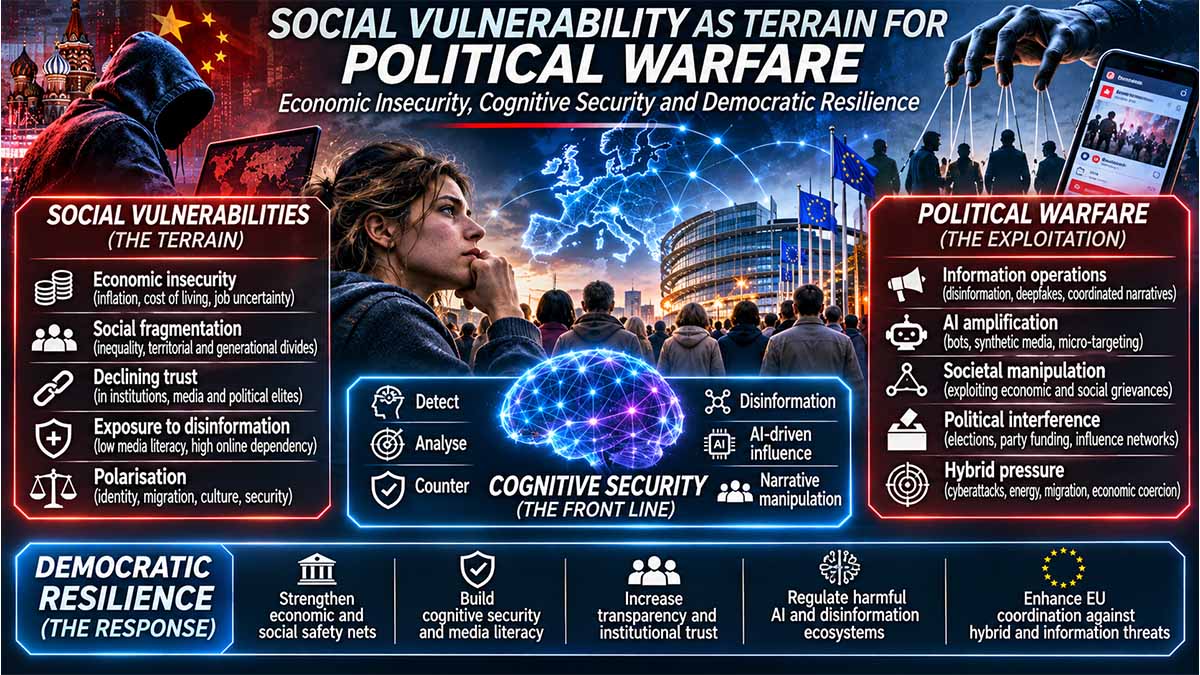
As of: 2026-11-08 | Geographic focus: European Union, Italy, France, Germany and United Kingdom | Strategic horizon: 2026–2031
Geopolitical Intelligence Assessment | Political Warfare, Economic Security, Neurocognitive Vulnerability and Institutional Legitimacy
Executive Summary — Bottom Line Up Front
Principal judgment — High confidence: Social vulnerability becomes strategically exploitable terrain when economic insecurity, perceived political exclusion and fragmented information environments intersect with an adversary’s demonstrable capacity to influence public interpretation, institutional credibility or collective behaviour. Vulnerability alone does not establish hostile intervention, and political discontent is not evidence of manipulation.
The central strategic risk is not necessarily the direct overthrow of democratic institutions. It is the progressive degradation of their capacity to produce legitimate decisions, maintain public cooperation, implement long-term policies and sustain political cohesion during economic or geopolitical crises.
The available evidence supports three critical distinctions. First, socioeconomic insecurity is strongly associated with institutional distrust, but does not automatically produce political radicalisation. Second, hostile information operations are documented, but their existence does not establish that they caused particular social movements or electoral outcomes. Third, younger generations face distinctive economic and digital pressures, but cannot be treated as a uniformly vulnerable political population.
The Organisation for Economic Co-operation and Development’s June 2026 Trust Survey reports 40% high or moderately high trust in national government against 43% low or no trust. Perceived political voice produces a 47-percentage-point trust gap, while financial insecurity corresponds to an 18-percentage-point gap. These findings indicate that democratic resilience depends not only on material conditions but also on whether citizens believe institutions are responsive and procedurally fair.
The European External Action Service has documented organised foreign information-manipulation infrastructure associated principally with Russian and also Chinese actors. This establishes an operational threat category, not universal attribution for democratic dissatisfaction.
Strategic implication: Democratic defence must combine economic resilience, institutional accountability, intelligence-led attribution and proportionate information-security measures. Treating legitimate dissent as a security threat risks reinforcing the institutional alienation that hostile actors seek to exploit.
Decisive uncertainty: The causal threshold at which endogenous grievances become externally directed political effects remains difficult to establish through public evidence, particularly when operations rely on authentic narratives, intermediaries and prolonged low-visibility amplification.
Europe’s Democratic Security Is Now an Infrastructure and Governance Test
Europe has begun treating democratic resilience as a national-security requirement, but its principal vulnerability is not the volume of hostile information circulating online. It is the possibility that energy dependence, technological concentration and institutional weaknesses allow external actors to convert economic disruption into political leverage. NATO’s revised resilience requirements of 15 September 2026, the European Union’s Digital Services Act and the European Commission’s 2026 Digital Decade assessment describe different parts of the same problem: protecting democratic decision-making requires functioning infrastructure, credible institutions and legally defensible intelligence capabilities. The contradiction is increasingly difficult to ignore. Europe is expanding regulatory obligations and investment programmes while remaining dependent on external energy supplies, critical technologies and privately operated networks. The decisive test is whether those commitments produce operational resilience before the next disruption exposes the difference between policy announcements and functioning capabilities.
Europe’s Dependence Has Become a Political Constraint
The European Union imported approximately 57% of the energy available for domestic consumption in 2024, according to Eurostat. Italy’s dependency reached approximately 74%, Germany’s 67% and France’s 42%. These figures do not measure the probability of hostile interference, but they expose materially different national capacities to absorb external supply pressures. Energy dependence becomes a political-security concern when price increases or supply restrictions affect household expenditure, industrial competitiveness and public finances simultaneously, forcing governments to distribute costs among consumers, companies and taxpayers.
The composition of European imports explains why aggregate diversification can conceal persistent exposure. In 2024, petroleum products accounted for 67% of EU energy imports and natural gas for 24%. Norway supplied 30% of imported natural gas, followed by the United States at 17%, with Algeria and Russia each accounting for 14%. These figures describe different fuels and supply relationships, not a single dependency that can be eliminated through one infrastructure investment. Replacing a supplier may reduce geopolitical concentration while increasing requirements for maritime transport, storage, import terminals or alternative transmission routes. Energy in Europe — Eurostat, 2026.
Italy’s position illustrates the industrial consequences. Its Mediterranean energy geography provides access to multiple external supply systems, but industrial production and household purchasing power remain exposed to international energy conditions. Germany faces a different transmission mechanism through its manufacturing base and interconnected industrial supply chains. France’s lower aggregate energy-import dependence reduces one category of exposure without removing fuel-specific risks or technological dependencies. The strategic problem is consequently not whether one European state is generically more vulnerable than another, but whether national infrastructures can maintain essential economic functions when particular supply relationships are interrupted.
Digital Expansion Is Outrunning Technological Sovereignty
The European Commission’s 2026 Digital Decade assessment reports 96.8% basic 5G household coverage across the European Union. Enterprise digitalisation has also advanced: 46.7% of EU enterprises used cloud computing, 39.9% used data analytics, and nearly 20% deployed artificial intelligence. These developments expand economic capacity, but they also increase the number of industrial and governmental functions dependent on digital infrastructure, electricity, telecommunications and specialised service providers.
Connectivity is not sovereignty. The Commission places Europe’s share of the global semiconductor market at approximately 9%, against a 20% target for 2030. Semiconductor production is not interchangeable across technological categories, and increasing regional market share would not automatically eliminate dependence on foreign equipment, software, materials or manufacturing processes. Similar distinctions apply to cloud computing: adoption improves access to digital capabilities but says little about the ability to maintain essential services during the failure or withdrawal of a critical provider.
The investment programme is substantial but its accounting matters. National Digital Decade roadmaps contain 1,934 measures valued at approximately €289.3 billion, including €205.9 billion associated with public budgets. These are programme commitments, not evidence that equivalent amounts have already produced operational capabilities. The difference between authorised investment, expenditure and functioning infrastructure is the central implementation risk. Industrial security will depend on completed capacity, supplier substitutability, tested continuity arrangements and the availability of essential services during disruption—not on the nominal value of announced programmes.
This creates a direct connection between industrial policy and democratic governance. A disruption affecting cloud services, electricity or telecommunications can interrupt public administration, commercial payments, logistics and industrial production. Government must then restore services while explaining the incident and allocating its costs. An adversary may exploit the resulting uncertainty, but the original technical failure and any subsequent hostile information operation require separate attribution. Confusing them would weaken both infrastructure analysis and intelligence credibility.
Foreign Interference Is Documented; Its Political Effects Are Not Automatically Proven
The European External Action Service’s fourth annual report on Foreign Information Manipulation and Interference, published on 12 March 2026, examined 540 incidents detected during 2025, involving approximately 10,500 unique channels and websites and 43,000 recorded observables across 19 platforms. The report’s displayed attribution categories include 157 incidents attributed to Russia, 31 connected to China and 348 unattributed. Those three counts total 536 rather than the stated 540 incidents; the difference should remain visible rather than be assigned without documentary justification.
The geographical distribution is equally revealing. The monitored sample identified 112 incidents targeting Ukraine, 107 targeting France, 94 targeting Moldova, 71 targeting Germany, 36 targeting the United Kingdom and 11 targeting Italy. These are detection counts within a defined monitoring perimeter, not a ranking of national susceptibility or proof that the corresponding political systems were destabilised.
The intelligence distinction is decisive. Identifying an organised foreign network establishes a potential operational threat. Demonstrating that its messages reached an audience establishes exposure. Proving that the operation changed voting behaviour, public confidence or government policy requires additional evidence. A hostile campaign may exploit genuine inflation, housing insecurity or dissatisfaction with public services without having caused those conditions. An external government may benefit from political instability without directing the domestic actors involved.
France’s response illustrates the value of operationally focused investigation. VIGINUM, operating within the French Secretariat-General for Defence and National Security, identified four foreign digital-interference operations affecting the municipal elections of 15 and 22 March 2026. Its June assessment also documented the importance of commercially motivated manipulation, demonstrating why coordinated information activity cannot automatically be attributed to state geopolitical objectives. Protection of Public Debate During the 2026 Municipal Elections — SGDSN/VIGINUM, June 2026.
The stronger defensive approach is to investigate coordination, financing, infrastructure and operational control rather than classify political viewpoints as security threats. That distinction protects the legitimacy of intelligence activity precisely when governments face genuine foreign interference.
Democratic Legitimacy Cannot Be Manufactured Through Communication
The OECD’s 2026 Trust Survey exposes a weakness that information-security measures cannot independently resolve. Across the surveyed countries, 42% of respondents considered government decisions likely to be informed by evidence, 40% believed public services could adapt to changing needs, 39% expected governments to respond to majority opposition, and 37% expressed confidence in cooperation with stakeholders over long-term challenges.
The distinction between immediate operational capacity and long-term political credibility is particularly important. 51% expressed confidence in government preparedness to protect lives during major emergencies, but only 34% believed governments adequately balanced the interests of present and future generations. Democratic institutions may therefore retain credibility in emergency management while facing deeper scepticism concerning their distribution of future costs and benefits.
Political voice introduces another constraint. The OECD reported that 68% believed voting influenced government action, while only 31% believed people like themselves had a say in government decisions. This difference helps explain why formal electoral legitimacy may coexist with frustration over policy responsiveness. It does not establish that dissatisfied citizens support authoritarian alternatives or are susceptible to foreign manipulation. It establishes that institutional credibility cannot be evaluated through elections alone.
The consequences for government are practical. Citizens asked to absorb higher energy costs, support defence expenditure or finance technological transformation will assess not only the policy’s stated objectives but also whether its costs are fairly allocated and its implementation can be trusted. Information campaigns cannot compensate indefinitely for poor services, opaque decisions or unrealised industrial commitments. Credibility depends on observable performance.
Europe’s Regulatory Response Has Constitutional Limits
The European Union has established substantial legal instruments for digital and infrastructure resilience. Directive (EU) 2022/2555, known as NIS2, addresses cybersecurity obligations for covered entities. Directive (EU) 2022/2557 concerns the resilience of critical entities. Regulation (EU) 2022/2065, the Digital Services Act, requires very large online platforms and search engines to assess and mitigate defined systemic risks, including those affecting civic discourse and electoral processes. These frameworks address different responsibilities and cannot be treated as interchangeable security powers. NIS2 Directive — European Parliament and Council, December 2022; Critical Entities Resilience Directive — European Parliament and Council, December 2022; Digital Services Act — European Parliament and Council, October 2022.
The legal constraint is not incidental. Article 11 of the EU Charter of Fundamental Rights protects freedom of expression and information, while Article 52 establishes the conditions governing limitations on protected rights. A government cannot establish hostile interference merely by demonstrating that a narrative contradicts its policy or corresponds to another state’s interests. Restrictions require an applicable legal basis, competent authority and proportionate justification. Excessive securitisation may damage the institutional trust that counter-interference policy seeks to protect. Charter of Fundamental Rights, Articles 11 and 52 — European Union.
The United Kingdom has adopted a different institutional instrument. Its Foreign Influence Registration Scheme, operational from 1 July 2025, establishes specified transparency obligations for foreign-directed activities. The Rycroft Review, published on 25 March 2026, presented 17 recommendations concerning foreign financial influence and interference in British politics. These measures recognise that political interference can operate through financing and concealed organisational relationships, not merely online content. They also demonstrate why European cooperation must accommodate different constitutional and statutory frameworks rather than assume a single enforcement model. Foreign Influence Registration Scheme — UK Home Office, July 2025; The Rycroft Review — UK Government, March 2026.
NATO Has Defined the Requirement; Governments Must Prove the Capability
NATO’s 2026 Resilience Baseline Requirements, published on 15 September 2026, provide the clearest strategic connection between civilian infrastructure and collective defence. The requirements encompass continuity of government, energy supply, food and water, civilian communications, transport and civilian support for military operations. They also address cyberattacks, sabotage, harmful economic activity and strategic technological dependencies.
The implications extend beyond military readiness. An electricity network supporting households and industrial facilities may also sustain communications and defence production. Transport systems used for commercial supply chains may become necessary for military mobility. Civilian digital infrastructure may support emergency coordination and essential government functions. A country can meet formal investment targets while remaining unable to restore one of these functions quickly under compound disruption.
The European Union’s €289.3 billion in Digital Decade roadmap measures and NATO’s revised resilience requirements therefore describe complementary but different commitments. The former concerns planned technological transformation; the latter specifies national functions that must remain available under stress. Neither programme establishes operational success merely through adoption or publication.
For Italy, France, Germany and the United Kingdom, the implementation test is consequently national before it becomes collective: identify critical dependencies, establish responsible authorities, demonstrate restoration capability and verify the capacity to support allies during disruption. European and NATO coordination can improve interoperability and information sharing, but cannot substitute for functioning domestic infrastructure.
The Next 24 Months Will Expose the Cost of Unfinished Resilience
Between November 2026 and November 2028, Europe’s principal exposure will be the gap between commitments already made and capabilities actually delivered. The 2026 NATO resilience requirements, the NIS2 and Critical Entities Resilience directives, the Digital Services Act and the Digital Decade investment roadmaps have established the institutional framework. The outstanding question is whether implementation will produce tested continuity, effective attribution and legally accountable defensive responses.
The financial burden of failure will fall first on households and businesses exposed to service interruptions, energy volatility and disrupted supply chains. Industrial operators will bear production and restoration costs; governments will face fiscal pressure from emergency measures and reconstruction; taxpayers will ultimately finance part of the response. Where disruptions affect transport, energy or communications supporting military operations, the consequences will extend to national defence readiness and allied commitments.
Foreign interference compounds these costs when adversaries exploit uncertainty or weakened institutional credibility. Yet suppressing legitimate disagreement would introduce another liability: the erosion of the constitutional safeguards that make democratic decisions acceptable even when they remain contested.
Europe’s governing choice is therefore not between economic resilience and democratic freedom. It is between converting existing expenditure and legal commitments into demonstrable institutional capacity, or allowing the next disruption to determine the political and fiscal price of unfinished implementation.
Navigational Index
Pillar I — The Political Economy of Strategic Vulnerability
Chapter 1. Political Warfare and the Conversion of Social Vulnerability into Strategic Advantage
Conceptual architecture; endogenous versus adversarial processes; strategic attribution; political-security doctrine and causal identification.
Chapter 2. Economic Insecurity, Capitalist Transformation and Democratic Exposure
Labour-market segmentation; financialisation; intergenerational wealth disparities; housing; regional divergence; economic coercion and political grievance.
Chapter 3. Generational Fractures and the Long-Term Reproduction of Democratic Legitimacy
Youth insecurity; intergenerational equity; political participation; digital dependence; demographic differentiation and structural continuity.
Pillar II — Cognitive Security and the Contest over Political Legitimacy
Chapter 4. Neurocognitive Mechanisms, Information Manipulation and Collective Behaviour
Attention, emotion, stress, identity-based reasoning, social transmission, epistemic uncertainty and the limits of micro-to-macro inference.
Chapter 5. Normative Beauty, Political Aesthetics and the Legitimacy of Democratic Institutions
Normative attractiveness; institutional dignity; procedural justice; authoritarian efficiency; populist authenticity; technocratic legitimacy.
Chapter 6. Hostile Exploitation, Attribution and the Paradoxes of Democratic Defence
Foreign information manipulation and interference; operational attribution; democratic rights; protective overreach; proportionality and accountability.
Pillar III — Geopolitical Competition and Democratic Resilience
Chapter 7. European Strategic Exposure: Economic, Technological and Cognitive Interdependence
Italy, France, Germany, United Kingdom and European Union; hostile-state and non-state capabilities; energy, migration, technology and information infrastructures.
Chapter 8. Intelligence Assessment, Competing Hypotheses and Strategic Defence, 2026–2031
Threat indicators; alternative explanations; confidence calibration; decision thresholds; resilience policy; research agenda and final net assessment.
Master Abstract — The Strategic Conversion of Social Vulnerability
Executive Assessment: The Transition from Domestic Weakness to Strategic Exploitation
The transformation of social vulnerability into an instrument of political warfare is neither automatic nor adequately explained by the presence of hostile propaganda. It requires an intersection of structural exposure, operational opportunity and strategic intent. Economic inequality, unstable employment, housing exclusion, declining expectations of upward mobility and diminished confidence in representative institutions constitute potential vulnerabilities. They become strategically relevant to an adversary when they can be incorporated into influence operations designed to alter political perceptions, weaken institutional cooperation, distort collective priorities or increase the political cost of government decisions. The decisive analytical distinction is therefore between the existence of discontent and evidence that an identifiable actor is attempting to exploit it for a political objective.
The conceptual significance of the political-security framework associated with Democrazie, capitalismo e libertà al collasso lies in its integration of economic and cognitive domains. The publisher’s documented description identifies economic security, cognitive security, the weaponisation of economic relations, cultural transformation and the exposure of younger generations as major components of the work. The published chapter structure extends this approach across political warfare, technological security, economic coercion and the cultural conditions of democratic legitimacy. These are identifiable elements of the author’s framework; they should not be confused with independently demonstrated causal relationships. The full text has not been established as available for examination in this assessment, so detailed positions beyond the published description and contents remain interpretively uncertain. Democrazie, capitalismo e libertà al collasso — Rubbettino Editore, 2026.
The economic component of the vulnerability thesis receives meaningful support from contemporary institutional research. The OECD’s 2026 Trust Survey identifies financial insecurity and perceived political exclusion as significant correlates of diminished confidence in national government. More importantly, the substantially larger trust gap associated with perceived political voice suggests that the problem cannot be reduced to household income or economic deprivation alone. Citizens may experience economic hardship without rejecting democratic legitimacy, while materially secure populations may distrust institutions because of perceived unfairness, ideological conflict or political exclusion. This distinction prevents an overly deterministic interpretation in which capitalist development necessarily generates political warfare. Economic conditions shape the opportunity structure; political institutions, social networks and adversarial intervention affect how that opportunity develops. OECD Survey on Drivers of Trust in Public Institutions 2026 Results — OECD, June 2026.
The generational component is strategically important but empirically more complicated than a simple division between politically alienated youth and established older populations. Eurofound documents disproportionate housing difficulties among young adults, affecting independence, employment opportunities and family formation. Yet the OECD’s 2026 evidence indicates that the average trust gap between younger and older adults has narrowed, while political voice and partisanship remain stronger correlates of trust than age. Moreover, younger citizens’ participation in civic organisations and political activities challenges assumptions of uniform withdrawal from democratic life. The strategic question is therefore not whether youth constitutes an inherently susceptible population, but whether particular combinations of economic exclusion, digitally mediated identity formation and weak institutional responsiveness create distinctive opportunities for influence.
The cognitive dimension introduces a further distinction between psychological plausibility and operational proof. Attention capture, motivated reasoning, emotional salience and social identity provide credible theoretical mechanisms through which political messages can influence the processing and circulation of information. However, individual cognitive effects do not establish aggregate electoral consequences, sustained ideological realignment or the collapse of institutional legitimacy. Such conclusions require evidence connecting message exposure to individual response, social transmission and measurable political outcomes. Without that chain, cognitive-security analysis risks replacing political explanation with psychological speculation.
The idea of normative beauty contributes a potentially useful but insufficiently operationalised component. Interpreted analytically, it concerns the perceived moral, procedural and symbolic attractiveness of democratic institutions: whether they appear fair, competent, dignified, inclusive and capable of offering a credible collective future. Its erosion could make competing models of political order more appealing, including authoritarian decisiveness, anti-establishment authenticity or ostensibly non-political technocratic rule. Yet attractiveness is neither a standardised measure of democratic legitimacy nor proof of foreign influence. It must be separated into observable dimensions such as procedural fairness, perceived integrity, representation, policy responsiveness and confidence in long-term institutional performance.
The geopolitical significance emerges when hostile actors can exploit these domestic conditions without creating them. The European External Action Service’s documented work on foreign information manipulation demonstrates that organised adversarial infrastructure exists within the European information-security environment. Nevertheless, the existence of such infrastructure is insufficient to attribute individual political developments to foreign direction. Operational analysis must differentiate the production of misleading content, coordinated distribution, financing or organisational control, measurable audience effects and strategic outcomes. Each requires a different evidentiary threshold. 3rd EEAS Report on Foreign Information Manipulation and Interference Threats — European External Action Service, March 2025.
The resulting strategic assessment is that democratic resilience cannot be secured exclusively through intelligence collection, platform regulation or counter-disinformation programmes. These capabilities address identifiable hostile activity but cannot independently resolve the material insecurity and institutional distrust that make such activity potentially consequential. Conversely, economic redistribution or improved public services cannot eliminate organised political warfare. A defensible strategy requires differentiated interventions: socioeconomic policies to reduce structural exposure, institutional reforms to strengthen political legitimacy, intelligence capabilities to identify hostile operations, and narrowly tailored measures to address established threats. The governing constraint is constitutional: democratic defence must preserve the public’s freedom to contest political authority, including through severe criticism, protest and legitimate ideological opposition.
The Conditions for a Politically Significant Conversion
The principal mechanism is best understood as a sequence of analytically distinct conditions rather than a single process of manipulation. A structural grievance supplies a potential subject, a political narrative offers an interpretation, an adversarial actor may selectively amplify that interpretation, and receptive audiences may incorporate it into their political judgments. A strategically consequential outcome requires an additional step: measurable alteration of collective behaviour, institutional confidence or governmental decision capacity.
Each transition contains substantial uncertainty. Economic dissatisfaction can be articulated by independent political actors, journalists, trade unions and civic organisations without external coordination. Grievance amplification can emerge from ordinary platform incentives or domestic electoral competition. Foreign participation in a debate does not necessarily establish control of that debate. Even successful exposure to hostile messaging does not prove durable behavioural effects.
Accordingly, the report distinguishes four levels of evidence: a documented vulnerability, observable amplification, operational attribution to a hostile actor, and demonstrated political effect. Conflating these levels is the central methodological danger in assessing cognitive and political warfare.
A state’s exposure becomes more consequential when vulnerabilities operate simultaneously across several domains. For example, a rise in energy costs may aggravate household insecurity, sharpen distributive conflicts, increase public scepticism of government decisions and create opportunities for competing interpretations of responsibility. Hostile influence may subsequently amplify selected interpretations, but the original economic shock and legitimate public debate remain analytically separate from any foreign operation.
This approach also establishes a limit to the concept of hybrid warfare. Not every economic dependency is a weapon, not every contentious narrative is disinformation, and not every deterioration in democratic legitimacy is the product of an identifiable adversary.
Principal Findings from the Verified Institutional Record
Table 1. Structural exposure, institutional legitimacy and documented information-security threats. Reference dates and population coverage are not interchangeable.
| Indicator | Value or status | Reference period | Issuer and exact source |
|---|---|---|---|
| High or moderately high trust in national government | 40% average across OECD countries surveyed | 2025 survey; published June 2026 | OECD Trust Survey 2026 |
| Low or no trust in national government | 43% | Same | OECD, same survey |
| Trust gap by perceived political voice | 47 percentage points | Same | OECD, same survey |
| Trust gap associated with financial insecurity | 18 percentage points | Same | OECD, Socioeconomic Conditions and Trust |
| Confidence that government adequately balances current and future generations’ interests | 34% | 2025 survey | OECD, Complex Policy Decision-Making |
| Difference in government trust between adults aged 18–29 and those aged 50+ | 5 percentage points; younger adults less trusting | 2025 survey | OECD, socioeconomic conditions |
| Housing vulnerability among young Europeans | Disproportionate exposure, particularly ages 18–39; no single composite risk figure | Published December 2025 | Eurofound, Foundational Challenges |
| Organised foreign information-manipulation infrastructure | Documented operational threat category; primarily Russian and also Chinese activity examined | Report March 2025 | EEAS, Third FIMI Threat Report |
| European Democracy Shield | Commission initiative covering information integrity and democratic resilience | November 2025 | European Commission, European Democracy Shield |
The OECD percentages are survey averages rather than population-weighted measurements of the entire democratic world. They measure respondents’ attitudes, not verified causes of distrust or proven susceptibility to foreign influence. The Eurofound findings identify material exposure, not attributable political-warfare outcomes. The European External Action Service reporting concerns detected foreign information-manipulation activity and should not be interpreted as evidence that all social or political polarisation results from that activity.
Competing Explanations and Strategic Pathways
The evidence supports three distinct, potentially overlapping explanations for democratic fragility. They should not be treated as mutually exclusive, because adversarial activity can operate within political conditions produced by domestic institutions, economic transformation and technological change.
Table 2. Analysis of competing hypotheses — qualitative assessment, without unsupported numerical probabilities.
| Hypothesis | Diagnostic evidence | Disconfirming evidence or limitations | Current standing |
|---|---|---|---|
| H1 — Endogenous institutional erosion | Economic insecurity, weak perceived political voice, unequal access to assets and dissatisfaction with long-term policy decisions | Variation in trust between countries and institutions; evidence of stabilisation in recent OECD averages | Strong support for structural vulnerabilities; insufficient evidence for inevitable democratic collapse |
| H2 — Deliberate hostile exploitation | Documented foreign information-manipulation infrastructure, coordinated operational activity and geopolitical incentives | Attribution of infrastructure does not demonstrate aggregate political effects or causation of specific grievances | Strong support for the existence of operations; case-dependent confidence in their consequences |
| H3 — Interaction between domestic vulnerabilities and hostile amplification | Plausible interaction of grievances, networked information distribution and adversarial operations | Limited directly comparable causal studies isolating independent hostile effects from domestic dynamics | Plausible and strategically consequential, but incompletely demonstrated at the societal level |
Net assessment — Moderate-to-high confidence: The interaction hypothesis provides the most useful framework for identifying strategic exposure, but it should not be elevated into a universal causal theory. Endogenous political and economic dynamics remain sufficient explanations for many observed manifestations of democratic dissatisfaction. Hostile exploitation must be demonstrated separately.
An important analytical bias would arise from focusing exclusively on foreign adversaries while disregarding the contribution of domestic governance failures. The opposite error would be to treat documented foreign information operations as strategically irrelevant simply because the grievances they exploit are authentic.
Critical Assessment: Strengths, Limits and Open Questions
The most defensible feature of the framework is its recognition that national security extends beyond military capabilities and territorial defence into the conditions enabling institutions to retain political authority and societal cooperation. Economic security, cognitive integrity and democratic legitimacy are interconnected, particularly during prolonged economic adjustment and geopolitical competition.
The principal conceptual weakness is the risk of excessive explanatory breadth. If economic dissatisfaction, cultural disagreement, digital behaviour, political polarisation and generational conflict are all classified as cognitive warfare without demonstrating adversarial agency, the concept loses diagnostic precision.
Three unresolved issues require particular scrutiny.
Strategic attribution. The decisive problem is establishing when observed political influence reflects intentional adversarial action rather than organic mobilisation, domestic political competition or commercial information-distribution incentives. Reliable attribution requires evidence concerning infrastructure, coordination, financing, control and intent. Measuring actual effects is a separate requirement.
The neurocognitive-to-collective bridge. Research identifying biases in attention, memory, emotional evaluation or information processing cannot alone explain mass political behaviour. Collective outcomes are mediated by social networks, institutional structures, political identities, media systems and historical conditions. The strength of individual psychological mechanisms must therefore be evaluated independently from claims about systemic political consequences.
The operational meaning of normative beauty. Democratic attractiveness may be a useful interpretive category, but it is not currently established here as a validated composite security indicator. It should be investigated through separately measurable dimensions of procedural fairness, political representation, institutional integrity, responsiveness and perceived intergenerational justice.
Conditions That Would Strengthen or Weaken the Central Thesis
The thesis would be strengthened by longitudinal evidence demonstrating that hostile operations systematically concentrate on documented socioeconomic grievances; credible attribution of the actors directing those operations; independent measurement of exposure and political effects; and replicated findings that exposed populations experience changes not adequately explained by domestic political conditions alone.
It would be weakened if observed distrust were sufficiently explained by economic circumstances and institutional performance without identifiable external intervention; if documented foreign amplification produced negligible or short-lived effects; if generational variation disappeared after controlling for socioeconomic and political characteristics; or if different measures of democratic legitimacy failed to support the proposed cognitive mechanisms.
The strongest potential validation would not be another correlation between insecurity and distrust. It would be credible evidence identifying the additional causal contribution of hostile intervention beyond the trajectory expected from existing domestic conditions.
Principal Intelligence Gaps and Watch Indicators
Table 3. Priority collection requirements for European democratic-resilience assessment, 2026–2031.
| Intelligence requirement | Observable indicator | Decision relevance |
|---|---|---|
| Establish hostile operational direction | Corroborated coordination, infrastructure control, financing and tasking | Distinguish foreign operations from legitimate political activity |
| Measure economic exposure | Comparable housing, income, wealth, employment and regional-access indicators | Locate structural pressures without labelling affected populations as threats |
| Evaluate information operations | Coordinated cross-platform distribution, inauthentic behaviour and attributable operational infrastructure | Support proportionate investigation and response |
| Establish political effects | Longitudinal, adequately controlled evidence of changes in attitudes or behaviour | Prevent attribution of outcomes from exposure statistics alone |
| Assess generational continuity | Cohort-specific trust, participation, housing independence and perceived political agency | Test whether generational fractures persist or converge |
| Assess democratic-defence externalities | Documented legal challenges, restrictions on lawful participation, transparency and oversight outcomes | Detect whether protective action damages democratic legitimacy |
Confidence and Uncertainty Register
Economic insecurity and perceived political exclusion are associated with lower institutional trust.
High confidence
Supported by cross-national institutional survey research. Causation and country-specific effect sizes require further analysis.
Foreign actors possess and operate organised information-manipulation capabilities relevant to European democracies.
High confidence
Supported by European institutional reporting. The effectiveness of individual operations is not established by capability documentation alone.
Economic and cognitive vulnerabilities can interact to increase opportunities for political warfare.
Moderate confidence
Mechanistically plausible and consistent with the documented threat environment, but the incremental causal effect of hostile intervention requires case-specific validation.
Younger generations constitute a uniquely susceptible strategic population.
Low confidence
Distinct economic and digital exposures are documented. A generalised claim of exceptional susceptibility is not supported by the evidence assembled here.
Neurocognitive vulnerabilities produce systemic democratic collapse.
Low confidence
Individual psychological mechanisms cannot establish aggregate political outcomes without additional evidence.
Normative beauty can be measured as an independent predictor of democratic resilience.
Low confidence
The concept remains theoretically interesting but requires operational definitions, construct validation and empirical testing.
Strategic Decision Implications
For European governments, the security-policy consequence is the need to distinguish three functions that have frequently been discussed together: correcting domestic vulnerabilities, identifying foreign interference and protecting the constitutional integrity of democratic institutions. Each function requires different legal authorities, evidence thresholds, operational capabilities and mechanisms of accountability.
Social-policy institutions are responsible for reducing economic exclusion and improving public-service outcomes. Intelligence and competent security authorities investigate documented threats under their respective legal mandates. Electoral regulators, judicial institutions and independent oversight bodies help preserve political competition and fundamental rights. European coordination can support information sharing and cross-border resilience, but cannot eliminate differences in national constitutional arrangements or political legitimacy.
For Italy, the analysis should investigate the relationship between regional economic divergence, youth employment, housing access and institutional responsiveness without treating social discontent as a security indicator. For France, the critical distinction concerns domestic political contestation and independently attributable influence activity. For Germany, the analytical priority includes regional economic differentiation, industrial adjustment and political trust. For the United Kingdom, institutional resilience must be assessed within its distinct constitutional and regulatory architecture. At the European Union level, coordination must address transnational information operations while retaining national legal competence and democratic oversight. These are collection and policy priorities, not claims that any particular country has experienced a verified causal sequence of hostile exploitation.
The most significant strategic warning is that an excessive securitisation of socioeconomic vulnerability could convert legitimate dissatisfaction into a perceived object of state suspicion, undermining political voice and institutional confidence. Conversely, refusing to recognise documented adversarial activity because it operates through authentic grievances would create avoidable intelligence blind spots.
The appropriate decision framework is consequently evidence-led, institutionally differentiated and proportionate to demonstrated operational threats. Its success should be evaluated not by the disappearance of disagreement, which is incompatible with open democracy, but by the continued capacity of institutions to govern legitimately, maintain public accountability and respond to external interference without sacrificing constitutional freedoms.
Social Vulnerability as Terrain for Political Warfare
Interactive assessment of the conditions under which economic insecurity, institutional distrust and fragmented information environments may become exploitable by hostile political-warfare operations.
The vulnerability-to-exploitation network
Select a node to examine its analytical function. Rotate the 3D model manually or activate automatic animation. Connections represent conceptual relationships, not measured causal effects.
Strategic conversion
Social vulnerability becomes a political-warfare vector only where adversarial action can be identified and its effects assessed separately from domestic causes.
Democratic trust and structural exposure
Switch between indicator groups. The chart uses distinct measurement contexts and does not combine them into a synthetic risk index.
Alternative explanations
Qualitative standing only. No numerical probabilities or arbitrary threat scores.
Economic insecurity, weak political voice and institutional performance can explain distrust without external intervention.
Foreign information-manipulation capabilities are documented. The effects of individual operations require separate evidence.
Hostile amplification may interact with domestic grievances, but its incremental causal contribution remains case-dependent.
Strategic indicators and decision requirements
Operational distinctions for monitoring political-warfare exposure while preserving constitutional safeguards.
| Intelligence requirement | Observable evidence | Decision significance |
|---|
Democratic resilience requires differentiated protection
The defensive requirement is to distinguish domestic socioeconomic vulnerabilities, attributable adversarial operations and demonstrable political outcomes. Economic reform, accountable intelligence activity and constitutional safeguards are complementary rather than interchangeable instruments. Preserving lawful political disagreement is a condition of democratic security, not an obstacle to it.
PILLAR I — THE POLITICAL ECONOMY OF STRATEGIC VULNERABILITY
OPEN-SOURCE STRATEGIC INTELLIGENCE ASSESSMENT
Reference date: 8 November 2026
Geographic scope: European Union, Italy, France, Germany and the United Kingdom, with comparative OECD evidence
Analytical horizon: 2026–2031
Principal domains: Political warfare, economic security, institutional legitimacy, socioeconomic fragmentation, generational inequality and strategic attribution
Chapter 1. Political Warfare and the Conversion of Social Vulnerability into Strategic Advantage
The Strategic Threshold Between Domestic Instability and Hostile Exploitation
The central intelligence question is not whether economic inequality, deteriorating living standards or declining confidence in political institutions represent vulnerabilities for contemporary democracies. Their existence and political significance are already documented across several European and OECD institutional datasets. The more consequential question is whether these conditions can be transformed into instruments of strategic competition by actors possessing identifiable political objectives, operational capabilities and access to the information environments in which grievances are interpreted and mobilised. The distinction is fundamental because the same observable domestic outcome, including a decline in institutional trust, heightened political polarisation or growing resistance to government decisions, may emerge independently from economic deterioration, institutional failures, legitimate political mobilisation or deliberate hostile interference. The intelligence requirement is therefore to establish the conditions under which these distinct processes interact, rather than assuming that a deterioration in democratic cohesion necessarily constitutes an act of political warfare.
For operational purposes, political warfare should be understood as the deliberate employment of political, economic, informational, organisational and other non-kinetic instruments to influence an adversary’s decisions, institutional capacity or strategic freedom of action. Its distinguishing feature is not the mere presence of persuasion, contestation or economic pressure, all of which also occur in normal international relations and domestic politics, but the strategic organisation of such instruments toward an identifiable adversarial objective. Foreign information manipulation and interference, commonly abbreviated FIMI, constitute one possible subset of this broader activity. Economic coercion, clandestine financial support, covert organisational influence and manipulation of critical dependencies may represent other mechanisms, although each requires its own evidentiary and legal classification. The existence of economic interdependence or foreign participation in public debate cannot, by itself, establish coercion, interference or hostile political warfare.
The European External Action Service provides a contemporary institutional foundation for this distinction. Its third report on foreign information manipulation and interference, published on 19 March 2025, maps digital infrastructure associated principally with Russian actors and also with Chinese activity directed at the information environments of the European Union and partner countries. Its subsequent report of 24 June 2026 describes activities undertaken during 2025 to address these threats. These records establish that organised foreign information manipulation is an operational problem recognised by an institution competent in European external action. They do not establish that foreign operations are the dominant explanation for democratic distrust, nor do they justify attributing particular protest movements, voting decisions or socioeconomic grievances to foreign direction without specific supporting evidence. Third EEAS Report on Foreign Information Manipulation and Interference Threats — European External Action Service — March 2025; 2025 Report on EEAS Activities to Counter Foreign Information Manipulation and Interference — European External Action Service — June 2026.
Structural Vulnerability as an Opportunity Structure, Not an Operational Attribution
The political significance of structural vulnerability lies in its capacity to alter the environment in which political decisions are interpreted and accepted. A household facing unstable employment, persistent housing insecurity or declining purchasing power may legitimately question the competence and distributive priorities of public authorities. Communities experiencing prolonged regional economic divergence may develop perceptions of political exclusion, particularly when investment, public services and employment opportunities are concentrated elsewhere. Younger populations encountering obstacles to independent housing, asset accumulation and career progression may evaluate the legitimacy of existing economic arrangements differently from those who entered employment and property markets under more favourable conditions. These responses do not require foreign manipulation, and their political expression remains part of ordinary democratic competition.
The OECD’s 2026 Trust Survey supplies a particularly important empirical distinction between the economic and political dimensions of institutional confidence. Across the surveyed countries, 68% of respondents believed voting influenced government action, while only 31% believed people like themselves had a say in government decisions. The difference identifies a substantial disparity between recognition of the electoral mechanism and perceived influence over decisions made between elections. Separately, the OECD identified a 47-percentage-point difference in national-government trust between respondents who felt politically represented and those who did not. This is not proof that insufficient political voice causes a particular form of political radicalisation, but it provides substantial evidence that perceived political agency is central to the legitimacy environment in which external influence operations might seek an opening. Trust Steadies, but People Still Do Not Feel Heard — OECD — June 2026.
The analytical implication is that economic insecurity and political exclusion should not be treated as interchangeable variables. Economic hardship concerns the distribution of resources, exposure to shocks and expectations of material improvement. Political exclusion concerns the perceived ability to influence collective decisions and obtain meaningful institutional responsiveness. These conditions may reinforce one another, but they may also diverge. A materially secure individual may perceive democratic procedures as unresponsive, while a financially insecure citizen may retain strong confidence in institutions regarded as fair and effective. Consequently, a strategic assessment seeking to identify susceptibility to political warfare must examine these variables separately, including their interaction with political affiliation, institutional experience, local economic conditions and the credibility of government decision-making.
The Conversion Mechanism: From Grievance to Adversarial Advantage
A useful causal architecture requires distinguishing structural conditions, political interpretation, hostile intervention and strategic outcome. The first component concerns the existence of a verifiable domestic pressure, such as employment insecurity or exclusion from affordable housing. The second concerns the manner in which political actors and citizens interpret that pressure, including the attribution of responsibility and the perceived legitimacy of government responses. The third requires evidence of deliberate intervention by an actor pursuing an adversarial objective. The fourth concerns whether that intervention produces an observable effect relevant to the adversary’s interests, including altered policy decisions, reduced institutional cooperation or a measurable deterioration in the target’s capacity to sustain a chosen strategic course.
The most important analytical boundary separates the second and third components. Domestic political actors have a legitimate interest in identifying grievances, criticising government decisions and mobilising support. Foreign governments also engage in public diplomacy and openly advocate positions abroad. The existence of a critical narrative, even one consistent with an adversary’s geopolitical objectives, does not establish covert foreign control. Attribution becomes stronger when investigators identify coordinated operational infrastructure, concealed financing, controlled information assets, systematic inauthentic behaviour or evidence of tasking by an identifiable actor. Attribution of activity must then be distinguished from attribution of impact. A campaign can be demonstrably hostile yet produce little measurable influence; conversely, a substantial political shift may occur without evidence that an external operation caused it.
This distinction is particularly relevant to the interpretation of economic narratives. Inflation, industrial restructuring, changes in energy prices and fiscal adjustment can generate genuine distributional conflicts. An adversarial actor does not need to invent the underlying economic problem to attempt to exploit it. It may selectively emphasise certain consequences, amplify distrust, encourage contradictory interpretations or promote particular political responses. Yet any assertion that such activity has changed collective behaviour must be supported by evidence connecting intervention, exposure, reception and outcome. Without that evidence, the assessment remains an account of an operational opportunity rather than a demonstrated strategic success.
Strategic Attribution and the Problem of Competing Causal Explanations
Attribution should operate at several distinct evidentiary levels. Technical attribution concerns the infrastructure, accounts, systems or distribution mechanisms associated with an observed operation. Organisational attribution concerns the institutions, networks or individuals exercising operational control. Strategic attribution concerns the objectives and interests that explain the operation’s direction. Effects attribution concerns the consequences that can reasonably be assigned to the intervention, rather than to other influences affecting the same population. The evidentiary requirements increase across these levels, and confidence established at one level cannot automatically be transferred to another.
A recurring methodological problem is the confusion between strategic benefit and strategic responsibility. A foreign government may benefit from political instability in another state without having caused it. A geopolitical adversary may publicly endorse an existing domestic controversy without directing the participants. An authentic economic grievance may circulate within information networks that also contain foreign-controlled accounts. Each situation has different implications for intelligence collection, law enforcement, diplomatic response and protection of constitutional rights.
The appropriate analytical approach is to maintain competing explanations until sufficiently diagnostic evidence becomes available. A deterioration in political trust may be explained by domestic institutional performance; it may be amplified by platform incentives and domestic political competition; or it may be affected by an attributable foreign operation. These explanations can coexist. Determining their relative importance requires comparisons across time, populations, information exposures and relevant policy developments. The absence of publicly available evidence of hostile intervention does not establish that no such intervention occurred, but it prevents a confident attribution. Equally, the discovery of hostile infrastructure does not justify treating all political developments occurring within its reach as consequences of that infrastructure.
Political Warfare as a Constraint on Democratic Decision Capacity
The potential strategic value of exploiting internal divisions lies in their effect on a state’s capacity to make and implement decisions. A democracy may retain functioning elections, independent courts, parliamentary procedures and formal constitutional guarantees while experiencing diminished public willingness to accept costly government decisions. These decisions may concern fiscal consolidation, defence expenditure, energy transition, industrial investment, migration management or international security commitments. The underlying policy disagreements can be entirely legitimate. The strategic exposure arises when an adversary can deliberately exploit those disagreements to increase the political, economic or institutional costs of a particular national course of action.
The relationship is especially important where decisions require continuity across electoral cycles. Defence procurement, energy infrastructure and industrial transformation commonly involve long implementation periods, concentrated initial expenditure and benefits distributed unevenly across sectors and generations. Their political sustainability depends on public confidence that costs are justified, institutions remain accountable and the expected benefits are credible. Adversarial activity may seek to undermine that confidence, but the effectiveness of such an operation depends partly on the quality of the underlying policy and the transparency of its implementation. Poor policy design and weak institutional accountability can produce opposition independently; successful defensive policy must therefore distinguish legitimate criticism from demonstrable manipulation.
Key judgment — High confidence: The existence of structured foreign information-manipulation capabilities and measurable domestic vulnerabilities is supported by institutional evidence. Their combination creates a plausible strategic opportunity, but the causal conversion of vulnerability into adversarial political advantage requires case-specific demonstration. The principal intelligence risk is a failure to distinguish the existence of an operational threat from evidence of its political effectiveness.
The Conversion Threshold and Attribution Architecture
The following scheme is a self-contained conceptual component. Its five analytical stages are distinct evidentiary categories, not claims that every observed instance follows an inevitable sequence. It includes interactive stage selection and language switching between English, Italian, Spanish, French and German. The visual structure is qualitative: it does not generate fabricated risk scores, probabilities or causal measurements.
From Domestic Grievance to Strategic Exploitation
Select each stage to inspect its evidence threshold and analytical limits.
Chapter 2. Economic Insecurity, Capitalist Transformation and Democratic Exposure
Economic Security as a Component of National Strategic Capacity
The relationship between economic insecurity and democratic vulnerability cannot be adequately understood through income distribution alone. Modern capitalist economies distribute economic opportunities and risks through labour markets, property ownership, financial assets, credit systems, regional production networks, public services and international supply chains. These mechanisms determine not only the material resources available to households but also their exposure to uncertainty, their capacity to absorb shocks and their expectations regarding future social mobility. The strategic relevance emerges when persistent economic instability affects the credibility of institutions responsible for managing those risks, particularly when public authorities are required to implement costly decisions in environments already characterised by distrust or perceived distributive injustice.
The most useful distinction is between economic exposure and economic coercion. Exposure concerns the degree to which households, firms or governments depend on conditions that may deteriorate because of domestic decisions, market adjustments or international disruptions. Coercion involves an actor deliberately using economic instruments or dependencies to influence another actor’s decisions. A rise in energy prices caused by market conditions is not equivalent to deliberate manipulation of energy supplies. Industrial decline does not necessarily reflect hostile economic warfare. A financial dependency becomes a coercive instrument when an identifiable actor uses control over resources, transactions or access conditions to pursue an adversarial objective. Without evidence of intentional employment, the phenomenon remains an economic vulnerability, however serious its political consequences.
This distinction prevents a deterministic interpretation of contemporary capitalism. Market competition, technological innovation and capital accumulation may produce substantial increases in productivity, employment and household wealth while also generating concentrated benefits, adjustment costs and unequal exposure to economic shocks. Financial development can improve access to credit and investment while increasing vulnerability to leverage, asset-price volatility or exclusion from asset ownership. Labour-market flexibility can support employment transitions while transferring uncertainty toward individuals with limited bargaining power. The security question is therefore not whether capitalist institutions inherently produce political warfare, but whether particular distributions of opportunity, risk and decision-making authority create conditions that are easier for adversarial actors to exploit.
Labour-Market Dualism, Employment Transitions and the Distribution of Uncertainty
Labour-market dualism describes a situation in which different groups of workers face structurally unequal combinations of employment security, bargaining power, earnings progression, access to training and social protection. The distinction may arise between permanent and temporary employees, formal and informal workers, employees and some forms of self-employment, workers in high-productivity firms and those concentrated in lower-productivity activities, or established employees and new labour-market entrants. Its strategic significance derives from the distribution of economic uncertainty rather than from the contractual distinction alone. Two workers with similar current incomes may experience materially different economic prospects if one possesses predictable employment, access to credit and social insurance, while the other faces repeated contract transitions or uncertain earnings.
The relevant political mechanism develops through expectations. When workers believe that professional effort and educational investment are unlikely to produce stable employment or a viable pathway toward household independence, the relationship between individual contribution and expected social reward becomes less credible. Over time, this may affect institutional trust and the perceived legitimacy of economic arrangements. Nevertheless, the relationship is conditional. Some labour-market transitions lead to higher earnings, greater occupational mobility and improved productivity. Temporary employment does not invariably imply socioeconomic exclusion, and permanent employment does not guarantee protection against regional industrial decline. A defensible analysis must therefore combine contractual indicators with measures of income volatility, involuntary employment status, transition probabilities, training access and household capacity to manage unemployment.
Eurostat’s figures for young people not in employment, education or training provide one important, although incomplete, measure of labour-market exclusion. In 2025, 11.0% of EU residents aged 15–29 fell into this category, compared with 15.2% in 2015 and 11.1% in 2024. The decline demonstrates meaningful improvement over the decade, making it analytically incorrect to describe European youth labour-market integration as uniformly deteriorating. At the same time, the 2025 indicator varied substantially across countries and age groups. The rate was 5.3% among 15–19-year-olds, 12.8% among 20–24-year-olds and 14.7% among 25–29-year-olds, illustrating how the transition from education to stable employment becomes increasingly consequential as individuals approach the stages of independent household formation and longer-term professional establishment. Fewer Young People Not in Work or Education in 2025 — Eurostat — May 2026.
These figures also demonstrate why strategic analysis must distinguish the level of vulnerability from its trajectory. A country may retain a relatively high rate of exclusion while achieving substantial improvement over time. Italy illustrates this distinction particularly clearly: the share of people aged 15–29 neither employed nor in education or training declined from 25.7% in 2015 to 13.3% in 2025, a reduction of 12.4 percentage points. The improvement does not eliminate the significance of the remaining excluded population, but it contradicts any proposition that Italy’s youth integration problems have worsened continuously across the entire period. Similarly, variation between the Netherlands at 5.3%, Sweden at 5.9%, Romania at 19.2%, Bulgaria at 13.8% and Greece at 13.6% demonstrates that a single European figure conceals markedly different national economic and institutional conditions. These cross-country differences cannot be interpreted as equivalent differences in political susceptibility without independent evidence of political behaviour and foreign influence.
Financialisation, Household Balance Sheets and the Politics of Asset Ownership
Financialisation is relevant to the political economy of vulnerability because economic security increasingly depends on the interaction between labour income, property values, debt servicing, savings and financial-market participation. Financial assets can provide households with buffers against unemployment and inflation, while liabilities and interest-rate exposure can increase sensitivity to adverse economic conditions. Housing occupies a particularly important position because it serves simultaneously as shelter, a major component of household wealth, a collateral asset and an essential requirement for labour mobility and family formation. Changes in property prices therefore affect existing owners and prospective purchasers through different channels, creating distributional consequences that may persist even when aggregate national wealth rises.
An increase in average household wealth does not necessarily imply an equivalent increase in financial security for younger or lower-income households. The mean can be influenced by substantial asset holdings concentrated among wealthier households, whereas the median provides information about the midpoint of the distribution. Neither measure alone describes access to liquid savings, regional property affordability, debt burdens or the distribution of wealth across age cohorts. A society may experience rising aggregate asset values while entry into home ownership becomes more difficult for households that have not accumulated savings or inherited assets. Conversely, declining property values can improve affordability for prospective buyers while weakening the balance sheets of indebted owners. These competing effects demonstrate why the relationship between financialisation and political legitimacy is more complex than a general opposition between capital and labour.
Eurostat’s Housing in Europe — 2025 edition reports that, in 2024, EU households devoted an average of 19% of disposable income to housing costs. Among households with disposable income below 60% of the national median, the corresponding share was 37%, compared with 16% for households above that threshold. The difference illustrates the unequal economic burden of housing expenditure and the importance of considering disposable resources rather than nominal housing prices alone. The report also records considerable differences between member states, including household housing-cost shares of 36% in Greece, 26% in Denmark, 25% in Sweden and Germany, and 11% in Cyprus. These figures describe average expenditure shares across defined population groups; they should not be confused with the housing-cost overburden indicator, which measures the proportion of individuals living in households whose housing costs exceed a specified share of disposable income. Housing in Europe — 2025 Edition — Eurostat.
The political consequences of these distributions depend on several mediating conditions: the capacity of wages to sustain housing expenditure, the availability of rental accommodation, the accessibility of credit, the effectiveness of public housing programmes, the relationship between housing location and employment opportunities, and the perceived fairness of public decisions affecting asset owners and non-owners. A government may pursue policies intended to increase housing supply while facing opposition from existing property owners concerned about neighbourhood change or declining asset values. Alternatively, policies that protect incumbent asset values may constrain affordability for prospective entrants. These conflicts involve legitimate distributive interests. Their relevance to political warfare emerges only when an external actor deliberately exploits them through attributable means.
Regional Divergence and the Geography of Political Vulnerability
Regional economic divergence creates a different category of exposure because disparities are geographically concentrated and may become associated with collective identities, institutional representation and perceptions of territorial neglect. A region experiencing persistent employment losses, population decline or weak infrastructure investment may develop political grievances distinct from those of a prosperous metropolitan area. These grievances can affect the credibility of central government, the perceived fairness of fiscal transfers and the willingness of communities to support national policies whose costs and benefits are distributed unequally. However, regional inequality cannot be inferred solely from differences in gross domestic product per inhabitant, and economic divergence should not be automatically interpreted as political alienation.
Eurostat’s regional accounts demonstrate the scale of economic heterogeneity within the European Union. In 2024, gross domestic product per inhabitant expressed in purchasing power standards ranged from 30.1% of the EU average in Mayotte, a French outermost region, to 268.3% in Ireland’s Eastern and Midland region. Luxembourg registered 244.6%, Southern Ireland 216.6% and Hamburg in Germany 196.1%. These differences are economically significant, but their interpretation requires caution. Eurostat notes that commuter flows and the presence of multinational enterprises affect certain regional indicators, particularly where production recorded within a territory does not correspond directly to the disposable income or living standards of its resident population. Real GDP Increased in Most EU Regions in 2024 — Eurostat — February 2026.
A second Eurostat assessment, published on 22 October 2026, provides a more directly relevant perspective on regional economic trajectories. Between 2019 and 2024, EU real GDP increased by 5.6%, but the underlying regional performance varied considerably. Among 244 NUTS 2 regions with available data, 197 recorded higher real economic output in 2024 than in 2019, 46 experienced a decline, and one remained unchanged. The presence of both expanding and contracting regions within an overall growing economy demonstrates that national or European aggregate growth may coexist with persistent local adjustment pressures. It does not, by itself, establish political consequences or regional susceptibility to hostile intervention. Which EU Regions’ GDP Exceeded Their Pre-Pandemic Levels? — Eurostat — October 2026.
The strategic relevance of regional divergence must therefore be assessed through an integrated set of indicators: changes in real household income, employment quality, accessibility of education and healthcare, transport connections, migration patterns, business formation, housing affordability and confidence in public institutions. Where these conditions deteriorate together, a region may become more receptive to political narratives centred on exclusion or unequal national treatment. Whether such receptivity produces political instability depends on domestic institutional responsiveness and mobilisation. Whether hostile actors exploit it remains a separate attribution question. A regional-development policy cannot be classified as a security response merely because it reduces grievances; its direct justification may be economic efficiency, territorial equity or social welfare. Its contribution to resilience is a potential additional benefit, not proof that the beneficiaries were previously subject to foreign manipulation.
Economic Dependencies, Price Shocks and Strategic Coercion
International economic dependencies become strategically consequential when critical resources or systems cannot be replaced quickly without significant costs. Energy supplies, industrial inputs, transport networks, payment systems, telecommunications, finance and digital infrastructure all contain dependencies capable of transmitting disruptions across national economies. The impact of a disruption depends on concentration of supply, available substitutes, inventories, contractual arrangements, infrastructure flexibility, policy response and household or corporate capacity to absorb increased costs. A high degree of dependence may create vulnerability, but identifying the source of vulnerability does not establish that a hostile actor possesses the capability or intention to exploit it.
The political transmission of an economic shock generally occurs through the distribution of its costs. An increase in energy expenditure can simultaneously affect household disposable income, industrial margins, public finances and the competitiveness of energy-intensive production. A rise in borrowing costs may affect indebted households, corporate investment and government debt-service obligations. Supply-chain disruption can increase prices while producing concentrated employment effects in particular industries or regions. These shocks may be interpreted through competing political narratives about national competence, economic sovereignty, distributive fairness and international commitments. The same economic event can therefore produce different political responses depending on the affected population, institutional credibility and available policy alternatives.
Political warfare may exploit such conditions through several channels, including disinformation concerning the source or consequences of a shock, covert amplification of selected grievances, or the deliberate use of controllable economic dependencies. Yet a rigorous assessment must avoid treating economic stress as proof of adversarial orchestration. Energy inflation can arise from market conditions and supply disruptions without intentional hostile manipulation. Public opposition to a government’s energy policy may be economically rational. Industrial workers opposing restructuring may be defending legitimate employment interests. The relevant security distinction concerns whether an identifiable adversary has deliberately intervened to alter the information environment, constrain policy choices or manipulate dependencies in pursuit of a strategic objective.
The Economic-Security Implications for European Democracies
European economic vulnerability is heterogeneous rather than uniform. Italy’s youth employment-transition challenges and geographical disparities require an analysis different from that appropriate to Germany’s industrial structure, France’s metropolitan and territorial economic contrasts, or the United Kingdom’s distinct institutional and housing-market arrangements. At the European Union level, fiscal coordination, common-market rules, industrial policy, competition law and cross-border infrastructure create mechanisms for mitigating certain vulnerabilities while also imposing implementation constraints. A legitimate assessment must therefore distinguish national economic-policy authority from EU institutional competence and avoid implying that European integration automatically resolves domestic distributive conflicts.
For Italy, the decline in the youth NEET rate over the decade provides evidence of improvement, while its 2025 level indicates that labour-market integration remains a significant policy problem. The country’s regional economic profile requires additional examination of employment quality, productivity, investment and access to housing. For Germany, comparative analysis should distinguish the economic consequences of industrial transformation and regional variation from national averages. For France, metropolitan concentration and the pronounced variation in regional output require attention to the limits of GDP per inhabitant as a welfare measure, particularly when outermost regions are included. For the United Kingdom, comparisons must use compatible official data and cannot simply transpose EU statistical definitions or policy instruments into a separate legal and institutional framework.
At the EU level, the strategic problem is not the existence of economic diversity, which is inherent in an integrated market encompassing different industrial and demographic structures. It is the possibility that economic shocks, geographic divergence and unequal access to economic opportunity undermine confidence in institutions simultaneously across several member states, reducing the political capacity for coordinated action. This constitutes a plausible mechanism of strategic exposure, but not a prediction of inevitable political fragmentation.
Key judgment — High confidence on economic heterogeneity; moderate confidence on its potential strategic interaction: Official evidence establishes substantial differences in housing affordability, youth integration and regional economic performance. These differences create distinct exposure profiles, but no defensible common coefficient converts them into probabilities of political manipulation or democratic instability.
European Economic and Generational Exposure
The following component adds a new comparative dataset rather than repeating the trust indicators already presented. It distinguishes the reference periods, units, population definitions and analytical limitations of each indicator. The table is scrollable, supports all five languages, and is isolated from WordPress styling.
Structural Exposure: Comparable Indicators and Definitions
Filter the evidence by domain. Each value preserves its official reference year and measurement unit.
| Indicator and geography | Value | Period | Definition / scope | Source |
|---|
These figures are not a composite vulnerability index and must not be interpreted as equivalent measures of political or security risk.
Chapter 3. Generational Fractures and the Long-Term Reproduction of Democratic Legitimacy
Generational Inequality as a Problem of Institutional Continuity
Generational inequality occupies a distinctive position within the political economy of democratic resilience because it concerns not only the present distribution of resources but also the credibility of the implicit social arrangements connecting successive generations. Democratic institutions depend on the expectation that political participation, taxation, education, employment and adherence to common rules will remain compatible with a reasonable prospect of social advancement. That expectation does not require every generation to become wealthier than its predecessor under all circumstances, but it does require institutions to demonstrate that opportunities, obligations and protections are distributed through procedures regarded as legitimate. When younger citizens believe that housing, employment security, asset ownership or family formation have become substantially less accessible, the problem can extend beyond immediate living standards to the perceived fairness and continuity of the political-economic system.
The relevant distinction is between age effects, cohort effects and period effects. Age effects arise from changes in circumstances over the life cycle, including the transition from education to employment, household formation, career progression and retirement. Cohort effects arise from experiences shared by individuals born during a particular period, such as entering the labour market during a prolonged recession or experiencing major technological transformations during formative years. Period effects arise from events affecting multiple generations simultaneously, including inflation, pandemics, financial crises or geopolitical shocks. These distinctions are essential because an observed difference between younger and older respondents does not necessarily establish a persistent generational division. Younger individuals may report lower income or wealth partly because they have had less time to accumulate assets, while particular cohorts may face disadvantages that persist after accounting for age and macroeconomic conditions.
A strategically useful generational assessment must therefore examine whether observed inequalities are transitory features of the life cycle or persistent disadvantages associated with the economic and institutional environment encountered by specific cohorts. The policy implications differ substantially. Transitional insecurity may be addressed through improvements in employment entry, education-to-work pathways and housing access. Persistent cohort disadvantage may require reforms concerning taxation, asset accumulation, pension systems, public investment and access to long-term economic opportunities. Neither category should automatically be classified as a security problem. Its relevance to political warfare depends on whether an adversarial actor can deliberately exploit the resulting perceptions or constraints to influence political behaviour or institutional confidence.
Housing Independence as a Measure of Economic Autonomy
Housing provides one of the clearest examples of the interaction between material conditions and generational expectations. Access to independent accommodation influences employment mobility, educational choices, household formation, personal financial autonomy and the geographical distribution of economic opportunity. Housing costs also affect the amount of income available for savings and investment, potentially shaping the capacity of young households to accumulate wealth. These effects are interconnected: a worker may be unable to accept employment in a high-productivity metropolitan area because available housing is unaffordable, while another may remain in the parental home to accumulate savings rather than incur elevated rental costs. Both behaviours may be economically rational, although they produce different consequences for independence, household formation and measured housing expenditure.
Eurostat reported that, in 2024, young Europeans left their parental homes at an average age of 26.2 years. The corresponding figures varied substantially across countries: 30.1 years in Italy, 30.7 in Greece, 31.3 in Croatia, 21.4 in Finland, 21.7 in Denmark and 21.9 in Sweden. These differences should not be interpreted as a direct ranking of economic prosperity, personal freedom or institutional performance. Household traditions, educational arrangements, labour-market structure, housing supply, rental-market accessibility and welfare systems influence residential decisions. Nevertheless, the comparison identifies materially different conditions under which young adults establish independent households. When Do Young People in the EU Leave Home? — Eurostat — September 2025.
The relationship between delayed residential independence and housing-cost burdens also requires careful interpretation. Countries where young adults leave home relatively early may record higher housing-cost burdens precisely because more young people have entered independent rental markets. Countries where young adults remain longer with their parents may record lower measured housing-cost overburden because potential housing expenditure is deferred or shared within existing households. A low overburden rate among young adults can therefore coexist with restricted opportunities for independent living. This is a significant methodological limitation in cross-country comparisons: affordability indicators describe experienced expenditure under existing household arrangements and do not necessarily reveal the costs that individuals would face if they entered the housing market independently.
Eurofound’s December 2025 study of European youth housing conditions reinforces this distinction. The agency identifies young adults aged 18–39 as disproportionately affected by housing unaffordability, particularly where lower earnings or unstable employment reduce their ability to absorb rising costs. It reports that affordability pressures can limit educational and employment opportunities, affect household formation and encourage living arrangements that do not correspond to individuals’ preferences. The study also identifies particularly difficult conditions in urban centres and popular tourist destinations, where the relationship between housing demand and available supply can restrict access for households dependent on ordinary employment income. These findings provide a more substantial empirical foundation for discussing generational economic constraints than broad assumptions that younger populations are politically alienated because they use digital technologies differently. Foundational Challenges: The Housing Struggles of Europe’s Youth — Eurofound — December 2025.
Overcrowding, Household Formation and the Distribution of Living Conditions
The most recent Eurostat evidence available within the assessment period provides additional information about the material conditions affecting young Europeans. In 2025, 26.9% of people aged 15–29 in the European Union lived in overcrowded households, compared with 16.8% of the total population. The resulting difference was 10.1 percentage points. The overcrowding rate decreased across successive youth age groups, from 30.1% among 15–19-year-olds to 28.7% among 20–24-year-olds and 21.8% among 25–29-year-olds. These results establish that residential crowding is substantially more common among young people than across the population as a whole, while also demonstrating that its prevalence changes as individuals progress through education, employment and household transitions. 27% of Young People Lived in Overcrowded Homes in 2025 — Eurostat — September 2026.
The national variation is particularly important. Eurostat recorded youth overcrowding rates of 60.4% in Romania, 54.9% in Latvia and 52.8% in Bulgaria, compared with 3.5% in Cyprus, 7.4% in Ireland and 7.7% in Malta. These figures describe household composition and residential space according to Eurostat’s overcrowding definition; they are not direct measurements of housing deprivation, political dissatisfaction or willingness to support particular political movements. Moreover, national housing traditions, dwelling characteristics and household composition may influence the indicator. The figures nevertheless demonstrate that young Europeans experience widely different residential conditions within the same broad European political and economic environment.
For strategic analysis, overcrowding becomes most relevant when evaluated alongside economic independence, employment prospects, educational access and personal perceptions of institutional fairness. High overcrowding may indicate constrained household formation or limited access to suitable accommodation, but it may also reflect family structure and prevailing residential arrangements. A robust assessment must therefore avoid assigning the same interpretation to all countries. The combination of overcrowding with high involuntary dependence on parental accommodation, weak employment prospects and low perceived political influence would be more informative than overcrowding alone. Even such a combination would identify a potential domestic vulnerability, not an attributable foreign influence operation.
Political Voice, Intergenerational Fairness and Democratic Expectations
The relationship between generational inequality and democratic legitimacy extends beyond the ability to afford housing or accumulate assets. It concerns whether younger citizens believe the political system can represent their interests over an extended horizon, particularly where public decisions affect the distribution of costs and benefits across decades. Pension financing, public debt, education investment, climate adaptation, infrastructure development, industrial transformation and housing policy all involve choices with potentially different consequences for current and future generations. The distributional issues are complex because older citizens may face substantial insecurity, while younger citizens are not economically homogeneous. Nevertheless, the temporal structure of policy creates a distinctive legitimacy problem: individuals may be required to accept present costs for benefits they believe they will not receive, or may perceive that established arrangements protect existing beneficiaries while transferring adjustment burdens toward future entrants.
The OECD’s 2026 Trust Survey identifies a relevant institutional constraint: only 34% of respondents expressed confidence that their government adequately balanced the interests of current and future generations. This indicator does not isolate younger respondents or demonstrate that intergenerational dissatisfaction causes political instability. It does, however, establish that confidence in government’s capacity to manage long-term distributional choices is limited across the surveyed population. The issue is therefore broader than a conflict between young and old. It concerns the credibility of public decision-making over time and the confidence that institutional commitments will remain legitimate as economic and demographic conditions change. Views of Government Decision-Making on Complex Policy Issues and Trust — OECD — June 2026.
Political agency is a separate but complementary issue. The finding that only 31% of respondents believed people like themselves had a say in government decisions indicates a significant gap between electoral participation and perceived influence over ongoing policy formation. For younger populations, this gap may be especially relevant when decisions concern long-term expenditure, housing systems or institutional arrangements from which they expect to benefit in the future. However, the direction of the relationship cannot be presumed: younger citizens may also engage through civic organisations, issue-specific campaigns, voluntary associations or digital forms of participation. Their lower confidence in particular institutions does not necessarily imply rejection of democracy, and their participation outside traditional political parties should not automatically be classified as institutional alienation.
Digital Dependence, Information Environments and Generational Differentiation
Digital technologies have altered the conditions under which political information is encountered, interpreted and circulated. Social platforms, search engines, messaging applications and algorithmically organised information services influence how individuals access public debate, compare political claims and encounter content selected through social networks or recommendation systems. Younger generations have generally experienced these environments throughout a larger portion of their lives, but the strategic significance of this distinction should not be overstated. Exposure to digital media does not establish reduced analytical capacity, exceptional susceptibility to disinformation or weaker commitment to democratic institutions. Such propositions require independent behavioural evidence and must account for educational attainment, digital literacy, social background, political engagement and the characteristics of the information environments under examination.
The relevant security question concerns the interaction between digital distribution mechanisms and existing economic or political grievances. A narrative concerning housing unaffordability may circulate through conventional journalism, parliamentary debate, civic activism and online networks simultaneously. Its popularity may reflect the material importance of the issue rather than manipulation. An adversarial operation becomes analytically identifiable only when evidence establishes deliberate hostile intervention, such as controlled inauthentic networks or covertly coordinated distribution. Even then, the operation’s influence on younger populations must be evaluated through exposure, engagement and behavioural evidence rather than inferred from age or digital-platform use.
Generational categories are also insufficiently precise for identifying the population potentially affected by hostile narratives. Students, employed graduates, apprentices, unemployed young adults, young parents, renters, homeowners and individuals living with relatives occupy different economic positions. Their political priorities may differ substantially even within the same age cohort. Geographic conditions further complicate the assessment: a young worker in an economically dynamic metropolitan area may face severe housing costs but strong employment opportunities, while a young adult in a declining region may face more affordable housing but limited professional prospects. The interaction between economic circumstances and information exposure must therefore be investigated at the level of identifiable populations and outcomes rather than through general claims about the psychological characteristics of an entire generation.
The Strategic Significance of Generational Continuity
The long-term security significance of generational fractures lies in their potential effect on institutional continuity rather than in any presumed political disposition of younger populations. Democracies reproduce their legitimacy through sustained participation, credible rules, functioning public institutions and the expectation that political differences can be managed without undermining the constitutional framework. If successive cohorts come to believe that economic opportunities are systematically inaccessible or that institutions cannot respond to legitimate grievances, confidence in those arrangements may weaken. This is a potential structural challenge, not proof of democratic collapse, and its magnitude depends on whether institutions adapt through reforms, improved public services, political representation and credible long-term commitments.
A hostile actor seeking to exploit generational tensions may attempt to frame economic problems as evidence that democratic procedures are incapable of producing meaningful change. Such messaging might target perceptions of unfairness or institutional incompetence, but the credibility of the narrative ultimately depends in part on observable economic and political conditions. The security response cannot therefore consist exclusively of disputing adversarial messages. Where grievances are substantiated, institutions must address their underlying causes through legitimate policy processes while maintaining the distinction between lawful criticism and attributable interference. The resulting defensive objective is not to eliminate disagreement between generations, but to prevent strategic adversaries from using covert or deceptive instruments to distort the political process while ensuring that democratic institutions remain responsive to the interests of different cohorts.
Key judgment — High confidence on generational economic differentiation; low confidence on generalised claims of exceptional youth susceptibility to political warfare: European statistical evidence establishes significant disparities in housing conditions, residential independence and labour-market integration. It does not establish that younger populations are intrinsically more receptive to hostile political influence or that generational inequality necessarily produces democratic instability.
The Institutional Consequences of Ignoring Generational Asymmetry
An assessment centred exclusively on electoral stability would underestimate the strategic significance of generational inequality. Democratic institutions may remain procedurally functional while losing the confidence of populations whose economic expectations are consistently unmet. The resulting consequences may emerge gradually through lower participation in traditional institutions, altered migration decisions, delayed household formation, reduced willingness to undertake long-term financial commitments or changing preferences concerning public expenditure. None of these outcomes automatically indicates democratic deterioration, and several may be rational adaptations to economic conditions. Their collective significance becomes clearer when they affect a state’s future labour force, demographic structure, fiscal sustainability or capacity to maintain public investment.
The demographic dimension creates a further policy problem because public decisions frequently involve obligations incurred in one period and fulfilled in another. Pension commitments, sovereign debt, infrastructure financing and public-sector investment can shift resources and risks across generations. The fairness of such arrangements cannot be assessed merely by comparing current transfers between age groups. A comprehensive examination must consider lifetime taxation, public services, pension entitlements, expected employment income, housing assets, inheritance, health expenditure and demographic change. Without such an accounting framework, broad assertions that one generation systematically finances another can become politically powerful while remaining analytically incomplete.
The institutional response should therefore emphasise transparent intergenerational assessment rather than demographic antagonism. Governments can publish distributional analyses of major fiscal and regulatory decisions, examine the long-term consequences of housing and education policies, improve the accessibility of labour-market entry and create credible opportunities for younger citizens to participate in decisions affecting their economic futures. These measures have independent public-policy justifications. Their contribution to democratic resilience would arise through improved responsiveness and institutional legitimacy, not through any assumption that economic support should be conditioned on political attitudes.
Generational Exposure and Structural Contrasts
The final component provides a focused comparison of verified generational indicators, allowing readers to examine housing overcrowding, residential independence and employment exclusion without confusing their different definitions. It uses native HTML, CSS and JavaScript, with an interactive indicator selector, five-language support and no external dependencies. Each data series retains its source year and denominator. The three views are deliberately separate rather than combined into a fabricated generational vulnerability score.
The Geography of Generational Exposure
Select a verified indicator to compare demographic conditions. Scales are reset for each measurement unit.
Pillar I — Consolidated Strategic Findings
The evidence assembled across the three chapters supports a differentiated understanding of economic and generational vulnerability. Structural economic pressures affect the distribution of resources, the accessibility of opportunity and the ability of citizens to plan their futures. Institutional legitimacy depends partly on how these conditions are managed and whether citizens believe political authorities respond through fair and credible procedures. Generational differences introduce an additional temporal dimension because economic opportunities and public-policy obligations are distributed across successive cohorts. These relationships are observable and relevant to national resilience, but they do not establish that domestic grievances result from hostile manipulation or that particular populations are predisposed toward adversarial influence.
The strongest conclusion concerns the necessity of separating structural exposure from operational attribution. European institutions document substantial inequalities in housing conditions, regional economic performance and employment integration, while the European External Action Service documents organised foreign information-manipulation activity. The coexistence of these phenomena creates strategic opportunities, but does not demonstrate that specific foreign operations produced the domestic political conditions they encounter. Attribution requires evidence of intentional intervention, and assessments of effectiveness require an additional causal chain connecting the intervention with political outcomes.
The second conclusion concerns the central role of political agency. The OECD’s evidence indicates that perceived influence over government decisions is strongly associated with institutional trust, suggesting that democratic resilience cannot be understood exclusively through economic aggregates. Citizens experiencing economic difficulties may retain confidence in institutions they regard as responsive, while materially secure populations may perceive political processes as unrepresentative. The quality of democratic governance therefore mediates the political consequences of economic insecurity. This strengthens the case for evaluating institutional responsiveness alongside conventional economic indicators, rather than constructing security assessments that reduce political attitudes to income or employment characteristics.
The third conclusion concerns the distinction between generational disadvantage and generational susceptibility. Housing affordability, residential independence, labour-market integration and perceptions of long-term fairness are materially important for younger populations, but their effects vary substantially by country, region, economic position and life stage. Eurostat’s evidence of declining EU youth exclusion over the decade demonstrates that structural challenges can improve even while significant disparities remain. Generational vulnerability must consequently be assessed as a changing distribution of economic and political conditions rather than a fixed attribute of age.
What Would Change the Assessment
The principal judgments would be strengthened by evidence demonstrating that documented foreign operations systematically target identifiable economic or generational vulnerabilities and produce political effects beyond those attributable to domestic conditions. Relevant observations would include independently corroborated operational control, reliable evidence of coordinated manipulation, longitudinal studies connecting exposure to behavioural changes, and institutional records demonstrating that specific strategic decisions were materially affected. The assessment would be weakened if the relevant political developments could be sufficiently explained by domestic governance, economic change and ordinary political mobilisation, or if hostile campaigns proved operationally detectable but incapable of producing sustained effects.
The central institutional implication is that economic resilience, democratic legitimacy and protection against hostile political warfare are connected but legally and operationally distinct responsibilities. Economic policies should address substantiated material conditions; political institutions should strengthen accountability and responsiveness; and security authorities should investigate identifiable hostile operations under appropriate legal oversight. The objective is not to remove political disagreement from democratic societies, but to maintain their ability to manage disagreement while resisting demonstrable external interference.
Pillar I net assessment — High confidence in the existence and heterogeneity of structural vulnerabilities; high confidence in the documented existence of foreign information-manipulation capabilities; moderate confidence in the strategic importance of their potential interaction; insufficient evidence for a general claim that socioeconomic insecurity or generational inequality independently causes hostile political-warfare success.
The subsequent analytical requirement is to examine how the information environment and cognitive mechanisms mediate these interactions, while maintaining the same distinction between psychological plausibility, operational evidence and demonstrated political consequences.
PILLAR II — COGNITIVE SECURITY AND THE CONTEST OVER POLITICAL LEGITIMACY
Chapter 4. Neurocognitive Mechanisms, Information Manipulation and Collective Behaviour
The Cognitive Dimension of Political Warfare: Distinguishing Psychological Mechanisms from Strategic Effects
Principal judgment — High confidence in the existence of relevant cognitive mechanisms; moderate confidence in their strategic exploitability; lower confidence in broad claims concerning their aggregate political consequences. Cognitive security concerns the conditions under which individuals and institutions can acquire, evaluate, communicate and use information without their decision-making processes being systematically distorted by deception, coercion or covert manipulation. In democratic societies, this capacity is particularly significant because public authority depends on the legitimacy of decisions made under conditions of disagreement, incomplete information and competing interests. Political warfare directed toward the cognitive domain does not necessarily require the invention of entirely false narratives. It may seek to alter the relative salience of existing problems, manipulate perceptions of institutional credibility, intensify uncertainty about the reliability of evidence or exploit the social processes through which information acquires collective significance. Yet these possibilities must be treated as hypotheses concerning mechanisms of influence, not as evidence that a particular political outcome was externally determined.
The analytical difficulty lies in distinguishing three levels of explanation that are frequently conflated. The first concerns individual information processing, including selective attention, memory, emotional evaluation, prior beliefs and the interpretation of uncertain evidence. The second concerns social transmission, through which individuals encounter information within interpersonal networks, professional communities, media organisations and algorithmically mediated platforms. The third concerns institutional and political outcomes, including changes in confidence, participation, voting, policy acceptance or government decision capacity. Evidence that a particular message attracts attention establishes neither its persuasive effect nor its consequences for democratic institutions. Similarly, evidence that an information operation reaches a large audience does not demonstrate that its intended political objectives have been achieved. Each transition requires separate empirical assessment, and the absence of evidence at one stage cannot be overcome by demonstrating the sophistication of another.
The fourth European External Action Service report on Foreign Information Manipulation and Interference, issued on 12 March 2026, provides a concrete operational foundation for assessing this environment. Based on its strategic monitoring activities, the EEAS detected and analysed 540 incidents during 2025, involving approximately 10,500 unique channels and websites and around 43,000 recorded content observables across 19 platforms. Within the incident sample, approximately 29% were attributed to Russia, 6% were connected to China and 65% remained unattributed. The report explicitly cautions that its findings reflect a selective, time-bound monitoring sample rather than an exhaustive measurement of global hostile activity. The distinction is crucial: these figures measure detected information-manipulation activity and its associated infrastructure, not the number of people persuaded, the proportion of elections influenced or a quantified reduction in democratic legitimacy. Fourth EEAS Annual Report on Foreign Information Manipulation and Interference Threats — European External Action Service — March 2026.
Attention, Salience and the Competition for Political Interpretation
Attention constitutes a limited cognitive resource. Individuals cannot examine every available political claim with equal depth, independently verify every source or evaluate every competing explanation before forming provisional judgments. Information environments therefore influence political interpretation partly through the distribution of attention: which events are encountered, which claims are repeated, which sources appear credible and which issues become sufficiently prominent to enter public discussion. This mechanism differs from direct persuasion. An information operation may fail to convince an audience that a claim is true while still increasing its perceived importance, creating uncertainty about established evidence or changing the issues through which political institutions are judged.
The strategic significance of attention becomes particularly apparent during complex policy disputes. Government decisions concerning public expenditure, technological regulation, international security or infrastructure development often involve competing risks, uncertain future outcomes and technical information that cannot be evaluated through immediate personal experience. Public understanding consequently depends on communication through institutions and intermediaries whose credibility may vary. Selective presentation can simplify complicated trade-offs, while repeated exposure to emotionally salient interpretations can alter which aspects of a policy dominate public consideration. Nevertheless, repetition is not an invariably effective instrument of persuasion. Familiarity, prior knowledge, source credibility, social identity and contextual information can influence its effects, and an audience may reject a repeated narrative despite extensive exposure.
The distinction between attention and belief is therefore central to intelligence assessment. Public visibility can be measured through content distribution and audience metrics, but belief requires evidence concerning how recipients interpret the content. Political mobilisation requires an additional behavioural measure. Institutional consequences require demonstrating that these behaviours affected public decisions or the legitimacy environment in a meaningful way. Treating all these outcomes as a single category of cognitive impact would produce misleading assessments because the available evidence commonly measures only the earliest stages of the sequence.
The EEAS documentation illustrates this limitation. Its 2026 report describes coordinated cross-platform infrastructures and substantial quantities of recorded material. It also indicates that a large proportion of the observables in its monitored sample appeared on X, while acknowledging differences in accessibility of platform data. Such a distribution may reflect genuine operational concentration, unequal data access or a combination of both. It cannot be interpreted as a complete comparison of all platform environments, nor does the number of recorded observables establish equivalent levels of audience attention or political influence across jurisdictions. Fourth EEAS Annual Report on Foreign Information Manipulation and Interference Threats — European External Action Service — March 2026.
Emotional Salience, Stress and the Limits of Neurocognitive Inference
Emotional responses can influence attention, memory, information prioritisation and the evaluation of uncertainty. Political messages concerning threats to personal security, collective identity, economic stability or institutional fairness may attract attention because they connect to issues that individuals consider consequential. Stress and uncertainty may further influence the allocation of cognitive resources, especially where information is incomplete or decisions must be made quickly. These processes provide a plausible psychological foundation for understanding why certain political narratives become prominent during crises, but they do not justify treating emotional reactions as evidence of impaired rationality or inevitable susceptibility to manipulation.
Emotions are not necessarily obstacles to accurate political judgment. Fear may direct attention toward genuine danger; anger may emerge from substantiated injustice; and collective concern may motivate effective democratic participation. The analytical task is to identify when emotional salience facilitates misleading interpretations or distorts evidence evaluation, rather than assuming that emotionally intense political engagement is intrinsically irrational. Furthermore, psychological responses differ across individuals and contexts. A stressful experience may narrow attention in one setting while encouraging more extensive information seeking or institutional cooperation in another. Broad propositions that economic insecurity automatically suppresses analytical reasoning therefore exceed what can be established without specific experimental or longitudinal evidence.
The methodological implications are considerable. Laboratory studies of information processing may establish that participants exhibit particular biases under controlled conditions, but their findings cannot be directly converted into estimates of democratic vulnerability. Experimental stimuli may differ from real political information environments in intensity, duration, social significance and competition with other information. Measured effects may concern short-term judgments rather than durable changes in beliefs or behaviour. Political decision-making also occurs within social networks and institutional contexts that may reinforce, moderate or contradict individual reactions. Any attempt to infer national-level political instability from neurocognitive mechanisms must therefore specify the intermediate social and institutional processes through which individual responses could become collective outcomes.
Identity-Based Reasoning and the Social Organisation of Credibility
Identity-based reasoning becomes relevant when individuals evaluate information partly through its relationship to political, cultural, professional or social affiliations. Group membership can influence which sources are considered trustworthy, how contradictory evidence is interpreted and whether a claim is understood as information about the world or as a statement about belonging and collective interests. These mechanisms can increase resistance to information associated with opposing groups, but they may also support cooperation, collective learning and adherence to legitimate institutions. Their political effects therefore depend on the nature of the group, the relevant information and the institutional environment rather than on identity itself.
The strategic concern arises when an identifiable hostile actor attempts to exploit existing group boundaries to influence political interpretation. Such activity may involve deceptive representation of source identity, coordinated promotion of narratives that intensify perceived antagonism or manipulation of the apparent popularity of particular claims. Its significance does not depend exclusively on whether the content is factually false. Authentic information can be presented selectively, removed from context or distributed through concealed operational networks. Conversely, strongly partisan commentary and selective political framing are common features of lawful domestic debate. The distinction between legitimate expression and hostile manipulation must therefore include evidence concerning behaviour, coordination, attribution and relevant legal constraints.
This creates an important institutional problem for intelligence and regulatory authorities: the characteristics of a political message are not sufficient to determine the status of the actor distributing it. A viewpoint may coincide with the strategic interests of a foreign government without being directed or financed by that government. A domestic organisation may voluntarily express positions that external actors also promote. A foreign-controlled information network may incorporate authentic material into a covert campaign. These situations require different evidentiary conclusions, even if their visible narratives appear similar. An assessment that substitutes ideological similarity for operational attribution risks both intelligence error and illegitimate interference with political freedom.
Social Transmission, Network Effects and Collective Behaviour
The transition from individual cognition to collective behaviour depends on network structures, communication patterns and institutions that mediate information exchange. Online platforms can accelerate the distribution of content and make social reactions visible, but network exposure is not equivalent to interpersonal agreement. A message may be shared because a recipient endorses it, disputes it, ridicules it or wishes to draw attention to its perceived inaccuracy. Similarly, apparent consensus within a digital community may reflect selective participation rather than the distribution of opinion across the broader population. These distinctions matter because metrics such as views, reposts, reactions and comments measure different forms of interaction and cannot be combined into a single indicator of persuasion without additional behavioural evidence.
Collective political outcomes also depend on processes external to digital platforms. Established media organisations, political parties, civil society groups, professional associations and public institutions influence how information is interpreted and acted upon. Institutional trust may moderate the effect of misleading narratives when credible authorities provide transparent, timely and verifiable explanations. Conversely, contradictory official communication, inconsistent implementation or perceived conflicts of interest may reduce the credibility of legitimate corrections. The effectiveness of information manipulation should therefore be evaluated within the broader communication environment, including the quality of governmental information, the independence of media institutions and the availability of reliable alternatives.
The Organisation for Economic Co-operation and Development’s 2026 Trust Survey offers an empirical reason for treating institutional credibility as a separate analytical variable. Among participating OECD countries, 42% of respondents considered it likely that government decisions were informed by evidence, while 37% considered that unlikely. The survey also found that 40% believed public services would adapt to changing societal needs, and 37% expressed confidence that governments could cooperate effectively with key stakeholders to address long-term challenges. These are measures of institutional perceptions, not cognitive susceptibility, but they indicate that public confidence in the processes through which complex decisions are made is limited and uneven. Such perceptions may shape the reception of both official information and competing political narratives. Views of Government Decision-Making on Complex Policy Issues and Trust — OECD — June 2026.
The Micro-to-Macro Problem: Why Cognitive Effects Cannot Be Treated as Democratic Outcomes
The central theoretical weakness of many expansive cognitive-warfare frameworks is the insufficiently demonstrated transition from individual-level psychological effects to changes in collective political behaviour. Even where research identifies an effect on attention, belief accuracy or emotional response, an additional set of conditions must be satisfied before that effect becomes strategically consequential. The affected individuals must represent a politically relevant population; the change must persist sufficiently long to influence behaviour; social and institutional interactions must allow the effect to survive competing information; and the resulting behaviour must influence an outcome of strategic significance.
These conditions are not independent. Political institutions may respond to public dissatisfaction through policy changes that reduce the original grievance. Media scrutiny may expose an operation and weaken its credibility. Political opponents may mobilise counterarguments. Citizens may encounter contradictory information through personal networks or professional experiences. An adversarial campaign may therefore produce an immediate observable reaction without generating a durable change in collective preferences. Alternatively, a relatively small operation could become politically consequential under exceptional circumstances, but such a conclusion requires case-specific evidence rather than assumptions about amplification.
A rigorous intelligence model should distinguish at least five empirical objects: the content and objective of an operation; its attributable infrastructure; the distribution and exposure of the intended audience; measured changes in beliefs or behaviour; and demonstrable consequences for political or institutional decisions. Each object may be supported by different evidence and subject to different uncertainty. The first two can sometimes be established through technical and organisational investigation. Audience exposure depends on platform access and measurement quality. Behavioural effects require research designs capable of separating intervention from confounding influences. Strategic outcomes require an additional counterfactual assessment of what would probably have occurred without the operation.
Chapter 4 net judgment: Neurocognitive mechanisms provide a credible explanation of how political information may be processed and socially transmitted, but they do not constitute independent proof of successful political warfare. The strongest intelligence applications concern behavioural analysis, network attribution and the measurement of specific information operations. The least defensible applications are unsupported claims that emotional engagement, group identity or digital dependence establish population-wide vulnerability to external control.
Cognitive Mechanisms, Evidence Requirements and Attribution Limits
This component is deliberately a table rather than another general dashboard. It separates psychological mechanisms from the observable evidence necessary to assess collective effects. The language selector updates the table in English, Italian, Spanish, French and German. All CSS rules are confined to the component’s unique identifier; there are no external scripts, fonts, stylesheets or global WordPress modifications.
From Psychological Mechanism to Political Outcome
An analytical matrix separating plausible cognitive mechanisms, observable effects and unsupported strategic inferences.
Qualitative analytical taxonomy. No row assigns an empirical effect size or attributes a population to hostile control.
Chapter 5. Normative Beauty, Political Aesthetics and the Legitimacy of Democratic Institutions
Democratic Legitimacy as an Institutional Experience Rather Than an Abstract Declaration
Principal judgment — Moderate confidence: The normative attractiveness of democratic institutions is strategically relevant because political legitimacy depends not only on formal constitutional authority but also on whether citizens experience public institutions as competent, fair, accountable and capable of sustaining a credible collective future. The concept of normative beauty can therefore contribute to the analysis of democratic resilience when treated as an interpretive framework for institutional attractiveness rather than as a self-evident or directly measurable property of political systems. Its principal analytical value lies in examining why citizens may continue to support democratic principles while becoming dissatisfied with the institutions claiming to embody them. Its principal weakness is the absence of a validated measurement framework establishing that aesthetic or moral attractiveness constitutes an independent causal determinant of political behaviour.
The distinction between constitutional legitimacy and perceived institutional attractiveness is fundamental. Constitutional legitimacy concerns the authority of institutions operating within recognised legal arrangements, including electoral procedures, legislative competence, judicial independence and protection of fundamental rights. Perceived legitimacy concerns citizens’ judgments about whether those institutions exercise authority fairly, effectively and in accordance with expectations of public responsibility. These dimensions are related but not identical. A government may remain constitutionally legitimate while becoming unpopular; an institution may be perceived as efficient while operating through procedures incompatible with democratic accountability. Equating popularity with legitimacy would therefore be as misleading as assuming that lawful authority automatically produces public confidence.
The political significance of institutional attractiveness emerges from the interaction between substantive outcomes and procedural experience. Citizens evaluate public authority partly through its effects on everyday life, including access to services, economic opportunity and administrative reliability. They also evaluate the manner in which decisions are made: whether relevant evidence is considered, affected groups are heard, conflicts of interest are managed, policy trade-offs are explained and decision-makers remain accountable. Institutions that communicate difficult decisions transparently may retain legitimacy despite contested outcomes, while institutions that achieve desirable outcomes through opaque or arbitrary procedures may undermine confidence in their own authority. This relationship means that democratic resilience cannot be reduced to the effectiveness of public communication. Institutional credibility depends on how institutions actually function.
The Empirical Foundations of Normative Attractiveness: Fairness, Evidence, Responsiveness and Integrity
The OECD’s 2026 Trust Survey provides an unusually relevant empirical basis for translating aspects of institutional attractiveness into observable dimensions. Its examination of complex government decision-making found that 42% of respondents across participating OECD countries considered it likely that government decisions were evidence-informed, 40% believed public services could adapt to changing societal needs, 39% considered it likely that a policy would be changed in response to majority opposition, and 37% expressed confidence in government cooperation with key stakeholders on long-term challenges. The survey also recorded that 51% believed government institutions were prepared to protect lives during large-scale emergencies, a higher share than the 34% confident in government’s capacity to balance the interests of present and future generations. These findings demonstrate differentiated perceptions of institutional competence across policy functions, rather than a single uniform assessment of government performance. Views of Government Decision-Making on Complex Policy Issues and Trust — OECD — June 2026.
The difference between emergency preparedness and long-term intergenerational governance is especially significant. Emergency response can sometimes be evaluated through visible operational capabilities, immediate public-service performance and identifiable outcomes. Long-term policy requires citizens to evaluate uncertain future benefits, complex distributive arrangements and institutional commitments that may extend beyond current political mandates. Confidence in such decisions consequently depends on the credibility of procedures as well as on observable results. This makes long-term policymaking a particularly demanding test of democratic legitimacy, because disagreement about expected outcomes is unavoidable and evidence rarely eliminates all uncertainty.
The OECD further reports that positive perceptions of evidence-informed government decision-making were associated with an approximately 6.0-percentage-point increase in the likelihood of reporting high or moderately high trust in national government, compared with smaller corresponding associations for several other public institutions. This is a modelled association, not an experimentally established causal effect. It nevertheless identifies a specific institutional characteristic whose perceived presence is strongly related to national-government confidence. The finding offers a more defensible operational dimension for studying democratic attractiveness than an undefined claim that democracy is becoming less aesthetically appealing. Views of Government Decision-Making on Complex Policy Issues and Trust — OECD — June 2026.
An additional result concerns the distinction between actual opportunities for participation and perceptions that participation can influence outcomes. In the OECD’s examination of political voice, 39% of respondents believed that participation in public consultations could exert moderate or significant influence on government action, while 35% expressed the same view regarding town-hall participation. The survey also found that 40% believed elected officials did not care about people like themselves. These findings indicate that formal participatory opportunities may be insufficient when citizens doubt whether their contributions affect decisions. From the perspective of normative attractiveness, the quality of participation therefore matters more than its ceremonial existence. Consultation mechanisms that collect opinions without establishing transparent procedures for considering them may contribute little to institutional legitimacy and could even reinforce perceptions of symbolic rather than meaningful inclusion. Political Voice, Barriers to Participation and Implications for Trust in Government — OECD — June 2026.
Institutional Dignity and the Political Significance of Procedural Justice
Institutional dignity can be understood as the expectation that public authority treats individuals as persons entitled to equal legal consideration, meaningful explanations and protection against arbitrary power. This definition links the aesthetic or moral attractiveness of democracy to observable constitutional and administrative practices. A public institution may be perceived as dignified when its decisions are reasoned, its officials remain accountable, its procedures are accessible and individuals can challenge decisions through lawful mechanisms. These characteristics differ from institutional popularity because they concern the exercise of authority rather than public approval of every decision.
Procedural justice is particularly relevant where public policies impose concentrated costs or allocate scarce benefits. Citizens may disagree about the distribution of public resources while nevertheless accepting a decision reached through transparent, non-discriminatory and accountable procedures. Conversely, perceptions of preferential treatment, concealed influence or inconsistent application of rules may undermine legitimacy even when aggregate outcomes are economically favourable. Such perceptions can be politically consequential without demonstrating corruption or unlawful conduct. Intelligence and policy analysis must therefore distinguish between documented institutional misconduct, survey-based perceptions and adversarial allegations.
The OECD’s longitudinal findings reinforce the importance of these differences. Its assessment of changes in public trust between the 2023 and 2025 survey waves indicates that shifts in perceptions concerning complex government decisions were more strongly associated with changes in national-government trust than changes in routine service experiences. In particular, perceptions of reliability, responsiveness and fairness in complex decision-making contributed to the observed variation in confidence. This does not establish an invariant causal relationship across countries, but it indicates that institutional legitimacy is sensitive to how governments manage difficult policy trade-offs. Drivers of Trust over Time: Lessons from the Third Wave of the OECD Trust Survey — OECD — June 2026.
Authoritarian Efficiency as a Competing Political Aesthetic
One alternative political aesthetic presents concentrated executive authority as a means of overcoming institutional complexity, partisan disagreement and administrative delay. Its appeal may increase where democratic institutions appear incapable of implementing decisions or responding to urgent problems. The relevant mechanism is not necessarily explicit ideological support for authoritarian government. Citizens may express frustration with procedural complexity, coalition bargaining or delayed infrastructure delivery while remaining committed to democratic principles. An adversarial actor may attempt to convert this frustration into a broader narrative that democratic institutions are inherently incapable of effective action, but evidence of such conversion must be established independently.
The analytical weakness of the authoritarian-efficiency narrative is its tendency to compare visible decisiveness with an incomplete accounting of institutional performance. Concentrated authority may accelerate selected decisions while reducing opportunities for scrutiny, correction and public accountability. Apparent administrative speed does not establish overall economic effectiveness, social welfare or long-term institutional reliability. Similarly, democratic deliberation imposes procedural costs, but those procedures can provide information, detect errors and preserve legitimacy when decisions affect diverse interests. A valid comparative assessment must examine implementation quality, reversibility, accountability, distributional consequences and the capacity to correct mistakes, rather than treating decision speed as an independent measure of political superiority.
The strategic exploitation of this aesthetic may occur through selective comparisons, exaggerated claims about institutional paralysis or presentations of authoritarian governance that emphasise visible outcomes while excluding failures and costs. However, criticism of democratic inefficiency remains legitimate political speech, and comparative political argument cannot be categorised as hostile interference merely because it questions established institutions. Attribution requires evidence concerning the actor and the organisation of the activity. The appropriate democratic response is not to prohibit comparisons, but to ensure that institutional performance can be assessed through transparent evidence and public scrutiny.
Populist Authenticity, Representation and the Contest over Political Voice
A second alternative aesthetic emphasises authenticity, direct representation and proximity to ordinary citizens, often contrasting these qualities with established political institutions characterised as distant, technocratic or unresponsive. The relationship between populist appeals and democratic legitimacy is complex because demands for representation and political responsiveness can arise from legitimate deficiencies in existing arrangements. Appeals to popular sovereignty are not inherently incompatible with democracy. The relevant concern emerges when claims of exclusive representation delegitimise the rights of political opponents, undermine independent institutions or treat constitutional constraints as obstacles to the allegedly singular will of the people.
The OECD evidence concerning political voice helps explain why appeals to direct representation may resonate. A population in which many citizens believe voting matters but relatively few believe they influence government decisions contains a substantial perceived representation gap. This finding does not identify support for any specific party or ideological position. It does, however, reveal a condition in which institutional communication focused exclusively on electoral legitimacy may fail to address citizens’ concerns about responsiveness between elections.
The geopolitical significance arises when external actors seek to exploit these concerns by amplifying narratives that transform legitimate demands for institutional reform into indiscriminate rejection of democratic procedures. The distinction is important: criticism of political elites, demands for constitutional change and calls for greater public participation may be entirely legitimate. An information operation becomes a security matter when identifiable hostile actors employ covert or deceptive methods to manipulate the public environment, not when citizens adopt positions inconsistent with the preferences of incumbent institutions.
Technocratic Neutrality and the Limits of Expertise-Based Legitimacy
A third alternative aesthetic presents technical expertise, administrative optimisation or algorithmic decision-making as substitutes for contentious democratic processes. Technocratic governance may offer genuine benefits where policy requires specialised knowledge, reliable data or consistent implementation. Independent regulators, central banks, statistical institutions and professional public administrations can contribute to policy credibility when their authority is legally defined and subject to appropriate accountability. However, expertise cannot independently resolve political disagreements about objectives, distributional priorities or acceptable risk. Technical models may inform choices, but democratic institutions remain responsible for determining the values and trade-offs those choices embody.
The expansion of artificial intelligence in public administration creates a particularly significant test of this distinction. Automated systems may improve service delivery, process information or support administrative decisions, but their use raises questions regarding transparency, data protection, contestability, accountability and the ability of affected individuals to understand and challenge consequential outcomes. The OECD’s 2026 Trust Survey reports that more than four in ten respondents believed artificial intelligence could help governments improve services or reduce costs, while confidence in appropriate safeguards was more limited. This indicates a potential divergence between expectations of administrative efficiency and confidence in institutional control over the technology. Trust Steadies, but People Still Do Not Feel Heard — OECD — June 2026.
From a normative perspective, the central issue is whether technological administration reinforces or displaces the conditions of democratic accountability. A highly efficient automated procedure may still be experienced as arbitrary if its consequences cannot be explained or contested. Conversely, transparent use of technical systems within legally accountable institutions may improve both performance and legitimacy. The distinction between expertise and political authority must therefore remain explicit. Technological competence can support democratic governance, but cannot provide an independent mandate to determine collective priorities.
Operationalising Normative Beauty Without Creating an Arbitrary Index
The concept of normative beauty becomes analytically useful only if its constituent dimensions are defined separately and linked to observable evidence. A possible research framework would examine procedural fairness, institutional integrity, substantive responsiveness, perceived competence, political inclusion, protection of rights and confidence in long-term policy commitments. Each dimension requires its own indicators and may have different relationships with public trust. Combining them into a single numerical score without a validated measurement model would obscure rather than clarify the relationship between political legitimacy and institutional performance.
The OECD findings suggest a more defensible alternative: measuring the distinct institutional attributes associated with trust and assessing their variation over time and across jurisdictions. Perceptions of evidence-informed decision-making, responsiveness to public input and cooperation with stakeholders provide observable indicators, while judicial independence, administrative accountability and legal protections require institutional and legal evidence. These dimensions should not be confused with the aesthetic qualities of political communication or institutional design. A government may communicate attractively while governing poorly, and an institution may communicate ineffectively while retaining strong legal and administrative safeguards. The analytical challenge is to establish which characteristics independently contribute to legitimacy, how those relationships vary across populations and whether hostile actors can measurably exploit changes in those perceptions.
Chapter 5 net judgment: The concept of normative beauty has value as a framework for examining the perceived moral and procedural attractiveness of democratic institutions, but it remains insufficiently operationalised to function as an independent intelligence indicator. Evidence more strongly supports analysis through institutional responsiveness, fairness, integrity, evidence-based decision-making and meaningful political voice. The strategic implication is that democratic legitimacy must be reinforced through observable institutional performance and constitutional accountability rather than through persuasive communication alone.
The Measurable Dimensions of Democratic Legitimacy
The following interactive table focuses exclusively on the institutional dimensions of perceived democratic legitimacy, using new indicators not included in the earlier generational or economic components. It preserves the distinct survey questions rather than presenting a single fabricated measure of normative attractiveness.
Institutional Legitimacy: Six Distinct Perceptions
Shares of respondents expressing a positive assessment of the specified government capability or process.
Chapter 6. Hostile Exploitation, Attribution and the Paradoxes of Democratic Defence
The Operational Architecture of Foreign Information Manipulation and Interference
Principal judgment — High confidence that organised foreign information manipulation constitutes a documented operational threat; moderate confidence that infrastructure-focused responses can reduce selected capabilities; case-dependent confidence regarding their political effectiveness and the consequences of defensive intervention. The strategic challenge for democratic governments is not simply identifying misleading information. It is determining whether specific actors have organised, financed or directed deceptive operations intended to manipulate the information environment, and whether countermeasures can disrupt those operations without impairing lawful political expression. This distinction separates intelligence activity from ideological supervision and establishes the evidentiary foundation for legitimate democratic defence.
The European External Action Service’s fourth annual threat report provides one of the most important institutional records for this assessment. Its 2025 monitoring identified 540 FIMI incidents, with 157 attributed to Russia, 31 connected to China and 348 remaining unattributed in the report’s displayed incident categories. The corresponding reported shares were approximately 29%, 6% and 65%. The report also identified approximately 10,500 unique channels involved in monitored activity, including fabricated websites, social-media accounts and other cross-platform assets. A selected group of approximately 3,000 recurrent assets was used for network characterisation and mapping. The report’s account of approximately 43,000 observables across 19 platforms concerns detected content and related material, not distinct operations or independently verified political effects. These categories must not be added together or interpreted as equivalent quantities. Fourth EEAS Annual Report on Foreign Information Manipulation and Interference Threats — European External Action Service — March 2026.
The large unattributed component is analytically significant because it illustrates the limits of operational visibility. The EEAS reported that unattributed incidents displayed indicators of coordination with assets linked to previously identified Russian or Chinese infrastructures, while withholding definitive actor attribution where the available evidence did not justify it. This is a more defensible intelligence practice than assigning all suspicious activity to a foreign government on the basis of narrative similarity or apparent strategic benefit. Nevertheless, the available record should not be interpreted as establishing that the unattributed category is unrelated to state-directed operations. It establishes that the relevant attribution threshold had not been met within the reported monitoring framework. The distinction between unknown attribution and evidence of independent operation must remain explicit.
The report also describes the increasing operational use of artificial intelligence in information manipulation, including generated text, synthetic audio and altered video. The significance of these capabilities lies in their potential contribution to content production, adaptation and operational scale. Their presence does not demonstrate superior persuasive effectiveness. Artificially generated material may be technically convincing but politically ineffective, while relatively simple content distributed through credible intermediaries may have greater influence in a particular context. Operational sophistication should therefore be assessed alongside the quality of distribution, audience response and the broader credibility environment rather than treated as a substitute for evidence of political consequences.
Organisational Attribution, Infrastructure Mapping and the Limits of Open-Source Evidence
Attribution in modern information operations is complicated by the separation between visible content, distribution infrastructure, intermediary organisations and the actors exercising strategic direction. An operation may use websites presenting themselves as independent media outlets, social-media accounts with concealed identities, legitimate platforms, commercial services or third-party intermediaries. The relationship between these components is not necessarily apparent from the material visible to ordinary users. Investigators may establish technical links between assets without identifying the ultimate source of financing or strategic instructions. Alternatively, evidence may identify a sponsoring organisation without demonstrating operational control over every piece of content appearing within the associated network.
The appropriate analytical model therefore distinguishes technical association, organisational control, state connection and political effect. Technical association concerns observable relationships between systems, accounts or distribution mechanisms. Organisational control requires evidence that an entity directs or manages relevant activity. State connection requires a further assessment of institutional relationships, official direction or other competent attribution evidence. Political effect concerns whether the operation altered attitudes, behaviour or strategic decisions. These are separate propositions requiring different forms of corroboration. The discovery of common infrastructure may justify further investigation but does not automatically establish state command or policy consequences.
The EEAS’s 2026 report is particularly relevant because it approaches foreign information manipulation through network analysis and operational infrastructure rather than through isolated false statements. It describes a central group of digital channels connected to regional structures serving different geographic and political objectives. The report also discusses repeated operational patterns around electoral processes and the adaptation of infrastructures across political contexts. These findings support an assessment that certain information operations are organised as reusable systems rather than isolated messages. At the same time, the monitoring perimeter, selected asset sample and limitations of platform access constrain what can be inferred about the complete scale and effectiveness of adversarial activity. Fourth EEAS Annual Report on Foreign Information Manipulation and Interference Threats — European External Action Service — March 2026.
Geographic Differentiation and the European Operating Environment
The distribution of detected incidents demonstrates why European information security cannot be assessed as a uniform geographical environment. Within the EEAS’s monitored 2025 sample, the report identified 112 incidents targeting Ukraine, 107 targeting France, 94 targeting Moldova and 71 targeting Germany. The corresponding figures for other relevant jurisdictions included 36 for the United Kingdom and 11 for Italy. These counts represent incidents detected within the monitoring methodology, not a comprehensive national ranking of hostile interference or a direct measure of comparative vulnerability. Differences may reflect the priorities of adversarial actors, the availability of observable data, the activities selected for analysis and the geographical or linguistic scope of institutional monitoring.
The significance of these differences lies in the requirement for distinct national collection priorities. France’s position within the reported sample warrants examination of the types of operations, audiences and political contexts identified by the EEAS, rather than an assumption that French democratic institutions are intrinsically less resilient. Germany’s exposure requires investigation of the relationship between the documented operations and its national information environment, including the limitations of attributing political outcomes to foreign intervention. Italy’s lower incident count cannot establish lower national susceptibility because the dataset is selective and does not measure all possible covert activity. The United Kingdom’s position requires analysis within a separate domestic constitutional and regulatory system, despite its participation in wider European security cooperation. Moldova and Ukraine represent additional strategic environments in which electoral competition and security conditions differ substantially from those of most EU member states.
These figures should not be transformed into a simple threat league table. A higher detected incident count may reflect more intensive hostile activity, stronger monitoring, wider platform access or some combination of those factors. Similarly, a lower count may reflect limited visibility rather than operational absence. Valid comparisons would require consistent detection criteria, comparable language coverage, similar observation periods and sufficiently aligned definitions. In the absence of those controls, the counts remain operational indicators suitable for investigating specific activity patterns rather than estimating national democratic fragility.
The European Defensive Architecture: Situational Awareness, Coordination and Deterrence
The European institutional response has increasingly sought to move from reactive public correction toward the identification and disruption of organised manipulation infrastructure. The EEAS report on its 2025 activities, published on 24 June 2026, describes the development of the FIMI Situational Awareness Hub, stronger coordination across EU and partner institutions, support for activity concerning Moldova’s 2025 parliamentary elections, and expanded cooperation with international organisations, member states and civil society. These measures reflect a growing emphasis on operational awareness and coordinated response rather than the assumption that individual fact-checking statements can neutralise entire hostile networks. 2025 Report on EEAS Activities to Counter Foreign Information Manipulation and Interference — European External Action Service — June 2026.
The EEAS’s fourth threat report also presents a deterrence-oriented framework aimed at increasing the costs and reducing the sustainability of organised foreign information manipulation. Its significance lies in identifying the financial, technical and organisational systems that enable repeated operations. A defensive measure directed toward demonstrated covert infrastructure may be more narrowly tailored than one seeking to suppress an entire category of political narratives. However, the effectiveness of infrastructure-focused intervention depends on accurate attribution, applicable legal authority, cooperation with relevant service providers and the capacity of hostile actors to replace or adapt disrupted assets. The report outlines an institutional approach; it does not establish a universal rate of deterrent success.
The European Commission’s Democracy Shield, presented on 12 November 2025, adds a wider democratic-resilience dimension. The initiative identifies three priority areas: strengthening situational awareness and response capacity in the information environment; reinforcing democratic institutions, electoral integrity and independent media; and improving societal resilience and civic participation. The Commission also proposed a European Centre for Democratic Resilience to facilitate cooperation among participating states and relevant European institutions. The distinction between these policy objectives and their actual implementation must be preserved. An announced initiative does not by itself establish that all proposed mechanisms are fully operational or have produced measurable improvements in electoral integrity or institutional confidence. Democracy and Electoral Rights — European Commission.
The Digital Services Act and the Regulation of Systemic Risks
The European Union’s Digital Services Act, Regulation (EU) 2022/2065, provides a legally distinct framework for addressing certain systemic risks associated with large online platforms and search engines. Article 34 requires providers of very large online platforms and very large online search engines to identify, analyse and assess systemic risks arising from the design, functioning and use of their services, including risks concerning fundamental rights, civic discourse, electoral processes and public security. Article 35 requires reasonable, proportionate and effective mitigation measures tailored to the identified risks, with explicit consideration of their effects on fundamental rights. Article 40 establishes provisions concerning data access and scrutiny, subject to the conditions set out in the regulation. These obligations address platform systems and related risks; they do not create a general legal presumption that controversial political content constitutes foreign interference. Regulation (EU) 2022/2065 on a Single Market for Digital Services — European Parliament and Council — October 2022.
The distinction between platform responsibility and state control of political discourse is fundamental. A platform may be required to assess systemic risks associated with its service design, recommendation systems or other operational characteristics, but the existence of a systemic-risk obligation does not establish that any particular lawful opinion may be prohibited. Risk mitigation must operate within applicable legal and fundamental-rights constraints. This creates a complex regulatory balance: insufficient scrutiny may leave coordinated manipulation infrastructures operational, while excessively broad intervention may interfere with journalism, political criticism or legitimate civic mobilisation.
Data access also raises methodological and legal considerations. Researchers and competent authorities require reliable information to evaluate the prevalence and effects of manipulation, but access arrangements must account for privacy, confidentiality, personal-data protection and the security of relevant systems. Even when data access is legally authorised, analytical results remain sensitive to selection bias, platform-specific definitions and incomplete observation. Improving visibility can reduce uncertainty without eliminating it. As a result, legal compliance by a platform and empirical effectiveness against hostile political influence are distinct questions that should be evaluated separately.
Freedom of Expression as a Constitutive Element of Democratic Security
The principal paradox of democratic defence is that restrictions introduced to protect political institutions can undermine those institutions if they exceed lawful and proportionate boundaries. Freedom of expression is not an external inconvenience to democratic security; it is one of the conditions through which democratic authority remains legitimate and accountable. Article 11 of the Charter of Fundamental Rights of the European Union protects freedom of expression and information, including the freedom to hold opinions and receive and impart information without interference by public authority. It also requires respect for freedom and pluralism of the media. Article 52 establishes the general conditions under which Charter rights may be limited, including the requirements of legality, respect for the essence of the right, necessity and proportionality. Charter of Fundamental Rights of the European Union, Article 11 — European Union; Charter of Fundamental Rights of the European Union, Article 52 — European Union.
Article 10 of the European Convention on Human Rights provides a complementary legal framework. The Council of Europe’s explanation of the provision emphasises that freedom of expression protects political debate, journalistic activity, criticism and the communication of opinions and ideas, including views that are controversial or unwelcome. Under the Convention, restrictions must satisfy the applicable legal tests, including requirements concerning lawful basis, legitimate purpose and necessity in a democratic society. Consequently, a state’s designation of an activity as dangerous, destabilising or misleading does not automatically establish that suppressing the associated expression is lawful. Freedom of Expression under the European Convention on Human Rights — Council of Europe.
The European Court of Human Rights has repeatedly emphasised that freedom of expression protects pluralism and political criticism, subject to the limitations established by Article 10. In Guja v. Moldova, the Grand Chamber reiterated the requirement that restrictions correspond to a pressing social need and remain subject to European judicial supervision. The relevance for information-security policy is that protective measures must be evaluated not only by the seriousness of the asserted threat, but also by the adequacy of the legal foundation, the necessity of the specific intervention and the safeguards available to affected parties. Guja v. Moldova — European Court of Human Rights — February 2008.
The Risks of Securitising Domestic Political Disagreement
The most serious institutional danger arises when security categories originally developed to identify covert hostile operations expand to encompass ordinary political dissatisfaction. Economic criticism, opposition to public expenditure, disagreement over migration policy, scepticism concerning technological regulation and demands for constitutional reform may all occur within the legitimate democratic sphere. Their political consequences can be substantial, but severity of criticism does not establish foreign control or justify an intelligence classification. A security assessment that relies on the ideological content of an opinion rather than evidence concerning its operational provenance risks converting political disagreement into a matter of state suspicion.
Such overextension may produce several adverse effects. It can weaken public confidence in the neutrality of security institutions, encourage allegations that government authorities are policing political viewpoints, deter legitimate participation and create uncertainty about the boundaries of lawful expression. It may also reduce the effectiveness of genuine counter-interference activity because broad accusations can obscure the distinction between demonstrable hostile infrastructure and ordinary political communication. The strategic cost is therefore not confined to civil liberties. Excessive securitisation can undermine the credibility and precision of the security response itself.
The problem is particularly acute where governments face genuine domestic failures. If economic grievances are substantiated, attributing public dissatisfaction primarily to hostile narratives may divert attention from the policies and institutions responsible for addressing those grievances. Conversely, recognising the legitimacy of the underlying criticism does not require ignoring evidence that foreign-controlled actors are exploiting it. A democratic government must be capable of acknowledging both propositions simultaneously. This requires institutional separation between policy evaluation, lawful political activity and evidence-based security investigation.
Proportionality, Oversight and the Allocation of Defensive Authority
Defensive measures should be differentiated according to the nature of the threat, the strength of the available evidence and the legal authority of the institution considering intervention. Public explanation and evidence disclosure may be appropriate where government can correct a demonstrable factual error without restricting lawful expression. Platform-level mitigation may be appropriate where a regulated service presents systemic risks covered by applicable law. Law-enforcement investigation may be justified where there is sufficient evidence of conduct potentially violating criminal or other relevant legal provisions. Intelligence activity may be appropriate within the competence and oversight arrangements of national security institutions. Sanctions and diplomatic measures require their own legal foundations and evidentiary standards.
These instruments should not be treated as interchangeable. A platform risk assessment is not a criminal conviction. An intelligence attribution is not automatically a judicial determination. An official statement identifying a suspected foreign campaign does not establish that every account distributing similar material belongs to that campaign. A diplomatic response may operate under different legal and evidentiary criteria from a domestic restriction on expression. Combining these categories without precision can create operational confusion and increase the risk of unlawful or disproportionate intervention.
Independent oversight and meaningful review are therefore essential design requirements rather than optional safeguards. Where measures affect individuals, organisations or media outlets, the availability of notice, explanation and contestation should be evaluated under the applicable legal framework, including relevant exceptions and security constraints. Measures should also be assessed for reversibility, unintended effects and the possibility that they will be used beyond their original purpose. The choice between narrowly targeted intervention and broad content restrictions must consider whether less intrusive measures could address the demonstrated threat with comparable effectiveness.
Country-Level Threat Exposure and the Interpretation of Operational Counts
The country-specific figures reported by the EEAS create an opportunity to examine the geographical concentration of observed activities, provided the limitations of the dataset remain explicit. Ukraine, France, Moldova and Germany account for substantial portions of the detected incidents within the selected monitoring perimeter. The United Kingdom and Italy also appear in the country-level records, although with lower identified counts. The data cannot establish that a country with fewer detected incidents faces proportionately less hostile activity, because the sample is conditioned by monitoring scope, platform visibility and attribution capabilities. Its proper use is to guide further examination of documented operational networks and identify where information-sharing and investigative coordination may be particularly important.
An additional quantitative caveat is necessary. The incident counts displayed for Russia, China and unattributed activity in the report—157, 31 and 348—sum to 536, whereas the report states an overall total of 540. The published percentage shares are approximate, and this four-incident difference should not be silently eliminated by assigning the residual to one actor category. It may reflect the presentation or classification of incidents, but the publicly inspected material does not establish a definitive reconciliation. For aggregate reporting, the overall figure of 540 remains the stated monitoring total; the category counts should be attributed as published, with the arithmetic discrepancy disclosed. This illustrates the importance of retaining source-defined categories rather than imposing false numerical consistency on intelligence datasets.
The distinction between incident counts, channels and observables is equally important. A single incident may involve numerous channels and pieces of content, while the same channel may participate in multiple operational activities. As a result, dividing observables by incidents does not produce a verified measure of campaign intensity or political effectiveness. Nor can country-level incident counts be normalised by population and interpreted as comparable national risk rates, because the underlying detection process and scope are not established as equivalent. The appropriate use of these records is operational mapping and hypothesis generation, followed by investigation of identifiable cases, rather than the construction of a speculative democratic vulnerability ranking.
EEAS 2025 Operational Monitoring and Country Distribution
Foreign Information Manipulation: Monitoring Evidence
Verified operational monitoring figures, not national risk scores or measured persuasion effects.
| Monitored category | Recorded value | Interpretation |
|---|
National Competence, European Coordination and the Problem of Democratic Accountability
The allocation of defensive authority is a decisive factor in assessing the feasibility of European counter-interference policies. Intelligence, criminal investigation, electoral administration, media regulation and constitutional review are organised through different institutional arrangements across European states. The European Union possesses relevant competencies concerning digital services, data protection, the internal market and defined aspects of democratic cooperation, but these do not replace the full range of national constitutional and security responsibilities. The United Kingdom operates outside the EU legal framework while remaining subject to its own domestic legislation and obligations under the European Convention on Human Rights. A common European threat assessment must therefore be translated into measures compatible with the jurisdiction, legal competence and review mechanisms of each participating authority.
For Italy, the analytical requirement is to distinguish the responsibilities of national security and law-enforcement institutions from those of authorities operating within the communications and electoral environment. The central question is whether the legal basis for a proposed intervention corresponds to the conduct being investigated. Evidence of covert foreign coordination may justify security investigation under applicable law, but criticism of government policy cannot be converted into an intelligence matter through narrative similarity alone. For France, the separation between foreign-interference assessment, electoral integrity and freedom of political expression is equally significant. Germany requires particular attention to the relationship between constitutional protections, federal institutional responsibilities and applicable European regulatory obligations. The United Kingdom must be evaluated through its distinct statutory and constitutional arrangements rather than by assuming that EU platform-governance provisions apply identically. These jurisdictional differences affect what evidence may be collected, which measures can be imposed and how affected parties may obtain legal review.
The European coordination problem is consequently as much institutional as technological. Cross-border networks may distribute content through infrastructure located in several jurisdictions, while relevant evidence is held by private platforms or national authorities operating under different legal regimes. Cooperation can improve situational awareness and facilitate consistent attribution, but it may also introduce risks involving unclear responsibility, inconsistent evidentiary standards and insufficient transparency. A credible European approach must establish which authority is responsible for an action, the legal basis on which it acts, the standards used to determine attribution and the mechanisms available to challenge erroneous decisions.
Defensive Instruments and Their Potential Second-Order Consequences
A proportional defensive architecture should distinguish measures designed to improve public understanding from those intended to disrupt operational infrastructure. Public communication can clarify government decisions and make underlying evidence available, but its effectiveness depends on institutional credibility and the quality of the explanation. Independent journalism and public-interest research can expose misleading claims, yet their legitimacy depends on editorial independence and transparent methods rather than government direction. Media literacy may support citizens’ ability to evaluate information, although its effectiveness must be assessed through actual behavioural outcomes rather than the number of programmes delivered. Platform risk mitigation may address the distribution characteristics of services, while targeted investigative or enforcement measures may address conduct supported by sufficient evidence.
Each instrument carries a different implementation burden and potential downside. Public communication is generally reversible and can be deployed rapidly, but inaccurate or politically selective statements may damage the credibility of the institution issuing them. Media-literacy initiatives require educational capacity and time to produce durable benefits; poorly designed programmes may reinforce distrust if they appear to instruct citizens which political positions are acceptable. Platform interventions may reduce the visibility of coordinated inauthentic networks but can also affect lawful expression when classification errors occur. Investigative measures may establish stronger attribution, but intrusive collection requires a specific legal basis, necessity and appropriate safeguards. Sanctions or other restrictive measures can impose costs on attributable actors but require the applicable legal procedures and may generate diplomatic or operational consequences.
The decisive policy question is not which instrument appears strongest, but which measure can address the documented threat with the least unnecessary interference in democratic rights. This requires specifying the objective, the competent authority, the available evidence, the expected effect, the time required, the capacity for reversal and the potential for unintended consequences. Such a framework also improves accountability by making it possible to compare the intended result with the outcome eventually observed.
Strategic Decision Matrix — Legal Authority, Intervention Threshold and Defensive Risk
The following table is an analytical decision framework, not a substitute for jurisdiction-specific legal advice. It identifies the principal requirements that should be examined before selecting an intervention.
| Defensive instrument | Competent authority or legal basis | Required evidentiary foundation | Principal expected benefit | Implementation burden and reversibility | Principal democratic risk |
|---|---|---|---|---|---|
| Transparent public explanation | Competent public institution exercising its communication functions | Verifiable factual record and clear attribution of uncertainty | Improved public access to accurate information | Relatively rapid; corrections and updates possible | Politicised communication or inaccurate official claims |
| Independent research and fact-checking | Independent research, journalistic or civil-society institutions under applicable law | Transparent methods, accessible evidence and editorial independence | Public scrutiny and independent verification | Requires sustained resources; findings can be corrected | Loss of independence or perceived political alignment |
| Media literacy and civic education | Competent education and civic institutions | Demonstrated educational need and evaluation methodology | Improved capacity to assess information | Medium- to long-term; programme design can be revised | Paternalism or ideological framing |
| Platform systemic-risk mitigation | Relevant platform obligations and competent regulators under applicable law | Documented systemic risk within regulatory scope | Reduction of platform-related risks | Technical, regulatory and oversight requirements; measures generally adjustable | Disproportionate effects on lawful speech |
| Security or criminal investigation | National authorities exercising defined statutory competence | Evidence meeting the applicable investigative threshold | Stronger attribution and potential disruption of unlawful activity | Potentially intrusive; subject to legal safeguards and review | Surveillance overreach or unjustified targeting |
| Restrictive or diplomatic measures | Competent EU or national authorities under relevant instruments | Sufficient legal and factual basis for the specific measure | Increased costs for attributable hostile actors | Significant legal and diplomatic burden; reversibility varies | Erroneous attribution or disproportionate consequences |
The relevant European legal foundations include Regulation (EU) 2022/2065 on a Single Market for Digital Services — European Parliament and Council — October 2022, Charter of Fundamental Rights of the European Union, Article 11 — European Union and Charter of Fundamental Rights of the European Union, Article 52 — European Union.
The table does not imply that every instrument is available in every jurisdiction or that all measures may be imposed by the same authority. National law, the nature of the conduct, procedural requirements and applicable fundamental-rights obligations determine the lawful choice in each case.
The Deterrence Paradox: Disrupting Hostile Infrastructure Without Weakening Legitimate Institutions
An infrastructure-oriented approach to counter-interference offers a potentially important advantage over a policy centred on controlling narratives. Where evidence identifies concealed operational networks, technical coordination or unlawful activity, defensive institutions may be able to address the mechanisms enabling the operation without asserting authority over the substance of political disagreement. This approach is consistent with the EEAS’s increasing emphasis on mapping FIMI infrastructure and addressing the organisational systems sustaining repeated operations.
However, infrastructure-focused policy is not automatically free from legal or democratic risks. Shared technical systems may support both legitimate and illegitimate activity. Intermediaries may have incomplete knowledge of the purposes for which services are used. Technical association may be mistaken for organisational control. Measures affecting infrastructure can have consequences for individuals or organisations unrelated to the targeted activity. Therefore, the legal and evidentiary requirements cannot be relaxed merely because the intervention is described as technical rather than political.
A defensible deterrence framework must also distinguish disruption from long-term prevention. Removing an identified network may reduce its immediate operational capacity, but hostile actors may create replacement assets, change platforms or adapt their methods. This does not make intervention ineffective; it means that effectiveness should be measured through attributable changes in operational capability, replacement costs, recurrence and demonstrable consequences, rather than the number of accounts or websites removed. Without such measures, institutional reporting can confuse enforcement activity with strategic success.
Assessing Democratic-Defence Effectiveness Without Arbitrary Security Scores
A credible evaluation framework should use observable outcomes corresponding to the actual objective of each defensive instrument. For attribution, relevant indicators include the proportion of cases supported by independently corroborated evidence and the number of significant attribution decisions revised after further investigation. For platform mitigation, indicators may include documented changes in coordinated inauthentic activity and the ability of identified networks to reconstitute their infrastructure. For public communication, evaluation may examine factual comprehension and confidence in information sources without treating agreement with government policy as the desired outcome. For legal safeguards, relevant evidence includes the availability of review procedures, documented errors, corrective actions and the treatment of lawful expression.
Such assessments should distinguish operational outputs from effects. The publication of a report, deployment of an analytical system or removal of an account represents an action undertaken. A reduction in the ability of a hostile network to distribute deceptive content represents a potential operational effect. A measurable reduction in the network’s influence on political behaviour would represent a further outcome requiring separate validation. The final strategic objective—preserving the capacity of democratic institutions to function legitimately under pressure—is broader still and cannot be reduced to any single enforcement metric.
The danger of constructing a unified cognitive-security score is that it would require combining indicators with different denominators, meanings and causal relationships. Counts of hostile operations, levels of institutional trust, digital-platform use and survey measures of political agency cannot be aggregated meaningfully without an explicit theoretical and statistical model. Arbitrary weighting would create the appearance of precision while concealing the uncertainty of the underlying relationships. A transparent set of separate indicators is therefore preferable to a synthetic index that could misrepresent both vulnerability and defensive effectiveness.
Conditions Under Which Democratic Defence Becomes Counterproductive
Defensive measures become strategically counterproductive when they reduce institutional credibility or constitutional protection more severely than they constrain the hostile activity they are intended to address. This may occur when authorities make unsupported attributions, impose broad restrictions on lawful political debate, use opaque criteria to classify political narratives or fail to provide meaningful correction and review mechanisms. The consequences can extend beyond the individuals directly affected. Public perceptions that security institutions operate as political instruments may weaken trust in legitimate investigations, increase resistance to official information and complicate future responses to genuine hostile operations.
A second danger arises when defensive policy substitutes communication management for institutional reform. Where citizens face documented economic exclusion or legitimate dissatisfaction with public decisions, a response centred on correcting narratives cannot resolve the material or procedural causes of distrust. Such an approach may even reinforce perceptions that institutions regard criticism as a communications problem rather than evidence of unmet public obligations. This does not imply that accurate public information is unimportant. It means that communication and policy performance address different components of democratic resilience.
A third danger concerns technological dependence within defensive systems. Automated monitoring, content classification and network analysis may increase investigative capacity, but their outputs depend on training data, access conditions, system design and the accuracy of the assumptions embedded in analytical methods. Technical tools may identify suspicious patterns while producing errors or false associations. Their conclusions require appropriate human examination and cannot substitute for the legal determination of individual responsibility. The adoption of advanced technology does not diminish the need for transparency, accountability and evidence-based decision-making.
Chapter 6 Net Assessment
The evidence establishes that European institutions face organised foreign information-manipulation activity supported by identifiable operational infrastructure and increasingly adaptable technological capabilities. The EEAS’s 2026 reporting provides a substantive foundation for assessing these operations, while the European Commission’s Democracy Shield and the Digital Services Act establish distinct policy and regulatory responses. Their existence does not demonstrate that all announced measures have achieved their objectives, nor does it justify extending security intervention to legitimate political disagreement.
The strongest defensive model combines attribution based on operational evidence, targeted intervention within legal competence, independent scrutiny and institutional reforms that improve public confidence in democratic processes. Its effectiveness depends partly on the ability to avoid two symmetrical errors: failing to identify genuine hostile activity because it exploits authentic grievances, and treating authentic grievances as evidence of hostility because adversarial actors may benefit from them.
The decisive strategic constraint is that democratic security cannot be strengthened by weakening the constitutional conditions that distinguish democratic political authority from the forms of power it seeks to resist.
Pillar II — Consolidated Strategic Assessment
The three chapters establish a common analytical framework connecting individual information processing, institutional legitimacy and the operational requirements of democratic defence. Cognitive mechanisms explain why the presentation, repetition and social distribution of information may influence political interpretation, but do not independently establish collective political outcomes. Institutional perceptions influence the credibility of public information and the acceptance of government decisions, but cannot be reduced to an undefined measure of normative attractiveness. Foreign information manipulation represents a documented operational threat, yet attribution and demonstrated effectiveness require distinct forms of evidence.
The strongest empirical basis concerns the institutional and operational dimensions. The OECD’s 2026 survey provides measurable indicators of public perceptions of evidence-informed decision-making, responsiveness, stakeholder cooperation and long-term governance. The EEAS’s fourth annual threat report establishes the existence and scale of monitored foreign information-manipulation infrastructure during 2025. European fundamental-rights instruments and platform legislation provide the legal architecture within which defensive responses must operate. Together, these records support a strategy that treats cognitive security as a component of democratic resilience while rejecting the unsupported proposition that information exposure, emotional engagement or institutional dissatisfaction necessarily produces hostile political effects.
The principal unresolved research requirement is the causal connection between attributable operations and durable changes in political behaviour. Better infrastructure attribution can establish the identity and organisation of hostile activity. Improved access to platform data can clarify distribution patterns. Behavioural research can help determine whether exposure changes beliefs or decisions. Longitudinal institutional evidence can assess whether particular interventions influence democratic confidence or government decision capacity. These research functions are complementary, but none can substitute for the others.
The practical implication for European governments is that democratic resilience should be assessed through a differentiated set of institutional capacities: public access to reliable information, credibility of decision-making processes, legal protection of political expression, technical detection of covert manipulation, competent investigative authority and effective independent review. The objective is not a political environment free from disagreement, uncertainty or criticism. It is an environment in which political competition remains legitimate while hostile actors face greater difficulty concealing coordinated interference.
Final Pillar II confidence assessment: High confidence in the documented existence of organised foreign information manipulation and in the legal importance of fundamental-rights protections; high confidence that institutional perceptions differ substantially across dimensions of government performance; moderate confidence in the strategic value of examining interactions between cognitive mechanisms and institutional legitimacy; low confidence in any generalised claim that neurocognitive vulnerabilities alone determine collective democratic outcomes.
The next analytical stage concerns the interaction of these cognitive and institutional conditions with geopolitical competition, critical dependencies, national security arrangements and European coordination.
PILLAR III — GEOPOLITICAL COMPETITION AND DEMOCRATIC RESILIENCE
Chapter 7. European Strategic Exposure: Economic, Technological and Cognitive Interdependence
European Strategic Resilience as a Problem of Interdependent Systems
Principal judgment — High confidence: Europe’s strategic exposure increasingly arises from the interaction of economic dependence, technological concentration, critical-infrastructure interconnectivity and the political consequences of disruptions to essential services. The most consequential vulnerability is not necessarily the failure of one system, but the possibility that disruptions originating in one domain create simultaneous pressures in others, complicating government decisions, weakening confidence in institutional competence and increasing the cost of sustaining national or collective security commitments. However, identifying this systemic exposure does not establish that an adversary possesses the operational capacity to exploit every dependency, or that a particular infrastructure disruption is attributable to hostile political warfare.
The strategic environment has evolved beyond the traditional separation between civilian economic security and military defence planning. Electricity networks support telecommunications, water services, transportation, financial transactions and digital infrastructure; telecommunications support emergency coordination, public administration and the dissemination of authoritative information; digital infrastructure supports industrial operations, logistics, financial services and government decision-making. A significant disruption affecting one system can consequently propagate through other sectors, depending on redundancy, recovery arrangements, geographical concentration and the availability of substitutes. The political consequences may extend beyond the immediate interruption of services because governments must explain the incident, allocate scarce resources, coordinate public and private operators and maintain confidence in their capacity to restore essential functions.
The institutional significance of this interdependence is particularly clear in NATO’s 2026 Resilience Baseline Requirements, published on 15 September 2026. The revised framework explicitly recognises cyberattacks, sabotage, harmful economic activities, strategic dependencies, emerging technologies, environmental disruptions and growing reliance on space-based assets as challenges to Allied resilience. It requires continuity of government, reliable energy supply, resilient food and water resources, functioning civilian communications and the capacity to support military operations through civilian infrastructure. The document also emphasises restoration, repair, logistics and the identification of dependencies that can generate cascading consequences across national borders and operational domains. This is an important doctrinal development because it places civilian preparedness and infrastructure continuity directly within the requirements for credible collective defence. 2026 Resilience Baseline Requirements — NATO — September 2026.
The significance of this approach is not that civilian infrastructure has become uniformly militarised, but that the distinction between civilian economic functionality and military operational support is increasingly insufficient for strategic planning. Transport networks may serve commercial supply chains in normal conditions and military mobility during a crisis. Energy systems support households and industries while also sustaining defence production and military facilities. Digital networks support ordinary communications as well as public-security coordination. A disruption affecting a common civilian resource may therefore create different consequences for public welfare, national economic performance and military readiness. These consequences require separate assessment; they cannot be inferred solely from the existence of an infrastructure dependency.
Energy Interdependence: Import Exposure, Supplier Concentration and the Capacity to Absorb Shocks
Energy security remains one of the clearest examples of the interaction between external dependence and domestic political resilience. Import dependence is a structural characteristic of an economy, reflecting the relationship between domestic energy production, imports, exports and consumption. It is not equivalent to supplier concentration, and neither measure independently determines exposure to coercion. A country importing most of its energy from diversified suppliers through flexible infrastructure may possess greater operational resilience than a country with a lower aggregate import share but substantial reliance on a difficult-to-replace fuel, route or facility. Consequently, the relevant strategic variables include the energy mix, supplier diversity, storage, interconnection, contractual flexibility, domestic production, industrial demand and emergency response capacity.
Eurostat’s Energy in Europe — 2026 edition reports that the European Union’s energy import dependency rate was approximately 57% in 2024, meaning that net imports supplied more than half of the energy available for domestic use under the statistical definition. The composition of imported energy was heavily concentrated in fossil fuels: petroleum products, including crude oil, accounted for 67% of EU energy imports, natural gas for 24%, solid fossil fuels for 4%, electricity for 3% and renewable energy for 2%. These figures describe the composition of imported energy, not the share of each fuel in total EU consumption. The distinction is essential when evaluating the consequences of supply disruption because a large share of imports need not correspond to the same share of domestic energy demand. Energy in Europe — 2026 Edition — Eurostat.
The geographical origin of imported fuels introduces a second dimension of exposure. In 2024, Eurostat identified Norway as the largest source of EU natural-gas imports, accounting for 30%, followed by the United States at 17%, and Algeria and Russia at 14% each. In petroleum products, the United States accounted for 16% of extra-EU imports, Norway 12%, Kazakhstan 9% and Saudi Arabia 8%. Australia supplied 31% of imported solid fossil fuels, followed by the United States at 28%. These distributions indicate that diversification must be assessed by product rather than through a single aggregate supplier index. They also show why diversification cannot be equated with full strategic independence: replacing one source of concentration may introduce new dependencies involving liquefied natural gas terminals, maritime transport, insurance, long-term contracts or downstream infrastructure. Energy in Europe — 2026 Edition — Eurostat.
The political-security consequences of an energy shock depend on its transmission through domestic economic structures. Rising energy expenditure can reduce household purchasing power and increase the operating costs of energy-intensive industries. Where governments intervene through subsidies, price regulation or fiscal transfers, the shock can also affect public finances. Industrial disruptions may generate employment consequences concentrated in particular regions, while household expenditure pressures may affect perceptions of policy fairness. These consequences create a potentially exploitable environment for political narratives concerning national competence, economic sovereignty and the distribution of crisis costs. Nevertheless, the existence of a narrative challenging energy policy does not establish hostile activity. Attribution requires evidence that an identifiable actor deliberately manipulated supply or conducted an attributable operation intended to influence political decisions.
Italy: Energy Import Dependence, Mediterranean Infrastructure and the Political Cost of Strategic Adjustment
Italy occupies a distinctive position within the European exposure structure because its energy security combines substantial external dependence with a Mediterranean infrastructure and supply geography. According to Germany’s Federal Statistical Office, using Eurostat data extracted on 5 March 2026, Italy’s aggregate energy import dependency rate was approximately 74% in 2024, compared with 57% for the European Union. The gap identifies a greater aggregate reliance on external energy supply, but it does not establish an equivalent increase in the probability of disruption. Italian resilience depends on the diversity of available suppliers, infrastructure capacity, electricity-system flexibility, domestic energy production and the capacity of households and industries to absorb price movements. Energy Import Dependence in Europe — Federal Statistical Office of Germany — March 2026.
The geographical dimension of this exposure is significant. Italy’s location creates opportunities for energy connections with North Africa and wider Mediterranean supply systems, but also requires attention to maritime logistics, subsea infrastructure, gas transmission networks and electricity interconnections. From a strategic perspective, geographical proximity is neither an automatic advantage nor an automatic vulnerability. It can reduce transport distances and support diversification while exposing infrastructure to geopolitical instability in neighbouring regions. The relevant question is whether alternative supplies and routes remain available under stress, and whether operators and authorities have verified arrangements for maintaining essential services.
Italy’s industrial structure adds a further transmission channel. Energy-intensive manufacturing can experience rapid cost pressure when energy prices increase, while small and medium-sized enterprises may have different capacities to hedge input costs or finance investments in efficiency. These effects can become politically significant where they interact with regional economic disparities or prolonged industrial restructuring. A hostile information operation could attempt to exploit legitimate concerns over energy affordability, but the existence of industrial criticism or public opposition to energy policy is insufficient evidence of interference.
The Italian intelligence requirement should therefore concentrate on the relationship between infrastructure continuity, supplier substitutability, industrial exposure and institutional communication during disruptions. A verified energy shock may create a need for crisis communication, but communication alone cannot compensate for unavailable supplies or ineffective restoration arrangements. Conversely, technically successful restoration may fail to reassure the public if information is contradictory, delayed or unsupported by evidence. The distinction between operational resilience and political credibility is critical because each requires different institutions and forms of preparation.
France: Energy Structure, Institutional Coordination and Foreign-Interference Detection
France’s strategic exposure differs from Italy’s because its domestic energy-production structure, institutional arrangements and information-security capabilities generate a distinct resilience profile. The Eurostat-based data published by Germany’s Federal Statistical Office place France’s energy import dependency substantially below Italy’s, with a level of approximately 42% in 2024. The national aggregate, however, should not be interpreted as immunity from energy-market disruption. Fuel-specific imports, electricity-system conditions, infrastructure dependencies and industrial requirements may remain consequential even when the overall import ratio is comparatively low.
France also provides a particularly important example of dedicated institutional capabilities for identifying foreign digital interference. VIGINUM, the national service responsible for detecting and characterising foreign digital interference, was established in 2021 within the Secretariat-General for Defence and National Security. Its function is focused on identifying relevant operations affecting French public debate, with particular attention to the technical and behavioural characteristics of coordinated activity. In January 2026, VIGINUM published a methodological definition of the Information Manipulation Set, emphasising technical indicators and attacker behaviour rather than treating the narrative content of a message as the principal basis for attribution. This distinction is strategically significant because it reduces the risk of confusing political disagreement with hostile operational coordination. Definitions and Objectives of the Information Manipulation Set Concept — SGDSN/VIGINUM — January 2026.
The French local elections of March 2026 offer a documented case through which the relationship between electoral protection and operational detection can be examined without speculating about electoral outcomes. In its report published on 11 June 2026, VIGINUM stated that four foreign digital-interference operations had targeted the municipal elections and described the first deployment of a dedicated national election-protection coordination mechanism. The report addressed the identified operations, their techniques and the associated defensive response. The existence of four detected operations does not establish that the election results were altered or that French public opinion was fundamentally reshaped. It demonstrates an institutional ability to identify and characterise selected interference activity during a defined electoral period. Protection of Public Debate Against Foreign Digital Interference During the Municipal Elections of 15 and 22 March 2026 — SGDSN/VIGINUM — June 2026.
A particularly important finding from the French record concerns the coexistence of geopolitical and commercial motivations. VIGINUM identified foreign digital activity involving the dissemination of polarising or misleading content for financial gain, rather than necessarily for the strategic objective of changing an election result. This complicates models that presume all coordinated information manipulation reflects direct state command. Commercial engagement incentives can produce behaviour that resembles political interference, and state-linked operators may operate within the same digital distribution environment. The distinction matters because defensive authorities must establish the relevant actor’s role, intention and applicable legal classification. A system that identifies only geopolitical narratives may overlook financially motivated manipulation; one that treats all coordinated polarisation as foreign political warfare risks over-attribution.
The French case therefore contributes an operational lesson for European resilience: the ability to detect interference is valuable precisely because it separates identifiable conduct from the political positions expressed in public debate. The institutional challenge is to preserve that distinction as detection technologies become more sophisticated and monitoring expands across platforms.
Germany: Industrial Interdependence, Economic Security and Critical Digital Infrastructure
Germany’s strategic vulnerability profile is shaped by the importance of industrial production, complex supply chains and the dependence of economic activity on reliable energy, transport and digital infrastructure. Its energy import dependency rate was approximately 67% in 2024, according to the Eurostat-based data published by the Federal Statistical Office. This places Germany above the EU aggregate while below Italy, but the aggregate does not reveal the sector-specific implications of supply disruption. The consequences of a given energy shock depend on the affected fuels, industrial energy intensity, contractual arrangements, substitution possibilities and the geographical distribution of economic activity. Energy Import Dependence in Europe — Federal Statistical Office of Germany — March 2026.
The German security problem extends beyond energy supply to the continuity of industrial and administrative systems. Manufacturing networks increasingly depend on software, operational technology, telecommunications and interconnected service providers. A cyber incident affecting a supplier or service operator can create operational consequences for multiple organisations, even where the organisations themselves have not been directly compromised. The relevance to democratic resilience emerges when disruptions affect public services, employment, logistics or confidence in governmental competence. However, system failure and hostile attack must remain separate analytical categories: software errors, misconfiguration, equipment failure and accidental disruption can produce substantial consequences without adversarial intervention.
Germany’s Federal Office for Information Security has consistently emphasised the importance of strengthening resilience against a broad cyber-threat environment. Its official reporting distinguishes threats, attack surfaces, incidents, consequences and resilience, providing a framework more useful for infrastructure preparedness than a narrative focused exclusively on state adversaries. Its approach illustrates why national security assessments should include criminal activity, technical failure and operational dependencies alongside intelligence-driven threats. The overlap between these categories creates potential cascading effects, but does not remove the need for separate attribution. The State of IT Security in Germany — Federal Office for Information Security.
For Germany, a decisive strategic issue is the capacity to maintain industrial and public-service continuity during simultaneous pressure on energy supply, logistics and digital systems. Such a situation could increase the political costs of sustaining long-term defence and industrial commitments, particularly where government responses require public expenditure or changes in economic priorities. The relevant intelligence indicators include the concentration of critical suppliers, restoration capabilities, dependencies on foreign digital services and the reliability of cross-border infrastructure. These are technical and institutional questions requiring specific data. They cannot be answered through a generic classification of Germany as highly vulnerable to hybrid warfare.
United Kingdom: Foreign Financial Influence, Democratic Institutions and Security Architecture
The United Kingdom presents a distinct legal and institutional framework because its national security and foreign-interference systems operate outside the European Union’s internal legislative architecture. The National Security Strategy 2025, published on 24 June 2025, establishes a framework organised around security at home, strength abroad and sovereign capabilities. It explicitly identifies hostile-state activity, technological competition, critical-infrastructure resilience, economic security and the protection of democratic institutions as interconnected national-security concerns. The strategy also stresses that government, industry and society must adapt to an environment in which physical, digital and economic security threats overlap. National Security Strategy 2025: Security for the British People in a Dangerous World — UK Cabinet Office — June 2025.
The British legal framework provides an example of the distinction between transparent foreign influence and unlawful foreign interference. The National Security Act 2023 modernised aspects of the United Kingdom’s counter-state-threat legislation, including provisions concerning foreign interference. The Foreign Influence Registration Scheme, which commenced on 1 July 2025, establishes transparency obligations for specified forms of foreign-directed political influence and certain activities involving designated foreign powers or foreign-power-controlled entities. The scheme is not a general prohibition on foreign viewpoints, and its requirements differ between the political influence tier and the enhanced tier. The legal distinction is important because it allows the state to address defined forms of concealed foreign influence without treating all international political engagement as illegitimate. UK Launches Foreign Influence Registration Scheme — Home Office — July 2025; Guidance on the Foreign Influence Registration Scheme: Parliamentarians and Targets of Influence — Home Office — July 2025.
The Rycroft Review, published on 25 March 2026, examined the risks posed by foreign financial influence and interference in British politics and presented 17 recommendations. Its relevance extends beyond digital information manipulation because foreign financial influence concerns the institutional integrity of political funding, relationships and decision-making. A campaign may seek to influence political outcomes through financial channels, organisational relationships or concealed sponsorship without relying principally on mass digital persuasion. This supports a wider analytical understanding of political warfare in which information operations constitute one component of a broader set of potential instruments. The Rycroft Review: Countering Foreign Financial Influence and Interference in UK Politics — UK Government — March 2026.
The British case also demonstrates why legal architecture must be distinguished from operational effectiveness. The existence of disclosure obligations and counter-interference offences establishes institutional tools, but it does not prove that all hostile financing can be detected or that every relevant intervention can be prosecuted successfully. The intelligence requirement remains to identify conduct meeting the applicable legal criteria, the relationships linking domestic activity to foreign actors and the potential consequences for political institutions. The presence of commercial, charitable or lawful international relationships does not establish wrongdoing without additional evidence.
European Union: Technological Dependence and the Limits of Aggregate Digital Progress
The European Commission’s 2026 State of the Digital Decade report provides a substantial empirical foundation for evaluating technological resilience. The Commission reported that basic 5G coverage had reached 96.8% of EU households, while enterprise adoption of advanced digital technologies continued to increase. In 2026, 46.7% of EU enterprises used cloud computing, 39.9% used data analytics and nearly 20% deployed artificial intelligence. These figures show that digital adoption is no longer a marginal feature of the European economy. However, the Commission simultaneously identified persistent gaps involving fibre networks, advanced computing capacity, digital skills, cybersecurity and strategic dependence on suppliers outside the EU. 2026 State of the Digital Decade Package — European Commission — June 2026.
The distinction between connectivity and technological sovereignty is particularly important. Wide 5G coverage indicates the availability of basic mobile-network access, not national control over semiconductor production, cloud infrastructure, artificial-intelligence systems or critical software supply chains. Similarly, the adoption of cloud services may improve business productivity while increasing dependence on specific providers, architectures and contractual arrangements. A digitally connected economy may therefore be operationally sophisticated without being strategically autonomous. The relevant measure of resilience is not simply whether digital services are available, but whether essential functions can continue during supplier failure, cyberattack, sanctions, service withdrawal or other significant disruptions.
The Commission’s report identified the EU as accounting for approximately 9% of the global semiconductor market, substantially below its 20% target for 2030. This figure concerns market position and must not be confused with self-sufficiency in every semiconductor category. Different chips depend on distinct manufacturing processes, intellectual property, equipment, materials, design capabilities and packaging systems. Increasing Europe’s share of production may improve resilience in selected segments while leaving dependencies in others. A strategically useful semiconductor assessment therefore requires a breakdown by technology class, industrial application, supplier concentration and substitution capacity. The aggregate market share provides a policy indicator but cannot establish the operational consequences of a particular supply disruption. 2026 State of the Digital Decade Package — European Commission — June 2026.
The financial dimension of the digital transition is also material. According to the Commission, national Digital Decade roadmaps included 1,934 measures valued at approximately €289.3 billion, of which €205.9 billion was associated with public budgets. These amounts represent roadmap commitments and planned measures within the Commission’s reporting framework; they should not be equated with completed projects, executed expenditure or fully delivered capabilities. The distinction matters when evaluating strategic preparedness because an announced investment can improve expectations without immediately increasing operational redundancy or domestic production capacity. 2026 State of the Digital Decade Package — European Commission — June 2026.
The European policy challenge therefore concerns the conversion of investment programmes into verifiable resilience. A new facility may expand productive capacity but still depend on imported equipment or critical materials. A digital public service may improve accessibility but require reliable cloud infrastructure and secure identity systems. A telecommunications network may provide extensive coverage while retaining vulnerabilities in its supply chain, maintenance arrangements or supporting electricity infrastructure. These dependencies should be documented at the level of operational functions rather than treated as undifferentiated evidence of technological weakness.
Migration, Social Cohesion and the Risks of Conflating Political Salience with Security Threats
Migration represents a particularly sensitive intersection between geopolitical developments, domestic policy, demographic change and information environments. International displacement, asylum applications, labour mobility and irregular migration involve different legal statuses, statistical definitions and policy responsibilities. Treating these categories as interchangeable would undermine the accuracy of any political-security assessment. Migration may create legitimate administrative, housing, fiscal and integration challenges, while also contributing labour, demographic renewal and economic activity. The magnitude and distribution of effects depend on local conditions, institutional capacity and the characteristics of the populations involved.
Eurostat reported 669,710 first-time asylum applications in the European Union during 2025, alongside 325,955 positive first-instance asylum decisions and 49,025 positive decisions following appeals or reviews. These figures represent different procedural categories and should not be added or interpreted as a single annual inflow of people granted protection. Eurostat separately recorded 683,475 new temporary-protection decisions for people fleeing Ukraine in 2025, reflecting a distinct legal mechanism. The figures establish the scale of administrative responsibilities but do not demonstrate that migration caused institutional distrust or that particular migration-related political narratives originated from foreign intervention. Asylum and Temporary Protection Trends: 2014–2025 — Eurostat — June 2026.
The strategic issue arises because migration policy often involves geographically uneven demands on public services and politically contested choices concerning border management, asylum procedures, integration and resource allocation. Such conditions can generate legitimate disagreement about policy effectiveness and distributive fairness. Hostile information operations may attempt to exploit those disagreements by promoting deceptive claims, impersonating authoritative sources or coordinating distribution through concealed infrastructure. However, opposition to migration policy, support for more restrictive rules or advocacy for more permissive arrangements does not constitute evidence of foreign interference. The distinguishing criterion remains attributable conduct rather than ideological content.
A defensible European assessment should therefore separate observed migration flows, administrative performance, local socioeconomic consequences and documented information operations. This distinction also prevents the misclassification of migrants or asylum seekers themselves as security threats based on demographic status. The relevant security concern concerns identifiable hostile actors and conduct, not the existence of displaced populations or legitimate political controversy.
Critical Infrastructure as the Bridge Between Physical Security and Political Legitimacy
The convergence of physical and cognitive security is most apparent during disruptions to essential services. Electricity failure, telecommunications outages, compromised public administration systems or transport interruptions can create immediate operational problems and political uncertainty. Governments must simultaneously restore services, coordinate operators, communicate with affected populations and establish what caused the disruption. If reliable information is unavailable, speculation may expand before investigators can determine whether the event was accidental, criminal, technically induced or state-directed. A hostile actor may exploit such uncertainty, but the existence of public concern during a disruption does not establish that an information operation caused it.
The European Union’s Critical Entities Resilience Directive, Directive (EU) 2022/2557, provides a legal framework concerned with the resilience of critical entities in specified sectors. The NIS2 Directive, Directive (EU) 2022/2555, addresses cybersecurity risk-management measures, reporting obligations and supervisory arrangements for defined categories of entities. Their interaction is relevant because modern critical infrastructure depends on both physical assets and networked information systems. However, these instruments operate through specific legal scopes, obligations and competent authorities; they do not create a universal security mandate covering every organisation or digital interaction. Directive (EU) 2022/2557 on the Resilience of Critical Entities — European Parliament and Council — December 2022; Directive (EU) 2022/2555 on Measures for a High Common Level of Cybersecurity — European Parliament and Council — December 2022.
The operational challenge is to identify the dependencies whose failure would create consequences across multiple essential functions. For example, digital infrastructure may depend on electricity, cooling, telecommunications and specialised maintenance. Electricity-system recovery may depend on digital monitoring, communications and available technical personnel. Transport continuity may require fuel, functioning payment systems and coordination between civilian authorities and private operators. These relationships can become strategically consequential during simultaneous disruptions, but the severity of the consequences depends on actual architecture, redundancy and contingency arrangements. A conceptual dependency chain should not be mistaken for a verified national failure pathway.
The 2026 NATO resilience requirements provide an appropriate institutional reference for this approach because they emphasise continuity, repair, restoration and the ability to support collective defence during disruption. Their significance lies in shifting attention from protection against individual hazards toward the capacity to maintain essential national functions under multiple forms of pressure. This produces a more rigorous definition of resilience: the ability to anticipate, absorb, adapt to and recover from disruptions while preserving legitimate government decision-making and essential services. 2026 Resilience Baseline Requirements — NATO — September 2026.
State and Non-State Actors: Different Capabilities, Motivations and Attribution Requirements
The European threat environment involves actors whose methods, resources and objectives differ substantially. State-directed operations may pursue strategic policy changes, intelligence objectives, coercive leverage or the degradation of an adversary’s institutional capacity. Commercial actors may exploit attention and controversy for financial gain. Criminal networks may target infrastructure or data to obtain revenue. Ideologically motivated organisations may seek political mobilisation without external direction. These categories can overlap through intermediaries, service providers or shared technical infrastructure, but the existence of overlap cannot substitute for evidence establishing an organisational relationship.
A particularly important distinction concerns intent. An actor seeking financial engagement may circulate polarising information because it attracts revenue, without pursuing a strategic objective directed against a particular state. A foreign government may exploit the resulting information environment without controlling the original activity. A criminal cyberattack may create uncertainty that other actors subsequently amplify. These possibilities require separate hypotheses and should not be collapsed into a single coordinated campaign unless the evidence supports that conclusion.
The French VIGINUM record concerning profit-driven foreign digital interference provides official evidence that not all externally organised manipulation is reducible to state geopolitical direction. The United Kingdom’s financial-interference review demonstrates a different category of institutional exposure involving the transparency and provenance of political funding. Together, these records support a multi-actor assessment in which technical indicators, organisational control, financing and strategic objectives are examined independently. Protection of Public Debate Against Foreign Digital Interference During the Municipal Elections — SGDSN/VIGINUM — June 2026; The Rycroft Review — UK Government — March 2026.
The resulting security model must include deliberate hostile action, commercially motivated manipulation, ordinary criminal activity, accidental failure and legitimate domestic political conflict as potentially distinct explanations. Their interaction may be consequential, but their differences determine the competent authority, legal response and appropriate standard of proof.
WordPress Comparative Evidence Matrix — European Strategic Exposure, 2024–2026
The following component is intended for insertion immediately after the country and European Union assessment. It does not create a synthetic risk ranking. Instead, it provides an interactive evidence matrix in which the reader can distinguish energy-import dependence, digital industrial capacity, migration-related administrative indicators and national institutional responses. Where equivalent official indicators are unavailable across the United Kingdom and EU member states, the table explicitly preserves the gap rather than fabricating a common measurement.
The comparison uses the rounded energy-dependency values published through official Eurostat and national statistical material. The data are reference-year observations, not forecasts for 2026–2031.
Strategic Exposure: Five Jurisdictions, Distinct Indicators
Explore energy dependencies and institutional responses without combining incompatible measures.
Net energy-import dependence, 2024
Interpretation
| Jurisdiction | Verified indicator or institution | Reference | Analytical limitation |
|---|
UK energy dependence is not inserted without a directly comparable verified series. Dependency is not equivalent to hostile intent or likelihood of attack.
Chapter 8. Intelligence Assessment, Competing Hypotheses and Strategic Defence, 2026–2031
The Central Intelligence Estimate: Strategic Exploitation Requires Both an Operational Opportunity and an Effective Transmission Mechanism
Principal judgment — Moderate-to-high confidence: The most consequential political-warfare risks confronting European democracies between 2026 and 2031 will arise where identifiable hostile operations encounter dependencies that are difficult to substitute, institutions whose crisis-response capacity is constrained, and information environments in which the origin and consequences of disruptive events cannot be established quickly. However, the strategic significance of these interactions remains conditional. Not every critical dependency is exploitable by an adversary, not every disruption produces political instability, and not every hostile operation achieves a measurable political effect.
A useful intelligence assessment must distinguish the severity of an adverse event from the possibility of hostile exploitation and from the political consequences that may follow. A major telecommunications outage can disrupt public administration without affecting the legitimacy of democratic institutions if its cause is quickly established, essential services are restored and communication remains credible. A smaller disruption may become politically consequential if it coincides with a contested policy decision, prolonged uncertainty and contradictory official explanations. Nevertheless, such an outcome would not prove adversarial orchestration. The political effects of disruption emerge from the interaction between operational consequences, institutional response and the information available to affected populations. Hostile intervention is a separate factor that may intensify, redirect or exploit the situation.
The NATO framework published in September 2026 provides a useful starting point because it defines resilience through continuity of essential functions rather than the elimination of all potential threats. Its requirements concerning government continuity, energy security, food and water resources, civilian communications, transport and the support of military operations translate the general concept of societal resilience into operational responsibilities. In this framework, preparedness is not equivalent to public confidence, although the two may interact. A government can possess emergency plans that have not been tested under realistic conditions, while public confidence may remain high despite undiscovered operational weaknesses. A reliable assessment must therefore examine verified exercises, restoration performance, spare capacity, interdependency mapping and institutional decision-making rather than relying exclusively on public perception or published strategy documents. 2026 Resilience Baseline Requirements — NATO — September 2026.
The distinction between declared capability and demonstrated capability is especially important for the 2026–2031 horizon. Legislation establishing cybersecurity obligations does not prove that regulated entities have achieved compliance. Investment commitments do not establish completed infrastructure. Information-sharing arrangements do not necessarily produce timely or actionable intelligence during a crisis. An exercise may establish that a particular procedure functioned under the conditions tested, without proving effectiveness against all plausible disruptions. Consequently, the intelligence requirement is to identify which aspects of national and European resilience have been operationally demonstrated, which remain in development and which cannot be assessed from the available public record.
Competing Strategic Hypotheses: Endogenous Disruption, Opportunistic Exploitation and Coordinated Political Warfare
A credible analysis of competing hypotheses must begin with explanations that could each account for an observed deterioration in institutional confidence or essential-service continuity. The first hypothesis is that domestic economic and institutional conditions remain the principal drivers of political dissatisfaction and that geopolitical adversaries have little measurable influence over the relevant outcomes. The second is that hostile actors primarily exploit events originating elsewhere, using information operations to amplify uncertainty and increase political costs without controlling the underlying disruption. The third is that identifiable adversaries conduct coordinated multi-domain operations involving more than one instrument of pressure, potentially combining economic coercion, infrastructure disruption, covert influence or information manipulation. A fourth explanation concerns commercially motivated or criminal activity that produces political consequences without being directed toward a geopolitical objective.
These hypotheses are not mutually exclusive. A cybercriminal attack may disrupt a public service, while independent political actors criticise the resulting government response and a hostile foreign information network opportunistically amplifies selected claims. The incident could therefore contain elements of domestic institutional failure, criminal activity and adversarial exploitation without establishing a single integrated campaign. Conversely, evidence of coordination between a technical disruption and an information operation would materially strengthen the case for intentional multi-domain political warfare, but it would still be necessary to establish the identity of the coordinating actor and the effects produced.
The principal analytical challenge is distinguishing observations that are merely consistent with a hypothesis from those capable of differentiating between competing explanations. Public anger after a disruption is consistent with all four hypotheses and therefore has limited attribution value. A concealed network distributing misleading claims may support the existence of an organised information operation, but does not establish responsibility for the original disruption. Financial records linking an intermediary to a foreign state, authenticated operational instructions or independently corroborated infrastructure relationships would provide stronger evidence of direction. Demonstrable timing and coordination between separate activities might strengthen the multi-domain hypothesis, but temporal proximity alone would remain insufficient to establish causation.
The French VIGINUM and British Rycroft records illustrate the need to preserve these distinctions. French investigations demonstrate the value of examining technical and behavioural indicators, including activity with commercial as well as geopolitical motivations. The British review addresses financial influence and political integrity through mechanisms distinct from mass information distribution. These examples support a broader threat model without implying that every observed activity forms part of a common foreign strategy. Definitions and Objectives of the Information Manipulation Set Concept — SGDSN/VIGINUM — January 2026; The Rycroft Review — UK Government — March 2026.
Analysis of Competing Hypotheses — Diagnostic Evidence and Disconfirming Observations
| Hypothesis | Mechanism | Evidence that would strengthen it | Evidence that would weaken it | Current standing |
|---|---|---|---|---|
| H1 — Predominantly endogenous vulnerability | Domestic economic conditions, administrative failures or political disputes generate the observed consequences | Documented domestic causes; comparable outcomes without hostile exposure; institutional recovery following domestic reforms | Verified external intervention accounting for additional changes beyond domestic explanations | Strong baseline explanation for many socioeconomic outcomes; case-dependent for specific disruptions |
| H2 — Opportunistic hostile amplification | An adversary exploits an independently occurring disruption or controversy | Attributable distribution infrastructure activated around an existing event; evidence of targeted coordination | Absence of attributable intervention; ordinary domestic or commercial diffusion sufficient to explain observed activity | Operationally plausible and supported by documented foreign-manipulation capabilities; effects unresolved |
| H3 — Coordinated multi-domain political warfare | Deliberate integration of economic, cyber, physical or information instruments toward a common strategic objective | Corroborated planning, tasking, shared operational control, financing or coordinated execution | Independent origins of activities; conflicting actor objectives; lack of corroborated coordination | Strategically consequential, but requires high evidentiary standards and case-specific assessment |
| H4 — Commercial or criminal exploitation without geopolitical direction | Profit-seeking or criminal activity produces disruption, manipulation or political controversy | Commercial monetisation evidence, criminal financial records, independent organisational control | Verified state tasking or strategic coordination that explains the activity | Supported as a distinct class of explanation; cannot be universally separated from state-linked activity |
The relative standing of the hypotheses should not be interpreted as a ranking of numerical probabilities. No verified common base rate exists in the evidence assembled here for the proportion of European political disturbances attributable to each category. The hypotheses also overlap, making an exhaustive probability distribution inappropriate. The useful intelligence output is therefore a set of discriminating evidence requirements and a clear indication of what observations would change the assessment.
Intelligence Collection Priorities: From Threat Visibility to Decision-Useful Evidence
Intelligence collection should prioritise information that changes a decision rather than information that merely increases the volume of observed activity. A large quantity of social-media material may provide situational awareness while contributing little to attribution or impact assessment. Similarly, a comprehensive register of infrastructure dependencies may identify potential exposure without establishing which failures would interrupt essential functions. The appropriate collection requirement is to determine what evidence would support a specific intervention, what uncertainty remains consequential and which authority can lawfully obtain or evaluate the relevant information.
For critical infrastructure, the principal collection gaps concern interdependencies, redundancy and recovery. Governments require verified information about which essential services rely on common suppliers, communications networks, energy systems and logistics arrangements. They also require evidence of restoration capacity, including realistic exercise results and the availability of alternative systems. The 2026 NATO requirements identify these functions as central to civilian resilience and military support, but the publication of requirements does not establish national implementation. Collection should therefore distinguish policy commitments from verified operational preparedness. 2026 Resilience Baseline Requirements — NATO — September 2026.
For foreign information manipulation, collection priorities concern operational infrastructure, organisational relationships and actual effects. Technical analysis may reveal coordinated distribution assets or repeated behaviour. Financial and organisational evidence may identify controlling entities. Behavioural research may help determine whether exposure produces changes in perception or action. These forms of evidence require different authorities, data access and analytical competencies. A monitoring system that maximises content detection without improving attribution may create substantial operational workload while providing limited decision value.
For democratic institutional resilience, collection should focus on public-service performance, political participation, administrative accountability and the effectiveness of procedures enabling citizens to challenge decisions. Such information is not equivalent to intelligence targeting of legitimate political activity. It may be gathered through public statistics, administrative performance evaluation and properly designed social research. The objective is to distinguish the institutional conditions affecting confidence from covert external conduct, thereby avoiding the circular assumption that distrust itself constitutes evidence of a hostile operation.
Observable Warning Indicators and Escalation Thresholds
A useful strategic-warning system should distinguish routine monitoring from conditions requiring investigative escalation and from those potentially justifying intervention. Routine indicators may include changes in infrastructure performance, service reliability, supplier concentration or the appearance of coordinated distribution patterns. Investigative escalation becomes relevant when independent evidence suggests an organised operation, unlawful conduct or an emerging threat to essential services. Intervention requires an additional assessment of legal authority, evidentiary sufficiency, necessity, proportionality and expected consequences.
The significance of a warning indicator depends on its diagnostic value. A rise in online discussion concerning an energy shortage is not diagnostic of political warfare because it may reflect genuine public concern. A sudden increase in coordinated inauthentic distribution may support further investigation, but does not by itself establish state direction. Technical evidence identifying an intrusion may establish a cybersecurity incident, but not necessarily a political-warfare objective. Evidence linking a disruption to an attributable actor and showing coordinated exploitation through other instruments would justify a more substantial reassessment.
Indicators should also be evaluated against plausible baselines. Without information about normal platform activity, routine service interruptions, seasonal demand or historical political participation, anomalous observations may be incorrectly interpreted as hostile. Baselines must therefore be defined by geography, sector, period and data source. Where reliable baselines are unavailable, authorities should identify the limitation rather than substituting arbitrary alert thresholds. The most consequential gaps concern situations in which several critical functions depend on a common provider or network and the failure of that dependency has not been adequately tested.
Scenario Assessment, 2026–2031: Resilience Under Competing Forms of Pressure
The period to 2031 should be assessed through conditional pathways rather than fabricated numerical forecasts. The relevant developments include the expansion of digital infrastructure, continuing economic interdependence, the evolution of foreign information manipulation, investment in critical-infrastructure resilience and the ability of European institutions to translate legislation and programmes into operational capacity. Because the reviewed evidence does not provide a documented statistical base rate or reproducible forecasting model for the compound outcomes described below, assigning numerical probabilities would create false precision.
The first pathway is adaptive resilience, in which infrastructure investment, regulatory implementation, improved intelligence cooperation and institutional accountability reduce the consequences of disruptions. This outcome would be supported by verified reductions in restoration times, improved redundancy, demonstrated cross-border response capabilities and independent evidence that public institutions can maintain essential services under stress. The existence of policy commitments is insufficient; the distinguishing condition is measured implementation.
The second pathway is persistent but manageable exposure, in which Europe continues to face cyber incidents, foreign information manipulation, economic shocks and politically contentious decisions without experiencing a sustained degradation of democratic institutional capacity. In this environment, risks remain substantial and unevenly distributed, but established political processes and infrastructure arrangements retain sufficient adaptability to absorb disruptions. This pathway does not require the absence of hostile operations. It requires that the consequences remain limited and that institutions retain legitimate decision-making authority.
The third pathway is compound strategic disruption, in which concurrent failures affecting infrastructure, economic activity and information integrity exceed available contingency arrangements or generate prolonged uncertainty. Such an outcome might increase the political costs of crisis management and complicate coordination among governments and private operators. However, the existence of simultaneous disruption would not establish hostile coordination. A distinction would still be required between independently occurring events, opportunistic exploitation and deliberately integrated political warfare.
The fourth pathway is defensive overreach, in which governments respond to real or perceived interference through measures that lack sufficient evidence, exceed legal authority or unnecessarily restrict lawful political participation. The consequence may be a deterioration in the credibility of security institutions and a reduction in public cooperation with legitimate defensive efforts. This scenario is analytically important because it demonstrates that democratic resilience can be weakened not only by hostile actors but also by disproportionate protective responses.
These pathways can overlap. A state may improve critical infrastructure resilience while simultaneously experiencing declining trust in a particular institution. It may successfully detect foreign operations while failing to mitigate an unrelated economic shock. Accordingly, the scenarios are not mutually exclusive and should not be treated as a probability distribution summing to 100%.
The 2026–2031 Strategic Programme: Priorities, Authorities and Implementation Constraints
The central policy objective should be to reduce the consequences of attributable hostile activity while improving the capacity of democratic institutions to manage independently occurring disruptions. This requires a programme structured around physical and digital continuity, intelligence-led attribution, institutional responsiveness and legal accountability. The functions are complementary but cannot be implemented through a single authority or evaluated with one performance measure.
Critical-infrastructure resilience should focus on documented dependencies, restoration exercises, operator coordination and the availability of essential services under stress. Competent national authorities and regulated operators possess the principal implementation responsibilities, while EU and NATO frameworks provide coordination or baseline requirements within their respective competencies. The immediate analytical priority is to establish which critical functions have tested recovery arrangements and which remain dependent on single points of failure. Implementation may require significant expenditure and coordination with private operators. Its benefits are potentially observable through exercise outcomes and actual restoration performance, although results from controlled exercises cannot guarantee effectiveness under all conditions.
Digital resilience should prioritise secure and reliable infrastructure, supply-chain risk assessment and the capacity to sustain essential government and economic functions when individual providers become unavailable. The EU Digital Decade programme identifies substantial investment commitments, but their security value depends on completed capabilities, technical interoperability and realistic contingency planning. The NIS2 and Critical Entities Resilience frameworks provide distinct legal mechanisms for relevant entities, while national authorities remain responsible for implementation and enforcement according to applicable law. 2026 State of the Digital Decade Package — European Commission — June 2026; Directive (EU) 2022/2555 — European Parliament and Council; Directive (EU) 2022/2557 — European Parliament and Council.
Counter-interference capabilities should be developed around evidence of actor behaviour, operational control and the methods used to conceal coordination. The French VIGINUM model illustrates the value of a technical approach to information manipulation that does not depend primarily on ideological classification. The British Foreign Influence Registration Scheme offers a distinct legal mechanism concerning defined foreign-directed influence activities. These institutional approaches cannot simply be transferred across jurisdictions because their powers, legal safeguards and implementation arrangements differ. Their common analytical value lies in differentiating demonstrable conduct from ordinary political expression.
Institutional resilience should be strengthened through transparent decision-making, effective administrative performance, independent review and meaningful participation. These measures may improve confidence in public authority, but their outcomes should be assessed through appropriate governance indicators rather than incorporated into speculative security scores. A population’s criticism of government cannot serve as a negative security indicator in itself. The relevant objective is to maintain constitutional accountability and the capacity to take legitimate decisions during periods of pressure.
WordPress Strategic Scheme — Intelligence Escalation, Decision Thresholds and Resilience Options, 2026–2031
This is the second and final HTML component for Pillar III. It is a bounded decision-support scheme rather than an additional report or a speculative simulation. It allows the reader to move between warning indicators, evidentiary thresholds, competent authorities and required safeguards. The interaction does not automatically attribute events or recommend restrictions on expression. Its purpose is to make the institutional decision chain auditable and to distinguish the discovery of a vulnerability from evidence supporting a defensive intervention.
The visual design uses 3D-style layered panels, restrained animation, an interactive stage selector, five-language translation and an accessible static fallback. It contains no external libraries, does not fetch data and applies CSS exclusively beneath the component identifier.
From Warning Indicator to Lawful Defensive Action
Select a stage to inspect evidence requirements, appropriate response and principal constraints.
Baseline observation
Monitoring and verification
| Decision dimension | Required control | Principal error to avoid |
|---|
Intelligence Governance: Integrating National Capabilities Without Creating a Centralised Political-Surveillance System
The final institutional challenge concerns the integration of evidence across different European jurisdictions. Energy regulators, cybersecurity agencies, intelligence organisations, electoral authorities, infrastructure operators and statistical institutions collect information for different purposes under distinct legal mandates. Their data may be relevant to the same strategic event, but they cannot automatically be combined or repurposed without regard to confidentiality, data protection, national security constraints and the legal basis for information sharing. A more integrated assessment does not necessarily require centralising all data. It requires clearly defined responsibilities, interoperable reporting formats, transparent escalation procedures and mechanisms allowing competent authorities to exchange decision-relevant findings.
A distributed model of intelligence cooperation offers advantages where national authorities retain responsibility for investigating conduct within their jurisdiction while European institutions support cross-border coordination. Such a model can preserve national constitutional safeguards and exploit specialised capabilities, but it may also suffer from delays, inconsistent classifications or gaps between institutional mandates. The remedy is not necessarily a single supranational authority with unrestricted access to political information. More defensible improvements include agreed technical terminology, reliable channels for requesting corroboration, documented procedures for handling uncertainty and joint exercises addressing cross-border disruptions.
The distinction between strategic intelligence and political monitoring must remain explicit. Public attitudes, electoral preferences and lawful criticism may be relevant to social research and democratic governance, but their existence does not automatically establish grounds for intelligence investigation. Authorities investigating hostile interference should concentrate on the conduct and control of attributable actors, not on the ideological characteristics of audiences. Similarly, assessments of institutional trust should be conducted through legitimate statistical and administrative methods rather than by treating dissatisfied populations as potential security targets. This separation protects constitutional rights while improving analytical precision.
The implementation of European regulatory frameworks adds another coordination challenge. NIS2 and the Critical Entities Resilience Directive address different aspects of essential-service security, while NATO’s requirements concern civilian preparedness and collective defence support. The European Commission’s digital policy programmes concern competitiveness, technological capabilities and strategic dependencies. Each framework contributes to resilience, but none alone supplies a comprehensive model for measuring the political consequences of disruption. Effective coordination therefore requires linking compatible operational observations without collapsing distinct legal purposes into one general category of hybrid warfare.
The Principal Research Agenda, 2026–2031
The first research priority is the construction of comparable, longitudinal evidence connecting infrastructure disruption with institutional and political outcomes. Existing public records can establish energy dependency, digital adoption, identified foreign information operations and aspects of public confidence, but they do not provide a comprehensive causal model connecting these variables. Research should examine identifiable events over time, distinguishing the operational consequences of disruption from public interpretations, policy responses and attributable adversarial intervention. Where possible, comparative designs should assess whether similar disruptions produce different political effects under different conditions of institutional responsiveness or infrastructure redundancy.
A second priority concerns the operational measurement of resilience. Published national strategies and investment programmes provide valuable institutional evidence but cannot substitute for tested performance. Research should evaluate restoration exercises, verified contingency arrangements, critical-supplier concentration, interdependency mapping and the ability to maintain essential government functions under compound stress. NATO’s 2026 requirements offer a framework for specifying relevant capabilities, but assessment must ultimately depend on whether those capabilities exist and function under the conditions examined. Sensitive operational details may not be publicly available; such gaps should be identified explicitly rather than reconstructed through speculation.
A third priority concerns the measurement of foreign influence effects. Current institutional reporting provides substantial information concerning detected operations and infrastructure, while independent evidence of durable political consequences remains more limited. Future research should distinguish distribution from persuasion, persuasion from behavioural change and behavioural change from strategic outcome. It should also examine whether disclosure or disruption of identified operations changes their subsequent effectiveness, while accounting for replacement infrastructure and adaptation. The research design must preserve lawful political expression and appropriate data-protection safeguards.
A fourth priority concerns the political economy of strategic dependencies. Energy, semiconductor production, cloud computing and other critical technologies require sector-specific analysis of concentration, substitution and financial exposure. Aggregate indicators should be used to identify potential areas for further study, not as substitutes for operational supply-chain assessment. The EU’s digital roadmap commitments and national infrastructure programmes should be evaluated through verified implementation, including completed capacity and demonstrable operational benefits. Their intended contribution to technological sovereignty should not be confused with the achievement of independence from foreign suppliers.
A fifth priority concerns the institutional consequences of protective measures. Democratic governments require evidence not only that a defensive intervention addresses a genuine threat, but also that its legal and political costs remain proportionate. Research should examine the accuracy of attribution decisions, the effectiveness of review procedures, the treatment of lawful expression and whether protective measures affect trust in competent authorities. The possibility that an intervention creates unintended institutional damage is a legitimate component of strategic-risk assessment, not a reason to disregard documented interference.
Decision Consequences for European Governments and NATO
The central decision for European governments is how to allocate finite resources across prevention, continuity, attribution and institutional legitimacy. Investment in redundancy may reduce the consequences of infrastructure failure, but it cannot prevent all information manipulation. Intelligence-led counter-interference may identify hostile networks, but it cannot resolve underlying socioeconomic grievances or guarantee public confidence. Improved institutional accountability may strengthen the credibility of government responses, but it cannot eliminate hostile capabilities. The appropriate strategy requires an explicit distribution of responsibilities and a means of evaluating the marginal benefit of each measure.
For Italy, the priority is to connect energy and industrial resilience with credible national crisis management, ensuring that infrastructure dependencies and restoration arrangements are assessed against real operational requirements. For France, dedicated foreign-interference detection should be integrated with wider infrastructure and democratic-resilience planning without expanding its mandate into ideological supervision. For Germany, critical-industrial and digital dependencies require coordination across competent authorities and operators, with particular attention to cascading disruption and restoration. For the United Kingdom, security policy should integrate infrastructure continuity with the distinct legal mechanisms addressing foreign political and financial interference. At the EU level, the emphasis should be on the implementation of existing regulatory frameworks, cross-border cooperation and verification of digital and infrastructure investment outcomes. NATO’s role concerns the continuity of national functions relevant to credible collective defence and the capacity of Allies to provide civilian support during crises.
These priorities cannot be reduced to a common national ranking. Countries possess different economic structures, legal systems, infrastructure arrangements and operational capabilities. A ranking based on one indicator would conceal these differences and could produce inappropriate policy recommendations. The more useful approach is to identify the concrete dependencies affecting essential functions, the authorities responsible for those functions and the evidence necessary to establish whether existing arrangements are adequate.
Conditions Under Which the Principal Assessment Would Strengthen or Weaken
The central assessment would be strengthened by documented cases in which an identifiable hostile actor coordinated activity across two or more domains and the resulting operation produced measurable consequences for essential services or government decision capacity. It would also be strengthened by longitudinal evidence showing that certain infrastructure dependencies systematically amplify the political consequences of disruption, after controlling for the severity of the original event and the quality of institutional response. Demonstrated relationships between restoration performance, public information quality and institutional confidence would further clarify the mechanisms through which operational resilience affects democratic legitimacy.
The assessment would be weakened if most observed political consequences were sufficiently explained by domestic economic and institutional conditions, without evidence of additional hostile influence; if documented foreign operations consistently produced negligible or short-lived effects; or if infrastructure disruptions generated limited political consequences regardless of dependency concentration or restoration performance. Evidence that European institutional adaptation substantially reduces the consequences of compound disruption would also require revising the estimated severity of the relevant strategic exposure. Such findings would not eliminate the existence of hostile capabilities, but they would alter the assessment of their likely effectiveness.
The largest unresolved uncertainty concerns the interaction between independently occurring disruptions and adversarial exploitation. Hostile actors may benefit from an event without controlling it, and may amplify controversy without producing the original grievance. Establishing that an external operation materially altered the trajectory of a political or institutional outcome remains substantially more demanding than documenting the operation’s existence. The intelligence framework must preserve that distinction throughout the 2026–2031 period.
Final Net Assessment — European Democratic Resilience, 2026–2031
The analysis across all three pillars supports a central conclusion: social vulnerability becomes strategically exploitable terrain when domestic pressures, operational dependencies and identifiable hostile capabilities interact under conditions that permit an adversary to influence political interpretation or constrain institutional decision-making. This conversion is conditional rather than inevitable. Economic insecurity, demographic divergence, contested public policies and low institutional confidence are not themselves acts of political warfare. They constitute aspects of the domestic environment that may affect the opportunities available to political actors, including adversaries. An intelligence assessment becomes operationally meaningful only when it identifies the actor, mechanism, evidentiary basis and potential consequences of a specific intervention.
The political economy of vulnerability establishes the structural conditions through which economic shocks and unequal opportunities may influence institutional confidence. The cognitive-security dimension explains why the interpretation and distribution of information can affect collective understanding, while demonstrating the limits of inferring mass political outcomes from individual psychological mechanisms. The geopolitical dimension adds the critical importance of energy, digital infrastructure, industrial dependencies and essential-service continuity. Together, these domains establish a multidimensional framework for evaluating democratic resilience without reducing domestic political dissatisfaction to foreign manipulation.
The strongest verified evidence concerns the existence of structural dependencies, the documented presence of foreign information-manipulation capabilities and the institutional recognition that civilian resilience contributes to national and collective defence. Eurostat’s energy statistics establish substantial external dependence and different national exposure profiles. The European Commission’s Digital Decade assessment identifies both extensive digital adoption and persistent technological dependencies. French and British institutional records demonstrate different approaches to foreign-interference detection and political-integrity protection. NATO’s September 2026 requirements provide a contemporary framework for evaluating civilian continuity, infrastructure dependencies and recovery capabilities. These sources establish the relevance of the identified domains, but they do not prove that Europe is approaching democratic collapse or that foreign adversaries can reliably convert every structural weakness into strategic advantage.
The most important analytical limitation is the lack of a general causal measure connecting hostile operations to durable political outcomes. Information-manipulation infrastructure can be observed and sometimes attributed; audience exposure can be estimated under defined conditions; but strategic success requires evidence that the operation changed behaviour, institutional capacity or policy outcomes beyond what would otherwise have occurred. This limitation cannot be overcome through more dramatic terminology, the construction of arbitrary vulnerability scores or the aggregation of unrelated indicators. It requires better evidence, more precise hypotheses and appropriate causal analysis.
The principal policy implication is that democratic resilience should be treated as a capacity to preserve legitimate decision-making and essential functions under pressure, rather than as an attempt to eliminate political disagreement or public distrust. A resilient democracy can experience intense criticism, economic conflict and contested policy choices while maintaining constitutional authority, reliable public services and the ability to respond to hostile interference. Conversely, a government may temporarily reduce visible dissent through restrictive measures while weakening the institutional safeguards on which long-term democratic legitimacy depends. The standard of successful defence must therefore include legality, accountability and the continued capacity for open political contestation.
The 2026–2031 period will be consequential because technological adoption, infrastructure investment and geopolitical competition are advancing simultaneously. Digital services are becoming more integral to economic and governmental functions, while technological dependencies remain difficult to eliminate. Energy security continues to depend on international markets and infrastructure. Foreign information manipulation is a documented operational activity, but its methods and effects vary by actor and context. European institutions possess relevant legal and policy frameworks, yet their strategic value depends on implementation, coordination and verified performance rather than the announcement of programmes.
The resulting intelligence estimate is neither that European democracies are structurally destined for failure nor that their existing institutional protections are sufficient under all conditions. The decisive variable is adaptive capacity: whether governments can identify and reduce consequential dependencies, maintain essential services during disruption, attribute hostile conduct accurately, correct institutional failures and preserve the rights that make democratic authority legitimate.
Final confidence assessment: High confidence in the existence of material economic and technological dependencies and documented organised foreign information-manipulation activity; high confidence that civilian infrastructure resilience is relevant to collective defence; moderate confidence that interactions among physical disruption, information uncertainty and institutional performance can create strategically significant political exposure; low confidence in any general proposition that hostile actors can reliably produce durable democratic destabilisation through the exploitation of socioeconomic or cognitive vulnerabilities alone.
The final strategic conclusion is that political warfare becomes effective not simply when an adversary identifies a grievance or dependency, but when its intervention changes what a democratic state can legitimately decide, sustain or implement. Defending against that possibility requires operational resilience, reliable intelligence, institutional accountability and constitutional restraint. These are not competing objectives. Their combination defines the strategic capacity of a democracy to remain governable, independent and politically legitimate under sustained external pressure.


