














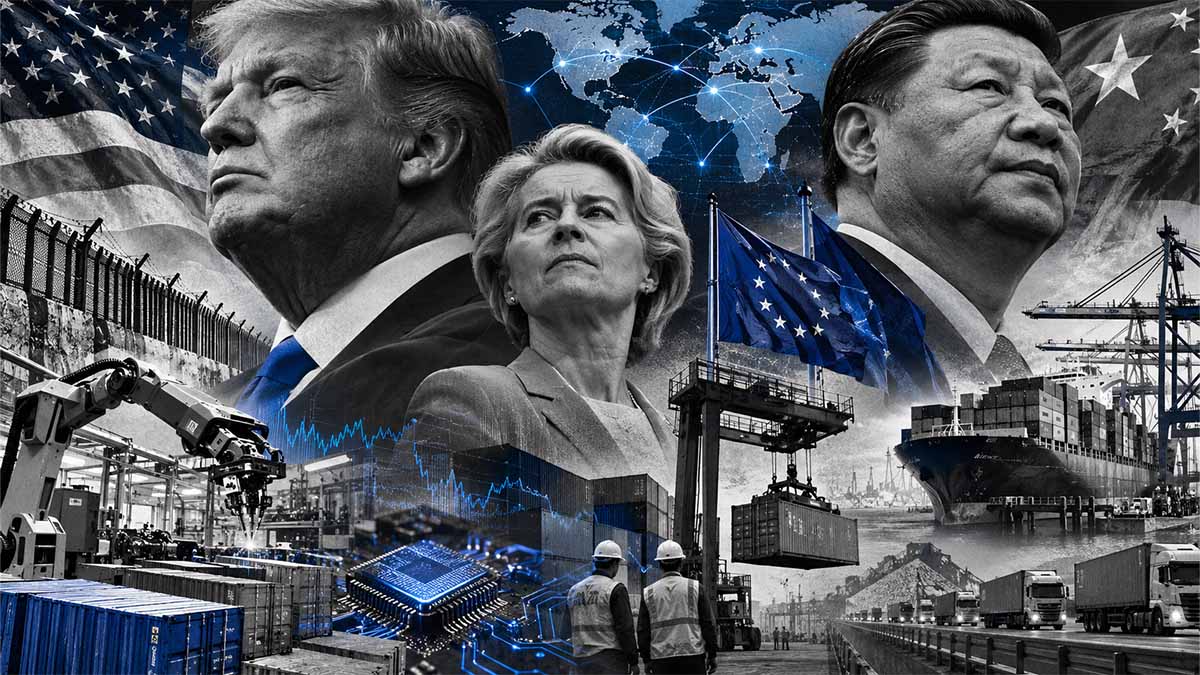
How Artificial Intelligence Is Reshaping International Commerce, Industrial Sovereignty and the Economics of Strategic Interdependence
Scope: Global trade, artificial intelligence, semiconductor supply chains, industrial protectionism and digital market access, assessed through November 8, 2026, with specific consideration of the United States, China, India, the European Union, Italy, France, Germany and the United Kingdom, and a strategic outlook to 2031.
Executive Summary / BLUF
Principal judgment: Artificial intelligence is not reversing protectionism. It is creating an increasingly important exception to it, as governments confront the economic costs of restricting access to the technologies, intermediate goods and international production networks required for AI development.
The evidence establishes a striking divergence between political restrictions on trade and the continued expansion of international commerce. In its October 2026 outlook, the World Trade Organization (WTO) raised its forecast for world merchandise trade volume growth to 3.9% in 2026, compared with 1.9% forecast in March. AI-enabling goods accounted for 47% of the year-on-year increase in global merchandise trade value during the first half of 2026, while trade in those goods expanded by 67%. Global Trade Outlook and Statistics — WTO — Oct 2026
This expansion is occurring alongside an intensification of restrictive trade policy. According to the WTO–IMF Trade Policy Activity Index, average global trade-policy activity in January–May 2026 was nearly twice its 2024 level, with restrictive measures driving much of the increase. Updated WTO-IMF TPA Index Shows Continued Rise in Global Trade Policy Activity — WTO — Jul 2026
The result is not a return to unrestricted globalisation, but an emerging system of selective economic openness: governments seek domestic industrial capabilities while remaining dependent on foreign components, specialised production, investment, services and technological expertise.
The greatest strategic vulnerability is concentration. The ten largest trading economies in AI-enabling goods accounted for approximately 85% of global exports and 80% of global imports in 2025. Expansion therefore coexists with substantial exposure to supply disruptions and geopolitical restrictions.
For policymakers, the central challenge is to reconcile technological security, national industrial capacity and internationally competitive access to AI infrastructure. The decisive uncertainty is whether AI-led trade growth becomes a durable, broad-based productivity transformation or remains dependent on a concentrated investment cycle vulnerable to financial repricing and political intervention.
AI Is Making Protectionism More Expensive — Without Making Governments Free Traders
Artificial intelligence is accelerating global commerce while concentrating technological power, financial exposure and industrial dependence. The result is not a return to free trade, but a more selective and politically controlled globalisation.
Artificial intelligence is exposing the central contradiction of contemporary industrial policy: governments seeking technological sovereignty increasingly depend on the international production networks they are trying to control. The World Trade Organization forecasts 3.9% growth in merchandise trade volume in 2026, even as restrictive trade-policy activity has intensified. AI-enabling goods accounted for 47% of the increase in global merchandise trade value during the first half of 2026. Washington restricts strategic technology exports while financing domestic semiconductor production; Beijing mobilises public capital to reduce foreign dependence; Brussels subsidises manufacturing while negotiating digital market access. The immediate stakes extend beyond trade balances. Industrial competitiveness, public finances, energy infrastructure and national security increasingly depend on whether governments can distinguish dependencies worth reducing from international relationships they cannot economically afford to dismantle.
Protectionism Is Rising, but Technology Is Pulling Trade in the Opposite Direction
The WTO–IMF Trade Policy Activity Index recorded restrictive intervention during January–May 2026 at nearly twice its 2024 average and approximately one-quarter above its 2025 level. Yet the WTO revised its forecast for 2026 merchandise trade volume growth from 1.9% in March to 3.9% in October, with a further 4.1% projected for 2027.
This divergence does not demonstrate that tariffs are ineffective. It demonstrates that trade restrictions and commercial demand operate through different mechanisms. Governments can raise barriers against selected suppliers while companies increase purchases of indispensable intermediate goods, redirect procurement or reorganise production across jurisdictions. Trade volumes can survive this adjustment even as transaction costs increase.
The distinction between value and volume is critical. During the first half of 2026, global merchandise trade increased 15% in current-dollar value but only 3.5% in volume. Higher prices for fuels and electronic components contributed to the difference. The nominal expansion of commerce therefore cannot be treated as equivalent to higher physical production or productivity.
The strongest conclusion from the WTO data is narrower but more consequential: the international economy is becoming more interventionist without becoming uniformly less interconnected. Artificial intelligence is a principal reason that this distinction now matters.
The Numbers Reveal a Concentrated Investment Cycle, Not a Universal Trade Revival
Trade in AI-enabling goods increased 16% in 2024, 31% in 2025 and 67% year-on-year during the first half of 2026. Their share of world merchandise trade value reached 14.8%, compared with approximately 7–8% during 2016–2023.
The scale of this expansion creates an important asymmetry. AI-related hardware accounted for almost half of the increase in world merchandise trade value during the first six months of 2026, but production and demand remain concentrated. The WTO estimates that the ten leading economies accounted for approximately 85% of AI-enabling goods exports and 80% of imports in 2025.
Global trade can consequently accelerate while industrial power becomes more concentrated. A rising number of international transactions does not necessarily mean that additional countries control the technologies required to produce the goods being traded.
The International Energy Agency provides the corresponding investment evidence. Capital expenditure by five major technology companies exceeded US$400 billion in 2025, with a further increase of approximately 75% anticipated in 2026. This expenditure supports demand for processors, memory, servers, networking equipment and electricity infrastructure.
The WTO’s trade outlook and the IEA’s investment assessment therefore describe related stages of the same economic process: expectations of future AI demand generate present capital expenditure, which creates international equipment orders before the anticipated productivity gains necessarily materialise.
The central vulnerability is that investment is measurable immediately; its economic return is not.
Semiconductor Sovereignty Breaks Down at the Weakest Production Stage
The industrial structure supporting AI makes comprehensive technological self-sufficiency exceptionally difficult.
Taiwan Semiconductor Manufacturing Company reported NT$3.809 trillion in 2025 revenue, with advanced process technologies accounting for 74% of wafer revenue. Customers headquartered in North America represented 75% of the company’s revenue, demonstrating the geographical separation between commercial demand and manufacturing capabilities.
The Netherlands occupies a different position. ASML reported €32.7 billion in 2025 sales, including deliveries of 48 extreme-ultraviolet lithography systems and 279 deep-ultraviolet systems. Its importance derives from specialised manufacturing equipment rather than the domestic production of finished AI processors.
Advanced packaging and high-bandwidth memory introduce additional dependencies. A processor cannot deliver its intended performance merely because sufficient logic-chip fabrication capacity exists. Memory bandwidth, component integration, manufacturing qualification and packaging capacity must also be available.
The United States has attempted to address selected vulnerabilities through domestic investment incentives. The November 2024 federal award for TSMC Arizona provided for up to US$6.6 billion in direct funding and US$5 billion in potential loans, associated with a manufacturing programme exceeding US$65 billion. These are funding arrangements and investment plans, not interchangeable measures of expenditure already disbursed or operational production.
The same distinction applies to electricity. The IEA estimates global data-centre electricity consumption at 485 TWh in 2025, potentially reaching approximately 950 TWh by 2030. Manufacturing access to advanced processors becomes economically insufficient when grid connections, transformers, cooling systems or electricity availability constrain their deployment.
Technological sovereignty is therefore not established by announcing a semiconductor factory or financing a data centre. It depends on the operational availability of an entire system of complementary capabilities.
Washington and Beijing Are Managing Access, Not Ending Interdependence
The United States has developed an increasingly differentiated export-control regime. In December 2024, the Bureau of Industry and Security introduced restrictions involving 24 semiconductor manufacturing-equipment categories, three software categories, high-bandwidth memory and 140 additions to the Entity List.
Yet on 15 January 2026, the Department of Commerce introduced case-by-case licensing treatment for specified advanced computing products exported to China and Macau, including the Nvidia H200 and AMD MI325X, subject to technical and compliance conditions.
The adjustment is revealing. Washington did not abandon export controls. It established a narrower channel for commercial transactions while preserving government authority over eligibility, performance thresholds and recipients.
China’s response has emphasised domestic industrial capability. The third phase of its National Integrated Circuit Industry Investment Fund was established in May 2024 with approximately RMB 344 billion in registered capital. The amount demonstrates financing ambition, not completed manufacturing capacity.
Both governments are therefore pursuing forms of selective industrial sovereignty: the United States through technological access controls and domestic production incentives; China through capital mobilisation and efforts to develop substitute capabilities.
The resulting competition affects third countries whose companies supply equipment, materials, memory and manufacturing services to both markets. Restrictions can redirect investment and production without eliminating upstream dependence. Relocating final assembly does not necessarily change the origin of the equipment, intellectual property or specialised components on which production relies.
The emerging divide is not between economies that trade and economies that do not. It is between technologies permitted to circulate and capabilities governments increasingly seek to control.
Europe and India Are Spending on Sovereignty, but Not on the Same Technologies
Europe’s industrial response illustrates the fiscal and technological complexity of semiconductor sovereignty.
The European Commission associates the original European Chips Act with more than €52 billion in mobilised public and private investment. Its June 2026 Chips Act 2.0 proposal extends the policy discussion towards industrial demand, supply resilience and the relationship between manufacturing and the broader technology system.
National projects demonstrate why aggregate European figures conceal substantial differences.
Italy authorised approximately €2 billion in state aid for STMicroelectronics’ Catania silicon-carbide programme, associated with a project of approximately €5 billion. Full capacity is expected in 2032. The investment targets power-semiconductor capabilities rather than the most advanced AI logic processors.
France supported the STMicroelectronics–GlobalFoundries Crolles programme, involving approximately €7.5 billion in investment and up to €2.9 billion in public assistance.
Germany obtained European Commission approval in August 2024 for €5 billion in state aid supporting the European Semiconductor Manufacturing Company project in Dresden. Its planned 28/22-nanometre and 16/12-nanometre production targets industrial and automotive requirements, with full capacity planned for 2029.
These investments are not technologically equivalent. Their economic justification depends on the specific components required by downstream industries, not on their contribution to an undifferentiated national semiconductor-production total.
The United Kingdom has adopted a more specialised approach. Its National Semiconductor Strategy committed up to £1 billion over a decade, prioritising research, design, compound semiconductors and industrial capabilities rather than attempting to reproduce every manufacturing stage domestically.
India is pursuing broader ecosystem development. Its Semicon 2.0 programme, approved on 15 July 2026, carries an outlay of ₹1,27,500 crore. By October 2026, five of twelve approved semiconductor projects had commenced commercial production, according to the Indian government’s November disclosure.
These figures cannot be ranked as though they represented comparable completed investments. Public subsidies, programme outlays, mobilised private capital and commercial production are different economic categories.
The underlying choice is whether public expenditure creates capabilities that domestic industries can use competitively, or merely increases manufacturing capacity whose future commercial demand remains uncertain.
The Financial System Is Becoming Exposed to the Same AI Revenue Assumptions
Industrial concentration is accompanied by a less visible financial concentration.
In its October 2026 Global Financial Stability Report, the International Monetary Fund examined 14 publicly disclosed circular AI financing transactions since 2023. It identified approximately US$300 billion in equity investments, US$650 billion in debt and US$1.4 trillion in future revenue commitments. About US$320 billion of the debt was attributed to investees within those arrangements.
These amounts cannot be added into a single investment total. They describe different financial instruments and contractual obligations. Their significance lies instead in the relationships connecting investors, infrastructure suppliers, customers and creditors.
A technology company may finance an AI developer that purchases computing services from the same commercial ecosystem. During expansion, rising expected revenues support valuations, financing and additional infrastructure orders. During a correction, the same relationships can transmit weaker demand, falling asset values and tighter credit conditions simultaneously.
The IMF identifies this interaction as a source of wrong-way risk: exposures that deteriorate together when the underlying commercial assumptions fail.
The consequences extend into international trade. Reduced infrastructure spending can weaken demand for advanced processors, memory, servers and electrical equipment. Manufacturers may then revise their investment programmes, while financing constraints affect companies further upstream.
This is why the financial sustainability of AI investment cannot be assessed through revenue growth alone. Utilisation, operating margins, depreciation, electricity costs, financing obligations and future equipment replacement determine whether infrastructure generates sufficient economic returns.
An AI investment correction would not have to originate in trade policy to produce an international trade shock.
The Next 24 Months Will Determine Who Absorbs the Adjustment
Between November 2026 and November 2028, the decisive issue will be whether the present expansion converts capital expenditure into sustainable commercial returns before financing conditions, infrastructure bottlenecks or technology restrictions force an adjustment.
Three developments will be particularly consequential: the relationship between AI infrastructure spending and realised profitability; the ability of semiconductor and electricity suppliers to deliver operational capacity; and the direction of export-control and digital-trade policy.
The WTO’s 2027 merchandise trade growth forecast of 4.1% remains conditional on the continuation of supportive investment and broader economic conditions. It is not a guarantee of a technology-led expansion through 2031.
For the United States, the cost of miscalculation would fall on technology investors, infrastructure borrowers and companies whose investment programmes depend on sustained computing demand. For China, it would affect the returns on semiconductor industrial financing and the competitiveness of domestic technological substitutes. In Europe, poorly targeted subsidies could impose fiscal costs while leaving critical upstream dependencies unresolved. Italy’s Catania programme, France’s Crolles investment and Germany’s Dresden project will ultimately be judged by qualified production, customer demand and commercially sustainable output—not approved funding alone.
The cost of inaction would be distributed differently. Manufacturers lacking affordable access to advanced inputs would face higher production costs or delayed modernisation. Electricity users could confront infrastructure constraints and associated financing burdens. Lenders and institutional investors would remain exposed to concentrated commercial assumptions, while governments could face pressure to support projects whose expected returns have weakened.
Artificial intelligence is not converting protectionist governments into free traders. It is forcing them to confront the economic price of protection.
The distinction that will matter over the next 12–24 months is whether governments protect genuinely critical industrial capabilities or subsidise expensive substitutes for international production networks that remain indispensable. The first can improve resilience. The second can transfer technological risk onto taxpayers, industrial customers and the financial system without eliminating the underlying dependence.
Navigational Index
Pillar I — The Economic Paradox: Protectionism and the Expansion of Technology Trade
Chapter 1 — The Reconfiguration of Globalisation: Trade restrictions, global commerce and the structural divergence between protectionist policies and commercial outcomes.
Chapter 2 — Artificial Intelligence as an Engine of International Trade: Semiconductor demand, servers, computing infrastructure, AI capital expenditure and the statistical contribution of technology-intensive goods.
Chapter 3 — The Political Economy of Selective Liberalisation: Why governments protecting domestic industries may simultaneously reduce barriers to strategic technologies, digital services and specialised inputs.
Pillar II — Strategic Dependencies, Industrial Sovereignty and Geoeconomic Competition
Chapter 4 — The Global AI Production Architecture: Semiconductor design, fabrication, advanced packaging, memory, computing systems, infrastructure and the geographical concentration of production.
Chapter 5 — The United States, China and the Fragmentation of Technology Markets: Trade policy, export restrictions, industrial strategies, supply-chain diversification and the distinction between commercial integration and technological security.
Chapter 6 — Europe, India and the United Kingdom: Competing Models of Technological Openness: Comparative institutional and industrial assessments of the European Union, Italy, France, Germany, the United Kingdom and India.
Pillar III — Financial Stability, Trade Governance and the 2027–2031 Strategic Outlook
Chapter 7 — The Financial Architecture of the AI Trade Expansion: Capital expenditure, infrastructure financing, investment concentration, corporate profitability and financial-contagion channels.
Chapter 8 — Trade Rules in an Era of Technological Sovereignty: WTO disciplines, digital trade agreements, economic-security measures, national regulation and the political constraints on international coordination.
Chapter 9 — Strategic Scenarios, Early-Warning Indicators and Policy Choices to 2031: Alternative trade-development pathways, technological and financial risks, decision thresholds and a final net assessment.
Master Abstract
Artificial Intelligence Is Changing the Economics of Protectionism
The international trading system is undergoing a transformation that cannot be understood through the conventional opposition between free trade and economic nationalism. Trade restrictions have become more prominent, yet cross-border commerce continues to expand, driven disproportionately by the industrial requirements of artificial intelligence. This apparent contradiction reflects a structural feature of modern technology production: achieving domestic technological capability often requires extensive international integration.
The WTO’s October 2026 figures illustrate the scale of the shift. Trade in AI-enabling goods grew by 16% in 2024, accelerated to 31% in 2025 and reached a year-on-year growth rate of 67% during the first half of 2026. Their share of global merchandise trade value increased from approximately 7–8% during 2016–2023 to 14.8% in the first half of 2026. Such figures establish that AI is no longer simply a potential source of future productivity improvements. Its infrastructure requirements are already affecting the composition and geographical distribution of international merchandise trade. Global Trade Outlook and Statistics — WTO — Oct 2026
The economic mechanism is significant. AI infrastructure requires specialised semiconductors, memory systems, high-performance computing equipment and associated industrial inputs. The production of these goods depends on internationally distributed activities and capabilities. A government seeking to expand national computing infrastructure therefore confronts a trade-off: restrictive measures may support selected domestic producers, but restrictions on essential imported inputs can also increase the cost or delay the development of domestic technological capacity. This creates incentives for selective market access even where broader industrial policy remains protectionist.
The Distinction Between Trade Growth and Trade Liberalisation
The existence of rapidly expanding commerce does not demonstrate that governments have abandoned restrictive policies. In fact, the WTO and IMF’s joint research indicates the opposite. Their Trade Policy Activity Index records a substantial increase in intervention, with restrictions rising more rapidly than facilitating measures during 2025 and early 2026. The index measures the intensity of trade-policy activity rather than the value of trade directly affected; it therefore cannot be interpreted as a percentage tariff increase or as a direct measure of lost trade. Nevertheless, its direction establishes that international economic integration is continuing under conditions of greater government intervention. Updated WTO-IMF TPA Index Shows Continued Rise in Global Trade Policy Activity — WTO — Jul 2026
An additional distinction concerns nominal trade values and physical volumes. According to the WTO, global merchandise trade value increased by 15% year-on-year in the first half of 2026, while merchandise trade volume rose by 3.5%. The difference reflects higher prices for fuels and electronic components used in data centres. Consequently, the rise in international trade cannot be interpreted entirely as an increase in physical production or exchanged quantities. This distinction is fundamental when assessing whether AI is generating durable economic expansion or temporarily increasing the nominal value of technology-intensive trade. Global Trade Outlook and Statistics — WTO — Oct 2026
The WTO also reports that approximately 72% of world merchandise trade continues to operate under most-favoured-nation tariff terms. This demonstrates the persistence of the multilateral system’s underlying legal architecture despite growing discrimination, industrial subsidies and security-related interventions. International trade is therefore becoming more politically managed without ceasing to be deeply interconnected. World Trade Report 2026 — WTO — 2026
Economic Openness Is Becoming Conditional and Sector-Specific
The clearest institutional manifestation of this transformation is the expansion of rules designed to facilitate digital commerce while governments preserve wider regulatory and security powers. The EU–Singapore Digital Trade Agreement entered into force on February 1, 2026. It addresses electronic transactions, customs duties on electronic transmissions, unjustified data-localisation requirements and compulsory source-code transfers. Its provisions demonstrate a deliberate effort to facilitate international digital commerce without eliminating regulatory authority over personal data and other public-policy concerns. EU–Singapore Digital Trade Agreement Enters into Force — European Commission — Feb 2026
The United Kingdom–India Comprehensive Economic and Trade Agreement, which entered into force on July 15, 2026, provides another example. Its digital trade chapter supports electronic contracts, authentication, paperless transactions and source-code protections. Importantly, the agreement preserves exceptions and regulatory discretion. This is evidence of negotiated, conditional liberalisation rather than an unrestricted commitment to technological free trade. UK–India CETA Chapter 12: Digital Trade — UK Department for Business and Trade — Jul 2026
For Europe, the challenge is particularly consequential. Germany’s industrial manufacturing structure, France’s technological-sovereignty priorities, Italy’s exposure through machinery and intermediate manufacturing, and the United Kingdom’s services and technology markets create different channels through which AI-driven trade can generate opportunities or deepen dependencies. These distinctions require country-specific evaluation rather than treating Europe as a homogeneous economic actor. At EU level, the strategic question concerns the balance between building European capacity and ensuring competitively priced access to international technologies.
The New Concentration Risk
AI-led global commerce is considerably more concentrated than overall merchandise trade. The WTO estimates that the geographical concentration of AI-enabling goods trade is approximately twice that of total merchandise trade. Its data show that the ten leading traders account for around 85% of AI-enabling exports and 80% of imports. This concentration strengthens the ability of a relatively limited group of economies and companies to influence prices, supply availability and technological development. It also means that the expansion of international trade does not necessarily produce a comparable diversification of industrial power. Global Trade Outlook and Statistics — WTO — Oct 2026
The financial consequences are equally important. The IMF’s October 2026 Global Financial Stability Report identifies AI-related asset-price corrections as a material risk, particularly where leverage and concentrated exposures could amplify financial adjustments. A reversal of expected AI profitability could therefore affect not only technology valuations but also infrastructure investment, equipment orders, trade finance and the international demand for technologically specialised goods. Resilience, Risk, and Transformation — IMF — Oct 2026
The resulting assessment is that AI is increasing the economic cost of technological isolation without eliminating the political incentives for industrial protection. The durability of this new configuration will depend on whether governments can preserve access to essential international production networks while reducing excessive concentration, maintaining technological security and enabling broader participation in the benefits of AI-related trade.
Key Evidence Table
The following indicators establish the principal quantitative baseline. Forecasts are distinguished from observed trade results, and value-based measures from volume-based measures.
| Indicator | Value/status | Reference date | Definition/scope | Issuer | Exact source |
|---|---|---|---|---|---|
| World merchandise trade growth | 3.9% forecast | 2026 | Annual growth in physical trade volume | WTO | October 2026 Outlook |
| Earlier merchandise growth forecast | 1.9% | March 2026 forecast for 2026 | Previous baseline, volume | WTO | October 2026 Outlook |
| World merchandise trade growth | 4.1% forecast | 2027 | Annual volume growth, conditional outlook | WTO | October 2026 Outlook |
| AI-enabling goods trade growth | 16% | 2024 | Annual change in trade value | WTO | October 2026 Outlook |
| AI-enabling goods trade growth | 31% | 2025 | Annual change in trade value | WTO | October 2026 Outlook |
| AI-enabling goods trade growth | 67% | H1 2026 | Year-on-year change in trade value | WTO | October 2026 Outlook |
| Contribution of AI-enabling goods | 47% | H1 2026 | Share of year-on-year increase in global merchandise trade value | WTO | October 2026 Outlook |
| AI-enabling goods share of merchandise trade | 14.8% | H1 2026 | Share of global merchandise trade value | WTO | October 2026 Outlook |
| AI-enabling goods trade concentration | 85% of exports; 80% of imports | 2025 | Combined shares of ten leading trading economies | WTO | October 2026 Outlook |
| Merchandise trade value growth | 15% | H1 2026 | Year-on-year change in current US dollars | WTO | October 2026 Outlook |
| Merchandise trade volume growth | 3.5% | H1 2026 | Year-on-year physical-volume change | WTO | October 2026 Outlook |
| Trade-policy intervention | Nearly twice 2024 average | Jan–May 2026 | Activity index; not tariff rate or trade coverage | WTO–IMF researchers | Trade Policy Activity Index |
| MFN-based merchandise trade | Approximately 72% | 2026 WTO assessment | Share of merchandise trade on WTO MFN tariff terms | WTO | World Trade Report 2026 |
| Commercial services trade volume growth | 3.3% forecast | 2026 | Annual services volume | WTO | October 2026 Outlook |
| World economic growth | 3.1% forecast | 2026 | Real GDP growth | IMF | World Economic Outlook |
H1 = first half of the year; MFN = most-favoured-nation treatment. WTO and IMF GDP projections are produced using different forecasting frameworks and should not be treated as interchangeable inputs. Values and volumes are also not directly comparable growth measures.
Competing Explanations and Strategic Pathways
Three explanations are sufficiently distinguishable to test against the available evidence. They are not entirely mutually exclusive: they describe different mechanisms that can operate simultaneously.
| Hypothesis | Diagnostic support | Disconfirming evidence or limitation | Indicators | Current standing |
|---|---|---|---|---|
| H1 — AI is producing selective trade liberalisation | Digital trade agreements facilitate transactions; AI-intensive production creates cross-border input requirements | Restrictive trade policies continue rising; digital trade agreements do not demonstrate general tariff liberalisation | Technology tariffs, digital agreements, customs treatment, cross-border investment | Partially supported; sector-specific openness is documented, but a causal reversal of protectionism is not established |
| H2 — AI is sustaining trade growth despite protectionism | AI-enabling goods contribute 47% of first-half 2026 merchandise trade value growth; global goods trade forecasts have risen | Growth is concentrated and nominal values are influenced by higher prices | Trade volume, AI-related capital expenditure, equipment orders, semiconductor exports | Strongest current explanation of observed trade resilience |
| H3 — AI is accelerating asymmetric economic interdependence | AI trade is geographically concentrated; geopolitical decoupling continues in some bilateral relationships | Overall trade fragmentation has not intensified uniformly; concentration does not by itself establish coercive conduct | Export controls, supplier concentration, sourcing diversification, investment restrictions | Strongly supported as a structural risk, but future consequences remain conditional |
The most defensible synthesis combines the second and third explanations. AI-related investment is demonstrably supporting international commerce, but the resulting trade is concentrated in relatively few economies. Selective liberalisation is occurring in certain digital transactions and bilateral agreements; it has not yet been demonstrated as a general change in the political orientation of protectionist governments.
This distinction has direct consequences for the design of trade and industrial policy. An economy can experience expanding technological imports and simultaneously impose greater restrictions on other sectors. Such behaviour is economically consistent when imported advanced technologies generate benefits for domestic producers, even where governments retain protective measures for competing national industries.
Principal Gaps and Watch Indicators
The causal relationship between AI demand and actual liberalisation
The present official record strongly establishes that AI investment increases international trade demand. It does not establish that the same investment has caused governments broadly to reverse previously enacted protective measures. Demonstrating that proposition requires a product-level comparison of AI-related tariff schedules, exemptions, restrictions and trade-policy decisions before and after the expansion of AI investment.
The appropriate monitoring records are national customs schedules, official trade-remedy decisions, WTO notifications and the WTO Trade Monitoring Database. These should be examined alongside trade values to distinguish increased demand under existing rules from genuine reductions in commercial barriers.
The sustainability of AI-related capital expenditure
The WTO’s October outlook incorporates expectations of continued growth in AI investment through 2027. Nevertheless, the institution explicitly identifies a slowdown or reversal in AI-related expenditure as a significant risk to global trade because of its high import content.
A decisive warning signal would be a sustained decline in infrastructure capital expenditure accompanied by weaker semiconductor and server orders. Isolated changes in equity valuations would be insufficient to establish a deterioration in physical demand, but synchronized declines in investment guidance, orders and realised shipments would materially weaken the present assessment.
The financial dimension requires monitoring alongside the IMF’s identified risks from concentrated market exposures and leverage. Resilience, Risk, and Transformation — IMF — Oct 2026
The relationship between AI trade and broader economic productivity
Rapid growth in semiconductor and computing-equipment trade is evidence of investment, not proof that AI adoption has already produced productivity gains sufficient to justify the associated expenditure.
The strategic evaluation must therefore distinguish the construction of AI capacity from its productive utilisation. Relevant evidence includes national productivity statistics, corporate investment disclosures, realised operating income, utilisation of computing infrastructure and changes in value added outside the technology sector.
A persistent gap between investment growth and realised productivity or profitability would increase the risk that the current trade expansion reflects an unusually concentrated capital-spending cycle rather than a durable transformation of global production.
The evolution of US–China technological separation
The WTO observes that the gap between trade within geopolitical blocs and trade across them narrowed during 2025 and into 2026, while US–China trade separation accelerated. This distinction matters because the international system may become more commercially interconnected overall while particular strategic relationships become less integrated. Global Trade Outlook and Statistics — WTO — Oct 2026
The most consequential indicators are changes in semiconductor and computing-equipment export controls, licence implementation, bilateral technology trade, third-country production relocation and the emergence of genuinely independent supply chains.
Trade routed through additional jurisdictions should not automatically be interpreted as technological diversification. A reduction in direct bilateral trade may coexist with continuing dependence on the same upstream components or manufacturing capabilities.
Europe’s industrial position in the emerging AI trading system
At the European level, an essential unresolved issue is whether AI-related demand will increase domestic value added or primarily expand imports of technologies manufactured elsewhere.
This requires a disaggregated assessment of European semiconductor production, equipment manufacturing, digital services, computing investment, industrial electricity costs and capital formation. Italy, France, Germany and the United Kingdom must be analysed separately because their industrial capabilities, energy exposure, technology specialisations and institutional powers differ materially.
The principal policy alternatives involve reducing costs and regulatory friction for essential imports, supporting selected domestic capabilities, and coordinating international supply-chain security. These approaches have different fiscal burdens, implementation periods and risks. Import facilitation can improve near-term access but preserve foreign dependence; industrial subsidies can develop capacity over longer horizons but risk inefficient expenditure; coordinated supply-chain arrangements can reduce disruption exposure while creating new political and contractual dependencies.
The relevant decision is therefore not between unrestricted free trade and complete technological self-sufficiency. It concerns which dependencies should be diversified, which capabilities justify domestic investment, and where international openness remains economically indispensable.
Final Assessment of the Dossier Opening
The available institutional evidence supports a substantive change in the structure of international economic integration. Governments are using trade restrictions and industrial policy more extensively, while investment in artificial intelligence is increasing demand for internationally manufactured technology goods and strengthening the economic importance of cross-border production networks.
The defining characteristic of this transformation is selective openness under conditions of strategic competition. AI creates powerful commercial incentives to preserve access to international inputs, but those incentives coexist with security concerns, industrial subsidies, export restrictions and efforts to strengthen national technological autonomy.
The resulting system is neither a simple revival of globalisation nor its collapse. It is a more differentiated trading order in which integration expands in certain technology-intensive activities even as political control over their supply chains becomes more important.
The strategic outcome through 2031 will depend on three developments: whether AI-related investment generates sustained productive returns, whether international trade governance can accommodate increasingly complex technological interdependence, and whether governments can manage concentrated supply-chain risks without undermining the very commercial networks on which their technological competitiveness depends.
The AI Trade
Paradox.
Protectionism is intensifying while artificial intelligence drives a disproportionate share of international trade growth. The emerging system combines strategic industrial protection with selective technological openness.
Interactive Trade Analytics
AI-Enabling Goods Trade Growth
Percentage change in AI-enabling goods trade value. First-half 2026 is a year-on-year observation, not a full-year annual growth rate.
Three Pillars of the New Trading Order
The Protectionism Paradox
Restrictive trade-policy activity increased substantially while AI-related demand supported international merchandise trade. Greater trade volumes do not necessarily mean governments have liberalised their trade policies.
Strategic Interdependence
A highly concentrated international production system provides essential AI inputs. The ten leading economies accounted for around 85% of AI goods exports and 80% of imports in 2025.
Financial and Policy Exposure
AI infrastructure investment supports technology trade but creates exposure to capital-spending reversals, financial repricing and geopolitical constraints on cross-border supply chains.
Trade and Technology Data Matrix
| Indicator | Value | Period | Definition | Source |
|---|---|---|---|---|
| AI-enabling goods trade growth | 67% | H1 2026 | Year-on-year, value | WTO |
| AI contribution to merchandise growth | 47% | H1 2026 | Share of value increase | WTO |
| AI goods share of merchandise trade | 14.8% | H1 2026 | Share of total value | WTO |
| Merchandise trade value growth | 15% | H1 2026 | Year-on-year, value | WTO |
| Merchandise trade volume growth | 3.5% | H1 2026 | Year-on-year, volume | WTO |
| World merchandise volume forecast | 3.9% | 2026 | October forecast | WTO |
| World merchandise volume forecast | 4.1% | 2027 | October forecast | WTO |
| Top ten AI goods exporters | 85% | 2025 | Share of global AI goods exports | WTO |
| Top ten AI goods importers | 80% | 2025 | Share of global AI goods imports | WTO |
National Exposure and Policy Priorities
European Union
Balance strategic technological autonomy with access to global inputs. Digital trade rules and supply-chain resilience form complementary policy instruments.
Italy
Evaluate AI demand through machinery, intermediate manufacturing and industrial adoption, while monitoring imported technology costs and energy exposure.
France
Assess national technology capacity and sovereign infrastructure ambitions against international semiconductor and computing dependencies.
Germany
Examine the relationship between industrial manufacturing competitiveness, technology imports, automation investment and export-market demand.
United Kingdom
Monitor digital services integration, trade agreement implementation, technology investment and access to international computing supply chains.
Common Strategic Risk
AI investment could expand trade while increasing exposure to a concentrated supplier base, financing cycles and geopolitical restrictions.
Selective Openness, Not the End of Protectionism
Artificial intelligence is increasing the economic cost of technological isolation without eliminating incentives for industrial protection. The critical decision is which dependencies to diversify, which capabilities justify domestic investment, and where international access remains indispensable for competitiveness.
PILLAR I — THE ECONOMIC PARADOX: PROTECTIONISM AND THE EXPANSION OF TECHNOLOGY TRADE
Chapter 1 — The Reconfiguration of Globalisation: Trade Restrictions, Global Commerce and the Structural Divergence Between Protectionist Policies and Commercial Outcomes
Principal judgment: The international trading system is undergoing a transition from predominantly rules-based market integration towards politically managed economic interdependence. Governments are increasing their use of tariffs, subsidies, industrial restrictions and economic-security instruments, but these interventions have not produced a corresponding contraction of world commerce. The expansion of artificial intelligence, the persistence of multinational production networks and the capacity of international suppliers to redirect trade have created conditions in which protectionism and global commercial expansion coexist. This does not demonstrate that trade restrictions are economically ineffective. It demonstrates that the relationship between trade policy and observed commerce has become more heterogeneous, sector-specific and dependent on the composition of international demand.
The Structural Separation Between Political Intentions and Economic Outcomes
The most important transformation in the international economy is not the disappearance of globalisation, but the weakening of the assumption that increasing protectionism must necessarily produce an immediate, generalised decline in international trade. Governments can restrict particular products, suppliers or countries while increasing their purchases from alternative jurisdictions, and multinational companies can preserve international production by altering sourcing arrangements rather than relocating entire value chains into domestic markets. The resulting configuration can increase the complexity and cost of commerce without necessarily reducing the total value of transactions. This distinction is essential because a tariff, an import prohibition, an industrial subsidy and an export-control licence affect different economic mechanisms. Tariffs change relative prices and the distribution of costs between producers, importers and consumers; quantitative restrictions directly constrain eligible imports; subsidies influence investment and production decisions; and export controls regulate the availability of selected technologies or equipment to designated recipients. These instruments cannot be treated as interchangeable evidence of a single, uniform process of deglobalisation.
The strongest official evidence of the policy shift comes from the joint WTO–IMF research on trade-policy activity, updated on 23 July 2026. The Trade Policy Activity Index measures the common movement of policy interventions across numerous economies and product categories using a dynamic-factor statistical model. It does not simply count tariffs or measure their average rate. According to the published results, global trade-policy activity during January–May 2026 was nearly twice its 2024 average and approximately one-quarter above its 2025 average. The increase was driven predominantly by restrictive measures, while facilitating measures expanded more modestly. The acceleration was not confined to the G20: non-G20 economies also recorded a substantial increase in policy activity. The evidence therefore indicates a broadening of governmental intervention in trade rather than a phenomenon attributable exclusively to the policies of the United States or China. Updated WTO–IMF Trade Policy Activity Index Shows Continued Rise in Global Trade Policy Activity — WTO — July 2026
The interpretation of this index requires precision. Its increase does not establish that the average effective tariff doubled, that the value of restricted trade doubled, or that twice as many products became subject to import prohibitions. The indicator captures an underlying dimension of policy activity inferred from multiple sources. Its principal analytical value is identifying the direction and intensity of intervention over time and distinguishing restrictive policies from facilitating measures. Consequently, comparing the index directly with aggregate trade growth does not provide a causal estimate of how much commerce protectionism has prevented. A defensible causal analysis would require product-level information about changes in tariff treatment, actual imports, prices, quantities, competing suppliers and the timing of policy implementation.
The WTO’s October 2026 trade outlook nevertheless establishes that international commerce has remained more resilient than expected. The organisation revised its forecast for merchandise trade volume growth in 2026 from 1.9% in March to 3.9% in October, a revision of 2.0 percentage points. Its forecast for 2027 was 4.1%, although the underlying outlook remained conditional on geopolitical and economic developments. This improvement was supported by stronger investment in artificial-intelligence infrastructure and by the adjustment of international supply chains to disruptions in energy, fertiliser and transport markets. The revision is significant because it occurred alongside the intensification of restrictive trade-policy activity, but it must not be interpreted as evidence that restrictions themselves increased international trade. The appropriate inference is that positive forces, particularly technology investment and supply-chain adaptation, were sufficiently strong to outweigh some of the negative pressures during the observed period. AI Boom and Trade Resilience to Middle East Crisis Lift Outlook, but Gains to Be Uneven — WTO — October 2026
Why Trade Can Expand Under Increasing Restrictions
The economic mechanisms behind this apparent contradiction operate at different levels of the production system. At the national level, an importing government may impose restrictions to protect domestic producers or limit dependence on a strategic competitor. At the corporate level, manufacturers continue to require components, capital equipment, specialised services and intermediate goods that domestic suppliers cannot necessarily provide at a competitive price, quality or delivery schedule. At the international level, suppliers respond to changes in market access by pursuing alternative customers, relocating eligible production activities or redirecting shipments through new commercial relationships. These adjustments can preserve the value of international exchange while changing its geography, contractual structure and distribution of economic benefits. They can also increase transaction costs, lengthen supply chains and weaken economic efficiency. An increase in gross trade is therefore compatible with both substantial commercial resilience and a deterioration in the efficiency of the trading system.
The second mechanism concerns the distinction between gross trade and domestic value added. When a semiconductor, component or piece of equipment crosses several borders during production, international trade statistics may record multiple transactions associated with different stages of the same final product. Gross exports consequently measure cross-border commercial transactions rather than the amount of value ultimately created within the exporting economy. This distinction becomes especially important when governments seek to evaluate whether relocating a limited assembly activity has actually reduced technological dependence. A product may acquire a different country of origin under applicable customs rules without its most critical upstream inputs becoming domestically available. Conversely, a country may generate substantial technological value through design, software, intellectual property or engineering without possessing the physical facilities used to manufacture the final hardware.
A third mechanism is the redirection of supply rather than the elimination of demand. The WTO documented an extraordinary example during the disruptions affecting energy and fertiliser trade in the first half of 2026. Middle Eastern crude-oil exports fell by approximately 24%, while liquefied-natural-gas exports from the region declined by 47%. Yet additional shipments from alternative suppliers limited the corresponding decline in global exports to approximately 6% for crude oil and 1% for LNG. Global imports of nitrogenous fertilisers were only 2.8% below recent averages, while phosphatic fertiliser imports were 2.2% higher. Global container throughput increased by 3.9% in the year to July 2026. These observations establish the capacity of some international supply networks to substitute suppliers and routes during severe disruptions, although they do not establish that adaptation was costless or equally available to every importing economy. AI Boom and Trade Resilience to Middle East Crisis Lift Outlook, but Gains to Be Uneven — WTO — October 2026
The relevance of these observations extends beyond the affected commodities. Supply-chain adaptation demonstrates why the geographical concentration of an initial disruption cannot automatically be translated into an equivalent global loss of trade. The outcome depends on spare production capacity elsewhere, transport infrastructure, financial resources, regulatory permissions, contractual flexibility and the technical substitutability of alternative goods. For highly standardised commodities with multiple suppliers, substitution may be comparatively feasible. For advanced technology components requiring specialised production processes and limited qualified suppliers, the capacity for substitution can be much narrower. As a result, the same global economy can exhibit substantial resilience in some commodity markets and acute vulnerabilities in particular semiconductor, computing or infrastructure segments.
Trade Values, Physical Volumes and the Problem of Statistical Interpretation
The difference between merchandise trade measured in current US dollars and trade measured in physical-volume terms is particularly important in evaluating the 2026 expansion. According to the WTO, the value of world merchandise trade increased by 15% year-on-year during the first half of 2026, whereas merchandise trade volume increased by 3.5%. The gap of 11.5 percentage points is a calculated difference between two reported growth rates, not a direct estimate of global export-price inflation. The WTO attributes much of the divergence to higher prices for fuels and electronic components used in data centres. The resulting statistical pattern demonstrates that rapidly increasing nominal trade values may reflect a combination of physical growth, changes in product composition and changes in transaction prices. Global Trade Outlook and Statistics — WTO — October 2026
This distinction has immediate implications for the measurement of globalisation. If international trade increases primarily because technologically sophisticated products become more expensive, its value can rise without a comparable increase in physical quantities. If higher technology expenditure also reflects a shift towards more capable or higher-specification products, conventional price and volume measures may struggle to capture improvements in performance consistently. A meaningful assessment therefore requires separate examination of nominal trade, physical shipments, product characteristics and domestic value added. The problem becomes more pronounced when the composition of international merchandise trade shifts rapidly towards sectors with short technology cycles and substantial variation in unit values.
A second limitation concerns forecasting comparisons. The WTO’s October projections for world merchandise trade volume growth of 3.9% in 2026 and 4.1% in 2027 were accompanied by WTO global GDP growth forecasts of 2.6% and 2.9%, respectively. The IMF’s October 2026 World Economic Outlook separately projected global GDP growth of 3.1% in 2026 and 3.4% in 2027. These are institution-specific forecasts, produced through different methodologies and assumptions, and must not be combined without reconciliation. Their shared implication is that the international economy was expected to continue expanding, but their numerical differences matter when evaluating whether trade is growing faster than production and by how much. AI Boom and Trade Resilience to Middle East Crisis Lift Outlook, but Gains to Be Uneven — WTO — October 2026 and World Economic Outlook: Resilience Under Strain, Urgent Choices — IMF — October 2026.
The Emerging Geography of Fragmentation
One of the most consequential findings in the WTO’s October assessment concerns the divergence between global fragmentation and particular bilateral relationships. The WTO reported that the difference between trade within geopolitical blocs and trade across blocs narrowed through 2025 and into 2026, suggesting that broad bloc-based fragmentation had not continued to intensify uniformly. At the same time, the separation of US–China trade accelerated from 2025 and became the principal driver of the remaining divergence. This establishes a more complex geography than a straightforward division of the world into two closed commercial systems. International production networks can remain highly interconnected while selected bilateral relationships become progressively more restricted. Global Trade Outlook and Statistics — WTO — October 2026
The distinction is fundamental for interpreting the strategies of middle-income and emerging economies. Countries positioned between major economic blocs may attract additional commercial opportunities as multinational companies seek alternative manufacturing locations, suppliers or export channels. However, increased bilateral trade with such countries does not necessarily establish that they have developed independent upstream technological capabilities. A supplier may remain dependent on imported semiconductor manufacturing equipment, specialised materials, foreign design technologies or externally produced components. The correct unit of analysis is therefore not simply bilateral trade but the distribution of critical production capabilities along the entire value chain. A more diversified map of customs transactions can coexist with persistent concentration in the underlying technology.
For advanced economies, this development changes the meaning of strategic autonomy. Complete domestic production across every stage of an advanced technological supply chain is not necessarily economically feasible, nor does it automatically maximise security. Autonomy may instead depend on assured access to critical foreign inputs, multiple qualified suppliers, domestic capacity in selected strategically important activities, stock-management arrangements and credible institutional relationships. A national strategy that reduces dependence on one foreign supplier while creating an equally concentrated dependence on another does not necessarily improve resilience. Similarly, a tariff intended to strengthen domestic production can undermine downstream industries when domestic substitutes are unavailable or prohibitively expensive.
The emerging trade system is therefore better understood through three distinct dimensions: the intensity of governmental intervention, the actual geographical and sectoral distribution of trade, and the concentration of critical production capabilities. These dimensions interact, but they do not move together mechanically. A government can intervene more actively without substantially reducing aggregate trade; trade can grow while dependence on a narrow supplier base increases; and bilateral trade separation can accelerate even as international commerce becomes more integrated elsewhere.
Chapter 1 — Key Judgments
The central finding is that the global trading system has become increasingly interventionist without becoming uniformly less interconnected. The evidence establishes a substantial increase in restrictive trade-policy activity during 2025–2026, a simultaneous upward revision to global merchandise trade growth and considerable resilience in international supply networks. The statistical record also demonstrates why nominal trade growth cannot be equated with equivalent increases in physical output, technological diffusion or economic welfare.
What would change the assessment: A sustained, broad-based decline in trade volumes across multiple sectors, accompanied by evidence that domestic production had replaced critical international inputs rather than merely redirected purchasing through alternative foreign suppliers, would support a stronger conclusion of structural deglobalisation. Conversely, sustained technological investment, broader geographical participation in high-value production and measurable reductions in restrictions would support a judgment that international integration had entered a new phase of expansion.
The official records most consequential for subsequent verification are the WTO Trade Monitoring Database, the WTO’s product-level trade statistics and the national tariff schedules associated with specific restrictive or facilitating measures. These records would allow the distinction between policy intentions, realised changes in market access and changes in commercial behaviour to be examined more precisely.
Chapter 2 — Artificial Intelligence as an Engine of International Trade: Semiconductor Demand, Servers, Computing Infrastructure, AI Capital Expenditure and the Statistical Contribution of Technology-Intensive Goods
Principal judgment: Artificial intelligence has become a major source of international demand for technologically sophisticated capital goods. The present expansion is not simply a consequence of rising exports of finished computers or electronic equipment. It reflects investment across an interconnected system of semiconductor design, advanced manufacturing, memory, processing equipment, data-centre infrastructure and digitally delivered services. The economic significance of this process lies in its exceptionally high import requirements, its concentration within a limited group of trading economies and its dependence on continued capital expenditure. These characteristics allow AI investment to support international commerce while simultaneously increasing exposure to technological bottlenecks, financial expectations and trade-policy intervention.
From Digital Innovation to Physical Capital Formation
The defining economic feature of the current AI investment cycle is the conversion of demand for advanced computational capability into demand for physical infrastructure. Although artificial intelligence is frequently described in terms of algorithms, software and models, the expansion of computational capacity depends on tangible industrial products and services. Training and deploying increasingly capable AI systems require processors, memory, computing servers, networking equipment, power-management systems, specialised cooling infrastructure and reliable electricity supplies. These requirements connect the development of digital services to sectors traditionally associated with capital-intensive manufacturing, utilities, construction, international logistics and industrial equipment.
The resulting trade mechanism operates through investment rather than final consumption alone. A company expanding computing capacity may acquire advanced processors manufactured abroad, servers assembled in another jurisdiction, networking equipment containing internationally sourced components and associated infrastructure procured from multiple suppliers. Expenditure on AI infrastructure consequently generates demand across several stages of international production. This distinguishes the present expansion from a purely software-driven increase in digital commerce. The relevant economic activity includes the construction and operation of physical assets whose components and production capabilities are distributed internationally.
The WTO’s October 2026 assessment explicitly identifies the expansion of AI infrastructure investment as a principal cause of stronger-than-expected merchandise trade growth. The organisation reported that trade in AI-enabling goods increased by 16% in 2024, 31% in 2025 and 67% year-on-year during the first half of 2026. These figures do not describe the same observation period: the first two represent full-year growth rates, whereas the third compares the first half of 2026 with the corresponding period of 2025. Nevertheless, the sequence establishes an acceleration in the recorded value of international exchanges involving the relevant goods. Global Trade Outlook and Statistics — WTO — October 2026
The macroeconomic significance of this expansion is unusually large. AI-enabling goods accounted for approximately 47% of the year-on-year increase in world merchandise trade value during the first half of 2026. Their share of total merchandise trade value reached 14.8%, compared with approximately 7–8% during 2016–2023. These observations indicate that AI-related hardware has become an increasingly important component of international merchandise exchange. They do not, however, establish that every transaction classified within AI-enabling goods was exclusively intended for artificial-intelligence applications. Semiconductors and computing equipment can serve multiple markets, and product classification does not necessarily identify the final technological application of each imported component. The category is therefore best interpreted as trade in goods capable of enabling AI infrastructure, rather than a perfectly isolated measure of expenditure attributable solely to AI. Global Trade Outlook and Statistics — WTO — October 2026
The Semiconductor–Infrastructure Production Chain
The underlying technological production system can be divided analytically into several interconnected functions: semiconductor design, fabrication, memory, packaging and integration, server manufacturing, networking, data-centre operation and software deployment. These functions have different economic characteristics and cannot be treated as equivalent indicators of technological sovereignty. Semiconductor design depends heavily on specialised engineering knowledge, intellectual property and software tools; fabrication requires capital-intensive manufacturing facilities and exceptionally demanding production processes; memory production involves distinct manufacturing capabilities; and advanced packaging integrates components into systems capable of meeting increasingly demanding computational and bandwidth requirements. The subsequent assembly of computing servers and the construction of data centres create additional demand for equipment, energy and supporting infrastructure.
The importance of this division is that securing domestic capacity in one stage does not automatically confer independence across the full system. A national processor-design programme may still depend on foreign fabrication capacity, intellectual-property licences or manufacturing equipment. A country capable of assembling servers may still require internationally sourced processors and memory. Domestic data-centre investment may increase national computing availability while leaving strategically significant dependencies on foreign hardware, software or maintenance providers. Consequently, the commercial geography of AI must be analysed through the location and substitutability of each technological capability rather than through the country in which a finished product is finally assembled or installed.
From an industrial-policy perspective, this creates a critical distinction between the location of capital expenditure and the distribution of its economic benefits. An economy can record substantial investment in domestic data centres while a significant proportion of that expenditure is embodied in imported equipment. The immediate effect may be higher computing capacity and construction activity domestically, accompanied by increased imports of technological goods. Over a longer period, economic gains depend on whether the infrastructure supports valuable domestic applications, attracts productive business activity, improves enterprise efficiency or generates internationally competitive services. The existence of new infrastructure alone is insufficient to establish that these subsequent economic returns have materialised.
The same mechanism explains why trade restrictions can impose costs on the very industrial development they are intended to support. If import duties increase the price of essential computing equipment, the cost of building domestic AI capacity rises. If export restrictions prevent access to particular semiconductor technologies, domestic developers may be required to redesign systems, seek alternative suppliers or accept lower performance. If industrial subsidies encourage local production but are not coordinated with available engineering expertise and upstream inputs, investment may develop capacity that remains commercially dependent on foreign technology. The appropriate question is not whether domestic production should be expanded in general, but which production stages create the greatest strategic value relative to their financial cost, technical feasibility and dependence on international supply networks.
Capital Expenditure as the Transmission Mechanism Into World Trade
The WTO’s October 2026 outlook projected global AI infrastructure spending growth of at least 30% during 2026 and cited market projections suggesting a further 10–20% increase in AI capital expenditure in 2027. These figures describe anticipated investment growth, not independently audited realised expenditure across every participating company. They nevertheless provide a useful indication of the demand assumptions underlying the trade outlook. Because AI infrastructure has substantial import content, changes in investment expectations can affect international orders for semiconductors, servers and supporting equipment before the final economic benefits of that investment become measurable. AI Boom and Trade Resilience to Middle East Crisis Lift Outlook, but Gains to Be Uneven — WTO — October 2026
This transmission mechanism creates an important distinction between the investment cycle and the productivity cycle. Capital expenditure is observable when companies purchase equipment or construct infrastructure. Productivity gains become observable only when that infrastructure contributes to more efficient production or supports additional economically valuable output. The two processes can be separated by several years, and their magnitudes need not be equal. An economy may therefore experience substantial growth in technology imports before corresponding gains appear in productivity statistics, corporate operating income or wages. The absence of immediate productivity improvements would not by itself establish that the investment is unproductive, but an extended and widening gap between realised economic benefits and the capital required to generate them would increase the financial risks associated with continued expansion.
The investment cycle also creates concentration risks. When a relatively small number of major purchasers account for a substantial share of demand for advanced computing equipment, suppliers may expand capacity in anticipation of continued orders. That process can generate strong export growth and encourage additional investment upstream. However, if major purchasers subsequently revise their expenditure plans, the adjustment can propagate through semiconductor production, components, manufacturing equipment, logistics and financing relationships. The resulting contraction may be considerably broader than the original change in demand for AI services, because suppliers and infrastructure investors have made commitments based on expectations of sustained expansion.
The IMF’s October 2026 Global Financial Stability Report identifies the potential for an AI-related market correction if investment or profitability falls short of expectations. The report also emphasises the possibility that leverage and concentrated financial exposures could amplify such an adjustment. The relevance for international trade is direct: financially driven changes in capital expenditure can alter orders for internationally manufactured equipment, investment in new production capacity and the liquidity available to companies operating within the supply chain. The available evidence supports identifying this as a consequential risk, although it does not justify assigning a numerical probability to a future investment reversal. Resilience, Risk, and Transformation — IMF — October 2026
The Difference Between Hardware Trade and Digital Services
The expansion of AI-related commerce also affects services, but the relationship between physical and digital trade is not symmetrical. Hardware investment creates demand for equipment before the resulting computing systems can operate. Once installed, computing infrastructure can support software applications, cloud services, automated business processes and other digitally delivered activities. The geographical location of infrastructure and the location of commercial value creation may differ, particularly where services are provided across borders. As a result, the contribution of AI to international trade cannot be measured solely through customs statistics for physical goods.
The WTO reported that computer-services exports increased by 18% year-on-year in value terms during the first quarter of 2026 and by an estimated 12% during the second quarter. Financial-services exports rose by 14% year-on-year in the second quarter. These figures demonstrate the resilience of selected digitally intensive services amid weaker conditions for transport and travel. They do not establish that AI accounted for the entirety of the increase in computer-services exports or that financial-services growth was caused predominantly by AI adoption. Nevertheless, they show that demand associated with the digital economy was expanding in service categories whose development is potentially supported by greater computing capacity. AI Boom and Trade Resilience to Middle East Crisis Lift Outlook, but Gains to Be Uneven — WTO — October 2026
The difference is also evident in the WTO’s wider forecast for commercial services. Services trade volume growth for 2026 was revised downward from 4.8% to 3.3%, reflecting the impact of geopolitical disruption on transport and international travel, while the 2027 projection reached 6.4% under the WTO’s stated assumptions. The coexistence of growing digitally intensive services and weaker traditional services indicates that technological change is altering the composition of international services trade rather than uniformly accelerating every component. For governments, this matters because a strategy based exclusively on attracting physical AI infrastructure may capture different economic benefits from one focused on software development, business services or the international sale of digital expertise. Global Trade Outlook and Statistics — WTO — October 2026
Geographical Concentration and the Limits of Market Diversification
The most consequential structural vulnerability of AI-related merchandise trade is its concentration. According to the WTO, the ten leading trading economies in AI-enabling goods accounted for approximately 85% of global exports and 80% of global imports during 2025. The organisation also reported that geographical concentration in this category was approximately twice that observed in merchandise trade overall. These figures indicate that AI-related trade is not simply a rapidly expanding segment of global commerce; it is a segment in which participation at scale remains concentrated among a limited number of economies. Global Trade Outlook and Statistics — WTO — October 2026
The export and import figures require separate interpretation. Export concentration identifies the limited number of economies supplying most internationally traded AI-enabling goods, while import concentration identifies the limited number purchasing most of those goods. A high concentration of exports can create vulnerabilities in production availability, whereas a high concentration of imports can make upstream suppliers more sensitive to investment decisions taken by a limited group of major markets. These two forms of concentration interact but should not be combined into a single numerical measure. They also do not identify the concentration of individual semiconductor technologies, manufacturing processes or companies, which would require more granular evidence.
In the absence of sufficiently detailed product-level information, the WTO’s aggregate concentration figures cannot establish which precise industrial activity is the most vulnerable to disruption. They do, however, justify close examination of whether the system has sufficient alternative sources of critical equipment, whether concentrated production can be expanded, and whether restrictions imposed by one jurisdiction could affect downstream industries in several other economies. The relevance for industrial policy is that diversification must be measured through actual production capabilities and technical substitutability, not simply through an increase in the number of countries participating in customs transactions.
WordPress HTML Scheme — The AI Investment–Trade Transmission System
The following component is designed for insertion immediately after this chapter’s analysis of capital expenditure and industrial dependencies. It illustrates the economic transmission mechanism and the distinction between observed official indicators and analytical relationships. It contains no invented monetary values, no external libraries and no changes to global WordPress styles.
AI Infrastructure and the International Trade Transmission Mechanism
Analytical dependency scheme. The stages describe economic relationships, not an exhaustive physical supply-chain map or measured input-output coefficients.
Capital Allocation
Investment commitments to AI training, inference capacity and computing infrastructure.
Industrial Demand
Orders for processors, memory, servers, networking systems and associated equipment.
Cross-Border Production
International design, fabrication, packaging, assembly and equipment supply relationships.
Infrastructure Deployment
Installation of computing capacity, supporting systems and physical infrastructure.
Economic Realisation
Potential service exports and productivity gains, conditional on adoption, utilisation and commercial returns.
AI-enabling goods trade growth, H1 2026 year-on-year in value
Contribution of AI-enabling goods to global merchandise trade value growth, H1 2026
AI-enabling goods share of world merchandise trade value, H1 2026
Interpretation: growth in infrastructure orders can raise international trade before productive returns become observable. Production concentration, export restrictions, investment reversals and energy constraints can interrupt this transmission. The diagram is qualitative; no unsupported elasticities or probabilities are implied.
Source: WTO, Global Trade Outlook and Statistics, October 2026.
The Financial and Industrial Implications of the Investment Cycle
The economic importance of AI-related trade cannot be reduced to the immediate revenue of semiconductor manufacturers or the current value of server shipments. Infrastructure investment creates obligations extending across equipment suppliers, construction contractors, financial intermediaries, electricity providers and long-term technology-service arrangements. The profitability of these investments depends on the relationship between capital expenditure, operating costs, utilisation rates, depreciation, technological replacement and the willingness of customers to pay for computing services. Rapidly changing hardware performance can make this calculation especially challenging because infrastructure that is commercially attractive at the moment of purchase may face new competitive pressures before the end of its assumed economic life.
These considerations create a broader macro-financial transmission channel. A reduction in anticipated demand for AI services can lower expected returns on infrastructure investment, causing companies to reconsider additional capital expenditure. Suppliers may then revise production and expansion plans, while investors reassess the value of related financial assets. Where projects depend on substantial borrowing, falling expected revenues can also affect financing conditions and the willingness of lenders to support additional infrastructure. These mechanisms are analytically distinct from the direct impact of trade restrictions, but they can reinforce one another. A tariff-induced increase in equipment costs can reduce expected project returns, while financial repricing can make already expensive investments more difficult to finance.
The IMF identifies concentrated exposure to AI-related expectations and the potential amplification of market corrections through leverage as financial-stability concerns. These warnings do not establish that the current investment expansion is economically unjustified. They establish that the scale and concentration of expectations have made disappointments potentially consequential beyond the technology industry itself. Accordingly, national assessments of AI competitiveness should distinguish the quantity of infrastructure installed from the economic value generated, and the nominal amount invested from the financing risks assumed. Resilience, Risk, and Transformation — IMF — October 2026
Chapter 2 — Key Judgments
The international expansion of AI-related infrastructure has created a powerful connection between digital innovation and physical merchandise trade. Its contribution is observable through the acceleration of AI-enabling goods trade, the growing share of those goods in international commerce and the investment assumptions underlying the WTO’s improved trade outlook. The system also exposes economies to concentrated production capabilities and to investment decisions that may be revised before anticipated productivity gains materialise.
What would change the assessment: A sustained decline in equipment orders and AI infrastructure capital expenditure, particularly if accompanied by weaker computing utilisation or disappointing returns, would challenge the expectation that AI will continue supporting merchandise trade through 2027. Conversely, evidence of broader deployment, sustained business demand, improved productivity and greater participation in technologically sophisticated production would strengthen the case for a durable transformation rather than a concentrated investment cycle.
The principal unresolved official records concern product-specific AI-related trade volumes, shipment quantities, semiconductor and server price movements, the domestic value-added content of infrastructure investment and measurable returns from AI deployment. Their collection is essential to distinguish a sustained increase in productive technological capability from an expansion driven predominantly by capital expenditure and equipment valuations.
Chapter 3 — The Political Economy of Selective Liberalisation: Why Governments Protecting Domestic Industries May Simultaneously Reduce Barriers to Strategic Technologies, Digital Services and Specialised Inputs
Principal judgment: The emerging international trading order is characterised by differentiated liberalisation rather than a general abandonment of protectionism. Governments increasingly distinguish between products and services whose importation is considered essential to domestic competitiveness and those whose foreign supply is treated as a potential threat to national industrial capacity or economic security. This creates a political economy in which openness and restriction can be complementary instruments of the same industrial strategy. The most consequential development is the growing importance of access to specialised technological inputs, digital trade infrastructure and cross-border production networks as prerequisites for achieving national technological objectives.
The Economic Logic of Protecting Industry While Liberalising Its Inputs
The apparent contradiction between protecting domestic production and facilitating imports of advanced technologies becomes more comprehensible when industrial policy is examined at the level of individual production stages. A government may seek to protect a domestic manufacturer against foreign competition while recognising that the manufacturer’s productivity depends on imported machinery, semiconductors, software or specialised intermediate products. Applying identical trade restrictions to finished competing goods and indispensable industrial inputs would not necessarily serve the same policy objective. Protection of final production may increase the profitability of selected domestic manufacturers, whereas restrictions on their imported inputs may increase operating costs, reduce investment incentives and weaken their competitiveness in export markets.
The resulting policy choice concerns the distribution of protection along the production chain. Restricting imports of finished products can benefit domestic competitors when viable substitutes exist, but tariffs on intermediate goods may raise the cost of producing those same domestic products. Where domestic substitutes are unavailable, the latter restrictions may transfer costs to downstream industries without generating a corresponding expansion of domestic upstream capacity. The economic case for selective import facilitation is therefore strongest where the relevant input is indispensable, supply is internationally concentrated, domestic production cannot be established within a commercially meaningful period and the benefits of technological access exceed the costs associated with foreign dependence.
This logic is particularly important for artificial intelligence. The development of domestic AI services may require internationally manufactured computing equipment. The construction of national data centres may depend on foreign-produced processors and components. The modernisation of manufacturing may require imported automation equipment, while domestic software developers may rely on internationally available computing platforms and specialised technological services. In these circumstances, the political objective of improving national technological capability can create incentives for openness at selected stages of production, even where the government maintains restrictions on competing finished goods or technologically sensitive exports.
The distinction between tariff policy and broader technological restrictions is essential. A government may maintain low customs duties on particular computing goods while imposing licensing requirements on their export to designated jurisdictions. It may permit imports of industrial equipment while restricting foreign investment in strategically sensitive enterprises. It may facilitate electronic commercial transactions while retaining rules governing personal data, cybersecurity or the transfer of particular technologies. These measures operate through different legal authorities and address different objectives. The relevant assessment must therefore examine the complete regulatory environment rather than identifying low tariffs as evidence of unrestricted technological commerce.
The Information Technology Agreement as a Structural Foundation
The most important institutional precedent for the preferential treatment of information-technology goods predates the current AI investment cycle. The WTO Information Technology Agreement was concluded in December 1996 by 29 participants and subsequently expanded. The WTO currently identifies 84 participants representing approximately 97% of world trade in information-technology products covered by the relevant trading system. Participants commit to eliminating and binding customs duties at zero on the products covered by their commitments. The agreement’s product coverage was expanded in 2015 to include an additional 201 products, whose annual trade value was estimated at more than US$1.3 trillion at the time of the agreement. Information Technology Agreement — WTO — Official Institutional Record
The significance of this architecture is that liberalisation of important information-technology goods is not merely a reaction to the recent expansion of AI investment. It forms part of a longer institutional process through which participating economies recognised that lower trade barriers could support international technology production and adoption. The WTO reports that exports of products covered by the original agreement exceeded US$2.5 trillion in 2021, more than four times their level in 1996. This historical figure provides context for the scale of the technology trading system, but it should not be confused with the current value of AI-specific commerce or with the separate trade coverage estimates associated with the 2015 expansion. Information Technology Agreement — WTO — Official Institutional Record
The agreement also illustrates the significance of the WTO’s most-favoured-nation principle. Tariff eliminations incorporated into participants’ WTO schedules are applied on an MFN basis, extending the relevant tariff treatment to eligible products originating in other WTO members, including non-participants. This reduces discrimination in the customs treatment of covered goods and supports international production networks. The result is an institutional environment in which important categories of information-technology products may benefit from established tariff-free treatment even as governments introduce new restrictions in other sectors or adopt separate export-control measures.
However, the Information Technology Agreement does not eliminate every barrier affecting AI infrastructure. Its benefits depend on the exact product classification and the commitments applicable to the importing jurisdiction. Customs-duty elimination does not independently remove domestic taxation, technical compliance requirements, export licensing, investment restrictions or other measures imposed under separate legal frameworks. Consequently, the presence of ITA commitments cannot be interpreted as proof that all semiconductor technologies, computing services or data-centre inputs circulate without restrictions.
The economic importance of the agreement lies in demonstrating how a rule-based system for facilitating technological goods can survive within a broader environment of increasing industrial intervention. Governments may retain the economic benefits of long-standing technology tariff commitments while introducing additional instruments intended to address security, strategic dependence or domestic production priorities. This coexistence is a defining characteristic of the present trading order.
Digital Trade Agreements and the Institutionalisation of Selective Openness
A second manifestation of selective liberalisation is the development of rules governing cross-border digital commerce. Unlike conventional merchandise trade, digitally enabled transactions can be affected by restrictions on electronic authentication, data processing, documentation, source-code disclosure and the legal recognition of electronic contracts. Such barriers can impose substantial transaction costs without taking the form of traditional customs duties. Their removal or limitation may therefore facilitate international trade even where governments do not reduce tariffs on physical goods.
The EU–Singapore Digital Trade Agreement provides an important example. Signed on 7 May 2025 and entering into force on 1 February 2026, it represents the European Union’s first standalone bilateral digital trade agreement. The European Commission identifies several areas of commitment, including the legal recognition of electronic signatures, contracts and invoices, the facilitation of paperless trade, the prohibition of customs duties on electronic transmissions, disciplines addressing unjustified data-localisation requirements and protections against forced transfers of software source code. The agreement also preserves regulatory space for the protection of personal data, consumer interests and other legitimate policy objectives. EU–Singapore Digital Trade Agreement Enters into Force — European Commission — February 2026
The agreement demonstrates an institutional approach that seeks to reduce unnecessary transaction barriers without removing the capacity of governments to regulate economically or politically sensitive activities. It is therefore inaccurate to classify the agreement as an unconditional commitment to unrestricted digital trade. Its provisions establish a negotiated balance between commercial predictability and regulatory autonomy. The distinction is important because digital services depend on cross-border legal certainty, while national authorities retain responsibilities relating to privacy, consumer protection, cybersecurity and other public-policy concerns.
The economic scale of the underlying relationship provides context. According to the European Commission, total EU–Singapore trade in 2024 amounted to approximately €131 billion, comprising €83 billion in services and €48 billion in goods. These figures describe the wider bilateral economic relationship, not the incremental commercial effects of the digital agreement. The Commission identifies digitally delivered services as an important component of the services relationship. This indicates why legal certainty regarding digital transactions may matter substantially even without changes in conventional merchandise tariffs. EU–Singapore Digital Trade Agreement Enters into Force — European Commission — February 2026
The United Kingdom–India Comprehensive Economic and Trade Agreement provides a second example of negotiated digital openness. The agreement entered into force on 15 July 2026 and includes a dedicated chapter on digital trade. The British government’s published description identifies provisions supporting electronic contracts and authentication, digital consumer protections and restrictions on compulsory disclosure of software source code. It also explains the agreement’s approach to future commitments concerning cross-border data flows and data localisation, while preserving applicable data-protection requirements and regulatory autonomy. UK–India CETA Chapter 12: Digital Trade — UK Department for Business and Trade — Updated July 2026 and Trading Goods and Services Digitally in India — UK Government.
The significance of these arrangements extends beyond their immediate bilateral participants. They demonstrate that governments with different economic structures and industrial objectives can identify areas where common digital rules reduce uncertainty for businesses without requiring comprehensive regulatory harmonisation. Agreements governing electronic transactions may improve commercial predictability and reduce administrative costs, while preserving divergent national approaches to technology policy. This suggests that future liberalisation may increasingly occur through carefully defined agreements addressing particular commercial activities rather than through broad political commitments to remove trade restrictions across every sector.
The Multilateral Constraint: Electronic Commerce After March 2026
The evolution of digital trade governance also illustrates the limits of consensus within the wider WTO system. According to the WTO’s official electronic-commerce record, members did not agree at the 14th Ministerial Conference in March 2026 to renew the Work Programme on Electronic Commerce and the moratorium on customs duties on electronic transmissions. Subsequently, beginning on 8 May 2026, a group of WTO members committed through a communication not to impose such duties among themselves. The WTO also records the conclusion in 2024 of negotiations on an Agreement on Electronic Commerce under a plurilateral joint initiative, establishing a framework of baseline digital trade rules open to additional WTO members. Electronic Commerce and Digital Technologies — WTO — Institutional Status, 2026
These developments establish that the institutional architecture for digital commerce is becoming more differentiated. The absence of renewed universal agreement on the moratorium does not establish that every WTO member has introduced customs duties on electronic transmissions. Likewise, a plurilateral commitment by a group of governments does not automatically extend identical legal obligations to every member of the organisation. The correct distinction is between multilateral commitments applicable to the membership as a whole, plurilateral arrangements among participating economies and bilateral obligations established through separate treaties.
This differentiation has significant consequences for companies providing digitally delivered services. Legal certainty can vary according to the jurisdictions involved, the applicable trade agreement, the legal characterisation of the transaction and the domestic regulatory framework. Businesses may therefore face different obligations depending on where their services originate and where their customers are located. The economic effect is not necessarily the elimination of international digital commerce, but the potential emergence of a more complex network of overlapping arrangements, compliance requirements and commercial rights.
For governments seeking to improve international technological competitiveness, the challenge is to ensure that regulatory objectives are implemented without unnecessarily increasing the cost of legitimate digital transactions. Legal interoperability, predictable documentation requirements and transparent treatment of cross-border services can support commerce without preventing authorities from pursuing narrowly defined security and consumer-protection objectives. The effectiveness of such arrangements depends on implementation, enforcement and the actual costs faced by firms, rather than on the announcement of agreements alone.
Why Selective Liberalisation Is Not Equivalent to Free Trade
The political economy of the current system is best understood by separating three forms of openness. The first is tariff openness, under which governments reduce or eliminate customs duties on specified goods. The second is transactional openness, under which governments facilitate cross-border commercial processes, digital transactions and the recognition of applicable documentation. The third is strategic openness, under which businesses receive predictable access to technologies, suppliers, investment opportunities or services considered important to their competitiveness.
These forms of openness can develop independently. An economy may eliminate tariffs on qualifying information-technology products while restricting exports of selected advanced technologies. It may recognise electronic contracts while limiting the international transfer of certain categories of data. It may encourage foreign technology investment in some activities while requiring additional scrutiny for investments affecting sensitive infrastructure. A government can therefore become more open in one regulatory dimension while becoming more restrictive in another.
This differentiation creates several possible economic outcomes. Where restrictions are narrowly targeted at activities that present genuine strategic risks, governments may preserve substantial commercial integration while reducing specified vulnerabilities. Where restrictions are broad, unpredictable or technically poorly calibrated, they can increase costs for domestic companies and undermine technological development. Where liberalisation is introduced without attention to concentrated suppliers, governments may improve short-term efficiency while increasing dependence on production capabilities that cannot be readily replaced. The appropriate assessment consequently requires consideration of both economic efficiency and strategic exposure.
The availability of internationally manufactured technologies also creates political incentives extending beyond the technology sector itself. Domestic industries seeking productivity improvements may support lower barriers on equipment and intermediate inputs. Export-oriented businesses may favour predictable access to international customers and digital services. Consumers and enterprises may benefit from more competitive prices or improved technology availability. These interests can coexist with political constituencies seeking protection for sectors exposed to import competition. Trade policy is therefore shaped by competing domestic economic interests rather than a single national preference for either complete liberalisation or comprehensive protection.
WordPress HTML Table — The Institutional Architecture of Selective Liberalisation
The following component is a specific evidence table for insertion into Chapter 3. It compares distinct legal and policy mechanisms rather than reproducing the previous dashboard’s trade-growth statistics. Its six-column architecture separates the governing instrument, operative mechanism, commercial effect, retained policy powers, implementation status and analytical significance.
The component is deliberately isolated: all CSS selectors are confined to its unique container; it performs no external requests; it changes no WordPress settings or global scripts; and its content remains readable if JavaScript is disabled. The language selector is limited to English, Italian, Spanish, French and German, and the component does not depend on external libraries.
Selective Liberalisation: Institutional Mechanisms
Comparative legal and economic assessment. Status as of 8 November 2026.
| Instrument | Operative mechanism | Commercial effect | Retained policy powers | Status | Strategic interpretation |
|---|---|---|---|---|---|
| WTO Information Technology Agreement | Zero customs duties on covered IT products through participants’ WTO schedules. | Reduced tariff barriers for internationally traded technology goods. | Product coverage limits; separate export, investment and technical controls. | Established tariff commitments | A long-standing foundation for technology trade, not evidence of universal liberalisation. |
| ITA Expansion — 2015 | Tariff elimination commitments extended to 201 additional products. | Wider tariff-free treatment for qualifying technological goods. | National implementation schedules and separate non-tariff rules remain relevant. | Concluded 2015 | Technology openness predates the current AI investment cycle. |
| EU–Singapore Digital Trade Agreement | Electronic transactions, paperless trade and disciplines on unjustified digital barriers. | Greater predictability for qualifying bilateral digital commerce. | Personal-data protection and legitimate regulatory objectives. | In force: 1 Feb 2026 | Selective digital openness combined with regulatory autonomy. |
| UK–India CETA, Chapter 12 | Digital contracts, authentication, consumer protections and source-code disciplines. | Reduced transaction uncertainty for digitally enabled trade. | Data-protection requirements and agreed regulatory exceptions. | In force: 15 Jul 2026 | Negotiated digital trade facilitation without unrestricted market access. |
| WTO E-commerce Moratorium | Historical multilateral moratorium on duties on electronic transmissions. | Previously supported predictability of customs treatment. | Member decisions and the legal status of applicable commitments. | Not renewed at MC14, Mar 2026 | Multilateral consensus does not automatically extend to every digital trade issue. |
| WTO Plurilateral Electronic Commerce | Negotiated baseline rules for digital commerce among participants. | Potentially greater regulatory interoperability for participating economies. | Participation, adoption and implementation conditions. | Negotiations concluded 2024 | Regulatory cooperation can advance without universal WTO agreement. |
Legal interpretation: an agreement’s conclusion, entry into force, product coverage and implementation are separate legal questions. The existence of a digital trade provision does not imply unrestricted data transfers or the elimination of national security controls.
Sources: WTO ITA; WTO Electronic Commerce; European Commission; UK CETA Chapter 12.
Economic Security and the Boundaries of Strategic Openness
Selective liberalisation becomes politically and economically consequential when governments distinguish between ordinary commercial access and technologies considered critical to national security or strategic independence. The underlying policy dilemma is that international technological integration can simultaneously improve economic efficiency and create dependencies that may become politically sensitive. Governments seeking to address this dilemma can adopt restrictions intended to reduce vulnerabilities, but the effectiveness of such restrictions depends on whether they protect genuinely critical capabilities and whether alternative sources of technology or domestic production can be developed at acceptable cost.
A restriction on exporting a particular technology does not necessarily imply a preference for reducing imports of all related goods. A government may encourage domestic companies to acquire advanced equipment while preventing specified technologies from being supplied to designated foreign customers. This asymmetric treatment reflects different policy objectives on the import and export sides of the commercial relationship. Import facilitation may support domestic industrial development, while export restrictions may seek to control the diffusion of sensitive capabilities. The resulting system can therefore combine expanding imports, industrial subsidies and increasingly selective export permissions without being internally inconsistent.
The economic consequences depend on the precision and implementation of each instrument. Where restrictions are narrowly focused, alternative suppliers remain available and domestic industries can adapt, the costs may be contained. Where restrictions affect widely used intermediate goods or create uncertainty over future market access, companies may reduce investment, duplicate production capacity or reorganise supply chains at substantial cost. The response may also differ across countries depending on existing technological capabilities, access to finance, electricity prices, skilled labour and regulatory institutions.
The strategic implication is that national technological sovereignty is not a binary condition. An economy may possess independent research capacity but remain dependent on foreign manufacturing; it may manufacture advanced components but depend on imported production equipment; or it may host substantial computing infrastructure while relying on external software and technical support. The effectiveness of policy must therefore be assessed against clearly defined capabilities and dependencies rather than an undifferentiated objective of technological self-sufficiency.
Industrial Implications for the European Union, Italy, France, Germany and the United Kingdom
The European dimension of selective liberalisation cannot be evaluated solely at the level of aggregate EU trade figures. The European Union has common trade-policy competence, but the industrial structure, fiscal capacity, energy exposure and technological specialisation of its member states differ. The United Kingdom operates outside the EU’s common commercial policy and negotiates its own trade agreements. These institutional distinctions determine which authorities can alter external tariffs, conclude trade agreements, introduce industrial measures and implement domestic investment strategies.
At EU level, the Digital Trade Agreement with Singapore illustrates an effort to improve international market access and transaction predictability through common external policy. Its importance for European technological competitiveness lies not simply in bilateral commercial volumes but in the possibility of establishing predictable cross-border rules for digitally enabled services and business processes. Such agreements can reduce administrative uncertainty without directly solving the region’s industrial dependence on foreign computing components. This distinction means that digital-trade policy and technology-industrial policy must be evaluated together but cannot be treated as interchangeable instruments. EU–Singapore Digital Trade Agreement Enters into Force — European Commission — February 2026
For Italy, the principal economic issue is the relationship between technological imports and the competitiveness of its manufacturing structure. Where firms require advanced machinery, automation systems or computing services to improve production, higher barriers on essential technologies may increase costs without establishing domestic alternatives. Conversely, investment in relevant industrial capabilities may create opportunities to participate in the technological supply chain. The appropriate policy evaluation must distinguish between benefits derived from the adoption of AI technologies within existing industries and benefits derived from producing AI-related equipment for international markets. These represent different channels of value creation and require different investment strategies.
For Germany, the industrial transmission mechanism is particularly important because AI adoption can influence the competitiveness of manufacturing systems and internationally traded capital goods. The relevant policy question concerns whether access to advanced technologies supports productivity improvements and export-market competitiveness, and whether industrial investment can generate commercially sustainable capabilities in selected technology-intensive activities. A policy that protects upstream production while substantially increasing downstream costs could weaken the competitiveness of firms that use imported technological inputs. A policy that relies entirely on international suppliers may preserve cost advantages while leaving particular strategic dependencies unresolved.
France’s policy assessment requires consideration of the relationship between domestic technological capabilities, infrastructure sovereignty and access to international production networks. Investment in national computing capacity can increase domestic availability of AI resources, but the strategic value of that investment depends on the reliability of equipment supply, the economic utilisation of infrastructure and the capacity to maintain and upgrade systems. The objective of strengthening domestic capability must therefore be distinguished from the broader ambition of producing every essential technology within national borders. These are different levels of industrial independence with different financial and technical requirements.
For the United Kingdom, the emphasis falls partly on digital services, technological investment and the legal environment governing international transactions. The United Kingdom–India agreement demonstrates the use of bilateral trade policy to facilitate digital commercial activity while preserving domestic regulatory authority. This approach may support the ability of firms to provide services across borders, but the benefits depend on business adoption, implementation and the commercial opportunities actually created. It should not be interpreted as evidence that digital trade rules alone can eliminate dependence on internationally manufactured computing equipment. UK–India CETA Chapter 12: Digital Trade — UK Department for Business and Trade — Updated July 2026
These national distinctions show why a common European assessment should not equate AI competitiveness with semiconductor manufacturing alone or evaluate technological sovereignty exclusively through infrastructure expenditure. Domestic value creation can arise from industrial applications, engineering expertise, specialised equipment, digital services and internationally competitive production activities. The optimal combination varies by country and cannot be established without comparable evidence on industrial capabilities, investment requirements and the costs of alternative policies.
The Distributional Consequences of Selective Liberalisation
The benefits of lower barriers to technology trade are unlikely to be distributed uniformly. Companies capable of investing in advanced equipment, employing skilled personnel and integrating new technologies into their operations may benefit more rapidly than businesses lacking the financial or organisational capacity to adopt them. Likewise, countries already participating in technologically sophisticated supply chains may capture a larger share of additional international demand than countries dependent on imports without corresponding production capabilities. This creates the possibility that technological trade expansion will increase aggregate commerce while reinforcing existing differences in industrial development.
The WTO’s finding that the ten leading economies account for the overwhelming majority of AI-enabling goods trade supports concern about concentrated participation, although it does not independently establish the distribution of productivity gains or income effects. The analytical issue is whether the benefits of technology trade become more geographically dispersed through investment, skills development and industrial upgrading, or remain concentrated among established suppliers and major technology purchasers. The answer depends on mechanisms that are not captured by merchandise trade statistics alone.
A related issue concerns public finances. Governments may use subsidies or fiscal incentives to encourage domestic technology investment, while simultaneously maintaining low barriers for selected imported equipment. These measures can support investment but also impose fiscal costs. Their economic justification depends on whether they address identifiable market failures or strategic vulnerabilities and whether the benefits exceed the costs of public support. Expenditure justified solely by the desire to match foreign subsidy programmes risks creating inefficient investment when a country lacks the conditions required for commercially sustainable production.
The IMF’s October 2026 assessment of the international economy identifies fiscal vulnerabilities and the reassessment of AI expectations among material downside risks. These considerations reinforce the need to evaluate industrial support alongside financial stability and the opportunity cost of public expenditure. A policy that creates nominal technological capacity without establishing sustained demand, commercially viable production or measurable economic benefits may increase fiscal exposure without materially improving national resilience. World Economic Outlook: Resilience Under Strain, Urgent Choices — IMF — October 2026.
The Policy Choice: Managed Interdependence Rather Than Absolute Self-Sufficiency
The most defensible policy framework emerging from the evidence is managed technological interdependence. This approach recognises that international supply networks provide economic benefits through specialisation, competition and access to advanced technologies, while acknowledging that dependence on a limited number of critical suppliers creates vulnerabilities. The objective is not to eliminate international dependence in every industrial activity but to identify where the consequences of disruption justify diversification, domestic capacity or other resilience measures.
This framework requires differentiating essential technologies from commercially substitutable inputs. Where reliable alternative suppliers exist and switching costs are manageable, diversified procurement may provide greater resilience than expensive domestic duplication. Where production depends on highly specialised capabilities that cannot be reproduced within a realistic period, governments may need to consider a combination of international agreements, targeted investment, contingency arrangements and measures supporting technological development. Where the principal barrier is regulatory rather than industrial, greater interoperability of digital trade rules may produce benefits at substantially lower fiscal cost than physical production subsidies.
Implementation should be evaluated through measurable outcomes. Relevant indicators include the number of technically qualified alternative suppliers, the time required to restore production following a disruption, the cost of obtaining essential inputs, the domestic value added generated by technological investment and the commercial viability of new production capacity. These indicators are more informative than the aggregate value of announced investments or the number of industrial programmes launched. Announcements are evidence of policy intention; they are not proof that the corresponding capabilities have become operational or economically sustainable.
The policy challenge therefore involves reconciling three legitimate but potentially competing objectives: reducing exposure to strategically consequential disruptions, preserving affordable access to international technologies and improving the competitiveness of domestic industries. Excessive openness without diversification may leave critical dependencies unmanaged. Excessive restriction without viable substitutes may undermine technological development. Subsidies without commercial discipline may produce costly capacity that does not improve economic resilience. Effective policy requires an assessment of these trade-offs rather than a categorical preference for either unrestricted trade or comprehensive protection.
Chapter 3 — Key Judgments
Selective liberalisation is emerging as a practical response to the economic requirements of technological development. Established tariff commitments under the WTO Information Technology Agreement, the expansion of bilateral digital trade rules and the development of plurilateral regulatory arrangements demonstrate that governments continue to recognise substantial benefits from international technological integration. At the same time, the increase in restrictive trade-policy activity establishes that such openness is occurring within a more interventionist international environment.
The resulting order is not accurately described as a universal conversion of protectionist governments to free trade. It is a differentiated system in which governments seek to preserve access to economically essential technologies while exercising greater political control over strategically sensitive activities. Its sustainability depends on the ability to distinguish genuine security requirements from restrictions that impose unnecessary costs on domestic industries.
What would change the assessment: Evidence of broad reductions in restrictions extending beyond selected technological categories would support a stronger judgment that governments were moving towards general trade liberalisation. Conversely, wider restrictions on essential technological inputs, accompanied by declining international investment and measurable reductions in trade volumes, would suggest that strategic intervention was beginning to override the commercial incentives supporting international integration.
The principal outstanding evidence requirements concern the actual implementation of digital agreements, product-specific tariffs and exemptions, changes in export licensing, the economic impact of domestic technology subsidies and the distribution of value added across international production networks.
Pillar I — Integrated Net Assessment
The three chapters establish that the central transformation of international commerce is the growing distinction between the political management of trade and the economic requirements of technological production. Governments are intervening more frequently in international markets, yet the development of artificial intelligence is increasing demand for products and services whose production depends on extensive cross-border integration. The resulting economic system contains both stronger incentives for selective technological openness and stronger political incentives to control strategically important capabilities.
The empirical foundation for this assessment rests on three separate observations. First, trade-policy activity increased significantly during 2025–2026, with restrictive measures accounting for the largest part of the acceleration. Second, world merchandise trade remained resilient, supported by AI-related investment and international supply-chain adaptation. Third, international institutions continued to develop or implement arrangements facilitating trade in information technology and digital services, even as multilateral consensus remained incomplete in certain areas.
These observations support a more precise interpretation of the relationship between AI and globalisation. Artificial intelligence does not automatically liberalise international trade. It changes the economic incentives confronting governments by increasing the value of access to specialised international production networks. The scale of the resulting commercial expansion depends on investment, prices, production concentration, the ability of suppliers to adapt and the extent to which regulatory restrictions affect critical inputs.
The defining strategic issue is therefore whether governments can preserve the economic benefits of international technological specialisation while reducing exposure to concentrated and politically vulnerable supply chains. This issue cannot be resolved through trade policy alone. It requires coordination between industrial strategy, technology investment, financial supervision, infrastructure development and international economic agreements.
For European governments, the consequence is particularly important. Technological competitiveness cannot be secured solely by attracting investment in computing infrastructure, nor can industrial autonomy be measured exclusively through the domestic location of production facilities. A credible strategy requires understanding where economic value is created, which capabilities are genuinely critical, what alternatives exist in the event of disruption and whether national intervention improves resilience without creating disproportionate costs for downstream industries.
Through 2031, three developments will be particularly consequential: the durability of AI-related capital expenditure, the degree to which international production becomes more diversified, and the evolution of institutional arrangements governing technological commerce. Sustained investment accompanied by productive adoption and broader participation in advanced manufacturing would strengthen international integration. A sharp investment reversal, expanding restrictions on indispensable technologies or prolonged concentration in critical production stages would place the present model under greater pressure.
Final judgment: The international economy is not witnessing the disappearance of protectionism or an unconditional restoration of free trade. It is moving towards a system of managed interdependence in which technological openness becomes increasingly valuable precisely because industrial and geopolitical competition is intensifying. The fundamental policy challenge is to ensure that measures intended to increase national economic security do not undermine the technological access and industrial competitiveness on which that security ultimately depends.
PILLAR II — STRATEGIC DEPENDENCIES, INDUSTRIAL SOVEREIGNTY AND GEOECONOMIC COMPETITION
Chapter 4 — The Global AI Production Architecture: Semiconductor Design, Fabrication, Advanced Packaging, Memory, Computing Systems, Infrastructure and the Geographical Concentration of Production
Principal judgment: The global artificial-intelligence production system is not controlled by a single country, manufacturer or technological capability. It consists of interdependent industrial activities distributed across jurisdictions with different concentrations of engineering expertise, intellectual property, semiconductor manufacturing capacity, specialised equipment, advanced memory production, packaging technology, computing infrastructure and energy availability. This distribution creates an economic structure in which national technological leadership does not necessarily imply industrial independence. The decisive strategic vulnerability is the possibility that a disruption affecting one difficult-to-substitute production stage will constrain activities elsewhere, even where substantial financial resources and manufacturing capacity remain available.
Semiconductor Sovereignty Is Determined by Capabilities, Not National Production Totals
The principal weakness in conventional assessments of semiconductor sovereignty is the tendency to treat semiconductor output as a homogeneous industrial category. An economy capable of manufacturing large quantities of established-generation integrated circuits may lack the facilities, engineering processes or equipment required to manufacture the most advanced computing processors. Conversely, an economy possessing leading-edge semiconductor manufacturing capacity may depend on imported lithography systems, electronic-design software, specialised materials or high-bandwidth memory. Both economies may possess substantial semiconductor industries while remaining vulnerable to disruptions affecting capabilities that their domestic production systems cannot readily replace.
The international production architecture should therefore be understood as an integrated technological system rather than as a competition measured exclusively by semiconductor manufacturing volume. Its principal industrial functions include electronic-design automation, semiconductor intellectual property, chip architecture, wafer fabrication, lithography, deposition, etching, metrology, inspection, advanced packaging, memory integration, substrate manufacturing, server assembly, networking, cooling, electricity supply and computing-system deployment. These activities have different capital requirements, intellectual-property barriers, learning curves and geographical distributions. They also possess different degrees of substitutability. A commercial alternative to a mature-generation industrial controller may be available from several suppliers, whereas changing the manufacturing process or packaging technology of a specialised AI accelerator may require significant redesign, validation and production qualification.
This distinction is visible in the official disclosures of Taiwan Semiconductor Manufacturing Company (TSMC). In 2025, the company shipped 15.0 million 12-inch-equivalent wafers, compared with 12.9 million in 2024. Advanced technologies, defined by the company as 7-nanometre technologies and beyond, accounted for 74% of wafer revenue, compared with 69% in the previous year. TSMC reported manufacturing 12,682 different products using 305 distinct process technologies for 534 customers. Its consolidated revenue reached approximately NT$3.809 trillion in 2025, an increase of 31.6% from the preceding year. These figures establish the breadth and commercial importance of TSMC’s manufacturing platform, but they should not be converted into an unsupported estimate of its share of global AI processor production. The company’s product portfolio encompasses numerous markets, and its advanced-node revenue is not exclusively attributable to artificial intelligence. TSMC 2025 Annual Report — Taiwan Semiconductor Manufacturing Company — 2026
The geographical interpretation of TSMC’s sales also requires care. Its US regulatory filing reports that North American-headquartered customers represented 75% of 2025 net revenue, China 9%, Asia-Pacific excluding China and Japan 9%, Japan 4%, and Europe, the Middle East and Africa 3%. These percentages classify customers according to headquarters rather than the destination of physical shipments or the location where the resulting computing infrastructure is installed. North America’s revenue share therefore demonstrates commercial concentration among customers headquartered in that region, not that three-quarters of the company’s semiconductor production physically entered the United States. The difference is fundamental when analysing export restrictions, customs exposure and industrial dependence. TSMC Form 20-F, Fiscal Year 2025 — U.S. Securities and Exchange Commission — 2026
The implication is that commercial dependence and geographical manufacturing concentration are separate dimensions. A manufacturer may possess facilities in several countries while its most sophisticated process technologies remain concentrated in a smaller number of locations. Customers may be headquartered in one jurisdiction, contract for manufacturing in another and deploy finished computing systems across several regions. National economic-security assessments that rely solely on the headquarters of customers, the registration of suppliers or the country of final assembly therefore risk misidentifying the actual points at which production could be interrupted.
Lithography and the Strategic Significance of Semiconductor Manufacturing Equipment
The importance of the Netherlands within the semiconductor production system is best understood through the role of specialised manufacturing equipment rather than through the size of its domestic market for finished AI processors. ASML provides lithography systems and associated equipment, software and services used by semiconductor manufacturers. Lithography is one of the critical stages in defining circuit structures on semiconductor wafers, and its technological requirements differ significantly across production processes.
ASML’s 2025 annual report records €32.7 billion in net sales, research and development expenditure of €4.7 billion, and sales of 535 systems. These comprised 48 extreme-ultraviolet lithography systems, 279 deep-ultraviolet lithography systems and 208 metrology and inspection systems. The distinction between these equipment categories matters because the number of systems sold is not equivalent to semiconductor manufacturing capacity, and different systems perform different production functions. The sales figures demonstrate the industrial scale of the equipment supplier but do not establish how many advanced AI processors could be produced from the systems delivered during the year. ASML Annual Report 2025 — ASML — 2026
ASML’s research programme also illustrates why industrial dependence persists after a manufacturer has acquired production equipment. The company identifies continuing development in its EUV product families, high-numerical-aperture EUV systems, metrology, inspection and semiconductor manufacturing software. A semiconductor facility’s technological capabilities are therefore influenced not only by its initial equipment purchases but also by access to technical upgrades, replacement components, maintenance services, software and qualified engineering support. A production asset that is physically present within a country is not automatically independent of the foreign industrial ecosystem required to keep it technologically competitive.
The Netherlands has treated the transfer of selected manufacturing technologies as a matter of national export-control policy. On 15 January 2025, the Dutch government announced an extension of its national authorisation requirements for advanced semiconductor manufacturing equipment, effective from 1 April 2025. The extension covered additional categories of equipment, including specified measurement and inspection technologies. The government described the measure as limited to particular technologies presenting security concerns. This establishes an important institutional distinction: the requirement to obtain an export authorisation is not necessarily equivalent to a universal prohibition on export, and the legal treatment of equipment depends on the precise classification, destination, end user and applicable licensing conditions. Klever: Export Controls on Advanced Semiconductor Manufacturing Equipment to Be Tightened — Government of the Netherlands — January 2025
The resulting strategic dependency is broader than equipment procurement. A country seeking to establish advanced semiconductor production must acquire appropriate manufacturing tools, maintain reliable access to necessary materials, develop process engineering capabilities, achieve acceptable production yields and qualify its products for commercial customers. Investment capital can finance the construction of facilities and purchase of equipment where legally available, but it cannot instantaneously reproduce accumulated technological expertise or remove restrictions imposed by supplier jurisdictions. Industrial sovereignty therefore depends partly on the ability to sustain production through successive technological generations, not merely on possessing an operational facility at a particular moment.
Advanced Packaging and High-Bandwidth Memory as Distinct Industrial Constraints
Advanced packaging has acquired greater strategic importance because increasingly complex AI processors depend on integrating multiple semiconductor components into high-performance computing systems. The relevant manufacturing challenge is no longer limited to producing individual logic chips with smaller transistor dimensions. System-level performance increasingly depends on the ability to connect processing components, memory and other specialised elements within integrated packages while managing bandwidth, power consumption, heat and physical reliability.
TSMC’s 2025 annual report identifies several technologies within its 3DFabric portfolio, including Chip-on-Wafer-on-Substrate configurations, advanced interconnect arrangements and wafer-level heterogeneous integration. Its disclosures distinguish packaging technologies already in volume production from subsequent generations still undergoing development. The company stated that particular CoWoS-L configurations had entered volume production and that further integration technologies incorporating logic and high-bandwidth memory remained under development. The distinction is important: an announced technological roadmap does not establish that the next generation of manufacturing capacity is commercially available, fully qualified or capable of satisfying projected demand. TSMC 2025 Annual Report — Taiwan Semiconductor Manufacturing Company — 2026
High-bandwidth memory (HBM) constitutes another distinct constraint. Its significance derives from the data-transfer requirements of advanced computing systems. Increasing computational processing capability does not automatically produce proportional improvements in effective AI performance if memory bandwidth, latency or capacity become limiting factors. The system therefore depends on the availability and successful integration of both high-performance logic and suitable memory components. Substituting conventional memory for specialised HBM is not necessarily a commercially or technically equivalent solution.
The strategic importance of HBM is confirmed by the United States’ export-control framework. On 2 December 2024, the Bureau of Industry and Security introduced additional measures covering semiconductor manufacturing equipment, specified software technologies and advanced memory, including HBM. The package included controls on 24 types of semiconductor manufacturing equipment, three categories of software tools and the addition of 140 entities to the Entity List, alongside 14 modifications. These were announced as regulatory instruments intended to restrict access to capabilities relevant to advanced semiconductor manufacturing and military applications. The numbers describe regulatory categories and designated entities; they do not measure the percentage of world semiconductor capacity restricted. Commerce Strengthens Export Controls to Restrict China’s Capability to Produce Advanced Semiconductors for Military Applications — U.S. Bureau of Industry and Security — December 2024
The combination of advanced logic production, packaging and memory requirements means that increasing capacity in only one segment may not remove the system’s principal constraint. Additional fabrication capacity can be economically underutilised if advanced packaging remains unavailable; more packaging capacity may deliver limited benefits if sufficient qualified memory is not supplied; and access to memory may be of limited value without compatible processor designs and manufacturing technologies. These relationships explain why supply-chain resilience must be evaluated through the complete production system and why aggregate semiconductor output is an insufficient measure of advanced AI computing availability.
Computing Infrastructure Is Becoming an Energy and Grid-Supply Problem
The semiconductor architecture ultimately connects to electricity infrastructure. Data centres require continuous power delivery, power-conversion equipment, cooling systems and dependable network connections. Consequently, the expansion of AI computing capacity introduces a second industrial dependency beyond the semiconductor supply chain: the availability of electrical infrastructure capable of supporting increasingly concentrated and power-intensive computing facilities.
The International Energy Agency’s more recent assessment, Key Questions on Energy and AI, estimates that worldwide data-centre electricity demand reached approximately 485 TWh in 2025 and projects approximately 950 TWh in 2030 under its central outlook. The report anticipates that electricity consumption from AI-focused data centres will triple over the same period. These figures represent modelled estimates and projections rather than electricity consumption attributable exclusively to AI applications. Data-centre demand includes other digital services, and the relationship between installed computing capacity and electricity consumption is affected by hardware efficiency, utilisation and operational practices. Key Questions on Energy and AI — International Energy Agency — 2026
The IEA’s analysis also identifies an extraordinary increase in power density. Between 2020 and 2025, the power density of AI servers increased approximately elevenfold, and the agency projects a further fourfold increase by 2027. These developments place greater demands on local power-delivery systems and can require more sophisticated cooling, electrical distribution and storage arrangements. The IEA notes that the expanding pipeline of data-centre projects is already confronting constraints involving transformers, gas turbines, grid connections, semiconductor supplies and planning approvals. These constraints affect the time required to convert financial investment into operational computing capacity, creating a potential divergence between announced data-centre expenditure and infrastructure actually available to customers. Key Questions on Energy and AI — International Energy Agency — 2026
The financial scale of the expansion reinforces this concern. The IEA reported that capital expenditure by five major technology companies exceeded US$400 billion in 2025, with a further increase of approximately 75% anticipated during 2026. This is an aggregate covering the companies and expenditure categories used by the agency, not a measure of total worldwide investment exclusively attributable to AI. Its importance lies in demonstrating the magnitude of concentrated investment decisions capable of influencing demand for semiconductors, electrical equipment, construction and supporting industrial technologies. Data Centre Electricity Use Surged in 2025 — International Energy Agency — 2026
This creates an economic-security issue that cannot be solved by semiconductor industrial policy alone. A country may obtain advanced computing hardware but lack sufficient grid capacity to operate it at commercially viable utilisation rates. It may possess electricity-generation capacity but face delays in transmission or distribution upgrades. It may construct data centres whose operating costs undermine their international competitiveness. Sovereign computing capacity must therefore be evaluated as a system involving hardware availability, energy supply, transmission infrastructure, financing, qualified labour and operational efficiency.
The Geography of Industrial Concentration
The production architecture creates different forms of strategic leverage across jurisdictions. Taiwan’s relevance is associated with advanced semiconductor manufacturing and related integration capabilities; the Netherlands possesses specialised manufacturing-equipment expertise; the United States combines important design, software, computing and semiconductor industrial capabilities; Japan provides specialised materials, equipment and manufacturing capabilities; South Korea plays a major role in memory and semiconductor production; and China maintains substantial industrial activity across electronics manufacturing and selected semiconductor supply-chain segments. These are functional distinctions, not a complete ranking of national technological power.
The central strategic problem is that dependencies across these jurisdictions may be cumulative. A processor designed in one country can depend on intellectual property and software originating elsewhere, manufacturing in Taiwan, memory produced in another economy, specialised equipment supplied through Europe and Japan, and subsequent integration into data-centre systems deployed in the United States, Europe or Asia. The strategic vulnerability of that processor cannot be determined from its place of design or the nationality of its principal commercial customer.
The policy implication is that production diversification has to be measured by function and technological generation. Establishing additional semiconductor manufacturing in several countries may improve resilience against geographically concentrated disruptions. It does not necessarily eliminate dependence on a limited set of lithography technologies, packaging capabilities or memory suppliers. Conversely, maintaining several qualified suppliers for a critical component may improve security even if none is located domestically, provided that supply arrangements remain legally and operationally dependable.
WordPress HTML Scheme — The Global AI Production Architecture
This scheme is intended for insertion at this point in Chapter 4. It distinguishes technological dependencies, production constraints and operational availability. It is a structural diagram, not a quantitative market-share chart; no unsupported concentration scores or country rankings are assigned.
AI Production: A System of Interdependent Capabilities
Each stage is necessary for particular semiconductor and computing products. The arrangement is explanatory rather than a literal manufacturing sequence.
Design and Intellectual Property
Chip architecture, electronic-design automation, verification, software tools and qualified engineering capabilities.
Manufacturing Equipment
Lithography, deposition, etching, inspection, measurement, precision components and technical maintenance.
Wafer Fabrication
Industrial manufacturing processes, process qualification, production yields and advanced or established-generation capacity.
Advanced Memory
High-bandwidth memory, compatibility, integration requirements, bandwidth and memory-system performance.
Advanced Packaging
Heterogeneous integration, interconnects, chiplet integration, testing and thermal management.
Computing Infrastructure
Servers, networking, electricity, cooling, grid connections, software deployment and effective utilisation.
Installed capacity does not establish advanced-node capability, qualified yield or available output.
Logic, memory and packaging capacity must be compatible. Expanding one stage need not resolve another.
Computing hardware requires available electricity, connections and suitable operating conditions.
Strategic interpretation: resilience depends on the substitutability, geographical distribution and operational availability of individual capabilities, not simply on the number of semiconductor factories. No percentage market shares or vulnerability scores are implied.
Sources: TSMC Annual Report 2025; ASML Annual Report 2025; IEA, Key Questions on Energy and AI.
Chapter 4 — Key Judgments
The semiconductor and AI infrastructure system contains multiple distinct forms of concentration. The technological location of semiconductor design, manufacturing, equipment production, memory integration and electricity-intensive computing infrastructure cannot be represented by a single national production figure. Industrial sovereignty is therefore a question of which capabilities can be exercised, maintained and expanded under conditions of commercial or geopolitical disruption.
The strongest documentary evidence establishes the economic scale of TSMC’s advanced production, the technological importance of ASML’s equipment portfolio, the expanding role of advanced packaging and memory integration, and the growing significance of electricity infrastructure as a constraint on computing deployment. The evidence does not support a claim that announced new facilities automatically eliminate these dependencies.
What would change the assessment: Commercially qualified alternative sources of advanced manufacturing, packaging, memory or equipment support would reduce the significance of existing concentration. Persistent production delays, stricter transfer restrictions, energy-infrastructure bottlenecks or unsuccessful technology qualification would reinforce it. The decisive open records are company production disclosures, equipment-delivery data, verified operational milestones, product-specific export authorisations and electricity-grid connection records.
Chapter 5 — The United States, China and the Fragmentation of Technology Markets: Trade Policy, Export Restrictions, Industrial Strategies, Supply-Chain Diversification and the Distinction Between Commercial Integration and Technological Security
Principal judgment: Competition between the United States and China is producing a selective fragmentation of advanced technology markets, not a comprehensive separation of their economies. The central mechanism is the increasing use of state authority to determine which technological capabilities may be transferred, manufactured, financed or maintained across national boundaries. The United States has combined restrictions on advanced semiconductor technologies with incentives for domestic manufacturing and, in 2026, more conditional treatment of certain computing-chip exports. China has pursued an industrial strategy intended to increase domestic capabilities across semiconductor manufacturing and related production activities. These approaches reflect different national economic structures and security objectives, but both demonstrate that technological competitiveness increasingly depends on government decisions concerning market access, industrial investment and the control of strategically important supply chains.
Export Controls Have Become Instruments of Industrial and Technological Competition
The principal distinction between conventional protectionism and advanced-technology export controls concerns the direction of the policy intervention. Import tariffs generally affect access to a domestic market and alter the relative price of imported goods. Export controls regulate the transfer of specified goods, software or technology to foreign recipients. Their immediate purpose may concern national security, foreign policy or compliance with legal restrictions rather than the protection of domestic producers from import competition. Their industrial consequences nevertheless extend into international markets because they can affect the availability of production equipment, computing technologies and technical knowledge required by companies in other jurisdictions.
The United States’ December 2024 package of semiconductor export controls illustrates this mechanism. The Bureau of Industry and Security extended restrictions involving semiconductor manufacturing equipment, specialised software and high-bandwidth memory, while introducing additional entity-specific measures. The regulations addressed technologies associated with advanced semiconductor production and computing capability, including certain equipment used in deposition, etching, lithography, measurement and inspection. The stated objective was to restrict capabilities considered relevant to China’s military modernisation and associated advanced-computing activities. Importantly, the measures did not amount to a prohibition on every category of semiconductor trade between the two countries. Their application depended on product classification, technical characteristics, destination, end use and the applicable export-control jurisdiction. Commerce Strengthens Export Controls to Restrict China’s Capability to Produce Advanced Semiconductors for Military Applications — U.S. Bureau of Industry and Security — December 2024
The regulatory architecture extends beyond shipments originating directly in the United States. Under specified circumstances, the US Export Administration Regulations also apply to foreign-produced items that meet relevant jurisdictional criteria, including provisions concerning foreign direct products of certain US technologies. This is strategically consequential because semiconductor production is internationally distributed. A product manufactured outside the United States may still fall within the jurisdiction of US export-control rules when applicable legal conditions are satisfied. The resulting compliance requirements can affect manufacturers, equipment suppliers and distributors operating across multiple jurisdictions, even when a transaction does not involve a direct shipment from US territory. The applicable requirements cannot be determined merely from the nationality of a manufacturer or the location of a factory. They depend on the relevant regulatory provisions and the technical and commercial circumstances of each transaction. Commerce Strengthens Export Controls to Restrict China’s Capability to Produce Advanced Semiconductors for Military Applications — U.S. Bureau of Industry and Security — December 2024
An additional tightening occurred in August 2025, when the Bureau of Industry and Security announced changes affecting the use of the Validated End-User programme by certain foreign-owned semiconductor manufacturing facilities in China. Under the announced approach, affected facilities would require export licences for previously authorised categories of equipment and technology. BIS indicated an intention to permit licences supporting the operation of existing facilities while not intending to authorise capacity expansion or technological upgrades through that arrangement. This distinction is important because maintaining an existing production line, increasing production capacity and introducing a more advanced manufacturing process are separate industrial activities. Restricting expansion or upgrades can affect the future technological trajectory of an existing factory without necessarily requiring its immediate closure. Department of Commerce Closes Export Controls Loophole for Foreign-Owned Semiconductor Fabs in China — U.S. Bureau of Industry and Security — August 2025
The January 2026 Licensing Adjustment: Conditional Commercial Access Within a Restrictive Framework
The regulatory development of January 2026 demonstrates why the contemporary US approach cannot be described accurately as either unrestricted technological free trade or a universal prohibition on advanced semiconductor exports to China. On 15 January 2026, a final rule published in the Federal Register revised the licensing treatment of certain advanced computing commodities exported from the United States to China and Macau. The rule replaced a presumption of denial with case-by-case consideration for specified commercially available products meeting technical thresholds and additional requirements. The examples identified by the government included the Nvidia H200 and AMD MI325X. Revision to License Review Policy for Advanced Computing Commodities — U.S. Department of Commerce, 91 FR 1684 — January 2026
The distinction between case-by-case review and general export authorisation is legally decisive. Case-by-case treatment permits an applicant to seek approval under defined conditions; it does not guarantee that every application will be granted. Under the January rule, the relevant products had to satisfy specified performance and memory-bandwidth criteria. The rule established a total processing performance threshold below 21,000 and total DRAM bandwidth below 6,500 GB/s for the relevant category, in accordance with its technical definitions. It also required compliance measures concerning commercial availability, domestic supply, manufacturing-capacity allocation, recipient security procedures and independent testing in the United States. These requirements illustrate a policy mechanism designed to permit selected commercial transactions while retaining governmental authority over their technical characteristics and recipients. Revision to License Review Policy for Advanced Computing Commodities — U.S. Department of Commerce, 91 FR 1684, pp. 1684–1689 — January 2026
The geographical and legal limits are equally important. The revised case-by-case policy did not eliminate the broader system of restrictions concerning specified destinations, prohibited end users, reexports or in-country transfers. Nor did it establish unrestricted access to more advanced products falling outside the relevant criteria. The policy should therefore be interpreted as a selective adjustment to the export-control regime rather than a general reversal of US technological restrictions.
The economic logic is nevertheless significant. Permitting eligible sales under controlled conditions can preserve certain commercial benefits for participating suppliers while maintaining restrictions intended to limit security exposure. For exporters, potential benefits include additional revenue, continued commercial relationships and the ability to compete for customers subject to licensing approval. For the importing economy, permitted access may improve the availability of specified computing technologies. The constraints and compliance burdens associated with the licensing framework can limit these benefits and introduce uncertainty concerning delivery schedules and future upgrades.
The more general conclusion is that technological export policy has become a means of managing differentiated market access. Governments are no longer choosing only between permitting and prohibiting entire categories of commerce. They may instead distinguish products by performance, recipients by eligibility, production activities by their contribution to future capabilities and transactions by the potential diversion of strategic resources. This increases the importance of regulatory administration, technical classification and institutional predictability within the international technology economy.
The American Industrial Strategy: Domestic Production Through International Investment
The United States’ response to semiconductor dependence has combined export restrictions with incentives intended to expand domestic manufacturing capacity. The CHIPS and Science Act created a framework for supporting semiconductor manufacturing, research and associated industrial activities. Its significance lies partly in the attempt to establish or expand advanced manufacturing capabilities physically located within the United States, while continuing to rely on investment, technology and expertise supplied by internationally active companies.
The TSMC Arizona programme provides a concrete example. On 15 November 2024, the US Department of Commerce announced a final award of up to US$6.6 billion in direct funding for TSMC Arizona, alongside the possibility of up to US$5 billion in loans. The funding arrangement was associated with an investment programme exceeding US$65 billion for three advanced semiconductor fabrication facilities in Arizona. The government described a planned progression involving 4-nanometre and 5-nanometre technologies at the first facility, 3-nanometre technology at the second and subsequent A16 and 2-nanometre capabilities at the third. These are programme commitments and technological plans recorded in the relevant award documentation; they must not be presented as proof that every facility or process generation had already reached commercial production by the end of 2026. TSMC Arizona CHIPS Incentives Award — National Institute of Standards and Technology — November 2024 and TSMC Arizona Project Profile — NIST CHIPS Program Office
The distinction between public financial commitments and actual expenditure is particularly important. An award of up to US$6.6 billion is not equivalent to confirmation that the full amount has been disbursed. Similarly, a potential loan facility is not necessarily a completed loan drawdown, and the overall planned investment is not evidence that all associated capital expenditure has occurred. The relevant federal documentation links funding to construction, production and commercial milestones. Assessing the realised industrial outcome therefore requires project-level evidence concerning factory operation, production qualification, construction progress, actual financing and commercially available output.
The American case also illustrates the limits of a simplistic domestic-versus-foreign classification. A manufacturing facility physically located in the United States can contribute to domestic supply-chain resilience even when it is owned by a company headquartered elsewhere. Its strategic value depends on the operational availability of production, applicable legal authority, access to equipment and personnel, and its ability to supply customers during disruptions. Foreign ownership does not automatically eliminate domestic industrial benefits, just as domestic ownership does not automatically guarantee independence from international equipment or material suppliers.
A second important element is memory manufacturing. In December 2024, the US Department of Commerce announced a semiconductor incentive award of up to US$6.165 billion for Micron Technology in connection with projects in Idaho and New York. The programme concerned an expansion of domestic memory-production capabilities, while other elements of the company’s manufacturing plans were subject to separate arrangements. Its importance for the present assessment is that leading-edge logic manufacturing alone is insufficient to establish a complete semiconductor ecosystem. Memory manufacturing and the availability of compatible memory technologies remain separate considerations for advanced computing. Department of Commerce Awards CHIPS Incentives to Micron for Idaho and New York Projects — NIST — December 2024
China’s Industrial Response: Capital Mobilisation and the Development of Domestic Capabilities
China’s strategy is shaped by a different industrial starting point. The country possesses extensive electronics manufacturing activity and a large domestic market for digital technologies, while its government has placed strategic importance on developing capabilities in semiconductors and associated production equipment. The policy objective extends beyond expanding finished-chip output. It also involves reducing exposure to foreign suppliers and technologies whose transfer may be restricted by other governments.
A major institutional instrument has been the China Integrated Circuit Industry Investment Fund, commonly identified as the National Integrated Circuit Industry Investment Fund. The third phase was established in May 2024 with registered capital of approximately RMB 344 billion. Officially reported investment intentions by six major state-owned commercial banks totalled approximately RMB 114 billion. The amounts describe the fund’s registered capital and associated institutional investment commitments, not the value of semiconductor factories completed, production equipment delivered or commercially qualified advanced-node output. Six Banks to Invest in Big Way in IC Fund — State Council of the People’s Republic of China — May 2024
The economic significance of this instrument lies in the capacity to mobilise long-term investment across a technologically demanding industrial sector. Semiconductor production requires sustained capital expenditure, technical learning and access to complex industrial inputs. Publicly supported financing may help develop capacity that private investors would otherwise be reluctant to finance because of high initial costs, uncertainty over profitability or strategic-policy risk. However, financial capital does not independently establish commercially competitive production or technological independence. A successful industrial programme must ultimately produce qualified equipment, reliable manufacturing output, sustainable yields and products that customers are willing to purchase.
China’s existing electronics manufacturing system can provide a significant domestic demand base for semiconductor investment. The relationship between manufacturing scale and technological capability nevertheless requires careful distinction. A large production system for electronic devices may support demand for chips and related components, but it does not establish domestic mastery of every semiconductor manufacturing process. Moreover, international restrictions may affect particular technologies while allowing commerce in other product categories to continue. The result is a differentiated system in which industrial expansion can coexist with continuing dependence on foreign components or equipment.
The interaction between China’s industrial ambitions and foreign export restrictions creates incentives to develop substitute production capabilities, redesign products and strengthen domestic supply relationships. Whether these activities reduce dependence over time depends on technical performance, costs, production yields and commercial qualification. Public industrial financing announcements are evidence of policy commitment; they are not sufficient to establish that restrictions on foreign technology have become economically ineffective.
Fragmentation Without Complete Decoupling
The United States and China are therefore pursuing industrial strategies with different operational instruments but a shared emphasis on controlling access to critical technological capabilities. The United States combines investment incentives, export-control authority and conditional commercial access. China combines domestic industrial financing, technological development and efforts to strengthen production capabilities within its own economy. These approaches can increase the separation of particular semiconductor markets while leaving other categories of commercial exchange intact.
The economic consequences depend on the extent of technological substitutability. If an imported component can be replaced with a domestically manufactured alternative that meets the required specifications at a competitive cost, restrictions may accelerate substitution without necessarily imposing persistent production losses. If substitutes are less capable, more expensive or unavailable, restrictions may increase costs or constrain the performance of downstream systems. In some cases, suppliers may redesign products to meet applicable regulatory requirements. Such adaptations may preserve certain transactions while changing the performance and competitiveness of the products available to customers.
A second consequence concerns investment decisions outside the two countries. Companies serving both markets must evaluate not only current legal restrictions but also the possibility of future changes. A manufacturing investment undertaken in one jurisdiction may provide market access advantages but expose the investor to different regulatory risks. A decision to diversify production may reduce dependence on one location while increasing costs or requiring duplicate facilities. These costs are not necessarily visible in aggregate trade statistics, because production relocation can generate additional international trade during the transition.
The resulting system is best described as selective technological separation within persistent international economic interdependence. The most sensitive capabilities are subject to increasingly detailed controls, while commercial exchanges involving less restricted products and services continue. Neither aggregate trade growth nor the existence of export controls independently establishes the extent of technological decoupling. That assessment requires detailed evidence concerning product-level transactions, manufacturing capabilities, ownership arrangements, regulatory treatment and the technical performance of available alternatives.
WordPress HTML Table — US–China Semiconductor Policy and Industrial Exposure
The following table compares distinct regulatory actions and industrial-financing programmes. It separates effective legal measures from financial commitments and announced projects, avoiding the misleading implication that a government authorisation, funding allocation and operational industrial capability are equivalent.
US–China Technology Competition: Policy and Industrial Instruments
Legal and financing comparison. Amounts are denominated in original currencies and should not be added together.
| Jurisdiction | Instrument or programme | Verified value or condition | Date | Legal or industrial status | Principal strategic consequence |
|---|---|---|---|---|---|
| United States | Advanced semiconductor controls | 24 equipment categories, three software categories, HBM controls; 140 Entity List additions | December 2024 | Export-control package announced and implemented through rules | Restrictions on access to defined manufacturing and computing capabilities |
| United States | Restrictions affecting foreign-owned fabs in China | Additional licensing requirements for previously authorised activities | August 2025 | Change to export-control authorisation arrangements | Greater distinction between existing operations and capacity expansion |
| United States | Specified computing-chip exports to China | Case-by-case review for eligible products, including H200 and MI325X, subject to conditions | January 2026 | Final rule effective 15 January 2026 | Conditional commercial access rather than general export liberalisation |
| United States | TSMC Arizona CHIPS award | Up to US$6.6bn direct funding; up to US$5bn loans | November 2024 | Final federal award; disbursement tied to milestones | Expansion of advanced manufacturing capacity in US territory |
| United States | Micron CHIPS award | Up to US$6.165bn | December 2024 | Federal funding award | Investment support for domestic memory production |
| China | Integrated Circuit Industry Investment Fund, Phase III | RMB 344bn registered capital | May 2024 | Fund established; not equivalent to expenditure or production | Long-term financing of domestic semiconductor capabilities |
Interpretation: a binding export rule, a licence review policy, a government funding award and an investment fund’s registered capital measure different things. None alone establishes completed manufacturing capacity or realised semiconductor output.
Sources: US BIS 2024; Federal Register 2026; NIST TSMC Arizona; NIST Micron; China State Council.
Strategic Consequences for Third-Country Industrial Suppliers
The consequences of US–China technological competition extend beyond the two economies because the semiconductor production system depends on internationally distributed capabilities. Equipment manufacturers, memory suppliers, semiconductor producers and companies providing manufacturing services may face different legal conditions when serving customers in the United States, China or other jurisdictions. This creates incentives to diversify customers and production locations, but it can also require additional compliance arrangements, investment in alternative facilities and reconsideration of commercial partnerships.
The Netherlands provides a particularly important example because its semiconductor manufacturing-equipment industry is directly exposed to national export-control requirements. Japan and South Korea are relevant through their manufacturing, materials, equipment and memory capabilities. Taiwan remains significant because of the commercial importance of advanced semiconductor production and integration. Their positions are not identical: each country’s exposure depends on the products it supplies, the markets it serves and the applicable legal authorities. A common geopolitical label cannot substitute for a detailed assessment of these differences.
The financial consequences are equally differentiated. A supplier denied access to a particular market may seek additional customers elsewhere, but alternative demand cannot always compensate for lost sales if products are highly specialised. A manufacturer expanding production in several jurisdictions may improve resilience but increase capital intensity and operating costs. An importing company may redesign products around available components, potentially reducing performance or increasing engineering expenditure. These effects may unfold over several years and may not appear immediately in aggregate merchandise trade figures.
The principal strategic error would be to interpret the geographical diversification of transactions as proof that the underlying production system has become technologically independent. Genuine diversification requires operational alternative capacity, technical qualification, competitive costs and the ability to sustain production under the applicable regulatory framework. Without those conditions, a change in the nationality of a supplier or the location of final assembly may redistribute commercial exposure without eliminating critical dependencies.
Chapter 5 — Key Judgments
The United States and China are increasingly competing over control of the technologies and production capabilities that determine advanced computing performance. The American approach combines domestic investment support with export-control instruments and selective licensing adjustments. China’s approach involves substantial long-term industrial financing intended to strengthen domestic capabilities. Both strategies create incentives for supply-chain reorganisation, but neither establishes complete technological separation.
The January 2026 US licensing adjustment is particularly important because it demonstrates that commercial access can be selectively permitted within a wider restrictive framework. It would be incorrect to describe this as a general end to advanced semiconductor export controls. Equally, it would be inaccurate to treat all semiconductor trade involving China as prohibited.
What would change the assessment: Broad relaxation or substantial tightening of controls on advanced manufacturing equipment, memory and computing technologies would alter the commercial environment. Verified improvements in domestic substitute production, expansion of technically qualified suppliers or a change in the treatment of foreign-owned manufacturing facilities would modify the balance of dependencies. The decisive official records are updated Export Administration Regulations, Federal Register rules, licensing-policy announcements, government financing disclosures and independently reported commercial production milestones.
Chapter 6 — Europe, India and the United Kingdom: Competing Models of Technological Openness and Industrial Sovereignty
Principal judgment: Europe, India and the United Kingdom are developing distinct responses to semiconductor concentration and the strategic importance of artificial intelligence. The European Union is combining common-market legislation, national industrial subsidies, research coordination and technological-sovereignty initiatives; India is moving from the establishment of a semiconductor manufacturing base towards a broader programme covering equipment, materials, design, fabrication and packaging; and the United Kingdom is pursuing a more specialised approach based on research, chip design, compound semiconductors, infrastructure access and international commercial integration. The fundamental difference lies not simply in the financial scale of these programmes but in the industrial capabilities each jurisdiction seeks to establish, its existing position within international supply chains and its willingness to rely on foreign partners for functions that cannot readily be reproduced domestically.
European Technological Sovereignty: From Semiconductor Production to Control of the Technology Stack
The European Union’s semiconductor strategy has evolved beyond the original objective of increasing domestic chip production. The European Chips Act, which entered into force on 21 September 2023, established a framework for strengthening research and innovation, improving the security of semiconductor supply and supporting production within the Union. The European Commission has maintained an ambition to increase Europe’s share of the worldwide semiconductor market to 20% by 2030, compared with an approximate 10% starting position. These percentages represent a policy baseline and objective rather than evidence that the target has been achieved. They also require a clearly defined market-share denominator: the value of semiconductor activity, physical wafer capacity and advanced-node manufacturing capability are not interchangeable indicators of industrial performance. European Chips Act — European Commission — Institutional Record and Chips Act — European Commission
The Commission’s subsequent policy development reflects recognition that manufacturing expansion alone cannot resolve the Union’s broader technological dependencies. On 3 June 2026, it presented a European Technological Sovereignty Package incorporating proposals for a Chips Act 2.0 and a Cloud and AI Development Act, alongside an Open Source Strategy and a strategic roadmap concerning digitalisation and artificial intelligence in energy. This expanded architecture links semiconductor supply with computing infrastructure, software ecosystems and energy systems. The distinction between a legislative proposal and adopted legislation remains essential: the Commission’s presentation of a package does not establish that every proposed provision has acquired binding legal force. Commission Proposes Tech Sovereignty Package to Strengthen Europe’s Digital Autonomy and Resilience — European Commission — June 2026
The Chips Act 2.0 proposal also moves the policy discussion from supply-side investment towards the relationship between semiconductor production and domestic demand. The Commission identifies measures intended to strengthen connections between manufacturers and industrial customers, accelerate the commercial adoption of new semiconductor products, support strategically important projects and improve the resilience of supply chains. These initiatives address a fundamental economic problem: additional production capacity does not automatically create a commercially viable semiconductor industry if domestic and international customers cannot be secured on competitive terms. A successful industrial strategy requires not only manufacturing facilities but also qualified products, customer relationships, research capabilities, dependable inputs and the ability to adapt to technological change. Chips Act 2.0 — European Commission — June 2026 Proposal
The Commission’s description of the original Chips Act reports that it has helped mobilise more than €52 billion in public and private investment and associates the initiative with an estimated 46,000 direct and indirect jobs. These are Commission-attributed measures of investment mobilisation and expected or estimated economic effects. They should not be treated as audited government disbursements, completed capital expenditure or independently verified employment already realised across every supported project. Likewise, the Commission’s expectation that the global semiconductor market could reach €1.37 trillion by 2030, with AI-related components contributing around 70% of market growth, constitutes a forward-looking market projection rather than observed production. Chips Act 2.0 — European Commission — Policy Overview
The strategic challenge for Europe is consequently one of industrial selectivity. Semiconductor demand comes from multiple sectors whose technological requirements differ. Automotive electronics, industrial control systems, power electronics, telecommunications equipment and advanced AI accelerators do not necessarily require identical manufacturing processes. Investing in the most advanced logic fabrication can strengthen certain capabilities, but it may not address the principal industrial requirements of European manufacturers in power conversion, sensing, control systems or other established and specialised semiconductor categories. Conversely, concentrating exclusively on mature and industrially established technologies would not resolve dependence on foreign leading-edge AI processors.
The economic efficiency of the European strategy therefore depends on matching supported production capabilities to commercial demand while identifying the specific dependencies that justify public intervention. The objective should not be interpreted as manufacturing every type of chip domestically regardless of cost, but as developing a technologically credible industrial system capable of supplying strategically important markets and maintaining access to essential external capabilities.
Italy: Silicon Carbide, Power Electronics and the Strategic Value of Industrial Specialisation
Italy’s semiconductor position is particularly significant in power electronics and associated manufacturing capabilities. Its strategic importance should not be evaluated solely through the country’s participation in the most advanced logic-process race. Silicon carbide technology, for example, has applications in high-performance power devices used in electric vehicles, charging systems, renewable-energy infrastructure and industrial equipment. These applications connect semiconductor manufacturing to sectors in which the performance of power conversion, electrical efficiency and reliability is economically consequential.
The most substantial documented Italian industrial intervention concerns the STMicroelectronics Catania Campus. On 31 May 2024, the European Commission approved an Italian state-aid measure of approximately €2 billion to support construction and operation of an integrated silicon-carbide manufacturing facility. The project was associated with a total company investment of approximately €5 billion and is intended to develop production based on 200-millimetre silicon-carbide wafers, integrating activities from materials to finished power devices and modules. The Commission stated that the facility was expected to reach full operating capacity in 2032, a date beyond the present dossier’s 2031 analytical horizon. That distinction matters: the approved industrial programme cannot be treated as having delivered its full planned manufacturing capacity by November 2026. La Commissione Approva una Misura di Aiuto di Stato Italiana da 2 Miliardi di EUR a Sostegno di STMicroelectronics — European Commission — May 2024
A separate Catania investment supported through Italy’s Recovery and Resilience Plan concerned silicon-carbide substrates. The European Commission’s project record identifies a total cost of €730 million, including €292.5 million in Recovery and Resilience Plan support. The facility was reported as having become operational in the second half of 2023, with subsequent investment in production equipment and a target of producing an additional 374,400 six-inch silicon-carbide substrates annually by the end of the second quarter of 2026. This investment is distinct from the larger 200-millimetre integrated silicon-carbide campus programme. Its financing and production targets should not be conflated with those of the subsequently approved €5 billion project. Innovation and Technology of Microelectronics — New Silicon Carbide Substrate Manufacturing Facility in Catania — European Commission
The industrial significance of these projects lies in the potential to strengthen a specialised production system connecting semiconductor materials, power devices, electronic modules and downstream manufacturing applications. Such capabilities contribute to technological resilience even when they do not directly produce the leading-edge processors used for AI training. Indeed, the expansion of data centres and electricity infrastructure may increase demand for power-conversion technologies and associated equipment. The relationship should not be overstated: the presence of a silicon-carbide manufacturing project does not establish that its production will be dedicated primarily to AI infrastructure. The more defensible conclusion is that Italy has an identifiable industrial position within a wider semiconductor ecosystem whose economic relevance extends across energy, automotive, industrial and digital infrastructure.
The strategic policy question is whether these specialised capabilities can be integrated with wider European semiconductor investment and international customer demand. An Italian strategy focused solely on replicating advanced logic manufacturing may require substantial resources and confront strong incumbents in a market with significant technological barriers. A strategy based on strengthening technically differentiated industrial capabilities may offer a more defensible relationship between existing expertise, customer requirements and public investment. The two objectives are not necessarily mutually exclusive, but they require different assessments of cost, technological feasibility and market opportunity.
France: Crolles and the Economics of Large-Scale Semiconductor Industrial Support
France has pursued a semiconductor industrial strategy involving significant public support for manufacturing expansion. The STMicroelectronics–GlobalFoundries project at Crolles provides a relevant example of the relationship between national industrial policy and international corporate collaboration. According to the French Ministry of the Economy, the project involved an investment of approximately €7.5 billion, with public support of up to €2.9 billion under the France 2030 framework. The announced objective included substantial additional production capacity by 2028. The official record described the planned increase as approximately 620,000 wafers annually, while identifying the project’s contribution to strengthening semiconductor supply for European industrial applications. Bruno Le Maire Annonce le Début de la Production de la Méga-Usine de Semi-Conducteurs à Crolles — Ministère de l’Économie et des Finances — June 2023
These figures require precise interpretation. The investment amount describes the programme’s financial scale; the public-support figure represents an approved maximum; and the production target is a projected capacity outcome. They do not establish the amount of capital actually spent by November 2026 or the manufacturing capacity already operating at the specified level. The distinction matters for any assessment of the economic return on public support. The effectiveness of the programme ultimately depends on production qualification, the ability to secure customers, sustainable manufacturing costs and the extent to which European industries gain access to commercially suitable components.
The project also demonstrates why technological sovereignty within Europe does not necessarily mean the exclusion of internationally headquartered companies. Cooperation between STMicroelectronics and GlobalFoundries reflects a model in which industrial capability is developed within European territory through corporate arrangements that span national boundaries. The relevant public-policy benefit is not determined exclusively by the legal nationality of the participating firms. It depends on the location and availability of production, the technologies manufactured, applicable contractual commitments and the project’s contribution to supply security.
A further issue concerns the distribution of commercial risks. Capital-intensive semiconductor production can require sustained investment across several technology generations. Public support may reduce the initial cost of investment, but it does not eliminate exposure to changes in demand, manufacturing costs or technological competition. Where state aid is used to encourage production, authorities must therefore assess whether the project addresses an identifiable supply-chain vulnerability and whether public financial support is proportionate to the resulting industrial benefit.
For France, the principal strategic challenge is to connect technological-sovereignty objectives with an economically sustainable semiconductor production structure. The ability to manufacture particular chips domestically may improve resilience, but additional capacity will have greater strategic value where it supplies critical industries, supports continuing innovation and remains commercially competitive under changing demand conditions.
Germany: Industrial Demand, Foundry Investment and the Dresden Semiconductor Ecosystem
Germany’s semiconductor strategy is closely connected to its manufacturing structure and the demand generated by automotive, industrial and electronic-equipment industries. Its economic exposure is consequently different from that of jurisdictions primarily seeking to expand cloud computing or develop standalone digital services. A shortage of suitably qualified industrial semiconductors can affect production in downstream manufacturing even when alternative technologies exist in other semiconductor markets. The industrial requirement therefore involves reliability, qualification and compatibility as well as transistor density or nominal processing performance.
A major example is the European Semiconductor Manufacturing Company project in Dresden. On 20 August 2024, the European Commission approved a German state-aid measure of €5 billion supporting the construction and operation of a semiconductor manufacturing facility associated with TSMC, Bosch, Infineon and NXP. The project was designed to serve industrial and automotive markets, with planned production using 300-millimetre wafers and process technologies including 28/22-nanometre and 16/12-nanometre nodes. The Commission identified a projected annual capacity of 480,000 wafers, with the plant planned to reach full capacity by 2029. Commission Approves €5 Billion German State Aid Measure to Support ESMC — European Commission — August 2024
The project’s process technologies illustrate the importance of evaluating manufacturing capabilities against industrial use cases. A production facility need not manufacture the smallest commercially available transistor structures to supply strategically important products. Industrial equipment and automotive applications may require proven production processes, long product lifecycles, functional reliability and specialised features. These requirements can justify investment in technologies that are not identical to the most advanced AI accelerator processes.
The Dresden project also provides an example of internationally integrated industrial sovereignty. European companies are participating alongside a Taiwanese foundry operator to establish production capacity within the EU. The structure may facilitate technology transfer, customer relationships and industrial cooperation, but it does not automatically eliminate dependence on foreign equipment, process expertise or corporate decisions. Its contribution to resilience must therefore be measured through the actual operational capacity developed and its ability to serve customers during disruptions.
The project’s open-foundry model is important because the planned capacity is not described as being reserved exclusively for the joint venture’s shareholders. The European Commission stated that customers beyond those shareholders could place manufacturing orders. Commercial accessibility may increase the range of industries benefiting from the investment, although actual access will depend on capacity allocation, product qualification and contractual arrangements. Public approval of an open-foundry project is not equivalent to confirmation that every potential customer can obtain capacity at a particular price or delivery schedule.
Germany’s broader industrial challenge concerns the relationship between local semiconductor investment and the competitiveness of downstream manufacturers. A technically successful semiconductor facility may improve supply security for some components, but the economic benefit will depend on whether its production meets the requirements of industrial users. Industrial policy must therefore assess production capacity and customer demand together, rather than treating the announcement of new factories as an independent measure of technological autonomy.
The United Kingdom: A Specialised Strategy Built Around Research, Design and Industrial Access
The United Kingdom’s semiconductor policy differs from the large-scale manufacturing subsidy programmes undertaken by some other advanced economies. Its National Semiconductor Strategy, published in May 2023, committed up to £200 million over 2023–2025 and up to £1 billion over the following decade. The strategy emphasised semiconductor research and development, infrastructure access, design capabilities, compound semiconductors, advanced packaging and skills. These figures describe government funding commitments and intended support over different periods, not a single annual spending programme. National Semiconductor Strategy — UK Department for Science, Innovation and Technology — May 2023
The strategic logic is relatively focused. Rather than framing technological sovereignty exclusively as the construction of multiple leading-edge silicon fabrication plants, the United Kingdom’s strategy identifies areas where research institutions, industrial specialisation and commercial innovation can contribute to the international semiconductor ecosystem. Design and intellectual-property capabilities can generate economic value without requiring domestic ownership of every physical manufacturing stage. Compound semiconductor technologies can serve markets with different technical requirements from conventional silicon logic. Advanced packaging and prototyping infrastructure can support companies that require access to specialised development facilities but do not possess the capital resources to build them independently.
The limitations of this approach are equally clear. A specialised strategy can improve technological participation and encourage innovation, but it does not independently guarantee access to leading-edge manufacturing. A British company producing an advanced semiconductor design may still depend on a foreign fabrication facility and associated equipment suppliers. Similarly, improved research and prototyping infrastructure does not automatically establish commercially available mass-production capacity. The benefits of the strategy therefore depend on international industrial access and the ability to translate research into products with sustainable demand.
The United Kingdom’s position outside the EU’s common trade policy also creates a distinct institutional environment. It can negotiate its own external trade agreements and adopt national approaches to particular technology sectors, subject to applicable international commitments. This provides flexibility but does not remove dependence on foreign production capabilities. The most defensible UK model is therefore one of specialised domestic capabilities combined with international industrial integration.
India: From Semiconductor Investment Commitments to Operating Industrial Capacity
India represents a different stage of semiconductor industrial development. Its strategy seeks to build a broader domestic ecosystem covering chip design, manufacturing, assembly, testing, packaging, equipment, materials and technical skills. The original Semicon India Programme was approved in December 2021 with an outlay of ₹76,000 crore. The objective was to stimulate the development of domestic semiconductor and display manufacturing capabilities, supported by financial incentives and institutional coordination. Cabinet Approves Programme for Development of Semiconductors and Display Manufacturing Ecosystem in India — Government of India — December 2021
The industrial programme expanded significantly during 2026. On 15 July 2026, the Indian government approved Semicon 2.0 with a fiscal outlay of ₹1,27,500 crore. The new programme was structured around six strategic pillars covering semiconductor design, machinery and materials, new fabrication facilities, advanced packaging, research and development, and talent development. This shift is significant because it explicitly extends beyond the construction of fabrication and packaging plants towards the supporting technologies and institutions required to sustain a competitive semiconductor industry. India Building Semiconductor Future — Ministry of Electronics and Information Technology — September 2026
The government’s most recent programme disclosure, issued on 6 November 2026, reported 12 approved semiconductor projects across six states, with cumulative envisaged investment exceeding ₹1.64 lakh crore. Of those projects, five had commenced commercial production by October 2026. The same announcement reported that 105 start-ups had received access to electronic-design automation tools, 24 had received funding support and 15 had obtained venture-capital funding. It also identified access to design tools through 332 institutions and approximately 70,000 students trained through the relevant skills programme. Union Minister Launches Semicon 2.0 Web Application Portal — Ministry of Electronics and Information Technology, Government of India — November 2026
These figures provide a more developed picture of India’s industrial progress than project announcements alone. The distinction between 12 approved projects and five units commencing commercial production is particularly important because it separates the investment pipeline from operational facilities. Nevertheless, the commencement of commercial production does not independently establish that every plant has reached its designed capacity, that all planned technologies are fully qualified or that the national ecosystem has achieved independence from imported equipment and materials. The government’s disclosure establishes programme progression, but assessing the depth of industrial capability requires project-specific production data.
India’s programme also illustrates the relationship between domestic technological ambition and international industrial cooperation. Developing production capabilities across several semiconductor functions can increase domestic value added and create opportunities for supply-chain participation. However, establishing competitive manufacturing requires access to equipment, engineering expertise, materials and markets. Foreign partnerships may therefore be necessary precisely because the industrial objective is to build more domestic capabilities. Such arrangements should not automatically be characterised as inconsistent with technological self-reliance. Their strategic value depends on the capabilities acquired and the extent to which future production can be sustained.
The fiscal scale of the programme requires careful interpretation. The ₹76,000 crore allocation for Semicon 1.0 and the ₹1,27,500 crore outlay for Semicon 2.0 represent distinct approved programme envelopes. They should not be added to the ₹1.64 lakh crore of envisaged project investments as if all three represented completed public expenditure. Programme outlays, private and public investment commitments, approvals and actual disbursements measure different aspects of industrial development. A complete fiscal assessment would require verified expenditure schedules, contractual obligations, realised private investment and commercial project outcomes.
The central strategic question for India is whether the transition from project approval to commercial production can be accompanied by deeper technological capabilities in equipment, materials, design, packaging and industrial process engineering. Successful development across these areas could increase India’s participation in international semiconductor supply chains without requiring comprehensive replacement of foreign suppliers. Conversely, a manufacturing expansion that remains dependent on imported critical technologies could increase domestic production while leaving important upstream dependencies unresolved.
Comparative Industrial Models and the Limits of a Single Sovereignty Indicator
The comparison between the European Union, its principal semiconductor-producing member states, the United Kingdom and India shows why technological sovereignty cannot be assessed through a single financial or production metric. The jurisdictions are seeking different outcomes, often using instruments authorised by different institutions. The EU operates a common external trade policy and coordinates semiconductor initiatives, while individual member states provide industrial support subject to applicable state-aid rules. The United Kingdom pursues its own national industrial and commercial policies. India employs central-government programmes intended to develop a semiconductor ecosystem from a different industrial starting point.
Their funding figures also differ in definition. The EU’s mobilised investment estimates include public and private commitments. Germany’s €5 billion and Italy’s €2 billion measures are specific state-aid approvals. France’s €2.9 billion represents support for a particular industrial programme. The United Kingdom’s £1 billion is a long-term government commitment. India’s rupee-denominated programme outlays are national policy envelopes. Directly ranking these values would produce a misleading comparison because they cover different periods, industries, public-financing mechanisms and implementation stages.
The industrial objectives are equally heterogeneous. Germany’s ESMC project targets industrial and automotive semiconductor demand, while Italy’s Catania programme concentrates on silicon-carbide power technologies. France’s Crolles programme supports additional manufacturing capacity within an established semiconductor cluster. The United Kingdom emphasises research, innovation and specialised capabilities. India seeks broader participation across the semiconductor value chain, with a growing number of projects entering commercial production. The EU’s overarching framework attempts to connect these and other capabilities with a larger internal market and coordinated economic-security objectives.
The meaningful comparison therefore concerns whether each jurisdiction’s policy responds to a documented industrial need, whether the proposed capacity has a credible market, whether technological and supply-chain dependencies are being reduced and whether public expenditure is proportionate to the strategic and economic benefits expected.
WordPress HTML Table and Scheme — European and Indian Semiconductor Industrial Strategies
This component is designed for insertion after Chapter 6’s country comparison. It provides a comparative table with official funding figures, industrial functions, policy status and delivery horizons, together with a focused capability scheme. It uses the documented values without converting currencies or creating arbitrary sovereignty scores.
It is self-contained, with all styling confined to a unique container. It does not request external data, modify the WordPress theme, access site settings or change global styles. It includes an independent five-language selector for English, Italian, Spanish, French and German, with updates to the table, headings and explanatory text.
Semiconductor Sovereignty: Comparative Policy Matrix
Institutional funding, industrial specialisation and implementation status.
| Jurisdiction | Programme | Official value | Industrial objective | Documented status | Principal limitation |
|---|---|---|---|---|---|
| EU | Chips Act framework | Over €52bn mobilised | Semiconductor ecosystem and resilience | Commission-reported mobilisation | Not equivalent to realised expenditure |
| Italy | ST Catania Campus | €2bn aid / €5bn project | 200mm silicon carbide | Approved; full capacity expected 2032 | Full capacity beyond dossier horizon |
| France | Crolles expansion | Up to €2.9bn aid / €7.5bn project | Semiconductor manufacturing expansion | Project development and production programme | Planned output differs from realised output |
| Germany | ESMC Dresden | €5bn state aid | Industrial and automotive chips | Approved; full capacity planned 2029 | Project capacity is not current output |
| United Kingdom | National Semiconductor Strategy | Up to £1bn over a decade | Design, research and specialist capabilities | Government strategy and commitments | Not a leading-edge fab capacity measure |
| India | Semicon 1.0 | ₹76,000 crore outlay | Domestic semiconductor manufacturing | 12 projects approved; five producing by Oct 2026 | Approved plants differ from fully qualified capacity |
| India | Semicon 2.0 | ₹1,27,500 crore outlay | Design, equipment, fabs, packaging, R&D and talent | Approved July 2026 | Programme funding is not completed output |
Different Models of Technological Capability
European Union
Coordinated market policy, semiconductor research, industrial support and supply-chain resilience.
Italy
Silicon-carbide materials and power semiconductor manufacturing.
France
Manufacturing capacity and semiconductor industrial investment.
Germany
Foundry production connected to industrial and automotive demand.
United Kingdom
Design, research, compound semiconductors and commercial access.
India
Ecosystem development spanning design, fabrication, packaging and manufacturing inputs.
Comparison rule: public aid, public programme outlays, private investment, mobilised capital and completed industrial output are different measures. Currencies and time periods are not normalised. This is a functional comparison, not a financial ranking or quantified sovereignty score.
Sources: European Commission; ESMC Dresden; ST Catania; France, Crolles; UK Strategy; India MeitY.
Comparative Policy Implications and Implementation Requirements
The central implication of the comparative analysis is that semiconductor industrial policy should be evaluated through the interaction of technological capability, commercial demand, fiscal exposure and resilience rather than by the absolute size of announced investment. The European Union possesses a significant internal market and established strengths in particular industrial and research activities, but its semiconductor ecosystem remains dependent on external capabilities in important segments. India has moved from programme design towards commercial production at several facilities, but the breadth and maturity of its domestic supply chain remain important questions. The United Kingdom is developing a different form of participation based on specialised technological capabilities and international partnerships. These approaches may produce complementary roles within the international economy rather than necessarily requiring every jurisdiction to compete in every segment of semiconductor production.
For the EU, the relevant institutional decision concerns the balance between common industrial coordination and national project support. The European Chips Act provides a framework for action across the Union, while state-aid decisions have authorised major investments by individual member states. The June 2026 Chips Act 2.0 proposal attempts to connect production capacity more closely with demand, innovation and resilience. The policy challenge is to avoid a fragmented investment system in which member states subsidise overlapping facilities without sufficient coordination over technological capabilities, market demand and supply security. At the same time, overly centralised intervention could fail to recognise the specialised industrial strengths of individual countries. Effective coordination therefore requires an assessment of which activities benefit from common European infrastructure and which are more appropriately developed through existing national industrial ecosystems.
For Italy, a defensible industrial approach would connect semiconductor production with industries capable of using or supplying relevant technologies. Silicon-carbide manufacturing is significant not because it replicates leading-edge AI processor fabrication, but because it contributes to specialised power electronics and associated industrial systems. Assessing its economic value requires evidence on manufacturing capacity, qualified customers, production costs, product performance and the development of related activities within the domestic economy. The same principle applies to France and Germany, where large manufacturing projects should be assessed against the needs of industrial customers and the technological capabilities actually delivered.
India’s principal challenge is different. Its approved projects and expanding policy commitments indicate substantial industrial ambition, while the commencement of commercial production at five facilities demonstrates that the programme has progressed beyond announcements alone. Nevertheless, achieving a competitive semiconductor ecosystem requires sustained development in design, machinery, materials, process engineering and skilled personnel. The scale of financial support may facilitate this process, but the decisive measures will be commercial production quality, industrial sustainability and the capacity to participate in international markets.
For the United Kingdom, the strategic value of specialisation depends on whether research and design capabilities translate into internationally competitive products and whether domestic firms retain access to manufacturing and packaging facilities. The national approach may be economically appropriate where the cost of independently reproducing large-scale semiconductor manufacturing is disproportionate to the benefits. Its principal vulnerability is dependence on foreign capacity at stages outside its specialisation.
Across these jurisdictions, the decisive issue is not whether technological sovereignty can be declared through legislation or investment announcements. It is whether governments can establish the capabilities needed to support economic activity under conditions of changing international market access. This requires careful differentiation between the authority to regulate a technology, the capacity to produce it, the resources required to sustain that production and the commercial benefits obtained from doing so.
Chapter 6 — Key Judgments
The European Union, Italy, France, Germany, the United Kingdom and India possess materially different semiconductor industrial strategies. Their differences reflect existing technological strengths, industrial demand, financial resources and institutional responsibilities. It would therefore be analytically misleading to evaluate them through a uniform ranking of public investment commitments or projected manufacturing capacity.
The European Union has expanded its semiconductor-policy architecture towards a broader technological-sovereignty agenda involving chips, computing infrastructure, software and energy. Italy, France and Germany have supported substantial industrial projects with distinct technological objectives. The United Kingdom has concentrated on selected research and industrial capabilities, while India has expanded its semiconductor programme and recorded the transition of several approved facilities into commercial production.
What would change the assessment: Evidence of sustained, commercially qualified production at supported facilities would strengthen judgments concerning the effectiveness of industrial support. Delays, cost escalation, insufficient customer demand or continued dependence on restricted foreign technologies would weaken them. The most consequential records are national budget execution reports, European Commission state-aid implementation data, company production disclosures, project-milestone certifications and product-specific supply-chain assessments.
Pillar II — Integrated Net Assessment
The evidence developed across Chapters 4–6 establishes that advanced technological competition is increasingly structured around control of individual industrial capabilities rather than the aggregate value of national semiconductor output. Semiconductor design, manufacturing equipment, advanced fabrication, packaging, memory systems and computing infrastructure represent different sources of economic and strategic power. Their geographical distribution creates an international system in which a country may possess substantial industrial strengths while remaining dependent on foreign capabilities that cannot readily be reproduced. This is particularly consequential for artificial intelligence, where the performance of a computing system depends on several complementary technologies and on the infrastructure required to operate them.
The United States’ export-control framework demonstrates that governments can regulate access to selected technologies through detailed licensing requirements without prohibiting every commercial transaction involving the same sector. Its domestic semiconductor investment programmes demonstrate a parallel effort to expand manufacturing within national territory through substantial public support and international corporate participation. China’s industrial strategy reflects the objective of developing domestic capabilities in response to technological dependence and restrictions imposed by other jurisdictions. The resulting competition is producing differentiated commercial relationships rather than a complete separation of technology markets.
European and Indian industrial policies reveal a second dimension of the same transformation. The Union’s approach combines supranational coordination with nationally financed projects, while individual European countries concentrate on different production technologies and industrial customers. India’s programme has developed from initial investment commitments towards an expanded industrial architecture encompassing design, manufacturing, equipment, materials and talent. The United Kingdom’s approach demonstrates the potential economic logic of specialised participation without attempting to reproduce every stage of semiconductor manufacturing domestically.
These developments support three overarching judgments. First, technological sovereignty is a matter of operational capability and access, not merely legal ownership or geographic location. Second, industrial diversification improves resilience only where alternative capabilities are technically qualified and commercially available. Third, restrictive technology policies and domestic investment subsidies may support narrowly defined economic-security objectives, but they can also impose substantial costs if implemented without regard to the international production relationships on which domestic industries depend.
The five-year outlook to 2031 will therefore be determined partly by the success or failure of current industrial programmes in developing commercially useful capacity. Additional semiconductor factories, new packaging facilities and expanded computing infrastructure may reduce selected vulnerabilities, but their strategic value will depend on the availability of qualified inputs, electricity, technical expertise, maintenance support and sustainable demand. Greater expenditure alone does not establish greater independence.
The most important implication for senior policymakers is that resilience must be assessed at the level of the individual production function. A government that diversifies semiconductor fabrication without addressing memory, packaging or equipment dependencies may retain significant vulnerabilities. A country that develops domestic design capabilities without securing fabrication access may increase its technological participation while remaining exposed to production restrictions. Similarly, domestic computing infrastructure may contribute little to operational autonomy if electricity availability, hardware maintenance or essential software dependencies remain unresolved.
Final assessment: The global AI economy is moving towards a system of contested technological interdependence in which industrial sovereignty, export-control authority and access to international production networks are increasingly inseparable. The strategic objective is not comprehensive domestic substitution, but the development of sufficient technological capability, commercial access and operational flexibility to sustain critical economic functions under adverse conditions. The countries most capable of reconciling these requirements will be better positioned to convert investment in artificial intelligence into durable industrial competitiveness without assuming disproportionate fiscal or supply-chain risks.
PILLAR III — FINANCIAL STABILITY, TRADE GOVERNANCE AND THE 2027–2031 STRATEGIC OUTLOOK
OPEN-SOURCE ANALYTICAL ASSESSMENT
As of: 8 November 2026
Geographic scope: Global financial and trading system, with specific implications for the United States, China, European Union, Italy, France, Germany, United Kingdom and India.
Strategic horizon: 2027–2031.
Chapter 7 — The Financial Architecture of the AI Trade Expansion: Capital Expenditure, Infrastructure Financing, Investment Concentration, Corporate Profitability and Financial-Contagion Channels
Principal judgment: The central financial vulnerability of the artificial-intelligence expansion is not simply that investment expenditure is increasing rapidly. It is the emergence of a capital-intensive system in which equipment suppliers, computing providers, infrastructure operators, lenders and technology customers are becoming increasingly exposed to the same expectations of future demand. The most consequential risk is a simultaneous deterioration in projected AI revenues, infrastructure profitability, asset valuations and financing conditions. Such a deterioration could propagate into international merchandise trade even without a new round of tariffs or export restrictions, because investment commitments and financing arrangements now influence demand throughout the semiconductor, electrical-equipment and computing-infrastructure supply chains.
AI Has Become an Investment-Dependent Source of Economic and Financial Resilience
The financial architecture supporting artificial intelligence differs materially from the conventional financing of an individual software product. Developing and operating large-scale computing systems requires investment in assets whose costs arise before the revenues associated with their utilisation become fully observable. These include computing equipment, networking systems, buildings, cooling installations, electricity infrastructure and the operational capabilities required to maintain and upgrade those assets. The associated expenditure can be undertaken directly by major technology corporations, by specialised infrastructure companies, through joint ventures or through financing arrangements involving multiple investors and lenders. Each structure distributes the economic benefits and risks differently, but the underlying relationship remains the same: present investment is justified by expectations about future demand, utilisation, prices and profitability.
The International Energy Agency’s 2026 assessment provides an important measure of the scale involved. Capital expenditure by five major technology companies exceeded US$400 billion in 2025, and the agency expected that expenditure to increase by approximately 75% in 2026. The IEA observes that this concentrated technology-sector expenditure had become larger than worldwide investment in oil and natural-gas production. This comparison concerns the expenditure categories and corporate group examined by the agency; it should not be interpreted as evidence that every dollar was invested exclusively in AI-specific data centres. Nevertheless, it demonstrates that a relatively small group of corporate decision-makers can exert substantial influence over global investment demand and associated industrial supply chains. Key Questions on Energy and AI — International Energy Agency — 2026 IEA
The macroeconomic implications arise from the composition of expenditure. Investments in computing equipment can generate immediate orders for internationally manufactured semiconductors, memory systems, networking products and electrical equipment. Those orders contribute to supplier revenues and can encourage additional production-capacity investment. However, the expenditure constitutes an economic commitment before the productivity improvements or commercial revenue expected from AI adoption have necessarily materialised. If the expected benefits are delayed, the investment cycle can continue for a period because financing remains available and companies are seeking technological advantage. The longer such a cycle persists without corresponding returns, the more sensitive its sustainability becomes to financing costs, market expectations and operational utilisation.
This does not mean that large investment programmes are inherently unsustainable. Computing infrastructure can support economically valuable services over extended periods, and investment in new technologies frequently precedes measurable productivity improvements. The relevant issue is whether the eventual revenue and efficiency gains are sufficient to finance the acquisition, operation, maintenance and replacement of the installed assets. A convincing profitability assessment must therefore distinguish the existence of demand for AI services from the profitability of providing those services, and the commercial value of an individual computing application from the return on the entire infrastructure supporting it.
The IMF’s October 2026 Global Financial Stability Report identifies optimism surrounding AI investment and corporate earnings as an important source of market resilience, while warning that a reassessment of anticipated investment or profits could lead to a correction in AI-related asset prices. The Fund also identifies sovereign-bond yield shocks and cyber incidents as potential triggers of broader financial-market stress. Its principal concern is not that a decline in technology valuations must necessarily cause systemic instability, but that concentrated exposures, financial leverage and unresolved vulnerabilities could amplify a correction and transmit it to otherwise resilient institutions and markets. Resilience, Risk, and Transformation — International Monetary Fund — October 2026 FMI
Circular Financing: When Future Customers, Investors and Creditors Become Interdependent
One of the most important developments identified in the October 2026 IMF assessment is the expansion of circular financing arrangements within the AI ecosystem. These arrangements can arise when a financially strong technology company provides equity investment, financing support or other commitments to a developing AI company that, in turn, enters into substantial future purchasing agreements with the investor or related infrastructure providers. The resulting relationships may support the rapid expansion of computational services, but they also create exposures through which a decline in the commercial prospects of one participating company can simultaneously affect the value of investments, the expected profitability of infrastructure and the financial condition of creditors.
The IMF examined 14 publicly disclosed transactions since 2023, identifying approximately US$300 billion in equity investments, US$650 billion in debt and US$1.4 trillion in future revenue commitments associated with services or chip orders. Approximately US$320 billion of the debt was attributed to investees in those circular arrangements, including certain debt structures involving guarantees, contingent financing and off-balance-sheet obligations. These figures are derived from the specific transactions examined by the Fund and should not be presented as the total size of every AI financing arrangement worldwide. They also represent different contractual and economic categories. Future revenue commitments are not equivalent to cash already received; debt is not equivalent to equity; and contractual commitments should not be added together as though they represented distinct amounts of completed capital investment. Global Financial Stability Report, Chapter 1: Beneath the Resilience—Rising Risks, Unresolved Vulnerabilities — IMF — October 2026 eLibrary IMF
The financial mechanism is consequential because the underlying economic exposures may be positively correlated during expansion and negatively correlated during a downturn. When demand for computing services grows, the expected value of future purchases improves, the companies supplying infrastructure may report stronger commercial prospects, and the financial value of related investments can increase. This can support additional financing and investment. If demand subsequently falls below expectations, however, the same relationships can transmit losses through several channels at once. A customer may reduce purchases, weakening the revenue outlook for its infrastructure provider; the investor may record a decline in the value of its equity holding; and lenders financing the participating companies may face deterioration in credit quality or collateral values.
The IMF identifies this as a form of wrong-way risk: exposures that appear manageable under normal operating conditions can deteriorate simultaneously when the underlying commercial relationship becomes stressed. The significance is not limited to the possibility of conventional loan defaults. Financing terms, guarantees, contractual obligations, collateral arrangements and expectations about future revenues can affect financial flexibility before a formal default occurs. A company whose anticipated revenues decline may face more expensive refinancing, stricter borrowing conditions or pressure to reduce capital expenditure, even while continuing to meet existing contractual obligations.
The relationship between these financial exposures and international trade is indirect but economically important. A deterioration in expected future computing demand can reduce orders for processors and servers; lower equipment orders can affect the investment plans of manufacturers; and manufacturing adjustments can alter demand for upstream materials, equipment and logistics. In this way, changes originating in financial valuations or commercial expectations can propagate into physical trade flows. The resulting transmission channel is distinct from the effect of tariffs or export restrictions, although it can reinforce the consequences of either.
Evidence Table — Circular AI Financing and Financial Exposure
| Financial component | IMF-observed amount | Reference period | Economic interpretation | Critical qualification |
|---|---|---|---|---|
| Equity investments | Approximately US$300 billion | 14 public transactions since 2023 | Capital invested in participating companies | Not annual revenue or realised profit |
| Debt associated with arrangements | Approximately US$650 billion | Same transaction sample | Borrowing and related financing exposure | Not exclusively bank lending |
| Debt attributed to investees | Approximately US$320 billion | Same transaction sample | Financing borne by recipient companies, including specified contingent structures | Subset of the US$650 billion; must not be added again |
| Future revenue commitments | Approximately US$1.4 trillion | Contractual future periods | Expected payments for services or chip orders | Not cash received or realised turnover |
| Transactions examined | 14 | Since 2023 | Publicly disclosed transactions analysed by IMF | Not a comprehensive census of the sector |
Source: Global Financial Stability Report, Chapter 1 — International Monetary Fund — October 2026. eLibrary IMF
The figures establish the scale of interconnected contractual and financing relationships, but they do not permit a calculation of aggregate net exposure without additional information concerning counterparty overlaps, contractual conditions, guarantees, collateral, repayment schedules and the realisation of future revenue. Any presentation combining the figures into a single sum would risk overstating the resources committed or the amount immediately at risk.
The Profitability Problem: Revenue Growth Does Not Automatically Establish an Adequate Return on Capital
The financial sustainability of AI infrastructure depends on the conversion of computing expenditure into durable operating earnings. The central accounting challenge is to distinguish revenue growth from economic profitability. A computing provider can report rapidly increasing sales while remaining exposed to significant depreciation, financing costs, electricity expenditure and future hardware replacement requirements. Similarly, a company purchasing computing services can generate substantial commercial activity without necessarily achieving sufficient margins to justify its expenditure.
The appropriate investment analysis should therefore consider the full cost structure of computing infrastructure. Initial capital expenditure establishes the acquisition cost of equipment and facilities, but future financial performance depends on the useful economic life of those assets, their utilisation, operating expenses, maintenance requirements, technological obsolescence and contractual pricing. A data centre with high nominal capacity may deliver poor financial returns if demand is insufficient to utilise that capacity efficiently. A highly utilised facility may still face profitability challenges if power prices, financing costs or technological replacement requirements are higher than anticipated.
Technological change creates a further complication. Semiconductor improvements can increase computational performance, but they may also alter the competitive value of previously installed equipment. The resulting financial risk is not simply that hardware becomes physically unusable. It is that newer equipment may deliver superior performance per unit of electricity or per unit of capital expenditure, changing the commercial economics of existing infrastructure before the end of its accounting depreciation period. This risk must be assessed against actual contract duration, utilisation, technical performance and replacement costs rather than through arbitrary assumptions about a uniform hardware lifespan.
These considerations also affect lenders. A financing agreement supported by infrastructure assets may depend on assumptions about residual value, future cash generation and customers’ willingness to continue purchasing services. Where those assumptions are optimistic, the ability to refinance or recover the value of the assets may deteriorate during a market correction. The difficulty is especially significant when equipment has specialised uses or when resale markets are insufficiently liquid to provide reliable valuations. The IMF’s concern about leverage and concentrated exposures therefore has a direct relationship to the industrial characteristics of AI infrastructure. Global Financial Markets Face Rising Risks From AI, Bond Yields, and Cyberattacks — IMF — October 2026 FMI
The Role of Private Credit, Institutional Investors and Sovereign-Bond Markets
The financial channels associated with AI investment extend beyond the balance sheets of major technology companies. Infrastructure projects and associated businesses may obtain financing through syndicated bank lending, corporate bonds, private-credit arrangements, investment funds or other institutional financing structures. These instruments carry different legal rights, maturities, collateral requirements and liquidity characteristics. Their risk profiles cannot be treated as identical merely because the underlying borrowers operate in the AI ecosystem.
The IMF’s October 2026 assessment identifies increasing leverage and contingent liquidity risks within private credit, alongside liquidity mismatches affecting some insurers and pension funds. It also reports approximately US$13 trillion in global hedge-fund assets, more than three times the level recorded in 2013. This figure refers to the overall hedge-fund sector rather than the amount invested in artificial intelligence. Its relevance is systemic: institutions using leverage and participating in interconnected markets can amplify asset-price adjustments when risk appetite deteriorates. The relationship between hedge funds and AI investment should therefore be evaluated through actual portfolio exposures, financing arrangements and trading positions rather than by attributing the entire sector’s assets to AI-related activity. Resilience, Risk, and Transformation — IMF — October 2026 FMI
Sovereign-bond markets form another important channel. The IMF warns that renewed inflation, fiscal concerns and large financing requirements could increase sovereign yields and tighten financial conditions. Higher government-bond yields can affect corporate financing by increasing benchmark borrowing costs, changing investment valuations and raising the returns demanded by lenders and investors. These effects may be particularly relevant to long-duration infrastructure projects whose financial returns are expected to materialise over extended periods. The relationship is conditional rather than mechanical: the effect depends on monetary policy, inflation expectations, financing structure, credit quality and the capacity of individual companies to finance investments internally.
The consequences for AI infrastructure could therefore arise from a financial shock unrelated to the commercial success of artificial intelligence itself. A broad increase in borrowing costs may delay infrastructure investment even where demand for computing services remains strong. Conversely, favourable financing conditions can support capital expenditure despite uncertainty about future profitability. This creates an important analytical requirement: changes in AI investment should be decomposed into changes in expected demand, technological performance, equipment costs and financing conditions.
The Electricity Constraint as a Financial Risk
Electricity availability introduces a further dimension of financial exposure. A computing facility can be technologically complete and contractually committed while remaining unable to operate at full capacity because the required grid connection, electrical equipment or reliable supply has not become available. Delays can defer revenue while interest expenses, contractual commitments and other costs continue. The resulting mismatch between financial expenditure and operational availability can reduce project returns even in the absence of a decline in demand for AI services.
The IEA’s updated 2026 assessment estimates data-centre electricity consumption at 485 TWh in 2025, with a central projection of approximately 950 TWh by 2030. It also projects that AI-focused data-centre electricity consumption will triple over the period. The agency identifies bottlenecks involving electrical equipment and grid infrastructure as constraints on the pace at which investment projects can become operational. These observations demonstrate why data-centre investment must be evaluated together with electricity-sector capacity rather than as an isolated technology-market decision. Key Questions on Energy and AI — International Energy Agency — 2026 IEA
The financial consequences depend on the allocation of infrastructure costs. Grid reinforcement may be financed through utility investment, regulated tariffs, customer contributions or contractual arrangements, depending on the jurisdiction. The distribution of these costs can affect electricity prices, public expenditure, utility balance sheets and the competitiveness of other electricity users. A data-centre project whose direct commercial return appears attractive may therefore create wider infrastructure requirements that are not fully reflected in the initial technology-investment announcement.
For governments, the appropriate economic evaluation must consider both private investment benefits and the public or regulated expenditure required to support them. A project that increases demand for imported computing equipment while requiring extensive electricity-infrastructure expansion may create commercial opportunities but also expose the host economy to infrastructure costs and supply constraints. The economic outcome depends on whether the resulting computing services, industrial applications and other activities produce sufficient value to justify those commitments.
The AI Financial-Contagion Transmission System
The following component is intended for placement after the financial-risk analysis. It displays the distinct transmission channels without inventing risk scores or numerical loss probabilities. It incorporates the IMF’s documented circular-financing figures and distinguishes observed financial commitments from conditional contagion pathways.
The AI Financial-Contagion Transmission System
Observed contractual and financing exposures, followed by conditional financial-to-industrial transmission mechanisms.
Approximate equity investments in 14 publicly disclosed circular transactions since 2023.
Approximate debt associated with the IMF’s selected transactions.
Future revenue commitments, not realised cash revenues.
01 — Investment Expectations
Projected AI revenue, computing utilisation and expected investment returns.
02 — Financial Repricing
Changes in asset valuation, collateral values, borrowing terms and financing availability.
03 — Capital Expenditure Adjustment
Potential changes in infrastructure projects, procurement commitments and equipment orders.
04 — International Trade Transmission
Potential effects on semiconductors, servers, electrical equipment and supporting industrial supply chains.
The diagram describes conditional transmission mechanisms, not a forecast of defaults or losses. Equity, debt and future revenue commitments are different measures and must not be summed as completed investment. The US$320bn of investee debt identified by the IMF is a subset of the US$650bn debt figure.
Source: IMF, Global Financial Stability Report, Chapter 1, October 2026.
Chapter 7 — Key Judgments
The financial architecture of AI trade is becoming more dependent on concentrated corporate capital expenditure, interconnected financing arrangements and expectations of sustained commercial demand. Official evidence supports the conclusion that the current investment expansion has become economically significant well beyond the technology industry, while the IMF’s analysis identifies plausible channels through which disappointed expectations could affect market stability.
The principal vulnerability is the potential interaction between lower expected AI revenues, financial repricing, tighter borrowing conditions and reductions in infrastructure orders. These developments could affect global trade through investment and industrial supply chains even without additional protectionist measures. Electricity infrastructure and grid-connection delays create a separate constraint capable of postponing operational revenues while financial commitments remain outstanding.
What would change the assessment: A sustained increase in realised computing-service profitability, supported by transparent cash-flow generation and manageable borrowing requirements, would strengthen confidence in the investment cycle. Rising reliance on contingent financing, weaker utilisation, repeated project delays, declining equipment orders or a deterioration in the credit quality of infrastructure borrowers would reinforce concerns about financial amplification. The most consequential missing records concern consolidated exposure to AI-related financing, project-specific debt structures, realised cash flows and operational utilisation.
Chapter 8 — Trade Rules in an Era of Technological Sovereignty: WTO Disciplines, Digital Trade Agreements, Economic-Security Measures, National Regulation and the Political Constraints on International Coordination
Principal judgment: International trade governance is entering a period in which the principal challenge is not simply the reduction of tariffs, but the management of increasingly complex interactions between commercial access, technological regulation, industrial subsidies, export restrictions and national-security responsibilities. The WTO continues to provide an essential legal and institutional foundation, yet governments are seeking more specialised arrangements to address digital transactions and economic-security concerns. The resulting system combines multilateral rules, regional agreements, national regulation and differentiated security measures. Its effectiveness will depend on whether these instruments remain sufficiently predictable and compatible to support international production without eliminating legitimate regulatory authority.
The WTO’s Continuing Importance in a More Fragmented Institutional Environment
The legal foundation of international trade remains particularly consequential because economic interdependence has not disappeared. The WTO’s September 2026 World Trade Report identifies non-discrimination, reciprocity, tariff commitments, transparency, dispute-settlement mechanisms and negotiated policy flexibility as essential elements of the multilateral system. The report also recognises that the international economy has become more complex as the distribution of economic power has shifted, global value chains have expanded and digital technologies have changed the character of cross-border commerce. These developments create demands on institutions originally designed primarily around traditional goods and services trade. World Trade Report 2026 — World Trade Organization — September 2026 Organizzazione Mondiale del Commercio
The distribution of global trading power helps explain why institutional coordination has become more difficult. According to the WTO, the share of low- and middle-income economies in global merchandise trade increased from 23% in 1995 to 45% in 2024. This redistribution has increased the economic significance of countries that historically possessed different tariff commitments, industrial development conditions and negotiating priorities. The consequences extend beyond conventional disagreements between advanced and developing economies. Governments increasingly differ in their approaches to industrial subsidies, data governance, technological security, public procurement, regulatory standards and the relationship between state intervention and market competition. World Trade Report 2026 — World Trade Organization — September 2026 Organizzazione Mondiale del Commercio
The WTO’s importance must consequently be evaluated through more than the number of tariff-reduction negotiations successfully concluded. Its agreements establish common legal expectations concerning discrimination, binding commitments and permitted exceptions. Its committees create channels for governments to communicate and examine trade measures, while notification and monitoring arrangements improve the transparency of national policies. These functions do not eliminate geopolitical competition, but they can reduce the uncertainty associated with government intervention. For technologically complex industries, predictability concerning applicable rules can influence investment decisions, contractual arrangements and the ability to maintain internationally distributed production.
The legal distinction between WTO commitments and domestic regulatory authority is fundamental. A government does not lose every capacity to regulate products or services because it participates in the multilateral trading system. WTO agreements include exceptions, procedures and flexibilities allowing measures under defined conditions. At the same time, the existence of a public-policy objective does not automatically establish that any associated restriction complies with every applicable international obligation. The legal assessment depends on the measure, the agreement, the relevant commitments, the available exceptions and the facts supporting their application.
Most-Favoured-Nation Treatment, Tariff Bindings and Strategic Restrictions
The principle of most-favoured-nation treatment is a cornerstone of the WTO’s institutional architecture. Under GATT Article I, the general obligation concerns extending qualifying trade advantages to like products originating in other WTO members in accordance with the provision’s requirements. GATT Article II addresses tariff commitments recorded in members’ schedules, while Article III governs national treatment in specified circumstances. These provisions perform different functions: MFN disciplines discriminatory treatment between trading partners, tariff bindings constrain the duties applied to covered goods, and national-treatment obligations address particular forms of discrimination between imported and domestic products after importation. General Agreement on Tariffs and Trade 1947, Articles I–III — GATT/WTO Legal Text Organizzazione Mondiale del Commercio
The importance of these distinctions is increasingly evident in technology trade. A tariff applying differently to like products according to their origin raises a different legal question from a product-neutral domestic technical standard. An export-control rule regulating transfers of specified technologies raises different questions again. Industrial subsidies may be governed by additional WTO disciplines and cannot be evaluated solely through tariff schedules. Consequently, a government’s technological policy cannot be assessed as a single legal instrument. It consists of measures whose compliance and commercial effects depend on different treaty obligations and domestic authorities.
The WTO reported in 2026 that approximately 72% of world merchandise trade continued to occur under MFN tariff treatment, despite the expansion of discriminatory trade arrangements and tariffs outside that treatment. This finding illustrates the continuing relevance of the multilateral framework. It does not mean that 72% of international commerce is completely unrestricted, nor that all relevant non-tariff barriers have disappeared. The indicator concerns tariff treatment rather than the total regulatory burden imposed on a cross-border transaction. World Trade Report 2026 — World Trade Organization — September 2026 Executive summary
The role of exceptions becomes especially important when governments invoke national security or other public-policy concerns. GATT Article XX contains general exceptions covering specified objectives subject to the legal requirements of the provision, including its introductory condition concerning arbitrary or unjustifiable discrimination and disguised restrictions. GATT Article XXI addresses security exceptions and identifies categories of essential-security interests and circumstances relevant to its application. These provisions cannot be collapsed into an unrestricted general licence to discriminate against foreign suppliers whenever a government considers a measure economically desirable. General Agreement on Tariffs and Trade 1947, Articles XX and XXI — WTO Legal Text Organizzazione Mondiale del Commercio
For semiconductor and AI-related restrictions, the resulting legal analysis requires distinguishing the actual regulatory objective, the technical characteristics of the products concerned, the responsible authority and the applicable legal commitments. Export licensing, investment screening and domestic technology regulation may involve different bodies of law, including rules not established by the WTO. A measure introduced for national-security purposes should therefore be assessed according to its operative legal basis rather than classified as lawful or unlawful solely because it affects commercial access.
Digital Trade After the Failure to Renew the Multilateral Moratorium
The most important digital-trade governance development in 2026 concerned the WTO’s longstanding practice of not imposing customs duties on electronic transmissions. Since 1998, members had periodically renewed a moratorium addressing such duties. The WTO’s fourteenth Ministerial Conference did not reach consensus on renewing the relevant arrangements, and the moratorium and associated Work Programme lapsed on 30 March 2026. This outcome created greater uncertainty concerning the multilateral legal treatment of electronic transmissions, although it did not establish that every WTO member had immediately introduced duties. Work Programme on Electronic Commerce and Moratorium — WTO — 2026 Work Programme on E-Commerce, Moratorium
The distinction between the lapse of a multilateral commitment and the actual introduction of national customs duties is important. A legal commitment can cease to apply at the multilateral level without governments immediately altering their domestic tariff practices. Some economies may retain unilateral policies of not imposing such duties, while others may remain bound through separate agreements. The resulting legal environment must be examined through national measures and the specific international commitments applicable between trading partners.
The WTO records that a group of members subsequently reaffirmed an intention to continue not imposing customs duties on electronic transmissions among themselves. It also identifies provisions concerning electronic transmissions in the plurilateral Agreement on Electronic Commerce. These developments illustrate the emergence of overlapping arrangements rather than a uniform global rule. The legal effect of each instrument depends on its status and the participating jurisdictions. A political statement of intention, a concluded negotiated text and an agreement that has entered into force are distinct forms of international commitment. Work Programme on Electronic Commerce and Moratorium — WTO — 2026 Work Programme on E-Commerce, Moratorium
The economic stakes extend beyond entertainment services or downloadable consumer products. International digital transactions increasingly involve software, computing services, technical documentation, electronic commercial systems and other services important to industrial and technological production. Uncertainty concerning the legal treatment of these transactions can increase compliance costs and affect the predictability of commercial relationships. However, the magnitude of such costs cannot be inferred from the lapse of the moratorium alone. It requires evidence concerning actual national duties, product or service classification, the coverage of bilateral agreements and business responses.
A further complexity concerns the distinction between electronic transmissions and the underlying content or service. Legal treatment can vary depending on how a transaction is classified under applicable domestic and international rules. Consequently, general statements that every digital transaction is either tariff-free or newly exposed to customs duties would be unsupported. The central policy concern is the fragmentation of legal expectations and the administrative complexity that may result.
Regional Digital Agreements as Instruments of Regulatory Interoperability
Regional and bilateral digital agreements can address areas in which global consensus proves difficult. Their economic importance lies in establishing predictable rules for electronic transactions, digital documentation and certain restrictions on cross-border services. They may also create obligations concerning consumer protection, privacy, authentication and software-related practices. Such agreements can improve the environment for international technological activity without requiring participating governments to harmonise every aspect of domestic regulation.
The EU–Singapore Digital Trade Agreement, which entered into force on 1 February 2026, provides a concrete example. It establishes commitments supporting electronic contracts, signatures and invoices, paperless trade, protections against certain unjustified data-localisation requirements and restrictions on forced disclosure of software source code. It also contains provisions intended to improve consumer trust and protect personal data. The European Commission emphasises that the agreement preserves policy space for legitimate regulatory objectives. The legal architecture therefore combines the facilitation of digital commerce with the continued ability to regulate specific risks. EU–Singapore Digital Trade Agreement Enters into Force — European Commission — February 2026 Trade and Economic Security
The agreement demonstrates a broader point concerning technological sovereignty. Regulatory autonomy and international commercial openness are not necessarily mutually exclusive, but their coexistence depends on the specificity and implementation of the applicable rules. An agreement prohibiting unjustified restrictions does not automatically prohibit every measure introduced for privacy, cybersecurity or public-policy purposes. The economic benefit depends on whether the framework reduces genuinely unnecessary barriers while maintaining sufficient legal certainty for businesses.
The proliferation of such agreements may nevertheless create regulatory complexity. A company operating internationally can face different rules depending on the jurisdictions involved, the type of transaction and the applicable agreement. The cost of compliance may therefore increase when multiple arrangements adopt different definitions, exceptions or procedural requirements. Regulatory interoperability becomes important not only because it can facilitate commerce, but because it can reduce the expense of operating across several legal systems.
The WTO’s September 2026 assessment recognises that regional and targeted trade agreements can serve as environments for developing rules beyond existing multilateral commitments, while warning that their proliferation may also contribute to fragmentation. The institution identifies more than 380 regional trade agreements notified to the WTO and emphasises the continued role of multilateral principles in determining how preferential arrangements interact with the broader trading system. World Trade Report 2026 — World Trade Organization — September 2026 Executive summary
European Economic Security, Dual-Use Controls and Artificial-Intelligence Regulation
The European Union’s technological regulatory system must be distinguished from its external trade agreements. EU Regulation 2021/821 establishes a common framework for controls on the export, brokering, technical assistance, transit and transfer of dual-use items. The regulation covers relevant goods, software and technology capable of civil and military applications, subject to its provisions and associated control lists. It therefore operates through a different legal mechanism from tariffs or digital trade facilitation. Regulation (EU) 2021/821 — European Parliament and Council — June 2021, Consolidated Framework EUR-Lex
This framework matters because semiconductor manufacturing equipment and advanced computing-related technologies may possess applications extending beyond ordinary commercial activity. The existence of dual-use controls does not imply that every AI-related product is prohibited from export, nor that all transactions require identical authorisations. The applicable treatment depends on the controlled item, relevant annex, destination, end use, end user and any additional restrictions. National licensing authorities implement the relevant regime within the applicable Union framework, meaning that institutional responsibilities must be distinguished between EU legislation and national administration.
Artificial-intelligence regulation introduces another dimension. Regulation (EU) 2024/1689, the AI Act, establishes harmonised rules concerning the development, placing on the market, putting into service and use of specified AI systems and models. The regulation is not a semiconductor import tariff or a conventional export-control instrument. Nevertheless, its requirements can affect the conditions under which AI products and services are supplied within the Union, including by companies headquartered outside Europe. The legal and economic consequences therefore extend to cross-border technological commerce. Artificial Intelligence Act — Regulation (EU) 2024/1689, Consolidated Legal Framework — EUR-Lex EUR-Lex
The applicable implementation calendar requires particular care. Amendments adopted in 2026 altered the scheduled application of certain high-risk-system requirements. The updated framework distinguishes obligations already applicable from requirements scheduled for later implementation, including relevant high-risk AI-system obligations scheduled for 2 December 2027 and 2 August 2028, depending on the category. These dates must not be confused with the original general application date of 2 August 2026. Regulation (EU) 2026/1744 — European Parliament and Council — 2026 EUR-Lex
The interaction between the AI Act, digital trade agreements, dual-use rules and industrial policies illustrates the growing complexity of European technological governance. A company may face requirements relating to the safety and transparency of an AI system, separate restrictions governing the export of certain computing technologies and additional contractual or regulatory conditions affecting cross-border services. These requirements serve different purposes and should not be aggregated into an undifferentiated measure of European protectionism.
The strategic question is whether the resulting framework supports a predictable operating environment while preserving legitimate regulatory objectives. Where rules are clear, proportionate and compatible with applicable international commitments, they may support trust and market access. Where requirements are inconsistent, difficult to interpret or duplicated across jurisdictions, they may increase the costs of technological deployment. The effect should be assessed through actual compliance costs, market entry, product availability and business investment rather than inferred solely from the existence of regulation.
The Economic Cost of Institutional Fragmentation
The WTO’s September 2026 World Trade Report provides an unusually important quantitative illustration of the potential economic consequences of institutional fragmentation. Its simulations examine alternative configurations of international trade governance, including a world divided into geopolitically aligned trading blocs, a system dominated by free trade agreements without the WTO and a scenario involving stronger multilateral cooperation. These are modelled counterfactuals, not observed economic results or forecasts that the corresponding institutional outcomes will occur. World Trade Report 2026 — WTO — September 2026 Executive summary
Under the WTO’s geo-fragmented world scenario, global GDP would be approximately 5.1% lower and global exports approximately 18.6% lower relative to the model’s baseline. Under an FTA world scenario in which multilateral cooperation is replaced by a network of free trade agreements and the WTO no longer functions, global GDP would be approximately 6.9% lower and exports 26.9% lower. By contrast, the enhanced cooperation scenario produces a modelled increase of 2.9% in global GDP and 17.9% in exports. These percentages describe differences in the modelled levels of economic activity under alternative institutional configurations, not annual changes in real GDP or merchandise trade growth. They should not be added to or substituted for the WTO’s 2026–2027 trade forecasts. World Trade Report 2026 — WTO — September 2026 Executive summary
The modelled losses are also unevenly distributed. The WTO reports that smaller and poorer economies are particularly exposed to erosion of multilateral cooperation, in part because they possess less bargaining power and fewer alternatives when major trading partners negotiate discriminatory arrangements. The implications for AI-related commerce are significant: countries lacking domestic semiconductor or computing capabilities may depend heavily on predictable international market access. A trading system dominated by bilateral bargaining could therefore impose disproportionate costs on economies that cannot easily negotiate favourable access independently.
The modelled gains from enhanced cooperation should not be interpreted as evidence that every form of liberalisation produces equivalent benefits or that legitimate security concerns can be ignored. Rather, the simulations illustrate the economic value of preserving a common institutional framework in which governments retain defined policy flexibility while reducing the risk of discriminatory escalation and unpredictable commercial treatment.
Institutional Fragmentation and the WTO’s Modelled Economic Outcomes
This component is intended for insertion alongside the discussion of the WTO’s 2026 simulation results. It uses a 3D-style comparative bar presentation with exact values, separate GDP and exports views, and a source-linked evidence table. It does not assign probabilities to scenarios or depict the simulations as forecasts.
Economic Consequences of Trade Governance
WTO modelled differences relative to baseline. These are counterfactual outcomes, not predicted 2027–2031 growth rates.
| Counterfactual scenario | Global GDP | Global exports |
|---|---|---|
| Geopolitical fragmentation | −5.1% | −18.6% |
| FTA network without WTO | −6.9% | −26.9% |
| Enhanced cooperation | +2.9% | +17.9% |
The charts show absolute magnitudes; the plus or minus sign above each bar specifies direction. Values compare modelled economic levels with a baseline. They are not annual growth rates, measured losses or scenario probabilities.
Chapter 8 — Key Judgments
The multilateral trading system retains significant economic value because it provides common legal expectations within an increasingly complex global economy. The WTO’s 2026 analysis indicates that fragmentation could impose substantial modelled economic costs, particularly on countries with limited bargaining power and high dependence on international market access. The appropriate interpretation is not that every existing trade rule should remain unchanged, but that the erosion of common disciplines can impose costs exceeding those associated with carefully negotiated reforms.
Digital trade governance demonstrates the institutional challenge especially clearly. The expiration of the WTO’s electronic-commerce moratorium in March 2026 created an important change in the multilateral framework, while separate agreements and member commitments continued to support digital commerce in particular relationships. The EU’s regulatory architecture similarly demonstrates that technological market access, dual-use export controls and AI-system requirements operate through distinct legal instruments.
What would change the assessment: Renewed multilateral agreement on digital transmissions, greater regulatory interoperability and measurable reductions in discriminatory trade costs would strengthen the outlook for institutional cooperation. An expansion of conflicting national requirements, unpredictable export restrictions and bilateral arrangements that undermine common market-access commitments would reinforce fragmentation risks. The most consequential official records are WTO ministerial decisions, notified trade agreements, national implementing measures, updated EU regulations, binding export-control instruments and product-level trade statistics.
Chapter 9 — Strategic Scenarios, Early-Warning Indicators and Policy Choices to 2031: Alternative Trade-Development Pathways, Technological and Financial Risks, Decision Thresholds and Final Net Assessment
Principal judgment: The most consequential uncertainty for the 2027–2031 period is whether AI-driven investment will evolve into a financially sustainable, internationally distributed source of productivity growth or remain concentrated in infrastructure expansion whose commercial returns and financing requirements become increasingly difficult to reconcile. The outcome will depend on the interaction of corporate investment decisions, electricity and computing capacity, technological innovation, financial conditions and international economic governance. The relevant strategic alternatives are not limited to continued globalisation or comprehensive decoupling. They include combinations of sustained investment and selective restrictions, geographical diversification without technological independence, regional regulatory integration and financial contraction accompanied by continuing structural demand for AI.
The Starting Conditions for the 2027–2031 Assessment
The baseline for the five-year outlook is stronger than would be inferred from protectionist trade policies alone, but it is exposed to important asymmetries. The WTO’s October 2026 projections anticipated merchandise trade volume growth of 4.1% in 2027 and identified continued AI investment as a significant supporting factor. The organisation also warned that the strength of the investment cycle, geopolitical disruption and supply-chain constraints could materially change the outcome. AI Boom and Trade Resilience to Middle East Crisis Lift Outlook, but Gains to Be Uneven — WTO — October 2026 Organizzazione Mondiale del Commercio
The IMF’s October 2026 economic outlook provides a complementary macroeconomic baseline. It projected global economic growth of 3.1% in 2026 and 3.4% in 2027, while identifying renewed trade tensions, reassessment of AI expectations, geopolitical escalation and fiscal vulnerabilities as important downside risks. The report also recognised potential upside from stronger AI investment and productivity improvements. These are alternative risk mechanisms, not mutually exclusive events; favourable technology adoption can coexist with rising financial or geopolitical uncertainty. World Economic Outlook: Resilience Under Strain, Urgent Choices — IMF — October 2026 FMI
The strategic outlook must also distinguish short-term investment demand from longer-term productivity effects. The WTO’s 2026 report includes model-based analysis suggesting that artificial intelligence could increase global trade by approximately 40% by 2040 and contribute more than 13% to global GDP over the following fifteen years, relative to the relevant modelled counterfactuals. These findings are not official forecasts for 2031, nor should they be converted into annual growth rates or extrapolated linearly to the end of this dossier’s five-year horizon. Their relevance is demonstrating that the economic possibilities associated with AI extend beyond the current infrastructure-investment cycle, subject to assumptions concerning adoption, technological diffusion and the distribution of economic benefits. World Trade Report 2026 — WTO — September 2026 Executive summary
The starting conditions therefore contain a clear tension. Substantial investment is expanding the capacity to provide AI services and supporting international trade in technologically sophisticated goods. At the same time, production remains concentrated in selected industrial capabilities, infrastructure development is affected by electricity and equipment constraints, and financial markets are increasingly exposed to expectations of future technological profitability. The strategic question is whether these tensions can be managed through technological progress, institutional cooperation and diversified production, or whether they will become mutually reinforcing sources of economic instability.
Strategic Scenario A — Productive Expansion and Managed International Integration
The first pathway involves sustained development of AI infrastructure accompanied by increasingly widespread commercial adoption. Under this configuration, companies continue investing in computing capacity, but the economic justification for investment increasingly comes from realised services revenue, operating efficiency and productive use across other industries. International technology trade remains substantial because advanced computing equipment, specialised manufacturing and infrastructure components continue to depend on globally distributed supply networks. Governments maintain some security restrictions and industrial support measures, but preserve predictable commercial access where technological integration is necessary for domestic competitiveness.
The key distinguishing characteristic of this pathway is the transition from investment-led demand to productivity-supported demand. The commercial value of additional computing capacity becomes less dependent on expectations of future technological breakthroughs and more dependent on observable applications, customer spending and sustained operating profitability. A successful transition would reduce the risk that infrastructure expenditure is supported primarily by valuation expectations or financing arrangements that assume continual acceleration. It would also improve the capacity of technology purchasers to finance investment through operating cash flows rather than increasingly complex external financing.
This pathway does not require the disappearance of protectionism. Governments could continue restricting selected technologies, subsidising strategically important production and screening particular investments while permitting substantial trade in components and services. The central policy requirement would be predictability: businesses must be able to distinguish stable restrictions from temporary political measures and assess the commercial viability of long-duration investments.
The strongest confirming indicators would be sustained growth in the utilisation of computing infrastructure, improving cash generation from AI services, continued equipment demand supported by realised revenues, more geographically diverse qualified suppliers and increasing evidence of productivity improvements outside the technology sector. A significant deterioration in these variables would weaken this pathway even if headline AI-related expenditure continued rising.
Strategic Scenario B — Continued Investment Under Increasing Technological Fragmentation
The second pathway involves sustained AI investment alongside tighter restrictions on the international transfer of selected technologies and greater differentiation between regional production systems. Under this configuration, demand for computing infrastructure remains strong, but governments place increasing emphasis on economic security, domestic capacity and control of strategically important production capabilities. Companies respond through manufacturing diversification, alternative procurement arrangements, product redesign and regionally differentiated commercial strategies.
The distinctive economic feature of this pathway is that investment growth and efficiency losses can coexist. Additional production facilities may improve geographical resilience, but the duplication of infrastructure and restrictions on access to the most efficient suppliers can increase capital costs. Similarly, a country may develop domestic technological capabilities while continuing to depend on foreign equipment, materials or intellectual property. Aggregate trade could remain resilient because companies continue purchasing internationally, but the distribution of trade would become more politically and technologically segmented.
The principal challenge would be distinguishing genuine diversification from changes in trade routing or final assembly. A new production facility does not necessarily reduce dependence if it requires the same difficult-to-substitute upstream technologies. Likewise, growth in trade between previously less-integrated economies does not independently establish that they have developed independent semiconductor production systems.
The most important confirming indicators would include additional binding export restrictions, increasingly divergent technical standards, expansion of region-specific manufacturing arrangements, higher compliance expenditure and sustained differences in the price or availability of equivalent technologies across jurisdictions. This pathway would be weakened by greater international regulatory interoperability, broad access to alternative suppliers and evidence that industrial diversification was reducing costs rather than duplicating capacity.
Strategic Scenario C — Financial Adjustment and a Repricing of AI Infrastructure
The third pathway involves a significant reassessment of expected AI-related profitability or the financial conditions supporting infrastructure investment. The initial trigger could arise from weaker customer demand, insufficient returns, higher financing costs, technological replacement pressures or delays in making infrastructure operational. A market correction could be amplified where investors and lenders possess concentrated exposures to the same companies or future revenue commitments.
The distinguishing characteristic is that the adjustment begins in expected investment returns rather than in a general prohibition on international trade. Lower projected profitability can lead companies to defer computing projects, reduce equipment orders or renegotiate financing. Suppliers may subsequently revise production schedules and investment plans. This would create a transmission mechanism through which reduced spending affects international semiconductor and equipment trade, potentially weakening merchandise trade growth despite continuing demand for AI applications.
The severity of the adjustment would depend on the financial structure of the affected companies. Businesses with substantial operating cash flows and manageable borrowing needs may be able to maintain investment through a period of weaker valuations. More leveraged companies with concentrated customer relationships or financing dependent on future revenue commitments may have less flexibility. The IMF’s October 2026 findings concerning circular financing and concentrated exposures make this a materially relevant pathway, but the public evidence does not establish when or whether such an adjustment will occur. Global Financial Stability Report, Chapter 1 — IMF — October 2026 eLibrary IMF
The clearest confirming indicators would be reductions in announced and realised capital expenditure, weaker equipment orders, deteriorating credit conditions, delayed infrastructure projects and evidence of declining utilisation or customer spending. A decline in equity valuations alone would not be sufficient to establish a broad contraction of physical AI investment. Conversely, stable financing and improving operating profitability would weaken the case for a prolonged financial adjustment.
Strategic Scenario D — Regulatory Fragmentation and Uneven Technological Diffusion
The fourth pathway concerns the institutional environment rather than the investment cycle alone. Under this configuration, artificial intelligence becomes more widely used, but international commerce is increasingly governed through overlapping regional agreements, domestic regulatory requirements and differentiated security arrangements. Governments continue negotiating selective trade facilitation, while multilateral cooperation makes limited progress on issues such as digital transmissions, data governance and the treatment of strategically sensitive technologies.
The resulting economic effects would be uneven. Firms operating within compatible regulatory systems could benefit from improved transaction predictability, while companies serving multiple jurisdictions could face growing compliance complexity. Smaller businesses and economies with limited legal or negotiating resources may find it more difficult to participate in international digital commerce. Larger firms may possess greater capacity to absorb regulatory costs, potentially reinforcing market concentration even where formal market access remains available.
This pathway is particularly relevant because regulatory fragmentation can occur without a substantial decline in investment or production. International trade may continue expanding while the cost of serving different markets increases. The effect on global productivity would depend on whether additional regulatory costs are outweighed by gains in security, consumer confidence and technological adoption.
The strongest confirming indicators would be a proliferation of incompatible digital-trade requirements, divergent rules on data processing and AI systems, increasing reliance on bilateral exceptions and limited progress towards common multilateral commitments. Evidence of mutual recognition, technical interoperability and more predictable international obligations would weaken the fragmentation pathway.
Comparing the Four Pathways
The scenarios are analytically distinct but not mutually exclusive. A productive expansion in AI services may coexist with significant US–China technological restrictions. A financial adjustment may occur within a generally cooperative trading system. Regulatory fragmentation may persist despite strong productivity gains. For this reason, assigning probabilities summing to 100% would imply exclusivity that the scenarios do not possess. The available official evidence also does not provide a sufficiently robust, reproducible base rate for numerical probability assignments.
The appropriate assessment is consequently based on diagnostic evidence and conditions that would change the relative standing of the pathways. Scenario A becomes more credible when realised profitability and broader productivity improvements accompany investment growth. Scenario B becomes more prominent when export restrictions, industrial duplication and supply-chain segmentation intensify. Scenario C becomes more significant when financing conditions and investment returns deteriorate together. Scenario D gains relevance when legal and regulatory arrangements become less interoperable despite continuing international technological demand.
The strategic objective is not to select a single future prematurely, but to identify decisions that remain useful under several plausible configurations. Supply-chain diversification, more transparent project financing, reliable electricity infrastructure and predictable regulation can reduce vulnerability across multiple scenarios. However, each measure imposes costs and requires evaluation against the actual risk it is intended to address.
Early-Warning Indicators and Decision Thresholds
An effective early-warning framework must distinguish changes in expectations from changes in realised economic activity. Financial markets can react immediately to revisions in projected AI profitability, while equipment production, infrastructure construction and international trade volumes respond over different periods. A decline in semiconductor-related equity prices, for example, may reflect valuation adjustments without any immediate reduction in physical shipments. Conversely, project cancellations or weaker equipment orders may indicate changes in industrial demand before aggregate trade statistics reveal a significant slowdown.
The monitoring system should therefore examine several independent categories of evidence. Corporate disclosures can reveal changes in capital expenditure, financing and demand commitments. Semiconductor manufacturers and equipment suppliers can provide information on orders, shipments and production capacity. Electricity-system operators and regulators can disclose grid-connection progress and infrastructure constraints. Statistical offices can measure international trade and productivity, while central banks and financial supervisors can assess leverage, credit conditions and concentrated institutional exposures. Trade ministries and regulators can document new restrictions, licences and agreements. No single indicator adequately captures all these dimensions.
The principal decision thresholds should be defined through observable combinations of events rather than invented numerical risk scores. A sustained reduction in capital expenditure by several major infrastructure purchasers, accompanied by weaker semiconductor orders, would constitute stronger evidence of an investment-cycle adjustment than an isolated corporate announcement. An increase in export restrictions affecting several stages of the same production chain would indicate greater technological fragmentation than a single change in licensing policy. Repeated delays in grid connections combined with rising infrastructure costs would indicate more significant capacity constraints than higher electricity demand alone.
Evidence and Monitoring Matrix
| Domain | Observable indicator | Competent record | Diagnostic interpretation | Escalation condition |
|---|---|---|---|---|
| Corporate investment | Realised capital expenditure and revised guidance | Audited filings and quarterly reports | Whether infrastructure demand remains financially supported | Repeated downward revisions across major purchasers |
| Commercial profitability | AI-related revenue, operating margins and cash flow | Audited corporate disclosures | Whether expenditure is translating into earnings | Persistent divergence between investment and realised returns |
| Semiconductor demand | Orders, shipments, capacity utilisation | Manufacturer and equipment-supplier disclosures | Whether technology demand is weakening or broadening | Concurrent declines across multiple production stages |
| Financial leverage | Debt obligations, refinancing terms, guarantees | Regulatory filings and supervisory records | Whether exposure is becoming more difficult to finance | Deteriorating credit quality combined with reduced financing access |
| Electricity infrastructure | Grid-connection delays and equipment availability | Grid operators, regulators and utilities | Whether infrastructure can become operational as planned | Repeated commissioning delays across several projects |
| Trade fragmentation | Export controls, licensing rules and tariff changes | WTO notifications and national legal instruments | Whether commercial access is becoming more restrictive | Binding restrictions affecting multiple critical capabilities |
| Digital regulation | Entry into force and implementation of agreements | WTO, EU and national legal records | Whether transactional interoperability is improving | Increasingly incompatible cross-border requirements |
| Economic productivity | Sectoral labour productivity and value added | National statistical offices, OECD and IMF | Whether AI investment generates wider economic gains | Persistent investment growth without measurable productive adoption |
The table contains analytical thresholds rather than claims that particular thresholds have already been crossed. The competent evidence sources are the WTO Global Trade Outlook and Statistics — October 2026, IMF Global Financial Stability Report — October 2026, IEA Key Questions on Energy and AI — 2026 and the relevant national regulatory and corporate disclosures.
Strategic Scenarios and Early-Warning Decision Matrix
The following is the complete, corrected and self-contained WordPress component for Chapter 9. It includes four non-exclusive strategic pathways for 2027–2031, observable early-warning indicators, financial and industrial transmission mechanisms, decision thresholds, and institutional monitoring responses.
The component features an interactive scenario selector, a comparative evidence table, animated 3D-style panels and full translation into English, Italian, Spanish, French and German. The scenarios are qualitative assessments, not statistical forecasts; no unsupported probabilities or risk scores are introduced.
All CSS is scoped to #p3-scenarios-2031. The JavaScript operates exclusively within that container, uses no external libraries or network requests, and does not change global WordPress styles, configuration or settings. WordPress must permit inline JavaScript for the interactive functions to operate.
AI Trade: Strategic Pathways to 2031
Four non-exclusive development pathways, with observable indicators, financial transmission mechanisms and institutional decision implications.
Productive AI Integration
AI infrastructure investment remains commercially sustainable, and adoption supports measurable revenue and productivity gains. The expansion of international technology trade becomes more durable if investment is supported by cash generation rather than expectations alone.
Decisive Monitoring Conditions
Monitor company capital expenditure, realised service revenue, computing utilisation, equipment orders and productivity indicators. Confirming evidence requires consistency across investment and operational performance, not valuation increases alone.
| Pathway | Observable indicators | Economic transmission | Policy response | Principal constraint |
|---|---|---|---|---|
| Productive AI Integration | Higher utilisation, sustained orders, improving profitability and adoption. | Continued investment supports technology imports and services. | Facilitate inputs, strengthen grids, monitor concentration. | Benefits depend on realised returns. |
| Managed Fragmentation | Selective licensing, supply diversification, continuing bilateral restrictions. | Trade routes and production locations change, potentially increasing costs. | Coordinate rules, diversify suppliers, preserve lawful market access. | Diversification may retain upstream dependencies. |
| Investment Correction | Reduced capital spending, weaker orders, financing stress and project delays. | Lower infrastructure demand affects hardware, upstream manufacturing and credit. | Monitor leverage and exposure, stress-test financing arrangements. | Private contracts may limit immediate adjustment. |
| Supply-Chain Disruption | Manufacturing interruption, licensing restrictions, equipment shortages and grid delays. | Production bottlenecks constrain deployment despite continued demand. | Qualify alternatives, protect critical access, coordinate contingency plans. | Qualified substitutes may be unavailable. |
Capital Expenditure
Published company investment plans and realised spending.
Company filings and audited reportsSemiconductor Orders
Equipment demand, deliveries and qualified production capacity.
Manufacturer disclosuresFinancing Conditions
Borrowing costs, leverage and contingent obligations.
IMF and regulatory recordsTrade Restrictions
Tariff changes, export licences and operative regulatory measures.
WTO and national legal recordsElectricity Availability
Grid connections, infrastructure delays and operational power demand.
IEA and national system operatorsRealised AI Returns
Service revenue, utilisation, productivity and operating profitability.
Audited disclosures and statistical officesStrategic Interpretation
These pathways are not mutually exclusive. AI investment can remain productive while technology markets fragment, and supply-chain disruptions can occur during periods of strong demand. Policy decisions should be based on observable evidence and the transmission mechanisms affecting production, finance and trade. No numerical scenario probabilities are assigned.
Baseline: November 2026. Horizon: 2027–2031. This component is a structured analytical scenario tool, not a real-time forecasting system.
The code is complete, including all closing tags, the full five-language translation system, the comparative table, the four scenario selectors and the monitoring dashboard. It does not create a separate HTML file.
The underlying analytical framework is consistent with the official evidence on technology-driven trade growth, investment concentration, financing risks and electricity constraints: Global Trade Outlook and Statistics — WTO — October 2026, Global Financial Stability Report — IMF — October 2026, and Key Questions on Energy and AI — International Energy Agency — 2026.