

















Energy Security · Sanctions Policy · Wartime Diplomacy · Transatlantic Relations · European Industrial Competitiveness
Scope: An integrated assessment of United States-mediated proposals to restore Russian natural gas deliveries to Europe during negotiations over the Russia–Ukraine war, examining American, Russian, Ukrainian, European Union and United Kingdom interests, the applicable legal and sanctions framework, energy-market conditions, infrastructure feasibility and prospective geopolitical consequences through 2030.
Executive Summary — Bottom Line Up Front
Principal judgment — HIGH CONFIDENCE: Proposals to restore Russian gas exports to Europe currently constitute an exploratory instrument of diplomatic and commercial leverage rather than an executable energy-security agreement. The decisive obstacle is no longer simply the availability of pipelines or commercial demand, but the incompatibility between renewed Russian gas dependence and the European Union’s binding legislative phase-out.
The European Union adopted Regulation (EU) 2026/261 on 26 January 2026, establishing a permanent regulatory prohibition on Russian gas imports, subject to narrow transitional and emergency provisions. The principal deadlines are 1 January 2027 for long-term liquefied natural gas contracts and 30 September 2027 for long-term pipeline contracts, potentially extending to 1 November under specified storage conditions.
The diplomatic proposition has nevertheless acquired greater significance during 2026. Reporting published on 8 October identified discussions involving American investment in Nord Stream infrastructure and Russian energy assets. A separate report emerging on 1–2 November described American support for renewed Russian exports across Ukraine within negotiations over an energy ceasefire. The latter account was explicitly not independently verified by Reuters, and neither report establishes an agreed operational arrangement.
The economic context creates incentives to consider additional supply without establishing political consent. The International Energy Agency identified a major disruption to global liquefied natural gas markets following the Middle East conflict, while the European Network of Transmission System Operators for Gas reported that European underground storage was 72% filled on 1 October 2026, significantly below the levels normally preferred before winter.
Strategic implication — HIGH CONFIDENCE: Any substantial reopening would require an exceptional convergence of American sanctions decisions, European legal authorisation, Ukrainian operational consent, Russian contractual concessions and commercially acceptable insurance, financing and delivery arrangements. A bilateral understanding between Washington and Moscow cannot independently satisfy those conditions.
Forecast — MEDIUM CONFIDENCE: Continued European phase-out remains the most credible trajectory through 2028. A narrowly conditioned arrangement linked to verified ceasefire compliance is conceivable, but broader reopening through 2030 would require a material reversal of European policy and legislative commitments.
Russian Gas, American Diplomacy and Europe’s Energy Sovereignty: Why a Ceasefire Deal Cannot Reopen the Pipelines
The Trump administration’s exploration of renewed Russian gas deliveries to Europe exposes a contradiction at the centre of Washington’s Ukraine diplomacy: energy trade could provide Moscow with a negotiable economic incentive, but the European Union has already legislated to eliminate the market on which that incentive depends. Regulation (EU) 2026/261, adopted on 26 January 2026, establishes the termination of Russian gas imports by the end of 2027, while American-mediated discussions have examined Ukrainian transit, Nord Stream infrastructure and possible commercial intermediation. The immediate stakes extend beyond energy prices. They concern Russian export revenue, Ukrainian sovereignty, European industrial competitiveness and the authority to determine the economic terms of a ceasefire. The decisive question is whether Washington can convert restricted commercial access into enforceable diplomatic leverage without requiring Europe to reverse its energy-security policy.
Washington Can Negotiate with Moscow, but Brussels Controls the Market
The emerging American initiative is not yet an executable energy agreement. On 8 October 2026, Reuters reported discussions involving Jared Kushner and Russian presidential representative Kirill Dmitriev concerning possible American investment in Nord Stream infrastructure and other Russian-linked energy assets. A separate report published on 1–2 November described an American proposal to restore Russian gas deliveries through Ukraine as part of negotiations over an energy ceasefire. Reuters explicitly stated that it had not independently verified the latter account. Neither report established agreed volumes, contractual counterparties, payment arrangements or operational authorisations.
The diplomatic distinction matters because the proposed transactions would cross jurisdictions with incompatible starting positions. Washington can negotiate sanctions permissions, financial participation and reciprocal concessions. Moscow can offer gas and discuss commercial access. Ukraine retains sovereign authority over its transmission infrastructure. European institutions control the legal conditions under which Russian-origin gas may enter the Union. An American intermediary cannot resolve those differences merely by replacing a Russian company as the contractual seller.
The discussions also reveal competing interpretations of economic diplomacy. A White House official indicated in October that any prospective transaction would have to involve the US Treasury Department and the United States International Development Finance Corporation, with benefits for American taxpayers and companies. Yet another American official considered a Nord Stream deal unlikely in the medium term, while Germany maintained its opposition to reopening the infrastructure. Commercial interest therefore existed without a demonstrated consensus on implementation.
Ukraine’s position cannot be reduced to a transit calculation. On 21 October 2026, President Volodymyr Zelenskyy supported renewed trilateral negotiations and proposals concerning an energy ceasefire, but that declaration did not constitute acceptance of Russian gas transit. On 31 October, US Secretary of State Marco Rubio discussed more limited Black Sea ceasefire initiatives involving commercial shipping. These developments establish diplomatic interest in sector-specific agreements, not Ukrainian consent to restore Russian energy exports.
Europe’s Import Figures Explain Both the Temptation and the Resistance
The commercial incentives become clearer when measured against Europe’s changed supply structure. Russian gas represented approximately 45% of EU gas imports in 2021, falling to about 12% in 2025 under the European Commission’s reporting convention. The Council of the European Union separately used approximately 13% for 2025 and estimated remaining Russian purchases at more than €15 billion annually. The Commission identified approximately 35 billion cubic metres of annual Russian supply still requiring elimination under the phase-out framework.
Those figures establish two competing realities. Russia has lost much of its former European market but retains an economically meaningful residual position. Europe has substantially reduced Russian dependence but remains vulnerable to international supply shocks. The economic argument for reopening is therefore strongest during periods of scarcity; the political argument against reopening derives from the costs already incurred to eliminate concentrated dependence.
The composition of European imports illustrates the structural adjustment. In 2025, Norway supplied approximately 31% of EU gas imports, the United States 26%, North Africa 13%, Russia 12%, and Azerbaijan and Qatar approximately 4% each. Liquefied natural gas accounted for 45% of EU gas imports, compared with 20% in 2021. Europe has exchanged much of its dependence on Russian pipelines for greater participation in globally traded LNG markets.
That transition became more expensive during the 2026 Middle East energy crisis. The International Energy Agency reported that LNG loadings from Qatar and the United Arab Emirates declined by approximately 35 billion cubic metres year-on-year between March and June 2026, partly offset by around 27 billion cubic metres of additional production elsewhere. European TTF prices averaged approximately USD 16 per million British thermal units in the second quarter of 2026, a 32% annual increase, while Asian spot LNG prices averaged USD 17.5, up 45%.
The disruption strengthened the economic case for additional supply without establishing that Russian gas was indispensable. The IEA estimated a cumulative reduction of approximately 140 billion cubic metres in prospective global LNG supply over 2026–2030, relative to its earlier supply trajectory. That uncertainty makes alternative pipeline capacity commercially interesting, but does not demonstrate that a Russian reopening would deliver lower European prices once transport, insurance, financing and interruption risks are included.
The Pipelines Exist; the Commercial System Does Not
The infrastructure question exposes the difference between historical capacity and currently deliverable gas. Ukraine’s transmission system has operated without Russian transit since 1 January 2025, following the expiry of the interconnection arrangements signed on 30 December 2019. The Gas Transmission System Operator of Ukraine confirmed that Russian flows through the former Sudzha entry route had ceased and that the network had been adapted to operate without them.
A renewed arrangement would consequently require more than a political declaration. Ukrainian consent, entry and exit agreements, operating-pressure requirements, metering, capacity nominations, insurance and legally compliant purchasers would have to be established. Wartime damage and infrastructure-security conditions introduce additional uncertainties. No verified current engineering programme demonstrates how quickly the former transit configuration could be restored or what volume it could reliably deliver.
Nord Stream presents a different problem. Its infrastructure suffered major damage in September 2022, while Nord Stream 2 had already encountered regulatory obstacles before the invasion. Germany’s Bundesnetzagentur suspended its certification procedure on 16 November 2021, citing requirements concerning the operator’s legal structure and compliance with German transmission regulations. Physical repairs would not independently resolve certification, ownership, sanctions or market-access restrictions.
American investment in the pipeline companies might change the ownership of commercial claims, but not the origin of Russian gas or Germany’s regulatory authority. Nor would a transaction involving a US investor automatically produce a bankable supply contract. European buyers and financial institutions would still face the possibility of delivery interruption, changing sanctions permissions and contractual disputes. Without a current technical inspection, a costed repair programme and legally valid purchase commitments, rapid-restart projections remain speculative.
The same distinction applies to Europe’s alternative infrastructure. ENTSOG estimated European LNG regasification capacity for winter 2026–2027 at approximately 1,600 terawatt-hours, equivalent to 145 billion cubic metres. Yet physical capacity does not guarantee cargo availability or that gas can reach every industrial market. European storage was approximately 72% filled on 1 October 2026, equivalent to around 74 billion cubic metres. Conditional modelling indicated possible storage levels of about 90% by September 2027 under favourable LNG conditions, compared with approximately 65% under constrained supply. These are modelling outcomes, not forecasts assigned probabilities.
A Binding European Prohibition Caps the Diplomatic Bargain
The principal obstacle is legislative rather than geological. Regulation (EU) 2026/261, adopted on 26 January 2026 and entering into force on 3 February, establishes a prohibition on Russian-origin or Russian-exported natural gas, with transitional rules governing qualifying pre-existing contracts. The general prohibition began applying on 18 March 2026. The principal transitional deadlines for existing short-term contracts fell on 25 April for LNG and 17 June for pipeline gas.
For qualifying long-term arrangements, Russian LNG imports must terminate from 1 January 2027, while the principal deadline for pipeline gas is 30 September 2027, with a conditional extension to 1 November linked to storage requirements. These are legal deadlines, not negotiating targets. The regulation also addresses indirect imports, making attempts to change contractual counterparties without changing the gas’s origin legally insufficient.
The emergency mechanism is narrower than a diplomatic reopening. Under qualifying security-of-supply circumstances, the European Commission may temporarily suspend relevant restrictions for affected member states, with decisions limited to four weeks at a time and subject to the prescribed conditions. Such authority cannot automatically support a multiyear programme of Russian imports. A sustained reopening would require an applicable legal basis or legislative change.
National positions complicate the political calculation. Germany’s industrial economy remains exposed to energy costs, but its government opposes Nord Stream reopening. France combines a comparatively nuclear-oriented electricity system with exposure to European gas markets. Italy’s manufacturing competitiveness depends partly on gas prices and diversified Mediterranean infrastructure. The United Kingdom, outside EU legislation, maintains separate restrictions on Russian LNG under its domestic sanctions regime.
Poland and the Baltic states approach renewed Russian energy dependence primarily as a security concern, while Hungary and Slovakia face different costs associated with supply substitution and inherited pipeline connections. Those differences could intensify during a severe winter, but individual governments cannot independently invalidate the Union’s adopted import prohibition. European political fragmentation may influence future legislation; it does not itself authorise prohibited transactions.
Russian Revenue Is Negotiable; Its Security Value Is Not Automatic
The central diplomatic proposition is that Russia might accept restrictions on military activity in exchange for controlled access to export income. In principle, a gas agreement could establish limited volumes, defined delivery periods and payments held in restricted accounts until independent monitors confirmed compliance with ceasefire obligations. Such a structure would make commercial benefits conditional rather than immediately available.
The weakness lies in the difference between gross turnover and usable revenue. At an illustrative price of €30 per megawatt-hour and an assumed conversion of 10.55 terawatt-hours per billion cubic metres, 10 billion cubic metres of annual deliveries would represent approximately €3.17 billion in gross commodity value. Twenty billion cubic metres would represent €6.33 billion. Neither figure is a forecast, and neither equals Russian government income after transportation, taxation, financing, contractual restrictions and other costs.
Escrow could reduce immediate Russian access to proceeds, but its effectiveness would depend on the legal ownership of funds, the custodian’s jurisdiction, the conditions for release and the consequences of disputed violations. The available diplomatic record does not establish an agreed escrow institution, monitoring authority or payment-release formula. Without those elements, the term describes a possible financial arrangement rather than an enforceable settlement mechanism.
The distribution of concessions also matters. If Moscow receives unrestricted commercial benefits before security obligations are independently verified, the transaction could strengthen Russian economic capacity without delivering durable military restraint. If all proceeds remain inaccessible until a comprehensive settlement, the immediate incentive may be too weak to affect negotiations. A workable compromise would require staged, reversible benefits and enforceable suspension rights, while ensuring that European purchasers could withstand an interruption without recreating strategic dependence.
Ukraine’s bargaining position would be particularly sensitive. Transit fees might provide revenue, but restoring a commercial relationship through Ukrainian territory could also expose Kyiv to pressure over the continued operation of infrastructure during hostilities. Since the Ukrainian transmission system has operated without Russian transit since January 2025, renewed flows would represent a new sovereign decision rather than the continuation of an indispensable existing arrangement.
The Next Two Years Will Price the Cost of Institutional Inaction
Through November 2028, the most credible trajectory remains implementation of the European phase-out, with Russian gas excluded from ordinary long-term EU procurement after the transitional deadlines. A limited conditional arrangement remains conceivable, but would require European legal authorisation, Ukrainian consent where relevant, verified infrastructure readiness, bankable contracts and enforceable ceasefire conditions. Broader reopening would demand a more substantial legislative reversal and greater political acceptance of renewed Russian supply risk.
The economic cost of maintaining the prohibition would fall unevenly. Energy-intensive manufacturers in Germany, Italy and other exposed markets would remain vulnerable to global gas-price volatility, while landlocked Central European economies could face higher replacement and transmission costs. European governments would bear the responsibility for financing or facilitating alternatives where infrastructure constraints prevented competitive access to diversified supply. Industrial consumers and households would ultimately absorb part of any persistent cost differential.
The alternative also carries a price. Reopening without credible security guarantees could provide additional Russian export income, weaken the consistency of European restrictions and encourage industrial investments dependent on supply whose reliability remains politically contested. American commercial participation would not eliminate these liabilities, and a temporary reduction in wholesale prices would not necessarily compensate for the future cost of renewed dependence.
The decision confronting Washington and European capitals is therefore not whether Russian gas possesses economic value. It plainly does. The question is whether that value can be exchanged for independently verifiable security concessions without surrendering the legal and commercial independence Europe has developed since 2022. By the end of 2028, the cost of inaction will be borne either by European industry through insufficient diversification and persistent energy-price exposure, or by European security through an inadequately conditioned return to Russian supply. The difference will depend on the legal, contractual and enforcement decisions governments make before the remaining Russian import arrangements expire.
Navigational Index
Pillar I — Diplomacy, Strategic Bargaining and the Political Economy of Energy
Chapter 1. The Diplomatic Reconstruction of Russian Gas Reopening Proposals : Historical background; evolution of American–Russian engagement; proposals involving Ukrainian transit, Nord Stream, American intermediaries and conditional payment structures; documented versus exploratory elements; sequence of diplomatic contacts and the evidentiary limits surrounding private negotiations.
Chapter 2. Washington’s Strategic Logic and the Limits of American Leverage : The Trump administration’s diplomatic objectives; commercial mediation and investment structures; energy-price incentives; sanctions authority; the respective roles of the White House, Treasury and the United States International Development Finance Corporation; political constraints; potential escrow mechanisms and the credibility of conditional enforcement.
Chapter 3. Moscow’s Incentives, Negotiating Position and Energy-Coercion Risks : Russian fiscal and commercial incentives; Gazprom’s European market position; bargaining over gas transit and ceasefire implementation; potential conditions for accepting restricted payments; strategic leverage over Ukraine; reliability, interruption and enforcement risks.
Pillar II — European Energy Sovereignty, Law and Infrastructure
Chapter 4. European Legal Commitments and the Fragmentation of National Interests : Regulation (EU) 2026/261; applicable sanctions architecture; emergency derogations; European institutional authority; positions of Germany, France, Italy and the United Kingdom; contrasting interests of Poland, the Baltic states, Hungary and Slovakia; consequences for European political cohesion.
Chapter 5. Physical Infrastructure, Commercial Viability and Energy-Market Exposure : Ukrainian transmission-system availability; Nord Stream infrastructure and certification; technical restart conditions; contractual ownership and access; insurance, financing and trading requirements; European storage, import infrastructure, LNG competition, price formation and industrial competitiveness.
Pillar III — Strategic Futures, Risk Transmission and Policy Decisions
Chapter 6. Three Alternative Pathways for Russian Gas and European Energy Security, 2027–2030 : Continued phase-out; narrowly conditioned, monitored deliveries; broader reopening under severe energy-market pressure; effects on Russian revenue, Ukrainian sovereignty, American influence, European prices and the sanctions regime.
Chapter 7. Geopolitical Consequences and the European Security Architecture : Transatlantic bargaining; EU institutional cohesion; the interaction between sanctions and ceasefire verification; implications for Ukrainian negotiating power; global energy-market exposure; the risk of renewed structural dependence and the strategic position of European industrial economies.
Chapter 8. Decision Framework, Early-Warning Indicators and Final Strategic Assessment : Governmental options; legislative and commercial prerequisites; implementation responsibilities; credible verification structures; monitoring thresholds; disconfirming evidence; risk exposure through 2030; final net assessment.
Master Abstract
Energy diplomacy is confronting a legal and institutional reality fundamentally different from that of the pre-war European gas market
The emerging debate over Russian gas deliveries to Europe reflects a broader attempt to introduce commercial incentives into negotiations that have otherwise remained dominated by territorial, military and security considerations. In principle, controlled access to energy revenue could offer Moscow an economic inducement linked to observable progress towards a cessation of hostilities, while additional gas supply could ease some European market pressures and create opportunities for American financial and industrial participation. The difficulty is that each component depends upon institutions and governments whose authority, interests and risk tolerance are not interchangeable. Washington possesses instruments of financial diplomacy and sanctions enforcement, but it does not control European import law, German pipeline certification or Ukraine’s sovereign decisions over the operation of its transmission network. Moscow could regard renewed gas access as economically desirable, but commercial participation would not necessarily establish a willingness to accept reliable external monitoring, enforceable revenue restrictions or concessions on the underlying conflict.
The distinction between a diplomatic proposition and an executable arrangement is therefore essential. The public record supports the existence of discussions about Russian gas sales and American commercial involvement, including potential investment in the Nord Stream infrastructure, but does not establish a signed agreement covering gas volumes, prices, payments, transit rights, sanctions relief or ceasefire conditionality. The October reporting also documented an important qualification from an American official: a Nord Stream arrangement was considered unlikely in the medium term, while the German government maintained its opposition to reopening the pipelines. The additional November account concerning Ukrainian transit must be treated with lower confidence because its principal reported elements had not been independently corroborated when published. These distinctions materially limit the evidentiary basis for predicting a near-term restart.
The European phase-out has transformed the bargaining environment from commercial discretion into statutory restriction
The adoption of Regulation (EU) 2026/261 fundamentally alters the legal framework within which any proposed energy settlement would operate. Unlike the earlier period, when the principal obstacles to Russian gas purchasing included sanctions against particular entities, corporate withdrawal, infrastructure disruption and political objections, the Union has established a directly applicable regulatory prohibition covering natural gas originating in or exported from the Russian Federation, including indirect imports through intermediaries. The regulation’s country-of-origin monitoring provisions are particularly relevant to proposals involving an American broker or the resale of Russian production through third-country commercial structures. A change in contractual counterparties would not, by itself, change the origin of the gas or remove the applicable prohibition. The emergency mechanism is similarly restrictive: it is designed to address a serious threat to security of supply following a declared emergency, rather than to provide an unrestricted legal basis for a sustained diplomatic reopening.
This constraint must be distinguished from the commercial feasibility of restoring deliveries. The Ukrainian transmission network has operated without Russian transit since 1 January 2025, following the expiry of the relevant interconnection arrangements. Its continued function as a domestic and regional transmission system does not demonstrate that renewed Russian exports could begin without new nomination procedures, technical verification, contractual agreements and political authorisation. Nord Stream presents a different combination of difficulties: damage sustained in September 2022, unresolved operational and ownership questions, regulatory certification requirements and explicit German political opposition. These limitations mean that historical pipeline capacity should not be mistaken for currently deliverable volumes. The central question is not how much Russian gas the European network once transported, but how much could lawfully, reliably and commercially reach an authorised buyer under conditions that both Ukraine and the European Union could accept. Transmission System Operator of Ukraine+2
Energy-market pressure increases the value of alternative supply, but does not demonstrate a European political reversal
European market conditions in 2026 provide a more substantial economic rationale for considering additional gas than the relatively comfortable storage and supply conditions experienced during parts of the preceding period. The International Energy Agency’s third-quarter assessment recorded a severe disturbance associated with the Middle East conflict and restrictions affecting LNG trade through the Strait of Hormuz. European benchmark TTF prices averaged close to USD 16 per million British thermal units during the second quarter of 2026, an increase of approximately 32% compared with the corresponding quarter of 2025. Meanwhile, the European transmission-system operators’ October assessment confirmed a comparatively weak storage starting position, although it also concluded that existing infrastructure retained sufficient flexibility to support supply under the modelled conditions. These findings establish genuine price and supply-security pressures, but they do not establish an unavoidable physical shortage or the economic necessity of Russian gas imports.
The economic and political consequences consequently diverge between European countries. Germany faces a particularly sensitive combination of industrial energy competitiveness, historical exposure to Russian pipeline supply and opposition to renewed dependence. France operates within the Union’s prohibition while retaining its own distinct gas and electricity-market structure. Italy’s strategic interests involve industrial gas demand, Mediterranean diversification and continental interconnections. The United Kingdom is outside the Union’s legislative jurisdiction and applies its own Russia sanctions regime, including a prohibition on Russian LNG imports. Poland and the Baltic countries view Russian energy dependence as a national-security vulnerability, whereas the residual supply interests of landlocked Central European economies create different distributional pressures within the Union. These differences affect the political durability of any arrangement, but they do not independently displace the binding European regulatory framework.
The decisive issue through 2030 is whether energy revenue can be made genuinely conditional on verifiable political conduct
Three analytically distinct outcomes emerge. Continued European phase-out requires the fewest institutional reversals and is most consistent with the existing legislative framework. Limited, time-bound deliveries linked to independently verifiable ceasefire steps would require a far more demanding set of legal, technical and financial arrangements, including a credible method of controlling revenue and suspending deliveries when agreed conditions are breached. A broader reopening driven by severe and prolonged European energy-market stress would entail still greater political and legislative changes, together with the risk of recreating dependencies that European governments have spent several years dismantling. None of these trajectories can be assigned a defensible numerical probability from the present public record, and their relative plausibility must therefore be evaluated through observable decisions rather than arbitrary forecasting percentages.
The principal strategic judgment is that Russian gas could acquire negotiating relevance without becoming a practicable instrument of settlement. A proposal may influence bargaining expectations, commercial valuations and relations between Washington and European capitals even if no physical gas changes direction. The conditions under which it would become a credible peace instrument are substantially narrower: an agreed and legally authorised delivery channel, explicit Ukrainian consent where Ukrainian infrastructure is involved, transparent payment controls, independently observable ceasefire obligations and enforceable consequences for non-compliance. Without those foundations, reopening would risk transferring economic value and political leverage before obtaining durable security concessions. The current balance of evidence therefore favours the interpretation of energy trade as a bargaining option whose execution remains structurally constrained, rather than as an established mechanism for producing a ceasefire.
Key Evidence Table
The following indicators establish the principal documentary baseline. Figures refer to different measurement periods and should not be treated as a single contemporaneous dataset.
| Indicator | Value / status | Reference date | Definition / scope | Issuer | Exact source |
|---|---|---|---|---|---|
| Russian gas phase-out | Regulation (EU) 2026/261 adopted | 26 Jan 2026 | Directly applicable EU import restrictions with transitional exemptions | EU Council and Parliament | Official adoption record |
| Russian LNG deadline | 1 Jan 2027 | Legislative schedule | Long-term contracts under the phase-out framework | Council of the EU | REPowerEU legislation overview |
| Russian pipeline gas deadline | 30 Sep 2027; conditional extension to 1 Nov | Legislative schedule | Long-term supply contracts; storage-related condition | Council of the EU | REPowerEU legislation overview |
| Russian gas share of EU imports | Approximately 12% | 2025 | Share of total EU natural gas imports; published Commission series | European Commission | REPowerEU implementation |
| Residual Russian gas imports | Approximately 35 bcm annually | Commission 2026 reporting | Remaining annual Russian gas volume to be phased out | European Commission | REPowerEU implementation |
| Underground gas storage | 72% filled | 1 Oct 2026 | EU underground storage filling ratio | ENTSOG | Winter Supply Outlook 2026/27 |
| LNG regasification capacity | Approximately 1,600 TWh per winter, equivalent to about 145 bcm | Winter 2026/27 | European seasonal regasification capability; not actual imported volume | ENTSOG | Winter Supply Outlook 2026/27 |
| European TTF gas benchmark | Approximately USD 16/MBtu, +32% year-on-year | Q2 2026 | Quarterly average European benchmark price | IEA | Gas Market Report, Q3-2026 |
| Russian transit through Ukraine | Suspended | 1 Jan 2025 | Former Sudzha entry and western/southern exit transit arrangement | Gas TSO of Ukraine | Operator statement, 1 Jan 2025 |
| Nord Stream 2 certification | Certification procedure suspended; no verified subsequent operational authorisation in the examined record | Initial suspension 16 Nov 2021 | German transmission operator certification, separate from physical repair and sanctions permissions | Bundesnetzagentur | Certification suspension |
| Emergency gas-import exception | Up to four weeks per suspension decision, subject to legal conditions and possible renewal | Regulation in force 2026 | Commission-managed mechanism following a qualifying security-of-supply emergency | EU institutions | Regulation (EU) 2026/261 |
Data integrity note: the Commission’s reported Russian import share differs slightly between institutional publications, with figures of approximately 12–13% for 2025. The table preserves the Commission’s 12% presentation rather than combining differing reporting conventions. The 72% storage figure is a dated observation, not a claim about storage on 2 November. The Nord Stream certification record establishes the original regulatory obstacle, not a comprehensive current operational inspection.
Competing Explanations and Strategic Pathways
The available evidence supports three competing but partially overlapping explanations of the American energy initiative. Their existence does not imply that the United States has formally adopted any one explanation as an exclusive policy objective.
| Hypothesis | Diagnostic support | Disconfirming evidence / limitations | Indicators | Current standing |
|---|---|---|---|---|
| H1 — Energy as a conditional ceasefire incentive | Reported Ukrainian-transit discussions connect renewed deliveries to an energy ceasefire; controlled revenues could create a conditional negotiating incentive | No public agreed escrow instrument, delivery schedule or monitoring framework; European import restrictions remain binding | Formal ceasefire annexes; escrow documentation; independent verification mandates | Plausible but unconfirmed — medium-low confidence |
| H2 — Commercial bargaining and American intermediation | Reported Nord Stream investment discussions; White House attribution concerning taxpayer and commercial benefits; reported interest in Russian-owned energy assets | American official also questioned medium-term Nord Stream feasibility; no publicly verified final investment structure | DFC disclosures; Treasury licensing decisions; ownership filings; financing agreements | Strongest documented explanation for exploratory commercial engagement — medium confidence |
| H3 — Strategic pressure on European bargaining positions | European gas-price exposure creates an opening for proposals linking supply relief to diplomatic cooperation; divergent national energy interests are observable | No verified official document establishes deliberate pressure on European governments as the controlling American objective | Coordinated diplomatic demands; European derogation requests; formal trade or sanctions concessions | Analytically plausible, but direct intent remains unestablished — low confidence |
Assessment: The three explanations are not mutually exclusive. Commercial incentives could be incorporated into a ceasefire negotiation while simultaneously influencing European negotiating positions. The stronger evidence concerns the existence of exploratory investment and energy discussions; the weaker evidence concerns their precise strategic hierarchy, unpublished contractual terms and whether any specific proposal has received binding governmental approval.
The official United States–European legal interface remains decisive. Even a commercially attractive agreement involving American investors would not automatically authorise Russian gas imports into the European Union, and transferring ownership of an intermediary would not alter the origin-based restrictions imposed under Regulation (EU) 2026/261.
Strategic Actor Matrix
| Actor | Core incentive | Stated or established red line | Practical leverage | Most probable near-term posture |
|---|---|---|---|---|
| United States | Ceasefire progress; commercial participation; sanctions-related negotiating influence | Any arrangement remains subject to applicable US legal and institutional authorities | Treasury licensing, sanctions policy, diplomatic mediation and potential development-finance participation | Explore options without a verified executable commitment |
| European Commission and EU institutions | Supply security, strategic independence and implementation of binding phase-out | Regulatory prohibition on Russian gas imports, subject to narrow lawful exceptions | Import law, regulatory implementation, authorisation and enforcement | Maintain phase-out; monitor emergency conditions |
| Germany | Industrial energy competitiveness and secure supply | Government opposition to Nord Stream reopening under existing circumstances | Pipeline certification, domestic regulatory authority and commercial infrastructure | Oppose reinstatement of Nord Stream imports |
| France | Supply diversification, European policy consistency and industrial competitiveness | EU import legislation and applicable sanctions | EU legislative influence, energy-market participation and diplomatic coordination | Support legally consistent diversification |
| Italy | Competitive gas prices, supply security and diversified Mediterranean/European routes | EU legal prohibition and national supply-security obligations | Import infrastructure, interconnections and energy diplomacy | Prefer diversification; resist legally unviable reopening |
| United Kingdom | Sanctions credibility, Ukrainian security and European market stability | Domestic prohibitions on Russian LNG and associated restricted activities | Independent sanctions jurisdiction and financial-services controls | Maintain restrictive policy |
| Poland and Baltic states | Prevent renewed Russian energy coercion | Strong political opposition to restored strategic dependence | EU coalition-building, regional energy infrastructure and security diplomacy | Oppose material reopening |
| Hungary and Slovakia | Secure affordable supply and manage transition costs | Continued supply security and contractual exposure, within applicable EU law | EU political negotiations and remaining regional import relationships | Seek flexibility and extended practical adjustment |
| Ukraine | Territorial and security guarantees, protection of infrastructure and sovereign control of transit | No verified agreement authorising renewed Russian transit | Transit infrastructure, interconnection arrangements and diplomatic consent | Condition any discussion on wider security interests |
| Russia | Export revenue, European market access and diplomatic bargaining power | Precise conditions for any new escrow or verification mechanism are not publicly established | Upstream supply, pricing, delivery decisions and participation in ceasefire bargaining | Explore economic concessions while preserving negotiating discretion |
The matrix distinguishes documented legal and governmental positions from inferred incentives. Where a government has not issued a verified decision specifically addressing a new ceasefire-linked gas proposal, the near-term posture is an analytical judgment, not a quotation of official policy. Country-specific evidence and constraints are allocated to Chapter 4.
Principal Gaps and Watch Indicators
The following unresolved questions are decision-critical because their answers could change the assessment of feasibility, timing or strategic risk.
| Critical uncertainty | Observable document or indicator | Strategic interpretation |
|---|---|---|
| Has Washington authorised a specific gas-for-ceasefire proposal? | White House, State Department or Treasury statement identifying terms and responsible authorities | Distinguishes a formal policy from exploratory discussions |
| Does any escrow architecture exist? | Published custodial terms, beneficiary structure, sanctions licences and release conditions | Determines whether gas revenue can genuinely be conditioned |
| Is Ukraine prepared to authorise Russian transit? | Ukrainian governmental decision and transmission-operator agreements | Establishes sovereign and operational feasibility |
| Could European gas imports legally resume? | EU legislative amendment, lawful Commission emergency decision or other controlling legal act | Determines whether any proposed delivery can enter the EU market |
| Is Nord Stream technically and legally restartable? | Engineering inspections, regulatory certification decisions and sanctions permissions | Separates historical capacity from usable capacity |
| Would European traders purchase the gas? | Binding offtake agreements, capacity bookings, financing commitments and insurance cover | Distinguishes diplomatic supply proposals from bankable commercial demand |
| Is winter stress becoming a genuine supply emergency? | ENTSOG scenarios, current AGSI storage measurements, coordinated emergency declarations and supply curtailment evidence | Determines whether emergency legal flexibility becomes relevant |
| Would Russia accept enforceable restrictions on receipts? | Signed revenue-control agreement with independently auditable payment and release provisions | Tests the credibility of commercial conditionality |
| Can ceasefire compliance be independently verified? | Agreed monitoring mandate, access arrangements and defined breach remedies | Determines whether economic concessions can be credibly linked to security performance |
| Is European policy fragmenting materially? | Council decisions, national diversification-plan revisions and formal derogation requests | Reveals whether economic pressures are becoming legislative pressure |
Decision thresholds
A meaningful upward revision in the feasibility of limited reopening would require several developments together, not merely another diplomatic meeting. The first threshold would be the publication or formal confirmation of specific negotiating terms identifying volumes, routes, beneficiaries and security conditions. The second would be a legally credible authorisation pathway accepted by the relevant European institutions, alongside Ukrainian consent where transit is concerned. The third would be verifiable commercial implementation, including the requisite capacity arrangements, payment permissions and independently enforceable mechanisms for suspending deliveries or restricting revenue.
Conversely, continued implementation of the European phase-out, the absence of new pipeline certification or transit arrangements, and sustained opposition from the principal European destination markets would progressively weaken the hypothesis of a practicable reopening before 2028. A deterioration in LNG availability or gas storage would increase the economic incentive to seek alternative supply, but would not independently remove the legal obstacles.
Structural Assessment of the European Gas-Supply Position
EU gas import dependence on Russia
Share of total EU gas imports, selected years. The 2021 and 2025 observations are not a continuous annual
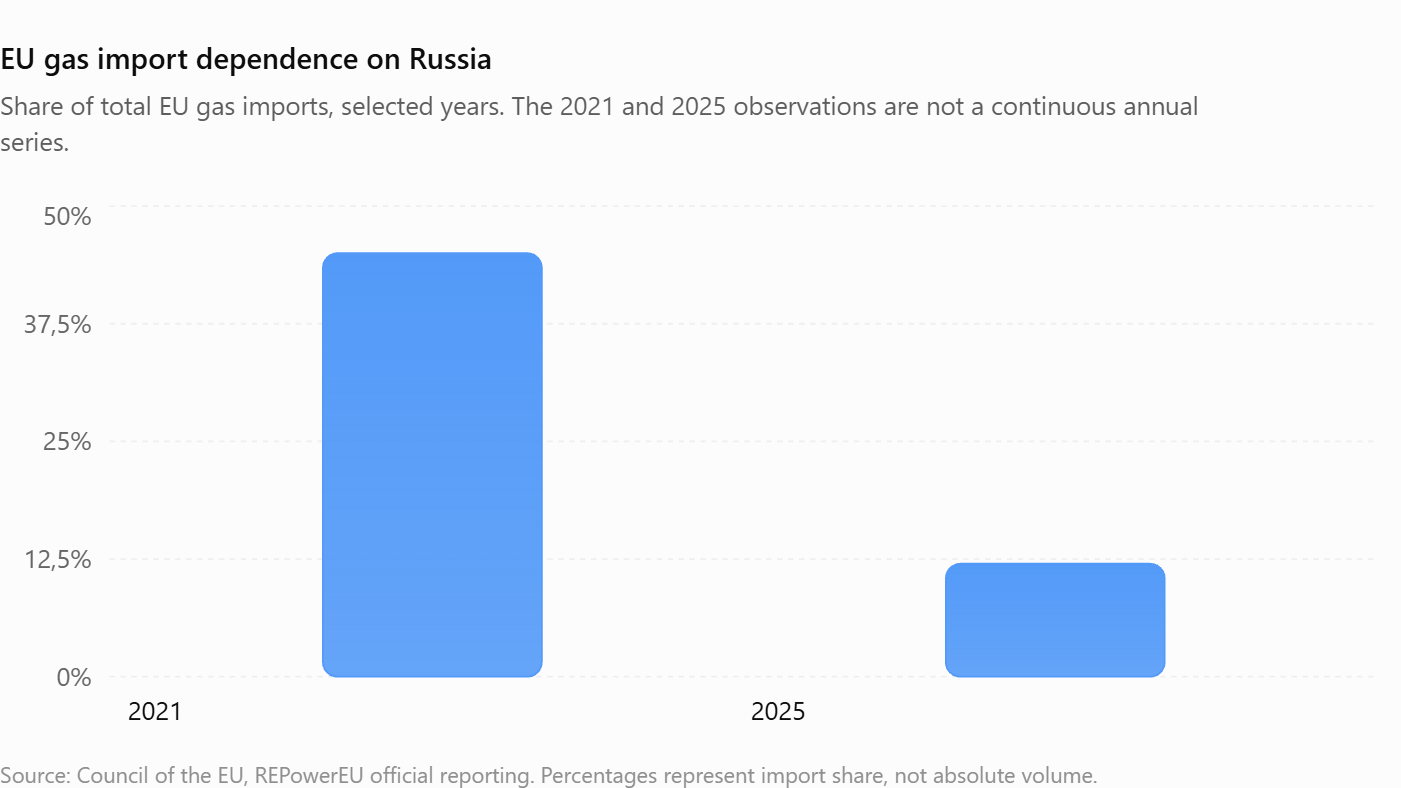
The verified record supports a conclusion that is both economically and diplomatically consequential: Europe has reduced Russian gas dependence sufficiently for its legal and political choices to differ markedly from those that governed the market before February 2022, while remaining exposed to global LNG supply disruptions, price volatility and uneven regional infrastructure access. The 2026 Middle East shock demonstrates that replacing a dominant pipeline supplier with diversified global sources does not eliminate energy-market risk; it changes the composition of that risk, shifting a larger part of Europe’s exposure towards international LNG competition, maritime disruption, terminal capacity, storage management and transmission constraints.
Those vulnerabilities provide a potential opening for energy diplomacy, but not an automatic argument for restoring the former supply relationship. A credible assessment must compare the potential short-term price benefit of additional gas against the economic value of supply diversification, the costs of legal and infrastructural reversal, the reliability of Russian deliveries and the security implications of renewing an economically significant relationship with a belligerent state. On the evidence presently available, that comparison cannot be reduced to a defensible single price forecast or a quantified economic gain from reinstating Russian exports.
The next stage of analysis must therefore establish whether the diplomatic architecture discussed during 2026 represents a substantive shift in American negotiating strategy, a commercial initiative being explored alongside ceasefire negotiations, or a combination of both. In particular, the precise sequence of envoy engagements, the authority attributed to the participants, the status of proposed revenue controls and the relationship between gas transit and verifiable security concessions will determine whether these discussions deserve to be treated as an emerging negotiating mechanism rather than as parallel commercial and political propositions.
Overall assessment: The principal strategic obstacle is not the theoretical availability of Russian natural gas, but the absence of a demonstrated arrangement capable of reconciling the incentives of Washington and Moscow with Ukrainian sovereignty, European import law, operational infrastructure and commercially enforceable ceasefire conditions.
RUSSIAN GAS & THE GEOPOLITICS OF A CEASEFIRE
An interactive assessment of US-mediated energy diplomacy, European legal constraints, Russian economic incentives and three strategic trajectories through 2030.
The structural energy position
Europe’s energy realignment
Russian gas share of EU imports
Two official historical observations, expressed as percentages of total gas imports.
The decline is approximately 33 percentage points. The two observations do not represent a continuous annual series or a projection to 2030.
European storage position
Underground storage filling ratio at the beginning of October 2026.
ENTSOG’s winter outlook also identified substantial gas infrastructure flexibility. A 72% filling ratio does not alone establish an emergency, future shortfall or inability to serve demand.
Historical reading — not live telemetryThe energy–ceasefire bargaining network
Lines represent negotiating dependencies, not documented agreements, signed contracts or confirmed direct communication channels. Select a node using a mouse, touch or keyboard.
Three scenarios, 2027–2030
Continued European phase-out
The EU implements existing restrictions. Russian gas is displaced by diversified imports, demand adjustment, storage management and alternative supply. This pathway requires the fewest reversals of established policy.
Required condition: Continued application of Regulation (EU) 2026/261, without a material legislative reversal.
Four independent implementation gates
Compliance with EU import prohibitions, applicable transition rules or a valid legal exception.
Ukrainian authorisation where applicable, pipeline access, physical inspection and regulatory approvals.
Permitted transactions, banking access, insurance, contractual obligations and enforceable payment controls.
Defined compliance obligations, independent monitoring, release conditions and suspension procedures.
These are analytical implementation dependencies rather than completed governmental approvals. No single gate substitutes for the others. An intermediary cannot remove an origin-based import prohibition.
Strategic actors and operative constraints
| Actor | Primary incentive | Main constraint | Practical leverage | Near-term assessment |
|---|---|---|---|---|
| United States | Ceasefire progress; financial and commercial influence | Sanctions authorities and other states’ sovereign powers | Financial permissions; mediation | Exploratory engagement |
| European Union | Security of supply; independence | Binding Russian-gas prohibition | Import regulation; enforcement | Maintain legislative phase-out |
| Germany | Industrial competitiveness; reliable supply | Nord Stream political and regulatory barriers | Certification and domestic policy | Opposition to reopening |
| France | Diversification; European policy coherence | EU legislation and applicable sanctions | EU policy influence | Diversified supply |
| Italy | Industrial gas costs; supply security | EU phase-out and contractual exposure | Mediterranean routes; interconnections | Alternative supply focus |
| United Kingdom | Sanctions integrity; Ukrainian security | Independent domestic restrictions | Financial sanctions; diplomacy | Restrictive policy |
| Poland and Baltic states | Protection from Russian energy coercion | Security opposition to renewed dependence | EU coalition-building | Oppose material reopening |
| Hungary and Slovakia | Price and supply continuity | EU regulatory framework | Political negotiation; regional relationships | Seek transition flexibility |
| Ukraine | Sovereignty; security guarantees | Conflict and security risks | Transit authorisation and infrastructure | Security-conditional posture |
| Russia | Export revenue; diplomatic leverage | Restricted EU access; sanctions; buyer willingness | Production and delivery decisions | Potential exploratory bargaining |
The table combines established legal positions and analytical interpretations of incentives. Assessments are not presented as quotations from governments.
Hypothetical gross gas-sales value
Adjust annual delivery volume and an assumed wholesale price to estimate the theoretical gross commodity value. This is not Russian state revenue, profit, realised export income or an estimate of Europe’s price savings.
0–35 bcm illustrative sensitivity range
Editable scenario price; not a verified spot quotation
Formula: bcm × 10.55 TWh/bcm × EUR/MWh ÷ 1,000 = EUR billions. The 10.55 TWh/bcm conversion is an illustrative calorific-value assumption; actual energy content depends on gas composition and reference conditions. The calculation excludes transport, transit fees, taxes, discounts, hedging, financing, escrow restrictions, sanctions costs and market-price feedback. No assumption is made that any selected volume is technically or legally deliverable.
Decision-changing indicators
Diplomatic and legal signals
Published terms, responsible institutions and legal authorities.
Legislative change or qualifying emergency measure.
Authorised transit agreements and operational terms.
Auditable escrow agreement and enforceable release conditions.
Infrastructure and commercial signals
Inspection, capacity access and required certification.
Bankable offtake agreements and capacity nominations.
Storage, TTF benchmarks, LNG disruptions and curtailment evidence.
Monitoring access and agreed breach-remedy procedures.
Official records and technical sources
- Regulation (EU) 2026/261 — European Union, January 2026
- Russian gas imports: Council gives final green light to a stepwise ban — Council of the EU, January 2026
- Ending Russian energy imports — Council of the EU
- REPowerEU: Phase-out of Russian energy imports — European Commission
- Winter Supply Outlook 2026/27 — ENTSOG
- Gas Market Report, Q3 2026 — International Energy Agency
- Ukrainian gas transmission system operating without Russian transit — Gas TSO of Ukraine, January 2025
- Nord Stream 2 certification suspension — Bundesnetzagentur, November 2021
Documentary values reflect their respective reference periods. The dashboard does not claim live data access. Private diplomatic negotiations, contractual intentions and prospective ceasefire terms are not independently established by the institutional data series shown here.
PILLAR I — DIPLOMACY, STRATEGIC BARGAINING AND THE POLITICAL ECONOMY OF ENERGY
Russian Gas as an Instrument of American Mediation: The Strategic Calculations of Washington and Moscow, Ukrainian Transit Sovereignty and the Limits of Energy-Based Ceasefire Diplomacy
Assessment date: 2 November 2026 | Historical baseline: 2019–2026 | Strategic relevance: 2027–2030 | Geographic scope: United States, Russia, Ukraine and Europe
Chapter 1. The Diplomatic Reconstruction of Russian Gas Reopening Proposals
The evolution from commercial interdependence to geopolitical bargaining
Principal judgment — High confidence: The renewed diplomatic consideration of Russian natural gas deliveries to Europe reflects a fundamental transformation in the political function of cross-border energy trade. Before Russia’s full-scale invasion of Ukraine in February 2022, gas contracts and pipeline infrastructure formed part of an extensive commercial relationship in which European demand, Russian production, transit arrangements and long-term investment were integrated through contractual commitments and physical dependencies. By November 2026, the central diplomatic question had changed considerably: rather than determining how established commercial flows could be maintained, Washington and Moscow were exploring whether selectively restored access to European gas markets might provide economic incentives within a wider political negotiation. Such an arrangement would no longer operate within the relatively permissive institutional conditions that supported the earlier trading relationship, since the European Union had adopted a binding import prohibition, Germany had opposed the reactivation of Nord Stream, and Ukraine had ceased providing Russian gas transit through the former interconnection arrangements.
The commercial and diplomatic significance of this change becomes clearer when the historical relationship is considered alongside the gradual erosion of Europe’s dependence on Russian supply. The Council of the European Union reported that Russian gas accounted for approximately 45% of European Union gas imports in 2021, compared with an estimated 13% in 2025 under its January 2026 reporting convention, although other European institutional summaries have used approximately 12% for the latter year. The Council further estimated that remaining Russian gas purchases in 2025 were worth more than €15 billion annually. These figures demonstrate that Russian exports continued to possess material commercial value despite the reduction in market share, but they do not establish that the former trading relationship could be reconstituted under the legislation subsequently adopted. Indeed, the European prohibition represents a deliberate effort to convert a political objective into a durable regulatory condition, reducing the possibility that short-term market developments or bilateral negotiations might automatically restore previously accepted commercial practices. Russian Gas Imports: Council Gives Final Green Light to a Stepwise Ban — Council of the European Union — January 2026
The deterioration of the former relationship did not occur in a single institutional step. Russia’s progressive restriction of pipeline deliveries during 2022, the damage inflicted on Nord Stream infrastructure in September of that year, the European expansion of alternative gas purchasing arrangements and the eventual cessation of Russian transit through Ukraine created distinct but mutually reinforcing disruptions. The Ukrainian transmission-system operator confirmed that the interconnection agreement signed with Gazprom on 30 December 2019 expired at 07:00 Kyiv time on 1 January 2025, bringing transportation through the Sudzha entry point towards western and southern exit points to an end. The operator also confirmed that it had prepared its domestic transmission system to function without Russian transit, including the optimisation of assets and the development of alternative cross-border transmission capacity. The implication for subsequent diplomacy is important: the cessation of transit was not simply a temporary reduction in nominated volumes, but the expiry of an operative interconnection arrangement accompanied by a deliberate operational transition. Any renewed Russian deliveries would consequently require fresh legal, technical and commercial arrangements rather than merely a political instruction to resume an existing transportation schedule. The Ukrainian GTS Has Been Operating Without Russian Gas Transit Starting from January 1, 2025 — Gas Transmission System Operator of Ukraine — January 2025
The diplomatic attraction of reversing part of this process lies in the possibility of creating an economic asset that is negotiable, divisible and potentially reversible. Territorial sovereignty, military deployment and security guarantees involve commitments that are exceptionally difficult to price or restructure through conventional commercial agreements, whereas natural gas deliveries can theoretically be limited by volume, duration, destination, contractual counterparties and payment conditions. A negotiation could therefore contemplate restricted deliveries over a specified period, payment into controlled accounts or conditional release of revenues following independently observable security developments. These characteristics make energy trade a possible instrument of bargaining, but they do not mean that such an instrument is available in practice. Its effectiveness depends on the willingness of the principal parties to accept the economic conditions, the existence of a lawful European destination market, the participation of the necessary infrastructure operators and the credibility of the mechanism linking commercial benefits to political compliance. Until those conditions are established, the economic proposition remains analytically distinguishable from a diplomatic agreement.
American–Russian engagement and the emergence of commercial mediation
The most consequential publicly documented development during October 2026 concerned discussions about American participation in Russian-linked energy infrastructure and commercial assets. On 8 October, Reuters reported, citing five people familiar with the situation, that senior American and Russian participants, including Jared Kushner and Russian presidential representative Kirill Dmitriev, had discussed the possibility of American investment in the Nord Stream pipeline system. The reporting identified meetings between Kushner and Dmitriev in Moscow and New York, while carefully distinguishing the existence of those contacts from the precise extent to which Nord Stream had been discussed during particular meetings. It also reported the possibility of American participation in the acquisition of certain international assets associated with Lukoil, potentially involving investors from Qatar and the United Arab Emirates. These discussions suggest that energy infrastructure and the ownership of sanctioned Russian-linked assets had entered the field of commercial diplomacy, but they do not demonstrate that Washington had selected a particular investment structure, secured Russian agreement or obtained the European approvals necessary for implementation. US, Russia Explore Gas Sale to Europe Amid Ukraine War, Say Sources — Reuters — October 2026
The same account contained two qualifications that substantially narrow the conclusions that can be drawn. A White House official indicated that any relevant arrangements would have to involve the United States International Development Finance Corporation and the Treasury Department, and deliver benefits for American taxpayers and companies; the official simultaneously stated that there had been no recent Nord Stream discussions. Another American official considered a Nord Stream transaction unlikely in the medium term because of the political, legal and commercial obstacles surrounding the infrastructure. The German Ministry for Economic Affairs and Energy maintained that reopening the pipelines would require governmental approval and that such approval was not desired. Consequently, the documentary record supports the existence of exploratory commercial contacts and a conditional American interest in transactions that could generate economic returns, but not the existence of an approved United States policy to restore Nord Stream gas flows. The distinction is crucial because the participation of individuals involved in diplomatic negotiations does not itself establish that every commercial possibility discussed has been adopted by the federal government. US, Russia Explore Gas Sale to Europe Amid Ukraine War, Say Sources — Reuters — October 2026
The relationship between these commercial discussions and the wider diplomatic process became more relevant following renewed contacts concerning negotiations between Russia, Ukraine and the United States. On 21 October 2026, President Volodymyr Zelenskyy indicated that Kyiv supported an American proposal to convene negotiations involving all three parties as soon as possible, preferably by early November. This followed American envoy Steve Witkoff’s contacts with the Ukrainian president in Norway and Russian President Vladimir Putin in Saint Petersburg. Zelenskyy also expressed Ukrainian support for proposals concerning a ceasefire, the termination of hostilities, an energy ceasefire and humanitarian initiatives. These remarks establish that Ukrainian participation in renewed negotiations was publicly endorsed and that energy-related ceasefire arrangements formed part of the diplomatic discussion, but they do not demonstrate Ukrainian acceptance of Russian gas transit or agreement to place such transit within a broader economic settlement. Ukraine’s Zelenskiy Hopes for New Talks with Russia, US by Early November — Reuters — October 2026
At the end of October, the diplomatic record increasingly reflected interest in limited arrangements capable of delivering measurable benefits without requiring immediate agreement on the entire conflict. Secretary of State Marco Rubio stated on 31 October that the United States was considering proposals associated with Turkey and India concerning a restricted ceasefire in the Black Sea, particularly the protection of commercial shipments involving grain and energy. Rubio acknowledged that an overall settlement was not imminent, while presenting narrower agreements as potentially useful components of a wider negotiating process. Canadian Foreign Minister Anita Anand separately described discussions about protecting Ukraine’s electricity and energy infrastructure during the approaching winter. Such statements are significant because they establish an officially acknowledged interest in limited, sector-specific security arrangements. They must nevertheless be distinguished from proposals to resume Russian natural gas exports, since protection of Black Sea shipping, restrictions on strikes against energy installations and renewed pipeline gas sales involve different operational commitments, financial arrangements and legal authorities. US, Canada See Growing Interest in Limited Ceasefire in Black Sea — Reuters — October 2026
The November Ukrainian-transit proposal and the distinction between evidence and reported negotiating intent
A separate and potentially more consequential development entered the public record on 1–2 November 2026, when Reuters described a Wall Street Journal account stating that the United States was supporting the rapid restoration of Russian natural gas exports to Europe through Ukrainian pipelines as part of negotiations intended to secure an energy ceasefire before winter. The underlying report was attributed to American, European and Ukrainian officials, but Reuters explicitly stated that it could not immediately verify the information. This qualification prevents the proposal from being classified as an established American governmental decision. The report is nevertheless relevant as evidence that a specific negotiating concept had entered credible diplomatic reporting: unlike the Nord Stream investment proposition, it concerned existing Ukrainian transmission infrastructure and appeared to link physical gas deliveries more directly with restrictions on wartime attacks against energy facilities. US Pushes to Restore Russian Gas Sales to Europe via Ukraine, WSJ Reports — Reuters — November 2026
The chronological relationship between the October and November accounts suggests a possible movement from broader commercial discussions towards a more specific examination of energy transit as a negotiable element of a ceasefire. It would, however, be premature to treat that movement as a verified evolution in official policy. No publicly established negotiation record identifies the precise sequence by which an investment proposition involving Nord Stream became connected, if at all, to a separate transit proposal involving Ukraine. The available reporting does not establish whether the two initiatives originated with the same participants, whether they were considered alternatives or complementary options, or whether any American department was instructed to prepare an operational implementation plan. It also does not establish that Ukraine agreed to provide transit, that Russian negotiators accepted volume restrictions or that European importers committed to purchase the gas.
The distinction between chronological proximity and causation is especially important in relation to military operations affecting energy infrastructure. Ukrainian attacks on Russian refining facilities, Russian strikes against Ukrainian electricity and gas systems, American envoy movements and preparations for trilateral negotiations all form part of the broader political environment in which an energy ceasefire might be considered. Yet the coincidence of such developments does not establish that a specific refinery attack caused a subsequent American proposal, or that any particular diplomatic meeting generated an agreed gas transit formula. Demonstrating such a causal relationship would require an authenticated governmental statement, a reliable meeting record or independently corroborated testimony identifying both the sequence and the decision-making connection. No such document has been established in the present record.
The concept of placing Russian export proceeds in third-country escrow warrants particular caution. A restricted payment mechanism is a coherent financial possibility because it could theoretically separate the receipt of commercial funds from their immediate availability to Russian counterparties, while allowing defined releases following independently verified security commitments. However, the precise form of any escrow proposal associated with the current negotiations remains unestablished. There is no verified public agreement identifying a depositary institution, governing law, account ownership, permitted beneficiaries, release triggers, monitoring authority or procedure for resolving disputed ceasefire violations. It would therefore be inaccurate to present escrow as an agreed element of the November proposal, rather than as a conceivable mechanism whose viability depends on negotiations and legal permissions that have not been demonstrated.
Chronology and evidentiary status of the diplomatic architecture
| Date or period | Documented development | Principal actors | Strategic significance | Evidentiary status |
|---|---|---|---|---|
| 30 December 2019 | Ukrainian–Russian gas-system interconnection agreement signed | Ukrainian TSO; Gazprom | Established the operational framework later terminated | Official operator record |
| February–September 2022 | Full-scale invasion followed by major disruption of Russian–European gas relations and damage to Nord Stream | Russia, Ukraine, European states | Changed infrastructure and political conditions | Established historical events |
| 1 January 2025 | Ukrainian operator ceased Russian gas transit under the expired interconnection arrangement | Ukrainian TSO; Gazprom | Removed an operative route and contractual framework | Official operator confirmation |
| 30 April 2025 | United States and Ukraine signed reconstruction investment fund agreement | US Treasury, DFC, Ukraine | Established a separate governmental mechanism for economic cooperation | Official US record |
| 26 January 2026 | EU formally adopted Russian-gas phase-out regulation | Council and European Parliament | Created durable legal restrictions on renewed imports | Binding legislative record |
| September–October 2026 | American–Russian discussions concerning energy investments reported | Kushner, Dmitriev and other officials | Indicated exploratory commercial engagement | Attributed investigative reporting |
| 8 October 2026 | Nord Stream investment discussions disclosed publicly | American and Russian representatives | Identified possible American intermediation and ownership changes | Corroborated reporting with official qualifications |
| 21 October 2026 | Ukraine expressed support for rapid trilateral negotiations and energy-ceasefire discussions | Zelenskyy, US negotiators, Russia | Confirmed Ukrainian engagement with limited-ceasefire diplomacy | Attributed statement by Ukrainian president |
| 31 October 2026 | US publicly discussed limited Black Sea ceasefire proposals | Rubio; Turkey and India as proposal sources | Demonstrated official interest in sector-specific arrangements | Attributed US statement |
| 1–2 November 2026 | Report emerged concerning rapid Russian gas transit restoration via Ukraine | US, Ukraine, Russia, European officials reportedly consulted | Introduced a more specific transit-based proposition | Reported; independently unverified by Reuters |
| November 2026 onward | Potential contractual, legal and monitoring arrangements | Relevant governments, regulators and operators | Would determine whether discussion becomes an executable transaction | No completed arrangement established |
Assessment of Chapter 1: The public evidence supports a progressively more explicit discussion of commercial and energy-related instruments within American-mediated diplomacy, but it does not establish a unified governmental proposal covering Nord Stream, Ukrainian transit, American brokerage and escrow as components of one negotiated package. The most important outstanding evidence consists of authenticated negotiating terms, formal American authorisation and a Ukrainian governmental position specifically addressing renewed Russian transit.
Chapter 2. Washington’s Strategic Logic and the Limits of American Leverage
Commercial diplomacy as an instrument of security negotiations
Principal judgment — Medium confidence: The Trump administration’s engagement with Russian-linked energy assets is consistent with a strategy that seeks to make economic opportunity part of diplomatic bargaining, but the available evidence does not establish the relative importance assigned internally to European energy-price relief, commercial profits, sanctions leverage or the creation of conditional economic incentives for Moscow. The clearest publicly documented position is narrower: American participation in prospective energy transactions must provide tangible benefits to American economic interests and must operate through the relevant federal authorities. That position differs substantially from a formal commitment to restore Russian gas imports, especially because the latter would require the participation of European governments whose existing legal obligations run in the opposite direction.
The potential logic of this approach lies in the ability of commercial arrangements to create a sequence of conditional incentives that might be more divisible than the principal political disputes. An energy agreement could theoretically be structured so that limited economic benefits arise only after a specified period without attacks on designated infrastructure, with subsequent benefits dependent on continuing compliance. Such an arrangement would create a repeated bargaining relationship rather than requiring all concessions to be exchanged at a single moment. Its weakness is that the value of the incentive depends on the credibility of future performance by several independent parties. Moscow would need to believe that revenues could eventually be accessed; European purchasers would need to believe that deliveries were lawful and reliable; Ukraine would need to believe that commercial benefits were contingent on meaningful security improvements; and Washington would need to retain sufficient enforcement authority to respond to violations. The result is a bargaining mechanism with potentially useful flexibility but considerable institutional complexity.
Washington’s interest in commercial participation is more directly supported by the American response to the October reporting concerning Nord Stream. The White House official’s reference to Treasury and DFC, together with the requirement that transactions benefit American businesses and taxpayers, identifies an important institutional preference: any American participation would need to be more than an informal diplomatic understanding. It would require a transaction capable of being reviewed, authorised and implemented by federal institutions with specific financial and legal responsibilities. Nevertheless, the same account reported that an American official regarded a Nord Stream deal as unlikely in the medium term, and the German government’s opposition demonstrated that American commercial interest was insufficient to establish access to the destination market. US, Russia Explore Gas Sale to Europe Amid Ukraine War, Say Sources — Reuters — October 2026
Treasury, DFC and the difference between an investment platform and an energy-sanctions licence
The United States Treasury Department and the United States International Development Finance Corporation possess distinct institutional roles, making their possible participation in an energy arrangement analytically important. Treasury, through its sanctions authorities and the Office of Foreign Assets Control, can determine whether specific transactions involving restricted parties or activities are prohibited, permitted under a general licence or eligible for a specific licence. DFC, by contrast, has a development-finance mandate and may provide eligible investment, financing or risk-mitigation instruments within its statutory authority and applicable institutional procedures. Neither institution can independently compel a European government to accept Russian gas, authorise a pipeline within another sovereign jurisdiction or eliminate European Union legal requirements through an American commercial agreement.
The difference between these functions can be observed in the separate United States–Ukraine Reconstruction Investment Fund. On 30 April 2025, the American government and Ukraine signed an agreement creating the fund, with Treasury and DFC assigned roles in advancing the economic partnership. DFC subsequently announced that the fund had become operational in December 2025 and began accepting project applications in January 2026. Its eligible areas include energy, critical minerals, infrastructure and other activities connected with Ukrainian economic reconstruction. On 2 October 2026, the fund announced additional approved investments and partnerships in energy and critical minerals, demonstrating the existence of a functioning institutional structure through which American financial participation can be aligned with Ukrainian reconstruction and longer-term economic interests. Treasury Announces Agreement to Establish United States–Ukraine Reconstruction Investment Fund — DFC — April 2025 DFC Announces U.S.–Ukraine Reconstruction Investment Fund Fully Operational — DFC — December 2025 URIF Approves Additional Investments and Partnerships in Energy and Critical Minerals — DFC — October 2026
This fund is relevant as evidence of American institutional capacity to organise economic cooperation within a strategic relationship, but it must not be conflated with the reported Russian gas proposals. Its established mandate concerns investment in Ukraine and associated economic development; it has not been demonstrated that the fund is designated to purchase Nord Stream assets, act as an intermediary for Russian gas or manage escrow payments associated with a ceasefire. The distinction is especially consequential where official and exploratory commercial structures are discussed in the same political context. The existence of one authorised investment vehicle cannot be treated as evidence that a separate transaction involving sanctioned Russian assets has received comparable approval.
American sanctions policy introduces a second institutional limitation. The Office of Foreign Assets Control has maintained a framework of Russia-related restrictions covering designated persons, entities and financial transactions, with licensing arrangements varying according to the applicable sanctions authority and the exact activities involved. A licence authorising one type of energy transaction cannot be presumed to authorise another, and an expired or superseded licence provides no reliable basis for concluding that a proposed transaction would be permissible in November 2026. Moreover, even where American authorities could authorise specific financial activities, the commercial participants would still face potentially independent restrictions under European Union and British law, as well as contractual, insurance and banking constraints. Ukraine-/Russia-related Sanctions — Office of Foreign Assets Control — US Department of the Treasury
The economic argument: European energy prices and the political value of additional supply
European energy-price exposure provides a rational economic context for examining alternative gas supply, although it does not establish that restoring Russian imports is the preferred or most effective intervention. According to the International Energy Agency’s July 2026 assessment, the conflict affecting the Middle East severely disrupted LNG trade through the Strait of Hormuz, which had previously accounted for almost one-fifth of global LNG supply. The resulting disturbance contributed to significant volatility in European and Asian prices, with the European TTF benchmark averaging approximately USD 16 per million British thermal units during the second quarter of 2026, an increase of 32% compared with the corresponding quarter of 2025. Asian spot LNG prices averaged approximately USD 17.5 per million British thermal units during the same period, a year-on-year increase of 45%, while the changing price relationship between European and Asian markets encouraged the diversion of flexible LNG shipments towards Asian destinations. These developments demonstrate why additional pipeline gas could have economic value under conditions of international LNG scarcity, particularly for European industrial economies exposed to marginal gas prices. Gas Market Report, Q3 2026 — International Energy Agency — July 2026
The economic transmission mechanism, however, is more complicated than a direct relationship between additional Russian volumes and lower European gas prices. A limited resumption could reduce demand for competing LNG cargoes, relieve pressure at particular transmission points or improve regional supply balances during a constrained period, but the size of those effects would depend on the volumes delivered, the duration of the arrangement, existing storage levels, competing supply availability, transportation restrictions and the market expectations generated by the announcement itself. Even a physically meaningful supply addition might produce a modest price effect if it were temporary, geographically constrained or subject to substantial interruption risk. Conversely, an expectation that considerable additional gas could become available might influence forward-market prices before any actual delivery, although such an effect could reverse quickly if regulatory authorisation were denied.
The American strategic benefit from offering a possible supply solution might therefore arise before any commercial transaction is completed. A credible proposal can alter the expectations of prospective buyers, investors, policymakers and negotiating parties, potentially influencing the positions they adopt in parallel diplomatic discussions. Yet there is an important limit: a proposal that repeatedly encounters the same unaltered European legal restrictions may lose credibility rather than accumulate leverage. For that reason, the central question for Washington is not simply whether Russian gas could offer European buyers an economic advantage under certain market conditions, but whether European institutions would be willing and legally able to authorise an arrangement whose geopolitical consequences extend beyond the price of the commodity.
Escrow, conditional release and the credibility of sanctions enforcement
A theoretically coherent escrow arrangement would need to distinguish among several financial concepts that are frequently conflated: the commercial price paid by a European buyer, the gross revenue attributable to the gas producer, the transit and transportation fees owed to infrastructure operators, the funds available for discretionary expenditure by the Russian beneficiary, and the portion of receipts restricted under an enforceable agreement. These categories are not economically equivalent. A system allowing Russian gas to be sold while holding proceeds in a restricted account could reduce the immediate liquidity available to the supplier, but it would still create an economic claim or asset that might possess value independently of its immediate convertibility into cash. If the controlled proceeds could later be released following political compliance, Moscow would acquire a contingent economic benefit; if the release conditions were effectively unenforceable, the mechanism might merely postpone payment without materially reducing the strategic value of the export transaction.
The credibility of an escrow arrangement would depend on whether the controlling parties could prevent alternative settlement routes, identify the beneficial ownership of the funds, monitor actual deliveries and apply pre-agreed remedies when ceasefire obligations were violated. Relevant contracts would also need to establish whether funds remained the property of the gas seller, were held under restricted beneficial rights or were subject to more extensive legal conditions. Currency denomination, interest accumulation, custodial jurisdiction, dispute resolution, treatment of exchange-rate movements and exposure to asset-freezing measures would each affect the economic value of the arrangement. The absence of a verified public agreement addressing these matters prevents any conclusion that the reported negotiations have already produced an operationally credible payment-control system.
There would also be an important sequencing problem. If economic benefits were granted before independently verified compliance with security obligations, the supplier might retain a substantial part of the commercial value even if hostilities resumed. If all proceeds remained inaccessible until a comprehensive political settlement, the arrangement might provide too little immediate incentive to alter Russian behaviour. A more discriminating approach could theoretically provide staged benefits linked to observable, independently monitored obligations, while reserving substantial funds against future violations. Such a structure would nevertheless require agreement on the identity and authority of the monitoring body, the evidentiary standard for determining violations and the procedure for suspending or terminating payments. Without those elements, escrow would remain a financial label rather than a reliable instrument of coercive or conditional diplomacy.
The limits of American authority over European energy policy
The most decisive institutional constraint on Washington’s strategy is that American sanctions decisions cannot supersede European import law. The European Union’s Regulation (EU) 2026/261, formally adopted on 26 January 2026, establishes restrictions on imports of Russian-origin or Russian-exported natural gas, together with transitional provisions and requirements for prior authorisation and origin verification. For existing long-term contracts, the principal prohibition applies from 1 January 2027 for LNG and from 30 September 2027 for pipeline gas, with a conditional pipeline deadline of 1 November 2027 where the relevant storage requirement is not satisfied. The regulation also provides an emergency suspension mechanism under defined security-of-supply circumstances, but that mechanism does not create an unrestricted, permanent pathway for reopening Russian trade. Ending Russian Energy Imports — Council of the European Union — 2026 Russian Gas Imports: Council Gives Final Green Light to a Stepwise Ban — Council of the European Union — January 2026
The implication is that changing the nationality of a commercial intermediary would not resolve the central legal issue. Where an American company purchases Russian gas for resale into Europe, the transaction may involve a new contractual counterparty, payment destination or ownership structure, but the commodity’s origin remains relevant under European law. A legally viable arrangement would therefore require a properly applicable exception, a change to the legislative framework or another controlling authorisation consistent with European law. This creates a direct distinction between American control over certain financial permissions and European control over access to the destination market. Washington might be able to facilitate payments, structure investments or contribute to sanctions negotiations, but it cannot transform Russian-origin gas into legally unrestricted gas merely by placing an American institution between producer and buyer.
The political limitations are no less substantial. Germany’s government has maintained its opposition to reopening Nord Stream, while Poland and the Baltic states have regarded renewed Russian energy dependence as a serious security risk. American proposals capable of generating short-term economic benefits for some European consumers could consequently create significant political costs within the European Union and the broader transatlantic relationship. This tension is particularly important because European governments are simultaneously responsible for supporting Ukraine, financing defence capabilities and preserving the integrity of their sanctions commitments. A proposal that appears commercially efficient to one set of participants might therefore be rejected by another set whose primary calculation concerns military security, institutional credibility or the long-term risk of renewed dependence. US, Russia Explore Gas Sale to Europe Amid Ukraine War, Say Sources — Reuters — October 2026
Comparative assessment of American strategic instruments
| Instrument | Responsible authority or essential participant | Potential strategic benefit | Principal implementation constraint | Evidentiary status |
|---|---|---|---|---|
| Diplomatic mediation | White House, State Department, authorised envoys | Links economic proposals to negotiations | Consent of Russia and Ukraine; political credibility | Active diplomatic process established |
| Specific sanctions permission | US Treasury / OFAC | Enables otherwise restricted eligible transactions | Applicable US law, conditions and independent foreign restrictions | General institutional power established; transaction-specific approval not demonstrated |
| Investment participation | DFC and eligible public/private partners | Commercial exposure and potential financial influence | Statutory mandate, investment approval and legal compliance | General DFC capacity established; Russian gas investment unapproved publicly |
| Ukrainian reconstruction investment | US–Ukraine Reconstruction Investment Fund | Long-term economic cooperation with Kyiv | Fund governance and investment mandate | Operational institution established |
| Russian gas brokerage | Potential licensed intermediaries and buyers | Commercial intermediation and negotiated payment control | EU import law, bankability and sanctions | Exploratory concept |
| Restricted escrow | Deposit institution, relevant states and compliance monitors | Conditional availability of export proceeds | No verified terms, beneficiary structure or release authority | Unestablished proposed mechanism |
| Nord Stream ownership participation | Shareholders, regulators and investors | Infrastructure-related commercial interests | Ownership, sanctions, German consent and damaged infrastructure | Discussions reported; no approved acquisition established |
| Ceasefire-linked delivery suspension | Parties to an agreement, operators and monitors | Makes continued revenue conditional on behaviour | Independent verification and enforceable termination rights | Conceptually feasible; no operative agreement demonstrated |
Assessment of Chapter 2: The American government possesses important diplomatic, financial and sanctions instruments, but these instruments do not amount to unilateral control over the European market or Ukrainian transit infrastructure. Its strongest potential negotiating position would arise from coordinating legally authorised economic incentives with independently verifiable security obligations and agreed European participation, whereas a commercially focused arrangement pursued without European legal compatibility could weaken rather than strengthen the credibility of the broader settlement process.
Chapter 3. Moscow’s Incentives, Negotiating Position and Energy-Coercion Risks
The economic value of European market access within Russia’s wartime bargaining strategy
Principal judgment — Medium-high confidence: Russia possesses an identifiable economic incentive to regain access to European natural gas markets, but the strategic value of renewed exports extends beyond immediate commercial revenue. Restored gas deliveries could offer Russian producers additional sales opportunities, strengthen Moscow’s influence over European energy-security calculations, create bargaining assets within American-mediated negotiations and potentially weaken the political cohesion supporting European restrictions. The principal uncertainty concerns the conditions under which the Russian leadership would consider those benefits sufficient to justify binding commitments affecting revenue availability, delivery reliability or the conduct of military operations. Public evidence supports Russian interest in commercial discussions, but it does not establish acceptance of a specific escrow mechanism, fixed volume ceilings or independent ceasefire verification.
Russia’s economic incentive must be assessed against the distinction between the commercial importance of its former European gas market and the substantially narrower market that remained accessible during 2025–2026. The Council of the European Union estimated that Russian gas retained an approximately 13% share of EU gas imports in 2025, representing purchases worth more than €15 billion, demonstrating that European sales still generated considerable commercial value despite the progressive restructuring of supply. Nevertheless, this residual trade cannot be equated with the capacity or profitability of restoring the pre-war export relationship. The commercial value of additional deliveries would depend on the price received at the relevant contractual delivery point, the transportation and transit costs associated with the selected route, the allocation of losses and infrastructure expenditure, the applicable fiscal regime and the extent to which proceeds could actually be transferred, converted or used by Russian beneficiaries. Where revenues were subject to legally enforceable restrictions, their immediate value to Moscow could differ materially from the nominal price paid by the European purchaser. Russian Gas Imports: Council Gives Final Green Light to a Stepwise Ban — Council of the European Union — January 2026
The possibility of restoring an established export market offers a different economic proposition from developing entirely new international demand. Historically, Russian pipeline infrastructure directed towards Europe represented long-lived investment in specific geographical markets, while alternatives involving other destinations require their own production connections, transportation infrastructure, contractual arrangements and commercially viable demand. Production capacity associated with one export corridor cannot necessarily be transferred to another destination without investment or operational adjustments. Consequently, the reopening of European routes could have value even if limited volumes were permitted, provided that the netback price, after transportation and other expenses, remained commercially attractive. This proposition is an economic mechanism rather than a verified calculation of Gazprom’s currently recoverable European revenue: the public evidence examined here does not provide a complete, comparable November 2026 dataset covering route-specific production costs, contractual pricing formulas, field-level production constraints and the expected profitability of each prospective reopening option.
The position of Gazprom also has to be separated from the position of the Russian state. Gross gas receipts are corporate commercial flows, not automatically additions of equal magnitude to the federal budget. Their fiscal contribution depends on the applicable taxes, duties, dividends, corporate results and other financial obligations, while their strategic contribution depends partly on whether the proceeds are available to purchase goods and services in the currencies and jurisdictions required. An escrow-based arrangement might generate corporate receivables or financial assets while preventing unrestricted immediate expenditure, which would make its economic and diplomatic effects different from those of ordinary export payments. Conversely, a structure permitting broad withdrawal or unrestricted assignment of proceeds could weaken the distinction between conditional revenue and conventional market access. Treating the nominal sale value of gas as equivalent to immediately disposable Russian government income would therefore substantially exaggerate the financial conclusions.
The negotiating advantages and strategic costs of restoring Ukrainian transit
From Moscow’s perspective, a proposal involving Ukrainian transmission infrastructure would raise political and strategic questions beyond those associated with gas pricing. The physical route crosses territory controlled by a state against which Russia is conducting military operations, and its operation would depend on technical coordination, legally recognised interfaces and compliance with conditions accepted by Ukraine. Renewed transit could therefore produce a direct economic relationship between adversaries while creating additional opportunities for monitoring, disputes and leverage over the interpretation of ceasefire obligations. A transit arrangement could potentially supply a concrete subject for negotiation, but it could also expose the parties to renewed disagreement over interruptions, infrastructure damage, capacity nominations and the attribution of responsibility for failures to deliver.
Ukraine’s successful transition to operating its transmission system without Russian transit from January 2025 materially changes the negotiating balance compared with the period during which substantial Russian gas deliveries crossed Ukrainian territory. The Ukrainian operator’s public statement confirmed that the expired interconnection arrangement had ceased functioning and that operational preparations for zero-transit conditions had been completed. This does not eliminate the potential commercial value of renewed transit fees, nor does it establish that Ukraine would refuse a future arrangement under all circumstances. It does mean, however, that a new transit proposal cannot simply rely on the assumption that the earlier operating relationship remains indispensable to Ukraine’s domestic gas supply. Moscow would have to account for the fact that Ukrainian consent is a necessary political and operational condition, rather than an automatic consequence of historical infrastructure use. The Ukrainian GTS Has Been Operating Without Russian Gas Transit Starting from January 1, 2025 — Gas Transmission System Operator of Ukraine — January 2025
The strategic consequences would depend heavily on the structure of the arrangement. If renewed transit were explicitly connected to independently monitored restrictions on attacks against energy installations, it could create incentives for both parties to protect designated infrastructure. If, however, the gas arrangement operated without enforceable security obligations, its principal effect could be the restoration of commercial relations while leaving the underlying conflict largely unaffected. Moscow might seek to preserve the ability to suspend deliveries during disputes, while Ukraine would have an interest in preventing its transmission network from becoming a mechanism through which Russia could secure economic concessions without providing durable military restraint. These incentives are not necessarily irreconcilable, but any agreement would require far more precise provisions than a general undertaking to restore gas deliveries in exchange for reduced attacks.
Nord Stream and the political value of participation in infrastructure ownership
The Nord Stream discussions raise a distinct problem because the strategic value of the infrastructure extends beyond the quantity of gas that might eventually be transported. The original Nord Stream system embodied a direct connection between Russian export supply and the German market, reducing dependence on particular overland transit arrangements. The reported possibility of American investment in the pipeline companies would therefore raise questions about ownership, governance, regulatory authority and the distribution of commercial benefits. An American shareholder might acquire an interest in future infrastructure income, but ownership would not necessarily produce the right to operate the pipelines, bypass sanctions or secure German authorisation for imports. Reuters reported that the companies’ ownership structure involved Gazprom and German, French and Dutch interests, while also identifying resistance among German shareholders to relinquishing influence over the assets. US, Russia Explore Gas Sale to Europe Amid Ukraine War, Say Sources — Reuters — October 2026
For Moscow, an investment arrangement involving American participation could theoretically create a commercial constituency interested in resolving barriers to pipeline operation. The acquisition of an ownership position by American investors might also be presented as a sign of improved bilateral economic relations, independently of whether gas deliveries actually resumed. Yet those benefits would be conditional on the legal and political environment. German regulatory and governmental opposition could prevent the infrastructure from generating the expected income, while European import prohibitions could restrict demand even if the pipelines were physically restored. The structure could therefore produce investment exposure without resolving the central obstacles to operating the asset. From Russia’s perspective, transferring part of an infrastructure interest could be commercially rational only if the resulting financial consideration, sanctions-related benefits or improved prospects for future market access exceeded the value of retaining the existing position.
Revenue restrictions, monitoring and Russia’s probable negotiating boundaries
The possibility of placing gas export payments under third-party control introduces a difficult trade-off for Moscow. An arrangement that permits exports but withholds immediate access to proceeds could partially restore Russian companies’ European market presence while limiting the liquidity that the transactions provide. The resulting incentive would depend on the value Moscow assigns to eventual access, the conditions for release and the credibility of the institution managing the funds. If the proceeds were available only after a comprehensive peace agreement, the commercial benefit might remain too remote to influence near-term military decisions. If they became available following narrow and independently verified steps, the mechanism could theoretically create a sequence of more immediate incentives, although the economic value would still depend on the permitted uses of the funds and the ability to enforce subsequent restrictions.
Russian acceptance of such a system is not established by the current diplomatic record. In particular, there is no verified public statement committing Moscow to a particular escrow custodian, legal jurisdiction, schedule of conditional payments or independent authority empowered to determine whether ceasefire obligations have been breached. Nor is there a verified commitment to restrict exports to predetermined volumes or accept automatic suspension following an adverse monitoring determination. It would therefore be premature to define specific Russian red lines concerning escrow as demonstrated negotiating positions. They should instead be treated as unresolved questions whose answers would determine whether an arrangement is capable of generating genuine conditionality.
A further complication concerns the distribution of authority over verification and enforcement. A ceasefire-monitoring body might determine whether attacks had occurred against installations covered by an agreement, but a commercial payment institution would require a legally recognised instruction before restricting funds or releasing them. In circumstances involving contested responsibility for an attack, inconsistent findings or incomplete monitoring access, the parties could dispute whether the commercial conditions had been satisfied. The effectiveness of the arrangement would thus depend on rules governing evidence, attribution, dispute resolution and the consequences of non-compliance. Without those provisions, payments could become a further source of diplomatic conflict rather than a stabilising mechanism.
Energy coercion, interruption risk and the credibility of restored supply
The possibility of renewed energy coercion remains a material consideration because dependence on a concentrated supplier can create bargaining asymmetries during periods of scarcity. The risk does not require the supplier to control the majority of a country’s energy consumption; it may arise where a comparatively small interruption has significant consequences for the marginal price, a constrained industrial region or a particular transmission corridor. During periods of tight global LNG supply, the withdrawal of additional pipeline volumes could increase the pressure on alternative sources, particularly if the interruption coincided with low storage, cold weather or infrastructure limitations. The International Energy Agency’s analysis of the 2026 Middle East crisis demonstrates the sensitivity of international gas markets to major disruptions of transport routes and the competitive effects of regional price differentials, although that evidence does not establish the probability of any future Russian interruption. Gas Market Report, Q3 2026 — International Energy Agency — July 2026
For a renewed Russian gas arrangement to reduce rather than reproduce coercive vulnerability, European purchasers would need to preserve sufficient alternative supply, storage and transmission flexibility to withstand an interruption without severe economic consequences. The relevant measure would not be merely the percentage of total gas imports supplied by Russia, but the ability of the affected markets to replace those deliveries under adverse conditions, including the time required to secure competing cargoes, the availability of spare regasification and pipeline capacity, and the affordability of alternative supply. A limited arrangement could conceivably remain compatible with diversified energy security if the recipient markets retained robust replacement options. Conversely, a seemingly modest volume could create significant dependence if concentrated in a constrained geographical market or embedded in critical industrial processes without adequate alternatives.
The security consequences must also be considered from Moscow’s perspective. An interruption might provide temporary bargaining leverage, but repeated unreliability would reduce the willingness of European customers to make long-term commitments and increase the incentive to invest in substitution. Russia would therefore face a choice between using restored deliveries as a reliable commercial relationship that could generate recurring value and retaining the option to interrupt those deliveries for strategic purposes. Those objectives can conflict: the more aggressively supply is used as a coercive instrument, the weaker the case for European buyers to reconstruct a durable dependence on it. The existence of this trade-off supports the conclusion that reliability commitments would be essential to any credible long-term arrangement, even if the initial agreement were presented as a temporary component of ceasefire diplomacy.
Strategic exposure matrix: Russian incentives and practical limitations
| Strategic dimension | Potential benefit for Moscow | Principal countervailing constraint | Observable test | Confidence |
|---|---|---|---|---|
| European export receipts | Additional commercial income and market access | Import prohibition, buyer reluctance and sanctions | Authorised contracts and settled payments | High: incentive; low: transaction feasibility |
| Federal fiscal benefit | Possible additional taxes and other fiscal receipts | Net profit, taxation, restrictions on proceeds | Corporate and budget disclosures | Medium |
| Ukrainian transit | Negotiable economic relationship and possible diplomatic influence | Ukrainian sovereign consent and operational requirements | Signed interconnection and transit arrangements | High: constraint |
| Nord Stream participation | Possible recovery of asset value and future commercial activity | German opposition, certification and sanctions | Ownership filings and regulatory approvals | High: obstacles |
| American financial participation | Potential investment, capital and diplomatic benefits | US institutional approvals and transaction eligibility | DFC decisions and Treasury licences | Medium |
| Restricted escrow | Conditional future access to export proceeds | Uncertain liquidity, ownership and release conditions | Signed custodial agreement | Low: acceptance |
| Ceasefire conditionality | Potential reciprocal economic and security concessions | Verification disputes and enforcement exposure | Agreed monitoring mandate | Low: agreed design |
| Delivery interruption | Possible temporary pressure on dependent markets | Reputation, lost revenue and customer substitution | Actual interruptions and contractual remedies | Medium: mechanism |
| Long-term European influence | Restoration of commercial relationships | Structural diversification and legal phase-out | Changes in legislation and long-term contracting | Medium-low |
The cumulative strategic position
The Russian leadership’s probable evaluation of an energy arrangement cannot be separated from its broader negotiating objectives. A limited reopening might provide export income and political recognition of Russia’s continuing role in European energy supply, but it could also require Moscow to accept restrictions on the use of commercial proceeds, greater external scrutiny of military conduct and operational dependencies involving Ukraine and European governments. A broader reopening could offer greater financial benefits, yet would require changes to European policy whose prospects are uncertain and whose political reversibility Moscow would have to consider. The most attractive arrangement from a narrowly commercial Russian perspective would therefore not necessarily be the most acceptable arrangement to Washington, Kyiv or European capitals, whose interests include enforceable security benefits and the avoidance of renewed energy dependence.
Assessment of Chapter 3 — Medium confidence: The restoration of European gas access could create a meaningful economic inducement for Russia, particularly if it offered predictable demand and legally usable revenue, but there is insufficient verified evidence to conclude that Moscow would exchange substantial military concessions for restricted or contingent gas receipts. Any arrangement granting Russia immediate commercial benefits while leaving verification, interruption and revenue-release conditions unresolved would present a significant risk of asymmetric bargaining gains. The strategic value of the proposal depends on whether economic benefits can be made conditional upon independently verifiable conduct without recreating the concentration of supply risks that the European phase-out was designed to address.
Diplomatic Conditionality and Institutional Decision Gates
The following component is designed specifically for insertion after Chapter 3. Unlike the broader dashboard, it focuses on the institutional architecture of an executable gas-for-ceasefire arrangement. It provides an interactive animated dependency diagram, selectable actors, a four-stage authorisation model, documentary status classifications and an analytical implementation table. It does not convert hypothetical arrangements into established facts or assign unsupported numerical probabilities.
THE GAS-FOR-CEASEFIRE CONDITIONALITY SYSTEM
Interactive institutional assessment of the authorities, financial arrangements and enforceable obligations required to convert a diplomatic proposition into legally authorised and commercially operational gas deliveries. Assessment date: 2 November 2026.
Interdependent geopolitical authorities
Animated connections indicate strategic interdependence, not verified bilateral agreements or financial transfers.
Institutional authority and leverage
Washington controls US sanctions permissions and can facilitate diplomatic and commercial arrangements. It cannot independently authorise Russian-origin gas imports into the European Union.
Select any actor in the network to examine its distinct authority.
From diplomatic concept to executable delivery
Every stage involves a distinct institutional requirement. A successful commercial negotiation cannot replace legal import authorisation or sovereign transit consent.
Negotiated commitments
The parties would have to agree on the permitted volume, delivery period, relevant ceasefire obligations and reciprocal commitments. No comprehensive public agreement combining these elements is established.
Not established as a completed agreementWhat is established and what remains unresolved
| Proposition | Evidence classification | Implementation significance |
|---|---|---|
| EU Russian-gas phase-out | Binding legislation | Legal barrier to new Russian-origin imports |
| End of Ukrainian Russian-gas transit | Official operator confirmation | New operational arrangements would be required |
| US–Russia Nord Stream investment talks | Multiple-source reporting; official qualifications | Exploratory commercial proposition, not approved restart |
| US-backed Ukrainian transit restart | Reported November proposal; independently unverified by Reuters | No demonstrated authorisation or operational agreement |
| Third-country escrow for Russian receipts | No operative public instrument established | Custody, beneficiary and release conditions remain unresolved |
| Independent ceasefire-linked gas verification | No complete binding mandate established | Conditionality cannot yet be assessed as enforceable |
Controlling institutional records
Regulation (EU) 2026/261 — European Union
Ending Russian Energy Imports — Council of the European Union
United States–Ukraine Reconstruction Investment Fund — DFC
Ukraine-/Russia-related Sanctions — US Treasury / OFAC
Public diplomatic reporting establishes exploratory proposals, not a signed and executable gas-for-ceasefire arrangement. Historical and regulatory records are distinct from scenario assumptions.
Pillar I — Final integrated strategic judgment
The diplomatic initiatives examined across the three chapters reveal a significant disparity between the political attractiveness of an energy-based ceasefire incentive and the institutional difficulty of implementing it. Washington has explored economic instruments capable of linking commercial opportunity to negotiations; Moscow has reasons to value renewed access to European gas demand; Ukraine has expressed support for renewed ceasefire diplomacy while retaining sovereign authority over any use of its transmission system; and the European Union has transformed its policy of energy diversification into binding import restrictions. These elements establish an environment in which energy trade can influence negotiating expectations, but they do not demonstrate the existence of a mutually accepted transaction capable of generating reliable physical deliveries and enforceable security concessions.
The principal strategic risk arises when the announcement of economic cooperation is treated as evidence of political convergence before the underlying institutional and security conditions have been satisfied. A Russian gas agreement could increase bargaining flexibility if its economic benefits were restricted, reversible and linked to independently verified conduct; it could alternatively weaken the credibility of sanctions and restore strategic dependence if commercial access were granted without effective conditions. The difference would be determined by the binding character of the legal arrangements, the independence of compliance monitoring, the availability of alternative energy supply and the willingness of the relevant governments to enforce penalties even when doing so carries an economic cost.
Pillar I net assessment — High confidence regarding the institutional constraints; medium confidence regarding negotiating incentives; low confidence regarding unpublished arrangements: The current evidence does not support treating the reported gas-reopening initiatives as an executable ceasefire settlement. It supports treating them as potentially consequential bargaining propositions whose future credibility depends on documented governmental commitments, legally valid European market access, Ukrainian consent, enforceable financial controls and independently observable security obligations.
PILLAR II — EUROPEAN ENERGY SOVEREIGNTY, LAW AND INFRASTRUCTURE
Chapter 4. European Legal Commitments and the Fragmentation of National Interests
European energy sovereignty has become an enforceable legal obligation rather than a discretionary diplomatic objective
Principal judgment — High confidence: The European Union’s decision to terminate Russian natural gas imports has materially reduced the ability of individual governments, energy companies and external diplomatic actors to negotiate a commercially meaningful restoration of Russian supply independently of the Union’s institutions. The decisive change is the adoption of Regulation (EU) 2026/261, which establishes a permanent, directly applicable framework prohibiting imports of Russian-origin or Russian-exported natural gas, subject to specifically defined transitional arrangements and emergency procedures. The regulation does not make all Russian gas transactions immediately unlawful from the same date, nor does it eliminate every possible security-of-supply exception, but it substantially changes the legal presumption governing the European market: Russian gas imports are to terminate according to a legislative timetable, and any proposal to reverse that outcome must identify an operative legal basis rather than rely on the historic existence of commercial contracts or physical pipeline connections.
The European legislative architecture is especially significant because its legal authority derives from the Union’s competences in energy and common commercial policy, rather than exclusively from the sanctions mechanisms traditionally used to restrict Russian economic activity. Regulation (EU) 2026/261 cites Articles 194(2) and 207 of the Treaty on the Functioning of the European Union, reflecting the interaction between energy-market governance and external trade regulation. Adopted on 26 January 2026, published in the Official Journal on 2 February and entering into force on 3 February, the measure establishes a regulatory foundation whose continued application does not depend on renewing a conventional sanctions package every six months. Its legal structure therefore reduces the possibility that a temporary change in diplomatic relations automatically produces renewed import rights, although the regulation remains subject to subsequent amendment through the applicable Union legislative procedures. Regulation (EU) 2026/261 — European Parliament and Council of the European Union — January 2026 Ending Russian Energy Imports — Council of the European Union — 2026
This distinction between sanctions and trade regulation has substantial consequences for negotiations mediated by the United States. Washington may possess authority under American law to issue sanctions licences, remove designated restrictions or approve specific financial transactions, but such decisions do not supersede the territorial application of European Union law. A transaction involving an American intermediary would consequently require separate analysis of the commodity’s origin, its contractual eligibility, the applicable transitional provisions and the authorisation obligations imposed on importers. The substitution of an American purchaser, broker, investor or payment institution for a Russian contractual counterparty would not establish that the underlying natural gas ceased to be Russian-origin production. The legal framework explicitly addresses direct and indirect imports, making the distinction between ownership of the gas and its geographical origin fundamental to compliance.
The legislation also reflects an institutional response to the European energy crises that preceded the current negotiations. Its recitals refer to earlier supply interruptions in 2006 and 2009 and to Russia’s subsequent use of energy dependence as an instrument of political pressure. The 2009 interruption, during which transit through Ukraine ceased and numerous European countries experienced severe disturbances, demonstrates why energy security is assessed not only through commercial availability and average annual prices but also through the concentration of supply, replacement capability and the consequences of delivery interruptions under adverse seasonal conditions. European legislators consequently framed the prohibition as a measure of economic security and market resilience, rather than merely as a short-term response to wartime developments. This distinction is central to assessing whether an eventual ceasefire could justify a policy reversal: the original legal rationale extends to the structural risks associated with dependence, which may persist even if active hostilities are temporarily reduced. Regulation (EU) 2026/261, Recitals 1–3 — European Parliament and Council of the European Union — January 2026
The operative import timetable, contractual exemptions and anti-circumvention architecture
The regulation’s implementation schedule must be interpreted with precision because its transitional deadlines differ according to the type of gas and the contractual relationship. The general prohibition began to apply on 18 March 2026, while qualifying pre-existing contracts were granted temporary exemptions designed to reduce abrupt supply disruption and contractual instability. For short-term contracts, the principal deadlines were 25 April 2026 for liquefied natural gas and 17 June 2026 for pipeline gas. Long-term LNG contracts are subject to the prohibition from 1 January 2027, while the corresponding date for long-term pipeline gas is 30 September 2027, potentially extending to 1 November 2027 under the regulation’s specified storage-related condition. The distinction matters because the legislative design was not intended to provide a continuing commercial exception for companies that wished to preserve Russian supply indefinitely; it was designed to manage the termination of existing relationships over a defined transitional period. Ending Russian Energy Imports — Council of the European Union — 2026
| Regulatory issue | Operative position | Date or condition | Consequence for renewed gas arrangements |
|---|---|---|---|
| Entry into force | Regulation (EU) 2026/261 | 3 February 2026 | Directly applicable EU legal framework |
| General prohibition | Russian pipeline gas and LNG, subject to transitional exceptions | 18 March 2026 | New supply arrangements cannot presume ordinary market eligibility |
| Existing short-term LNG contracts | Transitional deadline | 25 April 2026 | Historic short-term contractual status does not create indefinite eligibility |
| Existing short-term pipeline contracts | Transitional deadline | 17 June 2026 | Restrictions apply regardless of the former transit route |
| Existing long-term LNG contracts | Final transitional deadline | 1 January 2027 | Remaining qualifying long-term LNG imports must cease |
| Existing long-term pipeline contracts | Final transitional deadline | 30 September 2027 | The principal window for remaining contracted pipeline imports closes |
| Conditional pipeline extension | Storage-related provision | Potentially 1 November 2027 | Limited extension, not a general reopening |
| Prior authorisation | Origin and contractual eligibility controls | According to the applicable provisions | Importers must demonstrate compliance |
| Diversification planning | National supply-replacement plans | Legislative implementation requirements | Governments must identify remaining dependencies and substitution measures |
| Emergency suspension | Commission decision after qualifying emergency | Maximum four weeks per decision, subject to possible renewal | Temporary security-of-supply measure, limited to short-term contracts |
Legal references: Regulation (EU) 2026/261, Articles 3–5 and emergency provisions — European Parliament and Council — January 2026; Ending Russian Energy Imports — Council of the European Union — 2026.
The prior-authorisation system is one of the legislation’s most consequential features for proposals involving commercial intermediaries. European authorities must be able to establish whether imported gas qualifies under a permitted contractual exemption or whether the gas was produced outside Russia. The necessity of verifying origin reflects the structure of international gas trading, in which a single physical supply may be resold among multiple counterparties before reaching its final destination. Such transactions can change the legal ownership, invoicing entity or contractual delivery point without necessarily changing where the gas was produced. The legislation therefore seeks to prevent commercial restructuring from becoming an effective substitute for compliance with the prohibition.
The enforcement framework further changes the commercial calculation. The Council’s adoption announcement identifies financial penalties that may reach substantial amounts for corporate infringements, including relevant thresholds linked to worldwide turnover or transaction value. Those penalties are separate from the reputational and financing risks that would accompany an unresolved legal dispute involving Russian supply. Consequently, an international trader considering participation in an American-mediated arrangement would need to examine the enforceability of the supply contract, the legality of each payment and transportation service, the ability to satisfy origin-verification requirements and the potential exposure of affiliated entities operating in different jurisdictions. It would not be sufficient to demonstrate that the transaction offered a positive margin between the gas purchase price and its European resale price. Russian Gas Imports: Council Gives Final Green Light to a Stepwise Ban — Council of the European Union — January 2026
Emergency derogations: a narrowly conditioned security instrument rather than an alternative energy policy
The emergency provisions require particular scrutiny because they represent the most obvious legal mechanism that might be invoked during a severe supply disruption. The regulation permits the European Commission, following a qualifying emergency declaration under Regulation (EU) 2017/1938 and sudden and significant developments seriously threatening energy supply, to suspend parts of the prohibition temporarily for affected member states. The suspension must remain limited to the period necessary to address the threat, cannot exceed four weeks at a time and may be renewed only while the legal emergency conditions continue to apply. Importantly, the legislative mechanism permits only short-term supply contracts during such a suspension and requires the Commission to account for its decision to the relevant European institutions. Regulation (EU) 2026/261, Emergency Suspension Provisions — European Parliament and Council — January 2026
A temporary emergency suspension would therefore not be legally equivalent to establishing a multiyear Russian gas purchasing programme, reviving a permanent Nord Stream trading relationship or creating an unlimited commercial corridor through Ukraine. The measure is directed towards mitigating a severe supply-security problem, rather than granting a general exception for diplomatic or commercial convenience. If a ceasefire arrangement required recurring Russian deliveries over several winters, reliance on successive emergency decisions would create considerable legal uncertainty, particularly if the necessary emergency conditions were no longer present. It would also expose long-term purchasers to the possibility that a suspension would expire before they could recover infrastructure, contracting or financing commitments.
The legal distinction has consequences for European constitutional and institutional politics. A member state experiencing a serious supply disruption could argue for an emergency response, but it could not independently transform a Commission-managed temporary mechanism into a permanent derogation from Union law. Equally, the Commission would have to justify the applicability of the security-of-supply conditions and the proportionality of the measures taken. This leaves a narrow lawful space for exceptional intervention while preserving the principal legislative intention to terminate Russian gas dependence.
Germany: industrial competitiveness, transmission infrastructure and the political limits of Nord Stream restoration
Germany occupies a structurally important position in any assessment of restored Russian gas because its industrial economy, historic pipeline connections, gas-storage infrastructure and transmission links have shaped European energy flows over several decades. The country’s energy-intensive manufacturing sectors are exposed to gas prices both through direct combustion and feedstock requirements and through the effect of natural gas on wholesale electricity prices during periods when gas-fired generation influences the marginal clearing price. Germany therefore has an economic interest in secure and competitively priced energy, but that interest cannot be equated with governmental willingness to restore Russian imports. Energy-price competitiveness and the political acceptability of a particular supplier are distinct variables, especially where the supply relationship has previously created significant strategic vulnerability.
The Nord Stream 2 certification framework illustrates the institutional complexity. On 16 November 2021, the Bundesnetzagentur suspended the certification procedure for Nord Stream 2 AG as an independent transmission operator, explaining that the operator would need to satisfy German legal-form and ownership requirements for the German section of the pipeline. The regulator identified the transfer of relevant assets and personnel to a German subsidiary and compliance with the applicable unbundling framework as prerequisites for continuing the certification process. This original decision predated the full-scale invasion and the later sabotage of Nord Stream infrastructure, demonstrating that regulatory obstacles existed independently of the subsequent physical and political disruptions. A hypothetical restoration would have to address the current legal position rather than rely on a historic technical commissioning status. Certification Procedure for Nord Stream 2 Suspended — Bundesnetzagentur — November 2021
German policy presents a broader strategic consideration: restarting a direct Russian supply corridor could provide additional market liquidity under certain conditions, but could also reverse part of the diversification undertaken after 2022 and create renewed exposure to infrastructure whose political reliability has been contested. A German industrial company might benefit from lower regional wholesale prices even without purchasing Russian gas directly, while the federal government could still conclude that such benefits do not outweigh the implications for European security, sanctions consistency and supply sovereignty. The economic interests of industrial consumers, infrastructure operators, energy traders and federal policymakers are therefore not necessarily aligned.
The available regulatory evidence establishes the historical certification obstacle with high confidence. It does not establish a comprehensive, current engineering certification of the pipelines or the technical condition of every segment as of November 2026. Any precise claim that a particular Nord Stream line could restart within a specified number of weeks or months would require a current engineering inspection, regulator-recognised readiness documentation and an applicable operational authorisation.
France: diversification, European market governance and the distinction between nuclear electricity and gas exposure
France’s strategic position differs from Germany’s in the composition of its electricity system and the role played by nuclear generation, but this distinction does not eliminate its exposure to natural gas prices. French electricity production is less structurally dependent on gas-fired generation than that of several other European economies, yet French industrial users, heating consumers, gas traders and import infrastructure remain connected to European and international gas markets. Moreover, the integration of European electricity markets means that marginal generation costs and cross-border trading conditions can transmit gas-market disturbances into electricity prices even where a country’s domestic power mix contains a substantial nuclear component.
France’s principal diplomatic interest is therefore not necessarily the restoration of a particular pipeline, but the preservation of predictable energy supply, internationally competitive industrial costs and a coherent European regulatory system. As an EU member state, France participates in the implementation of Regulation (EU) 2026/261 and would be subject to the resulting import restrictions regardless of the nationality of an intermediary arranging a transaction. French energy companies could retain commercial exposure to LNG and international trading markets, but such exposure does not itself establish governmental support for lifting Russian import restrictions.
The distinction between national market interests and collective European legislation is particularly relevant for France because its broader energy-security position combines domestic electricity generation, international gas purchasing and influence over European regulatory decisions. The European Commission’s April 2026 assessment reported that LNG represented 45% of EU gas imports in 2025, compared with 20% in 2021, illustrating the scale of the European shift towards globally traded supply. For France, the resulting strategic issue is not solely whether Russian gas could be purchased at a lower contractual price; it is whether any short-term benefit from renewed Russian access would justify greater uncertainty over the Union’s common policy and the long-term credibility of its diversification programme. In Focus: EU Energy Security Explained — European Commission — April 2026
No official French decision authorising or formally endorsing the specific November 2026 Ukrainian-transit proposal has been established in the record examined. It would therefore be inappropriate to assign France an affirmative negotiating position merely because French commercial companies possess historical exposure to Russian gas or participate in European LNG trading.
Italy: industrial gas demand, Mediterranean diversification and infrastructure-mediated flexibility
Italy presents a different combination of economic incentives and strategic constraints. Its industrial system includes numerous gas-consuming manufacturing activities, while the country’s geographical position provides access to Mediterranean supply routes and interconnections with the European continental gas network. Italian energy security therefore depends not only on the international price of natural gas but also on the availability of competing import routes, sufficient pipeline and terminal capacity, effective transmission between regions and the ability of companies to secure supply under commercially sustainable terms.
The distinction between access to diversified supply and dependence on a single external producer is especially important for Italy. Additional Russian gas entering the European market might indirectly affect wholesale prices and therefore benefit Italian consumers even if it did not reach Italy through a dedicated contractual corridor. That indirect price effect would not necessarily imply that Italy should acquire a new long-term obligation to purchase Russian production. Indeed, access to diversified Mediterranean routes gives Italian policymakers an incentive to preserve supply optionality while supporting EU-wide rules intended to reduce concentration risk.
Italy also has an institutional interest in preventing abrupt regulatory or commercial changes from creating unequal competitive conditions among European manufacturers. Where energy-intensive industries in one member state benefit from lower regional gas costs than comparable industries elsewhere, the result may affect investment decisions, production margins and the competitiveness of downstream supply chains. A gas arrangement negotiated with selected countries or enterprises could therefore create internal-market consequences beyond the direct parties to the contract. This helps explain why the European response to renewed Russian supply proposals cannot be assessed solely by comparing the preferences of individual national energy ministries.
The European Commission’s documented diversification strategy provides the controlling policy framework. In 2025, the Union’s aggregate gas import mix included approximately 31% from Norway, 26% from the United States, 13% from North Africa, 12% from Russia and 4% each from Azerbaijan and Qatar. These figures are EU-wide rather than Italian national import shares, and should not be presented as the composition of Italy’s supply. They nevertheless illustrate the range of external sources within which Italy’s energy-security strategy operates. In Focus: EU Energy Security Explained — European Commission — April 2026
The record examined does not establish an Italian governmental commitment to the specific reported gas-for-ceasefire proposal. Italy’s residual commercial interest in affordable supply is therefore best regarded as an economic incentive, not as verified political consent to a new Russian gas transaction.
The United Kingdom: an independent sanctions jurisdiction with connected market exposure
The United Kingdom requires separate legal analysis because its withdrawal from the European Union means that Regulation (EU) 2026/261 does not operate as a generally applicable British import statute. British restrictions derive instead from the domestic sanctions framework, including the Russia (Sanctions) (EU Exit) Regulations 2019 as amended and the relevant licensing and enforcement arrangements. The Department for Business and Trade’s notice updated in June 2026 confirms that the United Kingdom’s restrictions on importing and acquiring Russian liquefied natural gas took effect on 1 January 2023, together with related restrictions affecting associated commercial services. NTI 2953: Russia Import Sanctions — UK Department for Business and Trade — June 2026
The distinction between British and EU legal authority does not mean that the United Kingdom is insulated from changes in European gas supply. British and continental gas markets are connected through commercial trading, electricity-market relationships and physical infrastructure, while both are exposed to competition for internationally traded LNG. Changes in continental demand can influence the availability and pricing of cargoes elsewhere in northwestern Europe, and regional price differences can affect the commercial direction of cross-border energy trading. The British government’s strategic calculation therefore includes both the credibility of its sanctions policy and the consequences of continental price volatility for domestic consumers and industrial enterprises.
A United States-mediated reopening could consequently affect British energy-market conditions without requiring the British government to participate directly in the underlying Russian transaction. Nevertheless, any proposed British commercial role would require independent examination under domestic sanctions legislation. American approval and European authorisation would not automatically establish the legality of a transaction involving a British trader, insurer, bank or other regulated entity.
Poland, the Baltic states, Hungary and Slovakia: the distributional politics of European energy security
The principal fragmentation within the European Union concerns the different historical costs, infrastructure constraints and security perceptions associated with Russian supply. Poland and the Baltic countries have strong reasons to regard renewed dependence as a strategic vulnerability, particularly given their geographical exposure, experience of supply disputes and security relationships with Ukraine. For these countries, the economic value of potentially cheaper Russian gas must be assessed against the possibility of restored political leverage, interruption risks and the effect of renewed commercial relations on the European response to Russian military aggression.
Hungary and Slovakia confront a different set of distributional pressures because landlocked geography, inherited pipeline systems and the economics of replacing existing energy relationships can make supply diversification more difficult or costly. Their interest in continuity or extended adjustment periods should not be confused with an independent legal entitlement to disregard the Union’s import prohibition. The relevant questions involve access to alternative gas through cross-border networks, regional transmission tariffs, the contractual consequences of terminating existing supply relationships and the scale of investment required to establish commercially reliable substitutes.
Importantly, disagreement among European governments does not itself determine the legal validity of adopted Union legislation. The regulation was enacted through the ordinary legislative process under qualified-majority voting in the Council, rather than through a rule requiring unanimous continuing consent for each commercial restriction. This limits the capacity of one or two member states to reverse the measure unilaterally. Conversely, the Union’s commitment to energy solidarity means that the economic difficulties faced by particular countries cannot simply be dismissed as politically irrelevant. The continued legitimacy and practical durability of the phase-out depend partly on whether diversification mechanisms allow relatively constrained members to replace former Russian supply without disproportionate economic damage. Regulation (EU) 2026/261 — European Parliament and Council — January 2026 Ending Russian Energy Imports — Council of the European Union — 2026
Comparative European assessment
| Jurisdiction | Principal energy-market exposure | Controlling legal consideration | Potential economic interest in additional supply | Strategic constraint |
|---|---|---|---|---|
| European Union | LNG competition, storage, transmission constraints | Regulation (EU) 2026/261 | Additional supply could ease specific shortages | Permanent regulatory phase-out |
| Germany | Industrial demand, storage, northwestern European gas markets | EU law and German regulatory approvals | Potential industrial price relief | Nord Stream barriers and strategic dependence |
| France | Gas consumption, LNG trading, integrated electricity market | EU import law | Wholesale-price stability | Collective policy integrity |
| Italy | Industrial gas demand, Mediterranean import infrastructure | EU law and national implementation | Supply optionality and price competitiveness | Diversification and internal-market consistency |
| United Kingdom | LNG markets, industrial costs, continental price transmission | Independent UK Russia sanctions | Indirect wholesale-market benefits | Domestic sanctions and Ukrainian security policy |
| Poland | Regional supply security and infrastructure | EU prohibition | Lower regional price volatility | Energy-coercion concerns |
| Baltic states | Small interconnected markets and security exposure | EU prohibition | Limited value from additional regional liquidity | Strategic rejection of renewed dependence |
| Hungary | Landlocked supply and contractual transition | EU prohibition | Continuity and transition-cost reduction | Compliance and alternative route capacity |
| Slovakia | Regional pipeline connections and supply substitution | EU prohibition | Replacement-cost and supply-security management | Regulatory deadlines and network access |
The table describes structural incentives and legal conditions; it is not a numerical ranking of national support for reopening. In particular, no country-specific numerical saving can be derived from the evidence without an accepted assumption about delivered gas volumes, local price formation, network tariffs and the counterfactual supply mix.
What would change the legal and political assessment
A material reassessment would require an operative European legal development, rather than an additional diplomatic statement alone. A legislative amendment changing the scope or deadlines of Regulation (EU) 2026/261 would affect the long-term feasibility of Russian supply, while a qualifying Commission emergency suspension would establish only a narrower and temporary opening. Formal national decisions supporting a specific reopening arrangement would also matter, particularly where the relevant infrastructure requires governmental authorisation, but their practical effect would remain subject to superior European legal obligations.
Chapter 4 net assessment — High confidence: The European Union’s Russian gas phase-out is a binding and institutionally consequential restriction that cannot be circumvented simply through commercial intermediation or bilateral American–Russian agreement. European national interests diverge materially because energy infrastructure, industrial exposure and security priorities are unevenly distributed, but these differences operate within a common regulatory system whose exceptions are limited and whose reversal would require identifiable political and legal action.
Chapter 5. Physical Infrastructure, Commercial Viability and Energy-Market Exposure
Historical pipeline capacity is not equivalent to available, legally deliverable gas
Principal judgment — High confidence: The technical feasibility of renewed Russian gas deliveries cannot be inferred from the nominal design capacity of existing pipelines or from their historical operation. A viable restart requires the simultaneous availability of upstream production, a physically operable transmission corridor, an authorised system operator, compatible cross-border arrangements, sufficient downstream capacity, compliant commercial counterparties and financing and insurance that remain effective throughout delivery. Failure of any one of these conditions can prevent the entire transaction, even where the physical pipeline remains partially intact.
The distinction is particularly important because the two principal routes considered in reported diplomatic discussions present different implementation problems. Ukrainian transit would involve an established continental transmission network whose previous Russian interconnection arrangements expired at the beginning of 2025, whereas Nord Stream would involve undersea infrastructure whose legal and technical condition has been affected by the 2022 damage, earlier certification difficulties and subsequent geopolitical restrictions. Neither option should be regarded as immediately operational solely because a physical corridor exists.
Ukraine’s transmission system: physical continuity without an active Russian transit arrangement
The Ukrainian gas transmission system continues to serve domestic and cross-border functions, but its operation without Russian gas transit since 1 January 2025 changes the starting point for any proposed restoration. The Gas Transmission System Operator of Ukraine confirmed that the former agreement governing the interconnection between its network and Gazprom had expired and that Russian gas movement from the Sudzha entry point towards western and southern exit points was suspended. The operator also described measures taken to accommodate the end of transit, including optimisation of infrastructure, reductions in operating gas consumption and improvements in guaranteed cross-border capacity. This establishes continued operational capability at the system level, but does not certify the availability of the former Russian entry route for immediate commercial exports. The Ukrainian GTS Has Been Operating Without Russian Gas Transit Starting from January 1, 2025 — Gas Transmission System Operator of Ukraine — January 2025
Restarting Russian transit would require renewed agreement on the relevant interconnection points, confirmation of the physical condition of the route, compliance with applicable network codes, operational pressure and gas-quality requirements, contractual capacity allocation and scheduling procedures. The Ukrainian operator and relevant neighbouring transmission-system operators would also have to coordinate the nomination and matching of gas volumes at each border, while commercial participants would need to establish legally valid entry and exit arrangements. In wartime conditions, this process could be complicated further by damage assessments, operational security concerns and the need to distinguish contractual delivery failures from interruptions caused by military activity.
The fact that the Ukrainian operator prepared its infrastructure for zero Russian transit does not imply that the network has become technically incapable of transporting any Russian gas. Equally, historic export capacity cannot be treated as proof that all compressors, metering facilities, interconnectors and associated systems are presently available for the earlier operating configuration. A current engineering assessment would be required to establish which components could be recommissioned, what maintenance or replacement investment would be necessary and how much reliable capacity could be offered under defined operating conditions.
Nord Stream: the interaction of damaged infrastructure, regulatory certification and commercial control
Nord Stream presents a different combination of technical and institutional obstacles. Its historical purpose was to transport Russian gas directly across the Baltic Sea towards Germany, but the damage sustained in September 2022 fundamentally changed the assumptions required for a potential restart. Any assessment of usable capacity would need to identify the condition of individual pipeline strings, the integrity of offshore sections, the status of terminal and compression equipment, the availability of inspection and repair services and the technical requirements for recommissioning. Even a pipeline section that remains physically intact may require inspection, pressure testing and regulatory authorisation before it can resume commercial operation.
The regulatory framework for Nord Stream 2 is independently important. The Bundesnetzagentur’s suspension of certification in November 2021 reflected requirements concerning the legal structure and independence of the proposed transmission-system operator. Those requirements cannot be satisfied merely by repairing damaged sections or acquiring an ownership interest in the infrastructure. Any renewed certification procedure would need to address the applicable German and European legal framework, including the regulator’s assessment of the operator and the relevant consultation arrangements. Certification Procedure for Nord Stream 2 Suspended — Bundesnetzagentur — November 2021
Ownership and control create additional complications because infrastructure assets can involve multiple entities with different rights and liabilities. A proposed investment in a pipeline company could concern shares, debt claims, operating rights or specific physical assets, and those categories would have different consequences for regulatory approval and future revenues. A shareholder cannot necessarily instruct the transmission operator to deliver gas where the operator lacks certification, the gas cannot legally enter the destination market or relevant contractual permissions have expired. The economic value of an ownership transaction would therefore depend on a detailed analysis of the legal entity acquired, its liabilities, creditor rights, sanctions exposure, operational licences and the prospects for obtaining future revenues.
No verified current inspection and costed recommissioning programme has been established here that would support a precise restart date or capital expenditure estimate. Accordingly, estimates of a rapid Nord Stream restart should be treated as unsubstantiated unless accompanied by dated engineering assessments, operator submissions, permitting decisions and enforceable commercial commitments.
Insurance, financing and the bankability of renewed Russian deliveries
Physical infrastructure represents only one component of commercial feasibility. A meaningful gas transaction would also require banks willing and legally permitted to process payments, insurers prepared to cover the relevant operational and political risks, traders capable of satisfying sanctions compliance requirements and buyers willing to assume contractual obligations. Financing institutions would assess the risk that deliveries might be suspended by a regulatory decision, interrupted by military activity, invalidated by sanctions restrictions or rendered commercially unattractive by subsequent political developments.
Insurance and financing arrangements would need to distinguish among physical damage, business interruption, war-related exclusions, sanctions-related exclusions and contractual non-performance. A policy that covers ordinary mechanical failure may not cover damage caused by hostilities, while the existence of an insurance policy does not guarantee that claims can be settled if payment to a restricted beneficiary is prohibited. Similarly, a bank may decline a transaction even where a narrowly framed legal permission exists if it cannot establish the beneficial ownership of the counterparties, the origin of the gas or the continued validity of the relevant licences.
The financing problem becomes more difficult where the proposed business model relies on revenues that may remain restricted under an escrow agreement. Lenders require a credible assessment of expected cash flows, repayment rights and security interests, while investors need to understand whether they will receive an enforceable return if ceasefire conditions are not satisfied. A structure designed to withhold substantial proceeds as a diplomatic incentive could therefore reduce the bankability of the transaction unless the financing agreements expressly allocate that risk.
European gas-market conditions: storage, LNG and seasonal security
The European gas system entered winter 2026–2027 with materially lower storage levels than in the preceding year, increasing the importance of LNG availability, cross-border coordination and continued injections. Gas Infrastructure Europe reported that underground storage was approximately 72% filled on 1 October 2026, equivalent to about 74 billion cubic metres, approximately eleven percentage points below the level recorded at the same time in 2025. The same institutional assessment explained that underground storage supplied approximately 26% of EU gas consumption during winter 2025–2026. The figures demonstrate the continuing operational significance of stored gas, while also showing why the initial filling level should not be interpreted independently of weather, future injections and LNG supply. Europe Enters Winter with Historically Low Storage Levels — Gas Infrastructure Europe — October 2026
The October 2026 ENTSOG outlook assessed the period from 1 October 2026 to 31 March 2027, with an additional evaluation of the subsequent summer refilling season. The modelling incorporated Ukraine’s complete gas-system topology for the first time and examined severe supply disruptions while assuming no Russian pipeline supply. Its central conclusion was that European infrastructure remained sufficiently flexible to meet demand under a range of conditions, supported by LNG regasification capacity of approximately 1,600 terawatt-hours per winter season, equivalent to about 145 billion cubic metres under the report’s conversion convention. This is a technical capacity measure, not a guarantee that equivalent LNG cargoes will be available, affordable or delivered to the terminals at the necessary times. ENTSOG Winter Supply Outlook 2026/27 — European Network of Transmission System Operators for Gas — October 2026
The importance of that distinction becomes evident in ENTSOG’s treatment of LNG supply conditions. Under the gas infrastructure industry’s published interpretation of the scenarios, the European system could refill storage to approximately 90% by the end of September 2027 with reference winter demand and optimal LNG supply, whereas a tight-LNG outcome could leave storage at approximately 65%. These are conditional modelling results rather than predictions of actual end-September stocks. They illustrate a central vulnerability of the diversified European system: physical regasification capacity can be extensive while the availability of internationally traded gas remains uncertain. Europe Enters Winter with Historically Low Storage Levels — Gas Infrastructure Europe — October 2026
The geographical distribution of infrastructure also matters. LNG regasification terminals are situated in particular coastal markets, while demand centres and underground storage facilities may be located far inland. Consequently, aggregate European import capacity does not establish that every member state can access sufficient LNG-derived supply during an emergency. Pipeline interconnections, available transmission capacity, network tariffs, physical directionality and seasonal congestion determine whether supply can reach individual markets. This is especially consequential for landlocked Central and Eastern European countries, where access to LNG may depend on several transmission systems and commercial arrangements beyond the importing state’s immediate control.
The Middle East energy shock and the transformation of European price exposure
The global LNG disturbance of 2026 illustrates why European energy security cannot be evaluated exclusively through Russian import volumes. The International Energy Agency reported that the conflict affecting the Middle East and the disruption of flows through the Strait of Hormuz produced a substantial reduction in internationally available LNG supply, affecting a maritime corridor that had previously carried almost one-fifth of global LNG production. Between March and June 2026, LNG loadings from Qatar and the United Arab Emirates declined by approximately 35 billion cubic metres year-on-year, while production from suppliers outside the Gulf increased by approximately 27 billion cubic metres, offsetting around three-quarters of that decline. The International Energy Agency also estimated that global LNG production fell by approximately 8 billion cubic metres, or 4%, year-on-year across the same March–June period, demonstrating how incremental supply from North America, Africa and other producing regions can mitigate a major interruption without necessarily eliminating its effects on prices or physical availability. Gas Market Report, Q3 2026 — International Energy Agency — July 2026
The price response was significant. The European TTF benchmark averaged approximately USD 16 per million British thermal units during the second quarter of 2026, increasing by 32% compared with the corresponding period of 2025, while Asian spot LNG prices averaged approximately USD 17.5 per million British thermal units, 45% above their year-earlier level. The relative attraction of competing destinations changed accordingly: the International Energy Agency reported that the relationship between the Asian JKM benchmark and European TTF shifted from a European premium of approximately USD 0.9 per million British thermal units in January and February to an Asian premium averaging USD 2.1 between March and June. This price differential encouraged the redirection of flexible LNG cargoes towards Asian markets, thereby demonstrating that physical regasification capacity in Europe does not itself guarantee the commercial acquisition of additional LNG volumes. Gas Market Report, Q3 2026 — International Energy Agency — July 2026
For European manufacturers, the economic consequences extend beyond the absolute price of natural gas. Volatility influences the cost of forward purchasing, the terms of industrial supply contracts, working-capital requirements and the willingness of investors to commit funds to long-lived energy-intensive production. Where factories compete internationally with producers operating under different gas-price structures, sustained price disparities may affect manufacturing margins and the commercial attractiveness of particular production locations. However, these mechanisms do not allow a direct estimate of European industrial losses from the reported TTF price alone, since the impact varies according to contract duration, gas consumption intensity, electricity purchasing arrangements, hedging strategies and the ability of firms to pass higher costs to customers.
The economic appeal of additional pipeline gas must therefore be assessed against the counterfactual supply options actually available at the time of delivery. Where European buyers can secure LNG, Norwegian gas, North African supply or demand-side adjustments at commercially acceptable costs, the incremental value of Russian pipeline deliveries may be limited. Conversely, where global LNG availability is severely restricted and a particular European region faces transmission constraints, additional physically deliverable pipeline gas could have substantial local value. A single assumed price discount cannot capture these differences, and the observed 2026 market data do not establish the wholesale price reduction that any proposed restoration of Russian gas would produce.
Gas supply and market resilience: verified quantitative comparison
| Indicator | Verified value | Reference period | Economic significance | Interpretation limit |
|---|---|---|---|---|
| EU gas import share supplied by Norway | 31% | 2025 | Major diversified pipeline supply source | EU-wide figure, not national allocation |
| EU gas import share supplied by United States | 26% | 2025 | Large exposure to US-linked supply, principally LNG | Import share is not delivery flexibility |
| EU gas import share supplied by North Africa | 13% | 2025 | Mediterranean supply diversification | Regional origins grouped |
| EU gas import share supplied by Russia | 12% | 2025, Commission convention | Residual dependence before full phase-out | Alternative Council presentation rounds to 13% |
| EU gas import share supplied by Azerbaijan | 4% | 2025 | Additional pipeline diversification | Not a measure of unused capacity |
| EU gas import share supplied by Qatar | 4% | 2025 | Direct exposure to Gulf LNG | Does not capture indirect global price exposure |
| LNG share of EU gas imports | 45% | 2025 | Greater reliance on internationally traded cargoes | Not an LNG capacity utilisation rate |
| LNG share of EU gas imports | 20% | 2021 | Historical comparison | Distinct year and market structure |
| EU underground storage | 72%; approximately 74 bcm | 1 October 2026 | Winter inventory buffer | Stock level, not guaranteed future supply |
| EU storage contribution to demand | Approximately 26% | Winter 2025/26 | Seasonal balancing importance | Historical withdrawal contribution |
| European LNG regasification capacity | Approximately 1,600 TWh / winter | Winter 2026/27 assessment | Physical import infrastructure | Does not establish cargo availability |
| EU storage by September 2027, optimal LNG case | Approximately 90% | Conditional ENTSOG scenario | Potential refilling outcome | Model result, not observation |
| EU storage by September 2027, tight LNG case | Approximately 65% | Conditional ENTSOG scenario | Potential refilling constraint | Model result, not observation |
| Gulf LNG loading reduction | 35 bcm year-on-year | March–June 2026 | Major international supply shock | Regional producer aggregate |
| Additional non-Gulf LNG output | Approximately 27 bcm year-on-year | March–June 2026 | Partial market compensation | Not necessarily delivered to Europe |
| European TTF benchmark | Approximately USD 16/MBtu | Q2 2026 | European wholesale price exposure | USD energy-unit quotation, not EUR/MWh |
| Asian spot LNG benchmark | Approximately USD 17.5/MBtu | Q2 2026 | Competing regional purchasing conditions | Different delivery basis from TTF |
Sources: In Focus: EU Energy Security Explained — European Commission — April 2026; Winter Supply Outlook 2026/27 — ENTSOG — October 2026; European Storage and LNG Flexibility Assessment — Gas Infrastructure Europe — October 2026; Gas Market Report, Q3 2026 — International Energy Agency — July 2026.
The figures must not be combined without their definitions. Import shares describe the composition of supply in 2025, storage measures describe inventories at a particular date, LNG regasification capacity measures the technical ability to process imports, and the IEA price figures represent market observations from a different reporting period. The collective evidence demonstrates the structure and vulnerabilities of European supply, but it does not establish an exact amount of Russian gas that could be restored, the resulting European price decline or the fiscal revenue that Russia would receive.
The commercial significance of constrained LNG access and regional network congestion
One of the principal limitations of aggregate European energy-security assessments is that they can overstate the practical interchangeability of gas supply sources. A molecule of natural gas entering a Spanish LNG terminal, for example, does not necessarily offer the same immediately available supply to a Central European industrial consumer as gas delivered directly through a nearby pipeline interconnection. The economic and technical conditions include transportation capacity, available network routes, transmission charges, congestion management and the existence of adequate commercial rights to move the gas across several national systems. Consequently, the European Union can possess considerable aggregate LNG import infrastructure while individual member states continue to experience comparatively high prices or constraints in acquiring supply.
The same logic applies to underground storage. A high filling ratio does not automatically mean that the stored gas can be delivered to every consumption centre at the rate required during a severe cold spell. Withdrawal capacity, the location of storage facilities, transmission-system pressure and contractual access all determine how effectively the inventory can be used. Conversely, lower storage levels do not necessarily establish that an immediate emergency exists where production, imports and demand conditions remain sufficient to balance the system. The European Commission’s 8 October assessment explicitly distinguished the relatively low storage position from an inability to meet demand, stating that European gas infrastructure retained the flexibility needed for the coming winter under the conditions considered. EU Gas System Prepared for the Winter Despite Lower Storage Levels — European Commission — October 2026
The interaction between infrastructure and supply pricing creates an important distinction between the market value and the geopolitical value of Russian pipeline deliveries. A limited volume entering a constrained region might provide a meaningful short-term improvement in local supply security, while the same volume delivered to a market with ample alternative sources might produce a comparatively modest economic effect. Conversely, a politically unreliable supply channel may require purchasers to maintain alternative capacity and liquidity arrangements even while importing Russian gas, reducing the net saving available from the transaction. The relevant economic comparison is therefore not merely the contractual price of Russian gas against the spot price of LNG, but the total risk-adjusted cost of obtaining reliable energy under competing supply arrangements.
Contractual feasibility: how a nominally profitable transaction can remain unbankable
A commercial arrangement involving Russian production, American intermediaries, Ukrainian transmission and European final purchasers would cross multiple legal and financial jurisdictions, each with its own enforceability requirements. The contractual chain would need to establish ownership transfer, delivery point, gas specifications, nomination procedures, transportation rights, payment obligations, consequences of interruption and the mechanism for determining whether any ceasefire-linked conditions had been satisfied. If one participant became unable to perform because a sanctions permission expired, an import restriction took effect or a pipeline ceased operating, the resulting claims could extend across several agreements.
Traditional long-term gas contracts often allocate commercial risk through provisions governing quantity commitments, payment obligations, force majeure, price revision and dispute resolution. A ceasefire-linked gas transaction would require additional provisions covering sovereign decisions and independently verified political events, creating risks that are qualitatively different from ordinary commercial non-performance. A buyer might be contractually obliged to pay for nominated gas while the seller’s proceeds remained restricted; a transportation operator might be able to perform physically but prohibited from providing services to a designated party; or a lender might face repayment uncertainty if the underlying transaction were terminated following a ceasefire violation.
The cumulative effect is that a positive expected trading margin would not establish financeability. Financial institutions would require a legally enforceable allocation of risks, sufficient evidence of regulatory permissions, credible counterparties and a repayment mechanism that survives relevant disruptions. In the absence of such arrangements, commercial participation could remain exploratory despite favourable headline energy prices.
Physical and contractual feasibility by delivery route
| Feasibility dimension | Ukrainian transit route | Residual Nord Stream infrastructure | Consequence for a negotiated restart |
|---|---|---|---|
| Historical commercial function | Russian transit towards Central and Southern Europe | Direct offshore transport towards Germany | Different regional markets and delivery economics |
| Operational baseline | Russian transit stopped in January 2025 | Infrastructure disrupted and regulatory authorisation unresolved | Previous operation cannot be assumed to continue |
| Sovereign / regulatory authority | Ukrainian consent and relevant cross-border authorisations | German and European regulatory framework | Bilateral US–Russia agreement is insufficient |
| Required technical evidence | Current entry/exit capability, inspections and system compatibility | Current subsea condition, engineering certification and recommissioning plan | Historical nameplate capacity is not usable capacity |
| Contractual prerequisites | New or amended interconnection and transit agreements | Ownership, operator certification and transportation arrangements | Separate legal processes required |
| Banking and insurance | Sanctions, war-related risk and payment permissions | Sanctions, infrastructure damage and project-financing risk | Commercial risk cannot be removed by political announcement |
| Buyer commitments | Legally eligible European purchasers | Legally eligible European purchasers | EU origin rules remain decisive |
| Restart schedule | Not reliably quantified from verified operational record | Not reliably quantified from verified engineering record | No defensible near-term date established |
| Capital expenditure | Requires route-specific engineering and commercial assessment | Requires line-specific inspection and costed repair assessment | No verified comparable estimate available |
| Strategic vulnerability | Exposure to wartime transit disputes and infrastructure risk | Concentration in politically contested offshore infrastructure | Reliability must be demonstrated separately from capacity |
The feasibility threshold for meaningful deliveries
A meaningful restoration would require more than a symbolic gas nomination or a temporary supply test. It would involve a commercially relevant volume delivered over a sufficiently predictable period to alter physical supply conditions or contractual decisions, with all legally necessary authorisations and a credible ability to sustain deliveries. Such a transaction would also need to demonstrate an economic advantage after considering network costs, insurance, financing, compliance and interruption risk. Where the arrangement depended on exceptional legal authorisations with short validity periods, its commercial significance might remain limited even if several deliveries could technically take place.
The most important unresolved quantitative issue is the difference between potentially available engineering capacity and legally and commercially realisable flow. There is no verified, route-specific November 2026 dataset within the examined public record that permits a reliable calculation of the maximum sustainable Russian gas volume deliverable through a renewed Ukrainian arrangement or a recommissioned Nord Stream corridor. Nor is there a comprehensive current dataset permitting a defensible comparison of restart costs, delivery lead times, bankable contractual capacity and expected netbacks under the two routes. These gaps are consequential because they prevent a purely numerical assessment of which proposal would offer greater economic value or faster implementation.
Chapter 5 net assessment — High confidence: Europe’s existing gas infrastructure provides substantial aggregate flexibility, but physical capacity must not be confused with guaranteed supply availability, regional deliverability or commercial feasibility. Ukrainian transit and Nord Stream possess different combinations of operational, legal and financial constraints, and neither can be regarded as an immediately executable route for restored Russian exports on the evidence examined. The European gas market remains exposed to LNG competition and storage volatility, but the economic value of additional pipeline supply cannot presently be quantified without verified route-specific volumes, delivered prices, contract structures and current technical readiness.
European Gas Sovereignty, Regulatory Constraints and Supply-Stress Simulation
The following scheme is specifically designed to accompany Pillar II and does not duplicate the earlier diplomatic dashboard. It combines an interactive regulatory calendar, animated 3D-style supply-composition chart, infrastructure feasibility matrix and selectable ENTSOG storage scenarios. Each numerical graphic distinguishes official observations from conditional modelling results. The component is self-contained, uses no external libraries and includes a readable fallback if WordPress blocks JavaScript.
Copy the complete block into a WordPress Custom HTML element at the relevant point in the document.
EUROPEAN GAS SECURITY & REGULATORY EXPOSURE
Interactive institutional analysis of the 2026–2027 Russian gas phase-out, European import diversification and conditional LNG-supply stress outcomes. Official historical observations are distinguished from modelled future scenarios.
European gas import composition, 2025
Official European Commission percentages. The categories below represent origin shares, not physical spare capacity. The selected sources total 90%; other suppliers account for the balance.
Source: European Commission, In Focus: EU Energy Security Explained, April 2026. Percentages reflect 2025 total EU natural gas imports.
Russian gas phase-out — binding legal deadlines
Russian-origin or Russian-exported gas is subject to the new import prohibition, with narrowly defined transitional provisions for eligible existing contracts.
A conditional extension to 1 November 2027 applies to the long-term pipeline deadline under specified storage conditions. Qualified emergencies may permit Commission-authorised temporary suspension for up to four weeks per decision, with only short-term contracts allowed.
Summer 2027 storage-refilling sensitivity
Conditional ENTSOG reference-winter scenario with sufficient LNG availability to support refilling.
These outputs are modelled conditions, not actual observed 2027 inventory levels and not predictions with assigned probabilities.
Physical, legal and commercial prerequisites
| Condition | Ukrainian route | Nord Stream route |
|---|---|---|
| Current operating baseline | Network operating without Russian transit since January 2025 | Restart not established by verified engineering and certification records |
| Principal authority | Ukrainian operator and relevant sovereign authorisations | German and European regulatory permissions |
| Technical evidence needed | Entry/exit availability, pressure, metering and inspections | Line-specific integrity assessment, repair and commissioning |
| Market-access condition | Compliance with EU Russian-origin gas restrictions | Compliance with EU Russian-origin gas restrictions |
| Commercial condition | Transit, offtake, banking and insurance agreements | Operator rights, offtake, banking and insurance agreements |
| Reliable restart date | Not established | Not established |
| Verified costed restart plan | Not established in the examined record | Not established in the examined record |
Primary institutional records
Regulation (EU) 2026/261 — Official Journal of the EU
Ending Russian Energy Imports — Council of the EU
In Focus: EU Energy Security Explained — European Commission, April 2026
Winter Supply Outlook 2026/27 — ENTSOG, October 2026
European Storage and LNG Flexibility — Gas Infrastructure Europe, October 2026
Nord Stream 2 Certification Suspension — Bundesnetzagentur
Gas Market Report, Q3 2026 — International Energy Agency
Data reference periods: 2025 import composition; 1 October 2026 storage observation; winter 2026/27 infrastructure assessment; September 2027 conditional storage scenarios. No live data connection or real-time price feed is claimed.
Pillar II — Integrated Strategic Assessment
The combined legal, political and technical evidence establishes that European energy sovereignty is no longer defined exclusively by the availability of alternative gas suppliers, but increasingly by the capacity of European institutions to maintain a diversified market under conditions of geopolitical pressure, international supply disruption and divergent national economic interests. The European Union has established a binding restriction on Russian-origin gas imports, while continuing to develop a supply system based on competing international sources, expanding LNG infrastructure, interconnected transmission networks, storage management and demand flexibility. The resulting structure is materially different from the pre-2022 market, although its dependence on internationally traded LNG has created greater exposure to maritime disruption and competition between regional purchasing centres.
The economic significance of the 2026 Middle East crisis is therefore considerable, but its strategic interpretation must remain proportionate to the evidence. The International Energy Agency’s documented reduction in Gulf LNG exports and the associated increase in European and Asian prices demonstrate that external supply disturbances can place substantial pressure on European energy markets even after the reduction of Russian imports. They do not demonstrate that restoring Russian gas represents the only viable response, or that the availability of additional pipeline volumes would automatically generate a measurable improvement in industrial competitiveness. The extent of any economic benefit would depend on delivered volumes, prices, location, seasonal conditions, competing supply options and the durability of the arrangement, none of which has been established in sufficient detail for the reported gas-reopening proposals.
Pillar II net assessment — High confidence: The European Union’s regulatory phase-out is a structural constraint on renewed Russian gas imports, while the physical and commercial feasibility of either Ukrainian transit or Nord Stream reopening remains unproven at the required operational level. Continued price volatility may strengthen incentives to consider additional sources, particularly in infrastructure-constrained regions, but it does not independently establish legal authorisation, technical readiness or political consent. The decisive change in the assessment would be a verifiable combination of a valid European legal pathway, route-specific engineering readiness, enforceable commercial contracts and sovereign approvals, supported by a demonstrated economic advantage over available alternatives.
The principal question for the next stage is therefore not simply whether Russian gas might eventually re-enter European markets, but under which exceptional political and economic conditions such a development could occur, how it would affect the durability of the sanctions architecture and what distribution of costs, revenues and strategic leverage would result through 2028 and 2030.
PILLAR III — STRATEGIC FUTURES, RISK TRANSMISSION AND POLICY DECISIONS
Russian Gas, Ceasefire Conditionality and the Future of European Energy Security: Alternative Strategic Trajectories, Transatlantic Bargaining, Ukrainian Sovereignty and Governmental Decision Requirements
Chapter 6. Three Alternative Pathways for Russian Gas and European Energy Security, 2027–2030
The decisive forecast concerns institutional reversibility, not the physical availability of Russian gas
Principal judgment — High confidence concerning the current institutional baseline; medium confidence concerning the dominant trajectory through 2028; lower confidence concerning developments through 2030. The future of Russian natural gas trade with Europe will depend less on the theoretical presence of pipeline infrastructure than on the interaction between European legal commitments, geopolitical negotiations, global LNG availability, Ukrainian sovereignty and the commercial credibility of any exceptional supply arrangement. Three distinct pathways emerge from the available evidence: continued implementation of the European phase-out without material restoration of Russian deliveries; limited, independently monitored transactions linked to verifiable security obligations; and a broader reopening following sufficiently severe and sustained energy-market disruption to induce a fundamental European political and legislative reassessment. These alternatives differ not only in the volumes that might be transported but also in the distribution of bargaining power, the enforceability of sanctions, the commercial value of export revenue and the consequences for European strategic autonomy.
The starting point is not neutral. The European Commission confirmed in its 2026 implementation material that Russian gas represented approximately 12% of total EU gas imports in 2025, compared with 45% in 2021, and that approximately 35 billion cubic metres of annual Russian supply remained to be eliminated under the Union’s phase-out framework. The significance of that residual volume is twofold. It establishes that Russia still possessed a commercially relevant European market before the final transitional deadlines, but it also demonstrates that the majority of the earlier supply relationship had already been displaced before the most restrictive provisions became fully applicable. Any forecast premised on the assumption that Europe must return to Russian gas to sustain its existing energy system would therefore conflict with the observable scale of diversification and the institutional commitment to completing it. REPowerEU: Phase-Out of Russian Energy Imports — European Commission — 2026
The second structural consideration concerns the long-term global market rather than the immediate diplomatic negotiations. The International Energy Agency’s July 2026 analysis identified substantial disruption to LNG production and transportation resulting from the Middle East conflict, estimating a cumulative loss of approximately 140 billion cubic metres of prospective LNG supply over 2026–2030 relative to the supply trajectory considered before the disruption. The IEA placed that loss at the equivalent of approximately 15% of the new LNG supply expected to be added globally over the period, with the largest effects concentrated in 2026 and 2027. This assessment does not establish that European buyers will face continuous scarcity through 2030, since new production capacity, demand adjustment, infrastructure recovery and shifts in trade flows may change the outcome. It does establish that the global supply environment contains a material additional source of uncertainty during the period in which Europe’s Russian-gas restrictions are scheduled to become fully operational. Gas Market Report, Q3 2026 — International Energy Agency — July 2026
The forecasting problem must therefore distinguish between a high-confidence legislative baseline and lower-confidence future political decisions. An existing regulation can be identified, interpreted and assigned an implementation schedule; the future willingness of European governments to amend it under an uncertain combination of energy-market conditions and diplomatic pressures cannot be measured with comparable precision. Numerical probabilities would require a defensible historical base rate or a reproducible forecasting model, neither of which is available for this particular combination of wartime diplomacy, regulatory restrictions and energy-market disruption. The scenarios that follow are consequently conditional pathways rather than predictions assigned arbitrary percentages, and their comparative standing reflects the number and importance of institutional decisions required for implementation.
Scenario A — Continued Russian gas phase-out and consolidation of European supply diversification
The first scenario assumes that European institutions implement the adopted Russian-gas prohibition substantially according to its legislative schedule, that no binding political settlement creates an exceptional basis for sustained Russian imports, and that European markets continue adjusting through alternative pipeline supply, LNG purchases, infrastructure investment, storage management and demand-side responses. Under this pathway, qualifying remaining long-term LNG imports cease at the beginning of 2027, while the final transitional arrangements for qualifying long-term Russian pipeline contracts expire in September or, subject to the prescribed condition, November of the same year. Russian gas ceases to represent a normal source of supply for the Union, although the degree of economic disturbance associated with this transition remains dependent on the global energy market.
The principal economic characteristic of this scenario is that Europe would exchange one form of geopolitical exposure for a different portfolio of market and infrastructure risks. Reduced reliance on Russia diminishes the strategic importance of Russian delivery decisions and limits the ability of Moscow to derive influence from European purchases, but the Union remains dependent on international commodity markets, the continuity of LNG shipping, the availability of non-Russian pipeline supplies and the effective operation of internal transmission networks. This distinction prevents the phase-out from being interpreted either as the complete elimination of energy vulnerability or as an automatic cause of permanently higher prices. A diversified market can experience severe volatility during global shortages, while additional LNG production and more flexible demand may improve market conditions even without Russian deliveries.
The IEA’s projections provide an important countervailing force to the argument that the absence of Russian gas must produce a permanent supply deficit. Its July 2026 outlook identified new LNG projects under development in the United States and elsewhere, including additional capacity scheduled to become available around 2030, while also recognising that Middle East disruptions had delayed the anticipated easing of global gas balances. The eventual effect on European prices will depend on the timing of these developments, their realised production rather than nominal capacity, international demand growth and the competition for flexible LNG cargoes. Consequently, an assessment that assumes a single fixed European wholesale price throughout 2027–2030 would obscure the principal drivers of economic uncertainty. Gas Market Report, Q3 2026 — International Energy Agency — July 2026
The geopolitical consequences are comparatively clear. Russia’s direct access to European gas revenue would diminish as the remaining transitional imports terminate, reducing one category of economic relationship through which Moscow could pursue influence. Ukraine would avoid the creation of new commercial obligations involving Russian transit, although it would not necessarily receive the potential transit income associated with a restoration. Washington would retain diplomatic and sanctions instruments but would not acquire a new role as an intermediary managing Russian gas exports to Europe. The European Union would preserve the consistency between its legislative commitments and commercial practice, while accepting the possibility that international gas-price disturbances could impose economic costs requiring internal solidarity and market interventions.
The durability of this scenario would nevertheless be tested by unequal regional exposure. A sustained LNG shortage or a severe winter could create pressure for additional supply, especially in member states with limited access to alternative import infrastructure. If European institutions responded through temporary demand-management measures, diversification investment and coordinated security-of-supply mechanisms rather than Russian import derogations, the political credibility of the phase-out could strengthen. If, however, a comparatively small number of economically exposed states were required to absorb disproportionate adjustment costs without adequate support, political pressure to reconsider the prohibition could intensify even while the legal measure remained formally intact.
Scenario A standing: Most consistent with existing legislation and institutional commitments. Confidence: medium for the dominant pathway through 2028, declining towards 2030 because of increasing uncertainty about future governments, energy markets and the evolution of the war.
Scenario B — Limited deliveries under legally authorised, independently monitored ceasefire conditionality
The second scenario assumes that the parties identify a narrowly defined arrangement in which restricted Russian gas deliveries become one component of a wider set of reciprocal security obligations. It would require the agreement of the relevant governments, a lawful European import pathway, operational consent for the chosen infrastructure, acceptable commercial terms and independent monitoring capable of determining whether the conditions for continuing deliveries and releasing associated revenues have been satisfied. Such a scenario is not equivalent to restoring the former Russian–European energy relationship: it would seek to make trade conditional, limited and reversible, rather than economically and politically normalised.
The principal strategic attraction is the possibility of creating a transaction whose economic benefits are divided over time. Russia might receive restricted commercial revenue or a contingent right to future funds, Ukraine might obtain measurable protection for designated energy installations and potentially transit-related income, European purchasers might receive additional supply during a constrained period, and Washington might acquire a role in coordinating payment authorisations and ceasefire monitoring. The arrangement could theoretically encourage compliance if the prospective commercial benefits remained sufficiently valuable and if violations predictably resulted in the suspension or loss of those benefits.
The difficulty is that this structure requires several commitments to be credible simultaneously. The European Union would need an operative legal basis for accepting the gas, while Ukrainian authorities would have to permit any transit through their territory and accept an operational framework consistent with national security. Russian participants would need to agree to deliver the gas reliably and to accept limitations on proceeds, while the financial institutions involved would need enforceable control over payments and a legally valid procedure for implementing restrictions. Independent monitors would require access, an agreed mandate and a method of making sufficiently reliable determinations about compliance. If these arrangements were incomplete, the mechanism might create a commercial opening without a correspondingly enforceable security benefit.
The regulatory difficulty is particularly substantial because an energy ceasefire does not itself override Regulation (EU) 2026/261. The legislation establishes origin-based import restrictions and only narrowly specified exceptions, while emergency suspension mechanisms require qualifying security-of-supply circumstances and remain temporary. A limited restoration designed principally to encourage ceasefire progress would therefore need to establish its own valid legal basis, whether through an applicable provision already in force or through additional legislative action. The fact that a transaction is described as temporary, humanitarian or connected with negotiations does not alone establish its legality. Regulation (EU) 2026/261 — European Parliament and Council — January 2026
The economic benefits would also depend on actual volumes and destinations. A small amount of gas delivered into a well-supplied market might have limited price effects, while the same amount delivered into a constrained regional system could be more valuable. There is no reliable basis for asserting that a particular volume would reduce European TTF prices by a fixed percentage without a market model accounting for alternative supply, demand, inventories, transmission constraints and the conditions of the transaction. Equally, the gross contractual value of the gas should not be presented as freely available Russian government revenue where the proceeds are restricted, contingent or subject to deductions.
A relevant practical question concerns whether deliveries could be interrupted without placing the receiving markets under substantial economic pressure. If a limited Russian supply arrangement became critical to balancing a particular market during winter, the threat of interruption could itself create leverage over the parties responsible for enforcing ceasefire conditions. The transaction should therefore be designed, if pursued, so that the affected buyers retain realistic replacement options and sufficient contractual flexibility to suspend purchases following a breach without causing an unacceptable domestic energy crisis. This requirement distinguishes a narrowly conditioned arrangement from renewed structural dependence.
Scenario B standing: Technically conceivable and diplomatically relevant, but not executable under the presently verified arrangements. Confidence: medium regarding conceptual feasibility, low regarding actual implementation before the end of 2027.
Scenario C — Broader reopening driven by sustained European energy-market stress
The third scenario assumes that global and regional energy-market conditions become sufficiently adverse to generate sustained pressure on European governments for a fundamental reconsideration of their Russian gas restrictions. Such a development might follow prolonged LNG disruption, unexpectedly weak supply growth, severe storage shortages, persistent industrial competitiveness problems or a combination of these factors. It could also occur in conjunction with a wider political settlement that materially changes European perceptions of the security risks associated with Russian supply. Under this scenario, selective emergency measures would be insufficient to satisfy the intended level or duration of imports, and a broader political and legislative change would become necessary.
The economic case for reopening would depend on a comparison between the cost of alternative supply and the full risk-adjusted cost of Russian deliveries. Where LNG remains scarce and expensive, additional pipeline supply could potentially lower marginal procurement costs, improve regional market liquidity and reduce the need for exceptional demand-management measures. However, those benefits would be conditional on the availability of physically deliverable gas, the existence of competitive contracts and a sufficiently credible expectation of continued supply. A policy reversal based on the assumption that Russian gas would necessarily be cheaper could prove economically disappointing if transportation, insurance, political-risk premiums, financing and infrastructure expenditure reduced the expected advantage.
The geopolitical effects would be more substantial than those associated with a limited conditional arrangement. Broader market access could provide Russian companies with increased export receipts and potentially improve the fiscal resources available to the Russian state, depending on taxation, profitability and the degree of control over proceeds. At the same time, European buyers could become more exposed to future Russian supply decisions, particularly if new investments or long-term contracts reduced their ability to switch suppliers. The result could be a partial reconstruction of the economic interdependence that European legislation was designed to dismantle.
A broad reopening would also alter the balance of transatlantic diplomacy. Washington might seek to facilitate an arrangement that generates commercial returns for American participants or supports a wider political agreement, but European governments would confront the prospect of reversing policies adopted to strengthen strategic independence. The political cost could be particularly significant if the reopening were perceived as providing Russia with substantial economic benefits before independently verified security concessions had been implemented. Moreover, disagreements between European states benefiting directly from restored gas and those viewing the arrangement as a renewed security threat could weaken the cohesion of sanctions and wider defence policy.
Scenario C standing: The most institutionally demanding pathway, requiring major political and legal changes beyond the measures currently established. Confidence: low for implementation before 2028; highly contingent through 2030.
Comparative strategic outcomes through 2030
| Dimension | Scenario A: Continued phase-out | Scenario B: Restricted conditional deliveries | Scenario C: Broader reopening |
|---|---|---|---|
| European legal framework | Existing prohibition implemented | Specific lawful exception or legislative change required | Material legislative revision required |
| Physical Russian imports | Remaining transitional imports terminate | Limited, authorised quantities | Substantial quantities contingent on capacity |
| European gas prices | Determined by non-Russian supply, demand and global conditions | Possible local relief, not reliably quantified | Potential broader supply relief, conditional on market conditions |
| Industrial competitiveness | Exposure to international prices remains | Possible targeted energy-cost benefit | Potential wider benefit offset by reliability and dependence risk |
| Russian commercial receipts | EU gas receipts decline towards termination | Restricted, contingent revenue | Greater potential export receipts |
| Russian fiscal benefit | Reduced direct European gas contribution | Depends on escrow, costs and tax treatment | Potentially greater, dependent on actual net revenue |
| Ukrainian sovereignty | No new Russian transit obligation | Requires explicit consent if Ukrainian infrastructure is used | Risk of stronger external pressure over transit decisions |
| Ukrainian transit income | No renewed Russian transit fees | Possible negotiated fees | Potentially larger fees, with additional political exposure |
| American diplomatic influence | Conventional mediation and sanctions | Potential financial and compliance coordination | Commercial opportunity accompanied by alliance-friction risk |
| EU institutional cohesion | Supported by existing common policy | Tested by exceptional authorisations | Potentially strained by regulatory reversal |
| Sanctions architecture | Greater consistency with phase-out | Risk of narrowly bounded exceptions | Higher risk of fragmentation |
| Infrastructure investment | Continued diversification | Limited route-specific recommissioning | Potential larger capital commitments |
| Principal failure mechanism | Supply-market stress and uneven transition costs | Weak verification or unenforceable conditionality | Renewed dependence and political reversal |
| Evidence required for implementation | Continued enforcement and alternative supply arrangements | Legal approval, sovereign consent, bankable contracts, independent monitoring | Legislative change, political consensus, major contracting and infrastructure readiness |
Quantitative sensitivity: additional Russian supply is not equivalent to measurable European price relief
A useful way to examine the scale of prospective Russian deliveries is to separate commodity turnover from market-price effects. Using an illustrative energy-conversion assumption of 10.55 terawatt-hours per billion cubic metres, one billion cubic metres of natural gas valued at €30 per megawatt-hour would generate approximately €316.5 million in gross commodity turnover. Ten billion cubic metres would correspond to approximately €3.165 billion, while twenty billion cubic metres would correspond to €6.33 billion under the same pricing assumption. These figures are arithmetic examples, not forecasts, and do not represent net Russian revenue, corporate profit, fiscal income or an estimate of the cost savings available to European buyers. The actual commercial value would depend on contractual delivery prices, energy content, taxes, transportation charges, financing, discounts, payment restrictions and the timing of deliveries.
| Illustrative annual volume | At €20/MWh | At €30/MWh | At €40/MWh | At €50/MWh |
|---|---|---|---|---|
| 0 bcm | €0bn | €0bn | €0bn | €0bn |
| 5 bcm | €1.06bn | €1.58bn | €2.11bn | €2.64bn |
| 10 bcm | €2.11bn | €3.17bn | €4.22bn | €5.28bn |
| 15 bcm | €3.17bn | €4.75bn | €6.33bn | €7.91bn |
| 20 bcm | €4.22bn | €6.33bn | €8.44bn | €10.55bn |
| 25 bcm | €5.28bn | €7.91bn | €10.55bn | €13.19bn |
Calculated scenario assumptions, not observed transactions: 1 bcm = 10.55 TWh and 1 TWh = 1 million MWh. Gross value is volume × energy content × assumed price, rounded to two decimal places. The selected prices are illustrative and are not represented as actual November 2026 contract quotations. The calculations do not establish the technical or legal availability of the selected quantities.
The sensitivity exercise reveals an important asymmetry. Even a restricted gas arrangement could involve commercially substantial gross turnover, while its effect on European wholesale prices might remain small or unmeasurable without a detailed market-clearing analysis. The converse is also possible: an additional volume that produces only limited direct exporter revenue could influence market expectations or alleviate a particular infrastructure bottleneck disproportionately. Consequently, neither gross trade value nor headline pipeline capacity provides a reliable substitute for modelling the actual economic effect on European consumers.
Chapter 7. Geopolitical Consequences and the European Security Architecture
The future of gas diplomacy will test the separation between American mediation and European strategic authority
Principal judgment — Medium-high confidence: The greatest geopolitical consequence of a proposed Russian gas reopening may arise before any physical supply is restored, because the negotiations expose a tension between American control over certain diplomatic and financial instruments and European control over market access, energy security and its regulatory commitments. A settlement framework that makes substantial commercial concessions to Russia without corresponding European agreement could undermine transatlantic coordination even if it temporarily improves relations between Washington and Moscow, whereas a carefully aligned process could potentially strengthen the credibility of conditional diplomacy by ensuring that economic benefits remain dependent on security outcomes accepted by the directly affected governments.
The reported American–Russian discussions in October 2026 provide an example of this institutional tension. Reuters documented exploratory contacts involving possible American investment in Nord Stream infrastructure and Russian-linked commercial assets, while reporting that an American official considered a pipeline deal unlikely in the medium term and that the German government did not favour reopening the infrastructure. The divergent positions demonstrate that the prospective commercial preferences of American participants, the negotiating interests of Moscow and the regulatory responsibilities of European governments cannot be treated as components of a single decision-making authority. A diplomatic agreement capable of generating economic value in one jurisdiction may remain impossible to implement where another jurisdiction controls the underlying market, infrastructure or regulatory approval. US, Russia Explore Gas Sale to Europe Amid Ukraine War — Reuters — October 2026
This creates a broader question about the relationship between transactional diplomacy and alliance cohesion. A commercial agreement may be designed to offer mutual economic gains to negotiating parties, but the distribution of those gains can differ substantially from the distribution of security risks. American investors might expect commercial returns from an energy transaction, Russian exporters might receive additional sales income and selected European consumers might benefit from increased supply, while Ukraine and some eastern European governments could perceive an increase in vulnerability. A bargaining arrangement that does not account for this distributional asymmetry risks generating opposition from actors whose participation is indispensable to its implementation.
The asymmetry becomes particularly important when economic incentives are presented as instruments of peace. A negotiated commercial opportunity may contribute to settlement where it encourages compliance with verifiable obligations, but economic benefits alone do not establish a durable change in military objectives or strategic behaviour. If the incentives are reversible and enforceable, they can potentially increase the cost of renewed violations; if they are granted irreversibly in advance, they may provide economic value without securing lasting concessions. The distinction is not rhetorical. It determines whether trade operates as conditional leverage or as an unreciprocated transfer of commercial opportunity.
European institutional cohesion and the strategic consequences of selective national exemptions
European cohesion is likely to be tested most severely if future supply conditions generate different economic pressures across member states. The existing import phase-out creates a common legal baseline, but its economic consequences are distributed unevenly because national gas systems differ in industrial consumption, storage capacity, access to LNG terminals, cross-border transmission and alternative pipeline supply. If certain markets experience significantly higher replacement costs, their governments may seek financial assistance, infrastructure solutions or emergency measures, potentially creating political friction with states that have already invested heavily in eliminating Russian dependence.
The European Commission’s implementation framework requires national diversification plans and establishes mechanisms for prior authorisation and information sharing, demonstrating that the prohibition is intended to operate through coordinated administrative implementation rather than purely declaratory political commitments. The framework also provides for cooperation among national authorities and European institutions responsible for detecting and addressing potential circumvention. This architecture has geopolitical significance because inconsistent national enforcement could allow commercial relationships to persist through indirect transactions even where the Union’s political objective remains formally unchanged. REPowerEU: Phase-Out of Russian Energy Imports — European Commission — 2026
A selective reopening involving one or two countries would therefore raise questions that go beyond the immediate purchasing arrangements. If a particular market obtained a lawful temporary exception, the resulting price effects could influence neighbouring markets through interconnected transmission systems and wholesale trading. Other governments might seek comparable treatment, particularly where their industries faced similar cost pressures. Such developments could produce demands for harmonised emergency measures, financial compensation or legislative reconsideration. The political challenge would be to preserve equal treatment and a credible common market while allowing genuine security-of-supply emergencies to be addressed proportionately.
The opposite danger would arise if the Union refused to adapt implementation mechanisms despite demonstrably severe and unequal supply disruption. A common policy may retain greater durability when economically exposed members receive access to alternative supply and appropriate solidarity mechanisms, reducing the incentive to seek unilateral exceptions. European cohesion should therefore be assessed not merely through the number of governments supporting the formal prohibition, but also through the capacity to implement that prohibition without creating persistent and politically destabilising inequalities.
Ukrainian negotiating power and the danger of subordinating energy sovereignty to external bargains
For Ukraine, the relevant geopolitical issue is not simply whether renewed transit could produce commercial fees, but whether accepting Russian gas flows would strengthen or weaken its control over security and economic decisions. A legally authorised and commercially compensated transit arrangement could potentially provide income or create limited incentives to protect infrastructure, but its strategic value would depend on whether Ukraine retained effective authority over the operation of the system and whether the arrangement delivered security benefits that could be independently verified.
A proposal negotiated principally between Washington and Moscow could generate additional pressure on Kyiv if the restoration of transit were presented as a necessary precondition for progress towards a wider ceasefire. Such pressure would be particularly sensitive where the proposed commercial benefits flowed immediately to Russian exporters while Ukrainian security guarantees remained incomplete. The risk is not inherent in the concept of energy transit; it arises from the sequencing and enforceability of reciprocal obligations. An arrangement negotiated with Ukrainian participation, subject to clearly defined conditions and independently enforceable suspension rights, would create a different distribution of political power from one in which Ukrainian infrastructure became an instrument for implementing commitments established elsewhere.
The institutional status of Ukraine’s transmission system provides an important counterweight to assumptions that renewed Russian transit is operationally unavoidable. The Ukrainian system has functioned without Russian transit since January 2025, meaning that any new arrangement would represent an additional political and contractual decision rather than the automatic continuation of an indispensable pre-existing relationship. The Ukrainian Gas Transmission System Has Been Operating Without Russian Transit Since 1 January 2025 — Gas TSO of Ukraine — January 2025
The longer-term implication concerns the relationship between transit income and sovereign autonomy. Infrastructure can generate commercial value through international connections, but dependence on revenues associated with an adversarial supplier may also create incentives to preserve a transaction even when the surrounding security relationship deteriorates. Ukraine would therefore need to evaluate any potential transit revenue alongside the risk of becoming economically dependent on continued Russian deliveries or politically exposed to disputes over contractual performance. The appropriate measure of success would not be the gross value of transit fees alone, but the net contribution of the arrangement to Ukrainian security, economic resilience and freedom of action.
Sanctions credibility and the problem of asymmetric concessions
Sanctions and import prohibitions are most credible when the rules governing their application are predictable, the conditions for relief are defined and the consequences of violations can be enforced. An exceptional energy arrangement would need to reconcile this requirement with the flexibility inherent in ceasefire negotiations. A narrow, transparent and reversible legal exception could potentially preserve the broader restrictive framework if its scope remained limited and its benefits were clearly contingent. A broad or poorly defined exception, by contrast, could encourage the belief that restrictions can be negotiated away through commercial arrangements without corresponding compliance.
This problem becomes more difficult where financial concessions are granted earlier than security concessions. Once infrastructure has been repaired, ownership interests transferred or export proceeds released, reversing the transaction may involve substantial commercial, legal and diplomatic costs. A formal right to suspend future deliveries would not necessarily recover benefits already received. Consequently, a settlement mechanism should distinguish between concessions that are reversible, such as future supply permissions, and those that may be difficult to reverse, such as completed asset transfers or unrestricted payments.
The wider sanctions system could also be affected by the precedent established. A transaction formally presented as exceptional might become a reference point for subsequent requests involving other energy assets, financial institutions or trading arrangements. Its implications would depend on whether the conditions were objectively defined and consistently applied, rather than on whether the arrangement was commercially advantageous to the initial participants. A narrowly bounded exception with credible enforcement would therefore have a different strategic meaning from a process of incremental exemptions that progressively restores ordinary commercial relations without a corresponding change in the underlying security environment.
Global energy markets and European industrial strategy through 2030
The geopolitical importance of the global LNG market derives from the fact that European demand competes with demand in Asia and other importing regions, while major supply disruptions can influence prices across several markets simultaneously. The 2026 Middle East shock demonstrated that a disruption concentrated in one geographical corridor could alter global price relationships, redirect flexible cargoes and encourage fuel switching or demand reduction in distant economies. The IEA estimated that reduced LNG loadings from Qatar and the United Arab Emirates were partially offset by production growth elsewhere, but the resulting market remained exposed to infrastructure damage and the uncertain timing of recovery. Gas Market Report, Q3 2026 — International Energy Agency — July 2026
For European industry, the strategic consequence is that energy sovereignty cannot be equated with complete price insulation. Diversification can reduce dependence on a particular exporting state while leaving manufacturing enterprises exposed to international commodity shocks. The appropriate industrial-policy response therefore involves strengthening the resilience of energy procurement and infrastructure, improving the availability of alternative supply, reducing inefficient exposure to short-term volatility and addressing constraints that prevent competitively priced energy from reaching industrial demand centres. Whether these measures are sufficient to offset the disadvantages of higher international gas prices depends on sector-specific consumption patterns and the pace of investment.
Germany, France, Italy and the United Kingdom will encounter these pressures differently. German manufacturing has a significant interest in predictable gas and electricity costs for energy-intensive production, while France’s comparatively nuclear-oriented electricity structure modifies but does not eliminate its exposure to gas-market shocks. Italy’s industrial system remains sensitive to gas supply costs and the availability of diversified pipeline and LNG routes, whereas the United Kingdom faces international LNG competition and the effects of continental energy-price movements within its separate sanctions and regulatory jurisdiction. These differences can influence the distribution of investment and industrial production without establishing that any individual government has endorsed the reported Russian gas reopening initiative.
The most significant long-term industrial risk would emerge if a temporary response to energy stress produced an irreversible return to concentrated supply dependence. A company making a long-lived investment on the assumption of renewed Russian gas availability could become exposed to a future interruption, regulatory reversal or renewed conflict, while alternative infrastructure investment might be deferred. Conversely, an excessively costly diversification strategy that failed to account for industrial competitiveness could create persistent pressure for political reversal. The central policy challenge is therefore to preserve the economic benefits of supply flexibility without creating commitments that weaken the ability to respond to future geopolitical disruptions.
The principal geopolitical transmission mechanisms
| Geopolitical transmission | Initial development | Primary affected actors | Potential consequence | Indicator capable of confirming the effect |
|---|---|---|---|---|
| Commercial leverage | Restricted Russian gas exports authorised | Moscow, Washington, European buyers | Economic incentives become part of ceasefire bargaining | Signed contracts and conditional payment records |
| Alliance friction | US-mediated terms conflict with EU restrictions | United States, EU institutions, member states | Disagreement over sanctions and implementation | Formal governmental objections or legislative proposals |
| Ukrainian sovereignty | Transit becomes a condition of negotiations | Ukraine, Russia, US mediators | Pressure over infrastructure and negotiating autonomy | Ukrainian governmental agreements or refusals |
| Sanctions fragmentation | Repeated exceptions become economically significant | EU, UK, US authorities | Reduced clarity and consistency of restrictions | Licence volume, scope and duration |
| Market stabilisation | Additional reliable gas becomes available | European consumers and traders | Potential reduction in regional supply pressure | Delivered volumes, price spreads and storage effects |
| Energy coercion | Russian delivery interruption after resumption | Exposed importing markets | Price disturbance and renewed bargaining dependence | Physical flow interruptions and replacement costs |
| Industrial adjustment | Sustained international gas-price volatility | Germany, France, Italy, UK | Changes in production costs and investment incentives | Industrial energy expenditure and output data |
| Global LNG diversion | Relative regional prices change | Europe and Asian importers | Cargoes redirected between regional markets | LNG shipment data and JKM–TTF spreads |
Chapter 7 net assessment — Medium-high confidence: The greatest geopolitical danger is not that a limited energy arrangement would necessarily fail, but that economic benefits could become detached from enforceable security conditions while European governments and Ukraine remain responsible for the resulting strategic exposure. A credible arrangement would require coordination among the directly affected authorities and a clear distinction between temporary economic incentives and the restoration of structural energy dependence.
Chapter 8. Decision Framework, Early-Warning Indicators and Final Strategic Assessment
The decision is whether controlled energy trade can produce enforceable security benefits without restoring strategic dependence
Principal judgment — High confidence: Governments considering Russian gas as an instrument of ceasefire diplomacy should distinguish between maintaining the option to negotiate, authorising a limited commercial transaction and reversing Europe’s structural restrictions on Russian energy imports. These are separate policy decisions with different legal authorities, implementation burdens and geopolitical consequences. The evidence available on 2 November 2026 does not justify treating a reported gas-for-ceasefire proposal as a completed political agreement, an authorised European import programme or a bankable commercial project. It does justify examining which institutional mechanisms would be necessary to convert a narrowly defined energy incentive into an arrangement capable of delivering measurable security benefits while protecting Ukrainian sovereignty and the integrity of the wider European regulatory system.
The relevant governmental decision is therefore not simply whether additional gas could reduce the price of energy. It is whether a commercial relationship that generates economic value for Russia can be structured so that the value of continued participation depends upon independently verifiable conduct, while ensuring that the European Union and Ukraine retain the capacity to terminate the arrangement without suffering disproportionate economic consequences. A mechanism satisfying those conditions would be fundamentally different from an unconditional restoration of trade, since its principal strategic function would be to create a continuing incentive for compliance rather than to establish a new permanent source of European energy supply.
The framework must operate within an environment in which several critical developments are already legally or statistically established. European institutions have adopted a prohibition with final transitional deadlines in 2027; Ukraine’s previous Russian gas-transit arrangement has expired; the 2026 Middle East energy shock has increased uncertainty over international LNG supply; and European transmission-system modelling continues to identify significant infrastructure flexibility despite weaker storage conditions. None of these facts independently establishes that limited Russian gas imports should be authorised, but together they define the economic opportunity, institutional restrictions and operational risks against which any decision must be evaluated. REPowerEU: Phase-Out of Russian Energy Imports — European Commission — 2026 Winter Supply Outlook 2026/27 — ENTSOG — October 2026
Governmental option one: enforce the existing phase-out while improving energy-market resilience
The first policy option is to continue implementing Regulation (EU) 2026/261 while strengthening the economic and operational conditions required for successful diversification. The competent authorities would include the European Commission, national governments, customs and authorising bodies, energy regulators and transmission-system operators, each acting within the relevant legal framework. The central actions would concern origin verification, contractual compliance, security-of-supply monitoring, cross-border transmission capacity, diversified procurement and preparation for severe seasonal or international supply disturbances. This option would not require a new agreement with Russia, but its practical sustainability would depend on the capacity of European governments to maintain reliable energy supply and address disproportionate adjustment costs.
Its principal advantage is institutional continuity. Regulatory obligations would remain predictable, companies would not be encouraged to invest in assets dependent on uncertain exemptions, and European energy policy would preserve the separation between market access and unresolved wartime negotiations. The principal disadvantage is the absence of an additional potential source of supply during periods of international scarcity, which could be economically material where available alternatives are insufficient or expensive. The appropriate response to that disadvantage would involve monitoring the actual supply balance and correcting identifiable infrastructure or market failures rather than assuming that lower Russian dependence necessarily produces a superior price outcome in every possible market condition.
The option’s effects would emerge through different time horizons. Regulatory enforcement can operate immediately within existing mandates, whereas investments in transmission infrastructure, storage flexibility or additional LNG supply may require longer planning, permitting and construction periods. Its reversibility is limited in a different sense: decisions to terminate contracts and develop alternative infrastructure can make future restoration commercially more expensive, even where subsequent political circumstances change. Nevertheless, the existing policy does not require accepting new Russian commercial commitments whose economic consequences might become difficult to reverse.
Governmental option two: examine a narrowly authorised conditional arrangement without committing to imports
The second option is to maintain a structured diplomatic examination of limited energy-related incentives while withholding operational authorisation until defined legal, security and commercial conditions are satisfied. This would allow relevant governments to establish whether the reported proposition contains sufficient economic value and enforceable conditionality to justify further consideration, without treating the preliminary negotiation itself as a commitment to restore Russian gas.
The necessary participants would differ according to the chosen route. An arrangement using Ukrainian infrastructure would require Ukrainian governmental and transmission-system participation; an arrangement involving Nord Stream would require the relevant German and European regulatory authorities and legally recognised infrastructure operators. American Treasury authorities would need to determine the applicable treatment of restricted financial transactions, while any development-finance participation would require an independently valid institutional mandate. European authorising bodies would have to establish a lawful import pathway, and the parties would need to agree on the identity and authority of the entity responsible for verifying compliance with the security conditions.
A central requirement would be to ensure that the arrangement remains divisible and reversible. The commercial contract would need to specify a limited duration, an upper limit on authorised volumes, clear payment obligations and enforceable rights to suspend further deliveries. Financial arrangements would need to prevent the premature release of benefits whose availability was supposed to depend on compliance. An arrangement that transferred unrestricted funds or durable commercial rights before the relevant security conditions were satisfied would create asymmetric risk, because the economic concession might remain effective after a violation while the intended security benefit could disappear.
The principal burden of this option is institutional complexity rather than necessarily its initial physical scale. Negotiators would have to coordinate legal permissions, market participants, infrastructure operators, payments and monitoring procedures across several jurisdictions, while maintaining the ability to suspend the transaction without triggering an unacceptable energy-security crisis. The option would therefore become credible only when a complete implementation design existed and the relevant authorities had confirmed their participation. Until then, it should remain a diplomatic possibility rather than a basis for commercial investment or public assurances regarding future supply.
Governmental option three: establish emergency response capacity without presuming a Russian supply exception
The third policy option is to prepare for severe European energy-market disruption using the existing security-of-supply framework, while treating any proposal to suspend Russian import restrictions as a separate legal decision. The distinction matters because the European Union’s energy-security legislation provides mechanisms for responding to emergencies, but does not establish that every substantial increase in gas prices qualifies as an emergency requiring Russian imports. The European Commission’s implementation guidance confirms that relevant temporary measures depend on legally specified conditions and that the flexibility available to authorities must remain consistent with the applicable rules. REPowerEU Implementation and Gas Import Authorisation — European Commission — 2026
Emergency preparation would involve identifying the conditions under which storage withdrawals, LNG availability, transmission congestion and demand developments could threaten physical supply. Authorities would need to distinguish a high-price environment from a material inability to meet demand, since the appropriate responses may differ substantially. A market can experience severe price volatility without physical shortages, while a geographically concentrated supply interruption may create serious local risks even where aggregate European storage or import capacity appears sufficient.
The relevant time horizon would be immediate to seasonal, with measures designed to preserve physical supply and prevent disproportionate economic disruption. Where additional market interventions were considered, the authorities would need to specify their expected effects, financing requirements, distributional consequences and termination conditions. A temporary response should not create permanent commercial commitments unless those commitments were independently justified under the applicable legal and strategic framework.
Governmental option four: legislative reassessment following a material transformation of the security environment
A broader reconsideration of European Russian-gas policy would require a substantially stronger evidentiary basis than the existence of exploratory negotiations or a period of elevated energy prices. The competent European institutions would need to evaluate whether the conditions that justified the prohibition had materially changed, whether the expected economic gains from renewed imports were sufficiently durable and whether alternative policy instruments could address the same market pressures with lower security risks.
The relevant evidence would include an independently verifiable change in the security environment, credible guarantees concerning the reliability of supply, a comprehensive assessment of route-specific technical readiness and a demonstrable economic benefit after incorporating the costs of infrastructure, insurance, financing and geopolitical exposure. A legislative reassessment undertaken without such evidence could create long-term contractual incentives that are difficult to reverse if political relations deteriorate again.
Its implementation burden would be greater than that of a limited exceptional arrangement because broader reopening could require changes to import law, regulatory approvals, long-term contracting, investment decisions and infrastructure operation. These changes would have effects extending beyond the duration of any immediate ceasefire agreement. Governments would therefore need to examine not only whether reopening could lower energy costs under contemporary market conditions, but also whether it would create a future concentration of supply whose interruption could impose costs exceeding the anticipated benefits.
Comparative governmental decision matrix
| Policy option | Principal authority | Expected effect | Implementation burden | Time to effect | Reversibility | Principal strategic risk |
|---|---|---|---|---|---|---|
| Enforce phase-out and strengthen diversification | EU institutions, member states and regulators | Preserve regulatory continuity and diversified supply | Moderate to high, depending on infrastructure needs | Immediate enforcement; medium-term investment | Regulatory changes possible, investments less reversible | Economic pressure during global supply disruption |
| Examine conditional gas incentives without authorising imports | US, EU, Ukraine, Russia and relevant operators | Preserve negotiating flexibility while testing enforceability | High coordination burden | Negotiations may begin promptly; execution uncertain | High before binding commitments | Political expectations exceed implementable concessions |
| Authorise narrowly conditioned volumes if lawful | Competent EU and national authorities, Ukraine where relevant, sanctions bodies | Possible specific supply and diplomatic benefit | Very high legal, financial and monitoring burden | Unquantified until authorisations and route readiness are established | Conditional on contractual and financial design | Revenue released without durable security compliance |
| Prepare targeted energy-emergency measures | Commission, national governments and transmission operators | Protect physical supply during qualifying disruption | Variable; depends on measures | Immediate to seasonal | Generally higher for temporary measures | Prolonged exceptions weaken common rules |
| Reassess long-term import legislation | EU legislative institutions | Potential wider reopening | Very high political and commercial burden | Uncertain, potentially multiyear | Lower after major infrastructure and contractual investment | Restored dependence and sanctions fragmentation |
Independent verification must precede the release of irreversible commercial benefits
An enforceable gas-for-ceasefire mechanism would require verification to function as an operational condition rather than a diplomatic declaration. The monitoring framework would need to define the protected assets, the conduct prohibited under the agreement, the geographical boundaries of the obligations, the information that monitors could collect and the evidence necessary to establish whether a violation had occurred. It would also need to specify whether the monitoring authority could make binding determinations or merely report findings to the participating governments, since the distinction affects how quickly financial restrictions could be imposed following a disputed event.
The financial agreement would require an equally precise structure. The parties would have to identify the legal owner of the funds, the custodian, the currencies permitted, the conditions governing transfers and the authority responsible for ordering releases or suspensions. A system that relies on discretionary political approval without predetermined contractual rules could create uncertainty for both the exporter and the purchaser, while a system allowing automatic payments without reference to verified security compliance would fail to provide the intended leverage. The decisive design requirement is that the economic benefit remain conditional in substance, not merely in the language used to describe the transaction.
A further difficulty concerns attribution. Damage to an energy installation could result from deliberate attack, accidental failure, sabotage or other causes, and the parties may dispute responsibility. Where the commercial consequences are substantial, each participant has an incentive to contest findings that would restrict its access to revenue or supply. The monitoring arrangement would therefore need a credible method for gathering and preserving evidence, allowing relevant technical assessment and resolving disputes without permitting indefinite obstruction of enforcement. This is a demanding institutional requirement, especially in an active conflict environment.
The need for an operationally credible monitoring structure does not imply that an entirely new international organisation must be created. Existing institutions or specially constituted bodies might perform relevant functions if the parties granted the necessary authority and access. The specific institutional choice cannot be determined from the presently established record, and assigning responsibility to an organisation that has not accepted the role would misrepresent the maturity of the negotiations.
Early-warning indicators and decision thresholds through 2030
An effective governmental monitoring system should distinguish between developments that merely increase the political visibility of a proposal and those that materially change its legal or operational feasibility. Statements indicating interest in renewed discussions may provide useful diplomatic context, but they do not establish the existence of a binding agreement. More diagnostic evidence would include a formal legal instrument, authorised financial structure, confirmed transmission capacity or signed contract whose performance is conditional on independently verified security obligations.
The following indicators identify observations capable of supporting or weakening the principal assessment without converting uncertain political developments into numerical predictions.
| Indicator | Record or observation to monitor | Decision significance | Interpretation of a positive observation |
|---|---|---|---|
| Official negotiated terms | Published government agreement or authenticated negotiating instrument | Establishes whether a specific proposal exists | Moves analysis beyond reported exploratory ideas |
| EU legal amendment | Official Journal publication and legislative record | Determines long-term market eligibility | Could materially change reopening feasibility |
| Emergency authorisation | Formal Commission decision under applicable provisions | Establishes temporary legal permission | Supports only the authorised scope and duration |
| Ukrainian transit consent | Governmental decision and operator documentation | Confirms sovereign participation | Removes one major barrier, not all barriers |
| Nord Stream regulatory authorisation | German regulator’s operative decision | Establishes a necessary legal condition | Does not independently prove engineering readiness |
| Engineering certification | Current inspection and recommissioning documentation | Determines physical operability | Supports route-specific capacity evaluation |
| Commercial offtake | Binding purchaser agreements and nominations | Demonstrates bankable demand | Converts theoretical demand into committed transactions |
| Payment-control instrument | Signed escrow and custody documentation | Establishes enforceable revenue conditionality | Enables analysis of actual economic leverage |
| Ceasefire monitoring mandate | Signed agreement defining authority and access | Establishes verifiability | Supports conditional security performance assessment |
| Actual physical flows | Transmission-system measurements | Confirms delivery | Demonstrates realised volume, not necessarily future reliability |
| European storage conditions | GIE and ENTSOG observations | Identifies seasonal supply stress | May support emergency assessment when combined with other evidence |
| Global LNG availability | IEA and competent energy-market data | Identifies external supply pressures | Changes the economic value of alternative supply |
| Market-price transmission | Comparable TTF, regional price and contract data | Tests claimed European price benefits | Supports measurable economic attribution only after controlling for other causes |
| Industrial competitiveness | Official industrial production and energy-cost series | Evaluates wider economic consequences | Helps distinguish energy-price effects from other industrial factors |
The indicators should be evaluated cumulatively. A single signed commercial agreement, for example, would not establish that a transaction is lawful or physically deliverable, while an engineering certification would not prove that buyers are willing to assume the sanctions and financing risks. Similarly, a severe LNG shortage might increase the attractiveness of additional supply without demonstrating that an exception is legally available. The decision threshold should therefore be defined as a combination of compatible legal permissions, sovereign consent, technical readiness, commercial commitment and enforceable security conditionality.
Disconfirming evidence and the circumstances under which the assessment must change
The current assessment favours continued European phase-out as the most institutionally consistent trajectory, but it is not immune to new evidence. A formal European legislative amendment authorising defined Russian gas imports would weaken the conclusion that reopening remains legally exceptional, while a signed and operationally credible agreement involving Ukraine, Russia, relevant European authorities and American financial participants would materially strengthen the case for limited conditional deliveries. Verified evidence of sustained ceasefire compliance accompanied by successfully restricted revenue flows would further strengthen the argument that energy trade can function as a genuine incentive mechanism.
Conversely, public rejection of the proposal by a necessary participant, continued refusal of German certification for a proposed Nord Stream route, the absence of Ukrainian consent for transit or the failure to establish lawful banking arrangements would further weaken its practical feasibility. A substantial improvement in global LNG availability could also reduce the economic urgency of reopening without altering the political status of the negotiations, while renewed military escalation could increase the risks associated with introducing valuable cross-border energy infrastructure into the conflict.
The evidence most likely to alter the assessment is therefore not additional commentary concerning the desirability of cheaper gas or the political advantages of an agreement, but documentation demonstrating that the necessary authorities have accepted specific obligations and that those obligations can be implemented and enforced.
Final strategic assessment — Russian gas as an instrument of conditional diplomacy
The principal conclusion of the assessment is that the strategic significance of Russian gas in the current ceasefire discussions is greater than the demonstrated feasibility of restoring its delivery to European consumers. The economic proposition is intelligible: restricted trade could create revenue incentives, additional gas could provide supply benefits under particular market conditions, and American participation might facilitate selected financial arrangements. The institutional obstacle is equally clear: those benefits cannot become a credible settlement mechanism unless the participating governments can lawfully authorise the transactions and make their continuation dependent upon independently verifiable security obligations.
The European phase-out constitutes the most important durable constraint because it transforms the question of Russian gas access from a matter of private contracting into one requiring compliance with a common legislative system. Ukraine’s sovereignty over transit infrastructure creates a separate and indispensable condition, while the technical status of the relevant pipelines, the willingness of European purchasers and the enforceability of financial controls create additional obstacles. None can be removed by a bilateral commercial understanding between Washington and Moscow.
The three strategic pathways differ fundamentally in their implications for political authority. Continued phase-out preserves the existing European regulatory settlement while leaving the Union exposed to international energy-market volatility; limited conditional deliveries could create a negotiable economic incentive but would require exceptional coordination and strong enforcement; broader reopening might produce additional supply and commercial revenue while risking the re-establishment of strategic vulnerabilities whose costs could exceed any short-term price benefit. The current evidence supports the first pathway as the most consistent with established institutions, while the other two remain contingent on significant political, legal and operational developments.
Final net assessment — High confidence regarding the constraints, medium confidence regarding the dominant near-term trajectory: Through 2028, meaningful Russian gas restoration remains less credible than continued implementation of European import restrictions. Through 2030, the outcome becomes increasingly dependent on developments in the war, the European political environment, international LNG supply and the credibility of any negotiated security settlement. The decisive measure of a successful energy-related agreement would not be the volume of Russian gas restored or the gross commercial value generated, but whether the transaction secures durable, independently verifiable security benefits without transferring disproportionate strategic leverage to the supplier or undermining the long-term resilience of European energy markets.
Strategic Futures and Governmental Decision Intelligence, 2027–2030
This component is designed specifically for Pillar III. It provides an animated, interactive scenario-selection system, a 3D-style conditional market-supply comparison, a revenue-sensitivity matrix, an institutional decision-gate model and a structured early-warning table. The 2027 storage outcomes of 90% and 65% are conditional results published by Gas Infrastructure Europe from ENTSOG modelling, not forecasts assigned probabilities; financial sensitivity calculations are explicitly illustrative, and no numerical geopolitical risk scores are fabricated.
Copy the complete code into a WordPress Custom HTML block. The component uses scoped CSS and optional inline JavaScript, with readable content when scripts are blocked.
ENERGY DIPLOMACY: STRATEGIC FUTURES & DECISION GATES
Interactive analysis of three conditional pathways for Russian gas trade, European regulatory decisions, ceasefire-linked economic incentives and global LNG supply pressures. All institutional positions and numeric indicators refer to the documentary baseline available on 2 November 2026.
Select a strategic trajectory
Existing legislation is implemented. Russian gas is replaced through diversified energy procurement and demand adjustments. Price exposure remains determined by global and regional market conditions.
European storage-refilling scenarios
Modelled end-September 2027 storage filling under two LNG availability assumptions.
Source: ENTSOG Winter Supply Outlook 2026/27 as described by Gas Infrastructure Europe. Both figures are conditional modelling results, not actual 2027 observations or probability estimates.
Potential gross gas-sales turnover
Adjust annual volume and assumed price. The result represents hypothetical gross commodity value, not government revenue, realised profits or expected European price savings.
105.5 TWh equivalent
Calculation: bcm × 10.55 TWh/bcm × EUR/MWh ÷ 1,000. The energy conversion and selected price are scenario assumptions. The calculation excludes taxes, transportation, financing, insurance, contract discounts, escrow restrictions and market-price effects. Selected quantities are not verified as deliverable.
Four conditions that must be satisfied together
Valid EU import permission and compliance with applicable sanctions, authorisation and origin rules.
Relevant transit consent, regulatory approval, engineering readiness and operational capacity.
Bankable contracts, permitted payments, insurance, custodial control and clear beneficial ownership.
Verified ceasefire obligations, release conditions, breach determination and effective suspension rights.
Satisfaction of one requirement does not substitute for the others. A diplomatic declaration or commercial investment does not independently authorise Russian gas imports.
Observable indicators and interpretation
| Observation | Responsible record | Strategic significance |
|---|---|---|
| EU legislative amendment | Official Journal / EU institutions | May alter long-term import eligibility |
| Emergency suspension decision | European Commission | Temporary authorisation under qualifying conditions |
| Ukrainian transit consent | Ukraine / gas TSO | Establishes necessary sovereign and operational participation |
| Pipeline certification | Competent national regulator | Establishes a legal operating prerequisite, not necessarily physical readiness |
| Binding offtake agreement | Commercial counterparties | Demonstrates committed purchases subject to legality |
| Escrow and payment agreement | Custodian / relevant authorities | Tests revenue conditionality |
| Independent monitoring mandate | Parties and designated monitoring authority | Establishes compliance-verification framework |
| Observed gas delivery | Transmission-system measurements | Demonstrates realised flow, not future reliability |
| Gas-market stress | IEA, ENTSOG, GIE, national regulators | Changes economic incentives and emergency exposure |
Verified institutional sources
REPowerEU: Phase-Out of Russian Energy Imports — European Commission
Regulation (EU) 2026/261 — European Union
Winter Supply Outlook 2026/27 — ENTSOG
European Storage and LNG Flexibility — Gas Infrastructure Europe
Gas Market Report, Q3 2026 — International Energy Agency
No live telemetry or automatic market updates are provided. Forecasts are conditional qualitative assessments. The financial sensitivity model does not simulate market equilibrium.


