

















Scope: An institutional assessment of Brazil’s economic and political constraints following the October 2026 presidential election, examining fiscal sustainability, monetary policy, congressional authority, institutional credibility, investment conditions and the country’s medium-term economic prospects through 2031.
Executive Summary / Bottom Line Up Front
Brazil’s principal economic vulnerability is not the absence of growth, but the persistent difficulty of converting economic activity and public revenue into a sustainable fiscal trajectory while preserving investment capacity and social protection. The political confrontation between Luiz Inácio Lula da Silva and the Bolsonaro movement has sharpened this problem without providing an evident solution to its underlying institutional causes.
The presidential election of 25 October 2026 returned Lula to office with 51.79% of valid votes, against 48.21% for Flávio Bolsonaro, according to the Superior Electoral Court. This political outcome resolves the presidential contest but not the fiscal and institutional challenges facing the incoming administration. Presidente do TSE anuncia reeleição de Lula — Tribunal Superior Eleitoral — Oct 2026. Tribunal Superior Eleitoral
The July 2026 IMF assessment projected general government gross debt at 97.8% of GDP in 2026, rising to 105.3% in 2031 under the Fund’s internationally comparable definition. Under the Brazilian authorities’ narrower definition, the corresponding 2026 projection was 86.6%. These are not interchangeable measures. IMF Executive Board Concludes 2026 Article IV Consultation with Brazil — International Monetary Fund — Jul 2026. Fondo Monetario Internazionale
Brazil’s central bank reduced its Selic policy-rate target to 13.75% annually in September 2026, but restrictive financing conditions remain a significant constraint on investment, public debt dynamics and household balance sheets. Comunicado nº 45.963 — Banco Central do Brasil — Sep 2026. Banco Central del Brasile
The central judgment is that durable economic stabilisation requires a credible medium-term fiscal framework, legislative cooperation, expenditure reform, productivity growth and institutional predictability. Neither ideological alignment nor electoral victory can substitute for those conditions.
Brazil’s Economic Impasse: Why Electoral Victory Cannot Resolve a Crisis of Fiscal Power
Brazil’s growing public debt, expensive financing and fragmented political authority expose the limits of competing economic programmes. The decisive question is whether the state can finance its commitments without sacrificing investment, institutional stability and long-term productivity.
Brazil’s presidential election of 25 October 2026 resolved the contest for executive power but left the country’s central economic contradiction intact. President Luiz Inácio Lula da Silva secured 51.79% of valid votes against 48.21% for Senator Flávio Bolsonaro, yet the incoming administration faces a fiscal system in which accrued interest consumes almost 9% of GDP, mandatory expenditure dominates the federal budget and Congress exercises substantial influence over the allocation of public resources. Neither presidential continuity nor the opposition’s programme of administrative restructuring changes these constraints automatically. The International Monetary Fund projects gross government debt reaching 105.3% of GDP by 2031 under its internationally comparable definition. Brazil’s immediate problem is therefore institutional as much as financial: political authority remains divided while the economic costs of delayed adjustment continue to accumulate.
The debt burden has become larger than the political debate
The figures published by the Banco Central do Brasil on 29 October 2026 reveal the scale of the imbalance. During the twelve months ending September, the consolidated public sector accumulated a primary deficit of R$70.1 billion, equivalent to 0.52% of GDP. Accrued nominal interest reached R$1.205 trillion, or 8.99% of GDP, bringing the overall nominal deficit to R$1.2751 trillion, equivalent to 9.51% of GDP. The distinction is decisive. Even eliminating the primary deficit would not eliminate the financing burden generated by accumulated public liabilities.
The deterioration is measurable. Twelve-month nominal interest increased from R$984.8 billion in September 2025 to R$1.205 trillion in September 2026, an additional R$220.2 billion. Gross government debt reached approximately R$11.1 trillion, equivalent to 82.9% of GDP under the Brazilian Central Bank’s definition, while net public-sector debt amounted to approximately R$9.4 trillion, or 70.0% of GDP. The IMF’s broader definition produces a higher projected debt ratio of 97.8% for 2026. These are different statistical measures, not contradictory estimates of an identical balance sheet.
The fiscal problem is compounded by monetary conditions. Following the September 2026 decision, the Selic policy-rate target stood at 13.75% annually. Although the policy rate cannot be applied mechanically to the entire public debt stock, its influence on financing costs, credit markets and investment remains substantial. The IMF’s July 2026 assessment projected continued debt accumulation through 2031 even under assumptions of gradual fiscal improvement, demonstrating that nominal economic growth and the anticipated primary adjustment remain insufficient to reverse the debt trajectory immediately.
Brazil changed its fiscal rules without removing their underlying constraints
Brazil’s present difficulties are rooted partly in the institutional arrangements developed over the past decade. Constitutional Amendment 95, adopted in December 2016, introduced an inflation-linked ceiling on federal primary expenditure. Its purpose was to restrain spending growth, but the mechanism did not automatically alter the statutory obligations determining much of that expenditure. As mandatory commitments increased, pressure shifted toward discretionary spending and investment, intensifying the political difficulties associated with maintaining the ceiling.
Constitutional amendments in 2021 and 2022 modified the framework and established the transition toward a replacement regime. Complementary Law 200 of 2023 subsequently introduced a fiscal arrangement combining primary-balance targets with annual real expenditure growth generally constrained within a corridor of 0.6% to 2.5%, subject to statutory conditions. The framework created greater flexibility but left the government dependent on revenue performance, expenditure composition and compliance with corrective mechanisms.
The 2027 Draft Annual Budget Law demonstrates the limits of that flexibility. Presented on 31 August 2026, it envisages a full primary surplus of R$18.6 billion, while its adjusted surplus for fiscal-target compliance reaches R$83.4 billion against a target centre of R$73.2 billion, equivalent to 0.5% of GDP. The two balances differ because the framework permits specific exclusions when calculating compliance. Treating the adjusted figure as the government’s comprehensive primary surplus would conceal the difference between satisfying a fiscal rule and reducing the actual financing requirement.
The proposed primary expenditure limit reaches R$2.576 trillion, an increase of R$183.8 billion over the comparable 2026 ceiling. Mandatory spending is expected to account for 91.7% of primary expenditure, compared with 92.4% in 2026. The improvement would remain modest: the overwhelming majority of federal spending would continue to be determined by commitments that cannot be freely adjusted through ordinary administrative decisions.
The same budget proposes R$272.2 billion for health, R$141.2 billion for education and R$133.8 billion for investment, alongside a minimum-wage assumption of R$1,741. These allocations expose the fiscal trade-off. Reducing spending without redesigning underlying commitments risks concentrating adjustment on investment and operational capacity, while preserving every commitment without compensating revenue or expenditure measures prolongs the accumulation of debt.
Neither presidential programme escapes the arithmetic of Congress
Lula’s registered programme for 2027–2030 combines continuity of the existing fiscal framework with progressive taxation, social protection, infrastructure investment and industrial development. The approach depends on improved expenditure efficiency and additional revenue while preserving selected spending commitments. Its principal implementation constraint is the need to obtain legislative approval for measures whose fiscal effects cannot be secured through executive decisions alone.
Flávio Bolsonaro’s registered programme proposes a different configuration: administrative restructuring, elimination of at least ten ministries, reductions in commissioned positions, revisions to taxation and changes to regulatory arrangements. The proposals place greater emphasis on reducing the administrative structure and altering incentives for private-sector activity. Yet abolishing ministerial portfolios does not necessarily eliminate the programmes, personnel and legal obligations previously administered by them. Verified recurring savings would require identifying which functions disappear, which are transferred and what restructuring costs arise.
Tax reductions involve a corresponding budgetary constraint. Lower rates can alter investment and consumption incentives, but their fiscal consequences depend on the tax base, exemptions, compliance responses and compensating measures. Neither administrative consolidation nor tax reform can be counted as a realised improvement in the primary balance before the relevant instruments have been enacted and their financial effects established.
The parliamentary composition emerging from the October 2026 election reinforces these limitations. The Liberal Party increased its elected representation in the Chamber of Deputies from 97 seats in 2022 to 121 in 2026. The PT–PCdoB–PV federation secured 88 seats, while the União–PP federation obtained 87, PSD 43, Republicanos 41 and MDB 36. No principal presidential political grouping independently controls the 513-member Chamber.
Constitutional amendments require 308 votes in the Chamber and 49 in the 81-member Senate, each in two rounds. Consequently, reforms affecting constitutional provisions require coalitions that extend beyond either principal political camp. Legislative bargaining can facilitate durable agreements, but it can also complicate fiscal consolidation when concessions create additional commitments without equivalent financing.
The division of authority is therefore not an incidental obstacle to economic policymaking. It determines whether campaign proposals become legally enforceable measures and whether the resulting legislation is consistent with the expenditure and revenue assumptions supporting the federal budget.
Weak investment transmission threatens Brazil’s productive future
Fiscal sustainability cannot be separated from the economy’s capacity to generate higher output and income. The IMF projected Brazilian real GDP growth of 2.4% in 2026 and 2.2% in 2027, while forecasting gross fixed capital formation growth of 4.1% in 2026, followed by only 0.7% in 2027 and 2.1% in 2028. The investment figures describe changes in investment volume, not its share of GDP or its contribution to productivity.
The industrial picture illustrates the distinction between aggregate economic resilience and structural transformation. IBGE reported a 0.6% seasonally adjusted decline in industrial production in August 2026 compared with July, including a 0.7% contraction in manufacturing. A single monthly decline does not establish a prolonged industrial recession, but it reinforces the importance of examining capital formation, technological upgrading and productive efficiency alongside headline GDP growth.
Brazil’s consumption-tax reform, initiated through Constitutional Amendment 132 of December 2023 and subsequently regulated through Complementary Laws 214 of January 2025 and 227 of January 2026, is intended to reduce distortions associated with fragmented taxation. Its transition extends through 2033, meaning that implementation costs, administrative integration and the practical functioning of tax credits will shape the timing of any productivity gains. Legislative enactment alone cannot establish that businesses have already experienced those benefits.
Public investment faces a similar distinction. Infrastructure appropriations do not become productive assets until projects are designed, financed, constructed and brought into operation. Transport networks, energy reliability, industrial equipment and workforce capabilities influence the return on capital, while high financing costs can discourage projects whose benefits emerge over several years.
The consequences reach beyond the public budget. Households face expensive credit and uneven debt-service exposure, while companies must evaluate investment against borrowing costs, imported inputs, taxation and expected demand. A fiscal adjustment that suppresses productive investment can weaken future GDP growth; an investment programme without adequate financing and execution discipline can increase liabilities without producing corresponding economic returns.
China sustains export earnings while Europe and the United States shape diversification
Brazil’s external position offers substantial financial protection but also exposes the limits of commodity-led development. According to the World Trade Organization, merchandise exports reached US$348.68 billion in 2025 against imports of US$293.28 billion, producing a goods-trade surplus of approximately US$55.39 billion. China absorbed 28.7% of Brazilian merchandise exports, followed by the European Union at 14.3%, the United States at 10.9% and Argentina at 5.2%.
The concentration is visible in individual products. Crude petroleum exports reached US$44.67 billion in 2025, soybeans US$43.53 billion and iron ores US$26.27 billion. Together, these categories accounted for approximately one-third of merchandise exports. Their economic contribution is considerable, but their revenues remain sensitive to international prices, Chinese demand, production conditions and transportation costs.
China also supplied 25.9% of Brazil’s merchandise imports in 2025, compared with 17.6% from the European Union and 16.3% from the United States. These relationships create distinct dependencies: export demand supports domestic production and foreign-exchange earnings, while imported machinery, equipment and intermediate inputs can improve productive efficiency or intensify competition for domestic manufacturers.
The EU–Mercosur agreement introduces another dimension. The European Union and Mercosur signed the Partnership Agreement and Interim Trade Agreement on 17 January 2026, and the trade instrument began provisional application on 1 May. Its provisions cover market access, rules of origin, technical standards, services and procurement. The economic result will depend on whether Brazilian enterprises can satisfy regulatory requirements and use improved market access to expand production with greater domestic value added.
The financial position provides a further distinction between external resilience and domestic fiscal sustainability. Banco Central do Brasil reported international reserves of US$362.8 billion at the end of September 2026 and direct-investment inflows of US$88.3 billion over the preceding twelve months, equivalent to 3.43% of GDP. These buffers help manage external disturbances and support financing, but they do not eliminate the domestic interest burden or guarantee that foreign investment will translate into productivity gains.
The IMF’s October 2026 Western Hemisphere assessment identified weak links between foreign direct investment, manufacturing integration and export development across Latin America. Brazil’s longer-term challenge is therefore to convert foreign demand and capital into technological absorption, stronger domestic suppliers and more sophisticated production, rather than measure external success exclusively through gross export revenues.
The next 24 months will determine who absorbs the adjustment
The period from November 2026 through October 2028 will expose the practical consequences of the fiscal and institutional choices made after the presidential election. The first test will be the 2027 federal budget, including whether its projected R$18.6 billion full primary surplus can be achieved and whether the adjusted compliance measure remains consistent with the government’s wider financing requirements. The second will be the legislative treatment of expenditure and revenue measures whose effects are necessary to support the medium-term fiscal programme.
The IMF recommended a cumulative fiscal improvement of approximately 3 percentage points of GDP over 2026–2031, with a federal primary surplus reaching 1.5% of GDP in 2029 and 2.5% in 2031 under its proposed consolidation path. These are recommended policy objectives, not enacted outcomes. Their credibility depends on identifiable recurring measures, realistic revenue forecasts and the preservation of investment capable of supporting future economic growth.
Institutional accountability will also carry direct fiscal consequences. In September 2026, the Supreme Federal Court required the government and Congress to submit by 30 November a proposal and timetable for a unique identifier tracing parliamentary amendments through financial-execution systems. Effective implementation would strengthen the capacity to identify the destination and use of public resources, although its completion cannot be presumed from the judicial order alone.
The costs of delayed adjustment will not be evenly distributed. The federal government will face continued financing requirements; households with debt will remain exposed to restrictive credit conditions; enterprises dependent on external funding or domestic borrowing will confront investment uncertainty; and infrastructure programmes may face pressure when expenditure controls operate against rigid mandatory commitments. Regional governments and public-service beneficiaries may also experience the effects of changes in transfers, appropriations and implementation schedules.
Brazil’s choice over the next 12–24 months is therefore not between an unconstrained expansion of the state and an equally unconstrained reduction of its responsibilities. It concerns the financing and institutional composition of the commitments that survive either political programme. Without recurring fiscal measures, more effective budget execution and stronger productive investment, the costs will continue to appear in public interest expenditure, private financing conditions and the productive capacity available to support future national income.
Navigational Index
PILLAR I — STRUCTURAL ECONOMIC CONSTRAINTS
Chapter 1. The Historical Construction of Brazil’s Fiscal Impasse
The constitutional spending ceiling, its political erosion, the subsequent fiscal framework and the interaction between federal commitments and fiscal flexibility.
Chapter 2. Public Debt, Interest Expenditure and Fiscal Sustainability
Debt definitions, primary balances, nominal deficits, debt-service transmission, refinancing exposure and fiscal adjustment requirements.
Chapter 3. Monetary Policy, Inflation and the Domestic Credit Economy
Central bank independence, interest-rate transmission, inflation expectations, household indebtedness, corporate financing and consumption.
Chapter 4. Productivity, Investment and Brazil’s Growth Model
Industrial performance, infrastructure, taxation, employment, informality, skills, technological upgrading, energy and trade competitiveness.
PILLAR II — POLITICAL AUTHORITY AND INSTITUTIONAL ECONOMICS
Chapter 5. Lula’s Economic Governance and the Limits of Executive Authority
Fiscal strategy, expenditure priorities, revenue policy, administrative capacity and the political conditions for legislative implementation.
Chapter 6. The Bolsonaro Movement and the Economics of Political Opposition
Flávio Bolsonaro’s political programme, the relationship with Jair Bolsonaro’s legacy, fiscal proposals, implementation constraints and the economic consequences of institutional confrontation.
Chapter 7. Congress, the Budget and Brazil’s Negotiated Political Economy
Legislative fragmentation, parliamentary budgetary influence, constitutional amendment procedures, bargaining incentives and fiscal accountability.
Chapter 8. Judicial Independence, Institutional Credibility and Investment Risk
Constitutional stability, courts, regulatory predictability, legal enforcement, public governance and the cost of institutional uncertainty.
PILLAR III — STRATEGIC OUTLOOK AND POLICY CHOICES
Chapter 9. Brazil’s External Economic Position and Geopolitical Exposure
Commodity cycles, China, the United States, Mercosur, international capital, trade diversification and the role of Brazilian exports in global value chains.
Chapter 10. Comparative Political Economy: Brazil and Latin America’s Divergent Models
Argentina, Chile, Colombia and the institutional conditions under which reform programmes succeed, stall or generate economic instability.
Chapter 11. Brazil 2027–2031: Economic Scenarios and Strategic Indicators
Fiscal consolidation, adjustment failure, inflation persistence, investment responses, external shocks and observable indicators.
Chapter 12. Policy Options and Final Strategic Assessment
Fiscal rules, expenditure quality, tax reform implementation, legislative coordination, institutional safeguards and the distribution of adjustment costs.
Master Abstract
Brazil’s Economic Problem Has Outgrown Its Electoral Divisions
Brazil enters the 2027–2031 political cycle with an increasingly consequential separation between electoral legitimacy, economic performance and the capacity of public institutions to deliver sustainable fiscal outcomes. Lula’s re-election provides continuity at the executive level, but it does not establish the legislative support, expenditure flexibility or financing conditions necessary for a durable correction in public debt. Conversely, the opposition’s electoral strength demonstrates the persistence of political dissatisfaction without establishing that an alternative administration would possess the fiscal instruments or institutional consensus required to resolve it. The central economic question is therefore not whether the left or right can achieve a short-term improvement in selected indicators, but whether Brazil can reorganise the relationship between public spending commitments, tax capacity, economic growth and the cost of capital.
The distinction matters because contemporary Brazilian economic conditions are more complex than a conventional narrative of recession or national economic failure would suggest. According to the IBGE, unemployment reached 5.2% in the quarter ending September 2026, while the accumulated growth rate over the four quarters ending June was 1.9%. September’s IPCA consumer inflation reached 4.58% over twelve months. These indicators describe an economy capable of generating employment and continuing to expand, but one that remains exposed to inflationary pressures and exceptionally demanding fiscal financing conditions. The IMF’s July assessment projected 2.4% real GDP growth for 2026. Dashboard of Indicators — IBGE — Oct 2026; IMF Executive Board Concludes 2026 Article IV Consultation with Brazil — IMF — Jul 2026. IBGE+2
The Fiscal Constraint Is Larger Than the Primary Deficit
The most revealing evidence lies in the difference between Brazil’s primary fiscal performance and the total public-sector financing requirement. According to the Central Bank’s fiscal statistics released on 29 October 2026, the consolidated public sector accumulated a primary deficit of R$70.1 billion, equivalent to 0.52% of GDP, during the twelve months ending September. Over the same period, nominal interest accrued on public-sector obligations reached R$1.205 trillion, equivalent to 8.99% of GDP, while the overall nominal deficit totalled R$1.2751 trillion, or 9.51% of GDP. The figures demonstrate that the interest burden, rather than the primary deficit alone, dominates the contemporary fiscal imbalance. This does not mean that monetary policy can independently resolve public debt dynamics: the underlying debt stock, its composition, fiscal expectations and economic growth all influence the relationship between interest costs and debt sustainability. Estatísticas Fiscais — Banco Central do Brasil — Oct 2026. Banco Central del Brasile
The implications extend beyond federal accounting. High sovereign financing costs influence the wider yield structure, commercial credit conditions and decisions by households and businesses. Fiscal uncertainty can sustain risk premiums even as monetary policy begins to ease, while rapid spending reductions could suppress consumption and investment if their composition and timing are poorly designed. The strategic issue is therefore the credibility and distribution of adjustment, rather than the announcement of a headline savings target. A credible programme would need to address expenditure rigidities, the quality of public spending, inefficient tax preferences and the preservation of economically productive investment. The IMF’s July 2026 recommendations identify precisely these areas, alongside a stronger medium-term debt anchor and measures to reduce the budget’s sensitivity to volatile oil revenues. IMF Executive Board Concludes 2026 Article IV Consultation with Brazil — IMF — Jul 2026. Fondo Monetario Internazionale
Economic Reform Requires Political Implementation, Not Merely Legislative Announcements
Brazil’s institutional architecture creates a further distinction between adopting reforms and delivering their economic consequences. The tax reform initiated through Constitutional Amendment 132 in December 2023, subsequently regulated through Complementary Law 214 of January 2025, provides an important example. Its principal objective is to reorganise consumption taxation through the federal Contribution on Goods and Services (CBS), the subnational Tax on Goods and Services (IBS), and a selective tax. The transition began in 2026 and is scheduled to continue through 2033, with significant implementation changes beginning in 2027. Consequently, the economic benefits of simplification, compliance improvements and greater certainty depend on the practical construction of tax administration, digital systems and intergovernmental coordination. They cannot be treated as fully realised fiscal savings in 2026. Reforma Tributária — Ministério da Fazenda — 2026; Como será a transição para o novo modelo de tributação? — Ministério da Fazenda — Oct 2026. Ministério da Fazenda+1
The political problem is similarly institutional rather than exclusively ideological. Presidential authority is insufficient to guarantee constitutional amendments, legislative appropriations or comprehensive expenditure restructuring. Congress therefore remains a decisive actor in the distribution of fiscal resources and in determining whether medium-term commitments are credible. This does not establish that legislative bargaining is inherently economically destructive. Negotiated measures can improve policy durability when they create transparent compromises and enforceable implementation obligations. They become fiscally damaging when fragmented appropriations, exemptions and short-term political concessions undermine the aggregate budget constraint. The economic consequences of Brazil’s political polarisation will depend on which of these bargaining mechanisms predominates during the next administration.
Institutional Credibility Is an Economic Variable
The relationship between constitutional governance and economic performance requires particular analytical precision. Judicial independence, predictable taxation, enforceable contracts and regulatory stability can influence investment through the protection of property rights, dispute resolution and expectations concerning future policy. A deterioration in these conditions would introduce risks distinct from those created by public deficits or inflation. However, the proposition that any particular ideological movement necessarily produces economic collapse would exceed the evidence presently established. The more defensible assessment is conditional: sustained institutional confrontation becomes economically consequential when it alters enforceable rights, constrains independent decision-making, creates regulatory uncertainty or increases the cost of capital.
Brazil’s financial vulnerabilities must also be distinguished from an immediate banking-system breakdown. The IMF’s 2026 Financial Sector Assessment Program described the banking sector as well-capitalised and liquid and systemic risks as contained, while nevertheless identifying household indebtedness, supervisory capacity and financial-sector governance as areas requiring attention. Brazil therefore possesses financial buffers even as its fiscal trajectory generates medium-term risks. The decisive distinction for institutional decision-makers is between an economy confronting expensive and increasingly restrictive financing conditions and an economy already experiencing generalised financial collapse. The official evidence supports the former assessment, not the latter. IMF Executive Board Concludes 2026 Article IV Consultation with Brazil — IMF — Jul 2026. Fondo Monetario Internazionale
Key Evidence Table
The following indicators use distinct reporting periods and institutional definitions. Observed outcomes are separated from IMF forecasts.
| Indicator | Value/status | Reference date | Definition/scope | Issuer | Exact source |
|---|---|---|---|---|---|
| Presidential election | Lula 51.79%; Flávio Bolsonaro 48.21% | 25 Oct 2026 | Valid second-round votes | TSE | Election result |
| Real GDP growth | 1.9% | Q2 2026 | Trailing four-quarter growth | IBGE | National indicators |
| Unemployment | 5.2% | Jul–Sep 2026 | Three-month moving period | IBGE | Continuous PNAD |
| Consumer inflation | 4.58% | Sep 2026 | IPCA, trailing 12 months | IBGE | Inflation indicators |
| Selic policy target | 13.75% p.a. | From 17 Sep 2026 | Monetary policy target | BCB | Copom decision |
| Consolidated primary balance | −0.52% of GDP | 12 months to Sep 2026 | Public-sector primary result | BCB | Fiscal statistics |
| Nominal interest | 8.99% of GDP | 12 months to Sep 2026 | Consolidated public sector, accrued | BCB | Fiscal statistics |
| Overall nominal balance | −9.51% of GDP | 12 months to Sep 2026 | Consolidated public sector | BCB | Fiscal statistics |
| Gross government debt | 82.9% of GDP | Sep 2026 | Brazilian BCB definition | BCB | Fiscal statistics |
| Gross government debt | 97.8% of GDP | 2026 forecast | IMF definition | IMF | Article IV, Table 1 |
| Real GDP growth | 2.4% | 2026 forecast | Annual real GDP change | IMF | Article IV |
| Gross government debt | 105.3% of GDP | 2031 forecast | IMF definition | IMF | Article IV, Table 1 |
The difference between the Brazilian and IMF gross-debt series reflects differences in methodology and coverage; it must not be interpreted as an unexplained increase in indebtedness or treated as evidence that either institution’s reporting is intrinsically incorrect.
Competing Economic Pathways
The established evidence supports three distinct but potentially overlapping explanations for Brazil’s difficulties. They concern different mechanisms and therefore should not be forced into mutually exclusive hypotheses.
| Explanation | Diagnostic support | Countervailing evidence | Indicators | Current standing |
|---|---|---|---|---|
| Fiscal structure is the dominant constraint | Large interest burden, persistent nominal deficits and IMF debt projections | Employment and output continue to expand; financing conditions could improve with credible consolidation | Primary balance, debt dynamics, expenditure rigidity, interest costs | Strong support as a principal structural explanation |
| Monetary and financial conditions dominate near-term weakness | Restrictive Selic rate and significant public financing costs | Resilient employment and the absence of an identified systemic banking crisis | Credit conditions, inflation expectations, investment, household arrears | Strong near-term transmission mechanism, but incomplete as a structural explanation |
| Political fragmentation prevents sustainable adjustment | Reforms require durable legislative cooperation and implementation across institutions | Political bargaining can also produce stable reform coalitions | Budget execution, fiscal legislation, reform implementation, institutional decisions | Plausible and consequential; requires further legislative evidence to establish relative importance |
These pathways reinforce one another. Fiscal uncertainty contributes to financing costs; expensive financing increases the public debt burden; and political disagreement makes corrective measures more difficult to negotiate. At the same time, stronger productivity, improved expenditure efficiency and credible institutional commitments could weaken these adverse feedback effects.
Principal Gaps and Watch Indicators
The first decisive question is whether the 2027 federal budget and the government’s medium-term fiscal programme establish an executable improvement in the primary balance. The relevant evidence will be the enacted budget, the official fiscal targets, the composition of mandatory and discretionary spending, and subsequent Treasury and Central Bank execution reports. Announced commitments should be distinguished from legislated measures and realised outcomes.
The second concerns monetary credibility. The observable indicators are the Copom’s successive decisions, inflation expectations, actual IPCA outcomes, credit conditions and the extent to which declining policy rates translate into lower borrowing costs without weakening inflation control. The current 13.75% Selic target establishes a restrictive starting point, but does not determine the trajectory of interest rates over the entire five-year horizon.
The third concerns legislative and institutional capacity. The composition and functioning of the new Congress, the distribution of budgetary authority, the passage of tax and expenditure legislation and the treatment of judicial and regulatory institutions will determine how much practical discretion the administration possesses. Detailed legislative voting records and the operative provisions of proposed reforms are necessary before assigning specific fiscal consequences to competing political programmes.
The fourth concerns the implementation of consumption-tax reform. The scheduled 2027 transition and the subsequent shift toward the IBS must be assessed against administrative readiness, taxpayer compliance costs, legal disputes and changes in business investment. Simplification could improve Brazil’s operating environment, but the scale and timing of the benefits remain dependent on execution.
The fifth concerns the external environment. Higher commodity revenues may temporarily improve fiscal receipts and the balance of payments, while weaker export demand, adverse exchange-rate movements or a renewed increase in international financing costs could complicate the adjustment. Temporary revenue windfalls should therefore be distinguished from permanent improvements in structural fiscal capacity.
Strategic Assessment of the Five-Year Horizon
Brazil’s projected gross government debt
IMF internationally comparable definition; percentage of GDP. The 2026–2031 figures are projections from the July 2026 Article IV consultation, not observed outcomes.
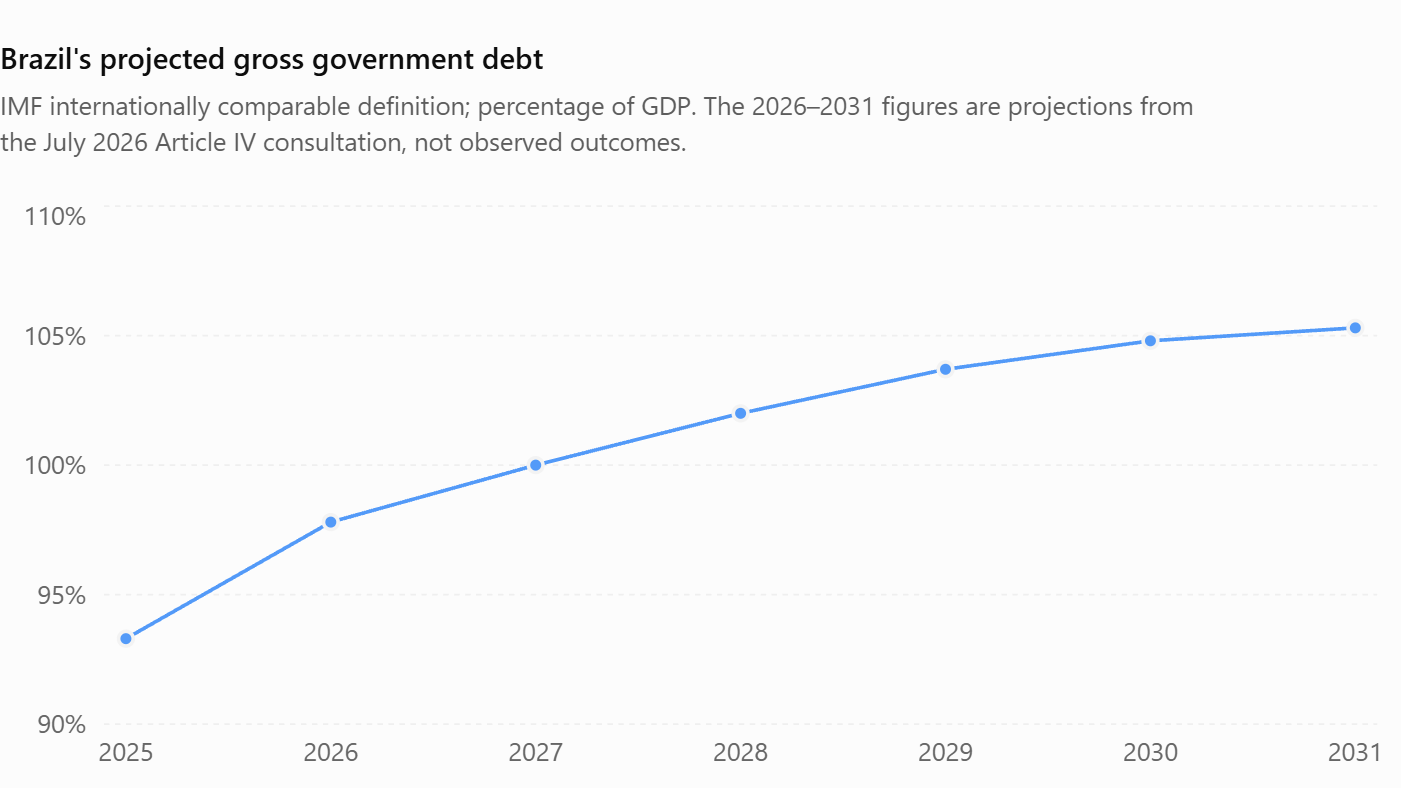
Source: IMF Executive Board Concludes 2026 Article IV Consultation with Brazil — International Monetary Fund — Jul 2026, Table 1. The 2025 value is a historical estimate and the subsequent values are IMF projections. Fondo Monetario Internazionale
The five-year assessment must distinguish between fiscal stabilisation and economic transformation. A credible fiscal programme could moderate debt accumulation and improve monetary conditions without immediately correcting weak productivity or infrastructure deficits. Conversely, stronger growth supported by favourable commodity prices could reduce some short-term pressures without eliminating the underlying fiscal imbalance. The most adverse pathway would combine persistent nominal deficits, disappointment in structural reforms, higher financing costs and deterioration in institutional predictability. The probability and timing of these outcomes cannot be quantified credibly from the verified record alone.
The decisive strategic consideration is that Brazil’s fiscal problem cannot be solved solely through either revenue increases or expenditure reductions without regard to their institutional feasibility and economic composition. The configuration of tax exemptions, mandatory spending, public investment and the cost of capital determines whether adjustment produces a sustainable improvement or merely transfers costs among households, businesses and different levels of government.
Lula’s electoral victory makes these constraints an immediate governing responsibility. The Bolsonaro movement’s continued political weight makes them equally important to the opposition’s legislative strategy. The ability of either political camp to contribute to economic stabilisation should be judged by documented legislation, executable financing, respect for institutional responsibilities and measurable economic outcomes rather than ideological declarations.
The principal judgment is therefore that Brazil retains meaningful economic and financial resilience but faces a deteriorating medium-term debt trajectory unless its political institutions can sustain a fiscal adjustment compatible with investment, price stability and social obligations. The country’s strategic challenge is not to choose between economic freedom and state intervention as abstract alternatives. It is to construct a political and fiscal settlement capable of financing both without progressively weakening public solvency, productive capacity or confidence in the institutional framework.
BRAZIL’S
ECONOMIC IMPASSE
Fiscal sustainability, monetary restriction, debt dynamics and institutional governance. Interactive analytical dashboard using published official statistics and IMF projections.
01 NOVEMBER 2026
Strategic horizon: 2027–2031
International definition
Banco Central do Brasil
Consolidated public sector
IBGE · PNAD Contínua
01 / Public Debt Trajectory
Interactive three-dimensional-style projection and fiscal-risk visualisation
02 / The Fiscal Pressure Mechanism
Actual consolidated public-sector balances, trailing twelve months to September 2026
−0.52% of GDP
Excludes nominal interest expenses. Represents the public-sector primary deficit over the twelve-month reporting period.
8.99% of GDP
Accrued nominal interest dominates the public sector financing requirement and increases sensitivity to interest costs and debt structure.
−9.51% of GDP
The total nominal deficit incorporates both the primary fiscal result and the accrued nominal interest burden.
Source: Banco Central do Brasil, Estatísticas Fiscais, released October 2026. All three measures use the same reporting period and consolidated public-sector coverage. The absolute deficit components satisfy 0.52 + 8.99 = 9.51 percentage points of GDP.
03 / Institutional Transmission Architecture
Analytical dependency pathways rather than independently measured causal coefficients
Expenditure and Debt
Persistent fiscal imbalances increase debt financing needs. The outcome depends on nominal interest costs, growth, primary balances and stock-flow adjustments.
Inflation and Credit
Restrictive monetary policy influences credit costs and spending. Fiscal credibility and inflation expectations affect how quickly financing conditions can improve.
Governance and Investment
Legislative coordination, predictable courts, enforceable rules and administrative execution affect investment confidence and the durability of economic reforms.
04 / Verified Economic Evidence
Filter observations and forecasts by analytical domain
| Indicator | Value | Reference | Definition / status | Issuer |
|---|---|---|---|---|
| Gross public debt | 97.8% | 2026 | IMF definition / forecast | IMF |
| Gross public debt | 105.3% | 2031 | IMF definition / forecast | IMF |
| Gross public debt | 82.9% | Sep 2026 | BCB definition / observed | BCB |
| Primary deficit | 0.52% | Sep 2026 | GDP / trailing 12 months | BCB |
| Nominal interest | 8.99% | Sep 2026 | GDP / trailing 12 months | BCB |
| Nominal deficit | 9.51% | Sep 2026 | GDP / trailing 12 months | BCB |
| Selic target | 13.75% | Sep 2026 | Annual policy rate | BCB |
| Consumer inflation | 4.58% | Sep 2026 | IPCA / trailing 12 months | IBGE |
| Unemployment | 5.2% | Jul–Sep 2026 | Three-month moving period | IBGE |
| Real GDP growth | 1.9% | Q2 2026 | Trailing four quarters | IBGE |
| Real GDP growth | 2.4% | 2026 | IMF annual forecast | IMF |
| Lula electoral share | 51.79% | 25 Oct 2026 | Presidential valid votes | TSE |
| Flávio Bolsonaro share | 48.21% | 25 Oct 2026 | Presidential valid votes | TSE |
Debt series use different definitions and must not be merged. A forecast is not an observed outcome. Nominal fiscal deficits and interest figures are shown as positive magnitudes in this table, while the explanatory panels identify deficit signs. Data are historical snapshots, not live feeds.
05 / Official Documentary Sources
Primary institutional records underlying the displayed observations and projections
PILLAR I — STRUCTURAL ECONOMIC CONSTRAINTS
Chapter 1. The Historical Construction of Brazil’s Fiscal Impasse
Brazil’s Fiscal Crisis Is a Crisis of Budgetary Architecture, Not Simply Expenditure Growth
Brazil’s contemporary fiscal difficulties emerged from the interaction of three structural conditions that successive governments have struggled to reconcile: the political and legal rigidity of a substantial share of federal expenditure, the repeated adjustment of fiscal rules intended to restrain aggregate spending, and an economic environment in which borrowing costs have remained high enough to magnify the consequences of relatively modest primary fiscal imbalances. The resulting system does not operate as a conventional discretionary budget in which the executive can freely redistribute expenditure among public services, investment programmes, pensions and administrative costs. A considerable portion of expenditure is determined by legislation, constitutional obligations, eligibility rules, benefit indexation and other commitments whose costs respond to demographic and economic developments independently of the annual government’s immediate preferences. Fiscal consolidation consequently requires more than reducing selected administrative appropriations. It requires the political capacity to modify expenditure trajectories, improve the efficiency of existing programmes, reassess tax privileges and preserve public investment within a framework capable of producing credible medium-term balances. The distinction is essential because a government may formally respect the expenditure ceiling applicable to a fiscal year while nevertheless failing to achieve a sustainable debt trajectory, particularly when interest expenditure exceeds the adjustment delivered by the primary budget.
The underlying institutional conflict became particularly visible with the adoption of Constitutional Amendment No. 95 on 15 December 2016, which inserted the New Fiscal Regime into Brazil’s constitutional transitional provisions. The legislation responded to a period of significant fiscal deterioration by establishing limits on federal primary expenditure, with future adjustments principally linked to inflation rather than unrestricted nominal spending increases. Its intention was to prevent the expansion of expenditure from continuing independently of the public sector’s capacity to finance it, but its design also exposed a fundamental tension between controlling the aggregate budget and changing the legislation that determines individual spending commitments. When mandatory expenditure increases within a constrained envelope, the adjustment falls disproportionately on the spending categories that remain administratively flexible. The fiscal rule therefore created pressure on discretionary public investment, operating expenditure and other programmes without automatically reforming the underlying commitments responsible for the increasing rigidity of the budget. This asymmetry would become an important explanation for the progressive political erosion of the spending ceiling. Emenda Constitucional nº 95, de 15 de dezembro de 2016 — Senado Federal — Dec 2016. Senado Federal
The Constitutional Ceiling and the Problem of Expenditure Composition
The original constitutional ceiling represented a substantial change in the method by which the Brazilian state attempted to exercise fiscal discipline. Rather than relying solely on annual primary-balance targets or negotiated expenditure reductions, it imposed a multiannual aggregate constraint intended to alter the expected path of federal primary spending. Such a rule can improve fiscal predictability when expenditure commitments are compatible with the ceiling and political authorities are willing to make the reforms necessary to sustain compliance. Its effectiveness is much more limited when entitlement growth, public-sector compensation, legally mandated transfers and other protected obligations progressively absorb the expenditure envelope. Under those conditions, the formal ceiling does not eliminate fiscal pressure; it changes the institutional location at which that pressure becomes visible. Budgetary negotiations increasingly concern exceptions, changes in coverage, accounting treatment and the allocation of remaining discretionary resources. The rule’s legal strength can therefore become a source of political conflict rather than a guarantee of effective expenditure management.
The Senate’s official historical documentation records subsequent changes to the ceiling’s calculation and the eventual replacement of the original regime. Constitutional Amendment No. 113 of 2021 modified relevant indexation arrangements, while Constitutional Amendment No. 126 of 2022 established the constitutional transition through which the previous spending-ceiling regime would be superseded after approval of new complementary legislation. These amendments should not be conflated with the outright abandonment of fiscal discipline: they altered the operative constraints, their calculation and the scope for federal expenditure, while also illustrating the difficulty of sustaining a constitutional fiscal commitment when the expenditure structure and the political coalition required for enforcement were insufficiently aligned. The eventual replacement through Complementary Law No. 200 of 2023 marked the transition from a predominantly inflation-indexed expenditure ceiling to a framework combining primary-balance objectives with a rule governing real expenditure growth. Cumprimento do Teto de Gastos — Senado Federal — Historical Legislative Record; Cumprimento dos Limites da LC nº 200/2023 — Senado Federal — 2026. Transparência Portal+1
The historical importance of this sequence lies in its demonstration that the legal durability of fiscal rules cannot be assessed independently of expenditure composition and political incentives. The creation of a constitutionally protected spending ceiling appeared to impose a powerful commitment device, but its subsequent alteration showed that even a constitutional rule is conditional on parliamentary support. Fiscal credibility therefore depends on the interaction of legal design, spending commitments, institutional enforcement and the perceived willingness of political authorities to preserve the rule when it conflicts with short-term priorities. Constitutional entrenchment can raise the procedural cost of changing a rule; it cannot ensure that the rule remains economically coherent or politically sustainable.
The 2023 Fiscal Framework: From Absolute Restraint to Conditional Expenditure Growth
The fiscal architecture established through Complementary Law No. 200 of 2023 sought to address some of these deficiencies by allowing expenditure to expand in real terms while linking that expansion to government revenue performance and a specified primary-balance objective. The framework sets annual primary-balance targets within a tolerance interval of ±0.25 percentage points of GDP and establishes a corridor for real primary-expenditure growth of 0.6% to 2.5% annually, subject to the applicable revenue-linked formula and statutory provisions. The arrangement is intended to avoid the politically difficult proposition that federal primary expenditure should remain permanently constant in real terms regardless of economic or demographic developments, while simultaneously limiting the possibility that temporary increases in revenue will translate into unrestricted permanent expenditure commitments. The IMF’s July 2026 staff assessment also identifies an investment floor of 0.6% of GDP and automatic adjustment provisions, including a restriction on real personnel expenditure growth following specified fiscal outcomes. The important distinction is that the new arrangement regulates expenditure growth through a combination of numerical limits and fiscal conditions; it does not guarantee that all spending permitted within the rule will be efficient or that the resulting primary balance will stabilise debt. Brazil: 2026 Article IV Consultation, Staff Report — International Monetary Fund — Jul 2026; Cumprimento dos Limites da LC nº 200/2023 — Senado Federal — 2026. eLibrary IMF+1
The most important innovation in the 2023 framework is its attempt to make fiscal adjustment conditional on economic and revenue developments without returning to an unconstrained expenditure model. Nevertheless, revenue-linked expenditure growth introduces its own vulnerabilities. Permanent spending obligations created during periods of strong revenue performance may remain after the revenue expansion has dissipated. The existence of a numerical expenditure corridor reduces this risk but does not eliminate it, especially when temporary receipts, commodity-linked revenues, judicial settlements or exceptional collections influence the measurement of fiscal capacity. Conversely, expenditure restrictions can intensify during economic slowdowns, creating pressure to reduce precisely those public services and investment programmes whose economic benefits emerge over a longer horizon. The challenge is therefore not merely compliance with a formula, but the distinction between structural revenue, cyclical revenue and exceptional receipts, combined with institutional mechanisms that prevent temporary fiscal improvements from supporting permanent commitments.
The IMF’s 2026 assessment identifies growing exceptions to Brazil’s expenditure framework as a material concern and concludes that fiscal sustainability would be better supported by more comprehensive spending limits, a binding medium-term debt anchor, expenditure-efficiency measures and closer alignment between real expenditure growth and structural government revenue. Importantly, these recommendations do not imply that fiscal consolidation should be pursued through indiscriminate reductions in public services. The Fund explicitly identifies the need to protect targeted social spending and preserve productive investment. The policy challenge is consequently one of expenditure quality and programme design as much as one of aggregate restraint. The fiscal framework becomes more credible when it distinguishes between spending that improves long-term productive capacity and spending that primarily perpetuates inefficiency, while ensuring that social commitments are financed on a sustainable basis rather than through repeated borrowing. IMF Executive Board Concludes 2026 Article IV Consultation with Brazil — International Monetary Fund — Jul 2026. Fondo Monetario Internazionale
The Historical Sequence of Fiscal-Regime Transformation
| Period | Legal or institutional instrument | Operative mechanism | Structural constraint | Principal economic consequence |
|---|---|---|---|---|
| December 2016 | Constitutional Amendment 95 | Constitutional limits on federal primary expenditure | Mandatory spending continued to evolve within the expenditure envelope | Pressure on discretionary spending and investment |
| 2021 | Constitutional Amendment 113 | Modification of expenditure-limit calculations | Changes in indexation altered permitted expenditure | Recalibration of fiscal space without comprehensive expenditure restructuring |
| December 2022 | Constitutional Amendment 126 | Transition arrangements and provision for replacement fiscal legislation | Political and social spending commitments required a revised framework | Expansion and reorganisation of available fiscal space |
| August 2023 | Complementary Law 200 | Primary-balance target combined with conditional real spending growth | Revenue volatility and expenditure rigidity | Greater formal flexibility, conditional on effective enforcement |
| 2025–2026 | Application of adjustment mechanisms | Expenditure-growth restrictions and fiscal corrective provisions | Compliance depends on fiscal outcomes and statutory exceptions | Increased importance of implementation and legislative consistency |
| 2027–2031 | Medium-term fiscal horizon | Annual targets, revenue performance and expenditure controls | Debt servicing, mandatory spending and political coordination | Sustainability depends on cumulative fiscal adjustment, not one-year compliance |
Sources: Emenda Constitucional nº 95 — Senado Federal — Dec 2016; Cumprimento dos Limites da LC nº 200/2023 — Senado Federal — 2026; Brazil: 2026 Article IV Consultation, Staff Report — IMF — Jul 2026. Senado Federal+2
The Distribution of Fiscal Authority and the Limits of Executive Control
An additional difficulty arises from the distribution of budgetary authority within Brazil’s constitutional system. Federal expenditure decisions are not exclusively executive functions. Congress participates in annual appropriations, legislates expenditure commitments, authorises changes to fiscal rules and exercises influence over the allocation of budget resources. State and municipal governments possess fiscal responsibilities that are distinct from those of the federal government, while transfers and the structure of revenue-sharing arrangements create additional relationships between levels of government. This distribution is not inherently incompatible with fiscal sustainability. Federal systems can sustain effective budget discipline when the responsibilities and financing capacities of each level of government are sufficiently transparent and the rules governing transfers and expenditure commitments are predictable. Problems arise when one political institution makes spending commitments whose costs fall on another, when the budget permits insufficient adjustment for economic shocks, or when legislative appropriations are fragmented without equivalent accountability for aggregate fiscal outcomes.
The resulting issue is one of fiscal responsibility across institutions. The central government can announce a primary-balance objective but still encounter difficulty delivering it if the programme depends on legislation not yet enacted, revenue measures subject to constitutional challenge or expenditure reforms for which political support remains uncertain. Equally, an apparent improvement in the central government’s fiscal result may not represent an equivalent improvement in the consolidated public sector if regional governments or public enterprises are moving in the opposite direction. Fiscal analysis must therefore preserve the distinction among the federal budget, central-government primary accounts, consolidated public-sector results and general-government debt. These classifications differ in scope and should not be treated as interchangeable expressions of national fiscal performance.
The Structural Significance of Mandatory Spending
Mandatory expenditure is not synonymous with waste, and any serious fiscal assessment must avoid treating legally protected social commitments as a homogeneous category of inefficient costs. Pensions and social transfers fulfil distributional and insurance functions, public-sector compensation finances administrative capacity, and constitutionally mandated services can support human capital and social stability. Nevertheless, the degree of legal rigidity influences the government’s ability to respond to changes in economic conditions. When benefit formulas and other obligations generate expenditure growth faster than the fiscal framework permits, the remaining budget absorbs the adjustment. In practice, this can produce a persistent tension between preserving existing commitments and maintaining the capital expenditure required for infrastructure, technological development and public-service modernisation.
The operational implication is that fiscal adjustment must distinguish among the number of beneficiaries, benefit eligibility, indexation mechanisms, administrative delivery costs and the financing sources attached to each programme. A measure that reduces administrative duplication may generate recurring savings without reducing statutory entitlements, while a change in eligibility or indexation can have much larger distributional and legal consequences. The time horizon is also essential: administrative efficiencies may require substantial initial investment in information systems and implementation capacity, whereas changes to entitlement rules can produce savings only gradually. Assessing fiscal measures solely by their announced annual savings therefore obscures their implementation costs, transition periods and potential effects on household income and economic demand.
Key Judgments — Chapter 1
The historical record supports the conclusion that Brazil’s recurring fiscal problems cannot be explained adequately by the political orientation of any single administration. The constitutional expenditure ceiling, its successive amendments and its replacement by the 2023 framework represent different institutional approaches to an enduring problem: how to reconcile legally committed expenditure with volatile revenue, economic development objectives and the cost of financing government debt. The next phase of fiscal reform will depend on the credibility of the existing rules, the extent to which statutory exceptions remain controlled, and the ability of public authorities to improve expenditure composition without undermining necessary social and productive functions. The decisive documentary tests are the enacted annual budget, compliance with Complementary Law 200, the evolution of expenditure exceptions and the evidence that announced efficiency measures produce measurable savings.
Chapter 2. Public Debt, Interest Expenditure and Fiscal Sustainability
Why the Primary Fiscal Balance Cannot Explain Brazil’s Debt Problem on Its Own
The central feature of Brazil’s public debt problem is the unusually consequential interaction between the accumulated stock of government obligations and the interest rates applied, directly or indirectly, to financing that stock. A primary balance measures public revenue minus non-interest expenditure and is therefore useful for assessing how current fiscal policy contributes to the government’s financing requirement before the cost of existing indebtedness. It is not, however, a comprehensive measure of fiscal sustainability. A government may record a primary surplus and continue to experience an increase in its debt ratio if the interest burden on outstanding obligations exceeds the combined effects of the primary surplus and nominal economic growth. Conversely, a temporary primary deficit does not necessarily imply an unsustainable debt trajectory if economic growth and favourable financing conditions are sufficiently strong. Brazil’s circumstances are distinguished by the difficulty of achieving a primary balance large enough to offset the interest burden while preserving public investment and politically significant expenditure commitments. Consequently, the fiscal adjustment needed to stabilise indebtedness must be assessed in relation to the effective interest rate, the debt stock, GDP growth and other changes in public liabilities, rather than derived mechanically from the primary deficit alone.
The IMF’s July 2026 staff report identifies Brazil’s unfavourable interest-rate–growth differential as a central factor behind the projected increase in debt, including during periods when primary fiscal balances improve. The Fund’s debt sustainability assessment classifies the risk of general-government debt distress as moderate under its baseline rather than describing an imminent sovereign crisis. This distinction is analytically important because high debt and an elevated interest burden can coexist with meaningful financial buffers, an established domestic government-securities market and monetary-policy institutions capable of absorbing shocks. However, such buffers do not make debt accumulation costless. They allow adjustment to proceed over a more orderly horizon while reducing the probability that temporary financial-market disruption will require abrupt fiscal intervention. Brazil: 2026 Article IV Consultation, Staff Report — International Monetary Fund — Jul 2026. eLibrary IMF
Debt Definitions: A Fundamental Requirement for Fiscal Comparison
One of the most frequent sources of error in Brazilian debt analysis is the combination of indicators calculated under different institutional and accounting definitions. The Banco Central do Brasil reports gross general-government debt, or Dívida Bruta do Governo Geral (DBGG), under its national statistical framework, while the IMF provides a broader internationally comparable measure of general-government gross debt. The two series can differ materially at the same reference date because their treatment of particular instruments, institutional positions and accounting boundaries is not identical. Net public-sector debt, or Dívida Líquida do Setor Público (DLSP), measures a different concept again because eligible assets are deducted from liabilities within its applicable perimeter. These differences are not technical curiosities. They influence apparent debt ratios, international comparisons, estimates of fiscal exposure and the interpretation of a government’s progress toward stabilisation.
For September 2026, the Brazilian Central Bank reported DBGG at 82.9% of GDP, equivalent to approximately R$11.1 trillion, and net public-sector debt at 70.0% of GDP, equivalent to approximately R$9.4 trillion. In its July assessment, the IMF projected gross general-government debt under its internationally comparable definition at 97.8% of GDP for 2026, increasing to 105.3% by 2031, whereas its projection under the Brazilian authorities’ definition was 86.6% for 2026. The numerical gap does not constitute evidence that debt suddenly increased between two reporting dates; it primarily reflects different statistical concepts, alongside the additional distinction between a monthly observation and an annual forecast. Any credible analysis must therefore identify the issuer, debt definition, coverage, reference period and observed or projected status for each quoted figure. Estatísticas Fiscais — Banco Central do Brasil — Oct 2026; IMF Executive Board Concludes 2026 Article IV Consultation with Brazil — International Monetary Fund — Jul 2026. Banco Central del Brasile+1
The Compounding Effect of Nominal Interest
The evolution of nominal interest expenditure provides an especially revealing measure of fiscal pressure. According to the Central Bank’s release of 29 October 2026, nominal interest accrued by the consolidated public sector reached R$107.5 billion in September 2026, compared with R$84.7 billion in September 2025. Over the twelve months ending September 2026, accrued nominal interest totalled R$1.205 trillion, or 8.99% of GDP, compared with R$984.8 billion, or 7.86% of GDP, over the corresponding twelve-month period ending September 2025. This represents an increase of R$220.2 billion in the reported twelve-month nominal interest burden and a rise of 1.13 percentage points of GDP between those reporting windows. The Central Bank attributes part of the monthly year-on-year increase to the less favourable outcome of foreign-exchange swap operations, in addition to growth in the debt stock and the influence of consumer-price inflation. These factors reinforce the need to distinguish interest accrued under public-sector accounting rules from the cash interest coupons paid on specific government securities or the annual budgetary appropriation for debt service. Estatísticas Fiscais — Banco Central do Brasil — Oct 2026. Banco Central del Brasile
The consolidated public sector’s primary deficit over the same twelve-month period was R$70.1 billion, equivalent to 0.52% of GDP, whereas the total nominal deficit reached R$1.2751 trillion, or 9.51% of GDP. The difference between these two balances demonstrates why a narrow political debate centred exclusively on reducing non-interest expenditure can fail to capture the magnitude of the fiscal challenge. The nominal financing requirement reflects both the current primary result and the accumulated cost of financing previous obligations. Reducing the primary deficit is necessary to improve debt dynamics, but the ultimate debt outcome also depends on market yields, inflation, refinancing conditions, currency-related exposures and economic growth. The primary fiscal adjustment is therefore not an isolated accounting exercise: it is part of a broader process intended to reduce expectations of future indebtedness and thereby improve the conditions under which public liabilities can be financed.
Fiscal Accounts and Debt Indicators: September 2026
| Indicator | Reported value | GDP equivalent | Coverage and reference | Analytical significance |
|---|---|---|---|---|
| Primary deficit | R$70.1 billion | 0.52% | Consolidated public sector; trailing 12 months | Fiscal imbalance before interest |
| Nominal interest | R$1,205.0 billion | 8.99% | Consolidated public sector; trailing 12 months | Accrued cost of public liabilities |
| Overall nominal deficit | R$1,275.1 billion | 9.51% | Consolidated public sector; trailing 12 months | Total nominal fiscal imbalance |
| Monthly nominal interest | R$107.5 billion | — | September 2026 | Monthly accrued financing burden |
| Monthly nominal deficit | R$113.0 billion | — | September 2026 | Monthly overall fiscal result |
| Gross government debt (DBGG) | R$11.1 trillion | 82.9% | BCB national definition; September 2026 | Gross indebtedness |
| Net public-sector debt (DLSP) | R$9.4 trillion | 70.0% | BCB national definition; September 2026 | Debt net of applicable assets |
Source: Estatísticas Fiscais — Banco Central do Brasil — Oct 2026. Banco Central del Brasile
Interest Rates, Refinancing and Government Securities
The relationship between monetary policy and government debt is mediated by the structure of outstanding liabilities. The Selic policy rate influences short-term money-market conditions, but the cost of servicing the public debt depends on the interest-rate characteristics, maturity structure, indexation and refinancing schedule of the instruments issued by the Treasury, as well as the accounting treatment of the public-sector balance sheet. Floating-rate liabilities can transmit changes in short-term rates more directly, whereas fixed-rate securities preserve their contractual coupon characteristics until maturity, even though prevailing market yields influence the cost of newly issued debt. Inflation-linked securities introduce another channel through which inflation affects the nominal value of obligations and accrued financing costs. Exchange-rate exposure must be evaluated in relation to both debt liabilities and public-sector foreign-currency assets rather than inferred from movements in the domestic currency alone. Without a current security-level portfolio schedule, it would be misleading to assign a single uniform sensitivity coefficient to Brazil’s entire debt stock.
This distinction also explains why the Selic rate cannot be multiplied mechanically by gross public debt to estimate the government’s actual interest expenditure. Such a calculation would assume that every liability is immediately refinanced at the current policy rate, ignores contractual maturities and indexation, and disregards accounting differences between gross and net positions. A proper analysis instead requires the debt portfolio’s composition by indexation category, average maturity, proportion repricing within the relevant horizon, Treasury cash position and the structure of market demand for government securities. The IMF notes that Brazil benefits from substantial government cash buffers, substantial Central Bank holdings of government securities subject to legally prescribed rollover arrangements, and limited reliance on foreign-currency and foreign-law debt. These characteristics mitigate immediate refinancing risks but do not eliminate the cumulative fiscal consequences of high domestic borrowing costs. Brazil: 2026 Article IV Consultation, Staff Report — International Monetary Fund — Jul 2026. eLibrary IMF
Fiscal Adjustment and the Interest-Rate–Growth Differential
Debt stabilisation requires a coherent relationship among four variables: the effective financing cost of the existing public debt, the nominal growth rate of GDP, the primary fiscal balance and adjustments that change the debt stock independently of the conventional fiscal deficit. When the effective interest rate exceeds nominal economic growth, the debt burden tends to increase unless the government generates a sufficiently strong primary surplus or benefits from offsetting adjustments. When growth exceeds the effective borrowing cost, a smaller primary surplus—or in some circumstances a limited primary deficit—can be compatible with a stable debt ratio. These relationships are affected by debt composition, inflation, exchange-rate movements and accounting coverage. They must therefore be used as analytical identities rather than as substitutes for a verified country-specific debt sustainability model.
The IMF’s July 2026 fiscal recommendation is particularly relevant because it provides a documented alternative to an unspecified assertion that Brazil must immediately undertake a drastic fiscal contraction. The Fund recommended a cumulative improvement of approximately 3 percentage points of GDP over 2026–2031, including saving additional oil-related fiscal windfalls in 2026 and improving the federal primary balance sufficiently to reach a 1.5% of GDP surplus in 2029 and 2.5% in 2031. The Fund’s proposal was intended to place general-government gross debt on a declining trajectory while protecting targeted social expenditure and supporting productivity-enhancing reforms. It is important to distinguish this recommended adjustment pathway from the Fund’s baseline forecast: a policy recommendation is not an enacted government programme, and its projected effects depend on the simultaneous assumptions regarding growth, interest rates, revenue performance and implementation. Brazil: 2026 Article IV Consultation, Staff Report — International Monetary Fund — Jul 2026. eLibrary IMF
The IMF Baseline and Its Fiscal Sensitivities
| IMF indicator | 2025 | 2026 | 2027 | 2028 | 2029 | 2030 | 2031 |
|---|---|---|---|---|---|---|---|
| Gross general-government debt, % GDP | 93.3 | 97.8 | 100.0 | 102.0 | 103.7 | 104.8 | 105.3 |
| Net public-sector debt, % GDP | 65.2 | 72.3 | 75.0 | 77.4 | 79.3 | 80.1 | 80.4 |
Source: IMF Executive Board Concludes 2026 Article IV Consultation with Brazil — International Monetary Fund — Jul 2026, statistical projections. Fondo Monetario Internazionale
The IMF baseline should not be interpreted as an unconditional prediction. Its staff analysis explicitly identifies fiscal measures that are not yet fully specified or allocated within the government’s existing programme. The anticipated improvement in the primary balance therefore depends in part on the future identification and implementation of measures capable of delivering recurring fiscal benefits. This is one of the most consequential uncertainties in Brazil’s medium-term fiscal outlook: measures that are projected but not yet legislated, financed or operationally specified cannot be assigned the same evidentiary status as enacted budgetary provisions. Under an alternative pathway in which these additional measures do not materialise, the IMF indicates that debt would continue to rise rather than stabilise on the baseline trajectory. Brazil: 2026 Article IV Consultation, Staff Report — International Monetary Fund — Jul 2026. eLibrary IMF
The Distributional and Investment Consequences of Consolidation
Fiscal adjustment also affects the economy through the allocation of its costs. An increase in revenue collected from economically inefficient exemptions can differ substantially from a broad increase in consumption taxes, both in its distributional consequences and in its influence on private spending. Reductions in administrative inefficiency can differ from cuts to infrastructure maintenance, education or health services, whose consequences may emerge over several years. Pension and social-security reforms can alter long-term commitments but may require extended implementation periods because existing beneficiaries, contribution histories and acquired rights have legal significance. The fiscal quality of a measure must therefore be judged by recurring savings, the legal and administrative cost of implementation, its effects on incentives and investment, and the consequences for households and regional governments. A fiscal programme that achieves a headline balance by postponing payments, reducing maintenance or suppressing capital expenditure can improve a short-term indicator while weakening future public-service capacity or economic growth.
The central economic risk is that poorly designed consolidation could lower the denominator of the debt ratio by reducing GDP growth at the same time that it improves the numerator through smaller deficits. The scale of this interaction is empirical and cannot be determined from the size of the fiscal package alone. A well-sequenced programme attempts to minimise adverse demand effects by identifying measures with relatively low growth costs, protecting essential investment and providing sufficient time for firms and households to adjust. The potential gain is not merely an improvement in government accounts but a reduction in uncertainty about future tax burdens, financing costs and fiscal policy. The result depends on whether private investment responds, whether monetary conditions can ease consistently with inflation control, and whether public institutions can sustain implementation across successive budgets.
Key Judgments — Chapter 2
Brazil’s debt problem is materially more demanding than the size of its primary deficit suggests because accrued nominal interest constitutes the dominant component of the reported overall deficit. The country’s domestic financing structure and institutional buffers reduce the immediacy of some refinancing risks, but an unfavourable interest-rate–growth differential creates a persistent requirement for credible primary fiscal adjustment. The IMF’s baseline and recommended consolidation path establish the direction of the challenge without proving that the prescribed measures have been legislated or that their economic consequences are certain. The most consequential records for further assessment are the Treasury’s current securities portfolio, debt maturity and indexation data, enacted medium-term fiscal measures and subsequent revisions to official debt sustainability projections.
Chapter 3. Monetary Policy, Inflation and the Domestic Credit Economy
Monetary Restriction and the Structural Cost of Brazilian Capital
Brazil’s monetary policy challenge extends beyond the immediate objective of reducing consumer-price inflation. The level and persistence of domestic interest rates influence the pricing of credit, the refinancing burden borne by households and businesses, the willingness of companies to undertake capital investment and the financial conditions under which the government manages its liabilities. Monetary policy must therefore be analysed as an important transmission mechanism connecting macroeconomic stability to the productive economy, but it must not be treated as an instrument capable of resolving fiscal instability independently of budgetary decisions. The Central Bank can influence short-term interest rates and inflation expectations, but it cannot directly modify mandatory public expenditure, eliminate inefficient tax provisions or increase structural productivity. Conversely, fiscal policy can alter the conditions under which monetary policy operates because persistent uncertainty about public debt and future financing needs may contribute to inflation expectations, exchange-rate sensitivity and the risk premiums demanded by investors. The result is a system in which the effectiveness of monetary easing depends not only on the inflation outlook but also on the perceived credibility of the broader macroeconomic framework.
Brazil’s monetary-policy institutions operate under a formal autonomy framework established by Complementary Law No. 179 of 24 February 2021, which provides for the terms of office and institutional objectives of the Central Bank’s leadership. The Central Bank identifies price stability as its fundamental objective, alongside secondary responsibilities concerning financial-system stability and efficiency, the smoothing of fluctuations in economic activity and the promotion of full employment. This legal architecture is economically significant because monetary-policy credibility depends partly on whether market participants believe that interest-rate decisions will remain consistent with the inflation objective rather than being subordinated to the immediate fiscal financing preferences of the executive. Operational autonomy does not eliminate the need for policy coordination, nor does it mean that monetary decisions are immune from accountability. It instead establishes institutional responsibilities under which the Central Bank must justify its decisions through the monetary-policy framework while elected authorities retain responsibility for fiscal legislation and budget execution. Autonomia do Banco Central — Banco Central do Brasil — Institutional Record. Banco Central del Brasile
The Continuous Inflation-Targeting Regime
A material institutional change occurred with the transition to a continuous inflation-targeting arrangement beginning in January 2025. Under Resolution CMN No. 5,141 of 26 June 2024, the inflation target is 3.0%, with a tolerance interval of 1.5 percentage points on either side, corresponding to a range from 1.5% to 4.5%. The relevant indicator is the twelve-month accumulated IPCA consumer-price index, measured monthly rather than solely against a December reference date. The framework establishes a specific procedure for identifying a sustained departure from the tolerance interval. The distinction between an inflation observation outside the range and a formally established breach under the continuous-targeting rules matters because the assessment of monetary performance depends on the legal conditions attached to the regime, not simply on whether an individual monthly observation exceeds a numerical threshold. Resolução CMN nº 5.141 — Conselho Monetário Nacional — Jun 2024; Histórico: Meta de Inflação versus Inflação Efetiva — Banco Central do Brasil — Institutional Statistical Record. Banco Central del Brasile+1
The importance of this institutional structure lies in its influence on inflation expectations. An inflation target can help coordinate expectations concerning future price developments if households, businesses, financial intermediaries and public authorities regard the target as a credible guide to monetary decisions. When expectations remain above the objective, the Central Bank may need to maintain restrictive financing conditions for longer than would otherwise be necessary, even if current inflation has begun to moderate. This does not imply that nominal interest rates must mechanically remain above inflation by a fixed predetermined margin. The appropriate policy stance depends on prospective inflation, economic activity, the estimated neutral real interest rate, financial conditions and the distribution of risks around the forecast. The IMF’s 2026 assessment describes medium-term inflation expectations as remaining above target and supports a cautious, data-dependent approach to monetary easing in the presence of continuing external uncertainty. Brazil: 2026 Article IV Consultation, Staff Report — International Monetary Fund — Jul 2026. eLibrary IMF
Monetary Easing Does Not Immediately Translate into Affordable Credit
The Selic policy-rate target stood at 13.75% annually following the September 2026 monetary-policy decision. This rate establishes an important reference for short-term financial conditions, but it is not the borrowing rate paid by every household or business. Retail credit rates incorporate funding costs, borrower-specific default probabilities, expected loss recovery, operational expenses, capital and liquidity requirements, taxes, institutional competition and commercial margins. The resulting difference between the monetary-policy rate and the rate actually charged to borrowers—the credit spread—varies considerably across lending products, borrower categories and financial intermediaries. A decline in the Selic rate can therefore reduce some funding costs without generating an equivalent reduction in rates charged on unsecured consumer loans or lending to smaller enterprises. Moreover, the transmission of monetary easing depends on the speed with which banks reprice assets and liabilities, the maturity of existing credit contracts and the willingness of financial institutions to expand lending under prevailing economic conditions.
For households, the distinction among fixed-rate loans, floating-rate obligations, revolving credit and newly originated borrowing is particularly important. Existing fixed-rate contracts may remain unaffected by an immediate policy-rate reduction, whereas obligations linked to variable rates may adjust more rapidly. Highly indebted households can respond to lower financing costs by reducing arrears or rebuilding liquidity before increasing consumption, while households with stronger balance sheets may respond primarily through housing purchases or durable-goods expenditure. In the corporate sector, larger firms with established access to capital markets may obtain financing under conditions that differ substantially from those facing smaller enterprises dependent on commercial banks or specialised lenders. The economic effect of the same monetary-policy decision is therefore uneven across sectors and income groups, and its aggregate impact depends on the composition of outstanding credit as well as the flow of newly authorised lending.
Credit Transmission Through the Domestic Economy
| Transmission channel | Initial monetary mechanism | Balance-sheet exposure | Conditions influencing transmission | Relevant official evidence |
|---|---|---|---|---|
| Unsecured household credit | Changes in bank funding and marginal lending costs | Household income, arrears and debt-service commitments | Credit spreads, borrower risk, product structure | BCB credit and household-indebtedness statistics |
| Housing finance | Influence on new mortgage rates and discount rates | Mortgage affordability and housing demand | Contract indexation, loan maturity, collateral and funding channels | BCB housing-credit series |
| Small and medium enterprises | Changes in credit pricing and availability | Working capital, inventories and liquidity | Bank competition, borrower information and default risk | BCB corporate-credit statistics |
| Large companies | Changes in financial-market yields | Debt refinancing and capital expenditure | Access to securities markets, credit quality and foreign funding | BCB financial-market and corporate-credit series |
| Government securities | Changes in yields and refinancing conditions | Public debt portfolio and financing requirement | Maturity, indexation, investor demand and Treasury cash position | National Treasury debt reports |
| Exchange rate and import prices | Changes in relative financial returns and expectations | Imported inputs, external liabilities and consumer prices | Global risk appetite, commodity prices and capital movements | BCB exchange-rate and external-sector statistics |
The table describes transmission mechanisms, not measured causal coefficients. Their magnitude cannot be inferred from the policy rate alone. Relevant sources include Estatísticas Monetárias e de Crédito — Banco Central do Brasil and Autonomia do Banco Central — Banco Central do Brasil. Banco Central del Brasile
Household Debt and the Limits of Consumption-Led Growth
A central vulnerability of consumption-led economic expansion arises when household expenditure becomes increasingly dependent on new credit or repeated refinancing rather than sustained gains in real disposable income. Credit can improve household welfare when it permits consumption smoothing, productive investment or the acquisition of durable assets, but the economic consequences differ when households must devote a growing share of income to financing obligations. High debt-service commitments reduce the flexibility of household budgets, particularly among borrowers with little capacity to absorb fluctuations in earnings. The effect can become pronounced in an economy with substantial informal employment and self-employment, where reported income and actual cash flows may differ considerably over time. Policy initiatives designed to restructure household debt may improve liquidity and reduce arrears when they establish sustainable repayment conditions, but their fiscal and financial effects depend on programme design, the allocation of losses among lenders and public institutions, and the behavioural incentives created for future borrowing.
The IMF’s 2026 Financial Sector Assessment Program identifies household indebtedness as an area requiring continued attention, while assessing Brazil’s banking system as well capitalised and liquid, with systemic risks contained. These findings should be interpreted together rather than selectively. Household financial vulnerability does not necessarily imply that the banking system is approaching systemic insolvency, because capital adequacy, provisioning, collateral, funding composition and supervisory practices affect how individual borrower distress is transmitted to financial institutions. Equally, a resilient banking system does not mean that indebted households are unaffected by restrictive credit conditions. The policy challenge is to preserve financial stability while ensuring that financing costs and debt-restructuring mechanisms do not unnecessarily suppress economically productive activity. IMF Executive Board Concludes 2026 Article IV Consultation with Brazil — International Monetary Fund — Jul 2026. Fondo Monetario Internazionale
Corporate Finance, Capital Formation and Investment Horizons
The impact of monetary conditions on investment is more complicated than the relationship between interest rates and current consumption because capital expenditure often involves multiannual commitments that cannot be reversed without substantial losses. A manufacturing company deciding whether to expand production capacity must evaluate construction costs, imported machinery, expected demand, financing conditions, taxation, infrastructure access and the possibility that technology or market conditions will change during the investment period. The relevant financing cost is therefore not necessarily the current Selic rate, but the expected weighted cost of capital over the project’s economic life. A temporary decline in the policy rate may have little influence on investment if companies expect future fiscal instability to increase borrowing costs or if uncertainty about taxation, regulation and market demand dominates financial considerations. Conversely, predictable monetary easing accompanied by credible fiscal commitments can improve investment conditions through both the direct cost of capital and reduced uncertainty about future economic policy.
This distinction helps explain why monetary policy is necessary but insufficient for increasing Brazil’s long-term growth potential. Lower financing costs can make previously unprofitable projects commercially viable, but they cannot independently remove logistical bottlenecks, improve vocational skills, simplify complex administrative procedures or establish reliable electricity and transport infrastructure. Investment decisions require the combined availability of finance, physical capacity, human capital and institutional predictability. Brazil’s economic transformation consequently depends on the interaction between monetary normalisation and structural reforms, with monetary policy providing the financial environment in which productive projects can proceed rather than creating those projects through interest-rate reductions alone.
External Shocks and the Inflation–Exchange-Rate Relationship
Brazil’s monetary policy is also influenced by the international environment, particularly the effects of commodity prices, international interest rates, exchange-rate movements and changes in global risk appetite. Depreciation of the real can increase the domestic-currency cost of imported products and intermediate goods, although the speed and magnitude of pass-through vary according to market structure, contracts and the degree of competition. Currency appreciation may reduce some import-price pressures but can also alter the competitiveness of export-oriented manufacturing activities. Rising international energy prices can improve fiscal receipts and export revenues for certain producers while increasing transportation costs, fertiliser prices and inflationary pressures elsewhere in the economy. These competing channels make a simple distinction between favourable and unfavourable commodity shocks inadequate.
The IMF’s July 2026 assessment specifically identified the economic consequences of the Middle East conflict, including inflation risks, changes in oil-related revenues and potential disruptions to fertiliser supply. Brazil’s position as an agricultural exporter and a net importer of fertilisers creates a particularly relevant transmission mechanism: higher commodity export revenues do not necessarily offset the increased production costs generated by more expensive imported agricultural inputs. The same external development can therefore improve parts of the balance of payments while weakening domestic purchasing power or increasing production costs. The Fund identifies exchange-rate flexibility and international reserves as important shock absorbers, reflecting the fact that monetary credibility depends in part on the economy’s capacity to adjust to external developments without creating an unsustainable financing or inflationary spiral. Brazil: 2026 Article IV Consultation, Staff Report — International Monetary Fund — Jul 2026. eLibrary IMF
Key Judgments — Chapter 3
Brazil’s monetary-policy restrictions are not merely a symptom of high inflation. They also reflect the institutional requirement to maintain credible inflation expectations in an economy characterised by fiscal pressures, heterogeneous credit markets and significant exposure to external shocks. The formal autonomy of the Central Bank and the continuous inflation-targeting regime provide important institutional foundations, but neither can substitute for improvements in fiscal credibility or productive capacity. Monetary easing can support household liquidity and corporate investment, although its effects differ according to credit products, borrower characteristics, debt maturity and market expectations. The decisive evidence for future assessment will be the trajectory of inflation expectations relative to the 3% target, the evolution of actual credit spreads and household debt-service burdens, the pricing of new corporate credit and the extent to which lower policy rates translate into sustained capital formation rather than exclusively short-term consumption.
Chapter 4. Productivity, Investment and Brazil’s Growth Model
Economic Expansion Without Equivalent Productivity Transformation
Brazil’s long-term economic difficulty is not simply that the country has been unable to generate employment, consumption or output growth. It is that economic expansion has not consistently been accompanied by sufficiently strong improvements in productivity, capital intensity and the efficiency with which labour and infrastructure contribute to production. This distinction is central to evaluating the country’s growth potential because rising employment can increase total output even when production per worker improves relatively slowly, whereas sustained growth in real income ultimately depends on productivity, investment, skills, organisational efficiency and technological diffusion. A growing labour force cannot indefinitely substitute for these structural sources of development, particularly as demographic conditions evolve and the marginal contribution of additional employment becomes more limited. The IMF’s July 2026 staff report explicitly identifies the post-pandemic recovery as having benefited strongly from higher employment and private consumption, while observing that productivity growth and investment have not provided equivalent sources of expansion. The same assessment identifies borrowing costs, infrastructure limitations, tax complexity and legal rigidities as constraints on potential growth. Brazil: 2026 Article IV Consultation, Staff Report — International Monetary Fund — Jul 2026. eLibrary IMF
The relevant analytical question is therefore whether Brazil can convert employment gains and domestic demand into a more productive economic structure without depending permanently on fiscal transfers, credit expansion or favourable commodity cycles. Productivity growth is not confined to advanced manufacturing, although industrial investment can be an important driver. It can also emerge through better transport logistics, more efficient agricultural production, digitalisation of services, improvements in energy infrastructure, administrative simplification and increased competition. The economic significance of these changes lies in their influence on the volume and value of output generated by a given combination of labour, capital and intermediate inputs. A country can possess internationally competitive companies in selected industries while still exhibiting weak aggregate productivity if a substantial share of the economy operates with outdated equipment, inefficient logistics, limited access to finance or insufficient managerial and technical capacity.
Industrial Performance and the Limits of Aggregate Production Indicators
Brazil possesses a diversified productive base comprising manufacturing, extractive industries, agriculture, energy, construction and services, but these sectors respond differently to domestic financing conditions and international demand. Extractive industries may benefit from global commodity prices and investment in natural-resource production, while manufacturing competitiveness depends more heavily on reliable supply chains, imported machinery and intermediate goods, technical skills, infrastructure quality, energy availability, taxation and the cost of working capital. A temporary improvement in industrial production may result from higher capacity utilisation rather than the construction of new productive assets, while a short-term contraction may reflect changes in inventories or demand rather than a permanent deterioration in industrial competitiveness. Industrial performance must consequently be assessed through several complementary indicators, including physical production, gross value added, capital formation, productivity and the changing composition of manufacturing output.
The IBGE’s industrial production survey recorded a 0.6% seasonally adjusted decline in overall industrial production in August 2026 compared with July, including a 0.7% decline in manufacturing and a 0.7% decline in extractive activities. These observations establish a monthly contraction but do not, on their own, demonstrate a sustained industrial recession or a structural loss of productive capacity. The same IBGE release provides differentiated results across manufacturing activities, demonstrating why aggregate industrial figures must be interpreted alongside sector-specific developments. For industrial policy, the central concern is whether changes in production are accompanied by investment in technology, improved productivity, higher domestic value added and stronger export competitiveness. Pesquisa Industrial Mensal: Produção Física — Instituto Brasileiro de Geografia e Estatística — Oct 2026. IBGE
Investment Formation and the Structure of Long-Term Growth
Gross fixed capital formation is one of the most important indicators for evaluating whether an economy is expanding its future productive capacity. It includes investment in fixed assets such as machinery, equipment and structures, but its interpretation requires attention to whether spending replaces depreciated assets or adds productive capacity, whether assets are efficiently deployed, and whether investment produces complementary improvements in labour productivity. Investment can rise temporarily because of a large infrastructure project without creating a broad national improvement in productivity if transport networks, customs systems, land-use procedures or electricity connections remain inadequate. Equally, a technologically sophisticated manufacturing investment can generate limited domestic spillovers when local supplier networks and technical training systems are insufficiently developed.
The IMF projected Brazilian gross fixed capital formation growth of 4.1% in 2026, followed by 0.7% in 2027 and 2.1% in 2028 in its July 2026 baseline. These figures indicate the possibility of near-term investment growth followed by slower expansion, but they do not quantify the quality of capital formation or guarantee a corresponding acceleration in productivity. The distinction between annual investment growth and the investment share of GDP must also be preserved. A positive annual increase can occur from a relatively weak initial base, while a high investment rate can fail to generate the expected economic returns if capital is allocated inefficiently. The productivity impact of investment depends on asset quality, utilisation, complementary infrastructure and institutional conditions. IMF Executive Board Concludes 2026 Article IV Consultation with Brazil — International Monetary Fund — Jul 2026. Fondo Monetario Internazionale
Brazil’s Investment Outlook: Selected IMF Projections
| Indicator | 2025 | 2026 | 2027 | 2028 | Economic interpretation |
|---|---|---|---|---|---|
| Gross fixed capital formation, annual real change | 2.9% | 4.1% | 0.7% | 2.1% | Investment-volume growth, not investment share of GDP |
| Private consumption, annual real change | 1.9% | 1.8% | — | — | Domestic-demand component |
| Gross national saving, % GDP | 21.2% | 22.5% | 21.3% | 20.4% | Economy-wide saving, not exclusively government saving |
Source: IMF Executive Board Concludes 2026 Article IV Consultation with Brazil — International Monetary Fund — Jul 2026. The values are IMF estimates and projections from the July 2026 reporting vintage; unavailable table entries are intentionally not interpolated. Fondo Monetario Internazionale
Infrastructure as a Constraint on the Return to Private Capital
Infrastructure affects productivity through the reliability, cost and geographical reach of economic activity. Transport networks influence the time required to move inputs and finished products, electricity systems affect industrial operating costs and reliability, telecommunications influence digital-service development, and ports connect domestic production to international markets. Where these networks are insufficient, firms may respond by maintaining larger inventories, purchasing backup generation, locating production closer to existing infrastructure rather than optimal markets, or avoiding investment altogether. These adjustments impose costs that do not necessarily appear as direct infrastructure expenditure in public accounts but nonetheless reduce productive efficiency. As a result, the economic value of infrastructure investment depends not only on the amount allocated to construction but also on the connection between projects, actual demand, maintenance capacity and the operating efficiency of the completed networks.
Brazil’s geographical scale makes the coordination of infrastructure particularly significant. Agricultural and mineral production can be located far from export terminals and major consumer markets, while industrial activity requires reliable links among production facilities, transport corridors, ports and energy systems. Infrastructure investment must therefore be analysed as a network problem rather than simply as a collection of individual projects. Improving one road or port may generate limited productivity benefits if connecting transport links remain unreliable or if customs and administrative procedures create additional delays. Similarly, increasing electricity-generation capacity does not automatically ensure that industrial users can obtain reliable connections at competitive delivered prices. The relevant measures include utilisation, service reliability, logistical costs, project completion and the ability of new infrastructure to support additional production. The IMF’s identification of infrastructure gaps among Brazil’s structural constraints is consistent with this interpretation, although quantification of individual bottlenecks requires project-level and sector-specific evidence beyond aggregate national investment data. Brazil: 2026 Article IV Consultation, Staff Report — International Monetary Fund — Jul 2026. eLibrary IMF
Tax Reform and the Cost of Economic Fragmentation
Brazil’s consumption-tax reform is relevant to productivity because complicated and fragmented tax arrangements can distort production decisions independently of the total amount of revenue collected. When different tax systems impose heterogeneous rules across jurisdictions, sectors or stages of production, businesses must devote resources to compliance, accounting, legal interpretation and dispute management. The interaction among taxes can also influence where production takes place, how supply chains are structured and whether firms choose to perform activities internally or purchase them from specialised suppliers. In a system with substantial cumulative taxation or imperfect credit recovery, intermediate transactions can increase the effective tax burden, creating incentives to organise economic activity according to fiscal treatment rather than productive efficiency. Simplification may therefore improve competitiveness without necessarily reducing the government’s aggregate revenue.
Brazil’s reform through Constitutional Amendment 132 of December 2023 and Complementary Law 214 of January 2025 established a framework for the new CBS, IBS and Selective Tax. The institutional implementation programme expanded with Complementary Law 227 of 13 January 2026, addressing the IBS Management Committee and related administrative arrangements, and Decree 12,955 of 29 April 2026, concerning implementation of the CBS. These instruments demonstrate that the transition is a substantial administrative and regulatory undertaking rather than a single legislative change. The construction of interoperable tax systems, clarification of credits and exemptions, coordination among federal and subnational tax authorities, and legal predictability during the transition will determine whether the expected simplification produces operational benefits for enterprises. The continued operation of transitional arrangements also means that temporary compliance costs may coexist with anticipated long-term efficiencies. Legislação da Reforma Tributária do Consumo — Receita Federal do Brasil — Updated Oct 2026. Receita Federal
The importance of this process for industrial policy is considerable because consumption-tax design influences the organisation of supply chains, the treatment of imported intermediate goods and capital equipment, and the incentives facing exporters and domestic producers. However, the existence of legislation does not establish the immediate realisation of lower compliance costs, higher investment or increased productivity. Those outcomes require evidence from implementation, including administrative processing times, tax-credit recovery, taxpayer dispute volumes and measurable changes in business operations. The appropriate economic assessment must therefore distinguish the legal enactment of reform, the operational transition to the new system and the eventual impact on productive efficiency.
Labour-Market Resilience, Informality and the Quality of Employment
Brazil’s labour market presents a distinction between employment creation and the structural quality of employment. A decline in unemployment can improve household income and support consumption even when productivity growth is limited. The employment rate, however, cannot by itself establish improvements in job security, formal coverage, working hours, real earnings or the capacity of workers to acquire transferable skills. Informal employment and self-employment can provide valuable income-generating opportunities, but they may also involve greater variability of earnings, reduced access to conventional credit and weaker participation in employment-linked protection systems. Their economic significance must therefore be assessed through measured labour-market categories rather than treating all self-employed workers as economically vulnerable or all formal positions as inherently productive.
The IBGE’s reported unemployment rate of 5.2% for July–September 2026 indicates relatively strong labour-market conditions at the time of observation. Nevertheless, employment growth and unemployment reduction do not resolve the question of whether the economy is creating occupations capable of supporting sustained real-income growth. For long-term economic development, the relevant indicators include real earnings, labour productivity per hour worked, educational attainment, occupational mobility, formalisation, regional disparities and the capacity of businesses to invest in workforce training. The policy challenge is not simply to increase the number of jobs, but to improve the relationship between employment, productive capital, technical capability and income. Pesquisa Nacional por Amostra de Domicílios Contínua — IBGE — 2026. IBGE
Human Capital, Technological Adoption and Industrial Upgrading
The productivity impact of education and technological development depends on the interaction between individual skills, enterprise organisation and the ability of the economy to deploy knowledge in commercially valuable activities. An increase in formal educational attainment does not automatically translate into higher output per worker if firms lack modern equipment, research capabilities or access to markets capable of absorbing more sophisticated production. Similarly, purchasing advanced technology does not guarantee productive benefits when the workforce lacks the training necessary to operate and maintain it or when internal business processes remain poorly organised. Productivity improvement consequently requires complementary investment in workforce skills, management practices, machinery, digital infrastructure and the diffusion of innovation across enterprises of different sizes.
For Brazil, this issue also concerns the organisation of national industrial policy. Targeted support for strategic sectors can contribute to technological learning and supply-chain development, but its effectiveness depends on clear objectives, measurable results, competition, transparent eligibility criteria and credible mechanisms for reviewing programmes that fail to deliver the intended benefits. Public support that principally preserves existing production arrangements without encouraging productivity improvements can create recurring fiscal liabilities while doing little to strengthen competitiveness. Conversely, carefully designed research infrastructure, technical training and investment-support mechanisms may generate positive spillovers beyond the firms receiving direct assistance. The policy objective should therefore be evaluated in terms of additional productive capacity, knowledge transfer, export competitiveness and measurable improvements in value added rather than the announced financial volume of industrial programmes.
Energy, Natural Resources and the Limits of Commodity-Led Development
Brazil’s natural-resource base provides economic opportunities through agriculture, hydrocarbons, minerals and energy production, but resource abundance does not automatically create broad-based increases in productivity. Export revenues can support public finances and foreign-exchange earnings while remaining sensitive to international prices and production conditions. The development of domestic supplier networks, processing capacity, technological expertise and infrastructure determines how much additional economic value is generated inside the country. Where the domestic economy primarily exports less-processed commodities and imports higher-value equipment or technological services, commodity-sector expansion may improve national income without producing an equivalent transformation in the industrial structure.
Energy policy illustrates this distinction particularly clearly. Investment in additional production capacity can generate export income and public revenue, but the broader economic benefit depends on the reliability and cost of energy supplied to domestic industries, the integration of generation and transmission infrastructure, and the regulatory conditions governing long-term investment. Hydrocarbon revenues also create a fiscal-management problem when governments treat temporary price-related gains as permanent financing for recurring expenditure. The IMF’s recommendation to save a larger portion of oil-related revenue windfalls in 2026 is relevant precisely because resource revenues can improve short-term fiscal outcomes without necessarily changing the long-term balance between permanent commitments and sustainable taxation. Brazil: 2026 Article IV Consultation, Staff Report — International Monetary Fund — Jul 2026. eLibrary IMF
Trade Competitiveness and the External Constraint
International competitiveness depends on a combination of relative prices, production costs, product quality, logistical efficiency, market access, exchange rates and the technological content of exports. Currency depreciation can improve the domestic-currency earnings of exporters, but its benefits may be partly offset when production depends on imported capital equipment, components, fertilisers or energy inputs. Currency appreciation can have the opposite effects, improving access to imported technologies while reducing the price competitiveness of some domestically produced goods. For this reason, exchange-rate movements should not be interpreted as a complete industrial strategy. Sustainable export competitiveness requires firms to improve production methods, product sophistication, reliability and integration into domestic and international supply chains.
The IMF’s July 2026 baseline projected a gradual narrowing of Brazil’s current-account imbalance over the medium term, supported in part by developments in agricultural and hydrocarbon exports and the evolution of domestic demand. However, a more favourable external balance does not necessarily indicate stronger manufacturing competitiveness or a successful process of industrial upgrading. An improvement can arise from commodity prices, reduced imports during weak domestic demand or changes in income payments and services. The composition of external trade is therefore as important as the aggregate balance. A country seeking greater productivity must distinguish between external adjustment driven by a temporary reduction in imports and improvement generated by higher domestic value added, technological capability and sustainable access to international markets. Brazil: 2026 Article IV Consultation, Staff Report — International Monetary Fund — Jul 2026. eLibrary IMF
The Fiscal–Productivity Relationship
The connection between fiscal sustainability and productivity is not exclusively restrictive. Public expenditure can improve future productive capacity when it finances infrastructure, education, health, effective institutions or research with positive economic returns. The problem arises when the structure of expenditure and debt servicing reduces the resources available for such investment or when inefficient programmes generate persistent fiscal commitments without corresponding social or economic benefits. A strategy that reduces public debt through cuts to highly productive expenditure may weaken future GDP and thereby compromise the debt ratio that consolidation was intended to improve. Equally, an investment programme financed through borrowing does not necessarily improve fiscal sustainability if the projects have low economic returns, excessive construction costs or inadequate operating capacity.
The policy question is therefore how to improve the quality of the public balance sheet and the productivity of the entire economy simultaneously. Fiscal measures should be evaluated according to their recurring budgetary effects and their implications for capital formation, while productivity measures must be assessed against their financing requirements and implementation capacity. This requires coordination across taxation, infrastructure, education, industrial development, financial regulation and fiscal governance, without assuming that any single reform can produce all the necessary adjustments. The most credible long-term path combines sustainable public financing with institutional conditions that encourage private investment and improve the return on public capital.
Structural Growth Constraints and Their Transmission Mechanisms
| Structural domain | Principal constraint | Economic transmission | Relevant measurement | Policy implementation requirement |
|---|---|---|---|---|
| Manufacturing | Financing and technological upgrading | Capital cost, efficiency and international competitiveness | Physical output, value added, productivity, investment | Reliable finance, workforce skills, technology adoption |
| Infrastructure | Network and logistical bottlenecks | Transport costs, delays and reliability | Freight costs, utilisation, service continuity | Coordinated capital planning and maintenance |
| Consumption taxation | Administrative complexity and transitional requirements | Compliance cost, cash flow and investment incentives | Credit recovery, dispute volumes, compliance time | Tax-system integration and administrative readiness |
| Labour market | Uneven job quality and productive capacity | Earnings, formalisation and consumption stability | Real wages, informality, hours and output per worker | Skills development and formal-sector productivity |
| Energy | Infrastructure coordination and price exposure | Production costs and investment viability | Delivered costs, reliability, capacity utilisation | Network investment and credible regulation |
| Technological development | Uneven innovation diffusion | Value added, product sophistication and efficiency | R&D, technology adoption, export complexity | Research, training and industrial coordination |
| International trade | Commodity exposure and variable competitiveness | Export revenues, imported input costs and investment | Export composition, value added, external balance | Market access, diversification and supply-chain development |
The table identifies the economic channels requiring measurement rather than assigning unsupported numerical weights or rankings. Its analytical foundation is the IMF’s identification of productivity, investment, infrastructure, tax complexity and financing conditions as structural growth constraints, combined with the applicable Brazilian official statistical and regulatory frameworks. Brazil: 2026 Article IV Consultation, Staff Report — International Monetary Fund — Jul 2026; Legislação da Reforma Tributária do Consumo — Receita Federal do Brasil — Oct 2026. eLibrary IMF+1
Key Judgments — Chapter 4
Brazil’s ability to improve its medium-term economic position depends on increasing the contribution of productivity and productive investment to economic growth rather than relying disproportionately on employment expansion, consumption, fiscal support or favourable commodity developments. Its diversified economic structure offers multiple channels through which productivity can improve, but these channels remain dependent on the interaction of financing conditions, infrastructure, taxation, skills and institutional implementation. The consumption-tax transition represents a substantial opportunity to reduce distortions, although its benefits must be evaluated through operational results rather than legislative enactment alone. Equally, industrial and infrastructure initiatives should be assessed according to their realised effect on capital formation, output quality and domestic value added rather than the nominal value of announced spending. The decisive evidence will be the evolution of sectoral productivity, fixed investment, the implementation of tax administration, industrial value added and the capacity of infrastructure projects to generate measurable improvements in economic efficiency.
THE ARCHITECTURE OF
BRAZIL’S ECONOMIC IMPASSE
An institutional model of the interaction between federal fiscal rules, public debt, financing costs, inflation control and long-term productivity. The numerical panels distinguish official observations from forecasts and policy parameters. Pathways represent analytical mechanisms, not estimated causal coefficients.
01. Fiscal Rules: The Institutional Evolution
Three legislative phases, three different approaches to constraining federal expenditure.
A constitutional spending limit constrained federal primary expenditure principally through inflation-linked adjustments, without automatically restructuring underlying mandatory commitments.
Transition provisions opened the way to a replacement fiscal framework, changing the institutional basis for governing aggregate spending.
Real expenditure growth corridor of 0.6%–2.5% annually, conditional on the statutory framework, combined with primary-balance target rules.
The legal sequence is historical. Statutory rules do not establish realised compliance, expenditure efficiency or public-debt stabilisation.
02. Fiscal Mechanics — Interactive 3D-Style Columns
Explore the relative magnitudes of primary deficits, accrued nominal interest and the overall fiscal deficit. All values use the same trailing twelve-month period.
Values are shown as deficit or accrued-interest magnitudes. Nominal deficit equals primary deficit plus accrued nominal interest; it is not a third independent expenditure.
03. Structural Transmission Model
Select one of the four channels to examine the institutional and economic mechanism connecting policy constraints to observable consequences.
Legally determined expenditure obligations
Statutory constraints on aggregate primary spending
Spending that can be changed through budget execution
Potential pressure on public capital expenditure
04. IMF Investment Outlook
Annual real growth in gross fixed capital formation, expressed as percentages, from the IMF’s July 2026 assessment. These figures are not investment-to-GDP ratios.
IMF July 2026 vintage. The 2025 figure is a historical estimate; 2026–2028 are forecasts.
05. Detailed Evidence and Interpretive Limits
A concise register of the empirical foundations supporting the four structural chapters.
| Domain | Indicator | Value | Reference period | Definition / limitation | Issuer |
|---|---|---|---|---|---|
| Fiscal framework | Real expenditure corridor | 0.6%–2.5% | From 2023 | Annual rule, subject to statutory conditions | Brazilian legislation |
| Fiscal framework | Primary target tolerance | ±0.25 pp | Framework rule | Percentage points of GDP | LC 200 |
| Fiscal | Primary deficit | 0.52% GDP | 12 months to Sep 2026 | Consolidated public sector | BCB |
| Fiscal | Nominal interest | 8.99% GDP | 12 months to Sep 2026 | Accrued interest, not bond coupons alone | BCB |
| Fiscal | Nominal deficit | 9.51% GDP | 12 months to Sep 2026 | Primary result plus nominal interest | BCB |
| Debt | Gross debt | 82.9% GDP | Sep 2026 | BCB national definition | BCB |
| Debt | Gross debt projection | 105.3% GDP | 2031 | IMF definition; projected, not observed | IMF |
| Monetary | Selic target | 13.75% p.a. | Sep 2026 | Policy target, not retail borrowing rate | BCB |
| Monetary | Inflation target | 3.0% | Continuous regime | ±1.5 percentage-point tolerance | CMN |
| Investment | Gross fixed capital formation growth | 4.1% | 2026 | IMF annual real growth forecast | IMF |
| Investment | Gross fixed capital formation growth | 0.7% | 2027 | IMF annual real growth forecast | IMF |
| Industrial | Industrial output change | −0.6% | Aug 2026 vs Jul | Seasonally adjusted monthly change | IBGE |
06. Official Documentary Register
Source documents supporting the legislative, monetary, fiscal and investment indicators.
All figures are static as-of-date references. No external JavaScript libraries, fonts, APIs or data downloads are required. The charts are accessible through the accompanying numerical text and evidence table.
PILLAR I — CONSOLIDATED STRATEGIC ASSESSMENT
Brazil’s Structural Economic Problem Is the Misalignment Between Fiscal Commitments, Financing Costs and Productive Capacity
The combined evidence from the four chapters establishes that Brazil’s economic vulnerabilities cannot be attributed to a single fiscal rule, monetary-policy decision, presidential administration or temporary disruption in economic activity. They arise from a structural misalignment among the commitments the public sector must finance, the economic and political instruments available to adjust those commitments, the interest costs attached to accumulated indebtedness, and the rate at which the productive economy can generate additional income and fiscal revenue. The institutional sequence beginning with Constitutional Amendment 95 in 2016 and continuing through Complementary Law 200 in 2023 illustrates the difficulty of imposing an aggregate spending constraint without simultaneously modifying the mechanisms that determine expenditure growth. The transition to a more flexible fiscal framework addressed some deficiencies of the earlier ceiling, but it also increased the importance of implementation, fiscal transparency and the credibility of medium-term commitments. The central economic challenge is consequently to align the trajectory of recurring public obligations with sustainable revenue and productive economic growth, while preventing the costs of adjustment from falling disproportionately on investment and essential services. A fiscal framework can help establish that alignment, but only if the measures required to satisfy it are politically feasible, legally enforceable and operationally deliverable. Cumprimento dos Limites da LC nº 200/2023 — Senado Federal — 2026; Brazil: 2026 Article IV Consultation, Staff Report — International Monetary Fund — Jul 2026.
The fiscal figures establish the magnitude of the financing problem. An overall nominal deficit of 9.51% of GDP during the twelve months ending September 2026, including accrued nominal interest equivalent to 8.99% of GDP, demonstrates that stabilising the public debt cannot depend exclusively on marginal reductions in administrative expenditure or temporary increases in taxation. The accumulated liabilities and the cost of financing them exert pressure on the fiscal accounts even when the primary deficit is comparatively limited. This does not establish that Brazil is approaching an immediate sovereign default, nor does it imply that all public expenditure reductions would improve debt sustainability. The country’s domestic government-securities market, financial institutions and existing fiscal and monetary frameworks provide important capacities for adjustment, while the economic consequences of consolidation depend on its composition, timing and credibility. The IMF’s recommendation for a gradual improvement in the primary balance over 2026–2031 offers a documented adjustment pathway, but implementation remains dependent on measures whose political and operational feasibility must be established through enacted legislation and budget execution. Estatísticas Fiscais — Banco Central do Brasil — Oct 2026; IMF Executive Board Concludes 2026 Article IV Consultation with Brazil — International Monetary Fund — Jul 2026.
Monetary policy introduces a second constraint that must be addressed without confusing the responsibilities of the Central Bank with those of the federal government. The continuous inflation-targeting system and the legal framework governing monetary autonomy provide a basis for controlling inflation expectations, yet the transmission of policy-rate changes to financing conditions remains uneven across households, enterprises and the public sector. Lower interest rates can improve affordability and capital formation, but the effectiveness of monetary easing depends on borrower risk, contractual arrangements, credit spreads, fiscal credibility and expectations concerning future economic conditions. A reduction in the Selic target therefore does not automatically produce an equivalent decline in household lending rates, corporate financing costs or the government’s accrued interest expenditure. Monetary normalisation and fiscal consolidation must be understood as complementary processes whose interaction can improve the economic environment, rather than as interchangeable instruments capable of correcting one another’s underlying structural limitations. Autonomia do Banco Central — Banco Central do Brasil; Histórico: Meta de Inflação versus Inflação Efetiva — Banco Central do Brasil.
The fourth chapter identifies the longer-term constraint: even a successful programme of fiscal and monetary stabilisation would not automatically produce the productivity improvements necessary to sustain higher real incomes, greater international competitiveness and increased public revenue. Brazil’s growth potential depends on the effectiveness of physical investment, technological adoption, human capital, infrastructure coordination, taxation and the organisation of productive enterprises. The consumption-tax transition provides a significant institutional opportunity to reduce administrative complexity and production distortions, while improvements in infrastructure and enterprise capability could increase the return to private capital. Nevertheless, these potential benefits are conditional on implementation. The enactment of legislation cannot be treated as equivalent to an operationally functioning tax system, just as an increase in investment expenditure cannot be treated as proof of higher productivity. The most consequential distinction is between policies that change the nominal volume of spending and policies that improve the efficiency with which economic resources are transformed into output and income. Legislação da Reforma Tributária do Consumo — Receita Federal do Brasil — Oct 2026; Pesquisa Industrial Mensal: Produção Física — IBGE — 2026.
The Strategic Implication for 2027–2031
The fundamental consequence for Brazil’s next political and economic cycle is that public debt stabilisation and productive development must be treated as interdependent objectives. A fiscal adjustment that weakens the capacity for long-term growth can undermine its own sustainability, while an investment expansion without adequate financing discipline may increase public liabilities without delivering sufficient economic returns. The relationship between these objectives depends on expenditure composition, effective borrowing costs, revenue quality, the performance of productive assets and institutional implementation capacity. Fiscal rules must therefore be judged by their ability to support sustainable balances over successive years; monetary policy by its capacity to preserve price stability while enabling predictable financing conditions; and structural economic reforms by measurable improvements in productivity, investment quality and competitiveness. The effectiveness of the resulting economic strategy will be demonstrated through official debt and budget outcomes, inflation and credit indicators, realised fixed capital formation and sectoral productivity, rather than through the political presentation of individual reforms.
The final assessment of Pillar I is that Brazil’s central economic constraint is the difficulty of sustaining credible fiscal adjustment while simultaneously reducing financing pressures and expanding productive capacity. Resolving these interconnected challenges will require durable institutional coordination and measurable improvements in the underlying economic structure. The political feasibility of that coordination, the distribution of budgetary authority and the consequences of competing institutional programmes form the analytical foundation for Pillar II, which will address political authority, congressional bargaining, executive limitations and institutional credibility without repeating the economic mechanisms established in this pillar.
PILLAR II — POLITICAL AUTHORITY AND INSTITUTIONAL ECONOMICS
Chapter 5. Lula’s Economic Governance and the Limits of Executive Authority
The 2026 Presidential Mandate and the Separation Between Electoral Authority and Legislative Power
The central institutional challenge confronting Luiz Inácio Lula da Silva after his re-election is the distinction between obtaining democratic authority to govern and possessing the legislative, administrative and fiscal instruments necessary to implement a coherent economic programme. Brazil’s presidential system gives the executive substantial responsibilities for preparing the federal budget, directing administrative policy, proposing legislation and coordinating the institutions responsible for expenditure and revenue collection. These powers are nevertheless exercised within a constitutional framework in which Congress approves legislation and budgetary appropriations, the judiciary reviews the legality and constitutionality of government action, and federal institutions retain distinct responsibilities. Presidential victory therefore establishes the political authority of the elected administration but does not resolve the distribution of power among the institutions required to transform a political programme into binding law, appropriated expenditure and measurable economic outcomes.
The official results announced by the Superior Electoral Court on 25 October 2026 recorded 64,256,232 valid votes for Lula, equivalent to 51.79%, and 59,826,041 for Flávio Bolsonaro, equivalent to 48.21%. The difference of 4,430,191 votes illustrates a competitive election in which the victorious candidate secured a majority of valid votes without obtaining a comparable monopoly over the political institutions involved in economic governance. Turnout reached approximately 128.2 million voters, with abstention around 19.2%. These figures establish the electoral result and the scale of participation; they do not independently establish the distribution of legislative support, the ideological commitments of every voter or the willingness of opposition legislators to cooperate on particular reforms. Lula’s re-election provides presidential continuity, but the composition of the National Congress elected in 2026 means that the administration’s legislative strategy must be evaluated separately from its electoral mandate. Presidente do TSE anuncia reeleição de Lula e faz balanço do 2º turno das Eleições 2026 — Tribunal Superior Eleitoral — Oct 2026. Tribunal Superior Eleitoral
This distinction becomes especially important in economic policymaking because the administration’s formal responsibility for fiscal outcomes is broader than its unilateral power to determine every expenditure commitment. The government must reconcile revenue policy, social obligations, public investment and expenditure controls with legislative decisions, judicial requirements and the institutional autonomy of other public bodies. A programme that depends on new taxation requires a legally valid revenue instrument and a political majority capable of approving it; an expenditure reform involving statutory entitlements requires legislative authority and may be subject to constitutional limitations; and a fiscal consolidation plan that relies on administrative efficiencies must identify the bodies responsible for implementation and the actual resources available to them. The effectiveness of presidential governance is thus determined not solely by the size of the electoral mandate but by the ability to convert that mandate into legally durable and administratively executable decisions.
The 2027 Budget as the First Institutional Test of the New Administration
The 2027 Draft Annual Budget Law (PLOA 2027) provides a concrete test of the relationship between executive fiscal intentions and the public expenditure framework. Presented by the federal government on 31 August 2026, the proposal envisages a full primary surplus of R$18.6 billion, counting primary revenues and expenditures without the exclusions permitted for compliance purposes. The adjusted primary result used to assess the fiscal target is R$83.4 billion, compared with the centre of the official target of R$73.2 billion, or 0.5% of GDP. The difference between the full and adjusted results is not an accounting detail that can be ignored: the two measures answer different questions. The full result describes the government’s projected fiscal balance under the stated coverage, whereas the adjusted result applies the deductions permitted by the fiscal framework for evaluating compliance. It would therefore be incorrect to describe the R$83.4 billion figure as the total primary surplus available to reduce financing requirements without explicitly identifying its adjusted definition. Governo Federal apresenta Projeto de Orçamento de 2027 com previsão de superávit primário de R$ 18,6 bilhões — Ministério da Fazenda — Sep 2026. Ministério da Fazenda
The proposal sets the primary expenditure limit at R$2.576 trillion, representing an increase of R$183.8 billion, or 7.7%, over the corresponding 2026 limit. According to the Ministry of Finance, the calculation incorporates the relevant inflation adjustment, the permitted real expenditure-growth component and additional indexation effects. The government also projects a reduction in the share of mandatory expenditure within total primary spending, from 92.4% in 2026 to 91.7% in 2027. Although this would represent a modest improvement in expenditure flexibility if realised, it would still leave the overwhelming majority of primary expenditure attached to legally or administratively determined commitments. This is precisely why the distinction between discretionary administrative decisions and statutory expenditure obligations remains politically important. The government can announce expenditure restraint, but the extent of actual flexibility depends on the legal composition of the approved budget and on the mechanisms through which appropriations are executed. Governo Federal apresenta Projeto de Orçamento de 2027 com previsão de superávit primário de R$ 18,6 bilhões — Ministério da Fazenda — Sep 2026. Ministério da Fazenda
The expenditure composition is politically consequential. The proposal envisages R$272.2 billion for health, R$141.2 billion for education and R$133.8 billion for investments, with the health and education amounts related to the applicable constitutional expenditure requirements and the investment allocation exceeding the reported floor of R$88.7 billion. It also assumes a minimum wage of R$1,741 for 2027. These figures describe the government’s proposed allocations and assumptions, not expenditure already incurred or final legal appropriations approved by Congress. The distinction matters because legislative amendments, revenue revisions, fiscal contingency measures and implementation conditions can alter the resources ultimately available for programmes. At the 1 November 2026 cut-off, the PLOA must therefore be treated as a government proposal under the budgetary process rather than as a completed fiscal result or an enacted budget whose implementation has already been demonstrated. Projeto de Lei Orçamentária Anual — PLOA 2027 — Ministério do Planejamento e Orçamento — Sep 2026; Governo Federal apresenta Projeto de Orçamento de 2027 com previsão de superávit primário de R$ 18,6 bilhões — Ministério da Fazenda — Sep 2026. PLOA 2027+1
The 2027 Budget: Proposed Fiscal Authority and Spending Commitments
| Fiscal or budgetary indicator | PLOA 2027 value | Legal or accounting significance | Implementation consideration |
|---|---|---|---|
| Full primary surplus | R$18.6 billion | Primary result before permitted target-compliance exclusions | Must not be confused with the adjusted result |
| Adjusted primary surplus | R$83.4 billion | Fiscal-framework compliance measure | Depends on the statutory exclusions |
| Centre of primary-balance target | R$73.2 billion | Equivalent to 0.5% of GDP | Target, not realised fiscal outcome |
| Margin over target centre | R$10.1 billion | Difference between adjusted projection and target centre | Can change with budget execution |
| Primary expenditure limit | R$2.576 trillion | Proposed expenditure constraint | Subject to applicable rules and legislative process |
| Increase over 2026 expenditure limit | R$183.8 billion | Nominal increase of 7.7% | Includes inflation and real-growth components |
| Mandatory expenditure share | 91.7% | Forecast share of primary spending | Limited discretionary flexibility |
| Health | R$272.2 billion | Proposed allocation corresponding to applicable floor | Actual execution remains distinct |
| Education | R$141.2 billion | Proposed allocation above R$138.8 billion floor | Appropriation and execution must be differentiated |
| Investment | R$133.8 billion | Proposed allocation above R$88.7 billion floor | Expenditure does not establish completed assets |
| Minimum wage assumption | R$1,741 | Budgetary and social-policy assumption | Affects relevant indexed commitments |
Source: Governo Federal apresenta Projeto de Orçamento de 2027 com previsão de superávit primário de R$ 18,6 bilhões — Ministério da Fazenda — Sep 2026. Ministério da Fazenda
Lula’s Published Programme and the Political Economy of Fiscal Continuity
The electoral programme deposited by Lula’s coalition with the Superior Electoral Court provides a more reliable basis for assessing the administration’s announced intentions than interpretations derived from speeches or partisan commentary alone. The programme identifies the maintenance of the fiscal framework, improvement in the quality and efficiency of public expenditure, progressive taxation, protection of social expenditure, industrial development, infrastructure investment and ecological transformation as elements of its economic strategy. It presents fiscal responsibility and social inclusion as mutually compatible policy objectives, while describing lower sustainable interest rates as an intended consequence of macroeconomic stability rather than as an immediate discretionary instruction to the Central Bank. These are documented political commitments, but the electoral programme does not by itself prove their fiscal feasibility or establish the legislation, annual appropriations and administrative procedures required to implement every proposal. Plano de Governo Lula 2027–2030 — Coalition registered with the Tribunal Superior Eleitoral — 2026, particularly the sections on economic development and fiscal policy. Justiça Eleitoral
The distributional objectives embedded in this programme create a substantial fiscal-management challenge because social-policy commitments must be financed alongside investment requirements and debt-service obligations. The question is not whether spending directed toward lower-income households is inherently inconsistent with fiscal sustainability; the economic consequences of transfers depend on their financing, targeting, incentives and effects on consumption and welfare. Rather, the issue is whether the government can establish a sufficiently predictable and recurring revenue base to sustain commitments without depending excessively on temporary receipts or measures that subsequently encounter legislative or legal obstacles. Lula’s programme also emphasises the taxation of higher-income groups and the reduction of tax distortions. The fiscal consequences of these proposals depend on taxable-base definitions, behavioural responses, administrative enforcement, interaction with existing taxation and the extent to which revenues are recurring rather than exceptional. Announced progressivity is a policy objective; its realised distributive and fiscal effects require evidence from the operative legislation and actual tax collections.
A second challenge concerns the administrative implementation of policies intended to increase growth. Infrastructure programmes, industrial finance, public credit and ecological-transition initiatives involve different execution mechanisms and may combine direct federal expenditure, state-enterprise investment, regulated private investment and private capital mobilised through financing arrangements. These categories cannot be aggregated into a single measure of government spending or treated as equivalent financial obligations. A programme announcing the mobilisation of capital may represent authorisations, financing intentions, private-sector commitments or planned public expenditure; only actual execution demonstrates the resources deployed. Lula’s political strategy depends on the capacity to coordinate these instruments without obscuring their fiscal treatment, implementation costs or effects on public-sector contingent liabilities.
Administrative Capacity and the Difference Between Budgetary Authorisation and Delivery
The effectiveness of economic governance depends on administrative institutions that are capable of converting approved appropriations into completed activities. This requires project design, procurement, contractual management, technical supervision, financial controls, evaluation and coordination among federal entities and subnational governments. These requirements become especially important where investment programmes involve transport, sanitation, energy infrastructure or industrial development, because delays in licensing, procurement or project engineering can postpone economic benefits without necessarily eliminating the costs of administration and financing. An institutional assessment should therefore examine not only whether the executive has secured congressional support for appropriations, but whether ministries, agencies, public companies and contracting authorities possess the technical and managerial capacity to implement the corresponding programmes within their intended time frames.
The distinction between executive authority and administrative delivery also extends to tax reform. The government may obtain congressional approval for a new fiscal instrument, but implementation can require the integration of databases, changes to tax-reporting systems, agreements among federal and subnational authorities, training of public personnel and the resolution of legal disputes. These functions are not automatically completed when legislation enters into force. Consequently, the administrative burden of reform must be included in assessments of both its economic benefits and its potential transition costs. The institutional capacity to execute policy is therefore not a secondary technical concern: it determines whether legislative successes produce measurable results.
Key Judgments — Chapter 5
Lula’s economic governance should be assessed through the interaction of three distinct forms of authority: the electoral mandate provided by the presidential result, the legislative authority necessary to approve taxation and expenditure measures, and the administrative capacity required to implement them. The 2027 budget proposal provides an unusually concrete basis for evaluating these relationships because it identifies fiscal targets, proposed allocations and the remaining rigidity of federal primary expenditure. The administration’s published programme combines fiscal continuity, social expenditure and productive investment, but the feasibility of this combination depends on the subsequent approval and execution of specific measures. The immediate institutional test is whether the government can transform the proposed budget into a legally valid and executable programme while preserving the distinction between formal fiscal-target compliance and the actual consolidated fiscal result.
Chapter 6. The Bolsonaro Movement and the Economics of Political Opposition
The Opposition’s Electoral Strength and Its New Institutional Position
The 2026 presidential election established Flávio Bolsonaro as the principal challenger to Lula in the second round and demonstrated the substantial electoral reach of the political movement associated with Jair Bolsonaro. This position has institutional consequences independent of the presidential result. A national opposition movement represented in Congress and state-level politics can influence budget legislation, constitutional proposals, regulatory initiatives, congressional investigations and the broader conditions under which the administration negotiates its programme. However, the capacity to influence legislative outcomes must be distinguished from the authority to implement an executive programme. The economic proposals advanced by Flávio Bolsonaro during the campaign represent an alternative policy platform, not government policy in force following the 2026 election. Their future significance depends on whether specific measures are introduced through congressional legislation, adopted by relevant governments or incorporated into wider legislative negotiations. Presidente do TSE anuncia reeleição de Lula e faz balanço do 2º turno das Eleições 2026 — Tribunal Superior Eleitoral — Oct 2026. Tribunal Superior Eleitoral
The composition of the newly elected Chamber of Deputies makes this distinction particularly consequential. The Chamber’s published comparison of elected party delegations records an expansion of the Liberal Party from 97 seats elected in 2022 to 121 seats elected in 2026, while the PT–PCdoB–PV federation increases from 82 to 88 seats. Other substantial delegations include the União–PP federation with 87 seats, the PSD with 43, Republicanos with 41 and the MDB with 36. These figures establish that the PL will constitute the largest individual party delegation among those listed, but they do not demonstrate a unified opposition majority or establish that every legislator from another party will support or oppose a particular fiscal measure. Coalition arithmetic depends on the content of legislation, formal party arrangements, legislative leadership, procedural decisions and the incentives confronting individual congressional delegations. As novas bancadas dos partidos na Câmara — Câmara dos Deputados — 2026. Portal da Câmara dos Deputados
The Published Flávio Bolsonaro Economic Programme
The 76-page document Diretrizes do Plano de Governo Flávio Bolsonaro 2027–2030, deposited with the Superior Electoral Court, provides a first-party record of the opposition candidate’s announced policy preferences. It includes administrative restructuring, a reduction in the number of ministries, revisions to taxation and fiscal rules, public-sector management reforms, regulatory changes and programmes concerning infrastructure, housing, public services and security. Its economic programme links a smaller administrative structure and lower tax burdens to improved competitiveness and private-sector activity. These commitments must be distinguished from quantified fiscal measures. Reducing the number of ministries, for example, does not automatically generate savings corresponding to the full budget previously allocated to them, because statutory expenditure, personnel, programmes and services may continue under successor departments or institutions. A defensible estimate requires an identified baseline of administrative expenditure, the functions being abolished rather than transferred, restructuring costs, personnel obligations and expected recurring savings. Diretrizes do Plano de Governo Flávio Bolsonaro 2027–2030 — Partido Liberal / Tribunal Superior Eleitoral — 2026, particularly the public-management and fiscal-policy chapters. Justiça Eleitoral
The programme proposes the elimination of at least ten ministries, reductions in commissioned positions and administrative expenditure, and measures against what it describes as excessive compensation and privileges in public administration. The proposal identifies a direction for administrative reform but does not establish that eliminating ten ministerial portfolios would produce a corresponding reduction in the expenditure commitments associated with the abolished structures. The relevant distinction is between the institutional form of government and the costs of public functions. Merging administrative organisations may reduce some overhead and improve coordination, but the savings depend on whether functions are genuinely discontinued, whether information systems and personnel are integrated efficiently, and whether restructuring introduces additional transition costs. A programme based on institutional consolidation therefore requires detailed cost accounting before its claimed fiscal contribution can be compared with the adjustment necessary to stabilise public debt. Diretrizes do Plano de Governo Flávio Bolsonaro 2027–2030 — Partido Liberal / Tribunal Superior Eleitoral — 2026, section on administrative restructuring. Justiça Eleitoral
The campaign document also advocates revisiting aspects of Brazil’s consumption-tax reform and tax increases introduced during the Lula administration. It states an intention to reduce the burden on production and consumption, reassess exceptions and protect non-cumulative taxation. These objectives address real questions of tax design, but their fiscal effect cannot be determined without identifying the precise rates, bases, exemptions, transitional arrangements and revenue offsets involved. A reduction in a statutory tax rate can improve particular investment or consumption incentives, yet its aggregate revenue impact depends on the tax base, compliance responses and interactions with other taxes. Conversely, removing exemptions can broaden the base even when the headline rate is reduced. The document contains fiscal and economic assertions about the existing reform that should be treated as campaign claims unless they are independently substantiated by official budgetary or tax-administration evidence. Diretrizes do Plano de Governo Flávio Bolsonaro 2027–2030 — Partido Liberal / Tribunal Superior Eleitoral — 2026, section on tax reform. Justiça Eleitoral
Comparing the Published Programmes Without Confusing Intentions and Results
The two official campaign documents show a genuine difference in economic-policy emphasis. Lula’s programme seeks to preserve the existing fiscal framework while combining revenue measures, social expenditure and public investment. Flávio Bolsonaro’s programme places greater emphasis on administrative restructuring, reducing or redesigning taxes and revising fiscal arrangements. These differences do not establish that either programme would necessarily produce superior fiscal outcomes. The economic effect of each depends on the legislation enacted, financing provided, obligations retained and the degree to which behavioural and administrative effects correspond to programme assumptions. Furthermore, campaign proposals are not an adequate substitute for a fully specified multiyear fiscal plan that reconciles projected revenue, primary spending, debt financing and contingent liabilities.
| Policy dimension | Lula programme, 2027–2030 | Flávio Bolsonaro programme, 2027–2030 | Evidence required for fiscal evaluation |
|---|---|---|---|
| Fiscal framework | Maintain the current framework while improving spending efficiency | Review fiscal arrangements and administrative expenditure | Draft legislation, expenditure baselines and fiscal projections |
| Taxation | Progressive revenue measures and implementation of consumption-tax reform | Reduction or revision of selected tax burdens and reform provisions | Rate schedules, tax bases, revenue estimates and offsets |
| Administration | Improved public-service delivery and institutional coordination | Fewer ministries and administrative restructuring | Functional mapping, transition costs and recurring savings |
| Investment | Public investment, industrial policy and infrastructure mobilisation | Private-sector incentives, infrastructure and investment measures | Financing structure, guarantees and actual expenditure |
| Social policy | Maintenance and expansion of identified social-policy commitments | Social protection combined with administrative efficiency measures | Eligibility, benefit costs and statutory commitments |
| Regulation | Implementation and strengthening of selected policy frameworks | Review and simplification of regulations | Operative legal text, economic impact assessments and enforcement arrangements |
| Debt sustainability | Fiscal outcomes dependent on framework compliance and revenue policy | Fiscal outcomes dependent on savings, taxation and programme financing | Comparable medium-term primary-balance and debt projections |
Sources: Plano de Governo Lula 2027–2030 — Coalition / TSE — 2026; Diretrizes do Plano de Governo Flávio Bolsonaro 2027–2030 — Partido Liberal / TSE — 2026. Justiça Eleitoral+1
The Relationship Between Jair Bolsonaro’s Political Legacy and Contemporary Economic Opposition
The political continuity between Jair Bolsonaro’s presidency and Flávio Bolsonaro’s campaign is relevant because it shapes the personnel, political affiliations and policy language of the contemporary opposition movement. It does not, however, justify treating decisions made by the previous administration as measures already adopted by the candidate who stood in the 2026 election. The distinction is particularly important when assessing fiscal proposals. A previous administration’s record may provide useful evidence concerning the implementation challenges of similar policies, but subsequent economic conditions, legislation, congressional composition and administrative capabilities may differ. Historical comparisons should therefore identify the specific measure, its legal basis, implementation period and observed fiscal consequence rather than infer outcomes solely from family or party affiliation.
The movement’s proposed institutional and regulatory reforms likewise require precise legal analysis. Changes to administrative structures, ordinary legislation, constitutional provisions and the powers of judicial institutions operate under different legal procedures. Some changes can be pursued through executive administrative action within existing statutory authority; others require approval by Congress; and constitutional amendments must satisfy the special procedures and substantive limitations established by Article 60 of the Constitution. A proposal affecting the judiciary cannot be treated as an economically implemented measure merely because it appears in a political debate, nor should contested allegations or public rhetoric be converted into judicial findings without an applicable official decision. The relevant economic question is whether a proposed institutional change would alter the enforceability of contracts, regulatory decisions, property rights or the independence and predictability of dispute resolution. Those are the mechanisms through which institutional controversies can acquire direct economic significance.
The Political Economy of Opposition Bargaining
The opposition’s larger legislative representation provides an opportunity to influence policy through committee participation, legislative amendments, negotiations and the approval or rejection of government measures. The effect on fiscal policy depends on the content of the negotiations. Legislative opposition can constrain proposals whose economic costs are insufficiently documented, demand greater transparency in spending or advance alternative reforms. It can also create implementation difficulties when fiscal measures become entangled with unrelated institutional disputes or when political bargaining generates costly appropriations without equivalent accountability for the total budget. Neither outcome follows automatically from opposition strength. The analytical task is to identify concrete votes, amendments, legislative agreements and budgetary decisions rather than assume that the presence of a substantial opposition bloc necessarily entails fiscal obstruction.
For the 2027–2031 horizon, the decisive test of the Bolsonaro movement’s economic programme will therefore be its treatment of specific legislation rather than the rhetorical contrast between state intervention and market liberalisation. Tax reductions must be evaluated against their financing, administrative reforms against the expenditure functions actually affected, investment proposals against available public and private capital, and institutional changes against constitutional procedures and legal certainty. The movement’s capacity to influence fiscal outcomes is considerable, but its influence remains mediated through Brazil’s legislative institutions and the broader political coalitions required to approve binding measures.
Key Judgments — Chapter 6
The 2026 election demonstrated that the Bolsonaro movement retains substantial electoral and legislative representation, while the official campaign document establishes a distinct programme emphasising administrative restructuring, taxation and regulatory reform. These are relevant alternatives for institutional comparison, but the available programme does not convert proposed ministry reductions or tax revisions into verified fiscal savings. The movement’s economic significance over the next political cycle will be determined through legislative decisions, budget negotiations and the enforceable content of adopted measures. The central distinction is between political representation, programme commitments and actual institutional authority, each of which must be evaluated separately when assessing the economic consequences of opposition politics.
Chapter 7. Congress, the Budget and Brazil’s Negotiated Political Economy
Congressional Power Is an Independent Determinant of Fiscal Policy
Brazil’s National Congress is not merely the institution through which presidential policies obtain formal approval. It exercises independent constitutional authority over legislation, budgetary appropriations, oversight and the amendment of fundamental legal rules, making it an essential actor in the distribution of fiscal resources and the formation of binding economic commitments. This distinction becomes particularly important in a fragmented party system in which the presidential party does not possess a legislative majority. Under these conditions, the executive must negotiate not only the content of particular reforms but also the distribution of legislative responsibilities, the management of appropriations and the political arrangements through which a durable majority can be assembled. The economic significance of these negotiations does not derive from political fragmentation alone. It arises from the possibility that fiscal decisions become distributed among institutions whose immediate incentives differ, while responsibility for the aggregate deficit and government debt remains politically associated with the executive.
The Chamber of Deputies’ official election comparison for 2026 identifies 121 elected PL deputies, 88 deputies in the PT–PCdoB–PV federation, 87 in the União–PP federation, 43 in PSD, 41 in Republicanos, 36 in MDB and 27 in Podemos, alongside other parliamentary groups. These figures establish a highly differentiated legislative composition. The PL alone remains well below the 257 votes corresponding to an absolute majority of the 513-member Chamber, while Lula’s electoral federation is likewise far from possessing the legislative strength required to govern without additional support. The more demanding threshold of three-fifths required for constitutional amendments makes the composition of cross-party coalitions particularly consequential. Importantly, these are delegations elected in 2026; they should not be confused with the incumbent membership of the outgoing legislature before the new congressional term begins. As novas bancadas dos partidos na Câmara — Câmara dos Deputados — 2026. Portal da Câmara dos Deputados
The Constitutional Mathematics of Legislative Authority
The Constitution distinguishes among legislative instruments that differ in their initiators, approval procedures and legal effects. Ordinary legislation, complementary legislation and constitutional amendments cannot be treated as interchangeable mechanisms of economic reform. Under Article 60, a constitutional amendment requires approval in two voting rounds in each congressional chamber, with the support of three-fifths of the respective membership. In a fully constituted Chamber of 513 deputies, that threshold corresponds to 308 votes, while in the 81-member Senate it corresponds to 49 votes. The constitutional requirement is calculated against the membership of each chamber rather than merely a simple majority of those present. Amendments are also subject to express substantive limitations protecting the federal form of the state, direct and periodic voting, separation of powers and individual rights and guarantees. These safeguards are not incidental procedural obstacles; they define the legal boundaries within which economic and institutional reforms must operate. Constituição da República Federativa do Brasil, Article 60 — Senado Federal — Consolidated Constitutional Record. Senado Federal
The importance of these thresholds is that a political coalition capable of approving ordinary legislation may be insufficient to enact constitutional reforms. Conversely, an administration may obtain congressional cooperation on budgetary matters without securing support for institutional changes. Legislative feasibility must therefore be assessed separately for each proposal, including its legal classification, the powers of the relevant committees, the voting procedures in each chamber and the possibility of judicial review. Simplified assertions that a parliamentary group controls Congress are inadequate unless the actual membership, formal alignments and voting behaviour support that conclusion. A large party delegation possesses bargaining influence, but its seats do not automatically translate into support from other parliamentary organisations whose regional, economic or institutional priorities may differ.
Chamber of Deputies: Elected Representation in 2026
Seats elected for the incoming legislature; official Chamber comparison, not a forecast of voting coalitions.
| Party or federation | 2022 elected seats | 2026 elected seats | Change |
|---|---|---|---|
| PL | 97 | 121 | +24 |
| PT / PCdoB / PV | 82 | 88 | +6 |
| União / PP | 105 | 87 | −18 |
| PSD | 42 | 43 | +1 |
| Republicanos | 40 | 41 | +1 |
| MDB | 41 | 36 | −5 |
| Podemos | 20 | 27 | +7 |
| PSB | 15 | 15 | 0 |
| PSOL / Rede | 15 | 15 | 0 |
| PSDB / Cidadania | 18 | 11 | −7 |
| NOVO | 3 | 10 | +7 |
| PRD / Solidariedade | 12 | 7 | −5 |
| PDT | 16 | 6 | −10 |
| Avante | 7 | 5 | −2 |
| Missão | 0 | 1 | +1 |
Source: As novas bancadas dos partidos na Câmara — Câmara dos Deputados — 2026. Portal da Câmara dos Deputados
Parliamentary Amendments and the Distribution of Budgetary Control
Parliamentary budget amendments occupy an important position in the relationship between Congress and the federal executive because they permit legislators to influence the allocation of public expenditure to specific programmes, beneficiaries and territories. Such appropriations can support legitimate local infrastructure, healthcare or public-service needs when their selection and implementation are transparent and consistent with fiscal and administrative requirements. They also create risks when the institutional procedures connecting political sponsorship, budgetary authorisation, financial commitments and ultimate beneficiaries are insufficiently traceable. The central issue is not the existence of parliamentary amendments as such, but whether they preserve the integrity of the budget, permit effective auditing and establish clear responsibility for the use of public funds.
The importance of this problem was demonstrated by the Supreme Federal Court’s continuing supervision of ADPF 854, concerning the transparency and traceability of parliamentary amendments. On 9 September 2026, Justice Flávio Dino directed the federal government and Congress to present, by 30 November 2026, a joint proposal and implementation timetable for a unique identifier linking the parliamentary indication of an amendment to the corresponding budgetary commitment and subsequent expenditure records. The intended mechanism would connect information across federal financial-management platforms, including SIAFI and Transferegov.br, allowing resources to be traced from political designation through administrative execution. The Court’s announcement also described deficiencies in existing identification arrangements and reported findings from supplementary health-expenditure audits. Those findings support a specific concern about financial traceability and the application of identified funds; they do not justify treating all parliamentary amendments as irregular or all legislators as responsible for the same deficiencies. Governo e Congresso deverão propor código único para rastrear emendas parlamentares, decide relator — Supremo Tribunal Federal — Sep 2026. noticias.stf.jus.br
The September 2026 judicial record contains additional operationally important information. According to the Court, 17 of 25 supplementary audits identified a need for the return or restoration of funds, and the documented findings included approximately R$7.74 million in damage to public funds and R$677,800 in deviations from the intended purpose, for a combined amount of approximately R$8.42 million in expenditure irregularities or insufficiently established use. These figures concern the specific audited matters described in the decision; they are not a national estimate of all irregular parliamentary expenditure. The Court also required responses from 22 states and the Federal District concerning reported deficiencies in transparency and traceability. The significance of these findings lies in the distinction between the formal existence of budgetary appropriations and the ability of public institutions to identify whether those appropriations reached their legally intended purposes. Governo e Congresso deverão propor código único para rastrear emendas parlamentares, decide relator — Supremo Tribunal Federal — Sep 2026. noticias.stf.jus.br
The Economics of Legislative Bargaining
Parliamentary bargaining can affect fiscal outcomes through the negotiation of appropriations, exemptions, implementation timetables and legal changes. These mechanisms are not identical. A legislated tax exemption can reduce expected revenue over several fiscal years, while a budget amendment may redirect already authorised expenditure without increasing the aggregate expenditure ceiling. A new statutory benefit can create a permanent fiscal obligation, whereas an infrastructure appropriation may finance an asset with a limited construction period but continuing maintenance costs. Consequently, the fiscal effect of political bargaining cannot be inferred solely from the volume of parliamentary amendments or the number of legislative concessions. It must be evaluated through the classification of the fiscal instrument, whether the measure increases or reallocates expenditure, the duration of the commitment and the existence of credible financing.
The growing importance of budget traceability also raises a question of democratic accountability. Parliamentary representatives can legitimately argue that regional expenditure priorities should not be determined exclusively by federal ministries, while the executive and fiscal authorities have a responsibility to ensure that allocations comply with statutory requirements and macroeconomic constraints. The institutional challenge is to preserve parliamentary participation without generating an opaque division of responsibility in which expenditure beneficiaries, sponsors and executing bodies cannot be reliably identified. The unique identifier required in ADPF 854 is therefore an example of institutional reform that seeks to improve accountability without eliminating the constitutional role of Congress in budgeting.
Budget Authorisation, Execution and Audit: Distinct Institutional Stages
| Budget stage | Principal institutional responsibility | Documentary evidence | Economic or governance risk |
|---|---|---|---|
| Fiscal policy formulation | Federal executive and competent ministries | Fiscal projections and proposed legislation | Unrealistic assumptions or unfinanced commitments |
| Budget submission | Federal executive | PLOA and accompanying explanatory materials | Incomplete specification of expenditure and revenue |
| Legislative consideration | National Congress | Committee records, amendments and voting decisions | Fragmentation or changes to fiscal composition |
| Enacted appropriations | Institutions exercising constitutional budget powers | Final annual budget law | Authorisations mistaken for realised spending |
| Commitment and execution | Competent spending agencies | SIAFI records and administrative documentation | Delays, weak controls or insufficient traceability |
| Transfers and final beneficiaries | Federal and receiving institutions | Transferegov and related records | Inability to identify beneficiaries or intended use |
| External audit and legal supervision | TCU, judiciary and other competent authorities | Audit reports and judicial decisions | Uncorrected deficiencies and failures of accountability |
Applicable authorities: Constituição da República Federativa do Brasil — Senado Federal; ADPF 854 Traceability Decision — Supremo Tribunal Federal — Sep 2026. Senado Federal+1
Key Judgments — Chapter 7
The 2026 legislative election establishes a Chamber in which no major party delegation can independently determine constitutional or ordinary legislative outcomes. Brazil’s economic governance will therefore continue to depend on negotiated coalitions whose composition can vary according to the specific measure under consideration. The institutional significance of Congress extends beyond the approval of fiscal legislation to the allocation, execution and oversight of public expenditure. Parliamentary amendments can contribute to legitimate public investment, but the effectiveness of the system depends on traceability and accountability. The implementation of the STF’s ADPF 854 requirements and the subsequent reconciliation of parliamentary indications with financial-execution records constitute particularly important tests of institutional transparency. The principal uncertainty is not whether legislative bargaining will occur, but whether that bargaining will produce coherent, auditable and fiscally sustainable decisions.
Chapter 8. Judicial Independence, Institutional Credibility and Investment Risk
Constitutional Predictability as a Condition for Long-Term Economic Activity
Judicial independence and constitutional predictability influence economic performance through the stability of enforceable rights and the credibility of public institutions. Investors, financial intermediaries and operating businesses make decisions concerning assets whose expected returns often depend on legislation, contracts and regulatory decisions that remain relevant for many years. The ability to obtain an impartial judicial determination, to enforce contractual obligations and to rely on established constitutional procedures can reduce uncertainty about those investments. Conversely, uncertainty concerning the enforceability of legal rights can increase the value firms attach to flexibility, liquidity and the possibility of postponing irreversible investment decisions. The resulting economic effects are not necessarily immediate or uniform: some sectors may remain relatively insulated from particular legal disputes, whereas highly regulated industries, long-term infrastructure investors and enterprises dependent on public contracts may be more sensitive to institutional developments.
The relevant constitutional starting point is the separation of powers and the allocation of judicial authority under Brazil’s 1988 Constitution. Article 60 expressly protects the separation of powers against proposed constitutional amendments tending to abolish it, alongside other foundational constitutional guarantees. This does not prohibit all institutional reform or prevent constitutional discussion of judicial administration, procedural rules or the organisation of public bodies. It does, however, establish substantive boundaries that distinguish legally permissible reform from changes incompatible with protected constitutional principles. An economic assessment should therefore examine the actual legal text of proposed measures, their compatibility with constitutional procedures and the institutions competent to review them, rather than treat political disagreement with a judicial decision as equivalent to an unlawful institutional intervention. Constituição da República Federativa do Brasil, Article 60 — Senado Federal — Consolidated Constitutional Record. Senado Federal
Judicial Review, Public Spending and the Institutional Boundaries of Fiscal Governance
The relationship between the Supreme Federal Court and the political branches is particularly consequential when judicial decisions concern the transparency, legality or implementation of public expenditure. Courts do not substitute for the elected legislature in designing the entire federal budget, but they can determine whether specific administrative or legislative practices comply with constitutional and legal requirements. ADPF 854 demonstrates this distinction because the Court’s intervention concerns the traceability of parliamentary amendments and the conditions necessary for transparent execution, rather than the formulation of an alternative comprehensive fiscal programme. The September 2026 decision required coordination between Congress and the executive to create a unique identification mechanism capable of following public funds through relevant administrative systems. Its economic significance lies in the institutional quality of expenditure management, including the ability to detect irregular allocations and verify whether resources have been applied to their legally established purposes. Governo e Congresso deverão propor código único para rastrear emendas parlamentares, decide relator — Supremo Tribunal Federal — Sep 2026. noticias.stf.jus.br
Judicial supervision of public finance can improve accountability when it establishes enforceable standards for transparency and prevents the concealment of beneficiaries or the diversion of appropriations. At the same time, legal disputes can complicate administrative planning if responsible institutions lack clarity about operative requirements or implementation schedules. These effects must be distinguished rather than reduced to the proposition that judicial involvement is either inherently beneficial or inherently damaging to economic governance. The more relevant question is whether judicial decisions clarify legal obligations, preserve legitimate institutional competences and permit government bodies to comply through administratively feasible procedures. A judicially supervised reform that results in effective data integration and auditable expenditure records may reduce governance risk, whereas unresolved institutional conflict over implementation can delay public spending or introduce further uncertainty.
The Channels Through Which Legal Uncertainty Reaches Investment
Institutional risk affects financial markets through multiple channels that are difficult to measure in isolation. Investors in long-term government securities must assess future fiscal policy and the enforceability of public obligations; lenders to infrastructure projects must evaluate regulatory commitments, tariffs and concession contracts; multinational companies must assess taxation and the treatment of commercial disputes; and domestic enterprises must determine whether changes in legislation or administrative decisions will alter the return on invested capital. These mechanisms do not imply that every political controversy produces measurable capital flight or higher sovereign yields. Financial prices also respond to inflation, monetary policy, global interest rates, commodity prices and business-cycle developments. Isolating the contribution of institutional uncertainty therefore requires event-specific analysis supported by market data, a clearly identified legal development and consideration of alternative explanations.
The transmission of institutional uncertainty can nevertheless be described without inventing a quantitative risk premium. An investor considering a project with high upfront capital requirements and limited reversibility may demand stronger contractual protections, additional contingencies or a higher expected return when the applicable legal framework is uncertain. A company operating under a long-term concession may delay investment if the permitted tariff methodology or dispute-resolution procedure is subject to unresolved legal controversy. A financial institution may alter the maturity or collateral requirements of loans when enforceability becomes less predictable. These changes affect economic activity through financing costs and the timing of investment, but the scale of the effects depends on the specific sector, contract and legal environment. The appropriate analytical unit is therefore the institutional decision and the economic exposure connected to it, not an undifferentiated assertion about national investor confidence.
Regulatory Agencies, Administrative Continuity and Contract Enforcement
The relationship between judicial independence and regulatory predictability extends beyond decisions of the Supreme Federal Court. Many economic activities depend on administrative agencies responsible for licensing, technical supervision, tariff structures, competition, environmental compliance and the enforcement of sector-specific rules. The stability of these arrangements influences the planning horizon of private investors, particularly when commercial returns depend on long-lived infrastructure or government concessions. Regulatory predictability does not require that rules remain permanently unchanged. It requires transparent authority, legally valid procedures, reasoned decisions and a sufficiently reliable framework for managing transitions. Changes adopted through established legal processes can improve competition or correct ineffective arrangements without necessarily weakening institutional credibility.
A sophisticated assessment must also distinguish judicial independence from the absence of judicial accountability. Judicial institutions operate within constitutional and procedural constraints, and lawful oversight mechanisms can coexist with protections against arbitrary interference. Political proposals to modify judicial administration should therefore be assessed according to their operative provisions, applicable voting requirements, procedural safeguards and potential effects on adjudicative independence. The economic relevance lies in whether the resulting arrangements preserve credible enforcement, independent adjudication and predictable treatment of economic rights. Institutional stability is not the preservation of every existing administrative practice; it is the maintenance of a reliable legal process through which rules can be changed and enforced.
Institutional-Risk Transmission Matrix
| Institutional mechanism | Economic exposure | Potential transmission | Decisive official record | Evidentiary limitation |
|---|---|---|---|---|
| Constitutional amendment | Long-term legal rights and state authority | Changes in legal rules and institutional competences | Constitutional proposal and voting record | Introduction does not establish enactment |
| Judicial review | Public expenditure and regulatory decisions | Clarification or interruption of disputed practices | Court decision and implementation order | Legal dispute alone does not quantify economic loss |
| Parliamentary budget oversight | Public investment and transfers | Allocation quality and accountability | Budget law, amendments and execution records | Appropriations are not completed expenditure |
| Public-sector audit | Government procurement and programme execution | Detection of irregularities and corrective action | Audit findings and remedial records | Audited samples may not represent all spending |
| Regulatory enforcement | Infrastructure and commercial investment | Contractual certainty and compliance costs | Agency decision and operative regulation | Effects vary across sectors and contracts |
| Commercial dispute resolution | Private investment and credit | Enforceability, recovery and expected returns | Court judgments and enforcement records | Legal uncertainty is not a directly observed risk premium |
| Interbranch coordination | Implementation of institutional reforms | Administrative delays or improved consistency | Formal agreements, deadlines and implementation reports | Political agreement does not guarantee execution |
Sources: Constituição da República Federativa do Brasil — Senado Federal; Governo e Congresso deverão propor código único para rastrear emendas parlamentares, decide relator — Supremo Tribunal Federal — Sep 2026. Senado Federal+1
Key Judgments — Chapter 8
Brazil’s constitutional and judicial institutions are economically consequential because they determine the legal conditions under which taxation, public expenditure, contracts and regulated investments operate. The relevant distinction is between lawful institutional reform, disputed political proposals and implemented changes affecting economic rights. Judicial supervision of parliamentary expenditure provides a concrete example of the role of constitutional review in financial accountability, but neither the presence of judicial controversy nor the existence of a reform proposal is sufficient to establish a measurable deterioration in investment conditions. The principal indicators for the next political cycle are the legal content of proposed institutional changes, compliance with judicial decisions, the implementation of public-expenditure traceability, regulatory continuity and documented changes in the enforceability of commercial and public obligations.
Brazil’s Political Authority and Institutional Economics
This component focuses exclusively on Pillar II. It maps legislative representation, constitutional voting thresholds, the 2027 draft budget, institutional decision pathways and parliamentary-amendment accountability. The 3D-style bars are based on elected seats, not invented political-risk scores.
BRAZIL’S POLITICAL
ECONOMY OF AUTHORITY
Legislative representation, fiscal governance, constitutional constraints and budgetary accountability. Evidence cut-off: 1 November 2026. Charts show historical election results, proposed 2027 figures and constitutional rules, not political predictions.
01. Composition of the Elected Chamber
3D-style columns, 2026 election / seats. Select a group to inspect the documented results.
Selected groups are not ideological or voting coalitions. Elected party totals are distinct from the outgoing Chamber’s current membership.
02. Constitutional Voting Requirements
Legal thresholds derived from the official membership and Article 60 of Brazil’s Constitution.
More than half of its statutory membership; not a universal voting threshold for all legislation.
Three-fifths of members in each of two voting rounds.
Three-fifths of senators in each of two voting rounds.
Constitutional amendments require approval in both houses in two rounds each and remain subject to the substantive limits of Article 60. An absolute majority is shown as a reference point, not as the rule applicable to every legislative instrument.
03. Budgetary Governance: Choose an Institutional Path
Switch between legislation, budget execution and court-supervised parliamentary-amendment traceability.
Budget and fiscal assumptions
Legislative review and amendment
Authorised spending and legal conditions
Commitments, payments and reporting
This pathway distinguishes proposed budget allocations from legally enacted appropriations and actual expenditure.
04. PLOA 2027: Proposed Fiscal and Sectoral Allocations
Brazilian reais, billions; proposal dated August 2026. Figures are not audited execution.
| Measure | Value | Definition | Status |
|---|---|---|---|
| Full primary surplus | R$18.6bn | Without permitted target-compliance deductions | Proposed |
| Adjusted primary surplus | R$83.4bn | Fiscal-rule compliance measure | Proposed |
| Target centre | R$73.2bn | 0.5% of GDP | Target |
| Primary expenditure limit | R$2,576bn | Rule-based proposed ceiling | Proposed |
| Health | R$272.2bn | Sectoral appropriation | Proposed |
| Education | R$141.2bn | Sectoral appropriation | Proposed |
| Investment | R$133.8bn | Proposed investment allocation | Proposed |
The adjusted and full primary results differ in their statutory treatment; they must not be added together. The sectoral figures are different classifications of planned expenditure, not additional amounts to be summed with the overall expenditure limit.
05. Parliamentary-Amendment Traceability
Concrete legal requirement in ADPF 854, not a speculative institutional-risk score.
Joint proposal and timetable for a unique parliamentary-amendment identifier.
Audits reporting a need to return or restore funds in the examined matters.
Approximate aggregate of documented damage and deviation-of-purpose findings; not a nationwide estimate.
The September 2026 STF decision links parliamentary indications to SIAFI and Transferegov records. The proposed identifier had not been treated as completed at this dashboard’s reference date.
06. Official Source Register
Primary institutional records for the displayed legal and quantitative information.
The code is self-contained and intended for a single WordPress Custom HTML block. The tables and legal thresholds remain visible if JavaScript is unavailable; interactive chart selection and institutional pathway switching require inline JavaScript to be permitted. No external libraries, data connections, decorative source icons or chapter dividers are included.
PILLAR II — CONSOLIDATED STRATEGIC ASSESSMENT
The Institutional Distribution of Economic Power Is Brazil’s Central Governance Challenge
Brazil’s 2026 election has produced a political configuration in which presidential authority, legislative representation, budgetary control and judicial supervision must operate through institutions possessing distinct constitutional responsibilities. The decisive finding of Pillar II is that economic governance cannot be reduced to the political programme of the president or the ideological orientation of the opposition. Lula’s re-election gives his administration responsibility for federal economic policy, while the substantial representation of the Liberal Party and other parliamentary groups requires legislation and budgetary decisions to be negotiated across party boundaries. The congressional election results confirm that neither principal presidential political grouping independently commands the legislative majority necessary to determine every significant measure. This institutional distribution does not automatically prevent reform, because negotiated legislation can produce durable agreements and strengthen accountability. It does, however, require economic programmes to be evaluated according to the legal instruments, parliamentary coalitions and administrative procedures necessary for their implementation. The relevant distinction is between political commitments that express an intended direction of policy and binding measures capable of changing public revenue, expenditure or institutional practice. Presidente do TSE anuncia reeleição de Lula e faz balanço do 2º turno das Eleições 2026 — Tribunal Superior Eleitoral — Oct 2026; As novas bancadas dos partidos na Câmara — Câmara dos Deputados — 2026. Tribunal Superior Eleitoral+1
The fiscal implications of this distribution of authority are especially visible in the 2027 budget proposal. The difference between the government’s full primary-surplus projection of R$18.6 billion and the adjusted figure of R$83.4 billion demonstrates that the legal definition of fiscal compliance must remain distinct from the comprehensive accounting balance. Similarly, the allocation of resources to health, education and investment must be distinguished from enacted appropriations and realised expenditure. These distinctions become increasingly important when legislative amendments alter programme allocations or when execution depends on institutions operating outside the direct administrative authority of the ministry responsible for drafting the budget. A credible fiscal strategy therefore requires transparent accounting definitions, coherent legislation and evidence that budgetary commitments have been translated into the intended activities. The concentration of primary spending in mandatory expenditure categories further limits the scope for purely administrative adjustment, making legislative decisions an essential component of medium-term fiscal policy. Governo Federal apresenta Projeto de Orçamento de 2027 com previsão de superávit primário de R$ 18,6 bilhões — Ministério da Fazenda — Sep 2026. Ministério da Fazenda
The published presidential programmes establish different approaches to the relationship between public spending, taxation and economic development, but their economic consequences remain dependent on subsequent implementation. Lula’s programme places greater emphasis on continuity of the existing fiscal framework, social policy and public investment, whereas Flávio Bolsonaro’s programme emphasises administrative restructuring, changes in taxation and revision of regulatory arrangements. Neither programme can be assessed solely through the nominal scale of proposed expenditure or the stated intention to reduce administrative costs. The relevant financial questions concern recurring revenue, the costs of legally protected commitments, the treatment of investment and the measurable savings associated with institutional reform. Equally, the legal implications of proposed changes must be assessed according to the constitutional procedure required for each measure rather than assumed from political statements. The registered programmes provide authoritative evidence of the candidates’ announced intentions; they do not establish that either programme would be fiscally sustainable under all economic conditions. Plano de Governo Lula 2027–2030 — Coalition / Tribunal Superior Eleitoral — 2026; Diretrizes do Plano de Governo Flávio Bolsonaro 2027–2030 — Partido Liberal / Tribunal Superior Eleitoral — 2026. Justiça Eleitoral+1
Judicial institutions constitute a further dimension of this governance structure because they determine whether legislation and administrative action comply with constitutional requirements. The continuing proceedings concerning parliamentary-amendment traceability provide a concrete example of a constitutional dispute with direct public-finance implications. The Supreme Federal Court’s September 2026 requirement for a common identifier linking parliamentary indications to expenditure records is intended to strengthen the ability of public institutions to reconstruct how authorised resources reach their beneficiaries. Its significance extends beyond the specific amounts identified in the accompanying audits: it concerns the institutional capacity to attribute responsibility, verify the lawful use of public funds and maintain confidence in the integrity of budget execution. At the same time, the existence of judicial oversight does not remove the constitutional responsibilities of Congress and the executive. The relevant governance objective is a system in which each institution exercises its lawful powers while maintaining information and accountability arrangements sufficient to prevent the fragmentation of fiscal responsibility. Governo e Congresso deverão propor código único para rastrear emendas parlamentares, decide relator — Supremo Tribunal Federal — Sep 2026. noticias.stf.jus.br
The Institutional Tests for 2027–2031
The assessment of Brazil’s economic governance over the next five years should therefore focus on observable institutional outcomes rather than political declarations. The first test is the adoption and implementation of a federal budget whose full and adjusted balances are transparently reconciled and whose expenditure commitments can be monitored through official financial systems. The second is whether the legislature can approve changes to taxation, expenditure and administrative organisation through legally valid procedures without weakening the coherence of the government’s medium-term fiscal commitments. The third is whether parliamentary-amendment systems achieve the traceability and accountability demanded by the applicable judicial decisions, including the identification of appropriations, commitments and final beneficiaries. The fourth is whether changes to judicial or regulatory institutions preserve predictable legal processes and the enforceability of public and private obligations. These tests are analytically distinct, but their economic consequences interact because credible legislation, reliable budget execution and enforceable institutions affect the conditions under which public and private investment decisions are made.
The final judgment of Pillar II is that Brazil’s political economy is determined by the relationship among authority, accountability and implementation. Electoral representation establishes the legitimacy of political actors, but sustainable economic governance requires legislation that can be enacted, budgets that can be executed, institutional responsibilities that can be identified and legal decisions that can be enforced. Presidential leadership, congressional negotiation and judicial independence are not interchangeable functions; their effective coordination determines whether economic policy commitments acquire practical and durable effect. The strategic question for the 2027–2031 period is therefore whether Brazil’s institutions can transform political competition into coherent fiscal and administrative decisions while preserving constitutional accountability. That institutional question connects directly with the external economic, geopolitical and investment exposures to be examined in Pillar III.
PILLAR III — STRATEGIC OUTLOOK AND POLICY CHOICES
Chapter 9. Brazil’s External Economic Position and Geopolitical Exposure
Brazil’s External Strength Conceals a Concentrated Structure of Economic Dependence
Brazil’s international economic position combines a substantial agricultural, energy and mineral export base with a diversified domestic economy, considerable foreign-exchange reserves and extensive commercial relationships with China, the United States, the European Union and its South American neighbours. This configuration provides important protection against some external disturbances, but it also creates a distinctive pattern of strategic exposure because the countries that purchase Brazilian commodities are not necessarily those that supply the machinery, chemicals, technologies and industrial components required by its productive economy. The central question for the 2027–2031 period is therefore not simply whether Brazil can maintain a positive merchandise trade balance, but whether its external relationships support greater domestic value added, productive investment, technological absorption and sustainable fiscal revenues. Trade surpluses can coexist with persistent current-account deficits when services, investment income and other external payments exceed the merchandise surplus, while substantial export earnings can remain vulnerable to international price movements even when export volumes are relatively resilient. External economic strength must consequently be evaluated through the composition of goods traded, the sources and purposes of foreign capital, the structure of international liabilities, and the institutions governing access to major markets.
The World Trade Organization’s Brazil profile, drawing on UN Comtrade information, records US$348.68 billion in merchandise exports and US$293.28 billion in merchandise imports for 2025, implying a merchandise surplus of approximately US$55.39 billion calculated from those two published totals. China accounted for 28.7% of exports, the European Union for 14.3%, the United States for 10.9% and Argentina for 5.2%. On the import side, China supplied 25.9%, the European Union 17.6%, the United States 16.3% and Argentina 4.6%. The asymmetry is significant: China is simultaneously Brazil’s largest merchandise export destination and its largest import source, while the United States and European Union occupy important positions in industrial supply, services, investment and regulatory relationships. These statistics describe the composition of international merchandise trade during 2025; they do not establish the ultimate ownership of exported products, the domestic value added contained in gross export receipts or the complete geographical distribution of final demand. Brazil — WTO Tariff & Trade Data, Member Profile — World Trade Organization — 2025 Trade Data. Brazil – Member profile
The Geography of Brazil’s Merchandise Trade
| Partner | Exports from Brazil, 2025 | Share of Brazilian exports | Imports into Brazil, 2025 | Share of Brazilian imports | Strategic interpretation |
|---|---|---|---|---|---|
| China | US$100.02bn | 28.7% | US$75.87bn | 25.9% | Principal bilateral merchandise relationship; demand and supply-chain exposure |
| European Union | US$49.83bn | 14.3% | US$51.72bn | 17.6% | Trade, investment, standards and market access |
| United States | US$38.10bn | 10.9% | US$47.79bn | 16.3% | Industrial, financial, technological and commercial connections |
| Argentina | US$18.11bn | 5.2% | US$13.41bn | 4.6% | Regional manufacturing and Mercosur integration |
| Mexico | US$7.73bn | 2.2% | US$6.42bn | 2.2% | Diversification within the Americas |
| Chile | US$7.21bn | 2.1% | US$4.76bn | 1.6% | Regional trade and industrial exchange |
| India | US$6.86bn | 2.0% | US$8.76bn | 3.0% | Expanding market and intermediate-input relationships |
| Japan | US$5.51bn | 1.6% | US$6.30bn | 2.1% | Industrial and technological supply connections |
Source: Brazil — WTO Tariff & Trade Data, Member Profile — World Trade Organization — 2025 Trade Data. Values are merchandise-trade statistics in current US dollars, rounded to two decimal places in billions; shares follow the WTO profile. Brazil – Member profile
These figures show why economic diversification cannot be measured simply by counting diplomatic partners or trade agreements. A country may maintain commercial relationships with a large number of states while depending heavily on a smaller set of markets for particularly important products. Diversification can occur geographically, through the development of additional export destinations; industrially, through a broader range of goods and services; technologically, through increased sophistication and domestic value added; and financially, through a more diversified set of long-term investors and funding sources. These forms of diversification are not interchangeable. A change in export destination may reduce dependence on a single country’s demand without improving productivity if the exported product remains substantially unchanged. Similarly, access to imported advanced machinery may improve productivity while increasing exposure to specific foreign suppliers. Brazil’s strategic objective should therefore be analysed as improving the balance between external market access and the capacity of domestic enterprises to generate higher-value output.
China: Commodity Demand, Industrial Imports and Asymmetric Dependence
China’s relationship with Brazil is economically significant because it links Brazilian export capacity to one of the world’s largest industrial and consumer markets while simultaneously connecting Brazilian firms to Chinese manufacturing and technology supply chains. The WTO data establish that approximately US$100 billion of Brazilian merchandise exports were directed to China in 2025, representing more than one-quarter of total merchandise exports. This concentration creates an important transmission channel through which developments in Chinese investment, industrial production, household demand and commodity procurement can influence Brazilian export receipts. The effect is especially relevant for sectors whose revenues depend on internationally traded agricultural and mineral products. Yet the exposure is not solely a risk: large and relatively diversified Chinese demand can sustain export volumes, support investment in production capacity and generate earnings that improve Brazil’s balance of payments. The economic consequence depends on whether increased exports are accompanied by domestic investment and whether firms and public institutions manage the volatility associated with commodity prices and market conditions. Brazil — WTO Tariff & Trade Data, Member Profile — World Trade Organization — 2025 Trade Data.
The import relationship is equally important because Brazil purchased approximately US$75.87 billion in merchandise from China during 2025. Chinese industrial supply can reduce the cost of machinery, electronics, equipment and intermediate inputs used by Brazilian companies, potentially supporting domestic investment and technology adoption. However, the effects vary by sector. Domestic producers competing directly with imported manufactured goods may face adjustment pressures, whereas companies using imports to improve their production processes may benefit from lower equipment costs. A reduction in dependence on Chinese imports is therefore not automatically equivalent to an improvement in Brazilian economic performance, just as rising imports are not necessarily evidence of domestic industrial decline. The meaningful industrial-policy question is whether the trade relationship increases Brazil’s productive capabilities, supplier diversity, technology absorption and capacity to generate domestic value added.
This distinction becomes particularly significant when analysing geopolitical tension between China and the United States. Brazil’s commercial interests are not confined to either market, and attempts to evaluate its external position through a simple alignment framework risk overlooking the different economic functions performed by its trade partners. China provides substantial demand for exported goods and a large source of merchandise imports, while the United States remains important to industrial trade, technology, finance and other economic relationships. Brazil’s strategic exposure therefore concerns the possibility that trade restrictions, financial sanctions affecting third parties, technology controls or changes in global supply chains could alter the conditions under which Brazilian firms operate. Such consequences must be assessed through specific operative measures rather than presumed from general geopolitical rivalry.
The United States: Industrial Trade, Financial Transmission and Regulatory Exposure
Brazil’s relationship with the United States operates through several channels that are not fully captured by merchandise trade statistics. In 2025, the WTO recorded approximately US$38.10 billion of Brazilian goods exports to the United States and US$47.79 billion of imports from the United States. The relationship is therefore important as both a destination for Brazilian production and a source of imported goods. However, the strategic importance of the United States also arises from the international role of the dollar, the influence of US monetary and financial conditions on emerging-market assets, and the technological and commercial significance of American enterprises and financial institutions. These channels can affect the Brazilian economy even when bilateral merchandise trade remains stable. Brazil — WTO Tariff & Trade Data, Member Profile — World Trade Organization — 2025 Trade Data.
Changes in US monetary conditions can influence the relative attractiveness of dollar-denominated assets, the cost of external financing and exchange-rate expectations. Higher international yields may increase the financing costs demanded by investors holding emerging-market assets, although the actual effect depends on global risk appetite, Brazilian fiscal credibility and the maturity and currency composition of outstanding liabilities. Trade-policy changes introduce a separate channel. Tariffs or restrictions directed at specific products can reduce access to the American market, alter export prices or encourage firms to redirect production, while changes affecting competitors can generate new opportunities for Brazilian suppliers. These possibilities should not be treated as a single uniform effect on Brazil. Their magnitude depends on the precise products covered, effective legal dates, exceptions, supply-chain substitutability and the ability of Brazilian producers to satisfy alternative market requirements.
The European Union and Mercosur: Market Access Under a Changing Legal Framework
The relationship between Brazil and the European Union acquired greater legal and economic significance during 2026 through the implementation of the EU–Mercosur trade framework. The European Commission records that the European Union and the four founding Mercosur states reached a political agreement on 6 December 2024; the Council authorised the signature of the relevant legal instruments on 9 January 2026; and the European Union and Mercosur signed the Partnership Agreement and Interim Trade Agreement on 17 January 2026. The Interim Trade Agreement began applying provisionally on 1 May 2026, while the broader Partnership Agreement remained subject to the procedures required for its full conclusion and entry into force. This distinction is essential: provisional application of the trade instrument must not be presented as completion of every legal and political requirement associated with the comprehensive partnership. EU–Mercosur Agreement — European Commission — 2026. Trade and Economic Security
The agreement’s economic scope extends beyond tariff reductions. According to the Commission, it covers rules of origin, technical barriers to trade, sanitary and phytosanitary measures, services, public procurement, intellectual property, sustainable development and provisions affecting small and medium-sized enterprises. These disciplines can influence the commercial environment facing Brazilian exporters and investors, but their effects depend on individual products, implementation schedules, applicable regulatory conditions and firms’ ability to meet the requirements of the destination market. Lower tariffs do not remove the need to satisfy product standards or rules of origin, while improved legal access does not guarantee that exporters possess sufficient production capacity or commercial networks to exploit it. The Commission also identifies the European Union as the largest foreign investor in Mercosur, reporting an EU investment stock of €390 billion in 2023 across the Mercosur relationship. That figure concerns the regional investment stock and should not be misrepresented as investment located entirely in Brazil. EU–Mercosur Agreement — European Commission — 2026. Trade and Economic Security
For Brazil, the strategic opportunity lies in connecting additional market access with industrial upgrading rather than relying exclusively on greater exports of existing products. Agricultural exporters may benefit from changes in market-access arrangements, while manufacturing enterprises could face both new opportunities for export integration and stronger competition from European producers. The interaction between rules of origin and domestic production capacity becomes particularly important for businesses seeking to incorporate imported components into goods destined for preferential markets. The outcome depends on the applicable legal text, the origin criteria for each product, production costs and the administrative ability to certify compliance. The EU–Mercosur framework therefore creates possibilities for commercial diversification, but the real economic consequences will emerge through investment and trade decisions made under the operative provisions rather than through the diplomatic importance of the agreement alone.
The Export Basket and the Difference Between Commodity Earnings and Industrial Transformation
Brazil’s export composition demonstrates the importance of distinguishing external revenue generation from deeper integration into higher-value international production networks. The WTO identifies crude petroleum oils, soybeans, iron ores, coffee, frozen boneless bovine meat and raw cane sugar among the leading merchandise export categories in 2025. These sectors have substantial economic significance and can incorporate sophisticated logistics, agricultural technology, industrial equipment and technical expertise. Their classification as commodity-related exports should not be interpreted as proof that production is technologically primitive. Nevertheless, the degree of domestic processing, the ownership of intellectual property, the location of higher-value services and the ability to develop downstream industries influence how much of the final value generated by international trade remains in Brazil. Brazil — WTO Tariff & Trade Data, Member Profile — World Trade Organization — 2025 Trade Data. Brazil – Member profile
| Export product, HS 2022 category | 2025 export value | Share of total goods exports | Relevant economic exposure |
|---|---|---|---|
| Crude petroleum oils | US$44.67bn | 12.8% | Oil prices, production capacity and global energy demand |
| Soybeans, excluding seed | US$43.53bn | 12.5% | Agricultural demand, weather, logistics and input costs |
| Non-agglomerated iron ores and concentrates | US$26.27bn | 7.5% | Steel production, construction activity and mineral prices |
| Unroasted, non-decaffeinated coffee | US$14.86bn | 4.3% | Agricultural supply, climate conditions and international pricing |
| Frozen boneless bovine meat | US$14.41bn | 4.1% | Market access, sanitary standards and production conditions |
| Raw cane sugar | US$12.08bn | 3.5% | Agricultural output, energy markets and commodity prices |
| Medium petroleum oils and preparations | US$9.79bn | 2.8% | Refining markets and energy trade |
| Chemical wood pulp, specified category | US$8.94bn | 2.6% | Global industrial demand and processing capacity |
| Maize, excluding seed | US$8.46bn | 2.4% | Harvests, freight and international demand |
| Soybean-oil extraction residues | US$7.91bn | 2.3% | Feed markets and oilseed processing |
Source: Brazil — WTO Tariff & Trade Data, Member Profile — World Trade Organization — 2025 Trade Data. Categories follow the WTO’s displayed Harmonized System product definitions; values are gross merchandise exports, not domestic value added. Brazil – Member profile
The listed categories illustrate how external shocks can have opposite effects across sectors. Higher oil prices can increase petroleum export receipts while increasing transport and input costs elsewhere in the economy. Strong soybean exports can benefit agricultural producers while also increasing exposure to international demand and imported fertiliser prices. Iron-ore demand can improve export earnings during periods of strong industrial activity abroad, but a downturn in major construction or steel-producing markets can affect prices and investment expectations. The appropriate macroeconomic assessment therefore examines terms of trade, export volumes, prices and domestic input costs separately rather than treating an increase in the aggregate value of exports as unambiguous evidence of improved structural competitiveness.
Foreign Direct Investment, Portfolio Flows and Brazil’s External Financial Buffers
The external financial position requires a distinction between investment that finances physical production or establishes enduring ownership interests and portfolio flows that respond more directly to changes in financial-market prices and investor preferences. Foreign direct investment can finance productive assets, facilitate technology transfer and connect domestic firms to international commercial networks, but it does not automatically generate productivity gains. The economic effects depend on the receiving sector, the extent of local procurement, managerial and technological spillovers, the availability of skilled workers and the degree to which foreign investment supports exports rather than primarily serving a protected domestic market. Portfolio investment performs different functions, providing liquidity and financing through securities markets but potentially responding more quickly to changes in global interest rates and risk appetite.
The Central Bank’s external-sector statistics published in October 2026 record US$11.3 billion of net direct-investment inflows in September 2026, including US$8.1 billion in equity-related investment and US$3.2 billion in intercompany transactions. Over the twelve months ending September, direct-investment inflows totalled US$88.3 billion, equivalent to 3.43% of GDP, compared with US$85.0 billion over the corresponding period ending September 2025. Portfolio investment recorded US$2.1 billion in net outflows during September, although the twelve-month measure for domestic-market portfolio investment remained positive at US$5.1 billion. These data show why monthly portfolio movements should not be treated as a definitive indicator of long-term foreign-investor confidence, particularly when direct-investment and portfolio flows move in different directions. Estatísticas do Setor Externo — Banco Central do Brasil — Oct 2026. Banco Central del Brasile
International reserves provide a further layer of protection. The Central Bank reported US$362.8 billion in international reserves at the end of September 2026, a decline of US$9.8 billion from August. The reduction included valuation effects associated with asset prices and exchange-rate parities, as well as foreign-exchange operations. This distinction matters because a change in the dollar value of reserves is not necessarily equivalent to an intervention of the same size in foreign-exchange markets. Reserves strengthen the country’s capacity to manage external liquidity pressures and exchange-market disruption, but their adequacy must be assessed against short-term external obligations, potential capital-flow volatility and import requirements. Their existence also does not eliminate the financing cost of domestic public debt or guarantee that fiscal adjustment will occur. Estatísticas do Setor Externo — Banco Central do Brasil — Oct 2026. Banco Central del Brasile
The Strategic Importance of Turning Foreign Investment into Export Productivity
The IMF’s October 2026 Regional Economic Outlook for the Western Hemisphere identifies a structural weakness in the relationship between foreign direct investment, trade integration and productivity across Latin America and the Caribbean. The Fund’s analysis finds that the region’s foreign-investment inflows have not generated export gains and additional trade-related investment comparable to those observed among relevant emerging-market peers. It attributes the weaker relationship partly to sectoral composition, limited innovation and technology absorption, insufficiently developed trade logistics and weaker investment–trade linkages within manufacturing. These findings are particularly relevant to Brazil because increasing capital inflows does not by itself guarantee a more sophisticated industrial economy. The strategic objective is to improve the capacity of domestic firms and workers to participate in the productive networks established or expanded by foreign investment. Regional Economic Outlook for the Western Hemisphere: Turning Tailwinds into Lasting Gains — International Monetary Fund — Oct 2026. Fondo Monetario Internazionale
The consequences for Brazil extend into trade negotiations and industrial policy. Preferential market access becomes more economically valuable when domestic enterprises can meet quality requirements, produce at competitive cost, source intermediate inputs efficiently and participate in cross-border production networks. Foreign manufacturing investments can create further benefits when domestic suppliers acquire transferable capabilities, while infrastructure improvements can strengthen the link between production locations and export terminals. Conversely, investment concentrated in activities with limited domestic supply-chain linkages may generate valuable employment and revenue without substantially changing the wider productive structure. A strategic trade policy therefore requires coordination between market access, productive capacity, investment facilitation, workforce development and supply-chain integration.
Key Judgments — Chapter 9
Brazil’s external position is supported by substantial merchandise exports, diversified bilateral relationships, significant direct-investment inflows and considerable international reserves, but it remains exposed to the composition of export demand, imported industrial inputs, international financing conditions and commodity prices. The concentration of exports in China and important resource-related products creates specific channels of vulnerability without implying that those commercial relationships are inherently disadvantageous. The United States, European Union and Mercosur provide distinct markets, financial relationships and institutional frameworks that can support diversification. The provisional application of the EU–Mercosur trade agreement represents a consequential legal development, but its economic benefits depend on actual trade and investment responses. The most important strategic distinction is between increasing gross external receipts and improving Brazil’s capacity to generate higher domestic value added through international economic integration.
Chapter 10. Comparative Political Economy: Brazil and Latin America’s Divergent Models
Different Reform Programmes Confront Common Institutional Constraints
The economic experiences of Brazil, Argentina, Chile and Colombia demonstrate that Latin America’s fiscal and development challenges cannot be explained adequately through a simple distinction between market-oriented and state-oriented governments. These countries differ in their monetary arrangements, fiscal institutions, international financial positions, export structures and political systems, but they confront related problems involving the credibility of public finances, the distribution of adjustment costs, weak productivity growth and the difficulty of sustaining reforms through periods of economic and political uncertainty. Comparative analysis must therefore distinguish the specific policy instruments used by each country from the conditions that determine their effectiveness. Fiscal consolidation can be undertaken through expenditure reductions, revenue increases or combinations of both, but its consequences depend on the starting fiscal position, inflation, financing conditions, social expenditure commitments and administrative capacity. Regulatory liberalisation can reduce barriers to investment, but the economic gains depend on whether firms possess financing, infrastructure, labour skills and access to markets. Equally, public investment can expand productive capacity when projects are economically valuable and properly executed, while creating persistent liabilities if they lack financing discipline or adequate returns.
The IMF’s October 2026 regional assessment identifies an important common context: economic growth in the Western Hemisphere has remained relatively resilient despite trade uncertainty, geopolitical tensions and higher energy prices, but public debt and limited fiscal space continue to constrain policy choices. It also concludes that favourable external conditions should be used to rebuild financial and fiscal buffers rather than interpreted as evidence that structural vulnerabilities have disappeared. This assessment provides a stronger basis for regional comparison than an ideological classification of governments because it identifies economic mechanisms that can be examined through observable data: inflation expectations, fiscal balances, debt composition, investment, external financing and productivity. Regional Economic Outlook for the Western Hemisphere: Turning Tailwinds into Lasting Gains — International Monetary Fund — Oct 2026. Fondo Monetario Internazionale
Argentina: Fiscal Consolidation Under an International Financing Programme
Argentina provides a distinct comparison because its macroeconomic programme operates within an extensive financing relationship with the IMF and has placed substantial emphasis on fiscal adjustment, disinflation, exchange-rate management and structural liberalisation. The IMF Executive Board’s May 2026 completion of the second review under Argentina’s Extended Fund Facility made approximately US$1 billion immediately available under the US$20 billion arrangement approved in April 2025, bringing cumulative disbursements at that point to approximately US$15.8 billion. The Fund reported that most major quantitative conditions had been met, although the end-December net international reserves accumulation target had not been achieved. These findings illustrate both the progress that can be made under a formal macroeconomic stabilisation programme and the continuing importance of external liquidity. Compliance with several fiscal and monetary benchmarks does not establish that reserve adequacy, exchange-rate stability, investment recovery and social outcomes have all been secured. IMF Executive Board Completes Second Review of the Extended Arrangement Under the Extended Fund Facility and Concludes 2026 Article IV Consultation with Argentina — International Monetary Fund — May 2026. Fondo Monetario Internazionale
The IMF identified several concrete elements of Argentina’s fiscal programme, including further reductions in energy subsidies, improved targeting of social transfers, containment of discretionary spending and legislative reforms concerning taxation, pensions and the labour market. The authorities committed to an overall cash fiscal balance for 2026. These measures illustrate a form of stabilisation in which the immediate objective is to establish a credible fiscal and monetary framework while strengthening external buffers. The programme also demonstrates the importance of policy sequencing. A rapid reduction in fiscal imbalances may improve financing credibility, but changes in subsidies and public expenditure can alter household purchasing power and business costs, while exchange-rate and monetary adjustments influence prices and investment. The net economic consequences depend on the evolution of inflation, real incomes, employment, financing conditions and private productive activity rather than the fiscal balance alone.
For Brazil, Argentina is therefore relevant principally as a comparison of adjustment mechanisms, not as a model whose fiscal outcomes can be transferred directly. Brazil possesses a different government-securities market, monetary framework and external financial structure, and its economic constraints cannot be inferred from Argentina’s programme requirements. The more general lesson is that stabilisation plans require clearly identified fiscal measures, consistent monetary arrangements and contingency mechanisms when anticipated external financing or reserve accumulation falls short of expectations. The IMF’s identification of missed Argentine reserve targets shows why compliance with a fiscal programme must not be confused with comprehensive macroeconomic stabilisation.
Chile: Fiscal Institutions, Structural Targets and the Limits of Expenditure Restraint
Chile provides a different institutional comparison because its fiscal framework relies on structural-balance targets and a medium-term public-debt anchor. The IMF’s July 2026 Article IV consultation describes a framework intended to reduce the structural fiscal deficit while maintaining debt below 45% of GDP. The authorities’ fiscal programme envisaged reducing the structural deficit from 2.6% of GDP in 2026 to 1.8% in 2027, followed by a gradual adjustment toward 1.5% in 2030. The Fund nevertheless concluded that additional fiscal measures would be needed because of revenue underperformance, spending pressures and uncertainty about the feasibility of some expenditure reductions. Chile’s experience demonstrates that even an established fiscal framework does not eliminate the need for realistic revenue assumptions and politically deliverable spending measures. A numerical debt anchor can improve the transparency of fiscal objectives, but the actual debt trajectory remains dependent on implementation and economic conditions. IMF Executive Board Concludes 2026 Article IV Consultation with Chile — International Monetary Fund — Jul 2026. Fondo Monetario Internazionale
Chile’s government has also pursued regulatory and taxation reforms intended to improve investment conditions. The IMF’s staff assessment identifies administrative simplification, permitting reform and lower corporate taxation among the proposed measures, while emphasising uncertainty about the magnitude and timing of their effects. This qualification is essential because announced improvements in the business environment do not automatically generate investment when firms face weak demand, high financing costs or limited productive opportunities. The Fund’s analysis of Chile further warns that additional reductions in capital expenditure could compromise productivity and potential growth because public investment has already declined substantially relative to GDP. In this respect, Chile provides a useful example of the tension between consolidation and investment preservation: improving fiscal outcomes through indiscriminate reductions in capital formation may weaken the future economic capacity on which fiscal sustainability depends. Chile: 2026 Article IV Consultation, Staff Report — International Monetary Fund — Jul 2026. Fondo Monetario Internazionale
A second distinction concerns the treatment of commodity revenue. Chile’s economic exposure to copper differs from Brazil’s broader combination of agricultural, energy and mineral exports, but both countries confront the challenge of distinguishing temporary commodity-related revenue improvements from permanent fiscal capacity. The use of structural fiscal targets attempts to reduce the influence of cyclical fluctuations on policy decisions, although estimating structural revenues requires assumptions that may subsequently be revised. For Brazil, Chile’s experience is relevant to the design of fiscal stabilisers and debt anchors, but it does not establish that importing Chilean institutional arrangements without adaptation would produce equivalent outcomes.
Colombia: Fiscal Rules, Temporary Suspension and the Cost of Delayed Adjustment
Colombia illustrates the difficulty of maintaining fiscal credibility when legal fiscal targets diverge from the government’s capacity to deliver the required adjustment. In its September 2025 Article IV assessment, the IMF recorded that the government had invoked an escape clause suspending the fiscal rule through 2027, while the authorities developed a fiscal adjustment plan intended to restore compliance. The Fund estimated a central-government deficit of 7.1% of GDP for 2025 and projected an improvement to 4.8% in 2026 and 3.2% in 2027, under the programme assumptions available at that time. These are forecasts from a 2025 institutional assessment and must not be presented as verified 2026 outcomes. The IMF also emphasised that adjustment measures would need to address expenditure, revenue and the credibility of the fiscal framework rather than assume that temporary suspension could indefinitely substitute for a sustainable fiscal path. IMF Executive Board Concludes 2025 Article IV Consultation with Colombia — International Monetary Fund — Sep 2025. Fondo Monetario Internazionale
An October 2026 IMF departmental study provides an additional institutional interpretation. It describes Colombia’s framework as combining a structural primary-balance rule with an explicit public-debt anchor, while identifying how fiscal calibration and temporary suspension can affect the convergence of debt toward the intended objective. The study records central-government net public debt of 59.3% of GDP in 2024 and discusses the implications of the three-year fiscal-rule suspension initiated in 2025. This evidence shows why the formal existence of a debt anchor cannot be treated as proof that the authorities possess the measures required to achieve it. A rule provides a reference for policy, but its economic effectiveness depends on whether deviations trigger credible correction and whether legal flexibility is supported by a sufficiently specified adjustment programme. Fiscal Rules and Medium-Term Fiscal Frameworks in Latin America and the Caribbean: Managing New Challenges — International Monetary Fund — 2026. eLibrary IMF
Colombia’s experience is particularly relevant to revenue forecasting. The IMF’s 2025 staff report observes that tax reforms have historically produced revenues materially below initial projections, emphasising the importance of realistic assumptions and budgetary buffers. For Brazil, the institutional implication is that proposed revenue measures should not be incorporated into a debt-stabilisation strategy at their full advertised yield before enactment, administrative implementation and subsequent collection data establish their effectiveness. Revenue forecasts can be legitimate components of a fiscal plan, but they remain conditional until supported by actual tax receipts. Colombia: 2025 Article IV Consultation, Staff Report — International Monetary Fund — Sep 2025. eLibrary IMF
Comparative Institutional Assessment
| Country | Fiscal framework or adjustment instrument | Documented quantitative anchor | Principal economic constraint | Institutional lesson |
|---|---|---|---|---|
| Brazil | Primary-balance targets and conditional expenditure-growth rule | IMF gross debt forecast of 97.8% of GDP in 2026 | High financing costs and expenditure rigidity | Fiscal rules require executable measures and debt-consistent primary balances |
| Argentina | IMF-supported stabilisation and fiscal adjustment | US$20bn EFF programme approved in 2025 | External liquidity, disinflation and sustained adjustment | Fiscal progress and external reserve adequacy must be assessed separately |
| Chile | Structural-balance rule and public-debt anchor | Authorities’ debt objective below 45% of GDP | Revenue underperformance and long-term spending pressures | Debt anchors require credible correction and protection of productive investment |
| Colombia | Structural fiscal rule and debt anchor with temporary escape clause | Fiscal-rule suspension through 2027 | Revenue shortfalls and delayed consolidation | Escape provisions require a defined return path and contingency measures |
Sources: Brazil 2026 Article IV — IMF — Jul 2026; Argentina 2026 Article IV and EFF Review — IMF — May 2026; Chile 2026 Article IV — IMF — Jul 2026; Colombia 2025 Article IV — IMF — Sep 2025. Fondo Monetario Internazionale+3
Institutional Conditions Governing Reform Outcomes
The comparative evidence suggests that reform programmes should be evaluated through the relationship among initial economic conditions, legal authority, financial buffers and implementation capacity rather than their ideological orientation. Argentina’s programme illustrates the importance of fiscal measures and external liquidity under a formal financing arrangement; Chile demonstrates the need to reconcile structural targets with realistic revenue assumptions and investment requirements; Colombia illustrates the risks associated with suspending a fiscal rule without sufficiently specified adjustment measures; and Brazil presents a distinct combination of domestic public-debt financing, legislative fragmentation and substantial resource-related external revenues. None of these experiences establishes a universal reform template. The economic consequences of expenditure reductions, tax changes and regulatory reforms depend on the structure of the economy in which they operate and the capacity of public institutions to implement them.
For Brazil, the practical value of regional comparison lies in identifying transferable institutional principles without assuming identical economic conditions. Fiscal targets benefit from clearly defined corrective mechanisms, budgetary proposals require conservative revenue assumptions, public investment should be evaluated on its economic return rather than its political visibility, and financial buffers should be preserved when external conditions are favourable. These principles are consistent with the IMF’s October 2026 regional assessment, which identifies productivity improvement, fiscal-buffer reconstruction, institutional strengthening and the transformation of foreign investment into trade-related economic gains as central priorities for the region. Regional Economic Outlook for the Western Hemisphere: Turning Tailwinds into Lasting Gains — International Monetary Fund — Oct 2026. Fondo Monetario Internazionale
Key Judgments — Chapter 10
Latin America’s divergent economic programmes demonstrate that fiscal credibility and productive development depend on more than the formal adoption of expenditure restraints, deregulation or tax reform. Argentina, Chile and Colombia each illustrate specific implementation constraints that are relevant to Brazil, including external financing requirements, revenue forecast credibility, the protection of productive investment and enforceable adjustment paths following fiscal-rule deviations. These comparisons do not support a universal conclusion that a particular political orientation necessarily produces superior economic results. They instead establish that institutional capacity, economic starting conditions and the composition of reforms are essential to understanding outcomes. Brazil’s strategic opportunity is to incorporate these lessons into a coherent medium-term framework suited to its own debt structure, financial buffers, legislative arrangements and productive economy.
Chapter 11. Brazil 2027–2031: Economic Scenarios and Strategic Indicators
A Five-Year Outlook Must Distinguish Baseline Forecasts from Conditional Policy Pathways
Brazil’s economic outlook through 2031 is shaped by the interaction between medium-term fiscal adjustment, inflation expectations, investment performance, external demand and the implementation of institutional reforms. These variables are not independent. Fiscal developments affect expected borrowing requirements and financing conditions; monetary policy influences credit costs and domestic demand; external commodity prices alter export revenues and selected fiscal receipts; and productivity improvements affect the economy’s capacity to sustain public commitments without increasing the debt burden. Consequently, scenario analysis must preserve the causal relationships among these variables without treating their future evolution as predetermined. A scenario describing successful consolidation should specify the measures and economic conditions under which it could occur, while an adverse scenario should identify the institutional or external developments capable of producing a different outcome. Numerical probabilities would require a defined forecasting model or reproducible elicitation process supported by appropriate historical data, neither of which is established by the present evidence. The assessment therefore uses conditional pathways and observable indicators rather than invented probabilities.
The IMF’s July 2026 Article IV consultation provides a documented medium-term baseline against which alternative developments can be assessed. It projected Brazilian real GDP growth of 2.4% in 2026, moderating to 2.2% in 2027, with growth recovering toward approximately 2.5% over the medium term. The same assessment projected end-2026 inflation of 5.6%, followed by gradual convergence toward the 3% target by mid-2028, while general-government gross debt under the IMF’s definition was projected to rise toward 105.3% of GDP by 2031. These figures describe the Fund’s July forecast vintage, not realised 2026 outcomes or unconditional predictions of the economic situation that will exist in five years. The subsequent October 2026 World Economic Outlook constitutes a newer forecasting vintage and should be used where a consistent cross-country comparison is required; the July Brazil Article IV remains particularly useful for examining the fiscal mechanisms, assumptions and debt-sustainability risks described in its accompanying staff analysis. IMF Executive Board Concludes 2026 Article IV Consultation with Brazil — International Monetary Fund — Jul 2026; World Economic Outlook Database — International Monetary Fund — Oct 2026. Fondo Monetario Internazionale+1
The Baseline Path: Gradual Adjustment Without Immediate Debt Reduction
The central characteristic of the July IMF baseline is that fiscal improvement and continued growth are not sufficient to produce an immediate reduction in the gross debt ratio. Under the Fund’s assumptions, debt continues to rise over most of the projection horizon, illustrating the cumulative effect of financing costs and the time required for gradual primary-balance improvements to affect the debt stock. The baseline also incorporates fiscal measures that have not been fully specified or allocated. In particular, the staff report identifies approximately 1.3% of GDP in additional measures within its fiscal projections, drawing on intentions to broaden the tax base, phase out tax expenditures and improve spending efficiency. This is a crucial evidentiary qualification because a forecast incorporating unspecified corrective measures is not equivalent to a projection based entirely on enacted fiscal legislation. Brazil: 2026 Article IV Consultation, Staff Report — International Monetary Fund — Jul 2026. eLibrary IMF
The baseline assumes that economic activity continues expanding, monetary conditions gradually normalise and external balances remain manageable. Its importance is not that it guarantees an orderly trajectory, but that it establishes a reference case in which the economy remains capable of financing its obligations despite elevated public debt. Under this pathway, however, the fiscal authorities would retain limited capacity to absorb additional shocks without either increasing borrowing requirements or modifying expenditure and revenue measures. The implementation of reforms that improve productivity could strengthen the debt trajectory indirectly through higher GDP and revenue, while disappointment in fiscal adjustment could increase uncertainty and financing costs. The ultimate outcome therefore depends on the interaction between legally implemented fiscal measures and the economic assumptions supporting the projection.
Conditional Pathway A: More Credible Consolidation and Stronger Productive Investment
A more favourable fiscal pathway would involve the adoption of recurring measures capable of improving the primary balance beyond the existing baseline, combined with expenditure reforms that preserve productive investment and targeted social support. Such an adjustment could be supported by more comprehensive limits on expenditure exceptions, better targeting of inefficient tax preferences, reliable tax administration and greater transparency concerning the fiscal use of commodity-related revenue windfalls. A stronger primary balance would reduce the government’s financing requirement, while improved confidence in the sustainability of public finances could contribute to more favourable financing conditions over time. However, these benefits would depend on their consistency with inflation control and economic growth, and should not be assumed to arise immediately upon announcement of reform.
The IMF’s July 2026 recommendation for a cumulative fiscal improvement of approximately 3 percentage points of GDP over 2026–2031, including a stronger federal primary-balance position, provides a documented reference for this pathway. The recommendation should not be interpreted as a mechanically required adjustment under every possible combination of growth and borrowing costs. It is a policy proposal based on the Fund’s analysis and assumptions. The relevant decision for Brazilian authorities would be to identify which legally feasible expenditure and revenue measures could deliver recurring improvement while minimising adverse consequences for investment and vulnerable households. Brazil: 2026 Article IV Consultation, Staff Report — International Monetary Fund — Jul 2026. eLibrary IMF
Conditional Pathway B: Incomplete Adjustment and Continuing Debt Accumulation
A less favourable fiscal pathway would arise if proposed revenue measures were delayed, expenditure reforms failed to materialise or the number and cost of statutory exceptions increased beyond the assumptions underlying the fiscal programme. Under such circumstances, the primary balance could remain weaker than envisaged, increasing the amount of additional borrowing required to finance public obligations. The effect on the debt ratio would depend on nominal GDP growth, the effective interest rate and other changes in public liabilities, but repeated fiscal underperformance could undermine expectations that the government would stabilise indebtedness within a credible time horizon. The IMF’s July report explicitly discusses a passive fiscal scenario in which currently unallocated adjustment measures do not materialise and debt continues to increase rather than following the more favourable path envisaged in the baseline. Brazil: 2026 Article IV Consultation, Staff Report — International Monetary Fund — Jul 2026. eLibrary IMF
The important distinction is between debt accumulation and immediate financial distress. A debt ratio can increase for several years without generating an abrupt financing crisis when domestic markets continue to absorb government securities and the authorities retain sufficient liquidity. Nevertheless, the cumulative effect of additional liabilities and high financing costs can progressively reduce fiscal flexibility, making later adjustment more demanding. A delayed programme may eventually require larger corrective measures or a longer period of consolidation than an earlier, more gradual response. The principal indicators would include the primary balance relative to the official target, the composition of newly enacted expenditure commitments, Treasury financing conditions and subsequent official debt projections.
Conditional Pathway C: External Shock and Inflationary Persistence
Brazil’s third major risk pathway concerns a deterioration in international conditions severe enough to alter inflation, trade revenues and financing costs simultaneously. Such a development might involve weaker Chinese demand for commodities, prolonged international energy-price volatility, higher global interest rates or additional restrictions affecting major export markets. The consequences would differ across sectors. Lower mineral or agricultural prices could reduce export receipts while improving input costs for some domestic producers, whereas higher oil prices could increase certain export and fiscal revenues while raising transport costs and inflationary pressures. The effect on the exchange rate would depend on the nature of the shock and the response of international investors. These interactions prevent an external shock from being treated as a uniform negative percentage adjustment to GDP without a properly specified economic model.
The IMF’s October 2026 regional assessment identifies high commodity prices and supportive external financial conditions as important sources of resilience across the Western Hemisphere, while warning that trade uncertainty and energy-price volatility could delay disinflation and complicate policy choices. For Brazil, the decisive question is whether foreign-exchange reserves, exchange-rate flexibility and domestic financial institutions can absorb external pressures while allowing fiscal and monetary policy to respond coherently. The existence of substantial reserves is an important buffer, but their adequacy is conditional on the nature, duration and scale of the disturbance. Regional Economic Outlook for the Western Hemisphere: Turning Tailwinds into Lasting Gains — International Monetary Fund — Oct 2026. Fondo Monetario Internazionale
Conditional Economic Pathways Through 2031
| Pathway | Necessary conditions | Principal economic mechanism | Observable indicators | Main policy trade-off |
|---|---|---|---|---|
| IMF reference baseline | Gradual fiscal improvement and broadly realised forecast assumptions | Continued growth with elevated debt and gradual disinflation | IMF revisions, primary balances, inflation and debt | Maintaining adjustment while protecting economic activity |
| Stronger fiscal consolidation | Enacted recurring fiscal measures, controlled exceptions and expenditure efficiency | Reduced financing needs and potential improvement in debt expectations | Structural balances, financing costs, tax expenditure and execution data | Limiting short-term adjustment costs |
| Incomplete fiscal adjustment | Revenue disappointment, delayed reforms or additional recurring commitments | Persistent deficits and continued debt accumulation | Fiscal-target deviations, debt projections and borrowing conditions | Avoiding abrupt corrective measures later |
| External inflationary shock | Higher imported costs or adverse global financial conditions | Inflation persistence and tighter domestic financing | IPCA, inflation expectations, exchange rate and external prices | Protecting price stability without excessive demand contraction |
| Productivity-led improvement | Effective tax reform, infrastructure and investment implementation | Higher productive capacity and improved fiscal denominator | Capital formation, value added, productivity and export composition | Financing implementation before benefits materialise |
These pathways are conditional and may overlap. No numerical probabilities or hypothetical GDP/debt values are assigned because the current evidence does not support calibrated estimates for those alternatives.
Strategic Indicators and Decision Thresholds
A useful monitoring system should separate indicators that reveal a deterioration in economic conditions from those that identify the institutional mechanisms responsible for it. Fiscal-target deviations, for example, may indicate weaker revenue, higher spending, exceptional accounting items or a combination of these factors; they should therefore be reconciled against the official budget and fiscal-statistics releases before policy conclusions are drawn. Similarly, an increase in the debt ratio can result from changes in interest accrual, exchange-rate valuation, primary balances or nominal GDP, and these mechanisms imply different policy responses. Indicators become operationally valuable when they are attached to a competent reporting authority, a defined measurement period and a decision that can be taken if the relevant condition is observed.
| Indicator | Official source | Observation frequency | Significance | Decision-relevant condition |
|---|---|---|---|---|
| Federal primary balance | National Treasury | Monthly and annual | Measures fiscal execution | Sustained deviation from legally established targets |
| Gross and net debt | Central Bank | Monthly | Reveals liability and asset developments | Persistent deterioration beyond the official adjustment path |
| Debt maturity and indexation | National Treasury | Regular portfolio reporting | Measures refinancing exposure | Concentration of maturities or increased repricing exposure |
| Inflation relative to target | IBGE and Central Bank | Monthly | Monetary credibility | Persistence beyond the applicable tolerance and accountability framework |
| Inflation expectations | Central Bank surveys | Regular releases | Expectations formation | Sustained divergence from the target |
| Direct investment inflows | Central Bank | Monthly | External productive financing | Persistent weakening accompanied by reduced capital formation |
| International reserves | Central Bank | Regular reporting | External liquidity | Material erosion relative to external financing needs |
| Export destination concentration | WTO and Brazilian trade authorities | Monthly/annual | Geographical demand exposure | Increased dependence on individual markets |
| Fixed capital formation | IBGE | Quarterly | Investment and capacity expansion | Prolonged weakness relative to productive requirements |
| Tax reform implementation | Receita Federal and competent management bodies | Legislative and administrative reporting | Reform execution | Delays in operational systems or compliance |
| Budget transparency | Federal financial systems and competent oversight bodies | Continuous and audit-based | Fiscal accountability | Failure to reconcile appropriations with actual beneficiaries |
The relevant sources include Estatísticas Fiscais — Banco Central do Brasil, Estatísticas do Setor Externo — Banco Central do Brasil, Brazil — WTO Tariff & Trade Data and Brazil 2026 Article IV Consultation — IMF — Jul 2026.
Key Judgments — Chapter 11
Brazil’s five-year outlook should be assessed as a set of conditional economic pathways rather than an assertion that a particular outcome is inevitable. The IMF’s baseline establishes continued growth and the possibility of gradual disinflation alongside elevated public debt, but it incorporates assumptions concerning fiscal measures that are not yet fully specified. Stronger consolidation, incomplete adjustment, external shocks and productivity improvement could materially alter that trajectory through identifiable economic mechanisms. The principal operational requirement is to monitor fiscal execution, financing conditions, inflation, external liquidity and productive investment against consistent official reporting definitions, allowing policymakers to distinguish temporary deviations from structural deterioration. The strategic priority is not to predict the precise debt ratio in 2031 independently of a reproducible model, but to establish the institutional and economic conditions under which debt stabilisation and productive growth can become mutually reinforcing.
Chapter 12. Policy Options and Final Strategic Assessment
The Institutional Requirements of a Sustainable Economic Programme
Brazil’s medium-term economic strategy must address the relationship among fiscal financing, monetary credibility, external resilience and productive investment through institutions capable of sustaining policy across successive budgets. The preceding chapters establish that these objectives cannot be achieved through a single legislative measure or by relying on favourable external conditions. Fiscal adjustment requires changes whose budgetary effects can be verified; inflation control requires monetary decisions consistent with the legally established target; productivity improvement requires the completion of investment and institutional reforms; and external diversification requires enterprises capable of exploiting market access through competitive production. The policy problem is therefore one of sequencing and institutional coordination. An adjustment programme that relies on revenue not yet collected may create commitments that subsequently require additional borrowing, while an investment programme that lacks technical preparation can generate appropriations without timely productive benefits. Equally, expenditure reductions that weaken infrastructure maintenance or the administrative capacity to implement reform can impair the very economic conditions necessary for fiscal consolidation.
The IMF’s July 2026 Brazil consultation and October 2026 regional outlook identify a set of mutually reinforcing policy priorities: greater fiscal credibility, expenditure efficiency, reduction of inefficient tax preferences, preservation of targeted social support, stronger institutional arrangements and policies capable of improving productivity and trade integration. These recommendations are not a substitute for Brazil’s domestic constitutional and legislative processes. They provide an externally documented analytical foundation against which alternative measures can be examined, while their implementation remains subject to the authority of Brazilian institutions and the availability of legally appropriated financial resources. IMF Executive Board Concludes 2026 Article IV Consultation with Brazil — International Monetary Fund — Jul 2026; Regional Economic Outlook for the Western Hemisphere — IMF — Oct 2026. Fondo Monetario Internazionale+1
Fiscal Anchoring and Expenditure Quality
One available policy approach is to strengthen the existing fiscal framework through more comprehensive expenditure coverage, greater transparency concerning exceptions and a medium-term public-debt reference capable of connecting annual primary-balance targets with long-term sustainability. The expected effect would be to reduce uncertainty about the adjustment required over successive years and improve the consistency between expenditure authorisations and fiscal financing. Implementation would require the federal executive to prepare the relevant technical proposals and Congress to enact changes where legal amendment is necessary. The administrative burden would include the integration of fiscal reporting, the definition of corrective measures and procedures for reconciling exceptional expenditure with medium-term targets. The approach would not be costless: overly rigid limits could constrain legitimate countercyclical policy or productive public investment during economic disturbances, while poorly defined escape clauses could weaken credibility. The appropriate institutional design would therefore need to specify both the conditions permitting temporary deviation and the legal and operational mechanisms through which compliance is restored.
Expenditure quality offers a related but distinct approach. A comprehensive review of federal programmes can identify duplication, ineffective tax preferences, administrative inefficiencies and spending commitments whose economic or social outcomes are weak relative to their costs. Such a review should not assume that every expenditure category can be reduced without legal or distributional consequences. Benefits, public services and investment programmes differ in their objectives and the rights attached to them, and reform measures must be evaluated through their recurring fiscal effects, implementation costs and consequences for vulnerable households and productive capacity. The advantage of expenditure-efficiency reform is that it can improve the relationship between public resources and delivered outcomes without relying exclusively on higher tax rates. Its limitation is the time required for administrative redesign, information-system integration, procurement improvements and legal changes. Savings should therefore be incorporated into official forecasts according to credible implementation schedules rather than the nominal amount announced in a policy document.
Revenue Policy and Tax-System Implementation
A second policy approach involves broadening the effective tax base while improving the administrative efficiency and predictability of taxation. This can include examining exemptions, preferential treatments and compliance gaps, while preserving the distinction between increasing statutory tax rates and improving the collection of revenue legally due. The economic effects depend on the distribution of tax burdens, the behavioural responses of households and businesses, and the degree to which reform reduces distortions that influence investment and production. A credible revenue programme should identify the operative legislation, expected recurring yield, transition costs, implementation body and assumptions underlying the forecast. The Brazilian consumption-tax transition provides an especially important setting in which these requirements can be tested, because the legal framework already establishes a multiannual administrative transformation requiring coordination among federal and subnational authorities. Legislação da Reforma Tributária do Consumo — Receita Federal do Brasil — Oct 2026.
The principal risk is that anticipated revenues are treated as fully available before the underlying measures become enforceable and collections materialise. This creates a potential mismatch between permanent expenditure commitments and uncertain tax receipts. A more robust process would distinguish enacted measures from proposed legislation, incorporate conservative implementation assumptions and require subsequent reconciliation with actual collections. Such arrangements improve fiscal transparency without prescribing a particular distribution of the tax burden. Political authorities retain responsibility for choosing among legally permissible revenue measures, while technical fiscal institutions must ensure that their projected yields are clearly defined and subsequently evaluated.
Public Investment, External Integration and Productivity
A third approach is to protect and improve productive investment while subjecting projects and programmes to rigorous selection, implementation and evaluation standards. Infrastructure, industrial development and technological programmes can support long-term economic growth when they remove genuine constraints on production, improve the reliability of essential services or generate knowledge and skills that private firms can use. However, public investment must not be equated with productive capacity before the relevant assets are completed and operational. Project appraisals should therefore evaluate economic demand, technical feasibility, financing requirements, maintenance obligations, delivery schedules and the risk of cost escalation. The federal government and competent public entities would be responsible for programmes within their authority, while privately financed investment would depend on contractual and regulatory arrangements that establish the allocation of risks and expected returns.
Trade integration offers an additional channel for increasing the return on productive investment. The provisional application of the EU–Mercosur Interim Trade Agreement creates new legal conditions for certain commercial relationships, while established trade with China, the United States and regional partners provides markets and supply-chain connections that Brazilian enterprises can use to expand production. The economic advantage of trade agreements depends on businesses’ ability to meet technical standards, satisfy rules of origin, source inputs efficiently and compete in destination markets. Consequently, trade policy should be coordinated with improvements in logistics, workforce capability and technology absorption rather than treated as an independent substitute for domestic productive development. The IMF’s October 2026 analysis of the region’s weak foreign-investment–trade nexus reinforces the importance of this relationship. EU–Mercosur Agreement — European Commission — 2026; Regional Economic Outlook for the Western Hemisphere — International Monetary Fund — Oct 2026. Trade and Economic Security+1
Institutional Accountability and the Governance of Reform
A fourth policy approach concerns the reliability of the institutional processes through which economic decisions are approved, financed and implemented. Budget traceability, independent audit, transparent procurement and legally predictable regulation are not alternatives to fiscal adjustment or productivity policy; they are mechanisms for improving their execution. Effective financial reporting allows public authorities to distinguish appropriations from actual expenditure and identify whether resources have reached their intended destinations. Transparent regulatory procedures reduce uncertainty about the conditions under which commercial investments can operate. Constitutional safeguards establish the boundaries within which political institutions may change applicable rules. The expected benefit is therefore greater reliability in economic implementation, although the magnitude of the financial effect depends on the specific reforms and cannot be assumed from the existence of new oversight arrangements.
The implementation burden includes administrative integration, legal compliance, independent supervision and the establishment of reliable data systems. These functions can involve initial expenditure even when they are intended to generate savings or prevent future losses. Their economic significance should be assessed through measurable improvements in auditability, project delivery, compliance and the correction of identified irregularities. The September 2026 Supreme Federal Court decision concerning parliamentary-amendment traceability provides a concrete example of a reform whose operational completion can be evaluated against a defined implementation requirement. Governo e Congresso deverão propor código único para rastrear emendas parlamentares, decide relator — Supremo Tribunal Federal — Sep 2026.
Policy Decision Matrix: Authority, Economic Effect and Implementation Risk
| Policy course | Principal authority | Expected economic effect | Implementation burden and timing | Reversibility | Principal downside |
|---|---|---|---|---|---|
| Strengthen medium-term fiscal anchoring | Executive proposals and Congress where legislation is required | Better alignment between expenditure and sustainable financing | Legislative design and multiyear implementation | Rules amendable subject to legal procedure | Excessive rigidity or weakly controlled exceptions |
| Improve expenditure efficiency | Competent ministries, agencies and legislature where applicable | Lower recurring costs or improved service outcomes | Programme review, administrative redesign and verification over several budgets | Varies by programme and statutory rights | Poorly designed cuts may weaken essential services |
| Rationalise inefficient tax preferences | Legislature and tax administration | Stronger revenue base and reduced distortions | Legal amendment, compliance systems and transition | Generally reversible through legislation, with economic adjustment costs | Unanticipated effects on investment or affected taxpayers |
| Complete consumption-tax transition | Federal and subnational competent authorities | Lower administrative complexity and improved predictability | Multiyear technological and administrative implementation | Major reversal would create substantial transition costs | Compliance disruption or delayed implementation |
| Protect high-return public investment | Budget authorities and executing agencies | Greater productive capacity and potential long-term fiscal benefits | Project appraisal, procurement, construction and operation | Limited once capital is committed | Cost overruns or economically weak projects |
| Improve foreign-investment spillovers | Trade, industrial and regulatory authorities | Greater domestic value added and technology diffusion | Logistics, skills and supplier development over several years | Individual programmes adjustable | Public support without measurable additionality |
| Strengthen budget traceability | Congress, executive, oversight and competent judicial bodies | Greater expenditure accountability | Data integration, auditing and enforcement | Administrative arrangements can be revised legally | Implementation costs and institutional coordination failures |
| Preserve monetary institutional credibility | Central Bank within its statutory mandate | Stable inflation expectations and more predictable financing conditions | Continuous policy implementation | Individual decisions reversible; credibility losses may persist | Inappropriate timing could increase inflation or suppress activity |
This matrix compares mechanisms and legal responsibilities, not political actors or electoral choices. The underlying documentary framework is provided by Brazil’s 2026 Article IV Consultation — IMF — Jul 2026, the 2026 Regional Economic Outlook — IMF — Oct 2026 and EU–Mercosur Agreement — European Commission — 2026. Fondo Monetario Internazionale+2
The Sequencing of Economic Adjustment
The sequencing of reforms matters because different measures produce their effects over different periods and can interact in ways that alter their economic consequences. Fiscal transparency and the identification of financing obligations can improve the information available for immediate budgetary decisions, while substantial changes to entitlement systems or taxation may require longer legal and administrative transitions. Productivity-enhancing infrastructure produces benefits only after the relevant assets become operational, and investment incentives may have limited effects when financing conditions remain uncertain. Monetary policy can respond to changes in inflation expectations and economic activity, but the timing of its effects depends on financial intermediation and contractual structures. Effective coordination therefore requires authorities to distinguish immediate administrative measures, medium-term legislative adjustments and long-term productive investments, without assuming that all reforms can produce simultaneous results.
The distribution of adjustment costs also affects implementation. Changes to taxation, subsidies, public employment or transfer programmes can affect households and sectors differently, while reductions in government investment may impose costs that become visible only after several years. A fiscally credible programme should therefore assess its implications for income distribution, productive capacity and the legal rights associated with existing commitments. Transparent distributional analysis is necessary not only for social reasons but also for the durability of implementation: reforms whose costs are poorly understood or whose benefits are presented without adequate evidence may encounter legislative and administrative difficulties that undermine the fiscal outcomes they were intended to produce.
Key Judgments — Chapter 12
Brazil’s medium-term economic policy must reconcile fiscal sustainability with the preservation and expansion of productive capacity. The verified evidence supports several policy mechanisms capable of contributing to this objective, including stronger fiscal anchoring, improved expenditure efficiency, credible tax administration, productive investment, international trade integration and institutional accountability. Each involves different authorities, implementation periods, reversibility conditions and economic risks. No single measure can be treated as sufficient to resolve the country’s fiscal and productivity challenges, and proposed fiscal savings or investment benefits should not be included as realised outcomes before implementation is demonstrated. The decisive requirement is a coherent institutional framework in which fiscal commitments are legally enforceable, financially measurable and compatible with sustainable long-term economic development.
Brazil’s External Exposure and Strategic Decision Architecture
The following component is intended for insertion at this point in Pillar III. It is not a replacement for the chapter prose. It uses 2025 WTO merchandise-trade data, the documented 2026 external-sector figures, and qualitative decision pathways. The interactive 3D-style columns and tables use actual published values; no artificial risk ratings, invented forecasts or probabilities are introduced.
BRAZIL 2027–2031
GLOBAL EXPOSURE & POLICY CHOICES
Interactive analysis of international trade, external financial buffers, conditional economic pathways and institutional policy decisions. Figures retain their reference dates and statistical definitions; pathway selections are analytical, not forecasts with assigned probabilities.
01. Brazil’s External Market Architecture
3D-style comparison of principal merchandise export markets, 2025. Select a bar for its exact reported value.
Export values are merchandise trade, not value-added exports. Country and EU totals are mutually exclusive in the source presentation.
02. Economic Pathways, 2027–2031
Choose a conditional pathway to inspect its economic transmission and required evidence.
Gradual primary-balance improvement
Progressive convergence toward target
Debt remains elevated in the baseline
Continued growth with fiscal vulnerabilities
03. Strategic Exposure and Decision Matrix
Specific mechanisms, relevant indicators and policy responsibilities.
| Domain | Documented exposure | Indicator | Policy mechanism |
|---|---|---|---|
| China | 28.7% of Brazilian merchandise exports, 2025 | Export prices, volumes and sector composition | Export-market and product diversification |
| United States | 10.9% of exports, 2025 | Market access and bilateral trade conditions | Trade negotiation and supply-chain competitiveness |
| European Union | 14.3% of exports, 2025 | EU–Mercosur implementation | Rules of origin, standards and productive investment |
| External liquidity | US$362.8bn international reserves, Sep 2026 | Reserves and external financing needs | Monetary and external-sector management |
| Foreign investment | US$88.3bn direct inflows, trailing 12 months | Investment composition and productive spillovers | Investment facilitation and domestic suppliers |
| Fiscal sustainability | IMF baseline debt accumulation through 2031 | Primary balance and borrowing costs | Recurring measures and debt-consistent fiscal policy |
| Productivity | Investment and structural implementation constraints | Capital formation and output per worker | Infrastructure, skills and technological absorption |
The economic mechanisms are analytical relationships. The component does not fabricate risk scores, probability weights or outcomes for alternative scenarios.
04. Documentary Sources
FINAL NET ASSESSMENT — BRAZIL’S ECONOMIC IMPASSE, 2027–2031
Brazil enters the next five-year cycle with substantial economic capabilities but with a persistent mismatch between the financial obligations of the state, the cost of servicing accumulated public liabilities and the capacity of political institutions to implement durable fiscal adjustments. The external economy provides meaningful resilience through agricultural, mineral and energy exports, international reserves, direct investment and established relationships with China, the United States, the European Union and Mercosur. These advantages, however, do not automatically eliminate the domestic fiscal constraint. Commodity receipts fluctuate with international demand and prices, foreign investment does not necessarily generate broad domestic productivity gains, and merchandise trade surpluses cannot be treated as equivalent to improvements in the entire external balance. The central issue is whether Brazil can transform its international economic relationships into sustained increases in domestic value added, investment quality and productive capacity while maintaining sufficient financing discipline to prevent the public debt burden from progressively limiting government choices. Brazil — WTO Tariff & Trade Data — World Trade Organization — 2025; Brazil: 2026 Article IV Consultation — International Monetary Fund — Jul 2026.
The comparative experience of Argentina, Chile and Colombia reinforces the importance of institutional execution rather than establishing a universally applicable economic model. Fiscal adjustment, regulatory reform, investment promotion and structural revenue measures can produce materially different outcomes according to the initial state of public finances, access to external financing, inflation, expenditure commitments and the administrative capacity of government. Brazil’s position differs substantially from that of neighbours operating under externally supported stabilisation programmes or fiscal frameworks with different debt anchors and adjustment mechanisms. Its policy choices must therefore reflect its own constitutional structure, domestic financing arrangements, social obligations and productive economy. The most relevant regional lesson is that credible rules must be accompanied by realistic fiscal measures, reliable reporting, appropriate safeguards against external shocks and sufficient investment to sustain economic growth. Regional Economic Outlook for the Western Hemisphere: Turning Tailwinds into Lasting Gains — International Monetary Fund — Oct 2026.
The 2027–2031 horizon is consequently defined by the interaction of fiscal implementation, monetary credibility and productivity growth. A stronger fiscal position could reduce financing requirements and create conditions for more favourable investment decisions, but such benefits depend on the composition of adjustment and the credibility of its execution. Incomplete fiscal measures could allow debt accumulation to continue, while external shocks could complicate disinflation or weaken export earnings. Higher productivity could improve economic capacity and the sustainability of public finances, but the benefits of investment and institutional reform emerge over time and cannot be treated as immediate fiscal receipts. These outcomes remain conditional, and neither the official economic evidence nor the institutional record supports assigning precise probabilities to them without a reproducible forecasting framework.
The final strategic judgment is that Brazil’s economic impasse is not reducible to a choice between political leaders or competing ideological programmes. It is a problem of fiscal sustainability, productive capacity and institutional coordination. Its resolution depends on whether public authorities can maintain legally credible fiscal commitments, preserve price stability, improve the efficiency of expenditure, implement structural reforms and create conditions for investment that generate lasting increases in domestic value added. Political competition will determine which proposals reach the legislative agenda, but measurable economic outcomes will depend on their legal validity, financing, implementation and effects on the productive economy. The central test of the next five years will be whether Brazil can reduce the structural pressures on its public finances without weakening the investment, institutions and social capabilities on which sustained economic development depends.


