













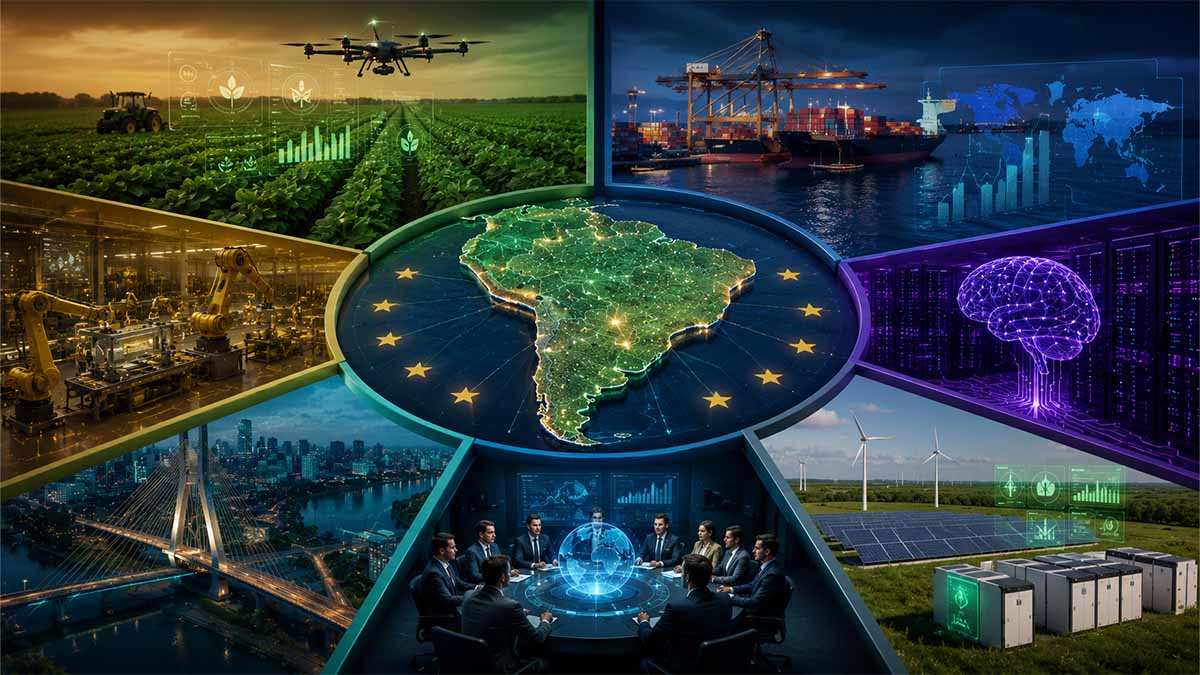
Executive Summary
The EU-Mercosur agreement is structurally favorable to Brazil’s AI infrastructure ambitions but potentially restrictive to Brazil’s AI software sovereignty and regulatory flexibility. The agreement materially improves conditions for European investment into Brazilian energy systems, rare-earth processing, cloud infrastructure, subsea connectivity, logistics corridors, and industrial supply chains, while remaining largely silent on AI governance, cross-border data flows, foundation-model regulation, training-data exemptions, algorithmic disclosure, and sovereign compute protections.
Over the next five years, the principal beneficiaries are likely to be Brazil, Argentina, and Uruguay in infrastructure and energy-linked AI development, while the principal strategic winners outside Mercosur could be Germany, France, Spain, Portugal, South Korea, Japan, and selected US hyperscalers seeking low-carbon compute expansion.
The greatest strategic risk for Brazil is regulatory convergence with the European Union’s AI Act and GDPR architectures, which could disproportionately burden Brazilian startups relative to European incumbents. Simultaneously, the agreement may accelerate a continental transition in which South America becomes an “AI infrastructure hinterland” supplying renewable electricity, critical minerals, and data-center territory without capturing higher-margin foundation-model leadership.
The decisive variable between 2026-2031 will not be tariffs. It will be whether Brazil can transform energy abundance, Portuguese-language data ecosystems, sovereign compute initiatives, and AI industrial policy into an integrated regional AI stack before external regulatory dependencies become structurally locked in.
“The Southern Common Market (MERCOSUR for its Spanish initials) is a regional integration process, initially established by Argentina, Brazil, Paraguay and Uruguay, and subsequently joined by Venezuela* and Bolivia**.)
EXECUTIVE FORENSIC CORE
EU-Mercosur Agreement • Brazil AI Sovereignty • 2026-2031
Premature alignment with EU AI Act and GDPR creates asymmetric compliance burdens favoring European incumbents over Brazilian startups.
Brazil supplies renewable energy, critical minerals, and data-center territory while higher-margin foundation-model leadership remains externalized.
Omission of digital governance provisions risks loss of flexibility in data flows, training-data exemptions, and sovereign compute protections.
By 2031, Brazil risks entrenched AI infrastructure dependency unless it prioritizes sovereign compute, Portuguese-language models, and selective regulatory hybridization to counter EU extraterritorial standards before lock-in occurs.
CORE FOCUS & KEY CONCEPTS
• AI Infrastructure Sovereignty: Control over compute power, data centers, chips, energy, and cloud systems → Determines whether Brazil builds its own AI capacity or only hosts foreign AI infrastructure.
• Regulatory Convergence: Brazil may align with EU-style rules such as GDPR and the EU AI Act → Helps market access but may raise compliance costs for Brazilian startups.
• Green Compute Advantage: Brazil and Uruguay have high renewable electricity shares → Makes them attractive for low-carbon data centers and AI infrastructure.
• Critical Minerals Link: Brazil and Argentina supply minerals used in batteries, chips, grids, and data-center systems → Supports AI hardware supply chains but risks raw-material dependency.
• EU Country Specialization: Germany, France, Spain, Italy, Poland, Romania, and the UK each offer different AI investment roles → Brazil can benefit most by combining their strengths instead of depending on one partner.
CRITICALITIES & BOTTLENECKS
• GPU Dependency: [Root Cause] Brazil lacks frontier AI-chip production → [Current Impact] foreign suppliers control access to advanced compute → [Data Evidence] Ceitec funding is R$220 million but focused on limited semiconductor capability. Severity: 🔴 High
• Regulatory Cost Burden: [Root Cause] EU-style AI and data rules require documentation, audits, transparency, and risk controls → [Current Impact] startups may face costs designed for large firms → [Data Evidence] EU AI Act applies to general-purpose AI models. Severity: 🔴 High
• Training-Data Uncertainty: [Root Cause] unclear rules on using public, copyrighted, and personal data for AI training → [Current Impact] slows foundation-model development → [Data Evidence] ANPD suspended Meta’s AI-training data processing in July 2024, later allowing restricted resumption. Severity: 🔴 High
• Extractive Infrastructure Risk: [Root Cause] foreign firms may control cloud, chips, and models while Mercosur supplies energy and minerals → [Current Impact] local value capture remains weak → [Data Evidence] [REQUIRES CLARIFICATION: ownership data not specified]. Severity: 🟡 Medium
• Fragmented Regional Strategy: [Root Cause] Brazil, Argentina, Uruguay, and Paraguay may negotiate separately → [Current Impact] weaker bargaining power against US, EU, and Chinese platforms → [Data Evidence] [NOT SPECIFIED]. Severity: 🟡 Medium
STRENGTHS & STRATEGIC ADVANTAGES
• Brazil’s Renewable Electricity: Brazil has a very high renewable electricity share → Supports low-carbon AI data centers → 88.2% renewable electricity generation in 2024.
• Uruguay’s Green Hosting Profile: Uruguay combines renewable electricity with institutional stability → Strong niche for trusted data hosting → 98% renewable electricity generation in 2025.
• Argentina’s Lithium Role: Argentina strengthens the upstream AI hardware chain → Lithium supports batteries and power systems for digital infrastructure → lithium was 15.1% of mining export value in 2025.
• Paraguay’s Hydropower Base: Paraguay can convert hydropower into compute attraction → Low-carbon electricity may support data-center siting → Itaipu generated 67,089 GWh in 2024.
• European Partner Diversity: Germany, France, Spain, Italy, Poland, Romania, and the UK provide different AI assets → Enables Brazil to diversify partners across industry, compute, language models, finance, and regulation.
PROJECTIONS & EXPECTATIONS
[Short-term (0–6 mo)]
• IF Brazil continues PBIA implementation → THEN green data centers, public AI, and supercomputing will remain priority areas.
• IF PL 2338 advances without proportional rules → THEN compliance uncertainty for startups will increase.
[Mid-term (6–18 mo)]
• IF EU-Mercosur implementation deepens → THEN European industrial AI, machinery, cloud, and energy investment channels should expand.
• IF ANPD continues sandbox-based regulation → THEN Brazil may balance innovation with data protection more effectively.
[Long-term (>18 mo)]
• IF Brazil secures GPU access and builds sovereign cloud capacity → THEN it can become Latin America’s strongest AI infrastructure hub by 2031.
• IF foreign firms control chips, cloud platforms, and models → THEN Mercosur risks becoming an AI infrastructure periphery.
• IF Brazil coordinates with Uruguay, Argentina, and Paraguay → THEN a South Atlantic AI corridor becomes more realistic.
DATA CONTEXT & METRIC ANCHORS
| Metric/Indicator | Current Value | Trend/Status | Strategic Relevance |
|---|---|---|---|
| Brazil PBIA investment frame | R$23 billion | [Verified] Active policy base | Funds AI strategy and infrastructure |
| Brazil renewable electricity | 88.2% in 2024 | [Verified] Strong | Supports low-carbon compute |
| PBIA green data-center funding | R$500 million | [Verified] Planned/allocated | Supports sustainable AI infrastructure |
| Ceitec semiconductor funding | R$220 million, 2024–2026 | [Verified] Restarting capability | Limited chip sovereignty improvement |
| Uruguay renewable electricity | 98% in 2025 | [Verified] Very strong | Green hosting advantage |
| Paraguay Itaipu generation | 67,089 GWh in 2024 | [Verified] Strong | Hydropower compute potential |
| Argentina lithium mining export share | 15.1% in 2025 | [Verified] Rising | Battery and infrastructure relevance |
| Managed Brazilian AI ascent scenario | 35% | [Estimated] Most likely scenario | Brazil rises but remains GPU-dependent |
Abstract
The strategic significance of the EU-Mercosur agreement extends far beyond agriculture, industrial tariffs, or conventional trade liberalization. Although public debate surrounding the accord has concentrated on beef quotas, ethanol access, environmental clauses, and industrial exports, the deeper geopolitical consequence concerns the emergence of a new transatlantic technological architecture centered on energy, compute infrastructure, mineral security, and regulatory influence. The agreement therefore intersects directly with the trajectory of Brazil’s national artificial-intelligence strategy, particularly the Plano Brasileiro de Inteligência Artificial (PBIA) 2024-2028 launched by the Ministério da Ciência, Tecnologia e Inovação in July 2024. Plano Brasileiro de Inteligência Artificial – Governo Federal do Brasil – 2024
The central paradox is that the agreement strengthens nearly every physical prerequisite for large-scale AI development while failing to secure many of the digital, legal, and regulatory conditions necessary for Brazil to become a sovereign AI power. This distinction is foundational. Artificial intelligence systems do not emerge solely from algorithms. They emerge from convergences among electricity systems, semiconductor supply chains, mineral processing ecosystems, subsea cable networks, cloud-infrastructure financing, research universities, sovereign procurement systems, and regulatory environments capable of balancing innovation with strategic autonomy. The EU-Mercosur framework materially affects several of these domains simultaneously.
The agreement politically concluded in revised form on 6 December 2024 between the European Union and the Mercosur bloc consisting of Brazil, Argentina, Paraguay, and Uruguay. EU-Mercosur Agreement – European Commission – December 2024 Subsequent implementation procedures accelerated during 2025 and 2026, including provisional application measures announced by the European Commission. EU-Mercosur trade accord to apply provisionally from May 1 – Reuters citing European Commission – March 2026
At the macro-structural level, the agreement creates one of the world’s largest integrated trade zones, covering roughly 700 million people and major industrial, agricultural, and resource networks across Europe and South America. EU and Mercosur sign trade deal after 25 years of negotiations – Reuters – January 2026 Yet its hidden strategic dimension is that it effectively institutionalizes Europe’s long-term access to South American energy systems, rare-earth processing chains, lithium corridors, agricultural data ecosystems, and decarbonized industrial infrastructure at precisely the historical moment when AI compute demand is exploding globally.
This timing matters because AI has entered an infrastructure phase rather than merely a software phase. Training frontier models now requires industrial-scale electricity consumption, massive GPU clusters, liquid-cooling systems, fiber-optic resilience, and long-duration capital commitments. In this context, Brazil possesses several unusually favorable structural advantages. The country operates one of the cleanest major electricity matrices in the world, with renewables representing approximately 85% of electricity generation. Plano Brasileiro de Inteligência Artificial – Governo Federal do Brasil – 2024 This characteristic becomes strategically transformative when combined with the growing European emphasis on carbon accounting, ESG disclosure, sustainability taxonomy requirements, and environmental reporting obligations affecting digital infrastructure operators.
For European hyperscale cloud providers, semiconductor firms, and AI infrastructure investors, Brazil increasingly appears not simply as a commodity exporter but as a potential low-carbon compute jurisdiction. AI infrastructure increasingly follows energy abundance. The same geopolitical dynamic currently benefiting Gulf monarchies and Nordic states may begin emerging across parts of South America, particularly southeastern Brazil.
The PBIA itself explicitly recognizes this transition. The Brazilian plan includes ambitions to construct advanced supercomputing infrastructure, strengthen sovereign data capabilities, expand AI education and workforce training, improve Portuguese-language foundation models, and establish governance institutions focused on algorithmic transparency and trustworthy AI systems. Plano Brasileiro de Inteligência Artificial (PBIA) 2024-2028 – Governo Federal do Brasil – August 2024 The strategy further envisions Brazil becoming a globally relevant AI actor rather than remaining merely a consumer of imported models and platforms.
Yet the EU-Mercosur agreement conspicuously omits many of the core legal dimensions shaping AI competition in the 2020s. The agreement contains no dedicated AI chapter, no digital-trade framework comparable to those in the USMCA or CPTPP, no binding commitments on cross-border data flows, no provisions governing training-data portability, no protections concerning source-code disclosure, and no common standards governing foundation models. EU-Mercosur: Text of the Agreement – European Commission – December 2024
This omission is strategically consequential because regulatory architecture increasingly determines who captures value in the AI ecosystem. The absence of digital governance provisions effectively means that Brazilian firms seeking access to European AI markets remain subject to unilateral regulatory determinations by Brussels. This includes extraterritorial effects arising from the General Data Protection Regulation (GDPR) and the EU AI Act.
The geopolitical implication is subtle but profound. Europe may not dominate frontier AI model development relative to the United States or China, but it increasingly dominates global AI regulatory exportation. Through market size and compliance leverage, Brussels possesses extraordinary capacity to externalize regulatory norms beyond European borders. This phenomenon, sometimes described as the “Brussels Effect,” becomes particularly important for middle-income economies attempting simultaneously to integrate with European markets and cultivate domestic AI industries.
Brazil therefore faces a dual strategic reality. On one side, convergence with European standards may facilitate investment flows, legal predictability, institutional trust, and interoperability with advanced economies. On the other side, premature convergence could impose compliance burdens that disproportionately favor large incumbents over emerging Brazilian firms.
This asymmetry becomes especially dangerous in relation to foundation-model regulation. Large European or American firms possess the capital, legal teams, cybersecurity infrastructure, adversarial-testing systems, audit capabilities, and reporting capacity necessary to satisfy complex AI compliance frameworks. Smaller Brazilian startups frequently do not. Consequently, if Brazil fully harmonizes with stringent European AI rules before achieving domestic industrial scale, it risks entrenching technological dependency rather than achieving sovereignty.
The training-data issue illustrates the problem clearly. The European framework emphasizes consent structures, documentation obligations, and copyright protections that can significantly constrain large-scale dataset development. By contrast, jurisdictions such as Japan adopted comparatively permissive approaches toward copyrighted data usage for AI training, thereby accelerating domestic experimentation. Brazil has not fully resolved this question domestically. Yet if the country effectively imports European restrictions through political or commercial alignment pressures, Brazilian developers may lose strategic flexibility during the formative years of national AI ecosystem development.
This tension is amplified by the structure of the Brazilian economy itself. Brazil possesses exceptional strengths in renewable energy, agritech data, biodiversity datasets, public digital services, and industrial resource extraction. However, it remains structurally weaker in advanced semiconductors, hyperscale cloud ecosystems, sovereign GPU manufacturing, and frontier-model capitalization. The risk is therefore that Brazil evolves into a supplier of inputs—energy, minerals, environmental assets, and territorial infrastructure—while higher-margin AI intellectual property remains concentrated elsewhere.
The AI economy increasingly resembles previous historical extractive hierarchies. During earlier industrial eras, peripheral economies exported raw materials while core economies controlled manufacturing and finance. In the AI era, a similar hierarchy may emerge involving data, electricity, minerals, and compute geography. Under this scenario, Brazil could become indispensable to global AI infrastructure while remaining subordinate within the higher layers of algorithmic power.
However, this outcome is not predetermined. The EU-Mercosur agreement also creates opportunities for strategic repositioning. By stabilizing investment conditions and reducing political uncertainty, the agreement potentially accelerates long-term infrastructure financing into Brazil’s digital and energy sectors. European capital seeking sustainable infrastructure exposure may increasingly support Brazilian data centers, subsea cable expansion, AI-optimized power systems, semiconductor packaging facilities, and research partnerships.
Among Mercosur members, Brazil clearly occupies the dominant AI position because of scale, industrial depth, university ecosystems, and electricity infrastructure. Yet other countries may benefit differently. Argentina possesses critical strategic advantages through lithium reserves concentrated within the “Lithium Triangle.” European demand for battery materials and energy-transition minerals indirectly reinforces Argentina’s relevance to future AI hardware supply chains because advanced compute systems require stable mineral inputs. The agreement’s investment protections may therefore strengthen Argentina’s attractiveness for mineral-processing expansion and related infrastructure.
Uruguay may emerge as a disproportionately important digital node despite its smaller size. Uruguay already possesses comparatively advanced digital governance institutions, political stability, renewable energy penetration, and favorable connectivity characteristics. Over the next five years, Uruguay could position itself as a regional AI hosting, compliance, fintech, and data-governance hub serving both Mercosur and European firms.
Paraguay, although less discussed, possesses major hydroelectric advantages linked to the Itaipu system and broader regional electricity dynamics. If AI compute increasingly follows cheap and renewable energy, Paraguay could become relevant for lower-cost infrastructure hosting or industrial AI deployment.
Outside Mercosur, the agreement also creates indirect strategic opportunities for several external powers. Germany stands to benefit through industrial exports, machinery systems, automotive supply chains, and green-industrial integration. German firms may seek Brazilian low-carbon industrial platforms for AI-enabled manufacturing and digital industrial systems.
France occupies a more ambivalent position. Paris has historically expressed reservations regarding agricultural competition and environmental concerns associated with Mercosur. Nevertheless, France simultaneously seeks leadership in European AI policy and sovereign AI capabilities. French AI firms such as Mistral AI may ultimately benefit from expanded South American infrastructure partnerships if regulatory alignment deepens.
Spain and Portugal could gain disproportionate influence because of linguistic and historical ties facilitating AI localization, cloud expansion, fintech integration, and digital-services coordination between Europe and Latin America. Portuguese-language AI ecosystems may become especially important as Brazil attempts to build sovereign linguistic datasets and regional model architectures.
Beyond Europe, South Korea and Japan may become the most strategically compatible partners for Brazil’s AI ambitions. Unlike Europe, these countries combine advanced semiconductor ecosystems with comparatively pragmatic technology-industrial policies. Japan’s more permissive AI-training approach and South Korea’s hardware strengths align more naturally with Brazil’s developmental stage. Over the next five years, Brazil may increasingly pursue triangulated partnerships combining European capital, Asian hardware ecosystems, and domestic infrastructure advantages.
The role of the United States remains uncertain. Structurally, the United States remains Brazil’s most valuable potential AI partner because it controls frontier semiconductors, hyperscale cloud ecosystems, and the dominant global AI firms. However, political unpredictability, export-control regimes, and inconsistent Latin America strategies reduce confidence in long-term alignment. European Union official gateway – European Union – accessed May 2026 Consequently, Brazil may attempt a hedging strategy rather than exclusive dependence on either Washington, Brussels, or Beijing.
The Chinese dimension introduces another layer of complexity. China remains deeply embedded in South American infrastructure, mining, telecommunications, and logistics networks. Chinese firms possess substantial capacity to finance energy systems, cloud infrastructure, surveillance technologies, and digital ecosystems across Latin America. Yet Chinese AI partnerships often raise concerns regarding technological dependency, opaque governance structures, and extractive economic patterns.
Thus Brazil increasingly confronts a tripolar AI dilemma. The European model offers predictability and regulatory legitimacy but risks over-compliance and industrial dependency. The American model offers frontier technology access but suffers from strategic inconsistency and geopolitical volatility. The Chinese model offers capital and infrastructure speed but risks dependency and asymmetrical control.
The next five years therefore become decisive. Several mutually exclusive scenarios are plausible.
The first scenario is “Infrastructure Dependency.” Under this pathway, Brazil successfully attracts European and foreign investment into data centers, cloud systems, energy corridors, and mineral processing but fails to cultivate competitive domestic AI firms. Brazil becomes indispensable to AI infrastructure yet remains technologically dependent on external platforms.
The second scenario is “Regulated Convergence.” Brazil increasingly harmonizes with European AI governance structures, facilitating market access and institutional legitimacy but constraining experimentation and startup flexibility. Domestic innovation slows relative to global frontier ecosystems.
The third scenario is “Sovereign Hybridization.” Brazil selectively adopts European governance principles while simultaneously building domestic compute infrastructure, open-source Portuguese-language models, and industrial partnerships with Asian semiconductor ecosystems. This is likely the most strategically favorable pathway for Brazilian sovereignty.
The fourth scenario is “Extractive Digitalization.” Foreign firms dominate Brazilian AI infrastructure while value capture remains externalized. South America effectively becomes a green compute colony supporting foreign AI systems without developing endogenous innovation ecosystems.
The fifth scenario is “South Atlantic AI Bloc Formation.” Brazil leverages Mercosur integration to create regional AI standards, cloud systems, educational networks, and energy infrastructure capable of supporting a broader Latin American AI ecosystem partially autonomous from both Europe and the United States.
Among these scenarios, current indicators suggest the highest probability lies between Infrastructure Dependency and Sovereign Hybridization. Brazil possesses the demographic scale, energy advantages, scientific institutions, and industrial capacity necessary for meaningful AI sovereignty. However, achieving that outcome requires avoiding premature regulatory lock-in while simultaneously accelerating domestic compute capability.
The decisive strategic variable will likely be compute sovereignty. Countries that control electricity, GPU access, data ecosystems, and sovereign cloud capacity will dominate the next phase of AI geopolitics. In this respect, the EU-Mercosur agreement indirectly strengthens Brazil’s position by improving long-term investment predictability and infrastructure financing conditions. Yet the agreement alone cannot guarantee AI sovereignty because sovereignty depends not merely on infrastructure ownership but on control over standards, models, datasets, and innovation ecosystems.
The geopolitical importance of this distinction cannot be overstated. AI is rapidly becoming a foundational layer of economic productivity, military modernization, bureaucratic governance, financial systems, and cognitive influence operations. Countries unable to cultivate domestic AI ecosystems may eventually confront forms of dependency deeper than previous industrial dependencies because AI increasingly mediates knowledge production itself.
For Brazil, therefore, the EU-Mercosur agreement represents neither outright victory nor outright constraint. It is better understood as an infrastructural accelerator embedded within an unresolved global struggle over technological sovereignty. The agreement strengthens the physical substrate necessary for AI development—energy, minerals, logistics, investment certainty, and industrial integration. Yet it leaves unresolved the legal, algorithmic, and strategic dimensions determining whether Brazil ultimately becomes an AI power, an AI service market, or an AI extraction zone within the emerging global order.
The period from 2026-2031 will therefore likely determine whether South America enters the AI century as a sovereign technological region or as a peripheral infrastructure appendage serving external digital empires. Brazil’s response to this challenge will shape not only its own future but the technological balance of the broader South Atlantic system.
Index / Navigator
1. Infrastructure Sovereignty and the South Atlantic Compute Corridor
Critical minerals, renewable electricity, subsea cables, hyperscale data centers, sovereign cloud architecture, GPU dependency, energy geopolitics, and AI industrial corridors across Brazil, Argentina, Uruguay, and Paraguay.
2. Regulatory Power, Digital Trade, and the Battle for AI Governance
GDPR convergence, EU AI Act extraterritoriality, Brazilian PL 2338, foundation-model compliance, training-data legality, algorithmic sovereignty, and the geopolitical exportation of regulatory systems.
3. Five-Year Strategic Forecast (2026-2031)
Probabilistic scenarios, geopolitical driver sets, AI capital flows, regional winners and losers, US-China-EU competition, sovereign compute trajectories, and emerging Latin American AI alignment architectures.
4. European Power Roles in EU-Mercosur Trade Activation and AI Investment
South Atlantic AI Ecosystem
Chapters 1–4 • Complete Interconnected Overview • May 2026
| Entity | Renewable Energy | Strategic Minerals | AI Infrastructure Role | Key Funding | Regulatory Status | 2031 Outlook |
|---|---|---|---|---|---|---|
| Brazil | 88.2% | 8 critical (Li,Cu,Nb,etc.) | Regional AI Anchor + Green Compute | R$23B PBIA • R$500M green DCs • R$220M Ceitec | PL 2338/2023 + LGPD | Managed Ascent (35%) |
| Argentina | Moderate | Extensive Lithium | Mineral & Battery Supplier | [DATA UNAVAILABLE] | Fragmented | Mineral Supplier |
| Uruguay | 98% | Limited | Trusted Green Hosting | [DATA UNAVAILABLE] | High predictability | Niche Hosting Leader |
| Paraguay | 67,000+ GWh Itaipu | Limited | Hydropower Compute | [DATA UNAVAILABLE] | Energy-centric | Low-cost Power Option |
| Germany | — | Importer | Industrial AI Leader (Rank 1) | Federal AI Programs | EU AI Act | Very High |
| France | — | Importer | Sovereign Capital (Rank 2) | €109 Billion | EU AI Act Leadership | Very High |
| Spain | — | Importer | Language Bridge (Rank 3) | MareNostrum 5 | National AI Strategy | High |
| Renewable Energy | 88.2% (2024–2025) |
| PBIA Investment | R$23 billion (2024–2028) |
| Green Data Centers | R$500 million (Feb 2025) |
| Semiconductors | Ceitec – R$220 million |
| Regulatory | PL 2338/2023 + LGPD + ANPD |
| 2031 Role | Managed Ascent – Green Compute Hub |
| Germany | Industrial AI & Machinery (Rank 1) |
| France | Sovereign AI Capital – €109B |
| Spain | Language & Atlantic Bridge (Rank 3) |
| UK | £14B AI Finance & Safety (Extra-Treaty) |
🇧🇷 Brazil
| Renewable Share | 88.2% (BEN May 2025) |
| Critical Minerals | 8 materials (ANM Apr 2026) |
| ANPD Action | Meta suspension Jul 2024 → restricted Aug 2024 |
| EU-Mercosur | Provisional application May 2026 |
🌍 Mercosur Partners
| Uruguay | 98% renewable • Trusted hosting |
| Paraguay | 67,000+ GWh Itaipu • Hydro surplus |
| Argentina | Lithium Triangle • Battery storage |
🇪🇺 European Contributors
| Germany | Industrial automation & machinery |
| France | €109B AI investment • Sovereign compute |
| Spain | Portuguese-Spanish language models |
Chapter 1: Infrastructure Sovereignty and the South Atlantic Compute Corridor
The decisive geopolitical question for the next generation of artificial intelligence is no longer merely who invents the most advanced model architectures. The emerging struggle concerns who controls the underlying infrastructure stack required for industrial-scale computation: electricity grids, subsea transmission systems, strategic mineral refining, hyperscale data-center geography, sovereign cloud jurisdiction, semiconductor access, high-capacity fiber routes, and AI-optimized logistics corridors. Within this evolving contest, Brazil is becoming increasingly important not because it rivals the United States or China in frontier model development, but because it possesses a rare convergence of renewable energy scale, territorial depth, industrial diversification, critical-mineral availability, freshwater reserves, and Atlantic connectivity.
The Plano Brasileiro de Inteligência Artificial (PBIA) formally identified sovereign computational infrastructure as a strategic national objective and explicitly linked artificial intelligence development to high-performance computing, sustainable data centers, public-sector digitalization, and national supercomputing capability Plano Brasileiro de Inteligência Artificial – Ministério da Ciência, Tecnologia e Inovação – July 2024. Unlike many emerging-market AI strategies centered primarily on software adoption, Brazil’s doctrine increasingly recognizes that computational sovereignty depends on energy sovereignty. This shift aligns with a broader transformation inside global AI economics whereby electricity costs, cooling efficiency, and long-duration energy predictability increasingly determine the location of next-generation compute clusters.
The strategic significance of EU-Mercosur lies precisely here. Although publicly framed around industrial tariffs and agricultural access, the agreement materially reshapes the investment environment surrounding South American infrastructure corridors relevant to AI deployment. The European Commission explicitly states that the agreement improves access to critical raw materials, green technologies, industrial machinery, and long-term investment stability Factsheet: EU-Mercosur Partnership Agreement – European Commission – December 2024. This legal stabilization matters because hyperscale AI infrastructure requires investment horizons extending beyond traditional commodity cycles. Data centers, fiber systems, transformer networks, substations, and grid-stabilization assets operate on multi-decade capital assumptions rather than short-term trade arbitrage.
The energy dimension is foundational. Brazil’s electricity matrix reached approximately 88.2% renewable generation in 2024 according to the official national energy balance Relatório Síntese 2025 do Balanço Energético Nacional – Empresa de Pesquisa Energética – May 2025. This figure is extraordinary by global standards. By comparison, most advanced industrial economies attempting large-scale AI deployment still depend substantially on fossil-fuel balancing systems. For AI infrastructure operators increasingly pressured by ESG frameworks, climate disclosure requirements, and carbon-accounting obligations, Brazil offers something structurally rare: high-capacity renewable electricity combined with continental territorial scale.
The implications for hyperscale computation are substantial. AI training clusters increasingly consume electricity volumes comparable to industrial zones. The next generation of frontier training environments is projected globally to require gigawatt-scale power systems, long-duration cooling redundancy, and uninterrupted grid reliability. Brazil’s hydroelectric architecture, complemented by expanding wind and solar capacity, therefore transforms the country into a potentially attractive AI compute jurisdiction. The Ministério da Ciência, Tecnologia e Inovação subsequently announced dedicated PBIA funding for “green data centers” integrating renewable electricity and digital infrastructure PBIA prevê R$ 500 milhões para data centers verdes – Ministério da Ciência, Tecnologia e Inovação – February 2025.
This transformation is reinforced by Brazil’s territorial geography. Unlike densely constrained European jurisdictions facing energy bottlenecks and permitting difficulties, Brazil possesses large inland industrial zones with access to hydropower systems, transmission corridors, freshwater cooling potential, and industrial logistics infrastructure. Regions surrounding Minas Gerais, São Paulo, Paraná, Rio Grande do Sul, and portions of the northeastern renewable corridor are increasingly relevant not merely for manufacturing but for future AI-compute siting strategies.
The mineral dimension deepens this strategic position. The AI economy depends upon an extensive upstream extraction ecosystem involving copper, lithium, nickel, graphite, manganese, cobalt, niobium, and rare earths. Brazil officially identifies several of these materials as strategic or critical minerals Minerais Críticos e Estratégicos – Agência Nacional de Mineração – April 2026. The Ministério de Minas e Energia further highlights Brazil’s relevance in lithium, graphite, rare earths, copper, nickel, and niobium supply chains Minerais Críticos do Brasil: Guia para Investidores Estrangeiros – Ministério de Minas e Energia – 2026.
These resources are not merely abstract industrial commodities. They directly underpin the production of transformers, advanced batteries, transmission systems, semiconductor packaging, cooling systems, server racks, and energy-distribution equipment necessary for AI infrastructure expansion. The strategic consequence is that Brazil increasingly occupies a dual role within the AI economy: energy provider and mineral platform simultaneously.
However, this infrastructure strength conceals a profound asymmetry. Brazil remains heavily dependent on foreign semiconductor ecosystems for advanced AI accelerators. The country possesses semiconductor capabilities through institutions such as Ceitec, which received renewed federal investment support between 2024-2026 MCTI anuncia investimento de R$ 220 milhões na Ceitec – Ministério da Ciência, Tecnologia e Inovação – December 2024. Yet these capabilities remain concentrated primarily in identification chips, RFID technologies, embedded systems, and specialized semiconductor applications rather than frontier AI GPUs.
This distinction is strategically decisive. The modern AI hierarchy increasingly separates into three layers:
| Layer | Strategic Controllers | Brazil Position |
|---|---|---|
| Frontier GPU fabrication | United States, Taiwan, partially South Korea | Structurally dependent |
| Compute hosting and energy infrastructure | Expanding multipolar field | Competitive advantage |
| Data localization and sovereign deployment | National governments and cloud alliances | Contested |
Brazil therefore risks occupying a middle-infrastructure position: powerful enough to host compute, insufficiently autonomous to manufacture the most advanced processors. This dependency creates exposure to export-control regimes, supply disruptions, geopolitical leverage, and cloud-provider concentration.
The subsea connectivity layer is equally important. AI sovereignty increasingly depends upon who controls transoceanic bandwidth and cloud transit routes. South America historically relied heavily on North Atlantic routing systems connecting through the United States, reinforcing data-dependency patterns. However, Brazil has gradually strengthened direct international cable connectivity across the South Atlantic. The cybersecurity dimension of these systems became more visible when Anatel implemented expanded cybersecurity obligations for submarine cable operators and cloud infrastructure providers through Resolution No. 767 Resolução Anatel nº 767 – Agência Nacional de Telecomunicações – August 2024.
The regulation addresses supplier dependency, foreign data exposure, incident management, infrastructure resilience, and telecommunications cloud systems. This evolution matters because AI infrastructure is inseparable from cyber resilience. Large-language-model ecosystems increasingly require low-latency international synchronization, distributed inference capacity, high-volume storage replication, and secure cross-border transfer systems. The protection of cable infrastructure therefore becomes part of national AI security doctrine.
The South Atlantic itself is becoming strategically revalued. Historically secondary to North Atlantic digital flows, the South Atlantic corridor increasingly connects South American energy systems, African mineral regions, European markets, and transcontinental fiber infrastructure. Brazil’s Atlantic geography consequently acquires new significance in AI geopolitics. Ports, landing stations, inland transmission routes, and digital logistics hubs become part of a wider contest over compute geography.
Within Mercosur, the infrastructure asymmetries are substantial.
Comparative AI Infrastructure Positioning Across Mercosur
| Variable | Brazil | Argentina | Uruguay | Paraguay |
|---|---|---|---|---|
| Renewable electricity scale | Very high | Moderate | Extremely high | Very high |
| Industrial diversification | High | Medium | Low | Low |
| AI institutional capacity | Expanding | Fragmented | Focused niche | Emerging |
| Strategic minerals | Extensive | Extensive lithium | Limited | Limited |
| Data-center attractiveness | Strong | Uneven | Strong niche | Energy-centric |
| Semiconductor ecosystem | Limited but active | Minimal | Minimal | Minimal |
| Grid scale | Continental | National | Compact | Compact |
| Export infrastructure | Extensive | Moderate | Strong logistics | Energy export focus |
Argentina’s relevance emerges primarily from mineral depth rather than digital infrastructure scale. Official Argentine mining data indicate strong lithium expansion trajectories tied to global electrification systems Exportaciones Mineras – Gobierno de Argentina – 2025. The country’s lithium corridor forms part of the broader “Lithium Triangle” shared with neighboring states. Yet the AI implications go beyond electric vehicles. High-density battery systems increasingly matter for backup power stabilization inside hyperscale computing facilities. As AI infrastructure grows more electricity intensive, energy-storage systems become strategically relevant to compute reliability itself.
Argentina nevertheless faces severe structural constraints. Macroeconomic instability, inflation volatility, currency instability, and infrastructure bottlenecks complicate long-term hyperscale investment decisions. Consequently, Argentina may emerge as a critical upstream supplier to AI infrastructure without necessarily becoming a dominant compute host itself.
Uruguay occupies a different strategic category. Its electricity system achieved approximately 98% renewable generation in 2025 Uruguay mantiene su alta renovabilidad en la generación eléctrica – Ministerio de Industria, Energía y Minería – January 2026. Unlike Brazil, Uruguay’s advantage is not scale but stability. The country possesses comparatively strong institutional predictability, advanced digital governance practices, and reliable renewable integration.
This creates a niche opportunity: regulatory-compliant green hosting. Uruguay may increasingly position itself as a trusted regional environment for fintech infrastructure, AI-enabled services, cloud backup systems, regional inference hubs, and low-carbon enterprise hosting. In effect, Uruguay’s future AI role resembles that of a specialized digital jurisdiction rather than a continental AI superpower.
Paraguay represents yet another model centered on hydroelectric surplus. Itaipu Binacional reported over 67,000 GWh of generation during 2024 Memoria Anual ITAIPU 2024 – ITAIPU Binacional – July 2025. Paraguay’s strategic opportunity lies in converting low-cost renewable electricity into compute attraction. This could involve industrial AI facilities, low-cost cloud hosting, or energy-intensive digital services.
However, energy abundance alone is insufficient. The critical determinant becomes whether Paraguay develops the transmission redundancy, legal predictability, cybersecurity governance, and telecommunications architecture necessary for hyperscale deployment. Without these layers, electricity remains an export commodity rather than the basis of sovereign digital infrastructure.
The European dimension introduces another strategic layer. Europe increasingly requires low-carbon industrial partnerships to sustain decarbonization trajectories while supporting digital transformation. The AI sector directly intensifies electricity demand inside Europe at precisely the moment when energy security concerns remain elevated following the disruption of Russian gas dependence. South America therefore becomes attractive as an externalized compute geography capable of hosting energy-intensive digital infrastructure linked to European capital and industrial systems.
This creates a possible “South Atlantic Compute Corridor” connecting European finance, Brazilian renewable infrastructure, Argentine minerals, Uruguayan hosting stability, and Paraguayan hydropower. Yet the corridor’s governance remains unresolved. Three competing infrastructure futures are plausible between 2026-2031.
Scenario Matrix: South Atlantic AI Infrastructure Futures
| Scenario | Description | Probability |
|---|---|---|
| Extractive Compute Periphery | Foreign firms dominate infrastructure while local value capture remains weak | Medium-High |
| Sovereign Hybridization | Mercosur states combine foreign investment with local compute sovereignty mechanisms | Medium |
| Fragmented Dependency | Infrastructure expands unevenly under competing US, EU, and Chinese ecosystems | Medium-High |
| South Atlantic Digital Bloc | Regional AI coordination emerges around energy and cloud systems | Low-Medium |
| Regulatory Overload | Excessive compliance burdens deter local AI industrialization | Medium |
The “Extractive Compute Periphery” scenario is particularly important. Under this pathway, South America becomes to AI what many developing economies historically became to industrial capitalism: a provider of inputs without control over higher-margin intellectual systems. Electricity, minerals, land, and cooling geography would remain local, while GPUs, model architectures, cloud platforms, and monetization systems remain foreign controlled.
The “Sovereign Hybridization” scenario is more favorable to Brazil. Here, Brazil would leverage renewable energy and market scale to negotiate stronger domestic participation requirements. This could include public supercomputing systems, national cloud mandates, sovereign-data protections, local AI procurement requirements, and regional AI-education expansion. The PBIA already signals partial movement in this direction through state-linked infrastructure planning and public-sector AI integration Plano Brasileiro de Inteligência Artificial – Ministério da Ciência, Tecnologia e Inovação – July 2024.
The “Fragmented Dependency” scenario may be most realistic. Under this outcome, Brazil simultaneously integrates with European investment systems, American cloud providers, and Chinese infrastructure finance while attempting to preserve strategic flexibility. This balancing strategy resembles broader Brazilian geopolitical doctrine historically favoring multi-alignment rather than rigid bloc integration.
The central infrastructure question over the next five years is therefore not whether Mercosur becomes an AI superpower. It is whether South America captures sufficient sovereignty over the compute stack to avoid permanent subordination within foreign AI ecosystems. The infrastructure foundations increasingly exist: renewable electricity, territorial scale, critical minerals, Atlantic connectivity, industrial logistics, and emerging policy frameworks. The unresolved issue concerns ownership and control.
Who owns the data centers?
Who controls the GPUs?
Who governs the cloud layers?
Who captures the software rents?
Who defines cybersecurity standards?
Who possesses legal jurisdiction over AI inference systems?
Who controls the subsea routes?
Who can interrupt compute access during geopolitical crisis?
These questions define the real meaning of AI sovereignty in the South Atlantic system. The EU-Mercosur agreement strengthens parts of the physical foundation but does not resolve the sovereignty dilemma itself. The next five years will determine whether Brazil and its regional partners become infrastructure hosts within foreign AI empires or architects of a partially autonomous South Atlantic compute order.
Infrastructure Sovereignty
South Atlantic Compute Corridor • Chapter 1 • May 2026 Analysis
Brazil’s 88.2% renewable grid + territorial scale + critical minerals create a rare competitive advantage for hyperscale AI. Mercosur partners add stability (Uruguay) and hydropower (Paraguay). The decisive question for 2026-2031 is sovereignty: who owns the GPUs, cloud layers, and subsea routes?
Fragmented Dependency is the most likely near-term outcomeMercosur Renewable Electricity Share 2024-2025
BAR CHARTBrazil AI Infrastructure Stack • 2026 Position
DONUTSouth Atlantic Compute Corridor • 2026-2031 Pathways
NODE MAP88.2% renewable • Continental grid
Gigawatt-scale training anchor
Lithium Triangle • Battery storage
Critical for compute backup
98% renewable + stability
Trusted inference hosting
67,000 GWh Itaipu surplus
Low-cost hyperscale power
Anatel Resolution 767 strengthened direct South Atlantic routes
Reduces North-Atlantic dependency
| Variable | Brazil | Argentina | Uruguay | Paraguay | |||||
|---|---|---|---|---|---|---|---|---|---|
| Renewable Electricity Scale | Very High (88.2%) | Moderate | Extremely High (98%) | Very High | Detail: Brazil offers gigawatt-scale renewable power ideal for AI training clusters. | ||||
| Industrial Diversification | High | Medium | Low | Low | Detail: Supports full data center supply chain development. | ||||
| Strategic Minerals | Extensive (8 critical) | Extensive Lithium | Limited | Limited | Detail: Copper, Lithium, Niobium, Graphite, REEs directly support AI hardware. | ||||
| Data Center Attractiveness | Strong | Uneven | Strong niche | Energy-centric | Detail: Freshwater cooling + land availability give Brazil edge. | ||||
| Semiconductor Capacity | Limited (Ceitec R$220M boost) | Minimal | Minimal | Minimal | Detail: Focused on embedded systems, not frontier GPUs. | ||||
| Subsea Connectivity | Strengthening (South Atlantic) | Moderate | Strong logistics | Limited | Detail: Anatel Resolution 767 enhances cybersecurity and sovereignty. | ||||
| Grid Scale | Continental | National | Compact | Compact | Detail: Brazil’s size allows inland hyperscale sites. | ||||
| Scenario | Probability | Key Risk / Opportunity |
|---|---|---|
| Extractive Compute Periphery | Medium-High | Foreign control of GPUs/cloud while SA supplies energy/minerals |
| Sovereign Hybridization | Medium | Brazil negotiates local ownership + national cloud mandates |
| Fragmented Dependency | Medium-High | Multi-alignment with US/EU/China providers (most likely) |
| South Atlantic Digital Bloc | Low-Medium | Regional coordination on energy, cables, sovereign standards |
| Regulatory Overload | Medium | Excessive rules slow local AI industrialization |
Chapter 2: Regulatory Power, Digital Trade, and the Battle for AI Governance
The central regulatory finding is that Brazil’s AI ambition is not constrained mainly by tariffs; it is constrained by jurisdictional dependency. The EU-Mercosur agreement can move goods, capital, machinery, and investment across the Atlantic, but the decisive AI layer remains governed by external legal systems: GDPR, the EU AI Act, Brazilian LGPD, pending PL 2338/2023, platform enforcement by ANPD, and the still-unsettled legality of training foundation models on publicly available data. The European Union has already enacted a binding AI regulation that applies to providers and deployers outside the Union when AI-system output is used inside the Union Regulation (EU) 2024/1689 – European Parliament and Council of the European Union – June 2024.
The first strategic layer is GDPR convergence. The General Data Protection Regulation governs personal-data processing in the European Union, applies to controllers and processors outside the Union when offering goods or services to individuals in the Union or monitoring their behavior, and created a globally exportable compliance architecture centered on lawful basis, consent, legitimate interest, purpose limitation, data minimization, transparency, and enforceable data-subject rights Regulation (EU) 2016/679 – European Parliament and Council of the European Union – April 2016. For Brazil, the issue is not simple imitation; it is strategic absorption. The Brazilian LGPD already reflects many GDPR-style principles, and that makes future EU-facing AI exporters structurally more compatible with European compliance expectations, but it also means Brazilian firms may inherit costly documentation, data-governance, consent, and risk-management burdens before they possess European-scale capital reserves.
The second strategic layer is the EU AI Act. The regulation creates a risk-based AI governance system, including prohibited practices, high-risk AI duties, transparency duties, and specific obligations for general-purpose AI models Regulation (EU) 2024/1689 – European Parliament and Council of the European Union – June 2024. Its extraterritorial logic matters directly for Brazilian firms because a Brazilian AI provider serving European clients, integrating into European supply chains, or producing outputs used inside the EU can fall inside European compliance gravity even without being headquartered in Europe. That makes EU law a market-access filter for Brazilian AI exports, especially in finance, health, education, employment, public administration, biometric systems, critical infrastructure, and safety-relevant industrial AI.
| Regulatory layer | EU instrument | Brazilian counterpart | Strategic effect on Brazil |
|---|---|---|---|
| Personal data | GDPR | LGPD and ANPD enforcement | Easier EU alignment, higher compliance cost |
| AI risk governance | EU AI Act | PL 2338/2023 under congressional process | Risk-tier convergence likely |
| Foundation models | EU AI Act GPAI provisions | Still developing in Brazilian law | Compliance uncertainty for startups |
| Training data | GDPR, copyright, AI Act documentation | ANPD enforcement and pending AI law | Legal uncertainty over model training |
| Regulatory testing | EU AI sandboxes | ANPD AI/data sandbox | Possible innovation bridge |
PL 2338/2023 is the domestic battleground. The Senado Federal identifies the bill as a proposal “sobre o uso da Inteligência Artificial” authored by Senator Rodrigo Pacheco Projeto de Lei n° 2338, de 2023 – Senado Federal – 2023. The Senate approved the AI regulatory framework on 10 December 2024, sending it to the Câmara dos Deputados for analysis Senado aprova regulamentação da inteligência artificial – Senado Federal – December 2024. The Câmara dos Deputados later published the authenticated bill text, stating that it establishes national general rules for responsible AI governance, protection of fundamental rights, responsible innovation, competitiveness, and human centrality Projeto de Lei n.º 2.338, de 2023 – Câmara dos Deputados – March 2026.
The Brazilian bill therefore sits between two pressures. One pressure comes from innovation policy: Brazil wants domestic foundation models, Portuguese-language AI systems, public-service automation, AI for agriculture, AI for health, and national compute capacity. The other pressure comes from rights-based regulation: Brazil’s lawmakers and regulators are embedding fundamental-rights protection, transparency, risk classification, and accountability into the legal architecture Projeto de Lei n.º 2.338, de 2023 – Câmara dos Deputados – March 2026. The strategic danger is not regulation itself; it is premature heavy regulation before domestic AI firms develop scale.
ANPD has already demonstrated that training-data legality is not theoretical. On 2 July 2024, ANPD ordered the preventive suspension of personal-data processing for training Meta’s generative AI systems, citing signs of inadequate legal basis, lack of transparency, limitations on data-subject rights, and risks to children and adolescents ANPD determina suspensão cautelar do tratamento de dados pessoais para treinamento da IA da Meta – Autoridade Nacional de Proteção de Dados – July 2024. On 30 August 2024, ANPD approved Meta’s compliance plan with restrictions, requiring measures that expanded transparency, simplified refusal mechanisms, and excluded children’s and adolescents’ account data from the processing plan Meta cumpre exigências da ANPD e poderá retomar, com restrições, o uso de dados pessoais para treinamento de inteligência artificial – Autoridade Nacional de Proteção de Dados – August 2024.
This case is the clearest live signal for Brazil’s AI future. ANPD did not ban generative AI training outright; it forced compliance architecture around transparency, lawful basis, opt-out design, and vulnerable-user protection. That model may become Brazil’s practical regulatory style: not anti-AI, but procedurally strict. For large foreign platforms, this is manageable. For Brazilian startups, it can become a structural cost barrier if documentation, legal review, dataset governance, auditability, and user-rights systems become too expensive too early.
The foundation-model problem is sharper. The EU AI Act imposes specific duties on general-purpose AI model providers, including technical documentation, information-sharing duties toward downstream AI-system providers, copyright-policy obligations, and summaries of training content Regulation (EU) 2024/1689 – European Parliament and Council of the European Union – June 2024. If Brazil mirrors this structure too closely, a small Brazilian team building a Portuguese-language foundation model for agronomic advisory, public-health triage, legal assistance, tax support, or educational tutoring could face compliance architecture designed for multinational AI laboratories. That would strengthen safety documentation but weaken domestic competitive entry.
| AI governance issue | EU-style benefit | Brazil-specific risk |
|---|---|---|
| Dataset documentation | Improves traceability and accountability | Expensive for small model developers |
| Risk classification | Protects users in sensitive domains | May overclassify public-service AI |
| Human oversight | Reduces automated harm | Slows deployment in understaffed agencies |
| GPAI duties | Controls systemic foundation-model risks | Burdens Portuguese-language model builders |
| Copyright and training-data duties | Protects creators | Narrows training-data availability |
The training-data legality question is the most important unresolved variable. Brazil must decide whether publicly available data, copyrighted works, and personal data can be used to train AI models under consent, legitimate interest, opt-out, public-interest, research, or specific statutory exceptions. ANPD’s Meta proceeding shows that personal-data training claims will face scrutiny Processos de Fiscalização em Andamento – Autoridade Nacional de Proteção de Dados – 2024. The Câmara dos Deputados text also shows that the AI bill is now entangled with attached proposals on authorship, copyright, ownership, registration, and civil responsibility for AI-generated intellectual works PL 2338/2023 – Câmara dos Deputados – March 2026.
That linkage matters because Brazil’s AI ambitions depend heavily on Portuguese-language corpora, public-sector datasets, agricultural-extension records, judicial texts, educational materials, biodiversity data, health-system data, tax-administration data, and local-market behavioral data. If training access becomes highly restrictive, Brazil will face a dataset disadvantage against jurisdictions with permissive text-and-data-mining frameworks, larger domestic platform ecosystems, or state-controlled data reservoirs. If training access becomes too permissive, Brazil risks litigation, rights violations, international trust loss, and exclusion from European markets. The optimal Brazilian path is therefore neither maximal extraction nor maximal restriction; it is a tiered training-data regime that distinguishes personal data, copyrighted works, anonymized public-sector datasets, scientific corpora, indigenous and traditional-knowledge data, children’s data, and high-risk biometric data.
Algorithmic sovereignty is the next battlefield. The ANPD sandbox describes an experimental regulatory environment for innovative AI projects involving personal-data processing, focused on algorithmic transparency and LGPD compliance Perguntas Frequentes sobre o Edital nº 02/2025 – Autoridade Nacional de Proteção de Dados – 2025. ANPD states that the sandbox seeks to reconcile fundamental-rights protection with continued innovation and is especially useful for disruptive technologies where conformity with existing laws is uncertain O Sandbox Regulatório – Autoridade Nacional de Proteção de Dados – 2025. This is a crucial institutional bridge because Brazil can use sandbox governance to test AI systems before imposing full statutory burdens.
The digital-trade gap remains severe. The EU-Mercosur agreement does not provide a comprehensive AI-specific digital-trade architecture comparable to the most advanced digital-economy agreements. Therefore, Brazilian AI firms will not receive automatic relief from European data-transfer law, European AI risk classification, European platform rules, or European conformity obligations. The agreement improves trade relations, but it does not create a shared AI market. The result is asymmetric interdependence: European capital and standards enter Brazil more easily, while Brazilian AI services still confront European regulatory gates.
This asymmetry produces five competing geopolitical driver sets.
| Driver set | Mechanism | Result for Brazil |
|---|---|---|
| Brussels Effect | EU market size exports regulation | Brazil aligns to EU rules for market access |
| Developmental Autonomy | Brazil adapts rules to local innovation needs | More experimentation, higher EU friction |
| Platform Dominance | Foreign cloud/model firms absorb compliance costs | Brazilian startups lose relative ground |
| Rights-Based Governance | Strong ANPD and PL 2338 protections | Trust increases, deployment slows |
| Regulatory Sandbox Model | Controlled testing before hard rules | Best balance for innovation and safety |
The first driver, Brussels Effect, would make Brazil progressively more European in AI governance. This pathway improves trust, interoperability, and investor confidence, but it may reduce Brazil’s freedom to create permissive training-data exceptions or lighter foundation-model rules. The second driver, Developmental Autonomy, would make Brazil a selective regulator: strict on biometric surveillance, children’s data, public-service harms, and discriminatory systems, but more flexible on open-source development, public research, and domestic language models. The third driver, Platform Dominance, is the most dangerous: compliance costs become a moat protecting foreign hyperscalers and large foundation-model providers. The fourth driver, Rights-Based Governance, creates legitimate public safeguards but may slow public-sector AI adoption in tax, health, education, and environmental enforcement. The fifth driver, Regulatory Sandbox Model, is the most productive if Brazil scales it beyond symbolic experimentation.
For Brazil, the five-year forecast is therefore conditional. If PL 2338/2023 passes in a form closely tracking EU AI Act risk logic without startup exemptions, research safe harbors, open-source proportionality, and public-interest data mechanisms, the law may protect citizens while weakening Brazil’s AI industrial base. If the law incorporates proportional obligations, staged compliance, sandbox pathways, and differentiated duties for small providers, Brazil can preserve regulatory legitimacy without sacrificing technological emergence.
The strongest strategic recommendation is a dual-track model: EU-compatible at the export frontier, Brazil-calibrated at the domestic innovation frontier. Brazilian AI systems intended for the EU market should be built for GDPR and EU AI Act compatibility from inception. Brazilian domestic systems should follow rights-based safeguards but retain developmental space for public research, Portuguese-language models, open-source innovation, agritech AI, climate AI, and public-service modernization. This avoids the false choice between European over-compliance and unregulated extractive AI.
The final assessment is direct: EU-Mercosur helps Brazil’s AI governance only if Brazil uses the agreement as a market bridge, not as a legal template. The agreement expands the economic relationship, but the regulatory war will be fought elsewhere: in ANPD enforcement files, PL 2338/2023 amendments, copyright rules, data-transfer adequacy, foundation-model duties, cloud contracts, procurement standards, and public-sector AI governance. Brazil’s AI future will be strongest if it exports trust to Europe while refusing to import every European constraint before its domestic ecosystem reaches scale.
Regulatory Power & AI Governance
Chapter 2 • Battle for Digital Sovereignty • South Atlantic Compute Corridor • May 2026
Brazil must choose between full Brussels Effect alignment and a dual-track strategy: EU-compatible exports + developmental autonomy for domestic innovation. Premature heavy regulation risks killing Brazilian foundation models before they reach scale.
Regulatory Sandbox Model offers the best balanceRegulatory Convergence Heatmap
ALIGNMENT BARGeopolitical Driver Influence 2026-2031
DONUTRegulatory Risk vs Opportunity Matrix
NODE MAPANPD Meta precedent sets strict transparency standard
Critical for Portuguese-language models
Senate approved Dec 2024 • Now in Chamber
Risk of over-regulation for startups
EU AI Act extraterritorial reach
Market access filter for Brazilian exporters
Experimental testing environment
Best bridge for innovation + safety
| Issue | EU Instrument | Brazil Counterpart | Strategic Impact | |||||
|---|---|---|---|---|---|---|---|---|
| Personal Data | GDPR | LGPD + ANPD | High compliance cost, easier EU market access | Detail: Brazil already mirrors many GDPR principles but lacks European-scale enforcement resources. | ||||
| AI Risk Governance | EU AI Act (2024/1689) | PL 2338/2023 | Risk-tier convergence likely | Detail: Extraterritorial effect impacts Brazilian providers serving EU clients. | ||||
| Foundation Models | GPAI Obligations | Developing in PL 2338 | Heavy documentation burden on startups | Detail: Technical docs, copyright summaries, downstream sharing duties. | ||||
| Training Data | GDPR + AI Act | ANPD enforcement | Legal uncertainty for public datasets | Detail: ANPD forced Meta to improve transparency and exclude children’s data. | ||||
| Regulatory Testing | EU AI Sandboxes | ANPD Sandbox 2025 | Innovation bridge | Detail: Controlled environment to test before full regulation. | ||||
| Driver | Probability | Outcome for Brazilian AI Ecosystem |
|---|---|---|
| Brussels Effect | High | Strong alignment, higher compliance costs, better investor trust |
| Developmental Autonomy | Medium-High | Selective rules favoring local innovation and Portuguese models |
| Platform Dominance | Medium | Foreign hyperscalers absorb costs, Brazilian startups disadvantaged |
| Rights-Based Governance | High | Strong citizen protection, slower public-sector AI deployment |
| Regulatory Sandbox Model | Medium | Best path: test → scale → sovereign governance |
Chapter 3: Five-Year Strategic Forecast (2026–2031)
The five-year forecast is that Brazil will probably strengthen its position as Latin America’s leading AI infrastructure state, but it will only become a true AI power if it solves three bottlenecks simultaneously: accelerator access, sovereign cloud capacity, and regulatory calibration. The PBIA set a 2024–2028 national AI investment frame of about R$23 billion Brazil launches a USD 4 billion plan for AI and prepares global action – Governo do Brasil/G20 – July 2024. The EU-Mercosur agreement improves the investment environment for critical raw materials, green technologies, public procurement, and supply-chain predictability Factsheet: EU-Mercosur Partnership Agreement – European Commission – December 2024. The EU AI Act creates binding obligations for AI systems and general-purpose AI models operating within the European market Regulation (EU) 2024/1689 – European Parliament and Council of the European Union – June 2024.
The result is a strategic triangle: Europe offers capital, market access, and regulatory legitimacy; the United States controls the highest-value AI chips, frontier model ecosystems, and hyperscale cloud platforms; China offers infrastructure finance, alternative AI governance diplomacy, and non-Western digital alignment channels. Brazil, Argentina, Uruguay, and Paraguay will not move through this triangle equally.
Strategic Probability Matrix: 2026–2031
| Scenario | Probability | Core outcome | Main winner | Main loser |
|---|---|---|---|---|
| Managed Brazilian ascent | 35% | Brazil becomes a green compute and applied-AI hub but remains dependent on foreign GPUs | Brazil, EU investors | Smaller Brazilian startups |
| Infrastructure dependency | 25% | Data centers and minerals expand, but foreign firms capture model/platform rents | US/EU hyperscalers | Local AI sovereignty |
| Regulatory over-convergence | 15% | Brazil imports EU-style compliance faster than its startup ecosystem can absorb | Large incumbents | Brazilian SMEs |
| China-tilted infrastructure bloc | 10% | Chinese finance and AI cooperation deepen if Western access stays uncertain | China, infrastructure firms | EU strategic influence |
| Latin American AI alignment architecture | 15% | Mercosur and regional partners coordinate compute, data, and public AI systems | Brazil, Uruguay, regional public sector | Fragmented national strategies |
These probabilities are analytic estimates, not official forecasts. They are based on current official policy trajectories, investment signals, regulatory instruments, and infrastructure constraints documented by primary institutional sources. The highest-probability outcome is not full Brazilian AI sovereignty. It is managed ascent: Brazil becomes more important in AI infrastructure and public-sector AI deployment while remaining dependent on foreign chips, cloud architectures, and foundation-model ecosystems.
Capital Flows: AI Money Will Follow Energy, Minerals, and Regulatory Certainty
The first driver is capital allocation. AI investment will move toward places where electricity is abundant, cleaner than peer markets, institutionally bankable, and connected to large demand zones. Brazil is well positioned because its electricity system is highly renewable, and its official energy balance reported 88.2% renewable electricity generation in 2024 Relatório Síntese 2025 do Balanço Energético Nacional – Empresa de Pesquisa Energética – May 2025.
The EU-Mercosur agreement strengthens this capital logic because the European Commission identifies Mercosur as a supplier of materials needed for green and digital transitions and states that the agreement lowers tariffs on critical raw materials and derived products Factsheet: EU-Mercosur Partnership Agreement – European Commission – December 2024.
Forecast: between 2026 and 2031, the most likely AI-related foreign investment into Brazil will not be pure AI model investment. It will be hybrid infrastructure investment: data centers, cloud regions, energy storage, grid equipment, cooling systems, cybersecurity services, fiber networks, and AI-enabled industrial automation.
AI Capital Flow Forecast
| Flow type | 2026–2031 intensity | Most likely destination | Reason |
|---|---|---|---|
| Green data centers | High | Brazil, Uruguay | Renewable power and institutional stability |
| Critical minerals | High | Brazil, Argentina | EU demand for green/digital inputs |
| Public-sector AI | Medium-high | Brazil | PBIA and federal digital state capacity |
| Foundation-model labs | Medium-low | Brazil | Language advantage, but compute bottleneck |
| GPU cluster investment | Medium | Brazil | Energy advantage, but chip access uncertainty |
| Regional AI governance | Medium | Brazil, Uruguay | Regulatory credibility and public-sector capacity |
US–China–EU Competition: Brazil Will Hedge, Not Align Exclusively
The United States remains the most important external actor for advanced AI compute because US-linked firms dominate frontier AI accelerators, cloud platforms, and foundation-model deployment. The US export-control environment remains unstable. The Bureau of Industry and Security announced in May 2025 that it would rescind the prior AI Diffusion Rule and issue a replacement approach Department of Commerce Announces Rescission of Biden-Era Artificial Intelligence Diffusion Rule – Bureau of Industry and Security – May 2025. Earlier, the Federal Register published the Framework for Artificial Intelligence Diffusion as an interim final rule on 15 January 2025 Framework for Artificial Intelligence Diffusion – Federal Register – January 2025.
For Brazil, this means GPU access is a geopolitical variable, not a normal procurement issue. Even when Brazil is not the principal target of US export controls, the global supply of advanced chips is shaped by US-China competition, licensing expectations, cloud security conditions, and trusted-partner classifications.
China offers a competing alignment channel. The People’s Republic of China released its Global AI Governance Initiative in October 2023, emphasizing equal rights to AI development, opposition to exclusive blocs, and broader access to AI technologies Global AI Governance Initiative – Ministry of Foreign Affairs of the People’s Republic of China – October 2023. China also uses AI governance diplomacy to appeal to countries seeking alternatives to Western regulatory and chip-control systems.
Europe offers the most mature rights-based AI regulatory model. The EU AI Act entered the official legal architecture as Regulation (EU) 2024/1689 Regulation (EU) 2024/1689 – European Parliament and Council of the European Union – June 2024. For Brazil, Europe is attractive as a market and investment partner, but its compliance model can raise costs for smaller domestic firms.
Forecast: Brazil will pursue non-exclusive technological hedging. It will seek US chips and cloud partnerships, EU capital and regulatory compatibility, Chinese infrastructure and BRICS-linked cooperation, and domestic sovereign compute programs under the PBIA.
Regional Winners and Losers
Brazil is the leading regional winner if it maintains policy coherence. Its advantages are market size, renewable electricity, industrial capacity, public digital infrastructure, and federal AI planning. Its weaknesses are dependence on imported accelerators, limited frontier semiconductor production, concentrated research capacity, and regulatory uncertainty around training data.
Argentina is a minerals winner but an AI-system uncertainty case. Its lithium and mining profile can attract capital, but macroeconomic volatility and weaker data-center attractiveness limit its near-term AI sovereignty trajectory.
Uruguay is a niche winner. It is unlikely to become a frontier AI state, but it can become a high-trust green hosting and AI-services jurisdiction. Its small size is a constraint; its institutional predictability is an asset.
Paraguay is an energy-option winner. Its hydropower position can support low-cost compute if paired with stronger telecommunications, cybersecurity, and data-center governance.
Regional Forecast Table
| Country | 2026–2031 AI role | Upside | Downside |
|---|---|---|---|
| Brazil | Regional AI anchor | Green compute, PBIA, public AI, market scale | GPU dependency, compliance costs |
| Argentina | Mineral and battery-chain supplier | Lithium and mining capital | Weak compute sovereignty |
| Uruguay | Trusted green digital node | Stable renewable hosting | Small domestic AI market |
| Paraguay | Hydropower compute option | Low-carbon electricity | Thin AI ecosystem |
Sovereign Compute Trajectories
The core sovereign-compute question is whether Brazil can move from “hosting compute” to “controlling compute.” Hosting means data centers exist on Brazilian territory. Controlling compute means Brazilian institutions can access, govern, prioritize, secure, and allocate AI processing capacity during crisis or strategic need.
The PBIA points toward this ambition by linking AI policy to infrastructure, sustainable data centers, and supercomputing Plano Brasileiro de Inteligência Artificial – Ministério da Ciência, Tecnologia e Inovação – July 2024. The MCTI also announced PBIA-linked green data-center funding of R$500 million PBIA prevê R$ 500 milhões para data centers verdes – Ministério da Ciência, Tecnologia e Inovação – February 2025.
The constraint is that compute sovereignty requires three layers at once: physical data-center capacity, access to advanced AI accelerators, and domestic governance of model/data workflows. Brazil is improving the first layer, exposed on the second, and still designing the third.
Sovereign Compute Scorecard
| Capability | Brazil 2026 baseline | 2031 likely position |
|---|---|---|
| Renewable power for compute | Strong | Stronger |
| Domestic data-center hosting | Growing | Strong |
| Frontier GPU access | Dependent | Still dependent |
| Public supercomputing | Expanding | Moderate |
| Domestic foundation models | Early-stage | Selective success |
| AI cloud sovereignty | Incomplete | Partially developed |
| Semiconductor autonomy | Weak | Limited improvement |
Latin American AI Alignment Architectures
The most important institutional opportunity is a Latin American AI alignment architecture centered on public-interest AI, Portuguese and Spanish language systems, open public datasets, climate monitoring, agricultural intelligence, health-system triage, education tools, and responsible public procurement. This architecture would not rival the US or China in frontier models, but it could create a defensible regional AI layer.
The foundation would be regional coordination among Brazil, Argentina, Uruguay, Paraguay, and possibly additional Latin American partners. Brazil would provide scale and public-sector AI capacity. Uruguay would provide trusted governance and green hosting. Argentina would provide scientific talent and mineral relevance. Paraguay would provide hydropower-linked compute optionality.
The alignment architecture would need five pillars:
| Pillar | Function |
|---|---|
| Regional compute pool | Shared public-sector GPU/supercomputing access |
| Language-model commons | Portuguese-Spanish public-interest datasets |
| AI procurement standards | Prevent foreign vendor lock-in |
| Data protection interoperability | Align LGPD-style rights with innovation |
| Strategic mineral-to-compute policy | Convert resources into local value capture |
The greatest risk is that the region fails to coordinate and each country signs separate deals with foreign hyperscalers, cloud providers, or infrastructure financiers. That would reproduce dependency through fragmented procurement.
Red-Team Counterfactuals
Counterfactual 1: Brazil overestimates its energy advantage. Clean electricity helps, but AI investors also need grid reliability, latency, permitting speed, skilled labor, tax clarity, cybersecurity, and predictable chip access. If these conditions lag, data-center investment may concentrate elsewhere.
Counterfactual 2: EU regulatory alignment becomes an advantage, not a burden. If Brazilian firms build compliance into their products early, they may gain trust in Europe faster than less regulated competitors.
Counterfactual 3: US export policy becomes more favorable to Brazil. If Washington treats Brazil as a trusted AI partner, accelerator access could improve and Brazil’s compute trajectory would rise sharply.
Counterfactual 4: China offers faster infrastructure deployment. If Chinese firms offer financing, cloud tools, and AI cooperation at speed, Brazil may deepen BRICS-linked AI channels despite European concerns.
Counterfactual 5: Latin America remains fragmented. If Mercosur fails to coordinate AI infrastructure and standards, the region will become a set of disconnected markets rather than a strategic AI bloc.
Final Forecast
By 2031, Brazil is likely to be the strongest AI infrastructure and governance actor in Latin America, but not yet a fully sovereign AI power. Its strongest path is a hybrid architecture: EU-compatible for exports, US-linked for advanced compute, selectively open to Asian hardware and research partnerships, and regionally anchored through Mercosur-scale infrastructure coordination.
The countries most likely to benefit are Brazil, Uruguay, and Argentina, in that order. Brazil gains the broadest AI-industrial upside. Uruguay gains a high-trust green-hosting niche. Argentina gains through lithium and mineral-chain relevance. Paraguay gains if it converts hydropower into digital infrastructure rather than remaining mainly an electricity exporter.
The main loser under a poorly managed trajectory would not be one country; it would be Latin American AI sovereignty itself. If the region supplies energy, minerals, data, and hosting geography while foreign actors control chips, models, cloud platforms, and monetization, the South Atlantic becomes an AI periphery. If Brazil converts PBIA funding, Mercosur infrastructure, green electricity, and regulatory sovereignty into a coordinated regional strategy, the South Atlantic becomes a serious AI corridor by 2031.
Five-Year Strategic Forecast 2026–2031
Chapter 3 • South Atlantic AI Trajectory • Managed Ascent Scenario
Brazil becomes Latin America’s leading AI infrastructure and applied-AI hub by 2031, but full sovereignty requires solving accelerator access, sovereign cloud, and calibrated regulation simultaneously. Hybrid hedging (US chips + EU capital + regional coordination) offers the strongest path.
South Atlantic as serious AI corridor by 2031 if coordinatedStrategic Probability Matrix 2026–2031
BAR CHARTSovereign Compute Scorecard 2026 → 2031
PROGRESS RADARRegional Winners & Losers 2031
NODE MAPRegional AI Anchor
Green compute + PBIA scale
Trusted Green Digital Node
High-trust hosting niche
Mineral & Battery Supplier
Lithium chain upside
Hydropower Compute Option
Low-cost energy potential
| Capital Flow Type | 2026–2031 Intensity | Primary Destination | Key Reason | |||||
|---|---|---|---|---|---|---|---|---|
| Green Data Centers | High | Brazil, Uruguay | Renewable power + institutional stability | Detail: Core driver for hyperscale AI hosting. | ||||
| Critical Minerals | High | Brazil, Argentina | EU demand for green/digital inputs | Detail: Lithium, copper, niobium for AI hardware. | ||||
| Public-sector AI | Medium-High | Brazil | PBIA + federal digital capacity | Detail: Agriculture, health, education applications. | ||||
| GPU Cluster Investment | Medium | Brazil | Energy advantage but chip uncertainty | Detail: US export controls remain key variable. | ||||
| Country | 2031 AI Role | Main Upside | Main Downside |
|---|---|---|---|
| Brazil | Regional AI Anchor | Green compute, market scale, PBIA | GPU dependency, compliance costs |
| Uruguay | Trusted Green Digital Node | Stable hosting & regulatory credibility | Small domestic market |
| Argentina | Mineral & Battery Supplier | Lithium chain capital inflows | Macro volatility limits compute sovereignty |
| Paraguay | Hydropower Compute Option | Low-carbon electricity surplus | Thin AI ecosystem & infrastructure |
Chapter 4: European Power Roles in EU-Mercosur Trade Activation and AI Investment
The EU-Mercosur Interim Trade Agreement began provisional application on 1 May 2026, giving EU producers, exporters, and farmers access to the agreement’s first operational benefits EU-Mercosur interim trade agreement starts to provisionally apply – European Commission – April 2026. The strategic issue for AI is that the agreement activates an investment corridor between European industrial states and Mercosur infrastructure states, while AI capital itself will flow through national specializations: Germany through industrial automation and machinery, France through sovereign AI capital and compute diplomacy, Italy through applied industrial AI and manufacturing networks, Spain through language-model infrastructure and Atlantic connectivity, Poland and Romania through EU AI Factory capacity, and the United Kingdom through non-EU AI finance, data-center capital, and AI safety architecture.
European Role Matrix
| Country | Treaty status | Core role in EU-Mercosur activation | AI-investment angle | Strategic risk |
|---|---|---|---|---|
| Germany | EU member | Industrial exporter, machinery supplier, automotive systems integrator | Applied AI for manufacturing, robotics, industrial cloud | Overdependence on Brazil as market, not co-developer |
| France | EU member | Regulatory power, AI sovereignty agenda, strategic capital | Large AI infrastructure investment, compute sovereignty, model ecosystem | Tension between farm politics and strategic tech interests |
| Italy | EU member | Machinery, agritech, industrial SMEs, manufacturing platforms | Applied AI in industry, public administration, SME digitalization | Limited hyperscale AI capital compared with France/Germany |
| Spain | EU member | Linguistic bridge, Iberian-Atlantic platform, digital services | Spanish-Portuguese foundation models, AI factories, supercomputing | Risk of becoming service intermediary only |
| Poland | EU member | Eastern EU industrial and research bridge | AI Factory, supercomputer investment, EU research agenda | Lower firm-level AI adoption baseline |
| Romania | EU member | Emerging AI Factory node, IT labor, nearshore engineering | EU-backed AI compute and software services | Capital depth and infrastructure gaps |
| United Kingdom | Non-EU | Not party to EU-Mercosur, but major AI capital and governance actor | AI Growth Zones, compute expansion, safety diplomacy | No direct EU-Mercosur treaty benefits |
Germany will likely be the leading EU industrial beneficiary because Mercosur demand aligns with German strengths in machinery, vehicles, chemicals, electrical systems, logistics technology, and factory automation. The European Commission states that the agreement removes high Mercosur tariffs on key EU industrial exports, including cars, car parts, machinery, chemicals, and pharmaceutical products Factsheet: EU-Mercosur Partnership Agreement – European Commission – December 2024. For AI, Germany’s role is not primarily foundation-model export; it is industrial AI: predictive maintenance, digital twins, robotic process optimization, precision manufacturing, supply-chain analytics, and AI-enabled factory systems for Brazilian and Argentine industry. Germany’s federal AI policy identifies AI as a central technology field and records additional federal investment commitments for AI policy instruments Artificial Intelligence – Federal Ministry for Economic Affairs and Climate Action – 2024.
France occupies the most politically contradictory role. It is often more defensive on agriculture, but it is also Europe’s most explicit AI-sovereignty state. France announced more than €109 billion in AI infrastructure investments during the AI Action Summit in February 2025 Make France an AI powerhouse – Élysée Palace – February 2025. The strategic implication is that France can use EU-Mercosur not only as a trade channel but as a technology-diplomacy instrument: French firms and funds can connect European AI sovereignty ambitions with Brazilian renewable energy, data-center siting, public AI procurement, and Portuguese-language model development. France’s downside is domestic political resistance to agricultural liberalization, which can slow enthusiasm even where AI-industrial logic favors deeper engagement.
Italy is structurally important because EU-Mercosur will favor industrial SMEs and machinery exporters, not only large hyperscalers. Italy’s government published the Strategia Italiana per l’Intelligenza Artificiale 2024-2026 in July 2024 Strategia Italiana per l’Intelligenza Artificiale 2024-2026 – Dipartimento per la trasformazione digitale – July 2024. Italy’s comparative AI role in Mercosur is likely applied rather than frontier: agrifood traceability, industrial robotics, SME automation, medical-device AI, ports, logistics, textile machinery, and AI-assisted manufacturing for Brazilian mid-sized firms. Italy can become a practical AI supplier to Brazil’s industrial base even without dominating foundation-model competition.
Spain is the most natural European bridge to Latin American AI ecosystems because it combines language proximity, Atlantic political networks, digital-government experience, and supercomputing assets. Spain approved an updated Artificial Intelligence Strategy 2024 on 15 May 2024 Digital Decade 2025 country reports: Spain – Government of Spain – June 2025. Spain’s strategy includes development of Spanish and co-official language foundation models and references models potentially reaching 175 billion parameters once the MareNostrum 5 upgrade is running 2024 Artificial Intelligence Strategy – Government of Spain – July 2024. For Brazil, Spain’s relevance is not just Spanish-language AI; it is Iberian-language infrastructure. Spanish-Portuguese model cooperation could support Brazilian Portuguese AI, Latin American public-sector tools, legal AI, medical AI, education systems, and multilingual European-Mercosur services.
Poland enters the chapter as a rising EU AI-infrastructure state rather than a classic Mercosur trade power. The European Commission reported that new AI Factories announced in October 2025 include locations in Poland, Romania, and Spain AI Factories – European Commission – October 2025. Poland also announced PLN 140 million for a fast AI supercomputer and PLN 200 million for Poland’s first AI factory Poland: A year of breakthrough – Chancellery of the Prime Minister of Poland – February 2025. Poland’s Mercosur role will likely be indirect: research partnerships, AI-for-industry services, cybersecurity, defense-adjacent engineering, agricultural analytics, and EU-backed compute services. The constraint is that Poland’s own enterprise AI adoption base remains weaker than Western European leaders, with one official Poland-linked report citing about 4% AI use among Polish enterprises in 2023 2024/25 KSP with Poland – Government of Poland – 2025.
Romania is a lower-cost engineering and EU compute-extension node. Romania adopted a national AI strategy document in 2024 Strategia națională în domeniul inteligenței artificiale – Ministry of Research, Innovation and Digitalisation of Romania – February 2024. Its strategic role in EU-Mercosur AI investment is unlikely to be direct capital leadership; it is more likely software engineering, outsourcing, cybersecurity services, AI Factory integration, and European project participation. Romania may become useful to Brazilian and Mercosur firms looking for EU-compatible software partners at lower cost than France or Germany.
The United Kingdom is outside the European Union and therefore is not a party to EU-Mercosur trade activation. That distinction matters: UK firms do not receive EU-Mercosur treaty benefits through British sovereignty. However, the UK remains relevant because it is one of Europe’s largest AI finance, AI safety, and compute-policy actors. The AI Opportunities Action Plan was published by the Department for Science, Innovation and Technology on 13 January 2025 AI Opportunities Action Plan – Government of the United Kingdom – January 2025. The UK government reported £14 billion in private commitments from major tech firms connected to AI infrastructure and AI Growth Zones Prime Minister sets out blueprint to turbocharge AI – Government of the United Kingdom – January 2025. By January 2026, the UK reported progress on 38 of 50 AI plan actions AI Opportunities Action Plan: One Year On – Government of the United Kingdom – January 2026. Its Mercosur role is therefore extra-treaty: AI governance export, cloud finance, risk assessment, insurance, fintech AI, and legal services.
Role Ranking for EU-Mercosur AI Investment, 2026–2031
| Rank | Country | Role strength | Why |
|---|---|---|---|
| 1 | Germany | Very high | Industrial AI, machinery, automotive, factory automation |
| 2 | France | Very high | AI capital, compute diplomacy, sovereign AI policy |
| 3 | Spain | High | Language bridge, AI strategy, supercomputing, Latin America links |
| 4 | Italy | Medium-high | SME industrial AI, machinery, agritech, applied systems |
| 5 | United Kingdom | Medium-high | Non-EU AI finance, safety, cloud, services |
| 6 | Poland | Medium | AI Factory, supercompute, EU research agenda |
| 7 | Romania | Medium-low | Engineering, AI Factory extension, software services |
The key forecast is that Germany, France, and Spain will dominate the European side of AI-related Mercosur engagement. Germany will push industrial AI into Brazilian manufacturing and logistics. France will push sovereign AI capital, compute infrastructure, and strategic regulatory diplomacy. Spain will push language, public-sector digitalization, and Latin American service integration. Italy will matter through machinery SMEs and applied industrial AI. Poland and Romania will matter through EU AI Factory capacity, engineering talent, and cost-competitive AI services. The United Kingdom will remain outside the treaty but inside the AI-power equation through capital, safety policy, and compute infrastructure.
The strategic winner is Brazil if it uses these European roles competitively rather than passively. Brazil should not accept one European AI model. It should extract German industrial AI, French compute finance, Spanish-Iberian language-model cooperation, Italian SME automation, Polish supercomputing collaboration, Romanian engineering capacity, and British AI-safety finance while preserving Brazilian control over procurement rules, public datasets, sovereign cloud, and Portuguese-language model infrastructure.
European Power Roles in EU-Mercosur AI
Chapter 4 • Investment Activation & Strategic Specialization • May 2026
Germany drives industrial AI, France leads sovereign compute diplomacy, Spain bridges language ecosystems. Brazil should actively extract value from each player while retaining procurement control and sovereign cloud architecture.
Germany + France + Spain = dominant European trioEU-Mercosur AI Investment Role Ranking 2026–2031
BAR CHARTEuropean AI Specialization in Mercosur
DONUTEuropean Country Roles in Mercosur AI Activation
NODE MAPIndustrial AI & Machinery Leader
Factory automation, digital twins, robotics
Sovereign AI Capital & Diplomacy
Compute infrastructure, model ecosystem
Iberian Language & Atlantic Bridge
Spanish-Portuguese foundation models
Applied Industrial AI for SMEs
Agritech, manufacturing, logistics
Extra-Treaty AI Finance & Safety
Growth Zones, risk assessment, cloud
EU AI Factory & Engineering Nodes
Supercomputing, cost-competitive services
| Country | Treaty Status | Core AI Role | Strategic Strength | |||||
|---|---|---|---|---|---|---|---|---|
| Germany | EU Member | Industrial exporter & automation | Very High — Machinery + Factory AI | Detail: Aligns perfectly with Brazilian manufacturing base. | ||||
| France | EU Member | Sovereign AI capital & diplomacy | Very High — €109B commitment | Detail: Can fund large-scale compute in Brazil. | ||||
| Spain | EU Member | Language & Atlantic bridge | High — Multilingual AI models | Detail: Natural partner for Portuguese-language systems. | ||||
| Italy | EU Member | SME industrial AI | Medium-High | Detail: Practical automation for mid-sized Brazilian firms. | ||||
| United Kingdom | Non-EU | AI finance & safety | Medium-High | Detail: Extra-treaty capital and governance expertise. | ||||
| Poland | EU Member | AI Factory & supercomputing | Medium | Detail: Research partnerships and EU-backed compute. | ||||


