












ABSTRACT: THE SHIELD FRACTURES — ANATOMY OF AN ALLIANCE IN CRISIS
I. The Geopolitical Trigger: From Rhetorical Warning to Structural Disruption
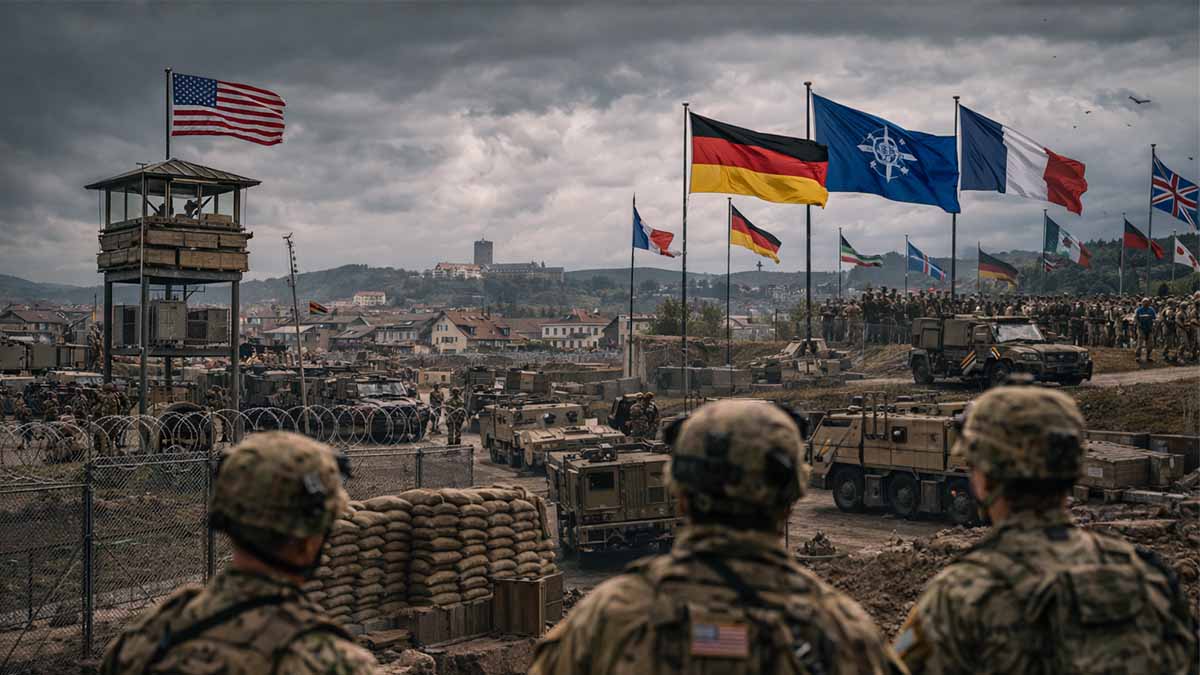
As of 28 March 2026, the geopolitical architecture underpinning European security since 1949 stands at its most precarious inflection point since the Cold War’s conclusion. US President Donald Trump, now in his second term and operating with substantially expanded executive authority relative to his first, is actively deliberating the withdrawal of approximately 35,000 active-duty personnel from Germany — representing the totality of the American forward-deployed land and air presence in Europe’s largest economy and geographic center. This is not a marginal policy adjustment; it is a structural rupture in the transatlantic security compact that has defined Western geopolitical order for three-quarters of a century.
The immediate trigger is well-documented. Sources close to the administration indicate that Trump is weighing the withdrawal of some 35,000 active personnel from Germany in a move that would further sour US-Europe relations. Trump is described as “angry that they [Europe] appear to be pushing for war.” Yahoo! The administration’s position has hardened into a transactional framework: states that fail to allocate 5% of GDP to defense shall forfeit both the protection of American military power and any meaningful voting influence over NATO spending architectures. On Thursday, Trump suggested the US may not defend NATO allies who do not meet his spending targets, telling reporters: “If you don’t pay your bills, we’re not going to participate. We’re not going to protect you.” Yahoo!
This threat carries genuine institutional weight in March 2026. The Ankara NATO Summit, scheduled for later this year under Secretary General Mark Rutte, will formally require member nations to present plans to reach the 5% threshold — a target that, even as of today, not a single European NATO member approaches. At the NATO Summit in The Hague, heads of state and government agreed on a new defense spending target: 5 percent of GDP on defense by 2035, including 3.5 percent on defense items and 1.5 percent on defense-related infrastructure, cybersecurity, and resilience. Atlantic Council The gap between where European nations stand today and where the Trump administration demands they arrive is not merely financial — it is structural, industrial, doctrinal, and temporal.
II. The Historical Blueprint: Precedent, Precedent, Precedent
The current deliberation is not without institutional memory. Trump’s first term produced a concrete withdrawal order that was only halted by Congress and a change in administration. The Trump administration announced plans to withdraw almost 12,000 troops from Germany — a sweeping continentwide reorganization — reducing permanently based US troops from some 36,000 to 24,000. Almost half, around 5,600, would move to other parts of Europe including Belgium, Poland and Italy, while some 6,400 would initially return to the United States. NBC News The Biden administration reversed this decision entirely upon taking office in January 2021, and subsequently surged forces to Europe following Russia’s full-scale invasion of Ukraine in February 2022.
What differentiates the 2026 deliberation from its 2020 predecessor is the constellation of enabling conditions. Trump’s second term has been characterized by dramatically expanded use of executive authority, reduced Congressional deference on foreign and defense policy, and a dramatically altered European security landscape in which Russia — despite the ongoing Ukraine conflict — has demonstrated renewed expansionist appetite and reconstituted significant military capacity. There is little doubt that the upcoming US Global Posture Review will include major troop drawdowns from Europe, though few indications have emerged of which units will be affected and where reductions will occur. ICDS The 2020 blueprint — involving withdrawal of the 12th Combat Aviation Brigade and the 2nd Cavalry Regiment — exists as an operational template, and Trump’s expanded executive powers in his second term provide a mechanism to bypass the Congressional hurdles that stymied the first attempt.
III. The Spending Architecture: What the Numbers Actually Mean
The 5% of GDP demand is, by any honest assessment, a politically constructed impossibility in the near-to-medium term for the overwhelming majority of European NATO members. To understand why, one must examine the actual spending landscape as it exists today, on 28 March 2026.
Poland records 4.48% of GDP on defense — the highest in the EU — followed by Lithuania at 4.00%, Latvia at 3.73%, and Estonia at 3.38%. Germany’s defence spending rose by 23% in real terms in 2024 and 18% in 2025, bringing the 2025 budget to €95 billion — double its 2021 level — at 2.14% of GDP. Following reform of the constitutional debt brake, Berlin has committed to further increases, with funding projected to reach €117.2 billion in 2026 and €162 billion by 2029, equivalent to approximately 3.2% of GDP. Epthinktank France increased its 2026 defense allocation to €68.5 billion — approximately 2.25% of GDP — despite wider deficit pressures.
The aggregate picture, while improving, remains profoundly asymmetric relative to American expenditure. In 2024, Washington invested €845 billion in defense (3.1% of GDP) — almost three times the EU total of €343 billion. Although EU countries collectively have more battle tanks, artillery systems and infantry fighting vehicles, their capabilities are fragmented across different operating systems, making them less effective than they could be. Euronews The fragmentation problem is particularly acute: European NATO forces operate a highly fragmented set of platforms, with fragmentation levels more than four times higher than in the United States — a figure that has increased by close to 10 percent since 2014, driven mainly by land systems and missiles. McKinsey & Company
Even under the most optimistic scenarios — full delivery of all committed spending increases, accelerated industrial production, genuine multinational interoperability — the continent cannot reach the 5% threshold demanded by Washington within the timeframe of Trump’s second term. The political consequences of failing to do so are precisely what the withdrawal deliberation represents: a coercive leverage mechanism designed to extract maximum concessions while Trump retains negotiating authority.
IV. The Bases at Risk: Strategic Real Estate and Operational Consequences
The specific installations that face potential drawdown or closure represent not merely symbolic assets but operationally irreplaceable nodes in the global US military logistics and command architecture. A clear-eyed assessment of what is actually at stake begins with Ramstein Air Base in Rhineland-Palatinate.
Ramstein is the primary US Air Force base in Europe and the headquarters for US Air Forces in Europe–Air Forces Africa (USAFE-AFAFRICA). It is a major transportation hub supporting US military operations across Europe, Africa, and the Middle East. The base hosts over 16,200 US military personnel, civilians, and contractors and is part of the Kaiserslautern Military Community — the largest American military population overseas, totaling 56,000 personnel. CEPA Ramstein Air Base is the largest US Air Force base outside the US, the headquarters of the US Air Force for Europe and Africa, and a central NATO location for planning and conducting air operations. Under the NATO Status of Forces Agreement, Washington has criminal jurisdiction over many offences committed on the site. euronews
Beyond Ramstein, the Grafenwoehr Training Area in Bavaria constitutes the most extensive land-force training installation in the American overseas military footprint. US bases such as Ramstein and Grafenwoehr are considered indispensable for US military operations in Europe, Asia and Africa. Table.Media The Stuttgart military community houses US European Command (USEUCOM) and US Africa Command (USAFRICOM) — the two geographic combatant commands that coordinate all American military activity across an area of responsibility spanning two continents and dozens of nations. The closure or significant reduction of these installations would require the relocation of command architectures that took decades to build and billions to establish — not in months, but in years.
The Trump administration’s own statements reveal internal incoherence regarding which bases might be preserved versus surrendered. The Telegraph reports that Trump is considering redeploying troops from Germany to Hungary — a NATO member that has maintained a close relationship with Russia and, notably, vetoed EU commitments to support Ukraine at an emergency Brussels summit. Yahoo! This would represent a geopolitically perverse outcome: removing forces from the strategically central ally that is most rapidly accelerating its defense spending, and repositioning them to the NATO member with the most Kremlin-proximate foreign policy posture.
V. The Russian Threat Calculus: Reading Moscow’s Strategic Ledger
Any analysis that omits the Russian strategic variable is analytically incomplete. The withdrawal deliberation occurs against the backdrop of a Russian military that has been substantially transformed by four years of large-scale conventional warfare in Ukraine. For the Russian military, the war in Ukraine has been costly. However, because of the Kremlin’s broad mobilisation of society and industry, Russia’s military is now considerably larger, more experienced and better equipped than the force that invaded Ukraine in 2022. The Russian presence in Ukraine at the end of 2024 stood at roughly 700,000 troops. In 2024 alone, Russia produced and refurbished an estimated 1,550 tanks, 5,700 armoured vehicles and 450 artillery pieces — representing a 220% increase in tank production and 150% increase in armored vehicles compared to 2022. Bruegel
This is the adversary against which a US-reduced European NATO would need to deter and, if necessary, prevail. The historical precedent for the consequences of American retrenchment from European security is not encouraging. The withdrawal of substantial US forces from Europe under Barack Obama in 2012 and 2013 was followed within eighteen months by Russia’s annexation of Crimea and destabilization of eastern Ukraine — events that triggered the entire cycle of European defense anxiety that now produces the current political crisis. The signal sent by American retrenchment — regardless of its stated rationale — is inevitably read by Moscow as strategic opportunity.
The Estonian Foreign Intelligence Service, published this month, assessed that Russia has no intention to attack a NATO member state in the coming year. But the same analysts project that after any resolution of the Ukraine conflict, Russia could in a worst case need less than a year to build up enough capabilities for a military operation, aimed not at militarily defeating NATO, “but at dividing the alliance and forcing concessions with regard to the European security architecture.” Defense News
VI. Europe’s Actual Military Capacity: The 10-Year Horizon of Structural Inadequacy
The most consequential analytical finding concerns the gap between European political rhetoric about strategic autonomy and the actual material capacity that exists today. NATO Secretary-General Mark Rutte has insisted that Europe is incapable of defending itself without US military support and would have to more than double current military spending targets to be able to do so, saying: “If anyone thinks here that the European Union or Europe as a whole can defend itself without the U.S., keep on dreaming.” NPR
This assessment is grounded in specific, quantifiable capability deficits. Europe will likely need until the early 2030s to develop some of the critical defense enablers needed to deter or defeat Russia without the United States. Establishing robust air and missile defenses may still take five to ten years. The US had 108 communication satellites for military use in 2025, compared with six for the UK, five for France, three for Italy and two each for Germany and Spain. Defense News In the critical domain of battlefield command and control, long-range strike, suppression of enemy air defenses, and strategic intelligence, European militaries are not set up to defend the continent without the United States — the issue is structural, not financial. European militaries were designed to serve as auxiliaries in a US-led NATO war effort. Foreign Affairs
The nuclear dimension adds a further layer of structural complexity that no amount of conventional defense spending can resolve on a short timeline. Rutte stated that if Europe were to go it alone, “forget that you can ever get there with 5%” — spending would need to be 10% instead. “You have to build up your own nuclear capability — that costs billions and billions of euros. In that scenario you would lose the ultimate guarantor of our freedom, which is the US nuclear umbrella.” Defense News
VII. The Nuclear Triptych and the New Vassal Question
France and the United Kingdom possess independent nuclear deterrents. France’s Force de Frappe comprises approximately 290 operational warheads delivered via submarine-launched ballistic missiles and air-launched cruise missiles from Rafale fighters. The UK’s Continuous at Sea Deterrent operates via four Vanguard-class submarines carrying Trident II D5 missiles. These represent genuine, credible second-strike capabilities — but they are national deterrents, not European ones, and neither nation has committed to extending these umbrellas formally over all European NATO members.
President Macron has floated the concept of extending French nuclear guarantees to European partners and announced plans to elaborate an updated nuclear doctrine, but the political and constitutional barriers to formalizing such an arrangement are substantial. France is the country most opposed to the consolidation of the European defense sector — such a step would force Paris to abandon the principles of national independence that have driven its statecraft since 1958. Foreign Affairs
Germany presents the most complex case in the new European security equation. Berlin has committed to the largest absolute defense spending increase in Europe — following reform of its constitutional debt brake, Germany has committed to funding projected to reach €162 billion by 2029, equivalent to 3.5% of GDP. Epthinktank But the question raised with uncomfortable directness — particularly in light of the AfD’s growing domestic political influence, which today saw its co-chair Tino Krupalla call for the withdrawal of all Allied forces and nuclear weapons from German territory — is what political character that rearmed Germany will ultimately project. Krupalla noted Germany should not allow itself to be drawn into international conflicts, citing Spain’s ban on Americans using bases for operations against Iran. Pravda Trump
For the smaller European NATO members — the Baltic states, Slovakia, Bulgaria, North Macedonia, and others — the existential question crystallizes with brutal clarity: if the American security guarantee evaporates and the continental architecture resolves into a France-UK-Germany triumvirate backed by their own national deterrents and political agendas, has the nature of the guarantee actually changed? From one form of dependent security relationship to another? The formal vocabulary of sovereignty may differ, but the structural dependency — being defended by a greater power according to that power’s own strategic interests and political calculations — remains identical. It is, as the question correctly frames it, a transition from one form of vassalage to another, with different masters and different conditionalities.
VIII. The 10-Year Prognosis: Scenarios, Probabilities, and Cascade Vectors
The ten-year European security horizon, assessed as of 28 March 2026, resolves into three primary scenario clusters, each carrying distinct cascade implications.
Scenario Alpha — Managed Partial Retrenchment (Estimated Probability: ~45%): Trump extracts significant political and financial concessions from European allies — formal commitments to accelerated spending trajectories, preferential access to European defense procurement contracts for American industry, political alignment on specific foreign policy positions — in exchange for maintaining a reduced but structurally significant American presence in Germany. Ramstein and Grafenwoehr survive in modified form. The psychological deterrent effect is damaged but not eliminated. Russian opportunism is constrained by residual American presence and the demonstrated capacity of Poland, the Baltic states, and a rearming Germany to impose significant conventional costs on any aggressor.
Scenario Beta — Full Withdrawal and Strategic Reorganization (Estimated Probability: ~30%): Trump executes a full or near-full withdrawal from Germany, repositioning forces to Poland, the Baltic states, and potentially Hungary. The eastern flank is reinforced at the expense of the central logistical hub. Ramstein’s loss as a drone warfare coordination node, African operations hub, and medical evacuation center creates a decade-long capability gap that no European substitute can fill in the near term. Equipment deliveries from recent orders are anticipated to accelerate in 2026 and 2027 McKinsey & Company — but the structural fragmentation of European forces means that increased spending does not translate linearly into increased capability.
Scenario Gamma — Alliance Fracture and Strategic Vacuum (Estimated Probability: ~25%): The withdrawal proceeds without adequate transition planning, European defense integration fails to accelerate sufficiently, and the eastern flank faces genuine deterrence gaps that Russia assesses as exploitable within three to five years. This scenario does not necessarily involve direct military conflict — the more probable Russian response is a campaign of hybrid pressure, territorial probing in gray zones, and information operations designed to fracture European political cohesion, forcing bilateral deals that undermine collective defense.
Europe’s first priority is to continue supporting Ukraine — Ukraine’s experienced military is currently the most effective deterrent against a Russian attack on the EU. Bruegel Any scenario in which the Ukraine conflict resolves unfavorably for Kyiv simultaneously removes this forward deterrent buffer while potentially freeing reconstituted Russian forces for alternative strategic objectives.
The analysis concludes that the real danger is not a single dramatic military event but rather a prolonged erosion of deterrence credibility — a slow-motion strategic vacuum that accumulates through incremental decisions, each individually defensible, that collectively hollow out the architecture of European security faster than European rearmament can compensate. The race between deterioration and reconstruction is the defining strategic contest of the next decade.
NATO & US Troop Withdrawal — Strategic Dashboard · 28 March 2026
Ramstein Air Base
Largest USAF base outside the US. HQ for USAFE-AFAFRICA. Hub for drone operations, medical evacuation, and NATO air command. 16,200+ US personnel. Part of 56,000-strong Kaiserslautern community.
Grafenwoehr Training Area
Largest US Army training facility in Europe (223 km²). Hosts 7th Army Training Command. Essential for NATO multinational exercises and combined arms training across the European theater.
Stuttgart (USEUCOM / AFRICOM)
Commands all US military activity across Europe and Africa from Patch & Kelley Barracks. Potential relocation to Belgium discussed — would cost single-figure billions and take years.
Wiesbaden (US Army HQ)
US Army Europe and Africa HQ since 2012. Houses 1st Armored Division and 66th Military Intelligence Group. Critical for theater-level land force coordination and intelligence.
Spangdahlem Air Base
Home of the 52nd Fighter Wing, specializing in suppression of enemy air defenses (SEAD). A critical offensive air capability rarely replicated elsewhere in NATO’s European footprint.
Hohenfels (JMRC)
Joint Multinational Readiness Center — multinational force-on-force training. Used by NATO allies for realistic combat preparation. Less irreplaceable than Ramstein or Grafenwoehr.
Years Europe needs to become self-sufficient in key defense enablers (expert consensus, Defense News survey, Feb 2026). Green = sooner, Red = longer.
INDEX
- The Withdrawal Vector: Trump’s Strategic Leverage Architecture and the 5% GDP Ultimatum
- Bases at Risk, Cascading Vulnerabilities, and the Geography of Exposure
- Europe’s Defense Reality: Nuclear Triptych, Vassal Reconfiguration, and the 10-Year Capability Horizon
THE WITHDRAWAL VECTOR — TRUMP’S STRATEGIC LEVERAGE ARCHITECTURE AND THE 5% GDP ULTIMATUM
The Transactional Deconstruction of the Atlantic Alliance, Assessed 28 March 2026
I.1 — The Doctrine Behind the Threat: From Rhetorical Pressure to Structural Coercion
The deliberation over withdrawing approximately 35,000 US troops from Germany is not, at its analytical core, a military planning decision. It is an instrument of political coercion — the application of maximum leverage within the most consequential security alliance in modern history. Understanding it requires understanding the doctrine that animates it, the institutional mechanisms through which it operates, the counter-pressures that constrain it, and the structural fractures it has already produced in the body of NATO even before a single soldier has been reordered.
President Donald Trump, in his second term operating with dramatically expanded executive authority and diminished Congressional deference, has constructed a transactional framework for American participation in NATO that fundamentally rejects the foundational premise of the alliance as constituted in 1949: that the collective security of the democratic West represents an intrinsic American national interest that transcends bilateral cost-benefit calculations. In Trump’s framework, the relationship is explicitly bilateral and explicitly conditional. Trump “essentially views NATO as an obsolete relic of the Cold War,” and allies’ refusal to help in Iran demonstrates that the US-European defense dynamic as it has existed since the late 1940s “is no longer necessary.” War on the Rocks In March 2025, confronted directly on Article 5, Trump told reporters: “If they don’t pay, I’m not going to defend them. No, I’m not going to defend them.” Three months later, modulating but not retracting, he said: “Depends on your definition of Article 5. There’s numerous definitions of Article 5. You know that, right?”
This deliberate ambiguity is itself the weapon. The uncertainty it generates — does Article 5 still function as an absolute guarantee, or has it become conditional on fiscal performance? — produces a constant low-grade deterrence crisis across every European capital, particularly those on the eastern flank whose existential exposure to Russian military power is most acute. The ambiguity does not need to resolve into actual abandonment to achieve its coercive effects. The mere possibility of abandonment is sufficient to extract political concessions, accelerate spending commitments, and restructure alliance relationships.
The 5% of GDP demand — the specific threshold now being wielded as the condition for full Article 5 protection and voting rights on NATO spending decisions — is the numerical expression of this coercive architecture. Trump is considering stripping NATO member states that fail to raise defense spending to 5% of GDP of the right to invoke Article 5 of the alliance’s charter, with proposals under discussion that such countries could be excluded from decision-making on expanding joint missions and activating the collective defense mechanism. Bytes Europe This model has been actively promoted by US officials during multiple meetings, though it has not been formally submitted for discussion at NATO headquarters in Brussels — preserving plausible deniability while ensuring the threat circulates through every allied defense ministry.
I.2 — The Hague Summit Architecture: What Was Actually Agreed, and What It Means
The critical institutional reference point for this analysis is the NATO Summit in The Hague, held in June 2025 — the first summit of the Trump second term, specifically engineered to deliver the president a tangible deliverable on defense spending. At the Hague Summit, heads of state and government of NATO allies agreed on a new defense spending target: 5 percent of GDP on defense by 2035, comprising 3.5 percent on defense items such as troops and weapons, and 1.5 percent on defense-related items such as critical infrastructure, cybersecurity, and civilian resilience. Atlantic Council
The significance of this summit cannot be overstated. For the first time in the alliance’s history, NATO formally committed to a target that exceeded the United States’ own current defense spending as a share of GDP. The US itself currently allocates approximately 3.19–3.2% of GDP to defense under the NATO accounting definition — meaning that the 5% target demands of European allies a proportional commitment that no nation, including America, presently meets. NATO Secretary General Mark Rutte credited Trump directly, stating he did not believe the whole of NATO would have reached 2% by 2025 without the present US administration, including laggards Spain, Belgium and Italy who failed to meet goals for decades. Euronews
This is the paradox at the center of the current crisis: Trump has been extraordinarily effective as a forcing function for European defense spending increases — the empirical record is unambiguous on this point, with all 32 NATO member states crossing the 2% threshold in 2025 for the first time in alliance history — yet the very success of this coercion has generated the conditions under which the next demand (5%) is simultaneously politically formalized and practically unachievable within any near-term horizon.
The NATO Secretary General expressed hope that by the alliance’s summit in Ankara on July 7–8, 2026, all member countries will “demonstrate progress toward increasing military spending to 5% of GDP.” Rutte noted that the US share of military spending among all 32 NATO member countries last year was 60 percent. Currently, only Poland comes closest to Trump’s stated target at 4.3% of GDP, followed by Lithuania at 4%, Latvia at 3.7%, Estonia at 3.4%, Denmark at 3.3%, and Norway at 3.2%. The United States itself recorded 3.2% of GDP — fourth place. Pravda EU
The Ankara Summit in July 2026 therefore represents the next decisive inflection point. It will be the moment at which the gap between what was promised at The Hague and what has actually been delivered becomes impossible to paper over — and the moment at which the withdrawal threat transitions from background pressure to active policy instrument.
I.3 — The Legislative Bulwark: Congressional Resistance and the NDAA Constraint
The Trump administration’s withdrawal ambitions operate within a specific legal constraint that is frequently underweighted in European analyses: the National Defense Authorization Act (NDAA) for 2026. This legislation, passed by the US House of Representatives with a bipartisan vote of 312–112, erects significant procedural barriers to the kind of unilateral, executive-action withdrawal that characterized Trump’s first-term attempt.
The bill blocks the Pentagon from reducing the number of troops in Europe below 76,000 or relinquishing the role of NATO’s Supreme Allied Commander until Defense Secretary Pete Hegseth certifies to Congress that the decision was made in consultation with NATO allies and is in the best national security interests of the US. The American Legion Furthermore, under the NDAA, the Pentagon would not be allowed to shift away any big-ticket pieces of military hardware valued at more than $500,000 from Europe. If the Pentagon wants to reduce troop levels, it must detail how that is in the national security interest of the US and how it consulted with all 32 members of the NATO alliance, with an analysis required to explain how adjustments would affect NATO warfighting plans and the alliance’s ability to deal with Russian hostilities. Stars and Stripes
This legislative architecture is not impenetrable. Trump has demonstrated in his second term a willingness and capacity to challenge statutory constraints through executive action, and the certification requirement creates a mechanism rather than an absolute prohibition — a sufficiently compliant Defense Secretary could theoretically provide the required certification. What the NDAA does accomplish is to slow the withdrawal process, force a public justification that becomes an auditable record, and create a political cost for Republican legislators who would need to defend the administration’s position. Even senior Republican defense committee chairmen stated they “strongly oppose the decision not to maintain the rotational US brigade in Romania,” adding: “We stated that we will not accept significant changes to our warfighting structure that are made without a rigorous interagency process, coordination with combatant commanders and the Joint Staff, and collaboration with Congress.” CBS News
The Romania precedent — in which the Pentagon announced deep cuts to the US force presence with minimal consultation — reveals the administration’s preferred methodology: incremental, rotational force reductions that technically comply with NDAA thresholds while progressively hollowing out the operational substance of the European posture. The withdrawal from Germany, if it proceeds, will almost certainly follow this pattern rather than a dramatic single-event announcement.
I.4 — The Global Posture Review: The Strategic Framework for Retrenchment
The institutional vehicle through which the Germany withdrawal decision will be formalized is the US Global Posture Review (GPR) — a comprehensive reassessment of where American forces are stationed worldwide and why. There is little doubt that the upcoming US Global Posture Review will include major troop drawdowns from Europe. The administration’s disdain for European “free loading,” alongside its shifting of priorities towards countering China, has the European allies bracing for likely troop withdrawals. Even before the release of the GPR, the Pentagon announced the redeployment of the USS Gerald R. Ford, along with three destroyers of Carrier Strike Group-12, to the Caribbean Sea. ICDS
The GPR’s analytical framework is anchored in three strategic reorientation priorities that collectively deprioritize the European theater. First, homeland security — explicitly ranked as the number one priority, above overseas threats and missions — has channeled significant assets toward the southern US border and Caribbean operations. Second, Indo-Pacific competition with China — the structural long-term strategic competition that the Pentagon’s institutional establishment regards as the defining challenge of the coming decades — creates a persistent pull on assets, capabilities, and strategic attention away from Europe. Third, Western Hemisphere security — encompassing Venezuela pressure, Caribbean counter-narcotics operations, and Greenland posturing — has absorbed carrier strike groups and command attention that previously anchored the European deterrence architecture.
The forthcoming National Security Strategy and National Defense Strategy will prioritize threats in the Western Hemisphere and from China, while downplaying the US role in Europe. Accordingly, the Pentagon is poised to announce the withdrawal of troops and capabilities from Europe in the forthcoming Global Posture Review — having already decided to withdraw a rotational brigade in Romania with hardly any notice. War on the Rocks
The Romania withdrawal is analytically significant as a behavioral data point. It demonstrated the administration’s willingness to execute force reductions with minimal allied consultation, to absorb the resulting bipartisan congressional criticism without reversing course, and to use Secretary Hegseth’s rhetorical framing — that reductions represent “a positive sign of increased European capability and responsibility” — to transform subtraction into claimed achievement. This rhetorical template will be applied to any future Germany withdrawal announcement.
I.5 — The Specific Units at Risk: What the Military Blueprint Reveals
The 2020 withdrawal blueprint — halted by Congress and reversed by Biden — provides the most operationally precise indicator of which specific units and capabilities face elimination in a renewed withdrawal scenario. That plan targeted the 12th Combat Aviation Brigade (CAB) and the 2nd Cavalry Regiment — the only permanent Combat Aviation Brigade and Stryker Battalion Tactical Group in Europe, both of which provide critical air and armor capabilities to NATO’s defense and deterrence posture. ICDS
Their elimination would not merely reduce headcount; it would remove specific capability categories that European forces cannot currently replicate. The 12th CAB provides the rotary-wing aviation architecture — attack helicopters, assault lift, medical evacuation, reconnaissance — that European ground forces depend on for combined-arms operations. The 2nd Cavalry Regiment’s Stryker-equipped infantry provides rapid maneuver capability that bridges the gap between light infantry and heavy armor — a capability class where European NATO forces are structurally underrepresented.
The planned February 2026 deployment of a 500-person Army Multi-Domain Task Force (MDTF) and its intermediate-range missile capabilities to Germany was assessed by the Defense Priorities think tank as “not consistent with the Trump administration’s assessment of the Russian threat or its desire to reduce the US role in European security,” with the MDTF’s long-range missiles “more likely to provoke Russia than to deter.” Defense Priorities The tension between this February 2026 deployment and the concurrent withdrawal deliberation illustrates the internal incoherence within the administration’s European posture — one hand deploying new long-range strike capability while the other deliberates removing the conventional ground force that gives that capability operational context.
Beyond the Germany-specific units, the broader European rotational presence — approximately 84,000 US service members across the EUCOM area of responsibility as of early 2025, including the post-2022 Ukraine-driven surge — represents the total pool against which any withdrawal calculation must be measured. The most obvious option for the administration is to reduce the number of rotationally deployed US forces — troops sent to Europe for nine-month rotations without family members. Since Russia’s 2014 invasion of Ukraine, the United States has sent thousands of troops to Europe on a rotational basis, primarily to Estonia, Latvia, Lithuania, Poland, Romania, and Bulgaria — the countries most exposed to Russian intimidation. Foreign Policy
I.6 — The Spending Gap in Forensic Detail: Why 5% Is Not a Near-Term Political Reality
The 5% of GDP demand requires forensic examination of what it actually represents in absolute fiscal terms — because the abstract percentage conceals the scale of what is being demanded from economies already operating under significant fiscal stress.
Germany, with a GDP of approximately €4.1 trillion in 2025, would need to reach approximately €205 billion in annual defense spending to hit the 5% threshold — more than double its current €95 billion commitment and more than 2.5 times its 2021 baseline. Berlin has committed to reaching €162 billion by 2029 (approximately 3.2–3.5% of GDP) following its historic constitutional debt brake reform — a genuinely extraordinary political and fiscal achievement by any objective standard. But €162 billion is still less than 80% of the 5% target. Using 2025 GDP estimates, reaching 3.5% of GDP translates to approximately €630 billion per year for European NATO members collectively — far more than the €350 billion or so they spent last year. The 5% target is beyond what any member state, including the US, currently spends on defense. German Marshall Fund
France presents a structurally different constraint. Paris has increased its 2026 defense allocation to €68.5 billion (approximately 2.25% of GDP) despite wider deficit pressures. Reaching 5% would require €157 billion annually — more than doubling current expenditure in a fiscal environment already subject to European Union deficit rules and domestic political pressure from constituencies dependent on social spending. France’s status as a nuclear power with a genuinely independent deterrent and a significant defense industrial base gives it more leverage in these negotiations than its raw spending percentage suggests — but the political mathematics of tripling the defense budget over a decade are brutal in any democratic system.
Spain presented the most direct resistance to the new targets. Madrid refused to endorse the 5% commitment at The Hague, proposing instead more flexible wording with a 2032 timeline — a posture that, under the Trump administration’s framework, would explicitly disqualify Spain from full Article 5 protection and voting rights on joint spending decisions. Trump may deprive NATO countries that do not spend 5% of GDP on defense of the right to use the fifth article of the alliance’s charter — proposals that such allies could be excluded from decision-making on expanding joint missions and activating the collective defense mechanism. Pravda EU
The cumulative picture is of an alliance in which the spending demands of the largest member are structurally impossible for most members to meet within the demanded timeframe, yet in which the cost of appearing to resist those demands — loss of Article 5 protection, exclusion from alliance governance, withdrawal of US conventional forces — is existentially prohibitive. This produces a specific political dynamic: formal commitment to targets that will almost certainly not be met, combined with accelerating actual spending increases that fall short of the formal commitment, combined with intensive diplomatic effort to convince Washington that the trajectory of improvement is sufficient to maintain the guarantee. This is the game every major European capital is currently playing.
I.7 — The Coercive Logic and Its Perverse Incentive Structure
The Trump leverage architecture contains a structural paradox that may ultimately undermine its own effectiveness. By making US protection explicitly conditional on spending performance, the administration has simultaneously incentivized European defense investment (clearly effective) and undermined the credibility of American commitment in ways that may produce strategic outcomes directly contrary to US interests.
Europe is the United States’ most important economic partner. Roughly one-quarter of all US trade is with Europe — more than with Canada, China, or Mexico. Over 2.4 million US jobs are directly tied to trade and investment with the EU and the United Kingdom, versus just over 930,000 with China. Europeans also hold twice as much US debt as China. Foreign Policy A security vacuum in Europe — whether produced by deliberate withdrawal or by the erosion of deterrence credibility — creates economic disruption risks that directly threaten the American prosperity that the administration claims to prioritize. The strategic incoherence of threatening the economic partner upon whose stability domestic American employment and debt financing depend is not lost on the institutional military and intelligence establishment in Washington — which is precisely why bipartisan congressional resistance to the withdrawal has been as robust as it has.
The second perverse incentive concerns the eastern flank specifically. Trump is said to be considering repositioning some US troops in Europe so they are focused around NATO countries that have upped their defense spending to meet GDP targets — with redeployment from Germany to Hungary specifically under consideration. ICDS Hungary, which maintains the most Kremlin-proximate foreign policy of any NATO member, vetoed EU support for Ukraine and has repeatedly obstructed alliance consensus. Rewarding the most Russia-aligned NATO member with a troop presence increase while reducing forces in the most strategically central ally inverts the deterrence logic that has governed NATO deployments for seven decades. It signals to Moscow that political alignment with Russian preferences is a viable strategy for securing American military presence — a signal with potentially catastrophic implications for alliance cohesion on the eastern flank.
I.8 — The Ankara Summit: The Coming Moment of Maximum Pressure
The Ankara NATO Summit scheduled for July 7–8, 2026 — now approximately 101 days from the date of this analysis — represents the next decisive institutional moment in this crisis. It is the first summit since The Hague at which member nations must demonstrate measurable progress toward the 5% target. The NATO Secretary General expressed hope that by the Ankara summit, all member countries will “demonstrate progress toward increasing military spending to 5% of GDP.” Pravda EU
The geometry of the summit is already set. Poland, Lithuania, Latvia, Estonia, Denmark, and Norway will arrive as demonstrably high-spending allies whose compliance with — or approach toward — the 5% framework insulates them from the most severe coercive pressure. Germany will arrive with a genuine and historically unprecedented commitment trajectory, but at 2.14% of GDP in actual 2025 expenditure, it remains far below the threshold. France will leverage its nuclear status and defense industrial significance to negotiate a distinct framework. Spain will maintain its resistance. Italy and Belgium will gesture at compliance while structurally falling short.
The outcome most likely to emerge from Ankara is not a clean resolution but a further round of formalized ambiguity — new pledges, new timelines, new “capability-equivalent” accounting methodologies — designed to give the Trump administration a political deliverable while preserving European fiscal space. Whether that deliverable is sufficient to forestall the Germany withdrawal is the critical unknown. What is analytically clear is that the withdrawal deliberation and the Ankara summit are not independent events — they are the two faces of the same coercive mechanism.
US coercion instruments
European counter-constraints
BASES AT RISK, CASCADING VULNERABILITIES, AND THE GEOGRAPHY OF EXPOSURE
The Strategic Real Estate of American Power in Europe — What Is Actually at Stake, Who Gets Hit First, and What Russia Reads Into It
II.1 — The Indispensability Paradox: Germany as the Irreplaceable Hub
The foundational analytical error in most public discourse about the Germany withdrawal deliberation is the framing of the decision as primarily about Germany’s security. It is not. The American military presence in Germany exists overwhelmingly to serve American strategic interests — the capacity to project power across Europe, Africa, the Middle East, and beyond. This distinction is not semantic. It is operationally decisive, and it reframes the entire withdrawal calculus.
Ramstein Air Base is the primary logistical hub for all US operations in the Middle East, North Africa, and South Asia. The base is also a relay station for all communications with US drones deployed over the horizon from their operators in Nevada. Both US Africa Command and European Command are headquartered in Stuttgart, Germany, and Landstuhl Regional Medical Center was a critical waypoint for thousands of wounded troops from US wars in Iraq and Afghanistan. The United States is currently building a new, larger military hospital in Weilerbach with some 5,000 rooms, 42 specialty departments, and nine operating rooms at a cost of $990 million. Foreign Policy
US bases such as Ramstein and Grafenwoehr are considered indispensable for US military operations in Europe, Asia and Africa, with US military personnel frequently describing Grafenwoehr as “the best we have.” Table.Media This is not the assessment of European defense ministries anxious to retain American protection — it is the assessment of the US military itself, whose operational planning, global logistics chains, and command architectures are structurally dependent on German real estate in ways that cannot be casually replicated by relocating to Poland or Hungary or any other alternative staging ground.
The paradox, therefore, is that the withdrawal threat is simultaneously a coercive instrument directed at European allies and a self-wounding action that would degrade capabilities the United States itself depends upon for operations completely unrelated to European defense. Gen. Ben Hodges, former commanding general of US Army Europe, stated: “The biggest gap would be US Air Force, early warning, intelligence… and then the US contribution at NATO’s air command at Ramstein.” NATO maritime Electronic Warfare Syndicate Chair Bas Nieuwenhuijse noted that the alliance is playing catch-up: it “hasn’t developed and fielded EW capabilities in the same amount of quality as some potential adversaries,” and within those it has, “NATO relies heavily on US EW capabilities.” Hudson Institute
II.2 — Ramstein Air Base: The Nerve Center That Cannot Be Moved
No installation in the entire American overseas military estate carries a higher concentration of irreplaceable strategic functions than Ramstein Air Base in Rhineland-Palatinate. Understanding this requires moving beyond the headline figures — largest USAF base outside the United States, headquarters for USAFE-AFAFRICA — to the specific operational architecture that Ramstein enables and that no alternative location can replicate without decade-long investments and fundamental restructuring of global military logistics.
Ramstein Air Base is the largest US Air Force base outside the US, the headquarters of the US Air Force for Europe and Africa, and a central NATO location for planning and conducting air operations. The stationing of US troops in Germany is based on NATO agreements and the security policy order under the 2+4 Treaty, which guarantees Germany its full sovereignty. Theoretically, Berlin could cancel the deployment agreement — but politically this would have far-reaching consequences for NATO and relations with the US. euronews
As of March 2026, Ramstein is actively serving as the coordination hub for US drone and missile strikes against Iran — a fact that has made it newly controversial within German domestic politics. Germany is allowing the United States to use Ramstein Air Base to coordinate drone and missile strikes against Iran, drawing criticism from opposition politicians who warn the facility could become a target for retaliation, while authorities say it is all by the book. US President Donald Trump praised German Chancellor Friedrich Merz at the White House for permitting American forces to operate from German territory, unlike other European countries. euronews
This real-time, active-operations role in the Iran conflict — spanning the satellite relay station that transmits targeting data for drone strikes, the airlift functions moving personnel and materiel, and the command infrastructure coordinating USAFE-AFAFRICA across two continents — demonstrates with crystalline clarity that the withdrawal deliberation is occurring at the precise moment when Ramstein’s operational relevance is at its historical apex, not its nadir. The Trump administration is simultaneously praising Germany’s cooperation in permitting operations from Ramstein and deliberating removing the force presence that makes those operations possible. This is not strategic coherence — it is transactional improvisation that happens to be playing out against the backdrop of an active shooting war.
The economic dimension of Ramstein’s closure on the local population has been documented with striking personal granularity. Andreas Hausmann, owner of the Hotel America in Ramstein, estimates that two-thirds of guests are American. “Every craftsman, every plumber, every painting company, every small business, even bakeries, taxi companies — everyone is indirectly dependent on the airbase,” he told AFP. “If they pull the plug here, we will be socially destroyed.” Fortune The wider Kaiserslautern Military Community — comprising over 56,000 Americans — represents a socioeconomic ecosystem built across decades that cannot be dismantled without cascading regional economic collapse. This creates a political constituency within Germany itself that may paradoxically strengthen Berlin’s negotiating hand with Washington: the economic and social disruption of full withdrawal affects not just German security calculations but the lived reality of tens of thousands of American military families and contractors.
II.3 — Grafenwoehr: The Training Infrastructure Backbone
The second irreplaceable installation in the German constellation is the Grafenwoehr Training Area in Bavaria — the largest US Army training facility in Europe at over 223 square kilometers, and the operational heart of multinational NATO force preparation across the entire continent. Its loss would not merely reduce the number of American soldiers in Europe; it would fundamentally degrade the interoperability, readiness, and combined-arms capability of NATO as a military institution.
The removal of the 2nd Stryker Cavalry Regiment in training-rich Vilseck-Grafenwoehr — the last full-time combat brigade-sized unit in Germany — does reduce flexibility in the immediate theater and lessens the relationships cultivated by day-in, day-out proximity of collocated allies and friends operating, training, and living together. What Germany provides operationally with its superb road and rail network is also a central position that knits strategic Belgium to NATO forces and allies in Eastern Europe. Wilson Center
The 7th Army Training Command — headquartered at Grafenwoehr — coordinates exercises not merely for American units but for NATO multinational forces across the continent. The Joint Multinational Readiness Center (JMRC) at Hohenfels — a subordinate garrison of the Grafenwoehr complex — is the premier multinational combat training center in Europe, where allied forces rehearse combined-arms combat under realistic conditions that replicate the Eastern European operational environment. There is no equivalent facility anywhere else in Europe that could absorb these training functions within any timeframe relevant to the current strategic situation.
Aircraft from Ramstein can reach conflict zones within hours, while armored units at Hohenfels sustain training cycles essential for readiness. These installations also host critical command and control nodes, facilitating real-time coordination among thousands of NATO personnel. Joint exercises conducted across multiple bases — incorporating troops from Germany, the US, and other allies — strengthen coalition interoperability and standardize procedures under NATO doctrine. St-aug
The 2nd Cavalry Regiment at Vilseck — a Stryker-equipped armored infantry formation — represents a capability class with no direct European equivalent: rapid maneuver infantry with sufficient protection and firepower to operate across the spectrum from counterinsurgency to peer-competitor high-intensity conflict. Its withdrawal, as specifically planned in the 2020 blueprint, would eliminate the only permanently forward-stationed Stryker battalion tactical group in Europe — a gap that European allies lack both the equipment and the trained formations to fill on any near-term timeline.
II.4 — Stuttgart: The Command Architecture Hub
The Stuttgart Military Community — centered on Patch Barracks and Kelley Barracks — houses two of the most consequential American military commands in the world: US European Command (USEUCOM), responsible for all US military activity across 51 countries spanning Europe to Russia, and US Africa Command (USAFRICOM), responsible for all US military engagement across the 54 nations of Africa.
These are not administrative offices. They are the command-and-control architectures through which the United States coordinates its military relationships, conducts crisis response, manages intelligence integration, and sustains operational planning across two entire continents. Their location in Stuttgart — geographically central, culturally integrated, logistically connected, and operationally hardened over decades — reflects the accumulated institutional investment of the entire post-Cold War era.
Relocating either command — as suggested in discussions about moving USEUCOM to Mons in Belgium — would require years of construction, infrastructure investment running into billions of dollars, the dislocation of thousands of military and civilian personnel, and the inevitable degradation of institutional knowledge and operational continuity that comes with any major organizational relocation. The US military has just upgraded many of its facilities in Germany, creating an important logistical and training hub for its operations in Africa, the Middle East, and South Asia. The relocation of troops back to the United States coupled with the argument that US strategic flexibility would improve is more questionable from a defense planning point of view. Wilson Center
The Landstuhl Regional Medical Center — the only Level I trauma center in the American overseas military estate, adjacent to Ramstein — adds yet another layer of irreplaceability. Over two decades of operations in Afghanistan, Iraq, Syria, and beyond, Landstuhl has served as the primary medical evacuation destination for every American service member wounded in the Middle East and South Asia. The new Weilerbach military hospital being constructed at a cost of $990 million represents an investment that makes the withdrawal deliberation even more structurally incoherent: Washington is simultaneously building the most expensive overseas military medical facility in history and contemplating vacating the strategic context that makes that facility necessary.
II.5 — The Geography of First-Strike Exposure: Nations That Get Hit First
A withdrawal from Germany does not create a uniform deterioration in European security. It creates a specific geography of concentrated vulnerability, in which particular nations face disproportionate exposure to Russian military, hybrid, and coercive pressure. Identifying these nations and the specific vectors of risk they face is the analytical core of the cascade consequence assessment.
The Baltic States (Estonia, Latvia, Lithuania) occupy the apex of first-exposure risk. All three border either Russia directly or Belarus — now effectively a Russian military district following the full integration of Belarusian armed forces under Moscow’s operational command. The Baltic states presently field no tanks or combat aircraft and only coastal patrol craft. NATO forward forces in the form of multinational battalion battlegroups are present in each of the eastern flank countries. Atlantic Council These battlegroups — typically 1,000–1,500 troops per nation — are insufficient to defeat a determined Russian conventional assault; they function as a tripwire, designed to ensure that NATO casualties trigger an Article 5 response. If Article 5 itself becomes conditional on spending performance, the tripwire function evaporates entirely.
A conventional Russian invasion of Estonia would likely pursue limited objectives — a rapid seizure of Narva, perhaps a drive towards Tallinn — to shock NATO and force a negotiated “pause.” The intention could be simply to undermine NATO and prove that Article 5 commitments on the eastern flank are empty. A Russian offensive that occurs in the next few years would require certain types of US participation. European Council on Foreign Relations The specific scenario of a Narva seizure — targeting the ethnically Russian northeastern corner of Estonia — is assessed by multiple intelligence services as the most plausible limited Russian military action designed to test NATO cohesion without triggering a full-scale alliance response. A Germany withdrawal that removes American tripwire forces from the rapid reinforcement pool fundamentally changes the mathematics of this scenario.
Poland presents a categorically different profile. Poland, much larger than its neighbors to the north, is an exception. It has much stronger active and reserve forces and formidable tank, artillery, and fighter holdings — though these are still far smaller than Russian forces. Atlantic Council With defense spending at 4.48% of GDP — the highest in all of NATO — and a declared ambition to field an army of 500,000 including reserves, Poland is the fastest-rearming nation in Europe and the most credible conventional deterrent on the eastern flank. Critically, Warsaw also hosts the Powidz Army Prepositioned Stocks-2 (APS-2) — housing an armored brigade combat team’s worth of M1A2 Abrams tanks and nearly 200 other armored vehicles — a US investment that creates a physical anchoring of American military commitment independent of rotational troop presence.
The Suwalki Gap — the approximately 65-kilometer land corridor between Kaliningrad (Russian exclave) and Belarus, separating Poland from Lithuania — remains the single most strategically sensitive chokepoint in all of Europe. A general identified the Suwalki Gap as the most “vulnerable” area for an invasion that “could trigger a larger war between Russia and the US.” The cost of destruction in the warzone, higher energy prices, and a sell-off in financial markets could total $1.5 trillion in the first year, roughly the same as the impact of the full-scale invasion of Ukraine. The Week
Romania and Bulgaria — both on NATO’s southeastern flank, bordering the Black Sea — have already experienced the first concrete manifestation of American retrenchment with the October 2025 withdrawal of the rotational US brigade from Romania. This withdrawal eliminated the most substantial American land-force presence on the southeastern flank, creating a gap that neither Romanian nor Bulgarian conventional forces are currently configured to fill.
The Nordic flank (Finland and Sweden, both now NATO members) represents a countervailing development that partially complicates the vulnerability picture. Both nations bring significant defense industrial capacity, substantial reserve forces, advanced air power — Nordic air forces collectively field approximately 250 modern fourth- and fifth-generation fighter aircraft — and a geographic position that gives NATO effective dominance of the Baltic Sea. Finnish Prime Minister Orpo warned that even if a Ukraine peace deal is reached, Russia will “move their military forces” back toward Finland’s and the Baltic states’ borders, urging EU financial support for heavily burdened eastern-flank countries that are ramping defense spending. Russia Matters
II.6 — The Hybrid Threat Vector: What Russia Actually Does Before Any Tank Moves
The cascade vulnerability analysis must extend beyond conventional military scenarios. The European Union Institute for Security Studies assessment for 2026 is unambiguous: Russia remains at the centre of Europe’s threat picture in 2026 — although experts do not expect a direct NATO-Russia war. Instead, the greatest risk lies in slow-burn actions that steadily degrade Europe’s security environment while remaining below NATO’s Article 5 threshold. The most acute risk is a ceasefire in Ukraine on Russia’s terms, which experts rate as a top-tier risk in terms of both likelihood and impact. European Union Institute for Security Studies
The hybrid threat architecture deployed by Russia against European NATO nations in 2025–2026 has been documented with increasing granularity. Across Central and Eastern Europe, authorities have uncovered coordinated sabotage activities targeting railways, logistics hubs, and commercial infrastructure linked to Ukraine-bound supply chains. Investigations in Poland, Germany, and Lithuania in 2025 uncovered overlapping networks linked to Russian military intelligence, often operating via proxies and criminal intermediaries to preserve deniability. The Kremlin wants Europe to feel vulnerable, with its infrastructure at risk of disruption at all times. GLOBSEC
A US withdrawal from Germany would dramatically accelerate this hybrid pressure campaign along three specific vectors. First, the removal of American intelligence and early-warning architectures from German soil — Ramstein’s satellite relay, the Stuttgart-based SIGINT integration platforms, the 66th Military Intelligence Group at Wiesbaden — would create immediate and exploitable gaps in NATO’s hybrid threat detection capability that European national intelligence services lack the technological infrastructure to fill. Second, the reduction of American diplomatic and military credibility would signal to Moscow that the political cost of hybrid escalation has decreased — a direct invitation to intensify operations that already include airspace violations, infrastructure sabotage, assassination campaigns, and information operations across the continent. Third, the psychological effect on European populations and governments of visible American withdrawal — regardless of its military significance — would create the political conditions in which anti-alliance voices gain electoral traction and pro-accommodation sentiment grows.
By staging Zapad-2025 drills that exceeded 100,000 troops, far greater than initially declared, with the use of nuclear systems, the Kremlin sought to demonstrate its escalation dominance and show that NATO’s Eastern Flank remains vulnerable despite NATO defense commitments. This coercive pressure is likely to shift from episodic provocation to a more systemic tool of pressure in 2026. GLOBSEC
II.7 — The Stress Fracture Map: Which Nations Cannot Compensate
Not all European NATO members are equally positioned to absorb the stress of a US withdrawal from Germany. The analysis reveals a sharp and analytically significant divergence between a group of nations that have invested heavily in independent military capability and those that have allowed structural dependency on American enablers to persist across three decades of post-Cold War neglect.
Nations most exposed and least capable of independent compensation include the smaller NATO members of Southern Europe — Belgium (at only 2.00% of GDP and housing NATO headquarters itself), Italy (2.00%), Spain (2.00%, which refused to endorse the 5% target at all), and the non-EU NATO members of the Balkan region. These nations combine low defense investment, fragmented military architectures, limited reserve depth, and geographic positions that make them structurally dependent on US conventional and nuclear guarantees. They are the nations for whom the conditional Article 5 threat is existentially significant rather than politically uncomfortable.
Nations with meaningful compensatory capacity include Poland (defense spending trajectory toward 5%, massive army expansion underway, prepositioned US equipment, strong military culture), the Nordic quartet of Finland, Sweden, Norway, and Denmark (collectively bringing advanced air power, resilient civil defense structures, and genuine national will to resist Russian pressure), and France (nuclear deterrent, capable expeditionary forces, independent defense industrial base, though hampered by fiscal constraints at the 2.25% of GDP level). Germany sits in a transitional category — genuinely rearming at historic pace, but still years from translating fiscal commitments into deployable military capability.
Europe, including the UK, currently has 1.47 million active-duty military personnel but effectiveness is hampered by the lack of a unified command. NATO works under the assumption that the Supreme Allied Commander Europe is a top US general — but that can only function if the US takes a leadership role and provides strategic enablers. Therefore, Europe faces a choice: either increase troop numbers significantly by more than 300,000 to make up for the fragmented nature of national militaries, or find ways to rapidly enhance military coordination. Bruegel
II.8 — What Moscow Reads: The Strategic Signal Calculus
The final analytical layer of this chapter concerns not what a Germany withdrawal does militarily, but what it signals strategically — because in deterrence theory, perception frequently matters more than physical capability. A Russia that believes the American guarantee is genuinely conditional will make different threat assessments, probe different red lines, and calibrate its hybrid and conventional operations on a fundamentally different risk-reward calculation than one that treats Article 5 as absolute.
A decision by Russia to mount an attack on NATO ultimately rests on Moscow’s calculations about a potential NATO response. Would the Alliance act in unison, or would NATO be riven by internal divisions between the eastern flank countries and Germany and France? If Putin calculated that the Alliance is sufficiently divided and unable to respond as one, he may be tempted to launch a probing attack above or below the threshold of war. Atlantic Council
The historical precedent from Obama’s 2012-2013 withdrawals from Europe — followed within eighteen months by Russia’s annexation of Crimea — provides the most relevant behavioral data point. Europe is facing its most dangerous security environment in decades. Russia has been utilizing a mix of gray zone tactics and open threats of military action to weaken NATO and assert a practical veto over its neighbors’ geopolitical alignments. Shifts in US foreign policy priorities and alliance politics under the Trump administration make the scale and credibility of US support less certain. Belfer Center for Science and International Affairs
Russian Defense Minister Andrei Belousov stated explicitly at the December 2025 expanded Defense Ministry board meeting that “NATO has begun accelerated preparations for confrontation with Russia in the 2030s” — framing the alliance’s rearmament as aggressive preparation rather than defensive response. This framing serves the Kremlin’s domestic mobilization narrative while simultaneously justifying continued Russian force reconstitution as defensive necessity. The withdrawal of American troops from Germany would be immediately instrumentalized within this narrative as evidence that NATO is fracturing — regardless of the actual military significance of the redeployment.
The US is no longer a partner on which Europeans can afford to remain dependent. US hostility towards Europe, evident in some passages of the White House’s 2025 National Security Strategy, has major consequences for European deterrence. European Union Institute for Security Studies This assessment — from the European Union Institute for Security Studies — represents the institutional consensus of the EU’s own security analysis apparatus: the transition from dependence to genuine autonomy is now a survival imperative, not a long-term strategic aspiration. Whether Europe can execute that transition before the deterrence vacuum created by American retrenchment is exploited by Moscow is the defining security question of the coming decade.
EUROPE’S DEFENSE REALITY — THE NUCLEAR TRIPTYCH, THE VASSAL RECONFIGURATION, AND THE 10-YEAR CAPABILITY HORIZON
Can Europe Defend Itself? The Unvarnished Assessment of Strategic Capacity, Nuclear Architecture, and the New Hierarchy of Security Dependence
III.1 — The Central Question, Honestly Posed
The question that animates this chapter is one that European political leaders have spent eight decades artfully avoiding: if the American security guarantee is withdrawn, conditional, or degraded to the point of unreliability, can Europe actually defend itself? Not in theory, not in aspirational spending projections, not in communiqués from summits — but in the measurable, deployable, operationally decisive terms that determine whether aggression is deterred or whether territory is lost.
The answer, assessed with full forensic rigor as of 28 March 2026, is: not yet — and not for a decade at minimum, under the most optimistic assumptions of sustained spending, industrial acceleration, and political will. Europe no longer trusts Washington’s commitment to security on the continent, a collapse of confidence that has already raised far-reaching doubts about the future of NATO. The success of this transition will require Washington’s active support. If the United States were to leave NATO and withdraw from Europe in a rapid and uncoordinated fashion, the integrated structure built up over decades would likely collapse. European countries simply do not have the military and technological resources to immediately replace what has been supplied by the United States — precisely because Washington made it clear to them for decades that building up such capacities was duplicative and wasteful. Foreign Affairs
This is the foundational paradox of European strategic autonomy: the very institutional architecture that made possible seven decades of prosperity and democratic consolidation — cheap security provided by Washington — simultaneously created the structural dependency that now makes genuine autonomy so difficult and so distant to achieve. European Commission President Ursula von der Leyen stated at the Munich Security Conference in February 2026: “I believe the time has come to bring Europe’s mutual defence clause to life. Mutual defence is not optional for the EU — it is an obligation.” Euronews The rhetorical urgency is real. The material gap between that declaration and the deployable capabilities that would give it substance is equally real.
III.2 — The Nuclear Triptych: France, the UK, and the Architecture of Deterrence Inheritance
Europe possesses, through France and the United Kingdom, approximately 515 nuclear warheads across genuinely independent, credible second-strike capable deterrent forces. This is not a negligible asset. Against the background of Russian nuclear escalation threats and American guarantee uncertainty, these two arsenals represent the only immediately available hedge against nuclear blackmail on the continent. But their adequacy as a substitute for the US nuclear umbrella requires careful disaggregation from political rhetoric.
France’s Force de Frappe — approximately 290 operational warheads delivered via Le Triomphant-class submarine-launched ballistic missiles and air-launched ASMP-A cruise missiles from Rafale fighters — underwent a doctrinal transformation on 2 March 2026 that represents the most significant shift in French nuclear policy in decades. Speaking at France’s Longue Île base for nuclear-capable submarines on March 2, Macron announced a new policy of “advance deterrence” extending deep into Europe, while retaining France’s sole responsibility for any decision to use a French nuclear weapon. He said that Paris would be willing to deploy nuclear-capable Rafale fighters to partner countries in Europe and introduce new cooperation on nuclear planning. France and Germany subsequently formed a new steering group to realize these ideas, designed to “add to, not substitute for” NATO’s nuclear deterrence. Responsible Statecraft
Countries including Germany, Belgium, and Poland have declared their willingness to participate and contribute financially. Talks will also involve the United Kingdom, which has had a framework for nuclear cooperation with France since July 2025. This involves permanent consultations on nuclear strategy, joint patrolling by nuclear-armed submarines and joint R&D. Bruegel The Northwood Declaration of July 2025 — in which France and the UK formalized unprecedented coordination of their nuclear deterrence policy — represents the institutional architecture upon which this emerging European nuclear dimension is being constructed.
The most notable element in Macron’s speech was the announcement that France will increase the size of its nuclear arsenal — currently estimated at around 290 warheads. This shift reflects a broader international trend: nuclear arsenals worldwide are expanding or modernizing, and strategic competition between major powers has intensified. Macron suggested France could temporarily deploy nuclear-capable Rafale aircraft to allied bases for exercises or signalling missions. Importantly, this would not amount to NATO-style nuclear sharing — the nuclear weapons, the command chain, and the decision to use them would remain strictly French. Chatham House
This last point is analytically crucial. Macron’s “advance deterrence” framework is a declaration of European solidarity with a significant asterisk: the finger on the French nuclear trigger remains exclusively French. For the countries interested in engaging with France, including Poland, the forward deterrence dialogue and cooperation could complement — but not substitute — the extended nuclear deterrence guarantees provided by the United States and the UK through NATO. Moving swiftly to operationalize the new concept, starting with the participation of allies in French nuclear exercises and cooperation on conventional capabilities such as deep precision strikes, will be the way to signal resolve toward Russia. Carnegie Endowment for International Peace
The doctrinal vulnerability is structural and irreducible: France maintains sole decision-making authority over weapons that are being offered as a collective deterrent. This is exactly the credibility problem that has historically plagued all extended deterrence frameworks — the guarantor must convince a potential aggressor that it would risk nuclear retaliation on behalf of another nation’s territory. France’s emphasis on strategic deterrence and its arsenal optimized for catastrophic retaliation, rather than flexible options, may not be well-suited to countering the limited nuclear coercion most plausible in today’s world. Carnegie Endowment for International Peace A Russian seizure of Narva — limited, deniable, designed to embarrass rather than annihilate — is not the kind of threat against which French strategic retaliation is credible.
Germany’s position on the nuclear question has undergone its own remarkable evolution. Chancellor Friedrich Merz stated: “Times have changed now, and I would like us to at least discuss the offer from the French. In times like these, an offer like this from the French government cannot simply be left unexamined.” Berlin is constrained by its own laws and international commitments — the 2+4 Treaty between West and East Germany and the Allies, and the nuclear nonproliferation treaty — in what types of nuclear deterrence it can consider. Merz described a French-German nuclear weapons partnership as a longstanding option going back to de Gaulle in the 1960s, with discussions springing up now in earnest. Defense News
The 2+4 Treaty constraint is genuine and legally significant: Germany is prohibited from acquiring, manufacturing, or controlling nuclear weapons. What Berlin can do — and is now actively exploring — is participate in French nuclear planning processes, contribute financial support to France’s nuclear modernization, and host French nuclear-capable aircraft under cooperative arrangements that stop short of ownership or control. This falls short of a genuine independent deterrent but represents a meaningful shift in German strategic thinking that would have been literally unthinkable as recently as 2021.
III.3 — Germany’s Rearmament: The Most Consequential Military Transformation in Modern Europe
The scale and pace of German military rearmament under Chancellor Friedrich Merz represents the most structurally significant military investment decision taken by any European democracy since the Cold War’s end. Its implications — for European security architecture, for Russian strategic calculations, and for the internal political dynamics of the continent — extend far beyond the raw budget figures, which are themselves historically unprecedented.
Germany’s regular defence budget is projected at €83 billion for 2026, up roughly 32% from the 2025 level of approximately €63 billion. Such an increase is unprecedented in modern Germany and is made possible by extraordinary fiscal measures. Merz won parliamentary approval to exclude defence outlays from constitutional debt limits — a break from long-standing policy that prioritised balanced budgets. Nordicdefencereview Adding the Bundeswehr special fund tranche of €25.51 billion, the total 2026 defense expenditure reaches €108.2 billion — the highest military budget in the history of the Federal Republic of Germany, surpassing even peak Cold War spending levels in real terms.
The five-year trajectory is equally dramatic. Berlin announced plans to spend nearly €650 billion over the next five years — more than double its current military spending — to hit NATO’s spending target of 3.5 percent of GDP on core defense requirements and transform the Bundeswehr into Europe’s strongest military. The Federal Ministry of Defense has drafted a procurement plan worth €377 billion ranging from immediate acquisitions to long-term aspirations. Atlantic Council
The specific procurement decisions reveal a military being rebuilt from near-collapse. Germany is opting for a combination of equipment produced at home and selected purchases from abroad to quickly plug capability gaps. The Bundeswehr is drawing on US suppliers for certain key technologies — the F-35 stealth fighter jet, long-range Tomahawk cruise missiles, and the Patriot air defence system. One major priority is establishing an efficient air defence infrastructure, including the Arrow 3 system for ballistic missile interception. The Bundeswehr has ordered 20 new Eurofighter jets and 200 additional Puma infantry fighting vehicles. Deutschland
The personnel challenge is severe and less amenable to rapid financial solution than equipment procurement. The overall size of the German military needs to rise from its current 182,000 to 260,000 within 10 years. German land forces are only at 50 percent readiness, and there is a maintenance backlog running to billions of euros. At one point in 2018, only four of the Luftwaffe’s 128 Eurofighter Typhoons were combat-ready. The Hill The 2026 budget provides for 10,000 new soldiers and 2,000 civilian posts — a meaningful increment but a small fraction of the 78,000 total personnel expansion required. Recruitment against a backdrop of generational shifts in attitudes toward military service, competition from a robust civilian economy, and the demographic reality of an aging society represents a structural constraint that cannot be resolved by money alone.
Although the target of spending 3.5% of GDP by 2029 remains unlikely to be fully achieved, Germany’s defence spending trajectory has shifted decisively upward. If Berlin is able to deliver on its plan to rearm itself and become the “strongest conventional army in Europe,” the rest of Europe, the US and Russia will have to adjust to this new, well-armed Germany. Atlasinstitute
The geopolitical implications of a rearmed Germany extend beyond the straightforward security calculus. Poland and the Baltic states — which historically regard German military power with existential anxiety rooted in the experience of two world wars — have been watching the Bundeswehr’s expansion with a nuanced mixture of relief and unease. Participation by Germany in a French-led initiative to reinforce nuclear deterrence is a practical demonstration of Berlin’s European orientation and may offer a measure of reassurance to countries like Poland, where German conventional rearmament might otherwise be viewed with concern. Responsible Statecraft The optics of German rearmament, however fiscally justified and strategically necessary, inevitably carry historical resonance that no briefing document can fully neutralize.
III.4 — The Vassal Reconfiguration: From American to European Suzerainty?
The most politically charged dimension of the withdrawal scenario — and the one that your framing captures with precise analytical accuracy — is the question of what happens to the smaller European NATO members when the American guarantee is replaced or diminished by a France-UK-Germany triumvirate. Do these nations gain genuine security? Or do they simply transition from one form of security dependency to another, with different patrons, different conditionalities, and potentially different political expectations?
No country, especially those that do not produce any weapons, wants to replace dependence on the US with dependence on France, Germany, or the UK. This is undoubtedly why, before imagining a decision-making and operational structure capable of breaking free from the US if necessary, the first step towards progress is not the question of burden sharing, but of benefit sharing, of a European defence. CEPA
This insight — from the Center for European Policy Analysis — cuts to the structural core of the vassal reconfiguration problem. The small states of NATO — Albania, Montenegro, North Macedonia, Slovakia, Slovenia, Luxembourg, Iceland (which has no standing military at all) — have historically derived their security from the American guarantee in part precisely because it came without the political expectations that a French or German or British guarantee would inevitably carry. Washington asked for money (in the form of defense spending) and political alignment on broad strategic questions. Paris, Berlin, or London would additionally ask for industrial procurement preferences, political subordination within EU decision-making frameworks, and acceptance of a hierarchy in which great-power interests structurally override small-state preferences.
The specific anxiety of Poland and the Baltic states is analytically distinct from that of Southern European members. For Warsaw, Tallinn, Riga, and Vilnius, the replacement of American security guarantee with a European alternative centered on France and Germany raises the question of whether the new guarantors have both the capability and the will to defend the eastern flank against Russian pressure. French strategic culture has historically inclined toward negotiated accommodation with Russia rather than confrontational deterrence — a tendency reinforced by economic interests and geographic distance from the Russian threat. Germany’s Cold War-era Ostpolitik and the Nord Stream dependency revealed the limits of Berlin’s willingness to maintain costly confrontational postures toward Moscow when economic interests argued for engagement.
Middle-sized and smaller nations are afraid to lose influence and to face fait accompli in the institutions, as the great powers de facto could make decisions above their heads. On the other hand, the middle-sized and smaller nations also must consider that the institutions, such as NATO and the EU, upon which they depend for influence on international matters, are gradually weakened if decision-making fails. Atlantic Council
The EU’s Article 42.7 mutual defense clause — activated most recently in the context of France’s responses to the 2015 Paris attacks — theoretically provides a European collective defense framework independent of NATO. Von der Leyen stated at the Munich Security Conference: “Mutual defence is not optional for the EU — it is an obligation. This commitment only carries weight if it is built on trust and capability.” Euronews The problem is that Article 42.7 was explicitly designed to complement rather than replace NATO’s Article 5, and its practical invocation in the context of conventional military conflict with Russia remains entirely untested. An article in a treaty is not a battle plan.
III.5 — The 10-Year Capability Horizon: What Can Actually Be Built and When
The forensic assessment of European military capability development over the next decade requires separation of the aspirational from the achievable. Four capability domains emerge as the critical determinants of whether European strategic autonomy becomes operationally real or remains permanently declaratory.
Domain 1 — Conventional Land Force Mass: Europe’s fundamental conventional deficiency is not equipment but mass — the raw number of trained, equipped, and immediately deployable combat soldiers. Europe, including the UK, currently has 1.47 million active-duty military personnel, but effectiveness is hampered by the lack of a unified command. An increase equivalent to the fighting capacity of 300,000 US troops is needed, translating to roughly 50 new European brigades. The combat power of 300,000 US troops is substantially greater than the equivalent number of European troops distributed over 29 national armies, as US troops come in large, cohesive, corps-sized units with unified command and control tighter even than NATO joint command. Bruegel
The 10-year assessment: generating 50 new brigades requires not merely recruitment and training but the full industrial production chain for their equipment, ammunition stockpiling to minimum 90-day high-intensity conflict levels, and the command-and-control architecture to coordinate them across national boundaries. Under the most optimistic scenarios — maximum political commitment, industrial surge, relaxed procurement timelines — Europe could field perhaps 25–30 of these brigades by 2035. The full 50 is a 15-year project at minimum.
Domain 2 — Air and Missile Defense: NATO has identified the priority domains in which Europeans depend most on US assets: intelligence, surveillance, and reconnaissance; integrated air and missile defence; long-range precision strike capabilities; and strategic airlift and air-to-air refuelling. European Council on Foreign Relations The European Sky Shield Initiative (ESSI) — led by Germany and including 21 participating nations — represents the most ambitious attempt to construct a continent-wide integrated air defense architecture. But ESSI currently depends heavily on American systems — Patriot, Arrow-3 — creating a dependency loop: Europe is building strategic autonomy on the foundation of American technology.
The European Long-Range Strike Approach (ELSA) — including France, Italy, Germany, Poland, Sweden, and the United Kingdom — aims to build a full-spectrum system for weapons with a range exceeding 500 kilometers. It complements the European Sky Shield Initiative, which although incomplete, aims to create a ground-based integrated air-defense system to protect European airspace that remains heavily dependent on US enablers. Atlantic Council
Domain 3 — Strategic Enablers (Intelligence, Airlift, Space): This is the most acute near-term gap and the one least amenable to rapid resolution. Strategic enablers — ISR, integrated air and missile defence, long-range precision strike, and strategic airlift and air-to-air refuelling — represent capabilities for which Europeans overwhelmingly depend on US forces. The gaps between US and European critical enablers are much wider than those for major platforms. European Council on Foreign Relations Europe had 36 ISR and electronic/signals intelligence satellites as of 2025, compared with 108 for the United States. Building the satellite constellation, the ground infrastructure, the trained analytical capacity, and the integrated command systems to replace American space-based intelligence is a 10–15 year program of extraordinary technical and financial complexity.
Domain 4 — Defense Industrial Capacity: Russian ammunition production outpaces German but also European and NATO rates. Despite large funds now allocated, munitions manufacturers across Europe and the US face severe backlogs and limited capacity to scale production. Atlasinstitute The Ukraine conflict has revealed with brutal clarity that modern high-intensity warfare consumes ammunition at rates that European industry — built around the assumption of Cold War deterrence and post-Cold War peace dividend — cannot sustain. NATO estimates an annual shortfall of more than 2 million 155mm shells. Europe produces roughly one-third of what Russia now manufactures annually in armor and artillery. Reversing this industrial asymmetry requires not merely increased orders but fundamental restructuring of defense industrial capacity — new factories, retrained workforces, revised regulatory frameworks — on a timeline measured in years, not months.
III.6 — The Vassal Architecture of the New Order: Analytic Conclusion
The compendium concludes with the structural observation that most candidly addresses the question your analysis raises: does a Europe organized around a France-UK-Germany security triumvirate actually represent genuine security sovereignty for the continent’s smaller and medium-sized nations, or does it simply reconfigure the form of dependency while preserving its substance?
The honest answer is: it reconfigures the form while partially preserving the substance — but with a critical difference in direction of improvement. American vassalage was static, externally imposed, and increasingly conditional on financial compliance. The emerging European security architecture, while hierarchical and unequal, is at least internally generated, capable in principle of being reformed through European political processes, and aligned with genuinely shared threat perceptions that Washington has demonstrably abandoned.
Despite French and German leadership, the continent remains fractured: Poland and the Baltic states, historically wary, recently joined a joint statement with France and Germany, signaling growing cohesion. As NATO Secretary General Mark Rutte observed: “Without Trump, none of this European rearmament would have happened.” IntInsight
The perverse historical irony crystallizes in that observation. The most consequential accelerant of European strategic autonomy has been not the diplomacy of Brussels, nor the visionary declarations of Paris, nor the constitutional reforms of Berlin — but the coercive transactionalism of Washington under Donald Trump. By making the American guarantee conditional and unreliable, Trump has done more to advance European defense integration in three years than thirty years of NATO burden-sharing negotiations. Whether the result is a stronger Europe or simply a more anxious one — capable of spending more but not yet capable of fighting independently — is the question upon which the security of a continent now rests.
The next 10 years will determine whether European rearmament translates into genuine deterrence capability, or whether the continent discovers too late that it ordered the right weapons for the wrong decade. The Ankara Summit in July 2026 — now 101 days away — is not merely a budgetary negotiation. It is the first formal test of whether the new European security compact can hold against the combined pressure of American conditionality, Russian opportunism, and the internal fracture lines of an alliance built on unequal capabilities, divergent threat perceptions, and the unresolved question of whether sovereignty freely pooled is sovereignty genuinely retained.


