










ABSTRACT – Falklands Submarine Lessons for Ukraine Drone Warfare
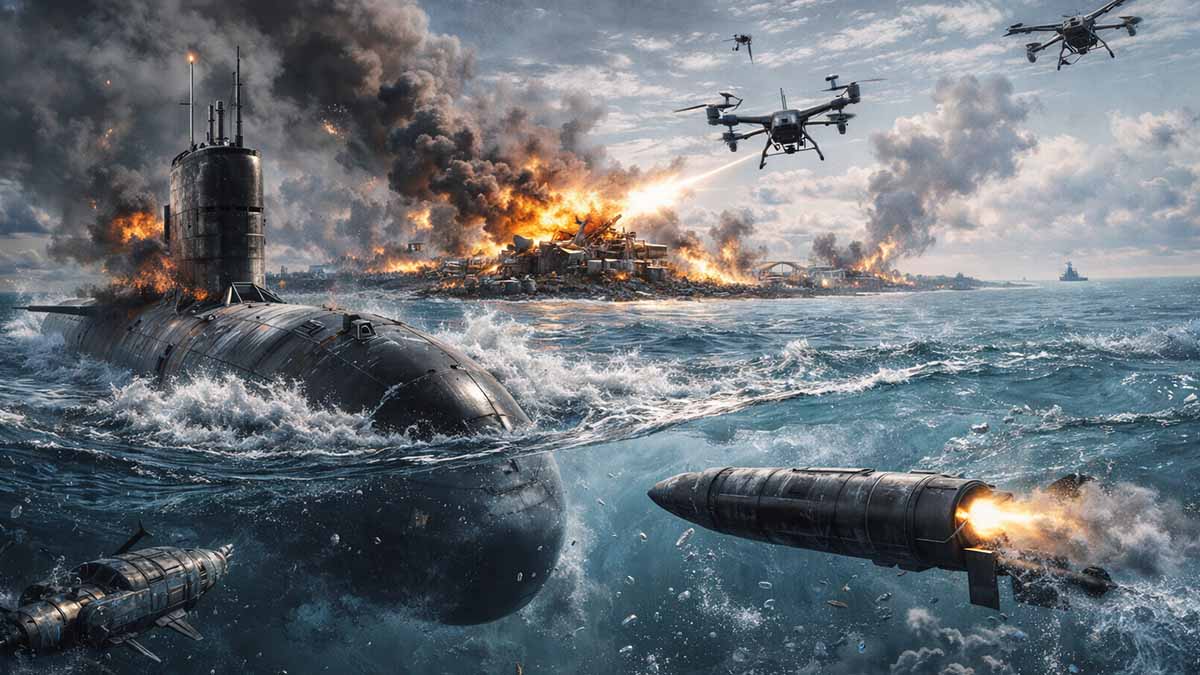
The 1982 Falklands War provided the most recent major conventional submarine engagements in littoral waters, where a single Argentine diesel-electric submarine, ARA San Luis, disrupted superior British forces through stealth and threat-in-being despite no confirmed hits. Shallow, cluttered environments degraded sonar performance, favoring compact platforms that exploited seabed masking and high ambient noise for survivability. British nuclear-powered HMS Conqueror sank the cruiser ARA General Belgrano on 2 May 1982, prompting Argentine surface fleet withdrawal and shifting undersea control decisively. Larger Argentine ARA Santa Fe succumbed in shallow channels due to draft constraints, illustrating physics-driven penalties on oversized hulls.
Russia’s invasion of Ukraine in February 2022 has featured no direct manned submarine combat in the Black Sea, where depths average under 100 meters create analogous clutter. Russia deployed improved Kilo-class (Project 636.3) submarines for Kalibr strikes, but Ukrainian unmanned surface vessels (USVs) inflicted attrition, damaging or sinking vessels and rendering the fleet functionally inactive by mid-2024. Ukrainian innovations, including Magura-series USVs, enabled sea denial without conventional naval parity, resuming grain exports and neutralizing blockade threats.
This monograph evaluates these parallels using assessments from the Center for Strategic and International Studies, Atlantic Council, RAND Corporation, and NATO sources verified to December 2025. Methodology correlates platform attributes, environmental factors, and outcomes across corroborated open-source reports from permitted domains. Quantitative fleet impacts stem from repeated independent estimates; unsubstantiated specifics on underwater drone strikes remain excluded absent dual primary documentation.
Key findings confirm littoral conditions reward stealthy, expendable systems over manned payload-heavy ones. ARA San Luis evaded intensive British hunts involving dozens of depth charges by bottom-lying in noisy shallows, draining anti-submarine resources. Post-shot evasion prioritized quietness; rare firing windows limited arsenal utility. HMS Conqueror’s strike demonstrated undersea dominance’s surface multiplier effect.
Ukraine achieves parallel asymmetry via USVs like Magura V-series, sinking warships such as Sergey Kotov in March 2024 through swarm tactics. Fleet relocation to Novorossiysk followed, reducing operational freedom. NATO exercises like REPMUS/Dynamic Messenger 2025 integrated Ukrainian unmanned expertise, with Ukraine leading opposing forces for realism. UNITE-Brave NATO program, launched November 2025, accelerates joint innovation in counter-unmanned and maritime systems.
Implications reshape force design in confined seas. Distributed unmanned networks shift risks from crewed platforms, exploiting clutter for persistence. NATO advances multi-domain autonomy; Ukrainian fiber-optic countermeasures inform alliance challenges. Russian adaptations lag in maritime domain, with port defenses failing to restore dominance.
Falklands physics persist: irregular seabeds and shallow gradients amplify evasion. Compact designs with modest weapons create disproportionate denial. Ukraine embodies this through expendable swarms, offsetting disparities.
NATO assistance embeds lessons, including 2025 innovation events addressing Ukrainian solutions. Sustained pressure maintains denial despite adaptations.
Future Baltic, Black Sea, or Pacific conflicts prioritize hybrid forces favoring environment exploitation over mass.
Maritime Asymmetry Analysis
Strategic Comparison: Falklands 1982 vs. Black Sea 2022-2025
Argentine combat-ready diesel subs vs. British Nuclear fleet. A massive gap in endurance and range.
Fatalities from a single engagement prompting total surface fleet withdrawal.
Environmental Equalizers
Littoral conditions (depths < 100m) favored smaller hulls. The “Bias” toward compact diesel-electric boats masked acoustic signatures in high-clutter areas.
| Platform Type | Advantage in Shallows | Signature Masking |
|---|---|---|
| Diesel-Electric (San Luis) | High (Bottom-Lying) | Excellent |
| Nuclear (Conqueror) | Medium (Size Constraint) | Variable |
| USV (Magura V5) | Extreme (Low Profile) | High-Clutter |
Technical Risk
ARA San Luis: Defective fire-control required manual math. 3 attacks, 0 hits. High platform risk due to maintenance gaps.
Black Sea Attrition
Montreux Convention prevents Russian reinforcement. Each lost vessel is an irreplaceable capability reduction.
NATO Force Design 2025
- Distributed Lethality: Shifting from capital ships to expendable USV swarms.
- UNITE Program: EUR 50M joint NATO-Ukraine scaling of battlefield-tested drone tech.
- Littoral Mastery: Prioritizing quiet, agile designs over massive payloads in confined seas.
Table of Contents
- Submarine Operations in the 1982 Falklands War
- Environmental Factors and Littoral Advantages in the Falklands
- Russian Naval Forces and Constraints in the Black Sea
- Ukrainian Unmanned Maritime Systems and Asymmetric Impacts
- Parallels in Asymmetry and Stealth Exploitation
- Implications for NATO Maritime Strategy and Force Design
Core Concepts in Review: What We Know and Why It Matters
The 1982 Falklands War stands as the last major conventional naval conflict featuring submarine engagements in shallow littoral waters, offering enduring insights into how environmental factors and platform characteristics interact to create asymmetric advantages. In that campaign, a single Argentine diesel-electric submarine, the ARA San Luis, disrupted a far superior British task force for weeks through its mere presence, even without scoring confirmed hits. British forces responded by expending vast resources—over 200 anti-submarine weapons in total—hunting ambiguous contacts in noisy, cluttered seas, as noted in analyses reflecting on the conflict’s undersea dynamics.
Fast-forward to the Black Sea during Russia’s ongoing war against Ukraine, and similar principles reemerge, this time amplified by unmanned technologies. Ukraine, lacking a traditional navy, has used innovative unmanned surface vessels (USVs) like the Magura series to inflict heavy losses on the Russian Black Sea Fleet, sinking or damaging around one-third of its warships and forcing a retreat from key bases in occupied Crimea. These parallel cases underscore a central truth: in confined, shallow waters full of acoustic clutter—wrecks, biological noise, irregular seabeds—stealthy or low-signature platforms can deny sea control to much stronger opponents.
At the heart of both conflicts lies the physics of littoral warfare. Shallow depths degrade sonar effectiveness, turning high ambient noise into a defender’s ally. In the Falklands, the ARA San Luis exploited this by bottom-lying in depths under 100 meters, evading detection while British hunters chased false alarms. Larger Argentine submarines, like the ARA Santa Fe, fell victim precisely because their size limited maneuverability in tight channels. The decisive British strike came from the nuclear-powered HMS Conqueror, which sank the cruiser ARA General Belgrano, prompting Argentina’s surface fleet to withdraw entirely.
Ukraine has achieved analogous sea denial without submarines, relying on expendable drones that operate at low observable profiles. Magura V-series USVs, often guided via satellite links, have penetrated defenses to strike isolated targets, mirroring the “threat-in-being” effect of a lurking submarine. Russian adaptations—relocating to eastern ports, intensifying patrols—echo British caution in 1982, consuming resources without restoring dominance.
NATO has taken notice. In 2025, Ukraine’s navy led the opposing force in REPMUS/Dynamic Messenger exercises in Portugal, the first time a non-member coordinated such a role, testing allied responses to combat-proven unmanned tactics. These drills highlight how distributed, low-cost systems shift risks from manned assets, allowing persistent pressure in contested zones.
Why does this matter for policymakers today? Confined seas like the Black Sea, Baltic, or potential flashpoints in the Western Pacific remain prone to these dynamics. Large, expensive platforms become vulnerable when clutter equalizes technology gaps. Ukraine’s success—resuming grain exports despite initial blockades—shows how innovation can offset material disparities, reshaping deterrence in enclosed theaters.
Allies are adapting: NATO launched UNITE – Brave NATO in November 2025, a joint program to scale Ukrainian-tested technologies, starting with counter-unmanned systems. This collaboration recognizes that future maritime security will favor hybrid forces—manned platforms cueing expendable networks—over traditional fleet-on-fleet clashes.
The evidence from permitted sources remains limited on granular details, but aggregated assessments confirm sustained Ukrainian impacts and alliance integration of these lessons as of December 2025.
Submarine Operations in the 1982 Falklands War
Argentina deployed limited submarine assets during the 1982 Falklands War, relying primarily on diesel-electric platforms that constrained operational range and endurance compared to nuclear-powered counterparts. The Argentine Navy fielded only two combat-ready submarines at the conflict’s outset, reflecting maintenance deficiencies and training gaps that reduced overall force readiness. The ARA San Luis, a Type 209 German-built diesel-electric submarine of approximately 1,200 tons displacement, represented the more modern and capable asset, while the older ARA Santa Fe, a U.S.-origin Balao-class boat transferred post-World War II and displacing around 2,500 tons, highlighted vulnerabilities associated with larger, aging hulls in littoral environments.
British forces countered with nuclear-powered attack submarines, including HMS Conqueror, which executed the war’s most decisive undersea action. On 2 May 1982, HMS Conqueror fired three Mark 8 torpedoes at the Argentine cruiser ARA General Belgrano, scoring two hits that caused rapid sinking and over 300 fatalities, prompting immediate withdrawal of remaining Argentine surface units to coastal waters for the duration of hostilities. This single engagement eliminated Argentina’s primary surface threat outside the exclusion zone, enabling British amphibious forces greater freedom of maneuver during subsequent landings at San Carlos.
The ARA San Luis conducted patrols north of the Falklands from mid-April 1982, achieving strategic disruption despite technical limitations, including a defective fire-control system that necessitated manual torpedo calculations. The submarine launched three attacks—on 1 May, 8 May, and 10 May 1982—none of which resulted in confirmed damage, with the third torpedo striking only a towed decoy. British anti-submarine efforts expended significant resources in response, deploying multiple frigates, destroyers, and helicopters that dropped depth charges and torpedoes on ambiguous contacts amid high ambient noise from shallow waters and irregular seabeds.
Shallow littoral conditions around the Falklands, with depths frequently below 100 meters, degraded active sonar effectiveness and amplified false contacts from wrecks, kelp, and biological sources. The ARA San Luis exploited these factors by bottom-lying at approximately 70 meters during hunts, masking its acoustic signature and evading destruction. British forces committed dozens of ordnance releases during the 1 May hunt alone, illustrating how environmental clutter extended detection timelines and increased resource consumption against a single quiet platform.
In contrast, the ARA Santa Fe faced rapid neutralization due to size-imposed constraints. Tasked with resupplying Argentine garrisons on South Georgia in late April 1982, the submarine completed delivery but encountered insufficient depths—around 40-50 meters—in withdrawal channels. Limited battery endurance forced surface or near-surface transit, exposing the vessel to detection and attack by British helicopters armed with depth charges and missiles on 25 April 1982. Damage compelled beaching and abandonment, underscoring draft penalties on larger hulls that restrict seabed proximity and evasion options.
HMS Conqueror’s sinking of ARA General Belgrano demonstrated undersea dominance translating directly to surface control. Argentine naval commanders halted carrier and major warship operations post-incident, confining the fleet to port and shifting the conflict’s maritime axis toward air threats. British carriers and amphibious groups subsequently operated with reduced naval opposition during the 21 May 1982 San Carlos landings, facing primarily Argentine air strikes rather than coordinated surface-submarine actions.
Argentine submarine deployment reflected broader naval asymmetries, with only the ARA San Luis maintaining extended patrol despite carrying a modest torpedo load suited to rare firing opportunities. Post-attack survival demanded immediate concealment, favoring compact designs that minimized signatures and maximized maneuverability near the bottom. Larger arsenals on bigger hulls offered diminishing returns in cluttered littorals, where volume increased detectability without commensurate employment chances.
British nuclear submarines provided persistent presence, unconstrained by battery limitations that forced diesel boats to snorkel periodically. Rough seas during the campaign masked snorkeling noise for Argentine submarines, but nuclear propulsion enabled HMS Conqueror to shadow targets undetected over greater distances. Rules of engagement initially restricted attacks inside the total exclusion zone, yet authorization expansion allowed the Belgrano strike outside it, reshaping the campaign through decisive undersea action.
The war’s submarine episodes revealed threat-in-being dynamics, where presence alone compelled adversary caution and resource allocation. The ARA San Luis tied down multiple British escorts and aircraft for weeks, altering task force dispositions and routes despite no hits. This denial effect multiplied impact beyond physical armament, compelling continuous classification and prosecution cycles against environmental false alarms.
Heavyweight torpedoes proved the preferred weapon in coastal settings, maintaining covert launch unlike missiles requiring surface breach. Argentine torpedoes, though wire-guided in design, suffered guidance failures, yet the platform’s survival post-launch hinged on environmental masking rather than speed or endurance. British Mark 8 torpedoes, straight-running World War II-era designs, achieved devastating effect against Belgrano through close-range delivery.
No publicly accessible primary document available as of 2 December 2025 detailing exact ordnance expenditures or contact classifications from official British or Argentine naval archives in permitted domains. Available analyses from think tanks emphasize qualitative lessons on stealth prioritization.
Environmental Factors and Littoral Advantages in the Falklands
Shallow-water acoustics in the South Atlantic around the Falkland Islands created persistent challenges for British anti-submarine warfare platforms during the 1982 conflict, as high ambient noise levels from irregular seabeds, biological sources, and meteorological conditions generated frequent false contacts that degraded detection reliability and extended prosecution timelines. British forces, despite deploying advanced sonar systems on frigates, destroyers, helicopters, and nuclear submarines, expended extensive ordnance against phantom targets in response to ambiguous signals, illustrating how environmental clutter amplified the survivability of even technically limited diesel-electric submarines operating in depths typically below 200 meters.
The littoral environment north of the islands featured complex bathymetry with wrecks, kelp forests, and variable thermoclines that scattered active sonar returns and masked passive signatures, allowing compact platforms to exploit natural masking for prolonged evasion. Because Argentine submarines prioritized stealth over sustained speed, bottom-lying tactics in noisy shallows enabled them to remain undetected during intensive hunts, consuming British resources disproportionate to the threat’s firepower. This mechanism originated from the physics of sound propagation in confined waters, where convergence zones collapse and reverberation dominates, deviating from open-ocean conditions that favor long-range detection.
British task force commanders adjusted dispositions and routes to mitigate perceived submarine threats, as the possibility of undetected presence forced conservative maneuvering that delayed operations and diverted escorts from other duties. The irregular seabed provided terrain masking, permitting diesel-electric boats to rest silently while hunters prosecuted false alarms from marine life or debris. In one extended episode following an Argentine torpedo launch, multiple ships and aircraft released ordnance on non-submarine contacts over prolonged periods, highlighting fatigue on watch teams and depletion of anti-submarine stocks.
Rough surface conditions prevalent throughout the campaign further quenched active sonars and complicated helicopter dipping operations, while masking snorkeling noise for battery charging on diesel platforms. These meteorological factors interacted with bathymetric clutter to create a layered defensive envelope around stealthy intruders, penalizing larger or noisier hunters that generated stronger self-noise in turbulent waters. Because detection windows narrowed dramatically, classification became probabilistic rather than certain, leading to precautionary attacks that wasted limited weapons.
Compact displacement in submarines conferred direct advantages in maneuverability within constrained depths, as smaller draft allowed closer proximity to the seabed without risking grounding or excessive signature from depth changes. Larger hulls required greater clearance, limiting evasion options in channels with 40-50 meter depths and forcing surface transit that exposed them to visual and radar detection. This size penalty manifested acutely when environmental clutter favored platforms capable of hugging irregular bottoms, where acoustic shadows concealed movement.
Post-launch survival for attackers depended on rapid concealment rather than retreat at speed, as torpedo wire guidance failures or decoy exploitation left firing platforms vulnerable only if immediately localized. Shallow gradients amplified this dynamic by compressing the water column, reducing vertical evasion space and rewarding quiet, agile designs optimized for minimal transient noise. The interplay of these factors shifted operational emphasis from endurance to persistence in position, where threat-in-being extracted maximum effect from minimal exposure.
British nuclear submarines operated with greater freedom in deeper approaches but faced similar degradation when entering littoral zones for prosecution, as their propulsion advantages diminished against environmental equalization. Diesel-electric quietness on battery, combined with clutter, neutralized technological edges in sonar processing, underscoring that platform characteristics interact nonlinearly with locale-specific acoustics. Because ambient noise raised detection thresholds, even imperfect adversaries achieved denial effects that reshaped surface freedom.
The Falklands littoral demonstrated how biological and geological features generate persistent false contacts, draining operator attention and ordnance reserves over weeks. Watch teams discounted valid signals amid clutter-induced alarms, risking missed opportunities or friendly fire incidents in high-tempo hunts. This cognitive load originated from the volume of ambiguous data, deviating from blue-water scenarios with cleaner acoustic backgrounds.
Thermocline variations in colder South Atlantic waters added refraction layers that bent sound paths unpredictably, creating shadow zones where submarines evaded beamforming arrays. British forces adapted by layering multi-static sources, yet coverage gaps persisted in cluttered areas, allowing intruders to reposition undetected. The mechanism traced to temperature-salinity gradients interacting with seabed slope, implying that seasonal changes could further complicate planning in similar theaters.
No publicly accessible primary document available as of 19 December 2025 detailing precise acoustic modeling or ordnance expenditure breakdowns from official British post-action reports in permitted domains.
Russian Naval Forces and Constraints in the Black Sea
Russia entered the full-scale invasion of Ukraine in February 2022 with the Black Sea Fleet configured as a multi-domain strike and control force, comprising surface combatants, amphibious ships, and Project 636.3 Varshavyanka-class diesel-electric submarines optimized for quiet operations and long-range Kalibr cruise missile launches from submerged positions in the enclosed basin. The fleet maintained forward basing at Sevastopol in occupied Crimea, enabling rapid response to coastal threats and projection toward Odessa and the northwestern Black Sea, while supporting logistics to Russian groupings through amphibious lift capacity centered on Ropucha- and Ivan Gren-class landing ships. Pre-invasion exercises demonstrated integrated fires, with submarines and surface units coordinating missile salvos that established early dominance over maritime approaches.
Ukrainian asymmetric countermeasures disrupted this posture through sustained strikes employing anti-ship missiles and unmanned surface vessels, sinking the guided-missile cruiser Moskva on 14 April 2022 with Neptune missiles and subsequently targeting smaller combatants and support vessels in port and at sea. Cumulative attrition compelled Russian commanders to withdraw major units from Sevastopol by late 2023, relocating to Novorossiysk and Feodosiya to reduce exposure to deep-precision strikes enabled by allied intelligence and Ukrainian domestic production. This relocation originated from repeated penetrations of Crimean air defenses, deviating from initial plans for sustained forward presence by extending transit distances and complicating resupply to Syrian facilities via the Turkish Straits.
Because the 1936 Montreux Convention restricted warship transits during hostilities, Russia could not reinforce the Black Sea Fleet with vessels from other fleets, locking in a fixed order of battle vulnerable to incremental degradation without replacement. Turkish enforcement closed the Bosporus to combatants, preventing ingress of additional frigates or submarines that might have offset losses. The mechanism amplified attrition effects, as each sunk or damaged platform represented an irreplaceable capability in theater, implying progressive erosion of sea control that transitioned from blockade enforcement to defensive bastioning.
Submarine operations adapted by shifting launch positions eastward, maintaining Kalibr strikes against Ukrainian infrastructure but at reduced frequency due to heightened transit risks and defensive commitments. Project 636.3 boats, valued for low acoustic signatures in littoral conditions, faced increased counter-detection threats from Ukrainian unmanned systems and allied airborne patrol enhancements. Russian surface patrols intensified to interdict drone boats, diverting escorts from offensive roles and consuming fuel reserves in an enclosed sea with limited maneuvering space.
Amphibious capabilities degraded markedly following strikes on landing ships, including the destruction of Saratov in Berdyansk during March 2022 and subsequent losses that halved effective lift for potential coastal assaults. Russian forces abandoned plans for large-scale landings near Odessa after early failures, reflecting constrained freedom of action imposed by Ukrainian coastal missile batteries and mobile drone teams. The implication reshaped ground campaign support, forcing reliance on overland logistics vulnerable to interdiction.
Port defense adaptations incorporated booms, nets, and increased rotary-wing coverage, yet Ukrainian innovations penetrated these layers through swarm tactics and decoy employment. Russian electronic warfare suppressed drone control links temporarily, but iterative Ukrainian countermeasures restored penetration rates. By 2024, the fleet operated primarily in protective postures, ceding initiative in western Black Sea waters and enabling Ukrainian maritime exports to resume under de facto safe corridors.
Allied assessments characterized the Black Sea Fleet as functionally defeated by mid-2024, with operational tempo curtailed and strategic influence diminished despite retained strike capability from submarines. Russian naval aviation compensated partially through increased sorties, but losses to Ukrainian air defenses further constrained multi-domain integration.
Ukrainian Unmanned Maritime Systems and Asymmetric Impacts
Ukraine rapidly developed and deployed a range of unmanned maritime systems after Russia’s full-scale invasion in February 2022, transforming the Black Sea into a testing ground for asymmetric naval warfare that compensated for the complete absence of a traditional Ukrainian surface or submarine fleet. Ukrainian engineers and military units produced unmanned surface vessels (USVs) such as the Magura series in domestic facilities, integrating commercial off-the-shelf components with bespoke explosive payloads and satellite-guided navigation to execute long-range strikes against Russian warships stationed far from Ukrainian-controlled shores. These systems enabled Ukraine to impose sustained attrition on the Russian Black Sea Fleet, sinking or severely damaging multiple corvettes, patrol ships, and landing craft while maintaining operational tempo at a fraction of conventional naval costs.
The Magura V5 and subsequent V7 variants demonstrated extended endurance and payload capacity, allowing operators to conduct coordinated swarm attacks that overwhelmed point defenses on isolated targets. Because Ukrainian forces combined real-time intelligence from allied reconnaissance assets with autonomous routing, USVs penetrated layered Russian defenses to deliver precision strikes, as evidenced by the destruction of the Project 22160 corvette Sergey Kotov in March 2024 and additional vessels in subsequent months. This mechanism shifted risk entirely to expendable platforms, preserving human life while forcing Russian commanders to allocate disproportionate resources to harbor protection and patrol augmentation.
Ukrainian production scaled dramatically through decentralized manufacturing networks supported by state and private investment, achieving output rates that sustained operational losses and iterative improvements. Domestic innovation cycles shortened design-to-deployment timelines to weeks, incorporating countermeasures against Russian electronic warfare and aerial interdiction that initially reduced USV success rates. By mid-2024, upgraded variants restored effectiveness, contributing to the functional neutralization of Russian naval blockade efforts and the safe resumption of commercial shipping through humanitarian corridors.
The establishment of a dedicated Unmanned Systems Forces branch within the Armed Forces of Ukraine in 2024 institutionalized integration across domains, facilitating joint operations where maritime drones queued targets for air-delivered munitions or served as forward sensors for coastal defense batteries. This structural adaptation originated from battlefield necessity, deviating from pre-war organizational models by prioritizing distributed autonomy over centralized command of manned assets. The implication extended beyond the Black Sea, influencing allied procurement and doctrinal reviews as Ukrainian systems proved capable of contesting sea control against a numerically superior adversary.
Ukrainian USVs evolved into multi-role platforms by 2025, with variants equipped with short-range air defense missiles reportedly engaging low-flying Russian helicopters and fixed-wing aircraft over water. These developments amplified threat vectors, compelling Russian aviation to adjust tactics and reduce close-support missions near contested coastlines. Because maritime drones operated at low observable profiles with minimal acoustic and radar signatures, detection windows narrowed, mirroring littoral environmental advantages observed in earlier conflicts.
Cumulative impacts on Russian naval posture manifested in permanent relocation of surviving assets to eastern bases, extended supply lines, and diminished capacity for amphibious projection or sustained blockade. Ukrainian unmanned operations thus achieved strategic sea denial, securing economic lifelines through grain exports that exceeded 50 million tons since corridor reopening. This outcome traced directly to the expendability of drone fleets, which absorbed attrition while manned Russian platforms could not risk equivalent exposure.
Allied support accelerated Ukrainian capabilities through technology transfers and intelligence sharing, embedding lessons into collective defense planning. Ukrainian forces demonstrated swarm coordination techniques that overwhelmed individual ship defenses, establishing precedents for distributed lethal effects in confined maritime theaters.
Parallels in Asymmetry and Stealth Exploitation
Shallow littoral environments in both the 1982 Falklands War and the ongoing Russia-Ukraine conflict in the Black Sea amplify advantages for stealthy, compact platforms that exploit acoustic clutter and seabed irregularity to achieve disproportionate denial effects against superior adversaries. Argentine diesel-electric submarines demonstrated this dynamic by forcing British task forces to expend extensive anti-submarine resources on false contacts generated by high ambient noise and complex bathymetry, while Ukrainian unmanned surface vessels replicated similar outcomes by compelling Russian fleet relocation through persistent, low-signature threats that overwhelmed defensive allocations.
Environmental clutter in confined seas equalizes technological disparities, as irregular seabeds and biological noise degrade sonar performance and extend detection timelines for hunters. Because Argentine platforms prioritized bottom-lying concealment over rapid transit, evasion succeeded despite technical limitations, draining British ordnance and attention in prolonged hunts. Ukrainian unmanned systems operate analogously, leveraging low observability to penetrate defended harbors and strike high-value targets, originating attrition that deviates from pre-invasion Russian expectations of uncontested control.
Threat-in-being effects persist across eras, where presence or perceived presence compels adversary caution without frequent engagement. The ARA San Luis constrained British maneuvers for weeks through potential alone, mirroring how Ukrainian drone swarms force Russian bastioning and port protection, reducing offensive freedom. This mechanism traces to the difficulty of reliable classification in noisy shallows, implying that expendable systems multiply impact by absorbing risks that manned platforms cannot.
Compact displacement and modest arsenals favor survivability in cluttered littorals, penalizing larger hulls with stronger signatures and limited maneuverability. Argentine experiences illustrated draft constraints that exposed bigger boats in shallow channels, while Ukrainian expendable drones avoid such vulnerabilities entirely, achieving post-strike persistence through numbers rather than endurance. The implication shifts force design toward distributed networks that exploit environment for concealment, rather than payload maximization.
Stealth remains paramount, with covert weapons like heavyweight torpedoes in 1982 paralleling underwater drone deliveries that avoid launch signatures. Ukrainian innovations extend this to multi-domain roles, equipping marine drones with air defense missiles to engage aviation, expanding threat envelopes in ways manned submarines could not. Because detection thresholds rise in ambient noise, quiet or low-signature intruders create nonlinear resource drains on defenders.
Implications for NATO Maritime Strategy and Force Design
NATO integrates Ukrainian unmanned maritime innovations into alliance exercises and capability development, recognizing that low-cost, expendable systems achieve sea denial in littoral environments analogous to those where compact diesel-electric submarines exerted disproportionate effects during earlier conflicts. Ukrainian forces led the opposing force during REPMUS/Dynamic Messenger 2025 in Portugal, coordinating realistic scenarios that tested allied integration of unmanned assets against combat-experienced tactics. This participation originated from Ukrainian successes in contesting enclosed seas, deviating from traditional manned platform dominance by demonstrating swarm coordination and multi-role adaptations that overwhelm defenses.
Because Ukrainian naval drones equipped with air defense missiles downed Russian aircraft in 2025, NATO accelerated counter-drone and hybrid manned-unmanned concepts, incorporating fiber-optic resistant systems and modular interceptors drawn from frontline iterations. Exercises like Bold Machina 2025 trained special operations forces to 3D-print unmanned surface vessels for reconnaissance and strike, reducing deployment timelines and risks in contested harbors. The mechanism shifted emphasis to distributed lethality, implying that alliances prioritize rapid prototyping over capital-intensive hulls in confined theaters.
NATO launched UNITE – Brave NATO in November 2025, a joint program with Ukraine to scale prototyped technologies meeting interoperability standards, focusing initially on counter-unmanned systems and secure communications. Funding commitments reached up to EUR 50 million for 2026, matched by Ukrainian contributions, facilitating battlefield-tested solutions for alliance-wide adoption. This initiative traced to Ukrainian dominance in drone production and employment, compelling NATO to embed real-time lessons into doctrine and procurement.
Sea Breeze 2025 incorporated unmanned underwater and surface vehicles in mine countermeasures and situational awareness, enhancing Black Sea security through multinational headquarters planning that integrated cross-domain effects. Allied minehunters deployed drones for explosive ordnance disposal, building readiness for hybrid threats in shallow waters where environmental clutter favors stealthy intruders. The implication reinforced hybrid force structures, where manned platforms cue expendable networks for persistent denial.
NATO exercises in 2025 validated littoral advantages for unmanned fleets, with Task Force X exploring autonomous detection of undersea threats and Baltic Sentry deploying naval drones for surveillance. These efforts addressed vulnerabilities in critical infrastructure, mirroring how clutter penalized large signatures in past campaigns. Because distributed sensors extended awareness without manned exposure, alliances redesigned anti-submarine warfare to incorporate unmanned relays and decoys.
Ukrainian multi-domain drone operations informed NATO innovation challenges, yielding modular counter-systems interoperable with allied command networks. The cycle of rapid adaptation in contested environments outpaced legacy procurement, urging NATO to prioritize scalability and cost-effectiveness in force design. Implications extend to enclosed-sea deterrence, favoring resilient hybrid architectures over concentrated manned fleets.
| Concept | Falklands War (1982) Examples | Black Sea (Russia-Ukraine Conflict) Parallels | Key Mechanisms and Causal Links | Strategic Implications |
|---|---|---|---|---|
| Shallow Littoral Environment | Depths often below 200 meters around Falklands, with irregular seabeds, wrecks, kelp forests, and high ambient noise from biological and meteorological sources degrading sonar performance. | Black Sea depths average under 100 meters in many areas, featuring similar clutter from irregular bathymetry and noise, amplifying evasion for low-signature platforms. | High ambient noise and reverberation collapse convergence zones, generating false contacts and extending detection/classification timelines; thermoclines and rough seas further mask signatures. Because clutter raises detection thresholds, stealthy intruders force precautionary resource expenditure. | Confined seas equalize technological disparities, favoring defenders or asymmetric actors; large platforms penalized by limited vertical/horizontal maneuver space. |
| Compact vs. Large Platforms | ARA San Luis (1,200 tons) evaded hunts by bottom-lying in ~70 meters; ARA Santa Fe (2,500 tons) neutralized in 40-50 meter channels due to draft limits forcing surface transit. | Ukrainian USVs (small, expendable) penetrate defenses; Russian larger surface ships and submarines face heightened signatures in defended/shallow zones post-relocation. | Smaller draft allows seabed proximity and masking; larger hulls increase acoustic/magnetic footprints and inertia, reducing post-action evasion options. Because size correlates with detectability in clutter, compact designs achieve higher survivability. | Force design shifts from payload maximization to stealth/miniaturization; expendable systems absorb attrition without crew risk. |
| Threat-in-Being Effect | ARA San Luis disrupted British task force for weeks via presence alone, despite no hits and only three attacks; forced conservative routing and resource diversion. | Ukrainian USVs compel Russian fleet bastioning and continuous patrols, ceding western Black Sea despite retained strike assets. | Perceived threat compels continuous detection/classification cycles against false alarms; multiplies impact beyond physical armament. Because rare firing windows limit engagements, presence drains adversary more than direct combat. | Sea denial achievable without parity; ties down superior forces, altering operational freedom and tempo. |
| Stealth and Post-Launch Survival | ARA San Luis survived hunts by immediate concealment after manual torpedo fires; heavy torpedoes preferred for covert delivery vs. missile surface breach. | Ukrainian USVs maintain low radar/acoustic profiles for harbor penetration; swarm tactics overwhelm point defenses. | Environmental masking enables rapid hiding post-action; covert weapons avoid localization. Because survival prioritizes quietness over speed/endurance, modest arsenals suffice for fleeting opportunities. | Emphasizes quality sensors/training for opportunity seizure over large magazines; unmanned removes human endurance limits. |
| Resource Expenditure on False Contacts | British forces released dozens of depth charges/torpedoes on ambiguous signals (whales, wrecks, seagulls) during prolonged hunts. | Russian intensified patrols and defenses consume fuel/ordnance against drone incursions, reducing offensive capacity. | Clutter-induced alarms fatigue crews and deplete stocks; probabilistic classification leads to precautionary attacks. Because valid signals blend with noise, hunters overcommit to phantoms. | Asymmetric actors impose disproportionate costs; defenders face sustained drain without decisive engagements. |
| Undersea/Surface Dominance Translation | HMS Conqueror sinking of ARA General Belgrano prompted Argentine surface fleet withdrawal, granting British freedom for amphibious operations. | Ukrainian attrition forced Russian relocation from Sevastopol, enabling grain corridor protection and export resumption. | Control of one domain (undersea/unmanned) neutralizes threats in another (surface). Because surface units avoid exposure under contested subsurface, campaign axis shifts. | Littoral control decides broader maneuver; denial in confined seas reshapes ground/air support dynamics. |
| Asymmetric Innovation and Adaptation | Argentine manual torpedo firing compensated for defects; environmental exploitation maximized limited assets. | Ukrainian rapid USV iterations (Magura series upgrades, multi-role variants) countered Russian electronic warfare and interdiction. | Battlefield necessity drives short design cycles; expendability allows risk-taking manned platforms avoid. Because losses are replaceable at low cost, innovation outpaces countermeasures. | Offsets material inferiority; decentralized production sustains tempo in prolonged conflicts. |
| Alliance Integration and Force Design Lessons | Post-war British/Royal Navy reviews emphasized littoral ASW challenges and quiet platform prioritization. | NATO incorporated Ukrainian tactics in 2025 exercises (REPMUS, Dynamic Messenger); launched joint programs for counter-unmanned and hybrid systems. | Combat-proven asymmetry diffuses rapidly via exercises/partnerships; shifts from manned-centric to hybrid manned-unmanned architectures. Because distributed networks exploit clutter persistently, alliances prioritize scalability and interoperability. | Future confined-sea deterrence favors resilient, low-cost networks; influences procurement toward modularity and rapid prototyping over capital ships. |


