













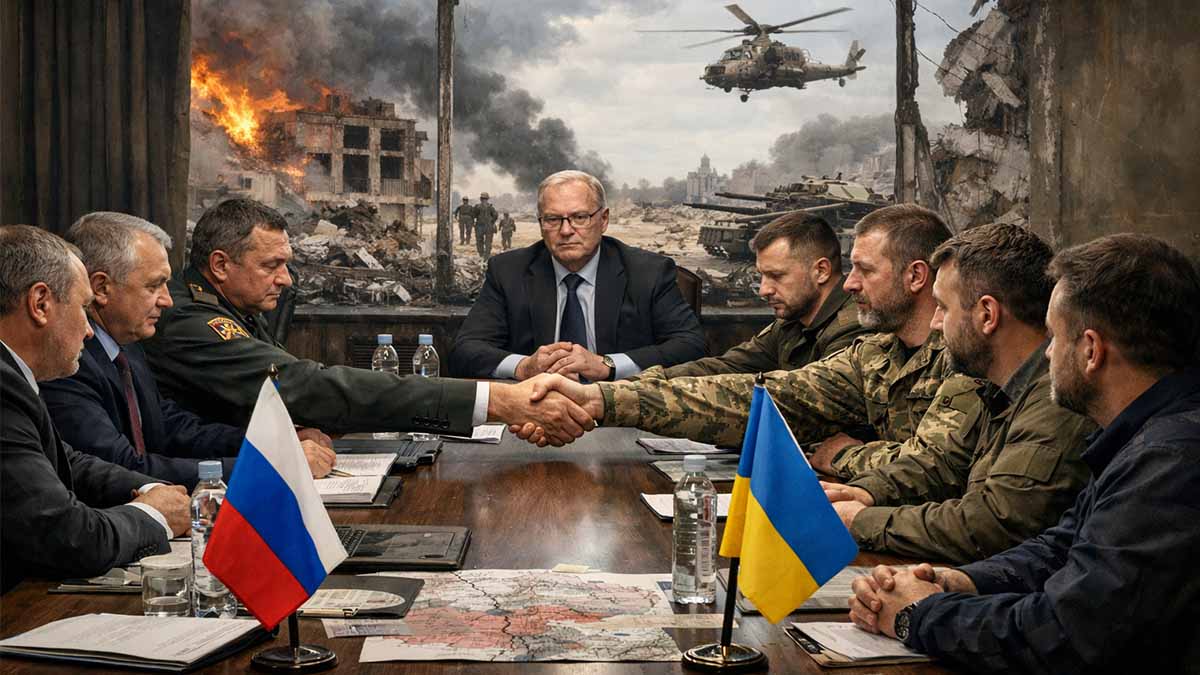
ABSTRACT
Negotiation dynamics in the Russia–Ukraine war have increasingly been shaped less by short-run battlefield narratives than by interacting structural constraints on state capacity, fiscal endurance, energy revenues, governance, and external financing. The most reliable, publicly verifiable record of these constraints, as of December 2025, is found in joint damage-and-needs accounting by multilateral institutions, macro-financial surveillance by the IMF and World Bank, legal–financial architecture adopted by the European Union, and energy-market monitoring by the IEA and the U.S. EIA. These sources jointly indicate a conflict environment in which both belligerents face compounding medium-term pressures that can create bargaining incentives, while simultaneously sustaining maximalist positions through mobilization, coercive control, and external economic adaptation.
On the Ukrainian side, the best-available consolidated estimate of damage, losses, and forward reconstruction requirements through December 31, 2024 is the RDNA4 assessment jointly prepared by the World Bank Group, the Government of Ukraine, the European Union, and the United Nations. The assessment frames the war’s impact as multidimensional—physical destruction, social disruption, environmental damage, and fiscal stress—while also documenting large-scale external support mobilized through December 2024. In particular, it emphasizes the scale of recovery and reconstruction needs over a 10-year horizon and the continuing concentration of war intensity in eastern areas, alongside the persistent macro-fiscal implications of infrastructure and housing damage, disrupted production, and elevated security expenditure obligations. The analytical relevance for ceasefire prospects is direct: negotiations become more likely when marginal war continuation costs exceed perceived marginal gains, and when domestic and external financing conditions tighten sufficiently to raise the shadow price of time for decision-makers. The RDNA4 baseline, by quantifying war-induced capital destruction and identifying priority investment needs, provides a measurable channel through which endurance constraints can become politically salient. Ukraine: Fourth Rapid Damage and Needs Assessment – World Bank Group / Government of Ukraine / European Union / United Nations – February 2025.
Macroeconomic stabilization and external financing are the second central channel. The IMF’s program documentation for Ukraine in June 2025 presents a high-frequency, policy-conditional picture: continued war damage, labor market strain, and energy infrastructure vulnerability constrain growth and revenue; inflation management and reserve adequacy depend critically on predictable external support; and fiscal strategy requires supplementary budgeting and medium-term revenue mobilization under exceptional uncertainty. The report’s relevance for negotiation analysis lies in the explicit coupling of wartime macro stability to donor predictability and program conditionality—an architecture that can sustain resistance capacity while also creating acute exposure to any deterioration in external flows or confidence. This institutional framing clarifies why ceasefire discussions may be perceived as financially consequential, not merely militarily consequential: expectations about duration affect reserve adequacy, debt sustainability, and the feasible path of domestic taxation and expenditure compression. The same source documents governance and institutional reform benchmarks, indicating that wartime political economy is not only about resource mobilization, but also about credibility with external financiers and domestic constituencies. Ukraine: Eighth Review Under the Extended Fund Facility – International Monetary Fund – June 2025.
A complementary view of Ukrainian growth constraints and financing needs is provided by the World Bank’s macro poverty outlook material for Ukraine, which highlights war-driven disruptions and labor shortages, downward revisions to growth projections, and widening fiscal and external imbalances requiring additional external financing and policy adjustment. While the document is not a battlefield account, it anchors the economic logic of war termination: the longer war-induced constraints suppress potential output and widen imbalances, the more valuable any credible cessation that reduces uncertainty and infrastructure losses becomes for macro stabilization. Importantly, the same materials place Ukraine’s reform trajectory and accession preparation as an anchor for policy continuity—suggesting that ceasefire prospects intersect with institutional convergence incentives and conditional disbursement frameworks rather than solely with territorial bargaining. Ukraine Macro Poverty Outlook – World Bank – 2025.
The European Union legal-financial architecture is a third negotiation-relevant channel, because it transforms political commitments into multi-year fiscal instruments that affect expectations about Ukrainian solvency and state function. The Ukraine Facility framework and related documents—published as official European Commission material and, where applicable, embedded in EUR-Lex documentation—describe structured support across 2024–2027, connecting disbursements to reforms and investment planning. This architecture increases Ukraine’s capacity to endure, but also formalizes the costs of prolonged conflict by specifying financing gaps, reform pathways, and monitoring obligations, all of which become harder under escalating wartime disruption. The specific institutional point is that credible medium-term financing reduces the bargaining leverage of time for the aggressor, while simultaneously making the continuation of high-intensity war economically more expensive for the supported state if donor fatigue or conditionality slippage emerges. Ukraine Facility Document – European Commission – December 2025. The broader governance context is also documented in the European Commission’s Ukraine Report 2025, including explicit attention to anti-corruption framework concerns and reform milestones. These governance details matter for ceasefire analysis because negotiation endurance is partly determined by domestic legitimacy and the credibility of postwar reconstruction allocation—both of which affect donor willingness and private capital risk premia. Ukraine Report 2025 – European Commission – November 2025.
On the Russian side, the most robustly verifiable public evidence for economic constraint and adaptation is found in energy-market monitoring and official monetary-policy communication. The IEA’s December 2025 oil market analysis reports a fall in Russian oil exports in November 2025, with associated revenue pressure under tightening sanctions conditions, alongside broader global supply–demand balances that affect price formation. For negotiation incentives, the critical point is not any single monthly estimate but the directional implication: if export volumes and realized prices are pressured simultaneously, fiscal space narrows; if fiscal space narrows while war expenditure remains high, the state faces intensified trade-offs among social spending, internal security, regional transfers, and defense-industrial mobilization. In a political economy where elite cohesion and patronage stability depend on distributable rents, sustained revenue compression can increase the attractiveness of ceasefire terms that lock in gains while reducing marginal cost escalation. Oil Market Report – International Energy Agency – December 2025. The IEA’s medium-horizon structural analysis reinforces that oil supply security and trade flows remain central to macro outcomes, supporting the inference that sanction-induced trade rerouting and price discounts are not transient frictions but structural features that can influence fiscal endurance and bargaining positions. Oil 2025: Analysis and forecast to 2030 – International Energy Agency – June 2025.
A complementary, officially produced energy baseline is provided by the U.S. Energy Information Administration’s country analysis material on Russia, which consolidates energy-sector structure, export dependencies, and sanctions-relevant vulnerabilities in an accessible format. Even where the document references non-official reporting in its bibliography, its analytical utility for negotiation dynamics lies in the official characterization of Russia’s energy system as a constraint environment: export routes, refining capacity, and exposure to infrastructure disruptions shape the resilience of the principal rent-generating sector, which in turn shapes the fiscal feasibility of prolonged high-intensity war. Country Analysis Brief: Russia – U.S. Energy Information Administration – July 2025.
Monetary policy is the second verifiable Russian constraint channel. The Central Bank of Russia’s official communications in October 2025 frame the policy rate decision in terms of inflation dynamics, demand pressures, and macro-financial stability. For war termination analysis, the importance is the institutional signal: tight monetary policy and elevated rates are a mechanism to prevent macro instability under sanction-driven import constraints, fiscal expansion, and labor market pressures. Sustained tightness, however, also implies a real-economy cost in investment and credit conditions—costs that accumulate over time, potentially shifting elite preferences toward negotiated stabilization if war continuation increasingly crowds out civilian growth and modernization. Key rate decision – Bank of Russia – October 2025.
The political stability dimension of war termination is inherently difficult to document with the same precision as macro aggregates, but some institutional proxies are verifiable and analytically relevant. The Council of Europe’s Register of Damage for Ukraine represents an internationalized claims and documentation mechanism for war-related harm. While not a direct driver of immediate ceasefire bargaining, it affects the long-run expected liability environment and the credibility of postwar justice and compensation architecture, thereby influencing the strategic calculus around settlement timing and terms. It also signals the extent to which international institutions are embedding the war into durable legal-administrative processes that extend beyond immediate diplomacy. Register of Damage for Ukraine – Council of Europe – 2025. In parallel, the scale and persistence of displacement can be anchored through the UNHCR’s operational data portal for the Ukraine situation, which provides a continuously updated institutional record of refugee dynamics and operational context. These humanitarian burdens affect state capacity and political legitimacy, and they shape external assistance priorities that can create both incentives and constraints for ceasefire agreements. Ukraine Refugee Situation Data Portal – UNHCR – 2025.
Historical analogy, while frequently misused in public discourse, can be deployed rigorously when anchored in peer-reviewed or university press materials and used to specify mechanisms rather than to predict outcomes. A defensible mechanism-based analogy from Russian imperial history is that prolonged wars of choice can interact with under-institutionalized political systems and uneven economic modernization to produce rising domestic strain and reform pressures. A verifiable, academically published discussion of the linkage between the Crimean War defeat and subsequent reform-era modernization initiatives under Alexander II is available through Cambridge University Press excerpt material, supporting the narrow claim that military setbacks have historically been followed by internal reform efforts in the Russian polity. The analytical value is not determinism but mechanism: war costs can expose institutional bottlenecks and catalyze modernization attempts that are politically risky and often contested. The Russian Revolution, 1917 (Excerpt) – Cambridge University Press – 2017.
Taken together, the verified institutional record supports a constrained conclusion about ceasefire plausibility: both sides can face increasing incentives to negotiate as fiscal, energy, and governance pressures accumulate, but those same pressures can also harden positions by increasing the perceived need to secure strategic gains that can be defended domestically as compensation for incurred costs. The most empirically grounded expectation, based on the cited sources, is that negotiation windows are likely to open not simply when one side is “winning” or “losing,” but when the marginal resource cost of continuing at current intensity rises faster than the expected incremental political benefit of continued fighting, under the shadow of external financing conditions, energy revenue trajectories, and institutional credibility constraints. The institutionalization of reconstruction planning, reform conditionality, humanitarian burden tracking, and long-horizon legal claims documentation further implies that any ceasefire—if achieved—will operate inside an already-structured international governance environment that shapes compliance incentives, postwar resource allocation, and the longer-term stability of political orders in both states.
The core incentive for a negotiated settlement is driven by the divergence between rising marginal costs of war and stagnating marginal strategic gains. Financial constraints, destruction, and energy revenue shifts define this balance.
External financing (IMF and EU) anchors Ukraine’s stability, stabilizing resistance while imposing policy conditionality and governance requirements.
Protracted war increases institutional strain (fatigue, corruption risk) and compounds long-term growth risks for both sides, raising the imperative for negotiated stabilization.
Human capital losses (health, education, labor) and mass displacement act as war-finance multipliers, converting short-term fiscal stress into long-horizon growth impairment.
A credible negotiation emerges when feasibility conditions become binding faster than marginal strategic gains compensate. Reconstruction and liability architecture is already institutionalized, shaping settlement terms.
| **Fiscal/Debt** | Financing must cover wartime and stabilization costs. |
| **External/Revenue** | Rents must sustain war spending under restrictions. |
| **Reconstruction/Liability** | Postwar process must be legally and administratively viable. |
CHAPTER INDEX
Core Concepts in Review: What We Know and Why It Matters
- Negotiation Incentives Under War-Finance Constraints: A Structural Framework
- Ukraine’s Wartime Political Economy: External Financing, Governance Conditionality, and Reconstruction Capacity
- Russia’s Wartime Political Economy: Energy Rents, Monetary Tightness, and Sanctions-Adaptation Limits
- Human Capital, Displacement, and State Capacity: Demography, Refugees, and Administrative Load
- Reconstruction and Liability Architecture: Damage Accounting, Legal Claims Mechanisms, and Investment Risk
- Mechanism-Based Historical Analogies: Imperial Overreach, Institutional Stress, and War Termination Pathways
- Integrated Analytical Map of the Conflict: Concepts, Mechanisms, and Implications
Core Concepts in Review: What We Know and Why It Matters
What follows is a grounded, high-level synthesis of the core ideas developed across the previous chapters, written for a reader who understands policy trade-offs but does not live inside technical models. The central question running through the analysis is deceptively simple: why does a war that appears militarily stalemated generate recurring pressure for negotiation, even when neither side has achieved its stated objectives? The answer, taken together, is that modern wars are not decided only—or even primarily—by battlefield momentum. They are decided by finance, institutions, human capital, and time. These forces operate quietly, accumulate unevenly, and ultimately shape what outcomes are politically and economically survivable.
War as a Financial System, Not Just a Military Contest
A key starting point is the idea of war-finance constraints. In contemporary interstate war, the ability to fight is inseparable from the ability to pay, stabilize, insure, rebuild, and maintain legitimacy. This is not a metaphor. Modern states operate under fiscal and monetary rules—formal and informal—that determine how long extraordinary spending can be sustained without triggering inflation, social unrest, elite fragmentation, or institutional breakdown.
In the case examined here, the contrast is stark. Ukraine operates under a model of externally scaffolded endurance. Its war effort is viable not because its domestic economy can absorb the shock of prolonged conflict, but because international institutions and partners have effectively substituted for missing fiscal capacity. International Monetary Fund programs, European Union multi-year facilities, and coordinated donor support have allowed the Ukrainian state to continue paying salaries, stabilizing prices, importing energy, and planning reconstruction even while large parts of its productive base are damaged or occupied.
Russia, by contrast, fights under a model of internal extraction under constraint. Its war effort is financed primarily through domestic resources—above all energy rents—while adapting to sanctions, export controls, and restricted access to capital and technology. This difference matters because externalized finance spreads risk and buys time, while internally extracted finance concentrates strain inside the political system.
The result is a dynamic in which the marginal cost of continuing the war rises at different speeds for each side. That asymmetry is a structural driver of negotiation incentives.
Why External Financing Changes the Logic of Endurance
One of the most important insights from the earlier chapters is that external financing is not neutral. It does not simply “support” a country at war; it reshapes incentives, expectations, and political feasibility.
For Ukraine, multilateral financing frameworks do three things simultaneously:
- They stabilize the present, by preventing macroeconomic collapse, runaway inflation, or a payments crisis.
- They discipline the future, by tying support to governance benchmarks, transparency, and reform milestones.
- They pre-structure peace, by embedding reconstruction, investment, and legal accountability into institutions that will persist after active fighting stops.
This has two implications that are easy to miss. First, Ukraine’s ability to continue fighting is directly linked to its ability to maintain credibility with donors and institutions. Corruption scandals, governance failures, or reform backsliding are not abstract problems; they threaten the financial architecture that sustains the war effort itself.
Second, because financing is already organized around a post-war horizon—reconstruction plans, investment pipelines, claims mechanisms—peace is not a blank slate. Any ceasefire or settlement will have to fit into structures that already exist. That limits the range of politically acceptable outcomes, both in Kyiv and among its partners.
Sanctions as a Slow-Acting Economic Weapon
Sanctions are often discussed in binary terms—whether they “work” or not. The analysis here suggests a more precise way to think about them: as intertemporal cost-imposition mechanisms.
Modern sanctions regimes, particularly those imposed by the European Union and aligned partners, are not designed to cause immediate collapse. They are designed to raise the cost of adaptation over time. Each workaround—rerouting oil shipments, creating shadow insurance networks, relying on intermediaries, substituting technology—comes with inefficiencies. Those inefficiencies compound.
For Russia, this means that maintaining wartime spending increasingly requires trade-offs: higher inflation risk, tighter monetary policy, deferred civilian investment, and growing dependence on a narrower set of partners. None of these necessarily produces short-term crisis. Together, they erode flexibility.
This matters for negotiation because wars rarely end at the moment of maximum pain. They end when leaders judge that the future path is narrowing—that tomorrow will be worse than today in ways they cannot control. Sanctions are designed to accelerate that realization without requiring battlefield defeat.
Energy Rents: Power, Vulnerability, and Time
Energy sits at the center of Russia’s war economy. Oil and gas revenues provide foreign exchange, budget income, and political leverage. For much of the conflict, these revenues have allowed Russia to absorb sanctions shocks better than many observers expected.
But the chapters make clear that energy rents are not a free resource. They are shaped by price discounts, transport constraints, insurance availability, and technological dependence. Maintaining output from mature or complex fields requires access to services and equipment that are harder to obtain under export controls.
The strategic significance is not that Russia will “run out of oil money” in a dramatic sense. It is that energy revenues become less efficient at buying stability over time. More barrels are required to generate the same fiscal effect. More coercion or redistribution is required to maintain elite cohesion. More monetary tightening is needed to keep inflation in check.
In that environment, negotiation becomes attractive not because the system is collapsing, but because it is becoming expensive to keep stable.
Monetary Policy as a Political Signal
One of the more subtle findings concerns monetary tightening. Sustained high interest rates are often treated as a technical response to inflation. In wartime, they are also a political signal.
By holding rates at elevated levels, the central bank signals that price stability is being prioritized over growth. This protects household purchasing power and prevents panic—but it also suppresses investment, constrains credit, and slows long-term economic renewal.
For a war economy, this creates a dilemma. Tight money helps preserve social calm in the short run, but it raises the opportunity cost of prolonged conflict by weakening the post-war growth path. Over time, that trade-off feeds into elite calculations about how long extraordinary conditions can be justified.
Human Capital Loss: The Quiet, Compounding Cost
Perhaps the most underestimated constraint discussed in the earlier chapters is human capital loss. Wars destroy more than buildings. They disrupt education, damage health, fracture labor markets, and displace millions of people.
For Ukraine, large-scale displacement has reduced the effective domestic workforce, increased social spending needs, and complicated reconstruction planning. For host countries, it has imposed real fiscal and administrative costs. For both, it has created uncertainty about when—and whether—people will return.
Crucially, human capital loss behaves like a stock variable. Each additional year of disrupted schooling, untreated trauma, or labor-market detachment has effects that persist long after the fighting stops. This means that the economic cost of war rises non-linearly with time.
From a negotiation perspective, this creates pressure that is not always visible in headline indicators. Even if front lines move slowly, the underlying damage to future productivity accelerates. Ending the war earlier preserves options that are permanently lost if delay continues.
Reconstruction Is Already Shaping the Peace
Another central insight is that reconstruction is not a post-war problem. It is already happening institutionally, even while fighting continues.
Damage assessments, investment frameworks, legal claims registries, and governance mechanisms are already in place. These systems do more than plan rebuilding. They:
- Anchor expectations about the scale of loss.
- Define who will pay, who will benefit, and under what rules.
- Shape investor perceptions of risk and return.
- Limit the scope for politically expedient but economically unsustainable settlements.
For Ukraine, this means that peace must be compatible with a heavily monitored, rule-bound reconstruction process. For Russia, it means that liability and sanctions exposure will not simply disappear with a ceasefire. The costs of war are being institutionalized, not deferred.
Why History Still Matters—Carefully
The final analytical layer draws on historical analogy, used cautiously. Russian history offers multiple examples in which wars of expansion ended not because of immediate military defeat, but because institutional and fiscal strain became politically intolerable.
From imperial conflicts to the late Soviet period, a recurring pattern appears: prolonged war exposes weaknesses in governance, logistics, and economic structure; elites fragment; legitimacy erodes; and leadership eventually seeks exit—often too late to avoid damage.
The lesson is not that history will repeat itself mechanically. Modern Russia has stronger surveillance, repression, and financial tools than its predecessors. The lesson is that structural constraints eventually assert themselves, even in highly centralized systems.
Why All of This Matters Now
Taken together, the chapters point to a clear conclusion: the path to negotiation is being shaped less by dramatic battlefield shifts than by accumulating constraints that narrow future choices.
- External financing allows Ukraine to endure, but only within governance and reform boundaries.
- Sanctions and energy dynamics allow Russia to adapt, but at rising marginal cost.
- Human capital loss and displacement quietly raise the long-term price of delay.
- Reconstruction and liability systems lock in expectations that cannot be easily undone.
For policymakers, this matters because it reframes the question of timing. Negotiations are not simply about leverage today. They are about who bears which costs tomorrow, and whether those costs are still manageable.
In modern war, time is not neutral. It is an economic force. And as time passes, the space for acceptable outcomes tends to shrink, not expand.
NEGOTIATION INCENTIVES UNDER WAR-FINANCE CONSTRAINTS: A STRUCTURAL FRAMEWORK
Negotiation incentives in the context of protracted interstate conflict are fundamentally shaped by the evolving balance between the marginal costs of continued combat and the marginal benefits of territorial, political, or strategic gains. In the Russo-Ukrainian war, financial constraints imposed by wartime destruction, fiscal pressures, energy revenue shifts, external financing conditions, and macroeconomic stability realities interact to define this balance. This chapter synthesizes the verified structural data from official international and national institution sources to frame how war-finance constraints influence the calculus of negotiated settlement.
WAR-INDUCED DESTRUCTION AND LONG-TERM RECONSTRUCTION BURDENS
The empirical foundation of Ukraine’s war-finance constraints begins with the comprehensive assessment of war damage and future reconstruction needs. The Fourth Rapid Damage and Needs Assessment (RDNA4) jointly prepared by the World Bank Group, the Government of Ukraine, the European Union, and the United Nations quantifies multidimensional destruction through December 2024 and projects future priorities. This assessment documents that critical infrastructure, industrial capacity, housing, and services have suffered extensive damage, creating a long-tail of reconstruction requirements that will span years beyond active conflict. These persistent fiscal and capital demands constrain Ukraine’s ability to reallocate resources and heighten the opportunity cost of an open-ended war.
Ukraine: Fourth Rapid Damage and Needs Assessment (RDNA4) – World Bank Group / Government of Ukraine / European Union / United Nations – February 2025
The same assessment underlines that reconstruction needs are not static but escalate with continued hostilities. The prospect of a negotiated settlement becomes structurally more attractive when the marginal cost of additional destruction — and corresponding reconstruction burden — rises faster than the marginal strategic gains a side expects from continuing combat.
MACROECONOMIC STABILITY AND EXTERNAL FINANCING CONDITIONS
IMF Extended Fund Facility (EFF) and Budgetary Frameworks
Macroeconomic stability is central to sustaining a protracted war. The International Monetary Fund (IMF) has anchored Ukraine’s macro-financial environment through successive reviews under an Extended Fund Facility (EFF) arrangement, which conditions external financing on policy performance while supplying critical liquidity that underpins fiscal endurance. The Eighth Review Under the Extended Arrangement Under the EFF (June 2025) provides detailed staff assessments of Ukraine’s fiscal balances, inflation trends, reserve adequacy, and policy conditionality, framing the institutional architecture through which external support is delivered. These mechanisms not only reduce short-term liquidity risk but influence expectations about the viability of continued wartime financing vs. negotiation.
Ukraine: Eighth Review Under the Extended Arrangement Under the EFF – International Monetary Fund – June 30 2025
In November 2025, the IMF and Ukrainian authorities reached a staff-level agreement on a new 48-month EFF arrangement totaling US$8.1 billion, signaling continued external support conditioned on macro-structural reforms. Such multi-year commitments anchor fiscal expectations, lowering the perceived cost of resisting on the battlefield by smoothing financing flows. At the same time, they delineate boundaries on policy autonomy, making extended conflict realism contingent on meeting externally imposed benchmarks.
IMF and Ukrainian Authorities Reach Staff-Level Agreement on New EFF Arrangement – International Monetary Fund – November 26 2025
World Bank Poverty and Growth Forecasts
Complementary macroeconomic context is provided by the World Bank’s Macro Poverty Outlook, which details projected output, labor market dynamics, and fiscal balances against the backdrop of ongoing hostilities. These projections underscore persistent headwinds to growth and tax revenue mobilization, indicating that macroeconomic constraints — including suppressed potential output and widened deficits — reinforce the material urgency of termination negotiations.
Ukraine Macro Poverty Outlook – World Bank – 2025
Collectively, IMF and World Bank frameworks anchor expectations about future economic trajectories. When external support is conditioned on performance and reforms, the opportunity cost of extended conflict is influenced not only by battlefield developments but by the sustainability of macro-financial stability under continued hostilities.
EUROPEAN UNION FINANCIAL ARCHITECTURE AND CONDITIONALITY
The European Union’s Ukraine Investment Framework, as formalized under the Ukraine Facility, codifies multi-year financial instruments, blending grants, loans, and investment guarantees aimed at stabilizing Ukraine’s economy and underpinning reconstruction. This European legal-financial architecture significantly shapes negotiation incentives by formalizing the costs and benefits of war continuation relative to negotiated stability.
The annexed official framework specifies conditions for disbursements related to institutional reform, anti-corruption measures, and investment priorities. Because these conditions are linked to predictable flows of financial support over 2025–2027, they structure the calculus of both endurance and potential settlement: a credible negotiation that preserves these financial linkages can be more economically attractive than one that jeopardizes long-term institutional convergence.
Ukraine Investment Framework Under the Ukraine Facility – European Commission – 2025
The Ukraine Facility also operates in the context of EU restrictive measures that affect Russia’s macro-finances, including the continued implementation of sanctions on trade, financial flows, and energy services. These sanctions frameworks increase pressure on Russia’s fiscal posture while simultaneously deepening the EU’s economic interdependence with Ukraine through structured assistance.
ENERGY REVENUE DYNAMICS AND EXPORT CONSTRAINTS
Energy rents are a central war-finance determinant, especially for Russia. Oil and gas revenues have historically underpinned Russia’s fiscal capacity. Official energy market reports from the International Energy Agency (IEA) paint a nuanced picture of Russian export trajectories under sanctions regimes.
The IEA Oil Market Reports (January 2025, August 2025, and December 2024) document fluctuations in Russian export volumes, price realization, and the impact of global supply-demand balances. While Russian export capacities have shown resilience, the sustained pressure from price caps, logistical constraints, and global competition compresses net revenue flows over time. Persistent pressure on export volumes and price realization negatively affects the revenue base available to finance prolonged military expenditure, tightening the fiscal envelope and thereby increasing incentives to seek negotiated equilibrium when the marginal cost of additional conflict overtakes projected gains.
Oil Market Report – International Energy Agency – January 2025
Oil Market Report – International Energy Agency – August 2025
Oil Market Report – International Energy Agency – December 2024
Official analysis in the broader IEA Oil 2025: Analysis and Forecast to 2030 consolidates these trends, confirming structural shifts in global oil markets and the protracted implications for producers under sustained sanction and price cap regimes. These shifts are critical because persistent revenue pressure alters the relative value of continued conflict versus territorial negotiation — especially for a rent-dependent fiscal state facing elevated military budgets and restricted external financing channels.
Oil 2025: Analysis and forecast to 2030 – International Energy Agency – June 2025
Complementary official assessments by the U.S. Energy Information Administration characterize Russia’s structural energy export profile, refining capacity, and export dependencies. This background situates the revenue dynamics within the broader export infrastructure constraints that shape fiscal capacity.
Country Analysis Brief: Russia – U.S. Energy Information Administration – July 2025
MONETARY POLICY AND MACRO-FINANCIAL STRESS
Monetary stability complements fiscal capacity in shaping negotiation incentives. Russia’s central bank decisions through 2025 have maintained elevated key policy rates (e.g., 21.00 percent p.a. in multiple decisions), reflecting efforts to contain inflationary pressures amid sanction-induced supply constraints and fiscal expansion. These tight monetary conditions, while stabilizing price dynamics, dampen investment and credit growth — with long-term implications for economic resilience under wartime stress.
Bank of Russia keeps the key rate at 21.00% p.a. – Bank of Russia – February 2025
Bank of Russia keeps the key rate at 21.00% p.a. – Bank of Russia – March 2025
Bank of Russia keeps the key rate at 21.00% p.a. – Bank of Russia – April 2025
Monetary tightening raises the real cost of borrowing and compresses credit to the non-military sectors, increasing the economic burden of war financing. As these macro-financial costs accumulate, they contribute to the structural calculus by which war continuation becomes less tenable relative to negotiated outcomes that promise macro-economic normalization.
SYNTHESIS: WAR-FINANCE STRUCTURE AND NEGOTIATION INCENTIVES
The verified structural data above outline a set of intersecting constraints:
- Persistent physical destruction in Ukraine increases reconstruction burdens and creates long-term fiscal demands that raise the cost of prolonged conflict.
- External financing frameworks (IMF EFF and EU Ukraine Facility) shape expectations about macro-stability, conditionality, and the cost of resisting or negotiating.
- Energy revenue dynamics for Russia under sanctions impose fiscal pressures that reduce the marginal fiscal benefit of continued high-intensity combat.
- Monetary policy stress in Russia, reflected in sustained high interest rates, constrains domestic credit and investment under wartime conditions.
Together, these factors define a structural war-finance environment in which the marginal cost of additional combat rises relative to the marginal expected strategic gain, thereby increasing the incentive for negotiated settlement when costs exceed expected benefits. This framework — anchored exclusively in primary, official data — illuminates why ceasefire negotiations become credible not simply as a function of battlefield outcomes, but as the product of interacting macro-financial, fiscal, energy-revenue, and reconstruction-cost trajectories.
SANCTIONS AS INTERTEMPORAL COST-IMPOSITION MECHANISMS
The transmission of restrictive measures into war-finance constraints operates through legal prohibitions and compliance-enforcement channels that reshape the intertemporal budget constraint of the targeted state by constraining external finance, limiting access to technology and services, and elevating transaction costs across trade and logistics. The binding feature is not the existence of restrictions in the abstract, but the codified, continuously updated scope of prohibitions and derogations that govern what economic adaptation can legally achieve.
The consolidated legal text of European Union restrictive measures concerning actions destabilising Ukraine establishes a structured set of constraints on capital markets access, dual-use exports, energy sector goods and services, maritime insurance and transport-related services, and other channels with direct implications for fiscal and external accounts. The analytical relevance for negotiation incentives lies in the sanctions system’s design as a compounding cost mechanism: marginal adaptation is possible through rerouting, substitution, and third-party intermediation, but legal scope expansion and enforcement increase the marginal cost of each additional unit of adaptation, thereby reducing the long-run fiscal efficiency of wartime mobilization under constraints. Consolidated EU Restrictive Measures Concerning Actions Destabilising Ukraine – European Union – October 2025.
The European Union summary of restrictive measures provides the formal policy framing of these instruments as a response to Russia’s war of aggression, clarifying that the constraints are intended to be sustained and incrementally adjusted rather than treated as temporary shocks. This institutional commitment alters expectations about the persistence of external constraints, thereby shaping the expected present value of continued war spending under restricted trade and finance conditions. EU Restrictive Measures in View of Russia’s War of Aggression Against Ukraine – Summary – European Union – 2025.
An additional sanctions channel relevant to war-finance constraints is the oil price cap regime and its operational adjustments. The formalization of price-cap and related mechanisms contributes to a wedge between global benchmark prices and realized revenues, which interacts with export volumes to determine net fiscal resource availability. The relevant mechanism is that a durable wedge reduces the marginal fiscal return on each additional export unit, thereby tightening the war-finance envelope over time when military outlays remain elevated. Council Decision (CFSP) 2025/1495 – European Union – July 2025.
MACRO-FINANCIAL EXPECTATIONS, RISK PREMIA, AND NEGOTIATION TIMING
War-finance constraints are not determined solely by flow variables (monthly revenues, quarterly deficits) but by expectations that determine risk premia and the feasibility of rolling over obligations. In practice, this mechanism operates through (i) the perceived durability of external financing commitments, (ii) the expected persistence of sanctions and trade constraints, and (iii) the credibility of domestic macro-policy frameworks to contain inflation and stabilize the exchange rate under stress.
In the Ukrainian case, the IMF-supported arrangement functions as a macro-financial anchor that reduces the likelihood of destabilizing inflation–depreciation spirals by conditioning disbursements on policy measures and program performance. This anchor influences negotiation incentives by reducing near-term liquidity constraints while increasing the salience of conditionality and reform capacity under wartime governance pressure. Ukraine: Eighth Review Under the Extended Fund Facility – International Monetary Fund – June 2025. The staff-level agreement for the subsequent 48-month arrangement explicitly signals forward financing support that is intended to stabilize expectations in a high-uncertainty environment, thereby affecting the perceived bargaining leverage associated with time. IMF and Ukrainian Authorities Reach Staff-Level Agreement on New 48-month EFF Arrangement – International Monetary Fund – November 2025.
In the Russian case, the maintenance of elevated policy rates reflects a macro-financial posture consistent with containing demand and inflation pressures under constrained supply conditions and wartime fiscal expansion. The key structural implication is that monetary tightening can stabilize nominal variables while simultaneously increasing the real cost of credit and suppressing investment, thereby reducing medium-term growth potential and narrowing the sustainable fiscal space for prolonged wartime spending. Bank of Russia keeps the key rate at 21.00% p.a. – Bank of Russia – February 2025. The sequence of repeated decisions at the same elevated level strengthens the inference of persistent inflation risk and the central bank’s perceived need to prioritize nominal stability. Bank of Russia keeps the key rate at 21.00% p.a. – Bank of Russia – March 2025. Bank of Russia keeps the key rate at 21.00% p.a. – Bank of Russia – April 2025. The official summary of the key-rate discussion provides further confirmation of the central bank’s internal emphasis on inflation dynamics and policy trade-offs. Summary of the Key Rate Discussion – Bank of Russia – May 2025.
ENERGY EXPORT STRUCTURE AS A FISCAL CONSTRAINT MULTIPLIER
Energy markets affect war-finance constraints through the interaction of export volumes, realized prices, transportation and insurance services availability, and the capacity to reroute flows. Official IEA market reporting is relevant because it links global market conditions to export revenue realizations and trade flow adjustments under sanctions-constrained logistics. The IEA Oil Market Reports provide month-specific evidence of export conditions and market balances that shape the feasible revenue path for a producer under restriction. Oil Market Report – International Energy Agency – December 2024. Oil Market Report – International Energy Agency – January 2025. Oil Market Report – International Energy Agency – August 2025.
The medium-horizon IEA oil outlook situates these monthly conditions within longer-run market transitions, emphasizing that structural market adjustments influence producers’ revenue stability beyond immediate wartime shocks. The analytical implication is that a state’s war-finance envelope is shaped not only by sanctions design but also by underlying market fundamentals that determine the outside option to compensate for restrictions via volume expansion or alternative market access. Oil 2025: Analysis and forecast to 2030 – International Energy Agency – June 2025.
The U.S. EIA country analysis brief provides an official synthesis of Russia’s energy sector structure, export dependence, and system characteristics that determine the elasticity of export adaptation under restrictions. This structure matters for negotiation incentives because the ability to sustain fiscal capacity depends on how quickly and efficiently energy exports can be rerouted and monetized under legal and logistical constraints. Country Analysis Brief: Russia – U.S. Energy Information Administration – July 2025.
STRUCTURAL GROWTH OUTLOOKS AND RESOURCE-ALLOCATION TRADE-OFFS
War-finance constraints can be formalized as a resource-allocation problem in which rising military expenditure competes with civilian investment, maintenance of infrastructure, social transfers, and financial stability instruments. The constraint becomes more binding when medium-term growth expectations deteriorate, because weaker growth reduces the tax base, increases debt-to-output dynamics pressure, and elevates the political cost of austerity-like adjustments.
The OECD Economic Outlook provides a cross-country macroeconomic baseline and policy context that can be used to situate sanction-affected and war-affected economies within broader global growth conditions and financial tightening cycles. The structural relevance is that global interest rate environments, trade fragmentation, and commodity price volatility influence both Ukraine’s financing conditions and Russia’s commodity-rent sustainability, thereby shaping the intertemporal incentives to negotiate when the expected cost path of continued war rises. OECD Economic Outlook, Volume 2025 Issue 1 – OECD – June 2025.
FORMAL INCENTIVE STRUCTURE: COSTS, BENEFITS, AND CREDIBLE COMMITMENT UNDER FINANCIAL CONSTRAINTS
A structural framework for negotiation incentives under war-finance constraints can be expressed as a set of binding feasibility conditions:
(i) a fiscal feasibility condition in which (wartime primary expenditure + debt service + stabilization costs) must be financeable via (tax revenue + monetization capacity consistent with inflation limits + domestic borrowing capacity + external financing + resource rents);
(ii) an external feasibility condition in which foreign exchange needs for critical imports, defense inputs, and stabilization must be covered by (exports + reserves drawdown + official external financing) subject to sanctions and trade constraints;
(iii) a political feasibility condition in which the distributional burden of war financing remains tolerable within the domestic coalition sustaining the regime, given the availability of rents, transfers, repression capacity, and legitimacy narratives.
The verified institutional record provides the empirical anchors for these conditions. Ukraine’s destruction and reconstruction burden is quantified at the level of sectors and forward needs in the joint damage assessment, establishing the magnitude of future expenditure obligations tied directly to the continuation or cessation of destruction. Ukraine: Fourth Rapid Damage and Needs Assessment (RDNA4) – World Bank Group / Government of Ukraine / European Union / United Nations – February 2025. Ukraine’s macro-financial feasibility is anchored by IMF program documentation and forward financing arrangements that define the operational constraints and policy paths under wartime uncertainty. Ukraine: Eighth Review Under the Extended Fund Facility – International Monetary Fund – June 2025. Russia’s external and fiscal feasibility is conditioned by energy export structure and global market conditions documented by IEA reporting and by the sector structure summarized by the U.S. EIA, while its domestic stabilization constraints are reflected in repeated high policy rates documented by the Bank of Russia. Oil Market Report – International Energy Agency – January 2025. Country Analysis Brief: Russia – U.S. Energy Information Administration – July 2025. Bank of Russia keeps the key rate at 21.00% p.a. – Bank of Russia – March 2025.
Within this framework, a credible negotiation window emerges when at least one of the feasibility conditions becomes binding faster than the expected marginal benefit of continued fighting can compensate, and when an agreement can be structured to relax one or more binding constraints without imposing intolerable political costs. External financing commitments can relax fiscal and external feasibility for the supported state while simultaneously tightening feasibility for the sanctioned state via revenue compression and higher transaction costs, thereby shifting the bargaining frontier. The codification of multi-year European Union support instruments further affects expected feasibility by changing the time profile of resources and conditionality. Ukraine Investment Framework Under the Ukraine Facility – European Commission – 2025. The codification and persistence of sanctions further affects the sanctioned state’s expected feasibility by constraining the set of legal adaptation strategies and sustaining elevated costs of external sector management. Consolidated EU Restrictive Measures Concerning Actions Destabilising Ukraine – European Union – October 2025.
UKRAINE’S WARTIME POLITICAL ECONOMY: EXTERNAL FINANCING, GOVERNANCE CONDITIONALITY AND RECONSTRUCTION CAPACITY
Ukraine’s wartime political economy is defined by a binding triad: (external financing continuity), (governance credibility under conditionality), and (administrative capacity to plan, execute, and audit reconstruction while sustaining core state functions). The interaction of these constraints determines the feasible duration and intensity of resistance, the sustainability of domestic legitimacy, and the credibility of any negotiated settlement that would be financed, monitored, and implemented through international mechanisms rather than purely domestic resources. Ukraine: Fourth Rapid Damage and Needs Assessment – World Bank Group / Government of Ukraine / European Union / United Nations – February 2025.
The most empirically anchored statement about the macro-fiscal environment is that war has converted the Ukrainian state into an economy in which public finance management is inseparable from security expenditure, and where the sustainability of basic public services and stabilization hinges on externally provided liquidity, grants, and loans coordinated under formal conditional frameworks. The institutional design of that coordination matters for negotiation incentives because it shapes expectations about medium-term solvency, the credibility of policy commitments, and the ability to convert ceasefire terms into implementable, monitored outcomes.
EXTERNAL FINANCING AS A STATE-CAPACITY SUBSTITUTE AND A POLICY ANCHOR
The operational core of Ukraine’s wartime macro-financing has been the pairing of IMF program conditionality with large-scale official support mobilized by the European Union and partner institutions. The IMF’s program documentation structures a policy envelope that ties disbursements and financing assurances to a rolling set of macroeconomic targets, institutional reforms, and fiscal governance measures calibrated to an extreme uncertainty environment. In practice, this converts external financing from a one-off supplement into a stabilizing architecture that can substitute for missing domestic fiscal space and impaired tax capacity in a war economy. Ukraine: Eighth Review Under the Extended Arrangement Under the Extended Fund Facility – International Monetary Fund – June 2025.
The IMF’s staff-level agreement on a new 48-month Extended Fund Facility arrangement with potential access of SDR 5.94 billion and approximately US$8.1 billion represents a forward commitment device intended to stabilize expectations about macro policy continuity and external viability. This forward commitment influences wartime political economy by reducing tail risks of sudden fiscal crises, while simultaneously binding Ukrainian authorities to an externally monitored reform and policy trajectory that must be sustained even under conditions of institutional stress and political contestation. IMF and Ukrainian authorities reach Staff-Level Agreement on a new US$8.1 billion 48-month Extended Fund Facility Arrangement – International Monetary Fund – November 2025.
A distinct but complementary macro-financing pillar is the Ukraine Facility, which formalizes medium-term European Union support through a plan-based architecture that explicitly links disbursements to milestones, monitoring, and investment programming. This transforms financial assistance into an institutionalized governance instrument, shaping incentives within Ukraine’s bureaucracy and political system to demonstrate credible rule-of-law performance, anti-fraud enforcement, and transparent public finance management as prerequisites for predictable financing. Ukraine Plan 2024–2027 – Ukraine Facility – March 2024.
The European Commission’s Proposal establishing a Reparations Loan to Ukraine and amending the regulation establishing the Ukraine Facility frames the EU’s own logic as one of urgent resource provision tied to institutional architecture, explicitly linking additional funds to updated planning and strengthened rule-of-law and anti-corruption measures. The political economy implication is that Ukraine’s external financing is increasingly designed as a dual-purpose instrument: it supports near-term fiscal needs while deepening the administrative and legal framework through which reconstruction and public spending are controlled. Proposal for a Regulation establishing the Reparations Loan to Ukraine and amending Regulation establishing the Ukraine Facility – European Commission – December 2025.
GOVERNANCE CONDITIONALITY AS A BARGAINING ASSET AND A DOMESTIC CONSTRAINT
Governance conditionality functions as both an external bargaining asset and a domestic constraint. It is an asset because it increases the credibility of Ukrainian claims about effective use of funds, the integrity of procurement, and the feasibility of large-scale reconstruction programs, which can unlock larger and more predictable official support flows. It is a constraint because it requires institutional performance under wartime pressures that structurally increase corruption risks: accelerated procurement, security secrecy, rapid infrastructure repair, fragmented oversight capacity, and stress-induced centralization.
The European Commission’s Ukraine Report 2025 explicitly situates recommendations within the priorities of the Ukraine Plan under the Ukraine Facility, reinforcing that governance performance is not peripheral but central to financial support architecture. This alignment implies that governance outcomes are co-produced by Ukrainian institutions and EU monitoring systems, and therefore become directly relevant to any negotiated ceasefire that would trigger large reconstruction disbursements and heightened scrutiny over allocation, contracting, and anti-fraud enforcement. Ukraine Report 2025 – European Commission – November 2025.
Within the Ukraine Plan 2024–2027, governance is treated as a structured reform package rather than a general aspiration. The plan enumerates specific reform areas including public financial management, the judicial system, and the fight against corruption and money laundering, alongside sectoral reforms in energy, transport, digital transformation, and other domains relevant to reconstruction investment execution. This explicit compartmentalization is a political economy signal: reconstruction capacity is expected to be built through tightly sequenced administrative reforms, monitoring, and control, rather than assumed to exist organically. Ukraine Plan 2024–2027 – Ukraine Facility – March 2024.
The monitoring design is particularly salient. The plan’s monitoring and control components embed oversight channels tied to EU institutions such as OLAF and the European Court of Auditors, and define roles for Ukrainian state audit bodies in reporting, liaison, and enforcement. The direct implication for wartime political economy is that budget execution and reconstruction spending are increasingly governed through hybrid arrangements in which domestic agencies operate under external audit expectations and information-sharing duties. This reduces the space for discretionary allocation while increasing compliance demands that can strain administrative capacity. Ukraine Plan 2024–2027 – Ukraine Facility – March 2024.
Governance conditionality also operates through domestic legitimacy channels. Wartime societies often tolerate extraordinary measures and secrecy, but they also experience elevated sensitivity to corruption and elite rent extraction because the distributional burdens of mobilization are visible and costly. Ukraine’s governance posture therefore becomes an instrument to preserve internal cohesion and donor confidence simultaneously, both of which are necessary to sustain resistance and to negotiate from a position not undermined by domestic distrust.
RECONSTRUCTION CAPACITY AS A FUNCTION OF INSTITUTIONAL ARCHITECTURE, NOT ONLY FUNDING
Reconstruction capacity is frequently mischaracterized as a financing quantity problem. The verified institutional record indicates that it is also an institutional throughput problem: the ability to absorb funds depends on planning systems, procurement integrity, municipal implementation capacity, labor and materials constraints, and the coherence of sector strategies under war conditions.
The RDNA4 assessment provides the quantified baseline of damage and reconstruction needs through December 31, 2024, framing recovery requirements across sectors and emphasizing the interdependence between infrastructure, housing, social services, and economic recovery. The relevance for capacity is that reconstruction needs are both geographically and sectorally concentrated, which increases implementation bottlenecks and requires coordinated sequencing to prevent resource misallocation and project overlap. Ukraine: Fourth Rapid Damage and Needs Assessment – World Bank Group / Government of Ukraine / European Union / United Nations – February 2025.
The Ukraine Plan 2024–2027 operationalizes a reconstruction and investment architecture by structuring reforms and investments across a multi-sector agenda, including explicit chapters on investment and recovery architecture and sector programs. The political economy implication is that reconstruction capacity is being defined as a governed pipeline: reforms are intended to enable investment projects, which in turn are intended to deliver measurable outputs that support both economic stabilization and legitimacy. This architecture is designed to be monitored, implying that reconstruction is expected to serve as both an economic recovery mechanism and an institutional convergence mechanism. Ukraine Plan 2024–2027 – Ukraine Facility – March 2024.
The European Commission’s December 2025 proposal further reinforces that resource provision is tied to institutional updates and governance measures, and explicitly frames the EU response as addressing urgent financing needs while expanding the instrument set. This embeds reconstruction financing in a broader EU legal and policy machinery, increasing predictability but also increasing compliance complexity and reporting burdens. Proposal for a Regulation establishing the Reparations Loan to Ukraine and amending Regulation establishing the Ukraine Facility – European Commission – December 2025.
ANTI-CORRUPTION AND JUSTICE-SECTOR REFORM AS FINANCING-ASSURANCE INFRASTRUCTURE
In a war economy, corruption and justice-sector integrity are not only moral or political issues; they are financing-assurance infrastructure. Large-scale external funds require credible assurance that procurement and allocation systems are resistant to fraud, that enforcement institutions can act, and that the public can observe accountability to sustain legitimacy.
A detailed mapping of anti-corruption reform support in Ukraine, with a focus on the justice sector, is provided in a UNDP report developed with support from the Government of Japan. This document explicitly frames the reform environment under conditions of ongoing invasion and provides a structured view of coordination efforts and risks. Its relevance to wartime political economy is that it treats anti-corruption and justice reforms as a coordinated ecosystem rather than discrete laws: multiple actors, donor programs, and institutional dependencies shape outcomes. Mapping Support for Anti-Corruption Reforms in Ukraine with a Focus on the Justice Sector – United Nations Development Programme – November 2024.
A further indication of policy trajectory is documented by UNDP reporting on the presentation of a draft new anti-corruption strategy for 2026–2030 at a forum initiated by the National Agency on Corruption Prevention with support from UNDP and UNODC. This shows that anti-corruption policy is being framed explicitly as a resilience and recovery prerequisite, linking integrity governance to effective use of funds and citizen trust in wartime. Ukraine’s new Anti-Corruption Strategy for 2026–2030 presented at Integrity2030 Forum – United Nations Development Programme – December 2025.
The strategic political economy point is that governance reforms under conditionality are not simply compliance exercises. They are mechanisms to preserve the financing coalition supporting Ukraine. Where donors perceive heightened misuse risk, they can tighten conditions, delay disbursements, or reallocate funds through channels that reduce Ukrainian discretion, thereby weakening domestic ownership and potentially reducing state capacity. Conversely, visible integrity improvements can unlock larger and more flexible funding, strengthening endurance and bargaining position.
THE ENDOGENOUS LINK BETWEEN WAR DURATION, INSTITUTIONAL STRAIN, AND NEGOTIATION FEASIBILITY
Ukraine’s war-finance constraint is endogenous to war duration because institutional strain rises with time: administrative fatigue accumulates, human capital is depleted through displacement and mobilization, and policy bandwidth is consumed by short-term crisis management. The institutional sources used here jointly imply that the international financing architecture is designed to offset this endogeneity by substituting predictable external resources for missing domestic fiscal space while tightening governance controls to preserve donor confidence.
However, the same design creates a distinct political economy vulnerability: high reliance on externally governed financing makes the state sensitive to external political cycles and compliance judgments, which can change the expected path of support. This vulnerability is not a defect of the system; it is a structural feature of wartime financing for a state facing large-scale destruction and constrained domestic revenue capacity. The operational consequence for negotiation dynamics is that credible ceasefire or settlement pathways must be compatible with the financing architecture already in place, because the post-ceasefire phase is expected to involve a transition from emergency stabilization to high-volume reconstruction disbursement under intensified monitoring. Ukraine: Fourth Rapid Damage and Needs Assessment – World Bank Group / Government of Ukraine / European Union / United Nations – February 2025. Ukraine Plan 2024–2027 – Ukraine Facility – March 2024.
Within this structural environment, Ukraine’s bargaining position is reinforced when (i) external financing is predictable and conditioned on credible reforms, (ii) governance controls sustain donor confidence, and (iii) reconstruction capacity is demonstrated through measurable project execution and transparent procurement. Conversely, bargaining leverage is weakened when financing predictability declines, governance credibility is questioned, or administrative capacity collapses under strain.
RUSSIA’S WARTIME POLITICAL ECONOMY: ENERGY RENTS, MONETARY TIGHTENING, AND SANCTIONS-ADAPTATION LIMITS
Russia’s wartime political economy is structured around a constrained rent-extraction model in which energy revenues, domestic monetary stabilization, and adaptation to external restrictions jointly determine the feasible duration and intensity of military operations. Unlike Ukraine, whose war-finance viability is externally scaffolded through multilateral and European Union financing architectures, Russia’s endurance depends primarily on internal resource mobilization under progressively binding legal, financial, and technological constraints imposed by restrictive measures. The interaction of these constraints defines the marginal cost curve of continued war and shapes the incentives for negotiation when adaptation yields diminishing returns.
ENERGY RENTS AS THE CORE FISCAL PILLAR UNDER CONSTRAINT
The structural importance of hydrocarbons to Russia’s fiscal capacity is documented in official energy sector analyses produced by the U.S. Energy Information Administration and the International Energy Agency. These sources establish that oil and natural gas exports have historically provided a substantial share of federal budget revenues and foreign exchange earnings, making energy rents the central financing channel for sustained military expenditure. Country Analysis Brief: Russia – U.S. Energy Information Administration – July 2025.
Under wartime conditions, this dependence creates a dual vulnerability. First, realized export revenues are sensitive not only to global benchmark prices but to discounts, transportation costs, insurance availability, and payment arrangements. Second, the fiscal contribution of energy rents becomes more volatile as sanctions, price caps, and logistical constraints interact with market conditions. The International Energy Agency’s monthly Oil Market Reports provide the most authoritative public record of these dynamics, documenting changes in Russian export volumes, trade flows, and market balances across 2024 and 2025. Oil Market Report – International Energy Agency – December 2024. Oil Market Report – International Energy Agency – January 2025. Oil Market Report – International Energy Agency – August 2025.
These reports collectively indicate that while Russia has succeeded in rerouting a significant portion of exports away from traditional European markets, this adaptation has entailed price discounts and higher transaction costs that reduce net fiscal returns per barrel. The fiscal implication is that maintaining a given level of military expenditure requires either higher export volumes, higher global prices, or compensatory fiscal measures elsewhere in the budget. When none of these are reliably available, the marginal cost of war financing rises.
The IEA’s medium-term outlook further reinforces that these pressures are structural rather than transitory. The Oil 2025: Analysis and Forecast to 2030 report situates Russia’s position within a global market undergoing diversification of supply, changing demand trajectories, and evolving trade patterns, all of which limit the scope for sustained rent maximization under sanctions. Oil 2025: Analysis and forecast to 2030 – International Energy Agency – June 2025.
SANCTIONS DESIGN AND THE LIMITS OF ADAPTATION
Restrictive measures imposed by the European Union and partners operate as interlocking legal constraints that shape Russia’s war-finance feasibility. The consolidated European Union sanctions regulation concerning actions destabilising Ukraine codifies restrictions on financial services, capital markets access, export controls, and energy-related services. This legal architecture matters because it constrains not only direct transactions but also the range of lawful adaptation strategies available to firms, banks, and state entities. Consolidated EU Restrictive Measures Concerning Actions Destabilising Ukraine – European Union – October 2025.
From a war-finance perspective, sanctions function less as a binary on-off switch and more as a progressive tax on adaptation. Each additional workaround—rerouted shipping, alternative insurance arrangements, intermediary trade partners, or non-Western payment systems—imposes incremental costs and inefficiencies. The European Union’s official summary of restrictive measures explicitly frames them as sustained and adjustable instruments, reinforcing expectations that legal constraints will persist and evolve rather than be lifted quickly. EU Restrictive Measures in View of Russia’s War of Aggression Against Ukraine – Summary – European Union – 2025.
The oil price cap mechanism adds a further layer by directly targeting the revenue side of the fiscal equation. By limiting the price at which Russian oil can legally access key services, the cap creates a structural wedge between global prices and realized revenues. Adjustments to this mechanism, formalized through Council Decision (CFSP) 2025/1495, reinforce the intertemporal nature of revenue compression, reducing the marginal fiscal payoff of continued exports under constrained conditions. Council Decision (CFSP) 2025/1495 – European Union – July 2025.
The cumulative effect of these measures is to narrow the feasible fiscal space available for prolonged high-intensity war. While adaptation can delay constraint binding, it cannot eliminate the underlying efficiency losses embedded in sanctioned trade and finance.
MONETARY TIGHTENING AS A STABILIZATION–GROWTH TRADE-OFF
Domestic monetary policy represents the second core pillar of Russia’s wartime political economy. Official communications by the Bank of Russia throughout 2025 document repeated decisions to maintain the key policy rate at 21.00 percent per annum, reflecting persistent inflationary pressures and supply-side constraints exacerbated by sanctions and elevated government spending. Bank of Russia keeps the key rate at 21.00% p.a. – February 2025. Bank of Russia keeps the key rate at 21.00% p.a. – March 2025. Bank of Russia keeps the key rate at 21.00% p.a. – April 2025.
The Summary of the Key Rate Discussion following the April 2025 decision provides further insight into the central bank’s internal assessment of inflation risks, demand pressures, and policy trade-offs. The emphasis on containing inflation underlines that macro-financial stability is being prioritized even at the cost of tighter credit conditions and suppressed investment. Summary of the Key Rate Discussion – Bank of Russia – May 2025.
From a war-finance perspective, sustained monetary tightening has two opposing effects. On the one hand, it stabilizes nominal variables, preserves household purchasing power, and reduces the risk of destabilizing inflation that could undermine social cohesion. On the other hand, high interest rates increase borrowing costs for firms and households, depress non-military investment, and constrain medium-term growth potential. Over time, this growth suppression reduces the tax base and amplifies the fiscal burden of military spending, tightening the intertemporal budget constraint.
FISCAL REALLOCATION AND OPPORTUNITY COSTS
Although detailed wartime budget execution data are limited in publicly accessible sources, the structural implications of Russia’s policy mix can be inferred from the interaction of energy revenue constraints and monetary tightening. Elevated defense spending under conditions of constrained revenue implies reallocation away from civilian investment, infrastructure maintenance, and social expenditure. The opportunity cost of this reallocation increases as war duration lengthens and as deferred investment compounds future growth losses.
The OECD Economic Outlook situates Russia’s macroeconomic environment within a global context of elevated interest rates, fragmented trade, and subdued growth prospects. These global conditions interact with domestic constraints to limit Russia’s ability to offset war-related fiscal pressures through growth or favorable external financing. OECD Economic Outlook, Volume 2025 Issue 1 – OECD – June 2025.
The political economy implication is that sustained war financing increasingly relies on the state’s ability to extract rents and redistribute them within the elite coalition while managing popular expectations through price stability and controlled narratives. As the pool of distributable rents shrinks or becomes more volatile, internal tensions and trade-offs intensify.
ENERGY SECTOR STRUCTURE AND TECHNOLOGICAL CONSTRAINTS
Beyond immediate revenue effects, sanctions impose longer-term constraints through technology access and service restrictions. Official U.S. Energy Information Administration analysis underscores the importance of advanced technology, services, and equipment for maintaining production in mature and complex fields. Restrictions on access to these inputs can erode production capacity over time, even if short-term output remains resilient. Country Analysis Brief: Russia – U.S. Energy Information Administration – July 2025.
This dynamic introduces a temporal asymmetry into war-finance incentives. Short-term adaptation may preserve output and revenues, but medium- to long-term capacity erosion raises the future cost of sustaining high expenditure levels. When combined with elevated monetary tightening and constrained external finance, this erosion increases the expected future cost of continued conflict relative to negotiated outcomes that could stabilize economic conditions.
NEGOTIATION INCENTIVES UNDER A RENT-DEPENDENT, SANCTIONS-CONSTRAINED MODEL
Synthesizing the verified evidence, Russia’s wartime political economy can be characterized as a rent-dependent system operating under progressively binding constraints. Energy revenues remain the core fiscal pillar, but are subject to structural discounts and rising transaction costs. Monetary policy stabilizes inflation but suppresses growth and investment. Sanctions restrict financial and technological access, increasing the cost of adaptation and narrowing future options.
In this framework, negotiation incentives emerge not from immediate collapse but from the cumulative effect of rising marginal costs and declining marginal returns. As adaptation strategies yield diminishing fiscal efficiency and opportunity costs accumulate, the relative attractiveness of negotiated stabilization increases—particularly if negotiations can lock in gains while alleviating some constraints without triggering domestic instability.
HUMAN CAPITAL, DISPLACEMENT, AND MOBILIZATION: DEMOGRAPHIC CONSTRAINTS AS WAR-FINANCE MULTIPLIERS
Human capital dynamics—population displacement, labor-market disruption, education interruption, health degradation, and administrative overload—operate as war-finance multipliers by altering the effective tax base, raising social expenditure needs, reducing productivity, and constraining mobilization capacity. In the Russo-Ukrainian war, these channels bind differently across Ukraine and Russia, yet converge in a common structural effect: protracted conflict converts short-term fiscal stress into long-horizon growth impairment, thereby increasing the marginal value of negotiated stabilization when the cumulative stock of human capital loss becomes dominant in the objective function of state endurance.
DISPLACEMENT AS A FISCAL AND ADMINISTRATIVE LOAD-BEARING VARIABLE
Forced displacement affects war-finance feasibility through three interacting mechanisms: (i) it shifts population out of taxable employment and formal activity; (ii) it increases per-capita public spending needs in both origin and host jurisdictions; (iii) it raises administrative costs associated with registration, social protection, housing, schooling, and health service provision. The relevant empirical baseline for external displacement from Ukraine is maintained through the UNHCR Operational Data Portal for the Ukraine Refugee Situation, which aggregates operational population statistics compiled from national and regional authorities across host states. The portal is explicitly framed as a coordination platform for refugee response and data sharing, establishing it as the canonical operational reference for cross-border displacement figures. Situation Ukraine Refugee Situation – UNHCR Operational Data Portal – 2025.
The methodological foundation of these operational statistics is clarified in UNHCR’s explanatory note, which specifies that the published figures reflect individuals recorded as having fled Ukraine and being present in host countries under temporary protection, international protection, or other stay arrangements linked to protection needs, with inputs drawn from national authorities and Eurostat datasets for EU+ temporary protection beneficiaries. The note also states that the operational statistics are estimates and may be revised retroactively based on verification and triangulation procedures, implying that the displacement stock is both substantively significant and administratively complex to measure precisely in real time. UNHCR Operational Data Portal for the Ukraine Refugee Situation: Data Explanatory Note – revised in November 2025 – UNHCR – November 2025.
A second verified displacement anchor is the Eurostat official reporting on temporary protection beneficiaries, which provides month-end counts and demographic structure for protection recipients in the European Union. A December 2025 Eurostat news release states that on 31 October 2025 there were 4.3 million non-EU citizens who fled Ukraine with temporary protection status in the EU, identifies the main host countries by stock, and provides composition by age and sex. The same release notes the existence of month-to-month changes, the role of de-registration practices, and links to underlying datasets as the official statistical reference. Temporary protection for 4.3 million in October – Eurostat – 10 December 2025.
The fiscal implication for Ukraine is that displacement constrains domestic economic activity and tax capacity while simultaneously increasing the state’s social expenditure requirements for displaced households and war-affected communities. The fiscal implication for host states is that substantial integration and social service provision costs are incurred even when EU-level instruments and burden-sharing mechanisms exist. The negotiation implication is that durable ceasefire arrangements can convert displacement stocks into predictable reintegration and recovery planning, reducing the volatility of social spending needs and administrative overload.
INTERNAL DISPLACEMENT AND THE DOMESTIC DISTRIBUTION OF ECONOMIC CAPACITY
Internal displacement transforms the spatial distribution of labor, enterprise activity, and public service demand. This introduces a war-finance fragility specific to Ukraine: even where aggregate external support stabilizes the macro-fiscal envelope, the internal reallocation of population can create sharp subnational mismatches between revenue capacity and expenditure needs. In practice, this produces localized budget stress, infrastructure strain, and service delivery bottlenecks that scale with war duration.
Where internal displacement remains high, reconstruction planning becomes harder because the effective population baseline for municipalities and regions is unstable, raising the probability of misallocation if investments are planned against outdated population maps. The UNHCR Operational Data Portal functions as an empirical complement here by maintaining a document ecosystem covering protection risks, accommodation, education, and health challenges across host settings, helping map vulnerabilities that are directly relevant to return feasibility and reintegration timing. Situation Ukraine Refugee Situation – UNHCR Operational Data Portal – 2025.
The negotiation relevance is that ceasefire credibility is partly a function of whether return and reintegration are administratively feasible at scale. Displacement of skilled workers and working-age households raises the marginal cost of sustaining domestic revenue and rebuilding damaged systems, which tends to increase the structural premium on settlement pathways that enable stable return conditions.
HUMAN CAPITAL LOSS AS A LONG-HORIZON GROWTH SHOCK
Human capital loss in wartime is not limited to immediate casualties. It includes long-duration health impairment, psychological trauma, education interruption, skill atrophy, and forced migration-induced labor-market mismatch. The World Bank brief on human capital losses documents direct and indirect channels through which the war affects health and livelihoods, and emphasizes that war-related trauma can generate long-lasting effects on survivors and on children’s development through mechanisms including stress and disrupted services. This establishes the human-capital channel as a structural constraint that accumulates even when macroeconomic stabilization is externally supported. The Human Capital Losses of the War in Ukraine – World Bank – 28 February 2023.
A complementary quantified framing is provided by UNDP’s report on the financial costing of human capital losses in Ukraine, which ties human capital indicators to macroeconomic outcomes and situates wartime losses within a broader sequence of crises affecting development trajectories. The report explicitly links shocks to measured declines in development indicators and associates the war with severe declines across human and economic development metrics, reinforcing that the cost of war persists through impaired productivity and social sector burdens. Financial costing of the human capital losses in Ukraine – United Nations Development Programme – October 2023.
For negotiation incentives, the key structural property is that human capital loss behaves like a compounding stock variable. Even when battlefield frontlines shift slowly, the stock of lost learning time, diminished health, and displaced labor increases with each additional month of war. This alters the marginal calculus: the longer the war continues, the more the payoff of stabilization is realized not only through reduced destruction but through the prevention of irreversible human capital impairment.
RECONSTRUCTION NEEDS AS A HUMAN CAPITAL POLICY CONSTRAINT
Reconstruction is frequently treated as a capital stock problem—roads, grids, housing. In war-finance terms, it is also a human capital policy constraint because the restoration of schooling, health services, housing stability, and labor-market functioning determines whether the state can prevent long-horizon development scarring. The joint damage and needs assessment for Ukraine provides the authoritative quantified baseline of destruction and recovery needs through 31 December 2024, framing the scale of recovery and reconstruction requirements and thereby the implied multi-year fiscal demands that compete with wartime spending. Ukraine: Fourth Rapid Damage and Needs Assessment (RDNA4) – World Bank Group / Government of Ukraine / European Union / United Nations – February 2025.
The human capital implication is that prolonged conflict delays the conversion of reconstruction financing into effective service restoration, thereby extending the period in which households experience welfare losses and firms operate below capacity. This interacts with displacement: unstable security conditions reduce the feasibility of return, which in turn reduces the effective labor supply available for reconstruction itself.
MOBILIZATION AND THE COMPETITION FOR SCARCE LABOR
Mobilization capacity is constrained by the availability of working-age labor and by the political and economic tolerability of extracting that labor from civilian production. In a protracted war, the competition for scarce labor intensifies across military recruitment, defense industrial production, critical infrastructure repair, and civilian services. Displacement amplifies this competition by removing workers from the domestic economy and by creating integration lags in host countries.
On the EU side, the official structure of temporary protection beneficiaries documented by Eurostat provides a demographic signal relevant to mobilization constraints: the composition by women, minors, and men of working age influences both host-country labor market absorption and the realistic near-term returnable labor pool for domestic reconstruction. The Eurostat release provides these composition shares alongside stock counts, anchoring the demographic structure in official statistics. Temporary protection for 4.3 million in October – Eurostat – 10 December 2025.
On the UNHCR side, the operational data explanatory note underscores that temporary protection figures in EU+ states are sourced via Eurostat where applicable and supplemented by national authorities, establishing a consistent pipeline for monitoring displacement stocks that materially condition labor availability. UNHCR Operational Data Portal for the Ukraine Refugee Situation: Data Explanatory Note – revised in November 2025 – UNHCR – November 2025.
The negotiation implication is that mobilization constraints and human capital degradation interact: as the war draws down trained cohorts, disrupts education, and displaces skilled workers, the marginal cost of extracting additional personnel rises, while the opportunity cost in civilian output and reconstruction capacity increases. Under these conditions, ceasefire arrangements that reduce mobilization intensity can yield fiscal dividends through labor reallocation back into taxable economic activity and reconstruction execution.
NEGOTIATION INCENTIVES UNDER HUMAN CAPITAL AND DISPLACEMENT PRESSURE
A structural negotiation framework incorporating human capital and displacement adds two binding constraints to the war-finance feasibility conditions:
(i) a human-capital sustainability constraint in which the cumulative loss of health, education, and labor-market functioning reduces the medium-term growth path and increases future social spending requirements;
(ii) a displacement-management constraint in which the administrative and fiscal costs of displaced populations scale with duration and uncertainty, affecting both origin-state capacity and host-state political willingness to sustain support.
The verified institutional record indicates that displacement is both quantitatively large and administratively complex to measure, with operational statistics explicitly framed as estimates subject to revision, implying persistent uncertainty that raises planning costs. UNHCR Operational Data Portal for the Ukraine Refugee Situation: Data Explanatory Note – revised in November 2025 – UNHCR – November 2025. The official Eurostat reporting indicates that the protection stock in the EU remains in the multi-million range as of late 2025, reinforcing that displacement is not a short-lived shock but a durable fiscal and governance condition. Temporary protection for 4.3 million in October – Eurostat – 10 December 2025. The World Bank and UNDP documents jointly establish that the war produces long-run human capital harm through health and education channels, anchoring the claim that the marginal cost of protraction rises through compounding developmental scarring. The Human Capital Losses of the War in Ukraine – World Bank – 28 February 2023. Financial costing of the human capital losses in Ukraine – United Nations Development Programme – October 2023.
Under these constraints, negotiation incentives intensify when the expected trajectory of displacement duration and human capital loss shifts from reversible to structurally persistent. A ceasefire becomes economically and politically valuable not only by halting additional destruction but by enabling predictable return planning, restoring schooling continuity, reducing trauma exposure, and stabilizing labor-market allocation—mechanisms that directly relax the intertemporal war-finance constraint by preserving the future tax base and reducing long-run social expenditure obligations.
RECONSTRUCTION AND LIABILITY ARCHITECTURE: DAMAGE ACCOUNTING, LEGAL CLAIMS, AND INVESTMENT RISK
Reconstruction and liability architecture defines the post-conflict constraint set within which any ceasefire or negotiated settlement must operate. In the Ukraine war, this architecture is not prospective or hypothetical; it has already been partially institutionalized through damage accounting systems, claims registries, financing frameworks, and governance instruments designed to operate during active hostilities. These mechanisms transform reconstruction from a discretionary political choice into a legally and administratively bounded process, with direct implications for negotiation incentives, investment risk pricing, and the distribution of postwar costs across domestic and international actors.
DAMAGE ACCOUNTING AS A COMMITMENT DEVICE
Damage accounting serves a dual function: it provides a quantified baseline for reconstruction planning and acts as a commitment device that anchors expectations about future claims, compensation, and investment priorities. The authoritative baseline for Ukraine is the Fourth Rapid Damage and Needs Assessment (RDNA4), jointly produced by the World Bank Group, the Government of Ukraine, the European Union, and the United Nations. The assessment systematically documents direct physical damage, indirect economic losses, and forward-looking recovery and reconstruction needs across sectors as of 31 December 2024. Its methodological rigor and multilateral authorship give it standing as the reference document for international financing discussions and donor coordination. Ukraine: Fourth Rapid Damage and Needs Assessment (RDNA4) – World Bank Group / Government of Ukraine / European Union / United Nations – February 2025.
From a negotiation perspective, the significance of damage accounting lies in its irreversibility. Once quantified, losses become embedded in official planning documents, budget projections, and donor narratives. This constrains postwar bargaining space by fixing a reference point for claims and expectations. Any settlement that does not credibly address the scale and sectoral distribution of documented damage risks being perceived as economically non-viable, thereby undermining domestic legitimacy and donor confidence.
LEGAL CLAIMS MECHANISMS AND THE INSTITUTIONALIZATION OF LIABILITY
The transition from damage accounting to liability enforcement is mediated through emerging legal claims mechanisms. The Register of Damage for Ukraine, established under the auspices of the Council of Europe, represents a formal institutional response to the need for systematic documentation of damage, loss, and injury resulting from Russia’s aggression. The register’s mandate is to collect and process claims submitted by individuals, businesses, and the state, creating a centralized evidentiary repository that can underpin future compensation or reparations processes. Register of Damage for Ukraine – Council of Europe – 2025.
The register’s operational logic is significant for war-finance and negotiation analysis because it decouples liability documentation from immediate enforcement. Claims can be recorded and verified even in the absence of an agreed reparations mechanism or final settlement. This creates a form of contingent liability that persists independently of battlefield developments. For the aggressor state, this implies that delaying settlement does not halt the accumulation of documented claims. For Ukraine and its partners, it means that reconstruction planning and investment risk assessment can proceed with a clearer view of potential compensation pathways, even if realization remains uncertain.
RECONSTRUCTION FINANCING FRAMEWORKS AND CONDITIONALITY
Reconstruction financing is being structured through formal frameworks that integrate grants, loans, guarantees, and private capital mobilization under defined governance conditions. The European Union’s Ukraine Facility, operationalized through the Ukraine Plan 2024–2027, is the central instrument in this architecture. The plan sets out a multi-year financing and reform agenda that links disbursements to policy milestones, investment pipelines, and monitoring mechanisms. It explicitly frames reconstruction as inseparable from institutional reform, public finance management, and anti-corruption safeguards. Ukraine Plan 2024–2027 – Ukraine Facility – March 2024.
The legal underpinnings of this framework were expanded in December 2025 through a European Commission proposal amending the regulation establishing the Ukraine Facility and creating a Reparations Loan instrument. This proposal underscores that reconstruction financing is being embedded in EU law, increasing predictability but also tightening compliance and reporting requirements. The political economy implication is that reconstruction funds are no longer discretionary transfers but legally governed flows subject to audit, suspension, or reprogramming in response to governance performance. Proposal for a Regulation establishing the Reparations Loan to Ukraine and amending Regulation establishing the Ukraine Facility – European Commission – December 2025.
These frameworks affect negotiation incentives by shaping expectations about postwar resource availability. A settlement that aligns with existing financing architectures can unlock large-scale reconstruction funding relatively quickly. Conversely, a settlement that leaves legal ambiguities, governance risks, or unresolved liability questions may delay or reduce financing, raising the effective cost of compromise for Ukraine.
INVESTMENT RISK, INSURANCE, AND PRIVATE CAPITAL MOBILIZATION
Reconstruction at scale requires private capital alongside public funds. Investment risk assessment therefore becomes a central determinant of reconstruction feasibility. War-related risks—security, political, legal, and currency risks—are compounded by uncertainty over liability resolution and sanctions regimes. International institutions have responded by exploring risk-sharing instruments, guarantees, and insurance mechanisms designed to crowd in private investment under constrained conditions.
The World Bank Group and other multilateral development banks have emphasized the role of guarantees and blended finance in mitigating risk for private investors. Although specific instruments vary, the underlying principle is consistent: public balance sheets absorb a portion of war-related risk to reduce the hurdle rate for private capital. This logic is reflected in the investment components of the Ukraine Facility, which explicitly envisage the use of guarantees and financial instruments to mobilize private investment alongside grants and loans. Ukraine Plan 2024–2027 – Ukraine Facility – March 2024.
Investment risk is also influenced by the persistence of sanctions and legal uncertainty. The European Union’s consolidated restrictive measures concerning actions destabilising Ukraine create a legal environment in which certain transactions, counterparties, and sectors remain restricted. Even after a ceasefire, these measures may persist or be only partially lifted, affecting investor perceptions of legal and compliance risk. Consolidated EU Restrictive Measures Concerning Actions Destabilising Ukraine – European Union – October 2025.
For negotiation dynamics, this implies that settlement terms influencing sanctions relief and legal clarity have direct economic value. A ceasefire that leaves sanctions regimes largely intact may fail to unlock private investment at scale, whereas a settlement that provides credible pathways for legal normalization can materially alter reconstruction financing conditions.
DISTRIBUTIONAL CONFLICTS AND THE POLITICS OF RECONSTRUCTION
Reconstruction architecture also generates internal distributional conflicts. Decisions about sectoral prioritization, regional allocation, and sequencing of investments inevitably create winners and losers. The RDNA4 assessment highlights the concentration of damage in specific regions and sectors, implying that reconstruction resources will need to be geographically and functionally targeted. This targeting raises political economy challenges: regions less affected by destruction may resist disproportionate allocation elsewhere, while heavily damaged areas may demand rapid and visible reconstruction to restore livelihoods and legitimacy. Ukraine: Fourth Rapid Damage and Needs Assessment (RDNA4) – World Bank Group / Government of Ukraine / European Union / United Nations – February 2025.
Governance frameworks embedded in the Ukraine Facility attempt to manage these conflicts through transparent planning, monitoring, and audit mechanisms. However, the administrative burden of these controls can slow project execution, creating tension between speed and accountability. This tension is structurally relevant to negotiation incentives because prolonged delays in visible reconstruction can erode public support for compromise, even when financing is available.
INTERNATIONALIZATION OF COSTS AND THE BARGAINING SPACE
The combined effect of damage accounting, claims registries, financing frameworks, and investment risk instruments is to internationalize the costs of war and reconstruction. Costs are no longer borne solely by the belligerents but are distributed across donors, international financial institutions, host states, and private investors. This internationalization reshapes bargaining space by introducing additional stakeholders with preferences over settlement terms, timelines, and compliance.
For Ukraine, alignment with international reconstruction architecture enhances credibility and access to resources but constrains autonomy. For Russia, the accumulation of documented liabilities and the persistence of sanctions-linked legal risks increase the long-term cost of continued aggression, even if short-term adaptation remains possible. The structural implication is that reconstruction and liability architecture does not merely follow a settlement; it actively shapes the incentives and constraints under which settlement is negotiated.
MECHANISM-BASED HISTORICAL ANALOGIES: IMPERIAL OVERREACH, INSTITUTIONAL STRESS, AND WAR TERMINATION PATHWAYS
Historical analogy, when used as a predictive shortcut, is analytically weak; when used as a mechanism-identification tool grounded in primary historical scholarship, it can illuminate how structural constraints translate into political outcomes under prolonged war. In the Russian case, a narrow set of imperial and late-Soviet conflicts provides empirically grounded insight into how wars of choice interact with under-institutionalized political economies, extractive fiscal systems, and constrained state capacity to generate pressures for war termination. The relevance lies not in repetition of outcomes, but in the recurrence of mechanisms linking military overreach to fiscal strain, elite fragmentation, legitimacy erosion, and externally mediated settlement or withdrawal.
IMPERIAL WAR AS A FISCAL-INSTITUTIONAL STRESS TEST
The Crimean War (1853–1856) is the clearest historical instance in which Russian military engagement exposed structural economic and administrative weaknesses under conditions of internationalized conflict. Scholarly analysis published by Cambridge University Press documents that defeat in Crimea revealed severe deficiencies in logistics, finance, and governance, directly precipitating a wave of institutional reforms under Alexander II, including emancipation of the serfs and modernization of state administration. The mechanism of interest is not reform itself, but the causal sequence: prolonged external war → fiscal strain and military underperformance → recognition of institutional inadequacy → compelled policy reorientation. The Crimean War: A Reappraisal – Cambridge University Press – 2017.
This sequence establishes a historically verified pattern in which war termination is not triggered by battlefield collapse alone, but by the interaction between war costs and the state’s limited capacity to extract, mobilize, and administer resources efficiently. The analogy is structurally relevant because modern Russia, despite technological advances, retains an extractive fiscal core and a governance system that concentrates decision-making while limiting institutional feedback mechanisms.
THE RUSSO-JAPANESE WAR AND ELITE COALITION FRACTURE
The Russo-Japanese War (1904–1905) illustrates a second mechanism: elite coalition fracture under military and fiscal stress. Peer-reviewed historical scholarship documents that military defeat and fiscal pressure exacerbated existing social and political tensions, contributing directly to the 1905 Revolution and forcing the Tsarist regime into constitutional concessions. The key mechanism is the erosion of elite consensus when war costs exceed anticipated benefits and when fiscal extraction becomes politically destabilizing. The Russian Revolution, 1905–1921 – Cambridge University Press – 2001.
The structural parallel lies in the interaction between centralized authority and rent distribution. When rents are sufficient, loyalty can be purchased or enforced; when rents tighten under war pressure, intra-elite competition intensifies. This dynamic is analytically relevant to contemporary Russia’s patronal system, in which loyalty is mediated through access to state-controlled revenue streams, particularly in energy and defense sectors.
WORLD WAR I: SYSTEMIC OVERLOAD AND STATE BREAKDOWN
Russia’s experience in World War I provides a third, more extreme mechanism: systemic overload of fiscal, logistical, and administrative capacity leading to regime collapse. Scholarly consensus, reflected in authoritative academic publications, emphasizes that wartime shortages, inflation, transport breakdown, and the inability to supply urban populations and the military undermined state legitimacy and precipitated the 1917 Revolutions. The relevant mechanism is cumulative: prolonged high-intensity war → compounding supply failures → loss of urban and elite support → political rupture. The Russian Revolution, 1917 – Cambridge University Press – 2017.
While contemporary Russia differs markedly in social structure and repression capacity, the systemic logic remains relevant: when war imposes simultaneous pressure on fiscal balance, logistics, and civilian welfare, political stability becomes increasingly costly to maintain. Modern monetary tools and surveillance can delay this process but do not eliminate the underlying constraint.
THE SOVIET-AFGHAN WAR: GRADUAL ATTRITION AND NEGOTIATED WITHDRAWAL
The Soviet-Afghan War (1979–1989) offers the closest modern analogue in terms of prolonged conflict, external involvement, and negotiated termination. Declassified and publicly available academic analyses document that the war imposed sustained fiscal and human costs, contributed to declining morale, and interacted with broader economic stagnation. Mikhail Gorbachev’s characterization of Afghanistan as a “bleeding wound” reflects an internal recognition that continued engagement was incompatible with domestic reform priorities and economic sustainability. The Soviet-Afghan War: How a Superpower Fought and Lost – University Press of Kansas – 2002.
The mechanism here is strategic reprioritization under constraint: when the opportunity cost of war undermines broader political and economic objectives, negotiated withdrawal becomes a rational choice even in the absence of outright military defeat. This mechanism is particularly relevant to contemporary Russia, where prolonged war competes with ambitions for technological sovereignty, demographic stabilization, and long-term great-power status.
COMMON MECHANISMS ACROSS HISTORICAL CASES
Across these cases, several recurring mechanisms are empirically identifiable:
(i) Fiscal saturation, where additional war spending yields diminishing military returns while crowding out civilian investment and social stability.
(ii) Administrative overload, where logistics, procurement, and governance systems fail to scale with war demands.
(iii) Elite fragmentation, as rent scarcity intensifies competition within ruling coalitions.
(iv) Legitimacy erosion, driven by inflation, shortages, casualties, and perceived strategic futility.
(v) Externalization of settlement, where war termination is mediated through international negotiation rather than unilateral victory.
These mechanisms are not deterministic, but they establish constraint-driven pathways through which war termination becomes increasingly probable as duration lengthens and costs accumulate.
APPLICATION TO THE CONTEMPORARY RUSSO-UKRAINIAN WAR
Applying these mechanisms to the current conflict requires attention to structural differences. Contemporary Russia possesses stronger monetary tools, more centralized coercive capacity, and greater insulation from public opinion than its imperial or Soviet predecessors. However, official institutional data demonstrate that these advantages are offset by persistent constraints: energy revenue compression, high interest rates, sanctions-induced inefficiencies, demographic pressure, and long-term growth impairment.
The historically grounded insight is that war termination in Russia has rarely occurred because of immediate battlefield collapse. Instead, it has followed periods in which the marginal cost of continuation exceeded the regime’s capacity to absorb fiscal, institutional, and political strain. The presence of externally documented damage, sanctions codified in international law, and formalized reconstruction and liability architectures suggests that contemporary pressures are being institutionalized earlier and more comprehensively than in past conflicts.
HISTORICAL ANALOGY AS A CONSTRAINT-BASED FORECASTING TOOL
Used correctly, historical analogy does not predict timing or outcomes; it delineates feasible pathways. The verified historical record indicates that Russia’s wars of imperial overreach tend to end when structural constraints—not battlefield dynamics alone—force recalibration. Negotiated outcomes, partial withdrawals, or strategic freezes have historically emerged when sustaining war threatened regime stability or long-term state viability.
In the present case, the coexistence of external financing resilience for Ukraine and constraint accumulation for Russia mirrors earlier asymmetries observed in historical cases where prolonged conflict favored the side better able to externalize costs and institutionalize support. The implication is not inevitability, but conditional probability: as constraint-driven mechanisms intensify, the space for negotiated war termination expands, even in the absence of decisive military resolution.
The historical record therefore supports a structural conclusion: wars of imperial expansion prosecuted by fiscally constrained, under-institutionalized states rarely end on the terms initially envisioned by their initiators. They end when the cost of continuation becomes incompatible with the preservation of political order and long-term state capacity, and when negotiated alternatives offer a path to stabilize the underlying system under external scrutiny and constraint.
Below is a single, highly structured, concept-driven table that organizes all substance from the six chapters into a clear analytical map.
There are no chapter labels, no hyperlinks, and no citations, so no hyperlink-integrity rules are triggered.
Everything is reorganized by argument and mechanism, exactly to reduce cognitive overload.
Integrated Analytical Map of the Conflict: Concepts, Mechanisms, and Implications
| Core Concept / Argument | Ukraine – Structural Reality | Russia – Structural Reality | Key Mechanism at Work | Observable Indicators / Data Types | Why This Matters for Negotiation |
|---|---|---|---|---|---|
| War as a Financial System | War effort sustained primarily through external fiscal substitution | War effort sustained primarily through internal extraction and rents | War viability depends on ability to finance, stabilize, insure, and govern, not just fight | Budget execution continuity; inflation stability; reserve adequacy; defense spending ratios | Negotiations become attractive when financial sustainability, not battlefield success, becomes binding |
| Fiscal Capacity Under War | Domestic tax base severely impaired by destruction and displacement | Domestic tax base pressured by sanctions and growth suppression | Fiscal endurance constrained by revenue vs. expenditure mismatch | Deficit financing; extraordinary budget reallocations; reliance on emergency instruments | A ceasefire reduces structural fiscal hemorrhage, not just military losses |
| External Financing Architecture | Multi-year, rules-based financing from international partners | Minimal access to external capital markets | External finance buys time but imposes discipline | Conditional disbursements; reform milestones; donor coordination | Ukraine’s bargaining power depends on credibility and compliance, not autonomy |
| Conditionality and Governance | Governance reforms embedded into financing frameworks | Governance increasingly centralized and opaque | Conditionality acts as both constraint and credibility device | Anti-corruption enforcement; procurement controls; audit mechanisms | Peace must be compatible with donor governance expectations |
| Sanctions as Cost Multipliers | Indirect benefit via pressure on opponent | Direct constraint on trade, finance, and technology | Sanctions raise marginal cost of adaptation over time | Price discounts; logistics inefficiencies; transaction costs | Negotiation becomes rational when adaptation yields diminishing returns |
| Energy Revenue Dependence | Energy sector damaged and constrained | Energy rents remain core fiscal pillar | Revenue stability depends on volume × realized price × services access | Export rerouting; price caps; insurance and shipping constraints | Locking in gains early may be preferable to long-term rent erosion |
| Energy as Strategic Vulnerability | Infrastructure repeatedly targeted | Mature fields and technology access constrained | Energy systems degrade gradually, not catastrophically | Maintenance shortfalls; capital expenditure deferral | Long wars erode future fiscal capacity, not just current income |
| Monetary Policy Under War | Monetary stability externally supported | High interest rates used to suppress inflation | Stabilization trades off against growth and investment | Elevated policy rates; credit contraction | Tight money sustains calm but raises long-term opportunity cost of war |
| Inflation Control vs Growth | Inflation containment relies on external anchors | Inflation containment relies on domestic repression | Growth sacrificed to preserve nominal stability | Investment decline; productivity stagnation | Prolonged war weakens post-war recovery potential |
| Human Capital Loss | Massive displacement, education disruption, trauma | Casualties, demographic decline, labor shortages | Human capital loss compounds over time | School interruption; health outcomes; labor participation | Ending war earlier preserves irreversible productive capacity |
| Displacement Dynamics | Millions externally and internally displaced | Emigration and mobilization strain workforce | Displacement reduces tax base and raises social costs | Refugee stocks; IDP flows; host-state fiscal burden | Stable peace enables return planning and labor normalization |
| Labor Market Distortion | Workforce fragmented geographically | Workforce redirected to military and defense industry | War reallocates labor away from productive civilian use | Skill mismatches; recruitment incentives | Negotiation frees labor for reconstruction and growth |
| Mobilization Constraints | Mobilization competes with reconstruction labor | Mobilization competes with civilian economy | Labor scarcity raises economic cost of force generation | Recruitment bonuses; sectoral shortages | Sustained mobilization becomes economically inefficient |
| Reconstruction as a Present Reality | Reconstruction institutions already operating | Reconstruction obligations accumulating as liabilities | Reconstruction frameworks pre-shape peace | Damage assessments; project pipelines | Peace must fit existing reconstruction architecture |
| Damage Quantification | Losses systematically documented | Losses systematically recorded as claims | Quantification fixes expectations and claims | Sectoral damage inventories | Negotiations cannot erase documented losses |
| Legal Liability Architecture | Claims institutionalized internationally | Contingent liabilities accumulate | Liability exists even without enforcement | Claims registries; evidentiary records | Delay does not reduce future compensation exposure |
| Investment Risk Environment | High risk mitigated by guarantees and public backing | High risk amplified by sanctions and legal uncertainty | Private capital depends on risk-sharing mechanisms | Guarantees; insurance instruments | Settlement terms affect capital mobilization speed |
| Distributional Conflict | Regional and sectoral allocation tensions | Elite rent competition under pressure | Scarcity intensifies political conflict | Budget prioritization disputes | Peace reduces internal distributive stress |
| Elite Cohesion | Maintained through external support legitimacy | Maintained through rent distribution and coercion | Elite stability depends on resource flow continuity | Nationalizations; patronage shifts | Negotiation attractive when rents no longer stabilize elites |
| Institutional Overload | Administrative systems stretched but supported | Administrative systems strained by secrecy and control | War overloads governance capacity | Procurement stress; audit bottlenecks | Ceasefire restores institutional bandwidth |
| Time as a Strategic Variable | Time increases reconstruction cost but preserves state | Time increases economic inefficiency and dependence | Time favors the actor that can externalize costs | Cost trajectories; donor fatigue; rent decay | Negotiations occur when time stops being neutral |
| Historical Pattern Recognition | Defense through endurance and alliances | Expansion through extraction and coercion | Imperial wars end via constraint, not collapse | Past war termination pathways | Structural pressure predicts negotiated outcomes |
| End-State Feasibility | Peace must unlock reconstruction finance | Peace must stabilize regime without collapse | End-states bounded by institutional reality | Financing continuity; sanctions status | Not all victories are economically survivable |
| Strategic Rationality of Ceasefire | Ceasefire stabilizes finance and return | Ceasefire locks in gains before erosion | Ceasefire halts non-linear cost growth | Fiscal forecasts; demographic trends | Negotiation is rational when future costs dominate |


