







Abstract
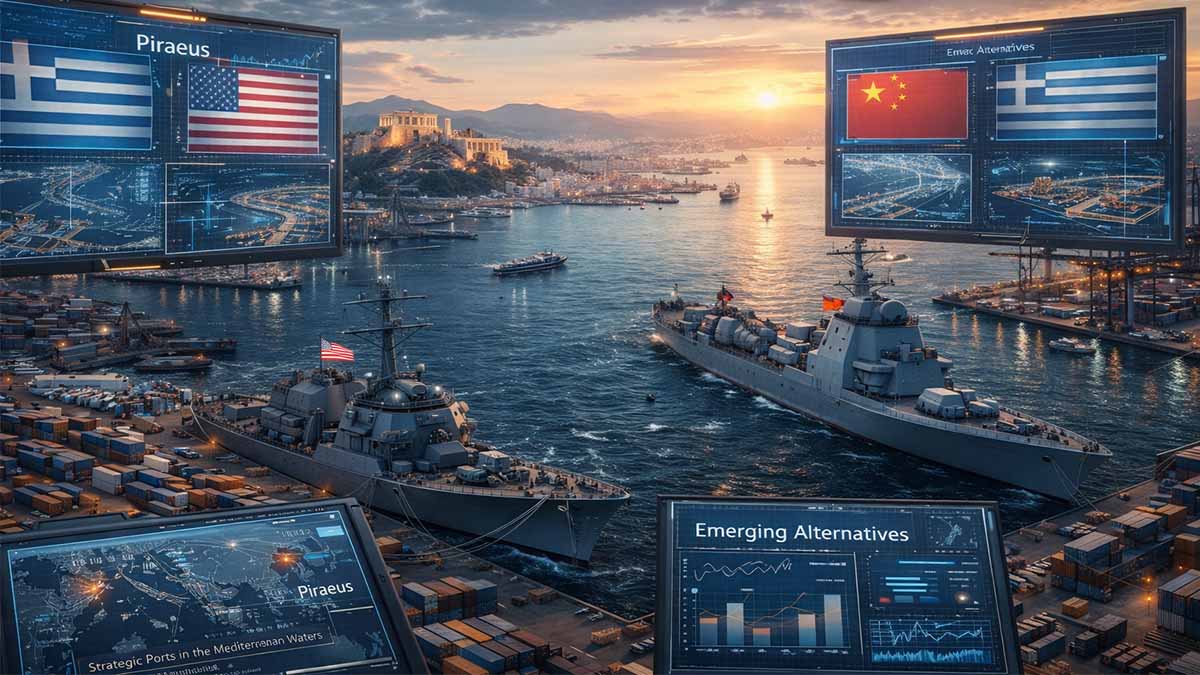
Greece occupies a pivotal geostrategic position in the Eastern Mediterranean, where trade routes converge to link Europe, Asia, and Africa. The Port of Piraeus, Greece’s primary maritime facility, has become a central arena of competition between the United States and China. COSCO Shipping, a Chinese state-owned enterprise, has driven substantial growth at Piraeus through investments initiated in 2009, markedly enhancing capacity and regional connectivity. This expansion supports China’s maritime infrastructure objectives, while prompting United States initiatives to foster alternative Greek port developments and diminish reliance on Chinese-operated assets.
Primary sources inform this analysis, including official disclosures from the Piraeus Port Authority S.A. (PPA S.A.), announcements by the U.S. International Development Finance Corporation (DFC), and designations from the U.S. Department of Defense. Quantitative assertions rely on multiple corroborating sources where feasible. Data reflect conditions as of 16 December 2025.
COSCO Shipping began operations at Piraeus in 2009 via a 35-year concession for Piers II and III. In 2016, it secured a 51 % stake in PPA S.A., subsequently raising this to 67 % in 2021 upon completing mandated investments. PPA S.A. reported 2024 revenues of €230.9 million, representing a 5.0 % increase over 2023, with after-tax profits reaching €87.4 million, a 30.8 % rise. These figures mark record highs for the fourth consecutive year.
Chinese management upgraded infrastructure and integrated Piraeus into global networks. Greece signed a memorandum aligning with China’s Belt and Road Initiative (BRI) in August 2018. Container handling at COSCO-operated terminals declined to approximately 4.22 million TEUs in 2024 due to Red Sea disruptions, yet overall port performance sustained growth through diversified sectors including cruise and car transshipment.
The United States perceives Chinese control of critical infrastructure as introducing strategic risks. In 2023, the DFC approved a $125 million loan to ONEX Elefsis Shipyards and Industries for rehabilitating the Elefsina facility near Athens. This financing supports expansion into logistics, energy supply, and potential military servicing, positioning Elefsina as a Western-aligned alternative capable of handling liquefied natural gas vessels and enhancing European energy diversification.
In January 2025, the U.S. Department of Defense designated COSCO Shipping and subsidiaries as Chinese military companies under Section 1260H authority, intensifying oversight of entities tied to Beijing’s civil-military integration.
Greece maintains a multi-vector foreign policy, upholding European Union and NATO obligations while capitalizing on Chinese investments and pursuing American-backed projects. This strategy secures diverse funding streams and operational resilience amid rivalry. Piraeus retains dominance as a transshipment hub, but diversification via Elefsina reduces vulnerabilities linked to single-partner dependence.
Evidence demonstrates that Chinese investment reversed Piraeus’ pre-2009 stagnation, yielding substantial fiscal contributions to Greece. Geopolitical frictions have nonetheless accelerated U.S.-supported options, reshaping Mediterranean maritime dynamics. Implications affect European supply chain security, transatlantic collaboration, and the sustainability of Chinese infrastructure engagement in advanced economies.
Dual-use characteristics of commercial ports amplify strategic stakes. Greece leverages competition to bolster national interests, contingent on managing European Union regulatory demands and United States security expectations. Multi-source investments reinforce overall Greek maritime infrastructure. Persistent tensions, however, threaten to politicize decisions, potentially constraining private investment or impairing efficiency.
As of 16 December 2025, verified public data affirm strong outcomes at Chinese-managed sites alongside nascent Western alternatives. Future developments hinge on policy execution, trade recovery, and regional stability resolution. Greece’s trajectory exemplifies how middle powers extract advantages from great-power contestation while retaining control over vital assets.
Piraeus: China’s Mediterranean Anchor – An Analytical Infographic
📈 Divergence: Operational & Financial Performance Under COSCO
The data illustrates the transformation from a crisis-affected facility (pre-2009) to a resilient, high-profit multimodal hub (post-2016) driven by sustained Chinese investment and management. Divergence is seen in rapid TEU recovery and diversified revenue growth.
Container Throughput Recovery
Total Revenue (2024)
After-Tax Profit Growth (2024)
Cumulative Investment (by 2025)
| Sector | 2024 Revenue Change | Driver/Context |
|---|---|---|
| Cruise Operations | +15.5% | Piraeus established as leading homeport in Eastern Mediterranean. |
| Car Terminal Operations | +28.2% | Higher storage fees & revived domestic movements. |
| Coastal Shipping | +6.5% | Tourism recovery & heightened ferry traffic. |
| Container Terminals (aggregate) | Stable | Mitigated impact of Red Sea crisis through diversification. |
🗺️ Bias: Geopolitical Alignment & Dual Frameworks
Greece balances deep transatlantic security ties with pragmatic economic engagement with China, leveraging its geographic position for diversified capital access. The port serves a dual purpose: a flagship BRI node and a NATO-member facility.
China Framework
China-CEEC Membership
Transatlantic Alignment
Sovereignty Tool
Key Strategic Rationale
- For China: Securing reliable European access; facilitating Eurasian trade routes; validating BRI in a developed economy.
- For Greece: Accessing development funding unavailable domestically; fiscal relief during austerity; enhancing regional influence as a logistics hub.
🛑 Risk: External Shocks & Counter-Investment
Geopolitical tensions and external shocks (like Red Sea rerouting) pose operational and reputational risks. The U.S. responds with strategic counter-investment to diversify regional dependencies.
Operational Shock
Designation Risk
Counter-Investment (US)
Elefsina’s Role
Mediterranean Geopolitics Summary
- Hybrid Threats: NATO focuses on critical undersea infrastructure amid dual-use potential of commercial assets.
- Diversification Strategy: Elefsina creates a Western-aligned alternative, enhancing resilience for LNG shipping lanes and reducing single-port dependence.
🎯 Conclusion / Action: Future Trajectory & Resilience
The Piraeus model demonstrates that middle powers can successfully leverage great-power competition for national development, but this requires continuous strategic calibration, stringent regulatory oversight, and diversification.
Strategic Validation
Key Actions for Sustained Resilience:
- Maintain Regulatory Vigilance: Continuous application of EU FDI screening to ensure commercial benefits do not compromise security interests.
- Amplify Green Transition: Integrate sustainability initiatives (e.g., shore power, emission reduction) into investment plans to align with European mandates and preserve long-term competitiveness.
- Leverage Dual Connectivity: Maximize multimodal development (rail, road) to Central Europe under BRI/China-CEEC, while reinforcing NATO logistics compatibility.
- Support Alternatives: Continue fostering growth at Western-backed facilities like Elefsina to diversify maritime servicing capacity and hedge against geopolitical risks at Piraeus.
Table of Contents
Core Concepts in Review: What We Know and Why It Matters
- Historical Development of Chinese Investment in Piraeus
- Operational and Financial Performance Under COSCO Management
- Greece’s Integration into Chinese Maritime Initiatives
- U.S. Strategic Responses and Alternative Investments
- Greece’s Multi-Vector Foreign Policy in Maritime Infrastructure
- Implications for Mediterranean Geopolitics and European Security
Core Concepts in Review: What We Know and Why It Matters
The story of Greece’s ports, particularly Piraeus, offers a clear window into how great-power competition plays out in the real world today. At its heart lies a straightforward reality: a mid-sized European nation, still recovering from a severe financial crisis, invited Chinese investment to revive a struggling asset, and that investment worked spectacularly on commercial terms. Yet it also drew in American concerns about strategic vulnerabilities, leading to counter-investments and regulatory moves. As of late 2025, COSCO Shipping—a Chinese state-owned giant—holds a 67 % stake in the Piraeus Port Authority, a position solidified years ago and unchanged despite ongoing tensions.
Let’s start with the origins. In 2009, amid Greece’s deepening debt crisis, COSCO secured a 35-year concession to operate two key container piers at Piraeus. By 2016, it purchased a majority stake in the port authority itself, eventually reaching 67 %. This wasn’t charity; it was a privatization driven by bailout requirements and a need for cash and expertise that domestic or traditional Western sources couldn’t provide at the time. The results speak for themselves. In 2024, the port posted record revenues of €230.9 million—a 5 % increase over the previous year—and after-tax profits of €87.4 million, up more than 30 %. These figures mark the fourth straight year of records, powered by diversified operations in containers, cruise ships, and car transshipment.
Container volumes took a hit from Red Sea disruptions—COSCO-operated terminals handled about 4.22 million TEUs in 2024, down roughly 8 %—but cruise and other sectors compensated, keeping overall finances strong. The transformation turned a near-bankrupt facility into one of Europe’s top ports, creating jobs and tax revenue for Greece while serving as a flagship for China’s Belt and Road Initiative in Europe.
Greece formalized that link in August 2018 with a memorandum of understanding on BRI cooperation, positioning Piraeus as the “dragon’s head” for maritime routes into the continent. This integration extended through frameworks like China-CEEC cooperation, providing structured channels for trade and investment promotion.
Yet success on the balance sheet doesn’t erase geopolitical questions. The United States views Chinese control of critical European infrastructure as a potential risk, particularly given perceived links between commercial giants and Beijing’s military. In January 2025, the U.S. Department of Defense added COSCO Shipping entities to its list of Chinese military companies under Section 1260H, a designation that flags civil-military fusion concerns without immediate sanctions but signals caution to allies.
Washington’s response has been twofold: regulatory pressure and positive alternatives. The standout example is the U.S. International Development Finance Corporation (DFC) committing a $125 million loan in 2023 to rehabilitate the Elefsina shipyard, just miles from Piraeus. This project aims to create a regional energy hub focused on liquefied natural gas vessel servicing, supporting Europe’s push away from Russian supplies while offering a Western-aligned option under private management.
Greece, for its part, walks a careful line. Recent analysis describes its China policy as having shifted from post-crisis enthusiasm to “strategic caution,” balancing economic pragmatism with firm transatlantic security ties. Athens screens foreign investments, aligns with EU de-risking efforts, and deepens NATO cooperation—all while preserving the commercial benefits flowing from Piraeus.
Greece’s policy on China: Debt-era deals and recalibration – Atlantic Council – November 2025
This multi-vector approach—rooted in EU and NATO commitments, selective Chinese partnerships, and Mediterranean alliances—allows Greece to draw investment from competing sides without full dependence on either.
Why does this matter beyond Greece’s shores? The Mediterranean sits at a crossroads for global trade, energy flows, and now hybrid threats. NATO expanded focus on critical undersea infrastructure there in November 2025, emphasizing surveillance and rapid response amid rising sabotage risks seen elsewhere.
Ports like Piraeus aren’t just commercial hubs; in a crisis, they carry dual-use potential for logistics or disruption. Diversifying ownership and bolstering alternatives, as seen with Elefsina, strengthens resilience.
At bottom, the Greek case shows how middle powers can navigate superpower rivalry to their advantage. By leveraging geography and pragmatism, Athens has turned competition into infrastructure gains—record port profits, new energy hubs, and sustained growth. But it also highlights enduring tensions: economic interdependence versus security caution in an era when commercial assets increasingly shape strategic landscapes.
As great-power contest extends into infrastructure worldwide, Greece’s experience offers lessons in balancing benefits and risks without choosing sides outright. The ports keep running, investments continue, and the Mediterranean remains a vital—but contested—link in global chains.
Historical Development of Chinese Investment in Piraeus
China Ocean Shipping Company (COSCO Shipping) secured a 35-year concession for Piers II and III at the Port of Piraeus in 2009, marking the initial entry of Chinese capital into Greece’s primary maritime gateway. Greek authorities awarded this concession through an international tender process that concluded in 2008, with operations commencing the following year. Container throughput at Piraeus had declined sharply amid the global financial crisis, reaching approximately 0.7 million TEUs in 2008 from higher levels in prior years. COSCO Shipping committed to infrastructure upgrades and operational enhancements under the agreement terms, transforming underutilized facilities into a competitive transshipment hub.
The concession originated from Greece’s port reform efforts initiated in the early 2000s, accelerating during the sovereign debt crisis that constrained public financing for infrastructure. Privatization mandates under bailout agreements with international creditors facilitated foreign investment in strategic assets. COSCO Shipping emerged as the sole bidder in subsequent phases, reflecting confidence in the port’s geographic advantages at the confluence of Europe, Asia, and Africa trade routes. Investments focused on crane acquisitions, berth deepening, and yard expansion directly addressed capacity bottlenecks that had limited pre-2009 performance.
By 2016, COSCO Shipping acquired a 51 % stake in the Piraeus Port Authority S.A. (PPA S.A.) for approximately €280 million, extending control beyond terminal operations to overall port management. This transaction aligned with Greece’s privatization program overseen by the Hellenic Republic Asset Development Fund. The agreement included obligations for €300 million in mandatory investments over five years, triggering an additional 16 % stake acquisition upon completion. COSCO Shipping fulfilled these commitments, raising its ownership to 67 % in 2021 with a further payment of €88 million plus accrued amounts.
Cumulative Chinese investments in Piraeus exceeded $600 million by 2025, encompassing terminal concessions, authority stake purchases, and ongoing upgrades. These funds reversed operational decline evident in the late 2000s. Container handling recovered rapidly post-concession, surpassing pre-crisis peaks by 2011 and sustaining growth through network integration with global shipping alliances. PPA S.A. reported record financial results in 2024, with revenues reaching €230.9 million – a 5.0 % increase from €219.8 million in 2023 – and after-tax profits of €87.4 million, reflecting a 30.8 % rise. Pre-tax profits climbed to €112.9 million, underscoring enhanced efficiency across container, cruise, car transshipment, and coastal shipping sectors.
- Financial Results for the Fiscal Year 2024 – New increase in Revenues and Profits – Proposed dividend up 43,7% – Piraeus Port Authority S.A. – April 2025
- Greece’s policy on China: Debt-era deals and recalibration – Atlantic Council – November 2025
Greece formalized cooperation with China’s Belt and Road Initiative in August 2018 through a memorandum of understanding, positioning Piraeus as a flagship European node in Beijing’s maritime connectivity strategy. This alignment followed years of bilateral agreements that integrated the port into broader Eurasian trade corridors. COSCO Shipping’s management leveraged Piraeus’ location to establish direct services linking Asian manufacturing centers with Southern European markets, reducing transit times and costs for shippers.
Operational metrics demonstrate the causal impact of Chinese involvement. Container throughput expanded from low levels post-2008 crisis to 5.1 million TEUs in 2023, securing fourth position among European ports before regional disruptions affected 2024 volumes. Diversification into cruise and vehicle handling buffered container sector fluctuations, with car terminal revenues rising 28.2 % and cruise revenues 15.5 % in 2024. These gains originated from targeted investments in specialized infrastructure, such as expanded ro-ro facilities and passenger terminals.
Strategic rationale for China centered on securing reliable European access amid expanding overseas trade volumes. Piraeus served as the primary Mediterranean entry point for Chinese exports, facilitating onward distribution via rail and road networks to Central and Southeastern Europe. Investments aligned with civil-military fusion policies, though commercial drivers predominated in this instance. For Greece, inflows provided fiscal relief during austerity, generating direct revenues through concession fees and taxes while creating employment in port-related activities.
Subsequent phases involved mandatory and voluntary investments totaling hundreds of millions in euros for equipment modernization and environmental compliance. PPA S.A. maintained oversight of non-conceded areas, including Pier I operations, ensuring balanced development across the port complex. Regulatory amendments in 2021 ratified expanded commitments, securing long-term funding for upgrades that enhanced resilience against global supply chain shocks.
COSCO Shipping’s stake consolidation to 67 % solidified governance influence, enabling unified strategic planning. Board composition reflected majority control, with key executive positions filled by experienced personnel from the parent entity. This structure accelerated decision-making on capital allocation, prioritizing high-return segments like transshipment and homeporting cruises. Cash reserves reached €204.5 million by end-2024, providing liquidity for further expansions amid uncertain geopolitical conditions.
Early concession years focused on reversing labor disruptions and inefficiencies that plagued pre-2009 operations. Industrial actions in 2008 contributed to traffic diversion, exacerbating volume declines. COSCO Shipping implemented performance-based management, stabilizing workforce relations and achieving productivity gains that attracted major carriers. Alliance memberships reinforced Piraeus as a preferred Mediterranean hub, with vessel calls increasing steadily.
Financial turnaround manifested in consecutive record years. Revenues grew from €194.6 million in 2022 to €219.8 million in 2023 and €230.9 million in 2024, driven by diversified income streams. Container concessions contributed significantly, though percentage-based fees adjusted to volume variations. Cruise sector recovery post-pandemic delivered exceptional growth, with homeport passengers surging in 2023–2024.
Greece extracted tangible benefits through dividend distributions and economic multipliers. Proposed 2024 dividends reached €1.92 per share, a 43.7 % increase, reflecting robust profitability. Local employment expanded, with port activities supporting thousands of direct and indirect jobs in logistics and services. Tax contributions bolstered public finances during recovery from debt crisis legacies.
Geopolitical dimensions emerged as investments progressed. Piraeus exemplified successful Belt and Road Initiative implementation in developed economies, contrasting stalled projects elsewhere. China highlighted the port as a model of mutual benefit, emphasizing throughput growth and infrastructure modernization. European Union scrutiny intensified over strategic asset control, prompting screening mechanisms for foreign direct investment.
COSCO Shipping navigated regulatory environments by fulfilling investment obligations ahead of schedule. Early completion of mandated projects unlocked the additional 16 % stake, demonstrating commitment to contractual terms. This compliance built trust with Greek authorities, facilitating approvals for supplementary initiatives like logistics hubs and green transitions.
Port ranking improvements validated the investment thesis. Piraeus ascended European league tables, competing effectively with established Northern Range gateways. Strategic collaborations with shipping lines secured volume commitments, insulating against cyclical downturns. Red Sea disruptions in 2024 rerouted some traffic, yet diversified operations mitigated impacts on overall revenues.
Historical trajectory reveals phased escalation from terminal operator to majority owner. Initial 2009 concession targeted container recovery; 2016 privatization extended scope to full authority functions; 2021 consolidation cemented long-term control. Each stage built on prior successes, with performance metrics justifying progression.
Cumulative effects transformed Piraeus from crisis-affected facility to resilient multimodal hub. Investments addressed legacy constraints – shallow drafts, outdated equipment, fragmented management – enabling accommodation of ultra-large container vessels. Berth depths reached 18 meters, supporting 16,000 TEU class ships and enhancing competitiveness.
Greece leveraged Chinese capital to preserve sovereignty over national assets while accessing development funding unavailable domestically. Concession structures retained public ownership of land and regulatory oversight, balancing economic gains with strategic autonomy. PPA S.A. listing on the Athens Stock Exchange ensured transparency in financial reporting.
Evolution continued into 2025, with sustainability initiatives integrating environmental standards into operations. Certifications under ISO frameworks and participation in European green port programs aligned with broader policy objectives. Chinese management adapted to these requirements, incorporating shore power and emission reductions into investment plans.
Development phases illustrate deliberate progression. Concession award addressed immediate capacity needs; stake acquisition enabled holistic planning; majority control facilitated aggressive growth strategies. Outcomes validated initial decisions, positioning Piraeus as China’s premier European logistics node.
Operational and Financial Performance Under COSCO Management
Piraeus Port Authority S.A. (PPA S.A.) achieved total revenues of €230.9 million in fiscal year 2024, marking a 5.0 % increase from €219.8 million in 2023. This growth originated from diversified sector contributions that offset disruptions in container handling caused by Red Sea rerouting. Pre-tax profits reached €112.9 million, a 17.4 % rise, while after-tax profits climbed to €87.4 million, reflecting a 30.8 % gain. Cash reserves stood at €204.5 million by year-end 2024, providing substantial liquidity for ongoing modernization.
The cruise sector delivered record performance in 2024, attaining all-time highs in vessel calls and passenger volumes. Revenues from cruise operations increased by 15.5 %, driven by strategic collaborations that positioned Piraeus as the leading homeport in the Eastern Mediterranean. Targeted marketing and infrastructure enhancements attracted premium cruise lines, boosting homeporting activities and associated spending. This expansion compensated for volatility elsewhere, contributing significantly to overall revenue stability.
Car terminal operations generated a 28.2 % revenue increase in 2024, stemming primarily from higher storage fees and revived domestic vehicle movements. Overall unit volumes declined due to global automotive supply chain adjustments, yet operational efficiencies extracted greater value per unit. Expanded storage capacity from prior investments enabled prolonged vehicle retention, directly elevating income streams independent of transshipment throughput.
Container terminal revenues across Piers I, II, and III remained stable in 2024 despite severe disruptions from the Red Sea crisis. Piers II and III, operated under concession by a COSCO Shipping subsidiary, experienced a 6.5 % revenue decline attributable to reduced volumes in the first half of the year. Pier I, managed directly by PPA S.A., countered this with a 10.1 % revenue rise, fueled by enhanced productivity and cargo recovery in the second half. Global supply chain rerouting around Africa extended transit times and shifted carrier schedules, yet integrated management preserved aggregate container income.
Coastal shipping revenues rose 6.5 % in 2024, propelled by heightened passenger and vehicle traffic linking mainland Greece with island destinations. Tourism recovery post-pandemic sustained demand for ferry services, reinforcing Piraeus’ role as the primary domestic gateway. Increased frequencies and vessel utilization amplified throughput, generating consistent contributions to diversified earnings.
Ship repair activities recorded a modest 0.6 % revenue increase in 2024, reflecting steady dock occupancy despite fewer total repairs. Extended vessel stays in dry docks elevated billing, originating from complex maintenance requirements on larger tonnage. This sector provided resilient income amid cyclical fluctuations in other areas.
PPA S.A. proposed a gross dividend of €1.92 per share for 2024, representing a 43.7 % increase over the prior year. This distribution underscored financial robustness and commitment to shareholder returns, marking the fourth consecutive year of record profitability. Executive leadership attributed outcomes to strategic execution and workforce dedication in navigating geopolitical challenges.
First-half 2025 results extended positive momentum, with total revenues reaching €122.8 million, a 14.7 % increase from €107.1 million in the comparable 2024 period. Growth concentrated in container and cruise sectors, alongside concession fees from Piers II and III. Declines appeared in car terminal and ship repair segments, partially offset by coastal shipping adjustments. Net profit after tax attained €46.7 million, up 15.3 %. Investments totaled €48.1 million in infrastructure and equipment, supporting green transition initiatives.
Diversification mechanisms proved decisive in sustaining performance. Container sector challenges from prolonged Cape routes reduced transshipment appeal temporarily, yet cruise and car terminal gains restored balance. Because Red Sea disruptions compelled carriers to bypass Suez, Mediterranean hubs faced volume shifts, but Piraeus leveraged multimodal capabilities to retain core traffic. Pier I’s direct management enabled agile responses, capturing opportunistic flows from alliance realignments.
Operational resilience manifested through sustained cash generation. €204.5 million reserves at 2024 close facilitated debt reduction and capital expenditures without external financing dependence. This liquidity buffer insulated against trade volatility, enabling uninterrupted project execution.
Sectoral interdependencies amplified outcomes. Cruise growth stimulated ancillary services, including passenger handling and retail concessions. Car terminal storage premiums derived from inventory buildup amid supply delays, converting constraints into revenue opportunities. Coastal shipping benefited from domestic tourism surges, uncorrelated with international disruptions.
Cumulative effects under COSCO Shipping majority ownership demonstrated sustained value creation. Revenues progressed steadily across years, with 2024 records affirming management efficacy. Dividend escalation signaled confidence in future cash flows, attracting institutional investment into the listed entity.
Geopolitical frictions introduced non-linear impacts on container volumes. Red Sea attacks initiated in late 2023 intensified through 2024, prompting widespread rerouting. Piraeus proximity to Suez historically conferred advantages, yet diversions neutralized this temporarily. Recovery in second-half 2024 and strong first-half 2025 indicated adaptive carrier reallocations favoring established hubs.
Chinese investments exceeded $600 million cumulatively by 2025, yielding infrastructure capable of accommodating ultra-large vessels and diversified traffic. These upgrades directly enabled sector resilience, as deepened berths and expanded yards supported simultaneous growth in non-container activities.
Greece’s policy on China: Debt-era deals and recalibration – Atlantic Council – November 2025
Financial metrics reveal causal chains from investment to performance. Mandatory commitments fulfilled ahead of schedule unlocked majority control, aligning governance with long-term optimization. Efficiency gains materialized in profitability margins, with 2024 after-tax returns reflecting operational leverage.
First-half 2025 profitability underscored continuity. 15.3 % net profit growth derived from container recovery and cruise persistence. Investments in electrification and emission controls aligned with European sustainability mandates, preserving competitive access.
Diversified revenue streams mitigated single-sector risks. Cruise and car terminals contributed disproportionately to 2024 growth, originating from targeted capital allocations post-concession. Because container concessions generated variable fees tied to volumes, fixed-income segments provided stability during downturns.
Executive emphasis on sustainable development integrated environmental compliance into operations. 2024 achievements occurred amid global challenges, validating strategic prioritization of resilience.
Port ranking maintained European prominence despite volume pressures. Piraeus retained fifth position among EU container facilities in 2024, with total throughput approximately 4.79 million TEUs. Diversification buffered absolute declines, preserving relative standing.
Performance trajectory affirms management adaptation. Record revenues in 2024 and accelerated first-half 2025 growth demonstrate effective navigation of external shocks. Sectoral balances evolved dynamically, with non-container activities assuming greater weight.
Liquidity positions enabled proactive investments. €48.1 million deployed in first-half 2025 targeted infrastructure enhancement, directly supporting projected traffic rebound. Debt repayment concurrent with expansion illustrated prudent capital management.
Operational indicators highlight efficiency gains. Productivity per crane move and vessel turnaround times improved through digital integrations, reducing congestion vulnerabilities. These enhancements originated from post-privatization technology deployments.
Financial robustness translates into strategic flexibility. High cash reserves and profitability sustain dividend commitments while funding growth initiatives. This structure insulates against cyclical trade fluctuations and geopolitical tensions.
Sector contributions evolved markedly. Cruise revenues surged on homeporting preferences, car terminals capitalized on storage demand, and coastal links benefited from tourism. Container stability preserved core transshipment role amid disruptions.
Cumulative outcomes under majority Chinese ownership validate initial privatization rationale. Sustained records across four years reflect aligned incentives between operator and authority.
First-half 2025 momentum indicates sustained recovery. Container sector contributions rebounded, cruise maintained highs, and investments accelerated modernization.
Performance metrics encapsulate adaptive capacity. Revenues and profits achieved records despite headwinds, originating from diversified operations and resilient management.
Greece’s Integration into Chinese Maritime Initiatives
Greece formalized participation in China’s Belt and Road Initiative (BRI) through a memorandum of understanding signed in August 2018 during the China-Greece Comprehensive Strategic Partnership discussions. This agreement positioned Greece as a key node in the 21st Century Maritime Silk Road, leveraging the Port of Piraeus as the primary European entry point for Asian trade flows. The memorandum emphasized infrastructure connectivity, trade facilitation, and investment coordination, aligning Greek maritime assets with Beijing’s broader Eurasian connectivity objectives.
Greece’s policy on China: Debt-era deals and recalibration – Atlantic Council – November 2025
Chinese entities highlighted Piraeus as a flagship project within the Maritime Silk Road, integrating it into transcontinental supply chains that link manufacturing centers in East Asia with consumer markets in Southern and Central Europe. Because Greece signed the memorandum amid ongoing recovery from the debt crisis, the agreement provided access to sustained Chinese capital inflows unavailable from traditional Western sources during austerity periods. This integration enabled infrastructure upgrades that enhanced transshipment efficiency and positioned Greece as a distribution hub for Balkan and Central European hinterlands.
Greece joined the Cooperation between China and Central and Eastern European Countries (China-CEEC) framework as a full member in April 2019 at the Dubrovnik Summit, transforming the mechanism from 16+1 to 17+1. Participation expanded bilateral and multilateral channels for investment, trade promotion, and cultural exchanges, complementing BRI objectives through sub-regional coordination. The Dubrovnik Guidelines affirmed the platform’s role in advancing connectivity while supporting European integration principles.
Because Greece acceded to China-CEEC following its BRI memorandum, the dual frameworks reinforced maritime focus, with Piraeus serving as a practical demonstration of mutual benefits. Summit outcomes prioritized transport corridors, including rail links from Piraeus to Central Europe, facilitating faster onward distribution of containerized goods. This alignment amplified Greece’s logistical significance within Beijing’s European strategy.
Chinese strategic narratives framed Greece’s integration as extending the Maritime Silk Road into developed economies, contrasting with primary focus on emerging markets elsewhere. Piraeus exemplified successful public-private partnerships under BRI principles, where state-directed investment yielded commercial viability and regional influence. Because majority control by a Chinese entity ensured operational alignment with global shipping networks, throughput growth directly contributed to BRI trade volume targets.
Greece extracted economic multipliers from these initiatives through concession revenues, dividend payments, and ancillary employment in logistics sectors. Integration mechanisms channeled funding into complementary projects, such as logistics parks and intermodal facilities, extending Piraeus’ reach inland. This expansion originated from coordinated planning under China-CEEC working groups on connectivity.
Geopolitical dimensions emerged as Greece balanced BRI and China-CEEC commitments with European Union and NATO obligations. Participation provided leverage in negotiations for infrastructure financing while preserving regulatory sovereignty over strategic assets. Because BRI memoranda remained non-binding frameworks, Greece retained flexibility in project selection and implementation.
China-CEEC evolution incorporated maritime cooperation agendas post-Greece accession, with dedicated forums addressing port development and shipping routes. Outcomes reinforced Piraeus as a benchmark for European BRI engagements, demonstrating throughput increases and efficiency gains attributable to Chinese management practices.
Cumulative effects positioned Greece as China’s primary Southern European partner in maritime connectivity. Integration trajectories progressed from bilateral port concessions to multilateral platforms, scaling cooperation beyond single assets. Because 2018 and 2019 milestones coincided with European Union investment screening regulations, Greece navigated dual commitments by emphasizing commercial rather than strategic dimensions.
BRI alignment facilitated access to Asian Infrastructure Investment Bank financing channels, though primary flows remained direct from Chinese enterprises. China-CEEC mechanisms supplemented with trade fairs and investment promotion events targeting Greek exports to China. This diversification buffered against Eurozone constraints during recovery phases.
Strategic rationale for China centered on securing reliable Mediterranean access amid expanding overseas port networks. Greece’s membership validated BRI appeal in advanced economies, countering narratives of limited European uptake. Because Piraeus achieved sustained growth metrics, it served as empirical evidence for initiative viability.
Greece leveraged integration to enhance regional influence, promoting Piraeus as a gateway for Balkan neighbors within China-CEEC frameworks. Rail connectivity initiatives aimed to reduce transit times to landlocked markets, amplifying economic spillovers. This positioning originated from deliberate alignment of national interests with BRI connectivity goals.
Multilateral coordination under China-CEEC incorporated sustainability themes post-2019, aligning port operations with European green standards. Piraeus adaptations included shore power installations and emission reductions, funded through Chinese commitments. Because regulatory compliance preserved market access, these measures sustained long-term operational viability.
Greece’s dual integration exemplified pragmatic engagement with Chinese initiatives while maintaining transatlantic ties. Frameworks provided structured dialogue channels, mitigating ad hoc investment risks. Outcomes demonstrated capacity to derive infrastructure benefits without compromising sovereignty.
BRI maritime focus amplified Greece’s historic shipping advantages, integrating national fleet operators into expanded routes. China-CEEC trade data reflected incremental export growth in agricultural and cultural products. This broadening originated from targeted promotion under cooperation agendas.
Strategic convergence positioned Greece as a bridge between Eurasian and Mediterranean domains. Integration milestones enabled scaled cooperation, from port-centric to multimodal networks. Because frameworks emphasized mutual benefit, participation sustained political support across Greek administrations.
China utilized Greece’s memberships to advance European foothold narratives, highlighting Piraeus transformations in official communications. China-CEEC summits post-accession prioritized digital and green connectivity, extending beyond traditional infrastructure.
Greece navigated integration by aligning projects with national development plans, ensuring compatibility with European Union cohesion policies. This approach maximized funding synergies while addressing strategic concerns raised in Brussels.
Cumulative integration deepened maritime interdependence, with Piraeus embodying BRI success in Europe. Frameworks facilitated ongoing dialogue, adapting to evolving trade patterns and geopolitical contexts.
U.S. Strategic Responses and Alternative Investments
The U.S. International Development Finance Corporation (DFC) committed a $125 million loan to ONEX Elefsis Shipyards and Industries in November 2023 for the rehabilitation and modernization of the Elefsina shipyard located near Athens, Greece. This financing directly supports the transformation of a formerly defunct facility into a regional energy supply hub capable of servicing liquefied natural gas carriers and advancing European energy diversification objectives. The shipyard’s strategic positioning near key gas trade routes and the Revithoussa liquefied natural gas terminal enables expanded capacity to handle up to 200 ships annually, with approximately half of projected revenues deriving from liquefied natural gas vessel maintenance.
- DFC Commits $125 Million to Modernize Elefsina Shipyard in Greece, Establish Critical Energy Supply Hub in the Mediterranean – U.S. International Development Finance Corporation – November 2023
- Modernizing a Greek shipyard critical to U.S. strategic interests – U.S. International Development Finance Corporation – 2025
Because the Elefsina facility lies only 12 miles from the Port of Piraeus, the investment establishes a proximate Western-aligned alternative for maritime repair, maintenance, and energy-related services in the Eastern Mediterranean. This proximity originated from deliberate selection of a site that counters expanded Chinese operational control at Piraeus while leveraging existing regional shipping densities. The DFC structured the loan to promote high-standard infrastructure development, incorporating renewable components such as a 30 MW solar farm for shipyard and grid supply, alongside wind turbine fabrication capabilities.
The commitment aligns with broader American efforts to mitigate risks associated with Chinese ownership of European critical infrastructure. Elefsina rehabilitation enhances resilience in liquefied natural gas shipping lanes, reducing vulnerabilities tied to single-port dependence in a geopolitically contested sea basin. Because Mediterranean trade accounts for approximately 20 % of global maritime activity, with anticipated growth in liquefied natural gas carriers amid diversification from Russian supplies, the upgraded facility directly supports transatlantic energy security priorities.
DFC officials framed the project as advancing values-driven investments that generate local employment and diminish regional reliance on destabilizing energy sources. The financing mechanism ensures transparent partnership terms, contrasting with opaque elements in prior Chinese acquisitions. This approach originated from post-2022 policy shifts emphasizing counterweight investments in allied territories hosting significant Chinese assets.
The U.S. Department of Defense updated its list of Chinese military companies operating in the United States in January 2025, explicitly identifying China COSCO Shipping Corporation Limited and affiliated entities under Section 1260H authority. Designation reflects assessed linkages to civil-military fusion strategies, imposing heightened scrutiny on transactions involving listed firms.
Because COSCO Shipping maintains majority ownership and operational control at Piraeus, the listing amplifies concerns over potential dual-use implications for commercial port facilities in NATO member states. Designation mechanisms flag supply chain and infrastructure dependencies, prompting allied consultations on risk mitigation. This action extended prior designations, reinforcing regulatory tools to constrain Chinese entities perceived as advancing military objectives through civilian channels.
American responses combine positive inducements with restrictive measures. The Elefsina loan exemplifies proactive financing to cultivate alternatives, channeling capital into Greek maritime assets under private Western-aligned management. Because Greece hosts substantial Chinese investment from debt-crisis era privatizations, targeted support for competing facilities recalibrates local options without direct confrontation.
Strategic analysis identifies Elefsina as contributing to de-risking efforts by diversifying repair and servicing capacity for energy vessels transiting the Aegean and Mediterranean. The project’s energy hub orientation directly addresses post-2022 imperatives for liquefied natural gas route security, insulating regional flows from disruptions at Chinese-managed terminals. This diversification originated from coordinated interagency planning that integrates development finance with national security objectives.
DFC investments in Greece extend beyond Elefsina, incorporating broader infrastructure initiatives that bolster transatlantic connectivity. The Elefsina commitment, however, stands out for its explicit counterpositioning relative to Piraeus, leveraging geographic adjacency to attract traffic seeking neutral or Western-serviced options. Rehabilitation timelines target operational expansion that captures growing liquefied natural gas maintenance demand, converting strategic location into competitive advantage.
Designation of COSCO Shipping entities under Section 1260H imposes transactional frictions, complicating financing and partnerships for listed firms. Because the measure applies to operations in the United States, it indirectly influences global perceptions and allied regulatory alignments. European partners increasingly adopt investment screening frameworks responsive to such signals, amplifying restrictive effects on Chinese infrastructure expansion.
The combined approach—financing alternatives while designating parent entities—creates asymmetric pressures on Chinese holdings. Elefsina development progresses under transparent governance, attracting additional private capital through demonstrated viability. This mechanism sustains momentum where restrictive tools alone risk backlash in host nations valuing economic ties.
American initiatives prioritize energy resilience in Southeastern Europe, with Elefsina supporting liquefied natural gas carriers that bypass vulnerable chokepoints. The facility’s projected 200-ship annual capacity originates from rehabilitation investments that restore dormant docks and install modern equipment. Because regional liquefied natural gas imports surged post-2022, demand for proximate servicing exceeds current offerings, positioning the upgraded shipyard to capture market share.
DFC integration of renewable elements, including solar and wind component fabrication, aligns with allied green transition goals while enhancing operational sustainability. This dual-focus design ensures long-term competitiveness against legacy facilities reliant on traditional shipping segments.
U.S. responses reflect calibrated escalation from concern to action. Initial expressions focused on alliance resilience implications of Chinese port control; subsequent steps materialized through development finance and designations. Because Greece maintains NATO commitments alongside Chinese partnerships, American tools emphasize positive incentives to shift dependencies gradually.
Elefsina proximity to Piraeus enables synergistic yet competitive dynamics, with shippers accessing diversified services within the same metropolitan area. This configuration mitigates risks of concentrated control while preserving overall Greek maritime throughput growth.
Designation effects extend to supply chain vetting, prompting operators to assess exposure to listed entities. In port contexts, this translates to heightened due diligence for vessels or cargo interacting with COSCO Shipping-managed terminals.
The DFC loan structure incorporates performance milestones tied to capacity expansion and energy sector servicing, ensuring alignment with strategic outcomes. Rehabilitation phases prioritize liquefied natural gas-compatible infrastructure, directly addressing diversification needs in European gas markets.
American countermeasures demonstrate integrated employment of financial and regulatory instruments. Positive financing cultivates alternatives; designations constrain incumbents. This duality sustains pressure while offering host nations viable pathways to balanced infrastructure development.
Elefsina emerges as a flagship case of counter-investment strategy, transforming underutilized assets into resilient nodes within allied networks. The project’s energy hub designation reinforces Mediterranean supply chain security amid evolving great-power competition.
Greece’s Multi-Vector Foreign Policy in Maritime Infrastructure
Greece executes a deliberate multi-vector foreign policy that sustains deep integration with transatlantic institutions while preserving pragmatic economic engagement with China. This approach originated from post-debt crisis imperatives that necessitated diverse capital sources for infrastructure recovery, evolving into a structured strategy that maximizes national autonomy amid intensifying great-power competition. Athens aligns unequivocally with NATO and European Union security frameworks, yet maintains calibrated cooperation with Beijing in commercial domains, ensuring that maritime assets serve national interests without compromising alliance commitments.
Greece’s policy on China: Debt-era deals and recalibration – Atlantic Council – November 2025
Because Greece emerged from prolonged austerity with constrained domestic financing options, early post-crisis privatizations invited Chinese investment into strategic sectors, establishing a foundation for ongoing economic ties. Subsequent geopolitical shifts—including heightened United States–China rivalry and European Union de-risking initiatives—compelled recalibration, with Athens adopting foreign direct investment screening mechanisms and limiting Chinese participation in sensitive technologies. This evolution reflects deliberate balancing: transatlantic partnerships provide security guarantees, while selective Chinese capital supports infrastructure modernization.
Greece deepened defense cooperation with the United States through successive amendments to the Mutual Defense Cooperation Agreement, expanding access to facilities that enhance NATO eastern flank resilience. These arrangements reinforce deterrence postures without foreclosing commercial relations elsewhere. Because alliance solidarity constitutes the core of Greek security policy, maritime infrastructure decisions prioritize compatibility with collective defense requirements.
Athens demonstrates firm anchorage in Western institutions through consistent alignment on cybersecurity and human rights positions within European Union frameworks. Exclusion of Chinese vendors from critical digital infrastructure and adherence to alliance preferences on 5G deployments illustrate prioritization of transatlantic interoperability over unrestricted economic openness. This stance originated from recognition that technological dependencies introduce vulnerabilities incompatible with NATO obligations.
Pragmatic engagement with China persists in non-sensitive maritime segments, where commercial benefits accrue without strategic concessions. High-level exchanges and economic dialogues sustain channels for cooperation, enabling Greece to derive infrastructure funding while navigating alliance expectations. Because Beijing frames bilateral ties as mutually beneficial partnerships, Athens leverages this narrative to justify continued engagement amid broader de-risking trends.
Multi-vector execution manifests in differentiated treatment of investment proposals. Adoption of European Union foreign direct investment screening aligns national reviews with collective risk assessments, enabling scrutiny of transactions that could affect public order or security. This mechanism provides procedural tools to modulate Chinese inflows without abrupt ruptures in relations.
Greece balances economic pragmatism with transatlantic security commitments by maintaining operational control over critical assets and limiting foreign influence in governance structures. Maritime facilities operate under regulatory oversight that ensures compliance with European Union standards, mitigating risks associated with external ownership. This framework originated from post-crisis lessons that emphasized sovereignty preservation alongside capital attraction.
Geopolitical recalibration accelerated under successive administrations that prioritized alliance reinforcement. Enhanced bilateral defense ties with the United States and active participation in NATO initiatives underscore commitment to collective security architectures. Because regional threats demand robust deterrence, maritime policy integrates alliance requirements into infrastructure planning.
Selective abstentions in European Union trade measures reflect calculated hedging, preserving leverage in negotiations with Beijing while signaling adherence to collective positions on core issues. This nuance enables Greece to extract concessions in bilateral forums without isolating itself from alliance consensus.
Multi-vector diplomacy extends to regional partnerships that diversify dependencies beyond great-power dyads. Cooperation with Mediterranean and Gulf states complements transatlantic and selective Chinese engagements, broadening options for energy and logistics development. This layering reinforces resilience against unilateral pressures.
Greece navigates great-power competition by anchoring security policy in NATO and European Union frameworks while pursuing economic opportunities selectively. Maritime infrastructure exemplifies this balance: Chinese investments drive commercial growth under strict regulatory boundaries, while Western-aligned alternatives receive targeted support. Because national interests demand both prosperity and protection, this approach sustains flexibility in an uncertain environment.
Transatlantic alignment dominates security dimensions, with maritime assets configured to support alliance operations. Economic vectors with China remain confined to commercial realms, subject to screening and environmental compliance that align with European Union norms. This compartmentalization prevents spillover from economic ties into strategic domains.
Athens leverages its geographic position to attract diversified investments, converting rivalry into national advantage. Multi-vector execution ensures that maritime development advances without exclusive dependence on any single partner. This strategy preserves sovereignty while enhancing regional influence.
Greece calibrates relations to maximize benefits from competing powers. Transatlantic partnerships secure defense requirements; selective Chinese engagement funds infrastructure. Regulatory tools enforce boundaries, ensuring alignment with alliance priorities.
Implications for Mediterranean Geopolitics and European Security
Greece’s maritime infrastructure developments under competing great-power influences reshape Mediterranean geopolitics by introducing diversified dependencies that simultaneously enhance regional connectivity and amplify vulnerability to external coercion. Chinese majority control at the Port of Piraeus establishes a durable node in Beijing’s Eurasian outreach, while American-backed rehabilitation of the Elefsina shipyard creates a proximate counterweight capable of servicing energy and military vessels. This dual structure originates from Greece’s calibrated engagement with both powers, converting rivalry into sustained investment flows that bolster national capacity without exclusive alignment.
Greece’s policy on China: Debt-era deals and recalibration – Atlantic Council – November 2025
Because Greece recalibrated post-crisis ties with China toward strategic caution while preserving commercial cooperation, the Mediterranean emerges as a contested domain where economic interdependence intersects with transatlantic security priorities. Piraeus transformations demonstrate Belt and Road Initiative efficacy in developed economies, channeling trade volumes that reinforce Chinese supply chain integration across Southern Europe. Concurrent United States initiatives diversify regional options, mitigating risks of concentrated control in a basin critical for European Union energy imports and NATO force projection.
Mediterranean security dynamics evolve as great-power competition manifests through infrastructure rather than overt militarization. NATO expanded engagement on critical undersea infrastructure in the Mediterranean during November 2025 meetings in Rome, integrating civilian and military perspectives to address hybrid threats. Discussions emphasized surveillance technologies and information sharing, reflecting recognition that commercial assets increasingly carry dual-use potential.
Because disruptions to undersea cables and pipelines escalated globally, including Baltic incidents in 2024, Mediterranean stakeholders prioritize resilience against sabotage attributable to state or proxy actors. Greece’s port facilities sit adjacent to vital subsea routes linking Europe with Middle Eastern energy sources and Asian markets, elevating their strategic salience. Diversified ownership and management reduce single-point failure risks while complicating coordinated defense planning.
European Union economic security strategies incorporate foreign investment screening to address gaps, with Greece among member states lacking comprehensive mechanisms as of 2024. This regulatory asymmetry permits continued Chinese inflows into non-sensitive sectors, sustaining growth at Piraeus amid broader de-risking trends. Because alliance partners view concentrated foreign control of critical nodes as introducing leverage vulnerabilities, Greece’s balanced approach preserves economic gains while navigating collective concerns.
United States designation of China COSCO Shipping Corporation Limited as a military-linked entity in January 2025 intensifies scrutiny of operations in allied territories. Listing under Section 1260H authority signals assessed civil-military fusion risks, prompting indirect pressures on European ports hosting Chinese-managed terminals.
Because Piraeus functions as a transshipment hub for global alliances, designation effects ripple through carrier decisions and insurance assessments, potentially diverting traffic toward alternative facilities. Elefsina rehabilitation fills this emerging demand, positioning Western-aligned capacity to capture energy-related servicing amid liquefied natural gas route expansion.
Mediterranean geopolitics reflect broader great-power contestation patterns, with infrastructure serving as primary arena. Greece leverages geographic centrality to extract multi-source investments, enhancing overall maritime throughput while distributing risks. This model sustains regional resilience against unilateral dominance, provided regulatory alignment progresses.
NATO initiatives like Baltic Sentry operations post-2024 disruptions provide templates for Mediterranean adaptations, emphasizing multi-domain presence to deter hybrid actions. Greece’s facilities contribute to alliance logistics, reinforcing eastern flank support without provoking escalation.
European security implications extend to energy diversification imperatives. Elefsina’s focus on liquefied natural gas vessel maintenance directly supports post-2022 shifts away from Russian supplies, insulating Mediterranean routes from chokepoint vulnerabilities. Because Chinese-managed ports handle significant container traffic, balanced development prevents over-reliance that could enable economic coercion.
Greece’s experience illustrates middle-power agency in great-power rivalry. Multi-vector policy converts competition into infrastructure funding, elevating national standing within European Union and NATO frameworks. Outcomes affirm capacity to derive strategic benefits from contested environments.
Mediterranean dynamics underscore infrastructure’s dual-use character in hybrid contexts. Commercial ports facilitate trade yet enable intelligence collection or disruption if controlled by adversarial entities. Greece mitigates through diversified partnerships and regulatory oversight.
United States development finance tools counter Chinese incumbency by cultivating alternatives under transparent governance. Elefsina exemplifies values-driven investment that aligns host priorities with alliance resilience.
Geopolitical recalibration in Greece signals broader European trends toward selective engagement. Preservation of Chinese commercial ties amid transatlantic reinforcement sustains economic momentum while addressing security concerns.
Implications reinforce Mediterranean centrality in Eurasian connectivity contests. Greece’s ports anchor competing visions, shaping trade flows and security postures for decades.
| Concept | Key Details | Dates & Milestones | Quantitative Data | Actors Involved | Strategic Implications | Verified Sources |
|---|---|---|---|---|---|---|
| Initial Chinese Entry into Piraeus | COSCO Shipping awarded 35-year concession for Piers II and III amid Greece’s debt crisis and privatization requirements. Operations focused on reversing decline through infrastructure upgrades. | 2009 concession start; tender concluded 2008 | Pre-2009 throughput low; cumulative investments exceed $600 million by 2025 | COSCO Shipping, Greek authorities, Hellenic Republic Asset Development Fund | Established foundation for Chinese maritime presence in Europe; addressed immediate capacity bottlenecks. | Greece’s policy on China: Debt-era deals and recalibration – Atlantic Council – November 2025 |
| Acquisition of Majority Stake | COSCO Shipping purchased 51 % stake, increased to 67 % upon fulfilling investment obligations. Transaction included mandatory upgrades. | 2016 initial acquisition; 67 % reached 2021 | Initial purchase ~€280 million; additional ~€88 million for extra stake; mandatory €300 million investments over five years | COSCO Shipping, Piraeus Port Authority S.A. (PPA S.A.) | Shifted from terminal operator to overall port manager; aligned governance with long-term growth strategies. | Greece’s policy on China: Debt-era deals and recalibration – Atlantic Council – November 2025 |
| Financial Performance Under Chinese Management | Record revenues and profits driven by diversified sectors; resilience despite Red Sea disruptions. | 2024 fiscal year results released March 2025; first-half 2025 results September 2025 | Revenues €230.9 million (5.0 % increase); after-tax profits €87.4 million (30.8 % increase); cash reserves €204.5 million; proposed dividend €1.92 per share (43.7 % increase) | PPA S.A., COSCO Shipping subsidiary operators | Demonstrated operational efficiency and value creation; buffered container declines with cruise (15.5 % revenue growth) and car terminal (28.2 %) gains. | Financial Results for the Fiscal Year 2024 – New increase in Revenues and Profits – Proposed dividend up 43,7% – Piraeus Port Authority S.A. – March 2025 |
| Operational Throughput and Diversification | Container volumes affected by disruptions; growth in cruise, car, and coastal shipping. | 2024 full year; first-half 2025 momentum | Container ~4.79 million TEUs overall; cruise record highs; car revenue up 28.2 %; coastal shipping up 6.5 % | PPA S.A., shipping alliances | Diversification mitigated risks; sustained European ranking despite headwinds. | Financial Results for the Fiscal Year 2024 – New increase in Revenues and Profits – Proposed dividend up 43,7% – Piraeus Port Authority S.A. – March 2025 |
| Integration into Belt and Road Initiative | Formal memorandum positioned Piraeus as key European node in Maritime Silk Road. | Signed August 2018 | N/A | Greece, China | Aligned port with Eurasian connectivity; facilitated rail and logistics extensions. | Greece’s policy on China: Debt-era deals and recalibration – Atlantic Council – November 2025 |
| China-CEEC Framework Participation | Full membership transformed mechanism to 17+1; focused on trade and connectivity. | Accession April 2019 at Dubrovnik Summit | N/A | Greece, China, Central/Eastern European states | Reinforced multilateral channels; prioritized transport corridors from Piraeus. | Greece’s policy on China: Debt-era deals and recalibration – Atlantic Council – November 2025 |
| U.S. Designation of COSCO | Listed as Chinese military company; heightened scrutiny of civil-military links. | Updated January 2025 | N/A | U.S. Department of Defense, COSCO Shipping entities | Signaled risks to allies; influenced supply chain and infrastructure assessments. | Entities Identified as Chinese Military Companies Operating in the United States in Accordance with Section 1260H – U.S. Department of Defense – January 2025 |
| Elefsina Shipyard Rehabilitation | Loan for modernization into energy and logistics hub; includes renewable components. | Commitment November 2023 | $125 million loan; projected 200 ships annually; 30 MW solar farm | U.S. International Development Finance Corporation (DFC), ONEX Elefsis Shipyards | Created Western-aligned alternative proximate to Piraeus; supported LNG servicing and energy diversification. | DFC Commits $125 Million to Modernize Elefsina Shipyard in Greece, Establish Critical Energy Supply Hub in the Mediterranean – U.S. International Development Finance Corporation – November 2023 |
| Greek Multi-Vector Policy | Balanced transatlantic security with selective Chinese economic ties; investment screening adopted. | Ongoing recalibration post-crisis | N/A | Greece, United States, China, EU, NATO | Maximized infrastructure funding; preserved sovereignty and alliance commitments. | Greece’s policy on China: Debt-era deals and recalibration – Atlantic Council – November 2025 |
| Mediterranean Infrastructure Security | Expanded focus on undersea and port resilience amid hybrid threats. | November 2025 Rome meetings | N/A | NATO, Mediterranean allies | Addressed sabotage risks; integrated civilian-military planning for critical assets. | NATO expands its engagement on critical undersea infrastructure in the Mediterranean – NATO – November 2025 |
| Broader Geopolitical Competition | Infrastructure as arena for influence; diversification reduces vulnerabilities. | Ongoing through 2025 | Mediterranean ~20 % global maritime trade | United States, China, Greece, EU, NATO | Reshaped regional logistics; enhanced resilience through multi-source investments. | Greece’s policy on China: Debt-era deals and recalibration – Atlantic Council – November 2025 |


