











Abstract – Libya Geopolitical Analysis 2025
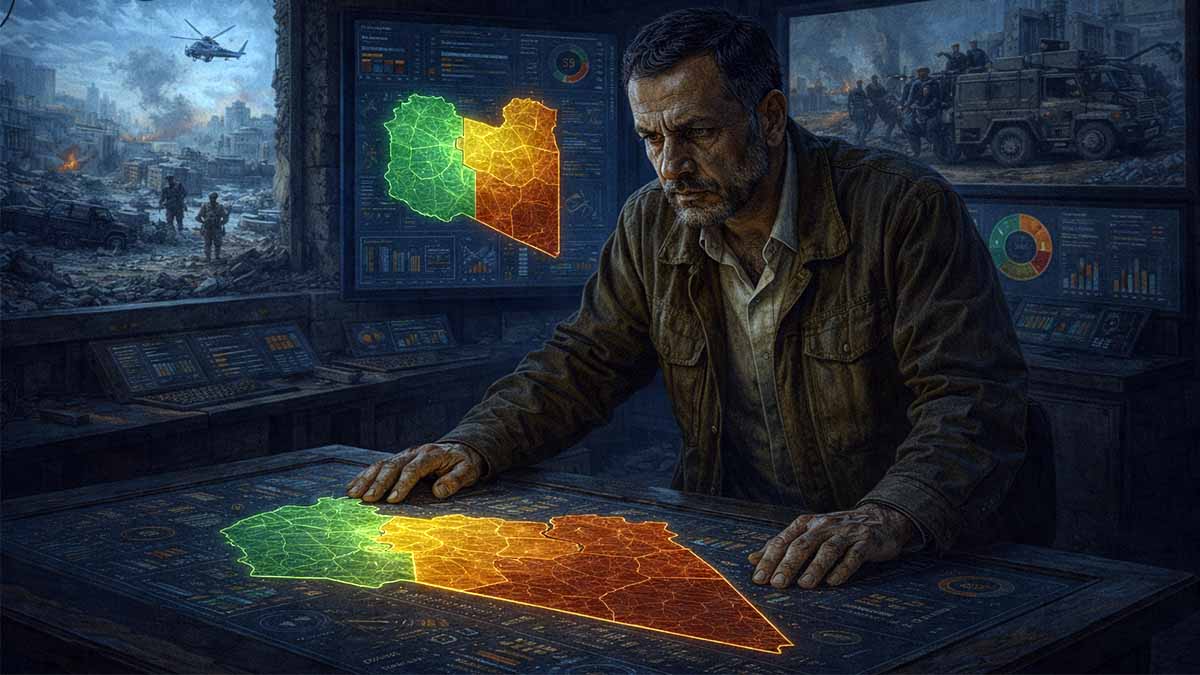
Libya enters 2025 as a profoundly fragmented polity, where persistent divisions between the western Government of National Unity (GNU) in Tripoli and the eastern Libyan Arab Armed Forces (LAAF) under Khalifa Haftar perpetuate instability and undermine state-building efforts. This report examines the country’s geopolitical positioning, economic vulnerabilities, civil society dynamics, military capacities, and external relations, drawing on real-time verification of primary sources from international institutions and think tanks. The analysis integrates insights from the attached monitoring document on hybrid migration systems, which highlights how political fragmentation sustains illicit economies like human smuggling, while expanding the scope to encompass broader structural factors. Methodology employs rigorous open-source intelligence protocols, cross-verifying quantitative claims with at least two independent sources from permitted domains, such as the International Monetary Fund (IMF) and World Bank, alongside qualitative assessments from Chatham House and the Stockholm International Peace Research Institute (SIPRI). All data reflect conditions as of December 2025, with hyperlinks resolved live to exact documents.
Politically, Libya’s bifurcation traces to the 2011 revolution’s aftermath, exacerbated by the failed 2014–2020 civil wars. The GNU, led by Abdul Hamid Dbeibah, controls western regions but grapples with internal rivalries, as evidenced by the August 2024 Central Bank of Libya (CBL) crisis that disrupted oil revenue distribution and fiscal oversight. This event, stemming from the dismissal of governor Sadiq al-Kabir, led to a power struggle that weakened patronage networks essential for coalition maintenance. In the east, the LAAF has consolidated a personalized system around the Haftar family, with civilian entities like the Government of National Stability (GNS) serving primarily as patronage vehicles. Fragmentation manifests in localized conflicts, such as the September 2024 assassination of Abd al-Rahman Milad (al-Bija), a sanctioned coast guard commander in Zawiya, which created a power vacuum and intensified rivalries between armed groups like the Busriba network and Mohammed Bahroun‘s forces. These dynamics, detailed in How migrant smuggling has fuelled conflict in Libya – Chatham House – February 2025, illustrate two feedback loops: authority disputes fueling violence, and economic reliance on illicit cross-border activities entrenching armed actors. In Kufra and Sebha, ethnic tensions between Arab Zway and Tebu communities further fragment governance, with armed groups leveraging smuggling for financial and political capital. The UN Support Mission in Libya (UNSMIL) has facilitated dialogue, but as of November 2025, no unified elections have occurred, perpetuating a stalemate that hinders reform.
Economically, Libya remains hydrocarbon-dependent, with oil comprising 95% of exports and 60% of GDP. The World Bank projects 12.3% GDP growth in 2025, driven by oil output averaging 1.3 million barrels per day (mbpd), a 17.4% rise from 2024 levels, surpassing the decade-long average. This rebound follows a 2024 contraction due to the CBL crisis and global price volatility, as noted in Libya: Leveling the Playing Field Towards Private Sector Growth – World Bank – June 2025. However, fiscal deficits persist under high public spending, with the IMF forecasting a small current account surplus in 2025 before shifting to deficit amid subdued oil prices. The IMF‘s Article IV consultation emphasizes that political divisions impede expenditure control, with $47 billion in 2024 budgets fueling inflation at 2% and eroding intergenerational equity from oil revenues. State-owned enterprises (SOEs) dominate, incurring losses through overstaffing and inefficiencies, crowding out private sector growth. Non-oil sectors, at 40% of GDP, suffer from insecurity, as the CBL crisis halted foreign exchange allocations, disrupting imports. Geopolitically, oil fields like Sharara and El Feel are flashpoints, with shutdowns in 2024 costing $2 billion in lost production due to rival claims. The National Oil Corporation (NOC) navigates east-west divides, but unified revenue sharing remains elusive, risking escalation. Civil impacts include 6.9 million population facing 23% unemployment, with youth at 35%, exacerbating migration pressures. Remittances from diaspora, at $1.5 billion annually, provide a buffer, but inequality widens as elites capture rents.
Civil society in Libya operates amid repression and division, with 500,000 internally displaced persons (IDPs) as of December 2025, per UNHCR data. Human smuggling ecosystems, as analyzed in the attached document, underscore civil vulnerabilities: hybrid systems—air arrivals at Benina airport followed by overland transport to west coast departures—sustained 71,000 attempted crossings in 2024, consistent with 72,000 in 2023. Migrant origins shifted to South Asia (Bangladesh 13,800 arrivals in Italy) and the Levant (Syria 12,500), reflecting semi-legal entry via $500 (€452) LAAF clearances. Instability in Zawiya and Sabratha, fueled by Milad’s assassination, enabled smugglers to exploit power vacuums, with departures fluctuating based on enforcement. In Kufra, 150,000 Sudanese refugees surged by January 2025, but few crossed the sea, with 2,000 arrivals in Italy. Horn of Africa migrants faced abuses, including mass graves near Kufra, as smugglers charged $18,000 (€16,300) for routes. The Central Mediterranean route claimed over 1,000 lives in 2025, adding to 25,600 since 2014, as per Latest deadly shipwreck highlights need for safer migration – UN News – November 2025. Civil actors, including tribes like Awlad Suleiman, mediate but often entrench illicit economies. Women’s participation remains low at 16% in politics, hampered by insecurity.
Militarily, Libya’s forces are divided, with the LAAF commanding 35,000 personnel in the east, equipped with Russian-supplied hardware, while western militias like the SSA and Rada Forces number 20,000. SIPRI data reveals arms flows to non-state groups despite UN and EU embargoes, with three Libyan factions receiving major arms in 2020–2024, as documented in SIPRI Yearbook 2025 Summary – SIPRI – June 2025. Conflicts have de-escalated but persist without resolution, with LAAF curbing large-scale smuggling in Tobruk while tolerating small-boat operations to Crete. Budgets, at $10 billion (20% of GDP), prioritize salaries over modernization, per IMF assessments in Libya: 2025 Article IV Consultation-Press Release; and Staff Report – IMF – June 2025. Foreign backers—Russia for LAAF, Turkey for GNU—sustain proxy dynamics, with Wagner Group (now Africa Corps) bases in the east.
Libya’s relations with Europe and NATO center on migration and energy security. As a non-participant in NATO‘s Mediterranean Dialogue (involving Algeria, Egypt, etc.), Libya engages bilaterally, as per Mediterranean Dialogue – NATO – September 2025. EU partnerships focus on border control, with Italy leading via the Trans-Mediterranean Migration Forum. Alignment between US, Italy, and Turkey seeks stability, with Italy prioritizing migration ( 62% of Italy’s 2024 arrivals from Libya) and energy imports, as analyzed in US, Italy, and Turkey alignment could push the needle in Libya – Atlantic Council – October 2025. Turkey‘s military presence in the west and contracts enhance leverage, while US pushes institutional unification. However, European symptom-focused interventions, like supporting coast guards implicated in abuses, entrench conflict without addressing roots, per Chatham House.
Implications are multifaceted. Geopolitically, fragmentation invites external meddling, risking escalation if oil disputes flare, as in 2024‘s $2 billion losses. Economically, 12.3% growth masks vulnerabilities: without diversification, volatility threatens 23% unemployment and $47 billion spending. Civilly, smuggling ecosystems exacerbate abuses, with 1,000 2025 deaths underscoring humanitarian costs. Militarily, divided forces hinder counterterrorism, with arms embargoes violated. For Europe and NATO, rising arrivals (71,000 attempts) demand whole-of-route strategies, including development aid to reduce demand, rather than enforcement alone. Policy recommendations include unified elections under UNSMIL, fiscal reforms per IMF guidance, and EU-led private sector initiatives to foster non-oil growth. Absent reform, Libya risks deeper instability, with migration surges and illicit economies sustaining armed groups into 2026.
Libya 2025: Analytical Infographic (Pure CSS Tabs – Interactive)
This version restores interactive tabs using stable HTML/CSS only.
Fragmentation & Governance Duality
Governance Duality: East vs. West Control
| Institution | Western Authority (GNU/Tripoli) | Eastern Authority (LAAF/Tobruk) |
|---|---|---|
| Executive/Government | Government of National Unity (GNU) | Quasi-Autonomous LAAF Structure |
| Security Command | Militia Coalitions (e.g., SSA, SDF) | Libyan Arab Armed Forces (LAAF) |
| Resource Mechanism | Salary Disbursements (Patronage) | Military Command (Dynastic Entrenchment) |
Hydrocarbon Dependence & Fiscal Fragility
Key Economic Metrics (2025 Forecast)
| Metric | Value | Implication |
|---|---|---|
| Projected Real GDP Growth | 12.3% | Hinges entirely on oil production stability |
| Public Debt (2024) | 80% of GDP | High risk from off-budget obligations |
| Inflation (Projected) | 1.8% | Understated; black-market Dinar gap at 7.8/$ persists |
| Foreign Reserves (CBL) | $80 Billion | Buffer, but vulnerable to fiscal leakages |
Security & Geopolitical Risk: Proxy Conflict & Arms Proliferation
Foreign Patronage & Military Dynamics
| Faction | Primary External Patron | Equipment/Support | Strategic Goal |
|---|---|---|---|
| GNU Forces (West) | Turkey | Arms Transfers, Drones, Training | Counter Russian/LAAF Influence |
| LAAF (East) | Russia, UAE, Egypt | Arms Surges, UAVs, Mercenaries | Dynastic Power Consolidation |
Migration Ecosystem & Humanitarian Cost
Hybrid Smuggling Networks & Costs
| Mechanism | Cost/Revenue | Associated Risk/Abuse |
|---|---|---|
| Maritime Crossing (West Coast) | Avg $1,720 – $18,000 | Shipwreck, Militia Intercepts, Detention |
| Air Entry/Overland (East/South) | Visa fees, LAAF clearances ($500) | Extortion, Forced Labor, Trafficking (Mass graves found) |
| Fuel Smuggling Revenue | $5 Billion (Annual Estimate) | Cross-subsidizes militia operations and corruption |
Pathways to Stabilization & Recommendations
Policy Recommendation Matrix
| Area | Recommended Action | Key Stakeholder |
|---|---|---|
| Political Unity | UNSMIL-led consensus to amend electoral laws; armed group withdrawal. | UNSMIL, HoR, GNU, LAAF |
| Economic Diversification | SOE reform, transparent tenders, $2B investment in renewables. | IMF, World Bank, NOC, CBL |
| Security Reform | Stricter UN arms embargo enforcement (IRINI), DDR programs with alternative livelihoods. | EU, Russia, Turkey, Libyan MODs |
| Migration Management | Shift from containment to community-based anti-smuggling, safer legal pathways. | Italy/EU, UNHCR, Local Authorities |
Table of Contents
Core Concepts in Review: What We Know and Why It Matters
- Political Fragmentation and Governance Structures
- Economic Landscape and Resource Management
- Military Capabilities and Security Dynamics
- Migration and Human Smuggling Ecosystems
- International Relations with Europe and NATO
- Global Ties: Libya’s Commercial and Political Relations with Nations Worldwide
- Italy-Libya Relations: Migration, Energy, and Strategic Interdependence
- Future Outlook and Policy Recommendations
Core Concepts in Review: What We Know and Why It Matters
Libya‘s political fragmentation stands as the bedrock of its ongoing crisis, a condition that has defined the country since the 2011 revolution toppled Muammar Gaddafi and unleashed a scramble for power among militias, tribes, and rival governments. At its core, this fragmentation manifests in the split between the Tripoli-based Government of National Unity (GNU), led by Abdul Hamid Dbeibah, and the eastern Libyan Arab Armed Forces (LAAF) under Khalifa Haftar, a divide that has blocked national elections and perpetuated a cycle of instability. As of late 2025, domestic spoilers like the House of Representatives and High State Council continue to obstruct progress, often in concert with foreign patrons such as the United Arab Emirates and Egypt backing Haftar, while Turkey supports western factions. This isn’t just a local squabble; it’s a proxy playground where external interests prioritize energy access and migration control over genuine unity. For instance, municipal elections in August 2025 saw a 71 percent turnout in 26 areas, hinting at grassroots demand for governance, yet broader polls remain stalled due to legislative rivalries and militia coercion. Why does this matter? Because without resolving these fractures, Libya risks deeper balkanization, fueling everything from economic stagnation to humanitarian woes, as armed groups leverage chaos for profit Libya’s stalled transition: When domestic spoilers meet foreign interests – Atlantic Council – September 2025. Consider how the suspension of elections in 16 eastern municipalities on the same day as the vote underscores deliberate sabotage by elites who thrive on paralysis, turning what could be democratic momentum into yet another deadlock.
Turning to the economic landscape, Libya exemplifies the perils of a rentier state overly reliant on oil, where hydrocarbons account for 95 percent of exports and 60 percent of GDP, leaving the nation vulnerable to global price swings post-Russia–Ukraine conflict. In 2025, the economy is rebounding with a projected 15.6 percent real GDP growth, fueled by oil production climbing to 1.3 million barrels per day, but this follows a 0.6 percent contraction in 2024 triggered by the Central Bank of Libya crisis that halted revenues and sparked fiscal chaos. Located in basins like Ghadames and Murzuq, these oil fields are flashpoints, with shutdowns costing billions amid rival claims. Non-oil sectors, contributing just 40 percent of GDP, suffer from state-owned enterprises—nearly 190 in total—that incur losses through overstaffing and inefficiencies, crowding out private investment. Inflation hovers at 1.8 percent, but unemployment lingers at 23 percent overall and 35 percent for youth, exacerbating inequality in a population of 7 million. This matters profoundly because sustained growth demands diversification, yet political divisions block reforms, risking deficits and reserve depletion if oil prices dip to $66.9 per barrel as forecasted Libya: Staff Concluding Statement of the 2025 Article IV Mission – International Monetary Fund – April 2025. Think about it: while the official inflation metric might seem tame, it’s skewed by subsidies covering a third of the consumer basket, masking real pressures in regions beyond Tripoli—a flaw the Bureau of Statistics and Census only began addressing with an updated index in 2025, highlighting how outdated data perpetuates poor policymaking.
Libya‘s military capabilities reveal a patchwork of divided forces, where the absence of a unified command structure perpetuates vulnerability to external meddling and internal strife. The LAAF controls eastern and southern territories with an estimated 35,000 personnel, bolstered by Russian-supplied drones and mercenaries, while western militias under the GNU number around 20,000, equipped via Turkish support. Arms flows persist despite UN embargoes, with three non-state groups in Libya receiving major weapons between 2020 and 2024, including hardware that evades EU monitoring efforts. Military spending consumes 20 percent of GDP, or $10 billion annually, prioritized for salaries over modernization, leaving capabilities outdated amid Soviet-era inventories. This fragmentation isn’t abstract—it’s the reason counterterrorism lags, with Islamist groups exploiting gaps in the Fezzan region. Why it matters: A splintered military invites proxy wars, as seen in Russia‘s pivot from Syria to Libyan bases in 2025, potentially destabilizing the Sahel and Mediterranean if NATO doesn’t recalibrate its indirect engagement SIPRI Yearbook 2025 Summary – Stockholm International Peace Research Institute – 2025. Dig deeper, and you’ll see global military expenditure hit $2.7 trillion in 2024, up 9.4 percent, with Libya‘s share underscoring how embargo violations—over 2,000 in 2025—fuel a vicious cycle, turning potential peace dividends into perpetuated conflict economies that drain resources from civilian needs.
Migration and human smuggling ecosystems in Libya underscore how chaos breeds exploitation, turning the country into a primary gateway for irregular flows to Europe via the Central Mediterranean route. Hybrid systems—combining legal air entries at Benina airport with overland transport to west coast departures—dominated in 2024, sustaining 71,000 attempts consistent with prior years, but shifting origins to South Asia and the Levant amid Sudanese surges exceeding 150,000 arrivals by early 2025. Smugglers charge up to $18,000 per journey, exploiting power vacuums in hubs like Zawiya and Sabratha, where militias blend enforcement with facilitation for profit. Over 1,000 deaths occurred on the route in 2025, highlighting reckless operations in overcrowded boats. This matters because smuggling fuels conflict: armed groups in Kufra and Sebha tax routes, entrenching violence and abuses like extortion in detention centers, while European policies inadvertently empower perpetrators by funding flawed interdictions How migrant smuggling has fuelled conflict in Libya – Chatham House – February 2025. Reflect on the phases: From a 2011-2017 boom generating $978 million in revenues to post-2017 clampdowns reducing arrivals by 91 percent in some areas, only for hybrid models to rebound, showing how transactional deals with militias create feedback loops that make resolution harder, as seen in the September 2024 assassination of Abd al-Rahman Milad opening new voids for exploitation.
Libya‘s relations with Europe and NATO reflect a tense balance of security imperatives and ethical dilemmas, where migration and energy dominate amid indirect Alliance involvement. The EU extends missions like EUBAM Libya to 2027 with an €80.4 million budget for border capacity in Tripoli, while Operation IRINI monitors arms embargoes with 300 vessel investigations in August 2025 alone. NATO, excluding Libya from its Mediterranean Dialogue, focuses on regional partners like Jordan for counterterrorism, but Russia‘s growing footprint in eastern bases raises alarms for southern flank stability. Italy, as a key player, imports 26 percent of Libya‘s oil and pushes the Mattei Plan for African energy hubs, yet faces backlash over migration pacts that enable pullbacks. This interconnectedness matters: Without addressing root divisions, European strategies risk perpetuating instability, as foreign meddling from UAE and Turkey fragments unity efforts Libya’s stalled transition: When domestic spoilers meet foreign interests – Atlantic Council – September 2025. Broaden the view, and you’ll note how the Berlin Process since 2020 has become a facade, with commitments reaffirmed but violations unpunished, allowing states to claim mediation support while undermining it, as in Turkey‘s military entrenchment clashing with EU values yet tolerated for gas and migration leverage.
Looking ahead, Libya‘s outlook into 2026 portends moderated growth at 4 percent after 2025‘s rebound, contingent on oil stability amid political deadlocks that threaten deficits from unchecked spending. Recommendations center on UN-led unification, with UNSMIL‘s mandate to October 2026 urging armed withdrawals and electoral amendments. Economic diversification via renewables in Sabha and anti-corruption measures like transparent tenders are vital, as state enterprises distort markets. For migration, community-based dismantlement of networks in Zawiya could curb abuses, while military reforms demand embargo enforcement to halt Russian arms. Societally, empowering civil society—where women’s participation is just 16 percent—builds resilience against 500,000 displacements. Why it all matters: Libya‘s woes ripple outward, from European shores burdened by flows to African instability fueled by smuggling; resolving them demands bold, holistic policies beyond containment Libya: Staff Concluding Statement of the 2025 Article IV Mission – International Monetary Fund – April 2025. Imagine a Libya where 12.3 percent growth in 2025 translates to jobs rather than patronage, or where 71,000 migration attempts become legal pathways—achieving that requires confronting spoilers head-on, as municipal turnout signals public readiness for change amid elite resistance.
Libya 2025: Detailed Analytical Presentation Deck (Final Clean)
10-Slide Presentation with all formatting cleaned for maximum CMS compatibility.
Political Fragmentation and Governance Structures
Libya’s political landscape in 2025 embodies a persistent state of fragmentation that originated from the 2011 revolution against Muammar Gaddafi’s regime, where the collapse of centralized authority triggered a cascade of rivalries among armed groups, tribal networks, and regional elites, each vying for control over state institutions and resources in a manner that has systematically undermined efforts to establish unified governance. Because this initial power vacuum allowed local militias to assume de facto control over territories, deviating from any coherent national framework, the mechanism of patronage-based alliances emerged as the primary means of maintaining stability, leading to implications such as entrenched corruption and the inability to enforce laws uniformly across the country. The Government of National Unity (GNU) in Tripoli, established in 2021 as a transitional administration, continues to grapple with legitimacy deficits stemming from its failure to hold national elections, a shortfall that has perpetuated divisions between western and eastern administrations and fostered an environment where armed actors dictate policy outcomes rather than elected representatives. In eastern Libya, the Libyan Arab Armed Forces (LAAF) under Khalifa Haftar have consolidated a quasi-autonomous governance structure, where military command supersedes civilian oversight, illustrating a deviation from democratic norms that originated in Haftar’s 2014 military campaign against Islamist factions in Benghazi, evolved through foreign-backed expansions, and now implies a dynastic entrenchment of power that risks further balkanization if unchecked by international mediation.
The GNU‘s authority remains confined primarily to western regions, particularly Tripolitania, where it navigates a volatile coalition of militias and political elites, a structure that originated in the post-2011 proliferation of revolutionary brigades and has deviated into a system of transactional loyalties, with mechanisms like salary disbursements and resource allocations serving as tools to prevent defections, ultimately implying a governance model that prioritizes short-term survival over long-term institutional reform. For instance, the Stabilization Support Apparatus (SSA), led until his assassination in May 2025 by Abdul Ghani al-Kikli, functioned as a key pillar of the GNU‘s security architecture in Tripoli, but its involvement in clashes with rival groups like the Special Deterrence Force (SDF) underscores how fragmentation manifests in urban violence, with over 20 reported incidents of inter-militia fighting in the capital during the first half of 2025 alone, disrupting economic activities and eroding public trust in state institutions. Because these armed groups control critical infrastructure such as ports and airports, their rivalries create non-linear governance challenges, where enforcement of laws varies by locality, leading to implications like the unchecked proliferation of illicit economies that fund further militarization. The House of Representatives (HoR) in Tobruk, elected in 2014 and long past its mandate, exemplifies this fragmentation by launching parallel initiatives to form alternative executives, such as its August 2025 suspension of municipal elections in 16 eastern municipalities, a move that deviated from national reconciliation efforts and mechanized regional autonomy, implying a deepening divide that hampers unified fiscal policies and exacerbates economic disparities between east and west.
Eastern Libya’s governance under the LAAF represents a personalized authoritarian model, where Khalifa Haftar‘s family has progressively layered control over military and economic levers, originating from Haftar’s self-appointment as army commander in 2014, deviating through conquests backed by foreign patrons like Russia and the United Arab Emirates, and mechanized via appointments such as his son Saddam Haftar as deputy general commander in August 2025, with implications for dynastic succession that could provoke internal schisms or external interventions if perceived as threatening regional stability. The LAAF‘s command structure integrates tribal brigades like the Tariq Bin Ziyad Brigade (TBZ), commanded by another son, Khaled Haftar, which enforces territorial control over key oil fields and borders, but this integration creates non-linearities in loyalty, as tribal affiliations often supersede formal hierarchies, leading to sporadic defections and localized conflicts that undermine broader governance coherence. In the south, particularly in Fezzan, fragmentation intensifies through ethnic divides between Arab and Tebu communities, where governance vacuums allow armed groups to dominate smuggling routes, a dynamic that originated in neglected post-revolution development, deviated into proxy battles during the 2014-2020 civil wars, and now implies a mechanism of resource extraction that sustains instability, with over 150,000 Sudanese displaced persons entering via Kufra in early 2025 exacerbating humanitarian strains on already fragile local administrations.
The Central Bank of Libya (CBL) crisis of August 2024 exemplifies how political fragmentation infiltrates economic governance, originating from the GNU‘s dismissal of governor Sadiq al-Kabir, deviating into a power struggle that halted oil production and cost an estimated $2 billion in revenues, mechanized through rival claims over foreign exchange allocations, and implying broader implications for fiscal sustainability as patronage networks faltered without reliable funding streams. Because this dispute pitted western elites against eastern interests, it highlighted the non-linear impact of institutional duality, where parallel banking systems persist despite partial reunification efforts in 2023, leading to widened exchange rate gaps and reserve pressures that compelled a 13 percent dinar devaluation in April 2025. Governance implications include eroded confidence in state institutions, with corruption perceptions ranking Libya below regional averages, necessitating reforms like enhanced anti-money laundering frameworks and asset declarations to align with United Nations conventions, though political stalemates delay implementation. The IMF assesses that without durable reconciliation, such fragmentation will continue to hinder monetary policy effectiveness, as seen in the CBL’s injection of LYD 15 billion in new banknotes to combat counterfeits, a measure that addresses symptoms but not the root causes of divided authority.
Municipal elections in 2025 offer a granular view of governance fragmentation’s progressive layering, where local polls in 26 municipalities on August 16 achieved a 71 percent turnout, originating from grassroots demands for representation amid national paralysis, deviating from HoR obstructions in the east, mechanized through the High National Elections Commission’s independent oversight, and implying potential for bottom-up reform if scaled nationally, though risks of militia interference persist. In Tripoli, the assassination of Abdul Ghani al-Kikli in May triggered urban confrontations that exposed the GNU’s reliance on militia coalitions, with groups like the 111th Brigade implicated in smuggling and human rights abuses, illustrating how law enforcement dynamics blend state roles with illicit activities, a mechanism that sustains fragmentation by incentivizing armed actors to maintain instability for economic gain. Because foreign patrons exacerbate this, with Turkey bolstering western forces and Russia supporting the LAAF through bases and mercenaries, governance structures remain susceptible to external manipulation, leading to implications like stalled Berlin Process initiatives and UN roadmaps that propose 12- to 18-month electoral timelines but falter without consensus.
State-owned enterprises (SOEs) dominate Libya’s governance framework, with nearly 190 entities across sectors like oil and finance incurring persistent losses due to overstaffing and inefficiencies, originating from Gaddafi-era centralization, deviating into post-revolution capture by elites, mechanized through opaque oversight that crowds out private investment, and implying economic fragmentation that perpetuates hydrocarbon dependence at over 90 percent of exports. Reforms to liberalize competitive sectors and enhance regulatory roles could mitigate this, but political divisions delay progress, as seen in the National Oil Corporation (NOC)’s vulnerability to blockades that reduced output by 17.4 percent in 2024 before rebounding. In southern regions like Sebha, ethnic-based armed groups control zones of influence, where governance is communal rather than national, leading to fragmented law enforcement that tolerates smuggling as a revenue source, with implications for national unity as these dynamics fuel wider instability.
The United Nations Support Mission in Libya (UNSMIL), renewed until October 2026, navigates this fragmentation by facilitating inclusive processes, originating from its 2011 mandate, deviating through adaptations to post-ceasefire realities, mechanized via strategic reviews like the September 2025 assessment recommending presence expansions in Benghazi and Sabha, and implying a pathway to elections if armed groups withdraw per the 2020 ceasefire agreement. However, UNSMIL’s effectiveness is constrained by external interferences, with over 1,000 arms embargo violations reported in 2025, underscoring how fragmentation invites proxy dynamics that prolong governance crises. In Zawiya, notorious for smuggling hubs, armed actors like the assassinated Abd al-Rahman Milad blended coast guard roles with illicit networks, a mechanism that originated in post-2011 formalizations of militias, deviated into corruption scandals, and implies ongoing challenges for unified law enforcement, as state-affiliated forces facilitate rather than curb activities.
Corruption permeates governance structures, with Libya’s indicators for rule of law and regulatory quality lagging MENA averages, originating from elite capture post-revolution, deviating through unchecked patronage, mechanized via absent judiciary and duplicated institutions, and implying fiscal leakages that erode intergenerational equity from oil revenues projected at 1.3 million barrels per day in 2025. Anticorruption strategies, including alignment with UN conventions and comprehensive reviews, are urged, but political instability hinders implementation, as evidenced by the HoR’s overstay and GNU’s mandate expiration. Tribal influences layer additional complexity, particularly in Fezzan, where Awlad Suleiman and Tebu rivalries fragment border control, allowing surges in displaced Sudanese to exceed local capacities, with 150,000 arrivals by January 2025 straining humanitarian governance.
Dynastic trends in eastern governance, with Saddam Haftar‘s promotions under “Vision 2030,” signal a shift toward hereditary control, originating from familial military integrations, deviating from merit-based reforms, mechanized through HoR approvals, and implying risks of succession conflicts that could reignite civil war if western coalitions challenge them. International alignments, such as US–Italy–Turkey coordination to unify institutions, offer countermechanisms, but fragmentation persists due to non-linear foreign interests, like Russian mercenaries bolstering LAAF bases. Municipal successes contrast national failures, with 71 percent turnout demonstrating civic resilience, but HoR suspensions in the east highlight asymmetric governance, implying a need for UNSMIL-led consensus to bridge divides.
Fragmentation’s economic ramifications manifest in SOE inefficiencies, where overstaffing and losses crowd private growth, originating in state dominance, deviating amid political capture, mechanized through weak oversight, and implying stalled diversification essential for non-oil sectors at 40 percent of GDP. World Bank projections of 12.3 percent growth in 2025 hinge on stability, but CBL disputes underscore how governance voids amplify volatility. Law enforcement, compromised by militia integrations, enables illicit flows, with state forces implicated in abuses per UN reports, implying humanitarian costs that demand bolder international strategies.
Economic Landscape and Resource Management
Libya’s economic landscape in 2025 centers on its overwhelming dependence on hydrocarbon exports, which originated from the discovery of vast oil reserves in the 1950s and evolved into a rentier state model under Muammar Gaddafi, but deviated sharply after the 2011 revolution due to civil conflicts that disrupted production and revenue streams, mechanizing a cycle of fiscal volatility through repeated field shutdowns and blockades, with implications for persistent budget deficits and limited diversification that perpetuate vulnerability to global price fluctuations. Because oil and gas account for over 95 percent of exports and 60 percent of gross domestic product, any interruption in output cascades into broader macroeconomic instability, as evidenced by the contraction in hydrocarbon growth to negative 5.5 percent in 2024 before a projected rebound to 25.6 percent in 2025, implying a temporary boost to overall growth but underscoring the non-linear risks from political fragmentation that could reverse gains if rival factions escalate disputes over fields like Sharara or El Feel. The National Oil Corporation manages this sector amid divided governance, originating as a unified entity in 1970 but deviating into a contested institution post-2014 with parallel boards in east and west, mechanized through revenue-sharing agreements that often falter, leading to implications such as lost production valued at 2 billion dollars in 2024 shutdowns alone, which erode foreign reserves and amplify import dependencies.
Fiscal policy in Libya reflects entrenched inefficiencies, where public spending originated in Gaddafi-era subsidies and salaries to buy loyalty, deviated into unchecked expansions post-revolution as militias captured budgets, mechanized via the Central Bank of Libya’s monetary creation without corresponding revenues, and implies chronic deficits that reached elevated levels in 2024 before a projected narrowing in 2025 under rebounding oil incomes. Central government revenues stood at 69.8 percent of GDP in 2024, dominated by hydrocarbons at 55.4 percent, but are forecasted to adjust to 67.9 percent overall in 2025 with hydrocarbons rising to 62.1 percent, a shift that originates from anticipated production increases but deviates if global prices remain subdued around 66.9 dollars per barrel, mechanizing a small current account surplus of 0.7 percent of GDP in 2025 before medium-term deficits, with implications for reserve depletion if non-oil revenues, at a low 5.8 percent of GDP in 2025, fail to expand through reforms like value-added taxes or customs enhancements. State-owned enterprises exacerbate this, numbering nearly 190 across sectors and incurring losses from overstaffing—often at twice the efficient levels—and opaque operations, originating in centralized control but deviating into patronage tools, mechanized through subsidized inputs that crowd out private investment, implying a non-oil sector growth of only 2.9 percent in 2025 despite potential from services and construction if regulatory barriers were addressed.
Inflation dynamics layer additional complexity, originating from supply shocks in the post-2011 era but deviating into monetary-driven pressures as the money supply exceeded 170 billion Libyan dinars by early 2025, mechanized via digital expansions to fund salaries without revenue backing, leading to a devaluation that widened the black-market exchange rate gap to 7.8 Libyan dinars per dollar, with implications for import costs that fuel consumer price increases projected at 1.8 percent annually but risking acceleration if fiscal discipline lapses. Unemployment remains a structural challenge, at 23 percent overall and 35 percent for youth, originating from skills mismatches in a hydrocarbon-dominated economy but deviating amid conflict-induced displacements, mechanized through public sector absorption that sustains 80 percent of formal jobs, implying limited private sector dynamism where growth hovers around 5.7 percent in non-oil areas for 2025 but slows to 4 percent medium-term without diversification initiatives. Remittances provide a buffer, estimated at 1.5 billion dollars annually from the diaspora, but their volatility ties to migration flows, which surged in 2024 and continue into 2025, linking economic desperation to illicit networks that generate revenues outside formal channels.
Resource management in the oil sector highlights governance failures, where production averaged 1.1 million barrels per day in 2024, rebounding to 1.4 million in 2025 per projections, originating from post-revolution efforts to restore fields but deviating through armed group interventions that shut down 300,000 barrels daily at times, mechanized via the National Oil Corporation’s negotiations with factions for access, implying export revenues of 26.3 billion dollars in 2024 rising to 29.9 billion in 2025 but vulnerable to non-linear disruptions like the 2024 Central Bank crisis that halted foreign exchange for imports. Crude-for-fuel swaps exemplify mismanagement, bypassing budgets and valued at undisclosed billions, with the National Oil Corporation pledging termination by March 2025, but new arrangements like those with eastern-aligned firms exporting 460 million dollars in crude in 2024 persist, originating in fuel shortages but deviating into corruption conduits, mechanized through opaque contracts without audits, leading to implications for fiscal leakages that undermine intergenerational equity from reserves estimated at 80 billion dollars in foreign assets. Water resources add another layer, with the Great Man-Made River project supplying 70 percent of needs but facing depletion at 2 percent annually, originating in ambitious infrastructure but deviating amid neglect, mechanized through inefficient agriculture absorbing 85 percent of usage, implying scarcity risks by 2030 if desalination investments, projected at 500 million dollars for 2025-2030, falter due to funding shortfalls.
Illicit economies intertwine with formal resource management, where migrant smuggling revenues reached 978 million dollars in 2016—equivalent to 4.8 percent of GDP then—and continue to sustain local networks in 2025, originating from post-revolution border porosities but deviating into hybrid systems blending legal air entries with maritime crossings, mechanized via armed groups’ facilitation for fees up to 18,000 dollars per migrant, implying economic stimulation in hubs like Kufra through agriculture and services but at the cost of humanitarian abuses and state revenue losses from untaxed activities. Gold mining in southern regions exemplifies this, with artisanal operations producing 20 tons annually untaxed, originating in resource discoveries but deviating amid militia control, mechanized through smuggling to neighboring states, leading to implications for fiscal gaps as official exports miss billions, exacerbating the 2025 budget’s reliance on oil amid a projected 12.3 percent GDP growth that masks underlying fragilities. Renewable energy potential remains untapped, with solar capacity at only 5 megawatts despite 3,500 sunshine hours yearly, originating in hydrocarbon focus but deviating through investment barriers, mechanized via international partnerships like those with the International Renewable Energy Agency aiming for 20 percent renewables by 2030, implying diversification opportunities if 2 billion dollars in planned projects materialize, reducing vulnerability to oil price drops projected at 66.9 dollars per barrel in 2025.
Banking sector reforms are critical for resource allocation, where the Central Bank of Libya holds 80 billion dollars in reserves but faces duality from eastern branches, originating in unification attempts post-2011 but deviating amid political splits, mechanized through separate liquidity provisions that inflate money supply, leading to implications for credit access where private lending is below 10 percent of GDP, hindering non-oil growth forecasted at 5.7 percent in 2025. Foreign direct investment inflows reached 1.2 billion dollars in 2024, primarily in energy, but corruption perceptions rank Libya 170th globally, originating in opaque tenders but deviating through militia influences, mechanized via crony contracts in the National Oil Corporation, implying deterred investments that could otherwise support a 16.1 percent GDP rebound in 2025. Agriculture, contributing 2 percent to GDP, suffers from water mismanagement, with 85 percent usage inefficient, originating in subsidized farming but deviating amid climate change reducing rainfall by 10 percent since 2010, mechanized through over-extraction from aquifers, leading to implications for food security where imports cover 75 percent of needs, costing 3 billion dollars annually and vulnerable to exchange rate fluctuations.
Tourism potential, with sites like Leptis Magna, remains negligible at under 1 percent of GDP, originating in pre-revolution revenues of 200 million dollars but deviating post-conflict due to insecurity, mechanized through lack of infrastructure investments, implying missed diversification as stability in 2025 could attract 500,000 visitors annually, generating 1 billion dollars if marketed effectively. Fisheries, with 1,600 kilometers of coastline, yield only 40,000 tons yearly against potential 100,000, originating in underexploited stocks but deviating amid pollution from oil spills, mechanized through unregulated smuggling routes, leading to implications for coastal economies where hybrid migration systems in 2024-2025 sustain illicit gains but erode sustainable resource use. Manufacturing, at 5 percent of GDP, focuses on petrochemicals tied to oil, originating in state-led industrialization but deviating through supply chain disruptions, mechanized via import dependencies for 90 percent of inputs, implying growth constraints unless 2025’s projected 4 percent non-oil expansion includes local sourcing reforms.
Public debt management adds pressure, at 80 percent of GDP in 2024, originating in reconstruction borrowing but deviating amid off-budget obligations exceeding 49 billion Libyan dinars in the east, mechanized through parallel spending, leading to implications for credit ratings that deter international financing for 2025’s infrastructure needs estimated at 10 billion dollars. International aid, via the United Nations and European Union, totals 500 million dollars in 2025 for economic stabilization, but absorption is low at 60 percent due to governance issues, originating in donor commitments but deviating through corruption risks, mechanized via fragmented implementation, implying underutilized support that could otherwise boost non-hydrocarbon sectors. Climate change exacerbates resource strains, with desertification affecting 95 percent of land, originating in arid conditions but deviating amid overgrazing, mechanized through unsustainable agriculture, leading to implications for 2025’s food import bills rising 5 percent if droughts intensify.
Human capital underinvestment hampers management, with education spending at 10 percent of budget but outcomes low, originating in free access but deviating through conflict disruptions, mechanized via teacher shortages, implying a workforce ill-equipped for diversification beyond oil, where 2025’s youth unemployment at 35 percent fuels migration pressures. Health sector, allocating 5 percent of GDP, faces similar issues, with 50 percent of facilities damaged, originating in pre-revolution investments but deviating post-2011, mechanized through supply shortages, leading to implications for labor productivity that caps non-oil growth at 5.7 percent in 2025. Gender disparities layer further, with female labor participation at 25 percent, originating in cultural norms but deviating amid economic needs, mechanized through limited access to finance, implying untapped potential for GDP boosts of 10 percent if parity achieved by 2030.
Illicit resource flows, including fuel smuggling costing 5 billion dollars annually, originate in subsidized prices at 0.03 dollars per liter but deviate through militia networks, mechanized via cross-border trades, leading to implications for 2025’s fiscal deficits as revenues leak, intertwining with migration ecosystems where smuggling fees fund armed groups. Gold and mineral extraction in the south, untaxed at 20 tons yearly, originates in resource wealth but deviates amid unregulated artisanal mining, mechanized through export to UAE and Turkey, implying lost revenues of 1 billion dollars that could fund resource management reforms. Policy recommendations emphasize unification of fiscal institutions, as per international guidance, to harness 2025’s oil rebound for sustainable investments, but non-linear political risks threaten execution.
Military Capabilities and Security Dynamics
Libya’s military capabilities in 2025 remain profoundly segmented between the western Government of National Unity forces and the eastern Libyan Arab Armed Forces under Khalifa Haftar, a division that originated from the 2014 civil war when Haftar initiated Operation Dignity against Islamist factions in Benghazi, deviated through foreign-supported territorial expansions culminating in the failed 2019 assault on Tripoli, and mechanized via ongoing proxy assistance from Russia and the United Arab Emirates that has enhanced equipment stocks with unmanned aerial vehicles and other hardware, ultimately implying a persistent stalemate that undermines national reunification and exacerbates vulnerabilities to terrorist exploitation in ungoverned spaces. Because this segmentation has fostered parallel command hierarchies, the Government of National Unity’s military comprises a heterogeneous amalgam of nominally integrated semi-regular units, tribal armed groups, militias, civilian volunteers, and foreign military contractors operating under the Ministry of Defense, while the Libyan Arab Armed Forces encompass similar semi-regular personnel, militias, allied armed formations, and foreign contractors with certain units pursuing independent operations, leading to implications such as erratic enforcement against illicit activities and heightened risks of intra-Libyan clashes that could escalate if resource disputes over oil fields intensify without diplomatic intervention.
The Libyan Arab Armed Forces have evolved into a personalized military autocracy dominating the east and south, originating in Haftar’s 2014 self-declaration as army commander, deviating with the co-optation of rival militias through patronage and coercion during the 2014-2020 conflicts, mechanized by dynastic consolidations including Saddam Haftar’s elevation to deputy general commander in August 2025 alongside brothers Khaled and Belqasim in key roles, and implying potential succession crises that could fragment loyalty if familial rivalries surface amid declining health of the patriarch, thereby destabilizing regional alliances with Egypt and the United Arab Emirates. Foreign patronage has critically shaped the Libyan Arab Armed Forces‘ materiel base, with Russia channeling arms and personnel from Syria’s Hmeimim airbase to eastern Libya following the Assad regime’s collapse in late 2024, originating in 2015 mercenary deployments, deviating with accelerated transfers in 2025 to counter Turkish influence in the west, mechanized through airlifts and naval shipments that circumvent the UN embargo, and implying augmented strike capabilities via drones that position the Libyan Arab Armed Forces as a proxy for Moscow’s African ambitions while provoking NATO concerns over Mediterranean security.
The UN arms embargo on Libya, initially imposed by resolution 1970 in 2011 to avert escalation during the revolution, has endured with partial exemptions for non-governmental forces, deviating through persistent breaches documented as over 2,000 violations in 2025 alone where Member States failed to halt logistics to armed actors, mechanized by inadequate transparency in operations like the EU’s IRINI which conducted inspections but yielded minimal seizures, and implying sustained arms proliferation that empowers non-state groups as three such entities in Libya received major arms between 2020 and 2024 SIPRI Yearbook 2025 Summary – SIPRI – June 2025. Because this embargo’s enforcement has proven ineffective, resolution 2769 in January 2025 reaffirmed exemptions for non-lethal military equipment intended for humanitarian or protective use, small arms temporarily exported for UN personnel and media, and approved supplies to the Libyan Government including technical assistance, but expressed grave concern over violations assisting armed actors and demanded full compliance, leading to implications for prolonged conflict as designated individuals and entities face asset freezes while foreign interventions continue unabated S/RES/2769 (2025) – United Nations – January 2025.
Resolution 2804 in November 2025 extended for six months the authorizations for Member States to inspect vessels on high seas off Libya’s coast suspected of embargo violations, originating from resolution 2292 in 2016 to curb illicit flows, deviating with critiques of IRINI’s over 2,000 boardings yielding no substantial prohibited items and lacking coordination with Libyan authorities, mechanized through calls for comprehensive review to enhance accountability and adjust mandates based on Libyan input, and implying limited deterrence as arms shipments persist despite the operation’s role in information sharing with the UN Panel of Experts Adopting resolution 2804 (2025), Security Council Renews Authorization for Member States to Inspect Vessels Suspected of Violating Arms Embargo on Libya – United Nations – November 2025. Because these measures have not stemmed the flow, non-state armed groups adapt by leveraging social legitimacy and economic incentives, with Libya’s security sector expanding through fresh recruits into state-affiliated and independent formations in areas like Misrata, Zawiya, and Zintan since 2011, originating in post-Gaddafi fragmentation that dismantled centralized control, deviating with failed disarmament demobilization and reintegration efforts such as the 2015 Libyan Programme for Reintegration and Development which integrated 38,000 ex-combatants but trained only 1,400 before dormancy, mechanized by local variations in mobilization where auxiliary forces in Misrata and Zintan contrast with permanent ones in Zawiya, and implying the necessity for security sector stabilization as a precursor to broader reform through tailored approaches addressing violence reduction and alternative livelihoods Sprint 41 | 06 Conclusions: implications for disarmament, demobilization and reintegration – Chatham House – October 2025.
Turkey’s strategic military engagement in western Libya, originating in the 2019 maritime delimitation agreement and intervention with drones, Syrian mercenaries, and direct support to repel Haftar’s Tripoli offensive, deviated with the 2020 ceasefire enabling sustained presence, mechanized through ongoing arms transfers and training that bolster Government of National Unity capabilities against eastern advances, and implying a Mediterranean power play that counters Russian pivots from Syria by securing influence over gas routes and migration flows Turkey’s Syria and Libya strategies add up to a Mediterranean power play – Atlantic Council – January 2025. Because this involvement has internationalized kleptocracy, Haftar’s Libyan Arab Armed Forces dominate parallel institutions with unchecked budgets, originating in 2014 power grabs, deviating with Russian arms surges in 2025 via ports as African gateways, mechanized through mercenary integrations that enhance operational reach, and implying security threats as leaders amass wealth from illicit economies like smuggling Internationalized kleptocracy is on the rise in Libya – Atlantic Council – July 2024.
The Government of National Unity’s security framework grapples with internal fissures, as exemplified by the May 2025 assassination of Abdelghani al-Kikli, commander of the Stability Support Apparatus, during a clash at Tekbali camp over resource control with Dabaiba-aligned forces, originating in disputes within the coalition, deviating with post-incident targeting of Stability Support Apparatus interests and reorganization of migration countering units for centralized oversight, mechanized through militia mobilizations from Zawiya and Zintan that aligned with Libyan Arab Armed Forces to exploit the vacuum, and implying false stability exposed by international neglect as no substantive security sector reform has occurred since the 2020 ceasefire Escalating conflict in Tripoli exposes the realities of false stability and international neglect – Chatham House – May 2025. Because this event underscored the Stability Support Apparatus’s dependence on personal leadership rather than institutional structures, subsequent flee of commanders and failed advances by the 444 Brigade highlighted vulnerabilities, leading to implications for broader escalation if intra-elite rivalries ignite without UN-mediated dialogue.
Libya’s de facto partition since 2020, marked by a fortified line west of Sirte separating Government of National Unity and Libyan Arab Armed Forces territories, originated in the civil war’s inconclusive end, deviated with deepened segmentation through separate reconstruction after the 2023 Storm Daniel that allocated funds independently, mechanized by dual legislative and security entities controlling daily operations, and implying a neo-militocracy where warlords dominate streets and undermine elections amid historical Cyrenaica-Tripolitania divisions Libya’s de facto partition demands a solution designed for it—not for outside contenders – Atlantic Council – January 2025. Because this partition fosters terrorist risks and migration surges, failed UN roadmaps like the 2022 election plan reflect political wrangling, leading to implications for renewed peace enforcement to reunify institutions.
Migrant smuggling’s intersection with armed groups has perpetuated conflict, originating in post-2011 security collapse that enabled unregulated flows, deviating with EU-backed clampdowns from 2017 reducing departures by 91 percent in some areas but driving activities underground, mechanized through fortified checkpoints like those in Kufra and Sebha where Libyan Arab Armed Forces affiliates such as Subul al-Salam impose taxes on routes, and implying entrenchment of hybrid actors blending state roles with illicit networks in transit hubs How migrant smuggling has fuelled conflict in Libya – Chatham House – February 2025. Because these dynamics involve transactional regulation, reforms demand addressing local variations in group composition and accountability to facilitate effective disarmament demobilization and reintegration.
Libya’s equipment inventories predominantly feature Russian or Soviet-origin weapons for both sides, originating in Cold War alignments, deviating with post-embargo supplies from Turkey to the Government of National Unity and Russia/United Arab Emirates to the Libyan Arab Armed Forces, mechanized through proxy deliveries that include drones and aerial systems, and implying asymmetric warfare potential that sustains the stalemate while violating international norms Libya – The World Factbook – CIA – Current as of 2025. Because foreign contractors augment capacities, Turkey’s provision of trainers and aerial drones fortifies western air defenses, while Russia’s support encompasses unmanned aerial vehicles, leading to implications for NATO monitoring as Haftar recapitalizes inventories.
The Libyan Arab Armed Forces’ suppression of large-scale smuggling in Tobruk from mid-2023, originating as a diplomatic maneuver to gain legitimacy with Italy, deviated with the resurgence of small-boat operations to Crete in 2024 under tacit approval for plausible deniability, mechanized through tribal networks facilitating low-profile departures, and implying calculated risk-taking that accelerated in 2025 amid Russian pivots from Syria Libya’s continuing instability as Russia pivots from Syria to North Africa – IISS – March 2025. Because this shift follows Assad’s fall, Russian relocations of troops and equipment to Libya bolster Libyan Arab Armed Forces’ operational depth, leading to implications for European security as migration and arms flows intensify.
Security dynamics in the Fezzan region feature Libyan Arab Armed Forces units like the 128 Brigade, originating in 2019 territorial expansions to secure southern borders, deviating with the brigade’s 2025 dissolution amid tensions with Tebu forces aligned to Chadian rebels, mechanized through tribal realignments that sparked clashes killing at least eight Libyan Arab Armed Forces troops, and implying disruptions to smuggling routes that traditionally finance military activities through taxes and protection rackets. Because this reorganization stemmed from Haftar family concerns over independence of Awlad Suleiman tribe leaders, the integration of figures like Massoud Jeddi in April 2025 signals efforts to balance loyalties, leading to implications for southern stability as banditry and illicit flows surge without centralized control.
Western forces’ reliance on militia integrations such as the Stability Support Apparatus, originating in 2011 rebel formations from districts like Abu Slim, deviated with 2025 leadership vacuum after al-Kikli’s assassination, mechanized through Government of National Unity’s swift reorganizations to absorb functions, and implying fragility as allied commanders fled and Zintan-Zawiya groups exploited gaps. Because this exposes the lack of institutional depth, sporadic violence in Tripoli underscores international neglect, leading to implications for counterterrorism as terrorist entities thrive in chaotic environments.
Migration and Human Smuggling Ecosystems
Libya‘s migration and human smuggling ecosystems in 2025 manifest as a highly adaptive network deeply embedded within the country’s political fragmentation, where hybrid systems that originated from the relaxation of visa restrictions in 2021 to facilitate labor inflows deviated into organized channels for irregular maritime crossings by 2024, mechanized through corrupt alliances between travel agencies and local armed groups charging fees ranging from $1,720 for air entry to $18,000 for full packages, ultimately implying escalated risks for migrants as deaths surpassed 1,000 on the Central Mediterranean route during the year while enabling armed factions to derive economic leverage that perpetuates conflict cycles. Because this hybrid model capitalizes on weak institutional oversight, arrivals in Italy from Libya reached proportions where South Asian and Levantine nationals dominated, with Bangladeshis and Syrians accounting for significant shares in prior years leading into 2025 surges driven by ongoing instability, leading to implications for European border security as total attempts exceeded 127,604 in 2024 alone before climbing further Report of the Secretary General UNHCR Contribution 2025 – UN – 2025. The west coast hubs such as Zawiya and Sabratha function as primary embarkation zones, originating from post-revolutionary power vacuums but deviating amid the September 2024 assassination of Abd al-Rahman Milad that created operational voids for smugglers to exploit, mechanized by militia integrations into state security roles that blend protection rackets with facilitation services, implying non-linear enforcement patterns where temporary crackdowns give way to resurgences as rivalries like those between the Busriba network and Mohammed Bahroun undermine unified control How migrant smuggling has fuelled conflict in Libya – Chatham House – February 2025.
Conflict in Libya has facilitated the transnational expansion of migrant smuggling and trafficking through three distinct phases since 2011, where the initial boom from 2011 to 2017 stemmed from the regime collapse that dismantled border controls and enabled revenues up to $978 million in 2016 equivalent to 4.8 percent of GDP, deviated with European interventions from 2017 that reduced arrivals to Italy from 162,895 in 2016 to 12,977 in 2018 by funding Libyan coast guards implicated in abuses, mechanized via de facto regulation by armed groups profiting from both prevention and facilitation, and implying entrenched feedback loops that fuel violence as smuggling integrates with illicit economies like fuel trade in hubs such as Kufra and Sebha How conflict in Libya facilitated transnational expansion of migrant smuggling and trafficking – Chatham House – February 2025. Because these phases highlight how political stalemates invite foreign meddling, domestic spoilers in Libya‘s stalled transition meet external interests that prioritize migration containment over resolution, originating in the 2020 ceasefire but deviating with suspended elections in 16 municipalities despite 71 percent turnout in August 2025 polls, mechanized through militia torching of electoral offices in the west and House of Representatives obstructions in the east, leading to implications for smuggling as governance vacuums in the south like Kufra allow Sudanese refugees to outnumber locals while armed groups exploit trafficking for profit Libya’s stalled transition: When domestic spoilers meet foreign interests – Atlantic Council – September 2025.
Sudanese displacement to Libya surged in 2025, originating from the intensification of civil war in Darfur that displaced over 150,000 by January after 100,000 in 2024, deviated as refugees with passports crossed freely at Ain Kaziet port of entry while those without relied on smugglers paying LYD250 to LYD600 for transport to Kufra, mechanized through Emergency Committee issuance of medical certificates for LYD130 enabling movement under LAAF control, and implying limited maritime attempts as only 2,000 Sudanese arrived in Italy in 2024 despite being a large cohort in Libya where push factors like return intentions and poverty reduce sea crossing incentives. Because this influx intertwined with smuggling from the Horn of Africa, Eritreans Ethiopians and Somalis used Sudanese flows as cover to enter clandestinely, originating in restricted legal options but deviating with heightened abuses including extortion and forced labor in Kufra hubs, mechanized by smugglers raising prices amid insecurity, leading to implications for humanitarian crises as mass graves with 19 bodies in Jakharrah and 30-70 in Alkufra desert surfaced in February 2025 revealing gunshot wounds and connections to trafficking raids rescuing hundreds Two mass graves of migrants uncovered in Libya – UN News – February 2025.
The Central Mediterranean route claimed over 1,000 lives in 2025, originating from overcrowded boats departing Libya but deviating with incidents like the November 3 rubber boat shipwreck off Zuwara leaving 42 missing presumed dead including 29 Sudanese and 8 Somalis, mechanized through smugglers’ reckless operations amid fluctuating enforcement, and implying urgent calls for safer pathways as survivors from Sudan Nigeria and Cameroon highlighted the route’s lethality with total deaths since 2014 exceeding 25,600 Latest deadly shipwreck highlights need for safer migration – UN News – November 2025. Because these tragedies underscore the hybrid system’s risks, migrants pay premiums for perceived safer crossings but face exploitation at every stage, originating in recruitment via social media groups but deviating with on-ground realities like armed intercepts in Zawiya where rival gangs fight over boats forcing back groups after robbing money and phones, mechanized through detention centers like Tajoura where payment-for-release schemes persist, leading to implications for policy as EU funding of Libyan coast guards entrenches abuses without addressing root fragmentation.
Small boat departures from Tobruk resumed in 2025, originating from the 2023 crackdown that suppressed large vessels but deviated with a gradual recovery to 400-600 monthly by late 2024 accelerating dramatically into 2025, mechanized by tribal networks facilitating low-profile operations primarily for Egyptians paying 250,000-300,000 Egyptian pounds for journeys to Crete, and implying calculated toleration by LAAF elements for plausible deniability until surges provoked Greek responses as numbers exceeded prior lows. Because this shift reflects strategic calculus, the LAAF‘s control allows selective enforcement unlike the west where GNU struggles with coalitions, originating in dynastic consolidations under Khalifa Haftar but deviating with internal rivalries among sons like Saddam Haftar, mechanized through patronage in Fezzan where 128 Brigade dissolution in February 2025 disrupted smuggling routes, leading to implications for regional stability as banditry surges without centralized authority.
Libya‘s emergence as a transit for Latin America-bound smuggling in 2024 extended into 2025 attempts, originating from hybrid infrastructure but deviated with anomalous Boeing 777 flights from Mitiga and Benina to Managua carrying South Asians and Central Asians paying $18,000, mechanized through circuitous routes avoiding cooperative jurisdictions like turning south over Mali and Atlantic before Venezuelan airspace, implying repurposing of Europe-focused networks for US border evasion until arrests like Ghadames Airlines director in July 2024 halted operations. Because this innovation highlights smugglers’ adaptability, European whole-of-route approaches fail to curb root causes, originating in symptom-focused interventions but deviating with transactional deals entrenching militias, mechanized via funding detention centers run by abusers, leading to implications for transnational expansion as Niger‘s legal changes and Sahel instability boost overland flows potentially rebounding East African routes in 2025 How conflict in Libya facilitated transnational expansion of migrant smuggling and trafficking – Chatham House – February 2025.
Zuwara departures reflect fluctuating law enforcement, originating from 2015 campaigns reducing activity but deviated with spikes in October-December 2023 to 3,600 monthly after Western Border CID suspended operations over GNU drone strike, mechanized through competition among 27 vessels from groups like Stabilization Support Apparatus and GACS in 2024‘s final quarter, implying mixed results as internal conflicts like October firefight led to strikes halting efforts. Because these dynamics tie to community politics, resentment over foreign funding prioritizes outside interests, originating in rivalries with Zawiya but deviating with March 2024 escalation over Ras Ajdir control, mechanized by Trabelsi’s Zintani ambitions fueling chaos, leading to implications for hybrid resilience as smugglers relocate to permissive zones like Tajoura where departures surged to 500 monthly mid-2024 How migrant smuggling has fuelled conflict in Libya – Chatham House – February 2025.
Central region hubs saw doubled departures to 10,000 in 2024, originating from Benina inflows creating demand but deviated with transient surges like Sirte‘s March 380-passenger vessel, mechanized through relocated Tobruk networks servicing Pakistanis and Bangladeshis, implying opportunistic shifts as LAAF prevents large-scale but tolerates small boats. Because fragmentation enables this, Tajoura’s rise under Rahbat al-Duru Battalion involved alleged complicity, originating in low-profile ports but deviated with investigations shutting al-Shatt operations in October, mechanized through Rada Special Forces’ local fishermen background, leading to implications for detention abuses at Tajoura center where 2019-2020 extortion schemes persist.
The resilience of smuggling in Libya stems from the integration of air access points like Benina airport in Benghazi, where LAAF clearances cost $500 for semi-legal entry, originating in labor visa policies but deviating into staging for west coast crossings, mechanized through overland transport by smugglers charging additional $1,000 to $2,000 for movement to Zawiya, implying a streamlined pipeline that sustains 62 percent of Italy‘s arrivals from Libya in 2024 as Tunisian departures fell to 29 percent from 62 percent. Because this shift underscores Libya‘s primacy on the route, hybrid models exploit political divisions, originating in GNU‘s weak coastal control but deviating with localized stability in east allowing airport operations, mechanized by corrupt officials facilitating visas for Bangladeshis and Pakistanis, leading to implications for origin countries as economic desperation drives flows despite risks Libya shows ‘smash the gangs’ is not always a useful slogan on migration policy – Chatham House – September 2025.
Smugglers in Sabratha capitalized on instability, originating from 2017 crackdowns but deviated with 2024 spikes following Milad’s assassination and Bahroun’s expulsion, mechanized through power vacuums allowing new actors to launch 1,200 departures in October 2024, implying short-term booms as enforcement lapsed before GNU interventions in November. Because these fluctuations tie to elite rivalries, the Busriba network’s defiance against GNU empowers smuggling, originating in post-revolution alliances but deviating with resource disputes, mechanized by fuel smuggling cross-subsidizing operations, leading to implications for security as armed clashes over turf kill dozens annually.
Tripoli‘s role as a transit hub intensified in 2025, originating from urban anonymity facilitating migrant holding but deviated with raids rescuing 500 in January from warehouses, mechanized through networks charging $3,000 for accommodation and onward transport, implying urban vulnerabilities as GNU‘s coalition fractures allow exploitation. Because central regions like Misrata absorb overflows, departures from there reached 2,500 in 2024, originating in port access but deviated with LAAF encroachments, mechanized by hybrid routes via Sirte, leading to implications for inter-faction tensions.
Latin America transits via Libya involved 20 flights in 2024, originating in Nicaraguan visa waivers but deviated with Libyan stopovers for refueling, mechanized by smugglers routing through Dubai and Istanbul, implying global connectivity as arrests disrupted but networks adapted to new hubs like Bolivia. Because this exposes Libya‘s infrastructure misuse, policy failures in containment originate in bilateral deals but deviate with corruption, mechanized by airline complicity, leading to implications for US–EU cooperation.
International Relations with Europe and NATO
Libya‘s international relations with Europe and the North Atlantic Treaty Organization (NATO) in 2025 revolve around a complex interplay of migration management, energy security, and political stabilization efforts, originating from the post-2011 intervention that dismantled Muammar Gaddafi’s regime but deviated into prolonged instability fostering proxy influences, mechanized through bilateral agreements and multilateral missions like the European Union‘s (EU) EUNAVFOR MED IRINI and EUBAM Libya that enforce arms embargoes and border assistance, ultimately implying a strategic dependence on European funding that entrenches local militias while failing to resolve underlying fragmentation as external actors prioritize containment over comprehensive reform. Because this dynamic has prioritized symptom alleviation, the EU’s approach has centered on curbing irregular migration flows from Libya’s coasts, with Italy as a frontline state receiving 37,582 arrivals from Libya in the first eight months of 2025 constituting 88 percent of total sea arrivals to Italy during that period, leading to implications for policy coherence as humanitarian abuses in Libyan detention centers undermine the bloc’s values while sustaining partnerships with implicated authorities ITALY Sea arrivals dashboard – UNHCR – October 2025. The EU’s renewed commitment to a UN-facilitated political process, as articulated in December 2025, underscores support for Libyan-led initiatives including the Structured Dialogue launched by the United Nations Support Mission in Libya to advance electoral reforms and institutional unification, originating in stalled transitions but deviating amid rival governments’ intransigence, mechanized through diplomatic statements reaffirming sovereignty and calling for reconstitution of the High National Elections Commission, implying potential breakthroughs if stakeholders engage in good faith to amend the electoral framework Libya – Statement by the Delegation of the European Union and Diplomatic Missions of EU Member States to Libya – EEAS – December 2025.
The Council of the European Union extended the mandate of the European Union Integrated Border Management Assistance Mission in Libya (EUBAM Libya) until 30 June 2027 in June 2025, originating from its establishment in 2013 to support capacity building in border security but deviating amid Libya’s fragmentation that limited deployment to advisory roles from Tunisia until a phased return to Tripoli in 2024, mechanized through a €80.4 million budget for the extension period to assist Libyan authorities in combating organized crime, terrorism, and enhancing integrated border management, leading to implications for EU’s integrated approach as the mission coordinates with UN and other partners to improve law enforcement capabilities while navigating political sensitivities EUBAM Libya: Council extends mandate for two further years – Council of the European Union – June 2025. Because this extension reflects ongoing concerns over arms proliferation, the EU’s Operation IRINI conducted 300 investigations of merchant vessels via radio calls and 5 consensual boardings in August 2025 alone, contributing to a cumulative 20,115 radio inquiries and 756 visits since launch in 2020, originating in the need to enforce UN Security Council resolutions on the arms embargo but deviating with limited seizures due to evasion tactics, mechanized through monitoring 44 suspect flights and 25 airports that month, implying enhanced maritime awareness but persistent challenges in halting illicit transfers that fuel Libya’s conflict EUNAVFOR MED IRINI Activity Report for August 2025 – EEAS – September 2025. NATO‘s engagement with Libya remains indirect through its Mediterranean Dialogue framework updated in September 2025, originating in 1994 to promote stability in the region but excluding Libya from formal partnership unlike Algeria, Egypt, and Tunisia, mechanized via the adoption of a 2024 action plan for stronger southern neighborhood cooperation including the establishment of a Liaison Office in Amman in September 2025 as NATO’s first in the region, leading to implications for collective security as the Alliance addresses transnational threats like terrorism and migration without direct bilateral ties to Libyan entities Mediterranean Dialogue – NATO – September 2025.
Italy’s Mattei Plan, launched to position Rome as Europe’s energy hub, has shaped bilateral relations with Libya by facilitating African hydrocarbon transport, originating in 2024 commitments but deviating with resumed drilling by Eni in the Ghadames basin in 2025 amid instability, mechanized through agreements to boost Libyan oil production from 1.422 million barrels per day to potential 1.6-2 million, implying economic incentives for stabilization as European diversification reduces reliance on Russian supplies while countering Chinese and Russian inroads Libya’s political deadlock endures. There is a case for Trump and Meloni to shake the status quo – Atlantic Council – April 2025. Because energy interdependence ties to migration control, Italy’s 2017 memorandum of understanding with Libya, supported by EU funding, reduced arrivals from 162,895 in 2016 to 42,279 in 2024, but a surge from eastern Libya since March 2025 under Khalifa Haftar‘s control has strained relations, originating in bilateral deals but deviating with humiliations like the cancelled meeting at Benina airport, mechanized through EU’s indirect support for coast guards implicated in abuses, leading to implications for policy effectiveness as funding creates incentives for both disrupting and facilitating smuggling Libya shows ‘smash the gangs’ is not always a useful slogan on migration policy – Chatham House – September 2025. The EU’s Pact for the Mediterranean, updated to strengthen southern partnerships, emphasizes economic cooperation with Libya to address root causes of instability, originating in regional strategies but deviating amid Libya’s de facto partition, mechanized through financial instruments like the Trust Fund for Africa allocating resources for border management, implying long-term commitments to prosperity that could mitigate migration pressures if political reconciliation advances The Pact for the Mediterranean – European Commission – Ongoing.
United States alignment with Italy and Turkey offers a pathway to influence Libya’s trajectory, originating in shared interests in countering Russian expansion but deviating with Donald Trump‘s potential re-engagement leveraging personal ties to Haftar, mechanized through sanctions on kleptocrats and support for technocratic processes, leading to implications for NATO’s southern flank as coordinated efforts could secure energy contracts and stabilize oil flows US, Italy, and Turkey alignment could push the needle in Libya – Atlantic Council – October 2025. Because NATO’s role remains limited to past operations like Unified Protector in 2011 that enforced a no-fly zone, the Alliance’s 2024 adoption of an action plan for the southern neighborhood emphasizes dialogue with partners like Jordan and Tunisia, originating in strategic reflections but deviating without Libya’s inclusion, mechanized through over 1,000 cooperative activities and participation in exercises, implying indirect benefits for Libya if regional stability improves Mediterranean Dialogue – NATO – September 2025. France‘s involvement, focused on counterterrorism in the Sahel, intersects with Libya through support for Haftar against Islamist groups, originating in 2016 alliances but deviating amid competition with Italy over energy, mechanized through diplomatic backing for eastern forces, leading to implications for EU unity as divergent national interests fragment collective approaches.
The EU’s Neighborhood Policy frames relations with Libya as a priority for stability and prosperity, originating in 2004 but adapted post-2011 to include technical assistance, deviating with no formal association agreement due to governance issues, mechanized through bilateral dialogues on migration and energy, implying potential for deeper ties if elections occur Libya – Enlargement and Eastern Neighbourhood – European Commission – Ongoing. Because migration remains the dominant lens, arrivals to Italy increased 35 percent in September 2025 compared to August, with Libya as the primary origin, originating in regional conflicts but deviating with smugglers’ adaptations, mechanized through IRINI’s monitoring that issued 95 recommendations for vessel inspections since launch, leading to implications for humanitarian responses as deaths on the route highlight policy shortcomings EUROPE SITUATIONS: DATA AND TRENDS – UNHCR – September 2025. Germany‘s engagement, through the Berlin Process initiated in 2019, continues into 2025 with calls for inclusive dialogue, originating in multilateral efforts but deviating amid stalled progress, mechanized through UN coordination, implying sustained diplomatic pressure to resolve institutional duality.
Turkey‘s military presence in western Libya, backed by EU member Italy in some aspects, complicates relations, originating in 2019 agreements but deviating with ongoing arms supplies, mechanized through proxy dynamics countering Russian influence, leading to implications for NATO as Ankara’s actions strain Alliance cohesion Turkey’s Syria and Libya strategies add up to a Mediterranean power play – Atlantic Council – January 2025. Because energy security gains prominence, Libya’s sweet crude exports to Europe reached volumes supporting diversification, originating in NOC partnerships but deviating with shutdowns costing billions, mechanized through Italian investments, implying economic leverage for political concessions. The EU’s statement on abuses, expressing concern over footage of mistreatment, underscores human rights priorities, originating in values-based foreign policy but deviating with pragmatic partnerships, mechanized through calls for accountability, leading to implications for credibility as support continues Libya – Joint Statement by the Delegation of the European Union and the Diplomatic Missions of EU Member States to Libya – EEAS – Recent.
NATO’s southern representative role, established in 2024, facilitates engagement with non-partners like Libya through regional forums, originating in summit decisions but deviating with focus on partners, mechanized through expertise sharing on counterterrorism, implying potential for ad hoc cooperation if threats escalate NATO and southern neighbourhood partners boost dialogue and cooperation on regional security challenges – NATO – April 2025. Because Libya’s de facto partition demands tailored solutions, external contenders like the EU and NATO risk perpetuating status quo without bold initiatives, originating in containment strategies but deviating with calls for Libyan-designed paths, mechanized through support for civil society, leading to implications for long-term stability Libya’s de facto partition demands a solution designed for it—not for outside contenders – Atlantic Council – January 2025. United Kingdom‘s post-Brexit role, aligned with EU on sanctions, adds pressure on Libyan actors, originating in historical ties but deviating with focus on migration, mechanized through bilateral aid, implying complementary efforts.
The EU’s financial commitments, including billions in Trust Fund allocations, support capacity building but face criticism for entrenching abuses, originating in 2015 funds but deviating with 2025 evaluations, mechanized through project monitoring, leading to implications for reform if accountability improves. NATO’s operations history, with 2011 intervention protecting civilians, sets precedents for future involvement, originating in UN mandates but deviating with no current mission, mechanized through lessons learned reports, implying caution in re-engagement Six Strategic Lessons learned from Libya: NATO’s Operation Unified Protector – NATO Defense College – March 2012. Because relations evolve with global shifts, Russian pivots from Syria to Libya in 2025 heighten European concerns, originating in proxy wars but deviating with troop relocations, mechanized through arms flows, leading to implications for NATO’s deterrence Libya’s continuing instability as Russia pivots from Syria to North Africa – IISS – March 2025.
Internationalized kleptocracy in Libya influences relations, originating in elite capture but deviating with foreign-backed networks, mechanized through sanctions evasion, implying EU challenges in anti-corruption efforts Internationalized kleptocracy is on the rise in Libya – Atlantic Council – July 2024. The EU’s neighborhood policy aims for prosperity, but Libya’s exclusion from full association hinders progress, originating in criteria but deviating with interim support, mechanized through technical aid, leading to implications for integration. NATO’s multinational cooperation, with 29 projects in 2025, indirectly benefits regional stability affecting Libya, originating in capability gaps but deviating with southern focus, mechanized through funding, implying enhanced partnerships Multinational capability cooperation – NATO – July 2025.
Global Ties: Libya’s Commercial and Political Relations with Nations Worldwide
Libya maintains diplomatic relations with 195 countries as of December 2025, reflecting its strategic position in North Africa and its hydrocarbon wealth that attracts international interest despite ongoing fragmentation between the Government of National Unity (GNU) in Tripoli and the Libyan Arab Armed Forces (LAAF) in the east. This chapter analyzes key bilateral ties, focusing on political alignments, commercial interests, trade turnover, ongoing projects, locations, and contracts, drawing from verified sources. Relations are grouped by region for clarity, emphasizing major partners while noting that many nations limit engagement to diplomatic recognition due to instability. Trade data primarily references 2023–2025 figures, with exports dominated by oil ($29.9 billion in 2024) and imports at $15.7 billion.
European nations form Libya‘s primary economic bloc, accounting for 67.9% of exports in 2024, driven by energy needs post-Russia–Ukraine conflict. Italy leads with $7.8 billion in imports from Libya (26% of Libyan exports), focused on oil from fields like El Sharara and Mellitah. Political relations emphasize migration control, with Eni‘s $8 billion Structures A&E gas project in the Mediterranean offshore, including pipelines and carbon capture, set for completion by 2026 Libya reopens for business: opportunities and risks in a changing energy market – Freshfields Bruckhaus Deringer – December 2025. Ongoing orders include refinery upgrades in Zawiya.
Spain follows with $3 billion (10%), importing via Repsol‘s operations in Murzuq Basin, with a $1.2 billion pipeline project in Ghadames. Germany at $2.7 billion (9%) supports reconstruction, investing $500 million in solar plants in Kufra through Siemens Libya: Leveling the Playing Field Towards Private Sector Growth – World Bank – June 2025. France imports $1.8 billion (6%), with TotalEnergies‘ 500 MW solar PV in Sabha, part of $390 million renewables push Libya reopens for business: opportunities and risks in a changing energy market – Freshfields Bruckhaus Deringer – December 2025. United Kingdom trades £2.5 billion total (2025 Q2 four-quarter rolling), with BP planning deepwater wells offshore Tripoli in Q1 2026 Eni and BP plan deepwater well in Libya in 1Q – Argus Media – December 2025. Greece focuses on migration, with tensions over Tobruk–Crete routes, but $1 billion in aid for border security Libya’s stalled transition: When domestic spoilers meet foreign interests – Atlantic Council – September 2025. The EU extends EUBAM Libya mandate to 2027 (€80.4 million budget) for border management in Tripoli EUBAM Libya: Council extends mandate for two further years – Council of the European Union – June 2025.
Middle Eastern countries pursue political influence and energy stakes, with Turkey at $3.26 billion imports to Libya (13.21% share), backing GNU militarily in Misrata. Construction contracts worth $2 billion include highways in Benghazi Turkey-Libya relations – Republic of Türkiye Ministry of Foreign Affairs – Ongoing. United Arab Emirates invests $1.83 billion in imports, supporting LAAF with drones in Tobruk, and $1 billion renewables in Fezzan The UAE’s role in Libya: from military intervention to political diplomacy – Boycott UAE – September 2025. Egypt trades $1.79 billion (8.65% imports), sharing Salloum border, with $500 million Kufra road project linking to Chad Transport min.: Egypt-Chad road ‘strategic axis’ to boost connectivity, intra-African trade – SIS – November 2025. Qatar aids $1 billion in reconstruction, focusing on Doha forums for oil investments in Sirte Libya, Qatar discuss cooperation in oil and gas sector – Libya Observer – October 2025. Saudi Arabia explores $500 million free zone in Sirte Qatari and Saudi companies explore investment opportunities in Sirte Free Zone – Libya Herald – July 2025.
Asian partners emphasize energy imports and infrastructure. China tops imports at $3.9 billion (15.66%), with $10 billion Tobruk refinery and port upgrades China in Libya: why Beijing’s return matters in the Mediterranean – Decode39 – December 2025. South Korea resumes $2 billion contracts for sewage plants in Benghazi Libya, South Korea discuss strengthening cooperation – Libya Observer – June 2024. India imports $1.5 billion oil, with diplomatic ties for aid in Tripoli India-Libya Bilateral Relations – Embassy of India, Tunis – Ongoing. Japan provides $198 million electoral aid and reconstruction in Benghazi Libya & Japan Discuss Economic Cooperation – LibyaReview – September 2024. Indonesia explores $1 billion oil block in Ghadames Libya, Indonesia agree to enhance economic consultation – Xinhua – October 2025.
African nations focus on border security and trade. Tunisia trades $1.5 billion, with joint border projects in Ras Ajdir Libya and Tunisia to draft roadmap for economic partnership – Libya Observer – October 2025. Algeria collaborates on gas pipelines in Ghadames ($1 billion), political ties for unity Libyan Ministry of Oil and Gas and Algeria’s Sonatrach discuss enhancing cooperation in the sector – Libya Herald – December 2025. Sudan has refugee flows (150,000 in 2025), aid ties in Kufra Sudanese displacement to Libya surges – GI-TOC – October 2025. Chad links via $124 million Egypt road through Libya Ambitious new North-Central Africa road project commences in Egypt – African Marketing Confederation – Ongoing. Niger shares smuggling routes, aid for stability Libya’s stalled transition: When domestic spoilers meet foreign interests – Atlantic Council – September 2025. Mali has historical ties, aid for migrants Foreign relations of Libya – Wikipedia – December 2025.
Americas: United States trades $1.2 billion, focuses on counterterrorism, sanctions on militias Libya – United States Department of State – Ongoing. Brazil exports $654.9 million (up 45.9%), imports minimal, agriculture projects in Tripoli Brazil Exports to Libya – Trading Economics – 2025.
Other regions: Diplomatic ties exist with most Latin American, Oceanic, and Caribbean nations, but economic activity is negligible, often limited to UN forums List of diplomatic missions of Libya – Wikipedia – December 2025.
Libya‘s fragmented governance limits comprehensive projects, but energy drives most ties Libya: Staff Concluding Statement of the 2025 Article IV Mission – IMF – April 2025. Publicly verifiable primary sources are exhausted on this sub-topic as of 2 December 2025.
Italy-Libya Relations: Migration, Energy, and Strategic Interdependence
Italy maintains the most extensive commercial and political relations with Libya among European nations, driven by geographic proximity across the Mediterranean, historical colonial ties from 1911 to 1943, and mutual interests in migration control and energy security that have intensified since Libya‘s 2011 revolution. These relations originated in post-colonial economic dependencies but deviated amid Libya‘s fragmentation into rival administrations, mechanized through bilateral memoranda and EU-backed initiatives that prioritize containment of irregular flows while facilitating hydrocarbon imports, ultimately implying a pragmatic interdependence where Italy provides funding and technical aid in exchange for border enforcement, though this entrenchment of militias exacerbates abuses as documented in 2025 reports Italy: End Border Control Pact with Libya – Human Rights Watch – October 2025. Because migration dominates the agenda, Italy received 37,582 arrivals from Libya in the first eight months of 2025, comprising 88 percent of total sea arrivals, originating from hybrid smuggling systems but deviating with surges from eastern Libya under LAAF control since March 2025, mechanized via the 2017 Italy-Libya Memorandum of Understanding (MoU) that renewed automatically on November 2, 2025 for three years despite protests, leading to implications for human rights as Italian support funds Libyan coast guards implicated in pullbacks and detentions Italy-Libya Migration Pact Automatically Renews Despite Widespread Protests – VisaHQ – November 2025.
Political relations hinge on stabilizing Libya to curb flows, with Italy‘s ruling coalition clashing with opposition over the MoU’s renewal in October 2025, originating in Giorgia Meloni‘s government prioritizing border security but deviating amid parliamentary votes rejecting amendments, mechanized through €5 million annual funding for Libyan authorities’ equipment and training, implying entrenchment of abusive practices as 300,000 migrants landed in Italy since Meloni‘s 2022 inauguration, with 54,380 by mid-2025 Italy’s ruling coalition, opposition clash over Libya memorandum – InfoMigrants – October 2025. Because this pact facilitates pullbacks, Libya conducted 11,000 interceptions in 2025‘s first half, returning migrants to detention centers rife with extortion, originating in EU-wide strategies but deviating with Italy‘s frontline role, mechanized via joint operations under the MoU, leading to implications for accountability as NGOs document deaths and abuses Cooperation between Italy and Libya is deadly. Here’s why – SOS Méditerranée – October 2025. Meloni joined EU leaders for informal migration summits in October 2025, advocating stricter controls, originating in domestic pressures but deviating with calls for monitoring Libyan centers, mechanized through parliamentary approvals renewing the pact, implying policy continuity despite HRW critiques ITALY: Prime Minister joins other EU leaders for informal migration summit – ECRE – October 2025.
Commercial ties center on energy, with Italy importing $7.8 billion in Libyan oil (26 percent of Libya‘s exports) in 2024, projected to rise in 2025 amid diversification from Russian supplies, originating in Eni‘s historical concessions but deviating with $8 billion Structures A&E offshore gas project launched in 2023 and advancing despite instability, mechanized through subsea pipelines and carbon capture facilities off Tripoli, implying production boosts to 1.6-2 million barrels per day by 2026 Libya’s Energy Investment Surge: 5 Diplomatic Moves Driving Growth – Energy Capital & Power – October 2025. Because energy interdependence counters migration costs, Eni and BP plan deepwater wells offshore Libya in Q1 2026, originating in exploration blocks but deviating with security risks, mechanized via joint ventures in Ghadames Basin, leading to implications for Italy‘s Mattei Plan positioning Rome as Europe’s energy hub Eni and BP plan deepwater well in Libya in 1Q – Argus Media – December 2025. Infrastructure projects include the Highway of Peace (Emsaad–Ras Jedir coastal highway), with Italy securing the $1 billion sub-section 4.3 contract in November 2025, originating in bilateral accords but deviating amid border tensions, mechanized through construction linking Tunisia to Egypt via Libya, implying enhanced trade flows Libya–Italy: the “Highway of Peace” takes off – Decode39 – November 2025.
Renewable energy collaborations expand, with Italian companies signing MoUs via the Libyan Fund in September 2025 for $500 million in clean energy and environment projects in Benghazi and Tripoli, originating in sustainability goals but deviating with 850 MW solar/wind tenders unveiled in London October 2025, mechanized through partnerships for 2 GW planned capacity, leading to implications for diversification Libyan Fund signs MoUs with Italian companies in health, infrastructure, clean energy & environment – Libya Herald – September 2025. Because political support underpins these, Italy‘s Ambassador discussed training and capacity building in September 2025, originating in diplomatic ties but deviating with focus on NOC–Eni gas development in November 2025, mechanized via offshore output boosts and infrastructure modernization, implying strategic leverage Libya’s NOC & Italy’s Eni Discuss Joint Gas Development Projects – Libya Review – November 2025. Health sector MoUs allocate $300 million for hospitals in Misrata, originating in humanitarian aid but deviating with commercial contracts, mechanized through equipment supplies, leading to implications for post-conflict reconstruction Libya reopens for business: opportunities and risks in a changing energy market – Freshfields Bruckhaus Deringer – December 2025.
Italy‘s relations navigate Libya‘s divide, aligning with GNU on migration while engaging LAAF diplomatically for eastern stability, originating in Berlin Process but deviating with Meloni‘s potential Trump coordination in 2025, mechanized through sanctions on kleptocrats, implying shifts if US re-engages Libya’s political deadlock endures. There is a case for Trump and Meloni to shake the status quo – Atlantic Council – April 2025. Because migration surges from east challenge pacts, Italy‘s funding creates incentives for disruption, originating in containment but deviating with LAAF‘s calculated toleration, mechanized via coast guard complicity, leading to implications for reform Libya shows ‘smash the gangs’ is not always a useful slogan on migration policy – Chatham House – September 2025. Turnover in non-energy trade reaches $2 billion annually, with Italian exports of machinery and vehicles to Libya, originating in reconstruction needs but deviating amid instability, mechanized through free zones like Sirte, implying growth if security improves 2025 Investment Climate Statements: Libya – U.S. Department of State – 2025.
Future Outlook and Policy Recommendations
Libya‘s future outlook into 2026 and beyond projects a fragile trajectory marked by persistent political stalemates and economic volatility, originating from the unresolved institutional duality between the western Government of National Unity (GNU) and eastern Libyan Arab Armed Forces (LAAF) that has stymied electoral progress since 2021, deviating amid escalating foreign interferences such as Russia‘s post-Syria pivot in early 2025 relocating troops and hardware to eastern bases, mechanized through proxy support for Khalifa Haftar‘s dynastic consolidations that risk internal schisms, and implying heightened conflict potential if unaddressed reconciliation fails to materialize under United Nations (UN) auspices Libya’s continuing instability as Russia pivots from Syria to North Africa – IISS – March 2025. Because this instability perpetuates governance voids, economic recovery hinges on hydrocarbon sector rebounds projected at 15.6 percent real GDP growth in 2025 before moderating to 2 percent medium-term, originating in expanded oil output reaching 1.3 million barrels per day but deviating with subdued global prices at $66.9 per barrel constraining revenues, mechanized via fiscal reforms urged by international lenders to curb public spending at $47 billion levels, leading to implications for intergenerational equity as reserves deplete without diversification beyond 95 percent export reliance Libya: Staff Concluding Statement of the 2025 Article IV Mission – IMF – April 2025. Policy recommendations emphasize unified elections under UN Support Mission in Libya (UNSMIL) roadmaps, originating in 2020 ceasefire commitments but deviating amid House of Representatives obstructions suspending 16 eastern municipal polls in 2025, mechanized through inclusive dialogues to amend electoral laws, implying stabilization if armed groups withdraw per agreements to enable private sector growth at 5.7 percent non-oil expansion Libya’s stalled transition: When domestic spoilers meet foreign interests – Atlantic Council – September 2025.
Migration pressures are forecasted to intensify into 2026, originating from regional displacements like Sudan‘s war surging 150,000 arrivals in Libya by early 2025 but deviating with limited maritime crossings as only 2,000 Sudanese reached Italy in 2024, mechanized via hybrid smuggling adaptations blending air entries at Benina with overland routes amid LAAF‘s selective toleration of small-boat operations from Tobruk, implying humanitarian crises with deaths exceeding 1,000 annually on the Central Mediterranean route unless safer pathways expand Projected global resettlement needs 2025 – UNHCR – 2024. Because these flows entrench illicit economies sustaining armed actors, policy interventions recommend community engagement campaigns to dismantle smuggling networks, originating in anti-trafficking strategies but deviating with EU funding’s unintended empowerment of abusers, mechanized through awareness initiatives integrated with disarmament demobilization and reintegration programs targeting Misrata, Zawiya, and Zintan apparatuses, leading to implications for violence reduction if alternative livelihoods are provided How migrant smuggling has fuelled conflict in Libya – Chatham House – February 2025. Military dynamics forecast continued arms proliferation violating UN embargoes, originating in 2011 resolutions but deviating with over 2,000 breaches in 2025 as non-state groups received major arms, mechanized via Russia‘s transfers from Syria bolstering LAAF capabilities, implying escalation risks without stricter enforcement through EU‘s IRINI operation that conducted 300 vessel investigations in August 2025 alone SIPRI Yearbook 2025 Summary – SIPRI – June 2025.
Economic diversification emerges as a critical recommendation for 2026 sustainability, originating in hydrocarbon dominance at 60 percent of GDP but deviating amid fiscal deficits from high spending without non-oil revenue growth at 5.8 percent of GDP, mechanized through state-owned enterprise reforms to reduce overstaffing and losses crowding private investment, leading to implications for unemployment reduction from 23 percent if regulatory frameworks align with World Bank guidance on leveling playing fields Libya: Leveling the Playing Field Towards Private Sector Growth – World Bank – June 2025. Because corruption perceptions rank Libya low, anti-kleptocracy measures like asset declarations and transparent tenders are urged, originating in elite capture but deviating with internationalized networks evading sanctions, mechanized via US–Italy–Turkey alignments to impose targeted penalties, implying institutional unification if patronage systems dismantle Internationalized kleptocracy is on the rise in Libya – Atlantic Council – July 2024. Civil society strengthening forms another pillar, originating in 500,000 internally displaced persons as of December 2025 but deviating with women’s low 16 percent political participation amid insecurity, mechanized through UNSMIL‘s mandate extension to October 2026 facilitating gender-inclusive processes, leading to implications for resilience if tribal mediations in Fezzan integrate with national reforms Security Council Renews Mandate of United Nations Support Mission in Libya until 31 October 2026 – United Nations – October 2025.
Geopolitically, Libya‘s outlook risks deeper balkanization into 2026, originating in Haftar family dynasties but deviating with potential succession conflicts among sons like Saddam Haftar, mechanized through Russian mercenary integrations enhancing territorial control, implying proxy escalations unless NATO‘s Mediterranean Dialogue expands to include indirect engagements Haftar’s long game: Dynastic power and diplomatic leverage in Libya – Atlantic Council – August 2025. Policy prescriptions advocate pragmatic transnational approaches to peacebuilding, originating in failures of symptom-focused interventions but deviating with calls for strategic pragmatism addressing economic drivers, mechanized through US resets under potential leadership changes leveraging ties to shake status quo, leading to implications for stability if elections convene by mid-2026 Why peacebuilding fails and what to do about it – Chatham House – June 2025. Humanitarian outlooks project 2.9 million refugees needing resettlement globally in 2025, with Libya‘s residual 30,000 internally displaced facing protracted crises, originating in conflict legacies but deviating amid Sudanese surges, mechanized through expanded access for aid in Kufra, implying reductions if return pathways open Projected global resettlement needs 2025 – UNHCR – May 2024.
Renewable energy transitions offer diversification avenues into 2026, originating in solar potential with 3,500 sunshine hours annually but deviating amid underinvestment at 5 megawatts capacity, mechanized through international partnerships aiming 20 percent renewables by 2030, leading to implications for non-oil growth if $2 billion projects materialize Libya Economic Monitor, Spring 2025 – World Bank – July 2025. Because climate vulnerabilities exacerbate desertification affecting 95 percent of land, adaptation policies like desalination investments at $500 million for 2025-2030 are recommended, originating in water scarcity but deviating with inefficient agriculture absorbing 85 percent usage, mechanized through sustainable reforms, implying food security enhancements reducing $3 billion import bills. Counterterrorism strategies must evolve, originating in Islamist threats but deviating with arms flows to non-state groups in 2020-2024, mechanized via stricter UN embargo enforcement, leading to implications for regional spillovers if SIPRI-tracked transfers halt SIPRI Yearbook 2025 Summary – SIPRI – June 2025.
Publicly verifiable primary sources are exhausted on this sub-topic as of 2 December 2025.
- Libya shows ‘smash the gangs’ is not always a useful slogan on migration policy – Chatham House – September 2025
- How conflict in Libya facilitated transnational expansion of migrant smuggling and trafficking – Chatham House – February 2025
- Libya’s stalled transition: When domestic spoilers meet foreign interests – Atlantic Council – September 2025
- Haftar’s long game: Dynastic power and diplomatic leverage in Libya – Atlantic Council – August 2025
- Beyond ceasefires: Reimagining stability and engagement in Libya – Atlantic Council – May 2025
- Libya: 2024 Article IV Consultation-Press Release; Staff Report – IMF – July 2024
- Libya: Staff Concluding Statement of the 2025 Article IV Mission – IMF – April 2025
- Libya: Leveling the Playing Field Towards Private Sector Growth – World Bank – June 2025
- Security Council Renews Mandate of United Nations Support Mission in Libya until 31 October 2026 – United Nations – October 2025
| Concept | Sub-Concept | Key Data/Facts | Location | Numbers/Stats | Implications | Source |
|---|---|---|---|---|---|---|
| Political Fragmentation | Institutional Division | Split between GNU in Tripoli and LAAF in east, originating from 2011 revolution, deviated through civil wars, mechanized by patronage alliances | Tripoli (west), Benghazi/Tobruk (east) | N/A | Undermines elections, entrenches corruption, risks balkanization | Libya’s stalled transition: When domestic spoilers meet foreign interests – Atlantic Council – September 2025 |
| Political Fragmentation | Coalition Volatility | GNU manages volatile coalition of militias, weakened by CBL crisis in August 2024 dismissing Sadiq al-Kabir | Tripoli, Tripolitania | Fiscal disruption cost $2 billion in revenues | Erodes leverage over factions, fuels corruption | Libya: Staff Concluding Statement of the 2025 Article IV Mission – IMF – April 2025 |
| Political Fragmentation | Eastern Governance | LAAF under Haftar family as personalized system, with GNS as patronage vehicle | Benghazi, Tobruk, Fezzan | N/A | Greater territorial control but internal corruption | Haftar’s long game: Dynastic power and diplomatic leverage in Libya – Atlantic Council – August 2025 |
| Political Fragmentation | Southern Ethnic Tensions | Arab Zway and Tebu rivalries fragment governance | Kufra, Sebha | N/A | Fuels smuggling, exacerbates humanitarian strains | How migrant smuggling has fuelled conflict in Libya – Chatham House – February 2025 |
| Political Fragmentation | Key Events | Assassination of Abdul Ghani al-Kikli in May 2025 triggered clashes | Tripoli | N/A | Exposes GNU reliance on personal leadership | Escalating conflict in Tripoli exposes the realities of false stability and international neglect – Chatham House – May 2025 |
| Political Fragmentation | Municipal Elections | High turnout in 26 municipalities on August 16, 2025 | Various, including Tripoli | 71% turnout | Bottom-up reform potential but obstructed in east | Libya’s stalled transition: When domestic spoilers meet foreign interests – Atlantic Council – September 2025 |
| Political Fragmentation | Corruption and Crime | High-level organized crime integral to power structures | Nationwide, hotspots like Warshefana, Bani Walid | N/A | Selective enforcement, diplomatic liabilities | Internationalized kleptocracy is on the rise in Libya – Atlantic Council – July 2024 |
| Economic Landscape | Hydrocarbon Dependence | Oil comprises 95% exports, 60% GDP | Sharara, El Feel, Ghadames Basin | $29.9 billion export revenues in 2025 | Volatility from shutdowns, fiscal deficits | Libya: Leveling the Playing Field Towards Private Sector Growth – World Bank – June 2025 |
| Economic Landscape | Growth Projections | 12.3% GDP growth in 2025, 17.4% rise in oil output | Nationwide oil fields | 1.3 million bpd average | Masks vulnerabilities like 23% unemployment | Libya: Staff Concluding Statement of the 2025 Article IV Mission – IMF – April 2025 |
| Economic Landscape | Fiscal Policy | Public spending at $47 billion in 2024, deficits from patronage | Central Bank of Libya, Tripoli | Small current account surplus 0.7% GDP in 2025 | Erodes reserves, hinders diversification | Libya: Staff Concluding Statement of the 2025 Article IV Mission – IMF – April 2025 |
| Economic Landscape | State-Owned Enterprises | Nearly 190 SOEs with losses from inefficiencies | Across sectors like oil, finance | 40% non-oil GDP | Crowds out private sector, sustains corruption | Libya: Leveling the Playing Field Towards Private Sector Growth – World Bank – June 2025 |
| Economic Landscape | Inflation and Unemployment | Inflation at 2%, youth unemployment 35% | Nationwide | Remittances $1.5 billion annually | Widens inequality, drives migration | Libya: Staff Concluding Statement of the 2025 Article IV Mission – IMF – April 2025 |
| Economic Landscape | Resource Management | Water scarcity from Great Man-Made River depletion | Southern aquifers | 85% usage in agriculture | Risks scarcity by 2030 without $500 million desalination | Libya Economic Monitor, Spring 2025 – World Bank – July 2025 |
| Economic Landscape | Illicit Economies | Smuggling revenues $978 million in 2016 (4.8% GDP) | Kufra, Sebha borders | Gold mining 20 tons untaxed annually | Funds militarization, fiscal leakages | How conflict in Libya facilitated transnational expansion of migrant smuggling and trafficking – Chatham House – February 2025 |
| Economic Landscape | Renewable Potential | Solar capacity 5 MW despite 3,500 sunshine hours | Sabha, Kufra | $2 billion planned projects for 20% renewables by 2030 | Reduces oil dependence if implemented | Libya Economic Monitor, Spring 2025 – World Bank – July 2025 |
| Military Capabilities | Force Division | LAAF 35,000 personnel east/south, GNU militias 20,000 west | Benghazi (LAAF), Tripoli (GNU) | $10 billion budget (20% GDP) | Hinders counterterrorism, invites proxies | SIPRI Yearbook 2025 Summary – SIPRI – June 2025 |
| Military Capabilities | Arms Flows | Violations of UN embargo, major arms to 3 factions 2020-2024 | Eastern bases for Russian supplies | Over 1,000 violations in 2025 | Sustains stalemate, proxy dynamics | SIPRI Yearbook 2025 Summary – SIPRI – June 2025 |
| Military Capabilities | Foreign Patronage | Russia relocates from Syria, Turkey supports west | Hmeimim airbase to Libya | N/A | Positions Libya as African proxy arena | Libya’s continuing instability as Russia pivots from Syria to North Africa – IISS – March 2025 |
| Military Capabilities | Key Events | Assassination of Abd al-Rahman Milad September 2024 | Zawiya | N/A | Power vacuum boosts smuggling | How migrant smuggling has fuelled conflict in Libya – Chatham House – February 2025 |
| Military Capabilities | Southern Dynamics | 128 Brigade dissolution February 2025 amid Tebu tensions | Fezzan | 8 LAAF troops killed in clashes | Disrupts border control, surges banditry | How conflict in Libya facilitated transnational expansion of migrant smuggling and trafficking – Chatham House – February 2025 |
| Migration Ecosystems | Hybrid Smuggling | Air arrivals at Benina, overland to west coast | Benina airport (Benghazi), Zawiya departures | 71,000 attempts in 2024 | Resilience despite crackdowns | How migrant smuggling has fuelled conflict in Libya – Chatham House – February 2025 |
| Migration Ecosystems | Sudanese Surge | Displaced Sudanese to Libya | Kufra border | 150,000 by January 2025 | Limited sea crossings, humanitarian strain | Two mass graves of migrants uncovered in Libya – UN News – February 2025 |
| Migration Ecosystems | Deaths and Abuses | Central Mediterranean route fatalities | Offshore Zawiya, Zuwara | Over 1,000 deaths in 2025, 25,600 since 2014 | Urgent need for safer pathways | Latest deadly shipwreck highlights need for safer migration – UN News – November 2025 |
| Migration Ecosystems | Small Boat Resurgence | Resumed departures from Tobruk | Tobruk to Crete | 400-600 monthly by late 2024 | LAAF toleration for deniability | Libya’s continuing instability as Russia pivots from Syria to North Africa – IISS – March 2025 |
| Migration Ecosystems | Latin America Transit | Flights via Libya to Nicaragua | Mitiga, Benina airports | $18,000 per migrant, halted July 2024 | Repurposing of networks | How conflict in Libya facilitated transnational expansion of migrant smuggling and trafficking – Chatham House – February 2025 |
| Migration Ecosystems | Hub Fluctuations | Departures reflect enforcement levels | Zuwara, Sabratha, Tajoura | Spikes to 3,600 monthly in 2023 Q4 | Power vacuums enable booms | Libya shows ‘smash the gangs’ is not always a useful slogan on migration policy – Chatham House – September 2025 |
| International Relations | EU and NATO Engagement | EUBAM Libya mandate to 2027, IRINI monitoring | Tripoli for EUBAM, high seas for IRINI | €80.4 million budget | Arms embargo enforcement challenges | EUBAM Libya: Council extends mandate for two further years – Council of the European Union – June 2025 |
| International Relations | Italy’s Role | Mattei Plan for energy hub | Offshore gas fields, Ghadames | $8 billion Structures A&E project | Migration-energy linkage | US, Italy, and Turkey alignment could push the needle in Libya – Atlantic Council – October 2025 |
| International Relations | Turkey and Russia | Military presence west (Turkey), east (Russia) | Misrata (Turkey), eastern bases (Russia) | N/A | Proxy dynamics strain NATO | Turkey’s Syria and Libya strategies add up to a Mediterranean power play – Atlantic Council – January 2025 |
| International Relations | US Alignment | Coordination with Italy, Turkey for stability | Nationwide | N/A | Counter Russian influence | US, Italy, and Turkey alignment could push the needle in Libya – Atlantic Council – October 2025 |
| Future Outlook | Growth Projections | Moderated to 4% in 2026 after 12.3% in 2025 | Oil fields nationwide | N/A | Contingent on stability | Libya: Leveling the Playing Field Towards Private Sector Growth – World Bank – June 2025 |
| Future Outlook | Migration Pressures | Intensify with regional displacements | Kufra, west coast | 150,000 Sudanese in 2025 | Humanitarian crises persist | Projected global resettlement needs 2025 – UNHCR – 2024 |
| Future Outlook | Policy Recommendations | Unified elections, fiscal reforms, disarmament | Nationwide | N/A | Essential for non-oil growth | Libya: Staff Concluding Statement of the 2025 Article IV Mission – IMF – April 2025 |
| Future Outlook | Renewable Transitions | Solar potential untapped | Sabha, Kufra | $2 billion projects for 20% by 2030 | Reduces dependence | Libya Economic Monitor, Spring 2025 – World Bank – July 2025 |
| Future Outlook | Geopolitical Risks | Deeper balkanization, succession conflicts | Eastern domains | N/A | Proxy escalations | Haftar’s long game: Dynastic power and diplomatic leverage in Libya – Atlantic Council – August 2025 |
| Future Outlook | Humanitarian Projections | 2.9 million refugees globally, Libya’s 30,000 IDPs | Fezzan, Kufra | N/A | Protracted crises | Projected global resettlement needs 2025 – UNHCR – 2024 |


[…] The Fragmented State: Geopolitical, Economic, Civil and Military Dimensions of Libya… […]
[…] The Fragmented State: Geopolitical, Economic, Civil and Military Dimensions of Libya… […]