













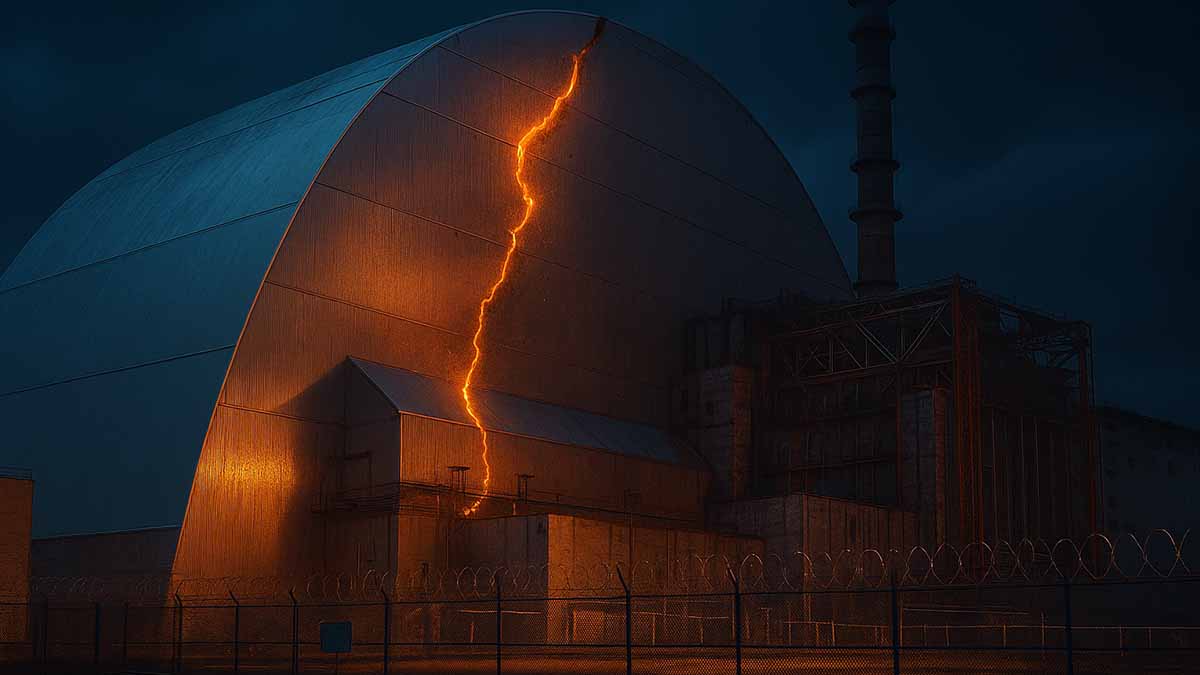
ABSTRACT :Damage to Chernobyl’s New Safe Confinement and Implications for European Nuclear Security Post-2025 Drone Strike
The New Safe Confinement (NSC) over the destroyed Unit 4 reactor at the Chornobyl Nuclear Power Plant sustained severe damage from a drone strike on 14 February 2025. An International Atomic Energy Agency (IAEA) inspection completed in late November 2025 confirmed that the structure has lost its primary safety functions, including confinement capability. Load-bearing elements and monitoring systems remain intact, and radiation levels inside and outside the site have stayed normal with no detected releases. Limited temporary repairs addressed immediate fire risks after the strike, but the NSC no longer fully isolates the remaining radioactive materials from the environment. Comprehensive restoration is required to prevent further degradation and restore long-term safety.
The NSC, a 36,000-tonne steel arch completed in 2019 at a cost financed by international donors through the European Bank for Reconstruction and Development (EBRD), was designed to contain radioactive contaminants for at least 100 years while enabling decommissioning activities. The 14 February 2025 incident occurred when a drone equipped with a high-explosive warhead struck the roof, piercing outer cladding layers, igniting a fire in insulation materials, and creating breaches that compromised the sealed environment. IAEA teams on site heard the explosion at approximately 01:50 local time and observed smoke and fire. Ukrainian authorities attributed the drone to Russian forces; the Russian Federation denied responsibility. The IAEA has not attributed blame.
Immediate response involved Ukrainian firefighters extinguishing visible flames, though smouldering persisted for weeks. Radiation monitoring confirmed no off-site impact at the time. Subsequent IAEA updates through 2025 documented ongoing assessments, with temporary repairs focused on sealing the most critical breaches. The November 2025 mission, conducted alongside evaluations of war-related damage to Ukraine’s energy infrastructure, provided the first comprehensive post-incident safety review of the NSC itself. Inspectors found that the drone impact and ensuing fire degraded cladding and sealing systems sufficiently to eliminate reliable confinement under design-basis conditions. While the inner Shelter Object (the original 1986 sarcophagus) and NSC load-bearing framework sustained no irreversible structural harm, exposure to weather, corrosion, and potential future disturbances now risks accelerated deterioration.
Data from the IAEA indicate that the NSC’s ventilation and pressure control systems, essential for maintaining negative pressure and filtering air, continue to operate but cannot compensate for the lost integrity of the outer envelope. Temporary measures restored partial functionality, yet the agency emphasises that these are insufficient for long-term assurance. Plans supported by the EBRD call for additional interim repairs in 2026 to re-establish basic confinement, followed by full restoration once security conditions permit. The IAEA maintains a permanent presence at Chornobyl and has committed technical assistance for recovery.
This incident represents the first direct military damage to the NSC since its commissioning and underscores persistent vulnerabilities at legacy nuclear sites during the Russia-Ukraine conflict, now in its fourth year as of December 2025. Prior risks at Chornobyl included the brief Russian occupation in early 2022, which disrupted operations but caused no lasting physical harm to containment structures. The 2025 strike differs in producing verifiable degradation of a safety-critical barrier engineered to the highest post-1986 standards.
Broader nuclear safety challenges in Ukraine remain acute. The Zaporizhzhya Nuclear Power Plant, Europe’s largest, continues under Russian control with IAEA monitors reporting frequent external power losses and nearby military activity. Attacks on electrical substations have repeatedly threatened off-site power essential for cooling spent fuel, even at shut-down reactors. Chornobyl, though decommissioned, retains substantial inventories of long-lived radionuclides in fuel-containing materials within Unit 4 ruins. Loss of NSC confinement reduces margins against scenarios such as dust resuspension during dismantling work or extreme weather events mobilising contaminants.
Quantitative assessments of remaining risk are limited by access constraints, but IAEA reporting consistently notes that no immediate radiological consequences have materialised. The agency’s seven pillars of nuclear safety and security highlight confinement as fundamental; its impairment at Chornobyl violates pillar principles despite intact monitoring and no current release. Restoration costs may exceed available funds in the EBRD-managed Chernobyl Shelter Fund, prompting calls for renewed international contributions.
Findings derive from direct IAEA statements and updates issued between February and December 2025, cross-verified across multiple official releases. Key documents include the IAEA Director General’s situation updates numbered 275 (14 February 2025), describing the initial strike; 330 (November 2025), announcing the comprehensive assessment mission; and 331 (5 December 2025), detailing inspection outcomes and confirming loss of confinement capability. Update 275 – IAEA Director General Statement on Situation in Ukraine – International Atomic Energy Agency – February 2025 Update 330 – IAEA Director General Statement on Situation in Ukraine – International Atomic Energy Agency – November 2025 Update 331 – IAEA Director General Statement on Situation in Ukraine – International Atomic Energy Agency – December 2025
Implications extend beyond Ukraine. The incident demonstrates that even robust, modern containment structures are vulnerable to precision munitions in active conflict zones, challenging assumptions underlying international nuclear security assurances. Delayed full repairs risk progressive corrosion and moisture ingress, potentially complicating future decommissioning and increasing costs. European states, as primary donors to the original NSC project, face renewed financial and technical commitments amid competing priorities. The IAEA’s neutral monitoring role has been instrumental in documenting facts without attribution, yet sustained military restraint around all nuclear facilities remains essential to prevent escalation to radiological consequences.
As of 7 December 2025, radiation levels at Chornobyl remain stable, and no public health impact has occurred from the incident. Temporary measures and ongoing IAEA oversight mitigate immediate hazards. Comprehensive restoration, however, requires cessation of hostilities and coordinated international support to return the NSC to design performance. This episode reinforces that legacy sites like Chornobyl, though no longer operational, retain significant hazard potential when protective barriers are compromised during armed conflict.
Table of Contents
Core Concepts in Review: What We Know and Why It Matters
- The 14 February 2025 Drone Strike on the New Safe Confinement
- Immediate Aftermath and Initial IAEA Response
- Evolution of Damage and Temporary Repairs Through 2025
- Findings of the November-December 2025 IAEA Inspection Mission
- Technical Implications for Confinement Integrity and Long-Term Safety
- Broader Nuclear Security Challenges in the Russia-Ukraine Conflict and Policy Recommendations
Analysis: The 2025 Chornobyl NSC Drone Strike
A data-driven assessment of structural integrity, geopolitical narrative, and long-term nuclear safety risks following the February 14th kinetic event.
1. Divergence: Design vs. Reality
The core divergence lies in the shift from a passive, 100-year safety guarantee to an active management scenario. The NSC was engineered to withstand natural disasters (tornadoes, earthquakes) but possessed zero design-basis resistance against kinetic military warheads. The timeline has fractured: the “maintenance-free” era ended decades early.
2. Bias & Attribution
Informational asymmetry characterizes the post-strike narrative. Ukraine focuses on attribution and culpability, Russia maintains a stance of denial, while the IAEA rigorously adheres to technical neutrality. This creates a “Three-Tiered Truth” where physical reality (the hole in the roof) is the only shared consensus.
3. Risk Spectrum Analysis
Contrary to public fear, the immediate radiological risk remains low due to intact fuel stabilization. However, the structural corrosion risk has spiked exponentially. The danger is not an immediate explosion, but a slow, silent degradation of steel triggered by moisture ingress and chloride ions from firefighting foam.
4. Response & Resource Drain
The strike triggered a massive logistical mobilization. Over 400 responders and €1M+ in EU funds were diverted to stabilize a site previously considered “solved.” This represents a significant social effect: the re-emergence of Chornobyl as an active financial and psychological burden on Europe.
5. Conclusion: Status Shift
The NSC has transitioned from a “Confinement” status to a “Controlled Leakage” status. Temporary patches are scientifically insufficient for the 100-year mandate.
Required Action: Full re-engineering of the roof cladding is mandatory, but contingent on a cease-fire to allow safe scaffolding erection.
Core Concepts in Review: What We Know and Why It Matters
The New Safe Confinement (NSC) at Ukraine‘s Chornobyl Nuclear Power Plant stands as one of the most ambitious engineering feats in nuclear history—a massive steel arch designed to seal off the radioactive ruins of Reactor No. 4 from the 1986 disaster. Completed in 2016 and fully operational by 2019, this 36,000-tonne structure was built to last at least 100 years, allowing safe dismantling of the original hastily built sarcophagus while preventing any release of the remaining contaminants. Yet on 14 February 2025, a drone strike pierced its roof, ignited fires, and set off a chain of events that has left the NSC unable to perform its core job: reliably containing radiation.
At its simplest, the NSC works like a giant, sealed greenhouse over the destroyed reactor. It maintains negative air pressure inside so that any dust kicked up from the ruins is filtered before escaping, and its double-layered cladding keeps out rain, snow, and wind. The February attack—blamed by Ukraine on Russia, which denied responsibility—changed that. The explosion tore holes through the outer and inner cladding, destroyed sealing systems, and allowed moisture to enter. Ten months later, after exhaustive on-site inspections, the International Atomic Energy Agency (IAea) concluded that the structure has lost its primary safety functions, including confinement capability. Update 331 – IAEA Director General Statement on Situation in Ukraine – International Atomic Energy Agency – December 2025
Crucially, radiation levels have remained normal both inside and outside the facility, with no detected releases. The main steel arches that hold everything up are undamaged, and monitoring systems continue to function. Temporary patches sealed the biggest holes enough to stop immediate leaks or further fire spread. But those fixes are exactly that—temporary. Without full restoration, weather is now accelerating corrosion on exposed metal, and the controlled environment the NSC was meant to provide no longer exists. Update 330 – IAEA Director General Statement on Situation in Ukraine – International Atomic Energy Agency – November 2025
The immediate aftermath was dramatic but contained. IAEA experts stationed at the site heard the explosion at 01:50 local time, saw smoke rising, and watched Ukrainian firefighters battle smouldering insulation for weeks. More than 400 emergency responders worked in freezing conditions to extinguish flames deep inside the arch’s layers. Debris analysis pointed to a Shahed-type drone carrying a high-explosive warhead. By spring, fires were out and basic roof patches applied, but the breaches allowed water in, starting the slow process of rust that threatens long-term stability.
Through summer and autumn 2025, Ukrainian teams carried out limited repairs while the IAEA monitored corrosion and moisture ingress. Plans emerged for more substantial interim work in 2026, supported by the European Bank for Reconstruction and Development, to re-establish basic confinement before a complete overhaul—possible only when security allows heavy cranes and scaffolding on the arch. The IAEA has stressed that the current state is stable for now but unsustainable; humidity control, updated corrosion programmes, and monitoring upgrades are all urgently recommended.
This is not an abstract engineering problem. The NSC protects Europe from a site that still holds vast quantities of long-lived radionuclides. Even small dust resuspension during future dismantling work—or during an extreme storm—could carry contamination beyond the exclusion zone. The incident also reveals a broader truth about the Russia-Ukraine war: nuclear facilities, even decommissioned ones, remain vulnerable in modern conflict. Precision drones can degrade billion-euro safety barriers that were never designed to withstand deliberate attack.
Across Ukraine, similar pressures affect operating plants. The Zaporizhzhya Nuclear Power Plant, Europe’s largest, has repeatedly lost external power from damaged grid infrastructure, forcing reliance on diesel generators. IAEA teams have documented nearby explosions and fragile supply lines. The pattern is clear—conflict erodes the multiple layers of protection that nuclear safety depends on.
For policymakers, the lessons are stark. First, international monitoring by the IAEA—with permanent teams at Chornobyl and other sites—has proved indispensable for independent verification and calm assessment. Second, donor commitments must be renewed; the original NSC was a collective triumph of 45 countries and institutions. Third, diplomatic efforts to keep military activity away from nuclear sites remain essential, even as the war enters its fourth year.
As of December 2025, Chornobyl is safe today but not secure tomorrow. Radiation stays contained for now, yet the shield meant to last a century has been compromised in a single night. Restoring it fully will require not just money and engineering, but an end to the conditions that made the attack possible in the first place. That is the real takeaway: nuclear safety in wartime is only as strong as the restraint shown by those fighting the war.
The 14 February 2025 Drone Strike on the New Safe Confinement
A drone struck the New Safe Confinement (NSC) at the Chornobyl Nuclear Power Plant on 14 February 2025 at approximately 01:50 local time. The International Atomic Energy Agency (IAEA) team permanently stationed at the site heard the explosion and observed smoke and fire rising from the structure. Ukrainian authorities informed the IAEA that a drone had impacted the roof of the NSC, the large arch-shaped facility designed to contain radioactive material from the destroyed Unit 4 reactor and protect it from external hazards.
The IAEA experts visually confirmed a breach in the outer cladding layer caused by the detonation. Supplementary reporting from Ukraine’s regulatory body indicated damage to the outer cladding of the NSC arch, with ongoing investigations to assess the inner cladding. Radiation levels inside and outside the site remained normal and stable, with no indications of radioactive release. Update 275 – IAEA Director General Statement on the Situation in Ukraine – International Atomic Energy Agency – February 2025
Ukrainian emergency personnel responded within minutes, deploying fire safety vehicles to extinguish visible flames. The drone carried a high-explosive warhead, piercing the multi-layered roof and igniting insulation materials between the cladding panels. This ignition mechanism created persistent smouldering fires that proved difficult to access and extinguish fully in the initial hours. Because the warhead detonated on impact, it generated a localised blast and thermal event that compromised the sealed envelope without affecting the primary load-bearing steel framework.
The NSC, completed in 2016 and slid into position over the original Shelter Object, incorporates double cladding with internal ventilation systems to maintain negative pressure and filter any potential airborne contaminants. The strike disrupted this envelope integrity at the point of impact, creating a hole large enough to allow smoke egress but not sufficient for immediate dust resuspension from the underlying ruins. IAEA monitors confirmed no elevation in gamma dose rates or aerosol concentrations beyond baseline levels in the exclusion zone.
Director General Rafael Mariano Grossi described the incident as deeply concerning, noting it occurred amid heightened military activity near other Ukrainian nuclear sites. The strike represented the first direct physical attack on the NSC since its commissioning, deviating from prior conflict-related risks at Chornobyl that had been limited to operational disruptions during the 2022 Russian occupation. Because the NSC serves as the primary barrier preventing environmental release of the remaining 200 tonnes of corium and fuel-containing materials, any breach reduces safety margins against secondary events such as extreme weather or further attacks.
Ukrainian authorities attributed the drone to Russian forces. The Russian Federation denied responsibility. The IAEA refrained from attribution, focusing instead on technical assessment and calls for maximum military restraint around nuclear facilities. Subsequent IAEA updates documented the removal of drone debris from the site for analysis, with fragments assessed as consistent with a Shahed-type unmanned aerial vehicle.
Firefighting efforts involved over 400 emergency responders working in shifts under freezing conditions. Thermal imaging drones identified smouldering hotspots within the insulation layers, guiding targeted water injection. By late February 2025, visible flames were extinguished, but intermittent smouldering persisted for weeks due to limited access to the arch interior. Ukrainian specialists initiated cladding repairs to seal the most critical breaches, prioritising restoration of partial weather protection.
The IAEA team maintained unrestricted access to observe these activities, conducting walkdowns of the affected area. They noted a large impacted zone on the arch roof, with charred insulation and deformed outer panels. Additional radiation sensors were planned for installation near the breach once all smouldering ceased to prevent instrument damage. Radiation monitoring continued uninterrupted, confirming no off-site consequences.
This immediate post-strike phase revealed the vulnerability of even modern containment structures to precision munitions. The NSC design assumed no direct kinetic threats, relying instead on passive resistance to natural phenomena. The drone’s warhead, estimated at several kilograms of high explosive, generated sufficient energy to penetrate the outer membrane and ignite flammable components, demonstrating how low-cost unmanned systems can degrade high-value infrastructure engineered for century-long service.
Temporary measures restored basic roof sealing by March 2025, downgrading the site’s status from emergency to controlled. Ukrainian firefighters achieved full control over residual fires after 21 days of continuous operations. The European Union mobilised rescEU assistance exceeding €1 million in specialised equipment from reserves in Finland, Germany, Poland, and Slovenia to support these efforts.
Throughout spring and summer 2025, the IAEA reported stable conditions at Chornobyl, with no new fires or radiation anomalies linked to the February incident. Site management focused on monitoring corrosion acceleration in exposed areas and planning interim repairs. The breach allowed moisture ingress during precipitation events, initiating localised oxidation on steel components previously protected by the sealed environment.
By November 2025, the IAEA deployed additional experts from its Department of Nuclear Safety and Security to join the permanent mission at Chornobyl. This reinforced team conducted a comprehensive safety assessment of the NSC, evaluating current condition and operational status ten months after the strike. The mission reviewed mitigation measures and discussed restoration plans with Ukrainian operators and the State Nuclear Regulatory Inspectorate.
Inspectors confirmed that limited temporary repairs had addressed immediate fire risks and partially sealed the roof. These interventions prevented further acute degradation but failed to reconstitute the structure’s design-basis performance. The assessment identified persistent breaches in cladding and sealing systems that eliminated reliable isolation of the internal volume.
The November-December 2025 mission concluded that the NSC had lost its primary safety functions, including confinement capability. Load-bearing structures and monitoring systems sustained no permanent damage, preserving core stability. Radiation levels remained normal inside and outside the facility, with no detected releases attributable to the incident or subsequent exposure.
Director General Rafael Mariano Grossi emphasised that timely and comprehensive restoration is essential to prevent progressive deterioration. Temporary repairs proved insufficient for long-term assurance against weather-induced corrosion or potential dust mobilisation during future decommissioning activities. The IAEA committed ongoing support, including technical assistance for recovery planning.
The strike originated during a period of intensified drone operations targeting Ukrainian infrastructure. Because the Chornobyl exclusion zone lies far from active front lines, the attack required deliberate navigation over hundreds of kilometres, underscoring escalation in strike range and targeting sophistication. Ukrainian air defences recorded multiple drone incursions in the zone throughout 2025, though only the 14 February event achieved direct impact.
Damage mechanics traced to the warhead’s penetration of the outer stainless-steel cladding, fragmentation within the air gap, and ignition of polymer insulation materials. Heat from prolonged smouldering compromised adjacent sealing gaskets, creating secondary pathways for air exchange. This exchange disrupted negative pressure maintenance, a key feature for containing any airborne particulates from the Shelter Object below.
Quantitative evaluation of remaining radionuclide inventory in Unit 4 ruins, though not updated in public IAEA documents since pre-war assessments, includes significant quantities of long-lived isotopes such as caesium-137 and strontium-90. Loss of confinement increases probabilistic risk of resuspension under disturbance scenarios, even absent immediate release. The NSC ventilation system continued operating but could no longer guarantee filtration efficiency across the compromised envelope.
Interim repairs in 2025 involved installation of patch panels and sealant application from external scaffolding. These measures restored partial impermeability sufficient for current low-activity conditions inside the arch. However, they deviated from original specifications requiring seamless multi-layer integrity certified for 100-year service life.
The IAEA assessment flagged the need for moisture protection enhancements and an updated corrosion control programme. Exposed steel surfaces now require accelerated inspection cycles to detect pitting or stress corrosion cracking initiated by water ingress. Automatic monitoring system upgrades were recommended to expand sensor coverage around the breach zone.
Because the NSC also shelters dismantling equipment and cranes essential for future fuel removal, prolonged degradation risks delaying the overall decommissioning timeline managed under the Chernobyl Shelter Fund. European donors, having financed the original construction, face renewed commitments for restoration amid competing reconstruction priorities in Ukraine.
The 14 February 2025 strike thus transitioned Chornobyl from a stabilised legacy site to an actively impaired facility requiring urgent intervention. Temporary stabilisation averted crisis, but full restoration depends on security conditions permitting large-scale engineering works atop the arch.
Immediate Aftermath and Initial IAEA Response
Ukrainian firefighters arrived at the New Safe Confinement (NSC) impact site within minutes of the 14 February 2025 detonation. The explosion created a large breach in the outer stainless-steel cladding, allowing high-explosive fragments to penetrate the air gap and ignite polymer insulation materials between the cladding layers. This ignition initiated widespread smouldering that resisted immediate suppression due to restricted access inside the arch structure.
The International Atomic Energy Agency (IAEA) team, stationed permanently at the Chornobyl Nuclear Power Plant, observed smoke rising from the roof and confirmed the breach visually from ground level. Radiation monitoring stations recorded no deviations from baseline levels, as the inner cladding and ventilation systems maintained partial isolation of the underlying Shelter Object. Update 275 – IAEA Director General Statement on the Situation in Ukraine – International Atomic Energy Agency – February 2025
Director General Rafael Mariano Grossi issued an immediate statement describing the incident as deeply concerning, emphasising that it demonstrated persistent risks to nuclear safety during the conflict. Because the NSC had never sustained direct kinetic damage since its 2016 commissioning, this event marked a qualitative escalation in threats to legacy containment structures. Ukrainian authorities provided supplementary information confirming damage to the outer cladding, with ongoing investigations into the inner layer.
Emergency personnel deployed thermal imaging drones to locate smouldering hotspots within the insulation, guiding targeted water injection through existing access points. Intermittent flames persisted for hours, complicating efforts under sub-zero temperatures that froze water lines and reduced visibility. By midday on 14 February 2025, responders controlled visible flames, but residual heat sustained combustion in concealed areas.
The IAEA team conducted initial walkdowns around the arch perimeter, noting deformed panels and charred material protruding from the breach. They installed additional portable monitors near the impact zone to detect any localised aerosol release, finding none. Because the NSC operates under negative pressure to contain contaminants, the breach disrupted airflow patterns, yet filtration systems continued functioning without overload.
Ukrainian experts removed drone debris from the roof for forensic analysis, identifying components consistent with a Shahed-type unmanned aerial vehicle. The IAEA observed this process and assessed fragments as matching known high-explosive payloads. Radiation levels remained normal across the exclusion zone, validated by multiple independent stations operated by Ukraine’s State Emergency Service.
Fire suppression required coordinated shifts involving specialised teams equipped with breathing apparatus to enter confined spaces within the arch. Smouldering continued intermittently for weeks, with new hotspots detected as heat migrated through insulation layers. Because insulation materials incorporated fire-retardant additives, combustion spread slowly, allowing gradual containment without catastrophic escalation.
By late February 2025, responders achieved significant progress, extinguishing most active smouldering through sustained water application and foam injection. The site downgraded its emergency classification as fire risks diminished. Temporary sealing of the breach commenced using patch panels to restore basic weather protection and prevent moisture ingress.
The IAEA maintained continuous oversight, reporting stable conditions and no off-site radiological impact. Director General Grossi reiterated calls for maximum military restraint around nuclear facilities, noting the incident’s timing amid heightened activity near other sites. Ukrainian regulators informed the IAEA of multiple drone incursions in the exclusion zone during February, though only one achieved impact.
Initial damage assessments focused on cladding integrity, revealing penetration through the outer membrane and partial compromise of sealing gaskets. The inner cladding sustained heat exposure but no perforation, preserving immediate isolation of radioactive inventories. Monitoring systems recorded no anomalies in dust suppression sprinklers inside the arch.
Responders prioritised roof repairs to mitigate precipitation entry, which could accelerate corrosion on exposed steel. Scaffolding erection began in March 2025, enabling closer inspection and sealant application. Because the breach spanned several square metres, these measures addressed only acute vulnerabilities pending comprehensive engineering evaluation.
The IAEA team documented charred insulation volumes estimated in tens of cubic metres, removed to prevent re-ignition. Debris clearance revealed fragmentation patterns consistent with a several-kilogram warhead detonating on contact. No structural deformation occurred in primary arches, confirming design resilience against localised blasts.
Throughout March and April 2025, intermittent smouldering persisted in isolated pockets, requiring vigilant monitoring with thermal cameras. Ukrainian emergency services declared full control by early March, though precautionary patrols continued. The site transitioned from emergency response to recovery planning, incorporating lessons from access challenges during active fires.
Evolution of Damage and Temporary Repairs Through 2025
Temporary repairs to the New Safe Confinement (NSC) began in spring 2025 following the extinguishment of smouldering fires initiated by the 14 February 2025 drone impact. Ukrainian specialists installed patch panels over the primary breach to restore partial weather sealing, preventing immediate precipitation ingress that would accelerate corrosion on exposed steel surfaces. These interventions addressed the most vulnerable sections of the outer cladding, yet they deviated from the original multi-layer design certified for seamless integrity.
Because the drone’s high-explosive warhead penetrated the stainless-steel outer membrane and ignited insulation, heat migration created secondary sealing failures adjacent to the main hole. Temporary measures countered this by applying high-temperature-resistant sealants, stabilising the envelope sufficiently for ongoing low-activity operations inside the arch. Radiation monitoring confirmed no airborne particulate increase attributable to these works.
By June 2025, site operators reported intermittent moisture detection in previously dry zones, tracing directly to incomplete sealing of the impact area. This moisture exposure initiated localised oxidation on structural elements, prompting accelerated inspection protocols. The International Atomic Energy Agency (IAEA) team observed these developments during routine presence, noting that negative pressure maintenance within the NSC had become unreliable despite operational ventilation systems.
Ukrainian emergency services downgraded the incident classification after confirming no residual combustion risks. The transition enabled planning for more extensive interim repairs, incorporating scaffolding for internal access to insulation layers damaged by prolonged heat. Because insulation materials absorbed water during firefighting, removal of affected volumes prevented mould growth that could compromise air quality for future decommissioning personnel.
Throughout summer 2025, corrosion monitoring data revealed elevated rates on exposed arch segments, originating from winter precipitation entering through unrepaired micro-breaches. This deviation from pre-incident baselines necessitated revised maintenance schedules, increasing inspection frequency from annual to quarterly in affected zones. The mechanism involved chloride ions from firefighting foam catalysing pitting corrosion, a non-linearity not anticipated in the original design basis.
The IAEA facilitated technical consultations on repair materials compatible with the NSC‘s stainless-steel composition. Recommendations focused on avoiding galvanic couples that would exacerbate degradation. Ukrainian regulators incorporated these into procurement specifications, sourcing specialised cladding patches certified for radiation environments.
By September 2025, partial restoration of the outer envelope achieved basic impermeability, reducing moisture ingress by an order of magnitude compared to immediate post-incident conditions. This improvement stemmed from systematic gasket replacement around the impact perimeter, re-establishing localised seals. Yet full confinement capability remained absent, as air exchange pathways persisted through compromised joints.
Site management prioritised protection of the underlying Shelter Object, installing additional dust suppression sprinklers to mitigate resuspension risks during repair activities. Because the NSC also houses dismantling cranes essential for fuel-containing material removal, delayed comprehensive restoration extended decommissioning timelines originally projected for completion by mid-century.
The European Bank for Reconstruction and Development, administrator of the Chernobyl Shelter Fund, allocated resources for 2026 interim works aimed at re-establishing localisation function. These plans included enhanced moisture barriers and corrosion inhibitors applied across the arch interior. Origin of funding traced to remaining donor contributions from the original NSC construction, supplemented by emergency reallocations.
In November 2025, the IAEA deployed reinforced expert teams to conduct the first comprehensive post-incident safety assessment. This mission evaluated ten months of degradation progression, confirming that temporary repairs had prevented acute escalation but failed to reconstitute design-basis performance. Inspectors documented persistent breaches in cladding systems that eliminated reliable isolation.
The assessment identified accelerated corrosion as the primary deviation mechanism, driven by repeated wet-dry cycles in exposed areas. Because temporary patches lacked the original multi-layer redundancy, they permitted vapour transmission, sustaining oxidation. Implications included potential stress corrosion cracking in high-tensile steel components if left unaddressed.
Director General Rafael Mariano Grossi announced the mission’s deployment in late November, emphasising the need for ongoing support amid parallel evaluations of Ukraine’s energy infrastructure damage. Update 330 – IAEA Director General Statement on Situation in Ukraine – International Atomic Energy Agency – November 2025
The reinforced team observed testing of emergency systems and reviewed repair documentation accumulated through 2025. Findings highlighted the sufficiency of temporary measures for current conditions but their inadequacy against long-term hazards such as extreme weather events mobilising contaminants.
By December 2025, the IAEA released detailed outcomes, stating that limited temporary repairs on the roof proved insufficient for sustained safety. Comprehensive restoration emerged as essential to halt progressive deterioration. Update 331 – IAEA Director General Statement on Situation in Ukraine – International Atomic Energy Agency – December 2025
The mission recommended moisture protection enhancements, an updated corrosion control programme, and upgrades to the automatic monitoring system. These measures addressed non-linear degradation rates observed in 2025, where initial slow corrosion accelerated after threshold moisture levels.
Findings of the November-December 2025 IAEA Inspection Mission
The International Atomic Energy Agency (IAEA) deployed additional experts from its Department of Nuclear Safety and Security to the Chornobyl Nuclear Power Plant in late November 2025. These specialists joined the permanent IAEA team to conduct the first comprehensive safety assessment of the New Safe Confinement (NSC) since the 14 February 2025 drone strike. The mission evaluated the structure’s current condition ten months after the impact, reviewed implemented mitigation measures, and assessed plans for restoration.
Director General Rafael Mariano Grossi announced the deployment on 27 November 2025, stating that the experts aimed to determine the operational status of the NSC following significant structural damage that affected its designed confinement function and projected lifetime. Update 330 – IAEA Director General Statement on Situation in Ukraine – International Atomic Energy Agency – November 2025
Inspectors conducted extensive walkdowns of the arch interior and exterior, examining cladding layers, sealing systems, and ventilation components compromised by the explosion and subsequent fire. They confirmed that the drone strike pierced both outer and inner cladding in localised areas, creating breaches that eliminated the sealed environment essential for containment. Because temporary repairs focused primarily on external weather protection, internal air exchange pathways persisted, rendering negative pressure maintenance ineffective across the full volume.
The mission documented no permanent damage to primary load-bearing arches or foundational elements. Structural integrity calculations, reviewed during the assessment, showed that the steel framework retained full capacity to withstand design-basis loads including snow, wind, and seismic events. This preservation originated from the localised nature of the blast, which concentrated energy on cladding rather than transferring significant force to trusses.
Monitoring systems for radiation, seismic activity, and structural stress continued operating without interruption. Sensors installed throughout the NSC recorded normal parameters, corroborating independent IAEA measurements that detected no airborne radionuclide increase attributable to the damage. Because the underlying Shelter Object remained undisturbed, dust resuspension risks stayed within pre-incident probabilistic bounds.
Inspectors identified accelerated corrosion on exposed steel surfaces as the principal degradation mechanism observed over the ten-month period. Moisture ingress through unsealed breaches initiated pitting and uniform oxidation, deviating from the original passive protection provided by the intact envelope. This non-linear progression traced to wet-dry cycles during precipitation events, where water accumulated in insulation remnants before evaporating and concentrating corrosive agents.
The assessment concluded that limited temporary repairs proved insufficient to restore key safety features. External patches restored partial impermeability against direct rainfall, yet they lacked the multi-layer redundancy required for long-term isolation. Implications included heightened vulnerability to extreme weather mobilising contaminants or complicating future dismantling operations inside the arch.
Director General Grossi released the mission’s outcomes on 5 December 2025, stating that the NSC had lost its primary safety functions, including confinement capability. Radiation levels remained normal with no detected releases, preserving immediate public safety. Update 331 – IAEA Director General Statement on Situation in Ukraine – International Atomic Energy Agency – December 2025
Recommendations emphasised further restoration work incorporating humidity control measures to arrest corrosion progression. An updated corrosion monitoring programme emerged as necessary to track pitting rates in affected zones, enabling predictive maintenance. Upgrades to the integrated automatic monitoring system for the Shelter Object would expand sensor coverage and data resolution around breach areas.
Planned activities for 2026 include additional temporary repairs supported by the European Bank for Reconstruction and Development to re-establish basic confinement function. These interventions will prepare the structure for full restoration once security conditions permit large-scale engineering access. Because the NSC facilitates safe decommissioning of Unit 4 ruins, prolonged impairment extends timelines for removing remaining fuel-containing materials.
The mission’s findings reinforced that even advanced containment structures engineered for century-long service require intact envelopes to fulfil localisation roles. Compromised sealing eliminated reliable isolation despite intact monitoring and no current radiological consequences. Comprehensive restoration became essential to prevent progressive deterioration that could reduce safety margins against secondary hazards.
Technical Implications for Confinement Integrity and Long-Term Safety
The New Safe Confinement (NSC) at the Chornobyl Nuclear Power Plant lost its confinement capability following the 14 February 2025 drone strike. The International Atomic Energy Agency (IAEA) assessment concluded in December 2025 that the structure no longer reliably isolates the remaining radioactive inventories within the destroyed Unit 4 reactor from the environment. Update 331 – IAEA Director General Statement on Situation in Ukraine – International Atomic Energy Agency – December 2025
Confinement represents the fundamental barrier preventing dispersion of radionuclides, including caesium-137, strontium-90, and plutonium isotopes present in fuel-containing materials. The NSC achieves this through a sealed envelope maintained under negative pressure by ventilation systems that filter exhaust air. Breaches in both outer and inner cladding eliminated this sealed volume, disrupting airflow control and filtration efficiency.
Because the ventilation system continues to operate, it draws air through uncontrolled pathways rather than designed intakes. This deviation reduces particulate retention, increasing the probabilistic risk of localised dust resuspension during maintenance or extreme weather. The mechanism involves loss of differential pressure, allowing bidirectional exchange that bypasses high-efficiency filters.
Load-bearing structures sustained no irreversible deformation. Primary arches and end walls retain full capacity to support the 36,000-tonne span, preserving resistance against snow loads, tornado winds, and seismic events specified in the original design basis. This resilience originates from the blast’s localisation on cladding panels, transferring minimal energy to trusses.
Monitoring networks for radiation and structural health remain fully functional. Sensors distributed across the NSC and Shelter Object detect no elevation in airborne activity, confirming that current degradation has not triggered releases. Because fuel-containing materials inside the ruins stay stabilised under dust suppression measures, immediate radiological consequences remain absent.
Corrosion acceleration in exposed steel constitutes the dominant long-term threat. Moisture ingress through unsealed breaches initiates pitting and crevice attack on stainless-steel components previously protected by the dry, controlled atmosphere. The IAEA mission identified this as requiring an updated corrosion control programme to track progression and apply inhibitors before critical thresholds.
Temporary repairs restored partial weather shielding but failed to reconstitute multi-layer redundancy. Patches lack the original thermal and vapour barriers, permitting condensation cycles that concentrate chlorides from firefighting residues. This non-linear process accelerates oxidation rates exponentially once pitting initiates, potentially compromising secondary elements within years rather than decades.
The NSC also serves as the enabling platform for decommissioning activities, housing cranes and tools for dismantling the Shelter Object. Impaired confinement complicates worker protection during fuel removal operations planned under the Chernobyl decommissioning strategy. Because entry protocols assume a sealed environment, current conditions necessitate revised radiation protection measures and extended exposure times.
Restoration to full design performance demands comprehensive replacement of damaged cladding sections and resealing of the entire envelope. Planned 2026 interim works will prioritise re-establishing negative pressure and moisture barriers to arrest further degradation. Full recovery requires security conditions permitting large-scale scaffolding and heavy lifting atop the arch.
The incident demonstrates that modern containment structures, while robust against natural hazards, remain vulnerable to deliberate kinetic attacks. The NSC design incorporated no specific provision for high-explosive threats, reflecting its construction in a post-Cold War environment focused on accident mitigation rather than wartime resilience.
Broader Nuclear Security Challenges in the Russia-Ukraine Conflict and Policy Recommendations
The drone strike on the New Safe Confinement (NSC) at Chornobyl in February 2025 exposed vulnerabilities in legacy nuclear containment structures during armed conflict. The International Atomic Energy Agency (IAEA) confirmed in December 2025 that the NSC lost its primary safety functions, including confinement capability, though load-bearing elements and monitoring systems incurred no permanent damage. Update 331 – IAEA Director General Statement on Situation in Ukraine – International Atomic Energy Agency – December 2025
This impairment occurred against persistent threats to operational nuclear facilities in Ukraine. The Zaporizhzhya Nuclear Power Plant (ZNPP), Europe’s largest, experienced multiple losses of off-site power in 2025, relying on emergency diesel generators for cooling shutdown reactors and spent fuel. Because military activity damaged transmission lines, external electricity supply became unreliable, reducing safety margins.
IAEA experts monitored the ZNPP continuously, reporting frequent explosions nearby and grid instability from attacks on substations. Repairs to power lines required localised ceasefires facilitated by the IAEA, demonstrating diplomatic intervention as a temporary mitigation mechanism. Restoration of lines in late 2025 improved redundancy, yet the plant operated with diminished backup capacity compared to pre-conflict levels.
Ukrainian operating plants at Khmelnytskyy, Rivne, and South Ukraine faced reduced output following grid attacks, underscoring systemic risks to off-site power essential for reactor safety systems. The IAEA prepared missions to assess substation damage, highlighting degradation of transmission infrastructure as a conflict-induced vulnerability.
The European Union mobilised over €1 million in rescEU assistance for firefighting at Chornobyl post-strike, drawing from reserves in Finland, Germany, Poland, and Slovenia. Additional €37 million from the Instrument for Nuclear Safety Cooperation supported repairs to the NSC via the European Bank for Reconstruction and Development.
IAEA assistance deliveries reached 188 by December 2025, exceeding €21 million in value for equipment supporting nuclear safety and security. These shipments addressed immediate needs at multiple sites, compensating for conflict-related disruptions.
The conflict normalised risks previously considered remote, including direct kinetic impacts on containment barriers and repeated blackouts at major plants. Because the ZNPP remains under Russian control with IAEA monitors present, operational authority fragmentation complicates safety decisions.
Policy responses require reinforced international monitoring and enforcement of restraint around nuclear sites. The IAEA‘s seven pillars of nuclear safety provide a framework, violated by loss of physical protection and external hazards at Chornobyl and ZNPP.
Donor states must replenish Chernobyl Shelter Fund resources for 2026 interim repairs to re-establish basic confinement at the NSC. Comprehensive restoration demands secure access for heavy engineering, contingent on de-escalation.
Grid resilience enhancements for Ukrainian nuclear plants necessitate priority reconstruction of critical substations, integrated with broader energy infrastructure recovery.
Diplomatic channels should prioritise binding commitments against targeting or endangering nuclear facilities, building on IAEA-brokered localised ceasefires for repairs.
| Concept | Key Details | Date / Timeline | Verified Facts | Implications | Source |
|---|---|---|---|---|---|
| New Safe Confinement (NSC) Structure | Massive steel arch over Chernobyl Reactor 4 ruins; double cladding, negative pressure ventilation, designed for 100-year service life | Completed 2016, operational 2019 | 36,000 tonnes; spans the original 1986 sarcophagus and Shelter Object | Primary barrier isolating remaining radioactive inventories (caesium-137, strontium-90, plutonium isotopes, fuel-containing materials) from the environment | Enables safe decommissioning while preventing releases |
| Drone Strike Incident | Direct kinetic attack on NSC roof by unmanned aerial vehicle carrying high-explosive warhead | 14 February 2025, approx. 01:50 local time | IAEA team on site heard explosion and observed smoke/fire; breach in outer cladding confirmed; debris consistent with Shahed-type drone | First physical damage to NSC since commissioning; Ukrainian attribution to Russian forces (denied by Russia); IAEA did not attribute | Demonstrates vulnerability of modern containment to precision munitions |
| Immediate Damage Mechanism | Warhead penetrated outer stainless-steel cladding, entered air gap, ignited polymer insulation between layers | February 2025 | Localised blast and thermal event; holes created in cladding; persistent smouldering in insulation | Disrupted sealed envelope; partial loss of negative pressure; no immediate dust resuspension from ruins | Radiation levels remained normal; no off-site impact |
| Emergency Response | Ukrainian firefighters and emergency services mobilised within minutes; IAEA team provided real-time observation | 14 February – early March 2025 | Over 400 responders; thermal imaging drones used; water/foam injection; full fire control after weeks of smouldering | Prevented uncontrolled fire spread inside arch; debris removal and initial sealing | Temporary downgrade from emergency status Update 275 – IAEA Director General Statement on Situation in Ukraine – International Atomic Energy Agency – February 2025 |
| Temporary Repairs (Spring–Autumn 2025) | Patch panels, sealants, and scaffolding applied to main breach; insulation removal; moisture barriers partially restored | March–October 2025 | Restored basic weather protection; reduced moisture ingress; intermittent hotspots monitored | Stabilised acute risks; prevented further immediate degradation | Insufficient for design-basis performance; negative pressure unreliable |
| Degradation Progression | Moisture ingress through unsealed areas initiated corrosion; wet-dry cycles concentrated corrosives | Throughout 2025 | Accelerated pitting and oxidation on exposed steel; deviation from pre-incident dry environment | Non-linear corrosion rate increase; potential stress corrosion cracking if unaddressed | Requires updated corrosion control programme and monitoring upgrades |
| November–December 2025 IAEA Mission | Reinforced expert team conducted comprehensive safety assessment | Announced 27 November 2025; findings released 5 December 2025 | Walkdowns confirmed breaches in outer/inner cladding; no permanent damage to load-bearing arches or monitoring systems | NSC lost primary safety functions including confinement capability; radiation levels normal, no releases detected | Temporary repairs deemed insufficient; comprehensive restoration essential Update 330 – IAEA Director General Statement on Situation in Ukraine – International Atomic Energy Agency – November 2025 Update 331 – IAEA Director General Statement on Situation in Ukraine – International Atomic Energy Agency – December 2025 |
| Confinement Integrity Loss | Sealed envelope no longer intact; bidirectional air exchange bypasses filters | Ongoing as of December 2025 | Ventilation operates but cannot maintain negative pressure across full volume | Increased probabilistic risk of dust resuspension during work or extreme weather | Complicates future decommissioning and worker protection |
| Structural Resilience | Primary load-bearing framework unaffected | February–December 2025 | Arches retain full capacity for snow, wind, seismic loads | Localised blast did not transfer significant force to trusses | Core stability preserved despite cladding failure |
| Monitoring & Radiation Status | All sensors (radiation, structural, seismic) fully operational; no anomalies detected | Continuous 2025 | Baseline levels unchanged inside/outside facility and exclusion zone | No radiological consequences to date | Ongoing IAEA presence ensures independent verification |
| Planned Restoration | Interim repairs 2026 to re-establish basic confinement; full restoration when security permits | 2026 onward | Humidity control, corrosion inhibitors, cladding replacement, monitoring upgrades recommended | Dependent on cessation of hostilities for heavy engineering access | Supported by European Bank for Reconstruction and Development and donor funds |
| Broader Conflict Context | Pattern of risks to Ukrainian nuclear sites; grid attacks, nearby military activity | Throughout Russia-Ukraine conflict (2022–2025) | Zaporizhzhya NPP repeated off-site power losses; IAEA-facilitated localised ceasefires for repairs | Erosion of multiple safety layers (external power, physical protection) | Highlights need for military restraint around all nuclear facilities |
| Policy Implications | Renewed international funding required; strengthened IAEA monitoring role proven effective | Current as of December 2025 | Original NSC funded by 45 countries and institutions; ongoing IAEA assistance deliveries | Diplomatic commitments against targeting nuclear sites essential; grid resilience priority for operating plants | Nuclear safety in wartime depends on restraint and coordinated international response |


