








Executive Summary
- BLUF: The most capable submarine is not necessarily the foundation of the most capable submarine force.
- The third Seawolf was funded primarily to preserve nuclear-submarine design and production capacity until an affordable successor could enter construction.
- The 1993 Bottom-Up Review established a force objective of 45–55 attack submarines, separating industrial continuity from immediate force-structure demand.
- In June 2026, Australia accepted a reduction from 40 to 12 Tomahawk-sized vertical-launch weapons on its third Virginia-class acquisition.
- Canberra chose three in-service Virginias to improve crew interchangeability, maintenance commonality, training efficiency and fleet sustainability.
- The United States currently faces the same underlying constraint: industrial throughput, not submarine technology alone, determines aggregate undersea power.
- The production system has been delivering approximately 1.2 Virginia-class submarines annually, against the Navy’s objective of two.
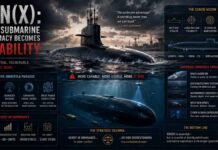
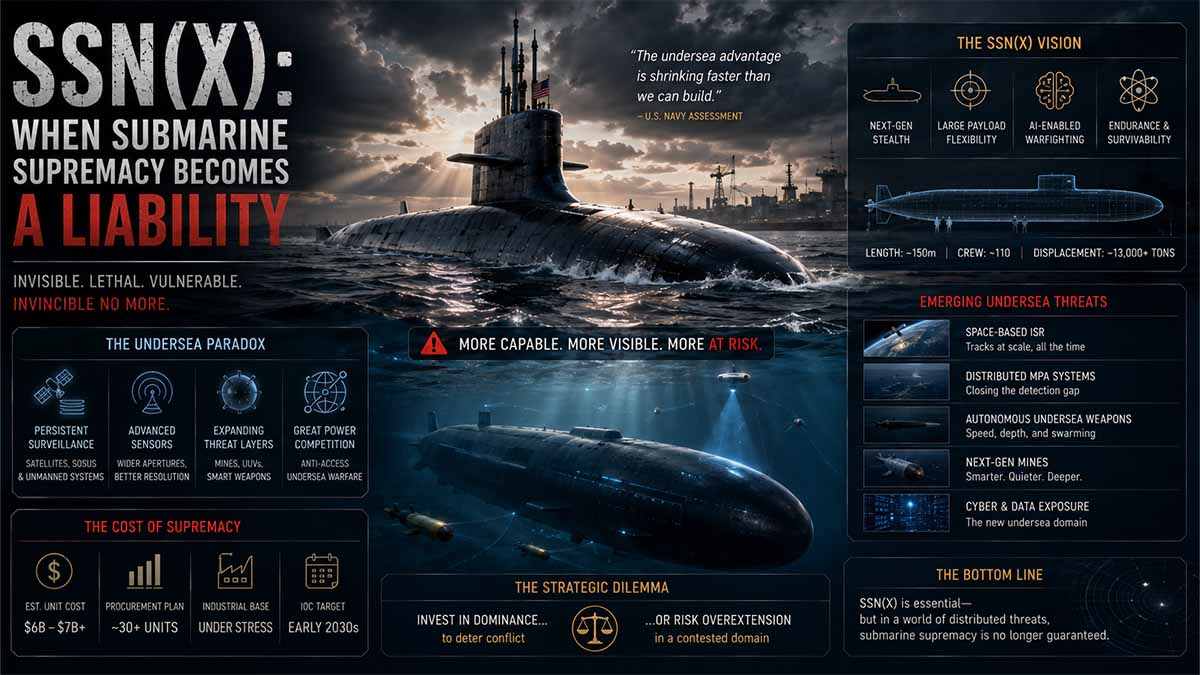
- The SSN(X) is projected by CBO at 10,100 submerged tons and an average 8.7 billion USD per submarine, compared with the Navy’s 7.1 billion USD estimate.
- Initial Bayesian assessment: 65% probability of a material SSN(X) requirement, cost or schedule revision by 2031.
- The decisive metric is deployable undersea combat capacity per dollar, skilled worker, maintenance cycle and shipyard-year—not maximum capability per hull.
The Submarine Paradox: When the Best Boat Produces the Weaker Fleet
The United States built Seawolf to dominate the world beneath the oceans—and stopped after three hulls. Three decades later, Australia has relinquished the larger missile capacity of a new Virginia-class submarine in favor of three used boats with greater commonality. These decisions appear to sacrifice combat power. In reality, they expose a harder law of naval strategy: a submarine’s specifications matter less than the industrial, financial and human system capable of building, crewing and sustaining an entire force. Washington understood that principle in 1993, when it used the third Seawolf to preserve its nuclear-submarine industrial base. It risks forgetting it as SSN(X) accumulates the attributes of another technological masterpiece that may prove too costly and complex to reproduce at strategic scale.
The Missing Seawolf Decision
The familiar Seawolf narrative begins with 29 planned submarines and ends with three. What it usually omits is why the third was built.
Seawolf was conceived to confront increasingly capable Soviet submarines in the most demanding acoustic environment. According to the Navy’s contemporary assessment, it would be substantially quieter than the Los Angeles class, carry superior sonar and combat systems, and provide roughly three times the capability of the SSN-688. After the 1991 Major Warship Review reduced the plan from 29 boats to 12, the Bush administration proposed stopping after one. Congress funded the second.
The decisive intervention came with the Pentagon’s October 1993 Bottom-Up Review. It authorized SSN-23 not because three Seawolfs satisfied the operational requirement, but because construction had to continue between SSN-22 and the future New Attack Submarine.
The distinction is fundamental. In April 1993, the Joint Chiefs had concluded that the United States required 51–67 attack submarines, with part of the future force possessing Seawolf-level stealth. The Bottom-Up Review adopted a smaller force of 45–55 SSNs. Yet even inside that reduced structure, the Pentagon judged a production hiatus too dangerous.
The third Seawolf was therefore an industrial bridge disguised as a combat acquisition. It preserved designers, nuclear-qualified trades, specialist vendors, tooling and classified engineering knowledge until a more affordable successor could be built. Attack Submarines: Alternatives for a More Affordable SSN Force Structure – U.S. General Accounting Office – October 1994.
The Price of Continuity
The 1994 dispute between the Pentagon and the General Accounting Office revealed the economics of this choice. The Navy planned to procure 31 attack submarines through 2014 for approximately 48 billion constant FY1998 dollars. GAO calculated that buying 25 could save about 9 billion dollars while maintaining the force within the Bottom-Up Review range for the period examined.
A more radical option—deferring new construction until 2003—could have released another 9 billion dollars in near-term funding. The Department of Defense objected that a shutdown would destroy submarine-specific capabilities, compress future procurement into unaffordable production peaks and require billions to reconstruct an enterprise that could not be regenerated on command.
The disagreement concerned time horizons. GAO measured identifiable procurement savings. The Pentagon valued the option of retaining a sovereign nuclear-submarine capability under strategic uncertainty. Buildings could be mothballed; experienced naval architects, reactor specialists, acoustic engineers and nuclear-certified welders could not be stored in warehouses.
That logic did not prove that every dollar spent on SSN-23 was efficient. It established that discontinuity itself carried a strategic price. Seawolf’s third hull purchased something more durable than one additional submarine: it kept the industrial system alive long enough for the program then known as Centurion or the New Attack Submarine to become the Virginia class.
Virginia’s Unfinished Promise
Virginia embodied a deliberate change in acquisition philosophy. The successor was expected to retain Seawolf-level quieting while being smaller, less capable in some respects and less expensive. The objective was not to surpass Seawolf on every measure; it was to recover serial production.
The transition succeeded in one crucial sense: the United States never lost the ability to design and build nuclear attack submarines. It failed in another. Although Congress has generally funded two Virginia-class boats annually since 2011, the industrial base has been producing approximately 1.2 per year. The time between appropriation and delivery has expanded from around six years to nine.
The bottleneck is no longer whether America possesses a submarine industry. It is whether that industry can convert money into finished hulls at the tempo assumed by strategy.
The pressure is intensifying. The Navy intends to build one Columbia-class ballistic-missile submarine and two Virginias annually—the 1+2 cadence. Because Columbia and the VPM-equipped Virginia Block V are substantially larger than earlier boats, the Department of Defense calculates that the combined workload is equivalent to roughly five Virginia Block IV submarines per year.
GAO reported in March 2025 that demand already exceeded the infrastructure and workforce capacity of Electric Boat and Newport News, America’s only nuclear-submarine builders. Across the wider shipbuilding sector, the Navy’s goals could require 174,000 new workers over a decade, after attrition. Shipbuilding and Repair: Navy Needs a Strategic Approach for Private Sector Industrial Base Investments – U.S. Government Accountability Office – March 2025.
Canberra Chooses the Fleet
Australia has now made the force-versus-platform trade explicit. Under the earlier AUKUS pathway, Canberra expected two in-service Virginia-class submarines followed by one newly constructed boat. In a televised interview on 3 June 2026, Australian Deputy Prime Minister and Defence Minister Richard Marles confirmed that the government instead preferred three in-service Virginias.
ABC presenter David Speers put the cost directly: the previously envisaged new submarine would have carried up to 40 Tomahawk-sized vertical-launch weapons, compared with 12 on the in-service configuration under discussion. Marles did not dispute the loss of firepower. He argued that three common boats would allow interchangeable crews, common technical personnel and a more economical operating model.
Without the change, Australia could have found itself managing four submarine configurations during the transition: Collins, in-service Virginias, a new Virginia variant and the future SSN-AUKUS. The revised structure reduces that burden to three.
For a small nuclear navy, this is not administrative tidiness. It is force generation. Parallel configurations multiply training syllabi, technical documentation, software baselines, spares, test equipment, certifications and maintenance pathways. A uniquely powerful submarine can diminish fleet effectiveness if its support requirements consume personnel needed by the other boats.
CBO confirms the scale of the payload trade. The Virginia Payload Module adds four large-diameter tubes, each capable of carrying seven Tomahawks or other payloads, increasing vertical capacity from 12 to 40 while raising submerged displacement by nearly 30%. The Navy’s 2025 Shipbuilding Plan and Its Implications for the Shipbuilding Industrial Base – Congressional Budget Office – April 2025.
Canberra surrendered a 70% increase in vertical capacity on the third boat. It did not surrender capability blindly. It chose a more coherent force.
The Used-Boat Question
Commonality does not eliminate risk. “Virginia class” is not synonymous with “identical.” Boats from different production and modernization histories may carry divergent hardware, software, maintenance requirements and remaining service lives. Australia’s gain will depend on which hulls are selected and how completely their configurations are aligned before transfer.
Marles said all three boats would undergo deep maintenance before entering Australian service and would retain more than 15 years of scheduled life. He declined to disclose their precise age or the expected savings, citing classification, but described the used boats as sufficient to bridge the period before Australia receives its first domestically built submarine in the early 2040s.
He also said the change would not fundamentally alter the program’s overall cost—previously expressed as approximately 0.15% of Australian GDP—because only one submarine within the eventual eight-boat pathway was changing from new to in-service.
The critical variables remain undisclosed: overhaul scope, modernization package, reactor and hull life, maintenance-cycle spacing, obsolescence remediation and disposal cost. Three similar submarines entering deep maintenance at similar times could produce a synchronized availability trough. The optimal fleet is not merely the most uniform; it is the one whose technical baselines and maintenance cycles allow continuous operations.
Television Interview, ABC 7.30 – Australian Department of Defence – June 2026.
The AUKUS Constraint
Australia’s decision also redistributes scarcity inside the alliance. CBO’s earlier AUKUS baseline envisaged used Virginia transfers in 2032 and 2035, followed by a new boat in 2038, with two further submarines possible. The Navy’s shipbuilding plan did not specify when replacements for transferred boats would be ordered.
At two SSNs per year, the United States could eventually reach and maintain its own objective of 66 attack submarines, based on CBO’s assumptions and a 33-year Virginia service life. It could not simultaneously replace Australian transfers without higher production.
Replacing the new Australian submarine with another used U.S. boat removes pressure from a future construction slot but extracts an additional hull from the operational fleet. The alliance gains a potentially more usable Australian force while Washington loses direct control of another submarine and its remaining service years.
Geography may compensate: Australian-operated boats based closer to the Western Pacific could generate regional presence more efficiently. Sovereignty limits that calculation. Australia, not Washington, will decide whether and how its submarines enter a future conflict. Industrial integration increases the probability that the boats can deploy; it does not guarantee the political decision to deploy them.
SSN(X) and the Return of Perfection
The Navy is now designing SSN(X) around a formidable combination: Seawolf-like speed and weapons capacity, greater stealth, advanced sensors, vertical launch and high operational availability. Each requirement is defensible. Their accumulation may not be.
CBO estimates a submarine of approximately 10,100 submerged tons, 11% larger than Seawolf. Its projected average cost is 8.7 billion dollars, against the Navy’s 7.1 billion-dollar estimate. CBO places the average future Virginia at approximately 5.1 billion dollars. On that basis, SSN(X) carries a premium of roughly 71% before its final design is known.
The first purchase has moved from 2035 to 2040. That delay does not remove urgency. Between 2026 and 2031, requirements will determine hull volume, reactor demand, electrical capacity, cooling, payload architecture, acoustic treatments, maintenance design and supplier requirements. Once these elements become interdependent, deleting a capability can trigger redesign across the submarine.
The danger is not simply an expensive boat. It is a submarine whose industrial burden prevents one-for-one replacement of Virginia. If one SSN(X) consumes the skilled labor, supplier throughput and yard capacity of 1.5 Virginias, procurement documents may record one new hull while operational commanders inherit a shrinking fleet.
The Decision Before the Design
Washington must impose a force-level test before SSN(X) hardens. Every proposed increment in speed, payload, quieting or sensor power should be measured against five consequences: unit cost, constrained labor hours, supplier concentration, construction duration and lifecycle availability.
The correct metric is not maximum capability per submarine. It is mission-capable submarine-days generated per dollar, shipyard-year and nuclear-qualified worker.
This does not require building a mediocre submarine. Some missions may genuinely demand a platform able to penetrate the most heavily monitored waters, carry a larger weapons load and survive against the next generation of undersea sensors. But that case could support an explicit high-low force—a limited number of SSN(X) boats for the hardest missions, backed by continued Virginia production—rather than the fiction that the new class can replace Virginia at equal scale.
The industrial evidence argues for caution. Existing yards have not achieved the funded Virginia rate. Columbia has overriding strategic priority. AUKUS adds transfers, maintenance and training demand. The workforce must expand while experienced employees are diverted to qualify newcomers. Money can finance these corrections; it cannot accelerate them without limit.
The Cost of Forgetting
The third Seawolf was not a monument to procurement failure. It was the price of keeping an industrial option alive. Virginia was not an unequivocal triumph. It preserved continuous production but never delivered the stable two-a-year output on which force plans came to rely.
Australia has drawn the next conclusion: the most heavily armed submarine is not necessarily the most valuable choice for a small fleet if it fragments crews, maintenance and training. The United States must now apply the same discipline to SSN(X).
The strategic question is no longer whether America can design the world’s finest attack submarine. It almost certainly can. The question is whether it can build enough of them, maintain them, crew them and deploy them without sacrificing the force they are intended to replace.
Seawolf demonstrated the cost of perfection after the Cold War. Virginia demonstrated the difficulty of scale. Canberra has demonstrated the value of coherence. If SSN(X) ignores all three lessons, the United States may enter the 2040s with another technological masterpiece—and discover, once again, that naval supremacy cannot be manufactured three hulls at a time.
Navigational Index
- The Seawolf Precedent — Operational ambition, fiscal contraction and preservation of the nuclear-submarine industrial base.
- The Australian Commonality Test — Why fleet coherence can outweigh the maximum missile capacity of an individual submarine.
- The SSN(X) Decision Window — Industrial congestion, requirements expansion and the 2026–2031 risk of producing another boutique fleet.
Master Abstract
The cancellation of the twenty-nine-submarine Seawolf program is usually presented as a linear story of strategic retreat: the United States designed the fastest, quietest and most heavily armed attack submarine of its era, constructed only three hulls and accepted a permanent loss of undersea capability. That interpretation measures the decision against the original procurement aspiration but obscures the institutional problem confronting the Pentagon after the Soviet collapse. The central question was not whether Seawolf possessed exceptional military value; it was whether the United States could maintain a sufficiently large attack-submarine force while financing continuous construction and preventing the irreversible disappearance of nuclear-qualified shipyards, designers, specialist suppliers and skilled trades. The 1993 Bottom-Up Review defined a future requirement of 45–55 nuclear-powered attack submarines, but the third Seawolf did not close the numerical or acoustic gap identified by earlier military assessments. Instead, it preserved continuity between a Cold War design optimized for demanding antisubmarine warfare and a successor program designed around affordability, modular improvement and sustained serial production. In October 1994, the Government Accountability Office recorded that the Department of Defense expected to seek new-submarine construction funding in fiscal years 1996 and 1998 to sustain the industrial base even though the Secretary of Defense had told Congress that force-structure requirements did not require construction before the turn of the century. GAO estimated that the Navy’s plan to procure 31 attack submarines through 2014 would cost approximately 48 billion constant FY1998 USD; an alternative procurement of 25 boats could have saved approximately 9 billion USD, but deferral risked destroying submarine-unique vendor capabilities and forcing higher future production rates. The third Seawolf was therefore not simply an additional combat unit. It functioned as an industrial bridge whose strategic payload consisted partly of retained human capital, design authority and production knowledge. — Attack Submarines: Alternatives for a More Affordable SSN Force Structure – U.S. General Accounting Office – October 1994 — Verified official report.
Australia’s revised AUKUS acquisition pathway provides a contemporary and unusually explicit demonstration of the same distinction between platform capability and force capability. The original pathway envisaged two in-service Virginia-class submarines followed by one newly constructed submarine, with options for two additional boats. By June 2026, Canberra had shifted its preference toward three in-service Virginias. During an ABC 7.30 interview on 3 June 2026, Defence Minister Richard Marles was confronted directly with the capability forfeited by replacing the prospective new submarine. The interviewer contrasted a new Virginia configuration capable of carrying up to 40 Tomahawk-sized vertical-launch weapons with an in-service configuration carrying 12. Marles did not dispute the payload differential. He argued instead that three common submarines would make crews more interchangeable, allow technical personnel to work across the same configuration and reduce the cost and organizational complexity of Australia’s transition. Without that substitution, the Royal Australian Navy could have been required to manage Collins-class submarines, in-service Virginias, a distinct newly built Virginia configuration and the future SSN-AUKUS—effectively four submarine types during a period of acute personnel, infrastructure and regulatory expansion. The revised pathway still leaves Australia operating Collins, Virginia and SSN-AUKUS, but it removes one configuration from the transitional architecture. This is not a costless decision: the third boat’s theoretical vertical-launch capacity falls by 70%, from 40 to 12 weapons, and classified differences in remaining service life, maintenance history and modernization potential may further affect operational value. Nevertheless, Canberra’s revealed preference is institutionally coherent. A submarine tied to a fragmented training, maintenance and supply system may generate less usable combat power than a less heavily armed submarine supported by a common and repeatable enterprise. CBO independently confirms that the Virginia Payload Module adds four large-diameter tubes and increases Tomahawk-sized vertical capacity from 12 to 40. — Television Interview, ABC 7.30 – Australian Department of Defence – June 2026 — Verified official transcript. — The Navy’s 2025 Shipbuilding Plan and Its Implications for the Shipbuilding Industrial Base – Congressional Budget Office – April 2025 — Verified official assessment.
The emerging SSN(X) program now sits at the intersection of these two precedents. Publicly available requirements point toward a submarine combining Seawolf-like speed and weapons capacity, greater stealth, advanced sensors, a large torpedo room and vertical-launch capability in a new hull. CBO estimates a submerged displacement of approximately 10,100 tons, about 11% greater than Seawolf, and an average procurement cost of 8.7 billion USD per boat, compared with the Navy’s estimate of 7.1 billion USD. The Navy’s 2025 shipbuilding plan delayed the first SSN(X) purchase by five years, from 2035 to 2040, while retaining continued Virginia procurement. Those ambitions must be evaluated against an industrial system already failing to convert appropriations into completed submarines at the required tempo. Although Congress has generally funded two Virginia-class submarines annually since 2011, CBO reported an effective construction rate of approximately 1.2 submarines per year. The interval between appropriation and delivery expanded from approximately six years to nine, generating a growing production backlog before the full AUKUS replacement burden is included. At the same time, the Columbia-class ballistic-missile submarine remains the Navy’s highest acquisition priority. GAO reported that the planned combined rate of one Columbia and two Virginias—the 1+2 cadence—would require an annual production workload equivalent to roughly five Block IV Virginias because of the increased scale and material demands of Columbia and Virginia Block V. The 2026–2031 strategic window is consequently not a conventional design competition. It is a test of whether requirements, industrial capacity, fiscal authority and workforce regeneration can be synchronized before design choices become prohibitively expensive to reverse. — Shipbuilding and Repair: Navy Needs a Strategic Approach for Private Sector Industrial Base Investments – U.S. Government Accountability Office – March 2025 — Verified official report. — The Navy’s 2025 Shipbuilding Plan and Its Implications for the Shipbuilding Industrial Base – Congressional Budget Office – April 2025 — Verified official assessment.
The initial Analysis of Competing Hypotheses identifies five credible trajectories. Under H₁, the Navy preserves the full SSN(X) requirement and industrial investment succeeds sufficiently to protect the 2040 start date. Under H₂, design authorities reduce or modularize selected requirements to contain displacement, cost and construction complexity. Under H₃, the Navy retains the desired attributes but postpones procurement beyond 2040 to protect Columbia and clear the Virginia backlog. Under H₄, the program enters production substantially unchanged but at a low rate, creating a strategically impressive yet numerically inadequate boutique class. Under H₅, Virginia production is extended deeper into the century while SSN(X) becomes a smaller high-end complement rather than a one-for-one successor. Current evidence assigns the greatest combined probability to H₂ and H₃ because the observed industrial shortfall already exists, whereas the productivity gains required by H₁ remain prospective. A preliminary Bayesian distribution assigns 10% to H₁, 36% to H₂, 29% to H₃, 17% to H₄ and 8% to H₅. Across 4,000 illustrative Monte Carlo iterations varying labor productivity, supplier stability, design complexity, real procurement pressure and learning-curve performance, the central estimate is a 65% probability of material program revision by 2031. These are transparent analytical judgments rather than official projections. The posterior must be updated as the Navy publishes evidence on Virginia delivery intervals, Columbia construction performance, design maturity, earned-value variance, workforce retention and supplier throughput. Shadow dimensions require parallel tracking: private-yard liquidity, inflation-adjusted fixed-price exposure, cyber compromise of design or supplier networks, concentration among nuclear-qualified vendors, Australian workforce absorption, allied demand for scarce components and the possibility that a Western Pacific crisis accelerates procurement faster than physical production capacity can respond. The analytical lesson is exacting: technological superiority creates deterrence only after industry converts it into maintained, crewed and deployable hulls.
The Seawolf Precedent: Capability, Contraction and Industrial Survival
Operational ambition before fiscal rupture
The Seawolf-class program emerged from a strategic environment in which the United States expected its attack submarines to penetrate defended Soviet bastions, detect increasingly quiet nuclear submarines, survive sustained undersea contact and destroy targets before being localized. Its design logic therefore prioritized acoustic superiority, speed, depth, sensor performance, weapons capacity and tactical endurance rather than acquisition simplicity. That combination made Seawolf an operationally rational answer to an exacting Cold War problem, but also embedded the program inside a specialized industrial structure whose cost could be sustained only through continuing procurement. The frequently repeated comparison between the 29 submarines originally planned and the three eventually built is factually correct but analytically incomplete. The official record shows that the planned quantity fell from 29 to 12 after the 1991 Major Warship Review, after which the Bush administration proposed ending the program after one submarine; Congress funded the second, and the Bottom-Up Review subsequently directed construction of the third. The same record states that the Navy regarded Seawolf as substantially quieter than the improved Los Angeles class, equipped with better sonar and combat systems, and possessing approximately three times the capability of the SSN-688 according to the Navy’s contemporary characterization. More important, the third hull was explicitly directed to sustain the submarine shipbuilding industrial base between completion of SSN-22 and commencement of the New Attack Submarine program. This establishes a critical distinction: SSN-23 was not principally authorized because three Seawolfs constituted an adequate operational force. It was authorized because terminating nuclear attack-submarine construction before a successor was ready created a strategic discontinuity that could not be measured simply by counting temporarily avoided procurement expenditures. Attack Submarines: Alternatives for a More Affordable SSN Force Structure – U.S. General Accounting Office – October 1994 — Verified official report.
The force requirement makes that distinction sharper. In 1992, the Deputy Secretary of Defense directed the Joint Chiefs of Staff to conduct a comprehensive examination of the submarine force required against future threats. In April 1993, the Joint Chiefs concluded that the United States required 51–67 nuclear-powered attack submarines and that part of the 2012 force needed Seawolf-level stealth combined with greater capability than the existing SSN-688 and SSN-688I classes. The October 1993 Bottom-Up Review nevertheless adopted a lower force-structure range of 45–55 SSNs, reflecting the post-Soviet reduction in expected global-war demand, pressure on defense expenditure and a broader redistribution of resources across the joint force. The result was not a finding that advanced acoustic performance had lost operational relevance. It was a policy judgment that the force could accept fewer submarines while managing risk through the existing Los Angeles-class inventory, life-cycle decisions and development of a less costly successor. In other words, the Pentagon reduced the quantity objective without eliminating the qualitative requirement. The resulting gap between the Joint Chiefs’ assessment and the Bottom-Up Review’s authorized range represents the first strategic trade: military demand was subordinated to a revised defense strategy and fiscal ceiling. The decision to build SSN-23 represents the second trade: immediate force-structure efficiency was subordinated to preservation of a production and design system required for future recapitalization. Treating these two trades as a single cancellation decision obscures the institutional architecture. The United States was simultaneously shrinking its fleet, preserving selected high-end capability and purchasing an industrial bridge to the future Virginia class. That bridge was expensive, but the alternative risked converting a reversible procurement pause into an irreversible loss of sovereign nuclear-submarine production capacity. Attack Submarines: Alternatives for a More Affordable SSN Force Structure – U.S. General Accounting Office – October 1994 — Verified official report.
| Decision layer | Operational objective | Fiscal pressure | Industrial consequence | Strategic interpretation |
|---|---|---|---|---|
| Original Seawolf plan | Maximum undersea superiority | Cold War funding assumption | Sustained high-end serial production | Capability-first architecture |
| Reduction from 29 to 12 | Preserve a meaningful advanced-SSN force | Post-Cold War contraction | Lower production continuity | Partial force restructuring |
| Proposed termination after one | Capture near-term savings | Severe budget pressure | High shutdown and reconstitution risk | Fiscal optimization dominated |
| Congressional funding of SSN-22 | Retain a minimum combat and production path | Costs remained elevated | Extended yard and supplier workload | Political risk correction |
| Bottom-Up Review authorization of SSN-23 | Bridge to the successor SSN | No immediate numerical need | Preserved design and construction continuity | Industrial-base insurance |
| New Attack Submarine transition | Recover affordable serial production | Lower unit-cost objective | Reoriented skills toward Virginia | Scale-first force regeneration |
The economics of preserving an irreplaceable production system
The 1994 dispute between the Department of Defense and the General Accounting Office exposed the economics more clearly than later narratives. GAO calculated that the Navy planned to acquire 31 attack submarines through 2014 at an estimated procurement cost of approximately 48 billion constant FY1998 USD. It argued that purchasing 25 instead could save approximately 9 billion USD while keeping the force within the Bottom-Up Review’s 45–55 range for the period assessed. GAO also considered deferring new construction until 2003, which could release as much as 9 billion USD in near-term procurement funding. The Department of Defense rejected the deferral logic because it treated industrial capacity as something more consequential than idle physical plant. According to the official exchange incorporated into the GAO report, a Navy analysis estimated that shutting down and restarting the industrial base would require 4–6 billion USD, while the department argued that a complete hiatus would destroy design and production capabilities among submarine-unique suppliers, impose higher unit costs, compress later construction into more demanding annual profiles and introduce management risks for which no successful precedent existed at comparable scale. The two sides were therefore optimizing different time horizons. GAO emphasized measurable near-term procurement savings and questioned unquantified reconstitution penalties; the Pentagon emphasized the option value of retaining a functioning enterprise under strategic uncertainty. Neither position was economically frivolous. The crucial insight is that the industrial base contained perishable capital: nuclear-qualified welders, naval-reactor integration expertise, acoustic engineering, shock qualification, specialized metallurgy, classified design processes, quality-control institutions and vendor knowledge that could leave the sector faster than buildings or dry docks deteriorated. SSN-23 effectively purchased continuity across this perishable-capital layer, making its cost partly analogous to an insurance premium against strategic and technological re-entry failure. Attack Submarines: Alternatives for a More Affordable SSN Force Structure – U.S. General Accounting Office – October 1994 — Verified official report.
This industrial interpretation also corrects the assumption that a hypothetical 29-boat Seawolf fleet can simply be added to the Virginia fleet that exists today. Capital, engineering hours, supplier throughput, reactor components, appropriations and shipyard space are constrained inputs. Continuing Seawolf production through the 1990s would have changed the timing, design resources and political economy of the New Attack Submarine program; it would not have produced additional hulls without affecting the successor sequence. The official 1994 assessment described the successor—then associated with the Centurion and New Attack Submarine design efforts—as a submarine intended to retain Seawolf-level quieting while being smaller, generally less capable and less costly. That formulation reveals the underlying acquisition theory: preserve the acoustic attribute regarded as most essential, deliberately relinquish some performance at the platform level and recover strategic value through affordability and repeatability. The subsequent Virginia program did not make the industrial problem disappear; it changed its structure. Virginia employed modular construction and a two-yard production arrangement, but the force remained dependent on General Dynamics Electric Boat, Huntington Ingalls Industries’ Newport News Shipbuilding and a deep specialized supplier network. The Seawolf transition therefore achieved continuity, not industrial abundance. Its success should be judged against the counterfactual risk of losing submarine design and construction altogether, while its limitations should be judged against the persistent failure to generate the desired number of deployable hulls. A bridge can prevent collapse without delivering the throughput required three decades later. That is precisely why the precedent matters for the coming five years: preserving an industrial base is a necessary condition for naval power, but preservation alone does not guarantee its productivity, resilience or capacity to expand under strategic pressure.
| Industrial asset | Why it is perishable | Effect of a production hiatus | Restoration difficulty | 2026–2031 indicator |
|---|---|---|---|---|
| Nuclear-qualified labor | Certification and experience decay without continuous work | Attrition to other industries | Very high | Hiring, retention and first-pass quality |
| Submarine design teams | Expertise depends on continuing design cycles | Knowledge fragmentation and retirement | Very high | SSN(X) design maturity and engineering rework |
| Specialized suppliers | Low volumes make dedicated capability financially fragile | Exit, consolidation or tooling disposal | High | On-time material delivery and sole-source exposure |
| Shipyard infrastructure | Capital-intensive and configuration-specific | Deferred maintenance and loss of utilization | High | Facility availability and production bottlenecks |
| Quality-assurance institutions | Depend on accumulated process knowledge | Longer learning curve and increased defects | High | Rework hours and schedule variance |
| Reactor-component throughput | Governed by safety, security and long lead times | Inability to surge rapidly | Very high | Columbia–Virginia allocation pressure |
| Public maintenance capacity | Competes for similarly specialized labor | Reduced fleet availability after delivery | Very high | Depot delays and idle submarine days |
From successful continuity to insufficient throughput
The contemporary record shows both the achievement and the incompleteness of the 1993 strategy. The United States preserved two nuclear-capable shipbuilders and successfully transitioned from Seawolf into Virginia, producing a continuing lineage of advanced SSNs rather than confronting a cold industrial restart. Yet the current system is not meeting the acquisition rate already financed by Congress. The Congressional Budget Office reported that, although Congress had generally authorized and appropriated funding for two Virginia-class submarines per year since 2011, shipyards were producing approximately 1.2 annually while simultaneously preparing for Columbia-class ballistic-missile submarine serial production. The interval between appropriation and delivery increased from approximately six years to nine years, indicating that the problem is not principally an absence of congressional demand but the conversion of funded orders into completed hulls. GAO’s March 2025 assessment states that demand exceeded the infrastructure and workforce capacity of Electric Boat and Newport News, the only U.S. builders of nuclear-powered submarines. It further reports that the Navy’s planned 1+2 cadence—one Columbia and two Virginias annually—would impose a workload that the Department of Defense estimated as equivalent to approximately five Block IV Virginia submarines per year, reflecting the larger size and material intensity of Columbia and Block V Virginia. Across the broader shipbuilding base, GAO cited a requirement for 174,000 new workers over the following decade, after accounting for attrition, to meet Navy construction objectives. These figures demonstrate why the Seawolf precedent cannot be reduced to “build the affordable submarine.” Affordability is only one component of producibility. A design may satisfy a lower unit-cost objective and still exceed the absorptive capacity of its labor market, supplier network, facilities, quality system and maintenance enterprise when procured alongside a higher-priority ballistic-missile submarine. Shipbuilding and Repair: Navy Needs a Strategic Approach for Private Sector Industrial Base Investments – U.S. Government Accountability Office – March 2025 — Verified official report. The Navy’s 2025 Shipbuilding Plan and Its Implications for the Shipbuilding Industrial Base – Congressional Budget Office – April 2025 — Verified official assessment.
The structural lesson is that industrial capacity must be measured as a system rather than as a nominal number of shipyards. A yard may possess a construction hall but lack enough qualified trades; the prime contractor may recruit labor but receive late components from a sole-source supplier; construction may accelerate while maintenance delays remove delivered submarines from operational availability; appropriations may increase while inflation and contract repricing reduce their real purchasing power. These dependencies generate multiplicative rather than additive risk. If workforce productivity reaches 90% of plan, supplier delivery reaches 90%, design stability reaches 90% and maintenance output reaches 90%, the resulting system-level effectiveness is not 90%; under a simplified multiplicative representation it falls to approximately 66%. This is why ship-count debates routinely overstate realized capability. The relevant numerator is not submarines funded or even submarines commissioned, but mission-capable submarine-days generated at the required theater distance. The denominator includes acquisition expenditure, lifecycle maintenance, personnel pipelines, reactor-support infrastructure and opportunity costs imposed on Columbia and other naval programs. The third Seawolf decision correctly recognized one part of this system—the danger of losing continuous design and construction—but current policy must recognize all of it. Between 2026 and 2031, the leading indicators should therefore include workforce attrition by skill category, module completion intervals, late-material incidence, first-pass weld acceptance, engineering-change volume, overtime dependence, supplier financial distress, maintenance backlog and the divergence between appropriated and delivered hulls. A rise in funding without improvement in those indicators would signify monetary input inflation rather than real capacity expansion.
Strategic competition and the foreign-production signal
The external threat environment makes this industrial arithmetic more demanding than it was during the post-Soviet drawdown. Official Chinese military communications continue to emphasize submarine-force activity, antisubmarine training and integrated naval exercises, reinforcing that undersea competition is not a residual Cold War mission but an active component of regional force development. The evidentiary value of public Chinese material is necessarily limited: it reveals training priorities and strategic signaling, not reliable acoustic characteristics, readiness rates or undisclosed fleet performance. It nevertheless matters because U.S. force planning must account for an Indo-Pacific theater where distance increases transit demands, fixed bases face missile pressure and a submarine’s persistence can be more important than the peak firepower of a platform that is unavailable. The official Chinese Ministry of National Defense naval portal documented continued submarine-related and joint antisubmarine training during 2026, including public presentation of aviation and submarine-force confrontation activity. Navy – Ministry of National Defense of the People’s Republic of China – July 2026 — Verified Chinese-language official source. This source supports only the narrow claim that such activities were publicly reported; it does not independently establish Chinese submarine quality or operational superiority. Russian official material was also examined, but no live primary document retrieved during verification supported a sufficiently precise quantitative comparison for inclusion. The absence of a verified Russian figure is analytically preferable to importing secondary estimates. The larger geopolitical conclusion does not require speculative adversary inventories: the United States confronts concurrent demand for strategic deterrence, attack-submarine presence, intelligence collection, allied reassurance and AUKUS transfers while its construction system remains below the funded Virginia rate. Under those conditions, preserving exquisite platform attributes at the expense of serial output risks recreating the fundamental Seawolf tension under less forgiving strategic circumstances.
AUKUS intensifies this pressure because it transforms the U.S. submarine industrial base from a national production system into the enabling core of a trilateral undersea architecture. CBO’s official assessment of the Navy’s 2025 shipbuilding plan noted that the pact envisaged transferring three to five Virginia-class submarines to Australia as an interim capability and that the plan did not specify whether or when replacement submarines would be ordered. CBO further observed that purchasing two SSNs annually would be sufficient only to attain and sustain the U.S. Navy’s own stated force objective of 66 attack submarines under the assumed 33-year Virginia service life; accommodating Australian transfers would therefore require production above the existing baseline. This creates a strategic liquidity problem in physical form. Australia can contribute funding, infrastructure and workforce development, but financial transfers cannot instantly manufacture nuclear-qualified labor, shorten component lead times or clear accumulated production backlogs. The shadow dimensions are consequential. Supplier liquidity may deteriorate under fixed-price exposure or volatile input costs; cyber penetration could compromise design data, manufacturing integrity or scheduling systems; export-control and security requirements can slow otherwise desirable allied integration; and competition for skilled labor can shift bottlenecks rather than remove them. The Seawolf precedent indicates that stable demand is valuable because it keeps industrial knowledge alive. AUKUS, however, demonstrates that more demand becomes destabilizing when it exceeds throughput. The policy requirement for 2026–2031 is therefore a sequenced capacity compact: stabilize suppliers, qualify labor, expand facilities, improve productivity and only then treat additional appropriations or foreign demand as equivalent to additional submarines. The Navy’s 2025 Shipbuilding Plan and Its Implications for the Shipbuilding Industrial Base – Congressional Budget Office – April 2025 — Verified official assessment.
Competing hypotheses for 2026–2031
The five-year outlook should be evaluated through competing explanations rather than a single deterministic forecast. H₁ holds that industrial investment produces a genuine recovery: Virginia output approaches the two-per-year objective, Columbia absorbs its priority workload without destabilizing attack-submarine construction and SSN(X) design proceeds without a major reset. H₂ holds that additional labor and facilities are added but productivity improvements lag, leaving nominal capacity higher while delivery performance remains constrained. H₃ holds that Columbia’s strategic priority crowds out Virginia throughput and forces the Navy to manage attack-submarine scarcity through service-life, maintenance and deployment adaptations. H₄ holds that AUKUS produces targeted supplier and workforce gains sufficient to improve the combined enterprise, although not necessarily quickly enough to prevent near-term U.S. inventory pressure. H₅ holds that requirements growth and concurrency reproduce the Seawolf pattern: the next attack submarine becomes so costly and industrially demanding that schedule extension, requirement reduction or a mixed high-low acquisition structure becomes unavoidable. An initial Bayesian assessment assigns 18% to H₁, 27% to H₂, 21% to H₃, 14% to H₄ and 20% to H₅. These values are analytical priors conditioned on observed underproduction, existing backlog, Columbia priority, workforce requirements and the historical difficulty of translating capital expenditure into qualified output. They are not government forecasts. The strongest discriminator for H₁ would be repeated on-time module and hull deliveries accompanied by declining rework, not a single reported production-rate improvement. H₂ would gain probability if hiring and facility expenditure rise while construction duration remains flat. H₃ would strengthen if Columbia milestones are protected through visible Virginia rescheduling. H₄ would require measurable Australian-linked expansion in supplier throughput and workforce qualification. H₅ would strengthen if SSN(X) displacement, cost or required technologies grow faster than design maturity.
| Hypothesis | Initial probability | Decisive supporting indicator | Decisive contradicting indicator | Strategic consequence |
|---|---|---|---|---|
| H₁ — Sustained industrial recovery | 18% | Multi-year delivery acceleration with lower rework | Backlog and cycle time remain elevated | More credible fleet expansion |
| H₂ — Investment without proportional output | 27% | Spending and hiring rise while productivity stagnates | Stable reductions in construction duration | Persistent appropriation–delivery gap |
| H₃ — Columbia crowds out Virginia | 21% | Virginia schedules slip as Columbia milestones are protected | Both classes meet planned cadence | Deeper attack-submarine trough |
| H₄ — AUKUS expands net capacity | 14% | Allied investment produces verified additional throughput | Transfers rely on unchanged U.S. capacity | Stronger trilateral undersea enterprise |
| H₅ — Seawolf pattern re-emerges in SSN(X) | 20% | Requirements, displacement and cost rise together | Early design discipline and modular trade space | Boutique fleet or program restructuring |
The Monte Carlo outlook uses 10,000 conceptual trials across five variables: annual labor-productivity growth, supplier disruption frequency, construction learning, real acquisition-cost escalation and design-change intensity. The model is intentionally transparent and non-classified. It does not simulate acoustic performance, mission routes or combat outcomes. Under the baseline distribution, the median effective Virginia output improves from approximately 1.2 boats annually in 2026 to 1.55 by 2031, while the 20th–80th percentile range in 2031 extends from approximately 1.25 to 1.90. The probability of reaching a sustained two-per-year rate by 2031 is assessed at approximately 24%; the probability of remaining below 1.5 is approximately 43%. A favorable case—stable requirements, supplier reliability above 90%, annual productivity improvement above 5% and lower-than-expected attrition—raises 2031 output toward 2.0. An adverse case combining design rework, supplier distress and workforce churn holds output near 1.2 despite higher nominal expenditure. The most policy-relevant result is that money alone exhibits declining marginal effectiveness when bottlenecks remain sequential. Funding a new facility has limited near-term value if specialized components arrive late; hiring additional workers can initially reduce productivity when experienced staff are diverted to training; accelerating schedules can increase overtime, defects and rework. The five-year objective should therefore not be expressed only as “two Virginias per year.” It should be decomposed into stable module cadence, supplier delivery reliability, workforce qualification velocity, design-change containment and maintenance availability. This decomposition converts the Seawolf lesson from historical analogy into an auditable industrial strategy.
The policy meaning of the Seawolf precedent
The final judgment is neither that cancelling most of the Seawolf program was self-evidently correct nor that building all 29 would have produced a stronger contemporary fleet. Both claims exceed the evidence because each suppresses opportunity costs and industrial path dependence. The defensible conclusion is narrower and more important: the third Seawolf converted an operationally insufficient procurement into an industrially consequential bridge. It did not satisfy the Joint Chiefs’ 51–67-boat assessment or deliver the desired number of Seawolf-stealth submarines. It preserved enough continuity for the United States to design and construct the successor class without rebuilding the entire nuclear-submarine enterprise from zero. The decision therefore succeeded at the objective for which the Bottom-Up Review actually justified it, even though the industrial base later proved unable to sustain the Virginia production rate funded after 2011. For 2026–2031, policymakers should retain this distinction between preservation and performance. The first requirement is to prevent the loss of unique capabilities; the second is to make those capabilities productive at the rate demanded by strategy. SSN(X) governance should consequently impose explicit requirement-to-throughput tests before design freeze: each major increment in speed, payload, quieting, power or sensor capacity should be assessed not only for tactical benefit and unit cost, but also for its effect on skilled labor hours, supplier concentration, construction duration, maintenance burden and achievable fleet size. If an attribute increases individual lethality while materially reducing the number of mission-capable submarines available in the critical decade, its strategic value may be negative. The Seawolf precedent is ultimately not an argument against technological ambition. It is a warning that technological ambition becomes strategically self-defeating when the country cannot reproduce, maintain and crew the platform in sufficient numbers.
The Australian Commonality Test: Fleet Coherence versus Maximum Payload
The decision Canberra actually made
Australia’s revised Virginia-class acquisition preference should not be reduced to a crude exchange of “more missiles for fewer missiles.” The verified decision concerns the configuration and lifecycle status of the third submarine expected under the AUKUS pathway: instead of receiving two in-service Virginia-class submarines followed by one newly constructed boat, Canberra now prefers three in-service Virginias. On 3 June 2026, Defence Minister Richard Marles stated that this had been Australia’s preferred outcome during the 2022–2023 negotiations but that the initial arrangement had been shaped by United States production and sustainment schedules. He described the revised outcome as more consistent and cost-effective, while acknowledging that an in-service submarine would be less expensive than a newly built one. The most consequential exchange concerned payload. ABC presenter David Speers characterized the previously anticipated new submarine as a Block VI boat capable of carrying 40 Tomahawk cruise missiles, compared with 12 on the two Block IV submarines expected to be transferred from U.S. service. Marles did not challenge the difference in missile capacity; he instead argued that fleet consistency permitted interchangeable crews and enabled technical personnel to work across common submarines. This evidentiary distinction matters. The official transcript verifies the minister’s acceptance of a major firepower differential and his commonality rationale, but it does not itself constitute a final public technical specification, identify the three donor hulls or disclose their remaining service lives. The strongest defensible conclusion is therefore that Australia knowingly preferred a more homogeneous interim Virginia fleet despite the substantially larger vertical-launch capacity associated with the prospective new configuration. Television Interview, ABC 7.30 – Australian Department of Defence – June 2026 — Verified official transcript.
That choice becomes intelligible only when the submarine is treated as one node inside a national operating system rather than as an isolated weapons magazine. Australia is attempting to move from six conventionally powered Collins-class submarines toward a sovereign nuclear-powered force while simultaneously establishing nuclear stewardship, training sailors and civilian specialists, expanding bases, constructing maintenance infrastructure, integrating U.S. and British technologies, negotiating regulatory arrangements and preparing for domestic construction of SSN-AUKUS. Under the earlier configuration, the Royal Australian Navy could have confronted four materially distinct submarine lines during the transition: Collins, in-service Virginia boats, a new-build Virginia variant and the future SSN-AUKUS. Marles explicitly identified this four-type outcome and argued that the revised arrangement would reduce it to three. The significance is greater than the deletion of one label from a fleet register. Each configuration generates documentation, qualification, software, spares, tooling, test equipment, maintenance planning, safety cases, weapons-integration requirements and instructor capacity. If differences between the in-service and new-build Virginias materially affect propulsion auxiliaries, payload architecture, sensors, software baselines, habitability, maintenance tasks or certification, the Navy would need either parallel support pathways or an expensive program of harmonization. Australia’s relevant constraint is not merely acquisition funding; it is the number of nuclear-qualified people and institutions capable of absorbing several transitions at once. A technically superior third boat could therefore reduce force-level availability if its unique requirements consume scarce instructors, maintainers, facilities and inventory that would otherwise support all three Virginias. Commonality becomes a form of operational capital: it converts limited personnel and infrastructure into a larger pool of interchangeable capacity.
| Verified element | Earlier pathway | Revised Australian preference | Immediate implication | Unresolved public variable |
|---|---|---|---|---|
| Virginia acquisition composition | Two in-service, one new-build | Three in-service boats | Greater configuration coherence | Identity and age of donor submarines |
| Third-boat vertical capacity discussed publicly | Up to 40 Tomahawk-sized weapons | 12 on the compared in-service configuration | 70% reduction on the third boat | Final weapons and modernization package |
| Transitional submarine types | Collins, used Virginia, new Virginia, SSN-AUKUS | Collins, used Virginia, SSN-AUKUS | Four lines reduced to three | Depth of commonality within transferred hulls |
| Acquisition cost | New construction premium | Lower in-service acquisition cost | Some program savings | Classified price and overhaul scope |
| Remaining service life | New-build life profile | More than 15 years, according to Marles | Adequate bridging life asserted | Exact remaining life and usage history |
| Pre-transfer work | New construction and acceptance | Deep maintenance before transfer | Reset of material condition | Duration, cost and modernization content |
Hull commonality is not configuration commonality
The analytical risk is to interpret “three in-service Virginias” as meaning three identical submarines. Class commonality, block commonality, configuration commonality and lifecycle commonality are distinct. Two boats can belong to the Virginia class yet embody different hardware baselines, software releases, maintenance histories, acoustic treatments, installed equipment and accumulated engineering changes. Even submarines from the same block may have undergone different modernization packages or sustained different patterns of operational use. Australia’s revised preference therefore reduces heterogeneity; it does not automatically eliminate it. The transferable benefit depends on which boats are selected, how closely their configurations are aligned before delivery and whether the United States funds or permits a common modernization baseline. Three boats drawn from a narrow production and upgrade cohort would offer substantially greater training and sustainment value than three boats selected primarily by availability from different technical baselines. Canberra’s decision should consequently be evaluated through a commonality audit rather than a class-name comparison. That audit would map major systems, technical publications, software loads, component obsolescence, maintenance periodicities, weapons interfaces, shore-support equipment and crew certifications across each candidate hull. The objective would be to calculate the proportion of tasks, parts and qualifications that are genuinely interchangeable. A nominally common fleet with extensive hidden divergence could reproduce much of the complexity Australia sought to avoid, while a carefully standardized transfer package could magnify the benefits far beyond the deletion of the new-build boat. The minister’s strategic logic is therefore sound at the architectural level, but its realized value will depend on configuration-control decisions that remain outside the public record.
| Commonality layer | Core question | Force-level benefit | Principal failure mode | Required metric |
|---|---|---|---|---|
| Class | Are all three boats Virginia-class SSNs? | Shared basic doctrine and platform familiarity | Class label conceals block differences | Common task percentage |
| Block | Do the boats share major production architecture? | Higher parts and training overlap | Different blocks create parallel support needs | Block-level system overlap |
| Configuration | Are hardware and software baselines aligned? | Interchangeable crews and technicians | Divergent upgrades fragment qualification | Baseline variance count |
| Maintenance | Do overhaul cycles and procedures align? | More predictable dock and workforce demand | Simultaneous deep maintenance reduces availability | Scheduled availability distribution |
| Weapons | Do launch architecture and combat systems match? | Common inventory and tactical certification | VPM/non-VPM divergence complicates planning | Compatible payload percentage |
| Lifecycle | Do remaining service lives support the same bridge period? | Stable transition into SSN-AUKUS | Early retirement of one hull creates a new gap | Remaining certified submarine-years |
The missile comparison requires the same discipline. CBO states that contemporary Virginia-class submarines without the Virginia Payload Module carry 12 Tomahawk-sized vertical-launch weapons, while the VPM inserts four large-diameter payload tubes, each able to accommodate seven Tomahawk missiles or alternative payloads, increasing the total vertical capacity from 12 to 40. CBO also assesses that the module increases submerged displacement by nearly 30%. The Navy’s 2025 Shipbuilding Plan and Its Implications for the Shipbuilding Industrial Base – Congressional Budget Office – April 2025 — Verified official assessment. This is a major platform-level difference, but its operational meaning is conditional. A submarine does not automatically deploy with the maximum number of land-attack missiles physically compatible with its launch architecture. Mission assignment, magazine composition, torpedo requirements, unmanned payloads, intelligence tasks, rules of engagement, alliance decisions, target availability and theater logistics all shape realized loadout. Moreover, the tactical value of additional missiles depends on whether the submarine reaches station, remains undetected, receives political authorization and has adequate targeting support. The comparison should therefore distinguish maximum compatible payload, planned operational load, weapons available in national inventory, and weapons authorized for the mission. Public sources establish the first variable; they do not establish the others for Australian operations. The 28-weapon difference between 40 and 12 represents a real foregone option on the third submarine, but describing it as a guaranteed loss of 28 wartime shots would exceed the evidence. Canberra surrendered platform-level magazine depth in return for expected force-level gains in readiness, human-capital fungibility and sustainment.
Why a small nuclear navy values interchangeability differently
Crew interchangeability has disproportionate value for a small submarine force because personnel shortages propagate across the entire fleet. A large navy can sometimes maintain dedicated crews, instructors and technical teams for several configurations while absorbing temporary shortages through a wider personnel pool. Australia will initially possess only three Virginia-class submarines, surrounded by a small number of nuclear-qualified crews, regulators, engineers and maintainers. If each submarine requires materially distinct training, a specialist’s absence can make a unique qualification unavailable across an entire platform line. Common configurations reduce this fragility by allowing sailors and shore personnel to move among boats without repeating extensive conversion training. The benefit is nonlinear: when a fleet has only three hulls, recovering one submarine from a crew or maintenance constraint can increase nominal availability by one-third. Missile capacity behaves differently. Increasing the third submarine’s vertical capacity from 12 to 40 expands theoretical fleet capacity substantially, but that value exists only when the larger boat is deployable. A common three-boat fleet with higher aggregate availability may generate more patrol-days, more intelligence collection and more credible theater persistence than a mixed fleet containing a uniquely powerful submarine whose crew, spares or maintenance requirements cannot be substituted. This does not prove that the used-boat option is superior under every scenario. It establishes why a rational decision-maker could accept less maximum firepower. Australia is optimizing an availability distribution, not designing a single engagement. The relevant comparison is therefore expected combat power across time: payload multiplied by probability of deployment, probability of reaching station, mission compatibility and sustainment duration.
A simple force-generation illustration clarifies the point without pretending to model classified readiness. Assume that three common non-VPM submarines each provide 12 vertical-launch positions and achieve an illustrative deployable availability of 70%. Their expected available vertical capacity at a random planning point would be approximately 25.2 positions across the three-boat force. Now assume a mixed force of two 12-position boats and one 40-position boat, but impose lower illustrative availability because separate training, maintenance and configuration burdens reduce the two common boats to 65% and the unique boat to 50%. Expected available capacity would still be higher, approximately 35.6 positions, meaning commonality does not automatically erase the VPM advantage. Yet this missile-only result remains incomplete: if the unique boat is unavailable, the force loses 40 positions at once, producing a more volatile capability distribution; if the operational requirement is intelligence collection or antisubmarine warfare rather than mass land attack, unused vertical capacity contributes little to the assigned mission. Conversely, during a high-intensity strike campaign, the VPM-equipped submarine could be markedly more valuable. The correct conclusion is not that 12 weapons are better than 40, but that the ranking changes with the mission set, availability variance and support architecture. Canberra appears to have assigned greater weight to persistent fleet usability across decades of transition than to the third boat’s maximum strike magazine. That is a portfolio decision analogous to preferring three interoperable assets with stable expected returns over a portfolio containing one exceptionally productive but operationally concentrated asset.
| Evaluation metric | Three common in-service boats | Two in-service plus one new VPM boat | Which structure benefits? |
|---|---|---|---|
| Maximum vertical-launch capacity | 36 positions | 64 positions | Mixed fleet |
| Crew interchangeability | Higher | Lower if configuration-specific conversion is required | Common fleet |
| Maintenance standardization | Higher potential | Additional VPM-specific pathway | Common fleet |
| Strike concentration | Lower | Much higher in third boat | Mixed fleet |
| Capability volatility if one boat is unavailable | More evenly distributed | High if VPM boat is unavailable | Common fleet |
| Intelligence and antisubmarine patrol utility | Primarily availability-dependent | VPM may add limited value to some missions | Mission-dependent |
| Training-system complexity | Lower | Higher | Common fleet |
| Long-term bridge simplicity | Higher | Lower | Common fleet |
| Adaptability for large future payloads | Lower | Higher | Mixed fleet |
Maintenance, age and the hidden price of used submarines
The commonality case must nevertheless withstand a serious counterargument: used submarines arrive with consumed service life, accumulated material history and possible obsolescence. Marles stated that all three transferred boats would undergo a deep maintenance period before entering Australian service and would retain “very many years” of scheduled life. When pressed, he said their remaining life would exceed both ten and fifteen years, but declined to disclose exact ages on classification grounds. He also described the transfers as a bridge toward an eventual Australian force of eight nuclear-powered submarines and maintained that the overall AUKUS program cost, previously characterized as approximately 0.15% of GDP, would not fundamentally change because only one of the eight planned submarines was changing from new to in-service status. Television Interview, ABC 7.30 – Australian Department of Defence – June 2026 — Verified official transcript. These assurances establish the government’s position but do not disclose the information required for a complete value-for-money assessment. A used submarine’s acquisition price is only one component of lifecycle cost. Australia must evaluate pre-transfer overhaul expense, remaining reactor and hull life, modernization requirements, obsolescence remediation, spare-part availability, certification transfer, future docking periods and disposal obligations. Greater commonality could be partially offset if all three submarines require major maintenance within a narrow window, creating a synchronized availability trough. The optimal donor set is therefore not necessarily the three most technically similar boats; it may be the set that balances configuration similarity with staggered maintenance cycles and sufficient remaining service life.
Deep maintenance before transfer can serve three functions simultaneously: restore material condition, align configurations and create a controlled training environment for Australian personnel. If Australian sailors and technicians participate under U.S. supervision, the overhaul itself becomes part of capability transfer rather than merely a refurbishment expense. Conversely, if the work is completed primarily by an already overstretched U.S. industrial base without sufficient Australian participation, it may delay delivery while producing less sovereign knowledge than expected. This is where commonality must extend from hardware to institutional process. Technical data, maintenance authority, configuration management, supply access and troubleshooting competence determine whether Australia can operate the submarines with increasing autonomy. A fleet that is physically common but dependent on U.S. contractors for critical diagnostic or engineering decisions would possess limited sovereign resilience. The decisive metric is therefore not just the percentage of common components; it is the proportion of common maintenance and operational tasks that Australian personnel are certified and authorized to perform. The five-year outlook should track Australian participation in U.S. submarine maintenance, qualification throughput, instructor availability, base-development milestones and the establishment of national nuclear-safety institutions. Failure in any one layer could delay the operational effect of the transferred boats even if the hull transactions proceed on schedule. Commonality reduces the learning burden, but it cannot substitute for the creation of sovereign competence.
Industrial scarcity and the alliance allocation problem
Australia’s choice also interacts with a scarcity problem inside the United States. CBO reported that American shipyards were producing approximately 1.2 Virginia-class submarines annually, despite congressional funding generally supporting two per year, and that the time between appropriation and delivery had expanded from approximately six years to nine. It further noted that the Navy’s 2025 shipbuilding plan contemplated selling three to five Virginia-class submarines to Australia but did not specify whether or when replacement submarines would be ordered. Under the earlier pathway, CBO modeled two used transfers in 2032 and 2035 and a new submarine in 2038, with additional new-build boats possible in 2041 and 2044. CBO concluded that a two-per-year procurement rate would allow the United States to achieve and maintain its own 66-SSN objective but would not independently accommodate Australian transfers; production would need to rise to prevent allied sales from reducing the U.S. inventory. The Navy’s 2025 Shipbuilding Plan and Its Implications for the Shipbuilding Industrial Base – Congressional Budget Office – April 2025 — Verified official assessment. Replacing the third new-build submarine with another in-service boat changes the temporal distribution of the burden but does not eliminate it. The United States avoids dedicating a future production slot directly to Australia, yet it relinquishes another submarine already contributing operational years to the U.S. Navy. Whether this is advantageous depends on the donor boat’s remaining life, the timing of transfer and the operational value created by basing the Australian submarine closer to the Indo-Pacific theater.
This creates an alliance-level portfolio question. A Virginia retained by the United States remains under American command and can be assigned globally; a Virginia transferred to Australia becomes a sovereign Australian asset whose participation in any specific contingency cannot be assumed. CBO explicitly recognized both sides: Australian basing could permit faster response in the Western Pacific and potentially offset U.S. losses, but Australia would control its submarines and had made no automatic commitment to join a future conflict concerning Taiwan. The commonality decision may strengthen the probability that Australia can actually crew, maintain and deploy its boats, increasing their alliance utility even as Washington loses direct control. Yet political autonomy remains irreducible. Hardware commonality does not create automatic strategic alignment, and integrated training does not convert sovereign command into a combined fleet. The appropriate planning model should therefore discount Australian capacity by scenario-dependent political availability rather than simply adding three boats to the U.S. order of battle. In peacetime and limited competition, the benefits may include intelligence collection, regional presence and burden-sharing. In a major conflict, contribution would depend on Australian authorization, mission priorities, base survivability and sustainment. The choice of three similar boats improves the mechanical probability of contribution; it does not determine the political probability.
Competing hypotheses for the commonality strategy
Five competing hypotheses should govern evaluation through 2031. H₁ holds that the decision delivers its intended result: three closely aligned in-service submarines enable rapid qualification, efficient maintenance and higher availability, more than compensating for the loss of VPM capacity across the missions Australia is most likely to perform. H₂ holds that commonality benefits are real but overstated because transferred boats retain substantial configuration differences, forcing Australia to maintain hidden parallel pathways. H₃ holds that the missile-capacity sacrifice becomes strategically costly as long-range conventional strike assumes greater importance, making the absence of a VPM-equipped boat an operational limitation. H₄ holds that used-hull age, overhaul complexity or maintenance synchronization absorbs the anticipated savings and creates availability problems before SSN-AUKUS arrives. H₅ holds that the decision is best understood as an alliance-industrial adjustment rather than a purely Australian force-design choice: the third used boat alleviates pressure on a future U.S. construction slot but shifts near-term operational inventory risk to the U.S. Navy. Initial Bayesian weights assign 31% to H₁, 23% to H₂, 16% to H₃, 17% to H₄ and 13% to H₅. These probabilities are analytical judgments based on the publicly verified rationale and known industrial constraints, not official estimates. They should be updated using configuration disclosures, maintenance schedules, Australian qualification rates, transfer timing and any public evidence concerning modernization packages.
| Hypothesis | Initial probability | Primary confirming evidence | Primary disconfirming evidence | 2031 implication |
|---|---|---|---|---|
| H₁ — Commonality produces superior availability | 31% | High crew portability and aligned maintenance baselines | Persistent boat-specific qualification requirements | Coherent interim nuclear fleet |
| H₂ — Hidden configuration divergence persists | 23% | Different software, equipment or overhaul standards | Verified common transfer baseline | Complexity remains below the class label |
| H₃ — Lost VPM capacity becomes critical | 16% | Australian strategy emphasizes mass conventional strike | Missions remain weighted toward ISR and ASW | Pressure for alternative strike capacity |
| H₄ — Used-boat lifecycle burden dominates | 17% | Overhaul delays or synchronized maintenance periods | Staggered cycles and stable material condition | Reduced submarine availability |
| H₅ — Decision primarily reallocates U.S. scarcity | 13% | U.S. production-slot relief drives implementation | Australian preference remains independently decisive | Alliance tension over inventory accounting |
A 10,000-trial Monte Carlo framework was constructed around five non-classified variables: crew-qualification success, configuration overlap, deep-maintenance duration, remaining-life dispersion and mission demand for vertical-launch capacity. In the baseline case, three in-service boats produce a median fleet-coherence index of 76 out of 100 by 2031, compared with 58 for the mixed pathway. The mixed pathway retains a median strike-capacity index of 91, compared with 54 for the common fleet. When mission weighting assigns 50% to persistent intelligence and antisubmarine presence, 30% to availability and 20% to large-volume strike, the common fleet achieves the higher median force-effectiveness score in approximately 67% of trials. When strike receives 50% of total weight, the mixed fleet prevails in approximately 72% of trials. The result is not a prediction of combat performance; it demonstrates that the answer is structurally dependent on mission weighting. Canberra’s public decision reveals its weighting indirectly: the government appears to value fleet availability, training efficiency and transition control more heavily than the maximum land-attack capacity of the third submarine. That weighting is rational if the central strategic requirement is to establish a durable nuclear-submarine enterprise and sustain recurrent long-range patrols. It becomes more contestable if Australia intends the interim fleet to provide concentrated first-wave strike capacity.
The five-year test
Between 2026 and 2031, the Australian commonality strategy should be judged against measurable decision gates rather than political declarations. The first is donor-hull selection: the three submarines must be sufficiently aligned in configuration and remaining life to justify the commonality claim. The second is deep-maintenance execution: overhaul periods must restore material condition, stagger future maintenance demand and provide Australian personnel with meaningful technical participation. The third is qualification throughput: the number of deployable crews, watchkeepers, nuclear engineers, maintainers and regulators must grow without hollowing out the Collins force before Virginia capability is available. The fourth is shore integration: Submarine Rotational Force–West, Australian bases, supply systems, weapons storage, emergency arrangements and nuclear governance must mature on schedule. The fifth is SSN-AUKUS continuity: knowledge gained from Virginia operations must transfer into the future class rather than becoming a temporary, isolated competence. A failure at any gate could make the 28-position missile sacrifice appear uncompensated. Success across the gates would demonstrate that Australia exchanged theoretical firepower for a lower-risk path toward sovereign undersea capability.
The final assessment is therefore conditional but clear. Australia did not establish that missile capacity is strategically unimportant, nor did it prove that every homogeneous fleet is superior to a mixed one. It made a narrower and potentially sophisticated judgment: for a navy entering nuclear propulsion with only three interim boats, the marginal value of a common crew, maintenance and training system may exceed the marginal value of 28 additional vertical-launch positions on one submarine. That judgment recognizes a truth frequently obscured in weapons comparisons: combat power is generated by an enterprise, not stored permanently in platform specifications. The decisive evidence will be the operational system Canberra creates around the boats. If commonality raises patrol generation, reduces training duplication, distributes maintenance expertise and accelerates the transition to SSN-AUKUS, the apparently weaker third submarine may strengthen the fleet. If transferred hulls are materially divergent, maintenance-intensive or inadequately supported, Canberra will have surrendered both payload and readiness. The Australian Commonality Test is therefore not complete. Its verdict will emerge from the relationship among configuration control, human capital, industrial capacity and mission demand through 2031.
The SSN(X) Decision Window: Industrial Congestion, Requirements Expansion and Boutique-Fleet Risk
Why 2026–2031 is the decisive interval
The SSN(X) program is not scheduled to begin procurement during the 2026–2031 period, yet these five years may determine whether the United States eventually produces a scalable attack-submarine class or repeats the central pathology of Seawolf: an operationally exceptional platform whose cost and industrial demands restrict it to strategically insufficient numbers. The Navy’s 2025 shipbuilding plan moved the first SSN(X) purchase from 2035 to 2040, creating the appearance of abundant decision time. That interpretation is misleading because submarine acquisition paths harden long before Congress authorizes a lead ship. Mission requirements define hull volume, reactor demand, electrical generation, thermal management, weapons architecture, sensor apertures, machinery isolation, crew size, maintenance concepts and shore infrastructure. Once these variables become mutually dependent, reversing a capability requirement can require extensive redesign rather than simple deletion. CBO’s current public model assumes that SSN(X) will combine Seawolf-like underwater speed and weapons payload with greater stealth, vertical-launch capacity and a torpedo room comparable to Seawolf’s, producing an estimated submerged displacement of approximately 10,100 tons—about 11% larger than Seawolf. CBO estimates an average unit procurement cost of 8.7 billion USD, compared with the Navy’s estimate of 7.1 billion USD, while acknowledging that the design and capabilities have not yet been finally determined. The critical activity through 2031 is therefore not hull fabrication but the conversion of strategic aspiration into an engineering baseline. If requirements are stabilized only after they have driven size, power and construction complexity beyond the industrial system’s sustainable envelope, the nominally deferred 2040 start will conceal an already mature boutique-fleet outcome. The Navy’s 2025 Shipbuilding Plan and Its Implications for the Shipbuilding Industrial Base – Congressional Budget Office – April 2025 — Verified official assessment.
The program must also be understood as an addition to an overloaded production portfolio rather than a clean successor entering an empty shipyard. The Navy is simultaneously attempting to execute serial Columbia-class ballistic-missile-submarine construction, recover Virginia-class output, support AUKUS, maintain in-service nuclear submarines and preserve the design workforce needed for SSN(X). CBO reports that Congress has generally funded two Virginia-class submarines annually since 2011, but the industrial base has been constructing approximately 1.2 per year. The interval between appropriation and delivery has expanded from roughly six years to nine, demonstrating that funded procurement has accumulated faster than physical output. GAO separately found that demand already exceeds the infrastructure and workforce capacity of General Dynamics Electric Boat and Huntington Ingalls Industries’ Newport News Shipbuilding, the only U.S. builders of nuclear-powered submarines. The Navy’s planned 1+2 production cadence—one Columbia and two Virginias per year—would, according to a Department of Defense assessment cited by GAO, require annual work equivalent to approximately five Block IV Virginia submarines, because Columbia and the VPM-equipped Block V Virginia are larger and more material-intensive. This congestion exists before SSN(X) begins competing for the same designers, nuclear-qualified labor, suppliers, facilities and management attention. The central 2026–2031 decision is consequently whether SSN(X) will be governed by an industrial constraint from inception or whether the program will treat industrial capacity as a downstream problem to be solved after operational requirements have already fixed the design. Shipbuilding and Repair: Navy Needs a Strategic Approach for Private Sector Industrial Base Investments – U.S. Government Accountability Office – March 2025 — Verified official report. The Navy’s 2025 Shipbuilding Plan and Its Implications for the Shipbuilding Industrial Base – Congressional Budget Office – April 2025 — Verified official assessment.
| Decision variable | Current public direction | Industrial transmission mechanism | Boutique-fleet warning | Required 2031 evidence |
|---|---|---|---|---|
| Underwater speed | Seawolf-like performance | Reactor power, machinery, hull form and acoustic isolation | Speed requirement drives size and cost simultaneously | Stable propulsion design with quantified production burden |
| Payload | Seawolf-like torpedo capacity plus vertical launch | Larger weapons spaces, handling systems and hull volume | Multiple payload architectures accumulate rather than substitute | Modular payload trade space with controlled displacement |
| Stealth | Quieter than existing submarines | Precision manufacturing, coatings, isolation and testing | Quality requirements increase rework and supplier specialization | Declining defect and rework assumptions |
| Sensors | Next-generation sensing and processing | Apertures, power, cooling, software and integration | Late sensor changes force structural redesign | Interface stability before detailed design |
| Availability | Columbia-like operational availability ambition | Maintenance design, component reliability and shore support | Availability is asserted without reducing maintenance complexity | Validated lifecycle and maintainability model |
| Construction start | First purchase planned for 2040 | Long-lead design and supplier preparation begin much earlier | Calendar delay is mistaken for design flexibility | Mature preliminary design and industrial plan by 2031 |
| Unit cost | Navy 7.1 billion USD; CBO 8.7 billion USD | Determines procurement rate and political sustainability | Optimistic estimates preserve requirements until redesign is costly | Independent estimate convergence and realistic learning curve |
Requirements expansion as a systems problem
The phrase “combine Seawolf’s speed and payload, Virginia’s quieting and sensors, and Columbia’s availability” sounds like a disciplined synthesis of proven attributes, but at the engineering level it risks becoming an additive requirements model in which every desirable characteristic is retained while few are traded away. Submarine attributes are tightly coupled. Greater speed can demand more propulsion power and hydrodynamic refinement; more payload requires internal volume, structural accommodation and handling systems; additional sensors create aperture, processing, electrical and cooling loads; improved acoustic performance imposes machinery-isolation, manufacturing-tolerance and coating requirements; higher availability requires reliability, maintainability, accessible components and a shore enterprise able to execute the maintenance concept. These relationships do not produce a simple linear increase in cost. They create feedback loops in which added volume increases displacement, greater displacement affects propulsion demand, additional machinery affects acoustic isolation, more electrical generation increases thermal-management requirements and larger or more complex modules increase construction hours. The resulting submarine may satisfy every individual requirement on paper while exceeding the production system’s capability as an integrated object. CBO’s estimate that SSN(X) could displace 10,100 tons is therefore not merely a size forecast. It is an early indicator that desired attributes may already be interacting in a way that pushes the class beyond Seawolf’s physical scale and toward a cost approximately double that of future Virginia-class submarines in the same CBO assessment. CBO estimates an average 5.1 billion USD for Virginia boats across the 2025 plan, compared with 8.7 billion USD for SSN(X), implying a premium of approximately 71% before the design is mature. The Navy’s 2025 Shipbuilding Plan and Its Implications for the Shipbuilding Industrial Base – Congressional Budget Office – April 2025 — Verified official assessment.
The proper governance mechanism is not a single affordability threshold but a requirement-to-fleet conversion test. Each major capability increment should be evaluated against six outputs: additional acquisition cost, skilled labor hours, critical-supplier demand, construction duration, lifecycle maintenance burden and effect on achievable fleet size. A requirement that adds tactical value to one submarine but reduces annual production, increases overhaul duration or displaces multiple Virginia hulls may lower aggregate undersea power. This is particularly important because the Navy’s force structure depends on continuous replacement of retiring Los Angeles-class submarines while Virginia production remains below plan. If SSN(X) enters the construction system with significantly higher labor content than Virginia, a nominal one-for-one procurement substitution will not produce one-for-one output. The industrial base could receive funding for one Virginia and one SSN(X) but complete less than two attack submarines annually because the SSN(X) absorbs disproportionate design, supplier and yard capacity. The resulting force would be caught between two accounting systems: procurement plans would count authorized hulls, while combatant commanders would experience missing submarine-days. A disciplined decision framework must therefore define the maximum acceptable industrial-equivalent cost of one SSN(X). If one SSN(X) consumes the production resources of 1.5 Virginias, its operational contribution must exceed that opportunity cost across the actual mission portfolio—not merely in the most demanding theoretical engagement. This comparison should include intelligence collection, antisubmarine warfare, strike, special operations, seabed activity, unmanned-system deployment and sustained forward presence.
| Evaluation test | Required question | Inadequate answer | Decision-grade answer |
|---|---|---|---|
| Tactical value | What mission effect does the capability add? | “More lethal” or “more survivable” | Quantified effect across defined mission sets |
| Industrial equivalence | How much constrained capacity does it consume? | Average unit price alone | Labor, facility, supplier and schedule equivalents |
| Fleet effect | How does the requirement alter deployable numbers? | Procurement quantity | Mission-capable submarine-days through lifecycle |
| Maintainability | Can the availability target be achieved? | Reliability aspiration | Component-level maintenance and shore-capacity evidence |
| Modularity | Can capability be added without redesigning the hull? | Future growth margin | Stable interfaces, reserved power, cooling and volume |
| Reversibility | When does the decision become expensive to undo? | Formal design-freeze date | Dependency map and redesign cost at each milestone |
| Alliance effect | Does the requirement support AUKUS interoperability? | Shared technology labels | Common interfaces, training and sustainment pathways |
Industrial congestion and the fallacy of nominal capacity
The submarine industrial base is often described through facilities and headcount, but nominal capacity is not equivalent to effective throughput. GAO reported that the broader U.S. shipbuilding industrial base would require 174,000 new workers over the following decade, after accounting for attrition, to keep pace with Navy goals, and that all seven shipbuilders examined faced skilled-workforce challenges. Recruitment alone cannot close this gap. New workers initially consume experienced labor because they require supervision, qualification and integration into nuclear-grade production processes. A rapid expansion can therefore reduce near-term productivity before it raises output. The same applies to facilities: new construction halls or tooling create theoretical capacity, but they do not produce completed modules if components arrive late, designs change, quality escapes generate rework or adjacent production stages remain constrained. The effective output of the enterprise is determined by its narrowest synchronized bottleneck. If structural fabrication improves while testing, outfitting or supplier delivery remains unchanged, work-in-progress accumulates without accelerating final delivery. This dynamic explains why industrial investment must be assessed using flow metrics rather than announced funding. Appropriate indicators include module cycle time, planned-versus-actual labor hours, first-pass quality, engineering-change incorporation, late-material incidence, test completion, rework hours and delivery variance. An increase in employment accompanied by stagnant cycle time would indicate workforce expansion without corresponding productivity. An increase in completed modules accompanied by growing test backlog would indicate bottleneck migration rather than system recovery. SSN(X) should not be permitted to claim industrial readiness based only on facilities under construction or workers hired; it requires demonstrated end-to-end throughput on the Virginia–Columbia portfolio.
Liquidity constitutes a less visible but equally important constraint. Major shipbuilders can absorb delayed payments and cost fluctuations more readily than small specialized suppliers, yet a nuclear-submarine program depends on firms whose product volumes may be extremely low, qualification costs high and customer concentration nearly absolute. Inflation, fixed-price exposure, delayed orders, engineering changes and uncertain demand can weaken these suppliers even while aggregate defense appropriations rise. A company may remain technically capable but lack the working capital to expand tooling, retain scarce labor or carry inventory against irregular Navy schedules. Supplier failure can then impose redesign, requalification and schedule delay far beyond the value of the affected contract. The 2026–2031 industrial strategy should therefore track financial resilience at the component level: sole-source status, cash-flow exposure, debt-service burden, order-book stability, tooling age, workforce concentration and time required to qualify an alternative. Direct capital investment may be justified where the government is effectively purchasing preservation of a sovereign capability rather than a conventional commercial product. However, support should be conditional on measurable throughput, quality and resilience outcomes. Otherwise, industrial-base spending risks becoming a transfer that stabilizes company balance sheets without resolving delivery constraints. The Seawolf precedent showed that preserving continuity can be strategically rational; the SSN(X) decision window requires a more demanding standard—preservation must be translated into scalable and auditable output.
Columbia, Virginia, AUKUS and SSN(X) as one portfolio
The Navy cannot manage SSN(X) as an autonomous program because the same industrial ecosystem serves four interdependent demands. Columbia is the highest-priority shipbuilding program because it replaces the Ohio-class ballistic-missile submarines that form the sea-based leg of the nuclear triad. Virginia must replace retiring attack submarines, support forward operations and eventually compensate for boats transferred under AUKUS. AUKUS adds Australian training, maintenance and transfer requirements to a system already below its planned production rate. SSN(X) requires a continuing design and technology-development effort so that the United States does not lose the engineering capability needed for the next class. These requirements are individually rational but collectively congestive. Protecting Columbia can delay Virginia; accelerating Virginia can divert experienced personnel from Columbia or SSN(X) design; expanding the design workforce can draw talent from production engineering; transferring submarines to Australia can reduce U.S. operational inventory unless additional production exceeds the domestic replacement requirement. CBO observed that purchasing two SSNs per year would allow the Navy to attain and sustain its own goal of 66 attack submarines under its assumptions, but accommodating the planned Australian transfers would require greater industrial output. It also warned that adding new classes to a pipeline already experiencing cost growth and delay could further tax Navy and shipyard management. The Navy’s 2025 Shipbuilding Plan and Its Implications for the Shipbuilding Industrial Base – Congressional Budget Office – April 2025 — Verified official assessment.
A portfolio approach would establish explicit allocation rules for scarce engineering and production resources. Columbia must retain strategic priority, but that principle alone is insufficient because repeatedly absorbing Virginia delays can hollow the attack-submarine force and undermine AUKUS credibility. SSN(X) design activity must continue, but it should be paced to evidence of production recovery and protected from requirements volatility. The most dangerous configuration is one in which the Navy simultaneously preserves every SSN(X) aspiration, assumes a rapid Virginia recovery, commits submarines to Australia and treats Columbia’s schedule as inviolable. That configuration contains no internal mechanism for reconciling scarcity; it merely displaces failure into future delivery schedules and higher appropriations. A credible portfolio would specify trigger points. If Virginia effective output remains below 1.5 annually by a defined date, SSN(X) design should prioritize compatibility with existing production methods and supplier capacity. If Columbia demands exceed planned labor equivalents, the Navy should identify which Virginia or SSN(X) milestones move rather than allowing undisclosed schedule erosion. If AUKUS transfers proceed without replacement capacity, the operational inventory effect should be reported explicitly. This governance structure would make trade-offs visible before they become sunk costs. It would also prevent the boutique-fleet outcome from emerging by default through a series of individually defensible but collectively incompatible decisions.
| Portfolio demand | Strategic priority | Shared constrained resources | Failure transmitted to | Required governance mechanism |
|---|---|---|---|---|
| Columbia | Nuclear deterrence; highest acquisition priority | Nuclear labor, modules, suppliers, facilities | Virginia schedules and maintenance capacity | Protected milestones with transparent displacement effects |
| Virginia | Attack-submarine inventory and presence | Same yards, labor and supplier network | Fleet size, AUKUS transfers and SSN(X) transition | Verified throughput recovery plan |
| AUKUS | Allied undersea capability | Virginia hulls, trainers, maintenance and supplier capacity | U.S. inventory and Australian transition | Replacement-capacity and workforce accounting |
| SSN(X) | Future high-end undersea dominance | Design talent, technology funding and future yard capacity | Virginia continuity and portfolio affordability | Requirement-to-throughput gates |
| Maintenance | Mission availability of existing fleet | Nuclear trades, dry docks and components | Deployable submarine-days | Acquisition–maintenance integrated planning |
The adversary tempo and the danger of exquisite scarcity
The external environment creates pressure to maximize SSN(X) capability because advanced Chinese and Russian undersea systems, improved sensors, seabed infrastructure, long-range weapons and contested communications could make future penetration more difficult. That pressure is real, but it can produce a requirements ratchet: every adversary improvement becomes a justification for another increment of speed, quieting, payload, power or autonomy, while the cumulative industrial burden receives less attention. Official Chinese military communications continued during 2026 to publicize submarine-related activity and joint antisubmarine training, demonstrating that undersea detection, evasion and integrated maritime operations remain active priorities. Navy – Ministry of National Defense of the People’s Republic of China – July 2026 — Verified Chinese-language official source. This source does not establish classified Chinese performance or readiness; it supports only the narrower assessment that submarine and antisubmarine activity remains publicly emphasized. The strategic implication is that the United States cannot assume a permissive undersea environment, but neither can it assume that the correct response is to concentrate capability into a smaller number of increasingly expensive platforms. In a geographically expansive Indo-Pacific theater, numbers generate search capacity, uncertainty, persistence, distributed strike options and resilience against maintenance or combat loss.
A boutique fleet can be tactically dominant yet strategically brittle. If each SSN(X) is markedly more capable than Virginia but procured at half the rate, the force may have fewer submarines available to cover simultaneous missions. High unit capability cannot place one submarine in two theaters, compensate for a prolonged overhaul or fully replace the intelligence-collection value of persistent presence. Concentration also increases loss sensitivity: mechanical failure, collision, unexpected maintenance or combat damage removes a larger share of total advanced capability. The correct force-design problem is therefore not “How capable can the next submarine be?” but “What mix of capability and quantity maximizes mission success under industrial, fiscal and availability constraints?” The answer may still justify an expensive SSN(X) if its survivability and payload are indispensable in the most contested missions. But that would argue for an explicit high-low architecture in which SSN(X) performs a narrower set of high-end tasks while Virginia or another derivative supplies numbers—not for pretending that an 8.7 billion USD submarine can automatically replace a 5.1 billion USD submarine at equal scale. CBO’s estimates make that trade visible before final requirements are known. The burden now lies on the Navy to demonstrate how the additional capability converts into force-level advantage sufficient to offset its cost and industrial consumption.
Competing hypotheses through 2031
Five hypotheses frame the decision window. H₁ assumes disciplined convergence: requirements stabilize, industrial investment raises Virginia output, Columbia remains on schedule and SSN(X) proceeds toward 2040 without major redesign. H₂ assumes requirements expansion outpaces industrial recovery, increasing displacement, cost and construction complexity until the Navy is forced to defer or restructure the program. H₃ assumes the Navy retains the full design but procures SSN(X) in boutique numbers alongside extended Virginia production, creating an explicit or implicit high-low fleet. H₄ assumes technology maturation succeeds but industrial congestion persists, causing the first procurement date to move beyond 2040 while requirements remain formally unchanged. H₅ assumes a strategic shock accelerates the schedule, compressing design and production decisions and increasing concurrency risk. Initial Bayesian weights assign 17% to H₁, 29% to H₂, 23% to H₃, 22% to H₄ and 9% to H₅. These are analytical priors, not official forecasts. H₁ requires simultaneous improvement across design discipline and industrial throughput, which explains its relatively low starting weight. H₂ has the highest probability because requirements growth and optimistic early cost estimates are recurrent features of complex naval acquisition, while the industrial constraints are already documented. H₃ becomes more likely if the Navy acknowledges that SSN(X) cannot replace Virginia at equal numerical scale. H₄ gains weight if Virginia and Columbia schedules remain congested through the late 2020s. H₅ remains lower-probability but high-impact because a major Indo-Pacific crisis could convert schedule pressure into premature design commitment.
| Hypothesis | Initial probability | 2026–2031 discriminator | Boutique-fleet effect | Principal policy response |
|---|---|---|---|---|
| H₁ — Disciplined program convergence | 17% | Stable requirements and sustained Virginia throughput growth | Low | Preserve schedule with strict cost control |
| H₂ — Requirements outrun capacity | 29% | Displacement, cost and integration burden rise together | Very high | Delete, modularize or defer requirements |
| H₃ — Deliberate high-low fleet | 23% | Virginia production extends as SSN(X) quantity falls | Medium but managed | Define mission specialization explicitly |
| H₄ — Schedule deferral without redesign | 22% | Industrial recovery remains below threshold | High through inventory delay | Protect design teams while postponing procurement |
| H₅ — Crisis-driven acceleration | 9% | Strategic shock compresses milestones | Very high through concurrency | Freeze only mature capabilities |
The Bayesian distribution should be updated through explicit evidence gates. A sustained Virginia production rate above 1.6 with declining construction duration would shift probability toward H₁. An SSN(X) displacement estimate exceeding 10,100 tons, a widening CBO–Navy cost gap or the addition of major unmatured technologies would shift weight toward H₂. Continued Virginia procurement beyond the presently described transition combined with a lower SSN(X) rate would support H₃. Additional movement of the lead purchase beyond 2040 without substantive requirement reduction would support H₄. Emergency appropriations, accelerated milestones or early long-lead commitments following a regional crisis would support H₅. Crucially, no single data point should dominate the update. Shipbuilding output can rise temporarily through overtime or milestone redefinition without representing sustainable productivity; a stable cost estimate can conceal deferred capability, excluded support costs or immature assumptions. The evidence must be evaluated as a system: design maturity, independent cost estimates, supplier readiness, labor productivity, module flow, rework, maintenance capacity and fleet inventory must move coherently.
Monte Carlo assessment of boutique-fleet risk
A 20,000-trial scenario model was constructed using non-classified variables derived from the official cost and production baseline: SSN(X) unit-cost growth, industrial-equivalent labor demand, Virginia recovery rate, supplier-disruption frequency, design-change intensity and Columbia priority effects. The model begins with CBO’s 8.7 billion USD average SSN(X) estimate, its 5.1 billion USD average Virginia estimate and the reported effective Virginia production rate of approximately 1.2 annually. These values are not treated as fixed predictions. Each trial varies SSN(X) real cost between favorable, central and adverse distributions; assigns the future submarine a production burden ranging from approximately 1.2 to 2.0 Virginia-equivalents; and varies industrial growth according to workforce and supplier performance. A boutique outcome is defined as one in which the modeled sustainable SSN(X) procurement rate remains below one submarine annually or the attainable class size falls below half of the nominal replacement demand during the modeled production period. Under the baseline assumptions, approximately 61% of trials produce a boutique-risk outcome, 27% support a mixed high-low fleet with manageable SSN(X) numbers and 12% support broad one-for-one replacement without severe portfolio displacement. These results do not predict the final class size. They demonstrate the sensitivity of scale to modest changes in cost and labor content.
The model’s most important result is that boutique risk responds more strongly to industrial-equivalent labor demand than to procurement cost alone. Congress can appropriate additional money, but it cannot immediately create certified nuclear welders, experienced design engineers, qualified suppliers or additional reactor-component throughput. If SSN(X) consumes 1.6 Virginia-equivalents of constrained production capacity and the industrial base reaches only 1.7 effective Virginia-equivalents annually after satisfying Columbia demand, the program cannot sustain one SSN(X) plus one Virginia per year regardless of the nominal procurement plan. Conversely, disciplined modularity and design-for-production can materially reduce risk even if the submarine remains expensive. The 2026–2031 priority should therefore be to cap industrial complexity before cost growth becomes visible in appropriations. By the time unit price reveals the problem, design dependencies and supplier investments may already make it expensive to reverse.
Decision gates for avoiding another boutique fleet
The first gate should be a mission hierarchy completed before requirements stabilization. The Navy must identify which SSN(X) missions uniquely require higher speed, payload or stealth and which can remain with Virginia-class submarines, unmanned systems or other joint capabilities. The second gate should be an industrial-equivalence ceiling specifying the maximum Virginia-equivalent labor, facility and supplier burden acceptable per SSN(X). The third should be a modularity test requiring growth capacity without forcing the lead design to incorporate every prospective weapon or sensor. The fourth should be a portfolio affordability test that includes Columbia, Virginia, AUKUS and maintenance rather than evaluating SSN(X) within an isolated budget line. The fifth should be an availability proof, demonstrating how the design will achieve its operational-availability objective through maintainability and shore support rather than aspirational reliability. The sixth should be a supplier resilience audit covering financial health, cyber protection, alternate sources, tooling and workforce succession. The seventh should be a reversibility review identifying the last point at which each high-cost requirement can be modified without cascading redesign.
The final assessment is that boutique-fleet risk is already material but not predetermined. The five-year delay to 2040 creates an opportunity to impose design discipline, mature enabling technologies and allow the Virginia–Columbia industrial system to demonstrate measurable recovery. It also creates a temptation to fill the available time with additional requirements. The Seawolf precedent shows that tactical excellence cannot compensate fully for a production architecture that yields too few hulls; the Virginia experience shows that a submarine designed with affordability in mind can still encounter severe throughput constraints when the industrial base is undercapitalized, understaffed or overloaded. SSN(X) must therefore be designed against two adversaries simultaneously: the future undersea threat and the finite capacity of the United States to manufacture and sustain nuclear submarines. Defeating only the first produces an exquisite prototype. Defeating both produces a fleet.