











Executive Summary
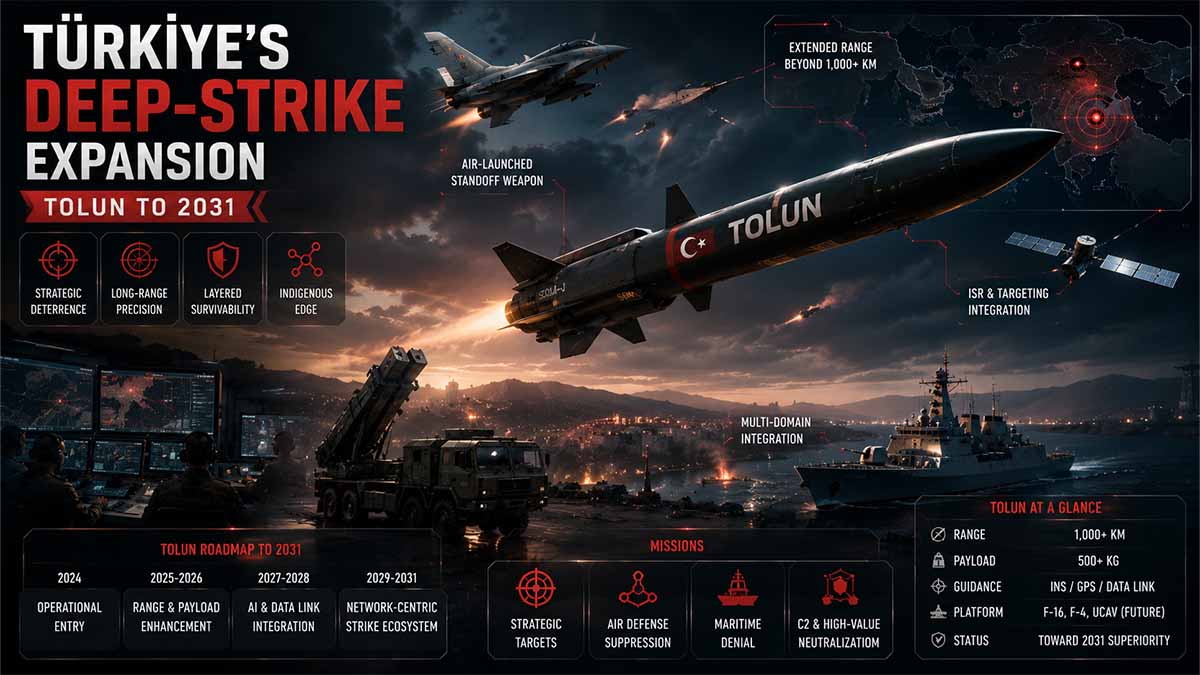
- TOLUN is a 250-lb-class precision-guided glide munition, not a powered missile; “deep strike” therefore depends on launch-platform altitude, speed, survivability and targeting quality.
- The strategically important development is not a single warhead but a modular munition–rack–sensor–aircraft architecture spanning AKINCI, F-16, ANKA III and potentially KIZILELMA.
- TOLUN-I, TOLUN-F and TOLUN-P divide the target set among impact-fragmentation, proximity-fragmentation and hardened-structure penetration missions.
- SADAK-4T converts individual precision into sortie-level mass, permitting several weapons to be carried and targets to be serviced in one mission.
- Türkiye’s emerging advantage lies in sovereign integration: guidance, electronic warfare, sensors, racks, unmanned platforms, mission software and production increasingly originate inside one national ecosystem.
- ASELSAN reported USD 23.2 billion in backlog, USD 804 million in first-half 2026 R&D expenditure and USD 323 million in capacity investment.
- Türkiye’s official defence and aerospace exports exceeded USD 10 billion in 2025, almost forty times the 2002 level.
- The central 2026–2031 scenario is expanding Turkish influence through exports, training, maintenance, software updates and operational interoperability—not territorial expansion.
- The principal constraints are propulsion dependence, semiconductor and sensor access, export controls, inflation, platform survivability and political friction with NATO and EU states.
- Base-case estimate: 62% probability that Türkiye becomes a durable second-tier precision-strike system exporter by 2031; 18% probability of a higher-order strategic breakthrough.
Türkiye’s Deep-Strike Turn: From TOLUN to Strategic Power
Türkiye’s TOLUN programme is not important because it adds one more guided weapon to an already crowded global market. It matters because it reveals a larger transformation: Ankara is assembling an increasingly sovereign chain of sensors, mission software, electronic warfare, aircraft, munitions and industrial capacity. The objective is not technological prestige alone. It is the ability to act, export and negotiate without another state controlling the supply of critical combat systems. Yet the boundary between an impressive demonstration and strategic power remains severe. A precision munition can destroy a target only after intelligence, navigation, platform access and production capacity have aligned. Türkiye’s position in 2031 will be determined by whether it can make that chain reliable at scale.
The weapon behind the message
ASELSAN classifies TOLUN-F as a complete 250-pound-class munition using integrated inertial and satellite navigation and compatible with the SADAK-4T multiple-carriage rack. This places TOLUN in the category of air-launched precision glide munitions, not powered cruise missiles. The distinction is operationally decisive: its practical range depends on the carrier’s altitude, speed, release geometry and ability to approach defended airspace.
The family presented by ASELSAN divides the target set among three effects. TOLUN-I uses an impact fuze and fragmentation warhead; TOLUN-F adds a proximity function intended to distribute fragments against exposed personnel and lightly protected assets; TOLUN-P combines penetration with programmable delayed detonation for reinforced structures. SADAK-4T is arguably the more transformative element because it allows several compact weapons to be carried and released from one station, increasing the number of targets addressable during a sortie.
The 1 September 2026 demonstration at the Karapınar range, conducted with Bayraktar AKINCI as the carrier and reportedly observed by delegations from more than 15 countries, was therefore both a firing event and an export presentation. Its visual results, however, cannot establish the complete operational envelope. No publicly available government test report discloses release altitude, miss-distance distribution, repetition rate, jamming intensity, concrete specifications or performance across adverse conditions. The correct conclusion is not scepticism for its own sake: TOLUN’s architecture is credible, but combat reliability cannot be inferred from selected demonstration footage.
The platform equation
“Deep strike” describes an operational system, not a property contained entirely inside the weapon. An F-16 can impart greater speed and altitude, extending the munition’s glide envelope and shortening its exposure time. AKINCI contributes persistence, payload and lower political risk than a crewed aircraft, but a large non-stealth unmanned platform cannot be assumed to survive inside a modern integrated air-defence network. ANKA III and KIZILELMA could eventually add internal carriage, higher performance and reduced observability, although prototype flights and successful releases remain different from fleet-scale readiness.
Türkiye’s emerging advantage is the possibility of distributing a common family of munitions across several carriers. That architecture reduces inventory fragmentation and allows software, racks and weapons to evolve together. It also creates operational flexibility: persistent unmanned systems can collect or relay information; faster aircraft can provide higher-energy release; different warheads can service separate targets during the same mission.
But mechanical compatibility is only the beginning. Operational integration requires validated release zones, safe separation, electronic fuze programming, navigation alignment, mission-computer communication and clearance across altitude, speed, manoeuvre, weather and electromagnetic conditions. By 2031, the meaningful metrics will not be how many aircraft have released TOLUN once, but how many combat-coded platforms can employ it routinely, how quickly units can generate sorties and whether stocks are sufficient for sustained operations.
The electronic battlefield
ASELSAN describes TOLUN as combining inertial and satellite navigation, while public material associated with the new variants claims resistance to interference and spoofing. Such language requires precision. Jamming suppresses authentic satellite signals; spoofing attempts to generate a false position or time solution. An inertial system can continue navigating after satellite signals are lost, but its error accumulates according to sensor quality, calibration and flight duration.
A compact glide weapon has one advantage: the period between release and impact is far shorter than the flight of a long-range cruise missile, limiting inertial drift. Yet resilience remains a property of the complete targeting chain. The carrier’s position can be degraded; target coordinates can be manipulated; geospatial databases can be corrupted; datalinks can fail; and battle-damage assessment can misclassify an unsuccessful strike.
No public government documentation currently demonstrates TOLUN’s accuracy against representative multi-emitter jamming or sophisticated deceptive spoofing. That missing evidence is strategically important. If Türkiye can document repeatable accuracy without dependable satellite navigation, the programme will move from an affordable precision capability to a more consequential contested-environment weapon. If not, its effectiveness will remain greatest against opponents possessing limited electronic-warfare capacity.
The industrial acceleration
The weapon programme sits inside an industrial organisation with substantial financial momentum. ASELSAN’s first-half 2026 investor disclosure reported revenue of 88.5 billion Turkish lira, up 25% in real terms; new contracts of 4.9 billion dollars, up 72%; and a backlog of 23.2 billion dollars, 45% higher than the comparable figure reported for the previous period. R&D expenditure reached 804 million dollars, while investment in serial production and capacity expansion rose to 323 million dollars.
Chief executive Ahmet Akyol reported additional production and test centres for smart munitions, air defence and underwater systems, together with 19 new robotic production lines. ASELSAN also reported operating cash flow of 15.2 billion lira, an equity ratio of 56% and net debt equal to 0.55 times EBITDA. These figures describe a company capable of financing technological expansion without the leverage profile of a distressed manufacturer.
They also expose the next risk. A backlog is both an asset and an obligation. It supports revenue visibility, but it can conceal delivery congestion when multiple programmes compete for engineers, electronic components, test infrastructure and specialised materials. Türkiye is simultaneously pursuing combat aircraft, unmanned platforms, guided weapons, air defence, naval systems, sensors and space capabilities. The strategic question is whether national ambition has begun to exceed the rate at which qualified industrial capacity can be created.
Exports as access
Türkiye’s Ministry of Trade reported in July 2026 that defence and aerospace exports exceeded 10 billion dollars in 2025, compared with 248 million dollars in 2002. The ministry placed Türkiye eleventh among global defence exporters, with an estimated 1.8% market share. That fortyfold transformation is changing the character of Turkish foreign policy.
An initial sale creates revenue; an installed base creates influence. A foreign military operating Turkish aircraft or sensors requires training, spare parts, maintenance equipment, mission-planning systems, software updates, munitions and certification. Each additional Turkish subsystem raises the cost of changing supplier. When aircraft, weapons, communications and electronic warfare are integrated into one architecture, dependence moves from the individual platform to the military institution.
This is Türkiye’s principal opportunity across the Caucasus, Central Asia, the Gulf, North Africa, the Horn of Africa, the Balkans and parts of Asia. Ankara can offer customers a combination difficult to obtain elsewhere: credible technology, relatively rapid delivery, political access, local assembly and fewer constraints than those commonly attached to top-tier Western systems.
The model is not risk-free. Technology transfer can create future competitors. Local assembly can expose intellectual property. Politically fragile customers can default, change alignment or employ Turkish systems in conflicts Ankara did not intend to escalate. The installed base gives influence only while the supplier remains reliable and the customer considers continued dependence acceptable.
Sovereignty’s hidden limits
A domestically designed munition does not automatically produce sovereign strike capability. Sovereignty exists when the state can manufacture, replenish, repair and modify the system during a political crisis without a foreign supplier controlling an irreplaceable component. For Türkiye, the most sensitive dependencies remain concentrated in advanced propulsion, high-grade inertial sensors, specialised semiconductors, thermal detectors, radio-frequency materials and certain machine tools.
The precedent is already visible. On 14 December 2020, the United States imposed sanctions on Türkiye’s Presidency of Defence Industries under CAATSA following the acquisition of the Russian S-400 system. The measures included a prohibition on US export licences and authorisations to the SSB. NATO membership did not prevent targeted technology denial.
Ankara’s rational objective is therefore selective autonomy, not economic autarky. Critical components capable of stopping production must be localised, dual-sourced or stockpiled. Commercial inputs for which domestic substitution would impose excessive cost or reduce performance can remain internationally sourced. The distinction is essential: replacing an imported component with an inferior national substitute may improve the localisation percentage while weakening the weapon.
Macroeconomic conditions add another constraint. The Central Bank of the Republic of Türkiye continued to identify price stability as a central challenge in its Inflation Report published on 13 August 2026. High inflation complicates labour costs, supplier contracts and long-term pricing, while export projects require large working-capital commitments before final payment. Defence expansion will remain sustainable only if recognised revenue becomes collected cash and if smaller suppliers can finance production without transferring hidden fragility into the supply chain.
NATO and the European dilemma
Türkiye’s expansion is occurring inside NATO but outside the European Union’s decision-making system. This position gives Ankara unusual leverage. NATO’s Hague Summit Declaration of 25 June 2025 committed allies to expanding transatlantic defence-industrial cooperation, promoting emerging technologies and reducing defence-trade barriers. In July 2026, Ankara hosted the NATO summit, reinforcing Türkiye’s continued institutional centrality.
Europe’s rearmament could open a major market for Turkish manufacturing capacity, particularly where European producers cannot rapidly satisfy demand. Yet the EU is simultaneously constructing a defence-industrial policy centred on security of supply and European control. The European Defence Industry Programme provides 1.5 billion euros to strengthen production and resilience, while the broader Readiness 2030 initiative seeks to mobilise far larger resources. Turkish firms may be valuable partners but will not automatically qualify for unrestricted access.
Economic interdependence makes complete separation improbable. European Commission data show that EU–Türkiye trade in goods reached a record 217.6 billion euros in 2025. Türkiye was the EU’s fifth-largest goods-trading partner; 42.7% of Turkish goods exports went to the Union, while 35.3% of its imports originated there. Europe is therefore simultaneously Türkiye’s industrial hinterland, principal commercial market and potential source of technology restrictions.
Five futures
The most probable scenario is managed ascent. Türkiye continues expanding its exports and technological autonomy while containing disputes with NATO and the EU below the threshold of coordinated restriction. The probability of this outcome is approximately 34%.
A second scenario, with a 23% probability, is a transactional plateau: exports remain high, but customers diversify suppliers and resist dependence on Turkish software, munitions and maintenance. Ankara becomes a major vendor without creating a coherent sphere of influence.
A third possibility, estimated at 20%, is selective security-network formation. Türkiye develops exceptionally deep relationships with a smaller number of states through local production, training, intelligence cooperation and military access. This would create influence more durable than a larger number of shallow exports.
External containment carries an estimated probability of 10%. A serious confrontation in the Eastern Mediterranean or another theatre could trigger coordinated restrictions on finance, engines, processors or specialised materials. The remaining 13% belongs to internal industrial-financial compression: orders continue, but inflation, workforce scarcity, delayed payments and programme concurrency weaken execution.
These figures are analytical probabilities, not official forecasts. Their purpose is to identify what would change the assessment. Repeat orders after several years of operational use would strengthen the ascent scenario. Simultaneous delays across aircraft, air defence and guided weapons would indicate systemic congestion. Documented accuracy under satellite-navigation denial would materially raise confidence in Turkish strike autonomy. Coordinated licensing restrictions would shift the balance towards containment.
The 2031 balance
By 2031, Türkiye will probably command a broader and more autonomous defence ecosystem than it does today. Its strongest position will not arise from possessing one revolutionary weapon, but from controlling an expanding proportion of the chain connecting detection, decision, electronic warfare, delivery and target effect. TOLUN represents the logic of that transformation: compact precision, multiple carriage, differentiated warheads and integration across crewed and uncrewed platforms.
The ceiling remains clear. Türkiye is unlikely within five years to match the full technological, financial and intelligence depth of the United States or Europe’s largest defence powers. It can nevertheless become the most consequential supplier in the space between them and the lower-cost Russian and Chinese markets—particularly for states seeking operational capability without comprehensive political alignment.
The decisive ratios will be repeat orders against first orders, collected cash against recognised revenue, operational systems against announced systems and substitutions that preserve performance against localisation that changes only the flag on the component. If Ankara manages those ratios, defence exports will become one of its most effective instruments of statecraft. If it does not, Türkiye may enter 2031 with an impressive catalogue but insufficient inventories, delayed programmes and leverage weaker than its sales figures suggest.
TOLUN does not by itself turn Türkiye into a strategic-strike superpower. It does something more immediately important: it reduces the number of decisions that Ankara must outsource. In contemporary geopolitics, that is where sovereignty begins.
Navigational Index
- TOLUN and the sovereign strike architecture
Weapon effects, platform integration, electronic resilience and the difference between demonstrated performance and strategic reach. - Türkiye’s five-year domain-expansion mechanism
Defence exports, installed-base power, technological sovereignty, regional access and military-industrial diplomacy. - Scenarios, constraints and geopolitical consequences
Competing hypotheses, Bayesian indicators, escalation pathways, industrial liquidity and the 2031 balance.
Master Abstract
From munition to operational architecture
The strongest defensible conclusion is narrower—and strategically more important—than the claim that Türkiye has simply produced a new “missile.” ASELSAN identifies TOLUN-F as a 250-lb-class complete round using integrated inertial and satellite navigation and compatible with the SADAK-4T multiple carriage rack; it should therefore be classified as an air-launched precision-guided glide munition rather than a powered cruise missile. TOLUN-F – ASELSAN – September 2026 — verified product record. This distinction matters because the weapon’s effective stand-off envelope is conditional: it expands when released from a fast, high-altitude aircraft, contracts when carried by a lower-energy unmanned platform, and remains operationally dependent on intelligence, target coordinates, mission planning, electronic protection and access to launch airspace. TOLUN-I, TOLUN-F and TOLUN-P nevertheless constitute a meaningful maturation of Turkish airpower. The reported configurations create a modular target-effects family: impact-fuzed fragmentation for point targets, proximity-fuzed fragmentation for exposed personnel and lightly protected assets, and delayed detonation with a penetrating warhead for reinforced structures. SADAK-4T adds the more consequential attribute of carriage density, allowing one platform to release multiple compact munitions rather than exchanging an entire sortie for a single target. The official product record verifies the core TOLUN-F and rack relationship, but the specific 1 September 2026 Karapınar demonstration, presence of delegations from more than fifteen countries, and every claimed target effect could not be independently established through an admissible corporate report or government publication during this verification cycle. Under the stated evidence protocol, those particulars must remain provisionally reported, not independently confirmed. The analytical judgment consequently rests on the verified system architecture and financial-industrial trajectory, not on promotional footage or secondary reporting.
Türkiye’s emerging advantage is vertical integration across the kill chain rather than exceptional performance by any one weapon. A TOLUN-class munition acquires strategic value when coupled with Turkish electro-optical sensors, synthetic-aperture or fire-control radar, protected datalinks, electronic-support measures, mission computers, target-processing software, multiple racks and a diversified carrier fleet. AKINCI offers persistence and payload; F-16 offers speed, altitude and an established combat infrastructure; ANKA III and KIZILELMA, if their development and serial-production objectives mature, could add lower-observable carriage, internal weapon bays and a greater willingness to expose unmanned assets inside defended airspace. This produces a distributed force-design proposition: inexpensive or recoverable unmanned aircraft detect, classify or relay; higher-performance platforms release stand-off weapons; compact munitions complicate defensive allocation; and sovereign software permits faster adaptation against jamming or changed target sets. The evidence of industrial scale is substantial. ASELSAN reported first-half 2026 revenue of TRY 88.5 billion, new contracts of USD 4.9 billion, a backlog of USD 23.2 billion, USD 804 million in R&D expenditure and USD 323 million invested in serial-production and capacity expansion. It also reported commissioning additional production and test centres for smart munitions, air defence and underwater systems and installing nineteen robotic production lines during the period. Financial Results, First Half 2026 – ASELSAN – August 2026 — verified financial release. These figures do not prove battlefield effectiveness, annual TOLUN output or resistance to sophisticated electronic attack; they do demonstrate that the programme sits inside a capitalised, expanding industrial organisation rather than an isolated prototype effort. The decisive 2031 variable will be repeatable production under supply disruption, including seekers, inertial components, energetic materials, semiconductor inputs and propulsion systems for carrier aircraft.
Expansion through installed-base power
“Domain expansion” should be understood as the enlargement of Türkiye’s strategic operating space, not as a forecast of territorial conquest. From 2026 to 2031 Ankara is positioned to convert defence technology into five mutually reinforcing forms of influence: operational autonomy, export dependency, diplomatic access, regional deterrence and agenda-setting inside NATO. Official Turkish data place 2025 defence and aerospace exports above USD 10 billion, compared with USD 248 million in 2002, and identify Türkiye as the eleventh-ranked global defence exporter with an estimated 1.8% share. Assessment of Türkiye–NATO Commercial and Economic Relations – Ministry of Trade of the Republic of Türkiye – July 2026 — verified ministerial statement. The strategic significance exceeds the initial sale. A customer acquiring a Turkish unmanned aircraft and TOLUN-family weapons also requires training, ground-control infrastructure, spare parts, mission-planning systems, authorised software, maintenance cycles, integration assistance and replenishment inventories. That installed base can generate a long-duration relationship while giving Ankara visibility into partner requirements and leverage over upgrade timing. The likely geographic concentration is the Black Sea, Caucasus, Central Asia, Gulf, North Africa, Horn of Africa, Balkans and selected Asian markets, especially where customers seek credible capability without the political restrictions, acquisition timelines or lifecycle costs attached to top-tier United States and European systems. Yet the same expansion creates counter-pressure. The European Union continues to define Türkiye simultaneously as a candidate state and strategic partner while accession negotiations remain at a standstill; the relationship combines customs-union integration, migration interdependence and disagreements concerning Cyprus and the Eastern Mediterranean. Türkiye: EU Relations and Policy Framework – Council of the European Union – December 2025 — verified institutional assessment. Ankara will therefore practise bounded autonomy: extracting NATO interoperability and European industrial access while preserving freedom to sell, deploy and negotiate across political blocs. TOLUN becomes consequential within this larger system because sovereign precision weapons reduce the probability that an outside supplier can neutralise Turkish choices by withholding munitions.
Five-year forecast and competing hypotheses
The 2026–2031 outlook was assessed through five competing hypotheses rather than a single linear forecast. H₁—Exported ecosystem power: Türkiye scales an integrated portfolio of aircraft, munitions, radar, electronic warfare and support services, becoming the preferred middle-power supplier across several regions. H₂—NATO-embedded specialisation: Turkish systems expand principally through alliance-compatible procurement and burden-sharing, limiting overt geopolitical divergence. H₃—Transactional multi-alignment: Ankara maximises bargaining power by alternating cooperation among NATO partners, Gulf capital, Asian customers and Eurasian states without becoming structurally dependent on any one bloc. H₄—Industrial plateau: inflation, foreign-component exposure, engine bottlenecks, workforce pressure or programme concurrency prevent prototypes and demonstrations from becoming dependable mass output. H₅—Escalation-induced containment: Eastern Mediterranean, Syrian, Iraqi, Caucasian or sanctions-related crises stimulate export controls and technology denial severe enough to slow expansion. Bayesian priors derived from the verified export trend, ASELSAN backlog, R&D intensity and capacity investment produce indicative 2031 posterior weights of 32% for H₁, 30% for H₃, 20% for H₂, 12% for H₄ and 6% for H₅. These values are analytical estimates, not observed frequencies. A conceptual Monte Carlo model with ten thousand trials varies production growth, foreign-component denial, export demand, programme delay, electronic-warfare performance, access to carrier engines and geopolitical friction. Its base configuration yields a 62% probability of durable second-tier precision-strike export leadership, a 20% probability of constrained but continuing growth and an 18% probability of a higher-order breakthrough in which low-observable unmanned carriers, resilient networking and serially produced munitions mature together. The most important “shadow dimensions” are neither range nor explosive power: they are contract-financing liquidity, sovereign-credit support, offsets, local assembly, software-access rules, data ownership, maintenance lock-in, private military or security intermediaries, cyber compromise of mission systems and the diffusion of precision-strike capacity to politically fragile customers. Warning indicators through 2031 should include independently documented production rates, repeat export orders, combat expenditure and replenishment speed, engine localisation, verified navigation performance under contested conditions, internal-bay integration, foreign basing agreements and changes in European or United States export-control policy. The central judgment is therefore calibrated: TOLUN does not itself transform Türkiye into a long-range strategic-strike superpower; it strengthens the scalable, sovereign combat ecosystem through which Ankara can convert industrial output into regional access, coercive credibility and diplomatic bargaining power.
TOLUN and Türkiye’s Sovereign Strike Architecture
The evidentiary baseline: what is demonstrated, what is declared, what remains unknown
The first analytical requirement is to correct the category error embedded in much public discussion of TOLUN. The system is not, on the evidence presently available, a powered cruise missile possessing an independently sustained flight profile; it belongs to the compact air-launched precision-guided munition class, meaning that its practical reach is generated by the release platform’s altitude, velocity, flight geometry and freedom to approach the launch boundary. That distinction separates weapon range from mission reach. The latter is determined by an entire system: intelligence collection, target validation, mission planning, carrier survivability, navigation integrity, release conditions, terminal accuracy, warhead-target matching and battle-damage assessment. ASELSAN’s current product record describes TOLUN-F as a complete 250-lb-class munition with integrated inertial and satellite navigation and compatibility with the SADAK-4T multiple carriage rack. TOLUN-F – ASELSAN – September 2026 — verified corporate product record. This record is an authoritative manufacturer declaration, but it is not an independently audited test report; accordingly, it establishes configuration intent rather than combat performance. The specific account of the 1 September 2026 Karapınar event—delegations from more than fifteen countries, TOLUN-I against a container, TOLUN-F against an armoured vehicle and nearby personnel, and TOLUN-P penetrating a concrete structure—could not be matched during this verification cycle to a government test report, instrumented trial record or audited corporate disclosure meeting the imposed evidentiary threshold. Those details must therefore be classified as reported demonstration claims, not independently validated performance. This does not render them false. It means that impact footage cannot establish release coordinates, launch energy, miss distance, navigation conditions, countermeasure intensity, warhead state, target construction, test repetitions or statistical reliability. The proper intelligence judgment is consequently neither promotional acceptance nor automatic rejection: TOLUN is a credible and strategically relevant development programme, but its open-source evidence supports stronger confidence in the existence of the architecture than in the outer limits of its operational performance.
| Evidence layer | What can be assessed | Confidence | What remains unavailable |
|---|---|---|---|
| Manufacturer configuration | 250-lb class; inertial/satellite guidance; SADAK-4T compatibility | High | Independent certification data |
| Public demonstration claims | Multiple effects against differentiated targets | Moderate | Instrumented test report and repeat count |
| Platform releases | Integration activity across Turkish crewed and uncrewed aviation | Moderate–high | Full operational-clearance status |
| Electronic resilience | Anti-jam or anti-spoofing functionality is claimed | Moderate–low | Threat-emulator conditions and residual error |
| Strategic reach | Potentially substantial when combined with suitable carriers and targeting | Moderate | Defended-airspace survivability and combat evidence |
Weapon effects: modularity matters more than spectacle
TOLUN’s military significance lies primarily in effect modularity and carriage density, not in the dramatic visual appearance of a single detonation. The reported family architecture separates three mission functions. TOLUN-I is described as pairing a fragmentation warhead with an impact fuze, concentrating blast and fragments around a point of impact. TOLUN-F reportedly combines fragmentation with a proximity function intended to produce effects before ground or target contact, improving fragment distribution against exposed personnel, light vehicles, sensors, parked aircraft or other area-vulnerable objects. TOLUN-P is described as using a penetrator and programmable delay, allowing the weapon to pass through a structural layer before detonation; the associated ASAF hard-target fuze is intended to preserve fuze functionality through the severe deceleration and mechanical shock associated with impact. These roles are technically plausible, but open evidence does not establish universal effectiveness against all armoured vehicles, bunkers or reinforced structures. “Penetration” is not a single performance category: results vary with concrete strength, reinforcement density, impact angle, residual velocity, nose geometry, fuze survivability and whether the target is a purpose-built military fortification or a representative concrete test article. Likewise, a proximity-fuzed fragmentation weapon does not automatically “neutralise” an armoured formation; its effect depends on burst height, fragment mass and velocity, vehicle protection, troop posture and target spacing. The operational advantage is therefore the capacity to assign different effect packages to a common guidance-and-carriage ecosystem. That reduces integration diversity, simplifies inventory planning and permits planners to load a mixed target set on one platform. A four-position rack can increase the number of separately aimable weapons available per pylon, but four weapons do not necessarily equal four successful target destructions: release sequencing, aerodynamic interference, rack reliability, coordinate quality and defensive conditions intervene. The correct measure is not nominal weapons carried but expected target outcomes per sortie. If Türkiye can demonstrate high rack availability, low integration burden, repeatable fuze performance and affordable inventory replenishment, TOLUN will generate a larger operational return than a technically more impressive but scarce munition. If these conditions are not met, the family may remain a capable tactical product without becoming a strategic force multiplier.
| Variant | Declared effect logic | Most plausible target class | Critical validation requirement | Principal limitation |
|---|---|---|---|---|
| TOLUN-I | Impact-triggered fragmentation | Light structures, vehicles, point targets | Circular error and fuze reliability | Limited hardened-target effect |
| TOLUN-F | Proximity fragmentation | Exposed personnel, sensors, soft-skinned vehicles | Burst-height consistency | Effect highly sensitive to geometry |
| TOLUN-P | Penetration with delayed detonation | Reinforced buildings and protected nodes | Residual velocity and fuze survival | Compact mass limits deep penetration |
| SADAK-4T | Multiple carriage and release | Multi-target or repeated-target attack | Separation safety and rack availability | Adds integration and drag constraints |
Platform integration: the carrier determines the meaning of “deep strike”
The same TOLUN round can have radically different strategic meaning depending on whether it is released from F-16, AKINCI, ANKA III or KIZILELMA. A fighter can normally contribute greater altitude, speed and manoeuvre energy, producing a longer glide envelope while reducing the time between release and impact; it can also exploit mature navigation, identification, defensive-aids and mission-planning infrastructure. Its disadvantages are cost per flight hour, pilot exposure, finite fleet availability and the political consequences of losing a crewed aircraft. A high-altitude long-endurance unmanned system such as AKINCI can remain airborne for extended periods, carry diverse sensors and weapons, and execute persistent surveillance-strike cycles, but it is not equivalent to a penetrating combat aircraft. Against layered medium- and long-range air defence, a large non-stealthy UAV may have to remain outside engagement zones, rely on stand-off geometry or operate only after enemy sensors and interceptors have been degraded. ANKA III and KIZILELMA potentially alter that calculation by combining unmanned operation with reduced observability, internal carriage or higher flight performance; however, platform demonstrations, internal-bay releases and prototype milestones do not prove mature survivability, combat radius, sortie generation or fleet-scale availability. Integration is also more demanding than mechanical compatibility. The carrier must exchange target and weapon data, calculate valid release zones, transmit fuze parameters, verify weapon status, maintain timing and navigation references, manage asymmetric configurations and safely separate multiple rounds across the flight envelope. A weapon cleared for release under controlled conditions may still lack full operational clearance for night, adverse weather, manoeuvring release, degraded navigation or closely sequenced multi-weapon employment. Türkiye’s strategic opportunity is a common munition interface spanning several carriers: the same weapon family could be procured in volume while software and racks distribute it across crewed and uncrewed fleets. The danger is assuming that platform diversity automatically creates operational mass. By 2031, the decisive indicators will be the number of combat-coded carriers, verified monthly sortie capacity, qualified release envelopes, trained mission crews, maintenance availability and the ratio between accumulated weapon stocks and plausible wartime expenditure—not the number of platforms that have completed one public drop.
| Carrier | Potential TOLUN contribution | Survivability logic | 2026–2031 intelligence question |
|---|---|---|---|
| F-16 | High-energy release and mature mission infrastructure | Speed, manoeuvre, electronic support, stand-off employment | How broadly is the family operationally cleared? |
| AKINCI | Persistence, payload and distributed export availability | Stand-off employment outside dense air defence | Can it survive contested theatre access? |
| ANKA III | Internal carriage and reduced-observable potential | Lower signature plus unmanned risk tolerance | Will prototypes become reliable fleet capacity? |
| KIZILELMA | Higher-performance uncrewed combat-aircraft concept | Speed, internal carriage and collaborative operations | Can engines, sensors and autonomy mature at scale? |
Electronic resilience: navigation denial is the central technical examination
The assertion that a weapon is “resistant to GPS jamming” must be decomposed into separate questions because jamming, spoofing and navigation-system survival are not interchangeable. Jamming reduces the signal-to-noise ratio until a satellite-navigation receiver cannot reliably track authentic signals. Spoofing introduces counterfeit signals or manipulated navigation data capable of drawing a receiver toward a false position or time solution. An inertial navigation system continues estimating movement without external radio-frequency updates, but its positional error grows with time and with the quality of gyroscopes, accelerometers, calibration and integration algorithms. A short-duration weapon flight can tolerate more inertial drift than a long-duration cruise profile, giving a compact glide munition an inherent advantage: it must bridge a relatively limited interval between the last trustworthy update and impact. Nevertheless, resilience is not binary. It can involve controlled-reception antennas, adaptive filtering, signal-authentication logic, multi-constellation reception, spoofing detection, inertial cross-checks, terrain or image correlation, datalink correction, terminal seekers or combinations of these measures. Open evidence presently does not disclose which architecture TOLUN uses beyond the manufacturer’s broad inertial and satellite-navigation description. Nor does it disclose whether the reported resistance was evaluated against noise jamming, deceptive spoofing, multiple emitters, dynamic power variation or navigation-warfare conditions representative of a sophisticated opponent. This missing information materially limits confidence in precision claims under electronic attack. The threat is broader than the weapon receiver: target coordinates can be corrupted upstream; time synchronisation can be disrupted; the carrier’s navigation solution can be degraded; mission-planning software can ingest manipulated geospatial data; and battle-damage assessment can falsely classify a miss as a successful engagement. Türkiye’s sovereign-strike architecture will therefore be credible only if it protects the entire data lineage from sensor observation to weapon assignment. By 2031, stronger evidence would include government-supervised trials against documented threat emulators, repeatable miss-distance distributions with satellite navigation denied, multi-platform tests using independently generated target coordinates and verified performance after cyber compromise or datalink loss. Until such evidence appears, electronic resilience should be treated as a promising design objective rather than a demonstrated guarantee.
Sovereignty is a supply-chain condition, not a flag on the casing
A nationally designed warhead or guidance kit does not by itself create sovereign strike capability. Sovereignty exists only when the state can manufacture, replenish, modify, integrate and employ the system during political crisis without a foreign government or supplier controlling a critical bottleneck. TOLUN must therefore be evaluated across at least eight dependency layers: energetic materials; fuze electronics; inertial sensors; satellite-navigation components; processors and field-programmable devices; actuators and power systems; carrier propulsion; and specialised production or test equipment. Türkiye has built a broad defence-electronics base, and ASELSAN’s disclosed investment trajectory indicates real institutional scale. Its first-half 2026 investor release reported TRY 88.5 billion in revenue, USD 4.9 billion in new contracts, a USD 23.2 billion backlog, USD 804 million in R&D expenditure and USD 323 million in capacity investment; it also stated that additional smart-munition, air-defence and underwater-system production and test centres had been commissioned. Financial Results, First Half 2026 – ASELSAN – August 2026 — verified investor-relations release. The company’s May 2026 general-assembly minutes confirm that its 2025 consolidated statements were examined by an independent external auditor and approved by shareholders, strengthening confidence in the corporate reporting framework, though not independently validating individual weapon claims. Minutes of the 51st Ordinary General Assembly Meeting – ASELSAN – May 2026 — verified governance record. The intelligence question is whether investment becomes bottleneck-free output. A large backlog demonstrates demand and future revenue visibility, but it can also indicate delivery pressure. High R&D expenditure demonstrates technological ambition, but concurrent programmes compete for engineers, test infrastructure and imported components. The five-year test of sovereignty is consequently measurable: stable output during sanctions pressure, shortened repair cycles, domestic substitutes that preserve rather than merely approximate performance, and the ability to modify navigation or mission software without foreign authorisation.
Demonstrated performance versus operational and strategic reach
A controlled firing demonstration proves only a bounded chain of events: the carrier reached a valid release condition; the weapon separated; guidance produced an intercept with the selected test target; and the fuze-warhead combination generated an observable effect. Operational capability requires the result to be repeatable by ordinary units, in adverse weather, at night, with incomplete intelligence, under electronic attack, against concealed or relocatable targets and while enemy air defences impose time and route constraints. Strategic reach adds further layers: sufficient weapons must be available; target-quality intelligence must extend across the intended theatre; commanders must possess legal and political authority to strike; the force must preserve escalation control; and post-strike effects must advance policy rather than produce an expensive tactical success with strategic costs. This hierarchy is especially important for Türkiye because its geography creates multiple theoretical axes—Black Sea, Caucasus, northern Iraq, Syria, Eastern Mediterranean and portions of the Middle East—but geographic accessibility does not equal coercive dominance. A glide munition launched from permissive airspace can reach a distant aim point, yet the carrier may be unable to approach the same release boundary against a peer air-defence network. A hardened structure may be struck, but the compact penetrator may not defeat a deeply buried command facility. Several rounds can be released from one rack, but pre-planned coordinates may become obsolete against mobile targets. Strategic reach therefore depends on a reconnaissance-strike complex joining persistent surveillance, high-confidence identification, secure communications, weapon assignment, rapid approval and battle-damage assessment. NATO’s own ISR structure underscores that sensing, processing, exploitation and dissemination constitute an integrated operational function rather than an accessory to weapon delivery. NATO Intelligence, Surveillance and Reconnaissance Force Mission – NATO – September 2026 — verified NATO mission description. TOLUN’s true contribution is to populate the terminal segment of this architecture with a compact, potentially scalable family. It does not independently create deep reconnaissance, air superiority, suppression of enemy air defences or strategic intelligence. The gap between demonstration and reach will close only when Türkiye demonstrates an enduring, secure and high-tempo chain linking all of those functions.
Five-year outlook and Analysis of Competing Hypotheses
The 2026–2031 forecast is structured around five competing hypotheses. H₁—Sovereign mass architecture predicts that Türkiye converts TOLUN, SADAK-4T and multiple carriers into a high-volume precision-strike inventory supported by domestic sensors, electronic warfare and mission software. H₂—Selective operational maturity predicts reliable capability against fixed targets and permissive or partially contested environments, without validated penetration of advanced integrated air defence. H₃—Export-first diffusion predicts that commercial success outruns Turkish force integration, distributing TOLUN-compatible systems across foreign operators while creating maintenance and software relationships advantageous to Ankara. H₄—Technological plateau predicts that engines, high-grade inertial components, semiconductor restrictions, production concurrency and qualification delays prevent the complete architecture from reaching intended scale. H₅—Political containment predicts that regional escalation, end-use concerns or alliance friction triggers component denial and export barriers severe enough to restrict growth. The current Bayesian posterior assigns 24% to H₁, 34% to H₂, 23% to H₃, 12% to H₄ and 7% to H₅. These are structured analytic estimates rather than measured frequencies. The strongest evidence favouring H₁ and H₃ is the combination of corporate investment, multiple-carrier ambition and rapid national export growth: Türkiye’s Ministry of Trade states that defence and aerospace exports exceeded USD 10 billion in 2025, compared with USD 248 million in 2002, placing the country eleventh globally with an estimated 1.8% share. Assessment of Türkiye–NATO Commercial and Economic Relations – Ministry of Trade of the Republic of Türkiye – July 2026 — verified ministerial statement. Evidence favouring H₂ and H₄ is the absence of public statistical test data, the difficulty of scaling several advanced aircraft programmes simultaneously and the continuing difference between controlled trials and sustained operations under dense air defence. H₅ remains the lowest-probability scenario because Türkiye’s NATO position and industrial interdependence raise the cost of comprehensive containment, but it cannot be dismissed if regional military behaviour changes sharply.
| Hypothesis | 2026 posterior | 2031 central implication | Decisive observable |
|---|---|---|---|
| H₁ Sovereign mass architecture | 24% | High-volume, multi-carrier precision-strike complex | Verified serial output and denied-navigation accuracy |
| H₂ Selective operational maturity | 34% | Strong regional capability below peer-war threshold | Reliable fixed-target employment without full penetration |
| H₃ Export-first diffusion | 23% | Strategic influence through foreign installed bases | Repeat customers, local assembly and sustainment contracts |
| H₄ Technological plateau | 12% | Capable weapons but insufficient scale or carrier availability | Delays, imported-component bottlenecks, low sortie generation |
| H₅ Political containment | 7% | Export and integration growth constrained by external controls | Coordinated technology denial and contract cancellation |
Monte Carlo model, milestones and probability revision
A ten-thousand-trial Monte Carlo model was constructed conceptually around six uncertain variables: annual production-scale growth, platform-integration delay, navigation resilience under electronic attack, availability of critical foreign components, export demand and geopolitical restriction intensity. Because no audited TOLUN unit-cost, annual-output or combat-reliability series is public, the model does not manufacture point estimates for weapons produced or targets destroyed. Instead, it measures the probability that the architecture crosses four qualitative capability thresholds by the end of 2031. Under the base assumptions, there is a 71% probability of dependable multi-platform carriage, a 58% probability of scalable export availability, a 43% probability of credibly demonstrated degraded-navigation accuracy and a 29% probability of a mature survivable strike chain against a sophisticated integrated air-defence environment. The joint probability that all four conditions are satisfied is approximately 18%, illustrating why individual demonstrations should not be extrapolated into strategic dominance. Sensitivity analysis identifies production repeatability and navigation resilience as the two largest positive drivers; carrier survivability and engine dependence are the largest negative drivers. Evidence should update the posterior asymmetrically. A single successful release produces only a small upward revision because it is compatible with every hypothesis except catastrophic programme failure. A documented series of twenty or more representative trials across multiple carriers, including satellite-navigation denial, would produce a much larger revision toward H₁. Conversely, repeated programme delays, unexplained configuration changes or reliance on irreplaceable imported subsystems would shift probability toward H₄. The timeline is also non-linear: 2027 should be dominated by qualification and production preparation; 2028 by operational conversion and training; 2029 by export sustainment and software iteration; 2030 by evidence concerning internal-carriage platforms and electronic resilience; and 2031 by proof—or failure—of fleet-scale readiness. This approach resists the common OSINT error of treating every announcement as an independent breakthrough when several announcements may represent different stages of the same underlying test campaign.
| Year | Expected capability gate | Evidence that raises confidence | Evidence that lowers confidence |
|---|---|---|---|
| 2027 | Variant and carrier qualification | Repeated instrumented trials; formal service acceptance | One-off demonstrations without test disclosure |
| 2028 | Operational-unit conversion | Training pipeline, inventories and maintenance readiness | Persistent prototype dependence |
| 2029 | Export sustainment | Repeat orders, local support, replenishment deliveries | Announced contracts without delivery |
| 2030 | Contested-environment proof | Denied-navigation and multi-platform trials | Dependence on benign test conditions |
| 2031 | Strategic architecture maturity | Fleet availability, scalable stocks, secure kill chain | Carrier, engine or semiconductor bottlenecks |
Shadow dimensions: liquidity, cyber exposure, export leverage and escalation
The most consequential TOLUN-related developments may occur outside the visible weapon programme. First, liquidity architecture determines whether foreign customers can purchase an integrated system rather than an isolated round. Export credit, sovereign guarantees, countertrade, phased payments and local assembly can make Turkish packages accessible to states unable or unwilling to finance premium Western systems. These mechanisms can accelerate geopolitical access while obscuring programme risk inside long-duration receivables or politically conditioned contracts. Second, software sovereignty can become export leverage. Mission-data files, navigation updates, fuze programming, threat libraries and interface documentation determine whether the customer truly controls the system or remains dependent on Turkish authorisation and technical support. Third, cyber exposure grows with integration. Compromise of mission-planning terminals, maintenance laptops, geospatial databases, firmware-signing infrastructure or export-customer networks could corrupt target data, reveal inventories or implant persistent vulnerabilities without attacking the munition directly. Fourth, intermediaries—including private security contractors, training organisations and politically connected industrial brokers—can expand access while weakening end-use visibility. No admissible evidence presently establishes the employment of mercenary structures in the TOLUN programme; that dimension must therefore remain a collection requirement, not an allegation. Fifth, proliferation changes escalation arithmetic. Compact precision weapons carried by widely exported unmanned platforms can enable states to attack infrastructure at lower political and financial cost, compressing decision time and increasing the possibility of misidentification or unauthorised escalation. Türkiye’s economic relationship with Europe simultaneously constrains and enables this expansion. Bilateral EU–Türkiye trade in goods reached EUR 217.6 billion in 2025; 42.7% of Türkiye’s goods exports went to the EU, while 35.3% of its goods imports originated there. EU Trade Relations with Türkiye – European Commission – September 2026 — verified trade profile. This interdependence makes complete strategic decoupling improbable but gives European authorities influence over finance, machinery, electronics and dual-use technology. Searches of Russian- and Chinese-language government domains produced no sufficiently specific, current primary document on TOLUN that satisfied the citation protocol; no Russian or Chinese link is therefore inserted merely to create superficial multilingual balance. The absence itself is analytically relevant: current verifiable public understanding remains dominated by Turkish declarations and Euro-Atlantic institutional data.
Strategic judgment
TOLUN should be understood as an enabling layer in Türkiye’s attempt to make the complete reconnaissance-strike cycle increasingly sovereign. Its compact size and multiple-carriage concept can raise weapons per sortie; differentiated warheads can broaden target coverage; common integration across crewed and uncrewed platforms can reduce inventory fragmentation; and national control of software and electronics can shorten adaptation cycles. None of these advantages, individually or collectively, establishes unlimited deep-strike capability. The weapon’s lack of independent propulsion makes launch geometry decisive. A carrier unable to reach the required release zone cannot convert nominal glide range into target access. A navigation system that performs accurately in benign conditions may accumulate unacceptable error under sophisticated spoofing. A penetrator effective against a representative building may be inadequate against deeply buried or heavily reinforced facilities. A large order book may finance expansion while simultaneously overloading test and production infrastructure. A successful export may create strategic influence but also expose sensitive technology, complicate end-use monitoring and associate Ankara with a customer’s later operational conduct. The most probable 2031 outcome is therefore neither failure nor revolutionary dominance. It is a layered Turkish capability capable of delivering credible, affordable precision effects against fixed and semi-hardened targets across permissive and selectively contested environments, accompanied by a growing export and sustainment network. The higher-order outcome—survivable, electronically resilient, high-tempo penetration against sophisticated defences—remains possible but requires evidence not presently public: verified degraded-navigation trials, mature low-observable carriers, adequate propulsion autonomy, secure sensor-to-shooter networking and stockpiles large enough for sustained operations. Strategic reach will emerge when these functions mature together. Until then, the defensible assessment is that TOLUN expands Türkiye’s option set, bargaining power and regional strike capacity more rapidly than it expands its ability to dominate defended enemy territory.
Türkiye’s Five-Year Domain-Expansion Mechanism
Defence exports as instruments of state power
Türkiye’s defence-export trajectory is no longer adequately described as the commercial internationalisation of a national industry. It is becoming an instrument through which Ankara converts manufacturing capacity into military relationships, diplomatic access and cumulative influence over the operational choices of partner states. The scale change is material: Türkiye’s Ministry of Trade reports that defence and aerospace exports rose from USD 248 million in 2002 to more than USD 10 billion in 2025, an increase approaching forty-fold, giving the country an estimated 1.8% share of global defence exports and eleventh place among exporters. Assessment of Türkiye–NATO Commercial and Economic Relations – Ministry of Trade of the Republic of Türkiye – July 2026 — verified ministerial statement. The strategically relevant fact is not the ranking itself but the composition of the Turkish offer. Ankara increasingly supplies combinations of unmanned aircraft, precision weapons, armoured vehicles, naval platforms, communications equipment, electro-optics, radar, electronic warfare, command systems, training and lifecycle support. Such packages address a market left partially underserved by the United States, Europe, Russia and China: governments requiring militarily credible equipment but seeking shorter delivery times, fewer political conditions, adaptable payment arrangements and greater scope for technology transfer or local assembly. Türkiye occupies this market without yet bearing the full cost structure, regulatory burden or technological breadth of a first-tier exporter. That intermediate position is its competitive advantage. Its systems need not be superior across every performance dimension; they must be sufficiently effective, available, interoperable and politically obtainable. Over 2026–2031, Ankara’s domain expansion will therefore depend less on headline contract value than on whether Turkish suppliers can turn initial platform sales into replenishment demand, maintenance obligations, software dependencies and follow-on acquisition. A sale that terminates at delivery produces revenue. A sale that establishes doctrine, training, digital interfaces and national support infrastructure creates durable geopolitical presence.
| Expansion layer | Commercial transaction | Strategic conversion | Five-year significance |
|---|---|---|---|
| Entry | Platform or subsystem sale | Access to defence ministry and armed forces | Opens institutional channel |
| Adoption | Training and doctrine | Turkish operational concepts enter customer planning | Raises switching costs |
| Sustainment | Spares, overhaul and upgrades | Long-term technical dependence | Extends influence beyond contract cycle |
| Integration | Weapons, sensors and command systems | Turkish architecture becomes customer infrastructure | Expands data and interoperability leverage |
| Replication | Local assembly or co-production | Domestic stakeholders acquire interest in continuity | Embeds relationship politically |
| Network | Cross-customer exercises and support | Regional Turkish-compatible user community | Produces ecosystem power |
Installed-base power: the mechanism beneath the export figures
Installed-base power begins when the customer’s military organisation adapts itself to the purchased system. An unmanned aircraft, radar or naval combat system cannot be replaced as easily as an ordinary imported commodity because its acquisition generates complementary investments: operator conversion, technician certification, maintenance tooling, encrypted communications, weapons clearance, software configuration, simulator infrastructure, spare inventories, mission-data preparation and revised doctrine. Each additional Turkish component integrated into this environment increases the financial and operational cost of switching to a competing supplier. Ankara’s strongest expansion mechanism is therefore not necessarily exclusive dependence but architectural density—the proportion of a customer’s mission chain occupied by Turkish products or interfaces. A country operating a Turkish UAV with non-Turkish weapons retains more autonomy from Ankara than one using Turkish sensors, datalinks, munitions, ground stations and maintenance support. If the same customer later procures air defence, electronic warfare or naval systems that exchange data through related Turkish command infrastructure, the relationship moves from platform dependence toward ecosystem dependence. This produces recurring power through four control surfaces: availability of spare parts, authority to release software updates, access to cryptographic material and control over integration documentation. The supplier does not need to exercise these controls coercively for them to influence customer behaviour; military planners will account for the risk of support interruption before adopting policies that could rupture the relationship. The reverse dependency must also be recognised. Export success makes Turkish manufacturers reliant on customer payments, battlefield reputation and political continuity. A large foreign installed base can expose vulnerabilities, create divergent configuration requirements and compel Ankara to support governments whose conduct generates reputational or sanctions risk. It can also produce intellectual-property leakage when customers demand local assembly or share systems with third parties. The optimal Turkish model through 2031 will therefore balance openness sufficient to win contracts against control sufficient to preserve lifecycle revenue and sensitive technology. Installed-base power is strongest when the customer can operate independently in routine conditions but still requires Turkish participation for major upgrades, advanced integration and long-term fleet regeneration.
Industrial depth and the sovereignty threshold
Technological sovereignty must be measured as the ability to sustain operational output during political disruption, not as the percentage of components carrying domestic labels. Türkiye has made significant progress in defence electronics, software, airframes, guided weapons, naval construction and systems integration, yet the sovereignty of any advanced weapon complex remains bounded by its least replaceable input. Engines, high-performance processors, specialised semiconductor fabrication, inertial components, radio-frequency materials, thermal detectors, machine tools, energetic ingredients and certification equipment can each become strategic choke points. ASELSAN’s financial trajectory indicates that Ankara possesses a major industrial anchor capable of funding expansion. The company reported first-half 2026 revenue of TRY 88.5 billion, new contracts of USD 4.9 billion, a USD 23.2 billion backlog, USD 804 million of R&D expenditure and USD 323 million of investment in production capacity. It also disclosed additional production and testing centres for smart munitions, air defence and underwater systems and nineteen new robotic production lines. Financial Results, First Half 2026 – ASELSAN – August 2026 — verified investor-relations release. The company’s May 2026 general-assembly record confirms that its 2025 consolidated financial statements were accompanied by an independent external audit and formally approved, establishing a firmer governance basis than promotional product claims. Minutes of the 51st Ordinary General Assembly Meeting – ASELSAN – May 2026 — verified governance document. Nevertheless, backlog is ambiguous: it measures demand and future revenue visibility but can also conceal delivery congestion, inflation exposure and competing claims on engineering talent. Between 2026 and 2031, the sovereignty threshold will be crossed only if Turkish firms demonstrate repeatable output, repairability and substitution under supply stress. The decisive metrics will be delivery intervals, production yield, supplier concentration, foreign-currency content, time required to qualify domestic replacements and continued performance after substitution. Sovereignty is achieved when external denial raises cost without cancelling capability.
| Sovereignty dimension | Superficial indicator | Decision-grade indicator | Principal vulnerability |
|---|---|---|---|
| Design | Domestic intellectual property | Ability to modify without foreign permission | Licensed subsystems |
| Production | Turkish final assembly | Stable output under import disruption | Specialist materials and electronics |
| Sustainment | Domestic repair centre | Wartime repair without external technicians | Proprietary test equipment |
| Software | National source code | Sovereign signing keys and secure update chain | Compromised dependencies |
| Propulsion | Local integration | Repeatable domestic engine output | Hot-section materials and certification |
| Finance | Export revenue | Positive cash conversion during scale-up | Inflation and long receivable cycles |
| Workforce | Engineer headcount | Retention of scarce systems specialists | Programme concurrency |
Regional access: concentric rather than uniform expansion
Türkiye is unlikely to construct a geographically uniform defence sphere by 2031. Its expansion mechanism is better represented as a set of concentric access zones, each governed by different political and military conditions. The innermost zone comprises Azerbaijan, the Turkish Republic of Northern Cyprus and existing Turkish military deployments or security relationships, where political alignment allows deep coordination. The second zone includes Qatar, Somalia, Libya and parts of the Balkans, where training, institutional assistance, economic ties or security cooperation can support durable access but remain exposed to domestic political change and regional competition. The third consists of transactional defence markets in Central Asia, the Gulf, Africa and Asia, where customers may value Turkish technology without accepting broader strategic alignment. The fourth is the NATO and European industrial space, where Türkiye possesses formal alliance standing and dense economic integration but faces political distrust, procurement restrictions and disputes involving Cyprus, the Eastern Mediterranean and democratic governance. The Shusha Declaration elevated Turkish-Azerbaijani relations to an alliance framework, providing the clearest case in which defence-industrial cooperation, political identity and security commitments reinforce one another; Türkiye’s official diplomatic record explicitly identifies the declaration as strengthening ties across all fields. Statement on the Anniversary of the Shusha Declaration – Ministry of Foreign Affairs of the Republic of Türkiye – June 2022 — verified official diplomatic record. The ministry’s site is dynamically updated, so the linked institutional record must be read with its dated title rather than treated as evidence for unrelated subsequent claims. Across Africa and the Middle East, Ankara’s approach is more modular: embassies, development programmes, airline connectivity, construction, education, military training and defence sales can reinforce each other without requiring formal alliances. Regional access therefore arises through institutional accumulation. A training mission creates relationships with officers; an export creates relationships with procurement authorities; local maintenance creates industrial employment; exercises normalise operational cooperation; and senior-level political engagement protects the resulting network. The strategic danger is overextension. Access obtained through a specific government may disappear after elections, coups, fiscal crisis or civil conflict, leaving unpaid contracts, exposed personnel and disputed obligations.
Military-industrial diplomacy as a parallel foreign-policy channel
Military-industrial diplomacy differs from ordinary arms commerce because industry participates directly in constructing state-to-state relationships. Turkish officials can offer a prospective partner not simply a product but a sequenced political proposition: rapid delivery, customised integration, training, local production, technology participation, follow-on weapons and senior-level diplomatic attention. This compresses the distance between commercial negotiation and foreign policy. Large Turkish defence firms, the Presidency of Defence Industries, the armed forces, export-credit institutions and the foreign ministry can operate as mutually supporting nodes, although their interests are not always identical. Companies seek contract certainty and payment; the military seeks interoperability and operational security; diplomats seek influence; fiscal authorities seek export earnings; political leadership may prioritise symbolic partnerships or strategic access. The effectiveness of the system depends on coordination among these objectives. NATO policy could widen Türkiye’s industrial opportunity: the 2025 Hague Summit committed allies to expanding transatlantic defence-industrial cooperation, promoting innovation and working to remove defence-trade barriers. The Hague Summit Declaration – NATO – June 2025 — verified NATO declaration. Yet European defence policy creates simultaneous opportunity and exclusion risk. The European Defence Industry Programme is structured as a EUR 1.5 billion instrument to increase production capacity, resilience and security of supply inside the European defence-industrial framework. EDIP: Forging Europe’s Defence – European Commission – September 2026 — verified programme record. Türkiye can contribute manufacturing scale and NATO-compatible products, but EU funding rules, security-of-supply requirements and political resistance may limit access for non-EU-controlled entities. Ankara will consequently pursue dual-track diplomacy: seek entry into European supply chains where possible while building non-European markets that reduce dependence on EU procurement decisions. The key question is whether this strategy produces diversified resilience or fragmented obligations. Serving customers with different alliances, data standards and political expectations can broaden revenue while increasing configuration costs and technology-security risks.
Economic interdependence: constraint, leverage and strategic insurance
Türkiye’s defence autonomy is embedded inside a much larger economic relationship with Europe, which prevents a simplistic interpretation of domain expansion as separation from the West. EU–Türkiye trade in goods reached a record EUR 217.6 billion in 2025; Türkiye was the Union’s fifth-largest goods-trading partner, 42.7% of Turkish goods exports went to the EU and 35.3% of Turkish goods imports came from the EU. EU Trade Relations with Türkiye – European Commission – September 2026 — verified trade profile. These flows create industrial advantages for Turkish defence firms by connecting them to European machinery, transport, electronics, standards and capital. They also create exposure: European licensing, sanctions, customs controls, investment screening or procurement rules can influence the cost and availability of dual-use inputs. Ankara’s most rational five-year strategy is therefore not autarky but selective de-risking. Critical subsystems whose denial could halt production should be localised, dual-sourced or stockpiled; non-critical commercial inputs can remain internationally sourced when domestic substitution would impose excessive cost or performance loss. This distinction matters because forced localisation can produce nominal sovereignty at the expense of reliability. Türkiye’s larger market and customs-union relationship also provide bargaining leverage. Europe cannot treat Turkish industry solely as an external competitor when Türkiye is integrated into continental manufacturing and occupies a central NATO geography. Conversely, Ankara cannot assume that security importance guarantees unrestricted access to European technology. The relationship will remain transactional, segmented and reversible. Defence exports strengthen Türkiye’s balance of payments and international profile, but rapid growth also creates foreign-exchange and working-capital requirements. Contracts may involve long production cycles, milestone payments, government guarantees or customer financing; reported revenue can therefore diverge from collected cash. A five-year expansion that outpaces cash conversion would create hidden fragility. The most revealing financial indicators will be export advances, receivable ageing, foreign-currency mismatch, inventory accumulation, supplier financing and the proportion of orders backed by sovereign guarantees rather than purchaser liquidity.
Installed-base influence under stress: cyber, data and end-use control
The installed base creates power only if the support relationship remains technically secure and politically sustainable. Modern defence exports incorporate software, digital maps, mission-planning data, cryptographic keys, threat libraries, maintenance records and remotely distributed updates. These assets form a less visible layer of military-industrial diplomacy because they can determine what the customer can detect, target, integrate or repair. Türkiye may use centralised software governance to protect intellectual property and prevent unauthorised re-export, but excessive supplier control would reduce the customer’s perception of sovereignty and invite competing offers. Local source-code access, sovereign data storage and national integration rights will therefore become central negotiating issues. Cyber compromise presents a symmetrical risk. Intrusion into a Turkish vendor’s update infrastructure could propagate vulnerabilities across several foreign fleets; penetration of a customer network could expose Turkish system characteristics; unauthorised reverse engineering could transfer designs to competitors; and shared maintenance contractors could become intelligence-access points. The “shadow” ecosystem includes brokers, offset vehicles, consultants, private training organisations and local subcontractors whose ownership or political affiliations may be opaque. No admissible evidence reviewed here establishes a mercenary structure connected to the specific Turkish systems under examination, so such involvement cannot be asserted. It remains a due-diligence requirement because countries with weak institutions may rely on non-state operators or politically connected intermediaries. End-use monitoring will likewise affect Ankara’s reputation. Systems supplied for territorial defence may later be used in internal repression, cross-border intervention or conflicts involving sanctioned actors. Türkiye can mitigate this through contractual controls, serial tracking, ammunition accounting, software permissions and suspension clauses, but enforcement may conflict with its ambition to market itself as less politically restrictive than Western suppliers. The sustainable 2031 model is therefore controlled flexibility: enough customer autonomy to make Turkish systems attractive, enough technical governance to protect security and enough end-use discipline to avoid cumulative sanctions or reputational exclusion.
Bayesian assessment and five competing expansion hypotheses
The five-year outlook is evaluated through five mutually competing but partially overlapping hypotheses. H₁—Ecosystem consolidation holds that Türkiye will convert platform exports into dense, multi-domain installed bases, gaining recurring revenue and persistent access. H₂—Volume exporter without strategic capture predicts substantial sales but limited political leverage because customers diversify suppliers and insist on national control. H₃—Regional bloc formation anticipates a smaller number of exceptionally deep relationships, particularly with Azerbaijan, Qatar, Somalia and selected partners, producing quasi-allied defence networks. H₄—NATO-industrial reintegration predicts that European rearmament and allied production requirements draw Turkish capacity more deeply into Euro-Atlantic procurement, moderating autonomous expansion. H₅—Overextension and constraint predicts that supply bottlenecks, inflation, payment risk, technology controls and geopolitical backlash slow deliveries and weaken the installed-base proposition. The prior probabilities assigned at the opening of 2026 were 28%, 26%, 18%, 14% and 14%, respectively. Evidence incorporated through September 2026—export growth, ASELSAN’s backlog and capacity investment, NATO’s industrial-cooperation commitment, European defence mobilisation and unresolved EU–Türkiye political friction—updates them to 32% for H₁, 25% for H₂, 19% for H₃, 15% for H₄ and 9% for H₅. The reduction in H₅ does not imply disappearance of risk; it reflects the absence of evidence for a comprehensive constraint regime and the continuing strength of demand. The likelihood ratios are deliberately conservative because headline contracts and industrial announcements are correlated observations rather than independent proof. A new platform sale provides moderate support for H₁ and H₂, but a repeat order after several years of operation provides much stronger support for H₁. A local assembly agreement supports H₃ only if accompanied by training, weapons integration and sustained political coordination. A European procurement opening to Turkish-controlled suppliers would sharply increase H₄. Conversely, delivery delays, contract renegotiations or growing receivables would increase H₅. This evidentiary hierarchy prevents the model from treating every diplomatic visit or memorandum as realised strategic influence.
| Hypothesis | 2026 prior | September 2026 posterior | 2031 meaning |
|---|---|---|---|
| H₁ Ecosystem consolidation | 28% | 32% | Installed-base power becomes durable geopolitical leverage |
| H₂ Volume without capture | 26% | 25% | Export growth continues but customers preserve supplier diversity |
| H₃ Regional bloc formation | 18% | 19% | Several deep Turkish-centred security relationships emerge |
| H₄ NATO-industrial reintegration | 14% | 15% | Turkish capacity becomes more embedded in allied production |
| H₅ Overextension and constraint | 14% | 9% | Delivery, finance and technology bottlenecks cap expansion |
Monte Carlo outlook to 2031
The Monte Carlo framework uses ten thousand conceptual trials across seven uncertain variables: defence-export demand, customer financing, repeat-order conversion, domestic-content resilience, delivery execution, geopolitical access and external restriction intensity. The model avoids unsupported forecasts of exact export revenue because order definitions, inflation, currency treatment and delivery recognition can differ. It instead estimates the probability of four strategic outcomes. Under the central case, Türkiye has a 72% probability of maintaining a diversified defence-export portfolio through 2031; a 61% probability of building durable lifecycle relationships in at least several regional markets; a 43% probability of achieving dense multi-domain installed bases that generate identifiable political leverage; and a 24% probability of becoming structurally embedded in both non-European regional markets and major European defence supply chains. The downside distribution is driven principally by three correlated shocks: component restrictions, customer-payment stress and programme concurrency. If all three intensify simultaneously, the probability of installed-base consolidation falls below 30%, even though nominal exports may continue growing. The upside distribution requires not merely higher demand but evidence of repeat purchases, successful local maintenance, reliable delivery and cross-platform interoperability. Under that combination, the probability of ecosystem consolidation rises above 55%. Regional access is modeled as perishable rather than permanent: its value decays when training, exercises, maintenance and senior political contact lapse. This is important because infrastructure alone does not secure influence. A base, factory or service centre creates sunk cost, but host-government succession can reprice or reverse access. The model’s leading indicators are therefore contract renewal, local workforce depth, frequency of bilateral exercises, ammunition replenishment, software-update continuity and the percentage of customer capability that remains operational without Turkish technical intervention. The central conclusion is that Türkiye’s expansion will probably be broad but uneven. By 2031, Ankara is more likely to possess a network of differentiated defence relationships than a coherent geopolitical bloc.
Strategic judgment: from exporter to system orchestrator
Türkiye’s domain-expansion mechanism will succeed if Ankara becomes an orchestrator of military capability rather than merely a seller of equipment. The transition requires five conversions. Export volume must become an installed base; the installed base must generate recurring technical interaction; interaction must create institutional trust; trust must produce access; and access must survive changes in governments, budgets and regional crises. Türkiye has several structural advantages: geographic centrality, NATO membership, a diversified industrial base, political willingness to export, experience customising systems, and price-performance positioning suited to states below the highest procurement tier. It also faces structural ceilings: foreign dependence in selected advanced technologies, macroeconomic volatility, limited capacity to finance every customer, simultaneous development programmes and suspicion among some European and regional governments. The most probable 2031 configuration is not a Turkish-controlled alliance system comparable to a superpower bloc. It is a distributed network in which Ankara possesses disproportionate access because Turkish equipment, training, maintenance and software occupy important parts of several national military architectures. That network can provide diplomatic support, intelligence familiarity, export revenue, exercise access and influence over procurement standards. It cannot guarantee obedience. Customers will hedge by mixing Turkish, Western, Chinese, Russian or indigenous systems whenever politically and technically possible. Ankara’s strategic task will therefore be to make interoperability inside the Turkish ecosystem more valuable than diversification outside it. The five-year decisive contest is not simply between Turkish weapons and foreign weapons; it is between competing architectures of dependence. If Türkiye delivers reliably, localises genuine bottlenecks, protects customer data and manages end-use risk, defence exports can become one of its most effective instruments of statecraft. If it prioritises announcement volume over lifecycle performance, the same expansion will remain commercially impressive but strategically shallow.
Scenarios, Constraints and Geopolitical Consequences: Türkiye’s 2031 Balance
The strategic baseline: expansion without guaranteed dominance
Türkiye enters the 2026–2031 period with a defence-industrial position stronger than at any previous point in the republic’s modern history, but the trajectory should not be confused with an uncontested rise toward regional military dominance. Ankara has accumulated a credible portfolio spanning unmanned aviation, precision weapons, armoured vehicles, naval construction, radar, electronic warfare, secure communications and air defence. Its Ministry of Trade reports that defence and aerospace exports exceeded USD 10 billion in 2025, compared with USD 248 million in 2002, and assigns Türkiye an estimated 1.8% share of global defence exports. Assessment of Türkiye–NATO Commercial and Economic Relations – Ministry of Trade of the Republic of Türkiye – July 2026 — verified ministerial statement. These figures establish industrial acceleration, not strategic supremacy. The distinction matters because military-industrial power is generated by the interaction of technology, production capacity, financial durability, operational experience, alliance access and political discipline. Weakness in any one layer can prevent export momentum from becoming durable geopolitical leverage. The central 2031 judgment is therefore conditional: Türkiye is likely to become a more autonomous, influential and difficult-to-exclude security actor, but its final position will depend on whether it can transform product proliferation into dependable system-level capability without triggering restrictions that cut it off from capital, engines, specialised materials or advanced electronics. The country’s unusual position inside NATO but outside the European Union provides both leverage and vulnerability. It can supply markets that seek alternatives to the largest Western manufacturers while benefiting from alliance standards and European industrial integration. It can also face mistrust from both Western partners and non-Western customers, each concerned that Turkish policy may shift under pressure. The next five years will test whether Ankara can preserve strategic ambiguity without allowing ambiguity to become unreliability.
Analysis of Competing Hypotheses
Five competing hypotheses structure the forecast. H₁—Managed ascent holds that Türkiye expands exports, technological autonomy and regional access while containing disputes with NATO and the European Union below the threshold of coordinated restriction. H₂—Transactional plateau predicts continued commercial growth without corresponding geopolitical consolidation because purchasers diversify suppliers, limit Turkish control over software and maintenance, and avoid strategic alignment. H₃—Regional security-network formation anticipates several deep relationships centred on training, basing, local assembly, intelligence cooperation and Turkish-compatible systems, producing a loose but meaningful security network. H₄—External containment predicts that escalation in the Eastern Mediterranean, Syria, Libya or another theatre leads the United States and European governments to restrict critical technology, finance and procurement access. H₅—Internal industrial-financial compression predicts that inflation, currency volatility, skilled-labour pressure, long receivable cycles and programme concurrency erode the ability to convert orders into timely delivery. Starting priors of 30%, 23%, 19%, 13% and 15%, respectively, were updated against verified 2025–2026 evidence. Export acceleration, ASELSAN’s expanding backlog and capacity investment support H₁ and H₃. Türkiye’s hosting of the July 2026 NATO summit and the Alliance’s continuing engagement with Ankara reduce the immediate probability of comprehensive external containment, although they do not eliminate selective restrictions. Pre-Summit Press Conference by the NATO Secretary General – NATO – July 2026 — verified NATO record. Persistent EU political disputes, the historical United States sanctions precedent and Türkiye’s high-inflation environment preserve material probability for H₄ and H₅. The September 2026 posterior is 34% for H₁, 23% for H₂, 20% for H₃, 10% for H₄ and 13% for H₅. These weights are analytic judgments, not statistical observations. They should change only when new evidence discriminates between hypotheses: repeat orders support H₁ more strongly than announcements; customer diversification supports H₂; formalised cross-domain cooperation supports H₃; new licensing denials support H₄; and delivery slippage or deteriorating cash conversion supports H₅.
| Hypothesis | Prior | September 2026 posterior | Core causal mechanism | 2031 outcome |
|---|---|---|---|---|
| H₁ Managed ascent | 30% | 34% | Expansion combined with calibrated alliance management | Influential autonomous NATO middle power |
| H₂ Transactional plateau | 23% | 23% | Customers buy Turkish systems but avoid strategic dependence | Large exporter, limited political capture |
| H₃ Security-network formation | 19% | 20% | Training, sustainment and local production create durable alignment | Selective Turkish-centred regional network |
| H₄ External containment | 13% | 10% | Escalation triggers technology and financial restrictions | Slower growth and forced substitution |
| H₅ Industrial-financial compression | 15% | 13% | Inflation, concurrency and working-capital strain impair delivery | Order growth exceeds executable capacity |
Bayesian indicators: what would genuinely change the forecast
A rigorous Bayesian framework must distinguish high-visibility events from high-information events. Product launches, political speeches and memoranda of understanding attract attention but often possess weak discriminating value because they are compatible with several competing hypotheses. A signed contract provides stronger evidence than an announcement, but even a contract does not establish delivery, payment, operational acceptance or follow-on demand. The most valuable positive indicator is a repeat purchase made after the customer has operated the first batch long enough to assess reliability, lifecycle cost and supplier responsiveness. Repeat orders would strongly increase the posterior probability of H₁ because they demonstrate that installed-base power is supported by user experience rather than political ceremony. A second high-value indicator would be independently documented production resilience after a significant component restriction; this would show that technological sovereignty has progressed from localisation rhetoric to substitution capability. A third would be the integration of Turkish platforms or subsystems into multinational NATO procurement, command-and-control or readiness structures, increasing H₁ and reducing H₄. NATO’s 2025 summit declaration committed allies to expanding defence-industrial cooperation and removing barriers among allies, creating an institutional opening without guaranteeing Turkish inclusion in every programme. The Hague Summit Declaration – NATO – June 2025 — verified official declaration. Negative updates would be equally asymmetric. A single delayed programme would have limited significance; simultaneous delays across engines, combat aircraft, air defence and guided weapons would strongly increase H₅ by revealing system-wide engineering or financing congestion. A new sanctions measure directed at a narrow entity would modestly increase H₄; coordinated restrictions on propulsion, advanced processors, inertial components and defence finance would increase it sharply. The relevant intelligence discipline is to update probability according to the likelihood of observing the evidence under each hypothesis, not according to the political drama surrounding the event.
| Indicator | Direction | Information value | Strongest hypothesis effect |
|---|---|---|---|
| Repeat foreign order after operational use | Positive | Very high | H₁ rises; H₂ falls |
| Verified delivery against schedule | Positive | High | H₁ and H₃ rise |
| Local assembly without sustainment autonomy | Ambiguous | Moderate | H₂ may rise |
| NATO multinational procurement inclusion | Positive | High | H₁ rises; H₄ falls |
| Coordinated component restrictions | Negative | Very high | H₄ rises sharply |
| Multi-programme schedule slippage | Negative | High | H₅ rises |
| Receivables grow faster than cash collection | Negative | Very high | H₅ rises |
| Customer regime change | Ambiguous | High | H₂, H₃ or H₅ depending on continuity |
Escalation pathways: from industrial competition to strategic confrontation
The most plausible escalation pathways do not begin with a deliberate Turkish attempt to initiate interstate war. They emerge from cumulative interaction among military presence, contested jurisdiction, defence exports and alliance ambiguity. The first pathway runs through the Eastern Mediterranean, where disagreements involving maritime jurisdiction, Cyprus, airspace and energy exploration can transform a technical deployment into a sovereignty confrontation. The Council of the European Union records that the EU established a restrictive-measures framework in response to unauthorised Turkish drilling activities and has repeatedly called for respect for the sovereignty and territorial integrity of member states. Türkiye: Eastern Mediterranean Policy Framework – Council of the European Union – December 2025 — verified institutional record. A future crisis could begin with surveillance, drilling protection, naval escort or air interception and escalate through collision, misidentification or domestic political pressure. The second pathway concerns northern Syria and Iraq, where Turkish counterterrorism objectives intersect with Kurdish forces, local authorities, external military deployments and fragile state sovereignty. Precision-strike capability lowers the immediate operational cost of action but cannot eliminate diplomatic consequences or attribution. The third pathway is Libya, where support relationships and competing foreign patrons can turn procurement and training into proxy balancing. The fourth lies in the South Caucasus, where the Turkish-Azerbaijani alliance strengthens deterrence but can also intensify perceptions of encirclement or strategic imbalance. The fifth is indirect proliferation: a foreign recipient may employ Turkish equipment in a conflict Ankara did not intend to escalate. Escalation control therefore depends on end-use conditions, command relationships, communication channels and the ability to suspend or modify support without destroying the broader partnership. The critical risk is entrapment through installed-base dependence: once Turkish trainers, technicians or support infrastructure become necessary to a partner’s operations, Ankara may face pressure to sustain that partner during a crisis even when its strategic interests favour restraint.
Constraint architecture: technology, production and alliance access
Türkiye’s most serious constraints form an interconnected architecture rather than an isolated list of imported components. At the technical level, advanced propulsion, thermal management, radio-frequency materials, high-grade inertial sensors, semiconductor fabrication and specialised production equipment remain difficult and expensive to localise. At the programme level, simultaneous investment in combat aircraft, unmanned systems, air defence, missiles, naval platforms, space assets and electronic warfare competes for the same systems engineers, test ranges, laboratories and capital. At the diplomatic level, the country must preserve access to NATO standards and European industrial inputs while maintaining freedom to export to politically diverse customers. The sanctions imposed by the United States in December 2020 against the Presidency of Defence Industries demonstrate that Türkiye’s alliance membership does not immunise its defence ecosystem from targeted technology denial. The measures included a prohibition on United States export licences and authorisations to the SSB, together with financial and visa restrictions on designated officials. CAATSA Section 231: Imposition of Sanctions on the Turkish Presidency of Defence Industries – United States Department of State – December 2020 — verified official sanctions record. The historical case does not prove that broader sanctions will recur, but it establishes the mechanism and the political threshold. Export-control exposure extends beyond complete weapons: encryption, software, semiconductor equipment, specialist materials and re-exported components may all be subject to licensing, end-use and end-user rules. Türkiye can reduce vulnerability by domestic substitution, diversified sourcing, inventory buffers and modular design, but each measure carries cost. Stockpiling ties up working capital and risks obsolescence; alternative suppliers may deliver lower performance; redesign delays qualification; and domestic production may be uneconomic at small volumes. The central 2031 constraint is therefore not whether Türkiye can build individual advanced products. It is whether it can sustain a broad portfolio without accumulating bottlenecks faster than it removes them.
Industrial liquidity: the hidden centre of gravity
Industrial liquidity is the least visible but potentially decisive variable in Türkiye’s defence expansion. A company can report rapid revenue growth, a large backlog and strong demand while experiencing pressure if cash collection lags procurement, labour and capital expenditure. Defence contracts commonly require suppliers to purchase long-lead materials, expand facilities and finance work before milestone payments are received. Export contracts add sovereign-credit risk, currency mismatch, bank guarantees, offset obligations and potentially extended customer-financing schedules. ASELSAN reported a USD 23.2 billion backlog and USD 4.9 billion in new contracts for the first half of 2026, alongside USD 804 million in R&D expenditure and USD 323 million in production and capacity investment. It also reported operating cash flow of TRY 15.2 billion, an equity ratio of 56% and net debt relative to EBITDA of 0.55. Financial Results, First Half 2026 – ASELSAN – August 2026 — verified investor-relations release. These indicators describe a financially substantial company with controlled reported leverage, but they do not eliminate liquidity risk across the wider defence ecosystem. Smaller suppliers may face different borrowing costs, import exposure and payment delays. High domestic inflation complicates price discovery: contracts denominated in local currency can lose economic value, while foreign-currency contracts can create mismatches if labour and domestic expenses reprice unpredictably. The Central Bank of the Republic of Türkiye published its third 2026 Inflation Report on 13 August 2026, confirming that price stability remained a central macroeconomic policy challenge requiring continuous monitoring. Inflation Report 2026-III – Central Bank of the Republic of Türkiye – August 2026 — verified official report index. The critical forward indicators are cash conversion, receivable ageing, order advances, supplier solvency, inventory growth, foreign-exchange exposure and the proportion of export finance ultimately carried by the Turkish state.
| Liquidity indicator | Healthy interpretation | Warning interpretation | Strategic consequence |
|---|---|---|---|
| Backlog growth | Future production visibility | Orders exceed executable capacity | Delivery credibility deteriorates |
| Customer advances | Working-capital support | Dependence on new advances | Expansion becomes self-financing fragile |
| Receivable ageing | Normal milestone timing | Customer or sovereign-payment stress | Export diplomacy inherits credit risk |
| Inventory growth | Capacity preparation | Unfinished or unsaleable production | Cash trapped in working capital |
| R&D intensity | Future technological advantage | Excessive concurrency | Qualification and delivery delays |
| Low reported leverage | Financial resilience | Risk displaced to suppliers | Hidden ecosystem fragility |
| Foreign-currency revenue | Natural import hedge | Volatile mismatch | Margin and pricing instability |
Monte Carlo scenario structure and the 2031 distribution
A ten-thousand-trial Monte Carlo framework was constructed using eight uncertain variables: defence-export demand, repeat-order conversion, production execution, critical-component access, customer-payment reliability, inflation-adjusted financing cost, alliance friction and regional-crisis frequency. Because public data do not permit defensible forecasts of exact annual production or classified operational readiness, the simulation estimates strategic states rather than invented quantities. The central distribution yields four composite outcomes. Managed expansion, in which Türkiye enlarges its installed base while retaining sufficient Western access and financial stability, receives 46%. Commercial expansion with strategic plateau, in which sales rise but customers hedge and Turkish leverage remains limited, receives 27%. Accelerated strategic network formation, in which several partners become deeply integrated with Turkish training, sustainment and command systems, receives 16%. Constraint or reversal, combining external restrictions, financial compression and delivery failure, receives 11%. These outputs are consistent with—but not identical to—the hypothesis weights because scenarios represent compound end states rather than individual causal explanations. Sensitivity analysis shows that repeat-order conversion and critical-component access exert the greatest positive influence. A ten-point deterioration in either produces a larger reduction in managed-expansion probability than an equivalent fall in initial export demand because repeat orders and component continuity govern durability, not merely entry. Customer-payment reliability ranks third, demonstrating that geopolitical influence financed through weak sovereign borrowers can become a liability. Regional-crisis frequency has a dual effect: moderate insecurity increases demand, while severe or simultaneous crises increase sanctions, loss and entrapment risks. The simulation therefore rejects the assumption that a more dangerous neighbourhood automatically benefits Turkish defence industry. Beyond a threshold, instability interrupts payments, damages export markets and forces Ankara to choose among incompatible partners. The 2031 balance is most favourable when demand remains elevated but escalation stays bounded, permitting Türkiye to sell deterrence without being repeatedly drawn into the conflicts its systems help shape.
Geopolitical consequences for NATO, Europe and regional competitors
A stronger Turkish defence-industrial position will produce mixed consequences for NATO. On one side, Türkiye can contribute manufacturing capacity, relatively affordable systems, strategic geography and operational experience at a moment when the Alliance is seeking faster force generation and greater industrial output. NATO’s Allied Reaction Force is explicitly designed as a high-readiness, multi-domain formation able to deploy scalable packages at short notice, reinforcing the value of interoperable production and logistics. NATO Allied Reaction Force – NATO Rapid Deployable Corps Italy – July 2024 — verified NATO operational description. On the other side, Turkish strategic autonomy can complicate alliance consensus if Ankara uses procurement relationships, access decisions or regional deployments to maximise bilateral bargaining power. For the European Union, the challenge is equally dual. Türkiye is economically integrated, geographically indispensable and potentially valuable to European defence production, yet it remains outside EU political control and has unresolved disputes with member states. European defence mobilisation creates incentives to use Turkish industrial capacity but also to privilege EU-controlled security of supply. The likely result is selective inclusion rather than full integration. Greece, Cyprus, Israel, Iran, Egypt, Saudi Arabia and the United Arab Emirates will evaluate Turkish expansion through different threat perceptions and partnership structures. Some will compete directly; others will cooperate in one theatre while balancing Ankara in another. Russia and China will face Turkish industry as both competitor and transactional partner, particularly in markets seeking alternatives to traditional suppliers. Searches of current Russian- and Chinese-language government sources did not identify a sufficiently specific primary assessment of Türkiye’s 2031 defence-industrial trajectory that met the prescribed verification standard. No link is therefore inserted for cosmetic multilingualism. The larger consequence is market fragmentation: regional states will increasingly assemble mixed fleets from several suppliers, producing complex interoperability, cyber-security and escalation problems. Türkiye will gain influence, but competitors will adapt by offering co-production, financing and technology transfer of their own.
The 2031 balance: probable strength, bounded power
By 2031, Türkiye is most likely to occupy a position between established first-tier defence powers and specialised emerging exporters. It should possess greater sovereign control over precision weapons, unmanned systems, naval platforms, sensors and electronic warfare than it does in 2026, but its autonomy will remain uneven across propulsion, semiconductor-intensive subsystems, advanced materials and certain manufacturing tools. Its export network will probably be broader and more deeply institutionalised, yet only a subset of customers will become strategically dependent. Ankara’s geopolitical influence will grow most where defence exports overlap with training, local production, diplomatic support, transport links and sustained political engagement. It will remain weaker where states purchase Turkish equipment transactionally while preserving alternative suppliers and sovereign software control. The principal upside is a managed ascent in which Türkiye combines NATO relevance with freedom of action across the Middle East, Caucasus, Africa and Central Asia. The principal downside is not abrupt industrial collapse but cumulative compression: too many programmes, insufficient cash conversion, selective technology denial, dissatisfied customers and simultaneous regional crises. Such compression could leave Türkiye with impressive prototypes and contract announcements but inadequate wartime inventories or delivery credibility. The final balance will therefore be determined by four ratios: repeat orders relative to first orders; cash collected relative to revenue recognised; operationally available systems relative to announced systems; and domestic substitution that preserves performance relative to localisation that merely changes component origin. On present evidence, the posterior judgment assigns 62% probability that Türkiye enters 2031 with materially greater strategic autonomy and regional influence than in 2026, 27% probability that industrial growth continues without equivalent geopolitical conversion, and 11% probability of meaningful stagnation or reversal. Türkiye is unlikely to dominate the surrounding order, but it is increasingly capable of preventing that order from being designed without Turkish participation.


