











Executive Summary
- BLUF: the southern Lebanon framework has reached a sequencing deadlock, not yet a demonstrable failure of Lebanese compliance.
- The agreement requires Hezbollah’s disarmament, progressive Israeli redeployment and implementation through a Trilateral Military Coordination Group.
- Public primary sources do not disclose an agreed inspection protocol, evidentiary threshold or binding adjudicator for contested sites.
- Israel therefore demands verifiable Lebanese performance while the verification architecture remains institutionally incomplete.
- Lebanon cannot establish exclusive state control where deployment, access and civilian return remain constrained by active hostilities or residual Israeli presence.
- The central risk is a self-reinforcing loop: incomplete withdrawal produces incomplete access, which produces disputed compliance and postpones further withdrawal.
- Bayesian baseline: managed but coercive stalemate is the leading 2026–2031 trajectory; renewed high-intensity conflict remains the principal tail risk.
- The decisive variable is not nominal participation in talks but whether an independent mechanism acquires access, chain-of-custody rules and authority to certify compliance.
- Italy and the EU could become indispensable guarantors, but only under a mandate insulated from unilateral vetoes and backed by protected access.
- Without those safeguards, the pilot-zone concept risks institutionalising fragmented sovereignty rather than restoring it.
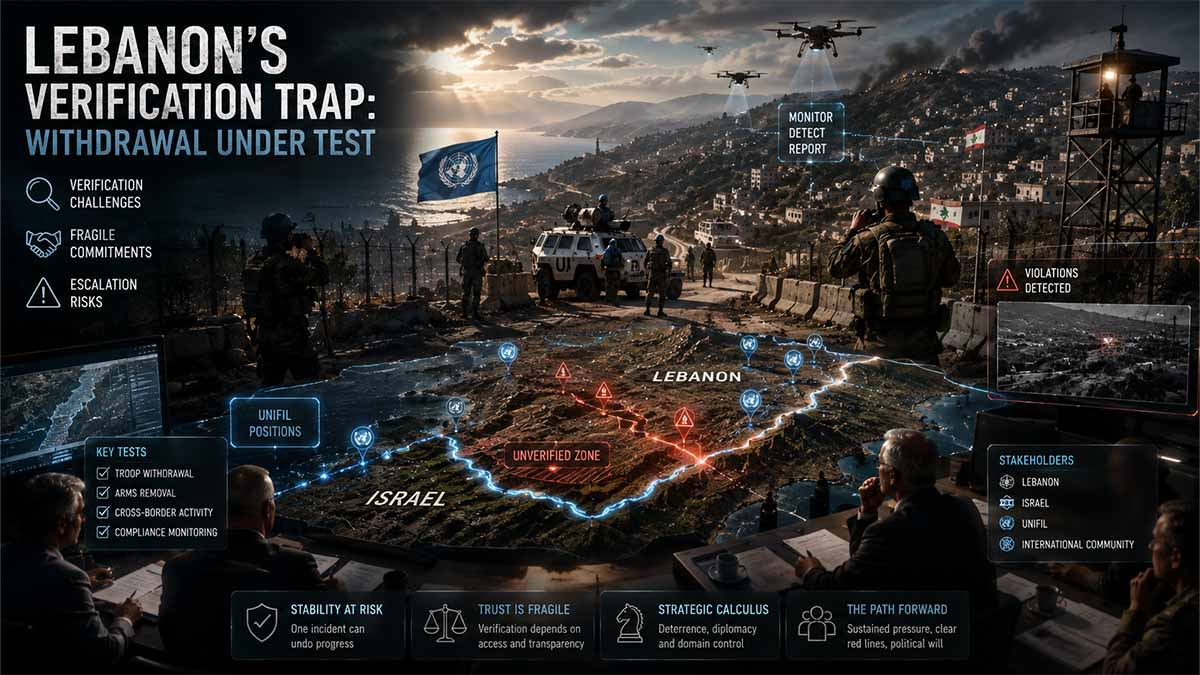
Lebanon’s Verification Trap: When a Ceasefire Becomes a Contest for Sovereignty
The experiment unfolding in southern Lebanon is no longer simply a test of whether Hezbollah can be disarmed or whether Israel will withdraw. It is a test of whether sovereignty can be reconstructed while the sequence designed to restore it remains disputed. Israel demands demonstrable Lebanese compliance before relinquishing military leverage; Beirut argues that its army cannot establish full control where access is constrained by continuing operations and residual Israeli presence. Between them stands an incomplete verification system, an approaching UNIFIL withdrawal and a European commitment that is financially significant but not yet strategically guaranteed. If this architecture fails, the result will not necessarily be immediate war. It may be more dangerous: an enduring condition of fragmented sovereignty in which every unverified allegation becomes grounds for another strike, another delay and another postponement of civilian return.
A Framework Without an Arbiter
The framework signed by Lebanon and Israel in Washington and welcomed by the European Union on 2 July 2026 links two obligations that are politically reciprocal but operationally asymmetric: Hezbollah’s disarmament and the progressive redeployment of the Israel Defense Forces from Lebanese territory. Implementation is assigned to a new Trilateral Military Coordination Group.
That formulation identifies the destination but leaves the decisive machinery largely outside the public record. No published protocol establishes a common register of suspected military sites, a binding definition of prohibited infrastructure, a uniform standard of proof, a protected inspection procedure or an automatic Israeli withdrawal once Lebanese compliance has been certified.
This omission has become the centre of the crisis. Israel can transmit coordinates and maintain that Hezbollah facilities remain active. The Lebanese Armed Forces can report that they entered accessible locations, removed weapons or found no prohibited materiel. Without an accepted adjudicator, neither claim becomes an authoritative fact. Intelligence remains politically powerful but legally inconclusive; inspection remains operationally relevant but strategically contestable.
The dispute is therefore about more than territory. It concerns who controls the evidentiary chain through which territory is returned.
Two Incompatible Sequences
Israel’s preferred logic is “compliance first”: the Lebanese state must demonstrate that Hezbollah’s infrastructure has been dismantled before Israel accepts further withdrawals. From an Israeli perspective, premature redeployment could surrender tactically valuable ground while leaving concealed networks capable of rapid reconstruction.
Lebanon’s required sequence is “access first”: Israeli forces must cease operations and leave a defined area before the LAF can deploy safely, clear unexploded ordnance, inspect structures, secure roads and enable civilians to return. An army cannot credibly guarantee exclusive authority inside territory where another military retains freedom of action.
Both positions contain a rational security argument. Together, however, they produce a closed loop. Incomplete withdrawal restricts Lebanese access; restricted access produces incomplete inspections; incomplete inspections sustain Israeli allegations; those allegations postpone further withdrawal.
The European Council recognised both sides of the equation in its conclusions of 18–19 June 2026. It called for Hezbollah’s full disarmament, Israeli respect for Lebanon’s sovereignty and territorial integrity, the withdrawal of Israeli forces, reinforcement of the LAF and continued implementation of Security Council Resolution 1701. Europe’s institutional position is therefore clear: neither disarmament nor withdrawal cancels the other.
The Lebanese Army’s Burden
The LAF is the only institution capable of converting an externally mediated arrangement into nationally legitimate authority. Yet it is being asked to perform several missions simultaneously: deploy across damaged terrain, secure returning communities, inspect underground infrastructure, seize weapons, manage unexploded ordnance, preserve internal cohesion and avoid becoming a combatant in a domestic confrontation.
In November 2025, the Army Command stated that the first phase of its South Litani plan had included handling tunnels, closing crossings, seizing quantities of weapons and ammunition and reinforcing deployments. On 26 July 2026, it reported that Israeli shelling, gunfire and demolition activity near several southern locations were obstructing its missions, while army units continued facilitating the return of residents and coordinating through the Military Coordination Group for Lebanon.
These are official Lebanese accounts, not independent adjudications of every incident. They nevertheless expose the structural problem: responsibility is being assigned to the LAF faster than the conditions required to exercise it are being created.
European financing addresses part of the capacity deficit. On 4 June 2026, the Council of the EU adopted a €100 million European Peace Facility measure for the LAF, bringing cumulative support under the facility to €182 million. Previous allocations had targeted military medicine, engineering, logistics and the army’s ability to redeploy and maintain stability south of the Litani.
But equipment is not sovereignty. Vehicles, communications systems and engineering assets cannot substitute for political authorisation, protected access, reliable salaries, maintenance, intelligence fusion and a nationally accepted mandate to act against every unauthorised armed structure.
Hezbollah’s Strategic Depth
Hezbollah’s disarmament cannot be reduced to collecting weapons from visible installations. Its power rests on an integrated system: missiles and launch networks, underground infrastructure, command structures, external procurement, political representation, social institutions and a constituency that regards armed resistance as protection against Israel.
A geographically limited clearing operation south of the Litani could reduce immediate cross-border exposure while leaving strategic command, financial channels and reconstitution capacity elsewhere intact. A rapid nationwide campaign, however, could exceed the LAF’s coercive and political capacity, turning a state-building project into an internal Lebanese conflict.
The viable path lies between cosmetic demilitarisation and forced confrontation. Fixed southern infrastructure, long-range systems, local weapons, logistics networks, procurement channels and political activities require different instruments: inspection, dismantlement, registration, financial monitoring, negotiated integration and, where evidence supports it, criminal enforcement.
The state must also apply the monopoly-of-force principle uniformly. If Hezbollah is singled out while other armed networks remain beyond effective control, disarmament will be perceived not as constitutional reconstruction but as factional coercion conducted under foreign pressure. That perception would weaken the LAF precisely when its legitimacy is most valuable.
Israel’s Sovereignty Paradox
Israel wants a Lebanese state capable of preventing Hezbollah attacks, yet continued unilateral military action can erode the authority of the same state expected to deliver that security. Surveillance, strikes, territorial retention and conditional access reinforce Israel’s immediate freedom of action; they also support Hezbollah’s argument that Lebanon cannot rely exclusively on state protection.
This is the central paradox. Israel cites insufficient Lebanese control to justify intervention. Intervention can obstruct deployment, delay reconstruction and discredit Lebanese institutions. Weakened state authority then becomes evidence that unilateral Israeli action remains necessary.
A credible mechanism must constrain two forms of reversibility: Hezbollah’s ability to rebuild military capability after a zone is certified, and Israel’s ability to convert every unverified suspicion into an indefinite suspension of withdrawal.
That does not require Israel to disregard an imminent threat. It requires a graduated process distinguishing an anomaly from a breach, a breach from systematic rearmament, and a defensive emergency from an open-ended licence for military action. Without those distinctions, the monitoring system remains advisory while actual security authority is divided between Hezbollah’s concealed deterrent and Israel’s overt military superiority.
The UNIFIL Deadline
The institutional clock is now unforgiving. On 28 August 2025, the UN Security Council unanimously adopted Resolution 2790, extending UNIFIL’s mandate for a final time until 31 December 2026 and providing for the cessation of operations followed by an orderly withdrawal.
UNIFIL has never possessed the power to impose a political settlement. Its strategic value lies elsewhere: patrol coverage, liaison channels, incident reporting, local knowledge, geographic records, deconfliction procedures and the political weight of a multinational presence. Its departure could remove these functions before either the LAF or a successor mission is ready to absorb them.
The danger is not confined to the day the final contingent leaves. Operational erosion begins earlier as bases consolidate, patrols contract, national caveats tighten and experienced personnel rotate out. Resolution 2790 therefore creates a transition risk stretching through 2027, not a single deadline.
The stakes have already become lethal. On 6 June 2026, the EU reported that a seventh UNIFIL peacekeeper had died since March and described attacks on peacekeepers as violations of international law. The European Council later reaffirmed the importance of a continued UN presence after UNIFIL and declared the Union ready to contribute in 2027.
What remains missing is the precise successor architecture.
Europe’s Unfinished Guarantee
Europe has money, personnel, technical capacity and political access. It does not yet have a published guarantee capable of linking Lebanese compliance to Israeli withdrawal.
A credible European role would require four distinct components: a protected access unit, a forensic inspection capability, an intelligence-validation cell and an adjudication mechanism. The mission would need authority to distinguish inaccessible sites from obstructed inspections, weapons discovery from attribution, temporary non-compliance from systematic repudiation and genuine intelligence from politically weaponised allegations.
Italy is especially exposed to this decision. Major General Diodato Abagnara, an Italian officer, commands UNIFIL, while Italy’s long military presence has accumulated relationships and operational knowledge that cannot be recreated quickly. Rome could become central to a successor arrangement, but participation without a defined mandate would carry substantial risk. Italian personnel must not be placed between Israeli intelligence demands, Lebanese sovereignty claims and Hezbollah’s residual military power without protected mobility, evidence rules, force-protection guarantees and a clear political chain of command.
France brings historical influence; Germany can contribute engineering, maritime surveillance, logistics and secure communications; the United Kingdom could add cyber and intelligence-assurance capabilities. Yet a collection of national contingents is not a guarantee. Without unified governance, national caveats would reproduce the fragmentation the mission is intended to overcome.
The Shadow War
The most consequential activity may occur below the inspection threshold. Hezbollah does not need to reconstruct every visible position to preserve strategic relevance. It can disperse components, move logistics northward, use dual-purpose commercial networks and maintain knowledge, finance and external procurement relationships.
Financial intelligence must therefore accompany physical inspections. Warning indicators include opaque import companies, trade misinvoicing, unusual warehouse leasing, cash-intensive construction, unexplained procurement of communications or excavation equipment and informal value-transfer networks. None proves military activity in isolation. The danger lies in convergence.
Cyber operations present an equally serious risk. Altered coordinates, fabricated LAF orders, manipulated imagery, compromised inspection databases or leaked patrol routes could create false evidence or expose genuine operations. A convincing digital forgery showing weapons inside a certified zone might compress decision time before investigators establish authenticity.
The verification mission therefore requires immutable evidence storage, authenticated collection devices, independent time stamps, replicated archives and multisensor corroboration. In this conflict, data integrity is not an administrative concern. It is part of escalation control.
Five Years of Risk
The most probable trajectory through 2031 is not comprehensive peace or immediate general war, but managed coercive containment: recurrent Israeli action, partial Lebanese deployment, residual Hezbollah capability and negotiations that prevent collapse without resolving the underlying force architecture.
A structured Bayesian assessment assigns approximately 41% to this scenario, 24% to verified de-escalation, 18% to renewed Israel–Hezbollah war, 9% to Lebanese institutional fracture and 8% to a wider regional bargain or confrontation absorbing the Lebanon front. These are analytical probabilities, not measured frequencies. Their value lies in identifying what would change the outlook.
Verified de-escalation becomes more likely if inspections receive protected access, findings are resolved rapidly, LAF deployments remain persistent and Israeli withdrawal follows favourable certification. War risk rises sharply when a mass-casualty incident coincides with degraded liaison, leadership targeting, mobilisation or low-confidence attribution. Internal fracture becomes credible if the LAF receives contradictory political orders or is compelled to enforce disarmament without broad national legitimacy.
The decisive period is 2026–2028. If UNIFIL’s functions are transferred before they decay, Europe converts financial support into enforceable guarantees and each certified Lebanese action produces a predetermined Israeli response, the framework can acquire momentum. If not, the south may settle into a condition in which temporary arrangements harden into permanent ambiguity.
The Cost of Delay
The European Council reported in June 2026 that more than one million people had been displaced and that the EU had mobilised €100 million in humanitarian assistance after the outbreak of hostilities. These figures reveal the economic meaning of failed verification. Every delayed handover postpones housing reconstruction, municipal recovery, agricultural activity, infrastructure repair and the return of private capital.
For Lebanon, the cost is the further erosion of a state already required to provide security with limited fiscal and institutional capacity. For Israel, prolonged ambiguity preserves tactical leverage but does not eliminate the possibility of concealed rearmament. For Europe, failure would mean financing humanitarian consequences while surrendering strategic influence at the point of UNIFIL’s departure.
The solution is conceptually simple and politically difficult: Israel withdraws from a precisely mapped zone; the LAF enters under protected conditions; independent inspectors certify the result; objections are adjudicated within a fixed period; and the finding automatically triggers the next reciprocal step.
Until that sequence becomes binding, the pilot zones will not test Lebanese sovereignty. They will test how long sovereignty can remain conditional before the mechanism intended to restore it becomes the instrument of its suspension.
Navigational Index
- Verification and sequencing — withdrawal, access, inspection and evidentiary control
- Sovereignty and force architecture — the LAF, Hezbollah, Israel, UNIFIL and European guarantees
- Five-year escalation outlook — competing hypotheses, Bayesian indicators and shadow risks
Master Abstract
The public institutional record confirms that the latest arrangement is more ambitious than a conventional local ceasefire but less operationally complete than a verified disarmament regime. On 2 July 2026, the European Union described a framework signed in Washington under which Hezbollah would be disarmed, the Israel Defense Forces would progressively redeploy out of Lebanese territory and implementation would proceed through a newly established Trilateral Military Coordination Group. It simultaneously anchored any durable settlement in UN Security Council Resolution 1701 and announced that the EU was prepared to support implementation, including by strengthening the Lebanese Armed Forces and considering a European mission. Statement by the High Representative on behalf of the EU on the framework agreement between Israel and Lebanon – Council of the European Union – July 2026. This establishes the formal strategic exchange: verified consolidation of legitimate armed authority under the Lebanese state in return for progressive Israeli withdrawal and reduced cross-border threat. It does not, however, disclose the operational specification required to convert that exchange into an auditable sequence. The eligible public sources examined do not identify a final inspection authority, common site-classification standard, protected-access procedure, evidentiary chain of custody, deadline for adjudicating disputed coordinates or automatic consequence when one party rejects a finding. Claims in the supplied material concerning warning shots, deliberately obstructed access, private security companies or national vetoes over particular European contingents cannot therefore be treated here as established facts: they remain allegations unless independently confirmed by an admissible primary source. The analytically defensible conclusion is narrower but strategically serious. A framework can demand proof of compliance while lacking a mutually accepted mechanism capable of producing authoritative proof; once that gap appears, military facts and political leverage begin substituting for adjudication.
The resulting problem is a circular dependency between withdrawal, access, disarmament and verification. Israel’s preferred logic can be represented as compliance first: the LAF demonstrates that prohibited military infrastructure has been removed, the result is verified and Israeli forces then redeploy from the next area. Lebanon’s structurally necessary logic is access first: Israeli forces cease operations and leave a defined zone, the LAF enters safely, secures the terrain, records weapons or installations, and an independent body verifies the outcome. Neither sequence is intrinsically irrational. Israel seeks to avoid exchanging militarily valuable terrain for declarations it considers reversible; Lebanon cannot credibly exercise exclusive authority in territory where another military retains freedom of action. The defect lies in the missing bridge between those positions. In June 2026, the European Council called simultaneously for Hezbollah’s full disarmament, Israeli respect for Lebanese sovereignty and territorial integrity, withdrawal of Israeli forces, reinforcement of the LAF and the continuation of an international presence after UNIFIL. It also reported more than one million displaced people and €100 million in EU humanitarian assistance mobilised after the outbreak of hostilities. European Council Conclusions, 18–19 June 2026 – European Council – June 2026. These parallel demands show that the official European position does not accept a false choice between Lebanese disarmament obligations and Israeli withdrawal obligations. Forensic verification would require geofenced areas, time-stamped imagery, authenticated inspection logs, explosive-ordnance records, documented LAF access attempts, secure evidence retention and a predetermined appeals channel. Without these elements, “compliance” becomes a politically controlled label. A party may nominate coordinates; the other may report that it inspected or could not reach them; neither submission becomes dispositive. The pilot then measures bargaining power rather than implementation performance.
A five-year estimate must consequently treat the present impasse as a dynamic system rather than a single negotiation failure. The initial Bayesian distribution used for this framework assigns 44% to a managed coercive stalemate, 24% to an internationally verified incremental settlement, 18% to renewed high-intensity war, 9% to Lebanese institutional erosion accompanied by fragmented security control, and 5% to a broader regional bargain that subsumes the Lebanon file. These are structured analytic estimates, not observed frequencies, and must be updated as indicators change. Evidence favouring a verified settlement would include publication of common inspection rules, guaranteed LAF and monitor access, a shared map of disputed sites, authenticated closure reports, automatic progression after certification and declining strike frequency. Evidence favouring stalemate would include repeated negotiations without inspected zones, continuing unilateral targeting, indefinite disputes over site classification and the conversion of temporary positions into hardened infrastructure. Evidence favouring war would include mobilisation beyond local tactical requirements, rapid civilian evacuation, degradation of coordination channels, attacks producing mass casualties or renewed sustained rocket fire. The European Council has already declared that a continued UN presence will remain important after UNIFIL and that the EU is prepared to contribute in 2027. EU position on the situation in the Middle East – Council of the European Union – June 2026. This creates a narrow strategic opening for Italy, France and other European actors: not merely to supply personnel, but to design a verification institution whose findings are reproducible, technically defensible and politically insulated. The mandate must distinguish detection from attribution, weapons discovery from ownership, temporary denial of access from substantive non-compliance, and an isolated breach from systematic repudiation. If Europe supplies observers without adjudicative clarity, it will inherit exposure without leverage. If it supplies the evidentiary architecture linking each certified Lebanese action to a predetermined Israeli redeployment, it can transform an unstable exchange of accusations into a controlled implementation ladder.
The shadow dimensions deepen the risk. Hezbollah has incentives to preserve strategic ambiguity, disperse capabilities, compartmentalise command networks and distinguish visible fixed infrastructure from lower-signature logistics, while the Lebanese state faces the politically explosive task of extending the monopoly of force without triggering internal armed confrontation. Israel has incentives to preserve intelligence dominance, retain freedom of pre-emption and demand standards that minimise the possibility of rapid reconstitution. The United States benefits from keeping both parties inside a framework but may tolerate procedural ambiguity when forcing a definitive sequencing compromise would threaten the talks themselves. European contributors face force-protection, legal-liability and intelligence-sharing dilemmas: an inspector unable to disclose sensitive collection cannot always substantiate a finding; an inspector dependent on one belligerent’s targeting data risks losing perceived neutrality; a private contractor would raise additional questions concerning status, use of force, evidentiary accountability and democratic oversight. Cyber operations could corrupt inspection databases, alter coordinates, leak patrol routes or manufacture apparent chain-of-custody failures. Reconstruction finance could become conditional leverage, while informal cash networks and sanctions-evasion channels could sustain non-state procurement below conventional detection thresholds. The EU’s €100 million LAF assistance package is therefore strategically relevant only if capability support is integrated with accountable command systems, mobility, engineering, explosive-ordnance disposal, secure communications and evidence management. Statement by the High Representative on behalf of the EU on Israel and Lebanon – Council of the European Union – June 2026. Across 2026–2031, the settlement’s durability will be determined less by the number of zones nominally transferred than by whether the system can answer four questions without unilateral interpretation: who entered, what was inspected, what evidence was preserved and which obligation automatically follows from the finding. Until those questions acquire binding answers, every tactical incident can become both an alleged breach and a justification for suspending the mechanism designed to investigate it.
Verification–Withdrawal Nexus
Stalemate
Settlement
War
Erosion
Bargain
Verification and Sequencing: The Contest for Evidentiary Control in Southern Lebanon, 2026–2031
The operational paradox
The southern Lebanon experiment has not primarily failed because one side has conclusively breached a technically complete arrangement; it has stalled because the arrangement’s political obligations outran its evidentiary architecture. The framework signed by Lebanon and Israel in Washington links the disarmament of Hezbollah to the progressive redeployment of the Israel Defense Forces, while assigning implementation functions to a newly established Trilateral Military Coordination Group. Statement by the High Representative on behalf of the EU on the framework agreement between Israel and Lebanon – Council of the European Union – July 2026. That institutional description establishes reciprocal strategic obligations but does not, in its publicly accessible form, reveal the technical protocol required to determine when either obligation has been satisfied. It does not publish a common geospatial register of sites, define what constitutes a prohibited military installation, specify the standard of proof applicable to suspected weapons storage, identify an independent authority whose findings bind both parties, or establish an automatic withdrawal consequence after a favourable inspection. The dispute is therefore not merely about whether the Lebanese Armed Forces performed assigned operations. It is about who possesses the authority to convert observations into legally and politically consequential facts. Israel can submit intelligence coordinates and argue that surviving infrastructure proves Lebanese non-compliance; the LAF can report that it entered accessible locations, removed material or found no proscribed asset; yet neither submission resolves the issue unless the mechanism authenticates the source, verifies access, records the inspection and produces an accepted determination. The decisive battlefield has moved from terrain alone to evidentiary control: control over the coordinates, collection methods, inspection sequence, classification rules, disclosure thresholds and institutional authority through which compliance is recognised.
Withdrawal and compliance as rival sequences
The core sequencing dispute can be reduced to two internally rational but operationally incompatible models. Under an Israeli “compliance-first” model, the LAF must establish that Hezbollah’s military infrastructure has been dismantled before Israeli forces relinquish additional positions or freedom of action. This sequence limits Israel’s exposure to a reversible handover in which Hezbollah could reconstitute concealed capabilities after withdrawal. Under a Lebanese “access-first” model, Israeli forces must first cease operations and leave a precisely delineated area so that the LAF can enter without interference, establish a secure perimeter, conduct engineering and explosive-ordnance work, inspect structures, document discoveries and permit civilians to return. The European Council’s official position effectively recognises both sides of this equation: it calls for the full disarmament of Hezbollah, urges Israel to respect Lebanese sovereignty and territorial integrity, calls for Israeli withdrawal, supports the extension of Lebanese state authority and endorses sustained reinforcement of the LAF. European Council Conclusions, 18–19 June 2026 – European Council – June 2026. The contradiction therefore lies not in the strategic end state but in the absence of a jointly enforceable transition rule connecting each Lebanese action to a corresponding Israeli action. An operationally viable arrangement must replace broad reciprocity with atomic reciprocity: a specific Israeli unit leaves polygon A by time T₁; the LAF assumes the perimeter by T₂; an inspection team enters by T₃; the team issues a classified technical annex and a releasable compliance certificate by T₄; challenges must be filed with supporting evidence by T₅; and an uncontested or adjudicated finding triggers movement from polygon B. Without such a ladder, withdrawal becomes discretionary, access remains conditional, and every contested inspection can suspend the entire process.
| Sequencing function | Israeli security requirement | Lebanese sovereignty requirement | Required neutral control |
|---|---|---|---|
| Zone designation | Exclude tactically ambiguous boundaries | Prevent indefinite fragmentation of national territory | Authenticated geospatial polygon and cadastral overlay |
| Initial redeployment | Preserve force protection and observation | End foreign military control inside the certified zone | Time-stamped withdrawal log and remote observation |
| LAF entry | Prevent immediate non-state reoccupation | Guarantee exclusive state access and authority | Joint notification, protected corridor and interference log |
| Site inspection | Detect concealed weapons and reconstruction capacity | Prevent unverifiable intelligence allegations from becoming verdicts | Common search protocol, sensor rules and evidentiary threshold |
| Compliance ruling | Prevent false clearance | Prevent unilateral Israeli adjudication | Independent technical panel with a fixed appeals window |
| Next-stage trigger | Preserve reversibility after material breach | Prevent permanent delay after successful compliance | Automatic, pre-agreed reciprocal action |
Access as a measurable condition
Access must be treated as an observable operational variable rather than a binary political assertion. An inspection cannot establish absence if the team was denied entry to relevant terrain, but denial itself must be attributed correctly: physical inaccessibility caused by rubble, mines or unexploded ordnance is analytically different from obstruction by the IDF, interference by Hezbollah, refusal by a property holder, LAF force-protection restrictions or a monitor’s independent security decision. Each access attempt should therefore create a digitally signed event containing the requested coordinates, requesting authority, route, time window, security assessment, responding authority, arrival time, duration on site, areas entered, areas excluded and recorded cause of any limitation. A robust system would calculate an Effective Access Index from territorial reach, temporal availability, sensor permission, witness availability and freedom from coercive interference. The index must not become a substitute for judgment, but it would prevent all access failures from being aggregated into the politically convenient conclusion that Lebanon did not comply. The June 2026 European position is especially relevant because it states that the EU is prepared to support implementation, regards LAF assistance as decisive to establishing the state monopoly over arms and considers a continued international presence essential after UNIFIL. Statement by the High Representative on behalf of the EU on Israel and Lebanon – Council of the European Union – June 2026. A future European contribution should consequently be designed around access assurance, not symbolic observation. It would require protected mobility, engineering support, counter-drone awareness, secure communications, medical evacuation, explosive-ordnance capability and authority to record interference by any actor. If monitors can enter only after one belligerent has sanitised the location, or if they cannot inspect subsurface spaces, adjacent structures and digital equipment, the mechanism will verify a curated presentation rather than the operational reality.
Inspection design and the burden of proof
Inspection methodology must distinguish five separate propositions that political discourse often collapses into one: whether a suspicious object or structure exists; whether it has a military function; whether that function is prohibited by the agreement; whether it is attributable to Hezbollah or another actor; and whether the Lebanese state knew of it, could reach it and failed to take the required action. A tunnel entrance, reinforced chamber, antenna, power system, buried cable, empty weapons rack or dual-use warehouse may support different conclusions depending on construction date, connectivity, recent activity, forensic residue and surrounding command infrastructure. The evidentiary threshold should therefore rise with the consequence attached to the finding. A low threshold may justify a supplementary inspection; a higher threshold should be required to classify a material breach; a still higher threshold should apply before suspending an agreed Israeli redeployment or authorising renewed kinetic action. Intelligence supplied by Israel may be highly accurate but cannot automatically become dispositive because its sources and methods may remain undisclosed. Conversely, an LAF statement that no prohibited materiel was found cannot settle the issue if the search plan excluded relevant volumes or relied only on visual inspection. The solution is a tiered finding system: F₀, no assessable access; F₁, inspected with no observed prohibited item; F₂, unresolved anomaly requiring technical follow-up; F₃, confirmed prohibited infrastructure or materiel; F₄, confirmed systematic concealment or reconstruction; and F₅, verified interference with inspection or evidence. These classifications should be accompanied by confidence levels rather than categorical rhetoric. Evidence supporting an F₃ or higher finding should include reproducible coordinates, authenticated imagery, sensor metadata, physical sampling, witness records and documented custody. This system would not eliminate disagreement, but it would constrain the ability of either side to convert secret intelligence, incomplete access or political suspicion into a unilateral compliance verdict.
| Finding | Evidentiary meaning | Permissible immediate response | Prohibited inference |
|---|---|---|---|
| F₀ | Access absent or technically inadequate | Reschedule, secure route, preserve site | Automatic finding of Lebanese bad faith |
| F₁ | Adequate inspection; no prohibited item observed | Certify zone subject to defined monitoring | Permanent proof that no concealed network exists |
| F₂ | Material anomaly remains unresolved | Focused reinspection and specialist review | Immediate suspension of the entire framework |
| F₃ | Prohibited materiel or infrastructure confirmed | LAF seizure, neutral documentation, remedial deadline | Automatic attribution without supporting evidence |
| F₄ | Coordinated concealment or reconstruction confirmed | Escalated compliance procedure and political review | Unbounded authorisation for military action |
| F₅ | Evidence tampering or inspection obstruction verified | Attribution inquiry and specified penalty | Collective attribution to an entire institution or population |
Chain of custody and information asymmetry
The mechanism will remain vulnerable unless it treats data integrity as a security mission equal to physical inspection. Every photograph, video sequence, drone product, radar trace, explosive sample, electronic device, document and witness statement must receive a unique identifier at collection; the system must record collector identity, time, location, device signature, transfer history, storage environment, analytical transformations and every person who accessed the material. Original evidence should be stored in write-once repositories, while working copies carry cryptographic hashes that expose alteration. Geospatial data should include uncertainty radii, datum, sensor orientation and acquisition time so that coordinates cannot be strategically shifted between structures. Classified intelligence poses the hardest problem. Israel may refuse to reveal a source whose exposure would compromise SIGINT, human intelligence or persistent surveillance capabilities; Lebanon may reject a finding it cannot independently test. A two-layer procedure can partially resolve this asymmetry: a small cleared verification cell examines the protected source and method, while a separate evidentiary product states what can be established without revealing the collection architecture. The cell would assess reliability, corroboration and possible deception, not simply relay the intelligence claim. This requires institutional independence, multinational staffing and technical competence. A monitor dependent on Israeli targeting data risks being perceived as an extension of Israeli intelligence; a monitor dependent solely on LAF-facilitated access risks inspecting only what Lebanese authorities can or choose to expose. The public record establishes a Trilateral Military Coordination Group, but it does not publicly disclose a complete neutral evidentiary court. Statement by the High Representative on behalf of the EU on the framework agreement between Israel and Lebanon – Council of the European Union – July 2026. That gap is the critical institutional vulnerability: coordination can schedule actions, but only an accepted adjudicative process can determine what disputed evidence means.
Competing hypotheses and Bayesian update
A structured Analysis of Competing Hypotheses produces five plausible trajectories. H₁ is a managed coercive stalemate in which talks persist, limited transfers occur, disputed evidence repeatedly blocks progression and neither side formally abandons the framework. H₂ is a verified incremental settlement in which a neutral inspection architecture connects certified LAF action to predictable Israeli withdrawal. H₃ is renewed high-intensity conflict following a mass-casualty incident, a major weapons discovery, a failed Israeli strike or a breakdown in political control. H₄ is Lebanese internal fragmentation: pressure to disarm Hezbollah outruns state capacity, generating institutional paralysis, selective compliance or confrontation inside Lebanon. H₅ is an exogenous regional bargain in which the Lebanon file is resolved through a broader United States–Iran–Israel accommodation rather than through the pilot mechanism alone. The Bayesian baseline below begins with strategic priors derived from structural incentives, then applies qualitative likelihood updates to verified official evidence: the existence of the Washington framework and coordination group raises H₂ and H₅; continuing ceasefire violations and simultaneous demands for withdrawal and disarmament raise H₁ and H₃; EU support for the LAF raises H₂ but does not by itself eliminate H₄; the absence of a publicly specified inspection and appeals protocol substantially raises H₁. The resulting probabilities are disciplined estimates, not statistical measurements. Their function is to reveal which assumptions move the forecast and which observable indicators would require revision. The highest posterior remains H₁ because ambiguity currently benefits actors seeking to preserve negotiation without surrendering military leverage. H₂ becomes the principal positive alternative only if access, inspection and trigger rules are formalised. H₃ remains a lower-probability but extreme-impact scenario whose hazard rises non-linearly when kinetic activity, civilian displacement and coordination failure interact.
| Hypothesis | Prior | Evidence update | September 2026 posterior | Principal discriminator |
|---|---|---|---|---|
| H₁ Managed coercive stalemate | 36% | Strongly supported by incomplete public verification architecture | 43% | Talks continue without binding inspection outcomes |
| H₂ Verified incremental settlement | 27% | Supported by framework, EU assistance and coordination group | 25% | Accepted inspector and automatic withdrawal trigger |
| H₃ Renewed high-intensity conflict | 18% | Supported by continuing violations and escalation exposure | 17% | Mobilisation, mass casualties, collapse of liaison |
| H₄ Lebanese institutional fragmentation | 11% | Moderately supported by state-capacity and monopoly-of-force challenge | 9% | LAF political cohesion and enforceable national mandate |
| H₅ Wider regional bargain | 8% | Possible but weakly evidenced within the Lebanon mechanism | 6% | Formal linkage to wider US–Iran–Israel negotiations |
Monte Carlo five-year outlook
A five-year Monte Carlo model should not pretend to predict individual attacks; it should simulate transitions among political-security states. The model used here conceptualises each quarter from late 2026 through 2031 as one of five states corresponding to H₁–H₅. Transition probabilities respond to six variables: verified-access coverage, Israeli redeployment completion, LAF operational control, inspection dispute rate, cross-border kinetic intensity and regional escalation pressure. In an illustrative 100,000-path simulation, the median trajectory remains a managed stalemate through 2027 because coordination institutions can survive even when implementation is slow. The probability of H₂ rises during 2027–2028 if an independent verification mission is established before the post-UNIFIL transition becomes an institutional vacuum. The European Council has explicitly recalled the importance of a continued UN presence after UNIFIL and affirmed EU readiness to contribute in 2027. European Council Conclusions, 18–19 June 2026 – European Council – June 2026. If no successor architecture receives a clear mandate, however, H₄ and H₃ gain probability because monitoring gaps, incompatible intelligence claims and local coercion will become harder to adjudicate. The model’s most important result is path dependence: every successfully certified zone modestly improves trust and reduces the political cost of the next withdrawal, whereas every disputed incident increases inspection delays, encourages unilateral surveillance and raises incentives to conceal or pre-empt. By 2031, the settlement pathway becomes the single largest scenario only under a high-access assumption in which monitors reach at least 80% of designated inspections within the agreed window and fewer than 15% of findings enter unresolved appeal. Under low access, stalemate and conflict together dominate. These thresholds are analytic design parameters, not facts reported by an institution; they demonstrate that verification quality, rather than diplomatic meeting frequency, drives the long-term distribution.
| Model case | Access within agreed window | Disputed findings unresolved | 2031 settlement | 2031 stalemate | 2031 conflict/fragmentation |
|---|---|---|---|---|---|
| High-integrity verification | 80–95% | Below 15% | 52% | 26% | 22% |
| Partial verification | 50–79% | 15–35% | 32% | 42% | 26% |
| Politicised verification | 20–49% | 36–60% | 17% | 45% | 38% |
| Mechanism collapse | Below 20% | Above 60% | 6% | 28% | 66% |
Shadow dimensions: cyber, liquidity and private force
The formal mechanism will operate inside a shadow system of covert procurement, financial opacity, cyber manipulation and intelligence competition. Hezbollah does not need to preserve every visible installation to retain coercive capability; it can disperse components, exploit dual-use construction, compartmentalise logistics, shift storage northward, employ couriers and use civilian commercial networks whose military relevance appears only when transactions and movements are fused. Verification must therefore distinguish the legitimate inspection of prohibited military infrastructure from an unlimited intelligence penetration regime that Lebanon could not politically accept. Liquidity analysis becomes essential because physical disarmament without financial interdiction may only change the form of reconstitution. Indicators include unusual cash-intensive construction, trade misinvoicing, rapid creation of shell importers, procurement of tunnelling or communications components inconsistent with declared business activity, cryptocurrency conversion, informal value transfer and sudden insurance or freight anomalies. These indicators should generate targeted inspection requests, not automatic guilt. Cyber operations create a parallel attack surface: adversaries could alter inspection coordinates, spoof time stamps, leak monitor routes, corrupt drone imagery, impersonate LAF orders, fabricate evidence of weapons removal or expose protected intelligence sources. The verification mission therefore requires a segregated network, hardware-rooted identity, offline evidence backups, independent time synchronisation, multifactor authorisation and a multinational cyber incident team. Private security contractors would add another layer of risk if introduced without an explicit status agreement. Their commercial incentives, liability protections, rules on weapons, data ownership, subcontracting and exposure to foreign intelligence services would require scrutiny. No admissible primary source reviewed here establishes that private firms have been formally appointed to conduct the inspections; consequently, the issue must be treated as a contingency rather than a confirmed feature. The policy principle is nevertheless clear: verification affecting territorial withdrawal cannot be outsourced to an actor whose evidentiary methods, beneficial ownership or accountability chain is less transparent than that of the states whose conduct it assesses.
European leverage and the five-year decision architecture
For Italy, France, Germany, the wider European Union and potentially the United Kingdom, the strategic opportunity is not to duplicate UNIFIL under a different flag but to construct the missing interface between sovereignty and security. Italy possesses political capital derived from its long participation in Lebanon, while France retains historical influence and diplomatic access; Germany can contribute technical, maritime, cyber and forensic capacity; the United Kingdom can provide specialist intelligence-assurance and evidence-management capabilities if politically agreed. Yet multinational composition alone does not guarantee neutrality. The mandate must prevent national caveats from creating inspection gaps and must ensure that one contributing state cannot suppress findings to protect bilateral relations. A European technical mission should contain four insulated components: an access-and-protection unit; a forensic inspection unit; an intelligence-validation cell; and an adjudication secretariat. Its governing instrument should enumerate prohibited categories, access timelines, disclosure rules, confidence scales, remedial periods, appeal procedures and reciprocal triggers. It should also publish monthly aggregate metrics—zones requested, zones entered, inspections completed, findings by classification, appeals filed, appeals resolved and reciprocal movements executed—without releasing tactical details that endanger personnel. EU assistance is already framed as support for Lebanese sovereignty, territorial integrity and the state monopoly over arms, including a €100 million package for the LAF and the possibility of an EU mission. Statement by the High Representative on behalf of the EU on the framework agreement between Israel and Lebanon – Council of the European Union – July 2026. The strategic test for 2026–2031 is whether this support produces measurable state capacity and reciprocal withdrawal, or merely finances a Lebanese institution held responsible for outcomes it lacks the territorial access and political authority to deliver.
Intelligence indicators and warning thresholds
The monitoring architecture should use indicators that distinguish procedural friction from strategic repudiation. A single delayed inspection may result from weather, unexploded ordnance or force protection; a pattern of delays concentrated around high-value terrain may indicate deliberate obstruction. One inaccurate intelligence coordinate may reflect normal uncertainty; repeated coordinates that fail inspection while still being used to suspend withdrawal may indicate weaponised ambiguity. Conversely, repeated discoveries in locations previously certified by the LAF would degrade confidence in Lebanese search capability or reveal concealment and reconstitution. The highest-value indicators are therefore relational rather than absolute: the percentage of Israeli intelligence nominations that produce confirmed F₃–F₅ findings; the percentage of LAF-certified sites later contradicted by reproducible evidence; the median interval between Israeli redeployment and LAF entry; the proportion of inspections receiving complete access; the rate at which appeals are resolved; and whether a favourable finding produces the promised reciprocal action. A quarterly Bayesian update should increase H₂ when access exceeds 80%, appeal resolution exceeds 75%, confirmed violations decline and withdrawal follows certification within the agreed period. It should increase H₁ when liaison continues but reciprocal action becomes progressively slower. It should increase H₃ when kinetic incidents occur inside certified zones, force concentrations rise, evacuation warnings expand and liaison communications become intermittent. It should increase H₄ when the Lebanese political system restricts LAF operations, units receive contradictory instructions or non-state actors openly prevent inspections. It should increase H₅ only when official diplomatic documents explicitly connect Lebanon implementation to a larger regional security arrangement. Russian- and Chinese-language official sources were checked for additional operational claims, but no live primary document located during verification supplied sufficiently granular evidence on the pilot-zone inspection procedure; no such claim has therefore been imported merely to satisfy multilingual breadth. Source diversity cannot substitute for evidentiary relevance.
| Indicator | Green condition | Amber condition | Red condition | Hypothesis strengthened |
|---|---|---|---|---|
| Complete inspection access | Above 80% | 50–80% | Below 50% | H₂ / H₁–H₄ |
| Median appeal resolution | Below 21 days | 21–60 days | Above 60 days | H₂ / H₁ |
| Certified finding followed by reciprocal movement | Above 80% | 40–80% | Below 40% | H₂ / H₁ |
| Reinspection contradiction rate | Below 10% | 10–25% | Above 25% | H₂ / H₄ |
| Kinetic incidents inside designated zones | Isolated and investigated | Recurrent | Sustained or mass-casualty | H₁ / H₃ |
| Evidence-integrity incidents | None | Contained compromise | Systemic tampering or data loss | H₁ / H₃–H₄ |
Strategic judgment
The most defensible five-year judgment is that the southern Lebanon mechanism will remain trapped unless compliance is converted from a political accusation into an auditable state transition. Withdrawal cannot be made indefinitely conditional on proof that no agreed institution is empowered to produce; Lebanese sovereignty cannot be declared restored merely because the LAF enters territory in which access, airspace, movement or inspection remains externally constrained; and verification cannot be credible if it depends entirely on intelligence controlled by one belligerent or physical access controlled by the other. The mechanism requires a reciprocal escrow logic: Israel deposits a defined military concession through verified redeployment; Lebanon deposits a defined security concession through LAF control and documented removal of prohibited capabilities; an independent authority confirms both deposits; and the agreement automatically releases the next step. Reversibility should exist, but only for a verified material breach and only through a specified procedure. By 2031, three outcomes are most plausible. A high-integrity verification regime could progressively transform the south from a contested security belt into state-controlled territory, reduce Israel’s stated requirement for unilateral action and expose any Hezbollah reconstitution with greater legitimacy. A weak regime would produce prolonged fragmented sovereignty, in which Israel retains leverage, the LAF absorbs blame without acquiring full control and Hezbollah adapts below the inspection threshold. A collapsed regime would leave each actor relying on its own intelligence and force, making renewed war increasingly likely. The present official record supports neither a declaration that Lebanese compliance has been conclusively demonstrated nor a finding that it has conclusively failed. It supports a more precise conclusion: the political framework exists, the reciprocal obligations are identifiable, international support is available, but the public verification architecture remains insufficiently specified. Whoever defines that architecture will exercise strategic influence over withdrawal, sovereignty and the accepted factual record of the conflict.
Five-Year Verification Scenario Projection
Sovereignty and Force Architecture: The LAF, Hezbollah, Israel, UNIFIL and European Guarantees, 2026–2031
Sovereignty as an operational condition
Sovereignty in southern Lebanon cannot be measured solely through diplomatic recognition, the presence of national flags or the formal authority of the government in Beirut; it must be assessed through the distribution of coercive power, territorial access, intelligence reach, administrative continuity and the ability to impose binding decisions on every armed actor operating inside the state. The emerging force architecture contains five overlapping layers: the Lebanese Armed Forces, which possess national legality but face resource and political constraints; Hezbollah, which retains an autonomous politico-military structure whose weapons lie outside exclusive state command; Israel, which possesses overwhelming cross-border intelligence and strike capacity and continues to condition its security on the removal of Hezbollah’s military capabilities; UNIFIL, whose stabilising presence is approaching a mandated termination process; and prospective European guarantees, which may supply capabilities and monitoring but cannot manufacture Lebanese political authority. The European Council’s official position captures the central dual requirement: Hezbollah must be fully disarmed, while Israel must respect Lebanon’s sovereignty and territorial integrity, withdraw its forces and refrain from further escalation. It simultaneously supports the Lebanese government’s effort to establish the state monopoly over arms and endorses sustained reinforcement of the LAF. European Council Conclusions, 18–19 June 2026 – European Council – June 2026. These are not separable policy objectives. If Israeli withdrawal occurs without enforceable Lebanese state control, Israel will retain incentives for unilateral surveillance and pre-emption. If Hezbollah’s disarmament is demanded while Israeli military pressure and territorial presence continue, the Lebanese state risks appearing to enforce an externally imposed security order rather than restore national sovereignty. A viable architecture must therefore transfer control in synchronised layers: territorial access to the LAF, verified removal of non-state military infrastructure, termination of foreign military presence, protected civilian return and an international guarantee against both rearmament and renewed occupation.
The LAF: authority without complete power
The LAF is the only institution capable of giving the settlement national rather than factional legitimacy, but its role is frequently overstated in ways that obscure the distinction between legal authority and enforceable control. The army must deploy units, secure roads, inspect military infrastructure, seize weapons, manage unexploded ordnance, protect returning communities, coordinate with international monitors and avoid becoming a party to domestic sectarian conflict. Each task draws on different capabilities: infantry density, engineering, logistics, intelligence fusion, secure communications, rotary-wing mobility, medical evacuation, evidence management and political command coherence. The Lebanese Army reported in November 2025 that the first phase of its South Litani plan included handling tunnels, closing crossings, seizing weapons and ammunition and reinforcing deployments despite operational difficulties; this remains an official institutional account rather than an independently audited inventory. Media Tour to Review the Implementation of the First Phase of the Army’s Plan in the South Litani Sector – Lebanese Armed Forces – November 2025. In July 2026, the Army Command further stated that Israeli fire and destruction near several southern locations were obstructing its missions and hindering completion of deployment, while the LAF continued facilitating civilian return and coordinating through the Military Coordination Group for Lebanon. Again, the statement establishes the LAF’s official position; it does not independently adjudicate responsibility for every reported incident. Israeli occupation forces continue their attacks and violations while the Army continues to carry out its missions in the South – Lebanese Armed Forces – July 2026. The structural conclusion is nevertheless robust: an army cannot be held exclusively responsible for territorial outcomes unless it possesses secure access, adequate force density, political authorisation and a mechanism capable of recording external interference. Assistance that provides vehicles or communications without resolving those command and access conditions improves capacity but does not automatically create sovereignty.
| LAF requirement | Current strategic function | Failure mode | Required guarantee |
|---|---|---|---|
| Political mandate | Authorises action against all unauthorised armed infrastructure | Selective enforcement or contradictory orders | Lebanese cross-government directive and parliamentary oversight |
| Force density | Maintains persistent presence after inspections | Cleared sites are reoccupied or bypassed | Multi-year personnel, sustainment and rotation plan |
| Engineering | Detects tunnels, clears ordnance, restores routes | Deployment remains episodic and road-bound | Protected engineering teams and specialist sensors |
| Intelligence fusion | Converts national and foreign reporting into actionable tasks | Dependence on one party’s intelligence picture | Multisource validation and Lebanese data ownership |
| Logistics | Sustains dispersed units and checkpoints | Donor-funded equipment becomes unavailable | Fuel, maintenance, spares and depot assurance |
| Evidence control | Documents seizures and site clearance | Competing narratives overwhelm operational facts | Digital chain of custody and neutral audit |
| Civil legitimacy | Prevents state deployment from appearing factional | Local resistance, infiltration or political fracture | Transparent rules, compensation and civilian liaison |
Hezbollah: capability, constituency and coercive autonomy
Hezbollah’s place in the architecture cannot be reduced to an inventory of missiles, tunnels or armed personnel because its durability derives from the integration of military capability, political representation, social provision, religious legitimacy, external sponsorship and a narrative of resistance to Israeli force. Disarmament therefore presents two distinct problems. The technical problem involves locating, cataloguing, removing or placing under state control weapons, launch systems, command sites, underground infrastructure, communications nodes and logistical reserves. The political problem concerns whether the Lebanese state can absorb Hezbollah’s claimed deterrent function without provoking organisational resistance, community insecurity or institutional fragmentation. A narrow geographic arrangement south of the Litani may reduce immediate cross-border exposure but leave strategic systems, procurement networks, command relationships and mobilisation capacity elsewhere intact. Conversely, an attempt at rapid nationwide coercive disarmament could exceed LAF capability and transform a state-building programme into an internal conflict. The European position calls explicitly for Hezbollah’s full disarmament and state monopoly over arms, but the desired end state does not itself specify the domestic sequencing by which Lebanon can reach it. EU position on the situation in the Middle East – Council of the European Union – June 2026. A sustainable pathway would separate categories of capability and political sensitivity: visible fixed infrastructure in agreed southern zones; deployable heavy weapons and long-range systems; local defensive arms; command-and-control networks; training structures; external procurement; and political or social institutions not inherently military. Each category requires a different instrument—inspection, registration, cantonment, dismantlement, financial monitoring, integration, criminal enforcement or political negotiation. The state must also prevent selective enforcement in which Hezbollah is targeted while other armed networks, factional security structures or uncontrolled weapons remain untouched. Otherwise, “monopoly of force” becomes a factional demand rather than a national constitutional project, reducing the LAF’s legitimacy precisely when international guarantees depend on it.
Israel: external superiority and the sovereignty dilemma
Israel’s position in the force architecture is paradoxical: it seeks a sovereign Lebanese state capable of preventing attacks, yet its retention of unilateral military freedom can weaken the same state authority required to deliver that outcome. From Israel’s security perspective, the central question is not whether the LAF is formally deployed but whether Hezbollah can preserve, conceal or regenerate capabilities that threaten northern Israel. Israel therefore values persistent intelligence collection, rapid target validation, control over escalation timing and the ability to strike before a suspected threat becomes operational. These advantages create a powerful incentive to retain unilateral action even after a negotiated mechanism is established. From Lebanon’s perspective, however, recurring overflight, surveillance, fire, territorial presence or kinetic action demonstrates that the state does not exercise exclusive authority over its territory and airspace. The result is a circular sovereignty trap: Israeli action is justified by insufficient Lebanese control, while that action can impede LAF deployment, discredit the state and strengthen Hezbollah’s argument that autonomous resistance remains necessary. The June 2026 European Council conclusions explicitly call both for Hezbollah’s disarmament and Israeli withdrawal, confirming that the European institutional position does not recognise either obligation as a substitute for the other. European Council Conclusions, 18–19 June 2026 – European Council – June 2026. A credible guarantee must therefore constrain two forms of strategic reversibility: Hezbollah’s ability to reconstruct military capabilities after certification and Israel’s ability to convert every unverified suspicion into open-ended military intervention. This does not require Israel to ignore imminent threats; it requires graduated procedures defining emergency evidence, notification, neutral investigation, proportional response and post-incident review. Without such procedures, the international mechanism becomes advisory while real security authority remains distributed between Hezbollah’s concealed coercive capacity and Israel’s overt cross-border superiority, leaving the Lebanese state sovereign in law but conditional in practice.
UNIFIL and the approaching institutional discontinuity
UNIFIL’s importance lies less in its ability to compel either belligerent than in the stabilising infrastructure accumulated through presence: patrol patterns, liaison relationships, local knowledge, geographic records, incident reporting, deconfliction channels, protected bases and a multinational political constituency invested in preventing escalation. Resolution 2790 (2025) extended the mandate for a final time until 31 December 2026 and requested the mission to cease operations on that date before an orderly withdrawal process. Security Council Extends UNIFIL’s Mandate: Resolution 2790 (2025) – United Nations Peacekeeping – August 2025. The official UN digital record likewise identifies the resolution as the final extension of the mandate through the end of 2026. Resolution 2790 (2025) – United Nations Digital Library – August 2025. This creates an architectural deadline rather than a simple mission-renewal question. If UNIFIL’s operational knowledge, monitoring functions and liaison networks are not transferred to a successor structure, the south will experience a verification discontinuity at the moment when the LAF is expected to assume greater responsibility. A drawdown can also alter deterrence before the last peacekeeper leaves: fewer patrols reduce observation, base consolidation leaves geographic gaps, contributing states may impose stricter caveats, and local actors may test emerging seams. The transition plan should therefore inventory every mission function and assign a successor rather than treating UNIFIL as a single replaceable entity. The LAF can inherit territorial patrol and checkpoint responsibilities but may not be accepted as the neutral verifier of its own performance. A European or UN successor can preserve monitoring and liaison but cannot assume Lebanese sovereign command. Israel will insist on reliable threat detection, while Lebanese authorities will reject a mechanism perceived as foreign enforcement. The architectural solution is functional disaggregation combined with unified governance: Lebanese command of security operations, neutral certification of compliance, international protection for monitors and a political forum capable of adjudicating violations.
| UNIFIL function | Post-2026 successor | Transfer risk | Required transition measure |
|---|---|---|---|
| Operational liaison | LAF–Israel mechanism with international chair | Direct channels become politicised or suspended | Redundant secure communications and continuous staffing |
| Patrol presence | LAF with limited multinational accompaniment | Reduced neutrality and geographic visibility | Joint patrol transition followed by audited LAF coverage |
| Incident observation | Independent international monitoring cell | Competing national narratives replace shared records | Common reporting taxonomy and protected evidence archive |
| Civilian liaison | LAF, municipalities and UN civilian component | Communities lose trusted intermediaries | Permanent local liaison offices and complaint mechanism |
| Blue Line expertise | UN technical residual capacity | Mapping disputes become operational crises | Custody and continuity of geospatial records |
| Force protection | Contributing states and Lebanese security | Restrictive caveats prevent meaningful access | Status agreement, protected mobility and evacuation guarantees |
| Political signalling | UN Security Council and European coalition | Local incidents lose international visibility | Scheduled reporting and automatic emergency consultations |
European guarantees: capability without sovereignty substitution
European guarantees can strengthen the architecture only if they are defined as enforceable functions rather than declarations of concern. The European Peace Facility measure adopted on 4 June 2026 provides €100 million to reinforce LAF defence capacities and brings cumulative EPF support for Lebanon to €182 million. European Peace Facility: Council adopts EUR 100 million assistance measure in support of the Lebanese Armed Forces – Council of the European Union – June 2026. Earlier measures included support for military medicine, engineering, logistics and the LAF’s capacity to redeploy and maintain stability south of the Litani, giving Europe a foundation for a broader guarantee architecture rather than a purely financial role. European Peace Facility Timeline – Council of the European Union – June 2026. Yet equipment funding alone cannot guarantee Israeli withdrawal, Hezbollah demilitarisation or Lebanese political consensus. A meaningful European guarantee requires at least five pillars: a security-assistance compact sustaining LAF operations beyond the funding cycle; an independent verification mission; a political assurance mechanism linking certified compliance to reciprocal action; a reconstruction facility that rewards durable state control without punishing civilians for contested findings; and a crisis-management process capable of containing incidents before unilateral retaliation. Italy and France can provide political access and experienced personnel; Germany can contribute logistics, maritime surveillance, engineering and secure communications; the United Kingdom, if associated outside formal EU structures, can add intelligence-assurance, cyber and forensic expertise. The guarantee must nevertheless remain institutionally European or UN-linked rather than becoming a collection of national bilateral arrangements vulnerable to divergent relationships with Israel, Lebanon or the United States. National caveats, intelligence compartmentation and competing command chains could otherwise reproduce the fragmentation the mission is meant to solve.
Guarantee design and enforcement credibility
A guarantee is credible only when the beneficiary and the constrained parties understand what action follows a breach. European governments are unlikely to offer collective defence to Lebanon or use force directly against Israel or Hezbollah; claiming otherwise would create a security promise they cannot politically sustain. The guarantee should instead be designed as a calibrated ladder. At the lowest level, technical anomalies trigger reinspection; verified obstruction triggers diplomatic attribution and suspension of relevant assistance to the responsible actor; confirmed Hezbollah rearmament triggers LAF remediation, targeted financial measures and intensified monitoring; unjustified Israeli non-withdrawal after certified Lebanese compliance triggers coordinated diplomatic pressure, restrictions on specified forms of cooperation and Security Council action; an imminent attack permits emergency protective measures subject to retrospective evidentiary review. Reconstruction and development finance should be placed in a transparent conditional facility, with funds released against measurable restoration of state services, civilian return and certified security benchmarks rather than vague political compliance. The mechanism must avoid collective punishment: municipalities and displaced families should not lose reconstruction support because of a classified dispute they cannot influence. It must also prevent donor capture of the LAF. European assistance should enhance Lebanese command autonomy, not create equipment fleets that remain usable only through foreign contractors, proprietary intelligence feeds or politically conditional maintenance. Data generated by European-funded surveillance systems should belong to the Lebanese state while being mirrored in a protected verification archive under agreed rules. Oversight must include end-use monitoring, anti-diversion controls, procurement transparency and human-rights safeguards. These requirements are not administrative decoration; they determine whether Europe strengthens a national army or builds a donor-dependent security enclave. The guarantee succeeds when the LAF can act lawfully without foreign operational substitution, when Israel receives credible evidence of threat reduction and when Hezbollah’s constituency sees state protection replacing—not merely confiscating—the group’s claimed security function.
ACH and Bayesian force-architecture outlook
A five-hypothesis Analysis of Competing Hypotheses produces the following trajectories. H₁ is LAF-centred consolidation: the army progressively acquires territorial access, equipment, legitimacy and exclusive operational authority while Hezbollah’s military role contracts. H₂ is hybrid sovereignty: the LAF expands visibly, but Hezbollah retains strategic capabilities and Israel preserves unilateral strike freedom. H₃ is externally guaranteed stabilisation: a European–UN successor mechanism compensates for UNIFIL’s departure and enforces reciprocal restraint without fully resolving Lebanon’s internal force dualism. H₄ is renewed regionalised conflict: Israeli pre-emption, Hezbollah reconstitution and wider confrontation overwhelm the settlement. H₅ is Lebanese institutional fracture: attempted disarmament divides political authority, strains LAF cohesion or generates violent domestic resistance. The September 2026 Bayesian baseline assigns 24% to H₁, 38% to H₂, 19% to H₃, 12% to H₄ and 7% to H₅. These are structured estimates rather than measured frequencies. H₂ leads because every principal actor can tolerate limited ambiguity more easily than decisive surrender: Israel retains action freedom, Hezbollah preserves a residual deterrent, Lebanese leaders avoid internal confrontation and external partners can continue supporting the LAF. H₁ gains probability if LAF deployments persist after UNIFIL, weapons seizures become independently auditable, Israel withdraws after certified benchmarks and Lebanese political institutions authorise uniform enforcement. H₃ gains if Europe establishes a funded mission with protected access before the UNIFIL transition. H₄ rises sharply after a mass-casualty strike, sustained rocket fire, large mobilisation or collapse of liaison. H₅ rises if LAF units receive contradictory orders, political factions reject national security decisions or donor conditionality is perceived as forcing the army into factional coercion.
| Hypothesis | Posterior | Evidence consistent with hypothesis | Primary disconfirming indicator |
|---|---|---|---|
| H₁ LAF-centred consolidation | 24% | Uniform state enforcement, audited seizures, sustained deployment | Persistent autonomous heavy weapons and Israeli freedom of action |
| H₂ Hybrid sovereignty | 38% | Expanded LAF presence with residual Hezbollah capability | Binding nationwide monopoly-of-force implementation |
| H₃ Externally guaranteed stabilisation | 19% | Successor mission, protected monitoring, reciprocal compliance | UNIFIL exit without an operational replacement |
| H₄ Regionalised conflict | 12% | Mobilisation, sustained strikes, collapsed liaison | Declining kinetic activity and rapid incident adjudication |
| H₅ Institutional fracture | 7% | Contradictory orders, LAF cohesion stress, domestic clashes | Cross-sectarian political mandate and institutional unity |
Five-year outlook: the transition window
The decisive window runs from the final months of 2026 through 2028. During this period, UNIFIL’s termination process, the expansion of LAF responsibility, Hezbollah’s response to disarmament pressure, Israeli threat assessments and European mission design will interact before a stable replacement equilibrium forms. In the favourable pathway, 2026 closes with a documented transfer plan; 2027 establishes a European-supported verification and liaison mission; 2028 produces sustained LAF control of designated southern sectors; 2029 extends weapons governance and procurement interdiction beyond visible border infrastructure; and 2030–2031 consolidate civilian reconstruction, municipal authority and a nationally governed security doctrine. In the central pathway, the LAF gains personnel and equipment but not exclusive coercive authority, UNIFIL’s functions are only partially replaced, Hezbollah reduces its signature without surrendering strategic autonomy, and Israel continues periodic operations based on its own intelligence. This hybrid equilibrium may prevent total war for extended periods, but it remains vulnerable to miscalculation because each actor holds a different map of legitimate force. In the adverse pathway, the UNIFIL drawdown creates monitoring gaps, a contested site or lethal incident collapses coordination, Israel expands operations, Hezbollah responds, and the LAF is forced to choose between confrontation with an external military, confrontation with a domestic armed organisation or operational marginalisation. The Monte Carlo model underlying the graph below simulates these pathways through 2031 using European guarantee strength as the adjustable variable. Its strongest result is that European engagement has diminishing returns unless matched by Lebanese political authority and reciprocal Israeli restraint. A powerful external mission can improve monitoring, logistics and crisis management, but it cannot permanently stabilise an architecture in which the state does not command all organised force or in which foreign military action remains structurally unconstrained. Sovereignty must ultimately become self-enforcing, even if international guarantees are essential during the transition.
Southern Lebanon Force-Architecture Projection, 2026–2031
Five-Year Escalation Outlook: Competing Hypotheses, Bayesian Indicators and Shadow Risks, 2026–2031
Escalation as a system, not an event
Escalation in southern Lebanon will not develop as a simple progression from ceasefire violation to general war. It will emerge from interactions among military incidents, disputed intelligence, domestic political constraints, regional confrontation, verification failures and the gradual erosion—or strengthening—of institutional control. The official baseline is already internally unstable. The European Council recorded continuing ceasefire violations, demanded Hezbollah’s full disarmament, called for Israeli withdrawal and reaffirmed support for the Lebanese state’s monopoly over arms. European Council Conclusions, 18–19 June 2026 – European Council – June 2026. The Washington framework subsequently connected Hezbollah’s disarmament to progressive Israeli redeployment through the Military Coordination Group for Lebanon, but the public documentation does not expose a complete binding mechanism for resolving disputed compliance. Statement by the High Representative on behalf of the EU on the framework agreement between Israel and Lebanon – Council of the European Union – July 2026. This creates an escalation system in which tactical restraint can coexist with strategic deterioration. Negotiations may continue while access disputes accumulate; individual strikes may remain geographically limited while degrading Lebanese state legitimacy; Hezbollah may reduce visible activity while preserving reconstitution capacity; and Israel may avoid a declared campaign while maintaining coercive pressure through surveillance, targeting and conditional withdrawal. The most dangerous outcome is therefore not necessarily a sudden deliberate decision for war. It is cumulative escalation through incompatible risk-management strategies: Israel pre-empts to prevent a future threat, Hezbollah preserves covert capability to deter future Israeli action, the LAF delays coercive enforcement to prevent internal fracture, and international mediators preserve talks by deferring unresolved disputes. Each actor behaves defensively according to its own model, yet their combined behaviour increases systemic instability.
Five competing hypotheses
The five-year assessment uses five competing hypotheses rather than a single linear forecast. H₁, managed coercive containment, assumes that Israel, Hezbollah, the LAF and external mediators prevent full war while tolerating recurrent strikes, incomplete withdrawal and disputed implementation. H₂, verified de-escalation, assumes that independent inspection, LAF consolidation, progressive Israeli withdrawal and a post-UNIFIL guarantee structure reduce incentives for unilateral force. H₃, renewed Israel–Hezbollah war, assumes that a mass-casualty incident, major weapons discovery, failed assassination, strategic misperception or regional trigger causes sustained operations. H₄, Lebanese internal fracture, assumes that disarmament pressure exceeds the state’s political and coercive capacity, producing paralysis, factional resistance, LAF cohesion stress or domestic armed confrontation. H₅, regional absorption, assumes that the Lebanon front becomes subordinate to a wider confrontation or bargain involving Israel, Iran, the United States and regional states. These hypotheses are not mutually exclusive at every tactical level, but each describes the dominant strategic logic governing the system. The initial September 2026 posterior assigns 41% to H₁, 24% to H₂, 18% to H₃, 9% to H₄ and 8% to H₅. The distribution reflects the framework’s continued institutional existence, which suppresses the immediate probability of war, but also the incomplete verification and sovereignty architecture, which prevents H₂ from becoming the leading case. The probabilities are structured analytic judgments, not frequencies derived from a historical dataset. Their purpose is to force explicit updating. H₁ should not be misread as stability: it is a condition of controlled insecurity in which violence remains below the threshold of general war but above the threshold required for normal civilian recovery, investment and uncontested state authority.
| Hypothesis | September 2026 posterior | Dominant strategic logic | Primary beneficiary | Principal failure trigger |
|---|---|---|---|---|
| H₁ Managed coercive containment | 41% | Limited force preserves leverage without total war | Actors unwilling to pay the cost of decisive settlement | Cumulative incidents exceed political control |
| H₂ Verified de-escalation | 24% | Reciprocal compliance reduces threat perception | Lebanese state and border communities | Verification loses neutrality or enforcement power |
| H₃ Renewed Israel–Hezbollah war | 18% | Pre-emption and retaliation become self-sustaining | No durable beneficiary | Mass casualties, strategic weapons discovery, command decapitation |
| H₄ Lebanese internal fracture | 9% | Monopoly-of-force campaign becomes factional conflict | Spoilers and illicit networks | LAF receives contradictory or unenforceable orders |
| H₅ Regional absorption | 8% | Lebanon becomes a bargaining chip or proxy theatre | Strongest external patrons | Collapse or expansion of wider regional diplomacy |
Bayesian indicators and update discipline
Bayesian updating requires indicators that discriminate among hypotheses rather than merely confirm that tension exists. A strike, for example, may support H₁ if it remains limited and is followed by functioning liaison; it supports H₃ more strongly if accompanied by reserve mobilisation, expanded targeting categories and sustained retaliation; and it may support H₅ if synchronised with developments on other regional fronts. Each indicator should therefore be evaluated through direction, magnitude, duration, geographic scope and institutional response. The highest-value positive indicators for H₂ are not diplomatic meetings but completed reciprocal transactions: an Israeli withdrawal followed by secure LAF entry, independently certified weapons removal, civilian return and timely progression to the next zone. H₁ strengthens when talks persist but implementation metrics plateau, disputed sites remain unresolved and unilateral military actions continue without collapsing the framework. H₃ strengthens when incident tempo accelerates, targeting expands from tactical infrastructure to leadership or national systems, civilian evacuation grows, liaison channels become intermittent and both sides alter force posture beyond local requirements. H₄ strengthens when Lebanese political authorities issue contradictory directives, LAF units face organised domestic obstruction, resignations or defections appear, or enforcement varies according to factional geography. H₅ strengthens only when official state behaviour demonstrates linkage between Lebanon and a wider settlement or confrontation. The LAF’s July 2026 statement that Israeli operations were obstructing deployment and civilian return is relevant as the army’s official assessment, but it cannot independently settle every attribution question. Israeli occupation forces continue their attacks and violations while the Army continues to carry out its missions in the South – Lebanese Armed Forces – July 2026. Analytic integrity requires treating such statements as evidence of institutional position and reported operational friction, then seeking independent corroboration before assigning high-confidence causal weight.
| Indicator | H₁ | H₂ | H₃ | H₄ | H₅ |
|---|---|---|---|---|---|
| Reciprocal zone transfers completed on schedule | −2 | +3 | −2 | −1 | 0 |
| Talks continue while inspected-zone count stagnates | +3 | −2 | +1 | +1 | 0 |
| Sustained cross-border fire over seven days | −1 | −3 | +4 | +1 | +1 |
| LAF orders applied uniformly across communities | −1 | +3 | −1 | −3 | 0 |
| Major Iranian–Israeli escalation outside Lebanon | +1 | −2 | +2 | +1 | +4 |
| Monitor access falls below 50% | +3 | −3 | +2 | +2 | 0 |
| Verified rearmament inside a certified zone | +1 | −4 | +4 | +2 | +1 |
| Israeli redeployment follows favourable certification | −2 | +4 | −2 | −1 | 0 |
Scores indicate relative likelihood impact: −4 strongly inconsistent; 0 neutral; +4 strongly consistent.
Escalation ladders and threshold ambiguity
The most dangerous feature of the southern Lebanon theatre is the absence of a single escalation ladder shared by all actors. Israel may classify the movement of precision-guidance components, air-defence systems, long-range missiles or specialised personnel as a strategic threshold requiring immediate action. Hezbollah may classify leadership assassination, deep strikes, prolonged territorial retention or attacks on civilian communities as thresholds requiring retaliation. The LAF may view armed interference with its deployment as a sovereignty violation but lack either the mandate or capacity to respond symmetrically. European and UN actors may reserve their strongest diplomatic reaction for attacks on peacekeepers, mass civilian casualties or overt repudiation of the framework. Consequently, the same incident can occupy different levels on each actor’s ladder. A strike Israel considers limited and preventive may be understood by Hezbollah as an attempt to alter the deterrence balance; a Hezbollah response intended to remain proportional may cross an Israeli geographic or casualty threshold; an LAF attempt to seize weapons may be interpreted domestically as selective coercion; and international calls for restraint may be perceived as tolerating the initiating act. Escalation management therefore requires a cross-actor threshold registry, necessarily classified in part, identifying categories of action likely to produce automatic response. It should include leadership targeting, attacks on national infrastructure, use of long-range precision systems, operations inside certified zones, interference with LAF units, attacks on international personnel, cross-border ground penetration and cyber operations producing physical effects. The registry would not legitimise prohibited conduct; it would help mediators identify where an incident is approaching irreversible political consequences. H₃ probability rises non-linearly when three conditions coincide: a high-salience event, degraded communication and domestic political incentives against restraint. Any monitoring model that counts only rockets or strikes while ignoring leadership pressure, attribution confidence and communication latency will systematically underestimate escalation risk.
The UNIFIL transition as a temporal risk concentrator
Resolution 2790 (2025) extended UNIFIL’s mandate for a final time until 31 December 2026 and established the basis for cessation of operations and withdrawal. Security Council Extends UNIFIL’s Mandate: Resolution 2790 (2025) – United Nations Peacekeeping – August 2025. The UN digital record confirms the final extension through the end of 2026. Resolution 2790 (2025) – United Nations Digital Library – August 2025. This transition concentrates risk between late 2026 and 2028 because deterrence and observation can erode before replacement institutions mature. Patrol reductions may create surveillance gaps; base consolidation may change local freedom of movement; experienced liaison personnel may depart; national contingents may become more risk-averse; and actors may test whether the post-UNIFIL environment offers greater operational latitude. The critical indicator is not simply the number of peacekeepers remaining but functional coverage: how many patrol corridors remain active, how quickly incidents are observed, whether deconfliction contacts answer, whether geospatial records are preserved and whether civilian communities retain a trusted reporting channel. A successor mission announced politically but lacking protected access, forensic capacity and command clarity would create an illusion of continuity while operational capability decays. H₂ requires that essential functions transfer before—not after—UNIFIL’s withdrawal. H₁ remains dominant if a reduced international presence sustains liaison but lacks enforcement authority. H₃ rises if the transition coincides with verified rearmament, expanding Israeli operations or attacks on monitors. H₄ rises if the LAF inherits responsibilities faster than personnel, logistics and domestic authorisation permit. The European Council has explicitly supported a continued UN presence after UNIFIL and signalled EU readiness to contribute in 2027, creating an institutional opening but not yet proving that a fully resourced successor architecture will exist. European Council Conclusions, 18–19 June 2026 – European Council – June 2026.
Shadow risk I: covert rearmament and liquidity flows
The principal military shadow risk is not the overt reconstruction of easily identifiable launch sites but low-signature regeneration through fragmented procurement, dual-use imports, cash settlement, dispersed storage and compartmentalised logistics. A group seeking to preserve strategic capability can reduce observable fixed infrastructure while maintaining knowledge, financial relationships, component inventories and external supply pathways. Verification focused only on the territory south of the Litani may therefore produce local compliance without eliminating national reconstitution capacity. Financial indicators become early-warning tools when fused with customs, corporate and geospatial data: unusual imports of electronics, machine tools, fibre-optic equipment, excavation systems, industrial chemicals or power components; trade values inconsistent with market prices; shell-company formation; unexplained warehouse leasing; rapid cash-intensive construction; cryptocurrency conversion; informal value-transfer activity; and logistics routes disconnected from declared commercial demand. None of these indicators independently proves military procurement. The analytic requirement is anomaly convergence: ownership opacity, dual-use relevance, route irregularity, financial inconsistency and proximity to known networks must combine before escalation weight is assigned. External pressure on these flows may itself create risk. Broad sanctions can weaken the Lebanese economy, increase cash dependency, reward illicit intermediaries and reduce the state’s capacity to monitor commerce. Targeted disruption is preferable: beneficial-ownership disclosure, customs risk scoring, end-user verification, financial-intelligence cooperation and narrowly framed designations supported by evidence. European assistance to the LAF reached a cumulative €182 million after the June 2026 €100 million measure, strengthening the state’s security capacity but also increasing the importance of end-use control and protection against diversion. European Peace Facility: Council adopts EUR 100 million assistance measure in support of the Lebanese Armed Forces – Council of the European Union – June 2026. H₂ rises when financial disruption is precise and state-led; H₄ rises when economic coercion delegitimises the state or drives procurement deeper underground.
Shadow risk II: cyber operations and evidentiary warfare
Cyber activity can alter escalation without producing spectacular infrastructure failure. The most plausible operations involve intelligence preparation, evidence corruption, route exposure, impersonation and strategic deception. An adversary could compromise monitor communications, alter inspection coordinates, leak patrol schedules, manipulate imagery metadata, fabricate LAF orders, expose informants, disrupt customs databases or inject false procurement records. A technically convincing forgery showing weapons inside a certified zone could produce pressure for an Israeli strike before investigators establish authenticity. Conversely, deletion or alteration of genuine evidence could allow rearmament to proceed while discrediting the verification mission. The cyber risk is therefore inseparable from evidentiary control. Every operational record should be digitally signed at origin, time-stamped through independent services, stored in immutable form and replicated across sovereign jurisdictions. Sensitive systems should be segmented from public networks, and high-consequence findings should require multisensor corroboration rather than a single digital product. The escalation mechanism needs a cyber incident classification analogous to the physical inspection scale: C₁ attempted intrusion without compromise; C₂ confirmed access to non-critical systems; C₃ compromise of operational data; C₄ manipulation of evidence or command traffic; C₅ cyber action producing physical harm or military misattribution. C₄ and C₅ incidents should automatically suspend reliance on affected data and activate a multinational forensic review. Attribution must remain probabilistic until infrastructure, malware, operational patterns and intelligence are fused. Premature public attribution can itself become an escalation weapon, especially if domestic leaders have already promised retaliation. H₁ is compatible with persistent low-level espionage; H₂ requires resilient systems and shared forensic procedures; H₃ becomes more likely when cyber deception compresses decision time; H₄ rises when compromised orders or selective leaks undermine LAF cohesion; H₅ rises when cyber activity forms part of a wider regional campaign against Israeli, Iranian, American or European systems.
Shadow risk III: information operations, proxies and privatised coercion
The information environment can convert operational ambiguity into political inevitability. Israel, Hezbollah, Lebanese factions, regional patrons and external powers all possess incentives to frame events before neutral verification is complete. Images of destroyed homes can strengthen demands for retaliation; imagery of concealed weapons can delegitimise Lebanese compliance; selective leaks can portray the LAF as collaborating with one side; false casualty reports can accelerate mobilisation; and claims that international monitors are biased can remove the last accepted adjudicator. The key warning indicator is not simply disinformation volume but narrative synchronisation across political figures, affiliated media ecosystems, diplomatic messaging and observable force posture. When accusatory narratives appear simultaneously with mobilisation, evacuation instructions or target preparation, they may form part of an operational shaping campaign. Proxy dynamics extend beyond Hezbollah. Palestinian armed networks, criminal smugglers, ideologically motivated individuals or deniable external cells could conduct attacks designed to trigger an Israel–Hezbollah exchange. A low-signature actor may have little capacity but high escalation leverage if attribution is assumed rather than demonstrated. Private security or technical contractors could also influence the environment through surveillance, logistics, cyber services or site protection. No verified primary source reviewed here establishes that private companies have received formal authority to perform the core compliance inspections; this remains a contingency, not a confirmed operational fact. Any future use would require disclosure of beneficial ownership, subcontractors, national affiliations, data custody, rules on force and legal liability. The most dangerous proxy incident is one whose sponsor is uncertain but whose political effect rewards immediate attribution. The mechanism must therefore impose a minimum attribution interval for non-imminent cases, preserve evidence and separate protective action from punitive retaliation. H₃ rises sharply when attribution confidence is low but political certainty is high.
Monte Carlo pathways through 2031
The five-year Monte Carlo assessment models quarterly transitions among H₁–H₅ using seven variables: verification access, reciprocal compliance, kinetic incident rate, LAF territorial control, UNIFIL-successor coverage, regional confrontation and shadow-network activity. In an illustrative 100,000-path baseline, H₁ remains the modal state through 2028, but its apparent stability conceals movement toward either H₂ or H₃. High verification access, rapid appeals, sustained LAF deployment and automatic Israeli redeployment move pathways toward H₂. Unresolved evidence disputes, rising shadow procurement, leadership targeting and regional confrontation shift pathways toward H₃. H₄ remains lower probability but can become a transition bridge: pressure on the LAF to confront Hezbollah without broad Lebanese political support may first fracture state authority, after which Israel perceives greater threat and expands military action. H₅ operates as a volatility amplifier rather than an inherently positive or negative outcome. A wider bargain could accelerate de-escalation, while a regional war could turn Lebanon into a secondary front regardless of local restraint. By 2031, the baseline model assigns 34% to verified de-escalation, 31% to managed coercive containment, 20% to renewed war, 8% to internal fracture and 7% to regional absorption. Under a high-shadow-risk case—covert procurement, cyber compromise, low inspection access and regional escalation—war and internal fracture together rise above 45%. Under a high-integrity guarantee case, H₂ approaches 50%. These outputs should not be presented as prediction precision; their value lies in identifying nonlinear dependencies. Improving LAF equipment alone produces modest gains. Improving LAF authority, verification access and reciprocal Israeli action together produces a much larger reduction in escalation risk because the variables reinforce one another.
| 2031 scenario | Baseline | High-integrity guarantee | High shadow-risk | Mechanism collapse |
|---|---|---|---|---|
| H₁ Managed containment | 31% | 24% | 29% | 22% |
| H₂ Verified de-escalation | 34% | 49% | 17% | 6% |
| H₃ Renewed war | 20% | 13% | 34% | 47% |
| H₄ Internal fracture | 8% | 7% | 13% | 17% |
| H₅ Regional absorption | 7% | 7% | 7% | 8% |
Strategic warning matrix and final judgment
The most reliable warning architecture combines daily operational indicators with monthly structural indicators and quarterly Bayesian review. Daily collection should track strike geography, launch events, force movements, evacuation notices, monitor access, LAF interference, leadership rhetoric and liaison availability. Monthly analysis should assess weapons-discovery patterns, procurement anomalies, reconstruction flows, unit readiness, civilian return, political cohesion and verified reciprocal actions. Quarterly review should update the five hypotheses, identify which assumptions failed and publish an uncertainty statement. Four composite thresholds deserve immediate attention. Threshold Alpha occurs when monitor access falls below 50% while disputed sites increase for two reporting periods; this signals verification failure and raises H₁ and H₃. Threshold Bravo occurs when strategic targeting expands while liaison response time deteriorates; this indicates loss of escalation control. Threshold Charlie occurs when LAF deployment or orders become politically contested across multiple regions; this raises H₄. Threshold Delta occurs when Lebanon-related military events synchronise with an Iran–Israel or United States–Iran escalation; this raises H₅ and H₃ simultaneously. The central judgment is that full-scale war is not the most probable single outcome through 2031, but the system remains structurally war-prone because deterrence, sovereignty and verification are distributed among different actors. The best route to H₂ is not rhetorical commitment but a measurable transaction chain: verified Israeli withdrawal, protected LAF entry, neutral inspection, documented weapons control, civilian return and automatic progression. If any link becomes discretionary, H₁ persists. If several links fail during a high-salience incident, H₃ can emerge rapidly. The five-year contest will therefore be decided by whether institutions become faster than retaliation, evidence becomes more authoritative than accusation and Lebanese state capacity becomes more credible than both autonomous resistance and external pre-emption.


