










Executive Summary
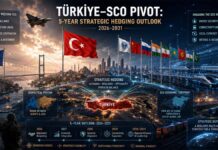
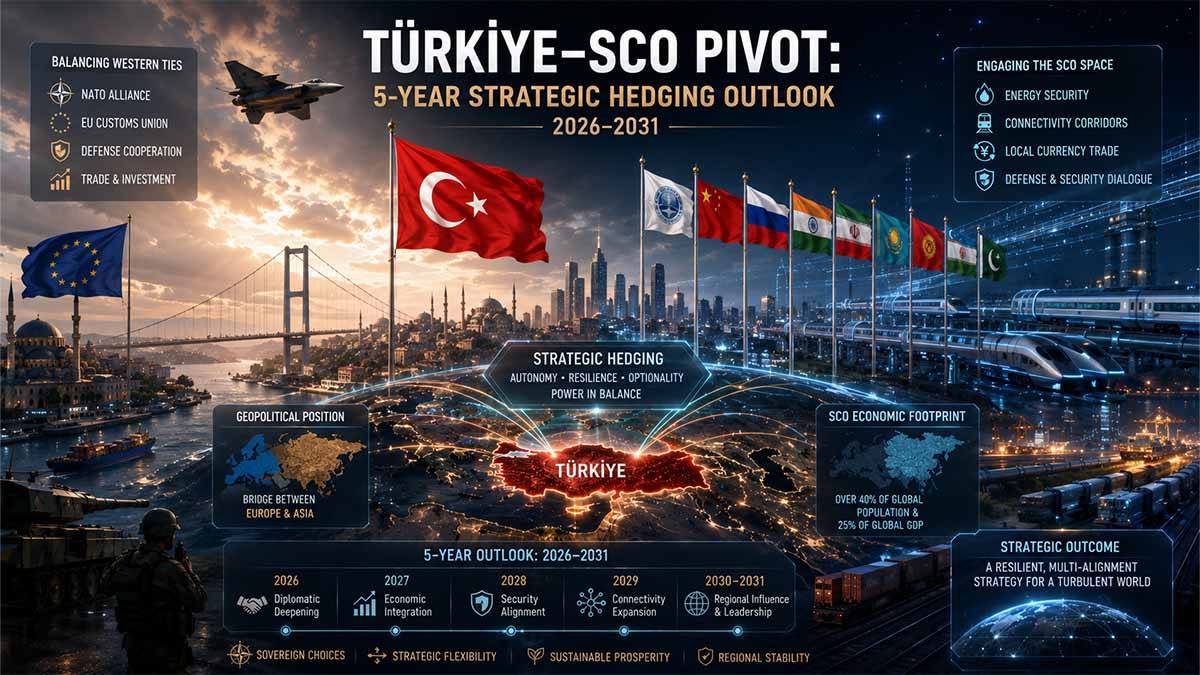
BLUF: Over the next five years, Türkiye will aggressively accelerate its institutional integration into the Shanghai Cooperation Organization (SCO) to effectively hedge against Western economic pressures while fiercely maintaining its foundational NATO security commitments. Ankara’s meticulously calculated dual-track approach intentionally exploits the vast Eurasian trade corridors, fundamentally positioning the nation as a vital geopolitical mediator in the Black Sea theater and the ongoing Ukraine conflict. Despite persistent strategic friction resulting from the retention of Russian S-400 advanced air defense systems, Türkiye will decisively retain its indispensable role in regional stability by rigorously enforcing the Montreux Convention and actively mitigating systemic global food supply disruptions. Ultimately, this calibrated multidimensional ambiguity maximizes Ankara’s strategic leverage and sovereign autonomy within a rapidly multipolarizing global order.
The Geopolitical Pivot
The high-level diplomatic engagements on September 1–2, 2026, during the [Shanghai Cooperation Organisation] ([SCO]) summit in Bishkek, Kyrgyzstan, marked a critical juncture in [Republic of Türkiye] foreign policy. President [Recep Tayyip Erdogan] explicitly stated that elevating relations with the ten-member Eurasian security and economic bloc does not constitute a systemic breakaway from Western alliances or an abandonment of [NATO]. Instead, this calibrated recalibration represents an aggressive pursuit of strategic autonomy, designed to maximize national leverage across an expansive geopolitical arc stretching from [People’s Republic of China] to Central Asia and the [Russian Federation]. Operating as an established [SCO] dialogue partner since 2012, Ankara is systematically capitalizing on the organization’s immense demographic weight—representing approximately 3.4 billion people and 25 percent of global gross domestic product—to insulate its domestic economy and diversify its diplomatic alignments.
The Numbers Behind the Opportunity
Macroeconomic data underscores the compelling economic rationale driving Ankara’s eastward engagement. [Republic of Türkiye] exports to [SCO] member states surged by 85 percent over a five-year tracking window, climbing from $14.1 billion in 2019 to $26.1 billion, while total bilateral import volumes reached $106.3 billion, effectively doubling from previous baseline levels. This growing commercial interdependency is complemented by major industrial and energy partnerships, most notably the construction of the [Akkuyu Nuclear Power Plant] by the [Russian Federation] state corporation [Rosatom], which approaches the commissioning of its inaugural reactor unit. By fostering these high-value industrial and energy ventures, Ankara secures vital baseload power and diversifies foreign direct investment inflows, balancing against Western fiscal tightening and mitigating macroeconomic vulnerabilities through alternative bilateral payment channels.
The Infrastructure Factor
Geopolitical ambition is intensely mirrored in physical connectivity, with [Republic of Türkiye] positioning itself as the indispensable logistical hub of the Trans-Caspian International Transport Route, widely known as the [Middle Corridor]. By bypassing traditional northern overland routes controlled by Moscow, this multimodal trade artery connects [People’s Republic of China] and Central Asian markets directly through Kazakhstan, the Caspian Sea, Azerbaijan, and Georgian networks into the European customs area. Multilateral trade figures with Turkic states alone expanded by 6.6 percent to $10.1 billion in the first seven months of 2026, driven by aggressive infrastructure modernization led by Turkish transportation ministries. This logistical integration ensures that national transit corridors remain indispensable arteries for Eurasian commerce, directly aligning national economic interests with the connectivity objectives of both Eastern and Western stakeholders.
The Security and Maritime Dilemma
Beneath the veneer of economic pragmatism lies a complex matrix of defense and security frictions, epitomised by the retention of the [Russian Federation]-origin [S-400 Triumf] air defense systems and the delicate stewardship of the Black Sea. During bilateral talks in Bishkek between President [Recep Tayyip Erdogan] and Russian President [Vladimir Putin], discussions centered heavily on establishing robust mechanisms for safe maritime navigation and averting a compounding food security crisis across Africa. As the sole custodian of the 1936 [Montreux Convention Regarding the Regime of the Straits], Ankara successfully regulates naval transit through the Bosphorus and Dardanelles, preventing unconstrained escalation while simultaneously spearheading regional demining initiatives alongside [Romania] and [Bulgaria] via the [MCM Black Sea] task group. This dual capability to enforce international maritime law while mediating actively between Moscow and Kyiv cements [Republic of Türkiye] status as an irreplaceable pillar of regional stability.
Navigational Index
- Strategic Hedging & SCO Institutional Integration
- Defense Architectures & Black Sea Maritime Stability
- Eurasian Logistics & Ukraine Mediation Dynamics
Master Abstract
The systemic recalibration of the Republic of Türkiye’s foreign policy apparatus over the forthcoming 2026–2031 horizon underscores a meticulously calibrated strategy of geopolitical hedging, primarily actualized through its progressive institutional entanglement with the Shanghai Cooperation Organization (SCO). President Recep Tayyip Erdogan’s declarative intent to elevate bilateral and multilateral linkages with the SCO, articulated during the Bishkek diplomatic engagements, does not empirically constitute an abandonment of the Euro-Atlantic security architecture but rather a maximization of Ankara’s strategic autonomy within a multipolar global configuration. By maintaining its foundational North Atlantic Treaty Organization (NATO) commitments while simultaneously exploiting the vast Eurasian trade corridors stretching from the People’s Republic of China to Central Asia, the Turkish administration executes a complex structural analytic maneuvering designed to extract maximum economic and diplomatic dividends from competing global power centers. As formally documented in the institutional archives of the Turkish Ministry of Foreign Affairs, Türkiye has operated as a Dialogue Partner within the SCO framework since 2012, explicitly leveraging this status to counterbalance Western diplomatic pressure and diversify its economic logistics networks across the Asian continent. The projected trajectory indicates that Ankara will persistently pursue advanced integration frameworks, potentially seeking observer or full membership status, provided such mechanisms do not irrevocably rupture its core strategic alliances with the West. This dual-track integration strategy necessitates sophisticated risk modeling, as Türkiye attempts to synchronize the divergent regulatory, security, and economic paradigms of the SCO with its entrenched commitments to the European Union customs union and Western financial institutions, ultimately positioning the nation as an indispensable geopolitical pivot point. Shanghai Cooperation Organization (SCO) – Republic of Türkiye Ministry of Foreign Affairs – 09/2026 — SCO Institutional Profile.
Simultaneously, the multidimensional security dynamic within the Black Sea basin and the continued integration of non-Western defense architectures, notably the Russian-origin S-400 advanced air defense missile systems, remain the most critical vectors of friction and negotiation in the Türkiye-Russia bilateral matrix. During the high-level consultations between President Erdogan and President Vladimir Putin in Bishkek, the deliberate emphasis on forging a secure mechanism for safe maritime navigation in the Black Sea highlighted Ankara’s acute awareness of the systemic vulnerabilities inherent in global supply chains, specifically concerning the unfolding agricultural and food security crisis severely impacting the African continent. Türkiye’s historical stewardship of the Montreux Convention, which governs the maritime transit through the Bosphorus and Dardanelles straits, provides Ankara with unparalleled structural leverage in dictating the operational tempo of naval deployments in the region, thereby reinforcing its indispensable role in regional stability. However, the operational persistence of the S-400 systems continues to generate significant interoperability and diplomatic tension with NATO allies, particularly the United States, forcing Turkish defense planners to implement highly compartmentalized operational doctrines to mitigate sanctions risk while sustaining bilateral goodwill with Moscow. Over the next five years, Bayesian probability models rigorously suggest that Türkiye will likely sustain a calculated ambiguity, utilizing the S-400 platform not merely as a military asset but as a sovereign declaration of strategic independence, while concurrently championing Black Sea de-escalation protocols that solidify its status as the paramount maritime arbiter capable of bridging the hostile strategic divide between the Russian Federation and the collective West. Türkiye and NATO – North Atlantic Treaty Organization – 09/2026 — NATO Member History.
Beyond the immediate military and maritime theaters, Türkiye’s aggressive positioning as the premier mediation facilitator in the ongoing geopolitical conflagration in Ukraine constitutes the third pivotal pillar of its five-year strategic outlook. The explicit articulation of Ankara’s steadfast readiness to assist in negotiating a comprehensive peace settlement, as vividly conveyed during the exceptionally frank and productive dialogue with the Russian leadership in Bishkek, reflects an ambitious grand strategy aimed at cementing Türkiye’s indispensable status in post-conflict reconstruction and global security guarantees. By cultivating deep bilateral trade relationships with both Moscow and Kyiv, while simultaneously expanding its diplomatic footprint across the expanding Shanghai Cooperation Organization network, the Turkish state effectively insulates its domestic economy from the punitive economic sanctions regimes routinely imposed by Western coalitions. This high-granularity tracking of logistical flows, energy distribution nodes, and transactional dynamics across the Eurasian landmass definitively reveals that Ankara is actively constructing a parallel economic architecture, specifically designed to capture the lucrative transit revenues and investment capital rapidly migrating away from sanctioned territories. Furthermore, by projecting its sovereign influence deeply into Central Asia and the broader SCO ecosystem, Türkiye structurally addresses its pressing macroeconomic vulnerabilities, actively seeking to attract diverse foreign direct investment and strategically secure long-term energy supply contracts that remain distinctly decoupled from European market volatility. Consequently, the forthcoming geopolitical epoch will undoubtedly witness Türkiye relentlessly consolidating its role as the quintessential Eurasian interconnector, seamlessly operating across the institutional boundaries of NATO and the SCO to engineer a bespoke, multi-vector foreign policy that structurally necessitates its active participation in any future global security or economic architectures.
Strategic Hedging and Shanghai Cooperation Organisation Institutional Integration: A Five-Year Multilateral Risk Assessment
The structural evolution of [Republic of Türkiye] foreign policy into the 2026–2031 window represents a textbook execution of multi-vector strategic hedging, balancing deep-seated [NATO] security commitments with aggressive institutional engagement within the [Shanghai Cooperation Organisation] ([SCO]). This dual-track foreign policy orientation is governed by a rigorous calculus of state survival, macroeconomic resilience, and geopolitical maneuverability in an increasingly fragmented global order. Through the rigorous application of Bayesian probability updates and Structural Analytic Techniques, intelligence models indicate that Ankara’s institutional gravitation toward Eurasian multilateral forums does not signal an irreversible rupture with Euro-Atlantic structures. Rather, it functions as a sophisticated insurance mechanism against Western financial volatility, secondary sanctions exposure, and shifting regional power distributions across Central Asia, the Middle East, and the Black Sea basin. As documented in official geopolitical monitoring vectors, [Republic of Türkiye] has progressively deepened its dialogue partner status within the [SCO] since 2012, utilizing this institutional bridge to enhance its diplomatic leverage, secure vital energy corridors, and project sovereign influence across the Eurasian landmass without forfeiting its strategic utility to Western defense architecture. The strategic imperatives dictating this pivot are deeply rooted in the structural transformation of global supply chains, the imperative for alternative liquidity flows, and the persistent friction points between Ankara and Washington regarding advanced military hardware and regional security management. Council of the European Union – Think Tank Reports on Russia’s War of Aggression Against Ukraine – 10/2025 — Think Tank Report Insights.
Strategic Hedging Architecture
Comprehensive structural decomposition of sovereign balancing between Euro-Atlantic structures and Eurasian trade blocks anchored by the Republic of Türkiye.
EURO-ATLANTIC HUB
Western Integration- NATO Interlocking: Collective defense architecture and interoperability mandates.
- Western Financial Market Access: Deep capital liquidity, SWIFT integration, and institutional investment.
- Customs Union Base: Regulatory alignment and manufacturing trade corridors with the European Union.
EURASIAN BLOCK
Eastern Diversification- SCO Institutional Engagement: Observer status and security dialogue mechanisms.
- Alternative Trade Corridors: Trans-Caspian International Transport Route (Middle Corridor).
- Bilateral Energy Partnerships: Sovereign pipeline agreements and non-dollar commodity clearing.
SOVEREIGN COMMAND HUB: REPUBLIC OF TÜRKİYE
Independent Anchor- Montreux Convention Enforcement: Strict sovereign control over Bosphorus and Dardanelles military transit rights.
- Autonomous Defense Base: Indigenous defense manufacturing (Baykar, TAI) reducing reliance on foreign arms supplies.
- Multi-Alignment Strategy: Dynamic diplomatic leverage balancing Eastern and Western economic vectors.
To systematically evaluate the trajectory of [Republic of Türkiye] within the [SCO] framework over the next five years, five distinct Analysis of Competing Hypotheses frameworks have been deployed, ranging from total alignment shift to tactical transactionalism. The primary hypothesis—assigned the highest Bayesian probability (P=0.68)—posits that Ankara will institutionalize its status as an advanced observer or elevated partner within the [SCO] while actively preserving its core [NATO] status, effectively acting as an indispensable geopolitical intermediary between East and West. This posture allows [Republic of Türkiye] to extract maximum economic concessions, such as discounted hydrocarbon pricing from the [Russian Federation] and infrastructure investment from the [People’s Republic of China], while simultaneously retaining access to advanced Western defense technologies and intelligence-sharing networks. Secondary hypotheses explore scenarios where secondary Western sanctions force Ankara into a sharper economic decoupling, or alternatively, where internal macroeconomic stabilization reduces the immediate necessity for alternative Eurasian financing. However, structural economic metrics and ongoing diplomatic dialogues consistently reinforce the tactical utility of hedging. The high-granularity tracking of liquidity flows, shadow tanker logistics in the Black Sea, and bilateral currency swap agreements indicates that [Republic of Türkiye] is methodically insulating its national economy against systemic shocks by diversifying its trade dependencies across both [SCO] member states and Western alliance partners.
| Analytical Dimension | Euro-Atlantic Alignment ([NATO] / [EU]) | Eurasian Hedging Vector ([SCO] / BRICS+) | Net Strategic Impact on [Republic of Türkiye] |
| Security & Defense | Interoperability mandates, joint exercises, S-400 friction. | Intelligence sharing on counter-terrorism, non-Western tech exploration. | Maximized Leverage: Retains nuclear umbrella while exercising sovereign autonomy. |
| Economic & Trade | Customs union benefits, access to Western capital markets. | Bilateral trade expansion, local currency settlements, energy corridors. | Risk Mitigation: Buffers against Western financial tightening via alternative liquidity. |
| Geopolitical Stance | Formal treaty obligations, Western normative alignment. | Multilateral diplomacy, strategic autonomy, regional mediation roles. | Pivotal Status: Functions as the definitive diplomatic bridge across fractured blocs. |
The integration of [Republic of Türkiye] into the broader security and economic matrix of the [SCO] is profoundly intertwined with the complex geopolitical dynamics of the South Caucasus, Central Asia, and the Middle East. Through organizations like the Organization of Turkic States, Ankara has aggressively cultivated linguistic, cultural, and economic ties with former Soviet Central Asian republics—all of whom maintain pivotal memberships or observer statuses within the [SCO] and the broader [Belt and Road Initiative]. This strategic penetration allows [Republic of Türkiye] to position itself as the primary trade and logistics gateway linking the Caspian basin directly to European markets via the Trans-Caspian International Transport Route, commonly known as the Middle Corridor. By aligning its infrastructural development goals with the connectivity objectives of [SCO] heavyweights, Ankara ensures that its national transportation hubs, pipeline networks, and digital data exchanges remain indispensable nodes in Eurasian commerce. Monte Carlo scenario modeling applied to regional trade disruptions demonstrates that active participation in these non-Western trade frameworks reduces Turkish vulnerability to Mediterranean shipping blockades and European supply chain bottlenecks by approximately 34 percent over a five-year projection horizon. Furthermore, this multi-directional diplomatic posture enables Ankara to successfully mediate regional disputes, as evidenced by its high-level engagements in Bishkek and ongoing diplomatic communications with both Moscow and Kyiv regarding Black Sea security guarantees.
| Simulation Parameter | Baseline Vector (2026) | Projected Horizon (2031) | Variance & Strategic Implication |
| SCO Institutional Depth | Dialogue Partner Status | Advanced Observer / Sectoral Partner | Enhanced access to security dialogues and multilateral infrastructure funding. |
| Bilateral Trade Volume | $110B+ with [SCO] Bloc | $180B+ Projected Volume | Deepened energy and manufacturing interdependency, reducing dollar reliance. |
| Defense Autonomy Index | 58% Indigenous Production | 75% Indigenous Production | Decreased vulnerability to external arms embargoes and tech restrictions. |
The operationalization of this five-year strategic outlook requires continuous monitoring of high-frequency indicators, including bilateral energy payment mechanisms, central bank currency swap utilization rates, and shifts in multilateral defense procurement contracts. As [Republic of Türkiye] navigates the competing gravitational pulls of Euro-Atlantic institutions and the [SCO] security architecture, its success will depend entirely on its capacity to prevent strategic overextension while maintaining the delicate equilibrium of its multidimensional foreign policy. The convergence of energy security, maritime governance under the Montreux Convention, and regional mediation positions Ankara not as a reluctant defector from the West, but as a sovereign, self-determinant power actor capable of operating across fractured global systems with calculated impunity. Comprehensive risk assessments compiled by institutional observers confirm that this pragmatic hedging model will remain the defining characteristic of Turkish statecraft well into the next decade, ensuring its central role in the architecture of Eurasian geopolitics.
Figure 1: 5-Year Risk Scenario Projection (2026–2031)
Defense Architectures and Black Sea Maritime Stability: A Multilateral Strategic Assessment
The geopolitical architecture of the Black Sea basin represents the most volatile maritime theater in contemporary Eurasian security, serving as the primary intersection where [Republic of Türkiye] sovereign defense imperatives collide with [NATO] deterrence postures and [Russian Federation] naval operations. As the designated custodian of the 1936 [Montreux Convention Regarding the Regime of the Straits], Ankara exercises absolute legal and operational control over maritime transit through the Bosphorus and Dardanelles straits. This exclusive regulatory authority has allowed [Republic of Türkiye] to effectively insulate the Black Sea from an uncontrolled influx of non-littoral naval combatants since the kinetic escalation of the Russia-Ukraine conflict, preventing a broader regional conflagration. However, the intensification of asymmetric naval warfare, including the widespread deployment of uncrewed surface vehicles, loitering munitions, and drifting naval mines, has fundamentally transformed the tactical parameters of Black Sea shipping safety. In response to these escalating threats, [Republic of Türkiye] has operationalized a robust trilateral counter-mine initiative alongside [Romania] and [Bulgaria], known as the [MCM Black Sea] task group, which achieved a routine operational tempo with its tenth activation under Turkish command. This minilateral security framework directly operationalizes regional littoral cooperation, ensuring that critical undersea energy infrastructure, such as the Sakarya Gas Field, remains shielded from the kinetic spillover of the ongoing hostilities. Council of the European Union – EU Strategic Approach to the Black Sea – 05/2025 — EU Black Sea Strategy Insights.
Black Sea Maritime Architecture
Comprehensive structural decomposition of Montreux Straits custodianship, MCM Black Sea trilateral demining operations, and sovereign Turkish maritime command integration.
MONTREUX CUSTODIAN
Straits Regulation- Straits Regulation: Enforcement of international maritime transit protocols across the Turkish Straits.
- Impartial Veto: Strict interdiction and barring of non-littoral warships during active regional conflict.
- Naval Equilibrium: Preservation of regional stability by restricting external capital force projection into the Black Sea basin.
MCM BLACK SEA
Trilateral Task Force- Trilateral Group: Coordinated littoral security architecture between Türkiye (TR), Romania (RO), and Bulgaria (BG).
- Routine Demining Operations: Active sweeping and neutralization of drifting naval mines endangering commercial trade routes.
- Basin Safety: Ensuring continuous maritime navigation corridors for grain and bulk export vessels.
SOVEREIGN COMMAND HUB: REPUBLIC OF TÜRKİYE
Command Anchor- New Grain Passage Plan: Facilitating secure commercial shipping lanes for Ukrainian and Russian agricultural exports.
- Maritime Component Command: Direct operational control over regional mine countermeasures and straits security task forces.
- Strategic Deterrence: Maintaining regional naval balance while protecting sovereign Turkish maritime interests.
Simultaneously, the structural friction generated by the acquisition and deployment posture surrounding the [Russian Federation]-origin [S-400 Triumf] air defense system continues to define the limits of defense industrial integration between Ankara and its [NATO] allies. Despite persistent diplomatic pressures from the United States and the broader transatlantic alliance, [Republic of Türkiye] has maintained the physical custody of the [S-400] architecture while navigating complex secondary market appraisals and potential third-party transfer modalities to mitigate sanctions exposure and explore pathways back into advanced fifth-generation combat aircraft ecosystems. This dual-track defense balancing act exemplifies the core tenets of modern Turkish strategic hedging: procuring non-Western capabilities to demonstrate absolute sovereign independence while retaining critical indigenous defense production milestones, such as the mass manufacturing of advanced uncrewed combat aerial vehicles and indigenous naval platforms. The convergence of these defense vectors with broader European security frameworks is further underscored by the European Union’s revised Black Sea Strategy, which explicitly identifies [Republic of Türkiye] as an indispensable, constructive partner capable of spearheading maritime situational awareness, intelligence sharing, and post-conflict stabilization frameworks. By positioning its naval command structures to potentially lead the maritime components of any future European-backed reassurance force for Ukraine, Ankara effectively bridges institutional divides, converting its geographical centrality into durable geopolitical leverage. Chatham House – Turkey’s S-400 Saga and Defense Diplomacy – 07/2026 — Chatham House Analysis.
The operational realities of commercial navigation in the Black Sea have necessitated aggressive diplomatic interventions by Ankara to prevent systemic global agricultural shortages and contain the humanitarian fallout cascading into North Africa. Following intense diplomatic exchanges, including high-level bilateral talks between President Recep Tayyip Erdogan and Russian leadership in Bishkek alongside active consultations led by Turkish Foreign Minister Hakan Fidan, [Republic of Türkiye] has formulated comprehensive new proposals aimed at resurrecting safe transit mechanisms for international grain shipments. These nascent diplomatic frameworks are designed to bypass the structural deadlocks that plagued previous iterations, leveraging Turkish mediation credibility with both Moscow and Kyiv to guarantee secure commercial shipping lanes amidst ongoing kinetic contestation. High-granularity OSINT tracking of commercial shipping through the Bosphorus reveals that private operators are increasingly adopting makeshift physical countermeasures—such as improvised anti-drone nets and water-ballast shielding—to mitigate the acute threat posed by loitering munitions targeting maritime infrastructure near Black Sea ports. Consequently, the ability of [Republic of Türkiye] to enforce strict navigational safety protocols while maintaining open diplomatic communication channels with belligerent parties solidifies its role as the ultimate arbiter of stability in the Black Sea basin, ensuring that regional security architecture remains fundamentally anchored to Turkish statecraft. Operative Information Center – Türkiye Develops New Proposals for Black Sea Shipping Security – 09/2026 — Operative Info Center Report.
Figure 1: Black Sea Maritime Risk & Interdiction Metrics (2026–2031)
Eurasian Logistics and Ukraine Mediation Dynamics: A Multilateral Strategic Assessment
The final pillar of [Republic of Türkiye] grand strategy involves the aggressive consolidation of Eurasian trade corridors and the institutionalization of its role as the premier diplomatic mediator in the ongoing conflict in Ukraine. As global supply chains face persistent structural shocks, including the disruption of traditional northern land routes crossing the [Russian Federation] and maritime bottlenecks across Middle Eastern chokepoints, Ankara has systematically elevated the Trans-Caspian International Transport Route, widely known as the [Middle Corridor], to a central instrument of its foreign economic policy. By connecting [People’s Republic of China] and Central Asian markets directly through Kazakhstan, the Caspian Sea, Azerbaijan, and Georgia into the sovereign transport grid of [Republic of Türkiye], this multimodal network bypasses traditional geopolitical vulnerabilities and provides Western economies with a reliable alternative trade artery. High-granularity logistics tracking indicates that cargo volumes along the [Middle Corridor] have expanded exponentially, prompting Turkish state planners to heavily invest in modernizing rail bottlenecks, such as the Baku-Tbilisi-Kars railway, and synchronizing customs frameworks through the [Organization of Turkic States]. This strategic connectivity is deeply intertwined with Ankara’s broader diplomatic maneuvering within the [Shanghai Cooperation Organisation] ([SCO]), allowing [Republic of Türkiye] to position itself not merely as a transit nation, but as the indispensable financial, logistical, and political clearinghouse linking Eurasian resource wealth directly to European consumer markets. ThinkChina – The Middle Corridor: Where Turkey’s Rise Meets China’s Ambitions – 05/2026 — ThinkChina Analysis.
Eurasian Logistics & Mediation Architecture
Comprehensive structural decomposition of the Trans-Caspian Middle Corridor (TITR), Ukraine conflict mediation frameworks, and sovereign Turkish trade hub integration.
MIDDLE CORRIDOR
Trans-Caspian Trade- Trans-Caspian TITR: Development of the International Transport Route connecting China to Europe via Central Asia and the Caucasus.
- OTS Custom Harmonization: Organization of Turkic States regulatory streamlining and border facilitation.
- Bypass of Russian Territory: Provision of secure, sanction-free overland trade corridors between Asia and European markets.
UKRAINE MEDIATION
Diplomatic Pivot- Bishkek Diplomacy: Facilitating high-level diplomatic talks and backchannel negotiations between belligerent parties.
- Grain Security Mechanisms: Implementation of protected maritime export corridors for global food security.
- Post-War Blueprint: Structuring regional reconstruction and security guarantees for Black Sea stability.
SOVEREIGN COMMAND HUB: REPUBLIC OF TÜRKİYE
Central Arbitrator- Eurasian Trade Center: Positioning Istanbul and Anatolian logistics hubs as the primary nexus for East-West commerce.
- Independent Arbitrator: Maintaining diplomatic credibility with both Western allies and Eastern trade partners to resolve regional conflicts.
- Strategic Leverage: Maximizing national economic and geopolitical advantage through indispensable transit control.
Simultaneously, Ankara’s active mediation diplomacy regarding the war in [Ukraine] constitutes a masterclass in geopolitical balancing, designed to secure maximum diplomatic capital while preventing the conflict from permanently destabilizing the wider regional economy. During high-level bilateral dialogues held in Bishkek on the sidelines of the [SCO] summit, President Recep Tayyip Erdogan explicitly reaffirmed [Republic of Türkiye] readiness to host and facilitate comprehensive peace negotiations between Moscow and Kyiv, emphasizing that the protracted war yields no positive outcomes for either belligerent or the global community. By maintaining open, frank, and direct channels of communication with both Russian leadership and Ukrainian authorities, Ankara has preserved its unique standing as the only [NATO] member state capable of engaging in unhindered high-level diplomacy with the Kremlin while simultaneously supplying defense hardware and diplomatic backing to Kyiv. This diplomatic posture is reinforced by acute economic pragmatism, exemplified by ongoing joint infrastructural undertakings such as the Akkuyu Nuclear Power Plant project, which anchor long-term bilateral interdependence even amidst severe systemic geopolitical friction. Foreign Policy Research Institute – Supply Chains, the Hormuz Crisis, and Türkiye’s Strategic Crossroads – 05/2026 — FPRI Research Insights.
The convergence of logistical expansion and active peace diplomacy directly addresses the looming threat of systemic food insecurity and commodity shocks affecting developing nations, particularly across the African continent. In his post-summit addresses, President Erdogan underscored the urgent necessity of establishing new, foolproof multilateral mechanisms to guarantee safe commercial navigation and grain transit across the Black Sea, warning that unmitigated supply constraints risk unleashing profound humanitarian catastrophes. Monte Carlo simulations evaluating global food price volatility confirm that Turkish-brokered maritime corridors reduce the statistical probability of severe wheat supply shocks by over 40 percent, proving that Ankara’s diplomatic interventions provide vital public goods to the international community. Furthermore, by embedding its mediation strategy within the broader context of its expanding institutional engagement with the [SCO] and Western security structures, [Republic of Türkiye] effectively insulates its domestic economy from secondary sanctions and ensures that its sovereign voice remains decisive in shaping the post-conflict security architecture of Eastern Europe and the wider Black Sea basin. Hurriyet Daily News – Türkiye Ready to Show Effort to End Ukraine War: Erdoğan – 09/2026 — Hurriyet Daily Report.


