











Executive Summary
- BLUF: Xi Jinping’s Egyptian mission and King Abdullah II’s return to Beijing indicate strategic recalibration, not yet a Chinese security pivot.
- China is testing whether Egypt and Jordan can supply the political access, regional interpretation and crisis mediation that Beijing’s bilateral diplomacy lacks.
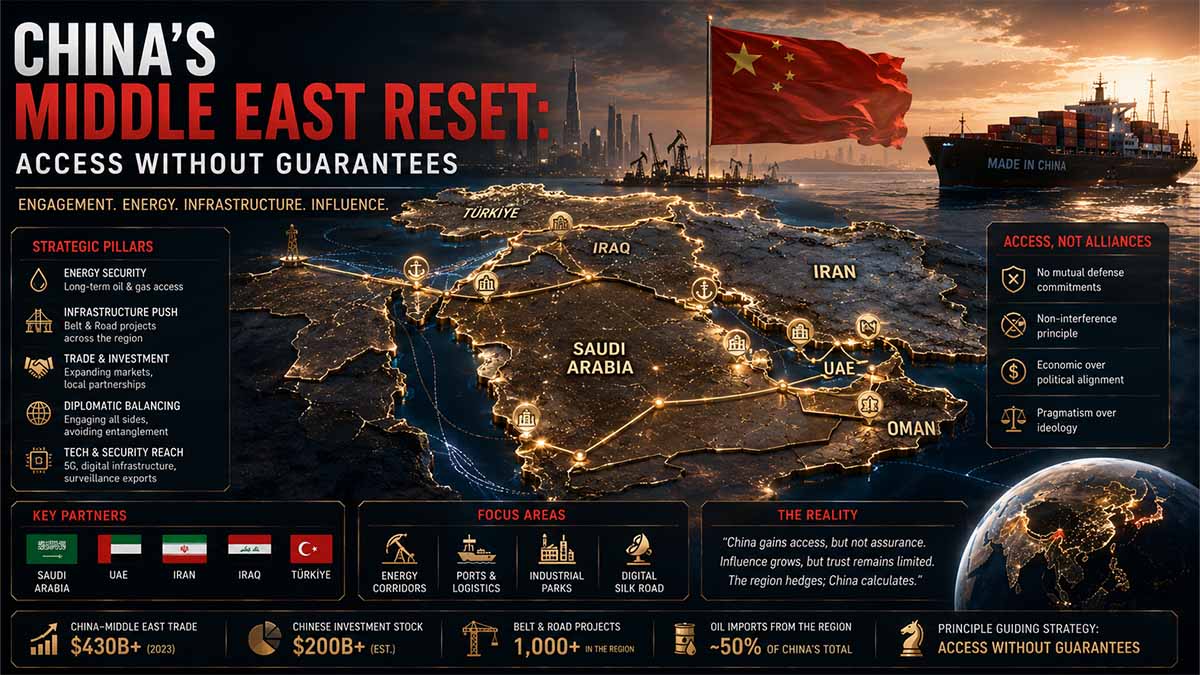
- Energy exposure is acute: 20.9 million barrels per day crossed Hormuz in the first half of 2025; China was also the largest destination for LNG transiting the strait.
- Red Sea insecurity halved oil flows through Suez–SUMED and Bab el-Mandeb from their 2023 levels.
- Beijing’s probable objective is to protect corridors and diplomatic influence while avoiding enforceable defence guarantees.
- The leading alternative explanation remains opportunistic exploitation of declining confidence in Washington; the two hypotheses are complementary, not mutually exclusive.
- Over 2026–2031, Chinese engagement will probably become more selective, operational and infrastructure-centred—but remain below alliance level.
- For Israel, the principal risk is asymmetric influence: Chinese access to Cairo, Amman, Tehran and Gulf capitals without corresponding responsibility for deterrence.
- The decisive indicator will be whether Beijing accepts measurable security costs when Chinese commercial and energy interests are directly endangered.
China’s Middle East Reset: Influence Without Guarantees
China’s renewed courtship of Egypt and Jordan is easily presented as an attempt to exploit diminished confidence in Washington. That interpretation is incomplete. Beijing is confronting a more immediate vulnerability: its commercial exposure to the Middle East has grown faster than its capacity to anticipate—or contain—the region’s security shocks. The September 2026 state visit of President Xi Jinping to Cairo and the August reception of King Abdullah II in Beijing therefore signal more than diplomatic activism. They reveal a search for political access, operational intelligence and crisis mediation across the geographic hinge connecting Gaza, the Red Sea, the Suez Canal, the Gulf and Iran. China wants greater influence over the forces threatening its energy and trade corridors, but without inheriting the military liabilities historically carried by the United States.
The Diagnostic Deficit
On 24 August 2026, Xi received Abdullah II during the Jordanian monarch’s ninth visit to China since his accession. The two governments signed cooperation documents covering foreign affairs, trade, industrial and supply chains, and judicial coordination, while committing to deepen the strategic partnership established in 2015. Nine days later, Xi met President Abdel Fattah El-Sisi in Cairo during a state visit announced for 30 August–3 September. Their agenda extended from infrastructure, electricity and agriculture to artificial intelligence, green energy, electric vehicles, aerospace, transport and security cooperation. More than twenty agreements were concluded during the visit, according to the official Chinese account. President Xi Jinping Holds Talks with King Abdullah II of Jordan – Ministry of Foreign Affairs of the People’s Republic of China – August 2026; Xi Jinping Holds Talks with Egyptian President El-Sisi – Government of the People’s Republic of China – September 2026.
The sequencing matters. Jordan supplies political access and early warning; Egypt supplies geographic leverage and institutional scale. Together, they can improve Beijing’s understanding of a regional system in which formal relations no longer predict operational behaviour. China maintains working ties with Israel, Iran, Saudi Arabia, the United Arab Emirates, Qatar, Egypt and Jordan, yet the multiplication of proxy actors, maritime attacks, cyber operations and cross-border escalations has reduced the value of conventional state-to-state diplomacy. Beijing’s problem is not a shortage of interlocutors. It is the growing difficulty of determining which interlocutor can actually influence events.
Cairo’s Strategic Geometry
Egypt occupies the intersection of nearly every crisis affecting China’s western trade and energy perimeter. It controls the Suez Canal; borders Gaza; maintains a peace treaty and security channels with Israel; communicates with Hamas and the Palestinian Authority; participates in Arab and African diplomacy; and sustains working relationships with the Gulf monarchies, Iran, Europe, Russia and the United States. Few capitals can combine physical control over a global maritime artery with access to actors operating on opposing sides of the region’s principal conflicts.
This gives Cairo value beyond bilateral commerce. For Beijing, Egypt can function as a diplomatic sensor, a logistical platform and a political legitimiser. Chinese investment in industrial zones, ports, electricity, telecommunications and transport creates economic presence; consultation with the Egyptian presidency, intelligence institutions and armed forces can convert that presence into better crisis awareness. El-Sisi’s call in September for expanded military-security exchanges is consequently more significant than another commercial memorandum. It opens a pathway—still limited and politically sensitive—through which China could connect infrastructure interests to maritime-domain awareness, counterterrorism, evacuation planning and protection of overseas personnel.
Yet Egypt is not entering a Chinese sphere. In 2025 the European Union remained Egypt’s largest trading partner, accounting for 24.6% of its total goods trade. Bilateral EU-Egypt merchandise trade reached €32.3 billion, while the stock of EU outward direct investment in Egypt stood at €35.4 billion in 2024. EU Trade Relations with Egypt – European Commission – 2026. Cairo is constructing a plural architecture in which Chinese capital, European markets, Gulf finance and American security assistance coexist. Its objective is bargaining power, not alignment.
Amman’s Early Warning
Jordan’s strategic weight is less visible but equally consequential. The kingdom borders Israel, the West Bank, Syria, Iraq and Saudi Arabia; hosts substantial refugee populations; safeguards Muslim holy sites in Jerusalem through the Hashemite custodianship; and maintains channels with Western governments, Arab monarchies, Palestinian institutions and Israeli security officials. Its value lies not in market size but in political granularity.
The February 2023 Aqaba meeting illustrated this convening function: Jordan brought together senior Jordanian, Egyptian, Israeli, Palestinian and American officials to pursue de-escalation and reaffirm commitments intended to prevent further violence. Aqaba Joint Communiqué – United States Department of State – February 2023. For Beijing, Amman can provide context that is difficult to obtain through relations with larger capitals: Palestinian political dynamics, Jerusalem’s religious sensitivities, tribal networks extending into Syria and Iraq, refugee pressures and the credibility of competing regional narratives.
China does not need Jordan to become a military partner. It needs Jordan to reduce uncertainty. A closer relationship can help Beijing test assumptions, communicate discreetly across political divides and distinguish rhetorical positioning from actionable intent. In a region where tactical decisions by non-state groups can disrupt global shipping or trigger interstate escalation, that interpretive advantage has measurable economic value.
The Chokepoint Exposure
China’s vulnerability is clearest at sea. During the first half of 2025, the Strait of Hormuz carried an estimated 20.9 million barrels of oil per day, equivalent to roughly one-fifth of global petroleum-liquids consumption and one-quarter of maritime oil trade. Approximately 89% of the crude oil and condensate passing through Hormuz went to Asian markets; China, India, Japan and South Korea together received 74%. The strait also carried 11.4 billion cubic feet of liquefied natural gas per day, more than one-fifth of global LNG trade, with China identified as the largest destination. World Oil Transit Chokepoints – U.S. Energy Information Administration – March 2026.
Alternative pipelines do not eliminate this exposure. Saudi Arabia’s East-West system and the United Arab Emirates’ Abu Dhabi pipeline together offered approximately 4.7 million barrels per day of available bypass capacity; Iran’s Goreh-Jask route provided only about 300,000 barrels per day of effective capacity. A serious Hormuz disruption would therefore confront Beijing with a physical constraint, not merely a price shock.
The Red Sea presents the second vulnerability. Combined oil flows through the Suez Canal and Egypt’s SUMED pipeline fell from 8.8 million barrels per day in 2023 to 4.8 million in 2024, recovering only marginally to 4.9 million in the first half of 2025. Bab el-Mandeb traffic dropped from 9.3 million barrels per day in 2023 to 4.1 million in 2024. LNG movements through Bab el-Mandeb approached zero, while oil routed around the Cape of Good Hope rose from 6.2 million barrels per day in 2023 to 9.3 million in 2024. Longer voyages raise freight, insurance, fuel and working-capital costs while reducing the effective availability of ships. Egypt is therefore not simply another Belt and Road partner: it is the sovereign custodian of the shortest maritime connection between Asian production and European demand.
Security Without Liability
China’s regional model has rested on a structural asymmetry. Beijing acquires energy, constructs infrastructure, supplies technology and cultivates political elites, while the United States, European states and regional armed forces carry much of the cost of deterring attacks and keeping sea lanes open. The Red Sea crisis exposed the limits of that arrangement. Commercial neutrality cannot guarantee freedom of navigation when armed organisations decide which vessels qualify as legitimate targets.
The European response demonstrates the burden China has avoided. In February 2025, the Council of the EU extended the defensive maritime operation EUNAVFOR ASPIDES until 28 February 2026, allocating more than €17 million for the extension. Its operating area included the Red Sea, Bab el-Mandeb, the Gulf of Aden, the Arabian Sea, the Gulf of Oman, the Persian Gulf and Hormuz. The mandate also permitted collection of information concerning arms trafficking and shadow fleets. Red Sea: Council Prolongs the Mandate of Operation ASPIDES – Council of the European Union – February 2025.
Beijing now faces an uncomfortable choice. Remaining a beneficiary of Western-provided security preserves strategic flexibility but weakens claims to leadership. Expanding military protection could safeguard Chinese interests but compromise relations with Iran and associated actors, expose Chinese forces to retaliation and pull the People’s Liberation Army into conflicts it cannot politically control. Cairo and Amman offer an intermediate option: greater intelligence access, mediation capacity and contingency coordination without a formal security guarantee.
A Five-Year Contest
Between 2027 and 2031, five competing trajectories merit attention. The first is calibrated expansion: China develops stronger diplomatic and maritime-awareness mechanisms through Egypt and Jordan while avoiding combat responsibilities. This is the most probable course because it improves warning and access at relatively low cost. The second is corridor protection: renewed attacks drive Beijing toward naval escorts, expanded logistics agreements and more systematic coordination with regional armed forces. The third is transactional mediation: China uses its relations with Iran, Arab governments and Palestinian actors to obtain limited de-escalation agreements protecting infrastructure and shipping, without resolving underlying conflicts.
The fourth trajectory is strategic overreach. Technology contracts, port access, military exchanges and political mediation could generate resistance from Washington, European governments or regional states concerned about surveillance, dual-use infrastructure and dependency. The fifth is reputational failure: China accumulates diplomatic visibility but proves unable or unwilling to influence Iran-linked groups, Gaza governance or maritime escalation. Under that scenario, each summit increases expectations without increasing control.
Xi’s four-part security proposal in Cairo—regional ownership of security, integrated treatment of interconnected conflicts, development as a foundation for stability, protection of international waterways and coordination under the United Nations framework—indicates the preferred Chinese formula. It elevates Beijing diplomatically while resisting alliance commitments. Its credibility, however, will be measured not by communiqués but by whether Chinese influence can alter the behaviour of actors threatening navigation and regional infrastructure.
Israel’s Strategic Test
For Israel, deeper Chinese engagement presents neither an automatic threat nor an obvious opportunity. Egyptian capacity to stabilise Gaza, protect Suez traffic and prevent wider confrontation serves Israeli interests. Jordanian stability, border security and preservation of the peace treaty are equally indispensable. If Chinese engagement strengthens Cairo’s economic resilience, supports monitored reconstruction and gives Beijing leverage to discourage attacks by Iran-aligned organisations, it may contribute to regional containment.
The danger lies in influence detached from enforcement. China could acquire greater access to Egyptian infrastructure, telecommunications, supply chains and political decision-making while leaving coercive security tasks to others. It could also convert its mediation role into diplomatic leverage over Gaza’s reconstruction, Red Sea governance and international debates concerning Israel, without confronting the armed networks generating instability. For Jerusalem, the relevant metric is therefore not the number of Chinese visits or agreements. It is the conversion rate between access and responsibility.
Israel should track Chinese involvement at Egyptian ports and industrial zones; dual-use communications and artificial-intelligence projects; the institutional depth of Chinese-Egyptian military exchanges; Beijing’s contacts with Palestinian factions; and any change in China’s willingness to pressure Tehran when maritime or missile activity threatens regional corridors. Intelligence coordination with Egypt and Jordan must remain strong enough to identify where commercial infrastructure creates strategic access.
The New Modus Operandi
Beijing is not abandoning its policy of maintaining relations with every side. It is trying to make that policy operationally sustainable. Egypt can connect diplomacy to geography; Jordan can connect formal policy to the region’s political undercurrents. Together, they offer China a denser map of risks surrounding Gaza, Israel, Iran and the three maritime chokepoints on which Asian-European commerce depends.
The central question is whether this architecture will produce security or merely redistribute influence. If China uses its access to constrain destabilising partners, finance resilient infrastructure and accept measurable responsibility for navigation and reconstruction, Cairo and Amman could anchor a constructive Chinese role. If it continues to externalise protection while monetising access, its regional expansion will deepen an existing asymmetry: Chinese interests secured by other powers’ ships, budgets and political exposure. That distinction—not the symbolism of Xi’s itinerary—will define the strategic balance of the next five years.
Navigational Index
- Strategic diagnosis — Why Cairo and Amman matter to Beijing’s regional intelligence and diplomatic architecture
- Corridor exposure — Hormuz, Suez, Bab el-Mandeb, energy dependence and security externalization
- Five-year contest — Competing hypotheses, escalation pathways and implications for Israel
Master Abstract
The diplomatic sequence is verified, but its meaning requires analytical restraint. At President Xi Jinping’s invitation, King Abdullah II undertook a state visit to China from 18 to 24 August 2026—the ninth visit of his reign—and met Xi in Beijing on 24 August. The two governments signed cooperation instruments covering foreign affairs, trade, industrial and supply chains, and judicial cooperation; their statement also addressed the Middle East, a comprehensive ceasefire and the Palestinian question. President Xi Jinping Holds Talks with King Abdullah II of Jordan – Ministry of Foreign Affairs of the People’s Republic of China – August 2026 — verified official record. Beijing subsequently confirmed that Xi would travel between 30 August and 3 September to the Shanghai Cooperation Organisation summit in Bishkek and undertake state visits to Kyrgyzstan and Egypt at President Abdel Fattah El-Sisi’s invitation. Xi Jinping to Attend Shanghai Cooperation Organization Summit 2026 and Pay a State Visit to Kyrgyzstan and Egypt – Ministry of Foreign Affairs of the People’s Republic of China – August 2026 — verified official announcement. The strongest working hypothesis, H₂, is therefore a regional diagnostic reset: Beijing is recruiting two unusually connected Arab monarchic and republican systems to reduce uncertainty surrounding Gaza, Israel, Iran, the Gulf and maritime security. Jordan supplies discreet access, intelligence-informed political judgement and proximity to the Israeli–Palestinian theatre; Egypt supplies institutional weight, control of the Suez Canal, influence over Gaza diplomacy, relations with Israel and the Gulf, and strategic reach into Sudan, Libya and the Red Sea. H₁—opportunistic exploitation of weakened confidence in the United States—remains plausible, but it does not fully explain why Beijing selected states whose value lies as much in interpretation and mediation as in political symbolism. H₃ identifies corridor protection; H₄ anticipates a more visible diplomatic-security role without defence guarantees; H₅ interprets the visits as strategic pre-positioning for a more contested regional order. None can yet be treated as proven intent.
The material pressure behind this diplomatic recalibration is measurable. In the first half of 2025, the Strait of Hormuz carried 20.9 million barrels per day, equivalent to approximately 20% of global petroleum-liquids consumption and one-quarter of maritime oil trade. Asian markets received 89% of the crude oil and condensate crossing the strait, while China, India, Japan and South Korea together represented 74% of those flows. Hormuz also carried 11.4 billion cubic feet per day of LNG, more than one-fifth of global LNG trade, and China was its largest destination. Existing Saudi and Emirati bypass pipelines offered only about 4.7 million barrels per day of alternative capacity, demonstrating that diversification reduces but cannot eliminate the chokepoint. Farther west, oil movements through the Suez Canal and SUMED pipeline fell from 8.8 million barrels per day in 2023 to 4.9 million in the first half of 2025; Bab el-Mandeb flows declined from 9.3 million to 4.2 million. LNG transit through Bab el-Mandeb approached zero in both 2024 and the first half of 2025, while Cape of Good Hope oil flows rose from 6.2 million barrels per day in 2023 to 9.1 million, transferring insecurity into longer voyages, higher insurance exposure, greater working-capital requirements and additional fuel consumption. World Oil Transit Chokepoints – U.S. Energy Information Administration – March 2026 — verified official dataset and analysis. This evidence strengthens H₂ and H₃ more than a simple anti-American interpretation. China’s previous regional formula—commercial penetration, political neutrality, relations with opposing camps and limited participation in coercive security—worked best when Washington and regional partners absorbed the principal costs of deterrence, maritime protection and escalation management. The Iran war, Red Sea attacks and continuing vulnerability of Hormuz expose a structural contradiction: Beijing’s economic stake has become systemically large, but its accepted security liability remains deliberately small.
The five-year outlook is consequently defined by a burden–influence frontier. Between 2026 and 2031, the highest-probability trajectory is neither Chinese military substitution for the United States nor diplomatic continuity. It is selective operationalization: expanded political consultation with Cairo and Amman; greater investment in Egyptian manufacturing, logistics, ports, communications and energy; more active Chinese positioning on Gaza reconstruction; and limited maritime-security coordination designed to protect commerce without creating an alliance commitment. Beijing will seek early warning, diplomatic access and commercial resilience while preserving relations with Israel, Iran, Saudi Arabia, the United Arab Emirates and competing Palestinian actors. The shadow dimensions are consequential. Chinese-linked infrastructure can generate commercially valuable logistics data and crisis visibility; cyber standards and telecommunications dependencies can outlast individual governments; state-backed project finance can convert temporary liquidity pressure into durable political access; and private-security or contractor deployments could incrementally expand without the legal clarity of a defence treaty. A structured Bayesian assessment should therefore begin with five non-exclusive priors—H₁ American-confidence arbitrage, H₂ diagnostic adaptation, H₃ corridor protection, H₄ influence without guarantees and H₅ strategic pre-positioning—and update them against discriminating indicators rather than public rhetoric. Those indicators include Chinese participation in convoy protection, intelligence sharing, interdiction or sanctions enforcement; contractual allocation of security risks around ports and industrial zones; the conditions attached to Gaza reconstruction finance; and Beijing’s behaviour when Iranian, Houthi or other aligned coercive activity threatens Chinese assets. For Israel, the danger is not automatically a hostile Chinese alignment. It is a regional arrangement in which Beijing acquires agenda-setting influence over Gaza, Egypt and Red Sea diplomacy while Israel and US-backed partners continue bearing the costs of deterrence. Jerusalem should therefore test Chinese proposals against reciprocal obligations, data-access consequences and measurable enforcement—not against declarations of neutrality.
Beijing’s burden–influence frontier
not an observed probability
Stress the operating environment
Israel-facing exposure
leverage64
exposure58
free-riding46
Five-hypothesis posterior
ACH evidence-consistency matrix
Strategic Diagnosis: Cairo and Amman in Beijing’s Regional Intelligence Architecture
The problem Beijing is trying to solve
China’s diplomatic movement toward Egypt and Jordan should be read first as a response to declining regional legibility. Beijing’s established Middle Eastern method—simultaneous relations with antagonistic states, commercial expansion without alliance commitments, declaratory support for sovereignty, and reliance on others to underwrite maritime and territorial security—worked while regional crises remained compartmentalized. That operating environment has disappeared. Gaza now intersects with Red Sea attacks, Iranian escalation, Israeli security calculations, Gulf hedging, Egyptian economic fragility, Jordanian domestic stability and the commercial viability of routes connecting Asia to Europe. Chinese analysts can obtain abundant reporting from embassies, enterprises, satellite systems and open sources, but collection volume does not automatically produce political comprehension. The decisive intelligence problem is interpretive: determining which public threats are bargaining signals, which commitments are durable, which actors can enforce an agreement and which diplomatic initiatives will generate reputational exposure without altering behaviour. Cairo and Amman matter because both governments operate inside several normally separated decision networks. Egypt connects Gaza mediation, Israel, the Arab League, Gulf financing, Iran, Sudan, Libya, the Red Sea and the Suez system. Jordan connects Israel and the West Bank, Palestinian constituencies, Gulf monarchies, Syria, Iraq, Western security institutions and the custodianship question surrounding Jerusalem’s Muslim holy sites. Beijing is therefore acquiring relationships with regional “interpretive junctions”: capitals able to explain not merely what actors say, but how apparently disconnected crises interact. The official chronology supports this diagnosis. King Abdullah II visited China from 18 to 24 August 2026 at Xi Jinping’s invitation, his ninth visit since accession. Jordan’s King to Visit China – State Council of the People’s Republic of China – August 2026 — verified official record. On 24 August, the leaders addressed regional conditions and signed instruments spanning foreign affairs, trade, industrial and supply chains, and judicial cooperation. President Xi Jinping Holds Talks with King Abdullah II of Jordan – Ministry of Foreign Affairs of the People’s Republic of China – August 2026 — verified official record.
Cairo as a multi-theatre fusion node
Cairo offers Beijing something that no Gulf capital can reproduce: institutional access to both the physical infrastructure and political mechanics of the western Middle East. Egypt controls the Suez Canal, operates the northern side of the Suez–SUMED energy corridor, borders Gaza, maintains a peace treaty and direct security coordination with Israel, possesses established channels to Palestinian actors, and participates simultaneously in Arab, African, Islamic and Global South institutions. Its strategic utility is therefore not reducible to canal transit or bilateral trade. Egyptian institutions observe the interaction between humanitarian access, ceasefire bargaining, border management, Palestinian factional politics, Israeli military thresholds, Gulf reconstruction financing and Western diplomatic pressure. For Beijing, this creates a potential fusion node through which political reporting, infrastructure risk and regional diplomatic positioning can be combined. Xi’s September 2026 meeting with President Abdel Fattah El-Sisi made this architecture explicit. The Chinese official account identified cooperation in infrastructure, power, agriculture, communications, green energy, electric vehicles, aerospace, digital economy and modern agricultural technology; it also recorded commitments to counter transnational crime, deepen anti-corruption cooperation, support counterterrorism and increase coordination within the United Nations, BRICS, the China–Arab States Cooperation Forum and the Forum on China–Africa Cooperation. The two presidents witnessed agreements involving the Belt and Road Initiative, artificial intelligence, trade, production and supply chains, while more than twenty additional instruments reportedly covered the digital economy, science and technology, education and transport. Most significantly, Xi proposed a four-part regional security framework based on locally generated common security, integrated treatment of interconnected conflicts, development as the foundation of stability, protection of international waterways and stronger multilateral coordination. 习近平同埃及总统塞西会谈 [Xi Jinping Holds Talks with Egyptian President El-Sisi] – Government of the People’s Republic of China/Ministry of Ecology and Environment – September 2026 — verified Chinese-language government record. This is not yet a Chinese security guarantee. It is, however, a formal attempt to convert Egyptian access and convening power into an input for Chinese regional architecture.
Amman as a political early-warning system
Jordan’s value lies less in economic mass than in the density, discretion and diversity of its political interfaces. The kingdom is geographically positioned between Israel, the West Bank, Syria, Iraq and Saudi Arabia, while its diplomatic system maintains working relationships with Washington, European governments, Gulf monarchies, Palestinian institutions and other regional actors. This gives Amman an unusually high signal-to-noise ratio for assessing escalation risks that cannot be understood through commercial data alone: instability in the West Bank; pressures surrounding Jerusalem; refugee flows; cross-border narcotics and weapons networks; militia activity in Syria and Iraq; shifts in Israeli–Palestinian security coordination; and domestic reactions to Gaza. Jordan has also repeatedly served as a venue for Israeli–Palestinian de-escalation. The February 2023 Aqaba meeting brought together Jordanian, Egyptian, Israeli, Palestinian and US officials, demonstrating Amman’s ability to host security dialogue among actors whose public relationships remain politically constrained. Aqaba Joint Communique – United States Department of State – February 2023 — verified official record. Washington’s official description of bilateral relations likewise identifies shared objectives involving Israeli–Palestinian peace and regional stability, while recording the scale of Jordan’s refugee burden and its dependence on external assistance. U.S. Relations With Jordan – United States Department of State – April 2022 — verified official record. For China, Amman can therefore function as a political early-warning system rather than a conventional economic anchor. The August 2026 China–Jordan statement’s coverage of industrial chains, technology, pharmaceuticals, agriculture, judicial cooperation and Middle Eastern diplomacy suggests an attempt to broaden the relationship from episodic political consultation into a more persistent information-bearing network. Beijing benefits from Jordanian assessments of thresholds: when unrest is containable, when Israeli or Palestinian actions may trigger broader mobilization, when Syrian instability may spill southward, and when Gulf policy reflects genuine strategic change rather than tactical signalling. Such assessments are precisely what a distant power needs before increasing its regional diplomatic exposure.
The corridor-intelligence connection
The intelligence requirement cannot be separated from China’s dependence on maritime corridors. In the first half of 2025, 20.9 million barrels per day of petroleum liquids crossed the Strait of Hormuz, equivalent to approximately one-fifth of global petroleum-liquids consumption and one-quarter of maritime oil trade. Asian markets received 89% of crude oil and condensate passing through the strait; China, India, Japan and South Korea together accounted for 74%. Hormuz also carried 11.4 billion cubic feet per day of LNG, more than 20% of global LNG trade, with China the largest destination. Existing Saudi and Emirati bypass pipelines could provide only about 4.7 million barrels per day of alternative capacity. Farther west, oil movements through Suez and SUMED fell from 8.8 million barrels per day in 2023 to 4.9 million in the first half of 2025, while Bab el-Mandeb flows contracted from 9.3 million to 4.2 million. LNG transit through Bab el-Mandeb approached zero in both 2024 and the first half of 2025. World Oil Transit Chokepoints – U.S. Energy Information Administration – March 2026 — verified official analysis and dataset. These figures explain why Beijing needs more than naval or satellite awareness. Maritime-domain systems may identify attacks, diversions and vessel concentrations, but they cannot reliably predict whether Egypt will modify canal incentives, whether Gulf exporters will redirect cargoes, whether regional escalation will affect insurance conditions, or whether a Gaza arrangement will reduce or intensify coercive activity in the Red Sea. Cairo supplies direct knowledge of Suez operations, Egyptian security perceptions and Gaza diplomacy; Amman supplies political insight into Israel, Palestinian dynamics, Syria and Iraq. Together they reduce the temporal gap between a political development and its commercial consequences. Beijing’s desired product is therefore fused warning: diplomatic intelligence linked to energy flows, freight exposure, port operations, supply-chain continuity and financial liquidity.
| Intelligence requirement | Cairo contribution | Amman contribution | Chinese strategic use |
|---|---|---|---|
| Gaza ceasefire viability | Border access, mediation channels, Palestinian contacts | Palestinian, Israeli and Jerusalem-related assessments | Test whether diplomatic proposals are enforceable |
| Israeli escalation thresholds | Direct state and security channels | Continuous proximity to West Bank and Israeli politics | Reduce miscalculation in public positioning |
| Red Sea disruption | Suez, SUMED and Red Sea operational visibility | Indirect insight through Gulf and Western security partners | Anticipate rerouting, insurance and energy effects |
| Iranian and militia behaviour | Relations with Iran and Arab institutions | Exposure to Syria–Iraq networks and Gulf threat perceptions | Distinguish signalling from imminent escalation |
| Reconstruction finance | Egyptian logistics and project access | Gulf and Western donor relationships | Structure Chinese participation without assuming full liability |
| Domestic Arab legitimacy | Largest Arab population and institutional media reach | Palestinian-linked public sensitivities and monarchical diplomacy | Estimate reputational costs of Chinese initiatives |
Five competing hypotheses
The Analysis of Competing Hypotheses produces five explanations that remain simultaneously plausible but are not equally supported. H₁, the US-confidence arbitrage hypothesis, holds that Beijing is exploiting weakened faith in Washington to advertise itself as a less coercive diplomatic partner. This interpretation is consistent with Chinese language opposing external interference, but it does not fully explain the operational emphasis on artificial intelligence, transport, supply chains, waterways and security cooperation. H₂, the regional diagnostic reset, argues that Beijing recognizes shortcomings in its ability to interpret linked regional crises and is strengthening relations with Cairo and Amman to improve warning, access and political calibration. H₃, corridor protection, treats diplomacy as an instrument for reducing the vulnerability of energy and trade routes without requiring a major Chinese combat role. H₄, security influence without guarantees, anticipates selective counterterrorism, policing, training, maritime coordination and technology cooperation while Beijing avoids treaty-based defence obligations. H₅, strategic pre-positioning, interprets the initiative as preparation for a more fundamental redistribution of regional power during 2026–2031. The most diagnostic negative evidence concerns H₅: neither the Jordan nor Egypt documents establishes basing rights, collective defence obligations, permanent command mechanisms or Chinese responsibility for deterring regional aggressors. H₄ is plausible but presently bounded; the security content remains broad and institutionally under-specified. H₂ and H₃ best explain the selection of Egypt and Jordan, the timing after severe corridor disruptions, and the mixture of diplomatic, supply-chain, digital and security instruments. H₁ remains relevant as a political accelerator rather than a sufficient explanation. Beijing can simultaneously exploit doubts about US reliability and acknowledge that replacing American security functions would impose costs, alliance choices and escalation liabilities fundamentally incompatible with China’s preference for strategic optionality. The central estimate is therefore not that China intends to “take over” the Middle East, but that it seeks superior access to regional decision cycles while maintaining a limited burden profile.
| Hypothesis | Prior | Updated estimate | Strongest confirming indicator | Principal disconfirming indicator |
|---|---|---|---|---|
| H₁ US-confidence arbitrage | 20% | 22.3% | Explicit opposition to external interference | Continued reliance on US-enabled security structures |
| H₂ Regional diagnostic reset | 25% | 28.4% | Selection of two cross-theatre diplomatic nodes | No formal intelligence-sharing mechanism disclosed |
| H₃ Corridor protection | 25% | 29.5% | Waterway, transport and supply-chain emphasis | Limited direct Chinese protection commitments |
| H₄ Influence without guarantees | 15% | 9.3% | Counterterrorism and security-cooperation language | Absence of enforceable mutual-security obligations |
| H₅ Strategic pre-positioning | 15% | 10.4% | Expanding military, digital and political access | No bases, alliance treaty or regional command architecture |
Bayesian update and Monte Carlo design
The numerical estimates above are structured analytic judgments, not observed frequencies or claims of privileged knowledge. The Bayesian update begins with priors distributed across the five hypotheses and applies directional likelihood adjustments for four verified evidence classes: the revival of summit-level China–Jordan diplomacy after a prolonged interval; the Egyptian state visit and its unusually broad cooperation portfolio; measurable disruption across Hormuz, Suez and Bab el-Mandeb; and the continuing absence of a Chinese defence guarantee. The Monte Carlo layer uses 100,000 iterations with uncertainty represented through beta distributions rather than fixed-point assumptions. Red Sea–Hormuz disruption intensity is modeled with a high-stress distribution; perceived US reassurance with a below-neutral distribution; Chinese tolerance for direct security liability with a low-to-moderate distribution; and Chinese diplomatic access to Gaza-related processes with an above-neutral distribution. Each draw alters the likelihood scores assigned to H₁–H₅, after which a normalized exponential transformation generates comparable posterior shares. Mean posterior allocation is 22.3% for H₁, 28.4% for H₂, 29.5% for H₃, 9.3% for H₄ and 10.4% for H₅. When the model is forced to select only the highest-scoring explanation in each iteration, H₃ dominates 51.2% of runs, H₂ 31.9% and H₁ 16.9%; H₄ and H₅ do not dominate because present evidence lacks the institutional commitments necessary to distinguish a genuine security transition from expanded diplomacy. This does not mean their probabilities are zero. It means they function more convincingly as secondary layers embedded within diagnostic adaptation and corridor protection. Sensitivity testing shows that H₄ rises materially only if Chinese willingness to absorb operational risk increases while disruption remains elevated. H₅ requires stronger evidence: recurring military access, protected Chinese security zones, command-and-control integration, or financing explicitly tied to strategic privileges.
The shadow architecture: data, finance and coercive capacity
The most consequential developments may occur below the level of treaties. Digital-economy, artificial-intelligence, communications, transport and supply-chain agreements can create persistent information advantages without any document labelled “intelligence cooperation.” Port-community systems generate data on cargoes, vessels, routing, customs processing and industrial dependencies. Telecommunications networks reveal aggregate mobility, network stress and crisis-related behaviour even where legal controls restrict direct intelligence access. Artificial-intelligence cooperation can embed Chinese vendors or standards within administrative workflows, while training and maintenance relationships generate institutional familiarity and long-term access. The September Egypt package expressly included artificial intelligence, digital economy, transport, trade and production-chain cooperation, making governance safeguards and data localization strategically relevant rather than merely technical. Financial structure forms a second shadow layer. Egypt’s recurring demand for foreign capital and Jordan’s dependence on external assistance create opportunities for project finance, supplier credit, currency arrangements and state-backed lending to produce political access disproportionate to nominal investment size. Yet Beijing must compete with entrenched Western and Gulf capital. The European Union remained Egypt’s largest goods-trading partner in 2025, accounting for 24.6% of Egyptian trade; bilateral goods trade reached €32.3 billion, services trade reached €13.7 billion in 2024, and EU outward foreign-direct-investment stock in Egypt stood at €35.4 billion. EU Trade Relations with Egypt – European Commission – 2026 data update — verified official EU record. China therefore cannot obtain exclusive leverage cheaply. A third layer concerns coercive capacity: private security contractors, police training, counterterrorism technology, cybersecurity cooperation and protection of Chinese industrial zones could expand incrementally while remaining below the threshold of a military alliance. Monitoring must focus on contracts, operating permissions, equipment transfers and data rights, not ceremonial communiqués alone.
The five-year trajectory, 2026–2031
The most probable five-year pathway is the construction of a consultative security-commercial lattice, not a Chinese alliance bloc. During 2026–2027, Beijing is likely to institutionalize follow-up mechanisms from the Abdullah and Sisi meetings: ministerial dialogues, working groups on supply chains and digital cooperation, security-service exchanges, transport projects and coordination before multilateral meetings. During 2027–2028, implementation quality will become the discriminating variable. If Red Sea instability persists, China will seek stronger Egyptian assurances concerning Suez continuity, industrial-zone protection and maritime information exchange; it may also use Jordanian channels to assess whether developments in Gaza, Jerusalem, the West Bank, Syria or Iraq could trigger wider escalation. During 2028–2029, Gaza reconstruction—if a politically viable framework exists—could become the principal arena in which Chinese finance, engineering, telecommunications and diplomacy converge. Egypt would control much of the logistical gateway, while Jordan could contribute diplomatic legitimacy, Palestinian institutional knowledge and coordination with Western and Gulf donors. During 2029–2030, China may attempt to connect these bilateral mechanisms to a broader Arab security dialogue framed around sovereignty, development and non-interference. By 2030–2031, success would produce faster regional warning, greater Chinese participation in infrastructure and reconstruction, and more influence over diplomatic agendas. Failure would expose three limitations: insufficient Chinese leverage over armed actors; unwillingness to bear enforcement costs; and resistance from governments concerned about technology dependence or strategic overreach. The key early-warning indicators are recurring Chinese security deployments, classified or secure communications arrangements, long-duration access to Egyptian ports, Chinese participation in maritime escort coordination, integrated customs or logistics platforms, and reconstruction contracts linking finance to data or operational control. Without such evidence, “security architecture” should mean diplomatic coordination and risk-management capacity—not an alliance system.
Implications for Israel and the regional balance
For Israel, Cairo and Amman are not peripheral components of Chinese diplomacy; they are potential conduits through which Beijing can acquire a more accurate map of Israeli constraints while shaping the political environment around Gaza, Jerusalem and the Red Sea. This creates both utility and risk. More informed Chinese diplomacy could reduce misreading, discourage maximalist initiatives and support Egyptian or Jordanian de-escalation when Beijing’s economic interests favour stability. China’s access to Iran and Arab capitals could occasionally provide communication channels unavailable to Israel or Washington. The adverse scenario is asymmetric responsibility: China gains diplomatic standing, commercial contracts and access to regional decision-makers while Israel, the United States, Egypt, Jordan and Gulf states continue to bear the costs of deterrence, border security and maritime enforcement. Jerusalem should therefore evaluate Chinese involvement using a reciprocity test. Does Beijing merely call for stability, or does it pressure actors that endanger shipping and civilian infrastructure? Does participation in Gaza reconstruction include verifiable controls against diversion, dual-use procurement and illicit financing? Do Chinese digital systems create access to sensitive logistics, communications or population data? Are port and infrastructure contracts commercially bounded, or do they generate operational privileges? Israel should also avoid treating Cairo and Amman as passive objects of Chinese influence. Both governments hedge among external partners, defend sovereign autonomy and use great-power competition to improve financing and diplomatic room for manoeuvre. The emerging structure is triangular rather than hierarchical: China seeks intelligence and access; Egypt and Jordan seek capital, political diversification and greater international weight; Israel must protect security equities without pushing either neighbour toward more exclusive dependence on Beijing. The governing judgment through 2031 is that Chinese influence will probably grow faster than Chinese willingness to enforce order. That gap—not China’s diplomatic presence alone—is the strategic risk requiring continuous measurement.
Figure 1: Beijing’s 2026–2031 Regional Access Projection
Analytic scenario indices, not observed probabilities. Adjust the strategic environment to test the projected value of Cairo and Amman to Beijing.
Corridor Exposure: Hormuz, Suez, Bab el-Mandeb and China’s Security Externalization
A single system of interdependent chokepoints
The Strait of Hormuz, the Bab el-Mandeb, the Suez Canal and Egypt’s SUMED pipeline should not be assessed as independent transport assets. Together they form an interconnected energy-security system whose components transmit disruption across markets, routes, insurance contracts, naval deployments and political relationships. Hormuz controls the principal maritime exit from the Persian Gulf; Bab el-Mandeb connects the Gulf of Aden and Arabian Sea to the Red Sea; Suez provides the shortest maritime connection between the Red Sea and Mediterranean; and SUMED offers a limited pipeline substitute for vessels unable or unwilling to complete the canal passage. A cargo moving from a Gulf producer toward Europe can therefore be exposed to Hormuz, Bab el-Mandeb and Suez within one voyage. Removing one chokepoint does not necessarily remove the risk: rerouting around the Cape of Good Hope avoids Bab el-Mandeb and Suez but increases distance, fuel consumption, charter duration, emissions, inventory time, insurance exposure and vessel demand. China experiences this system from both directions. Its refineries and industrial economy depend on eastbound Gulf hydrocarbons passing through Hormuz and, frequently, the Strait of Malacca; its manufactured exports to Europe depend heavily on the Red Sea–Suez route; and Chinese investments in Egypt and the Gulf depend on the stability of the same maritime architecture. The strategic problem is therefore not simply “energy dependence” but correlated exposure across energy imports, export competitiveness, logistics finance and political access. A shock at Hormuz principally affects supply and price; a shock at Bab el-Mandeb or Suez affects delivery time, shipping capacity and China–Europe trade; simultaneous shocks create nonlinear effects because alternative routes, spare pipeline capacity, tanker availability and naval protection cannot be expanded proportionally. This correlation is the foundation of Beijing’s interest in Cairo and its renewed emphasis on regional security architecture.
Hormuz: the irreplaceable volume problem
Hormuz remains the most severe physical concentration risk because the volume crossing it greatly exceeds available bypass capacity. In the first half of 2025, petroleum-liquid flows through the strait averaged 20.9 million barrels per day, representing approximately 20% of global petroleum-liquids consumption and one-quarter of maritime oil trade. Crude oil and condensate accounted for 14.7 million barrels per day and petroleum products for 6.1 million. Eighty-nine per cent of the crude and condensate moved to Asian markets; China, India, Japan and South Korea together received 74% of the total. LNG exposure was comparably concentrated: 11.4 billion cubic feet per day, more than one-fifth of global LNG trade, crossed Hormuz, and China was the largest destination. Saudi Arabia’s East–West pipeline and the United Arab Emirates’ Abu Dhabi pipeline together offered an estimated 4.7 million barrels per day of bypass capacity, while Iran’s Goreh–Jask system had an effective capacity of only approximately 300,000 barrels per day. World Oil Transit Chokepoints – U.S. Energy Information Administration – March 2026 — verified official analysis. Even before accounting for utilization constraints, crude quality, terminal capacity and the geographic mismatch between production fields and alternative outlets, the principal Saudi and Emirati pipelines could replace less than one-quarter of normal Hormuz flows. A complete closure is consequently not a disruption that commercial rerouting can solve; it is a forced allocation problem involving inventories, production curtailment, emergency reserves, price rationing and political prioritization. China’s vulnerability is amplified by destination concentration. Russian, African and Latin American supplies provide diversification, but they cannot immediately reproduce Gulf volumes, grades, pricing structures and voyage economics. Beijing can accumulate reserves and negotiate long-term contracts, yet neither measure keeps tankers moving through a physically obstructed strait. The security of Hormuz is therefore a public good from which China derives enormous benefit while accepting only a limited share of the military and coercive costs required to preserve it.
Suez and SUMED: Egypt’s conversion of geography into leverage
Suez is strategically different from Hormuz because it is governed by a territorially sovereign state possessing administrative control, military protection and the ability to influence commercial conditions. The canal and SUMED pipeline jointly carried 8.8 million barrels per day of petroleum liquids in 2023, but flows declined to 4.8 million in 2024 and 4.9 million in the first half of 2025. SUMED connects Ain Sukhna on the Red Sea with Sidi Kerir on the Mediterranean and has a reported capacity of 2.5 million barrels per day, allowing northbound crude movement across Egypt without a full canal transit. Yet SUMED is not a universal substitute: it principally serves crude oil, requires compatible unloading and reloading infrastructure, introduces additional handling, and cannot replace container, LNG or general cargo capacity. LNG flows through Suez fell from 4.1 billion cubic feet per day in 2023 to 500 million in 2024 before recovering only partially to 900 million in the first half of 2025. World Oil Transit Chokepoints – U.S. Energy Information Administration – March 2026 — verified official analysis. For Beijing, Egypt consequently represents more than a bilateral partner. It is the sovereign manager of the infrastructure that converts Red Sea access into Mediterranean access and determines whether Chinese goods reach Europe through the shortest commercially viable route. This helps explain why Xi Jinping’s September 2026 talks with President Abdel Fattah El-Sisi included infrastructure, electricity, communications, transport, artificial intelligence, trade and supply-chain cooperation, alongside an explicit Chinese commitment to work with regional countries to protect international waterways. 习近平同埃及总统塞西会谈 [Xi Jinping Holds Talks with Egyptian President El-Sisi] – Government of the People’s Republic of China/Ministry of Ecology and Environment – September 2026 — verified Chinese-language government record. China’s objective is not formal control of Suez; it is privileged situational awareness, reliable operating access and political influence over the ecosystem surrounding the canal.
Bab el-Mandeb: low-cost coercion against high-value traffic
Bab el-Mandeb demonstrates how comparatively inexpensive coercive systems can impose costs on a global trading network far exceeding the value of the weapons employed. Petroleum flows through the strait rose to 9.3 million barrels per day in 2023 but fell to 4.1 million in 2024 and 4.2 million during the first half of 2025. Crude and condensate accounted for 2.4 million barrels per day in the latter period, while petroleum products contributed 1.8 million. LNG movements, which had exceeded four billion cubic feet per day in 2022 and 2023, fell to approximately zero in both 2024 and the first half of 2025 as vessels avoided the route because of security concerns and elevated insurance costs. Oil flows around the Cape of Good Hope moved in the opposite direction, increasing from 6.2 million barrels per day in 2023 to 9.3 million in 2024 and 9.1 million in the first half of 2025. World Oil Transit Chokepoints – U.S. Energy Information Administration – March 2026 — verified official analysis. The strategic significance lies not only in destroyed or damaged ships but in behavioural denial: attackers do not need to close the strait physically if credible threats convince shipowners, crews, insurers and charterers that transit is economically irrational. A drone or missile campaign can therefore alter global vessel deployment without achieving conventional sea control. Chinese-flagged, China-linked or notionally protected vessels may occasionally obtain differentiated treatment, but commercial supply chains cannot rely on political declarations that are vulnerable to misidentification, changes in targeting doctrine or escalation involving third parties. Moreover, Chinese exports frequently travel on foreign-owned, foreign-insured or multinationally operated ships whose risk decisions are governed by corporate exposure rather than Beijing’s diplomatic posture. Bab el-Mandeb consequently converts non-state or quasi-state coercive capacity into a systemic tax on Chinese–European trade.
Security externalization as an operating model
China’s corridor strategy has historically separated economic benefit from security liability. Beijing purchases Gulf energy, finances infrastructure, operates commercial terminals, expands trade and advocates freedom of navigation, while the United States, European states and regional militaries supply much of the naval presence, air defence, intelligence integration and coercive deterrence that keep the routes usable. This is not simple passivity. It is a rational externalization model: China avoids becoming a belligerent, preserves relations with opposing regional actors and benefits from security services whose providers cannot easily exclude Chinese commerce. The model nevertheless weakens when threats become persistent and politically entangled. European action illustrates the burden China has not assumed. The European Union established EUNAVFOR ASPIDES as a defensive maritime-security operation covering the principal sea lines of communication in Bab el-Mandeb, the Red Sea, Gulf of Aden, Arabian Sea, Gulf of Oman, Persian Gulf and Strait of Hormuz. In February 2025, the Council prolonged its mandate to 28 February 2026 with more than €17 million in common funding and authorized collection of information concerning arms trafficking and shadow fleets for distribution to EU institutions, UNODC, INTERPOL, Europol and the International Maritime Organization. Red Sea: Council Prolongs the Mandate of Operation ASPIDES – Council of the European Union – February 2025 — verified official record. The operation’s official mandate is purely defensive and focuses on protecting civilian vessels and crews. EUNAVFOR ASPIDES: Mandate Video – European External Action Service – April 2026 — verified official record. China can benefit indirectly from the risk reduction generated by such missions while maintaining diplomatic distance from their rules of engagement and political consequences. The vulnerability is that externalization depends on other powers retaining both capacity and willingness to continue paying.
| Security function | Principal current burden-bearers | Chinese benefit | Chinese direct liability | Externalization vulnerability |
|---|---|---|---|---|
| Hormuz deterrence and surveillance | United States, Gulf states, European missions | Continuity of oil and LNG imports | Limited deployment and escort exposure | Providers may prioritize national or allied cargoes during crisis |
| Red Sea vessel protection | EU, United States and coalition naval forces | Lower probability of successful attacks | Limited compared with trade volume | Defensive escorts cannot eliminate launch infrastructure |
| Suez territorial security | Egypt | Shorter China–Europe transport route | Primarily commercial and diplomatic | Egyptian stability and fiscal capacity become system variables |
| Maritime intelligence | Western and regional military networks | Shared navigational awareness and safer routing | Selective independent collection | Dependence on data China may not fully receive |
| Escalation management | United States, Egypt, Gulf governments, European states | Preserved relations with all parties | Minimal formal guarantee obligations | China has limited leverage over armed actors |
| Loss absorption | Shipowners, insurers, charterers and cargo owners | Continued market access | Chinese firms absorb indirect costs | Premiums and rerouting costs propagate through supply chains |
The liquidity chain behind maritime disruption
Corridor disruption becomes economically strategic through liquidity transmission rather than through physical scarcity alone. A longer voyage around the Cape immobilizes a vessel and its cargo for additional time, reducing effective fleet supply even when no ship is destroyed. Charter rates can rise because the same annual cargo volume requires more vessel-days. Fuel consumption increases; insurance premiums and war-risk surcharges widen; letters of credit remain outstanding longer; inventories spend more time at sea; and importers must finance larger working-capital buffers. Refiners face crude-arrival uncertainty, manufacturers confront delayed components, and exporters absorb both higher freight charges and less reliable delivery schedules. These effects can compound because contractual responsibility is distributed among shipowners, charterers, cargo owners, banks and insurers. A delay initially categorized as a transport problem can become a collateral, covenant or liquidity problem when delivery dates, inventory valuations or payment terms are breached. The European Commission acknowledged that the 2026 Middle East crisis was affecting transport and tourism through fuel-supply disruption and closure of shipping and air routes, including the risk of aviation-fuel scarcity. Commission Publishes Guidance to Support EU Transport Sector Affected by Middle East Crisis – European Commission – May 2026 — verified official record. For China, this liquidity chain operates across both imports and exports. Energy cargoes become more expensive or uncertain, while Chinese goods reaching European markets face longer cash-conversion cycles. Large state-owned enterprises and major shipping groups can absorb part of the shock, but smaller exporters and highly leveraged intermediaries have less resilience. Beijing’s response is therefore likely to combine strategic inventories, long-term shipping arrangements, renminbi-denominated settlement, state-bank liquidity and investment in alternative transport infrastructure. None of these mechanisms eliminates the geography; they distribute the financial shock across time and institutions.
Analysis of competing hypotheses
Five hypotheses explain how Beijing may respond to corridor vulnerability through 2031. H₁, continued free-riding, assumes China will preserve its present posture because Western and regional powers cannot allow the routes to collapse, regardless of who benefits. H₂, selective burden sharing, anticipates more intelligence exchange, evacuation capacity, convoy coordination, port protection and counter-piracy activity without offensive operations or defence guarantees. H₃, Egypt-centred corridor insurance, predicts that Beijing will concentrate on Suez, SUMED, Egyptian ports, industrial zones and administrative cooperation because Egypt offers a politically acceptable way to reduce western-corridor risk without confronting Iran or the Houthis directly. H₄, route and supply diversification, prioritizes pipelines, Cape routing, Russian and Central Asian supplies, strategic reserves and electrification over additional regional security exposure. H₅, security-role transition, anticipates permanent Chinese naval access, more assertive escort operations and direct protection of Chinese-linked assets. Current evidence favours a mixture of H₂, H₃ and H₄. H₁ remains economically attractive but becomes less sustainable when disruption is prolonged; H₅ remains weak because China has not accepted alliance-level enforcement duties and would sacrifice diplomatic flexibility by becoming an overt combatant. A Bayesian update using verified transit volumes, the collapse of Red Sea LNG traffic, the Chinese–Egyptian commitment to protect waterways, and continued Western naval burden-bearing produces indicative weights of 21% for H₁, 27% for H₂, 25% for H₃, 20% for H₄ and 7% for H₅. These figures are analytic estimates, not empirically observed probabilities. The strongest discriminator will be operational behaviour during the next severe shock. Diplomatic calls for navigation security support H₂ or H₃ only weakly; dedicated Chinese escorts, persistent access agreements, integrated maritime-domain awareness or security conditions embedded in infrastructure finance would provide stronger evidence. Conversely, reserve releases, rerouting contracts and intensified non-Gulf sourcing would favour H₄. Beijing’s true strategy may remain deliberately modular, activating different components without acknowledging a formal doctrinal transition.
| Hypothesis | 2026 posterior | Expected 2031 signature | Decisive confirming evidence |
|---|---|---|---|
| H₁ Continued security externalization | 21% | Western and regional forces remain primary protectors | Chinese commerce benefits without measurable operational contribution |
| H₂ Selective burden sharing | 27% | Limited escorts, intelligence coordination and asset protection | Recurring coordination cells or Chinese-protected transit mechanisms |
| H₃ Egypt-centred corridor insurance | 25% | Expanded Suez-zone, port, SUMED and digital-logistics integration | Long-duration Chinese access or security provisions around Egyptian infrastructure |
| H₄ Route and supply diversification | 20% | Larger reserves, alternative suppliers and Cape-routing capacity | Major pipeline, fleet, storage or non-Gulf procurement expansion |
| H₅ Chinese security-role transition | 7% | Permanent access and direct deterrence obligations | Basing, rules of engagement and sustained combat-capable deployment |
Five-year scenario distribution
A 100,000-iteration Monte Carlo model tests the interaction among five uncertain variables: disruption persistence, Hormuz closure intensity, Western escort availability, Egyptian corridor reliability and Chinese willingness to accept security risk. Each variable is represented as a bounded probability distribution rather than a fixed forecast, and outcomes are classified according to dominant strategic behaviour. The central result assigns 44% to managed externalization, under which routes remain dangerous but Western, European and regional protection prevents systemic closure; 27% to selective Chinese burden sharing; 17% to accelerated diversification and reduced reliance on vulnerable routes; 9% to a synchronized corridor crisis involving serious disruption at more than one chokepoint; and 3% to a substantial Chinese security-role transition. The small probability assigned to synchronized crisis should not be confused with low consequence. Its expected loss is disproportionate because simultaneous impairment of Hormuz and the Red Sea would constrain both energy inflows and westbound merchandise exports, while rerouting options would compete for tanker, container, insurance and financing capacity. The model also reveals a threshold effect: once sustained Hormuz impairment exceeds approximately one-third of normal flows, existing bypass pipelines cannot prevent a global allocation shock, and the marginal value of diplomatic influence in Cairo declines relative to the value of production access, inventories and naval risk reduction. Conversely, when Bab el-Mandeb remains disrupted but Hormuz stays open, Egypt becomes more important, not less, because Beijing needs granular information on Suez utilization, SUMED capacity, Red Sea security and European-bound logistics. Scenario probabilities are particularly sensitive to Western escort availability. A reduction in US or European naval commitment does not automatically produce Chinese substitution; the first Chinese response may be commercial rerouting and political pressure. Direct burden sharing becomes rational only when the cost of strategic restraint exceeds the political and military risks of intervention.
Outlook and intelligence requirements through 2031
Between 2026 and 2031, China is likely to construct layered resilience rather than solve corridor exposure through a single grand strategy. The first layer will be commercial: larger inventories, flexible destination clauses, longer-term tanker access, alternative routing plans and supplier diversification. The second will be infrastructural: deeper involvement around Egyptian ports, the Suez Economic Zone, transport systems, communications and industrial facilities; continued interest in Gulf export infrastructure; and selective investment in pipelines and storage that reduce, but cannot eliminate, maritime concentration. The third layer will be informational: stronger maritime-domain awareness, port and customs data, risk analytics, satellite monitoring, embassy reporting and direct consultation with Cairo, Amman and Gulf capitals. The fourth will be diplomatic: Chinese advocacy of a regional security framework that assigns primary responsibility to regional states while legitimizing Beijing’s participation without requiring alliance commitments. The fifth, least developed layer will be coercive: escorts, naval access, contractor protection and counterterrorism support for Chinese assets. Analysts should track measurable indicators rather than infer strategy from ceremonial language. These include the proportion of Chinese Gulf imports using bypass terminals; Chinese tanker ownership and long-duration charters; changes in strategic petroleum reserve behaviour; Chinese participation in escort or deconfliction mechanisms; security clauses in Egyptian infrastructure contracts; port-community and customs-system vendors; financing terms tied to operational control; People’s Liberation Army Navy logistics calls; private-security authorizations; and changes in war-risk insurance for Chinese-linked vessels. The central five-year judgment is that Beijing will attempt to narrow its vulnerability without fully internalizing the cost of maritime order. Its preferred equilibrium is greater information, influence and redundancy combined with continued Western and regional provision of deterrence. The equilibrium will endure only while external protectors judge freedom of navigation worth its price and armed actors continue distinguishing commercial pressure from strategic closure.
Figure 1: Corridor Exposure and Security Burden, 2026–2031
Five-Year Contest: Competing Hypotheses, Escalation Pathways and Implications for Israel
The contest is over rules, not territorial control
The strategic contest unfolding between 2026 and 2031 is unlikely to resemble a conventional great-power competition for military control of the Middle East. China does not need to replace the United States as regional security guarantor to obtain substantial strategic benefit; it needs sufficient diplomatic access, economic embeddedness and informational visibility to influence the rules under which regional crises are interpreted and managed. Beijing’s preferred architecture emphasizes sovereignty, non-interference, political negotiation, economic development and regionally generated security arrangements. This formula appeals to governments seeking alternatives to Western conditionality, but it leaves unresolved who deters armed actors, enforces ceasefires, protects navigation and absorbs escalation costs. Xi Jinping’s September 2026 proposal in Cairo made the underlying ambition explicit: encourage Middle Eastern states to generate their own common security, treat regional conflicts as interconnected, preserve development as the foundation of stability, protect international waterways and reinforce multilateral coordination through the United Nations. The same meeting produced agreements concerning the Belt and Road Initiative, artificial intelligence, trade, supply chains, transport, digital economy, education and technology, demonstrating that Beijing conceives security architecture as an integrated political-economic system rather than a purely military arrangement. 习近平同埃及总统塞西会谈 [Xi Jinping Holds Talks with Egyptian President El-Sisi] – Government of the People’s Republic of China/Ministry of Ecology and Environment – September 2026 — verified Chinese-language government record. For Israel, the key contest is therefore not whether Chinese forces will displace American forces, but whether Beijing can accumulate agenda-setting influence while remaining insulated from the burdens of enforcement. If successful, China would participate in defining acceptable outcomes for Gaza, reconstruction, Palestinian representation, Red Sea security and relations with Iran without accepting the reciprocal obligations Israel normally expects from a strategic security actor. That asymmetry constitutes the central analytical problem.
Five competing hypotheses
Five hypotheses organize the forecast. H₁, calibrated accommodation, predicts that China will deepen relations with Egypt, Jordan, Israel, Iran and the Gulf simultaneously, using Cairo and Amman to improve political calibration while avoiding choices that destroy access to any camp. H₂, corridor-first selective burden sharing, holds that Beijing will gradually increase maritime coordination, intelligence exchange, infrastructure protection and evacuation capacity because energy and trade disruption now imposes costs greater than limited operational exposure. H₃, anti-American strategic arbitrage, interprets Chinese outreach primarily as an attempt to transform doubts regarding Washington into support for a post-American regional order. H₄, security-role transition, anticipates recurring Chinese naval deployments, protected access arrangements, security contractors and potentially permanent logistics infrastructure. H₅, fragmentation and backlash, predicts that Beijing’s effort to remain close to incompatible actors will eventually produce distrust, project restrictions, political retaliation or a forced alignment choice. The evidence supports H₁ and H₂ more strongly than H₃ or H₄. During King Abdullah II’s August 2026 visit, China and Jordan reaffirmed their strategic partnership, addressed the Palestinian question and signed cooperation documents covering diplomacy, trade, industrial and supply chains, and judicial cooperation. The official account did not establish a defence guarantee, military alliance or permanent Chinese operational presence. President Xi Jinping Holds Talks with King Abdullah II of Jordan – Ministry of Foreign Affairs of the People’s Republic of China – August 2026 — verified official record. Similarly, the Egyptian package broadened security and technology cooperation but stopped below collective defence. H₃ explains Beijing’s language opposing external interference but underestimates China’s continued dependence on security conditions created by American, European and regional forces. H₄ remains a credible tail scenario rather than the base case. H₅ deserves greater weight than public diplomacy suggests because China’s strategy becomes harder to sustain when relations among Israel, Iran, Palestinian actors and Arab governments shift from manageable rivalry to direct war.
| Hypothesis | 2026 analytic posterior | Core mechanism | 2031 confirming signature | Primary implication for Israel |
|---|---|---|---|---|
| H₁ Calibrated accommodation | 21.3% | Preserve access to opposing camps | Dense diplomacy without formal alliances | More Chinese influence, limited enforceability |
| H₂ Corridor-first burden sharing | 28.1% | Protect energy, trade and infrastructure | Maritime coordination and asset protection | Selective cooperation may become possible |
| H₃ Anti-American arbitrage | 16.5% | Convert distrust of Washington into alignment | Diplomatic blocs opposing US regional leadership | Greater political pressure on Israel |
| H₄ Chinese security-role transition | 14.2% | Internalize protection of Chinese interests | Persistent military access and operational deployments | New deconfliction and counterintelligence requirements |
| H₅ Fragmentation and backlash | 19.9% | Contradictory partnerships become unsustainable | Restrictions, project cancellations or forced choices | Opportunity and escalation risk increase together |
Bayesian interpretation and model limits
A Bayesian assessment should not ask which single hypothesis is “true,” because Beijing can pursue several mechanisms simultaneously. It should estimate which explanation best accounts for observable behaviour and update that judgment when discriminating evidence appears. The structured model begins with approximately balanced priors because each hypothesis has historical and strategic plausibility. It then applies likelihood adjustments for five evidence classes: intensifying corridor disruption; China’s dependence on Gulf energy and Asia–Europe trade; high-level outreach to Cairo and Amman; Beijing’s continued aversion to defence guarantees; and growing political friction between China’s support for Palestinian statehood and Israel’s security requirements. A 100,000-iteration Monte Carlo simulation represents US regional retrenchment, corridor disruption, Chinese risk tolerance, Chinese diplomatic access and Israel–China friction as bounded beta distributions. Mean posterior allocation is 21.3% for H₁, 28.1% for H₂, 16.5% for H₃, 14.2% for H₄ and 19.9% for H₅. When each simulation is forced to identify only the highest-scoring hypothesis, H₂ dominates 84.6% of iterations because elevated disruption combined with low-to-moderate Chinese appetite for direct military liability consistently favours selective burden sharing over either withdrawal or full security substitution. This dominance does not mean H₂ has an 84.6% objective probability. It means H₂ is structurally robust across the assumed uncertainty ranges. H₄ rises sharply only when Chinese security-risk tolerance moves above approximately 60 on a 0–100 index and external protection capacity simultaneously declines. H₃ becomes dominant when perceived US retrenchment and Israel–China political friction rise together, giving Beijing both opportunity and incentive to frame regional security as emancipation from Western influence. H₅ strengthens when Chinese infrastructure exposure increases while Beijing remains unable to moderate Iran-linked or other coercive actors. The model’s purpose is diagnostic discipline: it identifies which future observations should alter the assessment instead of converting uncertain political intentions into false numerical precision.
Escalation pathway one: controlled diplomatic competition
The most manageable escalation pathway is controlled competition in which China expands diplomacy, financing and political influence without challenging existing military security structures directly. Beijing would use Cairo and Amman to participate in Gaza-related diplomacy, cultivate reconstruction opportunities, advocate Palestinian statehood, support regional dialogue and promote an alternative vocabulary of security based on sovereignty and development. Washington would retain the principal deterrence and defence burden, while European and regional actors continued protecting navigation and supporting Egypt and Jordan. This pathway creates political competition rather than immediate military confrontation. Its risks for Israel are cumulative. Chinese positions could shape voting coalitions in the United Nations, strengthen diplomatic opposition to Israeli operations, influence reconstruction governance and offer regional governments additional bargaining leverage against Washington. Yet controlled competition also preserves room for selective Israel–China engagement. Beijing’s economic interests favour stable shipping, predictable Gulf production, protected infrastructure and avoidance of a region-wide war. Israel could exploit that preference by presenting specific, verifiable propositions: prevention of weapons diversion in reconstruction; protection of civilian shipping; controls on dual-use technology; non-interference with critical infrastructure; and pressure on actors threatening Chinese trade. The limitation is enforceability. China’s ability to communicate with Iran or Arab governments does not prove it can compel behavioural change, and Beijing may prefer publicly balanced positions even when private evidence identifies a particular actor as the escalation driver. Israel should therefore measure Chinese utility by delivered outcomes rather than diplomatic access. Under this pathway, the optimal Israeli posture is neither strategic embrace nor indiscriminate exclusion. It is compartmentalization: permit low-risk commercial activity, preserve diplomatic channels, protect sensitive infrastructure and technology, and require transparent security conditions wherever Chinese participation intersects with ports, telecommunications, energy systems, artificial intelligence, logistics or Gaza reconstruction.
Escalation pathway two: proxy coercion and maritime pressure
A more dangerous pathway emerges when regional armed actors use maritime attacks, cyber operations, missile launches, drone strikes or commercial disruption to alter Israeli, American or Arab behaviour while remaining below the threshold of conventional war. This form of escalation is attractive because it converts inexpensive weapons into system-wide economic effects. Bab el-Mandeb traffic illustrates the mechanism: petroleum flows fell from 9.3 million barrels per day in 2023 to 4.2 million in the first half of 2025, while LNG flows approached zero as vessels avoided the route. Hormuz carried 20.9 million barrels per day of petroleum liquids and 11.4 billion cubic feet per day of LNG during the same period, making even partial disruption globally consequential. World Oil Transit Chokepoints – U.S. Energy Information Administration – March 2026 — verified official analysis. China faces conflicting incentives under this pathway. It benefits from pressure that constrains US regional freedom of action or raises the costs of policies Beijing opposes, but it loses when attacks threaten energy deliveries, Chinese crews, export routes, investments or insurance conditions. That contradiction creates a test for H₂. Beijing could move from declaratory neutrality toward practical deconfliction, intelligence exchange and protection of Chinese-linked shipping without joining offensive operations. For Israel, selective Chinese protection may produce perverse incentives if armed groups learn that vessels associated with particular states receive differential treatment. It could fragment the principle of freedom of navigation into negotiated exemptions rather than collective enforcement. Israel should therefore distinguish Chinese efforts that protect the maritime system from arrangements that merely protect Chinese assets. The former can contribute to stability; the latter may preserve coercive leverage against everyone else and normalize a security order in which attackers determine commercial access through political classification.
Escalation pathway three: synchronized regional crisis
The highest-consequence pathway involves synchronization among several theatres: renewed Gaza war, major West Bank instability, Israel–Iran escalation, attacks from Yemen, pressure on Hormuz, Syrian or Iraqi militia activity, cyber operations against ports and energy infrastructure, and domestic stress in Egypt or Jordan. These events need not result from a unified command. They can synchronize through imitation, opportunism, misperception and mutually reinforcing political incentives. A missile strike in one theatre can change insurance prices elsewhere; an Israeli operation can trigger public pressure on Amman or Cairo; a cyber incident can be interpreted as preparation for kinetic attack; and economic stress can reduce a government’s capacity to enforce borders or protect infrastructure. China would confront the collapse of its compartmentalization strategy because relations with each actor would begin damaging relations with others. Beijing’s support for Iran’s sovereignty, Palestinian political claims, Egyptian stability, Jordanian security, Israeli commercial cooperation and Gulf energy continuity could no longer remain rhetorically compatible. The initial Chinese response would probably prioritize evacuation, asset protection, emergency diplomacy and supply diversification rather than military intervention. If Chinese citizens, vessels or strategic projects suffered repeated losses, however, domestic pressure and elite credibility concerns could shift Beijing toward H₄. Israel’s exposure would be multidimensional. Operational planning would need to account for Chinese naval movements, contractor activity, satellite collection, diplomatic pressure and infrastructure interests simultaneously. Counterintelligence risks would increase around ports, logistics platforms, telecommunications and crisis-response systems. Diplomatic miscalculation would also become more likely: Beijing might interpret Israeli actions primarily through the sovereignty and regional-order framework expressed in Cairo, while Israel would interpret Chinese neutrality as material tolerance of hostile actors. The central prevention requirement is therefore communication before crisis. Israel requires established channels capable of distinguishing defensive preparations from escalation signals, protecting Chinese civilians without compromising operations, and communicating red lines regarding technology, intelligence collection and support to Iran-linked entities.
Escalation pathway four: Chinese security transition
A genuine Chinese security-role transition would constitute the most important structural change, but evidence must meet a high threshold before analysts declare it. Port calls, anti-piracy deployments, evacuation missions, military exercises, police training or arms sales do not individually demonstrate an alliance architecture. Stronger indicators would include recurring combat-capable deployments tied to regional contingencies; long-duration logistics or maintenance access; integrated command, control or maritime-domain-awareness arrangements; explicit rules for protecting Chinese vessels and installations; state-authorized private-security operations carrying coercive powers; or political commitments to respond when partner states are attacked. China’s existing advantage is optionality. It can present itself as a diplomatic partner, commercial investor and permanent member of the UN Security Council without assuming automatic defence obligations. A security transition would reduce that flexibility by forcing decisions over whom to protect, which threats to identify publicly, and whether to use force. The European experience illustrates the burden involved. EUNAVFOR ASPIDES operates defensively across Bab el-Mandeb, the Red Sea, Gulf of Aden, Arabian Sea, Gulf of Oman, Persian Gulf and Hormuz; its mandate encompasses vessel protection and maritime situational awareness, including information concerning arms trafficking and shadow fleets. Red Sea: Council Prolongs the Mandate of Operation ASPIDES – Council of the European Union – February 2025 — verified official record. For Israel, H₄ would require formal deconfliction protocols and tighter screening of Chinese involvement in critical infrastructure. It could also create limited opportunities if China genuinely contributed to maritime defence or constrained threats to regional trade. The decisive question would remain whether Chinese deployments protect a rules-based maritime system or only Beijing’s nationally designated interests. The distinction determines whether greater Chinese capacity stabilizes the region or merely introduces another armed actor with separate exemptions and escalation thresholds.
Escalation pathway five: economic and technological confrontation
The competition can escalate without naval confrontation if infrastructure, artificial intelligence, telecommunications, surveillance systems, finance and supply chains become instruments of strategic pressure. Egypt’s agreements with China in artificial intelligence, digital economy, transport and production chains create potential efficiencies but also expand the importance of data governance, cybersecurity, maintenance access and vendor dependence. Jordan’s cooperation portfolio in technology, pharmaceuticals, agriculture, manufacturing and industrial chains similarly provides entry points below the level of high-profile infrastructure. The shadow risk is cumulative integration. A single commercial platform may appear non-sensitive, but interconnected customs, port, communications, energy and logistics systems can generate operationally significant data concerning cargoes, industrial demand, transport patterns and crisis behaviour. Financial exposure adds another layer. State-backed credit, supplier finance and infrastructure lending can preserve projects during liquidity stress and convert repayment dependence into political access. Conversely, project failure, debt renegotiation or sanctions exposure can produce abrupt disengagement and diplomatic resentment. Israel must therefore avoid binary classifications in which every Chinese investment is either benign commerce or espionage. The appropriate method is functional risk decomposition: identify what data the system generates, who maintains it, whether remote access exists, which components are replaceable, how continuity is guaranteed, whether ownership changes trigger review, and whether the asset supports military mobilization or emergency response. Israel’s established scientific and technological links with Europe demonstrate that external economic relationships operate within broader legal and institutional frameworks. International Cooperation with Israel in Research and Innovation – European Commission – current official framework — verified official EU record. Chinese engagement should be assessed with equivalent institutional seriousness. The objective is not commercial autarky; it is preventing peacetime economic integration from becoming wartime informational or operational leverage.
Cairo and Amman as escalation dampers—or transmission mechanisms
Egypt and Jordan can reduce escalation because both possess direct relationships, geographic exposure and strong incentives to prevent regional war. They can transmit messages, test proposals, interpret domestic constraints and identify formulations acceptable to actors that cannot negotiate openly. The February 2023 Aqaba process demonstrated Jordan’s convening role by bringing together Jordanian, Egyptian, Israeli, Palestinian and US representatives around de-escalation commitments. Aqaba Joint Communique – United States Department of State – February 2023 — verified official record. China’s stronger access to Cairo and Amman could therefore improve its understanding of Israeli and Palestinian thresholds and reduce the probability of proposals detached from operational reality. Yet the same capitals can transmit escalation if domestic legitimacy, economic pressure or public anger constrains cooperation with Israel. A Chinese diplomatic initiative that appears balanced in Beijing may increase pressure on Egypt or Jordan if it raises expectations they cannot fulfill, marginalizes existing channels or treats enforcement as someone else’s responsibility. China may also use Egyptian and Jordanian positions to construct broader Arab or Global South coalitions, turning local mediation preferences into multilateral pressure on Israel. Jerusalem should consequently assess not only bilateral China–Israel dialogue but the network effect generated by Beijing’s relationships with Israel’s neighbours. The relevant intelligence questions include whether China receives privileged briefings on Israeli security assessments; whether Chinese technology becomes embedded in Egyptian or Jordanian crisis-management systems; whether reconstruction frameworks give Beijing influence over border, customs or telecommunications arrangements; and whether Chinese financing changes Cairo’s or Amman’s negotiating autonomy. Egypt and Jordan are not Chinese proxies, and their relationships with Washington, Europe and Gulf donors remain substantial. Their value to Beijing derives precisely from their ability to operate across competing networks. Israel’s strategy should preserve that pluralism rather than encourage exclusive dependency through neglect, public humiliation or indiscriminate economic pressure.
Implications for Israeli statecraft
Israel requires a strategy based on differentiation, reciprocity and indicators. Differentiation means separating China’s legitimate commercial and diplomatic presence from activities that create intelligence, technological or operational vulnerability. Reciprocity means evaluating Chinese claims of support for regional stability against measurable behaviour: pressure on actors threatening maritime trade; transparency concerning dual-use exports; protection against diversion in reconstruction; respect for sensitive infrastructure restrictions; and willingness to communicate during crises. Indicator-based policy means avoiding judgments based solely on speeches, ceremonial visits or generalized assumptions about inevitable Chinese expansion. A national monitoring framework should integrate foreign affairs, defence, intelligence, transport, energy, cyber, finance and investment-screening authorities. It should track Chinese participation in Egyptian and Jordanian ports, customs platforms, telecommunications, artificial intelligence, emergency systems, security training and reconstruction finance; changes in People’s Liberation Army Navy deployment patterns; Chinese private-security licensing; and coordination between Chinese diplomatic initiatives and pressure within international organizations. Israel should preserve high-level dialogue with Beijing because miscommunication becomes more dangerous as Chinese regional exposure increases. It should simultaneously strengthen consultation with Cairo and Amman so that Chinese access does not become a substitute for direct regional communication. Cooperation may be possible on shipping security, civilian protection, reconstruction auditing, counterterrorism finance and deconfliction, but only with verifiable safeguards. The base-case judgment through 2031 is that China will gain influence faster than it assumes security burdens. The principal Israeli risk is therefore not immediate Chinese military encirclement; it is the emergence of a diplomatic-economic architecture in which Beijing shapes regional legitimacy, data systems and reconstruction priorities while remaining free to disclaim responsibility for enforcement. The principal opportunity is to make that asymmetry politically costly by defining concrete tests of responsible power. China should be judged not by the number of capitals it can reach, but by whether its influence reduces the capacity of armed actors to generate instability.


