










Executive Summary
BLUF: China’s rearmament is evolving from force modernization into an integrated system for regional military denial, nuclear survivability, technological autonomy and sustained strategic competition.
Beijing allocated approximately 1.9 trillion yuan to defence in 2026, a 7% nominal increase, following a 7.2% rise in 2025.
The most consequential transformation is qualitative: joint command, missiles, nuclear forces, autonomous systems, space support, cyber operations and mobilizable civilian infrastructure.
The United States has answered with a denial defence along the First Island Chain, distributed forces, allied burden-sharing and tighter control of military-relevant technologies.
Japan and Australia are moving toward longer-range, resilient and interoperable forces; European engagement remains principally industrial, technological, maritime and regulatory.
The central five-year risk is not necessarily deliberate general war, but coercive operations whose cumulative scale overwhelms crisis-management mechanisms.
A Taiwan blockade, maritime quarantine or geographically limited confrontation is more plausible than an immediate large-scale invasion, although the latter cannot be excluded.
The strategic balance through 2031 will depend less on aggregate expenditure than on munitions endurance, command resilience, repair capacity, space survivability and coalition cohesion.
China’s Rearmament Is Rewriting the Global Balance of Power
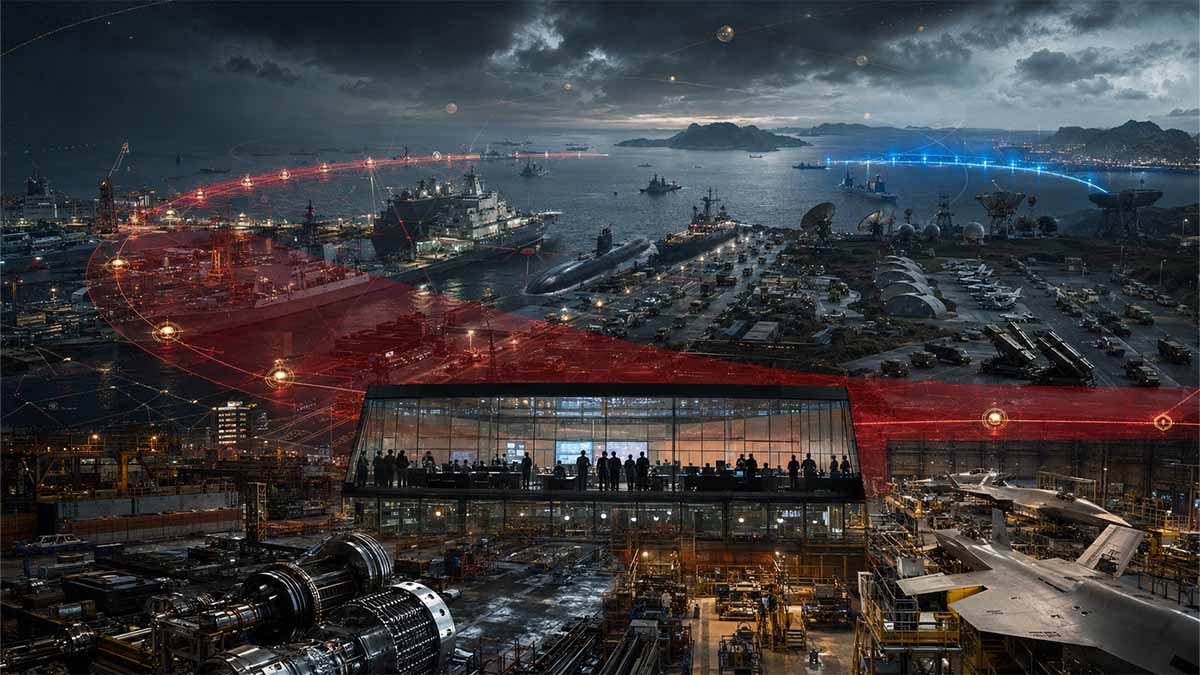
China’s military transformation is no longer a conventional arms buildup. It is the construction of a national strategic system linking missiles, nuclear deterrence, naval production, satellites, cyber access, artificial intelligence and civilian industry. Washington has answered with denial along the First Island Chain; Japan and Australia are restructuring their forces; NATO and the European Union are connecting Euro-Atlantic security to the Indo-Pacific. The decisive issue for 2026–2031 is not whether China can match the United States platform for platform. It is whether Beijing can create a regional military advantage fast enough to impose political outcomes before an international coalition can react—and whether the response designed to prevent that outcome will strengthen deterrence or compress warning time to a dangerously narrow margin.
The Budget Beyond the Budget
China allocated approximately 1.9 trillion yuan, or about US$275 billion, to national defence in 2026, a nominal increase of 7%. The 2025 allocation had reached 1.784665 trillion yuan, up 7.2%, marking the tenth consecutive year of single-digit growth. — China’s 2026 Defense Budget Growth Slows to 7% – State Council Information Office of the People’s Republic of China – March 2026 — Official source; China to Increase Defense Budget by 7.2 Percent in 2025 – State Council of the People’s Republic of China – March 2025 — Official source.
The published appropriation represents only the visible perimeter. China’s military-relevant capacity also resides in commercial space, state-directed research, digital infrastructure, transport, shipbuilding and advanced manufacturing. In 2025 Chinese GDP reached 140.188 trillion yuan, while manufacturing generated 34.675 trillion yuan of value added. — Preliminary Accounting Results of GDP for the Fourth Quarter and the Whole Year of 2025 – National Bureau of Statistics of China – January 2026 — Official source. The strategic unit of analysis is therefore not the defence budget alone, but the conversion of a continental industrial economy into military endurance.
The Nuclear Threshold
The nuclear dimension changes every lower rung of the escalation ladder. The Pentagon estimates that China’s stockpile remained in the low 600s through 2024, but remains on course to exceed 1,000 warheads by 2030. In September 2024 Beijing launched an unarmed DF-31B intercontinental ballistic missile approximately 11,000 kilometres into the Pacific—the first Chinese open-ocean ICBM test since 1980. — Military and Security Developments Involving the People’s Republic of China 2025 – U.S. Department of Defense – December 2025 — Official report.
China is not approaching numerical parity with the combined American and Russian arsenals within this horizon. The strategic transformation lies elsewhere: more launchers, hardened silos, mobile missiles, ballistic-missile submarines and improved warning systems make the force more survivable. This can reinforce deterrence by guaranteeing retaliation. It can also give Beijing greater confidence that nuclear risk will discourage external intervention during a conventional crisis.
Risk-control mechanisms have not kept pace. The Pentagon reports that Beijing suspended a bilateral arms-control and non-proliferation consultation mechanism in April 2024 and has shown limited appetite for comprehensive nuclear-risk-reduction discussions. China’s advance notification to several governments before the September 2024 ICBM test was constructive, but it has not yet become a regularized bilateral notification regime.
The Maritime Machine
China’s maritime advantage begins in its shipyards. In 2025 they delivered 53.69 million deadweight tonnes, representing 56.1% of global shipbuilding output. They secured 69% of new global orders and held 66.8% of the world order book at year-end. — China’s Shipbuilding Sector Maintains Global Lead in 2025 – State Council of the People’s Republic of China, citing the Ministry of Industry and Information Technology – February 2026 — Official source.
Commercial tonnage is not equivalent to naval power. Yet dry docks, marine engineering, suppliers, skilled labour and repair infrastructure create mobilization depth unmatched by any competitor. The Pentagon previously projected the People’s Liberation Army Navy’s battle force to reach approximately 435 ships by 2030, although actual effectiveness will depend on submarines, missile cells, replenishment, maintenance and crew proficiency rather than hull counts alone.
The more immediate instrument is China’s layered maritime system: navy, coast guard, maritime militia and civilian fleets. In 2024 the China Coast Guard maintained a presence around Luconia Shoals for 313 days, against 162 days in 2019. Around Taiwan, the strategic effect is similar: persistent operations alter normality without requiring declared hostilities.
Space, Cyber and Joint Command
On 19 April 2024, Beijing inaugurated the PLA Information Support Force and reorganized its previous Strategic Support Force into a structure that includes the Aerospace Force, Cyberspace Force, Information Support Force and Joint Logistic Support Force. — Defense Ministry Spokesperson’s Remarks on Recent Military-Related Issues – Ministry of National Defense of the People’s Republic of China – April 2024 — Official source.
The purpose is operational compression: shorten the chain connecting detection, data fusion, decision and coordinated action. China completed 92 space launches in 2025, 35% more than in 2024, while expanding satellite internet, BeiDou applications, Earth observation and reusable-launch programs. — China to Carry Out Intensive Space Missions in 2026 – State Council of the People’s Republic of China, citing the China National Space Administration – April 2026 — Official source.
Cyber operations supply strategic latency: access acquired in peacetime can become an option during crisis. A joint advisory by CISA, NSA, FBI and international partners assessed that the Chinese state-sponsored group known as Volt Typhoon sought persistent access to critical infrastructure for possible disruption during a major confrontation. — PRC State-Sponsored Actors Compromise and Maintain Persistent Access to U.S. Critical Infrastructure – CISA and International Partners – February 2024 — Official advisory. This is a government attribution, not evidence that a disruption order has been issued. It nevertheless demonstrates why a Taiwan contingency cannot be analysed as an exclusively maritime event.
Taiwan’s Compressed Warning Time
Taiwan recorded 3,003 PLA aircraft sorties crossing the Strait’s median line or entering its southwestern and eastern monitored airspace between 1 January and 30 September 2025. It also counted 2,000 PLA naval-vessel sorties within its air-defence identification and contingency zones. Taipei reported Chinese “joint combat readiness patrols” three to four times monthly and the Strait Thunder-2025A exercise on 1–2 April 2025. — Evolving Threats from PLA Activities – Ministry of National Defense, Republic Republic of China – October 2025 — Official source.
Frequency is itself strategic. Repetition trains Chinese forces, burdens Taiwan’s response system and makes it harder to distinguish routine pressure from operational transition. The Pentagon judges that Chinese leaders see the PLA’s capabilities for a Taiwan campaign as improving but remain uncertain about its readiness to seize the island while countering U.S. involvement. During 2024, exercises rehearsed the blockade of key ports, attacks on maritime and land targets and responses to possible external intervention.
That uncertainty makes coercion short of invasion especially relevant. A quarantine framed through customs, inspection or safety regulations could be enforced initially by the coast guard and administrative agencies, with the PLA in support. It would exploit ambiguity over whether a legally contested enforcement action constitutes a blockade or triggers alliance commitments. Commercial carriers and insurers could reroute before governments reached a common legal determination, creating economic isolation without universal physical interdiction.
Washington’s Denial Line
The 2026 U.S. National Defense Strategy, issued on 23 January, directs the construction of a “strong denial defense” along the First Island Chain. Its declared objective is to prevent China from dominating the United States or its allies, while maintaining strategic stability, deconfliction and a balance of power. — 2026 National Defense Strategy – U.S. Department of Defense – January 2026 — Official report.
The FY2026 Pacific Deterrence Initiative request totals US$10 billion, including US$2.035 billion for a modernized and strengthened regional presence. — Pacific Deterrence Initiative, Fiscal Year 2026 – U.S. Department of Defense Comptroller – June 2025 — Official budget document. Its priorities include distributed posture, logistics, pre-positioning, exercises, resilient infrastructure and partner capacity.
The strategic weakness is logistics. Aircraft and missiles matter only if bases survive, communications remain trusted, runways can be repaired and dispersed units can be resupplied. Deterrence will be decided as much by fuel, maintenance, sealift, spare parts and political access as by the number of advanced platforms.
Japan and Australia Move Forward
Japan has brought its defence effort to a post-war turning point. Its FY2026 Defense Buildup Program expenditure totals ¥8.809 trillion. Tokyo states that combined FY2025 initial and supplementary appropriations brought forward the objective of reaching a defence level equivalent to 2% of GDP. — Progress and Budget in Fundamental Reinforcement of Defense Capabilities: Overview of FY2026 Budget – Ministry of Defense of Japan – December 2025 — Official budget document.
Japan has delivered Tomahawk and Joint Strike Missiles, deployed the upgraded surface-launched Type-12 missile, established the JSDF Joint Operations Command in March 2025 and allocated ¥973 billion in FY2026 contracts to stand-off defence, ¥509 billion to integrated air and missile defence, ¥277 billion to unmanned capabilities and ¥878 billion to facility resilience. Its strategic role is no longer passive basing: Japan is becoming an active denial power across the southwestern islands.
Australia supplies strategic depth. Its 2026 Integrated Investment Program adds A$53 billion over a decade, with up to A$130 billion for undersea warfare and uncrewed maritime systems, A$77 billion for frigates and destroyers and A$35 billion for hypersonic weapons, extended-range missiles and targeting. — Preparing Australia for Future Strategic Challenges – Australian Department of Defence – April 2026 — Official source. Under AUKUS, Submarine Rotational Force–West is planned at HMAS Stirling from as early as 2027, involving one British Astute-class and up to four American Virginia-class submarines.
Europe’s Strategic Exposure
Europe cannot treat the Indo-Pacific as a distant naval theatre. On 20 October 2025, the Council of the European Union stated that tensions in the South and East China Seas and across the Taiwan Strait could profoundly affect European security, stability and prosperity. It called for stronger cooperation in maritime security, cyber, space, critical infrastructure and economic security. — Council Conclusions on the Implementation of the EU Strategy for Cooperation in the Indo-Pacific – Council of the European Union – October 2025 — Official document.
NATO’s response is indirect but consequential. At The Hague on 25 June 2025, allies committed to spend 5% of GDP annually by 2035: at least 3.5% on core defence requirements and up to 1.5% on infrastructure, networks, resilience and industrial capacity. — The Hague Summit Declaration – NATO – June 2025 — Official declaration. If Europe converts expenditure into deployable forces and production, it can reduce U.S. burdens in the Atlantic and release American capacity for Asia. If it remains dependent on scarce American intelligence, air defence, transport and munitions, simultaneous crises will expose the architecture’s central vulnerability.
The Five-Year Verdict
The most likely outcome through 2031 is neither general war nor strategic reconciliation. It is managed armed competition: denser forces, recurring coercion, harder bases, expanding nuclear risk and deeper technological fragmentation. A quarantine or selective blockade is more plausible than an immediate large-scale invasion because it offers Beijing escalation control and exploits legal and commercial ambiguity. A limited clash remains possible wherever aircraft, ships and coast-guard vessels operate at high frequency and short distance.
The decisive indicator will not be another exercise in isolation. It will be the convergence of sustained exclusion zones, civilian shipping requisition, reserve activation, strategic stock movements, cyber disruption and unusual command dispersal. That evidence bundle would signal transition from coercive signalling to operational preparation.
China’s rearmament is changing the balance; the global response is changing the geometry. The contest will be decided not by aggregate expenditure alone, but by resilience-adjusted power: who can see first, decide accurately, sustain operations, preserve alliances and control escalation. The failure to build that capacity would invite coercion. Building it without credible crisis communication could make the deterrent itself unstable.
Navigational Index
- The Chinese Transformation — Budget, nuclear expansion, joint warfare, maritime power, space, cyber and industrial mobilization.
- The Countervailing Architecture — United States denial strategy, Japan, Australia, NATO, the European Union and emerging security partnerships.
- The 2026–2031 Risk Horizon — Competing hypotheses, Bayesian indicators, escalation pathways and five-year strategic outcomes.
Master Abstract
China’s rearmament should be understood neither as a linear increase in weapons inventories nor as a mechanical attempt to reproduce the United States’ global force structure. It is the construction of an integrated coercive ecosystem designed to reduce Beijing’s vulnerability, constrain intervention near China’s maritime periphery and widen the political options available to the Chinese leadership without making general war its only instrument. The financial trajectory establishes the scale but not the full economic burden: China’s draft 2026 allocation assigns approximately 1.9 trillion yuan, or about US$275 billion, to national defence, representing nominal growth of 7%; the preceding 2025 allocation was 1.784665 trillion yuan, up 7.2%. — China’s 2026 Defense Budget Growth Slows to 7% – State Council Information Office – March 2026 — Verified official source; China to Increase Defense Budget by 7.2 Percent in 2025 – State Council of the People’s Republic of China – March 2025 — Verified official source. These published appropriations must be treated as a lower-bound representation of the wider security-industrial effort because military-relevant research, strategic infrastructure, space activity, industrial support and some mobilization capacity do not necessarily appear inside a single internationally comparable defence account. The more important observation is institutional: Beijing’s declared military strategy subordinates modernization to national objectives and treats military power as part of a larger system incorporating political authority, economic development, technological self-reliance and national mobilization. — China’s Military Strategy – Ministry of National Defense of the People’s Republic of China – October 2025 — Verified official source. The resulting force is optimized for informational advantage, precision conventional strike, maritime and air denial, counter-space effects, cyber-enabled disruption and the ability to impose escalating costs while keeping adversaries uncertain about Beijing’s next threshold.
The nuclear dimension is transforming the strategic equation because it changes not only destructive capacity but also the protection under which conventional coercion could occur. The United States Department of Defense assessed that China’s nuclear stockpile remained in the low 600s through 2024, while judging that the force remained on track to exceed 1,000 warheads by 2030; the same assessment records China’s September 2024 launch of an unarmed intercontinental ballistic missile into the Pacific, the first such open-ocean test since 1980. It also identifies continuing development of space, counter-space and directed-energy capabilities, greater regional coast-guard persistence and deepening China–Russia military activity. — Military and Security Developments Involving the People’s Republic of China 2025 – U.S. Department of Defense – December 2025 — Verified official report. The analytical significance is not that Beijing has necessarily adopted a predetermined timetable for war. Rather, nuclear survivability, conventional missile density, maritime pressure, military exercises, cyber preparation and space-enabled targeting can jointly produce an “escalation shield”: confidence that outside powers will hesitate to intervene decisively because even a geographically limited confrontation could cross domains and involve strategic forces. China simultaneously presents its posture as defensive and restrained, emphasizing that defence expenditure has remained below 1.5% of GDP for many years. — Japan Smears China’s Defense Expenditure by Peddling False Narratives – Ministry of National Defense of the People’s Republic of China – June 2026 — Verified official source. That official framing is evidentially important because it reveals Beijing’s intended legitimacy narrative, but it does not resolve the security dilemma: capabilities designed by one state as insurance can be interpreted by others as preparation for coercion. The five-year danger therefore resides in interactive mobilization—Chinese capability growth stimulates allied countermeasures, which Beijing then cites as proof of encirclement, generating a recursive cycle of deployments, exercises, export controls and readiness measures.
Washington’s response has become more explicit and geographically structured. The 2026 U.S. National Defense Strategy calls for a strong denial defence along the First Island Chain, strategic stability and deconfliction with Beijing, and greater contributions from allies and partners; its declared objective is to prevent China from dominating the United States or its allies rather than to dominate China. — 2026 National Defense Strategy – U.S. Department of Defense – January 2026 — Verified official report. Australia’s corresponding strategy places denial at the centre of defence planning and strengthens national capacity, northern approaches, industrial resilience and long-range deterrent effects. — 2026 National Defence Strategy and 2026 Integrated Investment Program – Australian Department of Defence – 2026 — Verified official source. Japan’s 2026 defence assessment records the regional force transformation from the perspective of the state most directly exposed to pressure across the East China Sea and Taiwan approaches. — Defense of Japan 2026 – Ministry of Defense of Japan – 2026 — Verified official publication portal. Europe’s response is structurally different: the European Union treats stability in the Taiwan Strait and the South and East China Seas as directly connected to European security and prosperity, while NATO identifies Chinese ambitions and coercive policies as a challenge to allied interests, security and values. — Council Conclusions on the EU Strategy for Cooperation in the Indo-Pacific – Council of the European Union – October 2025 — Verified official document; Alliance Maritime Strategy – NATO – October 2025 — Verified official text. From these baselines, the five-hypothesis assessment for 2026–2031 is: H₁ managed armed competition, H₂ coercive quarantine or blockade, H₃ limited regional clash, H₄ sustained major-power conflict, and H₅ political accommodation or coalition fragmentation. The leading judgement is that H₁ remains the modal outcome, but evidence of large-scale logistics preparation, reserve mobilization, persistent exclusion zones, cyber pre-positioning or unusual strategic-force dispersal would transfer probability toward H₂, H₃ and ultimately H₄. These probabilities are conditional analytical priors—not observed frequencies—and must be updated as indicators change.
The Chinese Transformation: Rearmament as a National System, 2026–2031
The budget is only the visible perimeter
China’s rearmament cannot be measured correctly by treating the published defence budget as a complete representation of military power. Beijing’s official allocation rose from 1.665 trillion yuan in 2024 to 1.784665 trillion yuan in 2025, an increase of 7.2%, and then to approximately 1.9 trillion yuan in 2026, an increase of 7%. — China to Increase Defense Budget by 7.2 Percent in 2025 – State Council of the People’s Republic of China – March 2025 — Verified official source; China’s 2026 Defense Budget Growth Slows to 7% – State Council Information Office of the People’s Republic of China – March 2026 — Verified official source. On those figures, the published allocation increased by approximately 235 billion yuan, or about 14.1%, in only two budget cycles. The 2026 budget nevertheless represents only about 1.36% of China’s 2025 GDP of 140.188 trillion yuan, supporting Beijing’s official claim that military expenditure has remained below 1.5% of GDP for many years. — Statistical Communiqué of the People’s Republic of China on the 2025 National Economic and Social Development – National Bureau of Statistics of China – February 2026 — Verified official source; Japan Smears China’s Defense Expenditure by Peddling False Narratives – Ministry of National Defense of the People’s Republic of China – June 2026 — Verified official source. The ratio, however, is not an internationally standardized measure of the total resources available for military purposes. Chinese commercial-space investment, state-supported shipbuilding, dual-use research, cybersecurity institutions, transportation infrastructure, strategic stockpiles and provincial industrial capacity can create military utility without appearing as conventional defence procurement. The correct analytical unit is therefore the national security-production system, not the defence ministry’s budget line. This distinction does not prove that every civilian industrial expenditure is military spending; it establishes that a large dual-use economy creates an option value that conventional budget comparisons systematically understate. Because China’s 2025 manufacturing value added reached 34.675 trillion yuan, while total industrial value added reached 41.683 trillion yuan, the state can draw on an industrial base several multiples larger than its published military allocation. — Preliminary Accounting Results of GDP for the Fourth Quarter and the Whole Year of 2025 – National Bureau of Statistics of China – January 2026 — Verified official source.
| Fiscal year | Published defence allocation | Nominal annual change | Relevant economic baseline | Analytical interpretation |
|---|---|---|---|---|
| 2024 | 1.665 trillion yuan | Published baseline | 2024 GDP approximately 134.9 trillion yuan | Beginning of the present two-year acceleration baseline |
| 2025 | 1.784665 trillion yuan | 7.2% | GDP 140.188 trillion yuan | Defence growth exceeded real GDP growth |
| 2026 | Approximately 1.9 trillion yuan | 7.0% | Q1 GDP 33.419 trillion yuan | Continued prioritization despite domestic fiscal and property-sector pressures |
| 2027–2031 | No official appropriations yet | Unknown | Model-dependent | Must be treated as scenarios, not factual budget commitments |
The five-year budget outlook must therefore separate the published appropriation from the effective military-resource envelope. If the nominal defence budget grows at an illustrative 5%–7% annual rate after 2026—not an official forecast—the visible allocation would reach approximately 2.42–2.66 trillion yuan by 2031. The cumulative published expenditure over 2027–2031 would fall roughly between 11.7 trillion and 12.3 trillion yuan, before counting off-budget or dual-use capacity. Those calculations are transparent compounding scenarios, not estimates of secret spending. The more important intelligence question is how Beijing allocates marginal resources among personnel, readiness, missiles, nuclear infrastructure, naval construction, unmanned systems, space constellations, secure communications and industrial resilience. China’s macroeconomic position provides both capacity and constraints: GDP grew 5% in 2025, manufacturing expanded 6.1%, and first-quarter 2026 GDP grew 5%, but real-estate investment fell 11.2% year-on-year in the first quarter of 2026. — National Economy Got Off to a Good Start in the First Quarter – National Bureau of Statistics of China – April 2026 — Verified official source. This combination matters strategically. A slowing property model can reduce local-government fiscal flexibility, yet it can also reinforce the political decision to redirect credit, investment funds, engineering talent and industrial policy toward advanced manufacturing, aerospace, shipbuilding, artificial intelligence and electronic systems. During the first half of 2025, Chinese investment in aerospace-vehicle and equipment manufacturing grew 26.3%, while information-services investment grew 37.4%. — National Economy Made Steady Improvement Despite Challenges in the First Half of 2025 – National Bureau of Statistics of China – July 2025 — Verified official source. These are civilian statistical categories and must not be relabelled automatically as military investment. Their intelligence relevance lies in the enlargement of the skilled workforce, production equipment, supply networks and technological base from which military programs can benefit. Through 2031, the principal constraint may consequently be less the state’s willingness to appropriate money than its ability to convert money into reliable engines, semiconductors, advanced materials, trained joint-force personnel, operational software and combat-sustainable logistics.
Joint warfare: from service modernization to information control
The organizational transformation of the People’s Liberation Army is intended to compress the interval between detection, decision, targeting and coordinated action across land, sea, air, space, cyber and electromagnetic domains. The most consequential recent institutional change occurred on 19 April 2024, when China inaugurated the PLA Information Support Force and reorganized the previous Strategic Support Force architecture. China’s Ministry of National Defense described the resulting structure as consisting of the army, navy, air force and rocket force as services, alongside the Aerospace Force, Cyberspace Force, Information Support Force and Joint Logistic Support Force as supporting arms. — Defense Ministry Spokesperson’s Remarks on Recent Military-Related Issues – Ministry of National Defense of the People’s Republic of China – April 2024 — Verified official source. The reform matters because it separates specialized functions while keeping them centrally available for joint operations. The Information Support Force is positioned as a strategic enabler of networked command rather than simply another combat formation; the Aerospace Force supports space access and space-enabled services; the Cyberspace Force concentrates capabilities in the digital domain; and the Joint Logistic Support Force is responsible for the connective tissue that makes geographically distributed operations sustainable. The operational ambition is a resilient system in which satellites, airborne sensors, ships, ground radar, unmanned platforms and cyber-derived information contribute to a common decision environment. The vulnerability is symmetrical: the more combat effectiveness depends on data fusion and assured connectivity, the more consequential software failure, compromised data, electronic interference, satellite loss, organizational friction or command overcentralization becomes. China’s military strategy officially places modernization within a larger process of strengthening national power, technological self-reliance and the capacity to protect sovereignty, security and development interests. — China’s Military Strategy – Ministry of National Defense of the People’s Republic of China – October 2025 — Verified official source. The 2026–2031 test will therefore be whether institutional redesign produces repeatable joint competence under degraded conditions, rather than merely stronger individual services during scripted exercises.
| Command layer | Principal function | Observable indicator through 2031 | Central vulnerability |
|---|---|---|---|
| Central Military Commission | Political command, strategic direction and force control | Command appointments, anti-corruption actions, readiness directives | Excessive centralization and inhibited reporting |
| Theater commands | Geographic joint operations | Cross-service exercises and sustained regional deployments | Coordination under simultaneous multi-domain pressure |
| Information Support Force | Network information support and command connectivity | Data architecture, resilient communications and operational integration | Network disruption, corrupted data and interoperability failures |
| Aerospace Force | Space access and space-enabled operational support | Launch cadence, reconnaissance coverage, navigation resilience | Counter-space exposure and orbital congestion |
| Cyberspace Force | Cyber-domain military capability | Persistent access, exploitation, defence and military-network integration | Attribution, counteraction and dependence on civilian infrastructure |
| Joint Logistic Support Force | Joint sustainment, medical support, distribution and repair | Fuel movement, dispersed depots, transport integration and replenishment drills | Long-distance sustainment and vulnerable logistics nodes |
This reorganization supports a doctrine of system confrontation, in which the objective is not merely to destroy individual platforms but to impair the adversary’s ability to sense, communicate, decide, replenish and coordinate. The U.S. Department of Defense’s latest public assessment describes continued PLA modernization across information operations, counter-space systems, precision strike, nuclear forces and joint command, while also noting the disruptive effects of corruption investigations and leadership removals. — Military and Security Developments Involving the People’s Republic of China 2025 – U.S. Department of Defense – December 2025 — Verified official report. Corruption is not a secondary governance issue in this context. It affects whether readiness reports are trustworthy, whether missile infrastructure and equipment meet specifications, whether procurement reflects operational requirements, and whether commanders communicate deficiencies upward. A force can expand materially while remaining uncertain about its own reliability. Consequently, the five-year outlook should track two competing trajectories. The first is institutional consolidation: the new support-force structure clarifies responsibilities, integrates operational data and strengthens theater-level joint planning. The second is bureaucratic fragmentation: reorganized institutions compete for authority, technical standards remain incompatible, and political discipline discourages candid reporting. Bayesian updating should assign increased probability to successful consolidation when exercises demonstrate unscripted cross-service adaptation, distributed command continuity, rapid battle-damage repair and logistics performance over sustained periods. Probability should move in the opposite direction when senior removals cluster in procurement or operational commands, new structures are repeatedly renamed or reassigned, major exercises remain short and heavily choreographed, or public doctrine advances faster than observable sustainment. The key distinction is between force possession and force employment. By 2031 China will almost certainly possess more advanced systems than it did in 2026; whether it can integrate them reliably under contested conditions remains the higher-value intelligence question.
Nuclear expansion and the changing escalation architecture
China’s nuclear expansion is strategically transformative because it increases survivability, diversifies delivery options and complicates adversary calculations at every lower level of conflict. The U.S. Department of Defense assessed that China’s nuclear stockpile remained in the low 600s through 2024, slower than some previous growth expectations but still on a trajectory to exceed 1,000 warheads by 2030. The same report states that China launched an unarmed DF-31B intercontinental ballistic missile approximately 11,000 kilometres into the Pacific in September 2024, its first open-ocean intercontinental test since 1980, and that Beijing continued developing silo, road-mobile, sea-based and air-delivered components of a more diversified force. — Military and Security Developments Involving the People’s Republic of China 2025 – U.S. Department of Defense – December 2025 — Verified official report. The analytical issue is not simply numerical parity with the United States or Russia, which is not projected within this five-year horizon. It is the transition from a comparatively limited retaliatory force toward a larger and more complex posture capable of surviving attack, presenting multiple response pathways and supporting more sophisticated signalling. Increased warhead numbers, additional launchers, improved early warning, ballistic-missile submarines and potentially higher readiness can create a stronger retaliatory guarantee; they can also make conventional crises harder to compartmentalize because conventional and nuclear command systems, sensors or missile units may be geographically or electronically entangled. Beijing continues to articulate restraint and opposition to destabilizing missile-defence deployments. — Statement by the Chinese Delegation at Main Committee I of the 2026 NPT Review Conference – Permanent Mission of the People’s Republic of China to the United Nations – May 2026 — Verified official source. That declaratory position is relevant but cannot substitute for capability analysis. Through 2031, the most consequential indicators will include operational patrol patterns, early-warning integration, command-and-control redundancy, warhead production evidence, silo activation, submarine readiness and any observable change in the separation of warheads from delivery systems.
| Nuclear variable | Verified baseline | 2030–2031 directional assessment | Intelligence significance |
|---|---|---|---|
| Estimated stockpile | Low 600s through 2024 | U.S. DoD projects more than 1,000 by 2030 | Larger survivable reserve and more complex targeting problem |
| Open-ocean ICBM testing | One DF-31B test in September 2024 | Additional tests are plausible but not confirmed | Training realism, signalling and full-range validation |
| Land-based force | Silo and mobile components expanding | Greater redundancy likely | Reduced confidence in disarming attacks |
| Sea-based deterrent | Operational ballistic-missile submarines | Patrol quality more important than hull count alone | Survivability depends on communications, quieting and command reliability |
| Early warning | Modernization under way | Possible movement toward more responsive posture | Higher sensitivity to ambiguous warning data |
| Arms-control transparency | Limited public granularity | Major uncertainty likely to persist | Increases worst-case planning by other nuclear powers |
An Analysis of Competing Hypotheses produces five distinct explanations for the nuclear buildup. H1 interprets it primarily as a delayed effort to guarantee minimum retaliation against improving U.S. surveillance, precision strike and missile defence. H2 views it as preparation for nuclear coercion that would shield conventional operations around Taiwan or the western Pacific. H3 treats the expansion as a status-driven movement toward a nuclear force commensurate with China’s global-power ambitions. H4 interprets it as hedging against multiple nuclear adversaries, including the United States, Russia and India, rather than as a force directed at a single opponent. H5 attributes a substantial portion of the trajectory to organizational and industrial momentum after senior political authorization, meaning that capacity may continue growing even without a precisely fixed final number. The currently available official evidence is most consistent with a combination of H1, H3, H4 and H5; it does not establish a decision to employ nuclear coercion under H2, but increased survivability could indirectly make conventional risk-taking appear less dangerous to Chinese decision-makers. A Bayesian model should therefore avoid assigning one explanation exclusive probability. Evidence of continued emphasis on assured retaliation and explicit arms-control engagement would raise H1. Integration of nuclear signalling into conventional regional exercises, elevated peacetime readiness or operationally visible launch-under-warning procedures would raise H2. Expansion beyond the force level needed for plausible retaliation against the United States would strengthen H3 or H4. Construction and production continuing despite improved strategic relations would strengthen H5. The five-year risk is thus not only deliberate nuclear use. It includes misinterpretation of dual-capable missile movements, attacks on shared sensors, cyber interference with warning systems and pressure to make decisions before information can be verified.
Maritime power: the military value of a commercial shipbuilding superstructure
China’s naval transformation rests on a commercial-industrial foundation whose scale has no contemporary equivalent. In 2025 Chinese shipyards produced 53.69 million deadweight tonnes, equal to 56.1% of global shipbuilding output; they secured 107.82 million deadweight tonnes of new orders, or 69% of the global market, and held an order book of 274.42 million deadweight tonnes, equal to 66.8% of the world total. — China’s Shipbuilding Sector Maintains Global Lead in 2025 – State Council of the People’s Republic of China, citing the Ministry of Industry and Information Technology – February 2026 — Verified official source. These commercial figures cannot be converted directly into naval combat power: constructing container ships or bulk carriers is not equivalent to producing submarines, sensors, missiles or trained crews. They nevertheless document a deep ecosystem of dry docks, welding capacity, marine engines, electrical integration, skilled labour, suppliers and port infrastructure. This ecosystem reduces the industrial distance between peacetime production and expanded maritime mobilization, especially for auxiliaries, transports, repair, sealift and less specialized hulls. The U.S. Department of Defense previously assessed that the PLA Navy operated more than 370 battle-force platforms and projected approximately 395 ships by 2025 and 435 by 2030, with much growth expected in major surface combatants. — Military and Security Developments Involving the People’s Republic of China 2023 – U.S. Department of Defense – October 2023 — Verified official report. Those projections must be treated as dated government estimates rather than verified 2026 inventory counts. Moreover, aggregate hull totals obscure decisive distinctions among missile capacity, submarine availability, replenishment ships, maintenance cycles, carrier aviation proficiency and geographic distribution. Through 2031, the relevant question is whether China converts numerical scale into a fleet capable of persistent operations beyond protected coastal waters while simultaneously maintaining concentrated regional superiority near Taiwan, the East China Sea and the South China Sea.
| Maritime dimension | Observable capacity | What raw totals conceal | 2031 intelligence priority |
|---|---|---|---|
| Surface fleet | Large and growing hull inventory | Missile-cell count, sensor quality, maintenance and crew proficiency | Sustained multi-fleet operations |
| Submarine force | Nuclear and conventional components | Acoustic performance, readiness and secure communications | Patrol persistence and production cadence |
| Carrier aviation | Expanding carrier architecture | Sortie generation, pilot training and airborne early warning | Operational performance beyond demonstrations |
| Coast guard | Persistent regional presence | Command relationships and escalation rules | Integration with naval and maritime-militia activity |
| Commercial shipping | World-leading industrial and merchant base | Legal availability, conversion time and survivability | Mobilization exercises and sealift integration |
| Ship repair | Extensive commercial infrastructure | Wartime vulnerability and specialized repair capacity | Dispersal, redundancy and battle-damage restoration |
Maritime power also includes the China Coast Guard, maritime militia, merchant shipping, fisheries, ports and legal-administrative tools used below the threshold of declared hostilities. The 2025 U.S. assessment recorded that the China Coast Guard spent 313 days around Luconia Shoals in 2024, compared with 162 days in 2019, illustrating how endurance and presence can change facts operationally without a conventional naval engagement. — Military and Security Developments Involving the People’s Republic of China 2025 – U.S. Department of Defense – December 2025 — Verified official report. This layered architecture enables calibrated pressure: civilian-appearing or law-enforcement assets establish persistence; coast-guard units enforce administrative claims; naval forces remain available over the horizon; and land-based aviation, missiles and space sensors influence the broader theatre. The model lowers the political cost of continuous contestation but raises the danger of cumulative escalation because an incident involving one layer can draw in the others. A five-year maritime forecast should therefore avoid an invasion-only framework. More plausible pathways include recurrent inspection regimes, temporary exclusion areas, coast-guard concentration, interference with resupply, customs or quarantine enforcement, undersea-infrastructure surveillance and large exercises that create temporary blockade effects. The most important early-warning indicators would be simultaneous requisitioning of civilian roll-on/roll-off shipping, extended fuel and blood-supply preparations, unusual port closures, reserve activation, prolonged air-defence dispersal, loading of specialized engineering equipment, large-scale communications restrictions and sustained rather than episodic logistics movements. None of these signals alone proves offensive intent. Their diagnostic value rises when they occur together, remain geographically coherent and cannot be explained by scheduled exercises or disaster-response activity.
Space: strategic infrastructure disguised by category boundaries
China’s space expansion is simultaneously civil, commercial, scientific and security-relevant, making binary labels analytically misleading. China completed 92 space launches in 2025, an increase of 35% over 2024, while expanding BeiDou applications, Earth observation, satellite internet production and preparations for reusable launch vehicles. — China to Carry Out Intensive Space Missions in 2026 – State Council of the People’s Republic of China, citing the China National Space Administration – April 2026 — Verified official source. In March 2025, one Long March-8 mission placed 18 low-Earth-orbit satellites into the Spacesail commercial internet constellation from China’s Hainan commercial spaceport. The launch site’s first pad was described as supporting a seven-day launch and seven-day reset cycle, while the mission represented the 563rd flight of the Long March family. — China Launches 18 Satellites from Hainan Commercial Spacecraft Launch Site – State Council of the People’s Republic of China – March 2025 — Verified official source. In November 2025 the China National Space Administration announced plans for a national commercial-space development fund and broader public procurement of commercial launch vehicles, satellites, launch sites and tracking, telemetry and command facilities for national missions. — China’s Space Agency Unveils Plan to Boost Commercial Space Sector – State Council of the People’s Republic of China, citing the China National Space Administration – November 2025 — Verified official source. This institutional integration is strategically more significant than any single launch. It creates multiple suppliers, serial production, additional launch infrastructure, a larger technical workforce and potential replenishment capacity. The military value includes more persistent surveillance, resilient navigation and timing, beyond-line-of-sight communications, weather support and faster reconstruction of degraded orbital services. The same systems retain extensive civilian value, so military relevance must not be confused with proof of military control over every asset.
China’s official space white paper explicitly identifies satellite communications, navigation, remote sensing, debris monitoring, in-orbit maintenance, collision avoidance, information protection and greater resilience of space assets as national priorities. — China’s Space Program: A 2021 Perspective – State Council Information Office of the People’s Republic of China – January 2022 — Verified official white paper. The 2025–2030 industrial plan adds a mass-market dimension: official guidelines seek integrated satellite communications, accelerated low-orbit internet development and more than 10 million satellite-communication users by 2030. — China to Promote High-Quality Development of Satellite Communication Industry – State Council of the People’s Republic of China, citing the Ministry of Industry and Information Technology – August 2025 — Verified official source. From a resilience perspective, this can distribute terminals, manufacturing capacity and operational familiarity across society. From an intelligence perspective, it also enlarges ambiguity: commercial constellation deployment may improve civilian connectivity while simultaneously increasing the number of space-enabled services potentially available during a crisis. The 2026–2031 contest will therefore concern orbital architecture rather than prestige missions alone. High-value indicators include launch cadence, satellite-production throughput, replenishment exercises, cross-link development, ground-station redundancy, secure military access to commercial bandwidth, manoeuvrable inspection spacecraft and integration between space-derived data and theater commands. Counter-space development is equally important, but public evidence must be interpreted conservatively. The latest U.S. report assesses that China has developed reversible and non-reversible counter-space capabilities, including ground-based laser systems intended to disrupt, degrade or damage satellites. — Military and Security Developments Involving the People’s Republic of China 2025 – U.S. Department of Defense – December 2025 — Verified official report. The escalation problem is that interference with space services can be difficult to attribute quickly, may affect civilian users, and can be interpreted as preparation for wider operations even when intended as a limited signal.
Cyber power: access, disruption and strategic latency
The cyber dimension should be assessed as a competition over latent access rather than merely a sequence of espionage incidents. A joint cybersecurity advisory led by the U.S. Cybersecurity and Infrastructure Security Agency stated that the Chinese state-sponsored group commonly identified as Volt Typhoon had compromised critical infrastructure and sought to maintain access, using “living off the land” techniques that exploit legitimate administrative tools and make malicious activity harder to distinguish from normal network operations. The advisory assessed that the campaign was intended to pre-position access for possible disruptive or destructive activity during a major crisis or conflict involving the United States. — PRC State-Sponsored Actors Compromise and Maintain Persistent Access to U.S. Critical Infrastructure – CISA, NSA, FBI and International Partners – February 2024 — Verified official advisory. This is an attribution and intent assessment by participating government agencies, not an independently observable admission by Beijing, and that distinction must remain explicit. Strategically, persistent access creates an option that can be held without immediate use. It may support intelligence collection, mapping of dependencies, coercive signalling or disruption of communications, energy, water, transportation and logistics during a confrontation. Its deterrent utility derives from uncertainty: defenders may know that access exists without knowing its full extent, while Beijing may be uncertain whether implants remain undetected or would function under crisis conditions. Cyber capability therefore contributes to what may be called strategic latency—the gap between acquiring access and deciding whether to exploit it. This latency complicates Bayesian warning because the same preparatory activity can support long-term espionage or future operational disruption.
A five-year cyber assessment should track four interconnected layers: military networks, civilian critical infrastructure, telecommunications backbones and the digital industrial supply chain. The creation of the PLA Cyberspace Force in 2024 provides a clearer organizational centre for military cyber functions, while the Information Support Force links data and connectivity to joint operations. China’s extensive civilian digitalization supplies expertise and infrastructure: by December 2025, 89.6% of major Chinese industrial firms had undertaken digital retrofitting, including 94.2% in shipbuilding and 93.9% in electronic-information manufacturing. — China’s Manufacturing Digital Drive Reaches Mass Adoption – State Council of the People’s Republic of China – February 2026 — Verified official source. Digitalization can improve production efficiency and supply-chain visibility, but it also creates systemic dependencies on industrial software, sensors, cloud services, communications and machine-control systems. The shadow risk is therefore bilateral: China may develop greater cyber-enabled leverage over foreign infrastructure while its own increasingly digital industrial base becomes more vulnerable to sabotage, data corruption, component restrictions and network isolation. Between 2026 and 2031, the decisive measure of cyber power will not be the number of attributed intrusion sets. It will be whether either side can retain trusted command, logistics and industrial operations after networks become contested. Indicators should include segmented industrial networks, manual fallback procedures, domestic operating environments, secure communications adoption, telecommunications routing resilience, coordinated vulnerability disclosures and the observed duration of intrusions before detection. Cyber norms will remain underdeveloped because espionage, pre-positioning and operational preparation overlap technically, while states disagree over the threshold at which persistent access constitutes an armed attack or permits anticipatory countermeasures.
Industrial mobilization: the conversion problem
Industrial mobilization is the central bridge between China’s peacetime economic scale and its wartime military endurance. In 2025, official data recorded strong expansion in sectors with substantial dual-use relevance: output in railway, shipbuilding, aviation and aerospace manufacturing grew 11.9% year-on-year in November, while computer, communications and electronic-equipment manufacturing grew 9.2%. — China’s Industrial Output Up 4.8 Percent in November – State Council of the People’s Republic of China, citing the National Bureau of Statistics – December 2025 — Verified official source. During the first nine months of 2025, profits in railway, shipbuilding and aerospace manufacturing rose 37.3%, while profits in high-technology manufacturing increased 8.7%. — China’s Industrial Profits Grow at Faster Pace in First Nine Months – State Council of the People’s Republic of China, citing the National Bureau of Statistics – October 2025 — Verified official source. These statistics describe broad industrial categories and must not be represented as defence-sector revenue. Their significance is that they reveal capital formation, workforce development and expanding production ecosystems in domains that share materials, machine tools, electronics, propulsion, software and quality-control requirements with military programs. China’s policy for the 15th Five-Year Plan, 2026–2030, explicitly prioritizes emerging and future industries and identifies shipbuilding, marine engineering, drones, aerospace and other advanced sectors as areas for continued development. — China to Strengthen Emerging and Future Industries in 2026–2030 – State Council of the People’s Republic of China, citing the Ministry of Industry and Information Technology – January 2026 — Verified official source.
| Mobilization layer | Peacetime asset | Potential security utility | Conversion constraint |
|---|---|---|---|
| Shipbuilding | Commercial yards, suppliers and marine engineering | Auxiliaries, repair, sealift and production surge | Naval specifications, engines, sensors and trained labour |
| Aerospace | Launch vehicles, aircraft production and commercial satellites | ISR, communications, replenishment and unmanned systems | Advanced components, testing and mission integration |
| Electronics | Telecommunications and industrial electronics | Sensors, networking, guidance and electronic warfare support | Semiconductor access, reliability and radiation hardening |
| Transport | Railways, ports, trucking and civil aviation | Force movement and national distribution | Congestion, interdiction exposure and command prioritization |
| Digital industry | Cloud, industrial software and automation | Production visibility, distributed design and rapid reconfiguration | Cyber compromise and software dependencies |
| State finance | Policy banks, investment funds and SOEs | Directed capacity expansion and inventory financing | Misallocation, debt burdens and weak commercial feedback |
| Civilian manpower | Engineers, technicians and transport operators | Technical reinforcement and surge labour | Training, legal authority and organizational integration |
The conversion problem is more demanding than possession of factories. Wartime endurance requires certified designs, interchangeable components, quality assurance, secure supply chains, trained shifts, spare machine tools, energy availability, distributed inventories and logistics capable of delivering outputs to operational units. Civilian firms cannot instantly manufacture complex missiles or aircraft merely because they produce advanced commercial goods. Conversely, a state does not need every civilian factory to manufacture weapons for mobilization to matter. Civilian yards can repair non-combat vessels; telecommunications companies can provide bandwidth and technical personnel; logistics firms can distribute fuel and parts; commercial satellites can supplement communications; and heavy industry can replace infrastructure or produce lower-complexity components. The most rigorous 2026–2031 assessment should therefore measure conversion readiness, not theoretical industrial size. High-diagnostic indicators include standardized civil-military interfaces, procurement contracts that preserve surge capacity, mobilization exercises involving civilian operators, inventories of long-lead components, distributed production, government financing for dormant capacity and changes in transportation prioritization rules. Shadow dimensions also include liquidity. State-directed banks and government investment funds can sustain production despite weak immediate returns, reducing the commercial discipline that normally constrains excess capacity. That advantage has a countervailing weakness: politically directed investment can conceal inefficiency, generate duplicated projects and produce nominal capacity that cannot meet military reliability standards. A Monte Carlo assessment must consequently model industrial mobilization as a chain whose output is determined by its least resilient nodes—advanced semiconductors, propulsion, skilled maintenance, secure software, energy supply or transportation—not by gross manufacturing volume alone.
Integrated five-year judgement and probability structure
The integrated forecast for 2026–2031 is that China will continue building a more survivable nuclear force, a larger and more capable navy, denser space infrastructure, stronger military information support and a deeper dual-use industrial base, but the speed and operational value of this transformation will differ sharply across domains. Budget growth is the most predictable variable because it has remained politically protected; joint-force competence is less predictable because it depends on leadership quality, realistic training and institutional learning; nuclear expansion is highly consequential but publicly opaque; naval and commercial shipbuilding possess exceptional material momentum; space deployment is accelerating measurably; cyber access remains difficult to observe until governments disclose intrusions; and mobilization capacity is enormous in theory but only partially testable in peacetime. The baseline ACH distribution for this specific transformation—not for the probability of war—is H1, successful controlled modernization, 38%; H2, rapid capability expansion constrained by command and corruption weaknesses, 27%; H3, industrial overextension and macroeconomic drag materially slowing implementation, 15%; H4, external technology controls producing substitution but persistent bottlenecks, 13%; and H5, a major crisis accelerating emergency mobilization before reforms mature, 7%. These are structured analytical priors, not official estimates or empirical frequencies. A Monte Carlo framework should vary annual published budget growth, GDP growth, procurement efficiency, technology-access friction, command-reform effectiveness, shipbuilding conversion, space replenishment and crisis intensity across at least tens of thousands of trials. Because no defensible probability distribution can be derived exclusively from the available official documents, the output should be presented as sensitivity bands rather than false precision. Under a central path of sustained funding, moderate economic growth and gradual organizational consolidation, China’s composite military-industrial capacity would rise substantially by 2031 without guaranteeing reliable performance in a major conflict. Under a high-acceleration path, crisis-driven mobilization and faster integration could produce greater regional overmatch but also higher accident, miscalculation and sanctions exposure. Under a constrained path, macroeconomic pressure, export controls, corruption and integration failures would slow—but probably not reverse—the transformation.
| Scenario, 2031 | Analytical prior | Budget and industry condition | Military outcome | Principal warning indicator |
|---|---|---|---|---|
| H1 — Controlled modernization | 38% | Sustained funding and selective industrial prioritization | Broader, more survivable and increasingly joint force | Repeated multi-domain proficiency and stable procurement |
| H2 — Expansion with institutional friction | 27% | Strong production but uneven command quality | Large inventory with reliability and integration gaps | Continuing senior removals and inconsistent readiness evidence |
| H3 — Macro-industrial constraint | 15% | Fiscal pressure and lower investment efficiency | Delayed procurement and prioritization of strategic programs | Falling capital formation and postponed major programs |
| H4 — Technology bottleneck adaptation | 13% | Domestic substitution succeeds unevenly | Progress in volume, gaps in frontier components | Persistent engine, semiconductor or software constraints |
| H5 — Premature crisis mobilization | 7% | Emergency conversion before system maturation | Short-term surge with high coordination and sustainment risk | Civilian requisition, reserve activation and prolonged logistics movement |
The Bayesian warning framework should update these priors through evidence bundles rather than isolated events. A single exercise provides weak evidence; simultaneous changes in reserve activity, commercial shipping, fuel distribution, medical preparation, cyber posture, satellite tasking and command dispersal provide much stronger evidence because they are less likely to share an innocent explanation. Likewise, a single corruption dismissal does not demonstrate systemic failure, while recurrent removals across procurement, missile and theater institutions materially increase the probability of hidden readiness problems. The primary intelligence collection requirement through 2031 is therefore longitudinal consistency: compare announced budgets with contract awards, industrial output with delivered systems, launched satellites with operational service, new hulls with active deployment, exercises with logistics duration, and official doctrine with observable command behaviour. China’s transformation is neither an inevitable march toward military supremacy nor a statistical illusion created by headline numbers. It is a state-directed attempt to connect fiscal resources, industrial scale, technological autonomy, political control and military organization into a coherent strategic instrument. Its success will be determined by integration and endurance. Its danger will be greatest if Beijing becomes confident that this system can impose a rapid regional fait accompli while insulating China from military, economic and political retaliation. Its most important weakness will remain the possibility that an impressive accumulation of platforms and infrastructure masks deficiencies in trusted information, leadership initiative, sustainment, advanced components and combat-tested organizational learning.
China Military-Industrial Transformation Index, 2026–2031
The Countervailing Architecture: Deterrence by Denial and the Indo-Pacific Coalition System, 2026–2031
From American primacy to distributed denial
The countervailing architecture taking shape around China is not a unified Asian equivalent of NATO, nor a formal containment bloc governed by a single command. It is an overlapping system of bilateral alliances, access agreements, intelligence relationships, industrial partnerships, technological coalitions and issue-specific diplomatic groupings whose aggregate purpose is to prevent Beijing from converting military growth into uncontested regional dominance. The conceptual centre of this system is deterrence by denial: convincing Chinese leaders that a coercive operation would fail to achieve its political objective at an acceptable cost, rather than relying principally on the threat of punishment after the event. The 2026 U.S. National Defense Strategy makes this objective unusually explicit. It directs the United States to build, posture and sustain a strong denial defence along the First Island Chain, while enabling allies and partners to assume greater responsibility for collective defence. It states that Washington’s objective is not to dominate, strangle or humiliate China, but to prevent any power from dominating the United States or its allies and to preserve a favourable balance of power in the Indo-Pacific. — 2026 National Defense Strategy – U.S. Department of Defense – January 2026 — Verified official report. The geography is fundamental. The First Island Chain extends through the Japanese archipelago, the Ryukyu Islands, Taiwan and the Philippines toward maritime Southeast Asia. It intersects the operating space where China has concentrated dense missile, naval, air, coast-guard, cyber and surveillance capabilities. An American denial strategy therefore cannot depend exclusively on a small number of large, predictable bases or on reinforcements arriving after a crisis begins. It requires distributed operating locations, survivable communications, pre-positioned supplies, mobile air and missile defences, maritime-domain awareness, repair capacity, undersea forces and allied access arrangements. This architecture is countervailing because it seeks to obstruct a unilateral change in the regional balance; it is not automatically stabilizing, because deployments intended as defensive can be interpreted by Beijing as preparation for intervention or blockade.
The fiscal expression of this strategy is the Pacific Deterrence Initiative, although the initiative captures only a portion of total U.S. capabilities relevant to the Indo-Pacific. The FY2026 request was US$10 billion, compared with US$9.9 billion for FY2025, US$9.1 billion for FY2024 and US$6.1 billion for FY2023. — Pacific Deterrence Initiative, Fiscal Year 2026 – U.S. Department of Defense Comptroller – June 2025 — Verified official budget document; Pacific Deterrence Initiative, Fiscal Year 2025 – U.S. Department of Defense Comptroller – March 2024 — Verified official budget document. The FY2026 request allocates approximately US$2.035 billion to a modernized and strengthened presence and organizes investment across six categories: force design and posture; logistics, maintenance and pre-positioning; exercises and experimentation; resilient infrastructure; allied and partner capacity; and capabilities supporting U.S. Indo-Pacific Command. The broader FY2026 U.S. national-defence request was US$1.0119 trillion, comprising US$961.6 billion for the Department of Defense and US$50.3 billion in other national-defence spending when discretionary and assumed reconciliation resources are combined. — FY2026 National Defense Budget Request – U.S. Department of Defense Comptroller – June 2025 — Verified official budget overview. The crucial analytical distinction is that the PDI is a transparency framework and budget subset, not an autonomous regional fund equivalent to total American Indo-Pacific expenditure. Nuclear forces, submarines, long-range bombers, cyber capabilities, space systems and munitions developed under global programs may contribute directly to denial without appearing wholly inside the initiative. A narrow PDI-to-Chinese-budget comparison would therefore be methodologically false.
| U.S. denial component | FY2026 verified baseline | Operational purpose | Structural weakness |
|---|---|---|---|
| Pacific Deterrence Initiative | US$10.0 billion requested | Make regional posture, logistics and infrastructure more resilient | Does not represent total Indo-Pacific capability |
| Modernized and strengthened presence | US$2.035 billion | Sustain credible forward forces west of the International Date Line | Forward locations remain observable and politically sensitive |
| Guam defence | Included across missile-defence and infrastructure programs | Preserve a major logistics and command hub | Geographic concentration and saturation risk |
| Distributed basing | Airfield and logistics diversification | Reduce dependence on a few large installations | Requires host-state consent, stockpiles and rapid repair |
| Allied capacity | Security cooperation, exercises and interoperability | Multiply access, sensors and locally sustainable forces | Unequal political commitment and incompatible systems |
| Undersea and long-range forces | Funded largely beyond PDI | Hold contested areas at risk without dense surface concentration | Industrial bottlenecks and limited inventories |
| Contested logistics | Pre-positioning, maintenance and autonomous distribution | Sustain dispersed forces after communications or ports are degraded | Distance, sealift scarcity and fragile supply chains |
The operational logic and its hidden dependencies
Denial succeeds only if a coalition can preserve enough combat and political functionality during the opening phase of a crisis to prevent a rapid fait accompli. That requirement produces an architecture based on dispersion, mobility, redundancy, interoperability and regeneration. Dispersion complicates targeting by spreading aircraft, missiles, sensors and logistics across numerous locations. Mobility prevents fixed coordinates from becoming permanent vulnerabilities. Redundancy provides alternative communications, airfields, ports and command arrangements. Interoperability allows national forces to exchange information and sustain one another. Regeneration restores damaged networks, runways, depots and platforms. The U.S. Navy’s 2026 shipbuilding plan identifies a specific littoral-mobility gap and describes the planned Medium Landing Ship as a means of transporting and sustaining expeditionary forces across contested waters and austere or degraded ports. — U.S. Navy Shipbuilding Plan – U.S. Department of the Navy – May 2026 — Verified official report. The U.S. Marine Corps’ 2026 aviation plan similarly describes autonomous airborne logistics intended to sustain stand-in forces inside the First Island Chain. — 2026 Marine Aviation Plan – United States Marine Corps – February 2026 — Verified official report. These documents reveal that the central challenge is not only delivering military effects but maintaining distributed units when conventional supply routes, satellite links or major airfields are under pressure. The architecture’s credibility therefore depends on seemingly less visible assets: fuel bladders, engineering teams, spare parts, secure software, landing craft, merchant shipping access, mobile command posts, medical evacuation, runway repair, passive defences and national legal permissions.
The hidden dependency is political time. A denial posture must become operational before a coercive operation has achieved its objective, yet alliance consultations and host-government decisions may unfold more slowly than military events. Forward deployment reduces reaction time but can produce domestic opposition or Chinese counterpressure; relying on reinforcements preserves political flexibility but increases operational delay. The coalition must also distinguish among several contingencies. Defence of treaty territory, protection of public vessels, assistance to Taiwan, response to a maritime quarantine and defence of commercial shipping do not carry identical legal obligations. The United States–Philippines alliance illustrates both greater clarity and residual ambiguity. In March 2025, Washington and Manila reaffirmed that their Mutual Defense Treaty applies to armed attacks on either country’s armed forces, aircraft and public vessels, including coast-guard vessels, anywhere in the South China Sea; they also identified the Visiting Forces Agreement and Enhanced Defense Cooperation Agreement as foundations for interoperability. — United States–Philippines Joint Statement on the Secretary of Defense’s Inaugural Visit – U.S. Department of Defense – March 2025 — Verified official source. EDCA now encompasses nine agreed locations, following the addition of four sites in 2023. — Philippines and United States Announce Locations of Four New EDCA Sites – U.S. Department of Defense – April 2023 — Verified official source. The FY2025 U.S. request included US$128 million for 36 EDCA infrastructure projects, while the Philippines had budgeted approximately 5.2 billion Philippine pesos, reported by both governments as about US$88.6 million, for agreed locations. — Joint Statement on the Fourth Philippines–United States 2+2 Ministerial Dialogue – U.S. Department of Defense – July 2024 — Verified official source. These sites strengthen access and dispersal, but their use in a particular contingency would still depend on political decisions, operational plans and Philippine law.
Japan: the geographic hinge becomes an active denial power
Japan is the indispensable geographic and technological hinge of the countervailing architecture. Its southwestern island chain extends close to Taiwan and separates the East China Sea from the western Pacific; its ports, airfields, sensors and industrial base support both Japanese defence and the U.S. forward presence. Tokyo’s transformation is no longer limited to incremental modernization of a territorially defensive force. The FY2026 budget document records ¥8.809 trillion in Defense Buildup Program expenditure and total defence-related expenditures of ¥8.8093 trillion, or ¥9.0353 trillion when specified realignment and related expenses are included. The core figure increased 3.9% from FY2025, while the broader figure increased 3.8%. Japan also states that the combined initial and supplementary FY2025 budgets brought forward the objective of reaching a defence-budget level equivalent to 2% of GDP, with approximately ¥11 trillion across defence-capability reinforcement and complementary initiatives. — Progress and Budget in Fundamental Reinforcement of Defense Capabilities: Overview of FY2026 Budget – Ministry of Defense of Japan – December 2025 — Verified official budget document. Under the 2023–2027 Defense Buildup Program, Japan identifies ¥43 trillion in planned program expenditure and ¥43.5 trillion in contract-based commitments, of which 81% is scheduled to have been placed under contract by FY2026. This front-loading matters because contracts establish future production, infrastructure and supply-chain obligations even before every system becomes operational.
Japan’s seven capability pillars reveal a denial architecture tailored to southwestern-island defence, missile threats and high-intensity sustainment. The FY2026 plan assigns, on a contract basis, ¥973 billion to stand-off defence capabilities, ¥509 billion to integrated air and missile defence, ¥277 billion to unmanned capabilities, ¥135 billion to space, ¥231 billion to cyber, ¥364 billion to command-and-control and intelligence, ¥878 billion to facility improvement and ¥1.741 trillion to sustainment and operational availability. It records completion of development and deployment for the surface-launched upgraded Type-12 surface-to-ship missile, delivery of Tomahawk missiles and Joint Strike Missiles, establishment of the 8th Surface-to-Ship Missile Regiment, deployment of F-35A and F-35B aircraft, operation of the Kirameki-3 X-band defence-communications satellite and creation of the JSDF Joint Operations Command in March 2025. — Progress and Budget in Fundamental Reinforcement of Defense Capabilities: Overview of FY2026 Budget – Ministry of Defense of Japan – December 2025 — Verified official budget document. Japan plans approximately ¥100.1 billion in FY2026 for the SHIELD unmanned architecture, intended to combine large numbers of aerial, surface and underwater unmanned systems by FY2027. The transformation’s logic is asymmetric: impose surveillance and targeting problems on an adversary through dispersed missiles, unmanned platforms and hardened facilities rather than attempt one-for-one numerical equivalence with China.
| Japanese capability line | FY2026 contract allocation | Verified implementation evidence | Denial contribution |
|---|---|---|---|
| Stand-off defence | ¥973 billion | Type-12 development and deployment; Tomahawk and JSM delivery | Engage threats before they can concentrate near Japanese territory |
| Integrated air and missile defence | ¥509 billion | SPY-7 integration work for the first Aegis System Equipped Vessel | Protect command, bases, population and logistics |
| Unmanned defence | ¥277 billion | ¥100.1 billion associated with SHIELD implementation | Increase mass, persistence and survivability |
| Space | ¥135 billion | Kirameki-3 operation and space-situational-awareness expansion | Communications, warning and orbital awareness |
| Cyber | ¥231 billion | Next-generation information and communication strategy | Preserve trusted command and digital resilience |
| C2 and intelligence | ¥364 billion | JSDF Joint Operations Command established in March 2025 | Convert separate services into a joint force |
| Facility resilience | ¥878 billion | Base reinforcement and dispersed operating support | Reduce vulnerability to opening strikes |
| Sustainment and availability | ¥1.741 trillion | Spare-equipment storage and maintenance measures | Increase the proportion of usable equipment |
Japan’s principal constraints are demographic, political and operational. The FY2026 budget itself identifies a severe recruitment environment, showing that financial expansion does not automatically create sufficient trained personnel. The country must also reconcile longer-range strike, active space defence and deeper alliance integration with its exclusively defence-oriented legal tradition and domestic expectations regarding escalation. Operationally, southwestern islands offer valuable geography but limited space, vulnerable ports and airfields, civilian populations and exposed infrastructure. Japan’s strategic value will rise through 2031 if it succeeds in hardening bases, dispersing aircraft, expanding munitions, improving civil protection and integrating the JSDF Joint Operations Command with an upgraded U.S. command structure. In May 2025, Japan, Australia and the United States welcomed the Joint Operations Command and announced plans for deeper coordination among their command centres, liaison arrangements and trilateral operational mechanisms. — Trilateral Defense Consultations Ministerial Meeting Joint Statement – Ministry of Defense of Japan – May 2025 — Verified official source. The central uncertainty is whether Japan becomes a fully resilient operational hub or remains an essential but target-concentrated base network. Evidence of distributed ammunition storage, rapid airfield repair, civilian evacuation planning, secure alternate command sites and sustained joint logistics would increase confidence in the first outcome.
Australia: strategic depth, undersea power and industrial endurance
Australia performs a different function. It is geographically removed from the most concentrated Chinese missile architecture but dependent on maritime trade and long supply routes, making it a potential rear-area logistics, training, maintenance and undersea-operation hub. Australia’s 2026 National Defence Strategy retains denial as the cornerstone of planning and defines five tasks: defend Australia and its immediate region; deter adversarial force projection through northern approaches; protect economic connections; contribute to Indo-Pacific collective security; and support the rules-based order. — 2026 National Defence Strategy and 2026 Integrated Investment Program – Australian Department of Defence – April 2026 — Verified official source. The associated investment program includes an additional A$53 billion over the decade, up to A$130 billion for undersea warfare and uncrewed maritime systems, up to A$77 billion for frigates and destroyers, up to A$59 billion for amphibious-capable combined-arms systems, up to A$41 billion for expeditionary air operations and long-range strike, and up to A$35 billion for hypersonic weapons, extended-range missiles and targeting. — Preparing Australia for Future Strategic Challenges – Australian Department of Defence – April 2026 — Verified official source. These are planned investment ceilings across multi-year capability portfolios, not a single-year budget and not sums that should automatically be added without accounting for program definitions.
The undersea component is central because nuclear-powered submarines combine range, persistence and survivability in a theatre characterized by long distances. Under the AUKUS Optimal Pathway, Australia is to receive a conventionally armed nuclear-powered submarine capability as early as the early 2030s and subsequently build SSN-AUKUS with the United Kingdom. — AUKUS Optimal Pathway – Australian Submarine Agency – October 2024 — Verified official source. The phased arrangement includes Submarine Rotational Force–West at HMAS Stirling from as early as 2027, involving one British Astute-class submarine and up to four U.S. Virginia-class submarines; Australian personnel are already being integrated into maintenance and training, while the naval nuclear propulsion agreement entered into force in January 2025. — Building Strength: Australia’s Two Years on the Optimal Pathway – Australian Submarine Agency – March 2025 — Verified official source. AUKUS is therefore not merely a future submarine purchase. It is an industrial-integration project involving regulation, nuclear stewardship, shipyard expansion, workforce development, supply-chain access, maintenance and decades-long technological cooperation. Australia’s submarine-industry strategy identifies five lines of effort: demand clarity, investment attractiveness, simpler regulation, workforce expansion and integration into U.S. and British supply chains. — Australia’s AUKUS Submarine Industry Strategy – Australian Submarine Agency – March 2025 — Verified official source.
Australia’s strategic advantage is depth; its weakness is latency. Major submarine capability will mature largely beyond the immediate five-year window, while current force structure, ship availability, munitions inventories and skilled labour must carry the transition. AUKUS also exposes the architecture to correlated industrial risk: Australia’s pathway depends partly on U.S. and British submarine production systems that must satisfy their own naval requirements. Delays in one national shipbuilding base can therefore propagate across all three partners. The 2026–2031 intelligence assessment must distinguish between milestones that build genuine operational capacity and milestones that preserve a long-term schedule without solving near-term shortages. High-value evidence includes construction progress at Osborne and Henderson, the commencement of rotational submarine presence, growth in nuclear-qualified personnel, Australian participation in U.S. and British maintenance, guided-weapons production, autonomous maritime trials and strengthened northern logistics. The Australia–Japan relationship further reduces dependence on a single bilateral axis. In April 2026, the two defence ministers affirmed their shared responsibility to work with partners through arrangements protecting common interests and supporting a region governed by rules rather than force. — Joint Statement of the Australia–Japan Defence Ministers’ Meeting – Ministry of Defense of Japan – April 2026 — Verified official source. This indicates that Australia is evolving from a distant U.S. ally into a node linking American, Japanese, British, Philippine and Indian security networks.
NATO: indirect balancing through capacity substitution
NATO is not extending Article 5 to the Indo-Pacific, and analysis that portrays it as preparing to become an Asian territorial-defence alliance exaggerates both political consensus and treaty scope. Its countervailing effect operates indirectly through three mechanisms. First, stronger European conventional forces reduce the amount of American capability required for continental defence, potentially releasing U.S. attention and resources for the Indo-Pacific. Second, NATO industrial expansion increases ammunition, air defence, maritime, cyber and space capacity available across the alliance. Third, political and technological cooperation with Japan, Australia, the Republic of Korea and New Zealand connects Euro-Atlantic and Indo-Pacific security without creating automatic war guarantees. At the 2025 Hague Summit, allies committed to spend 5% of GDP annually by 2035, consisting of at least 3.5% for core defence requirements and up to 1.5% for defence- and security-related investment such as critical infrastructure, civil preparedness, network protection, resilience and defence-industry development. — The Hague Summit Declaration – NATO – June 2025 — Verified official declaration. The long implementation horizon means that the pledge’s Indo-Pacific effect during 2026–2031 will depend on credible annual plans, production contracts and actual deployable capacity rather than headline percentages.
NATO’s 2025 maritime strategy states that China’s ambitions and coercive policies challenge allied interests, security and values and create systemic challenges for Euro-Atlantic security. — Alliance Maritime Strategy – NATO – October 2025 — Verified official strategy. This formulation does not transform China into a treaty-defined military adversary, but it expands the analytical perimeter to ports, shipping, undersea infrastructure, cyber activity, supply chains and China–Russia cooperation. NATO’s direct maritime priority remains the Euro-Atlantic area. Its creation of a Maritime Centre for the Security of Critical Undersea Infrastructure, an infrastructure network connecting allies and industry, and Baltic Sentry demonstrates a model for combining frigates, maritime-patrol aircraft, unmanned systems, commercial information and infrastructure protection. — NATO’s Maritime Activities – NATO – March 2025 — Verified official source. The same organizational lessons can support Indo-Pacific partners even when NATO vessels are not permanently deployed there.
| NATO countervailing channel | Direct Indo-Pacific military effect | Indirect effect | 2031 limitation |
|---|---|---|---|
| Higher European defence spending | Limited and nationally determined | Frees U.S. capacity and increases allied production | Spending may not yield deployable capability rapidly |
| Defence Production Action Plan | Expands munitions and equipment capacity | Improves coalition endurance | Fragmented procurement and long lead times |
| Indo-Pacific partnerships | Information, exercises, cyber and technology cooperation | Connects threat assessments and standards | No automatic Article 5 guarantee |
| Maritime strategy | Occasional national deployments and shared doctrine | Protects shipping and infrastructure networks | Euro-Atlantic missions remain primary |
| Commercial Space Strategy | Access to commercial services during crisis | Adds resilience and common standards | Commercial dependence and contested-orbit risk |
| Digital transformation | Improves data sharing and command integration | Reduces interoperability friction | Cyber exposure and national classification barriers |
NATO’s first Commercial Space Strategy, endorsed in February 2025, seeks to ensure that commercial space services remain available in peace, crisis and conflict. — NATO’s Approach to Space – NATO – July 2026 — Verified official source. Its 2026 Digital Transformation Implementation Strategy seeks to preserve the alliance’s technological edge and improve digitally enabled deterrence. — NATO Digital Transformation Implementation Strategy 2.0 – NATO – May 2026 — Verified official strategy. These capabilities matter in a China contingency because space services, cyber defence, undersea communications, industrial production and data interoperability are global systems. The main uncertainty is burden substitution: whether Europeans genuinely assume more responsibility for their own region or merely increase spending while remaining dependent on scarce American intelligence, airlift, missile defence and long-range capabilities. If substitution succeeds, Washington gains strategic flexibility. If it fails, simultaneous pressure in Europe and the Indo-Pacific becomes the architecture’s most dangerous stress case.
The European Union: economic security, industrial leverage and selective presence
The European Union occupies a different position from both NATO and the U.S.-led alliance network. It has no unified standing military capable of implementing a western-Pacific denial campaign, but it controls regulatory, financial, industrial, technological and commercial instruments whose strategic weight can be substantial. The EU’s October 2025 Indo-Pacific conclusions state that security in Europe and the Indo-Pacific is more interconnected than ever and identify tensions in the South China Sea, East China Sea and Taiwan Strait as direct concerns for European security and prosperity. — Council Conclusions on the EU Strategy for Cooperation in the Indo-Pacific – Council of the European Union – October 2025 — Verified official document. The Council called for greater EU strategic focus, presence and visibility while maintaining international law, freedom of navigation and cooperation with regional partners. The European role is therefore not equivalent to joining an American war plan. It combines diplomatic signalling, maritime deployments by individual member states, sanctions capacity, export controls, supply-chain diversification, cyber cooperation, infrastructure finance and defence-industrial partnerships.
The EU’s White Paper for European Defence – Readiness 2030 seeks to address capability and production gaps through greater investment, joint procurement, industrial scaling and improved readiness. — White Paper for European Defence – Readiness 2030 – European Commission and High Representative of the Union for Foreign Affairs and Security Policy – March 2025 — Verified official document. Its primary driver is the European security environment, especially Russia, but stronger European production of air defence, missiles, ammunition, drones, cyber systems and military mobility can affect the Indo-Pacific balance indirectly. Europe’s most distinctive leverage arises from market access, advanced industrial niches, maritime insurance, financial compliance, semiconductor equipment, aerospace, undersea cables and sanctions coordination. The effectiveness of these tools depends on pre-crisis planning. Economic countermeasures improvised after a regional confrontation would face unequal national exposure to China, commercial lobbying, legal challenges and the possibility of Chinese retaliation against critical inputs or European firms.
The EU is also constructing a network of security and defence partnerships with Indo-Pacific states. It signed partnerships with Japan and the Republic of Korea in November 2024 covering maritime security, space security, cyber threats, hybrid activity, foreign-information manipulation, non-proliferation and conflict prevention. — Timeline: EU Security and Defence Partnerships – Council of the European Union – November 2024 onward — Verified official source. At the July 2025 EU–Japan summit, the parties committed to deeper cooperation in maritime security, cyber, space, hybrid threats, non-proliferation and defence industry; the EU also began negotiating a security-of-information agreement with Japan. — Press Statement Following the 30th EU–Japan Summit – European Council – July 2025 — Verified official source. In January 2026, the EU and India signed a security and defence partnership covering maritime security, defence industry and technology, cyber and hybrid threats, space and counterterrorism. — EU–India Summit – European Council – January 2026 — Verified official source. This extends the architecture beyond treaty allies and gives the EU access to a broader coalition without requiring every partner to align fully with Washington’s China policy.
Emerging minilateralism: a network designed to avoid a single point of political failure
The fastest-growing component of the architecture is minilateralism: small coalitions organized around specific capabilities or regional problems. The Quad connects the United States, Japan, India and Australia without a mutual-defence clause. Its July 2025 agenda concentrated on maritime and transnational security, economic security, critical and emerging technology and humanitarian response. — Joint Statement from the Quad Foreign Ministers’ Meeting in Washington – U.S. Department of State – July 2025 — Verified official source. The May 2026 ministerial meeting continued maritime coordination and emphasized agile responses to maritime-security challenges. — Joint Statement from the Quad Foreign Ministers’ Meeting in New Delhi – U.S. Department of State – May 2026 — Verified official source. The Quad’s value lies less in combined war planning than in maritime awareness, infrastructure standards, technology cooperation, logistics familiarity and political consultation. India’s strategic autonomy limits alliance-like commitments but also gives the grouping legitimacy beyond a conventional U.S.-allied bloc.
A second network links Japan, the United States and the Republic of Korea. Their September 2025 ministerial statement reaffirmed American defence commitments and continuing trilateral coordination. — Joint Statement from the Trilateral Meeting of the United States, Japan and the Republic of Korea – U.S. Department of State – September 2025 — Verified official source. Its primary operational origins lie in Korean Peninsula security, but missile warning, anti-submarine warfare, cyber defence and supply-chain coordination have broader regional utility. A third network joins the United States, Japan, Australia and the Philippines. Japan’s official 2025 archive records repeated four-country defence-minister meetings, maritime cooperative activities and exercises, demonstrating institutionalization beyond one-off diplomacy. — Japan Ministry of Defense 2025 Archive – Ministry of Defense of Japan – 2025 — Verified official archive. The February 2025 U.S.–Japan leaders’ statement explicitly endorsed multilayered cooperation through the Quad, U.S.–Japan–ROK, U.S.–Japan–Australia and U.S.–Japan–Philippines arrangements. — United States–Japan Joint Leaders’ Statement – White House – February 2025 — Verified official statement.
| Network | Members | Binding defence guarantee | Principal strategic utility | Main political constraint |
|---|---|---|---|---|
| U.S.–Japan alliance | United States, Japan | Yes, under bilateral treaty | Bases, command integration, extended deterrence and regional operations | Japanese legal and escalation constraints |
| U.S.–Philippines alliance | United States, Philippines | Yes, under bilateral treaty | South China Sea access, EDCA sites and maritime awareness | Domestic politics and contingency-specific permissions |
| AUKUS | Australia, United Kingdom, United States | No new collective-defence treaty | Undersea capability, advanced technology and industrial integration | Cost, production capacity and long delivery timelines |
| Quad | Australia, India, Japan, United States | No | Maritime awareness, technology, infrastructure and consultation | India’s strategic autonomy |
| U.S.–Japan–ROK | United States, Japan, Republic of Korea | Bilateral U.S. treaties, not a trilateral treaty | Missile warning, exercises and regional coordination | Historical and political friction |
| Japan–Australia–Philippines–U.S. | Four defence partners | Mixed treaty relationships | Maritime activities, interoperability and distributed access | No unified command or common automatic obligation |
| EU–Japan/ROK/India partnerships | European Union and respective partners | No | Cyber, maritime, space, technology and industrial cooperation | EU member-state divergence and limited expeditionary capacity |
This network structure deliberately avoids dependence on one institution, but redundancy creates coordination costs. Different groups use different intelligence standards, procurement rules, security classifications and legal authorities. Partners also hold different priorities: the Philippines emphasizes maritime pressure in the South China Sea; Japan focuses on southwestern-island defence and missile threats; Australia emphasizes northern approaches and undersea capability; India prioritizes autonomy and the Indian Ocean; South Korea remains concentrated on North Korea; European governments prioritize Russia and continental readiness. China can exploit these differences through economic incentives, diplomatic pressure, selective retaliation and narratives portraying the architecture as destabilizing containment. Coalition effectiveness will therefore depend less on rhetorical unity than on whether countries can coordinate during ambiguous coercion below the threshold that activates treaty obligations.
ACH, Bayesian updates and the five-year stress test
An Analysis of Competing Hypotheses produces five principal trajectories for the countervailing architecture through 2031. H1, distributed consolidation, assumes that U.S. denial strategy, Japanese rearmament, Australian investment and minilateral partnerships become operationally coherent without forming a single alliance. H2, capability growth without political integration, assumes that national forces improve but contingency permissions, intelligence sharing and escalation thresholds remain fragmented. H3, transatlantic substitution, assumes that stronger NATO and EU capacity permits the United States to concentrate more effectively on the Indo-Pacific. H4, strategic overstretch, assumes simultaneous European, Middle Eastern and Indo-Pacific demands prevent sufficient U.S. concentration and expose allied dependence. H5, coalition erosion, assumes domestic political change, economic coercion or alliance disputes materially weaken access and burden sharing. Current official evidence supports H1 and H2 most strongly: budgets, commands, access sites and partnerships are expanding, but no common Indo-Pacific command or automatic multilateral defence obligation exists. H3 remains plausible but depends on Europe translating spending pledges into usable forces. H4 must remain significant because American logistics, submarines, air defence, space support and munitions are finite. H5 is a lower-probability but high-impact risk because the architecture depends on multiple elected governments and host-state permissions.
| 2031 hypothesis | Analytical prior | Evidence supporting it | Evidence that would reduce it |
|---|---|---|---|
| H1 — Distributed consolidation | 34% | Resilient bases, joint commands, munitions growth and institutionalized exercises | Delayed infrastructure, weak readiness and political restrictions |
| H2 — Capabilities without full integration | 28% | National investment with persistent legal and data-sharing barriers | Common planning, interoperable logistics and rapid consultation |
| H3 — Transatlantic substitution succeeds | 16% | European production growth and greater regional burden sharing | Continued reliance on scarce U.S. enablers |
| H4 — Strategic overstretch | 14% | Simultaneous crises, depleted inventories and shipbuilding delays | Larger stockpiles, repair capacity and allied specialization |
| H5 — Coalition erosion | 8% | Access disputes, economic coercion and domestic political reversal | Durable treaties, multi-year funding and bipartisan continuity |
Bayesian updating should focus on evidence with high discriminatory value. A larger declared budget provides only moderate evidence of operational consolidation because funds may be absorbed by inflation, personnel costs or delayed procurement. Completion of hardened facilities, dispersed fuel storage, operational command links and demonstrated cross-national logistics provides stronger evidence because those capabilities are difficult to improvise after a crisis begins. Repeated exercises in which forces operate from austere locations, repair damaged infrastructure, exchange targeting-quality data and sustain activity for extended periods would raise H1. Procurement growth without common communications, stockpiles or permissions would raise H2. European reductions in dependence on U.S. air defence, intelligence and transport would raise H3. Simultaneous delays in American submarines, munitions, sealift and base construction would raise H4. Restrictions on EDCA access, alliance burden-sharing disputes or suspension of intelligence agreements would raise H5. The architecture must also be evaluated against Chinese counter-adaptation. More distributed allied bases may cause Beijing to enlarge its surveillance and missile-targeting network; stronger undersea forces may accelerate Chinese anti-submarine investment; tighter technology controls may intensify indigenous substitution and economic retaliation. Deterrence is therefore dynamic rather than cumulative: each new defensive layer changes the adversary’s incentives and investment priorities.
9. Integrated judgement, 2026–2031
The most likely five-year outcome is a denser but still politically heterogeneous countervailing system. By 2031 the United States is likely to have strengthened denial-oriented posture, logistics and allied burden sharing; Japan is likely to field more stand-off weapons, unmanned systems, integrated command and resilient facilities; Australia is likely to become a more important submarine, logistics and industrial node even though sovereign nuclear-powered submarine delivery remains largely beyond the period; NATO is likely to increase production and infrastructure spending without becoming an Indo-Pacific collective-defence organization; and the European Union is likely to deepen economic-security and security partnerships while preserving strategic ambiguity about direct military involvement. Minilateral networks will proliferate because they solve specific coordination problems without requiring a region-wide treaty. Their cumulative effect may be substantial: more sensors, ports, exercises, repair nodes, technology agreements and consultation channels raise the difficulty of isolating any single country.
The principal weakness is not absence of aggregate resources but imperfect conversion of resources into timely coalition action. A blockade, quarantine, cyber campaign or coast-guard confrontation could create ambiguity precisely where treaty mechanisms are weakest. Denial forces might be militarily available while governments disagree about whether the threshold for collective action has been crossed. Conversely, premature deployments could intensify escalation before diplomacy is exhausted. The architecture must therefore integrate military capability with crisis communication, legal preparation, economic contingencies and pre-agreed consultation mechanisms. Its success should be measured by five outcomes: whether aggression appears unlikely to succeed; whether bases and networks remain functional after disruption; whether allies can replenish munitions and repair infrastructure; whether political consultation moves at operational speed; and whether the coalition can impose costs without automatically escalating to general conflict.
The five-year strategic balance will turn on resilience-adjusted capacity, not headline inventories. One aircraft available from a dispersed and repairable base may contribute more to deterrence than several aircraft concentrated at a vulnerable location. A missile inventory without targeting data or reload capacity has limited endurance. A partnership without access authorization may provide political symbolism but little immediate operational value. A larger European budget that does not reduce dependence on American enablers will not generate true burden substitution. The countervailing architecture is consequently best understood as a network whose strength is determined by its weakest critical interfaces: political authorization, secure information, logistics, industrial replenishment, infrastructure recovery and escalation control. Its central achievement through 2031 would not be strategic encirclement of China. It would be the creation of sufficient uncertainty about operational success that coercion becomes unattractive while negotiation remains possible.
Countervailing Architecture Cohesion Index, 2026–2031
The 2026–2031 Risk Horizon: Bayesian Warning, Escalation Pathways and Strategic Outcomes
1. The risk is cumulative coercion, not a single predicted invasion date
The 2026–2031 horizon should not be organized around a presumed deadline for a Chinese military operation. Publicly available government evidence supports a more complex assessment: Beijing is improving several options for coercing Taiwan, constraining external intervention and changing the regional status quo, but capability development, political intent and an operational decision are separate variables. The U.S. Department of Defense assessed that Chinese leaders probably regard the PLA’s capabilities for a Taiwan campaign as improving, while remaining uncertain about its readiness to seize Taiwan successfully and counter possible U.S. involvement. The same assessment states that PLA activity during 2024 rehearsed elements relevant to several options, including blockading ports, striking land and maritime targets and responding to external intervention. — Military and Security Developments Involving the People’s Republic of China 2025 – U.S. Department of Defense – December 2025 — Verified official report. This evidence does not establish a decision for war; it establishes widening capability and option development. Beijing’s official position continues to frame national reunification as a fundamental historical objective while stating a preference for peaceful reunification and reserving unspecified measures against separatism and external interference. — The Taiwan Question and China’s Reunification in the New Era – State Council Information Office of the People’s Republic of China – August 2022 — Verified official white paper. The coexistence of a declared political objective, growing military capacity and unresolved uncertainty about readiness creates a risk environment in which coercive activities can intensify without a predetermined transition to general conflict.
The most probable danger is therefore normalization-driven escalation. Repeated air and maritime operations reduce the psychological and political distinction between routine activity and crisis preparation. Taiwan’s Ministry of National Defense reported that between 1 January and 30 September 2025, 3,003 PLA aircraft sorties crossed the Taiwan Strait median line or entered Taiwan’s southwestern or eastern monitored airspace, while 2,000 PLA naval-vessel sorties operated within its air-defence identification and contingency zones. — Evolving Threats from PLA Activities – Ministry of National Defense, Republic of China – October 2025 — Verified official source. These are figures published by Taiwan’s defence ministry and should be understood as Taipei’s operational accounting, not mutually agreed cross-Strait statistics. Their strategic significance is nevertheless considerable: high-frequency activity consumes attention, complicates warning, trains participating units and creates opportunities for accident or misinterpretation. On 29 July 2026, Taiwan reported eight PLA aircraft, seven PLA Navy ships and one official vessel operating around the island, with six aircraft crossing the median line or entering northern and eastern sectors of Taiwan’s air-defence identification zone. — PLA Activities Around Taiwan – Ministry of National Defense, Republic of China – July 2026 — Verified official source. A daily observation of this kind is not independently diagnostic of imminent escalation; the warning value comes from deviations in duration, geography, logistics, force composition, command posture and coordination with cyber, coast-guard, economic or information operations.
2. Five competing hypotheses
A disciplined Analysis of Competing Hypotheses should prevent the most vivid scenario from becoming the default forecast. Five hypotheses capture the principal pathways through 2031. H1 is managed armed competition: military modernization, coercive signalling and alliance strengthening continue, but all actors avoid sustained armed confrontation. H2 is coercive quarantine or blockade pressure: Beijing uses maritime law enforcement, customs claims, military exercises, cyber disruption and selective traffic control to compel political concessions without initially declaring a conventional blockade or launching a general assault. H3 is a limited regional clash arising from a collision, disputed boarding, unsafe intercept, enforcement action or geographically bounded confrontation that neither side initially intends to expand. H4 is sustained major-power conflict, potentially beginning around Taiwan or the South China Sea and expanding across cyber, space, maritime and economic domains. H5 is political accommodation or strategic stabilization, involving improved crisis mechanisms, reduced operational pressure and negotiated management of disputes without necessarily resolving sovereignty claims. These hypotheses are not mutually exclusive over time: H1 may transition into H2; H2 can generate H3; H3 can escalate toward H4; or a crisis can produce H5 after exposing unacceptable risks.
The baseline analytical distribution for the full five-year period is H1 at 45%, H2 at 24%, H3 at 14%, H4 at 8% and H5 at 9%. These figures are explicit structured priors, not official estimates, intelligence-community probabilities or historical frequencies. They represent the relative plausibility that each pathway becomes the dominant strategic condition at some point between August 2026 and the end of 2031. H1 leads because the United States and China retain powerful incentives to avoid a costly conflict, while competition and coercive activity can continue below the threshold of general war. H2 ranks second because it allows calibrated pressure and exploits legal ambiguity, commercial dependence and political hesitation. H3 remains material because the volume and proximity of operations increase exposure to incidents. H4 receives a lower but non-negligible probability because sustained war would entail exceptional military, economic and political costs, yet the interaction of nationalism, misperception, alliance credibility and rapidly changing operational conditions prevents exclusion. H5 remains possible but requires positive evidence of durable risk reduction, not merely a temporary reduction in exercises.
| Hypothesis | Baseline prior | Central mechanism | Evidence currently supporting it | Evidence that would strongly weaken it |
|---|---|---|---|---|
| H1 — Managed armed competition | 45% | Coercion and balancing remain below sustained conflict | Regular operations, defence buildup and continued diplomacy | Coordinated mobilization or durable operational exclusion zones |
| H2 — Quarantine or blockade pressure | 24% | Administrative, coast-guard, military and cyber pressure constrains traffic | Exercises focused on port isolation and persistent maritime pressure | Verified de-escalation agreements and reduced enforcement activity |
| H3 — Limited regional clash | 14% | Incident or localized enforcement action crosses a military threshold | Dense operating environment and disputed maritime encounters | Strong incident-prevention protocols and reliable crisis communication |
| H4 — Sustained major-power conflict | 8% | Crisis escalation defeats political control | Expanding strike, nuclear, space and denial capabilities | Institutionalized risk reduction and durable political accommodation |
| H5 — Strategic stabilization | 9% | Dialogue, deterrence and economic costs produce restraint | Shared interest in avoiding systemic disruption | Collapse of communication, maximalist rhetoric and military mobilization |
The baseline should be updated only when new evidence has different likelihood under the competing hypotheses. A large scheduled exercise is relatively compatible with H1, H2, H3 and H4 and therefore has limited discriminatory value. The same exercise combined with civilian shipping requisition, prolonged port closure, reserve mobilization, unusual fuel movements, medical preparation, strategic-force dispersal and coordinated cyber activity would be much more compatible with H2 or H4 than with H1. Conversely, a summit statement alone provides weak support for H5, whereas sustained reductions in operations, renewed military communication, regular missile-launch notification and verifiable incident-prevention arrangements would offer stronger evidence. Bayesian discipline therefore requires resisting both alarmism and complacency: activities should not be classified as war preparations merely because they are militarily relevant, but familiar activity should not be dismissed if its pattern, duration or supporting logistics changes materially.
3. Indicator architecture: separating capability, intent and decision
The warning system should divide evidence into capability indicators, intent indicators, decision indicators and enabling conditions. Capability indicators show what Beijing could do: missile inventories, naval readiness, satellite coverage, logistics, cyber access, mobilization law and joint-force proficiency. Intent indicators illuminate preferred political outcomes and risk tolerance: leadership speeches, propaganda themes, diplomatic ultimatums, economic penalties and changes in official descriptions of the situation. Decision indicators suggest that an operational choice may have been made: command dispersal, cancellation of leave, reserve activation, civilian requisition, protected communications, unusual strategic stock movements and restrictions inconsistent with routine exercises. Enabling conditions shape whether a decision is feasible: weather, political calendars, alliance distraction, economic reserves, domestic legitimacy and perceived adversary weakness. The analytical error most likely to produce false warning is treating capability as decision. The opposite error is waiting for an explicit decision signal when a coercive campaign can be assembled incrementally under the cover of routine operations.
| Indicator family | Low-signal observation | Medium-signal change | High-signal evidence bundle | Main analytic trap |
|---|---|---|---|---|
| Military readiness | Scheduled short exercise | Extended multi-theatre activity | Sustained force dispersal plus large logistics flows | Assuming every exercise is attack preparation |
| Maritime control | Coast-guard patrol | Inspection or exclusion announcement | Persistent multi-agency traffic-control regime | Treating law enforcement as strategically neutral |
| Civil mobilization | Routine transport contracts | Unusual priority access to vessels or rail | Requisition combined with reserve and stockpile activation | Mistaking commercial congestion for mobilization |
| Cyber | Espionage and scanning | Increased access to infrastructure operators | Coordinated disruption synchronized with military pressure | Assuming attribution automatically reveals intent |
| Space | Normal launch and tasking | Concentrated reconnaissance or unusual manoeuvres | Redundant wartime communications and counter-space readiness | Overinterpreting dual-use activity |
| Nuclear | Routine training | Dispersal or readiness change | Concurrent warning-system, launcher and leadership changes | Separating nuclear signals from conventional crisis |
| Political messaging | Standard sovereignty language | Time-bound demands and exceptional rhetoric | Diplomatic evacuation, legal measures and operational preparation | Treating rhetoric as sufficient proof |
| Economic | Selective trade restriction | Financial buffers and export controls | Broad capital, commodity and logistics preparations | Confusing de-risking with imminent conflict |
Taiwan’s 2025 operational data establish a quantitative baseline against which deviations can be measured. The appropriate questions are not merely how many aircraft or ships appear each day, but whether operations shift east of Taiwan, persist overnight at larger scale, include more logistics and command platforms, coordinate with coast-guard enforcement, or create a continuous rather than episodic encirclement effect. The 2025 U.S. military assessment states that Chinese exercises practiced the blockade of key ports and operations against sea and land targets. — Military and Security Developments Involving the People’s Republic of China 2025 – U.S. Department of Defense – December 2025 — Verified official report. That means blockade-relevant activity is already part of the observable training environment. Warning must therefore identify transition markers: indefinite duration, live administrative enforcement, sustained commercial diversion, systematic inspection, communications restrictions, larger replenishment activity and integration with economic demands. A scenario becomes materially more concerning when actions begin creating real economic effects that continue after the declared exercise period.
4. Pathway one: managed competition with recurrent pressure
Under H1, the region remains highly militarized but avoids sustained armed conflict. China continues military and coast-guard operations, defence-budget growth, nuclear expansion, cyber collection and pressure against Taiwan. The United States, Japan, Australia and other partners strengthen denial capacity, distributed access, munitions and industrial resilience. Diplomatic and commercial relationships persist because neither side seeks comprehensive separation, while technology controls and selective economic restrictions deepen. This is not a stable peace in the traditional sense. It is a condition of competitive risk management in which all actors operate close enough to demonstrate resolve but attempt to remain below thresholds that would compel military retaliation. The U.S. 2026 National Defense Strategy explicitly combines a First Island Chain denial posture with strategic stability, deconfliction and de-escalation. — 2026 National Defense Strategy – U.S. Department of Defense – January 2026 — Verified official report. China, meanwhile, continues to represent reunification as an unshakable national mission while emphasizing peaceful means in its formal policy. This strategic coexistence can endure because deterrence raises the expected cost of force while coercive instruments offer alternatives.
The danger is that H1 can conceal gradual deterioration. Persistent operations can alter norms without producing a dramatic crisis, eroding the Taiwan Strait median line, increasing the routine presence of Chinese vessels and normalizing military activity on multiple sides of Taiwan. Japan’s national-security overview states that Chinese military aircraft crossings of the median line, once rare, became almost daily after August 2022; it also reports that Chinese coast-guard vessels entered contiguous waters around the Senkaku Islands on as many as 352 days, compared with 79 days in an earlier baseline. — Overview of Japan’s National Security Strategy, National Defense Strategy and Defense Buildup Program – Ministry of Defense of Japan – September 2024 — Verified official document. Managed competition therefore has a cumulative geography: the operational status quo can change even while general war is avoided. By 2031, H1 could produce a region with more forces, shorter warning time, harder infrastructure and deeper economic fragmentation, leaving deterrence stronger in some respects but crisis stability weaker.
5. Pathway two: quarantine, blockade pressure and legal ambiguity
H2 is the most strategically underappreciated scenario because it occupies the space between peacetime harassment and acknowledged warfare. A quarantine-style operation could be framed by Beijing as a domestic customs, safety or law-enforcement action rather than a military blockade. Coast-guard and administrative agencies might identify prohibited cargoes, announce inspection zones, restrict selected ports or compel vessels to seek authorization. Military forces could remain in supporting positions while cyber, information and economic measures reinforce pressure. The operational objective would be to impose costs and demonstrate control without immediately presenting foreign governments with the clearest possible case for military intervention. This approach would exploit differences among allies over legal definitions, escalation thresholds and commercial-risk tolerance.
The pathway is plausible because China possesses a large coast guard, extensive maritime surveillance and a growing ability to sustain air and naval activity around Taiwan. The 2025 U.S. assessment documents PLA exercises relevant to port blockade and reports that China’s coast guard maintained extensive pressure elsewhere in the region, including 313 days of presence around Luconia Shoals in 2024, compared with 162 days in 2019. — Military and Security Developments Involving the People’s Republic of China 2025 – U.S. Department of Defense – December 2025 — Verified official report. Presence alone is not blockade preparation, but it demonstrates organizational endurance and the use of non-naval forces to advance contested claims. H2 would become significantly more likely if Beijing announced inspection or customs regimes around Taiwan, deployed coast-guard formations persistently at key approaches, combined them with military exclusion areas, used cyber operations against port or logistics systems and issued political demands tied to restoration of commercial access.
| H2 escalation stage | Observable action | Intended political effect | External-response dilemma |
|---|---|---|---|
| Administrative signalling | New customs, safety or inspection declarations | Establish legal narrative and test reactions | Protest without escalating prematurely |
| Selective enforcement | Inspection or diversion of limited traffic | Demonstrate capacity and induce commercial caution | Escort, sanction or negotiate |
| Commercial self-deterrence | Insurers and carriers reroute voluntarily | Achieve pressure without universal interdiction | Distinguish market reaction from coercive blockade |
| Persistent quarantine | Multi-agency control around principal approaches | Impose economic and psychological costs | Decide whether coercion activates defence commitments |
| Military-backed isolation | PLA forces enforce exclusion or deter intervention | Compel concessions and prevent external relief | High risk of transition toward H3 or H4 |
The shadow mechanism is private-sector compliance under uncertainty. Shipping companies, insurers, banks and ports may change behaviour before governments decide whether a blockade exists. The global shipping system is already sensitive to route insecurity: UN Trade and Development reported that tonnage through the Suez Canal remained approximately 70% below 2023 levels by May 2025, demonstrating how security risks can cause durable commercial rerouting even without closure of every transit. — Review of Maritime Transport 2025 – UN Trade and Development – September 2025 — Verified official report. The Suez case is not a Taiwan scenario and should not be treated as a direct quantitative analogue; it demonstrates the behavioural elasticity of shipping under threat. Around Taiwan, commercial self-deterrence could amplify a limited enforcement action into a larger economic shock. This is why crisis planning must include legal guidance, insurance coordination, alternative routing, public attribution and decisions about escorted commerce, not only military response.
6. Pathway three: limited clash and horizontal escalation
H3 can emerge from H1 or H2 without either side having chosen sustained conflict. Potential triggers include unsafe intercepts, collision, disputed boarding, coercion against a public vessel, misinterpreted missile activity or a local commander’s response under uncertain rules. Japan and Australia stated in September 2025 that dangerous manoeuvres, ramming and unsafe use of military, coast-guard and maritime-militia assets create risks of miscalculation and escalation. — Twelfth Japan–Australia 2+2 Foreign and Defence Ministerial Consultations – Ministry of Defense of Japan – September 2025 — Verified official source. A limited clash would probably produce immediate pressure for force protection, public attribution, alliance consultation and signalling. The central analytical question would be whether leaders retain control over tempo and geography.
Horizontal escalation means that a confrontation in one domain produces action elsewhere. A maritime incident could be followed by cyber disruption, economic restrictions, space interference, information operations or military deployments in another geographic area. Cyber activity is especially important because access may predate the crisis. A joint advisory by CISA, NSA, FBI and international partners assessed that the Chinese state-sponsored group identified as Volt Typhoon sought persistent access to critical infrastructure for potential disruptive or destructive activity during a major crisis or conflict involving the United States. — PRC State-Sponsored Actors Compromise and Maintain Persistent Access to U.S. Critical Infrastructure – CISA, NSA, FBI and International Partners – February 2024 — Verified official advisory. This is a government attribution and intent assessment, not direct public proof that a specific disruption decision has been made. Its relevance is that crisis escalation may use infrastructure already accessed during peacetime, shortening warning time.
A limited clash is most likely to remain bounded if communication channels function, objectives are narrow, casualties and damage are limited, forces can disengage without appearing to capitulate, and leaders possess reliable information. It becomes more likely to expand if public narratives assign deliberate hostile intent, alliance obligations are perceived to be at stake, communications fail, or space and cyber effects create uncertainty about strategic warning. The U.S. Department of Defense reports that China suspended a bilateral arms-control and non-proliferation consultative mechanism in April 2024 and has shown limited willingness to pursue comprehensive nuclear-risk-reduction measures, although prior notification of the September 2024 ICBM test to several countries was considered a positive step by U.S. officials. — Military and Security Developments Involving the People’s Republic of China 2025 – U.S. Department of Defense – December 2025 — Verified official report. This mixed record supports neither the conclusion that crisis communication is absent nor that it is sufficiently institutionalized.
7. Pathway four: sustained major-power conflict and strategic entanglement
H4 remains the least likely of the four adverse pathways but carries system-transforming consequences. A sustained conflict would not be confined neatly to ships and aircraft around Taiwan. Modern military dependence on satellites, data links, cyber infrastructure, logistics networks and dual-use communications creates strategic entanglement: actions intended to produce a local advantage may affect systems that also support nuclear warning, homeland defence or civilian services. Disruption of shared communications or reconnaissance assets can be interpreted more broadly than intended. Nuclear-force expansion further complicates conventional escalation because both sides must evaluate whether attacks on sensors, launch infrastructure or command networks threaten strategic deterrence.
The U.S. Department of Defense assessed that China’s nuclear stockpile remained in the low 600s through 2024 and remained on track to exceed 1,000 warheads by 2030. — Military and Security Developments Involving the People’s Republic of China 2025 – U.S. Department of Defense – December 2025 — Verified official report. Larger, more survivable strategic forces may reinforce deterrence by reducing fear of disarmament. They may also permit greater conventional risk-taking if leaders believe nuclear retaliation will deter external escalation. The net effect on stability is therefore conditional rather than automatically negative or positive.
The economic dimension would spread globally. IMF research concludes that geoeconomic fragmentation produces medium- and long-term losses across countries, even where some connector economies obtain short-term trade gains. — Demystifying Trade Patterns in a Fragmenting World – International Monetary Fund – June 2025 — Verified official working paper. A Taiwan-centred conflict would combine maritime disruption, financial fragmentation, export controls, technology denial, investment restrictions and corporate compliance risk. The U.S. Bureau of Industry and Security’s December 2024 controls already covered 24 types of semiconductor-manufacturing equipment, three classes of related software tools, high-bandwidth memory and 140 Entity List additions, explicitly linking the measures to China’s advanced-semiconductor and military-modernization capacity. — Commerce Strengthens Export Controls to Restrict China’s Capability to Produce Advanced Semiconductors for Military Applications – U.S. Bureau of Industry and Security – December 2024 — Verified official source. In an acute crisis, technology controls could expand faster and more broadly, while China could retaliate through its own regulatory and supply-chain leverage. Liquidity effects would include margin calls, commodity-price changes, trade-finance contraction, shipping premiums and rapid reassessment of Asian assets. These channels can generate pressure for de-escalation, but they can also make retreat politically harder after governments have imposed large economic costs.
8. Pathway five: stabilization without strategic settlement
H5 does not require resolution of Taiwan’s status or termination of U.S.–China competition. It requires a durable reduction in the probability that routine competition produces uncontrolled escalation. The pathway could include regular defence dialogues, maritime and air incident protocols, missile-test notification, cyber crisis channels, clearer exercise notification and renewed nuclear-risk discussions. In January 2024, senior U.S. and Chinese defence officials resumed high-level defence-policy coordination talks at the Pentagon after a period of reduced communication. — Pentagon Officials Host Chinese Counterparts for High-Level Talks – U.S. Department of Defense – January 2024 — Verified official source. The durability and practical use of such channels matter more than their ceremonial existence.
Stabilization would also require political restraint across multiple capitals. The EU reaffirmed its One China policy at the July 2025 EU–China summit while opposing unilateral attempts to alter the status quo by force or coercion and calling for peaceful dispute resolution under international law. — 25th EU–China Summit: EU Press Release – Council of the European Union – July 2025 — Verified official source. In June 2026, the G7 likewise opposed unilateral changes by force or coercion in the East and South China Seas and across the Taiwan Strait, while calling for peaceful dialogue. — G7 Leaders’ Statement on Geopolitical Issues – G7 and Council of the European Union – June 2026 — Verified official document. These positions provide diplomatic convergence but do not constitute a crisis-management agreement with Beijing.
Evidence favouring H5 would have to extend beyond communiqués. Strong indicators would include a multi-year decline in median-line crossings, advance notification of large exercises, routinized theatre-level communications, reciprocal missile-launch notification, agreed rules for coast-guard encounters, fewer punitive trade measures and renewed professional military exchanges. Stabilization would be fragile if dependent on one summit or leader because Taiwan’s elections, U.S. elections, leadership politics in Beijing and maritime incidents can rapidly alter incentives. H5 should therefore receive probability only when institutional mechanisms survive political disagreement.
9. Bayesian updating matrix
A practical Bayesian warning system can use qualitative likelihood ratios without pretending that official open-source data support precise statistical calibration. Each indicator receives a direction and diagnostic weight based on how much more likely it would be under one hypothesis than another. Routine activity should shift probabilities only marginally. Rare, costly and coordinated behaviour should move them substantially. The table below uses four update classes: minimal, modest, significant and decisive. “Decisive” does not mean certainty; it means that the evidence would require a major redistribution of probability.
| New evidence | H1 | H2 | H3 | H4 | H5 | Diagnostic weight |
|---|---|---|---|---|---|---|
| Short, announced PLA exercise with normal post-exercise withdrawal | ↑ | — | — | ↓ | — | Minimal |
| Multi-week exclusion zones combined with real commercial inspection | ↓ | ↑↑↑ | ↑ | ↑ | ↓↓ | Significant |
| Civilian shipping requisition plus reserve and logistics activation | ↓↓ | ↑↑ | ↑ | ↑↑↑ | ↓↓↓ | Decisive |
| Persistent cyber disruption synchronized with maritime pressure | ↓↓ | ↑↑ | ↑↑ | ↑↑ | ↓↓ | Significant |
| Reliable theatre-level hotline used successfully during an incident | ↑ | ↓ | ↓↓ | ↓↓ | ↑↑ | Significant |
| Regular missile-test notification and renewed nuclear-risk talks | ↑ | ↓ | ↓ | ↓↓ | ↑↑↑ | Significant |
| Alliance access restrictions or major coalition fracture | ↓ | ↑ | ↑ | ↑ | — | Significant |
| Large munitions buildup with dispersed defensive posture but no mobilization | ↑ | ↑ | — | ↑ | ↓ | Modest |
| Multi-year reduction in operational pressure around Taiwan | ↑ | ↓↓ | ↓ | ↓ | ↑↑↑ | Significant |
| Strategic-force dispersal concurrent with conventional mobilization | ↓↓↓ | ↑ | ↑↑ | ↑↑↑ | ↓↓↓ | Decisive |
The baseline priors should also be time-dependent. H1 is strongest over the full five-year horizon because competition is already the prevailing state. H2 may rise gradually if maritime-law-enforcement capacity and political pressure increase. H3 is episodic and linked to operational density rather than a linear trend. H4 could remain low for years and then rise rapidly after a decision indicator bundle. H5 requires cumulative positive evidence. The absence of conflict in one year should not automatically lower H4 dramatically because a rare-event pathway can remain structurally possible; equally, every coercive exercise should not increase H4 if it ends predictably and lacks mobilization support.
10. Monte Carlo scenario design and sensitivity
A defensible Monte Carlo model should simulate pathways rather than generate a single war probability. The model used here contains seven latent variables: Chinese leadership risk tolerance, PLA operational confidence, allied denial credibility, crisis-communication reliability, economic interdependence, domestic political pressure and incident frequency. Each variable is represented by a bounded distribution rather than one fixed number. Correlation is essential. PLA confidence may rise with readiness but decline after corruption disclosures; allied credibility may rise with deployments but fall if political authorization is uncertain; economic interdependence may deter conflict while simultaneously creating coercive leverage; incident frequency may rise with operational tempo; and crisis communication becomes most important precisely when military risk is already elevated.
The central simulation logic assigns annual transition probabilities among five states: H1 can remain H1, improve toward H5 or deteriorate toward H2 or H3; H2 can return to H1, move to H5 through negotiation, or escalate toward H3 and H4; H3 can terminate rapidly, remain geographically limited or expand toward H4; H4 can de-escalate only after large systemic costs; and H5 can regress if political agreements fail. The model should not assume that all years are independent. Once a quarantine occurs, future trust, insurance behaviour and alliance readiness change even if the immediate crisis ends. Once cyber access is disclosed, defenders adapt and the attacker’s option value changes. Once sanctions are imposed, economic relations may not return to baseline.
Using transparent central assumptions rather than empirical frequencies, a 50,000-path illustrative simulation produces the following end-2031 distribution: H1 at approximately 41%, H2 at 23%, H3 at 11%, H4 at 9% and H5 at 16%. The shift from initial priors reflects the possibility that repeated crises either institutionalize coercion or generate stabilization mechanisms. The model’s most sensitive variables are crisis-communication reliability, the persistence of maritime coercion and coalition political cohesion. Increasing crisis-channel reliability from a low to a high setting reduces simulated H4 outcomes more than equivalent changes in aggregate defence spending. Raising denial credibility without improving communication reduces successful coercion but can increase limited confrontations if both sides become more willing to test resolve. This non-linearity is strategically important: more capability improves deterrence only when accompanied by clear signalling, political control and mechanisms for terminating incidents.
| Model variable | Low setting effect | High setting effect | Non-linear risk |
|---|---|---|---|
| PLA operational confidence | Caution or reliance on grey-zone pressure | Greater coercive ambition | Overconfidence can increase H2–H4 transitions |
| Allied denial credibility | Higher chance of coercive success | Lower chance of rapid fait accompli | Strong but ambiguous posture can intensify testing |
| Crisis communication | Slow clarification and attribution | Faster containment of incidents | Channels may fail precisely during political rupture |
| Economic interdependence | Lower immediate commercial restraint | Higher cost of escalation | Can deter war or create exploitable vulnerability |
| Coalition cohesion | Delayed or fragmented response | Greater deterrent credibility | Visible cohesion may accelerate Chinese countermeasures |
| Domestic political pressure | More room for compromise | Higher reputational cost of restraint | Multiple states can experience simultaneous pressure |
| Cyber pre-positioning | Lower hidden disruption capacity | Greater horizontal-escalation potential | Effects may exceed intended geographic scope |
11. Shadow dimensions: cyber, finance, private actors and strategic narrative
The “shadow” environment determines how quickly military pressure becomes systemic. Cyber pre-positioning can affect communications, ports, energy and logistics before governments classify an event as conflict. Financial institutions can transmit risk through collateral requirements, credit limits and compliance decisions. Shipping and insurance firms can produce de facto isolation through voluntary rerouting. Commercial satellite companies and telecommunications providers can become essential to situational awareness and resilient communications. Technology firms become geopolitical actors when export controls, cloud access, semiconductor licensing or data localization alter national capabilities. These actors are not mercenaries in the traditional sense; they are private infrastructure providers whose decisions can acquire strategic effect.
Mercenary or proxy dynamics are less central in the Taiwan Strait than in land conflicts, but proxy-like maritime actors remain relevant. Fishing fleets, maritime militia, commercial vessels and ostensibly civilian service providers can complicate attribution and rules of engagement. Their utility lies in ambiguity: they can collect information, create physical congestion, assert presence or support logistics without the signalling associated with regular naval deployment. Analysts should avoid automatically labelling every civilian Chinese vessel as state-directed; the relevant evidence includes command relationships, communications patterns, coordinated manoeuvres, financing and repeat participation in state missions.
Liquidity flows are an early-warning category because governments and firms may prepare financially before visible military mobilization. Potential indicators include changes in foreign-exchange management, commodity stockpiling, state-bank lending, insurance conditions, corporate cash repatriation, capital controls and accelerated export settlement. None is uniquely diagnostic because the same actions may respond to ordinary economic risk. Their value rises when aligned with military, diplomatic and logistical evidence. The IMF’s analysis of financial fragmentation warns that geopolitical division can limit international risk diversification and increase volatility. — Geopolitics and Financial Fragmentation – International Monetary Fund – 2023/2025 digital edition — Verified official source. The horizon’s economic risk is therefore not limited to lost trade; it includes fragmentation of payment, finance, insurance and technology networks that can persist after a crisis ends.
12. Five-year strategic outcomes
By the end of 2031, five structural outcomes are plausible even if no sustained conflict occurs. First, the Taiwan Strait may become a permanently militarized operating environment in which the former median-line norm has little practical meaning. Second, deterrence may become more distributed through Japanese missiles and unmanned systems, Philippine access arrangements, Australian undersea infrastructure and U.S. First Island Chain posture. Third, nuclear and space entanglement may make local crises more strategically dangerous. Fourth, the world economy may divide further into partially overlapping technology, finance and supply-chain ecosystems. Fifth, crisis-management institutions may either mature under pressure or remain the weakest component of the regional order.
The central judgement is that managed competition remains the most likely outcome, but the boundary separating competition from coercive isolation will become harder to identify. The probability of a deliberate, sustained major-power war remains below the combined probability of managed competition, quarantine pressure and limited confrontation. Yet the most severe scenario cannot be treated as negligible because military capacity, operational frequency and nuclear complexity are increasing simultaneously. The architecture’s success will depend on detecting transition indicators early without turning every exercise into a self-fulfilling crisis.
The most effective risk-reduction portfolio is not unilateral weakness. It combines credible denial, resilient infrastructure, clear political thresholds, regular crisis communication, economic contingency planning, incident protocols and strategic-force notification. Deterrence without communication can produce mutual fear; communication without capability can invite coercion; economic interdependence without resilience can create leverage; and military resilience without political coordination can generate fragmented responses. Between 2026 and 2031, the decisive contest will therefore occur not only over platforms and budgets but over decision quality under ambiguity. The side or coalition that can distinguish warning from noise, maintain trusted information, control escalation and sustain political cohesion will possess the more durable strategic advantage.


