
















The Constitutional Redistribution of Political Authority, the Limits of Presidential Power and the Implications for Transatlantic Security, Global Economic Governance and Strategic Stability Through 2028
Scope: United States federal electoral and constitutional developments following the November 3, 2026 midterm elections, assessed against their consequences for Europe, NATO, Ukraine, the Middle East, Iran, the Indo-Pacific and the international economic system through December 2028.
Executive Summary — Bottom Line Up Front
The November 3, 2026 midterm elections have produced a substantial change in the prospective balance of power in Washington. Election-night reporting indicates Democratic control of the House of Representatives and Senate, although final certified seat totals and the resulting congressional committee arrangements remain outstanding. The decisive institutional consequence is not the disappearance of presidential authority but its redistribution across legislative, financial, investigative and executive channels.
The outgoing Senate contains 53 Republicans, 45 Democrats and two independents caucusing with Democrats, giving Republicans a 53–47 organizational advantage. The electoral reversal, including reported Democratic Senate gains in traditionally Republican states, is geographically broader than a narrow redistribution of competitive suburban constituencies. However, electoral breadth alone cannot establish a durable partisan realignment.
The new congressional majority will acquire substantial influence over appropriations, committee oversight, investigations, legislative scheduling and Senate confirmations when the 120th Congress convenes on January 3, 2027. It will not automatically acquire the power to enact its own programme against presidential opposition. The two-thirds veto-override requirement and the Senate’s ordinary 60-vote legislative cloture threshold remain fundamental constraints.
The presidency retains constitutional command authority, diplomatic initiative, enforcement discretion and substantial statutory powers over sanctions, trade administration and executive implementation. Those powers remain subject to legislation, judicial review, appropriations and specific statutory limitations.
For foreign governments, the principal consequence is a more complex American decision-making structure. Congressional support for an international commitment may coexist with executive resistance; conversely, presidential diplomatic or military initiatives may encounter congressional opposition without necessarily being stopped immediately.
Principal judgment — High confidence: The 2027–2028 period will be characterized by stronger congressional constraints on new domestic legislation and appointments, but potentially continuing executive initiative in diplomacy, sanctions and foreign-policy implementation.
Decisive uncertainty — Medium confidence: The extent to which the new majorities translate electoral gains into coordinated policy decisions, rather than investigations, budgetary confrontation and selective legislative compromises.
America’s Divided Government: The Cost of Political Fragmentation for Global Security
The November 3, 2026 US midterm elections have created a contradiction with consequences far beyond Washington: a presidency retaining substantial control over foreign policy and military operations now faces a reported Democratic majority in both chambers of Congress, capable of constraining legislation, appropriations and senior appointments. The reversal comes as the United States records a $1.992 trillion federal deficit, Europe finances a €90 billion Ukraine support programme, and the conflict involving Iran disrupts global petroleum supplies. These pressures will not disappear with a change in congressional leadership. Nor will presidential authority. The governing question for 2027–2028 is whether American institutions can translate competing political mandates into legally financed and operationally executable commitments. The principal international risk is not divided government itself, but the widening gap between Washington’s capacity to announce policy and its capacity to sustain it.
The Electoral Reversal Changes Congress, Not the Presidency
The November 2026 elections reportedly transferred control of both the House of Representatives and the Senate to the Democratic Party, with Senate gains in seven previously Republican-held states: Texas, Kansas, Iowa, Ohio, Maine, North Carolina and South Carolina. The geographic distribution extends beyond traditionally competitive constituencies, although final certified margins remain outstanding. The outgoing Senate contained 53 Republicans, 45 Democrats and two independents caucusing with Democrats, making the reported reversal consequential for legislative control, committee organization and confirmation procedures.
The institutional transition begins on January 3, 2027, when the 120th Congress assumes office under the Twentieth Amendment. President Donald Trump’s second term continues until January 20, 2029. Democratic congressional control therefore creates divided government without transferring the president’s executive authority. The new majorities can determine committee leadership, expand investigations, influence appropriations and control Senate confirmation proceedings, but cannot independently implement a legislative programme against presidential opposition.
The constitutional arithmetic explains the constraint. Most contested Senate legislation remains subject to a cloture threshold normally requiring 60 votes, while overriding a presidential veto requires two-thirds of those voting in each chamber, provided a quorum is present. If all members participate, that corresponds to 67 senators and 290 representatives. Formal treaty ratification separately requires the consent of two-thirds of senators present. These requirements make congressional control a powerful instrument for blocking or negotiating legislation, but not an automatic mechanism for replacing executive policy.
Historical precedents offer limited reassurance. The opposition party gained 54 House seats in 1994, 32 in 2006, 64 in 2010 and 41 in 2018. Those transitions produced different combinations of legislative confrontation, oversight and executive initiative. The reported 2026 change is institutionally distinct from 2018 because Democratic control extends to both chambers. It remains insufficient, however, to demonstrate permanent electoral realignment or establish the outcome of the 2028 presidential election.
A $1.992 Trillion Deficit Restricts the Fiscal Choices Available to Both Parties
The fiscal arithmetic places an immediate ceiling on competing political programmes. In fiscal year 2026, federal net outlays reached $7.396 trillion, against receipts of $5.403 trillion, producing a deficit of approximately $1.992 trillion, compared with $1.775 trillion in fiscal year 2025. The deficit increased by approximately $217 billion, or 12.2%, while annual receipts financed roughly 73.1% of expenditure. For every dollar collected, Washington spent approximately $1.37.
These figures describe annual budgetary flows, not the outstanding stock of federal debt. The Congressional Budget Office’s February 2026 baseline had projected public debt of approximately $32.1 trillion at the fiscal year’s conclusion, illustrating the scale of financing requirements already anticipated before the election. Divided government inherits these obligations; it does not dissolve them.
A Democratic Congress can influence spending legislation and taxation, while the president retains veto authority and responsibility for lawful budget execution. Neither institution can impose a comprehensive fiscal settlement without satisfying the applicable legislative requirements. The result is a structural incentive toward negotiated appropriations, limited statutory adjustments and disputes over the allocation of resources rather than an immediate reconstruction of the federal budget.
The executive’s capacity to withhold enacted funding is also legally constrained. On September 29, 2026, the Government Accountability Office examined presidential rescission proposals affecting eleven appropriation accounts and concluded that the proposed rescissions did not authorize withholding the relevant funds beyond the fiscal year’s end without congressional enactment. The Impoundment Control Act of 1974 thus remains a consequential boundary between presidential budget preferences and congressional spending authority.
For international partners, the distinction is practical: an American assistance announcement is not an appropriation, an appropriation is not a financial obligation, and an obligation is not proof of delivery. Defence manufacturers, infrastructure investors and foreign governments must distinguish each stage before treating federal commitments as available resources.
The Trade Conflict Has Moved From Emergency Powers to Statutory Competition
The American trade system entered the elections after a major judicial restriction on presidential tariff authority. On February 20, 2026, the Supreme Court ruled that the International Emergency Economic Powers Act did not authorize the tariffs imposed under the emergency powers examined in Learning Resources, Inc. v. Trump and Trump v. V.O.S. Selections, Inc. The decision restricted one legal instrument without eliminating the executive’s ability to impose trade measures under other statutes.
The administration subsequently employed Section 122 of the Trade Act of 1974 to impose a temporary 10% global tariff, which expired on July 24, 2026. Section 232 of the Trade Expansion Act of 1962 and Section 301 of the Trade Act of 1974 remained relevant instruments for national-security-related import restrictions and responses to specified foreign trade practices, subject to their respective statutory requirements.
This legal structure creates an asymmetric form of economic power. Congress can amend trade legislation and scrutinize administrative findings, but the executive retains operational flexibility where valid statutory delegations already exist. The disappearance of unified party control therefore does not guarantee tariff stability or a general reduction in trade restrictions.
The distinction is particularly important for industrial investment. Semiconductor facilities, advanced manufacturing plants, defence production lines and energy infrastructure require commitments extending well beyond a congressional term. Changes in trade regulations, export licences or procurement conditions can affect capital allocation before legislators negotiate comprehensive reforms.
The January 13, 2026 decision by the Bureau of Industry and Security to revise licensing treatment for certain advanced semiconductors exported to China illustrates the mechanism. Products including the NVIDIA H200 and AMD MI325X became subject to individual licensing review under specified security conditions. Such decisions can alter commercial access and technology supply chains through administrative implementation, even when Congress remains divided over broader economic legislation.
Sanctions follow a different legal structure. The Supreme Court’s restriction on emergency tariff authority did not generally invalidate non-tariff sanctions under the International Emergency Economic Powers Act. Congressional statutes, executive designations, licensing decisions and enforcement procedures continue to determine the actual operation of restrictions affecting Russia, Iran and other jurisdictions. Legal continuity and administrative discretion therefore matter more than a generalized assumption that congressional opposition neutralizes economic statecraft.
Europe Has €90 Billion for Ukraine but Cannot Finance Its Way Out of Every Dependency
The European Union enters the new American congressional period with a more substantial financing architecture for Ukraine. On April 23, 2026, the Council finalized a €90 billion Ukraine Support Loan for 2026–2027, comprising an indicative €30 billion for macroeconomic support and €60 billion for defence and industrial requirements. An initial €45 billion was made accessible for 2026, including €8.35 billion in macro-financial assistance, €8.35 billion through the Ukraine Facility and €28.3 billion for defence-industrial capacity.
These amounts represent components of the same financing framework, not separate commitments that can be added to the €90 billion total. Their significance lies in separating the financial survival of the Ukrainian state from the procurement and production of military capabilities. European borrowing can support both functions, but it cannot automatically manufacture missiles, ammunition or air-defence systems.
The financing requirement extends beyond the immediate instrument. The European Council identified approximately €30 billion in additional international financing needs in March 2026, while the International Monetary Fund assessed Ukraine’s cumulative 2026–2029 financing gap at approximately $140.3 billion under its baseline scenario, including $55.4 billion in 2026 and $43.4 billion in 2027. These figures use different definitions and must not be added mechanically.
Russian sovereign assets provide a further example of the distinction between financial stocks and available resources. Approximately €210 billion in Russian central-bank assets remained immobilized within the European Union according to the Council’s October 14, 2026 review. Extraordinary revenues generated approximately €8 billion, of which €3.8 billion had reached Ukraine and €4.2 billion had supported or been reserved for repayment mechanisms. The underlying €210 billion stock is not equivalent to money transferred to Kyiv.
NATO’s June 25, 2025 Hague Summit Declaration adds a longer-term financial obligation: allied investment equivalent to 5% of GDP by 2035, consisting of at least 3.5% for core defence requirements and up to 1.5% for broader defence- and security-related activities. The European Union’s separate SAFE instrument provides up to €150 billion in eligible defence loans. Neither the NATO commitment nor SAFE represents military equipment already delivered.
European exposure remains differentiated. Germany must translate expenditure into industrial production and continental readiness. France combines national military autonomy with European defence-industrial coordination. The United Kingdom retains bilateral American security relationships while participating in eligible European Ukraine procurement arrangements following the Council’s July 22, 2026 approval. Italy faces the combined constraints of Mediterranean security, manufacturing exposure, fiscal capacity and defence-supply-chain qualification.
The consequence is that European financial autonomy has advanced faster than the ability to demonstrate independence across every critical military capability. American congressional rebalancing may improve or complicate particular assistance channels, but Europe’s underlying production, logistics and procurement constraints remain its own responsibility.
Iran Has Turned American Crisis Management Into a Global Energy Cost
The United States and Israel initiated military operations against Iran on February 28, 2026, creating an ongoing controversy concerning presidential command authority, congressional authorization and the War Powers Resolution. The November election changes the political environment surrounding those operations without automatically terminating them. The president retains command authority subject to constitutional and statutory limits, while Congress can exercise oversight and enact legally effective financial or operational restrictions through the required legislative procedures.
The economic consequences extend well beyond the legal dispute in Washington. The International Energy Agency’s October 14, 2026 report recorded world oil supply of 102.3 million barrels per day in September, following a monthly recovery of 2.5 million barrels per day. Nevertheless, the agency projected average global supply of only 100.7 million barrels per day for 2026, representing a year-on-year reduction of 5.8 million barrels per day.
The disruption is particularly severe in refined products. Gulf crude exports recovered to approximately 13.9 million barrels per day in September, while flows through the Strait of Hormuz reached 10.9 million barrels per day. Yet Middle Eastern refined-product exports stood at only 1.9 million barrels per day, compared with 4.7 million before the war. Liquefied petroleum gas exports recovered to approximately 670,000 barrels per day, against a pre-war level of 1.5 million. Global observed inventories declined by 509 million barrels between the end of February and the end of September.
These figures explain why improved crude shipments do not establish energy-market normalization. Refineries, shipping routes, insurance, pipelines and export terminals remain separate potential bottlenecks. The September attack on Saudi Arabia’s East-West Pipeline demonstrated that bypass infrastructure can reduce dependence on the Strait of Hormuz without eliminating vulnerability to regional attacks.
For Italy, Germany, France and the United Kingdom, the transmission occurs through industrial energy costs, freight, aviation fuel, shipping insurance and purchasing power. For Asian importing economies, the availability of crude grades and refined products creates additional exposure. Congressional opposition in Washington may alter the political sustainability of prolonged operations, but it cannot by itself restore damaged infrastructure or remove physical maritime risks.
The Indo-Pacific Tests Whether Deterrence Can Survive Administrative Uncertainty
American commitments in the Indo-Pacific depend on several legal and operational arrangements that cannot be treated as interchangeable. Japan, the Republic of Korea and the Philippines have distinct treaty-based security relationships with Washington, while Taiwan’s position is governed by a different domestic statutory and diplomatic framework. The credibility of these commitments depends not only on presidential statements but also on force readiness, logistics, procurement, technology controls and the resources required for implementation.
Congressional appropriations can affect defence production and security assistance, while executive agencies retain powers over military deployment and export licensing under applicable law. This creates the possibility that diplomatic assurances continue while particular procurement programmes experience funding or production delays. Equally, targeted bipartisan agreements could preserve technology-security and defence-industrial programmes despite confrontation elsewhere in Washington.
The semiconductor licensing decision of January 13, 2026 illustrates the significance of administrative authority in strategic competition with China. Product-specific licensing can change access to advanced computing technologies without the adoption of a comprehensive new industrial statute. The resulting effects extend through semiconductor manufacturers, suppliers, investors and allied technology industries, making regulatory predictability an operational component of economic security.
The Indo-Pacific therefore exposes a longer-duration version of the problem visible in Ukraine: a political commitment can remain intact while the resources necessary to execute it become subject to separate institutional decisions. For allied governments, the critical evidence lies in signed agreements, appropriations, export-control rules, procurement contracts and delivered capabilities rather than declarations of strategic intent.
The Next 24 Months Will Price the Difference Between Commitment and Delivery
Three institutional pathways remain possible through 2028. Legislative gridlock could coexist with continued presidential action through existing foreign-policy, trade and sanctions authorities. Selective bipartisan agreements could preserve particular procurement, technology and assistance programmes without producing wider political consensus. Intensified confrontation could generate funding disputes, confirmation delays, litigation and interruptions in implementation. These mechanisms may operate simultaneously across different policy sectors; none can be assigned a defensible numerical probability from the election result alone.
The relevant indicators are legally consequential. Enacted appropriations matter more than funding proposals; confirmed appointments matter more than nomination announcements; operative judicial orders matter more than the filing of lawsuits; and completed defence deliveries matter more than declared procurement values. The Government Accountability Office’s September 2026 decision on rescissions demonstrates that conflicts over public expenditure can have concrete statutory limits, while the constitutional veto and Senate procedures constrain the ability of either congressional majority or presidency to impose new legislation independently.
Over the next 12–24 months, the direct costs of unresolved institutional confrontation will fall on programmes requiring new financing, industries exposed to changes in tariffs and export controls, and foreign partners dependent on American procurement or security assistance. European taxpayers may face additional financing pressures where national or EU institutions choose to compensate for delayed support. Defence contractors and their suppliers may absorb production uncertainty. Energy-importing businesses and households remain exposed to Gulf disruptions regardless of Washington’s internal legislative balance.
The central fiscal contradiction is already measurable: $7.396 trillion in annual federal expenditure against $5.403 trillion in receipts, alongside international commitments requiring financing and industrial execution across multiple years. The November 2026 elections redistribute political authority but do not reduce these obligations.
The cost of inaction will therefore be borne less by the institutions announcing competing policies than by the governments, manufacturers, investors and households required to operate under the resulting uncertainty. Between January 2027 and the end of 2028, American international credibility will be measured increasingly by the legal durability, financial provision and operational delivery of its commitments—not by the political authority claimed to support them.
Navigational Index
Pillar I — Electoral Reconfiguration and Constitutional Authority
Political baseline, legislative arithmetic and institutional competence
- Chapter 1. The 2026 Electoral Outcome: Congressional Composition, Geographic Shifts and Structural Political Significance
- Chapter 2. The New Institutional Balance: Presidential Veto, Congressional Oversight, Appropriations and Executive Residual Authority
Pillar II — Economic Statecraft and International Security
Financial policy, external commitments and geopolitical transmission
- Chapter 3. Economic Statecraft, Tariffs, Sanctions, Industrial Policy, Federal Borrowing and Market Expectations
- Chapter 4. Europe, NATO and Ukraine: Security Financing, Strategic Autonomy and Transatlantic Institutional Relations
- Chapter 5. The Middle East, Iran and the Indo-Pacific: Military Authorities, Regional Deterrence, Energy Security and Alliance Management
Pillar III — Strategic Equilibrium and the 2028 Horizon
Political durability, competing pathways and decision indicators
- Chapter 6. The Durability of Divided Government: Republican Repositioning, Democratic Coalition Dynamics and the 2028 Electoral Horizon
- Chapter 7. Strategic Scenarios Through 2028: Executive Activism, Selective Bipartisanship and Institutional Confrontation
- Chapter 8. Critical Uncertainties, Early-Warning Indicators, Governmental Policy Options and Final Strategic Assessment
Master Abstract
The electoral result changes institutional control more directly than executive capacity
The 2026 congressional elections have altered the prospective distribution of political authority within the United States federal government. The immediate distinction is between control of Congress, the capacity to legislate and the authority to execute existing law. A Democratic majority in both chambers can determine committee leadership, establish investigative priorities, influence fiscal negotiations and exercise the Senate’s constitutional advice-and-consent function. It cannot independently repeal existing legislation, appropriate money over a presidential veto without sufficient cross-party support, or assume responsibility for the diplomatic and military functions constitutionally assigned to the executive. The incoming congressional balance therefore creates divided government rather than a transfer of the presidency’s powers to the legislature. Its practical significance depends on the size and internal cohesion of the new majorities, the procedural rules governing Senate business, the willingness of Republican legislators to cooperate across party lines and the legal scope of authorities already delegated to the executive branch. The relationship between these factors, rather than the electoral result considered in isolation, will determine whether the next two years are dominated by institutional paralysis, targeted bipartisan agreements or intensified executive-legislative confrontation. National Archives+2
The immediate legal framework is especially important because congressional opposition does not automatically suspend existing presidential authorities. Under Article II of the Constitution, the president remains commander in chief and retains powers relating to diplomacy, federal appointments, law execution and executive administration. Congress, however, possesses independent legislative and financial authority, including the ability to enact conditions governing expenditure and to investigate administrative implementation. The distinction between these powers is neither theoretical nor absolute: military initiatives may be constrained by the War Powers Resolution and appropriations, sanctions may depend on statutes delegating authority to the executive, and executive restrictions on appropriated expenditure may encounter the Impoundment Control Act. A particularly relevant contemporary precedent is the Government Accountability Office’s September 29, 2026 assessment of a presidential rescission proposal involving eleven appropriation accounts, which reaffirmed that executive withholding of enacted funding remains subject to statutory limits. Consequently, foreign governments should distinguish presidential announcements, existing executive authorities, congressional authorization, actual appropriations and implemented financial obligations before treating American policy commitments as operationally secure. National Archives+2
International consequences: the multiplication of American decision centres
For Europe, the principal strategic implication is the emergence of additional congressional channels through which Ukraine assistance, NATO-related appropriations, defence-industrial cooperation and sanctions enforcement may be scrutinized or supported. These channels can improve policy continuity where executive and legislative priorities differ, but they cannot independently guarantee that funding will be appropriated, released and implemented. The European Union must therefore distinguish the political durability of congressional support from the financial durability of enacted assistance. Germany faces particular questions of industrial capacity and continental defence financing; France must assess the implications for European strategic autonomy and independent diplomatic initiatives; the United Kingdom must manage the relationship between bilateral intelligence and defence cooperation and congressional influence; and Italy must examine the interaction between alliance commitments, Mediterranean security, industrial exposure and fiscal constraints. These national interests overlap but are not interchangeable, and a common European response cannot be assumed merely because American congressional control has changed.
In the Middle East, a stronger congressional role may increase scrutiny of military operations involving Iran, sanctions implementation, military assistance, regional defence arrangements and the fiscal consequences of sustained deployments. Nevertheless, congressional opposition does not, by itself, remove presidential command authority or terminate an operation. In the Indo-Pacific, the institutional balance may affect the reliability and timing of defence appropriations, technology controls, security-assistance programmes and diplomatic assurances to regional partners. The combined global implication is an increase in the importance of distinguishing the authority to announce policy, the authority to finance it and the authority to execute it. These three functions may increasingly operate under different political incentives, particularly during crises requiring rapid decisions. Senato degli Stati Uniti+2
Historical interpretation and the limits of electoral extrapolation
The historical record establishes that divided government can coexist with substantial executive foreign-policy initiative, but it does not establish a uniform outcome across administrations. The significance of the 2026 results must therefore be evaluated against legislative arithmetic, party cohesion, policy-specific coalitions and the legal distribution of governmental powers rather than a generic assumption of presidential weakness. Moreover, an election decided under particular economic and security conditions cannot, without additional evidence, demonstrate that the same voter coalition will persist through 2028. Geographic gains in Republican-held constituencies reveal the breadth of an electoral change, while evidence of durable realignment would require repeated election results, comparable constituency boundaries and consistent demographic voting patterns. The distinction is consequential for governments seeking to assess whether the United States is undergoing a temporary period of institutional confrontation or a more persistent restructuring of its domestic political coalitions.
The principal strategic assessment is therefore conditional. Congressional rebalancing is institutionally consequential from January 2027, but its implications for global stability depend on how it is translated into appropriations, appointments, legislative compromises, executive decisions and judicial outcomes. The mechanisms of constraint are established in constitutional and statutory law; their intensity and political consequences remain matters for observation through 2028. Senato degli Stati Uniti+2
Key Evidence Table — Electoral and Institutional Baseline
The following distinguishes official institutional records from election-night outcome calls. This distinction is essential because election projections and state-certified results have different evidentiary standing.
| Indicator | Value / status | Reference date | Definition / scope | Issuer | Exact source |
|---|---|---|---|---|---|
| Federal election | November 3, 2026 | 2026 | Regular congressional general election | Federal Election Commission | Election Results and Voting Information |
| Senate before election | 53 Republican, 45 Democratic, 2 independent | 119th Congress | Independents caucus with Democrats | US Senate | Senate Party Division |
| Senate electoral outcome | Democratic control reported; exact final margin awaiting confirmation | November 4, 2026 | Election-night calls, not state certification | State election authorities; independent election calls | Election-night outcome reporting |
| House electoral outcome | Democratic majority reported; final seat allocation outstanding | November 4, 2026 | 435 elected seats; 218 required for a full-chamber majority | State election authorities; independent election calls | Congressional control reporting |
| Texas Senate race | Talarico 4,546,036; Paxton 3,567,899 | November 3, 2026, 23:40 local update | Unofficial partial count; 47% of polling locations reporting | Texas Secretary of State | November 2026 Election Results |
| Presidential veto override | Two-thirds in each chamber | Constitutional rule | Applies to vetoed legislation | US National Archives | US Constitution, Article I, Section 7 |
| Ordinary Senate legislative cloture | Normally 60 senators | Current procedural framework | Three-fifths requirement for most legislation | US Senate | About Filibusters and Cloture |
| Executive withholding of enacted funding | Legally restricted | September 29, 2026 | Review of 11 appropriation accounts | Government Accountability Office | GAO Decision B-338788 |
The Texas election figures are a documented partial count, not a complete statewide tally. The numerical difference at that reporting point is 978,137 votes, calculated from the two principal candidates’ reported totals. It must not be interpreted as the final margin. Similarly, the widely reported Democratic congressional takeover establishes an important provisional political baseline, but it does not establish exact final caucus sizes or certified vote shares. Tuesday, November 3, 2026+2
Preliminary geographic interpretation
The election-night record identifies reported Democratic Senate gains in Kansas, Iowa, Texas, Ohio, Maine, North Carolina and South Carolina, alongside Democratic retention of contested seats in Michigan and Georgia. These reported results indicate electoral penetration beyond the usual competitive presidential states, although the magnitude of change cannot be measured precisely without completed counts and consistent historical comparisons. AP News
Three distinct interpretations therefore remain relevant. The first is a conventional midterm reaction against an incumbent administration. The second is a broader, policy-specific withdrawal of support from the governing coalition. The third is a durable realignment affecting the geographic and demographic bases of American political competition. The first two interpretations can coexist; the third requires evidence extending beyond one election.
The composition of the incoming Democratic Senate caucus also deserves attention. Reported victories by Abdul El-Sayed in Michigan and Peggy Flanagan in Minnesota introduce representatives associated with different political and demographic constituencies. Such developments can affect internal caucus negotiations, but individual electoral victories cannot establish a uniform future position on trade, foreign assistance, military action or fiscal policy. AP News
Competing Explanations and Strategic Pathways
The evidence supports three competing but partially overlapping explanations of the electoral shift. They are analytically distinct because each implies a different pattern of political durability and policy behaviour.
| Hypothesis | Diagnostic support | Disconfirming evidence or limitation | Indicators through 2028 | Current standing |
|---|---|---|---|---|
| Conventional midterm correction | Opposition gains and transfer of congressional control | Geographic reach extends into traditionally Republican territory | Subsequent special elections, partisan turnout, district-level reversals | Consistent with observed results |
| Broader rejection of incumbent governing policies | Reported losses across several Republican-held states and districts | Electoral outcomes alone do not isolate the effects of economic policy, foreign conflict or candidate selection | Consistent survey evidence, policy-specific voting patterns, Republican legislative repositioning | Plausible; causality unresolved |
| Durable geographic and demographic realignment | Competitive outcomes in previously Republican-leaning constituencies | One election does not establish persistent coalition change | Repeated elections, comparable voter-group evidence, geographic persistence in 2028 | Not established |
No numerical probability is assigned because a sufficiently documented, comparable empirical model has not been established for these particular explanations.
Institutional Transmission: Powers, Constraints and International Effects
The practical consequences of the midterms vary sharply between policy domains.
| Policy domain | Residual executive authority | Congressional leverage after the midterms | Probable near-term institutional effect | External implication |
|---|---|---|---|---|
| New taxation and mandatory spending | Proposal, administration of existing law, veto | Control over legislative passage | Major new programmes require negotiated legislation | Reduced predictability for large fiscal initiatives |
| Annual appropriations | Budget proposals and lawful execution | Funding decisions, restrictions, oversight | Greater scope for budget negotiations and confrontations | Timing uncertainty for external assistance |
| Trade restrictions | Existing statutory delegations, subject to legal constraints | Legislative amendment, oversight, funding conditions | Executive flexibility continues within valid delegations | Tariff and supply-chain uncertainty |
| Economic sanctions | Designation, licensing and implementation under applicable law | Statutory mandates, oversight, modification through legislation | Substantial executive implementation authority remains | Policy can change without comprehensive new legislation |
| Senior appointments | Nomination and limited alternative appointment mechanisms | Senate confirmation or rejection | Potential vacancies and contested appointments | Diplomatic and administrative continuity risks |
| Military operations | Commander-in-chief powers and existing statutory authorizations | Appropriations, legislation, oversight, war powers | Executive initiative remains legally and politically contested | Crisis decisions may precede legislative resolution |
| Treaties | Negotiation and signature | Two-thirds Senate consent for constitutional treaty ratification | Treaty-level commitments face high procedural barriers | Greater reliance on alternative legal instruments where authorized |
The core constitutional distinctions follow Articles I and II of the Constitution, while the spending limitations are reinforced by the Government Accountability Office’s interpretation of the Impoundment Control Act. National Archives+2
Strategic Pathways Through 2028
Three pathways merit sustained monitoring. These are conditional institutional scenarios rather than forecasts of electoral winners or probability-ranked political outcomes.
Scenario A — Legislative gridlock with continued executive foreign-policy activism
Budget agreements and major legislation remain difficult, while the White House relies more extensively on existing diplomatic, trade, sanctions and military authorities. European governments face greater pressure to secure autonomous financing for critical commitments. The Indo-Pacific faces uncertainty about the relationship between political assurances and the financing of deterrence. Energy markets remain exposed to executive decisions affecting sanctions and regional crises.
Indicators: repeated funding disputes, frequent vetoes, executive orders and administrative litigation.
Scenario B — Selective bipartisan compromises
Congress and the administration reach limited agreements concerning technology security, defence procurement, certain trade measures and narrowly scoped assistance packages. This preserves partial programme continuity without resolving wider political disagreements. European allies gain opportunities for negotiated funding arrangements, while Indo-Pacific partners benefit where congressional and executive priorities align.
Indicators: negotiated appropriations, cross-party committee legislation, targeted assistance authorizations and stable implementation timetables.
Scenario C — Intensified institutional confrontation
Expanded investigations, contested appropriations, confirmation disputes and litigation generate recurrent interruptions in governmental decision-making. Foreign governments confront conflicting political signals and possible implementation delays. The greatest operational concern is a divergence between announced American commitments and the funds, personnel or legal authority available to execute them.
Indicators: escalating subpoena disputes, prolonged confirmation delays, funding lapses, contested impoundments and repeated court interventions.
These pathways are not mutually exclusive across all policy fields. The administration could simultaneously reach a defence-industrial compromise, face a domestic appropriations conflict and pursue a contested foreign-policy initiative.
Principal Gaps and Watch Indicators
The most consequential unresolved questions concern certified electoral arithmetic, the organization of the 120th Congress, the actual legislative programme adopted by the new majorities and the administration’s selection of executive instruments after January 2027.
| Monitoring priority | Decisive observable record | Strategic significance |
|---|---|---|
| Final electoral distribution | State-certified House and Senate results | Establishes the actual governing margins and geographic shifts |
| Congressional leadership | January 2027 organizational votes and committee assignments | Determines control of hearings, oversight and legislative scheduling |
| Appropriations | Enacted spending bills, continuing resolutions and funding conditions | Tests the ability to sustain defence and foreign-assistance programmes |
| Senate confirmations | Committee calendars, nominations and recorded votes | Measures constraints on the executive’s capacity to staff government |
| Veto use | Presidential veto messages and override roll calls | Reveals whether legislative confrontation is producing binding policy outcomes |
| Executive implementation | Federal Register actions, sanctions notices, budget execution reports | Establishes whether presidential policy announcements become operational decisions |
| Judicial constraints | Federal court orders and final appellate rulings | Determines enforceable limits on contested executive measures |
| Foreign-policy continuity | Authorizations, obligations, deliveries and allied agreements | Distinguishes political commitments from financed and executed programmes |
The primary documentary repositories for these indicators include the US Senate, Federal Election Commission, Government Accountability Office and National Archives constitutional record. Individual future committee decisions and appropriations outcomes must be assessed as they occur rather than assumed in advance.
Preliminary Net Assessment
The 2026 midterm elections constitute a consequential change in the American legislative balance, but their international significance cannot be reduced to a single proposition about presidential strength or weakness. A new congressional majority can constrain the approval of legislation, reshape financial negotiations, scrutinize administrative action and influence the composition of the executive and judiciary through Senate confirmations. It cannot automatically displace constitutionally assigned executive functions or invalidate existing statutes.
For governments assessing American reliability, the essential distinction is between political authorization, legal competence, financial provision and operational execution. These elements are related but institutionally separate, and a change in congressional control may affect each at a different pace.
The principal question through 2028 is therefore not simply whether Washington becomes more divided. It is whether the new distribution of legislative and executive authority produces durable limits on policy volatility, selective continuity through bipartisan agreements, or additional uncertainty arising from competing institutional centres.
The evidence available at the November 4, 2026 cut-off supports a clear judgment about the constitutional redistribution of power, but not a definitive judgment about the durability of the new electoral coalition or the future effectiveness of specific foreign-policy commitments. Those outcomes remain conditional on certified results, congressional organization, appropriations, judicial decisions and executive implementation.
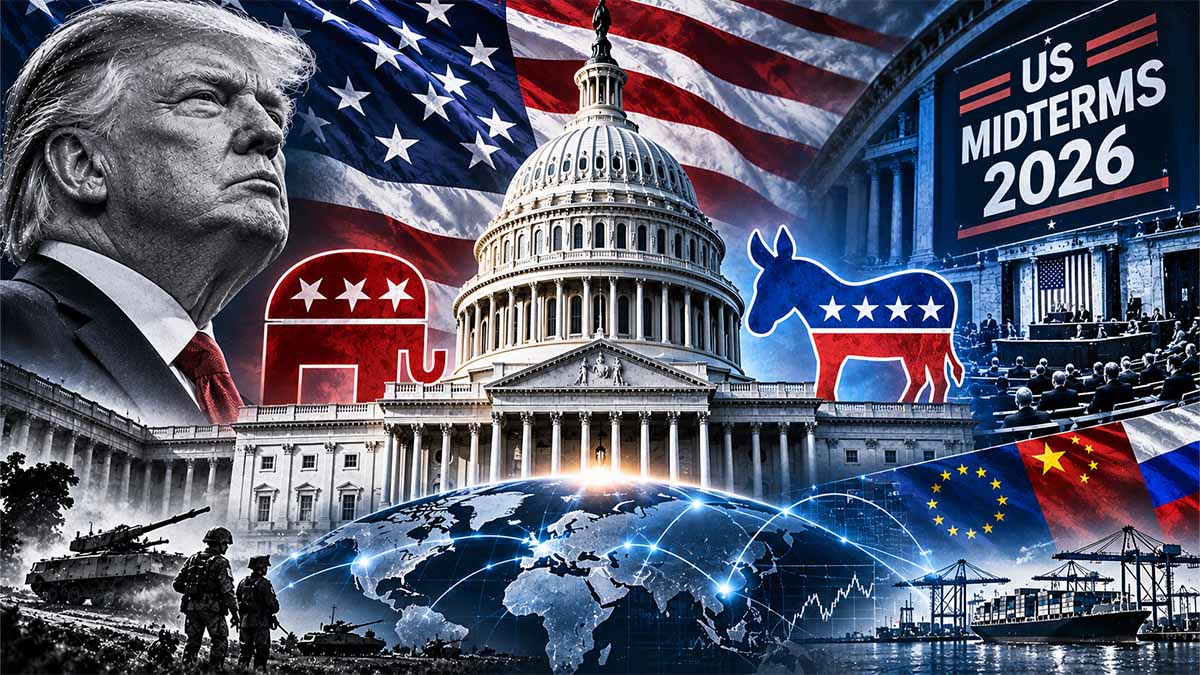
US MIDTERMS 2026
THE NEW POWER EQUILIBRIUM
Interactive assessment of congressional rebalancing, presidential residual authority, economic statecraft and geopolitical consequences through 2028.
01 / Constitutional Power Baseline
02 / Senate Composition and Institutional Network
The chart displays the official pre-election Senate party distribution. The emerging post-election balance is deliberately not quantified until final verified seat counts are available.
Senate Party Composition — 119th Congress
Historical counts, not projected 2027 seating. Bar heights use a common scale of 60 seats.
Federal Power Distribution
03 / Interactive Policy Authority Matrix
Select a policy field to compare retained executive powers, congressional constraints, the potential policy outcome and external consequences.
| Policy domain | Executive authority | Congressional leverage | Institutional effect | External implication |
|---|---|---|---|---|
| Taxation and mandatory spending | Proposals, implementation, veto | Legislative approval | Negotiation required | Large fiscal changes face legislative constraints |
| Annual appropriations | Budget request and lawful execution | Funding legislation and oversight | Funding leverage | Timing uncertainty for assistance programmes |
| Trade and tariffs | Existing statutory delegations | Amendment, oversight and funding | Delegated powers remain | Continuing trade-policy volatility |
| Sanctions | Designations, licences and enforcement | Statutory mandates and oversight | Executive implementation | Changes possible under existing legal authority |
| Federal appointments | Nominations and lawful alternatives | Senate advice and consent | Confirmation constraint | Potential leadership and diplomatic vacancies |
| Military operations | Commander-in-chief and valid existing authorities | Legislation, funding and war-powers oversight | Residual executive initiative | Crisis action can precede legislative resolution |
| Formal treaties | Negotiation and signature | Two-thirds Senate consent for ratification | High approval threshold | Constraints on new treaty commitments |
The labels describe legal mechanisms, not quantified risk levels. Outcome and external impact are conditional institutional assessments.
04 / Geopolitical Transmission Network
Four theatres are exposed to different combinations of US funding decisions, executive discretion, alliance commitments and crisis-response capacity.
Europe and Ukraine
Congressional appropriations and oversight affect security-assistance financing, programme continuity and industrial cooperation. Executive implementation remains consequential.
Middle East and Iran
Military command, sanctions implementation, war-powers restrictions and funding decisions interact with regional deterrence and energy-market stability.
Indo-Pacific
Defence appropriations, technology-export controls, security assistance and diplomatic assurances affect the implementation of deterrence commitments.
Continental defence financing and industrial production capacity.
Strategic autonomy and independent diplomatic capability.
Bilateral defence and intelligence continuity.
Mediterranean security, defence-industrial exposure and fiscal constraints.
05 / Interactive Strategic Scenario Engine
Switch between three conditional pathways for 2027–2028. These are not numerical forecasts, and no probability ranking is implied.
Legislative Gridlock + Executive Foreign-Policy Activism
Congressional negotiations obstruct major legislative initiatives while the presidency continues using valid existing executive powers.
Global implications: European financing uncertainty, continued executive influence over sanctions and energy markets, and potential divergence between Indo-Pacific commitments and implementation resources.
06 / Strategic Early-Warning Observatory
The following expandable indicators identify observable institutional records that would help distinguish the three pathways.
01 · Certified congressional results
Monitor state certifications, recounts and the final House and Senate seat allocations. These determine the precise legislative arithmetic.
02 · Appropriations and fiscal agreements
Track enacted annual appropriations, continuing resolutions, assistance conditions and federal budget-execution decisions.
03 · Senate confirmations
Observe nomination withdrawals, hearings, recorded confirmation votes and prolonged vacancies.
04 · Presidential vetoes
Record veto messages, override votes and whether legislation is enacted through cross-party agreement.
05 · Committee oversight
Monitor formal investigative announcements, hearings, subpoenas, public testimony and oversight reports.
06 · Executive administrative action
Track Federal Register rules, emergency-authority notices, sanctions changes and administrative implementation.
07 · Judicial constraints
Observe injunctions, appellate decisions and final rulings affecting contested executive measures.
08 · International commitment execution
Separate announced commitments from statutory authorization, funding, obligations, deliveries and implementation.
07 / Net Strategic Assessment
The 2026 midterm rebalancing changes the channels through which American policy is authorized, financed, investigated and executed. It does not remove the presidency’s existing constitutional and statutory powers.
For foreign governments, the central requirement through 2028 is to evaluate presidential policy announcements against congressional authorization, enacted appropriations, legal constraints and observable operational implementation.
PILLAR I — ELECTORAL RECONFIGURATION AND CONSTITUTIONAL AUTHORITY
Chapter 1. The 2026 Electoral Outcome: Congressional Composition, Geographic Shifts and Structural Political Significance
Assessment date: 4 November 2026
Principal judgment — High confidence on the reported transfer of congressional control; medium confidence on its longer-term political significance. The November 3, 2026 United States congressional elections produced a reported Democratic takeover of both the House of Representatives and the Senate, ending unified Republican control of the federal legislative and executive branches and establishing the conditions for divided government during the final two years of President Donald Trump’s second term. The institutional importance of this result is established by the transfer of prospective legislative control, but its structural political significance requires a more differentiated assessment. The reported Democratic gains encompass competitive states, traditionally Republican Senate constituencies, suburban congressional districts and certain areas in which Republicans had consolidated electoral support during the preceding presidential cycle. The geographic breadth is important because it indicates that the outcome cannot be explained exclusively by marginal changes in a small number of closely divided constituencies. Nevertheless, an election-night change of this magnitude does not, by itself, demonstrate a permanent transformation of American party coalitions. The central analytical distinction is between a national electoral correction, the deterioration of support for particular governing policies and a durable restructuring of electoral alignments. These propositions require different evidence and have different consequences for the prospective composition of Congress, the political position of the presidency and the approach of international partners to the United States through 2028.
The electoral baseline: confirmed institutional arithmetic and provisional 2026 outcomes
The starting point is the composition of the outgoing 119th Congress, which entered the second session of its term with 53 Republican senators, 45 Democratic senators and two independent senators caucusing with the Democratic Party. This distribution gave Republicans an effective 53–47 organizational advantage and made a Democratic Senate majority dependent on capturing several Republican-held seats while maintaining the party’s existing representation. The House operated under a narrower Republican majority, increasing the sensitivity of chamber control to relatively modest changes in district-level outcomes. The two chambers therefore entered the election under different structural conditions: the Senate required geographically distributed victories across several states, whereas the House could change hands through a combination of competitive suburban districts, candidate-specific outcomes and regional electoral changes. The underlying composition is documented in the United States Senate, Party Division, 119th Congress and the United States Senate Daily Press, 119th Congress Party Lineup, July 2026. Senato degli Stati Uniti+1
Election-night reporting on November 4 identifies Democratic control of both chambers, with at least seven Republican-held Senate seats reported as changing party control in Kansas, Iowa, Texas, Ohio, Maine, North Carolina and South Carolina. Democratic candidates also retained competitive Senate seats in Georgia and Michigan, thereby preventing Republican gains that could otherwise have offset the electoral advances elsewhere. In the House, the reported Democratic gain exceeds two dozen constituencies, including districts previously supportive of Republican presidential candidates. These results provide substantial evidence of a national change in congressional representation, but a precise final House allocation, definitive Senate caucus balance and comprehensive national district-by-district vote swing cannot yet be established from the completed state certification process. Accordingly, the current analysis treats reported race outcomes as provisional electoral findings and reserves the term certified result for the legally completed state canvass and certification. AP News
| Electoral indicator | Established baseline or reported result | Analytical significance | Evidentiary status |
|---|---|---|---|
| Outgoing Senate Republicans | 53 seats | Pre-election controlling caucus | Official Senate record |
| Outgoing Senate Democrats | 45 seats | Principal opposition party | Official Senate record |
| Outgoing Senate independents | 2 seats, both caucusing with Democrats | Effective outgoing opposition alignment of 47 | Official Senate record |
| Senate seats contested in 2026 | 35, including special elections | Geographic distribution of the electoral contest | Official Senate election schedule |
| Republican-held Senate seats reported flipped | At least 7 | Indicates gains beyond the minimum required for control | Election-night calls, pending certification |
| Republican-to-Democratic Senate flips reported | Kansas, Iowa, Texas, Ohio, Maine, North Carolina, South Carolina | Combination of competitive and previously Republican-leaning states | Provisional |
| Competitive Democratic Senate holds | Georgia and Michigan | Prevents offsetting Republican gains | Provisional |
| House seats subject to regular election | 435 | Entire voting membership contested | Constitutional and statutory framework |
| House majority threshold | 218 of 435 seats | Minimum full-house majority | Established arithmetic |
| House seats reported gained by Democrats | More than 24 | Establishes substantial reported district-level change | Provisional |
| Final 120th Congress composition | Awaiting completed authoritative allocation | Determines exact committee and voting margins | Not yet certified |
Sources: United States Senate — Party Division; United States Senate Daily Press — Senate Facts; Texas Secretary of State — November 3, 2026 Election Results; Federal Election Commission — Election Results and Voting Information. The seven reported Senate flips and House gains are independently documented by contemporaneous election reporting, but should not be described as final state-certified results.
The geographic distribution of the Senate shift
The geographic composition of the reported Democratic Senate gains warrants particular attention because the United States Senate is based on equal representation of states rather than population-proportional electoral districts. Every state elects two senators irrespective of population, making Senate control sensitive to political changes in smaller states and to electoral coalitions that do not necessarily resemble the national popular-vote distribution. A change of party control in Kansas or Iowa therefore has the same numerical effect on Senate membership as a comparable change in Texas. This arrangement means that the electoral geography of November 2026 has consequences exceeding the aggregate number of votes cast in particular regions. It also creates a distinction between the territorial scope of an electoral change and its demographic magnitude, which must be measured through separate statistical series.
The reported outcomes in Texas, Kansas and Iowa are significant because these states have supported Republican presidential candidates over recent electoral cycles, although the strength and social composition of Republican voting patterns differ considerably among them. Texas combines major metropolitan areas, extensive suburban development, rural conservative constituencies, substantial Hispanic populations and economically differentiated regions. Kansas has a markedly different population distribution and agricultural-industrial structure, while Iowa’s electorate has been shaped by changing rural, small-city and regional economic alignments. Consequently, their reported Democratic Senate gains cannot legitimately be attributed to one uniform demographic mechanism without comparable county-level, precinct-level and voter-survey evidence.
North Carolina and Ohio represent different analytical categories. North Carolina has been competitive in statewide elections despite Republican presidential victories, while Ohio has experienced a longer-term shift in the relationship between presidential and senatorial electoral coalitions. South Carolina introduces a further distinction because its statewide Republican advantage has generally been more durable than in the most closely contested presidential states. Maine, meanwhile, has a different partisan configuration, including a history of candidate-specific voting and cross-party electoral behaviour. The combined outcomes demonstrate substantial geographic diversity; they do not establish that each state moved for the same reasons.
The Texas Secretary of State’s November 3, 2026 reporting offers an example of the distinction between an observable vote count and a legally complete statewide result. At the 11:40 p.m. update, the state’s official election reporting system recorded 4,546,036 votes for Democratic candidate James Talarico and 3,567,899 for Republican candidate Ken Paxton, with 47% of polling locations reporting. The reported difference was 978,137 votes at that specific reporting point. This represents a substantial numerical advantage within the published partial return, but the proportion of reporting locations is not identical to the proportion of total ballots counted, and the reporting sequence may not be geographically representative. The figures therefore support an assessment of the observed interim result, not a claim about the exact certified margin or statewide demographic vote distribution. Source: Texas Secretary of State — November 3, 2026 General Election Results. Tuesday, November 3, 2026
Geographic evidence matrix
| State | Reported Senate development | Electoral characteristic | Structural question |
|---|---|---|---|
| Texas | Republican-held seat reported won by Democrats | Large, demographically and economically diverse state with recent Republican statewide dominance | Whether metropolitan, suburban and border-region changes are persistent |
| Kansas | Republican-held seat reported won by Democrats | Historically strong Republican Senate tradition | Whether the outcome is candidate-specific or reflects broader statewide change |
| Iowa | Republican-held seat reported won by Democrats | State with substantial rural and small-city electoral influence | Whether recent Republican presidential strength translates differently to congressional contests |
| Ohio | Republican-held seat reported won by Democrats | State with changing presidential and Senate voting coalitions | Whether Democratic Senate support extends beyond individual candidate appeal |
| South Carolina | Republican-held seat reported won by Democrats | State with a durable recent Republican statewide orientation | Whether participation and coalition changes are repeatable |
| North Carolina | Republican-held seat reported won by Democrats | State with competitive statewide political institutions | Whether the result reflects broader coalition consolidation |
| Maine | Republican-held seat reported won by Democrats | State with distinct candidate-specific and cross-party voting traditions | Whether partisan alignment has displaced incumbency effects |
| Georgia | Democratic seat reportedly retained | Competitive electoral environment | Stability of Democratic statewide coalition |
| Michigan | Democratic seat reportedly retained | Competitive industrial and metropolitan electorate | Relationship between candidate selection, participation and coalition continuity |
The state-level outcomes in this table represent reported election-night results rather than independently completed certifications. The distinction is maintained because structural political interpretation depends on final vote margins, turnout denominators and comparable historical returns, none of which should be reconstructed from incomplete reporting. AP News
Electoral correction, governing-coalition dissatisfaction and structural realignment
The historical context is essential to evaluating the political meaning of the 2026 result. The American electoral system frequently produces congressional losses for the president’s party during midterm elections, but the size, geographic scope and institutional consequences of those losses vary. In 1994, the Republican Party gained 54 House seats; in 2006, Democrats gained 32; in 2010, Republicans gained 64; and in 2018, Democrats gained 41. These historical changes are documented in the United States House of Representatives, Majority Changes in the House of Representatives, 1856 to Present. The 2018 result is particularly relevant because it occurred during Donald Trump’s first presidency and created a Democratic-controlled House while Republicans retained the Senate, a configuration materially different from the dual-chamber change reported in 2026. Storia della Camera dei Rappresentanti
The historical comparisons demonstrate that substantial midterm losses can occur without establishing irreversible partisan realignment. They also show why the relationship between House and Senate results matters. House gains generally reflect changes across many geographically localized constituencies, whereas Senate gains depend on the particular states holding elections in that cycle. An election can produce a large national House majority change without a comparable Senate shift, and the reverse can occur when the Senate electoral calendar disproportionately exposes one party’s seats. The 2026 result therefore needs to be measured both against historical midterm swings and against the particular composition of Senate seats contested in November 2026.
The explanation of voter behaviour requires further evidentiary separation. Surveys and election reporting identify economic affordability, public concern about the Iran war and questions about government conduct as prominent election issues, while reported voting patterns indicate changes among younger and Hispanic voters relative to the prior presidential coalition. These observations should not be converted into a single causal explanation without accounting for turnout, candidate quality, partisan identification, demographic sampling and the distinction between national survey results and individual constituency outcomes. An aggregate increase in Democratic voting does not demonstrate that a particular issue independently changed a specified number of votes, while the reported movement of a demographic category does not necessarily establish that the same individuals changed party preference. The former could reflect altered participation, the latter population composition or both. The historical and demographic analysis should therefore preserve competing explanations rather than selecting a single politically convenient narrative.
Changes within the incoming Democratic representation
The reported election of Abdul El-Sayed in Michigan and Peggy Flanagan in Minnesota has significance beyond the numerical balance of the Senate because it broadens the political backgrounds and demographic representation of the incoming caucus. Their individual policy positions and coalition relationships may affect internal negotiations, particularly when the majority margin is narrow, but descriptive diversity does not translate mechanically into particular legislative outcomes. The organization of the Senate is influenced by leadership elections, committee assignments, institutional seniority, individual senator preferences and the procedural structure of each bill. A candidate elected with strong support from a particular ideological constituency may nonetheless negotiate differently across health policy, military appropriations, technology regulation, trade and foreign affairs.
A further institutional distinction concerns the House leadership. Hakeem Jeffries is positioned to seek the speakership under the reported Democratic House majority, but the office is filled through an election by the House itself, not through an automatic transfer from the minority leadership. The new majority must also determine its internal rules and committee organization, with potentially important consequences for how oversight investigations and appropriations negotiations are coordinated. The numerical majority, the identity of the speaker and the effective legislative coalition are therefore related but separate variables. The same applies to the Senate, where a nominal party majority does not guarantee the votes required for ordinary legislative cloture. AP News+1
The political significance of the shift before 2028
The evidence currently establishes a reported change in congressional control and a geographically extensive set of Republican electoral losses, but its implications for the 2028 presidential election cannot be inferred as an electoral forecast. Presidential contests involve different participation patterns, candidate selection processes and state-level coalition configurations than midterm congressional contests. The institutional consequences of the 2026 result can be analyzed directly; the identity or electoral advantage of future presidential candidates cannot be established from the present evidence.
For foreign governments, the immediate political significance lies instead in the changing number of American interlocutors with real institutional authority. Congressional leadership, committee chairs, Senate confirmation coalitions and appropriations negotiators will become more relevant to evaluating the implementation of long-term American commitments. These actors can influence legislation and expenditure even when the White House maintains a different policy position. Their influence is nevertheless constrained by the president’s veto, Senate procedures, existing statutory delegations and the courts, making the constitutional architecture of divided government the necessary subject of the next chapter.
Chapter 1 — Key judgments
The reported electoral transfer of both chambers is supported by current election calls, while the exact size of the incoming congressional majorities remains dependent on authoritative final returns. The distribution of reported Senate gains across seven Republican-held states supports a finding of broad geographic change, but it does not establish a single demographic cause or a permanent political realignment. Historical House majority changes in 1994, 2006, 2010 and 2018 demonstrate that substantial midterm corrections are not unique; the distinctive feature of 2026 is the reported simultaneous transfer of both chambers under an incumbent Republican president. Confidence is high in the institutional meaning of chamber control, medium in the geographic interpretation of reported outcomes and low in any claim of a durable demographic realignment before comparable election data and subsequent electoral evidence are available.
What would change the assessment
The decisive additional evidence would consist of certified state-level vote returns, the final House and Senate composition, comparable district and county voting data, documented participation changes, geographically representative voter surveys and the formal caucus organization of the 120th Congress. Material revisions to reported race outcomes or unexpectedly narrow governing margins would affect the legislative interpretation, while consistent evidence of enduring changes across multiple elections would strengthen the case for a structural electoral realignment.
Open official record
The authoritative sources for completion of this assessment are the Federal Election Commission’s Election Results and Voting Information, state election certification records, the United States Senate’s official party-division record and the United States House of Representatives’ historical election records.
Chapter 2. The New Institutional Balance: Presidential Veto, Congressional Oversight, Appropriations and Executive Residual Authority
Principal judgment — High confidence. The Democratic takeover reported in the 2026 congressional elections changes the legislative and investigative environment confronting the White House, but it does not create a parliamentary system in which the executive automatically loses office or authority upon losing control of the legislature. The United States Constitution separates presidential tenure and executive competence from congressional majority control. The president retains the constitutional responsibility to execute federal law, command the armed forces within applicable legal limits, nominate federal officials, conduct diplomacy and exercise veto authority, while the House and Senate independently control legislative enactment, appropriations and substantial oversight functions. The resulting balance is not a simple hierarchy in which one institution prevails over the others. It is a system of overlapping legal powers, procedural veto points and institutional dependencies through which a policy may be politically supported but legally blocked, legally authorized but financially constrained, or fully appropriated but subject to disputed implementation. For the 2027–2028 period, the decisive issue is whether the incoming congressional majorities can translate their procedural and financial powers into sustained constraints on executive action without obtaining the president’s agreement or assembling the supermajorities required to override presidential opposition.
Constitutional architecture and the limits of legislative majorities
Article I of the United States Constitution vests federal legislative authority in Congress and establishes the House of Representatives and the Senate as separate legislative bodies. Article II vests executive power in the president, who serves a constitutionally prescribed term and is not subject to removal merely because congressional control changes. The institutional consequences of the November 2026 elections therefore begin with the allocation of congressional powers rather than with any automatic reduction of the presidency’s constitutional status. Under Article I, Section 7, ordinary legislation passed by both chambers must generally be presented to the president, who may sign or veto it. If vetoed, the legislation can nevertheless become law when two-thirds of those voting in each chamber, provided a quorum is present, approve the override. This mechanism makes a simple congressional majority potentially sufficient to block presidential legislative initiatives but insufficient to impose major new legislation in the face of determined presidential opposition. The Constitution of the United States — National Archives provides the controlling constitutional framework. National Archives
The distinction between positive and negative legislative power is fundamental. A congressional majority can refuse to pass legislation, decline to approve appropriations, postpone particular bills, amend measures under its consideration and use institutional procedures to require additional examination. These powers are substantial because many presidential policy proposals depend on Congress to establish new legal authorities, amend tax law, authorize new mandatory spending or alter existing statutory constraints. A majority cannot, however, unilaterally compel a president to sign a bill. Nor can the president ordinarily enact legislation independently simply because Congress refuses to cooperate. In this respect, divided government creates a bilateral constraint on the creation of new statutory law, while leaving substantial areas of existing law available for executive administration.
The Senate adds another procedural dimension. Under the ordinary legislative cloture rule, three-fifths of senators duly chosen and sworn—normally 60 senators in a fully constituted Senate—are required to close debate on most legislation. This means that a Democratic Senate majority, even if sufficient to control its committees and leadership, would not necessarily possess the votes required to advance contested legislation over a sustained filibuster. By contrast, the Senate has established precedents permitting the closure of debate on nominations by a simple majority, subject to applicable Senate procedures. Treaty ratification presents a distinct constitutional requirement because Article II requires the concurrence of two-thirds of senators present. These thresholds cannot be treated as interchangeable: a majority required to organize the Senate, a majority required to confirm nominations, the 60-vote requirement commonly applicable to legislation and the two-thirds requirement for treaty consent perform different constitutional and procedural functions. Source: United States Senate — About Filibusters and Cloture. Senato degli Stati Uniti
Legislative thresholds and institutional consequences
| Governmental decision | Governing requirement | Practical meaning for 2027–2028 | Principal constraint |
|---|---|---|---|
| Ordinary passage in the House | Majority of votes cast, with applicable quorum and procedural rules | House majority can determine passage of many bills | Senate and presidential approval remain necessary |
| Ordinary Senate legislation | Simple majority for final passage, but generally 60 votes for cloture when contested | Senate majority may not be sufficient to overcome extended debate | Filibuster and chamber rules |
| Presidential veto override | Two-thirds voting in each chamber, with quorum | Cross-party support generally necessary | Constitutional supermajority |
| Most Senate-confirmed appointments | Simple-majority confirmation under current precedents | Majority can reject or approve nominees | Senate confirmation procedures |
| Constitutional treaty consent | Two-thirds of senators present | Treaty ratification requires unusually broad support | Article II |
| Constitutional amendment proposal | Two-thirds of both chambers, or constitutional convention mechanism | Ordinary party majorities cannot independently propose an amendment through Congress | Article V |
| Impeachment in the House | Majority vote | House may approve articles of impeachment | Senate trial and conviction |
| Removal after Senate impeachment trial | Two-thirds of senators present for conviction | House impeachment does not itself remove an official | Constitutional conviction threshold |
Source: The Constitution of the United States — National Archives; United States Senate — Powers and Procedures; United States Senate — Filibusters and Cloture. National Archives+2
Congressional oversight as an operational instrument
The transformation of congressional committee control is one of the most consequential institutional effects of the 2026 elections because it changes the capacity to demand information, organize hearings, investigate administrative action and influence the public documentary record surrounding federal policy decisions. Congressional oversight is supported by Congress’s legislative and investigative functions, subject to constitutional and statutory limitations, and its practical effectiveness depends on committee jurisdiction, delegated investigative authority, the availability of records and the enforceability of compulsory demands. A congressional majority may establish sustained investigations into executive implementation, the administration of appropriated funds, federal procurement, sanctions licensing, trade-policy decisions, agency compliance and the conduct of federal officials. It may also seek testimony from cabinet officials and other persons within the bounds of lawful investigative authority.
Oversight should not, however, be confused with direct administrative command. A congressional committee can investigate a federal department, examine documents and expose discrepancies between enacted law and executive implementation, but the committee does not ordinarily become the administrator of that department. Requests for documents may be resisted on grounds involving executive privilege, statutory confidentiality, national security or other legally recognized restrictions. Subpoena enforcement may require additional institutional procedures or judicial proceedings. The existence of investigative authority therefore does not guarantee prompt access to every requested document, and the announcement of an investigation should not be equated with a legally established finding of misconduct.
The capacity of committees to influence external policy is nevertheless substantial because the documentary record generated through oversight can become relevant to appropriations, statutory amendments, confirmation proceedings and judicial review. Investigations into sanctions implementation may identify differences between announced sanctions policy and actual administrative licensing or enforcement. Investigations into military assistance may distinguish congressional authorization from financial obligations, deliveries and operational availability. Investigations into procurement may identify contracting delays, cost overruns, supply-chain vulnerabilities or deviations from legislative requirements. These are mechanisms through which congressional control can affect executive policy without the immediate enactment of new legislation.
In the context of divided government, committee effectiveness also depends on coordination between chambers. Investigative findings produced by the House can inform Senate hearings, and Senate committees may integrate oversight findings into confirmation or appropriations negotiations. However, different committee jurisdictions and majority priorities can generate overlapping investigations, duplication of documentary demands or inconsistent policy objectives. A numerically unified congressional majority should therefore not be assumed to operate as a single institution with uniform priorities.
Appropriations, rescissions and the financial limits of presidential discretion
The constitutional allocation of financial authority is particularly significant because Article I, Section 9 establishes that money cannot be drawn from the Treasury except pursuant to appropriations made by law. This provision makes congressional legislation central to the authorization of federal expenditure, including defence programmes, international assistance and many administrative activities. At the same time, the existence of an appropriation does not always establish an unconditional obligation to spend every authorized dollar immediately. Actual execution depends on the statutory language, the period of availability, the legal nature of the appropriation, applicable conditions, administrative procedures and the federal financial-management framework. Consequently, the relationship between congressional funding and executive implementation must be assessed through the operative legal instruments rather than generalized assertions that either Congress or the president possesses absolute control.
The Congressional Budget and Impoundment Control Act of 1974 provides an especially relevant framework for disputes over the executive withholding of appropriated funds. The law establishes procedures for presidential proposals to rescind budget authority, while imposing limitations on withholding and preserving the legislative role in determining whether proposed rescissions become law. This framework has contemporary significance because the Government Accountability Office examined a September 25, 2026 presidential special message proposing rescissions involving eleven appropriation accounts. In its September 29, 2026 decision, the agency concluded that the proposals did not permit the executive to withhold the affected appropriations beyond the end of fiscal year 2026, emphasizing that Congress had not enacted the corresponding rescissions. The conclusion concerns the specific legal circumstances and appropriations reviewed and should not be generalized into an assertion that all administrative funding delays are unlawful. It does, however, demonstrate that fiscal conflicts between Congress and the executive are governed by enforceable statutory distinctions rather than solely by political negotiations. Source: Impoundment Control Act of 1974: Review of the President’s Special Message of September 25, 2026 — United States Government Accountability Office. U.S. GAO
The potential policy consequences are especially important for programmes whose implementation depends on successive annual appropriations. A multiyear defence-industrial strategy may require several separate annual funding decisions, while a particular procurement contract may depend on previously enacted budget authority and its specific terms. A foreign-assistance announcement may be based on already available funds or on a request for new funds, and those situations create materially different congressional dependencies. New congressional majorities may seek to attach reporting requirements, restrictions, conditions or revised priorities to future appropriations. The president may veto the resulting legislation, but that decision can create risks for broader government funding when unrelated programmes are incorporated within the same legislative vehicle.
A useful distinction must therefore be maintained between the authority to authorize expenditure, the legal availability of appropriated funds, the administrative obligation of funds, the actual disbursement of money and the delivery of goods or services. These are separate stages in the federal financial process. A foreign government relying on American defence assistance should not assume that the announcement of a programme establishes the completion of all subsequent funding and delivery stages. Conversely, the absence of new appropriations does not necessarily mean that all assistance previously authorized, appropriated and obligated must immediately cease.
Executive orders, administrative action and the limits of residual presidential authority
A president confronting an opposition-controlled Congress retains the capacity to issue executive orders, direct executive agencies within the scope of lawful authority, implement existing statutes, make certain appointments under applicable constitutional provisions, conduct diplomatic initiatives and exercise the commander-in-chief function. These powers can provide significant operational flexibility when new legislation becomes difficult. Their existence does not, however, establish an unlimited capacity to create new legal authorities. Executive orders must rest on a valid constitutional or statutory basis, and administrative regulations must comply with the relevant legislation and procedural requirements. Courts may review executive and administrative action, subject to jurisdictional and justiciability limitations, while Congress retains the ability to amend statutes through the constitutionally prescribed legislative process.
The scope of presidential discretion varies sharply across policy areas. In trade policy, the executive may exercise powers delegated by Congress under particular statutes, but those delegations have conditions, procedures and legally contestable boundaries. In sanctions administration, the executive may possess considerable authority to designate entities, issue licences and implement restrictions, but the extent of discretion depends on the governing statutory framework and any applicable emergency-authority requirements. In military affairs, the constitutional commander-in-chief function must be considered alongside congressional powers relating to appropriations, declarations of war, military organization and statutory war-powers restrictions. In immigration, environmental regulation, industrial policy and federal procurement, executive action similarly depends on the relevant legislative framework.
The consequence for the 2027–2028 period is that executive initiative can continue across many policy domains without requiring the simultaneous political approval of both congressional chambers, but it remains subject to legal constraints and potential institutional challenge. The more an initiative depends on existing delegated authority, previously enacted expenditure or constitutionally assigned executive functions, the less directly congressional majority control may determine its immediate implementation. Conversely, the more an initiative depends on new mandatory spending, new taxation, major statutory changes or new treaty-level commitments, the greater the importance of congressional cooperation.
Congressional control and the operational limits of military authority
The relationship between legislative control and military authority has direct relevance to international strategic stability because urgent military decisions may occur before Congress can complete legislative procedures. The president serves as commander in chief under Article II, while Congress holds important powers concerning declarations of war, military funding, organization of the armed forces and legislation governing military operations. The War Powers Resolution of 1973 establishes statutory consultation, reporting and withdrawal-related requirements concerning certain introductions of United States forces into hostilities, although its interpretation and application have been disputed by successive administrations. The resulting legal framework requires analysis of the specific operation, the nature of the military engagement, the existence of statutory authorization and the applicable congressional response.
The potential emergence of a more assertive congressional majority may influence the political sustainability of prolonged military operations through hearings, funding negotiations and legislative initiatives. Nevertheless, a resolution expressing congressional opposition does not automatically terminate military operations unless it has the necessary legal effect. Similarly, congressional resistance to an executive military initiative does not necessarily prevent the initiation of every operation that the president considers authorized under existing law. Military command, legislative authorization and financial support remain distinct forms of power, each with different procedural requirements and temporal characteristics.
This separation becomes particularly consequential during crises involving Iran, maritime security, regional escalation or confrontations in the Indo-Pacific. Decisions involving military deployments, emergency operational responses or changes in force posture may have immediate strategic consequences, while congressional efforts to restrict or redirect the underlying policy may require extended institutional action. Foreign governments assessing American decision-making should therefore differentiate the executive’s capacity to initiate a particular measure from its capacity to sustain that measure politically, financially and legally over time. The United States Senate’s official explanation of its powers and procedures confirms Congress’s central constitutional role in military policy through war powers, appropriations and oversight. Senato degli Stati Uniti
The operational significance of Senate confirmations
The Senate’s advice-and-consent authority constitutes a separate potential constraint on the presidency because certain executive and judicial positions require confirmation before an appointee may exercise the powers of the office on a permanent basis. The extent of this constraint depends on the type of appointment, the legal framework governing vacancies, Senate procedures and the availability of alternative lawful appointment mechanisms. A Senate majority opposed to particular nominations can reject them, decline to advance them or condition political negotiations on commitments concerning administrative priorities. Such leverage may affect cabinet leadership, diplomatic representation, regulatory agencies, federal judgeships and national-security administration, although the president may retain certain options involving acting officials or recess appointments within constitutional and statutory limits.
The foreign-policy consequences are indirect but operationally meaningful. Delays in confirming ambassadors can affect diplomatic representation, particularly during complex bilateral negotiations. Vacancies or leadership disputes within departments can affect the consistency and coordination of regulatory or sanctions implementation. Judicial appointments can have longer-term institutional effects because Article III judges ordinarily serve during good behaviour rather than for a fixed presidential term. The importance of confirmation authority therefore extends beyond immediate partisan confrontation to the continuity and composition of federal institutions.
A Democratic Senate majority would possess the procedural capacity to influence these appointments, but the actual effect cannot be determined without examining the nominations submitted, committee assignments, voting behaviour and statutory arrangements governing the relevant offices. The administration’s possible use of alternative appointments or acting arrangements would also require case-specific legal analysis.
A differentiated hierarchy of institutional constraints
The strongest congressional constraints arise where executive policy depends on new statutory authority or discretionary appropriations, while the weakest immediate legislative constraints may arise where the executive can operate within valid existing law without additional expenditure or congressional approval. Between those endpoints lies a substantial category of shared authority, contested interpretation and negotiated implementation. The following matrix organizes the main institutional mechanisms according to their operational dependencies rather than assuming that every policy domain responds identically to a congressional majority change.
| Policy category | Presidential instrument | Congressional instrument | Principal legal limitation | Operational consequence |
|---|---|---|---|---|
| New federal taxation | Budget proposals, veto, statutory implementation | Tax legislation | Bicameral passage and presentment | Major changes require legislative agreement or veto override |
| Mandatory spending programmes | Execution of existing law, legislative proposals | Creation or amendment of statutory entitlements | Statutory authorization and budget rules | New programmes face substantial legislative barriers |
| Annual discretionary expenditure | Budget request, administration, veto | Appropriations legislation and conditions | Constitutional appropriations requirements | Funding negotiations become central |
| Rescission of appropriated funds | Statutory rescission proposal | Approval or rejection through legislation | Impoundment Control Act | Executive withholding is legally constrained |
| Federal appointments | Nomination and lawful alternative arrangements | Senate confirmation | Article II and applicable statutes | Vacancies and appointment disputes possible |
| Regulatory implementation | Executive orders and agency rulemaking | Statutory amendment, oversight, appropriations | Administrative law and judicial review | Existing delegations remain consequential |
| Trade restrictions | Exercise of delegated statutory powers | Revision of trade statutes and oversight | Governing delegation and judicial interpretation | Executive trade action may continue |
| Economic sanctions | Designation, licensing and enforcement | Statutory sanctions and oversight | Applicable sanctions law | Significant executive implementation discretion |
| Formal treaties | Negotiation and signature | Senate consent | Two-thirds Senate requirement | Ratification constrained |
| Military operations | Commander-in-chief function and relevant statutory authority | Funding, authorization, legislation and oversight | Constitution, war-powers statutes and applicable law | Immediate initiative and sustained support may diverge |
| Investigations | Responses to lawful requests and privilege claims | Hearings, subpoenas and committee inquiries | Jurisdiction, privilege and judicial enforcement | Expanded scrutiny, but not automatic administrative control |
| Constitutional amendments | No ordinary unilateral executive amendment power | Congressional proposal mechanism | Article V supermajority and ratification rules | Outside ordinary majority control |
Source framework: United States Constitution — National Archives; United States Senate — Powers and Procedures; United States Senate — Filibusters and Cloture; United States Government Accountability Office — Decision B-338788, September 2026. National Archives+3
Historical divided government and the institutional distinction between confrontation and constraint
The constitutional balance after the 2026 elections can be evaluated through earlier periods of divided government, provided that those precedents are used to identify institutional mechanisms rather than to presume identical political outcomes. During President Bill Clinton’s administration after the 1994 congressional elections, Republican control of both legislative chambers created a sustained environment of budgetary negotiation, legislative conflict and executive-legislative bargaining. During President Barack Obama’s administration after the 2010 elections, the Republican takeover of the House established a different configuration, in which congressional control was divided between parties and the executive faced constraints arising from the interaction between chambers. During President Trump’s first administration after the 2018 elections, Democratic control of the House increased congressional investigative capacity and affected legislative negotiations while the Senate remained Republican-controlled. These episodes illustrate how the distribution of control across chambers influences the availability of legislative agreement, the intensity of committee investigations and the possible consequences of funding disputes. The official historical House data are maintained by the United States House of Representatives, Majority Changes in the House of Representatives, 1856 to Present. Storia della Camera dei Rappresentanti
The 2026 configuration differs from the 2018 configuration because the reported Democratic majority extends to both congressional chambers. This distinction matters particularly for nominations and committee investigations, since Senate control determines which party organizes Senate committees and which coalition possesses the principal procedural advantage in advancing or rejecting nominations. Nevertheless, even simultaneous control of the House and Senate does not remove the president’s constitutional veto or the Senate’s procedural limitations on ordinary legislation. The relevant comparison is therefore not simply between divided and unified government, but between specific combinations of party control, legislative voting thresholds, committee organization and existing executive authority.
The historical record also requires distinguishing congressional confrontation from effective legal constraint. An administration may face extensive hearings and public criticism while continuing to implement existing law; alternatively, a relatively limited number of appropriations provisions or statutory amendments may substantially alter the operational feasibility of a particular programme. The number of investigations alone is therefore an inadequate measure of congressional effectiveness. A more useful measure considers whether investigations produce enforceable disclosure, legislative changes, appropriations restrictions, confirmation consequences or judicially relevant findings. Similarly, the number of presidential executive orders does not independently establish an expansion of lawful presidential power, because the legal effects of those orders depend on underlying authority and subsequent implementation.
Institutional effectiveness under differing congressional margins
The final numerical composition of the 120th Congress will influence the practical importance of individual members and the strength of congressional leadership. Narrow majorities increase the potential influence of small internal groups because a limited number of defections can prevent passage. Larger majorities provide greater procedural flexibility but do not eliminate differences among legislators regarding spending, regulation, foreign policy or the degree of confrontation with the executive. In the Senate, a party majority below the ordinary 60-vote cloture threshold remains dependent on cross-party cooperation, applicable procedural exceptions or changes in Senate precedent to advance contested ordinary legislation. The resulting relationship between seat margins and policy outcomes is nonlinear: obtaining an additional seat may alter committee ratios or strengthen internal leadership, while still leaving a substantial gap to the votes required for contested legislation or treaty ratification.
The constitutional veto introduces another discontinuity. Even where both chambers pass a bill, a presidential veto forces Congress to assemble a two-thirds coalition in each chamber to enact the measure over executive objection. The constitutional requirement applies to those voting, provided a quorum is present, rather than necessarily requiring identical fixed numerical thresholds in every conceivable voting configuration. For illustration, if all 435 House members vote, 290 affirmative votes are necessary for a two-thirds override; if all 100 senators vote, 67 affirmative votes are necessary. These are illustrative full-membership voting thresholds, not claims about the forthcoming party composition. They demonstrate why a simple majority in each chamber provides substantial blocking power but does not automatically provide the ability to impose contested legislation.
Strategic implications for the distribution of American policy authority
The most important institutional consequence of the 2026 result is the multiplication of actors capable of determining whether a federal policy proceeds from political commitment to implemented action. The House may influence the financial provisions governing a policy, the Senate may affect the confirmation of officials responsible for implementation, the executive may continue exercising existing statutory powers, and the courts may determine whether disputed actions fall within the law. Each institutional actor therefore affects a different stage in the policy cycle, and these stages cannot be collapsed into a simple measure of presidential or congressional strength.
For senior foreign-policy decision-makers, the resulting framework requires a more precise understanding of the durability of American commitments. A presidential statement concerning military assistance, trade restrictions, sanctions or security guarantees is not equivalent to a new statute. A congressional authorization does not necessarily establish an appropriation. An appropriation does not necessarily establish that funds have been obligated or that equipment has been delivered. A legally valid executive action may remain subject to subsequent statutory changes, judicial proceedings or fiscal constraints. Conversely, a public conflict between the administration and congressional leadership does not prove that an existing legally authorized programme has been suspended.
The significance of divided government is therefore best understood as an alteration in the probability of institutional agreement and the timing of policy implementation, rather than a universal prohibition on action. Where executive and congressional priorities converge, the constitutional system permits continued cooperation, appropriations and the implementation of existing programmes. Where priorities diverge, the consequences depend on which institution possesses the legally decisive power at the relevant stage. A disagreement over a proposed tax reform differs fundamentally from a disagreement over an existing sanctions designation, a pending ambassadorial confirmation or the execution of an enacted defence appropriation.
Chapter 2 — Key judgments
The reported Democratic control of both chambers expands congressional capacity to organize investigations, determine legislative priorities, control appropriations negotiations and influence Senate confirmations, but the president retains constitutionally and statutorily defined executive authority. The principal legal limits are established by the Constitution, applicable statutes, Senate procedures and judicial decisions, rather than by election-night political interpretations. The 60-vote ordinary Senate cloture threshold, the two-thirds constitutional veto-override requirement and the two-thirds Senate treaty-consent requirement create distinct forms of constraint, while the Impoundment Control Act limits the executive’s ability to withhold appropriated funds under the circumstances governed by that law. Confidence is high in these institutional distinctions; the actual intensity of confrontation, the internal cohesion of the incoming congressional majorities and the administration’s selection of executive instruments remain unresolved political variables.
What would change the assessment
The most important developments would include the formal adoption of congressional rules and committee assignments, the emergence of stable voting coalitions, changes to Senate procedural precedents, new appropriations legislation, legally consequential presidential vetoes, judicial decisions interpreting executive powers and documented changes in the administration’s implementation practices. Each would provide direct evidence about whether divided government is producing effective constraints, negotiated compromises or increased reliance on existing executive authority.
Open official record
The decisive institutional sources are the National Archives’ constitutional transcript, the United States Senate’s procedural records, the United States Senate’s historical explanation of cloture and the Government Accountability Office’s September 29, 2026 decision on the Impoundment Control Act.
US MIDTERMS 2026: THE NEW POWER EQUILIBRIUM
Interactive assessment of congressional power, executive authority and geopolitical consequences through 2028.
01 / Institutional Baseline
02 / Congressional Composition and Federal Power
Senate Composition — 119th Congress
Constitutional Power Network
03 / Policy Authority Matrix
04 / Geopolitical Transmission
European National Differentiation
05 / Strategic Scenario Explorer, 2027–2028
06 / Early-Warning Indicators
07 / Strategic Assessment
PILLAR II — ECONOMIC STATECRAFT AND INTERNATIONAL SECURITY
The 2026 US Midterm Elections: Financial Power, Alliance Commitments and Global Strategic Stability
Assessment cut-off: November 4, 2026
Strategic horizon: January 2027–December 2028
Geographic coverage: United States, European Union, Italy, France, Germany, United Kingdom, Ukraine, Middle East, Iran and Indo-Pacific.
This pillar examines the transmission of the new congressional balance into economic policy, international security financing and executive crisis management. Its central distinction is between legal authority, the availability of financial resources and the operational capacity to implement national commitments. Election-night reporting indicates Democratic control of both congressional chambers, but the analysis does not presume that every contested race has been certified or that the incoming majorities will act uniformly across policy domains. AP News
Chapter 3. Economic Statecraft, Tariffs, Sanctions, Industrial Policy, Federal Borrowing and Market Expectations
Principal assessment — High confidence in the governing legal and fiscal constraints; medium confidence in their prospective economic effects.
The economic significance of the 2026 congressional elections cannot be reduced to the proposition that Democratic control of the House and Senate automatically reverses the Trump administration’s trade, fiscal and industrial policies. The American economic system operates through several different legal channels, including congressional authority over taxation and appropriations, presidential implementation of existing statutes, administrative powers exercised by the Treasury and Commerce Departments, independent monetary-policy decisions by the Federal Reserve and judicial review of the executive’s interpretation of delegated powers. The transfer of congressional control changes the political conditions for adopting new laws and modifying existing fiscal commitments, but it does not automatically eliminate tariffs imposed under valid statutory authority, terminate existing industrial subsidies, revoke outstanding federal contracts or suspend legally established sanctions programmes. The strategic consequences for international markets and foreign governments will arise primarily from changes in the durability, implementation and legal contestability of these instruments, particularly where trade restrictions intersect with industrial investment, public borrowing, defence procurement and the security interests of allied economies.
The transformation of American tariff policy in 2026
The most consequential legal development preceding the midterm elections was the United States Supreme Court’s February 20, 2026 decision in Learning Resources, Inc. v. Trump and Trump v. V.O.S. Selections, Inc., which held that the International Emergency Economic Powers Act did not authorize the president to impose tariffs through the emergency authorities invoked in the litigation. The distinction is critical because the judgment did not eliminate the broader American statutory framework for import restrictions. Rather, it removed one asserted legal basis for the administration’s tariff programme while leaving the executive able to use other instruments delegated by Congress, subject to their particular conditions and limitations. The Congressional Research Service subsequently documented the administration’s use of Section 122 of the Trade Act of 1974, followed by continued application of Section 232 of the Trade Expansion Act of 1962 and Section 301 of the Trade Act of 1974. Under Section 122, the president imposed a temporary global tariff of 10%, but the statutory authority could not support that measure indefinitely without congressional legislation extending the authorized period. The temporary tariffs expired on July 24, 2026, after which other statutory trade instruments assumed greater importance. Sources: Congressional and Presidential Authority to Impose Import Tariffs — Congressional Research Service, March 19, 2026 and Active Presidential Tariff Actions in 2026 — Congressional Research Service, October 8, 2026. Every CRS Report+2
This sequence demonstrates that divided government cannot be evaluated independently of judicial limitations and the specific statutory powers already available to the executive. Section 232 concerns national-security-related import restrictions and requires the relevant investigation and statutory findings, while Section 301 addresses certain foreign trade practices through procedures administered by the Office of the United States Trade Representative. These authorities permit substantial executive influence over international trade, but they do not create unlimited discretion to impose any tariff, on any product, for any purpose. Their legal conditions can be contested, and Congress remains constitutionally competent to amend the underlying statutes through legislation. In a divided-government environment, the administration may seek to preserve its trade programme through existing authorities, while congressional committees may demand evidence concerning the statutory basis, economic effects, implementation procedures and consequences for American businesses and consumers. The strength of congressional influence will depend on whether investigations produce legislative agreements, whether appropriations provisions lawfully constrain particular administrative activities and whether courts accept the administration’s interpretation of the applicable statutes.
The distinction between emergency economic authority and trade authority also affects sanctions policy. The Supreme Court’s restriction on tariff use under the International Emergency Economic Powers Act should not be interpreted as a general invalidation of that statute’s non-tariff sanctions functions. Economic restrictions involving blocked property, prohibited transactions and designated persons must be assessed under their operative legal authorities, including the International Emergency Economic Powers Act, specific sanctions statutes and applicable executive orders. This distinction is especially important for governments and companies conducting business involving Russia, Iran or strategically sensitive technologies, because a judicial ruling affecting one form of economic intervention does not necessarily remove other legally independent restrictions.
United States trade-policy authority after the 2026 judicial and statutory changes
| Legal instrument | Applicable function | Executive authority | Congressional leverage after the elections | International economic consequence |
|---|---|---|---|---|
| International Emergency Economic Powers Act, 1977 | Emergency economic restrictions, including relevant sanctions authorities | Broad economic emergency measures, subject to law; not a general tariff power under the February 2026 ruling | Statutory amendment, oversight and applicable legislative controls | Sanctions remain distinct from tariffs |
| Trade Expansion Act, 1962 — Section 232 | Import restrictions following national-security investigation | Presidential adjustment of imports under statutory conditions | Oversight, statutory amendment and examination of administrative findings | Sector-specific exposure in metals and strategic industries |
| Trade Act, 1974 — Section 301 | Response to specified foreign trade practices | Trade measures following required procedures and determinations | Legislative revision, oversight and procedural scrutiny | Potential effects on China-related trade and international supply chains |
| Trade Act, 1974 — Section 122 | Temporary import surcharge under specified balance-of-payments circumstances | Time-limited tariff authority, subject to statutory maximum duration | Extension requires congressional legislation | Temporary 2026 measure could not continue indefinitely without further law |
| Trade Act, 1974 — Section 201 | Safeguards concerning serious injury from imports | Measures following the required investigation and recommendations | Statutory amendment and oversight | Product-specific protection and adjustment costs |
| Federal appropriations law | Funding for trade administration and enforcement | Lawful execution of enacted appropriations | Appropriations decisions and oversight | Administrative implementation and enforcement capacity |
| Judicial review | Review of agency and executive action where jurisdiction exists | Defence of challenged executive measures | Congress can amend statutes, subject to constitutional limits | Legal uncertainty over particular restrictions |
Legal basis: Congressional and Presidential Authority to Impose Import Tariffs — Congressional Research Service, March 2026; Active Presidential Tariff Actions in 2026 — Congressional Research Service, October 2026. These Congressional Research Service publications reproduce institutional legal analysis; the operative legal authorities remain the statutes and Supreme Court judgments they examine. Every CRS Report+1
Federal borrowing, fiscal exposure and the constraints on new expenditure
The fiscal environment entering the 120th Congress is materially different from one in which legislators could negotiate new programmes against a balanced federal budget or a declining public-debt stock. The federal fiscal year ended on September 30, 2026, with a reported deficit of approximately $1.992 trillion, federal net outlays of approximately $7.396 trillion and net receipts of approximately $5.403 trillion, according to the October 22, 2026 fiscal update issued through the United States Congress Joint Economic Committee’s reporting system. The deficit exceeded the corresponding fiscal-year 2025 figure of approximately $1.775 trillion by about $217 billion. Federal receipts financed approximately 73.1% of fiscal-year 2026 outlays, with the remaining 26.9% corresponding to the annual deficit. These figures describe the federal budgetary flow during fiscal year 2026 and must not be confused with the outstanding stock of Treasury debt, the gross federal debt or the market value of government securities. Source: Monthly Fiscal Update, September 2026 — United States Congress Joint Economic Committee, October 22, 2026. jec.senate.gov
The Congressional Budget Office’s February 2026 baseline had projected fiscal-year 2026 revenues of approximately $5.6 trillion, outlays of $7.4 trillion, a deficit of approximately $1.9 trillion and debt held by the public reaching approximately $32.1 trillion at the end of the fiscal year. These figures represent a forecast vintage and should not replace subsequently reported fiscal-year results. Their analytical value lies in showing that substantial deficits and financing requirements were already expected before the election result, and that the incoming congressional majority will inherit structural spending and revenue commitments rather than a discretionary fiscal position determined entirely by the new political configuration. The distinction between the baseline forecast and the realized fiscal outcome is particularly important because forecasts incorporate assumptions concerning legislation, macroeconomic conditions, revenue collection and interest costs that may differ from subsequent developments. Source: The Budget and Economic Outlook — Congressional Budget Office, February 2026. Congressional Budget Office
| Fiscal indicator | Fiscal year 2026 | Fiscal year 2025 comparison or forecast | Interpretation |
|---|---|---|---|
| Federal net outlays | $7.396 trillion | $7.010 trillion in FY2025 | Spending increased by approximately 5.5% |
| Federal net receipts | $5.403 trillion | Not used for comparison here | Revenue received during FY2026 |
| Federal deficit | $1.992 trillion | $1.775 trillion in FY2025 | Deficit increased by approximately 12.2% |
| Deficit as share of outlays | 26.9% | Calculated from FY2026 totals | Portion of spending not financed by annual receipts |
| Expenditure per $1 of receipts | Approximately $1.37 | Calculated from FY2026 totals | Describes annual fiscal imbalance, not debt-service burden |
| CBO’s earlier FY2026 deficit projection | Approximately $1.9 trillion | February 2026 forecast vintage | Not the final fiscal-year result |
| CBO’s earlier FY2026 public-debt projection | Approximately $32.1 trillion | End-of-year forecast | Publicly held debt stock, not annual borrowing flow |
Sources: Joint Economic Committee — September 2026 Monthly Fiscal Update; Congressional Budget Office — Budget and Economic Outlook. Calculations are rounded from the reported figures. jec.senate.gov+1
These fiscal numbers indicate an important constraint on the economic choices available to either party. A new congressional majority may favor different distributions of spending, taxation or industrial support, but changing those priorities requires identifying the corresponding legislative authority and fiscal consequences. Large increases in discretionary expenditure may require additional borrowing or compensating revenue and spending measures, while proposed reductions in mandatory programmes can face statutory, political and administrative barriers. The president can veto appropriations and tax legislation but cannot, through the veto alone, compel Congress to adopt an alternative comprehensive fiscal programme. A divided federal government may therefore produce negotiations over incremental expenditure, continuing resolutions or narrowly defined tax provisions rather than a complete redesign of federal fiscal policy.
For international markets, this creates two potentially opposing transmission mechanisms. Legislative disagreement may constrain the adoption of new large-scale spending commitments and thereby limit certain forms of fiscal expansion, but recurrent funding conflicts can also increase uncertainty regarding the implementation of federal programmes and the administration of existing obligations. Treasury financing requirements remain governed by the federal fiscal position and applicable borrowing authorities rather than solely by the party composition of Congress. Interest rates on Treasury securities are also influenced by monetary policy, inflation expectations, liquidity conditions, investor demand and global financial developments. Consequently, a change in congressional control does not establish a mechanically predictable direction for Treasury yields, the dollar exchange rate or equity valuations.
Industrial policy, subsidies and the durability of existing programmes
Industrial policy requires distinguishing legally enacted incentives from executive announcements, appropriated programme funds, administrative grant decisions and binding contractual obligations. Federal semiconductor, energy, infrastructure and defence-industrial initiatives may be financed through different statutory mechanisms, with different periods of availability and different degrees of administrative discretion. A change in congressional control may affect the legal conditions governing future programmes, but existing legislation remains in force unless amended or repealed through the constitutionally required process. Similarly, grants and contracts already executed under valid law may carry enforceable obligations that cannot be disregarded merely because congressional priorities change. Conversely, funds authorized but not appropriated, appropriated but not obligated, or conditionally available may remain exposed to future legislative and administrative decisions.
This distinction has international consequences because industrial investment often has longer planning and construction horizons than a two-year congressional term. Semiconductor fabrication facilities, energy infrastructure, grid projects, defence production lines and advanced manufacturing facilities require decisions involving capital expenditure, skilled labour, supplier contracts, permitting and equipment procurement. A company evaluating a multibillion-dollar investment cannot treat a political statement of support as equivalent to a legally binding financial commitment. It must examine the operative statute, actual funding arrangements, grant or contract conditions, implementation schedules and any applicable regulatory or export-control restrictions. The rebalancing of Congress may change the political oversight environment, but the consequences for individual investments will depend on the specific legal and financial structure of the programme.
The effects extend to allied industrial economies. Germany’s automotive, mechanical engineering and advanced manufacturing sectors have substantial commercial interests in tariff predictability and regulatory stability. France combines industrial and technological interests with a comparatively developed national defence-industrial structure. Italy’s industrial exposure includes machinery, transport equipment, metals, components, precision manufacturing and specialized suppliers, while the United Kingdom’s interests include financial services, aerospace, defence cooperation, research and technology. These differing economic structures mean that a sector-specific American import restriction may affect European economies in different ways, even when the legal measure applies across multiple countries. A comprehensive assessment of exposure requires product-level trade statistics, the relevant tariff lines, supply-chain mapping and the actual structure of transatlantic investment rather than an assumption that every European economy experiences identical effects.
Sanctions as an instrument of executive-led economic statecraft
Sanctions policy occupies a particularly sensitive position within divided government because Congress can establish mandatory restrictions through legislation while the executive administers substantial parts of the sanctions architecture through delegated statutory authority, regulations, licences, designations and enforcement decisions. The distinction between mandatory sanctions, discretionary sanctions and implementation exemptions is essential. A restriction established directly by statute may not be removable solely through a presidential policy announcement, while a designation adopted under a particular executive authority may be subject to administrative modification within the applicable legal framework. Licensing decisions may permit specified transactions without terminating the underlying sanctions programme, and enforcement priorities can influence the practical effect of a restriction without formally changing its legal existence.
For Russia, this means that the effectiveness and continuity of sanctions must be examined alongside the applicable statutory constraints, executive designation authorities, financial enforcement mechanisms and coordination with European and other allied jurisdictions. For Iran, sanctions enforcement interacts with restrictions on financial transactions, energy trade, shipping and designated entities. In both cases, a new congressional majority may increase scrutiny of administrative decisions or seek legislative changes, but implementation does not automatically transfer to Congress. The decisive analytical question is whether the disputed policy requires new legislation, can be executed under existing authorities or is already constrained by mandatory statutory provisions. The International Emergency Economic Powers Act, 50 U.S.C. Chapter 35 and the United States Treasury’s Office of Foreign Assets Control provide the principal legal and administrative framework for examining these distinctions.
Market expectations: policy volatility and institutional constraint
Financial markets may interpret divided government as a source of policy constraint, political confrontation or both, depending on the particular instrument under examination. The expectation of fewer comprehensive tax or spending reforms is different from the expectation of reduced tariff volatility, because the latter depends heavily on executive authorities already delegated by Congress. Likewise, greater congressional scrutiny of sanctions does not necessarily imply that financial restrictions will become either stronger or weaker; the effect depends on the relevant legislation, administrative decisions and the conduct of affected jurisdictions. A valid market assessment must therefore identify the specific policy mechanism through which the new Congress could alter cash flows, investment incentives, legal obligations or commercial access.
The principal economic risk is not legislative disagreement in the abstract, but uncertainty concerning the enforceability, duration and implementation of decisions that affect capital allocation. Businesses can adapt to stable restrictions more readily than to repeated changes in legal conditions, implementation timetables and administrative requirements. This is particularly important for firms investing in long-lived industrial assets, institutions providing project finance and governments relying on American technology or defence procurement. The relevant monitoring indicators are therefore not merely political statements or headline market movements, but enacted legislation, agency rules, judicial decisions, appropriations, contract obligations, Treasury financing data and verified changes in actual trade flows.
Chapter 3 — Key judgments
The 2026 midterm outcome changes the political conditions for American economic legislation without automatically reversing existing trade, sanctions or industrial-policy instruments. The February 2026 Supreme Court ruling materially restricted the use of emergency economic authority for tariffs, while the continued availability of other statutory trade instruments demonstrates the importance of legal delegation. The fiscal-year 2026 deficit of approximately $1.992 trillion establishes a substantial pre-existing borrowing requirement, limiting the practical scope for major fiscal initiatives without legislative agreement. Existing industrial programmes must be evaluated according to their authorizations, appropriations and binding obligations, while sanctions remain governed by a combination of statutes and executive implementation. Confidence is high in these legal and fiscal conclusions, medium in the expectation of increased implementation uncertainty and low in any directional forecast of financial-market prices derived solely from the election.
What would change the assessment
Material changes would include new trade legislation, judicial decisions affecting Section 232 or Section 301 implementation, revised statutory sanctions authorities, negotiated multi-year appropriations, significant amendments to industrial incentives or new official fiscal projections demonstrating a substantial change in borrowing requirements. The most relevant records are the United States Code, Federal Register, Congressional Budget Office, United States Treasury and Office of the United States Trade Representative.
Chapter 4. Europe, NATO and Ukraine: Security Financing, Strategic Autonomy and Transatlantic Institutional Relations
Principal assessment — High confidence in the established European financing instruments and NATO commitments; medium confidence in the effects of the new American congressional majority on future transatlantic security decisions.
The principal consequence of the 2026 congressional elections for European security is a possible change in the political channels through which the United States authorizes, finances and implements assistance, rather than an automatic amendment of the North Atlantic Treaty or the termination of existing security obligations. European governments enter the 2027–2028 period with a significantly expanded European financing framework for Ukraine, a NATO commitment to increase defence and security-related investment by 2035, and continuing dependence on American capabilities in several strategically important areas. The interaction between these conditions and divided government in Washington creates a more complicated security environment: congressional support may strengthen particular assistance programmes even where executive priorities differ, but such support cannot independently guarantee presidential implementation, military delivery or durable bilateral agreement. Conversely, presidential decisions concerning diplomacy, deployment and military command may continue to influence European security despite a more assertive Congress. For European governments, the central requirement is to distinguish the legal continuity of alliance obligations from the financial and operational continuity of individual programmes, while examining whether European defence-industrial capacity can compensate for delays or changes in American support.
Ukraine’s financing architecture: an established European commitment rather than a political intention
A significant development preceding the 2026 midterm elections was the European Union’s adoption of a €90 billion Ukraine Support Loan for 2026–2027, agreed politically by the European Council in December 2025 and finalized through the necessary legislative framework in April 2026. The arrangement was designed to address Ukrainian budgetary requirements and defence-industrial needs, using borrowing by the European Union on capital markets backed by EU budgetary resources. The approved framework allocates an indicative €30 billion to macroeconomic support and €60 billion to military and defence-industrial purposes. This division is essential because budget support sustains government functions and macroeconomic stability, whereas defence-industrial financing supports the procurement and production of military equipment. These financial purposes are related but are not interchangeable in operational analysis. The Council’s April 23, 2026 announcement also specified that an initial €45 billion would be made accessible for 2026, including €8.35 billion through macro-financial assistance, €8.35 billion through the Ukraine Facility and €28.3 billion for defence-industrial capacities. These figures describe approved financial architecture and availability arrangements; they must not all be presented as completed disbursements or delivered military equipment. Source: Council Finalises €90 Billion Support Loan to Ukraine — Council of the European Union, April 23, 2026. Consilium
The structure of this financing arrangement demonstrates that European capacity to sustain Ukraine cannot be measured exclusively through annual national defence budgets or through direct military transfers. The Union has combined common-market borrowing, budgetary guarantees, macro-financial assistance and defence procurement into an institutional mechanism intended to provide resources over more than one fiscal period. This does not eliminate financial or operational risk. Borrowing creates obligations within the European financial architecture, while defence expenditure depends on procurement eligibility, industrial production, contracting, delivery schedules and the availability of the required weapons and ammunition. The financial commitment can therefore be legally established even when particular items remain unavailable for immediate delivery, and a disbursement can occur without implying that a corresponding military capability has reached Ukrainian forces. This distinction is especially important for air defence systems, missiles, drones and ammunition, where the operational result depends on production capacity and deployment rather than merely the availability of financing.
The European Council’s March 19, 2026 conclusions had already identified an additional Ukrainian financing requirement of approximately €30 billion beyond the European Union’s €90 billion framework, while calling for increased contributions from other international partners. This figure should be interpreted within the financing assumptions adopted at that time rather than added mechanically to subsequent International Monetary Fund estimates, which use different time horizons and methodological definitions. The same European Council conclusions emphasized the urgency of accelerating the production and delivery of air defence systems, ammunition, drones and missiles, particularly to protect Ukrainian energy and critical infrastructure. The institutional objective is therefore dual: preserve the fiscal functioning of the Ukrainian state and increase its capacity to acquire and produce military equipment. Source: European Council, March 19, 2026 — Conclusions on Ukraine. Consilium
European Union financial commitments to Ukraine
| Instrument or commitment | Amount | Period | Financial or operational purpose | Status and limitation |
|---|---|---|---|---|
| Ukraine Support Loan | €90 billion | 2026–2027 | Combined macro-financial and defence support | Legislative framework finalized April 2026 |
| Indicative macroeconomic allocation | €30 billion | 2026–2027 | Budgetary and financial stability | Part of the €90 billion, not additional funding |
| Indicative defence allocation | €60 billion | 2026–2027 | Defence-industrial capacity and procurement | Part of the €90 billion |
| Financing accessible under the 2026 implementing decision | €45 billion | 2026 | Financial and defence support | Availability is distinct from disbursement |
| Macro-financial assistance component | €8.35 billion | 2026 | Macroeconomic assistance | Component of the €45 billion |
| Ukraine Facility component | €8.35 billion | 2026 | Support through the Ukraine Facility | Component of the €45 billion |
| Defence-industrial component | €28.3 billion | 2026 | Defence procurement and production | Component of the €45 billion |
| Additional international financing requirement identified by European Council | Approximately €30 billion | 2026–2027 | Remaining Ukrainian financing requirements under March assumptions | Financing gap, not an adopted additional EU appropriation |
| SAFE defence-financing instrument | Up to €150 billion | Multiannual EU instrument | Loans for eligible member-state defence investment and common procurement | Separate instrument; not exclusively for Ukraine |
Sources: Council Finalises €90 Billion Support Loan — April 2026; European Council Conclusions on Ukraine — March 2026; EU Military Support for Ukraine — Council of the European Union.
Frozen Russian assets and the distinction between capital and extraordinary revenues
The treatment of immobilized Russian sovereign assets constitutes a separate financial and legal issue. According to the Council of the European Union’s October 14, 2026 review, approximately €210 billion in Central Bank of Russia assets remained immobilized in the European Union. The European mechanism established in 2024 permits the use of extraordinary revenues generated from those immobilized assets to support Ukraine, while maintaining a legal distinction between the underlying sovereign assets and the extraordinary proceeds. Under the October 2024 arrangement, 95% of the relevant extraordinary revenues are assigned to the Ukraine Loan Cooperation Mechanism and 5% to the European Peace Facility. The Council reported approximately €8 billion in accumulated windfall profits, of which €3.8 billion had reached Ukraine and €4.2 billion had contributed to repayment arrangements for EU–G7 loans or had been reserved for that purpose. These categories must remain separate because the stock of immobilized assets is not equivalent to cash transferred to Ukraine, and the cumulative revenue generated by those assets is not equivalent to the original capital amount. Source: EU Financial Assistance to Ukraine — Council of the European Union, reviewed October 14, 2026. Consilium
This distinction has direct implications for American congressional oversight and allied financial coordination. A new congressional majority may seek information concerning the operation of American sanctions, the treatment of immobilized assets under United States jurisdiction and the interaction between American and European financing mechanisms. However, the European Union’s treatment of assets immobilized under EU law cannot be altered directly through an American congressional vote. Similarly, the existence of a European mechanism for using extraordinary revenues does not automatically create authority to confiscate the underlying Russian sovereign principal. Any such action would raise separate legal questions concerning sovereign immunity, property rights, financial jurisdiction, sanctions law and the particular statutory or regulatory instruments adopted by the competent authorities.
The relevant strategic consequence is that European financing autonomy has increased in certain areas, but it remains bounded by legal and financial dependencies. The €90 billion loan provides a substantial framework for financial support, while extraordinary revenues from immobilized assets create another potential repayment or assistance mechanism. Neither instrument eliminates the need for industrial production, military equipment, transport and operational integration. Moreover, European financial institutions and governments must consider the implications of financial arrangements for sovereign-debt markets, custodial institutions and the long-term credibility of legal protections governing state assets. These issues cannot be resolved solely through the political preferences of Washington or Brussels.
International Monetary Fund assessments and Ukraine’s medium-term financing requirements
The International Monetary Fund’s 2026 programme review provides an additional basis for understanding the scale and timing of Ukrainian financing needs. Under the Fund’s baseline scenario, the financing gap for the 2026–2029 period was assessed at approximately $140.3 billion, with annual components of $55.4 billion in 2026, $43.4 billion in 2027, $22.8 billion in 2028 and $18.6 billion in 2029. The corresponding downside scenario increased the cumulative requirement to approximately $149.5 billion. These figures describe an IMF programme financing framework rather than a forecast of additional expenditure to be financed exclusively by the United States. The baseline incorporates expected official financing, IMF programme resources, debt-related measures and other components, while some assumed later-period financing remains dependent on prospective creditor and donor decisions. Accordingly, the figures should not be summed with the European Union’s €90 billion loan because the latter is already represented within the broader financing assumptions and is denominated in a different currency. Source: Ukraine: 2026 Article IV Consultation and First Review Under the Extended Fund Facility — International Monetary Fund, 2026. eLibrary IMF
The temporal profile of the IMF’s assessment is important because it indicates substantial financing requirements continuing into 2028, beyond the primary period covered by the European Union’s current €90 billion support instrument. This creates an exposure that cannot be fully resolved by examining the annual American appropriations process in isolation. Ukraine’s medium-term fiscal stability depends on the availability and timing of several financing sources, the continuation of domestic revenue collection, the economic effects of the war and the implementation of agreed reforms. United States congressional decisions may affect particular assistance mechanisms or multilateral financial relationships, but European Union institutions, bilateral donors, international financial institutions and Ukrainian domestic authorities remain independent participants in the financing process.
The resulting strategic issue is one of coordination rather than simple substitution. If American support becomes more difficult to authorize or implement, European actors may possess mechanisms to sustain portions of the financing requirement, but additional European lending does not necessarily replace specific American military capabilities or intelligence functions. Equally, a political agreement in Washington cannot by itself resolve procurement bottlenecks or Ukrainian domestic implementation constraints. Financial stabilization, defence procurement and operational military support must therefore be evaluated as separate but interdependent dimensions of assistance.
NATO’s 2035 investment commitment and the effect of the American electoral cycle
The NATO Hague Summit Declaration of June 25, 2025 established a commitment by allied governments to invest 5% of gross domestic product annually in core defence requirements and broader defence- and security-related expenditure by 2035, divided into a minimum 3.5% of GDP for core defence requirements and up to 1.5% for specified defence- and security-related activities. The declaration also required allies to submit annual plans demonstrating a credible trajectory toward the objective and scheduled a review in 2029. The distinction between the two components is fundamental: expenditure satisfying the core NATO defence definition is not interchangeable with all expenditure classified as infrastructure, resilience, cyber protection or broader national security. The agreed percentages are prospective commitments and must not be represented as expenditures already realized in 2026. Source: The Hague Summit Declaration — North Atlantic Treaty Organization, June 25, 2025. The Hague Summit Declaration
The 2026 American elections do not automatically amend this declaration, nor do they alter the text of Article 5 of the North Atlantic Treaty. However, the credibility of alliance commitments depends on more than treaty language. Allied deterrence requires forces, readiness, ammunition, command structures, military mobility, intelligence support, communications and the political capacity to make decisions under crisis conditions. A change in American congressional control may influence the appropriations and oversight environment governing some of these capabilities, while the president retains important responsibilities for diplomacy and military command. The practical effect therefore depends on whether American funding and operational commitments are maintained through enacted legislation and implemented defence programmes.
The NATO investment commitment also creates a timing problem. The American 2028 political horizon precedes the alliance’s 2035 expenditure objective and its scheduled 2029 review. European governments consequently face a requirement to organize multi-year financing and industrial programmes that extend beyond the current American presidential term. This makes the credibility of European national investment plans, production contracts and defence-industrial cooperation especially important. A future American administration may adopt a different approach to alliance management, but European procurement programmes requiring many years to produce operational capabilities cannot be designed exclusively around the political preferences of a single American presidency.
European defence-industrial autonomy and the limits of financial substitution
European strategic autonomy is frequently discussed as a political objective, but its operational meaning must be defined more precisely. For the purposes of defence planning, autonomy concerns the capacity to authorize, finance, produce, sustain and employ essential capabilities without unacceptable dependence on external decisions. This does not require eliminating all international industrial cooperation, which would be neither necessary nor economically efficient across every defence sector. It requires identifying particular dependencies capable of restricting national or allied freedom of action during a crisis, including dependencies involving production capacity, replacement components, export licences, specialized materials, maintenance, intelligence systems, communications and strategic transport.
The European Union’s Security Action for Europe instrument provides a relevant financing mechanism, with loans of up to €150 billion intended to support eligible common defence procurement by member states. The regulation entered into force on May 28, 2025, and the Council reports that 15 of the 19 national SAFE plans submitted in 2025 included projects involving Ukraine. Ukraine can participate in eligible joint procurement, and Ukrainian companies are eligible under the framework. These provisions create possibilities for integrating Ukrainian defence-industrial capacity into European procurement arrangements, but the existence of financing eligibility does not demonstrate that all proposed industrial projects have entered production or delivered equipment. Source: EU Military Support for Ukraine — Council of the European Union. Consilium
The distinction between investment authorization and realized capability is especially important when European governments consider replacing or supplementing American assistance. Defence production requires production lines, trained labour, quality assurance, technical certification, access to components and stable demand sufficient to justify investment. Even where financing is available, a shortage of particular components or a long production lead time can restrict the immediate operational effect. Conversely, predictable multi-year procurement can improve manufacturers’ ability to invest in capacity and supply-chain resilience. The relevant analytical measure is therefore not merely the total value of announced defence expenditure but the relationship between committed resources, contracted production, deliveries, operational availability and sustainable replenishment.
Germany: industrial capacity, continental defence and transatlantic exposure
Germany’s strategic position combines a central geographic role in European security with major industrial capabilities and extensive exposure to international trade. The effects of divided government in Washington must therefore be assessed through several different channels: the financing of European defence requirements, industrial production and procurement, access to American defence technology, the resilience of transatlantic commercial relationships and the capacity to sustain support for Ukraine. German manufacturing enterprises operating in automotive, machinery, chemicals, electronics and industrial equipment can be affected by American tariff policy, while German defence procurement and military readiness depend on separate national and alliance decisions.
The principal German policy question concerns whether higher expenditure can be converted into usable capability at the required pace. Increased budget allocations do not automatically solve shortages in production capacity, maintenance personnel, munitions or military logistics. Coordination with American institutions can remain important even when Germany expands its domestic defence-industrial base, particularly where programmes involve jointly developed equipment, American technology or interoperable systems. A divided American Congress may create additional political channels supporting transatlantic industrial cooperation, but it may also introduce uncertainty into particular procurement and funding arrangements. Germany’s response should therefore be evaluated through national budget enactment, procurement awards, production schedules and NATO capability requirements rather than general statements concerning strategic autonomy.
France: strategic autonomy, national decision-making and European defence coordination
France enters this period with a distinct strategic profile because it maintains national nuclear deterrence, significant defence-industrial capabilities and a tradition of independent diplomatic and military decision-making. Its assessment of American congressional rebalancing consequently differs from that of states whose security posture depends more directly on American extended deterrence and military infrastructure. The central French question is whether increased American institutional uncertainty strengthens the practical case for European capabilities in areas where dependence could constrain autonomous action, while preserving cooperation where American participation remains operationally essential.
The distinction between strategic autonomy and strategic separation is particularly important. European states may seek greater control over their own procurement, intelligence support and operational planning without abandoning NATO or reducing all forms of transatlantic cooperation. France’s defence-industrial capabilities can contribute to European procurement and technological resilience, but European capability development remains subject to national procurement decisions, financing, intellectual-property arrangements and industrial competition. The American congressional balance may influence the political environment for such cooperation, yet the decisive French and European instruments remain domestic legislation, EU mechanisms, bilateral agreements and the applicable NATO framework.
United Kingdom: defence cooperation, intelligence continuity and European financing integration
The United Kingdom occupies a different institutional position because it is a NATO ally outside the European Union while maintaining extensive defence, intelligence and technological cooperation with the United States. This creates several layers of exposure to American political decisions, including bilateral defence programmes, intelligence cooperation, procurement arrangements and diplomatic coordination. The relevant distinction is between relationships established through durable agreements and institutional cooperation, which can continue across political changes, and discretionary initiatives requiring new political agreement, funding or administrative authorization.
A significant development in July 2026 was the Council of the European Union’s approval of British participation in the €90 billion Ukraine Support Loan framework. The arrangement enables Ukraine to procure eligible defence products from British manufacturers under the agreed conditions, illustrating that European security financing and industrial cooperation need not be restricted exclusively to EU member-state industrial capacity. This matters because the United Kingdom possesses relevant defence-industrial resources and can contribute to European procurement without holding the same institutional position as an EU member. Source: Ukraine Support Loan: EU Countries Approve UK Participation — Council of the European Union, July 22, 2026. Consilium
The strategic implication is that British security policy must coordinate three distinct relationships: direct bilateral cooperation with Washington, institutional participation in NATO and selective cooperation with European Union financing and procurement arrangements. These relationships can reinforce one another, but they operate through different legal instruments and political institutions. The emergence of a Democratic congressional majority in Washington may create additional parliamentary interlocutors, but the continuity of specific programmes will depend on their legal basis, funding arrangements and executive implementation.
Italy: Mediterranean security, industrial supply chains and fiscal constraints
Italy’s strategic exposure combines NATO commitments, Mediterranean security interests, participation in European defence initiatives and a manufacturing system involving machinery, metallurgy, transport equipment, electronics and specialized industrial suppliers. The consequences of American congressional rebalancing therefore extend beyond military policy narrowly defined. American trade restrictions can affect industrial exporters and integrated supply chains, while changes in United States engagement in the Mediterranean or Middle East can influence Italian security planning, energy infrastructure, maritime transport and the protection of commercially important routes.
Italy’s ability to expand defence-industrial participation must also be assessed against national fiscal constraints and the time required to qualify production capabilities. Financial commitments may support industrial conversion, but actual integration into defence supply chains requires compliance with technical specifications, traceability, quality assurance and the procurement conditions established by prime contractors and public authorities. The European Union’s emerging financing arrangements may create opportunities for eligible projects, but they should not be interpreted as automatic procurement contracts or guaranteed industrial demand. Italy’s strategic interest is therefore linked to the relationship between national funding capacity, European common procurement, NATO operational requirements and the continuity of international supply chains.
The Mediterranean dimension differentiates Italy from some northern and central European allies. Instability in North Africa, the Red Sea, the Eastern Mediterranean or the Gulf can affect maritime security, energy prices, insurance, shipping costs and the functioning of infrastructure relevant to European trade. American military and diplomatic decisions may influence these conditions even if the congressional majority changes, while European responses depend on the availability of national and multinational assets. The relationship between American institutional confrontation and Italian economic exposure is consequently indirect but potentially material, particularly when global energy and transport markets are already disrupted.
European strategic exposure matrix
| Jurisdiction | Principal exposure to US policy | European or national instrument | Implementation constraint | Decision-relevant indicator |
|---|---|---|---|---|
| European Union | Ukraine financing, sanctions coordination, defence procurement | Ukraine Support Loan, SAFE, EU sanctions instruments | Member-state participation, financing rules and industrial delivery | Actual disbursements, procurement awards and deliveries |
| Germany | Continental defence readiness, industrial trade, Ukraine support | National budgets, NATO planning, EU procurement | Production capacity and fiscal implementation | Contracted capability and delivery schedules |
| France | Strategic autonomy, defence technology, independent military capability | National defence authorities, EU programmes, NATO cooperation | Industrial coordination and programme financing | National procurement and multinational commitments |
| United Kingdom | Bilateral US defence relations, NATO, Ukraine procurement | UK defence programmes, NATO, participation in eligible EU procurement | Separate UK and EU legal frameworks | Bilateral implementation and procurement eligibility |
| Italy | Mediterranean security, industrial supply chains, defence investment | National programmes, NATO, EU defence financing | Fiscal capacity, qualification and production timelines | Procurement, industrial conversion and readiness |
| Ukraine | Budgetary stability and military sustainment | National budget, EU financing, IMF programme, bilateral assistance | Financing timing, procurement and operational needs | Financial obligations, military deliveries and infrastructure resilience |
The comparative assessment is based on the applicable European Council Ukraine financing framework, European Union defence-support instruments and NATO Hague Summit Declaration. It distinguishes established institutional mechanisms from country-specific analytical exposures rather than presenting unsupported national expenditure forecasts.
Transatlantic institutional relations after the congressional change
European governments will need to engage with several American institutions whose powers are related but not identical. The presidency remains responsible for major diplomatic initiatives and executive implementation, while congressional committees may influence the legal and financial conditions governing assistance programmes. The Senate’s role in confirming senior officials can affect diplomatic representation and administrative continuity, while the House and Senate together influence the adoption of new appropriations. The Department of Defense, Department of State, Department of the Treasury and other agencies remain responsible for executing their legally assigned functions. Consequently, a government obtaining political support from congressional leadership has not necessarily secured executive agreement, just as an agreement announced by the administration does not automatically establish congressional financing.
The central operational requirement is to evaluate each transatlantic commitment through its legal and financial structure. An existing multilateral treaty differs from a bilateral memorandum of understanding; a security-assistance authorization differs from an appropriation; a procurement contract differs from a general political declaration; and an appropriated programme differs from an actual military delivery. The distinction allows governments to identify where American policy continuity is protected by existing institutions and where new political decisions remain necessary.
Chapter 4 — Key judgments
The European Union’s €90 billion Ukraine Support Loan constitutes an established financing framework, with an indicative €30 billion macroeconomic component and €60 billion defence-related component, while NATO’s 2035 investment commitment creates a longer-term requirement for national and allied capability development. Approximately €210 billion in Russian central-bank assets remained immobilized in the European Union according to the Council’s October 2026 review, but the underlying principal must remain distinct from the extraordinary revenues generated by those assets. The new American congressional balance may influence the financing and oversight of United States commitments, although it cannot directly amend EU legal instruments or NATO treaty obligations. Confidence is high in the existence and structure of these commitments, medium in their capacity to reduce specific external dependencies and low in any assertion that European financing alone could replace all forms of American operational support.
What would change the assessment
The most consequential changes would include new American appropriations for Ukraine, material restrictions on the execution of existing programmes, revised EU disbursement schedules, significant changes in the legal treatment of immobilized Russian assets, defence-industrial production data demonstrating accelerated delivery and binding changes to national NATO capability plans. The relevant official records include the Council of the European Union’s Ukraine financing documentation, NATO official declarations and International Monetary Fund programme reports.
Chapter 5. The Middle East, Iran and the Indo-Pacific: Military Authorities, Regional Deterrence, Energy Security and Alliance Management
Principal assessment — High confidence in the observed 2026 energy disruption and the legal framework governing American military action; medium confidence in the prospective effects of congressional rebalancing on regional security policy.
The consequences of the 2026 American congressional elections for the Middle East and the Indo-Pacific arise from a fundamental asymmetry between executive crisis-management authority and congressional influence over the sustainability of military and economic policy. The president retains substantial capacity to direct military forces, conduct diplomatic negotiations and administer sanctions under applicable law, while Congress possesses legislative, appropriations and investigative powers capable of changing the conditions under which these activities continue. This distinction is particularly consequential during the ongoing conflict involving Iran, where military operations and disruptions to maritime energy flows have created measurable economic consequences extending far beyond the immediate theatre of hostilities. It is equally important in the Indo-Pacific, where long-term deterrence depends on military readiness, industrial capacity, technology-export controls, alliance coordination and credible implementation of security commitments. A change in congressional control does not automatically alter the command authority of the president, but it can affect the financing, scrutiny and political durability of policies that must be sustained over time. The resulting strategic environment must therefore be evaluated through actual legal authorities, operational developments and observable financial commitments rather than the assumption that a congressional majority determines all dimensions of American foreign policy.
Iran and the legal distinction between military initiative and sustained authorization
The United States and Israel initiated military operations against targets in Iran on February 28, 2026, following a period of negotiations concerning Iran’s nuclear programme and wider American concerns involving Iranian missiles and regional armed groups. The Congressional Research Service’s March 1, 2026 assessment identified questions concerning presidential authority, congressional notification and the War Powers Resolution, while documenting congressional consideration of measures intended to require the withdrawal of American forces from unauthorized hostilities. This establishes that the legal controversy surrounding military operations against Iran predates the November congressional elections and therefore cannot be attributed solely to the subsequent transfer of legislative control. Source: U.S. and Israeli Military Operations Against Iran: Issues for Congress — Congressional Research Service, March 1, 2026.
The constitutional framework divides relevant powers between the president and Congress. Article II establishes the president as commander in chief, while Article I grants Congress powers concerning declarations of war, appropriations, the organization of armed forces and legislation necessary to execute federal governmental powers. The War Powers Resolution of 1973 seeks to establish procedures for congressional consultation and participation when American forces are introduced into hostilities or situations involving imminent hostilities. Under the statute’s reporting and withdrawal framework, the president may become subject to a 60-day termination requirement, with a possible additional 30-day period under specified circumstances, unless an applicable statutory condition permits continued action. The precise operation of these provisions is subject to the facts of the deployment, the existence of congressional authorization and longstanding disagreements concerning the resolution’s constitutional interpretation. The relevant statutory provisions are 50 U.S.C. §1541 — Purpose and Policy and 50 U.S.C. §1544 — Congressional Action.
The implications of the new congressional balance depend on the legal form of legislative action. Hearings, statements and resolutions can affect political accountability and public scrutiny, but they do not necessarily produce binding restrictions on military operations. A lawfully enacted appropriations prohibition or statutory restriction has a different legal effect from a nonbinding declaration of congressional opposition. Moreover, the constitutional requirements governing legislative enactment remain applicable, including presidential presentment and veto procedures. Congressional opposition can therefore create substantial political and financial pressure without necessarily terminating an operation immediately. Conversely, sustained military commitments may become more difficult if Congress refuses to authorize required new expenditures or enacts binding limitations through the constitutionally prescribed process.
The strategic consequence is temporal as well as institutional. Immediate military decisions may occur within hours, while congressional hearings, appropriations and litigation can unfold over considerably longer periods. A regional government assessing American policy must consequently distinguish the executive’s ability to initiate action from the legal and financial conditions governing the continuation of that action. The distinction becomes particularly important when military operations extend beyond limited strikes and require prolonged deployments, replenishment of precision weapons, force protection, maritime security or reconstruction of damaged military infrastructure.
The 2026 energy shock: documented production losses, maritime disruption and fuel-market transmission
The International Energy Agency’s October 14, 2026 Oil Market Report documents a global energy market substantially disrupted by the Iran conflict and associated attacks on regional infrastructure and maritime traffic. According to that report, world oil supply increased by 2.5 million barrels per day in September to approximately 102.3 million barrels per day, reflecting a partial recovery in Gulf production. Nevertheless, the agency projected average global supply of approximately 100.7 million barrels per day for 2026, representing a year-on-year reduction of 5.8 million barrels per day. The agency also estimated that global oil demand would decline by approximately 2.6 million barrels per day over the full year, with a partial recovery of 2 million barrels per day projected for 2027. These are forecast values produced under the agency’s October 2026 assumptions, not realized full-year outcomes. Their significance lies in demonstrating that the crisis has affected both the availability of petroleum and the demand for energy through higher prices, physical shortages and deterioration in economic activity. Source: Oil Market Report — International Energy Agency, October 14, 2026. IEA
The same report identifies a critical distinction between the recovery of crude-oil exports and the recovery of refined-product supply. Gulf crude exports increased to approximately 13.9 million barrels per day in September, supported by restored production and the use of alternative transport arrangements, while estimated flows through the Strait of Hormuz rose to approximately 10.9 million barrels per day. However, refined-product shipments and liquefied petroleum gas flows recovered much more slowly. Middle Eastern refined-product exports reached approximately 1.9 million barrels per day in September compared with a pre-war level of approximately 4.7 million barrels per day, while liquefied petroleum gas exports reached approximately 670,000 barrels per day compared with a pre-war level of around 1.5 million barrels per day. The distinction matters because an improvement in crude-oil throughput does not automatically restore the supply of diesel, jet fuel, petrochemical feedstocks or other refined products necessary for industrial production, transport and consumer markets. Source: International Energy Agency — October 2026 Oil Market Report. IEA
The consequences for European and Asian economies arise through several related mechanisms. Higher crude-oil prices increase the cost of petroleum inputs and can affect refined products, but the relationship between crude prices and retail fuel prices is mediated by refining margins, product availability, taxation, transport and inventory levels. Maritime insecurity can increase shipping costs and insurance premiums, while disruptions to refineries and export terminals can restrict product supply even if upstream production partially recovers. Reduced availability of diesel affects freight transport, agriculture, industrial operations and parts of the maritime sector, while changes in jet-fuel availability affect aviation operating costs. The effects can therefore spread into consumer prices, industrial margins, trade balances and real household income without requiring a direct physical interruption of oil imports into every affected country.
Global oil-market disruption — October 2026 reference
| Indicator | Reported value | Reference period | Interpretation |
|---|---|---|---|
| Global oil supply | 102.3 million barrels/day | September 2026 | Partial monthly supply recovery |
| Monthly increase in supply | 2.5 million barrels/day | September versus August | Recovery in production, especially Gulf producers |
| Projected global average supply | 100.7 million barrels/day | Full-year 2026 | IEA forecast, not completed annual outcome |
| Projected year-on-year supply reduction | 5.8 million barrels/day | 2026 | Reflects extensive disruption |
| Projected global demand reduction | 2.6 million barrels/day | 2026 | Includes economic response to high prices and shortages |
| Gulf crude exports | 13.9 million barrels/day | September 2026 | Partial recovery toward pre-war levels |
| Strait of Hormuz oil flows | 10.9 million barrels/day | September 2026 | Recovered flows remained vulnerable |
| Middle Eastern refined-product exports | 1.9 million barrels/day | September 2026 | Below pre-war 4.7 million barrels/day |
| Middle Eastern LPG exports | 670,000 barrels/day | September 2026 | Below pre-war 1.5 million barrels/day |
| Global observed inventory decline from end-February | 509 million barrels | End-September 2026 | Reduction in available market buffers |
| North Sea Dated crude benchmark | $116.89/barrel | September 2026 average | Physical crude benchmark, not Brent futures |
| North Sea Dated price at report preparation | Approximately $134/barrel | October 2026 reporting period | Point-in-time observation, not monthly average |
| Projected recovery in global oil supply | 7.7 million barrels/day | 2027 versus 2026 | Conditional IEA forecast |
Source: Oil Market Report, October 2026 — International Energy Agency. The values distinguish physical flows, stocks, observed prices and forecasts. IEA
The Strait of Hormuz and the distinction between maritime access and energy-market normalization
The Strait of Hormuz remains one of the most consequential maritime passages for global energy trade, but the strategic effect of disruptions cannot be assessed solely through whether the passage is formally open or closed. Actual maritime access depends on security conditions, vessel availability, insurance, port operations, cargo loading, refinery production and the willingness of commercial operators to accept the prevailing risks. The International Energy Agency’s October 2026 assessment demonstrates that even when crude shipments partially recover, the wider petroleum market may remain severely constrained by damaged infrastructure, impaired refining capacity and disrupted refined-product transport. This distinction matters because a limited improvement in vessel movements may create an appearance of normalization that is not reflected in available diesel, aviation fuel or petrochemical products.
In September 2026, the agency recorded a strong rebound in Gulf crude exports while simultaneously identifying renewed attacks on regional energy infrastructure and tanker traffic as threats to the continuation of that recovery. The report also documented the September 11 attack on the Saudi East-West Pipeline and the consequences of higher freight rates for delivered crude costs and refining margins. This means that infrastructure bypassing the Strait can reduce dependence on a single maritime passage but does not eliminate vulnerability to attacks against pipelines, terminals or other transport assets. The relevant operational question is therefore whether the regional transport system can sustain adequate petroleum flows across multiple routes under continued security pressure. Source: International Energy Agency — Oil Market Report, October 2026. IEA
The economic effects extend particularly to oil-importing economies in Asia and Europe. A disruption in Middle Eastern exports may require refiners to obtain alternative crude grades, which can involve different transport distances, refining configurations and acquisition costs. At the same time, global shortages of particular refined products can cause price movements substantially exceeding changes in crude benchmarks. This creates differentiated exposure across economies according to their refinery capacity, product import dependence, inventory arrangements and the structure of industrial fuel consumption. A country possessing domestic refining capacity may still face shortages if the required feedstock is unavailable or if the refining system cannot produce the needed product mix. Conversely, a country importing refined products may face price and availability risks even if international crude markets appear to be recovering.
For the United States, the regional energy shock has both domestic and international consequences. American oil production and refining capacity provide certain advantages, but they do not insulate the economy entirely from global price movements, shipping costs or the consequences of disruption affecting allied economies. The administration may seek to influence energy-market conditions through diplomacy, sanctions administration, coordination with producers and legally authorized emergency measures. Congress may examine these decisions through oversight, legislation and appropriations, but the immediate management of diplomatic and military crisis decisions remains substantially executive-led within applicable law.
Strategic implications for Iran-related sanctions and negotiations
The relationship between military operations, sanctions enforcement and diplomatic negotiations requires distinguishing several different policy objectives. Restrictions intended to influence financial transactions, energy exports or designated entities may continue to operate under existing statutory and administrative authorities even while the administration pursues negotiations. Conversely, the existence of negotiations does not, by itself, establish a legal suspension of sanctions. Any relevant relief depends on the authority under which a particular restriction was imposed, the availability of waiver or licensing mechanisms and the formal legal measures adopted by the competent institutions.
A new congressional majority may influence the political environment surrounding negotiations by scrutinizing sanctions licences, demanding information regarding enforcement, examining the terms of proposed arrangements and considering legislation affecting particular restrictions. However, the ability of Congress to prevent or require a specific diplomatic measure depends on its legal form. A formal treaty requiring Senate consent differs from an executive agreement or administrative sanctions measure implemented under existing law. Similarly, congressional opposition to a negotiation does not automatically prevent the president from communicating with foreign governments or conducting diplomatic discussions.
The operational consequences for energy markets depend on the implementation of particular restrictions and on physical conditions in the Gulf. A sanctions adjustment may influence the legal availability of petroleum transactions, but it cannot immediately restore damaged infrastructure or remove risks to shipping. Conversely, the physical reopening of a transport route does not necessarily alter the legal restrictions governing particular cargoes, financial transactions or counterparties. For governments and businesses, sanctions compliance, shipping security, insurance availability and actual petroleum supply therefore remain separate dimensions of energy-market risk.
The Indo-Pacific: alliance credibility and the continuity of deterrence
The consequences of American divided government in the Indo-Pacific arise through a different combination of institutional dependencies. Regional deterrence depends on the credibility of American security commitments, the readiness and availability of deployed forces, the production and maintenance of military equipment, the resilience of military logistics and communications, and the ability of regional governments to coordinate policy under crisis conditions. Congressional appropriations and statutory authorizations influence portions of these capabilities, while the executive directs military operations and conducts diplomacy within the applicable legal framework. A change in congressional control may therefore affect particular programmes without directly determining every regional military or diplomatic decision.
The central analytical distinction is between alliance reassurance and operational implementation. A public commitment to defend an ally may influence political expectations, but the practical capability to fulfil the commitment depends on force posture, available equipment, logistical support, command arrangements and the legal obligations governing the relationship. Some regional partnerships are structured through mutual-defence treaties, while others involve different statutory, diplomatic or security-assistance arrangements. They cannot all be described as possessing identical American defence guarantees.
For Japan and the Republic of Korea, the relevant issues include the continuity of treaty commitments, military cooperation, deterrence arrangements and the readiness of forces necessary to respond to regional contingencies. The Philippines has a separate treaty relationship and security environment involving maritime interests and regional military cooperation. Taiwan occupies a different legal category because the United States maintains a domestic statutory framework governing relations and security assistance without the same formal mutual-defence treaty structure applicable to certain American allies. These distinctions have direct consequences for the nature of American commitments and the institutional mechanisms through which they are implemented.
Technology-export controls and the strategic role of administrative discretion
Technology policy represents an important area in which the executive retains substantial operational influence through existing export-control statutes and regulations. The United States Department of Commerce’s Bureau of Industry and Security administers export controls affecting strategically sensitive technologies, including advanced semiconductors and related equipment. These controls can influence the availability of computing capabilities, industrial investment, technology supply chains and the strategic competition between the United States and China. Congressional oversight may examine the criteria used to issue licences, the effectiveness of restrictions and the relationship between national-security objectives and commercial consequences, but individual licensing procedures remain governed by the applicable legal framework.
A particularly relevant 2026 example is the Bureau of Industry and Security’s January 13 decision to revise its licensing policy for certain advanced semiconductors exported to China. The agency announced that applications involving the NVIDIA H200, AMD MI325X and comparable products would be reviewed individually when specified security conditions were satisfied. Those conditions included measures concerning the availability of semiconductor production capacity for American customers, compliance procedures adopted by purchasers and independent testing in the United States. The measure illustrates that export-control policy can change through administrative rulemaking and licensing frameworks without requiring a comprehensive new statute for every individual adjustment. Source: Department of Commerce Revises License Review Policy for Semiconductors Exported to China — Bureau of Industry and Security, January 13, 2026.
This example also demonstrates why technology restrictions should not be interpreted solely through a binary distinction between prohibition and permission. Export controls may include licensing requirements, end-user restrictions, product specifications, destination-based limitations and conditions governing compliance or subsequent use. Their strategic consequences depend on how these restrictions affect actual technology transfers, domestic industrial incentives, allied supply chains and the ability of foreign companies to obtain alternative products. A divided Congress may influence the political scrutiny of these decisions, but it does not automatically resolve the underlying technological and security trade-offs.
For European and Asian partners, the relevant issue is the degree of predictability in American technology policy. Firms investing in semiconductor production, advanced computing or related manufacturing infrastructure require an understanding of the applicable licensing rules and the likelihood that particular transactions will remain legally permissible. Governmental cooperation concerning critical technologies also depends on the treatment of intellectual property, research collaboration, security screening and the interaction between American and allied export-control regimes. Consequently, the effect of the midterm elections should be evaluated through enacted legislation, published administrative rules and actual licensing decisions rather than speculative assumptions about future restrictions.
Regional strategic comparison: legal authority, operational exposure and external effects
The Middle East and Indo-Pacific present different operational environments, but both demonstrate the importance of separating presidential initiative from congressional financial and legislative authority. The Middle East currently involves an active conflict with major documented consequences for international energy markets, while Indo-Pacific security concerns involve deterrence, military readiness, alliance continuity and strategic technology competition. The same constitutional framework governs the relationship between the American executive and Congress, but its operational consequences differ according to the nature of the activity being financed or implemented.
| Strategic dimension | Middle East and Iran | Indo-Pacific | Congressional influence | Executive residual authority |
|---|---|---|---|---|
| Immediate military risk | Active hostilities, maritime insecurity and regional military operations | Deterrence, force posture and potential regional crises | War-powers legislation, oversight and appropriations | Military command and lawful operational decisions |
| Economic transmission | Crude oil, refined products, insurance, freight and energy prices | Technology supply chains, trade routes and industrial dependencies | Trade legislation, funding and investigations | Existing trade and export-control delegations |
| Sanctions and restrictions | Iran-related financial, commercial and energy measures | Technology and strategic trade controls | Statutory amendment and oversight | Designations, licences and enforcement under applicable law |
| Alliance and partner relationships | Defence cooperation and regional security arrangements | Treaty alliances and differentiated security partnerships | Security assistance, appropriations and confirmations | Diplomacy, military implementation and bilateral engagement |
| Industrial implications | Military replenishment and energy infrastructure | Advanced manufacturing, semiconductors and defence production | Industrial-policy legislation and expenditure | Procurement and administrative implementation |
| Principal implementation risk | Divergence between military decisions and prolonged financial or political support | Divergence between announced deterrence commitments and deliverable capabilities | Funding delays and contested legislative conditions | Operational discretion subject to law |
| Critical observable indicators | War-powers actions, force posture, energy flows, sanctions notices | Procurement, export licences, deployments and alliance agreements | Enacted legislation and appropriations | Published executive and agency actions |
The comparison follows the statutory framework of the War Powers Resolution, the Congressional Research Service’s assessment of Iran operations, the International Energy Agency’s October 2026 Oil Market Report and the Bureau of Industry and Security’s January 2026 semiconductor licensing decision.
Extended deterrence, institutional predictability and the distinction between commitment and capability
Extended deterrence depends on the expectation that a state possessing substantial military capabilities will employ or support those capabilities under circumstances defined by its commitments and strategic interests. Its credibility therefore includes political intention, military capability, institutional authorization and the practical capacity to respond. A congressional majority change can affect the legislative and financial conditions supporting deterrence, while the presidency retains important powers relating to military command and diplomacy. The interaction does not establish a uniform direction of change in deterrence credibility because institutional disagreement can coexist with continued military readiness, just as a political consensus can coexist with shortages of equipment or logistical capacity.
This distinction is particularly important for allied governments evaluating the continuity of American commitments through 2028. A defence treaty may remain legally operative while specific military programmes undergo budgetary review. A security-assistance programme may retain authorization but experience delays in appropriations or procurement. An executive announcement may indicate an intended policy change without establishing a legally binding alteration to an existing commitment. These differences are central to the assessment of American reliability because the practical consequences for an allied government depend on which element of the commitment is affected.
The institutional response to divided government may also vary by sector. Congressional and executive disagreements concerning domestic taxation do not necessarily imply disagreement concerning military procurement or technology security. Conversely, bipartisan support for a particular strategic objective does not eliminate disagreement concerning financing, delivery mechanisms or the conditions placed on recipients. Foreign governments should therefore evaluate each American policy instrument independently and avoid assuming that all external commitments will respond identically to the electoral change.
Integrated geopolitical consequences through 2028
The interaction between American domestic political rebalancing and international security will be shaped by three concurrent developments: the allocation of authority between Congress and the presidency, the operational condition of existing international security arrangements and the capacity of allied states to finance and implement their own policies. These developments can reinforce or offset one another. A reduction in new American legislative agreements could constrain particular financing programmes while existing executive powers continue to support military operations, sanctions or technology restrictions. Alternatively, selective legislative cooperation could preserve parts of defence procurement and alliance financing without creating broader political agreement. The international consequences would depend less on the general description of Washington as divided than on the precise legal and financial mechanisms governing each affected policy.
The energy shock associated with the Iran conflict demonstrates the potential economic importance of executive decisions occurring alongside congressional scrutiny. The International Energy Agency’s October 2026 findings establish that regional disruption has materially affected crude production, refined-product availability, maritime transportation and global inventories. Under these conditions, diplomatic and military decisions taken by the United States may influence energy markets before Congress has completed any new legislative response. The resulting economic consequences can affect European industrial activity, Asian import costs, global inflation and financial-market expectations. Congressional influence remains important, particularly where continued operations require funding or where sanctions policy is governed by statutory conditions, but that influence operates through institutional mechanisms that may have different implementation timetables.
The Indo-Pacific presents a longer-duration version of the same problem. Deterrence commitments may remain formally unchanged while procurement, technology policy, force posture and industrial production evolve under different political and financial pressures. The capacity to sustain commitments therefore depends on the relationship between operational readiness and the domestic institutions responsible for supplying resources. A reliable assessment requires examining actual deployments, contracted procurement, alliance agreements and published export-control regulations rather than treating electoral results as a direct measurement of military credibility.
Chapter 5 — Key judgments
The United States retains substantial executive authority in military and diplomatic affairs, but sustained operations and long-term security programmes remain exposed to congressional legislation, appropriations and oversight. The February 2026 initiation of American and Israeli military operations against Iran preceded the midterm elections and created an existing legal and operational controversy that the new congressional configuration may influence without automatically resolving. The October 2026 International Energy Agency record establishes serious and continuing disruptions to crude oil, refined products and maritime energy flows, including an observed inventory reduction of 509 million barrels from end-February to end-September. In the Indo-Pacific, the January 2026 revision of American semiconductor licensing policy illustrates the continued importance of executive-administered trade and technology authorities. Confidence is high in these documented legal and operational developments, medium in the assessment that congressional rebalancing may alter their financial and political sustainability, and low in any prediction of specific military escalation or regional conflict outcomes derived solely from the American election.
What would change the assessment
The principal indicators would be formal congressional action affecting the authority or financing of military operations, legally consequential changes in American sanctions against Iran, verified developments in Gulf energy production and maritime traffic, published decisions concerning strategic technology exports, revisions to regional defence agreements and observable changes in American force posture or procurement implementation. Particularly important would be evidence showing that financial or legislative decisions in Washington have directly changed the availability of military capabilities, rather than merely altering political statements concerning those capabilities.
Open official record
The relevant institutional records include the United States Code — War Powers Resolution, Congressional Research Service — U.S. and Israeli Military Operations Against Iran, March 2026, International Energy Agency — Oil Market Report, October 2026, United States Treasury — Office of Foreign Assets Control and United States Department of Commerce — Bureau of Industry and Security.
Pillar II — Final Integrated Assessment
The new American congressional balance will affect international economic and security policy primarily through changes in legislation, appropriations, oversight and the political durability of executive initiatives. The most important distinction is that these effects do not occur simultaneously across all policy domains. Tariff measures may continue under valid delegated authorities, sanctions administration may remain substantially executive-led, and military operations may proceed under existing powers, while new spending programmes and major statutory changes encounter additional congressional constraints. Consequently, the election does not establish a uniform reduction in American international influence; it changes the institutional conditions under which that influence is exercised and sustained.
The verified financial and operational record indicates that the United States and its partners enter this period with substantial pre-existing obligations and exposures. American fiscal-year 2026 expenditure reached approximately $7.396 trillion against receipts of approximately $5.403 trillion, creating a deficit of almost $2 trillion. The European Union established a €90 billion Ukraine financing framework for 2026–2027, while NATO adopted a longer-term commitment to increase defence and security-related investment by 2035. Meanwhile, the International Energy Agency’s October 2026 assessment documented extensive disruptions in global petroleum supply, refinery activity and inventories associated with the Middle East conflict. These conditions materially constrain governmental choices independently of the new American congressional composition. Sources: Joint Economic Committee — September 2026 Fiscal Update, Council of the European Union — Ukraine Support Loan, April 2026, NATO — The Hague Summit Declaration, June 2025 and International Energy Agency — Oil Market Report, October 2026.
The evidence therefore supports a differentiated assessment of American policy continuity through 2028. Existing constitutional and statutory authorities remain legally consequential, while congressional control matters most where future legislation, funding or confirmation is necessary. For Europe, the principal exposure concerns the relationship between financial commitments, defence-industrial production and the availability of American operational support. For the Middle East, the immediate exposure involves the interaction between military decisions, regional security and disrupted energy markets. For the Indo-Pacific, the principal issues concern the implementation of deterrence commitments, technology controls and the long-term availability of military and industrial capabilities.
The operational question for foreign governments is not whether American political institutions agree on every policy, but whether specific international commitments retain the legal authority, financial resources and operational means necessary for implementation. The answer will differ across trade, fiscal policy, sanctions, defence procurement and military operations. This differentiation provides the necessary foundation for a subsequent examination of political durability, institutional confrontation and strategic trajectories through 2028.
ECONOMIC STATECRAFT & INTERNATIONAL SECURITY
OPEN-SOURCE ANALYTICAL ASSESSMENT
PILLAR III — STRATEGIC EQUILIBRIUM AND THE 2028 HORIZON
The 2026 US Midterm Elections: Political Durability, Institutional Confrontation and the Global Strategic Outlook Through 2028
Assessment date: November 4, 2026
Analytical horizon: November 2026–December 2028
Scope: United States political institutions, transatlantic relations, European security, international economic governance, the Middle East and the Indo-Pacific.
Chapter 6. The Durability of Divided Government: Republican Repositioning, Democratic Coalition Dynamics and the 2028 Electoral Horizon
Principal judgment — High confidence concerning the constitutional transition; medium confidence concerning the durability of the emerging congressional equilibrium; low confidence concerning claims of permanent electoral realignment.
The strategic importance of the November 3, 2026 congressional elections lies not simply in the reported transfer of the House of Representatives and Senate to Democratic control, but in the possibility that this change will establish a different pattern of institutional competition during the remaining two years of President Donald Trump’s second presidential term. The outcome alters the distribution of congressional authority, creates new legislative and investigative constraints, and changes the political incentives confronting the administration and both major parties. Nevertheless, the durability of divided government must be distinguished from the durability of the electoral coalitions that produced it. Congressional control can change immediately following the constitutionally prescribed transition, while the deeper social, demographic and geographic composition of American political competition evolves over a longer period and requires repeated observation. The 2026 results therefore provide direct evidence of a change in legislative representation but insufficient evidence to establish whether this change constitutes a temporary correction, an issue-specific reaction to incumbent governance or a persistent restructuring of the national party system.
The constitutional calendar establishes an important limitation on immediate interpretations. Under Section 1 of the Twentieth Amendment, the terms of newly elected senators and representatives begin at noon on January 3, 2027, while the current presidential term continues until January 20, 2029. Accordingly, the electoral result does not instantly transfer congressional committee leadership, investigative authority or the legislative agenda to the incoming majority on election night. These institutional changes arise through the constitutionally prescribed congressional transition, the organization of each chamber and the selection of leadership and committee assignments. The outgoing Congress retains its authority until the expiration of its term, subject to the ordinary limitations governing legislative business and presidential presentment. This creates a distinct transition period during which political expectations may change more rapidly than formal institutional control. The governing constitutional provisions are reproduced in Legal Provisions Relevant to the Electoral College Process — United States National Archives and The Constitution: Amendments 11–27 — United States National Archives. National Archives+1
The transition from electoral victory to effective congressional authority
The immediate institutional consequence of the reported Democratic victories is the creation of a prospective majority in both legislative chambers, but the operational significance depends on the final certified seat distribution, the internal organization of the Democratic caucuses and the interaction between congressional procedures and presidential powers. The outgoing Senate began the 119th Congress with 53 Republicans, 45 Democrats and two independents caucusing with Democrats. Contemporary election reporting identifies Democratic Senate gains across seven previously Republican-held states, indicating a substantial change in the prospective party balance. However, the official Senate party-division record continues to describe the serving 119th Congress, and it should not be treated as certification of the composition of the incoming 120th Congress. These distinctions matter because the number of seats held by the majority influences committee ratios, the capacity to absorb individual defections and the degree of cross-party cooperation required for specific legislative measures. The operative baseline is established in Party Division — United States Senate, while the relevant election results remain subject to completion of the state canvassing and certification processes. Senato degli Stati Uniti
The relationship between chamber control and governing effectiveness is not linear. In the House of Representatives, a narrow majority can encounter significant constraints when members disagree over legislation, spending or institutional priorities, because the loss of a relatively small number of votes may prevent passage. A larger majority provides greater flexibility, but it does not eliminate internal differences concerning fiscal discipline, industrial protection, international assistance or the appropriate intensity of oversight. The Senate presents an additional complication because party control of the chamber is distinct from the votes required to end debate on most legislation. The ordinary legislative cloture requirement remains three-fifths of senators duly chosen and sworn, normally 60 votes, while nominations generally follow the simple-majority cloture precedents adopted during the preceding decade. Thus, a Democratic majority could possess substantial influence over Senate confirmations while remaining unable to advance contested ordinary legislation without cooperation from Republican senators or an applicable procedural exception. The institutional rules are documented in About Filibusters and Cloture — United States Senate and About Judicial Nominations: Historical Overview — United States Senate. Senato degli Stati Uniti+1
This separation of voting thresholds will shape political incentives throughout 2027 and 2028. The majority can establish committee leadership, organize hearings, investigate executive activity and influence nominations, but major legislative initiatives remain dependent on bicameral agreement, Senate procedures and presidential approval or a constitutionally sufficient override coalition. The president can continue exercising existing executive authorities, but cannot create new legislation merely by declining to cooperate with Congress. The resulting equilibrium permits substantial confrontation without necessarily producing legislative change, while also allowing selective cooperation where policy interests overlap. For international partners, this means that congressional political support should be evaluated in relation to the specific legal instrument under consideration, because the ability to conduct oversight differs from the ability to appropriate funding, approve a treaty or compel an executive agency to implement a measure.
Republican repositioning: legislative autonomy, coalition pressures and the presidential relationship
The Republican Party enters the post-election period confronting several institutional choices that differ from those arising under unified party control. Republican members may support the administration’s continued use of valid executive powers while simultaneously seeking to preserve legislative autonomy, retain influence over appropriations negotiations and maintain their own policy positions on trade, fiscal questions and international security. These possibilities do not establish that Republican legislators will adopt a uniform strategy, nor do they justify inferring individual motivations without evidence from legislative conduct. The relevant institutional question is whether Republican members act primarily as a coordinated opposition to Democratic congressional initiatives, participate in cross-party policy coalitions or differentiate their positions according to the substantive subject and the political interests of their constituencies.
The distinction between party leadership and individual legislative behaviour becomes especially consequential where the Democratic majority requires additional votes to advance contested Senate legislation. Republican senators may become pivotal participants in negotiations concerning government funding, defence-industrial appropriations, technology security, infrastructure and certain foreign-policy authorizations, even when they disagree with the majority on broader domestic questions. The same legislators may oppose new mandatory spending while supporting specific defence appropriations, or resist congressional investigations while accepting narrowly defined administrative reforms. Such combinations should not be interpreted as inconsistent without considering the legal and financial content of the measures under discussion, because American legislative coalitions are frequently organized around particular bills rather than a comprehensive parliamentary programme.
For the administration, Republican repositioning creates a different relationship between party loyalty and institutional effectiveness. Support from Republican legislators may help resist certain Democratic proposals, but it does not automatically deliver the votes necessary to pass presidential legislative priorities when Democrats control both chambers. Conversely, the administration may seek cooperation with selected Democratic legislators on limited objectives while maintaining opposition to other parts of the Democratic agenda. The president’s veto authority provides a substantial negative legislative instrument, but repeated reliance on vetoes can preserve existing law without advancing new policy. The resulting distinction between protecting the existing executive programme and securing additional statutory authority will be a central feature of the remaining presidential term.
The most consequential evidence of Republican repositioning will therefore come from recorded votes, sponsorship of legislation, participation in committee negotiations, positions on appropriations and responses to executive actions whose legality or implementation is disputed. Public declarations may identify political objectives, but actual institutional behaviour is established through legislative records. An assessment based only on public rhetoric would risk overstating either party cohesion or the depth of internal disagreement.
Democratic coalition dynamics: controlling the chambers without controlling the presidency
The Democratic Party’s reported congressional gains create expanded institutional influence but also expose the party to internal coordination problems inherent in assembling majorities across geographically and politically diverse constituencies. Senators elected from historically Republican-leaning states may operate under different political and economic conditions from legislators representing strongly Democratic metropolitan districts. Representatives from competitive industrial constituencies may prioritize trade protection, manufacturing investment or energy affordability differently from members representing technology-intensive or service-oriented economies. These differences do not establish incompatible policy positions in advance, but they demonstrate why the composition of the majority matters more than its party label alone.
The incoming Democratic caucuses will also need to distinguish between policies they can advance through existing congressional authority and those requiring presidential cooperation. Oversight investigations can be organized through committees according to applicable rules, but legislative changes require votes in both chambers and must survive the presidential veto process. Senate confirmations offer a more direct instrument for influencing the composition of federal institutions, but the effects of withholding confirmation depend on the position involved, the existence of lawful acting arrangements and the capacity of executive agencies to continue operating without permanent leadership. Appropriations negotiations provide substantial leverage, but refusing to enact funding can also affect programmes supported by the majority itself. Each instrument therefore creates a different balance between institutional influence, implementation costs and potential unintended consequences.
The strategic importance of internal Democratic differences will be most visible where the majority must choose among oversight, legislation and negotiated compromise. A committee may produce extensive documentary evidence concerning executive conduct without obtaining sufficient congressional support for statutory amendments, while a narrower legislative initiative concerning procurement administration or financial transparency might secure cross-party passage. These outcomes are not equivalent measures of political success or failure; they reflect different institutional objectives and legal requirements. For foreign governments, the important question is whether the Democratic congressional majority can maintain a coordinated position over the full sequence of authorization, appropriation, administrative oversight and implementation.
The reported election of legislators with differing political backgrounds also raises questions about future caucus priorities, but demographic representation and ideological positioning should not be treated as a substitute for observable legislative conduct. The composition of committees, the selection of chairs, the adoption of caucus rules and the first recorded votes of the 120th Congress will provide substantially stronger evidence concerning the internal governing balance than speculative descriptions of electoral mandates.
Historical precedents: what divided government demonstrates and what it does not
American history provides several relevant examples of congressional majority changes occurring during an incumbent president’s term. The official House historical series records a Republican gain of 54 seats in 1994, a Democratic gain of 32 seats in 2006, a Republican gain of 64 seats in 2010 and a Democratic gain of 41 seats in 2018. These episodes occurred under different administrations and were followed by different institutional outcomes, demonstrating that a substantial midterm shift can change legislative control without automatically ending presidential initiative or producing a uniform form of executive-legislative confrontation. The historical data are documented in Majority Changes in the House of Representatives, 1856 to Present — United States House of Representatives. Storia della Camera dei Rappresentanti
The 1994 congressional transition under President Bill Clinton offers an example of how simultaneous opposition-party control of the House and Senate can alter fiscal bargaining and legislative negotiations. The 2006 transition during President George W. Bush’s administration demonstrates how changes in congressional control can increase the political significance of executive accountability and foreign-policy oversight during an ongoing conflict. The 2010 election under President Barack Obama illustrates how a divided legislative branch can create additional institutional barriers when the president’s party retains one chamber but loses the other. The 2018 election under President Donald Trump created an opposition-controlled House while Republicans retained the Senate, producing a different distribution of oversight, confirmation and legislative authority from the configuration reported in 2026.
These precedents support a limited but important conclusion: congressional opposition can impose significant procedural and financial constraints without necessarily eliminating executive action in diplomacy, national security or administrative implementation. They do not establish that any particular historical outcome must recur. The political and economic conditions surrounding each administration differed, as did the relevant legislation, military circumstances, federal fiscal position and composition of Congress. Historical analogy is therefore useful for identifying mechanisms of institutional conflict, but not for manufacturing numerical predictions concerning the frequency of vetoes, the likelihood of impeachment or the success of future legislative negotiations.
Historical comparison of congressional transitions
| Election | House change | Institutional configuration | Relevant mechanism | Limitation of comparison |
|---|---|---|---|---|
| 1994 | Republican gain of 54 seats | Republican control of both chambers under Democratic president | Fiscal bargaining, legislative agenda control | Different economic and international environment |
| 2006 | Democratic gain of 32 seats | Democratic congressional control under Republican president | Executive oversight and conflict-related scrutiny | Different war authorizations and security conditions |
| 2010 | Republican gain of 64 seats | Republican House, Democratic Senate, Democratic presidency | Bicameral disagreement and fiscal negotiations | No opposition-party control of both chambers |
| 2018 | Democratic gain of 41 seats | Democratic House, Republican Senate, Republican presidency | House investigations and legislative constraints | Senate remained controlled by the president’s party |
| 2026 | Substantial Democratic gain reported; final count pending | Democratic control of both chambers reported under Republican president | Combined congressional oversight, legislative scheduling and Senate confirmations | Election-night outcome awaiting final certification |
Source: United States House of Representatives — Historical Majority Changes; United States Senate — Historical Party Division. The 2026 row describes provisional contemporary reporting and is not part of the completed historical House series. Storia della Camera dei Rappresentanti+1
The 2028 horizon: political continuity without assuming an electoral outcome
The 2028 presidential election will occur after approximately two years of the new congressional configuration, creating a period in which legislation, executive implementation and institutional investigations may become part of the observable governmental record. However, the result of the 2026 midterm elections cannot determine the result of the 2028 presidential contest, nor does it establish the electoral prospects of prospective candidates. Presidential elections operate through different participation patterns and coalition structures, and the political positions of individual legislators do not automatically transfer to national presidential electorates. Any claim that one party is positioned to win the 2028 election would therefore require a separate evidence framework and should not be presented as a conclusion of the present institutional assessment.
The relevant strategic issue for governments is the continuity of American commitments across the approaching end of the current presidential term. Programmes established through durable statutes, legally binding agreements, appropriated expenditure or multiyear procurement may exhibit different levels of continuity from discretionary executive initiatives. The distinction does not mean that statutes are immutable or that executive agreements are necessarily ineffective. Rather, different instruments require different legal steps to amend, terminate, finance or implement. A foreign government evaluating American cooperation through 2028 should therefore determine which commitments require new annual appropriations, which depend on administrative discretion, which are governed by international agreements and which involve contractual obligations extending beyond the current administration.
The transition toward the next presidential term may also affect the incentives of congressional leaders. Legislators may seek to preserve policy positions through enacted law, establish stronger reporting requirements or negotiate multiyear appropriations, while the administration may pursue executive measures available under existing authority. The courts may become more significant where these actions create disputes over statutory interpretation or executive competence. These institutional possibilities do not require assumptions about the eventual presidential result; they follow from the distribution of constitutional powers and the timing of the electoral cycle.
Chapter 6 — Key judgments
The incoming Congress is scheduled to assume its constitutional term on January 3, 2027, while the current presidential term runs until January 20, 2029. The reported Democratic takeover creates new institutional opportunities for oversight, legislative control and Senate confirmations, but the practical effect depends on final seat margins, internal party cohesion, procedural rules and presidential cooperation. Historical comparisons support the conclusion that divided government can produce both confrontation and selective agreement; they do not justify treating institutional paralysis or a durable electoral realignment as inevitable. The principal evidence required to assess the durability of the new equilibrium will be the organization of the 120th Congress, the first sustained pattern of recorded votes, enacted appropriations and legally consequential executive-legislative disputes.
Confidence: High on constitutional timing and legislative procedures; medium on the prospective significance of caucus dynamics; low on assertions of permanent party realignment.
What would change the assessment
Certified electoral results, unexpected changes in congressional membership, new Senate procedural precedents, sustained cross-party legislative agreements, major statutory amendments or an observable pattern of executive action constrained by judicial decisions would materially change the assessment of institutional effectiveness. Claims concerning lasting demographic change would require comparable voter and turnout evidence beyond a single election.
Open official record
The essential documentary sources are United States Senate — Party Division, United States Senate — Voting Procedures, United States House of Representatives — Majority Changes and United States National Archives — Twentieth Amendment.
Chapter 7. Strategic Scenarios Through 2028: Executive Activism, Selective Bipartisanship and Institutional Confrontation
Principal judgment — High confidence in the legal feasibility of the three pathways; medium confidence in their relevance to the 2027–2028 decision environment. The American institutional system permits several forms of divided-government behaviour to develop simultaneously because the presidency, the House, the Senate, federal agencies and the courts exercise different powers over different policy instruments. Three strategic pathways warrant detailed examination: sustained legislative gridlock accompanied by active executive implementation of existing powers; selective bipartisan agreements preserving specific financial, technological and international-security programmes; and intensified confrontation involving appropriations, investigations, appointments and litigation. These scenarios are not predictions of electoral winners, numerical estimates of future events or mutually exclusive descriptions of every policy domain. They are alternative institutional mechanisms through which the same congressional configuration could generate different consequences for American policy continuity and international strategic stability. Their analytical value lies in identifying the conditions under which each mechanism becomes operationally significant, the records that would demonstrate its emergence and the consequences for governments that depend on American financial, regulatory or security decisions.
Scenario architecture and the distinction between concurrent pathways
A strategic assessment of divided government must avoid treating congressional control as a single variable capable of determining the entire international conduct of the United States. Congress may remain divided over taxation while reaching agreement on a specific defence procurement programme, and the administration may encounter investigative resistance in one area while exercising broad discretion under an existing sanctions statute in another. Judicial review can further differentiate outcomes by upholding some executive actions and restricting others. The scenarios should therefore be understood as dominant patterns within particular policy fields rather than comprehensive forecasts requiring one political outcome to prevail across the entire federal government.
The historical record supports this approach because previous periods of divided government did not produce uniform relationships between legislative activity, executive initiative and foreign-policy implementation. The Senate’s official procedural record confirms that different matters are governed by different thresholds, with ordinary legislation generally exposed to a 60-vote cloture requirement while nominations are governed by simpler majority procedures. The Government Accountability Office’s September 29, 2026 decision concerning proposed rescissions from eleven appropriation accounts provides a concrete demonstration that executive budgetary action can encounter a separate statutory constraint even where the president retains other executive powers. These institutional differences establish the legal feasibility of multiple simultaneous pathways and explain why an analysis confined to the number of executive orders, congressional investigations or public disagreements would be inadequate. Sources: United States Senate — About Filibusters and Cloture and Impoundment Control Act of 1974: Review of the President’s Special Message of September 25, 2026 — Government Accountability Office. Senato degli Stati Uniti+1
The analysis consequently uses conditional scenarios without assigning arbitrary percentages. A numerical probability would require a clearly defined outcome, an appropriate historical base rate or reproducible forecasting model and assumptions concerning dependencies among congressional behaviour, executive decisions and external events. Such a model has not been established from the available evidence. Likewise, a single risk score combining foreign-policy volatility, funding delays, judicial challenges and military readiness would obscure differences in measurement and legal significance. The assessment therefore evaluates each scenario through observable institutional events and the mechanisms connecting them to international consequences.
Scenario A — Sustained legislative gridlock accompanied by executive foreign-policy activism
The first pathway involves substantial difficulty in passing major new legislation, combined with continued presidential use of existing constitutional and statutory authorities. Under this configuration, congressional majorities may refuse to enact major administration proposals or condition their support on negotiated changes, while the president uses veto authority to resist legislation inconsistent with executive priorities. Ordinary Senate procedures may compound the difficulty of achieving legislative agreement, and the administration may respond by relying more heavily on executive orders, existing trade statutes, sanctions authorities, administrative regulations and diplomatic initiatives. The defining characteristic is not the absence of governmental action, but the concentration of policy initiative in areas where the executive can act without new comprehensive legislation.
The legal feasibility of this pathway is high because the United States Constitution does not require unified partisan control for the executive to exercise powers already granted by law. The president remains responsible for executing federal statutes and conducting important diplomatic and military functions, while Congress retains the authority to create or amend legislation and control appropriations. Nevertheless, executive activity is not legally unrestricted. Trade measures must comply with the relevant statutory delegations, sanctions decisions must remain within applicable legal authorities and administrative regulations are subject to procedural and judicial constraints. Military action must likewise be assessed under the Constitution, applicable authorizations and war-powers statutes. The operational distinction is between the availability of an existing executive instrument and the financial or legislative support required to sustain its consequences.
For European governments, this scenario creates particular uncertainty concerning programmes requiring fresh American appropriations or amendments to existing assistance mechanisms. Congressional opposition to one initiative may delay its authorization even when other legally established programmes continue, while presidential diplomatic decisions may proceed without corresponding congressional agreement. Europe would therefore face a greater need to distinguish continuity of American military deployments from continuity of financial assistance, and continuity of treaty obligations from the availability of particular operational capabilities. Governments relying on American procurement or technology transfers would also need to examine whether the relevant programmes are established through already funded contracts or depend on future discretionary decisions.
The consequences for global economic governance would be differentiated. Major tax and mandatory spending reforms would remain exposed to legislative disagreement, while the administration might continue using legally available trade and sanctions authorities. This could generate a policy environment in which large structural fiscal reforms advance slowly but selected international economic restrictions change more rapidly. The result would not necessarily be a general increase or decrease in financial-market volatility; the effect would depend on the products, jurisdictions and legal instruments involved. Firms investing in strategically sensitive technologies or internationally integrated production would need to assess the possibility that regulatory and trade-policy decisions develop independently of the broader legislative agenda.
In the Middle East, executive foreign-policy activism could involve continuing diplomatic initiatives, sanctions implementation or military decisions under existing authorities. The limits of this pathway become particularly significant if operations require prolonged deployment, replenishment, additional appropriations or new statutory authorization. Congressional scrutiny may affect political sustainability, while judicial and statutory limits remain relevant to particular measures. Energy-market implications would depend principally on actual regional security developments, production and maritime conditions rather than congressional confrontation alone. A presidential initiative affecting sanctions or regional negotiations could influence expectations more rapidly than Congress could enact a new statute, but physical energy supply would continue to depend on infrastructure, transport and commercial conditions.
In the Indo-Pacific, the scenario would place increased analytical weight on the continuity of executive-administered technology controls, military deployments and diplomatic engagements. Congressional financing decisions could still influence procurement and security-assistance programmes, potentially creating a divergence between political assurances and the pace of operational implementation. This divergence would be particularly consequential for programmes with long production lead times, where a delayed appropriation may affect future delivery schedules even though existing forces and agreements remain in place.
The early evidence supporting Scenario A would be a recurring inability to enact significant legislative changes, combined with continued publication of executive regulations, sanctions decisions and presidential directives under existing authorities. The decisive issue would be the legal and practical effects of those measures, not their number alone. Repeated vetoes, sustained Senate cloture failures and judicial challenges would provide additional evidence, while enacted cross-party legislation covering major disputed questions would weaken the interpretation that gridlock had become the dominant governmental pattern.
Scenario B — Selective bipartisan agreements on security, technology and limited financing
The second pathway involves selective cooperation between the administration and congressional majorities on initiatives whose economic, security or administrative objectives receive sufficient cross-party support. The constitutional system permits such agreements even when the parties remain divided on taxation, broader spending priorities, institutional investigations or the presidency’s political conduct. The defining characteristic would be the ability to construct policy-specific legislative coalitions that produce enacted law, funded programmes or durable administrative arrangements without requiring comprehensive agreement on the federal agenda.
This pathway has particular relevance for defence procurement, technology security, cyber resilience, government modernization and portions of international assistance. These programmes may involve shared concerns about operational readiness, industrial capacity, technological dependencies or federal administrative performance, although the existence of such concerns does not establish that legislative agreement will follow. The practical feasibility of cooperation must be evaluated through the specific text of legislation, the amount and duration of required funding, committee jurisdiction and the willingness of the presidency to sign the resulting measures.
A relevant institutional opportunity is the use of established oversight findings to support targeted administrative reforms. The Government Accountability Office’s High Risk List, for example, identified 38 areas with serious vulnerabilities or transformation requirements as of February 2025, including defence acquisition, defence financial management, cybersecurity, information-technology acquisition and the protection of technologies critical to national-security interests. The agency reported nearly $759 billion in cumulative financial benefits associated with efforts to address high-risk issues over the period covered by its historical accounting. These figures do not represent savings achievable through the incoming Congress, but they demonstrate that a substantial institutional record of management problems and recommendations already exists. Congressional majorities could use such evidence to examine specific procurement or administrative reforms without requiring agreement on all other policies. Source: High Risk List — United States Government Accountability Office, February 2025. U.S. GAO
The international significance of selective cooperation would be strongest where legislation provides multiyear visibility for procurement or financing. Defence manufacturers and security partners benefit from understanding the legal duration and financial structure of programmes, because production, contracting and delivery cannot always be adjusted within a single fiscal year. Agreements that establish predictable appropriations or clarify procurement authorities can therefore improve implementation conditions even without resolving wider political disagreements. However, the effect must be demonstrated through signed legislation, funding availability, obligations and deliveries rather than inferred from bipartisan statements.
For Europe and Ukraine, selective cooperation could preserve limited American security-assistance mechanisms or enable more predictable coordination between European funding and particular American programmes. The European Union’s financing framework would remain legally distinct from United States appropriations, but predictable American participation could improve coordination in areas where capabilities or production chains are complementary. NATO cooperation might similarly benefit where legislative agreements support procurement, industrial replenishment or logistical programmes already identified as important to allied readiness.
In the Indo-Pacific, agreements concerning strategically sensitive technology, defence production or procurement could provide greater continuity to specific programmes. Congressional and executive convergence would be operationally significant where it produces stable export-control legislation, appropriated manufacturing support or binding procurement decisions. Nevertheless, the existence of a bipartisan objective does not remove the need to consider allied commercial interests, industrial supply capacity and the legal consequences of restricting technology exports. Measures that improve national-security control over certain technologies may simultaneously create costs for companies and partners operating through international supply chains.
For the Middle East, selective cooperation could support clearly defined security or oversight measures, although major differences over military operations, sanctions relief or regional diplomacy could persist. A narrow agreement concerning humanitarian assistance, force protection or specified procurement would not imply consensus over the broader conflict. The scenario therefore permits substantial policy continuity in some areas while leaving other decisions contested.
The decisive indicators of Scenario B would be enacted cross-party measures, stable appropriations for specific programmes, completed confirmation negotiations and procurement decisions supported by identifiable legislative authority. Evidence of merely announced negotiations would be insufficient. The scenario would be weakened if repeated compromises failed during final legislative passage, were vetoed or were not implemented despite the availability of funding.
Scenario C — Intensified institutional confrontation and reduced implementation predictability
The third pathway involves sustained disputes among the executive, Congress and potentially the courts, producing delays, legal uncertainty and reduced clarity concerning the implementation of federal policy. Such confrontation could involve contested appropriations, disputed withholding of enacted funds, extensive congressional investigations, unresolved confirmation proceedings, litigation over executive authority and repeated legislative vetoes. The defining characteristic would not be the volume of political disagreement alone, but the accumulation of institutional disputes capable of changing the legal or operational status of governmental programmes.
The Government Accountability Office’s September 29, 2026 impoundment decision provides an existing example of a potential conflict mechanism. The agency concluded that the president’s rescission proposals concerning eleven appropriation accounts did not permit withholding the relevant funds beyond the expiration of fiscal year 2026 in the absence of enacted rescissions. This finding establishes a specific legal constraint concerning the execution of appropriations, while leaving other questions of budget administration subject to the relevant statutes and facts. If comparable disputes were to recur after the congressional transition, they could produce additional oversight, litigation or legislative action. The existence of the precedent does not demonstrate that such disputes will necessarily recur or that every future executive withholding will be unlawful. Source: Impoundment Control Act of 1974: Review of the President’s Special Message of September 25, 2026 — United States Government Accountability Office. U.S. GAO
The most significant operational consequence of intensified confrontation would be the possibility of divergence between a policy’s announced objectives and the resources or legal authorities available to implement it. An executive programme might remain politically supported by the administration but become subject to appropriations restrictions, judicial injunctions or administrative delays. Conversely, Congress might approve a programme that requires implementation by agencies whose leadership, procedures or operating priorities are under dispute. These situations create different forms of uncertainty, and not all of them would necessarily interrupt governmental operations. The relevant assessment requires identifying the exact legal instrument, the stage of implementation affected and the practical consequences of any restriction.
For financial markets, confrontation could increase uncertainty where it affects government funding, debt-management legislation, tax rules or administrative implementation. However, it would be inappropriate to infer a uniform market outcome without considering monetary conditions, fiscal fundamentals and the specific nature of the dispute. A temporary disagreement over one agency’s funding is economically different from a legally binding interruption affecting a major federal programme, and both differ from a dispute concerning statutory borrowing authority. Market effects would depend on the scale, duration and credibility of the underlying institutional consequences.
European governments could encounter additional complexity in coordinating assistance or procurement if American decisions require repeated political negotiation or become subject to contested implementation. The effect would be greatest for programmes lacking already secured funding, legal authorization or contractual protection. Existing programmes might continue, while new initiatives face delays, producing a differentiated rather than universal pattern of disruption. In the Middle East, confrontation could complicate the political sustainability of prolonged military operations or sanctions arrangements without automatically removing the president’s capacity to respond to an immediate crisis. In the Indo-Pacific, the most consequential risk would be delayed funding or procurement affecting the future availability of military capabilities, especially where long industrial lead times make later recovery difficult.
The decisive indicators would include funding lapses, legally consequential judicial orders, unresolved disputes over the execution of appropriations, sustained confirmation vacancies and documented implementation failures arising from institutional disagreement. The scenario would be weakened by the resolution of disputes through binding agreements, completed appointments or stable funding legislation.
Comparative evaluation of the three strategic pathways
| Analytical dimension | Scenario A: Gridlock and executive activism | Scenario B: Selective compromise | Scenario C: Intensified confrontation |
|---|---|---|---|
| Principal institutional mechanism | Legislative obstruction combined with existing executive powers | Policy-specific cross-party legislative agreement | Competing institutional actions and contested implementation |
| New legislation | Major initiatives frequently fail to advance | Targeted bills may be enacted | Legislative activity may be dominated by disputes |
| Presidential veto | Instrument for preserving executive positions | Less relevant to agreed measures | Potential instrument in repeated institutional conflict |
| Appropriations | Negotiated or delayed; existing funded programmes may continue | Selected programmes obtain more predictable funding | Greater risk of interrupted or contested funding |
| Senate confirmations | Positions may remain contested | Specific nominations may receive negotiated support | Prolonged vacancies and confirmation disputes |
| Executive orders and regulations | Important instruments for implementing existing authority | Continue alongside legislation | May generate additional litigation and oversight |
| European security | Financial coordination uncertainty | Programme-specific continuity | Potential funding and delivery delays |
| Middle East | Executive crisis initiative remains important | Narrow areas of cooperation possible | Political and legal disputes may complicate sustained action |
| Indo-Pacific | Executive-controlled tools remain active | Procurement and technology agreements may strengthen continuity | Implementation delays could affect longer-term readiness |
| Financial markets | Policy-specific regulatory volatility | Greater clarity for selected programmes | Greater uncertainty where disputes affect funding or legal obligations |
| Decisive observation | Persistent legislative impasse alongside implemented executive measures | Enacted negotiated measures and completed implementation | Binding institutional disputes causing measurable interruptions |
These scenarios are conditional and may coexist across different governmental activities. No numerical probability or artificial overall risk score is assigned.
Cross-scenario mechanisms affecting international strategic stability
Several mechanisms operate across all three pathways and therefore provide a more stable basis for governmental planning than any assumption that one scenario must prevail. The first is the distinction between financial authorization and operational delivery, which affects American assistance, defence procurement and international development programmes regardless of the party composition of Congress. The second is the relationship between executive authority and judicial review, under which some administrative decisions can be implemented promptly while others become subject to litigation or statutory limitations. The third is the interaction between annual appropriations and multi-year industrial projects, which creates potential delays when funding decisions do not correspond to the production schedules of equipment and infrastructure. The fourth is the independence of external crises from the American legislative calendar: military escalation, energy disruption or technological competition may require rapid executive responses even when domestic institutions are engaged in prolonged disagreement.
These mechanisms explain why government responses should be designed around verifiable commitments and implementation capacities rather than broad assumptions concerning American political behaviour. Foreign governments can reduce uncertainty by distinguishing existing law from proposed legislation, appropriated funds from announced financing, contracts from political commitments and treaty obligations from discretionary policy instruments. Such distinctions remain useful whether the dominant American pattern is confrontation or cooperation, because they identify the institutional stage at which a commitment may become ineffective.
Chapter 7 — Key judgments
The three scenarios describe legally feasible pathways through which divided government could affect American domestic policy and international commitments, but the available evidence does not justify assigning them numerical probabilities or treating them as mutually exclusive. Legislative gridlock can coexist with substantial executive action; targeted bipartisan cooperation can preserve selected programmes without eliminating political disagreement; and intensified institutional confrontation can create implementation uncertainty where appropriations, appointments or executive measures are legally contested. The decisive early indicators are enacted legislation, appropriations outcomes, executive implementation records, confirmation votes and legally consequential judicial decisions. Confidence is high in the constitutional mechanisms, medium in the strategic usefulness of the conditional pathways and low in any claim that one pathway is certain to dominate all policy fields through 2028.
What would change the assessment
A sustained pattern of enacted cross-party legislation would strengthen the relevance of selective compromise, while repeated legislative failures accompanied by continued lawful executive implementation would strengthen the gridlock-and-executive-action pathway. Legally binding interruptions in funding or administration, significant unresolved appointment disputes and repeated judicial constraints would provide stronger evidence of intensified confrontation. The key requirement is to evaluate the actual implementation effect of each event rather than relying on the language used by political actors to describe it.
Open official record
The principal records are United States Senate — Legislative Voting Procedures, United States Senate — Cloture Procedures, Government Accountability Office — Impoundment Control Act Decision B-338788 and Government Accountability Office — High Risk List.
Chapter 8. Critical Uncertainties, Early-Warning Indicators, Governmental Policy Options and Final Strategic Assessment
Principal judgment — High confidence. The principal uncertainty surrounding the United States’ international policy trajectory through 2028 is not whether the November 2026 elections have altered the prospective congressional balance, but how the new balance will affect the continuity, financing and legal implementation of particular governmental commitments. The congressional transition is governed by established constitutional rules, and the respective powers of the presidency, House, Senate and federal courts remain identifiable through authoritative legal instruments. What cannot yet be established is the degree of cohesion within the incoming congressional majorities, the administration’s future prioritization of executive authorities, the effectiveness of interbranch negotiations or the frequency with which disputed policies will produce binding institutional outcomes. For governments responsible for national security, economic stability and alliance management, these uncertainties require a disciplined monitoring and decision framework that distinguishes political communication from legal authority, appropriated resources from financial obligations and authorized programmes from delivered operational capabilities. The appropriate objective is not to predict American political behaviour through an unsupported comprehensive forecast, but to identify the governmental decisions most exposed to institutional change, the official records capable of resolving uncertainty and the measures available to maintain policy continuity without assuming that future American commitments are either guaranteed or necessarily withdrawn.
Establishing the hierarchy of consequential uncertainties
The first unresolved issue concerns the actual numerical and organizational composition of the 120th Congress. Although election-night reporting indicates Democratic control of both chambers, the final certified margins remain important because they determine how much internal dissent a majority can absorb, the ratio of committee representation and the practical influence of individual legislators in closely contested votes. The distinction between a small majority and a more substantial one can affect legislative scheduling and internal bargaining even when neither configuration is sufficient to overcome a presidential veto or the ordinary Senate cloture threshold. The authoritative records necessary to resolve this uncertainty are state-certified returns, the formal organization of the House and Senate, congressional membership records and committee assignments established after the constitutional transition.
The second uncertainty concerns the administration’s selection of legal instruments following the congressional change. The executive may continue using existing statutory powers, but the choice among regulations, executive orders, sanctions designations, procurement decisions and diplomatic initiatives can materially affect implementation speed and judicial exposure. The legal durability of each instrument depends on the operative statutory or constitutional authority, not simply on its political importance. A statutory sanctions regime differs from a discretionary administrative designation, just as an executive order implementing existing law differs from a proposal requiring new legislation. Governments assessing American policy continuity must therefore identify the particular legal basis for each consequential measure, including applicable limits and any pending judicial review.
The third uncertainty concerns the actual use of congressional oversight. The incoming majority may acquire the capacity to organize more extensive investigations, but the announcement of a committee inquiry does not establish whether the inquiry will produce enforceable disclosure, statutory reform, administrative correction or a broader institutional confrontation. Oversight effectiveness must be measured by documentary results and legally consequential action, rather than by the number of hearings or public statements. This distinction is especially important because congressional investigations can be politically prominent while producing limited immediate policy changes, whereas narrower investigations into financial execution or procurement may affect specific programmes through legislative conditions or administrative reforms.
The fourth uncertainty concerns the continuity of discretionary appropriations and the treatment of existing budget authority. The legal constraints identified by the Government Accountability Office in its September 2026 impoundment decision demonstrate that disputes over federal expenditure can turn on statutory provisions governing the availability and withholding of funds. The decision does not resolve every possible future dispute, but it identifies an established mechanism through which congressional financial authority can limit executive implementation. For external partners, this uncertainty requires separating enacted appropriations, obligations, outlays and deliveries, particularly where security assistance or procurement spans several fiscal periods. Source: Impoundment Control Act of 1974: Review of the President’s Special Message of September 25, 2026 — United States Government Accountability Office. U.S. GAO
The fifth uncertainty concerns the influence of external crises on the domestic institutional equilibrium. A significant military, economic or technological development could change the immediate policy agenda without altering the formal composition of Congress. A rapid security crisis may require executive decisions under existing authority, while Congress subsequently examines the legal basis, financing and sustainability of the response. Conversely, a major deterioration in fiscal or financial conditions could increase the importance of congressional negotiation over spending and borrowing. These developments cannot be predicted through the electoral result alone, and they should not be treated as evidence of an inevitable change in American foreign policy.
Evidence-based early-warning system
A decision-grade monitoring system should record not only the occurrence of institutional events but also their legal status, timing, financial implications and relationship to the implementation of specific policies. The distinction between leading indicators and realized outcomes is essential. A committee hearing may indicate the emergence of a dispute, while an enacted funding restriction establishes a materially different institutional condition. An executive announcement may indicate policy intention, while a published regulation or sanctions designation may establish an operative legal act. A procurement announcement may indicate planned investment, while a binding contract and subsequent delivery establish further stages of implementation. Conflating these categories would produce a misleading assessment of governmental capacity and international commitment durability.
For monitoring purposes, indicators can be grouped into electoral certification, legislative organization, fiscal decisions, executive implementation, judicial intervention and external-policy execution. Each group requires a different authoritative record, with separate attention to the date on which the action occurred and the date on which it became legally effective. This is especially important during the transition between the 119th and 120th Congresses, when election-night projections, leadership decisions and existing governmental authority operate on different constitutional timelines.
Strategic early-warning and decision-indicator matrix
| Monitoring domain | Official evidence to examine | Sign of institutional change | Practical consequence | Confidence in indicator |
|---|---|---|---|---|
| Congressional membership | State certifications, formal House and Senate membership | Final majority margins materially differ from provisional calls | Changes the available voting coalitions and committee balance | High |
| House organization | Speaker election, House rules, committee memberships | Majority fails to organize or adopts unusual procedures | Delays or changes legislative and investigative activity | High |
| Senate organization | Leadership, committee assignments, official voting records | Persistent internal disagreement or changes in procedural practice | Affects confirmations and legislative scheduling | High |
| Ordinary legislation | Recorded votes, cloture motions and enacted statutes | Repeated failure or success of cross-party measures | Distinguishes gridlock from selective cooperation | High |
| Presidential veto | Official veto messages and override votes | Repeated vetoes of consequential legislation | Identifies the practical reach of presidential negative power | High |
| Appropriations | Enacted spending laws, continuing resolutions, federal execution records | Funding lapses, restrictions or negotiated multiyear provisions | Affects the implementation of government programmes | High |
| Executive implementation | Federal Register publications and agency orders | Material regulatory changes under existing authority | Demonstrates continued executive initiative | High |
| Financial withholding | GAO decisions and legally relevant budget execution records | Disputed withholding or rescission practices | Indicates interbranch financial conflict | High |
| Senate nominations | Official nomination and roll-call records | Repeated failures, withdrawals or extended vacancies | Affects federal institutional staffing | High |
| Judicial constraints | Published federal court orders and appellate decisions | Injunctions or final judgments against executive measures | Changes legally permissible implementation | High |
| Foreign assistance | Authorizations, appropriations, obligations and delivery records | Divergence between announced and executed commitments | Affects allied operational planning | High |
| Defence procurement | Contract awards, production schedules and delivery records | Delays or changes to funded capabilities | Affects readiness and industrial capacity | Medium–high |
| International commitments | Signed legal instruments, formal withdrawal or amendment notices | Legally consequential changes to an existing commitment | Alters the external policy environment | High |
| Market transmission | Treasury data, official fiscal projections and relevant central-bank records | Material changes in financing conditions | Affects economic planning but does not independently establish political causation | Medium |
This matrix specifies observable records rather than arbitrary risk scores. The legal basis for congressional voting, nominations and legislative procedures is documented by the United States Senate — About Voting, United States Senate — About Nominations and National Archives — Constitutional Amendments. The financial-control framework is supported by the Government Accountability Office’s Impoundment Control Act decision of September 29, 2026. Senato degli Stati Uniti+3
Monitoring thresholds and the distinction between political events and actionable changes
For governmental use, monitoring indicators become more valuable when associated with specific thresholds for reassessment. A threshold need not be a numerical probability or artificial scoring system; it can be a legally meaningful event or an observable change in the implementation status of a programme. The most important thresholds concern the passage or failure of legislation, the enactment of appropriations, the legal effect of judicial decisions and the actual availability of operational capabilities.
A congressional bill receiving committee approval constitutes a different level of institutional progress from one passed by both chambers, and neither is equivalent to legislation that has become law. A programme authorized by legislation may still require appropriations, while an appropriated programme may involve additional administrative conditions before funds are obligated. A foreign-assistance announcement may identify an intended policy without establishing a delivery schedule, whereas a completed contractual obligation can create a materially different financial relationship. These distinctions should be reflected in governmental monitoring systems rather than compressed into a single indicator of American political support.
A comparable distinction applies to litigation. The filing of a lawsuit does not necessarily suspend the contested executive action, while a preliminary injunction may have immediate practical effects subject to its scope and subsequent judicial review. A final appellate judgment may settle a particular legal issue, but it should not automatically be interpreted as determining every related governmental authority. For governments exposed to American sanctions, technology restrictions or procurement requirements, the legally operative text and effective date of the relevant administrative or judicial action are therefore more important than general statements describing the dispute.
The following operational thresholds provide a practical structure for reassessment:
| Trigger | Verification threshold | Required analytical revision |
|---|---|---|
| Final congressional results | Official state certification and chamber membership | Replace provisional majorities with exact governing arithmetic |
| Legislative agreement | Bill becomes law | Identify binding provisions, effective dates and appropriations |
| Legislative confrontation | Consequential veto, cloture failure or funding lapse | Determine the exact policy affected and the available alternatives |
| Executive-policy change | Published operative order, regulation or administrative determination | Reassess the legal authority and implementation consequences |
| Appropriations dispute | Official GAO finding, relevant court order or enacted statutory change | Determine whether funds remain legally available and executable |
| Diplomatic commitment | Signed instrument with identifiable legal status | Distinguish treaty, executive agreement and nonbinding declaration |
| Defence-assistance implementation | Confirmed obligation, contractual milestone or delivery | Reassess actual capability availability rather than announced value |
| Judicial restriction | Effective order governing the contested measure | Reassess the permissible executive action and the scope of relief |
| Institutional staffing | Confirmed appointment or documented vacancy affecting an office | Evaluate continuity and lawful operating arrangements |
These thresholds are proposed analytical procedures rather than claims that the corresponding events have occurred.
Governmental policy options: authority, implementation burden and reversibility
The appropriate response of foreign governments to American divided government depends on their legal authority, existing international commitments, available resources and the operational importance of the programme concerned. The options available to an EU institution differ from those available to a national defence ministry, a bilateral diplomatic mission or a commercial organization. A useful framework must therefore identify the competent authority responsible for each measure, the expected effect, the implementation burden, the likely time required to produce a meaningful result, the possibility of reversing the measure and any relevant second-order consequences.
The first option is to strengthen institutional monitoring through established diplomatic and governmental channels. Foreign ministries and embassies can systematically examine American congressional legislation, committee activity, executive orders, appropriations and judicial decisions affecting bilateral or multilateral commitments. The expected effect is improved visibility over legal and financial changes, with a relatively limited implementation burden compared with major industrial or military investments. The principal limitation is that improved information does not itself change the legal authority or policy priorities of the United States. Such monitoring should therefore support decision-making rather than create an assumption that greater diplomatic engagement guarantees a particular American outcome.
The second option is to strengthen the legal and financial documentation of existing bilateral programmes. Governments can review which agreements are binding, which funding commitments depend on annual appropriations and which contracts or assistance arrangements contain conditions that may affect continuity. This may be undertaken through foreign ministries, finance ministries, defence procurement agencies and competent legal offices, depending on the instrument concerned. The expected benefit is a clearer understanding of programme exposure, but the process can require access to technical, contractual or restricted governmental information. Some information may remain classified or legally protected, requiring analysis within authorized national institutional channels rather than reconstruction from open sources.
The third option is to increase the resilience of essential procurement and logistics systems where dependence on a single external decision could interrupt a national security capability. This may involve identifying alternate qualified suppliers, assessing available maintenance and repair arrangements, evaluating stocks and production lead times, and determining whether greater multinational procurement coordination would reduce exposure. Such measures can be resource-intensive and may require years to produce results, particularly where specialized defence systems or export-controlled components are involved. The potential benefit must therefore be weighed against the risk of duplicating existing capacity, creating incompatible systems or diverting funding from more immediate readiness requirements.
The fourth option concerns European financial and industrial coordination. European Union institutions and member states can evaluate how existing financial instruments, common procurement arrangements and national defence programmes interact with American assistance mechanisms. The objective would be to identify areas in which European resources can improve continuity without assuming that financial commitments automatically replace American equipment, intelligence or other capabilities. Implementation depends on the legal eligibility of projects, national participation, industrial supply constraints and the availability of funding. The measure is more difficult to reverse once binding procurement commitments have been made, and poorly coordinated investments may create long-term industrial inefficiencies.
The fifth option is to establish more robust policy-continuity procedures for economic and regulatory exposure. Governments and competent agencies can examine the consequences of changes in American tariffs, export controls, sanctions licensing and related administrative measures for nationally important sectors. This requires coordination among customs authorities, trade ministries, regulators, financial institutions and affected industries, subject to applicable confidentiality and competition requirements. The expected benefit is reduced uncertainty concerning legal compliance and supply-chain adjustment, but monitoring must remain focused on actual operative rules rather than speculative future restrictions.
Governmental option matrix
| Policy option | Competent authority | Expected effect | Implementation burden | Indicative time-to-effect | Reversibility | Principal downside |
|---|---|---|---|---|---|---|
| Institutional monitoring of Washington | Foreign ministry, embassy, authorized analytical services | Earlier identification of legal and policy changes | Low to moderate | Immediate to several months | High | Information volume without clear decision priorities |
| Legal audit of bilateral commitments | Foreign ministry, justice ministry, responsible contracting authority | Clarifies binding obligations and continuity risks | Moderate | Several weeks to months | High for analytical procedure; variable for resulting legal changes | Restricted information and contractual complexity |
| Review of security-assistance dependencies | Defence ministry and procurement authority | Identifies vulnerable capability and delivery chains | Moderate to high | Months | Moderate | Resource diversion from immediate requirements |
| Alternative supplier qualification | Procurement agencies and qualified industry | Reduces dependence on particular suppliers where feasible | High | Months to years | Often limited after contracting | Cost, compatibility and certification difficulties |
| European defence-financing coordination | EU institutions and participating national authorities | Improves coherence between financing and procurement | High | Months to years | Variable | Governance complexity and industrial duplication |
| Sanctions and export-control monitoring | Trade and finance authorities, regulators | Improves legal compliance and business continuity | Moderate | Weeks to months | High for monitoring; variable for policy changes | Compliance costs and information gaps |
| Multiyear programme documentation | Finance and defence ministries, contracting authorities | Clarifies resources, milestones and exposure to future funding changes | Moderate | Months | Variable | Reduced budgetary flexibility |
| Strategic contingency planning | National security council and competent ministries | Improves preparedness for interruption of critical commitments | Moderate to high | Months | High for plans; lower for investments | Planning burden and scenario overexpansion |
Time-to-effect values are indicative planning ranges, not empirically estimated implementation durations for particular countries. Actual feasibility depends on national law, programme scope, existing institutional capacity and funding availability.
European governmental coordination: differentiated national responsibilities
Europe cannot respond to American institutional change as though it were a single governmental authority. The European Union possesses important competences in trade, financial instruments, sanctions adoption within the applicable legal framework and certain defence-industrial support mechanisms, while member states retain distinct responsibilities for national defence, military deployment, intelligence, taxation and substantial portions of procurement. NATO provides a separate alliance framework, and the United Kingdom participates in European security through its own legal and institutional arrangements outside the European Union. These differences require national assessments rather than a generalized recommendation for European strategic autonomy.
For Germany, the practical emphasis should be on aligning long-term procurement, industrial investment and defence-readiness requirements with the legal durability of international programmes. The relevant governmental authorities include the federal executive, parliament and procurement institutions operating under German law. For France, the central question is how national defence capabilities and independent diplomatic instruments interact with multilateral cooperation without assuming that autonomy requires separation from allied arrangements. For the United Kingdom, the priority concerns maintaining the continuity of bilateral security cooperation with Washington while coordinating where appropriate with NATO and European procurement mechanisms. For Italy, the strategic question includes the intersection of Mediterranean security, maritime and energy exposure, industrial conversion and constrained fiscal resources. These national considerations should be incorporated into a common European assessment where necessary, but they should not be forced into identical policy choices.
The decision to expand a particular defence-industrial capability should be based on the verified existence of a strategic dependency, the availability of financing, the technical ability of industry to produce the required capability and the expected operational benefit. It should not be justified solely through general expectations of political uncertainty in Washington. In particular, defence procurement and national industrial policies require a distinction between nominal financing, legally binding contracts, production capacity and available operational assets. European governments can improve resilience through coordinated planning, but the effectiveness of any measure must be measured in delivered capabilities and reduced critical dependencies rather than announced investment totals alone.
International economic governance and the continuity of American authority
The 2027–2028 period will also require governments to distinguish the continuity of American statutory obligations from the political stability of their implementation. Trade restrictions, economic sanctions, export controls and fiscal decisions are governed by different statutes and institutions, and a congressional change does not automatically modify them. The degree of executive discretion depends on the legal authority involved, while Congress may amend the governing law through the constitutionally prescribed process. Courts can impose additional limits where executive action is contested. Consequently, economic governance may exhibit substantial variation across sectors even during the same period of domestic political conflict.
For central banks, finance ministries and regulators, the principal external effects will arise through actual changes in financial conditions, trade restrictions, fiscal legislation and market-access rules. These effects should not be attributed automatically to divided government when alternative explanations include inflation, monetary policy, energy-price shocks or broader global economic developments. Where a causal claim is necessary, the analysis should identify the relevant legal or financial mechanism and distinguish it from correlated market changes.
The same principle applies to industrial companies evaluating American investment or market access. A federal policy announcement may create commercial expectations, but the durability of those expectations depends on the applicable law, published regulations, appropriated funding and contractual conditions. Commercial decisions based on long-lived capital assets should therefore distinguish implemented measures from proposals and identify the administrative or judicial events that would change the expected regulatory environment.
Final net strategic assessment: the constitutional durability of American power and the conditional continuity of its commitments
The 2026 congressional elections create an important change in the distribution of American political authority, but they do not abolish the constitutional separation of powers or automatically transfer executive functions to Congress. The prospective Democratic control of both chambers expands legislative scheduling, appropriations, oversight and Senate confirmation authority, while the president retains constitutionally and statutorily established executive powers. The resulting institutional arrangement creates the possibility of significant legislative constraint, continuing executive initiative, selective policy cooperation and legal confrontation, depending on the specific governmental instrument involved. These outcomes must be distinguished because each has different consequences for the durability and implementation of international commitments.
The decisive strategic issue is therefore the relationship between political authority and operational execution. American policy is not implemented through a single institutional decision. Legislation, appropriations, administrative action, contracting, judicial review and delivery may occur through separate procedures, and an international commitment can be affected at any of these stages. Foreign governments seeking to assess American reliability must determine whether the relevant commitment is legally established, adequately financed, administratively executable and supported by the necessary operational capabilities. The existence of political disagreement does not automatically invalidate a commitment, while political consensus does not automatically guarantee its implementation.
For Europe, the challenge is to preserve the continuity of security arrangements and industrial programmes while distinguishing American decisions from European legal and financial responsibilities. For the Middle East, the most immediate concern is the interaction between executive military and sanctions authority, congressional constraints and regional developments capable of affecting energy security. For the Indo-Pacific, the relevant issues are the durability of deterrence arrangements, procurement and technology controls, and the ability of existing institutions to sustain capabilities over time. These theatres differ substantially in their operational characteristics, but they share a common dependency on the distinction between declared policy and executable governmental action.
The 2028 horizon introduces additional political uncertainty without changing the need for documentary discipline. The result of the next presidential election cannot be established from the 2026 midterm outcome, and the future composition of American political coalitions remains uncertain. What can be established is that the current presidential term and the incoming Congress operate under different constitutional calendars, while existing legal instruments and financial obligations may extend beyond both. Governmental planning should therefore avoid equating the duration of a particular political majority with the duration of every American international commitment.
The final judgment is that divided government should be understood as a change in the institutional conditions of American power rather than a uniform contraction of that power. Some policy instruments may become more difficult to create, others may remain executable under existing authority, and still others may become subject to intensified oversight or judicial review. The stability of the international consequences depends on the precise distribution of legal competence, financial resources and operational capacity. This provides a more defensible basis for governmental decisions than an undifferentiated forecast of American political confrontation or cooperation.
Final confidence assessment
| Principal judgment | Confidence | Supporting basis | Remaining limitation |
|---|---|---|---|
| The reported election outcome changes prospective congressional control | High for election-night control calls | Contemporaneous election reporting | Final certified margins outstanding |
| Congressional authority changes formally with the new term | High | Twentieth Amendment | Organizational details remain to be established |
| The presidency retains constitutional and existing statutory powers | High | Constitution and operative statutes | Scope varies by specific action |
| New major legislation requires congressional and presidential agreement or valid override | High | Constitutional legislative process | Procedural exceptions require case-specific examination |
| The new majority can materially expand oversight and confirmation influence | High | Senate and congressional powers | Practical effectiveness depends on committee organization |
| Divided government can produce both confrontation and selective cooperation | High as an institutional possibility | Historical precedents and voting procedures | Relative prevalence cannot yet be established |
| Congressional rebalancing may affect international programme continuity | Medium | Appropriations, authorization and administrative mechanisms | Programme-specific evidence required |
| The 2026 results establish a permanent electoral realignment | Low | Insufficient longitudinal evidence | Requires repeated elections and comparable voter data |
| The 2026 results determine the 2028 presidential outcome | Not established | No sufficient electoral basis | Future electoral conditions remain unknown |
Final operational conclusion
The most consequential analytical distinction for the 2027–2028 period is between a change in political control and a change in legally executable governmental authority. The former is produced through elections and congressional organization; the latter is established through the Constitution, statutes, appropriations, administrative decisions, judicial rulings and contractual or treaty obligations. These mechanisms operate on different timescales and create different consequences for international partners.
A foreign government cannot assume that congressional opposition disables the American presidency, that presidential support guarantees congressional funding or that a formally authorized programme necessarily produces an available operational capability. Equally, it cannot assume that institutional confrontation will automatically interrupt every treaty, procurement programme, sanctions regime or security relationship. The appropriate basis for policy is continuous examination of the authoritative legal and financial record, combined with verification of actual implementation.
The American system enters 2027 with a reported redistribution of congressional political control, substantial existing fiscal and international commitments, and a constitutional framework that permits both cooperation and confrontation. Its international effects will be determined not by the electoral result alone, but by the interaction between institutional voting arithmetic, lawful executive authority, congressional financing and the capacity of government agencies and allied partners to implement decisions.
The fundamental strategic requirement through 2028 is therefore institutional predictability supported by documentary evidence and operational verification, rather than reliance on assumptions concerning political continuity or disruption.
Chapter 8 — Key judgments
The constitutional distribution of American authority provides a stable legal framework for evaluating international commitments, but the actual application of that framework after the 2026 elections remains dependent on congressional organization, legislative voting coalitions, executive decisions and judicial outcomes. The most consequential uncertainties concern final governing margins, the legal instruments selected by the administration, the execution of appropriated funds and the continuity of externally significant programmes. Governmental monitoring should prioritize legally effective events and verified implementation rather than political statements. Policy options should be selected according to the competent authority, the expected operational benefit, financing requirements, implementation burden and reversibility.
What would change the final assessment
The assessment would require material revision if the certified congressional results significantly altered the reported distribution of control, if the incoming majority established new procedural precedents, if major cross-party legislation substantially changed executive authority, or if judicial decisions altered the legal scope of contested governmental instruments. Significant changes in the financing or operational delivery of international security programmes would also require reassessment, particularly where announced commitments and actual implementation diverged.
Open official record
The continuing documentary record includes United States National Archives — The Constitution and Amendments, United States Senate — Powers and Procedures, United States Senate — Party Division, United States Government Accountability Office — High Risk List and United States Government Accountability Office — Impoundment Control Act Decision B-338788.


