












Strategic Assessment | European Security, Ukraine Diplomacy, NATO and European Decision-Making | Outlook 2027–2028
Scope: Assessment of Italy’s effective influence within European and transatlantic security decision-making between November 2024 and November 2026, examining its relationship with France, Germany, the United Kingdom, Poland, Ukraine, NATO, the European Union and the United States, with conditional scenarios through December 2028.
Executive Summary — Bottom Line Up Front
Italy’s position in European security decision-making is differentiated rather than uniformly declining. The official record establishes its exclusion from several narrowly constituted E3 consultations on Ukraine, but also its participation in the E5 framework, wider Ukraine diplomatic coordination and European defence-industrial initiatives. The central concern is therefore not general diplomatic isolation, but the distinction between formal participation and influence over the preparation of security arrangements.
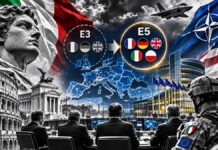
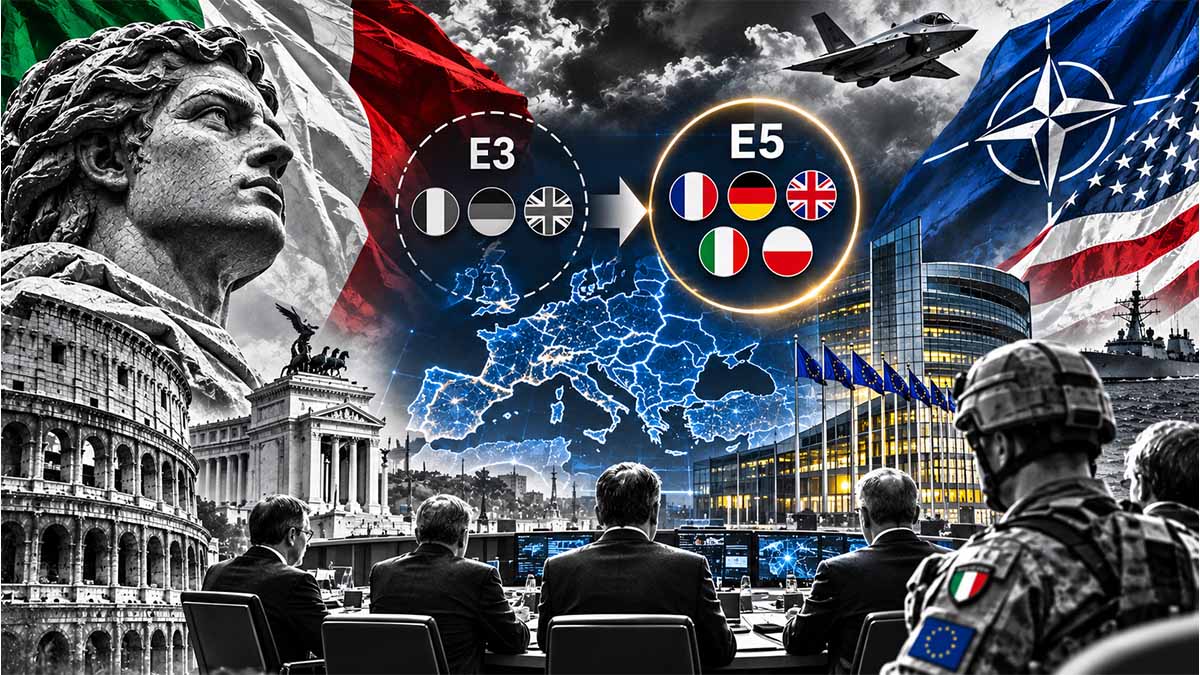
The 7 June 2026 E3–Ukraine meeting brought together France, Germany, the United Kingdom and Ukraine to discuss ceasefire conditions, negotiations and security guarantees. Italy was not a participant. Yet on 24 June, Italy joined those three European governments and Poland in an E5 leaders’ meeting focused on defence cooperation, NATO burden-sharing and support for Ukraine. GOV.UK+1
The distinction is operationally significant. France and the United Kingdom also exercise command responsibilities within the Multinational Force–Ukraine, whose multinational planning arrangements were formalised in January 2026. As of 3 November, the British Ministry of Defence identifies 35 states in the wider coalition and military commitments from 24 nations. GOV.UK
European decision-making is consequently developing through overlapping formats, with participation shaped by the specific military, diplomatic, financial and institutional responsibilities involved. The composition of these groups demonstrates differentiated access, although publicly available records do not establish the precise criteria used for every invitation.
Italy retains access through the E5, NATO and EU institutions, as well as reconstruction-related cooperation. Its capacity to influence Ukraine-specific security guarantees depends on whether its diplomatic and industrial involvement translates into responsibilities within the mechanisms implementing those guarantees.
Principal assessment — Medium confidence: The evidence supports a persistent distinction between Italy’s inclusion in broad European security coordination and its absence from certain smaller Ukraine negotiation groups. It does not yet establish that this distinction is irreversible, nor that any individual exclusion resulted from a punitive political decision.
Italy’s Diminishing Influence in European Security: The Price of Diplomatic Access Without Operational Authority
Italy’s position in European security is increasingly defined by a contradiction: Rome retains full membership in the G7, European Union and NATO, yet participation in these institutions does not guarantee access to the narrower consultations shaping Ukraine’s security arrangements. The exclusion of Italy from the E3–Ukraine meeting of 7 June 2026, followed by its inclusion in the E5 meeting of 24 June, exposes a distinction between institutional standing and practical responsibility. That distinction has fiscal, industrial and diplomatic consequences. European governments are committing substantial resources to military assistance, defence production and reconstruction, while negotiations increasingly involve states responsible for specific elements of implementation. Italy’s central problem is not the absence of international recognition, but the risk that its political participation will cease to translate into influence over the decisions that determine European security expenditure and operational commitments.
The June meetings exposed two different levels of European influence
The E3–Ukraine meeting of 7 June 2026 brought together France, Germany, the United Kingdom and Ukrainian President Volodymyr Zelenskyy to establish common positions on ceasefire conditions, the existing line of contact, legally binding security guarantees and immobilised Russian sovereign assets. Italy was absent. On 24 June, however, Rome participated alongside the same three European governments and Poland in the E5 leaders’ meeting in Berlin, which addressed European defence responsibilities, NATO burden-sharing and industrial cooperation. The E5 subsequently reconvened at defence-ministerial level in Paris on 26 October. The sequence does not establish a policy of excluding Italy from European security coordination. It demonstrates something more specific: participation changes according to the subject and institutional purpose of the consultation.
The distinction becomes consequential when a restricted meeting prepares positions that other governments will subsequently be asked to finance, approve or implement. On 8 December 2025, British Prime Minister Keir Starmer hosted President Zelenskyy, French President Emmanuel Macron and German Chancellor Friedrich Merz in London for discussions concerning American-led peace efforts and prospective security guarantees. Their national-security advisers were instructed to continue consultations, while wider European partners were engaged separately. The British government’s official account documents a sequence in which restricted political deliberation preceded broader coordination. It does not reveal the private reasons for the participant list or establish which government drafted individual proposals. Nevertheless, the difference between participating in preliminary negotiations and receiving subsequent consultations is institutionally material.
Europe’s financial commitments expose the limits of diplomatic rhetoric
The scale and composition of Ukraine-related financing show why practical influence cannot be evaluated through political attendance alone. Germany reports approximately €57.6 billion in military assistance already provided or earmarked for future years, alongside more than €43.3 billion in bilateral civilian support since February 2022. The United Kingdom reported £35 billion in total commitments as of 28 October 2026, comprising £16 billion in military support, up to £12.6 billion in non-military commitments and £6.5 billion in export-finance cover. Poland reported PLN 16.45 billion in completed equipment donations by July 2026 and more than 30,000 Ukrainian military personnel trained. These figures are not interchangeable: Germany includes future allocations, Britain includes guarantees and credit capacity, while Poland identifies completed equipment donations. An aggregate ranking without reconciling these definitions would misrepresent the underlying commitments. German Federal Government, HM Treasury and Polish Ministry of National Defence.
The European Union has meanwhile established a €90 billion Ukraine Support Loan for 2026–2027, indicatively allocating €30 billion to macroeconomic assistance and €60 billion to defence-related procurement and industrial investment. Its approved 2026 financing strategy provides €45 billion, including €28.3 billion for defence-industrial requirements. On 26 October 2026, the Council also adopted decisions enabling €4.9 billion through the European Peace Facility, principally for reimbursement of eligible military assistance and additional training support. These are EU-wide measures, not national bilateral contributions. Their implementation depends on procurement eligibility, legal conditions, disbursement procedures and actual deliveries. Italy retains institutional participation in these decisions, but such participation is a different form of authority from shaping the security arrangements being negotiated by a smaller group. Council of the European Union, April 2026; Council of the European Union, October 2026.
Military command and industrial delivery are becoming instruments of diplomatic relevance
The clearest example is the Multinational Force–Ukraine, established through arrangements initiated by France and the United Kingdom. By 3 November 2026, the British Ministry of Defence identified 35 countries in the wider Coalition of the Willing and military commitments from 24 nations, while the operational-level headquarters remained under British and French command. The force is not a NATO operation and would require a cessation of hostilities, an invitation from Ukraine and the necessary political and military authorisations before deployment. The distinction matters: coalition membership establishes participation, whereas command responsibilities create continuing involvement in operational planning, logistics, force preparation and implementation requirements. The appointment of British Lieutenant General Tom Bateman to command the multinational force in July 2026 illustrates that these responsibilities are institutionally identifiable rather than merely diplomatic. UK Ministry of Defence, Multinational Force–Ukraine.
Industrial production creates a parallel mechanism. The European Defence Agency reports sixty framework contracts for collaborative procurement of 155-millimetre ammunition, with orders exceeding €380 million, while the EU’s Security Action for Europe programme (SAFE) provides a framework of up to €150 billion in loans for eligible defence investment. The existence of financing does not establish completed production: manufacturing requires contracts, qualified suppliers, components, delivery schedules and technical acceptance. For Italy, whose industrial capabilities can contribute to multinational production chains, the relevant measure is therefore not the announcement of cooperation but the extent to which Italian suppliers obtain contractual responsibility for equipment that participating governments require. This is where industrial participation can generate sustained implementation relationships. European Defence Agency; European Commission, SAFE.
Italy’s fiscal and energy constraints limit the room for additional commitments
Italy faces these decisions with relatively restricted fiscal flexibility. The European Commission’s May 2026 forecast projected real GDP growth of 0.5% in 2026 and 0.6% in 2027, while general-government debt was expected to rise from 137.1% of GDP in 2025 to 138.5% in 2026 and 139.2% in 2027. The deficit was projected at 2.9% of GDP in both forecast years. Such conditions do not prevent defence investment, but they complicate the financing of multiyear procurement, ammunition replenishment, personnel, maintenance and military readiness. NATO’s 2025 commitment to defence and security-related expenditure of 5% of GDP by 2035 adds a further planning requirement, although the distinction between core military expenditure and broader security investment remains material.
Energy dependence compounds the industrial exposure. Eurostat’s 2026 publication, using 2024 data, reports energy import-dependency rates of 75% for Italy, 67% for Germany, 45% for Poland and 42% for France. These percentages do not measure dependence on a single supplier, but they demonstrate different national energy structures and potential exposure to international market disruptions. Italy’s Mediterranean connections provide relevant infrastructure and diversification functions, yet energy geography does not automatically confer influence over negotiations concerning Ukrainian territory or security guarantees. Rome’s challenge is therefore to reconcile industrial competitiveness, energy resilience and defence procurement under fiscal conditions that leave limited scope for inefficient expenditure.
Washington can change the negotiating format without removing Europe’s legal responsibilities
American leadership introduces another variable. The White House readout of negotiations in Geneva on 23 November 2025 identified Secretary of State Marco Rubio, Special Envoy Steve Witkoff and other American representatives participating in direct discussions with Ukraine concerning security guarantees, economic development, infrastructure protection and sovereignty. Subsequently, the Coalition of the Willing linked American involvement with European preparations for possible security arrangements. This creates a division between negotiating channels and the governments responsible for delivering guarantees, financing or military capabilities.
Continued Trump-aligned policy could preserve direct American negotiating channels while requiring European governments to assume specific implementation obligations. An alternative administration could place greater procedural emphasis on NATO and wider institutional consultation, or maintain selective bilateral arrangements for operational reasons. Neither pathway establishes automatic Italian inclusion. France and the United Kingdom have documented multinational command responsibilities; Germany combines procurement financing with military-assistance coordination; Poland possesses logistical functions directly connected with Ukraine. Italy’s bilateral access to Washington would therefore have to be assessed separately from its responsibilities within the European mechanisms required to implement an agreement. Changes in American leadership may alter consultation patterns, but cannot independently replace EU budgetary procedures or national constitutional authorisations.
Through 2028, the cost of inaction will appear in contracts, commitments and negotiating access
Between November 2026 and December 2028, three institutional outcomes remain possible: continued Italian participation through wider European mechanisms while narrower negotiations remain separate; selective expansion of Rome’s role through formally assigned military, industrial or financial responsibilities; or increasing specialisation of European security cooperation among regional and operational groupings. None can be assigned a defensible probability from the available record. The decisive evidence will be the composition of negotiating meetings, national command appointments, accepted equipment deliveries, procurement awards, financial disbursements and the implementation of agreed security arrangements.
The economic consequences are already measurable in the scale of authorised programmes. The Ukraine Investment Framework had approximately €8.5 billion in commitments by June 2026, intended to mobilise nearly €26 billion in public and private investment, while the EU’s €90 billion support-loan framework establishes substantial procurement and financing requirements through 2027. Italy’s absence from an initial diplomatic consultation does not prevent its companies from competing for eligible contracts or its government from exercising applicable EU decision rights. But failure to establish identifiable implementation responsibilities would leave Rome with fewer documented channels through which to influence the technical, financial and operational decisions made during programme execution. European Commission, Ukraine Investment Framework; Council of the European Union, Ukraine Support Loan.
The cost of inaction would fall on three identifiable constituencies: the Italian public finances if additional security obligations are assumed without sustainable procurement and operating arrangements; the defence-industrial supply chain if firms fail to secure participation in programmes that subsequently determine production volumes and technical standards; and the Italian government’s negotiating position if consequential security commitments are prepared through mechanisms in which it has no defined responsibility. Europe’s institutional decisions will continue regardless of Rome’s preferred diplomatic visibility. By 2028, the substantive measure of Italian influence will be the decisions it helped formulate, the capabilities it demonstrably delivered and the obligations it was authorised to implement—not the number of meetings at which its presence was announced.
Navigational Index
Pillar I — Diplomatic Access and the Distribution of European Power
- Chapter 1 — Italy’s Position in European and Transatlantic Decision-Making, 2024–2026 ;: Reconstruction of the official participation record across E3, E3+US, E5, Coalition of the Willing, NATO and EU consultations. Assessment of inclusion, exclusion, initiative and documented agenda-setting authority.
- Chapter 2 — Material Foundations of Influence: Defence, Ukraine Assistance and Industrial Capacity : Comparative examination of Italy, France, Germany, the United Kingdom and Poland, including NATO-defined defence expenditure, bilateral support to Ukraine, equipment commitments and deliveries, defence-industrial capacity, energy exposure and fiscal constraints.
- Chapter 3 — The Reorganisation of European Security Governance : Analysis of the E3, E5, Weimar Triangle, Nordic-Baltic coordination, Ukraine Defence Contact Group and coalition-based security arrangements, distinguishing political consultation from operational command and legally competent decision-making.
Pillar II — Strategic Drivers, Political Constraints and Transatlantic Change
- Chapter 4 — The United States and the Changing Value of European Interlocutors : Assessment of continued Trump-aligned policy and alternative post-Trump administrative configurations. Implications for bilateral access, European coordination, negotiation mandates, intelligence cooperation and security guarantees.
- Chapter 5 — Structural and Cyclical Drivers of Italy’s Relative Influence : Evaluation of military capabilities, expenditure, industrial specialisation, geographic interests, fiscal constraints, domestic political continuity and diplomatic positioning, with particular attention to the differences between Italy and northern or eastern European partners.
- Chapter 6 — Italy, France, Germany, the United Kingdom and Poland: Strategic Convergence and Competition : Comparison of national incentives and institutional roles in shaping Ukraine policy, European rearmament, reconstruction, energy security, NATO planning and the allocation of responsibility among allied governments.
Pillar III — Strategic Options, Scenarios and Decision Indicators
- Chapter 7 — Operational Levers for Italian Influence : Assessment of capability contributions, air defence and ammunition programmes, defence-industrial integration, reconstruction financing, diplomatic initiatives and cooperation with Poland and northern European governments.
- Chapter 8 — Three European Security Scenarios Through 2028 : Examination of persistent Italian participation outside narrower negotiating groups, selective reinclusion through greater operational responsibilities, and increasing reliance on alternative regional and operational coalitions. Consequences for Ukraine security guarantees, reconstruction conditionality and European budget priorities.
- Chapter 9 — Strategic Monitoring, Decision Thresholds and Final Net Assessment : Development of observable indicators, policy choices, implementation burdens and conditional decision thresholds, distinguishing changes in diplomatic visibility from measurable changes in influence.
Master Abstract
European Security Is Becoming More Differentiated, Not Institutionally Uniform
The European response to Russia’s war against Ukraine has produced a differentiated network of diplomatic consultations, military planning arrangements and financial instruments. These mechanisms overlap in membership but do not perform identical functions. The E3 provides a narrow platform for political coordination among France, Germany and the United Kingdom; the E5 adds Italy and Poland to selected European defence consultations; the Coalition of the Willing operates through wider participation and narrower command structures; and the European Union retains responsibility for decisions requiring its legal, financial and institutional authority. Consequently, access to a particular consultation must be assessed against the decisions being prepared there rather than treated as a universal measure of national standing.
The documented pattern illustrates this distinction. The United Kingdom hosted France, Germany and Ukraine on 8 December 2025 for discussions involving US-led peace efforts, national-security advisers and prospective security guarantees. The 7 June 2026 E3 meeting again involved those governments and Ukraine, while Italy participated separately in broader consultations, including the E5 meeting of 24 June. In October 2026, E5 defence-ministerial cooperation continued, providing evidence that Italy remained within a recognised European defence coordination framework. GOV.UK+3
Military Implementation and Financial Authority Are Distinct Sources of Influence
The development of the Multinational Force–Ukraine demonstrates how particular governments can acquire responsibilities beyond diplomatic participation. According to the United Kingdom’s Ministry of Defence, its operational-level joint headquarters is commanded by the United Kingdom and France, with headquarters responsibilities scheduled to rotate from Paris to Britain before the end of 2026. This operational arrangement offers a concrete mechanism through which those governments may influence planning, provided that any future deployment is politically authorised and its conditions agreed. Neither participation in the broader coalition nor endorsement of its objectives automatically confers equivalent command authority.
Financial governance creates another distribution of responsibility. The Council of the European Union completed the legislative framework for a €90 billion Ukraine support loan covering 2026–2027 on 23 April 2026. Its indicative allocation assigns €30 billion to macroeconomic support and €60 billion to defence-industrial investment and procurement. Those instruments operate through EU procedures and conditions rather than through E3 consultation alone. Italy therefore retains institutional participation in consequential financial decisions even where it is absent from specific diplomatic meetings.
Italy’s Position Depends on the Intersection of Several Forms of Access
The distinction between military command, diplomatic convening power, financial commitments and institutional authority has direct implications for Italy. Its participation in the E5 and reconstruction cooperation establishes continuing involvement in European security and Ukraine-related policy. The July 2025 Ukraine Recovery Conference in Rome also provided a documented occasion for Italian diplomatic engagement, with Ukraine and other participating governments joining coalition discussions from that setting. Nevertheless, these activities do not by themselves demonstrate influence over the drafting of security guarantees or the selection of negotiating interlocutors.
The distribution of influence can therefore evolve without a formal alteration of Italy’s membership in NATO, the EU or the G7. A government may retain full institutional rights while playing a less direct role in preliminary negotiations or operational preparations. Conversely, a narrower consultation does not remove the legal authority of EU member states or NATO allies over decisions reserved to those institutions.
For Italy, the decisive distinction through 2028 is between maintaining consultation rights and obtaining responsibilities that other governments must incorporate into their plans. The documented evidence supports a concern about differentiated access, but it also identifies established channels through which Italian influence continues to operate.
Key Evidence Table
The following indicators establish the initial documentary baseline. Quantities relating to overall European financial instruments are distinguished from national bilateral assistance, and announced military commitments are distinguished from deployed capabilities.
| Indicator | Value/status | Reference date | Definition/scope | Issuer | Exact source |
|---|---|---|---|---|---|
| E3–Ukraine consultation | UK, France, Germany and Ukraine; Italy absent | 7 June 2026 | Leaders’ discussion of negotiations and security guarantees | UK Prime Minister’s Office | Joint E3 Leaders’ Statement — Jun 2026 |
| E5 leaders’ consultation | Five states: France, Germany, Italy, Poland and UK | 24 June 2026 | Defence coordination, NATO burden-sharing and Ukraine | UK Prime Minister’s Office | E5 Leaders’ Statement — Jun 2026 |
| E5 defence-ministerial meeting | Same five participating countries | 26 October 2026 | European defence-industrial and military cooperation | French Ministry for the Armed Forces | European Defence: The E5 — Oct 2026 |
| Coalition of the Willing | 35 participating nations | 3 November 2026 | Coalition participation; not a count of deployed forces | UK Ministry of Defence | The Multinational Force–Ukraine — Nov 2026 |
| Multinational Force–Ukraine | Military commitments from 24 nations; UK–French operational command | 3 November 2026 | Planning and commitments, not proof of deployment | UK Ministry of Defence | The Multinational Force–Ukraine — Nov 2026 |
| EU Ukraine support loan | €90 billion | 2026–2027 | €30bn macroeconomic and €60bn defence-related indicative allocations | Council of the EU | Council Finalises €90bn Support Loan — Apr 2026 |
| NATO defence-investment commitment | 5% of GDP by 2035 | Agreed June 2025 | At least 3.5% core defence; up to 1.5% other defence/security-related expenditure | NATO | Defence Investment and NATO’s 5% Commitment — Jun 2026 |
| European Allies and Canada: defence expenditure | Nearly 20% real increase | 2025 versus 2024 | Aggregate NATO-defined expenditure; not individual country growth | NATO | Defence Investment Update — Jul 2026 |
These indicators establish the simultaneous existence of narrow diplomatic meetings, wider military coordination and EU-level financing. They do not establish a complete quantitative ranking of national diplomatic influence. Such a ranking would additionally require a consistent meeting register, comparable national expenditure and delivery data, and evidence of who originated or amended consequential decisions.
Competing Explanations for Italy’s Differentiated Access
Three explanations warrant examination. They are not mutually exclusive: different consultations may reflect different combinations of institutional continuity, military responsibilities and political choices.
| Hypothesis | Diagnostic support | Disconfirming evidence | Indicators | Current standing |
|---|---|---|---|---|
| H1 — Functional concentration | The E3 participates in narrow diplomatic consultations; UK and France command the multinational planning structure | Italy remains an E5 participant and contributes to broader coordination | Consistent relationship between meeting access and implementation responsibility | Supported as a structural mechanism; medium confidence |
| H2 — Negotiating-format continuity | Repeated E3 consultations and leadership roles in preparing Ukraine security guarantees | Wider meetings incorporate Italy and Poland, showing that E3 is not the sole relevant configuration | Whether E3 expands when negotiations enter implementation or EU financing stages | Plausible; medium confidence |
| H3 — Political selectivity | Invitation patterns may reflect immediate alignment, negotiating preferences or diplomatic relationships | Official records do not establish an Italy-specific punitive decision; inclusion continues in other formats | Government correspondence, stated selection criteria and changes following policy adjustments | Unresolved; low confidence |
The first two explanations draw on observable institutional arrangements. The third cannot be dismissed, but the available public evidence does not justify treating political dissatisfaction with Rome as the established reason for exclusion.
An additional distinction concerns diplomatic sequence. Governments can meet privately or in narrow groups to prepare positions before submitting decisions to larger organisations. Such preparatory access may be influential, but its significance depends on whether the resulting proposals become binding decisions, receive financial support or establish command arrangements.
Principal Gaps and Watch Indicators
The Limits of Public Participation Records
Official statements verify who attended particular consultations and often identify what subjects were discussed. They rarely disclose invitation decisions, private objections or the proportion of negotiating language drafted by each government. Consequently, the absence of an Italian representative from an E3 meeting establishes non-participation in that meeting, but not the private reason for the invitation list.
The November 2026 reports concerning a further narrow Brussels consultation require a separate official participant record before the event can be treated as completed evidence of exclusion. Its eventual diplomatic relevance will depend on whether it leads to subsequent negotiating instructions, security arrangements or decisions submitted to NATO and EU institutions.
Observable Indicators Through 2028
Composition of Ukraine negotiation groups
Record whether Italy participates directly in US–European consultations involving proposed ceasefire terms, security guarantees and negotiations with Ukraine, distinguishing physical attendance, remote participation and subsequent briefings.
Operational responsibilities
Track whether Italy assumes formally documented planning, procurement, logistics or command responsibilities within Ukraine-related multinational arrangements, and whether commitments become available capabilities.
Material contributions and delivery performance
Compare annual NATO-defined expenditure, equipment procurement, Ukraine-specific allocations and actual deliveries using common periods and definitions. Particular attention should be given to discrepancies between announced commitments and implemented assistance.
Financial and institutional influence
Examine Italian participation in EU financing negotiations, frozen-asset decisions, procurement eligibility, reconstruction conditionality and industrial projects, identifying substantive amendments or implementation responsibilities.
Changes in Washington’s negotiating arrangements
Monitor whether US representatives rely on E3, E5, NATO institutions, bilateral contacts or broader European participation, and whether those preferences persist across changes in US leadership or negotiating personnel.
Principal Documentary Uncertainties
Three consequential uncertainties remain. First, public statements do not establish the full invitation criteria used for each narrow Ukraine consultation. Second, publicly reported aid values can differ because of national accounting conventions, undisclosed military transfers, future commitments and differences between equipment allocation and delivery. Third, the eventual force structure and legal conditions governing multinational security guarantees remain dependent on political and operational decisions not established merely by the existence of planning headquarters.
These limitations prevent an evidence-based numerical probability of Italy’s inclusion in future meetings. They do not prevent assessment of the institutional mechanisms likely to matter: documented participation, responsibility for implementation, available military capabilities, financial authority and the capacity to coordinate across national governments.
No decision-useful visualisation is supportable from the verified record.
Initial Strategic Assessment
The documentary record supports a narrower conclusion than either complete Italian marginalisation or assured membership of Europe’s most influential negotiating circle. Italy is demonstrably included in the E5 and broader European security arrangements, while the E3 has conducted consequential Ukraine-specific consultations without Italian participation. France, Germany and the United Kingdom are documented as participants in those narrow meetings, and the UK–French military planning arrangements provide an additional form of operational responsibility.
The resulting institutional configuration has two simultaneous consequences. It permits Italy to participate in European defence coordination and legally competent EU decisions, but it also allows smaller groups to formulate proposals before they reach broader forums. Whether this reduces Italy’s practical influence depends on the substantive authority of those proposals, the implementation responsibilities assigned to participating governments and the extent to which subsequent EU or NATO decisions preserve opportunities for amendment.
Through 2028, the principal question is therefore not whether Italy can secure recognition as a major European country. Its established participation already demonstrates significant institutional access. The question is whether its defence commitments, industrial capabilities, financial involvement and diplomatic initiatives translate into responsibilities within the specific arrangements determining Ukraine’s future security and Europe’s military posture.
The evidence identifies a differentiated architecture of influence. A durable loss of Italian weight would require a continuing pattern in which substantive decisions and implementation responsibilities consolidate outside Italy’s participation. A reversible episode would be indicated by renewed involvement in those preparations or by identifiable Italian responsibilities in subsequent security and financial instruments. Both outcomes remain open on the public record available at the assessment date.
EUROPEAN POWER ARCHITECTURE 2026–2028
Italy’s position in European decision-making: diplomatic access, security coordination, operational authority and institutional leverage. An interactive assessment of documented participation and conditional strategic pathways.
03 NOV 2026
European Security Coordination Architecture
Select an institutional node to examine its composition, function and implications for Italy. Connections represent analytical relationships, not a formal hierarchy or delegated authority.
E5 — European Five
France, Germany, Italy, Poland and the United Kingdom participated in the E5 leaders’ consultation on 24 June 2026. The format provides Italy with documented access to European defence coordination. It does not establish participation in every narrower Ukraine negotiating meeting.
Evidence: UK Prime Minister’s Office, E5 Leaders’ Statement, 24 June 2026.Documented Meeting Participation
Select a country to highlight its documented participation in three specified consultations. The matrix is not a comprehensive register of all diplomatic meetings.
| Country | E3–Ukraine 7 Jun 2026 |
E5 Leaders 24 Jun 2026 |
E5 Defence 26 Oct 2026 |
|---|---|---|---|
| Italy | Not included | Included | Included |
| France | Included | Included | Included |
| Germany | Included | Included | Included |
| United Kingdom | Included | Included | Included |
| Poland | Not included | Included | Included |
Italy — Differentiated Access
Italy was not included in the specified E3–Ukraine consultation of 7 June 2026, but was included in the E5 meetings of 24 June and 26 October. This establishes differentiated access, not exclusion from European security coordination as a whole.
Coalition Commitments and EU Financial Instruments
Two different measures of European security implementation: multinational participation and an EU financial instrument. They are displayed separately because their units and institutional scopes differ.
Multinational Force–Ukraine Framework
Nations participating in the wider coalition and nations with reported military commitments.
Scale: 35 coalition nations = 100%. The 24-nation bar represents 24/35, or approximately 68.6%. The figures describe reported commitments, not troops deployed, force readiness or military effectiveness. Source: UK Ministry of Defence, 3 November 2026.
EU Ukraine Support Loan
€90 billion support-loan framework for 2026–2027, with indicative allocations.
Values are EU-wide, not Italy-specific. The allocation is indicative and must not be interpreted as national bilateral aid or completed disbursement. Source: Council of the European Union, 23 April 2026.
Conditional Pathways Through 2028
Select a scenario to display its enabling conditions, consequences and observable indicators. Scenarios are analytical alternatives, not probability forecasts.
Scenario 01 — Persistent Secondary Role
Italy remains active in E5, EU and NATO coordination but is not routinely included in narrower preliminary consultations on Ukraine’s security guarantees.
- Trigger: continued use of E3-centred negotiation channels.
- Consequence: reduced direct involvement in preliminary negotiating language, while retaining institutional decision rights.
- Indicator: repeated narrow consultations without additional Italian implementation roles.
Decision-Relevant Indicators
Observable developments that would strengthen or weaken the assessment of Italy’s access and implementation influence.
Core Meeting Composition
Track Italy’s attendance and mandate in Ukraine negotiation consultations, distinguishing participation from briefings.
Actual Equipment Delivery
Compare delivered assets and available capabilities rather than announcements or future procurement intentions.
Operational Responsibilities
Identify formal Italian planning, logistics, command or procurement roles in multinational arrangements.
Budget and Procurement Decisions
Examine amendments, eligibility rules, financing conditions and implementation responsibilities in EU instruments.
US Interlocutor Preferences
Monitor the use of bilateral, E3, E5, NATO and wider coalition channels by US diplomatic and security officials.
Joint Production and Integration
Track contracted production, deliveries, industrial participation and integration with allied procurement programmes.
Official Documentary Sources
- UK Prime Minister’s Office — Joint E3 Leaders’ Statement with Ukraine, 7 June 2026
- UK Prime Minister’s Office — E5 Leaders’ Statement, 24 June 2026
- French Ministry for the Armed Forces — European Defence and the E5, October 2026
- UK Ministry of Defence — The Multinational Force–Ukraine, consulted 3 November 2026
- Council of the European Union — €90 Billion Ukraine Support Loan, 23 April 2026
OPEN-SOURCE ANALYTICAL ASSESSMENT | 3 NOVEMBER 2026
PILLAR I — DIPLOMATIC ACCESS AND THE DISTRIBUTION OF EUROPEAN POWER
Italy’s Position in European and Transatlantic Decision-Making, 2024–2026: Diplomatic Participation, Material Capabilities and the Reorganisation of Security Governance
Chapter 1 — Italy’s Position in European and Transatlantic Decision-Making, 2024–2026
The distinction between diplomatic status and effective decision-making authority
The restructuring of European security diplomacy between 2024 and 2026 has exposed an increasingly consequential distinction between the formal international standing of a state and its practical capacity to participate in the preparation, negotiation and implementation of strategic decisions. Italy retains its membership in the Group of Seven, the European Union and the North Atlantic Treaty Organization, possesses an established diplomatic network and participates in European security, industrial and financial initiatives. None of these institutional characteristics, however, automatically guarantees inclusion in the smaller political consultations through which European governments formulate negotiating positions before presenting them to wider organisations. The emerging architecture is therefore better understood as a system of differentiated diplomatic access, in which governments participate through overlapping mechanisms whose membership reflects their purposes, operational responsibilities, institutional competences and political relationships. For Rome, the decisive issue is not whether Italy remains formally recognised as an important European state, but whether its participation extends to the preliminary stages at which negotiating objectives, military commitments, implementation arrangements and acceptable compromises are defined.
The documentary record demonstrates that Italian participation cannot accurately be described as either comprehensive inclusion or systematic exclusion. On 7 June 2026, the leaders of France, Germany and the United Kingdom met Ukrainian President Volodymyr Zelenskyy and issued a substantive statement concerning ceasefire conditions, the line of contact, legally binding security guarantees, immobilised Russian assets and the institutional consent required for future arrangements. Italy was not among the participating governments. Seventeen days later, on 24 June, the leaders of France, Germany, Italy, Poland and the United Kingdom met in Berlin under the E5 framework, with the NATO Secretary General joining from Washington. This second consultation addressed European leadership, NATO burden-sharing, defence-industrial cooperation and continued support for Ukraine. The different compositions of these two meetings establish an observable distinction between access to a narrower diplomatic negotiating group and participation in a broader defence coordination mechanism. They do not, without further evidence, establish why Italy was absent from the first meeting or whether the organisers intended to establish a permanent hierarchy among European governments. Joint E3 Leaders’ Statement — UK Prime Minister’s Office — 7 June 2026; E5 Leaders’ Statement — UK Prime Minister’s Office — 24 June 2026. GOV.UK+1
This distinction has important consequences for evaluating international influence. Attendance demonstrates access to a particular consultation, but not necessarily control over its agenda. Hosting demonstrates convening capacity, but does not establish that the host determines the negotiating outcome. Issuing a joint declaration demonstrates agreement on the published text, but does not reveal which government proposed its substantive provisions. Operational command provides authority within a defined military organisation, but does not automatically confer the legal power to decide whether a force will deploy. Financial contributions can establish indispensable implementation capacity, while legislative and budgetary institutions may retain the final authority to approve an arrangement prepared elsewhere. A defensible assessment of Italy’s position must therefore distinguish the opportunity to participate, the ability to initiate proposals, the capacity to modify negotiating positions and the practical responsibility for implementing agreed commitments.
The documentary sequence: from European consultations to differentiated negotiating groups
The development of European coordination during the period under examination shows how smaller consultation formats can acquire significance without becoming formal replacements for established international organisations. One particularly informative event occurred on 8 December 2025, when the British Prime Minister received President Zelenskyy, President Emmanuel Macron and Chancellor Friedrich Merz in London. According to the official British account, the leaders examined American-led peace discussions and the conditions for establishing durable security guarantees. They also instructed their national-security advisers to continue consultations and discussed the possibility of using immobilised Russian sovereign assets to support reconstruction. After this narrower meeting, the British Prime Minister convened a separate call involving other European partners. The sequence demonstrates a specific form of diplomatic organisation: a smaller group first discusses sensitive negotiating questions, then communicates with a wider circle. Although the record does not establish that every substantive decision was made during the first meeting, it confirms that the two stages were not identical in participation or function. Prime Minister’s Engagements with President Zelenskyy, President Macron, Chancellor Merz and European Partners — UK Prime Minister’s Office — 8 December 2025. GOV.UK
The 7 June 2026 E3–Ukraine statement provides stronger evidence of the substantive content that narrower consultations can generate. The participating governments jointly identified five elements relevant to a future settlement: cessation of fighting, the existing line of contact as the starting point for negotiations without recognising territorial changes imposed by force, legally binding security guarantees following a ceasefire, continued immobilisation of Russian assets pending compensation, and protection of European institutional interests through the consent of the relevant EU member states and NATO allies. The same statement linked future guarantees to arrangements discussed in Berlin in December 2025 and Paris in January 2026, including the proposed Multinational Force–Ukraine. These were not merely ceremonial expressions of solidarity; they constituted publicly articulated negotiating principles with potential consequences for military deployment, international law, sanctions, asset management and European institutional competence. Italy’s absence from the published meeting therefore matters specifically because of the issues discussed, rather than simply because its name did not appear on a participant list. Joint E3 Leaders’ Statement with President Volodymyr Zelenskyy of Ukraine — UK Prime Minister’s Office — 7 June 2026. GOV.UK
The subsequent E5 meeting in Berlin complicates any interpretation suggesting that Italy had been removed from European security coordination. Its participants explicitly included Italy and Poland alongside the E3 governments, and the meeting’s official agenda concerned the relationship between European defence responsibilities, NATO commitments and industrial cooperation. This configuration illustrates the possibility that different questions generate different groups. A consultation devoted to settlement conditions and security guarantees may follow one diplomatic network, whereas a meeting addressing alliance burden-sharing and defence production may require the participation of additional governments. The interpretation remains conditional because the public record does not provide an authoritative formula governing invitation decisions. Nevertheless, the coexistence of E3 and E5 supplies stronger documentary support for functional differentiation than for a comprehensive policy of excluding Rome. E5 Leaders’ Statement — UK Prime Minister’s Office — 24 June 2026. GOV.UK
The distinction continued into the autumn. On 26 October 2026, the defence ministers of France, Germany, Italy, Poland and the United Kingdom met in Paris under the E5 format. The French Ministry for the Armed Forces characterised the consultation as an effort to strengthen European responsibility within NATO while accelerating military and industrial cooperation. The significance for Italy is institutional continuity: its presence in the E5 was not confined to a single leaders’ meeting in June. At the same time, the official record does not demonstrate that E5 membership automatically translated into participation in every Ukraine-specific negotiation or into equivalent operational authority over multinational forces. These remain separate questions requiring separate evidence. European Defence: The E5 Aims to Build a Stronger Europe Within a Stronger NATO — French Ministry for the Armed Forces — 27 October 2026. defense.gouv.fr
Documented participation and the limits of the public meeting record
The following comparison covers specifically identified meetings, institutional decisions and operational arrangements. It does not claim to count every bilateral conversation, telephone call, restricted consultation or informal diplomatic exchange conducted over the entire two-year period. Such a comprehensive count would require harmonised records from the participating governments, including meetings whose existence or complete attendance lists are not publicly disclosed.
| Date | Consultation or institutional action | Documented participants or competent authorities | Italy’s recorded position | Decision-making significance |
|---|---|---|---|---|
| 8 November 2024 | Extension of the EU Military Assistance Mission for Ukraine | Council of the EU | Member-state participation through EU structures | Legal continuity of EU military training |
| March 2025 | Creation of the Coalition of the Willing | UK–French initiative; coalition subsequently expanded | Wider coalition participation must be distinguished from its founding leadership | Formation of a separate security-guarantee coordination mechanism |
| 8 December 2025 | London consultation on US-led peace efforts | Ukraine, UK, France and Germany | Not listed in the initial restricted meeting | Discussion of security guarantees and instructions to national-security advisers |
| 18 December 2025 | European Council decision on Ukraine financing | European Council and participating EU governments | Institutional participation as an EU member | Agreement on the €90bn financing framework |
| 6 January 2026 | Declaration of Intent establishing the multinational force framework | UK, France and Ukraine | Not a signatory to the identified founding declaration | Foundation for subsequent military planning |
| 15 April 2026 | Ukraine Defence Contact Group in Berlin | UK–German co-chairing; Ukraine and participating partners | Not part of the identified co-chairing arrangement | Coordination of military assistance and capability requirements |
| 23 April 2026 | Final EU legislative action on Ukraine support loan | Council of the EU and participating member states | Participation through applicable EU procedures | Financing, procurement and conditionality |
| 7 June 2026 | E3–Ukraine leaders’ meeting | France, Germany, UK and Ukraine | Absent from published participant list | Negotiating principles and future security guarantees |
| 24 June 2026 | E5 leaders’ meeting, Berlin | France, Germany, Italy, Poland, UK; NATO Secretary General joined remotely | Included | European defence and NATO coordination |
| 26 October 2026 | E5 defence ministers’ meeting, Paris | France, Germany, Italy, Poland and UK | Included | Defence-industrial and military coordination |
| 29 October 2026 | Announcement of next Ukraine Defence Contact Group meeting | NATO announcement; UK and Germany named as conveners | No Italian co-chairing role identified | Scheduled coordination, not a completed meeting |
| 3 November 2026 | Published Multinational Force–Ukraine operational description | UK Ministry of Defence; UK–French command arrangement | Membership and command must be assessed separately | Clarifies coalition scale, planned force function and command |
Sources: EU Military Support for Ukraine — Council of the European Union; European Council Conclusions on Ukraine — December 2025; Ukraine Defence Contact Group Meeting — NATO — April 2026; Ukraine Defence Contact Group Meeting Announcement — NATO — October 2026; The Multinational Force–Ukraine — UK Ministry of Defence — November 2026. Consilium+4
The most consequential feature of this chronology is the movement between consultation and implementation. The London meeting in December 2025 established that a restricted group could instruct national-security advisers to pursue further work. The January 2026 declaration concerning multinational forces then placed particular governments in a founding role within a military planning structure. By June 2026, the E3’s public negotiating principles referred directly to the proposed multinational force as part of the security-guarantee framework. These developments provide a documented connection between diplomatic consultation, political declarations and operational planning, although they do not prove that one particular meeting caused every subsequent institutional decision. The distinction is important because effective influence often arises through continuity across these functions, not simply through repeated attendance.
The Coalition of the Willing and the emergence of operational responsibility
The Coalition of the Willing provides an especially important example of the distinction between political membership and operational authority. The British Ministry of Defence identifies the initiative as having originated with the United Kingdom and France in March 2025 and reports a coalition comprising 35 countries as of 3 November 2026. Its military component, the Multinational Force–Ukraine, was formally established following a January 2026 declaration signed by the leaders of the United Kingdom, France and Ukraine. The ministry reports military commitments from 24 countries and identifies an operational-level joint headquarters under British and French command. It also explicitly states that the force is not a NATO operation, is not designed as a conventional peacekeeping or ceasefire-monitoring force, and would deploy only following an invitation from Ukraine and once hostilities had ended and the necessary political and military conditions had been satisfied. These qualifications prevent the reported coalition membership and military commitments from being misinterpreted as evidence of a completed deployment or an already operational security guarantee. The Multinational Force–Ukraine — UK Ministry of Defence — 3 November 2026. GOV.UK
Command responsibility also provides evidence of practical organisational authority. On 24 July 2026, the British Ministry of Defence announced that Lieutenant General Tom Bateman had assumed command of the multinational force from his French predecessor during a ceremony at the operational headquarters in Paris. The change demonstrates a functioning command appointment mechanism within the planning structure, although it does not independently establish deployment readiness or authorise operations on Ukrainian territory. The distinction matters because governments directly involved in maintaining a headquarters, assigning senior officers and preparing multinational exercises possess defined organisational functions that are different from those of states participating only in political consultation. The strategic implication is that operational responsibilities can reinforce diplomatic access by requiring continuing contact over mission requirements, logistics, rules of engagement, force protection and implementation schedules. UK Takes Command of Multinational Force for Ukraine — UK Ministry of Defence — 24 July 2026. GOV.UK
By 3 November, the United Kingdom had announced Exercise KOALICJA 26.2 in Poland, involving forces from eleven participating countries and designed to rehearse logistical and operational arrangements for a possible future mission. The named participants were Belgium, Estonia, France, Germany, Lithuania, the Netherlands, Poland, Spain, Sweden, Türkiye and the United Kingdom. The exercise was scheduled for November, and therefore its announced scope must not be represented as a completed operational outcome at the assessment cut-off. Nevertheless, the participant list illustrates the relevance of specific military commitments and practical preparations: the governments involved in an exercise can acquire direct experience in developing the force’s procedures, even though exercise participation does not confer authority over the diplomatic settlement itself. UK to Lead Multinational Military Training Exercise to Prepare for Peace in Ukraine — UK Ministry of Defence — 3 November 2026. GOV.UK
Agenda-setting power: what the official records establish
The evidence supports different levels of attribution. The United Kingdom can be identified as host of the December 2025 restricted consultation and as a co-founder of the Coalition of the Willing alongside France. France and the United Kingdom can be identified as the governments responsible for the multinational force’s operational-level command arrangements. Germany and the United Kingdom can be identified as organisers of the April 2026 Ukraine Defence Contact Group meeting, while the E3 governments can be identified as joint issuers of the June 2026 statement setting out negotiating principles. These are documented organisational roles, not speculative assessments of personal relationships or diplomatic prestige. Prime Minister’s Engagements — UK Prime Minister’s Office — December 2025; NATO Secretary General Attends Ukraine Defence Contact Group Meeting — NATO — April 2026. GOV.UK+1
It would nevertheless be methodologically incorrect to assign a numerical degree of influence to each government solely from these records. The published statements do not disclose the negotiating drafts circulated before the meetings, the disagreements resolved privately, the positions abandoned by individual participants or the concessions made in exchange for particular commitments. Nor do they establish that an invitation was refused, withheld for political reasons or excluded by an agreed permanent rule. The observable evidence is sufficient to identify participation, convening responsibility, some aspects of implementation authority and certain institutional outcomes. It is not sufficient to reconstruct the full distribution of negotiating influence behind closed doors.
Chapter 1 — Key judgments
High confidence: Italy’s participation varies substantially by institutional format. It was absent from identified restricted E3–Ukraine consultations while remaining included in documented E5 meetings.
High confidence: The United Kingdom and France possess formally documented responsibilities within the multinational force’s planning and command framework; these responsibilities are distinct from membership of the wider Coalition of the Willing.
Medium confidence: The repeated use of narrow consultations alongside wider meetings is consistent with increasing functional differentiation in European security diplomacy, but the available record does not establish a universal or permanent invitation hierarchy.
Low confidence: The proposition that specific exclusions were intended to penalise the Italian government is not established by the official documents reviewed.
What would change the assessment: Consistent Italian participation in the initial drafting of future security-guarantee arrangements, formal assignment of command or implementation responsibilities, or a documented change in the procedures used to convene restricted diplomatic meetings would materially alter the assessment of access and operational influence.
Chapter 2 — Material Foundations of Influence: Defence, Ukraine Assistance and Industrial Capacity
The conversion of economic resources into military and diplomatic capabilities
The material foundations of European security influence cannot be reduced to the absolute size of national economies or the public presentation of military expenditure. Defence budgets generate political relevance only insofar as they finance capabilities that satisfy identifiable military requirements, sustain deployable forces, replace equipment transferred to Ukraine, support industrial production and maintain allied operations over time. Similarly, assistance commitments acquire strategic significance through their composition and implementation: a financial guarantee, an ammunition delivery, a training programme, an air-defence system and a procurement contract can each contribute to Ukraine’s security, but they create different obligations, different operational effects and different forms of dependence between governments. A country’s diplomatic position may be strengthened when it controls an important component of a larger military or financial arrangement, yet no general rule establishes that a specific expenditure level automatically entitles it to participate in a restricted leaders’ consultation.
NATO’s investment framework provides a common starting point for examining these differences. At the 2025 Hague Summit, allies committed to the objective of allocating 5% of gross domestic product annually to defence and defence-related security expenditure by 2035, comprising at least 3.5% for core defence requirements and up to 1.5% for broader security, resilience and related investment. The distinction matters because expenditure classified under the broader category cannot be equated directly with funding for deployable formations, weapons, ammunition or military readiness. NATO also reports that European allies and Canada increased combined defence expenditure by nearly 20% in real terms between 2024 and 2025, with the collective figure reaching more than $571 billion in 2021 prices in 2025. That aggregate establishes a significant change in regional investment, but it cannot support a conclusion about the relative contribution of Italy without examining the national series separately. Defence Investment and NATO’s 5% Commitment — NATO — 29 June 2026; Defence Investment Update: Record Spending in Europe and Canada — NATO — 7 July 2026. NATO Topic+1
The relationship between defence expenditure and diplomatic access is particularly difficult to establish because national figures are affected by differing accounting practices, spending calendars and procurement structures. NATO’s harmonised definition includes expenditure incurred to meet the needs of national or allied armed forces and differs in certain respects from national-budget classifications. The appropriate comparison must therefore distinguish annual expenditure expressed in a common currency, expenditure relative to national GDP, equipment expenditure, personnel and pension costs, and the proportion devoted to fulfilling specific NATO capability requirements. A government may report rising expenditure while still lacking particular deployable capabilities because industrial production, recruitment and procurement take time. Conversely, the existence of older military inventories does not establish current readiness or the ability to transfer further equipment without affecting national defence commitments. Defence Expenditure of NATO Countries, 2014–2025 — NATO — August 2025. NATO News
Germany: financial commitments, procurement capacity and military assistance
Germany’s contribution illustrates the importance of distinguishing immediate deliveries from the financial capacity to sustain military assistance over several budget years. The German federal government reports more than €43.3 billion in bilateral civilian support to Ukraine since February 2022 and approximately €57.6 billion in military assistance either provided or earmarked for future years. The figures must not be interpreted as €100.9 billion in completed cash transfers or delivered equipment: the civilian and military categories have different scopes, and the military total explicitly combines past support with future allocations. Nevertheless, they establish the scale of Germany’s publicly reported financial and military commitment and demonstrate the value of long-term budgetary planning as an instrument of security policy. The government also reports more than 27,000 Ukrainian military personnel trained in Germany and identifies air defence, artillery, combat vehicles, armoured transport, ammunition and protective equipment among the principal categories of assistance. How Germany Is Supporting Ukraine — German Federal Government — 2026. Federal Government
Germany’s role is not simply a function of the total amount announced. The federal government has explained that assistance has evolved from transfers out of Bundeswehr inventories toward greater use of industrial production and procurement financing. This transition creates a different type of influence because the donor may become responsible for financing production capacity, coordinating supply chains and delivering equipment according to future schedules rather than only releasing existing stocks. In August 2026, German defence officials identified several mechanisms of support, including transfers from inventories, industrial procurement and multinational capability coordination. They referred specifically to air-defence systems and future missile deliveries, while distinguishing newly financed production from immediate transfers. Federal Government Press Conference — German Federal Government — 10 August 2026. Bundesregierung
Germany’s financial position and defence-industrial arrangements help explain why its participation extends beyond restricted leaders’ meetings into the mechanisms coordinating military assistance. Its co-chairing role in the Ukraine Defence Contact Group alongside the United Kingdom provides a documented organisational responsibility, whereas participation in the E3 provides an additional diplomatic channel. The two functions are complementary but not identical: the contact group coordinates military requirements and contributions, while leaders’ meetings can address broader negotiating conditions. The official record supports the existence of both German responsibilities, although it does not establish that the total value of German assistance was the determining cause of its inclusion in the E3.
United Kingdom: bilateral assistance, financial instruments and operational leadership
The United Kingdom provides a particularly clear example of the need to separate financial commitments from their accounting components. In its 28 October 2026 announcement, HM Treasury reported that total UK support commitments to Ukraine had reached £35 billion, comprising £16 billion in military support, up to £12.6 billion in non-military commitments, and £6.5 billion in export-finance cover. These figures form the categories of the stated government commitment, but they do not represent equivalent disbursements: the non-military category includes fiscal guarantees, while export-finance cover represents an authorised exposure limit rather than expenditure necessarily incurred. The October announcement also included additional support for Ukrainian air defence and increased economic assistance, reflecting the United Kingdom’s use of budgetary support, military financing, credit capacity and industrial policy as related but distinct instruments. Further Support for Ukraine — HM Treasury — 28 October 2026. GOV.UK
The UK’s earlier October factsheet established an intended annual military-support commitment of £3 billion until 2030–2031, with additional information on air-defence support and reconstruction-related assistance. Such commitments matter because they provide a basis for medium-term planning by both the recipient government and defence manufacturers. They do not, however, guarantee delivery of a particular equipment quantity unless contracts, production schedules and transfer records support that conclusion. The British model also combines direct assistance with broader industrial and financial relationships, including the International Fund for Ukraine, the long-term bilateral partnership signed in January 2025 and cooperation on defence technologies. UK Support to Ukraine: Factsheet — UK Government — 13 October 2026. GOV.UK
The United Kingdom’s military contribution has an additional organisational dimension. Operation INTERFLEX has provided training to more than 63,000 Ukrainian military personnel according to the British Ministry of Defence, while the United Kingdom’s co-chairing role in the Ukraine Defence Contact Group and its joint responsibilities with France in the Multinational Force–Ukraine establish separately documented mechanisms of operational coordination. These responsibilities create sustained requirements for communication among military staffs, procurement authorities and political representatives. Accordingly, the British position within European Ukraine diplomacy cannot be explained by expenditure alone, although the precise contribution of any individual factor to its diplomatic access remains unobservable from published records. UK-Led Operation INTERFLEX Enters New Phase of Specialist Training for Ukraine — UK Ministry of Defence — 2026; The Multinational Force–Ukraine — UK Ministry of Defence — November 2026. GOV.UK+1
Poland: completed equipment donations, training and logistical geography
Poland’s contribution differs in both its operational geography and the available accounting evidence. On 6 July 2026, the Polish Ministry of National Defence reported that completed equipment donations to Ukraine had a cumulative cost of PLN 16.45 billion, of which PLN 1.55 billion related to the period 2024–2026. The ministry stated that more than 30,000 Ukrainian soldiers had been trained and identified the logistics hub associated with Rzeszów-Jasionka airport as an important component of Poland’s assistance. These are materially different measures: the cost of donated equipment, the number of personnel trained and the provision of a logistics corridor do not measure the same output and must not be converted into an aggregated contribution without an explicit valuation methodology. Every Donation to Ukraine Was Subject to Prior Analysis by the Polish Armed Forces — Polish Ministry of National Defence — 6 July 2026. Portal Gov.pl
Poland’s geography produces an additional operational relationship with Ukraine that cannot be captured adequately through financial comparisons. Its territory supports military transport, training and logistical preparation involving other allied governments, while its proximity to Ukraine and the eastern NATO security environment gives its national defence planning particular relevance to regional deterrence. The November 2026 multinational exercise in Poland further illustrates the relationship between geographical location and logistical responsibility, although the exercise announcement does not establish the readiness of the planned force or the allocation of all future operational tasks. This distinction provides an analytical explanation for why a country might participate in defence coordination even where it is excluded from a narrower diplomatic consultation. UK to Lead Multinational Military Training Exercise to Prepare for Peace in Ukraine — UK Ministry of Defence — 3 November 2026. GOV.UK
Poland’s participation in the E5, its membership in the Weimar Triangle alongside France and Germany, and its logistical contribution to Ukraine constitute several different channels of access. These channels do not establish Polish participation in every E3 meeting, but they demonstrate how operational geography, regional coalitions and military support can create opportunities for influence without membership of the original three-government grouping.
Italy: legal continuity, military assistance and the limits of public transparency
Italy’s support for Ukraine includes an established domestic legal mechanism for transferring military equipment and defence-related materials. On 25 February 2026, the Italian Senate completed parliamentary approval of legislation extending the authorisation for such transfers until 31 December 2026, subject to the applicable parliamentary procedures. The resulting Law No. 27 of 27 February 2026 maintained the legal framework for assistance, with stated priorities including logistics, medical and civilian-protection capabilities, as well as protection against aerial, missile, drone and cyber threats. This constitutes documentary evidence of continued governmental and parliamentary authorisation; it is not itself proof that every category of equipment was delivered in a given quantity or by a particular date. Conversion of Decree-Law No. 201/2025, Senate Bill No. 1793 — Italian Senate — February 2026; Parliamentary Proceedings of 25 February 2026 — Italian Senate. Senato+1
A central difficulty in assessing Italy’s comparative military contribution is that the legal record of authorisation does not provide a complete publicly auditable equipment-by-equipment and date-by-date account of deliveries. Such limitations are relevant because they affect comparisons with countries whose governments publish cumulative procurement allocations, detailed equipment listings or completed donation values. It would be analytically unjustified to assign Italy a zero value for undisclosed transfers or to assume that an authorised shipment represents a fully completed delivery. Equally, confidentiality cannot justify treating unspecified material assistance as equivalent to a documented value reported by another government. The appropriate evidentiary position is that Italy has demonstrated a continuing legal and political commitment to military assistance, while the publicly accessible material reviewed here does not establish a complete harmonised national total suitable for a defensible five-country ranking.
The distinction has implications for both external perceptions and internal governance. Where a government cannot disclose the composition or value of particular transfers, other participating states may possess more complete information through official bilateral and alliance channels than outside observers can reconstruct. Public commentary may therefore underestimate assistance that is not disclosed, but the opposite possibility also exists: political declarations can create an impression of commitment that exceeds confirmed deliveries. An assessment of material diplomatic leverage should focus on what recipient governments, military planning organisations and procurement authorities can verify, including whether delivered equipment meets a time-sensitive operational requirement, whether replenishment contracts have been concluded, and whether production is sufficiently sustainable to support future transfers without undermining national force requirements.
France: nuclear and expeditionary capabilities, command responsibilities and industrial participation
France’s position combines several categories of national capability that should not be collapsed into a single measure of Ukraine assistance. As a nuclear-armed state and permanent member of the United Nations Security Council, it possesses formal strategic characteristics not shared by Italy, Germany or Poland. Within the European security arrangements examined here, its most directly relevant documented role is its co-leadership with the United Kingdom of the Coalition of the Willing and the command arrangements established for the Multinational Force–Ukraine. France also participates in the E3, E5 and Weimar Triangle, creating continuity across distinct diplomatic and defence mechanisms. These functions provide formal channels through which French authorities can engage with the military and political preparation of future security guarantees. They do not justify the conclusion that France can unilaterally determine European policy or authorise multinational deployment without the consent of other relevant governments. The Multinational Force–Ukraine — UK Ministry of Defence — November 2026; European Defence: The E5 Aims to Build a Stronger Europe Within a Stronger NATO — French Ministry for the Armed Forces — October 2026. GOV.UK+1
France’s defence-industrial base is relevant to this position because future European security arrangements require more than national military expenditure. Sustained production of air-defence equipment, missiles, electronic systems, vehicles and other defence technologies depends on contracts, supplier capacity, access to components and industrial coordination among governments. However, the available records reviewed for this chapter do not establish a sufficiently reconciled cumulative French bilateral aid total, on the same basis as the British, German and Polish figures, to support a reliable numerical ranking. France’s documented diplomatic and command responsibilities can be assessed independently of that missing comparison, but a direct inference that those responsibilities arise from a particular aid ranking would exceed the evidence.
Five-country comparison: contributions, responsibilities and information limitations
| Country | Officially documented contribution or mechanism | Relevant period | What the figure or record measures | Diplomatic or operational access | Principal limitation |
|---|---|---|---|---|---|
| Italy | Legally authorised military and civil-defence equipment transfers through 31 December 2026 | 2026 | Authorisation, not complete disclosed delivery value | E5; EU; NATO | Incomplete public itemised delivery totals |
| France | UK–French command responsibility for Multinational Force–Ukraine | 2025–2026 | Organisational and military planning authority | E3; E5; Weimar Triangle; coalition leadership | Command responsibility does not establish completed deployment |
| Germany | €57.6bn military aid provided or earmarked; more than €43.3bn bilateral civilian support | Cumulative since 2022, official 2026 reporting | Mixed completed support and future commitments | E3; E5; contact-group co-chairing; EU | Future allocations cannot be treated as completed deliveries |
| United Kingdom | £35bn total commitments, including £16bn military, up to £12.6bn non-military and £6.5bn export-finance cover | As of 28 October 2026 | Mixed commitments, guarantees and credit capacity | E3; E5; coalition command; contact-group co-chairing | Credit limits and guarantees differ from expenditure |
| Poland | PLN 16.45bn completed equipment donations; more than 30,000 Ukrainian personnel trained | Cumulative, reported July 2026 | Equipment donation cost and training outputs | E5; Weimar Triangle; logistical coordination | Equipment donations exclude other contribution categories |
The comparison demonstrates why a single aggregate national-support ranking would be misleading without harmonising monetary values, currencies, periods and accounting concepts. Germany’s figure includes future allocations; the United Kingdom’s headline incorporates guarantees and credit capacity; Poland identifies completed equipment donations; Italy’s detailed transfer values are not fully established by the public legal record; and the verified French operational record documents command responsibility rather than a compatible cumulative aid total. The table therefore preserves the original measurement categories instead of creating a false numerical equivalence. The relevant source records are the German Federal Government’s Ukraine Assistance Statement, HM Treasury’s October 2026 Ukraine Support Announcement, Polish Ministry of National Defence’s July 2026 Donation Report, Italian Senate’s February 2026 Legislative Record and UK Ministry of Defence’s Multinational Force Record. Federal Government+4
European defence-industrial financing and the redistribution of implementation capacity
National assistance must also be considered alongside EU industrial and financial instruments. The Security Action for Europe initiative, known as SAFE, establishes a framework of up to €150 billion in long-maturity loans for eligible defence investment by EU member states. The instrument aims to accelerate common procurement and expand defence-industrial capacity, including through cooperation involving Ukraine. The European Commission reported on 29 October 2026 that nineteen member states had participated in the programme’s initial national planning process, that loan agreements had been signed with sixteen, and that almost €13.5 billion had been disbursed to eleven member states. The Commission also announced a further opportunity associated with €21.3 billion of available financing. These values refer to different stages of programme implementation and therefore cannot be added indiscriminately or described as direct assistance already delivered to Ukraine. SAFE — Security Action for Europe — European Commission; Commission Invites Member States to Use €21.3 Billion Under SAFE — European Commission — 29 October 2026. European Commission+1
The economic implications are substantial because common procurement can alter the relationship between national industrial capacity and European political influence. A state whose manufacturers contribute essential components or deliver specialised equipment may become important to the implementation of programmes negotiated under EU procedures, even if it was not present in a particular diplomatic preparatory meeting. Conversely, industrial strength does not translate automatically into strategic authority: firms must secure contracts, meet technical requirements, obtain export approvals and demonstrate performance within agreed schedules. The relevant measures are therefore actual procurement awards, domestic and cross-border production commitments, delivery performance and the extent to which national firms occupy indispensable positions in multinational supply chains. This creates a route through which Italian industry may participate in European defence implementation, but its actual impact must be demonstrated through contracts and fulfilled requirements rather than assertions of national manufacturing strength alone.
The EU’s separate €90 billion Ukraine support loan for 2026–2027 introduces another institutional relationship between financing and defence production. Its indicative composition provides €30 billion for macroeconomic support and €60 billion for defence-related procurement and industrial investment, while the Council has established conditionality and eligibility provisions governing implementation. The Council also approved the United Kingdom’s participation in the Ukraine support-loan framework in July 2026, illustrating how EU-administered financing can interact with industrial capabilities outside the Union through explicitly authorised legal arrangements. Such developments are particularly significant because they demonstrate that the practical boundaries of European defence-industrial cooperation do not necessarily coincide with EU membership, E3 participation or membership of any single military coalition. Council Finalises €90 Billion Support Loan to Ukraine — Council of the European Union — 23 April 2026; EU Countries Approve UK Participation in Ukraine Support Loan — Council of the European Union — 22 July 2026. Consilium+1
Energy exposure, geographic priorities and the composition of national security interests
Energy security and industrial resilience represent additional foundations of European influence, but they do not affect every security dossier in the same way. Italy’s geographical position in the Mediterranean gives it a distinct set of security and economic interests involving maritime routes, energy-import infrastructure, relations with North African suppliers and the protection of transportation and communications links. These priorities can be relevant to European strategic resilience, particularly where maritime security, energy infrastructure and industrial continuity intersect with defence policy. However, their contribution to influence over negotiations concerning Ukrainian territorial arrangements or the deployment of a post-hostilities multinational force cannot be assumed. The diplomatic value of a national capability depends on the extent to which that capability addresses an actual requirement of the negotiation or implementation mechanism under consideration.
The same principle applies to the comparison with northern and eastern European governments. Poland’s geographic relationship to Ukraine creates a direct logistical function documented in official assistance records, while the Nordic-Baltic countries have developed substantial regional coordination around military assistance, energy infrastructure and eastern-flank security. Italy’s Mediterranean priorities are not inherently less important to European security, but their relevance to a particular Ukraine negotiation differs from the immediate operational requirements associated with Ukraine’s western transport corridors, air defence, military training and eastern-flank deterrence. A rigorous assessment should therefore avoid equating general strategic importance with dossier-specific negotiating leverage.
Chapter 2 — Key judgments
High confidence: Publicly reported financial commitments to Ukraine are not directly comparable without separating completed deliveries, future allocations, guarantees, credit facilities and equipment valuations.
High confidence: Germany, the United Kingdom and Poland have published materially different forms of quantifiable assistance, including long-term military allocations, broad financial commitments, completed equipment donations, training and logistics.
Medium confidence: Operational responsibilities, long-term production financing and control of essential logistics provide plausible mechanisms through which material contributions can reinforce diplomatic access, but the precise causal relationship between expenditure and invitations to restricted meetings remains unestablished.
Medium confidence: Italy retains potential leverage through EU defence-industrial instruments and geographically specific security responsibilities; the practical effect depends on identifiable contracts, capabilities, delivery performance and formal implementation responsibilities.
What would change the assessment: A harmonised public comparison of NATO-defined national expenditure for 2024–2026, reconciled bilateral military-assistance figures and documented equipment-delivery records would permit stronger conclusions about relative material contributions. Equally important would be evidence linking particular contributions to changes in negotiating membership or operational appointments.
Chapter 3 — The Reorganisation of European Security Governance
From institutional uniformity to overlapping coalitions of responsibility
The transformation of European security governance is occurring less through the formal replacement of existing organisations than through the proliferation and consolidation of arrangements operating alongside them. The European Union continues to exercise legal, budgetary and regulatory authority within its treaty framework, while NATO remains the central institution for collective defence and allied military planning. At the same time, smaller diplomatic and operational groupings coordinate positions on Ukraine, prepare military capabilities, develop industrial initiatives and negotiate arrangements that may subsequently require wider institutional approval. These mechanisms possess different memberships, procedures and sources of authority, making it increasingly difficult to describe European security decisions as the product of a single unified political centre. The central analytical challenge is to identify where an issue is first formulated, where its implementation is organised and which institution retains the authority to approve the resulting commitment.
The E3 exemplifies concentrated political consultation among France, Germany and the United Kingdom. Its significance arises partly from the combination of French and British military capabilities with German financial and industrial resources, although the official evidence does not establish that this combination constitutes an agreed membership criterion. The E5 extends consultation to Italy and Poland for selected European defence priorities, whereas the Weimar Triangle brings France, Germany and Poland together in a continental European configuration. The Nordic-Baltic Eight coordinates a geographically defined group of states with common interests in Ukraine assistance, eastern-flank defence and regional resilience. The Ukraine Defence Contact Group addresses military-assistance requirements through a wider multinational process, while the Coalition of the Willing maintains a separate arrangement for prospective security guarantees. These groups should not be understood as interchangeable institutions or as successive levels of a formally established European command hierarchy.
The structure is relevant because it allows diplomatic and military functions to be distributed unevenly without changing the formal legal rights of states within the EU or NATO. Governments may participate in one negotiation while being absent from another, and a state that lacks a role in a restricted diplomatic meeting may nevertheless exercise legal authority over an EU financing instrument or contribute to a multinational military operation. Such differentiated participation can create practical advantages for states involved at the earliest stages of planning, but it does not eliminate the consent requirements applicable to decisions taken under established institutional frameworks.
E3 and E5: different functions within European coordination
The E3’s published activities concerning Ukraine demonstrate the role of restricted diplomatic consultation in formulating negotiating principles. The June 2026 statement addressed ceasefire conditions, international borders, security guarantees, immobilised Russian sovereign assets and institutional consent, while the earlier December 2025 meeting in London involved discussions concerning American-led peace efforts and instructions to national-security advisers. Together, these records establish that E3 consultations have addressed matters extending beyond defence-industrial coordination into the political and legal substance of a possible settlement. Nevertheless, the E3 has no independent treaty-based authority to bind the European Union or NATO to decisions outside the competence of its member governments. Indeed, its own June statement acknowledged the requirement that matters affecting EU and NATO interests receive the consent of the relevant institutional participants. Joint E3 Leaders’ Statement — UK Prime Minister’s Office — June 2026. GOV.UK
The E5 performs a related but different function. Its official June 2026 statement addressed European leadership in NATO, defence-industrial cooperation and burden-sharing, while the October meeting in Paris maintained ministerial-level consultation among the same five governments. The addition of Italy and Poland enlarges the geographic and industrial scope of the format, but does not necessarily transform it into a comprehensive negotiating authority for all questions associated with the war in Ukraine. The analytical significance lies in the existence of a broader coordination mechanism whose participants can develop common positions on defence investment, capability requirements and industrial cooperation, while other diplomatic consultations continue with narrower memberships. Italy’s inclusion therefore provides documented access to a recognised mechanism, but whether that access affects Ukraine settlement negotiations depends on the subsequent relationship between E5 decisions and the narrower groups responsible for developing particular proposals. E5 Leaders’ Statement — UK Prime Minister’s Office — June 2026; European Defence and the E5 — French Ministry for the Armed Forces — October 2026. GOV.UK+1
The distinction also affects relations between EU and non-EU countries. The United Kingdom is a participant in both E3 and E5 but does not exercise the institutional rights of an EU member state. Italy and Poland, by contrast, can participate in E5 consultation while retaining their respective roles in EU legislative and budgetary procedures. Consequently, no one format reproduces the membership or competence of another. The effectiveness of European coordination depends partly on the ability to connect these mechanisms without allowing differences in national participation to obstruct implementation.
The Weimar Triangle: an alternative continental axis
The Weimar Triangle provides an additional example of how European states can coordinate outside universal institutional formats while retaining their established EU and NATO responsibilities. Its composition—France, Germany and Poland—differs from the E3 through the inclusion of Poland and the exclusion of the United Kingdom. This creates a different geographic and institutional configuration, combining two major western European governments with a state whose security priorities are particularly connected to NATO’s eastern flank and the logistical requirements of supporting Ukraine. The arrangement does not possess authority to replace the Council of the European Union or NATO’s established political and military structures, but it can facilitate common positions that participating governments subsequently promote within those institutions.
Its continued relevance was demonstrated on 25–26 October 2026, when the ministers responsible for European affairs from France, Germany and Poland met in Giżycko and issued a joint declaration addressing Ukraine, European security, foreign information manipulation, enlargement, competitiveness and the EU’s future financial framework. The declaration linked eastern European security concerns with wider questions of European defence industry and institutional policy, illustrating the format’s capacity to combine regional priorities with EU-level decision subjects. The participation of France and Germany in both E3 and the Weimar Triangle creates potential continuity between different consultation networks, but the existence of overlapping membership does not prove that decisions are transferred automatically between them. Joint Declaration of the Weimar Triangle Ministers for European Affairs — French Ministry for Europe and Foreign Affairs — 27 October 2026. France Diplomatie
For Italy, the Weimar Triangle is relevant because it illustrates a route through which Poland can participate in European political coordination beyond the E5, while France and Germany retain access to several distinct diplomatic groups. This creates more than one opportunity for those governments to coordinate positions before institutional negotiations. However, the mere number of formats in which a government participates cannot be treated as a quantitative measure of influence. The substantive importance of any group depends on whether it produces decisions, influences proposals subsequently adopted by competent institutions, or assigns implementation responsibilities that persist beyond the meeting itself.
Nordic-Baltic coordination: regional alignment supported by documented commitments
The Nordic-Baltic Eight provides a distinct model of regional organisation. Its participants are Denmark, Estonia, Finland, Iceland, Latvia, Lithuania, Norway and Sweden, and its cooperation combines security, defence, resilience and support for Ukraine. The grouping’s significance arises not only from geographic proximity and shared security concerns, but also from documented political and financial commitments. In a joint statement issued with Ukraine on 24 February 2026, the participating governments reported more than €42 billion in cumulative military, financial and humanitarian assistance since the beginning of Russia’s full-scale invasion, €1.4 billion in contributions through NATO’s Prioritised Ukraine Requirements List mechanism during 2025, and planned military contributions approaching €12.5 billion for 2026. The statement also identified at least €918 million in energy-related support for the relevant winter period and the remainder of the year. These figures are collective Nordic-Baltic commitments, not a national ranking, and the planned 2026 amount must not be interpreted as fully delivered assistance. Joint Statement of the Leaders of Ukraine and the Nordic-Baltic States — Swedish Government — 24 February 2026. Regeringskansliet
The Nordic-Baltic framework demonstrates how states with different national economic and military characteristics can coordinate through a common regional agenda and present collective commitments that are relevant to wider European policy. It also shows how the political importance of a regional group may be reinforced by the combination of assistance, defence readiness, cooperation with Ukraine’s industrial base and shared positions concerning sanctions and accountability. The 2026 Nordic-Baltic statements address the security of the eastern flank, the continuation of military assistance and the relationship between Ukraine’s security and European stability. They provide evidence of sustained political coordination, but they do not establish that the Nordic-Baltic Eight exercises authority over EU or NATO decisions outside the relevant institutional procedures. Joint Statement of the Nordic-Baltic Prime Ministers — Swedish Government — July 2026; Joint Statement of Nordic-Baltic Foreign Ministers — Swedish Government — April 2026. Regeringskansliet+1
A practical implication follows for the distribution of European diplomatic access. The Nordic-Baltic states can coordinate across several governments and aggregate commitments that individually might be less prominent within continent-wide negotiations. Italy, by contrast, generally participates as a single government in the E5 and institutional EU or NATO processes. This difference does not imply that Nordic-Baltic positions necessarily prevail, but it establishes a different mechanism through which common positions can be formulated and supported by material contributions.
Ukraine Defence Contact Group: coordination through military requirements
The Ukraine Defence Contact Group differs from E3 and E5 because its central function concerns the coordination of military assistance and the requirements of Ukraine’s armed forces. Its significance therefore lies in the relationship between operational needs, national contributions, procurement and delivery rather than in the preparation of a comprehensive political settlement. NATO’s official April 2026 announcement documented a meeting in Berlin involving the organisation’s Secretary General and defence officials from Germany, the United Kingdom and Ukraine, while the United Kingdom and Germany exercised co-chairing responsibilities. NATO subsequently announced on 29 October that the United Kingdom and Germany would convene another contact-group meeting at NATO headquarters on 17 November 2026. At the 3 November cut-off, that latter meeting remained scheduled rather than completed. NATO Secretary General Attends Ukraine Defence Contact Group Meeting — NATO — 14 April 2026; Ukraine Defence Contact Group to Meet at NATO Headquarters — NATO — 29 October 2026. NATO Media advisory+1
The contact group provides an example of influence linked to coordination responsibilities. Governments responsible for organising assistance meetings can help structure the discussion of capability shortages, production requirements and contributions by participating states, although formal convening responsibility does not prove that every procurement decision follows the conveners’ preferred position. The group’s military character also means that political participation should be evaluated differently from participation in leaders’ meetings concerning ceasefire provisions or future territorial arrangements. A government may contribute equipment through a multinational initiative without co-chairing the contact group, and a government that co-chairs a meeting may still require national or EU-level authorisation before financing a proposed delivery.
European Union governance: consultation does not replace legal authority
The European Union’s role introduces an essential legal distinction into the analysis. Informal coalitions may prepare common positions, but they cannot independently exercise legislative or budgetary powers reserved to EU institutions under the treaties. The development of the €90 billion Ukraine support loan provides a concrete example. The European Council agreed in December 2025 to establish the financing arrangement, and the Council of the European Union completed the relevant legislative framework in April 2026 using enhanced cooperation. The initial European Council conclusions specified that the arrangement would not increase the financial obligations of the Czech Republic, Hungary and Slovakia through the relevant budget guarantee mechanism, while the April implementing decision recorded the participation of twenty-four member states. The institutional process therefore operated through defined legal arrangements rather than through a unanimous decision of E3 or E5 governments alone. European Council Conclusions on Ukraine — December 2025; Council Finalises €90 Billion Support Loan to Ukraine — April 2026. Consilium+1
This distinction is central to Italy’s position. Rome’s absence from a restricted diplomatic consultation does not remove its rights or responsibilities within EU institutions, but participation in those institutions does not guarantee influence over every proposal before it enters the formal decision-making process. The separation between preparatory diplomacy and legally competent decision-making creates both opportunities and constraints. Governments participating in narrow formats may develop proposals at an early stage, while states outside those consultations retain the ability to exercise the institutional powers available to them when a measure is submitted for approval. The degree to which late-stage institutional participation compensates for earlier absence depends on the applicable voting rules, coalition alignments, legal competences and substantive flexibility remaining in the proposal.
The military-training framework demonstrates another form of EU implementation authority. The European Union Military Assistance Mission in support of Ukraine, EUMAM Ukraine, was extended by the Council in November 2024 through 15 November 2026. The Council’s public record reports participation by twenty-four member states in the provision of training personnel or modules, approximately 97,000 Ukrainian personnel trained since the mission began, and €950 million in financial support through the European Peace Facility. These are EU mission-wide figures, not national outputs attributable to any one member state. They nevertheless establish that the Union maintains concrete military-support instruments operating through its own decision procedures and programme structures. EU Military Support for Ukraine — Council of the European Union. Consilium
NATO governance and the distinction between collective defence and coalition operations
NATO’s institutional role must be kept separate from the Coalition of the Willing and the proposed Multinational Force–Ukraine. NATO establishes obligations and procedures governing collective defence, allied planning and capability requirements, whereas the British Ministry of Defence expressly identifies the multinational force as an arrangement not connected to NATO. The location of a meeting at NATO headquarters or the participation of NATO officials in a consultation does not automatically convert the initiative into a NATO military operation. Similarly, the presence of NATO member states within a multinational coalition does not independently determine the organisation’s authority, mission mandate or deployment conditions. The Multinational Force–Ukraine — UK Ministry of Defence — November 2026; Defence Investment and NATO’s 5% Commitment — NATO — June 2026. GOV.UK+1
For governments evaluating their practical influence, this separation creates several distinct forms of responsibility. Military planning within NATO can shape national capability requirements and defence-investment decisions, while participation in an ad hoc multinational force may involve separate command arrangements and operational commitments. EU institutions may finance certain capabilities or procurement programmes, while national governments retain authority over their own armed forces and relevant deployments. The overlap between these structures creates opportunities for coordinated action, but it also requires careful management of legal mandates, financing arrangements and military command relationships. An assessment that treats all these mechanisms as a single decision-making hierarchy would obscure the very differences that determine the distribution of responsibilities.
Institutional comparison: membership, competence and implementation
| Format | Core composition | Principal documented function | Legal or operational character | Consequence for Italy |
|---|---|---|---|---|
| E3 | France, Germany, UK | Restricted diplomatic consultation | Informal political coordination | No automatic inclusion |
| E5 | France, Germany, Italy, Poland, UK | Defence and security coordination | Informal ministerial and leaders’ framework | Documented participation |
| Weimar Triangle | France, Germany, Poland | Continental European political coordination | Informal intergovernmental format | Italy is not a member |
| Nordic-Baltic Eight | Eight Nordic and Baltic states | Regional security and Ukraine coordination | Informal regional intergovernmental arrangement | External to the group |
| Ukraine Defence Contact Group | Multinational donors and partners | Military requirements and assistance coordination | Multinational assistance mechanism | Participation distinct from convening authority |
| Coalition of the Willing | 35 participating nations reported in November 2026 | Prospective security arrangements for Ukraine | Ad hoc coalition | Membership distinct from command |
| Multinational Force–Ukraine | Military component of the coalition; UK–French command | Military planning for a possible future mission | Separate multinational command arrangement | Specific role requires documentary confirmation |
| Council of the EU / European Council | EU member-state representatives | EU political, legislative and financial decisions | Treaty-based institutional authority | Formal participation according to applicable rules |
| NATO | Allied governments | Collective defence and military planning | Treaty-based alliance | Full allied institutional rights |
The comparison demonstrates that European security governance is not organised along a single line running from informal consultation to binding military action. Some mechanisms are diplomatic, others financial, others military, and others combine elements of these functions. Their relationships must be reconstructed through official mandates, decisions and implementation records rather than inferred from their political visibility.
The institutional consequences for a European G7 member
Italy’s position illustrates the limitations of relying on G7 membership as a guarantee of access to every important European security consultation. The G7 is a forum for coordination among major advanced economies, whereas European defence and Ukraine diplomacy increasingly involves groups whose composition reflects different institutional, regional and operational requirements. The presence of Poland in the E5 and Weimar Triangle, and the extensive cooperation of the Nordic-Baltic Eight, demonstrates that participation in important European security discussions is not confined to G7 members. Conversely, the United Kingdom’s continuing involvement in European security negotiations and defence-industrial financing arrangements illustrates that non-membership of the EU does not eliminate a government’s potential role in Europe’s military and diplomatic coordination.
The central institutional challenge is consequently one of connecting political authority, material contributions and implementation responsibility. A country may retain a substantial economic and diplomatic position but participate less directly in particular preparations if those activities are organised around narrowly defined capabilities or existing negotiating relationships. The same country may remain important to EU financing, procurement, industrial cooperation or NATO planning through mechanisms that the narrower diplomatic group cannot replace. The available record does not justify assuming that Europe has adopted a permanent system of concentric political ranks. It does, however, establish that the distribution of practical responsibilities has become increasingly differentiated across multiple forums.
Chapter 3 — Key judgments
High confidence: E3, E5, the Weimar Triangle, Nordic-Baltic Eight, Ukraine Defence Contact Group, EU institutions, NATO and the Coalition of the Willing have different memberships and functions; they cannot be treated as a single European decision-making authority.
High confidence: The EU and NATO retain their respective institutional competences, while the Multinational Force–Ukraine operates under a separately established multinational arrangement.
Medium confidence: Overlapping membership can facilitate continuity between diplomatic consultations and implementation mechanisms, but public records do not establish the extent to which individual governments transfer proposals between those groups.
Medium confidence: The multiplication of specialist and regional formats increases the significance of issue-specific responsibilities, though it does not demonstrate that broad European institutions have become secondary in legally binding decisions.
What would change the assessment: The establishment of permanent formal membership rules for restricted consultations, binding institutional arrangements transferring responsibilities from EU or NATO structures, or demonstrable concentration of implementation authority within a small group of governments would provide stronger evidence of a durable reorganisation of European security governance.
European Security Governance and the Distribution of Decision Authority
European Security: Where Decisions Are Formulated, Financed and Implemented
An interactive institutional architecture showing how political consultations, operational military arrangements, European financing and legally competent organisations interact without constituting a single chain of command. Select a functional category to examine the distribution of responsibilities and Italy’s documented access.
The architecture combines political consultation, military implementation, financial instruments and legally competent institutions. Connection between functions does not imply subordination or automatic transfer of authority.
Institutional Access and Implementation Matrix
| Mechanism | Italy | Relevant authority | Principal limitation |
|---|---|---|---|
| E3 | Outside core | Political consultation | No binding EU/NATO competence |
| E5 | Included | Political and defence coordination | Not a standing military command |
| Weimar Triangle | Not a member | Regional political coordination | No independent legislative authority |
| Nordic-Baltic Eight | Not a member | Regional intergovernmental coordination | Collective declarations do not bind NATO/EU |
| Coalition of the Willing | Role-specific assessment required | Prospective security coordination | Coalition participation differs from command |
| EU institutions | Member state | Applicable treaty and budgetary powers | Subject to applicable procedures and voting rules |
| NATO | Ally | Collective defence and allied planning | Separate from ad hoc coalition mandates |
Principal Analytical Distinction
Diplomatic access does not automatically establish agenda-setting authority. Financial participation does not establish operational command. Military commitments do not constitute deployment unless the required authorisations and conditions are satisfied. Membership in EU and NATO institutions preserves the legal rights available under their governing arrangements, but it does not guarantee participation in every informal preparatory negotiation.
For Italy, the measurable distinction is between presence in E5 and treaty-based institutions on the one hand, and a defined role in narrower Ukraine negotiations or multinational implementation structures on the other.
Documentary references for the scheme
The institutional comparison draws on the Joint E3 Leaders’ Statement — UK Prime Minister’s Office — June 2026, E5 Leaders’ Statement — UK Prime Minister’s Office — June 2026, The Multinational Force–Ukraine — UK Ministry of Defence — November 2026, Council Finalises €90 Billion Support Loan to Ukraine — Council of the European Union — April 2026, SAFE — Security Action for Europe — European Commission and EU Military Support for Ukraine — Council of the European Union.
Pillar I — Consolidated Strategic Assessment
Diplomatic participation, material contributions and institutional authority
The evidence examined across the three chapters establishes that Italy’s position within the European security system cannot be assessed adequately through the frequency of its participation in restricted political consultations alone, nor can it be understood solely through the economic scale traditionally associated with membership of the Group of Seven. The more consequential development is the differentiation of European security functions among several diplomatic, military and financial arrangements whose compositions do not necessarily coincide. France, Germany and the United Kingdom have maintained a narrow consultation format on consequential questions concerning Ukraine’s future security and negotiated settlement conditions; Italy and Poland participate with those governments in the broader E5 framework; Poland also maintains a separate diplomatic relationship with France and Germany through the Weimar Triangle; Nordic and Baltic governments coordinate collectively through a regional security arrangement supported by substantial documented commitments; and legally competent EU and NATO institutions continue to exercise responsibilities that cannot be transferred automatically to informal political groups. This configuration does not establish a new formal hierarchy of European states, but it demonstrates a distribution of access and responsibility in which the relevance of individual governments varies according to the subject under consideration, the capabilities required and the institutions authorised to act.
For Italy, the distinction is particularly important because its continued participation in E5 meetings and EU and NATO decision-making exists alongside its absence from certain restricted consultations concerning Ukraine. The record therefore supports neither the proposition that Rome has been comprehensively excluded from European security governance nor the opposing assumption that its established international standing guarantees influence over the earliest stages of every consequential negotiation. In practical terms, a state may retain its legal rights, contribute financial resources, participate in defence-industrial programmes and maintain active diplomatic relations while exercising a less direct role in the preparation of specific proposals. The consequence is not necessarily the loss of formal authority, but a possible reduction in the opportunity to influence negotiating language before political positions become consolidated. This distinction is especially relevant when preliminary consultations concern legally binding security guarantees, military implementation arrangements, sanctions, frozen sovereign assets or other subjects requiring extensive coordination before their submission to wider institutions.
The material comparison further demonstrates that the relationship between national contributions and diplomatic participation is more complicated than a simple ranking of defence budgets or cumulative assistance commitments. Germany publishes substantial military and civilian assistance allocations, including financing extending into future years; the United Kingdom combines military spending with financial guarantees, export-finance capacity, training and multinational command responsibilities; Poland has documented completed equipment donations, military training and logistical functions directly associated with Ukraine; France possesses distinct strategic capabilities and formal responsibilities in the military planning structure established with the United Kingdom; and Italy maintains a legal framework for military assistance while operating within European defence-industrial and financial programmes. These contributions are not measured on a uniform accounting basis, and the available public record does not support treating their nominal totals as interchangeable indicators of immediate operational value. The relevant strategic distinction is whether a contribution provides a capability that is available when required, whether it supports an essential implementation mechanism and whether the contributing government assumes identifiable responsibilities that create continuing involvement in decisions.
The boundaries of European strategic coordination
The proliferation of smaller European groupings does not eliminate the legal or political significance of the European Union and NATO. Informal diplomatic consultations can formulate proposals, but they cannot independently exercise the legislative, budgetary or collective-defence powers reserved to competent institutions. The adoption of the European Union’s €90 billion Ukraine financing framework illustrates this separation because the financial instrument was established through defined EU procedures, including enhanced cooperation, rather than by a decision of the E3 or E5 alone. Similarly, the Multinational Force–Ukraine operates through a separately established military arrangement whose reported coalition participation and command responsibilities do not transform it into a NATO operation. The resulting European security architecture therefore contains several intersecting sources of influence: the capacity to convene or participate in negotiations, the ability to finance and deliver necessary capabilities, responsibility for military planning and implementation, and the authority to approve decisions under domestic and international legal procedures. Any assessment that merges these functions into one unqualified measure of geopolitical influence would obscure important differences in institutional competence and practical responsibility.
The distinction also limits the conclusions that can be drawn about the precise reasons for Italy’s exclusion from individual meetings. Official participant lists, joint statements and ministerial records document who attended, what was publicly agreed and which institutions or governments assumed certain responsibilities. They generally do not reveal the complete sequence of private negotiations, the motivations behind invitation decisions or the relative contributions of individual governments to the drafting of common positions. Consequently, it is possible to identify repeated institutional patterns without attributing unsupported intentions to political leaders. The stronger documentary conclusion is that European governments employ multiple consultation formats and allocate different responsibilities among them. Whether this pattern develops into a lasting concentration of Ukraine-related negotiating authority among particular states, or remains adaptable as military requirements and political conditions evolve, cannot be determined conclusively from the current public record.
Implications for Italy’s position in the European security system
The central implication for Italy is that diplomatic participation, material implementation and institutional authority must be assessed together. Membership of the E5 establishes a channel for European security coordination, while participation in EU and NATO institutions preserves the rights and responsibilities conferred by those organisations. Neither form of participation, however, establishes an Italian role in the operational command arrangements led by France and the United Kingdom or in every restricted diplomatic negotiation concerning Ukraine’s security guarantees. Conversely, the absence of Italy from a particular E3 consultation does not prove that it lacks influence over subsequent financial, legislative or defence-industrial decisions. The practical significance of each channel depends on the decisions actually prepared or implemented through it, the extent to which Italian authorities participate before those decisions become settled, and the capacity of national institutions and industry to fulfil resulting commitments.
Future developments should therefore be evaluated using observable changes rather than general claims of diplomatic prestige or marginalisation. A sustained pattern in which important security arrangements are formulated, financed and implemented without direct Italian responsibilities would provide stronger evidence of a durable change in Rome’s practical position. By contrast, formal participation in the preparation of security guarantees, responsibility for an identifiable military or logistical function, or documented involvement in consequential procurement and financing decisions would demonstrate additional channels of influence, irrespective of whether Italy attended every preceding political meeting. These observations require careful separation from domestic interpretations of international prestige, because diplomatic visibility and actual institutional authority do not necessarily move together.
The consolidated finding of Pillar I is that European security decision-making has become institutionally differentiated, with important functions distributed among restricted diplomatic groups, regional coalitions, multinational military arrangements and legally competent organisations. Italy remains a participant in several consequential mechanisms, while particular Ukraine-related consultations and operational responsibilities are documented under different national configurations. The official evidence establishes this differentiated pattern with substantial confidence, but it does not establish an irreversible loss of Italian diplomatic influence or a single causal explanation for individual exclusions. The subsequent assessment must therefore examine how political relationships, alliance priorities and changes in United States leadership may affect the use of these existing channels, without treating prospective developments as outcomes already determined by the current institutional structure.
PILLAR II — STRATEGIC DRIVERS, POLITICAL CONSTRAINTS AND TRANSATLANTIC CHANGE
United States Leadership, Italy’s Structural Constraints and the Changing Distribution of European Strategic Responsibility
Chapter 4 — The United States and the Changing Value of European Interlocutors
American negotiating authority and the reconfiguration of European strategic responsibilities
The principal effect of changes in United States leadership on European security diplomacy is not necessarily a change in the number of European governments invited to individual consultations, but a potential redistribution of the responsibilities that Washington expects its European partners to assume. The United States possesses military, intelligence, diplomatic and financial capabilities that remain central to transatlantic security arrangements, while European governments have distinct constitutional authorities, defence budgets, industrial capacities and regional interests. Consequently, the choice between bilateral negotiations, restricted European consultations, NATO mechanisms and wider coalitions depends on the specific commitments under discussion and on how the American administration intends to organise the negotiating and implementation process. For Italy, this creates a strategic relationship in which privileged bilateral communication with Washington may provide access to information or opportunities for consultation, but does not automatically confer influence over arrangements organised through European military commands, financing institutions or diplomatic mechanisms outside that bilateral channel.
The official American record demonstrates the importance of examining the actual organisation of negotiations rather than deriving conclusions solely from the political character of the administration. On 23 November 2025, the White House published a readout of peace discussions in Geneva involving Secretary of State Marco Rubio, Special Envoy Steve Witkoff, Jared Kushner, Secretary Daniel Driscoll and a Ukrainian delegation. The statement identified security guarantees, long-term economic development, infrastructure protection, freedom of navigation and political sovereignty among the subjects discussed. It also described continuing consultations over draft agreements intended to establish an eventual negotiated settlement. The participant list and stated objectives demonstrate that the United States was operating through a direct negotiating channel with Ukraine involving senior political and designated negotiating representatives. The document does not establish the complete contents of the draft agreements, the positions taken privately by European governments or the extent to which individual European capitals influenced particular provisions. Readout of Peace Talks in Geneva — The White House — 23 November 2025. The White House
The significance of this arrangement lies in the distinction between American negotiating leadership and European implementation responsibilities. A settlement framework developed through direct US–Ukrainian discussions may require European governments to provide military assistance, security guarantees, budgetary support or reconstruction financing, creating an implementation process that cannot be completed by the initial negotiators alone. European participants therefore have incentives to maintain contact with Washington while also ensuring that proposed commitments remain compatible with their own legal and financial responsibilities. In the American-led process, this gives particular relevance to governments able to supply capabilities, coordinate multinational forces, finance reconstruction or facilitate decisions through European institutions. Italy’s bilateral relationship with Washington can be relevant to these discussions, but the practical consequence depends on whether American consultation is accompanied by an identifiable Italian role in the implementation architecture.
Continued Trump-aligned policy: bilateral channels and differentiated burden-sharing
The publicly documented approach of President Donald Trump’s administration places importance on American-led negotiations and a continuing European contribution to security arrangements that would follow a ceasefire. The relationship between American diplomatic efforts and European responsibilities was particularly visible in the January 2026 discussions concerning multinational forces, when British officials described US-led ceasefire monitoring and verification as a possible component of a wider settlement arrangement, alongside the United Kingdom’s commitments to long-term military assistance and cooperation with Washington over future security guarantees. These statements establish the British government’s published understanding of the emerging arrangements; they should not be treated as proof that all elements had entered into force or that a completed security guarantee existed. Defence Secretary Statement on the Coalition of the Willing Meeting — UK Ministry of Defence — January 2026. GOV.UK
The interaction became more explicit in the Coalition of the Willing’s statement of 13 July 2026. Participating governments welcomed the American President’s support for security guarantees at the NATO summit in Ankara and reaffirmed that a future peace agreement would require politically and legally binding guarantees, activated only after a ceasefire entered into force and in accordance with the participating states’ constitutional and legal arrangements. The statement also addressed intelligence sharing, coordinated approaches to Russia’s shadow fleet and the continued preparation of the Multinational Force–Ukraine, including exercises intended to demonstrate its prospective capabilities. This evidence establishes a developing transatlantic division of responsibilities in which American political engagement and European military preparations are connected but remain institutionally distinct. The coalition’s declaration of readiness should not be interpreted as evidence that all contingencies, legal approvals and operational conditions had already been satisfied. Statement of the Co-Chairs of the Coalition of the Willing — UK Prime Minister’s Office — 13 July 2026. GOV.UK
Within such an arrangement, the value of an individual European interlocutor is issue-specific. A government responsible for a military command may be directly involved when the United States and its partners discuss force deployment, verification procedures or security guarantees. A government responsible for substantial procurement and financing may become relevant when negotiators examine whether Ukraine can maintain its armed forces over several years. A government controlling important transportation infrastructure may contribute when logistical support or transit arrangements are required. These are functional relationships rather than fixed diplomatic privileges. The available record does not justify the assumption that the Trump administration invariably prefers one European government over another for every issue, nor does it establish that political compatibility alone determines the allocation of responsibilities.
This distinction is important for understanding the difference between bilateral access and multilateral implementation. A bilateral conversation may allow a European government to communicate its preferences directly to Washington, but a guarantee dependent on military forces from several countries requires coordination among their national defence establishments and authorising institutions. Similarly, European financing through EU instruments cannot be redirected solely through a bilateral American understanding when the applicable EU regulations establish eligibility conditions, budgetary safeguards and institutional decision procedures. The value of bilateral communication therefore varies according to the stage of the decision. It may be particularly relevant during initial diplomatic consultations, while the capacity to implement an agreed arrangement depends on the organisations and governments responsible for providing the necessary capabilities.
The significance of July and August 2026 for transatlantic security coordination
The coalition’s subsequent statements demonstrate that the relationship between American diplomacy and European implementation was not confined to its early formation. On 24 August 2026, the coalition’s co-chairs reaffirmed preparations for the multinational force following a credible cessation of hostilities, while also addressing economic pressure on Russia, the protection of Ukrainian maritime access and continued coordination with the United States. The statement identified sanctions, maritime enforcement, energy and financial measures as connected elements of the pressure framework. These subjects matter for Italy because their implementation relies on different national and institutional resources: sanctions involve legal and regulatory authorities, maritime measures require operational capacity and applicable international-law authority, while longer-term security assistance depends on financing, procurement and military readiness. The public statement documents coalition objectives and reported coordination, but does not establish that every proposed measure was executed by every participating government. Co-Chairs’ Statement of the Coalition of the Willing — UK Prime Minister’s Office — 24 August 2026. GOV.UK
The United Kingdom’s separate strategic dialogue with Ukraine further illustrates the relationship between bilateral partnerships and wider coordination. In April 2026, the British government published details of discussions addressing the political settlement, reconstruction, sanctions, security guarantees, energy resilience and cooperation with the United States. Its longer-term bilateral framework with Ukraine provides continuity across several policy domains independently of any individual meeting of European leaders. Such arrangements can reduce uncertainty for the participating governments by defining continuing channels for consultations and implementation. They do not, however, guarantee that the United Kingdom determines the outcomes of American-led negotiations, and they should not be interpreted as evidence that comparable bilateral relationships maintained by other governments are irrelevant. The UK–Ukraine Strategic Dialogue — UK Government — April 2026. GOV.UK
Alternative post-Trump administrations: policy configuration rather than assumed partisan continuity
The effect of an eventual post-Trump administration cannot be established in advance from the party affiliation of a hypothetical successor. A Democratic administration could place greater procedural emphasis on NATO institutions and transatlantic consultation, but it could also maintain direct negotiations with selected European governments where rapid coordination or specific operational requirements made that approach useful. A Republican administration organised differently from the current presidency could preserve the objective of increased European defence responsibility while altering the personnel, diplomatic channels or sequencing of negotiations. The central analytical variable is therefore the administration’s actual policy configuration: the degree of American willingness to participate in security guarantees, its approach to NATO consultation, its willingness to supply intelligence and verification capabilities, and the relationship between military commitments and reconstruction financing.
Three distinct pathways can be examined without attaching unsupported probabilities or predicting American electoral outcomes.
| US policy configuration | European interlocutor requirements | Potential relevance for Italy | Principal uncertainty |
|---|---|---|---|
| Continued Trump-aligned, US-led settlement diplomacy | Direct negotiating channels supplemented by European implementation groups | Bilateral access, participation in burden-sharing and issue-specific commitments | Whether Italy receives a defined role in settlement preparation |
| Administration emphasising institutional NATO and EU consultation | Greater use of formal alliance processes alongside national negotiations | NATO membership and EU participation become directly relevant to consultation procedures | Whether early drafting remains concentrated among selected governments |
| Administration favouring selective bilateral and operational partnerships | Countries selected according to specific capabilities, geography and commitments | Relevance depends on documented capabilities and assigned responsibilities | Which requirements Washington treats as indispensable |
These pathways are not forecasts of which administration will govern the United States after the next presidential transition. They describe alternative policy arrangements that could emerge under different leadership configurations. Nor are they mutually exclusive across all dossiers: a government may use NATO procedures for military planning, bilateral channels for negotiations and EU institutions for financing within the same broader policy.
The most consequential distinction for Italy would be between an American approach that emphasises the widest institutional coordination and one that relies primarily on smaller groups charged with delivering particular commitments. Under the first configuration, formal participation through NATO and EU mechanisms would provide substantial opportunities to take part in consultation and approval procedures. Under the second, a government without a specified operational or negotiating responsibility might be consulted after narrower discussions had already prepared the main proposal. Neither arrangement automatically determines the final distribution of influence, because formal institutions retain their legal powers and smaller groups remain dependent on resources and commitments supplied by their participants.
Four dossiers in which American policy changes would alter European responsibilities
Security guarantees and ceasefire verification. The principal issue is whether Washington would provide direct military commitments, verification capabilities, intelligence support, logistical assistance or a combination of these functions. The July 2026 coalition statement links American support to the wider guarantee architecture, while maintaining the requirement for national legal and constitutional approval. If American participation were concentrated on verification and enabling capabilities, European governments would need to clarify who supplies forces, maintains command arrangements and finances operations. Italy’s role would depend on formally assigned commitments rather than the existence of a bilateral political relationship alone. Statement of the Co-Chairs of the Coalition of the Willing — UK Prime Minister’s Office — July 2026. GOV.UK
Frozen Russian sovereign assets and long-term financing. The principal issue is the legal and financial structure through which immobilised assets, associated revenues, borrowing and repayment obligations are used to support Ukraine. In December 2025, the European Council agreed to establish the €90 billion financing framework through borrowing backed by EU budget headroom while continuing work on a separate reparations-loan concept linked to immobilised Russian assets. In April 2026, the Council completed the legislation for the support loan, including conditionality and financing provisions. American changes in sanctions policy or negotiations over compensation could affect European policy choices, but they would not by themselves replace the EU legal procedures governing the instrument. Italy would retain participation through the applicable European financial and legislative arrangements. European Council Conclusions on Ukraine — European Council — 18 December 2025; Council Finalises €90 Billion Support Loan to Ukraine — Council of the European Union — 23 April 2026.
Black Sea security and maritime economic continuity. A negotiated settlement could require arrangements affecting Ukrainian ports, shipping, freedom of navigation, the protection of maritime infrastructure and the relationship between maritime security and sanctions enforcement. These issues were included among the subjects identified in the American Geneva readout and subsequent coalition statements. Italy’s Mediterranean maritime capabilities and commercial interests may provide relevant expertise, but geographical experience in the Mediterranean cannot be treated as equivalent to operational responsibility in the Black Sea. Any concrete Italian role would need to be identified through a mandate, national commitment or documented participation in the relevant planning process. Readout of Peace Talks in Geneva — The White House — November 2025; Coalition of the Willing Co-Chairs’ Statement — UK Prime Minister’s Office — August 2026
Defence-industrial procurement and transatlantic interoperability. Different American administrations could alter the balance between equipment manufactured in the United States, joint procurement arrangements and European industrial production. For Italy, the resulting effects would depend on equipment specifications, licensing, procurement eligibility and the position of Italian firms within multinational programmes. The European Council’s July 2026 decision allowing UK participation in the Ukraine support-loan procurement framework demonstrates that defence-industrial eligibility can be altered through specific legal arrangements, making market access and procurement rules relevant to European industrial influence independently of political meetings. EU Countries Approve UK Participation in Ukraine Support Loan — Council of the European Union — 22 July 2026. Consilium
Intelligence cooperation as a separate source of dependence
Intelligence cooperation warrants particular caution because the most consequential arrangements are not necessarily documented in public records. European governments and the United States exchange information through bilateral relationships, NATO structures and mission-specific mechanisms, but the extent of access to particular intelligence products, operational tasking systems or sensitive technical capabilities cannot be reconstructed reliably from public diplomatic statements. It would therefore be unjustified to conclude that Italy possesses or lacks a particular intelligence privilege solely because of its participation in a political meeting. The published July 2026 coalition declaration identifies intelligence sharing and the development of common operational approaches among participating governments, providing evidence of an agreed policy objective rather than disclosure of the underlying intelligence-access arrangements. Statement of the Co-Chairs of the Coalition of the Willing — UK Prime Minister’s Office — 13 July 2026. GOV.UK
The strategic relevance of this distinction is considerable. Intelligence and surveillance support can affect the feasibility of ceasefire verification, maritime enforcement, air and missile defence, and the preparation of military operations. A government entrusted with a specific operational responsibility may require continuing access to relevant information, while the broader diplomatic distribution of intelligence remains governed by separate agreements and security requirements. Changes in American policy could therefore alter the practical requirements placed on European partners without necessarily changing their formal membership in international organisations. The available record supports the importance of these dependencies but not a country-by-country ranking of classified intelligence access.
Chapter 4 — Key judgments
High confidence: The United States has operated direct Ukraine negotiating channels while European governments have developed separate military and financial implementation arrangements.
High confidence: The July 2026 coalition statement explicitly connected prospective security guarantees with American involvement, European military preparations and national legal requirements.
Medium confidence: Changes in US policy configuration could alter which European capabilities and institutions are required for implementation, thereby changing the practical relevance of different interlocutors.
Low confidence: The public record does not establish that a post-Trump administration would systematically include or exclude Italy, or that American political alignment alone determines access to restricted European negotiations.
What would change the assessment: Published negotiating mandates, bilateral security-guarantee agreements, formal American commitments to ceasefire verification, changes in procurement eligibility and official confirmation of national implementation responsibilities would provide more decisive evidence than political statements expressing general alignment.
Chapter 5 — Structural and Cyclical Drivers of Italy’s Relative Influence
Fiscal capacity as a constraint on strategic commitments
Italy’s fiscal position introduces a material constraint into its capacity to expand defence expenditure, sustain procurement programmes and assume additional financial obligations, although it does not determine diplomatic access mechanically. In its July 2026 Article IV consultation, the International Monetary Fund projected Italian real economic growth of 0.5% in both 2026 and 2027, with general government gross debt reaching 138.2% of GDP in 2026 and declining to 137.5% in 2027 under its baseline. The same IMF assessment projected a general government deficit of 2.9% of GDP in 2026, followed by 2.8% in 2027, and identified weak productivity, population ageing, energy-import dependence and sensitivity to financing costs as persistent vulnerabilities. These figures describe the IMF’s July forecast rather than a completed annual outcome, and they should not be mixed with subsequently revised estimates without identifying the different publication dates and underlying assumptions. IMF Executive Board Concludes 2026 Article IV Consultation with Italy — International Monetary Fund — 24 July 2026. Fondo Monetario Internazionale
The European Commission’s May 2026 forecast provides an alternative institutional estimate. It projected real growth of 0.5% in 2026 and 0.6% in 2027, with government debt rising from 137.1% of GDP in 2025 to 138.5% in 2026 and 139.2% in 2027. The difference from the IMF’s July projections is significant enough to require explicit recognition: forecasts issued at different times incorporate different macroeconomic assumptions, statistical revisions and fiscal-policy assessments, and should not be averaged into a synthetic estimate. Both institutional forecasts nevertheless identify a combination of weak expected growth and elevated public debt, creating a structural financing constraint relevant to long-term defence commitments. Economic Forecast for Italy — European Commission — 21 May 2026. European Commission
| Indicator | IMF forecast, July 2026 | European Commission forecast, May 2026 | Interpretation |
|---|---|---|---|
| Real GDP growth, 2026 | 0.5% | 0.5% | Same projected rate |
| Real GDP growth, 2027 | 0.5% | 0.6% | Different forecast vintages |
| General government deficit, 2026 | 2.9% of GDP | 2.9% of GDP | Same projected fiscal balance |
| General government deficit, 2027 | 2.8% of GDP | 2.9% of GDP | Different fiscal projections |
| Gross government debt, 2026 | 138.2% of GDP | 138.5% of GDP | Both indicate elevated debt |
| Gross government debt, 2027 | 137.5% of GDP | 139.2% of GDP | Different projected debt paths |
Sources: Italy: 2026 Article IV Consultation — IMF — July 2026 and Economic Forecast for Italy — European Commission — May 2026. Fondo Monetario Internazionale+1
These projections have practical defence-policy implications because multi-year military programmes create financial obligations extending beyond a single budget cycle. The acquisition of sophisticated weapons systems entails development, production, training, infrastructure, maintenance, ammunition and eventual replacement costs. A country whose borrowing costs respond sensitively to changes in market conditions must consider the implications of assuming obligations that cannot be reduced quickly without disrupting contracts or degrading capabilities. This creates a distinction between expenditure that can be announced in a political declaration and procurement programmes that can be maintained under adverse fiscal conditions. The IMF’s finding that Italy remains exposed to interest-rate and growth shocks therefore matters not as a general judgement of political status, but as evidence of constraints affecting the sustainability of additional commitments.
Italy’s financing constraints also produce incentives to participate in collective procurement programmes and European lending mechanisms that distribute financial requirements over longer periods. Such programmes can support investment without eliminating the underlying obligation to repay loans or finance operating costs. Accordingly, EU-level defence financing should not be interpreted as cost-free fiscal space. Its strategic usefulness depends on the relationship between national procurement requirements, financing terms, industrial delivery capacity and the ability of the programme to replace fragmented national purchases with interoperable systems. For Italy, the practical question is whether multinational procurement can meet specific national and allied requirements while remaining compatible with medium-term fiscal consolidation.
Defence budgeting and the difference between allocation, acquisition and deployability
Italy’s 2026 defence planning documents provide a basis for assessing how resources are authorised and allocated, but they must be distinguished from NATO’s harmonised expenditure figures and from operational readiness. The Ministry of Defence’s published 2026 budget documentation includes the allocation of resources for the 2026–2028 period, the economic classification of expenditure, technical and financial programming and associated administrative responsibilities. Separate procurement documentation published through the Ministry’s TELEDIFE directorate identifies three-year acquisition planning for 2026–2028, including an update reflecting the position as of 31 July 2026. These are authoritative records of administrative and procurement planning, although their existence does not establish that all programmes have resulted in completed contracts, equipment deliveries or mission-ready military capabilities. State of Defence Expenditure for Financial Year 2026 — Italian Ministry of Defence; Three-Year Procurement Planning, 2026–2028 — Italian Ministry of Defence. difesa.it+1
The distinction between the national defence budget and NATO-defined expenditure is especially important because expenditure may be classified differently according to the purpose of the reporting system. A national ministry’s budget records appropriations administered through particular institutions, whereas NATO measures expenditure under an agreed alliance definition that can encompass relevant spending outside the defence ministry itself. An assessment of Italy’s ability to meet NATO commitments must therefore use NATO-compatible figures for international comparison, supplemented by national programme documents to examine acquisition priorities and implementation. It would be incorrect to infer NATO compliance directly from a single national-budget heading or to treat planned investment as proof that new forces and equipment are already available.
The practical consequence for Italy is that military influence depends on procurement continuity and operational integration as well as expenditure growth. A capability acquired through a multinational programme may strengthen Italy’s contribution to a wider alliance mission if its technical systems are interoperable, its personnel are trained, its ammunition and maintenance arrangements are sustainable and the relevant national authorities are willing and legally able to make it available. The same expenditure may have a less immediate effect on a specific Ukraine-related commitment if the equipment is intended for long-term national requirements or remains in development. The relevant assessment is therefore not whether public declarations refer to increased defence investment, but whether the associated programmes create usable and verifiable military capacities within the period under examination.
Energy dependence and strategic exposure
Italy’s external energy exposure introduces a separate structural consideration into security and fiscal planning. Eurostat’s 2026 energy publication reports that natural gas accounted for 37% of Italy’s energy imports by product category in 2024, compared with 29% for Germany and 29% for France. This percentage describes the share of natural gas within the value or composition of imported energy products under Eurostat’s published classification; it is not the proportion of Italy’s total energy consumption met by imports, nor the share of Italian gas supplies obtained from one particular country. The distinction matters because the composition of imports and overall energy dependency are different indicators. Energy in Europe — 2026 Edition — Eurostat. Eurostat
The IMF separately identifies energy-import dependence and exposure to global energy-price increases as material macroeconomic vulnerabilities for Italy. These risks influence real household income, industrial operating costs, inflation and the fiscal resources potentially required to address external shocks. The consequence for defence policy is indirect but important: energy-price volatility may increase the competition among public expenditure priorities at precisely the moment when military procurement and infrastructure investment require continuity. A government therefore faces a more complex budgetary environment when it must simultaneously finance defence modernisation, protect essential services, preserve debt sustainability and respond to energy-market disturbances. Italy: 2026 Article IV Consultation — International Monetary Fund — July 2026. Fondo Monetario Internazionale
Energy vulnerability should not, however, be interpreted exclusively as a reduction in diplomatic autonomy. Infrastructure connecting southern Europe with Mediterranean supply routes can create economic and operational relevance for wider European security, particularly where transport corridors, pipeline networks, electricity interconnections, port facilities and energy-system resilience support the continuity of European industry. The value of such assets depends on measurable capacity, available redundancy, ownership and regulatory authority, rather than geographical position alone. A country may host important infrastructure without possessing the legal power to redirect flows unilaterally, and an interconnector’s nominal capacity does not establish the volume of energy actually transferred under constrained market conditions. These distinctions are necessary when translating Italy’s Mediterranean relationships into specific European security responsibilities.
Industrial specialisation and the limits of converting manufacturing capacity into defence influence
Italy’s industrial structure creates opportunities for participation in European defence procurement, but general manufacturing competence cannot be treated as equivalent to the capacity to deliver certified military systems at a required rate. The transition from civilian production to defence applications may involve technical qualification, security authorisations, supply-chain traceability, specialised testing, export licensing, cybersecurity requirements and long-term maintenance obligations. Even where a national industrial base possesses relevant technologies, integration into a multinational defence programme requires contractual access, compatible technical interfaces and evidence that production can be maintained under the conditions imposed by the purchasing authorities. Consequently, national industrial relevance must be evaluated at the level of specific systems and supply chains rather than through broad assertions about manufacturing output.
The implementation of European procurement instruments provides an important way to examine these relationships. The EU’s SAFE framework authorises up to €150 billion in loans supporting eligible defence investment, including common procurement, while the Ukraine support-loan mechanism provides financing intended to strengthen Ukrainian and European defence-industrial capacity. The Council’s April 2026 decision also establishes conditions governing eligible procurement and allows specified participation by third countries. These rules can materially affect industrial access because suppliers must meet the conditions imposed by the programme rather than rely solely on national political sponsorship. For Italy, participation in European defence industry can therefore be examined through actual contract awards, the inclusion of Italian production facilities in multinational programmes and the delivery of components or systems that satisfy defined requirements. EU Military Support for Ukraine — Council of the European Union; Council Finalises €90 Billion Support Loan to Ukraine — Council of the European Union — April 2026. Consilium+1
The distinction also applies to industrial partnerships with France and Germany. Joint procurement, collaborative development and supply-chain integration can create durable institutional relationships between participating governments and manufacturers, but they may also produce disputes over workshare, intellectual property, export restrictions, national requirements and programme management. An Italian industrial role would be strategically significant where it supports a capability that participating countries cannot readily obtain within the required period without Italian production or technical expertise. By contrast, a memorandum of understanding or an announced intention to cooperate provides evidence of political or commercial interest, not necessarily a completed industrial capability.
Domestic political continuity and the distinction between structural and cyclical factors
Italy’s domestic political environment can affect the presentation, authorisation and continuity of its foreign-policy commitments, but individual diplomatic exclusions should not be attributed to domestic political events without documentary evidence establishing the connection. Government preferences may influence the choice of military contributions, the willingness to participate in particular coalitions, the timing of national-budget decisions and the diplomatic language used in negotiations. Parliamentary opposition may contest expenditure, equipment transfers or the appropriate balance between national and international priorities. These are components of ordinary democratic decision-making and should be analysed through enacted legislation, recorded votes, budget decisions and official policy statements rather than through unsupported assumptions concerning political motives.
The renewal of Italian legal authority to transfer equipment and materials to Ukraine through December 2026 demonstrates one important element of policy continuity. It establishes that the government and Parliament maintained a legal channel for assistance during the period under examination, even though the public evidence does not provide a complete itemised record of all resulting deliveries. This prevents a simplistic interpretation in which differences over particular negotiating questions are treated as proof that Italy has abandoned support for Ukraine. At the same time, continuity of authorisation does not establish that the scale or timing of assistance meets every capability requirement identified by Ukraine or allied coordination mechanisms. Senate Bill No. 1793 and Conversion of Decree-Law No. 201/2025 — Italian Senate — February 2026. Senato
Structural factors and cyclical factors should therefore be distinguished according to their persistence and the mechanisms through which they affect national commitments. Public debt, demographic conditions, industrial production cycles and geography generally change slowly. Ministerial personnel, diplomatic negotiating mandates, parliamentary coalitions, particular procurement decisions and the composition of specific international meetings may change more quickly. The distinction is not absolute: a temporary policy decision can create a lasting effect if it causes a country to miss the initial development phase of an important programme, while a structural weakness can be mitigated through sustained investment or multinational cooperation. The analytical task is to identify which observed changes require modification of national capacities and which depend primarily on diplomatic or administrative decisions.
| Driver | Relevant evidence | Main mechanism | Persistence | Implication for policy evaluation |
|---|---|---|---|---|
| High public debt | IMF and European Commission 2026 forecasts | Financing costs and fiscal exposure | Structural | Examine affordability of multi-year commitments |
| Low projected growth | 2026–2027 macroeconomic forecasts | Limited expansion of the tax base | Structural | Distinguish nominal budget growth from sustainable increases |
| Energy-import exposure | IMF assessment and Eurostat import composition | Price shocks and industrial operating costs | Structural, with cyclical price effects | Assess infrastructure resilience and fiscal transmission |
| Defence procurement | Italian 2026–2028 planning documents | Conversion of budgets into available capabilities | Multi-year | Verify contracts, delivery schedules and readiness |
| Ukraine assistance authorisation | Italian parliamentary legislation | Legal continuity of assistance | Renewable through political decisions | Separate authorisation from delivery |
| Diplomatic representation | Official meeting records | Access to consultations and negotiating processes | Potentially cyclical | Require evidence before attributing exclusions to political motives |
| Industrial integration | EU procurement eligibility and national contracts | Production capacity and implementation responsibilities | Medium- to long-term | Examine actual awards and supply-chain commitments |
Sources: IMF Italy Article IV Consultation — July 2026, European Commission Economic Forecast for Italy — May 2026, Eurostat Energy in Europe — 2026, Italian Ministry of Defence Procurement Programme — 2026–2028 and Italian Senate Legislative Record — February 2026. Fondo Monetario Internazionale+3
Chapter 5 — Key judgments
High confidence: Italy’s public debt, weak projected growth and energy-import exposure create identifiable constraints on the fiscal sustainability of additional long-term commitments, though they do not establish the causes of individual diplomatic invitation decisions.
High confidence: National defence-budget appropriations, procurement plans, contracted equipment and operational readiness are different categories and cannot be treated as equivalent evidence of military capacity.
Medium confidence: Defence-industrial integration and participation in European procurement programmes may create continuing responsibilities that influence the practical relevance of Italy within particular projects.
Low confidence: The public evidence does not establish a direct causal relationship between domestic Italian political disputes and exclusion from particular European negotiating consultations.
What would change the assessment: Completed procurement contracts, readiness reporting, harmonised expenditure data, detailed equipment-transfer records and identifiable Italian roles in multinational implementation programmes would permit stronger conclusions about the relationship between structural capacity and diplomatic access.
Chapter 6 — Italy, France, Germany, the United Kingdom and Poland: Strategic Convergence and Competition
The distribution of national responsibilities across the European security agenda
The relationship among Italy, France, Germany, the United Kingdom and Poland is characterised by overlapping security commitments and differentiated national responsibilities rather than a single contest for institutional precedence. Each government participates in European and transatlantic arrangements through a combination of diplomatic relationships, domestic legal authority, military capabilities, procurement systems and economic interests. Their cooperation is necessary in areas such as support for Ukraine, NATO defence planning, sanctions implementation and industrial production, while differences arise over financing methods, capability priorities, geographical exposure and the allocation of responsibilities within multinational initiatives. These differences do not establish permanent political blocs or a complete hierarchy of national influence, because individual governments can exercise different types of authority across different issues. The more useful analytical distinction concerns whether a government is participating in defining the policy objective, financing its implementation, providing the relevant capability or exercising authority over the resulting decision.
France’s strategic characteristics include its national nuclear deterrent, permanent membership of the United Nations Security Council and participation in several major European consultation mechanisms. Within the Ukraine security arrangements examined here, its formally documented responsibilities include co-leadership of the Coalition of the Willing and participation in the operational command structure of the Multinational Force–Ukraine alongside the United Kingdom. Germany contributes significant public financing commitments, defence procurement and military-assistance coordination, including contact-group responsibilities shared with the United Kingdom. Poland contributes logistics, equipment donations, military training and participation in geographically relevant security coordination. The United Kingdom maintains direct bilateral relationships with Ukraine, multinational command responsibilities and involvement in European security arrangements despite its position outside the EU. Italy participates in EU and NATO decision-making, the E5 and defence-industrial arrangements, while its national fiscal circumstances and publicly disclosed military contributions require separate assessment. These are differences in documented functions, not an evaluative ranking of governments.
France: strategic autonomy, military planning and European industrial relationships
France’s position within European security reflects the interaction between national military capabilities and cooperation through European institutions and multinational arrangements. Its role in the preparation of the Multinational Force–Ukraine places French authorities directly within the development of possible post-hostilities security arrangements, while its participation in the E3, E5 and Weimar Triangle creates several distinct channels of political consultation. The relevance of these mechanisms is not simply that France is present in multiple meetings, but that the subjects discussed range from ceasefire provisions and security guarantees to defence-industrial cooperation and European institutional policy. This creates opportunities for continuity between political negotiations and the implementation activities in which France has documented responsibilities. Nevertheless, national military leadership does not remove the need for participating governments to authorise deployments, finance commitments and agree on operational arrangements under their applicable legal systems. The Multinational Force–Ukraine — UK Ministry of Defence — November 2026; Joint Declaration of the Weimar Triangle Ministers for European Affairs — French Ministry for Europe and Foreign Affairs — October 2026. GOV.UK+1
France’s bilateral relationship with Italy is relevant primarily where joint industrial production, maritime security, procurement and infrastructure create continuing responsibilities shared between the governments. Such cooperation can generate mutual dependence through technical requirements and production schedules, but it can also require agreement over intellectual property, manufacturing workshare, exports and long-term maintenance. The existence of a bilateral industrial relationship is therefore not sufficient to establish a common national position on all questions concerning Ukraine. The strategic value of cooperation becomes observable when the participants establish binding obligations, develop interoperable systems or deliver capabilities required by a multinational programme. The same principle applies to the relationship between French military initiatives and EU defence-industrial financing: national command responsibilities and eligibility for European procurement operate through separate legal and administrative arrangements, even where they support related security objectives.
Germany: financing architecture and the continuity of military procurement
Germany’s European security responsibilities are linked to long-term financing, defence-industrial production and coordination of military assistance. Its government’s published Ukraine assistance figures combine completed contributions and future financial allocations, while the UK–German co-chairing arrangement within the Ukraine Defence Contact Group establishes a separate role in organising assistance discussions. The distinction is significant because maintaining financial allocations over several years requires different administrative processes from convening meetings or determining the political conditions for a settlement. Germany’s participation in E3, E5 and Weimar consultations also connects its economic and military responsibilities with several political formats, but the public evidence does not demonstrate how much negotiating weight is attributable to any individual component. How Germany Is Supporting Ukraine — German Federal Government — 2026; NATO Secretary General Attends Ukraine Defence Contact Group Meeting — NATO — April 2026. Federal Government+1
German defence-industrial cooperation with other European governments is relevant to Italy because multinational procurement programmes can create long-term relationships between suppliers, ministries and armed forces. However, such relationships also require complex coordination over national equipment specifications, financing, intellectual property and export authorisations. The strategic question for participating countries is whether cooperation produces compatible military capabilities at the cost, scale and delivery schedule required by their armed forces. A programme may be economically substantial while contributing little to the immediate Ukrainian security situation if its principal systems will not become available until well after the relevant military requirements arise. Conversely, replenishment of ammunition and equipment transferred to Ukraine may produce a more immediate relationship between industrial production and allied assistance.
United Kingdom: operational coordination and access to European defence financing
The United Kingdom occupies a distinct institutional position because it participates in several major European security arrangements without possessing the legal rights of an EU member state. Its role in the multinational force and the Ukraine Defence Contact Group creates continuing operational relationships with European allies, while its bilateral partnership with Ukraine supports cooperation across defence, economic and reconstruction subjects. The development of these arrangements demonstrates that participation in consequential European security initiatives is not limited to governments exercising EU legislative authority. Equally, the United Kingdom’s ability to participate in EU-administered procurement arrangements depends on the specific legal provisions adopted for those programmes. The UK–Ukraine Strategic Dialogue — UK Government — April 2026. GOV.UK
The Council’s decision of 22 July 2026 approving UK participation in the Ukraine support-loan procurement framework is a concrete illustration of this distinction. The decision allows Ukraine to procure eligible defence products from British manufacturers under the conditions established by the relevant EU instrument. It therefore connects a non-EU industrial base to an EU financing mechanism through an explicit institutional decision, rather than through the informal political authority of the E3. This arrangement is significant for European industrial coordination because eligibility rules can influence the suppliers available to Ukraine, the production capacities accessed through a financing instrument and the distribution of potential manufacturing contracts. It does not mean that the United Kingdom controls the EU budget or possesses the institutional rights of the participating EU member states. Ukraine Support Loan: EU Countries Approve UK Participation — Council of the European Union — 22 July 2026. Consilium
Poland: logistical integration and the eastern European security environment
Poland’s strategic responsibilities arise from the interaction between its geographic position, its national defence priorities and its participation in several European coordination arrangements. Its completed military-equipment donations and training activities demonstrate material support for Ukraine, while its transport infrastructure and military facilities provide opportunities for logistical coordination with other allied governments. Poland also participates in E5 consultations and maintains the Weimar Triangle relationship with France and Germany. These arrangements connect its eastern-flank security interests with wider European defence and institutional discussions, but they do not establish that Polish positions are adopted automatically by the other participants. Every Donation to Ukraine Was Subject to Prior Analysis by the Polish Armed Forces — Polish Ministry of National Defence — July 2026; Joint Declaration of the Weimar Triangle Ministers for European Affairs — French Ministry for Europe and Foreign Affairs — October 2026. Portal Gov.pl+1
Poland’s relationship with the Nordic-Baltic states provides an additional geographic and political context for eastern European security coordination, although it is not itself a member of the Nordic-Baltic Eight. Cooperation among governments exposed to related regional security concerns can support common procurement, training, infrastructure and deterrence initiatives. The practical relevance of these relationships depends on the capabilities and commitments established through them, rather than on geographical proximity alone. This is particularly important when evaluating the consequences of European rearmament: investment in transportation infrastructure, ammunition production, military mobility and eastern-flank preparedness may create continuing requirements for cooperation among several governments, but their contributions must be demonstrated through actual projects and military plans.
Italy: Mediterranean interests and integration within wider European programmes
Italy’s security interests encompass the European continent, the Mediterranean, maritime transportation, energy infrastructure and the wider transatlantic relationship. The country’s formal participation in the EU and NATO gives it established institutional responsibilities, while its inclusion in the E5 provides an additional mechanism for defence coordination with France, Germany, the United Kingdom and Poland. Its national economic conditions and defence-industrial structure, however, mean that participation in wider initiatives must be assessed according to the resources committed and the implementation functions performed. A general statement that Italy possesses significant manufacturing capability or maritime experience cannot substitute for evidence of a particular contract, deployable military contribution or formally assigned responsibility within a security arrangement.
For Italy, the relationship between Mediterranean interests and continental European security is most concrete where infrastructure, maritime operations, industrial production and defence logistics create shared requirements. The protection of energy infrastructure can be relevant to industrial continuity and European resilience, while maritime security can involve cooperation among naval forces and national authorities operating under defined legal mandates. Yet the importance of these activities does not establish a direct role in negotiations over the deployment of forces within Ukraine or the territorial conditions of a ceasefire. The policy mechanisms differ, and the value of Italian capabilities must be evaluated against the specific requirements of each undertaking.
Italy’s fiscal circumstances further shape the implementation of these responsibilities. The IMF and European Commission forecasts discussed in Chapter 5 indicate that high public debt and weak projected growth constrain the resources available for sustained increases in public expenditure. These constraints do not prevent defence investment or industrial participation, but they increase the significance of financing terms, procurement efficiency and long-term operating costs. Within multinational programmes, the question is therefore whether Italy’s participation creates a sustainable capability contribution while preserving the fiscal resources required to maintain it. Italy Article IV Consultation — IMF — July 2026; Economic Forecast for Italy — European Commission — May 2026. Fondo Monetario Internazionale+1
National interests across five consequential policy domains
The comparison becomes clearer when organised around the actual policy functions at issue rather than broad national characterisations.
| Policy domain | Italy | France | Germany | United Kingdom | Poland |
|---|---|---|---|---|---|
| Ukraine security guarantees | E5 and applicable wider consultations; implementation role must be specified | Joint leadership of multinational force arrangements | E3 participation and military assistance | Joint leadership and bilateral Ukraine cooperation | E5 participation and logistics-related functions |
| Defence-industrial expansion | National procurement and EU programme participation | National and European industrial programmes | Procurement financing and production | National programmes and specified EU procurement access | National procurement and logistical-industrial requirements |
| EU financing and conditionality | EU member-state role under applicable procedures | EU member-state role | EU member-state role | Participates where legal agreements permit | EU member-state role |
| Energy and infrastructure resilience | Mediterranean import infrastructure and energy-market exposure | National and EU energy-security measures | Industrial and energy-import considerations | National energy and maritime infrastructure | Eastern European infrastructure and regional security |
| NATO military planning | Full allied participation | Full allied participation; national nuclear deterrent | Full allied participation | Full allied participation; national nuclear deterrent | Full allied participation; eastern-flank requirements |
This matrix records different institutional and geographic relationships rather than an assessment of national superiority. The legal responsibilities derive from the European Council’s Ukraine Conclusions — December 2025, Council’s Ukraine Support-Loan Decision — April 2026, UK Participation Decision — July 2026 and Multinational Force–Ukraine Record — UK Ministry of Defence — November 2026. Consilium+3
Reconstruction financing and the governance of long-term assistance
Reconstruction introduces a different set of national interests from the immediate coordination of military assistance. The principal subjects include Ukraine’s public finances, infrastructure recovery, energy restoration, industrial investment, procurement governance, regulatory convergence and institutional reform. Under the EU support-loan framework, financial assistance is linked to conditions concerning the rule of law and anti-corruption measures, while the financing strategy and procurement rules determine how resources can be made available and spent. These conditions create institutional responsibilities that are distinct from the military preparation of security guarantees. A government may therefore participate materially in Ukraine’s economic recovery through the EU without exercising command authority over multinational military forces or attending every restricted peace consultation. Council Finalises €90 Billion Support Loan to Ukraine — Council of the European Union — April 2026. Consilium
The allocation of reconstruction responsibilities also depends on the relationship between public financing and private industrial participation. A government may support a reconstruction programme through guarantees, loans or contributions to international institutions, while companies compete for eligible contracts under the applicable procurement framework. The announcement of an investment initiative does not establish completed construction, and the availability of credit does not demonstrate that a borrower has drawn down the full authorised amount. These distinctions are particularly relevant when national governments present economic cooperation as evidence of strategic involvement. Its material consequences should be evaluated through documented financing agreements, procurement awards, completed projects and the institutional conditions attached to them.
European rearmament and the coordination of competing national priorities
European defence investment creates a shared requirement for greater industrial capacity, but the interests of participating governments are not necessarily identical. Different armed forces operate different equipment inventories, maintain different procurement priorities and possess national industrial relationships that influence the technical and commercial terms of cooperation. Joint programmes must therefore resolve questions concerning interoperability, delivery schedules, financing, intellectual property, export licensing and the distribution of production among participating countries. These issues matter because the value of industrial cooperation depends on whether programmes produce capabilities that can be deployed and sustained, not simply on the financial size of the announced investment.
The EU’s financing instruments can create incentives for multinational procurement by making financial support available under specified eligibility and cooperation conditions. The effect, however, depends on whether governments coordinate sufficiently to place contracts and manufacturers possess the capacity to fulfil them. The fact that the SAFE framework provides up to €150 billion in loans is evidence of available policy capacity, not of completed defence production worth that amount. The same distinction applies to the Ukraine support-loan framework, where appropriations and financing arrangements must be separated from procurement execution and actual equipment delivery. EU Military Support for Ukraine — Council of the European Union; SAFE — Security Action for Europe — European Commission. Consilium+1
NATO planning and the distribution of national burdens
NATO’s investment commitments require national governments to reconcile collective defence objectives with domestic budgetary and procurement decisions. The alliance’s 2025 commitment to the 5% objective by 2035 establishes a common strategic framework while permitting differences in national implementation paths and expenditure composition. Governments must therefore consider not only the amounts allocated to defence but also the relationship between their investments and agreed capability requirements. The division between core defence expenditure and broader security-related expenditure is particularly relevant because spending on infrastructure or resilience may contribute to alliance security without delivering the same immediate operational effects as ammunition, air defence or deployable military formations. Defence Investment and NATO’s 5% Commitment — NATO — June 2026. NATO Topic
For the five countries examined, NATO planning provides a common institutional framework within which differing national capacities and priorities must be coordinated. The United Kingdom and France maintain national nuclear forces, while Germany, Italy and Poland participate through their respective conventional capabilities, NATO responsibilities and other applicable alliance arrangements. The distribution of national capabilities affects which governments can provide particular contributions, but it does not automatically establish a corresponding hierarchy of political authority inside NATO. A government’s participation in alliance decisions must be distinguished from the independent military capabilities it contributes to those decisions.
Chapter 6 — Key judgments
High confidence: The five governments maintain distinct institutional, financial, military and geographic responsibilities that cannot be captured through a single ranking of European strategic influence.
High confidence: EU financing, national procurement, NATO planning and multinational military arrangements operate under different legal and administrative requirements, even where they address related security objectives.
Medium confidence: Sustained multinational industrial and operational responsibilities can create continuing consultation requirements among participating governments, although their effect on wider diplomatic access is not established automatically.
Medium confidence: Italy’s Mediterranean infrastructure interests and industrial capabilities provide relevant areas for cooperation, but their influence over individual Ukraine-related decisions depends on defined mandates, contracts and implementation responsibilities.
What would change the assessment: Detailed national procurement awards, official multinational programme workshare agreements, documented responsibility for military implementation and evidence of substantive amendments made through EU or NATO procedures would permit a more precise comparison of how the five governments exercise influence across particular policy domains.
Chapter 5 — Structural and Cyclical Drivers of Italy’s Relative Influence
Fiscal capacity and the limits of strategic expenditure
Italy’s ability to sustain additional security commitments is influenced by the interaction of economic growth, public-debt servicing and the allocation of expenditure among competing national priorities. In its May 2026 forecast, the European Commission projected Italian real GDP growth of 0.5% in 2026 and 0.6% in 2027, a general-government deficit of 2.9% of GDP in both years and a public-debt ratio rising from 137.1% in 2025 to 138.5% in 2026 and 139.2% in 2027. The same forecast identified interest expenditure, weak growth and the effects of previous housing-related fiscal measures as important elements of the debt trajectory. These figures do not indicate that Italy is incapable of increasing defence expenditure, nor do they establish that fiscal conditions caused its absence from particular diplomatic meetings. They do establish that any sustained increase in defence capabilities must operate within a fiscal environment in which additional recurring commitments compete with debt servicing, infrastructure investment, social expenditure and the maintenance of existing public services. Unlike a one-off equipment transfer, an enduring security commitment may require multiyear procurement, personnel expenditure, maintenance, training, ammunition replenishment and investment in industrial capacity, making its budgetary sustainability as important as its initial announcement. Economic Forecast for Italy — European Commission — May 2026. European Commission
| Italian macroeconomic indicator | 2025 | 2026 forecast | 2027 forecast |
|---|---|---|---|
| Real GDP growth | 0.5% | 0.5% | 0.6% |
| Inflation | 1.7% | 3.2% | 1.8% |
| General-government balance, % of GDP | −3.1% | −2.9% | −2.9% |
| Gross public debt, % of GDP | 137.1% | 138.5% | 139.2% |
| Current-account balance, % of GDP | 1.2% | 0.5% | 0.6% |
Source: European Commission, Spring 2026 forecast for Italy, published 21 May 2026. Forecast values are not realised fiscal outcomes.
The strategic consequence is a potential difference between the political feasibility of announcing additional defence expenditure and the administrative capacity to transform that expenditure into capabilities that can be delivered and maintained. Large procurement programmes require contracting authority, predictable multiyear appropriations, trained personnel and industrial supply chains capable of fulfilling orders. Increasing expenditure rapidly may raise contractual commitments before the corresponding equipment becomes available. Conversely, concentrating resources on narrowly specified capabilities can generate measurable military results without producing an immediate or proportionate change in the headline defence budget. The relevant question is therefore not whether a particular expenditure ratio constitutes an independent measure of national influence, but whether budgetary choices provide credible commitments that can be incorporated into multinational planning. The Commission’s forecast provides a factual baseline for this constraint, although it cannot establish how an Italian government will distribute spending between individual defence programmes.
Energy dependency as an industrial and fiscal exposure
Energy dependency introduces a second constraint because higher or more volatile import prices affect industrial operating costs, inflation, the external balance and potentially the fiscal resources available for other priorities. Eurostat’s 2026 edition of Key Figures on Europe, using 2024 national energy-balance data, reports an energy import-dependency rate of 75% for Italy, compared with 67% for Germany, 45% for Poland and 42% for France, against an EU average of 57.3%. Energy import dependency is defined as net energy imports divided by gross available energy, rather than as a direct measure of exposure to a single foreign supplier. The different national values therefore measure a common statistical concept but should not be interpreted as identical vulnerability to a particular geopolitical disruption. France’s energy structure, Poland’s domestic production, Germany’s import composition and Italy’s reliance on imported oil and gas create different sensitivities to changes in energy prices and supply conditions. Key Figures on Europe — Eurostat — 2026 Edition; Energy Imports Dependency: Statistical Metadata — Eurostat. 2026 edition+1
Energy import dependency, 2024
Net energy imports divided by gross available energy. EU member-state and EU aggregate figures, Eurostat 2026 edition.
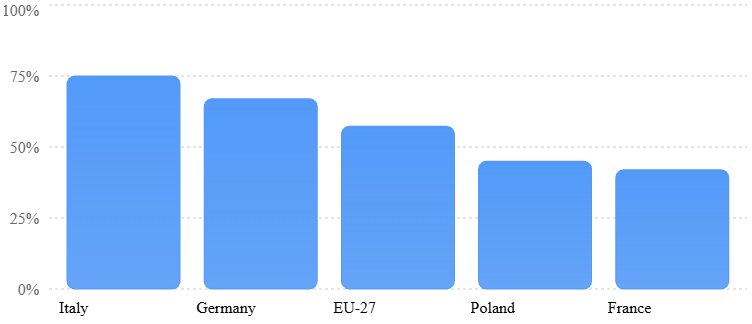
The comparison identifies a relevant structural difference without proving that the country with the higher import-dependency percentage has less diplomatic influence. Energy imports can be diversified across suppliers, transport routes and contractual arrangements; domestic production can be concentrated in fuels with different environmental and economic characteristics; and the ability to respond to a supply disruption depends on storage, interconnection capacity, alternative generation, demand flexibility and market institutions. Eurostat’s 2026 energy publication identifies natural gas as accounting for 36% of Italy’s gross available energy in 2024, while nuclear energy accounted for approximately 40% in France and solid fuels for 34% in Poland. These differences are relevant to the structure of industrial costs and energy-security policy, but an assessment of resilience would additionally require information about infrastructure availability, spare capacity, supply concentration and the duration of prospective interruptions. Energy in Europe — Eurostat — 2026 Edition. Eurostat
Italy’s geographical position creates possible strategic functions that are not captured by its national import-dependency rate. Energy connections between the Mediterranean and European markets can contribute to supply diversification and regional infrastructure resilience, while ports, maritime services and cross-border transport systems may be relevant to industrial continuity and logistical planning. The existence of these assets does not, however, demonstrate that Italian authorities exercise negotiating leverage over Ukraine security guarantees. A stronger causal connection would require evidence that a specific infrastructure asset or operational capability is necessary for an agreed European security measure, that Italy possesses an identifiable decision or implementation role, and that other participating governments depend on that role. This separates the strategic relevance of geographic position from assumptions about diplomatic entitlement.
Industrial specialisation and the distinction between production capacity and strategic indispensability
The organisation of defence-industrial supply chains can create forms of influence that differ from national ownership of complete weapons systems. Modern military production depends on components, materials, software, electronics, propulsion, sensors, communications equipment, precision manufacturing, certification and integration services. A manufacturer supplying a critical component can possess an important industrial function even when the final product is assembled in another country. Nevertheless, national industrial capability should not be inferred from the existence of individual companies without examining ownership, contractual responsibilities, export-control obligations, production capacity and dependence on foreign inputs. The strategic significance of a supply-chain position depends on whether it is difficult to substitute, whether output can be increased within relevant timeframes, and whether the responsible government can maintain reliable access to production under the applicable legal and commercial arrangements.
Italy’s industrial structure offers opportunities for participation in multinational European programmes, but the conversion of general manufacturing capacity into defence capability is constrained by procurement specifications, certification, quality assurance and security requirements. The establishment of a new factory, the announcement of a production partnership or the signature of a memorandum does not establish that qualified products have been delivered. Similarly, an investment programme designed to expand industrial capacity should be assessed by the facilities constructed, equipment installed, personnel trained, production rates achieved and contracts fulfilled. These distinctions are particularly important where European procurement instruments seek to stimulate cooperation among manufacturers and reduce dependence on vulnerable supply chains. Italy’s ability to participate in such arrangements would be demonstrated through documented contractual obligations and completed industrial output, not merely by the presence of an extensive manufacturing sector.
Geographic priorities and the allocation of diplomatic attention
Italy’s geographic interests differ in important respects from those of governments whose national security planning is more directly connected to NATO’s eastern flank. Rome’s Mediterranean environment includes maritime infrastructure, commercial shipping, energy routes, North African political and economic relationships, migration-management arrangements and the security of critical infrastructure connecting Europe with external markets. These subjects can create substantial responsibilities within the European security system, particularly where disruptions would affect energy availability, industrial production or maritime transport. They also compete for diplomatic attention, administrative capacity and public resources. The relevant analytical question is whether this wider agenda affects the quantity or type of Italian resources available for Ukraine-related commitments, rather than whether Mediterranean security is intrinsically more or less important than eastern European security.
For Poland and the Baltic states, the proximity of Russia, Belarus and Ukraine, together with the physical location of NATO’s eastern defence infrastructure, produces a different relationship between national and regional security priorities. Their involvement in Ukraine-related assistance can be closely connected to the defence of their own territory, logistical arrangements and the strengthening of eastern-flank capabilities. Italy may share the broader objective of European security while facing a different distribution of immediate geographic requirements. This difference can influence national procurement choices and diplomatic activity, but it does not establish that Mediterranean priorities are incompatible with substantial participation in Ukraine policy. The extent of any trade-off depends on actual resource allocation and on whether the same capabilities can perform multiple security functions.
Cyclical political choices and structural constraints
Structural conditions must be distinguished from decisions that can change within a government’s political cycle. Public debt, industrial production capacity, military inventories and major infrastructure networks generally evolve over several years, whereas diplomatic statements, ministerial appointments, political positioning and the selection of negotiating initiatives can change over shorter periods. A government may adjust the emphasis of its foreign policy without substantially altering the material capabilities available to its armed forces. Conversely, major procurement programmes may continue under successive governments even when their public communications differ. This distinction prevents short-term diplomatic developments from being presented automatically as evidence of a permanent transformation in national influence.
Italy’s February 2026 parliamentary extension of the authorisation to transfer military equipment to Ukraine illustrates a concrete measure of policy continuity that should be considered separately from interpretations of the government’s political alignment. The legislation extended the relevant legal framework through 31 December 2026, demonstrating that the national authorisation mechanism continued to operate during the period under assessment. The measure does not disclose the complete equipment-delivery record or establish the diplomatic effect of the transfers, but it provides stronger evidence of policy implementation than general political commentary. Italian Senate — Parliamentary Proceedings on Ukraine Military Assistance — February 2026. Senato della Repubblica
A structural explanation of Italy’s differentiated influence would require evidence that its material capabilities, geographic responsibilities, institutional relationships or fiscal constraints consistently limit participation in particular functions, regardless of changes in government or diplomatic personnel. A cyclical explanation would require evidence that participation changed following specific policy decisions, diplomatic initiatives or shifts in the preferences of negotiating partners while the material conditions remained broadly similar. The observed variation among institutional formats is consistent with several possible mechanisms, so no single political interpretation should be elevated into an established causal finding without more direct documentary support.
Chapter 5 — Key judgments
High confidence: Italy’s fiscal outlook and energy-import dependence create identifiable economic exposures relevant to the sustainability of defence investment and industrial production.
High confidence: National energy structures differ substantially across Italy, France, Germany and Poland; import dependency alone does not measure total strategic resilience.
Medium confidence: Industrial integration, procurement performance and the availability of specialised capabilities can affect a government’s practical role in multinational security arrangements, but that relationship requires programme-specific evidence.
Low confidence: Publicly available records do not establish that domestic political positioning, rather than institutional requirements or military responsibilities, caused an individual exclusion from a restricted European consultation.
What would change the assessment: Comparable country-level evidence on procurement execution, defence readiness, industrial contracts, equipment deliveries and the reasons for particular invitation decisions would permit a more precise separation of structural constraints from short-term diplomatic choices.
Chapter 6 — Italy, France, Germany, the United Kingdom and Poland: Strategic Convergence and Competition
Five national security profiles within a shared but differentiated European environment
The five governments examined in this assessment possess overlapping interests in European security, but the distribution of their responsibilities is influenced by different military capabilities, domestic political institutions, geographic exposures and economic structures. Their cooperation cannot be understood as a unified national strategy implemented by several capitals, nor should their differences be treated as permanent geopolitical competition. The policy choices available to each government depend on the specific subject under discussion. A country with established military command responsibilities may be especially involved in operational planning; a government financing a large procurement programme may be central to production and delivery decisions; a state hosting essential logistical infrastructure may have an important implementation role; and an EU member state may exercise legally defined authority over financial or regulatory measures without participating in the initial diplomatic consultation. The result is a network in which national interests converge on certain objectives while implementation burdens and institutional responsibilities remain unevenly distributed.
For Italy, a comparison with France, Germany, the United Kingdom and Poland is useful precisely because it exposes different combinations of these functions. The relevant variables are not interchangeable and should not be converted into a composite diplomatic score. Formal institutional membership, military deployment capability, documented command responsibility, financial commitments, equipment deliveries, energy dependence and geographic exposure are distinct characteristics. Their interaction may help explain which governments participate in particular activities, but the official record does not demonstrate that the same variables determine the membership of every negotiating group. The most defensible approach is therefore to compare the relevant functions and the policy constraints affecting them, rather than establish an overall hierarchy of national political importance.
France: strategic autonomy, military command and the European industrial framework
France’s security policy combines national strategic capabilities with European defence-industrial cooperation and an established diplomatic role in multilateral security arrangements. As a nuclear-armed state and permanent member of the United Nations Security Council, France possesses institutional and military characteristics not shared by Italy, Germany or Poland. These characteristics are relevant to international security diplomacy, although they do not confer legal authority over the national decisions of other European governments. Within Ukraine-related arrangements, France has also assumed a direct organisational role alongside the United Kingdom in the development of the Coalition of the Willing and the Multinational Force–Ukraine. This responsibility is more specific than a general assertion of strategic importance because it can be identified in official command and planning arrangements, although it remains subject to the political and legal conditions governing any eventual deployment. The Multinational Force–Ukraine — UK Ministry of Defence — November 2026.
France’s interests in European defence-industrial policy also involve questions of production capacity, technological autonomy, procurement eligibility and coordination between European institutions and national manufacturers. These interests can converge with those of Italy, Germany and Poland where cooperative programmes provide equipment that several governments require, but they can also generate differing national preferences regarding industrial participation, technology access, production locations and the allocation of procurement expenditure. The European Commission’s SAFE framework creates opportunities for common procurement, although the establishment of a financing programme does not resolve commercial or industrial differences automatically. The strategic significance of cooperation must therefore be assessed through the actual participation of companies, contractual responsibilities, production schedules and the conditions governing the transfer or use of technology. SAFE — Security Action for Europe — European Commission.
Germany: budgetary commitments, industrial organisation and long-term support
Germany’s policy profile differs from France’s because its documented contribution to Ukraine is strongly associated with financial commitments, procurement and the organisation of substantial military assistance, rather than possession of an independent national nuclear deterrent. Its role in co-chairing the Ukraine Defence Contact Group alongside the United Kingdom provides a defined coordination function, while its national procurement and assistance arrangements connect federal budgetary decisions to the production and delivery of military capabilities. The distinction is relevant because a government can exercise practical influence through the capacity to finance equipment and sustain industrial contracts without possessing all the strategic capabilities associated with a nuclear-armed state. Germany’s participation in the E3 and E5 should therefore be examined alongside, rather than explained exclusively by, its material commitments. How Germany Is Supporting Ukraine — German Federal Government — 2026; NATO Secretary General Attends Ukraine Defence Contact Group Meeting — NATO — April 2026.
Germany’s industrial interests can align with those of Italy and France when common procurement and production arrangements reduce costs, improve interoperability or increase available output. Differences may arise where participating governments seek to preserve national industrial capabilities, select different technical standards or prioritise equipment serving distinct operational requirements. The presence of substantial financing does not eliminate such constraints, because production capacity must still be created or expanded, personnel must be trained, supply chains must remain available and equipment must satisfy agreed specifications. A complete assessment of German industrial influence would therefore examine the relationship between federal appropriations, procurement contracts, manufacturer deliveries and participation in multinational programmes, rather than treat the headline value of future assistance as equivalent to completed operational capability.
United Kingdom: non-EU institutional position and military coordination
The United Kingdom occupies a distinctive position because it participates extensively in European security coordination while remaining outside EU membership. Its NATO responsibilities, bilateral security agreements, military training activities, operational role within the Multinational Force–Ukraine and documented financial commitments demonstrate that non-membership of the EU does not remove a government from important European defence processes. At the same time, the United Kingdom cannot exercise the institutional voting rights of an EU member state, making its participation in EU-administered financing and procurement dependent on the applicable legal instruments. The Council’s July 2026 approval of UK participation in the Ukraine support-loan framework is therefore significant: it demonstrates that cooperation can be established through specific legal provisions rather than assumed automatically from the United Kingdom’s military and diplomatic relationships. EU Countries Approve UK Participation in Ukraine Support Loan — Council of the European Union — July 2026.
The United Kingdom’s relationship with France also illustrates how military cooperation can coexist with distinct national political and industrial interests. The two governments have shared organisational responsibilities for multinational force planning, but their domestic defence establishments remain accountable through separate national systems. A multinational command arrangement does not eliminate differences in procurement, force availability, expenditure or the legal conditions of deployment. For Italy, the British case demonstrates the importance of concrete responsibilities in European security coordination while highlighting the distinction between military cooperation and EU institutional authority.
Poland: eastern-flank security and the relationship between geography and defence policy
Poland’s security priorities are closely connected to its location on NATO’s eastern flank, its border with Ukraine and its role in military transport and logistical coordination. Its government has documented completed equipment donations, training programmes and the importance of Rzeszów-Jasionka airport to the logistical support of Ukraine. These functions are not merely expressions of diplomatic preference; they constitute observable activities associated with the movement of equipment, military personnel and assistance. Poland’s involvement in both the E5 and Weimar Triangle creates further opportunities for consultation with governments possessing different industrial and military capabilities, although these arrangements do not confer authority over the decisions of countries outside their membership. Every Donation to Ukraine Was Subject to Prior Analysis by the Polish Armed Forces — Polish Ministry of National Defence — July 2026; Joint Declaration of the Weimar Triangle Ministers for European Affairs — French Ministry for Europe and Foreign Affairs — October 2026.
Poland’s energy structure introduces an additional distinction. Eurostat reports lower total import dependency than in Italy or Germany for 2024, but this does not establish that Poland’s energy system is free from security or economic vulnerabilities. The composition of domestic production, dependence on particular fuels, the availability of alternative supplies and the investment required to maintain or transform energy infrastructure all affect national resilience. The relevant policy comparison therefore extends beyond the total import-dependency rate to the capacity of each country to maintain industrial output and critical services under different supply conditions. Key Figures on Europe — Eurostat — 2026 Edition.
Italy: Mediterranean responsibilities, fiscal sustainability and industrial cooperation
Italy’s profile combines full EU and NATO membership, Mediterranean geographic responsibilities, a substantial manufacturing economy and participation in European defence-industrial cooperation. Unlike France and the United Kingdom, Italy does not possess an independent national nuclear deterrent; unlike Poland, its territory does not provide the same direct logistical relationship with Ukraine’s western border; and unlike the United Kingdom and France, it does not hold the identified joint operational command responsibility within the Multinational Force–Ukraine. These distinctions are relevant to particular security arrangements, but they do not establish that Italy lacks capabilities or policy functions of value to the European security system. Its access to European financing instruments, defence procurement and NATO planning must be examined through the responsibilities associated with those mechanisms and through the economic capacity to fulfil commitments over time.
Italy’s fiscal and energy characteristics also influence the domestic conditions under which security commitments are made. The European Commission’s May 2026 forecast identifies relatively weak economic growth and a high public-debt ratio, while Eurostat’s energy figures demonstrate substantial dependence on imported energy. These indicators provide context for evaluating the sustainability of additional military expenditure and industrial production, although they cannot establish a direct causal relationship with the composition of particular diplomatic meetings. The most relevant policy question is how these constraints interact with national procurement choices, industrial cooperation, energy infrastructure and the development of capabilities that other governments require. Economic Forecast for Italy — European Commission — May 2026; Energy Imports Dependency — Eurostat.
Comparative policy responsibilities and constraints
| Country | Diplomatic and institutional channels | Documented military or implementation function | Economic or industrial consideration | Principal policy constraint |
|---|---|---|---|---|
| Italy | EU, NATO, E5 | National military assistance; participation in wider coordination | Manufacturing integration; Mediterranean energy and maritime infrastructure | Fiscal sustainability, procurement execution and limited public delivery detail |
| France | E3, E5, Weimar Triangle, NATO, EU | Joint multinational-force command; national strategic capabilities | Defence-industrial production and technology autonomy | Coordinating national military commitments with multinational requirements |
| Germany | E3, E5, Weimar Triangle, NATO, EU | Contact-group co-chairing; substantial procurement and assistance financing | Large industrial procurement and production programmes | Delivery schedules, industrial capacity and long-term budget commitments |
| United Kingdom | E3, E5, NATO, coalition leadership | Joint multinational-force command; contact-group co-chairing; training | Defence production, bilateral financing and specific EU procurement eligibility | Separate national and EU legal procedures |
| Poland | E5, Weimar Triangle, NATO, EU | Training, equipment donations and logistical support | Eastern-flank infrastructure and defence procurement | Managing national force requirements alongside external assistance |
The table identifies different national responsibilities without converting them into an artificial ranking. The documentary basis is provided by The Multinational Force–Ukraine — UK Ministry of Defence, Ukraine Defence Contact Group Meeting — NATO — April 2026, German Federal Government Ukraine Assistance Records, Polish Ministry of National Defence Equipment Donation Records and European Commission’s Economic Forecast for Italy.
Convergence and differences across four strategic dossiers
Ukraine security guarantees. The five governments have participated in support for Ukraine and wider European security coordination, but their formal responsibilities differ. The United Kingdom and France have identified command functions within the multinational force, Germany has a documented role in military-assistance coordination, Poland provides important training and logistical support, and Italy participates in European defence and institutional arrangements. These functions can contribute to a common objective without requiring identical responsibilities or identical negotiating roles.
European rearmament. Common procurement creates opportunities to expand production and improve interoperability, but national industrial preferences can differ over technology, manufacturing locations, suppliers and contractual responsibilities. EU financing can facilitate cooperation within its legal framework, while implementation remains dependent on the ability of manufacturers and governments to fulfil procurement requirements. Participation should therefore be assessed by contracts and deliveries, not solely by declarations of industrial cooperation. SAFE — Security Action for Europe — European Commission.
Reconstruction and long-term financing. Ukraine’s recovery creates requirements involving physical infrastructure, energy systems, financial guarantees, public-sector governance and industrial investment. The governments may participate through bilateral assistance, financial institutions, European programmes and commercial projects. Their responsibilities depend on the applicable financing and procurement rules, while the eligibility and conditionality of EU instruments remain subject to competent European institutions. Council Finalises €90 Billion Support Loan to Ukraine — Council of the European Union — April 2026.
Energy and infrastructure resilience. The five governments face different import requirements and domestic energy structures. France’s nuclear generation, Poland’s domestic solid-fuel production, Germany’s import exposure and Italy’s significant use of natural gas illustrate different national circumstances. These differences can affect the types of infrastructure investment considered important, but do not establish a single preferred European energy policy or a direct relationship between energy-import dependency and Ukraine negotiating access. Energy in Europe — Eurostat — 2026 Edition.
Chapter 6 — Key judgments
High confidence: The five governments possess different documented military, institutional, industrial and geographic responsibilities, and these differences affect the practical functions they can perform within European security arrangements.
High confidence: European security cooperation can operate through combinations of EU member states and non-EU partners, subject to the specific legal and institutional mechanisms concerned.
Medium confidence: Cross-border industrial procurement, multinational planning and shared logistical requirements create incentives for cooperation, while national procurement choices and legal responsibilities can constrain implementation.
Low confidence: The public record does not support assigning a single overall measure of negotiating influence to the five governments or attributing individual invitation decisions exclusively to any one national characteristic.
What would change the assessment: Official records demonstrating the origin of specific negotiating provisions, contractual responsibility for indispensable defence capabilities, formal command appointments and the documented implementation of European financing decisions would provide stronger evidence of how influence is exercised across the five governments.
WordPress HTML Scheme — Structural Constraints and Strategic Policy Comparison
This is a complete, self-contained component for insertion after Chapter 6. It contains an interactive 3D-style energy-dependency comparison and a country-specific policy matrix. Its quantitative graph uses only the harmonised 2024 Eurostat figures, while its institutional comparison remains descriptive rather than creating unsupported numerical influence scores.
The statistical basis is Key Figures on Europe — Eurostat — 2026 Edition, with definitions from Energy Imports Dependency — Eurostat Methodology. The Italian fiscal indicators use the European Commission Economic Forecast — May 2026.
European Security: Structural Constraints and National Responsibilities
Select a country to compare its documented energy-import dependency and the institutional or operational factors relevant to European security coordination. The bars use actual Eurostat percentages; visual depth is illustrative.
Energy Import Dependency — 2024
Unit: percentage of gross available energy supplied by net imports. Reference year: 2024. Source: Eurostat, Key Figures on Europe, 2026 edition. The United Kingdom is omitted from this EU-only harmonised comparison.
Italy
Italy combines substantial energy-import dependence, Mediterranean infrastructure responsibilities and participation in European defence coordination. Its government-debt and growth outlook create additional considerations for multiyear commitments.
Policy responsibility
EU and NATO participation; E5 coordination; national military assistance and defence-industrial cooperation.
| Government | Strategic and institutional functions | Implementation consideration |
|---|---|---|
| Italy | EU, NATO, E5; Mediterranean security | Fiscal sustainability, industrial execution and documented delivery |
| France | E3, E5, EU, NATO; joint MFU command | National military authority and multinational requirements |
| Germany | E3, E5, EU, NATO; assistance coordination | Long-term procurement and production schedules |
| United Kingdom | E3, E5, NATO; joint MFU command | National authorisation and EU procurement arrangements |
| Poland | E5, Weimar Triangle, EU, NATO; Ukraine logistics | National defence requirements and logistical capacity |
Pillar II — Consolidated Assessment
The evidence developed in Pillar II establishes that the external configuration of American security policy, the domestic economic circumstances of European governments and the allocation of operational responsibilities constitute distinct but interacting elements of European security coordination. American negotiating preferences can influence the channels through which European governments participate in discussions about Ukraine, but the implementation of any resulting arrangement depends on capabilities, financing, legal mandates and national authorisations that cannot be substituted by diplomatic access alone. The official record demonstrates that the United States has employed direct negotiating channels with Ukraine while European governments have developed multinational military and financial arrangements, yet it does not establish that these mechanisms are governed by a permanent hierarchy of European interlocutors or that an alternative American administration would necessarily maintain the same consultation pattern.
Italy’s fiscal and energy conditions provide a more measurable basis for examining the sustainability of national commitments. The European Commission’s May 2026 projections indicate modest growth and a high public-debt ratio, while Eurostat’s harmonised data identify comparatively substantial energy-import dependency. These conditions can influence the resources available for sustained procurement and industrial investment, but they do not establish political incapacity or a direct causal connection with the invitation lists of restricted diplomatic meetings. Italy also retains legal and institutional avenues for participation in European security arrangements, together with industrial and geographic functions whose practical relevance depends on specific programmes and responsibilities. The distinction between general economic capacity and actual implementation is essential: strategic commitments become operationally significant through contracts, production, training, infrastructure, equipment availability and formally assigned responsibilities, rather than through their announced financial value alone.
The comparison with France, Germany, the United Kingdom and Poland further demonstrates that national responsibilities differ according to the function being considered. France and the United Kingdom possess documented command responsibilities in multinational force planning, Germany has substantial financing and military-assistance coordination functions, Poland contributes important logistical and training capabilities, and Italy participates in institutional and defence-industrial mechanisms while facing different fiscal and geographic conditions. These distinctions provide grounds for analysing why certain governments may be directly involved in specific arrangements, but the available public record does not establish an exclusive or universally applicable set of criteria determining diplomatic participation. Consequently, the continuation or alteration of American leadership should be assessed through observable changes in negotiating mandates, security guarantees, procurement conditions, operational arrangements and institutional procedures rather than assumptions about political affinity or the relative prestige of national governments.
The central finding of Pillar II is that European strategic responsibility is distributed across different forms of capability, authority and economic exposure, while changes in American policy may alter how those functions are coordinated without eliminating the separate legal and operational responsibilities of European governments. The decisive evidence needed for further assessment concerns the documented implementation of commitments, the allocation of military and financial responsibilities, and any changes in the procedures governing restricted negotiations. These provide the appropriate foundation for examining conditional trajectories and policy choices through 2028, without assigning unsupported probabilities to future political developments.
PILLAR III — STRATEGIC OPTIONS, SCENARIOS AND DECISION INDICATORS
Italy’s Strategic Influence Through 2028: Capability Commitments, Implementation Authority, European Coalitions and Conditional Security Pathways
Chapter 7 — Operational Levers for Italian Influence
From strategic commitments to verifiable implementation responsibilities
The practical effectiveness of an Italian initiative in European security policy depends on whether it changes the resources, institutional responsibilities or operational dependencies involved in implementing a common decision. The distinction is especially important when considering initiatives designed to increase diplomatic participation. Announcing a new policy objective, endorsing an existing declaration or requesting admission to an informal consultation can clarify a government’s position, but such actions do not necessarily alter the capabilities available to other participants. A contract that secures additional ammunition production, a formally assigned logistics responsibility, a certified industrial contribution or participation in a defined multinational planning mechanism creates a different relationship because other governments can incorporate that contribution into their own implementation arrangements. This does not guarantee access to restricted negotiations, whose membership may also reflect political or procedural considerations, but it supplies a more observable basis for sustained cooperation than diplomatic visibility alone.
The current European policy environment offers several mechanisms through which such responsibilities can be established without creating new institutions. The Council of the European Union’s September 2026 defence meeting identified air defence as a principal Ukrainian requirement, reported approved defence procurement plans worth €28.3 billion under the 2026 financing strategy and emphasised the need to combine immediate equipment deliveries with increased production capacity. The same meeting addressed the European Peace Facility and the extension of the EU Military Assistance Mission in support of Ukraine. The European Council subsequently welcomed the establishment of an integrated anti-ballistic missile coalition and called for continued defence-industrial cooperation. These records establish areas of organised international activity against which potential national contributions can be evaluated. They do not establish that any particular Italian offer has been accepted or that participation in a programme would automatically result in membership of a separate negotiating group. Foreign Affairs Council (Defence) — Council of the European Union — 28 September 2026; European Council Meeting, 15–16 October 2026 — European Council. Consilium+1
Air defence: matching contributions to documented capability requirements
Air and missile defence is particularly relevant because it combines equipment supply, ammunition replenishment, maintenance, radar integration, training and continuous operational support. A national contribution must therefore be examined in terms of its specific function rather than the political significance of its announcement. An equipment transfer from existing inventories may address an immediate requirement but create a replenishment obligation for the donor. A contract for new interceptors may support future deliveries without solving a near-term shortage. Technical assistance or training may sustain equipment already in service, while investment in sensors, communications or maintenance capacity may contribute to a larger integrated system. Each type of contribution has a different implementation schedule and imposes different responsibilities on the participating government.
The September 2026 Foreign Affairs Council explicitly identified the need for immediate delivery from available stocks alongside increased industrial output, and reported that approved procurement plans under the Ukraine Support Loan included prospective purchases of Patriot missiles. This establishes an immediate policy distinction between equipment already available and equipment that must be manufactured or procured under future arrangements. For Italy, any additional role would need to be assessed against national defence requirements, export authorisations, the availability of relevant equipment or components and the sustainability of replenishment. The appropriate test is whether a contribution addresses a documented Ukrainian requirement through an authorised and deliverable mechanism. The public evidence does not justify treating an undisclosed or unspecified contribution as equivalent to a completed delivery. Foreign Affairs Council (Defence) — Council of the European Union — September 2026. Consilium
NATO’s Prioritised Ukraine Requirements List, established in July 2025, offers a separate mechanism for financing critical equipment supplied from the United States. Under this arrangement, NATO’s Supreme Allied Commander Europe identifies packages of equipment and ammunition that Ukraine requires and that American production can supply in greater volumes than European allies and Canada alone. Participating allies and partners then finance packages, while NATO coordinates deliveries through established assistance mechanisms. By October 2026, NATO reported commitments exceeding US$6 billion under this arrangement. This model allows a government to contribute to a clearly identified requirement without necessarily owning the manufacturing system or transferring an equivalent item from its national inventory. For Italy, the relevant distinction would be between participation in financing, procurement, delivery and subsequent technical support, since each function would create a different operational and financial relationship. Relations with Ukraine — NATO — October 2026. NATO Topic
Ammunition procurement: contract execution and industrial interoperability
Ammunition production offers another area where the practical significance of participation can be evaluated through contracts and delivery schedules rather than general commitments. The European Defence Agency’s collaborative procurement programme seeks to aggregate demand across participating countries, reduce duplication in national purchasing procedures and improve compatibility among equipment systems. The Agency reports that the initiative launched in 2023 involves twenty-seven EU member states and Norway, covers several ammunition categories and has established sixty framework contracts for the procurement of 155-millimetre artillery ammunition. In its recent account of collective procurement, the Agency reported orders exceeding €380 million for that ammunition category, together with a separate first joint order valued at €22 million for 84-millimetre ammunition on behalf of three participating countries. These figures refer to specific procurement activity within the Agency’s programme; they must not be interpreted as the complete value of European ammunition production or as evidence that every contracted quantity has been delivered. Buying Military Equipment Together — European Defence Agency — 2026. eda.europa.eu
The industrial significance of collaborative procurement depends on the degree to which manufacturers can meet agreed standards across different weapons systems and sustain production at the contracted rate. The Agency identifies 155-millimetre ammunition compatibility with several European artillery platforms, illustrating the practical value of standardisation. This does not eliminate national requirements or supplier-specific technical differences, but it allows participating authorities to examine whether aggregated demand supports larger, more predictable manufacturing orders. For Italy, an industrial contribution would become measurable through the volume and type of contracted production, delivery performance, interoperability certification and the ability to fulfil commitments without creating unacceptable supply risks for national forces. The value of participation would be particularly clear where a manufacturer or specialised supplier performs an essential function within a cross-border production chain, although establishing such a position requires contract-level evidence.
European financing: the allocation of implementation responsibilities
The EU’s financing arrangements provide a substantial institutional mechanism through which governments can participate in long-term Ukrainian assistance without controlling the initial diplomatic negotiations. The Council’s April 2026 legislative decision established the €90 billion Ukraine Support Loan for 2026–2027 with indicative allocations of €30 billion for macroeconomic support and €60 billion for defence-industrial investment and procurement. The implementing decision made €45 billion available under the 2026 financing strategy, divided into €8.35 billion for macro-financial assistance, €8.35 billion through the Ukraine Facility and €28.3 billion for defence-industrial requirements. These are legally and financially distinct categories: an approved allocation creates financing capacity, but actual delivery requires subsequent procurement, compliance and disbursement. Council Finalises €90 Billion Support Loan to Ukraine — Council of the European Union — 23 April 2026. Consilium
The European Peace Facility supplies a different set of instruments. On 26 October 2026, the Council adopted decisions enabling €4.9 billion in support, comprising approximately €4.7 billion in reimbursement of qualifying military assistance already delivered by member states and €230 million in additional support for the EU Military Assistance Mission. These decisions followed a political agreement to mobilise €6.6 billion and brought the Council’s reported cumulative European Peace Facility mobilisation for Ukraine to €10.8 billion, including military-assistance reimbursement and training support. The difference between reimbursement and new equipment procurement is essential. Reimbursement addresses the financing of assistance previously supplied, while new procurement or training measures can create future implementation responsibilities. The two categories therefore affect national budgetary burdens and military capabilities in different ways. EU Support for Ukraine: Council Mobilises €4.9 Billion Under the European Peace Facility — Council of the European Union — 26 October 2026. Consilium
These mechanisms are relevant to Italy because their implementation requires decisions concerning national participation, procurement, financing, eligibility and oversight. They also demonstrate why the size of a European programme cannot be assigned to an individual member state as evidence of its bilateral contribution. A meaningful assessment would identify whether Italian authorities or enterprises participated in a specific approved programme, which obligations they assumed, what financing became available, which goods or services were contracted and whether the resulting outputs were delivered. Such evidence would demonstrate implementation involvement independently of general statements concerning national diplomatic importance.
Reconstruction: financial mobilisation, conditionality and project delivery
Reconstruction financing provides another field in which institutional authority and implementation may be more important than attendance at restricted security consultations. The European Commission reports that the Ukraine Investment Framework, established within the wider Ukraine Facility, has a capacity of €9.6 billion, consisting of €7.8 billion in guarantee cover and €1.8 billion in blended-finance grants, with the objective of mobilising up to €40 billion in investment. Following agreements concluded around the June 2026 Ukraine Recovery Conference in Gdańsk, the Commission reported approximately €8.5 billion in commitments under the framework, intended to mobilise nearly €26 billion in public and private investment. These figures describe financial instruments and expected investment mobilisation, not completed reconstruction expenditure. The distinction is important because guarantee capacity, committed financing and physical infrastructure delivery occur at different stages of project execution. Ukraine Investment Framework — European Commission; EU Steps Up Support for Ukraine at the Ukraine Recovery Conference — European Commission — 25 June 2026. Enlargement and Eastern Neighbourhood+1
The Commission’s published framework identifies transport connectivity, roads, railways, ports, logistics, energy infrastructure, digitalisation, manufacturing and private-sector finance as relevant investment sectors. It also describes a steering-board arrangement providing strategic and operational guidance, together with cooperation involving eligible financial institutions. This structure offers a direct example of the distinction between political sponsorship and investment governance. Governments can advocate particular priorities, but programme implementation also depends on eligibility, financing agreements, project appraisal, procurement compliance, audit arrangements and the ability of contractors to complete the work. For Italy, any substantial reconstruction role would be established through participation in these processes, rather than through a general claim that the country’s private sector could contribute to Ukraine’s recovery. Ukraine Investment Framework — European Commission. Enlargement and Eastern Neighbourhood
The same distinction governs reconstruction conditionality. The EU’s financing architecture links support to Ukraine’s reform commitments, the rule of law and anti-corruption requirements. An individual government may participate in the adoption of an institutional decision or in financing a specific project, but it cannot independently substitute its preferred conditions for those established by the competent authorities. Accordingly, the measurable policy functions are the negotiation of applicable rules, participation in programme governance, the identification of eligible investment projects and oversight of their execution. These functions may continue across different political administrations because they are embedded in legal agreements and financing structures.
Regional cooperation: Poland, the Nordic-Baltic states and defined operational requirements
Cooperation with Poland and northern European governments offers opportunities for Italy to participate in activities that connect military procurement, training, logistics and infrastructure resilience. Such cooperation should be examined according to the actual requirements of participating institutions rather than the political visibility of a proposed regional partnership. Poland’s territory provides documented logistical and military-support functions associated with Ukraine, while Nordic and Baltic states have organised substantial collective commitments and regional security coordination. The importance of these arrangements lies in their ability to combine capabilities and resources around identifiable requirements, but their existence does not imply that other governments must automatically adopt the same national priorities.
The British Ministry of Defence’s announcement of Exercise KOALICJA 26.2 provides a concrete test of multinational implementation. Scheduled for 9–22 November 2026 in Poland, the exercise was intended to involve approximately 2,800 personnel from eleven participating countries, including around 300 British personnel, and to examine military movement, logistics, command-and-control arrangements and coordination among land, air and maritime components. The maritime element was to involve Turkish forces operating from Istanbul, with preparation for activities relevant to future Black Sea mine clearance. At the 3 November cut-off, the exercise had been announced but not completed. Its relevance for Italy lies in the example of how operational participation can be documented through assigned tasks, personnel and exercise objectives, rather than through political consultation alone. UK to Lead Multinational Military Training Exercise to Prepare for Peace in Ukraine — UK Ministry of Defence — 3 November 2026. GOV.UK
An Italian contribution to a comparable initiative would require a clear legal basis, national assessment of available capabilities and agreement with the relevant organising authorities. The possible functions could include logistics, maintenance, military training, command support, defence-industrial procurement or other activities specified through the multinational planning process. These are alternatives for institutional examination rather than evidence that such Italian assignments have already been made. Their practical significance would depend on whether the receiving organisation needs the proposed capability, whether Italy can deliver it within the relevant period and whether the commitment creates continuing responsibilities beyond the initial announcement.
Comparative implementation options
| Instrument or policy route | Competent authority | Documented institutional basis | Required implementation evidence | Main burden | Key risk |
|---|---|---|---|---|---|
| Air-defence equipment contribution | National authorities; relevant procurement and coordination bodies | EU defence requirements and NATO PURL | Delivery acceptance, maintenance and availability | Equipment, replacement and sustainment | Depletion of national capability |
| Ammunition production or procurement | National procurement authorities and participating European mechanisms | EDA collaborative procurement | Contracts, production quantities, acceptance and delivery | Industrial capacity and financing | Production delays and supply-chain constraints |
| Multinational military planning | Participating national governments and force command | Multinational Force–Ukraine | Formal assignment, approved personnel and tested functions | Personnel, logistics, legal authorisation | Dependence on unfulfilled mission conditions |
| European financing participation | EU and national institutions | Ukraine Support Loan and EPF | Legal decisions, obligations and disbursements | Fiscal exposure and compliance | Delayed execution or ineligible expenditure |
| Reconstruction investment | Commission, financial institutions and project authorities | Ukraine Investment Framework | Project approval, financing close and physical completion | Project preparation and risk allocation | Financial and implementation losses |
| Regional defence cooperation | Participating governments | Bilateral and multinational arrangements | Signed mandates, joint exercises and completed outputs | Coordination and capability commitments | Mismatch between national and partner requirements |
The distinction running through these options concerns the progression from political authorisation to operational delivery. An announced commitment can be relevant evidence of intent, but its effect on the wider security system remains contingent on the completion of subsequent stages. A financing agreement may allow a project to begin but cannot establish completion; an equipment order may support future capacity but does not establish current availability; a military planning assignment may create institutional responsibility without satisfying the conditions required for deployment. These distinctions are necessary for assessing whether a national initiative has materially affected the capabilities available to other participating governments.
Chapter 7 — Key judgments
High confidence: The official European and NATO records identify air defence, ammunition, military training, defence-industrial production and long-term financing as active areas of coordinated support for Ukraine.
High confidence: The EU financing and procurement mechanisms distinguish authorisation, committed financing, reimbursement, disbursement and actual implementation.
Medium confidence: Defined operational or industrial responsibilities can create continuing requirements for consultation, although their effect on the membership of restricted diplomatic meetings cannot be assumed.
Medium confidence: Cooperation through existing multinational mechanisms can be implemented without establishing additional political forums, provided the relevant authorities agree on responsibilities and resources.
What would change the assessment: Evidence of formally assigned Italian functions, completed procurement deliveries, project implementation and sustained participation in the responsible military or financial bodies would establish the practical effects of particular policy initiatives.
Chapter 8 — Three European Security Scenarios Through 2028
Scenario construction and governing assumptions
The evolution of European security coordination through 2028 is subject to several uncertainties that cannot be resolved from the current official record. These include the course of negotiations concerning Ukraine, whether and under what conditions hostilities cease, the extent of future American participation in security guarantees, the actual availability of European military capabilities, and the ability of European institutions to finance and implement agreed measures. The scenarios therefore describe alternative configurations of consultation and responsibility rather than predictions of territorial developments, political leadership changes or the outcome of negotiations. They are conditional pathways, not numerical forecasts, and no probabilities are assigned because the available evidence does not establish a defensible base rate for the composition of future restricted meetings.
The scenarios are also not based on the assumption that a peace agreement will have entered into force by a particular date. The Multinational Force–Ukraine’s published mandate makes clear that its deployment would require an invitation from the Ukrainian government and the cessation of hostilities together with the necessary political and military conditions. Consequently, an announced military commitment, an exercise or an existing headquarters cannot be treated as evidence that the force will deploy before December 2028. The scenarios instead examine how Italy’s role in consultations, procurement, financial governance and implementation could develop under different institutional configurations, including circumstances in which negotiations continue without an agreed deployment. The Multinational Force–Ukraine — UK Ministry of Defence — 3 November 2026. GOV.UK
Scenario A — Persistent participation through wider institutions, with restricted diplomatic consultations continuing separately
Under the first pathway, France, Germany and the United Kingdom continue to use a narrow consultation format for selected questions concerning Ukraine’s security arrangements, while Italy participates through the E5, EU and NATO structures and any additional arrangements in which it assumes a formally recognised role. This configuration would not require a change in the legal rights of any country or the creation of a new European institution. It would represent the continuation of differentiated diplomatic processes in which some negotiations begin within smaller groups and subsequently interact with wider political, financial or military arrangements. Its defining feature would not be Italy’s absence from European security policy, but a recurring distinction between participation in preliminary diplomatic discussions and involvement in subsequent decisions within institutions whose membership is broader.
The consequences would vary by policy domain. Security guarantees might be prepared initially through a restricted set of interlocutors, while legally binding commitments requiring national authorisation would remain subject to the procedures of the participating countries. Reconstruction conditionality would continue to be established through the relevant EU financing instruments and the financial institutions administering individual projects. European budget priorities would remain subject to the applicable EU decision-making framework, although proposals initially developed by a smaller group could influence the subsequent political agenda. Italy’s practical role would therefore depend on the extent to which its authorities participate before the substantive terms of a proposal are settled and on whether it possesses an implementation responsibility that requires consultation during the preparation stage.
The principal evidence confirming this pathway would be repeated official meeting records showing a continuing narrow diplomatic group, together with sustained Italian participation in E5 or institutional EU and NATO activities but no identifiable expansion of its responsibilities in negotiations or multinational implementation. Evidence weakening the pathway would include Italy’s participation in the initial preparation of security-guarantee arrangements, a formally assigned operational responsibility or a documented change in the composition of restricted consultations.
Scenario B — Selective expansion of Italy’s role through additional responsibilities
Under the second pathway, Italy acquires additional responsibilities in a defined security, procurement, logistics or diplomatic activity that requires continued coordination with the governments already involved. Such a development could occur through a national commitment accepted within a multinational military planning process, participation in a specific capability programme, an agreed contribution to reconstruction implementation or a change in the organisation of transatlantic consultations. The central distinction is that wider access would follow an identifiable change in responsibility rather than an assumption that participation in a particular diplomatic format is permanently guaranteed by national status. This pathway does not require the dissolution of the E3 or the replacement of existing European arrangements; it requires only that additional governments become necessary to the preparation or implementation of particular decisions.
Its consequences for Ukraine security guarantees would depend on the type of responsibility assigned. A military planning role could create consultation requirements concerning logistics, sustainment, personnel and national authorisation. A defence-industrial role could lead to participation in procurement schedules and the resolution of supply constraints. A reconstruction-financing role could involve coordination with European financial institutions or project authorities, potentially affecting the practical implementation of agreed conditions without transferring legal authority away from the competent institutions. Changes in American policy could reinforce these developments if Washington altered the composition of its European consultation mechanisms or relied on a wider group of participating governments for particular commitments. However, none of these mechanisms would guarantee Italian involvement in every negotiating subject, because access would remain related to the scope of the assigned responsibility.
The principal confirming evidence would be formal documentation of Italian participation in the preparation of consequential arrangements, appointment to a multinational implementation function, contractual responsibility for a necessary capability or substantive participation in the governance of a major financing instrument. An invitation to a single additional meeting would be weaker evidence because it might reflect a temporary consultation requirement. Repeated participation linked to a continuing operational or institutional function would provide stronger evidence of a durable change.
Scenario C — Greater reliance on specialised regional and operational groupings
The third pathway involves an expansion in the number or significance of specialised arrangements through which European governments address specific security requirements. Rather than a single small political group becoming more powerful across every issue, operational responsibilities could be distributed among several coalitions focused on air defence, ammunition, military mobility, regional deterrence, maritime security, infrastructure protection and reconstruction financing. Governments would participate according to their capabilities, geography, commitments and the requirements established by the relevant organising authorities. Under this configuration, the resulting pattern of access might become more differentiated across policy domains even if formal EU and NATO membership remained unchanged.
The development of specialised groupings is already visible in official institutional activity. NATO’s Prioritised Ukraine Requirements List coordinates financing for identified American-supplied equipment, the European Defence Agency aggregates demand for ammunition, the European Union operates procurement and financing frameworks, and the Multinational Force–Ukraine develops its own operational planning and exercises. The European Council’s October 2026 reference to the establishment of an integrated anti-ballistic missile coalition provides further evidence that specific military requirements can generate distinct collaborative mechanisms. These initiatives do not establish that a particular country has been politically marginalised. They indicate that responsibilities may increasingly be organised around specific capabilities and programmes. Relations with Ukraine — NATO — October 2026; Buying Military Equipment Together — European Defence Agency; European Council Meeting — October 2026. NATO Topic+2
For Italy, the consequence would depend on whether its capabilities match the requirements of the increasingly specialised programmes. It could retain substantial influence in EU financing and particular industrial or maritime activities while participating less directly in arrangements focused on eastern-flank logistics or the command of a prospective multinational force. Conversely, a strong Italian contribution to a specific programme could create an important implementation function without producing a general change in membership of restricted political consultations. The degree of differentiation would therefore be greater, but its effect would not be uniform across the government’s entire European security agenda.
The scenario would be supported by documented growth in specialist military coalitions, procurement arrangements and regionally concentrated planning groups, particularly where these mechanisms acquire continuing responsibilities for implementation. It would be weakened by evidence that broader institutional consultation becomes the principal mechanism for preparing as well as formally approving substantive decisions. The formation of additional informal groups alone would not be decisive unless their actual functions and outputs were identified.
Comparative scenario consequences
| Dimension | Scenario A: Persistent differentiated access | Scenario B: Additional Italian responsibilities | Scenario C: More specialised coalitions |
|---|---|---|---|
| Negotiation access | Narrow preliminary consultations remain separate | Italy participates in additional specified preparations | Access varies more strongly by programme |
| Security guarantees | Italy’s role depends on later institutional or operational participation | Formal responsibility could require continuing consultation | Different components governed through specialised arrangements |
| Military implementation | Existing organisational responsibilities persist | New Italian tasks require formal authorisation and delivery | Functions allocated among multiple coalitions |
| Reconstruction conditionality | EU and financial-institution procedures remain decisive | Italy may participate in additional project or financing governance | Project-specific institutions gain practical significance |
| EU budget priorities | Formal EU decision rights continue | Additional implementation evidence may inform policy discussions | Financing demands become more sector-specific |
| Principal confirming indicator | Repeated narrow meetings without expanded Italian responsibility | Formal Italian appointments, mandates or accepted commitments | New specialist mechanisms with documented implementation roles |
| Main uncertainty | Degree of influence exercised before wider consultation | Whether additional responsibilities affect diplomatic access | Extent of coordination across specialised groups |
The three scenarios are not mutually exclusive across every policy domain. Elements of narrow political consultation, selective inclusion and specialised implementation may coexist. Their value lies in identifying observable institutional developments that would materially change the allocation of responsibilities, not in presenting an artificial distribution of future political outcomes.
Implications for security guarantees, reconstruction and budget sustainability
Security guarantees would create the most immediate relationship between diplomatic coordination and national military commitments if a negotiated arrangement established binding obligations and the relevant governments authorised implementation. Such guarantees may involve different forms of support, including continued assistance to Ukraine’s armed forces, intelligence or verification mechanisms, military training and multinational force preparations. The existence of a planning headquarters and exercises demonstrates preparation, but the legal obligation of an individual government must be established through the relevant agreement and domestic authorisation. For Italy, the important observable development would be whether a specific responsibility is formally assigned and whether the associated capability is available when required.
Reconstruction would follow a different implementation pathway because financing and project governance are already being organised through established European institutions. The European Commission reported that the Ukraine Facility’s October 2026 regular payment of €2.9 billion brought support disbursed under the Ukraine Plan to more than €32 billion. Separately, the Ukraine Investment Framework had committed approximately €8.5 billion in guarantee and blended-finance arrangements, with the objective of mobilising much larger public and private investments. These are different financial measures and should not be added without reconciling their institutional coverage. Their importance for the 2028 outlook lies in the need to evaluate whether approved financing translates into completed infrastructure, functioning services and sustained economic activity. The Ukraine Facility — European Commission; Ukraine Investment Framework — European Commission. European Commission+1
European budget sustainability introduces another source of uncertainty. Multi-year defence and reconstruction commitments may continue beyond the immediate financing period, while national governments face differing fiscal circumstances and domestic priorities. The €90 billion support loan covers 2026–2027, but its existence does not determine the size, legal structure or burden-sharing of any subsequent arrangement. An assessment of future EU budget priorities must therefore distinguish funding already authorised from financing proposals that would require new institutional decisions. Italy’s formal participation in those decisions remains relevant, although the extent of its practical influence would depend on the procedures, coalition alignments and substance of the proposed measures.
Chapter 8 — Key judgments
High confidence: The current official record supports multiple possible configurations of diplomatic consultation and implementation through 2028, but does not establish which will occur.
High confidence: Deployment of the Multinational Force–Ukraine remains conditional on the cessation of hostilities, Ukrainian invitation and the necessary political and military arrangements.
Medium confidence: Additional formally assigned capabilities or implementation responsibilities would provide identifiable grounds for more sustained consultation, without guaranteeing participation in unrelated negotiations.
Medium confidence: Greater specialisation in European security cooperation would make national influence increasingly dependent on the function under consideration rather than membership of one diplomatic group.
What would change the assessment: A signed security-guarantee agreement, a published multinational deployment mandate, changes in negotiating membership and legally adopted post-2027 financing arrangements would materially alter the scenario assumptions.
Chapter 9 — Strategic Monitoring, Decision Thresholds and Final Net Assessment
Establishing an observable basis for evaluating diplomatic and operational influence
The final assessment requires a monitoring framework capable of distinguishing changes in diplomatic visibility from changes in the responsibilities exercised by governments. The most reliable indicators are not the number of public statements referring to national importance or the frequency with which political representatives appear together, but the records showing participation in the preparation of decisions, allocation of resources, assumption of operational responsibilities and implementation of legally authorised commitments. These records can be evaluated separately because they answer different questions. An official participant list establishes access to a meeting; a joint declaration establishes agreement on its published provisions; a procurement contract creates identifiable commercial obligations; a financing decision establishes an authorised mechanism; a delivery record demonstrates transfer of goods or services; and a military appointment identifies an organisational role. None of these observations alone measures total diplomatic influence, but their combination can establish whether a government’s involvement has changed in a specific and consequential way.
A monitoring framework must also recognise the limitations of public evidence. Restricted negotiations do not necessarily produce complete attendance records, draft agreements may not be published and military deliveries can contain classified or commercially sensitive information. The absence of an official public record therefore cannot always be interpreted as proof that an activity did not occur. Nevertheless, public institutional evidence can identify many decisive developments, including legislation, procurement awards, financing agreements, budget implementation, appointments and formally announced multinational exercises. Where such documentation is unavailable, the appropriate finding is that a particular proposition remains unresolved rather than assigning it an invented numerical estimate.
Decision thresholds based on institutional change
A threshold should represent an observable change in the status of a policy or responsibility. The first threshold concerns diplomatic participation. An invitation to one additional meeting establishes participation in that consultation, but a sustained institutional change would require repeated involvement in the preparation of consequential decisions or a formal assignment of responsibility within the relevant mechanism. This distinction prevents isolated diplomatic events from being interpreted as permanent transformations in national standing. The second threshold concerns material commitments. A budget allocation or procurement announcement demonstrates authority or intent, while a signed contract, completed delivery and certified operational availability provide progressively stronger evidence of implementation. The third threshold concerns multinational security arrangements, where planning, exercises, formal command appointments and deployment authorisations represent different institutional stages. The fourth threshold concerns financing, where regulatory approval, commitment, disbursement and completed project delivery must remain separate.
| Indicator | Baseline at 3 November 2026 | Observation establishing change | Principal record | Confidence in baseline |
|---|---|---|---|---|
| Participation in restricted negotiations | Differentiated attendance across identified consultations | Published participant lists and evidence of substantive involvement | National government readouts | High for documented meetings |
| Military implementation role | Specific multinational responsibilities publicly identified for participating governments | Formal appointment or assigned national function | Defence ministries and multinational headquarters | High for published arrangements |
| Air-defence procurement | Approved EU procurement plans include air-defence requirements | Contract award, delivery and system availability | Council, procurement authorities, recipient government | High for approved plans; lower for future delivery |
| Ammunition production | EDA joint procurement contracts and orders exist | Verified production and accepted deliveries | EDA and contracting authorities | High for reported procurement |
| EU financial implementation | €90bn framework; 2026 strategy approved | Additional disbursements and audited expenditure | Council and Commission | High |
| Reconstruction investment | UIF commitments and expected investment mobilisation | Financial close and completed projects | Commission, financial institutions and project authorities | High for commitments; conditional for future outputs |
| Multinational exercise | KOALICJA 26.2 scheduled for November 2026 | Official after-action results and recorded capability findings | Participating defence ministries | High for announcement |
| Post-2027 financing | Existing instruments cover specified periods | New legally adopted financing arrangements | EU legislative and budgetary records | Unresolved |
The selection of indicators is deliberately narrow. Each observation can be tied to a record produced by an authority competent to report the relevant activity, and each represents a change that could affect practical implementation. A new diplomatic statement would not satisfy the procurement threshold, an exercise announcement would not satisfy the readiness threshold, and the approval of a financial instrument would not establish that the anticipated investments had been completed.
Monitoring the relationship between commitments and delivery
The difference between financing commitments and implementation is especially important given the scale of European programmes established during 2025–2026. Under the Ukraine Support Loan, the Council approved a 2026 financing strategy containing €28.3 billion in defence-industrial funding, while the European Peace Facility made additional resources available for reimbursement and training. These mechanisms can create opportunities for further procurement and military assistance, but their practical effects depend on contracting, eligibility, delivery and the ability to sustain equipment after transfer. A monitoring process should therefore track the progression of each programme through its legally defined stages, identifying where significant delays arise and whether the causes relate to financing, procurement, production or other implementation constraints. Council Finalises €90 Billion Support Loan to Ukraine — Council of the European Union — April 2026; Foreign Affairs Council (Defence) — Council of the European Union — September 2026. Consilium+1
The same requirement applies to the defence industry. Framework agreements and aggregated orders are evidence of procurement activity, but they do not provide a complete measure of manufacturing output. Production performance can be assessed through accepted deliveries and evidence of continued supply, while contractual modifications or revised schedules may reveal implementation difficulties. This monitoring is particularly important for multinational programmes because delays by one supplier can affect systems assembled or operated elsewhere. The resulting information can help explain changes in practical cooperation without attributing every development to diplomatic preferences.
Monitoring security guarantees and multinational force preparations
The military arrangements associated with possible security guarantees require a distinct monitoring sequence because the existence of a planning organisation does not establish a legal mandate for deployment. The published Multinational Force–Ukraine framework identifies necessary conditions, including a cessation of hostilities, an invitation from the Ukrainian government and satisfaction of relevant political and military requirements. Its activities can therefore be examined through official exercises, command appointments, readiness assessments and subsequent authorisation decisions. The November 2026 exercise in Poland represents a scheduled opportunity to test aspects of multinational coordination, but at the assessment cut-off it cannot be evaluated as a completed event. The Multinational Force–Ukraine — UK Ministry of Defence — November 2026; UK to Lead Multinational Military Training Exercise — UK Ministry of Defence — 3 November 2026. GOV.UK+1
For Italy, the relevant observation would be whether its military or civilian authorities receive a defined responsibility within the preparation or implementation structure. A national contribution could be recorded through an approved assignment, a procurement obligation, participation in an exercise or a logistics agreement, but each would demonstrate a different degree and type of involvement. The existence of such responsibilities would justify a reassessment of Italy’s implementation role, though not necessarily of its access to unrelated political negotiations. This distinction is necessary to prevent the monitoring process from converting all forms of cooperation into a single and unsupported indicator of geopolitical influence.
Monitoring reconstruction conditionality and European financing
Reconstruction monitoring must distinguish the political allocation of financial resources from their use in individual projects. The European Commission’s Ukraine Investment Framework provides guarantees, grants, technical assistance and other financial instruments intended to mobilise investment in infrastructure, energy, transport, manufacturing and private-sector development. Its published programme structure includes a steering board and cooperation with eligible financial institutions, creating several stages at which decisions may be taken and reviewed. The principal observations are therefore project approval, financial close, procurement compliance, the completion of contractual milestones, disbursement and physical delivery. These records would establish whether a government or national industry has a substantive implementation responsibility rather than merely participating in a reconstruction conference or announcing interest in prospective opportunities. Ukraine Investment Framework — European Commission. Enlargement and Eastern Neighbourhood
The monitoring of conditionality should likewise focus on competent institutional decisions. Requirements concerning governance, public finance, anti-corruption measures and procurement arise from the applicable legal instruments and programme conditions. A government may advocate changes through the relevant institutions, but the existence of such advocacy is not equivalent to adoption of the proposed amendment. Stronger evidence would include the final legal text, an identifiable decision of the competent body or a change in the conditions governing disbursement. This provides a direct means of distinguishing participation in political debate from an observable effect on programme governance.
Strategic policy choices and implementation burdens
The framework identifies several categories of policy choice that could be considered by Italian authorities within their legal responsibilities, without presuming that any one course of action would guarantee greater diplomatic access. The principal distinction is between activities that create implementation obligations and activities that communicate political preferences. Their appropriateness depends on military requirements, fiscal affordability, legal conditions and the commitments already undertaken.
| Policy choice | Responsible authority | Expected operational effect if implemented | Burden and time horizon | Reversibility | Main downside |
|---|---|---|---|---|---|
| Additional equipment delivery | National government and defence authorities | Addresses an identified recipient capability requirement | Availability and replacement dependent; near-term only where stocks permit | Low once transferred | Reduction in national inventories |
| Multiyear ammunition procurement | Procurement authorities and industrial partners | Supports predictable production and future supply | Contracts and manufacturing capacity; multi-year | Limited after binding contracts | Cost escalation or delivery failure |
| Multinational planning participation | Government and military command authorities | Creates defined organisational responsibilities | Personnel and sustainment; dependent on mission stage | Conditional on mandate | Resource commitments without eventual deployment |
| Reconstruction project participation | Competent institutions and financing partners | Supports specified infrastructure or economic activity | Appraisal, financing and construction; multi-year | Limited after financial close | Project and financial risk |
| Defence-industrial cooperation | Procurement authorities and manufacturers | Develops interoperable production and technical capacity | Development, certification and investment; multi-year | Often costly to reverse | Contractual disputes and supply dependence |
| Diplomatic coordination initiative | Government and diplomatic authorities | Establishes consultation opportunities | Administrative and political; potentially short-term | Generally reversible | Limited implementation effect without substantive agreement |
The table is an implementation comparison, not a political ranking. It does not assume that the option with the greatest expenditure produces the strongest diplomatic effect, nor that a less costly initiative is necessarily preferable. Different measures address different problems. Equipment delivery concerns immediate capability availability; procurement concerns future supply; multinational planning concerns organisational responsibilities; reconstruction participation concerns investment execution; and diplomatic consultation concerns the preparation of political decisions. Their benefits and risks should be evaluated against the requirements of the institution or programme involved.
Final net assessment
The evidence across the three pillars supports an assessment of European security governance in which diplomatic consultation, military implementation, industrial production and financial authority are increasingly exercised through overlapping arrangements with different memberships and decision procedures. This structure creates opportunities for governments to contribute in distinct ways, but also complicates attempts to infer influence from diplomatic participation alone. Italy’s position is therefore most accurately examined through the relationship between its documented access, legally authorised commitments, material capabilities and the responsibilities assigned within specific mechanisms. Its participation in the E5, EU and NATO remains established, while individual restricted consultations and multinational command arrangements operate through other configurations.
The official record does not demonstrate that these arrangements constitute a permanent political hierarchy or that Italy’s absence from particular meetings results from a uniform policy of exclusion. Nor does it establish that membership of the Group of Seven, the size of a national economy or the maintenance of bilateral relationships automatically guarantees direct participation in every consequential negotiation. The evidence instead indicates that national responsibilities vary by issue and that the ability to implement a policy may depend on military capabilities, procurement, logistics, financing and applicable legal authority. The relative importance of these functions can change as negotiations and implementation requirements evolve.
Through 2028, the principal uncertainty concerns whether European governments will continue to organise preparatory negotiations through restricted groups, expand participation in response to new responsibilities or distribute more functions among specialised coalitions. The available record does not support assigning probabilities to these developments. It does support the identification of documentary thresholds that would distinguish them: changes in published participation, formal appointments, accepted operational commitments, procurement execution, legally adopted financing arrangements and completed reconstruction projects. These indicators would allow future assessments to identify institutional change without treating temporary diplomatic visibility or unimplemented announcements as decisive evidence.
The final judgement is that Italy’s practical role in European security cannot be established by diplomatic attendance alone and must be evaluated against specific responsibilities that can be documented and implemented. Its formal institutional participation remains clear, while the extent of its involvement in narrower negotiating and operational arrangements varies. The principal question through 2028 is whether future decisions allocate additional substantive responsibilities to Italian authorities and industry, and whether those responsibilities are supported by the resources, legal authorisations and implementation capacity required to fulfil them. This is a question that can be monitored through competent institutional records, rather than resolved through assumptions concerning national prestige or political alignment.
European Security Decision Architecture — Outlook to 2028
Interactive scenario and implementation framework examining how Italian participation may evolve through changes in negotiating composition, military responsibilities, industrial commitments and institutional authority. The scenarios describe conditional pathways, not forecasts with numerical probabilities.
Scenario A — Persistent Secondary Role
Italy remains within established wider coordination mechanisms while some preliminary Ukraine negotiations continue among a narrower set of governments. Formal EU and NATO responsibilities remain governed by their existing institutional procedures.
- Confirming indicator: repeated documented narrow consultations.
- Decision consequence: implementation responsibilities remain distinguishable from preliminary negotiation access.
- Principal uncertainty: whether the consultation structure changes with the requirements of a future agreement.
Decision Threshold and Implementation Matrix
| Decision area | Initial evidence | Implementation threshold | Competent record |
|---|---|---|---|
| Diplomatic access | Meeting invitation or participation | Documented involvement in consequential negotiations or preparation of agreed provisions | Government readouts and official agreements |
| Air-defence support | Approved commitment or procurement | Accepted delivery and confirmed availability | Defence and procurement authorities |
| Ammunition production | Contract award | Manufactured and accepted quantities | EDA and contracting authorities |
| Multinational security role | Declared intention to participate | Formal assignment and authorised operational function | National authorities and multinational command |
| EU financial support | Legal allocation or financial commitment | Disbursement and verified expenditure | Council, Commission and audit records |
| Reconstruction | Approved investment or guarantee | Financial close and completed project milestones | Financial institutions and project authorities |
Evidence cut-off: 3 November 2026. Scenario selection changes the analytical interpretation, not the underlying official records. Visual depth and movement do not represent probabilities, influence rankings or military readiness.
Pillar III — Final Strategic Conclusion
The strategic significance of Italy’s participation in European and transatlantic security policy through 2028 will depend on the interaction between three distinct developments: the organisation of negotiations concerning Ukraine, the distribution of responsibility for implementing military and financial commitments, and the evolving relationship between American leadership and European institutional arrangements. These developments may reinforce one another, but they cannot be assumed to move in the same direction. A government may participate in restricted negotiations without possessing the resources necessary to implement every resulting commitment, just as another government may finance, manufacture or deliver essential capabilities without exercising authority over the initial diplomatic process. Consequently, the practical distribution of European security responsibilities must be established through documentary evidence of specific decisions, legally authorised commitments and verified implementation rather than through general assessments of national prestige.
For Italy, the central analytical distinction concerns the conversion of institutional participation into responsibilities that have identifiable consequences for multinational programmes. Existing EU and NATO membership provides formal decision rights under their respective legal frameworks, while participation in diplomatic and defence-coordination mechanisms creates opportunities for cooperation. Neither automatically establishes authority over separate negotiations or multinational military commands. More consequential evidence would consist of accepted national capability contributions, formally assigned operational functions, completed defence-industrial obligations, participation in the governance of reconstruction financing or documented involvement in the preparation of security arrangements. Such evidence would demonstrate substantive implementation responsibilities without requiring an unsupported numerical measure of national influence.
The European Union’s financing instruments provide an important institutional context because they create obligations and procedures that extend beyond individual political meetings. The €90 Billion Ukraine Support Loan — Council of the European Union — April 2026 establishes a substantial financing framework, while the Ukraine Investment Framework — European Commission provides mechanisms intended to mobilise reconstruction investment. The practical consequences of these arrangements depend on actual disbursement, contracting, programme governance and project completion. Their financial size therefore cannot be interpreted as equivalent to completed expenditure or national bilateral contributions. Italy’s participation in the relevant EU decisions remains institutionally significant, but its specific implementation role must be established through the applicable records.
The three scenarios examined through December 2028 identify different configurations of diplomatic participation and implementation responsibility without assuming a predetermined political outcome. Continued narrow consultation would preserve a distinction between preliminary negotiations and wider institutional decisions. Selective re-inclusion would be demonstrated through additional formally documented Italian responsibilities or changes in negotiating participation. Greater specialisation would distribute functions among more regional and operational arrangements, increasing the importance of specific capabilities and institutional mandates. These pathways may coexist across different policy domains, and no defensible probability can be assigned to them from the available evidence.
The final assessment is that Italy’s future role in European security should be evaluated through verifiable participation, legally established authority, material capability delivery and sustained implementation responsibility, rather than diplomatic visibility alone. The decisive changes to monitor through 2028 are the formal allocation of responsibilities for Ukraine’s security arrangements, the actual delivery of defence-industrial commitments, the implementation of European financing decisions and the procedures by which the United States and European governments coordinate negotiations. Together, these indicators provide an auditable basis for distinguishing temporary changes in consultation patterns from more durable institutional developments.


