
















Geopolitical Intelligence | Defence and Security | Energy Diplomacy | Regional Power Competition | Strategic Outlook 2026–2031
Scope: Assessment of Azerbaijan’s evolving strategic autonomy, the resilience of its alliance with Türkiye, its defence and economic relationship with Israel, and the consequences for the South Caucasus, Eastern Mediterranean, Iran, Russia, the United States and Europe, using verified developments through 4 November 2026 and a five-year strategic horizon.
Executive Summary — Bottom Line Up Front
Principal judgment: Azerbaijan is pursuing a more autonomous and diversified foreign policy without formally dismantling its alliance with Türkiye. The strategic question is no longer whether Baku belongs within Ankara’s regional security architecture, but whether the two governments can preserve their defence, energy and transport interdependence while tolerating divergent relationships with Israel and other regional powers.
The evidence identifies five decisive developments:
– An institutional disagreement has become visible. President Ilham Aliyev did not attend the Organization of Turkic States summit in Ankara on 30 October 2026, despite President Recep Tayyip Erdoğan’s invitation of 21 October. Azerbaijan was represented by Foreign Minister Jeyhun Bayramov, whom Erdoğan subsequently received for bilateral talks. The absence is established; its precise political motivation is not. Presidential Telephone Conversation — Presidency of Azerbaijan — Oct 2026; 13th Summit of the Organization of Turkic States — Presidency of Türkiye, Directorate of Communications — Oct 2026.
– The bilateral alliance remains legally and diplomatically operative. The Shusha Declaration of 15 June 2021 establishes allied relations while explicitly recognising each country’s independent foreign policy. On 29 October 2026, Aliyev publicly reaffirmed the alliance in a message to Erdoğan. Shusha Declaration on Allied Relations — Presidency of Azerbaijan — Jun 2021; Message to President Recep Tayyip Erdoğan — Presidency of Azerbaijan — Oct 2026.
– Israel is an established strategic partner, not an improvised alternative. Azerbaijan maintained high-level engagement with Israel in January and October 2026, involving energy, technology, investment and regional diplomacy. Aliyev’s meeting with Israeli President Isaac Herzog on 14 October took place during the same period as the emerging disagreement with Ankara. Meeting with President of Israel — Presidency of Azerbaijan — Oct 2026; Meeting with Israel’s Foreign Minister — Presidency of Azerbaijan — Jan 2026.
– Economic interdependence limits the strategic consequences of diplomatic disagreement. Azerbaijan and SOCAR supplied 12.5 billion cubic metres of natural gas to EU member states in 2025, an increase of 53.8% compared with 2021, according to the European Commission and Azerbaijan’s Energy Ministry. The Southern Gas Corridor includes the Trans-Anatolian pipeline across Türkiye and the Trans-Adriatic pipeline connecting Greece, Albania and Italy. Joint Energy Statement — European Commission and Azerbaijan Ministry of Energy — Mar 2026; Diversification of Gas Supply Sources and Routes — European Commission.
– The regional consequences extend beyond the Caucasus. Israel, Greece and Cyprus formally reaffirmed their security and maritime cooperation on 22 December 2025, including their relationship with the United States through the 3+1 framework. Separately, the United States facilitated an Armenia–Azerbaijan declaration in August 2025, creating an additional diplomatic and connectivity dimension. Neither process, by itself, establishes a coordinated strategy against Türkiye. Joint Declaration of the 10th Trilateral Summit — Governments of Israel, Greece and Cyprus — Dec 2025; President Trump Brokers Another Historic Peace Deal — White House — Aug 2025.
Decision consequence: Governments and investors should distinguish diplomatic symbolism from changes in binding agreements, operational military cooperation, energy deliveries and infrastructure implementation. The critical uncertainty through 2031 concerns whether greater Azerbaijani independence can be accommodated within existing regional partnerships or begins to affect their practical execution.
Azerbaijan Is No Longer Ankara’s Junior Partner—and Europe Will Pay for Misreading It
Türkiye’s problem with Azerbaijan is not the loss of an ally but the end of an assumption: that military solidarity entitles Ankara to political obedience. Baku is retaining its Turkish alliance while treating relations with Israel, Washington and European capitals as sovereign choices, not permissions to be requested. The contradiction became visible in October 2026, when presidential absences at regional summits coincided with continued ministerial diplomacy and formal affirmations of allied relations. For governments and investors, the stakes are measurable. Gas reaching the European Union depends on pipelines crossing Türkiye; defence programmes rely on suppliers with incompatible political priorities; new transport corridors require law, financing and borders that are not yet fully settled. The question is whether these interests can be administered separately—or whether political grievances begin to enter contracts, infrastructure and security decisions.
Shusha commits two allies, not a senior and a subordinate
The 15 June 2021 Shusha Declaration requires security cooperation but preserves each ally’s independent foreign policy. The 21 September 2026 Azerbaijani school-uniform amendment invoked secular education and uniformity without expressly naming the hijab. Turkish political criticism turned school administration into a dispute over Ankara’s influence, not its legal authority. Shusha Declaration — Presidency of Azerbaijan Decision No. 309 — Azerbaijan Legal Repository.
On 14 October 2026, President Ilham Aliyev met Israeli President Isaac Herzog in Baku; on 15 October, he received Türkiye’s Foreign Minister Hakan Fidan. Turkish President Recep Tayyip Erdoğan invited Aliyev to the Ankara summit by telephone on 21 October. Aliyev reaffirmed their alliance on 29 October but sent Foreign Minister Jeyhun Bayramov to the 30 October Organization of Turkic States summit; Erdoğan received him. The absences mattered diplomatically, but the documented contacts do not establish a rupture or Aliyev’s motives. Aliyev–Fidan meeting — Presidency of Azerbaijan Erdoğan–Bayramov meeting — Presidency of Türkiye.
Israel is a technological relationship, not an October improvisation
Azerbaijan opened its embassy in Israel on 29 March 2023; Defence Minister Zakir Hasanov met his Israeli counterpart Israel Katz in May 2025. The ties are also industrial: Azercosmos contracted with Israel Aerospace Industries in October 2023 for two Azersky-2 satellites with a declared resolution better than 0.5 metres; the Azerbaijan Cybersecurity Center, developed with Israel’s Technion, reported 480 graduates and 86% graduate employment in February 2026. The satellites were contracted, not commissioned; the employment rate is ministry-reported. Technical support and training nonetheless impose costs on disengagement. Azersky-2 agreement — Azercosmos Cybersecurity results — Azerbaijan Digital Ministry.
At ADEX in September 2026, IAI, Rafael, Elbit and UVision exhibited alongside Turkish firms; Azerbaijan announced seven Turkish–Azerbaijani defence-industry documents. Exhibits are not purchases, and memoranda are not factories. Diversified suppliers widen Baku’s choices but introduce licensing and maintenance dependencies; they do not prove it would choose Israel over Türkiye in a crisis. ADEX — Presidency of Azerbaijan ADEX agreements — Azerbaijan Defence Industry Ministry.
The numbers make a clean separation commercially implausible
In 2025, Azerbaijan and SOCAR supplied 12.5 billion cubic metres of natural gas to EU member states, 53.8% above 2021. That route crosses Georgia and Türkiye; the Trans-Adriatic Pipeline reported 50 billion cubic metres delivered cumulatively to Italy by July 2026. On 1 July 2026, operatorship of the 1,768-kilometre Baku–Tbilisi–Ceyhan oil pipeline moved from bp to a SOCAR subsidiary, while shareholder interests and bp’s role at Sangachal remained unchanged. Operatorship is not ownership; diplomatic autonomy cannot relocate a pipeline. EU–Azerbaijan energy statement — European Commission BTC operator transition — SOCAR.
Israeli exposure is a different accounting category. Azerbaijani officials reported US$78 million of bilateral trade in 2025, approximately US$600 million of mutual investment and 130 Israeli-invested enterprises in January 2026. SOCAR’s announced acquisition of a 10% effective interest in Israel’s Tamar gas field was originally subject to approvals. These incommensurable measures nevertheless explain Baku’s resistance to exclusive alignment. Trade — AZPROMO Investment — Azerbaijan Economy Minister Tamar agreement — SOCAR.
Transport diplomacy is advancing faster than sovereign implementation
The 8 August 2025 Washington Declaration envisaged Azerbaijan–Nakhchivan access through Armenia under Armenian jurisdiction. The 17-article peace text was initialled, not ratified. Armenian Prime Minister Nikol Pashinyan described a prospective TRIPP company with 74% US and 26% Armenian initial participation: proposed company equity, not territorial control or an operational railway. In August 2026, both governments acknowledged limited trade and transit, although TRIPP still required legal and physical implementation. Washington Declaration — Armenia Peace agreement text — Armenian Foreign Ministry.
Azerbaijan’s recorded road, rail and air transit increased from 5.7 million tonnes in 2019 to 14.5 million in 2024, then fell 10% year-on-year in the first quarter of 2025, while its East–West category grew 16.9%. The World Bank in September 2026 estimated more than US$25 billion of physical and approximately US$30 billion of enabling investments for the wider Trans-Caspian system through 2040. Modelled needs are not appropriations; customs, shipping and demand still determine revenue. Transit freight — Azerbaijan Transit Council Trans-Caspian investment — World Bank.
The Mediterranean produces competing claims, not a single hostile bloc
On 22 December 2025, Israel, Greece and Cyprus reaffirmed defence and maritime cooperation, followed by a 2026 military plan; the US participates separately through 3+1. On 20 October 2026, Libya’s House of Representatives ratified the 2019 Türkiye–Libya maritime memorandum. Ankara welcomed the decision; the European Union reiterated objections concerning third-state maritime rights. Neither settled the boundary. Ankara also had alternatives: the February 2026 Türkiye–Egypt strategic council cited bilateral trade approaching US$9 billion and a target of US$15 billion by 2028. The contest concerns maritime law, routes and security—not an anti-Turkish treaty. Trilateral declaration — Israel, Greece and Cyprus Türkiye–Libya memorandum — Turkish Foreign Ministry.
Europe has overlapping exposures, not one Caucasus policy
On 1 July 2026, the European Commission announced €200 million in possible connectivity grants, up to €2 billion in mobilised investment and €20 million separately for peace support, none yet equivalent to expenditure. Italy reported roughly €8 billion in bilateral trade with Azerbaijan in 2025 and signed an industrial-cooperation arrangement on 21 October 2026. Germany signed its own strategic agenda with Baku in July 2026, while France concluded a strategic partnership with Armenia in May 2026 and the United Kingdom adopted a separate, explicitly non-treaty partnership with Armenia that month. Different statistics and instruments preclude a ranking of influence. EU connectivity programme — European Commission Italy–Azerbaijan agreement — Italian Foreign Ministry.
The 10 February 2026 US–Azerbaijan Strategic Partnership Charter covers energy, technology and security, not mutual defence. NATO engages Azerbaijan as a partner, not a member protected by Article 5. The European Union simultaneously finances cooperation with Baku and operates distinct civilian observation and advisory missions in Armenia. For public institutions, grants are not disbursements, civilian missions are not military forces, and strategic charters do not waive export controls. Strategic Partnership Charter — Presidency of Azerbaijan NATO–Azerbaijan cooperation — NATO.
The next 24 months will charge for failed execution
From November 2026 to November 2028, the tests are the peace agreement, TRIPP, defence-industrial contracts and European connectivity financing. No defensible probability of rupture or war emerges; implementation provides verifiable indicators: cancelled technical-support agreements, stalled legal ratification, financing that never closes, reduced pipeline deliveries and persistent freight or customs delays. Those events outweigh summit protocol.
Costs would be distributed. Ankara would lose negotiating flexibility if alignment demands damaged industrial cooperation; Baku would pay for replacing technology or logistics on which it still relies; European energy customers and freight operators would absorb delay and substitution costs; and Armenian and Azerbaijani communities would lose the benefits of projects announced but not delivered. The 2026 choice is diversification without a formal break; its price will appear in contracts, throughput and stalled institutions, not declarations of brotherhood.
Navigational Index
Pillar I — Sovereignty, Alliance Architecture and the Transformation of Azerbaijani Foreign Policy
- Chapter 1 — From Strategic Dependency to Sovereign Partnership : Historical foundations of Azerbaijan–Türkiye relations, the institutional and legal significance of the Shusha Declaration, the transformation of Azerbaijani strategic decision-making following the Karabakh conflicts, and the limits of Ankara’s influence over Baku’s internal and external policies.
- Chapter 2 — The 2026 Diplomatic Disagreements: Domestic Authority, Political Signalling and Alliance Cohesion : The September school-dress regulations, political reactions in Türkiye, presidential and ministerial diplomacy, the October CICA and Organization of Turkic States summits, and the evidentiary distinction between temporary political disagreement and structural deterioration.
- Chapter 3 — The Strategic Partnership with Israel: Defence Technology, Energy, Economic Interests and Diplomatic Autonomy : The historical and contemporary security relationship, military-industrial cooperation, technology and cybersecurity, petroleum trade, diplomatic representation, economic partnerships and the constraints on strategic alignment between Baku and Ankara.
Pillar II — Regional Power Competition, Strategic Infrastructure and External Actors
- Chapter 4 — Türkiye, Israel and the Eastern Mediterranean Security Architecture : Israeli cooperation with Greece and Cyprus, the American 3+1 framework, maritime jurisdiction disputes, defence partnerships, Libya, Egypt, energy infrastructure and the implications for Turkish diplomatic and operational freedom of action.
- Chapter 5 — Iran, Russia, Armenia and the South Caucasus Security Equilibrium : Iranian and Russian security interests, Armenia–Azerbaijan normalisation, the status of regional transport arrangements, Nakhchivan, external military partnerships and possible diplomatic or security spillovers.
- Chapter 6 — Energy Corridors, Industrial Dependencies and the Strategic Geography of Eurasian Connectivity : Caspian oil and gas, the Baku–Tbilisi–Ceyhan pipeline, the Southern Gas Corridor, Trans-Caspian transport, the Middle Corridor, investment and logistics constraints, and the economic consequences for regional and European stakeholders.
Pillar III — European Interests, Strategic Scenarios and Government Decision Options
- Chapter 7 — Implications for the United States, NATO, the European Union and European National Interests : Separate assessments of Italy, France, Germany and the United Kingdom, followed by analysis of European Union and NATO coordination, energy security, defence technology, industrial exposure and regional diplomacy.
- Chapter 8 — Strategic Pathways Through 2031: Alliance Adaptation, Fragmentation and Regional Escalation : Competing explanations, alternative trajectories, economic and military transmission mechanisms, qualitative assessments of strategic uncertainty and measurable indicators of emerging change.
- Chapter 9 — Governmental and Institutional Courses of Action: Risk Containment, Strategic Engagement and Final Net Assessment : Diplomatic choices, security-cooperation safeguards, energy and transport continuity, implementation responsibilities, institutional constraints, early-warning requirements and the final integrated assessment.
Master Abstract
Strategic Autonomy Is Expanding Within an Existing Alliance, Not Outside It
Azerbaijan’s foreign-policy transformation is best understood as an adjustment in the distribution of influence within a longstanding alliance rather than a demonstrable transition from Turkish to Israeli strategic patronage. The distinction is fundamental because the principal legal instrument governing Azerbaijan–Türkiye relations already recognises the independence of each country’s foreign policy, even while establishing mechanisms for defence consultations, military cooperation, coordinated responses to external threats and joint industrial development. The Shusha Declaration therefore contains both the institutional foundation of the alliance and the legal basis for policy divergence. The September–October 2026 disagreements exposed the political difficulty of reconciling these two principles, particularly when domestic sovereignty, religious expression and relations with Israel became subjects of public controversy. Yet the diplomatic sequence also demonstrates continuity: Erdoğan and Aliyev spoke on 21 October, Aliyev reaffirmed allied relations on 29 October, and Erdoğan received Azerbaijan’s foreign minister on 30 October. These contacts do not prove that the disagreement has been resolved, but neither do they support the conclusion that formal allied relations have ceased. Shusha Declaration on Allied Relations — Presidency of Azerbaijan — Jun 2021; Presidential Telephone Conversation — Presidency of Azerbaijan — Oct 2026; Reception of Azerbaijani Foreign Minister — Presidency of Türkiye, Directorate of Communications — Oct 2026.
An important counterweight to interpretations of an approaching rupture is the continuing development of Turkish–Azerbaijani defence-industrial cooperation during 2026. On 3 April, Azerbaijan’s Ministry of Defence Industry announced an implementing agreement associated with an existing bilateral cooperation memorandum. At the ADEX defence exhibition on 30 September, the ministry reported seven Turkish–Azerbaijani cooperation documents, involving defence-industry education, institutional collaboration, an initial agreement concerning an ASELSAN factory, technology development, strategic industrial cooperation and logistical support. The documents are not interchangeable with completed investment, operational production facilities or delivered military equipment, but their existence is material: they establish that industrial cooperation continued to advance immediately before the October diplomatic disagreement. At the same exhibition, Israeli defence companies, including Israel Aerospace Industries, Rafael, Elbit Systems and UVision Air, also participated, illustrating Azerbaijan’s simultaneous engagement with competing suppliers. This combination is more consistent with procurement and industrial diversification than with an already completed strategic substitution. Implementation of Azerbaijan–Türkiye Defence Industry Cooperation — Ministry of Defence Industry of Azerbaijan — Apr 2026; ADEX 2026 Defence Industry Cooperation Memoranda — Ministry of Defence Industry of Azerbaijan — Sep 2026; Presidential Visit to ADEX 2026 — Presidency of Azerbaijan — Sep 2026.
The Strategic Relationship with Israel Has Independent Institutional Foundations
Azerbaijan’s engagement with Israel has an economic, technological and diplomatic structure that does not depend on temporary disagreements with Türkiye. The 26 January 2026 reception of Israeli Foreign Minister Gideon Sa’ar by President Aliyev addressed economic relations, energy, tourism, agriculture, water management, high technologies and artificial intelligence. The meeting was accompanied by an Israeli business delegation and preparations for a bilateral business forum. The subsequent meeting between Aliyev and Israeli President Isaac Herzog on 14 October reinforced the continuity of state-level dialogue, without establishing the existence of a new mutual-defence treaty or a binding commitment to coordinate military operations against another country. The practical significance is that Ankara’s foreign-policy preferences do not control Azerbaijan’s economic or technological relationship with Israel. Nevertheless, the record does not establish that Baku intends to replace Turkish military cooperation with exclusive Israeli dependence, nor does Israeli cooperation with Greece and Cyprus automatically make Azerbaijan a participant in the Eastern Mediterranean trilateral framework. These relationships may generate overlapping concerns for Ankara, but they have distinct institutional structures, geographical purposes and strategic constraints. Meeting with Israel’s Foreign Minister — Presidency of Azerbaijan — Jan 2026; Meeting with President of Israel — Presidency of Azerbaijan — Oct 2026; Joint Declaration of the 10th Trilateral Summit — Governments of Israel, Greece and Cyprus — Dec 2025.
Energy and Connectivity Create Both Strategic Leverage and Mutual Constraints
The economic dimension is decisive because Azerbaijan’s room for independent diplomatic action is supported by its position as an energy producer and Eurasian transit participant, while the commercial value of that position depends partly on infrastructure and relationships beyond Azerbaijani territory. The Southern Gas Corridor illustrates this duality. Its geographical configuration links production in the Caspian region with transmission across Georgia and Türkiye and onward through Greece, Albania and Italy. Consequently, the same infrastructure that strengthens Azerbaijan’s bargaining position in European energy markets also creates incentives for functional cooperation with Ankara. In March 2026, the European Commission and Azerbaijan’s Energy Ministry reported that gas supplies to EU member states had reached 12.5 billion cubic metres during 2025, 53.8% above the 2021 level. Separately, Armenia–Azerbaijan diplomatic engagement, facilitated by the United States, has introduced additional transport possibilities involving Nakhchivan and Armenian territory. These arrangements remain subject to implementation requirements, legal formalisation, infrastructure financing and political agreement. Their successful development could alter the distribution of regional transit influence without eliminating the physical and commercial importance of established Turkish routes. Joint Energy Statement — European Commission and Azerbaijan Ministry of Energy — Mar 2026; Joint Washington Declaration — Office of the Prime Minister of Armenia — Aug 2025.
Strategic Implications for the Regional and European Security Architecture
The wider security consequences arise from the interaction of several developments rather than from a single emerging alliance system. Türkiye remains connected to Azerbaijan through formal allied commitments, defence-industrial cooperation, energy infrastructure and a shared interest in transport connectivity. Israel maintains independent relationships with Azerbaijan and with Greece and Cyprus; the latter governments have formally committed to expanding defence, maritime security and infrastructure protection cooperation while reaffirming the participation of the United States through the 3+1 format. Iran, Russia and Armenia retain separate interests in Caucasus sovereignty, transit arrangements and external security partnerships. The European Union has a material interest in gas supplies and East–West connectivity, with particularly direct energy exposure for Italy through the Trans-Adriatic Pipeline, while Germany entered the European Commission’s published list of Azerbaijani gas destinations beginning in January 2026. The European strategic question therefore concerns continuity, resilience and the management of competing partnerships rather than the assumption that a bilateral disagreement must generate a comprehensive regional realignment. Through 2031, the most consequential evidence will come from actual institutional decisions, procurement outcomes, transport implementation, pipeline operations and changes in military cooperation rather than isolated summit attendance or political rhetoric. Diversification of Gas Supply Sources and Routes — European Commission; Joint Declaration of the 10th Trilateral Summit — Governments of Israel, Greece and Cyprus — Dec 2025.
Key Evidence Table
The following records establish the institutional, diplomatic, legal and quantitative baseline. They distinguish completed actions from stated intentions, preliminary agreements and projected outcomes.
| Indicator | Value/status | Reference date | Definition/scope | Issuer | Exact source |
|---|---|---|---|---|---|
| Azerbaijan–Türkiye alliance | Shusha Declaration signed; allied relations formalised | 15 Jun 2021 | Sovereignty, consultations, defence cooperation, energy and transport | Presidency of Azerbaijan | Shusha Declaration — Jun 2021 |
| School uniform requirements | Government Decision No. 309; uniform elements must comply with prescribed standards and secular education principles | 21 Sep 2026 | Public general-education institutions; regulation does not expressly name the hijab | Cabinet of Ministers of Azerbaijan; Ministry of Science and Education | Official Education Administration Notice — Sep 2026 |
| Azerbaijan–Israel presidential engagement | Aliyev–Herzog meeting held in Baku | 14 Oct 2026 | Bilateral and regional discussions during the CICA summit | Presidency of Azerbaijan | Official Meeting Record — Oct 2026 |
| Azerbaijan–Türkiye presidential contact | Erdoğan invited Aliyev to the Ankara summit | 21 Oct 2026 | Recorded bilateral telephone conversation | Presidency of Azerbaijan | Presidential Telephone Conversation — Oct 2026 |
| Alliance reaffirmation | Aliyev formally reaffirmed allied relations with Türkiye | 29 Oct 2026 | Official presidential correspondence | Presidency of Azerbaijan | Presidential Message — Oct 2026 |
| Ankara summit participation | Aliyev absent; Bayramov represented Azerbaijan and met Erdoğan | 30 Oct 2026 | 13th Organization of Turkic States summit | Presidency of Türkiye | Summit Record — Oct 2026; Bilateral Reception — Oct 2026 |
| Turkish–Azerbaijani defence-industry documents | 7 agreements/cooperation documents announced | 30 Sep 2026 | Mixed instruments, including memoranda, preliminary factory agreement and logistics cooperation | Azerbaijan Ministry of Defence Industry | ADEX Agreements — Sep 2026 |
| EU-bound Azerbaijani natural gas | 12.5 bcm | Calendar year 2025 | Supply to EU member states; Azerbaijan and SOCAR | European Commission and Azerbaijan Ministry of Energy | Joint Energy Statement — Mar 2026 |
| EU gas-supply growth | +53.8% | 2025 versus 2021 | Percentage change in reported EU supply volumes | European Commission and Azerbaijan Ministry of Energy | Joint Energy Statement — Mar 2026 |
| Southern Gas Corridor configuration | 3,500 km | Current Commission description | South Caucasus Pipeline, TANAP and TAP network | European Commission | Gas Supply Diversification |
| Israel–Greece–Cyprus framework | 10th trilateral summit; security, defence and maritime cooperation reaffirmed | 22 Dec 2025 | Joint political declaration; 3+1 engagement with the United States | Governments of Israel, Greece and Cyprus | Joint Declaration — Dec 2025 |
| Armenia–Azerbaijan peace framework | Joint declaration signed; bilateral peace agreement text initialled, not thereby ratified | 8 Aug 2025 | Peace, interstate relations and communications | Governments of Armenia and Azerbaijan; United States witness | Washington Joint Declaration — Aug 2025 |
| TRIPP transport framework | Proposed development-company shares: US 74%; Armenia 26% | 24 Sep 2026 statement | Announced prospective company structure; not evidence of completed construction | Office of the Prime Minister of Armenia | UN General Assembly Address — Sep 2026 |
Evidence interpretation: The table contains operational facts, legal provisions, diplomatic actions and announced projects with different evidentiary implications. In particular, the seven defence-industry documents cannot be interpreted as seven completed industrial facilities; the TRIPP shareholding figures describe a proposed corporate arrangement rather than operational infrastructure; and the 2025 EU gas volume is an observed supply flow, not an estimate of pipeline capacity.
Competing Explanations and Strategic Pathways
The current evidence supports four analytically distinct explanations for the developments in Azerbaijan–Türkiye relations. These explanations concern the principal drivers of change and are not necessarily mutually exclusive. No numerical probabilities are assigned because the public record does not support defensible likelihood estimates.
| Hypothesis | Diagnostic support | Disconfirming evidence | Indicators | Current standing |
|---|---|---|---|---|
| H1 — Managed strategic autonomy | Azerbaijan maintains relations with Türkiye while independently developing partnerships with Israel, the United States and other governments | No public agreement defines the acceptable limits of divergence between Ankara and Baku | Continuing alliance consultations alongside independent Israeli cooperation | Consistent with the verified institutional record |
| H2 — Temporary diplomatic disagreement | The October dispute followed domestic regulatory changes and disagreements over political conduct; ministerial contacts continued | Established Israeli relationships and Azerbaijani foreign-policy autonomy predate the October episode | Renewed presidential participation in joint meetings; cessation of public diplomatic disputes | Partially supported; insufficient to explain structural trends |
| H3 — Progressive institutional separation | High-level diplomatic absence and conflicting relations with Israel could indicate difficulties in political coordination | The Shusha framework remains operative; defence-industry cooperation advanced in September 2026; formal presidential reassurances continued in October | Suspension of exercises, cancellation of industrial projects, termination of formal consultation mechanisms | A structural rupture is not established |
| H4 — Wider regional reconfiguration | Israel–Greece–Cyprus cooperation, US engagement in the Caucasus and new transport proposals create additional diplomatic and commercial options | No verified instrument demonstrates that these separate initiatives form a coordinated strategy to isolate Türkiye | New cross-regional military agreements, implemented connectivity projects, formal institutional participation | Several components are documented; an integrated realignment remains unproven |
The managed-autonomy explanation accounts for the coexistence of three documented developments: Azerbaijan’s independent diplomatic engagement with Israel, the continued operation of its alliance framework with Türkiye, and the maintenance of bilateral industrial and ministerial cooperation during 2026.
The tactical-disagreement explanation addresses the immediate political sequence but does not account for the duration of Azerbaijan’s external partnerships. Conversely, a theory of institutional separation would require stronger evidence than an absence from one summit, particularly given the documented bilateral contacts and defence-industry initiatives.
The fourth explanation concerns the external environment rather than an exclusive Azerbaijani policy choice. The growing number of regional partnerships and transport initiatives changes the range of possible diplomatic arrangements, but the existence of separate agreements does not demonstrate operational coordination among all their participants.
Principal Intelligence Gaps and Watch Indicators
The central unresolved issues concern policy implementation, institutional continuity and the distinction between commercial announcements and material changes in strategic capability.
| Strategic question | Consequential evidence gap | Observable indicator | Strategic significance |
|---|---|---|---|
| Is the bilateral alliance being weakened operationally? | Latest joint-security consultation records, exercises and implementation decisions | Cancellation or continuation of formally scheduled military activities | Separates diplomatic disagreement from actual deterioration in security cooperation |
| Will domestic-policy disagreements persist? | School-level implementation decisions and competent administrative interpretations | Official clarification, regulatory amendment or documented resolution of implementation disputes | Tests whether the original political disagreement becomes a continuing bilateral issue |
| Is Israeli defence cooperation changing Azerbaijan’s procurement structure? | Recent comparable procurement, delivery, licensing and expenditure records | Verified contracts, delivery records and locally implemented production agreements | Distinguishes supplier diversification from a structural defence dependency |
| Will Turkish–Azerbaijani industrial commitments be implemented? | Executed project milestones, investment decisions and production records | Progress on September 2026 agreements, including proposed industrial facilities | Tests the resilience of economic and defence-industrial cooperation |
| Will the Armenia–Azerbaijan peace framework become fully binding? | Final signed and ratified interstate agreement | Completion of domestic constitutional and ratification procedures | Changes the institutional foundation of South Caucasus security and connectivity |
| Will new transit links alter existing regional dependencies? | Final TRIPP implementation instruments, financing decisions and construction milestones | Commissioned railway or transport infrastructure and recorded cargo movements | Establishes whether proposed connectivity generates measurable economic effects |
| Will Eastern Mediterranean cooperation acquire additional operational depth? | Implementing agreements, exercise records and verified deployments | New military exercises, infrastructure protection arrangements and operational facilities | Determines the practical significance of regional defence coordination |
| Will European energy exposure change? | Updated country-level delivery volumes, transportation contracts and pipeline utilisation | Persistent changes in gas flows, transit agreements or supply interruptions | Identifies consequences for European energy security and commercial resilience |
Analytical Collection Priorities
Three evidence categories are particularly consequential over the next 12–24 months.
First, actual military and industrial implementation must be separated from diplomatic signalling. A defence memorandum, joint exhibition or announced production initiative does not establish deployed capability. By contrast, contract execution, production commissioning, delivery acceptance and recurring military exercises provide more direct evidence of operational cooperation.
Second, the legal and physical status of South Caucasus connectivity requires continuous verification. The August 2025 Washington Declaration explicitly envisaged further steps towards signing and ratifying the Armenia–Azerbaijan peace agreement. The September 2026 Armenian government statements concerning TRIPP contain prospective implementation arrangements, including proposed shareholdings, which should not be treated as evidence of completed transport infrastructure. Washington Joint Declaration — Office of the Prime Minister of Armenia — Aug 2025; UN General Assembly Address — Office of the Prime Minister of Armenia — Sep 2026.
Third, energy and transport data must be monitored independently of political declarations. Pipeline operating records, actual trade volumes, transport tariffs, investment decisions and interruptions provide more reliable evidence of changing economic interdependence than statements concerning strategic influence. The World Bank’s September 2026 assessment illustrates the importance of this distinction: its larger Trans-Caspian freight, employment and economic-growth outcomes are conditional projections for 2040, not current realised benefits. Trans-Caspian Transport Corridor Investments Could Spur Growth and Create Millions of Jobs — World Bank — Sep 2026.
Strategic Relationship and Dependency Architecture
The verified relationships support a qualitative dependency diagram rather than a quantitative geopolitical risk score. The following WordPress-ready component distinguishes allied obligations, independent strategic partnerships, established infrastructure and proposed connectivity arrangements.
Azerbaijan: Strategic Autonomy and Regional Dependencies
Verified institutional relationships as of 4 November 2026. The diagram represents legal, diplomatic and physical connections, not an assessment of military superiority or political alignment.
1. Political and Security Architecture
These three relationships are separately documented. Their simultaneous existence does not establish a single integrated military alliance.
2. Established European Gas Supply Chain
Gas production
South Caucasus Pipeline
TANAP
TAP
European entry
Recorded EU supply: 12.5 bcm in 2025, 53.8% above the 2021 volume.
The route is established infrastructure. The figures represent reported gas supplies, not pipeline design capacity.
3. Proposed South Caucasus Connectivity
TRIPP framework
Implementation Status
The Washington Declaration provides for reciprocal connectivity respecting sovereignty and jurisdiction. The TRIPP implementation arrangements remain subject to legal, financing and infrastructure milestones.
Official Evidence
Shusha Declaration — Presidency of Azerbaijan, 2021
Azerbaijan–Israel Ministerial Engagement — Presidency of Azerbaijan, 2026
Israel–Greece–Cyprus Joint Declaration, 2025
Southern Gas Corridor — European Commission
2025 Gas Supplies — European Commission, March 2026
Washington Joint Declaration — Armenia, Azerbaijan and the United States, 2025
The architecture illustrates the distinction between diplomatic autonomy and structural dependency. Azerbaijan can maintain independent relationships with Israel while remaining institutionally connected to Türkiye; European gas delivery depends on established multinational infrastructure; and additional connectivity through Armenia would require implementation before it could materially alter regional trade patterns.
The principal strategic question through 2031 is therefore whether these relationships remain simultaneously functional, or whether political disagreement begins to affect security cooperation, procurement execution, infrastructure development and economic exchange.
Azerbaijan’s Strategic Autonomy
Türkiye, Israel and the restructuring of regional partnerships across the South Caucasus, Eastern Mediterranean and European energy corridors.
Strategic Relationship Architecture
Select a government or institution to inspect its documented relationships. Filter the graph to distinguish security, energy, diplomacy and planned connectivity.
Qualitative graph only. Node positions, distances and line thickness do not represent geographic distance, political influence, military power or statistical weight.
Established Southern Gas Corridor
The operational infrastructure connects Azerbaijani natural gas to Europe through a multinational transmission system.
Verified reported supply: 12.5 billion cubic metres to EU member states during 2025, a 53.8% increase over 2021.
Armenia–Azerbaijan Connectivity / TRIPP
The August 2025 Washington Declaration provides for reciprocal connectivity respecting sovereignty and jurisdiction. Implementation remains dependent on legal, financing and construction milestones; the proposed route must not be treated as a completed transport corridor.
Official Evidence & Diplomatic Timeline
Source-linked recordsExplore documented events, institutional decisions, announced projects and economic data. Filter by category, year or keyword.
| Date | Verified event / status | Domain | Official source |
|---|---|---|---|
| 2026-10-30 | Azerbaijan was represented by Foreign Minister Jeyhun Bayramov at the Ankara summit; Erdoğan received him for bilateral talks. | Diplomacy | Presidency of Türkiye |
| 2026-09-30 | Seven Turkish–Azerbaijani defence-industry cooperation documents announced at ADEX. | Security | Azerbaijan Ministry of Defence Industry |
| 2026-03-03 | Joint EU–Azerbaijan statement reported 12.5 bcm supplied to EU states in 2025. | Energy | European Commission |
| 2025-08-08 | Armenia and Azerbaijan adopted the Washington Joint Declaration. | Connectivity | Government of Armenia |
| 2021-06-15 | Shusha Declaration established formal allied relations. | Security | Presidency of Azerbaijan |
PILLAR I — SOVEREIGNTY, ALLIANCE ARCHITECTURE AND THE TRANSFORMATION OF AZERBAIJANI FOREIGN POLICY
Reference date: 4 November 2026 | Strategic horizon: 2026–2031
Chapter 1 — From Strategic Dependency to Sovereign Partnership
The Historical Transformation of Azerbaijan–Türkiye Relations: From Post-Soviet State Formation to Institutionalised Strategic Alliance
The evolution of relations between Azerbaijan and Türkiye represents a distinctive process of strategic institutionalisation in which historical, linguistic and cultural proximity gradually developed into a framework of political consultation, military cooperation, economic interdependence and legally articulated allied relations. The relationship originated in the geopolitical uncertainty surrounding the dissolution of the Soviet Union, when Azerbaijan faced the simultaneous requirements of establishing independent state institutions, obtaining international diplomatic recognition, securing its territorial integrity and developing economic connections capable of reducing its inherited dependence on Soviet infrastructure. Türkiye became the first country to recognise Azerbaijan’s restored independence on 9 November 1991, while formal diplomatic relations were established on 14 January 1992. These dates have significance beyond diplomatic chronology because Ankara’s early recognition provided a foundation for Azerbaijan’s international engagement during a period of institutional fragility and unresolved territorial conflict. Turkish diplomatic representation was established in Baku in January 1992, while Azerbaijan opened its embassy in Ankara in August of the same year, creating the permanent bilateral channels through which subsequent political, economic and defence agreements would be negotiated. The expansion of consular representation to Nakhchivan, Ganja, Istanbul and Kars subsequently reinforced a geographically distributed relationship encompassing border communities, transport networks and commercial activity rather than remaining confined to presidential diplomacy. Relations between Türkiye and Azerbaijan — Republic of Türkiye Ministry of Foreign Affairs.
The historical importance of this early diplomatic engagement should not, however, be interpreted as evidence that Azerbaijan transferred its sovereign decision-making authority to Ankara. Recognition, strategic assistance and political solidarity established a relationship of mutual political interest, not a hierarchy of constitutional or governmental competences. The distinction became progressively more important as Azerbaijan developed its own diplomatic institutions and consolidated control over hydrocarbon revenues, foreign investment arrangements and international commercial partnerships. The political expression commonly associated with Heydar Aliyev, one nation, two states, provided an enduring foundation for bilateral solidarity, but its legal and institutional implementation depended on agreements between two formally independent governments. The first phase of the relationship involved supporting Azerbaijani state consolidation and international engagement; the subsequent phase involved establishing mechanisms for regular governmental coordination; and the mature phase involved combining military and strategic cooperation with the continued exercise of independent foreign-policy authority. Consequently, the historical relationship should be analysed as the progressive convergence of two sovereign states whose interests frequently coincided, rather than as an arrangement requiring Azerbaijan to accept Turkish positions on every external or domestic issue. Relations between Türkiye and Azerbaijan — Republic of Türkiye Ministry of Foreign Affairs; Shusha Declaration on Allied Relations — Presidency of Azerbaijan — Jun 2021.
An important institutional development occurred on 16 August 2010, when Azerbaijani President Ilham Aliyev and Turkish President Abdullah Gül signed the Treaty on Strategic Partnership and Mutual Assistance, extending bilateral security cooperation beyond the earlier diplomatic and political framework. This was followed on 15 September 2010 by a joint declaration establishing the High-Level Strategic Cooperation Council, signed by Aliyev and then Turkish Prime Minister Recep Tayyip Erdoğan. These instruments formalised a relationship that had previously relied heavily on political solidarity and executive diplomacy, creating mechanisms through which cooperation could be coordinated across governmental institutions. Their significance lies in the cumulative development of the bilateral architecture: strategic partnership became a subject of formal intergovernmental commitments, consultation acquired a permanent institutional basis, and the two governments established a structure capable of accommodating defence, energy, industrial and regional-policy discussions. This institutional progression subsequently provided the foundation for the Shusha Declaration of June 2021, rather than making that declaration an isolated or entirely new strategic commitment. Signing of the Strategic Partnership and Mutual Assistance Treaty — Presidency of Azerbaijan — Aug 2010; Establishment of the High-Level Strategic Cooperation Council — Presidency of Azerbaijan — Sep 2010.
Historical and Institutional Development of the Bilateral Relationship
| Period | Officially documented development | Institutional significance | Strategic interpretation | Source |
|---|---|---|---|---|
| 9 November 1991 | Türkiye recognised Azerbaijan’s independence | Establishment of formal diplomatic recognition | Foundation for post-Soviet bilateral engagement | Turkish Ministry of Foreign Affairs |
| 14 January 1992 | Diplomatic relations formally established | Permanent interstate diplomatic framework | Transition from political recognition to institutional relations | Turkish Ministry of Foreign Affairs |
| 9 February 1994 | Friendship, comprehensive cooperation and mutual-assistance instruments, subsequently referenced in the Shusha Declaration | Earlier bilateral legal foundations | Consolidation of cooperation before the 2010 security architecture | Shusha Declaration — Presidency of Azerbaijan |
| 16 August 2010 | Treaty on Strategic Partnership and Mutual Assistance signed | Formal strategic and mutual-assistance relationship | Increased institutional depth of security cooperation | Presidency of Azerbaijan — Aug 2010 |
| 15 September 2010 | High-Level Strategic Cooperation Council established | Regular senior-level coordination mechanism | Institutionalisation of bilateral policy consultations | Presidency of Azerbaijan — Sep 2010 |
| 2020 | Second Karabakh War and subsequent trilateral ceasefire arrangements | Transformation of the regional military and territorial situation | Increased relevance of reconstruction, security guarantees and regional connectivity | UN Security Council Record S/2020/1104 — Nov 2020 |
| 15 June 2021 | Shusha Declaration signed | Explicit elevation of relations to allied status | Comprehensive framework covering sovereignty, defence, industry, energy and transport | Shusha Declaration — Presidency of Azerbaijan |
| February 2022 | Parliamentary approvals of the Shusha Declaration | Domestic institutional endorsement of the allied framework | Consolidation beyond the original presidential signing | Turkish Ministry of Foreign Affairs |
| September 2023 | Azerbaijan established control over the remaining Karabakh territory outside its earlier control; a large-scale Armenian refugee movement followed | Major change in the regional territorial and humanitarian environment | Altered Azerbaijan’s security calculations and external negotiating position | UN World Food Programme — Sep 2023; Presidency of Azerbaijan — Sep 2023 |
The institutional sequence demonstrates that Azerbaijan’s strategic autonomy did not suddenly emerge in 2026. Independent state authority was already embedded in the bilateral legal architecture, while military cooperation and regional circumstances influenced the extent to which Baku could exercise that autonomy without encountering political disagreement with Ankara. The transformation of the regional territorial situation after 2020 and 2023 subsequently changed Azerbaijan’s strategic circumstances, but did not create sovereignty where none had existed.
The Shusha Declaration: Legal Commitments, Mutual Assistance and the Limits of Political Coordination
The Shusha Declaration, signed on 15 June 2021, occupies a central position in the legal architecture of Azerbaijani–Turkish relations because it addresses both coordinated security policy and independent national decision-making. Its provisions reaffirm sovereignty, territorial integrity, the inviolability of internationally recognised borders and non-interference in internal affairs, while simultaneously establishing expectations of foreign-policy coordination, regular consultations and mutual assistance in circumstances involving external threats. The declaration also incorporates defence-industrial cooperation, military training, cybersecurity, energy security, transport corridors and international institutional coordination. This breadth makes it more than a symbolic declaration of historical solidarity, although the legal consequences of its different provisions must be assessed individually. Some provisions establish concrete consultation arrangements; others express commitments to develop cooperation; still others identify shared strategic interests without prescribing a specific operational outcome. Treating all provisions as identical obligations would obscure their actual differences in legal content, implementation requirements and governmental discretion. Shusha Declaration on Allied Relations — Presidency of Azerbaijan — Jun 2021.
The declaration’s security-consultation mechanism is particularly important. Where either government considers that a third state threatens or commits aggression against its independence, sovereignty, territorial integrity or internationally recognised borders, the parties undertake to conduct joint consultations and pursue measures consistent with the purposes and principles of the United Nations Charter. The text envisages necessary assistance and subsequent urgent discussions to determine the scope and form of that assistance, followed by coordinated measures involving relevant defence and administrative authorities. This is not equivalent to a provision prescribing an identical, automatic military response in every conceivable crisis. The documentary distinction matters because the presence of an allied relationship does not eliminate national decision-making over the circumstances, form and implementation of assistance. Nor does the declaration establish that every diplomatic disagreement involving one country’s relations with a third state automatically becomes a bilateral security crisis. An assessment of the declaration’s legal consequences must therefore distinguish the obligation to consult, the undertaking to provide assistance in the circumstances described, the role of national authorities in determining its form, and the separate political question of whether the two governments share an assessment of the particular threat. Shusha Declaration on Allied Relations — Presidency of Azerbaijan — Jun 2021.
The same instrument explicitly recognises that both governments pursue independent foreign policies designed to protect national interests. This clause establishes a relevant counterbalance to the provisions concerning coordination and solidarity. Foreign-policy consultation does not necessarily require identical diplomatic recognition policies, identical trade relations or universal agreement about relations with third countries. Equally, the reference to independent foreign policy should not be interpreted as removing commitments to consult or cooperate on agreed security matters. The declaration instead contains an intentional combination of sovereignty and coordination, leaving the political leadership of each country responsible for reconciling national preferences with allied commitments. This balance creates an institutional basis for managing disagreements, but it also exposes a potential source of recurring tension when political expectations exceed the obligations actually expressed in the instrument. A disagreement concerning Azerbaijan’s relations with Israel, for example, cannot be treated automatically as a breach of the Shusha framework merely because Turkish and Azerbaijani diplomatic preferences differ; a defensible legal determination would require identifying the specific operative provision, the conduct alleged to violate it and the competent mechanism for resolving the dispute. Shusha Declaration on Allied Relations — Presidency of Azerbaijan — Jun 2021.
Functional and Legal Architecture of the Shusha Declaration
| Policy domain | Provision or undertaking | Implementation mechanism | Sovereignty limitation or qualification | Relevant evidence |
|---|---|---|---|---|
| Sovereign equality | Independence, territorial integrity and non-interference reaffirmed | Bilateral political and legal mechanisms | No general transfer of national executive authority is established | Shusha Declaration |
| Foreign policy | Coordination and regular consultations on common interests | Foreign ministries and High-Level Strategic Cooperation Council | Each government expressly maintains an independent foreign policy | Shusha Declaration |
| External threats | Consultations and necessary assistance in circumstances specified by the declaration | Urgent consultations and nationally determined defence measures | Form and scope of assistance require further determination | Shusha Declaration |
| National security | Regular joint security-council meetings envisaged | Competent national security institutions | Actual meeting frequency and classified outcomes require separate evidence | Shusha Declaration |
| Armed forces | Modernisation, personnel exchanges and joint training | Defence ministries and military authorities | Cooperation does not establish a unified command structure | Shusha Declaration |
| Defence industry | Technology exchange, common projects and encouragement of production industries | National defence-industrial authorities and commercial enterprises | Announced projects do not automatically constitute completed production capacity | Shusha Declaration |
| Cybersecurity | Joint research, specialist training and technical cooperation | Competent technical and security institutions | Specific operational access or intelligence-sharing arrangements are not publicly defined | Shusha Declaration |
| Economic relations | Investment cooperation, export diversification and trade facilitation | Governmental and commercial arrangements | Trade facilitation remains subject to implementing decisions | Shusha Declaration |
| Energy security | Continued coordinated development of the Southern Gas Corridor | Energy companies, transmission operators and competent authorities | Infrastructure ownership and regulatory jurisdiction remain separately determined | Shusha Declaration |
| Transport connectivity | Development of East–West transport routes and Nakhchivan-related connections | Infrastructure agreements and national authorities | Projects require applicable international arrangements, financing and construction | Shusha Declaration |
| Multilateral diplomacy | Solidarity and cooperation in international organisations | National representatives and diplomatic missions | Participation does not remove each state’s separate institutional membership and voting responsibilities | Shusha Declaration |
The practical significance of this architecture is that Azerbaijan and Türkiye have established mechanisms for cooperation across a considerably wider range of activities than military assistance alone, but none of the publicly accessible provisions establishes Turkish authority over Azerbaijani domestic legislation, educational administration or the selection of external economic partners. This distinction is especially consequential when political disagreements are framed in terms of loyalty or strategic alignment. A state can remain bound by alliance consultations and industrial cooperation while maintaining a different position on the diplomatic treatment of Israel, provided the resulting conduct does not violate a specific applicable commitment. The more difficult question is political rather than purely legal: whether the governments are prepared to accept differentiated foreign policies without interpreting them as evidence of declining solidarity.
The Karabakh Conflicts and the Redistribution of Strategic Bargaining Power
The territorial and military developments of 2020 and 2023 altered the geopolitical context in which Azerbaijan exercises its foreign policy. The 2020 war ended with a trilateral ceasefire arrangement involving Azerbaijan, Armenia and Russia, including provisions concerning Russian peacekeeping deployment, territorial arrangements and transport communications. The agreement changed the regional security environment but did not immediately settle every question of territorial administration, civilian protection or interstate relations. In September 2023, Azerbaijan conducted a military operation in the remaining Armenian-controlled areas of Karabakh and subsequently established control over the territory. Azerbaijani authorities described the operation as the restoration of constitutional authority and sovereignty, while the European Council president publicly conveyed concern during the events. The military outcome was accompanied by a major humanitarian displacement: the United Nations World Food Programme recorded that more than 100,000 people had sought refuge in Armenia by 30 September 2023, and a later United Nations-published assessment referred to more than 115,000 refugees arriving following the escalation. The legal and political consolidation of territorial control must therefore be considered alongside the unresolved issues of displacement, civilian rights, return, reconciliation and the requirements of an eventual comprehensive settlement between Armenia and Azerbaijan. Trilateral Ceasefire Statement, UN Security Council Document S/2020/1104 — Nov 2020; President Charles Michel’s Telephone Conversation with Ilham Aliyev — Presidency of Azerbaijan — Sep 2023; World Food Programme Responds to Humanitarian Crisis — United Nations — Sep 2023; Labour Force Assessment Among Refugees from Nagorno-Karabakh — United Nations in Armenia — Nov 2024.
From the standpoint of strategic decision-making, the territorial transformation changed Azerbaijan’s negotiating environment in at least three respects. First, Baku’s security-policy agenda could shift from the immediate military objective of recovering contested territory towards the longer-term requirements of border management, regional connectivity, post-conflict reconstruction and relations with neighbouring governments. Second, the reduced centrality of active territorial warfare altered the relative importance of external military assistance compared with investment, industrial technology, logistics and diplomatic support. Third, the political leadership acquired additional opportunities to demonstrate sovereign decision-making without immediately connecting every external relationship to the requirements of an ongoing territorial campaign. These consequences do not establish that Türkiye’s influence necessarily declined after the conflict; an alternative interpretation is that bilateral cooperation became increasingly relevant to reconstruction, defence-industrial modernisation and transport infrastructure. Both mechanisms can operate simultaneously, and the available official record demonstrates continuing Turkish involvement in defence cooperation without proving that Ankara possesses a decisive role in every Azerbaijani policy decision.
The historical transition also requires a distinction between military outcomes and the durability of subsequent political settlements. Territorial control can materially change negotiating positions, but it does not, by itself, establish regional reconciliation, normalised borders, mutually accepted transport arrangements or the resolution of humanitarian claims. The displacement recorded by United Nations agencies illustrates why the end of the principal military phase cannot be equated with the disappearance of political and social risks. For Azerbaijan, the capacity to pursue relationships with additional partners is influenced by its control over territory and state institutions; for Türkiye, maintaining influence depends increasingly on the tangible benefits provided through defence cooperation, infrastructure access, trade and regional diplomacy. This creates a relationship in which Azerbaijani strategic autonomy and Turkish strategic importance can grow in different policy domains at the same time.
The Emerging Political Economy of Sovereign Partnership
The longer-term transformation of the alliance is therefore closely connected to a change in the instruments through which influence is exercised. Where political solidarity and diplomatic assistance were particularly visible during the first years of independence, contemporary cooperation increasingly involves specialised institutions, defence enterprises, transport operators, investors, regulatory authorities and technology providers. The creation of the High-Level Strategic Cooperation Council and the subsequent Shusha framework established an institutional basis for this expansion, while more recent defence-industrial agreements demonstrate the continuing importance of industrial implementation. On 30 September 2026, Azerbaijan’s Ministry of Defence Industry reported seven Turkish–Azerbaijani cooperation documents concluded at ADEX, covering academic cooperation, defence-sector training, research institutions, an initial ASELSAN factory agreement, radio-frequency-related systems, strategic industrial cooperation and logistics. The precise legal status and implementation stage differ among these instruments, and an initial factory agreement cannot be treated as proof of completed manufacturing capacity. Nevertheless, their existence establishes that specialised industrial cooperation was continuing during the period immediately preceding the diplomatic disagreements of October 2026. ADEX 2026 Defence Industry Cooperation Memoranda — Ministry of Defence Industry of Azerbaijan — Sep 2026.
This increasing concentration on industrial and technical cooperation creates a more complex distribution of influence than a relationship based solely on executive political alignment. Azerbaijani institutions can benefit from Turkish engineering expertise, industrial partnerships and training programmes while separately acquiring technology, investment and equipment from other countries. Türkiye can maintain a central position within Azerbaijani security and infrastructure systems without determining the entirety of Azerbaijan’s foreign-policy choices. The mechanisms are not necessarily contradictory: diversified procurement may strengthen Azerbaijani negotiating capacity, while established Turkish industrial connections may remain economically and operationally advantageous. The limits of the arrangement would become visible if divergent external relationships began to affect access to critical technologies, the execution of joint production agreements, information security or operational cooperation. At present, the official record supports the existence of simultaneous partnerships more strongly than the proposition that Azerbaijan is dismantling its Turkish institutional connections.
Chapter 1 — Key Judgments
The historical record establishes that Azerbaijan–Türkiye relations developed from diplomatic recognition in 1991 into an extensive institutional alliance formalised through successive agreements in 1994, 2010 and 2021. The Shusha Declaration simultaneously establishes commitments to cooperation and recognises independent foreign-policy authority, creating a framework that permits differences in national preferences without automatically terminating allied relations. The territorial developments of 2020 and 2023 altered Azerbaijan’s strategic circumstances, increasing the importance of post-conflict governance, infrastructure, economic diversification and autonomous external diplomacy. At the same time, continuing Turkish–Azerbaijani defence-industrial cooperation demonstrates that greater Azerbaijani independence cannot be equated with the disappearance of Turkish strategic relevance.
What would change the assessment: Formal amendments to existing bilateral agreements, restrictions on military or technological cooperation, the cancellation of substantial joint projects, or a persistent failure to conduct consultations expressly contemplated by the Shusha Declaration would provide more consequential evidence of institutional deterioration than political disagreement alone.
Open official record: The most significant remaining documentation concerns the detailed implementation of the 2010 mutual-assistance treaty, the frequency and outcome of security consultations under the Shusha framework, and verified contract-level execution of bilateral defence-industrial projects. These records are necessary to evaluate the operational depth of the alliance independently of public political statements.
Chapter 2 — The 2026 Diplomatic Disagreements: Domestic Authority, Political Signalling and Alliance Cohesion
The September 2026 School-Dress Regulation: Domestic Legislation, Secular Governance and Political Sovereignty
The September 2026 school-dress controversy must be distinguished from the broader political disagreement between Azerbaijan and Türkiye because the underlying legal instrument concerns Azerbaijani education administration, while its subsequent diplomatic significance arose from the political interpretation of that instrument. On 21 September 2026, Azerbaijan’s Cabinet of Ministers adopted Decision No. 309, amending the descriptions and requirements governing uniforms in state general-education institutions under an earlier regulatory framework established by Decision No. 96 of 17 March 2022. The amendment prohibits additional clothing elements that disrupt the uniformity of prescribed school dress or conflict with the secular character of general education. It also permits national clothing or traditional clothing elements at events associated with Azerbaijan’s history, culture and national values, subject to decisions of the relevant school’s Pedagogical Council. Responsibility for compliance is assigned partly to parents or other legal representatives, while questions involving implementation by students are to be addressed by the school’s Pedagogical Council. The regulation therefore contains provisions concerning both the substantive requirements applicable to school clothing and the institutional responsibilities involved in enforcement. Crucially, the operative amendment does not expressly use the word hijab, although its provisions concerning uniformity and secular education may affect religious clothing depending on their interpretation and application. Decision No. 309 Amending the Descriptions of Uniforms for Students of State General-Education Institutions — Cabinet of Ministers of Azerbaijan — Sep 2026; Official Notice on Amendments to School Uniform Requirements — Baku City Education Administration — Sep 2026.
The constitutional framework introduces an additional dimension that cannot be reduced to a simple assertion that secular education automatically excludes every manifestation of religious identity. Article 18 of Azerbaijan’s Constitution establishes the separation of religion and the state, equality of religious beliefs before the law and the secular character of the state education system. Article 48, however, also protects freedom of conscience, including the right to determine one’s religious beliefs, practise a religion individually or collectively, decline religious adherence and express religious convictions. These provisions must be considered together when assessing the relationship between school-uniform regulation and individual religious expression. A requirement that educational institutions operate on secular principles is not, without further legal interpretation, identical to a prohibition on all personal religious manifestations. Conversely, constitutional protection of religious freedom does not necessarily remove the competence of public authorities to regulate school clothing under duly adopted legislation. The legally relevant questions concern the scope of the regulation, the treatment of different religious and non-religious expressions, the reasons offered for restrictions, the consistency of enforcement and the availability of administrative or judicial review. None of these questions is resolved merely by describing the controversy as a dispute between secularism and religion. Constitution of the Republic of Azerbaijan, Articles 18 and 48 — Official Legal Repository.
This distinction also changes the analysis of external political interference. Azerbaijani institutions possess domestic authority to adopt, interpret and enforce their education regulations, subject to applicable constitutional and international legal obligations. Public criticism by an official or political figure in another country does not automatically constitute unlawful interference under international law, particularly where it takes the form of commentary rather than coercive action. It may nevertheless be perceived politically as an attempt to influence domestic governance, especially when the criticism originates from a country whose leadership has historically emphasised privileged cultural and political relations. In such circumstances, Baku’s assertion of sovereign competence serves both a domestic constitutional function and an external diplomatic purpose. It communicates that affinity between societies does not confer jurisdiction over public education, religious policy or the implementation of national legislation. Whether individual statements by Turkish political figures were authorised governmental interventions, partisan expressions or personal political commentary is therefore essential to the assessment; attributing every statement to the Turkish presidency without documentary confirmation would overstate the evidence of an official interstate confrontation.
Legal and Administrative Structure of the September 2026 Regulation
| Legal provision or institutional element | Documented content | Competent authority | Practical implication | Source |
|---|---|---|---|---|
| Constitution, Article 18(I) | Separation of religion and the state; equality of religious beliefs before the law | Constitutional and judicial institutions | Establishes constitutional principles governing relations between religion and the state | Azerbaijan Constitution |
| Constitution, Article 18(III) | Secular character of the state education system | State education authorities | Constitutional foundation for secular public education | Azerbaijan Constitution |
| Constitution, Article 48 | Freedom of conscience and religious belief | Constitutional and judicial institutions | Relevant protection when considering restrictions affecting religious expression | Azerbaijan Constitution |
| Cabinet Decision No. 96 | Earlier regulatory framework for state-school uniforms | Cabinet of Ministers | Baseline instrument amended in September 2026 | Decision No. 309 — Official Legal Repository |
| Cabinet Decision No. 309 | Amendment adopted on 21 September 2026 | Cabinet of Ministers | Establishes the revised school-uniform requirements | Decision No. 309 — Official Legal Repository |
| New clause 1.4-1 | Restricts clothing elements inconsistent with prescribed uniforms or secular general education | Education institutions and competent administrative bodies | Creates the substantive basis for clothing-related enforcement | Baku City Education Administration — Sep 2026 |
| New clause 1.4-2 | Allows national clothing at qualifying cultural events with school approval | School Pedagogical Council | Establishes a regulated exception for specified traditional clothing | Decision No. 309 — Official Legal Repository |
| Amended clause 1.8 | Places responsibility on parents or legal representatives to ensure compliance | Parents and legal representatives | Connects institutional requirements with family responsibilities | Baku City Education Administration — Sep 2026 |
| New clause 1.10 | Assigns student-compliance questions to the Pedagogical Council | School Pedagogical Council | Establishes an internal school-level decision mechanism | Baku City Education Administration — Sep 2026 |
| Amended clause 3.2 | Requires publication of the relevant decision on the school’s website or notice board within five working days | School administration | Introduces an administrative publication requirement | Decision No. 309 — Official Legal Repository |
The administrative provisions are particularly relevant because they identify where the legal controversy could acquire operational consequences. The central regulation establishes general requirements, but individual decisions concerning student compliance are allocated to school-level institutions. Consequently, it is necessary to distinguish the existence of a national rule from the number of affected students, the frequency of enforcement actions and the treatment of particular cases. The publicly available legal instrument does not, by itself, provide a statistical account of exclusions from education, disciplinary proceedings, appeals or judicial determinations. Any claim that a particular number of students were prevented from attending school, or that implementation was uniform across the country, would require separate administrative evidence. For institutional assessment, the consequential records are therefore school-level decisions, ministerial implementation guidance, complaints, applicable court judgments and any subsequent regulatory amendments. These sources would allow the analysis to move from political controversy to a defensible understanding of actual administrative practice.
Political Reactions in Türkiye and the Limits of Attribution
The political controversy became more consequential because the school-dress issue intersected with differing understandings of the Azerbaijani–Turkish relationship. Within Türkiye, political and social debates concerning religious expression, secular institutions and cultural solidarity can produce expectations that extend beyond formal interstate obligations. Azerbaijani authorities, however, operate under a constitutional framework in which secular public education is expressly recognised. These distinct institutional settings create the possibility that a domestic administrative measure in one country will be interpreted in the other as a matter of broader identity or political solidarity. The resulting disagreement does not necessarily indicate a conflict over the legal terms of the alliance; it may instead reflect competing expectations about the political conduct appropriate between culturally connected states. The analytical difficulty is that public criticism by individual political actors can be amplified into an apparently official governmental position even when no corresponding presidential decision, diplomatic communication or competent ministerial instruction has been established.
Statements attributed to Turkish presidential adviser Oktay Saral concerning Azerbaijani school-dress policy therefore require careful differentiation from authenticated decisions of the Turkish executive. Public controversy surrounding those statements is relevant to the diplomatic environment, but the accessible first-order record does not establish that every subsequent allegation about personnel changes, the reasons for those changes or private presidential interventions is factually confirmed. In particular, no authenticated dismissal instrument or official presidential explanation sufficient to establish a direct causal connection between the controversy and an alleged dismissal has been identified in the material examined for this chapter. It would accordingly be inappropriate to treat claims about such personnel decisions as established evidence of a deliberate Turkish governmental strategy. The stronger institutional evidence consists of the actual education regulation, the diplomatic meetings subsequently recorded by both governments and the formal positions expressed through competent authorities.
The broader issue is whether domestic political criticism can be managed without becoming an obstacle to bilateral cooperation. For Baku, accommodating an external political demand concerning school regulations could be interpreted domestically as accepting a privileged foreign role in educational governance. For Ankara, failing to respond to criticism of a policy affecting religious expression could generate domestic political disagreement, although the magnitude and policy consequences of that pressure cannot be assumed without evidence. These considerations create incentives for both governments to maintain a distinction between statements by individual political actors and binding intergovernmental policy. Such separation is particularly important where the two countries retain substantial defence and economic interests that would be exposed to disruption if every domestic controversy were elevated into a formal interstate dispute.
The October 2026 Diplomatic Sequence: What the Official Record Actually Establishes
The diplomatic events of October 2026 are more informative when examined chronologically than when treated as isolated indications of deteriorating relations. Azerbaijan hosted the seventh summit of the Conference on Interaction and Confidence Building Measures in Asia (CICA) in Baku on 15 October 2026. The summit took place under Azerbaijan’s chairmanship and addressed regional security, connectivity, digitalisation and multilateral cooperation. The CICA institutional record identifies the adoption of the Baku Declaration, the extension of Azerbaijan’s chairmanship for 2026–2028 and other organisational decisions. Turkish President Erdoğan did not participate personally, but Türkiye was represented at ministerial level, with Foreign Minister Hakan Fidan attending the gathering. More importantly, Azerbaijan’s presidential administration records that Aliyev received Fidan on 15 October and that the meeting included an exchange of views concerning recent developments in Azerbaijan–Türkiye relations. This official confirmation changes the significance of Erdoğan’s absence: the absence of the president cannot be equated with the absence of Turkish diplomatic participation, the termination of bilateral dialogue or an unqualified boycott of Azerbaijan’s multilateral initiative. Seventh CICA Summit Documents — CICA Secretariat — Oct 2026; Ilham Aliyev Received Türkiye’s Minister of Foreign Affairs — Presidency of Azerbaijan — Oct 2026.
Aliyev’s address to the CICA summit provides an additional statement of the principles that Azerbaijan sought to project internationally. He emphasised sovereign equality, non-interference in internal affairs, territorial integrity and an independent foreign policy, while also describing the country’s connections across Asia and Europe through bilateral and multilateral cooperation. This was an official presentation of Azerbaijani foreign-policy principles in an international institutional setting, rather than merely a reaction to Turkish criticism. Its timing gives it relevance to the October bilateral controversy, but the address should not be interpreted as a document exclusively directed against Ankara. The speech addressed wider international questions, regional security, sovereignty and Azerbaijan’s diplomatic position; identifying a single intended foreign recipient would exceed what the public text establishes. Nevertheless, the conjunction of an explicitly independent foreign-policy doctrine and the reception of Türkiye’s foreign minister on the same day demonstrates how Baku could assert sovereign authority while maintaining formal diplomatic engagement. Speech by Ilham Aliyev at the Seventh CICA Summit — Presidency of Azerbaijan — Oct 2026.
The subsequent presidential contacts further complicate the interpretation of a developing rupture. On 21 October 2026, Erdoğan telephoned Aliyev to discuss bilateral relations and regional and international matters, congratulated Azerbaijan on the anniversary of its restored independence and invited the Azerbaijani president to participate in the forthcoming Organization of Turkic States summit in Ankara. The Azerbaijani presidential record states that both leaders expressed confidence in the continued development of their bilateral relations. On 29 October, Aliyev sent Erdoğan a message marking Türkiye’s Republic Day, explicitly referring to the alliance created through the Shusha Declaration and its importance for bilateral relations. These statements constitute official diplomatic positions; they do not prove that differences had disappeared, but they establish that neither presidency publicly announced the suspension or repudiation of the alliance during this period. Presidential Telephone Conversation — Presidency of Azerbaijan — Oct 2026; Message from President Ilham Aliyev to President Recep Tayyip Erdoğan — Presidency of Azerbaijan — Oct 2026.
The Ankara summit on 30 October 2026 subsequently demonstrated a reduction in Azerbaijani presidential participation without a corresponding withdrawal from the organisation. Aliyev did not attend, and Azerbaijan was instead represented by Foreign Minister Jeyhun Bayramov. Türkiye’s presidential Directorate of Communications identifies Bayramov among the participants in the summit’s official proceedings and separately confirms that Erdoğan received him for bilateral discussions at the Presidential Complex. The thirteenth summit’s joint declaration was also signed. The confirmed facts therefore establish a difference in representation level and continuing institutional engagement, not a definitive rupture or abandonment of Turkic multilateral cooperation. Publicly accessible official documents do not conclusively establish why Aliyev declined to attend, and competing explanations involving diplomatic reciprocity, domestic political disagreement or relations with Israel should remain analytical possibilities rather than being reported as verified presidential motives. Thirteenth Summit of the Organization of Turkic States — Presidency of Türkiye, Directorate of Communications — Oct 2026; President Erdoğan Receives Azerbaijani Foreign Minister Bayramov — Presidency of Türkiye — Oct 2026; Joint Declaration of the Thirteenth Summit Signed — Presidency of Türkiye — Oct 2026.
Chronology of the September–October 2026 Diplomatic Disagreements
| Date | Event or decision | Established evidence | Limits of interpretation | Official source |
|---|---|---|---|---|
| 21 September | Cabinet Decision No. 309 adopted | School-uniform and secular-education requirements amended | No nationwide count of affected students is established by the instrument | Official Legal Repository |
| 22 September | Education administration published an explanatory notice | Uniformity, secular education and school-council responsibilities described | Does not independently demonstrate how individual schools enforced the rule | Baku City Education Administration |
| 14 October | Aliyev met Israeli President Isaac Herzog | Bilateral and regional questions discussed during the CICA summit period | Does not establish an anti-Turkish security arrangement | Presidency of Azerbaijan |
| 15 October | Seventh CICA summit held in Baku | Multilateral summit proceedings and organisational decisions recorded | Presidential attendance and state participation are separate matters | CICA Secretariat |
| 15 October | Aliyev received Turkish Foreign Minister Hakan Fidan | Meeting explicitly concerned recent bilateral developments | Full private discussions and their results were not publicly disclosed | Presidency of Azerbaijan |
| 15 October | Aliyev addressed CICA | Independent foreign policy and non-interference expressly reaffirmed | The speech was not solely a bilateral statement about Türkiye | Presidency of Azerbaijan |
| 21 October | Erdoğan telephoned Aliyev | Bilateral and regional questions discussed; Ankara summit invitation extended | No public agreement resolving all political disagreements was announced | Presidency of Azerbaijan |
| 29 October | Aliyev sent a Republic Day message to Erdoğan | Alliance and bilateral solidarity officially reaffirmed | Diplomatic language does not establish the absence of unresolved disagreements | Presidency of Azerbaijan |
| 30 October | Organization of Turkic States summit in Ankara | Azerbaijan represented by Foreign Minister Bayramov | Aliyev’s precise reasons for non-attendance remain unconfirmed | Presidency of Türkiye |
| 30 October | Erdoğan received Bayramov | Official bilateral ministerial engagement continued | Does not establish substantive resolution of the underlying differences | Presidency of Türkiye |
The Interaction Between Domestic Sovereignty, Multilateral Diplomacy and Relations with Israel
The presence of Israeli President Isaac Herzog in Baku during the CICA summit period gave the October diplomatic developments an additional regional dimension because Türkiye and Azerbaijan maintain different political relationships with Israel. The Azerbaijani presidential record confirms that Aliyev met Herzog on 14 October 2026, discussing bilateral relations and international and regional matters. This meeting occurred immediately before the multilateral summit and one day before Aliyev received Hakan Fidan, creating a diplomatic sequence in which Baku separately engaged representatives of governments whose positions on regional security were not identical. The existence of both meetings is evidence of Azerbaijan’s capacity to conduct parallel diplomacy, but not evidence that the meetings formed part of a coordinated policy against Türkiye. Nor does hosting a multilateral organisation necessarily imply endorsement of every statement or policy advanced by participating governments. The legal and diplomatic distinction between bilateral relations, multilateral participation and military alignment is essential here. Ilham Aliyev Met with President of Israel — Presidency of Azerbaijan — Oct 2026; Ilham Aliyev Received Türkiye’s Minister of Foreign Affairs — Presidency of Azerbaijan — Oct 2026.
For Ankara, such a diplomatic environment can create political tensions because public positions concerning Israel form part of Turkish foreign-policy discourse, while Azerbaijan’s relationship with Israel includes longstanding economic and security interests. For Baku, however, discontinuing an established external partnership simply to achieve complete rhetorical alignment with Ankara would involve policy costs that require substantive consideration. The immediate question is not whether the two governments agree on Israel, but whether their disagreement can remain compartmentalised within the diplomatic sphere rather than affecting defence, industry, trade or regional infrastructure. The official October record contains evidence of continuing ministerial and presidential communication, while the more consequential implementation data concerning military and industrial cooperation must be assessed separately. It therefore supports an interpretation of differentiated policy preferences under continued diplomatic engagement, without establishing that either government has accepted a permanent accommodation of all the other’s external relationships.
The same distinction applies to the operation of Turkic multilateral institutions. The Organization of Turkic States provides an institutional setting for political coordination among participating governments, but it does not replace the foreign-policy institutions of its individual members. Attendance by a foreign minister rather than a head of state can have diplomatic significance, particularly when an invitation to the president was previously documented, but the material effects of such representation depend on subsequent decisions, participation in adopted instruments and the implementation of agreed programmes. The signing of a summit declaration and the continuation of bilateral meetings demonstrate that multilateral engagement remained possible despite differences at the presidential level. Whether the political disagreement becomes more significant would be determined by persistent changes in institutional representation, obstruction of joint initiatives or practical restrictions on agreed cooperation rather than one isolated attendance decision.
Distinguishing Temporary Political Disagreement from Structural Alliance Deterioration
The fundamental analytical problem is that diplomatic symbolism is visible immediately, while structural alliance deterioration generally becomes evident through administrative, operational and economic changes that accumulate over time. Presidential absence from a summit is a directly observable event, but its causal meaning may remain uncertain. A bilateral ministerial meeting is equally observable, but does not prove that every disagreement has been resolved. Public affirmations of alliance are evidence of governmental positions, while the condition of actual defence cooperation depends on the behaviour of ministries, armed forces and industrial institutions. These categories should not be combined into a single impressionistic measure of bilateral relations. The October record establishes that disagreement and cooperation occurred within the same period; it does not establish whether the relationship has reached a stable new political equilibrium.
Institutional Indicators for Evaluating Bilateral Cohesion
| Assessment dimension | Evidence of continuing cooperation | Evidence that would indicate deterioration | Current documentary conclusion |
|---|---|---|---|
| Presidential diplomacy | Telephone contact, formal correspondence and summit invitations | Sustained suspension of contacts or formal repudiation of bilateral commitments | Contact continued in October 2026 |
| Ministerial diplomacy | Fidan received in Baku; Bayramov received in Ankara | Cancellation of regular diplomatic consultations | Bilateral ministerial engagement remained active |
| Multilateral participation | Azerbaijani ministerial participation in Ankara; Turkish ministerial participation in Baku | Withdrawal from agreed institutional mechanisms or refusal to implement decisions | Participation continued at different representation levels |
| Domestic sovereignty | School regulation adopted by competent Azerbaijani authorities | Formally documented external coercion affecting domestic legislation | Political controversy documented; coercive intervention not established |
| Defence institutions | Turkish–Azerbaijani industrial documents signed in September 2026 | Suspension of joint exercises, contracts or military consultations | No verified structural suspension established |
| Public allied commitments | Aliyev’s 29 October message expressly reaffirmed the alliance | Official declaration terminating or revising the alliance | No such termination established |
| Third-country policy | Azerbaijan maintained separate diplomatic relations with Israel | Proven violation of a specific bilateral commitment | Different foreign-policy positions alone do not establish such a violation |
This differentiation produces a more constrained but more defensible assessment than a narrative of imminent political separation. The school-dress controversy generated a dispute over the relationship between national authority and external political expectations; the CICA and Organization of Turkic States summits provided venues in which differences in representation became visible; and the continuing presidential and ministerial contacts demonstrated that bilateral diplomatic channels remained operational. The material question is whether these separate developments lead to changes in the behaviour of institutions responsible for security, industrial production and economic interdependence. Until such changes can be established, the October episode is evidence of political friction within the alliance rather than proof that the alliance’s foundations have ceased to function.
Chapter 2 — Key Judgments
Decision No. 309 concerns domestic education administration and must be interpreted within Azerbaijan’s constitutional provisions on secular education and freedom of conscience. Its implementation cannot be assessed solely from political reactions or general descriptions of a religious-clothing prohibition. The October diplomatic sequence establishes that presidential representation at two regional summits differed, while formal contact between Azerbaijani and Turkish officials continued through the same period. The authenticated record therefore demonstrates disagreement and diplomatic management, but does not conclusively establish either complete reconciliation or irreversible institutional deterioration.
What would change the assessment: A binding judicial interpretation of the school-dress regulation, a formal bilateral diplomatic communication identifying a specific dispute, sustained changes in summit participation or documented suspension of military and governmental consultation mechanisms would materially strengthen the evidence available for determining the character of the disagreement.
Open official record: School-level enforcement decisions, competent judicial or administrative rulings, authenticated governmental communications concerning the controversy, and the substantive outcomes of the 15 and 30 October bilateral meetings remain necessary to establish the operational consequences and precise motivations of the dispute.
Chapter 3 — The Strategic Partnership with Israel: Defence Technology, Energy, Economic Interests and Diplomatic Autonomy
The Institutional Foundations of Azerbaijan–Israel Relations: From Diplomatic Recognition to Strategic Cooperation
The relationship between Azerbaijan and Israel has developed into a multidimensional partnership encompassing military-technical cooperation, energy investment, satellite technology, cybersecurity, scientific research and commercial activity. Its strategic importance cannot be explained exclusively through military procurement or the political disagreements between Azerbaijan and Türkiye. The documented institutional architecture reveals a relationship that has gradually acquired its own economic interests, public-sector organisations, industrial projects and bilateral decision-making mechanisms. The distinction is essential because such institutional development creates continuity independently of the immediate political circumstances surrounding individual diplomatic exchanges. It also means that Azerbaijan’s relationship with Israel should not be evaluated solely by considering whether the two governments agree on regional security issues: the relationship now involves investments, specialised personnel, research programmes, industrial contracts and the economic interests of organisations whose activities extend beyond foreign ministries.
Israel recognised Azerbaijan’s independence on 25 December 1991, and diplomatic relations were established on 7 April 1992, according to Azerbaijan’s official diplomatic record. Israel subsequently established diplomatic representation in Baku in August 1993, while Azerbaijan’s decision to establish a resident embassy in Israel was implemented substantially later. The official inauguration of Azerbaijan’s embassy took place on 29 March 2023, with Azerbaijani Foreign Minister Jeyhun Bayramov and Israeli Foreign Minister Eli Cohen participating in the ceremony. The event marked an institutional development because Azerbaijan’s resident diplomatic representation provided an additional mechanism for sustained political dialogue, commercial engagement, consular services and communication between governmental agencies. The opening also demonstrated the distinction between longstanding diplomatic relations and the later decision to increase the institutional visibility of those relations. During the ceremony, both foreign ministers publicly emphasised the strategic character of bilateral cooperation, although such political descriptions do not, by themselves, establish a mutual-defence obligation or a common military command structure. Official Opening of the Embassy of Azerbaijan in Israel — Azerbaijan State News Agency — Mar 2023; Meeting with Israel’s Minister of Intelligence — Presidency of Azerbaijan — Mar 2023.
The sequence of high-level institutional contacts surrounding the establishment of the embassy further demonstrates that diplomatic representation was accompanied by engagement on security matters. In March 2023, Azerbaijan’s presidency confirmed that Aliyev had met Israeli Defence Minister Yoav Gallant in Munich the preceding February and subsequently received Israeli Minister of Intelligence Gila Gamliel in Baku. The public records establish the occurrence of these meetings and the governments’ stated interest in cooperation, but do not disclose classified exchanges, intelligence-sharing arrangements or operational agreements. This distinction matters because the participation of intelligence and defence officials can legitimately be treated as evidence of high-level security dialogue without supporting an assumption that either government granted the other unrestricted operational access to its territory, military systems or classified information. For a decision-grade assessment, the relevant distinction is between the public institutional relationship, which is documented, and the operational content of that relationship, which cannot be reconstructed from diplomatic protocol alone. Meeting with Israel’s Minister of Intelligence — Presidency of Azerbaijan — Mar 2023.
The economic component has also been institutionalised through an intergovernmental commission and specialised bilateral mechanisms. On 19 April 2023, the third session of the Azerbaijan–Israel Joint Intergovernmental Commission discussed investment, innovation, information technologies, agricultural development, water management, energy, pharmaceuticals, biotechnology, food safety and cybersecurity. The fourth commission session, subsequently referenced in official Azerbaijani government records, took place in November 2025, with further ministerial discussions following in December. These proceedings are relevant because they provide a formal structure through which companies and public authorities can identify projects, review economic implementation and negotiate future cooperation. A joint commission does not guarantee that every proposed project becomes commercially viable, but its recurring operation creates an institutional channel that is independent of short-term diplomatic disputes. By January 2026, the bilateral agenda had extended to the implementation of investment projects, technology-related partnerships and direct engagement between commercial organisations. Third Session of the Azerbaijan–Israel Joint Commission — Ministry of Economy of Azerbaijan — Apr 2023; Development of Economic Cooperation between Azerbaijan and Israel — Ministry of Economy of Azerbaijan — Dec 2025; Meeting with Israeli Ambassador — Ministry of Digital Development and Transport of Azerbaijan — Jan 2026.
Military-Technical Cooperation: Procurement, Institutional Dialogue and the Distinction Between Access and Operational Capability
The military component remains one of the most strategically sensitive elements of Azerbaijan–Israel relations because defence procurement and technological support can influence the modernisation of armed forces, the availability of specialised systems and the capacity of national institutions to sustain equipment throughout its operational life. However, these effects cannot be inferred simply from the identity of suppliers or the range of products presented at defence exhibitions. A sound assessment must distinguish diplomatic engagement concerning defence cooperation, industrial participation in exhibitions, procurement contracts, equipment deliveries, integration into operational forces, and demonstrated readiness. Each represents a different level of evidence. A public statement confirming bilateral military-technical discussions proves that cooperation is being considered or developed; it does not necessarily establish a particular acquisition, the quantity of equipment supplied, an operational deployment or a combat performance outcome.
On 19 May 2025, Azerbaijan’s Ministry of Defence announced that Defence Minister Zakir Hasanov had travelled to Israel and met Israeli Defence Minister Israel Katz and Chief of the General Staff Eyal Zamir. The official account also recorded discussions between Azerbaijani Deputy Defence Minister Agil Gurbanov and Israeli Ministry of Defence Director General Amir Baram concerning military-technical and military-educational cooperation. The significance of the visit lies in the level and scope of institutional engagement: defence ministers addressed strategic cooperation, while senior administrative and technical officials discussed the mechanisms through which such cooperation could be developed. This establishes a direct governmental relationship in addition to commercial contacts with defence manufacturers. Nevertheless, the published record does not identify the value of procurement contracts, the quantities of equipment concerned or the conditions governing technology transfer. It therefore establishes institutional engagement without providing a complete measure of the economic or operational scale of bilateral defence cooperation. Azerbaijani–Israeli Military Cooperation Develops — Ministry of Defence of Azerbaijan — May 2025.
A subsequent meeting on 27 November 2025 reinforced the technological dimension. Azerbaijan’s Defence Ministry confirmed that Hasanov received a delegation led by Dr Daniel Gold, head of Israel’s Defence Research and Development Directorate. The meeting concerned the existing state of military-technical cooperation and areas of mutual interest. The involvement of an institution responsible for defence research and development is analytically important because it suggests that official discussions extended beyond general diplomatic coordination to the technological foundations of military capability. Yet this should not be converted into an assertion that particular research results, intellectual-property rights or engineering processes were transferred to Azerbaijan. The publicly released statement identifies the participating institution and the broad subject of the discussion; it does not establish the detailed content of any resulting project. Azerbaijani Defence Minister Receives Israeli Delegation — Ministry of Defence of Azerbaijan — Nov 2025.
The ADEX 2026 defence exhibition in Baku, held in September 2026, provided unusually detailed official evidence of the breadth of Azerbaijan’s supplier engagement. According to the Azerbaijani presidency, 59 foreign delegations from 39 countries registered for ADEX, while the combined ADEX and Securex Caspian exhibitions involved 277 companies from 30 countries and 14 national pavilions. Türkiye was identified as the most widely represented country. The presidential account also documented the participation of Israeli manufacturers Israel Aerospace Industries, Rafael Advanced Defense Systems, Elbit Systems and UVision Air, alongside Turkish manufacturers including Baykar, ASELSAN and Roketsan. These numbers refer to event participation, not defence procurement values, and the overall company and country totals encompass both exhibitions rather than a verified count of bilateral industrial contracts. Their significance is nevertheless considerable: Azerbaijan was engaging a diverse defence-industrial marketplace in which Turkish and Israeli enterprises participated simultaneously, alongside companies from other European and non-European states. Presidential Visit to ADEX 2026 and Securex Caspian — Presidency of Azerbaijan — Sep 2026.
The manufacturer descriptions published by the presidency identify the technological categories presented at the exhibition, including unmanned aircraft, precision-guided weapons, air-defence systems, radar, military communications, electronic warfare, electro-optical equipment and loitering munitions. In the case of Israel, Israel Aerospace Industries was associated with aircraft, missiles, radar, electronic systems and satellites; Rafael with air-defence and missile technologies; Elbit Systems with avionics, electronic warfare, unmanned systems and military electronics; and UVision Air with loitering munitions. These descriptions are useful for establishing the technological breadth of the firms involved, but they are not an inventory of Azerbaijani military equipment. Displaying a system at ADEX does not establish that Azerbaijan purchased it, received it, integrated it into its armed forces or employed it operationally. The distinction is especially important for sophisticated systems whose military utility depends on training, communications, logistics, maintenance infrastructure, compatible command systems and continuing access to parts and technical support. Presidential Visit to ADEX 2026 and Securex Caspian — Presidency of Azerbaijan — Sep 2026.
Military and Strategic-Technology Cooperation: Verified Instruments and Evidentiary Limits
| Date | Institutions or companies | Documented development | Established status | What the record does not establish | Official source |
|---|---|---|---|---|---|
| February 2023 | Azerbaijani presidency; Israeli Ministry of Defence | Aliyev met Israeli Defence Minister Yoav Gallant in Munich | High-level security contact subsequently confirmed by Azerbaijan’s presidency | Specific classified agreements or procurement outcomes | Presidency of Azerbaijan — Mar 2023 |
| 19 May 2025 | Azerbaijani and Israeli defence ministries | Hasanov met Israel Katz and Eyal Zamir; senior officials discussed technical and educational cooperation | Official bilateral military visit | Contract values, deliveries and operational commitments | Azerbaijan Ministry of Defence — May 2025 |
| 27 November 2025 | Azerbaijani Defence Ministry; Israeli Defence Research and Development Directorate | Delegation led by Daniel Gold met Hasanov | Official research-and-development-level contact | Specific technology transfers or jointly fielded systems | Azerbaijan Ministry of Defence — Nov 2025 |
| 30 September 2026 | Israel Aerospace Industries | Participation in ADEX; aerospace, defence and satellite capabilities presented | Exhibition participation | New Azerbaijani procurement or delivery of displayed systems | Presidency of Azerbaijan — Sep 2026 |
| 30 September 2026 | Rafael Advanced Defense Systems | Participation in ADEX; air-defence and missile technologies described | Exhibition participation | Acquisition or deployment of specific systems | Presidency of Azerbaijan — Sep 2026 |
| 30 September 2026 | Elbit Systems | Participation in ADEX; electronics, UAVs and avionics described | Exhibition participation | Contract quantity, price or operational readiness | Presidency of Azerbaijan — Sep 2026 |
| 30 September 2026 | UVision Air | Participation in ADEX; HERO loitering-munition product family described | Exhibition participation | Purchase, ammunition stock or fielded capability | Presidency of Azerbaijan — Sep 2026 |
| 30 September 2026 | Turkish defence manufacturers | Turkish companies were the most extensively represented national group at ADEX | Parallel engagement with Turkish suppliers | A numerical comparison of Turkish and Israeli procurement expenditure | Presidency of Azerbaijan — Sep 2026 |
The practical challenge for Azerbaijani defence policy is not simply acquiring equipment from several suppliers but managing the technical and institutional consequences of a diversified force structure. Equipment originating from different manufacturers can create advantages in price competition, technological choice and procurement flexibility, while also increasing the complexity of maintenance arrangements, software compatibility, training, spare-parts procurement and technical security. Systems obtained from different industrial environments may rely on distinct communications protocols, proprietary data formats, licensing conditions and manufacturer-controlled components. The ability to operate them within a coherent national defence structure therefore depends on integration and sustainment as much as on individual equipment performance. These are general technological mechanisms rather than claims about the undisclosed configuration of Azerbaijan’s armed forces, and the available official sources do not provide sufficient information to calculate the country’s current dependence on Israeli or Turkish maintenance and support services.
An additional issue concerns the difference between industrial cooperation and technological sovereignty. Licensing an external system, assembling equipment locally, manufacturing components under contract, obtaining source-code rights and developing a domestic product are materially different arrangements. Each offers a different level of control over maintenance, modification, upgrades, intellectual property and future exports. Consequently, an assessment of Azerbaijan’s strategic autonomy should examine the actual contractual terms and domestic industrial capabilities associated with major procurement programmes rather than assuming that the nationality of a supplier determines the degree of foreign influence. The publicly documented 2025 defence contacts and the 2026 industrial exhibition establish a substantial field of potential cooperation, but they do not disclose a sufficiently complete set of agreements to quantify the relative technological dependence created by each partnership.
Space Technology and Geospatial Intelligence: The Azersky-2 Programme
The cooperation between Israel Aerospace Industries and Azercosmos provides a particularly important example of how the bilateral relationship extends from conventional defence procurement into technologies with civilian, commercial and security applications. On 3 October 2023, Azercosmos announced an agreement with Israel Aerospace Industries concerning the Azersky-2 programme, involving the sale of two multispectral electro-optical satellites designed with a native spatial resolution better than 0.5 metres. The agreement also included technology and knowledge transfer relating to satellite construction and operation, together with a longer-term partnership intended to support innovation, education, research and the development of expertise in Azerbaijan’s space sector. These terms are significant because they place domestic technical capability and the development of specialised personnel alongside the acquisition of space hardware. The official announcement establishes an agreement and declared design characteristics; it does not, by itself, confirm that the satellites had been launched, commissioned or placed into routine operational service by 4 November 2026. IAI and Azercosmos Announce Agreement on Azersky-2 Programme — Azercosmos — Oct 2023.
The technical significance of a multispectral electro-optical satellite programme extends beyond the numerical specification of ground resolution. Such systems can support land-use analysis, agricultural monitoring, infrastructure assessment, environmental observation and the creation of geospatial datasets, while their potential security applications depend on additional factors including revisit frequency, spectral characteristics, image-processing infrastructure, data availability, transmission links and the quality of analytical exploitation. A stated resolution better than 0.5 metres describes an announced sensor characteristic; it does not establish continuous observation of a particular territory or the ability to identify every category of object under all environmental conditions. Nor does it indicate the number of images available to Azerbaijani agencies, the contractual allocation of tasking rights or the extent of national control over the processing and distribution of satellite data. Those matters require separate programme documentation and operational evidence.
The industrial component is equally important. Acquisition of satellite hardware can create a persistent relationship with the supplier if maintenance, software, technical support and future upgrades remain externally controlled. Conversely, genuine transfer of engineering knowledge, development of domestic ground infrastructure and sustained training of technical personnel can increase national competence in a strategically valuable industrial sector. The strength of this effect depends on the scope of technology-transfer agreements and whether Azerbaijani institutions acquire practical control over relevant engineering processes rather than merely receiving training or operating imported equipment. The Azersky-2 announcement indicates an intention to develop such capabilities, but the exact division of technical responsibilities and intellectual-property rights is not publicly established in the released agreement summary. This is a consequential distinction for evaluating the strategic importance of the programme: the number of satellites contracted is measurable from the announcement, whereas the degree of technological independence generated by the contract requires evidence of subsequent implementation.
The relationship subsequently acquired an additional institutional dimension through the establishment of the Vistar Center of Excellence, inaugurated on 16 December 2025 and announced by Azerbaijan’s Ministry of Digital Development and Transport the following day. The centre was established through cooperation involving the Innovation and Digital Development Agency, Azercosmos and Israel Aerospace Industries. Its stated activities concern space-related innovation, startup development, education, research, prototypes and entrepreneurial acceleration. This provides documentary evidence of an implemented institutional initiative linked to the broader aerospace relationship, rather than merely an aspiration to cooperate. At the same time, the creation of a centre does not establish the volume of industrial investment generated, the commercial value of participating startups or the operational output of any prototype programme. Those outcomes require subsequent reporting. Vistar Center of Excellence Launched in Azerbaijan — Ministry of Digital Development and Transport — Dec 2025.
The development of cooperation in space technology therefore has strategic consequences that differ from conventional arms transfers. Satellites, ground stations, analytical software, technical education and commercial geospatial services can generate civilian economic applications while supporting capabilities relevant to national resilience and territorial monitoring. The resulting relationship may be institutionally persistent because it involves long programme lifecycles, specialised professional training and the accumulation of technical knowledge. It may also create commercial and technical dependencies if core components remain proprietary or externally maintained. Which mechanism predominates cannot be determined solely from the existence of the agreement; it depends on the completion of the programme and the capabilities demonstrably acquired by Azerbaijani institutions.
Cybersecurity and Scientific Cooperation: An Institutional Partnership with Measurable Human-Capital Outcomes
The Azerbaijan Cybersecurity Center constitutes one of the clearest examples of bilateral technological cooperation for which the official record provides measurable implementation results. The centre began operating on 28 March 2023 through cooperation involving Azerbaijan’s Ministry of Digital Development and Transport, the Innovation and Digital Development Agency and Israel’s Technion – Israel Institute of Technology. Its purpose was to develop specialist cybersecurity capabilities and create a domestic training and research environment. The official programme description referred to an ambition to train more than 1,000 people within three years and to develop a domestic group of trainers. Such a statement was a programme target rather than an observed outcome, and the appropriate measure of subsequent implementation is the number of individuals actually trained and the activities documented by the institution. Azerbaijan Cybersecurity Center — Ministry of Digital Development and Transport of Azerbaijan.
On 10 February 2026, the ministry reported the graduation of 100 additional cybersecurity specialists, bringing the cumulative number of graduates to 480. It also reported 60 participants continuing their studies in the seventh training cohort and an 86% employment rate among graduates. These figures are more informative than a general declaration of technological cooperation because they record an implemented educational programme and a measurable institutional output. They nevertheless require precise interpretation. The 480 figure is a cumulative count of graduates reported at the specified date, not the number of cybersecurity specialists employed by the Azerbaijani government. The 60 participants represent an ongoing training cohort, not an additional group of confirmed graduates. The 86% employment rate is the ministry’s reported result; without a detailed published methodology identifying the reference population, observation period and treatment of unavailable outcomes, it should not be converted into a broader estimate of national cybersecurity employment or programme effectiveness. Another 100 Students Graduate from Azerbaijan Cybersecurity Center — Ministry of Digital Development and Transport — Feb 2026.
The training structure also warrants technical distinction. The official February 2026 account describes practical exercises organised around Red Team, Blue Team and Purple Team activities, encompassing offensive-security simulation, defensive-security functions and combined exercises. These activities are relevant to the training of cybersecurity professionals because they connect theoretical instruction with simulated technical environments, but they should not be interpreted as evidence that the programme conducted unauthorised operations against external networks or provided a foreign government with access to Azerbaijani critical infrastructure. Such an interpretation would require separate competent evidence. The documented value of the centre lies instead in specialist training, laboratory facilities, research opportunities and the development of human capital capable of supporting public and private-sector cybersecurity functions.
The continuation of the programme was confirmed again on 7 April 2026, when the ministry announced recruitment for another training cycle. The programme was described as six months in duration, with selection through examinations and interviews and places for 60 successful applicants receiving fully funded scholarships. Its provisions included theoretical and practical instruction by Technion personnel and opportunities for selected graduates to undertake additional international professional experience. These details demonstrate that the partnership is not limited to one ceremonial event; it involves recurring recruitment, education and institutional activity. The important limitation is that recruitment targets and available places must remain distinct from final graduation numbers and actual employment outcomes. Azerbaijan Cybersecurity Center Launches Registration for New Training Programme — Ministry of Digital Development and Transport — Apr 2026.
Quantitative Evidence of Israeli–Azerbaijani Technological Cooperation
| Indicator | Value or documented status | Reference period | Exact interpretation | Evidentiary limitation | Official source |
|---|---|---|---|---|---|
| Azerbaijan Cybersecurity Center established | 28 March 2023 | 2023 | Commencement of institutional training activity | Does not measure operational cybersecurity capability | Ministry of Digital Development and Transport |
| Initial cybersecurity training ambition | More than 1,000 people within three years | Programme announcement | Announced educational target | Not a confirmed graduate count | Ministry of Digital Development and Transport |
| Additional graduates reported | 100 | February 2026 graduation cycle | Completed cohort of trained specialists | Must not be added again to cumulative graduates | Ministry of Digital Development and Transport — Feb 2026 |
| Cumulative cybersecurity graduates | 480 | Reported February 2026 | Total graduates reported by the ministry | Not a national cybersecurity workforce total | Ministry of Digital Development and Transport — Feb 2026 |
| Students still in training | 60 | Reported February 2026 | Participants in seventh cohort | Not yet confirmed graduates | Ministry of Digital Development and Transport — Feb 2026 |
| Reported graduate employment rate | 86% | Reported February 2026 | Ministry-reported employment outcome | Detailed statistical methodology not specified in the announcement | Ministry of Digital Development and Transport — Feb 2026 |
| New recruitment intake | 60 fully funded places | Announced April 2026 | Planned admission capacity for next training cycle | Admission places do not equal completed graduates | Ministry of Digital Development and Transport — Apr 2026 |
| Azersky-2 satellites | 2 contracted | Agreement announced October 2023 | Multispectral electro-optical satellites | Agreement does not confirm launches or operational deployment | Azercosmos — Oct 2023 |
| Declared Azersky-2 resolution | Better than 0.5 metres | Manufacturer and agency announcement, October 2023 | Announced native ground resolution | Not an independently verified in-orbit performance result | Azercosmos — Oct 2023 |
| Vistar Center of Excellence | Inaugurated 16 December 2025 | December 2025 | Established institutional collaboration with IAI | Commercial and technical outputs require additional records | Ministry of Digital Development and Transport — Dec 2025 |
| Scientific cooperation memorandum | Signed February 2026 | February 2026 | Institutional framework for research and academic exchange | Does not specify completed joint research projects or expenditure | Ministry of Science and Education — Feb 2026 |
The February 2026 memorandum on scientific cooperation expands the significance of these projects beyond industrial transactions. Azerbaijan’s Ministry of Science and Education confirmed that Deputy Minister Hasan Hasanli and Israeli Minister of Innovation, Science and Technology Gila Gamliel signed an instrument providing for joint research projects, scientific cooperation, potential co-financing, exchanges of doctoral researchers and academic personnel, and related institutional activities. These arrangements create an additional channel through which specialist knowledge may develop within Azerbaijani institutions. The memorandum, however, is a framework for cooperation and should not be treated as evidence that every proposed joint project has received financing or produced completed research. Memorandum on Scientific Cooperation between Azerbaijan and Israel — Ministry of Science and Education of Azerbaijan — Feb 2026.
Energy Relations: From Hydrocarbon Trade to Cross-Border Ownership and Offshore Exploration
The energy relationship has acquired a more complex structure than a conventional arrangement in which one country exports oil and the other receives it. Azerbaijani economic institutions have increasingly pursued investment and exploration opportunities within Israel’s own energy sector, thereby creating commercial relationships involving asset ownership, regulatory approval, exploration rights and industrial partnerships. This distinction changes the strategic meaning of bilateral energy cooperation because the interests of the parties become connected not only through commodity deliveries but also through the future performance of specific investments and their associated legal and operational obligations.
On 31 January 2025, the State Oil Company of the Republic of Azerbaijan, SOCAR, announced an agreement with Union Energy concerning the acquisition of 10% effective ownership in the Tamar natural-gas field offshore Israel. SOCAR’s published announcement explicitly stated that the agreement was subject to conditions, including regulatory and other approvals. This qualification is critical because an agreement to acquire an interest and the completed transfer of effective ownership are legally and financially distinct stages. Subsequently, on 26 January 2026, Azerbaijani Economy Minister Mikayil Jabbarov publicly referred to the acquisition of a 10% stake in Tamar as evidence of bilateral energy investment. The two statements indicate a progression from the conditional agreement announced in January 2025 to a governmental representation of the acquisition in January 2026, but a detailed determination of the final holding structure, transaction settlement, beneficial ownership and remaining regulatory conditions requires relevant company and regulatory records. The percentage should therefore be understood as the disclosed effective interest associated with the Tamar investment, not as 10% ownership of Israel’s entire natural-gas industry. SOCAR Acquires Stakes in Tamar Project — SOCAR Germany — Jan 2025; Statement by Economy Minister Mikayil Jabbarov on Energy Investment — Azerbaijan State News Agency — Jan 2026.
A separate development concerned the award of offshore natural-gas exploration licences to a consortium involving SOCAR, BP and Israel’s NewMed Energy. NewMed’s corporate disclosure identifies six exploration licences in Cluster I within Israel’s exclusive economic zone and indicates approximately equal participating interests among the three companies, with SOCAR designated as operator. The project originated in Israel’s fourth offshore bidding round, with the consortium identified in the 2023 award process, while Azerbaijan’s Ministry of Economy recorded a formal licence-presentation ceremony during the Azerbaijani economic delegation’s visit to Israel in March 2025. The ministry described the project as SOCAR’s first exploration initiative outside Azerbaijan. The distinction between a licensing decision and production is fundamental: an exploration licence authorises specified geological and technical activity within its legal conditions; it does not demonstrate the discovery of commercially recoverable gas, the existence of a final investment decision, the development of production facilities or the delivery of gas to customers. NewMed Energy, SOCAR and BP Awarded Six Exploration Licences in Cluster I — NewMed Energy — Oct 2023; Development of Economic Cooperation with Israel — Ministry of Economy of Azerbaijan — Mar 2025.
The participating-interest structure also establishes a direct connection between an Azerbaijani state-owned energy company, a British international energy company and an Israeli energy business. NewMed reports approximately one-third participation by each partner, with SOCAR operating the consortium. These percentages represent interests in the exploration arrangement rather than quantities of gas produced or allocated. Exploration creates financial and geological uncertainty because commercial outcomes depend on seismic analysis, drilling results, resource characteristics, project economics, regulation and market access. The consortium’s legal and commercial interests may therefore create continuing incentives for intergovernmental cooperation, but its existence does not establish that the project will necessarily produce gas or generate an identifiable revenue stream before 2031. The relevant economic evidence would include approved work programmes, completed seismic surveys, drilling decisions, investment expenditure and subsequent resource assessments.
An additional memorandum was signed during the March 2025 visit between SOCAR and Union Energy concerning joint exploration activity in Israel’s exclusive economic zone. The Azerbaijani Economy Ministry reported the memorandum separately from the licence award. These are different types of instrument and should not be combined without evidence that they concern identical contractual obligations or participating interests. An exploratory memorandum establishes an intention to cooperate within its stated scope, while a licence confers rights and obligations under the applicable regulatory system. Treating them as interchangeable would exaggerate the economic maturity of the bilateral relationship. Development of Economic Cooperation with Israel — Ministry of Economy of Azerbaijan — Mar 2025.
Energy Investments, Rights and Financial Exposure
| Project or instrument | Disclosed amount, share or status | Principal parties | Reference date | Economic and legal interpretation | Primary source |
|---|---|---|---|---|---|
| Tamar gas-field investment | 10% effective ownership interest contemplated in acquisition agreement | SOCAR; Union Energy | 31 Jan 2025 | Announced transaction subject to regulatory and other conditions | SOCAR Germany — Jan 2025 |
| Tamar investment, subsequent government statement | 10% stake described as acquired | Azerbaijan’s Economy Minister; SOCAR | 26 Jan 2026 | Official governmental representation; detailed ownership and settlement records remain relevant | Economy Minister’s Statement — Jan 2026 |
| Offshore exploration licences | 6 licences, Cluster I | SOCAR; BP; NewMed Energy | 2023 award process; 2025 licence ceremony | Exploration authorisations, not producing fields | NewMed Energy; Azerbaijan Ministry of Economy — Mar 2025 |
| Consortium participation | Approximately 33.33% for each of 3 participants | SOCAR; BP; NewMed Energy | Corporate disclosure | Interests in exploration rights; not reserves or output | NewMed Energy |
| Consortium operation | SOCAR designated operator | SOCAR and consortium partners | Corporate disclosure | Operational responsibility for the exploration arrangement under applicable agreements | NewMed Energy |
| SOCAR–Union Energy exploration memorandum | Memorandum of Understanding signed | SOCAR; Union Energy | Mar 2025 | Framework for exploration cooperation; not proof of production | Azerbaijan Ministry of Economy — Mar 2025 |
| Broader bilateral energy cooperation | Continued investment and policy discussions | Azerbaijani and Israeli economic authorities | Dec 2025–Jan 2026 | Established governmental engagement; specific project outcomes require separate verification | Azerbaijan Ministry of Economy — Dec 2025; Jan 2026 |
The strategic significance of these developments lies in the creation of interests that are not dependent on Azerbaijani oil being physically delivered to Israel. A stake in a gas-producing asset establishes an investment relationship within the Israeli energy sector, while exploration rights create exposure to future investment decisions and regulatory developments. These relationships involve asset values, contractual rights, licences and financial obligations rather than simply annual import and export volumes. They may therefore be affected by changes in regional security, regulatory policy, financing conditions or the commercial viability of offshore development. Conversely, their continuation can create incentives for maintaining bilateral dialogue even where political disagreements arise in unrelated diplomatic settings.
Petroleum Trade and the Problem of Statistical Comparability
A rigorous economic assessment must distinguish Azerbaijan’s role as a hydrocarbon exporter from the publicly reported bilateral trade figures, because several different economic processes can generate transactions associated with the same commodity. Crude oil may be produced in one jurisdiction, transported through another, sold to a trading company, transferred between owners during shipment and ultimately discharged or refined in a different country. The country recorded as a commercial partner in a customs dataset may depend on national statistical definitions, the country of destination, contractual ownership, customs declarations and the treatment of intermediary transactions. Physical delivery, origin of crude, commercial ownership, export customs valuation and payment flows are therefore not automatically identical categories.
This distinction becomes particularly consequential when considering the bilateral statistics publicly presented during the 26 January 2026 Azerbaijan–Israel Business Forum. AZPROMO Executive Director Yusif Abdullayev stated that bilateral trade turnover totalled approximately US$78 million during calendar year 2025. He also reported that Azerbaijani non-oil exports to Israel reached approximately US$20.3 million during January–November 2025, compared with US$16 million during the corresponding period of 2024, representing an increase reported at 27%. The figures must be preserved with their respective reference periods: the US$78 million represents the stated annual bilateral turnover, while the non-oil figures refer to an eleven-month comparison between two separate years. Their scope, definitions and accounting categories cannot simply be combined into a single measure of bilateral hydrocarbon trade. Statement by AZPROMO Executive Director at Azerbaijan–Israel Business Forum — Azerbaijan State News Agency — Jan 2026.
The figures also illustrate the limitations of treating trade statistics as a complete measure of strategic economic interdependence. A customs-based turnover figure does not necessarily capture equity investment in an offshore field, the value of an exploration licence, a satellite procurement contract or the economic consequences of specialised technical training. Nor can the value of physical crude shipments be reconstructed reliably from a figure whose coverage has not been reconciled against the relevant customs and commodity-trading methodologies. The public statements identified in the official record do not provide a sufficiently detailed reconciliation between Azerbaijani customs statistics, Israeli import records, oil-origin data and vessel-level delivery information. Consequently, it would not be defensible to present an unverified petroleum-shipment volume as directly comparable to the US$78 million figure or to assume that the difference can be explained by a particular trading arrangement without the underlying documentation.
For economic and governmental readers, the material question is not whether one publicly reported number appears larger than another, but whether both numbers describe the same transactions. Accurate assessment requires reference to the responsible national customs authorities, the relevant period, the commodity classifications, the treatment of re-exports and the distinction between physical delivery and the nationality of contractual counterparties. Until those definitions are reconciled, the available figures establish the reported scale of a particular bilateral trade series but do not support a comprehensive monetary valuation of every hydrocarbon flow associated with Azerbaijan and Israel.
Commercial Investment, Agriculture, Water Management and the Expansion of Bilateral Economic Interests
Beyond energy investment, bilateral cooperation has developed through commercial institutions and specialised sectors whose relevance is more directly connected to Azerbaijan’s domestic economic development. At the January 2026 business forum, Economy Minister Mikayil Jabbarov stated that 130 commercial entities with Israeli investment were operating in Azerbaijan, while the value of mutual investments between the two countries was reported at approximately US$600 million. These figures describe different dimensions of economic relations: the enterprise count concerns the number of operating commercial entities with Israeli investment, whereas the US$600 million figure represents a reported aggregate value of mutual investment, not a single annual flow of capital. It would therefore be incorrect to interpret the latter as investment made exclusively during 2025 or to add it to annual bilateral trade turnover. The public statement also does not provide a comprehensive sector-by-sector distribution or a comparable valuation of each entity’s capital, employment or production. Statement by Economy Minister Mikayil Jabbarov at Azerbaijan–Israel Business Forum — Azerbaijan State News Agency — Jan 2026.
The 26 January 2026 business forum itself provides an additional indication of the breadth of economic participation. Azerbaijan’s Ministry of Economy reported the attendance of more than 100 company representatives from sectors including industry, construction, pharmaceuticals, agriculture, technology, water supply and management, transport, logistics, cybersecurity, banking and tourism. The ministry also confirmed the signing of a Memorandum of Understanding between Azerbaijan’s National Confederation of Entrepreneurs and the Manufacturers Association of Israel, alongside business-to-business and business-to-government meetings. These activities establish organised commercial engagement and the creation of institutional channels for future cooperation. They do not provide evidence that every participating company concluded a contract or that a specific amount of new investment was committed at the forum. Distinguishing participation from completed transactions is essential when using business events to assess the maturity of bilateral economic relationships. Strengthening Economic Partnership with Israel Discussed — Ministry of Economy of Azerbaijan — Jan 2026.
Agricultural cooperation offers a separate example of the relationship’s institutional depth. On 11 September 2023, Azerbaijan’s Agricultural Research Center reported a meeting between Azerbaijani Agriculture Minister Majnun Mammadov and Israeli Agriculture and Rural Development Minister Avi Dichter. The two sides discussed cooperation in livestock, seed production, agricultural research, technical training and irrigation, and signed a declaration of intent together with a roadmap covering 2023–2025. These instruments identify the fields in which cooperation was intended to develop, but their signatures do not establish the agricultural productivity gains, water savings or commercial outcomes generated during the roadmap period. Evaluating implementation would require records of completed projects, technology deployment, agricultural yields, water use and participating enterprises. Azerbaijani and Israeli Agriculture Ministers Discuss Cooperation — Agricultural Research Center of Azerbaijan — Sep 2023.
The agricultural and water-management dimension is strategically relevant because technical cooperation in these sectors can influence domestic production capacity, resource efficiency and the adoption of specialised industrial systems. For Azerbaijan, such cooperation potentially contributes to broader economic diversification by introducing knowledge and technologies applicable outside the hydrocarbon sector. However, the economic consequences depend on financing, local engineering capacity, the suitability of imported technologies to domestic conditions, maintenance requirements and the ability of local enterprises to sustain implementation. A bilateral declaration of intent is evidence of governmental cooperation, not proof that all these requirements have been fulfilled. The same distinction applies to technology partnerships in pharmaceuticals and biotechnology: the official record identifies relevant economic sectors, while the operational scale and measurable outcomes of individual projects require specific commercial and regulatory records.
Commercial and Economic Evidence: Separate Stocks, Flows and Institutional Measures
| Indicator | Officially reported value | Period | Category | Interpretation | Source |
|---|---|---|---|---|---|
| Bilateral trade turnover | Approximately US$78 million | Calendar year 2025 | Trade flow | Officially attributed annual trade figure; scope requires reconciliation for petroleum analysis | AZPROMO Executive Director — Jan 2026 |
| Azerbaijani non-oil exports to Israel | Approximately US$16 million | Jan–Nov 2024 | Export flow | Comparison-period baseline | AZPROMO Executive Director — Jan 2026 |
| Azerbaijani non-oil exports to Israel | Approximately US$20.3 million | Jan–Nov 2025 | Export flow | Same eleven-month reference period as comparison baseline | AZPROMO Executive Director — Jan 2026 |
| Reported non-oil export growth | 27% | Jan–Nov 2025 versus Jan–Nov 2024 | Percentage change | Officially reported growth; values are rounded | AZPROMO Executive Director — Jan 2026 |
| Mutual investment value | Approximately US$600 million | Reported Jan 2026 | Aggregate investment measure | Not an annual investment flow; underlying sectoral composition not provided | Economy Minister — Jan 2026 |
| Commercial entities with Israeli investment | 130 | Reported Jan 2026 | Enterprise count | Operating entities with Israeli participation; not a measure of employment or revenue | Economy Minister — Jan 2026 |
| Azerbaijan–Israel business forum participation | More than 100 company representatives | 26 Jan 2026 | Event participation | Evidence of commercial engagement, not contracts concluded | Ministry of Economy — Jan 2026 |
| Employers’ association memorandum | Signed | 26 Jan 2026 | Institutional cooperation | Establishes a cooperation framework | Ministry of Economy — Jan 2026 |
| Agriculture cooperation roadmap | 2023–2025 | Signed Sep 2023 | Sectoral programme | Agreed implementation framework; completed outcomes require verification | Agricultural Research Center — Sep 2023 |
| Bilateral economic commission | Fourth session referenced in official December 2025 records | 2025 | Intergovernmental coordination | Continuing institutional channel; not a quantified economic outcome | Ministry of Economy — Dec 2025 |
The combined economic evidence supports a specific conclusion: Azerbaijan–Israel relations involve both measurable commercial activity and a wider series of institutional commitments whose economic results are not yet fully documented. The available trade figures describe one reported flow of goods, the investment estimate describes an aggregate economic position, the enterprise figure identifies the presence of Israeli-linked commercial organisations, and the forum and sectoral agreements establish mechanisms intended to promote future cooperation. These measures should be analysed separately because they carry different implications for financial exposure, employment, industrial production and diplomatic incentives. An increase in non-oil exports may indicate progress in commercial diversification, while the creation of an offshore investment position may alter financial exposure without producing any corresponding immediate increase in goods trade.
Diplomatic Autonomy and the Limits of Israeli Influence on Azerbaijani Foreign Policy
The expanding relationship with Israel creates additional diplomatic options for Azerbaijan, but the existence of those options should not be confused with a proven replacement of Turkish influence or with an established political commitment to support every Israeli regional policy. Azerbaijan’s governmental institutions engage Israel through presidential diplomacy, foreign ministries, defence institutions, economic agencies, technology programmes and industrial projects. These relationships provide multiple channels of communication and opportunities for cooperation, but each remains subject to national decision-making and the legal or commercial terms governing the relevant activity. The public record does not establish a comprehensive mutual-defence treaty between Azerbaijan and Israel equivalent in institutional scope to the Shusha framework between Azerbaijan and Türkiye. Nor does it establish that Israel possesses authority to direct Azerbaijani military operations, determine Azerbaijani domestic legislation or require Baku’s participation in security arrangements involving other states.
The relationship’s diplomatic significance is better understood through the accumulation of distinct institutional contacts. The 2023 embassy inauguration strengthened formal representation; the 2025 ministerial defence exchanges established continuing security-level communication; the March 2025 energy arrangements created commercial exposure within Israel’s offshore sector; the December 2025 creation of the Vistar centre expanded technological cooperation; the January 2026 business forum connected commercial organisations; and the February 2026 scientific memorandum extended the relationship into academic research. These developments occurred through different governmental and industrial channels, reducing the extent to which the relationship depends on a single diplomatic initiative. They also create potential costs associated with an abrupt suspension of cooperation, although the magnitude of those costs cannot be quantified without access to the underlying contracts, investment values and project expenditure.
This does not mean that Azerbaijan is insulated from the wider consequences of Israel’s regional relationships. Israeli defence and technological institutions also cooperate with other governments whose interests may differ from those of Türkiye or Azerbaijan. The possibility of political friction arises where third-country relationships influence access to technology, information security, export authorisations or the diplomatic treatment of particular conflicts. Nevertheless, the existence of separate relationships does not demonstrate that they operate as a single coordinated strategic mechanism. Azerbaijan’s participation in bilateral projects with Israel should not automatically be equated with participation in Israeli defence arrangements with Greece and Cyprus, just as Turkish–Azerbaijani military cooperation does not eliminate Baku’s ability to conduct independent commercial negotiations with Israeli companies.
Claims that the Israeli relationship necessarily guarantees Azerbaijani influence in Washington require similar caution. Access to political and commercial networks can support diplomatic communication, but the existence of bilateral relations with Israel does not establish that particular American governmental decisions were obtained through Israeli intervention. A defensible assessment would require authenticated diplomatic correspondence, governmental statements, registered lobbying disclosures where applicable, or other competent records connecting identifiable decisions to specified channels of influence. Without such evidence, the possible diplomatic value of the Israeli relationship should be treated as an analytical consideration rather than a documented mechanism controlling American policy.
The Strategic Relationship Through 2031: Institutional Resilience, Commercial Exposure and Technological Dependence
The medium-term significance of Azerbaijan–Israel cooperation will depend less on the frequency of ceremonial meetings than on the implementation of existing contracts, the maturation of technical institutions and the commercial performance of investments. In defence, the most consequential evidence will concern executed procurement programmes, equipment delivery, technical support arrangements and the extent of domestic industrial participation. In aerospace, it will concern the delivery, launch and commissioning of satellites, the operation of associated ground infrastructure and the actual transfer of engineering capabilities to Azerbaijani institutions. In cybersecurity, it will concern the continued production of qualified specialists, the sustainability of educational programmes and the development of locally controlled technical competence. In energy, it will concern ownership documentation, exploration expenditure, geological results, commercial discoveries and subsequent development decisions. In agriculture and other civilian sectors, it will concern the completion of projects and measurable changes in production, technical capacity or resource efficiency.
These domains generate different forms of strategic exposure. A defence relationship may create dependence on controlled equipment, software or replacement components. A satellite programme may create long-term obligations involving ground systems and maintenance. Cybersecurity education may create human-capital benefits that remain in the receiving country, even if cooperation with the original training partner later changes. An offshore exploration licence may initially generate costs and uncertainty rather than revenue. A commercial investment position may create continuing economic interests subject to the regulatory and political environment of the host country. Consequently, it would be misleading to combine all bilateral cooperation into a single quantitative measure of Israeli influence or Azerbaijani strategic dependence. The appropriate assessment must identify the mechanisms through which each project affects sovereign decision-making and the extent to which Azerbaijani institutions can sustain operations independently of external support.
The strongest documented basis for describing the relationship as structurally significant is therefore the diversity of functioning institutional channels. Diplomatic representation, government-to-government commissions, defence-ministry engagement, space-industry agreements, an operational cybersecurity education programme and cross-border energy investment are not interchangeable, but together they demonstrate that cooperation extends across several independent policy domains. This breadth creates reasons for continued engagement that are not automatically removed by disagreement over another government’s foreign policy. At the same time, the public evidence does not establish that Azerbaijan would necessarily choose Israel over Türkiye in a hypothetical confrontation between the two. Such a proposition would require direct authoritative evidence of Azerbaijani intentions or a clearly defined decision situation, neither of which is established by the commercial and institutional record examined here.
Strategic Implementation and Exposure Matrix
| Cooperation field | Confirmed institutional basis | Observable implementation evidence | Principal dependency or constraint | Decision-relevant indicator through 2031 |
|---|---|---|---|---|
| Diplomatic representation | Resident Azerbaijani embassy inaugurated in Israel in 2023 | Operating diplomatic relationship and recurring official visits | Political authority remains national; consultations do not create a mutual-defence treaty | Continuity and subject matter of official bilateral consultations |
| Military-technical cooperation | Defence-ministry meetings in 2025 | Ministerial and defence-research contacts | Contractual restrictions, technical support, software and equipment maintenance | Verified deliveries and implementation of industrial agreements |
| Defence-industrial engagement | Participation of Israeli manufacturers at ADEX 2026 | Exhibition participation officially recorded | Exhibits do not establish procurement or deployed capability | Confirmed contract awards, deliveries and local industrial activity |
| Satellite technology | Azersky-2 agreement involving two satellites | Contract announcement and associated institutional cooperation | Manufacturing, launch, operational commissioning and data-control arrangements | Confirmed spacecraft delivery and operational acceptance |
| Aerospace innovation | Vistar Center of Excellence established in December 2025 | Official centre inauguration | Commercial output and technology transfer require implementation | Research projects, patents, prototypes and verified industrial results |
| Cybersecurity education | Azerbaijan Cybersecurity Center operating with Technion cooperation | 480 reported graduates and continuing training as of February 2026 | Programme continuity and measurable professional outcomes | Cohort completion, employment reporting and domestic technical development |
| Scientific cooperation | February 2026 bilateral memorandum | Signed institutional framework | Research finance and completed project outputs remain to be documented | Funded projects, exchanges and published scientific results |
| Offshore gas investment | Tamar acquisition agreement and subsequent ministerial statement | Disclosed 10% effective interest | Regulatory approvals, ownership records and market conditions | Verified holding structure and asset-level financial reporting |
| Offshore exploration | Six Cluster I licences involving SOCAR, BP and NewMed | Licence award and operating role recorded | Geological uncertainty, exploration expenditure and regulatory requirements | Survey completion, drilling, discoveries and investment decisions |
| Agriculture and water | Bilateral ministerial cooperation and 2023–2025 roadmap | Signed programme instruments | Local implementation, financing and maintenance | Completed projects, verified agricultural and water-use results |
| Commercial relations | Joint commission, business forum and enterprise investment | 130 Israeli-invested entities and approximately US$600 million mutual investment reported in January 2026 | Investment definitions, sectoral concentration and commercial risks | Comparable investment disclosures, company activity and trade statistics |
The matrix identifies an important distinction between institutional resilience and strategic autonomy. A relationship can be resilient because it spans several sectors, while still generating vulnerabilities within individual sectors if essential technology or investment depends on decisions made outside Azerbaijan. Equally, diversification of suppliers can increase Azerbaijan’s negotiating options without eliminating the need for cooperation with existing partners. The available documentary record is consistent with a policy of expanding external technological and economic relationships, but it does not establish that these relationships are organised into an exclusive security alignment or that commercial engagement predetermines diplomatic choices.
Chapter 3 — Key Judgments
Azerbaijan’s relationship with Israel is a durable, institutionally diversified partnership rather than a temporary political response to disagreements with Türkiye. The verified record establishes a resident Azerbaijani embassy inaugurated in March 2023, high-level military-technical contacts during 2025, contractual cooperation involving two planned electro-optical satellites, an established cybersecurity training programme with measurable graduate outcomes, a jointly developed innovation centre, scientific cooperation agreements and expanding involvement in Israel’s offshore energy sector. These arrangements involve different governmental and commercial institutions, and their continuation depends on legal obligations, investment decisions, technical execution and practical economic interests rather than political declarations alone.
The economic evidence requires particular discipline. The reported US$78 million in bilateral trade turnover during 2025, approximately US$600 million in mutual investments, 130 commercial entities with Israeli investment, SOCAR’s disclosed 10% Tamar interest and the six offshore exploration licences represent distinct indicators with different reference periods, definitions and legal meanings. They cannot be aggregated into a single bilateral financial exposure figure. Similarly, the two contracted Azersky-2 satellites and the stated resolution better than 0.5 metres are programme commitments and declared design characteristics, not independently verified operational spacecraft performance. The cybersecurity centre’s 480 reported graduates represent an implemented human-capital output, while its 86% employment rate remains a government-reported statistic requiring methodological context.
The resulting strategic picture is one in which Azerbaijan has acquired additional economic and technological channels for exercising its foreign policy, without publicly establishing an exclusive defence relationship with Israel or terminating its existing alliance commitments elsewhere. Greater independence in diplomatic decision-making is therefore compatible with continued cooperation across multiple external partnerships. The decisive question is not which foreign capital or military supplier possesses the strongest political symbolism, but which relationships create binding obligations, operational dependencies and measurable benefits that influence the choices available to Azerbaijani institutions.
What would change the assessment: Evidence of major new Israeli–Azerbaijani security commitments, the termination or substantial modification of existing agreements, a verified change in the structure of military procurement, the transfer of significant industrial production capabilities, the operational commissioning of contracted satellites, or a materially different ownership and investment position in Israeli offshore energy would alter the assessment of the partnership’s scale and strategic consequences.
Open official record: The principal outstanding requirements concern the executed terms and completion status of major industrial agreements, contract-level defence procurement and delivery records, the final beneficial-ownership and regulatory position associated with the Tamar investment, detailed offshore exploration work programmes, the operational status of the Azersky-2 spacecraft, and reconciled customs and physical commodity-trade data. These records are necessary to distinguish the established breadth of the partnership from the degree of operational dependence, economic exposure and strategic influence that it ultimately creates.
Azerbaijan’s Strategic Autonomy
An interactive institutional and economic examination of Azerbaijan’s relations with Türkiye and Israel, their legal foundations, industrial cooperation, diplomatic disagreements and measurable strategic dependencies.
3D Strategic Relationship Architecture
Select an actor, filter the type of relationship, or drag the background to rotate the perspective. All connectors represent documented institutional relationships, not simulated influence or military strength.
This network is topological, not geographical. Node distances, visual heights and connector thickness do not measure influence, military power, trade volume or the likelihood of conflict. The Greece–Cyprus–Israel framework is separate from Azerbaijan’s bilateral partnership with Israel.
Institutional and Diplomatic Evolution
Four anchor dates illustrate the transition from international recognition to formal alliance and the October 2026 diplomatic disagreements. Select a date for the underlying institutional significance, then consult the source-linked records below.
2021 — Shusha allied framework
The Shusha Declaration combines allied consultation and defence cooperation with explicit recognition of independent foreign policy and national sovereignty.
Open official recordOctober 2026 — Verified Diplomatic Sequence
| Date | Documented event | Evidentiary meaning | Source |
|---|---|---|---|
| 14 Oct 2026 | Aliyev met Israeli President Isaac Herzog. | Confirmed bilateral diplomacy. | Presidency of Azerbaijan |
| 15 Oct 2026 | Aliyev received Turkish Foreign Minister Hakan Fidan. | Direct dialogue continued. | Presidency of Azerbaijan |
Economic Interdependence and Cross-Border Exposure
The dashboard separates annual trade, investment holdings, company counts, gas deliveries and exploration rights. These are different statistical and legal categories and must not be summed into a single measure of strategic dependence.
Reported trade turnover
Calendar year 2025. Scope of crude-trading statistics requires separate reconciliation.
Mutual investments
Reported January 2026; an aggregate measure, not a single-year capital flow.
Entities with Israeli investment
Operating in Azerbaijan, according to the Economy Minister in January 2026.
Azerbaijan exports to Israel
January–November 2025; compared with $16m in the same period of 2024.
Tamar effective interest
SOCAR’s 2025 announced agreement was subject to regulatory and other conditions.
Offshore exploration licences
SOCAR, BP and NewMed: exploration rights are not proven reserves or production.
Established Southern Gas Corridor
The following diagram represents the physical order of the established gas transmission system. Its blocks do not represent relative pipeline throughput, capacity or asset value.
The Southern Gas Corridor is operating infrastructure. By contrast, proposed Armenia–Nakhchivan transport connectivity remains dependent on legal, financing and construction milestones and is not presented here as a completed route.
Statistical and Contractual Evidence
| Indicator | Value | Reference period | Definition / limitation | Source |
|---|---|---|---|---|
| Bilateral trade turnover | $78m | 2025 | Reported annual trade. | AZPROMO |
| Mutual investment | ~$600m | Jan 2026 | Aggregate, not annual flow. | Economy Ministry |
Technology, Defence Industry and Human Capital
These 3D indicator panels present distinct documented outputs and commitments. Their identical geometric dimensions are deliberate: quantities expressed in satellites, graduates, percentages and agreements cannot be compared through a common numerical axis.
Azersky-2 satellites contracted
Agreement announced October 2023; operational commissioning not established by the contract alone.
Declared native resolution
Manufacturer-announced characteristic, not independently verified in-orbit performance.
Cumulative graduates
Reported by Azerbaijan’s digital-development ministry in February 2026.
Reported graduate employment rate
A ministry-reported outcome; detailed statistical methodology is not established here.
Students in seventh cohort
Reported February 2026; current students must not be counted as graduates.
Turkish–Azerbaijani cooperation documents
Announced September 2026; agreements do not equal completed factories or delivered equipment.
Programme Status and Implementation Boundaries
| Programme | Documented status | Evidence boundary | Source |
|---|---|---|---|
| Azersky-2 | 2 satellite agreement | Contract is not commissioning. | Azercosmos |
| Cybersecurity Center | 480 graduates | Training is not deployment. | Digital Development Ministry |
Institutional Evidence Registry
SOURCE-LINKED RECORDSUse the filters to examine legal instruments, official meetings, industrial commitments, economic statistics and technical programmes. The source column opens the specific official record or attributed governmental statement supporting each entry.
| Date | Documented event | Domain | Documented status | Source |
|---|---|---|---|---|
| 2026-10-30 | Bayramov met Erdoğan in Ankara. | Diplomacy | Official meeting | Presidency of Türkiye |
| 2026-10-14 | Aliyev met Herzog in Baku. | Diplomacy | Official meeting | Presidency of Azerbaijan |
| 2021-06-15 | Shusha Declaration signed. | Legal | Allied framework | Presidency of Azerbaijan |
Source-linked documentary records.
Principal Official Sources
PILLAR II — REGIONAL POWER COMPETITION, STRATEGIC INFRASTRUCTURE AND EXTERNAL ACTORS
Chapter 4 — Türkiye, Israel and the Eastern Mediterranean Security Architecture
The Eastern Mediterranean as an Interconnected Security, Energy and Maritime Jurisdiction System
The Eastern Mediterranean is developing into a regional security environment in which military cooperation, competing maritime jurisdiction claims, energy infrastructure, external investment and diplomatic partnerships increasingly affect one another, without necessarily constituting a unified system of opposing military alliances. Türkiye’s position within this environment is influenced by its geographical proximity to the Aegean Sea, Cyprus, the Levant and North Africa, its membership of the North Atlantic Treaty Organization, its defence and economic relationships with regional governments, and its unresolved maritime disagreements with Greece and Cyprus. Israel’s cooperation with Greece and the Republic of Cyprus introduces an additional institutional dimension, while American participation through the 3+1 framework connects selected regional energy and security initiatives to broader transatlantic diplomatic structures. These developments create overlapping interests and potential points of disagreement, but their strategic consequences depend on the legal status of individual agreements, the actual implementation of military programmes, the physical development of infrastructure and the extent to which participating governments coordinate their policies.
The significance of this regional architecture becomes clearer when the different forms of cooperation are distinguished. A political declaration among heads of government can establish common priorities without creating binding mutual-defence obligations. A military cooperation programme can provide for exercises, exchanges and technical consultations without establishing a permanent combined force. An energy agreement may concern exploration, electricity transmission, financing or regulatory cooperation, each of which involves different implementation requirements. Maritime boundary agreements have an additional legal character because they seek to define jurisdictional rights over maritime areas that may also be claimed by third countries. Finally, the participation of the United States in regional dialogue does not automatically transform the participating countries into a collective-defence organisation. A decision-grade assessment must therefore examine the legal and operational content of the individual instruments rather than infer a single regional alignment from the simultaneous existence of several partnerships.
The Israel–Greece–Cyprus Trilateral Framework: Institutional Continuity and Security Expansion
The tenth trilateral summit of Israel, Greece and Cyprus, held in Jerusalem on 22 December 2025, represents a significant official record of the scope and direction of their cooperation. Israeli Prime Minister Benjamin Netanyahu, Greek Prime Minister Kyriakos Mitsotakis and Cypriot President Nikos Christodoulides adopted a declaration committing their governments to more frequent political coordination, an annual leaders’ summit and intensified ministerial and working-level meetings. The document also expressly addresses defence, military cooperation, counterterrorism, maritime security, critical infrastructure protection, energy projects, electricity interconnections, emergency preparedness, science, technology and regional connectivity. Its importance lies in the formal consolidation of cooperation across multiple governmental sectors, rather than the announcement of a single new military project. By including both security and civilian infrastructure within the same political framework, the three governments identified several areas in which regional resilience depends on coordination among national authorities, commercial operators and technical institutions. Joint Declaration of the Tenth Trilateral Summit of Israel, Greece and Cyprus — Governments of Israel, Greece and Cyprus — Dec 2025.
The declaration’s security provisions extend beyond conventional military cooperation. The governments committed themselves to reinforcing trilateral defence activities, improving the protection of maritime routes and critical infrastructure, and deepening collaboration against emerging threats. They also welcomed the establishment of a Maritime Cybersecurity Center of Excellence in Cyprus, with inauguration planned for 2026, and agreed to establish a working group on emergency preparedness and response. The envisaged cybersecurity centre is relevant because maritime transport, ports, offshore installations and electricity infrastructure increasingly depend on information systems whose disruption can affect physical operations. However, the declaration establishes political support for the centre and records its planned inauguration; it does not independently demonstrate that the institution had achieved full operational capability, acquired a defined workforce or implemented specific cybersecurity services by the reference date. Similarly, commitments to establish working groups identify future coordination mechanisms but do not prove that those mechanisms have already produced measurable operational outcomes. Joint Declaration of the Tenth Trilateral Summit, Security and Maritime Cooperation Provisions — Dec 2025.
The military dimension acquired a more concrete implementing instrument immediately after the Jerusalem summit. The Hellenic National Defence General Staff announced that, between 22 and 23 December 2025, the three countries signed a Joint Action Plan for 2026, while Greece and Israel separately signed a bilateral Military Cooperation Programme covering the same year. According to the Greek military authority, the instruments encompass joint operational activities, special-operations training, staff-level meetings and consultations on matters of common interest. This is stronger evidence of organised military cooperation than a general declaration of strategic affinity because it identifies a military planning mechanism and specific categories of activity for an established annual period. Nevertheless, the announcement does not provide a comprehensive list of executed exercises, deployed personnel, equipment inventories or operational readiness levels. The distinction between a programme signed for 2026 and activities actually completed under that programme remains essential when determining its military significance. Signing of the Joint Action Plan Between Greece, Cyprus and Israel and the Greece–Israel Military Cooperation Programme for 2026 — Hellenic National Defence General Staff — Dec 2025.
The geographic relevance of this cooperation arises from the position of Greece and Cyprus within the Eastern Mediterranean, the proximity of regional energy infrastructure to contested maritime areas, and the importance of commercial shipping routes connecting the Mediterranean with the Suez Canal and wider international markets. Training and cooperation among armed forces may improve interoperability, communication and situational awareness, while shared infrastructure-protection initiatives may strengthen civilian resilience. Yet none of these effects should be assumed to exist at a specific operational level without evidence of completed exercises, compatible command systems and sustained deployment arrangements. The public record establishes a structured programme of cooperation rather than a permanent, combined military formation with a publicly defined command chain or a binding obligation to intervene collectively against Türkiye.
Institutional Architecture of the Israel–Greece–Cyprus Framework
| Instrument or initiative | Documented date | Participants | Officially identified function | Implementation status | Strategic limitation |
|---|---|---|---|---|---|
| Tenth Trilateral Summit | 22 Dec 2025 | Israel, Greece, Cyprus | Political coordination across security, energy and regional cooperation | Summit completed; declaration adopted | Political declaration is not a collective-defence treaty |
| Annual leaders’ summit commitment | Dec 2025 | Three governments | Institutional continuity | Commitment adopted | Future meetings require separate verification |
| Security and defence cooperation | Dec 2025 | Three governments | Reinforcement of existing trilateral military cooperation | Declared political commitment | Does not establish a unified operational command |
| Joint Action Plan for 2026 | 22–23 Dec 2025 | Armed forces of Greece, Cyprus and Israel | Joint operational activities, training and staff consultations | Programme signed | Individual completed activities require separate records |
| Greece–Israel Military Cooperation Programme | 22–23 Dec 2025 | Greek and Israeli armed forces | Bilateral military cooperation during 2026 | Programme signed | Not identical to the trilateral plan |
| Maritime Cybersecurity Center of Excellence | Planned inauguration in 2026 | Cyprus and cooperating partners | Maritime cybersecurity cooperation | Initiative welcomed in summit declaration | Full operating status and resources require confirmation |
| Emergency preparedness working group | Dec 2025 | Three governments | Coordinated responses to natural disasters | Creation agreed | Operational activity not established by declaration |
| Maritime pollution exercise | Planned for 2026 | Relevant trilateral authorities | Joint response to maritime pollution incidents | Exercise commitment recorded | Completion must be independently documented |
| Artificial intelligence working group | Dec 2025 | Three governments | Research and cooperation on civilian applications and computing infrastructure | Establishment agreed | No completed research outcomes established |
| Regional energy and connectivity projects | Dec 2025 | Three governments and project partners | Natural gas, electricity, renewables and connectivity | Political support reaffirmed | Project-specific permits, financing and construction remain separate |
The table is supported by the Joint Declaration of the Tenth Trilateral Summit — Dec 2025 and the Hellenic National Defence General Staff’s 2026 Joint Action Plan Announcement — Dec 2025.
The United States and the 3+1 Format: From Regional Consultation to Energy-Infrastructure Coordination
The United States participates in the Israel–Greece–Cyprus relationship through a separate 3+1 diplomatic framework, whose institutional purpose has historically encompassed energy security, economic development, emergency preparedness, counterterrorism and regional connectivity. The framework should not be confused with NATO, a bilateral American defence treaty or a newly established mutual-defence organisation among its four participants. Its political significance derives instead from the ability of three Eastern Mediterranean governments to coordinate with Washington on selected regional priorities while retaining their own national legal and security commitments. The December 2025 trilateral declaration expressly reaffirmed the importance of American participation and called for the continuation and expansion of cooperation, demonstrating that the three governments regard the United States as an external partner in the framework rather than as a substitute for their individual foreign-policy institutions. Joint Declaration of the Tenth Trilateral Summit, Cooperation and 3+1 Provisions — Dec 2025.
The energy dimension became especially visible during the ministerial dialogue held in Greece in November 2025 and subsequent developments in 2026. The December trilateral declaration welcomed the November ministerial discussions, including their support for an Eastern Mediterranean Energy Center and additional cooperation on infrastructure and energy security. During a further ministerial meeting in Houston in 2026, the Greek Ministry of Environment and Energy reported the signing of a declaration establishing the Eastern Mediterranean Energy Center under the 3+1 initiative. The meeting involved Greek and Cypriot energy ministers, US Energy Secretary Chris Wright, and Israeli diplomatic and energy representatives. The participants discussed energy security, electricity interconnection, cyber resilience and the development of institutional cooperation. This demonstrates that the 3+1 relationship was developing beyond occasional diplomatic consultations into an increasingly specialised energy-coordination framework, although the existence of a ministerial declaration is not equivalent to completed investment in physical energy infrastructure. Declaration Establishing the Eastern Mediterranean Energy Center under the 3+1 Initiative — Hellenic Ministry of Environment and Energy — 2026.
For Türkiye, the principal issue is not the existence of American cooperation with other regional governments, which is compatible with Washington’s separate bilateral and NATO relationships, but the extent to which particular projects affect Turkey’s maritime jurisdiction claims, access to commercial energy developments or participation in regional regulatory arrangements. An electricity interconnector between Greece and Cyprus may proceed through maritime areas that Türkiye considers legally disputed. An energy-development initiative involving Israel and Greece may alter commercial investment patterns without automatically changing the legal position of Türkiye. A military cooperation programme can improve interoperability between participating armed forces while remaining separate from NATO’s collective-defence arrangements. These distinctions are important because treating every element of the 3+1 framework as an integrated strategy directed against Ankara would attribute a common operational purpose to institutions whose official mandates and legal structures are not identical.
Maritime Jurisdiction Disputes: Competing Legal Positions and the Türkiye–Libya Agreement
The maritime disputes of the Eastern Mediterranean are fundamentally concerned with the delimitation of jurisdiction over continental shelves and exclusive economic zones, the legal effect attributed to islands, and the relationship between bilateral delimitation agreements and the rights of states that are not parties to those agreements. International law distinguishes sovereignty over land territory from sovereign rights relating to maritime resources, while the delimitation of overlapping maritime entitlements requires legal and geographical analysis. Articles 74 and 83 of the United Nations Convention on the Law of the Sea provide for delimitation of exclusive economic zones and continental shelves between states with opposite or adjacent coasts through agreement on the basis of international law, with the objective of achieving an equitable solution. These provisions also envisage provisional arrangements pending final delimitation. The Convention provides an important legal framework for understanding the disputes, but treaty-party status, applicable customary law, the position of relevant islands, geographic circumstances and the rights of third states must be considered before drawing legal conclusions about a particular maritime boundary. United Nations Convention on the Law of the Sea, Article 74 — United Nations; United Nations Convention on the Law of the Sea, Article 83 — United Nations.
Türkiye’s Ministry of Foreign Affairs identifies a series of unresolved issues with Greece concerning maritime delimitation, territorial waters, the continental shelf, airspace and the status of particular islands. Its official presentation acknowledges that the Aegean continental shelf has not been fully delimited by bilateral agreement, while advancing Turkish legal interpretations concerning the effect of geographic circumstances and the rights attributable to islands. Greece and the European Union maintain different positions on important aspects of these disputes, particularly where Turkish interpretations would restrict maritime entitlements that Greece attributes to its islands. The legal difficulty is therefore not resolved by stating that one party invokes equity and another invokes the law of the sea: equitable delimitation is itself an element of the applicable legal framework, while disagreement concerns the interpretation and application of relevant principles to specific geographic circumstances. No general conclusion about the lawfulness of a particular maritime boundary can be derived solely from the political positions of either party. The Outstanding Aegean Issues — Republic of Türkiye Ministry of Foreign Affairs.
The Türkiye–Libya Memorandum of Understanding on the Delimitation of Maritime Jurisdiction Areas, originally concluded in 2019, became a central point of renewed controversy on 20 October 2026, when Libya’s House of Representatives adopted a decision ratifying the arrangement. The development is particularly important because the parliamentary institution involved is associated with eastern Libya, where political authorities had previously opposed agreements concluded by the internationally recognised government in Tripoli. Türkiye’s Ministry of Foreign Affairs welcomed the parliamentary decision and reaffirmed its position that the agreement had been in force since 2019 and protected the rights and interests of both countries under international law and equitable principles. This constitutes an authenticated Turkish governmental position concerning the agreement’s bilateral validity and political significance. It does not, however, establish that the European Union or Greece accepts the maritime boundary or that the agreement has become binding upon states that were not parties to it. Regarding the Memorandum of Understanding on the Delimitation of Maritime Jurisdiction Areas between Türkiye and Libya — Republic of Türkiye Ministry of Foreign Affairs — Oct 2026.
The European Union responded through an official statement issued by European Council President António Costa and European Commission President Ursula von der Leyen, expressing opposition to the ratification and reaffirming the EU position first articulated in 2019. The EU representatives argued that the memorandum infringes the sovereign rights of third states, is inconsistent with the law of the sea and cannot produce lawful consequences for those states. The EU High Representative subsequently reiterated this position on behalf of the Union, explicitly distinguishing the agreement’s bilateral parties from third states whose maritime entitlements might be affected. The institutional significance of these statements is clear: the October 2026 ratification did not result in EU recognition of the delimitation or resolve the legal disagreement. Nevertheless, a political statement by European institutions is not itself a judgment by an international court determining the entire maritime boundary dispute. The appropriate legal assessment must preserve the competing positions and identify the absence of a mutually accepted delimitation with all relevant states. Joint Statement by the President of the European Council and President of the European Commission — European Council — Oct 2026; Statement by the High Representative on the Ratification of the Libya–Türkiye Memorandum — Council of the European Union — Oct 2026.
Competing Legal and Diplomatic Positions Concerning the Türkiye–Libya Maritime Agreement
| Legal or political question | Türkiye’s official position | European Union’s official position | What the 20 October 2026 event established | Remaining issue |
|---|---|---|---|---|
| Status of the 2019 memorandum | Türkiye states that it has been in force since 2019 | EU rejects its law-of-the-sea implications | Libyan House of Representatives adopted ratification decision | Legal effects must be distinguished among parties and third states |
| Maritime delimitation | Agreement protects mutual Turkish and Libyan rights and interests | Agreement infringes sovereign rights of third states | Eastern Libyan parliamentary approval changed the domestic political context | No universally accepted regional delimitation |
| Equitable principles | Türkiye invokes international law and equity | EU invokes law of the sea and third-state rights | Positions remained publicly opposed | Application of delimitation principles to the relevant geography |
| Rights of Greek islands | Türkiye disputes relevant Greek maritime interpretations | EU supports Greek and Cypriot sovereign rights | Ratification did not resolve competing entitlements | Specific maritime boundary determination remains contested |
| Effect on third states | Türkiye defends the agreement’s validity | EU states that it cannot produce legal consequences for third states | No third-state consent was established by Libyan ratification | Third-state rights and applicable international law |
| Political legitimacy in Libya | Türkiye welcomed the parliamentary decision | EU reiterated concern about interference and political instability | Parliamentary endorsement broadened Libyan institutional support | Relationship between domestic ratification and the wider Libyan political settlement |
| Regional security | Türkiye presents cooperation as consistent with Mediterranean stability | EU stresses respect for member-state maritime rights | Diplomatic disagreement continued | Risk management during exploration, naval activity and infrastructure development |
Sources: Türkiye Ministry of Foreign Affairs, Statement No. 202 — 20 October 2026; European Council and European Commission Joint Statement — 20 October 2026; Council of the European Union, High Representative’s Statement — 21 October 2026.
The strategic implications of the ratification are substantial but must not be exaggerated. By endorsing the memorandum, Libya’s eastern parliamentary institution altered the domestic political environment surrounding an agreement historically associated with authorities in western Libya. This may strengthen Türkiye’s negotiating position in its relations with Libyan institutions, but does not automatically resolve Libya’s broader political fragmentation or establish the enforceability of maritime claims against third parties. For Greece and Cyprus, the concern remains that implementation of the memorandum could affect exploration activity, maritime surveillance, the planning of subsea infrastructure and the interpretation of jurisdictional rights in contested waters. For the European Union, the issue concerns the compatibility of regional maritime arrangements with its member states’ rights and the applicable law of the sea. These are material institutional interests, but they do not establish that military confrontation is an inevitable consequence of the legal disagreement.
Egypt and Türkiye: Regional Competition Combined with Economic and Diplomatic Normalisation
The development of Türkiye’s relationship with Egypt demonstrates why the Eastern Mediterranean cannot be reduced to a single alignment separating Ankara from an opposing coalition. On 4 February 2026, Turkish President Erdoğan and Egyptian President Abdel Fattah el-Sisi co-chaired the second meeting of the Egypt–Türkiye High-Level Strategic Cooperation Council in Cairo. Their joint declaration reaffirmed the importance of the bilateral Joint Planning Group as the principal coordination mechanism, welcomed agreements in defence, investment, trade, agriculture, health and other sectors, and confirmed a shared objective of expanding economic cooperation. The declaration described bilateral trade as approaching US$9 billion and identified a target of US$15 billion by 2028. These amounts represent different categories: the former is a reported level of commercial exchange, while the latter is a policy objective, not a forecast or a completed trade result. Joint Declaration of the Second Egypt–Türkiye High-Level Strategic Cooperation Council — Presidency of Egypt — Feb 2026.
The declaration also incorporated regional political and security questions, including Libya, the Middle East, maritime navigation, the Red Sea and cooperation on regional de-escalation. Its provisions concerning defence cooperation and economic coordination demonstrate that Ankara is simultaneously developing relationships with governments that possess independent regional interests. Egypt’s geography and its position within Mediterranean, Red Sea and North African commercial systems make the relationship relevant to trade, transport and regional diplomatic coordination. However, normalisation between Egypt and Türkiye does not imply that Cairo has adopted Ankara’s maritime positions or that all earlier disagreements over Libya and Mediterranean security have disappeared. The significance of the agreement is instead that both governments have established a formal mechanism for managing a broader set of relations, including areas of cooperation that can remain economically valuable even where strategic preferences diverge. Joint Declaration of the Second Egypt–Türkiye High-Level Strategic Cooperation Council — Presidency of Egypt — Feb 2026.
For Turkish foreign policy, the Egyptian relationship introduces an important counterweight to interpretations of comprehensive diplomatic isolation. Cooperation with Cairo can support bilateral investment, industrial engagement and regional dialogue, while reducing the number of issues that must be managed through confrontation alone. The ability of the governments to expand cooperation depends on implementation and continuing political agreement, but the February 2026 declaration provides evidence of an operative diplomatic framework rather than merely a proposal to restore contact. The broader strategic conclusion is that regional competition and diplomatic accommodation can develop simultaneously among states whose interests are not identical.
Energy Infrastructure: The Great Sea Interconnector and the Distinction Between Political Support and Completed Capacity
Energy infrastructure provides one of the clearest mechanisms through which maritime jurisdiction disputes and regional political partnerships interact. The Great Sea Interconnector, designed to connect Cyprus with the continental European electricity system through Greece, is a particularly relevant example because its development involves subsea infrastructure, national regulatory authorities, cross-border financing and maritime areas subject to political sensitivities. The December 2025 Israel–Greece–Cyprus declaration reaffirmed political support for the project and for wider electricity interconnection, natural-gas development and renewable-energy initiatives. The European Commission separately identifies the proposed Greece–Cyprus electricity connection as a project addressing Cyprus’s isolation from the continental European electricity system. These institutional commitments establish the strategic and regulatory importance attributed to the project, but do not demonstrate that the submarine electricity connection was completed and operating by November 2026. Joint Declaration of the Tenth Trilateral Summit, Energy and Connectivity Provisions — Dec 2025; Energy Highways: Commission Communication on Cross-Border Electricity Infrastructure — European Commission — Dec 2025.
The project illustrates several distinct dimensions of infrastructure risk. First, electricity interconnection depends on the successful engineering and installation of subsea cable systems across challenging marine environments. Second, long-distance electricity transmission requires technical coordination between grid operators, including frequency management, converters, protection systems and operational procedures. Third, cross-border infrastructure must obtain applicable permits and financial approvals, while its cost recovery depends on regulatory decisions and the allocation of expenditure among participating jurisdictions. Fourth, construction and maintenance activities in politically contested maritime environments may be subject to diplomatic disagreement or operational interference. These factors mean that political endorsement, inclusion in a strategic infrastructure programme and the availability of European financing support are relevant milestones, but none is individually equivalent to the commissioning of a functioning electricity interconnector.
For Türkiye, the project raises questions about the practical treatment of contested maritime areas and the extent to which infrastructure development may proceed without prior resolution of every related jurisdictional dispute. For Greece and Cyprus, it concerns energy security, electricity-market integration and the ability to connect island infrastructure with continental systems. For the European Union, the question includes energy-market integration and the implementation of trans-European infrastructure priorities. These interests need not be mutually exclusive, but they can create competing legal and political positions over the conduct of marine surveys, cable installation and related commercial activities.
Turkish Military Procurement Constraints and the Limits of Regional Operational Comparisons
Türkiye’s exclusion from the American F-35 programme following the acquisition of Russia’s S-400 air-defence system remains relevant to its broader defence-industrial relations, but this issue should not be presented as direct evidence that the Israel–Greece–Cyprus cooperation framework possesses operational superiority over Turkish armed forces. The United States Government Accountability Office recorded that Türkiye’s participation in the F-35 programme was suspended in July 2019, with the programme subsequently required to replace Turkish suppliers for approximately 1,005 airframe and engine components. This was an industrial and procurement consequence with effects on multinational supply-chain arrangements. It does not establish the current availability, mission readiness or operational performance of the respective national air forces in the Eastern Mediterranean. F-35 Programme: Türkiye’s Suspension and Supply-Chain Consequences — US Government Accountability Office — May 2020.
Military comparisons in the region must distinguish systems ordered, delivered, fielded and available for operations. They must also account for the different purposes of naval patrols, air defence, intelligence collection, anti-submarine operations, special-forces exercises and critical infrastructure protection. Public evidence of joint exercises may demonstrate military cooperation, while a procurement agreement may indicate intended future capability, but neither can be converted directly into a numerical measure of regional military advantage. Likewise, Türkiye’s participation in NATO does not mean that every regional maritime dispute involving a member state automatically triggers a collective-defence response, and cooperation between Greece and Israel does not make Israel a NATO member. The relevant institutional and operational assessments require specific information about applicable treaty obligations, national command authority, force availability and the political decisions governing potential military deployments.
Chapter 4 — Key Judgments
The Eastern Mediterranean security architecture is characterised by overlapping partnerships rather than a single, comprehensive alliance confrontation. Israel, Greece and Cyprus have established formal trilateral political and military cooperation mechanisms, while the United States participates in a separate 3+1 framework that has acquired additional energy-infrastructure and cybersecurity-related functions. The implementation of the 2026 military cooperation programme gives the trilateral relationship practical significance, but the publicly available record does not establish a permanent combined military command or a collective-defence treaty directed against Türkiye.
The 20 October 2026 ratification of the Türkiye–Libya maritime memorandum by Libya’s House of Representatives is a consequential diplomatic and institutional development because it altered the domestic Libyan political context surrounding the agreement, while simultaneously generating explicit opposition from European Union institutions. The Turkish and European legal positions remain incompatible on material questions concerning third-state maritime rights, and the parliamentary decision did not itself resolve those disputes.
Türkiye’s engagement with Egypt demonstrates the continued availability of alternative diplomatic and economic relationships. The February 2026 High-Level Strategic Cooperation Council and its declared trade objectives indicate organised bilateral normalisation, while unresolved maritime claims and the development of separate energy and defence frameworks continue to impose constraints on regional policy coordination.
What would change the assessment: Completed deployment of additional joint military capabilities, the establishment of a binding multilateral security commitment, operational commissioning of major electricity interconnections, agreed maritime delimitation arrangements, or documented changes in the enforcement of contested maritime claims would provide material evidence of a different regional security structure.
Open official record: Detailed implementation reports for the 2026 trilateral military action plan, verified project-level documentation concerning the Great Sea Interconnector, the operative Libyan parliamentary ratification instrument and associated legal documentation, and any subsequent maritime delimitation negotiations remain decisive for distinguishing political commitments from enforceable obligations and operational outcomes.
Chapter 5 — Iran, Russia, Armenia and the South Caucasus Security Equilibrium
The Transformation of Regional Security: From Conflict Mediation to Competition over Sovereignty, Connectivity and Institutional Influence
The South Caucasus has entered a period in which the principal strategic competition increasingly concerns the legal and commercial organisation of regional peace, transportation, energy exchange and external security relationships, rather than exclusively the territorial military confrontation that dominated earlier decades. This transformation is not equivalent to the disappearance of security risks, nor does it establish that Russia, Iran or Türkiye have lost their interests in the region. It indicates that the instruments through which those interests are exercised are becoming more diversified. Diplomatic recognition, border agreements, railway access, customs jurisdiction, infrastructure ownership, investment finance and the presence of foreign civilian or military personnel now form interconnected parts of the regional security environment. The relative importance of each instrument depends on the implementation of formal agreements and the continuing ability of governments to exercise sovereignty over their territory and institutions.
The most significant new institutional development is the Armenia–Azerbaijan normalisation process, supported through the 8 August 2025 Washington Declaration, which introduced an additional American diplomatic and economic dimension into negotiations previously associated with Russian mediation and the Organization for Security and Co-operation in Europe. The Washington agreement was followed by the formal termination of the OSCE Minsk Process and related structures, while the two South Caucasus governments began developing practical commercial arrangements even though their comprehensive peace agreement remained subject to signature and ratification. The resulting situation is legally distinctive: implementation of selected transport and economic measures can advance before the complete interstate settlement becomes binding, creating practical incentives for continued cooperation while leaving important constitutional, security and territorial-administration questions unresolved. Joint Washington Declaration — Governments of Armenia, Azerbaijan and the United States — Aug 2025; OSCE Completes Closure of Minsk Process and Related Structures — OSCE Secretariat — Dec 2025; Armenia–Azerbaijan–United States Joint Statement on the First Anniversary of the Washington Summit — Armenian Ministry of Foreign Affairs — Aug 2026.
The regional security equilibrium must consequently be assessed through the separate interests of the four principal governments directly connected to the South Caucasus: Azerbaijan seeks reliable transport access to Nakhchivan and additional international trade routes; Armenia seeks internationally recognised borders, national jurisdiction over infrastructure and expanded diplomatic and commercial relations; Iran seeks the preservation of established borders and the development of transport and energy connections that do not undermine its strategic interests; and Russia seeks to maintain substantial economic, political and infrastructural relationships despite the changing role of its earlier conflict-mediation mechanisms. These interests can generate cooperation in one sector and disagreement in another, making the character of individual projects more informative than broad descriptions of regional alignment.
The Armenia–Azerbaijan Peace Agreement: Initialled Text, Legal Provisions and Outstanding Ratification
The agreement text initialled by the Armenian and Azerbaijani foreign ministers on 8 August 2025, and published by mutual consent on 11 August, provides an important legal foundation for understanding the post-conflict settlement. Its 17 articles address recognition of sovereignty and internationally recognised borders, the rejection of territorial claims, non-use of force, non-interference, diplomatic relations, border delimitation, third-party forces, cooperation on missing persons, interstate disputes and implementation mechanisms. The document is particularly significant because it sets out the intended legal structure of relations between the two states, rather than merely establishing an aspiration to maintain peace. Nevertheless, the text was initialled, not thereby formally signed and ratified, and its Article XVI expressly provides for entry into force only after the exchange of instruments confirming completion of the parties’ internal procedures. The distinction between political agreement on a text and the entry into force of a binding interstate treaty is therefore not technical formalism: it determines which obligations can be invoked as operative treaty commitments and which remain part of a negotiated settlement awaiting the required legal steps. Publication of the Initialled Agreement on Establishment of Peace and Inter-State Relations — Armenian Ministry of Foreign Affairs — Aug 2025.
Articles I and II establish the proposed settlement’s territorial foundation by recognising the international borders inherited from the former Soviet republics and rejecting present and future territorial claims against the other party. Article III addresses the threat or use of force and includes provisions concerning the use of either state’s territory by third parties for force directed against the other. Article IV concerns non-interference in internal affairs. Article VI requires good-faith negotiations through the respective border commissions to conclude a delimitation and demarcation agreement. These provisions are interconnected because the recognition of territorial integrity provides the political and legal basis for managing future disputes, while border commissions supply the technical institutions through which that recognition can be translated into agreed geographic boundaries. The existence of a general commitment to respect international borders does not eliminate the need for maps, coordinates, technical surveys, bilateral protocols and procedures concerning locations where administrative boundaries or historical records require reconciliation. Initialled Armenia–Azerbaijan Peace Agreement, Articles I–VI — Armenian Ministry of Foreign Affairs — Aug 2025.
Article VII introduces a particularly relevant security commitment: the parties would refrain from deploying forces of third parties along their mutual border, while implementing mutually agreed security and confidence-building measures pending delimitation and subsequent demarcation. This clause has implications for discussions concerning foreign military deployments and external monitoring arrangements, but its precise legal effects depend on the agreement entering into force and on the interpretation of the term forces. It would be inappropriate to assume that the clause automatically prohibits every form of unarmed civilian observation, because civilian monitoring and military deployment are different institutional activities. Equally, it would be inappropriate to declare that all existing third-party presences are necessarily compatible without examining their actual legal mandates and operational characteristics. The publicly available text establishes an intended restriction and a framework for confidence-building, while the implementation of that restriction remains dependent on the legal completion of the treaty and any associated arrangements. Initialled Armenia–Azerbaijan Peace Agreement, Article VII — Armenian Ministry of Foreign Affairs — Aug 2025.
The agreement also establishes procedures relevant to the institutional sustainability of peace. Article IX addresses missing persons and enforced disappearances associated with the conflict, providing for information exchange and cooperation where appropriate. Article XIII envisages a bilateral commission to oversee treaty implementation, while Article XIV provides for consultations concerning disputes arising from interpretation or application and contemplates other peaceful dispute-settlement mechanisms if consultations fail within six months. Article XV addresses the disposition of pre-existing interstate legal claims following entry into force. These provisions demonstrate that the contemplated settlement extends beyond non-aggression and includes administrative processes intended to manage legacy disputes and future disagreements. However, the legal effectiveness of such processes depends on their establishment, agreed operating procedures, governmental cooperation and compliance with applicable international obligations. The existence of an initialled provision does not itself establish that the relevant commission has been constituted or that outstanding cases have been resolved. Initialled Armenia–Azerbaijan Peace Agreement, Articles IX and XIII–XVI — Armenian Ministry of Foreign Affairs — Aug 2025.
The principal remaining political obstacle concerns the completion of the legal process and the conditions each government considers necessary for final signature and ratification. Azerbaijan’s Ministry of Foreign Affairs has publicly maintained that constitutional provisions in Armenia must be addressed to remove what Baku regards as territorial claims before the treaty can be signed. Armenia has continued to present the agreed text as the foundation for peace while emphasising constitutional sovereignty and the development of bilateral relations. As recently as 29 October 2026, Prime Minister Nikol Pashinyan publicly identified signature and ratification of the peace agreement as an objective still to be achieved. This confirms that the parties’ political description of peace as having been established must not be confused with the completion of the treaty’s formal legal process. Statement on Azerbaijan’s Peace Agenda — Ministry of Foreign Affairs of Azerbaijan — 2025; Publication of the Initialled Peace Agreement — Armenian Ministry of Foreign Affairs — Aug 2025; Prime Minister Pashinyan’s Statement on Signature and Ratification — Armenian Public News Agency — Oct 2026.
Legal Architecture of the Initialled Armenia–Azerbaijan Agreement
| Treaty provision | Principal subject | Intended obligation or mechanism | Implementation requirement | Legal status at 4 November 2026 |
|---|---|---|---|---|
| Article I | Sovereignty and international borders | Mutual recognition of territorial integrity and political independence | Treaty entry into force and subsequent implementation | Initialled text |
| Article II | Territorial claims | Rejection of present and future claims against the other state | Compliance following entry into force | Initialled text |
| Article III | Non-use of force | Prohibition of threats or force and specified third-party uses of national territory | National military and administrative compliance | Initialled text |
| Article IV | Non-interference | Respect for domestic political independence | Governmental conduct consistent with the obligation | Initialled text |
| Article V | Diplomatic relations | Establishment of relations following ratification procedures | Exchange of instruments and agreed implementation timing | Initialled text; timetable still requires final legal determination |
| Article VI | Border delimitation | Good-faith negotiations through border commissions | Maps, technical negotiations and bilateral delimitation instruments | Negotiated provision; separate commission arrangements exist |
| Article VII | Third-party forces and border security | Restriction on third-party forces along the mutual border; confidence-building | Interpretation and implementation following entry into force | Initialled text |
| Article IX | Missing persons | Information exchange and cooperation | Relevant records and institutional arrangements | Initialled text |
| Article XIII | Implementation commission | Bilateral oversight mechanism | Agreement on operating modalities | Proposed treaty mechanism |
| Article XIV | Dispute settlement | Direct consultations and subsequent peaceful procedures | Established commission and dispute-settlement arrangements | Initialled text |
| Article XV | Pre-existing interstate disputes | Disposition of specified legal proceedings following entry into force | Legal and administrative implementation | Initialled text |
| Article XVI | Entry into force | Exchange of instruments confirming completion of internal procedures | Signature, ratification and formal notification | Conditions not completed in the examined record |
| Article XVII | Authentic languages | Armenian, Azerbaijani and English texts; English prevails where meanings diverge | Final treaty authentication | Initialled text |
The treaty structure is particularly important for external governments because it establishes a potential future legal framework without removing the need to evaluate the status of individual provisions. International investors considering transport, energy or telecommunications projects may regard the negotiated text as evidence of political progress, but should not assume that all treaty protections and implementation mechanisms are already operative. Similarly, military and diplomatic authorities evaluating the presence of third-party personnel along the border must distinguish the obligations currently in force under separate instruments from restrictions that would arise following the completion of the peace treaty.
The Closure of the OSCE Minsk Process and the Redistribution of Diplomatic Responsibilities
The formal termination of the OSCE Minsk Process represents a separate institutional development from the peace agreement. Following a joint appeal by Armenia and Azerbaijan, the OSCE Ministerial Council adopted Decision No. 1/25 on 1 September 2025, closing the Minsk Process and its related structures. According to the OSCE Secretariat, the administrative closure was completed at 23:59 on 30 November 2025, following the consensus decision of all 57 participating states. The closure included structures previously associated with conflict mediation and planning, such as the Personal Representative of the Chairperson-in-Office and the High-Level Planning Group. This was a completed organisational decision, not merely an announced intention to reduce the OSCE’s role. OSCE Completes Closure of Minsk Process and Related Structures — OSCE Secretariat — Dec 2025.
The significance of the closure lies in the redistribution of diplomatic responsibilities. Earlier international mediation arrangements provided channels through which outside governments could participate formally in conflict diplomacy. Their termination removed those particular institutional mechanisms from the regional architecture, while the Washington process introduced direct political engagement involving the United States and the two South Caucasus governments. This does not establish that the OSCE as a whole has disappeared from regional affairs or that Russia, France or the United States has been excluded from all future diplomacy. It establishes that one specific set of conflict-related institutions ceased to operate and that future engagement must proceed through other available bilateral, multilateral and governmental mechanisms.
The distinction has practical consequences for monitoring and accountability. The absence of the former Minsk structures increases the importance of direct bilateral implementation arrangements, border commissions, diplomatic relations and any agreed third-party support. It also means that the documentary record concerning interstate incidents, humanitarian questions and compliance with future agreements may become distributed among national governments, international institutions and specialised monitoring bodies rather than concentrated within a single mediation framework. Whether this redistribution strengthens the durability of peace depends on the effectiveness of the replacement mechanisms and their ability to manage disputes that arise after the withdrawal of earlier institutional arrangements.
Nakhchivan and TRIPP: Sovereignty, Corporate Participation and the Politics of Transit Rights
The Nakhchivan Autonomous Republic occupies a central position in the emerging connectivity debate because its geographical separation from mainland Azerbaijan creates a requirement for cross-border transport arrangements. The 8 August 2025 Washington Declaration expressly identifies the importance of opening communications between Armenia and Azerbaijan for domestic, bilateral and international transportation, subject to respect for sovereignty, territorial integrity and jurisdiction. It also envisages unimpeded connectivity between mainland Azerbaijan and Nakhchivan through Armenian territory, together with reciprocal benefits for Armenian domestic and international connections. The declaration therefore contains two mutually relevant principles: connectivity is intended to reduce physical and commercial isolation, while the territory through which the proposed connection passes remains subject to the sovereignty and jurisdiction of the relevant state. These principles should be interpreted together rather than presenting the transit commitment as an automatic transfer of territorial authority. Joint Washington Declaration, Paragraphs 3–4 — Governments of Armenia, Azerbaijan and the United States — Aug 2025.
The proposed Trump Route for International Peace and Prosperity (TRIPP) subsequently acquired a more detailed prospective corporate structure. In an address to Armenia’s National Assembly on 24 August 2026, Prime Minister Pashinyan described a framework agreement concerning cooperation with the United States and the establishment of a development company. He stated that Armenia would initially hold 26% and the United States 74% of the proposed company, with the arrangement envisaged for an initial period of at least 49 years. He further described the possibility of a subsequent period under which Armenia’s share would rise to 49%, while the American share would become 51%, without additional Armenian financial contribution. In his address to the United Nations General Assembly on 24 September, Pashinyan again referred to the proposed initial 26%–74% allocation and stated that the shareholder agreement and development-company arrangements were being prepared. The figures therefore represent officially announced proposed participation terms, not a public record of completed incorporation, fully paid-in capital, commissioned infrastructure or commercial operating revenue. Speech on the Armenian Government’s 2026–2031 Programme — Office of the Prime Minister of Armenia — Aug 2026; Address to the Eighty-First United Nations General Assembly — Office of the Prime Minister of Armenia — Sep 2026.
A critical legal distinction concerns the relationship between shareholding in a development company and sovereign jurisdiction over the route. A corporate interest does not, by itself, confer sovereign authority over territory, immigration, customs, policing or the deployment of armed personnel. The specific allocation of operational responsibilities depends on the governing agreements, applicable Armenian law and the commercial arrangements concluded with the relevant operators. Pashinyan expressly stated in August 2026 that the project would operate within Armenia’s territorial integrity, sovereignty and jurisdiction and would not entail a foreign military or armed presence. This is an authoritative statement of the Armenian government’s intended project structure, but its ultimate legal and operational implementation must be assessed against the final agreement and any domestic legislation adopted to regulate the route. Speech on the Armenian Government’s 2026–2031 Programme, TRIPP Provisions — Office of the Prime Minister of Armenia — Aug 2026.
The distinction between future rail connectivity and already resumed commercial transit is also important. During the first anniversary of the Washington process, Armenian and Azerbaijani authorities acknowledged the movement of Azerbaijani petroleum products to Armenia and the transportation of third-country cargo through Azerbaijani territory. At their 31 August 2026 meeting in Bishkek, Aliyev and Pashinyan specifically highlighted petroleum-product exports, grain transit and the establishment of trade relations as practical results of normalisation. These developments demonstrate that limited commercial connections had already begun to develop, while the proposed direct transport route through southern Armenia remained a separate infrastructure project. It would be inaccurate to describe the entire process as commercially inactive merely because TRIPP was not complete, just as it would be inaccurate to treat those early trade flows as evidence that the planned railway and border infrastructure had already been commissioned. Press Statement on the Aliyev–Pashinyan Meeting — Presidency of Azerbaijan — Aug 2026; Telephone Conversation between the Armenian Prime Minister and Azerbaijani President — Office of the Prime Minister of Armenia — Aug 2026.
TRIPP and Regional Normalisation: Documentary Status
| Component | Officially documented position | Quantitative or legal detail | Implementation stage | Consequential uncertainty |
|---|---|---|---|---|
| Washington Declaration | Adopted 8 Aug 2025 | Connectivity subject to sovereignty, territorial integrity and jurisdiction | Political declaration completed | Final technical and commercial arrangements |
| Armenia–Azerbaijan peace agreement | Text initialled | 17 articles; entry into force requires further legal procedures | Not finally signed and ratified in the examined record | Completion of constitutional and ratification requirements |
| TRIPP framework | Armenia–US cooperation described by Armenian government | Intended Armenian territorial jurisdiction | Framework development and ratification steps described in 2026 | Final legal instruments and implementing rules |
| Development-company ownership | Proposed 26% Armenia, 74% United States | Announced initial corporate participation | Shareholder agreement and corporate establishment in preparation | Final ownership documents and subscribed capital |
| Longer-term participation | Proposed subsequent 49% Armenia, 51% United States | Conditional on extension under described terms | Prospective arrangement | Legally finalised duration and extension conditions |
| Foreign military presence | Armenian government states none envisaged | No foreign military or armed presence under stated policy | Official governmental position | Final security and operating provisions |
| Mainland Azerbaijan–Nakhchivan connection | Direct route envisaged through Armenia | Unimpeded connectivity with reciprocal benefits | Infrastructure and operational arrangements pending | Railway construction, border management and commissioning |
| Azerbaijani petroleum exports to Armenia | Trade activity acknowledged by both governments | Physical commercial exchange identified | Activity reported during 2026 | Comparable customs and volume data |
| Third-country cargo through Azerbaijan | Transit of grain and other goods reported | Transit through Azerbaijani territory to Armenia | Activity acknowledged by leaders | Frequency, volume, tariffs and long-term commercial viability |
| Armenia–Türkiye railway connection | Identified as an additional connectivity objective | Separate from the immediate operation of TRIPP | Future reopening discussed | Bilateral normalisation and border-opening decisions |
Sources: Washington Declaration — Aug 2025; Armenian Government Programme Address — Aug 2026; UN General Assembly Address — Sep 2026; Aliyev–Pashinyan Meeting — Aug 2026.
Iran’s Strategic Interests: Territorial Continuity, Regional Access and the Preservation of the Armenia Connection
Iran’s position in the South Caucasus is shaped by its direct borders with Azerbaijan and Armenia, its interests in North–South transport connectivity, its energy relationships and its concern that regional infrastructure arrangements should not undermine the sovereign authority of neighbouring states. The Armenia–Iran border is of particular significance because it provides a direct bilateral connection independent of Azerbaijan and Türkiye. Tehran’s support for Armenia’s territorial integrity was expressly reaffirmed during President Masoud Pezeshkian’s official visit to Yerevan on 19 August 2025, when he stated that Iran would not accept violations of Armenian territorial integrity. The governments also signed documents covering political consultations for 2025–2027, economic standards and technical regulation, tourism and other areas of cooperation. These documents establish a continuing bilateral framework rather than merely a public objection to alternative transport arrangements. Armenian Prime Minister and Iranian President Sign Joint Statement and Cooperation Documents — Office of the Prime Minister of Armenia — Aug 2025.
The infrastructure relationship adds economic substance to Iran’s diplomatic position. During the August 2025 visit, Armenia identified the 32-kilometre Kajaran–Agarak road section, being constructed by an Iranian company, as an important project for Armenia’s transport system. The two governments also discussed a second bridge across their common border and the development of the third Armenia–Iran electricity transmission line. These projects have different technical purposes: road improvements address transport accessibility and freight movement; bridge construction concerns border capacity and cross-border traffic; and an electricity line concerns transmission capability and bilateral energy exchange. None is a direct substitute for a proposed railway across southern Armenia, although together they affect the practical importance of the Armenia–Iran connection within wider transport and energy networks. The official statements establish project implementation and governmental intentions, but do not provide evidence that every project was fully commissioned by November 2026. Armenia–Iran Presidential Visit and Infrastructure Cooperation — Office of the Prime Minister of Armenia — Aug 2025.
Iran’s interests must also be examined through its relationship with Azerbaijan, which includes direct transport links and cooperation in the North–South corridor. The presence of disagreements concerning regional security or external partnerships does not eliminate bilateral economic incentives. On 31 January 2026, Azerbaijani President Aliyev and Iranian President Pezeshkian discussed the construction of the Aghband–Kelaleh highway bridge across the Araz River, with Azerbaijan’s presidential administration stating that work was progressing according to schedule. On 9 October 2026, the two presidents met in Turkmenbashi and recorded satisfaction that implementation of the project had reached its final stage. These official records are significant because they establish active bilateral infrastructure cooperation during a period of regional political complexity. The precise operational status of the bridge, however, must be distinguished from construction progress; a project approaching completion is not necessarily open to commercial traffic or equipped with all necessary border-management facilities. Presidential Telephone Conversation between Azerbaijan and Iran — Presidency of Azerbaijan — Jan 2026; Aliyev Meets Iranian President in Turkmenbashi — Presidency of Azerbaijan — Oct 2026.
The Iranian position is therefore more complex than a general preference for regional exclusion of outside powers. Tehran has direct interests in preserving recognised borders and avoiding arrangements that could restrict its access or alter the regional distribution of security influence, while also pursuing practical road, rail and energy projects with both Armenia and Azerbaijan. The available official records support the existence of this dual engagement. They do not establish that every Iranian political objection to a particular proposed corridor amounts to opposition to all improvements in Azerbaijan–Armenia connectivity, nor do they demonstrate that regional transport projects must necessarily proceed at Iran’s economic expense. The strategic consequences depend on whether new routes complement existing networks, alter traffic distribution or create regulatory and security arrangements unacceptable to affected governments.
The continuation of high-level political engagement reinforces the relevance of this distinction. Armenian Prime Minister Pashinyan and Iranian President Pezeshkian met in New York on 24 September 2026, in Turkmenistan on 9 October and again in Yerevan on 16 October, discussing bilateral cooperation and implementation of previously agreed projects. Azerbaijan’s presidency separately confirmed Aliyev’s October meeting with Pezeshkian. The diplomatic pattern indicates that Iran continued engagement with both South Caucasus governments, rather than limiting its policy to a single bilateral relationship. These contacts do not eliminate the potential for future disagreements, but provide evidence against treating the region as already divided into mutually exclusive diplomatic blocs. Armenia–Iran Presidential Meeting — Office of the Prime Minister of Armenia — Sep 2026; Armenia–Iran Meeting in Yerevan — Office of the Prime Minister of Armenia — Oct 2026; Azerbaijan–Iran Presidential Meeting — Presidency of Azerbaijan — Oct 2026.
Russia’s Changing Role: Reduced Conflict-Mediation Presence but Continuing Economic and Institutional Influence
Russia’s regional position cannot be assessed solely from the withdrawal of its peacekeeping contingent from Karabakh or from the development of American-supported Armenia–Azerbaijan diplomacy. The Russian peacekeeping deployment established under the November 2020 arrangements became less central following Azerbaijan’s establishment of control over Karabakh in 2023, and the withdrawal process began in April 2024. The resulting change was significant because it reduced the role of a particular Russian military deployment within the post-conflict security environment. Nevertheless, the termination of one deployment does not establish the disappearance of Russian economic interests, treaty relationships, military connections elsewhere in the region or participation in transport arrangements. November 2020 Trilateral Ceasefire Statement — UN Security Council Documentary Record; Russian Peacekeeping Withdrawal — Swedish Centre for Eastern European Studies — Apr 2024.
An important first-order indication of Russia’s continuing interests is provided by the 1 September 2026 meeting between Vladimir Putin and Nikol Pashinyan in Bishkek. Putin publicly described Russia as Armenia’s principal trade and economic partner and attributed approximately 30% of Armenia’s trade to the Russian relationship. He further stated that bilateral trade turnover had reached US$2.5 billion during the first half of 2026, while emphasising Russian investment and cooperation in industry, agriculture, mining, nuclear energy, transport and the digital economy. These figures represent the Russian president’s officially recorded statements and should be treated as attributed governmental statistics unless independently reconciled with Armenian and Russian customs data. Their significance is that Russia continued to identify substantial economic exposure to Armenia despite the latter’s developing European and American relationships. Meeting between Vladimir Putin and Nikol Pashinyan — Office of the Prime Minister of Armenia — Sep 2026.
The same meeting revealed the institutional consequences Russia associates with Armenia’s European aspirations. Putin acknowledged Armenia’s sovereign right to determine its future political and economic course but argued that possible accession to the European Union would create significant difficulties concerning membership of the Eurasian Economic Union and established trade relationships. This is a documented Russian governmental position, not proof that Armenia’s future European integration would automatically terminate all commercial relations with Russia. The economic consequences would depend on applicable trade rules, regulatory harmonisation, customs obligations, transition arrangements and decisions taken by the participating governments and organisations. Pashinyan’s own August 2026 parliamentary address had identified the need to diversify commercial relationships and address economic dependence, demonstrating that Armenian authorities were examining these questions as part of a broader foreign-policy strategy. Putin–Pashinyan Meeting — Office of the Prime Minister of Armenia — Sep 2026; Armenian Government Programme Address — Aug 2026.
Russia also retains interests in the North–South International Transport Corridor connecting Russian transport infrastructure with Azerbaijan and Iran. Azerbaijan’s official transport documentation records the 2024 bilateral cooperation agreement with Russia concerning the development of North–South freight transport, as well as the November 2025 trilateral memorandum involving Azerbaijan, Iran and Russia. These arrangements identify a continuing commercial and infrastructural basis for cooperation even as the diplomatic architecture surrounding Armenia–Azerbaijan normalisation changes. Their implementation depends on railway development, cross-border coordination, financing and market demand, which will be examined separately in the analysis of Eurasian connectivity. The relevance for regional security is that Russia’s ability to participate in trade and infrastructure projects should not be confused with its former role as the principal organiser of conflict mediation. Azerbaijan as a Eurasian Transport Hub — Presidency of Azerbaijan.
External Actors: Official Positions, Material Interests and Constraints
| Government or institution | Documented strategic interest | Relevant official evidence | Material economic or institutional measure | Principal constraint |
|---|---|---|---|---|
| Azerbaijan | Direct connection to Nakhchivan, international trade and recognition of territorial integrity | Washington Declaration; bilateral trade and transit statements | Early petroleum and third-country cargo transit with Armenia reported in 2026 | Final treaty ratification and infrastructure implementation |
| Armenia | Sovereign control of territory, open transport links and diversified external relations | Washington Declaration; TRIPP governmental statements | Proposed 26% participation in development company | Final agreements, financing, railway construction and border administration |
| Iran | Territorial continuity, Armenia connection and North–South transport development | Armenia–Iran statements; Azerbaijan–Iran presidential contacts | 32 km Kajaran–Agarak road project and Aghband–Kelaleh bridge development | Construction, border management and regional security conditions |
| Russia | Economic relations with Armenia and participation in Eurasian transit | Putin–Pashinyan meeting; Azerbaijan transport agreements | Russian presidential statement of US$2.5bn trade in H1 2026 | Changing diplomatic roles and competing integration requirements |
| United States | Support for Armenia–Azerbaijan normalisation and TRIPP development | Washington Declaration; Armenian governmental project statements | Proposed 74% development-company participation | Final corporate, legal and financial implementation |
| European Union | Border observation, human security and support for regional stability | EUMA mandate and EU Council decisions | More than €44m for the February 2025–February 2027 mandate | Unarmed civilian mandate and Armenian host-state jurisdiction |
| OSCE | Institutional termination of previous mediation structures | Ministerial Council Decision No. 1/25 | Closure completed 30 November 2025 | Former Minsk structures no longer operational |
| Türkiye | Regional connectivity and bilateral normalisation with Armenia | Armenia–Türkiye diplomatic process | Continuing negotiations concerning reopening and normalisation | Border-opening decisions and the wider regional settlement |
Sources: Washington Declaration — Aug 2025; Armenia–Iran Agreements — Aug 2025; Russia–Armenia Presidential Meeting — Sep 2026; EU Mission in Armenia Mandate — European External Action Service — Jan 2025; OSCE Minsk Process Closure — Dec 2025.
The European Union Mission in Armenia and the Distinction Between Civilian Monitoring and Military Presence
The European Union Mission in Armenia introduces an additional institutional dimension because it operates as an unarmed civilian mission on the Armenian side of the internationally recognised Armenia–Azerbaijan border. Established in February 2023, the mission is tasked with observing and reporting on security conditions, contributing to human security in conflict-affected areas and supporting confidence-building where possible. On 30 January 2025, the Council of the European Union extended its mandate for a further two years, covering 20 February 2025 to 19 February 2027, with a budget allocation exceeding €44 million. The European External Action Service reported more than 200 international and local personnel, including observers and experts drawn from EU member states and Canada. These figures describe authorised mission resources and personnel, not armed-force strength or a combat deployment. Armenia: Council Extends Mandate of the EU Civilian Mission for Two Years — European External Action Service — Jan 2025.
The mission’s existence creates an institutional question concerning future border-security arrangements because the initialled Armenia–Azerbaijan peace agreement addresses third-party forces along the mutual border. However, it would be legally unsound to assume that an unarmed civilian monitoring mission is necessarily equivalent to the military forces described in a prospective treaty restriction. The relevant assessment must consider the mission’s legal mandate, actual operational characteristics, host-state consent and the final language of any agreement that enters into force. Likewise, the extension of EUMA’s mandate does not independently establish that the mission will necessarily remain unchanged after February 2027 or that it will be invited to undertake responsibilities outside its existing territorial and institutional scope.
The mission also illustrates the distinction between observation and enforcement. Civilian observers may gather information, report incidents and support confidence-building, but they do not possess the same legal or operational responsibilities as military peacekeepers tasked with enforcing a ceasefire or controlling territory. Their presence may contribute to transparency and human security, while their ability to prevent deliberate violations by armed actors is limited by the absence of a military enforcement mandate. Assessing the mission as though it were either a military alliance deployment or an effective guarantee against all border incidents would therefore exceed its documented functions.
Turkey–Armenia Normalisation and the Wider Security Consequences of Regional Connectivity
The separate Armenia–Türkiye normalisation process creates a potential connection between the settlement of the Armenia–Azerbaijan conflict and the wider organisation of regional trade. Armenian official records identify the appointment of special representatives for normalisation and a series of meetings beginning in January 2022, including subsequent discussions in 2024 and 2025. Despite this engagement, Armenia’s foreign minister stated publicly in October 2026 that the border with Türkiye remained closed, even though diplomatic dialogue was continuing. This distinction demonstrates that negotiations and political engagement do not necessarily produce immediate changes in border operations. The reopening of relevant routes requires national decisions, customs and security arrangements, infrastructure readiness and, where appropriate, bilateral implementing agreements. Türkiye–Armenia Bilateral Relations — Armenian Ministry of Foreign Affairs; Foreign Minister Ararat Mirzoyan at the Warsaw Security Forum — Armenian Ministry of Foreign Affairs — Oct 2026.
If future transport arrangements provide Armenia with improved access through Azerbaijan and Türkiye, the effects could extend beyond transit revenues. Manufacturers may gain additional route choices, importers may reduce dependence on individual border crossings, and freight operators may be able to combine rail and road services across several jurisdictions. Nevertheless, these benefits depend on actual operational connectivity and competitive commercial conditions. A politically agreed railway route may remain economically unattractive if freight charges, service frequency, customs delays or handling costs are excessive. Conversely, improvements in documentary procedures and border management can produce measurable gains even before major new physical infrastructure is completed.
The regional security implications therefore extend beyond questions of military alignment. As states become more interconnected through trade, electricity networks and transport infrastructure, they may acquire additional incentives to avoid disruption; at the same time, reliance on cross-border facilities can create vulnerabilities where political disagreements affect access, regulatory decisions or commercial continuity. Neither outcome is automatic. The direction of change depends on whether governments establish predictable legal rules, reliable operating systems and effective dispute-resolution procedures.
Chapter 5 — Key Judgments
The South Caucasus security environment has shifted from the administration of an unresolved territorial conflict toward the implementation of a still-incomplete interstate peace settlement and the development of competing but potentially complementary transport systems. The 2025 Washington Declaration, the publication of the initialled 17-article peace agreement and the completed closure of the OSCE Minsk Process establish an important institutional transformation, while the absence of final signature and ratification demonstrates that the legal settlement remains unfinished.
The TRIPP project introduces an additional American economic and diplomatic dimension through a proposed corporate structure involving 74% American and 26% Armenian initial participation, but these figures must not be confused with territorial sovereignty or an established foreign military presence. The project remains subject to legal, financial and construction milestones, while limited bilateral trade and transit arrangements had already begun producing practical results during 2026.
Iran’s documented relations with both Armenia and Azerbaijan, Russia’s continuing economic and transport interests, and the European Union’s unarmed civilian monitoring mission demonstrate that regional influence is distributed through different institutional channels. A reduction in the role of one historical mediation mechanism does not establish the disappearance of all other relationships held by the same government.
What would change the assessment: Final signature and ratification of the peace agreement, legally operative TRIPP agreements, the opening of direct railway connections, changes to border-monitoring mandates, the completion of key Iran–Armenia and Iran–Azerbaijan infrastructure projects, or formal restrictions on existing external security relationships would materially alter the regional balance.
Open official record: The final ratification instruments, approved technical border-delimitation documents, executed TRIPP shareholder and operating agreements, project-specific railway financing arrangements, and updated border-monitoring decisions remain necessary to determine the extent to which the emerging settlement has moved from political agreement to legally and physically implemented regional integration.
Chapter 6 — Energy Corridors, Industrial Dependencies and the Strategic Geography of Eurasian Connectivity
From Hydrocarbon Export Routes to a Multimodal Eurasian Infrastructure System
Azerbaijan’s infrastructure strategy is developing around the simultaneous management of three materially different economic systems: the export of Caspian hydrocarbons, the movement of international freight between Asia and Europe, and the development of North–South transport connections linking Russia, Iran and wider international markets. The strategic importance of this transformation lies not simply in the number of transport corridors crossing Azerbaijani territory, but in the increasing influence of infrastructure ownership, operational responsibility, cargo-handling capacity, customs administration and investment decisions over the country’s international economic relationships. Each system operates under different commercial conditions. Oil pipelines transport continuously flowing commodities through specialised infrastructure; natural-gas transmission depends on pressure management, interconnection agreements and contracted capacity; railway and maritime freight relies on the coordination of trains, vessels, ports, terminals and customs administrations. These differences determine how quickly an interruption can propagate, which institutions control the response, where investment generates measurable benefits and how effectively alternative routes can substitute for disrupted services.
The central analytical distinction is between geographical importance and realised economic value. A country can occupy a critical location between major markets without automatically capturing the commercial benefits of international freight, particularly when the movement of goods depends on foreign ports, shipping operators, railway companies, border authorities and infrastructure located outside its jurisdiction. Conversely, a relatively small physical improvement at a key terminal or border crossing may generate disproportionately important operational benefits if it removes persistent delays affecting an entire route. Azerbaijan’s infrastructure strategy must therefore be evaluated as a system of interdependent assets and institutions rather than as a collection of nationally announced projects. This approach is supported by the World Bank’s September 2026 assessment of the Trans-Caspian Transport Corridor, which identifies cross-border coordination, digital documentation, port capacity, rail operations and commercial governance as interrelated determinants of corridor performance. Integration: World-Class Trade Logistics Along the Trans-Caspian Transport Corridor — World Bank — Sep 2026; Trans-Caspian Transport Corridor Investments Could Spur Growth and Create Millions of Jobs — World Bank — Sep 2026.
The infrastructure system is also governed through different institutional arrangements whose legal and financial characteristics cannot be aggregated. A state-owned company may operate a pipeline without controlling every shareholder decision. A port may possess a declared annual handling capacity that exceeds the cargo actually processed. A rail corridor may have substantial domestic infrastructure while remaining constrained by insufficient vessels on an international maritime crossing. A development bank may approve a loan for a particular port expansion without financing the broader railway network to which that port connects. Finally, a governmental commitment to increase freight capacity does not establish that cargo demand will materialise at the intended level. The economic and strategic consequences of the individual projects must accordingly be assessed against verified operating data, effective investment commitments, technical capacity and the institutional arrangements governing international access.
The Baku–Tbilisi–Ceyhan Pipeline: A Major Change in Operational Control During 2026
The most significant recent institutional development affecting Caspian oil exports occurred on 1 July 2026, when operatorship of the Baku–Tbilisi–Ceyhan (BTC) oil pipeline transferred from BP Exploration (Caspian Sea) Limited to SOCAR Midstream Operations LLC, a wholly owned subsidiary of Azerbaijan’s State Oil Company. The transfer covered BTC’s sections in Azerbaijan, Georgia and Türkiye, together with management of the pipeline’s activities and specified common operational activities involving the BTC and South Caucasus Pipeline systems. The announcement expressly stated that the shareholding structure of BTC Company remained unchanged and that the Sangachal terminal would continue to be operated by bp. These qualifications are central to understanding the development: the transfer changed the institution responsible for operating the oil pipeline, but it did not establish a corresponding transfer of all ownership rights, remove bp from the project or place every facility in the connected infrastructure system under SOCAR’s operational management. BTC Announces Transition of Operatorship — SOCAR Midstream Operations — 2026.
The transfer constitutes a measurable institutional change because the pipeline is a technically complex, multinational system extending approximately 1,768 kilometres from Azerbaijan through Georgia to the Turkish Mediterranean coast. SOCAR’s announcement identifies a current throughput capacity of 1 million barrels of oil per day, eight pumping stations and 98 valve stations across its three transit countries. It also reports that the pipeline passes through difficult mountainous terrain, reaching elevations of approximately 2,830 metres, and crosses numerous roads, railway lines, utility installations and watercourses. These engineering characteristics explain why operational responsibility is strategically consequential: the operator must coordinate maintenance, pipeline integrity, pumping systems, emergency response, environmental management, cross-border communication and the continuity of commercial transportation. The technical complexity increases the importance of specialist personnel, operational procedures and cooperation among the national jurisdictions through which the pipeline passes. BTC Announces Transition of Operatorship, Key Facts and Figures — SOCAR Midstream Operations — 2026.
The pipeline’s commercial significance is established by its cumulative operating record. SOCAR Midstream reported that, by the time of the operatorship transition, BTC had transported more than 4.7 billion barrels, approximately 630 million tonnes, of crude oil, with cargoes loaded onto 6,271 tankers for shipment to international markets. These figures describe cumulative throughput and export activity since the pipeline entered commercial operation in 2006; they are not annual volumes and cannot be interpreted as evidence that the pipeline operated continuously at its maximum rated capacity. The same announcement identifies Azeri–Chirag–Gunashli crude oil and Shah Deniz condensate among the principal commodities transported, alongside additional Caspian-region volumes originating from Kazakhstan and Turkmenistan. This composition is relevant because BTC functions not exclusively as a national export pipeline but also as part of a wider Caspian export system in which third-country producers and commercial operators can utilise available transportation arrangements. BTC Announces Transition of Operatorship — SOCAR Midstream Operations — 2026.
The distinction between ownership and operatorship is especially important for assessing the strategic consequences of this transfer. An operator controls defined technical and administrative activities under the project’s governing arrangements, while the shareholders retain the ownership interests and rights established by their contractual and corporate instruments. Operational control can influence technical staffing, procurement, maintenance planning, information management and responsibility for emergency response, but it does not automatically authorise unilateral changes in tariffs, ownership interests or the rights of participating companies. Nor should the transfer be treated as evidence that SOCAR acquired unrestricted authority over the infrastructure of Georgia or Türkiye. The physical assets remain located within three separate sovereign jurisdictions, where applicable law and existing agreements continue to determine relevant regulatory and administrative responsibilities.
The transition was preceded by another infrastructure-management change. Effective 8 June 2026, facilities belonging to the Western Route Export Pipeline in Azerbaijan and Georgia were returned to the entities acting on behalf of the respective governments, namely SOCAR Midstream Operations and the Georgian Oil and Gas Corporation. Separately, SOCAR Midstream Gas Operations had already served as the commercial operator of the South Caucasus Pipeline since 2015 and as its technical operator since 2021. These developments demonstrate that the July BTC transfer formed part of an extended evolution in the operational responsibilities of Azerbaijani institutions rather than an isolated change affecting one asset. Nevertheless, each pipeline has its own contractual, operational and ownership arrangements, and the transfer of responsibility for common activities must not be interpreted as eliminating the legal distinctions among them. BTC Announces Transition of Operatorship — SOCAR Midstream Operations — 2026.
BTC Operational and Institutional Baseline
| Indicator | Verified value or status | Reference period | Meaning | Qualification |
|---|---|---|---|---|
| Pipeline length | 1,768 km | Operator’s 2026 description | Physical BTC route across Azerbaijan, Georgia and Türkiye | Does not include all connected upstream or downstream facilities |
| Rated throughput capacity | 1 million barrels/day | 2026 operator statement | Current stated technical throughput capacity | Not observed average daily production or utilisation |
| Pumping stations | 8 | 2026 operator statement | Core pumping infrastructure | Not a measure of current mechanical availability |
| Valve stations | 98 | 2026 operator statement | Network operating and isolation infrastructure | Does not describe full condition of individual assets |
| Highest route elevation | Approximately 2,830 m | Engineering characteristic | Geographical operating complexity | Not an indicator of operational risk probability |
| Cumulative crude transported | More than 4.7 billion barrels | Since 2006, reported 2026 | Historical aggregate transportation | Not annual oil exports |
| Cumulative oil tonnage | Approximately 630 million tonnes | Since 2006, reported 2026 | Historical cumulative quantity | Conversion depends on oil density and cargo composition |
| Cumulative tanker loadings | 6,271 | Since 2006, reported 2026 | Historical export shipments from Ceyhan | Not current annual vessel traffic |
| BTC operator | SOCAR Midstream Operations LLC | Effective 1 Jul 2026 | Technical and operational responsibility transferred | BTC shareholding structure unchanged |
| Sangachal terminal operator | bp | Following 2026 transfer | Terminal operations remain with previous operator | Excluded from the BTC transfer |
| BTC ownership | Unchanged | 2026 announcement | Existing shareholders retain their respective interests | Operatorship is not ownership |
| Western Route Export Pipeline facilities | Transferred to designated Azerbaijani and Georgian entities | Effective 8 Jun 2026 | Separate institutional transition | Not identical to the BTC arrangement |
Source for the figures and operational distinctions: BTC Announces Transition of Operatorship — SOCAR Midstream Operations — 2026.
The strategic interpretation is that Azerbaijan acquired greater responsibility for the execution of a major international infrastructure system while continuing to depend on cooperation with foreign shareholders, commercial customers, transport authorities and host-country institutions. The change may support the development of domestic technical-management capacity and provide additional experience in running multinational energy infrastructure. Whether it alters procurement patterns, operational expenditure, employment, industrial localisation or the financial distribution of project benefits, however, depends on the underlying contracts and subsequent operating results. Those consequences should not be inferred solely from the change in operator identity.
The Southern Gas Corridor: Energy Security, Transmission Capacity and the Importance of Italy
The natural-gas system differs fundamentally from BTC because the Southern Gas Corridor is composed of multiple interconnected transmission systems with separate operators, shareholders and regulatory arrangements. The European Commission identifies three principal elements: the South Caucasus Pipeline across Azerbaijan and Georgia, the Trans-Anatolian Natural Gas Pipeline across Türkiye, and the Trans-Adriatic Pipeline through Greece and Albania and under the Adriatic Sea to Italy. The system entered operation as an integrated route to European markets in December 2020 and extends approximately 3,500 kilometres. Its relevance to European energy security lies in providing access to Azerbaijani gas production through a route that differs from other major European supply systems. Diversification of Gas Supply Sources and Routes — European Commission.
The volume of gas actually delivered to European Union customers must be separated from the transmission capacity of the system. On 3 March 2026, the European Commission and Azerbaijan’s Ministry of Energy reported that Azerbaijan and SOCAR had supplied 12.5 billion cubic metres of natural gas to EU member states during 2025, representing an increase of 53.8% compared with 2021. These figures describe the stated supply flow during a specified calendar year and its change relative to an earlier reference period. They do not constitute an estimate of total Azerbaijani gas production, total exports to all countries or the technical capacity of every pipeline within the corridor. Nor do they establish that each importing EU country received gas through the same physical interconnection or under an identical commercial arrangement. Press Statement by European Commissioner Dan Jørgensen and Azerbaijani Energy Minister Parviz Shahbazov — European Commission — Mar 2026.
The European Commission’s country-level description makes this distinction especially important. It states that SOCAR supplied gas to 14 countries in 2025, including eight EU member states: Bulgaria, Croatia, Greece, Hungary, Italy, Romania, Slovakia and Slovenia. The broader country list also includes Georgia, North Macedonia, Serbia, Syria, Ukraine and Türkiye. The Commission separately reports that Azerbaijani gas exports to Germany and Austria began in January 2026. Thus, the number of recipient countries must not be confused with the 2025 EU supply volume or used to imply that Germany and Austria were already included in the Commission’s 2025 list. The apparent geographic expansion of customers also does not, by itself, establish the existence of new direct pipelines from Azerbaijan to each destination. Gas can be delivered or traded through interconnected regional networks and commercial arrangements whose precise physical and contractual paths require separate evidence. Diversification of Gas Supply Sources and Routes — European Commission.
Italy occupies a particularly important position in this system because the Trans-Adriatic Pipeline reaches the Italian mainland after crossing Greece, Albania and the Adriatic Sea. On 10 July 2026, TAP reported that cumulative gas deliveries since the commencement of commercial operations had exceeded 60 billion cubic metres to Europe, including 50 billion cubic metres delivered to Italy. These are cumulative volumes since late 2020, not Italian annual imports for 2026 or European Union deliveries during 2025. The distinction is material for evaluating actual infrastructure use. A cumulative figure demonstrates the scale of delivered gas over several years, while the annual supply figure identifies the flow during a particular calendar year; neither alone establishes the proportion of national demand satisfied in 2026 or the volume available during a future emergency. One Flow, Two Milestones: 60 bcm Delivered to Europe, 50 bcm to Italy — TAP AG — Jul 2026.
The 2026 expansion of TAP provides an additional example of the difference between technical capability and observed delivery. On 4 March 2026, TAP announced the full operational availability of the first expansion level, providing 1.2 billion cubic metres per year of additional long-term booked capacity. The upgrade required installation of a new 15-megawatt compressor unit at Kipoi, near the border between Türkiye and Greece. The significance of the investment lies in its ability to increase the pipeline’s commercially available transmission capability in response to capacity commitments established through a previous market test. However, the booked capacity figure is not a measure of additional gas already delivered during 2026, and the installation of a compressor does not demonstrate that every section of the wider Southern Gas Corridor has an equivalent amount of unused capacity available under all operating conditions. TAP Strengthens Natural Gas Deliveries to Europe — TAP AG — Mar 2026.
Southern Gas Corridor: Separating Quantities, Capacity and Geography
| Indicator | Value | Reference date | Statistical or technical definition | Strategic significance | Source |
|---|---|---|---|---|---|
| Southern Gas Corridor length | Approximately 3,500 km | Commission description | Integrated cross-border pipeline route | Physical dependence on multiple jurisdictions | European Commission |
| EU gas supply | 12.5 bcm | Calendar year 2025 | Reported delivery to EU member states | Established contribution to supply diversification | European Commission — Mar 2026 |
| Growth in EU supply | +53.8% | 2025 versus 2021 | Percentage change in reported EU delivery volume | Expansion of realised supply over the comparison period | European Commission — Mar 2026 |
| SOCAR recipient countries | 14, including 8 EU members | 2025 | Countries receiving gas according to Commission listing | Commercial geographic reach, not 14 separate direct pipelines | European Commission |
| New recipient markets | Germany and Austria | January 2026 | Reported commencement of Azerbaijani gas exports | Geographic expansion after the 2025 reference year | European Commission |
| TAP cumulative European deliveries | More than 60 bcm | By 10 Jul 2026 | Total since commencement of commercial operations | Demonstrated multi-year transmission | TAP AG — Jul 2026 |
| TAP cumulative deliveries to Italy | 50 bcm | By 10 Jul 2026 | Total since commencement of operations | Direct relevance to Italy’s gas supply system | TAP AG — Jul 2026 |
| TAP first expansion level | 1.2 bcm/year | Operational in early 2026 | Incremental long-term booked transmission capacity | Capacity expansion, not a measured annual delivery increment | TAP AG — Mar 2026 |
| Kipoi compressor addition | 15 MW | Announced operational Mar 2026 | Installed compressor-unit power | Engineering investment supporting additional transmission capacity | TAP AG — Mar 2026 |
| TAP pipeline length | 877 km | Operator description | Greece–Albania–Adriatic–Italy transmission section | Length of TAP, not the entire Southern Gas Corridor | TAP AG — Mar 2026 |
The European consequences extend beyond the absolute quantity of gas delivered. For Italy, the completed pipeline provides an established physical entry point into the national gas transmission system and an additional source of import diversification. For Greece and Bulgaria, the same corridor interacts with their regional interconnection infrastructure and the wider Balkans. For Germany and Austria, the January 2026 commencement of Azerbaijani gas exports illustrates that commercial access may expand into additional European markets without requiring a dedicated Caspian pipeline to every destination. The practical resilience of these arrangements nevertheless depends on the availability of upstream gas production, pipeline maintenance, contractual transmission capacity, operating conditions and the interconnections through which gas can reach final customers.
The expansion of customer markets also introduces a commercial constraint. Energy diplomacy can establish political support for additional purchases, but sustained increases in physical supply require available gas volumes and infrastructure capacity along the complete delivery chain. A compressor upgrade may remove one transmission limitation while leaving other constraints elsewhere in the network unchanged. Similarly, a long-term capacity booking may indicate a commercial commitment by a shipper without proving that an identical volume has already been produced and delivered. The available official record therefore supports the importance of the Southern Gas Corridor as an operating European supply route, but not an assumption that all prospective expansion objectives can be realised without additional investment and contracting decisions.
The Middle Corridor: Multimodal Connectivity and the Economics of Trans-Caspian Freight
The Trans-Caspian International Transport Route, commonly described as the Middle Corridor, differs from hydrocarbon pipelines because its purpose is to move containerised and other freight across a chain of rail, maritime and road systems. Azerbaijan’s official Coordinating Council on Transit Freight identifies the principal eastbound and westbound configuration as connecting China and Central Asia with Azerbaijan, Georgia, Türkiye and European markets. On the Caspian side, maritime connections link ports in Kazakhstan and Turkmenistan with the Port of Baku; west of Azerbaijan, freight can travel through the Baku–Tbilisi–Kars railway or reach European markets through Georgian Black Sea ports. The existence of these alternatives provides routing flexibility, but the use of different modes creates multiple transshipment requirements that do not arise in the same form in continuous pipeline transportation. East–West Corridor — Coordinating Council of the Republic of Azerbaijan on Transit Freight.
The commercial challenge is that freight customers purchase a transport service measured by cost, delivery time, reliability and administrative predictability, rather than simply by the geographical distance between origin and destination. A route may be shorter than an alternative but become commercially less attractive if cargo remains at a border terminal for an extended period, if ferry departures are irregular or if separate railway and shipping operators fail to coordinate schedules. Intermodal movements also impose handling costs because containers must be transferred between trains and vessels, and the service requires available equipment in appropriate locations. Such constraints can be aggravated when freight flows are imbalanced in the two directions, leaving containers or railway equipment concentrated away from the points where they are next required. These mechanisms explain why corridor performance cannot be inferred from railway length or nominal port capacity alone.
Azerbaijan’s transit authority reported that 300 block trains were dispatched along the China–Kazakhstan–Azerbaijan route during 2024, while the number of containers transported from China reached approximately 27,000 twenty-foot equivalent units (TEU), described by the authority as a 25-fold increase compared with the corresponding earlier period. These figures relate to a specified direction and service category, not to the entire freight traffic of Azerbaijan or all international rail routes passing through the country. The distinction between trains and TEU is important because a train is an operational movement while TEU is a standardised measure of container size; neither can be converted automatically into cargo tonnes without information about container loading, goods composition and actual weight. The authority also reported that an inaugural Azerbaijani export block train departed for China in November 2024 with 62 forty-foot containers, demonstrating that at least some services were developing in the reverse direction. East–West Corridor, Container and Block-Train Statistics — Coordinating Council on Transit Freight.
The wider freight statistics provide a more informative measure of the country’s overall transit activity. The Azerbaijani Coordinating Council’s report for the first quarter of 2025 presents total transit volumes by road, railway and air transport for 2019–2024. Its published chart reports approximately 5.7 million tonnes in 2019, 6.4 million in 2020, 7.2 million in 2021, 11.9 million in 2022, 13.4 million in 2023 and 14.5 million tonnes in 2024. The chart’s categories relate to the identified transit transport modes and should not be treated as a measure of all oil and gas transported through Azerbaijan’s pipelines. The growth across this six-year period demonstrates the expansion of recorded transit activity, but the figures alone do not identify how much additional revenue, employment or industrial value was retained domestically. Such economic conclusions would require tariff receipts, transport-sector accounts, operator expenditure and evidence concerning the domestic services associated with freight movement. Transit Freight Transportation: First Quarter 2025 Report, General Information — Ministry of Digital Development and Transport and Coordinating Council on Transit Freight — 2025.
Azerbaijan Transit Freight: Historical Modal Development
Volumes in million tonnes; rounded values as displayed in the official quarterly report. Modal subtotals may differ slightly from the headline totals because of rounding.
| Year | Road transport | Railway transport | Air transport | Total transit volume |
|---|---|---|---|---|
| 2019 | 1.4 | 4.2 | 0.2 | 5.7 |
| 2020 | 1.8 | 4.3 | 0.3 | 6.4 |
| 2021 | 2.3 | 4.6 | 0.3 | 7.2 |
| 2022 | 4.3 | 7.4 | 0.3 | 11.9 |
| 2023 | 6.5 | 6.7 | 0.2 | 13.4 |
| 2024 | 7.2 | 7.0 | 0.3 | 14.5 |
Azerbaijan’s recorded transit freight, 2019–2024
Official rounded total for road, rail and air transit; excludes the separate physical throughput of oil and gas export pipelines.
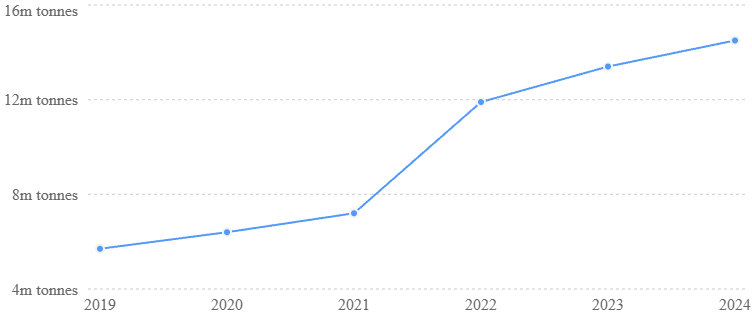
The statistical development is not uniform across modes. Road transit increased from approximately 1.4 million tonnes in 2019 to 7.2 million tonnes in 2024, whereas rail transit increased from approximately 4.2 million tonnes to 7.0 million tonnes during the same period. This pattern indicates that road transport expanded more strongly in absolute and relative terms within the reported series, but it does not establish that road transport is inherently superior for long-distance freight. The suitability of each mode depends on cargo type, shipment size, loading infrastructure, service frequency and cross-border procedures. Road transport can provide flexibility for dispersed destinations, while rail typically depends on larger consolidated flows and coordinated terminal operations. The observed growth of road transit may therefore reflect changes in the composition and routing of cargo as well as infrastructure improvements, rather than a simple substitution of one mode for another.
The first quarter of 2025 introduces an important qualification to the longer-term growth narrative. The same report records approximately 3.6 million tonnes of transit freight during January–March 2025, representing a 10% reduction compared with the corresponding period of 2024. Road freight decreased by approximately 11%, rail freight by approximately 9%, and air freight by approximately 4%, according to the report’s rounded presentation. These figures demonstrate that the expansion of Azerbaijan’s infrastructure and longer-term transit volumes did not eliminate exposure to temporary declines in freight demand, commodity-specific disruptions or operational constraints. The ability to attract cargo is therefore a continuing commercial challenge rather than a guaranteed consequence of infrastructure investment. Transit Freight Transportation: First Quarter 2025 Report, Three-Month Comparison — Coordinating Council on Transit Freight — 2025.
More importantly, the report shows that different corridors performed differently during the same period. The East–West corridor accounted for approximately 31% of the recorded first-quarter transit total and carried 1.122 million tonnes, an increase of 16.9% compared with the first quarter of 2024. The North–West corridor carried 1.006 million tonnes, representing 28% of the total and a decline of 28.2%. The South–West corridor carried 805,000 tonnes, representing 22% and a decline of 15.1%, while the North–South corridor carried 607,000 tonnes, representing 17% and a decline of 5.6%. These percentages refer to distinct corridor categories within the official reporting framework and should not be interpreted as changes in the total amount of all freight moving between China and Europe. Their significance is that an aggregate national decline coexisted with growth along a specific international corridor, making the choice of denominator and route definition essential to any strategic interpretation. Transit Freight Transportation: First Quarter 2025 Report, Dynamics by Corridors — Coordinating Council on Transit Freight — 2025.
Transit Freight by Corridor — January–March 2025
| Corridor | Recorded freight | Share of total | Year-on-year change | Analytical implication |
|---|---|---|---|---|
| East–West | 1.122 million tonnes | 31% | +16.9% | Growth in this route category despite overall decline |
| North–West | 1.006 million tonnes | 28% | −28.2% | Material reduction requiring commodity and route analysis |
| South–West | 805,000 tonnes | 22% | −15.1% | Decline in a separate corridor category |
| North–South | 607,000 tonnes | 17% | −5.6% | Reduction during the period; not evidence that long-term route development ended |
| Other routes | Residual volume | Approximately 2% | Not separately established here | Should not be treated as zero |
| Total national transit | Approximately 3.6 million tonnes | 100% | −10% | Includes different corridors and the official transport-mode coverage |
The differences among corridor categories also demonstrate why annual targets and isolated train movements provide only partial evidence of economic performance. A corridor may gain containerised traffic while experiencing reduced bulk freight movement, producing different conclusions depending on whether the analyst examines TEU, tonnes, train counts, operator revenue or transit time. A rise in the number of container trains is operationally meaningful, but does not necessarily compensate financially for a decline in higher-weight bulk commodities. Similarly, an increase in road freight may expand employment or demand for logistics services while also generating infrastructure maintenance and environmental costs. A defensible assessment requires separate indicators for volume, value, revenue, cost and reliability.
The principal commercial requirement is therefore not maximum throughput in the abstract, but the provision of predictable international services that users can compare with competing routes. This includes transparent tariffs, assured departure schedules, cargo tracking, harmonised customs documentation and the ability to reserve transport services across several countries. These requirements become particularly important when the Caspian crossing introduces a maritime segment into what otherwise appears to be a continuous railway route.
The Port of Baku and the Caspian Crossing: Capacity, Utilisation and Intermodal Constraints
The Baku International Sea Trade Port at Alat is a central element of Azerbaijan’s Trans-Caspian strategy because it connects incoming maritime cargo with the country’s rail and road networks. Azerbaijan’s presidency states that the port entered operation in 2018, possesses an annual cargo-handling capacity of 15 million tonnes and, following optimisation, a container-handling capacity of 150,000 TEU per year. The same official account records approximately 100,000 TEU handled during 2025. These figures are especially useful because they distinguish infrastructure capacity from actual use: 150,000 TEU is the stated handling capability following optimisation, while 100,000 TEU is the reported realised container volume during a specified year. Azerbaijan as a Eurasian Transport Hub, Baku International Sea Trade Port — Presidency of Azerbaijan.
On the basis of these two figures, reported 2025 container throughput represents approximately 66.7% of the stated optimised annual container capacity, calculated as 100,000 divided by 150,000. This is a simple descriptive ratio, not a comprehensive operational utilisation rate. It does not reveal whether specific berths, cranes, storage facilities or vessel schedules were congested during peak periods, whether equipment was available throughout the year or how cargo volumes were distributed seasonally. A port may possess unused annual nominal capacity and still experience severe congestion if ship arrivals are concentrated, if customs processing is delayed or if onward railway capacity is temporarily insufficient. The ratio therefore supports a conclusion about annual volume relative to stated capacity, but not an assertion that the port could absorb a proportional increase in every category of cargo without additional operational changes.
The Caspian crossing creates constraints that differ from those affecting the land-based portions of the corridor. Freight arriving at a port must be matched with available vessels, cargo-handling equipment and onward railway services, while the commercial costs of the maritime segment depend on voyage frequency, vessel size, port charges, weather conditions and equipment management. When different countries control the ports at the two ends of a crossing, technical improvements in one port may produce limited benefits if the partner port cannot process the same volume or coordinate vessel departures. This explains why investment decisions cannot be assessed independently. A major expansion in rail capacity west of Baku may provide only partial gains if Caspian vessel availability remains insufficient, while an expansion of container terminals on the eastern shore may fail to generate full economic value if Azerbaijan’s inland services cannot absorb additional traffic.
A relevant example of coordinated infrastructure investment is provided by the European Bank for Reconstruction and Development (EBRD) and European Union financing package announced for Kazakhstan’s Aktau port in 2025. The EBRD described a package of up to €45 million, comprising an EBRD loan of up to €35 million and a potential European Union investment grant of up to €10 million. The project was intended to extend port berths, acquire weather-resilient ship-to-shore cranes and expand container handling. The EBRD also described a future terminal objective of processing up to 240,000 TEU annually, alongside an expected reduction in average handling time per container from four minutes to two and a half minutes. These are financing components and expected engineering outcomes, not evidence that the full funding package had already been disbursed or that the projected operating performance had been achieved. EBRD and EU Help Improve Sustainability of Transportation through the Transcaspian Corridor — European Bank for Reconstruction and Development — 2025.
The Aktau investment is relevant to Azerbaijan because the economic performance of the Middle Corridor depends on multiple connected terminals rather than on the Port of Baku alone. Improvements in container-handling times at an eastern Caspian port can reduce the total time cargo spends in the international system, but the benefit depends on compatible vessel schedules and onward transport capacity. The intended reduction from four minutes to two and a half minutes represents a substantial unit-level performance objective, but it should not be interpreted as guaranteeing a corresponding proportional reduction in end-to-end journey times, which include many additional activities. Similarly, the 240,000-TEU terminal objective and Baku’s stated 150,000-TEU optimised capacity should not be treated as directly comparable without considering the assets covered, implementation dates, available vessel services and actual traffic composition.
Selected Caspian Port and Infrastructure Indicators
| Facility or initiative | Documented figure | Period/status | Meaning | Critical limitation |
|---|---|---|---|---|
| Baku–Alat port | 15 million tonnes/year | Official capacity description | Annual cargo-handling capacity | Not the amount actually handled |
| Baku–Alat container capacity | 150,000 TEU/year | Post-optimisation capacity | Stated annual container-handling capability | Not a guarantee of uniform daily availability |
| Baku–Alat container throughput | 100,000 TEU | 2025 | Realised container traffic | Distinct from total freight tonnage |
| Baku nominal annual container-capacity ratio | Approximately 66.7% | Calculated from stated 2025 inputs | 100,000 / 150,000 TEU | Not a measure of berth occupancy or peak congestion |
| Aktau financing package | Up to €45 million | EBRD/EU announcement, 2025 | Combined potential financing envelope | Loan and potential grant have different legal and disbursement statuses |
| Aktau EBRD loan | Up to €35 million | 2025 | Proposed lending component | Not a grant |
| Aktau potential EU grant | Up to €10 million | 2025 | Conditional investment-grant component | Not necessarily fully committed or disbursed |
| Aktau future container terminal | Up to 240,000 TEU/year | Project objective | Intended future annual terminal capacity | Not verified realised throughput |
| Aktau handling time | 4 minutes → 2.5 minutes | Project target | Intended reduction in average handling time per container | Not overall corridor transit-time reduction |
Sources: Azerbaijan as a Eurasian Transport Hub — Presidency of Azerbaijan; EBRD and EU Help Improve Sustainability of Transportation through the Transcaspian Corridor — EBRD — 2025. The Baku capacity ratio is calculated from the official values cited above.
The North–South Corridor: Trade Connectivity with Russia and Iran
The International North–South Transport Corridor (INSTC) introduces a different geographical and commercial logic from the Middle Corridor. Rather than primarily connecting Central Asia and China with European markets through the Caspian and South Caucasus, its western branch links Russia with Azerbaijan and Iran, with prospective access to southern maritime routes and Asian markets. Azerbaijan’s presidency records that the original INSTC agreement entered into force in 2002 and that Azerbaijan joined the arrangement in 2005. It identifies approximately 511 kilometres of railway along the relevant Azerbaijani section and describes subsequent investments in highways, border crossings, terminals and railway infrastructure. The regional importance of the corridor derives from the possibility of coordinating the movement of freight across several states through a combination of railway and maritime services. Azerbaijan as a Eurasian Transport Hub, North–South International Transport Corridor — Presidency of Azerbaijan.
The institutional development of the western route includes several different agreements. Azerbaijan, Russia and Iran adopted a Baku Declaration in September 2022 concerning the expansion of freight movement; Russia and Iran concluded a financing arrangement in May 2023 for construction of the missing Rasht–Astara railway segment; Azerbaijan and Russia signed a bilateral agreement on transport development in December 2024; and Azerbaijan, Iran and Russia signed a further trilateral memorandum in November 2025 concerning the efficiency of the western North–South branch. These instruments demonstrate sustained governmental attention to the corridor, but they do not establish that the missing railway segment had been completed or that every planned improvement had entered commercial operation by November 2026. Azerbaijan as a Eurasian Transport Hub, North–South Corridor Agreements — Presidency of Azerbaijan.
The Azerbaijani presidential record identifies a target of 15 million tonnes per year associated with the development of the North–South corridor. This figure must be treated as a policy and infrastructure-development objective rather than an observed level of traffic. The distinction is supported by the actual quarterly freight data, which show that Azerbaijan’s North–South route carried 607,000 tonnes during January–March 2025, down 5.6% from the corresponding period of 2024. These numbers have different geographical and temporal definitions, and the quarterly figure cannot be compared directly with the corridor-wide annual target as though both described the same completed operating system. The target concerns future capacity and traffic ambitions, while the quarterly result measures freight recorded within Azerbaijan’s defined corridor category during a specific three-month period. Azerbaijan as a Eurasian Transport Hub — Presidency of Azerbaijan; Transit Freight Transportation: First Quarter 2025 Report — Coordinating Council on Transit Freight.
The economic constraints are substantially different from those associated with Azerbaijan’s European gas exports. North–South freight movement depends on railway availability, border processing, commercial tariffs, freight demand and the completion of the relevant missing infrastructure. The commercial viability of the route also depends on the cost of transferring cargo between railway systems and other transport modes, the availability of services at suitable frequency and the treatment of international payments, insurance and customs documentation. Where a route passes through countries subject to different sanctions or regulatory regimes, commercial operators must assess the legal conditions applicable to specific transactions, counterparties and goods. The presence of an operating railway does not itself establish that every potential shipment is legally permitted or commercially viable. These considerations are particularly relevant for international investors and freight companies seeking to distinguish national infrastructure ambitions from transport services available under their own legal and compliance obligations.
The Middle Corridor’s Financing Gap: Investment Commitments, Modelled Needs and Commercial Performance
The September 2026 World Bank assessment provides an important distinction between the infrastructure already operating along the Trans-Caspian route and the investment required to support substantially larger freight flows. The Bank estimated that more than US$25 billion in physical infrastructure investment would be required through 2040, principally involving rail networks, ports and feeder roads. It separately identified approximately US$30 billion in enabling investments, including connections to domestic economies, logistics hubs, inland terminals, rolling stock, cargo-handling equipment and digital systems. These figures describe modelled investment requirements over a long horizon. They are not an amount already disbursed, a single approved public budget or an officially allocated fund for Azerbaijan alone. The two categories should also remain distinct because their programme boundaries and implementation requirements differ. Trans-Caspian Transport Corridor Investments Could Spur Growth and Create Millions of Jobs — World Bank — Sep 2026.
The World Bank’s conditional projections should be interpreted with equal care. Its 2026 assessment estimates that appropriately coordinated infrastructure investment could more than triple corridor trade volumes, halve transit times, increase gross domestic product by 3.3% and generate approximately 2 million additional jobs by 2040 across the wider corridor region considered in the report. Under a more extensive programme combining investment with policy reforms, the analysis identifies the possibility of a fourfold increase in corridor volumes and a reduction in travel times of approximately two-thirds. These are modelled outcomes conditional on investment and reform, not forecasts of individual Azerbaijani company revenues or an assessment that all the stated jobs would be created within Azerbaijan. The Bank’s analytical geography encompasses nine countries, including Armenia in its longer-term 2023–2040 framework despite Armenia not yet functioning as an established host country for the corridor at the time of publication. Integration: World-Class Trade Logistics Along the Trans-Caspian Transport Corridor — World Bank — Sep 2026; World Bank Press Release — Sep 2026.
The investment requirements should also be distinguished from financing commitments announced through the European Union’s Global Gateway initiative. At the EU–Central Asia Transport Connectivity Investors Forum in January 2024, the European Commission reported approximately €10 billion in overall investment commitments assembled from participating international financial institutions, public bodies and private investors. The Commission described this as a combined contribution from several partners rather than an amount disbursed exclusively by the Commission. The forum also involved memoranda and agreements intended to initiate infrastructure and regulatory cooperation, including coordination mechanisms and support for transport connectivity. The distinction matters because a financing commitment, a memorandum of understanding, an approved lending operation and an actual cash disbursement represent different stages of project implementation. Treating the €10 billion commitment as money already spent on completed corridors would overstate the realised investment position. Global Gateway: EU and Central Asian Countries Agree on Building Blocks to Develop the Trans-Caspian Transport Corridor — European Commission — Jan 2024.
The relationship between investment and economic benefit is especially important because transport infrastructure can impose large fixed costs while delivering uncertain returns if freight demand fails to develop as expected. A railway may be constructed to accommodate higher volumes, but commercial operators still need regular customers willing to purchase services at prices sufficient to support maintenance and operating expenditure. A port terminal can be financed and completed, but its financial performance depends on vessel arrivals, cargo handling and onward transport. Digital customs systems may be comparatively less expensive than major civil-engineering projects, yet produce substantial benefits where administrative delays are a dominant source of unreliability. Consequently, expenditure alone is not an adequate indicator of strategic success; the relevant question is whether investment reduces the total cost and uncertainty of moving goods across the international system.
Investment, Financing and Modelled Outcomes: Distinct Categories
| Item | Amount or result | Time horizon | Classification | Interpretation |
|---|---|---|---|---|
| World Bank physical infrastructure needs | More than US$25bn | Through 2040 | Modelled investment requirement | Rail, ports, feeder roads and related physical assets |
| World Bank enabling investment needs | Approximately US$30bn | Through 2040 | Separate modelled investment requirement | Logistics hubs, domestic connections, equipment and digital systems |
| Global Gateway forum commitments | Approximately €10bn | Announced Jan 2024 | Combined investment commitments | Multiple institutions and investors; not equivalent to completed spending |
| Aktau EBRD/EU package | Up to €45m | Announced 2025 | Project-specific potential financing | EBRD loan plus potential EU grant |
| World Bank baseline investment scenario | Trade volumes more than 3× | By 2040 | Conditional model outcome | Corridor-wide, not solely Azerbaijani freight |
| World Bank baseline investment scenario | Transit times approximately −50% | By 2040 | Conditional model outcome | Requires network investment and implementation |
| World Bank modelled GDP effect | Approximately +3.3% | By 2040 | Modelled regional economic impact | Across defined corridor countries |
| World Bank modelled employment effect | Approximately 2 million additional jobs | By 2040 | Modelled regional outcome | Not an Azerbaijani national employment estimate |
| More extensive investment-and-reform scenario | Corridor volumes approximately 4× | By 2040 | Alternative conditional model outcome | Not an observed forecast result |
| More extensive investment-and-reform scenario | Transit times reduced by approximately two-thirds | By 2040 | Alternative conditional model outcome | Requires stronger reform and coordination |
Sources: World Bank, Integration: World-Class Trade Logistics Along the Trans-Caspian Transport Corridor — Sep 2026; World Bank, Trans-Caspian Investment Assessment — Sep 2026; European Commission, Global Gateway Investors Forum — Jan 2024; EBRD, Aktau Port Financing — 2025.
The World Bank’s recommendations place particular emphasis on the need for coordinated, commercially oriented operations rather than physical expansion alone. Its September 2026 analysis identifies four priorities: developing a common digital corridor system, strengthening integration between railway and Caspian shipping operators, improving corridor-wide coordination and modernising the governance of participating transport companies. These recommendations address the central commercial problem of a route composed of multiple independently administered segments. A freight customer requires an integrated service, while the corridor’s operating institutions may each be optimising a separate part of the journey. Greater coordination can potentially reduce this fragmentation, but the achievement of measurable improvements depends on the legal authority of the coordinating bodies, the commercial incentives of national operators and the practical implementation of compatible information systems. Trans-Caspian Transport Corridor Investments Could Spur Growth and Create Millions of Jobs — World Bank — Sep 2026.
Digital Customs, Administrative Reliability and the Industrial Value of Corridor Integration
The economic competitiveness of a freight corridor is affected by institutional processes that are not visible in conventional infrastructure maps. Customs declarations, transport permits, transit guarantees, cargo inspections, electronic seals, payments, insurance documents and the exchange of information between national agencies can all influence the time required for goods to cross borders. Azerbaijan’s Coordinating Council identifies e-TIR, electronic consignment documentation and single-window mechanisms among the tools being developed or implemented to improve international transit. The official description also refers to efforts to improve compatibility with wider electronic transit systems, including European arrangements. These measures are relevant because digital processes can reduce duplication and improve visibility, but the existence of an announced system does not demonstrate complete operational integration among every customs authority or transport provider along the route. E-Transit Procedures — Coordinating Council of the Republic of Azerbaijan on Transit Freight; East–West Corridor — Coordinating Council on Transit Freight.
Administrative reliability also has a direct commercial value. Freight customers often face costs associated with delays, inventory, missed delivery windows and the uncertainty of arrival times. A route offering slightly shorter theoretical transit time may therefore be commercially less attractive than another that provides predictable service and transparent charges. This distinction affects industries whose production systems depend on scheduled deliveries, including manufacturing, automotive components, chemicals, electronics, agricultural products and time-sensitive intermediate goods. Such sectors do not evaluate freight exclusively on the basis of distance or nominal transportation rates; they consider the expected total cost of holding inventory, production interruptions, insurance and administrative compliance. Consequently, infrastructure strategy capable of supporting industrial development requires more than additional railway capacity. It requires dependable service standards, transparent cross-border processes and sufficient competition among logistics providers.
The Alat Free Economic Zone is relevant to this broader industrial dimension because Azerbaijan’s presidency identifies it as a framework for attracting investment in export-oriented production and higher-value commercial activities. The zone’s establishment in 2020 was linked to the development of the port and surrounding logistics infrastructure, with the objective of encouraging manufacturers and service providers to utilise Azerbaijan’s geographical position. The official record also describes the development of associated air-cargo infrastructure. However, the existence of a free economic zone and its policy objectives cannot be treated as evidence that a corresponding volume of manufacturing investment, employment or value added has already been realised. Establishing those outcomes would require enterprise-level investment records, operating statistics, production values and national accounts data. Azerbaijan as a Eurasian Transport Hub, Alat Free Economic Zone — Presidency of Azerbaijan.
This distinction is particularly important because transit revenue and domestic industrial development are not synonymous. A country may earn fees from the passage of goods without undertaking significant processing, manufacturing or distribution activities. Conversely, a relatively smaller amount of freight may generate substantial domestic economic benefits if it supports warehouses, assembly operations, specialised repairs, financial services or industrial production. The strategic objective of converting geographical connectivity into domestic economic value therefore depends on the development of complementary commercial institutions and industrial capacity, not simply the pursuit of higher gross tonnage.
Strategic Dependencies and the Limits of Corridor Substitution
Azerbaijan’s participation in East–West and North–South infrastructure systems offers route diversification, but the existence of several corridors does not mean that they can substitute for one another without cost or delay. A crude-oil pipeline cannot readily transport natural gas or containerised freight. A gas pipeline cannot function as an alternative to maritime container transport. A rail route cannot absorb liquid hydrocarbon exports at pipeline scale without suitable terminals, equipment and commercial arrangements. Even between rail and road freight, substitution depends on the nature of the cargo, availability of vehicles and terminals, legal limits, transport pricing and the condition of border crossings. These technical constraints are decisive when evaluating the strategic value of multiple connections.
The physical vulnerability of the system also differs by mode. Pipeline continuity depends on the integrity of a fixed network, while railway operations depend on track availability, signalling, rolling stock and the scheduling of services. Maritime transport introduces exposure to port operations, vessel availability and environmental conditions, while road transport depends on border capacity, vehicle availability and highway infrastructure. Cybersecurity affects all four modes through industrial control systems, cargo-management platforms, customs systems and commercial communications. These dependencies can interact: a disruption at a port may leave trains waiting inland, while failures in customs information exchange may delay cargo without damaging any physical infrastructure. The resulting risks are systemic because an interruption affecting one component can reduce the effectiveness of other investments that remain physically intact.
The consequences for regional governments and commercial operators therefore depend on their ability to identify the actual limiting component of each route. Building additional infrastructure may be necessary where physical capacity is demonstrably insufficient, but it may be economically inefficient where administrative or scheduling problems are responsible for most delays. The World Bank’s 2026 assessment explicitly supports this interpretation by placing infrastructure investment alongside digital coordination, joint commercial operations and corridor-wide performance monitoring. The appropriate policy and investment response should consequently be determined by evidence concerning throughput, delay, service reliability and operating cost rather than by a preference for the most visible construction project. World Bank, Trans-Caspian Transport Corridor Investment and Governance Assessment — Sep 2026.
Principal Infrastructure Dependencies and Observable Performance Indicators
| Infrastructure or institutional component | Main dependency | Mechanism of possible disruption | Most relevant performance evidence | Consequential decision |
|---|---|---|---|---|
| BTC oil pipeline | Cross-border operational coordination and pipeline integrity | Maintenance failures, terminal disruption or interruption to associated infrastructure | Actual throughput, downtime, integrity assessments and emergency-response records | Maintenance investment and continuity planning |
| Southern Gas Corridor | Available gas, transmission capacity and interconnected operators | Upstream production limits, compressor outages or transmission restrictions | Actual deliveries, contracted capacity and operator availability | Capacity expansion and contractual diversification |
| Baku–Alat port | Berths, handling equipment, vessel schedules and rail access | Queue formation and delayed transshipment | TEU handled, berth occupancy and dwell times | Terminal investment and vessel-rail coordination |
| Eastern Caspian ports | Vessel availability and compatible handling capacity | Delays in maritime movement | Vessel departures, berth availability and equipment productivity | Targeted port and fleet investments |
| Baku–Tbilisi–Kars railway | Railway availability and cross-border operating procedures | Interruption of train services or inconsistent schedules | Completed train movements, service frequency and transit times | Rail maintenance and common operating standards |
| North–South railway | Missing foreign links, border procedures and available freight demand | Incomplete route segments or border congestion | Operational route availability and actual freight tonnes | Completion of bottlenecks and customs harmonisation |
| Customs and digital systems | Interoperable documentation and national administrative coordination | Duplicate declarations, delayed clearance and data incompatibility | Clearance times and error rates | Administrative and digital reform |
| Freight operators | Commercial coordination across modes and jurisdictions | Misaligned tariffs and schedules | End-to-end price, reliability and booking availability | Joint commercial services and integrated logistics products |
| Free economic and logistics zones | Enterprise investment and access to markets | Insufficient industrial demand or limited supporting services | Actual capital expenditure, production, employment and value added | Industrial-development and investment-policy assessment |
These indicators offer a more reliable basis for evaluating corridor resilience than the number of national development programmes announced. They also identify where international cooperation is unavoidable: a pipeline crossing three countries, or a freight service crossing multiple borders and the Caspian Sea, cannot be optimised entirely through decisions taken by one government.
Implications for European Industrial and Energy Interests
The European implications of Azerbaijani infrastructure development differ substantially among countries because direct exposure depends on physical infrastructure, commercial relationships and national economic structure. Italy has a specifically documented role as the entry point of TAP and the destination of 50 billion cubic metres of cumulative gas deliveries by July 2026, according to the pipeline operator. This creates a direct connection between the performance of the Southern Gas Corridor and an established part of Italy’s energy-import system. The strategic significance is not that Azerbaijani gas supplies all Italian demand, but that the operating infrastructure provides one identifiable source of diversification whose reliability depends on multiple jurisdictions between the Caspian and the Adriatic. One Flow, Two Milestones: 60 bcm Delivered to Europe, 50 bcm to Italy — TAP AG — Jul 2026.
Germany entered the European Commission’s list of destination markets for Azerbaijani gas beginning in January 2026, together with Austria. This development demonstrates an expansion of commercial access within European gas markets, but the relevant country-level volumes, contractual counterparties and complete physical delivery arrangements are not established by the Commission’s summary. Germany’s significance therefore lies in the expansion of the European commercial network rather than in an unsupported assertion concerning its share of Azerbaijani exports. France is affected through European Union energy-market rules, infrastructure financing and trade connectivity, but the examined official record does not support a comparable country-specific Azerbaijani gas-delivery figure. The United Kingdom has a distinct industrial and corporate connection through bp’s historical role as BTC operator and its continued position as a shareholder after the July 2026 operatorship transfer. These distinctions demonstrate why the four countries should not be treated as possessing identical exposure to Azerbaijani infrastructure. Diversification of Gas Supply Sources and Routes — European Commission; BTC Announces Transition of Operatorship — SOCAR Midstream Operations — 2026.
The European Union collectively has a broader interest in the reliability of energy and trade routes, the integration of transport systems and the financial sustainability of infrastructure supported through European institutions. The January 2024 Global Gateway commitments and subsequent EBRD investments illustrate how European public and development-finance institutions seek to influence Eurasian transport connectivity without directly operating every participating railway, port or shipping company. The benefits of this engagement depend on the completion of projects, the adoption of interoperable systems and the willingness of private freight customers to use the resulting services. Greater connectivity may support European manufacturing supply chains through additional routing options, but those benefits are conditional on reliable end-to-end transport and cannot be inferred from announced financial commitments alone. Global Gateway: EU and Central Asian Countries Agree on Building Blocks to Develop the Trans-Caspian Transport Corridor — European Commission — Jan 2024; EBRD and EU Help Improve Sustainability of Transportation through the Transcaspian Corridor — EBRD — 2025.
A separate economic consideration concerns the distribution of value added. European companies may benefit from additional freight routes without making substantial investments in Azerbaijan, while companies operating logistics terminals, engineering projects or industrial facilities may acquire more direct financial exposure. The effects on European employment, industrial output and supply-chain costs cannot be calculated reliably from the corridor-wide projections without country-specific trade and investment data. The World Bank’s modelled benefits through 2040 provide an indication of the potential regional scale of coordinated investment, but are not a substitute for national economic-impact assessments. This distinction will become particularly relevant when evaluating the separate interests of European governments, industrial enterprises and financial institutions.
Investment and Security Decisions Through 2031: A Framework for Monitoring Realised Change
The strategic value of Azerbaijan’s evolving infrastructure system through 2031 will depend on whether the documented changes in institutional responsibility, infrastructure investment and international coordination produce measurable improvements in transport performance and commercial activity. The July 2026 BTC operatorship transfer provides one indicator of the development of Azerbaijani operational capacity, while the expansion of TAP demonstrates that technical investments can increase available transmission capacity within an established system. The historical increase in transit freight reveals growing use of Azerbaijan’s transport networks, but the decline in the first quarter of 2025 demonstrates the continued importance of commodity demand and route-specific conditions. Meanwhile, the investment requirements identified by the World Bank underline the distinction between existing infrastructure and the larger, more integrated logistics system required to realise the economic outcomes envisaged for 2040.
For governments, the first decision question concerns which assets and institutional arrangements are essential to the continuity of current economic activity. Operational pipelines carrying established volumes should be assessed through maintenance, integrity and commercial reliability, while proposed railways should be assessed through feasibility, financing and legal implementation. The second question concerns how investment should be prioritised among physical capacity, digital administration and commercial coordination. The World Bank’s analysis indicates that these functions must be developed together, but the appropriate sequence depends on which bottleneck is demonstrably restricting performance in each specific route. The third question concerns the risk that major public investment could produce underutilised assets if freight demand or complementary infrastructure fails to develop. These risks can be assessed through staged implementation, transparent procurement and verified operating indicators rather than assumed away by reference to strategic geography.
For international investors, the relevant distinctions are contractual and financial. A pipeline operator’s responsibilities are not identical to the rights of an equity shareholder; an announced government financing commitment is not a completed loan disbursement; a port’s nominal capacity is not the throughput available at every moment; and a multilateral model’s long-term economic projections are not company-specific revenue forecasts. Investors and public authorities should accordingly evaluate the actual legal instrument, its counterparties, implementation status, financing terms, expected cash flows and exposure to adjacent infrastructure. This approach is particularly important where the project spans multiple jurisdictions and where national regulatory or commercial decisions can affect facilities located elsewhere.
For Azerbaijan, the long-term consequence is that strategic autonomy increasingly depends on institutional execution as well as diplomatic choice. Control over the operation of major infrastructure may increase national technical responsibility, but the value of that control is conditioned by international cooperation. Diversified corridors may provide additional commercial opportunities, but their performance depends on interconnected foreign systems. Investment in ports, railways and logistics can strengthen the national economy, but the benefits depend on the development of competitive services and domestic industrial activity. The transformation from energy exporter to Eurasian logistics participant is therefore not a completed status determined by geography; it is an ongoing process whose results must be established through verified operating performance, financial execution and industrial output.
Chapter 6 — Key Judgments
The most consequential verified infrastructure development of 2026 is the transfer of BTC operatorship to SOCAR Midstream Operations on 1 July, while the pipeline’s shareholder structure and bp’s operatorship of the Sangachal terminal remained unchanged. This establishes an actual change in operating responsibility across a major international oil-export system rather than a merely announced industrial objective. The documented technical baseline includes 1,768 kilometres of pipeline, capacity of 1 million barrels per day, eight pumping stations and 98 valve stations, alongside cumulative transportation exceeding 4.7 billion barrels since commercial operations began.
The Southern Gas Corridor remains an established component of European energy diversification. The European Commission reported 12.5 billion cubic metres of Azerbaijani gas supplied to EU member states during 2025, while TAP’s operator recorded more than 60 billion cubic metres delivered cumulatively to Europe and 50 billion cubic metres to Italy by July 2026. The first TAP capacity expansion added 1.2 billion cubic metres per year of long-term booked capacity supported by a 15-megawatt compressor unit. These figures describe different statistical and operational categories and must remain separate in any assessment of actual energy supply, infrastructure capacity and future expansion.
Azerbaijan’s international freight system has expanded substantially, with the official road, railway and air transit series increasing from approximately 5.7 million tonnes in 2019 to 14.5 million tonnes in 2024. Nevertheless, the 10% decline in total transit freight during the first quarter of 2025 demonstrates that infrastructure development does not eliminate exposure to demand and operational fluctuations. The East–West corridor’s simultaneous 16.9% growth shows why total national traffic and route-specific performance must be analysed independently.
The wider Trans-Caspian system faces substantial financing and coordination requirements. The World Bank estimates more than US$25 billion in physical infrastructure needs and approximately US$30 billion in enabling investment needs through 2040, while the European Commission’s earlier €10 billion Global Gateway figure describes commitments assembled from multiple partners rather than completed spending. The Bank’s projections for trade, transit times, economic growth and employment are conditional long-term model outcomes, not realised national benefits.
What would change the assessment: Verified post-transfer BTC operating results, substantial changes in Southern Gas Corridor deliveries, commercially completed new rail connections, sustained changes in route-specific freight volumes, documented reductions in port dwell times and border delays, or the financial completion and successful operation of major infrastructure investments would materially change the assessment of Azerbaijan’s realised economic and logistical position.
Open official record: The decisive remaining documentation concerns comparable 2026 annual freight and corridor-disaggregated statistics, verified BTC performance following the SOCAR operatorship transition, current contracted and available capacity across the complete Southern Gas Corridor, actual Caspian port and vessel utilisation, completed railway and customs-system implementation records, and audited project-level financing data distinguishing approvals, commitments, disbursements and realised expenditure.
Regional Power and Eurasian Connectivity
Eastern Mediterranean security, South Caucasus diplomacy, oil and gas infrastructure, Trans-Caspian freight and competing regional connectivity arrangements.
3D Regional Relationship Architecture
Select a country or institution to inspect its documented relationships. Filter by category or drag the background to adjust the 3D perspective. Lines indicate relationships, not geopolitical influence or military strength.
The network is qualitative. Its coordinates, distances, line thickness and visual perspective do not represent geographic distance, alliance strength, economic dependence or military capability.
Eastern Mediterranean Maritime Positions
The October 2026 Libya ratification changed the domestic political context of the 2019 maritime memorandum but did not settle competing third-state maritime claims.
Türkiye–Libya maritime memorandum
Türkiye welcomed the Libyan House of Representatives’ ratification on 20 October 2026 and maintained that the memorandum has been in force since 2019 and protects the two parties’ maritime rights.
Open official sourceThird-state maritime rights
The European Council and Commission maintained that the memorandum infringes third-state sovereign rights and cannot produce lawful consequences for those states. This remains a disputed legal position, not a final judicial settlement.
Open official sourceEnergy and Eurasian Connectivity Architecture
Choose a corridor to examine its physical sequence, verified operating status, commercial purpose and remaining implementation constraints. The diagrams are schematic and do not represent geographical distance.
Interactive Freight Performance Analysis
Switch between annual national transit totals and corridor-specific first-quarter figures. These series have different periods and definitions and must not be combined on one statistical axis.
Road, railway and air transit totals recorded by Azerbaijan’s Coordinating Council on Transit Freight.
Rounded published totals. This series does not represent oil or gas transported through pipelines.
Open official sourceUnderlying Observations
| Period / route | Value | Annual change | Definition |
|---|---|---|---|
| 2019 | 5.7 million tonnes | — | Road, rail and air transit |
| 2020 | 6.4 million tonnes | — | Road, rail and air transit |
| 2021 | 7.2 million tonnes | — | Road, rail and air transit |
| 2022 | 11.9 million tonnes | — | Road, rail and air transit |
| 2023 | 13.4 million tonnes | — | Road, rail and air transit |
| 2024 | 14.5 million tonnes | — | Road, rail and air transit |
Official Evidence and Implementation Registry
Filter legal instruments, diplomacy, infrastructure, energy and freight records. Every entry distinguishes documented actions from disputed claims, announced proposals and modelled investment requirements.
| Date | Documented event or finding | Domain | Status | Source |
|---|---|---|---|---|
| 2026-07-01 | BTC operatorship transferred to SOCAR Midstream; ownership unchanged. | Energy | Implemented | SOCAR |
| 2025-08-08 | Armenia and Azerbaijan adopted the Washington Declaration. | Diplomacy | Signed declaration | Government of Armenia |
Source-linked records
PILLAR III — EUROPEAN INTERESTS, STRATEGIC SCENARIOS AND GOVERNMENT DECISION OPTIONS
Chapter 7 — Implications for the United States, NATO, the European Union and European National Interests
European Strategic Exposure: From Regional Diplomacy to Economic Security, Defence Cooperation and Industrial Sovereignty
The principal consequence of Azerbaijan’s expanding diplomatic autonomy for Europe is the emergence of a more complex system of overlapping national interests, in which energy supply, defence-industrial cooperation, regional connectivity and the institutional settlement of the Armenia–Azerbaijan conflict cannot be managed through a single European policy instrument. The United States has formalised a strategic partnership with Azerbaijan while supporting the normalisation process with Armenia; NATO maintains a partnership relationship with Azerbaijan without extending collective-defence guarantees to it; the European Union has expanded its economic engagement with Baku while developing separate civilian security and resilience missions in Armenia; and individual European governments maintain substantially different commercial, diplomatic and military relationships with the countries concerned. These developments establish a regional architecture in which economic cooperation and political disagreement can coexist, but in which the implementation of specific agreements increasingly affects the strategic calculations of governments, investors, industrial enterprises and security institutions.
The distinction among European interests is fundamental. Italy’s exposure is concentrated partly in established hydrocarbon trade, natural-gas infrastructure and an expanding bilateral industrial partnership with Azerbaijan. France combines an increasingly institutionalised security relationship with Armenia with an economically relevant but politically difficult relationship with Baku. Germany maintains substantial commercial exchanges with Azerbaijan, including crude-oil imports and exports of industrial products, while the opening of Azerbaijani gas exports to the German market in January 2026 introduced an additional energy relationship. The United Kingdom has developed strategic partnerships with both Azerbaijan and Armenia while retaining major historical corporate interests in the Caspian energy sector. These relationships cannot be assessed through a common numerical indicator because they involve different legal instruments, commercial definitions, reference periods and forms of strategic exposure. Their integration at European level requires coordination, but coordination does not eliminate the separate responsibilities of national governments or the independent commercial decisions of companies operating across the region.
The institutional environment also changed materially during 2026. On 28 January, the European Union and Azerbaijan agreed to strengthen cooperation through Global Gateway and the Cross-Regional Connectivity Agenda, including a feasibility study developed with the European Bank for Reconstruction and Development concerning the Nakhchivan railway. On 5 May, EU High Representative Kaja Kallas visited Baku and publicly identified additional opportunities in trade, transport, digital connectivity and regional peace, while explicitly retaining human rights within the bilateral dialogue. These official developments establish that the European Union was maintaining and expanding engagement with Azerbaijan during a period when several member states had separate political disagreements or security partnerships elsewhere in the South Caucasus. EU and Azerbaijan Step Up Cooperation to Boost Investment and Connectivity — European Commission and EEAS — Jan 2026; Kaja Kallas Arrives in Baku — European External Action Service — May 2026.
The United States: A New Strategic Partnership with Azerbaijan and a Separate Role in Regional Peace Implementation
The most consequential development in Washington’s direct relationship with Baku during 2026 was the signing of the Charter on Strategic Partnership between the Government of the Republic of Azerbaijan and the Government of the United States of America on 10 February 2026. The document was signed in Baku by Azerbaijani President Ilham Aliyev and US Vice President JD Vance, following the memorandum establishing a bilateral working group that had been concluded during the August 2025 Washington summit. The charter provides an authoritative framework for understanding the contemporary American–Azerbaijani relationship because it identifies the sectors in which the governments intend to cooperate and creates provisions for institutional follow-up. Its scope extends beyond conventional diplomacy to include regional transportation, energy, critical minerals, artificial intelligence, cybersecurity, digital infrastructure, research, investment, security cooperation and humanitarian demining. These provisions demonstrate that Washington’s engagement with Azerbaijan was being developed through a comprehensive strategic-partnership framework rather than exclusively through the earlier peace declaration or the commercial interests of American enterprises. Charter on Strategic Partnership between Azerbaijan and the United States — Presidency of Azerbaijan — Feb 2026; Signing Ceremony of the Azerbaijan–United States Strategic Partnership Charter — Presidency of Azerbaijan — Feb 2026.
The charter’s transport provisions are particularly relevant to the redistribution of regional influence. Section I identifies cooperation on the Trans-Caspian Transport Corridor, including land, maritime and air infrastructure; energy and digital connectivity; customs and border procedures; international multimodal logistics; and the proposed Trump Route for International Peace and Prosperity. These commitments create a framework through which American institutions and private enterprises can participate in the development of new commercial connections without necessarily operating every component of the corridor. However, the legal and economic meaning of the charter must be preserved: the document predominantly employs language expressing governmental intentions to cooperate, identify projects and mobilise investment, rather than setting out completed construction contracts, appropriated public expenditure or guaranteed freight volumes. The existence of a strategic partnership therefore establishes diplomatic authority for cooperation, but the actual commercial consequences remain dependent on project selection, financing, regulatory arrangements and implementation. Azerbaijan–United States Strategic Partnership Charter, Section I — Presidency of Azerbaijan — Feb 2026.
Section II introduces a technological and industrial dimension that is materially different from the traditional oil-and-gas relationship. The governments identify opportunities involving artificial intelligence, digital infrastructure, data centres, commercial research, venture capital, cybersecurity, technology protection and the development of skilled personnel. The charter also refers to the possible creation of joint research-and-development support mechanisms, innovation platforms and private-sector partnerships. These provisions are strategically relevant because digital infrastructure and advanced technical services can create long-term commercial relationships involving intellectual property, equipment, software, professional training and continuing technical support. Nevertheless, a governmental statement expressing an intention to facilitate investment in artificial-intelligence data centres does not establish that such facilities have already been constructed, that a particular amount of private capital has been committed or that specific computing capacity is available in Azerbaijan. The relevant future evidence would consist of executed investment agreements, construction records, electricity-supply arrangements, equipment procurement and commercial operating contracts. Azerbaijan–United States Strategic Partnership Charter, Section II — Presidency of Azerbaijan — Feb 2026.
The security provisions in Section III also require careful interpretation. The parties express their intention to expand defence and security cooperation, including defence sales, counterterrorism, cybersecurity, critical-infrastructure protection and humanitarian demining. These are substantive areas of governmental engagement, but the charter does not establish a NATO-style collective-defence obligation or a publicly defined American commitment to deploy forces in Azerbaijan following an external attack. Defence sales remain subject to applicable American authorisation and export-control processes, while cooperation on cybersecurity and infrastructure protection requires separate technical and administrative implementation. The provision concerning humanitarian demining is especially relevant to the post-conflict environment because it identifies a security-related activity that can be pursued through technical assistance and financial support without the creation of a new military alliance. The available record therefore establishes an expanding security partnership, not a mutual-defence treaty. Azerbaijan–United States Strategic Partnership Charter, Section III — Presidency of Azerbaijan — Feb 2026.
The implementation mechanism creates a directly observable test of whether strategic partnership declarations are translated into operational cooperation. Section IV envisages working groups concerning economic relations, energy, connectivity, digital development and security, and states that the groups intend to determine project lists and implementation roadmaps within three months of the charter’s signature. It also envisages meetings at least annually. These provisions provide an institutional timetable against which implementation can be assessed. The three-month period is an announced procedural objective, not evidence that a complete set of approved projects and financing arrangements was produced by May 2026. A verified assessment would require the published working-group decisions, approved roadmaps, project allocations and subsequent implementation reports. Their absence from the accessible material does not prove non-performance, but it prevents the charter from being treated as evidence of completed investment or defence procurement beyond the commitments expressly documented. Azerbaijan–United States Strategic Partnership Charter, Section IV — Presidency of Azerbaijan — Feb 2026.
Institutional Scope and Implementation Tests of the US–Azerbaijan Strategic Partnership
| Policy domain | Commitment identified in the charter | Responsible governmental or commercial actors | Verification requirement | Principal institutional limitation |
|---|---|---|---|---|
| Regional connectivity | Cooperation on Trans-Caspian and TRIPP transport systems | Transport authorities, customs agencies, investors and operators | Approved projects, route agreements and operating milestones | Strategic intention is not completed infrastructure |
| Energy | Cooperation in oil, gas, electricity and interconnections | Energy authorities, companies and regulators | Executed contracts, transmission arrangements and project expenditure | Supply commitments depend on production and transport availability |
| Critical minerals | Facilitation of transit through the Middle Corridor | Trade authorities, logistics operators and commercial enterprises | Cargo records, applicable trade licences and transport arrangements | No guaranteed trade volume established |
| Artificial intelligence | Identification of AI investment and infrastructure opportunities | Technology agencies, private investors and research organisations | Investment decisions, facilities and operational records | No quantified installed computing capacity established |
| Digital connectivity | Cooperation on data networks and digital infrastructure | Telecommunications authorities and network operators | Permits, financing and commissioned assets | Project intentions do not establish deployed systems |
| Cybersecurity | Expansion of cybersecurity and infrastructure-protection cooperation | Relevant security and technical authorities | Agreed programmes, training and implementation reports | Technical access and classified cooperation are not publicly defined |
| Defence cooperation | Exploration and expansion of defence sales and security collaboration | Defence ministries and competent export-control bodies | Authorisations, contracts, deliveries and acceptance records | No automatic collective-defence obligation |
| Humanitarian demining | Capacity-building through financing and technology | Mine-action agencies and supporting institutions | Financial commitments, equipment delivery and cleared-area reporting | Declared cooperation is not an independently measured outcome |
| Institutional implementation | Working groups and project roadmaps within a stated three-month period | Bilateral governmental working groups | Published roadmaps and subsequent progress reports | Timetable expresses intent rather than verified completion |
| Political consultation | Regular meetings at least annually | Both governments | Official meeting records | Does not transfer sovereign decision-making authority |
The American role is also distinct from the Israeli relationship examined previously. Washington maintains its own bilateral engagement with Azerbaijan, has participated directly in Armenia–Azerbaijan peace diplomacy and is developing a framework for investment and security cooperation through its own governmental institutions. These relationships may overlap commercially or diplomatically with projects involving Israel, Türkiye and European states, but there is no basis for assuming that American decisions under the February charter are controlled by another regional partner. The appropriate analytical unit is the specific American legal or administrative decision, including its competent authority, conditions and implementation record.
NATO: Collective Defence, Partnership Cooperation and the Limits of Alliance Obligations
NATO’s relationship with Azerbaijan is structurally different from the bilateral alliances and strategic-partnership declarations discussed elsewhere in this assessment. Azerbaijan is a NATO partner, not a member of the Alliance, while Türkiye and Greece are NATO members whose own security relationships are governed by the North Atlantic Treaty. The distinction is fundamental because the collective-defence obligations established by Article 5 apply within the treaty’s specified conditions to members, whereas NATO partnership programmes provide opportunities for political dialogue, interoperability, defence education, institutional reform and technical cooperation without extending an equivalent collective-defence guarantee. Article 4 establishes a mechanism for consultations among Allies where their territorial integrity, political independence or security is threatened, while Articles 5 and 6 govern collective defence and its applicable geographic scope. The treaty also permits each Ally to determine the assistance it considers necessary under Article 5, meaning that even a valid collective-defence situation is not equivalent to an identical automatic military deployment by every member. The North Atlantic Treaty, Articles 4–6 — NATO — Apr 1949; Collective Defence and Article 5 — NATO — Nov 2025.
During 21–22 January 2026, NATO Deputy Secretary General Radmila Šekerinska visited Azerbaijan and met Foreign Minister Jeyhun Bayramov, the parliamentary speaker and a presidential representative. NATO’s official statement identifies military interoperability, defence education, regional stability, humanitarian mine action, cybersecurity and the development of an Individually Tailored Partnership Programme (ITPP) among the principal subjects of cooperation. It also records NATO’s recognition of Azerbaijan’s past participation in Alliance-led missions in Afghanistan and its contribution to European energy security. This demonstrates that NATO’s partnership with Baku was operationally and institutionally relevant, but the reference to ongoing work on the ITPP should not be interpreted as confirmation that the programme had already been finalised at the time of the visit. NATO–Azerbaijan Relations on a Solid Track — NATO — Jan 2026.
The institutional relationship was reaffirmed on 25–26 June 2026, when NATO Secretary General’s Special Representative Kevin Hamilton visited Baku and discussed the evolving partnership with Azerbaijani officials. NATO again referred to ongoing work to finalise the ITPP, recognising Azerbaijan’s cooperation on military interoperability, defence planning, education and hybrid threats. The June statement therefore provides a later official reference point for assessing the programme’s status, while the fact that NATO continued to describe it as being finalised cautions against treating the partnership as equivalent to completed membership-related integration. NATO also welcomed further steps in the Armenia–Azerbaijan peace process, illustrating that the Alliance’s engagement with Baku includes regional political stability as well as defence-sector cooperation. NATO Special Representative for the Caucasus and Central Asia Visits Azerbaijan — NATO — Jun 2026.
For European security institutions, a further complication is that Türkiye and Greece can maintain competing positions on maritime disputes while remaining members of the same collective-defence organisation. Their membership does not resolve disputed maritime boundaries, nor does bilateral military cooperation between Greece and Israel make Israel a NATO member. A regional incident would need to be assessed according to the actual conduct involved, applicable international law, the geographic scope of NATO treaty provisions and decisions made by the competent national and Alliance authorities. Equating political disagreement, maritime exploration disputes and an armed attack would therefore produce an unsound assessment of collective-defence obligations.
NATO and Adjacent Security Frameworks: Legal Distinctions
| Framework | Participating relationship | Principal legal or institutional function | Does it create a NATO Article 5 guarantee? | Official evidence |
|---|---|---|---|---|
| North Atlantic Treaty | Türkiye and Greece as NATO members | Collective defence and consultations under treaty conditions | Yes, subject to treaty scope and applicable conditions | North Atlantic Treaty — NATO |
| NATO–Azerbaijan partnership | NATO institutions and Azerbaijan | Political dialogue, interoperability, training and defence reform | No | NATO Deputy Secretary General’s Visit — Jan 2026 |
| Individually Tailored Partnership Programme | NATO and Azerbaijan | Multi-year programme for agreed partnership activities | No | NATO Special Representative’s Visit — Jun 2026 |
| Israel–Greece–Cyprus trilateral cooperation | Three national governments | Defence coordination, exercises, maritime security and infrastructure protection | No | Joint Declaration — Dec 2025 |
| US–Azerbaijan strategic charter | Washington and Baku | Economic, technological, diplomatic and security cooperation | No | Strategic Partnership Charter — Feb 2026 |
| EU civilian missions in Armenia | EU Common Security and Defence Policy institutions | Border observation and separate resilience advice | No | EUMA Mandate — EEAS — Jan 2025; EUPM Armenia — EEAS — Jul 2026 |
The practical significance of these distinctions is that an increasing number of security partnerships can coexist without creating a single set of mutual-defence obligations. Operational cooperation may expand through training, military education and technical exchanges, while the application of collective defence remains governed by the treaties and jurisdictions actually binding on the participating governments.
The European Union: Concurrent Engagement with Azerbaijan and Two Distinct Civilian Missions in Armenia
The European Union’s South Caucasus policy acquired an additional institutional dimension during 2026 through the creation of a second civilian Common Security and Defence Policy mission in Armenia. The development is especially important because the two missions perform different functions and must not be combined into a single military or intelligence deployment. The European Union Mission in Armenia (EUMA) was established in February 2023 to observe and report on conditions along the Armenian side of the international border with Azerbaijan, contribute to human security and support confidence-building. Its mandate was extended in January 2025 through 19 February 2027, with a budget exceeding €44 million for the extension period. The mission is explicitly unarmed and civilian, and the official description identifies more than 200 international and local personnel. These figures are measures of a civilian monitoring institution, not military force availability or a guarantee against future border incidents. Armenia: Council Extends the Mandate of the EU Civilian Mission for Two Years — European External Action Service — Jan 2025.
The European Union Partnership Mission in Armenia (EUPM Armenia) was formally established on 21 April 2026 and launched on 13 July 2026 as a separate civilian advisory mission intended to strengthen Armenian institutional resilience against foreign information manipulation and interference, cybersecurity threats and illicit financial flows. The mission provides strategic and technical advice, institutional capacity-building and support for relevant projects, but has no executive mandate and does not participate in decision-making on behalf of Armenian authorities. The European External Action Service describes an envisaged staffing level of approximately 30 personnel, distinct from EUMA’s larger monitoring establishment. This second mission demonstrates that the EU’s security engagement now includes both observation of physical border conditions and assistance concerning non-kinetic threats to administrative and institutional resilience. These activities are strategically connected but legally and operationally distinct. EUMA conducts observation and reporting activities connected to the physical security situation along the Armenian side of the international border, whereas EUPM Armenia supports the development of administrative, technical and institutional capabilities intended to address cyber threats, foreign information manipulation, interference and illicit financial flows. EUPM was established at the request of the Armenian authorities, has its headquarters in Yerevan, does not maintain regional offices and operates under an initial two-year mandate. Its proposed establishment of a specialist project cell introduces a practical mechanism for supporting targeted activities, but the mission remains non-executive and cannot substitute its decisions for those of Armenian ministries, regulators or security institutions. The distinction is essential when assessing the relationship between European assistance and Armenian sovereignty: the European Union may provide technical expertise, advisory personnel and institutional support without acquiring legal authority to command Armenian forces, administer border crossings or exercise governmental powers on Armenian territory. About the EU Partnership Mission in Armenia — European External Action Service — Jul 2026; Armenia: EU Launches Partnership Mission to Support Resilience Against Hybrid Threats — European External Action Service — Jul 2026.
The creation of two separate civilian missions also illustrates a broader change in the European Union’s approach to security cooperation. Border observation responds primarily to the consequences of interstate confrontation, while resilience assistance addresses vulnerabilities within national institutions that may become consequential even without a conventional military incident. Information manipulation can affect public confidence and decision-making; cyber incidents can disrupt administrative services or critical infrastructure; and illicit financial flows can undermine regulatory enforcement and institutional integrity. The relationship among these risks is operational rather than merely conceptual, since the ability of a government to sustain essential services during a diplomatic or security crisis depends partly on the integrity of its communications, information systems and financial administration. Nevertheless, the presence of European advisers does not demonstrate that such threats have been eliminated, that particular hostile activities have been conclusively attributed to foreign governments or that all participating Armenian institutions have adopted the recommended procedures. Those conclusions would require project-level implementation records, incident reporting and measurable evidence of institutional improvements.
The European approach therefore contains an important strategic asymmetry: the Union maintains political and economic engagement with Azerbaijan while providing civilian observation and institutional-resilience assistance to Armenia. This asymmetry does not necessarily demonstrate inconsistency, because the instruments have different purposes, legal bases and beneficiaries. Energy partnerships and commercial connectivity agreements address supply diversification and economic integration; civilian missions support human security, border observation and institutional capacity; diplomatic engagement concerns normalisation and interstate commitments. The coordination challenge arises when developments in one relationship affect perceptions of neutrality, the acceptability of European involvement or the incentives of either government to cooperate with EU institutions. A credible European approach must therefore distinguish the separate mandates and preserve transparency concerning their legal and operational limitations, rather than imply that commercial cooperation with one government automatically establishes a security obligation toward it.
European Union Engagement in the South Caucasus: Distinct Instruments and Competences
| Instrument or institutional framework | Competent European institution | Documented purpose | Quantitative or temporal baseline | Legal or operational limitation |
|---|---|---|---|---|
| EU Mission in Armenia (EUMA) | Council of the EU; European External Action Service | Civilian observation, reporting, human security and confidence-building | Mandate extended to 19 February 2027; more than €44 million allocated for the extension | Unarmed civilian mission; no general military enforcement mandate |
| EU Partnership Mission in Armenia (EUPM) | Council of the EU; European External Action Service | Cyber resilience, foreign information manipulation and interference, illicit financial flows and institutional advice | Established 21 April 2026; launched 13 July 2026; approximately 30 planned personnel | Non-executive; Armenian authorities retain decision-making responsibility |
| EU–Azerbaijan connectivity cooperation | European Commission; European External Action Service | Transport, energy, digital connectivity and investment facilitation | Cooperation strengthened during 2026 | Announced programmes require project-specific implementation |
| Global Gateway | European Commission and participating development-finance institutions | Mobilisation of infrastructure investment and regional connectivity | Project-specific commitments and investment frameworks | Commitments and financing announcements are not completed expenditure |
| EU–Armenia bilateral partnership | EU institutions and Armenian authorities | Institutional, economic and political cooperation | Expanded during 2026 | National sovereignty and EU institutional competences remain separate |
| Common Security and Defence Policy | Council and relevant EU structures | Civilian and military crisis-management instruments | Mission-specific mandates | Does not provide an automatic equivalent of NATO Article 5 |
| European energy-market framework | European Commission, national regulators and infrastructure operators | Supply diversification, interconnection and market integration | Existing gas deliveries and separate infrastructure projects | Commercial flows depend on contracts, capacity and regulatory conditions |
Sources: EUMA Mandate Extension — European External Action Service — Jan 2025; EUPM Armenia Establishment — European External Action Service — Apr 2026; EUPM Armenia Launch — European External Action Service — Jul 2026; EU–Azerbaijan Connectivity Cooperation — European External Action Service — Jan 2026.
Italy: Energy Security, Industrial Partnerships and the Strategic Expansion of Bilateral Economic Cooperation
Italy’s relationship with Azerbaijan acquired an additional industrial dimension on 21 October 2026, when the two governments formalised cooperation intended to extend beyond established energy trade into critical raw materials, mining, metallurgy, advanced manufacturing, artificial intelligence and digital infrastructure. The development is significant because Italy’s interests in Azerbaijan have historically been associated with hydrocarbon imports and the physical importance of the Trans-Adriatic Pipeline, whereas the October initiative envisages a broader relationship between the two manufacturing systems. The meeting in Rome was organised by Confindustria in collaboration with the Ministry of Enterprises and Made in Italy, the Ministry of Foreign Affairs and International Cooperation and Azerbaijan’s Ministry of Economy, with Azerbaijani Economy Minister Mikayil Jabbarov participating. The event produced a signed intergovernmental cooperation arrangement and commercial discussions involving enterprises from both countries. The existence of this framework is established; the number and value of industrial projects subsequently implemented under it must be determined from separate investment, procurement and production records. Italy–Azerbaijan: Economic and Industrial Cooperation between the Two Countries Is Being Strengthened — Italian Ministry of Foreign Affairs and International Cooperation — Oct 2026.
The economic figures released during the October meeting provide a more precise basis for evaluating Italy’s bilateral exposure. The Italian Foreign Ministry reported that bilateral trade reached approximately €8 billion in calendar year 2025, identifying Italy as the principal destination market for Azerbaijani exports. Confindustria separately reported Italian exports to Azerbaijan of approximately €432 million during the same year, while its research centre identified more than €110 million in additional export potential. The distinction among these figures is essential. Bilateral turnover encompasses trade in both directions, whereas Italian exports represent only one component of the commercial relationship; the €110 million is a business-association estimate of possible additional exports, not an observed increase or a contractual obligation. The large difference between total bilateral turnover and Italian exports is consistent with the central role of Azerbaijani energy supplies, but the exact commodity-by-commodity distribution requires the relevant customs data. No conclusion concerning trade profitability, domestic industrial value added or employment should be derived merely by subtracting one reported figure from another. Italy–Azerbaijan Economic and Industrial Cooperation — Italian Ministry of Foreign Affairs — Oct 2026.
The statement also reported that almost 48 billion cubic metres of natural gas reached Italy through TAP between 2021 and 2025, a cumulative historical figure distinct from the annual 2025 volume supplied by Azerbaijan to all European Union member states. The distinction matters because Italy’s economic security depends on actual import volumes, available alternative suppliers, contracted gas transportation and national demand, rather than on the existence of a pipeline alone. The entry of Azerbaijani gas into the Italian system provides diversification, but should not be interpreted as insulating the country against every disruption originating in the Caspian region or along the transmission route. Infrastructure availability, upstream production, geopolitical developments affecting transit jurisdictions and the commercial obligations of the relevant shippers can all influence the reliability of supply. The cumulative volume nevertheless establishes a substantial realised energy relationship, while the October 2026 industrial initiative demonstrates an intention to expand cooperation into sectors whose value depends on manufacturing, technical competence and investment rather than hydrocarbon delivery alone. Italy–Azerbaijan Economic and Industrial Cooperation — Italian Ministry of Foreign Affairs — Oct 2026.
The most consequential new subject is the proposed cooperation across the critical raw-materials value chain, including extraction, processing and recycling. Italian Foreign Minister Antonio Tajani described the signed declaration as a framework for combining Italian industrial expertise with Azerbaijan’s mineral resources, while Minister Adolfo Urso identified advanced robotics, artificial intelligence applied to production and manufacturing partnerships among the areas of interest. Urso also referred to a proposed strategic stockpiling initiative at Porto Marghera, presenting Azerbaijan as a possible partner in a wider European industrial-resilience project. These are official political and industrial intentions, not evidence that specific Azerbaijani mineral deposits have achieved commercially recoverable status, that mining concessions have been awarded to Italian enterprises or that the proposed strategic reserve has been commissioned. The strategic relevance therefore concerns the creation of an institutional mechanism through which future projects may be evaluated against geological information, industrial demand, processing capacity, environmental requirements and financing conditions. Italy–Azerbaijan Economic and Industrial Cooperation — Italian Ministry of Foreign Affairs — Oct 2026.
For Italy’s manufacturing sector, cooperation in mineral processing and metallurgy would involve a different economic risk structure from the purchase of crude oil or natural gas. Mining projects require verified geological resources, environmental permits, capital-intensive development and long-term commercial viability; metallurgical operations require energy, process engineering, equipment, skilled personnel and compliance with applicable industrial standards; recycling involves collection systems, material recovery rates and technologies capable of producing outputs suitable for industrial use. A politically supported partnership does not remove these requirements. Its potential significance lies in creating additional opportunities for Italian engineering, equipment, technology and services, while also providing Azerbaijan with possibilities for industrial diversification. Whether this generates a meaningful increase in Italian employment, exports or gross value added depends on the location of productive activities, ownership of facilities, the domestic share of procurement and the distribution of industrial functions between the two countries.
Italy’s diplomatic interest also extends to regional stability because long-term energy contracts and industrial investments are affected by the predictability of cross-border infrastructure, transport availability and international legal arrangements. A durable Armenia–Azerbaijan settlement could create additional commercial access across the South Caucasus, while renewed instability could introduce insurance costs, delays or investment uncertainty. However, the fact that Italy maintains a significant economic relationship with Azerbaijan does not establish a legal obligation to support every Azerbaijani position concerning regional disputes. The separation of commercial engagement from the interpretation of international law is therefore important, particularly when national industrial strategies interact with European Union policies concerning human rights, external relations and regional connectivity.
Italy–Azerbaijan: Verified Economic Indicators and Implementation Requirements
| Indicator or initiative | Documented value/status | Reference period | Competent institution | Economic meaning | Principal qualification |
|---|---|---|---|---|---|
| Bilateral trade turnover | Approximately €8bn | Calendar year 2025 | Italian Foreign Ministry | Trade in both directions | Not Italian exports alone |
| Italian exports to Azerbaijan | Approximately €432m | Calendar year 2025 | Confindustria statement published by Italian Foreign Ministry | Italian sales to Azerbaijan | Not equivalent to domestic value added |
| Additional Italian export potential | More than €110m | Estimate presented Oct 2026 | Confindustria Research Centre | Estimated commercial opportunity | Not completed transactions |
| TAP gas deliveries to Italy | Almost 48 bcm | Cumulative 2021–2025 | Italian Foreign Ministry | Historical imported gas volume through TAP | Not annual gas demand |
| Intergovernmental industrial cooperation | Agreement signed | 21 Oct 2026 | Italian and Azerbaijani ministries | Framework for new projects | Contract-level execution remains separate |
| Critical raw materials | Cooperation across extraction, processing and recycling proposed | Oct 2026 | Competent ministries and enterprises | Potential supply-chain development | No project-specific output established |
| Advanced manufacturing and AI | Cooperation identified | Oct 2026 | Ministries and industrial enterprises | Future technological and industrial partnerships | No installed capacity or investment amount established |
| Strategic stockpiling at Porto Marghera | Proposed initiative | Oct 2026 | Italian government | Potential industrial-resilience instrument | No completed reserve established |
The distinction between institutional opportunity and realised economic benefit should guide future assessment. Italy has a verified energy relationship, substantial bilateral trade and a new industrial-cooperation framework, but the financial, employment and industrial consequences of the October agreement will depend on individual projects. The most informative subsequent evidence will concern approved investment decisions, the nationality and location of contractors, industrial production, new export orders and the degree to which supply-chain diversification is reflected in actual material deliveries rather than policy announcements.
France: Strategic Cooperation with Armenia, Relations with Azerbaijan and the Limits of Diplomatic Normalisation
France occupies a different position because its regional policy combines a strengthened strategic and defence relationship with Armenia, difficult diplomatic relations with Azerbaijan and a continuing commercial presence associated with aerospace, industrial exports and energy. The France–Armenia strategic partnership signed during President Emmanuel Macron’s state visit on 4–5 May 2026 established an additional framework encompassing diplomacy, defence cooperation, economic relations, education, scientific research and institutional exchanges. The Élysée’s official account describes defence cooperation as a substantial element of the relationship and records an agreement between the French Defence Innovation Agency and Armenia’s ministry responsible for high technologies. The existence of the partnership demonstrates Paris’s intention to deepen its engagement with Armenian sovereign capabilities, but does not, by itself, establish the quantities of equipment delivered, the operational availability of particular weapons systems or the terms of any confidential military agreements. State Visit to the Republic of Armenia — Presidency of the French Republic — May 2026; Armenia: Political and Economic Relations — French Ministry for Europe and Foreign Affairs — Oct 2026.
The French Foreign Ministry expressly presents its defence engagement with Armenia as intended to support sovereignty, territorial integrity and resilience without seeking escalation. This is an official statement of French policy and should be attributed accordingly, rather than accepted as independent proof that all possible military consequences are negligible. Defence cooperation can affect the capacity of a receiving state to train personnel, operate equipment or sustain its institutions, while its regional implications depend on the systems involved, their deployment, the conditions of use and the reactions of other governments. A comprehensive assessment would therefore distinguish the declared purpose of French assistance from the capabilities actually delivered and the international legal obligations governing the transfer of military equipment. The publicly accessible diplomatic statements support the existence of an expanding security relationship, but do not provide a sufficient inventory to calculate its net operational effect on the regional military balance. Armenia: Political and Economic Relations — French Ministry for Europe and Foreign Affairs — Oct 2026; State Visit to Armenia — Élysée — May 2026.
Relations with Azerbaijan require separate treatment because the French government continues to attribute serious political and diplomatic disagreements to developments following the 2020 and 2023 Karabakh conflicts. Its official bilateral assessment refers to deteriorating relations, disputes involving French nationals, the operating environment of French diplomatic and educational institutions and allegations of Azerbaijani information interference affecting French interests, including overseas territories. These are stated French governmental positions; they should not be transformed into independently established findings on every disputed incident without the corresponding investigative, judicial or regulatory record. The French government also reports that diplomatic dialogue resumed in January 2025, with both presidents expressing an intention to restore relations during their meeting at the European Political Community summit in Copenhagen on 2 October 2025. This combination demonstrates that political disagreement and renewed diplomatic contact were simultaneously present, rather than French–Azerbaijani relations having been formally terminated. Azerbaijan: Political and Economic Relations — French Ministry for Europe and Foreign Affairs — Oct 2026.
The economic figures provide an additional reason to distinguish political relations from commercial activity. France’s official country assessment reports that French exports to Azerbaijan reached €311.2 million in 2025, with the increase driven substantially by transport equipment, which rose from €6.5 million in 2024 to €149.1 million in 2025. Other reported export categories include chemicals, fragrances and cosmetics worth €71.5 million, industrial and agricultural machinery worth €19.7 million, pharmaceutical products worth €13.6 million, and agricultural and food-industry products worth €12.8 million. These figures identify the distribution of French exports within a particular year, but not the final users, profitability or commercial conditions of individual transactions. They demonstrate that diplomatic disagreement did not eliminate economic exchange, while also revealing that changes in a single major industrial category can materially affect the annual total. Azerbaijan: Political and Economic Relations — French Ministry for Europe and Foreign Affairs — Oct 2026.
France’s economic exposure also includes investment positions with different historical reference periods. The French-language government record reports €1.3 billion in French direct-investment stock in Azerbaijan in 2022, associated substantially with the country’s energy sector and TotalEnergies, while identifying Azerbaijan’s State Oil Fund as an important participant in Azerbaijani investment in France. This is a historical investment-stock measure, not the value of new French investment made during 2026. The corresponding English-language country page displays an inconsistent unit for that figure; the assessment therefore relies on the French-language original and does not treat the two versions as separate observations. The distinction is consequential because stock data and export flows cannot be combined without a common analytical framework, and an investment position recorded in 2022 cannot be assumed to remain unchanged four years later. Azerbaïdjan: Politique et Économie — Ministère de l’Europe et des Affaires étrangères — Oct 2026.
France’s relationship with Armenia also includes an economic dimension that remains considerably smaller than its political and defence engagement might suggest. The French Foreign Ministry reports that bilateral trade with Armenia doubled compared with 2021 and that France recorded a €146 million trade surplus with Armenia during 2025, while French exports included optical equipment, construction-related metal components and chemical products. The scale and composition differ from the French–Azerbaijani relationship, demonstrating why commercial data alone cannot serve as an index of political alignment or defence commitment. Paris may deepen institutional and security cooperation with Yerevan while maintaining industrial exports and energy-related economic interests involving Baku, but such parallel relationships expose French authorities to difficulties when evaluating regional events in which the parties maintain opposing interpretations of security and international law. Armenia: Political and Economic Relations — French Ministry for Europe and Foreign Affairs — Oct 2026.
French Economic and Institutional Exposure
| Indicator | Recorded value or status | Reference period | Interpretation | Source |
|---|---|---|---|---|
| France–Armenia strategic partnership | Signed | May 2026 | Framework covering defence, diplomacy and other sectors | Élysée — May 2026 |
| Defence-innovation cooperation | Agreement announced | May 2026 | Institutional cooperation, not a delivered-equipment inventory | Élysée — May 2026 |
| French exports to Azerbaijan | €311.2m | 2025 | Annual export flow | French Foreign Ministry — Oct 2026 |
| Transport-equipment exports to Azerbaijan | €149.1m | 2025 | Product category within exports | French Foreign Ministry — Oct 2026 |
| Transport-equipment comparison | €6.5m | 2024 | Previous-year category value | French Foreign Ministry — Oct 2026 |
| Chemicals, fragrances and cosmetics exports | €71.5m | 2025 | Separate export category | French Foreign Ministry — Oct 2026 |
| Industrial and agricultural machinery exports | €19.7m | 2025 | Separate export category | French Foreign Ministry — Oct 2026 |
| French direct-investment stock in Azerbaijan | €1.3bn | 2022 | Historical investment stock, as reported in French-language official record | French Foreign Ministry — Oct 2026 |
| French trade surplus with Armenia | €146m | 2025 | Bilateral goods-trade balance reported by France | French Foreign Ministry — Oct 2026 |
The French strategic challenge is therefore institutional rather than reducible to a choice between commercial interests and security commitments. Paris must administer its bilateral defence relationship with Armenia, protect French nationals and enterprises, maintain diplomatic channels with Azerbaijan and participate in common European Union policies. These responsibilities can be compatible if they are exercised through transparent legal frameworks, but tensions can arise where a regional event is interpreted differently by the governments concerned. The relevant indicators of future change are not simply the tone of political statements, but the completion of defence programmes, the restoration or restriction of diplomatic functions, the implementation of existing commercial contracts and the ability of the parties to participate in regional arrangements without requiring identical political interpretations.
Germany: A New Strategic Agenda with Azerbaijan and the Industrial Importance of Commercial Diversification
Germany’s relationship with Azerbaijan underwent a material institutional development on 21 July 2026, when Federal Chancellor Friedrich Merz and President Ilham Aliyev signed the Joint Declaration on a Strategic Agenda for the Bilateral Partnership between the Federal Republic of Germany and the Republic of Azerbaijan. The declaration establishes a political framework for regular diplomatic consultation, trade and investment cooperation, energy, infrastructure, digital transformation, industrial modernisation, education and selected security matters. The document expressly reaffirms national sovereignty, territorial integrity and support for Armenia–Azerbaijan normalisation, while recognising the strategic importance of the Azerbaijan–European Union relationship. Its scope therefore extends beyond commercial exchange to a broader programme of governmental cooperation, although its final provisions specify that implementation is subject to available resources and each country’s applicable laws and regulations. This qualification prevents the declaration from being treated as a financed portfolio of completed projects or a legally equivalent substitute for the specific contracts required to implement individual industrial activities. Joint Declaration on a Strategic Agenda for the Germany–Azerbaijan Bilateral Partnership — Federal Government of Germany — Jul 2026.
The declaration is especially relevant because Germany’s industrial relationship with Azerbaijan already possesses a measurable commercial foundation. The German Federal Foreign Office reports that bilateral trade totalled approximately €1.7 billion in 2024, consisting of around €1.07 billion in German imports from Azerbaijan and €623 million in German exports. The principal German exports included machinery, motor vehicles and components, iron and steel products, and industrial production equipment, while Azerbaijan was identified as one of Germany’s ten most important crude-oil suppliers. These figures relate to 2024 and cannot be substituted for current 2026 trade volumes without newer comparable statistical records. Their relevance lies in identifying the sectors through which German manufacturing and energy requirements were connected to Azerbaijan before the July 2026 declaration. Germany and Azerbaijan: Bilateral Relations — German Federal Foreign Office — Oct 2025.
The 2026 strategic agenda identifies green energy, low-carbon hydrogen, sustainable development, energy efficiency, digital transformation, research and industrial modernisation among the intended areas of cooperation. These subjects have different economic and technical prerequisites. Cooperation concerning crude oil involves established commodity markets and transport infrastructure; renewable-electricity projects depend on generation assets, grid connection and investment economics; hydrogen trade requires production technology, certification arrangements, transportation and a viable customer base; digital transformation may involve software, cloud infrastructure, industrial automation or specialist training. None of these activities becomes commercially operational simply because it is identified in a governmental declaration. The appropriate implementation evidence would include executed investment decisions, commercially binding energy-purchase agreements, research projects, equipment orders and operational assets. Germany–Azerbaijan Joint Strategic Agenda, Economic and Technological Cooperation Provisions — Federal Government of Germany — Jul 2026.
The security provisions also require distinction. Germany and Azerbaijan identify cooperation on mine action, dialogue concerning regional and international security, exchanges involving defence academies and potential defence-industrial cooperation. These are relevant governmental objectives, but they do not create a mutual-defence treaty or establish that specific military equipment has been delivered. Germany’s own foreign policy includes engagement with Armenia, including cooperation on economic development and institutional resilience, demonstrating that Berlin’s support for the peace process is not limited to its bilateral relationship with Baku. The German position is therefore characterised by an attempt to combine energy and industrial interests with support for regional normalisation and separate diplomatic relationships. The degree of practical compatibility depends on implementation decisions and on whether the participating governments can sustain commercial cooperation during future political disagreements. Germany–Azerbaijan Joint Strategic Agenda — Federal Government of Germany — Jul 2026.
The institutional significance of the July agreement is that it establishes a structured framework for additional German engagement at a time when Azerbaijan is diversifying its diplomatic relationships and seeking wider industrial cooperation. It also creates a direct opportunity to evaluate whether a political agenda produces identifiable commercial and technical results. The relevant evidence will concern meetings of the bilateral trade and investment working group, project-specific financing, the formation of any proposed economic council, industrial contracts, research arrangements and actual changes in trade flows. Announced cooperation should not be treated as completed industrial transformation, but neither should its significance be dismissed merely because implementation is incomplete. It provides a formal channel through which the two governments can negotiate projects while retaining their independent positions concerning broader European and regional policy.
United Kingdom: Bilateral Strategic Partnerships with Azerbaijan and Armenia and Corporate Exposure in the Caspian
The United Kingdom’s position is distinctive because it maintains a substantial historical corporate relationship with Azerbaijan through the energy sector while simultaneously expanding its political, security and economic relationships with Armenia. In August 2025, British Minister for Europe Stephen Doughty visited Baku and announced the upgrading of the United Kingdom–Azerbaijan relationship to a strategic partnership. The British government identified regional security, the Armenia–Azerbaijan peace process, economic cooperation, education, climate policy and the relationship with the Azerbaijani government among the subjects of engagement. In December 2025, British Defence Minister Lord Vernon Coaker visited Baku, with the British government describing defence and security cooperation as an intended component of the strategic partnership. These statements establish high-level governmental engagement, but do not disclose a comprehensive bilateral mutual-defence agreement or the value of associated security contracts. UK Minister Visits Baku to Advance UK–Azerbaijan Partnership — British Embassy Baku — Sep 2025; UK Defence Minister Visits Baku to Strengthen Defence Partnership — British Embassy Baku — Dec 2025.
The commercial baseline can be established from the British government’s trade statistics. Its 23 June 2026 Trade and Investment Factsheet reports bilateral trade in goods and services of approximately £972 million during the four quarters ending in December 2025, comprising £757 million in UK exports to Azerbaijan and £215 million in UK imports. Within British exports, goods accounted for approximately £413 million, or 54.6%, while services accounted for approximately £344 million, or 45.4%. The goods-and-services distinction is important because the United Kingdom’s commercial relationship includes professional, technical and other service activities that cannot be inferred from merchandise trade alone. The figures were published using the statistical vintage available in June 2026 and may subsequently be revised; they should therefore be identified by publication date rather than presented as a permanently fixed measure of 2025 trade. The factsheet also records that the total UK outward direct-investment stock in Azerbaijan was unavailable in the relevant statistical disclosure, meaning that the absence of a published figure must not be treated as zero investment. Azerbaijan: UK Trade and Investment Factsheet — UK Department for Business and Trade — Jun 2026.
The United Kingdom’s relationship with the Caspian energy sector is especially important because corporate involvement creates economic interests that differ from the responsibilities of the British state. The July 2026 transfer of operatorship of the Baku–Tbilisi–Ceyhan pipeline to a SOCAR subsidiary changed the operating institution while leaving the BTC shareholder structure unchanged and retaining bp’s operatorship of the Sangachal terminal. This distinction matters for British strategic exposure because a company headquartered in the United Kingdom may retain ownership, commercial, technical and financial interests in an infrastructure system even when day-to-day operating responsibility passes to another entity. Corporate interests do not automatically become obligations of the British government, but they can inform economic diplomacy and the government’s assessment of regional investment conditions. BTC Announces Transition of Operatorship — SOCAR Midstream Operations — Jul 2026.
The British relationship with Armenia acquired a more formal basis on 5 May 2026, when the governments issued a Joint Declaration on a Strategic Partnership covering defence and security cooperation, economic growth, regional connectivity, democratic resilience and institutional development. The document expresses support for the Armenia–Azerbaijan normalisation process and identifies the Crossroads of Peace and TRIPP initiatives as potential platforms for economic cooperation. Significantly, its final provisions expressly state that the declaration is not an international treaty and does not create legal rights or obligations under domestic or international law. It also establishes an intended annual strategic-partnership session supported by an outcome framework, while permitting either party to end cooperation following the notice provisions specified in the document. These provisions demonstrate the legal distinction between strategic political partnership and binding treaty obligation, a distinction that must also be maintained when evaluating the United Kingdom’s separate relationship with Azerbaijan. Joint Declaration on a Strategic Partnership between the United Kingdom and Armenia — UK Prime Minister’s Office — May 2026.
The coexistence of British strategic partnerships with both South Caucasus governments creates opportunities for diplomatic engagement, but also imposes requirements of consistency and legal clarity. London can support Armenian institutional resilience, economic development and border-related cooperation while maintaining commercial and security dialogue with Azerbaijan, provided the individual arrangements are implemented within their applicable legal mandates. A future disagreement between Armenia and Azerbaijan would not automatically transform either partnership declaration into a collective-defence obligation. Conversely, substantial British corporate interests in Azerbaijan would not, by themselves, determine the government’s position on the legality of specific military or maritime actions. The relevant assessment therefore concerns the practical implementation of each relationship, the transparency of its legal commitments and the separation between commercial interests and sovereign governmental obligations.
United Kingdom: Bilateral and Commercial Baseline
| Indicator | Documented value/status | Period | Evidentiary significance | Source |
|---|---|---|---|---|
| UK–Azerbaijan strategic partnership | Upgrade announced | Aug 2025 | Political and diplomatic framework | British Embassy Baku — Sep 2025 |
| Defence-minister engagement | Ministerial visit completed | Dec 2025 | Governmental defence dialogue | British Embassy Baku — Dec 2025 |
| UK–Azerbaijan total trade | £972m | Four quarters ending Dec 2025 | Goods and services, current prices | UK Trade Factsheet — Jun 2026 |
| UK exports to Azerbaijan | £757m | Same reference period | Goods and services combined | UK Trade Factsheet — Jun 2026 |
| UK imports from Azerbaijan | £215m | Same reference period | Goods and services combined | UK Trade Factsheet — Jun 2026 |
| UK goods exports | £413m | Same reference period | 54.6% of reported UK exports to Azerbaijan | UK Trade Factsheet — Jun 2026 |
| UK services exports | £344m | Same reference period | 45.4% of reported UK exports to Azerbaijan | UK Trade Factsheet — Jun 2026 |
| UK direct-investment stock in Azerbaijan | Not disclosed in the relevant statistical series | End 2024 | Missing data, not zero | UK Trade Factsheet — Jun 2026 |
| UK–Armenia strategic partnership | Joint declaration signed | May 2026 | Political framework expressly excluding treaty status | UK Prime Minister’s Office — May 2026 |
| BTC operating responsibility | Transferred to SOCAR subsidiary | Jul 2026 | Change in pipeline management, not shareholder structure | SOCAR Midstream — Jul 2026 |
European Comparability: Economic Exposure Does Not Automatically Determine Political Alignment
The national evidence demonstrates why a comparison of European interests must preserve both statistical definitions and the distinct legal purposes of bilateral agreements. Italy’s approximately €8 billion in 2025 bilateral trade, France’s €311.2 million in 2025 exports to Azerbaijan, Germany’s €1.7 billion in 2024 trade and the United Kingdom’s £972 million in goods-and-services trade during the four quarters ending December 2025 are not directly comparable measures of economic dependence. They are denominated in different currencies, refer partly to different periods and, most importantly, do not have identical coverage. The Italian figure concerns total bilateral trade, the French figure concerns exports in one direction, the German figure is an earlier-year bilateral total and the British figure explicitly includes both goods and services. Presenting the four values as a ranking would therefore produce a misleading result. Their decision relevance lies in identifying country-specific commercial relationships, not establishing an artificial hierarchy of influence.
A similar limitation applies to defence relationships. France has established a strategic partnership with Armenia that expressly incorporates defence cooperation, while Germany’s July 2026 political declaration includes prospective security and defence-industrial activities with Azerbaijan. The United Kingdom has developed strategic partnerships with both South Caucasus governments, while Italy’s October 2026 initiative concentrates on industrial and economic cooperation. These instruments differ in legal status, scope, implementation requirements and operational evidence. Comparing the number of signed declarations would not establish the volume of military assistance, the level of technological dependence or the ability of any government to influence a specific regional decision.
European National Interests: Comparable Policy Functions, Different Evidence
| National or institutional actor | Principal verified relationship | Economic baseline | Security or legal dimension | Main implementation question |
|---|---|---|---|---|
| Italy | Energy and industrial cooperation with Azerbaijan | Approximately €8bn bilateral trade in 2025 | EU and NATO commitments; separate bilateral economic agreements | Will the October 2026 industrial declaration generate completed projects? |
| France | Strategic partnership with Armenia; diplomatic engagement with Azerbaijan | €311.2m exports to Azerbaijan in 2025 | Defence cooperation with Armenia; disputed political relations with Baku | How will defence and diplomatic commitments be managed simultaneously? |
| Germany | Strategic agenda with Azerbaijan signed July 2026 | Approximately €1.7bn bilateral trade in 2024 | Security dialogue, mine action and defence-industrial cooperation envisaged | Which proposed industrial and technological projects will be financed? |
| United Kingdom | Strategic engagement with both Azerbaijan and Armenia; Caspian corporate interests | £972m goods-and-services trade, four quarters to Dec 2025 | Separate political partnerships; commercial energy exposure | How will commercial projects and non-binding security commitments be implemented? |
| European Union | Economic engagement with Azerbaijan; resilience and civilian missions in Armenia | Project-specific financing and separate energy-market relationships | CSDP mandates, common external policies and regulatory competences | Can cooperation and mission mandates be coordinated without exceeding legal authority? |
| NATO | Türkiye and Greece as members; Azerbaijan as partner | No single comparable economic indicator | Collective defence for members; partnership activities for Azerbaijan | How will alliance consultations remain separate from bilateral regional disputes? |
| United States | Strategic partnership charter with Azerbaijan; participation in Armenia–Azerbaijan diplomacy | Programme-specific commitments; no unified bilateral investment total in the charter | Security cooperation, defence sales and connectivity activities envisaged | Which working-group programmes and investment roadmaps become operational? |
Sources: Italian Ministry of Foreign Affairs — Oct 2026; French Foreign Ministry — Oct 2026; German Federal Foreign Office — Oct 2025; UK Trade and Investment Factsheet — Jun 2026; Germany–Azerbaijan Strategic Agenda — Jul 2026; UK–Armenia Strategic Partnership — May 2026; US–Azerbaijan Strategic Partnership Charter — Feb 2026.
European Union Connectivity and Peace Support: A New Financial and Institutional Framework Announced in July 2026
A major additional development occurred on 1 July 2026, when European Commission President Ursula von der Leyen visited Baku and announced a new Global Gateway investment package of up to €200 million in grants for transport, energy and digital connectivity across the South Caucasus, with the potential to mobilise up to €2 billion in public and private investment. The Commission also announced a separate €20 million peace-fostering programme intended to support communities in both Armenia and Azerbaijan through activities such as healthcare, demining, skills development and local economic projects. These figures are materially different: the €200 million represents a maximum announced grant envelope for connectivity, the €2 billion represents potential wider investment mobilisation, and the additional €20 million concerns a separately identified community-support programme. They should not be added or presented as though each amount represented money already disbursed, infrastructure completed or guaranteed private investment. EU Launches Connectivity and Communities Support Programmes for Peace in the South Caucasus — European Commission — Jul 2026.
The July announcement also launched the EU–Azerbaijan Connectivity Partnership, accompanied by a proposed high-level dialogue covering transport, energy and digital connectivity. The Commission identified the Nakhchivan railway and the Port of Baku among possible areas for infrastructure investment, while referring to the feasibility study involving the European Bank for Reconstruction and Development that had been initiated earlier in 2026. These institutional arrangements matter because the European Union was developing project-identification and financing mechanisms directly with Azerbaijan while supporting separate programmes involving Armenia. The proposed connectivity framework can potentially connect commercial interests with the normalisation process, but the outcome depends on the selection of viable projects and the adoption of enforceable operating arrangements. A feasibility study is not a construction contract, an investment conference is not a financing decision and the creation of a dialogue mechanism is not proof that the required railway or port works have been completed. EU Launches Connectivity and Communities Support Programmes for Peace in the South Caucasus — European Commission — Jul 2026; Statement by President von der Leyen with Azerbaijani President Aliyev — European Commission — Jul 2026.
The Commission further reported that the EU and Azerbaijan had provisionally concluded discussions on Partnership Priorities for 2026–2030 in June 2026 and had resumed negotiations on a new bilateral agreement. These developments should be distinguished from the legal status of a finally concluded and ratified international instrument. Provisional conclusion of discussions concerning political priorities establishes progress in negotiations, while the creation of binding treaty obligations depends on the applicable approval, signature and ratification processes. The relevance for institutional decision-making lies in the potential establishment of more structured cooperation over a defined period, without assuming that every proposed commitment is already legally operative. EU Launches Connectivity and Communities Support Programmes for Peace in the South Caucasus — European Commission — Jul 2026.
European Connectivity and Peace Financing: Separate Instruments
| Instrument | Announced value | Date or horizon | Financial definition | Implementation evidence required |
|---|---|---|---|---|
| South Caucasus connectivity grant package | Up to €200m | Announced Jul 2026 | Global Gateway grant envelope | Approved allocations, grant agreements and disbursements |
| Potential investment mobilisation | Up to €2bn | Announced Jul 2026 | Potential public and private investment catalysed by the programme | Executed financing and investment contracts |
| Peace-fostering programme | €20m | Announced Jul 2026 | Separate support for communities in Armenia and Azerbaijan | Project selections, beneficiaries and expenditure |
| EU–Azerbaijan Connectivity Partnership | Framework launched | Jul 2026 | Institutional cooperation and project identification | Joint work programmes and project implementation |
| High-Level Connectivity Dialogue | Announced | Jul 2026 | Strategic coordination mechanism | Meeting records and agreed decisions |
| Nakhchivan railway feasibility work | Study initiated | Jan 2026 | Preparatory technical assessment | Completed feasibility findings and subsequent investment decisions |
| Partnership Priorities | Proposed framework 2026–2030 | Discussions provisionally concluded Jun 2026 | Political and institutional cooperation priorities | Final adoption and documented implementation |
| New bilateral EU–Azerbaijan agreement | Negotiations resumed | 2026 | Prospective international agreement | Completed negotiations and applicable legal procedures |
This emerging financial architecture gives the European Union opportunities to support regional stability through economic incentives, but it also creates identifiable implementation risks. Infrastructure projects can attract political support before their commercial viability has been demonstrated, while investment mobilisation objectives may depend on private capital whose participation cannot be compelled by a Commission declaration. Community-level programmes may generate benefits at a different scale and through different institutions than major railway or port developments, meaning that their performance must be monitored independently. The appropriate measures include investment agreements executed, grants disbursed, infrastructure commissioned, commercial services established and social or economic outcomes demonstrably delivered to the intended beneficiaries.
Chapter 7 — Key Judgments
The European strategic environment is characterised by a distribution of economic and security interests across several independent institutional frameworks. Italy’s relationship with Azerbaijan has expanded from substantial energy and trade connections into a new industrial-cooperation agenda; France combines a strengthened strategic partnership with Armenia and continuing commercial interests in Azerbaijan; Germany formalised a new strategic agenda with Baku in July 2026; and the United Kingdom has established political partnerships with both South Caucasus governments while retaining corporate exposure in the Caspian energy sector. These arrangements possess different legal and commercial structures and cannot be reduced to a common measure of influence.
The European Union operates two distinct civilian missions in Armenia while expanding economic and connectivity cooperation with Azerbaijan, including the July 2026 announcement of up to €200 million in connectivity grants, potential mobilisation of €2 billion and a separate €20 million peace-support programme. NATO’s relationship with Azerbaijan remains a partnership rather than collective-defence membership, while the United States has established a new strategic charter covering economic, technological and security cooperation.
What would change the assessment: Completed EU connectivity investments, revised or expanded bilateral security agreements, a binding new EU–Azerbaijan agreement, significant changes in national energy-import structures, or documented alterations to the mandates and implementation of European civilian missions would materially change the pattern of institutional exposure.
Open official record: Final EU–Azerbaijan Partnership Priorities, the implementation roadmaps of the US–Azerbaijan strategic charter, completed national industrial projects, updated comparable bilateral trade and investment statistics, contract-level defence cooperation, and the detailed financial execution of the July 2026 EU initiatives remain necessary for assessing realised consequences rather than announced intentions.
Chapter 8 — Strategic Pathways Through 2031: Alliance Adaptation, Fragmentation and Regional Escalation
The 2026 Strategic Baseline: Increasing Diplomatic Choice Does Not Eliminate Structural Interdependence
The strategic environment through 2031 is best assessed as a set of interacting institutional, commercial and security pathways rather than as a binary transition from regional alliance to geopolitical confrontation. The developments verified through 4 November 2026 demonstrate that Azerbaijan has acquired additional diplomatic, technological and economic relationships while retaining established connections with Türkiye and maintaining engagement with Armenia through the peace process. The United States has formalised a strategic partnership with Baku, Germany has adopted a new bilateral strategic agenda, Italy has expanded industrial cooperation, France and the United Kingdom have strengthened separate relationships with Armenia, and the European Union has introduced new connectivity-financing mechanisms. These developments increase the number of organisations, governments and commercial enterprises involved in regional decisions, but they do not establish that those actors share a single strategic objective, intend to coordinate against a particular government or possess common military obligations.
The central forecasting difficulty is that the observable changes belong to different categories and operate on different timescales. Presidential meetings can occur or be cancelled within days; defence-industrial contracts may take years to move from negotiation to production; transport projects require financing, permissions and construction; and the commercial consequences of improved connectivity may emerge only after customers establish reliable freight services. Legal agreements can also remain politically significant before entering into force, while their practical effect may depend on subsequent administrative measures. Consequently, developments that appear contradictory in a single month may be consistent with a longer process of institutional diversification. A country may dispute a partner’s foreign policy while maintaining energy deliveries and military training, or conduct a peace dialogue while postponing completion of a border railway. The purpose of scenario analysis is therefore to identify the conditions under which these relationships remain compatible and the observations that would demonstrate a material change.
The evidence available at the reference date supports three particularly important baseline distinctions. First, Azerbaijan’s alliance with Türkiye is formally documented, while public disagreements do not establish the termination of allied obligations. Second, Armenia–Azerbaijan normalisation has generated practical commercial exchanges, but the initialled peace agreement remains distinct from final signature, ratification and entry into force. Third, the infrastructure connecting the Caspian region with Europe includes operating pipelines and transport networks alongside proposed routes whose economic value depends on future investment. The 31 August 2026 meeting between Aliyev and Pashinyan, for example, expressly identified Azerbaijani petroleum exports to Armenia, transit of third-country goods through Azerbaijan and business contacts as practical results of normalisation, while separately recognising the need to continue work on TRIPP and border delimitation. This demonstrates why partial implementation should not be confused with completion of the entire peace settlement. Meeting between the Prime Minister of Armenia and the President of Azerbaijan — Office of the Prime Minister of Armenia — Aug 2026.
Four Strategic Pathways: Managed Diversification, Economic Consolidation, Institutional Friction and Security Disruption
Four pathways provide a structured way to assess developments through 2031. They are not necessarily mutually exclusive, and the available official evidence does not support assigning defensible numerical probabilities to them. In particular, the first two pathways can reinforce one another, while selective diplomatic friction may persist even during economic consolidation. A security disruption could also interrupt an otherwise cooperative trajectory without necessarily terminating every bilateral agreement. The analytical distinction is therefore based on the mechanism responsible for change, the documents or activities that would confirm it and the observations that would contradict it.
Managed strategic diversification describes an environment in which Azerbaijan continues expanding its independent diplomatic and industrial relationships while maintaining the operational foundations of existing alliances and transport arrangements. Under this pathway, relations with Israel, the United States and European governments would develop through separate agreements, procurement programmes and economic projects, while Türkiye would continue participating in established defence, energy and logistics cooperation. The mechanism is not necessarily political convergence: it is the ability of governments to tolerate different external relationships because the benefits of continuing cooperation remain sufficiently important. Evidence consistent with this pathway would include regular security consultations, sustained industrial contracts, ongoing pipeline operations and continued multilateral engagement despite disagreements over third-country policy. It would be weakened by documented cancellation of major cooperative programmes, formal restriction of security consultations or changes to agreements that materially reduce institutional participation.
Connectivity-led regional consolidation describes a process in which implementation of Armenia–Azerbaijan normalisation and transport investments creates additional commercial incentives for cooperation. The mechanism would operate through border opening, reliable customs procedures, the establishment of railway or road services and the emergence of commercial demand for the new connections. Unlike diplomatic diversification, which concerns the range of available governmental partnerships, this pathway concerns the conversion of political agreements into physical and economic activity. Its effects would become visible through completed infrastructure, sustained freight volumes, private investment and the development of services connecting previously restricted markets. It would be weakened by delays in legal implementation, disagreement over border jurisdiction, failure to obtain financing or the absence of commercially viable cargo demand.
Selective institutional friction describes an environment in which existing cooperation continues, but particular diplomatic or security relationships become more difficult to manage. The disagreement may concern domestic policy, defence exports, relations with Israel, maritime jurisdiction or the conduct of external actors in the South Caucasus. The mechanism is the accumulation of political conditions attached to otherwise separate areas of cooperation. A dispute that initially concerns public statements may become economically consequential if it affects procurement licences, industrial projects, the exchange of sensitive information or the functioning of a bilateral consultation mechanism. Evidence supporting this pathway would include repeated administrative restrictions, postponement of scheduled cooperation, official protests linked to specific projects or deterioration in the implementation of existing instruments. The October 2026 diplomatic sequence demonstrates the possibility of visible disagreement, but does not itself establish that such cumulative deterioration has occurred. President Erdoğan Receives Azerbaijani Foreign Minister Bayramov — Presidency of Türkiye — Oct 2026.
Regional security disruption concerns the possibility that a military incident, coercive action affecting transport infrastructure or a severe escalation of a maritime dispute could interrupt otherwise functional diplomatic and economic relationships. The relevant mechanism would depend on the event: an incident involving armed forces would generate questions of international law and national security response; damage to critical infrastructure could affect commercial operations without necessarily establishing an interstate armed attack; and a maritime confrontation could involve competing jurisdictional claims whose legal consequences remain contested. This pathway should not be interpreted as a forecast that regional war will occur. The public evidence does not support a reliable probability estimate for such an outcome, and differences among regional governments do not demonstrate an intention to engage in military confrontation. A valid assessment must instead identify the conditions under which an actual incident would acquire wider consequences and the legal and operational mechanisms available to manage it.
Strategic Pathways Through 2031
| Pathway | Principal mechanism | Current documentary support | Evidence that would weaken the explanation | Consequential observation |
|---|---|---|---|---|
| Managed strategic diversification | Independent external partnerships coexist with established alliances | Multiple official bilateral frameworks alongside continuing Turkish–Azerbaijani contacts | Formal suspension of major cooperation agreements | Actual continuation or cancellation of security and industrial activity |
| Connectivity-led consolidation | Peace implementation creates new economic and transport opportunities | Washington Declaration, early trade exchanges, EU connectivity programmes | Failure to complete agreements, infrastructure or commercial services | Signed instruments, commissioned routes and recurring freight |
| Selective institutional friction | Political disagreements affect specific operational relationships | October 2026 diplomatic differences; distinct foreign-policy positions | Continued implementation without identifiable restrictions | Procurement decisions, consultation records and project cancellations |
| Regional security disruption | A specific military, maritime or infrastructure incident produces broader consequences | Existing jurisdictional disputes and critical cross-border dependencies | Effective incident management and uninterrupted operations | Authenticated incident reports, official measures and operational interruptions |
These pathways cannot be ranked credibly by invented percentages or assigned numerical scores derived from the number of diplomatic statements. The verified record establishes components relevant to several pathways, while the outcome through 2031 depends on implementation decisions that have not yet occurred. The most useful monitoring approach is therefore to identify the information that would materially change the interpretation rather than repeatedly classify governments as becoming closer or more distant on the basis of political rhetoric.
The Economic Transmission of Political Disagreement: From Administrative Decision to Industrial Consequence
A political disagreement becomes economically consequential only when it affects a mechanism through which commercial activity is conducted. The mechanism may involve export authorisations, contractual performance, access to equipment, investment approval, transport tariffs, financial settlement, insurance or restrictions on the movement of goods and personnel. The distinction between political disagreement and material disruption is particularly important in a region where governments maintain overlapping relationships with energy producers, technology suppliers, military enterprises and transport operators. A diplomatic statement concerning Israel does not automatically affect Azerbaijani oil deliveries; disagreement concerning a maritime boundary does not necessarily interrupt a functioning pipeline; and criticism of a domestic education regulation does not, by itself, demonstrate the suspension of military-industrial cooperation. A defensible causal assessment must identify the administrative or operational decision connecting the political event to a measurable economic result.
The first transmission mechanism concerns defence and controlled technology. Modern military and dual-use systems may depend on supplier authorisations, proprietary components, software licences, technical support, maintenance facilities and training. If a political disagreement leads to an authorised restriction on new exports, modification of an existing support agreement or cancellation of a joint industrial project, the effects may emerge through delayed deliveries, increased maintenance costs or the requirement to identify alternative suppliers. However, the impact depends on the precise equipment, the relevant contractual terms, existing inventories and the availability of substitutes. The nationality of the supplier alone does not determine the magnitude of the dependency. A project involving local assembly may still rely on externally supplied components, while a domestic manufacturing capability may provide greater flexibility if it includes engineering rights, qualified personnel and access to essential materials. Assessing this pathway therefore requires contract-level records and actual operational data rather than assumptions based on political relationships.
The second mechanism concerns energy and physical infrastructure. Oil and gas systems are exposed to technical failures, upstream production constraints, operational interruptions and changes in the commercial or regulatory environment. Cross-border pipelines are particularly relevant because the same delivered commodity may depend on equipment and administrative decisions in several jurisdictions. A disruption affecting one segment can reduce available transport capacity elsewhere in the system even when those facilities remain fully functional. Yet a diplomatic disagreement does not automatically generate such an interruption, particularly where operators have independent contractual obligations and where national governments retain incentives to preserve commercial revenue. Consequently, pipeline integrity reports, operating notices and measured deliveries are more informative than general political statements when determining whether an event has affected energy security.
The third mechanism concerns multimodal freight and insurance. International freight services rely on predictable schedules, cargo-handling operations, customs procedures and the ability to contract across multiple jurisdictions. Political uncertainty may influence insurance costs or private investment decisions, but the scale of the effect depends on the nature of the risk and the contractual obligations involved. A rise in nominal port capacity does not necessarily compensate for customs delays, while a temporary suspension of a railway connection may affect freight customers differently depending on the availability and price of alternative routes. The World Bank’s September 2026 assessment identifies coordinated logistics, digital documentation and commercially integrated transport services as essential requirements for the Trans-Caspian corridor, reinforcing the importance of analysing operational mechanisms rather than treating geographical position as sufficient evidence of economic resilience. Trans-Caspian Transport Corridor Investments Could Spur Growth and Create Millions of Jobs — World Bank — Sep 2026.
The fourth mechanism concerns financial exposure and investment execution. A publicly announced grant envelope, investment memorandum or development-company proposal creates expectations but not necessarily legally enforceable financing. If the political conditions surrounding a project change before financial close, the effect may be a delay or cancellation rather than the impairment of an operating asset. Conversely, an existing investment may continue generating economic activity even where diplomatic relations deteriorate, subject to the applicable legal framework and contractual rights. This distinction is relevant to the European Union’s July 2026 connectivity package: the proposed €200 million grant envelope and potential €2 billion mobilisation objective create a programme for selecting and supporting projects, but the actual economic exposure can be established only through subsequent investment agreements, financing commitments and completed expenditure. EU Launches Connectivity and Communities Support Programmes for Peace in the South Caucasus — European Commission — Jul 2026.
Political and Security Risk Transmission into Economic Activity
| Initial development | Transmission mechanism | First observable effect | Possible second-order consequence | Evidence required |
|---|---|---|---|---|
| Diplomatic disagreement | Restrictions on official consultations or authorisations | Meetings postponed, licences delayed or contracts modified | Reduced project execution or increased administrative costs | Competent ministry decisions and contract amendments |
| Defence-export restriction | Supplier or regulatory decision | Procurement or support interruption | Maintenance delays and equipment substitution costs | Export-control records and delivery data |
| Pipeline operational incident | Loss of technical availability | Reduction in throughput or temporary shutdown | Changes in deliveries, storage requirements or commercial settlement | Operator incident and flow reports |
| Maritime jurisdiction confrontation | Restrictions affecting surveys or commercial activity | Survey interruption or deployment of enforcement assets | Project delay, additional insurance or legal expenditure | Maritime notices, official orders and incident records |
| Border closure or administrative restriction | Customs, transport or security decision | Increased clearance time or suspension of traffic | Supply-chain disruption and higher freight costs | Border operating records and freight statistics |
| Connectivity financing delay | Failure to reach project approval or financial close | Postponement of procurement and construction | Continued reliance on existing routes | Financing agreements and construction records |
| Cyber incident affecting transport | Disruption of digital systems | Service interruption, loss of visibility or manual processing | Commercial delays and operational recovery costs | Authenticated incident reports and technical assessments |
| Deterioration in bilateral political relations | Reassessment of investment or commercial activity | Delayed investment decisions | Reduced industrial activity or relocation of projects | Audited project accounts and company disclosures |
The table identifies possible mechanisms, not a claim that any particular incident or transmission chain has already occurred. Its practical value lies in specifying which records would be required before attributing an economic consequence to a geopolitical event.
The Military and Legal Escalation Problem: Different Incidents Require Different Responses
Security escalation must be assessed through the legal character of the conduct involved and the institutions competent to respond. A diplomatic disagreement, military exercise, maritime survey, cyber incident, armed attack and transport interruption are not interchangeable events. The United Nations Charter establishes sovereign equality, peaceful settlement of disputes and the prohibition on the threat or use of force against the territorial integrity or political independence of states. Those principles provide the general legal framework, while the determination of particular rights and obligations depends on the facts of the incident, applicable treaties and relevant international law. A statement by one government that an incident threatens its interests is evidence of its position, not automatically a definitive legal determination concerning the conduct of another state. Charter of the United Nations, Article 2 — United Nations.
In the Eastern Mediterranean, competing maritime jurisdiction claims create particular risks of misinterpretation because different authorities may characterise the same activity as lawful exploration, an infringement of sovereign rights or interference with a permitted commercial operation. The applicable response depends on the nature of the maritime claim, the location, the vessels or assets involved and the legal rights established under the relevant instruments. In the South Caucasus, a border incident would have different implications depending on whether it involved recognised military forces, unauthorised armed groups, civilian personnel or infrastructure. A cyber incident would require a separate technical and attribution process before responsibility could be assigned credibly to a state. In each case, a reliable assessment must resist the tendency to classify all hostile or contested conduct as an armed attack.
The presence of overlapping partnerships further complicates the escalation environment. Türkiye and Greece are NATO members, Azerbaijan is a NATO partner, Israel participates in separate bilateral and trilateral frameworks, and the European Union operates civilian missions with defined mandates in Armenia. These arrangements involve different legal obligations. An incident affecting one partner does not automatically activate every agreement held by that government. Similarly, a military or civilian mission operating in a particular jurisdiction cannot lawfully assume responsibilities beyond its mandate merely because an incident acquires wider regional significance. Institutional clarity is therefore a practical mechanism of risk containment: it reduces the possibility that political expectations about assistance exceed the obligations actually agreed.
Indicators That Would Demonstrate Material Change Before 2031
A useful early-warning system should prioritise evidence that is difficult to substitute with political rhetoric. Formal legal actions, verified industrial implementation, actual transport and energy operations, and official restrictions on cooperation possess greater diagnostic value than the frequency of public statements. The interpretation must nevertheless remain contextual. A missed summit can have political importance, but may also reflect scheduling or protocol; a delayed infrastructure project can reflect financing or engineering constraints rather than political opposition; and a temporary fall in trade may result from commodity prices rather than a deterioration in bilateral relations. The assessment should therefore examine whether several observations point to the same causal mechanism and whether alternative explanations remain credible.
Strategic Watch Indicators, Evidence Sources and Proposed Monitoring Triggers
| Domain | Observable indicator | Documentary authority | What would substantively change the assessment | Interpretation limit |
|---|---|---|---|---|
| Alliance continuity | Formal amendments or suspension of security agreements | National governments and treaty repositories | Documented restriction of agreed cooperation | A political disagreement alone is insufficient |
| Military cooperation | Cancellation of signed programmes or verified termination of industrial work | Defence ministries and competent manufacturers | Demonstrable change in actual exercises, production or support | Procurement announcements are not deliveries |
| Armenia–Azerbaijan settlement | Signature, ratification and entry into force of peace agreement | Governments and official legal records | Completion of operative treaty requirements | An initialled text is not a treaty in force |
| Border administration | Approved delimitation records and functioning crossings | Border commissions and national authorities | Implemented jurisdictional and operating procedures | Maps and announcements require formal adoption |
| TRIPP implementation | Final corporate agreements, construction and commercial commissioning | Armenian authorities and competent project entities | Transition from proposal to operating transport services | Proposed shareholding does not transfer sovereignty |
| EU connectivity programme | Approved grants and investment disbursements | European Commission and financing institutions | Conversion of announced financing into executed projects | Grant ceilings are not expenditure |
| Pipeline reliability | Operator notices, downtime and realised deliveries | Pipeline operators and regulators | Sustained operational interruption or expansion | Technical capacity differs from physical flow |
| Trans-Caspian freight | Comparable quarterly and annual volumes, transit time and service reliability | Transport authorities and operators | Persistent route-specific performance change | Freight tonnes and TEU are different measures |
| Maritime disputes | Official delimitation instruments or enforceable decisions | Governments, courts and competent international institutions | Recognised change in the applicable maritime legal position | Unilateral declarations are not universal settlement |
| Cyber resilience | Authenticated incidents and implemented technical safeguards | Competent national cybersecurity institutions | Verified disruption or sustained improvement in response capability | Attribution requires technical evidence |
These are proposed monitoring categories, not statistical thresholds derived from a historical risk model. A consequential event should prompt examination of the underlying evidence, while escalation of institutional concern should be based on the severity and persistence of the documented change rather than an arbitrary numerical score.
Chapter 8 — Key Judgments
The principal uncertainty through 2031 concerns whether expanding international partnerships and regional connectivity initiatives can coexist with established alliances and unresolved security disagreements without producing material disruption to their implementation. The verified record supports the existence of managed diplomatic diversification, emerging commercial cooperation between Armenia and Azerbaijan, and continuing regional disagreements, but does not support a numerical forecast of alliance fragmentation or military escalation.
The most consequential economic transmission mechanisms involve controlled technology, cross-border pipeline operations, multimodal logistics, financing and administrative restrictions. Each requires observable implementation evidence before a political event can be linked credibly to an economic consequence. Diplomatic symbolism may provide an early indication of tension, but changes in binding agreements, actual military cooperation, infrastructure operations and investment execution provide more decisive evidence of structural change.
What would change the assessment: Formal treaty developments, completed transport connections, sustained changes in defence-industrial implementation, authenticated security incidents or significant operational interruptions would require reassessment of the relevant pathway. The existence of several partnerships alone does not establish a coordinated regional confrontation.
Open official record: The principal requirements concern official implementation decisions, completed infrastructure records, security-cooperation agreements, comparable freight and energy statistics and authenticated incident reporting. These records would permit a transition from conditional scenario analysis to evidence-based assessment of realised outcomes.
Chapter 9 — Governmental and Institutional Courses of Action: Risk Containment, Strategic Engagement and Final Net Assessment
Decision Architecture: Preserving Sovereign Authority While Managing Interdependent Security and Economic Relationships
The principal governmental decision problem is not whether Azerbaijan should maintain a particular external partnership, but how the institutions affected by its increasingly diversified relationships can preserve legally defined authority, operational continuity and predictable economic cooperation when their political preferences differ. The nine-chapter assessment establishes that regional governments and external partners operate through distinct legal instruments: bilateral allied arrangements, strategic political declarations, international peace negotiations, maritime jurisdiction agreements, civilian missions, defence-industrial contracts, energy-transportation systems and investment programmes. None of these mechanisms can legitimately be treated as interchangeable. A government may exercise authority over its own armed forces without controlling the commercial obligations of an international pipeline company; an investor may obtain rights under a project agreement without receiving jurisdiction over the territory in which the project is located; and a civilian mission may provide technical assistance without acquiring the powers of the national authorities it advises.
The appropriate institutional response therefore begins with defining the decision-making competence associated with each issue. Questions of treaty interpretation belong to the parties and the competent legal mechanisms; border administration belongs to the relevant sovereign authorities; defence procurement remains subject to national authorisations and contracts; European Union financing is administered through its applicable budgetary and financial procedures; and infrastructure operations are governed by the legal and commercial arrangements binding on the relevant operators. Political coordination can support these processes, but it cannot replace the legal decisions required to implement them. The relevant international baseline remains the Charter of the United Nations, particularly the principles of sovereign equality, peaceful dispute settlement and the prohibition on the threat or use of force. Charter of the United Nations, Articles 1–2 — United Nations.
This approach is particularly important where institutional ambiguity can create escalation pressure. A difference concerning diplomatic relations with Israel should not automatically affect commercial gas transportation unless a competent legal or commercial decision establishes that consequence. A disagreement involving maritime claims should be distinguished from the legal status of subsea infrastructure and the applicable rights of third parties. A proposed transport company should not be described as exercising territorial sovereignty because it may hold shares in infrastructure assets. Similarly, a strategic partnership declaration should not be treated as a mutual-defence treaty simply because it includes security cooperation. Maintaining these distinctions is not merely a matter of legal precision; it helps governments and commercial operators identify which decisions are within their authority, which require consultation and which consequences can reasonably be anticipated from the available evidence.
A Multi-Institutional Framework for Diplomatic Risk Containment
Diplomatic risk containment can be organised through existing bilateral and multilateral channels without requiring the creation of a single regional security organisation or a new supranational authority. Azerbaijan and Türkiye possess consultation arrangements under their established alliance framework; Armenia and Azerbaijan have direct presidential, ministerial and border-commission channels associated with normalisation; the European Union maintains political dialogue with both governments and separate civilian mission mandates in Armenia; NATO provides partnership and consultation mechanisms applicable to its members and partners; and the United States has established bilateral working-group structures through its strategic partnership with Azerbaijan. The primary institutional question is whether these mechanisms are used consistently to address disagreements before they affect security cooperation or commercial implementation.
A procedural course of action would distinguish diplomatic communication, technical problem-solving and formal legal dispute settlement. Diplomatic communication would permit governments to clarify their positions and avoid attributing comments by individual political actors to an entire executive without verification. Technical problem-solving would involve the institutions responsible for customs operations, transport services, energy systems and industrial agreements, allowing practical matters to be addressed without requiring agreement on every political question. Formal dispute settlement would apply where parties disagree over the interpretation or implementation of binding instruments, using the procedures provided by those instruments or other applicable international law. These functions can operate in parallel, but maintaining their separation reduces the risk that a local operational problem becomes a broader dispute over national sovereignty or political alignment.
The corresponding implementation burden differs among mechanisms. Regular diplomatic consultations generally require existing institutional personnel and agreed agendas, whereas an international arbitration or judicial process may involve extensive legal preparation, acceptance of jurisdiction and prolonged proceedings. Technical coordination among infrastructure operators may produce operational benefits relatively quickly where the required changes fall within established contracts, while major construction projects require lengthy procurement, financing and regulatory procedures. Decisions should therefore distinguish what can be accomplished through existing authority from what requires new legislation, international agreements or capital expenditure.
Governmental Courses of Action: Authorities, Implementation Requirements and Downside Exposure
| Course of action | Competent authority | Expected institutional effect | Implementation burden and indicative planning horizon | Reversibility | Principal second-order consequence and risk |
|---|---|---|---|---|---|
| Structured bilateral diplomatic consultations | Relevant foreign ministries and presidential administrations | Clarification of disagreements without automatically affecting unrelated cooperation | Existing diplomatic channels; weeks to months where meetings are agreed | High for meeting format; lower for formal commitments adopted | Political expectations may exceed the actual result |
| Technical continuity arrangements for defence and industry | National defence authorities, regulators and contracted enterprises | Preservation of authorised maintenance, training and project implementation | Contract review and technical coordination; months depending on scope | Subject to export controls, contracts and national law | Security-sensitive information or supplier dependency may require additional safeguards |
| Armenia–Azerbaijan peace implementation | Both governments and competent constitutional, parliamentary and border authorities | Conversion of negotiated settlement provisions into operative legal arrangements | Legal procedures, delimitation and institutional establishment; potentially multi-year | Low after binding commitments and infrastructure investment | Poorly coordinated implementation could generate new jurisdictional disputes |
| Maritime dispute-management consultations | Competent governments, maritime authorities and available legal mechanisms | Reduction of operational ambiguity around contested activity | Legal analysis and bilateral or multilateral engagement; variable | Procedural consultations generally reversible; adjudicated boundaries less so | Disagreement over jurisdiction or applicable law may persist |
| Staged connectivity financing | National authorities, European institutions, development banks and investors | Alignment of investment with legally and commercially viable projects | Feasibility, permits, procurement and financial close; multi-year for major assets | High before financial close; progressively lower thereafter | Delays or underutilised infrastructure may increase financial exposure |
| Energy infrastructure continuity planning | Operators, regulators, energy ministries and competent emergency bodies | Improved ability to manage interruptions to existing supply systems | Operational reviews and exercises; months, with ongoing maintenance | Generally adjustable within contracts and law | Additional costs and possible conflict between commercial and public priorities |
| Civilian cyber and institutional resilience cooperation | Armenian authorities and EUPM within its mandate | Improved administrative preparedness and technical coordination | Expert programmes and institutional projects; months to years | Adjustable within mission and national mandates | Risk of blurred responsibility if advisers are treated as executive authorities |
| Border observation and confidence-building | EUMA, Armenian authorities and parties to relevant agreements | Improved situational awareness and support for human security | Existing mission structures; ongoing within mandate | Subject to mandate extension and host-state arrangements | Observation does not provide coercive enforcement |
| Commercial freight coordination | Railway, port, shipping and customs authorities | Improved service predictability and reduced avoidable delays | Operating agreements and digital integration; months to years | Varies with systems and contractual investments | Benefits may be limited if adjacent operators do not cooperate |
| Humanitarian and community-level support | National authorities, EU programmes, humanitarian organisations and implementing partners | Support for demining, basic services and local economic activity | Project selection and implementation; months to years | Project commitments vary | Local benefits require measurable implementation and appropriate beneficiary access |
The planning horizons are indicative administrative categories rather than forecasts derived from a quantitative implementation model. Actual times depend on approvals, financing, legislation, contracts and the willingness of the relevant parties to cooperate. The institutional options are not mutually exclusive and do not constitute an assessment that one political actor or policy choice is superior to another.
Armenia–Azerbaijan Peace Implementation: Legal Completion, Border Administration and Economic Incentives
A durable implementation process requires separating the completion of the interstate legal settlement from the development of individual commercial projects. The initialled Armenia–Azerbaijan agreement establishes a negotiated framework concerning sovereignty, territorial integrity, non-use of force, border delimitation, diplomatic relations and dispute settlement, but entry into force remains dependent on the procedures specified in the agreement. The governing question is therefore whether both states complete the necessary legal steps and establish institutions capable of implementing the resulting obligations. Economic cooperation can continue before that process is complete, as demonstrated by the reported exchange of petroleum products and transit of third-country goods during 2026, but such activity does not substitute for the final settlement of legal questions. Initialled Agreement on Establishment of Peace and Inter-State Relations — Armenian Ministry of Foreign Affairs — Aug 2025; Meeting between the Prime Minister of Armenia and President of Azerbaijan — Armenian Government — Aug 2026.
For national administrations, the most consequential implementation responsibilities concern the creation of legally recognised border procedures, the identification of authorities responsible for customs and security, and the conclusion of agreements governing international transport. The same principles apply to proposed routes involving Nakhchivan. A development company may finance or operate infrastructure within the limits of its agreement, while the state retains sovereign competences unless valid legal instruments provide otherwise within the applicable legal framework. The distinction must be maintained in the final project documents, particularly where commercial operating rights, land access, customs processing and infrastructure security intersect. A failure to define these functions precisely can produce disputes that affect the economic viability of an otherwise commercially attractive project.
The agreement’s proposed bilateral implementation commission and dispute-settlement provisions offer a potential institutional mechanism for addressing differences after entry into force. Their effectiveness would depend on agreed operating procedures, access to the relevant documents, the capacity to resolve technical disagreements and the willingness of both governments to implement decisions. Where a question concerns railway specifications, customs systems or border facilities, specialised technical working arrangements may be necessary even when a higher-level political body retains overall responsibility. The resulting governance architecture should therefore distinguish political authority from operational competence, rather than assuming that a single commission can directly administer every aspect of interstate cooperation.
The economic incentives associated with implementation are substantial but conditional. A functioning route can reduce transport constraints and increase commercial opportunities, but its benefits depend on competitive pricing, reliable schedules, adequate infrastructure and actual customer demand. If new transport arrangements impose higher costs than existing alternatives or involve unpredictable administrative procedures, commercial operators may have limited incentives to use them. Conversely, improvements in documentation and customs processing may provide benefits before the completion of major railway construction. Monitoring should therefore focus on the cost, reliability and volume of actual services, not simply the number of signed agreements.
Maritime Security and Legal Predictability: Managing Disputes Without Assuming a Final Delimitation
The maritime disputes involving Türkiye, Greece, Cyprus and Libya require a separate institutional approach because the questions concern jurisdictional rights under international law rather than solely diplomatic preferences. The relevant legal framework includes the applicable rules governing continental shelves, exclusive economic zones and maritime delimitation, together with the treaties and customary principles binding on the states concerned. The October 2026 ratification of the Türkiye–Libya memorandum by Libya’s House of Representatives changed the Libyan institutional context, while the European Union reiterated that it did not accept the memorandum’s implications for third-state maritime rights. The existence of these competing positions must be preserved in governmental analysis rather than resolved through unsupported assertions of legal finality. Türkiye–Libya Maritime Memorandum Statement — Turkish Ministry of Foreign Affairs — Oct 2026; Joint Statement by the European Council and Commission Presidents — European Council — Oct 2026.
The immediate governmental concern is the management of operational activity while legal disagreement persists. Marine scientific surveys, commercial exploration, electricity-cable installation and the deployment of enforcement vessels involve different technical and legal considerations. The competent authorities must establish the location, nature and legal basis of the activity before assessing whether it infringes another state’s rights. A navigation warning or diplomatic protest may be relevant evidence of a position, but does not independently settle the underlying entitlement. The practical purpose of consultations and recognised legal procedures is to create clarity concerning the activities at issue and reduce the possibility that incompatible legal interpretations lead to avoidable operational incidents.
For energy and infrastructure operators, the consequences concern permitting, financing, insurance and project continuity. A project located within a contested maritime area may encounter legal and commercial uncertainty even if its technical feasibility has been demonstrated. Financial institutions and contractors therefore require reliable information concerning the applicable permits, the competence of issuing authorities and the potential effect of third-state objections. This does not mean that every disputed area must remain commercially inactive indefinitely, but it requires careful distinction between political support for a project and the legal rights necessary for its implementation.
Energy and Transport Continuity: From Infrastructure Availability to Measurable Resilience
Infrastructure continuity should be evaluated through operational systems rather than general declarations of energy security or regional connectivity. For oil pipelines, the relevant institutions include operators, shareholders, maintenance contractors, regulators and national authorities responsible for emergencies. For natural gas, the system also includes upstream producers, transmission operators, shippers and downstream customers. For multimodal freight, port authorities, railway operators, shipping companies and customs agencies must coordinate services across several jurisdictions. The practical question is whether these institutions possess sufficiently clear responsibilities and tested procedures to manage an interruption without allowing it to propagate unnecessarily through connected commercial systems.
A structured continuity programme would begin by identifying critical assets, their owners and operators, the contractual relationships governing their use and the availability of alternative arrangements. It would then distinguish technical failure from political restriction, because the appropriate response to a compressor outage differs from the response to a border closure or a change in export authorisation. Operators may be able to restore technical availability through maintenance, whereas a commercial or legal restriction may require intervention by regulators, contractual counterparties or national governments. The identification of alternatives must also account for physical incompatibility: a railway is not a direct substitute for an oil pipeline, while additional port capacity may provide limited benefit where onward transport remains constrained.
For European countries, continuity planning should reflect their actual exposure. Italy’s direct relationship with TAP creates specific questions concerning gas inflows, alternative sources, contracted capacity and national supply arrangements. Germany’s industrial interests and evolving gas relationship require attention to the availability of commercial deliveries, production equipment and transport services. France and the United Kingdom possess different combinations of corporate, commercial and diplomatic exposure. The European Union may support infrastructure and cross-border coordination, but operational responsibility remains distributed among the applicable national authorities and commercial organisations. Resilience cannot therefore be established simply by announcing additional financing or describing a route as strategically important.
The World Bank’s September 2026 Trans-Caspian assessment reinforces the importance of commercial and administrative coordination. Its recommendations concerning digital systems, integrated logistics operations, corridor-wide governance and infrastructure investment identify mechanisms through which reliability may improve, but the benefits depend on implementation across several countries and commercial operators. A transport corridor should therefore be assessed through end-to-end service indicators such as delivery time, variability, cost, customs clearance and actual customer use. Such measures are more directly connected to economic performance than nominal capacity alone. World Bank, Trans-Caspian Transport Corridor Investment and Governance Assessment — Sep 2026.
Defence-Industrial and Technology Safeguards: Commercial Cooperation without Assumed Strategic Alignment
The expansion of defence and technology cooperation across several bilateral relationships creates requirements for national control over procurement, licensing, information security and industrial responsibilities. The fact that Azerbaijan maintains military-technical contacts with Israel, Türkiye and other partners does not establish that these suppliers share identical export policies or are willing to provide interoperable systems under the same conditions. Similarly, European and American strategic declarations referring to defence cooperation do not remove the need for applicable procurement and export-control decisions. The relevant safeguards concern the lawful origin of equipment, contractual obligations, the availability of support, protection of technical information and the domestic capacity to operate and maintain acquired systems.
Governments should therefore distinguish industrial opportunity from strategic dependency when evaluating particular projects. Local assembly may create employment and technical familiarity without granting control over key components, while a technology-transfer agreement may provide broader capabilities if its terms include engineering documentation, training, manufacturing processes and appropriate rights to modification and maintenance. The actual level of independence depends on the contract and the skills acquired, rather than on the public description of the project. In sensitive areas such as cybersecurity, satellite systems and military communications, the protection of information and technical access requires particular attention because cooperation may involve systems whose integrity is essential to national functions.
A practical institutional approach would involve coordinated assessment by the competent ministries, regulators, procurement authorities and industrial enterprises, with separate reviews of technical compatibility, financial exposure and security-sensitive information. This does not require governments to adopt identical foreign policies, but it does require clarity concerning the conditions under which different systems may be integrated, maintained and supported. Such controls can preserve cooperation across several partnerships while reducing the possibility that an unrelated diplomatic disagreement produces an avoidable technical or contractual disruption.
Human Security, Demining and the Local Implementation of Regional Peace
Human security introduces a further set of governmental responsibilities that cannot be reduced to military competition or infrastructure investment. The normalisation process involves communities affected by previous conflict, including people whose security and economic opportunities depend on access to land, public services, transport and employment. Humanitarian mine action and the removal of explosive remnants of war are particularly relevant where contaminated land prevents safe agricultural use, reconstruction or infrastructure development. The technical execution of clearance requires competent national agencies, appropriate safety standards, trained personnel and reliable quality assurance. Financial commitments and announced cooperation programmes do not, by themselves, establish the quantity of land safely released or the number of people who can subsequently use it.
The European Union’s €20 million peace-fostering programme announced in July 2026 provides an institutional mechanism for supporting community-level activities in Armenia and Azerbaijan, including healthcare, demining, skills development, local enterprise and rural economic projects. Its importance lies in directing resources toward identifiable civilian needs rather than treating the peace process exclusively as a matter of interstate diplomacy or major infrastructure construction. Nevertheless, the assessment of impact must be based on actual allocations, project completion, beneficiary access and sustained service provision. A programme designed to support border communities may fail to generate lasting benefits if it is not integrated with national administrative capacity, local economic requirements and the infrastructure necessary for commercial activity. EU Launches Connectivity and Communities Support Programmes for Peace in the South Caucasus — European Commission — Jul 2026.
Humanitarian and reconstruction initiatives may also influence the political sustainability of normalisation by providing tangible benefits to communities, but the relationship should not be assumed to be automatic. Improvements in roads, water management, healthcare or local business activity can support livelihoods, while unresolved legal claims, insecurity or restrictions on movement may continue to affect public confidence. For governments and donors, the appropriate assessment therefore combines physical outputs with evidence of actual access and use. A completed facility is a necessary but not always sufficient indicator of successful implementation, and expenditure is not synonymous with a measured humanitarian outcome.
Implementation Responsibilities: A Distributed Institutional Model Rather Than a Single Regional Command Structure
The institutional architecture emerging from the preceding analysis does not require the creation of a supranational authority capable of directing all participating governments, but it does require greater clarity about responsibility for decisions whose consequences extend beyond national borders. The relevant model is a distributed arrangement in which each government retains its legal competences, international organisations operate within their mandates, and commercial enterprises remain accountable under applicable contracts and regulatory systems. A framework of this kind can support coordination without requiring governments to agree on every geopolitical issue, provided that its procedures distinguish political consultation from technical implementation and formal legal dispute settlement.
The responsibilities of the United States derive from the bilateral strategic partnership charter, its involvement in Armenia–Azerbaijan diplomacy and the specific authorities of American departments, agencies and private enterprises participating in projects. The European Union can use its external financing instruments, diplomatic services and civilian missions within their respective mandates, while NATO remains responsible for its treaty-based alliance functions and partnership activities without assuming authority over agreements to which it is not a party. Italy, France, Germany and the United Kingdom possess separate national responsibilities for export authorisations, bilateral diplomacy, industrial cooperation and the protection of their commercial interests. Armenia and Azerbaijan, as the states directly concerned by the peace settlement and related transport arrangements, retain primary responsibility for the legal instruments and territorial administration governing those developments. The practical purpose of coordination is therefore to ensure that these responsibilities are exercised with sufficient information about their effects on connected systems, rather than attempting to centralise political authority.
A useful implementation model would distinguish three administrative levels. The first concerns decisions requiring political authority, including signature and ratification of international agreements, national security policy and the establishment of formal diplomatic commitments. The second concerns decisions requiring regulatory or technical competence, such as export licences, border procedures, infrastructure permits and the operation of transport systems. The third concerns commercial execution, including investment decisions, contracts, procurement, maintenance and the provision of actual services. The three levels interact, but successful implementation requires that each be evaluated against the records and responsibilities appropriate to it. For example, the political announcement of connectivity investment may initiate a project, but regulatory approval and financial close are separate requirements before commercial construction can proceed.
Institutional Responsibility and Decision-Evidence Matrix
| Institution or actor | Primary area of authority | Relevant decision record | Implementation responsibility | Evidence of completed action |
|---|---|---|---|---|
| Armenian government | National sovereignty, border administration, treaty implementation and domestic infrastructure | Ratified instruments, governmental decisions and applicable regulations | Implement approved peace and connectivity arrangements | Operative legal measures, border procedures and completed infrastructure |
| Azerbaijani government | National security, treaty implementation, energy and transport policy | Official agreements, regulatory decisions and competent ministry records | Implement bilateral commitments and national infrastructure policy | Executed measures, operating records and project completion |
| Turkish government | National foreign policy, defence arrangements and transport regulation | Bilateral instruments and governmental decisions | Administer applicable cooperation and infrastructure arrangements | Official implementation and operating records |
| United States Government | Bilateral diplomatic and security cooperation; federal authorisations and programmes | Strategic partnership charter, agency decisions and authorised programmes | Implement activities within national legal competence | Approved projects, contracts and documented programme results |
| European Commission | Applicable EU financing, connectivity policy and economic cooperation | Grant agreements, implementing decisions and financing instruments | Manage approved EU programmes and associated reporting | Contracted grants, disbursements and completed activities |
| European External Action Service | EU diplomatic engagement and relevant civilian mission structures | Mission mandates and institutional decisions | Conduct authorised diplomacy, observation and advisory activities | Mission reporting and documented project implementation |
| Council of the European Union | Applicable CSDP decisions and mandates | Council decisions and mandate extensions | Establish, extend or modify authorised missions | Adopted legal instruments |
| NATO | Collective-defence treaty functions and partnership cooperation | North Atlantic Treaty and competent Alliance decisions | Conduct activities within Alliance authority | Official programmes and authorised activities |
| National energy and transport regulators | Licensing, safety and applicable operating rules | Regulatory approvals, permits and enforcement decisions | Supervise activities within national jurisdiction | Compliance and operating records |
| Infrastructure operators | Technical management under applicable contracts | Operating agreements and performance records | Maintain and operate commissioned assets | Actual capacity availability and delivered services |
| Development-finance institutions | Project appraisal and financing within institutional mandates | Approved financing and disbursement records | Assess, finance and monitor eligible investments | Financial close, disbursement and project completion |
| Private industrial enterprises | Contractual commercial and technical activities | Executed contracts and corporate disclosures | Deliver goods, services, investment and production | Verified deliveries, audited results and operational assets |
The institutional distinctions are supported by the United Nations Charter — United Nations, US–Azerbaijan Strategic Partnership Charter — Presidency of Azerbaijan — Feb 2026, EUPM Armenia Mandate — European External Action Service — Jul 2026, European Union Connectivity Support Programme — European Commission — Jul 2026, and UK–Armenia Strategic Partnership Declaration — UK Prime Minister’s Office — May 2026.
An Operational Monitoring Architecture for Government and Institutional Decision-Makers
An effective monitoring system should connect each consequential question to a defined source of evidence, a competent institution and a decision that can lawfully be taken in response. The objective is not to generate a continuous stream of general geopolitical assessments, but to identify changes that materially affect existing commitments or the feasibility of planned activities. Such a system should distinguish official legal acts from political statements, completed operations from announced intentions, commercial performance from technical capacity and observed incidents from speculative threat assessments. The resulting information would allow decision-makers to determine whether a development requires diplomatic clarification, technical intervention, legal analysis, financing review or a security response.
The first operational requirement is the maintenance of a reliable record of applicable agreements and their implementation status. Governments and investors cannot assess the effects of a new arrangement without knowing whether an earlier one remains in force, has been amended or is still awaiting ratification. The second requirement is comparable operational reporting, particularly for energy and transport systems. A reduction in delivered gas requires examination of production, contractual arrangements and pipeline availability, while a decline in freight traffic requires consideration of demand, transport pricing and operational constraints. The third requirement is the identification of changes in national regulatory or security policy that could affect commercial activity, including export authorisations, border procedures or infrastructure permissions. The fourth is the development of procedures for distinguishing authenticated incidents from unverified allegations, especially where cybersecurity, information operations or contested maritime activity are concerned.
These requirements also establish the limits of automation. Automated collection can assist in identifying published regulatory changes, official announcements, revised statistics and new procurement records, but it cannot determine the legal meaning of a disputed maritime boundary or establish responsibility for an unidentified cyber incident without competent evidence. Similarly, an automated alert concerning a cancelled meeting may be useful for initiating review, but should not automatically be interpreted as proof of alliance deterioration. Human analytical judgment remains necessary to assess source competence, conflicting accounts, alternative explanations and the relationship between the event and a consequential governmental decision.
Monitoring and Decision Triggers
| Observation | Source of verification | Operational trigger for review | Decision responsibility | Appropriate review |
|---|---|---|---|---|
| New bilateral treaty or amendment | Competent treaty repository or government | Authenticated signature, ratification, amendment or termination | Foreign ministry and legal authorities | Determine operative obligations and implementation requirements |
| Change in defence cooperation | Defence ministry, regulator or contract authority | Official cancellation, suspension or significant contractual modification | Competent defence and procurement authorities | Assess effects on authorised programmes and technical support |
| Maritime enforcement incident | Maritime authorities and authenticated incident records | Official report of interference, detention, damage or use of force | National maritime and legal authorities | Establish facts, applicable jurisdiction and lawful response options |
| Pipeline interruption | Operator and regulator | Confirmed reduction or suspension of availability | Infrastructure operator and competent regulator | Determine technical cause, commercial consequences and restoration requirements |
| Transport-corridor deterioration | Railway, port and customs records | Documented persistent reduction in service reliability or capacity | Transport authorities and commercial operators | Identify the limiting component and feasible corrective measures |
| New project financing | Development bank and project entity | Binding financing approval or financial close | Financial and project authorities | Reassess implementation feasibility and exposure |
| Peace-agreement milestone | Armenian and Azerbaijani official records | Completed signature, ratification or entry-into-force requirement | Both governments and competent constitutional bodies | Apply newly operative provisions and establish implementing institutions |
| Border or customs procedure change | National customs and border authorities | Published change affecting commercial movement | Competent national administrations | Evaluate legal compliance and logistics impact |
| Cybersecurity incident | Competent technical authority | Authenticated disruption affecting relevant systems | National cybersecurity and infrastructure authorities | Technical containment, evidence preservation and recovery |
| Humanitarian programme implementation | National agencies and donor reporting | Verified completion of funded activities | Implementing institutions and funders | Assess beneficiary access, expenditure and outcomes |
These triggers are administrative review criteria rather than statistical risk thresholds. Their purpose is to ensure that consequential evidence receives an appropriate institutional response, without implying that every change requires escalation or that every reported incident establishes hostile governmental intent.
Sequencing Governmental and Institutional Decisions
The sequencing of decisions is important because different actions become feasible at different stages of legal and commercial implementation. Existing diplomatic consultation mechanisms and technical exchanges can often be used without constructing new institutions, while major transport projects depend on extended legal, financial and engineering procedures. A staged approach can therefore reduce unnecessary institutional commitments before the relevant evidence is available, while preserving the ability to expand cooperation when projects demonstrate commercial viability or when legal agreements become operative.
Within an initial 0–90-day administrative review window, relevant institutions could reconcile the status of existing agreements, identify outstanding legal and commercial decisions, review the implementation of current security and infrastructure programmes, and determine which new developments require formal consultation. This period is an illustrative administrative planning window, not a prediction that complex diplomatic disagreements can be resolved within three months. The principal benefit would be improved clarity concerning what has already been agreed, which commitments are binding and which proposed activities remain subject to further approval. The principal risk would be treating the creation of a review process as a substitute for actual implementation or assigning responsibilities to institutions without the necessary authority.
Within a three-to-twelve-month planning window, institutions could evaluate the progress of authorised projects, assess comparable operational data, complete appropriate feasibility work and establish more detailed technical coordination arrangements where the parties agree. For example, an infrastructure-financing initiative may move from project identification to a formal appraisal stage, while bilateral working groups may develop implementation documents concerning specific sectors. The commercial consequences would remain dependent on the terms of the relevant agreements and the completion of applicable approval procedures. Activities requiring new international agreements or complex procurement decisions could extend well beyond this period.
Over a one-to-three-year implementation period, the most relevant outcomes would concern investments and institutional reforms that require sustained technical or financial commitment. These could include commissioned transport assets, established commercial services, completed industrial facilities or functioning digital systems, provided that the necessary investment and legal decisions have been taken. The risks would increasingly concern expenditure, asset utilisation, contract performance and the compatibility of connected infrastructure. Once significant capital has been committed or binding long-term obligations have been adopted, reversibility becomes lower and the consequences of incorrect assumptions become more substantial.
The period extending through 2031 should be assessed through cumulative outcomes rather than predetermined political endpoints. The appropriate measures would include the legal completion and implementation of regional agreements, sustained operating performance of energy and freight systems, verified industrial investment, the continuity of authorised security cooperation and the ability of governments to manage disputes without materially disrupting unrelated commercial activities. No reliable quantitative model currently establishes the probability of achieving all these outcomes, and the relative importance of each will vary by government and sector.
Implementation Sequence and Decision Gates
| Planning period | Principal function | Necessary evidence | Decision gate | Main exposure |
|---|---|---|---|---|
| Initial 0–90 days | Legal and institutional status review | Applicable agreements, operating mandates and current programme records | Determine whether existing authority is sufficient | Administrative duplication or inaccurate interpretation |
| 3–12 months | Technical appraisal and programme coordination | Feasibility studies, financing proposals and implementation reports | Approve, revise or defer specific activities | Premature commitments or ineffective coordination |
| 1–3 years | Capital investment and operational implementation | Executed contracts, permits, construction and commissioning records | Confirm readiness for operation or continued expenditure | Cost escalation, underutilised assets or technical incompatibility |
| Through 2031 | Evaluation of sustained strategic and economic effects | Comparable operating data, audited financial results and completed legal processes | Reassess policies against observed outcomes | Persistent dependencies or ineffective institutional arrangements |
The sequencing does not imply that every project should follow the same timetable. Existing operational systems require continuous maintenance and risk management, while proposed infrastructure requires appraisal and financing. The decision gates are intended to preserve the distinction between different kinds of evidence and the authority required to act upon them.
Financial Accountability and the Prevention of Unsupported Strategic Commitments
The expansion of public and private investment initiatives in the South Caucasus creates a requirement for financial accountability that is separate from diplomatic assessment. Governments may announce investment programmes to support regional connectivity, but the economic effect depends on how the funding is allocated, whether projects reach financial close, the conditions under which money is disbursed and the performance of the completed assets. A programme intended to mobilise private capital should therefore report the amount of investment actually committed by participating investors rather than assume that the announced mobilisation target has been achieved. Likewise, an approved grant should be distinguished from expenditure, and the construction of an asset from its ability to provide commercially useful services.
For projects involving multiple countries, financial accountability should also distinguish national expenditure from corridor-wide economic outcomes. An investment in a Caspian port may improve one component of international freight transport but deliver limited corridor-wide benefits if the adjacent railway or maritime service remains constrained. Conversely, a relatively modest investment in customs interoperability may reduce delays affecting several expensive infrastructure assets. The appropriate assessment must therefore combine project-level financial information with evidence concerning the performance of the connected transport system. The World Bank’s September 2026 assessment of the Trans-Caspian corridor identifies both physical investment needs and enabling investments, demonstrating that the two categories should be evaluated as complementary requirements rather than interchangeable funding totals. Integration: World-Class Trade Logistics Along the Trans-Caspian Transport Corridor — World Bank — Sep 2026.
The same principles apply to defence-industrial projects. A memorandum concerning the possible establishment of a production facility does not demonstrate that the plant has been financed, constructed or commissioned. An agreement to acquire equipment does not necessarily establish delivery, acceptance or operational readiness. A programme describing technology transfer requires evidence of the capabilities actually provided to the receiving institution. Public authorities and investors should therefore treat each stage of implementation as a distinct decision, with the corresponding legal, financial and technical requirements documented before additional commitments are made.
Institutional Risks Associated with Competing External Partnerships
The coexistence of several international partnerships creates opportunities for economic diversification and diplomatic engagement, but it also increases the complexity of legal compliance and institutional coordination. A project involving companies from the United States, European countries, Türkiye, Israel or other states may be affected by different export-control regimes, intellectual-property arrangements, cybersecurity requirements, financing conditions and technical standards. The participating governments may also maintain different political positions concerning regional security or maritime law. These differences do not automatically prevent cooperation, but they require contractual clarity concerning the applicable law, the rights and obligations of the parties, the protection of sensitive information and the procedures available when disputes arise.
The problem is particularly relevant to projects involving dual-use technology. Equipment used in telecommunications, satellite observation, cybersecurity, industrial automation or advanced manufacturing may possess both civilian and security applications. The nature of a product’s application can influence the authorisations required for its export, transfer or use, while the contractual rights associated with software and technical systems may affect future maintenance and upgrades. An institution seeking technological diversification must therefore assess not only which companies can provide equipment, but also the continuing legal and technical conditions governing its operation. The same reasoning applies to industrial projects involving critical minerals, advanced materials and specialised manufacturing processes.
Financial and reputational exposure also differs from national-security risk. A commercial partner may terminate or postpone investment because of changes in project economics without implying a political realignment by its government. A national regulator may restrict a specific technology transfer under applicable law while permitting other bilateral activities to continue. A diplomatic protest may have political significance without producing any immediate commercial effect. The central analytical requirement is to identify the actual decision-maker and mechanism in each case, avoiding unsupported conclusions that a single event reflects a comprehensive shift in the relationship between states.
Final Net Assessment — Azerbaijan’s Strategic Autonomy and the Changing Regional Architecture Through 2031
The evidence establishes a regional transformation characterised by greater diplomatic diversification, a wider distribution of international economic relationships and the development of new institutional arrangements for security and connectivity, but it does not establish the replacement of Azerbaijan’s existing alliance with Türkiye by an exclusive security relationship with Israel or any other external partner. Azerbaijan’s foreign-policy choices are increasingly expressed through separate agreements and programmes involving the United States, European governments, Israel and neighbouring states, while its established energy and transport relationships continue to depend on infrastructure and institutions located across several sovereign jurisdictions. These developments create opportunities for wider commercial engagement and independent diplomacy, but they also generate new responsibilities involving the administration of complex industrial, legal and technical relationships.
The strategic significance of the transformation lies in the distinction between political autonomy and operational independence. Azerbaijan can exercise sovereign authority over its diplomatic relationships without possessing unilateral control over every infrastructure asset, technology supply chain or international commercial arrangement upon which its economy depends. Similarly, Türkiye can maintain important defence and transport relationships with Azerbaijan without acquiring authority to determine Azerbaijani domestic legislation or its complete foreign-policy agenda. The durability of bilateral cooperation therefore depends on whether the governments can continue administering their documented obligations while recognising that their interests and external partnerships are not identical. The current record establishes continuing institutional relationships alongside political differences; it does not support the conclusion that structural separation has already occurred.
The Armenia–Azerbaijan normalisation process introduces a second transformation whose significance is legal and economic as well as diplomatic. The negotiated peace agreement, the closure of the OSCE Minsk Process and the involvement of the United States and European Union in new connectivity initiatives have changed the institutional context of regional relations. Nevertheless, the completion of a durable interstate settlement remains dependent on final legal procedures and the implementation of agreed arrangements. Early commercial exchanges are relevant evidence of practical normalisation, but do not establish the completion of proposed transport infrastructure or the resolution of every border and jurisdictional question. The consequences through 2031 will depend on the extent to which the participating governments convert political commitments into legally operative institutions and commercially sustainable services.
The wider international environment has become more complex because the United States, European Union, NATO and individual European governments participate through different legal and institutional mechanisms. Italy, France, Germany and the United Kingdom do not possess interchangeable interests, and their economic or security commitments should not be reduced to a common political classification. The United States has adopted a strategic partnership charter with Azerbaijan; the European Union maintains distinct civilian missions in Armenia while expanding connectivity cooperation with Baku; NATO continues partnership activities with Azerbaijan without extending membership-based collective-defence guarantees; and European national governments maintain separate industrial, diplomatic and security relationships. These frameworks can coexist because they address different functions, but their implementation requires clear legal boundaries and coordination where activities affect one another.
The Eastern Mediterranean presents a separate source of uncertainty. Israeli cooperation with Greece and Cyprus, the American 3+1 framework, unresolved maritime delimitation disputes and the October 2026 Libyan ratification of the Türkiye–Libya memorandum create competing legal and political interests. These developments are material to the security and commercial environment, but their existence does not demonstrate that a unified regional military confrontation is inevitable. The risks arise through identifiable mechanisms: disputed jurisdiction over maritime activity, the potential interruption of infrastructure projects, the deployment of national enforcement assets and political disagreements concerning regional security. Their consequences must be assessed from actual decisions and incidents rather than the assumption that all regional partnerships form a single coordinated alliance.
The industrial and economic consequences remain dependent on implementation. Pipelines transporting oil and gas are operating systems with measurable historical delivery volumes, while announced investments and proposed railway projects require separate financing and commissioning decisions. New strategic partnerships may facilitate research, manufacturing and technological cooperation, but their benefits cannot be calculated from the signature of declarations alone. The most consequential evidence will concern completed contracts, deployed capabilities, actual trade flows, operational infrastructure, financing disbursements and institutional performance. These indicators provide a defensible basis for reassessing regional relationships as new information becomes available.
The final institutional conclusion is that strategic autonomy, alliance continuity and regional economic integration are not necessarily mutually exclusive conditions. Their compatibility depends on the interpretation of existing agreements, the conduct of national authorities, the quality of commercial implementation and the ability of governments to manage political disagreements without allowing them to generate unnecessary disruption across unrelated sectors. The available evidence supports this distinction, while leaving unresolved whether future policy choices, security incidents or project-level disagreements will materially alter the relationships concerned.
The appropriate analytical horizon through 2031 is therefore defined by the transition from political declarations to implementation: the completion or amendment of interstate agreements, the performance of cross-border infrastructure, the development of sustainable industrial partnerships and the operation of institutions capable of managing disputes. These developments will determine the practical consequences of Azerbaijan’s expanding diplomatic autonomy more reliably than any single summit absence, political controversy or announcement of strategic alignment.
European Interests and Strategic Decisions
An interactive assessment of national economic exposure, international security frameworks, alternative strategic pathways and institutional decisions across the South Caucasus and wider European security environment.
3D Institutional Relationship Network
Select a government or institution and filter its documented relationships. The graph distinguishes economic engagement, security frameworks, civilian cooperation and peace diplomacy. Drag the background to adjust the 3D-style perspective.
Qualitative schematic. Coordinates, line thickness, heights and colours do not represent distance, military power, strategic influence, economic exposure or probability. Separate legal frameworks are not merged into a single military alliance.
National Economic and Institutional Exposure
Select Italy, France, Germany or the United Kingdom. Each profile displays its own documented figures and legal context; values from different countries are deliberately not ranked because currency, reference period and statistical coverage differ.
Italy
Italy maintains substantial bilateral energy and commercial relations with Azerbaijan and signed a wider industrial-cooperation initiative in October 2026.
Trade figures and investment projects must be distinguished from their implementation and value added.
Open official sourceFrance — 2025 Exports to Azerbaijan by Product Category
A comparable five-category breakdown in millions of euros, using the French Foreign Ministry’s published figures. These categories do not exhaust the overall export total.
Transport equipment: €149.1m in 2025.
Open official sourceStrategic Pathways Through 2031
Four alternative mechanisms are examined qualitatively, without unsupported numerical probabilities or rankings. They may overlap; an isolated political disagreement does not establish structural alliance fragmentation.
Managed diversification
Different diplomatic relationships coexist while established security and commercial systems remain operational.
Continuing ministerial contact and multiple officially documented partnership frameworks.
Cancellation of material agreements or persistent restrictions on operational cooperation.
Official consultation records, executed industrial contracts and actual infrastructure continuity.
These pathways are not mutually exclusive and carry no numerical likelihood estimates.
EU Connectivity Financing — Separate Financial Categories
Governmental and Institutional Decision Matrix
Filter the courses of action by domain. Each entry identifies the competent institution, practical purpose, implementation horizon, verifiable evidence and principal downside. The time horizons are administrative planning categories, not forecasts of success.
| Course of action | Competent authority | Planning horizon | Required evidence | Implementation risk | Official source |
|---|---|---|---|---|---|
| Structured consultations | Foreign ministries | Weeks to months | Official meetings | Political expectations may exceed agreed outcomes | Strategic charter |
The matrix identifies institutional responsibilities rather than endorsing a political actor or ranking policy options.
Official Evidence and Verification Registry
Search published declarations, mission mandates, verified commercial figures and financing announcements. Filter by institutional domain or reference year. All links open the corresponding official record.
| Date | Official finding or instrument | Domain | Evidence status | Official source |
|---|---|---|---|---|
| 2026-07-01 | European Commission announced connectivity and peace-support packages. | Economic | Announcement | European Commission |
Official records.


